EP2028172A1 - Method for producing 1,3,3,3-tetrafluoropropene - Google Patents
Method for producing 1,3,3,3-tetrafluoropropene Download PDFInfo
- Publication number
- EP2028172A1 EP2028172A1 EP07745030A EP07745030A EP2028172A1 EP 2028172 A1 EP2028172 A1 EP 2028172A1 EP 07745030 A EP07745030 A EP 07745030A EP 07745030 A EP07745030 A EP 07745030A EP 2028172 A1 EP2028172 A1 EP 2028172A1
- Authority
- EP
- European Patent Office
- Prior art keywords
- catalyst
- tetrafluoropropene
- reaction
- producing
- zirconium compound
- Prior art date
- Legal status (The legal status is an assumption and is not a legal conclusion. Google has not performed a legal analysis and makes no representation as to the accuracy of the status listed.)
- Granted
Links
Classifications
-
- C—CHEMISTRY; METALLURGY
- C07—ORGANIC CHEMISTRY
- C07C—ACYCLIC OR CARBOCYCLIC COMPOUNDS
- C07C17/00—Preparation of halogenated hydrocarbons
- C07C17/23—Preparation of halogenated hydrocarbons by dehalogenation
-
- B—PERFORMING OPERATIONS; TRANSPORTING
- B01—PHYSICAL OR CHEMICAL PROCESSES OR APPARATUS IN GENERAL
- B01J—CHEMICAL OR PHYSICAL PROCESSES, e.g. CATALYSIS OR COLLOID CHEMISTRY; THEIR RELEVANT APPARATUS
- B01J21/00—Catalysts comprising the elements, oxides, or hydroxides of magnesium, boron, aluminium, carbon, silicon, titanium, zirconium, or hafnium
- B01J21/06—Silicon, titanium, zirconium or hafnium; Oxides or hydroxides thereof
-
- B—PERFORMING OPERATIONS; TRANSPORTING
- B01—PHYSICAL OR CHEMICAL PROCESSES OR APPARATUS IN GENERAL
- B01J—CHEMICAL OR PHYSICAL PROCESSES, e.g. CATALYSIS OR COLLOID CHEMISTRY; THEIR RELEVANT APPARATUS
- B01J21/00—Catalysts comprising the elements, oxides, or hydroxides of magnesium, boron, aluminium, carbon, silicon, titanium, zirconium, or hafnium
- B01J21/06—Silicon, titanium, zirconium or hafnium; Oxides or hydroxides thereof
- B01J21/066—Zirconium or hafnium; Oxides or hydroxides thereof
-
- B—PERFORMING OPERATIONS; TRANSPORTING
- B01—PHYSICAL OR CHEMICAL PROCESSES OR APPARATUS IN GENERAL
- B01J—CHEMICAL OR PHYSICAL PROCESSES, e.g. CATALYSIS OR COLLOID CHEMISTRY; THEIR RELEVANT APPARATUS
- B01J37/00—Processes, in general, for preparing catalysts; Processes, in general, for activation of catalysts
- B01J37/22—Halogenating
- B01J37/26—Fluorinating
-
- C—CHEMISTRY; METALLURGY
- C07—ORGANIC CHEMISTRY
- C07C—ACYCLIC OR CARBOCYCLIC COMPOUNDS
- C07C17/00—Preparation of halogenated hydrocarbons
- C07C17/25—Preparation of halogenated hydrocarbons by splitting-off hydrogen halides from halogenated hydrocarbons
-
- C—CHEMISTRY; METALLURGY
- C07—ORGANIC CHEMISTRY
- C07C—ACYCLIC OR CARBOCYCLIC COMPOUNDS
- C07C21/00—Acyclic unsaturated compounds containing halogen atoms
- C07C21/02—Acyclic unsaturated compounds containing halogen atoms containing carbon-to-carbon double bonds
- C07C21/18—Acyclic unsaturated compounds containing halogen atoms containing carbon-to-carbon double bonds containing fluorine
-
- B—PERFORMING OPERATIONS; TRANSPORTING
- B01—PHYSICAL OR CHEMICAL PROCESSES OR APPARATUS IN GENERAL
- B01J—CHEMICAL OR PHYSICAL PROCESSES, e.g. CATALYSIS OR COLLOID CHEMISTRY; THEIR RELEVANT APPARATUS
- B01J21/00—Catalysts comprising the elements, oxides, or hydroxides of magnesium, boron, aluminium, carbon, silicon, titanium, zirconium, or hafnium
- B01J21/02—Boron or aluminium; Oxides or hydroxides thereof
- B01J21/04—Alumina
-
- B—PERFORMING OPERATIONS; TRANSPORTING
- B01—PHYSICAL OR CHEMICAL PROCESSES OR APPARATUS IN GENERAL
- B01J—CHEMICAL OR PHYSICAL PROCESSES, e.g. CATALYSIS OR COLLOID CHEMISTRY; THEIR RELEVANT APPARATUS
- B01J21/00—Catalysts comprising the elements, oxides, or hydroxides of magnesium, boron, aluminium, carbon, silicon, titanium, zirconium, or hafnium
- B01J21/06—Silicon, titanium, zirconium or hafnium; Oxides or hydroxides thereof
- B01J21/063—Titanium; Oxides or hydroxides thereof
-
- B—PERFORMING OPERATIONS; TRANSPORTING
- B01—PHYSICAL OR CHEMICAL PROCESSES OR APPARATUS IN GENERAL
- B01J—CHEMICAL OR PHYSICAL PROCESSES, e.g. CATALYSIS OR COLLOID CHEMISTRY; THEIR RELEVANT APPARATUS
- B01J21/00—Catalysts comprising the elements, oxides, or hydroxides of magnesium, boron, aluminium, carbon, silicon, titanium, zirconium, or hafnium
- B01J21/18—Carbon
-
- B—PERFORMING OPERATIONS; TRANSPORTING
- B01—PHYSICAL OR CHEMICAL PROCESSES OR APPARATUS IN GENERAL
- B01J—CHEMICAL OR PHYSICAL PROCESSES, e.g. CATALYSIS OR COLLOID CHEMISTRY; THEIR RELEVANT APPARATUS
- B01J37/00—Processes, in general, for preparing catalysts; Processes, in general, for activation of catalysts
- B01J37/02—Impregnation, coating or precipitation
- B01J37/0201—Impregnation
- B01J37/0203—Impregnation the impregnation liquid containing organic compounds
Definitions
- the present invention relates to a method for producing 1,3,3,3-tetrafluoropropene, which is useful as an intermediate raw material of medicines, agricultural chemicals and functional materials or a refrigerant, a molten magnesium/magnesium alloy production, fire suppressing, protecting gas, and the like.
- Non-patent Publication 1 As a method for producing 1,3,3,3-tetrafluoropropene, hitherto, there have been known a method (Non-patent Publication 1) in which 1,3,3,3-tetrafluoro-1-iodopropane is subjected to dehydroiodination by alcoholic potassium hydroxide, or a method (Non-patent Publication 2) in which 1,1,1,3,3-pentafluoropropane is subjected to dehydrofluorination by potassium hydroxide in dibutyl ether, and the like.
- Patent Publication 1 a method in which 1,1,1,3,3-pentafluoropropane is subjected to dehydrofluorination with a chromium/activated carbon catalyst is disclosed in Patent Publication 1, and a method for obtaining 1,3,3,3-tetrafluoropropene from 1,1,1,3,3-pentafluoropropane by contact with a chromium-based catalyst is disclosed in Patent Publication 2.
- Patent Publication 3 Japanese Patent Application Publication 2000-63300 Patent Publication 3: Japanese Patent Application Publication 9-67281 Patent Publication 4: US Patent 2480560 specification Non-patent Publication 1: R. N.
- the method of conducting a dehydrohalogenation by potassium hydroxide is a method superior in conversion and selectivity.
- potassium hydroxide is necessary in more than stoichiometric amount, that a potassium salt resulting from the reaction becomes a lot, and the like.
- Patent Publication 3 is a method conducted by activated carbon or a chromium oxide catalyst after turning 1,1,1,3,3,3-hexafluoropropane into gas condition. Although selectivity is almost quantitative, conversion has been about 4%-50%.
- a zirconium series compound as a catalyst in a method for producing 1,3,3,3-tetrafluoropropene by subjecting 1,1,1,3,3-pentafluoropropane to dehydrofluorination reaction in gas phase, thereby reaching the present invention.
- the present invention is characterized in using as a catalyst a zirconium compound, that is, a zirconium compound-carried catalyst, in which a zirconium compound is carried on a metal oxide or activated carbon, or zirconia.
- a zirconium compound that is, a zirconium compound-carried catalyst, in which a zirconium compound is carried on a metal oxide or activated carbon, or zirconia.
- a method for producing 1,3,3,3-tetrafluoropropene by subjecting 1,1,1,3,3-pentafluoropropane to a dehydrofluorination reaction in gas phase in the presence of a catalyst, the method for producing 1,3,3,3-tetrafluoropropene being characterized in that there is used a zirconium compound-carried catalyst in which a zirconium compound is carried on a metal oxide or activated carbon.
- 1,3,3,3-tetrafluoropropene with high yield and high selectivity under mild conditions by conducting the reaction using 1,1,1,3,3-pentafluoropropane as the raw material and a zirconium compound-carried catalyst or zirconia as the catalyst. Furthermore, it is also useful as an industrial production method, since 1,3,3,3-tetrafluoropropene can continuously be produced.
- 1,3,3,3-tetrafluoropropene is useful as an intermediate raw material of agricultural chemicals and functional materials, propellant, a protective gas of magnesium production, a foaming agent, aerosol, or refrigerant, etc.
- 1,1,1,3,3-pentafluoropropane which is the raw material used in the present invention, is a substance that is easily available, since it is industrially produced as a foaming agent of hard polyurethane foams.
- a zirconium series catalyst according to the present invention is a zirconium compound-carried catalyst, in which a zirconium compound is carried on a metal oxide or activated carbon, or zirconia.
- the zirconium compound used upon preparing the zirconium compound-carried catalyst is, for example, at least one selected from the group consisting of oxides, fluorides, chlorides, fluorochlorides, oxyfluorides, oxychlorides, oxyfluorochlorides of zirconium.
- the metal oxide useful as the carrier is, for example, at least one selected from the group consisting of alumina, zirconia, titania, and magnesia.
- Activated carbon useful as another carrier may be used by selecting from various commercial ones. For example, it is possible to cite an activated carbon produced from bituminous coal (CALGON GRANULAR ACTIVATED CARBON CAL (made by TOYO CALGON CO.), coconut husk coal (for example, made by Takeda Pharmaceutical Company Limited), etc. Of course, it is not limited to these kinds and producers.
- the method for preparing a zirconium compound-carried catalyst according to the present invention is not limited. It can be prepared by impregnating or spraying a metal oxide, activated carbon, or a compound prepared by previously subjecting them to a halogen modification treatment with hydrogen fluoride, hydrogen chloride, a chlorofluorohydrocarbon, etc., which is used as the carrier, with a solution prepared by dissolving a soluble compound of zirconium.
- the amount of the zirconium compound carried is 0.1-80wt%, preferably 1-40wt%, in percentage amounting to the total amount with the carrier.
- the soluble compound of zirconium to be carried on the carrier it is possible to cite nitrates, phosphates, chlorides, oxides, oxychlorides, and oxyfluorides of the relevant metal that are soluble in a solvent such as water, hydrochloric acid, aqueous ammonia, ethanol, acetone, and the like.
- the metal compound to be carried besides zirconium, it is possible to carry a metal compound of at least one selected from chromium, titanium, aluminum, manganese, nickel, cobalt, iron, molybdenum, niobium, tantalum, iridium, tin, hafnium, and vanadium to be coexistent with zirconium.
- the reaction temperature is 200-600°C, preferably 200-500°C, more preferably 200°C-400°C. If the reaction temperature is lower than 200°C, the reaction is slow and is not practical. If the reaction temperature exceeds 600°C, the catalyst lifetime becomes short. Furthermore, although the reaction proceeds rapidly, the decomposition products and the like are produced, thereby lowering selectivity of 1,3,3,3-tetrafluoropropene. Therefore, it is not preferable.
- the resulting 3,3,3-trifluoropropyne was produced in some cases as a by-product.
- the present inventors have found that it is possible to further suppress the production of 3,3,3-trifluoropropyne by conducting at the above reaction temperature.
- an inert gas such as nitrogen, helium and argon
- 1,1,1,3,3-pentafluoropropane that is supplied to the reaction region.
- hydrogen fluoride it is optional to supply an inert gas, such as nitrogen, helium and argon, simultaneously with 1,1,1,3,3-pentafluoropropane that is supplied to the reaction region.
- an inert gas such as nitrogen, helium and argon
- reaction pressure is not particularly limited, it is preferable to conduct that at 0.1-10kg/cm 2 from the aspect of apparatus. It is desirable to select a condition in which the raw material organic matter and hydrogen fluoride that exist in the system do not become liquid in the reaction system.
- the contact time is normally 0.1-300 seconds, preferably 5-200 seconds.
- the reactor used in the present invention is made of a material having heat resistance and corrosion resistance against hydrogen fluoride, hydrogen chloride, etc., preferably stainless steel, Hastelloy, Monel, platinum, etc. Furthermore, it can also be made by a material lined with these metals.
- a product containing 1,3,3,3-tetrafluoropropene flowing out of the reactor after the treatment by the method of the present invention turns into a finished product through purification by a known method.
- the purification method is not limited. For example, it can be conducted firstly by washing the product, from which hydrogen fluoride to be recovered has previously been separated, with water or an alkali aqueous solution to remove acidic substances, such as hydrogen chloride and hydrogen fluoride, followed by drying and distillation to remove organic impurities.
- % of the compositional analysis value represents “areal %" of the composition obtained by measuring the reaction mixture directly by gas chromatography (unless particularly described, the detector is FID).
- the temperature was increased to 200°C, while nitrogen gas was allowed to flow. At the time when no water outflow was found, nitrogen gas was accompanied with hydrogen fluoride, and its concentration was gradually increased.
- the reactor temperature was increased to 450°C, and that condition was maintained for 1 hour to prepare the catalyst.
- 40mL of the catalyst prepared by Preparation Example 2 as catalyst was placed at around the center of a gas-phase reaction apparatus (made by SUS316, diameter: 2cm, length: 40cm) formed of a cylindrical reaction tube to be heated by an outside heating apparatus. While nitrogen gas was allowed to flow at a flow rate of about 200ml/minute, the temperature of the reaction tube was increased to 400°C, and it was continued to introduce hydrogen fluoride at a rate of about 0.2g/minute for 1 hour. The temperature of the reaction tube was decreased to 350°C.
- 40mL of a zirconia formed into a columnar form of 3x6mm was placed into a gas-phase reaction apparatus (made by SUS316, diameter: 2cm, length: 40cm) formed of a cylindrical reaction tube to be heated by an outside heating apparatus. While nitrogen gas was allowed to flow at a flow rate of about 400ml/minute, the temperature of the reaction tube was increased to 400°C, and it was continued to introduce hydrogen fluoride at a rate of about 0.2g/minute for 1 hour. The temperature of the reaction tube was decreased to 350°C.
- Examples 1-3 it is possible to obtain the target product with a higher conversion and a higher selectivity as compared with Comparative Examples by using the zirconium compound-carried catalyst in which a zirconium compound is carried on a metal oxide or activated carbon.
- Example 2 The reactions were conducted in the same manner as that of Example 2, except in that the temperature of the reaction tube of 1,1,1,3,3-pentafluoropropane was each set to 300°C or 350°C and that the catalysts prepared by Preparation Example 3 (Comparative Examples 1-2: 5%Mo/C, Comparative Examples 3-4: 5%Ti/C, Comparative Examples 5-6: 5%Ir/C, Comparative Examples 7-8: 5%Sn/C) were used. The results are also each shown in Table 1.
Landscapes
- Chemical & Material Sciences (AREA)
- Organic Chemistry (AREA)
- Engineering & Computer Science (AREA)
- Materials Engineering (AREA)
- Chemical Kinetics & Catalysis (AREA)
- Organic Low-Molecular-Weight Compounds And Preparation Thereof (AREA)
- Catalysts (AREA)
Abstract
Description
- The present invention relates to a method for producing 1,3,3,3-tetrafluoropropene, which is useful as an intermediate raw material of medicines, agricultural chemicals and functional materials or a refrigerant, a molten magnesium/magnesium alloy production, fire suppressing, protecting gas, and the like.
- As a method for producing 1,3,3,3-tetrafluoropropene, hitherto, there have been known a method (Non-patent Publication 1) in which 1,3,3,3-tetrafluoro-1-iodopropane is subjected to dehydroiodination by alcoholic potassium hydroxide, or a method (Non-patent Publication 2) in which 1,1,1,3,3-pentafluoropropane is subjected to dehydrofluorination by potassium hydroxide in dibutyl ether, and the like. Furthermore, a method in which 1,1,1,3,3-pentafluoropropane is subjected to dehydrofluorination with a chromium/activated carbon catalyst is disclosed in Patent Publication 1, and a method for obtaining 1,3,3,3-tetrafluoropropene from 1,1,1,3,3-pentafluoropropane by contact with a chromium-based catalyst is disclosed in Patent Publication 2.
- On the other hand, as examples of dehydrofluorination reaction in gas phase in general fluoroalkane compounds, a method in which 1,1,1,3,3,3-hexafluoropropane is turned into a gaseous condition, followed by contact with activated carbon or chromium oxide catalyst to produce the corresponding propene is disclosed in Patent Publication 3, and a method in which fluoroethane is pyrolyzed by contact with activated carbon is disclosed.
Patent Publication 1: Japanese Patent Application Publication11-140002
Patent Publication 2: Japanese Patent Application Publication2000-63300
Patent Publication 3: Japanese Patent Application Publication9-67281
Patent Publication 4:US Patent 2480560 specification
Non-patent Publication 1: R. N. Haszeldine et al., J. Chem. Soc. 1953, 1199-1206; CA 48 5787f
Non-patent Publication 2: I. L. Knunyants et al., Izvest. Akad. Nauk S. S. S. R., Otdel. Khim. Nauk. 1960, 1412-18; CA 55, 349f - The method of conducting a dehydrohalogenation by potassium hydroxide, such as the above Non-patent Publication 1 and Non-patent Publication 2, is a method superior in conversion and selectivity. There have been, however, many difficulties for industrial application due to that the use of solvent is necessary, that potassium hydroxide is necessary in more than stoichiometric amount, that a potassium salt resulting from the reaction becomes a lot, and the like.
- Furthermore, even though the reaction conditions are severe in the dehydrofluorination reaction of a fluoroalkane compound in gas phase, conversion has not been so high in general. For example, the method of Patent Publication 3 is a method conducted by activated carbon or a chromium oxide catalyst after turning 1,1,1,3,3,3-hexafluoropropane into gas condition. Although selectivity is almost quantitative, conversion has been about 4%-50%.

- Although pyrolysis is conducted at a considerably high temperature of about 750-900°C in Patent Publication 4, conversion is also about 40% even in this method.

- In dehydrofluorination like the above, it is necessary to make the reaction conditions more severe to improve conversion. Furthermore, since it is also a high-temperature reaction, it is expected that industrial production is forced into a considerable difficulty, such as conversion into tar and carbonization of the product, durability of reactor, etc.
- Due to these, there has been a considerable difficulty with respect to the method for producing 1,3,3,3-tetrafluoropropene, which is the target product of the present invention. Therefore, there has been a demand for establishing the production method for efficiently obtaining the target product with high yield in industrial scale.
- By an eager study to solve the above task, the present inventors have found that it is particularly preferable to use a zirconium series compound as a catalyst in a method for producing 1,3,3,3-tetrafluoropropene by subjecting 1,1,1,3,3-pentafluoropropane to dehydrofluorination reaction in gas phase, thereby reaching the present invention.
- Herein, the present invention is characterized in using as a catalyst a zirconium compound, that is, a zirconium compound-carried catalyst, in which a zirconium compound is carried on a metal oxide or activated carbon, or zirconia. Although it was possible to obtain 1,3,3,3-tetrafluoropropene, which was the target product, with high selectivity, in the case of using a catalyst carrying another metal without carrying a zirconium compound, conversion was very low similar to conventional techniques (see the after-mentioned Comparative Example 1-8).
- However, when the present inventors used a zirconium compound-carried catalyst or zirconia as a catalyst, we obtained findings that are very efficient in industrial scale production and advantageous in practical use to obtain the target product with high selectivity and high conversion even compared with Comparative Examples (see the after-mentioned Examples 1-3).
- Although details are mentioned hereinafter, the present inventors obtained findings to further suppress the production of by-products by suitably adjusting the reaction conditions.
- There is a characteristic in that, although they are in small amounts, by-products having boiling points close to that of the target compound are produced by a chromium series catalyst to increase the load of distillation purification, but there are almost no by-products found by the zirconia series catalyst, thereby making the load of distillation purification small. It is assumed that this is due to easiness of the production of by-products, as isomerization and disproportionation reaction activities, etc. are known in the chromium series catalyst.
- Thus, as compared with conventional liquid-phase reaction and gas-phase reaction, it became possible by using a zirconium compound-carried catalyst or zirconia to produce the target compound with a yield higher than those of conventional techniques. It is a greatly superior method with no load on productivity.
- According to the present invention, there is provided a method for producing 1,3,3,3-tetrafluoropropene by subjecting 1,1,1,3,3-pentafluoropropane to a dehydrofluorination reaction in gas phase in the presence of a catalyst, the method for producing 1,3,3,3-tetrafluoropropene being characterized in that there is used a zirconium compound-carried catalyst in which a zirconium compound is carried on a metal oxide or activated carbon.
- According to the present invention, it is possible to obtain 1,3,3,3-tetrafluoropropene with high yield and high selectivity under mild conditions by conducting the reaction using 1,1,1,3,3-pentafluoropropane as the raw material and a zirconium compound-carried catalyst or zirconia as the catalyst. Furthermore, it is also useful as an industrial production method, since 1,3,3,3-tetrafluoropropene can continuously be produced.
- 1,3,3,3-tetrafluoropropene is useful as an intermediate raw material of agricultural chemicals and functional materials, propellant, a protective gas of magnesium production, a foaming agent, aerosol, or refrigerant, etc.
- 1,1,1,3,3-pentafluoropropane (HFC-245fa), which is the raw material used in the present invention, is a substance that is easily available, since it is industrially produced as a foaming agent of hard polyurethane foams.
- Thus, according to the present invention, it is possible to provide a method for producing 1,3,3,3-tetrafluoropropene by using a raw material that is available in industrial scale or is a substance that can relatively easily be produced from a raw material that is available in industrial scale.
- A zirconium series catalyst according to the present invention is a zirconium compound-carried catalyst, in which a zirconium compound is carried on a metal oxide or activated carbon, or zirconia. The zirconium compound used upon preparing the zirconium compound-carried catalyst is, for example, at least one selected from the group consisting of oxides, fluorides, chlorides, fluorochlorides, oxyfluorides, oxychlorides, oxyfluorochlorides of zirconium.
- The metal oxide useful as the carrier is, for example, at least one selected from the group consisting of alumina, zirconia, titania, and magnesia. Activated carbon useful as another carrier may be used by selecting from various commercial ones. For example, it is possible to cite an activated carbon produced from bituminous coal (CALGON GRANULAR ACTIVATED CARBON CAL (made by TOYO CALGON CO.), coconut husk coal (for example, made by Takeda Pharmaceutical Company Limited), etc. Of course, it is not limited to these kinds and producers.
- The method for preparing a zirconium compound-carried catalyst according to the present invention is not limited. It can be prepared by impregnating or spraying a metal oxide, activated carbon, or a compound prepared by previously subjecting them to a halogen modification treatment with hydrogen fluoride, hydrogen chloride, a chlorofluorohydrocarbon, etc., which is used as the carrier, with a solution prepared by dissolving a soluble compound of zirconium.
- It is suitable that the amount of the zirconium compound carried is 0.1-80wt%, preferably 1-40wt%, in percentage amounting to the total amount with the carrier. As the soluble compound of zirconium to be carried on the carrier, it is possible to cite nitrates, phosphates, chlorides, oxides, oxychlorides, and oxyfluorides of the relevant metal that are soluble in a solvent such as water, hydrochloric acid, aqueous ammonia, ethanol, acetone, and the like.
- As the metal compound to be carried, besides zirconium, it is possible to carry a metal compound of at least one selected from chromium, titanium, aluminum, manganese, nickel, cobalt, iron, molybdenum, niobium, tantalum, iridium, tin, hafnium, and vanadium to be coexistent with zirconium.
- It is effective to previously treat the catalyst made to carry the metal by any method, with a fluorination agent, such as hydrogen fluoride and a fluorohydrocarbon, at a temperature higher than a predetermined reaction temperature, prior to use, to activate the catalyst. In the activation of the catalyst, it is also possible to use a fluorinating method after a previous treatment with a chlorohydrocarbon. Furthermore, it is an effective means to supply the reactor during the reaction with oxygen, chlorine, a fluorinated or chlorinated hydrocarbon, etc. in order to prolong the catalyst lifetime and to improve conversion and reaction yield.
- The reaction temperature is 200-600°C, preferably 200-500°C, more preferably 200°C-400°C. If the reaction temperature is lower than 200°C, the reaction is slow and is not practical. If the reaction temperature exceeds 600°C, the catalyst lifetime becomes short. Furthermore, although the reaction proceeds rapidly, the decomposition products and the like are produced, thereby lowering selectivity of 1,3,3,3-tetrafluoropropene. Therefore, it is not preferable.
- Furthermore, in the present invention, besides the target product 1,3,3,3-tetrafluoropropene, due to the progress of a further dehydrofluorination of this, the resulting 3,3,3-trifluoropropyne was produced in some cases as a by-product.
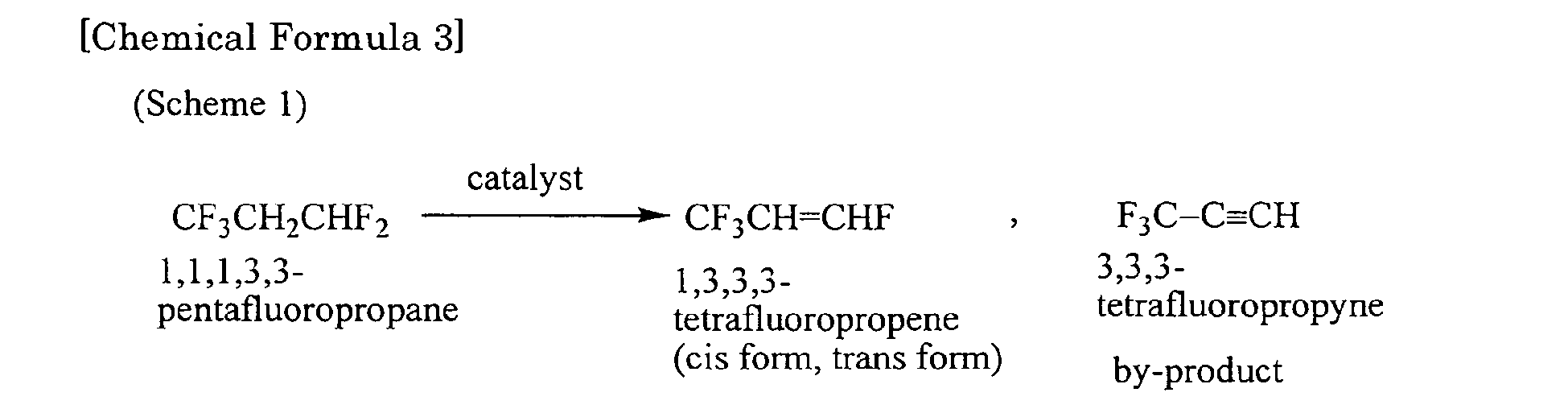
- The present inventors have found that it is possible to further suppress the production of 3,3,3-trifluoropropyne by conducting at the above reaction temperature. For example, in Examples 1-3, it is one of particularly preferable embodiments to adjust the reaction temperature to 300-350°C.
- In the method of the present invention, it is optional to supply an inert gas, such as nitrogen, helium and argon, simultaneously with 1,1,1,3,3-pentafluoropropane that is supplied to the reaction region. Furthermore, it is optional to make hydrogen fluoride coexistent.
- Although the reaction pressure is not particularly limited, it is preferable to conduct that at 0.1-10kg/cm2 from the aspect of apparatus. It is desirable to select a condition in which the raw material organic matter and hydrogen fluoride that exist in the system do not become liquid in the reaction system. The contact time is normally 0.1-300 seconds, preferably 5-200 seconds.
- It suffices that the reactor used in the present invention is made of a material having heat resistance and corrosion resistance against hydrogen fluoride, hydrogen chloride, etc., preferably stainless steel, Hastelloy, Monel, platinum, etc. Furthermore, it can also be made by a material lined with these metals.
- A product containing 1,3,3,3-tetrafluoropropene flowing out of the reactor after the treatment by the method of the present invention turns into a finished product through purification by a known method. The purification method is not limited. For example, it can be conducted firstly by washing the product, from which hydrogen fluoride to be recovered has previously been separated, with water or an alkali aqueous solution to remove acidic substances, such as hydrogen chloride and hydrogen fluoride, followed by drying and distillation to remove organic impurities.
- In the following, the present invention is explained in more detail by examples, but it is not limited to these embodiments. Herein, "%" of the compositional analysis value represents "areal %" of the composition obtained by measuring the reaction mixture directly by gas chromatography (unless particularly described, the detector is FID).
- [PREPARATION EXAMPLE 1] 4.5g of a special grade reagent ZrOCl2·8H2O was dissolved in ethanol. In this solution, 50mL of spherical alumina having a diameter of 5mm was immersed, followed by standing still for a whole day and night. Then, the solvent was distilled off, followed by drying at 150°C under reduced pressure. The obtained zirconium-carried alumina was placed into a cylindrical reaction tube that was equipped with an electric furnace, had a diameter of 2cm and a length of 40cm, and was made of SUS316. The temperature was increased to 200°C, while nitrogen gas was allowed to flow. At the time when no water outflow was found, nitrogen gas was accompanied with hydrogen fluoride, and its concentration was gradually increased. When hot spot due to fluorination of the placed zirconium compound-carried alumina reached an outlet end of the reaction tube, the reactor temperature was increased to 450°C. That condition was maintained for 1 hour to prepare the catalyst.
- [PREPARATION EXAMPLE 2] In a solution prepared by dissolving 3.3g of a special grade reagent ZrOCl2·8H2O in ethanol, 50mL of a granular activated carbon (Takeda Pharmaceutical Company Limited, GRANULAR SHIRO SAGI GX) having a diameter of 4-6mm was immersed, followed by standing still for a whole day and night. Then, the solvent was distilled off, followed by drying at 150°C under reduced pressure. The obtained zirconium compound-carried, activated carbon was placed into a cylindrical reaction tube that was equipped with an electric furnace, had a diameter of 2cm and a length of 40cm, and was made of SUS316. The temperature was increased to 200°C, while nitrogen gas was allowed to flow. At the time when no water outflow was found, nitrogen gas was accompanied with hydrogen fluoride, and its concentration was gradually increased. The reactor temperature was increased to 450°C, and that condition was maintained for 1 hour to prepare the catalyst.
- [PREPARATION EXAMPLE 3] Catalysts were prepared under the same conditions as those of Preparation Example 2, except in that special grade reagents MoCl5, TiCl4, IrCl4 and SnCl4 were used, and they were dissolved in ethanol or water to make solutions.
- 40mL of the catalyst prepared by Preparation Example 1 as catalyst was placed at around the center of a gas-phase reaction apparatus (made of SUS316, diameter: 2cm, length: 40cm) formed of a cylindrical reaction tube to be heated by an outside heating apparatus. While nitrogen gas was allowed to flow at a flow rate of about 200ml/minute, the temperature of the reaction tube was increased to 300°C, and it was continued to introduce hydrogen fluoride at a rate of about 0.2g/minute for 1 hour. The introduction of hydrogen fluoride and nitrogen gas was stopped, and it was started to supply the previously vaporized 1,1,1,3,3-pentafluoropropane as the raw material organic matter to the reactor at a rate of 0.15g/minute.
- One hour after the start of the reaction, the reaction became stable. Therefore, the produced gas discharging from the reactor was bubbled into water to remove acidic gas, followed by collecting with a dry ice/acetone trap. The collected organic matter was analyzed by gas chromatography, and the results are shown in Table 1.
- 40mL of the catalyst prepared by Preparation Example 2 as catalyst was placed at around the center of a gas-phase reaction apparatus (made by SUS316, diameter: 2cm, length: 40cm) formed of a cylindrical reaction tube to be heated by an outside heating apparatus. While nitrogen gas was allowed to flow at a flow rate of about 200ml/minute, the temperature of the reaction tube was increased to 400°C, and it was continued to introduce hydrogen fluoride at a rate of about 0.2g/minute for 1 hour. The temperature of the reaction tube was decreased to 350°C. The introduction of hydrogen fluoride and nitrogen gas was stopped, and it was started to supply the previously vaporized 1,1,1,3,3-pentafluoropropane as the raw material organic matter to the reactor at a rate of 0.15g/minute. The results are shown in Table 1.
- 40mL of a zirconia formed into a columnar form of 3x6mm was placed into a gas-phase reaction apparatus (made by SUS316, diameter: 2cm, length: 40cm) formed of a cylindrical reaction tube to be heated by an outside heating apparatus. While nitrogen gas was allowed to flow at a flow rate of about 400ml/minute, the temperature of the reaction tube was increased to 400°C, and it was continued to introduce hydrogen fluoride at a rate of about 0.2g/minute for 1 hour. The temperature of the reaction tube was decreased to 350°C. The introduction of hydrogen fluoride and nitrogen gas was stopped, and it was started to supply the previously vaporized 1,1,1,3,3-pentafluoropropane as the raw material organic matter to the reactor at a rate of 0.15g/minute. The results are shown in Table 1.
[Table 1] Raw Material Purity: 99.9% PFP Supply Rate g/min Reaction Temp. °C Product Composition (%) Conversion*1) Selectivity*2) PFP TeFP(t) TeFP(c) TFPy Example 1 0.15 300 5.88 75.48 17.70 0.47 94.02 99.11 Example 2 0.15 350 15.08 68.69 16.01 0.00 84.82 99.85 Example 3 0.15 350 8.73 74.98 15.29 0.12 91.17 99.02 Com. Ex. 1 0.15 300 59.16 33.71 7.14 0.00 40.74 100 Com. Ex. 2 0.15 350 41.83 47.31 10.70 0.00 58.07 99.91 Com. Ex. 3 0.15 300 87.28 10.05 2.53 0.01 12.61 99.72 Com. Ex. 4 0.15 350 54.30 36.78 8.64 0.00 45.59 99.61 Com. Ex. 5 0.15 300 73.96 21.61 4.33 0.00 25.94 100 Com. Ex. 6 0.15 350 52.48 39.33 7.98 0.00 47.41 99.77 Com. Ex. 7 0.15 300 88.98 8.53 2.19 0.00 10.92 98.17 Com. Ex. 8 0.15 350 72.69 20.65 5.51 0.00 27.21 96.15 PFP: 1,1,1,3,3-pentafluoropropane
TeFP(t): 1,3,3,3-tetrafluoropropene (trans)
TeFP(c): 1,3,3,3-tetrafluoropropene (cis)
TFPy: 3,3,3-trifluoropropyne
*1) Conversion (%) was calculated by (99.9% - product (%) of PFP)
*2) Selectivity (%) was calculated by 100x[(TeFP(t) + TeFP(c))/conversion]
For example) in the case of Example 1:
Conversion = 99.9%-5.88% = 94.02%
Selectivity = 100x [(75.48+17.70)/94.02] = 99.11% - Thus, in Examples 1-3, it is possible to obtain the target product with a higher conversion and a higher selectivity as compared with Comparative Examples by using the zirconium compound-carried catalyst in which a zirconium compound is carried on a metal oxide or activated carbon.
- The reactions were conducted in the same manner as that of Example 2, except in that the temperature of the reaction tube of 1,1,1,3,3-pentafluoropropane was each set to 300°C or 350°C and that the catalysts prepared by Preparation Example 3 (Comparative Examples 1-2: 5%Mo/C, Comparative Examples 3-4: 5%Ti/C, Comparative Examples 5-6: 5%Ir/C, Comparative Examples 7-8: 5%Sn/C) were used. The results are also each shown in Table 1.
- In examples in which other metals are carried, selectivity is good, but conversion is considerably low. Therefore, it is necessary to make the reaction conditions severer in order to make the reaction proceed well.
Thus, there is a difficulty somewhat in industrial production.
Claims (4)
- A method for producing 1,3,3,3-tetrafluoropropene by subjecting 1,1,1,3,3-pentafluoropropane to a dehydrofluorination reaction in gas phase in the presence of a catalyst, the method for producing 1,3,3,3-tetrafluoropropene being characterized in that there is used a zirconium compound-carried catalyst in which a zirconium compound is carried on a metal oxide or activated carbon.
- A method for producing 1,3,3,3-tetrafluoropropene according to claim 1, wherein the metal oxide is at least one selected from the group consisting of alumina, zirconia, titania, and magnesia.
- A method for producing 1,3,3,3-tetrafluoropropene according to claim 1 or claim 2, wherein the zirconium compound is at least one selected from the group consisting of oxides, fluorides, chlorides, fluorochlorides, oxyfluorides, oxychlorides, and oxyfluorochlorides.
- A method for producing 1,3,3,3-tetrafluoropropene by subjecting 1,1,1,3,3-pentafluoropropane to a dehydrofluorination reaction in gas phase in the presence of a catalyst, the method for producing 1,3,3,3-tetrafluoropropene being characterized in that zirconia is used as the catalyst.
Applications Claiming Priority (2)
| Application Number | Priority Date | Filing Date | Title |
|---|---|---|---|
| JP2006163485 | 2006-06-13 | ||
| PCT/JP2007/061741 WO2007145171A1 (en) | 2006-06-13 | 2007-06-11 | Method for producing 1,3,3,3-tetrafluoropropene |
Publications (3)
| Publication Number | Publication Date |
|---|---|
| EP2028172A1 true EP2028172A1 (en) | 2009-02-25 |
| EP2028172A4 EP2028172A4 (en) | 2011-05-11 |
| EP2028172B1 EP2028172B1 (en) | 2014-11-05 |
Family
ID=38831685
Family Applications (1)
| Application Number | Title | Priority Date | Filing Date |
|---|---|---|---|
| EP07745030.2A Not-in-force EP2028172B1 (en) | 2006-06-13 | 2007-06-11 | Method for producing 1,3,3,3-tetrafluoropropene |
Country Status (6)
| Country | Link |
|---|---|
| US (1) | US8115037B2 (en) |
| EP (1) | EP2028172B1 (en) |
| KR (1) | KR101057583B1 (en) |
| CN (1) | CN101466656B (en) |
| CA (1) | CA2653194C (en) |
| WO (1) | WO2007145171A1 (en) |
Cited By (6)
| Publication number | Priority date | Publication date | Assignee | Title |
|---|---|---|---|---|
| US8147709B2 (en) | 2008-05-07 | 2012-04-03 | E. I. Du Pont De Nemours And Company | Compositions comprising 3,3,3-trifluoropropyne |
| GB2492847A (en) * | 2011-07-15 | 2013-01-16 | Mexichem Amanco Holding Sa | A process for reducing TFMA content in R-1234 |
| WO2013164618A1 (en) * | 2012-05-02 | 2013-11-07 | Mexichem Amanco Holding S.A. De C.V. | Process for preparing a c3-c7 (hydro) fluoroalkene by dehydrohalogenation |
| EP3098281A1 (en) | 2014-09-25 | 2016-11-30 | Daikin Industries, Ltd. | Composition comprising hfc and hfo |
| EP2976318B1 (en) | 2013-03-20 | 2020-12-09 | Arkema France | Composition comprising hf and 1,3,3,3-tetrafluoropropene |
| EP3865468A4 (en) * | 2018-10-09 | 2023-01-11 | Daikin Industries, Ltd. | PROCESS FOR THE PREPARATION OF A PERFLUORALKINE COMPOUND |
Families Citing this family (25)
| Publication number | Priority date | Publication date | Assignee | Title |
|---|---|---|---|---|
| US8377327B2 (en) * | 2006-06-27 | 2013-02-19 | E I Du Pont De Nemours And Company | Tetrafluoropropene production processes |
| JP5416587B2 (en) | 2006-10-03 | 2014-02-12 | メキシケム、アマンコ、ホールディング、ソシエダッド、アノニマ、デ、カピタル、バリアブレ | process |
| GB0706978D0 (en) | 2007-04-11 | 2007-05-16 | Ineos Fluor Holdings Ltd | Process |
| JP5277813B2 (en) * | 2008-09-11 | 2013-08-28 | セントラル硝子株式会社 | Method for producing fluorinated propene |
| US7829748B1 (en) * | 2009-09-21 | 2010-11-09 | Honeywell International Inc. | Process for the manufacture of 1,3,3,3-tetrafluoropropene |
| US8513474B2 (en) | 2010-06-24 | 2013-08-20 | Honeywell International Inc. | Process for the manufacture of fluorinated olefins |
| JP6182989B2 (en) | 2012-06-28 | 2017-08-23 | セントラル硝子株式会社 | Method for producing 1,3,3,3-tetrafluoropropene |
| JP6107467B2 (en) * | 2012-06-29 | 2017-04-05 | セントラル硝子株式会社 | Process for producing 1-chloro-3,3,3-trifluoropropene |
| JP6251992B2 (en) | 2012-06-29 | 2017-12-27 | セントラル硝子株式会社 | Method for producing cis-1,3,3,3-tetrafluoropropene |
| US20150219874A1 (en) * | 2012-11-29 | 2015-08-06 | Carl Zeiss Smt Gmbh | Cooling system for at least one system component of an optical system for euv applications and system component of this type and optical system of this type |
| CN103880590B (en) | 2012-12-19 | 2016-10-05 | 中化蓝天集团有限公司 | A kind of technique preparing 1,3,3,3-tetrafluoropropene |
| US9187386B2 (en) * | 2013-05-23 | 2015-11-17 | The Chemours Company Fc, Llc | Catalytic process of making 1,3,3,3-tetrafluoropropene |
| CN110845295A (en) | 2014-08-14 | 2020-02-28 | 科慕埃弗西有限公司 | Process for the preparation of E-1, 3,3, 3-tetrafluoropropene (HFC-1234ze) by dehydrofluorination |
| CN105753641B (en) * | 2014-12-13 | 2018-08-31 | 西安近代化学研究所 | The preparation method of 1,3,3,3- tetrafluoropropenes |
| CN105753640B (en) * | 2014-12-13 | 2018-07-31 | 西安近代化学研究所 | A kind of preparation method of 1,3,3,3- tetrafluoropropenes |
| GB201615197D0 (en) | 2016-09-07 | 2016-10-19 | Mexichem Fluor Sa De Cv | Catalyst and process using the catalyst |
| GB201615209D0 (en) | 2016-09-07 | 2016-10-19 | Mexichem Fluor Sa De Cv | Catalyst and process using the catalyst |
| CN106866353B (en) * | 2016-12-28 | 2019-06-18 | 陕西延长石油集团氟硅化工有限公司 | A kind of method of synthesis of trans -1,3,3,3- tetrafluoropropene |
| GB201701099D0 (en) * | 2017-01-23 | 2017-03-08 | Mexichem Fluor Sa De Cv | Process |
| BR112021022059A2 (en) | 2018-10-26 | 2021-12-28 | Chemours Co Fc Llc | Fluoropropene compositions, methods of producing a mixture and cooling, processes for transferring heat, for treating a surface and for forming a composition, refrigeration system, refrigeration apparatus, use of the fluoropropene composition and method for replacing a soda |
| US11209196B2 (en) | 2018-10-26 | 2021-12-28 | The Chemours Company Fc, Llc | HFO-1234ZE, HFO-1225ZC and HFO-1234YF compositions and processes for producing and using the compositions |
| GB2580623A (en) | 2019-01-17 | 2020-07-29 | Mexichem Fluor Sa De Cv | Method |
| CN110013865A (en) * | 2019-05-23 | 2019-07-16 | 浙江师范大学 | A kind of catalyst for preparing HFO-1234ze by cracking HFC-245fa and preparation method thereof |
| CN111054402B (en) * | 2020-02-18 | 2022-11-11 | 浙江工业大学 | TiOF 2 Catalyst, preparation method and application thereof |
| CN116143583B (en) * | 2023-04-19 | 2023-07-07 | 山东澳帆新材料有限公司 | A kind of coproduction preparation method of 2,3,3,3-tetrafluoropropene and 1,3,3,3-tetrafluoropropene |
Family Cites Families (9)
| Publication number | Priority date | Publication date | Assignee | Title |
|---|---|---|---|---|
| US2480560A (en) | 1945-12-06 | 1949-08-30 | Kinetic Chemicals Inc | Method for pyrolyzing polyfluoroalkanes |
| JPH0967281A (en) | 1995-09-01 | 1997-03-11 | Daikin Ind Ltd | Method for producing 1,1,1,3,3-pentafluoropropene and method for producing 1,1,1,3,3-pentafluoropropane |
| US5986151A (en) * | 1997-02-05 | 1999-11-16 | Alliedsignal Inc. | Fluorinated propenes from pentafluoropropane |
| JP3886229B2 (en) | 1997-11-11 | 2007-02-28 | セントラル硝子株式会社 | Method for producing 1,3,3,3-tetrafluoropropene |
| US6124510A (en) | 1998-07-21 | 2000-09-26 | Elf Atochem North America, Inc. | 1234ze preparation |
| US20050119512A1 (en) * | 2003-04-29 | 2005-06-02 | Central Glass Company, Limited | Fluorobutene derivatives and process for producing same |
| US7592494B2 (en) * | 2003-07-25 | 2009-09-22 | Honeywell International Inc. | Process for the manufacture of 1,3,3,3-tetrafluoropropene |
| US20050038302A1 (en) * | 2003-08-13 | 2005-02-17 | Hedrick Vicki E. | Systems and methods for producing fluorocarbons |
| WO2006043946A1 (en) * | 2004-10-18 | 2006-04-27 | Central Glass Co., Ltd. | A method for producing 4,4,4-trifluorobutane-2-one |
-
2007
- 2007-06-11 EP EP07745030.2A patent/EP2028172B1/en not_active Not-in-force
- 2007-06-11 WO PCT/JP2007/061741 patent/WO2007145171A1/en not_active Ceased
- 2007-06-11 CN CN2007800211797A patent/CN101466656B/en active Active
- 2007-06-11 KR KR1020087031508A patent/KR101057583B1/en not_active Expired - Fee Related
- 2007-06-11 CA CA2653194A patent/CA2653194C/en not_active Expired - Fee Related
-
2008
- 2008-12-12 US US12/334,157 patent/US8115037B2/en not_active Expired - Fee Related
Cited By (24)
| Publication number | Priority date | Publication date | Assignee | Title |
|---|---|---|---|---|
| US8147709B2 (en) | 2008-05-07 | 2012-04-03 | E. I. Du Pont De Nemours And Company | Compositions comprising 3,3,3-trifluoropropyne |
| US8333902B2 (en) | 2008-05-07 | 2012-12-18 | E I Du Pont De Nemours And Company | Compositions comprising 1,1,1,2,3-pentafluoropropane or 2,3,3,3- tetrafluoropropene |
| EP2271724B1 (en) * | 2008-05-07 | 2013-04-24 | E. I. Du Pont de Nemours and Company | Compositions comprising 2,3,3,3- tetrafluoropropene |
| US8692037B2 (en) | 2008-05-07 | 2014-04-08 | E I Du Pont De Nemours And Company | Compositions comprising 1,1,1,2,3-pentafluoropropane or 2,3,3,3-tetrafluoropropene |
| USRE47862E1 (en) | 2008-05-07 | 2020-02-18 | The Chemours Company Fc, Llc | Compositions comprising 1,1,1,2,3-pentafluoropropane or 2,3,3,3-tetrafluoropropene |
| GB2492847A (en) * | 2011-07-15 | 2013-01-16 | Mexichem Amanco Holding Sa | A process for reducing TFMA content in R-1234 |
| WO2013011291A1 (en) * | 2011-07-15 | 2013-01-24 | Mexichem Amanco Holding S.A. De C.V. | Process for purifying tetrafluoropropene |
| WO2013164618A1 (en) * | 2012-05-02 | 2013-11-07 | Mexichem Amanco Holding S.A. De C.V. | Process for preparing a c3-c7 (hydro) fluoroalkene by dehydrohalogenation |
| US10167242B2 (en) | 2012-05-02 | 2019-01-01 | Mexichem Amanco Holding S.A. De C.V. | Process for preparing a C3-C7 (hydro) fluoroalkene by dehydrohalogenation |
| EP2976318B1 (en) | 2013-03-20 | 2020-12-09 | Arkema France | Composition comprising hf and 1,3,3,3-tetrafluoropropene |
| EP3023472B1 (en) | 2014-09-25 | 2019-11-06 | Daikin Industries, Ltd. | Composition containing hfc and hfo |
| EP3284797B1 (en) | 2014-09-25 | 2020-12-16 | Daikin Industries, Ltd. | Composition comprising hfc and hfo |
| CN109971432A (en) * | 2014-09-25 | 2019-07-05 | 大金工业株式会社 | Compositions containing HFC and HFO |
| EP3284797A1 (en) | 2014-09-25 | 2018-02-21 | Daikin Industries, Ltd. | Composition comprising hfc and hfo |
| EP3239269B1 (en) | 2014-09-25 | 2020-07-01 | Daikin Industries, Ltd. | Composition comprising hfc and hfo |
| EP3098281B1 (en) | 2014-09-25 | 2020-07-22 | Daikin Industries, Ltd. | Composition comprising hfc and hfo |
| EP3098281A1 (en) | 2014-09-25 | 2016-11-30 | Daikin Industries, Ltd. | Composition comprising hfc and hfo |
| CN110003860A (en) * | 2014-09-25 | 2019-07-12 | 大金工业株式会社 | Compositions containing HFC and HFO |
| CN110003860B (en) * | 2014-09-25 | 2022-01-04 | 大金工业株式会社 | Compositions containing HFC and HFO |
| CN109971432B (en) * | 2014-09-25 | 2022-02-01 | 大金工业株式会社 | Compositions containing HFC and HFO |
| EP4050081B1 (en) | 2014-09-25 | 2025-01-22 | Daikin Industries, Ltd. | Composition comprising hfc and hfo |
| EP3239269B2 (en) † | 2014-09-25 | 2023-12-20 | Daikin Industries, Ltd. | Composition comprising hfc and hfo |
| EP3805336B1 (en) | 2014-09-25 | 2024-05-22 | Daikin Industries, Ltd. | Refrigeerator comprising a composition comprising hfc and hfo |
| EP3865468A4 (en) * | 2018-10-09 | 2023-01-11 | Daikin Industries, Ltd. | PROCESS FOR THE PREPARATION OF A PERFLUORALKINE COMPOUND |
Also Published As
| Publication number | Publication date |
|---|---|
| CN101466656A (en) | 2009-06-24 |
| CA2653194A1 (en) | 2007-12-21 |
| US20090099395A1 (en) | 2009-04-16 |
| CN101466656B (en) | 2013-07-03 |
| US8115037B2 (en) | 2012-02-14 |
| KR101057583B1 (en) | 2011-08-17 |
| CA2653194C (en) | 2010-11-09 |
| EP2028172B1 (en) | 2014-11-05 |
| KR20090017642A (en) | 2009-02-18 |
| WO2007145171A1 (en) | 2007-12-21 |
| EP2028172A4 (en) | 2011-05-11 |
Similar Documents
| Publication | Publication Date | Title |
|---|---|---|
| EP2028172B1 (en) | Method for producing 1,3,3,3-tetrafluoropropene | |
| JP4693811B2 (en) | Method for producing 1,3,3,3-tetrafluoropropene | |
| EP2552873B1 (en) | Method for making hexafluoro-2-butene | |
| EP2091897B1 (en) | Processes for the production of fluoropropanes and halopropenes and azeotropic compositions of 2-chloro-3,3,3-trifluoro-1-propene with hf and of 1,1,1,2,2-pentafluoropropane with hf | |
| US7678949B2 (en) | Process for the preparation of 1,3,3,3-tetrafluoropropene and/or 2,3,3,3-tetrafluoropropene | |
| CA2539936C (en) | Process for the preparation of 1,1,1,3,3-pentafluoropropane and 1,1,1,2,3-pentafluoropropane | |
| US8487144B2 (en) | Process for producing fluorinated propene | |
| CN101821220B (en) | Method for producing trans-1,3,3,3-tetrafluoropropene | |
| US7663007B2 (en) | Process for the preparation of 1,3,3,3-tetrafluoropropene and/or 1,1,3,3,3-pentafluoropropene | |
| WO2017049026A1 (en) | Novel process for manufacturing 2-chloro-3,3,3-trifluoropropene from 1,2-dichloro-3,3,3-trifluoropropene | |
| US7091388B2 (en) | Method of making 1,1,3,3,3-pentafluoropropene | |
| JPH107604A (en) | Production of 1,3,3,3-tetrafluoropropene | |
| US20140357907A1 (en) | Process for Producing 1,2-Dichloro-3,3,3-Trifluoropropene | |
| WO2014003068A1 (en) | Method for producing cis-1,3,3,3-tetrafluoropropene | |
| JPH107605A (en) | Production of 1,3,3,3-tetrafluoropropene | |
| US8017817B2 (en) | Process for the preparation of 1,1,3,3,3-pentafluoropropene and 1,2,3,3,3-pentafluoropropene | |
| WO2007019353A1 (en) | Process for the preparation of 1,1,1,3,3-pentafluoropropane and 1,1,1,2,3-pentafluoropropane | |
| US6235950B1 (en) | Method of making hydrofluorocarbons | |
| US7659436B2 (en) | Process for the preparation of 1,1,1,3,3-penta-fluoropropane and/or 1,1,1,3,3,3-hexafluoropropane | |
| US10843988B2 (en) | Method for producing 1-chloro-3,3,3-trifluoropropene |
Legal Events
| Date | Code | Title | Description |
|---|---|---|---|
| PUAI | Public reference made under article 153(3) epc to a published international application that has entered the european phase |
Free format text: ORIGINAL CODE: 0009012 |
|
| 17P | Request for examination filed |
Effective date: 20081212 |
|
| AK | Designated contracting states |
Kind code of ref document: A1 Designated state(s): AT BE BG CH CY CZ DE DK EE ES FI FR GB GR HU IE IS IT LI LT LU LV MC MT NL PL PT RO SE SI SK TR |
|
| AX | Request for extension of the european patent |
Extension state: AL BA HR MK RS |
|
| A4 | Supplementary search report drawn up and despatched |
Effective date: 20110408 |
|
| DAX | Request for extension of the european patent (deleted) | ||
| 17Q | First examination report despatched |
Effective date: 20130419 |
|
| GRAP | Despatch of communication of intention to grant a patent |
Free format text: ORIGINAL CODE: EPIDOSNIGR1 |
|
| INTG | Intention to grant announced |
Effective date: 20131030 |
|
| GRAP | Despatch of communication of intention to grant a patent |
Free format text: ORIGINAL CODE: EPIDOSNIGR1 |
|
| INTG | Intention to grant announced |
Effective date: 20140602 |
|
| GRAS | Grant fee paid |
Free format text: ORIGINAL CODE: EPIDOSNIGR3 |
|
| GRAA | (expected) grant |
Free format text: ORIGINAL CODE: 0009210 |
|
| AK | Designated contracting states |
Kind code of ref document: B1 Designated state(s): AT BE BG CH CY CZ DE DK EE ES FI FR GB GR HU IE IS IT LI LT LU LV MC MT NL PL PT RO SE SI SK TR |
|
| REG | Reference to a national code |
Ref country code: GB Ref legal event code: FG4D |
|
| REG | Reference to a national code |
Ref country code: CH Ref legal event code: EP |
|
| REG | Reference to a national code |
Ref country code: AT Ref legal event code: REF Ref document number: 694528 Country of ref document: AT Kind code of ref document: T Effective date: 20141115 |
|
| REG | Reference to a national code |
Ref country code: IE Ref legal event code: FG4D |
|
| REG | Reference to a national code |
Ref country code: DE Ref legal event code: R096 Ref document number: 602007039140 Country of ref document: DE Effective date: 20141224 |
|
| REG | Reference to a national code |
Ref country code: AT Ref legal event code: MK05 Ref document number: 694528 Country of ref document: AT Kind code of ref document: T Effective date: 20141105 |
|
| REG | Reference to a national code |
Ref country code: NL Ref legal event code: VDEP Effective date: 20141105 |
|
| REG | Reference to a national code |
Ref country code: LT Ref legal event code: MG4D |
|
| PG25 | Lapsed in a contracting state [announced via postgrant information from national office to epo] |
Ref country code: LT Free format text: LAPSE BECAUSE OF FAILURE TO SUBMIT A TRANSLATION OF THE DESCRIPTION OR TO PAY THE FEE WITHIN THE PRESCRIBED TIME-LIMIT Effective date: 20141105 Ref country code: NL Free format text: LAPSE BECAUSE OF FAILURE TO SUBMIT A TRANSLATION OF THE DESCRIPTION OR TO PAY THE FEE WITHIN THE PRESCRIBED TIME-LIMIT Effective date: 20141105 Ref country code: IS Free format text: LAPSE BECAUSE OF FAILURE TO SUBMIT A TRANSLATION OF THE DESCRIPTION OR TO PAY THE FEE WITHIN THE PRESCRIBED TIME-LIMIT Effective date: 20150305 Ref country code: FI Free format text: LAPSE BECAUSE OF FAILURE TO SUBMIT A TRANSLATION OF THE DESCRIPTION OR TO PAY THE FEE WITHIN THE PRESCRIBED TIME-LIMIT Effective date: 20141105 Ref country code: ES Free format text: LAPSE BECAUSE OF FAILURE TO SUBMIT A TRANSLATION OF THE DESCRIPTION OR TO PAY THE FEE WITHIN THE PRESCRIBED TIME-LIMIT Effective date: 20141105 Ref country code: PT Free format text: LAPSE BECAUSE OF FAILURE TO SUBMIT A TRANSLATION OF THE DESCRIPTION OR TO PAY THE FEE WITHIN THE PRESCRIBED TIME-LIMIT Effective date: 20150305 |
|
| PG25 | Lapsed in a contracting state [announced via postgrant information from national office to epo] |
Ref country code: LV Free format text: LAPSE BECAUSE OF FAILURE TO SUBMIT A TRANSLATION OF THE DESCRIPTION OR TO PAY THE FEE WITHIN THE PRESCRIBED TIME-LIMIT Effective date: 20141105 Ref country code: PL Free format text: LAPSE BECAUSE OF FAILURE TO SUBMIT A TRANSLATION OF THE DESCRIPTION OR TO PAY THE FEE WITHIN THE PRESCRIBED TIME-LIMIT Effective date: 20141105 Ref country code: GR Free format text: LAPSE BECAUSE OF FAILURE TO SUBMIT A TRANSLATION OF THE DESCRIPTION OR TO PAY THE FEE WITHIN THE PRESCRIBED TIME-LIMIT Effective date: 20150206 Ref country code: AT Free format text: LAPSE BECAUSE OF FAILURE TO SUBMIT A TRANSLATION OF THE DESCRIPTION OR TO PAY THE FEE WITHIN THE PRESCRIBED TIME-LIMIT Effective date: 20141105 Ref country code: SE Free format text: LAPSE BECAUSE OF FAILURE TO SUBMIT A TRANSLATION OF THE DESCRIPTION OR TO PAY THE FEE WITHIN THE PRESCRIBED TIME-LIMIT Effective date: 20141105 Ref country code: CY Free format text: LAPSE BECAUSE OF FAILURE TO SUBMIT A TRANSLATION OF THE DESCRIPTION OR TO PAY THE FEE WITHIN THE PRESCRIBED TIME-LIMIT Effective date: 20141105 |
|
| PG25 | Lapsed in a contracting state [announced via postgrant information from national office to epo] |
Ref country code: SK Free format text: LAPSE BECAUSE OF FAILURE TO SUBMIT A TRANSLATION OF THE DESCRIPTION OR TO PAY THE FEE WITHIN THE PRESCRIBED TIME-LIMIT Effective date: 20141105 Ref country code: RO Free format text: LAPSE BECAUSE OF FAILURE TO SUBMIT A TRANSLATION OF THE DESCRIPTION OR TO PAY THE FEE WITHIN THE PRESCRIBED TIME-LIMIT Effective date: 20141105 Ref country code: EE Free format text: LAPSE BECAUSE OF FAILURE TO SUBMIT A TRANSLATION OF THE DESCRIPTION OR TO PAY THE FEE WITHIN THE PRESCRIBED TIME-LIMIT Effective date: 20141105 Ref country code: CZ Free format text: LAPSE BECAUSE OF FAILURE TO SUBMIT A TRANSLATION OF THE DESCRIPTION OR TO PAY THE FEE WITHIN THE PRESCRIBED TIME-LIMIT Effective date: 20141105 Ref country code: DK Free format text: LAPSE BECAUSE OF FAILURE TO SUBMIT A TRANSLATION OF THE DESCRIPTION OR TO PAY THE FEE WITHIN THE PRESCRIBED TIME-LIMIT Effective date: 20141105 |
|
| REG | Reference to a national code |
Ref country code: DE Ref legal event code: R097 Ref document number: 602007039140 Country of ref document: DE |
|
| PLBE | No opposition filed within time limit |
Free format text: ORIGINAL CODE: 0009261 |
|
| STAA | Information on the status of an ep patent application or granted ep patent |
Free format text: STATUS: NO OPPOSITION FILED WITHIN TIME LIMIT |
|
| 26N | No opposition filed |
Effective date: 20150806 |
|
| PG25 | Lapsed in a contracting state [announced via postgrant information from national office to epo] |
Ref country code: MC Free format text: LAPSE BECAUSE OF FAILURE TO SUBMIT A TRANSLATION OF THE DESCRIPTION OR TO PAY THE FEE WITHIN THE PRESCRIBED TIME-LIMIT Effective date: 20141105 |
|
| REG | Reference to a national code |
Ref country code: CH Ref legal event code: PL |
|
| PG25 | Lapsed in a contracting state [announced via postgrant information from national office to epo] |
Ref country code: SI Free format text: LAPSE BECAUSE OF FAILURE TO SUBMIT A TRANSLATION OF THE DESCRIPTION OR TO PAY THE FEE WITHIN THE PRESCRIBED TIME-LIMIT Effective date: 20141105 Ref country code: LU Free format text: LAPSE BECAUSE OF FAILURE TO SUBMIT A TRANSLATION OF THE DESCRIPTION OR TO PAY THE FEE WITHIN THE PRESCRIBED TIME-LIMIT Effective date: 20150611 |
|
| REG | Reference to a national code |
Ref country code: IE Ref legal event code: MM4A |
|
| PG25 | Lapsed in a contracting state [announced via postgrant information from national office to epo] |
Ref country code: LI Free format text: LAPSE BECAUSE OF NON-PAYMENT OF DUE FEES Effective date: 20150630 Ref country code: CH Free format text: LAPSE BECAUSE OF NON-PAYMENT OF DUE FEES Effective date: 20150630 Ref country code: IE Free format text: LAPSE BECAUSE OF NON-PAYMENT OF DUE FEES Effective date: 20150611 |
|
| REG | Reference to a national code |
Ref country code: FR Ref legal event code: PLFP Year of fee payment: 10 |
|
| PG25 | Lapsed in a contracting state [announced via postgrant information from national office to epo] |
Ref country code: MT Free format text: LAPSE BECAUSE OF FAILURE TO SUBMIT A TRANSLATION OF THE DESCRIPTION OR TO PAY THE FEE WITHIN THE PRESCRIBED TIME-LIMIT Effective date: 20141105 |
|
| PG25 | Lapsed in a contracting state [announced via postgrant information from national office to epo] |
Ref country code: HU Free format text: LAPSE BECAUSE OF FAILURE TO SUBMIT A TRANSLATION OF THE DESCRIPTION OR TO PAY THE FEE WITHIN THE PRESCRIBED TIME-LIMIT; INVALID AB INITIO Effective date: 20070611 Ref country code: BG Free format text: LAPSE BECAUSE OF FAILURE TO SUBMIT A TRANSLATION OF THE DESCRIPTION OR TO PAY THE FEE WITHIN THE PRESCRIBED TIME-LIMIT Effective date: 20141105 |
|
| REG | Reference to a national code |
Ref country code: FR Ref legal event code: PLFP Year of fee payment: 11 |
|
| PG25 | Lapsed in a contracting state [announced via postgrant information from national office to epo] |
Ref country code: TR Free format text: LAPSE BECAUSE OF FAILURE TO SUBMIT A TRANSLATION OF THE DESCRIPTION OR TO PAY THE FEE WITHIN THE PRESCRIBED TIME-LIMIT Effective date: 20141105 |
|
| PG25 | Lapsed in a contracting state [announced via postgrant information from national office to epo] |
Ref country code: BE Free format text: LAPSE BECAUSE OF FAILURE TO SUBMIT A TRANSLATION OF THE DESCRIPTION OR TO PAY THE FEE WITHIN THE PRESCRIBED TIME-LIMIT Effective date: 20141105 |
|
| REG | Reference to a national code |
Ref country code: FR Ref legal event code: PLFP Year of fee payment: 12 |
|
| PGFP | Annual fee paid to national office [announced via postgrant information from national office to epo] |
Ref country code: DE Payment date: 20190528 Year of fee payment: 13 Ref country code: IT Payment date: 20190620 Year of fee payment: 13 |
|
| PGFP | Annual fee paid to national office [announced via postgrant information from national office to epo] |
Ref country code: FR Payment date: 20190510 Year of fee payment: 13 |
|
| PGFP | Annual fee paid to national office [announced via postgrant information from national office to epo] |
Ref country code: GB Payment date: 20190605 Year of fee payment: 13 |
|
| REG | Reference to a national code |
Ref country code: DE Ref legal event code: R119 Ref document number: 602007039140 Country of ref document: DE |
|
| GBPC | Gb: european patent ceased through non-payment of renewal fee |
Effective date: 20200611 |
|
| PG25 | Lapsed in a contracting state [announced via postgrant information from national office to epo] |
Ref country code: FR Free format text: LAPSE BECAUSE OF NON-PAYMENT OF DUE FEES Effective date: 20200630 Ref country code: GB Free format text: LAPSE BECAUSE OF NON-PAYMENT OF DUE FEES Effective date: 20200611 |
|
| PG25 | Lapsed in a contracting state [announced via postgrant information from national office to epo] |
Ref country code: DE Free format text: LAPSE BECAUSE OF NON-PAYMENT OF DUE FEES Effective date: 20210101 |
|
| PG25 | Lapsed in a contracting state [announced via postgrant information from national office to epo] |
Ref country code: IT Free format text: LAPSE BECAUSE OF NON-PAYMENT OF DUE FEES Effective date: 20200611 |