EP2022787A1 - Process for the preparation of N-1 protected N ring nitrogen containing cyclic polyamines and products thereof - Google Patents
Process for the preparation of N-1 protected N ring nitrogen containing cyclic polyamines and products thereof Download PDFInfo
- Publication number
- EP2022787A1 EP2022787A1 EP08163998A EP08163998A EP2022787A1 EP 2022787 A1 EP2022787 A1 EP 2022787A1 EP 08163998 A EP08163998 A EP 08163998A EP 08163998 A EP08163998 A EP 08163998A EP 2022787 A1 EP2022787 A1 EP 2022787A1
- Authority
- EP
- European Patent Office
- Prior art keywords
- multiplet
- compound
- equivalents
- comprises adding
- mixture
- Prior art date
- Legal status (The legal status is an assumption and is not a legal conclusion. Google has not performed a legal analysis and makes no representation as to the accuracy of the status listed.)
- Granted
Links
- 238000000034 method Methods 0.000 title claims description 31
- 230000008569 process Effects 0.000 title claims description 19
- 229920000768 polyamine Polymers 0.000 title abstract description 28
- 238000002360 preparation method Methods 0.000 title description 19
- 150000001875 compounds Chemical class 0.000 claims description 49
- OKKJLVBELUTLKV-UHFFFAOYSA-N Methanol Chemical compound OC OKKJLVBELUTLKV-UHFFFAOYSA-N 0.000 claims description 39
- MDAXKAUIABOHTD-UHFFFAOYSA-N 1,4,8,11-tetraazacyclotetradecane Chemical compound C1CNCCNCCCNCCNC1 MDAXKAUIABOHTD-UHFFFAOYSA-N 0.000 claims description 29
- BWHMMNNQKKPAPP-UHFFFAOYSA-L potassium carbonate Chemical compound [K+].[K+].[O-]C([O-])=O BWHMMNNQKKPAPP-UHFFFAOYSA-L 0.000 claims description 22
- 239000000203 mixture Substances 0.000 claims description 21
- WEVYAHXRMPXWCK-UHFFFAOYSA-N Acetonitrile Chemical compound CC#N WEVYAHXRMPXWCK-UHFFFAOYSA-N 0.000 claims description 14
- STSCVKRWJPWALQ-UHFFFAOYSA-N TRIFLUOROACETIC ACID ETHYL ESTER Chemical compound CCOC(=O)C(F)(F)F STSCVKRWJPWALQ-UHFFFAOYSA-N 0.000 claims description 14
- 150000001412 amines Chemical class 0.000 claims description 12
- 239000002904 solvent Substances 0.000 claims description 12
- 229910000027 potassium carbonate Inorganic materials 0.000 claims description 11
- ZMANZCXQSJIPKH-UHFFFAOYSA-N Triethylamine Chemical group CCN(CC)CC ZMANZCXQSJIPKH-UHFFFAOYSA-N 0.000 claims description 10
- 239000002253 acid Substances 0.000 claims description 9
- 125000000325 methylidene group Chemical group [H]C([H])=* 0.000 claims description 8
- 150000003335 secondary amines Chemical class 0.000 claims description 7
- XLYOFNOQVPJJNP-UHFFFAOYSA-N water Substances O XLYOFNOQVPJJNP-UHFFFAOYSA-N 0.000 claims description 7
- 239000003085 diluting agent Substances 0.000 claims description 6
- 125000004044 trifluoroacetyl group Chemical group FC(C(=O)*)(F)F 0.000 claims description 6
- 239000003795 chemical substances by application Substances 0.000 claims description 4
- 229910052751 metal Inorganic materials 0.000 claims description 4
- 239000002184 metal Substances 0.000 claims description 4
- 229910052760 oxygen Inorganic materials 0.000 claims description 4
- YAJIMXYFYCOBMX-UHFFFAOYSA-N 1-[4,8-bis(2,2,2-trifluoroacetyl)-1,4,8,11-tetrazacyclotetradec-1-yl]-2,2,2-trifluoroethanone Chemical compound FC(F)(F)C(=O)N1CCCN(C(=O)C(F)(F)F)CCN(C(=O)C(F)(F)F)CCCNCC1 YAJIMXYFYCOBMX-UHFFFAOYSA-N 0.000 claims description 3
- NINIDFKCEFEMDL-UHFFFAOYSA-N Sulfur Chemical compound [S] NINIDFKCEFEMDL-UHFFFAOYSA-N 0.000 claims description 3
- UADLUJIUAQAUHR-UHFFFAOYSA-N 2,5-dichloro-5,6-dimethylcyclohexa-1,3-diene Chemical group CC1C=C(Cl)C=CC1(C)Cl UADLUJIUAQAUHR-UHFFFAOYSA-N 0.000 claims description 2
- 150000004703 alkoxides Chemical class 0.000 claims description 2
- XMBWDFGMSWQBCA-UHFFFAOYSA-M iodide Chemical compound [I-] XMBWDFGMSWQBCA-UHFFFAOYSA-M 0.000 claims description 2
- VMVNZNXAVJHNDJ-UHFFFAOYSA-N methyl 2,2,2-trifluoroacetate Chemical compound COC(=O)C(F)(F)F VMVNZNXAVJHNDJ-UHFFFAOYSA-N 0.000 claims description 2
- DPKBAXPHAYBPRL-UHFFFAOYSA-M tetrabutylazanium;iodide Chemical compound [I-].CCCC[N+](CCCC)(CCCC)CCCC DPKBAXPHAYBPRL-UHFFFAOYSA-M 0.000 claims description 2
- 239000012351 deprotecting agent Substances 0.000 claims 4
- QGZKDVFQNNGYKY-UHFFFAOYSA-N Ammonia Chemical compound N QGZKDVFQNNGYKY-UHFFFAOYSA-N 0.000 claims 2
- BVKZGUZCCUSVTD-UHFFFAOYSA-L Carbonate Chemical compound [O-]C([O-])=O BVKZGUZCCUSVTD-UHFFFAOYSA-L 0.000 claims 2
- 239000003495 polar organic solvent Substances 0.000 claims 2
- 239000011541 reaction mixture Substances 0.000 claims 2
- 239000005864 Sulphur Substances 0.000 claims 1
- 150000007513 acids Chemical class 0.000 claims 1
- 229910021529 ammonia Inorganic materials 0.000 claims 1
- IDGUHHHQCWSQLU-UHFFFAOYSA-N ethanol;hydrate Chemical compound O.CCO IDGUHHHQCWSQLU-UHFFFAOYSA-N 0.000 claims 1
- 229910000000 metal hydroxide Inorganic materials 0.000 claims 1
- 150000004692 metal hydroxides Chemical class 0.000 claims 1
- 125000004122 cyclic group Chemical group 0.000 abstract description 26
- YIQPUIGJQJDJOS-UHFFFAOYSA-N plerixafor Chemical compound C=1C=C(CN2CCNCCCNCCNCCC2)C=CC=1CN1CCCNCCNCCCNCC1 YIQPUIGJQJDJOS-UHFFFAOYSA-N 0.000 abstract description 14
- 238000004519 manufacturing process Methods 0.000 abstract description 10
- 238000010511 deprotection reaction Methods 0.000 abstract description 8
- QJGQUHMNIGDVPM-UHFFFAOYSA-N nitrogen group Chemical group [N] QJGQUHMNIGDVPM-UHFFFAOYSA-N 0.000 abstract description 7
- 125000003277 amino group Chemical group 0.000 abstract description 3
- 125000001153 fluoro group Chemical group F* 0.000 abstract 1
- HEDRZPFGACZZDS-MICDWDOJSA-N Trichloro(2H)methane Chemical compound [2H]C(Cl)(Cl)Cl HEDRZPFGACZZDS-MICDWDOJSA-N 0.000 description 26
- 238000006243 chemical reaction Methods 0.000 description 26
- IJGRMHOSHXDMSA-UHFFFAOYSA-N Atomic nitrogen Chemical compound N#N IJGRMHOSHXDMSA-UHFFFAOYSA-N 0.000 description 17
- -1 acyclic cyclam dimer Chemical class 0.000 description 17
- 239000000047 product Substances 0.000 description 17
- YMWUJEATGCHHMB-UHFFFAOYSA-N Dichloromethane Chemical compound ClCCl YMWUJEATGCHHMB-UHFFFAOYSA-N 0.000 description 12
- XEKOWRVHYACXOJ-UHFFFAOYSA-N Ethyl acetate Chemical compound CCOC(C)=O XEKOWRVHYACXOJ-UHFFFAOYSA-N 0.000 description 12
- YXFVVABEGXRONW-UHFFFAOYSA-N Toluene Chemical compound CC1=CC=CC=C1 YXFVVABEGXRONW-UHFFFAOYSA-N 0.000 description 12
- KSSJBGNOJJETTC-UHFFFAOYSA-N COC1=C(C=CC=C1)N(C1=CC=2C3(C4=CC(=CC=C4C=2C=C1)N(C1=CC=C(C=C1)OC)C1=C(C=CC=C1)OC)C1=CC(=CC=C1C=1C=CC(=CC=13)N(C1=CC=C(C=C1)OC)C1=C(C=CC=C1)OC)N(C1=CC=C(C=C1)OC)C1=C(C=CC=C1)OC)C1=CC=C(C=C1)OC Chemical compound COC1=C(C=CC=C1)N(C1=CC=2C3(C4=CC(=CC=C4C=2C=C1)N(C1=CC=C(C=C1)OC)C1=C(C=CC=C1)OC)C1=CC(=CC=C1C=1C=CC(=CC=13)N(C1=CC=C(C=C1)OC)C1=C(C=CC=C1)OC)N(C1=CC=C(C=C1)OC)C1=C(C=CC=C1)OC)C1=CC=C(C=C1)OC KSSJBGNOJJETTC-UHFFFAOYSA-N 0.000 description 11
- 238000005160 1H NMR spectroscopy Methods 0.000 description 10
- LFQSCWFLJHTTHZ-UHFFFAOYSA-N Ethanol Chemical compound CCO LFQSCWFLJHTTHZ-UHFFFAOYSA-N 0.000 description 10
- 239000000543 intermediate Substances 0.000 description 9
- 229910052757 nitrogen Inorganic materials 0.000 description 9
- 239000000243 solution Substances 0.000 description 9
- QBPPRVHXOZRESW-UHFFFAOYSA-N 1,4,7,10-tetraazacyclododecane Chemical compound C1CNCCNCCNCCN1 QBPPRVHXOZRESW-UHFFFAOYSA-N 0.000 description 8
- 125000003118 aryl group Chemical group 0.000 description 8
- 239000007787 solid Substances 0.000 description 8
- 125000002015 acyclic group Chemical group 0.000 description 7
- 239000000654 additive Substances 0.000 description 7
- 150000004649 carbonic acid derivatives Chemical class 0.000 description 7
- 125000006239 protecting group Chemical group 0.000 description 7
- 239000003223 protective agent Substances 0.000 description 7
- 239000003039 volatile agent Substances 0.000 description 7
- QTBSBXVTEAMEQO-UHFFFAOYSA-N Acetic acid Chemical compound CC(O)=O QTBSBXVTEAMEQO-UHFFFAOYSA-N 0.000 description 6
- GLUUGHFHXGJENI-UHFFFAOYSA-N Piperazine Chemical compound C1CNCCN1 GLUUGHFHXGJENI-UHFFFAOYSA-N 0.000 description 6
- 125000001931 aliphatic group Chemical group 0.000 description 6
- 125000000217 alkyl group Chemical group 0.000 description 6
- 238000005804 alkylation reaction Methods 0.000 description 6
- 150000004982 aromatic amines Chemical class 0.000 description 6
- 230000015572 biosynthetic process Effects 0.000 description 6
- 239000012039 electrophile Substances 0.000 description 6
- VLKZOEOYAKHREP-UHFFFAOYSA-N n-Hexane Chemical compound CCCCCC VLKZOEOYAKHREP-UHFFFAOYSA-N 0.000 description 6
- 238000001644 13C nuclear magnetic resonance spectroscopy Methods 0.000 description 5
- VYPSYNLAJGMNEJ-UHFFFAOYSA-N Silicium dioxide Chemical compound O=[Si]=O VYPSYNLAJGMNEJ-UHFFFAOYSA-N 0.000 description 5
- 230000029936 alkylation Effects 0.000 description 5
- 239000003153 chemical reaction reagent Substances 0.000 description 5
- 235000019439 ethyl acetate Nutrition 0.000 description 5
- 150000003839 salts Chemical class 0.000 description 5
- 239000000741 silica gel Substances 0.000 description 5
- 229910002027 silica gel Inorganic materials 0.000 description 5
- CDBYLPFSWZWCQE-UHFFFAOYSA-L sodium carbonate Substances [Na+].[Na+].[O-]C([O-])=O CDBYLPFSWZWCQE-UHFFFAOYSA-L 0.000 description 5
- 238000003786 synthesis reaction Methods 0.000 description 5
- ITWBWJFEJCHKSN-UHFFFAOYSA-N 1,4,7-triazonane Chemical compound C1CNCCNCCN1 ITWBWJFEJCHKSN-UHFFFAOYSA-N 0.000 description 4
- 125000003342 alkenyl group Chemical group 0.000 description 4
- 125000003545 alkoxy group Chemical group 0.000 description 4
- 125000004432 carbon atom Chemical group C* 0.000 description 4
- 125000001072 heteroaryl group Chemical group 0.000 description 4
- 229920000642 polymer Polymers 0.000 description 4
- 229910000029 sodium carbonate Inorganic materials 0.000 description 4
- 238000007070 tosylation reaction Methods 0.000 description 4
- BVKZGUZCCUSVTD-UHFFFAOYSA-M Bicarbonate Chemical class OC([O-])=O BVKZGUZCCUSVTD-UHFFFAOYSA-M 0.000 description 3
- DGAQECJNVWCQMB-PUAWFVPOSA-M Ilexoside XXIX Chemical compound C[C@@H]1CC[C@@]2(CC[C@@]3(C(=CC[C@H]4[C@]3(CC[C@@H]5[C@@]4(CC[C@@H](C5(C)C)OS(=O)(=O)[O-])C)C)[C@@H]2[C@]1(C)O)C)C(=O)O[C@H]6[C@@H]([C@H]([C@@H]([C@H](O6)CO)O)O)O.[Na+] DGAQECJNVWCQMB-PUAWFVPOSA-M 0.000 description 3
- KFZMGEQAYNKOFK-UHFFFAOYSA-N Isopropanol Chemical compound CC(C)O KFZMGEQAYNKOFK-UHFFFAOYSA-N 0.000 description 3
- 229910019142 PO4 Inorganic materials 0.000 description 3
- 239000003513 alkali Substances 0.000 description 3
- 125000000304 alkynyl group Chemical group 0.000 description 3
- 150000004645 aluminates Chemical class 0.000 description 3
- QVGXLLKOCUKJST-UHFFFAOYSA-N atomic oxygen Chemical compound [O] QVGXLLKOCUKJST-UHFFFAOYSA-N 0.000 description 3
- 125000003178 carboxy group Chemical group [H]OC(*)=O 0.000 description 3
- 125000000753 cycloalkyl group Chemical group 0.000 description 3
- 239000003480 eluent Substances 0.000 description 3
- 150000004820 halides Chemical class 0.000 description 3
- 150000007529 inorganic bases Chemical class 0.000 description 3
- 150000002678 macrocyclic compounds Chemical class 0.000 description 3
- 230000004048 modification Effects 0.000 description 3
- 238000012986 modification Methods 0.000 description 3
- 239000001301 oxygen Substances 0.000 description 3
- 235000021317 phosphate Nutrition 0.000 description 3
- 150000003013 phosphoric acid derivatives Chemical class 0.000 description 3
- 150000003141 primary amines Chemical class 0.000 description 3
- 238000001953 recrystallisation Methods 0.000 description 3
- 229920005989 resin Polymers 0.000 description 3
- 239000011347 resin Substances 0.000 description 3
- 238000003756 stirring Methods 0.000 description 3
- 125000002088 tosyl group Chemical group [H]C1=C([H])C(=C([H])C([H])=C1C([H])([H])[H])S(*)(=O)=O 0.000 description 3
- 238000010626 work up procedure Methods 0.000 description 3
- FMCAFXHLMUOIGG-IWFBPKFRSA-N (2s)-2-[[(2s)-2-[[(2s)-2-[[(2r)-2-formamido-3-sulfanylpropanoyl]amino]-3-methylbutanoyl]amino]-3-(4-hydroxy-2,5-dimethylphenyl)propanoyl]amino]-4-methylsulfanylbutanoic acid Chemical compound O=CN[C@@H](CS)C(=O)N[C@@H](C(C)C)C(=O)N[C@H](C(=O)N[C@@H](CCSC)C(O)=O)CC1=CC(C)=C(O)C=C1C FMCAFXHLMUOIGG-IWFBPKFRSA-N 0.000 description 2
- AKXKKSAGNHWXPQ-UHFFFAOYSA-N 1,2-dibromo-3,4-dimethylbenzene Chemical group CC1=CC=C(Br)C(Br)=C1C AKXKKSAGNHWXPQ-UHFFFAOYSA-N 0.000 description 2
- IOXZZNMTQBXRFR-UHFFFAOYSA-N 1-[4,7-bis(2,2,2-trifluoroacetyl)-1,4,7,10-tetrazacyclododec-1-yl]-2,2,2-trifluoroethanone Chemical compound FC(F)(F)C(=O)N1CCNCCN(C(=O)C(F)(F)F)CCN(C(=O)C(F)(F)F)CC1 IOXZZNMTQBXRFR-UHFFFAOYSA-N 0.000 description 2
- VSPUNALNEZUPHN-UHFFFAOYSA-N 1-[4,8-bis(2,2,3,3,3-pentafluoropropanoyl)-1,4,8,11-tetrazacyclotetradec-1-yl]-2,2,3,3,3-pentafluoropropan-1-one Chemical compound FC(F)(F)C(F)(F)C(=O)N1CCCN(C(=O)C(F)(F)C(F)(F)F)CCN(C(=O)C(F)(F)C(F)(F)F)CCCNCC1 VSPUNALNEZUPHN-UHFFFAOYSA-N 0.000 description 2
- LZIPBJBQQPZLOR-UHFFFAOYSA-N 2-(4-methylphenyl)sulfonyloxyethyl 4-methylbenzenesulfonate Chemical compound C1=CC(C)=CC=C1S(=O)(=O)OCCOS(=O)(=O)C1=CC=C(C)C=C1 LZIPBJBQQPZLOR-UHFFFAOYSA-N 0.000 description 2
- BMYNFMYTOJXKLE-UHFFFAOYSA-N 3-azaniumyl-2-hydroxypropanoate Chemical compound NCC(O)C(O)=O BMYNFMYTOJXKLE-UHFFFAOYSA-N 0.000 description 2
- YYROPELSRYBVMQ-UHFFFAOYSA-N 4-toluenesulfonyl chloride Chemical compound CC1=CC=C(S(Cl)(=O)=O)C=C1 YYROPELSRYBVMQ-UHFFFAOYSA-N 0.000 description 2
- HEDRZPFGACZZDS-UHFFFAOYSA-N Chloroform Chemical compound ClC(Cl)Cl HEDRZPFGACZZDS-UHFFFAOYSA-N 0.000 description 2
- OAKJQQAXSVQMHS-UHFFFAOYSA-N Hydrazine Chemical compound NN OAKJQQAXSVQMHS-UHFFFAOYSA-N 0.000 description 2
- CPELXLSAUQHCOX-UHFFFAOYSA-N Hydrogen bromide Chemical class Br CPELXLSAUQHCOX-UHFFFAOYSA-N 0.000 description 2
- ZMXDDKWLCZADIW-UHFFFAOYSA-N N,N-Dimethylformamide Chemical compound CN(C)C=O ZMXDDKWLCZADIW-UHFFFAOYSA-N 0.000 description 2
- LRHPLDYGYMQRHN-UHFFFAOYSA-N N-Butanol Chemical compound CCCCO LRHPLDYGYMQRHN-UHFFFAOYSA-N 0.000 description 2
- WYURNTSHIVDZCO-UHFFFAOYSA-N Tetrahydrofuran Chemical compound C1CCOC1 WYURNTSHIVDZCO-UHFFFAOYSA-N 0.000 description 2
- AMNPXXIGUOKIPP-UHFFFAOYSA-N [4-(carbamothioylamino)phenyl]thiourea Chemical compound NC(=S)NC1=CC=C(NC(N)=S)C=C1 AMNPXXIGUOKIPP-UHFFFAOYSA-N 0.000 description 2
- 229960000583 acetic acid Drugs 0.000 description 2
- 230000000996 additive effect Effects 0.000 description 2
- 239000002168 alkylating agent Substances 0.000 description 2
- 229940100198 alkylating agent Drugs 0.000 description 2
- 230000036436 anti-hiv Effects 0.000 description 2
- 239000003125 aqueous solvent Substances 0.000 description 2
- 239000002585 base Substances 0.000 description 2
- 125000005518 carboxamido group Chemical group 0.000 description 2
- 239000003638 chemical reducing agent Substances 0.000 description 2
- 238000004587 chromatography analysis Methods 0.000 description 2
- 238000004440 column chromatography Methods 0.000 description 2
- 230000008878 coupling Effects 0.000 description 2
- 238000010168 coupling process Methods 0.000 description 2
- 238000005859 coupling reaction Methods 0.000 description 2
- 238000005881 detosylation reaction Methods 0.000 description 2
- 150000002118 epoxides Chemical class 0.000 description 2
- 239000006260 foam Substances 0.000 description 2
- 229910052736 halogen Inorganic materials 0.000 description 2
- 150000002367 halogens Chemical class 0.000 description 2
- BHEPBYXIRTUNPN-UHFFFAOYSA-N hydridophosphorus(.) (triplet) Chemical class [PH] BHEPBYXIRTUNPN-UHFFFAOYSA-N 0.000 description 2
- 230000007062 hydrolysis Effects 0.000 description 2
- 238000006460 hydrolysis reaction Methods 0.000 description 2
- 125000004356 hydroxy functional group Chemical group O* 0.000 description 2
- 239000012948 isocyanate Substances 0.000 description 2
- 150000002513 isocyanates Chemical class 0.000 description 2
- 125000005647 linker group Chemical group 0.000 description 2
- 238000005710 macrocyclization reaction Methods 0.000 description 2
- 239000012038 nucleophile Substances 0.000 description 2
- 125000000843 phenylene group Chemical group C1(=C(C=CC=C1)*)* 0.000 description 2
- 125000002924 primary amino group Chemical group [H]N([H])* 0.000 description 2
- 238000000746 purification Methods 0.000 description 2
- 230000009467 reduction Effects 0.000 description 2
- 238000006722 reduction reaction Methods 0.000 description 2
- 238000007363 ring formation reaction Methods 0.000 description 2
- 238000007127 saponification reaction Methods 0.000 description 2
- 229910052717 sulfur Inorganic materials 0.000 description 2
- 239000011593 sulfur Substances 0.000 description 2
- 125000005490 tosylate group Chemical group 0.000 description 2
- ITMCEJHCFYSIIV-UHFFFAOYSA-M triflate Chemical compound [O-]S(=O)(=O)C(F)(F)F ITMCEJHCFYSIIV-UHFFFAOYSA-M 0.000 description 2
- 150000003672 ureas Chemical class 0.000 description 2
- UZPZYFDULMKDMB-UHFFFAOYSA-N 1,2-dichloro-3,4-dimethylbenzene Chemical group CC1=CC=C(Cl)C(Cl)=C1C UZPZYFDULMKDMB-UHFFFAOYSA-N 0.000 description 1
- RKWMORBZZNTHCD-UHFFFAOYSA-N 1,4,7-triazonane-1,4-diium 2,2,2-trifluoroacetate Chemical compound OC(=O)C(F)(F)F.OC(=O)C(F)(F)F.C1CNCCNCCN1 RKWMORBZZNTHCD-UHFFFAOYSA-N 0.000 description 1
- 238000004293 19F NMR spectroscopy Methods 0.000 description 1
- ZVWNYNDJHKNAHV-UHFFFAOYSA-N 2,2,2-trifluoro-1-[4-(2,2,2-trifluoroacetyl)-1,4,7-triazonan-1-yl]ethanone Chemical compound FC(F)(F)C(=O)N1CCNCCN(C(=O)C(F)(F)F)CC1 ZVWNYNDJHKNAHV-UHFFFAOYSA-N 0.000 description 1
- ZUSZPUNTECJHJZ-UHFFFAOYSA-N 2,3-dibromo-1,4-dimethylbenzene Chemical group CC1=CC=C(C)C(Br)=C1Br ZUSZPUNTECJHJZ-UHFFFAOYSA-N 0.000 description 1
- BEBQYPFPMBNGNG-UHFFFAOYSA-N 2,5-dibromo-5,6-dimethylcyclohexa-1,3-diene Chemical group CC1C=C(Br)C=CC1(C)Br BEBQYPFPMBNGNG-UHFFFAOYSA-N 0.000 description 1
- UHXNZIVRNXDVIZ-UHFFFAOYSA-N 2-(1,4,7-triazonan-1-yl)acetamide Chemical compound NC(=O)CN1CCNCCNCC1 UHXNZIVRNXDVIZ-UHFFFAOYSA-N 0.000 description 1
- JUIKUQOUMZUFQT-UHFFFAOYSA-N 2-bromoacetamide Chemical compound NC(=O)CBr JUIKUQOUMZUFQT-UHFFFAOYSA-N 0.000 description 1
- ZOXJGFHDIHLPTG-UHFFFAOYSA-N Boron Chemical compound [B] ZOXJGFHDIHLPTG-UHFFFAOYSA-N 0.000 description 1
- ODKBXYWBDNLGRS-UHFFFAOYSA-N COC(N1CCNCCCNCCNCCC1)=O Chemical compound COC(N1CCNCCCNCCNCCC1)=O ODKBXYWBDNLGRS-UHFFFAOYSA-N 0.000 description 1
- OKTJSMMVPCPJKN-UHFFFAOYSA-N Carbon Chemical compound [C] OKTJSMMVPCPJKN-UHFFFAOYSA-N 0.000 description 1
- VVNCNSJFMMFHPL-VKHMYHEASA-N D-penicillamine Chemical group CC(C)(S)[C@@H](N)C(O)=O VVNCNSJFMMFHPL-VKHMYHEASA-N 0.000 description 1
- RPNUMPOLZDHAAY-UHFFFAOYSA-N Diethylenetriamine Chemical compound NCCNCCN RPNUMPOLZDHAAY-UHFFFAOYSA-N 0.000 description 1
- KCXVZYZYPLLWCC-UHFFFAOYSA-N EDTA Chemical compound OC(=O)CN(CC(O)=O)CCN(CC(O)=O)CC(O)=O KCXVZYZYPLLWCC-UHFFFAOYSA-N 0.000 description 1
- 229910004373 HOAc Inorganic materials 0.000 description 1
- VEXZGXHMUGYJMC-UHFFFAOYSA-N Hydrochloric acid Chemical class Cl VEXZGXHMUGYJMC-UHFFFAOYSA-N 0.000 description 1
- AFVFQIVMOAPDHO-UHFFFAOYSA-N Methanesulfonic acid Chemical compound CS(O)(=O)=O AFVFQIVMOAPDHO-UHFFFAOYSA-N 0.000 description 1
- QPCDCPDFJACHGM-UHFFFAOYSA-N N,N-bis{2-[bis(carboxymethyl)amino]ethyl}glycine Chemical compound OC(=O)CN(CC(O)=O)CCN(CC(=O)O)CCN(CC(O)=O)CC(O)=O QPCDCPDFJACHGM-UHFFFAOYSA-N 0.000 description 1
- ZMZDMBWJUHKJPS-UHFFFAOYSA-M Thiocyanate anion Chemical compound [S-]C#N ZMZDMBWJUHKJPS-UHFFFAOYSA-M 0.000 description 1
- 239000007983 Tris buffer Substances 0.000 description 1
- 230000002378 acidificating effect Effects 0.000 description 1
- 125000002252 acyl group Chemical group 0.000 description 1
- 150000001298 alcohols Chemical class 0.000 description 1
- 150000008052 alkyl sulfonates Chemical class 0.000 description 1
- 230000002152 alkylating effect Effects 0.000 description 1
- 150000001408 amides Chemical class 0.000 description 1
- 238000013459 approach Methods 0.000 description 1
- 125000005228 aryl sulfonate group Chemical group 0.000 description 1
- 125000004429 atom Chemical group 0.000 description 1
- HSDAJNMJOMSNEV-UHFFFAOYSA-N benzyl chloroformate Chemical compound ClC(=O)OCC1=CC=CC=C1 HSDAJNMJOMSNEV-UHFFFAOYSA-N 0.000 description 1
- 125000001797 benzyl group Chemical group [H]C1=C([H])C([H])=C(C([H])=C1[H])C([H])([H])* 0.000 description 1
- 229910052796 boron Inorganic materials 0.000 description 1
- 229910052794 bromium Inorganic materials 0.000 description 1
- 229910052799 carbon Inorganic materials 0.000 description 1
- 150000003857 carboxamides Chemical class 0.000 description 1
- 238000009903 catalytic hydrogenation reaction Methods 0.000 description 1
- 239000002738 chelating agent Substances 0.000 description 1
- 229910052801 chlorine Inorganic materials 0.000 description 1
- 238000011161 development Methods 0.000 description 1
- 229940039227 diagnostic agent Drugs 0.000 description 1
- 239000000032 diagnostic agent Substances 0.000 description 1
- 150000004985 diamines Chemical class 0.000 description 1
- 230000000694 effects Effects 0.000 description 1
- 238000000921 elemental analysis Methods 0.000 description 1
- 150000002148 esters Chemical class 0.000 description 1
- 238000000605 extraction Methods 0.000 description 1
- 238000001914 filtration Methods 0.000 description 1
- 239000012467 final product Substances 0.000 description 1
- 239000012458 free base Substances 0.000 description 1
- 125000000524 functional group Chemical group 0.000 description 1
- 239000012362 glacial acetic acid Substances 0.000 description 1
- 239000011521 glass Substances 0.000 description 1
- 150000002429 hydrazines Chemical class 0.000 description 1
- ZMZDMBWJUHKJPS-UHFFFAOYSA-N hydrogen thiocyanate Natural products SC#N ZMZDMBWJUHKJPS-UHFFFAOYSA-N 0.000 description 1
- 150000004679 hydroxides Chemical class 0.000 description 1
- 125000002768 hydroxyalkyl group Chemical group 0.000 description 1
- 239000005457 ice water Substances 0.000 description 1
- 229910017053 inorganic salt Inorganic materials 0.000 description 1
- 229910052740 iodine Inorganic materials 0.000 description 1
- 238000002955 isolation Methods 0.000 description 1
- 239000000463 material Substances 0.000 description 1
- MJGFBOZCAJSGQW-UHFFFAOYSA-N mercury sodium Chemical compound [Na].[Hg] MJGFBOZCAJSGQW-UHFFFAOYSA-N 0.000 description 1
- CYEBJEDOHLIWNP-UHFFFAOYSA-N methanethioamide Chemical compound NC=S CYEBJEDOHLIWNP-UHFFFAOYSA-N 0.000 description 1
- GBMDVOWEEQVZKZ-UHFFFAOYSA-N methanol;hydrate Chemical compound O.OC GBMDVOWEEQVZKZ-UHFFFAOYSA-N 0.000 description 1
- AGJSNMGHAVDLRQ-IWFBPKFRSA-N methyl (2s)-2-[[(2s)-2-[[(2s)-2-[[(2r)-2-amino-3-sulfanylpropanoyl]amino]-3-methylbutanoyl]amino]-3-(4-hydroxy-2,3-dimethylphenyl)propanoyl]amino]-4-methylsulfanylbutanoate Chemical group SC[C@H](N)C(=O)N[C@@H](C(C)C)C(=O)N[C@H](C(=O)N[C@@H](CCSC)C(=O)OC)CC1=CC=C(O)C(C)=C1C AGJSNMGHAVDLRQ-IWFBPKFRSA-N 0.000 description 1
- JMKJCPUVEMZGEC-UHFFFAOYSA-N methyl 2,2,3,3,3-pentafluoropropanoate Chemical compound COC(=O)C(F)(F)C(F)(F)F JMKJCPUVEMZGEC-UHFFFAOYSA-N 0.000 description 1
- 125000002496 methyl group Chemical group [H]C([H])([H])* 0.000 description 1
- 125000004170 methylsulfonyl group Chemical group [H]C([H])([H])S(*)(=O)=O 0.000 description 1
- 125000004433 nitrogen atom Chemical group N* 0.000 description 1
- 239000012454 non-polar solvent Substances 0.000 description 1
- 239000003960 organic solvent Substances 0.000 description 1
- 230000003647 oxidation Effects 0.000 description 1
- 238000007254 oxidation reaction Methods 0.000 description 1
- 125000006340 pentafluoro ethyl group Chemical group FC(F)(F)C(F)(F)* 0.000 description 1
- 229960003330 pentetic acid Drugs 0.000 description 1
- 125000000951 phenoxy group Chemical group [H]C1=C([H])C([H])=C(O*)C([H])=C1[H] 0.000 description 1
- DGTNSSLYPYDJGL-UHFFFAOYSA-N phenyl isocyanate Chemical compound O=C=NC1=CC=CC=C1 DGTNSSLYPYDJGL-UHFFFAOYSA-N 0.000 description 1
- LFGREXWGYUGZLY-UHFFFAOYSA-N phosphoryl Chemical group [P]=O LFGREXWGYUGZLY-UHFFFAOYSA-N 0.000 description 1
- 230000000865 phosphorylative effect Effects 0.000 description 1
- 229960002169 plerixafor Drugs 0.000 description 1
- 239000002798 polar solvent Substances 0.000 description 1
- BDERNNFJNOPAEC-UHFFFAOYSA-N propan-1-ol Chemical compound CCCO BDERNNFJNOPAEC-UHFFFAOYSA-N 0.000 description 1
- 239000012264 purified product Substances 0.000 description 1
- 239000012429 reaction media Substances 0.000 description 1
- 230000009257 reactivity Effects 0.000 description 1
- 238000006268 reductive amination reaction Methods 0.000 description 1
- 230000002829 reductive effect Effects 0.000 description 1
- 238000010992 reflux Methods 0.000 description 1
- 229920006395 saturated elastomer Polymers 0.000 description 1
- 238000000926 separation method Methods 0.000 description 1
- 238000010898 silica gel chromatography Methods 0.000 description 1
- 239000011734 sodium Substances 0.000 description 1
- 229910001023 sodium amalgam Inorganic materials 0.000 description 1
- BEOOHQFXGBMRKU-UHFFFAOYSA-N sodium cyanoborohydride Chemical compound [Na+].[B-]C#N BEOOHQFXGBMRKU-UHFFFAOYSA-N 0.000 description 1
- 239000011877 solvent mixture Substances 0.000 description 1
- 239000007858 starting material Substances 0.000 description 1
- 125000000547 substituted alkyl group Chemical group 0.000 description 1
- QAOWNCQODCNURD-UHFFFAOYSA-N sulfuric acid Substances OS(O)(=O)=O QAOWNCQODCNURD-UHFFFAOYSA-N 0.000 description 1
- 239000000725 suspension Substances 0.000 description 1
- KUCOHFSKRZZVRO-UHFFFAOYSA-N terephthalaldehyde Chemical compound O=CC1=CC=C(C=O)C=C1 KUCOHFSKRZZVRO-UHFFFAOYSA-N 0.000 description 1
- LXEJRKJRKIFVNY-UHFFFAOYSA-N terephthaloyl chloride Chemical compound ClC(=O)C1=CC=C(C(Cl)=O)C=C1 LXEJRKJRKIFVNY-UHFFFAOYSA-N 0.000 description 1
- 150000003567 thiocyanates Chemical class 0.000 description 1
- 150000007944 thiolates Chemical class 0.000 description 1
- JOXIMZWYDAKGHI-UHFFFAOYSA-N toluene-4-sulfonic acid Chemical compound CC1=CC=C(S(O)(=O)=O)C=C1 JOXIMZWYDAKGHI-UHFFFAOYSA-N 0.000 description 1
- 229940086542 triethylamine Drugs 0.000 description 1
- 150000008648 triflates Chemical class 0.000 description 1
Images


Classifications
-
- C—CHEMISTRY; METALLURGY
- C07—ORGANIC CHEMISTRY
- C07D—HETEROCYCLIC COMPOUNDS
- C07D255/00—Heterocyclic compounds containing rings having three nitrogen atoms as the only ring hetero atoms, not provided for by groups C07D249/00 - C07D253/00
- C07D255/02—Heterocyclic compounds containing rings having three nitrogen atoms as the only ring hetero atoms, not provided for by groups C07D249/00 - C07D253/00 not condensed with other rings
-
- C—CHEMISTRY; METALLURGY
- C07—ORGANIC CHEMISTRY
- C07D—HETEROCYCLIC COMPOUNDS
- C07D257/00—Heterocyclic compounds containing rings having four nitrogen atoms as the only ring hetero atoms
- C07D257/02—Heterocyclic compounds containing rings having four nitrogen atoms as the only ring hetero atoms not condensed with other rings
Definitions
- the present invention relates to the area of selective protection of identical amino groups in cyclic polyamines, and preferably, relates to an improved process for preparing 1, 1'-[1,4-phenylenebis (methylene)]-bis1,4,8,11-tetraazacyclotetradecane.
- J. Med. Chem, Vol. 38, No. 2, pgs. 366-378 (1995 ) is directed to the synthesis and anti-HIV activity of a series of novel phenylbis(methylene)-linked bis-tetraazamacrocyclic analogs, including 1, 1'-[1,4-phenylenebis (methylene)]-bis 1,4,8,11-tetraazacyclotetradecane.
- This compound and its analogs are prepared by: 1) forming the tritosylate of the tetraazamacrocycle; 2) reacting the protected tetraazamacrocycle with an organic dihalide, e.g., dibromo-p-xylene, in acetonitrile in the presence of a base such as potassium carbonate; and 3) de-protecting the bis-tetraazamacrocycle prepared in 2) employing freshly prepared sodium amalgam, concentrated sulfuric acid or an acetic acid/hydrobromic acid mixture to obtain the desired cyclam dimer in the form of a salt.
- organic dihalide e.g., dibromo-p-xylene
- U.S. Pat. No. 5,047,527 is directed to a process for preparing a mono-functionalized (e.g., monoalkylated) cyclic tetraamine comprising: 1) reacting the unprotected macrocycle with chrominum hexacarbonyl to obtain a triprotected tetraazacycloalkane compound; 2) reacting the free amine group of the triprotected compound prepared in 1) with an organic halide to obtain a triprotected mono-functionalized tetraazacycloalkane compound; and 3) deprotecting the compound prepared in 2) by simple air oxidation to obtain the desired compound.
- a mono-functionalized (e.g., monoalkylated) cyclic tetraamine comprising: 1) reacting the unprotected macrocycle with chrominum hexacarbonyl to obtain a triprotected tetraazacycloalkane compound; 2) reacting the free amine group of the triprotected compound prepared in 1) with an organic
- the reference discloses alternative methods of tri-protection of cyclic tetraamine employing boron and phosphorous derivatives. These tri-protected intermediates are used in the preparation of linked compounds, including the cyclam dimer 1, 1'-[1,4-phenylenebis (methylene)]-bis1,4,8,11-tetraazacyclotetradecane, by reacting with an organic dihalide in a molar ratio of 2:1, followed by deprotection.
- Synthetic Communications, 28(15), pgs. 2903-2906, (1998 ) describes an improved method adopting the above-mentioned phosphorous protection, deprotection sequence to make 1, 1'-[1,4-phenylenebis (methylene)]-bis1,4,8,11-tetraazacyclotetradecane.
- U.S. Pat. No. 5,606,053 is directed to a process for preparing cyclam dimer 1, 1'-[1,4-phenylenebis (methylene)]-bis1,4,8,11-tetraazacyclotetradecane.
- the compound is prepared by: 1) tosylation of tetraamine starting material to obtain an acyclic ditosyl intermediate and an acyclic tritosyl intermediate; 2) separation of the two different tosylation product from step 1), e.g.
- the ditosyl tetraamine and the tritosyl tetraamine 3) alkylation of the ditosyl tetraamine with dibromoxylene, followed by tosylation to make hexatosylated acyclic cyclam dimer; 4) alkylation of the tritosyl tetraamine from 1); 5) cyclization of the compound prepared in steps 3) and 4), i.e., the bridged hexatosyl acyclic dimer, by reacting it with three equivalents of ethylene glycol ditosylate; 6) detosylation of the cyclized cyclam dimer by reacting with a mixture of hydrobromic acid and glacial acetic acid to obtain the product in the form of an HBr salt.
- U. S. Pat. No. 5,801,281 is directed to an improved process for preparing the cyclam dimer 1, 1'-[1,4-phenylenebis (methylene)]-bis1,4,8,11-tetraazacyclotetradecane.
- the compound is prepared by: 1) reacting the acyclic tetraamine with 3 equivalents of ethyl trifluoroacetate; 2) alkylation of the tri-protected acyclic tetraamine with 0.5 equivalents of dibromoxylene, to obtain the 1,4 phenylene bis-methylene bridged acyclic dimer; 3) hydrolysis to remove the six trifluoroacetyl groups of the compound prepared in step 2); 4) tosylation of the compound prepared in step 3) to obtain the hexatosylated bridged tetraamine dimer; 5) cyclization of the compound in step 4) with ethylene glycol ditosylate to obtain the hexatosylated cyclam dimer; 6) detosylation of the compound prepared in step 5) to obtain the cyclam dimer 1, 1'-[1,4-phenylenebis (methylene)]-bis1,4,8,11-tetraazacyclotetradecane in the form of
- U.S. Pat. No. 5064956 discloses a process for preparing mono-alkylated polyazamacrocycles by reacting unprotected macrocycle with an electrophile in an aprotic, relatively non-polar solvent in the absence of a base. No example resembling the synthesis of cyclam dimer was provided.
- Protecting groups such as tosyl, mesyl, Boc etc have been tested and vigorously optimized.
- U.S. Pat. No. 5,705,637 discloses a process for preparing tri-benzylated macrocycles following a macrocyclization/amide reduction sequence. The three benzyl groups are removed eventually to afford mono-substituted cyclen.
- N-1 protected cyclic macrocyclic polyamines of the present invention are useful, after necessary additional protection deprotection steps, for the preparation of N-1 substituted cyclic polyamines.
- Tetrahedron Letters Vol. 36. No. 41, pgs 7357-7360, (1995 ) relates to examples using single equivalent ethyl trifluoroacetate to selectively protect di-primary amines and di-secondary amines.
- One case involving a six-membered diamine piperazine demonstrated a moderate selectivity of 5.8:1 when one equivalent of ethyl trifluoroacetate is used per equivalent of piperazine. It is noted that treatment of piperazine with excess ethyl trifluoroacetate readily produces more double (full) protected product, thus significantly reduced selectivity.
- U.S. Pat. No. 6,080,785 relates to new mono-functionalized ethylenediaminetetraacetic acid, diethylenetriaminepentaacetic acid and triethylenetetraaminehexaacetic acid derivatives.
- a linear 1,4,7-triazaheptane was treated with 1.1 equivalents of ethyl trifluoroacetate and produced a mixture of monoamide and diamide at a ratio of 9 : 1. This mixture was carried further to the next step.
- the present invention is based on the discovery that, when certain protecting agents are used to protect cyclic polyamines containing N ring nitrogen (N ⁇ 3) with each nitrogen being separated by 2 or more carbon atoms , the rate of reaction will slow down sharply once N-1 nitrogens are protected, even when all of the nitrogens in the cyclic polyamine are originally chemically equivalent. These controlled reactions thus afford, in an excellent yield, the important N-1 protected polyazamacrocycles at high selectivity.
- the present invention relates, for example, to efficient high yielding N- protection of cyclic polyamines containing a total of N amine nitrogens, where the ring has from 9 to 20 ring members and N is from 3 to 6 amine nitrogens spaced by 2 or more carbon atoms, using fluroronated acid esters and other structurally related protecting agents (formula III ).
- the resultant protected amines prepared by this method are useful intermediates for the preparation of selectively N-substituted protected cyclic polyamines.
- the protected selectively N-substituted cyclic polyamine is readily deprotected under mild conditions to form selectively N-substituted cyclic polyamines.
- the current invention discloses, inter alia , the high yielding tri-protection of 1,4,8,11-tetraazacyclotetradecane (cyclam), 1,4,7,10-tetraazacyclododecane (cyclen) and di-protection of 1,4,7-triazacyclononane using agents such as those represented by formula III.
- the present invention provides an extremely efficient and economic process for preparing 1, 1'-[1,4-phenylenebis (methylene)]-bis1,4,8,11-tetraazacyclotetradecane from cyclam, by using protecting groups such as, but not limited to, trifluoroacetyl, following a reaction sequence of tri-protection, alkylation and deprotection.
- protecting groups such as, but not limited to, trifluoroacetyl
- the present invention relates to N-1 (i.e. all but one) protection of cyclic polyamines containing a total of N amine nitrogens on the ring system, where the ring has from 9 to 20 ring members and contains from 3 to 6 amine nitrogens spaced by 2 or more carbon atoms, using trifluoroacetyl and other structurally related protecting agents as represented by formula III.
- applicable cyclic polyamine may be represented by formulas I and II, where m and m' represent from 0 to 2 inclusive, preferably from 0 to 1 inclusive carbons; n, n'and n" represent from 1 to 3 inclusive, preferably from 1 to 2 inclusive carbons; m, m', n, n' and n"may be identical or different for any specific compound.
- one or more carbon atoms on the ring may also be substituted with one or more atoms such as oxygen and/or sulfur.
- the protecting agents are represented by formula III, where X is a fluoro-substituted, preferably perfluoro substituted aromatic, heteroaromatic, alkyl, alkenyl and/or alkynyl group, more preferably perfluoro substituted linear or branched alkyl group, most preferably perfluoro substituted saturated linear alkyl group containing 1-5 carbons, and further wherein X is preferably CyHpFz, wherein y is from 1 to 10 inclusive, p is from 0 to 20 inclusive, preferably 0 to 5, more preferably 0 to 2, and z is from 1 to 21 inclusive, preferably 1 to 9, more preferably 1 to 5; Lv is a moderately reactive nitrogen, oxygen, or sulfur containing leaving group such as, but not limited to, alkoxy, phenoxy, mercaptyl, imidazoyl, N-hydroxysuccinyl or other nitrogen or oxygen containing group preferably alkoxy containing 1-6 carbons, more preferably C1-C4.
- This N-1 protection reaction may be carried out in the presence of a diluting agent or a combination of diluting agents, such as: a C1-C12, preferably C1-C4, straight chain or branched chain alkanol, or a mixture of any other non-aqueous solvents with any alkanol described, including but not limited to methanol, ethanol, or low molecular weight (less than 5 carbon) alkanol such as butanol, or propanol; and/or pure alkyl trifluoroacetate, preferably methyl trifluoroacetate or ethyl trifluoroacetate, or other protecting agents adopted as defined by formula III.
- a diluting agent or a combination of diluting agents such as: a C1-C12, preferably C1-C4, straight chain or branched chain alkanol, or a mixture of any other non-aqueous solvents with any alkanol described, including but not limited to methanol, ethanol, or low mo
- Solvent or solvents used may contain certain levels of water without very serious product formation problem; however, it is preferable to exclude water. This may be accomplished by using additives that will sequester water.
- the quantity of diluting agent employed may range from 0 to100 litres per mole of the cyclic polyamine, preferably from 0 to 5 litre, most preferably from 2 to 3 litres, per mole of the cyclic polyamine.
- Additives that will keep the reaction system acid free may be used such as carbonates, bicarbonates, phosphates, oxides, aluminates, aliphatic or aromatic amines, or polymer supported basic resins.
- amines includes aliphatic or aromatic amines that contain up to 24 carbons and preferably 3 to 12 carbons.
- Example of inorganic bases include alkali carbonates preferably sodium or potassium carbonate. The amount of this additive can range from 0 to a large excess, such as 0 to 10 equivalents, preferably 0 to 1 equivalents, more preferably 0.1 to 1 equivalents, per equivalent of the cyclic polyamine.
- the N-1 protection operation may be advantageously carried out at temperatures from -78°C to 120°C, preferably from -20°C to 100°C, most preferably from 0°C to 60°C.
- the duration of the N-1 protection is generally on the order of 10 minutes to 72 hours, preferably from 1 hour to 24 hours, more preferably from 2 to 10 hours.
- the product obtained from the reaction medium may be purified by methods such as, but not limited to, silica gel chromatography, recrystallization, acid wash and any other commonly practiced purification techniques.
- the product can also be isolated by treatment with salt forming acid in the form of amine salt, such as, but not limited to, the hydrogen chloride salt.
- the product may be used for further modification as crude without further purification.
- the N-1 protected cyclic polyamine can be used in further reactions where the single unmasked amine nitrogen will take part. These reactions, which are known art of the field, will lead to mono-functionalized, N-1 differently protected cyclic polyamines. Commonly and conveniently, the N-1 protection groups such as trifluoroacetyl, may be removed, under various standard and mild conditions, to give mono-functionalized cyclic polyamines ( T. W. Greene and P.G.M.Wuts, Protective Groups in Organic Synthesis, 3rd edition, 1999, Wiley & Sons .). These are important intermediates and useful in the preparation of many known and potential cyclic polyamine based MRI chelating agents.
- N-1 protection groups such as trifluoroacetyl
- CyHpFz is a fluoro-substituted alkyl, alkenyl, alkynyl, cycloalkyl, aromatic, or heteroaromatic group, wherein y is from 1 to 10, p is from 0 to 20, and z is from 1 to 21; wherein m and m' are from 0 to 2 and n, n' and n" are from 1 to 3; and wherein m, m', n, n' and n" may be the same or different; and wherein E is an alkyl, acyl, alkenyl, alkynl, hydroxyalkyl, cycloalkyl, aromatic, heteroaromatic, carboxamide, thiocarboxamide, carboxyl, phosphoryl or sulphato group.
- E may also form a linker group, E", which is attached to one macrocyclic nitrogen of each macrocyclic polyamine and is preferably a phenylene ring optionally substituted with an electron donating or withdrawing group consisting of alkyl, aryl, amino, alkoxy, hydroxy, halogen, carboxyl or carboxamido.
- the final compound may be represented by compound XX: Q-E"-Q' XX where Q and Q' may be the same or different and are macrocyclic polyamines represented by formulas I or II that are linked via E".
- E when E is an aromatic ring, it may function to link two compound XIV groups together to form the compound according to formula XXI, wherein CyHpFz is a fluoro-substituted alkyl, alkenyl, alkynyl, cycloalkyl, aromatic, or heteroaromatic group, wherein y is from 1 to 10, p is from 0 to 20, and z is from 1 to 21; and wherein m and m' are from 0 to 2 and n and n' are from 1 to 3; and wherein m, m', n and n' may be the same or different, and wherein Ar is a phenylene ring, optionally substituted with an electron donating or withdrawing group such as alkyl, aryl, amino, alkoxy, hydroxy, halogen, carboxyl or carboxamido.
- CyHpFz is a fluoro-substituted alkyl, alkenyl, alkynyl,
- linker Ar is formed from compound XI, wherein Lx and Lx 1 are the same or different and are moieties that can be displaced by an unprotected amine nitrogen.
- Lx and Lx' are selected from Cl, Br, I, aryl sulfonate and alkyl sulfonate (e.g., 4-tolylsulfonate, methanesulfonate and trifluoromethane sulfonate).
- step 1 pertains to a process for preparing 1,1'[1,4-phenylenebis (methylene)]-bis 1,4,8,11-tetraazacyclotetradecane, which is a representative process according to the present invention, with the protecting step described above given by step 1.
- the first step involves the reaction of cyclam IV with a reagent represented by formula III.
- the reaction may use from 3 to 100 equivalents, preferably 3 to 10 equivalents of protecting agent III, in a non-aqueous solvent or a mixture of solvents suitable to dissolve the materials, preferably methanol, ethanol and/or other low molecular alcohol solvent or solvent mixture containing these polar solvents, at a temperature between -78°C to 120°C, preferably between 20°C to 60°C.
- the reaction may take from 30 minutes to 72 hours , depending on the yield pursued, preferably from 2 hours to 10 hours.
- suitable protecting agents such as depicted by formula III, preferably alkyl trifluoroacetate, more preferably methyl and/or ethyl trifluoroacetate can also serve as solvent for this reaction.
- Additives that will keep the reaction system acid free may be used such as carbonates, bicarbonates, phosphates, oxides, aluminates, aliphatic or aromatic amines, or polymer supported basic resins.
- Examples of amines includes aliphatic or aromatic amines that contain up to 24 carbons and preferably 3 to 12 carbons.
- Example of inorganic bases include alkali carbonates preferably sodium or potassium carbonate. The amount of this additive can range from 0 to 10 equivalents, preferably from 0.1 to 1 equivalent, per equivalent of cyclam.
- Step 1 the product of Step 1, such as the tri-protected cyclam V , can be used as crude for the next step, or can be purified by silica gel column or using other common practice in the field such as, but not limited to, aqueous extraction work-up or recrystallization.
- the second step concerns functionalizing the remaining secondary amine from step 1 with a mono-reactive or di-reactive electrophile.
- compound V obtained from step 1 can be alkylated using 1,4 - dibromoxylene, 1,4 - dichloroxylene, the ditosylate analogue or other similar alkylating agents.
- organic solvents are suitable as diluting agents including acetonitrile, toluene, THF, DMF, 2-propanol and any other solvent or combination of solvents desirable for amine alkylation.
- the reaction may be carried out at a temperature from 20°C to 150°C, preferably from 60°C to 120°C.
- any single or mixture of iodide anion containing compounds may be used as additives, including but not limited to KI, NaI, Bu 4 NI, preferably KI.
- Additives that will keep the reaction system acid free may be used such as carbonates, bicarbonates, phosphates, oxides, aluminates, aliphatic or aromatic amines, or polymer supported basic resins.
- Examples of amines includes aliphatic or aromatic amines that contain up to 24 carbons and preferably 3 to 12 carbons.
- Example of inorganic bases include alkali carbonates preferably sodium or potassium carbonate.
- reductive amination methods may be used.
- terephthaldehyde may be reductively aminated with compound V using a reducing agent such as sodium cyanoborohydride or other borohydride reducing agents, or via catalytic hydrogenation.
- the product from step 1 can also react with terephthaloyl chloride to obtain the corresponding diamide, followed by reduction to give the hexa-trifluoroacetyl cyclam dimer.
- the product VI from these alkylation reactions may be used as crude for the next step, or preferably, recrystallized from common solvents and/or mixture of solvents.
- solvent systems include, but are not limited to, ethyl acetate, methanol, ethanol, methanol-water mixture etc.
- step two comprises reaction of compound VIII given above with the alkylating agent compound XI given above to form compound X.
- the third step of the process is deprotection (e.g. by saponification) of all the protecting groups in compound VI.
- Reagents that are useful for this saponification include, but are not limited to, alkoxides, hydroxides, amines, hydrazines, thiolates or other nucleophiles or reagents that generate nucleophiles such as metal carbonates in wet alcohols or water.
- hydrolysis of the nitrogen protecting group in compound VI may be effected using acidic conditions such as those described in T.W. Greene and P.G.M. Wuts, Protective Groups in Organic Synthesis, 3rd edition, 1999, Wiley & Sons .
- acidic conditions such as those described in T.W. Greene and P.G.M. Wuts, Protective Groups in Organic Synthesis, 3rd edition, 1999, Wiley & Sons .
- a variety of other deprotection methods are also known to those skilled in the art. See T.W. Greene and P.G.M. Wuts, Protective Groups in Organic Synthesis, 3rd edition, 1999, Wiley & Sons .
- the final product VII can be obtained and purified by common methods such as, but not limited to, recrystallization, salt formation and chromatography.
- step 2 is used to form the intermediate given by formula VIII above, which is reacted with a suitable electrophile selected from the group consisting of organic halides, tosylates, triflates, epoxides, thiocyanates and isocyanates to form a compound given by formula XIV above, wherein E is a functional group bonded to the nitrogen as described above.
- Optional step 4 involves functionalizing all of the secondary amines released in the third step with an electrophile that includes but is not limited to an alkylating, acylating, sulphonylating or phosphorylating agent.
- step 4 comprises reacting the compound given by formula XV above with an electrophile, E', which is different from E, to form the compound according to the formula XVI wherein E' is selected from the group consisting of organic halide, tosylates, triflate, epoxide, thiocyanate, and isocyanate.
- E' is selected from the group consisting of organic halide, tosylates, triflate, epoxide, thiocyanate, and isocyanate.
- step 4 comprises reacting the compound given by formula XVIII given above with an electrophile as described above to form the compound according to the formula XIX.
- 1,4,7-triazacyclononane (115.0 mg, 0.89 mmol) was dissolved in MeOH (2.0 mL). To this clear solution was added NEt 3 (0.13 mL, 0.89 mmol) in one portion, followed by ethyl trifluoroacetate (0.43 mL, 13.56 mmol) during a period of 5 minutes. Stirring was continued under N 2 for 15 hours. Volatiles were then removed by rotavapor. The residue was dissolved in the minimum amount of CH 2 Cl 2 ( ⁇ 2.0mL) and passed through a short silica gel pad, eluted with 100% EtOAc. The eluent was concentrated to give the product as a white solid (267.0 mg, 94%).
- 1, 1'-[1,4-phenylenebis (methylene)]-bis-tris-(trifluoroacetyl)-1,4,8,11-azatetradecane (3.30g, 3.05mmol) was dissolved in MeOH (6.0mL). K 2 CO 3 (1.27g, 9.1mmol) was added in one portion. The suspension was heated at reflux for 3h. Toluene (30mL) was then added to the cooled mixture. MeOH was removed by forming an azeotrope with toluene. After all MeOH was removed, the hot toluene solution suspended with inorganic salt was filtered and concentrated to give AMD3100 free base (1.32g, 86%) as a white solid. All characteristics of this product are in good agreement with an authentic sample prepared according to reported methods.
- 1,4,7-tris (trifluoroacetyl)-1,4,7,10-tetraazacyclododecane (303.5 mg, 0.658 mmol) was dissolved in CH 2 Cl 2 (5.0 mL). Phenyl isocyanate (0. 14 mL, 1.32 mmol) was added in one portion. The reaction was continued at room temperature for 15 hours. After removal of all volatiles, the residue was chromatographed to give the desired urea derivative (301.0mg, 79%).
- Tri-TFA cyclam was dissolved in CH 2 Cl 2 (10 mL) at room temperature. Na 2 CO 3 (566 mg, 5.34 mmol) was added in one portion, followed by slow addition of Cbz chloride. The reaction was monitored by TLC (1:1 ethyl acetate: hexane). The reaction was stopped after 15 hours. Usual work up followed by column chromatography using silica gel afforded the product (1.30g, 94%) as a white foam.
- Tri-TFA cyclam (3.31g, 6.77mmol) was dissolved in CH 2 Cl 2 (30 mL). Triethyl amine (1.40 mL, 8.12 mmol) was added in one portion. The solution was cooled in an ice water bath. TsCl (1.55g, 8.12 mmol) was added in small portions during a period of 5 minutes. The reaction was continued at room temperature for 8 hours. Usual work up and column chromatography afforded the desired the product (3.47g, 80%).
- Mono-Cbz-tris-(trifluoroacetyl) cyclam (4.0 g, 6.4 mmol) was dissolved in bench MeOH (50 mL). K 2 CO 3 (2.0 g, 14.5 mmol) was added in one portion. The mixture was refluxed for 15 h. Most of the volatiles was removed under vacuum and the residue was taken into CHCl 3 (100mL). The solid was filtered off and the solution was concentrated to give mono-Cbz cyclam (1.82g, 85%).
Landscapes
- Chemical & Material Sciences (AREA)
- Organic Chemistry (AREA)
- Pharmaceuticals Containing Other Organic And Inorganic Compounds (AREA)
- Nitrogen And Oxygen Or Sulfur-Condensed Heterocyclic Ring Systems (AREA)
- Heterocyclic Carbon Compounds Containing A Hetero Ring Having Nitrogen And Oxygen As The Only Ring Hetero Atoms (AREA)
- Macromolecular Compounds Obtained By Forming Nitrogen-Containing Linkages In General (AREA)
- Organic Low-Molecular-Weight Compounds And Preparation Thereof (AREA)
- Hydrogenated Pyridines (AREA)
- Low-Molecular Organic Synthesis Reactions Using Catalysts (AREA)
- Saccharide Compounds (AREA)
- Polymers With Sulfur, Phosphorus Or Metals In The Main Chain (AREA)
Abstract
Description
- The present invention relates to the area of selective protection of identical amino groups in cyclic polyamines, and preferably, relates to an improved process for preparing 1, 1'-[1,4-phenylenebis (methylene)]-bis1,4,8,11-tetraazacyclotetradecane.
- J. Med. Chem, Vol. 38, No. 2, pgs. 366-378 (1995) is directed to the synthesis and anti-HIV activity of a series of novel phenylbis(methylene)-linked bis-tetraazamacrocyclic analogs, including 1, 1'-[1,4-phenylenebis (methylene)]-bis 1,4,8,11-tetraazacyclotetradecane. This compound and its analogs are prepared by: 1) forming the tritosylate of the tetraazamacrocycle; 2) reacting the protected tetraazamacrocycle with an organic dihalide, e.g., dibromo-p-xylene, in acetonitrile in the presence of a base such as potassium carbonate; and 3) de-protecting the bis-tetraazamacrocycle prepared in 2) employing freshly prepared sodium amalgam, concentrated sulfuric acid or an acetic acid/hydrobromic acid mixture to obtain the desired cyclam dimer in the form of a salt.
-
U.S. Pat. No. 5,047,527 is directed to a process for preparing a mono-functionalized (e.g., monoalkylated) cyclic tetraamine comprising: 1) reacting the unprotected macrocycle with chrominum hexacarbonyl to obtain a triprotected tetraazacycloalkane compound; 2) reacting the free amine group of the triprotected compound prepared in 1) with an organic halide to obtain a triprotected mono-functionalized tetraazacycloalkane compound; and 3) deprotecting the compound prepared in 2) by simple air oxidation to obtain the desired compound. - In addition, the reference discloses alternative methods of tri-protection of cyclic tetraamine employing boron and phosphorous derivatives. These tri-protected intermediates are used in the preparation of linked compounds, including the cyclam dimer 1, 1'-[1,4-phenylenebis (methylene)]-bis1,4,8,11-tetraazacyclotetradecane, by reacting with an organic dihalide in a molar ratio of 2:1, followed by deprotection.
- Synthetic Communications, 28(15), pgs. 2903-2906, (1998) describes an improved method adopting the above-mentioned phosphorous protection, deprotection sequence to make 1, 1'-[1,4-phenylenebis (methylene)]-bis1,4,8,11-tetraazacyclotetradecane.
-
U.S. Pat. No. 5,606,053 is directed to a process for preparing cyclam dimer 1, 1'-[1,4-phenylenebis (methylene)]-bis1,4,8,11-tetraazacyclotetradecane. The compound is prepared by: 1) tosylation of tetraamine starting material to obtain an acyclic ditosyl intermediate and an acyclic tritosyl intermediate; 2) separation of the two different tosylation product from step 1), e.g. the ditosyl tetraamine and the tritosyl tetraamine; 3) alkylation of the ditosyl tetraamine with dibromoxylene, followed by tosylation to make hexatosylated acyclic cyclam dimer; 4) alkylation of the tritosyl tetraamine from 1); 5) cyclization of the compound prepared in steps 3) and 4), i.e., the bridged hexatosyl acyclic dimer, by reacting it with three equivalents of ethylene glycol ditosylate; 6) detosylation of the cyclized cyclam dimer by reacting with a mixture of hydrobromic acid and glacial acetic acid to obtain the product in the form of an HBr salt. -
U. S. Pat. No. 5,801,281 is directed to an improved process for preparing the cyclam dimer 1, 1'-[1,4-phenylenebis (methylene)]-bis1,4,8,11-tetraazacyclotetradecane. The compound is prepared by: 1) reacting the acyclic tetraamine with 3 equivalents of ethyl trifluoroacetate; 2) alkylation of the tri-protected acyclic tetraamine with 0.5 equivalents of dibromoxylene, to obtain the 1,4 phenylene bis-methylene bridged acyclic dimer; 3) hydrolysis to remove the six trifluoroacetyl groups of the compound prepared in step 2); 4) tosylation of the compound prepared in step 3) to obtain the hexatosylated bridged tetraamine dimer; 5) cyclization of the compound in step 4) with ethylene glycol ditosylate to obtain the hexatosylated cyclam dimer; 6) detosylation of the compound prepared in step 5) to obtain the cyclam dimer 1, 1'-[1,4-phenylenebis (methylene)]-bis1,4,8,11-tetraazacyclotetradecane in the form of a salt using HBr/HOAc mixture. -
U.S. Pat. No. 5064956 discloses a process for preparing mono-alkylated polyazamacrocycles by reacting unprotected macrocycle with an electrophile in an aprotic, relatively non-polar solvent in the absence of a base. No example resembling the synthesis of cyclam dimer was provided. - Although the current approaches to 1, 1'-[1,4-phenylenebis (methylene)]-bis 1,4,8,11-tetraazacyclotetradecane via tri-protection of cyclam or starting from acyclic tetraamine as demonstrated previously are suitable to prepare the compound (supra), they both suffer from the fact that the key step in each process is low yielding. The average yield of tri-protection reported is rarely over 50%. The macrocyclizations are also frequently suffering from lower yields. In addition, the deprotection of tosyl groups is time consuming and requires relatively harsh conditions.
- It is known to those skilled in the art that the direct N-1 protection of N- ring nitrogen containing cyclic polyamines, where "N-1 protection" refers to the protection of all but one nitrogen in a cyclic polyamine containing N amines and N equals the number of protectable primary or secondary amines, e.g. cyclam and cyclen (N = 4 in both cases), are generally problematic. Protecting groups such as tosyl, mesyl, Boc etc have been tested and vigorously optimized. Nevertheless, the drawbacks of these existing methods are obvious in several general aspects: 1) the low to moderate yield (frequently less than 50%) during the N-1 protection pursued due to the concurrent formation, with relatively great amount, of from N-M (M < N) to N substituted derivatives; 2) the difficulty in the isolation of the N-1 protected intermediate from the mixture; and 3) in several cases, such as tosyl, the harsh conditions required in the removal of these protecting groups at certain stage of the application.
- In particular, the chemistry related to the tri-protection of tetraazamacrocycles such as 1,4,8,11-tetraazacyclotetradecane (cyclam), 1,4,7,10-tetraazacyclododecane (cyclen) and the di-protection of 1,4,7-triazacyclononane are currently under active development in the field. It will be obvious to those skilled in the art that these N-1 protected cyclic polyamines are useful intermediates that will lead to, after necessary manipulation, mono-substituted cyclic amines. Hence these are key intermediates having great potential in the preparation ofMRI diagnostic agents (
U.S. Pat. No. 5,994,536 ;U.S. Pat. No. 5,919,431 ;U.S. Pat. 5,871,709 ;U.S. Pat. No. 5,410,043 ;U. S. Pat. No. 5,277,895 ;U. S. Pat. No. 5,132,409 ;U. S. Pat. No. 4,885,363 .) or for the preparation of anti-HIV compounds (U.S. Pat. No. 5,583,131 ;U.S. Pat. No. 5,698,546 ;U.S. Pat. No. 5,021,409 ; andU.S. Pat. No. 6,001,826 ), or for the preparation of compounds disclosed inPCT WO 2000/45814 - More recently,
U.S. Pat. No. 5,705,637 discloses a process for preparing tri-benzylated macrocycles following a macrocyclization/amide reduction sequence. The three benzyl groups are removed eventually to afford mono-substituted cyclen. - For those skilled in the art it will also be obvious that the N-1 protected cyclic macrocyclic polyamines of the present invention are useful, after necessary additional protection deprotection steps, for the preparation of N-1 substituted cyclic polyamines.
- Certain unique nitrogen protecting groups other than those described above have been reported and offer from low to excellent selectivity among primary and secondary amines and between two secondary amines.
- Tetrahedron Letters Vol. 36. No. 20, pgs 3451-3452, (1995) reported reactions using ethyl trifluoroacetate to selectively protect primary amine in the presence of secondary amine in several linear polyamine compounds.
- Tetrahedron Letters Vol. 36. No. 41, pgs 7357-7360, (1995) relates to examples using single equivalent ethyl trifluoroacetate to selectively protect di-primary amines and di-secondary amines. One case involving a six-membered diamine piperazine demonstrated a moderate selectivity of 5.8:1 when one equivalent of ethyl trifluoroacetate is used per equivalent of piperazine. It is noted that treatment of piperazine with excess ethyl trifluoroacetate readily produces more double (full) protected product, thus significantly reduced selectivity.
-
U.S. Pat. No. 6,080,785 relates to new mono-functionalized ethylenediaminetetraacetic acid, diethylenetriaminepentaacetic acid and triethylenetetraaminehexaacetic acid derivatives. A linear 1,4,7-triazaheptane was treated with 1.1 equivalents of ethyl trifluoroacetate and produced a mixture of monoamide and diamide at a ratio of 9 : 1. This mixture was carried further to the next step. - The present invention is based on the discovery that, when certain protecting agents are used to protect cyclic polyamines containing N ring nitrogen (N ≥3) with each nitrogen being separated by 2 or more carbon atoms , the rate of reaction will slow down sharply once N-1 nitrogens are protected, even when all of the nitrogens in the cyclic polyamine are originally chemically equivalent. These controlled reactions thus afford, in an excellent yield, the important N-1 protected polyazamacrocycles at high selectivity..
- The present invention relates, for example, to efficient high yielding N- protection of cyclic polyamines containing a total of N amine nitrogens, where the ring has from 9 to 20 ring members and N is from 3 to 6 amine nitrogens spaced by 2 or more carbon atoms, using fluroronated acid esters and other structurally related protecting agents (formula III). The resultant protected amines prepared by this method are useful intermediates for the preparation of selectively N-substituted protected cyclic polyamines. The protected selectively N-substituted cyclic polyamine is readily deprotected under mild conditions to form selectively N-substituted cyclic polyamines.
- More particularly, the current invention discloses, inter alia, the high yielding tri-protection of 1,4,8,11-tetraazacyclotetradecane (cyclam), 1,4,7,10-tetraazacyclododecane (cyclen) and di-protection of 1,4,7-triazacyclononane using agents such as those represented by formula III.
- In addition, the present invention provides an extremely efficient and economic process for preparing 1, 1'-[1,4-phenylenebis (methylene)]-bis1,4,8,11-tetraazacyclotetradecane from cyclam, by using protecting groups such as, but not limited to, trifluoroacetyl, following a reaction sequence of tri-protection, alkylation and deprotection.
- Other aspects of the invention are described throughout the specification and in particular the claims.
-
-
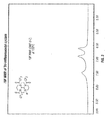
Figure 1 depicts the 13C NMR of Tri-trifluoroacetyl cyclam. -
Figure 2 depicts the 1H NMR of Tri-trifluoroacetyl cyclam. -
Figure 3 depicts the 19F NMR of Tri-trifluoroacetyl cyclam. - The present invention relates to N-1 (i.e. all but one) protection of cyclic polyamines containing a total of N amine nitrogens on the ring system, where the ring has from 9 to 20 ring members and contains from 3 to 6 amine nitrogens spaced by 2 or more carbon atoms, using trifluoroacetyl and other structurally related protecting agents as represented by formula III.

- Preferably, applicable cyclic polyamine may be represented by formulas I and II,
where m and m' represent from 0 to 2 inclusive, preferably from 0 to 1 inclusive carbons; n, n'and n" represent from 1 to 3 inclusive, preferably from 1 to 2 inclusive carbons; m, m', n, n' and n"may be identical or different for any specific compound.
- Even more preferable examples are cyclam (formula I, m = m' = n = n' = 1), cyclen (formula I, m = m' = 0, n = n' = 1) and 1,4,7-triazacyclononane (formula II, n = n' = n"= 1).
- In another embodiment, one or more carbon atoms on the ring (formula I and II) may also be substituted with one or more atoms such as oxygen and/or sulfur.
- The protecting agents are represented by formula III, where X is a fluoro-substituted, preferably perfluoro substituted aromatic, heteroaromatic, alkyl, alkenyl and/or alkynyl group, more preferably perfluoro substituted linear or branched alkyl group, most preferably perfluoro substituted saturated linear alkyl group containing 1-5 carbons, and further wherein X is preferably CyHpFz, wherein y is from 1 to 10 inclusive, p is from 0 to 20 inclusive, preferably 0 to 5, more preferably 0 to 2, and z is from 1 to 21 inclusive, preferably 1 to 9, more preferably 1 to 5; Lv is a moderately reactive nitrogen, oxygen, or sulfur containing leaving group such as, but not limited to, alkoxy, phenoxy, mercaptyl, imidazoyl, N-hydroxysuccinyl or other nitrogen or oxygen containing group preferably alkoxy containing 1-6 carbons, more preferably C1-C4. As would be well understood by someone skilled in the field, where u is the total number of rings and pi (double) bonds in the group, and t is the number of nitrogen atoms in the group, z=1 to 2y+1-2u+t, and p=2y+1-z-2u+t. These and similar reagents can also be in the form of polymer-bound derivatives, such as those described by P. Suirskaya and L. Letnoff, J. Org. chem (1987) 52:1362-1364.
- Compounds represented by formulas VIII and IX shown below are prepared, according to conditions detailed elsewhere herein, from reactions of I and II with III, respectively. In formulas VIII and IX, CyHpFz is as described above; m, m' are from 0 to 2 inclusive, n, n'and n" are from 1 to 3 inclusive carbons, and m, m', n, n'and n" may be identical or different for any specific compound.

- This N-1 protection is carried out using 1 to more than 100 equivalents, preferably N-1 to 3 x N equivalents, most preferably N-1 to 2 x N equivalents, of alkyl trifluoroacetate and/or other reagents with similar reactivity as defined by formula III per mole of cyclic polyamine where N = the number of ring nitrogens in the cyclic polyamine.
- This N-1 protection reaction may be carried out in the presence of a diluting agent or a combination of diluting agents, such as: a C1-C12, preferably C1-C4, straight chain or branched chain alkanol, or a mixture of any other non-aqueous solvents with any alkanol described, including but not limited to methanol, ethanol, or low molecular weight (less than 5 carbon) alkanol such as butanol, or propanol; and/or pure alkyl trifluoroacetate, preferably methyl trifluoroacetate or ethyl trifluoroacetate, or other protecting agents adopted as defined by formula III.
- Solvent or solvents used may contain certain levels of water without very serious product formation problem; however, it is preferable to exclude water. This may be accomplished by using additives that will sequester water.
- The quantity of diluting agent employed may range from 0 to100 litres per mole of the cyclic polyamine, preferably from 0 to 5 litre, most preferably from 2 to 3 litres, per mole of the cyclic polyamine.
- Additives that will keep the reaction system acid free may be used such as carbonates, bicarbonates, phosphates, oxides, aluminates, aliphatic or aromatic amines, or polymer supported basic resins. Examples of amines includes aliphatic or aromatic amines that contain up to 24 carbons and preferably 3 to 12 carbons. Example of inorganic bases include alkali carbonates preferably sodium or potassium carbonate. The amount of this additive can range from 0 to a large excess, such as 0 to 10 equivalents, preferably 0 to 1 equivalents, more preferably 0.1 to 1 equivalents, per equivalent of the cyclic polyamine.
- Alternatively, the N-1 protection operation may be advantageously carried out at temperatures from -78°C to 120°C, preferably from -20°C to 100°C, most preferably from 0°C to 60°C.
- The duration of the N-1 protection is generally on the order of 10 minutes to 72 hours, preferably from 1 hour to 24 hours, more preferably from 2 to 10 hours.
- The product obtained from the reaction medium may be purified by methods such as, but not limited to, silica gel chromatography, recrystallization, acid wash and any other commonly practiced purification techniques. The product can also be isolated by treatment with salt forming acid in the form of amine salt, such as, but not limited to, the hydrogen chloride salt. Alternatively, the product may be used for further modification as crude without further purification.
- The N-1 protected cyclic polyamine can be used in further reactions where the single unmasked amine nitrogen will take part. These reactions, which are known art of the field, will lead to mono-functionalized, N-1 differently protected cyclic polyamines. Commonly and conveniently, the N-1 protection groups such as trifluoroacetyl, may be removed, under various standard and mild conditions, to give mono-functionalized cyclic polyamines (T. W. Greene and P.G.M.Wuts, Protective Groups in Organic Synthesis, 3rd edition, 1999, Wiley & Sons.). These are important intermediates and useful in the preparation of many known and potential cyclic polyamine based MRI chelating agents.
- The aforementioned reactions may be used to synthesize compounds XIV and XVII as described herein, wherein CyHpFz is a fluoro-substituted alkyl, alkenyl, alkynyl, cycloalkyl, aromatic, or heteroaromatic group, wherein y is from 1 to 10, p is from 0 to 20, and z is from 1 to 21; wherein m and m' are from 0 to 2 and n, n' and n" are from 1 to 3; and wherein m, m', n, n' and n" may be the same or different; and wherein E is an alkyl, acyl, alkenyl, alkynl, hydroxyalkyl, cycloalkyl, aromatic, heteroaromatic, carboxamide, thiocarboxamide, carboxyl, phosphoryl or sulphato group.
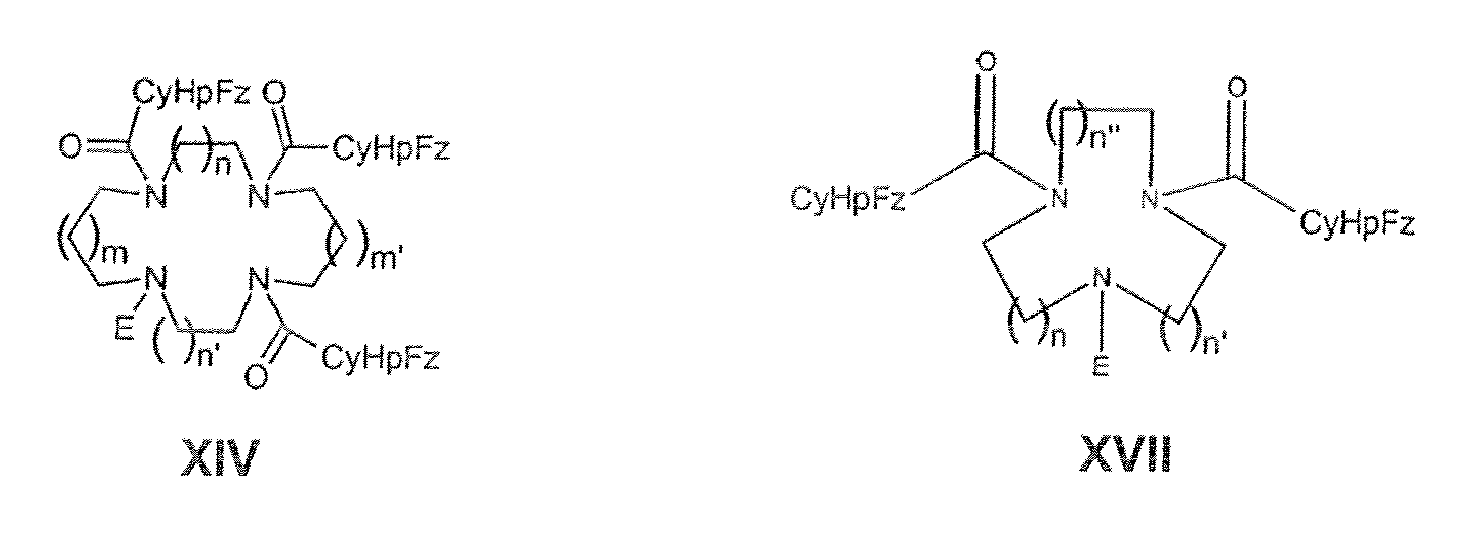
- In compounds XIV and XVII, E may also form a linker group, E", which is attached to one macrocyclic nitrogen of each macrocyclic polyamine and is preferably a phenylene ring optionally substituted with an electron donating or withdrawing group consisting of alkyl, aryl, amino, alkoxy, hydroxy, halogen, carboxyl or carboxamido.
- In a more general sense, the final compound may be represented by compound XX:
Q-E"-Q' XX
where Q and Q' may be the same or different and are macrocyclic polyamines represented by formulas I or II that are linked via E". - For instance, when E is an aromatic ring, it may function to link two compound XIV groups together to form the compound according to formula XXI, wherein CyHpFz is a fluoro-substituted alkyl, alkenyl, alkynyl, cycloalkyl, aromatic, or heteroaromatic group, wherein y is from 1 to 10, p is from 0 to 20, and z is from 1 to 21; and wherein m and m' are from 0 to 2 and n and n' are from 1 to 3; and wherein m, m', n and n' may be the same or different, and wherein Ar is a phenylene ring, optionally substituted with an electron donating or withdrawing group such as alkyl, aryl, amino, alkoxy, hydroxy, halogen, carboxyl or carboxamido.

- Preferably, linker Ar is formed from compound XI, wherein Lx and Lx1 are the same or different and are moieties that can be displaced by an unprotected amine nitrogen. Preferably, Lx and Lx' are selected from Cl, Br, I, aryl sulfonate and alkyl sulfonate (e.g., 4-tolylsulfonate, methanesulfonate and trifluoromethane sulfonate).

- By way of example, the following description pertains to a process for preparing 1,1'[1,4-phenylenebis (methylene)]-bis 1,4,8,11-tetraazacyclotetradecane, which is a representative process according to the present invention, with the protecting step described above given by step 1.

- Thus, the present invention is exemplified by the process for preparing 1, 1'-[1,4-phenylenebis (methylene)]-bis1,4,8,11-tetraazacyclotetradecane via a three step sequence as depicted above. As shown, R in formula V and VI is the protecting moiety that is represented by formula III, where Lv is removed, preferably when X in Formula III is CyHpFz, and is a perfluoro substituted alkyl group containing 1 to 6 carbons, more preferably CyHpFz=CF3.
- With respect to the individual steps, the first step involves the reaction of cyclam IV with a reagent represented by formula III. The reaction may use from 3 to 100 equivalents, preferably 3 to 10 equivalents of protecting agent III, in a non-aqueous solvent or a mixture of solvents suitable to dissolve the materials, preferably methanol, ethanol and/or other low molecular alcohol solvent or solvent mixture containing these polar solvents, at a temperature between -78°C to 120°C, preferably between 20°C to 60°C.
- The reaction may take from 30 minutes to 72 hours , depending on the yield pursued, preferably from 2 hours to 10 hours. Other than the solvent system described above, suitable protecting agents such as depicted by formula III, preferably alkyl trifluoroacetate, more preferably methyl and/or ethyl trifluoroacetate can also serve as solvent for this reaction.
- Additives that will keep the reaction system acid free may be used such as carbonates, bicarbonates, phosphates, oxides, aluminates, aliphatic or aromatic amines, or polymer supported basic resins. Examples of amines includes aliphatic or aromatic amines that contain up to 24 carbons and preferably 3 to 12 carbons. Example of inorganic bases include alkali carbonates preferably sodium or potassium carbonate. The amount of this additive can range from 0 to 10 equivalents, preferably from 0.1 to 1 equivalent, per equivalent of cyclam.
- The product of Step 1, such as the tri-protected cyclam V, can be used as crude for the next step, or can be purified by silica gel column or using other common practice in the field such as, but not limited to, aqueous extraction work-up or recrystallization.
- The second step concerns functionalizing the remaining secondary amine from step 1 with a mono-reactive or di-reactive electrophile. For example, compound V obtained from step 1 can be alkylated using 1,4 - dibromoxylene, 1,4 - dichloroxylene, the ditosylate analogue or other similar alkylating agents. A wide range of organic solvents are suitable as diluting agents including acetonitrile, toluene, THF, DMF, 2-propanol and any other solvent or combination of solvents desirable for amine alkylation. The reaction may be carried out at a temperature from 20°C to 150°C, preferably from 60°C to 120°C. Further, any single or mixture of iodide anion containing compounds may be used as additives, including but not limited to KI, NaI, Bu4NI, preferably KI. Additives that will keep the reaction system acid free may be used such as carbonates, bicarbonates, phosphates, oxides, aluminates, aliphatic or aromatic amines, or polymer supported basic resins. Examples of amines includes aliphatic or aromatic amines that contain up to 24 carbons and preferably 3 to 12 carbons. Example of inorganic bases include alkali carbonates preferably sodium or potassium carbonate.
- Alternatively, reductive amination methods may be used. For example, terephthaldehyde may be reductively aminated with compound V using a reducing agent such as sodium cyanoborohydride or other borohydride reducing agents, or via catalytic hydrogenation. Additionally, the product from step 1 can also react with terephthaloyl chloride to obtain the corresponding diamide, followed by reduction to give the hexa-trifluoroacetyl cyclam dimer. The product VI from these alkylation reactions may be used as crude for the next step, or preferably, recrystallized from common solvents and/or mixture of solvents. These solvent systems include, but are not limited to, ethyl acetate, methanol, ethanol, methanol-water mixture etc.
- In one embodiment of the invention, step two comprises reaction of compound VIII given above with the alkylating agent compound XI given above to form compound X.

- The third step of the process is deprotection (e.g. by saponification) of all the protecting groups in compound VI. Reagents that are useful for this saponification include, but are not limited to, alkoxides, hydroxides, amines, hydrazines, thiolates or other nucleophiles or reagents that generate nucleophiles such as metal carbonates in wet alcohols or water.
- Alternatively, hydrolysis of the nitrogen protecting group in compound VI may be effected using acidic conditions such as those described in T.W. Greene and P.G.M. Wuts, Protective Groups in Organic Synthesis, 3rd edition, 1999, Wiley & Sons. A variety of other deprotection methods are also known to those skilled in the art. See T.W. Greene and P.G.M. Wuts, Protective Groups in Organic Synthesis, 3rd edition, 1999, Wiley & Sons. The final product VII can be obtained and purified by common methods such as, but not limited to, recrystallization, salt formation and chromatography.
- In one embodiment of the present invention, step 2 is used to form the intermediate given by formula VIII above, which is reacted with a suitable electrophile selected from the group consisting of organic halides, tosylates, triflates, epoxides, thiocyanates and isocyanates to form a compound given by formula XIV above, wherein E is a functional group bonded to the nitrogen as described above. Then, step 3 consists of removing the (C=O)CyHpFz groups from the formula XIV compound using a method compatible with E to form a compound given by the formula XV.

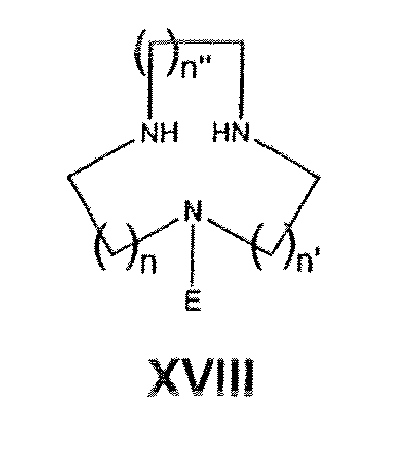
- In another embodiment, step 3 comprises removing the (C=O)CyHpFz groups from a compound given by formula XVII above using a method compatible with E to form a compound given by the formula XVIII.
- In yet another embodiment, when compound X as described above is deprotected in step three, this results in formation of compound XII.

- Optional step 4 involves functionalizing all of the secondary amines released in the third step with an electrophile that includes but is not limited to an alkylating, acylating, sulphonylating or phosphorylating agent.
- In one embodiment, step 4 comprises reacting the compound given by formula XV above with an electrophile, E', which is different from E, to form the compound according to the formula XVI

- In another embodiment, step 4 comprises reacting the compound given by formula XVIII given above with an electrophile as described above to form the compound according to the formula XIX.

- Having now generally described the invention, the same will be more readily understood by way of reference to the following examples which are provided and illustrated, and are not intended to be limiting of the present invention, unless specified.
-

- Cyclen (2.13 g, 12.35 mmol) was dissolved in MeOH (20 mL). To the clear solution was added NEt3 (1.70 mL, 12.35 mmol) in one portion, followed by slow addition of ethyl trifluoroacetate (7.35 mL, 61.76 mmol) during a period of 5 minutes. The reaction may be chilled to keep temperature under 25°C. Stirring was continued under N2 for 15 hours. Volatiles were then removed under vacuum. The residue was dissolved in the minimum amount of CH2Cl2 (∼2.0mL) and passed through a short silica gel pad, eluted with 100% EtOAc. The eluent was concentrated to give the product as a white semi solid (5.25 g, 92.5%). 1H NMR (300 MHz, CDCl3): δ 3.90 - 3.76 (broad multiplet, 4 H, 3.68 - 3.20 (multiplet, 8 H), 3.10 - 2.65 (multiplet, 4 H), 1.40 - 1.25 (multiplet, 1 H). Mass C14H17F9N4O3 requires C 36.53, H 3.72, N 12.17, O 10.43, found C 36.49, H 3.71, N 12.11, O 10.59.
-

- 1,4,7-triazacyclononane (115.0 mg, 0.89 mmol) was dissolved in MeOH (2.0 mL). To this clear solution was added NEt3 (0.13 mL, 0.89 mmol) in one portion, followed by ethyl trifluoroacetate (0.43 mL, 13.56 mmol) during a period of 5 minutes. Stirring was continued under N2 for 15 hours. Volatiles were then removed by rotavapor. The residue was dissolved in the minimum amount of CH2Cl2 (∼2.0mL) and passed through a short silica gel pad, eluted with 100% EtOAc. The eluent was concentrated to give the product as a white solid (267.0 mg, 94%). 1H NMR (300 MHz, CDCl3): δ 4.04 - 3.95 (multiplet, 2 H), 3.80 - 3.72 (multiplet, 2 H), 3.50 - 3.40 (multiplet, 4 H), 3.0 - 2.90 (multiplet, 4 H), 1.59 (singlet, 1 H). Mass calculated for C10H13F6N3O2 321.2, found M+1 322.1.
-

- Cyclam (7.53 g, 37.58 mmol) was dissolved in bench MeOH (30 mL). To this clear solution was added NEt3 (5.20 mL, 37.58 mmol) in one portion, followed by portional addition of ethyl trifluoroacetate (18.0 mL, 150.3 mmol) during a period of 5 minutes. The reaction may be chilled to keep temperature under 25°C. Stirring was continued under N2 for 5h. Volatiles were then removed under vacuum. The residue was dissolved in minimum amount of CH2Cl2 (∼2.0mL) and passed through a short silica gel pad (∼25 g), eluted with 100% EtOAc. The eluent was concentrated to give the product as a white semi solid (17.05 g, 92.5%), 1H NMR (200 MHz, CDCl3): δ 3.85 - 3.25 (multiplet, 12 H), 2.80 (broad singlet, 2 H), 2.74-2.50 (broad singlet, 2H), 2.30-1.90 (multiplet, 2 H), 1.85-1.63 (multiplet, 2 H), 1.25- 0.60 (multiplet, 1 H). 13C NMR (75.5 MHz, CDCl3): δ 158.74-157.31 (multiplet, C=O, muitiplets due to existence of conformers), 122.84-11.32 (quartet, CF3, due to C-F coupling, JC-F ∼ 264 Hz, further split due to existence of conformers), 51.2 - 46.2 (multiplet, CH2 next to N), 29.4 - 27.8 (multiplet, CH2); Mass of C16H21F9N4O3 requires: C 39.35; H 4.33; N 11.47; O 9.83; found: C 39.19; H 4.36; N 11.33; O 10.04.
-

- To a round bottom flask was charged 1,4,8-tris (trifluoroacetyl)-1,4,8,11-tetraazacyclotetradecane (3.70g, 7.57mmol) and anhydrous CH3CN (20 mL). The mixture was stirred at rt. until a solution was obtained (∼10 min). To this solution was then added K2CO3 (98%, 1.57g, 11.35mmol), KI (62.8mg, 0.38mmol) and Dichloro-xylene (663.0mg, 3.78mmol). The mixture was refluxed under N2. TLC (1:1 EtOAc/Hexane) was used to monitor the reaction progress, which was completed after ∼16h. The mixture was cooled to rt. and filtered through a sintered glass filter to remove insoluble salt (washed with 20mL CH3CN). The solution was then concentrated to give a slightly yellowish solid. The solid was recrystallized using 4/1 EtOH / H2O to give the purified product (3.47g, 85%) as an off white solid. 1H NMR (300 MHz, CDCl3): δ 7.25 - 7.06 (multiplet, 5 H), 3.80 - 3.20 (multiplet, 28 H), 2.75 (broad singlet, 4 H), 2.45 - 2.20 (multiplet, 8 H), 1.90 - 1.60 (multiplet, 4 H); 13C NMR (75.5 MHz, CDCl3): δ 155.6 - 154.5 (multiplet, C=O, multiplet due to conformers), 135.9 - 134.0 (multiplet, aromatic C), 127.9 - 126.7 (multiplet, aromatic C-H), 118.0 (quartet, JC-F ∼ 287 Hz), 58.3 - 57.7 (multiplet), 55.0 -52.0 (multiplet), 50.4 - 42.7 (multiplet due to conformers), 26.5 - 21.8 (multiplets due to conformers). Elemental analysis for C40H48F18N8O6 calculated C 44.53, H 4.48, N 10.39, O 8.90, found C 44.46, H 4.40, N 10.26, O 9.11.
-

- 1, 1'-[1,4-phenylenebis (methylene)]-bis-tris-(trifluoroacetyl)-1,4,8,11-azatetradecane (3.30g, 3.05mmol) was dissolved in MeOH (6.0mL). K2CO3 (1.27g, 9.1mmol) was added in one portion. The suspension was heated at reflux for 3h. Toluene (30mL) was then added to the cooled mixture. MeOH was removed by forming an azeotrope with toluene. After all MeOH was removed, the hot toluene solution suspended with inorganic salt was filtered and concentrated to give AMD3100 free base (1.32g, 86%) as a white solid. All characteristics of this product are in good agreement with an authentic sample prepared according to reported methods.
-

- Bis-TFA 1,4,7-triazacyclononane (261.4 mg, 0.81 mmol) was dissolved in acetonitrile (5.0 mL), bromoacetamide (168.1 mg, 1.22 mmol) and K2CO3 (225.0 mg, 1.62 mmol) were added sequentially. The mixture was refluxed for 15 hours. Filtration and chromatography of the residue after removal of all volatiles gave the desired product as an oil (214.0 mg, 70%).
-

- Cyclam (618.9 mg, 3.08 mmol) was dissolved in methanol (5.0 mL). NEt3 (0.43 ml, 3.08 mmol) and methyl pentafluoropropionate (2.0 mL, 15.44 mmol) were added sequentially. The reaction was continued at room temperature for 15 h. After removal of volatiles, the residue was chromatographed to give 1,4,8-tris (pentafluoropropionyl)-1,4,8,11-tetraazacyclotetradecane (660.0 mg, 34%) as a white foam. 1H NMR (CDCl3, 200MHz): δ 4.0-3.28 (multiplet, 10 H), 2.86 (broad multiplet, 2 H), 2.64-2.59 (multiplet, 2 H), 2.48-1.99 (multiplet, 2H), 1.8-1.7(multiplet, 2H), 1.1 (s, 1H); 13C NMR (75.5 MHz, CDCl3): δ 159.4 - 157.7 (multiplet, C=O), 123.9 - 111.8 (triplet of quartet, JC-F = 249 Hz, 34Hz, CF3CF2), 112.6 - 104.6 (multiplet of triplet, J C-F = 308 Hz, CF2CF3), 50.3 - 44.4 (multiplet, CH2 next to N), 28.9 - 27.8 (multiplet, CH2); C19H21N4F15O3 requires: C 35.75, H 3.32, N 8.78, O 7.52, found C 35.81, H 3.37, N 8.55, O 7.74.
-

- 1,4,7-tris (trifluoroacetyl)-1,4,7,10-tetraazacyclododecane (303.5 mg, 0.658 mmol) was dissolved in CH2Cl2 (5.0 mL). Phenyl isocyanate (0. 14 mL, 1.32 mmol) was added in one portion. The reaction was continued at room temperature for 15 hours. After removal of all volatiles, the residue was chromatographed to give the desired urea derivative (301.0mg, 79%). 1H NMR (CDCl3, 200 MHz): δ 7.38-7.26 (multiplet, 5H), 7.08-7.03 (multiplet, 1H), 4.03-3.28 (multiplet, 16 H); MS calculated for C21H22N5F9O4 579.4, found M+Na: 602.5.
-

- Tri-TFA cyclam was dissolved in CH2Cl2 (10 mL) at room temperature. Na2CO3 (566 mg, 5.34 mmol) was added in one portion, followed by slow addition of Cbz chloride. The reaction was monitored by TLC (1:1 ethyl acetate: hexane). The reaction was stopped after 15 hours. Usual work up followed by column chromatography using silica gel afforded the product (1.30g, 94%) as a white foam. 1H NMR (CDCl3, 200 MHz): δ 7.31 (broad multiplet, 5 H), 5.02 (s, 2H), 3.54-3.10 (multiplet, 16 H), 2.04-1.54 (multiplet, 4 H); Mass for C24H27F9N4O4, calculated: 622.5, found M+1 623.2.
-

- Tri-TFA cyclam (3.31g, 6.77mmol) was dissolved in CH2Cl2 (30 mL). Triethyl amine (1.40 mL, 8.12 mmol) was added in one portion. The solution was cooled in an ice water bath. TsCl (1.55g, 8.12 mmol) was added in small portions during a period of 5 minutes. The reaction was continued at room temperature for 8 hours. Usual work up and column chromatography afforded the desired the product (3.47g, 80%). 1H NMR (300 MHz, CDCl3): δ 7.5-7.48 (multiplet, 2H), 7.26 - 7.20 (multiplet, 2 H), 3.67 - 3.30 (multiplet, 12 H), 3.21 (broad multiplet, 2 H), 2.95 (broad multiplet, 2 H), 2.32 (s, 3 H), 2.20- 1.70 (multiplet, 4 H). 13C NMR (75.5 MHz, CDCl3): δ 158.4 - 156.4 (multiplet, C=O), 144.8 - 144.7 (two singlet due to conformers), 134.2 - 133.8 ( four singlet due to ring conformers), 133.8, 127.7 - 127.5 ( two singlet due to conformers), 122.3 - 110.8 (four singlet, due to C-F coupling, J C-F ∼ 287 Hz), 51.8 - 45.0 ( multiplet due to conformers), 28.4 - 27.2 ( multiplet due to conformers), 21.6.
-
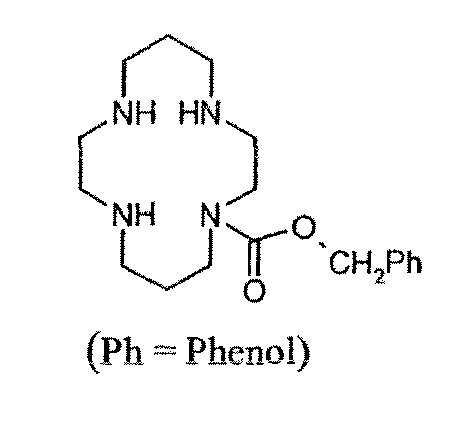
- Mono-Cbz-tris-(trifluoroacetyl) cyclam (4.0 g, 6.4 mmol) was dissolved in bench MeOH (50 mL). K2CO3 (2.0 g, 14.5 mmol) was added in one portion. The mixture was refluxed for 15 h. Most of the volatiles was removed under vacuum and the residue was taken into CHCl3 (100mL). The solid was filtered off and the solution was concentrated to give mono-Cbz cyclam (1.82g, 85%). 1H NMR (CDCl3, 200 MHz): δ 7.21 -7.14 (multiplet, 5 H), 4.98 (singlet, 2 H), 3.33 (triplet, 2 H), 3.26 (triplet, 2 H), 2.67 (triplet, 2 H), 2.60-2.51 (multiplet, 10 H), 1.68 ( broad singlet, 3 H), 1.68-1.49 (multiplet, 4 H).
- Citation of documents herein is not intended as an admission that any of the document is prior art. All statements as to the date or representation as to the contents of these documents is based on the information available to the applicants and does not constitute any admission of the correctness of the dates or contents of these documents. Further, all publications and patents mentioned in the above specification are herein incorporated by reference. Various modifications and variations of the described method and system of the invention will be apparent to those skilled in the art without departing from the scope and spirit of the invention. Although the invention has been described in connection with specific preferred embodiments, it should be understood that the invention as claimed should not be unduly limited to such specific embodiments. Indeed, various modifications of the described modes for carrying out the invention which are obvious to those skilled in the same or any related fields are intended to be within the scope of the following claims.
Claims (15)
- A process for making a compound of formula:
 a) selectively acylating 1,4,8,11-tetraazacyelotetradecane (cyclam) with a fluoro-substituted acylating agent of formula:
 b) functionalizing the remaining secondary amine with 1,4-dichloroxylene to provide 1, 1'-[1,4-plienylenebis (methylene)]-bis-tris(trifluoroacetyl)-1 ,4,8,11-tetraazacyclotetradecane; andc) removing the trifluoroacetyl groups to provide the compound of formula XII.
 - A process as claimed in claim 1, wherein the fluoro-substituted acylating agent in step a) is methyl trifluoroacetate or ethyl trifluoroacetate.
- A process as claimed in claim 2, wherein step a) further comprises adding about 3 to about 10 equivalents of ethyl trifluoroacetate.
- A process as claimed in claim 1, wherein step a) further comprises adding from about 0 to 10 equivalents of an amine base containing from 3 to 12 carbons to the reaction mixture.
- A process as claimed in claim 4, wherein the amine base is triethylamine.
- A process as claimed in claim 1, wherein step a) further comprises adding a diluting agent to the reaction mixture, wherein the diluting agent comprises a C1-C4 straight chain or branched chain alkanol.
- A process as claimed in claim 1, wherein step a) further comprises adding 3 to 10 equivalents of ethyl trifluoroacetate, and wherein step a) is carried out in the presence of methanol at a temperature from about 20°C to about 60°C for a period of from 1 hour to 24 hours.
- A process as claimed in claim 1, wherein step b) further comprises adding an iodide anion-containing compound selected from KI, NaI, and Bu4NI, or a mixture thereof.
- A process as claimed in claim 1, wherein step b) further comprises adding a metal carbonate as the base.
- A process as claimed in claim 1, wherein step b) further comprises adding 0.15 to 2 equivalents of KI and 0.5 to 50 equivalents of K2CO3, and wherein step b) is carried out in the presence of acetonitrile at a temperature from 20°C to 150°C for a period of between 4 hour and 72 hours.
- A process as claimed in claim 1, wherein the product of step b) is recrystallized using an ethanol-water mixture.
- A process as claimed in claim 1, wherein step c) comprises removal of the trifluoroacetyl groups with a deprotecting agent.
- A process as claimed in claim 12, wherein the deprotecting agent is dissolved in a solvent selected from the group consisting of a polar organic solvent, water, and a mixture of a polar organic solvent and water.
- A process as claimed in claim 12, wherein the deprotecting agent is:-(i) an acid or a mixture of acids;(ii) ammonia in any form or an organic amine containing from 1 to 20 carbons;(iii) a sulphur containing compound;(iv) a metal alkoxide or a metal hydroxide; or(v) a metal carbonate, e.g. K2CO3.
- The process according to claim 12, wherein the deprotecting agent is K2CO3
and step c) is carried out in the presence of methanol.
Priority Applications (1)
| Application Number | Priority Date | Filing Date | Title |
|---|---|---|---|
| CY20131100084T CY1113564T1 (en) | 2000-09-29 | 2013-01-30 | PROCEDURE FOR PRODUCING CIRCULAR POLYAMINS CONTAINING N-1 PROTECTED NITROGEN PERSONS IN THE RING AND THESE PRODUCTS |
Applications Claiming Priority (2)
| Application Number | Priority Date | Filing Date | Title |
|---|---|---|---|
| US23700200P | 2000-09-29 | 2000-09-29 | |
| EP01979421A EP1322626B1 (en) | 2000-09-29 | 2001-09-28 | Process for preparation of n-1 protected n ring nitrogen containing cyclic polyamines and products thereof |
Related Parent Applications (2)
| Application Number | Title | Priority Date | Filing Date |
|---|---|---|---|
| EP01979421A Division EP1322626B1 (en) | 2000-09-29 | 2001-09-28 | Process for preparation of n-1 protected n ring nitrogen containing cyclic polyamines and products thereof |
| EP01979421.3 Division | 2001-09-28 |
Publications (2)
| Publication Number | Publication Date |
|---|---|
| EP2022787A1 true EP2022787A1 (en) | 2009-02-11 |
| EP2022787B1 EP2022787B1 (en) | 2012-11-28 |
Family
ID=22891923
Family Applications (2)
| Application Number | Title | Priority Date | Filing Date |
|---|---|---|---|
| EP01979421A Expired - Lifetime EP1322626B1 (en) | 2000-09-29 | 2001-09-28 | Process for preparation of n-1 protected n ring nitrogen containing cyclic polyamines and products thereof |
| EP08163998A Expired - Lifetime EP2022787B1 (en) | 2000-09-29 | 2001-09-28 | Process for the preparation of N-1 protected N ring nitrogen containing cyclic polyamines and products thereof |
Family Applications Before (1)
| Application Number | Title | Priority Date | Filing Date |
|---|---|---|---|
| EP01979421A Expired - Lifetime EP1322626B1 (en) | 2000-09-29 | 2001-09-28 | Process for preparation of n-1 protected n ring nitrogen containing cyclic polyamines and products thereof |
Country Status (23)
| Country | Link |
|---|---|
| US (1) | US6489472B2 (en) |
| EP (2) | EP1322626B1 (en) |
| JP (2) | JP5335171B2 (en) |
| KR (1) | KR100808385B1 (en) |
| CN (1) | CN1273455C (en) |
| AT (1) | ATE413391T1 (en) |
| AU (2) | AU1139302A (en) |
| BR (1) | BR0114246A (en) |
| CA (1) | CA2419631A1 (en) |
| CY (1) | CY1113564T1 (en) |
| DE (1) | DE60136476D1 (en) |
| DK (1) | DK2022787T3 (en) |
| ES (2) | ES2320323T3 (en) |
| HU (1) | HUP0301176A3 (en) |
| IL (3) | IL154400A0 (en) |
| MX (1) | MXPA03002772A (en) |
| NO (1) | NO20031401L (en) |
| NZ (1) | NZ524580A (en) |
| PL (1) | PL359292A1 (en) |
| PT (1) | PT2022787E (en) |
| RU (2) | RU2311413C2 (en) |
| WO (1) | WO2002026721A1 (en) |
| ZA (1) | ZA200301012B (en) |
Families Citing this family (17)
| Publication number | Priority date | Publication date | Assignee | Title |
|---|---|---|---|---|
| US7169750B2 (en) | 2001-07-31 | 2007-01-30 | Anormed, Inc. | Methods to mobilize progenitor/stem cells |
| JP5137288B2 (en) | 2001-07-31 | 2013-02-06 | アノーメッド インコーポレイティド | How to mobilize progenitor / stem cells |
| US20050033106A1 (en) * | 2003-07-08 | 2005-02-10 | Wing Tak Wong | Synthesis of tris N-alkylated 1,4,7,10-tetraazacyclododecanes |
| DE102004038134B4 (en) | 2004-08-05 | 2013-07-25 | Johann Wolfgang Goethe-Universität Frankfurt am Main | Multivalent chelators for modifying and organizing target molecules, methods for their preparation and their use |
| EP1796716A4 (en) * | 2004-08-13 | 2010-09-08 | Anormed Inc | Chemokine combinations to mobilize progenitor/stem cells |
| US7306785B2 (en) * | 2004-09-23 | 2007-12-11 | General Electric Company | Multifunctional cross-bridged tetraaza macrocyclic compounds and methods of making and using |
| NO20051911D0 (en) * | 2005-04-19 | 2005-04-19 | Amersham Health As | Synthesis |
| WO2007120153A1 (en) * | 2006-04-19 | 2007-10-25 | The Board Of Regents Of The University Of Texas System | Compositions and methods for cellular imaging and therapy |
| US8758723B2 (en) | 2006-04-19 | 2014-06-24 | The Board Of Regents Of The University Of Texas System | Compositions and methods for cellular imaging and therapy |
| AU2007281090A1 (en) * | 2006-08-02 | 2008-02-07 | Genzyme Corporation | Combination therapy |
| MX2009001445A (en) * | 2006-08-07 | 2009-02-18 | Genzyme Corp | Combination therapy. |
| US20150030561A1 (en) | 2011-05-16 | 2015-01-29 | Genzyme Corp. | Use of CXCR4 Antagonists |
| US9439984B2 (en) * | 2012-05-31 | 2016-09-13 | The Regents Of The University Of California | Macrocycles |
| WO2014125499A1 (en) | 2013-02-13 | 2014-08-21 | Natco Pharma Limited | Improved and commercially viable process for the preparation of high pure plerixafor base |
| CN104211652B (en) * | 2014-08-27 | 2016-09-07 | 吉林大学 | A kind of method preparing Plerixafor |
| US10544109B2 (en) | 2015-09-02 | 2020-01-28 | Fresenius Kabi Oncology Ltd. | Process for the preparation of xylene linked cyclam compounds |
| CN121378164B (en) * | 2025-12-25 | 2026-04-17 | 江西中医药大学 | Celacarfurine and method for synthesizing key intermediate thereof |
Citations (17)
| Publication number | Priority date | Publication date | Assignee | Title |
|---|---|---|---|---|
| US4885363A (en) | 1987-04-24 | 1989-12-05 | E. R. Squibb & Sons, Inc. | 1-substituted-1,4,7-triscarboxymethyl-1,4,7,10-tetraazacyclododecane and analogs |
| US5021409A (en) | 1989-12-21 | 1991-06-04 | Johnson Matthey Plc | Antiviral cyclic polyamines |
| US5047527A (en) | 1989-03-20 | 1991-09-10 | Centre National De La Recherche Scientifique (Cnrs) | Process for the preparation of monofunctionalized cyclic tetramines |
| US5064956A (en) | 1987-06-24 | 1991-11-12 | The Dow Chemical Company | Process for preparing mono-n-alkylated polyazamacrocycles |
| US5132409A (en) | 1987-01-12 | 1992-07-21 | Bracco Industria Chimica S.P.A. | Macrocyclic chelating agents and chelates thereof |
| US5277895A (en) | 1990-11-08 | 1994-01-11 | Schering Aktiengesellschaft | Mono-n-substituted 1,4,7,10-tetraazacyclododecane derivatives, process for their production and pharmaceutical agents containing these derivatives |
| US5410043A (en) | 1991-12-06 | 1995-04-25 | Schering Aktiengesellschaft | Process for the production of mono-N-substituted tetraaza macrocycles |
| US5583131A (en) | 1991-12-16 | 1996-12-10 | Johnson Matthey Public Limited Company | Aromatic-linked polyamine macrocyclic compounds with anti-HIV activity |
| US5606053A (en) | 1995-05-02 | 1997-02-25 | Johnson Matthey Plc | Process for preparing 1,1'-[1,4-phenylenebis-(methylene)]-bis-1,4,8,11-tetraazacyclotetradecane |
| US5698546A (en) | 1994-01-11 | 1997-12-16 | Johnson Matthey Public Limted Company | Cyclic polyamines |
| US5705637A (en) | 1995-03-10 | 1998-01-06 | Nycomed Imaging As | Polyazacycloalkane compounds |
| US5801281A (en) | 1995-03-30 | 1998-09-01 | Johnson Matthey Plc | Process for preparing 1,1'- (1,4- phenylenebis (methlene)-Bis 1,4,8,11-tetraazacyclotetradecane |
| US5919431A (en) | 1993-11-24 | 1999-07-06 | Schering Aktiengesellschaft | 1,4,7,10-tetraazacyclododecane derivatives, their use, pharmaceutical agents containing these compounds and process for their production |
| US5994536A (en) | 1997-06-02 | 1999-11-30 | Schering Aktiengesellschaft | Process for mono- and 1,7-bis-N-β-hydroxyalkylation of cyclene; N-β-hydroxyalkyl-1,4,7,10-tetraazacyclododecane-lithium-salt complexes and the use of the complexes for the production of gadobutrol and analogs |
| US6001826A (en) | 1989-12-21 | 1999-12-14 | Anormed, Inc. | Chemical compounds |
| US6080785A (en) | 1996-01-04 | 2000-06-27 | Schering Aktiengesellschaft | Monofunctionalised EDTA, DTPA and TTHA derivatives and their use in medical diagnosis and therapy |
| WO2000045814A1 (en) | 1999-02-02 | 2000-08-10 | Anormed Inc. | Methods and compositions to enhance white blood cell count |
Family Cites Families (23)
| Publication number | Priority date | Publication date | Assignee | Title |
|---|---|---|---|---|
| FR2609985B1 (en) | 1987-01-26 | 1989-04-14 | Rhone Poulenc Chimie | PROCESS FOR N-O TRIFLUOROACETYLATION OF SATURATED ALIPHATIC MONOCARBOXYLIC A, O DIAMINOACIDS |
| US5012625A (en) * | 1988-06-17 | 1991-05-07 | Propst Robert L | Building enclosure system and method |
| US5144290A (en) * | 1988-10-31 | 1992-09-01 | Kabushiki Kaisha Toshiba | Display unit attachment device |
| GB2250198B (en) * | 1990-04-18 | 1994-06-22 | Celltech Ltd | Tetra-aza macrocycles,processes for their preparation and their use in magnetic resonance imaging |
| FR2672051B1 (en) * | 1991-01-24 | 1993-05-21 | Guerbet Sa | NOVEL NITROGEN MACROCYCLIC LIGANDS, PREPARATION METHOD, POLYMETALLIC COMPLEXES, DIAGNOSTIC AND THERAPEUTIC COMPOSITION. |
| US5684149A (en) * | 1993-01-22 | 1997-11-04 | Research Foundation Of State University Of New York | Metal complexes for promoting catalytic cleavage of RNA by transesterification |
| JP2504713B2 (en) * | 1993-03-09 | 1996-06-05 | タキゲン製造株式会社 | Lock handle device for drawer revolving door |
| US5583735A (en) * | 1994-01-18 | 1996-12-10 | Hollingsead International, Inc. | Aircraft video monitor deployment and retraction apparatus |
| FR2725449B1 (en) * | 1994-10-05 | 1996-12-27 | Air Liquide | POLYAZACYCLOALCANE DERIVATIVES, THEIR METAL COMPLEXES AND PHARMACEUTICAL PRODUCTS INCORPORATING THESE COMPLEXES |
| US5705689A (en) * | 1995-06-19 | 1998-01-06 | Associated Universities, Inc. | Aza compounds as anion receptors |
| WO1997001360A2 (en) * | 1995-06-26 | 1997-01-16 | Concat, Ltd. | Compounds with chelation affinity and selectivity for first transition series elements and their use in medical therapy and diagnosis |
| JP3293740B2 (en) * | 1996-06-24 | 2002-06-17 | 矢崎総業株式会社 | Automotive roof module |
| US5946055A (en) * | 1996-08-16 | 1999-08-31 | Rosen Product Development, Inc. | Display unit |
| US6059255A (en) * | 1996-08-16 | 2000-05-09 | Rosen Products Llc | Stowable display apparatus |
| DE19729013A1 (en) * | 1997-07-03 | 1999-02-04 | Schering Ag | Oligomeric, perfluoroalkyl-containing compounds, processes for their preparation and their use in NMR diagnostics |
| US6007036A (en) * | 1997-09-23 | 1999-12-28 | Rosen Products Llc | Stowable support apparatus |
| US6062623A (en) * | 1998-05-18 | 2000-05-16 | Prince Corporation | Latch for vehicle overhead storage bin |
| US6135528A (en) * | 1998-10-20 | 2000-10-24 | Prince Corporation | Combined storage compartment and garage door opening transmitter storage and actuating compartment |
| WO2000028987A1 (en) * | 1998-11-17 | 2000-05-25 | Smithkline Beecham Corporation | Methods of treating thrombocytopenia |
| US6412848B1 (en) * | 1999-11-02 | 2002-07-02 | Rosen Products Llc | Vehicle display monitor system |
| US6400560B1 (en) * | 2000-11-08 | 2002-06-04 | Yue-Hui Chian | Engaging device for a computer screen in a car |
| US6633347B2 (en) * | 2001-01-02 | 2003-10-14 | Alpine Electronics, Inc. | Display assembly having display supported on casing to be controllable in attitude |
| US6575528B2 (en) * | 2001-10-19 | 2003-06-10 | Lear Corporation | Modular overhead console assembly |
-
2001
- 2001-09-28 MX MXPA03002772A patent/MXPA03002772A/en active IP Right Grant
- 2001-09-28 RU RU2003112460/04A patent/RU2311413C2/en not_active IP Right Cessation
- 2001-09-28 IL IL15440001A patent/IL154400A0/en unknown
- 2001-09-28 EP EP01979421A patent/EP1322626B1/en not_active Expired - Lifetime
- 2001-09-28 DK DK08163998.1T patent/DK2022787T3/en active
- 2001-09-28 KR KR1020037004453A patent/KR100808385B1/en not_active Expired - Fee Related
- 2001-09-28 NZ NZ524580A patent/NZ524580A/en unknown
- 2001-09-28 BR BR0114246-1A patent/BR0114246A/en not_active IP Right Cessation
- 2001-09-28 PT PT81639981T patent/PT2022787E/en unknown
- 2001-09-28 PL PL01359292A patent/PL359292A1/en unknown
- 2001-09-28 AU AU1139302A patent/AU1139302A/en active Pending
- 2001-09-28 DE DE60136476T patent/DE60136476D1/en not_active Expired - Lifetime
- 2001-09-28 AT AT01979421T patent/ATE413391T1/en not_active IP Right Cessation
- 2001-09-28 ES ES01979421T patent/ES2320323T3/en not_active Expired - Lifetime
- 2001-09-28 EP EP08163998A patent/EP2022787B1/en not_active Expired - Lifetime
- 2001-09-28 US US09/970,288 patent/US6489472B2/en not_active Expired - Lifetime
- 2001-09-28 CA CA002419631A patent/CA2419631A1/en not_active Abandoned
- 2001-09-28 WO PCT/US2001/030948 patent/WO2002026721A1/en not_active Ceased
- 2001-09-28 HU HU0301176A patent/HUP0301176A3/en unknown
- 2001-09-28 ES ES08163998T patent/ES2398399T3/en not_active Expired - Lifetime
- 2001-09-28 AU AU2002211393A patent/AU2002211393B2/en not_active Expired - Fee Related
- 2001-09-28 CN CNB018164617A patent/CN1273455C/en not_active Expired - Fee Related
- 2001-09-28 JP JP2002531105A patent/JP5335171B2/en not_active Expired - Fee Related
-
2003
- 2003-02-05 ZA ZA200301012A patent/ZA200301012B/en unknown
- 2003-02-12 IL IL154400A patent/IL154400A/en active IP Right Grant
- 2003-03-27 NO NO20031401A patent/NO20031401L/en not_active Application Discontinuation
-
2007
- 2007-06-08 RU RU2007121719/04A patent/RU2007121719A/en not_active Application Discontinuation
-
2011
- 2011-12-19 JP JP2011277680A patent/JP2012056967A/en active Pending
-
2012
- 2012-02-01 IL IL217872A patent/IL217872A0/en unknown
-
2013
- 2013-01-30 CY CY20131100084T patent/CY1113564T1/en unknown
Patent Citations (18)
| Publication number | Priority date | Publication date | Assignee | Title |
|---|---|---|---|---|
| US5132409A (en) | 1987-01-12 | 1992-07-21 | Bracco Industria Chimica S.P.A. | Macrocyclic chelating agents and chelates thereof |
| US4885363A (en) | 1987-04-24 | 1989-12-05 | E. R. Squibb & Sons, Inc. | 1-substituted-1,4,7-triscarboxymethyl-1,4,7,10-tetraazacyclododecane and analogs |
| US5064956A (en) | 1987-06-24 | 1991-11-12 | The Dow Chemical Company | Process for preparing mono-n-alkylated polyazamacrocycles |
| US5047527A (en) | 1989-03-20 | 1991-09-10 | Centre National De La Recherche Scientifique (Cnrs) | Process for the preparation of monofunctionalized cyclic tetramines |
| US5021409A (en) | 1989-12-21 | 1991-06-04 | Johnson Matthey Plc | Antiviral cyclic polyamines |
| US6001826A (en) | 1989-12-21 | 1999-12-14 | Anormed, Inc. | Chemical compounds |
| US5871709A (en) | 1990-11-08 | 1999-02-16 | Schering Aktiengesellschaft | Macrocyclic compounds as complexing compounds or agents, complexes of metal ions therewith and use thereof as contrast media for diagnostics and therapeutics |
| US5277895A (en) | 1990-11-08 | 1994-01-11 | Schering Aktiengesellschaft | Mono-n-substituted 1,4,7,10-tetraazacyclododecane derivatives, process for their production and pharmaceutical agents containing these derivatives |
| US5410043A (en) | 1991-12-06 | 1995-04-25 | Schering Aktiengesellschaft | Process for the production of mono-N-substituted tetraaza macrocycles |
| US5583131A (en) | 1991-12-16 | 1996-12-10 | Johnson Matthey Public Limited Company | Aromatic-linked polyamine macrocyclic compounds with anti-HIV activity |
| US5919431A (en) | 1993-11-24 | 1999-07-06 | Schering Aktiengesellschaft | 1,4,7,10-tetraazacyclododecane derivatives, their use, pharmaceutical agents containing these compounds and process for their production |
| US5698546A (en) | 1994-01-11 | 1997-12-16 | Johnson Matthey Public Limted Company | Cyclic polyamines |
| US5705637A (en) | 1995-03-10 | 1998-01-06 | Nycomed Imaging As | Polyazacycloalkane compounds |
| US5801281A (en) | 1995-03-30 | 1998-09-01 | Johnson Matthey Plc | Process for preparing 1,1'- (1,4- phenylenebis (methlene)-Bis 1,4,8,11-tetraazacyclotetradecane |
| US5606053A (en) | 1995-05-02 | 1997-02-25 | Johnson Matthey Plc | Process for preparing 1,1'-[1,4-phenylenebis-(methylene)]-bis-1,4,8,11-tetraazacyclotetradecane |
| US6080785A (en) | 1996-01-04 | 2000-06-27 | Schering Aktiengesellschaft | Monofunctionalised EDTA, DTPA and TTHA derivatives and their use in medical diagnosis and therapy |
| US5994536A (en) | 1997-06-02 | 1999-11-30 | Schering Aktiengesellschaft | Process for mono- and 1,7-bis-N-β-hydroxyalkylation of cyclene; N-β-hydroxyalkyl-1,4,7,10-tetraazacyclododecane-lithium-salt complexes and the use of the complexes for the production of gadobutrol and analogs |
| WO2000045814A1 (en) | 1999-02-02 | 2000-08-10 | Anormed Inc. | Methods and compositions to enhance white blood cell count |
Non-Patent Citations (10)
| Title |
|---|
| D. XU ET AL: "Ethyl trifluoroacetate: a powerful reagent for differentiating amino groups", TETRAHEDRON LETTERS., vol. 36, no. 41, 1995, ELSEVIER SCIENCE PUBLISHERS, AMSTERDAM., NL, pages 7357 - 7360, XP002093313, ISSN: 0040-4039 * |
| G.J. BRIDGER ET AL: "Synthesis and structure-activity relationships of phenylenebis(methylene)-linked bis-tetraazamacrocycles that inhibit HIV replication", JOURNAL OF MEDICINAL CHEMISTRY., vol. 38, no. 2, 1995, AMERICAN CHEMICAL SOCIETY. WASHINGTON., US, pages 366 - 378, XP000196379, ISSN: 0022-2623 * |
| J. MED. CHEM, vol. 38, no. 2, 1995, pages 366 - 378 |
| M.C. O'SULLIVAN ET AL: "A one-step procedure for the selective trifluoroacetylation of primary amino groups of polyamines", TETRAHEDRON LETTERS., vol. 36, no. 20, 1995, ELSEVIER SCIENCE PUBLISHERS, AMSTERDAM., NL, pages 3451 - 3452, XP004028076, ISSN: 0040-4039 * |
| P. SUIRSKAYA; L. LETNOFF, J. ORG. CHEM, vol. 52, 1987, pages 1362 - 1364 |
| SYNTHETIC COMMUNICATIONS, vol. 28, no. 15, 1998, pages 2903 - 2906 |
| T. W. GREENE; P.G.M.WUTS: "Protective Groups in Organic Synthesis", 1999, WILEY & SONS |
| T.W. GREENE; P.G.M. WUTS: "Protective Groups in Organic Synthesis", 1999, WILEY & SONS |
| TETRAHEDRON LETTERS, vol. 36, no. 20, 1995, pages 3451 - 3452 |
| TETRAHEDRON LETTERS, vol. 36, no. 41, 1995, pages 7357 - 7360 |
Also Published As
Similar Documents
| Publication | Publication Date | Title |
|---|---|---|
| EP1322626B1 (en) | Process for preparation of n-1 protected n ring nitrogen containing cyclic polyamines and products thereof | |
| AU2002211393A1 (en) | Process for preparation of n-1 protected n ring nitrogen containing cyclic polyamines and products thereof | |
| JP5817079B2 (en) | Process for preparing 6- (7-((1-aminocyclopropyl) methoxy) -6-methoxyquinolin-4-yloxy) -N-methyl-1-naphthamide, or a pharmaceutically acceptable salt thereof | |
| US5589595A (en) | Process for tetraazacycloalkane preparation | |
| US5705637A (en) | Polyazacycloalkane compounds | |
| EP0366301A2 (en) | Preparation of 1,4-diazabicyclo [3.2.2]nonane | |
| HK1058035B (en) | Process for preparation of n-1 protected n ring nitrogen containing cyclic polyamines and products thereof | |
| EP0237899B1 (en) | Production of fluoroaniline derivatives | |
| Li et al. | The syntheses of cyclic spermine alkaloids: analogues of buchnerine and budmunchiamine C | |
| HU194160B (en) | Process for producing 9-carbamoyl-fluorene derivatives | |
| IE50069B1 (en) | Papaverine carbanion | |
| AU703541B2 (en) | An intermediate for preparing naphthyridonecarboxylic acid salts | |
| CZ288287B6 (en) | Process for preparing 5-(alkoxymethyl)-2,3-pyridine dicarboximide compounds | |
| AU2345299A (en) | Processes and intermediates useful to make antifolates | |
| Kawthekar et al. | Synthesis of (S)-3-aminoethyl-1, 2, 3, 4-tetrahydroisoquinoline (TIQ-diamine) via the Mitsunobu protocol | |
| HK1009131A1 (en) | Process for preparing halogenoacetamide derivatives | |
| HK1071139B (en) | Intermediate compounds for the preparation of imidazo-pyridine-derivatives | |
| HK1009131B (en) | Process for preparing halogenoacetamide derivatives |
Legal Events
| Date | Code | Title | Description |
|---|---|---|---|
| PUAI | Public reference made under article 153(3) epc to a published international application that has entered the european phase |
Free format text: ORIGINAL CODE: 0009012 |
|
| AC | Divisional application: reference to earlier application |
Ref document number: 1322626 Country of ref document: EP Kind code of ref document: P |
|
| AK | Designated contracting states |
Kind code of ref document: A1 Designated state(s): AT BE CH CY DE DK ES FI FR GB GR IE IT LI LU MC NL PT SE TR |
|
| AX | Request for extension of the european patent |
Extension state: AL LT LV MK RO SI |
|
| 17P | Request for examination filed |
Effective date: 20090806 |
|
| AKX | Designation fees paid |
Designated state(s): AT BE CH CY DE DK ES FI FR GB GR IE IT LI LU MC NL PT SE TR |
|
| 17Q | First examination report despatched |
Effective date: 20100505 |
|
| RAP1 | Party data changed (applicant data changed or rights of an application transferred) |
Owner name: GENZYME CORPORATION |
|
| GRAP | Despatch of communication of intention to grant a patent |
Free format text: ORIGINAL CODE: EPIDOSNIGR1 |
|
| GRAS | Grant fee paid |
Free format text: ORIGINAL CODE: EPIDOSNIGR3 |
|
| GRAA | (expected) grant |
Free format text: ORIGINAL CODE: 0009210 |
|
| AC | Divisional application: reference to earlier application |
Ref document number: 1322626 Country of ref document: EP Kind code of ref document: P |
|
| AK | Designated contracting states |
Kind code of ref document: B1 Designated state(s): AT BE CH CY DE DK ES FI FR GB GR IE IT LI LU MC NL PT SE TR |
|
| REG | Reference to a national code |
Ref country code: GB Ref legal event code: FG4D |
|
| REG | Reference to a national code |
Ref country code: CH Ref legal event code: EP |
|
| REG | Reference to a national code |
Ref country code: AT Ref legal event code: REF Ref document number: 586097 Country of ref document: AT Kind code of ref document: T Effective date: 20121215 |
|
| REG | Reference to a national code |
Ref country code: IE Ref legal event code: FG4D |
|
| REG | Reference to a national code |
Ref country code: DE Ref legal event code: R096 Ref document number: 60147446 Country of ref document: DE Effective date: 20130124 |
|
| REG | Reference to a national code |
Ref country code: PT Ref legal event code: SC4A Free format text: AVAILABILITY OF NATIONAL TRANSLATION Effective date: 20130115 |
|
| REG | Reference to a national code |
Ref country code: SE Ref legal event code: TRGR |
|
| REG | Reference to a national code |
Ref country code: DK Ref legal event code: T3 |
|
| REG | Reference to a national code |
Ref country code: ES Ref legal event code: FG2A Ref document number: 2398399 Country of ref document: ES Kind code of ref document: T3 Effective date: 20130315 |
|
| REG | Reference to a national code |
Ref country code: GR Ref legal event code: EP Ref document number: 20130400188 Country of ref document: GR Effective date: 20130225 |
|
| REG | Reference to a national code |
Ref country code: NL Ref legal event code: T3 |
|
| PLBE | No opposition filed within time limit |
Free format text: ORIGINAL CODE: 0009261 |
|
| STAA | Information on the status of an ep patent application or granted ep patent |
Free format text: STATUS: NO OPPOSITION FILED WITHIN TIME LIMIT |
|
| 26N | No opposition filed |
Effective date: 20130829 |
|
| REG | Reference to a national code |
Ref country code: DE Ref legal event code: R097 Ref document number: 60147446 Country of ref document: DE Effective date: 20130829 |
|
| REG | Reference to a national code |
Ref country code: FR Ref legal event code: PLFP Year of fee payment: 16 |
|
| REG | Reference to a national code |
Ref country code: FR Ref legal event code: PLFP Year of fee payment: 17 |
|
| REG | Reference to a national code |
Ref country code: FR Ref legal event code: PLFP Year of fee payment: 18 |
|
| PGFP | Annual fee paid to national office [announced via postgrant information from national office to epo] |
Ref country code: LU Payment date: 20180910 Year of fee payment: 18 Ref country code: MC Payment date: 20180829 Year of fee payment: 18 Ref country code: IT Payment date: 20180919 Year of fee payment: 18 |
|
| PGFP | Annual fee paid to national office [announced via postgrant information from national office to epo] |
Ref country code: DK Payment date: 20180911 Year of fee payment: 18 Ref country code: TR Payment date: 20180907 Year of fee payment: 18 Ref country code: CH Payment date: 20180913 Year of fee payment: 18 Ref country code: BE Payment date: 20180717 Year of fee payment: 18 Ref country code: NL Payment date: 20180912 Year of fee payment: 18 Ref country code: SE Payment date: 20180910 Year of fee payment: 18 Ref country code: AT Payment date: 20180828 Year of fee payment: 18 Ref country code: FI Payment date: 20180910 Year of fee payment: 18 |
|
| PGFP | Annual fee paid to national office [announced via postgrant information from national office to epo] |
Ref country code: PT Payment date: 20180925 Year of fee payment: 18 |
|
| PGFP | Annual fee paid to national office [announced via postgrant information from national office to epo] |
Ref country code: CY Payment date: 20180824 Year of fee payment: 18 |
|
| PGFP | Annual fee paid to national office [announced via postgrant information from national office to epo] |
Ref country code: ES Payment date: 20181001 Year of fee payment: 18 |
|
| REG | Reference to a national code |
Ref country code: FI Ref legal event code: MAE |
|
| REG | Reference to a national code |
Ref country code: DK Ref legal event code: EBP Effective date: 20190930 |
|
| PG25 | Lapsed in a contracting state [announced via postgrant information from national office to epo] |
Ref country code: FI Free format text: LAPSE BECAUSE OF NON-PAYMENT OF DUE FEES Effective date: 20190928 Ref country code: SE Free format text: LAPSE BECAUSE OF NON-PAYMENT OF DUE FEES Effective date: 20190929 |
|
| REG | Reference to a national code |
Ref country code: SE Ref legal event code: EUG |
|
| REG | Reference to a national code |
Ref country code: NL Ref legal event code: MM Effective date: 20191001 |
|
| PG25 | Lapsed in a contracting state [announced via postgrant information from national office to epo] |
Ref country code: CY Free format text: LAPSE BECAUSE OF NON-PAYMENT OF DUE FEES Effective date: 20190928 Ref country code: MC Free format text: LAPSE BECAUSE OF NON-PAYMENT OF DUE FEES Effective date: 20190930 |
|
| REG | Reference to a national code |
Ref country code: CH Ref legal event code: PL |
|
| PG25 | Lapsed in a contracting state [announced via postgrant information from national office to epo] |
Ref country code: LI Free format text: LAPSE BECAUSE OF NON-PAYMENT OF DUE FEES Effective date: 20190930 Ref country code: CH Free format text: LAPSE BECAUSE OF NON-PAYMENT OF DUE FEES Effective date: 20190930 Ref country code: LU Free format text: LAPSE BECAUSE OF NON-PAYMENT OF DUE FEES Effective date: 20190928 Ref country code: GR Free format text: LAPSE BECAUSE OF NON-PAYMENT OF DUE FEES Effective date: 20200416 Ref country code: NL Free format text: LAPSE BECAUSE OF NON-PAYMENT OF DUE FEES Effective date: 20191001 Ref country code: IE Free format text: LAPSE BECAUSE OF NON-PAYMENT OF DUE FEES Effective date: 20190928 Ref country code: PT Free format text: LAPSE BECAUSE OF NON-PAYMENT OF DUE FEES Effective date: 20200504 |
|
| REG | Reference to a national code |
Ref country code: BE Ref legal event code: MM Effective date: 20190930 |
|
| REG | Reference to a national code |
Ref country code: AT Ref legal event code: MM01 Ref document number: 586097 Country of ref document: AT Kind code of ref document: T Effective date: 20190928 |
|
| PG25 | Lapsed in a contracting state [announced via postgrant information from national office to epo] |
Ref country code: IT Free format text: LAPSE BECAUSE OF NON-PAYMENT OF DUE FEES Effective date: 20190928 Ref country code: BE Free format text: LAPSE BECAUSE OF NON-PAYMENT OF DUE FEES Effective date: 20190930 |
|
| PG25 | Lapsed in a contracting state [announced via postgrant information from national office to epo] |
Ref country code: DK Free format text: LAPSE BECAUSE OF NON-PAYMENT OF DUE FEES Effective date: 20190930 |
|
| PGFP | Annual fee paid to national office [announced via postgrant information from national office to epo] |
Ref country code: FR Payment date: 20200812 Year of fee payment: 20 Ref country code: GB Payment date: 20200916 Year of fee payment: 20 Ref country code: DE Payment date: 20200916 Year of fee payment: 20 |
|
| PG25 | Lapsed in a contracting state [announced via postgrant information from national office to epo] |
Ref country code: AT Free format text: LAPSE BECAUSE OF NON-PAYMENT OF DUE FEES Effective date: 20190928 |
|
| REG | Reference to a national code |
Ref country code: ES Ref legal event code: FD2A Effective date: 20210129 |
|
| PG25 | Lapsed in a contracting state [announced via postgrant information from national office to epo] |
Ref country code: ES Free format text: LAPSE BECAUSE OF NON-PAYMENT OF DUE FEES Effective date: 20190929 |
|
| REG | Reference to a national code |
Ref country code: DE Ref legal event code: R071 Ref document number: 60147446 Country of ref document: DE |
|
| REG | Reference to a national code |
Ref country code: GB Ref legal event code: PE20 Expiry date: 20210927 |
|
| PG25 | Lapsed in a contracting state [announced via postgrant information from national office to epo] |
Ref country code: GB Free format text: LAPSE BECAUSE OF EXPIRATION OF PROTECTION Effective date: 20210927 |
|
| PG25 | Lapsed in a contracting state [announced via postgrant information from national office to epo] |
Ref country code: TR Free format text: LAPSE BECAUSE OF NON-PAYMENT OF DUE FEES Effective date: 20190928 |