EP2020424B1 - Functionalization of poly(arylene-vinylene) polymers for electronic devices - Google Patents
Functionalization of poly(arylene-vinylene) polymers for electronic devices Download PDFInfo
- Publication number
- EP2020424B1 EP2020424B1 EP20080161680 EP08161680A EP2020424B1 EP 2020424 B1 EP2020424 B1 EP 2020424B1 EP 20080161680 EP20080161680 EP 20080161680 EP 08161680 A EP08161680 A EP 08161680A EP 2020424 B1 EP2020424 B1 EP 2020424B1
- Authority
- EP
- European Patent Office
- Prior art keywords
- acid
- polymer
- group
- dithiocarbamate
- alkyl
- Prior art date
- Legal status (The legal status is an assumption and is not a legal conclusion. Google has not performed a legal analysis and makes no representation as to the accuracy of the status listed.)
- Not-in-force
Links
- 229920000642 polymer Polymers 0.000 title claims description 178
- 238000007306 functionalization reaction Methods 0.000 title description 5
- -1 poly(ethylene oxide) Polymers 0.000 claims description 144
- 239000002253 acid Substances 0.000 claims description 62
- 238000000034 method Methods 0.000 claims description 51
- 239000012038 nucleophile Substances 0.000 claims description 29
- 239000003795 chemical substances by application Substances 0.000 claims description 25
- 125000003837 (C1-C20) alkyl group Chemical group 0.000 claims description 24
- 229920000547 conjugated polymer Polymers 0.000 claims description 24
- 125000003118 aryl group Chemical group 0.000 claims description 23
- 230000004048 modification Effects 0.000 claims description 21
- 238000012986 modification Methods 0.000 claims description 19
- 125000000623 heterocyclic group Chemical group 0.000 claims description 17
- 125000004178 (C1-C4) alkyl group Chemical group 0.000 claims description 16
- 239000000203 mixture Substances 0.000 claims description 15
- 125000001424 substituent group Chemical group 0.000 claims description 15
- 229920001577 copolymer Polymers 0.000 claims description 14
- IJGRMHOSHXDMSA-UHFFFAOYSA-N Atomic nitrogen Chemical compound N#N IJGRMHOSHXDMSA-UHFFFAOYSA-N 0.000 claims description 13
- 125000004435 hydrogen atom Chemical class [H]* 0.000 claims description 12
- 125000003860 C1-C20 alkoxy group Chemical group 0.000 claims description 10
- 125000005549 heteroarylene group Chemical group 0.000 claims description 9
- 125000000732 arylene group Chemical group 0.000 claims description 8
- WGQKYBSKWIADBV-UHFFFAOYSA-N benzylamine Chemical class NCC1=CC=CC=C1 WGQKYBSKWIADBV-UHFFFAOYSA-N 0.000 claims description 8
- 125000005842 heteroatom Chemical group 0.000 claims description 8
- 229910052757 nitrogen Inorganic materials 0.000 claims description 8
- 239000012991 xanthate Substances 0.000 claims description 8
- 229920003171 Poly (ethylene oxide) Polymers 0.000 claims description 7
- 150000001413 amino acids Chemical class 0.000 claims description 7
- LYCAIKOWRPUZTN-UHFFFAOYSA-N Ethylene glycol Chemical compound OCCO LYCAIKOWRPUZTN-UHFFFAOYSA-N 0.000 claims description 6
- 229910052739 hydrogen Inorganic materials 0.000 claims description 6
- 239000001257 hydrogen Substances 0.000 claims description 6
- 229910052760 oxygen Inorganic materials 0.000 claims description 6
- 125000003358 C2-C20 alkenyl group Chemical group 0.000 claims description 5
- 150000001298 alcohols Chemical class 0.000 claims description 5
- 150000001735 carboxylic acids Chemical class 0.000 claims description 5
- 150000003573 thiols Chemical class 0.000 claims description 5
- IAYPIBMASNFSPL-UHFFFAOYSA-N Ethylene oxide Chemical compound C1CO1 IAYPIBMASNFSPL-UHFFFAOYSA-N 0.000 claims description 4
- NINIDFKCEFEMDL-UHFFFAOYSA-N Sulfur Chemical compound [S] NINIDFKCEFEMDL-UHFFFAOYSA-N 0.000 claims description 4
- 229930013930 alkaloid Natural products 0.000 claims description 4
- QVGXLLKOCUKJST-UHFFFAOYSA-N atomic oxygen Chemical compound [O] QVGXLLKOCUKJST-UHFFFAOYSA-N 0.000 claims description 4
- 239000001301 oxygen Substances 0.000 claims description 4
- 150000002989 phenols Chemical class 0.000 claims description 4
- 229920001223 polyethylene glycol Polymers 0.000 claims description 4
- 150000003460 sulfonic acids Chemical class 0.000 claims description 4
- 125000001140 1,4-phenylene group Chemical group [H]C1=C([H])C([*:2])=C([H])C([H])=C1[*:1] 0.000 claims description 3
- 239000005864 Sulphur Substances 0.000 claims description 3
- 150000001299 aldehydes Chemical class 0.000 claims description 3
- 150000008051 alkyl sulfates Chemical class 0.000 claims description 3
- 125000002490 anilino group Chemical class [H]N(*)C1=C([H])C([H])=C([H])C([H])=C1[H] 0.000 claims description 3
- 150000001733 carboxylic acid esters Chemical class 0.000 claims description 3
- 239000002777 nucleoside Substances 0.000 claims description 3
- 125000003835 nucleoside group Chemical group 0.000 claims description 3
- 150000007524 organic acids Chemical class 0.000 claims description 3
- 150000004707 phenolate Chemical class 0.000 claims description 3
- 102000004196 processed proteins & peptides Human genes 0.000 claims description 3
- 108090000765 processed proteins & peptides Proteins 0.000 claims description 3
- 150000003566 thiocarboxylic acids Chemical class 0.000 claims description 3
- 150000007944 thiolates Chemical class 0.000 claims description 3
- 150000003939 benzylamines Chemical class 0.000 claims description 2
- 150000002148 esters Chemical class 0.000 claims description 2
- 150000003009 phosphonic acids Chemical class 0.000 claims description 2
- 125000005556 thienylene group Chemical group 0.000 claims description 2
- 150000004659 dithiocarbamates Chemical group 0.000 claims 3
- 125000006376 (C3-C10) cycloalkyl group Chemical group 0.000 claims 2
- 239000002243 precursor Substances 0.000 description 103
- DKVNPHBNOWQYFE-UHFFFAOYSA-N carbamodithioic acid Chemical compound NC(S)=S DKVNPHBNOWQYFE-UHFFFAOYSA-N 0.000 description 89
- 238000006243 chemical reaction Methods 0.000 description 82
- 239000012990 dithiocarbamate Substances 0.000 description 52
- DTQVDTLACAAQTR-UHFFFAOYSA-N Trifluoroacetic acid Chemical compound OC(=O)C(F)(F)F DTQVDTLACAAQTR-UHFFFAOYSA-N 0.000 description 46
- MVPPADPHJFYWMZ-UHFFFAOYSA-N chlorobenzene Chemical compound ClC1=CC=CC=C1 MVPPADPHJFYWMZ-UHFFFAOYSA-N 0.000 description 40
- 239000000243 solution Substances 0.000 description 31
- SRSXLGNVWSONIS-UHFFFAOYSA-N benzenesulfonic acid Chemical compound OS(=O)(=O)C1=CC=CC=C1 SRSXLGNVWSONIS-UHFFFAOYSA-N 0.000 description 30
- 229940092714 benzenesulfonic acid Drugs 0.000 description 29
- 238000002371 ultraviolet--visible spectrum Methods 0.000 description 16
- OKKJLVBELUTLKV-UHFFFAOYSA-N Methanol Chemical compound OC OKKJLVBELUTLKV-UHFFFAOYSA-N 0.000 description 15
- HEDRZPFGACZZDS-UHFFFAOYSA-N Chloroform Chemical compound ClC(Cl)Cl HEDRZPFGACZZDS-UHFFFAOYSA-N 0.000 description 14
- 238000002474 experimental method Methods 0.000 description 14
- KZCOBXFFBQJQHH-UHFFFAOYSA-N octane-1-thiol Chemical compound CCCCCCCCS KZCOBXFFBQJQHH-UHFFFAOYSA-N 0.000 description 14
- 230000008569 process Effects 0.000 description 13
- 239000011541 reaction mixture Substances 0.000 description 13
- 239000000126 substance Substances 0.000 description 13
- YBJHBAHKTGYVGT-ZKWXMUAHSA-N (+)-Biotin Chemical compound N1C(=O)N[C@@H]2[C@H](CCCCC(=O)O)SC[C@@H]21 YBJHBAHKTGYVGT-ZKWXMUAHSA-N 0.000 description 12
- HEDRZPFGACZZDS-MICDWDOJSA-N Trichloro(2H)methane Chemical compound [2H]C(Cl)(Cl)Cl HEDRZPFGACZZDS-MICDWDOJSA-N 0.000 description 12
- 125000004432 carbon atom Chemical group C* 0.000 description 12
- 150000001875 compounds Chemical class 0.000 description 12
- LMBWSYZSUOEYSN-UHFFFAOYSA-N diethyldithiocarbamic acid Chemical compound CCN(CC)C(S)=S LMBWSYZSUOEYSN-UHFFFAOYSA-N 0.000 description 12
- 239000002904 solvent Substances 0.000 description 12
- 238000006467 substitution reaction Methods 0.000 description 12
- 150000007513 acids Chemical class 0.000 description 10
- QTBSBXVTEAMEQO-UHFFFAOYSA-N Acetic acid Chemical compound CC(O)=O QTBSBXVTEAMEQO-UHFFFAOYSA-N 0.000 description 9
- LFQSCWFLJHTTHZ-UHFFFAOYSA-N Ethanol Chemical compound CCO LFQSCWFLJHTTHZ-UHFFFAOYSA-N 0.000 description 9
- 238000003379 elimination reaction Methods 0.000 description 8
- ZCSHNCUQKCANBX-UHFFFAOYSA-N lithium diisopropylamide Chemical compound [Li+].CC(C)[N-]C(C)C ZCSHNCUQKCANBX-UHFFFAOYSA-N 0.000 description 8
- 239000000178 monomer Substances 0.000 description 8
- 230000000269 nucleophilic effect Effects 0.000 description 8
- 230000036961 partial effect Effects 0.000 description 8
- OCJBOOLMMGQPQU-UHFFFAOYSA-N 1,4-dichlorobenzene Chemical compound ClC1=CC=C(Cl)C=C1 OCJBOOLMMGQPQU-UHFFFAOYSA-N 0.000 description 7
- 230000000052 comparative effect Effects 0.000 description 7
- 229940117389 dichlorobenzene Drugs 0.000 description 7
- 125000005678 ethenylene group Chemical group [H]C([*:1])=C([H])[*:2] 0.000 description 7
- 125000001495 ethyl group Chemical group [H]C([H])([H])C([H])([H])* 0.000 description 7
- 238000010534 nucleophilic substitution reaction Methods 0.000 description 7
- 239000007787 solid Substances 0.000 description 7
- UHOVQNZJYSORNB-UHFFFAOYSA-N Benzene Chemical group C1=CC=CC=C1 UHOVQNZJYSORNB-UHFFFAOYSA-N 0.000 description 6
- WVDDGKGOMKODPV-UHFFFAOYSA-N Benzyl alcohol Chemical compound OCC1=CC=CC=C1 WVDDGKGOMKODPV-UHFFFAOYSA-N 0.000 description 6
- PEEHTFAAVSWFBL-UHFFFAOYSA-N Maleimide Chemical compound O=C1NC(=O)C=C1 PEEHTFAAVSWFBL-UHFFFAOYSA-N 0.000 description 6
- IMNFDUFMRHMDMM-UHFFFAOYSA-N N-Heptane Chemical compound CCCCCCC IMNFDUFMRHMDMM-UHFFFAOYSA-N 0.000 description 6
- 125000004429 atom Chemical group 0.000 description 6
- 229960002685 biotin Drugs 0.000 description 6
- 235000020958 biotin Nutrition 0.000 description 6
- 239000011616 biotin Substances 0.000 description 6
- 229910052799 carbon Inorganic materials 0.000 description 6
- ZOOODBUHSVUZEM-UHFFFAOYSA-N ethoxymethanedithioic acid Chemical compound CCOC(S)=S ZOOODBUHSVUZEM-UHFFFAOYSA-N 0.000 description 6
- 238000001704 evaporation Methods 0.000 description 6
- 230000008020 evaporation Effects 0.000 description 6
- 229920000553 poly(phenylenevinylene) Polymers 0.000 description 6
- 238000010992 reflux Methods 0.000 description 6
- RMVRSNDYEFQCLF-UHFFFAOYSA-N thiophenol Chemical compound SC1=CC=CC=C1 RMVRSNDYEFQCLF-UHFFFAOYSA-N 0.000 description 6
- 125000006651 (C3-C20) cycloalkyl group Chemical group 0.000 description 5
- 238000005160 1H NMR spectroscopy Methods 0.000 description 5
- 238000001157 Fourier transform infrared spectrum Methods 0.000 description 5
- 238000010521 absorption reaction Methods 0.000 description 5
- 230000002378 acidificating effect Effects 0.000 description 5
- 150000004945 aromatic hydrocarbons Chemical group 0.000 description 5
- 239000002585 base Substances 0.000 description 5
- 230000015572 biosynthetic process Effects 0.000 description 5
- 230000008030 elimination Effects 0.000 description 5
- 238000010438 heat treatment Methods 0.000 description 5
- 239000010410 layer Substances 0.000 description 5
- 238000000655 nuclear magnetic resonance spectrum Methods 0.000 description 5
- 125000001997 phenyl group Chemical group [H]C1=C([H])C([H])=C(*)C([H])=C1[H] 0.000 description 5
- 238000003786 synthesis reaction Methods 0.000 description 5
- 150000003923 2,5-pyrrolediones Chemical class 0.000 description 4
- VVJKKWFAADXIJK-UHFFFAOYSA-N Allylamine Chemical compound NCC=C VVJKKWFAADXIJK-UHFFFAOYSA-N 0.000 description 4
- PAYRUJLWNCNPSJ-UHFFFAOYSA-N Aniline Chemical compound NC1=CC=CC=C1 PAYRUJLWNCNPSJ-UHFFFAOYSA-N 0.000 description 4
- BAVYZALUXZFZLV-UHFFFAOYSA-N Methylamine Chemical compound NC BAVYZALUXZFZLV-UHFFFAOYSA-N 0.000 description 4
- ISWSIDIOOBJBQZ-UHFFFAOYSA-N Phenol Chemical compound OC1=CC=CC=C1 ISWSIDIOOBJBQZ-UHFFFAOYSA-N 0.000 description 4
- WPYMKLBDIGXBTP-UHFFFAOYSA-N benzoic acid Chemical compound OC(=O)C1=CC=CC=C1 WPYMKLBDIGXBTP-UHFFFAOYSA-N 0.000 description 4
- 238000000605 extraction Methods 0.000 description 4
- 230000007935 neutral effect Effects 0.000 description 4
- 238000006116 polymerization reaction Methods 0.000 description 4
- 230000035484 reaction time Effects 0.000 description 4
- 150000003839 salts Chemical class 0.000 description 4
- VYPSYNLAJGMNEJ-UHFFFAOYSA-N silicon dioxide Inorganic materials O=[Si]=O VYPSYNLAJGMNEJ-UHFFFAOYSA-N 0.000 description 4
- NCPQROHLJFARLL-UHFFFAOYSA-N 4-(2,5-dioxopyrrol-1-yl)butanoic acid Chemical compound OC(=O)CCCN1C(=O)C=CC1=O NCPQROHLJFARLL-UHFFFAOYSA-N 0.000 description 3
- WOJKKJKETHYEAC-UHFFFAOYSA-N 6-Maleimidocaproic acid Chemical compound OC(=O)CCCCCN1C(=O)C=CC1=O WOJKKJKETHYEAC-UHFFFAOYSA-N 0.000 description 3
- RWSOTUBLDIXVET-UHFFFAOYSA-N Dihydrogen sulfide Chemical class S RWSOTUBLDIXVET-UHFFFAOYSA-N 0.000 description 3
- 238000005481 NMR spectroscopy Methods 0.000 description 3
- YXFVVABEGXRONW-UHFFFAOYSA-N Toluene Chemical compound CC1=CC=CC=C1 YXFVVABEGXRONW-UHFFFAOYSA-N 0.000 description 3
- 150000001448 anilines Chemical class 0.000 description 3
- 150000001615 biotins Chemical class 0.000 description 3
- 125000002843 carboxylic acid group Chemical group 0.000 description 3
- 229950004394 ditiocarb Drugs 0.000 description 3
- 125000001153 fluoro group Chemical group F* 0.000 description 3
- 229910052736 halogen Inorganic materials 0.000 description 3
- 150000002367 halogens Chemical class 0.000 description 3
- 125000001072 heteroaryl group Chemical group 0.000 description 3
- 125000002950 monocyclic group Chemical group 0.000 description 3
- 230000003647 oxidation Effects 0.000 description 3
- 238000007254 oxidation reaction Methods 0.000 description 3
- 238000002360 preparation method Methods 0.000 description 3
- 238000001228 spectrum Methods 0.000 description 3
- 229910052717 sulfur Chemical group 0.000 description 3
- HVBSAKJJOYLTQU-UHFFFAOYSA-N 4-aminobenzenesulfonic acid Chemical compound NC1=CC=C(S(O)(=O)=O)C=C1 HVBSAKJJOYLTQU-UHFFFAOYSA-N 0.000 description 2
- YNIUDHSTAXEOHP-UFLZEWODSA-N 5-[(3as,4s,6ar)-2-oxo-1,3,3a,4,6,6a-hexahydrothieno[3,4-d]imidazol-4-yl]pentanoic acid;ethane-1,2-diamine Chemical compound NCCN.N1C(=O)N[C@@H]2[C@H](CCCCC(=O)O)SC[C@@H]21 YNIUDHSTAXEOHP-UFLZEWODSA-N 0.000 description 2
- 241001120493 Arene Species 0.000 description 2
- 239000005711 Benzoic acid Substances 0.000 description 2
- WKBOTKDWSSQWDR-UHFFFAOYSA-N Bromine atom Chemical compound [Br] WKBOTKDWSSQWDR-UHFFFAOYSA-N 0.000 description 2
- FERIUCNNQQJTOY-UHFFFAOYSA-N Butyric acid Chemical compound CCCC(O)=O FERIUCNNQQJTOY-UHFFFAOYSA-N 0.000 description 2
- ZAMOUSCENKQFHK-UHFFFAOYSA-N Chlorine atom Chemical compound [Cl] ZAMOUSCENKQFHK-UHFFFAOYSA-N 0.000 description 2
- YMWUJEATGCHHMB-UHFFFAOYSA-N Dichloromethane Chemical compound ClCCl YMWUJEATGCHHMB-UHFFFAOYSA-N 0.000 description 2
- IAZDPXIOMUYVGZ-UHFFFAOYSA-N Dimethylsulphoxide Chemical compound CS(C)=O IAZDPXIOMUYVGZ-UHFFFAOYSA-N 0.000 description 2
- PXGOKWXKJXAPGV-UHFFFAOYSA-N Fluorine Chemical compound FF PXGOKWXKJXAPGV-UHFFFAOYSA-N 0.000 description 2
- AEMRFAOFKBGASW-UHFFFAOYSA-N Glycolic acid Chemical compound OCC(O)=O AEMRFAOFKBGASW-UHFFFAOYSA-N 0.000 description 2
- VEXZGXHMUGYJMC-UHFFFAOYSA-N Hydrochloric acid Chemical compound Cl VEXZGXHMUGYJMC-UHFFFAOYSA-N 0.000 description 2
- CPELXLSAUQHCOX-UHFFFAOYSA-N Hydrogen bromide Chemical compound Br CPELXLSAUQHCOX-UHFFFAOYSA-N 0.000 description 2
- CSNNHWWHGAXBCP-UHFFFAOYSA-L Magnesium sulfate Chemical compound [Mg+2].[O-][S+2]([O-])([O-])[O-] CSNNHWWHGAXBCP-UHFFFAOYSA-L 0.000 description 2
- AFVFQIVMOAPDHO-UHFFFAOYSA-N Methanesulfonic acid Chemical compound CS(O)(=O)=O AFVFQIVMOAPDHO-UHFFFAOYSA-N 0.000 description 2
- QIAFMBKCNZACKA-UHFFFAOYSA-N N-benzoylglycine Chemical compound OC(=O)CNC(=O)C1=CC=CC=C1 QIAFMBKCNZACKA-UHFFFAOYSA-N 0.000 description 2
- UIIMBOGNXHQVGW-UHFFFAOYSA-M Sodium bicarbonate Chemical compound [Na+].OC([O-])=O UIIMBOGNXHQVGW-UHFFFAOYSA-M 0.000 description 2
- 150000001338 aliphatic hydrocarbons Chemical class 0.000 description 2
- 150000001450 anions Chemical class 0.000 description 2
- 239000007864 aqueous solution Substances 0.000 description 2
- 235000010233 benzoic acid Nutrition 0.000 description 2
- 125000004541 benzoxazolyl group Chemical group O1C(=NC2=C1C=CC=C2)* 0.000 description 2
- 235000019445 benzyl alcohol Nutrition 0.000 description 2
- 125000000051 benzyloxy group Chemical group [H]C1=C([H])C([H])=C(C([H])=C1[H])C([H])([H])O* 0.000 description 2
- GDTBXPJZTBHREO-UHFFFAOYSA-N bromine Substances BrBr GDTBXPJZTBHREO-UHFFFAOYSA-N 0.000 description 2
- 229910052794 bromium Inorganic materials 0.000 description 2
- 150000001732 carboxylic acid derivatives Chemical class 0.000 description 2
- 230000015556 catabolic process Effects 0.000 description 2
- 239000000460 chlorine Substances 0.000 description 2
- 229910052801 chlorine Inorganic materials 0.000 description 2
- 125000001309 chloro group Chemical group Cl* 0.000 description 2
- MLIREBYILWEBDM-UHFFFAOYSA-N cyanoacetic acid Chemical compound OC(=O)CC#N MLIREBYILWEBDM-UHFFFAOYSA-N 0.000 description 2
- 125000004122 cyclic group Chemical group 0.000 description 2
- NLUNLVTVUDIHFE-UHFFFAOYSA-N cyclooctylcyclooctane Chemical compound C1CCCCCCC1C1CCCCCCC1 NLUNLVTVUDIHFE-UHFFFAOYSA-N 0.000 description 2
- 238000006731 degradation reaction Methods 0.000 description 2
- 238000011161 development Methods 0.000 description 2
- 125000005509 dibenzothiophenyl group Chemical group 0.000 description 2
- JXTHNDFMNIQAHM-UHFFFAOYSA-N dichloroacetic acid Chemical compound OC(=O)C(Cl)Cl JXTHNDFMNIQAHM-UHFFFAOYSA-N 0.000 description 2
- ZUOUZKKEUPVFJK-UHFFFAOYSA-N diphenyl Chemical compound C1=CC=CC=C1C1=CC=CC=C1 ZUOUZKKEUPVFJK-UHFFFAOYSA-N 0.000 description 2
- 239000011737 fluorine Substances 0.000 description 2
- 229910052731 fluorine Inorganic materials 0.000 description 2
- 125000005843 halogen group Chemical group 0.000 description 2
- 229930195733 hydrocarbon Natural products 0.000 description 2
- 150000002430 hydrocarbons Chemical group 0.000 description 2
- IXCSERBJSXMMFS-UHFFFAOYSA-N hydrogen chloride Substances Cl.Cl IXCSERBJSXMMFS-UHFFFAOYSA-N 0.000 description 2
- 229910000041 hydrogen chloride Inorganic materials 0.000 description 2
- XMBWDFGMSWQBCA-UHFFFAOYSA-N hydrogen iodide Chemical compound I XMBWDFGMSWQBCA-UHFFFAOYSA-N 0.000 description 2
- PCKPVGOLPKLUHR-UHFFFAOYSA-N indoxyl Chemical group C1=CC=C2C(O)=CNC2=C1 PCKPVGOLPKLUHR-UHFFFAOYSA-N 0.000 description 2
- 230000002452 interceptive effect Effects 0.000 description 2
- 125000000959 isobutyl group Chemical group [H]C([H])([H])C([H])(C([H])([H])[H])C([H])([H])* 0.000 description 2
- 125000001449 isopropyl group Chemical group [H]C([H])([H])C([H])(*)C([H])([H])[H] 0.000 description 2
- 150000002576 ketones Chemical class 0.000 description 2
- JVTAAEKCZFNVCJ-UHFFFAOYSA-N lactic acid Chemical compound CC(O)C(O)=O JVTAAEKCZFNVCJ-UHFFFAOYSA-N 0.000 description 2
- 125000005647 linker group Chemical group 0.000 description 2
- 239000007788 liquid Substances 0.000 description 2
- BDAGIHXWWSANSR-UHFFFAOYSA-N methanoic acid Natural products OC=O BDAGIHXWWSANSR-UHFFFAOYSA-N 0.000 description 2
- MKUWVMRNQOOSAT-UHFFFAOYSA-N methylvinylmethanol Natural products CC(O)C=C MKUWVMRNQOOSAT-UHFFFAOYSA-N 0.000 description 2
- 150000007522 mineralic acids Chemical class 0.000 description 2
- 238000002715 modification method Methods 0.000 description 2
- 238000006011 modification reaction Methods 0.000 description 2
- VLKZOEOYAKHREP-UHFFFAOYSA-N n-Hexane Chemical compound CCCCCC VLKZOEOYAKHREP-UHFFFAOYSA-N 0.000 description 2
- 125000001624 naphthyl group Chemical group 0.000 description 2
- QJGQUHMNIGDVPM-UHFFFAOYSA-N nitrogen group Chemical group [N] QJGQUHMNIGDVPM-UHFFFAOYSA-N 0.000 description 2
- 230000003287 optical effect Effects 0.000 description 2
- 125000004430 oxygen atom Chemical group O* 0.000 description 2
- VLTRZXGMWDSKGL-UHFFFAOYSA-N perchloric acid Chemical compound OCl(=O)(=O)=O VLTRZXGMWDSKGL-UHFFFAOYSA-N 0.000 description 2
- KHIWWQKSHDUIBK-UHFFFAOYSA-N periodic acid Chemical compound OI(=O)(=O)=O KHIWWQKSHDUIBK-UHFFFAOYSA-N 0.000 description 2
- 125000001484 phenothiazinyl group Chemical group C1(=CC=CC=2SC3=CC=CC=C3NC12)* 0.000 description 2
- OXNIZHLAWKMVMX-UHFFFAOYSA-N picric acid Chemical compound OC1=C([N+]([O-])=O)C=C([N+]([O-])=O)C=C1[N+]([O-])=O OXNIZHLAWKMVMX-UHFFFAOYSA-N 0.000 description 2
- 229920000264 poly(3',7'-dimethyloctyloxy phenylene vinylene) Polymers 0.000 description 2
- KOUKXHPPRFNWPP-UHFFFAOYSA-N pyrazine-2,5-dicarboxylic acid;hydrate Chemical compound O.OC(=O)C1=CN=C(C(O)=O)C=N1 KOUKXHPPRFNWPP-UHFFFAOYSA-N 0.000 description 2
- 239000010453 quartz Substances 0.000 description 2
- 125000001567 quinoxalinyl group Chemical group N1=C(C=NC2=CC=CC=C12)* 0.000 description 2
- 229930195734 saturated hydrocarbon Natural products 0.000 description 2
- WWGXHTXOZKVJDN-UHFFFAOYSA-M sodium;n,n-diethylcarbamodithioate;trihydrate Chemical compound O.O.O.[Na+].CCN(CC)C([S-])=S WWGXHTXOZKVJDN-UHFFFAOYSA-M 0.000 description 2
- 241000894007 species Species 0.000 description 2
- 230000003595 spectral effect Effects 0.000 description 2
- 125000001544 thienyl group Chemical group 0.000 description 2
- 125000004568 thiomorpholinyl group Chemical group 0.000 description 2
- XLYOFNOQVPJJNP-UHFFFAOYSA-N water Substances O XLYOFNOQVPJJNP-UHFFFAOYSA-N 0.000 description 2
- QBYIENPQHBMVBV-HFEGYEGKSA-N (2R)-2-hydroxy-2-phenylacetic acid Chemical compound O[C@@H](C(O)=O)c1ccccc1.O[C@@H](C(O)=O)c1ccccc1 QBYIENPQHBMVBV-HFEGYEGKSA-N 0.000 description 1
- 125000000008 (C1-C10) alkyl group Chemical group 0.000 description 1
- 125000000229 (C1-C4)alkoxy group Chemical group 0.000 description 1
- GAWAYYRQGQZKCR-REOHCLBHSA-N (S)-2-chloropropanoic acid Chemical compound C[C@H](Cl)C(O)=O GAWAYYRQGQZKCR-REOHCLBHSA-N 0.000 description 1
- RELMFMZEBKVZJC-UHFFFAOYSA-N 1,2,3-trichlorobenzene Chemical compound ClC1=CC=CC(Cl)=C1Cl RELMFMZEBKVZJC-UHFFFAOYSA-N 0.000 description 1
- NPXCSDPOOVOVDQ-UHFFFAOYSA-N 1,2-dichloro-3-fluorobenzene Chemical compound FC1=CC=CC(Cl)=C1Cl NPXCSDPOOVOVDQ-UHFFFAOYSA-N 0.000 description 1
- YJTKZCDBKVTVBY-UHFFFAOYSA-N 1,3-Diphenylbenzene Chemical group C1=CC=CC=C1C1=CC=CC(C=2C=CC=CC=2)=C1 YJTKZCDBKVTVBY-UHFFFAOYSA-N 0.000 description 1
- SRGYIOWEOTVTRE-UHFFFAOYSA-N 1,3-oxazinane-2,6-dione Chemical compound O=C1CCNC(=O)O1 SRGYIOWEOTVTRE-UHFFFAOYSA-N 0.000 description 1
- RYHBNJHYFVUHQT-UHFFFAOYSA-N 1,4-Dioxane Chemical compound C1COCCO1 RYHBNJHYFVUHQT-UHFFFAOYSA-N 0.000 description 1
- XHQBIYCRFVVHFD-UHFFFAOYSA-N 1-benzothiophen-3-ol Chemical group C1=CC=C2C(O)=CSC2=C1 XHQBIYCRFVVHFD-UHFFFAOYSA-N 0.000 description 1
- ZBNCSBMIRFHJEL-UHFFFAOYSA-N 1-chloro-2,3-difluorobenzene Chemical compound FC1=CC=CC(Cl)=C1F ZBNCSBMIRFHJEL-UHFFFAOYSA-N 0.000 description 1
- NFDXQGNDWIPXQL-UHFFFAOYSA-N 1-cyclooctyldiazocane Chemical group C1CCCCCCC1N1NCCCCCC1 NFDXQGNDWIPXQL-UHFFFAOYSA-N 0.000 description 1
- LNETULKMXZVUST-UHFFFAOYSA-N 1-naphthoic acid Chemical compound C1=CC=C2C(C(=O)O)=CC=CC2=C1 LNETULKMXZVUST-UHFFFAOYSA-N 0.000 description 1
- 238000001644 13C nuclear magnetic resonance spectroscopy Methods 0.000 description 1
- YBYIRNPNPLQARY-UHFFFAOYSA-N 1H-indene Natural products C1=CC=C2CC=CC2=C1 YBYIRNPNPLQARY-UHFFFAOYSA-N 0.000 description 1
- OHZAHWOAMVVGEL-UHFFFAOYSA-N 2,2'-bithiophene Chemical group C1=CSC(C=2SC=CC=2)=C1 OHZAHWOAMVVGEL-UHFFFAOYSA-N 0.000 description 1
- XHWHHMNORMIBBB-UHFFFAOYSA-N 2,2,3,3-tetrahydroxybutanedioic acid Chemical compound OC(=O)C(O)(O)C(O)(O)C(O)=O XHWHHMNORMIBBB-UHFFFAOYSA-N 0.000 description 1
- PNJJKWLRMWJONM-UHFFFAOYSA-N 2,2,3-trihydroxybutanedioic acid Chemical compound OC(=O)C(O)C(O)(O)C(O)=O PNJJKWLRMWJONM-UHFFFAOYSA-N 0.000 description 1
- BRRSNXCXLSVPFC-UHFFFAOYSA-N 2,3,4-Trihydroxybenzoic acid Chemical compound OC(=O)C1=CC=C(O)C(O)=C1O BRRSNXCXLSVPFC-UHFFFAOYSA-N 0.000 description 1
- WXTMDXOMEHJXQO-UHFFFAOYSA-N 2,5-dihydroxybenzoic acid Chemical compound OC(=O)C1=CC(O)=CC=C1O WXTMDXOMEHJXQO-UHFFFAOYSA-N 0.000 description 1
- ULIKDJVNUXNQHS-UHFFFAOYSA-N 2-Propene-1-thiol Chemical compound SCC=C ULIKDJVNUXNQHS-UHFFFAOYSA-N 0.000 description 1
- XRXMNWGCKISMOH-UHFFFAOYSA-N 2-bromobenzoic acid Chemical compound OC(=O)C1=CC=CC=C1Br XRXMNWGCKISMOH-UHFFFAOYSA-N 0.000 description 1
- HABAPWZXRLIZDL-UHFFFAOYSA-N 2-chloro-2-phenoxyacetic acid Chemical compound OC(=O)C(Cl)OC1=CC=CC=C1 HABAPWZXRLIZDL-UHFFFAOYSA-N 0.000 description 1
- IKCLCGXPQILATA-UHFFFAOYSA-N 2-chlorobenzoic acid Chemical compound OC(=O)C1=CC=CC=C1Cl IKCLCGXPQILATA-UHFFFAOYSA-N 0.000 description 1
- QBBFKSWFGRFADY-UHFFFAOYSA-N 2-cyano-2-phenoxyacetic acid Chemical compound OC(=O)C(C#N)OC1=CC=CC=C1 QBBFKSWFGRFADY-UHFFFAOYSA-N 0.000 description 1
- XNINAOUGJUYOQX-UHFFFAOYSA-N 2-cyanobutanoic acid Chemical compound CCC(C#N)C(O)=O XNINAOUGJUYOQX-UHFFFAOYSA-N 0.000 description 1
- JDEFPFLTCXIVDH-UHFFFAOYSA-N 2-cyanopropanoic acid Chemical compound N#CC(C)C(O)=O JDEFPFLTCXIVDH-UHFFFAOYSA-N 0.000 description 1
- DYWAPFDKPAHSED-UHFFFAOYSA-N 2-cycloheptyloxepane Chemical group C1CCCCCC1C1OCCCCC1 DYWAPFDKPAHSED-UHFFFAOYSA-N 0.000 description 1
- 125000004847 2-fluorobenzyl group Chemical group [H]C1=C([H])C(F)=C(C([H])=C1[H])C([H])([H])* 0.000 description 1
- 125000004198 2-fluorophenyl group Chemical group [H]C1=C([H])C(F)=C(*)C([H])=C1[H] 0.000 description 1
- SMNDYUVBFMFKNZ-UHFFFAOYSA-N 2-furoic acid Chemical compound OC(=O)C1=CC=CO1 SMNDYUVBFMFKNZ-UHFFFAOYSA-N 0.000 description 1
- WBJWXIQDBDZMAW-UHFFFAOYSA-N 2-hydroxynaphthalene-1-carbonyl chloride Chemical compound C1=CC=CC2=C(C(Cl)=O)C(O)=CC=C21 WBJWXIQDBDZMAW-UHFFFAOYSA-N 0.000 description 1
- CJNZAXGUTKBIHP-UHFFFAOYSA-N 2-iodobenzoic acid Chemical compound OC(=O)C1=CC=CC=C1I CJNZAXGUTKBIHP-UHFFFAOYSA-N 0.000 description 1
- JYJIMEQNTHFXMT-UHFFFAOYSA-N 2-nitro-2-phenylacetic acid Chemical compound OC(=O)C([N+]([O-])=O)C1=CC=CC=C1 JYJIMEQNTHFXMT-UHFFFAOYSA-N 0.000 description 1
- SLAMLWHELXOEJZ-UHFFFAOYSA-N 2-nitrobenzoic acid Chemical compound OC(=O)C1=CC=CC=C1[N+]([O-])=O SLAMLWHELXOEJZ-UHFFFAOYSA-N 0.000 description 1
- 125000006512 3,4-dichlorobenzyl group Chemical group [H]C1=C(Cl)C(Cl)=C([H])C(=C1[H])C([H])([H])* 0.000 description 1
- 125000004189 3,4-dichlorophenyl group Chemical group [H]C1=C([H])C(Cl)=C(Cl)C([H])=C1* 0.000 description 1
- 125000003762 3,4-dimethoxyphenyl group Chemical group [H]C1=C([H])C(OC([H])([H])[H])=C(OC([H])([H])[H])C([H])=C1* 0.000 description 1
- ZAJAQTYSTDTMCU-UHFFFAOYSA-N 3-aminobenzenesulfonic acid Chemical compound NC1=CC=CC(S(O)(=O)=O)=C1 ZAJAQTYSTDTMCU-UHFFFAOYSA-N 0.000 description 1
- 125000004080 3-carboxypropanoyl group Chemical group O=C([*])C([H])([H])C([H])([H])C(O[H])=O 0.000 description 1
- 125000004179 3-chlorophenyl group Chemical group [H]C1=C([H])C(*)=C([H])C(Cl)=C1[H] 0.000 description 1
- AYIXBWGVAXLWHS-UHFFFAOYSA-N 4,4-dichloro-3-oxobutanoic acid Chemical compound OC(=O)CC(=O)C(Cl)Cl AYIXBWGVAXLWHS-UHFFFAOYSA-N 0.000 description 1
- OSWFIVFLDKOXQC-UHFFFAOYSA-N 4-(3-methoxyphenyl)aniline Chemical compound COC1=CC=CC(C=2C=CC(N)=CC=2)=C1 OSWFIVFLDKOXQC-UHFFFAOYSA-N 0.000 description 1
- 125000006283 4-chlorobenzyl group Chemical group [H]C1=C([H])C(=C([H])C([H])=C1Cl)C([H])([H])* 0.000 description 1
- 125000004176 4-fluorobenzyl group Chemical group [H]C1=C([H])C(=C([H])C([H])=C1F)C([H])([H])* 0.000 description 1
- 125000001255 4-fluorophenyl group Chemical group [H]C1=C([H])C(*)=C([H])C([H])=C1F 0.000 description 1
- HCXJFMDOHDNDCC-UHFFFAOYSA-N 5-$l^{1}-oxidanyl-3,4-dihydropyrrol-2-one Chemical group O=C1CCC(=O)[N]1 HCXJFMDOHDNDCC-UHFFFAOYSA-N 0.000 description 1
- ZCYVEMRRCGMTRW-UHFFFAOYSA-N 7553-56-2 Chemical compound [I] ZCYVEMRRCGMTRW-UHFFFAOYSA-N 0.000 description 1
- WDJHALXBUFZDSR-UHFFFAOYSA-N Acetoacetic acid Natural products CC(=O)CC(O)=O WDJHALXBUFZDSR-UHFFFAOYSA-N 0.000 description 1
- ZTHQBROSBNNGPU-UHFFFAOYSA-N Butyl hydrogen sulfate Chemical compound CCCCOS(O)(=O)=O ZTHQBROSBNNGPU-UHFFFAOYSA-N 0.000 description 1
- 239000004215 Carbon black (E152) Substances 0.000 description 1
- WBYWAXJHAXSJNI-SREVYHEPSA-N Cinnamic acid Chemical compound OC(=O)\C=C/C1=CC=CC=C1 WBYWAXJHAXSJNI-SREVYHEPSA-N 0.000 description 1
- SNRUBQQJIBEYMU-UHFFFAOYSA-N Dodecane Natural products CCCCCCCCCCCC SNRUBQQJIBEYMU-UHFFFAOYSA-N 0.000 description 1
- KIWBPDUYBMNFTB-UHFFFAOYSA-N Ethyl hydrogen sulfate Chemical compound CCOS(O)(=O)=O KIWBPDUYBMNFTB-UHFFFAOYSA-N 0.000 description 1
- 206010073306 Exposure to radiation Diseases 0.000 description 1
- KRHYYFGTRYWZRS-UHFFFAOYSA-N Fluorane Chemical compound F KRHYYFGTRYWZRS-UHFFFAOYSA-N 0.000 description 1
- 239000002879 Lewis base Substances 0.000 description 1
- 241001082241 Lythrum hyssopifolia Species 0.000 description 1
- 241000124008 Mammalia Species 0.000 description 1
- 150000001204 N-oxides Chemical class 0.000 description 1
- GRYLNZFGIOXLOG-UHFFFAOYSA-N Nitric acid Chemical compound O[N+]([O-])=O GRYLNZFGIOXLOG-UHFFFAOYSA-N 0.000 description 1
- CTQNGGLPUBDAKN-UHFFFAOYSA-N O-Xylene Chemical compound CC1=CC=CC=C1C CTQNGGLPUBDAKN-UHFFFAOYSA-N 0.000 description 1
- IWYDHOAUDWTVEP-UHFFFAOYSA-N R-2-phenyl-2-hydroxyacetic acid Natural products OC(=O)C(O)C1=CC=CC=C1 IWYDHOAUDWTVEP-UHFFFAOYSA-N 0.000 description 1
- QAOWNCQODCNURD-UHFFFAOYSA-N Sulfuric acid Chemical compound OS(O)(=O)=O QAOWNCQODCNURD-UHFFFAOYSA-N 0.000 description 1
- 229910003069 TeO2 Inorganic materials 0.000 description 1
- YTPLMLYBLZKORZ-UHFFFAOYSA-N Thiophene Chemical group C=1C=CSC=1 YTPLMLYBLZKORZ-UHFFFAOYSA-N 0.000 description 1
- NGDCLPXRKSWRPY-UHFFFAOYSA-N Triptycene Chemical compound C12=CC=CC=C2C2C3=CC=CC=C3C1C1=CC=CC=C12 NGDCLPXRKSWRPY-UHFFFAOYSA-N 0.000 description 1
- LEHOTFFKMJEONL-UHFFFAOYSA-N Uric Acid Chemical compound N1C(=O)NC(=O)C2=C1NC(=O)N2 LEHOTFFKMJEONL-UHFFFAOYSA-N 0.000 description 1
- TVWHNULVHGKJHS-UHFFFAOYSA-N Uric acid Natural products N1C(=O)NC(=O)C2NC(=O)NC21 TVWHNULVHGKJHS-UHFFFAOYSA-N 0.000 description 1
- GLGXSTXZLFQYKJ-UHFFFAOYSA-N [cyclohexylsulfonyl(diazo)methyl]sulfonylcyclohexane Chemical compound C1CCCCC1S(=O)(=O)C(=[N+]=[N-])S(=O)(=O)C1CCCCC1 GLGXSTXZLFQYKJ-UHFFFAOYSA-N 0.000 description 1
- 125000003668 acetyloxy group Chemical group [H]C([H])([H])C(=O)O[*] 0.000 description 1
- 125000000641 acridinyl group Chemical group C1(=CC=CC2=NC3=CC=CC=C3C=C12)* 0.000 description 1
- 239000000654 additive Substances 0.000 description 1
- 230000000996 additive effect Effects 0.000 description 1
- 150000001335 aliphatic alkanes Chemical class 0.000 description 1
- 150000007933 aliphatic carboxylic acids Chemical class 0.000 description 1
- 125000001931 aliphatic group Chemical group 0.000 description 1
- 150000003797 alkaloid derivatives Chemical class 0.000 description 1
- 150000003973 alkyl amines Chemical class 0.000 description 1
- 125000000217 alkyl group Chemical group 0.000 description 1
- PYHXGXCGESYPCW-UHFFFAOYSA-N alpha-phenylbenzeneacetic acid Natural products C=1C=CC=CC=1C(C(=O)O)C1=CC=CC=C1 PYHXGXCGESYPCW-UHFFFAOYSA-N 0.000 description 1
- 125000002178 anthracenyl group Chemical group C1(=CC=CC2=CC3=CC=CC=C3C=C12)* 0.000 description 1
- 229940111121 antirheumatic drug quinolines Drugs 0.000 description 1
- 239000008346 aqueous phase Substances 0.000 description 1
- 125000006615 aromatic heterocyclic group Chemical group 0.000 description 1
- 229910052785 arsenic Inorganic materials 0.000 description 1
- 125000003710 aryl alkyl group Chemical group 0.000 description 1
- 125000004104 aryloxy group Chemical group 0.000 description 1
- 125000005602 azabenzimidazolyl group Chemical group 0.000 description 1
- 125000005334 azaindolyl group Chemical group N1N=C(C2=CC=CC=C12)* 0.000 description 1
- 125000002393 azetidinyl group Chemical group 0.000 description 1
- 125000004069 aziridinyl group Chemical group 0.000 description 1
- 125000004045 azirinyl group Chemical group 0.000 description 1
- HNYOPLTXPVRDBG-UHFFFAOYSA-N barbituric acid Chemical compound O=C1CC(=O)NC(=O)N1 HNYOPLTXPVRDBG-UHFFFAOYSA-N 0.000 description 1
- 229940077388 benzenesulfonate Drugs 0.000 description 1
- SRSXLGNVWSONIS-UHFFFAOYSA-M benzenesulfonate Chemical compound [O-]S(=O)(=O)C1=CC=CC=C1 SRSXLGNVWSONIS-UHFFFAOYSA-M 0.000 description 1
- 125000003785 benzimidazolyl group Chemical group N1=C(NC2=C1C=CC=C2)* 0.000 description 1
- 125000004604 benzisothiazolyl group Chemical group S1N=C(C2=C1C=CC=C2)* 0.000 description 1
- 125000003310 benzodiazepinyl group Chemical group N1N=C(C=CC2=C1C=CC=C2)* 0.000 description 1
- 125000004602 benzodiazinyl group Chemical group N1=NC(=CC2=C1C=CC=C2)* 0.000 description 1
- 125000000928 benzodioxinyl group Chemical group O1C(=COC2=C1C=CC=C2)* 0.000 description 1
- 125000002047 benzodioxolyl group Chemical group O1OC(C2=C1C=CC=C2)* 0.000 description 1
- 125000000499 benzofuranyl group Chemical group O1C(=CC2=C1C=CC=C2)* 0.000 description 1
- 125000004618 benzofuryl group Chemical group O1C(=CC2=C1C=CC=C2)* 0.000 description 1
- 125000005874 benzothiadiazolyl group Chemical group 0.000 description 1
- 125000001164 benzothiazolyl group Chemical group S1C(=NC2=C1C=CC=C2)* 0.000 description 1
- 125000004196 benzothienyl group Chemical group S1C(=CC2=C1C=CC=C2)* 0.000 description 1
- 125000004600 benzothiopyranyl group Chemical group S1C(C=CC2=C1C=CC=C2)* 0.000 description 1
- 125000003354 benzotriazolyl group Chemical group N1N=NC2=C1C=CC=C2* 0.000 description 1
- 125000004622 benzoxazinyl group Chemical group O1NC(=CC2=C1C=CC=C2)* 0.000 description 1
- 125000001797 benzyl group Chemical group [H]C1=C([H])C([H])=C(C([H])=C1[H])C([H])([H])* 0.000 description 1
- 125000000440 benzylamino group Chemical group [H]N(*)C([H])([H])C1=C([H])C([H])=C([H])C([H])=C1[H] 0.000 description 1
- 230000000975 bioactive effect Effects 0.000 description 1
- 239000012620 biological material Substances 0.000 description 1
- 235000010290 biphenyl Nutrition 0.000 description 1
- 239000004305 biphenyl Substances 0.000 description 1
- AOJDZKCUAATBGE-UHFFFAOYSA-N bromomethane Chemical compound Br[CH2] AOJDZKCUAATBGE-UHFFFAOYSA-N 0.000 description 1
- 125000004799 bromophenyl group Chemical group 0.000 description 1
- MIOPJNTWMNEORI-UHFFFAOYSA-N camphorsulfonic acid Chemical compound C1CC2(CS(O)(=O)=O)C(=O)CC1C2(C)C MIOPJNTWMNEORI-UHFFFAOYSA-N 0.000 description 1
- 125000000609 carbazolyl group Chemical group C1(=CC=CC=2C3=CC=CC=C3NC12)* 0.000 description 1
- 125000004623 carbolinyl group Chemical group 0.000 description 1
- 150000004649 carbonic acid derivatives Chemical class 0.000 description 1
- 125000002915 carbonyl group Chemical class [*:2]C([*:1])=O 0.000 description 1
- 125000003178 carboxy group Chemical group [H]OC(*)=O 0.000 description 1
- 150000001768 cations Chemical class 0.000 description 1
- 230000008859 change Effects 0.000 description 1
- 238000002144 chemical decomposition reaction Methods 0.000 description 1
- 238000007385 chemical modification Methods 0.000 description 1
- 239000003153 chemical reaction reagent Substances 0.000 description 1
- FOCAUTSVDIKZOP-UHFFFAOYSA-N chloroacetic acid Chemical compound OC(=O)CCl FOCAUTSVDIKZOP-UHFFFAOYSA-N 0.000 description 1
- 229940106681 chloroacetic acid Drugs 0.000 description 1
- 125000004775 chlorodifluoromethyl group Chemical group FC(F)(Cl)* 0.000 description 1
- 125000004218 chloromethyl group Chemical group [H]C([H])(Cl)* 0.000 description 1
- 125000003016 chromanyl group Chemical group O1C(CCC2=CC=CC=C12)* 0.000 description 1
- 125000004230 chromenyl group Chemical group O1C(C=CC2=CC=CC=C12)* 0.000 description 1
- 125000002676 chrysenyl group Chemical group C1(=CC=CC=2C3=CC=C4C=CC=CC4=C3C=CC12)* 0.000 description 1
- 125000000259 cinnolinyl group Chemical group N1=NC(=CC2=CC=CC=C12)* 0.000 description 1
- 238000004440 column chromatography Methods 0.000 description 1
- 230000002860 competitive effect Effects 0.000 description 1
- 230000021615 conjugation Effects 0.000 description 1
- 125000000332 coumarinyl group Chemical group O1C(=O)C(=CC2=CC=CC=C12)* 0.000 description 1
- 125000001995 cyclobutyl group Chemical group [H]C1([H])C([H])([H])C([H])(*)C1([H])[H] 0.000 description 1
- 125000000582 cycloheptyl group Chemical group [H]C1([H])C([H])([H])C([H])([H])C([H])([H])C([H])(*)C([H])([H])C1([H])[H] 0.000 description 1
- 125000000113 cyclohexyl group Chemical group [H]C1([H])C([H])([H])C([H])([H])C([H])(*)C([H])([H])C1([H])[H] 0.000 description 1
- 125000000640 cyclooctyl group Chemical group [H]C1([H])C([H])([H])C([H])([H])C([H])([H])C([H])(*)C([H])([H])C([H])([H])C1([H])[H] 0.000 description 1
- 125000001511 cyclopentyl group Chemical group [H]C1([H])C([H])([H])C([H])([H])C([H])(*)C1([H])[H] 0.000 description 1
- 125000001559 cyclopropyl group Chemical group [H]C1([H])C([H])([H])C1([H])* 0.000 description 1
- 125000002704 decyl group Chemical group [H]C([H])([H])C([H])([H])C([H])([H])C([H])([H])C([H])([H])C([H])([H])C([H])([H])C([H])([H])C([H])([H])C([H])([H])* 0.000 description 1
- 230000007547 defect Effects 0.000 description 1
- WOWBFOBYOAGEEA-UHFFFAOYSA-N diafenthiuron Chemical compound CC(C)C1=C(NC(=S)NC(C)(C)C)C(C(C)C)=CC(OC=2C=CC=CC=2)=C1 WOWBFOBYOAGEEA-UHFFFAOYSA-N 0.000 description 1
- 125000002576 diazepinyl group Chemical group N1N=C(C=CC=C1)* 0.000 description 1
- CSYSRRCOBYEGPI-UHFFFAOYSA-N diazo(sulfonyl)methane Chemical class [N-]=[N+]=C=S(=O)=O CSYSRRCOBYEGPI-UHFFFAOYSA-N 0.000 description 1
- 229960005215 dichloroacetic acid Drugs 0.000 description 1
- 125000004774 dichlorofluoromethyl group Chemical group FC(Cl)(Cl)* 0.000 description 1
- 125000001028 difluoromethyl group Chemical group [H]C(F)(F)* 0.000 description 1
- 125000004852 dihydrofuranyl group Chemical group O1C(CC=C1)* 0.000 description 1
- 125000005043 dihydropyranyl group Chemical group O1C(CCC=C1)* 0.000 description 1
- 125000004655 dihydropyridinyl group Chemical group N1(CC=CC=C1)* 0.000 description 1
- 125000005057 dihydrothienyl group Chemical group S1C(CC=C1)* 0.000 description 1
- XBDQKXXYIPTUBI-UHFFFAOYSA-N dimethylselenoniopropionate Natural products CCC(O)=O XBDQKXXYIPTUBI-UHFFFAOYSA-N 0.000 description 1
- MPFLRYZEEAQMLQ-UHFFFAOYSA-N dinicotinic acid Chemical compound OC(=O)C1=CN=CC(C(O)=O)=C1 MPFLRYZEEAQMLQ-UHFFFAOYSA-N 0.000 description 1
- 125000000597 dioxinyl group Chemical group 0.000 description 1
- 125000005879 dioxolanyl group Chemical group 0.000 description 1
- 125000005883 dithianyl group Chemical group 0.000 description 1
- 125000003438 dodecyl group Chemical group [H]C([H])([H])C([H])([H])C([H])([H])C([H])([H])C([H])([H])C([H])([H])C([H])([H])C([H])([H])C([H])([H])C([H])([H])C([H])([H])C([H])([H])* 0.000 description 1
- 238000010894 electron beam technology Methods 0.000 description 1
- 125000006575 electron-withdrawing group Chemical group 0.000 description 1
- DUYAAUVXQSMXQP-UHFFFAOYSA-N ethanethioic S-acid Chemical compound CC(S)=O DUYAAUVXQSMXQP-UHFFFAOYSA-N 0.000 description 1
- 150000002170 ethers Chemical class 0.000 description 1
- WBJINCZRORDGAQ-UHFFFAOYSA-N ethyl formate Chemical compound CCOC=O WBJINCZRORDGAQ-UHFFFAOYSA-N 0.000 description 1
- 230000007717 exclusion Effects 0.000 description 1
- 230000001747 exhibiting effect Effects 0.000 description 1
- 125000003914 fluoranthenyl group Chemical group C1(=CC=C2C=CC=C3C4=CC=CC=C4C1=C23)* 0.000 description 1
- 125000003983 fluorenyl group Chemical group C1(=CC=CC=2C3=CC=CC=C3CC12)* 0.000 description 1
- 125000004216 fluoromethyl group Chemical group [H]C([H])(F)* 0.000 description 1
- 150000003948 formamides Chemical class 0.000 description 1
- 235000019253 formic acid Nutrition 0.000 description 1
- 125000002541 furyl group Chemical group 0.000 description 1
- QFWPJPIVLCBXFJ-UHFFFAOYSA-N glymidine Chemical compound N1=CC(OCCOC)=CN=C1NS(=O)(=O)C1=CC=CC=C1 QFWPJPIVLCBXFJ-UHFFFAOYSA-N 0.000 description 1
- 125000003187 heptyl group Chemical group [H]C([*])([H])C([H])([H])C([H])([H])C([H])([H])C([H])([H])C([H])([H])C([H])([H])[H] 0.000 description 1
- 125000004051 hexyl group Chemical group [H]C([H])([H])C([H])([H])C([H])([H])C([H])([H])C([H])([H])C([H])([H])* 0.000 description 1
- 125000001183 hydrocarbyl group Chemical group 0.000 description 1
- 229910000042 hydrogen bromide Inorganic materials 0.000 description 1
- 229910000040 hydrogen fluoride Inorganic materials 0.000 description 1
- 229910000043 hydrogen iodide Inorganic materials 0.000 description 1
- 125000004356 hydroxy functional group Chemical group O* 0.000 description 1
- 239000005457 ice water Substances 0.000 description 1
- 150000002460 imidazoles Chemical class 0.000 description 1
- 125000002632 imidazolidinyl group Chemical group 0.000 description 1
- 125000002636 imidazolinyl group Chemical group 0.000 description 1
- 125000002883 imidazolyl group Chemical group 0.000 description 1
- 230000006872 improvement Effects 0.000 description 1
- 238000011065 in-situ storage Methods 0.000 description 1
- 125000003427 indacenyl group Chemical group 0.000 description 1
- 125000003392 indanyl group Chemical group C1(CCC2=CC=CC=C12)* 0.000 description 1
- 125000003453 indazolyl group Chemical group N1N=C(C2=C1C=CC=C2)* 0.000 description 1
- 125000003454 indenyl group Chemical group C1(C=CC2=CC=CC=C12)* 0.000 description 1
- 125000003406 indolizinyl group Chemical group C=1(C=CN2C=CC=CC12)* 0.000 description 1
- 125000001041 indolyl group Chemical group 0.000 description 1
- 239000003999 initiator Substances 0.000 description 1
- 230000000977 initiatory effect Effects 0.000 description 1
- 239000000543 intermediate Substances 0.000 description 1
- 239000011630 iodine Substances 0.000 description 1
- 229910052740 iodine Inorganic materials 0.000 description 1
- JDNTWHVOXJZDSN-UHFFFAOYSA-N iodoacetic acid Chemical compound OC(=O)CI JDNTWHVOXJZDSN-UHFFFAOYSA-N 0.000 description 1
- 125000006303 iodophenyl group Chemical group 0.000 description 1
- 230000005865 ionizing radiation Effects 0.000 description 1
- 125000001977 isobenzofuranyl group Chemical group C=1(OC=C2C=CC=CC12)* 0.000 description 1
- 125000002183 isoquinolinyl group Chemical class C1(=NC=CC2=CC=CC=C12)* 0.000 description 1
- 125000005956 isoquinolyl group Chemical group 0.000 description 1
- 125000001786 isothiazolyl group Chemical group 0.000 description 1
- 239000004310 lactic acid Substances 0.000 description 1
- 235000014655 lactic acid Nutrition 0.000 description 1
- 150000007527 lewis bases Chemical class 0.000 description 1
- YNESATAKKCNGOF-UHFFFAOYSA-N lithium bis(trimethylsilyl)amide Chemical compound [Li+].C[Si](C)(C)[N-][Si](C)(C)C YNESATAKKCNGOF-UHFFFAOYSA-N 0.000 description 1
- MJIVRKPEXXHNJT-UHFFFAOYSA-N lutidinic acid Chemical compound OC(=O)C1=CC=NC(C(O)=O)=C1 MJIVRKPEXXHNJT-UHFFFAOYSA-N 0.000 description 1
- 229910052943 magnesium sulfate Inorganic materials 0.000 description 1
- 229960002510 mandelic acid Drugs 0.000 description 1
- 229940098779 methanesulfonic acid Drugs 0.000 description 1
- 125000000956 methoxy group Chemical group [H]C([H])([H])O* 0.000 description 1
- 125000002496 methyl group Chemical group [H]C([H])([H])* 0.000 description 1
- WBYWAXJHAXSJNI-UHFFFAOYSA-N methyl p-hydroxycinnamate Natural products OC(=O)C=CC1=CC=CC=C1 WBYWAXJHAXSJNI-UHFFFAOYSA-N 0.000 description 1
- JZMJDSHXVKJFKW-UHFFFAOYSA-M methyl sulfate(1-) Chemical compound COS([O-])(=O)=O JZMJDSHXVKJFKW-UHFFFAOYSA-M 0.000 description 1
- 125000000250 methylamino group Chemical group [H]N(*)C([H])([H])[H] 0.000 description 1
- 238000012544 monitoring process Methods 0.000 description 1
- 150000002763 monocarboxylic acids Chemical class 0.000 description 1
- 125000002757 morpholinyl group Chemical group 0.000 description 1
- 125000001421 myristyl group Chemical group [H]C([*])([H])C([H])([H])C([H])([H])C([H])([H])C([H])([H])C([H])([H])C([H])([H])C([H])([H])C([H])([H])C([H])([H])C([H])([H])C([H])([H])C([H])([H])C([H])([H])[H] 0.000 description 1
- DUWWHGPELOTTOE-UHFFFAOYSA-N n-(5-chloro-2,4-dimethoxyphenyl)-3-oxobutanamide Chemical compound COC1=CC(OC)=C(NC(=O)CC(C)=O)C=C1Cl DUWWHGPELOTTOE-UHFFFAOYSA-N 0.000 description 1
- 125000004108 n-butyl group Chemical group [H]C([H])([H])C([H])([H])C([H])([H])C([H])([H])* 0.000 description 1
- PSZYNBSKGUBXEH-UHFFFAOYSA-N naphthalene-1-sulfonic acid Chemical compound C1=CC=C2C(S(=O)(=O)O)=CC=CC2=C1 PSZYNBSKGUBXEH-UHFFFAOYSA-N 0.000 description 1
- 229910017604 nitric acid Inorganic materials 0.000 description 1
- 150000002825 nitriles Chemical class 0.000 description 1
- 125000000449 nitro group Chemical group [O-][N+](*)=O 0.000 description 1
- 125000004971 nitroalkyl group Chemical group 0.000 description 1
- 239000012454 non-polar solvent Substances 0.000 description 1
- 125000001400 nonyl group Chemical group [H]C([*])([H])C([H])([H])C([H])([H])C([H])([H])C([H])([H])C([H])([H])C([H])([H])C([H])([H])C([H])([H])[H] 0.000 description 1
- 239000012434 nucleophilic reagent Substances 0.000 description 1
- 125000002347 octyl group Chemical group [H]C([*])([H])C([H])([H])C([H])([H])C([H])([H])C([H])([H])C([H])([H])C([H])([H])C([H])([H])[H] 0.000 description 1
- 235000005985 organic acids Nutrition 0.000 description 1
- 239000012044 organic layer Substances 0.000 description 1
- 239000003960 organic solvent Substances 0.000 description 1
- 125000001715 oxadiazolyl group Chemical group 0.000 description 1
- 125000000160 oxazolidinyl group Chemical group 0.000 description 1
- 125000005968 oxazolinyl group Chemical group 0.000 description 1
- 125000002971 oxazolyl group Chemical group 0.000 description 1
- 125000003566 oxetanyl group Chemical group 0.000 description 1
- 125000000466 oxiranyl group Chemical group 0.000 description 1
- 125000003854 p-chlorophenyl group Chemical group [H]C1=C([H])C(*)=C([H])C([H])=C1Cl 0.000 description 1
- NRNFFDZCBYOZJY-UHFFFAOYSA-N p-quinodimethane Chemical compound C=C1C=CC(=C)C=C1 NRNFFDZCBYOZJY-UHFFFAOYSA-N 0.000 description 1
- 125000000913 palmityl group Chemical group [H]C([*])([H])C([H])([H])C([H])([H])C([H])([H])C([H])([H])C([H])([H])C([H])([H])C([H])([H])C([H])([H])C([H])([H])C([H])([H])C([H])([H])C([H])([H])C([H])([H])C([H])([H])C([H])([H])[H] 0.000 description 1
- 238000000059 patterning Methods 0.000 description 1
- 125000000538 pentafluorophenyl group Chemical group FC1=C(F)C(F)=C(*)C(F)=C1F 0.000 description 1
- 125000001147 pentyl group Chemical group C(CCCC)* 0.000 description 1
- 125000005327 perimidinyl group Chemical group N1C(=NC2=CC=CC3=CC=CC1=C23)* 0.000 description 1
- 230000000144 pharmacologic effect Effects 0.000 description 1
- 125000004625 phenanthrolinyl group Chemical group N1=C(C=CC2=CC=C3C=CC=NC3=C12)* 0.000 description 1
- 125000001791 phenazinyl group Chemical group C1(=CC=CC2=NC3=CC=CC=C3N=C12)* 0.000 description 1
- 125000005954 phenoxathiinyl group Chemical group 0.000 description 1
- 125000001644 phenoxazinyl group Chemical group C1(=CC=CC=2OC3=CC=CC=C3NC12)* 0.000 description 1
- 125000000951 phenoxy group Chemical group [H]C1=C([H])C([H])=C(O*)C([H])=C1[H] 0.000 description 1
- FCJSHPDYVMKCHI-UHFFFAOYSA-N phenyl benzoate Chemical compound C=1C=CC=CC=1C(=O)OC1=CC=CC=C1 FCJSHPDYVMKCHI-UHFFFAOYSA-N 0.000 description 1
- 125000000286 phenylethyl group Chemical group [H]C1=C([H])C([H])=C(C([H])=C1[H])C([H])([H])C([H])([H])* 0.000 description 1
- 125000003356 phenylsulfanyl group Chemical group [*]SC1=C([H])C([H])=C([H])C([H])=C1[H] 0.000 description 1
- 150000003003 phosphines Chemical class 0.000 description 1
- 229910052698 phosphorus Inorganic materials 0.000 description 1
- 125000002265 phtalazinyl group Chemical group 0.000 description 1
- 125000004592 phthalazinyl group Chemical group C1(=NN=CC2=CC=CC=C12)* 0.000 description 1
- 125000001388 picenyl group Chemical group C1(=CC=CC2=CC=C3C4=CC=C5C=CC=CC5=C4C=CC3=C21)* 0.000 description 1
- 125000004193 piperazinyl group Chemical group 0.000 description 1
- 125000003386 piperidinyl group Chemical group 0.000 description 1
- 239000003880 polar aprotic solvent Substances 0.000 description 1
- 229920000412 polyarylene Polymers 0.000 description 1
- 125000003367 polycyclic group Chemical group 0.000 description 1
- 229920000867 polyelectrolyte Polymers 0.000 description 1
- 230000000379 polymerizing effect Effects 0.000 description 1
- 235000019260 propionic acid Nutrition 0.000 description 1
- 125000001436 propyl group Chemical group [H]C([*])([H])C([H])([H])C([H])([H])[H] 0.000 description 1
- 239000003586 protic polar solvent Substances 0.000 description 1
- 230000005588 protonation Effects 0.000 description 1
- 125000001042 pteridinyl group Chemical group N1=C(N=CC2=NC=CN=C12)* 0.000 description 1
- 125000000561 purinyl group Chemical group N1=C(N=C2N=CNC2=C1)* 0.000 description 1
- 125000004309 pyranyl group Chemical group O1C(C=CC=C1)* 0.000 description 1
- 150000003216 pyrazines Chemical class 0.000 description 1
- 125000003373 pyrazinyl group Chemical group 0.000 description 1
- 125000003072 pyrazolidinyl group Chemical group 0.000 description 1
- 125000002755 pyrazolinyl group Chemical group 0.000 description 1
- 125000003226 pyrazolyl group Chemical group 0.000 description 1
- 125000001725 pyrenyl group Chemical group 0.000 description 1
- 125000002098 pyridazinyl group Chemical group 0.000 description 1
- 150000003222 pyridines Chemical class 0.000 description 1
- 125000004076 pyridyl group Chemical group 0.000 description 1
- 125000000714 pyrimidinyl group Chemical group 0.000 description 1
- 125000000719 pyrrolidinyl group Chemical group 0.000 description 1
- 125000001422 pyrrolinyl group Chemical group 0.000 description 1
- 125000000168 pyrrolyl group Chemical group 0.000 description 1
- 125000002294 quinazolinyl group Chemical group N1=C(N=CC2=CC=CC=C12)* 0.000 description 1
- 125000002943 quinolinyl group Chemical class N1=C(C=CC2=CC=CC=C12)* 0.000 description 1
- 125000005493 quinolyl group Chemical group 0.000 description 1
- 125000004621 quinuclidinyl group Chemical group N12C(CC(CC1)CC2)* 0.000 description 1
- 239000000376 reactant Substances 0.000 description 1
- 230000009257 reactivity Effects 0.000 description 1
- 238000001953 recrystallisation Methods 0.000 description 1
- 239000011833 salt mixture Substances 0.000 description 1
- 229920006395 saturated elastomer Polymers 0.000 description 1
- 239000004065 semiconductor Substances 0.000 description 1
- 239000000377 silicon dioxide Substances 0.000 description 1
- 229910000030 sodium bicarbonate Inorganic materials 0.000 description 1
- 125000004079 stearyl group Chemical group [H]C([*])([H])C([H])([H])C([H])([H])C([H])([H])C([H])([H])C([H])([H])C([H])([H])C([H])([H])C([H])([H])C([H])([H])C([H])([H])C([H])([H])C([H])([H])C([H])([H])C([H])([H])C([H])([H])C([H])([H])C([H])([H])[H] 0.000 description 1
- 230000007847 structural defect Effects 0.000 description 1
- 125000005156 substituted alkylene group Chemical group 0.000 description 1
- 239000000758 substrate Substances 0.000 description 1
- 229950000244 sulfanilic acid Drugs 0.000 description 1
- QAOWNCQODCNURD-UHFFFAOYSA-L sulfate group Chemical group S(=O)(=O)([O-])[O-] QAOWNCQODCNURD-UHFFFAOYSA-L 0.000 description 1
- 150000003457 sulfones Chemical class 0.000 description 1
- RWSOTUBLDIXVET-UHFFFAOYSA-O sulfonium Chemical compound [SH3+] RWSOTUBLDIXVET-UHFFFAOYSA-O 0.000 description 1
- 125000003375 sulfoxide group Chemical group 0.000 description 1
- 150000003462 sulfoxides Chemical class 0.000 description 1
- 239000011593 sulfur Chemical group 0.000 description 1
- 239000001117 sulphuric acid Substances 0.000 description 1
- 235000011149 sulphuric acid Nutrition 0.000 description 1
- LAJZODKXOMJMPK-UHFFFAOYSA-N tellurium dioxide Chemical compound O=[Te]=O LAJZODKXOMJMPK-UHFFFAOYSA-N 0.000 description 1
- FVBHYZVVSXFCOO-UHFFFAOYSA-M tert-butyl sulfate Chemical compound CC(C)(C)OS([O-])(=O)=O FVBHYZVVSXFCOO-UHFFFAOYSA-M 0.000 description 1
- 125000003718 tetrahydrofuranyl group Chemical group 0.000 description 1
- 125000001712 tetrahydronaphthyl group Chemical group C1(CCCC2=CC=CC=C12)* 0.000 description 1
- 125000001412 tetrahydropyranyl group Chemical group 0.000 description 1
- 125000004853 tetrahydropyridinyl group Chemical group N1(CCCC=C1)* 0.000 description 1
- 125000005958 tetrahydrothienyl group Chemical group 0.000 description 1
- 125000005247 tetrazinyl group Chemical group N1=NN=NC(=C1)* 0.000 description 1
- 125000003831 tetrazolyl group Chemical group 0.000 description 1
- 238000007669 thermal treatment Methods 0.000 description 1
- 125000004525 thiadiazinyl group Chemical group S1NN=C(C=C1)* 0.000 description 1
- 125000001113 thiadiazolyl group Chemical group 0.000 description 1
- 125000004627 thianthrenyl group Chemical group C1(=CC=CC=2SC3=CC=CC=C3SC12)* 0.000 description 1
- 125000006407 thiazinanyl group Chemical group 0.000 description 1
- 125000001984 thiazolidinyl group Chemical group 0.000 description 1
- 125000002769 thiazolinyl group Chemical group 0.000 description 1
- 125000000335 thiazolyl group Chemical group 0.000 description 1
- 125000002053 thietanyl group Chemical group 0.000 description 1
- 125000001730 thiiranyl group Chemical group 0.000 description 1
- QERYCTSHXKAMIS-UHFFFAOYSA-N thiophene-2-carboxylic acid Chemical compound OC(=O)C1=CC=CS1 QERYCTSHXKAMIS-UHFFFAOYSA-N 0.000 description 1
- 125000005503 thioxanyl group Chemical group 0.000 description 1
- 125000004306 triazinyl group Chemical group 0.000 description 1
- 125000001425 triazolyl group Chemical group 0.000 description 1
- YNJBWRMUSHSURL-UHFFFAOYSA-N trichloroacetic acid Chemical compound OC(=O)C(Cl)(Cl)Cl YNJBWRMUSHSURL-UHFFFAOYSA-N 0.000 description 1
- ITMCEJHCFYSIIV-UHFFFAOYSA-N triflic acid Chemical compound OS(=O)(=O)C(F)(F)F ITMCEJHCFYSIIV-UHFFFAOYSA-N 0.000 description 1
- 125000000876 trifluoromethoxy group Chemical group FC(F)(F)O* 0.000 description 1
- 125000002023 trifluoromethyl group Chemical group FC(F)(F)* 0.000 description 1
- 229950002929 trinitrophenol Drugs 0.000 description 1
- OBYIEPMKXIBQEV-UHFFFAOYSA-N undecyl hydrogen sulfate Chemical compound CCCCCCCCCCCOS(O)(=O)=O OBYIEPMKXIBQEV-UHFFFAOYSA-N 0.000 description 1
- 229940116269 uric acid Drugs 0.000 description 1
- 125000001834 xanthenyl group Chemical group C1=CC=CC=2OC3=CC=CC=C3C(C12)* 0.000 description 1
- 239000008096 xylene Substances 0.000 description 1
Images

Classifications
-
- C—CHEMISTRY; METALLURGY
- C08—ORGANIC MACROMOLECULAR COMPOUNDS; THEIR PREPARATION OR CHEMICAL WORKING-UP; COMPOSITIONS BASED THEREON
- C08G—MACROMOLECULAR COMPOUNDS OBTAINED OTHERWISE THAN BY REACTIONS ONLY INVOLVING UNSATURATED CARBON-TO-CARBON BONDS
- C08G61/00—Macromolecular compounds obtained by reactions forming a carbon-to-carbon link in the main chain of the macromolecule
- C08G61/02—Macromolecular compounds containing only carbon atoms in the main chain of the macromolecule, e.g. polyxylylenes
-
- C—CHEMISTRY; METALLURGY
- C08—ORGANIC MACROMOLECULAR COMPOUNDS; THEIR PREPARATION OR CHEMICAL WORKING-UP; COMPOSITIONS BASED THEREON
- C08G—MACROMOLECULAR COMPOUNDS OBTAINED OTHERWISE THAN BY REACTIONS ONLY INVOLVING UNSATURATED CARBON-TO-CARBON BONDS
- C08G61/00—Macromolecular compounds obtained by reactions forming a carbon-to-carbon link in the main chain of the macromolecule
- C08G61/12—Macromolecular compounds containing atoms other than carbon in the main chain of the macromolecule
-
- C—CHEMISTRY; METALLURGY
- C08—ORGANIC MACROMOLECULAR COMPOUNDS; THEIR PREPARATION OR CHEMICAL WORKING-UP; COMPOSITIONS BASED THEREON
- C08G—MACROMOLECULAR COMPOUNDS OBTAINED OTHERWISE THAN BY REACTIONS ONLY INVOLVING UNSATURATED CARBON-TO-CARBON BONDS
- C08G61/00—Macromolecular compounds obtained by reactions forming a carbon-to-carbon link in the main chain of the macromolecule
- C08G61/12—Macromolecular compounds containing atoms other than carbon in the main chain of the macromolecule
- C08G61/122—Macromolecular compounds containing atoms other than carbon in the main chain of the macromolecule derived from five- or six-membered heterocyclic compounds, other than imides
- C08G61/123—Macromolecular compounds containing atoms other than carbon in the main chain of the macromolecule derived from five- or six-membered heterocyclic compounds, other than imides derived from five-membered heterocyclic compounds
- C08G61/126—Macromolecular compounds containing atoms other than carbon in the main chain of the macromolecule derived from five- or six-membered heterocyclic compounds, other than imides derived from five-membered heterocyclic compounds with a five-membered ring containing one sulfur atom in the ring
Definitions
- the present invention relates to a method for the modification and optionally the further functionalization of poly(arylene-vinylene) and poly(heteroarylene-vinylene) precursor polymers by means of an acid.
- the present invention also relates to a class of novel polymers and copolymers obtainable by this method.
- the present invention also provides electronic devices comprising layers of such novel polymers and copolymers.
- Conjugated polymers are of great interest for the development of optical and electronic applications because of their extended ⁇ -electron delocalisation along the backbone.
- a problem however frequently occurring during the synthesis of conjugated polymers is their insolubility due to their rigid backbone. Quite often the solubility problem is circumvented by the use of a soluble and easily processable non-conjugated precursor polymer.
- precursor polymers can be synthesised via several different routes (e.g. sulphonium or Wessling-Zimmerman precursor route, xanthate precursor route and sulphinyl precursor route) having in common that they make use of polymerisation behaviour of p-quinodimethane systems.
- EP 1 548 044 A discloses a method of preparing derivatives of polyarylene vinylene and electronic devices included them.
- precursor polymers corresponding to the structural formula (I) of the present application are subjected to a conversion reaction towards a soluble or insoluble conjugated polymer corresponding to the structural formula (II) of the present invention, by thermal treatment.
- An aim of the present invention is to provide a cost-effective and environmentally-friendly solution to one or more of the above outlined problems, especially by designing a poly(arylene vinylene) precursor polymer modification method being free from the prior art drawbacks and limitations.
- the present invention provides a method for the acid-induced modification of dithiocarbamate-containing precursor polymers, e.g. polymers comprising arylene or heteroarylene divalent groups in the main chain and dithiocarbamate groups as side groups.
- the modification can be (a) the partial or total conversion of a precursor into a conjugated polymer, (b) the partial conversion of a precursor followed by a nucleophilic substitution to replace dithiocarbamate groups by another nucleophilic group, (c) the simultaneous occurrence of the partial conversion of a precursor into a conjugated polymer and the nucleophilic substitution to replace dithiocarbamate groups by another nucleophilic group or (d) a nucleophilic substitution to replace dithiocarbamate groups by another nucleophilic group on a precursor followed by the partial or total conversion of the precursor into a conjugated polymer.
- the method of the present invention is particularly suitable for the improved conversion (partial or complete conversion) of such dithiocarbamate-containing precursor polymers into e.g. poly(arylene-vinylene) or poly(heteroarylene-vinylene) polymers or copolymers. It has been surprisingly found that this embodiment is specific to dithiocarbamate-containing precursor polymers and is not applicable to the corresponding xanthate-containing precursor polymers, e.g. polymers comprising arylene or heteroarylene divalent groups in the main chain and xanthate groups as side groups.
- the method of the present invention further includes the reaction of said partially converted (acid-modified) poly(arylene-vinylene) or poly(heteroarylene-vinylene) polymers or copolymers with a nucleophilic agent.
- This embodiment is particularly suitable for the functionalisation of polymers after polymerisation (without subjecting the function to be introduced to polymerization conditions), also called post polymer functionalisation.
- the acid used for polymer modification may be used in an amount ranging from about 0.1 to 3 molar equivalents of the dithiocarbamate moieties present in said polymer.
- reacting said polymer with said acid may be performed at a temperature ranging from about -30°C to about +130°C, e.g. from about 20°C to about 100°C.
- the method may comprise adding a nucleophile agent (e.g. whereby a post-functionalized polymer is obtained) such as, but not limited to, alcohols, thiols, phenols, thiophenols, dialkylsulfurs, aminoalkanes, anilines, carboxylic acids, carboxylic aldehydes, carboxylic acid esters, thiocarboxylic acids and esters thereof, xanthates, carboxylic acid amides, amino-acids, peptides, nucleosides, heterocyclic bases, alkaloids and modified DNA.
- a nucleophile agent e.g. whereby a post-functionalized polymer is obtained
- a nucleophile agent e.g. whereby a post-functionalized polymer is obtained
- a nucleophile agent e.g. whereby a post-functionalized polymer is obtained
- a nucleophile agent e.g. whereby a post-functionalized polymer
- This embodiment is able to produce polymers and copolymers wherein the nucleophile Nu present as a side group may be selected from the group consisting of OR 5 , SR 5 , NHR 6 , OC(O)R 5 , SC(O)R 5 , wherein each of R 5 and R 6 is selected from the group consisting of C 1-20 alkyl, C 2-20 alkenyl, and aryl.
- said nucleophile agent may be added in an amount ranging from about 0.1 to about 10 molar equivalents of the dithiocarbamate moieties present in said polymer represented by the structural formula (I).
- C 1-4 alkyl refers to a straight (non-branched) or branched chain saturated acyclic hydrocarbon monovalent group having from 1 to 4 carbon atoms such as, for example, methyl, ethyl, propyl, n-butyl, 1-methylethyl (isopropyl), 2-methylpropyl (isobutyl), and 1,1-dimethylethyl ( tert -butyl).
- C 1-20 alkyl refers to straight (non-branched) or branched chain groups having from 1 to 20 carbon atoms such as, for example, pentyl, hexyl, heptyl, octyl, nonyl, decyl, dodecyl, tetradecyl, hexadecyl, octadecyl and the like.
- aryl designates any mono- or polycyclic aromatic monovalent hydrocarbon group having from 6 to 30 carbon atoms such as, but not limited to, phenyl, naphthyl, anthracenyl, phenanthracyl, fluoranthenyl, chrysenyl, pyrenyl, biphenylyl, terphenyl, picenyl, indenyl, biphenyl, indacenyl, tetrahydropyrenyl, benzocyclobutenyl, benzocyclooctenyl and the like, including fused benzo-C 4-8 cycloalkyl groups such as, for instance, indanyl, tetrahydronaphthyl, fluorenyl and the like, all of the said groups being optionally substituted with one or more substituents (preferably 1 to 3 substituents) independently selected from the group consisting of
- heterocyclyl means a mono- or polycyclic, saturated or mono-unsaturated or polyunsaturated monovalent hydrocarbon group having from 2 to 15 carbon atoms and including one or more heteroatoms in one or more heterocyclic rings, each of said rings having from 3 to 10 atoms (and optionally further including one or more heteroatoms attached to one or more carbon atoms of said ring, for instance in the form of a carbonyl, and/or to one or more heteroatoms of said ring, for instance in the form of a sulfone, sulfoxide or N-oxide), each of said heteroatoms being independently selected from the group consisting of nitrogen, oxygen and sulfur, also including groups wherein a heterocyclic ring is fused to one or more aromatic hydrocarbon rings for instance in the form of benzo-fused, dibenzo-fused and naphtho-fused heterocyclic groups; within this definition are included heterocyclic
- heterocyclic groups may be sub-divided into heteroaromatic (or " heteroaryl ") groups and non-aromatic
- halogen means any atom selected from the group consisting of fluorine, chlorine, bromine and iodine.
- halo C 1-4 alkyl means a C 1-4 alkyl group (such as above defined, including sub-groups thereof) in which one or more hydrogen atoms are independently replaced by a corresponding number of independently selected halogen atoms (preferably fluorine, chlorine or bromine) such as, but not limited to, fluoromethyl, difluoromethyl, trifluoromethyl, chloromethyl, chlorodifluoromethyl, dichlorofluoromethyl and the like.
- C 1-20 alkoxy refers to substituents wherein a carbon atom of a C 1-20 alkyl group (such as defined herein above, including sub-groups thereof), is attached to an oxygen atom through a single bond such as, but not limited to methoxy, ethoxy, propoxy, n-butoxy, isopropoxy, sec-butoxy, tert-butoxy, pentyloxy, undecyloxy and the like.
- arylalkyl refers to an aliphatic saturated hydrocarbon monovalent group (preferably a C 1-20 alkyl group such as defined above, including sub-groups thereof) onto which an aryl group (such as defined above, including sub-groups thereof) is bonded such as, but not limited to, benzyl, 4-chlorobenzyl, 4-fluorobenzyl, 2-fluorobenzyl, 3,4-dichlorobenzyl, 2,6-dichlorobenzyl, and phenylethyl.
- C 3-20 cycloalkyl means a monocyclic saturated hydrocarbon monovalent group having from 3 to 20 carbon atoms, such as for instance cyclopropyl, cyclobutyl, cyclopentyl, cyclohexyl, cycloheptyl, cyclooctyl and the like.
- C 1-20 alkysulfate refers to substituents wherein a carbon atom of a C 1-20 alkyl group (such as defined herein above, including sub-groups thereof), is attached to an oxygen atom of a sulfate group through a single bond such as, but not limited to methylsulfate (methoxysulfonyloxy), ethylsulfate (ethoxysulfonyloxy), n-butylsulfate (n-butoxysulfonyloxy), tert- butylsulfate ( tert -butoxysulfonyloxy), undecylsulfate (undecyloxysulfonyloxy), and the like.
- arylene designates any divalent group derived from aryl (such as above defined) by abstracting a hydrogen atom.
- heteroarylene designates any divalent group derived from heteroaryl (such as above defined) by abstracting a hydrogen atom.
- Iptycene refers to a divalent group wherein three benzene rings are bridged together about a [2,2,2] tricyclic ring system (see for instance formula V-XI).
- Iptycenes include, but are not limited to, triptycenes (3 planes such as e.g. in the structural formulae V, VII, VIII and X) and pentiptycenes (5 planes such as e.g. in the structural formulae VI, IX and XI) as examples in which the arenes planes are fused together at the [2,2,2] bicyclooctane junctions.
- the arene planes may be a monocyclic aromatic (such as a benzene ring), a polycyclic aromatic (such as, but not limited to, fused benzene rings) or a cycloalkadiene structure.
- nucleophile designates any species (neutral “neutral nucleophiles” or negatively charged) that are attracted to positive sources. Typical nucleophiles are any negative or neutral atom that has a lone pair to donate. Nucleophiles can also be called Lewis base because they can donate electrons during a chemical reaction (nucleophillic substitution).
- amino-acid refers to a group derived from a molecule having the chemical formula H 2 N-CHR-COOH, wherein R is the side group of atoms characterising the amino-acid type; said molecule may be one of the 20 naturally-occurring amino-acids or any similar non naturally-occurring amino-acid.
- alkaloid refers to a nitrogenous organic molecule having a pharmacological effect on a human being or another mammal.
- poly(ethylene oxide) refers to a polymer having the following general formula HO-(CH 2 -CH 2 -O-) n -H wherein n is from 11 to about 200,000.
- oligo(ethylene oxide) refers to a monomer or low molecular weight polymer having the following general formula HO-(CH 2 -CH 2 -O-) n -H wherein n is from 1 to 10.
- the invention provides a method of modifying a polymer having dithiocarbamate moieties and being represented by the structural formula (I) wherein:
- the reaction conditions may be such that polymer modification can be a conversion of the polymer (such as forming a totally or partially conjugated polymer as described below, e.g. with respect to structural formula II) and/or a substitution of at least a part of the dithiocarbamate moieties to thereby introduce another functionality.
- the reactions conditions may also be such that polymer modification optionally involves protonation of at least a part of the dithiocarbamate moieties.
- Ar may also be a rigid three-dimensional group.
- the arylene or heteroarylene divalent group Ar may be selected from the group consisting of 1,4-phenylene; 2,6-naphthalenediyl; 1,4-naphthalenediyl; 1,4-anthracenediyl; 2,6-anthracenediyl; 9,10-anthracenediyl; 2,5-thienylene; 2,5-furanediyl; 2,5-pyrrolediyl; 1,3,4-oxadiazole-2,5-dyil; 1,3,4-thiadiazole-2,5-diyl; 2,3-benzo[c]thienylene; thieno[3,2-b]thiophene-2,5-diyl; pyrrolo[3,2-b]pyrrole-2,5-diyl; pyrene-2,7-diyl; 4,5,9,10-tetrahydro
- Ar may be an iptycene group or derivatives of an iptycene group wherein three benzene rings are bridged/fused together about a [2,2,2] tricyclic ring system.
- Iptycenes include triptycenes (3 planes) and pentiptycenes (5 planes) as examples in which the arenes planes are fused together at the [2,2,2] bicyclooctane junctions.
- the iptycyl group may be represented by one the following formulae (V) to (XI): wherein:
- Precursor polymers of poly(arylene-vinylene) and poly(heteroarylene-vinylene), for instance PTV (polythienylene-vinylene) precursors or PPV (polyphenylene-vinylene) precursors that are suitable for modification according to particular embodiments of the present invention (and having for formula (I)) can be prepared by any method known in the art such as, for example, by means of competitive nucleophilic substitution of the Wessling polyelectrolyte "Wessling route" with sodium diethyl dithiocarbamate or by means of polymerization of starting monomers bearing dithiocarbamate groups "dithiocarbamate route", stable in time, leading in high yields to precursor polymers with high molecular weight and/or high ⁇ max values.
- the modification process according to preferred embodiments of the present invention can suitably be effected in solution in one or more organic solvents.
- the selection of an appropriate solvent is within the ordinary skill of the skilled person and depends namely upon the solubility of the precursor polymer and/or the type (organic or inorganic) of acid used and/or the solubility of the acid used for polymer modification. Where a nucleophilic reagent is used, its solubility can also be taken into account.
- Effective solvents have been found to include " non-polar solvents ", " polar aprotic solvents ", and " polar protic solvents " such as, but not limited to, aliphatic hydrocarbons (e.g.
- alkanes include heterocyclic hydrocarbons, ethers, halogenated aliphatic hydrocarbons (e.g. halomethanes), aliphatic carboxylic acid esters (e.g. alkyl acetates), ketones, nitriles, formamides, dimethyl sulfoxide, alkanoic acids (e.g.
- acetic acid, propanoic acid or butyric acid alcohols, aromatic hydrocarbons and aromatic halogenated hydrocarbons, and more particularly such as, but not limited to, chlorobenzene, dichlorobenzene (all isomers thereof), trichlorobenzene, dichlorofluorobenzene (all isomers thereof), chlorodifluorobenzene (all isomers thereof), toluene, xylene and the like, and mixtures thereof in all proportions.
- the amount of acid that is suitable for performing the process according to preferred embodiments of the present invention may depend upon the specific acid used but is usually from about 0.1 to about 3.0 molar equivalents of the dithiocarbamate moieties present in the polymer to be modified, e.g. between 0.5 and 2.0 molar equivalents, for instance from 1.0 to 1.5 molar equivalents of the dithiocarbamate moieties of the polymer.
- the process of the invention can be performed over a broad range of temperatures depending namely upon parameters such as the type of solvent such as from about -30°C to about +130°C, e.g. from about 20 to about 100°C, for instance from about 20 to about 70°C or from about 20 to about 50 °C.
- the type of solvent such as from about -30°C to about +130°C, e.g. from about 20 to about 100°C, for instance from about 20 to about 70°C or from about 20 to about 50 °C.
- the pKa of the acid used for polymer modification may be from about -10 to about 11, e.g. from about -3 to about 4.
- the pKa value can be about 4.
- the pKa of the main available organic and inorganic acids (usually measured at room temperature, i.e. about 25°C, in aqueous solutions) is widely available in literature (for instance in Handbook of Chemistry and Physics 81st edition (2000), CRC Press, pages 8-44 to 8-56 ).
- acids suitable for the practice of the preferred embodiments of the invention mainly include inorganic acids such as, but not limited to, hydrogen iodide, hydrogen bromide, hydrogen chloride, hydrogen fluoride, sulphuric acid, nitric acid, iodic acid, periodic acid and perchloric acid, as well as HOCIO, HOClO 2 and HOIO 3 .
- Some organic acids are also suitable for the practice of certain embodiments of the present invention, including but not limited to:
- Acids suitable for the practice of certain embodiments of the present invention also include, as an alternative embodiment, one of the above acids being generated in situ by methods available in the art.
- this includes the so-called photo-acid generators, i.e. compounds capable of conversion into acids upon exposure to radiation, e.g. visible light sources or deep ultraviolet (UV) light sources at short wavelengths such as the range from about 100 nm to about 350 nm, or ionizing radiation such as electron-beam or X-rays.
- photo-acid generators are well known in the field of transferring images to a substrate, especially in the field of photo-resist compositions and patterning processes, and include for instance monomeric generators such as, but not limited to:
- Such photo-acid generators may also include polymeric generators such as polymers with a molecular weight from about 500 to about 1,000,000 which have a sulfonium salt on their backbone and/or side chains and also have one or more organic photo-acid generating groups on side chains to generate acid by exposure to light; such polymers may be such as in preparative examples 1 and 2 of U.S. Patent No. 6,660,479 wherein the salt may be p-toluenesulfonic salt, naphthalenesulfonic salt or 9,10-dimethoxy-2-anthracenesulfonic salt.
- Two or more of the above-mentioned acids may also be suitable for the practice of the invention, either in the form of mixtures as far as said acids may be used together under the reaction conditions (i.e. as far as their physical form allows for simultaneous reaction with the polymer to be modified) or by sequential reactions with the polymer in two or more steps.
- conjugated polymers can be obtained by acid-induced elimination of dithiocarbamate moieties that act as leaving groups.
- Such an embodiment is particularly suitable for the preparation of a conjugated polymer or copolymer including repeating units represented by the structural formula (II) wherein Ar, R 3 , R 4 and n are as defined herein above.
- Conjugated polymers obtained according to such an embodiment of the invention show a low structural defect level and increased ⁇ max values compared to similar conjugated polymers obtained by heat treatment at higher temperatures (usually at least 150°C) and/or higher conversion times (usually at least 3 hours).
- a nucleophile agent can be further added during the process.
- This nucleophilic agent can substitute some or all of the remaining dithiocarbamate groups.
- Such an embodiment is particularly suitable for the preparation of polymers or copolymers including repeating units represented by the structural formula (III) wherein Ar, R 3 , R 4 and n are as described herein above and wherein Nu is a monovalent group derived from said nucleophile agent through abstraction of a hydrogen atom.
- the process according to such an embodiment of the present invention allows for easy chemical modification, e.g. functionalization, of a precursor polymer obtained via the dithiocarbamate precursor route.
- a modification can be suitably used in order to introduce, in an easy and controllable way, chemical functions which can be used for example as (macro)-initiators in further reactions such as e.g. polymerization reactions.
- grafted-copolymers can be synthesized which can be used for example in further reactions with bio-molecules to produce active layers useful for biosensors.
- nucleophile agents can be suitably used in the process according to such an embodiment of the present invention. Since the nucleophile agent is usually added under acidic conditions, simultaneously with or after addition of at least part of the acid used for conversion (elimination of dithiocarbamate moieties e.g. to form a conjugated polymer), the skilled person readily understands that the selection of an appropriate nucleophile agent needs to take such acidic conditions into account.
- Preferred nucleophile agents can be for example, but are not limited to, alcohols and/or alcoholates (e.g. alcali alcoholates), thiols and/or thiolates (e.g. alcali thiolates), phenols and/or phenolates (e.g.
- alcali phenolates thiophenols and/or thiophenolates (e.g. alcali thiophenolates).
- suitable nucleophile agents include, but are not limited to, dialkylsulfur (e.g. di-C 1-20 alkylsulfur), aminoalkanes (e.g.
- Carboxylic and sulfonic acids may also constitute suitable nucleophile agents. Some of them, especially when exhibiting a pK a at room temperature below 11, or even below 4, are peculiar in the sense that they also meet the criteria for performing the acid-induced elimination of dithiocarbamate moieties in a previous step of the method.
- the nucleophilic agent can be selected from the group consisting of compounds represented by one the structural formulae R 5 OH, R 5 SH, R 6 NH 2 , RN 3 , RSR 5 , RCOOH, RCOSH, ROSSR 5 , RCONR 5 , wherein each of R, R 5 and R 6 is independently selected from the group consisting of C 1-20 alkyl, C 2-20 alkenyl, aryl and aryl-C 1-4 alkyl.
- the amount of nucleophile reagent suitable for addition in the process according to this embodiment of the invention may be from 0.1 to 10 molar equivalent of the dithiocarbamate moieties present in the starting polymer with the structural formula (I). For instance this amount may be from 0.5 to 5.0 molar equivalents or, more specifically, between 1.0 and 2.0 equivalents of the dithiocarbamate moieties of said polymer.
- Modified polymers and copolymers obtained in such a way can, when the nucleophile agent is properly selected, contain chromophores, bioactive molecules or functionalities that can take part in a further chemical reaction or a further polymerization process as a monomer or as an initiating site.
- the process according to the present invention can be applied in a two-step modification method of the polymer (I), i.e. performing both a partial dithiocarbamate conversion and a partial functionalization.
- a number of substituents "Nu” are introduced into the polymer structure by using a limited amount of a strong acid (i.e. an amount such as not leading to conversion or not leading to complete conversion of the precursor into the conjugated polymer), more specifically a non-nucleophilic acid, in the presence of a nucleophile agent, e.g. a non-acidic or neutral nucleophile agent.
- the partly substituted precursor polymer can be further partially or completely converted (into a conjugated polymer) (with elimination of residual dithiocarbamate moieties) in the presence of an additional adequate amount of an acid (either the same or a different acid).
- the ratio between substitution and elimination reactions during performance of the method of preferred embodiments according to the present invention can be controlled by monitoring the temperature (higher temperatures are known to the skilled person to favor the elimination reaction) and/or by adding a relatively stronger nucleophile agent, e.g. a strong nucleophilic agent (this being known to the skilled person to favor the substitution reaction).
- a relatively stronger nucleophile agent e.g. a strong nucleophilic agent
- a device comprising one or more layers, preferably at least one thin layer, of a polymer or copolymer represented by the structural formula (IV) according to any embodiment of the method of the first aspect of the invention is particularly suitable for a semiconductor device, a solar cell, a light-emitting diode, a chemical sensor, a biological sensor or an integrated circuit component.
- Ar is a rigid three-dimensional moiety such as for example an iptycene group or a derivative
- polymers are particularly suitable for devices such as a chemical sensor or a biological sensor.
- a precursor polymer having dithiocarbamate moieties was synthesised via the so-called dithiocarbamate precursor route and then dissolved in a solvent until a given concentration was obtained and then degassed by passing through a continuous nitrogen flow.
- the relevant acid was added to the mixture and the temperature was optionally increased from 20°C up to 70°C during the conversion procedure.
- a partly converted precursor polymer was dissolved in a solvent until a given concentration was obtained and then degassed by passing through a continuous nitrogen flow. An adequate nucleophile agent was added (from equimolar amount to large excess) to the reaction mixture. An acid was then added. The temperature can optionally be increased from 20°C up to 70° C during a further conversion procedure leading to a polymer according to formula IV wherein q and n are at least 1.
- Example 1 Conversion of a dithiocarbamate-containing poly(2,5-thienylene vinylene) precursor polymer with benzenesulfonic acid at 70°C.
- the conjugated polymer converted with the use of benzenesulfonic acid showed ⁇ max values (586 nm after 1 hour, 610 nm after 5 hours) significantly higher than the comparative polymer converted under reflux at 175°C in dichlorobenzene after 12 hours ( ⁇ max 572 nm).
- Example 2 Conversion of a dithiocarbamate-containing poly(2,5-thienylene vinylene) precursor polymer with benzenesulfonic acid without heating.
- a solution of a precursor polymer (as used in example 1) in chlorobenzene and 1.5 equivalents of benzenesulfonic acid (molar equivalents of the amount of dithiocarbamate moiety in the polymer) into a quartz cell was monitored by means of a UV-Visible technique. The spectra were taken every two minutes in the first five hours and every 20 minutes afterwards. The conversion was followed for 24 hours. The reaction mixture started to change colour immediately after the addition of the acid. It was noticed that the ⁇ max value of the product such obtained was 529 nm, meaning that the polymer was almost totally converted to its conjugated form (but not totally). A further heat treatment at 175°C lead to a polymer with the ⁇ max value of 530 nm, i.e.
- Example 3 Conversion of a dithiocarbamate-containing poly(2,5-thienylene vinylene) precursor polymer with benzenesulfonic acid.
- Example 4 Conversion of a dithiocarbamate-containing poly(2,5-thienylene vinylene) precursor polymer with trifluoroacetic acid.
- Example 5 Conversion of a dithiocarbamate-containing poly(2,5-thienylene vinylene) precursor polymer with trifluoroacetic acid and addition of a thiol
- Example 6 (comparative) - Conversion of a xanthate-containing poly(2,5-thienylene vinylene) precursor polymer with benzenesulfonic acid.
- Example 7 Conversion of a dithiocarbamate-containing poly(2,5-phenylene vinylene) precursor polymer with benzenesulfonic acid at 70°C
- the conjugated polymer converted with the use of benzenesulfonic acid shows a ⁇ max value of 510 nm after 1 hour indicating that the conversion reaction was already well advanced.
- the comparative polymer converted under reflux at 180°C in dichlorobenzene did not show sign of started conversion reaction after 1 hour as no changes in colour were observed, after 3 hours at 180°C a ⁇ max of 530 nm is then obtained. Caution had to be taken because too long reaction time of the polymer in presence of benzensulfonic acid may cause chemical degradation.
- the spectral data of the produced polymers were consistent with the structural formula (II).
- Example 8 Conversion of a dithiocarbamate-containing poly(2,5-phenylene vinylene) precursor polymer with trifluoroacetic acid at 70°C
- the colour of the solution (precursor polymer + chlorobenzene) turned from bright yellow to a darker orange colour 3 hours after addition of the acid. After 8 hours the reaction mixture had a red colour, thus indicating a high conversion ratio.
- Samples were taken from the reaction mixture at different points in time (after 1, 3, 5 and 8 hours, respectively) and worked up as follows. The excess of acid was neutralised and then an extraction with chloroform was carried out. After evaporation of the solvent, UV-Visible spectra (in film) were taken at room temperature for each sample and compared with the UV-Visible spectrum of a thermally converted comparative polymer (obtained by conversion in dichlorobenzene under reflux at 180°C after 3 hours).
- the conjugated polymer converted with the use of trifluoroacetic acid at 70°C showed a maximum absorption wavelength at 480 nm after 3 hours and a ⁇ max value of 540 nm after 8 hours.
- the comparative polymer converted under reflux at 180°C in dichlorobenzene after 3 hours showed a ⁇ max of 530 nm.
- the use of trifluoroacetic acid required a longer reaction time than a thermal elimination at 180°C, but higher value for the maximum absorption wavelength ⁇ max was obtained for a reaction performed at much lower temperature meaning only 70 °C.
- This high value for the ⁇ max indicated a high conversion ratio but also a longer average conjugation length of conjugated system meaning less chemical defects in the conjugated polymer backbone. Also no sign of degradation was observed since a plateau in the absorption / time curve was observed.
- R is hydrogen.
- R is 2-ethylhexyloxy.
- 1,4-bis-bromomethyltriptycene (XIV) and the analog compound (XV) have been synthesized according to the procedure described in Fig. 16B of U.S. patent publication No. 2006073607 ; compound (XIV) has been characterized as follows:
- LDA lithium diisopropylamide
- LHMDS lithium hexamethyldisilazide
- Polymer (XIX) was obtained by analogy to polymer (XVIII) but starting from compound (XVII) (400 mg, 0.481 mmol) and LDA (240 ⁇ L of a 2 M solution in THF/ n -heptane) or LHMDS (481 ⁇ L of a 1 M solution in THF). A light yellow solid was obtained (187 mg, yield 57%) which characterized by nuclear magnetic resonance as follows:
- Example 10 Conversion of a dithiocarbamate-containing poly(iptycene vinylene) precursor polymer derivative with benzenesulfonic acid at 70°C
- Example 11 Conversion of a dithiocarbamate-containing unsubstituted poly(triptycenylene vinylene) precursor polymer with benzenesulfonic acid
- Example 12 Conversion of a dithiocarbamate-containing poly(iptycene vinylene) precursor polymer with trifluoroacetic acid at 70°C
- Example 13 conversion of a dithiocarbamate-containing poly(2,5-thienylene vinylene) precursor polymer with trifluoroacetic acid and addition of methanol
- Example 14 conversion of a dithiocarbamate-containing poly(2,5-thienylene vinylene) precursor polymer with trifluoroacetic acid and addition of phenol.
- Example 15 conversion of a dithiocarbamate-containing poly(2,5-thienylene vinylene) precursor polymer with trifluoroacetic acid and addition of benzyl alcohol.
- Example 16 conversion of a dithiocarbamate-containing poly(2,5-thienylene vinylene) precursor polymer with trifluoroacetic acid and addition of 3-buten-2-ol
- Example 17 conversion of a dithiocarbamate-containing poly(2,5-thienylene vinylene) precursor polymer with trifluoroacetic acid and addition of thiophenol
- Example 18 conversion of a dithiocarbamate-containing poly(2,5-thienylene vinylene) precursor polymer with trifluoroacetic acid and addition of allylmercaptan
- Example 19 conversion of a dithiocarbamate-containing poly(2,5-thienylene vinylene) precursor polymer with trifluoroacetic acid and addition of methylamine
- Example 20 conversion of a dithiocarbamate-containing poly(2,5-thienylene vinylene) precursor polymer with trifluoroacetic acid and addition of allylamine
- Example 21 conversion of a dithiocarbamate-containing poly(2,5-thienylene vinylene) precursor polymer with trifluoroacetic acid and addition of aniline
- Example 22 conversion of a dithiocarbamate-containing poly(2,5-thienylene vinylene) precursor polymer with trifluoroacetic acid and addition of benzylamine
- Example 23 conversion of a dithiocarbamate-containing poly(2,5-thienylene vinylene) precursor polymer with trifluoroacetic acid and addition of thioacetic acid
- Example 24 conversion of a dithiocarbamate-containing poly(2,5-thienylene vinylene) precursor polymer with trifluoroacetic acid and addition of acetic acid
- Example 25 conversion of a dithiocarbamate-containing poly(2,5-thienylene vinylene) precursor polymer with trifluoroacetic acid and addition of benzoic acid
- Example 26 modification of a dithiocarbamate-containing poly(2,5-thienylene vinylene) precursor polymer with benzenesulfonic acid followed by the addition of a biotin derivative such as biotin-PEO2-PPO2-amine or biotin ethylene-diamine
- Example 27 modification of a dithiocarbamate-containing poly(p-phenylene vinylene) precursor polymer with benzenesulfonic acid followed by the addition of a biotin derivative
- Example 28 modification of a dithiocarbamate-containing poly(triptycenylene-vinylene) precursor polymer with benzenesulfonic acid followed by the addition of a biotin derivative such as biotin-PEO2-PPO2-amine or biotin ethylene-diamine
- Example 29 modification of a dithiocarbamate-containing poly(2,5-thienylene vinylene) precursor polymer with benzenesulfonic acid followed by the addition of a maleimide derivative such as 6-maleimidocaproic acid or 4-maleimidobutanoic acid
- Example 30 modification of a dithiocarbamate-containing poly(p-phenylene-vinylene) precursor polymer with benzenesulfonic acid followed by the addition of a maleimide derivative such as 6-maleimidocaproic acid or 4-maleimidobutanoic acid
- a maleimide based derivative as described in example 29 5 molar equivalents of a maleimide based derivative as described in example 29 are added to a mixture of the precursor polymer of example 1 and benzenesulfonic acid (1.5 molar equivalent, based on dithiocarbamate moieties) in chlorobenzene. Substitution of the dithiocarbamate moieties by the maleimide based derivative via the terminal carboxylic acid group onto the precursor polymer backbone occurs, as evidenced by FT-IR and NMR spectra.
- Example 31 modification of a dithiocarbamate-containing poly(triptycenylene vinylene) precursor polymer with benzenesulfonic acid followed by the addition of a maleimide derivative such as 6-maleimidocaproic acid or 4-maleimidobutanoic acid
- a maleimide based derivative as described in example 29 5 molar equivalents of a maleimide based derivative as described in example 29 are added to a mixture of the precursor polymer of example 1 and benzenesulfonic acid (1.5 molar equivalent, based on dithiocarbamate moieties) in chlorobenzene. Substitution of the dithiocarbamate moieties by the maleimide based derivative via the terminal carboxylic acid group onto the precursor polymer backbone occurs.
Landscapes
- Chemical & Material Sciences (AREA)
- Health & Medical Sciences (AREA)
- Chemical Kinetics & Catalysis (AREA)
- Medicinal Chemistry (AREA)
- Polymers & Plastics (AREA)
- Organic Chemistry (AREA)
- Polyoxymethylene Polymers And Polymers With Carbon-To-Carbon Bonds (AREA)
Description
- The present invention relates to a method for the modification and optionally the further functionalization of poly(arylene-vinylene) and poly(heteroarylene-vinylene) precursor polymers by means of an acid.
- The present invention also relates to a class of novel polymers and copolymers obtainable by this method. The present invention also provides electronic devices comprising layers of such novel polymers and copolymers.
- Conjugated polymers are of great interest for the development of optical and electronic applications because of their extended π-electron delocalisation along the backbone. A problem however frequently occurring during the synthesis of conjugated polymers is their insolubility due to their rigid backbone. Quite often the solubility problem is circumvented by the use of a soluble and easily processable non-conjugated precursor polymer. Nowadays, such precursor polymers can be synthesised via several different routes (e.g. sulphonium or Wessling-Zimmerman precursor route, xanthate precursor route and sulphinyl precursor route) having in common that they make use of polymerisation behaviour of p-quinodimethane systems. These routes differ however in the choice of the leaving group and polariser group in the pre-monomer structure and in the polymerisation conditions (base and solvents, reaction temperatures and reaction time) used. Initially, these methods were developed for the synthesis of poly (1,4-phenylene vinylene) (hereinafter referred as PPV) derivatives and were later adapted for the synthesis of other poly (heteroarylene vinylene) derivatives, but with mixed success. Especially the synthesis of electron rich conjugated polymers such as poly (2,5-thienylene vinylene) (hereinafter referred as PTV) via these precursor routes is problematic. In particular, the high reactivity of intermediates or even the monomer itself precludes the development of a reproducible, versatile, low polydispersity and high yield polymerisation process towards PTV derivatives, due to the electron rich nature of the thiophene ring.
- Accordingly there is still a strong need in the art for improving the conversion (also called elimination reaction) of a poly(arylene vinylene) precursor polymer into a conjugated poly (arylene-vinylene) polymer such as PPV or PTV. There is also a need in the art for providing alternative derivatives of conjugated poly (arylene-vinylene), e.g. through the functionalization of such precursor polymers, which may exhibit unexpectedly unique physical, chemical and/or electrical properties. There is also a need in the art for providing alternative layer components for electronic or optical devices such as, but not limited to, solar cells, light-emitting diodes, chemical sensors, biological sensors and integrated circuits.
-
US 5,817,430 describes a process for the preparation of polymers comprising: polymerizing at least one monomer of the formula X-CH2-Ar-CH2-X' in the presence of a base and at least one chain end controlling additive of the formula R-H to form a soluble conjugated poly(arylene vinylene) of the formula R-CH2-[Ar-CH=CH-]n-Ar-CH2-R where X and X' are electron withdrawing groups, R-H is a compound containing at least one acidic proton, R is a nucleophile, Ar is an aryl or aromatic group with from 5 to 30 carbon atoms, and n represents the number of repeating segments. -
EP 1 548 044 A discloses a method of preparing derivatives of polyarylene vinylene and electronic devices included them. In the examples 1-9, precursor polymers corresponding to the structural formula (I) of the present application are subjected to a conversion reaction towards a soluble or insoluble conjugated polymer corresponding to the structural formula (II) of the present invention, by thermal treatment. - Accordingly, there is still a need in the art for methods enabling the conversion of poly(arylene vinylidene) precursor polymers and for new methods enabling the functionalisation of polymers comprising arylene-vinylidene repeating units.
- An aim of the present invention is to provide a cost-effective and environmentally-friendly solution to one or more of the above outlined problems, especially by designing a poly(arylene vinylene) precursor polymer modification method being free from the prior art drawbacks and limitations.
- The present invention provides a method for the acid-induced modification of dithiocarbamate-containing precursor polymers, e.g. polymers comprising arylene or heteroarylene divalent groups in the main chain and dithiocarbamate groups as side groups. The modification can be (a) the partial or total conversion of a precursor into a conjugated polymer, (b) the partial conversion of a precursor followed by a nucleophilic substitution to replace dithiocarbamate groups by another nucleophilic group, (c) the simultaneous occurrence of the partial conversion of a precursor into a conjugated polymer and the nucleophilic substitution to replace dithiocarbamate groups by another nucleophilic group or (d) a nucleophilic substitution to replace dithiocarbamate groups by another nucleophilic group on a precursor followed by the partial or total conversion of the precursor into a conjugated polymer. According to a specific embodiment, the method of the present invention is particularly suitable for the improved conversion (partial or complete conversion) of such dithiocarbamate-containing precursor polymers into e.g. poly(arylene-vinylene) or poly(heteroarylene-vinylene) polymers or copolymers. It has been surprisingly found that this embodiment is specific to dithiocarbamate-containing precursor polymers and is not applicable to the corresponding xanthate-containing precursor polymers, e.g. polymers comprising arylene or heteroarylene divalent groups in the main chain and xanthate groups as side groups. According to another useful embodiment, the method of the present invention further includes the reaction of said partially converted (acid-modified) poly(arylene-vinylene) or poly(heteroarylene-vinylene) polymers or copolymers with a nucleophilic agent. This embodiment is particularly suitable for the functionalisation of polymers after polymerisation (without subjecting the function to be introduced to polymerization conditions), also called post polymer functionalisation.
- In an embodiment of the present invention, the acid used for polymer modification may be used in an amount ranging from about 0.1 to 3 molar equivalents of the dithiocarbamate moieties present in said polymer.
- In another embodiment of the present invention, reacting said polymer with said acid may be performed at a temperature ranging from about -30°C to about +130°C, e.g. from about 20°C to about 100°C.
- In another embodiment of the present invention, the method may comprise adding a nucleophile agent (e.g. whereby a post-functionalized polymer is obtained) such as, but not limited to, alcohols, thiols, phenols, thiophenols, dialkylsulfurs, aminoalkanes, anilines, carboxylic acids, carboxylic aldehydes, carboxylic acid esters, thiocarboxylic acids and esters thereof, xanthates, carboxylic acid amides, amino-acids, peptides, nucleosides, heterocyclic bases, alkaloids and modified DNA.
- This embodiment is able to produce polymers and copolymers wherein the nucleophile Nu present as a side group may be selected from the group consisting of OR5, SR5, NHR6, OC(O)R5, SC(O)R5, wherein each of R5 and R6 is selected from the group consisting of C1-20 alkyl, C2-20 alkenyl, and aryl.
- Within this embodiment, said nucleophile agent may be added in an amount ranging from about 0.1 to about 10 molar equivalents of the dithiocarbamate moieties present in said polymer represented by the structural formula (I).
-
-
Fig.1 is the UV-Visible spectra of iptycene polymer derivatives according to embodiments of the present invention. - As used herein with respect to a substituting group, and unless otherwise stated, the term " C1-4 alkyl " refers to a straight (non-branched) or branched chain saturated acyclic hydrocarbon monovalent group having from 1 to 4 carbon atoms such as, for example, methyl, ethyl, propyl, n-butyl, 1-methylethyl (isopropyl), 2-methylpropyl (isobutyl), and 1,1-dimethylethyl (tert-butyl). Similarly, the term " C1-20 alkyl " refers to straight (non-branched) or branched chain groups having from 1 to 20 carbon atoms such as, for example, pentyl, hexyl, heptyl, octyl, nonyl, decyl, dodecyl, tetradecyl, hexadecyl, octadecyl and the like.
- As used herein with respect to a substituting group, and unless otherwise stated, the term " aryl " designates any mono- or polycyclic aromatic monovalent hydrocarbon group having from 6 to 30 carbon atoms such as, but not limited to, phenyl, naphthyl, anthracenyl, phenanthracyl, fluoranthenyl, chrysenyl, pyrenyl, biphenylyl, terphenyl, picenyl, indenyl, biphenyl, indacenyl, tetrahydropyrenyl, benzocyclobutenyl, benzocyclooctenyl and the like, including fused benzo-C4-8 cycloalkyl groups such as, for instance, indanyl, tetrahydronaphthyl, fluorenyl and the like, all of the said groups being optionally substituted with one or more substituents (preferably 1 to 3 substituents) independently selected from the group consisting of halogen, C1-10 alkyl, nitro, trifluoromethoxy, halo C1-7 alkyl and C1-4 alkoxy (all of such substituents being such as herein defined, including individual species and sub-groups thereof), such as for instance 4-fluorophenyl, 4-chlorophenyl, 3,4-dichlorophenyl, 2,6-dichlorophenyl, 2-fluorophenyl, 3-chlorophenyl, 3,5-dichloro-phenyl, trifluoromethylphenyl and 3,4-dimethoxyphenyl, iodo-phenyl, bromo-phenyl.
- As used herein with respect to a substituting group, and unless otherwise stated, the term " heterocyclyl " means a mono- or polycyclic, saturated or mono-unsaturated or polyunsaturated monovalent hydrocarbon group having from 2 to 15 carbon atoms and including one or more heteroatoms in one or more heterocyclic rings, each of said rings having from 3 to 10 atoms (and optionally further including one or more heteroatoms attached to one or more carbon atoms of said ring, for instance in the form of a carbonyl, and/or to one or more heteroatoms of said ring, for instance in the form of a sulfone, sulfoxide or N-oxide), each of said heteroatoms being independently selected from the group consisting of nitrogen, oxygen and sulfur, also including groups wherein a heterocyclic ring is fused to one or more aromatic hydrocarbon rings for instance in the form of benzo-fused, dibenzo-fused and naphtho-fused heterocyclic groups; within this definition are included heterocyclic groups such as, but not limited to, diazepinyl, oxadiazinyl, thiadiazinyl, dithiazinyl, triazolonyl, diazepinonyl, triazepinyl, triazepinonyl, tetrazepinonyl, benzoquinolinyl, benzo-thiazinyl, benzothiazinonyl, benzoxathiinyl, benzodioxinyl, benzodithiinyl, benzoxazepinyl, benzothiazepinyl, benzodiazepinyl, benzodioxepinyl, benzo-dithiepinyl, benzoxazocinyl, benzothiazocinyl, benzodiazocinyl, benzoxathiocinyl, benzodioxocinyl, benzotrioxepinyl, benzoxathiazepinyl, benzoxadiazepinyl, benzothiadiazepinyl, benzotriazepinyl, benzoxathiepinyl, benzotriazinonyl, benzoxazolinonyl, azetidinonyl, azaspiroundecyl, dithiaspirodecyl, selenazinyl, selenazolyl, selenophenyl, hypoxanthinyl, azahypoxanthinyl, bipyrazinyl, bipyridinyl, oxazolidinyl, diselenopyrimidinyl, benzodioxocinyl, benzopyrenyl, benzopyranonyl, benzophenazinyl, benzoquinolizinyl, dibenzocarbazolyl, dibenzoacridinyl, dibenzo-phenazinyl, dibenzothiepinyl, dibenz-oxepinyl, dibenzopyranonyl, dibenzoquino-xalinyl, dibenzothiazepinyl, dibenzisoquinolinyl, tetraazaadamantyl, thiatetra-azaadamantyl, oxauracil, oxazinyl, dibenzothiophenyl, dibenzofuranyl, oxazolinyl, oxazolonyl, azaindolyl, azolonyl, thiazolinyl, thiazolonyl, thiazolidinyl, thiazanyl, pyrimidonyl, thiopyrimidonyl, thiamorpholinyl, azlactonyl, naphtindazolyl, naphtindolyl, naphtothiazolyl, naphtothioxolyl, naphtoxindolyl, naphtotriazolyl, naphtopyranyl, oxabicycloheptyl, azabenzimidazolyl, azacycloheptyl, azacyclooctyl, azacyclononyl, azabicyclononyl, tetrahydrofuryl, tetrahydropyranyl, tetrahydropyronyl, tetrahydroquinoleinyl, tetrahydrothienyl and dioxide thereof, dihydrothienyl dioxide, dioxindolyl, dioxinyl, dioxenyl, dioxazinyl, thioxanyl, thioxolyl, thiourazolyl, thiotriazolyl, thiopyranyl, thiopyronyl, coumarinyl, quinoleinyl, oxyquinoleinyl, quinuclidinyl, xanthinyl, dihydropyranyl, benzodihydrofuryl, benzothiopyronyl, benzothiopyranyl, benzoxazinyl, benzoxazolyl, benzodioxolyl, benzodioxanyl, benzothiadiazolyl, benzotriazinyl, benzothiazolyl, benzoxazolyl, phenothioxinyl, phenothiazolyl, phenothienyl (benzothiofuranyl), phenopyronyl, phenoxazolyl, pyridinyl, dihydropyridinyl, tetrahydropyridinyl, piperidinyl, morpholinyl, thiomorpholinyl, pyrazinyl, pyrimidinyl, pyridazinyl, triazinyl, tetrazinyl, triazolyl, benzotriazolyl, tetrazolyl, imidazolyl, pyrazolyl, thiazolyl, thiadiazolyl, isothiazolyl, oxazolyl, oxadiazolyl, pyrrolyl, furyl, dihydrofuryl, furoyl, hydantoinyl, dioxolanyl, dioxolyl, dithianyl, dithienyl, dithiinyl, thienyl, indolyl, indazolyl, benzofuryl, quinolyl, quinazolinyl, quinoxalinyl, carbazolyl, phenoxazinyl, phenothiazinyl, xanthenyl, purinyl, benzothienyl, naphtothienyl, thianthrenyl, pyranyl, pyronyl, benzopyronyl, isobenzofuranyl, chromenyl, phenoxathiinyl, indolizinyl, quinolizinyl, isoquinolyl, phthalazinyl, naphthiridinyl, cinnolinyl, pteridinyl, carbolinyl, acridinyl, perimidinyl, phenanthrolinyl, phenazinyl, phenothiazinyl, imidazolinyl, imidazolidinyl, benzimi-dazolyl, pyrazolinyl, pyrazolidinyl, pyrrolinyl, pyrrolidinyl, piperazinyl, uridinyl, thymidinyl, cytidinyl, azirinyl, aziridinyl, diazirinyl, diaziridinyl, oxiranyl, oxaziridinyl, dioxiranyl, thiiranyl, azetyl, dihydroazetyl, azetidinyl, oxetyl, oxetanyl, oxetanonyl, homopiperazinyl, homopiperidinyl, thietyl, thietanyl, diazabicyclooctyl, diazetyl, diaziridinonyl, diaziridinethionyl, chromanyl, chromanonyl, thiochromanyl, thiochromanonyl, thiochromenyl, benzofuranyl, benzisothiazolyl, benzocarbazolyl, benzochromonyl, benzisoalloxazinyl, benzocoumarinyl, thiocoumarinyl, pheno-metoxazinyl, phenoparoxazinyl, phentriazinyl, thiodiazinyl, thiodiazolyl, indoxyl, thioindoxyl, benzodiazinyl (e.g. phtalazinyl), phtalidyl, phtalimidinyl, phtalazonyl, alloxazinyl, dibenzopyronyl (i.e. xanthonyl), xanthionyl, isatyl, isopyrazolyl, isopyrazolonyl, urazolyl, urazinyl, uretinyl, uretidinyl, succinyl, succinimido, benzylsultimyl, benzylsultamyl, thieno-thiophenyl, pyrrolo-pyrrolyl, dibenzothiophenyl, and the like, wherein each carbon atom of said heterocyclic ring may furthermore be independently substituted; depending upon the number of unsaturations in the 3 to 10 atoms ring, heterocyclic groups may be sub-divided into heteroaromatic (or " heteroaryl ") groups and non-aromatic heterocyclic groups according to standard knowledge in the art; when a heteroatom of said heterocyclic group is nitrogen, the latter may be substituted with a substituent selected from the group consisting of C1-4 alkyl, aryl or aryl-C1-4 alkyl (all of them being such as herein defined, including sub-groups thereof).
- As used herein with respect to a substituting atom, and unless otherwise stated, the term halogen means any atom selected from the group consisting of fluorine, chlorine, bromine and iodine.
- As used herein with respect to a substituting group, and unless otherwise stated, the term " halo C1-4 alkyl " means a C1-4 alkyl group (such as above defined, including sub-groups thereof) in which one or more hydrogen atoms are independently replaced by a corresponding number of independently selected halogen atoms (preferably fluorine, chlorine or bromine) such as, but not limited to, fluoromethyl, difluoromethyl, trifluoromethyl, chloromethyl, chlorodifluoromethyl, dichlorofluoromethyl and the like.
- As used herein with respect to a substituting group, and unless otherwise stated, the term " C1-20 alkoxy " refers to substituents wherein a carbon atom of a C1-20 alkyl group (such as defined herein above, including sub-groups thereof), is attached to an oxygen atom through a single bond such as, but not limited to methoxy, ethoxy, propoxy, n-butoxy, isopropoxy, sec-butoxy, tert-butoxy, pentyloxy, undecyloxy and the like.
- As used herein with respect to a substituting group, and unless otherwise stated, the term " arylalkyl " refers to an aliphatic saturated hydrocarbon monovalent group (preferably a C1-20 alkyl group such as defined above, including sub-groups thereof) onto which an aryl group (such as defined above, including sub-groups thereof) is bonded such as, but not limited to, benzyl, 4-chlorobenzyl, 4-fluorobenzyl, 2-fluorobenzyl, 3,4-dichlorobenzyl, 2,6-dichlorobenzyl, and phenylethyl.
- As used herein with respect to a substituting group, and unless otherwise stated, the term " C3-20 cycloalkyl " means a monocyclic saturated hydrocarbon monovalent group having from 3 to 20 carbon atoms, such as for instance cyclopropyl, cyclobutyl, cyclopentyl, cyclohexyl, cycloheptyl, cyclooctyl and the like.
- As used herein with respect to a substituting group, and unless otherwise stated, the term " C1-20 alkysulfate " refers to substituents wherein a carbon atom of a C1-20 alkyl group (such as defined herein above, including sub-groups thereof), is attached to an oxygen atom of a sulfate group through a single bond such as, but not limited to methylsulfate (methoxysulfonyloxy), ethylsulfate (ethoxysulfonyloxy), n-butylsulfate (n-butoxysulfonyloxy), tert-butylsulfate (tert-butoxysulfonyloxy), undecylsulfate (undecyloxysulfonyloxy), and the like.
- As used herein with respect to a linking group, and unless otherwise stated, the term " arylene " designates any divalent group derived from aryl (such as above defined) by abstracting a hydrogen atom.
- As used herein with respect to a linking group, and unless otherwise stated, the term " heteroarylene " designates any divalent group derived from heteroaryl (such as above defined) by abstracting a hydrogen atom.
- As used herein with respect to an arylene group, and unless otherwise stated, the term " iptycene " refers to a divalent group wherein three benzene rings are bridged together about a [2,2,2] tricyclic ring system (see for instance formula V-XI). Iptycenes include, but are not limited to, triptycenes (3 planes such as e.g. in the structural formulae V, VII, VIII and X) and pentiptycenes (5 planes such as e.g. in the structural formulae VI, IX and XI) as examples in which the arenes planes are fused together at the [2,2,2] bicyclooctane junctions. The arene planes may be a monocyclic aromatic (such as a benzene ring), a polycyclic aromatic (such as, but not limited to, fused benzene rings) or a cycloalkadiene structure.
- As used herein with respect to a reactant in a functionalisation method, and unless otherwise stated, the term " nucleophile " designates any species (neutral "neutral nucleophiles" or negatively charged) that are attracted to positive sources. Typical nucleophiles are any negative or neutral atom that has a lone pair to donate. Nucleophiles can also be called Lewis base because they can donate electrons during a chemical reaction (nucleophillic substitution).
- As used herein with respect to a nucleophile agent or a substituting group, and unless otherwise stated, the term " amino-acid " refers to a group derived from a molecule having the chemical formula H2N-CHR-COOH, wherein R is the side group of atoms characterising the amino-acid type; said molecule may be one of the 20 naturally-occurring amino-acids or any similar non naturally-occurring amino-acid.
- As used herein with respect to a nucleophile agent or a substituting group, and unless otherwise stated, the term " alkaloid " refers to a nitrogenous organic molecule having a pharmacological effect on a human being or another mammal.
- As used herein and unless provided otherwise, the terms "poly(ethylene oxide)" refer to a polymer having the following general formula HO-(CH2-CH2-O-)n-H wherein n is from 11 to about 200,000.
- As used herein and unless provided otherwise, the terms "oligo(ethylene oxide)" refer to a monomer or low molecular weight polymer having the following general formula HO-(CH2-CH2-O-)n-H wherein n is from 1 to 10.
- The invention provides a method of modifying a polymer having dithiocarbamate moieties and being represented by the structural formula (I)

- Ar is arylene or heteroarylene optionally substituted with one or more substituents independently selected from the group consisting of C1-20 alkyl, C1-20 alkoxy, C1-20 alkylsulfate, poly(ethylene oxide) (PEO) or oligo(ethylene oxide), poly(ethylene glycol) (PEG) or oligo(ethylene glycol), aryl and aryl-C1-4 alkyl, wherein said heteroarylene may comprise up to 4 heteroatoms independently selected from the group consisting of oxygen, sulphur, and nitrogen,
- R1 and R2 are independently selected from the group consisting of C1-20 alkyl, C3-20 cycloalkyl, aryl, aryl-C1-4 alkyl and heterocyclyl,
- R3 and R4 are independently selected from the group consisting of hydrogen, C1-20 alkyl, C3-20 cycloalkyl, aryl, aryl-C1-4 alkyl, and heterocyclyl, and
- n is such that the number average molecular weight of the polymer is in the range from 5.000 to 1.000.000 Dalton,
- The reaction conditions may be such that polymer modification can be a conversion of the polymer (such as forming a totally or partially conjugated polymer as described below, e.g. with respect to structural formula II) and/or a substitution of at least a part of the dithiocarbamate moieties to thereby introduce another functionality. The reactions conditions may also be such that polymer modification optionally involves protonation of at least a part of the dithiocarbamate moieties.
- In an embodiment of the invention, Ar may also be a rigid three-dimensional group. In another embodiment of the present invention, the arylene or heteroarylene divalent group Ar may be selected from the group consisting of 1,4-phenylene; 2,6-naphthalenediyl; 1,4-naphthalenediyl; 1,4-anthracenediyl; 2,6-anthracenediyl; 9,10-anthracenediyl; 2,5-thienylene; 2,5-furanediyl; 2,5-pyrrolediyl; 1,3,4-oxadiazole-2,5-dyil; 1,3,4-thiadiazole-2,5-diyl; 2,3-benzo[c]thienylene; thieno[3,2-b]thiophene-2,5-diyl; pyrrolo[3,2-b]pyrrole-2,5-diyl; pyrene-2,7-diyl; 4,5,9,10-tetrahydropyrene-2,7-diyl; 4,4'-bi-phenylene; phenantrene-2,7-diyl; 9,10-dihydrophenantrene-2,7-diyl; dibenzo-furane-2,7-diyl; dibenzothiophene-2,7-diyl; substituted and non-substituted triptycenylene; substituted and non-substituted pentiptycenylene or substituted and non-substituted iptycenylene. For instance, Ar may comprise an iptycene group as defined herein.
- In a particular embodiment of the present invention, Ar may be an iptycene group or derivatives of an iptycene group wherein three benzene rings are bridged/fused together about a [2,2,2] tricyclic ring system. Iptycenes include triptycenes (3 planes) and pentiptycenes (5 planes) as examples in which the arenes planes are fused together at the [2,2,2] bicyclooctane junctions.
- In a specific embodiment of the present invention, the iptycyl group may be represented by one the following formulae (V) to (XI):


- each of X1 to X16 is independently selected from the group consisting of hydrogen , linear or branched C1-20 alkyl and C1-20 alkoxy and wherein, if the main chain of said linear or branched C1-20 alkyl or C1-20 alkoxy includes at least 3 carbon atoms, one or more non-adjacent CH or CH2 divalent groups of said linear or branched C1-20 alkyl and C1-20 alkoxy may independently be replaced by O, S, C(=O), C(=O)O, OC(=O), NH, N-C1-4 alkyl or NC(=O) and/or wherein one or more hydrogens may be each independently replaced by a substituent selected from the group consisting of fluoro, chloro, aryl, aryloxy, COOR, SO3R, CN, and NO2 wherein R is selected from the group consisting of C1-20 alkyl, C2-20 alkenyl and aryl;
- each of G, L, M and Q is independently selected from the group consisting of N, P, As and CX17;
- each X17 is independently selected from the group consisting of hydrogen, C1-20 alkyl and C1-20 alkoxy, wherein if the main chain of said C1-20 alkyl or C1-20 alkoxy includes at least 3 carbon atoms, one or more non-adjacent CH or CH2 divalent groups of said C1-20 alkyl and C1-20 alkoxy may independently be replaced by O, S, C(=O), C(=O)O, OC(=O), NH, N-C1-4 alkyl or NC(=O) wherein one or more hydrogen atoms may be each independently replaced by a substituent selected from the group consisting of fluoro, chloro, aryl and CN. According to a specific embodiment of the present invention, Ar is 1,4-phenylene or 2,5-thienylene.
- Precursor polymers of poly(arylene-vinylene) and poly(heteroarylene-vinylene), for instance PTV (polythienylene-vinylene) precursors or PPV (polyphenylene-vinylene) precursors that are suitable for modification according to particular embodiments of the present invention (and having for formula (I)) can be prepared by any method known in the art such as, for example, by means of competitive nucleophilic substitution of the Wessling polyelectrolyte "Wessling route" with sodium diethyl dithiocarbamate or by means of polymerization of starting monomers bearing dithiocarbamate groups "dithiocarbamate route", stable in time, leading in high yields to precursor polymers with high molecular weight and/or high λmax values.
- The modification process according to preferred embodiments of the present invention can suitably be effected in solution in one or more organic solvents. The selection of an appropriate solvent is within the ordinary skill of the skilled person and depends namely upon the solubility of the precursor polymer and/or the type (organic or inorganic) of acid used and/or the solubility of the acid used for polymer modification. Where a nucleophilic reagent is used, its solubility can also be taken into account. Effective solvents have been found to include " non-polar solvents ", " polar aprotic solvents ", and " polar protic solvents " such as, but not limited to, aliphatic hydrocarbons (e.g. alkanes), heterocyclic hydrocarbons, ethers, halogenated aliphatic hydrocarbons (e.g. halomethanes), aliphatic carboxylic acid esters (e.g. alkyl acetates), ketones, nitriles, formamides, dimethyl sulfoxide, alkanoic acids (e.g. acetic acid, propanoic acid or butyric acid), alcohols, aromatic hydrocarbons and aromatic halogenated hydrocarbons, and more particularly such as, but not limited to, chlorobenzene, dichlorobenzene (all isomers thereof), trichlorobenzene, dichlorofluorobenzene (all isomers thereof), chlorodifluorobenzene (all isomers thereof), toluene, xylene and the like, and mixtures thereof in all proportions. The amount of acid that is suitable for performing the process according to preferred embodiments of the present invention may depend upon the specific acid used but is usually from about 0.1 to about 3.0 molar equivalents of the dithiocarbamate moieties present in the polymer to be modified, e.g. between 0.5 and 2.0 molar equivalents, for instance from 1.0 to 1.5 molar equivalents of the dithiocarbamate moieties of the polymer.
- The process of the invention can be performed over a broad range of temperatures depending namely upon parameters such as the type of solvent such as from about -30°C to about +130°C, e.g. from about 20 to about 100°C, for instance from about 20 to about 70°C or from about 20 to about 50 °C.
- According to another specific embodiment of the method according to the present invention, the pKa of the acid used for polymer modification may be from about -10 to about 11, e.g. from about -3 to about 4. For instance, the pKa value can be about 4. The pKa of the main available organic and inorganic acids (usually measured at room temperature, i.e. about 25°C, in aqueous solutions) is widely available in literature (for instance in Handbook of Chemistry and Physics 81st edition (2000), CRC Press, pages 8-44 to 8-56). In accordance with a particular embodiment of this invention, it is preferred that the pKa (measured at room temperature - about 25°C - in aqueous solutions) of said acid used for polymer modification is lower than about 4, i.e. with exclusion of the so-called weak acids. Based on the above criteria, acids suitable for the practice of the preferred embodiments of the invention mainly include inorganic acids such as, but not limited to, hydrogen iodide, hydrogen bromide, hydrogen chloride, hydrogen fluoride, sulphuric acid, nitric acid, iodic acid, periodic acid and perchloric acid, as well as HOCIO, HOClO2 and HOIO3. Some organic acids are also suitable for the practice of certain embodiments of the present invention, including but not limited to:
- phosphonic acids of general formula RP(O)(OH)2 wherein R is a hydrocarbyl group;
- sulfonic acids including optionally substituted alkylsulfonic acids and arylsulfonic acids such as, but not limited to, methanesulfonic acid, aminobenzenesulfonic acid (all 3 isomers thereof), benzenesulfonic acid, naphthalenesulfonic acid, sulfanilic acid and trifluoromethanesulfonic acid;
- monocarboxylic acids including optionally substituted alkylcarboxylic mono-acids and arylalkylcarboxylic mono-acids such as, but not limited to, acetoacetic acid, barbituric acid, bromoacetic acid, bromobenzoic acid (both ortho and meta isomers thereof), chloroacetic acid, chlorobenzoic acid (all 3 isomers thereof), chlorophenoxyacetic acid (all 3 isomers thereof), chloropropionic acid (both α and β isomers thereof), cis-cinnamic acid, cyanoacetic acid, cyanobutyric acid, cyanophenoxyacetic acid (all 3 isomers thereof), cyanopropionic acid, dichloroacetic acid, dichloroacetylacetic acid, dihydroxybenzoic acid, dihydroxymalic acid, dihydroxytartaric acid, dinicotinic acid, diphenylacetic acid, fluorobenzoïc acid, formic acid, furanecarboxylic acid, furoic acid, glycolic acid, hippuric acid, iodoacetic acid, iodobenzoïc acid, lactic acid, lutidinic acid, mandelic acid, α-naphthoïc acid, nitrobenzoïc acid, nitrophenylacetic acid (all 3 isomers thereof), O-phenylbenzoïc acid, thioacetic acid, thiophene-carboxylic acid, trichloroacetic acid and trihydroxybenzoïc acid; and
- other acidic substances such as fluoro or nitro-substituted alcohols, e.g. substituted phenols as but not limited to picric acid (2,4,6-trinitrophenol), and ketones such as, but not limited to, uric acid (trihydroxy-2,6,8-purine or its ketonic form).
- Acids suitable for the practice of certain embodiments of the present invention also include, as an alternative embodiment, one of the above acids being generated in situ by methods available in the art. For instance this includes the so-called photo-acid generators, i.e. compounds capable of conversion into acids upon exposure to radiation, e.g. visible light sources or deep ultraviolet (UV) light sources at short wavelengths such as the range from about 100 nm to about 350 nm, or ionizing radiation such as electron-beam or X-rays. Exemplary such photo-acid generators are well known in the field of transferring images to a substrate, especially in the field of photo-resist compositions and patterning processes, and include for instance monomeric generators such as, but not limited to:
- bis-sulfonyldiazomethanes, bis(cyclohexylsulfonyl)diazomethane and sulfonyldiazomethanes of
U.S. Patent No. 6,689,530 ; - iodonium salts and sulfonium salts (including the sulfonium salt mixtures of
U.S. Patent No. 6,638,685 , especially wherein two groups of a sulfonium cation together form an oxo substituted alkylene group) wherein the anion component is selected from the group consisting of perfluoroalkylsulfonates, camphorsulfonate, benzenesulfonate, alkylbenzenesulfonates, fluorine-substituted benzenesulfonates, fluorine-substituted alkylbenzenesulfonates and halogen (provided that said anion is able to form an acid having a pKa lower than 11, and preferably lower than about 4), and/or wherein the cation component comprises one or more groups such as naphthyl, thienyl or pentafluorophenyl. - Such photo-acid generators may also include polymeric generators such as polymers with a molecular weight from about 500 to about 1,000,000 which have a sulfonium salt on their backbone and/or side chains and also have one or more organic photo-acid generating groups on side chains to generate acid by exposure to light; such polymers may be such as in preparative examples 1 and 2 of
U.S. Patent No. 6,660,479 wherein the salt may be p-toluenesulfonic salt, naphthalenesulfonic salt or 9,10-dimethoxy-2-anthracenesulfonic salt. - Two or more of the above-mentioned acids may also be suitable for the practice of the invention, either in the form of mixtures as far as said acids may be used together under the reaction conditions (i.e. as far as their physical form allows for simultaneous reaction with the polymer to be modified) or by sequential reactions with the polymer in two or more steps.
- According to an embodiment of the present invention, conjugated polymers can be obtained by acid-induced elimination of dithiocarbamate moieties that act as leaving groups. Such an embodiment is particularly suitable for the preparation of a conjugated polymer or copolymer including repeating units represented by the structural formula (II)

- According to another embodiment of the present invention, a nucleophile agent can be further added during the process. This nucleophilic agent can substitute some or all of the remaining dithiocarbamate groups. Such an embodiment is particularly suitable for the preparation of polymers or copolymers including repeating units represented by the structural formula (III)

- The process according to such an embodiment of the present invention allows for easy chemical modification, e.g. functionalization, of a precursor polymer obtained via the dithiocarbamate precursor route. Such a modification can be suitably used in order to introduce, in an easy and controllable way, chemical functions which can be used for example as (macro)-initiators in further reactions such as e.g. polymerization reactions. In this way grafted-copolymers can be synthesized which can be used for example in further reactions with bio-molecules to produce active layers useful for biosensors.
- A broad range of nucleophile agents can be suitably used in the process according to such an embodiment of the present invention. Since the nucleophile agent is usually added under acidic conditions, simultaneously with or after addition of at least part of the acid used for conversion (elimination of dithiocarbamate moieties e.g. to form a conjugated polymer), the skilled person readily understands that the selection of an appropriate nucleophile agent needs to take such acidic conditions into account. Preferred nucleophile agents can be for example, but are not limited to, alcohols and/or alcoholates (e.g. alcali alcoholates), thiols and/or thiolates (e.g. alcali thiolates), phenols and/or phenolates (e.g. alcali phenolates), thiophenols and/or thiophenolates (e.g. alcali thiophenolates). Other suitable nucleophile agents include, but are not limited to, dialkylsulfur (e.g. di-C1-20 alkylsulfur), aminoalkanes (e.g. primary C1-20 alkylamines or primary C3-20 cycloalkyl-amines); anilines and substituted anilines (wherein the one or more substituents of the phenyl ring are not susceptible of otherwise interfering with the acid modification or nucleophilic substitution reaction steps), benzylamine and substituted benzylamines (wherein the one or more substituents of the phenyl ring are not susceptible of otherwise interfering with the acid modification or nucleophilic substitution reaction steps), carboxylic aldehydes; carboxylic acid esters; thiocarboxylic acids; xanthates; carboxylic acid amides such as maleimides; dialkyl carbonates; nitroalkanes; cyanoalkanes; dialkylsulfoxides; dialkylsulfones; amino-acids; peptides; nucleosides; heterocyclic bases such as, but not limited to, imidazoles, quinolines, isoquinolines, pyridines, pyrazines and quinoxalines; alkaloids and modified DNA, and phosphines.
- Carboxylic and sulfonic acids may also constitute suitable nucleophile agents. Some of them, especially when exhibiting a pKa at room temperature below 11, or even below 4, are peculiar in the sense that they also meet the criteria for performing the acid-induced elimination of dithiocarbamate moieties in a previous step of the method.
- In a specific embodiment of the present invention the nucleophilic agent can be selected from the group consisting of compounds represented by one the structural formulae R5OH, R5SH, R6NH2, RN3, RSR5, RCOOH, RCOSH, ROSSR5, RCONR5, wherein each of R, R5 and R6 is independently selected from the group consisting of C1-20 alkyl, C2-20 alkenyl, aryl and aryl-C1-4 alkyl.
- The amount of nucleophile reagent suitable for addition in the process according to this embodiment of the invention may be from 0.1 to 10 molar equivalent of the dithiocarbamate moieties present in the starting polymer with the structural formula (I). For instance this amount may be from 0.5 to 5.0 molar equivalents or, more specifically, between 1.0 and 2.0 equivalents of the dithiocarbamate moieties of said polymer. Modified polymers and copolymers obtained in such a way can, when the nucleophile agent is properly selected, contain chromophores, bioactive molecules or functionalities that can take part in a further chemical reaction or a further polymerization process as a monomer or as an initiating site.
- In yet another embodiment, the process according to the present invention can be applied in a two-step modification method of the polymer (I), i.e. performing both a partial dithiocarbamate conversion and a partial functionalization. In first instance, according to this particular embodiment, a number of substituents "Nu" (said substituents "Nu" being all the same or being different) are introduced into the polymer structure by using a limited amount of a strong acid (i.e. an amount such as not leading to conversion or not leading to complete conversion of the precursor into the conjugated polymer), more specifically a non-nucleophilic acid, in the presence of a nucleophile agent, e.g. a non-acidic or neutral nucleophile agent. Afterwards, the partly substituted precursor polymer can be further partially or completely converted (into a conjugated polymer) (with elimination of residual dithiocarbamate moieties) in the presence of an additional adequate amount of an acid (either the same or a different acid).
- Furthermore, the ratio between substitution and elimination reactions during performance of the method of preferred embodiments according to the present invention can be controlled by monitoring the temperature (higher temperatures are known to the skilled person to favor the elimination reaction) and/or by adding a relatively stronger nucleophile agent, e.g. a strong nucleophilic agent (this being known to the skilled person to favor the substitution reaction).
- The molecular weight polydispersity of the polymer or copolymer represented by the structural formula (IV):

- Ar is as defined with respect to the structural formula (I), e.g. Ar is arylene or heteroarylene optionally substituted with one or more substituents independently selected from the group consisting of C1-20 alkyl, C1-20 alkoxy, C1-20 alkylsulfate, poly(ethylene oxide) (PEO) or oligo(ethylene oxide), aryl and aryl-C1-4 alkyl groups, wherein these aromatic divalent groups may comprise up to 4 heteroatoms chosen from the group comprising oxygen, sulphur, and nitrogen. Ar may be also a rigid three-dimensional group such as e.g. an iptycene.
- R1 and R2 are as defined with respect to the structural formula (I), e.g. R1 and R2 are independently selected from the group consisting of C1-20 alkyl, C3-20 cycloalkyl, aryl, aryl-C1-4 alkyl and heterocyclyl,
- R3 and R4 are as defined in the structural formula (I), e.g. R3 and R4 are independently selected from the group consisting of hydrogen, C1-20 alkyl, C3-20 cycloalkyl, aryl, aryl-C1-4 alkyl and heterocyclyl,
- n, p, q are integers such as the number average molecular weight of the polymer or copolymer is from 5,000 to 1,000,000 Dalton,
- p and q are at least 0, and n is at least 1, and
- Nu is selected from the group consisting of OR5, SR5, NHR5, OC(O)R5, SC(O)R5, wherein R5 is selected from the group consisting of C1-20 alkyl, C2-20 alkenyl and aryl;
- A device comprising one or more layers, preferably at least one thin layer, of a polymer or copolymer represented by the structural formula (IV) according to any embodiment of the method of the first aspect of the invention is particularly suitable for a semiconductor device, a solar cell, a light-emitting diode, a chemical sensor, a biological sensor or an integrated circuit component.
- Where Ar is a rigid three-dimensional moiety such as for example an iptycene group or a derivative such polymers are particularly suitable for devices such as a chemical sensor or a biological sensor.
- The present invention will be further described with reference to certain more specific embodiments and examples, but the present invention is not limited thereto but only by the attached claims.
- The following examples are given by way of illustration only, and repeatedly include one or more of the following methodologies.
- A precursor polymer having dithiocarbamate moieties was synthesised via the so-called dithiocarbamate precursor route and then dissolved in a solvent until a given concentration was obtained and then degassed by passing through a continuous nitrogen flow. The relevant acid was added to the mixture and the temperature was optionally increased from 20°C up to 70°C during the conversion procedure.
- A partly converted precursor polymer was dissolved in a solvent until a given concentration was obtained and then degassed by passing through a continuous nitrogen flow. An adequate nucleophile agent was added (from equimolar amount to large excess) to the reaction mixture. An acid was then added. The temperature can optionally be increased from 20°C up to 70° C during a further conversion procedure leading to a polymer according to formula IV wherein q and n are at least 1.
- To a solution of 70 mg of a precursor polymer with dithiocarbamate moieties (represented by the structural formula (I) wherein Ar = 2,5-thienylene-3-hexyl, R1 = R2 = C2H5, R3 = R4 = H , Mw = 57,000 ; Mn = 22,000; PDI (polydispersity index) = 2.5 dissolved in chlorobenzene (5 ml), benzenesulfonic acid (1.5 molar equivalents based on the amount of dithiocarbamate moieties in the precursor polymer) was added as a solid. The solution was heated at 70°C under N2. The colour of the solution (precursor polymer + chlorobenzene) turned from pale orange to a darker colour immediately after addition of the acid. After 10 minutes the colour of the reaction mixture became deep blue, thus indicating a high conversion ratio. Samples were taken from the reaction mixture at different points in time (after 10 minutes; 1 hour and 5 hours, respectively) and worked up as follows. The excess of acid was neutralised and then an extraction with chloroform was carried out. After evaporation of the solvent, UV-Visible spectra (in film) were taken at room temperature for each sample and compared with the UV-Visible spectrum of a thermally converted comparative polymer (obtained by conversion in dichlorobenzene under reflux at 175°C after 12 hours).
- The conjugated polymer converted with the use of benzenesulfonic acid showed λmax values (586 nm after 1 hour, 610 nm after 5 hours) significantly higher than the comparative polymer converted under reflux at 175°C in dichlorobenzene after 12 hours (λmax 572 nm). The spectral data of the produced polymer was consistent with the structural formula (II) wherein Ar = 2,5-thienylene-3-hexyl, and R3 = R4 = H.
- A solution of a precursor polymer (as used in example 1) in chlorobenzene and 1.5 equivalents of benzenesulfonic acid (molar equivalents of the amount of dithiocarbamate moiety in the polymer) into a quartz cell was monitored by means of a UV-Visible technique. The spectra were taken every two minutes in the first five hours and every 20 minutes afterwards. The conversion was followed for 24 hours. The reaction mixture started to change colour immediately after the addition of the acid. It was noticed that the λmax value of the product such obtained was 529 nm, meaning that the polymer was almost totally converted to its conjugated form (but not totally). A further heat treatment at 175°C lead to a polymer with the λmax value of 530 nm, i.e. no significant increase of the λmax value was observed. This lower λmax value when compared to example 1 shows that a competition between conversion process and nucleophile substitution occurred using these experimental conditions. No conversion of the precursor polymer takes place in similar conditions, e.g. at room temperature, without the addition of the acid (only a broad peak at a λmax value comprised between 200 and 300 nm corresponding to the precursor polymer itself was observed).
- In order to control the rate of conversion, 0.3 equivalent of benzenesulfonic acid (molar equivalents of the amount of dithiocarbamate moiety in the polymer) were added to a solution of precursor polymer (as in example 1) in chlorobenzene. The reaction was followed in solution at room temperature by means of UV-Visible spectra taken every two minutes in the first five hours and every 20 minutes afterwards. The conversion was followed for 24 hours. The colour of the reaction mixture after 24 hours appeared to be dark orange. Only a partial conversion was induced as it appears from the UV-Visible spectrum (very broad flat peak between 379 nm and 522 nm). The so prepared solution was kept and analysed again after four days by UV-Visible, and it showed the presence of an improvement of the conversion of the precursor polymer into its conjugated form (as evidenced by a broad peak with two maximum values λmax at 426 and 524 nm). A further heat treatment at 175°C during 12 hours gave a polymer with a λmax value of 570 nm. Accordingly this example shows that the speed and rate of the conversion reaction can be controlled by the amount of acid used and the reaction time. The substitution process can be limited by the amount of acid used (compared with the further heat treatment of example 2).
- To a solution of the precursor polymer of example 1 in chlorobenzene, trifluoroacetic acid as alternative to benzenesulfonic acid (1.5 molar equivalent based on the amount of dithiocarbamate moieties in the precursor polymer) was added. The reaction was monitored at room temperature in solution by UV-Visible spectrum. Fast conversion into the conjugated polymer was obtained, with a λmax value of 566 nm after 220 minutes. No sign of degradation was observed since a plateau in the absorption/time curve was observed.
- A few drops of octane-thiol were added to a mixture of the dithiocarbamate-containing precursor polymer of example 1 and trifluoroacetic acid (1.5 molar equivalents) in chlorobenzene. The reaction was followed by the evolution of the UV-Visible spectrum along time. In order to check whether nucleophilic substitution by the thiol onto the precursor polymer backbone has occurred, an oxidation of the resulting polymer was performed using H2O2/TeO2 in dioxane. Comparison of the FT-I.R. spectra before and after oxidation clearly showed appearance of an absorption band characteristic of the presence of a sulfoxide group, thus confirming the presence of an octylthio group onto the polymer before oxidation.
- A solution of xanthate precursor polymer having the following structure:

- To a solution of 200 mg of a MDMO-PPV dithiocarbamate precursor polymer (represented by the structural formula (I)) wherein Ar = 2-methoxy-5-(3,7-dimethyloctyloxy)]-1,4-phenylene , R1 = R2 = C2H5, R3 = R4 = H (Mw = 220,000; Mn = 94,000; polydispersity index = 2.3) dissolved in 100 ml of chlorobenzene, benzenesulfonic acid (1.5 molar equivalents based on the amount of dithiocarbamate moieties in the precursor polymer) was added as a solid. The solution was heated at 70°C under N2. The colour of the solution (precursor polymer + chlorobenzene) turned from bright yellow to a darker orange colour immediately after addition of the acid. After 10 minutes the colour of the reaction mixture became red, thus indicating a high conversion ratio. Samples were taken from the reaction mixture at 2 different points in time (after 10 minutes and 1 hour, respectively) and worked up as follows. The excess of acid was neutralised and then an extraction with chloroform was carried out. After evaporation of the solvent, UV-Visible spectra (in film) were taken at room temperature for each sample and compared with the UV-Visible spectrum of a thermally converted comparative polymer (obtained by conversion in dichlorobenzene under reflux at 180°C after 3 hours). The conjugated polymer converted with the use of benzenesulfonic acid shows a λmax value of 510 nm after 1 hour indicating that the conversion reaction was already well advanced. The comparative polymer converted under reflux at 180°C in dichlorobenzene did not show sign of started conversion reaction after 1 hour as no changes in colour were observed, after 3 hours at 180°C a λmax of 530 nm is then obtained. Caution had to be taken because too long reaction time of the polymer in presence of benzensulfonic acid may cause chemical degradation. The spectral data of the produced polymers were consistent with the structural formula (II).
- To a solution of 200 mg of a MDMO-PPV dithiocarbamate precursor polymer (represented by the structural formula (I)) wherein Ar = 2-methoxy-5-(3,7-dimethyloctyloxy)]-1,4-phenylene , R1 = R2 = C2H5, R3 = R4 = H (Mw = 220,000; Mn = 94,000; polydispersity index = 2.3) dissolved in 100 ml of chlorobenzene, trifluoroacetic acid (1.5 molar equivalents based on the amount of dithiocarbamate moieties in the precursor polymer) was added as a liquid. The solution was heated at 70°C under N2. The colour of the solution (precursor polymer + chlorobenzene) turned from bright yellow to a darker orange colour 3 hours after addition of the acid. After 8 hours the reaction mixture had a red colour, thus indicating a high conversion ratio. Samples were taken from the reaction mixture at different points in time (after 1, 3, 5 and 8 hours, respectively) and worked up as follows. The excess of acid was neutralised and then an extraction with chloroform was carried out. After evaporation of the solvent, UV-Visible spectra (in film) were taken at room temperature for each sample and compared with the UV-Visible spectrum of a thermally converted comparative polymer (obtained by conversion in dichlorobenzene under reflux at 180°C after 3 hours). The conjugated polymer converted with the use of trifluoroacetic acid at 70°C showed a maximum absorption wavelength at 480 nm after 3 hours and a λmax value of 540 nm after 8 hours. The comparative polymer converted under reflux at 180°C in dichlorobenzene after 3 hours showed a λmax of 530 nm. The use of trifluoroacetic acid required a longer reaction time than a thermal elimination at 180°C, but higher value for the maximum absorption wavelength λmax was obtained for a reaction performed at much lower temperature meaning only 70 °C. This high value for the λmax indicated a high conversion ratio but also a longer average conjugation length of conjugated system meaning less chemical defects in the conjugated polymer backbone. Also no sign of degradation was observed since a plateau in the absorption / time curve was observed.
- For tryticene compounds represented by the structural formulae (XIV), (XVI) and (XVIII), R is hydrogen. For tryticene compounds represented by the structural formulae (XV), (XVII) and (XIX), R is 2-ethylhexyloxy.

- 1,4-bis-bromomethyltriptycene (XIV) and the analog compound (XV) have been synthesized according to the procedure described in Fig. 16B of
U.S. patent publication No. 2006073607 ; compound (XIV) has been characterized as follows: - 1H NMR (CDCl3): chemical shifts at 7.45 ppm (q, 4H), 7.03 ppm (m, 4H), 6.89 ppm (s, 2H), 5.83 ppm (s, 2H) and 4.66 ppm (s, 4H); and
- MS (EI, m/e): 440 (M+), 360 (M+ - Br), 280 (M+ - 2 x Br), 266 (M+ - CH2Br2), 252 (M+ - 2 x CH2Br).
- A mixture of 1,4-bis-bromomethyltriptycene (XIV) (0.70 g, 1.6 mmol) and sodium diethyldithiocarbamate trihydrate (0.82 g, 3.7 mmol) in 40 mL of ethanol was stirred for three days at room temperature. Subsequently, water (30 mL) was added and the mixture was extracted with CHCl3 (3 x 50 mL) and dried over MgSO4. The crude reaction mixture was purified by column chromatography (silica, n-hexane/CHCl3 1/1) after which the dithiocarbamate-containing tryticene monomer (XVI) was recrystallized in ethanol, obtained as a white solid (0.44 g, 48% yield) which has been characterized as follows:
- 1H NMR (CDCl3): chemical shifts at 7.37 ppm (q, 4H), 6.96 ppm (q, 4H), 6.92 ppm (s, 2H), 5.78 ppm (s, 2H), 4.69 ppm (s, 4H), 4.09 ppm (q, J = 7.2 Hz, 4H), 3.70 ppm (q, J = 7.2 Hz, 4H), and 1.29 ppm (2t, J = 7.2 Hz, 12H);
- 13C NMR (CDCl3): 194.79, 145.57, 144.82, 129.14, 126.97, 125.07, 123.71, 50.21, 49.42, 46.66, 40.16, 12.42, and 11.60;
- DIP MS (EI, m/e): 576 (M+), 428 (M+ - SC(S)NEt2), 280 (M+ - 2 x
- SC(S)NEt2), 148 (SC(S)NEt2), 116, (C(S)NEt2).
- Compound (XVII) was produced by analogy to compound (XVI), but starting from compound (XV) (0.88 g, 1.26 mmol) and sodium diethyldithiocarbamate trihydrate (0.65 g, 2.89 mmol). After recrystallization in ethanol, compound (XVII) was obtained as a white solid (0.63 g, 55% yield) and has been characterized by nuclear magnetic resonance as follows:
- 1H NMR (CDCl3): chemical shifts at 7.37 ppm (m, 2H), 6.97 ppm (s, 2H), 6.94 ppm (m, 2H), 6.46 ppm (s, 2H), 6.20 ppm (s, 2H), 4.83 ppm (d, 2H), 4.53 ppm (d, 2H), 4.03 ppm (m, 4H), 3.52-3.94 ppm (m, 8H), 1.80 ppm (m, 2H), 1.38-1.65 ppm (m, 16H), 1.27 ppm (2t, 12H), and 0.95-1.07 ppm (m, 12H);
- A solution of the dithiocarbamate-containing tryticene monomer (XVI) (400 mg, 0.694 mmol) in dry THF (3.47 mL, 0.2 M) at room temperature or 65°C was degassed for 15 minutes by passing through a continuous stream of N2 after which a strong base, lithium diisopropylamide (LDA) (347 µL of a 2 M solution in THF/n-heptane) or lithium hexamethyldisilazide (LHMDS) (764 µl /3060 µl of a 1 M solution in THF) was added in one portion. The mixture was kept at room temperature or 65°C for 90 minutes. The reaction mixture was quenched in ice water (100 mL), and neutralized with HCl (1M in H2O). Subsequently, the aqueous phase was extracted with CH2Cl2 (3 x 60 mL). The organic layers were combined and the solvents were removed by evaporation under reduced pressure. The resulting crude polymer was re-dissolved in CHCl3 (2 mL) and precipitated in MeOH (100 mL) at 0°C. The polymer was collected and dried in vacuo. A white solid was obtained (180 mg, yield 61 % with respect to LDA) which characterized by nuclear magnetic resonance as follows:
- 1H NMR (CDCl3): chemical shifts at 6.4-7.8 ppm (br m, 10H), 5.9-6.4 ppm (br s, 2H), 5.6-5.9 ppm (br s, 1 H), 4.0-4.3 ppm (br s, 2H), 3.7-4.0 ppm (br s, 2H), 3.2-3.7 ppm (br s, 2H), and 0.8-1.4 ppm (2 br s, 6H).
- Polymer (XIX) was obtained by analogy to polymer (XVIII) but starting from compound (XVII) (400 mg, 0.481 mmol) and LDA (240 µL of a 2 M solution in THF/n-heptane) or LHMDS (481 µL of a 1 M solution in THF). A light yellow solid was obtained (187 mg, yield 57%) which characterized by nuclear magnetic resonance as follows:
- 1H NMR (CDCl3): chemical shifts at 5.8-7.8 ppm (br m, 10+2+1H), 3.0-4.4 ppm (br m, 4+4H), and 0.3-2.2 ppm (br m, 30+6H).
- To a solution of 100 mg of a precursor polymer with dithiocarbamate moieties (XIX, corresponding to the structural formula (I) wherein Ar = 1,4-bis(2-ethylhexyloxy)-9,10-dihydro-9,10[1',2']benzenoanthracene, R1 = R2 = C2H5, R3 = R4 = H , Mw = 66,500 ; Mn = 12,800 ; polydispersity index = 5.2 dissolved in chlorobenzene (5 ml), benzenesulfonic acid (1.5 molar equivalents based on the amount of dithiocarbamate moieties in the precursor polymer) was added as a solid. The solution was heated at 70°C under N2. The colour of the solution turned from light yellow to orange yellow immediately after addition of the acid. It took more then 4 hours before the solution became fluorescent yellow what is an indication that an amount of precursor polymer is being converted into the conjugated form. Samples were taken from the reaction mixture at different points in time (after 10 minutes; 30 minutes; 1 hour; 2 hours, 4 hours, 24 hours and 48 hours, respectively) and worked up as follows. The excess of acid was neutralised with NaHCO3 and then an extraction with chloroform was carried out. After evaporation of the solvent, UV-Visible spectra (in film) were taken at room temperature for each sample. Curves c, d and e of
Fig. 1 are the UV-Visible spectra taken after 1, 24 and 48 hours of conversion respectively. A peak at 360 nm appears gradually over time indicating conversion to the conjugated polymer into a diethylhexyloxy-substituted poly(triptycenylene-vinylene) derivative represen-ted by the structural formula (XIII)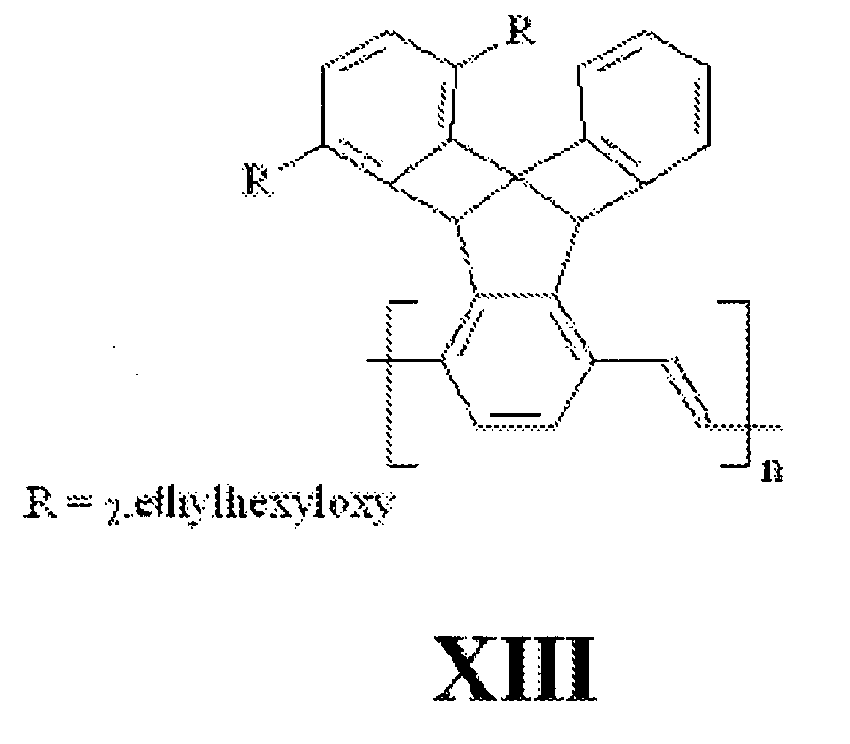
- The same experimental procedure of example 10 is repeated, except for using a dithiocarbamate-containing precursor polymer represented by the structural fromula (I) wherein Ar = unsubstituted triptycenyl, R1 = R2 = C2H5, and R3 = R4 = H. Conversion into a poly(triptycenylene vinylene) derivative represented by the structural formula (XII) is observed.

- To a solution of 100 mg of poly(iptycene vinylene) precursor polymer derivative with dithiocarbamate moieties (XIX, corresponding to the structural formula (I) wherein Ar = 1,4-bis(2-ethylhexyloxy)-9,10-dihydro-9,10[1',2']-benzoanthracene, R1 = R2 = C2H5, R3 = R4 = H , Mw = 66,500 ; Mn = 12,800 ; polydispersity index = 5.2) dissolved in chlorobenzene (5 ml), trifluoroacetic acid (1.5 molar equivalent based on the amount of dithiocarbamate moieties in the precursor polymer) was added in one go as a liquid. The solution was heated at 70°C under N2. No conversion took place after 5 hours, but a longer conversion time is necessary. Samples were taken from the reaction mixture at different points in time (after 1 hour and 5 hours respectively). After evaporation of the solvent, UV-Visible spectra (in film) were taken at room temperature for each sample. Curves a and b of
Fig. 1 are the UV-Visible spectra taken after 1 and 5 hours of conversion respectively. - The experimental procedure of example 5 is repeated, except for using methanol instead of octane-thiol. Similar observations can be made, including the indirect control of a methoxy group present onto the resulting polymer.
- The experimental procedure of example 5 is repeated, except for using phenol instead of octanethiol. Similar observations can be made, including the indirect control of a phenoxy group present onto the resulting polymer.
- The experimental procedure of example 5 is repeated, except for using benzyl alcohol instead of octanethiol. Similar observations can be made, including the indirect control of a benzyloxy group present onto the resulting polymer.
- The experimental procedure of example 5 is repeated, except for using methanol instead of octanethiol. Similar observations can be made, including the indirect control of a 3-buten-2-oxy group present onto the resulting polymer.
- The experimental procedure of example 5 is repeated, except for using thiophenol instead of octanethiol. Similar observations can be made, including the indirect control of a phenylthio group present onto the resulting polymer.
- The experimental procedure of example 5 is repeated, except for using methanol instead of octane-thiol. Similar observations can be made, including the indirect control of a 2-propene-1-thio group present onto the resulting polymer.
- The experimental procedure of example 5 is repeated, except for using methylamine instead of octanethiol. Similar observations can be made, including the indirect control of a methylamino group present onto the resulting polymer.
- The experimental procedure of example 5 is repeated, except for using allylamine instead of octanethiol. Similar observations can be made, including the indirect control of a propene-2-amino group present onto the resulting polymer.
- The experimental procedure of example 5 is repeated, except for using aniline instead of octanethiol. Similar observations can be made, including the indirect control of an anilino group present onto the resulting polymer.
- The experimental procedure of example 5 is repeated, except for using benzylamine instead of octanethiol. Similar observations can be made, including the indirect control of a benzylamino group present onto the resulting polymer.
- The experimental procedure of example 5 is repeated, except for using thiolacetic acid instead of octanethiol. Similar observations can be made, including the indirect control of an acetylthio group present onto the resulting polymer.
- The experimental procedure of example 5 is repeated, except for using acetic acid instead of octanethiol. Similar observations can be made, including the indirect control of an acetoxy group present onto the resulting polymer.
- The experimental procedure of example 5 is repeated, except for using benzoic acid instead of octanethiol. Similar observations can be made, including the indirect control of an benzoxy group present onto the resulting polymer.
- 5 molar equivalents of a biotin based derivative represented by the structural formula below

- 5 molar equivalents of a biotin based derivative as described in example 26 is added to a mixture of the dithiocarbamate-containing precursor polymer of example 1 and benzenesulfonic acid (1.5 molar equivalent, based on dithiocarbamate moieties) in chlorobenzene. Substitution of the dithiocarbamate groups by the biotin moiety via the terminal -NH2 function onto the precursor polymer backbone occurs, as evidenced by FT-IR and NMR spectra.
- 5 molar equivalents of a biotin based derivative as described in example 26 is added to a mixture of the precursor polymer of example 1 and benzenesulfonic acid (1.5 molar equivalent, based on dithiocarbamate moieties) in chlorobenzene. Substitution of the dithiocarbamate groups by the biotin moiety via the terminal -NH2 function onto the precursor polymer backbone occurs, as evidenced by FT-IR and NMR spectra.
- 5 molar equivalents of a maleimide based derivative represented by the structural formula

- 5 molar equivalents of a maleimide based derivative as described in example 29 are added to a mixture of the precursor polymer of example 1 and benzenesulfonic acid (1.5 molar equivalent, based on dithiocarbamate moieties) in chlorobenzene. Substitution of the dithiocarbamate moieties by the maleimide based derivative via the terminal carboxylic acid group onto the precursor polymer backbone occurs, as evidenced by FT-IR and NMR spectra.
- 5 molar equivalents of a maleimide based derivative as described in example 29 are added to a mixture of the precursor polymer of example 1 and benzenesulfonic acid (1.5 molar equivalent, based on dithiocarbamate moieties) in chlorobenzene. Substitution of the dithiocarbamate moieties by the maleimide based derivative via the terminal carboxylic acid group onto the precursor polymer backbone occurs.
Claims (12)
- A method of modifying a polymer having dithiocarbamate moieties and being represented by the structural formula (I),
 - Ar is arylene or heteroarylene optionally substituted with one or more substituents independently selected from the group consisting of C1-20 alkyl, C1-20 alkoxy, C1-20 alkylsulfate, poly(ethylene oxide) (PEO) or oligo(ethylene oxide), poly(ethylene glycol) (PEG) or oligo(ethylene glycol), aryl and aryl-C1-4 alkyl, wherein said heteroarylene may comprise up to 4 heteroatoms independently selected from the group consisting of oxygen, sulphur, and nitrogen,- R1 and R2 are independently selected from the group consisting of C1-20 alkyl, C3-10 cycloalkyl, aryl, aryl-C1-20 alkyl and heterocyclyl,- R3 and R4 are independently selected from the group consisting of hydrogen, C1-20 alkyl, C3-10 cycloalkyl, aryl, aryl-C1-4 alkyl and heterocyclyl, and- n is such that the number average molecular weight of the polymer is from 5.000 to 1.000.000 Dalton,wherein said method comprises a step of reacting said polymer with an acid.
 - A method according to claim 1, wherein said modification forms a conjugated polymer represented by the structural formula

- A method according to claim 1, wherein said acid is used in an amount ranging from 0.1 to 3.0 molar equivalents of the dithiocarbamate moieties present in said polymer.
- A method according to any claim 1 or claim 3, wherein reacting said polymer with said acid is performed ata temperature ranging from -30°C to +130°C.
- A method according to any of claims 1 to 4, wherein Ar is selected from the group consisting of 1,4-phenylene; 2,8-naphthalenediyl; 1,4-naphthalenediyl; 1,4-anthracenediyl; 2,6-anthracenediyl; 9,10-anthracenediyl; 2,5-thienylene; 2,5-furanediyl; 2,5-pyrrolediyl; 1,3,4-oxadiazole-2,5-dyil; 1,3,4-thiadiazole-2,5-diyl; 2,3-benzo[c]thienylene; thieno[3,2-b]thiophene-2,5-diyl; pyrrolo[3,2-b]pyrrole-2,5-diyl; pyrene-2,7-diyl; 4,5,9,10-tetrahydropyrene-2,7-diyl; 4,4'-bi-phenylene; phenantrene-2,7-diyl; 9,10-dihydrophenantrene-2,7-diyl; dibenzofurane-2,7-diyl; dibenzothiophene-2,7-diyl, substituted and non-substituted triptycenylene; substituted and non-substituted pentiptycenylene or substituted and non-substituted iptycenylene.
- A method according to any of claims 1 to 5, wherein said method further comprises adding a nucleophile agent.
- A method according to claim 6, wherein said nucleophile agent is selected from the group consisting of alcohols, thiols, phenols, thiophenols, alcoholates, thiolates, phenolates, thiophenolates, dialkylsulfurs, aminoalkanes, anilines and substituted anilines, benzylamine and substituted benzylamines, carboxylic acids, carboxylic aldehydes, carboxylic acid esters, thiocarboxylic acids and esters thereof, sulfonic acids, xanthates, carboxylic acid amides, amino-acids, peptides, nucleosides, heterocyclic bases, alkaloids and modified DNA.
- A method according to claim 6 or claim 7, which produces a polymer or copolymer comprising repeating units represented by the structural formula (III)

- A method according to claim 8, wherein Nu is selected from the group consisting of OR5, SR5, NHR6, OC(O)Ra, SC(O)R5, wherein each of R5 and R6 is independently selected from the group consisting of C1-20 alkyl, C2-20 alkenyl, aryl and aryl-C1-4 alkyl.
- A method according to any of claims 6 to 9, wherein said nucleophile agent is added in an amount ranging between 0.1 to 10 molar equivalents of the dithiocarbamate moieties present in said polymer represented by the structural formula (I).
- A method according to any of claims 1 to 10, wherein the acid exhibits a pKa from-10 to +11.
- A method according to any of claims 1 to 11, wherein the acid is an organic acid selected from the group consisting of carboxylic acids, phosphonic acids, sulfonic acids and mixtures thereof.
Priority Applications (3)
| Application Number | Priority Date | Filing Date | Title |
|---|---|---|---|
| EP20080161680 EP2020424B1 (en) | 2007-08-01 | 2008-08-01 | Functionalization of poly(arylene-vinylene) polymers for electronic devices |
| EP08166820.4A EP2116528B1 (en) | 2008-05-07 | 2008-10-16 | Method of preparing derivatives of poly(arylene vinylene) and method of preparing an electronic device including same |
| US12/435,198 US8449985B2 (en) | 2007-08-01 | 2009-05-04 | Polyiptycenylene vinylene and method of making the same |
Applications Claiming Priority (6)
| Application Number | Priority Date | Filing Date | Title |
|---|---|---|---|
| EP20070447045 EP2020423A1 (en) | 2007-08-01 | 2007-08-01 | Functionalization of poly(arylenevinylene) polymers for integrated circuits |
| US95737307P | 2007-08-22 | 2007-08-22 | |
| US12/026,385 US8173267B2 (en) | 2007-08-01 | 2008-02-05 | Functionalization of poly(arylenevinylene) polymers for integrated circuits |
| US5126808P | 2008-05-07 | 2008-05-07 | |
| US5128408P | 2008-05-07 | 2008-05-07 | |
| EP20080161680 EP2020424B1 (en) | 2007-08-01 | 2008-08-01 | Functionalization of poly(arylene-vinylene) polymers for electronic devices |
Publications (2)
| Publication Number | Publication Date |
|---|---|
| EP2020424A1 EP2020424A1 (en) | 2009-02-04 |
| EP2020424B1 true EP2020424B1 (en) | 2012-11-28 |
Family
ID=39876281
Family Applications (1)
| Application Number | Title | Priority Date | Filing Date |
|---|---|---|---|
| EP20080161680 Not-in-force EP2020424B1 (en) | 2007-08-01 | 2008-08-01 | Functionalization of poly(arylene-vinylene) polymers for electronic devices |
Country Status (1)
| Country | Link |
|---|---|
| EP (1) | EP2020424B1 (en) |
Families Citing this family (3)
| Publication number | Priority date | Publication date | Assignee | Title |
|---|---|---|---|---|
| EP2116528B1 (en) * | 2008-05-07 | 2016-01-06 | Imec | Method of preparing derivatives of poly(arylene vinylene) and method of preparing an electronic device including same |
| GB2473816A (en) * | 2009-09-18 | 2011-03-30 | Zumtobel Gmbh | Electroluminescent materials and devices |
| CN115850907B (en) * | 2022-12-29 | 2024-12-17 | 福建泓光半导体材料有限公司 | Phenolic resin composition, preparation method and application thereof, and preparation method of cured relief pattern |
Family Cites Families (6)
| Publication number | Priority date | Publication date | Assignee | Title |
|---|---|---|---|---|
| US5817430A (en) | 1996-11-13 | 1998-10-06 | Xerox Corporation | Electroluminescent polymer compositions and processes thereof |
| US6660479B2 (en) | 1999-06-07 | 2003-12-09 | Samsung Electronics Co., Ltd. | Process for preparing peptide nucleic acid probe using polymeric photoacid generator |
| JP4378872B2 (en) | 2000-11-15 | 2009-12-09 | 日本電気株式会社 | Photoacid generator, chemically amplified resist composition, and pattern formation method using the same |
| US6689530B2 (en) | 2001-09-28 | 2004-02-10 | Shin-Etsu Chemical Co., Ltd. | Sulfonyldiazomethanes, photoacid generations, resist compositions, and patterning process |
| EP1548044B1 (en) * | 2003-10-22 | 2013-07-03 | Imec | Method of preparing derivatives of polyarylene vinylene and method of preparing an electronic device including same |
| US7759127B2 (en) | 2003-12-05 | 2010-07-20 | Massachusetts Institute Of Technology | Organic materials able to detect analytes |
-
2008
- 2008-08-01 EP EP20080161680 patent/EP2020424B1/en not_active Not-in-force
Also Published As
| Publication number | Publication date |
|---|---|
| EP2020424A1 (en) | 2009-02-04 |
Similar Documents
| Publication | Publication Date | Title |
|---|---|---|
| US7511116B2 (en) | Method of preparing derivatives of polyarylene vinylene and method of preparing an electronic device including same | |
| CN104428341B (en) | Polythiophene class, the water-soluble conducting polymer using it and manufacture method thereof | |
| US9537101B2 (en) | Composition capable of changing its solubility, hole transport material composition, and organic electronic element using the same | |
| KR20120104151A (en) | Soluble alternating donor-acceptor conjugated polymer electrochromes | |
| WO2014007299A1 (en) | Polythiophenes, water-soluble conductive polymer using same, and method for producing same | |
| GB2447173A (en) | Polymeric compound and polymeric electroluminescence element using the same | |
| GB2432838A (en) | High molecular luminescent material composition and polymeric light-emitting devices | |
| KR101825251B1 (en) | High-molecular compound and light-emitting element using same | |
| EP2020424A1 (en) | Functionalization of poly(arylene-vinylene) polymers for electronic devices | |
| CN101415745B (en) | Acene-thiophene copolymers | |
| US8173999B2 (en) | Functionalization of poly(arylene-vinylene) polymers for electronic devices | |
| EP2520576A1 (en) | Compound and organic electroluminescent element using said compound | |
| Handoko et al. | Effect of cyano substituent on photovoltaic properties of quinoxaline-based polymers | |
| Yasuda et al. | New luminescent 1, 2, 4-triazole/thiophene alternating copolymers: Synthesis, characterization, and optical properties | |
| US8173267B2 (en) | Functionalization of poly(arylenevinylene) polymers for integrated circuits | |
| JP3426806B2 (en) | Method for producing polymer of α, ω-unsaturated conjugated compound | |
| EP1548044B1 (en) | Method of preparing derivatives of polyarylene vinylene and method of preparing an electronic device including same | |
| Choi et al. | Electrochemical properties of new n-type π-conjugated polybipyridines and polybiphenylenes with various bridging units | |
| EP1290059B1 (en) | Method of preparing a polymer, method of preparing a compound, compounds, polymers, and method of manufacturing an electronic device | |
| EP2116528B1 (en) | Method of preparing derivatives of poly(arylene vinylene) and method of preparing an electronic device including same | |
| KR101650708B1 (en) | 11H-benzo[4,5]thieno[3,2-b]benzo[4,5]thieno[ 2,3-d]pyrrole derivative and organic solar cell containing the same as an photo active layer | |
| KR101739259B1 (en) | New pyrrole monomer and manufacturing method thereof, polymer or compound from new pyrrole monomer and manufacturing method thereof | |
| KR101466716B1 (en) | Cyclopentadithiophene-based polymers and organic optoelectronic device comprising the polymers | |
| WO2003042276A2 (en) | Process for preparing aromatic polymers | |
| Weller et al. | 7 Influence of fluorination and backbone extension in thieno [3, 4-c] pyrrole-4, 6-dione based copolymers carrying thiophene and terthiophene comonomers |
Legal Events
| Date | Code | Title | Description |
|---|---|---|---|
| PUAI | Public reference made under article 153(3) epc to a published international application that has entered the european phase |
Free format text: ORIGINAL CODE: 0009012 |
|
| AK | Designated contracting states |
Kind code of ref document: A1 Designated state(s): AT BE BG CH CY CZ DE DK EE ES FI FR GB GR HR HU IE IS IT LI LT LU LV MC MT NL NO PL PT RO SE SI SK TR |
|
| AX | Request for extension of the european patent |
Extension state: AL BA MK RS |
|
| RIN1 | Information on inventor provided before grant (corrected) |
Inventor name: BANISHOEIB, FATEME Inventor name: LUTSEN, LAURENCE Inventor name: VANDEZANDE, DIRK |
|
| 17P | Request for examination filed |
Effective date: 20090428 |
|
| 17Q | First examination report despatched |
Effective date: 20090701 |
|
| RAP1 | Party data changed (applicant data changed or rights of an application transferred) |
Owner name: UNIVERSITEIT HASSELT Owner name: IMEC |
|
| AKX | Designation fees paid |
Designated state(s): AT BE BG CH CY CZ DE DK EE ES FI FR GB GR HR HU IE IS IT LI LT LU LV MC MT NL NO PL PT RO SE SI SK TR |
|
| GRAP | Despatch of communication of intention to grant a patent |
Free format text: ORIGINAL CODE: EPIDOSNIGR1 |
|
| GRAS | Grant fee paid |
Free format text: ORIGINAL CODE: EPIDOSNIGR3 |
|
| GRAA | (expected) grant |
Free format text: ORIGINAL CODE: 0009210 |
|
| AK | Designated contracting states |
Kind code of ref document: B1 Designated state(s): AT BE BG CH CY CZ DE DK EE ES FI FR GB GR HR HU IE IS IT LI LT LU LV MC MT NL NO PL PT RO SE SI SK TR |
|
| REG | Reference to a national code |
Ref country code: GB Ref legal event code: FG4D |
|
| REG | Reference to a national code |
Ref country code: CH Ref legal event code: EP |
|
| REG | Reference to a national code |
Ref country code: AT Ref legal event code: REF Ref document number: 586152 Country of ref document: AT Kind code of ref document: T Effective date: 20121215 |
|
| REG | Reference to a national code |
Ref country code: IE Ref legal event code: FG4D |
|
| REG | Reference to a national code |
Ref country code: DE Ref legal event code: R096 Ref document number: 602008020372 Country of ref document: DE Effective date: 20130124 |
|
| REG | Reference to a national code |
Ref country code: AT Ref legal event code: MK05 Ref document number: 586152 Country of ref document: AT Kind code of ref document: T Effective date: 20121128 |
|
| REG | Reference to a national code |
Ref country code: NL Ref legal event code: VDEP Effective date: 20121128 |
|
| REG | Reference to a national code |
Ref country code: LT Ref legal event code: MG4D |
|
| PG25 | Lapsed in a contracting state [announced via postgrant information from national office to epo] |
Ref country code: FI Free format text: LAPSE BECAUSE OF FAILURE TO SUBMIT A TRANSLATION OF THE DESCRIPTION OR TO PAY THE FEE WITHIN THE PRESCRIBED TIME-LIMIT Effective date: 20121128 Ref country code: SE Free format text: LAPSE BECAUSE OF FAILURE TO SUBMIT A TRANSLATION OF THE DESCRIPTION OR TO PAY THE FEE WITHIN THE PRESCRIBED TIME-LIMIT Effective date: 20121128 Ref country code: HR Free format text: LAPSE BECAUSE OF FAILURE TO SUBMIT A TRANSLATION OF THE DESCRIPTION OR TO PAY THE FEE WITHIN THE PRESCRIBED TIME-LIMIT Effective date: 20121128 Ref country code: LT Free format text: LAPSE BECAUSE OF FAILURE TO SUBMIT A TRANSLATION OF THE DESCRIPTION OR TO PAY THE FEE WITHIN THE PRESCRIBED TIME-LIMIT Effective date: 20121128 Ref country code: NO Free format text: LAPSE BECAUSE OF FAILURE TO SUBMIT A TRANSLATION OF THE DESCRIPTION OR TO PAY THE FEE WITHIN THE PRESCRIBED TIME-LIMIT Effective date: 20130228 Ref country code: ES Free format text: LAPSE BECAUSE OF FAILURE TO SUBMIT A TRANSLATION OF THE DESCRIPTION OR TO PAY THE FEE WITHIN THE PRESCRIBED TIME-LIMIT Effective date: 20130311 |
|
| PG25 | Lapsed in a contracting state [announced via postgrant information from national office to epo] |
Ref country code: PL Free format text: LAPSE BECAUSE OF FAILURE TO SUBMIT A TRANSLATION OF THE DESCRIPTION OR TO PAY THE FEE WITHIN THE PRESCRIBED TIME-LIMIT Effective date: 20121128 Ref country code: BE Free format text: LAPSE BECAUSE OF FAILURE TO SUBMIT A TRANSLATION OF THE DESCRIPTION OR TO PAY THE FEE WITHIN THE PRESCRIBED TIME-LIMIT Effective date: 20121128 Ref country code: GR Free format text: LAPSE BECAUSE OF FAILURE TO SUBMIT A TRANSLATION OF THE DESCRIPTION OR TO PAY THE FEE WITHIN THE PRESCRIBED TIME-LIMIT Effective date: 20130301 Ref country code: SI Free format text: LAPSE BECAUSE OF FAILURE TO SUBMIT A TRANSLATION OF THE DESCRIPTION OR TO PAY THE FEE WITHIN THE PRESCRIBED TIME-LIMIT Effective date: 20121128 Ref country code: LV Free format text: LAPSE BECAUSE OF FAILURE TO SUBMIT A TRANSLATION OF THE DESCRIPTION OR TO PAY THE FEE WITHIN THE PRESCRIBED TIME-LIMIT Effective date: 20121128 Ref country code: PT Free format text: LAPSE BECAUSE OF FAILURE TO SUBMIT A TRANSLATION OF THE DESCRIPTION OR TO PAY THE FEE WITHIN THE PRESCRIBED TIME-LIMIT Effective date: 20130328 |
|
| PG25 | Lapsed in a contracting state [announced via postgrant information from national office to epo] |
Ref country code: AT Free format text: LAPSE BECAUSE OF FAILURE TO SUBMIT A TRANSLATION OF THE DESCRIPTION OR TO PAY THE FEE WITHIN THE PRESCRIBED TIME-LIMIT Effective date: 20121128 |
|
| PG25 | Lapsed in a contracting state [announced via postgrant information from national office to epo] |
Ref country code: CZ Free format text: LAPSE BECAUSE OF FAILURE TO SUBMIT A TRANSLATION OF THE DESCRIPTION OR TO PAY THE FEE WITHIN THE PRESCRIBED TIME-LIMIT Effective date: 20121128 Ref country code: EE Free format text: LAPSE BECAUSE OF FAILURE TO SUBMIT A TRANSLATION OF THE DESCRIPTION OR TO PAY THE FEE WITHIN THE PRESCRIBED TIME-LIMIT Effective date: 20121128 Ref country code: BG Free format text: LAPSE BECAUSE OF FAILURE TO SUBMIT A TRANSLATION OF THE DESCRIPTION OR TO PAY THE FEE WITHIN THE PRESCRIBED TIME-LIMIT Effective date: 20130228 Ref country code: DK Free format text: LAPSE BECAUSE OF FAILURE TO SUBMIT A TRANSLATION OF THE DESCRIPTION OR TO PAY THE FEE WITHIN THE PRESCRIBED TIME-LIMIT Effective date: 20121128 Ref country code: SK Free format text: LAPSE BECAUSE OF FAILURE TO SUBMIT A TRANSLATION OF THE DESCRIPTION OR TO PAY THE FEE WITHIN THE PRESCRIBED TIME-LIMIT Effective date: 20121128 |
|
| PG25 | Lapsed in a contracting state [announced via postgrant information from national office to epo] |
Ref country code: RO Free format text: LAPSE BECAUSE OF FAILURE TO SUBMIT A TRANSLATION OF THE DESCRIPTION OR TO PAY THE FEE WITHIN THE PRESCRIBED TIME-LIMIT Effective date: 20121128 Ref country code: NL Free format text: LAPSE BECAUSE OF FAILURE TO SUBMIT A TRANSLATION OF THE DESCRIPTION OR TO PAY THE FEE WITHIN THE PRESCRIBED TIME-LIMIT Effective date: 20121128 Ref country code: IT Free format text: LAPSE BECAUSE OF FAILURE TO SUBMIT A TRANSLATION OF THE DESCRIPTION OR TO PAY THE FEE WITHIN THE PRESCRIBED TIME-LIMIT Effective date: 20121128 |
|
| PLBE | No opposition filed within time limit |
Free format text: ORIGINAL CODE: 0009261 |
|
| STAA | Information on the status of an ep patent application or granted ep patent |
Free format text: STATUS: NO OPPOSITION FILED WITHIN TIME LIMIT |
|
| 26N | No opposition filed |
Effective date: 20130829 |
|
| PG25 | Lapsed in a contracting state [announced via postgrant information from national office to epo] |
Ref country code: CY Free format text: LAPSE BECAUSE OF FAILURE TO SUBMIT A TRANSLATION OF THE DESCRIPTION OR TO PAY THE FEE WITHIN THE PRESCRIBED TIME-LIMIT Effective date: 20121128 |
|
| REG | Reference to a national code |
Ref country code: DE Ref legal event code: R097 Ref document number: 602008020372 Country of ref document: DE Effective date: 20130829 |
|
| REG | Reference to a national code |
Ref country code: CH Ref legal event code: PL |
|
| PG25 | Lapsed in a contracting state [announced via postgrant information from national office to epo] |
Ref country code: LI Free format text: LAPSE BECAUSE OF NON-PAYMENT OF DUE FEES Effective date: 20130831 Ref country code: MC Free format text: LAPSE BECAUSE OF FAILURE TO SUBMIT A TRANSLATION OF THE DESCRIPTION OR TO PAY THE FEE WITHIN THE PRESCRIBED TIME-LIMIT Effective date: 20121128 Ref country code: CH Free format text: LAPSE BECAUSE OF NON-PAYMENT OF DUE FEES Effective date: 20130831 |
|
| REG | Reference to a national code |
Ref country code: IE Ref legal event code: MM4A |
|
| PG25 | Lapsed in a contracting state [announced via postgrant information from national office to epo] |
Ref country code: IE Free format text: LAPSE BECAUSE OF NON-PAYMENT OF DUE FEES Effective date: 20130801 |
|
| PG25 | Lapsed in a contracting state [announced via postgrant information from national office to epo] |
Ref country code: MT Free format text: LAPSE BECAUSE OF FAILURE TO SUBMIT A TRANSLATION OF THE DESCRIPTION OR TO PAY THE FEE WITHIN THE PRESCRIBED TIME-LIMIT Effective date: 20121128 Ref country code: TR Free format text: LAPSE BECAUSE OF FAILURE TO SUBMIT A TRANSLATION OF THE DESCRIPTION OR TO PAY THE FEE WITHIN THE PRESCRIBED TIME-LIMIT Effective date: 20121128 |
|
| PG25 | Lapsed in a contracting state [announced via postgrant information from national office to epo] |
Ref country code: HU Free format text: LAPSE BECAUSE OF FAILURE TO SUBMIT A TRANSLATION OF THE DESCRIPTION OR TO PAY THE FEE WITHIN THE PRESCRIBED TIME-LIMIT; INVALID AB INITIO Effective date: 20080801 Ref country code: LU Free format text: LAPSE BECAUSE OF NON-PAYMENT OF DUE FEES Effective date: 20130801 |
|
| PG25 | Lapsed in a contracting state [announced via postgrant information from national office to epo] |
Ref country code: IS Free format text: LAPSE BECAUSE OF FAILURE TO SUBMIT A TRANSLATION OF THE DESCRIPTION OR TO PAY THE FEE WITHIN THE PRESCRIBED TIME-LIMIT Effective date: 20121128 |
|
| REG | Reference to a national code |
Ref country code: FR Ref legal event code: PLFP Year of fee payment: 9 |
|
| PGFP | Annual fee paid to national office [announced via postgrant information from national office to epo] |
Ref country code: GB Payment date: 20160726 Year of fee payment: 9 Ref country code: DE Payment date: 20160721 Year of fee payment: 9 |
|
| PGFP | Annual fee paid to national office [announced via postgrant information from national office to epo] |
Ref country code: FR Payment date: 20160720 Year of fee payment: 9 |
|
| REG | Reference to a national code |
Ref country code: DE Ref legal event code: R119 Ref document number: 602008020372 Country of ref document: DE |
|
| GBPC | Gb: european patent ceased through non-payment of renewal fee |
Effective date: 20170801 |
|
| REG | Reference to a national code |
Ref country code: FR Ref legal event code: ST Effective date: 20180430 |
|
| PG25 | Lapsed in a contracting state [announced via postgrant information from national office to epo] |
Ref country code: GB Free format text: LAPSE BECAUSE OF NON-PAYMENT OF DUE FEES Effective date: 20170801 Ref country code: DE Free format text: LAPSE BECAUSE OF NON-PAYMENT OF DUE FEES Effective date: 20180301 |
|
| PG25 | Lapsed in a contracting state [announced via postgrant information from national office to epo] |
Ref country code: FR Free format text: LAPSE BECAUSE OF NON-PAYMENT OF DUE FEES Effective date: 20170831 |