EP2020406A1 - New antimicrobial compounds, their synthesis and their use for treatment of mammalian infection - Google Patents
New antimicrobial compounds, their synthesis and their use for treatment of mammalian infection Download PDFInfo
- Publication number
- EP2020406A1 EP2020406A1 EP07013899A EP07013899A EP2020406A1 EP 2020406 A1 EP2020406 A1 EP 2020406A1 EP 07013899 A EP07013899 A EP 07013899A EP 07013899 A EP07013899 A EP 07013899A EP 2020406 A1 EP2020406 A1 EP 2020406A1
- Authority
- EP
- European Patent Office
- Prior art keywords
- linear
- branched aliphatic
- chain members
- formula
- benzothiazin
- Prior art date
- Legal status (The legal status is an assumption and is not a legal conclusion. Google has not performed a legal analysis and makes no representation as to the accuracy of the status listed.)
- Withdrawn
Links
- 150000001875 compounds Chemical class 0.000 title claims abstract description 41
- 208000015181 infectious disease Diseases 0.000 title claims abstract description 7
- 238000011282 treatment Methods 0.000 title claims abstract description 7
- 230000015572 biosynthetic process Effects 0.000 title abstract description 6
- 238000003786 synthesis reaction Methods 0.000 title abstract description 6
- 230000000845 anti-microbial effect Effects 0.000 title abstract description 4
- 201000008827 tuberculosis Diseases 0.000 claims abstract description 19
- 125000001797 benzyl group Chemical group [H]C1=C([H])C([H])=C(C([H])=C1[H])C([H])([H])* 0.000 claims abstract description 18
- 229920006395 saturated elastomer Polymers 0.000 claims abstract description 16
- 229910052801 chlorine Inorganic materials 0.000 claims abstract description 14
- 229910052731 fluorine Inorganic materials 0.000 claims abstract description 14
- 229910052794 bromium Inorganic materials 0.000 claims abstract description 12
- 125000002496 methyl group Chemical group [H]C([H])([H])* 0.000 claims abstract description 11
- 125000002023 trifluoromethyl group Chemical group FC(F)(F)* 0.000 claims abstract description 10
- 125000003545 alkoxy group Chemical group 0.000 claims abstract description 9
- 125000001997 phenyl group Chemical group [H]C1=C([H])C([H])=C(*)C([H])=C1[H] 0.000 claims abstract description 6
- 125000001931 aliphatic group Chemical group 0.000 claims abstract description 4
- 125000001028 difluoromethyl group Chemical group [H]C(F)(F)* 0.000 claims abstract description 4
- 125000000876 trifluoromethoxy group Chemical group FC(F)(F)O* 0.000 claims abstract description 4
- 238000000034 method Methods 0.000 claims description 33
- XLYOFNOQVPJJNP-UHFFFAOYSA-N water Substances O XLYOFNOQVPJJNP-UHFFFAOYSA-N 0.000 claims description 19
- 125000002924 primary amino group Chemical group [H]N([H])* 0.000 claims description 15
- WEVYAHXRMPXWCK-UHFFFAOYSA-N Acetonitrile Chemical compound CC#N WEVYAHXRMPXWCK-UHFFFAOYSA-N 0.000 claims description 12
- CSCPPACGZOOCGX-UHFFFAOYSA-N Acetone Chemical compound CC(C)=O CSCPPACGZOOCGX-UHFFFAOYSA-N 0.000 claims description 10
- QTBSBXVTEAMEQO-UHFFFAOYSA-N Acetic acid Chemical compound CC(O)=O QTBSBXVTEAMEQO-UHFFFAOYSA-N 0.000 claims description 9
- 238000006243 chemical reaction Methods 0.000 claims description 9
- FZFMYVAZNHKETP-SNVBAGLBSA-N 2-[methyl-[(1r)-1-phenylethyl]amino]-8-nitro-6-(trifluoromethyl)-1,3-benzothiazin-4-one Chemical compound C1([C@H](N(C)C=2SC3=C([N+]([O-])=O)C=C(C=C3C(=O)N=2)C(F)(F)F)C)=CC=CC=C1 FZFMYVAZNHKETP-SNVBAGLBSA-N 0.000 claims description 7
- 150000001298 alcohols Chemical class 0.000 claims description 7
- 125000004194 piperazin-1-yl group Chemical group [H]N1C([H])([H])C([H])([H])N(*)C([H])([H])C1([H])[H] 0.000 claims description 7
- 229910052751 metal Inorganic materials 0.000 claims description 5
- 239000002184 metal Substances 0.000 claims description 5
- 239000003960 organic solvent Substances 0.000 claims description 5
- 150000003839 salts Chemical class 0.000 claims description 5
- 206010024229 Leprosy Diseases 0.000 claims description 3
- 241000124008 Mammalia Species 0.000 claims description 3
- 150000001412 amines Chemical class 0.000 claims description 3
- 230000000813 microbial effect Effects 0.000 claims description 2
- 239000008194 pharmaceutical composition Substances 0.000 claims description 2
- 229910003204 NH2 Inorganic materials 0.000 claims 2
- JCXJVPUVTGWSNB-UHFFFAOYSA-N nitrogen dioxide Inorganic materials O=[N]=O JCXJVPUVTGWSNB-UHFFFAOYSA-N 0.000 claims 2
- RAHZWNYVWXNFOC-UHFFFAOYSA-N sulfur dioxide Inorganic materials O=S=O RAHZWNYVWXNFOC-UHFFFAOYSA-N 0.000 claims 2
- 229910052736 halogen Inorganic materials 0.000 claims 1
- 125000005843 halogen group Chemical group 0.000 claims 1
- 238000011321 prophylaxis Methods 0.000 claims 1
- 230000001225 therapeutic effect Effects 0.000 claims 1
- 239000003814 drug Substances 0.000 abstract description 9
- 229940079593 drug Drugs 0.000 abstract description 8
- 230000000694 effects Effects 0.000 abstract description 6
- 206010061822 Drug intolerance Diseases 0.000 abstract description 2
- LFQSCWFLJHTTHZ-UHFFFAOYSA-N Ethanol Chemical compound CCO LFQSCWFLJHTTHZ-UHFFFAOYSA-N 0.000 description 30
- IAZDPXIOMUYVGZ-WFGJKAKNSA-N Dimethyl sulfoxide Chemical compound [2H]C([2H])([2H])S(=O)C([2H])([2H])[2H] IAZDPXIOMUYVGZ-WFGJKAKNSA-N 0.000 description 20
- HEDRZPFGACZZDS-MICDWDOJSA-N Trichloro(2H)methane Chemical compound [2H]C(Cl)(Cl)Cl HEDRZPFGACZZDS-MICDWDOJSA-N 0.000 description 18
- 239000007787 solid Substances 0.000 description 17
- 238000005160 1H NMR spectroscopy Methods 0.000 description 11
- VLKZOEOYAKHREP-UHFFFAOYSA-N n-Hexane Chemical compound CCCCCC VLKZOEOYAKHREP-UHFFFAOYSA-N 0.000 description 9
- 239000011541 reaction mixture Substances 0.000 description 9
- SSMQOXFMYXHULT-UHFFFAOYSA-N 2-(benzylamino)-8-nitro-6-(trifluoromethyl)-1,3-benzothiazin-4-one Chemical compound [O-][N+](=O)C1=CC(C(F)(F)F)=CC(C(N=2)=O)=C1SC=2NCC1=CC=CC=C1 SSMQOXFMYXHULT-UHFFFAOYSA-N 0.000 description 8
- ZMXDDKWLCZADIW-UHFFFAOYSA-N N,N-Dimethylformamide Chemical compound CN(C)C=O ZMXDDKWLCZADIW-UHFFFAOYSA-N 0.000 description 8
- 230000002401 inhibitory effect Effects 0.000 description 8
- XEKOWRVHYACXOJ-UHFFFAOYSA-N Ethyl acetate Chemical compound CCOC(C)=O XEKOWRVHYACXOJ-UHFFFAOYSA-N 0.000 description 6
- 230000000844 anti-bacterial effect Effects 0.000 description 6
- 238000001953 recrystallisation Methods 0.000 description 6
- 239000000725 suspension Substances 0.000 description 6
- AEEXQLMBJXNPMU-UHFFFAOYSA-N 2-(4-benzylpiperazin-1-yl)-8-nitro-6-(trifluoromethyl)-1,3-benzothiazin-4-one Chemical compound [O-][N+](=O)C1=CC(C(F)(F)F)=CC(C(N=2)=O)=C1SC=2N(CC1)CCN1CC1=CC=CC=C1 AEEXQLMBJXNPMU-UHFFFAOYSA-N 0.000 description 5
- IDNXLFOQOLAAPH-UHFFFAOYSA-N 2-[4-(2-fluorophenyl)piperazin-1-yl]-8-nitro-6-(trifluoromethyl)-1,3-benzothiazin-4-one Chemical compound [O-][N+](=O)C1=CC(C(F)(F)F)=CC(C(N=2)=O)=C1SC=2N(CC1)CCN1C1=CC=CC=C1F IDNXLFOQOLAAPH-UHFFFAOYSA-N 0.000 description 5
- 241001646725 Mycobacterium tuberculosis H37Rv Species 0.000 description 5
- 239000000203 mixture Substances 0.000 description 5
- 239000002244 precipitate Substances 0.000 description 5
- 239000007858 starting material Substances 0.000 description 5
- AEUTYOVWOVBAKS-UWVGGRQHSA-N ethambutol Chemical compound CC[C@@H](CO)NCCN[C@@H](CC)CO AEUTYOVWOVBAKS-UWVGGRQHSA-N 0.000 description 4
- 239000012467 final product Substances 0.000 description 4
- 239000002609 medium Substances 0.000 description 4
- 0 CCCN(CCC)*(C)* Chemical compound CCCN(CCC)*(C)* 0.000 description 3
- OKKJLVBELUTLKV-UHFFFAOYSA-N Methanol Chemical compound OC OKKJLVBELUTLKV-UHFFFAOYSA-N 0.000 description 3
- 238000004440 column chromatography Methods 0.000 description 3
- 208000037265 diseases, disorders, signs and symptoms Diseases 0.000 description 3
- 239000012990 dithiocarbamate Substances 0.000 description 3
- 208000036984 extensively drug-resistant tuberculosis Diseases 0.000 description 3
- QRXWMOHMRWLFEY-UHFFFAOYSA-N isoniazide Chemical compound NNC(=O)C1=CC=NC=C1 QRXWMOHMRWLFEY-UHFFFAOYSA-N 0.000 description 3
- 238000000746 purification Methods 0.000 description 3
- 239000000243 solution Substances 0.000 description 3
- GBEMNSRGSOIQIX-UHFFFAOYSA-N 1,3-benzothiazin-4-one Chemical class C1=CC=C2C(=O)N=CSC2=C1 GBEMNSRGSOIQIX-UHFFFAOYSA-N 0.000 description 2
- JQMJSCJCLPSDNR-UHFFFAOYSA-N 2-[4-(4-chlorophenyl)piperazin-1-yl]-6,8-dinitro-1,3-benzothiazin-4-one Chemical compound N=1C(=O)C2=CC([N+](=O)[O-])=CC([N+]([O-])=O)=C2SC=1N(CC1)CCN1C1=CC=C(Cl)C=C1 JQMJSCJCLPSDNR-UHFFFAOYSA-N 0.000 description 2
- -1 2-substituted-4H-1,3-benzothiazin-4-one Chemical class 0.000 description 2
- UODVGRSCHPJYLN-UHFFFAOYSA-N 8-nitro-6-(trifluoromethyl)-2-[4-[3-(trifluoromethyl)phenyl]piperazin-1-yl]-1,3-benzothiazin-4-one Chemical compound [O-][N+](=O)C1=CC(C(F)(F)F)=CC(C(N=2)=O)=C1SC=2N(CC1)CCN1C1=CC=CC(C(F)(F)F)=C1 UODVGRSCHPJYLN-UHFFFAOYSA-N 0.000 description 2
- 241000894006 Bacteria Species 0.000 description 2
- 241001465754 Metazoa Species 0.000 description 2
- 241000186365 Mycobacterium fortuitum Species 0.000 description 2
- 241000187480 Mycobacterium smegmatis Species 0.000 description 2
- CDBYLPFSWZWCQE-UHFFFAOYSA-L Sodium Carbonate Chemical compound [Na+].[Na+].[O-]C([O-])=O CDBYLPFSWZWCQE-UHFFFAOYSA-L 0.000 description 2
- UIIMBOGNXHQVGW-UHFFFAOYSA-M Sodium bicarbonate Chemical compound [Na+].OC([O-])=O UIIMBOGNXHQVGW-UHFFFAOYSA-M 0.000 description 2
- FAPWRFPIFSIZLT-UHFFFAOYSA-M Sodium chloride Chemical compound [Na+].[Cl-] FAPWRFPIFSIZLT-UHFFFAOYSA-M 0.000 description 2
- 238000004458 analytical method Methods 0.000 description 2
- 239000003242 anti bacterial agent Substances 0.000 description 2
- WGQKYBSKWIADBV-UHFFFAOYSA-N benzylamine Chemical compound NCC1=CC=CC=C1 WGQKYBSKWIADBV-UHFFFAOYSA-N 0.000 description 2
- 239000003795 chemical substances by application Substances 0.000 description 2
- 239000012895 dilution Substances 0.000 description 2
- 238000010790 dilution Methods 0.000 description 2
- 201000010099 disease Diseases 0.000 description 2
- BNIILDVGGAEEIG-UHFFFAOYSA-L disodium hydrogen phosphate Chemical compound [Na+].[Na+].OP([O-])([O-])=O BNIILDVGGAEEIG-UHFFFAOYSA-L 0.000 description 2
- 229910000397 disodium phosphate Inorganic materials 0.000 description 2
- 150000004659 dithiocarbamates Chemical class 0.000 description 2
- 229960000285 ethambutol Drugs 0.000 description 2
- 229940093499 ethyl acetate Drugs 0.000 description 2
- 235000019439 ethyl acetate Nutrition 0.000 description 2
- 238000001914 filtration Methods 0.000 description 2
- 239000007788 liquid Substances 0.000 description 2
- 239000006379 löwenstein-jensen medium Substances 0.000 description 2
- 238000001819 mass spectrum Methods 0.000 description 2
- 238000000655 nuclear magnetic resonance spectrum Methods 0.000 description 2
- 238000011084 recovery Methods 0.000 description 2
- 239000013049 sediment Substances 0.000 description 2
- UCSJYZPVAKXKNQ-HZYVHMACSA-N streptomycin Chemical compound CN[C@H]1[C@H](O)[C@@H](O)[C@H](CO)O[C@H]1O[C@@H]1[C@](C=O)(O)[C@H](C)O[C@H]1O[C@@H]1[C@@H](NC(N)=N)[C@H](O)[C@@H](NC(N)=N)[C@H](O)[C@H]1O UCSJYZPVAKXKNQ-HZYVHMACSA-N 0.000 description 2
- HEEACTTWORLLPM-UHFFFAOYSA-N 2-(1h-imidazol-5-yl)ethanol Chemical compound OCCC1=CNC=N1 HEEACTTWORLLPM-UHFFFAOYSA-N 0.000 description 1
- XGNWEHYJHKVEHM-UHFFFAOYSA-N 2-(2-carbamoyl-4,6-dinitrophenyl)-4-(4-chlorophenyl)piperazine-1-carbodithioic acid Chemical compound NC(=O)C1=CC([N+]([O-])=O)=CC([N+]([O-])=O)=C1C1N(C(S)=S)CCN(C=2C=CC(Cl)=CC=2)C1 XGNWEHYJHKVEHM-UHFFFAOYSA-N 0.000 description 1
- YCHUHDPMIIFYGU-UHFFFAOYSA-N 2-[4-(5-chloro-2-methylphenyl)piperazin-1-yl]-8-nitro-6-(trifluoromethyl)-1,3-benzothiazin-4-one Chemical compound CC1=CC=C(Cl)C=C1N1CCN(C=2SC3=C([N+]([O-])=O)C=C(C=C3C(=O)N=2)C(F)(F)F)CC1 YCHUHDPMIIFYGU-UHFFFAOYSA-N 0.000 description 1
- UGCJCMXWPFVXLO-UHFFFAOYSA-N 2-[benzyl(methyl)amino]-6-chloro-8-nitro-1,3-benzothiazin-4-one Chemical compound N=1C(=O)C2=CC(Cl)=CC([N+]([O-])=O)=C2SC=1N(C)CC1=CC=CC=C1 UGCJCMXWPFVXLO-UHFFFAOYSA-N 0.000 description 1
- RBGDLYUEXLWQBZ-UHFFFAOYSA-N 2-chlorobenzamide Chemical class NC(=O)C1=CC=CC=C1Cl RBGDLYUEXLWQBZ-UHFFFAOYSA-N 0.000 description 1
- NGGFNCAOJAYNTH-UHFFFAOYSA-N 2-ethoxy-8-nitro-6-(trifluoromethyl)-1,3-benzothiazin-4-one Chemical compound FC(F)(F)C1=CC([N+]([O-])=O)=C2SC(OCC)=NC(=O)C2=C1 NGGFNCAOJAYNTH-UHFFFAOYSA-N 0.000 description 1
- MJNPHLBKHKJDEF-UHFFFAOYSA-N 2h-1$l^{4},2-benzothiazine 1-oxide Chemical compound C1=CC=C2S(=O)NC=CC2=C1 MJNPHLBKHKJDEF-UHFFFAOYSA-N 0.000 description 1
- UJVBZCCNLAAMOV-UHFFFAOYSA-N 2h-1,2-benzothiazine Chemical class C1=CC=C2C=CNSC2=C1 UJVBZCCNLAAMOV-UHFFFAOYSA-N 0.000 description 1
- HRHFUHGNTSSIFS-UHFFFAOYSA-N 2h-thiazine 1-oxide Chemical compound O=S1NC=CC=C1 HRHFUHGNTSSIFS-UHFFFAOYSA-N 0.000 description 1
- FLVZTNAMLNMCIA-UHFFFAOYSA-N 4-chloro-n-[4-[(4-methylpyrimidin-2-yl)sulfamoyl]phenyl]-3-nitrobenzamide Chemical compound CC1=CC=NC(NS(=O)(=O)C=2C=CC(NC(=O)C=3C=C(C(Cl)=CC=3)[N+]([O-])=O)=CC=2)=N1 FLVZTNAMLNMCIA-UHFFFAOYSA-N 0.000 description 1
- 208000035143 Bacterial infection Diseases 0.000 description 1
- 229910020323 ClF3 Inorganic materials 0.000 description 1
- 208000035473 Communicable disease Diseases 0.000 description 1
- 206010059866 Drug resistance Diseases 0.000 description 1
- DGAQECJNVWCQMB-PUAWFVPOSA-M Ilexoside XXIX Chemical compound C[C@@H]1CC[C@@]2(CC[C@@]3(C(=CC[C@H]4[C@]3(CC[C@@H]5[C@@]4(CC[C@@H](C5(C)C)OS(=O)(=O)[O-])C)C)[C@@H]2[C@]1(C)O)C)C(=O)O[C@H]6[C@@H]([C@H]([C@@H]([C@H](O6)CO)O)O)O.[Na+] DGAQECJNVWCQMB-PUAWFVPOSA-M 0.000 description 1
- KFZMGEQAYNKOFK-UHFFFAOYSA-N Isopropanol Chemical compound CC(C)O KFZMGEQAYNKOFK-UHFFFAOYSA-N 0.000 description 1
- 206010062207 Mycobacterial infection Diseases 0.000 description 1
- 241000187473 Mycobacterium aurum Species 0.000 description 1
- 108700035964 Mycobacterium tuberculosis HsaD Proteins 0.000 description 1
- 241000187644 Mycobacterium vaccae Species 0.000 description 1
- AIIPLNHEPPVMPF-UHFFFAOYSA-M O.O.[Na+].C(N)([S-])=S.ClC1=CC=C(C=C1)N1CCNCC1 Chemical compound O.O.[Na+].C(N)([S-])=S.ClC1=CC=C(C=C1)N1CCNCC1 AIIPLNHEPPVMPF-UHFFFAOYSA-M 0.000 description 1
- 101100062394 Picea mariana DAD1 gene Proteins 0.000 description 1
- ZLMJMSJWJFRBEC-UHFFFAOYSA-N Potassium Chemical compound [K] ZLMJMSJWJFRBEC-UHFFFAOYSA-N 0.000 description 1
- VYPSYNLAJGMNEJ-UHFFFAOYSA-N Silicium dioxide Chemical compound O=[Si]=O VYPSYNLAJGMNEJ-UHFFFAOYSA-N 0.000 description 1
- KGTSLTYUUFWZNW-PPJQWWMSSA-N [(7S,9E,11S,12R,13S,14R,15R,16R,17S,18S,19E,21Z)-2,15,17,27,29-pentahydroxy-11-methoxy-3,7,12,14,16,18,22-heptamethyl-26-[(E)-(4-methylpiperazin-1-yl)iminomethyl]-6,23-dioxo-8,30-dioxa-24-azatetracyclo[23.3.1.14,7.05,28]triaconta-1(29),2,4,9,19,21,25,27-octaen-13-yl] acetate pyridine-4-carbohydrazide Chemical compound NNC(=O)c1ccncc1.CO[C@H]1\C=C\O[C@@]2(C)Oc3c(C2=O)c2c(O)c(\C=N\N4CCN(C)CC4)c(NC(=O)\C(C)=C/C=C/[C@H](C)[C@H](O)[C@@H](C)[C@@H](O)[C@@H](C)[C@H](OC(C)=O)[C@@H]1C)c(O)c2c(O)c3C KGTSLTYUUFWZNW-PPJQWWMSSA-N 0.000 description 1
- GHEWXBAQAPFAPW-UHFFFAOYSA-N [3-amino-6-methyl-4-(trifluoromethyl)thieno[2,3-b]pyridin-2-yl]-(4-nitrophenyl)methanone Chemical compound S1C2=NC(C)=CC(C(F)(F)F)=C2C(N)=C1C(=O)C1=CC=C([N+]([O-])=O)C=C1 GHEWXBAQAPFAPW-UHFFFAOYSA-N 0.000 description 1
- 208000036981 active tuberculosis Diseases 0.000 description 1
- 230000002411 adverse Effects 0.000 description 1
- 239000004411 aluminium Substances 0.000 description 1
- 229910052782 aluminium Inorganic materials 0.000 description 1
- XAGFODPZIPBFFR-UHFFFAOYSA-N aluminium Chemical compound [Al] XAGFODPZIPBFFR-UHFFFAOYSA-N 0.000 description 1
- 229940126575 aminoglycoside Drugs 0.000 description 1
- 230000001355 anti-mycobacterial effect Effects 0.000 description 1
- 238000009635 antibiotic susceptibility testing Methods 0.000 description 1
- 239000007900 aqueous suspension Substances 0.000 description 1
- 208000022362 bacterial infectious disease Diseases 0.000 description 1
- 230000003385 bacteriostatic effect Effects 0.000 description 1
- 230000037396 body weight Effects 0.000 description 1
- 125000001246 bromo group Chemical group Br* 0.000 description 1
- 238000002815 broth microdilution Methods 0.000 description 1
- 239000004490 capsule suspension Substances 0.000 description 1
- DKVNPHBNOWQYFE-UHFFFAOYSA-N carbamodithioic acid Chemical compound NC(S)=S DKVNPHBNOWQYFE-UHFFFAOYSA-N 0.000 description 1
- JQXXHWHPUNPDRT-YOPQJBRCSA-N chembl1332716 Chemical compound O([C@](C1=O)(C)O\C=C/[C@@H]([C@H]([C@@H](OC(C)=O)[C@H](C)[C@H](O)[C@H](C)[C@@H](O)[C@@H](C)/C=C\C=C(C)/C(=O)NC=2C(O)=C3C(O)=C4C)C)OC)C4=C1C3=C(O)C=2\C=N\N1CCN(C)CC1 JQXXHWHPUNPDRT-YOPQJBRCSA-N 0.000 description 1
- 229940125904 compound 1 Drugs 0.000 description 1
- 229940125773 compound 10 Drugs 0.000 description 1
- 229940125782 compound 2 Drugs 0.000 description 1
- 229940126214 compound 3 Drugs 0.000 description 1
- 229940125898 compound 5 Drugs 0.000 description 1
- 239000012043 crude product Substances 0.000 description 1
- 230000034994 death Effects 0.000 description 1
- 231100000517 death Toxicity 0.000 description 1
- 150000002148 esters Chemical class 0.000 description 1
- 238000000338 in vitro Methods 0.000 description 1
- 238000011534 incubation Methods 0.000 description 1
- 238000002347 injection Methods 0.000 description 1
- 239000007924 injection Substances 0.000 description 1
- 239000002054 inoculum Substances 0.000 description 1
- 238000010255 intramuscular injection Methods 0.000 description 1
- 239000007927 intramuscular injection Substances 0.000 description 1
- 238000010253 intravenous injection Methods 0.000 description 1
- 238000002955 isolation Methods 0.000 description 1
- 229960003350 isoniazid Drugs 0.000 description 1
- ZLVXBBHTMQJRSX-VMGNSXQWSA-N jdtic Chemical compound C1([C@]2(C)CCN(C[C@@H]2C)C[C@H](C(C)C)NC(=O)[C@@H]2NCC3=CC(O)=CC=C3C2)=CC=CC(O)=C1 ZLVXBBHTMQJRSX-VMGNSXQWSA-N 0.000 description 1
- 230000007246 mechanism Effects 0.000 description 1
- 238000002844 melting Methods 0.000 description 1
- 230000008018 melting Effects 0.000 description 1
- 201000009671 multidrug-resistant tuberculosis Diseases 0.000 description 1
- 208000027531 mycobacterial infectious disease Diseases 0.000 description 1
- 239000002547 new drug Substances 0.000 description 1
- 230000002352 nonmutagenic effect Effects 0.000 description 1
- 238000007911 parenteral administration Methods 0.000 description 1
- 239000000546 pharmaceutical excipient Substances 0.000 description 1
- 229910052700 potassium Inorganic materials 0.000 description 1
- 239000011591 potassium Substances 0.000 description 1
- IPEHBUMCGVEMRF-UHFFFAOYSA-N pyrazinecarboxamide Chemical compound NC(=O)C1=CN=CC=N1 IPEHBUMCGVEMRF-UHFFFAOYSA-N 0.000 description 1
- 238000003224 resazurin reduction assay Methods 0.000 description 1
- 229960001225 rifampicin Drugs 0.000 description 1
- 238000007363 ring formation reaction Methods 0.000 description 1
- 229910002027 silica gel Inorganic materials 0.000 description 1
- 239000000741 silica gel Substances 0.000 description 1
- 229960001866 silicon dioxide Drugs 0.000 description 1
- 239000011734 sodium Substances 0.000 description 1
- 229910052708 sodium Inorganic materials 0.000 description 1
- OMAGIWPDSGOXAM-UHFFFAOYSA-M sodium N-benzyl-N-ethylcarbamodithioate dihydrate Chemical compound O.O.[Na+].CCN(Cc1ccccc1)C([S-])=S OMAGIWPDSGOXAM-UHFFFAOYSA-M 0.000 description 1
- 229910000030 sodium bicarbonate Inorganic materials 0.000 description 1
- 229910000029 sodium carbonate Inorganic materials 0.000 description 1
- 239000011780 sodium chloride Substances 0.000 description 1
- 239000002904 solvent Substances 0.000 description 1
- 229960005322 streptomycin Drugs 0.000 description 1
- 238000010254 subcutaneous injection Methods 0.000 description 1
- 239000007929 subcutaneous injection Substances 0.000 description 1
- 239000000126 substance Substances 0.000 description 1
- 239000006228 supernatant Substances 0.000 description 1
- 239000003826 tablet Substances 0.000 description 1
- 150000003567 thiocyanates Chemical class 0.000 description 1
- 238000011200 topical administration Methods 0.000 description 1
- 230000000699 topical effect Effects 0.000 description 1
- 238000001665 trituration Methods 0.000 description 1
Classifications
-
- C—CHEMISTRY; METALLURGY
- C07—ORGANIC CHEMISTRY
- C07D—HETEROCYCLIC COMPOUNDS
- C07D279/00—Heterocyclic compounds containing six-membered rings having one nitrogen atom and one sulfur atom as the only ring hetero atoms
- C07D279/04—1,3-Thiazines; Hydrogenated 1,3-thiazines
- C07D279/08—1,3-Thiazines; Hydrogenated 1,3-thiazines condensed with carbocyclic rings or ring systems
-
- A—HUMAN NECESSITIES
- A61—MEDICAL OR VETERINARY SCIENCE; HYGIENE
- A61P—SPECIFIC THERAPEUTIC ACTIVITY OF CHEMICAL COMPOUNDS OR MEDICINAL PREPARATIONS
- A61P31/00—Antiinfectives, i.e. antibiotics, antiseptics, chemotherapeutics
- A61P31/04—Antibacterial agents
- A61P31/06—Antibacterial agents for tuberculosis
-
- A—HUMAN NECESSITIES
- A61—MEDICAL OR VETERINARY SCIENCE; HYGIENE
- A61P—SPECIFIC THERAPEUTIC ACTIVITY OF CHEMICAL COMPOUNDS OR MEDICINAL PREPARATIONS
- A61P31/00—Antiinfectives, i.e. antibiotics, antiseptics, chemotherapeutics
- A61P31/04—Antibacterial agents
- A61P31/08—Antibacterial agents for leprosy
Definitions
- the present invention relates to novel benzothiazin derivatives and their use as antibacterial agents in infectious diseases of mammals (humans and animals) caused by bacteria, especially diseases like tuberculosis (TB) and leprosy caused by mycobacteria.
- mycobacteria resistant at least against two of the most active tuberculosis drugs, isoniazid and rifampicin, but also against streptomycin, pyranzinamid and ethambutol.
- the proportion of MDR-TB in some countries is already more than 20%. Even more threatening became the situation since the first cases of XDR-TB (extremly resistant TB) were diagnosed last year in South Africa. Now XDR-TB is already spread over all continents.
- Mycobacteria causing XDR-TB are resistant against the first line TB drugs Rifampicin, Isoniazid, Pyrazinamid, Ethambutol and additionally against the second line chinolones and aminoglycosides. ( Nature Med. 2007,13, 295-298 ) Together with the increased number of TB diseases generally, worldwide it causes about 2.000.000 deaths annually.
- the present invention aims at the generation of new compounds with activity against mycobacteria as potential new tuberculosis drugs to overcome problems concerning resistance and drug intolerance.
- R 1 and R 2 are, independently of each other, NO 2 , NR 7 R 8 , NHOR 9 , COOR 9 , CN, CONR 10 R 11 , CHO, F, Cl, Br, SO 2 NR 12 R 13 , lower alkoxy, OCF 3 , mono-, di or trifluoromethyl;
- R 3 and R 4 axe, independently of each other, H, a saturated or unsaturated, linear or branched aliphatic radical having 1-3 chain members, F, Cl, Br, lower alkoxy;
- R 5 is H, a saturated or unsaturated, halogenated or unhalogenated, linear or branched aliphatic radical having 1-7 chain members;
- R 6 is a radical: wherein X is saturated or unsaturated, halogenated or unhalogenated, linear or branched aliphatic radical having 1-5 chain members, or R 5 and R 6 together represent bivalent radicals wherein n is 1-4: R 7 - R
- the invention concerns compounds of the formula (I) selected from the group consisting of
- Methods A, B and C propose to use as starting material well known polysubstituted 2-chloro(bromo)-benzcarboxamides, many of them described in the literature or can be easily prepared by analogues methods ( Isaew S. G. Farm. Zh. (Kiev), 2000, 52 ; Makosza M., Nizamov S. Org. Prep. and Proced.Int., 1997, 29, 707 ; Nerin C., Tomes A. R., Domento C., Cacho J. J. Agr.
- the starting 2-chlorobenzcarboxamides were treated by 1,0-1,2 equimolar quantity of the metal salts of dithiocarbamates in alcohols, aceton or in their mixture under 0-50°C for a period of about one quater of an hour to about 24 hours.
- this reaction is conducted in alcohol at room temperature.
- the reaction mixture was diluted by water and solid 2-dithiocarbamoylbenzcarboxamide was filtered off.
- 2-Dithiocarbamoylbenzcarboxamide was treated by light alkaly (e.g.
- the 2-substituted-4H-1,3-benzothiazin-4-one is obtained by conventional recovery procedures, e.g. trituration with ethylacetate or dilution with water, filtration and recrystallization from a suitable organic solvent.
- This method proposes to use excess of metal dithiocarbamate as light alkaly in the benzothiazinone cyclization and not to isolate 2-dithiocarbamoylbenzcarboxamide.
- the starting 2-chlorobenzcarboxamides can be treated with a 1,2-2,5 equimolar quantity of the metal salts of dithiocarbamates in alcohols, aceton or in their mixture at 20-80°C for a period of about 3-36 hours.
- this reaction is conducted in alcohol or in a mixture of water/alcohol at 50-75°C for about 24 hours.
- the aimed 2-substituted-4H-1,3-benzothiazin-4-one is obtained by recovery procedures from method A.
- This method uses as starting material 2-chlorobenzencarboxamides. These compounds were treated with 1,1-2,0 fold excess of metal salts of alkylxantogenate, for example commercial available potassium ethylxantogenate, at a temperature of 20-100°C in different alcohols, acetone, acetonitrile or other suitable organic solvents for a period of about one half hour to about 24 hours. Preferably, this reaction is conducted in alcohol at room temperature for about 24 hours.
- alkylxantogenate for example commercial available potassium ethylxantogenate
- the isolated 2-alkoxy-4 H -1,3-benzothiazin-4-one was treated with the corresponding amine HNR 5 R 6 in acetic acid, alcohols, ethylacetate, DMF, aceton or acetonitrile for a period of up to 48 hours for full exchange of the alkoxy group to the corresponding amine.
- the reaction mixture can be evaporated and diluted by water or it can be diluted by water directly.
- the aimed 2- NR 5 R 6 -4 H- 1,3-benzothiazin-4-one is recovered by customary isolation procedures, e.g, filtration and recrystallization from a suitable organic solvent.
- the compounds of the invention exhibit strong antibacterial activity, especially against mycobacteria with minimal inhibitory concentrations (MIC) in the range of ⁇ 0,000012 - 0,78 ⁇ g/ml for fast growing mycobacteria, of ⁇ 0.39 - 3.12 ⁇ g/ml for M. tuberculosis, including multiresistant strains, determined by the classical method and of 2.0 - 50.0 ng/ml for M. tuberculosis H37Rv determined by the Alamar Blue method.
- the compounds of the invention demonstrate a high level of selectivity for mycobacteria only which reduces the potential for adverse side effects dramatically.
- the compounds of the invention are non-mutagenic at 5 mg/ml in the SOS chromotest ( M.Isidori, M. Lavorgna, A.Nardelli, L.Pascarella, A. Parella, Sci. Total Environ., 2005, 346, 87-98 ; M. Bombardier, N. Bermingham, R. Legault, A. Fouquet, Chemosphere, 2001, 42, 931-44 ; D.A. Widdick, D.I. Edward, Mutat, Res., 1991, 259, 89-93 ) .
- the compounds of the invention are useful for the treatment of tuberculosis infections and other mycobacterial infections, in humans and in animals.
- the invention concerns pharmaceutical compositions comprising a compound of the formula I.
- the invention relates furthermore to a compound of the formula I for use in a method for the treatment of bacterial infections in mammals.
- Preferred compounds of the formula I for use in such method are those specifically listed above.
- the compounds of the invention are formulated for use by preparing a diluted solution or suspension in pharmaceutically acceptable aqueous, organic or aqueous-organic medium for topical or parenteral administration by intravenous, subcutaneous or intramuscular injection, or for intranasal application; or are prepared in tablet, capsule or aqueous suspension form with conventional excipients for oral administration or as suppositorium.
- the compounds can be used in dosages from 0.001-1000 mg/kg body weight.
- the examples which follow in the subsequent experimental part serve to illustrate the invention but should not be construed as a limitation thereof.
- the structures of the compounds of the invention were established by modes of synthesis and elementary analysis, and by nuclear magnetic resonance and mass spectra.
- MIC bacteriostatic effect
- Table 2 Antimicrobial activity of compounds of the formula I against Mycobacterium tuberculosis H37Rv and clinical isolates HSRE resistant strain and XTB strain as determined by minimal inhibitory concentrations (MIC) and minimal bactericidal concentrations (MBC) Strain Compound MBC ( ⁇ g/mL) MIC ( ⁇ g/mL) H37Rv 5 3.12 1.56 HSRE resistant 3.12 1.56 X TB 3.12 1.56 H37Rv 8 1.56 1.56 HSRE resistant 1.56 0.78 X TB 1.56 0.78 H37Rv 10 0.78 ⁇ 0.39 HSRE resistant 1.56 1.56 X TB 0.39 ⁇ 0.39 H37Rv Isoniazid (INH) 1.56 0.78 HSRE resistant Not active X TB Not active HSRE
Landscapes
- Chemical & Material Sciences (AREA)
- Organic Chemistry (AREA)
- Health & Medical Sciences (AREA)
- Medicinal Chemistry (AREA)
- Pharmacology & Pharmacy (AREA)
- Oncology (AREA)
- Chemical Kinetics & Catalysis (AREA)
- General Chemical & Material Sciences (AREA)
- Veterinary Medicine (AREA)
- Nuclear Medicine, Radiotherapy & Molecular Imaging (AREA)
- Communicable Diseases (AREA)
- Life Sciences & Earth Sciences (AREA)
- Animal Behavior & Ethology (AREA)
- General Health & Medical Sciences (AREA)
- Public Health (AREA)
- Pulmonology (AREA)
- Pharmaceuticals Containing Other Organic And Inorganic Compounds (AREA)
- Nitrogen- Or Sulfur-Containing Heterocyclic Ring Compounds With Rings Of Six Or More Members (AREA)
- Acyclic And Carbocyclic Compounds In Medicinal Compositions (AREA)
Abstract

R3 and R4 are, independently of each other, H, a saturated or unsaturated, linear or branched aliphatic radical having 1-3 chain members, F, Cl, Br, lower alkoxy;
R5 is H, a saturated or unsaturated, halogenated or unhalogenated, linear or branched aliphatic radical having 1-7 chain members;
R6 is a radical:

R5 and R6 together represent bivalent radicals wherein n is 1-4:
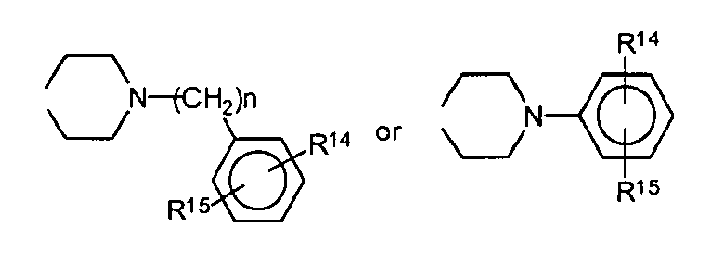
R14 and R15 are, independently of each other, H, linear or branched aliphatic radical having 1-5 chain members, F, Cl, Br, NO2, NH2, CF3.
Description
- The present invention relates to novel benzothiazin derivatives and their use as antibacterial agents in infectious diseases of mammals (humans and animals) caused by bacteria, especially diseases like tuberculosis (TB) and leprosy caused by mycobacteria.
- Thiazinone, their derivatives and their use as antibacterial agents, especially against mycobacteria (TB), laid open for public in
AR 24 25 67 A1 AU 37 04 400 A1 CA 13 22 551 C1 orEP 0 245 901 B1 for instance.
As known, there is a threatening worldwide increase in tuberculosis infections with mycobacteria which developed resistance against the available therapeutics (B.R.Bloom, J.L.Murray, Tuberculosis: commentary on a reemergent killer. Science 1992, 257, 1055-1064). Extremely dangerous is the development of multidrug resistant (MDR) mycobacteria. These are mycobacteria, resistant at least against two of the most active tuberculosis drugs, isoniazid and rifampicin, but also against streptomycin, pyranzinamid and ethambutol. The proportion of MDR-TB in some countries is already more than 20%. Even more threatening became the situation since the first cases of XDR-TB (extremly resistant TB) were diagnosed last year in South Africa. Now XDR-TB is already spread over all continents. Mycobacteria causing XDR-TB are resistant against the first line TB drugs Rifampicin, Isoniazid, Pyrazinamid, Ethambutol and additionally against the second line chinolones and aminoglycosides. (Nature Med. 2007,13, 295-298) Together with the increased number of TB diseases generally, worldwide it causes about 2.000.000 deaths annually. - For the treatment of such diseases, like (TB) or leprosy, there is an urgent need for new drugs with new mechanisms of actions, especially to overcome drug resistance and to overcome the known dramatic side effects of the available drugs.
- The present invention aims at the generation of new compounds with activity against mycobacteria as potential new tuberculosis drugs to overcome problems concerning resistance and drug intolerance.
- This aim has been solved by providing compounds of the formula I
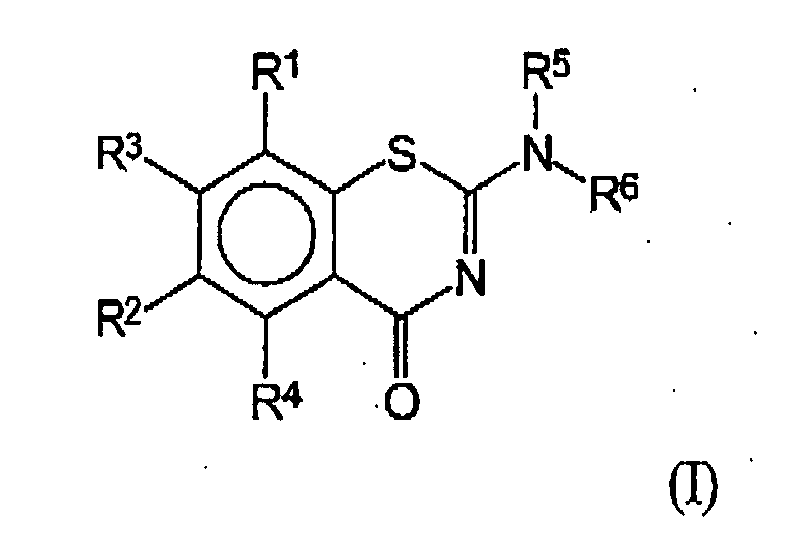
R3 and R4 axe, independently of each other, H, a saturated or unsaturated, linear or branched aliphatic radical having 1-3 chain members, F, Cl, Br, lower alkoxy;
R5 is H, a saturated or unsaturated, halogenated or unhalogenated, linear or branched aliphatic radical having 1-7 chain members;
R6 is a radical:
R5 and R6 together represent bivalent radicals wherein n is 1-4:
R14 and R15 are, independently of each other, H, linear or branched aliphatic radical having 1-5 chain members, F, Cl, Br, NO2, NH2, CF3. - In a preferred embodiment the invention concerns compounds of the formula (I) selected from the group consisting of
- 2-[4-(2-R14,5-R15-phenyl)piperazin-1-yl]-8-nitro-6-(trifluoromethyl)-4H--1,3-benzothiazin-4-one,
- 2-[4-(2-R14,6-R15-phenyl)piperazin-1-yl]-8-nitro-6-(trifluoromethyl)-4H--1,3-benzothiazin-4-one,
- 2-[4-(3-R14,5-R15-phenyl)piperazin-1-yl]-8-nitro-6-(trifluoromethyl)-4H--1,3-benzothiazin-4-one,
- 2-[benzyl(methyl)amino]-8-nitro-6-R2-4H-1,3-benzothiazin-4-one,
- 2-[benzyl(R5)amino]-8-nitro-6-(trifluoromethyl)-4H-1,3-benzothiazin-4-one,
- 2-[benzyl(R5)amino]-8-nitro-6-R2-4H-1,3-benzothiazin-4-one,
- 2-[benzyl(R5)amino]-8-nitro-6-chloro-4H-1,3-benzothiazin-4-one,
- 2-[benzyl(R5)amino]-8-nitro-6-fluoro-4H-1,3-benzothiazin-4-one,
- 2-[benzyl(R5)amino]-8-R1-6-(trifluoromethyl)-4H-1,3-benzothiazin-4-one,
- 2-[4-(4-Chlorophenyl)piperazin-1-yl]-6,8-dinitro-4H-1,3-benzothiazin-4-one,
- 2-[4-(5-chloro-2-methylphenyl)piperazin-1-yl]-8-nitro-6-(trifluoromethyl)-4H-1,3-benzothiazin-4-one,
- 8-Nitro-6-(trifluoromethyl)-2-{4-[3-(trifluoromethyl)phenyl]piperazin-1-yl}-4H-1,3-benzothiazin-4-one,
- 2-[Benzyl(ethyl)amino]-8-nitro-6-(trifluoromethyl)-4H-1,3-benzothia-zin-4-one,
- 2-[Benzyl(methyl)amino]-8-nitro-6-(trifluoromethyl)-4H- 1,3-benzothia-zin-4-one,
- 2-[4-(2-Fluorophenyl)piperazin-1-yl]-8-nitro-6-(trifluoromethyl)-4H-1,3-benzothiazin-4-one,
- 2-(4-Benzylpiperazin-1-yl)-8-nitro-6-(trifluoromethyl)-4H-1,3-benzothiazin-4-one,
- 2-(Benzylamino)-8-nitro-6-(trifluoromethyl)-4H-1,3-benzothiazin-4-one,
- 2-{Methyl[(1R)-1-phenylethyl]amino}-8-nitro-6-(trifluoromethyl)-4H-1,3-benzothiazin-4-one,
- 2-[Benzyl(methyl)amino]-6-chloro-8-nitro-4H-1,3-benzothiazin-4-one.
- We used 4 different methods for the synthesis of new and novel 1,3-benzothiazin-4-one derivatives. Methods A, B and C propose to use as starting material well known polysubstituted 2-chloro(bromo)-benzcarboxamides, many of them described in the literature or can be easily prepared by analogues methods (Isaew S. G. Farm. Zh. (Kiev), 2000, 52; Makosza M., Nizamov S. Org. Prep. and Proced.Int., 1997, 29, 707; Nerin C., Tomes A. R., Domento C., Cacho J. J. Agr. and Food Chem., 1996, 44, 4009; Thiel W., Mayer R, Jauer, E.-A., Modrow H., Dost H. J. Prakt. Chem., 1986, 328, 497; Yokoyama M., Yoshida S., Imamoto T. Synthesis, 1982, 591; Romanowski J., Eckstein Z. Pol. J. Chem., 1984, 58, 263; Nisato D., Sacilotto R., Frigerio M., Boveri S., Palmisano G., Lesma G. Org. Prep. Proced, Int., 1985, 17, 75; Oikawa N., Nakagawa Y., Nishimura K., Ueno T., Fujita T., Pestic. Sci., 1994, 41, 139; Welch D.E., Baron R.R, J. Med. Chem., 1969, 12, 299; Fuller R.W., Molloy B.B., Day W.A., Roush B.W., March M.M., J. Med. Chem., 1973,16, 101 and many others).

- The starting 2-chlorobenzcarboxamides were treated by 1,0-1,2 equimolar quantity of the metal salts of dithiocarbamates in alcohols, aceton or in their mixture under 0-50°C for a period of about one quater of an hour to about 24 hours. Preferably, this reaction is conducted in alcohol at room temperature. The reaction mixture was diluted by water and solid 2-dithiocarbamoylbenzcarboxamide was filtered off. For the next step it is possible to use crude product or to recrystallize it from a suitable organic solvent. 2-Dithiocarbamoylbenzcarboxamide was treated by light alkaly (e.g. Na2HPO4, NaHCO3, Na2CO3, etc) in water, alcohols or in a mixture of water/alcohol at a temperature of 50-100°C for 2-36 hours. Preferably, this reaction is conducted in a mixture of water/alcohol at 50-75°C for about 24 hours. When the reaction is complete, the 2-substituted-4H-1,3-benzothiazin-4-one is obtained by conventional recovery procedures, e.g. trituration with ethylacetate or dilution with water, filtration and recrystallization from a suitable organic solvent.
- This method proposes to use excess of metal dithiocarbamate as light alkaly in the benzothiazinone cyclization and not to isolate 2-dithiocarbamoylbenzcarboxamide. So, the starting 2-chlorobenzcarboxamides can be treated with a 1,2-2,5 equimolar quantity of the metal salts of dithiocarbamates in alcohols, aceton or in their mixture at 20-80°C for a period of about 3-36 hours. Preferably, this reaction is conducted in alcohol or in a mixture of water/alcohol at 50-75°C for about 24 hours. The aimed 2-substituted-4H-1,3-benzothiazin-4-one is obtained by recovery procedures from method A.

- This method uses as starting material 2-chlorobenzencarboxamides. These compounds were treated with 1,1-2,0 fold excess of metal salts of alkylxantogenate, for example commercial available potassium ethylxantogenate, at a temperature of 20-100°C in different alcohols, acetone, acetonitrile or other suitable organic solvents for a period of about one half hour to about 24 hours. Preferably, this reaction is conducted in alcohol at room temperature for about 24 hours. The isolated 2-alkoxy-4H-1,3-benzothiazin-4-one was treated with the corresponding amine HNR5R6 in acetic acid, alcohols, ethylacetate, DMF, aceton or acetonitrile for a period of up to 48 hours for full exchange of the alkoxy group to the corresponding amine. After the process is completed the reaction mixture can be evaporated and diluted by water or it can be diluted by water directly. The aimed 2- NR5R6-4H-1,3-benzothiazin-4-one is recovered by customary isolation procedures, e.g, filtration and recrystallization from a suitable organic solvent.
- The classical method of 1,3-benzothiazin-4-one synthesis by use of the reaction of thiocyanate salts with 2-chloroarylchloroanhydride and a subsequent treatment of the reaction mass with the corresponding amine is usable too. This method is well described in the scientific literature, for example: J. Imrich, P. Kristian, Coll. Czech. Chem. Commun., 1982, 47, 3268-3282; D. Koscik, P. Kristian, J. Gonda, E. Dandarova, Coll. Czech. Chem. Commun., 1983, 48, 3315-3328; D. Koscik, P. Kristian, O. Forgac, Coll. Czech. Chem. Commun.., 1983, 48, 3427-3432;
T. H. Cronin, H. - J .E. Hess, Pat. US 3522247 . - Surprisingly the compounds of the invention exhibit strong antibacterial activity, especially against mycobacteria with minimal inhibitory concentrations (MIC) in the range of <0,000012 - 0,78 µg/ml for fast growing mycobacteria, of <0.39 - 3.12 µg/ml for M. tuberculosis, including multiresistant strains, determined by the classical method and of 2.0 - 50.0 ng/ml for M. tuberculosis H37Rv determined by the Alamar Blue method. Surprisingly the compounds of the invention demonstrate a high level of selectivity for mycobacteria only which reduces the potential for adverse side effects dramatically.
- The compounds of the invention are non-mutagenic at 5 mg/ml in the SOS chromotest (M.Isidori, M. Lavorgna, A.Nardelli, L.Pascarella, A. Parella, Sci. Total Environ., 2005, 346, 87-98; M. Bombardier, N. Bermingham, R. Legault, A. Fouquet, Chemosphere, 2001, 42, 931-44; D.A. Widdick, D.I. Edward, Mutat, Res., 1991, 259, 89-93).
- Thus, the compounds of the invention are useful for the treatment of tuberculosis infections and other mycobacterial infections, in humans and in animals.
- Accordingly, the invention concerns pharmaceutical compositions comprising a compound of the formula I.
- The invention relates furthermore to a compound of the formula I for use in a method for the treatment of bacterial infections in mammals.
- Preferred compounds of the formula I for use in such method are those specifically listed above.
- The compounds of the invention are formulated for use by preparing a diluted solution or suspension in pharmaceutically acceptable aqueous, organic or aqueous-organic medium for topical or parenteral administration by intravenous, subcutaneous or intramuscular injection, or for intranasal application; or are prepared in tablet, capsule or aqueous suspension form with conventional excipients for oral administration or as suppositorium.
- The compounds can be used in dosages from 0.001-1000 mg/kg body weight.
The examples which follow in the subsequent experimental part serve to illustrate the invention but should not be construed as a limitation thereof. - The structures of the compounds of the invention were established by modes of synthesis and elementary analysis, and by nuclear magnetic resonance and mass spectra.
- Chemicals and solvents were purchased from Alfa-Aesar (GB) or from Aldrich Co. (Sigma-Aldrich Company, St-Louis, US) and were used in the synthesis without additional purification. Melting points were determined according to the BP procedure and are uncorrected (Electrothermal 9001, GB). If analyses are indicated only by the symbols of the elements, analytical results are within ±0.3% of the theoretical values (Carlo-Erba 5500, Italy). NMR spectra were determined with a Varian Unity Plus 400 (USA). Shifts for 1H NMR are reported in ppm downfield from TMS (δ). Mass spectra were obtained using a Finnigan SSQ-700 (USA) instrument with direct injection. Reactions and purity of compounds were controlled by TLC using Silicagel 60 F254 aluminium sheets (Merck Co, Germany).
- 0.5 g of 2-chloro-3,5-dinitrobenzcarboxamide was dissolved in 25 ml ethanol. The reaction mixture was treated with of 0.39 g of 4-(4-chlorophenyl)-piperazine dithiocarbamate sodium salt dihydrate and stored for 6 h at room temperature. The reaction mixture was poured into 50 ml of cooled water and the resulting yellow precipitate was filtered off. Pure final product was obtained after recrystallization from ethanol. 2-Aminocarbonyl-4,6-dinitrophenyl-4-(4-chlorophenyl)piperazine-1-carbodithioate is a light yellow crystalline solid. Yield 68 %. mp 178-180°C. MS m/z 481 (M+).
Anal. Calcd. for C18H16ClN5O5S2: C, 44.86; H, 3.35; N, 14.53; S, 13.31
Found: C, 44.71; H, 3.36; N, 14.62; S,13.35 - 0.5 g of 2-aminocarbonyl-4,6-dinitrophenyl-4-(4-chlorophenyl)pipe-razine-1-carbodithioate was dissolved in 25 ml ethanol. The reaction mixture was treated with of 0.2 g of Na2HPO4 x 12H2O and refluxed for 6 h. Reaction mixture was cooled in the refrigerator and the ligth yellow precipitate was filtered off and washed with 50 ml water and 30 ml methanol. Pure final product was obtained after recrystallization twice from ethanol. 2-(1,4-2-[4-(4-Chlorophenyl)piperazin-1-yl]-6,8-dinitro-4H-1,3-benzothtiazin-4-one is a light yellow crystalline solid. Yield 38 %. mp 279-281°C (EtOH)
MS m/z 447 (M+).
1H NMR (DMSO-d6/CDCl3) δ 9.08 and 8.95 (two 1H, two s, 2CH), 6.88 and 6.71 (two 2H, d, C6H4Cl), 3,68 and 3.30 (two 4H, m, N(CH2CH2)2N) ppm.
Anal. Calcd. for C18H14ClN5O5S: C, 48.27; H, 3.15; N, 15.04; S, 7.16
Found: C, 48.34; H, 3.22; N, 14.97; S, 7.23 - Following the procedure of Example 1 using of 2-chloro-3-nitro-5-trfluoromethylbenzcarboxamide as starting material. Light yellow crystalline solid. Yield 44%. mp 158-161°C (DMF/water)
MS m/z 484 (M+).
1H NMR (DMSO-d6/CDCl3) δ 8.80 and 8.77 (two 1H, two s, 2CH), 7.32 (1H, s, CH), 9.95 and 6.73 (two 1H, d, two CH), 3,65 and 3.29 (two 4H, m, N(CH2CH2)2N), 2.29 (3H, s, CH3) ppm.
Anal. Calcd. for C20H16ClF3N4O3S: C, 49.54; H, 3.33; N, 11.55; S, 6.61
Found: C, 49.45; H, 3.40; N, 11.47; S, 6.83 - Following the procedure of Example 1 using of 2-chloro-3-nitro-5-trifluoromethylbenzcarboxamide as starting material. Light yellow crystaline solid. Yield 33%. mp 201-203°C (EtOH).
MS m/z 504 (M+).
1H NMR (DMSO-d6/CDCl) δ 8.80 and 8.77 (two 1H, two s, 2CH), 7.61 (1H, s, CH), 7.39 and 7.03 (two 1H, d, two CH), 3,66 and 3.31 (two 4H,
m, N(CH2CH2)2N) ppm.
Anal. Calcd. for C2H14F6N4O3S: C, 47.62; H, 2.80; N, 11.11; S, 6.36
Found: C, 47.74; H, 2.91; N,11.29; S, 6.53 - A suspension of 1.2 g 2-chloro-3-amino-5-trifluoromethyl-benzcarboxamide in 45 ml ethanol was treated with 2.0 g of benzyl(ethyl)dithiocarbamate sodium salt dihydrate and refluxed for 14 h. The dark red reaction mixture was diluted with 70 ml of water, cooled in the refrigerator for 6 hours, the ligth yellow precipitate was filtered off and washed with 50 ml ester. Pure final product was obtained after column chromatography (hexane/aceton 3:1). 2-[Benzyl(ethyl)aminol-8-nitro-6-(trifluoromethyl)-4H-1,3-benzothia-zin-4-one is a light yellow crystalline solid. Yield 40 %. mp 94-97°C.
MS m/z 409 (M+).
1H NMR (DMSO-d6/CDCl3) δ 8.80 and 8.77 (two 1H, two s, 2CH), 7.41-7.25 (5H, m, C6H5), 4.62 (2H, s, CH2), 3.43 (2H, q, CH2), 1.01
(3H, t, CH3) ppm.
Anal. Calcd. for C18H14F3N3O3S: C, 52.81; H, 3.45; N, 10.26; S, 7.83
Found: C, 52.73; H, 3.38; N,10.44; S, 7.89 - Following the procedure of Example 4. Light yellow crystalline solid. Yield 47%. mp 120-124°C (EtOH/water).
MS m/z 395 (M+).
1H NMR (DMSO-d6/CDCl3) δ 8.81 and 8.77 (two 1H, two s, 2CH), 7.40-7.25 (5H, m, C6H5), 4.64 (2H, s, CH2), 2.87 (3H, s, CH3) ppm. Anal. Calcd. for C17H12F3N3O3S: C, 51.64; H, 3.06; N, 10.63; S, 8.11
Found: C, 51.76; H, 3.13; N, 10.41; S, 8.34 - Following the procedure of Example 1. Light yellow crystalline solid. Yield 37%. mp 164-168°C (i-PrOH).
MS m/z 454 (M+).
1H NMR (DMSO-d6/CDCl3) δ 8.81 and 8.77 (two 1H, two s, 2CH), 6.76 (3H, m, 3CH), 6.11 (1H, m, CH), 3,68 and 3.30 (two 4H, m, N(CH2CH2)2N) ppm.
Anal. Calcd. for C19H14F4N4O3S: C, 50.22; H, 3.11; N, 12.33; S, 7.06
Found: C, 50.08; H, 3.21; N,12.46; S, 7.09 - Following the procedure of Example 4. Yellow crystalline solid. Yield 51%. mp 161-163°C (EtOH/DMF).
MS m/z 450 (M+).
1H NMR (DMSO-d6/CDCl3) δ 8.80 and 8.76 (two 1H, two s, 2CH), 7.19-7.28 (5H, m, Ph), 3.48 (2H, s, CH2), 3,38 and 3.09 (two 4H, m, N(CH2CH2)2N) ppm.
Anal. Calcd. for C17H18N4O7S: C, 53.33; H, 3.80; N, 12.44; S, 7.12
Found: C, 53.29; H, 4,01; N,12.48; S, 7.06 - A suspension of 2.5 g 2-chloro-3-nitro-5-trifluoromethylbenzcar-boxamide in 25 ml ethanol was treated with of 1.75 g of sodium ethylxantogenate and stored for 24 h at room temperature. The reaction mixture was poured into 50 ml of cooled water and the resulting yellow precipitate was faltered off. Pure 2-ethoxy-8-nitro-6-(trifluoromethyl)-4H-1,3-benzothiazin-4-one was obtained after recrystallization from ethanol/water as white crystalline solid. Yield 58 %. mp 146-148°C.
MS m/z 320 (M+).
Anal. Calcd. for C11H7F3N2O4S: C, 41.26; H, 2.20; N, 8.75; S,10.01
Found: C, 41.34; H, 2.22; N, 8.87; S, 10.27
A solution of 0.7 g of 2-ethoxy-8-nitro-6-(trifluoromethyl)-4H-1,3,-benzothiazin-4-one in 15 ml acetic acid was treated with 0.4 ml of benzylamine and refluxed for 14 h. The reaction mixture was evaporated and the residue was treated by 10 ml water, the yellow precipitate was filtered off and washed with 50 ml water. Pure final product was obtained after recrystallization twice from ethanol/DMF. 2-(Benzylamino)-8-nitro-6-(trifluoromethyl)-4H-1,3-benzothiazin-4-one is a light yellow crystalline solid. Yield 73 %. mp 192-194°C.
MS m/z 381 (M+).
1H NMR (DMSO-d6/CDCl3) δ 9.27 (1H, broad s, NH), 8.80 and 8.75 (two 1H, two s, 2CH), 7.74-7.49 (5H, m, Ph), 4.49 (2H, s, CH2) ppm. Anal. Calcd. for C16H10F3N3O3S: C, 50:39; H, 2.64; N,11.02; S, 8.41
Found: C, 50.42; H, 2.61; N,10.89; S, 8.64 - Following the procedure of Example 1. Light yellow crystalline solid. Yield 54%. mp 110-113°C (purification by column chromatography aceton/hexane 5:1).
MS m/z 409 (M+).
1H NMR (DMSO-d6/CDCl3) δ 8.82 and 8.76 (two 1H, two s, 2CH), 7.84, 7.43, 7.15 (5H, 3 m, Ph), 4.84 (H, m, CH), 3.07 (3H, s, NCH3,), 1.39 (3H, d, CH3) ppm.
Anal. Calcd. for C18H14F3N3O3S: C, 52.81; H, 3.45; N, 10.26; S, 7.83
Found: C, 52.73; H, 3.46; N,10.19; S, 7.92 - Following the procedure of Example 8. Light yellow crystalline solid. Yield 64%. mp 138-141°C (purification by column chromatography aceton/hexane 4:1).
MS m/z 361 (M+).
1H NMR (DMSO-d6/CDCl3) δ 8.37 and 8.23 (two 1H, two s, 2CH), 7.45-7.35 (5H, m, Ph), 4.62 (2H, 2, CH2), 2.87 (3H, s, CH3) ppm. Anal. Calcd. for C16H12ClN3O3S: C, 53.11; H, 3.34; N,11.61; S, 8.86
Found: C, 53.19; H, 3.30; N, 11.52; S, 8.89 - Determination of the in vitro inhibitory activity of the compounds of the invention against mycobacteria.
- The antibacterial activities of the compounds against Mycobacterium smegmatis SG 987, M. aurum SB66, M vaccae IMET 10670 and M. fortuitum B were tested by determination of minimal inhibitory concentrations (MIC) by the broth micro dilution method in Mueller-Hinton broth (Difco) according to the NCCLS guidelines [National Committee for Clinical Laboratory Standards: Methods for dilution antimicrobial susceptibility tests for bacteria that grow aerobically; 5th Ed.; Villanova, Ed.; Approved standard Document M7-A5. NCCLS, (2000)]. The results are presented in Table 1.
Table 1: Antimicrobial activity of compounds as of the formula I determined by minimal inhibitory concentrations MIC [µg/ml] Compound M. smegmatis
MIC [µg/ml]M.vaccae
MIC [µg/ml]M.fortuitum
MIC [µg/ml]1 0,78 0,0062 0,78 2 0,05 0,008 0,031 3 0,04 0,0031 0,0031 4 0,0062 0,0008 0,0062 5 0,0156 0,0005 0,0156 6 0,005 0,005 0,005 7 0,05 0,05 0,05 8 0,00078 <0,0000121 0,00078 9 <0,0000121 <0,0000121 <0,0000121 10 0,0062 0,00031 0,00156 - Activity against M. tuberculosis H37Rv was tested by the following method for determination of minimal inhibitory concentrations (MIC) and minimal bactericidal concentrations (MBC):
- Strains were inoculated onto solid Lowenstein-Jensen medium. After 21 days, the cultures grown were used to prepare an inoculum suspension corresponding to 5 x 10⁸ microbial cells/ml. With 0,2 ml of that suspension tubes with 2 ml liquid Shkolnikova medium, containing corresponding concentrations of compounds under study - from 100,0 to 0,195 µg/ml, were inoculated. After 14 days of incubation at 37 °C the tubes with liquid medium were centrifuged for 15min. at 3000 RPM. After discarding the supernatant, the sediment was resuspended in 0,8 ml of sterile 0,9% NaCl. 0,1 ml of the suspension was used to prepare smears subsequently stained by the Ziehl-Neelsen method. The retaining sediment was inoculated in 0,2 ml volumes into three tubes with solid drug free Lowenstein-Jensen medium to determine minimal bactericidal concentrations (MBC). The results were read after 21-28 days of cultivation at 37 °C. Controls were tubes cultured with test-strains not treated with the studied agents.
Minimal bactericidal concentration of drugs (MBC) was considered as the drug concentration completely inhibiting the growth of mycobacteria on the solid medium. The bacteriostatic effect (MIC) was characterized by the presence of only individual mycobacteria in the smear and a strong decrease in the number of colonies grown on solid media compared to the controls. The results are presented in Table 2.Table 2: Antimicrobial activity of compounds of the formula I against Mycobacterium tuberculosis H37Rv and clinical isolates HSRE resistant strain and XTB strain as determined by minimal inhibitory concentrations (MIC) and minimal bactericidal concentrations (MBC) Strain Compound MBC
(µg/mL)MIC
(µg/mL)H37Rv 5 3.12 1.56 HSRE resistant 3.12 1.56 X TB 3.12 1.56 H37Rv 8 1.56 1.56 HSRE resistant 1.56 0.78 X TB 1.56 0.78 H37Rv 10 0.78 <0.39 HSRE resistant 1.56 1.56 X TB 0.39 <0.39 H37Rv Isoniazid (INH) 1.56 0.78 HSRE resistant Not active X TB Not active HSRE: multiresistant strain
XTB: extremly resistant strain - Activity against M. tuberculosis H37Rv was determined by the resazurin reduction assay (MIC96) too. The method was described in detail in: P. Quillardet, O. Huisman, R. D'Ari, M. Hofnung, Proc. Natl. Acad. Sci. USA, 1982, 79, 5971-5; J.C. Palomino, A. Martin, M. Camacho, H. Guerra, J. Swings, F. Portaels, Antimicrob. Agents Chemother., 2002, 46, 2720-2. The results are presented in Table 3.
Table 3: Antimycobacterial activity of compounds as of the formula I determined by minimal inhibitory concentrations (MIC) [ng/ml] Compound M. tuberculosis H37Rv (ng/ml) 4 2 5 3 8 50 9 0,4 10 25 INH 125
Claims (12)
- A compound of the formula I

R3 and R4 are, independently of each other, H, a saturated or unsaturated, linear or branched aliphatic radical having 1-3 chain members, F, Cl, Br, lower alkoxy;
R5 is H, a saturated or unsaturated, halogenated or unhalogenated, linear or branched aliphatic radical having 1-7 chain members;
R6 is a radical:

R14 and R15 are, independently of each other, H, linear or branched aliphatic radical having 1-5 chain members, F, Cl, Br, NO2, NH2, CF3. - Salts of compound of formula (I).
- A 2-[4-(2-R14,5-R15-phenyl)piperazin-1-yl]-8-nitro-6-(trifluoro-methyl)-4H-1,3-benzothiazin-4-one of the formula (I) according to claim 1, R14 represents H, R15 represents halogen.
- A 2-[4-(3-R14,5-R15-phenyl)piperazin-1-yl]-8-nitro-6-(trifluoromethyl)-4H-1,3-benzothiazin-4-one of the formula (I) according to claim 1, R14 represents H, R15 represents F or Cl.
- A 2-[benzyl(methyl)amino]-8-nitro-6-R2-4H-1,3-benzothiazin-4-one of the formula (I) according to claim 1, R2 represents CF3, Cl or F.
- A 2-[benzyl(R5)amino]-8-R1-6-(trifluoromethyl)-4H-1,3-benzothiazin-4-one, of the formula (I) according to claim 1, R1 represents CF3, NO2 NHOH, NR7R8 and R7 and R8 have the meanings given in claim 1.
- A compound of the formula (I) according to claim 1 selected from the group consisting of 2-{methyl[(1R)-1-phenylethyl]amino}-8-nitro-6-(trifluoromethyl)-4H-1,3-benzothiazin-4-one.
- A compound of the formula (I) according to claim 1 selected from the group consisting of 6-R2-2-[methyl(2-phenylethyl)amino]-8-nitro-4H-1,3-benzothiazin-4-one.
- A compound of the formula (I) according to claim 1 selected from the group consisting of 6-triflomemyl-2-[methyl(2-phenylethyl)amino]-8-R1-4H-1,3-benzothiazin-4-one.
- A pharmaceutical composition comprising a compound of the formula I according to claim 1.
- A compound of the formula I

R3 and R4 are, independently of each other, H, a saturated or unsaturated, linear or branched aliphatic radical having 1-3 chain members, F, Cl, Br, lower alkoxy;
R5 is H, a saturated or unsaturated, halogenated or unhalogenated, linear or branched aliphatic radical having 1-7 chain members;
R6 is a radical:

R14 and R15 are, independently of each other, H, linear or branched aliphatic radical having 1-5 chain members, F, Cl, Br, NO2, NH2, CF3 for use in a method for the therapeutic or prophylactic treatment of microbial infections, in particular tuberculosis infection or leprosy infection in mammals. - The method of the preparation of 2-NR5R6-4H-1,3-benzothiazin-4-ones of formula I by the reaction of 2-chlorobenzcarboxamides with 1,1-2,5 excess of metal salts of alkylxantogenate at a temperature of 20-100°C in different alcohols, acetone, water, acetonitrile or other suitable organic solvents for a period of about one half hour to about 24 hours and subsequent treatment by the corresponding amine NR5R6 in acetic acid, alcohols, water or acetonitrile at a temperature of 20-100°C.
Priority Applications (24)
| Application Number | Priority Date | Filing Date | Title |
|---|---|---|---|
| EP07013899A EP2020406A1 (en) | 2007-07-16 | 2007-07-16 | New antimicrobial compounds, their synthesis and their use for treatment of mammalian infection |
| CN2008800248917A CN101809009B (en) | 2007-07-16 | 2008-06-25 | Novel antimicrobial compounds, their synthesis and their use for the treatment of infections in mammals |
| MX2010000672A MX2010000672A (en) | 2007-07-16 | 2008-06-25 | New antimicrobial compounds, their synthesis and their use for treatment of mammalian infections. |
| PCT/EP2008/005142 WO2009010163A1 (en) | 2007-07-16 | 2008-06-25 | New antimicrobial compounds, their synthesis and their use for treatment of mammalian infections |
| NZ582620A NZ582620A (en) | 2007-07-16 | 2008-06-25 | Benzothiazinone derivatives, their synthesis and their use for treatment of mammalian infections |
| EA201070145A EA017806B1 (en) | 2007-07-16 | 2008-06-25 | Antimicrobial compounds, their synthesis and their use for treatment of mammalian infections |
| KR1020107003264A KR101588064B1 (en) | 2007-07-16 | 2008-06-25 | New antimicrobial compounds, their synthesis and their use for treatment of mammalian infections |
| UAA201001591A UA99300C2 (en) | 2007-07-16 | 2008-06-25 | Antimicrobial compounds, their synthesis and their use for treatment of mammalian infections |
| US12/669,748 US8440842B2 (en) | 2007-07-16 | 2008-06-25 | Antimicrobial compounds, their synthesis and their use for treatment of mammalian infections |
| AP2010005131A AP2010005131A0 (en) | 2007-07-16 | 2008-06-25 | New antimicrobial compounds, their synthesis and their use for treatment of mammalian infections |
| DE602008002843T DE602008002843D1 (en) | 2007-07-16 | 2008-06-25 | NEW ANTIMICROBIAL COMPOUNDS, THEIR SYNTHESIS AND THEIR USE FOR THE TREATMENT OF MAMMALIAN INFECTIONS |
| BRPI0813828-1A2A BRPI0813828A2 (en) | 2007-07-16 | 2008-06-25 | ANTIMICROBIAN COMPOUNDS, SUMMARY OF THE SAME AND THE USE OF THE SAME FOR THE TREATMENT OF INFECTIONS IN MAMMALS |
| CA2693088A CA2693088C (en) | 2007-07-16 | 2008-06-25 | Antimicrobial compounds, their synthesis and their use for treatment of mammalian infections |
| EP08773648A EP2176248B1 (en) | 2007-07-16 | 2008-06-25 | New antimicrobial compounds, their synthesis and their use for treatment of mammalian infections |
| JP2010516390A JP5502731B2 (en) | 2007-07-16 | 2008-06-25 | New antimicrobial compounds, their synthesis and their use for the treatment of mammalian infections |
| AT08773648T ATE482939T1 (en) | 2007-07-16 | 2008-06-25 | NEW ANTIMICROBIAL COMPOUNDS, THEIR SYNTHESIS AND THEIR USE FOR THE TREATMENT OF MAMMAL INFECTIONS |
| AU2008278056A AU2008278056B2 (en) | 2007-07-16 | 2008-06-25 | New antimicrobial compounds, their synthesis and their use for treatment of mammalian infections |
| TNP2010000023A TN2010000023A1 (en) | 2007-07-16 | 2010-01-13 | New antimicrobial compounds, their synthesis and their use for treatment of mammalian infections |
| NI201000012A NI201000012A (en) | 2007-07-16 | 2010-01-15 | NEW ANTIMICROBIAL COMPOUNDS, THEIR SYNTHESIS AND THEIR USE FOR THE TREATMENT OF INFECTIONS IN MAMMALS. |
| ZA201000491A ZA201000491B (en) | 2007-07-16 | 2010-01-21 | New antimicrobial compounds, their synthesis and their use for treatment of mammalian infections |
| CR11240A CR11240A (en) | 2007-07-16 | 2010-01-27 | NEW ANTI MICROBIAL COMPOUNDS, THEIR SYNTHESIS AND THEIR USE FOR THE TREATMENT OF INFECTIONS IN MAMMALS |
| MA32614A MA31607B1 (en) | 2007-07-16 | 2010-02-11 | NOVEL ANTIMICROBIAL COMPOUNDS, THEIR SYNTHESIS AND THEIR USE IN TREATING INFECTIONS IN MAMMALS |
| EC2010009962A ECSP109962A (en) | 2007-07-16 | 2010-02-12 | NEW ANTIMICROBIAL COMPOUNDS, THEIR SYNTHESIS AND THEIR USE FOR THE TREATMENT OF INFECTIONS IN MAMMALS |
| CO10017435A CO6321160A2 (en) | 2007-07-16 | 2010-02-16 | NEW ANTIMICROBIAL COMPOUNDS DERIVED FROM BENZOTIAZINA |
Applications Claiming Priority (1)
| Application Number | Priority Date | Filing Date | Title |
|---|---|---|---|
| EP07013899A EP2020406A1 (en) | 2007-07-16 | 2007-07-16 | New antimicrobial compounds, their synthesis and their use for treatment of mammalian infection |
Publications (1)
| Publication Number | Publication Date |
|---|---|
| EP2020406A1 true EP2020406A1 (en) | 2009-02-04 |
Family
ID=38777913
Family Applications (2)
| Application Number | Title | Priority Date | Filing Date |
|---|---|---|---|
| EP07013899A Withdrawn EP2020406A1 (en) | 2007-07-16 | 2007-07-16 | New antimicrobial compounds, their synthesis and their use for treatment of mammalian infection |
| EP08773648A Active EP2176248B1 (en) | 2007-07-16 | 2008-06-25 | New antimicrobial compounds, their synthesis and their use for treatment of mammalian infections |
Family Applications After (1)
| Application Number | Title | Priority Date | Filing Date |
|---|---|---|---|
| EP08773648A Active EP2176248B1 (en) | 2007-07-16 | 2008-06-25 | New antimicrobial compounds, their synthesis and their use for treatment of mammalian infections |
Country Status (23)
| Country | Link |
|---|---|
| US (1) | US8440842B2 (en) |
| EP (2) | EP2020406A1 (en) |
| JP (1) | JP5502731B2 (en) |
| KR (1) | KR101588064B1 (en) |
| CN (1) | CN101809009B (en) |
| AP (1) | AP2010005131A0 (en) |
| AT (1) | ATE482939T1 (en) |
| AU (1) | AU2008278056B2 (en) |
| BR (1) | BRPI0813828A2 (en) |
| CA (1) | CA2693088C (en) |
| CO (1) | CO6321160A2 (en) |
| CR (1) | CR11240A (en) |
| DE (1) | DE602008002843D1 (en) |
| EA (1) | EA017806B1 (en) |
| EC (1) | ECSP109962A (en) |
| MA (1) | MA31607B1 (en) |
| MX (1) | MX2010000672A (en) |
| NI (1) | NI201000012A (en) |
| NZ (1) | NZ582620A (en) |
| TN (1) | TN2010000023A1 (en) |
| UA (1) | UA99300C2 (en) |
| WO (1) | WO2009010163A1 (en) |
| ZA (1) | ZA201000491B (en) |
Cited By (1)
| Publication number | Priority date | Publication date | Assignee | Title |
|---|---|---|---|---|
| EP2570413A1 (en) | 2011-09-15 | 2013-03-20 | The University Of Queensland | Benzothiazinone derivatives as anti-tuberculosis agents |
Families Citing this family (18)
| Publication number | Priority date | Publication date | Assignee | Title |
|---|---|---|---|---|
| EP2380886A1 (en) | 2010-04-23 | 2011-10-26 | Vadim A. Makarov | Process for the preparation of 2-aminosubstituted 1,3-benzothiazine-4-ones |
| US8796264B2 (en) * | 2010-11-19 | 2014-08-05 | Ecole Polytechnique Federale De Lausanne (Epfl) | 2-piperazin-1-yl-4H-1,3-benzothiazin-4-one derivatives and their use for the treatment of mammalian infections |
| EP2468746A1 (en) | 2010-12-23 | 2012-06-27 | The University of Queensland | Benzothiazinone compounds and their use as anti-tuberculosis agents |
| CN102276598B (en) * | 2011-05-27 | 2014-11-05 | 四川大学 | Benzothiazine-thione derivatives, preparation method thereof and purpose thereof |
| CN103508980B (en) * | 2012-06-14 | 2016-07-06 | 四川大学 | Benzothiazine-4-ketone derivatives and its production and use |
| US9708339B2 (en) * | 2014-06-09 | 2017-07-18 | University Of Notre Dame Du Lac | 1,3-benzothiazinone, sulfoxide, and sulfone compounds with electrophilic substituent |
| DE102014012546A1 (en) * | 2014-09-26 | 2016-03-31 | Martin-Luther-Universität Halle-Wittenberg | Antimycobacterially active substances, process for their preparation and their use |
| EP3072889A1 (en) * | 2015-03-23 | 2016-09-28 | Ecole Polytechnique Federale De Lausanne (Epfl) | 2-Homopiperazine-1-yl-4H-1,3-benzothiazine-4-one derivatives and process for the preparation of 2-(homo)piperazine 1,3-benzothiazine-4-one hydrochlorides |
| CN112007622B (en) | 2015-07-27 | 2023-01-10 | 第六波创新公司 | Molecularly imprinted polymer beads for metal extraction and uses thereof |
| CN105294597B (en) * | 2015-11-03 | 2017-11-24 | 华东师范大学 | Benzothiazine derivatives and its synthetic method and application |
| EP3515920B1 (en) | 2016-09-22 | 2021-08-25 | Leibniz-Institut für Naturstoff-Forschung und Infektionsbiologie e.V. -Hans-Knöll-Institut- (HKI) | New antimicrobial compounds, their use for the treatment of mammalian infections and a new metabolic mechanism |
| AU2017353993B2 (en) | 2016-11-03 | 2022-07-21 | 6th Wave Innovations Corp. | Molecularly imprinted polymer beads for extraction of lithium, mercury, and scandium |
| CN108929329B (en) * | 2017-05-24 | 2020-12-11 | 中国医学科学院药物研究所 | 2-Azacyclo-5-trifluoromethyl-8-nitrobenzo(thio)pyran-4-ones |
| CN108947952B (en) * | 2017-05-24 | 2021-09-21 | 中国医学科学院药物研究所 | 2-substituted amino-5-trifluoromethyl-8-nitrobenz (thio) pyran-4-ketone compound and preparation method and application thereof |
| CN111303075A (en) * | 2020-04-08 | 2020-06-19 | 苏州大学 | Benzothiazinone derivatives and their preparation methods and their application as anti-tuberculosis drugs |
| CN111269197A (en) * | 2020-04-08 | 2020-06-12 | 苏州大学 | Benzothiazinone compound, preparation method thereof and application of compound as antituberculosis drug |
| WO2022204902A1 (en) * | 2021-03-29 | 2022-10-06 | 苏州大学 | Benzothiazinone derivative substituted with trifluoromethyl at 6-position, and preparation method therefor and use thereof |
| WO2023065182A1 (en) * | 2021-10-20 | 2023-04-27 | 苏州大学 | Benzothiazinone derivative based on alkynyl linking arm, preparation method therefor, and use thereof |
Citations (4)
| Publication number | Priority date | Publication date | Assignee | Title |
|---|---|---|---|---|
| US3522247A (en) * | 1967-11-07 | 1970-07-28 | Pfizer & Co C | 2-amino-6,7-disubstituted-4h-1,3-benzothiazine-4-ones as bronchodilators |
| EP1568697A1 (en) * | 2002-12-05 | 2005-08-31 | Takeda Pharmaceutical Company Limited | 1,3-benzothiazinone derivatives, process for producing the same and use thereof |
| WO2005092872A1 (en) * | 2004-03-26 | 2005-10-06 | Arpida A/S | Peptide deformylase inhibitors |
| WO2007134625A1 (en) * | 2006-05-24 | 2007-11-29 | Leibniz Institute For Natural Product Research And Infection Biology E.V. Hans-Knöll-Institut (Hki) | New benzothiazinone derivatives and their use as antibacterial agents |
Family Cites Families (1)
| Publication number | Priority date | Publication date | Assignee | Title |
|---|---|---|---|---|
| US5690598A (en) * | 1996-09-27 | 1997-11-25 | Liang; Yung Jen | Wrist exerciser |
-
2007
- 2007-07-16 EP EP07013899A patent/EP2020406A1/en not_active Withdrawn
-
2008
- 2008-06-25 CA CA2693088A patent/CA2693088C/en active Active
- 2008-06-25 EP EP08773648A patent/EP2176248B1/en active Active
- 2008-06-25 JP JP2010516390A patent/JP5502731B2/en active Active
- 2008-06-25 WO PCT/EP2008/005142 patent/WO2009010163A1/en not_active Ceased
- 2008-06-25 US US12/669,748 patent/US8440842B2/en active Active
- 2008-06-25 CN CN2008800248917A patent/CN101809009B/en active Active
- 2008-06-25 AP AP2010005131A patent/AP2010005131A0/en unknown
- 2008-06-25 EA EA201070145A patent/EA017806B1/en not_active IP Right Cessation
- 2008-06-25 AU AU2008278056A patent/AU2008278056B2/en not_active Ceased
- 2008-06-25 NZ NZ582620A patent/NZ582620A/en not_active IP Right Cessation
- 2008-06-25 AT AT08773648T patent/ATE482939T1/en not_active IP Right Cessation
- 2008-06-25 UA UAA201001591A patent/UA99300C2/en unknown
- 2008-06-25 MX MX2010000672A patent/MX2010000672A/en active IP Right Grant
- 2008-06-25 BR BRPI0813828-1A2A patent/BRPI0813828A2/en not_active IP Right Cessation
- 2008-06-25 KR KR1020107003264A patent/KR101588064B1/en active Active
- 2008-06-25 DE DE602008002843T patent/DE602008002843D1/en active Active
-
2010
- 2010-01-13 TN TNP2010000023A patent/TN2010000023A1/en unknown
- 2010-01-15 NI NI201000012A patent/NI201000012A/en unknown
- 2010-01-21 ZA ZA201000491A patent/ZA201000491B/en unknown
- 2010-01-27 CR CR11240A patent/CR11240A/en not_active Application Discontinuation
- 2010-02-11 MA MA32614A patent/MA31607B1/en unknown
- 2010-02-12 EC EC2010009962A patent/ECSP109962A/en unknown
- 2010-02-16 CO CO10017435A patent/CO6321160A2/en not_active Application Discontinuation
Patent Citations (4)
| Publication number | Priority date | Publication date | Assignee | Title |
|---|---|---|---|---|
| US3522247A (en) * | 1967-11-07 | 1970-07-28 | Pfizer & Co C | 2-amino-6,7-disubstituted-4h-1,3-benzothiazine-4-ones as bronchodilators |
| EP1568697A1 (en) * | 2002-12-05 | 2005-08-31 | Takeda Pharmaceutical Company Limited | 1,3-benzothiazinone derivatives, process for producing the same and use thereof |
| WO2005092872A1 (en) * | 2004-03-26 | 2005-10-06 | Arpida A/S | Peptide deformylase inhibitors |
| WO2007134625A1 (en) * | 2006-05-24 | 2007-11-29 | Leibniz Institute For Natural Product Research And Infection Biology E.V. Hans-Knöll-Institut (Hki) | New benzothiazinone derivatives and their use as antibacterial agents |
Non-Patent Citations (1)
| Title |
|---|
| GHEORGHIU C V ET AL: "Antituberculous substances", CHEMICAL ABSTRACTS + INDEXES, AMERICAN CHEMICAL SOCIETY. COLUMBUS, US, no. 1, October 1958 (1958-10-01), pages 1, XP002958704, ISSN: 0009-2258 * |
Cited By (2)
| Publication number | Priority date | Publication date | Assignee | Title |
|---|---|---|---|---|
| EP2570413A1 (en) | 2011-09-15 | 2013-03-20 | The University Of Queensland | Benzothiazinone derivatives as anti-tuberculosis agents |
| WO2013038259A1 (en) | 2011-09-15 | 2013-03-21 | The University Of Queensland | Benzothiazinone derivatives as anti -tuberculosis agents |
Also Published As
| Publication number | Publication date |
|---|---|
| NZ582620A (en) | 2012-03-30 |
| ECSP109962A (en) | 2010-03-31 |
| NI201000012A (en) | 2010-05-14 |
| JP2010533661A (en) | 2010-10-28 |
| MX2010000672A (en) | 2010-05-17 |
| TN2010000023A1 (en) | 2011-09-26 |
| CO6321160A2 (en) | 2011-09-20 |
| CR11240A (en) | 2010-05-19 |
| KR101588064B1 (en) | 2016-01-22 |
| AP2010005131A0 (en) | 2010-02-28 |
| JP5502731B2 (en) | 2014-05-28 |
| WO2009010163A1 (en) | 2009-01-22 |
| EP2176248A1 (en) | 2010-04-21 |
| CA2693088A1 (en) | 2009-01-22 |
| AU2008278056A1 (en) | 2009-01-22 |
| EP2176248B1 (en) | 2010-09-29 |
| KR20100043071A (en) | 2010-04-27 |
| CN101809009A (en) | 2010-08-18 |
| ATE482939T1 (en) | 2010-10-15 |
| US8440842B2 (en) | 2013-05-14 |
| US20100286130A1 (en) | 2010-11-11 |
| BRPI0813828A2 (en) | 2015-01-06 |
| ZA201000491B (en) | 2010-10-27 |
| AU2008278056B2 (en) | 2013-09-26 |
| MA31607B1 (en) | 2010-08-02 |
| DE602008002843D1 (en) | 2010-11-11 |
| EA201070145A1 (en) | 2010-06-30 |
| CA2693088C (en) | 2016-08-30 |
| CN101809009B (en) | 2013-04-24 |
| EA017806B1 (en) | 2013-03-29 |
| UA99300C2 (en) | 2012-08-10 |
Similar Documents
| Publication | Publication Date | Title |
|---|---|---|
| EP2176248B1 (en) | New antimicrobial compounds, their synthesis and their use for treatment of mammalian infections | |
| EP2029583B1 (en) | New benzothiazinone derivatives and their use as antibacterial agents | |
| US10358442B2 (en) | 2-homopiperazine-1-yl-4H-1,3-benzothiazine-4-one derivatives and process for the preparation of 2-(homo)piperazine 1,3-benzothiazine-4-one hydrochlorides | |
| US20080255166A1 (en) | Dithiocarbamate derivatives and their use as antibacterial agents | |
| EP2181998B1 (en) | New benzothiazinone derivative and its use as antibacterial agent | |
| HK1142605A (en) | New benzothiazinone derivative and its use as antibacterial agent |
Legal Events
| Date | Code | Title | Description |
|---|---|---|---|
| PUAI | Public reference made under article 153(3) epc to a published international application that has entered the european phase |
Free format text: ORIGINAL CODE: 0009012 |
|
| 17P | Request for examination filed |
Effective date: 20080112 |
|
| AK | Designated contracting states |
Kind code of ref document: A1 Designated state(s): AT BE BG CH CY CZ DE DK EE ES FI FR GB GR HU IE IS IT LI LT LU LV MC MT NL PL PT RO SE SI SK TR |
|
| AX | Request for extension of the european patent |
Extension state: AL BA HR MK RS |
|
| AKX | Designation fees paid |
Designated state(s): AT BE BG CH CY CZ DE DK EE ES FI FR GB GR HU IE IS IT LI LT LU LV MC MT NL PL PT RO SE SI SK TR |
|
| STAA | Information on the status of an ep patent application or granted ep patent |
Free format text: STATUS: THE APPLICATION HAS BEEN WITHDRAWN |
|
| 18W | Application withdrawn |
Effective date: 20100323 |