EP2019834B1 - Ectonucleotidase inhibitors - Google Patents
Ectonucleotidase inhibitors Download PDFInfo
- Publication number
- EP2019834B1 EP2019834B1 EP07729500.4A EP07729500A EP2019834B1 EP 2019834 B1 EP2019834 B1 EP 2019834B1 EP 07729500 A EP07729500 A EP 07729500A EP 2019834 B1 EP2019834 B1 EP 2019834B1
- Authority
- EP
- European Patent Office
- Prior art keywords
- mmol
- dissolved
- water
- residue
- compound
- Prior art date
- Legal status (The legal status is an assumption and is not a legal conclusion. Google has not performed a legal analysis and makes no representation as to the accuracy of the status listed.)
- Not-in-force
Links
- 239000003112 inhibitor Substances 0.000 title claims description 39
- 108010047482 ectoATPase Proteins 0.000 title description 28
- 239000000203 mixture Substances 0.000 claims description 101
- 150000001875 compounds Chemical class 0.000 claims description 99
- -1 C1-C3-alkoxyl Chemical group 0.000 claims description 51
- 239000002773 nucleotide Substances 0.000 claims description 28
- 125000003729 nucleotide group Chemical group 0.000 claims description 25
- 101000733593 Arabidopsis thaliana Apyrase 1 Proteins 0.000 claims description 21
- 101000733585 Arabidopsis thaliana Apyrase 2 Proteins 0.000 claims description 21
- 101000733587 Arabidopsis thaliana Probable apyrase 3 Proteins 0.000 claims description 21
- 101000733600 Arabidopsis thaliana Probable apyrase 4 Proteins 0.000 claims description 21
- 101000733603 Arabidopsis thaliana Probable apyrase 5 Proteins 0.000 claims description 21
- 101000733602 Arabidopsis thaliana Probable apyrase 6 Proteins 0.000 claims description 21
- 101000733605 Arabidopsis thaliana Probable apyrase 7 Proteins 0.000 claims description 21
- 229910052739 hydrogen Inorganic materials 0.000 claims description 19
- 239000001257 hydrogen Substances 0.000 claims description 18
- 239000003814 drug Substances 0.000 claims description 14
- 201000010099 disease Diseases 0.000 claims description 11
- 208000037265 diseases, disorders, signs and symptoms Diseases 0.000 claims description 11
- 238000000034 method Methods 0.000 claims description 11
- 125000006273 (C1-C3) alkyl group Chemical group 0.000 claims description 9
- 238000002560 therapeutic procedure Methods 0.000 claims description 8
- 238000003670 luciferase enzyme activity assay Methods 0.000 claims description 6
- 125000001495 ethyl group Chemical group [H]C([H])([H])C([H])([H])* 0.000 claims description 5
- 125000004432 carbon atom Chemical group C* 0.000 claims description 4
- 125000002915 carbonyl group Chemical group [*:2]C([*:1])=O 0.000 claims description 4
- 229910052736 halogen Inorganic materials 0.000 claims description 4
- 125000004435 hydrogen atom Chemical class [H]* 0.000 claims description 4
- 125000002887 hydroxy group Chemical group [H]O* 0.000 claims description 4
- 210000000987 immune system Anatomy 0.000 claims description 4
- 125000000843 phenylene group Chemical group C1(=C(C=CC=C1)*)* 0.000 claims description 4
- 238000011002 quantification Methods 0.000 claims description 4
- 208000014644 Brain disease Diseases 0.000 claims description 3
- OKTJSMMVPCPJKN-UHFFFAOYSA-N Carbon Chemical compound [C] OKTJSMMVPCPJKN-UHFFFAOYSA-N 0.000 claims description 3
- 201000003883 Cystic fibrosis Diseases 0.000 claims description 3
- 208000003556 Dry Eye Syndromes Diseases 0.000 claims description 3
- 208000018522 Gastrointestinal disease Diseases 0.000 claims description 3
- 208000008839 Kidney Neoplasms Diseases 0.000 claims description 3
- 206010038389 Renal cancer Diseases 0.000 claims description 3
- 125000003710 aryl alkyl group Chemical group 0.000 claims description 3
- 125000003118 aryl group Chemical group 0.000 claims description 3
- 150000002367 halogens Chemical class 0.000 claims description 3
- 208000027866 inflammatory disease Diseases 0.000 claims description 3
- 201000010982 kidney cancer Diseases 0.000 claims description 3
- 208000017169 kidney disease Diseases 0.000 claims description 3
- 201000006370 kidney failure Diseases 0.000 claims description 3
- 125000001570 methylene group Chemical group [H]C([H])([*:1])[*:2] 0.000 claims description 3
- 125000004433 nitrogen atom Chemical group N* 0.000 claims description 3
- 238000002360 preparation method Methods 0.000 claims description 3
- 208000023504 respiratory system disease Diseases 0.000 claims description 3
- 150000003839 salts Chemical class 0.000 claims description 3
- 229910052799 carbon Inorganic materials 0.000 claims description 2
- 238000000338 in vitro Methods 0.000 claims description 2
- 230000002829 reductive effect Effects 0.000 claims description 2
- 125000006850 spacer group Chemical group 0.000 claims description 2
- VZQXUWKZDSEQRR-UHFFFAOYSA-N Nucleosid Natural products C12=NC(SC)=NC(NCC=C(C)C)=C2N=CN1C1OC(CO)C(O)C1O VZQXUWKZDSEQRR-UHFFFAOYSA-N 0.000 claims 1
- 125000000218 acetic acid group Chemical group C(C)(=O)* 0.000 claims 1
- 125000005842 heteroatom Chemical group 0.000 claims 1
- OKKJLVBELUTLKV-UHFFFAOYSA-N Methanol Chemical compound OC OKKJLVBELUTLKV-UHFFFAOYSA-N 0.000 description 423
- RTZKZFJDLAIYFH-UHFFFAOYSA-N Diethyl ether Chemical compound CCOCC RTZKZFJDLAIYFH-UHFFFAOYSA-N 0.000 description 384
- XLYOFNOQVPJJNP-UHFFFAOYSA-N water Chemical compound O XLYOFNOQVPJJNP-UHFFFAOYSA-N 0.000 description 214
- 229910001868 water Inorganic materials 0.000 description 204
- YMWUJEATGCHHMB-UHFFFAOYSA-N Dichloromethane Chemical compound ClCCl YMWUJEATGCHHMB-UHFFFAOYSA-N 0.000 description 193
- 239000000243 solution Substances 0.000 description 176
- JGFZNNIVVJXRND-UHFFFAOYSA-N N,N-Diisopropylethylamine (DIPEA) Chemical compound CCN(C(C)C)C(C)C JGFZNNIVVJXRND-UHFFFAOYSA-N 0.000 description 130
- OGBVRMYSNSKIEF-UHFFFAOYSA-L benzyl-dioxido-oxo-$l^{5}-phosphane Chemical compound [O-]P([O-])(=O)CC1=CC=CC=C1 OGBVRMYSNSKIEF-UHFFFAOYSA-L 0.000 description 105
- SJRJJKPEHAURKC-UHFFFAOYSA-N N-Methylmorpholine Chemical compound CN1CCOCC1 SJRJJKPEHAURKC-UHFFFAOYSA-N 0.000 description 96
- XEKOWRVHYACXOJ-UHFFFAOYSA-N Ethyl acetate Chemical compound CCOC(C)=O XEKOWRVHYACXOJ-UHFFFAOYSA-N 0.000 description 93
- 238000003756 stirring Methods 0.000 description 87
- XKRFYHLGVUSROY-UHFFFAOYSA-N Argon Chemical compound [Ar] XKRFYHLGVUSROY-UHFFFAOYSA-N 0.000 description 82
- DTQVDTLACAAQTR-UHFFFAOYSA-N Trifluoroacetic acid Chemical compound OC(=O)C(F)(F)F DTQVDTLACAAQTR-UHFFFAOYSA-N 0.000 description 65
- CDBYLPFSWZWCQE-UHFFFAOYSA-L Sodium Carbonate Chemical compound [Na+].[Na+].[O-]C([O-])=O CDBYLPFSWZWCQE-UHFFFAOYSA-L 0.000 description 62
- DNSISZSEWVHGLH-UHFFFAOYSA-N butanamide Chemical compound CCCC(N)=O DNSISZSEWVHGLH-UHFFFAOYSA-N 0.000 description 61
- 238000002390 rotary evaporation Methods 0.000 description 59
- 239000003039 volatile agent Substances 0.000 description 59
- VEXZGXHMUGYJMC-UHFFFAOYSA-N Hydrochloric acid Chemical compound Cl VEXZGXHMUGYJMC-UHFFFAOYSA-N 0.000 description 52
- OKKJLVBELUTLKV-VMNATFBRSA-N methanol-d1 Chemical compound [2H]OC OKKJLVBELUTLKV-VMNATFBRSA-N 0.000 description 52
- 125000002496 methyl group Chemical group [H]C([H])([H])* 0.000 description 51
- 239000000047 product Substances 0.000 description 46
- 229910052786 argon Inorganic materials 0.000 description 41
- OIVLITBTBDPEFK-UHFFFAOYSA-N 5,6-dihydrouracil Chemical compound O=C1CCNC(=O)N1 OIVLITBTBDPEFK-UHFFFAOYSA-N 0.000 description 40
- 238000004108 freeze drying Methods 0.000 description 37
- 230000015572 biosynthetic process Effects 0.000 description 34
- ASOKPJOREAFHNY-UHFFFAOYSA-N 1-Hydroxybenzotriazole Chemical compound C1=CC=C2N(O)N=NC2=C1 ASOKPJOREAFHNY-UHFFFAOYSA-N 0.000 description 33
- 238000005160 1H NMR spectroscopy Methods 0.000 description 33
- HEMHJVSKTPXQMS-UHFFFAOYSA-M Sodium hydroxide Chemical compound [OH-].[Na+] HEMHJVSKTPXQMS-UHFFFAOYSA-M 0.000 description 33
- 238000001644 13C nuclear magnetic resonance spectroscopy Methods 0.000 description 32
- 125000000548 ribosyl group Chemical group C1([C@H](O)[C@H](O)[C@H](O1)CO)* 0.000 description 32
- 229920006395 saturated elastomer Polymers 0.000 description 32
- WORJRXHJTUTINR-UHFFFAOYSA-N 1,4-dioxane;hydron;chloride Chemical compound Cl.C1COCCO1 WORJRXHJTUTINR-UHFFFAOYSA-N 0.000 description 31
- 239000007832 Na2SO4 Substances 0.000 description 31
- PMZURENOXWZQFD-UHFFFAOYSA-L Sodium Sulfate Chemical compound [Na+].[Na+].[O-]S([O-])(=O)=O PMZURENOXWZQFD-UHFFFAOYSA-L 0.000 description 31
- 239000012044 organic layer Substances 0.000 description 31
- 239000002244 precipitate Substances 0.000 description 31
- 238000004007 reversed phase HPLC Methods 0.000 description 31
- WBHQBSYUUJJSRZ-UHFFFAOYSA-M sodium bisulfate Chemical compound [Na+].OS([O-])(=O)=O WBHQBSYUUJJSRZ-UHFFFAOYSA-M 0.000 description 31
- 229910000342 sodium bisulfate Inorganic materials 0.000 description 31
- 229910000029 sodium carbonate Inorganic materials 0.000 description 31
- 229910052938 sodium sulfate Inorganic materials 0.000 description 31
- IAZDPXIOMUYVGZ-WFGJKAKNSA-N Dimethyl sulfoxide Chemical compound [2H]C([2H])([2H])S(=O)C([2H])([2H])[2H] IAZDPXIOMUYVGZ-WFGJKAKNSA-N 0.000 description 30
- BTJRKNUKPQBLAL-UHFFFAOYSA-N hydron;4-methylmorpholine;chloride Chemical compound Cl.CN1CCOCC1 BTJRKNUKPQBLAL-UHFFFAOYSA-N 0.000 description 30
- 125000000325 methylidene group Chemical group [H]C([H])=* 0.000 description 30
- 238000010511 deprotection reaction Methods 0.000 description 29
- AIPRAPZUGUTQKX-UHFFFAOYSA-N diethoxyphosphorylmethylbenzene Chemical compound CCOP(=O)(OCC)CC1=CC=CC=C1 AIPRAPZUGUTQKX-UHFFFAOYSA-N 0.000 description 29
- 239000000843 powder Substances 0.000 description 29
- QLNJFJADRCOGBJ-UHFFFAOYSA-N propionamide Chemical compound CCC(N)=O QLNJFJADRCOGBJ-UHFFFAOYSA-N 0.000 description 29
- 239000012043 crude product Substances 0.000 description 28
- 238000010898 silica gel chromatography Methods 0.000 description 28
- VGUWZCUCNQXGBU-UHFFFAOYSA-N 3-[(4-methylpiperazin-1-yl)methyl]-5-nitro-1h-indole Chemical compound C1CN(C)CCN1CC1=CNC2=CC=C([N+]([O-])=O)C=C12 VGUWZCUCNQXGBU-UHFFFAOYSA-N 0.000 description 26
- 239000002904 solvent Substances 0.000 description 26
- 238000004679 31P NMR spectroscopy Methods 0.000 description 24
- CKLJMWTZIZZHCS-REOHCLBHSA-N L-aspartic acid Chemical compound OC(=O)[C@@H](N)CC(O)=O CKLJMWTZIZZHCS-REOHCLBHSA-N 0.000 description 24
- 125000000959 isobutyl group Chemical group [H]C([H])([H])C([H])(C([H])([H])[H])C([H])([H])* 0.000 description 21
- OIRDTQYFTABQOQ-KQYNXXCUSA-N adenosine Chemical compound C1=NC=2C(N)=NC=NC=2N1[C@@H]1O[C@H](CO)[C@@H](O)[C@H]1O OIRDTQYFTABQOQ-KQYNXXCUSA-N 0.000 description 19
- 102000005962 receptors Human genes 0.000 description 19
- 108020003175 receptors Proteins 0.000 description 19
- 239000003054 catalyst Substances 0.000 description 15
- 238000006243 chemical reaction Methods 0.000 description 15
- 239000013078 crystal Substances 0.000 description 15
- 230000005764 inhibitory process Effects 0.000 description 15
- WHUUTDBJXJRKMK-UHFFFAOYSA-N Glutamic acid Natural products OC(=O)C(N)CCC(O)=O WHUUTDBJXJRKMK-UHFFFAOYSA-N 0.000 description 14
- WHUUTDBJXJRKMK-VKHMYHEASA-N L-glutamic acid Chemical compound OC(=O)[C@@H](N)CCC(O)=O WHUUTDBJXJRKMK-VKHMYHEASA-N 0.000 description 14
- 238000005251 capillar electrophoresis Methods 0.000 description 13
- VRPJIFMKZZEXLR-UHFFFAOYSA-N 2-[(2-methylpropan-2-yl)oxycarbonylamino]acetic acid Chemical compound CC(C)(C)OC(=O)NCC(O)=O VRPJIFMKZZEXLR-UHFFFAOYSA-N 0.000 description 12
- DLFVBJFMPXGRIB-UHFFFAOYSA-N Acetamide Chemical compound CC(N)=O DLFVBJFMPXGRIB-UHFFFAOYSA-N 0.000 description 12
- UFHFLCQGNIYNRP-UHFFFAOYSA-N Hydrogen Chemical compound [H][H] UFHFLCQGNIYNRP-UHFFFAOYSA-N 0.000 description 12
- 229940102859 methylene diphosphonate Drugs 0.000 description 12
- HIDJWBGOQFTDLU-UHFFFAOYSA-N 4-[(2-methylpropan-2-yl)oxycarbonylamino]butanoic acid Chemical compound CC(C)(C)OC(=O)NCCCC(O)=O HIDJWBGOQFTDLU-UHFFFAOYSA-N 0.000 description 11
- 239000004927 clay Substances 0.000 description 11
- MJUJXFBTEFXVKU-UHFFFAOYSA-N diethyl phosphonate Chemical compound CCOP(=O)OCC MJUJXFBTEFXVKU-UHFFFAOYSA-N 0.000 description 11
- YOETUEMZNOLGDB-UHFFFAOYSA-N 2-methylpropyl carbonochloridate Chemical compound CC(C)COC(Cl)=O YOETUEMZNOLGDB-UHFFFAOYSA-N 0.000 description 10
- 239000002126 C01EB10 - Adenosine Substances 0.000 description 10
- 102000004190 Enzymes Human genes 0.000 description 10
- 108090000790 Enzymes Proteins 0.000 description 10
- 229960005305 adenosine Drugs 0.000 description 10
- MHDVGSVTJDSBDK-UHFFFAOYSA-N dibenzyl ether Chemical compound C=1C=CC=CC=1COCC1=CC=CC=C1 MHDVGSVTJDSBDK-UHFFFAOYSA-N 0.000 description 10
- KVEBNTWOYMYORY-UHFFFAOYSA-N diethoxyphosphoryl(phenyl)methanamine Chemical compound CCOP(=O)(OCC)C(N)C1=CC=CC=C1 KVEBNTWOYMYORY-UHFFFAOYSA-N 0.000 description 10
- 239000002777 nucleoside Substances 0.000 description 9
- WCFJUSRQHZPVKY-UHFFFAOYSA-N 3-[(2-methylpropan-2-yl)oxycarbonylamino]propanoic acid Chemical compound CC(C)(C)OC(=O)NCCC(O)=O WCFJUSRQHZPVKY-UHFFFAOYSA-N 0.000 description 8
- 239000002253 acid Substances 0.000 description 8
- 238000003556 assay Methods 0.000 description 8
- 239000000706 filtrate Substances 0.000 description 8
- 230000007062 hydrolysis Effects 0.000 description 8
- 238000006460 hydrolysis reaction Methods 0.000 description 8
- 238000002474 experimental method Methods 0.000 description 7
- 230000001696 purinergic effect Effects 0.000 description 7
- 230000011664 signaling Effects 0.000 description 7
- 238000005406 washing Methods 0.000 description 7
- 108010080422 CD39 antigen Proteins 0.000 description 6
- IAZDPXIOMUYVGZ-UHFFFAOYSA-N Dimethylsulphoxide Chemical compound CS(C)=O IAZDPXIOMUYVGZ-UHFFFAOYSA-N 0.000 description 6
- 102100036515 Ectonucleoside triphosphate diphosphohydrolase 8 Human genes 0.000 description 6
- HWZUDASOMGNLSM-UHFFFAOYSA-N O=P1OCOP(=O)O1 Chemical compound O=P1OCOP(=O)O1 HWZUDASOMGNLSM-UHFFFAOYSA-N 0.000 description 6
- ISAKRJDGNUQOIC-UHFFFAOYSA-N Uracil Chemical compound O=C1C=CNC(=O)N1 ISAKRJDGNUQOIC-UHFFFAOYSA-N 0.000 description 6
- PISJZZXIJJLJIM-UHFFFAOYSA-N [amino(diethoxyphosphoryl)methyl]phosphonic acid Chemical compound CCOP(=O)(OCC)C(N)P(O)(O)=O PISJZZXIJJLJIM-UHFFFAOYSA-N 0.000 description 6
- MBKDYNNUVRNNRF-UHFFFAOYSA-N medronic acid Chemical compound OP(O)(=O)CP(O)(O)=O MBKDYNNUVRNNRF-UHFFFAOYSA-N 0.000 description 6
- YACKEPLHDIMKIO-UHFFFAOYSA-L methylphosphonate(2-) Chemical compound CP([O-])([O-])=O YACKEPLHDIMKIO-UHFFFAOYSA-L 0.000 description 6
- 239000000725 suspension Substances 0.000 description 6
- 239000001226 triphosphate Substances 0.000 description 6
- AATNZNJRDOVKDD-UHFFFAOYSA-N 1-[ethoxy(ethyl)phosphoryl]oxyethane Chemical compound CCOP(=O)(CC)OCC AATNZNJRDOVKDD-UHFFFAOYSA-N 0.000 description 5
- PNFZSRRRZNXSMF-UHFFFAOYSA-N 5'-phosphopyridoxal-6-azobenzene-2,4-disulfonic acid Chemical compound O=CC1=C(O)C(C)=NC(N=NC=2C(=CC(=CC=2)S(O)(=O)=O)S(O)(=O)=O)=C1COP(O)(O)=O PNFZSRRRZNXSMF-UHFFFAOYSA-N 0.000 description 5
- 102000009346 Adenosine receptors Human genes 0.000 description 5
- 108050000203 Adenosine receptors Proteins 0.000 description 5
- 101710116071 Ectonucleoside triphosphate diphosphohydrolase 8 Proteins 0.000 description 5
- 102000002298 Purinergic P2Y Receptors Human genes 0.000 description 5
- 108010000818 Purinergic P2Y Receptors Proteins 0.000 description 5
- ILXFKEOLRYLPJG-IDTAVKCVSA-N [dibromo-[[[(2r,3s,4r,5r)-5-[6-(diethylamino)purin-9-yl]-3,4-dihydroxyoxolan-2-yl]methoxy-hydroxyphosphoryl]oxy-hydroxyphosphoryl]methyl]phosphonic acid Chemical compound C1=NC=2C(N(CC)CC)=NC=NC=2N1[C@@H]1O[C@H](COP(O)(=O)OP(O)(=O)C(Br)(Br)P(O)(O)=O)[C@@H](O)[C@H]1O ILXFKEOLRYLPJG-IDTAVKCVSA-N 0.000 description 5
- 230000004913 activation Effects 0.000 description 5
- 238000004458 analytical method Methods 0.000 description 5
- 125000006297 carbonyl amino group Chemical group [H]N([*:2])C([*:1])=O 0.000 description 5
- 238000004440 column chromatography Methods 0.000 description 5
- 230000000144 pharmacologic effect Effects 0.000 description 5
- VZPXDCIISFTYOM-UHFFFAOYSA-K trisodium;1-amino-4-[4-[[4-chloro-6-(3-sulfonatoanilino)-1,3,5-triazin-2-yl]amino]-3-sulfonatoanilino]-9,10-dioxoanthracene-2-sulfonate Chemical compound [Na+].[Na+].[Na+].C1=2C(=O)C3=CC=CC=C3C(=O)C=2C(N)=C(S([O-])(=O)=O)C=C1NC(C=C1S([O-])(=O)=O)=CC=C1NC(N=1)=NC(Cl)=NC=1NC1=CC=CC(S([O-])(=O)=O)=C1 VZPXDCIISFTYOM-UHFFFAOYSA-K 0.000 description 5
- IXZCGSCTDGHHTI-NTISSMGPSA-N (2s)-2-(dibenzylamino)butanedioic acid;4-methylbenzenesulfonic acid Chemical compound CC1=CC=C(S(O)(=O)=O)C=C1.C=1C=CC=CC=1CN([C@@H](CC(=O)O)C(O)=O)CC1=CC=CC=C1 IXZCGSCTDGHHTI-NTISSMGPSA-N 0.000 description 4
- VAYAXPUNOXWHJE-KXZFXPDESA-N (2s)-2-amino-2-[4-[[(2s,3r,4s,5r)-3,4-dihydroxy-5-(5-methyl-2,4-dioxopyrimidin-1-yl)oxolane-2-carbonyl]amino]butanoylamino]butanedioic acid Chemical compound O=C1NC(=O)C(C)=CN1[C@H]1[C@@H](O)[C@@H](O)[C@@H](C(=O)NCCCC(=O)N[C@@](N)(CC(O)=O)C(O)=O)O1 VAYAXPUNOXWHJE-KXZFXPDESA-N 0.000 description 4
- CESZBZLQVOLXMB-WHOOJLRASA-N (2s)-2-amino-2-[4-[[(2s,3r,4s,5r)-5-(2,4-dioxo-1,3-diazinan-1-yl)-3,4-dihydroxyoxolane-2-carbonyl]amino]butanoylamino]butanedioic acid Chemical compound O[C@H]1[C@@H](O)[C@@H](C(=O)NCCCC(=O)N[C@](CC(O)=O)(N)C(O)=O)O[C@H]1N1C(=O)NC(=O)CC1 CESZBZLQVOLXMB-WHOOJLRASA-N 0.000 description 4
- CAWBMHDLBLNHOG-BAGMCGHXSA-N (2s)-2-amino-2-[[2-[[(2s,3r,4s,5r)-5-(2,4-dioxo-1,3-diazinan-1-yl)-3,4-dihydroxyoxolane-2-carbonyl]amino]acetyl]amino]butanedioic acid Chemical compound O[C@H]1[C@@H](O)[C@@H](C(=O)NCC(=O)N[C@](CC(O)=O)(N)C(O)=O)O[C@H]1N1C(=O)NC(=O)CC1 CAWBMHDLBLNHOG-BAGMCGHXSA-N 0.000 description 4
- MATMQHRLYZMFNV-FCIYXJNOSA-N (2s,3r,4s,5r)-n-[3-[4-(diethoxyphosphorylmethyl)anilino]-3-oxopropyl]-5-(2,4-dioxopyrimidin-1-yl)-3,4-dihydroxyoxolane-2-carboxamide Chemical compound C1=CC(CP(=O)(OCC)OCC)=CC=C1NC(=O)CCNC(=O)[C@@H]1[C@H](O)[C@H](O)[C@H](N2C(NC(=O)C=C2)=O)O1 MATMQHRLYZMFNV-FCIYXJNOSA-N 0.000 description 4
- 102000004008 5'-Nucleotidase Human genes 0.000 description 4
- TWRXJAOTZQYOKJ-UHFFFAOYSA-L Magnesium chloride Chemical compound [Mg+2].[Cl-].[Cl-] TWRXJAOTZQYOKJ-UHFFFAOYSA-L 0.000 description 4
- VABABGRBZPRVJJ-FYZYNONXSA-N dibenzyl (2s)-2-(4-aminobutanoylamino)butanedioate;hydrochloride Chemical compound Cl.C([C@H](NC(=O)CCCN)C(=O)OCC=1C=CC=CC=1)C(=O)OCC1=CC=CC=C1 VABABGRBZPRVJJ-FYZYNONXSA-N 0.000 description 4
- GATNOFPXSDHULC-UHFFFAOYSA-N ethylphosphonic acid Chemical compound CCP(O)(O)=O GATNOFPXSDHULC-UHFFFAOYSA-N 0.000 description 4
- 150000003833 nucleoside derivatives Chemical class 0.000 description 4
- 125000003835 nucleoside group Chemical group 0.000 description 4
- 125000001997 phenyl group Chemical group [H]C1=C([H])C([H])=C(*)C([H])=C1[H] 0.000 description 4
- 108010043671 prostatic acid phosphatase Proteins 0.000 description 4
- 239000011541 reaction mixture Substances 0.000 description 4
- 238000000926 separation method Methods 0.000 description 4
- FIAFUQMPZJWCLV-UHFFFAOYSA-N suramin Chemical compound OS(=O)(=O)C1=CC(S(O)(=O)=O)=C2C(NC(=O)C3=CC=C(C(=C3)NC(=O)C=3C=C(NC(=O)NC=4C=C(C=CC=4)C(=O)NC=4C(=CC=C(C=4)C(=O)NC=4C5=C(C=C(C=C5C(=CC=4)S(O)(=O)=O)S(O)(=O)=O)S(O)(=O)=O)C)C=CC=3)C)=CC=C(S(O)(=O)=O)C2=C1 FIAFUQMPZJWCLV-UHFFFAOYSA-N 0.000 description 4
- 229960005314 suramin Drugs 0.000 description 4
- 230000001225 therapeutic effect Effects 0.000 description 4
- RQCYHCSAEIFGEM-WFEKMPBRSA-N (2s)-2-amino-2-[3-[[(2s,3r,4s,5r)-5-(2,4-dioxo-1,3-diazinan-1-yl)-3,4-dihydroxyoxolane-2-carbonyl]amino]propanoylamino]butanedioic acid Chemical compound O[C@H]1[C@@H](O)[C@@H](C(=O)NCCC(=O)N[C@](CC(O)=O)(N)C(O)=O)O[C@H]1N1C(=O)NC(=O)CC1 RQCYHCSAEIFGEM-WFEKMPBRSA-N 0.000 description 3
- GUNXDENAJHEJBE-WHOOJLRASA-N (2s)-2-amino-2-[3-[[(2s,3r,4s,5r)-5-(2,4-dioxo-1,3-diazinan-1-yl)-3,4-dihydroxyoxolane-2-carbonyl]amino]propanoylamino]pentanedioic acid Chemical compound O[C@H]1[C@@H](O)[C@@H](C(=O)NCCC(=O)N[C@](CCC(O)=O)(N)C(O)=O)O[C@H]1N1C(=O)NC(=O)CC1 GUNXDENAJHEJBE-WHOOJLRASA-N 0.000 description 3
- NQOROOJJANXJOE-FCIYXJNOSA-N (2s,3r,4s,5r)-n-[2-[4-(diethoxyphosphorylmethyl)anilino]-2-oxoethyl]-3,4-dihydroxy-5-(3-methyl-2,4-dioxopyrimidin-1-yl)oxolane-2-carboxamide Chemical compound C1=CC(CP(=O)(OCC)OCC)=CC=C1NC(=O)CNC(=O)[C@@H]1[C@H](O)[C@H](O)[C@H](N2C(N(C)C(=O)C=C2)=O)O1 NQOROOJJANXJOE-FCIYXJNOSA-N 0.000 description 3
- LTRYSCHRRAXOGS-VUHPKUFZSA-N (2s,3r,4s,5r)-n-[3-[bis(diethoxyphosphoryl)methylamino]-3-oxopropyl]-5-(2,4-dioxopyrimidin-1-yl)-3,4-dihydroxyoxolane-2-carboxamide Chemical compound O[C@H]1[C@@H](O)[C@@H](C(=O)NCCC(=O)NC(P(=O)(OCC)OCC)P(=O)(OCC)OCC)O[C@H]1N1C(=O)NC(=O)C=C1 LTRYSCHRRAXOGS-VUHPKUFZSA-N 0.000 description 3
- SISFYXWKQQQLRF-MDAIXWLXSA-N (2s,3r,4s,5r)-n-[4-[4-(diethoxyphosphorylmethyl)anilino]-4-oxobutyl]-3,4-dihydroxy-5-(5-methyl-2,4-dioxopyrimidin-1-yl)oxolane-2-carboxamide Chemical compound C1=CC(CP(=O)(OCC)OCC)=CC=C1NC(=O)CCCNC(=O)[C@@H]1[C@H](O)[C@H](O)[C@H](N2C(NC(=O)C(C)=C2)=O)O1 SISFYXWKQQQLRF-MDAIXWLXSA-N 0.000 description 3
- OISCPADSGWNNAX-BESBDSHLSA-N (2s,3r,4s,5r)-n-[4-[4-(diethoxyphosphorylmethyl)anilino]-4-oxobutyl]-5-(2,4-dioxopyrimidin-1-yl)-3,4-dihydroxyoxolane-2-carboxamide Chemical compound C1=CC(CP(=O)(OCC)OCC)=CC=C1NC(=O)CCCNC(=O)[C@@H]1[C@H](O)[C@H](O)[C@H](N2C(NC(=O)C=C2)=O)O1 OISCPADSGWNNAX-BESBDSHLSA-N 0.000 description 3
- RSGBQGAHQURQPX-DOADOZAASA-N (2s,3r,4s,5r)-n-[4-[bis(diethoxyphosphoryl)methylamino]-4-oxobutyl]-5-(2,4-dioxopyrimidin-1-yl)-3,4-dihydroxyoxolane-2-carboxamide Chemical compound O[C@H]1[C@@H](O)[C@@H](C(=O)NCCCC(=O)NC(P(=O)(OCC)OCC)P(=O)(OCC)OCC)O[C@H]1N1C(=O)NC(=O)C=C1 RSGBQGAHQURQPX-DOADOZAASA-N 0.000 description 3
- ABFKGMMHYNJFDW-FUSWIWGXSA-N (3s)-3-amino-3-[4-[[(2s,3r,4s,5r)-5-(2,4-dioxopyrimidin-1-yl)-3,4-dihydroxyoxolane-2-carbonyl]amino]butanoylamino]-4-ethoxy-4-oxobutanoic acid Chemical compound O[C@H]1[C@@H](O)[C@@H](C(=O)NCCCC(=O)N[C@@](N)(CC(O)=O)C(=O)OCC)O[C@H]1N1C(=O)NC(=O)C=C1 ABFKGMMHYNJFDW-FUSWIWGXSA-N 0.000 description 3
- XWGFDGPRLZVXCF-UHFFFAOYSA-N 2-amino-2-phosphonoacetic acid Chemical compound OC(=O)C(N)P(O)(O)=O XWGFDGPRLZVXCF-UHFFFAOYSA-N 0.000 description 3
- 206010061218 Inflammation Diseases 0.000 description 3
- 239000000872 buffer Substances 0.000 description 3
- 210000004027 cell Anatomy 0.000 description 3
- 210000003169 central nervous system Anatomy 0.000 description 3
- 230000002860 competitive effect Effects 0.000 description 3
- BQAMWLOABQRMAO-INIZCTEOSA-N dibenzyl (2s)-2-aminobutanedioate Chemical compound C([C@H](N)C(=O)OCC=1C=CC=CC=1)C(=O)OCC1=CC=CC=C1 BQAMWLOABQRMAO-INIZCTEOSA-N 0.000 description 3
- OVHZWLGNOJBTDI-UHFFFAOYSA-N diethoxyphosphorylmethylazanium;2-hydroxy-2-oxoacetate Chemical compound OC(=O)C(O)=O.CCOP(=O)(CN)OCC OVHZWLGNOJBTDI-UHFFFAOYSA-N 0.000 description 3
- 229940079593 drug Drugs 0.000 description 3
- 230000000694 effects Effects 0.000 description 3
- 230000004054 inflammatory process Effects 0.000 description 3
- 238000002347 injection Methods 0.000 description 3
- 239000007924 injection Substances 0.000 description 3
- 125000002467 phosphate group Chemical group [H]OP(=O)(O[H])O[*] 0.000 description 3
- 230000036515 potency Effects 0.000 description 3
- 230000003389 potentiating effect Effects 0.000 description 3
- 239000011535 reaction buffer Substances 0.000 description 3
- 239000000018 receptor agonist Substances 0.000 description 3
- 229940044601 receptor agonist Drugs 0.000 description 3
- 235000011178 triphosphate Nutrition 0.000 description 3
- 229940035893 uracil Drugs 0.000 description 3
- JKMHFZQWWAIEOD-UHFFFAOYSA-N 2-[4-(2-hydroxyethyl)piperazin-1-yl]ethanesulfonic acid Chemical compound OCC[NH+]1CCN(CCS([O-])(=O)=O)CC1 JKMHFZQWWAIEOD-UHFFFAOYSA-N 0.000 description 2
- ZVAYUUUQOCPZCZ-UHFFFAOYSA-N 4-(diethoxyphosphorylmethyl)aniline Chemical compound CCOP(=O)(OCC)CC1=CC=C(N)C=C1 ZVAYUUUQOCPZCZ-UHFFFAOYSA-N 0.000 description 2
- 102100022464 5'-nucleotidase Human genes 0.000 description 2
- KDCGOANMDULRCW-UHFFFAOYSA-N 7H-purine Chemical compound N1=CNC2=NC=NC2=C1 KDCGOANMDULRCW-UHFFFAOYSA-N 0.000 description 2
- 0 BC1OC(C)C(C(C)*)C1*CC Chemical compound BC1OC(C)C(C(C)*)C1*CC 0.000 description 2
- UXVMQQNJUSDDNG-UHFFFAOYSA-L Calcium chloride Chemical compound [Cl-].[Cl-].[Ca+2] UXVMQQNJUSDDNG-UHFFFAOYSA-L 0.000 description 2
- HMFHBZSHGGEWLO-SOOFDHNKSA-N D-ribofuranose Chemical compound OC[C@H]1OC(O)[C@H](O)[C@@H]1O HMFHBZSHGGEWLO-SOOFDHNKSA-N 0.000 description 2
- 102000003688 G-Protein-Coupled Receptors Human genes 0.000 description 2
- 108090000045 G-Protein-Coupled Receptors Proteins 0.000 description 2
- 108010044467 Isoenzymes Proteins 0.000 description 2
- 238000005481 NMR spectroscopy Methods 0.000 description 2
- 206010028980 Neoplasm Diseases 0.000 description 2
- 229910019142 PO4 Inorganic materials 0.000 description 2
- KDLHZDBZIXYQEI-UHFFFAOYSA-N Palladium Chemical compound [Pd] KDLHZDBZIXYQEI-UHFFFAOYSA-N 0.000 description 2
- 108010029485 Protein Isoforms Proteins 0.000 description 2
- 102000001708 Protein Isoforms Human genes 0.000 description 2
- 102000009609 Pyrophosphatases Human genes 0.000 description 2
- 108010009413 Pyrophosphatases Proteins 0.000 description 2
- PYMYPHUHKUWMLA-LMVFSUKVSA-N Ribose Natural products OC[C@@H](O)[C@@H](O)[C@@H](O)C=O PYMYPHUHKUWMLA-LMVFSUKVSA-N 0.000 description 2
- VYPSYNLAJGMNEJ-UHFFFAOYSA-N Silicium dioxide Chemical compound O=[Si]=O VYPSYNLAJGMNEJ-UHFFFAOYSA-N 0.000 description 2
- FAPWRFPIFSIZLT-UHFFFAOYSA-M Sodium chloride Chemical compound [Na+].[Cl-] FAPWRFPIFSIZLT-UHFFFAOYSA-M 0.000 description 2
- DRTQHJPVMGBUCF-XVFCMESISA-N Uridine Chemical compound O[C@@H]1[C@H](O)[C@@H](CO)O[C@H]1N1C(=O)NC(=O)C=C1 DRTQHJPVMGBUCF-XVFCMESISA-N 0.000 description 2
- 125000002777 acetyl group Chemical group [H]C([H])([H])C(*)=O 0.000 description 2
- 239000000556 agonist Substances 0.000 description 2
- HMFHBZSHGGEWLO-UHFFFAOYSA-N alpha-D-Furanose-Ribose Natural products OCC1OC(O)C(O)C1O HMFHBZSHGGEWLO-UHFFFAOYSA-N 0.000 description 2
- 150000001408 amides Chemical class 0.000 description 2
- 150000001412 amines Chemical class 0.000 description 2
- 239000005557 antagonist Substances 0.000 description 2
- 210000001130 astrocyte Anatomy 0.000 description 2
- 239000001110 calcium chloride Substances 0.000 description 2
- 229910001628 calcium chloride Inorganic materials 0.000 description 2
- 230000002490 cerebral effect Effects 0.000 description 2
- 230000001054 cortical effect Effects 0.000 description 2
- FXBSESUGGPIAQR-LMOVPXPDSA-N dibenzyl (2s)-2-[(2-aminoacetyl)amino]butanedioate;hydrochloride Chemical compound Cl.C([C@H](NC(=O)CN)C(=O)OCC=1C=CC=CC=1)C(=O)OCC1=CC=CC=C1 FXBSESUGGPIAQR-LMOVPXPDSA-N 0.000 description 2
- LNVURDRHDPTGPT-BPRFTHKLSA-N diethyl (2s)-2-amino-2-[4-[[(2s,3r,4s,5r)-5-(2,4-dioxopyrimidin-1-yl)-3,4-dihydroxyoxolane-2-carbonyl]amino]butanoylamino]butanedioate Chemical compound O[C@H]1[C@@H](O)[C@@H](C(=O)NCCCC(=O)N[C@@](N)(CC(=O)OCC)C(=O)OCC)O[C@H]1N1C(=O)NC(=O)C=C1 LNVURDRHDPTGPT-BPRFTHKLSA-N 0.000 description 2
- 239000001177 diphosphate Substances 0.000 description 2
- XPPKVPWEQAFLFU-UHFFFAOYSA-J diphosphate(4-) Chemical class [O-]P([O-])(=O)OP([O-])([O-])=O XPPKVPWEQAFLFU-UHFFFAOYSA-J 0.000 description 2
- 235000011180 diphosphates Nutrition 0.000 description 2
- MWEQTWJABOLLOS-UHFFFAOYSA-L disodium;[[[5-(6-aminopurin-9-yl)-3,4-dihydroxyoxolan-2-yl]methoxy-hydroxyphosphoryl]oxy-oxidophosphoryl] hydrogen phosphate;trihydrate Chemical compound O.O.O.[Na+].[Na+].C1=NC=2C(N)=NC=NC=2N1C1OC(COP(O)(=O)OP([O-])(=O)OP(O)([O-])=O)C(O)C1O MWEQTWJABOLLOS-UHFFFAOYSA-L 0.000 description 2
- 150000002148 esters Chemical group 0.000 description 2
- 239000005350 fused silica glass Substances 0.000 description 2
- 229930004094 glycosylphosphatidylinositol Natural products 0.000 description 2
- 238000010438 heat treatment Methods 0.000 description 2
- 125000001072 heteroaryl group Chemical group 0.000 description 2
- 230000000971 hippocampal effect Effects 0.000 description 2
- 150000002431 hydrogen Chemical class 0.000 description 2
- 230000028993 immune response Effects 0.000 description 2
- 229910001629 magnesium chloride Inorganic materials 0.000 description 2
- 201000001441 melanoma Diseases 0.000 description 2
- JWSUYMWJMOVVNE-UHFFFAOYSA-N methyl 2-[(2-aminoacetyl)amino]-2-dimethoxyphosphorylacetate;hydrochloride Chemical compound Cl.COC(=O)C(P(=O)(OC)OC)NC(=O)CN JWSUYMWJMOVVNE-UHFFFAOYSA-N 0.000 description 2
- 239000008194 pharmaceutical composition Substances 0.000 description 2
- 239000010452 phosphate Substances 0.000 description 2
- 239000012146 running buffer Substances 0.000 description 2
- 239000000523 sample Substances 0.000 description 2
- 125000001424 substituent group Chemical group 0.000 description 2
- 239000000758 substrate Substances 0.000 description 2
- AEVBPXDFDKBGLT-QWRZHYGGSA-N (2S,3R,4S)-N-[2-[4-(diethoxyphosphorylmethyl)anilino]-2-oxoethyl]-5-(2,4-dioxopyrimidin-1-yl)-3,4-dihydroxyoxolane-2-carboxamide Chemical compound C(C)OP(OCC)(=O)CC1=CC=C(C=C1)NC(CNC(=O)[C@H]1OC([C@H]([C@H]1O)O)N1C(NC(C=C1)=O)=O)=O AEVBPXDFDKBGLT-QWRZHYGGSA-N 0.000 description 1
- JWBKHJLNVDTETC-LMOVPXPDSA-N (2s)-2-(dibenzylamino)pentanedioic acid;hydrochloride Chemical compound Cl.C=1C=CC=CC=1CN([C@@H](CCC(=O)O)C(O)=O)CC1=CC=CC=C1 JWBKHJLNVDTETC-LMOVPXPDSA-N 0.000 description 1
- ZIGQJTCDPMPONX-GKAYAJSDSA-N (2s,3r,4s,5r)-5-(6-aminopurin-9-yl)-n-[2-[4-(diethoxyphosphorylmethyl)anilino]-2-oxoethyl]-3,4-dihydroxyoxolane-2-carboxamide Chemical compound C1=CC(CP(=O)(OCC)OCC)=CC=C1NC(=O)CNC(=O)[C@@H]1[C@H](O)[C@H](O)[C@H](N2C3=NC=NC(N)=C3N=C2)O1 ZIGQJTCDPMPONX-GKAYAJSDSA-N 0.000 description 1
- NDNRHJYBLMNMPY-MXTNKPTQSA-N (2s,3r,4s,5r)-5-(6-aminopurin-9-yl)-n-[3-[bis(diethoxyphosphoryl)methylamino]-3-oxopropyl]-3,4-dihydroxyoxolane-2-carboxamide Chemical compound O[C@H]1[C@@H](O)[C@@H](C(=O)NCCC(=O)NC(P(=O)(OCC)OCC)P(=O)(OCC)OCC)O[C@H]1N1C2=NC=NC(N)=C2N=C1 NDNRHJYBLMNMPY-MXTNKPTQSA-N 0.000 description 1
- NLEXSAYIQIVTAR-IZZGNVEXSA-N (2s,3r,4s,5r)-5-(6-aminopurin-9-yl)-n-[4-[4-(diethoxyphosphorylmethyl)anilino]-4-oxobutyl]-3,4-dihydroxyoxolane-2-carboxamide Chemical compound C1=CC(CP(=O)(OCC)OCC)=CC=C1NC(=O)CCCNC(=O)[C@@H]1[C@H](O)[C@H](O)[C@H](N2C3=NC=NC(N)=C3N=C2)O1 NLEXSAYIQIVTAR-IZZGNVEXSA-N 0.000 description 1
- WRNBGUKRZXKFQA-BZDHPDOMSA-N (2s,3r,4s,5r)-5-(6-aminopurin-9-yl)-n-[4-[bis(diethoxyphosphoryl)methylamino]-4-oxobutyl]-3,4-dihydroxyoxolane-2-carboxamide Chemical compound O[C@H]1[C@@H](O)[C@@H](C(=O)NCCCC(=O)NC(P(=O)(OCC)OCC)P(=O)(OCC)OCC)O[C@H]1N1C2=NC=NC(N)=C2N=C1 WRNBGUKRZXKFQA-BZDHPDOMSA-N 0.000 description 1
- ZKFNOUUKULVDOB-UHFFFAOYSA-N 1-amino-1-phenylmethyl phosphonic acid Chemical compound OP(=O)(O)C(N)C1=CC=CC=C1 ZKFNOUUKULVDOB-UHFFFAOYSA-N 0.000 description 1
- MEKOFIRRDATTAG-UHFFFAOYSA-N 2,2,5,8-tetramethyl-3,4-dihydrochromen-6-ol Chemical compound C1CC(C)(C)OC2=C1C(C)=C(O)C=C2C MEKOFIRRDATTAG-UHFFFAOYSA-N 0.000 description 1
- AWZBBAQFILMHNQ-UHFFFAOYSA-N 2-(phenylmethoxycarbonylamino)-2-phosphonoacetic acid Chemical compound OC(=O)C(P(O)(O)=O)NC(=O)OCC1=CC=CC=C1 AWZBBAQFILMHNQ-UHFFFAOYSA-N 0.000 description 1
- YWTBOEJNYKHJGI-UHFFFAOYSA-N 2-diethoxyphosphorylethanamine;oxalic acid Chemical compound OC(=O)C(O)=O.CCOP(=O)(CCN)OCC YWTBOEJNYKHJGI-UHFFFAOYSA-N 0.000 description 1
- 108700004024 5'-Nucleotidase Proteins 0.000 description 1
- 125000002124 5'-adenosyl group Chemical group N1=CN=C2N(C=NC2=C1N)[C@H]1[C@H](O)[C@H](O)[C@H](O1)C* 0.000 description 1
- IBYWUFHJUDTSOC-SOVPELCUSA-N 9-riburonosyladenine Chemical compound C1=NC=2C(N)=NC=NC=2N1[C@@H]1O[C@H](C(O)=O)[C@@H](O)[C@H]1O IBYWUFHJUDTSOC-SOVPELCUSA-N 0.000 description 1
- 229920000936 Agarose Polymers 0.000 description 1
- 108020004774 Alkaline Phosphatase Proteins 0.000 description 1
- 102000002260 Alkaline Phosphatase Human genes 0.000 description 1
- USFZMSVCRYTOJT-UHFFFAOYSA-N Ammonium acetate Chemical compound N.CC(O)=O USFZMSVCRYTOJT-UHFFFAOYSA-N 0.000 description 1
- 108010007730 Apyrase Proteins 0.000 description 1
- ACYFWRHALJTSCF-UHFFFAOYSA-N CC(C)(C)NC(C)=O Chemical compound CC(C)(C)NC(C)=O ACYFWRHALJTSCF-UHFFFAOYSA-N 0.000 description 1
- BRYSHWWVNURISJ-OQLXKQOESA-N CCOP(CC(CC1)=CC=C1NC(CCCNC([C@H]([C@H]([C@H]1O)O)O[C@H]1N(C=CC(N1)=O)C1=O)=O)=O)(OCC)=O Chemical compound CCOP(CC(CC1)=CC=C1NC(CCCNC([C@H]([C@H]([C@H]1O)O)O[C@H]1N(C=CC(N1)=O)C1=O)=O)=O)(OCC)=O BRYSHWWVNURISJ-OQLXKQOESA-N 0.000 description 1
- 108091005462 Cation channels Proteins 0.000 description 1
- OXVGKRNCNGPOKY-UHFFFAOYSA-N Cl.C(C)OP(OCC)(=O)CC1=CC=CC=C1 Chemical compound Cl.C(C)OP(OCC)(=O)CC1=CC=CC=C1 OXVGKRNCNGPOKY-UHFFFAOYSA-N 0.000 description 1
- 102100028712 Cytosolic purine 5'-nucleotidase Human genes 0.000 description 1
- 102100029723 Ectonucleoside triphosphate diphosphohydrolase 2 Human genes 0.000 description 1
- 101710116099 Ectonucleoside triphosphate diphosphohydrolase 2 Proteins 0.000 description 1
- 108090000371 Esterases Proteins 0.000 description 1
- 102000005720 Glutathione transferase Human genes 0.000 description 1
- 108010070675 Glutathione transferase Proteins 0.000 description 1
- 241000238631 Hexapoda Species 0.000 description 1
- 101000678236 Homo sapiens 5'-nucleotidase Proteins 0.000 description 1
- 101001120086 Homo sapiens P2Y purinoceptor 12 Proteins 0.000 description 1
- AFVFQIVMOAPDHO-UHFFFAOYSA-N Methanesulfonic acid Chemical group CS(O)(=O)=O AFVFQIVMOAPDHO-UHFFFAOYSA-N 0.000 description 1
- 101100042258 Neurospora crassa (strain ATCC 24698 / 74-OR23-1A / CBS 708.71 / DSM 1257 / FGSC 987) sem-1 gene Proteins 0.000 description 1
- 102000004160 Phosphoric Monoester Hydrolases Human genes 0.000 description 1
- 108090000608 Phosphoric Monoester Hydrolases Proteins 0.000 description 1
- 102000002294 Purinergic P2X Receptors Human genes 0.000 description 1
- 108010000836 Purinergic P2X Receptors Proteins 0.000 description 1
- CZPWVGJYEJSRLH-UHFFFAOYSA-N Pyrimidine Chemical compound C1=CN=CN=C1 CZPWVGJYEJSRLH-UHFFFAOYSA-N 0.000 description 1
- 101000678231 Rattus norvegicus 5'-nucleotidase Proteins 0.000 description 1
- 101001012448 Rattus norvegicus Ectonucleoside triphosphate diphosphohydrolase 1 Proteins 0.000 description 1
- 101001001270 Rattus norvegicus Prostatic acid phosphatase Proteins 0.000 description 1
- 229940124639 Selective inhibitor Drugs 0.000 description 1
- 210000001744 T-lymphocyte Anatomy 0.000 description 1
- HLMUYZYLPUHSNV-NTISSMGPSA-N [(2s)-1,4-dioxo-1,4-bis(phenylmethoxy)butan-2-yl]azanium;4-methylbenzenesulfonate Chemical compound CC1=CC=C(S(O)(=O)=O)C=C1.C([C@H](N)C(=O)OCC=1C=CC=CC=1)C(=O)OCC1=CC=CC=C1 HLMUYZYLPUHSNV-NTISSMGPSA-N 0.000 description 1
- ZLIAJZQKKBOFJR-WNJXVAICSA-N [[[[(2r,3s,4r,5r)-5-[6-amino-2-(2,2,3,3,3-pentatritiopropylsulfanyl)purin-9-yl]-3,4-dihydroxyoxolan-2-yl]methoxy-hydroxyphosphoryl]oxy-hydroxyphosphoryl]-dichloromethyl]phosphonic acid Chemical compound C12=NC(SCC([3H])([3H])C([3H])([3H])[3H])=NC(N)=C2N=CN1[C@@H]1O[C@H](COP(O)(=O)OP(O)(=O)C(Cl)(Cl)P(O)(O)=O)[C@@H](O)[C@H]1O ZLIAJZQKKBOFJR-WNJXVAICSA-N 0.000 description 1
- 238000002835 absorbance Methods 0.000 description 1
- 230000002378 acidificating effect Effects 0.000 description 1
- 239000012190 activator Substances 0.000 description 1
- 239000008186 active pharmaceutical agent Substances 0.000 description 1
- 150000003838 adenosines Chemical class 0.000 description 1
- 238000001042 affinity chromatography Methods 0.000 description 1
- 235000001014 amino acid Nutrition 0.000 description 1
- 150000001413 amino acids Chemical class 0.000 description 1
- 125000000129 anionic group Chemical group 0.000 description 1
- 125000004429 atom Chemical group 0.000 description 1
- 210000003719 b-lymphocyte Anatomy 0.000 description 1
- 125000001797 benzyl group Chemical group [H]C1=C([H])C([H])=C(C([H])=C1[H])C([H])([H])* 0.000 description 1
- DRTQHJPVMGBUCF-PSQAKQOGSA-N beta-L-uridine Natural products O[C@H]1[C@@H](O)[C@H](CO)O[C@@H]1N1C(=O)NC(=O)C=C1 DRTQHJPVMGBUCF-PSQAKQOGSA-N 0.000 description 1
- 230000004071 biological effect Effects 0.000 description 1
- 230000008512 biological response Effects 0.000 description 1
- 210000004369 blood Anatomy 0.000 description 1
- 239000008280 blood Substances 0.000 description 1
- 229910021538 borax Inorganic materials 0.000 description 1
- IYYIVELXUANFED-UHFFFAOYSA-N bromo(trimethyl)silane Chemical compound C[Si](C)(C)Br IYYIVELXUANFED-UHFFFAOYSA-N 0.000 description 1
- 239000008366 buffered solution Substances 0.000 description 1
- 201000011510 cancer Diseases 0.000 description 1
- 125000000837 carbohydrate group Chemical group 0.000 description 1
- 150000001720 carbohydrates Chemical class 0.000 description 1
- 238000001460 carbon-13 nuclear magnetic resonance spectrum Methods 0.000 description 1
- 150000001735 carboxylic acids Chemical class 0.000 description 1
- 210000000748 cardiovascular system Anatomy 0.000 description 1
- 230000015556 catabolic process Effects 0.000 description 1
- 210000000170 cell membrane Anatomy 0.000 description 1
- 238000012512 characterization method Methods 0.000 description 1
- WBLIXGSTEMXDSM-UHFFFAOYSA-N chloromethane Chemical compound Cl[CH2] WBLIXGSTEMXDSM-UHFFFAOYSA-N 0.000 description 1
- 230000000052 comparative effect Effects 0.000 description 1
- 230000001143 conditioned effect Effects 0.000 description 1
- 238000005859 coupling reaction Methods 0.000 description 1
- 238000013480 data collection Methods 0.000 description 1
- 238000006731 degradation reaction Methods 0.000 description 1
- 239000008367 deionised water Substances 0.000 description 1
- 229910021641 deionized water Inorganic materials 0.000 description 1
- 238000001514 detection method Methods 0.000 description 1
- MAYZEBMJQZJJDI-PBCDJRLTSA-N dibenzyl (2s)-2-(2-aminopropanoylamino)butanedioate;hydrochloride Chemical compound Cl.C([C@H](NC(=O)C(N)C)C(=O)OCC=1C=CC=CC=1)C(=O)OCC1=CC=CC=C1 MAYZEBMJQZJJDI-PBCDJRLTSA-N 0.000 description 1
- LWNBKQUYNNTHCG-BKEIEZAHSA-N dibenzyl (2s)-2-(2-aminopropanoylamino)pentanedioate;hydrochloride Chemical compound Cl.C([C@H](NC(=O)C(N)C)C(=O)OCC=1C=CC=CC=1)CC(=O)OCC1=CC=CC=C1 LWNBKQUYNNTHCG-BKEIEZAHSA-N 0.000 description 1
- NUHGPKFWEAVVFE-FERBBOLQSA-N dibenzyl (2s)-2-(3-aminopropanoylamino)butanedioate;hydrochloride Chemical compound Cl.C([C@H](NC(=O)CCN)C(=O)OCC=1C=CC=CC=1)C(=O)OCC1=CC=CC=C1 NUHGPKFWEAVVFE-FERBBOLQSA-N 0.000 description 1
- LQXQTRMCPQVFRZ-VBCXQLELSA-N dibenzyl (2s)-2-amino-2-[3-[[(2s,3r,4s,5r)-5-(2,4-dioxo-1,3-diazinan-1-yl)-3,4-dihydroxyoxolane-2-carbonyl]amino]propanoylamino]butanedioate Chemical compound C([C@](N)(NC(=O)CCNC(=O)[C@@H]1[C@@H]([C@H](O)[C@@H](O1)N1C(NC(=O)CC1)=O)O)C(=O)OCC=1C=CC=CC=1)C(=O)OCC1=CC=CC=C1 LQXQTRMCPQVFRZ-VBCXQLELSA-N 0.000 description 1
- KYAFBCHJXFYRDH-UVASCQQPSA-N dibenzyl (2s)-2-amino-2-[3-[[(2s,3r,4s,5r)-5-(2,4-dioxo-1,3-diazinan-1-yl)-3,4-dihydroxyoxolane-2-carbonyl]amino]propanoylamino]pentanedioate Chemical compound C([C@](N)(NC(=O)CCNC(=O)[C@@H]1[C@@H]([C@H](O)[C@@H](O1)N1C(NC(=O)CC1)=O)O)C(=O)OCC=1C=CC=CC=1)CC(=O)OCC1=CC=CC=C1 KYAFBCHJXFYRDH-UVASCQQPSA-N 0.000 description 1
- GRGJVECUQLAEDM-LMOVPXPDSA-N dibenzyl (2s)-2-aminopentanedioate;hydrochloride Chemical compound Cl.C([C@H](N)C(=O)OCC=1C=CC=CC=1)CC(=O)OCC1=CC=CC=C1 GRGJVECUQLAEDM-LMOVPXPDSA-N 0.000 description 1
- 150000005690 diesters Chemical group 0.000 description 1
- UTEKNCGQJSAMBA-MTICXXPYSA-N diethyl (2s)-2-(2-aminopropanoylamino)butanedioate;hydrochloride Chemical compound Cl.CCOC(=O)C[C@H](NC(=O)C(C)N)C(=O)OCC UTEKNCGQJSAMBA-MTICXXPYSA-N 0.000 description 1
- AJOXZAAREAYBQR-RGMNGODLSA-N diethyl (2s)-2-aminobutanedioate;hydrochloride Chemical compound Cl.CCOC(=O)C[C@H](N)C(=O)OCC AJOXZAAREAYBQR-RGMNGODLSA-N 0.000 description 1
- IJKVHSBPTUYDLN-UHFFFAOYSA-N dihydroxy(oxo)silane Chemical compound O[Si](O)=O IJKVHSBPTUYDLN-UHFFFAOYSA-N 0.000 description 1
- 239000003596 drug target Substances 0.000 description 1
- 238000001962 electrophoresis Methods 0.000 description 1
- 238000000119 electrospray ionisation mass spectrum Methods 0.000 description 1
- 239000003480 eluent Substances 0.000 description 1
- 210000000750 endocrine system Anatomy 0.000 description 1
- 210000003989 endothelium vascular Anatomy 0.000 description 1
- 230000002255 enzymatic effect Effects 0.000 description 1
- 238000001952 enzyme assay Methods 0.000 description 1
- 108020001507 fusion proteins Proteins 0.000 description 1
- 102000037865 fusion proteins Human genes 0.000 description 1
- 235000013922 glutamic acid Nutrition 0.000 description 1
- 239000004220 glutamic acid Substances 0.000 description 1
- 125000005843 halogen group Chemical group 0.000 description 1
- 102000043971 human P2RY12 Human genes 0.000 description 1
- 230000003301 hydrolyzing effect Effects 0.000 description 1
- 238000010348 incorporation Methods 0.000 description 1
- 230000002401 inhibitory effect Effects 0.000 description 1
- 239000000543 intermediate Substances 0.000 description 1
- 210000000936 intestine Anatomy 0.000 description 1
- 208000028867 ischemia Diseases 0.000 description 1
- 238000011813 knockout mouse model Methods 0.000 description 1
- 230000023404 leukocyte cell-cell adhesion Effects 0.000 description 1
- 230000000670 limiting effect Effects 0.000 description 1
- 210000004185 liver Anatomy 0.000 description 1
- 210000004072 lung Anatomy 0.000 description 1
- 235000019988 mead Nutrition 0.000 description 1
- 210000003205 muscle Anatomy 0.000 description 1
- 230000007935 neutral effect Effects 0.000 description 1
- 229910052757 nitrogen Inorganic materials 0.000 description 1
- 239000012740 non-selective inhibitor Substances 0.000 description 1
- 229940127073 nucleoside analogue Drugs 0.000 description 1
- 229910052760 oxygen Inorganic materials 0.000 description 1
- 210000001428 peripheral nervous system Anatomy 0.000 description 1
- NBIIXXVUZAFLBC-UHFFFAOYSA-K phosphate Chemical compound [O-]P([O-])([O-])=O NBIIXXVUZAFLBC-UHFFFAOYSA-K 0.000 description 1
- 150000003008 phosphonic acid esters Chemical class 0.000 description 1
- ABLZXFCXXLZCGV-UHFFFAOYSA-N phosphonic acid group Chemical group P(O)(O)=O ABLZXFCXXLZCGV-UHFFFAOYSA-N 0.000 description 1
- 238000001394 phosphorus-31 nuclear magnetic resonance spectrum Methods 0.000 description 1
- 230000035790 physiological processes and functions Effects 0.000 description 1
- 229920002401 polyacrylamide Polymers 0.000 description 1
- 238000000039 preparative column chromatography Methods 0.000 description 1
- 238000000425 proton nuclear magnetic resonance spectrum Methods 0.000 description 1
- 125000000561 purinyl group Chemical group N1=C(N=C2N=CNC2=C1)* 0.000 description 1
- 239000002718 pyrimidine nucleoside Substances 0.000 description 1
- 125000000714 pyrimidinyl group Chemical group 0.000 description 1
- 125000006413 ring segment Chemical group 0.000 description 1
- 239000012488 sample solution Substances 0.000 description 1
- 239000011734 sodium Substances 0.000 description 1
- 239000011780 sodium chloride Substances 0.000 description 1
- 235000010339 sodium tetraborate Nutrition 0.000 description 1
- 239000000126 substance Substances 0.000 description 1
- 229910052717 sulfur Inorganic materials 0.000 description 1
- 238000003786 synthesis reaction Methods 0.000 description 1
- 238000012360 testing method Methods 0.000 description 1
- 210000001519 tissue Anatomy 0.000 description 1
- JOXIMZWYDAKGHI-UHFFFAOYSA-N toluene-4-sulfonic acid Chemical group CC1=CC=C(S(O)(=O)=O)C=C1 JOXIMZWYDAKGHI-UHFFFAOYSA-N 0.000 description 1
- UNXRWKVEANCORM-UHFFFAOYSA-N triphosphoric acid Chemical compound OP(O)(=O)OP(O)(=O)OP(O)(O)=O UNXRWKVEANCORM-UHFFFAOYSA-N 0.000 description 1
- BSVBQGMMJUBVOD-UHFFFAOYSA-N trisodium borate Chemical compound [Na+].[Na+].[Na+].[O-]B([O-])[O-] BSVBQGMMJUBVOD-UHFFFAOYSA-N 0.000 description 1
- 238000000825 ultraviolet detection Methods 0.000 description 1
- 241000701447 unidentified baculovirus Species 0.000 description 1
- DRTQHJPVMGBUCF-UHFFFAOYSA-N uracil arabinoside Natural products OC1C(O)C(CO)OC1N1C(=O)NC(=O)C=C1 DRTQHJPVMGBUCF-UHFFFAOYSA-N 0.000 description 1
- 229940045145 uridine Drugs 0.000 description 1
Classifications
-
- C—CHEMISTRY; METALLURGY
- C07—ORGANIC CHEMISTRY
- C07H—SUGARS; DERIVATIVES THEREOF; NUCLEOSIDES; NUCLEOTIDES; NUCLEIC ACIDS
- C07H19/00—Compounds containing a hetero ring sharing one ring hetero atom with a saccharide radical; Nucleosides; Mononucleotides; Anhydro-derivatives thereof
- C07H19/02—Compounds containing a hetero ring sharing one ring hetero atom with a saccharide radical; Nucleosides; Mononucleotides; Anhydro-derivatives thereof sharing nitrogen
- C07H19/04—Heterocyclic radicals containing only nitrogen atoms as ring hetero atom
- C07H19/06—Pyrimidine radicals
-
- A—HUMAN NECESSITIES
- A61—MEDICAL OR VETERINARY SCIENCE; HYGIENE
- A61P—SPECIFIC THERAPEUTIC ACTIVITY OF CHEMICAL COMPOUNDS OR MEDICINAL PREPARATIONS
- A61P1/00—Drugs for disorders of the alimentary tract or the digestive system
-
- A—HUMAN NECESSITIES
- A61—MEDICAL OR VETERINARY SCIENCE; HYGIENE
- A61P—SPECIFIC THERAPEUTIC ACTIVITY OF CHEMICAL COMPOUNDS OR MEDICINAL PREPARATIONS
- A61P11/00—Drugs for disorders of the respiratory system
-
- A—HUMAN NECESSITIES
- A61—MEDICAL OR VETERINARY SCIENCE; HYGIENE
- A61P—SPECIFIC THERAPEUTIC ACTIVITY OF CHEMICAL COMPOUNDS OR MEDICINAL PREPARATIONS
- A61P13/00—Drugs for disorders of the urinary system
- A61P13/12—Drugs for disorders of the urinary system of the kidneys
-
- A—HUMAN NECESSITIES
- A61—MEDICAL OR VETERINARY SCIENCE; HYGIENE
- A61P—SPECIFIC THERAPEUTIC ACTIVITY OF CHEMICAL COMPOUNDS OR MEDICINAL PREPARATIONS
- A61P25/00—Drugs for disorders of the nervous system
-
- A—HUMAN NECESSITIES
- A61—MEDICAL OR VETERINARY SCIENCE; HYGIENE
- A61P—SPECIFIC THERAPEUTIC ACTIVITY OF CHEMICAL COMPOUNDS OR MEDICINAL PREPARATIONS
- A61P27/00—Drugs for disorders of the senses
- A61P27/02—Ophthalmic agents
-
- A—HUMAN NECESSITIES
- A61—MEDICAL OR VETERINARY SCIENCE; HYGIENE
- A61P—SPECIFIC THERAPEUTIC ACTIVITY OF CHEMICAL COMPOUNDS OR MEDICINAL PREPARATIONS
- A61P29/00—Non-central analgesic, antipyretic or antiinflammatory agents, e.g. antirheumatic agents; Non-steroidal antiinflammatory drugs [NSAID]
-
- A—HUMAN NECESSITIES
- A61—MEDICAL OR VETERINARY SCIENCE; HYGIENE
- A61P—SPECIFIC THERAPEUTIC ACTIVITY OF CHEMICAL COMPOUNDS OR MEDICINAL PREPARATIONS
- A61P35/00—Antineoplastic agents
-
- A—HUMAN NECESSITIES
- A61—MEDICAL OR VETERINARY SCIENCE; HYGIENE
- A61P—SPECIFIC THERAPEUTIC ACTIVITY OF CHEMICAL COMPOUNDS OR MEDICINAL PREPARATIONS
- A61P37/00—Drugs for immunological or allergic disorders
-
- C—CHEMISTRY; METALLURGY
- C07—ORGANIC CHEMISTRY
- C07H—SUGARS; DERIVATIVES THEREOF; NUCLEOSIDES; NUCLEOTIDES; NUCLEIC ACIDS
- C07H19/00—Compounds containing a hetero ring sharing one ring hetero atom with a saccharide radical; Nucleosides; Mononucleotides; Anhydro-derivatives thereof
- C07H19/02—Compounds containing a hetero ring sharing one ring hetero atom with a saccharide radical; Nucleosides; Mononucleotides; Anhydro-derivatives thereof sharing nitrogen
- C07H19/04—Heterocyclic radicals containing only nitrogen atoms as ring hetero atom
- C07H19/16—Purine radicals
Definitions
- the present invention provides ectonucleotidase inhibitors including ecto-nucleotide triphosphate diphosphohydrolase (NTPDase) inhibitors and ecto-5'-nucleotidase (ecto-5'-NT) inhibitors, namely nucleotide mimetics as selective NTPDase or ecto-5'-NT inhibitors. It also provides methods for preparations of said compounds. Furthermore provided are pharmaceutical and diagnostic compositions comprising said compounds, and the use of said compounds in a medicament for treating diseases associated with ectonucleotidase activity and/or P1 or P2 receptors.
- Extracellular nucleotides such as ATP, ADP, UTP, and UDP can act as activators/agonists on a variety of nucleotide receptors (P2 receptors), namely purine P2 receptors and/or pyrimidine P2 receptors ( Ralevic, V., and Burnstock, G., Pharmacol Rev 1998; 50: 413-92 ).
- P2 receptors nucleotide receptors
- the activation of P2 receptors is controlled by ecto-nucleotidases (NTPDases) capable of hydrolyzing nucleoside tri- and diphosphates ( Zimmermann, H., Naunyn Schmiedebergs Arch Pharmacol 2000; 362: 299-309 ).
- E-NTPDase ecto-nucleotidases
- ecto-5'-NT inhibitors ecto-5'-NT inhibitors
- Inhibitors cf ecto-nucleotidases should have no effect on P1 or P2 receptors and should not be dephosphorylated by ecto-nucleotidase. Ideally they would also reveal selectivity for individual NTPDase isoforms or ecto-5'-NT. Many inhibitors of ecto-nucleotidases also act as antagonists of P2 receptors. These include suramin, pyridoxalphosphate-6-azophenyl-2',4'-disulfonic acid (PPADS) and reactive blue 2 (see Scheme 1 below; for references see Zimmermann, H., Ecto-nucleotidases. In Abbracchio, M.P.
- NTPDase 2 for example, is predominantly expressed by hippocampal, cortical and cerebellar astrocytes. The enzyme probably modulates inflammatory reactions in the CNS and may therefore represent a useful therapeutic target in human diseases.
- E-NPPs ecto-nucleotide phosphatases
- the ecto-nucleoside triphosphate diphosphohydrolases represent a major and ubiquitous family of ecto-nucleotidases. They catalyze the sequential hydrolysis of the ⁇ - and ⁇ -phosphate residues of nucleoside tri- and diphosphates, producing the corresponding nucleoside monophosphate derivatives ( Zimmermann, H., Naunyn Schmiedebergs Arch Pharmacol 2000; 362: 299-309 ). To date four different cell surface-located isoforms of the enzyme family have been cloned and functionally characterized (NTPDase1, 2 and 3, and very recently NTPDase8 ( Bigonnesse, F.
- NTPDase1 hydrolyzes ATP and ADP about equally well
- NTPDase2 has a high preference for the hydrolysis of ATP over ADP
- NTPDase3 and NTPDase8 are functional intermediates.
- NTPDase1 hydrolyzes ATP directly to AMP
- ADP is the preferential product of ATP hydrolysis by NTPDase2
- NTPDase3 and NTPDase8 hydrolyze ADP formed from ATP efficiently to AMP.
- the different isoenzymes show distinct expression profiles.
- Ecto-5'-nucleotidase (ecto-5'-NT, CD73, EC 3.1.3.5) is attached via a glycosylphosphatidylinositol (GPI) anchor to the plasma membrane, where it catalyzes the hydrolysis of nucleoside 5'-monophosphates such as AMP, GMP, or UMP to the respective nucleosides.
- GPI glycosylphosphatidylinositol
- ecto-5'-NT The main physiological function of ecto-5'-NT is the hydrolysis of extracellular AMP formed by the degradation of the P2 receptor agonists ATP and ADP by other ecto-nucleotidases.
- the enzyme generates adenosine, which can act on P1 (adenosine) receptors ( N. Sträter, Purinergic Signalling 2006, 2, 343-350 ).
- Adenosine exerts multiple actions throughout the body; In human airways, adenosine is also mainly formed by the activity of ecto-5'-NT, in addition to a minor contribution by alkaline phosphatase ( M. Picher et al., J. Biol. Chem.
- Ectonucleotidases and adenosine are involved in immune responses, e.g. involving T-cells and B-cells ( Resta, R. et al., Immunol. Rev. 1998, 161: 95-109 ), and in tumor promotion ( Spychala J., Pharmacol. Ther. 2000, 87, 161-173 ).
- NTPDase inhibitors include all disease therapies which aim at increasing the nucleotide concentration or reducing the adenosine concentration in a patient, while therapeutic applications of ecto-5'-NT inhibitors include disease therapies which aim at reducing adenosine concentrations ( Ralevic, V., and Burnstock, G., Pharmacol Rev 1998; 50: 413-92 ; Brunschweiger, A. and Müller, C.E., Curr. Med. Chem. 2006, 13, 289-312 ; Vekaria, R. M. et al., Am. J Physiol Renal Physiol 2006, 290, F550-F560 ; Gendron, F.P.
- NTPDase2 is predominantly expressed by hippocampal, cortical and cerebellar astrocytes.
- the enzyme probably modulates inflammatory reactions in the CNS and therefore represents a potential therapeutical target ( Wink, M.R. et al., Neuroscience 2006, 138, 421-432 ).
- NTPDase inhibitors showing the desired properties may be used as novel therapeutics (drugs) for various diseases.
- the standard inhibitor is an analog of ADP, in which the ⁇ -phosphate ester bond is replaced by a methylene group ( ⁇ -methylene-ADP, AOPCP).
- the compound is a nucleotide analog bearing negative charges at physiologic pH value.
- the present invention provides new class of ectonucleotidase inhibitors, namely NTPDase and ecto-5'-NT inhibitors, which are not nucleotides, but nucleotide mimetics.
- said compounds are neutral (not anionic/ negatively charged).
- the compounds are selective versus P2 receptors and exhibit high potency to inhibit ectonucleotidases and some are selective for certain NTPDase subtypes or ecto-5'-NT.
- the compounds are derivatives of nucleosides or nucleoside derivatives; they can be described as nucleotide mimetics, in which the phosphate chain of the corresponding nucleotides is replaced by various substituents of different lengths, e.g. bearing a terminal phosphonic acid diester group.
- the nucleobase is an oxopurin or oxopyrimidin that can be derivatized or otherwise modified.
- the ribose moiety can also be modified.
- the compounds show peroral bioavailability and, in contrast to nucleotides, are metabolically considerably more stable.
- the compounds are competitive inhibitors of NTPDases or ecto-5'-NT, respectively and are suitable for the treatment of a number of different diseases in which the activation of P2 receptors and/or the inhibition of activation of adenosine receptors is advantageous.
- the compounds of present invention are structurally derived from nucleosides. In their broadest sense, they can be seen as nucleotide-mimetics wherein the phosphate chain is replaced with moieties which are less prone to hydrolysis, namely by a carbohydrate chain forming an amide or amine with the ribose on one end and bearing an ester or acid group on the other end as shown in the compound of formula (I) set forth above.
- the spacer molecule i.e. the atoms between the 5'C atom of the nucleotide and the acidic moiety A is at least three carbon or hetereatoms (O, N or S).
- the ring atoms of the ribose unit are chiral.
- the spatial orientation of their substituents is arbitrary. However, an orientation like in the native ribose furanoside of nucleotides is preferred. Said orientation is the one represented in the following formula of a preferred compound of present invention: wherein all variables are defined as above.
- A represents a -PO(OR3) 2 or -SO2(OR3) residue, wherein m is an integer from 0 to 2, R3 is C 1 -C 3 -alkyl, aryl, arylalkyl (e.g.
- A represents a -PO(OR3) 2 residue. If n is 1, this means that there is one terminal -PO(OR3) 2 group in the compound of present invention. If n is 2, there are two of them. However, it is preferred that n is 1. Furthermore in said preferred aspect, R3 is preferably an ethyl or methyl moiety, most preferably an ethyl moiety.
- an especially preferred compound of present invention is represented by the following formula: wherein preferably
- residue A represents a -(CH 2 ) m -COOR4 residue.
- R4 is H and n is 2.
- m is 0 in one of the two -(CH 2 ) m -COOR4 groups.
- the compound which is represented by the formula namely compounds (13), (14), (22) and (24), the compound which is represented by the formula namely compound (2) are the most preferred ones.
- the latter one is an excellent inhibitor of NTPDase (compare Tab. 1) and is therefore even more preferred.
- the compounds of present invention are probably competitive inhibitors of NTPDases. Thus, they are of interest for any therapy wherein an activation of P2 receptors is advantageous.
- the pharmaceutical composition of embodiment (2) is preferably the medicament of embodiment (3). Furthermore, said medicament of embodiment (3) is preferably for therapy of dry eye disease, respiratory diseases, cystic fibrosis, inflammatory diseases, diseases of the immune system, gastrointestinal diseases, kidney disorders, cancer, and brain diseases. Especially preferred is a medicament for therapy of cancer.
- the pharmaceutical composition and the medicament of present invention are applicable in any way allowing the incorporation of the compounds of present invention.
- the compounds of present invention are more stable to hydrolysis than compounds containing a phosphate chain, their oral application is preferred.
- a further preferred aspect of present invention is the use of the compounds of embodiment (1) in the method of embodiment (5).
- Especially preferred is the use in a luciferase assay.
- the known NTPDase inhibitor ARL 67156 is metabolically unstable towards ecto-nucleotide pyrophosphatases (E-NPP). It can be applied as a pharmacological tool but is not suitable in assays where the luciferase assay is used for the quantification of ATP concentrations since it interferes with that assay. It was shown that the compounds of embodiment (1) do not interfere with the luciferase assay for ATP determination. They have therefore major advantages as pharmacological tools in comparison to ARL 67156 and other known NTPDase inhibitors.
- the method (6) preferably comprises the following steps: reacting a compound of formula (II) wherein X is a leaving group and all other variables are as defined above, with a compound of formula (III) wherein all variables are as defined above.
- reactive groups which are not part of said coupling reaction e.g. the free hydroxy groups of the ribose moiety
- Such protection/deprotection reactions are known in the art and exemplified in examples 1 to 20.
- the leaving group X is selected from halogen, tosylate, mesylate, and activated esters.
- ESI mass spectra were recorded on an API 2000 (Applied Biosystems, Darmstadt, Germany) mass spectrometer at the Pharmaceutical Institute Poppelsdorf, University of Bonn, Germany (ESI, sprayed from a 10 -5 M solution in 2 mM NH 4 OAc/MeOH 0.75:0.25, flow rate 10 ⁇ l/min).
- N-tert-butyloxycarbonylglycine (10 mmol, 1750 mg) was dissolved in 10 ml of dry THF and cooled to -25 °C. Subsequently, N-methylmorpholine (10 mmol, 1010 mg) and isobutyl chloroformiate (10 mmol, 1360 mg) were sequentially added under vigorous stirring. Immediately after the formation of a white precipitate (N-methylmorpholine hydrochloride) a solution of aminobenzylphosphonic acid diethyl ester (11 mmol, 2673 mg) in dry THF (10 ml) was added. The resulting mixture was allowed to warm to ambient temperature.
- the product was isolated by rotary evaporation at 40 °C and recrystallized from diethyl ether. Deprotection of the ribose moiety was performed by stirring 2',3'-anisylideneuridine-5'-amide (100 rng) in a mixture of dichloromethane (3 ml), trifluoroacetic acid (0.15 ml) and water (0.1 ml) at ambient temperature. After two hours, the crude product was precipitated by the addition of diethyl ether (50 ml), filtered off, dissolved in 7 ml of water/methanol (75:25) and purified by RP-HPLC using a gradient of water/methanol from 75:25 to water/methanol 0:100.
- N-tert-butyloxycarbonyl- ⁇ -alanine (10 mmcl, 1890 mg) was dissolved in 10 ml of dry THF and cooled to -25 °C. Subsequently, N-methylmorpholine (10 mmol, 1010 mg) and isobutyl chloroformiate (10 mmol, 1360 mg) were sequentially added under vigorous stirring. Immediately after the formation of a white precipitate (N-methylmorpholine hydrochlorice) a solution of aminobenzylphosphonic acid diethyl ester (11 mmol, 2673 mg) in dry THF (10 ml) was added. The resulting mixture was allowed to warm to ambient temperature.
- N-tert-butyloxycarbonyl-y-aminobutyric acid (10 mmol, 2030 mg) was dissolved in 10 ml of dry THF and cooled to -25 °C. Subsequently, N-methylmorpholine (10 mmol, 1010 mg) and isobutyl chloroformiate (10 mmol, 1360 mg) were sequentially added under vigorous stirring. Immediately after the formation of a white precipitate (N-methylmorpholine hydrochloride) a solution of aminobenzylphosphonic acid diethyl ester (11 mmol, 2673 mg) in dry THF (10 ml) was added. The resulting mixture was allowed to warm to ambient temperature.
- N-tert-butyloxycarbonylglycine (10 mmol, 1750 mg) was dissolved in 10 ml of dry THF and cooled to -25 °C. Subsequently, N-methylmorpholine (10 mmol, 1010 mg) and isobutyl chloroformiate (10 mmol, 1360 mg) were sequentially added, under vigorous stirring. Immediately after the formation of a white precipitate (N-methylmorpholine hydrochloride) a solution of aminomethylphosphonic acid diethylester oxalate (11 mmol, 2827 mg) in THF (10 ml) and 1N aq. NaOH (11 ml), pre-cooled on ice, was added.
- Aminomethylcarboxamidomethylphosphonic acid diethyl ester hydrochloride was precipitated by addition of 50 ml of diethyl ether, filtered off and thoroughly washed with diethyl ether (yield over two steps: 2200 mg, 85%, white crystals).
- Vigorous stirring was continued for 24 hours at ambient temperature.
- the volatiles were removed in vacuum at 40 °C and the residue was purified by silica gel column chromatography using dichloromethane/methanol (40:1).
- the product was isolated by rotary evaporation at 40 °C and recrystallized from diethyl ether.
- Deprotection of the ribose moiety was performed by stirring 2',3'-anisylideneuridine-5'-amide (100 mg) in a mixture of dichloromethane (3 ml), trifluoroacetic acid (0.15 ml) and water (0.1 ml) at ambient temperature.
- N-tert-butyloxycarbonyl- ⁇ -alanine (10 mmol, 1750 mg) was dissolved in 10 ml of dry THF and cooled to -25 °C. Subsequently, N-methylmorpholine (10 mmol, 1010 mg) and isobutyl chloroformiate (10 mmol, 1360 mg) were sequentially added under vigorous stirring. Immediately after the formation of a white precipitate (N-methylmorpholine hydrochloride) a solution of aminomethylphosphonic acid diethyl ester oxalate (11 mmol, 2827 mg) in THF (10 ml) and 1N aq. NaOH (11 ml), pre-cooled on ice, was added.
- 2-Aminoethylcarboxamidomethylphosphonic acid diethyl ester hydrochloride was precipitated by addition of 50 ml of diethyl ether, filtered off and thoroughly washed with diethyl ether (yield over two steps: 2000 mg, 73%, clay).
- N-tert-butyloxycarbonyl- ⁇ -aminobutyric acid (10 mmol, 2030' mg) was dissolved in 10 ml of dry THF and cooled to -25 °C. Subsequently, N-methylmorpholine (10 mmol, 1010 mg) and isobutyl chloroformiate (10 mmol, 1360 mg) were sequentially added under vigorous stirring. Immediately after the formation of a white precipitate (N-methylmorpholine hydrochloride) a solution of aminomethylphosphonic acid diethyl ester oxalate (11 mmol, 2827 mg) in THF (10 ml) and 1N aq.
- N-tert-butyloxycarbonylglycine (10 mmol, 1750 mg) was dissolved in 10 ml of dry THF and cooled to -25 °C. Subsequently, N-methylmorpholine (10 mmol, 1010 mg) and isobutyl chloroformiate (10 mmol, 1360 mg) were sequentially added under vigorous stirring. Immediately after the formation of a white precipitate (N-methylmorpholine hydrochloride) a solution of aminoethyl-phosphonic acid diethylester oxalate (11 mmol, 2981 mg) in THF (10 ml) and 1N, aq. NaOH (11 ml), pre-cooled on ice, was added.
- 2-(Aminomethylcarboxamido)ethylphosphonic acid diethyl ester hydrochloride was precipitated by addition of 50 ml of diethyl ether, filtered off and thoroughly washed with diethyl ether (yield over two steps: 1900 mg, 69%, clay).
- 2',3'-anisylideneuridine-4'-carboxylic acid (1 mmol, 376 mg)
- HCTU ® 1.1 mmol, 455 mg
- 1-hydroxybenzotriazole 1.1 mmol, 149 mg
- N-benzyloxycarbonyl- ⁇ -phosphonoglycine 11 mmol, 3600 mg was dissolved in 20 ml of dry methanol and hydrogenated for 1 hour at 3 atm H 2 (rt) with 1 g of Pd/C. The suspension was filtered, the catalyst washed with methanol (2 x 5 ml) and the filtrate directly used in the next step.
- N-tert-butyloxycarbonylglycine (10 mmol, 1750 mg) was dissolved in 10 ml of dry THF and cooled to -25 °C.
- N-methylmorpholine (10 mmol, 1010 mg) and isobutyl chloroformiate (10 mmol, 1360 mg) were sequentially added under vigorous stirring.
- a white precipitate N-methylmorpholine hydrochloride
- the solution of ⁇ -phosphonoglycine in methanol (30 ml) was added.
- the resulting mixture was allowed to warm to ambient temperature.
- the volatiles were removed by rotary evaporation at 40 °C, the residue was dissolved in 10 ml of water and adjusted to pH 1 (10% aq. NaHSO 4 solution) and extracted with ethyl acetate (3 x 50 ml).
- N-tert-butyloxycarbonyl-glycine (10 mmol, 1750 mg) was dissolved in 10 ml of dry THF and cooled to -25 °C. Subsequently, N-methylmorpholine (10 mmol, 1010 mg) and isobutyl chloroformiate (10 mmol, 1360 mg) were sequentially added under vigorous stirring. Immediately after the formation of a white precipitate (N-methylmorpholine hydrochloride) a solution of aminomethylenediphosphonic acid diethylester (11 mmol, 3350 mg) in dry THF (10 ml) was added. The resulting mixture was allowed to warm to ambient temperature.
- Aminomethylcarboxamidomethylbis-(phosphonic acid diethyl ester) hydrochloride was precipitated by addition of 50 ml of diethyl ether, filtered off and thoroughly washed with diethyl ether (yield over two steps: 3100 mg, 76%, clay).
- N-tert-butyloxycarbonyl- ⁇ -alanine (10 mmol, 1890 mg) was dissolved in 10 ml of dry THF and cooled to -25 °C. Subsequently, N-methylmorpholine (10 mmol, 1010 mg) and isobutyl chloroformiate (10 mmol, 1360 mg) were sequentially added under vigorous stirring. Immediately after the formation of a white precipitate (N-methylmorpholine hydrochloride) a solution of aminomethylenediphosphonic acid diethylester (11 mmol, 3350 mg) in dry THF (10 ml) was added. The resulting mixture was allowed to warm to ambient temperature.
- 2-Aminoethylcarboxamidomethyl-bis(phosphonic acid diethyl ester) hydrochloride was precipitated by addition of 50 ml of diethyl ether, filtered off and thoroughly washed with diethyl ether (yield over two steps: 3100 mg, 76%, clay).
- N-tert-butyloxycarbonyl- ⁇ -aminobutyric acid (10 mmol, 2030 mg) was dissolved in 10 ml of dry THF and cooled to -25 °C. Subsequently, N-methylmorpholine (10 mmol, 1010 mg) and isobutyl chloroformiate (10 mmol, 1360 mg) were sequentially added under vigorous stirring. Immediately after the formation of a white precipitate (N-methylmorpholine hydrochloride) a solution of of aminomethylenediphosphonic acid diethylester (11 mmol, 3350 mg) in dry THF (10 ml) was added. The resulting mixture was allowed to warm to ambient temperature.
- 3-Aminopropylcarboxamidomethyl-bis(phosphonic acid diethyl ester) hydrochloride was precipitated by addition of 50 ml of diethyl ether, filtered off and thoroughly washed with diethyl ether (yield over two steps: 3400 mg, 80%, clay).
- N-tert-butyloxycarbonylglycine (10 mmol, 1750 mg) was dissolved in 10 ml of dry THF and cooled to -25 °C. Subsequently, N-methylmorpholine (10 mmol, 1010 mg) and isobutyl chloroformiate (10 mmol, 1360 mg) were sequentially added under vigorous stirring. Immediately after the formation of a white precipitate (N-methylmorpholine hydrochloride) a solution of p- aminobenzylphosphonic acid diethyl ester (11 mmol, 2673 mg) in dry THF (10 ml) was added. The resulting mixture was allowed to warm to ambient temperature.
- N-tert-butyloxycarbonyl- ⁇ -alanine (10 mmol, 1890 mg) was dissolved in 10 ml of dry THF and cooled to -25 °C. Subsequently, N-methylmorpholine (10 mmol, 1010 mg) and isobutyl chloroformiate (10 mmol, 1360 mg) were sequentially added under vigorous stirring. Immediately after the formation of a white precipitate (N-methylmorpholine hydrochloride) a solution of p -aminobenzylphosphonic acid diethyl ester (11 mmol, 2673 mg) in dry THF (10 ml) was added. The resulting mixture was allowed to warm to ambient temperature.
- N-tert-butyloxycarbonyl- ⁇ -aminobutyric acid (10 mmol, 2030 mg) was dissolved in 10 ml of dry THF and cooled to -25 °C. Subsequently, N-methylmorpholine (10 mmol, 1010 mg) and isobutyl chloroformiate (10 mmol, 1360 mg) were sequentially added under vigorous stirring. Immediately after the formation of a white precipitate (N-methylmorpholine hydrochloride) a solution of aminobenzylphosphonic acid diethyl ester (11 mmol, 2673 mg) in dry THF (10 ml) was added. The resulting mixture was allowed to warm to ambient temperature.
- N-tert-butyloxycarbonyl- ⁇ -alanine (10 mmol, 1890 mg) was dissolved in 10 ml of dry THF and cooled to -25 °C. Subsequently, N-methylmorpholine (10 mmol, 1010 mg) and isobutyl chloroformiate (10 mmol, 1360 mg) were sequentially added under vigorous stirring. Immediately after the formation of a white precipitate (N-methylmorpholine hydrochloride) a solution of aminomethylenediphosphonic acid diethylester (11 mmol, 3350 mg) in dry THF (10 ml) was added. The resulting mixture was allowed to warm to ambient temperature.
- 2-Aminoethylcarboxamidomethyl-bis(phosphonic acid diethyl ester) hydrochloride was precipitated by addition of 50 ml of diethyl ether, filtered off and thoroughly washed with diethyl ether (yield over two steps: 3100 mg, 76%, clay).
- N-tert-butyloxycarbonyl- ⁇ -aminobutyric acid (10 mmol, 2030 mg) was dissolved in 10 ml of dry THF and cooled to -25 °C. Subsequently, N-methylmorpholine (10 mmol, 1010 mg) and isobutyl chloroformiate (10 mmol, 1360 mg) were sequentially added under vigorous stirring. Immediately after the formation of a white precipitate (N-methylmorpholine hydrochloride) a solution of aminomethylenediphosphonic acid diethylester (11 mmol, 3350 mg) in dry THF (10 ml) was added. The resulting mixture was allowed to warm to ambient temperature.
- 3-Aminopropylcarboxamidomethyl-bis(phosphonic acid diethyl ester) hydrochloride was precipitated by addition of 50 ml of diethyl ether, filtered off and thoroughly washed with diethyl ether (yield over two steps: 3400 mg, 80%, clay).
- N-tert-butyloxycarbonyl- ⁇ -alanine (10 mmol, 1890 mg) was dissolved in 10 ml of dry THF and cooled to -25 °C. Subsequently, N-methylmorpholine (10 mmol, 1010 mg) and isobutyl chloroformiate (10 mmol, 1360 mg) were sequentially added under vigorous stirring. Immediately after the formation of a white precipitate (N-methylmorpholine hydrochloride) a solution of ( S )-aspartic acid dibenzyl ester p-toluene sulfonate (11 mmol, 5330 mg) in 1N aq. NaOH-solution (11 ml) was added.
- the resulting mixture was allowed to warm to ambient temperature. After three hours, THF and other volatiles were removed by rotary evaporation at 40 °C, the residual aqueous mixture was diluted with a small volume of H 2 O and adjusted to pH 1 (10% aq. NaHSO 4 solution) and extracted with ethyl acetate (3 x 50 ml). The combined organic layers were washed with saturated aq. Na 2 CO 3 solution (3 x 20 ml) and subsequently with water (3 x 20 ml), dried over Na 2 SO 4 , and evaporated to dryness. The residue (boc-protected amide) was dissolved in 8 ml of dry 4N HCl-dioxane solution and stirred for two hours at ambient temperature.
- Deprotection of the ribose moiety was performed by stirring 2',3'-anisylideneuridine-5'-amide (100 mg) in a mixture of dichloromethane (3 ml), trifluoroacetic acid (0.15 ml) and water (0.1 ml) at ambient temperature. After two hours, the crude product was precipitated by addition of diethyl ether (50 ml), filtered off, dissolved in 7 ml of water/methanol (75:25) and purified by RP-HPLC using a gradient of water/methanol from 75:25 to water/methanol 0:100.
- the catalyst Pd(OH) 2 (5 mg) was added, the vessel was purged first by argon and then by hydrogen which were applied by means of a balloon. The reaction was performed overnight at ambient temperature and checked by TLC. After 12 hours the catalyst was filtered off and thoroughly washed with methanol and water. The washings were added to the filtrate. The solvent was removed by lyophilisation to give 19 mg analytically pure title compound (13) as white amorphous powder (yield: 89%).
- N-tert-butyloxycarbonyl- ⁇ -alanine (10 mmol, 1890 mg) was dissolved in 10 ml of dry THF and cooled to -25 °C. Subsequently, N-methylmorpholine (10 mmol, 1010 mg) and isobutyl chloroformiate (10 mmol, 1360 mg) were sequentially added under vigorous stirring. Immediately after the formation of a white precipitate (N-methylmorpholine hydrochloride) a solution of (S)-glutamic acid dibenzyl ester hydrochloride (11 mmol, 3883 mg) in 1N aq. NaOH-solution (11 ml) was added. The resulting mixture was allowed to warm to ambient temperature.
- Deprotection of the ribose moiety was performed by stirring 2',3'-anisylideneuridine-5'-amide (100 mg) in a mixture of dichloromethane (3 ml), trifluoroacetic acid (0.15 ml) and water (0.1 ml) at ambient temperature. After two hours, the crude product was precipitated by addition of diethyl ether (50 ml), filtered off, dissolved in 7 ml of water/methanol (75:25) and purified by RP-HPLC using a gradient of water/methanol from 75:25 to water/methanol 0:100.
- the dibenzylester (30 mg, 0.05 mmol) was suspended by sonification in 2 ml of MeOH and water (5:1). Then, the catalyst Pd(OH) 2 (5 mg) was added, the vessel was purged first by argon and then by hydrogen which were applied by means of a balloon. The reaction was performed overnight at ambient temperature and checked by TLC. After 12 hours the catalyst was filtered off and thoroughly washed with methanol and water. The washings were added to the filtrate. The solvent was removed by lyophilisation to give 20 mg analytically pure title compound (14) as white amorphous powder (yield: 90%).
- N-tert-butyloxycarbonyl- ⁇ -alanine (10 mmol, 1890 mg) was dissolved in 10 ml of dry THF and cooled to -25 °C. Subsequently, N-methylmorpholine (10 mmol, 1010 mg) and isobutyl chloroformiate (10 mmol, 1360 mg) were sequentially added under vigorous stirring. Immediately after the formation of a white precipitate (N-methylmorpholine hydrochloride) a solution of aspartic acid diethyl ester hydrochloride (11 mmol, 2475 mg) in 1N aq. NaOH-solution (11 ml) was added. The resulting mixture was allowed to warm to ambient temperature.
- the lyophilisate was dissolved in 7 ml of water/methanol (90:10) and purified by RP-HPLC using a gradient of water/methanol from 90:10 to water/methanol 0:100.
- the solvents contain 0.1 % of trifuoracetic acid. 8 mg of the title compound (15) was isolated by lyophilization as white amorphous powder (yield: 42%).
- N-tert-butyloxycarbonylglycine (10 mmol, 1750 mg) was dissolved in 10 ml of dry THF and the solution was cooled to -25 °C.
- N-methylmorpholine (10 mmol, 1010 mg) and subsequently isobutyl chloroformate (10 mmol, 1360 mg) was added under vigorous stirring.
- a white precipitate N-methylmorpholine hydrochloride
- aminobenzylphosphonic acid diethyl ester 11 mmol, 2673 mg
- p-(Aminomethylcarboxamido)benzylphosphonic acid diethyl ester hydrochloride is precipitated by the addition of 50 ml of diethyl ether, filtered off and thoroughly washed with diethyl ether (yield over two steps: 3100 mg, 92%, white crystals).
- 2',3'-anisylidene-3-methyluridine-4'-carboxylic acid (1 mmol, 390 mg)
- HCTU ® 1.1 mmol, 455 mg
- 1-hydroxybenzotriazole 1.1 mmol, 149 mg
- N-tert-butyloxycarbonylglycine (10 mmol, 1750 mg) was dissolved in 10 ml of dry THF and cooled to -25 °C. Subsequently, N-methylmorpholine (10 mmol, 1010 mg) and isobutyl chloroformate (10 mmol, 1360 mg) were added under vigorous stirring. Immediately after the formation of a white precipitate (N-methylmorpholine hydrochloride) a solution of aminobenzylphosphonic acid diethyl ester (11 mmol, 2673 mg) in dry THF (10 ml) was added. The resulting mixture was allowed to warm to rt.
- N-tert-butyloxycarbonylglycine (10 mmol, 1750 mg) was dissolved in 10 ml of dry THF and cooled to -25 °C. Subsequently, N-methylmorpholine (10 mmol, 1010 mg) and isobutyl chloroformate (10 mmol, 1360 mg) were sequentially added under vigorous stirring. Immediately after the formation of a white precipitate (N-methylmorpholine hydrochloride) a solution of aminobenzylphosphonic acid diethyl ester (11 mmol, 2673 mg) in dry THF (10 ml) is added. The resulting mixture was allowed to warm to rt.
- the product is isolated by rotary evaporation at 40 °C and recrystallized from diethyl ether.
- Deprotection of the ribose moiety is performed by stirring 2',3'-anisylidene-5-methyluridine-5'-amide (100 mg) in a mixture of dichloromethane (3 ml), trifluoroacetic acid (0.15 ml) and water (one drop) at rt.
- N-tert-butyloxycarbonyl- ⁇ -aminobutyric acid (10 mmol, 2030 mg) was dissolved in 10 ml of dry THF and cooled to -25 °C. Subsequently, N-methylmorpholine (10 mmol, 1010 mg) and isobutyl chloroformate (10 mmol, 1360 mg) were sequentially added under vigorous stirring. Immediately after the formation of a white precipitate (N-methylmorpholine hydrochloride) a solution of aminobenzylphosphonic acid diethyl ester (11 mmol, 2673 mg) in dry THF (10 ml) was added. The resulting mixture was allowed to warm to rt.
- p-(Aminopropylcarboxamido)benzylphosphonic acid diethyl ester hydrochloride is precipitated by addition of 50 ml of diethyl ether, filtered off and thoroughly washed with diethyl ether (yield over two steps: 3300 mg, 91%, white crystals).
- N-tert-butyloxycarbonylglycine (10 mmol, 1750 mg) was dissolved in 10 ml of dry THF and cooled to -25 °C. Subsequently, N-methylmorpholine (10 mmol, 1010 mg) and isobutyl chloroformate (10 mmol, 1360 mg) were sequentially added under vigorous stirring. Immediately after the formation of a white precipitate (N-methylmorpholine hydrochloride) a solution of aminobenzylphosphonic acid diethyl ester (11 mmol, 2673 mg) in dry THF (10 ml) was added. The resulting mixture was allowed to warm to rt.
- p-(Aminomethylcarboxamido)-benzylphosphonic acid diethyl ester hydrochloride is precipitated by addition of 50 ml of diethyl ether, filtered off and thoroughly washed with diethyl ether(yield over two steps: 3100 mg, 92%, white crystals).
- the phosphonic acid ester (16.2 mg, 0.03 mmol) was suspended in 3 ml of dry CH 2 Cl 2 at 0°C (ice bath) under argon. Then, trimethylsilyl bromide (0.3 ml, 2.4 mmol) was added dropwise via a syringe. The ensuing clear solution was allowed to warm up slowly to rt and stirred overnight. After 16 h the volatile were removed in vacuum (ice bath) and the residue was dissolved in 2 ml of water, pre-cooled on ice, at 0°C and adjusted to pH 7 using saturated aquaeous NaHCO 3 -solution.
- the product was stirred 2 h in water at 0°C, then adjusted to pH 2 by means of trifluoroacetic acid and purified by RP-HPLC using a gradient of water : methanol from 90 : 10 to water : methanol 0 : 100.
- the solvents contained 0.1 % of trifluoroacetic acid. Pure title compound (21) was isolated by lyophilisation.
- N-tert-butyloxycarbonylglycine (10 mmol, 1750 mg) was dissolved in 10 ml of dry THF and cooled to -25 °C. Subsequently, N-methylmorpholine (10 mmol, 1010 mg) and isobutyl chloroformate (10 mmol, 1360 mg) were sequentially added under vigorous stirring. Immediately after the formation of a white precipitate (N-methylmorpholine hydrochloride) a solution of dibenzylaspartate tosylate (11 mmol, 5.3 g), dissolved in 11 ml of 1N NaOH, was added. The resulting mixture is allowed to warm to rt.
- N-tert-butyloxycarbonyl- ⁇ -aminobutyric acid (2.1 g, 10 mmol) was dissolved in 10 ml of dry THF and cooled to -25 °C. Subsequently, N-methylmorpholine (10 mmol, 1010 mg) and isobutyl chloroformate (10 mmol, 1360 mg) were sequentially added under vigorous stirring. Immediately after the formation of a white precipitate (N-methylmorpholine hydrochloride) a solution of dibenzylaspartate tosylate (5.3 g, 11 mmol), dissolved in 11 ml of 1N NaOH, was added. The resulting mixture was allowed to warm to rt.
- N-tert-butyloxycarbonylglycine (2.1 g, 10 mmol) was dissolved in 10 ml of dry THF and cooled to -25 °C. Subsequently, N-methylmorpholine (10 mmol, 1010 mg) and isobutyl chloroformate (10 mmol, 1360 mg) were sequentially added under vigorous stirring. Immediately after the formation of a white precipitate (N-methylmorpholine hydrochloride) a solution of dibenzylglutamic acid hydrochloride (4.0 g, 11 mmol), dissolved in 11 ml of 1N NaOH, was added. The resulting mixture was allowed to warm to rt.
- N-tert-butyloxycarbonyl-y-aminobutyric acid 2.1 g, 10 mmol
- 10 ml of dry THF a dry vessel
- N-methylmorpholine 10 mmol, 1010 mg
- isobutyl chloroformate 10 mmol, 1360 mg
- white precipitate N-methylmorpholine hydrochloride
- dibenzylaspartate tosylate 5.3 g, 11 mmol
- N-tert-butyloxycarbonyl- ⁇ -aminobutyric acid (2.1 g, 10 mmol) was dissolved in 10 ml of dry THF and cooled to -25 °C. Subsequently, N-methylmorpholine (10 mmol, 1010 mg) and isobutyl chloroformate (10 mmol, 1360 mg) were sequentially added under vigorous stirring. Immediately after the formation of a white precipitate (N-methylmorpholine hydrochloride) a solution of dibenzylaspartate tosylate (5.3 g, 11 mmol), dissolved in 11 ml of 1N NaOH, was added. The resulting mixture was allowed to warm to rt.
- the dibenzylester (30 mg, 0.06 mmol) was suspended in 2 ml of MeOH and water by sonification (5:1). Then, the catalyst Pd(OH) 2 (5 mg) was added, the vessel thoroughly purged first by argon and then by hydrogen which were applied by means of a hydrogen generator (Hogen GC, Proton Energy Systems, Wallingford, CT, USA). The reaction was performed for 2 h at a pressure of 25 psi at rt. Then, the suspension was filtered and the catalyst thoroughly washed with methanol and water. The washings were added to the filtrate. The solvent was removed by lyophilisation and 21 mg of the title compound (26) was obtained (yield: 95 %).
- N-tert-butyloxycarbonyl- ⁇ -aminobutyric acid (10 mmol, 2030 mg) was dissolved in 10 ml of dry THF and cooled to -25 °C. Subsequently, N-methylmorpholine (10 mmol, 1010 mg) and isobutyl chloroformiate (10 mmol, 1360 mg) were sequentially added under vigorous stirring. Immediately after the formation of a white precipitate (N-methylmorpholine hydrochloride) a solution of of aminomethylenediphosphonic acid diethylester (11 mmol, 3350 mg) in dry THF (10 ml) was added. The resulting mixture was allowed to warm to ambient temperature.
- 3-Aminopropylcarboxamidomethyl-bis(phosphonic acid diethyl ester) hydrochloride was precipitated by addition of 50 ml of diethyl ether, filtered off and thoroughly washed with diethyl ether (yield over two steps: 3400 mg, 80 %, clay).
- N-tert-butyloxycarbonyl- ⁇ -aminobutyric acid (10 mmol, 2030 mg) was dissolved in 10 ml of dry THF and cooled to -25 °C. Subsequently, N-methylmorpholine (10 mmol, 1010 mg) and isobutyl chloroformiate (10 mmol, 1360 mg) were sequentially added under vigorous stirring. Immediately after the formation of a white precipitate (N-methylmorpholine hydrochloride) a solution of (R,S)-a-amino-benzylphosphonic acid diethyl ester hydrochloride (11 mmol, 3080 mg) in THF (10 ml) and 1N aq.
- the applied enzyme inhibition assay has been described ( Iqbal J, Vollmayer P, Braun N, Zimmermann H, Müller CE.
- Catalytically active recombinant soluble glutathione-S-transferase/ecto-5'-nucleotidase fusion protein was expressed in insect cells using the baculovirus system and purified by affinity chromatography using agarose-coupled GSH as previously described [ Servos, J., Reilander, H., Zimmermann, H. Drug. Dev. Res. 1998, 45, 269-276 ]
- Enzyme assays were carried out at 37 °C in a final volume of 100 ⁇ l.
- the reaction buffer consisted of 10 mM Hepes (2.38 g/L), 2 mM MgCl 2 (0.41 g/L), and 1 mM CaCl 2 (0.11 g/L), brought to pH 7.4 by adding the appropriate amount of 1-N aqueous HCl solution.
- the reaction was initiated by the addition of 10 ⁇ l of the appropriately diluted enzyme (0.52 ⁇ g).
- the reaction mixture was incubated for 10 min and terminated by heating at 99 °C for 5 min. Nucleosides and nucleotides were stable under these conditions.
- CE separations were carried out using a P/ACE MDQ system (Beckman Coulter Instruments, Fullerton, CA, USA) equipped with a DAD detection system.
- the electrophoretic separations were carried out using an eCAP fused-silica capillary [30 cm (20 cm effective length) x 75 ⁇ m internal diameter (I.D), x 375 ⁇ m outside diameter (O.D) obtained from Beckman Coulter].
- T 25 °C
- ⁇ max 260 nm
- voltage 15 kV
- the capillary was washed with 0.1 M NaOH for 2 min, deionized water for 1 min, and running buffer for 1 min before each injection.
Landscapes
- Health & Medical Sciences (AREA)
- Chemical & Material Sciences (AREA)
- Organic Chemistry (AREA)
- General Health & Medical Sciences (AREA)
- Life Sciences & Earth Sciences (AREA)
- Engineering & Computer Science (AREA)
- General Chemical & Material Sciences (AREA)
- Pharmacology & Pharmacy (AREA)
- Nuclear Medicine, Radiotherapy & Molecular Imaging (AREA)
- Animal Behavior & Ethology (AREA)
- Medicinal Chemistry (AREA)
- Public Health (AREA)
- Veterinary Medicine (AREA)
- Chemical Kinetics & Catalysis (AREA)
- Bioinformatics & Cheminformatics (AREA)
- Biochemistry (AREA)
- Molecular Biology (AREA)
- Genetics & Genomics (AREA)
- Biotechnology (AREA)
- Biomedical Technology (AREA)
- Neurosurgery (AREA)
- Ophthalmology & Optometry (AREA)
- Neurology (AREA)
- Immunology (AREA)
- Rheumatology (AREA)
- Pain & Pain Management (AREA)
- Urology & Nephrology (AREA)
- Pulmonology (AREA)
- Pharmaceuticals Containing Other Organic And Inorganic Compounds (AREA)
Description
- The present invention provides ectonucleotidase inhibitors including ecto-nucleotide triphosphate diphosphohydrolase (NTPDase) inhibitors and ecto-5'-nucleotidase (ecto-5'-NT) inhibitors, namely nucleotide mimetics as selective NTPDase or ecto-5'-NT inhibitors. It also provides methods for preparations of said compounds. Furthermore provided are pharmaceutical and diagnostic compositions comprising said compounds, and the use of said compounds in a medicament for treating diseases associated with ectonucleotidase activity and/or P1 or P2 receptors.
- Extracellular nucleotides such as ATP, ADP, UTP, and UDP can act as activators/agonists on a variety of nucleotide receptors (P2 receptors), namely purine P2 receptors and/or pyrimidine P2 receptors (Ralevic, V., and Burnstock, G., Pharmacol Rev 1998; 50: 413-92). The activation of P2 receptors is controlled by ecto-nucleotidases (NTPDases) capable of hydrolyzing nucleoside tri- and diphosphates (Zimmermann, H., Naunyn Schmiedebergs Arch Pharmacol 2000; 362: 299-309). Inhibition of ecto-nucleotidases can result in a potentiation of purinergic signaling, supporting the notion that endogenous ecto-nucleotidases reduce the effective concentration of the released nucleotide (Crack, B.E. et al., Br J Pharmacol 1994; 113: 1432-8; Crack, B.E. et al., Br J Pharmacol 1995; 114: 475-81; Bültmann, R. et al., Naunyn Schmiedebergs Arch Pharmacol 1995; 351: 555-60). Similarly, metabolically stable analogs of ATP are considerably more effective in causing a biological response than ATP itself (for references see Zimmermann, H., Ecto-nucleotidases. In Abbracchio, M.P. and Williams, M. (eds): Handbook of Experimental Pharmacology. Purinergic and Pyrimidergic Signalling, Heidelberg: Springer Verlag 2001; 209-50). Inhibitors of ecto-nucleotidases could thus represent valuable tools for amplifying the biological effects induced by extracellularly released nucleotides. In addition, inhibition of ecto-nucleotidases is mandatory for both, studies of nucleotide release and the analysis of the potency on P2 receptors of nucleotides or their hydrolyzable analogs. In addition, ectonucleotidase inhibitors (E-NTPDase as well as ecto-5'-NT inhibitors) inhibit the formation of adenosine, and thus the activation of adenosine receptors (P1 receptors).
- P1 or adenosine receptors are subdivided into four distinct subtypes, A1, A2A, A2B, and A3 all of which are G protein-coupled receptors (Fredholm, B.B. et al., Pharmacol. Rev. 2001; 53: 527-552).
- P2 receptors are divided in two categories: G protein-coupled receptors, termed P2Y (currently known subtypes: P2Y1, P2Y2, P2Y4, P2Y6, P2Y11, P2Y12, P2Y13, P2Y14) and ligand-gated cation channels, termed P2X (currently known subtypes: P2X1-7). Several subtypes have been cloned within each family, and function in such systems as the central and peripheral nervous systems, the cardiovascular system, the endocrine system, lung, intestines, muscle, and the immune system (Xu, B. et al., J. Med. Chem. 2002; 45: 5694-5709; Fredholm, B.B. et al., Trends Pharm. Sci. 1997; 18: 79-82; Di Virgilio, F. et al., Blood 2001; 97: 587-600; Burnstock, G. and Williams, M., J. Pharmacol. Exp. Ther. 2000; 295: 862-869).
- Inhibitors cf ecto-nucleotidases should have no effect on P1 or P2 receptors and should not be dephosphorylated by ecto-nucleotidase. Ideally they would also reveal selectivity for individual NTPDase isoforms or ecto-5'-NT. Many inhibitors of ecto-nucleotidases also act as antagonists of P2 receptors. These include suramin, pyridoxalphosphate-6-azophenyl-2',4'-disulfonic acid (PPADS) and reactive blue 2 (see Scheme 1 below; for references see Zimmermann, H., Ecto-nucleotidases. In Abbracchio, M.P. and Williams, M. (eds): Handbook of Experimental Pharmacology. Purinergic and Pyrimidergic Signalling, Heidelberg: Springer Verlag 2001; 209-50): NTPDase 2, for example, is predominantly expressed by hippocampal, cortical and cerebellar astrocytes. The enzyme probably modulates inflammatory reactions in the CNS and may therefore represent a useful therapeutic target in human diseases.

- To date only the ATP analog ARL67156 (FPL67156, N6-Diethyl-β,γ-dibromomethylene-ATP; see Fig.1) (Crack, B.E. et al., Br J Pharmacol 1995; 114: 475-81; Kennedy, C. et al., Semin Neurosci 1996; 8: 195-99) and 8-thiobutyladenosine 5'-triphosphate (8-Bu-S-ATP) (Gendron, F.P. et al., J Med Chem 2000; 43: 2239-47) reveal enzyme inhibitory potential without significantly affecting nucleotide receptors. However, these compounds are not very potent, they are highly polar, and - since they contain phosphoric acid ester bonds - will probably not be highly stable but be hydrolyzed by physiological enzymes, such as ecto-nucleotide phosphatases (E-NPPs).
- The ecto-nucleoside triphosphate diphosphohydrolases (EC 3.6.1.5) represent a major and ubiquitous family of ecto-nucleotidases. They catalyze the sequential hydrolysis of the γ- and β-phosphate residues of nucleoside tri- and diphosphates, producing the corresponding nucleoside monophosphate derivatives (Zimmermann, H., Naunyn Schmiedebergs Arch Pharmacol 2000; 362: 299-309). To date four different cell surface-located isoforms of the enzyme family have been cloned and functionally characterized (NTPDase1, 2 and 3, and very recently NTPDase8 (Bigonnesse, F. et al., Biochemistry 2004; 43: 5511-9; Zimmermann, H., Drug Dev Res 2001; 52: 44-56; Kukulski, F. et al., Purinergic Signalling 2005; 1: 193-204). The four enzymes differ in substrate specificity and in the pattern of product formation. Whereas NTPDase1 hydrolyzes ATP and ADP about equally well, NTPDase2 has a high preference for the hydrolysis of ATP over ADP. NTPDase3 and NTPDase8 are functional intermediates. NTPDase1 hydrolyzes ATP directly to AMP, ADP is the preferential product of ATP hydrolysis by NTPDase2, and NTPDase3 and NTPDase8 hydrolyze ADP formed from ATP efficiently to AMP. The different isoenzymes show distinct expression profiles.
- Ecto-5'-nucleotidase (ecto-5'-NT, CD73, EC 3.1.3.5) is attached via a glycosylphosphatidylinositol (GPI) anchor to the plasma membrane, where it catalyzes the hydrolysis of nucleoside 5'-monophosphates such as AMP, GMP, or UMP to the respective nucleosides. ATP and ADP are competitive inhibitors of AMP hydrolysis (H. Zimmermann, Biochem. J. 1992, 285: 345-365). The main physiological function of ecto-5'-NT is the hydrolysis of extracellular AMP formed by the degradation of the P2 receptor agonists ATP and ADP by other ecto-nucleotidases. Thus, the enzyme generates adenosine, which can act on P1 (adenosine) receptors (N. Sträter, Purinergic Signalling 2006, 2, 343-350). Adenosine exerts multiple actions throughout the body; In human airways, adenosine is also mainly formed by the activity of ecto-5'-NT, in addition to a minor contribution by alkaline phosphatase (M. Picher et al., J. Biol. Chem. 2003, 278, 13468-13479).. Recently, ecto-5'-NT knock-out mice have been generated, which showed increased leukocyte adhesion in the vascular endothelium after ischemia-reperfusion (Koszalka P. et al., Circ. Res. 2004, 95, 814-821). These findings point to an important role of ecto-5'-NT in tissue inflammation and immune responses. Ecto-5'-NT as well as NTPDase1 have been reported to be highly expressed in melanoma cells, and the ecto-5'-NT level has been associated with their ability to metastasize (Sadej R. et al., Melanoma Res. 2006, 16, 213-222; Dzhandzhugazyan, K.N. et al., FEBS Lett. 1998, 430, 227-230). Ectonucleotidases and adenosine are involved in immune responses, e.g. involving T-cells and B-cells (Resta, R. et al., Immunol. Rev. 1998, 161: 95-109), and in tumor promotion (Spychala J., Pharmacol. Ther. 2000, 87, 161-173).
- Potential therapeutic applications of NTPDase inhibitors include all disease therapies which aim at increasing the nucleotide concentration or reducing the adenosine concentration in a patient, while therapeutic applications of ecto-5'-NT inhibitors include disease therapies which aim at reducing adenosine concentrations (Ralevic, V., and Burnstock, G., Pharmacol Rev 1998; 50: 413-92; Brunschweiger, A. and Müller, C.E., Curr. Med. Chem. 2006, 13, 289-312; Vekaria, R. M. et al., Am. J Physiol Renal Physiol 2006, 290, F550-F560; Gendron, F.P. et al., Curr Drug Targets 2002, 3, 229-245; Sträter, N. Purinergic Signalling, 2006, 2, 343-350). Potential applications include dry eye disease (local application), respiratory diseases, cystic fibrosis, inflammatory diseases, diseases of the immune system, gastrointestinal diseases, kidney disorders, cancer, and brain diseases. Furthermore, selective NTPDase inhibitors and ecto-5'-NT inhibitors may be useful for diagnostic purposes and as pharmacological tools.
- For example, NTPDase2 is predominantly expressed by hippocampal, cortical and cerebellar astrocytes. The enzyme probably modulates inflammatory reactions in the CNS and therefore represents a potential therapeutical target (Wink, M.R. et al., Neuroscience 2006, 138, 421-432).
- However, so far no highly potent and at the same time highly selective inhibitors for certain subtypes of NTPDases have been described. Such compounds could increase extracellular nucleotide concentrations in an event- and site-specific manner and thus act as indirect, P2 receptor agonists. Selective NTPDase inhibitors should not exhibit affinity for P2 receptors. NTPDase inhibitors showing the desired properties may be used as novel therapeutics (drugs) for various diseases.
- Up to now it has mainly been attempted to develop direct P2 receptor agonists. Major drawbacks of such compounds are (i) that they do not act in a site- and event-specific manner, but at all receptors, and not only where the nucleotide concentration is high; (ii) the P2 agonists that are known so far are highly polar containing negative charges, since they are derived from nucleotides. Therefore they are only parenterally applicable.
- For ecto-5'-NT only very few inhibitors have been described to date (Zimmermann H., Biochem. J. 1992, 285, 345-365). The standard inhibitor is an analog of ADP, in which the β-phosphate ester bond is replaced by a methylene group (β-methylene-ADP, AOPCP). The compound is a nucleotide analog bearing negative charges at physiologic pH value.
- On the other hand, certain 5' derivatives of adenosine acid were described in the following:
- Uri A. et al. Bioorganic & Medical Chemistry, Vol. 2, No. 10, pp. 1099-1105 (1994) and Kawana M. et al., J. Org. Chem., Vol. 37, No. 2, pp. 288-291 (1972) disclose conjugates of amino acids and adenosine 5' carboxylic acids.
-
US 3,914,415 discloses adenosine-5' carboxylic acid amindes. - Further, Jie L. et al., J. Med. Chem. 33:248, 2481-2487 (1990) discloses 5' O-Phosphonomethyl-2'3' dideoxy nucleosided and Walker, T.E. et al., Carbohydrate Res.. 27, 225-234 (1993) discloses 5'-C-alkyl analogues of adenosine.
- Finally,
WO 2006/121856 (published November 16, 2006 ) discloses 4-aminoacyl pyrimidine nucleoside analogues carrying a 5' carbon chain. - Thus, the problem underlying present invention is the provision of isoenzyme-selective ectonucleotidase inhibitors, namely NTPDase and ecto-5'-NT inhibitors, which are not highly polar, do not block P2 receptors and which preferably act in a site and event specific manner.
- The present invention provides new class of ectonucleotidase inhibitors, namely NTPDase and ecto-5'-NT inhibitors, which are not nucleotides, but nucleotide mimetics. Preferably, said compounds are neutral (not anionic/ negatively charged). The compounds are selective versus P2 receptors and exhibit high potency to inhibit ectonucleotidases and some are selective for certain NTPDase subtypes or ecto-5'-NT. The compounds are derivatives of nucleosides or nucleoside derivatives; they can be described as nucleotide mimetics, in which the phosphate chain of the corresponding nucleotides is replaced by various substituents of different lengths, e.g. bearing a terminal phosphonic acid diester group. The nucleobase is an oxopurin or oxopyrimidin that can be derivatized or otherwise modified. The ribose moiety can also be modified. The compounds show peroral bioavailability and, in contrast to nucleotides, are metabolically considerably more stable. The compounds are competitive inhibitors of NTPDases or ecto-5'-NT, respectively and are suitable for the treatment of a number of different diseases in which the activation of P2 receptors and/or the inhibition of activation of adenosine receptors is advantageous.
- Thus, the present invention provides
- (1) a compound represented by the formula (I)

- B represents an oxopurinyl or oxopyrimidinyl residue which is connected with the furanoside ring via one of its nitrogen atoms;
- R1 represent independently from each other residues selected from hydroxyl, hydrogen, C1-C3-alkoxyl, C1-C3-alkyl, C1-C3-alkenyl, C1-C3-alkinyl, C1-C3-acyl, halogen, or commonly form a double bond with one of the vicinal C atoms or an acetyl or ketal ring with each other;
- R2 is -(CH2)0-2- or phenylene;
- A represents a -PO(OR3)2 or -SO2(OR3) residue wherein R3 is C1-C3-alkyl, aryl, arylalkyl or heteroaryl or A represents a -(CH2)m-COOR4 residue, wherein m is an integer from 0 to 2 and R4 is selected from hydrogen and C1-C3-alkyl;
- R5 is a carbonyl or a methylene group; and n is 1 or 2, provided that when A represents a -(CH2)m-COOR4 residue, n is 2; or a salt thereof.
- (2) a pharmaceutical or diagnostic composition or a medicament comprising a compound as defined in (1) above;
- (3) the use of the compound as defined in (1) above for the preparation of a medicament for treating diseases connected with a reduced abundance of nucleotides in a patient or for therapies aiming at increasing the nucleotide concentration in a patient;
- (4) the use of the compound as defined in (1) above as selective NTPDase inhibitor;
- (5) an in vitro method for ATP quantification using the compound as defined in (1) above; and
- (6) a method for preparing the compound as defined in (1) above.
- The compounds of present invention are structurally derived from nucleosides. In their broadest sense, they can be seen as nucleotide-mimetics wherein the phosphate chain is replaced with moieties which are less prone to hydrolysis, namely by a carbohydrate chain forming an amide or amine with the ribose on one end and bearing an ester or acid group on the other end as shown in the compound of formula (I) set forth above.
- In more detail, in the formula (I) representing the compound of embodiment (1) the variables are defined as follows:
- B represents an oxopurinyl or an oxopyrimidinyl residue. Said residue is preferably a native oxopurinyl or oxopyrimidyl including uracilyl, thyminyl, cytosinyl and methylcytosinyl, guaninyl, hypoxanthinyl or xanthinyl (but is not an adenosyl residue), most preferably is an uracilyl residue.
- B is connected with the ribose moiety via one of the ring nitrogen atoms, preferably via the N-1 of the pyrimidinyl residues or the N-9 of the purinyl residues. More preferably, B is 1-uracilyl.
- R1 represent independently from each other residues selected from the group consisting of hydroxyl, hydrogen, C1-C3-alkoxyl, C1-C3-alkyl, C1-C3-alkenyl, C1-C3-alkinyl, C1-C3-acyl, halogen, or commonly form a double bond with one of the vicinal C atoms or an acetyl or ketal ring with each other. Preferably, at least one R1 is OH and the other R1 is H or OH. More preferred, both R1 are OH.
- R2 is -(CH2)0-2- or phenylene. If R2 is phenylene, it may be connected in o-, m- or p-position with the other elements of the compound according to present invention. However, the p-connection is preferred.
- R5 is a carbonyl or methylidene (-CH2-) group. It is preferably a carbonyl group, thus forming an amide bound with the adjacent amine function.
- Moreover, it is preferred that the spacer molecule, i.e. the atoms between the 5'C atom of the nucleotide and the acidic moiety A is at least three carbon or hetereatoms (O, N or S).
- The ring atoms of the ribose unit are chiral. The spatial orientation of their substituents is arbitrary. However, an orientation like in the native ribose furanoside of nucleotides is preferred. Said orientation is the one represented in the following formula of a preferred compound of present invention:

A represents a -PO(OR3)2 or -SO2(OR3) residue, wherein m is an integer from 0 to 2, R3 is C1-C3-alkyl, aryl, arylalkyl (e.g. benzyl) or heteroaryl or represents a -(CH2)m-COOR4 residue, wherein R4 is selected from hydrogen and C1-C3-alkyl,
n is 1 or 2, provided that when A represents a -(CH2)m-COOR4 residue, n is 2;
or a salt thereof. - In one preferred aspect of the invention, A represents a -PO(OR3)2 residue. If n is 1, this means that there is one terminal -PO(OR3)2 group in the compound of present invention. If n is 2, there are two of them. However, it is preferred that n is 1. Furthermore in said preferred aspect, R3 is preferably an ethyl or methyl moiety, most preferably an ethyl moiety.
- Thus, an especially preferred compound of present invention is represented by the following formula:

- (i) at least one R1 is OH and the other R1 is H or OH, more preferably both R1 are OH; and/or
- (ii) R3 is ethyl.
- As far as residue A is concerned, in a further preferred aspect of present invention said residue A represents a -(CH2)m-COOR4 residue. In this aspect, moreover, R4 is H and n is 2. Even more preferred, m is 0 in one of the two -(CH2)m-COOR4 groups.
- The following compounds of embodiment (1) are especially preferred (hereinafter referred to as "Compounds (1) to (26) of the invention"):

- Among these compounds, the compound which is represented by the formula


- The compounds of present invention are probably competitive inhibitors of NTPDases. Thus, they are of interest for any therapy wherein an activation of P2 receptors is advantageous.
- The pharmaceutical composition of embodiment (2) is preferably the medicament of embodiment (3). Furthermore, said medicament of embodiment (3) is preferably for therapy of dry eye disease, respiratory diseases, cystic fibrosis, inflammatory diseases, diseases of the immune system, gastrointestinal diseases, kidney disorders, cancer, and brain diseases. Especially preferred is a medicament for therapy of cancer.
- The pharmaceutical composition and the medicament of present invention are applicable in any way allowing the incorporation of the compounds of present invention. As the compounds of present invention are more stable to hydrolysis than compounds containing a phosphate chain, their oral application is preferred.
- A further preferred aspect of present invention is the use of the compounds of embodiment (1) in the method of embodiment (5). Especially preferred is the use in a luciferase assay. The known NTPDase inhibitor ARL 67156 is metabolically unstable towards ecto-nucleotide pyrophosphatases (E-NPP). It can be applied as a pharmacological tool but is not suitable in assays where the luciferase assay is used for the quantification of ATP concentrations since it interferes with that assay. It was shown that the compounds of embodiment (1) do not interfere with the luciferase assay for ATP determination. They have therefore major advantages as pharmacological tools in comparison to ARL 67156 and other known NTPDase inhibitors.
- The method (6) preferably comprises the following steps: reacting a compound of formula (II)


- The leaving group X is selected from halogen, tosylate, mesylate, and activated esters.
- The present invention is described in more detail by reference to the following examples. It should be understood that these examples are for illustrative purpose only and are not to be construed as limiting the invention.
- All commercially available chemicals and solvents were obtained from various companies (Fluka, Merck, Acros, Sigma-Aldrich). Preparative column chromatography was performed on silica gel 60 (Fluka) 230-400 mesh. Preparative RP-HPLC was performed on a Eurosphere 100 C18 column (250 x 20 mm) with a mixture of MeOH and H2O at a flow rate of 20 ml/min. 1H-NMR-, 13C-NMR- and 31P-NMR-spectra were recorded on a Bruker Avance 500 NMR-spectrometer. Shifts (δ) are given in ppm. The ESI mass spectra were recorded on an API 2000 (Applied Biosystems, Darmstadt, Germany) mass spectrometer at the Pharmaceutical Institute Poppelsdorf, University of Bonn, Germany (ESI, sprayed from a 10-5 M solution in 2 mM NH4OAc/MeOH 0.75:0.25, flow rate 10 µl/min).
-

- Under an atmosphere of argon, 2',3'-anisylideneuridine-4'-carboxylic acid (1 mmol, 376 mg), PyBOP® (1.1 mmol, 572 mg) and 1-hydroxybenzotriazole (1.1 mmol, 149 mg) were dissolved in 2 ml of dry DMF at r.t. Diisopropylethylamine (1.1 mmol, 143 mg) and, after one minute, aminobenzylphosphonic acid diethyl ester (2 mmol, 1215 mg), dissolved in 2 ml of dry DMF, were added sequentially via a syringe to the solution. Vigorous stirring was continued for 24 hours at ambient temperature. The volatiles were removed in vacuum at 40 °C and the residue purified by silica gel column chromatography using dichloromethane:methanol (40:1) as an eluent. The product was isolated by rotary evaporation at 40 °C and recrystallized from diethyl ether.
- Deprotection of the ribose moiety was performed by stirring 2',3'-anisylideneuridine-5'-amide (100 mg) in a mixture of dichloromethane (3 ml), trifluoroacetic acid (0.15 ml) and water (0.1 ml) at ambient temperature. After two hours, the crude product was precipitated by the addition of diethyl ether (50 ml), filtered off, dissolved in 7 ml of water/methanol (75:25) and purified by RP-HPLC using a gradient of water/methanol of 75:25 to water/methanol 0:100. 230 mg of the title compound (1) was obtained by lyophilization as white amorphous powder (yield over two steps: 48%).
1H-NMR (500 MHz, MeOD), δ (ppm) 8.17 (d, 1H, 3J = 7.90 Hz, H-6), 7.67 (d, 2H, 3J = 8.85 Hz, 2 x CHortho, benzyl phosphonate), 7.32 (dd, 2H, 3J = 8.80 Hz and 4J = 2.80 Hz, 2 x CHmeta, benzyl phosphonate), 5.85 (d, 1H, 3J = 6.30 Hz, H-1'), 5.80 (d, 1H, 3J = 8.20 Hz, H-5), 4.61 (dd, 1H, 3J = 5.05 Hz and 3J = 5.95 Hz, H-2'), 4.56 (d, 1H, 3J = 3.20 Hz, H-4'), 4.35 (dd, 1H, 3J = 3.20 Hz and 3J = 5.05 Hz, H-3'), 4.10 - 4.04 (2 x q, 4H, 2 x O-CH2), 3.26 (d, 2H, 2JH,P = 21.45 Hz, CH2P, benzyl phosphonate), 1.30 (t, 6H, 2 x CH3).
13C-NMR (125 MHz, MeOD), δ (ppm) 170.8 (C=O), 166.5 (C-4), 153.1 (C-2), 145.2 (C-2), 138.5 (Cpara, benzyl phosphonate), 131.7 (2 x CHortho, benzyl phosphonate), 129.2 (d, 2JC,P = 38.7 Hz, Cipso, benzyl phosphonate), 121.7 (2 X CHmeta, benzyl phosphonate), 103.5 (C-5), 94.1 (C-1'), 86.1 (C-4'), 75.1 (C-2'), 73.8 (C-3'), 64.1 (2 x O-CH2), 33.5 (d, 1JC,P = 551.2 Hz, CH2-P, benzyl phosphonate), 17.0 (2 x CH3).
31 P-NMR (202 MHz, MeOD) δ (ppm) 26.7.
MS (ESI), m/z +1: 484.1; m/z -1: 482.3. -

- In a dry vessel, N-tert-butyloxycarbonylglycine (10 mmol, 1750 mg) was dissolved in 10 ml of dry THF and cooled to -25 °C. Subsequently, N-methylmorpholine (10 mmol, 1010 mg) and isobutyl chloroformiate (10 mmol, 1360 mg) were sequentially added under vigorous stirring. Immediately after the formation of a white precipitate (N-methylmorpholine hydrochloride) a solution of aminobenzylphosphonic acid diethyl ester (11 mmol, 2673 mg) in dry THF (10 ml) was added. The resulting mixture was allowed to warm to ambient temperature. After three hours, the volatiles were removed by rotary evaporation at 40 °C, the residue was dissolved in 10 ml of water and adjusted to pH 1 (10 % aq. NaHSO4 solution) and extracted with ethyl acetate (3 x 50 ml). The combined organic layers were washed with saturated aq. Na2CO3 solution (3 x 20 ml) and subsequently with water (3 x 20 ml), dried over Na2SO4, and evaporated to dryness. The residue (boc-protected amide) was dissolved in 8 ml of dry 4N HCl-dioxane solution and stirred for two hours at ambient temperature. p-(Aminomethylcarboxamido)benzylphos-phonic acid diethyl ester hydrochloride was precipitated by addition of 50 ml of diethyl ether, filtered off and thoroughly washed with diethyl ether (yield over two steps: 3100 mg, 92 %, white crystals).
- Under an atmosphere of argon, 2',3'-anisylideneuridine-4'-carboxylic acid (1 mmol, 376 mg), HCTU® (1.1 mmol, 455 mg) and 1-hydroxybenzotriazole (1.1 mmol, 149 mg) were dissolved in 2 ml of dry DMF at ambient temperature. Diisopropylethylamine (1.1 mmol, 143 mg) and, after one minute, p-(aminomethylcarboxamido)benzylphosphonic acid diethyl ester hydrochloride (2 mmol, 672 mg), dissolved in a mixture of dry DMF (2 ml) and diisopropylethylamine (0.5 ml), were added sequentially via a syringe to the solution. Vigorous stirring was continued for 24 hours at ambient temperature. The volatiles were removed in vacuum at 40 °C and the residue was purified by silica gel column chromatography using dichloromethane/methanol (40:1). The product was isolated by rotary evaporation at 40 °C and recrystallized from diethyl ether. Deprotection of the ribose moiety was performed by stirring 2',3'-anisylideneuridine-5'-amide (100 rng) in a mixture of dichloromethane (3 ml), trifluoroacetic acid (0.15 ml) and water (0.1 ml) at ambient temperature. After two hours, the crude product was precipitated by the addition of diethyl ether (50 ml), filtered off, dissolved in 7 ml of water/methanol (75:25) and purified by RP-HPLC using a gradient of water/methanol from 75:25 to water/methanol 0:100. 310 mg of the title compound (2) was obtained by lyophilization as white amorphous powder (yield over two steps: 57%).
1H-NMR (500 MHz, MeOD), δ 8.18 (d, 1H, 3J = 7.90 Hz, H-6), 7.58 (d, 2H, 3J = 8.85 Hz, 2 x CH ortho , benzyl phosphonate), 7.31 (dd, 2H, 3J = 8.80 Hz and 4J = 2.80 Hz, 2 x CHmera, benzyl phosphonate), 6.02 (d, 1H, 3J = 6.30 Hz, H-1'), 5.78 (d, 1H, 3J = 8.20 Hz, H-5), 4.51 (d, 1H, 3J = 3.20 Hz, H-4'), 4.47 (dd, 1H, 3J = 5.05 Hz und 3J = 5.95 Hz, H-2'), 4.41 (dd, 1H, 3J = 3.20 Hz and 3J = 5.05 Hz, H-3'), 4.19 - 4.01 (AB-system with A d and B d, partially overlapping with 2 x O-CH2, 2H, 2J = 16.35 Hz, N-CH2, ethaneamide), 4.09 - 4.01 (2 x q, 4H, 2 x O-CH2), 3.25 (d, 2H, 2JH,P = 21.45 Hz, CH2-P, benzyl phosphonate), 1.29 (t, 6H, 2 x CH3).
13C-NMR (125 MHz, MeOD) δ 173.2 (C=O), 169.5 (C=O), 166.4 (C-4), 153.1 (C-2), 144.3 (C-6), 138.9 (C para , benzyl phosphonate), 131.7 (2 x CH ortho , benzyl phosphonate), 128.7 (d, 2JC,P = 9.4 Hz, C ipso , benzyl phosphonate), 121.5 (2 x CH meta , benzyl phosphonate), 103.5 (C-5), 92.2 (C-1'), 85.3 (C-4'), 74.9 (C-2'), 74.1 (C-3'), 64.1 und 64.0 (2 x O-CH2), 43.9 (N-CH2, ethaneamide), 33.4 (d, 1JC,P = 137.6 Hz, CH2-P, benzyl phosphonate), 17.0 und 16.9 (2 x CH3).
31P-NMR (MeOD) δ 26.7.
MS (ESI), m/z +1: 541.0; m/z -1: 539.3. -

- In a dry vessel, N-tert-butyloxycarbonyl-β-alanine (10 mmcl, 1890 mg) was dissolved in 10 ml of dry THF and cooled to -25 °C. Subsequently, N-methylmorpholine (10 mmol, 1010 mg) and isobutyl chloroformiate (10 mmol, 1360 mg) were sequentially added under vigorous stirring. Immediately after the formation of a white precipitate (N-methylmorpholine hydrochlorice) a solution of aminobenzylphosphonic acid diethyl ester (11 mmol, 2673 mg) in dry THF (10 ml) was added. The resulting mixture was allowed to warm to ambient temperature. After three hours, the volatiles were removed by rotary evaporation at 40 °C, the residue was dissolved in 10 ml of water and adjusted to pH 1 (10% aq. NaHSO4 solution) and extracted with ethyl acetate (3 x 50 ml). The combined organic layers were washed with saturated aq. Na2CO3 solution (3 x 20 ml) and subsequently with water (3 x 20 ml), dried over Na2SO4, and evaporated to dryness. The residue (boc-protected amide) was dissolved in 8 ml of dry 4N HCl-dioxane solution and stirred for two hours at ambient temperature. p-(2-Aminoethylcarboxamido)benzylphos-phonic acid diethyl ester hydrochloride was precipitated by addition of 50 ml of diethyl ether, filtered off and thoroughly washed with diethyl ether (yield over two steps: 3000 mg, 86%, white crystals).
- Under an atmosphere of argon, 2',3'-anisylideneuridine-4'-carboxylic acid (1 mmol, 376 mg), HBTU® (1.1 mmol, 428 mg) and 1-hydroxybenzotriazole (1.1 mmol, 149 mg) were dissolved in 2 ml of dry DMF at ambient temperature. Diisopropylethylamine (1.1 mmol, 143 mg) and, after one minute, p-(2-aminoethylcarboxamido)benzylphosphonic acid diethyl ester hydrochloride (2 mmol, 700 mg), dissolved in a mixture of dry DMF (2 ml) and diisopropylethylamine (0.5 ml), were added sequentially via a syringe to the solution. Vigorous stirring was continued for 24 hours at ambient temperature. The volatiles were removed in vacuum at 40 °C and the residue was purified by silica gel column chromatography using dichloromethane:methanol (40:1). The product was isolated by rotary evaporation at 40 °C and recrystallized from diethyl ether. Deprotection of the ribose moiety was performed by stirring 2',3'-anisylideneuridine-5'-amide (100 mg) in a mixture of dichloromethane (3 ml), trifluoroacetic acid (0.15 ml) and water (0.1 ml) at ambient temperature. After two hours, the crude product was precipitated by addition of diethyl ether (50 ml), filtered off, dissolved in 7 ml of water/methanol (75:25) and purified by RP-HPLC using a gradient of water/methanol from 75:25 to water/methanol 0:100. 350 mg of the title compound (3) was isolated by lyophilization as white amorphous powder (yield over two steps: 63%).
1H-NMR (500 MHz, MeOD), δ 8.08 (d, 1H, 3J = 8.20 Hz, H-6), 7.55 (d, 2H, 3J = 7.90 Hz, 2 x CH ortho , benzyl phosphonate), 7.29 (dd, 2H, 3J = 8.50 Hz and 4J = 2.85 Hz, 2 x CH meta , benzyl phosphonate), 5.92 (d, 1H, 3J = 6.30 Hz, H-1'), 5.72 (d, 1H, 3J = 7.90 Hz, H-5), 4.41 (dd, 1H, 3J = 5.05 Hz and 3J = 6.30 Hz, H-2'), 4.40 (d, 1H, 3J = 2.85, H-4'), 4.28 (dd, 1H, 3J = 5.05 Hz and 2J = 2.85 Hz, H-3'), 4.10 - 4.03 (2 x q, 4H, 2 x O-CH2), 3.69 - 3.56 (m, 2H, 3J = 6.30 Hz, N-CH2, propaneamide), 3.23 (d, 2H, 2JH,P = 21.45 Hz, CH2-P, benzyl phosphonate), 2.65 (m, 2H, 3J = 6.30 Hz, O=C-CH 2 , propaneamide), 1.29 (t, 6H, 2 x CH3).
13C-NMR (125 MHz, MeOD) δ 172.6 (C=O), 172.2 (C=O), 166.3 (C-4), 152.9 (C-2), 144.3 (C-6), 139.1 (C para , benzyl phosphonate), 131.7 (2 x CH ortho , benzyl phosphonate), 128.6 (d, 2JC,P = 9.4 Hz, C ipso , benzyl phosphonate), 121.5 (2 x CH meta , benzyl phosphonate), 103.4 (C-5), 92.4 (C-1'), 85.4 (C-4'), 74.9 (C-2'), 74.1 (C-3'), 64.1 and 64.0 (2 x O-CH2), 36.6 (N-CH2, propaneamide), 37.1 (O=C-CH 2, propaneamide), 33.4 (d, 1JC,P = 137.6 Hz, CH2-P, benzyl phosphonate), 16.9 and 16.8 (2 x CH3).
31P-NMR (202 MHz, MEOD) δ 26.8.
MS (ESI), m/z +1: 555.3; m/z -1: 553.3. -

- In a dry vessel, N-tert-butyloxycarbonyl-y-aminobutyric acid (10 mmol, 2030 mg) was dissolved in 10 ml of dry THF and cooled to -25 °C. Subsequently, N-methylmorpholine (10 mmol, 1010 mg) and isobutyl chloroformiate (10 mmol, 1360 mg) were sequentially added under vigorous stirring. Immediately after the formation of a white precipitate (N-methylmorpholine hydrochloride) a solution of aminobenzylphosphonic acid diethyl ester (11 mmol, 2673 mg) in dry THF (10 ml) was added. The resulting mixture was allowed to warm to ambient temperature. After three hours, the volatiles were removed by rotary evaporation at 40 °C, the residue was dissolved in 10 ml of water and adjusted to pH 1 (10% aq. NaHSO4 solution) and extracted with ethyl acetate (3 x 50 ml). The combined organic layers were washed with saturated aq. Na2CO3 solution (3 x 20 ml) and subsequently with water (3 x 20 ml), dried over Na2SO4, and evaporated to dryness. The residue (boc-protected amide) was dissolved in 8 ml of dry 4N HCl-dioxane solution and stirred for two hours at ambient temperature. p-(3-Aminopropylcarboxamido)benzyl-phosphonic acid diethyl ester hydrochloride was precipitated by addition of 50 ml of diethyl ether, filtered off and thoroughly washed with diethyl ether (yield over two steps: 3300 mg, 91%, white crystals).
- Under an atmosphere of argon, 2',3'-anisylideneuridine-4'-carboxylic acid (1 mmol, 376 mg), HBTU® (1.1 mmol, 482 mg) and 1-hydroxybenzotriazole (1.1 mmol, 149 mg) were dissolved in 2 ml of dry DMF at ambient temperature. Diisopropylethylamine (1.1 mmol, 143 mg) and, after one minute, p-(aminopropylcarboxamido)benzylphosphonic acid diethylester hydrochloride (2 mmol, 728 mg), dissolved in a mixture of dry DMF (2 ml) and diisopropylethylamine (0.5 ml), were added sequentially via a syringe to the solution. Vigorous stirring was continued for 24 hours at ambient temperature. The volatiles were removed in vacuum at 40 °C and the residue was purified by silica gel column chromatography using dichloromethane/methanol (40:1). The product was isolated by rotary evaporation at 40 °C and recrystallized from diethyl ether. Deprotection of the ribose moiety was performed by stirring 2',3'-anisylideneuridine-5'-amide (100 mg) in a mixture of dichloromethane (3 ml), trifluoroacetic acid (0.15 ml) and water (0.1 ml) at ambient temperature. After two hours, the crude product was precipitated by addition of diethyl ether (50 ml), filtered off, dissolved in 7 ml of water/methanol (75:25) and purified by RP-HPLC using a gradient of water/methanol from 75:25 to water/methanol 0: 100. 340 mg of the title compound (4) was obtained by lyophilization as white amorphous powder (yield over two steps: 60%).
1H-NMR (500 MHz, MeOD), δ 8.11 (d, 1H, 3J = 8.20 Hz, H-6), 7.55 (d, 2H, 3J = 7.90 Hz, 2 x CH ortho . benzyl phosphonate), 7.28 (dd, 2H, 3J = 8.50 Hz and 4J = 2.85 Hz, 2 x CH meta , benzyl phosphonate), 5.86 (d, 1H, 3J = 6.30 Hz, H-1'), 5.75 (d, 1H, 3J = 7.90 Hz, H-5), 4.45 (dd, 1H, 3J = 5.05 Hz and 3J = 6.30 Hz, H-2'), 4.39 (d, 1H, 3J = 2.85, H-4'), 4.27 (dd, 1H, 3J = 5.05 Hz and 2J = 2.85 Hz, H-3'), 4.09-4.03 (2 x q, 4H, 2 x O-CH2), 3.38 (t, partly below solvent peak, 2H, 3J = 7.25 Hz, N-CH2, butaneamide), 3.23 (d, 2H, 2JH,P = 21.45 Hz, CH2-P, benzyl phosphonate), 2.45 (t, 2H, 3J = 7.25 Hz, O=C-CH 2, butaneamide), 1.95 (tt, 2H, 3J = 7.25 Hz, CH2, butaneamide), 1.29 (t, 6H, 2 x CH3).
13C-NMR (125 MHz, MeOD) δ 174.0 (C=O), 172.7 (C=O), 166.3 (C-4), 152.9 (C-2), 144.6 (C-6), 139.2 (C para , benzyl phosphonate), 131.6 (2 x CH ortho , benzyl phosphonate), 128.5 (d, 2JC,P = 9.4 Hz, C ipso , benzyl phosphonate), 121.4 (2 x CH meta , benzyl phosphonate), 103.3 (C-5), 93.1 (C-1'), 85.4 (C-4'), 74.8 (C-2'), 74.1 (C-3'), 64.0 (2 x O-CH2), 40.1 (N-CH2, butaneamide), 35.5 (O=C-CH 2 , butaneamide), 33.4 (d, 1JC,P = 137.6 Hz, CH2-P, benzyl phosphonate), 26.6 (CH2, butaneamide), 16.9 and 16.8 (2 x CH3).
31P-NMR (202 MHz, MeOD) δ 26.8.
MS (ESI), m/z +1: 569.2; m/z -1: 567.3. -

- In a dry vessel, N-tert-butyloxycarbonylglycine (10 mmol, 1750 mg) was dissolved in 10 ml of dry THF and cooled to -25 °C. Subsequently, N-methylmorpholine (10 mmol, 1010 mg) and isobutyl chloroformiate (10 mmol, 1360 mg) were sequentially added, under vigorous stirring. Immediately after the formation of a white precipitate (N-methylmorpholine hydrochloride) a solution of aminomethylphosphonic acid diethylester oxalate (11 mmol, 2827 mg) in THF (10 ml) and 1N aq. NaOH (11 ml), pre-cooled on ice, was added. The resulting mixture was allowed to warm to ambient temperature. After three hours, the volatiles were removed by rotary evaporation at 40 °C, the residue was dissolved in 10 ml of water and adjusted to pH 1 (10% aq. NaHSO4 solution) and extracted with ethyl acetate (3 x 50 ml). The combined organic layers were washed with saturated aq. Na2CO3 solution (3 x 20 ml) and subsequently with water (3 x 20 ml), dried over Na2SO4, and evaporated to dryness. The residue (boc-protected amide) was dissolved in 8 ml of dry 4N HCl-dioxane solution and stirred for two hours at ambient temperature. Aminomethylcarboxamidomethylphosphonic acid diethyl ester hydrochloride was precipitated by addition of 50 ml of diethyl ether, filtered off and thoroughly washed with diethyl ether (yield over two steps: 2200 mg, 85%, white crystals).
- Under an atmosphere of argon, 2',3'-anisylideneuridine-4'-carboxylic acid (1 mmol, 376 mg), HCTU® (1.1 mmol, 455 mg) and 1-hydroxybenzotriazole (1.1 mmol, 149 mg) were dissolved in 2 ml of dry DMF at ambient temperature. Diisopropylethylamine (1.1 mmol, 143 mg) and, after one minute, aminomethylcarboxamidomethylphosphonic acid diethyl ester hydrochloride (2 mmol, 522 mg), dissolved in a mixture of dry DMF (2 ml) and diisopropylethylamine (0.5 ml), were added sequentially via a syringe to the solution. Vigorous stirring was continued for 24 hours at ambient temperature. The volatiles were removed in vacuum at 40 °C and the residue was purified by silica gel column chromatography using dichloromethane/methanol (40:1). The product was isolated by rotary evaporation at 40 °C and recrystallized from diethyl ether. Deprotection of the ribose moiety was performed by stirring 2',3'-anisylideneuridine-5'-amide (100 mg) in a mixture of dichloromethane (3 ml), trifluoroacetic acid (0.15 ml) and water (0.1 ml) at ambient temperature. After two hours, the crude product was precipitated by addition of diethyl ether (50 ml), filtered off, dissolved in 7 ml of water/methanol (75:25) and purified by RP-HPLC using a gradient of water/methanol from 75:25 to water/methanol 0: 100. 190 mg of the title compound (5) was isolated by lyophilization as white amorphous powder (yield over two steps: 41%).
1H-NMR (500 MHz, MeOD), δ 8.10 (d, 1H, 3J = 7.85 Hz, H-6), 5.91 (d, 1H, 3J = 5.95 Hz, H-1'), 5.77 (d, 1H, 3J = 7.85 Hz, H-5), 4.50 (dd, 1H, 3J = 5.35 Hz and 3J = 5.70 Hz, H-2'), 4.48 (d, 1H, 3J = 2.85 Hz, H-4'), 4.44 (dd, 1H, 3J = 5.0 Hz and 3J = 3.15 Hz, H-3'), 4.22 - 4.15 (2 x q, 4H, 2 x O-CH2), 4.10-3.83 (AB-system with A d and B d, 2H, 2J = 17.00 Hz, N-CH2, ethaneamide), 3.84-3.72 (AB-system with A dd and B dd, 2H, 2JH,P = 11.65 Hz and 2J = 15.75 Hz, N-CH2, methyl phosphonate), 1.35 (2 x t, 6H, 2 x CH3).
13C-NMR (125 MHz, MeOD) δ 173.2 (C=O), 171.6 (C=O), 166.4 (C-4), 153.1 (C-2), 144.9 (C-6), 103.5 (C-5), 93.9 (C-1'), 85.7 (C-4'), 74.9 (C-2'), 74.2 (C-3'), 64.5 (2 x O-CH2), 43.4 (N-CH2, ethaneamide), 35.7 (d, 1JC,P = 157.6 Hz, CH2-P, methyl phosphonate), 17.0 (2 x CH3).
31P-NMR (202 MHz, MeOD) δ 22.1.
MS (ESI), m/z +1: 465.1; m/z -1: 463.1. -

- In a dry vessel, N-tert-butyloxycarbonyl-β-alanine (10 mmol, 1750 mg) was dissolved in 10 ml of dry THF and cooled to -25 °C. Subsequently, N-methylmorpholine (10 mmol, 1010 mg) and isobutyl chloroformiate (10 mmol, 1360 mg) were sequentially added under vigorous stirring. Immediately after the formation of a white precipitate (N-methylmorpholine hydrochloride) a solution of aminomethylphosphonic acid diethyl ester oxalate (11 mmol, 2827 mg) in THF (10 ml) and 1N aq. NaOH (11 ml), pre-cooled on ice, was added. The resulting mixture was allowed to warm to ambient temperature. After three hours, the volatiles were removed by rotary evaporation at 40 °C, the residue was dissolved in 10 ml of water and adjusted to pH 1 (10% aq. NaHSO4 solution) and extracted with ethyl acetate (3 x 50 ml). The combined organic layers were washed with saturated aq. Na2CO3 solution (3 x 20 ml) and subsequently with water (3 x 20 ml), dried over Na2SO4, and evaporated to dryness. The residue (boc-protected amide) was dissolved in 8 ml of dry 4N HCl-dioxane solution and stirred for two hours at ambient temperature. 2-Aminoethylcarboxamidomethylphosphonic acid diethyl ester hydrochloride was precipitated by addition of 50 ml of diethyl ether, filtered off and thoroughly washed with diethyl ether (yield over two steps: 2000 mg, 73%, clay).
- Under an atmosphere of argon, 2',3'-anisylideneuridine-4'-carboxylic acid (1 mmol, 376 mg), PyBOP® (1.1 mmol, 455 mg) and 1-hydroxybenzotriazole (1.1 mmol, 149 mg) were dissolved in 2 ml of dry DMF at ambient temperature. Diisopropylethylamine (1.1 mmol, 143 mg) and, after one minute, 2-aminoethylcarboxamidomethylphosphonic acid diethyl ester hydrochloride (2 mmol, 578 mg), dissolved in a mixture of dry DMF (2 ml) and diisopropylethylamine (0.5 ml), were added sequentially via a syringe to the solution. Vigorous stirring was continued for 24 hours at ambient temperature. The volatiles were removed in vacuum at 40 °C and the residue was purified by silica gel column chromatography using dichloromethane/methanol (40:1). The product was isolated by rotary evaporation at 40 °C and recrystallized from diethyl ether. Deprotection of the ribose moiety was performed by stirring 2',3'-anisylideneuridine-5'-amide (100 mg) in a mixture of dichloromethane (3 ml), trifluoroacetic acid (0.15 ml) and water (0.1 ml) at ambient temperature. After two hours, the crude product was precipitated by addition of diethyl ether (50 ml), filtered off, dissolved in 7 ml of water/methanol (75:25) and purified by RP-HPLC using a gradient of water/methanol from 75:25 to water/methanol 0:100. 170 mg of the title compound (6) was isolated by lyophilization as white amorphous powder (yield over two steps: 36%).
1H-NMR (500 MHz, MeOD), δ 8.13 (d, 1H, 3J = 8.20 Hz, H-6), 5.91 (d, 1H, 3J = 6.00 Hz, H-1'), 5.79 (d, 1H, 3J = 8.20 Hz, H-5), 4.44 (dd, 1H, 3J = 5.05 Hz and 3J = 5.95 Hz, H-2'), 4.38 (d, 1H, 3J = 3.20 Hz, H-4'), 4.28 (dd, 1H, 3J = 5.05 Hz and 3J = 3.15 Hz, H-3'), 4.21-4.15 (2 x q, 4H, 2 x O-CH2), 3.74 (d, 2H, 2JH,P = 11.65 Hz, CH2-P, methyl phosphonate), 3.51 (m, 2H, 3J = 6.65 Hz, N-CH2, propaneamide), 2.53 (m, 2H, 3J = 6.60 Hz, O=C-CH 2, propaneamide), 1.37 (2 x t, 6H, 2 x CH3).
13C-NMR (125 MHz, MeOD) δ 173.7 (C=O), 172.6 (C=O), 166.8 (C-4), 153.2 (C-2), 144.5 (C-6), 103.4 (C-5), 92.8 (C-1'), 85.4 (C-4'), 74.9 (C-2'), 74.0 (C-3'), 64.4 (2 x O-CH2), 37.1 (N-CH2, propaneamide), 36.4 (O=C-C H2, propaneamide), 35.7 (d, 1JC,P = 145.7 Hz, CH2-P, methyl phosphonate), 17.0 (2 x CH3).
31P-NMR (202 MHz, MeaD) δ 24.6.
MS (ESI), m/z +1: 479.0; m/z -1: 477.1. -
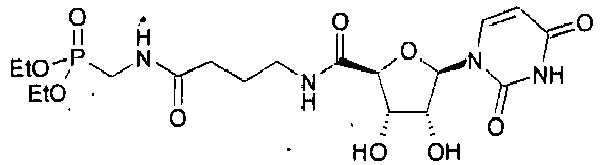
- In a dry vessel, N-tert-butyloxycarbonyl-γ-aminobutyric acid (10 mmol, 2030' mg) was dissolved in 10 ml of dry THF and cooled to -25 °C. Subsequently, N-methylmorpholine (10 mmol, 1010 mg) and isobutyl chloroformiate (10 mmol, 1360 mg) were sequentially added under vigorous stirring. Immediately after the formation of a white precipitate (N-methylmorpholine hydrochloride) a solution of aminomethylphosphonic acid diethyl ester oxalate (11 mmol, 2827 mg) in THF (10 ml) and 1N aq. NaOH (11 ml), pre-cooled on ice, was added. The resulting mixture was allowed to warm to ambient temperature. After three hours, the volatiles were removed by rotary evaporation at 40 °C, the residue was dissolved in 10 ml of water and adjusted to pH 1 (10% aq. NaHSO4 solution) and extracted with ethyl acetate (3 x 50 ml). The combined organic layers were washed with saturated aq. Na2CO3 solution (3 x 20 ml) and subsequently with water (3 x 20 ml), dried over Na2SO4, and evaporated to dryness. The residue (boc-protected amide) was dissolved in 8 ml of dry 4N HCl-dioxane solution and stirred for two hours at ambient temperature. 3-Aminopropylcarboxamidomethylphosphonic acid diethyl ester hydrochloride was precipitated by addition of 50 ml of diethyl ether, filtered off and thoroughly washed with diethyl ether (yield over two steps: 2300 mg, 80%, white crystals).
- Under an atmosphere of argon, 2',3'-anisylideneuridine-4'-carboxylic acid (1 mmol, 376 mg), PyBOP® (1.1 mmol, 455 mg) and 1-hydroxybenzotriazole (1.1 mmol, 149 mg) were dissolved in 2 ml of dry DMF at ambient temperature. Diisopropylethylamine (1.1 mmol, 143 mg) and, after one minute, 3-aminopropylcarboxamidomethylphosphonic acid diethyl ester hydrochloride (2 mmol, 550 mg), dissolved in a mixture of dry DMF (2 ml) and diisopropylethylamine (0.5 ml), were added sequentially via a syringe to the solution. Vigorous stirring was continued for 24 hours at ambient temperature. The volatiles were removed in vacuum at 40 °C and the residue was purified by silica gel column chromatography using dichloromethane/methanol (40:1). The product was isolated by rotary evaporation at 40 °C and recrystallized from diethyl ether. Deprotection of the ribose moiety was performed by stirring 2',3'-anisylideneuridine-5'-amide (100 mg) in a mixture of dichloromethane (3 ml), trifluoroacetic acid (0.15 ml) and water (0.1 ml) at ambient temperature. After two hours, the crude product was precipitated by addition of diethyl ether (50 ml), filtered off, dissolved in 7 ml of water/methanol (75:25) and purified by RP-HPLC using a gradient of water/methanol from 75:25 to water/methanol 0:100. 310 mg of the title compound (7) was isolated by lyophilization as white amorphous powder (yield over two steps: 63%).
1H-NMR (500 MHz, MeOD), δ 8.11 (d, 1H, 3J = 7.85 Hz, H-6), 5.84 (d, 1H, 3J = 6.00 Hz, H-1'), 5.78 (d, 1H, 3J = 8.20 Hz, H-5), 4.50 (dd, 1H, 3J = 5.05 Hz and 3J = 5.95 Hz, H-2'), 4.39 (d, 1H, 3J = 3.15 Hz, H-4'), 4.27 (dd, 1H, 3J = 5.05 Hz and 3J = 3.15 Hz, H-3'), 4.20-4.15 (2 x q, 4H, 2 x O-CH2), 3.75 d, 2H, 2JH P = 11.65 Hz, CH2-P, methyl phosphonate), 3.38-3.26 (m, partly below solvent peak, 2H, 3J = 6.95 Hz, N-CH2, butaneamide), 2.34 (t, 2H, 3J = 7.55 Hz, O=C-CH 2, butaneamide), 1.88 (tt, 2H, 3J = 7.25 Hz and 3J = 6.95 Hz, CH2, butaneamide), 1.36 (2 x t, 6H, 2 x CH3).
13C-NMR (125 MHz, MeOD) δ 175.5 (C=O), 172.7 (C=O), 166.4 (C-4), 153.0 (C-2), 144.9 (C-6), 103.3 (C-5), 93.6 (C-1'), 85.5 (C-4'), 74.9 (C-2'), 73.9 (C-3'), 64.4 (2 x O-CH2), 39.9 (N-CH2, butaneamide), 35.6 (d, 1JC,P = 156.8 Hz, CH2-P, methyl phosphonate), 34.3 (O=C-CH 2, butaneamide), 26.8 (CH2, butaneamide), 17.0 (2 x CH3).
31P-NMR (202 MHz, MeOD) δ 24.6.
MS (ESI), m/z +1: 493.1; m/z -1: 491.5. -

- In a dry vessel, N-tert-butyloxycarbonylglycine (10 mmol, 1750 mg) was dissolved in 10 ml of dry THF and cooled to -25 °C. Subsequently, N-methylmorpholine (10 mmol, 1010 mg) and isobutyl chloroformiate (10 mmol, 1360 mg) were sequentially added under vigorous stirring. Immediately after the formation of a white precipitate (N-methylmorpholine hydrochloride) a solution of aminoethyl-phosphonic acid diethylester oxalate (11 mmol, 2981 mg) in THF (10 ml) and 1N, aq. NaOH (11 ml), pre-cooled on ice, was added. The resulting mixture was allowed to warm to ambient temperature. After three hours, the volatiles were removed by rotary evaporation at 40 °C, the residue was dissolved in 10 ml of water and adjusted to pH 1 (10% aq. NaHSO4 solution) and extracted with ethyl acetate (3 x 50 ml). The combined organic layers were washed with saturated aq. Na2CO3 solution (3 x 20 ml) and subsequently with water (3 x 20 ml), dried over Na2SO4, and evaporated to dryness. The residue (boc-protected amide) was dissolved in 8 ml of dry 4N HCl-dioxane solution and stirred for two hours at ambient temperature. 2-(Aminomethylcarboxamido)ethylphosphonic acid diethyl ester hydrochloride was precipitated by addition of 50 ml of diethyl ether, filtered off and thoroughly washed with diethyl ether (yield over two steps: 1900 mg, 69%, clay). Under an atmosphere of argon, 2',3'-anisylideneuridine-4'-carboxylic acid (1 mmol, 376 mg), HCTU® (1.1 mmol, 455 mg) and 1-hydroxybenzotriazole (1.1 mmol, 149 mg) were dissolved in 2 ml of dry DMF at ambient temperature. Diisopropylethylamine (1.1 mmol, 143 mg) and, after one minute, 2-(aminomethyl-carboxamido)ethylphosphonic acid diethyl ester hydrochloride (2 mmol, 550 mg), dissolved in a mixture of dry DMF (2 ml) and diisopropylethylamine (0.5 ml), were added sequentially via a syringe to the solution. Vigorous stirring was continued for 24 hours at ambient temperature. The volatiles were removed in vacuum at 40 °C and the residue was purified by silica gel column chromatography using dichloromethane/methanol (40:1). The product was isolated by rotary evaporation at 40 °C and recrystallized from diethyl ether. Deprotection of the ribose moiety was performed by stirring 2',3'-anisylideneuridine-5'-amide (100 mg) in a mixture of dichloromethane (3 ml), trifluoroacetic acid (0.15 ml) and water (0.1 ml) at ambient temperature. After two hours, the crude product was precipitated by addition of diethyl ether (50 ml), filtered off, dissolved in 7 ml of water/methanol (75:25) and purified by RP-HPLC using a gradient of water/methanol from 75:25 to water/methanol 0:100. 280 mg of the title compound (8) was isolated by lyophilization as white amorphous powder (yield over two steps 59%).
1H-NMR (500 MHz, MeOD), δ 8.12 (d, 1H, 3J = 8.20 Hz, H-6), 5.93 (d, 1H, 3J = 5.95 Hz, H-1'), 5.78 (d, 1H, 3J = 8.20 Hz, H-5), 4.48 (dd, 1H, 3J = 5.35 Hz and 3J = 6.00 Hz, H-2'), 4.48 (d, 1H, 3J = 3.15 Hz, H-4'), 4.40 (dd, 1H, 3J = 5.05 Hz and 3J = 3.20 Hz, H-3'), 4.19 - 4.12 (2 x q, 4H, 2 x O-CH2), 4.01 - 3.83 (AB-system with A d and B d, 2H, 2JA,B = 16.70 Hz, N-CH2, ethaneamide), 3.50 (m, 2H, 3J = 7.55 Hz and 3JH,P = 12.95 Hz, N-CH2, ethyl phosphonate), 2.16 - 2.09 (m, 2H, 3J = 7.55 and 2JH,P = 18.35 Hz, CH2-P, ethyl phosphonate), 1.37 (t, 6H, 2 x CH3).
13C-NMR (125 MHz, MeOD) δ 173.2 (C=O), 171.6 (C=O), 166.4 (C-4), 153.0 (C-2), 144.6 (C-6), 103.4 (C-5), 93.1 (C-1'), 85.4 (C-4'), 74.8 (C-2'), 74.1 (C-3'), 63.8 (2 x O-CH2), 43.5 (N-CH2, ethaneamide), 34.9 (N-CH2, ethyl phosphonate), 26.5 (d, 1JC,P = 138.3 Hz, CH2-P, ethyl phosphonate), 17.0 (2 x CH3).
31P-NMR (202 MHz, MeOD) δ 28.8.
MS (ESI), m/z +1: 479.0; m/z -1: 477.1. - Commercially available N-benzyloxycarbonyl-α-phosphonoglycine (11 mmol, 3600 mg) was dissolved in 20 ml of dry methanol and hydrogenated for 1 hour at 3 atm H2 (rt) with 1 g of Pd/C. The suspension was filtered, the catalyst washed with methanol (2 x 5 ml) and the filtrate directly used in the next step. In a dry vessel, N-tert-butyloxycarbonylglycine (10 mmol, 1750 mg) was dissolved in 10 ml of dry THF and cooled to -25 °C. Subsequently, N-methylmorpholine (10 mmol, 1010 mg) and isobutyl chloroformiate (10 mmol, 1360 mg) were sequentially added under vigorous stirring. Immediately after the formation of a white precipitate (N-methylmorpholine hydrochloride) the solution of α-phosphonoglycine in methanol (30 ml), pre-cooled on ice, was added. The resulting mixture was allowed to warm to ambient temperature. After three hours, the volatiles were removed by rotary evaporation at 40 °C, the residue was dissolved in 10 ml of water and adjusted to pH 1 (10% aq. NaHSO4 solution) and extracted with ethyl acetate (3 x 50 ml). The combined organic layers were washed with saturated aq. Na2CO3 solution (3 x 20 ml) and subsequently with water (3 x 20 ml), dried over Na2SO4, and evaporated to dryness. The residue (boc-protected amide) was dissolved in 8 ml of dry 4N HCl-dioxane solution and stirred for two hours at ambient temperature. N-(Aminomethylcarbonyl)-α-dimethylphosphonoglycine methyl ester hydrochloride was precipitated by addition of 50 ml of diethyl ether, filtered off and thoroughly washed with diethyl ether (yield over two steps: 1650 mg, 65%, white crystals). Under an atmosphere of argon, 2',3'-anisylideneuridine-4'-carboxylic acid (1 mmol, 376 mg), HCTU® (1.1 mmol, 455 mg) and 1-hydroxybenzotriazole (1.1 mmol, 149 mg) were dissolved in 2 ml of dry DMF at ambient temperature. Diisopropylethylamine (1.1 mmol, 143 mg) and, after one minute, N-(aminomethylcarbonyl)-α-dimethylphosphonoglycine methyl ester hydrochloride (2 mmol, 550 mg), dissolved in a mixture of dry DMF (2 ml) and diisopropylethylamine (0.5 ml), were added sequentially via a syringe to the solution. Vigorous stirring was continued for 24 hours at ambient temperature. The volatiles were removed in vacuum at 40 °C and the residue was purified by silica gel column chromatography using dichloromethane/methanol (40:1). The product was isolated by rotary evaporation at 40 °C and recrystallized from diethyl ether. Deprotection of the ribose moiety was performed by stirring 2',3'-anisylideneuridine-5'-amide (100 mg) in a mixture of dichloromethane (3 ml), trifluoroacetic acid (0.15 ml) and water (0.1 ml) at ambient temperature. After two hours, the crude product was precipitated by addition of diethyl ether (50 ml), filtered off, dissolved in 7 ml of water/methanol (75:25) and purified by RP-HPLC using a gradient of water/methanol from 75:25 to water/methanol 0:100. 260 mg of the title compound (9) was isolated as a mixture of two stereoisomeres by lyophilisation as white amorphous powder (yield over two steps: 53%).
1H-NMR (500 MHz, MeOD), δ 8.10 (2 x d, 1H, 3J = 7.85 Hz, H-6), 5.96 (2 x d, 1H, 3J = 5.95 Hz, H-1'), 5.77 (2 x d, 1H, 3J = 7.85 Hz, H-5), 4.50-4.40 (m, 3H, H-2', H-3' and H-4'), 4.18-3.94 (AB-system with A d and B d, 2H, 2J = 17.00 Hz, N-CH2 (ethaneamide), 3.97-3.85 (m, 9H, 3 x O-CH3), N-CH (α-phosphonoglycine) not determinable, under solvent peak at 3.35 ppm.
13C-NMR (125 MHz, MeOD) δ 173.3 (C=O), 171.4 (C=O), 168.1 (C=O), 166.4 (C-4), 153.0 (C-2), 144.6 (C-6), 103.5 (C-5), 93.3 (C-1'), 85.6 (H-4'), 74.9 (H-2'), 74.2 (H-3'), 55.3 (3 x O-CH3), N-CH (α-phosphonoglycine) not determinable, under solvent peak at 49 ppm, 43.1 (N-CH2, ethaneamide)
31P-NMR (202 MHz, MeOD) δ 18.1.
MS (ESI), m/z +1: 495.0; m/z -1: 493.3 -

- In a dry vessel, N-tert-butyloxycarbonyl-glycine (10 mmol, 1750 mg) was dissolved in 10 ml of dry THF and cooled to -25 °C. Subsequently, N-methylmorpholine (10 mmol, 1010 mg) and isobutyl chloroformiate (10 mmol, 1360 mg) were sequentially added under vigorous stirring. Immediately after the formation of a white precipitate (N-methylmorpholine hydrochloride) a solution of aminomethylenediphosphonic acid diethylester (11 mmol, 3350 mg) in dry THF (10 ml) was added. The resulting mixture was allowed to warm to ambient temperature. After three hours, the volatiles were removed by rotary evaporation at 40 °C, the residue was dissolved in 10 ml of water and adjusted to pH 1 (10% aq. NaHSO4 solution) and extracted with ethyl acetate (3 x 50 ml). The combined organic layers were washed with saturated aq. Na2CO3 solution (3 x 20 ml) and subsequently with water (3 x 20 ml), dried over Na2SO4, and evaporated to dryness. The residue (boc-protected amide) was dissolved in 8 ml of dry 4N HCl-dioxane solution and stirred for two hours at ambient temperature. Aminomethylcarboxamidomethylbis-(phosphonic acid diethyl ester) hydrochloride was precipitated by addition of 50 ml of diethyl ether, filtered off and thoroughly washed with diethyl ether (yield over two steps: 3100 mg, 76%, clay).
- Under an atmosphere of argon, 2',3'-anisylideneuridine-4'-carboxylic acid (1 mmol, 376 mg), HCTU® (1.1 mmol, 455 mg) and 1-hydroxybenzotriazole (1.1 mmol, 149 mg) were dissolved in 2 ml of dry DMF at ambient temperature. Diisopropylethylamine (1.1 mmol, 143 mg) and, after one minute, aminomethylcarboxamidomethyl-bis(phosphonic acid diethyl ester) hydrochloride (2 mmol, 788 mg), dissolved in a mixture of dry DMF (2 ml) and diisopropylethylamine (0.5 ml), were added sequentially via a syringe to the solution. Vigorous stirring was continued for 24 hours at ambient temperature. The volatiles were removed in vacuum at 40 °C and the residue was purified by silica gel column chromatography using dichloromethane/methanol (40:1). The product was isolated by rotary evaporation at 40 °C and recrystallized from diethyl ether. Deprotection of the ribose moiety was performed by stirring 2',3'-anisylideneadenosine-5'-amide (100 mg) in a mixture of dichloromethane (3 ml), trifluoroacetic acid (0.15 ml) and water (0.1 ml) at ambient temperature. After two hours, the crude product was precipitated by addition of diethyl ether (50 ml), filtered off, dissolved in 7 ml of water/methanol (75:25) and purified by RP-HPLC using a gradient of water/methanol from 75:25 to water/methanol 0:100. 320 mg of the title compound (10) was isolated by lyophilization as white amorphous powder (yield over two steps: 50%).
1H-NMR (500 MHz, DMSO-d6), δ 11.30 (d, 1H, 3J = 1.85 Hz, NH, uracil), 8.74 (d, 1H, 3J = 9.80 Hz, CONH), 8.51 (t, 1H, 3J = 5.65 Hz, 4'-CONH), 8.23 (d, 1H, 3J = 8.15 Hz, H-6), 5.92 (d, 1H, 3J = 6.90 Hz, H-1'), 5.62 (dd, 1H, 3J = 7.90 Hz and 4J = 2.20 Hz, H-5), 5.52 (br s, 2H, 2 x OH), 4.82 (td, 1H, 3J = 9.75 Hz and 2JH,P = 22.35 Hz, PPNCH, methylene diphosphonate), 4.35 (d, 1H, 3J = 1.90 Hz, H-4'), 4.20 - 3.99 (br s, 10H, 4 x O-CH2, H-2'and H-3'), 3.85 (AB-system with A dd and B dd, 1H, 3J = 5.70 Hz and 2J = 17.30 Hz, N-CH2, ethaneamide), 1.22 (br s, 12H, 4 x CH3).
13C-NMR (125 MHz, DMSO-d6) δ 170.5 (C=O), 168.7 (C=O), 163.2 (C-4), 151.2 (C-2), 141.4 (C-6), 102.2 (C-5), 87.8 (C-1'), 83.2 (C-4'), 73.9 (C-2'), 72.2 (C-3'), 63.1 (4 x O-CH2), 43.5 (t, partially under solvent peak, 1JC,P = 581.90 Hz, PPNCH, methylene diphosphonate)), N-CH2 (ethaneamide) under solvent peak at 42, 16.3 (4 × CH3).
31P-NMR (202 MHz, DMSO-d6) 15.8. -

- In a dry vessel, N-tert-butyloxycarbonyl-β-alanine (10 mmol, 1890 mg) was dissolved in 10 ml of dry THF and cooled to -25 °C. Subsequently, N-methylmorpholine (10 mmol, 1010 mg) and isobutyl chloroformiate (10 mmol, 1360 mg) were sequentially added under vigorous stirring. Immediately after the formation of a white precipitate (N-methylmorpholine hydrochloride) a solution of aminomethylenediphosphonic acid diethylester (11 mmol, 3350 mg) in dry THF (10 ml) was added. The resulting mixture was allowed to warm to ambient temperature. After three hours, the volatiles were removed by rotary evaporation at 40 °C, the residue was dissolved in 10 ml of water and adjusted to pH 1 (10% aq. NaHSO4 solution) and extracted with ethyl acetate (3 x 50 ml). The combined organic layers were washed with saturated aq. Na2CO3 solution (3 x 20 ml) and subsequently with water (3 x 20 ml), dried over Na2SO4, and evaporated to dryness. The residue (boc-protected amide) was dissolved in 8 ml of dry 4N HCl-dioxane solution and stirred for two hours at ambient temperature. 2-Aminoethylcarboxamidomethyl-bis(phosphonic acid diethyl ester) hydrochloride was precipitated by addition of 50 ml of diethyl ether, filtered off and thoroughly washed with diethyl ether (yield over two steps: 3100 mg, 76%, clay).
- Under an atmosphere of argon, 2',3'-anisylideneadenosine-4'-carboxylic acid (1 mmol, 376 mg), PyBOP® (1.1 mmol, 572 mg) and 1-hydroxybenzotriazole (1.1 mmol, 149 mg) were dissolved in 2 ml of dry DMF at ambient temperature. Diisopropylethylamine (1.1 mmol, 143 mg) and, after one minute, 2-aminoethylcarboxamidomethyl-bis(phosphonic acid diethyl ester) hydrochloride (2 mmol, 816 mg), dissolved in a mixture of dry DMF (2 ml) and diisopropylethylamine (0.5 ml), were added sequentially via a syringe to the solution. Vigorous stirring was continued for 24 hours at ambient temperature. The volatiles were removed in vacuum at 40 °C and the residue was purified by silica gel column chromatography using dichloromethane/methanol (40:1). The product was isolated by rotary evaporation at 40 °C and recrystallized from diethyl ether. Deprotection of the ribose moiety was performed by stirring 2',3'-anisylideneadenosine-5'-amide (100 mg) in a mixture of dichloromethane (3 ml), trifluoroacetic acid (0.15 ml) and water (0.1 ml) at ambient temperature. After two hours, the crude product was precipitated by addition of diethyl ether (50 ml), filtered off, dissolved in 7 ml of water/methanol (75:25) and purified by RP-HPLC using a gradient of water/methanol from 75:25 to water/methanol 0:100. 320 mg of the title compound (11) was isolated by lyophilization as white amorphous powder (yield over two steps: 50%).
1H-NMR (500 MHz, DMSO-d6), δ 11.30 (d, 1H, 4J = 2.25 Hz, NH, uracil), 8.74 (d, 1H, 3J = 10.05 Hz, CONH, propaneamide), 8.28 (t, 1H, 3J = 5.65 Hz, 4'-CONH), 8.23 (d, 1H, 3J = 8.20 Hz, H-6), 5.88 (d, 1H, 3J = 6.30 Hz, H-1'), 5.69 (dd, 1H, 3J = 7.90 Hz and 4J = 2.20 Hz, H-5'), 5.48 (br s, 2H, 2'-OH and 3'-OH), 4.86 (dt, 1H, 3J = 10.1 Hz and 2JP,H = 22.70 Hz, methylene diphosphonate), 4.23 (d, 1H, 3J = 2.20 Hz, H-4'), 4.16 (pseudo-t, 1H, 3J = 4.72 Hz and 3J = 6.60 Hz, H-2'), 4.02 (br s, 8H, 4 x O-CH2), 3.99 (pseudo-q, 1H, 3J = 2.20 Hz and 3J = 2.20 Hz and 3J = 2.50 Hz, H-3'), 3.40 - 3.20 (N-CH2, propaneamide), not determinable, covered by water from solvent), 2.44 (t, 2H, 3J = 6.95 Hz, O=C-CH2, propaneamide), 1.21 (m, 12H, 4 x CH3).
13C-NMR (125 MHz, DMSO-d6), δ 172.1 (C=O), 170.2 (C=O), 163.2 (C-4), 151.1 (C-2), 143.5 (C-6), 102.2 (C-5), 88.0 (C-1'), 83.2 (C-4'), 73.1 (C-2'), 73.0 (C-3'), 63.0 and 62.8 (4 x O-CH2), 43.3 (t, partially covered by solvent peak, 1J = 579.90 Hz, PPNCH, methylene diphosphonate), 35.4 (N-CH2 (propaneamide)), 34.4 (O=C-CH 2 propaneamide)), 16.4 and 16.3 (4 x CH3).
31P-NMR (202 MHz, DMSO-d6), 15.2. -

- In a dry vessel, N-tert-butyloxycarbonyl-γ-aminobutyric acid (10 mmol, 2030 mg) was dissolved in 10 ml of dry THF and cooled to -25 °C. Subsequently, N-methylmorpholine (10 mmol, 1010 mg) and isobutyl chloroformiate (10 mmol, 1360 mg) were sequentially added under vigorous stirring. Immediately after the formation of a white precipitate (N-methylmorpholine hydrochloride) a solution of of aminomethylenediphosphonic acid diethylester (11 mmol, 3350 mg) in dry THF (10 ml) was added. The resulting mixture was allowed to warm to ambient temperature. After three hours, the volatiles were removed by rotary evaporation at 40 °C, the residue was dissolved in 10 ml of water and adjusted to pH 1 (10% aq. NaHSO4 solution) and extracted with ethyl acetate (3 x 50 ml). The combined organic layers were washed with saturated aq. Na2CO3 solution (3 x 20 ml) and subsequently with water (3 x 20 ml), dried over Na2SO4, and evaporated to dryness. The residue (boc-protected amide) was dissolved in 8 ml of dry 4N HCl-dioxane solution and stirred for two hours at ambient temperature. 3-Aminopropylcarboxamidomethyl-bis(phosphonic acid diethyl ester) hydrochloride was precipitated by addition of 50 ml of diethyl ether, filtered off and thoroughly washed with diethyl ether (yield over two steps: 3400 mg, 80%, clay).
- Under an atmosphere of argon, 2',3'-anisylideneuridine-4'-carboxylic acid (1 mmol, 376 mg), PyBOP® (1.1 mmol, 572 mg) and 1-hydroxybenzotriazole (1.1 mmol, 149 mg) were dissolved in 2 ml of dry DMF at ambient temperature. Diisopropylethylamine (1.1 mmol, 143 mg) and, after one minute, 3-aminopropylcarboxamidomethyl-bis(phosphonic acid diethyl ester) hydrochloride (2 mmol, 844 mg), dissolved in a mixture of dry DMF (2 ml) and diisopropylethylamine (0.5 ml), were added sequentially via a syringe to the solution. Vigorous stirring was continued for 24 hours at ambient temperature. The volatiles were removed in vacuum at 40 °C and the residue was purified by silica gel column chromatography using dichloromethane/methanol (40:1). The product was isolated by rotary evaporation at 40 °C and recrystallized from diethyl ether. Deprotection of the ribose moiety was performed by stirring 2',3'-anisylideneadenosine-5'-amide (100 mg) in a mixture of dichloromethane (3 ml), trifluoroacetic acid (0.15 ml) and water (0.1 ml) at ambient temperature. After two hours, the crude product was precipitated by addition of diethyl ether (50 ml), filtered off, dissolved in 7 ml of water/methanol (75:25) and purified by RP-HPLC using a gradient of water/methanol from 75:25 to water/methanol 0:100. 380 mg of the title compound (12) was isolated by lyophilization as white amorphous powder (yield over two steps: 58%).
1H-NMR (500 MHz, DMSO-d6), δ 11.30 (d, 1H, 3J = 1.85 Hz, NH, uracil), 8.63 (d, 1H, 3J = 9.75. Hz, CONH), 8.31 (t, 1H, 3J = 5.65 Hz, 4'-CONH), 8.27 (d, 1H, 3J = 8.15 Hz, H-6), 5.86 (d, 1H, 3J = 6.30 Hz, H-1'), 5.62 (dd, 1H, 3J = 8.15 Hz and 4J = 2.20 Hz, H-5), 5.50 (br s, 2H, 2 x OH), 4.87 (td, 1H, 3J = 10.10 Hz and 2JH,P = 23.00 Hz, methylenediphosphonate), 4.25 (d, 1H, 3J = 2.50 Hz, H-4'), 4.17 (pseudo-t, 1H, 3J = 4.75 Hz and 3J = 5.95 Hz, H-2'), 4.08 - 4.02 (m, 8H, 4 × O-CH2), 3.98 (dd, 1H, 3J = 2.50 Hz and 3J = 4.40 Hz, H-3'), 3.08 (dt, 2H, 3J = 5.70 Hz and 3J = 7.50 Hz, N-CH2, butaneamide), 2.23 (t, 2H, 3J = 7.25 Hz, O=C-CH2, butaneamide), 1.65 (tt, 2H, 3J = 7.25 Hz, CH2, butaneamide), 1.22 (br s, 12H, 4 x CH3).
13C-NMR (125 MHz, DMSO-d6) δ 171.8 (C=O), 170.0 (C=O), 163.2 (C-4), 151.2 (C-2), 141.4 (C-6), 102.1 (C-5), 88.3 (C-1'), 83.3 (C-4'), 73.2 (C-2'), 73.1 (C-3'), 62.9 (4 x O-CH2), 43.5 (t, 1JC,P = 589.80 Hz, PPNCH, methylenediphosphonate), 38.3 (N-CH2, butaneamide), 32.3 (O=C-CH 2, butaneamide), 25.5 (CH2, butaneamide), 16.3 (4 x CH3).
31P-NMR (202 MHz, DMSO-d6) 15.6. -

- In a dry vessel, N-tert-butyloxycarbonylglycine (10 mmol, 1750 mg) was dissolved in 10 ml of dry THF and cooled to -25 °C. Subsequently, N-methylmorpholine (10 mmol, 1010 mg) and isobutyl chloroformiate (10 mmol, 1360 mg) were sequentially added under vigorous stirring. Immediately after the formation of a white precipitate (N-methylmorpholine hydrochloride) a solution of p-aminobenzylphosphonic acid diethyl ester (11 mmol, 2673 mg) in dry THF (10 ml) was added. The resulting mixture was allowed to warm to ambient temperature. After three hours, the volatiles were removed by rotary evaporation at 40 °C, the residue was dissolved in 10 ml of water and adjusted to pH 1 (10 % aq. NaHSO4 solution) and extracted with ethyl acetate (3 x 50 ml). The combined organic layers were washed with saturated aq. Na2CO3 solution (3 x 20 ml) and subsequently with water (3 x 20 ml), dried over Na2SO4, and evaporated to dryness. The residue (boc-protected amide) was dissolved in 8 ml of dry 4N HCl-dioxane solution and stirred for two hours at ambient temperature. p-(Aminomethylcarboxamido)benzylphosphonic acid diethyl ester hydrochloride was precipitated by addition of 50 ml of diethyl ether, filtered off and thoroughly washed with diethyl ether (yield over two steps: 3100 mg, 92%, white chrystals).
- Under an atmosphere of argon, 2',3'-anisylideneadenosine-4'-carboxylic acid (1 mmol, 399 mg), HCTU® (1.1 mmol, 455 mg) and 1-hydroxybenzotriazole (1.1 mmol, 149 mg) were dissolved in 2 ml of dry DMF at ambient temperature. Diisopropylethylamine (1.1 mmol, 143 mg) and, after one minute, p-(aminomethylcarboxamido)benzylphosphonic acid diethyl ester hydrochloride (2 mmol, 672 mg), dissolved in a mixture of dry DMF (2 ml) and diisopropylethylamine (0.5 ml), were added sequentially via a syringe to the solution. Vigorous stirring was continued for 24 hours at ambient temperature. The volatiles were removed in vacuum at 40 °C and the residue was purified by silica gel column chromatography using dichloromethane:methanol (40:1). The product was isolated by rotary evaporation at 40 °C and recrystallized from diethyl ether. Deprotection of the ribose moiety was performed by stirring 2',3'-anisylideneadenosine-5'-amide (100 mg) in a mixture of dichloromethane (3 ml), trifluoroacetic acid (0.15 ml) and water (0.1 ml) at ambient temperature. After two hours, the crude product was precipitated by the addition of diethyl ether (50 ml), filtered off, dissolved in 7 ml of water/methanol (75:25) and purified by RP-HPLC using a gradient of water/methanol from 75:25 to water/methanol 0:100. 310 mg of the title compound (CC 1) was isolated by lyophilization as white amorphous powder (yield over two steps: 68%).
1H-NMR (500 MHz, MeOD), δ 8.42 (s, 1H, H-2), 8.24 (s, 1H, H-8), 7.57 (d, 2H, 3J = 8.20 Hz, 2 x CHmeta, benzyl phosphonate), 7.30 (dd, 2H, 3J = 8.80 Hz and 4J = 2.50 Hz, 2 x CHortho, benzyl phosphonate), 6.14 (d, 1H, 3J = 7.90 Hz, H-1'), 4.91 (dd, partly below solvent peak, 1H, 3J = 7.55 Hz and 3J = 4.75 Hz, H-2'), 4.62 (s, 1H, H-4'), 4.49 (dd, 1H, 3J = 4.75 and 3J = 1.60 Hz, H-3'), 4.29 - 4.10 (AB-system with A d and B d, 2H, 2J = 16.40 Hz, N-CH2, ethaneamide), 4.09 - 4.04 (m, 4H, 2 × O-CH2), 3.24 (d, 2H, 2JH,P = 21.45 Hz, CH2-P, benzyl phosphonate), 1.29 (t, 6H, 2 x CH3).
13C-NMR (125 MHz, MeOD) δ 173.4 (C=O), 169.5 (C=O), 157.9 (C-6), 154.2 (C-2), 150.6 (C-4), 142.8 (C-8), 138.9 (C para , benzyl phosphonate), 131.7 (2 × CH ortho , benzyl phosphonate), 128.7 (d, 2JC,P = 9.4 Hz, C ipso , benzyl phosphonate), 121.5 (2 x CH meta , benzyl phosphonate), 121.3 (C-5), 90.6 (C-1'), 86.7 (C-4'), 75.5 (C-2'), 73.9 (C-3'), 64.0 (2 x O-CH2), 44.0 (N-CH2, ethaneamide), 33.4 (d, 1JC,P = 137.6 Hz, CH2-P, benzyl phosphonate), 17.0 und 16.9 (2 x CH3).
31P-NMR (202 MHz, MeOD) δ 28.8.
MS (ESI), m/z +1: 564.3; m/z -1: 562.3. -

- In a dry vessel, N-tert-butyloxycarbonyl-β-alanine (10 mmol, 1890 mg) was dissolved in 10 ml of dry THF and cooled to -25 °C. Subsequently, N-methylmorpholine (10 mmol, 1010 mg) and isobutyl chloroformiate (10 mmol, 1360 mg) were sequentially added under vigorous stirring. Immediately after the formation of a white precipitate (N-methylmorpholine hydrochloride) a solution of p-aminobenzylphosphonic acid diethyl ester (11 mmol, 2673 mg) in dry THF (10 ml) was added. The resulting mixture was allowed to warm to ambient temperature. After three hours, the volatiles were removed by rotary evaporation at 40 °C, the residue was dissolved in 10 ml of water and adjusted to pH 1 (10% aq. NaHSO4 solution) and extracted with ethyl acetate (3 x 50 ml). The combined organic layers were washed with saturated aq. Na2CO3 solution (3 x 20 ml) and subsequently with water (3 x 20 ml), dried over Na2SO4, and evaporated to dryness. The residue (boc-protected amide) was dissolved in 8 ml of dry 4N HCl-dioxane solution and stirred for two hours at ambient temperature. p-(2-Aminoethylcarboxamido)benzylphosphonic acid diethyl ester hydrochloride was precipitated by addition of 50 ml of diethyl ether, filtered off and thoroughly washed with diethyl ether (yield over two steps: 3300 mg, 94%, white crystals).
- Under an atmosphere of argon, 2',3'-anisylideneadenosine-4'-carboxylic acid (1 mmol, 399 mg), HBTU® (1.1 mmol, 428 mg) and 1-hydroxybenzotriazole (1.1 mmol, 149 mg) were dissolved in 2 ml of dry DMF at ambient temperature. Diisopropylethylamine (1.1 mmol, 143 mg) and, after one minute, p-(2-aminoethylcarboxamido)benzylphosphonic acid diethyl ester hydrochloride (2 mmol, 700 mg), dissolved in a mixture of dry DMF (2 ml) and diisopropylethylamine (0.5 ml), were added sequentially via a syringe to the solution. Vigorous stirring was continued for 24 hours at ambient temperature. The volatiles were removed in vacuum at 40 °C and the residue was purified by silica gel column chromatography using dichloromethane/methanol (40:1). The product was isolated by rotary evaporation at 40 °C and recrystallized from diethyl ether. Deprotection of the ribose moiety was performed by stirring 2',3'-anisylideneadenosine-5'-amide (100 mg) in a mixture of dichloromethane (3 ml), trifluoroacetic acid (0.15 ml) and water (0.1 ml) at ambient temperature. After two hours, the crude product was precipitated by addition of diethyl ether (50 ml), filtered off, dissolved in 7 ml of water/methanol (75:25) and purified by RP-HPLC using a gradient of water/methanol from 75:25 to water/methanol 0:100. 350 mg of the title compound (CC 2) was isolated by lyophilization as white amorphous powder (yield over two steps: 71%).
1H-NMR (500 MHz, D2O), δ 8.08 (s, 1H, H-2), 7.95 (s, 1H, H-8), 7.57 (d, 2H, 3J = 8.20 Hz, 2 x CHmeta, benzyl phosphonate), 7.30 (dd, 2H, 3J = 8.80 Hz and 4J = 2.50 Hz, 2 x CHortho, benzyl phosphonate), 6.14 (d, 1H, 3J = 7.90 Hz, H-1'), 4.91 (dd, partially below solvent peak, 1H, 3J = 7.55 Hz and 3J = 4.75 Hz, H-2'), 4.62 (s, 1H, H-4'), 4.49 (dd, 1H, 3J = 4.75 and 3J = 1.60 Hz, H-3'), 4.09 - 4.04 (m, 4H, 2 × O-CH2), 3.67 - 3.58 (m, 2H, 3J= 5.35 Hz, N-CH2 (propaneamide), 3.24 (d, 2H, 2JH,P = 21.45 Hz, CH2-P, benzyl phosphonate), 2.59 - 2.49 (m, 2H, 3JX,A = 5.35 Hz, O=C-CH 2, propaneamide), 1.29 (t, 6H, 2 x CH3).
13C-NMR (125 MHz, D2O) δ 174.9 (C=O), 174.4 (C=O), 157.9 (C-6), 155.3 (C-2), 150.7 (C-4), 143.9 (C-8), 138.8 (C para , benzyl phosphonate), 133.1 (2 × CH ortho , benzyl phosphonate), 129.6 (d, 2JC,P = 9.4 Hz, Cipso, benzyl phosphonate), 123.1 (2 x CHmeta, benzyl phosphonate), 121.9 (C-5), 91.3 (C-1'), 87.4 (C-4'), 75.8 (C-2'), 74.7 (C-3'), 64.0 (2 x O-CH2), 39.6 (N-CH2, propaneamide), 39.1 (O=C-CH2, propaneamide), .34.1 (d, 1JC,P = 137.6 Hz, CH2-P, benzyl phosphonate), 18.3 (2 x CH3).
31P-NMR (202 MHz, D2O) δ 30.0.
MS (ESI), m/z +1: 578.2; m/z -1: 576.3. -

- In a dry vessel, N-tert-butyloxycarbonyl-γ-aminobutyric acid (10 mmol, 2030 mg) was dissolved in 10 ml of dry THF and cooled to -25 °C. Subsequently, N-methylmorpholine (10 mmol, 1010 mg) and isobutyl chloroformiate (10 mmol, 1360 mg) were sequentially added under vigorous stirring. Immediately after the formation of a white precipitate (N-methylmorpholine hydrochloride) a solution of aminobenzylphosphonic acid diethyl ester (11 mmol, 2673 mg) in dry THF (10 ml) was added. The resulting mixture was allowed to warm to ambient temperature. After three hours, the volatiles were removed by rotary evaporation at 40 °C, the residue was dissolved in 10 ml of water and adjusted to pH 1 (10% aq. NaHSO4 solution) and extracted with ethyl acetate (3 x 50 ml). The combined organic layers were washed with saturated aq. Na2CO3 solution (3 x 20 ml) and subsequently with water (3 x 20 ml), dried over Na2SO4, and evaporated to dryness. The residue (boc-protected amide) was dissolved in 8 ml of dry 4N HCl-dioxane solution and stirred for two hours at ambient temperature. p-(3-Aminopropylcarboxamido) benzylphosphonic acid diethyl ester hydrochloride was precipitated by addition of 50 ml of diethyl ether, filtered off and thoroughly washed with diethyl ether (yield over two steps: 3300 mg, 94%, white crystals).
- Under an atmosphere of argon, 2',3'-anisylideneadenosine-4'-carboxylic acid (1 mmol, 399 mg), HBTU® (1.1 mmol, 428 mg) and 1-hydroxybenzotriazole (1.1 mmol, 149 mg) were dissolved in 2 ml of dry DMF at ambient temperature. Diisopropylethylamine (1.1 mmol, 143 mg) and, after one minute, p-(3-aminopropylcarboxamido)benzylphosphonic acid diethyl ester hydrochloride (2 mmol, 728 mg), dissolved in a mixture of dry DMF (2 ml) and diisopropylethylamine (0.5 ml), were added sequentially via a syringe to the solution. Vigorous stirring was continued for 24 hours at ambient temperature. The volatiles were removed in vacuum at 40 °C and the residue was purified by silica gel column chromatography using dichloromethane/methanol (40:1). The product was isolated by rotary evaporation at 40 °C and recrystallized from diethyl ether. Deprotection of the ribose moiety was performed by stirring 2',3'-anisylideneadenosine-5'-amide (100 mg) in a mixture of dichloromethane (3 ml), trifluoroacetic acid (0.15 ml) and water (0.1 ml) at ambient temperature. After two hours, the crude product was precipitated by addition of diethyl ether (50 ml), filtered off, dissolved in 7 ml of water/methanol (75:25) and purified by RP-HPLC using a gradient of water/methanol from 75:25 to water/methanol 0:100. 340 mg of the title compound (CC 3) was obtained by lyophilization as white amorphous powder (yield over two steps: 70%).
1H-NMR (500 MHz, DMSO-d6), δ 9.84 (br s, 1H, 4'-CONH), 9.05 (t, 2H, 3J = 5.70 Hz, CONH, butaneamide), 8.36 (s, 1H, H-2), 8.23 (s, 1H, H-8), 7.48 (d, 2H, 3J = 8.55 Hz, 2 x CHortho, benzyl phosphonate), 7.38 (br s, 2H, 6-NH2), 7.16 (dd, 2H, 3J = 8.85 Hz and 4J = 2.20 Hz, 2 x CH meta , benzyl phosphonate), 5.95 (d, 1H, 3J = 7.60 Hz, H-1'), 5.72 (br d, 1H, 3J = 2.50 Hz, 2'-OH), 5.51 (br d, 1H, 3J = 4.40 Hz, 3'-OH), 4.61 (dd, 1H, 3J = 7.55 Hz and 3J = 4.75 Hz, H-2'), 4.32 (d, 1H, 3J = 1.60 Hz, H-4'), 4.14 (br s, 1H, H-3'), 3.95 - 3.89 (m, 4H, 2 x O-CH2), 3.26 (dt, 2H, 3J = 7.25 Hz and 3J = 5.70 Hz, N-CH2, butaneamide), 3.12 (d, 2H, 2JH,P = 21.10 Hz, CH2-P, benzyl phosphonate), 2.32 (t, 2H, 3J = 7.25 Hz, O=C-CH 2, butaneamide), 1.79 (tt, 2H, 3J = 7.25 Hz, CH2, butaneamide), 1.29 (t, 6H, 2 x CH3).
13C-NMR (125 MHz, DMSO-d6) δ 170.8 (C=O), 169.6 (C=O), 156.5 (C-6), 152.6 (C-2), 148.9 (C-4), 140.9 (C-8), 137.9 (Cpara, benzyl phosphonate), 130.1 (2 × CH ortho , benzyl phosphonate), 126.7 (d, 2JC,P = 9.4 Hz, C ipso , benzyl phosphonate), 119.8 (2 x CH meta , benzyl phosphonate), 119.1 (C-5), 88.0 (C-1'), 84.9 (C-4'), 73.4 (C-2'), 72.0 (C-3'), 61.5 (2 x O-CH2), 38.5 (N-CH2, butaneamide), 33.8 (O=C-CH 2, butaneamide), 33.4 (d, 1JC,P = 137.6 Hz, CH2-P, benzyl phosphonate), 25.3 (CH2, butaneamide), 16.4 und 16.3 (2 x CH3).
31P-NMR (202 MHz, DMSO-d6) δ 27.1.
m/z +1: 592.0; m/z -1: 590.3. -
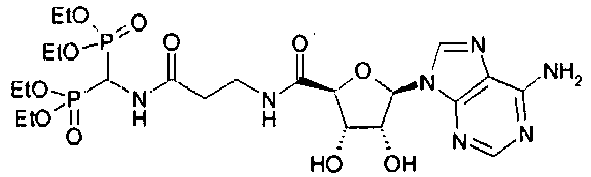
- In a dry vessel, N-tert-butyloxycarbonyl-β-alanine (10 mmol, 1890 mg) was dissolved in 10 ml of dry THF and cooled to -25 °C. Subsequently, N-methylmorpholine (10 mmol, 1010 mg) and isobutyl chloroformiate (10 mmol, 1360 mg) were sequentially added under vigorous stirring. Immediately after the formation of a white precipitate (N-methylmorpholine hydrochloride) a solution of aminomethylenediphosphonic acid diethylester (11 mmol, 3350 mg) in dry THF (10 ml) was added. The resulting mixture was allowed to warm to ambient temperature. After three hours, the volatiles were removed by rotary evaporation at 40 °C, the residue was dissolved in 10 ml of water and adjusted to pH 1 (10% aq. NaHSO4 solution) and extracted with ethyl acetate (3 x 50 ml). The combined organic layers were washed with saturated aq. Na2CO3 solution (3 x 20 ml) and subsequently with water (3 x 20 ml), dried over Na2SO4, and evaporated to dryness. The residue (boc-protected amide) was dissolved in 8 ml of dry 4N HCl-dioxane solution and stirred for two hours at ambient temperature. 2-Aminoethylcarboxamidomethyl-bis(phosphonic acid diethyl ester) hydrochloride was precipitated by addition of 50 ml of diethyl ether, filtered off and thoroughly washed with diethyl ether (yield over two steps: 3100 mg, 76%, clay).
- Under an atmosphere of argon, 2',3'-anisylideneadenosine-4'-carboxylic acid (1 mmol, 399 mg), PyBOP® (1.1 mmol, 572 mg) and 1-hydroxybenzotriazole (1.1 mmol, 149 mg) were dissolved in 2 ml of dry DMF at ambient temperature. Diisopropylethylamine (1.1 mmol, 143 mg) and, after one minute, 2-aminoethylcarboxamidomethyl-bis(phosphonic acid diethyl ester) hydrochloride (2 mmol, 816 mg), dissolved in a mixture of dry DMF (2 ml) and diisopropylethylamine (0.5 ml), were added sequentially via a syringe to the solution. Vigorous stirring was continued for 24 hours at ambient temperature. The volatiles were removed in vacuum at 40 °C and the residue was purified by silica gel column chromatography using dichloromethane/methanol (40:1). The product was isolated by rotary evaporation at 40 °C and recrystallized from diethyl ether. Deprotection of the ribose moiety was performed by stirring 2',3'-anisylideneadenosine-5'-amide (100 mg) in a mixture of dichloromethane (3 ml), trifluoroacetic acid (0.15 ml) and water (0.1 ml) at ambient temperature. After two hours, the crude product was precipitated by addition of diethyl ether (50 ml), filtered off, dissolved in 7 ml of water/methanol (75:25) and purified by RP-HPLC using a gradient of water/methanol from 75:25 to water/methanol 0: 100. 320 mg of the title compound (CC 4) was isolated by lyophilization as white amorphous powder (yield over two steps: 50%).
1H-NMR (500 MHz, MeOD), δ 8.41 (s, 1H, H-2), 8.38 (s, 1H, H-8), 6.06 (d, 1H, 3J = 7.90 Hz, H-1'), 5.10 (t, 1H, 2JH,P = 23.00 Hz, PPNCH, methylene diphosphonate), 4.77 (pseudo-q, 1H, 3J = 7.55 Hz and 3J = 4.75 Hz, H-2'), 4.51 (d, 1H, 3J = 1.55 Hz, H-4'), 4.36 (dd, 1H, 3J = 5.05 Hz and 3J = 1.25 Hz, H-3'), 4.23 - 4.07 (m, 8H, 4 x O-CH2), 3.74 - 3.61 (m, 2H, 3J = 6.30 Hz, N-CH2, propaneamide), 2.66 - 2.61 (m, 2H, 3J = 6.30 Hz, O=C-CH2, propaneamide), 1.36 - 1.25 (m, 12H, 4 x CH3).
13C-NMR (125 MHz, MeOD) δ 173.1 (C=O), 172.8 (C=O), 157.9 (C-6), 154.1 (C-2), 150.5 (C-4), 142.8 (C-8), 121.5 (C-5), 90.7 (C-1'), 86.8 (C-4'), 75.3 (C-2'), 73.7 (C-3'), 65.4 (4 x O-CH2), 47.5 (t, 1JC,P = 579.9 Hz, PPNCH, methylene diphosphonate), 36.7 (N-CH2, propaneamide), 36.2 (O=C-CH 2, propaneamide), 16.9 (4 × CH3).
31P-NMR (202 MHz, MeOD) δ 15.5.
MS (ESI), m/z +1: 638.0; m/z -1: 636.3. -

- In a dry vessel, N-tert-butyloxycarbonyl-γ-aminobutyric acid (10 mmol, 2030 mg) was dissolved in 10 ml of dry THF and cooled to -25 °C. Subsequently, N-methylmorpholine (10 mmol, 1010 mg) and isobutyl chloroformiate (10 mmol, 1360 mg) were sequentially added under vigorous stirring. Immediately after the formation of a white precipitate (N-methylmorpholine hydrochloride) a solution of aminomethylenediphosphonic acid diethylester (11 mmol, 3350 mg) in dry THF (10 ml) was added. The resulting mixture was allowed to warm to ambient temperature. After three hours, the volatiles were removed by rotary evaporation at 40 °C, the residue was dissolved in 10 ml of water and adjusted to pH 1 (10% aq. NaHSO4 solution) and extracted with ethyl acetate (3 x 50 ml). The combined organic layers were washed with saturated aq. Na2CO3 solution (3 x 20 ml) and subsequently with water (3 x 20 ml), dried over Na2SO4, and evaporated to dryness. The residue (boc-protected amide) was dissolved in 8 m of dry 4N HCl-dioxane solution and stirred for two hours at ambient temperature. 3-Aminopropylcarboxamidomethyl-bis(phosphonic acid diethyl ester) hydrochloride was precipitated by addition of 50 ml of diethyl ether, filtered off and thoroughly washed with diethyl ether (yield over two steps: 3400 mg, 80%, clay).
- Under an atmosphere of argon, 2',3'-anisylideneadenosine-4'-carboxylic acid (1 mmol, 399 mg), PyBOP® (1.1 mmol, 572 mg) and 1-hydroxybenzotriazole (1.1 mmol, 149 mg) were dissolved in 2 ml of dry DMF at ambient temperature. Diisopropylethylamine (1.1 mmol, 143 mg) and, after one minute, 3-aminopropylcarboxamidomethyl-bis(phosphonic acid diethylester) hydrochloride (2 mmol, 844 mg), dissolved in a mixture of dry DMF (2 ml) and diisopropylethylamine (0.5 ml), were added sequentially via a syringe to the solution. Vigorous stirring was continued for 24 hours at ambient temperature. The volatiles were removed in vacuum at 40 °C and the residue was purified by silica gel column chromatography using dichloromethane/methanol (40:1). The product was isolated by rotary evaporation at 40 °C and recrystallized from diethyl ether. Deprotection of the ribose moiety was performed by stirring 2',3'-anisylideneadenosine-5'-amide (100 mg) in a mixture of dichloromethane (3 ml), trifluoroacetic acid (0.15 ml) and water (0.1 ml) at ambient temperature. After two hours, the crude product was precipitated by addition of diethyl ether (50 ml), filtered off, dissolved in 7 ml of water/methanol (75:25) and purified by RP-HPLC using a gradient of water/methanol from 75:25 to water/methanol 0:100. 380 mg of the title compound (CC 5) was isolated by lyophilization as white amorphous powder (yield over two steps: 58%).
1H-NMR (500 MHz, MeOD), δ 8.36 (s, 1H, H-2), 8.34 (s, 1H, H-8), 6.07 (d, 1H, 3J = 7.85 Hz, H-1'), 5.14 (t, 1H, 2JH,P = 23.00 Hz, PPNCH, methylenediphosphonate), 4.79 (dd, 1H, 3J = 7.55 Hz and 3J = 4.70 Hz, H-2'), 4.51 (d, 1H, 3J = 1.25 Hz, H-4'), 4.36 (dd, 1H, 3J = 4.70 Hz and 3J = 1.25 Hz, H-3'), 4.26 - 4.19 (m, 8H, 4 × O-CH2), 3.42 (t, 2H, 3J = 6.95 Hz, N-CH2, butaneamide), 2.41 (t, 2H, 3J = 7.25 Hz, O=C-CH2, butaneamide), 1.94 (tt, 2H, 3J = 7.25 Hz and 3J = 6.90 Hz, CH2, butaneamide), 1.36 - 1.25 (m, 12H, 4 × CH3).
13C-NMR (125 MHz, MeOD), δ 175.0 (C=O), 172.7 (C=O), 158.0 (C-6), 154.3 (C-2), 150.5 (C-4), 143.0 (C-8), 121.5 (C-5), 90.9 (C-1'), 86.8 (C-4'), 75.3 (C-2'), 73.7 (C-3'), 65.3 (4 x O-CH2), 45.0 (t, 1JC,P = 596.8 Hz, PPNCH, methylenediphosphonate), 39.9 (N-CH2, butaneamide), 34.0 (O=C-CH 2, butaneamide), 27.3 (CH2, butaneamide), 17.0 (4 x CH3).
31P-NMR (202 MHz, MeOD), δ 15.8.
MS (ESI), m/z +1: 652.3; m/z -1: 650.3. -

- In a dry vessel, N-tert-butyloxycarbonyl-β-alanine (10 mmol, 1890 mg) was dissolved in 10 ml of dry THF and cooled to -25 °C. Subsequently, N-methylmorpholine (10 mmol, 1010 mg) and isobutyl chloroformiate (10 mmol, 1360 mg) were sequentially added under vigorous stirring. Immediately after the formation of a white precipitate (N-methylmorpholine hydrochloride) a solution of (S)-aspartic acid dibenzyl ester p-toluene sulfonate (11 mmol, 5330 mg) in 1N aq. NaOH-solution (11 ml) was added. The resulting mixture was allowed to warm to ambient temperature. After three hours, THF and other volatiles were removed by rotary evaporation at 40 °C, the residual aqueous mixture was diluted with a small volume of H2O and adjusted to pH 1 (10% aq. NaHSO4 solution) and extracted with ethyl acetate (3 x 50 ml). The combined organic layers were washed with saturated aq. Na2CO3 solution (3 x 20 ml) and subsequently with water (3 x 20 ml), dried over Na2SO4, and evaporated to dryness. The residue (boc-protected amide) was dissolved in 8 ml of dry 4N HCl-dioxane solution and stirred for two hours at ambient temperature. (S)-2-Aminopropionylaspartic acid dibenzyl ester hydrochloride was precipitated by addition of 50 ml of diethyl ether, filtered off and thoroughly washed with diethyl ether (yield over two steps: 2600 mg, 68%, clay). Under an atmosphere of argon, 2',3'-anisylideneuridine-4'-carboxylic acid (1 mmol, 376 mg), PyBOP® (1.1 mmol, 572 mg) and 1-hydroxybenzotriazole (1.1 mmol, 149 mg) were dissolved in 2 ml of dry DMF at ambient temperature. Diisopropylethylamine (1.1 mmol, 143 mg) and, after one minute, 2-aminoethylcarboxamidoglutamic acid dibenzyl ester hydrochloride (2 mmol, 840 mg), dissolved in a mixture of dry DMF (2 ml) and diisopropylethylamine (0.5 ml), were added sequentially via a syringe to the solution. Vigorous stirring was continued for 24 hours at ambient temperature. The volatiles were removed in vacuum at 40 °C and the residue was purified by silica gel column chromatography using dichloromethane/methanol (40:1). The product was isolated by rotary evaporation at 40 °C and recrystallized from diethyl ether. Deprotection of the ribose moiety was performed by stirring 2',3'-anisylideneuridine-5'-amide (100 mg) in a mixture of dichloromethane (3 ml), trifluoroacetic acid (0.15 ml) and water (0.1 ml) at ambient temperature. After two hours, the crude product was precipitated by addition of diethyl ether (50 ml), filtered off, dissolved in 7 ml of water/methanol (75:25) and purified by RP-HPLC using a gradient of water/methanol from 75:25 to water/methanol 0:100. 2-[3-((2S,3R,4S,5R)-5-(2,4-Dioxo-3,4,5,6-tetrahydropyrimidin-1(2H)-yl)-3,4-dihydroxytetrahydrofurane-2-carboxamido)propaneamido]-(S)-aspartic acid dibenzylester was isolated by lyophilisation (yield over two steps: 200 mg, 32%, white amorphous powder). The dibenzylester (30 mg, 0.05 mmol) was suspended by sonification in 2 ml of MeOH and water (5:1). Then, the catalyst Pd(OH)2 (5 mg) was added, the vessel was purged first by argon and then by hydrogen which were applied by means of a balloon. The reaction was performed overnight at ambient temperature and checked by TLC. After 12 hours the catalyst was filtered off and thoroughly washed with methanol and water. The washings were added to the filtrate. The solvent was removed by lyophilisation to give 19 mg analytically pure title compound (13) as white amorphous powder (yield: 89%).
1H-NMR (500 MHz, D2O), δ 5.84 (d, 1H, 3J = 6.35 Hz, H-1'), 4.71 (t, 1H, 3J = 5.35 Hz, N-CH, Asp), 4.37 (d, 1H, 3J = 2.55 Hz, H-4'), 4.35 (dd, 1H, 3J = 5.35 Hz and 3J = 6.00 Hz, H-2'), 4.33 (dd, 1H, 3J = 2.50 Hz and 3J = 5.35 Hz, H-3'), 3.73 (m, 2H, 3J = 6.60 Hz, N-CH2, dihydrouracil), 3.52 and 3.21 (AB-system with A dd and B dd, 2H, 3J= 6.65 Hz and 2J = 14.80 Hz, O=C-CH2, Asp), 2.91 (t, 2H, 3J = 6.30 Hz, N-CH2, propaneamide), 2.79 (m, 2H, 3J = 6.30 Hz and 3J = 2.85 Hz, O=C-CH2, dihydrouracil), 2.56 (t, 2H, 3J = 6.30 Hz, O=C-CH2, propaneamide).
13C-NMR (125 MHz, D2O), δ 177.6 (C=O), 176.6 (2 x C=O), 176.4 (C=O), 174.3 (C-4), 157.6 (C-2), 91.5 (C-1'), 84.8 (C-4'), 75.4 (C-2'), 72.3 (C-3'), 45.4 (N-CH, Asp), 40.6 (N-CH2, dihydrouracil), 39.0 (N-CH2, propaneamide), 38.4 (O=C-CH2, dihydrouracil), 37.5 (O=C-CH 2, Asp), 33.0 (O=C-CH 2, propaneamide). -

- In a dry vessel, N-tert-butyloxycarbonyl-β-alanine (10 mmol, 1890 mg) was dissolved in 10 ml of dry THF and cooled to -25 °C. Subsequently, N-methylmorpholine (10 mmol, 1010 mg) and isobutyl chloroformiate (10 mmol, 1360 mg) were sequentially added under vigorous stirring. Immediately after the formation of a white precipitate (N-methylmorpholine hydrochloride) a solution of (S)-glutamic acid dibenzyl ester hydrochloride (11 mmol, 3883 mg) in 1N aq. NaOH-solution (11 ml) was added. The resulting mixture was allowed to warm to ambient temperature. After three hours, THF and other volatiles were removed by rotary evaporation at 40 °C, the residual aqueous mixture was diluted with a small volume of H2O and adjusted to pH 1 (10% aq. NaHSO4 solution) and extracted with ethyl acetate (3 x 50 ml). The combined organic layers were washed with saturated aq. Na2CO3 solution (3 x 20 ml) and subsequently with water (3 x 20 ml), dried over Na2SO4, and evaporated to dryness. The residue (boc-protected amide) was dissolved in 8 ml of dry 4N HCl-dioxane solution and stirred for two hours at ambient temperature. (S)-2-Aminopropionylglutamic acid dibenzyl ester hydrochloride was precipitated by addition of 50 ml of diethyl ether, filtered off and thoroughly washed with diethyl ether (yield over two steps: 2800 mg, 65%, clay). Under an atmosphere of argon, 2',3'-anisylideneuridine-4'-carboxylic acid (1 mmol, 376 mg), PyBOP® (1.1 mmol, 572 mg) and 1-hydroxybenzotriazole (1.1 mmol, 149 mg) were dissolved in 2 ml of dry DMF at ambient temperature. Diisopropylethylamine (1.1 mmol, 143 mg) and, after one minute, 2-aminoethylcarboxamidoglutamic acid dibenzyl ester hydrochloride (2 mmol, 868 mg), dissolved in a mixture of dry DMF (2 ml) and diisopropylethylamine (0.5 ml), were added sequentially via a syringe to the solution. Vigorous stirring was continued for 24 hours at ambient temperature. The volatiles were removed in vacuum at 40 °C and the residue was purified by silica gel column chromatography using dichloromethane/methanol (40:1). The product was isolated by rotary evaporation at 40 °C and recrystallized from diethyl ether. Deprotection of the ribose moiety was performed by stirring 2',3'-anisylideneuridine-5'-amide (100 mg) in a mixture of dichloromethane (3 ml), trifluoroacetic acid (0.15 ml) and water (0.1 ml) at ambient temperature. After two hours, the crude product was precipitated by addition of diethyl ether (50 ml), filtered off, dissolved in 7 ml of water/methanol (75:25) and purified by RP-HPLC using a gradient of water/methanol from 75:25 to water/methanol 0:100. 2-[3-((2S,3R,4S,5R)-5-(2,4-Dioxo-3,4,5,6-tetrahydropyrimidin-1(2H)-yl)-3,4-dihydroxytetrahydrofurane-2-carboxamido)propaneamido]-(S)-glutamic acid dibenzylester was isolated by lyophilisation (yield over two steps: 170 mg, 36%, white amorphous powder).
- The dibenzylester (30 mg, 0.05 mmol) was suspended by sonification in 2 ml of MeOH and water (5:1). Then, the catalyst Pd(OH)2 (5 mg) was added, the vessel was purged first by argon and then by hydrogen which were applied by means of a balloon. The reaction was performed overnight at ambient temperature and checked by TLC. After 12 hours the catalyst was filtered off and thoroughly washed with methanol and water. The washings were added to the filtrate. The solvent was removed by lyophilisation to give 20 mg analytically pure title compound (14) as white amorphous powder (yield: 90%).
1H-NMR (500 MHz, D2O), δ 5.84 (d, 1H, 3J = 6.30 Hz, H-1'), 4.37 (t, 1H, 3J = 6.00 Hz, N-CH, Glu),4.38 (d, 1H, 3J = 2.50 Hz, H-4'), 4.35 (dd, 1H, 3J = 5.35 Hz and 3J = 6.35 Hz, H-2'), 4.32 (dd, 1H, 3J = 2.20 Hz and 3J = 5.35 Hz, H-3'), 3.74 (m, 2H, 3J = 6.60 Hz, N-CH2, dihydrouracil), 3.52 (t, 2H, 3J = 6.30 Hz, N-CH2, propaneamide), 2.80 (m, 2H, 3J = 6.30 Hz and 3J = 2.85 Hz, O=C-CH2, dihydrouracil), 2.56 (t, 2H, 3J = 6.30 Hz, O=C-CH2, Glu), 2.45 (t, 2H, 3J = 7.55 Hz, O=C-CH2, propaneamide), 2.15 (m, 1H, 0.5 x CH2, Glu), 1.96 (m, 1H, 0.5 x CH2, Glu).
13C-NMR (125 MHz, D2O), δ 180.5 (C=O), 179.5 (C=O), 176.6 (C=O), 176.4 (C=O), 174.3 (C-4), 157.6 (C-2), 91.5 (C-1'), 84.8 (C-4'), 75.4 (C-2'), 72.3 (C-3'), 51.7 (N-CH, Glu), 45.4 (N-CH2, dihydrouracil), 40.6 (O=C-CH2, dihydrouracil), 38.4 (N-CH2, propaneamide) 37.6 (O=C-CH2, propaneamide), 33.4 (O=C-CH 2, Glu), 29.4 (CH2, Glu). -

- In a dry vessel, N-tert-butyloxycarbonyl-β-alanine (10 mmol, 1890 mg) was dissolved in 10 ml of dry THF and cooled to -25 °C. Subsequently, N-methylmorpholine (10 mmol, 1010 mg) and isobutyl chloroformiate (10 mmol, 1360 mg) were sequentially added under vigorous stirring. Immediately after the formation of a white precipitate (N-methylmorpholine hydrochloride) a solution of aspartic acid diethyl ester hydrochloride (11 mmol, 2475 mg) in 1N aq. NaOH-solution (11 ml) was added. The resulting mixture was allowed to warm to ambient temperature. After three hours, THF and other volatiles were removed by rotary evaporation at 40 °C, the residual aqueous mixture was diluted with a small volume of H2O and adjusted to pH 1 (10% aq. NaHSO4 solution) and extracted with ethyl acetate (3 x 50 ml). The combined organic layers were washed with saturated aq. Na2CO3 solution (3 x 20 ml) and subsequently with water (3 x 20 ml), dried over Na2SO4, and evaporated to dryness. The residue (boc-protected amide) was dissolved in 8 ml of dry 4N HCl-dioxane solution and stirred for two hours at ambient temperature. (S)-2-Aminopropionylaspartic acid diethyl ester hydrochloride was precipitated by addition of 50 ml of diethyl ether, filtered off and thoroughly washed with diethyl ether (yield over two steps: 2800 mg, 65%, clay). Under an atmosphere of argon, 2',3'-anisyliderieuridine-4'-carboxylic acid (1 mmol, 376 mg), PyBOP® (1.1 mmol, 572 mg) and 1-hydroxybenzotriazole (1.1 mmol, 149 mg) were dissolved in 2 ml of dry DMF at ambient temperature. Diisopropylethylamine (1.1 mmol, 143 mg) and, after one minute, (S)-2-aminoethylcarbonylaspartic acid dibenzyl ester hydrochloride (2 mmol, 550 mg), dissolved in a mixture of dry DMF (2 ml) and diisopropylethylamine (0.5 ml), were added sequentially via a syringe to the solution. Vigorous stirring was continued for 24 hours at ambient temperature. The volatiles were removed in vacuum at 40 °C and the residue was purified by silica gel column chromatography using dichloromethane/methanol (40:1). The product was isolated by rotary evaporation at 40 °C and recrystallized from diethyl ether. Deprotection of the ribose moiety was performed by stirring 2',3'-anisylideneuridine-5'-amide (100 mg) in a mixture of dichloromethane (3 ml), trifluoroacetic acid (0.15 ml) and water (0.1 ml) at ambient temperature. After two hours, the crude product was precipitated by addition of diethyl ether (50 ml), filtered off, dissolved in 7 ml of water/methanol (75:25) and purified by RP-HPLC using a gradient of water/methanol from 75:25 to water/methanol 0:100. 2-[4-((2S,3R,4S,5R)-5-(2,4-Dioxo-3,4-dihydropyrimidin-1(2H)-yl)-3,4-dihydroxy-tetrahydrofurane-2-carboxamido)butaneamido]-(S)-aspartic acid diethylester was isolated by lyophilisation (yield over two steps: 250 mg, 49%).
2-[4-((2S,3R,4S,5R)-5-(2,4-Dioxo-3,4-dihydropyrimidin-1(2H)-yl)-3,4-dihydroxy-tetrahydro-furane-2-carboxamido)butaneamido]-(S)-aspartic acid diethylester was dissolved in 20 ml of aq. Na2HPO4-bufferedsolution (50 mM buffer, pH 7.4) at 37°C. Pig liver esterase (20 mg) was added and the slightly cloudy solution was stirred overnight at 37 °C, filtered and lyophilisated. The lyophilisate was dissolved in 7 ml of water/methanol (90:10) and purified by RP-HPLC using a gradient of water/methanol from 90:10 to water/methanol 0:100. The solvents contain 0.1 % of trifuoracetic acid. 8 mg of the title compound (15) was isolated by lyophilization as white amorphous powder (yield: 42%).
1H-NMR (500 MHz, D2O), δ 7.97 (d, 1H, 3J = 8.20 Hz, H-6), 5.91 (d, 1H, 3J = 7.90 Hz, H-5), 5.88 (d, 1H, 3J = 5.35 Hz, H-1'), 4.78 (t, 1H, 3J = 6.95 Hz, N-CH, Asp), 4.51 (pseudo-t, 1H, 3J = 5.35 Hz and 3J = 5.05 Hz, H-2'), 4.46 (d, 1H, 3J = 4.70 Hz, H-4'), 4.42 (pseudo-t, 1H, 3J = 5.00 Hz and 3J = 4.75 Hz, H-3'), 4.18 (q, 2H, O-CH2), 3.28 (dt, 2H, 3J = 6.60 Hz and 3J = 6.95 Hz, N-CH2, butaneamide), 2.91 (AB-system with A dd and B dd, 2H, 3J = 5.35 Hz and 2J = 16.70 Hz, O=C-CH2, Asp), 2.34 (t, 2H, 3J = 6.95 Hz, O=C-CH2, butaneamide), 1.83 (dt, 2H, 3J = 7.25 Hz and 3J = 6.95 Hz, CH2, butaneamide), 1.27 (t, 3H, CH3).
13C-NMR (125 MHz, D2O), δ 178.6 (C=O), 176.8 (C=O), 175.4 (C=O), 174.2 (C=O), 169.0 (C-4), 154.5 (C-2), 146.1 (C-6), 105.2 (C-5), 94.3 (C-1'), 85.6 (C-4'), 73.4 (C-2'), 73.1 (C-3'), 65.1 (O-CH2), 51.9 (N-CH, Asp), 41.3 (N-CH2, butaneamide), 38.8 (O=C-CH 2, Asp), 35.5 (O=C-CH 2, butaneamide), 27.4 (CH2, butaneamide), 16.1 (CH3). -

- In a dry vessel, N-tert-butyloxycarbonylglycine (10 mmol, 1750 mg) was dissolved in 10 ml of dry THF and the solution was cooled to -25 °C. N-methylmorpholine (10 mmol, 1010 mg) and subsequently isobutyl chloroformate (10 mmol, 1360 mg) was added under vigorous stirring. Immediately after the formation of a white precipitate (N-methylmorpholine hydrochloride) a solution of aminobenzylphosphonic acid diethyl ester (11 mmol, 2673 mg) in dry THF (10 ml) was added. The resulting mixture was allowed to warm to rt. After 3 h, the volatiles were removed by rotary evaporation at 40 °C. The residue was dissolved in 10 ml of water and adjusted to pH 1 (10 % aq. NaHSO4 solution) and extracted with ethyl acetate (3 x 50 ml). The combined organic layers were washed with a saturated aq. Na2CO3 solution (3 x 20 ml) and subsequently with water (3 x 20 ml), dried over Na2SO4, and evaporated to dryness. The residue (boc-protected amide) was dissolved in 8 ml of dry 4N HCl-dioxane solution and stirred for 2 h at rt. p-(Aminomethylcarboxamido)benzylphosphonic acid diethyl ester hydrochloride is precipitated by the addition of 50 ml of diethyl ether, filtered off and thoroughly washed with diethyl ether (yield over two steps: 3100 mg, 92%, white crystals). Under an atmosphere of argon, 2',3'-anisylidene-3-methyluridine-4'-carboxylic acid (1 mmol, 390 mg), HCTU® (1.1 mmol, 455 mg) and 1-hydroxybenzotriazole (1.1 mmol, 149 mg) were dissolved in 2 ml of dry DMF at rt. Diisopropylethylamine (1.1 mmol, 143 mg) and, after 1 min, p-(aminomethylcarboxamido)benzylphosphonic acid diethyl ester hydrochloride (2 mmol, 672 mg), dissolved in a mixture of dry DMF (2 ml) and diisopropylethylamine (0.5 ml), are added sequentially via a syringe to the solution. Vigorous stirring was continued for 24 h at rt. The volatiles are removed in vacuum at 40 °C and the residue was purified by silica gel column chromatography using dichloromethane : methanol (40 : 1). The product was isolated by rotary evaporation at 40 °C and recrystallized from diethyl ether. Deprotection of the ribose moiety was performed by stirring 2',3'-anisylidene-3-methyluridine-5'-amide (100 mg) in a mixture of dichloromethane (3 ml), trifluoroacetic acid (0.15 ml) and water (one drop) at rt. After 2 h, the crude product was precipitated by the addition of diethyl ether (50 ml), filtered off, dissolved in 7 ml of water : methanol (75 : 25) and purified by RP-HPLC using a gradient of water : methanol from 75 : 25 to water : methanol 0 · 100. 340 mg of the title compound (16) was obtained by lyophilization as white amorphous powder (yield over two steps: 61%).
1H-NMR (500 MHz, MeOD), δ 8.18 (d, 1H, 3J = 7.90 Hz, H-6), 7.58 (d, 2H, 3J = 8.20 Hz, 2 x CHmeta, benzylphosphonate), 7.31 (dd, 2H, 3J = 8.50 Hz and 4J = 2.50 Hz, 2 x CHortho, benzylphosphonate), 6.02 (d, 1H, 3J = 5.65 Hz, H-1'), 5.84 (d, 1H, 3J = 8.20 Hz, H-5), 4.50 (d, 1H, 3J = 3.15 Hz, H-4'), 4.46 (dd, 1H, 3J = 5.05 Hz and 3J = 5.65 Hz, H-2'), 4.41 (dd, 1H, 3J = 3.15 Hz and 3J = 5.05 Hz, H-3'), 4.18 - 3.99 (AB-system with A d and B d, partially overlapping with 2 x O-CH2, 2H, 2J = 16.35 Hz, N-CH2, 2-amidoethanamide), 4.09 - 4.01 (2 x q, 4H, 2 x O-CH2), 3.29 (s, 3H, 3-CH3), 3.25 (d, 2H, 2JH,P = 21.45 Hz, CH2-P, benzylphosphonate), 1.27 (t, 6H, 2 x CH3).
13C-NMR (125 MHz, MeOD), δ 173.2 (C=O), 169.5 (C=O), 165.4 (C-4), 153.1 (C-2), 142.3 (C-6), 138.8 (C-NH, benzylphosphonate), 131.7 (2 × CHmeta, benzylphosphonate), 128.8 (d, 2JC,P = 9.4 Hz, C-CH2-P, benzylphosphonate), 121.5 (2 x CHortho, benzylphosphonate), 102.6 (C-5), 93.6 (C-1'), 85.3 (C-4), 74.9 (C-2), 74.4 (C-3), 64.0 (2 x O-CH2), 43.9 (N-CH2, 2-amidoethaneamide), 33.4 (d, 1JC,P = 137.5 Hz, CH2-P, benzylphosphonate), 28.4 (3-CH3), 17.0 and 16.9 (2 x CH3).
31P-NMR (202 MHz, MeOD), δ 26.7. -

- Under an athmosphere of argon, 2',3'-anisylidene-3-ethyluridine-4'-carboxylic acid (1 mmol, 404 mg), HCTU® (1.1 mmol, 455 mg) and 1-hydroxybenzotriazole (1.1 mmol, 149 mg) were dissolved in 2 ml of dry DMF at rt. Diisopropylethylamine (1.1 mmol, 143 mg) and, after one min, p-(aminomethylcarboxamido)benzylphosphonic acid diethyl ester hydrochloride (2 mmol, 672 mg), dissolved in a mixture of dry DMF (2 ml) and diisopropylethylamine (0.5 ml), were added via a syringe to the solution. Vigorous stirring was continued for 24 h at rt. The volatiles were removed in vacuum at 40 °C and the residue is purified by silica gel column chromatography using dichloromethane:methanol (40 : 1). The product was isolated by rotary evaporation at 40 °C and recrystallized from diethyl ether. Deprotection of the ribose moiety was performed by stirring 2',3'-anisylidene-3-ethyluridine-5'-amide (100 mg) in a mixture of dichloromethane (3 ml), trifluoroacetic acid (0.15 ml) and water (one drop) at rt. After 2 h, the crude product was precipitated by the addition of diethyl ether (50 ml), filtered off, dissolved in 7 ml of water : methanol (75 : 25) and purified by RP-HPLC using a gradient of water : methanol from 75 : 25 to water : methanol 0 : 100. 370 mg of the title compound (17) was obtained by lyophilization as white amorphous powder (yield over two steps: 63%).
1H-NMR (500 MHz, DMSO-d6), δ 9.98 (s, 1H, CONH); 8.57 (t, 1H, 3J = 6.00 Hz, 4'-CONH), 8.30 (d, 1H, 3J = 8.20 Hz, H-6), 7.20 (d, 2H, 3J = 8.20 Hz, 2 x CHmeta, benzylphosphonate), 7.31 (dd, 2H, 3J = 8.50 Hz and 4J = 2.50 Hz, 2 x CHortho, benzylphosphonate), 5.99 (d, 1H, 3J = 6.60 Hz, H-1'), 5.78 (d, 1H, 3J = 8.20 Hz, H-5), 5.56 (d, 1H, 3J = 4.75 Hz, 3'-OH), 5.54 (d, 1H, 3J = 6.00 Hz, 2'-OH), 4.40 (d, 1H, 3J = 2.20 Hz, H-4'), 4.46 (pseudo-q, 1H, 3J = 4.75 Hz and 3J = 5.95 Hz and 3J = 6.00 Hz, H-2'), 4.41 (ddd, 1H, 3J = 2.20 Hz and 3J = 4.75 Hz, H-3'), 3.96 - 3.85 (AB-system with A d and B d, overlapping with 2 x O-CH2, 2H, N-CH2, 2-amidoethanamide), 3.93 - 3.91 (2 x q, 4H, 2 x O-CH2), 3.83 (q, 2H, 3J = 6.90 Hz, 3-CH2), 3.14 (d, 2H, 2JH,P = 21.45 Hz, CH2-P, benzylphosphonate), 1.15 (t, 6H, 2 x CH3), 1.08 (t, 3H, 3J = 6.95 Hz, 3-CH2-CH 3).
13C-NMR (125 MHz, DMSO-d6), δ 170.6 (C=O), 167.3 (C=O), 161.8 (C-4), 151.0 (C-2), 139.9 (C-6), 137.4 (C-NH, benzylphosphonate), 130.2 (2 x CHmeta, benzylphosphonate), 127.2 (d, 2JC,P = 9.4 Hz, C-CH2-P, benzylphosphonate); 119.2 (2 x CHortho, benzylphosphonate), 101.5 (C-5), 88.9 (C-1'), 83.2 (C-4), 73.2 (C-2), 73.1. (C-3), 61.5 (2 x O-CH2), 42.6 (N-CH2, 2-amidoethaneamide), 35.6 (3-CH2), 31.8 (d, 1JC,P = 137.5 Hz, CH2-P, benzylphosphonate), 16.3 (2 x CH3), 12.8 (3-CH2-CH 3).
31P-NMR (202 MHz, DMSO-d6), δ 27.2. -

- In a dry vessel, N-tert-butyloxycarbonylglycine (10 mmol, 1750 mg) was dissolved in 10 ml of dry THF and cooled to -25 °C. Subsequently, N-methylmorpholine (10 mmol, 1010 mg) and isobutyl chloroformate (10 mmol, 1360 mg) were added under vigorous stirring. Immediately after the formation of a white precipitate (N-methylmorpholine hydrochloride) a solution of aminobenzylphosphonic acid diethyl ester (11 mmol, 2673 mg) in dry THF (10 ml) was added. The resulting mixture was allowed to warm to rt. After 3 h, the volatiles were removed by rotary evaporation at 40 °C, the residue was dissolved in 10 ml of water and adjusted to pH 1 (10 % aq. NaHSO4 solution) and extracted with ethyl acetate (3 x 50 ml). The combined organic layers were washed with saturated aq. Na2CO3 solution (3 x 20 ml) and subsequently with water (3 x 20 ml), dried over Na2SO4, and evaporated to dryness. The residue (boc-protected amide) was dissolved in 8 ml of dry 4N HCl-dioxane solution and stirred for 2 h at rt. p-(Aminomethylcarboxamido)benzylphosphonic acid diethyl ester hydrochloride was precipitated by the addition of 50 ml of diethyl ether, filtered off and thoroughly washed with diethyl ether (yield over two steps: 3100 mg, 92%, white crystals).
- Under an atmosphere of argon, 2',3'-anisylidene-3-butyluridine-4'-carboxylic acid (1 mmol, 432 mg), HCTU® (1.1 mmol, 455 mg) and 1-hydroxybenzotriazole (1.1 mmol, 149 mg) were dissolved in 2 ml of dry DMF at rt. Diisopropylethylamine (1.1 mmol, 143 mg) and, after 1 min, p-(aminomethylcarboxamido)benzylphosphonic acid diethyl ester hydrochloride (2 mmol, 672 mg), dissolved in a mixture of dry DMF (2 ml) and diisopropylethylamine (0.5 ml), were added via a syringe to the solution. Vigorous stirring was continued for 24 h at rt. The volatiles were removed in vacuum at 40 °C and the residue is purified by silica gel column chromatography using dichloromethane : methanol (40 : 1). The product was isolated by rotary evaporation at 40 °C and recrystallized from diethyl ether. Deprotection of the ribose moiety was performed by stirring 2',3'-anisylideneuridine-5'-amide (100 mg) in a mixture of dichloromethane (3 ml), trifluoroacetic acid (0.15 ml) and water (one drop) at rt. After 2 h, the crude product was precipitated by the addition of diethyl ether (50 ml), filtered off, dissolved in 7 ml of water : methanol (75 : 25) and purified by RP-HPLC using a gradient of water : methanol from 75 : 25 to water : methanol 0 : 100. 420 mg of the title compound (18) was obtained by lyophilization as white amorphous powder (yield over two steps: 70%).
1H-NMR (500 MHz, MeOD), δ 8.18 (d, 1H, 3J = 7.90 Hz, H-6), 7.58 (d, 2H, 3J = 8.20 Hz, 2 x CHmeta, benzylphosphonate), 7.31 (dd, 2H, 3J = 8.50 Hz and 4J = 2.50 Hz, 2 x CHortho, benzylphosphonate), 6.02 (d, 1H, 3J = 5.65 Hz, H-1'), 5.84 (d, 1H, 3J = 8.20 Hz, H-5), 4.50 (d, 1H, 3J = 3.15 Hz, H-4'), 4.46 (dd, 1H, 3J = 5.05 Hz and 3J = 5.65 Hz, H-2'), 4.41 (dd, 1H, 3J = 3.15 Hz and 3J = 5.05 Hz, H-3'), 4.18 - 3.99 (AB-system with A d and B d, partially overlapping with 2 x O-CH2, 2H, 2J = 16.35 Hz, N-CH2, 2-amidoethanamide), 4.09 - 4.01 (2 x q, 4H, 2 x O-CH2), 3.29 (s, 3H, 3-CH3), 3.25 (d, 2H, 2JH,P = 21.45 Hz, CH2-P, benzylphosphonate), 1.27 (t, 6H, 2 x CH3).
13C-NMR (125 MHz, MeOD), δ 173.2 (C=O), 169.5 (C=O), 165.4 (C-4), 153.1 (C-2), 142.3 (C-6), 138.8 (C-NH, benzylphosphonate), 131.7 (2 x CHmeta, benzylphosphonate), 128.8 (d, 2JC,P = 9.4 Hz, C-CH2-P, benzylphosphonate), 121.5 (2 x CHortho, benzylphosphonate), 102.6 (C-5), 93.6 (C-1'), 85.3 (C-4), 74.9 (C-2), 74.4 (C-3), 64.0 (2 x O-CH2), 43.9 (N-CH2, 2-amidoethaneamide), 33.4 (d, 1JC,P = 137.5 Hz, CH2-P, benzylphosphonate), 28.4 (3-CH3), 17.0 and 16.9 (2 x CH3).
31P-NMR (202 MHz, MeOD), δ 26.7. -

- In a dry vessel, N-tert-butyloxycarbonylglycine (10 mmol, 1750 mg) was dissolved in 10 ml of dry THF and cooled to -25 °C. Subsequently, N-methylmorpholine (10 mmol, 1010 mg) and isobutyl chloroformate (10 mmol, 1360 mg) were sequentially added under vigorous stirring. Immediately after the formation of a white precipitate (N-methylmorpholine hydrochloride) a solution of aminobenzylphosphonic acid diethyl ester (11 mmol, 2673 mg) in dry THF (10 ml) is added. The resulting mixture was allowed to warm to rt. After 3 h, the volatiles were removed by rotary evaporation at 40 °C, the residue was dissolved in 10 ml of water and adjusted to pH 1 (10 % aq. NaHSO4 solution) and extracted with ethyl acetate (3 x 50 ml). The combined organic layers were washed with saturated aq. Na2CO3 solution (3 x 20 ml) and subsequently with water (3 x 20 ml), dried over Na2SO4, and evaporated to dryness. The residue (boc-protected amide) was dissolved in 8 ml of dry 4N HCl-dioxane solution and stirred for 2 h at rt. p-(Aminomethylcarboxamido)benzylphosphonic acid diethyl ester hydrochloride was precipitated by addition of 50 ml of diethyl ether, filtered off and thoroughly washed with diethyl ether (yield over two steps: 3100 mg, 92%, white crystals).
- Under an atmosphere of argon, 2',3'-anisylidene-5-methyluridine-4'-carboxylic acid (1 mmol, 390 mg), HCTU® (1.1 mmol, 455 mg) and 1-hydroxybenzotriazole (1.1 mmol, 149 mg) were dissolved in 2 ml of dry DMF at rt. Diisopropylethylamine (1.1 mmol, 143 mg) and, after one minute, p-(aminomethylcarboxamido)benzylphosphonic acid diethyl ester hydrochloride (2 mmol, 672 mg), dissolved in a mixture of dry DMF (2 ml) and diisopropylethylamine (0.5 ml), were added sequentially via a syringe to the solution. Vigorous stirring was continued for 24 h at rt. The volatiles were removed in vacuum at 40 °C and the residue is purified by silica gel column chromatography using dichloromethane : methanol (40 : 1). The product is isolated by rotary evaporation at 40 °C and recrystallized from diethyl ether. Deprotection of the ribose moiety is performed by stirring 2',3'-anisylidene-5-methyluridine-5'-amide (100 mg) in a mixture of dichloromethane (3 ml), trifluoroacetic acid (0.15 ml) and water (one drop) at rt. After 2 h, the crude product was precipitated by the addition of diethyl ether (50 ml), filtered off, dissolved in 7 ml of water : methanol (75 : 25) and purified by RP-HPLC using a gradient of water : methanol from 75 : 25 to water : methanol 0 : 100. 300 mg of the title compound (19) was isolated by lyophilization as white amorphous powder (yield over two steps: 54%).
1H-NMR (500 MHz, MeOD), δ 7.97 (s, 1H, H-6), 7.58 (d, 2H, 3J = 7.90 Hz, 2 x CHmeta, benzylphosphonate), 7.39 (dd, 2H, 3J = 8.50 Hz and 4J = 2.55 Hz, 2 x CHortho, benzylphosphonate), 6.02 (d, 1H, 3J = 6.95 Hz, H-1'), 4.51 (d, 1H, 3J = 2.55 Hz, H-4'), 4.47 (dd, 1H, 3J = 5.00 Hz and 3J = 6.90 Hz, H-2'), 4.41 (dd, 1H, 3J = 2.50 Hz and 3J = 5.05 Hz, H-3'), 4.24 - 3.99 (AB-system with A d and B d, partially overlapping with 2 x O-CH2, 2H, 2J = 16.70 Hz, N-CH2, 2-amidoethanamide), 4.09 - 4.01 (2 x q, 4H, 2 x O-CH2), 3.25 (d, 2H, 2JH,P = 21.45 Hz, CH2-P, benzylphosphonate), 1.93 (s, 3H, 5-CH3), 1.29 (t, 6H, 2 x CH3).
13C-NMR (125 MHz, MeOD), δ 173.2 (C=O), 169.4 (C=O), 166.7 (C-4), 153.3 (C-2), 139.8 (C-NH, benzylphosphonate), 138.9 (C-6), 131.7 (2 x CHmeta, benzylphosphonate), 128.7 (d, 2JC,P = 9.4 Hz, C-CH2-P, benzylphosphonate), 121.4 (2 x CHortho, benzylphosphonate), 112.5 (C-5), 91.6 (C-1'), 85.3 (C-4), 75.0 (C-2), 73.7 (C-3), 64.0 (2 x O-CH2), 43.9 (N-CH2, 2-amidoethanamide), 33.4 (d, 1JC,P = 137.5 Hz, CH2-P, benzylphosphonate), 17.0 and 16.9 (2 x CH3), 12.6 (5-CH3).
31P-NMR (202 MHz, MeOD), δ 26.7. -

- In a dry vessel, N-tert-butyloxycarbonyl-γ-aminobutyric acid (10 mmol, 2030 mg) was dissolved in 10 ml of dry THF and cooled to -25 °C. Subsequently, N-methylmorpholine (10 mmol, 1010 mg) and isobutyl chloroformate (10 mmol, 1360 mg) were sequentially added under vigorous stirring. Immediately after the formation of a white precipitate (N-methylmorpholine hydrochloride) a solution of aminobenzylphosphonic acid diethyl ester (11 mmol, 2673 mg) in dry THF (10 ml) was added. The resulting mixture was allowed to warm to rt. After 3 h, the volatiles were removed by rotary evaporation at 40 °C, the residue was dissolved in 10 ml of water and adjusted to pH 1 (10% aq. NaHSO4 solution) and extracted with ethyl acetate (3 x 50 ml). The combined organic layers were washed with saturated aq. Na2CO3 solution (3 x 20 ml) and subsequently with water (3 x 20 ml), dried over Na2SO4, and evaporated to dryness. The residue (boc-protected amide) was dissolved in 8 ml of dry 4N HCl-dioxane solution and stirred for 2 h at rt. p-(Aminopropylcarboxamido)benzylphosphonic acid diethyl ester hydrochloride is precipitated by addition of 50 ml of diethyl ether, filtered off and thoroughly washed with diethyl ether (yield over two steps: 3300 mg, 91%, white crystals).
- Under an athmosphere of argon, 2',3'-anisylidene-5-methyluridine-5'-carboxylic acid (1 mmol, 390 mg), HBTU® (1.1 mmol, 430 mg) and 1-hydroxybenzotriazole (1.1 mmol, 149 mg) were dissolved in 2 ml of dry DMF at rt. Diisopropylethylamine (1.1 mmol, 143 mg) and, after one minute, p-(aminopropyl-carboxamido)benzylphosphonic acid diethyl ester hydrochloride (2 mmol, 672 mg), dissolved in a mixture of dry DMF (2 ml) and diisopropylethylamine (0.5 ml), were added sequentially via a syringe to the solution. Vigorous stirring was continued for 24 h at rt. The volatiles were removed in vacuum at 40 °C and the residue was purified by silica gel column chromatography using dichloromethane : methanol (40 : 1). The product was isolated by rotary evaporation at 40 °C and recrystallized from diethyl ether. Deprotection of the ribose moiety was performed by stirring 2',3'-anisylidene-5-methyluridine-5'-amide (100 mg) in a mixture of dichloromethane (3 ml), trifluoroacetic acid (0.15 ml) and water (one drop) at rt. After 2 h, the crude product was precipitated by the addition of diethyl ether (50 ml), filtered off, dissolved in 7 ml of water : methanol (75 : 25) and purified by RP-HPLC using a gradient of water : methanol from 75 : 25 to water : methanol 0 : 100. The title compound (20) was isolated by lyophilization.
1H-NMR (500 MHz, MeOD), δ 7.91 (s, 1H, H-6), 7.58 (d, 2H, 3J = 7.90 Hz, 2 x CHmeta, benzylphosphonate), 7.29 (dd, 2H, 3J = 8.50 Hz and ,4J = 2.55 Hz, 2 x CHortho, benzylphosphonate), 5.85 (d, 1H, 3J = 6.30 Hz, H-1'), 4.47 (dd, 1H, 3J = 5.05 Hz and 3J = 6.00 Hz, H-2'), 4.39 (d, 1H, 3J = 3.15 Hz, H-4'), 4.27 (dd, 1H, 3J = 2.50 Hz and 3J = 5.05 Hz, H-3'), 4.08 - 4.05 (2 x q, 4H, 2 x O-CH2), 3.35 (t, 2H, 3J = 7.25 Hz, N-CH2, amidobutanamide), 3.25 (d, 2H, 2JH,P = 21.45 Hz, CH2-P, benzylphosphonate), 2.47 (t, 2H, 3J = 7.25 Hz, O=C-CH 2, amidobutaneamide), 1.96 (tt, 2H, 3J = 7.25 Hz, CH2, amidobutaneamide), 1.93 (s, 3H, 5-CH3), 1.29 (t, 6H, 2 x CH3).
13C-NMR (125 MHz, MeOD), δ 174.2 (C=O), 172.8 (C=O), 166.7 (C-4), 153.1 (C-2), 140.3 (C-NH, benzylphosphonate), 139.1 (C-6), 131.6 (2 x CHmeta, benzylphosphonate), 128.5 (d, 2JC,P = 9.4 Hz, C-CH2-P, benzylphosphonate), 121.6 (2 x CHortho, benzylphosphonate), 112.1 (C-5), 92.9 (C-1'), 85.4 (C-4), 74.9 (C-2), 73.8 (C-3), 64.0 (2 x O-CH2), 40.3 (N-CH2, amidobutaneamide), 35.5 (O=C-CH 2), 33.4 (d, 1JC,P = 137.5 Hz, CH2-P, benzylphosphonate), 26.6 (CH2, amidobutaneamide), 17.0 and 16.9 (2 x CH3), 12.6 (5-CH3).
31P-NMR (202 MHz, MeOD), δ 26.9. -

- In a dry vessel, N-tert-butyloxycarbonylglycine (10 mmol, 1750 mg) was dissolved in 10 ml of dry THF and cooled to -25 °C. Subsequently, N-methylmorpholine (10 mmol, 1010 mg) and isobutyl chloroformate (10 mmol, 1360 mg) were sequentially added under vigorous stirring. Immediately after the formation of a white precipitate (N-methylmorpholine hydrochloride) a solution of aminobenzylphosphonic acid diethyl ester (11 mmol, 2673 mg) in dry THF (10 ml) was added. The resulting mixture was allowed to warm to rt. After 3 h, the volatiles were removed by rotary evaporation at 40 °C, the residue was dissolved in 10 ml of water and adjusted to pH 1 (10 % aq. NaHSO4 solution) and extracted with ethyl acetate (3 x 50 ml). The combined organic layers are washed with saturated aq. Na2CO3 solution (3 x 20 ml) and subsequently with water (3 x 20 ml), dried over Na2SO4, and evaporated to dryness. The residue (boc-protected amide) was dissolved in 8 ml of dry 4N HCl-dioxane solution and stirred for 2 h at rt. p-(Aminomethylcarboxamido)-benzylphosphonic acid diethyl ester hydrochloride is precipitated by addition of 50 ml of diethyl ether, filtered off and thoroughly washed with diethyl ether(yield over two steps: 3100 mg, 92%, white crystals).
- Under an atmosphere of argon, 2',3'-anisylideneuridine-5'-carboxylic acid (1 mmol, 376 mg), HCTU® (1.1 mmol, 455 mg) and 1-hydroxybenzotriazole (1.1 mmol, 149 mg) were dissolved in 2 ml of dry DMF at rt. Diisopropylethylamine (1.1 mmol, 143 mg) and, after one minute, p-(aminomethylcarboxamido)benzylphosphonic acid diethyl ester hydrochloride (2 mmol, 672 mg), dissolved in a mixture of dry DMF (2 ml) and diisopropylethylamine (0.5 ml), were added sequentially via a syringe to the solution. Vigorous stirring was continued for 24 h at rt. The volatiles were removed in vacuum at 40 °C and the residue was purified by silica gel column chromatography using dichloromethane : methanol (40 : 1). The product was isolated by rotary evaporation at 40 °C and recrystallized from diethyl ether. Deprotection of the ribose moiety was performed by stirring 2',3'-anisylideneadenosine-5'-amide (100 mg) in a mixture of dichloromethane (3 ml), trifluoroacetic acid (0.15 ml) and water (one drop) at rt. After 2 h, the crude product was precipitated by the addition of diethyl ether (50 ml), filtered off, dissolved in 7 ml of water : methanol (75 : 25) and purified by RP-HPLC using a gradient of water : methanol from 75:25 to water: methanol 0:100. 4-[2-((2S,3R,4S,SR)-5-(2,4-Dioxo-3,4-dihydropyrimidine-1(2H)-yl)-3,4-dihydroxy-tetrahydrofurane-2-carboxamido)ethaneamido]benzylphosphonic acid diethylester was isolated by lyophilization (yield over two steps: 310 mg, 68 %, white amorphous powder).
- The phosphonic acid ester (16.2 mg, 0.03 mmol) was suspended in 3 ml of dry CH2Cl2 at 0°C (ice bath) under argon. Then, trimethylsilyl bromide (0.3 ml, 2.4 mmol) was added dropwise via a syringe. The ensuing clear solution was allowed to warm up slowly to rt and stirred overnight. After 16 h the volatile were removed in vacuum (ice bath) and the residue was dissolved in 2 ml of water, pre-cooled on ice, at 0°C and adjusted to pH 7 using saturated aquaeous NaHCO3-solution. The product was stirred 2 h in water at 0°C, then adjusted to pH 2 by means of trifluoroacetic acid and purified by RP-HPLC using a gradient of water : methanol from 90 : 10 to water : methanol 0 : 100. The solvents contained 0.1 % of trifluoroacetic acid. Pure title compound (21) was isolated by lyophilisation.
1H-NMR (500 MHz, D2O), δ 7.98 (d, 1H, 3J = 7.90 Hz, H-6), 7.39 (d, 2H, 3J = 8.50 Hz, 2 x CHmeta, benzylphosphonate), 7.33 (dd, 2H, 3J = 8.50 Hz and 4J = 2.20 Hz, 2 x CHortho, benzylphosphonate), 5.97 (d, 1H, 3J = 5.05 Hz, H-1'), 5.78 (d, 1H, 3J = 8.20 Hz, H-5), 4.61 (d, 1H, 3J = 3.80 Hz, H-4'), 4.53 (pseudo-t, 1H, 3J = 5.05 Hz and 3J = 5.35 Hz, H-2'), 4.50 (pseudo-t, 1H, 3J = 3.80 Hz and 3J = 5.05 Hz, H-3'), 4.20 - 4.10 (AB-system with A d and B d, 2H, 2J = 16.70 Hz, N-CH2, amidoethanamide), 3.12 (d, 2H, 2JH,P = 20.80 Hz, CH2-P, benzylphosphonate).
13C-NMR (125 MHz, D2O), δ 175.0 (C=O), 172.3 (C=O), 169.0 (C-4), 154.6 (C-2), 145.8 (C-6), 137.6 (C phenyl-NH, benzylphosphonate), 134.3 (d, 2JC,P = 9.2 Hz, C phenyl-CH2-P, benzylphosphonate), 133.1 (2 x CHortho, benzylphosphonate), 125.0 (2 x CHmeta, benzylphosphonate) 105.4 (C-5), 93.8 (C-1'), 85.6 (C-4), 75.4 (C-2), 75.3 (C-3), 45.5 (N-CH2, amidoethanamide), 37.4 (d, 1JC,P = 129.1 Hz, CH2-P, benzylphosphonate).
31P-NMR (202 MHz, D2O), δ 26.7.
MS (ESI), m/z +1: 541.0, m/z -1: 539.3 -

- In a dry vessel, N-tert-butyloxycarbonylglycine (10 mmol, 1750 mg) was dissolved in 10 ml of dry THF and cooled to -25 °C. Subsequently, N-methylmorpholine (10 mmol, 1010 mg) and isobutyl chloroformate (10 mmol, 1360 mg) were sequentially added under vigorous stirring. Immediately after the formation of a white precipitate (N-methylmorpholine hydrochloride) a solution of dibenzylaspartate tosylate (11 mmol, 5.3 g), dissolved in 11 ml of 1N NaOH, was added. The resulting mixture is allowed to warm to rt. After 3 h, the volatiles are removed by rotary evaporation at 40 °C, the residue was dissolved in 10 ml of water and adjusted to pH 1 (10 % aq. NaHSO4 solution) and extracted with ethyl acetate (3 x 50 ml). The combined organic layers are washed with saturated aq. Na2CO3 solution (3 x 20 ml) and subsequently with water (3 x 20 ml), dried over Na2SO4, and evaporated to dryness. The residue (boc-protected amide) was dissolved in 8 ml of dry 4N HCl-dioxane solution and stirred for 2 h at rt. (S)-N-(2-aminoacetyl)aspartic acid dibenzylester hydrochloride was precipitated by addition of 50 ml of diethyl ether, filtered off and thoroughly washed with diethyl ether (yield over two steps: 2.8 g, 70%, white crystals).
- Under an atmosphere of argon, 2',3'-anisylideneuridine-5'-carboxylic acid (1 mmol, 390 mg), HCTU® (1.1 mmol, 455 mg) and 1-hydroxybenzotriazole (1.1 mmol, 149 mg) were dissolved in 2 ml of dry DMF at rt. Diisopropylethylamine (1.1 mmol, 143 mg) and, after one minute (S)-N-(2-aminoacetyl)aspartic acid dibenzylester hydrochloride (2 mmol, 800 mg), dissolved in a mixture of dry DMF (2 ml) and diisopropylethylamine (0.5 ml), were added sequentially via a syringe to the solution. The solution was stirred at rt overnight. To isolate the product the solvent was removed in vacuum at 40°C, the residue purified by column chromatography (CH2Cl2/MeOH 40:1) and the analytically pure product crystallised from ether (yield: 250 mg, 33%).
100 mg of 2',3'-protected uridine-5'-amide were dissolved in 3 ml of dichloromethane, then 0,15 ml of TFA and one drop of water was added. The solution was stirred until completion of the reaction (overnight) at rt. Upon addition of 20 ml of ether the product precipitated, was filtered off and thoroughly washed with ether (yield: 77 mg, 92%). - The dibenzylester of 2-[2-((2S,3R,4S,5R)-5-(2,4-Dioxo-5,6-dihydropyrimidine-1(2H)-yl)-3,4-dihydroxy-tetrahydrofurane-2-carboxamido)ethaneamido]-(S)-aspartic acid (30 mg, 0.061 mmol) was suspended in 2 ml of MeOH and water by sonification (5:1). Then, the catalyst Pd(OH)2 (5 mg) was added, the vessel thoroughly purged first by argon and then by hydrogen which were applied by means of a hydrogen generator (Hogen GC, Proton Energy Systems, Wallingford, CT, USA). The reaction was performed for 2 h at a pressure of 25 psi at rt. Then, the suspension was filtered and the catalyst thoroughly washed with methanol and water. The washings were added to the filtrate. The solvent was removed by lyophilisation and 20 mg of the title compound (22) was obtained (yield: 92%).
1H-NMR (500 MHz, D2O), δ 5.87 (d, 1H, 3J = 6.30 Hz, H-1'); 4.70 (t, 1H, 3J = 6.00 Hz, N-CH, Asp), 4.48 (d, 1H, 3J = 2.20 Hz, H-4'), 4.42 (dd, 1H, 3J = 5.35 Hz and 3J = 6.35 Hz, H-2'), 4.41 (dd, 1H, 3J = 2.20 Hz and 3J = 5.35 Hz, H-3'), 4.05 (AB-system with A d and B d, 2H, 2J = 17.00 Hz, N-CH2, 2-amidoethaenamide), 3.61 (m, 2H, 3J = 6.60 Hz, N-CH2, dihydrouracil), 2.93 (d, 3J = 6.00 Hz, O=C-CH 2, Asp), 2.80 (m, 2H, 3J = 6.00 Hz, O=C-CH 2, dihydrouracil).
13C-NMR (125 MHz, D2O), δ 177.9 (C=O), 177.7 (C=O), 176.6 (C=O), 175.1 (C=O), 173.3 (C-4), 157.6 (C-2), 91.8 (C-1'), 84.8 (C-4'), 75.5 (C-2'), 72.5 (C-3'), 49.5 (N-CH, Asp), 45.4 (N-CH2, 2-amidoethaneamide), 40.7 (N-CH2, dihydrouracil), 38.9 (O=C-CH2, Asp), 33.0 (O=C-CH2, dihydrouracil). -
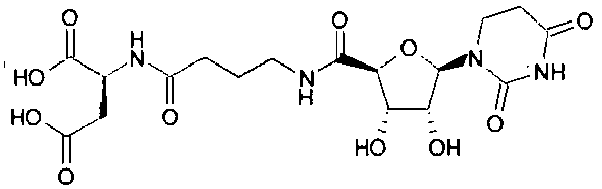
- In a dry vessel, N-tert-butyloxycarbonyl-γ-aminobutyric acid (2.1 g, 10 mmol) was dissolved in 10 ml of dry THF and cooled to -25 °C. Subsequently, N-methylmorpholine (10 mmol, 1010 mg) and isobutyl chloroformate (10 mmol, 1360 mg) were sequentially added under vigorous stirring. Immediately after the formation of a white precipitate (N-methylmorpholine hydrochloride) a solution of dibenzylaspartate tosylate (5.3 g, 11 mmol), dissolved in 11 ml of 1N NaOH, was added. The resulting mixture was allowed to warm to rt. After 3 h, the volatiles were removed by rotary evaporation at 40 °C, the residue was dissolved in 10 ml of water and adjusted to pH 1 (10 % aq. NaHSO4 solution) and extracted with ethyl acetate (3 x 50 ml). The combined organic layers are washed with saturated aq. Na2CO3 solution (3 x 20 ml) and subsequently with water (3 x 20 ml), dried over Na2SO4, and evaporated to dryness. The residue (boc-protected amide) is dissolved in 8 ml of dry 4N HCl-dioxane solution and stirred for 2 h at rt. (S)-N-(4-aminobutyryl)aspartic acid dibenzylester hydrochloride was precipitated by addition of 50 ml of diethyl ether, filtered off and thoroughly washed with diethyl ether (yield over two steps: 2.3 g (71 %).
- Under an atmosphere of argon, 2',3'-anisylideneuridine-5'-carboxylic acid (1 mmol, 390 mg), PyBOP® (1.1 mmol, 572 mg) and 1-hydroxybenzotriazole (1.1 mmol, 149 mg) were dissolved in 2 ml of dry DMF at rt. Diisopropylethylamine (1.1 mmol, 143 mg) and, after one minute(S)-N-(4-aminobutyryl)aspartic acid dibenzylester hydrochloride (2 mmol, 866 mg), dissolved in a mixture of dry DMF (2 ml) and diisopropylethylamine (0.5 ml), were added sequentially via a syringe to the solution. The solution was stirred at rt overnight. To isolate the product the solvent was removed in vacuum at 40°C, the residue purified by column chromatography (CH2Cl2/MeOH 40:1) and the analytically pure product crystallised from ether (yield: 450 mg, 56%).
- 100 mg of 2',3'-protected uridine-5'-amide were dissolved in 3 ml of dichloromethane, then 0,15 ml of TFA and one drop of water was added. The solution was stirred until completion of the reaction (overnight) at rt. Upon addition of 20 ml of ether the product precipitated, was filtered off and thoroughly washed with ether (yield: 79 mg, 94 %).
- The dibenzylester of 2-[4-((2S,3R,4S,5R)-5-(2,4-Dioxo-5,6-dihydropyrimidine-1(2H)-yl)-3,4-dihydroxy-tetrahydrofurane-2-carboxamido)butaneamido]-(S)-aspartic acid (30 mg, 0.065 mmol) was suspended in 2 ml of MeOH and water by sonification (5:1). Then, the catalyst Pd(OH)2 (5 mg) was added, the vessel thoroughly purged first by argon and then by hydrogen which were applied by means of a hydrogen generator (Hogen GC, Proton Energy Systems, Wallingford, CT, USA). The reaction was performed for 2 h at a pressure of 25 psi at rt. Then, the suspension was filtered and the catalyst thoroughly washed with methanol and water. The washings were added to the filtrate. The solvent was removed by lyophilisation and 20 mg of the title compound (23) was obtained (yield: 92 %).
1H-NMR (500 MHz, D2O) δ 5.82 (d, 1H, 3J = 6.60 Hz, H-1'), 4.71 (t, 1H, 3J = 6.95 Hz, N-CH, Asp), 4.41 (dd, 1H, 3J = 6.60 Hz and 3J = 5.35 Hz, H-2'), 4.38 (d, 1H, 3J = 3.15 Hz, H-4'), 4.35 (dd, 1H, 3J = 3.15 Hz and 5.35 Hz, H-3'), 3.66 (m, 2H, N-CH2, Dihydrouracil), 3.28 (dt, 2H, 3J = 6.95 Hz and 3J = 7.85 Hz, N-CH2, 4-amidobutaneamide), 2.91 (AB-system with A dd and B dd, 2H, 3J = 5.05 Hz and 2J = 16.75 Hz, O=C-CH 2, Asp), 2.80 (m, 2H, O=C-CH 2, dihydrouracil), 2.34 (t, 2H, 3J = 7.25 Hz, O=C-CH 2, 4-amidobutaneamide), 1.83 (dt, 2H, 3J = 7.25 Hz and 3J = 6.95 Hz, CH2, 4-amidobutaneamide).
13C-NMR (125 MHz, D2O) δ 178.4 (C=O), 178.0 (C=O), 177.7 (C=O), 176.6 (C=O), 174.4 (C-4), 157.5 (C-2), 92.0 (C-1'), 84.9 (C-4'), 75.4 (C-2'), 72.5 (C-3'), 52.7 (N-CH, Asp), 41.3 (N-CH2, dihydrouracil), 40.9 (N-CH2, 4-amidobutaneamide), 39.1 (O=C-CH 2, dihydrouracil), 35.6 (O=C-CH 2, Asp), 33.0 (O=C-CH 2, 4-amidobutaneamide), 27.5 (CH2, 4-amidobutaneamide). -

- In a dry vessel, N-tert-butyloxycarbonylglycine (2.1 g, 10 mmol) was dissolved in 10 ml of dry THF and cooled to -25 °C. Subsequently, N-methylmorpholine (10 mmol, 1010 mg) and isobutyl chloroformate (10 mmol, 1360 mg) were sequentially added under vigorous stirring. Immediately after the formation of a white precipitate (N-methylmorpholine hydrochloride) a solution of dibenzylglutamic acid hydrochloride (4.0 g, 11 mmol), dissolved in 11 ml of 1N NaOH, was added. The resulting mixture was allowed to warm to rt. After 3 h, the volatiles were removed by rotary evaporation at 40 °C, the residue was dissolved in 10 ml of water and adjusted to pH 1 (10 % aq. NaHSO4 solution) and extracted with ethyl acetate (3 x 50 ml). The combined organic layers were washed with saturated aq. Na2CO3 solution (3 x 20 ml) and subsequently with water (3 x 20 ml), dried over Na2SO4, and evaporated to dryness. The residue (boc-protected amide) was dissolved in 8 ml of dry 4N HCl-dioxane solution and stirred for 2 h at rt. (S)-N-(4-aminobutyryl)aspartic acid dibenzylester hydrochloride was precipitated by addition of 50 ml of diethyl ether, filtered off and thoroughly washed with diethyl ether (yield over two steps: 3.4 g, 80%).
- Under an atmosphere of argon, 2',3'-anisylideneuridine-5'-carboxylic acid (1 mmol, 390 mg), HCTU® (1.1 mmol, 455 mg) and 1-hydroxybenzotriazole (1.1 mmol, 149 mg) are dissolved in 2 ml of dry DMF at rt. Diisopropylethylamine (1.1 mmol, 143 mg) and, after one minute(S)-N-(2-aminoacetyl)glutamic acid dibenzylester hydrochloride (2 mmol, 830 mg), dissolved in a mixture of dry DMF (2 ml) and diisopropylethylamine (0.5 ml), are added sequentially via a syringe to the solution. The solution is stirred at rt overnight. To isolate the product the solvent is removed in vacuum at 40°C, the residue purified by column chromatography (CH2Cl/MeOH 40:1) and the analytically pure product crystallised from ether (yield: 220 mg, 30 %).
- 100 mg of 2',3'-protected uridine-5'-amide were dissolved in 3 ml of dichloromethane, then 0,15 ml of TFA and one drop of water was added. The solution was stirred until completion of the reaction (overnight) at rt. Upon addition of 20 ml of ether the product precipitated, was filtered off and thoroughly washed with ether (yield: 79 mg, 94 %).
- The dibenzylester of 2-[4-((2S,3R,4S,5R)-5-(2,4-Dioxo-5,6-dihydropyrimidine-1(2H)-yl)-3,4-dihydroxy-tetrahydrofurane-2-carboxamido)ethaneamido]-(S)-glutamic acid (30 mg, 0.062 mmol) was suspended in 2 ml of MeOH and water by sonification (5:1). Then, the catalyst Pd(OH)2 (5 mg) was added, the vessel thoroughly purged first by argon and then by hydrogen which were applied by means of a hydrogen generator (Hogen GC, Proton Energy Systems, Wallingford, CT, USA). The reaction was performed for 2 h at a pressure of 25 psi at rt. Then, the suspension was filtered and the catalyst thoroughly washed with methanol and water. The washings were added to the filtrate. The solvent was removed by lyophilisation and 20 mg of the title compound (24) was obtained (yield: 92 %).
1H-NMR (500 MHz, D2O) δ 5.87 (d, 1H, 3J = 6.00 Hz, H-1'); 4.49 (d, 1H, 3J = 2.50 Hz, H-4'); 4.43 (dd, 1H, 3J = 5.35 Hz und 3J = 6.65 Hz, H-2'), 4.41 (dd, 1H, 3J = 2.50 Hz and 3J = 5.15 Hz, H-3'), 4.35 (t, 1H, 3J = 4.75 Hz, N-CH, Glu); 4.05 (AB-System mit A d und B d, 2H, 2J = 17.00 Hz, N-CH2, 2-Amidoethanamid); 3.61 (m, 2H, 3J = 6.60 Hz, N-CH2, Dihydrouracil); 2.80 (dt, 2H, 3J = 6.00 Hz und 3J = 3.75 Hz, O=C-CH 2, Dihydrouracil); 2.56 (t, 2H , 3J = 7.55 Hz, O=C-CH 2, Glu); 2.20 und 1.99 (2 x m, 2 x 1H, 3J = 7.25 Hz und 3J = 4.75 Hz, CH2, Glu).
13C-NMR (125 MHz, D2O) δ 180.5 (C=O); 179.5 (C=O); 176.6 (C=O); 175.1 (C=O); 173.4 (C-4); 157.6 (C-2); 91.8 (C-1'); 84.8 (C-4'); 75.5 (C-2'); 72.5 (C-3'); 45.4 (N-CH2, 2-Amidoethanamid); 45.0 (N-CH, Glu); 40.7 (N-CH2, Dihydrouracil); 33.2 (O=C-CH 2, Dihydrouracil); 33.0 (O=C-CH 2, Glu); 29.3 (CH2, Glu). -

- In a dry vessel, N-tert-butyloxycarbonyl-y-aminobutyric acid (2.1 g, 10 mmol) was dissolved in 10 ml of dry THF and cooled to -25 °C. Subsequently, N-methylmorpholine (10 mmol, 1010 mg) and isobutyl chloroformate (10 mmol, 1360 mg) were sequentially added under vigorous stirring. Immediately after the formation of a white precipitate (N-methylmorpholine hydrochloride) a solution of dibenzylaspartate tosylate (5.3 g, 11 mmol), dissolved in 11 ml of 1N NaOH, was added. The resulting mixture was allowed to warm to rt. After 3 h, the volatiles were removed by rotary evaporation at 40 °C, the residue was dissolved in 10 ml of water and adjusted to pH 1 (10 % aq. NaHSO4 solution) and extracted with ethyl acetate (3 x 50 ml). The combined organic layers were washed with saturated aq. Na2CO3 solution (3 x 20 ml) and subsequently with water (3 x 20 ml), dried over Na2SO4, and evaporated to dryness. The residue (boc-protected amide) is dissolved in 8 ml of dry 4N HCl-dioxane solution and stirred for 2 h at rt. (S)-N-(4-aminobutyryl)aspartic acid dibenzylester hydrochloride was precipitated by addition of 50 ml of diethyl ether, filtered off and thoroughly washed with diethyl ether (yield over two steps: 2.3 g, 71%).
- Under an atmosphere of argon, 2',3'-anisylidene-5-methyluridirie-5'-carboxylic acid (1 mmol, 390 mg), PyBOP® (1.1 mmol, 572 mg) and 1-hydroxybenzotriazole (1.1 mmol, 149 mg) were dissolved in 2 ml of dry DMF at rt. Diisopropylethylamine (1.1 mmol, 143 mg) and, after one minute(S)-N-(4-aminobutyryl)aspartic acid dibenzylester hydrochloride (2 mmol, 866 mg), dissolved in a mixture of dry DMF (2 ml) and diisopropylethylamine (0.5 ml), were added sequentially via a syringe to the solution. The solution was stirred at rt overnight. To isolate the product the solvent was removed in vacuum at 40°C, the residue purified by column chromatography (CH2Cl2/MeOH 40:1) and the analytically pure product crystallised from ether (yield: 450 mg, 58 %).
- 100 mg of 2',3'-protected 5-methyluridine-5'-amide were dissolved in 3 ml of dichloromethane, then 0,15 ml of TFA and one drop of water was added. The solution was stirred until completion of the reaction (overnight) at rt. Upon addition of 20 ml of ether the product precipitated, was filtered off and thoroughly washed with ether (yield: 80 mg, 92%).
- The dibenzylester of 2-[4-((2S,3R,4S,5R)-5-(2,4-Dioxo-5-methylpyrimidine-1(2H)-yl)-3,4-dihydroxytetrahydrofurane-2-carboxamido)butaneamido]-(S)-aspartic acid (30 mg, 0.062 mmol) was suspended in 2 ml of MeOH and water by sonification (5:1). Then, the catalyst Pd(OH)2 (5 mg) was added, the vessel thoroughly purged first by argon and then by hydrogen which were applied by means of a hydrogen generator (Hogen GC, Proton Energy Systems, Wallingford, CT, USA). The reaction was performed for 2 h at a pressure of 25 psi at rt. Then, the suspension was filtered and the catalyst thoroughly washed with methanol and water. The washings were added to the filtrate. The solvent was removed by lyophilisation and 21 mg of the title compound (25) was obtaind (yield: 95 %).
1H-NMR (500 MHz, D2O) δ 7.79 (s, 1H, H-6), 5.89 (d, 1H, 3J = 6.60 Hz, H-1'), 4.71 (t, 1H, 3J = 6.95 Hz, N-CH, Asp), 4.52 (dd, 1H, 3J = 5.35 Hz and 3J = 6.60 Hz, H-2'), 4.47 (d, 1H, 3J = 2.20 Hz, H-4'), 4.43 (dd, 1H, 3J = 3.80 Hz and 3J = 3.15 Hz, H-3'), 3.28 (dt, 2H, 3J = 6.95 Hz and 3J = 7.85 Hz, N-CH2, 4-butanamide), 2.91 (AB-system with A dd and B dd, 2H, 3J = 5.05 Hz and 2J = 16.75 Hz, O=C-CH2, Asp), 2.34 (t, 2H, 3J = 7.25 Hz, O=C-CH2, 4-butanamide), 1.91 (s, 3H, 5-CH3), 1.85 (dt, 2H, 3J = 7.25 Hz and 3J = 6.95 Hz, CH2, 4-butanamide). 13 C-NMR (125 MHz, D2O) δ 178.5 (C=O), 177.5 (C=O), 177.5 (C=O), 174.3 (C=O), 169.4 (C-4), 154.7 (C-2), 141.6 (C-6), 114.4 (C-5), 92.0 (C-1'), 84.9 (C-4'), 75.4 (C-2'), 72.5 (C-3'), 52.7 (N-CH, Asp), 40.9 (N-CH2, 4-butanamide), 35.6 (O=C-CH2, Asp), 33.0 (O=C-CH2, 4-butanamide), 27.5 (CH2, 4-butanamide). -

- In a dry vessel N-tert-butyloxycarbonyl-γ-aminobutyric acid (2.1 g, 10 mmol) was dissolved in 10 ml of dry THF and cooled to -25 °C. Subsequently, N-methylmorpholine (10 mmol, 1010 mg) and isobutyl chloroformate (10 mmol, 1360 mg) were sequentially added under vigorous stirring. Immediately after the formation of a white precipitate (N-methylmorpholine hydrochloride) a solution of dibenzylaspartate tosylate (5.3 g, 11 mmol), dissolved in 11 ml of 1N NaOH, was added. The resulting mixture was allowed to warm to rt. After 3 h, the volatiles were removed by rotary evaporation at 40 °C, the residue was dissolved in 10 ml of water and adjusted to pH 1 (10 % aq. NaHSO4 solution) and extracted with ethyl acetate (3 x 50 ml). The combined organic layers were washed with saturated aq. Na2CO3 solution (3 x 20 ml) and subsequently with water (3 x 20 ml), dried over Na2SO4, and evaporated to dryness. The residue (boc-protected amide) was dissolved in 8 ml of dry 4N HCl-dioxane solution and stirred for 2 h at rt. (S)-N-(4-aminobutyryl)aspartic acid dibenzylester hydrochloride was precipitated by addition of 50 ml of diethyl ether, filtered off and thoroughly washed with diethyl ether (yield over two steps: 2.3 g, 71%).
- Under an atmosphere of argon, 2',3'-anisylidene-inosine-5'-carboxylic acid (1 mmol, 399 mg), PγBOP® (1.1 mmol, 572 mg) and 1-hydroxybenzotriazole (1.1 mmol, 149 mg) were dissolved in 2 ml of dry DMF at rt. Diisopropylethylamine (1.1 mmol, 143 mg) and, after one minute(S)-N-(4-aminobutyryl)aspartic acid dibenzylester hydrochloride (2 mmol, 866 mg), dissolved in a mixture of dry DMF (2 ml) and diisopropylethylamine (0.5 ml), were added sequentially via a syringe to the solution. The solution is stirred at rt overnight. To isolate the product, the solvent was removed in vacuum at 40°C, the residue purified by column chromatography (CH2Cl2/MeOH 40:1) and the analytically pure product crystallised from ether (yield: 280 mg, 36 %).
- 100 mg of 2',3'-protected adenosine-5'-amide were dissolved in 3 ml of dichloromethane, then 0,15 ml of TFA and one drop of water was added. The solution was stirred until completion of the reaction (overnight) at rt. Upon addition of 20 ml of ether the product precipitated, was filtered off and thoroughly washed with ether (yield: 75 mg, 87 %).
- The dibenzylester (30 mg, 0.06 mmol) was suspended in 2 ml of MeOH and water by sonification (5:1). Then, the catalyst Pd(OH)2 (5 mg) was added, the vessel thoroughly purged first by argon and then by hydrogen which were applied by means of a hydrogen generator (Hogen GC, Proton Energy Systems, Wallingford, CT, USA). The reaction was performed for 2 h at a pressure of 25 psi at rt. Then, the suspension was filtered and the catalyst thoroughly washed with methanol and water. The washings were added to the filtrate. The solvent was removed by lyophilisation and 21 mg of the title compound (26) was obtained (yield: 95 %).
1H-NMR (500 MHz, D2O) δ 8.57 (H-2), 8.46 (H-8), 6.22 (d, 1H, 3J = 6.60 Hz, H-1'), 4.89 (t, 1H, 3J = 6.95 Hz, N-CH, Asp), 4.72·(dd, 1H, 3J = 5.35 Hz and 3J = 6.60 Hz, H-2'), 4.64 (d, 1H, 3J = 2.20 Hz, H-4'), 4.63 (dd, 1H, 3J = 3.80 Hz and 3J = 3.15 Hz, H-3'), 3.28 (dt, 2H, 3J = 6.95 Hz and 3J = 7.85 Hz, N-CH2, 4-butanamide), 2.92 (AB-system with A dd and B dd, 2H, 3J = 5.05 Hz and 2J = 16.75 Hz, O=C-CH2, Asp), 2.32 (t, 2H, 3J = 7.25 Hz, O=C-CH2, 4-butanamide), 1.81 (dt, 2H, 3J = 7.25 Hz and 3J = 6.95 Hz, CH2, 4-butanamide).
13C_NMR (125 MHz, D2O) δ 178.5 (C=O), 177.3 (C=O), 177.2 (C=O), 174.0 (C=O), 153.2 (C-6), 151.2 (C-2), 147.8 (C-4), 146.5 (C-8), 122.2 (C-5), 9170 (C-1'), 86.7 (C-4'), 75.8 (C-2'), 75.7 (C-3'), 52.7 (N-CH, Asp), 40.9 (N-CH2, 4-butanamide), 35.6 (O=C-CH2, Asp), 33.0 (O=C-CH2, 4-butanamide), 27.5 (CH2, 4-butanamide). -

- In a dry vessel, N-tert-butyloxycarbonyl-γ-aminobutyric acid (10 mmol, 2030 mg) was dissolved in 10 ml of dry THF and cooled to -25 °C. Subsequently, N-methylmorpholine (10 mmol, 1010 mg) and isobutyl chloroformiate (10 mmol, 1360 mg) were sequentially added under vigorous stirring. Immediately after the formation of a white precipitate (N-methylmorpholine hydrochloride) a solution of of aminomethylenediphosphonic acid diethylester (11 mmol, 3350 mg) in dry THF (10 ml) was added. The resulting mixture was allowed to warm to ambient temperature. After three hours, the volatiles were removed by rotary evaporation at 40 °C, the residue was dissolved in 10 ml of water and adjusted to pH 1 (10% aq. NaHSO4 solution) and extracted with ethyl acetate (3 x 50 ml). The combined organic layers were washed with saturated aq. Na2CO3 solution (3 x 20 ml) and subsequently with water (3 x 20 ml), dried over Na2SO4, and evaporated to dryness. The residue (boc-protected amide) was dissolved in 8 ml of dry 4N HCl-dioxane solution and stirred for two hours at ambient temperature. 3-Aminopropylcarboxamidomethyl-bis(phosphonic acid diethyl ester) hydrochloride was precipitated by addition of 50 ml of diethyl ether, filtered off and thoroughly washed with diethyl ether (yield over two steps: 3400 mg, 80 %, clay).
- Under an atmosphere of argon, 2',3'-anisylidene-5-methyluridine-4'-carboxylic acid (1 mmol, 390 mg), PyBOP® (1.1 mmol, 572 mg) and 1-hydroxybenzotriazole (1.1 mmol, 149 mg) were dissolved in 2 ml of dry DMF at ambient temperature. Diisopropylethylamine (1.1 mmol, 143 mg) and, after one minute, 3-aminopropylcarboxamidomethyl-bis(phosphonic acid diethyl ester) hydrochloride (2 mmol, 844 mg), dissolved in a mixture of dry DMF (2 ml) and diisopropylethylamine (0.5 ml), were added sequentially via a syringe to the solution. Vigorous stirring was continued for 24 hours at ambient temperature. The volatiles were removed in vacuo at 40 °C and the residue was purified by silica gel column chromatography using dichloromethane/methanol (40:1). The product was isolated by rotary evaporation at 40 °C and recrystallized from diethyl ether. Deprotection of the ribose moiety was performed by stirring 2',3'-anisylidene-5-methyluridine-5'-amide (100 mg) in a mixture of dichloromethane (3 ml), trifluoroacetic acid (0.15 ml) and water (0.1 ml) at ambient temperature. After two hours, the crude product was precipitated by addition of diethyl ether (50 ml), filtered off, dissolved in 7 ml of water/methanol (75:25) and purified by RP-HPLC using a gradient of water/methanol from 75:25 to water/methanol 0:100. 250 mg of the title compound was isolated by lyophilisation as white amorphous powder (yield over two steps: 39 %).
1H-NMR (500 MHz, MeOD) δ 7.82 (s, 1H, H-6), 5.70 (d, 1H, 3J = 6.95 Hz, H-1'), 5.13 (t, 1H, 2JH,P = 22.40 Hz, methylenediphosphonate), 4.66 (dd, 1H, 3J = 6.60 Hz and 3J = 5.05 Hz, H-2'), 4.39 (d, 1H, 3J = 2.50 Hz, H-4'), 4.26-4.21 (m, 9H, H-3' and 4 x O-CH2), 3.48-3.43 and 3.25-3.11 (2 x m, 2H, N-CH2, butaneamide), 2.45-2.35 (m, 2H, O=C-CH 2 , butaneamide), 1.95 (s, 3H, 5-CH3), 1.90 (m, 2H, CH2, butaneamide), 1.40-1.34 (m, 12H, 4 x CH3).
13C-NMR (125 MHz, MeOD) δ 175.1 (C=O), 172.7 (C=O), 166.4 (C-4), 153.4 (C-2), 141.6 (C-6), 112.3 (C-5), 94.8 (C-1'), 85.8 (C-4'), 75.0 (C-2'), 72.7 (C-3'), 65.4 (4 x O-CH2), 44.8 (t, 1JC,P = 148.9 Hz, PPNCH, methylenediphosphonate), 39.4 (N-CH2, butaneamide), 34.0 (O=C-CH 2 , butaneamide), 27.2 (CH2, butaneamide), 16.9 (4 x CH3), 12.6 (5-CH3).
31P-NMR (202 MHz, MeOD) 15.8. -

- In a dry vessel, N-tert-butyloxycarbonyl-γ-aminobutyric acid (10 mmol, 2030 mg) was dissolved in 10 ml of dry THF and cooled to -25 °C. Subsequently, N-methylmorpholine (10 mmol, 1010 mg) and isobutyl chloroformiate (10 mmol, 1360 mg) were sequentially added under vigorous stirring. Immediately after the formation of a white precipitate (N-methylmorpholine hydrochloride) a solution of (R,S)-a-amino-benzylphosphonic acid diethyl ester hydrochloride (11 mmol, 3080 mg) in THF (10 ml) and 1N aq. NaOH (11 ml), pre-cooled on ice, was added. The resulting mixture was allowed to warm to ambient temperature. After three hours, the volatiles were removed by rotary evaporation at 40 °C, the residue was dissolved in 10 ml of water and adjusted to pH 1 (10% aq. NaHSO4 solution) and extracted with ethyl acetate (3 x 50 ml). The combined organic layers were washed with saturated aq. Na2CO3 solution (3 x 20 ml) and subsequently with water (3 x 20 ml), dried over Na2SO4, and evaporated to dryness. The residue (boc-protected amide) was dissolved in 8 ml of dry 4N HCl-dioxane solution and stirred for two hours at ambient temperature. (R,S)-α-(3-Aminopropylcarboxamido)benzylphosphonic acid diethyl ester hydrochloride was precipitated by addition of 50 ml of diethyl ether, filtered off and thoroughly washed with diethyl ether (yield over two steps: 3120 mg, 86 %, white crystals).
- Under an atmosphere of argon, 2',3'-anisylideneuridine-4'-carboxylic acid (1 mmol, 376 mg), PyBOP® (1.1 mmol, 455 mg) and 1-hydroxybenzotriazole (1.1 mmol, 149 mg) were dissolved in 2 ml of dry DMF at ambient temperature. Diisopropylethylamine (1.1 mmol, 143 mg) and, after one minute, (R,S)-α-(3-Aminopropylcarboxamido)benzylphosphonic acid diethyl ester hydrochloride (2 mmol, 726 mg), dissolved in a mixture of dry DMF (2 ml) and diisopropylethylamine (0.5 ml), were added sequentially via a syringe to the solution. Vigorous stirring was continued for 24 hours at ambient temperature. The volatiles were removed in vacuo at 40 °C and the residue was purified by silica gel column chromatography using dichloromethane/methanol (40:1). The product was isolated by rotary evaporation at 40 °C and recrystallized from diethyl ether. Deprotection of the ribose moiety was performed by stirring 2',3'-anisylideneuridine-5'-amide (100 mg) in a mixture of dichloromethane (3 ml), trifluoroacetic acid (0.15 ml) and water (0.1 ml) at ambient temperature. After two hours, the crude product was precipitated by addition of diethyl ether (50 ml), filtered off, dissolved in 7 ml of water/methanol (75:25) and purified by RP-HPLC using a gradient of water/methanol from 75:25 to water/methanol 0:100. 310 mg of the title compound as a racemic mixture was isolated by lyophilisation as white amorphous powder (yield over two steps: 63%).
1H-NMR (500 MHz, MeOD) δ 8.11 (2 x d, 1H, 3J = 7.85 Hz, H-6), 7.52 (d, 2H, 3J = 7.85 Hz, 2 x Hortho, phenyl), 7.42-7.34 (m, 3H, 2 x Hmeta and Hpara, phenyl), 5.83 (2 x d, 1H, 3J = 6.00 Hz, H-1'), 5.78 (2 x d, 1H, 3J = 8.20 Hz, H-5), 5.59 (d, 1H, 2JH,P = 21.40 Hz, Hα, α-aminobenzylphosphonate), 4.52 (pseudo-q, 1H, 3J = 5.05 Hz and 3J = 6.65 Hz, H-2'), 4.39 (2 x d, 1H, 3J = 3.15 Hz, H-4'), 4.27 (2 x dd, 1H, 3J = 5.05 Hz and 3J = 3.15 Hz, H-3'), 4.16-4.11 (dq, 2H, O-CH2), 4.02 (m, 1H, 0.5 x O-CH2), 3.92 (m, 1H, 0.5 x O-CH2), 3.38-3.26 (m, partly below solvent peak, 2H, N-CH2, butaneamide), 2.34 (m, 2H, O=C-CH 2 , butaneamide), 1.88 (m, 2H, CH2, butaneamide), 1.36 (2 x t, 6H, 2 x CH3).
13C-NMR (125 MHz, MeOD) δ 175.1 and 175.0 (C=O), 172.7 (C=O), 166.3 and 166.2 (C-4), 153.1 and 153.0 (C-2), 145.0 and 144.9 (C-6), 136.4 (Cipso, phenyl), 129.9-129.6 (5 x C, phenyl), 103.4 and 103.3 (C-5), 93.7 and 93.6 (C-1'), 85.5and 85.4 (C-4'), 74.9 and 74.8 (C-2'), 73.9 and 73.8 (C-3'), 65.0 and 64.9 (2 x O-CH2), 52.7 (2 x d, 1Jc,p= 156.8 Hz, CH-P, benzylphosphonate), 39.9 and 39.8 (N-CH2, butaneamide), 34.3 and 34.2 (O=C-CH 2 , butaneamide), 27.1 and 27.0 (CH2, butaneamide), 17.1 and 16.8 (2 x CH3).
31P-NMR (202 MHz, MeOD) δ 20.8. - The applied enzyme inhibition assay has been described (Iqbal J, Vollmayer P, Braun N, Zimmermann H, Müller CE. A capillary electrophoresis method for the characterization of ecto-nucleoside triphosphate diphosphohydrolases (NTPDases) and the analysis of inhibitors by in-capillary enzymatic microreaction. Purinergic Signalling 2005, 1, 349-358).
- A. CE instrumentation: All experiments were carried out using a P/ACE MDQ capillary electrophoresis system (Beckman Instruments, Fullerton, CA, USA) equipped with a UV detection system coupled with a diode-array detector (DAD). Data collection and peak area analysis were performed by the P/ACE MDQ software 32 KARAT obtained from Beckman Coulter. The capillary temperature was kept constant at 25 °C. The temperature of the sample storing unit was also adjusted to 25 °C. The electrophoretic separations were carried out using an eCAP polyacrylamide-coated fused-silica capillary [(30 cm (20 cm effective length) x 50 µm internal diameter (I.D.) x 360 µm outside diameter (O.D.), obtained from CS-Chromatographie (Langerwehe, Germany)]. The separation was performed using an applied current of -60 µA and a data acquisition rate of 8 Hz. Analytes were detected using direct UV absorbance at 210 nm. The capillary was conditioned by rinsing with water for 2 min and subsequently with buffer (phosphate 50 mM, pH 6.5) for 1 min. Sample injections were made at the cathodic side of the capillary.
- B. NTPDase inhibition assay by capillary electrophoresis: Enzyme inhibition assays were carried out at 37 °C in a final volume of 100 µl. The reaction mixture contained 320 µM of ATP (substrate) in reaction buffer. The reaction buffer contained 140 mM NaCl, 5 mM KCl, 1 mM MgCl2, 2 mM CaCl2, and 10 mM Hepes, pH 7.4.
- Different concentrations of inhibitors dissolved in DMSO or water (10 µl) were added and the reaction was initiated by the addition of 10 µl of the appropriately diluted recombinant or native human or rat NTPDase enzyme. The final DMSO concentration did not exceed 1 %. The mixture (final volume 100 µl) was incubated for 15 min and terminated by heating at 99 °C for 4 min. Aliquots of the reaction mixture (50 µl) were then transferred to mini-CE vials and injected into the CE instrument under the conditions described above. 20 µM of UMP was used as internal standard. Inhibition of NTPDase was tested over a range of 6 to 8 concentrations of test compound spanning 3 orders of magnitude to determine Ki values. Each analysis was repeated two times (in triplicates) in two separate experiments. The Cheng-Prusoff equation was used to calculate the Ki values from the IC50 values, determined by the non-linear curve fitting program PRISM® 3.0 (GraphPad, San Diego, California, USA). In table 1 Ki values of selected compounds as inhibitors of human NTPDases are given.
Table 1: Ki values for human NTPDase inhibition obtained for selected new inhibitors using the capillary electrophorese (CE) method. The results were means ± SEM of three separate experiments each run in triplicate 1 . Compound No. NTPDase1 Ki [µM] ± SEM NTPDase2 Ki [µM] ± SEM NTPDase3 Ki [µM] ± SEM NTPDase8 Ki [µM] ± SEM 1 n.d.2 117 ±15 n.d.2 n.d.2 5 786 ± 33 71.7 ± 13.50 >> 200 (0)3 >> 100 (0)3 2 >> 50 (50)3 8.2 ± 2.1 >> 200 (0)3 >> 100 (0)3 8 >> 50 (0)3 116 ± 24 >> 200 (22)3 >> 100 (0)3 6 >> 50 (0)3 167 ± 21 >> 200 (0)3 >> 100 (0)3 4 182 ± 24.3 210 ± 25.3 >> 200 (48)3 242 ± 39.3 3 55.2 ± 2.6 173 ± 17 >> 200 (40)3 >> 100 (0)3 7 >> 50 (45)3 29.2 ± 2.7 >> 200 (0)3 >> 100 (0)3 9 n.d.2 ca. 165 (54)3 n.d.2 n.d.2 12 32.4 ± 1.1 ca. 165 (54)3 n.d.2 n.d.2 11 325 ± 25 ca. 175 (51)3 n.d.2 n.d.2 10 93 ± 14 ca. 165 (54)3 n.d.2 n.d.2 CC1 >> 50 (0)3 >> 200 (0)3 >> 200 (0)3 >> 100 (0)3 CC3 161 ± 24 213 ± 34 >> 200 (0)3 >> 100 (0)3 CC2 154 ± 37 1440 ± 64 » 200 (0)3 255 ± 25.3 CC4 >> 50 (0)3 >> 200 (0)3 n.d.2 n.d.2 CC5 >> 50 (0)3 >> 200 (0)3 n.d.2 n.d.2 15 29 ± 4 n.d.2 n.d.2 n.d.2 13 55 ± 5 n.d.2 n.d.2 n.d.2 14 10.8 ± 1 n.d.2 n.d.2 n.d.2 1) Km (NTPDase1): 17 µM; Km (NTPDase2): 70 µM; Km (NTPDase3): 75 µM; Km (NTPDase8): 46 µM; concentration of ATP: 320 µM.
2) not determined
3) inhibition (%) at 1 mM - In table 2 inhibition data of selected examples at human P2Y receptor subtypes were collected. It can be seen that no compound was identified that inhibited P2Y receptors at high concentrations of 100 µM and 10 µM, respectively.
Table 2: Percent inhibition values at selected P2Y receptor subtypes. The results were means ± SEM of three separate experiments each run in triplicate. Compound No. hP2Y2 % inhibition of UTP binding at 100 µM, n = 3, Ø hP2Y4 % inhibition of UTP binding at 100 µM; n = 3, Ø rP2Y6 % inhibition of UDP binding at 100 µM, n = 3, Ø hP2Y12 % Inhibition of [3H]PSB-0413 Binding at 10µM, n=3, Ø 1 n.d. n.d. - 12 ± 3 n.d. 5 n.d. n.d. 17 ± 16 31 ± 1 2 n.d. n.d. -10 ± 10 2 ± 6 8 n.d. n.d. 9 ± 13 2 ± 3 6 n.d. n.d. - 3 ± 2 7 ± 5 4 n.d. n.d. - 8 ± 11 6 ± 4 3 n.d. 14 ± 6 7 ± 7 9 ± 4 7 n.d. n.d. - 3 ± 11 2 ± 8 9 n.d. n.d. n.d. n.d. 12 - 44 ± 20 27 ± 7 18 ± 4 1 ± 5 11 - 12 ± 24 7 ± 20 14 ± 2 1 ± 5 10 - 38 ± 11 34 ± 15 8 ± 14 2 ± 5 CC1 n.d. n.d. n.d. -4 ± 6 CC3 n.d. n.d. n.d. 5 ± 1 CC2 n.d. n.d. n.d. 1 ± 6 CC4 n.d. n.d. 5 ± 8 n.d. CC5 n.d. n.d. -5 ± 2 n.d. 15 -28 ± 11 n.d. n.d. n.d. 13 n.d. n.d. n.d. 2 ± 5% 14 n.d. n.d. n.d. 6 ± 4 % n.d. = not determined Table 3: Ki values at rat NTPDase1, 2 and 3 and at selected P2Y receptor subtypes obtained for standard compounds: reactive blue 2 (RB2), PPADS, suramin, and ARL67156, using the in-capillary electrophoresis method. The results were means ± SEM of three separate experiments each run in duplicate. Inhibitor Ki ± SEM [µM] Ectonucleotidases selected P2Y-Receptors NTPDases1 NTPDase2 NTPDase3 P2Y2 P2Y4 P2Y6 P2Y12 RB2 20.0 ± 0.003 24.2 ± 0.06 1.10 ± 0.03 1 > 100 31 1.3 PPADS 46.0 ± 0.01 44.2 ± 0.03 3.0 ± 0.001 inactive 73 % inhib. at 100 µM 69 % inhib. at 100 µM Suramin 300 ± 0.1 65.4 ± 0.01 12.7 ± 0.03 50 inactive > 100 4.0 ARL 67156 27.0 ± 0.004 >> 600 112.1 ± 0.05 Table 4: Potencies of standard E-NTPDase inhibitors at selected P2X receptor subtypes Inhibitor Ki ± SEM [µM] selected P2Y-Receptors P2X1 P2X2 P2X3 P2X5 RB2 215 0.415 5015 2015 PPADS 0.1315 1.615 0.215 0.215 Suramin 215 1015 415 1.615 ARL 67156 - In tables 3 and 4 data for standard NTPDase inhibitors were collected. For structures of the compounds see fig. 1. It can be seen that - with the exception of the ATP analog ARL 67156 the compounds were non-selective inhibitors of NTPDase1,2 and 3, and they were at least equally potent as antagonists at one or several P2 receptor subtypes. ARL 6,7156 has the disadvantage of being metabolically unstable towards ecto-nucleotide pyrophosphatases (E-NPP). It can be applied as a pharmacological tool but was not suitable in assays where the luciferase assay was used for the quantification of ATP concentrations since it interferes with that assay. One of the new compounds (AMB246.1, Example 2) presented in this patent has been shown not to interfere with the luciferase assay for ATP determination and to have therefore decisive advantages as pharmacological tool.
- Catalytically active recombinant soluble glutathione-S-transferase/ecto-5'-nucleotidase fusion protein was expressed in insect cells using the baculovirus system and purified by affinity chromatography using agarose-coupled GSH as previously described [Servos, J., Reilander, H., Zimmermann, H. Drug. Dev. Res. 1998, 45, 269-276]
- Enzyme assays were carried out at 37 °C in a final volume of 100 µl. The reaction buffer consisted of 10 mM Hepes (2.38 g/L), 2 mM MgCl2 (0.41 g/L), and 1 mM CaCl2 (0.11 g/L), brought to pH 7.4 by adding the appropriate amount of 1-N aqueous HCl solution. The reaction was initiated by the addition of 10 µl of the appropriately diluted enzyme (0.52 µg). The reaction mixture was incubated for 10 min and terminated by heating at 99 °C for 5 min. Nucleosides and nucleotides were stable under these conditions. Aliquots of the reaction mixture (50 µl) were then transferred to mini-CE vials containing 50 µl of the internal standard uridine (final concentration 20 µM). In the absence of an internal standard similar results were obtained. Each analysis was repeated twice (duplicates) in three separate experiments.
- CE separations were carried out using a P/ACE MDQ system (Beckman Coulter Instruments, Fullerton, CA, USA) equipped with a DAD detection system. The electrophoretic separations were carried out using an eCAP fused-silica capillary [30 cm (20 cm effective length) x 75 µm internal diameter (I.D), x 375 µm outside diameter (O.D) obtained from Beckman Coulter]. The following conditions were applied: T = 25 °C, λmax = 260 nm, voltage = 15 kV, running buffer 40 mM sodium borate buffer, pH 9.1. The capillary was washed with 0.1 M NaOH for 2 min, deionized water for 1 min, and running buffer for 1 min before each injection. Injections were made by applying 0.1 psi of pressure to the sample solution for 30 s. The amount of adenosine formed was determined. The CE instrument was fully controlled through a personal computer, which operated with the analysis software 32 KARAT obtained from Beckman Coulter. Electropherograms were evaluated using the same software.
Table 5: Ki values for rat ecto-5'-nucleotidase inhibition obtained for selected compounds using a capillary electrophoresis (CE) method. The results are means ± SEM of three separate experiments each run in triplicate. Example No. Rat Ecto-5'-NT Ki [µM] ± SEM 25 1.61 ± 0.62 13 0.60 ± 0.01 23 0.180 ± 0.014 24 34.3 ± 0.2 14 0.78 ± 0.18 21 6.47 ± 1.31
Claims (15)
- A compound represented by the formula (I)

B represents an oxopurinyl or oxopyrimidinyl residue which is connected with the furanoside ring via one of its nitrogen atoms;
R1 represent independently from each other residues selected from hydroxyl, hydrogen, C1-C3-alkoxyl, C1-C3-alkyl, C1-C3-alkenyl, C1-C3-alkinyl, C1-C3-acyl, halogen, or commonly form a double bond with one of the vicinal C atoms or an acetyl or ketal ring with each other;
R2 is -(CH2)0-2- or phenylene;
A represents a -PO(OR3)2 or -SO2(OR3) residue wherein R3 is C1-C3-alkyl, aryl, arylalkyl or heteroary,l or A represents a -(CH2)m-COOR4 residue, wherein m is an integer from 0 to 2 and R4 is selected from hydrogen and C1-C3-alkyl;
R5 is a carbonyl or a methylene group; and
n is 1 or 2, provided that when A represents a -(CH2)m-COOR4 residue, n is 2;
or a salt thereof. - The compound of claim 1, which is represented by the formula

- The compound of claim 1 or 2, wherein(i) at least one R1 is OH and the other R1 is H or OH; and/or(ii) the spacer between the nucleosid 5'C and A comprises at least three carbon or heteroatoms.
- The compound of any one of claims 1 to 3, wherein
B is selected from a native oxopurinyl or oxopyrimidyl residue including uracilyl, cytosinyl, guaninyl, hypoxanthinyl, xanthinyl,
preferably B is uracilyl or, most preferably is 1-uracilyl. - The compound of any one of claims 1 to 4, wherein A represents a -PO(OR3)2 residue, R3 is ethyl and/or n is 1.
- The compound of claim 5, which is represented by the formula
 (i) at least one R1 is OH and the other R1 is H or OH, more preferably both R1 are OH; and/or(ii) R3 is ethyl.
 - The compound of claim 6, which is represented by the formula

- The compound of any one of claims 1 to 4, wherein A represents a -(CH2)m-COOR4 residue and R4 is H.
- The compound of claim 8, which is represented by the formula

- The compound of any of claims 1 to 9 which is a selective NTPDase inhibitor.
- A pharmaceutical or diagnostic composition or a medicament comprising a compound as defined in any one of claims 1 to 9.
- Use of the compound of any one of claims 1 to 9 for the preparation of a medicament for treating diseases connected with a reduced abundance of nucleotides in a patient or for therapies aiming at increasing the nucleotide concentration in a patient.
- The use of claim 12, wherein the medicament is for therapy of dry eye disease, respiratory diseases, cystic fibrosis, inflammatory diseases, diseases of the immune system, gastrointestinal diseases, kidney disorders, cancer, and brain diseases.
- An in vitro method for ATP quantification which comprises utilizing the compound of any of claims 1 to 9, preferably in a luciferase assay.
- A method for preparing the compound of formula (I) of any one of claim 1 to 9, which comprises reacting a compound of formula (II)


Priority Applications (1)
| Application Number | Priority Date | Filing Date | Title |
|---|---|---|---|
| EP07729500.4A EP2019834B1 (en) | 2006-05-24 | 2007-05-24 | Ectonucleotidase inhibitors |
Applications Claiming Priority (3)
| Application Number | Priority Date | Filing Date | Title |
|---|---|---|---|
| EP06114534A EP1860113A1 (en) | 2006-05-24 | 2006-05-24 | Ectonucleotidase inhibitors |
| EP07729500.4A EP2019834B1 (en) | 2006-05-24 | 2007-05-24 | Ectonucleotidase inhibitors |
| PCT/EP2007/055071 WO2007135195A1 (en) | 2006-05-24 | 2007-05-24 | Ectonucleotidase inhibitors |
Publications (2)
| Publication Number | Publication Date |
|---|---|
| EP2019834A1 EP2019834A1 (en) | 2009-02-04 |
| EP2019834B1 true EP2019834B1 (en) | 2014-07-09 |
Family
ID=37621981
Family Applications (2)
| Application Number | Title | Priority Date | Filing Date |
|---|---|---|---|
| EP06114534A Withdrawn EP1860113A1 (en) | 2006-05-24 | 2006-05-24 | Ectonucleotidase inhibitors |
| EP07729500.4A Not-in-force EP2019834B1 (en) | 2006-05-24 | 2007-05-24 | Ectonucleotidase inhibitors |
Family Applications Before (1)
| Application Number | Title | Priority Date | Filing Date |
|---|---|---|---|
| EP06114534A Withdrawn EP1860113A1 (en) | 2006-05-24 | 2006-05-24 | Ectonucleotidase inhibitors |
Country Status (3)
| Country | Link |
|---|---|
| US (1) | US20100204182A1 (en) |
| EP (2) | EP1860113A1 (en) |
| WO (1) | WO2007135195A1 (en) |
Families Citing this family (22)
| Publication number | Priority date | Publication date | Assignee | Title |
|---|---|---|---|---|
| EP1860113A1 (en) * | 2006-05-24 | 2007-11-28 | Rheinische Friedrich-Wilhelms-Universität Bonn | Ectonucleotidase inhibitors |
| WO2012065139A2 (en) * | 2010-11-11 | 2012-05-18 | Board Of Regents, The University Of Texas System | Entpd5 inhibitors |
| FR3011240A1 (en) | 2013-10-01 | 2015-04-03 | Centre Nat Rech Scient | 5'-NUCLEOTIDASE INHIBITORS AND THERAPEUTIC USES THEREOF |
| EP3134411B1 (en) * | 2014-04-25 | 2021-06-30 | Boehringer Ingelheim International GmbH | Purine derivatives as cd73 inhibitors for the treatment of cancer |
| EP3760208B1 (en) | 2014-06-25 | 2024-05-29 | The General Hospital Corporation | Targeting human satellite ii (hsatii) |
| US10632151B2 (en) | 2015-01-22 | 2020-04-28 | University Of Massachusetts | Cancer immunotherapy |
| CA2990852A1 (en) | 2015-06-26 | 2016-12-29 | Beth Israel Deaconess Medical Center, Inc. | Cancer therapy targeting tetraspanin 33 (tspan33) in myeloid derived suppressor cells |
| TWI767937B (en) | 2016-09-09 | 2022-06-21 | 美商卡利泰拉生物科技公司 | Ectonucleotidase inhibitors and methods of use thereof |
| CA3037046A1 (en) | 2016-10-31 | 2018-05-03 | University Of Massachusetts | Targeting microrna-101-3p in cancer therapy |
| WO2018089688A1 (en) | 2016-11-09 | 2018-05-17 | Jinjun Shi | Restoration of tumor suppression using mrna-based delivery system |
| JP7150712B2 (en) * | 2016-11-18 | 2022-10-11 | アーカス バイオサイエンシズ インコーポレイティド | Inhibitors of CD73-mediated immunosuppression |
| CA3047988A1 (en) | 2016-12-22 | 2018-06-28 | Antengene Therapeutics Limited | Ectonucleotidase inhibitors and methods of use thereof |
| US20200115404A1 (en) * | 2017-03-31 | 2020-04-16 | Peloton Therapeutics, Inc. | Cd73 inhibitors and uses thereof |
| WO2018209324A2 (en) | 2017-05-11 | 2018-11-15 | The Broad Institute, Inc. | Methods and compositions of use of cd8+ tumor infiltrating lymphocyte subtypes and gene signatures thereof |
| EA039042B1 (en) * | 2017-09-08 | 2021-11-25 | Калитера Байосайенсиз, Инк. | Ectonucleotidase inhibitors and methods of use thereof |
| US11814623B2 (en) | 2018-01-30 | 2023-11-14 | University Of Massachusetts | Methods of treating a wound using epigenetic regulation |
| US20210213041A1 (en) | 2018-02-06 | 2021-07-15 | The General Hospital Corporation | Repeat rna as biomarkers of tumor immune response |
| TWI702954B (en) * | 2018-03-01 | 2020-09-01 | 美商美國禮來大藥廠 | Cd73 inhibitors |
| WO2019213660A2 (en) | 2018-05-04 | 2019-11-07 | The Broad Institute, Inc. | Compositions and methods for modulating cgrp signaling to regulate innate lymphoid cell inflammatory responses |
| WO2019232319A1 (en) * | 2018-05-31 | 2019-12-05 | Peloton Therapeutics, Inc. | Compositions and methods for inhibiting cd73 |
| MX2020013320A (en) | 2018-06-21 | 2021-02-22 | Calithera Biosciences Inc | ECTONUCLEOTIDASE INHIBITORS AND METHODS OF USE THEREOF. |
| CN113727999A (en) | 2019-01-11 | 2021-11-30 | 奥默罗斯公司 | Methods and compositions for treating cancer |
Citations (1)
| Publication number | Priority date | Publication date | Assignee | Title |
|---|---|---|---|---|
| EP1860113A1 (en) * | 2006-05-24 | 2007-11-28 | Rheinische Friedrich-Wilhelms-Universität Bonn | Ectonucleotidase inhibitors |
Family Cites Families (4)
| Publication number | Priority date | Publication date | Assignee | Title |
|---|---|---|---|---|
| US3914415A (en) * | 1973-06-14 | 1975-10-21 | Abbott Lab | Adenosine-5{40 -carboxylic acid amides |
| EP0477454A1 (en) * | 1990-09-28 | 1992-04-01 | Merrell Dow Pharmaceuticals Inc. | Novel phosphonate derivatives of certain nucleosides |
| US6683060B2 (en) * | 2002-02-25 | 2004-01-27 | Advanced Gene Technology Corp. | Matrix metalloproteinase and tumor necrosis factor inhibitors |
| US7932376B2 (en) * | 2005-05-05 | 2011-04-26 | Inspire Pharmaceuticals, Inc. | Pyrimidine-based non-nucleotide composition and method for inhibiting platelet aggregation |
-
2006
- 2006-05-24 EP EP06114534A patent/EP1860113A1/en not_active Withdrawn
-
2007
- 2007-05-24 WO PCT/EP2007/055071 patent/WO2007135195A1/en not_active Ceased
- 2007-05-24 EP EP07729500.4A patent/EP2019834B1/en not_active Not-in-force
- 2007-05-24 US US12/227,560 patent/US20100204182A1/en not_active Abandoned
Patent Citations (1)
| Publication number | Priority date | Publication date | Assignee | Title |
|---|---|---|---|---|
| EP1860113A1 (en) * | 2006-05-24 | 2007-11-28 | Rheinische Friedrich-Wilhelms-Universität Bonn | Ectonucleotidase inhibitors |
Also Published As
| Publication number | Publication date |
|---|---|
| EP2019834A1 (en) | 2009-02-04 |
| US20100204182A1 (en) | 2010-08-12 |
| WO2007135195A1 (en) | 2007-11-29 |
| EP1860113A1 (en) | 2007-11-28 |
Similar Documents
| Publication | Publication Date | Title |
|---|---|---|
| US20100204182A1 (en) | Ectonucleotidase inhibitors | |
| US11559542B2 (en) | Phosphoramidate derivatives of 5-fluoro-2′-deoxyuridine for use in the treatment of cancer | |
| NZ523632A (en) | 3'-prodrugs of 2'-deoxy-beta-L-nucleosides for use in treating hepatitis B viral infections | |
| KR20220025914A (en) | β-D-2'-DEOXY-2'-α-FLUORO-2'-β-C-SUBSTITUTED-2-MODIFIED-N6-SUBSTITUTED PURINE NUCLEOTIDES FOR HCV TREATMENT | |
| HK40069170A (en) | Phosphoramidate derivatives of 5-fluoro-2'-deoxyuridine for use in the treatment of cancer | |
| HK40001167A (en) | Pharmaceutical formulation comprising a phosphoramidate derivative of 5-fluoro-2'-deoxyuridine for use in the treatment of cancer | |
| HK40001167B (en) | Pharmaceutical formulation comprising a phosphoramidate derivative of 5-fluoro-2'-deoxyuridine for use in the treatment of cancer | |
| HK1192758B (en) | Phosphoramidate derivatives of 5-fluoro-2'-deoxyuridine for use in the treatment of cancer |
Legal Events
| Date | Code | Title | Description |
|---|---|---|---|
| PUAI | Public reference made under article 153(3) epc to a published international application that has entered the european phase |
Free format text: ORIGINAL CODE: 0009012 |
|
| 17P | Request for examination filed |
Effective date: 20081028 |
|
| AK | Designated contracting states |
Kind code of ref document: A1 Designated state(s): AT BE BG CH CY CZ DE DK EE ES FI FR GB GR HU IE IS IT LI LT LU LV MC MT NL PL PT RO SE SI SK TR |
|
| AX | Request for extension of the european patent |
Extension state: AL BA HR MK RS |
|
| RIN1 | Information on inventor provided before grant (corrected) |
Inventor name: BRUNSCHWEIGER, ANDREAS Inventor name: MUELLER, CHRISTA E. Inventor name: IQBAL, JAMSHED |
|
| 17Q | First examination report despatched |
Effective date: 20090812 |
|
| DAX | Request for extension of the european patent (deleted) | ||
| GRAP | Despatch of communication of intention to grant a patent |
Free format text: ORIGINAL CODE: EPIDOSNIGR1 |
|
| INTG | Intention to grant announced |
Effective date: 20140109 |
|
| GRAS | Grant fee paid |
Free format text: ORIGINAL CODE: EPIDOSNIGR3 |
|
| GRAA | (expected) grant |
Free format text: ORIGINAL CODE: 0009210 |
|
| AK | Designated contracting states |
Kind code of ref document: B1 Designated state(s): AT BE BG CH CY CZ DE DK EE ES FI FR GB GR HU IE IS IT LI LT LU LV MC MT NL PL PT RO SE SI SK TR |
|
| REG | Reference to a national code |
Ref country code: GB Ref legal event code: FG4D |
|
| REG | Reference to a national code |
Ref country code: AT Ref legal event code: REF Ref document number: 676554 Country of ref document: AT Kind code of ref document: T Effective date: 20140715 Ref country code: CH Ref legal event code: EP |
|
| REG | Reference to a national code |
Ref country code: IE Ref legal event code: FG4D |
|
| REG | Reference to a national code |
Ref country code: DE Ref legal event code: R096 Ref document number: 602007037550 Country of ref document: DE Effective date: 20140821 |
|
| REG | Reference to a national code |
Ref country code: AT Ref legal event code: MK05 Ref document number: 676554 Country of ref document: AT Kind code of ref document: T Effective date: 20140709 |
|
| REG | Reference to a national code |
Ref country code: NL Ref legal event code: VDEP Effective date: 20140709 |
|
| REG | Reference to a national code |
Ref country code: LT Ref legal event code: MG4D |
|
| PG25 | Lapsed in a contracting state [announced via postgrant information from national office to epo] |
Ref country code: BG Free format text: LAPSE BECAUSE OF FAILURE TO SUBMIT A TRANSLATION OF THE DESCRIPTION OR TO PAY THE FEE WITHIN THE PRESCRIBED TIME-LIMIT Effective date: 20141009 Ref country code: LT Free format text: LAPSE BECAUSE OF FAILURE TO SUBMIT A TRANSLATION OF THE DESCRIPTION OR TO PAY THE FEE WITHIN THE PRESCRIBED TIME-LIMIT Effective date: 20140709 Ref country code: FI Free format text: LAPSE BECAUSE OF FAILURE TO SUBMIT A TRANSLATION OF THE DESCRIPTION OR TO PAY THE FEE WITHIN THE PRESCRIBED TIME-LIMIT Effective date: 20140709 Ref country code: GR Free format text: LAPSE BECAUSE OF FAILURE TO SUBMIT A TRANSLATION OF THE DESCRIPTION OR TO PAY THE FEE WITHIN THE PRESCRIBED TIME-LIMIT Effective date: 20141010 Ref country code: PT Free format text: LAPSE BECAUSE OF FAILURE TO SUBMIT A TRANSLATION OF THE DESCRIPTION OR TO PAY THE FEE WITHIN THE PRESCRIBED TIME-LIMIT Effective date: 20141110 Ref country code: ES Free format text: LAPSE BECAUSE OF FAILURE TO SUBMIT A TRANSLATION OF THE DESCRIPTION OR TO PAY THE FEE WITHIN THE PRESCRIBED TIME-LIMIT Effective date: 20140709 Ref country code: SE Free format text: LAPSE BECAUSE OF FAILURE TO SUBMIT A TRANSLATION OF THE DESCRIPTION OR TO PAY THE FEE WITHIN THE PRESCRIBED TIME-LIMIT Effective date: 20140709 |
|
| PG25 | Lapsed in a contracting state [announced via postgrant information from national office to epo] |
Ref country code: NL Free format text: LAPSE BECAUSE OF FAILURE TO SUBMIT A TRANSLATION OF THE DESCRIPTION OR TO PAY THE FEE WITHIN THE PRESCRIBED TIME-LIMIT Effective date: 20140709 Ref country code: CY Free format text: LAPSE BECAUSE OF FAILURE TO SUBMIT A TRANSLATION OF THE DESCRIPTION OR TO PAY THE FEE WITHIN THE PRESCRIBED TIME-LIMIT Effective date: 20140709 Ref country code: LV Free format text: LAPSE BECAUSE OF FAILURE TO SUBMIT A TRANSLATION OF THE DESCRIPTION OR TO PAY THE FEE WITHIN THE PRESCRIBED TIME-LIMIT Effective date: 20140709 Ref country code: IS Free format text: LAPSE BECAUSE OF FAILURE TO SUBMIT A TRANSLATION OF THE DESCRIPTION OR TO PAY THE FEE WITHIN THE PRESCRIBED TIME-LIMIT Effective date: 20141109 Ref country code: PL Free format text: LAPSE BECAUSE OF FAILURE TO SUBMIT A TRANSLATION OF THE DESCRIPTION OR TO PAY THE FEE WITHIN THE PRESCRIBED TIME-LIMIT Effective date: 20140709 Ref country code: AT Free format text: LAPSE BECAUSE OF FAILURE TO SUBMIT A TRANSLATION OF THE DESCRIPTION OR TO PAY THE FEE WITHIN THE PRESCRIBED TIME-LIMIT Effective date: 20140709 |
|
| REG | Reference to a national code |
Ref country code: DE Ref legal event code: R097 Ref document number: 602007037550 Country of ref document: DE |
|
| PG25 | Lapsed in a contracting state [announced via postgrant information from national office to epo] |
Ref country code: CZ Free format text: LAPSE BECAUSE OF FAILURE TO SUBMIT A TRANSLATION OF THE DESCRIPTION OR TO PAY THE FEE WITHIN THE PRESCRIBED TIME-LIMIT Effective date: 20140709 Ref country code: RO Free format text: LAPSE BECAUSE OF FAILURE TO SUBMIT A TRANSLATION OF THE DESCRIPTION OR TO PAY THE FEE WITHIN THE PRESCRIBED TIME-LIMIT Effective date: 20140709 Ref country code: DK Free format text: LAPSE BECAUSE OF FAILURE TO SUBMIT A TRANSLATION OF THE DESCRIPTION OR TO PAY THE FEE WITHIN THE PRESCRIBED TIME-LIMIT Effective date: 20140709 Ref country code: EE Free format text: LAPSE BECAUSE OF FAILURE TO SUBMIT A TRANSLATION OF THE DESCRIPTION OR TO PAY THE FEE WITHIN THE PRESCRIBED TIME-LIMIT Effective date: 20140709 Ref country code: IT Free format text: LAPSE BECAUSE OF FAILURE TO SUBMIT A TRANSLATION OF THE DESCRIPTION OR TO PAY THE FEE WITHIN THE PRESCRIBED TIME-LIMIT Effective date: 20140709 Ref country code: SK Free format text: LAPSE BECAUSE OF FAILURE TO SUBMIT A TRANSLATION OF THE DESCRIPTION OR TO PAY THE FEE WITHIN THE PRESCRIBED TIME-LIMIT Effective date: 20140709 |
|
| PLBE | No opposition filed within time limit |
Free format text: ORIGINAL CODE: 0009261 |
|
| STAA | Information on the status of an ep patent application or granted ep patent |
Free format text: STATUS: NO OPPOSITION FILED WITHIN TIME LIMIT |
|
| 26N | No opposition filed |
Effective date: 20150410 |
|
| PG25 | Lapsed in a contracting state [announced via postgrant information from national office to epo] |
Ref country code: SI Free format text: LAPSE BECAUSE OF FAILURE TO SUBMIT A TRANSLATION OF THE DESCRIPTION OR TO PAY THE FEE WITHIN THE PRESCRIBED TIME-LIMIT Effective date: 20140709 |
|
| REG | Reference to a national code |
Ref country code: CH Ref legal event code: PL |
|
| PG25 | Lapsed in a contracting state [announced via postgrant information from national office to epo] |
Ref country code: CH Free format text: LAPSE BECAUSE OF NON-PAYMENT OF DUE FEES Effective date: 20150531 Ref country code: LU Free format text: LAPSE BECAUSE OF FAILURE TO SUBMIT A TRANSLATION OF THE DESCRIPTION OR TO PAY THE FEE WITHIN THE PRESCRIBED TIME-LIMIT Effective date: 20150524 Ref country code: MC Free format text: LAPSE BECAUSE OF FAILURE TO SUBMIT A TRANSLATION OF THE DESCRIPTION OR TO PAY THE FEE WITHIN THE PRESCRIBED TIME-LIMIT Effective date: 20140709 Ref country code: LI Free format text: LAPSE BECAUSE OF NON-PAYMENT OF DUE FEES Effective date: 20150531 |
|
| REG | Reference to a national code |
Ref country code: IE Ref legal event code: MM4A |
|
| PG25 | Lapsed in a contracting state [announced via postgrant information from national office to epo] |
Ref country code: IE Free format text: LAPSE BECAUSE OF NON-PAYMENT OF DUE FEES Effective date: 20150524 |
|
| REG | Reference to a national code |
Ref country code: FR Ref legal event code: PLFP Year of fee payment: 10 |
|
| PG25 | Lapsed in a contracting state [announced via postgrant information from national office to epo] |
Ref country code: BE Free format text: LAPSE BECAUSE OF FAILURE TO SUBMIT A TRANSLATION OF THE DESCRIPTION OR TO PAY THE FEE WITHIN THE PRESCRIBED TIME-LIMIT Effective date: 20140709 |
|
| PG25 | Lapsed in a contracting state [announced via postgrant information from national office to epo] |
Ref country code: MT Free format text: LAPSE BECAUSE OF FAILURE TO SUBMIT A TRANSLATION OF THE DESCRIPTION OR TO PAY THE FEE WITHIN THE PRESCRIBED TIME-LIMIT Effective date: 20140709 |
|
| REG | Reference to a national code |
Ref country code: FR Ref legal event code: PLFP Year of fee payment: 11 |
|
| PG25 | Lapsed in a contracting state [announced via postgrant information from national office to epo] |
Ref country code: HU Free format text: LAPSE BECAUSE OF FAILURE TO SUBMIT A TRANSLATION OF THE DESCRIPTION OR TO PAY THE FEE WITHIN THE PRESCRIBED TIME-LIMIT; INVALID AB INITIO Effective date: 20070524 |
|
| PG25 | Lapsed in a contracting state [announced via postgrant information from national office to epo] |
Ref country code: TR Free format text: LAPSE BECAUSE OF FAILURE TO SUBMIT A TRANSLATION OF THE DESCRIPTION OR TO PAY THE FEE WITHIN THE PRESCRIBED TIME-LIMIT Effective date: 20140709 |
|
| REG | Reference to a national code |
Ref country code: FR Ref legal event code: PLFP Year of fee payment: 12 |
|
| REG | Reference to a national code |
Ref country code: DE Ref legal event code: R082 Ref document number: 602007037550 Country of ref document: DE Representative=s name: RCD-PATENT GIESEN, SCHMELCHER & GRIEBEL PATENT, DE |
|
| PGFP | Annual fee paid to national office [announced via postgrant information from national office to epo] |
Ref country code: DE Payment date: 20190529 Year of fee payment: 13 |
|
| PGFP | Annual fee paid to national office [announced via postgrant information from national office to epo] |
Ref country code: FR Payment date: 20190521 Year of fee payment: 13 |
|
| PGFP | Annual fee paid to national office [announced via postgrant information from national office to epo] |
Ref country code: GB Payment date: 20190523 Year of fee payment: 13 |
|
| REG | Reference to a national code |
Ref country code: DE Ref legal event code: R119 Ref document number: 602007037550 Country of ref document: DE |
|
| GBPC | Gb: european patent ceased through non-payment of renewal fee |
Effective date: 20200524 |
|
| PG25 | Lapsed in a contracting state [announced via postgrant information from national office to epo] |
Ref country code: GB Free format text: LAPSE BECAUSE OF NON-PAYMENT OF DUE FEES Effective date: 20200524 Ref country code: FR Free format text: LAPSE BECAUSE OF NON-PAYMENT OF DUE FEES Effective date: 20200531 |
|
| PG25 | Lapsed in a contracting state [announced via postgrant information from national office to epo] |
Ref country code: DE Free format text: LAPSE BECAUSE OF NON-PAYMENT OF DUE FEES Effective date: 20201201 |