EP2019511A1 - Method for monitoring a statistical multiplexed data stream, monitoring device and gateway - Google Patents
Method for monitoring a statistical multiplexed data stream, monitoring device and gateway Download PDFInfo
- Publication number
- EP2019511A1 EP2019511A1 EP07290927A EP07290927A EP2019511A1 EP 2019511 A1 EP2019511 A1 EP 2019511A1 EP 07290927 A EP07290927 A EP 07290927A EP 07290927 A EP07290927 A EP 07290927A EP 2019511 A1 EP2019511 A1 EP 2019511A1
- Authority
- EP
- European Patent Office
- Prior art keywords
- bandwidth
- data stream
- announced
- theoretical
- equivalent access
- Prior art date
- Legal status (The legal status is an assumption and is not a legal conclusion. Google has not performed a legal analysis and makes no representation as to the accuracy of the status listed.)
- Granted
Links
- 238000012544 monitoring process Methods 0.000 title abstract description 18
- 238000012806 monitoring device Methods 0.000 title abstract description 10
- 238000000034 method Methods 0.000 title abstract description 7
- 230000007774 longterm Effects 0.000 abstract description 17
- 230000006978 adaptation Effects 0.000 description 13
- 238000012935 Averaging Methods 0.000 description 3
- 230000005540 biological transmission Effects 0.000 description 3
- 230000003247 decreasing effect Effects 0.000 description 2
- 230000000644 propagated effect Effects 0.000 description 2
- 238000012546 transfer Methods 0.000 description 2
- 230000003139 buffering effect Effects 0.000 description 1
- 238000010586 diagram Methods 0.000 description 1
- 238000012986 modification Methods 0.000 description 1
- 230000004048 modification Effects 0.000 description 1
- 230000011664 signaling Effects 0.000 description 1
Images
Classifications
-
- H—ELECTRICITY
- H04—ELECTRIC COMMUNICATION TECHNIQUE
- H04L—TRANSMISSION OF DIGITAL INFORMATION, e.g. TELEGRAPHIC COMMUNICATION
- H04L43/00—Arrangements for monitoring or testing data switching networks
- H04L43/08—Monitoring or testing based on specific metrics, e.g. QoS, energy consumption or environmental parameters
- H04L43/0876—Network utilisation, e.g. volume of load or congestion level
- H04L43/0894—Packet rate
Definitions
- the invention relates to a method for monitoring a statistical multiplexed data stream for compliance with an announced property indicative of the granularity of the data stream, in particular an announced equivalent access bandwidth, to a monitoring unit for monitoring a statistical multiplexed data stream for compliance with such an announced property indicative of the granularity of the data stream, in particular with an announced equivalent access bandwidth, and to a gateway for transferring a data stream comprising such a monitoring unit.
- the industry fraction in favor of network neutrality wants to grow a global network, that is functioning purely on brute force overdimensioning. It is well known, that the required degree of overdimensioning depends on the access bandwidth of end user applications. Networks without such limitation of the end user access bandwidth cannot give any transmission guarantees (e.g. traditional LANs) and thus cannot serve as a model for the global universal network.
- the equivalent access bandwidth figures can be propagated to higher layers of a hierarchical network.
- this can be done by calculating the weighted mean of the equivalent access bandwidths of the flows of the previous layer(s) weighted with the mean traffic load of each flow.
- signaling of access bandwidth figures at gateways located at peering points between network operators might be prone to fraud as long as the announced equivalent access bandwidth cannot be cross-checked.
- peering points between operators are typically far away from the end user access, which complicates the matter additionally.
- a data stream 1 is delivered from a first network operator A to a gateway 2, the data stream 1 having been statistically multiplexed from a number of thin flows 3 with identical access bandwidths b x in a first statistical multiplexer 4.
- the data stream 1 is delivered to the gateway 2 with appropriate overdimensioning at a gross bandwidth B x representing the actual (physically available) bandwidth of the transmission line at the gateway 2.
- the equivalent access bandwidth b x at the output of the first statistical multiplexer 4 is invariant to the multiplexing, and therefore is still equal to the access bandwidths b x of the particular inputs.
- a second operator B uses the data stream 1' at the output of the gateway 2 for a further statistical multiplexing into a larger pipe of gross bandwidth B (a) in a second statistical multiplexer 5.
- operator B has to take into account the equivalent access bandwidth and the mean load M on his own output link 6, which depends inter alia on the gateway load M x .
- the second operator B does not really see the granularity of the traffic which is delivered from the first operator A to the input of the gateway 2. Even the first operator A could be uncertain about the granularity of the data flow when more complicated routings as the ones shown in Figs. 2a,b have to be taken into account. Therefore, there is a need for the second operator B to gradually differentiate between the two extreme cases described above, and a need for the first operator A to cross-check the equivalent access bandwidth he is delivering to the second operator B in more complicated network scenarios.
- This object is achieved by a method comprising the steps of: determining a theoretical bandwidth derived from the data stream based on the announced property, on a long-term mean value of the data stream, and on a preset factor N, determining an instantaneous bandwidth derived from the data stream by counting the occupation of a sliding window over a corresponding number N of time slots of the data stream, and comparing the theoretical bandwidth to the instantaneous bandwidth.
- the central idea of the invention is to perform virtual multiplexing of the data stream with samples of itself in two different ways and to compare the resulting bandwidth requirements of the virtually multiplexed data streams, the preset factor N defining the multiplexing factor for the virtual multiplexing.
- the data stream has a gross bandwidth B x and an announced equivalent access bandwidth b x , as is the case for the data stream 1 of Fig. 2a .
- the long-term average M x of the traffic load of a first copy of the data stream is measured.
- the long-term mean value M of the virtually multiplexed data stream is calculated, which is equal to N times the mean value M x of the original data stream.
- the expected gross (theoretical) bandwidth B th of the virtually multiplexed data stream can then be calculated based on the mean value M, the announced equivalent access bandwidth b x and a preset loss probability, as described in detail in the article " Bandwidth Dimensioning in Stochastic Packet Networks", by W. Lauten redesignr, Photonische Netze 2007: Vostance der 8. ITG-Fachtagung vom 7. bis 8.
- the instantaneous bandwidth is determined based on instantaneous load figures. For this purpose, the sliding sum of the last N time slots (a time slot normally corresponds to a maximum packet size in packet-switched networks) corresponds to the instantaneous bandwidth B in from the multiplex of N times the same, however, time shifted data stream. Whenever the instantaneous bandwidth B in exceeds the theoretical bandwidth B th , the latter is insufficient and a (virtual) packet loss occurs.
- the first operator A generally chooses an actual physical bandwidth B x which is typically much higher than the (equivalent) access bandwidth b x . Therefore, in general, there is only one packet originating from one and the same of the data flows 3 every B x /b x time slots. In consequence, in a sliding window of N packet distances there should not be any two packets from the same original data flow 3. Presence or absence of packets in the sliding window is therefore de-correlated. The proposition of statistical independence between the multiplexed components is therefore also satisfied when determining the instantaneous bandwidth B in . In this respect, it should be mentioned that the long-term mean value M x of the data stream is taken over a number of time slots which is considerably, e.g. by a factor of 100 to 1000, larger than the preset number N.
- the preset factor N is chosen to be smaller or equal to a ratio between the physically available bandwidth and the announced equivalent access bandwidth.
- the preset factor N is the largest integer number which is smaller than the above ratio.
- the preset multiplexing factor N should be chosen in such a way that de-correlation of the samples in the sliding window is guaranteed in case that the data stream exhibits the announced granularity.
- foreseeable changes of the long-term mean value are taken into account. Such foreseeable changes may occur periodically, e.g. each day due to daylight synchronization of users. As at a given time t in , the sliding window takes into account only the sum over the small number N of preceding time slots, the instantaneous bandwidth increases rapidly when fast changes of the traffic load occur, whereas the long-term mean value adjusts rather slowly to these changes. Therefore, the long-term mean value could be multiplied by an additional factor which accounts for those foreseeable changes of the mean traffic load and thus improves the precision when comparing both bandwidths.
- the value of the announced property, in particular of the equivalent access bandwidth is adapted in dependence of the outcome of the comparison between the theoretical bandwidth and the instantaneous bandwidth.
- the overflow events can be used to adapt the equivalent access bandwidth figures: In case of too much overflow events, b x is slowly increased, in case of no overflow events, b x is slowly decreased.
- the modified value of the equivalent access bandwidth can be used for the calculation of the theoretical bandwidth and may also be signalled to the first and/or the second operator.
- the overflow events may also be used to drop real packets in order to tear down the violating traffic at the gateway with the intention to protect the upper layers of the network of the second operator B.
- the invention is also realized in a monitoring device for monitoring a statistical multiplexed data stream for compliance with an announced property indicative of the granularity of the data stream, in particular with an announced equivalent access bandwidth, with: an averaging device for deriving a long-term mean value from the data stream, a theoretical bandwidth determining device for determining a theoretical bandwidth depending on the announced property, on the long-term mean value, and on a preset factor N, an instantaneous bandwidth determining device for determining an instantaneous bandwidth derived from the data stream by counting the occupation of a sliding window over a corresponding number N of time slots of the data stream, and a comparator for comparing the theoretical bandwidth to the instantaneous bandwidth.
- the monitoring unit preferably further comprises a multiplexing factor fixing unit for fixing the preset factor N at a value smaller or equal to the ratio between an available bandwidth and the announced equivalent access bandwidth. It is further preferred when the theoretical bandwidth determining device determines the theoretical bandwidth by taking foreseeable changes of the long-term mean value into account. Furthermore, the monitoring unit preferably comprises an equivalent access bandwidth adaptation unit for adapting the equivalent access bandwidth depending on the output from the comparator.
- the invention further relates to a gateway for transferring a data stream, comprising a monitoring device as described above, preferably further comprising a data stream adaptation unit for adapting the data stream to fit to the announced property.
- the data stream adaptation unit may be used as a buffer for holding back packets which are not in compliance with the announced property, the data stream adaptation unit trying to transmit these packets later when empty time slots are available.
- the data stream adaptation unit drops part of the data stream. In this way, the violating traffic is dropped at the gateway with the intention to protect successive parts of the network, which is in conformity with the TCP congestion avoidance mechanism.
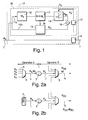
- Fig. 1 shows the gateway 2 between the first statistical multiplexer 4 and the second statistical multiplexer 5 of the network shown in Figs. 2a,b in detail.
- the gateway 2 transfers an input data stream 1 from the first operator A into an output data stream 1' for the second operator B.
- a monitoring device 10 is arranged in the gateway, a copy of the data stream 1 being provided to its input. This copy of the data stream 1 is fed to a first signal path 11a and to a second signal path 11b of the monitoring device 10.
- a multiplexing of the copy of the data stream 1 with itself is simulated, as will be described in the following.
- an averaging device 12 for deriving a long-term mean value M x from the data stream 1 is arranged.
- the long-term mean value M x is then multiplied by a virtual multiplexing factor N which is chosen to be smaller or equal to the ratio B x / b x between the available bandwidth B x at the gateway 2 and the announced equivalent access bandwidth b x , which are provided to the preset factor fixing unit 13 by the first operator A of the network (not shown).
- the multiplexing factor N depends upon the number and nature of end users connected to the input of the gateway 2 and may consequently differ considerably depending on the network equipment used. Typical values of N range from about 10 to about 1000, in some cases up to 10000 or more.
- the multiplication of the long-term mean value M x of the copy of the original data stream 1 with the multiplexing factor N results in the long term-mean value M N M x of the virtually multiplexed data stream.
- the expected theoretical bandwidth B th of the virtually multiplexed data stream is then calculated in a theoretical bandwidth determining device 14 based on the mean value M, the announced equivalent access bandwidth b x provided by the first operator A (dashed line) and a desired loss probability along the lines described in the inventor's article cited above. In practice, a look-up table may be used for determining the theoretical bandwidth B th in dependence of these input values.
- either the theoretical bandwidth determining device 14, the averaging unit 12, or the multiplexing factor fixing unit 13 are constructed to modify the value of the theoretical bandwidth B th .
- the sliding window takes into account only the sum over a small number N of preceding time slots and thus the instantaneous bandwidth B in may increase rapidly, whereas the long-term mean value adjusts rather slowly to rapid changes. Therefore, the long-term mean value M x may be multiplied by an additional factor which accounts for those changes and thus improves the precision when comparing the theoretical bandwidth B th to the instantaneous bandwidth B in .
- an instantaneous bandwidth determining device 15 is arranged for determining an instantaneous bandwidth B in derived from the data stream 1 by counting the occupation of a sliding window (not shown) over a corresponding number N of time slots, the number N being provided to the bandwidth determining device 15 from the multiplexing factor fixing unit 13.
- the occupation of the time slots of the sliding window is determined by summing up the actual packet sizes being present in the window, and normalized to the size of a time slot.
- the theoretical bandwidth B th and the instantaneous bandwidth B in at the outputs of the paths 11a, 11b are compared in a comparator 16.
- the equivalent access bandwidth b x of the data stream 1 is larger than the contracted value, an overflow occurs which would lead to a virtual packet loss.
- a passive monitoring of the data stream 1 can be provided when comparing the overflow rate with the assumed loss rate in the calculations of the theoretical bandwidth B th .
- the adherence of the first operator A to the contracted equivalent access bandwidth can be checked either by the second operator B or by the first operator A himself.
- the adherence to the announced equivalent access bandwidth is not only monitored, but adjusted in an equivalent access bandwidth adaptation unit 17 for adapting the equivalent access bandwidth in dependence of the output from the comparator 16.
- the announced equivalent access bandwidth b x provided as an input to the theoretical bandwidth determination device 14 is slowly increased by adding a positive number b x ' to the announced equivalent bandwidth b x
- the announced equivalent access bandwidth b x is slowly decreased by adding a negative number b x ' to the announced equivalent access bandwidth b x .
- the gateway 2 of Fig. 1 further comprises a data stream adaptation unit 18 which is operatively connected to the equivalent access bandwidth adaptation unit 17.
- the data stream adaptation unit 18 compares the actual equivalent access bandwidth b x " to the announced equivalent access bandwidth b x and adapts the data stream 1 to fit to the latter by either buffering part of the packets for later transmission, or by tearing down the violating traffic by intentional packet drop with respect to the degree of violation, in conformity with the TCP congestion avoidance mechanism. In either case, the data stream 1' at the output of the gateway 2 fits to the announced statistical granularity profile.
- the adaptation of the data stream may be performed independently of the adaptation of the equivalent access bandwidth, i.e. the data stream adaptation unit 18 may also be connected directly to the comparator 16 for dropping data packets in dependence of the number of overflow events.
- monitoring of a data stream for compliance with an announced equivalent access bandwidth b x is achieved, thus making it possible for network operators to check and estimate the granularity of the data stream e.g. at a peering point of the network, and to modify the data stream in case the data stream does not fit into the announced profile.
- the elements of the gateway 2 of Fig. 1 do not necessarily correspond to physical entities, and that the whole calculation in the monitoring device 10 may be implemented in a suitable hardware such as an ASIC.
- the monitoring unit 2 and the data stream adaptation unit 18 may be located at any point in the hierarchical network where the equivalent access bandwidth needs to be monitored.
Landscapes
- Engineering & Computer Science (AREA)
- Environmental & Geological Engineering (AREA)
- Computer Networks & Wireless Communication (AREA)
- Signal Processing (AREA)
- Data Exchanges In Wide-Area Networks (AREA)
- Time-Division Multiplex Systems (AREA)
Abstract
Description
- The invention relates to a method for monitoring a statistical multiplexed data stream for compliance with an announced property indicative of the granularity of the data stream, in particular an announced equivalent access bandwidth, to a monitoring unit for monitoring a statistical multiplexed data stream for compliance with such an announced property indicative of the granularity of the data stream, in particular with an announced equivalent access bandwidth, and to a gateway for transferring a data stream comprising such a monitoring unit. The industry fraction in favor of network neutrality wants to grow a global network, that is functioning purely on brute force overdimensioning. It is well known, that the required degree of overdimensioning depends on the access bandwidth of end user applications. Networks without such limitation of the end user access bandwidth cannot give any transmission guarantees (e.g. traditional LANs) and thus cannot serve as a model for the global universal network.
- Account for access bandwidth is faced with two problems: First of all the access bandwidth ranges from e.g. 64 kbit/s for a VoIP (Voice over IP) application up to multi Gbit/s e.g. for FTP (file transfer protocol) sessions. Not all parts of the global network need to be (and will not be) prepared for the largest available access bandwidths. Equivalent access bandwidth is, beyond traffic load, a parameter which is characteristic of the granularity of a data stream which is propagated through the network.
- Starting from the end users (where the access bandwidths are obvious), the equivalent access bandwidth figures can be propagated to higher layers of a hierarchical network. In case of inhomogeneous access bandwidths this can be done by calculating the weighted mean of the equivalent access bandwidths of the flows of the previous layer(s) weighted with the mean traffic load of each flow. Yet, as such a hierarchical network is in general not owned by one single network operator, signaling of access bandwidth figures at gateways located at peering points between network operators might be prone to fraud as long as the announced equivalent access bandwidth cannot be cross-checked. Moreover, peering points between operators are typically far away from the end user access, which complicates the matter additionally.
- The problem described above is illustrated in the following with reference to
Figs. 2a ,b. InFig. 2a , a data stream 1 is delivered from a first network operator A to agateway 2, the data stream 1 having been statistically multiplexed from a number of thin flows 3 with identical access bandwidths bx in a first statistical multiplexer 4. The data stream 1 is delivered to thegateway 2 with appropriate overdimensioning at a gross bandwidth Bx representing the actual (physically available) bandwidth of the transmission line at thegateway 2. The equivalent access bandwidth bx at the output of the first statistical multiplexer 4 is invariant to the multiplexing, and therefore is still equal to the access bandwidths bx of the particular inputs. - A second operator B uses the data stream 1' at the output of the
gateway 2 for a further statistical multiplexing into a larger pipe of gross bandwidth B(a) in a secondstatistical multiplexer 5. For dimensioning of that pipe, operator B has to take into account the equivalent access bandwidth and the mean load M on hisown output link 6, which depends inter alia on the gateway load Mx. - The situation is completely different in the case shown in
Fig. 2b . Instead of multiple thin access flows 3 with an access bandwidth bx which are statistically multiplexed to form the data stream 1, a single end user 7 is present which uses up all the actual bandwidth Bx, being equal to the equivalent access bandwidth in this case. The second operator B might see the same mean load Mx at the output of thegateway 2. Nevertheless, the dimensioning of the bandwidth B(b) at theoutput link 6 has to be based on Bx , not anymore on bx . With typically bx << Bx , the second operator B ofFig. 2b needs to dimension his output pipe with a bandwidth B(b) >> B(a). - Unfortunately, the second operator B does not really see the granularity of the traffic which is delivered from the first operator A to the input of the
gateway 2. Even the first operator A could be uncertain about the granularity of the data flow when more complicated routings as the ones shown inFigs. 2a,b have to be taken into account. Therefore, there is a need for the second operator B to gradually differentiate between the two extreme cases described above, and a need for the first operator A to cross-check the equivalent access bandwidth he is delivering to the second operator B in more complicated network scenarios. - It is the object of the invention to provide a monitoring method, a monitoring unit and a gateway as described above which allow checking if the statistics of a data flow with respect to its granularity corresponds to an announced value, in particular to an announced equivalent access bandwidth.
- This object is achieved by a method comprising the steps of: determining a theoretical bandwidth derived from the data stream based on the announced property, on a long-term mean value of the data stream, and on a preset factor N, determining an instantaneous bandwidth derived from the data stream by counting the occupation of a sliding window over a corresponding number N of time slots of the data stream, and comparing the theoretical bandwidth to the instantaneous bandwidth.
- The central idea of the invention is to perform virtual multiplexing of the data stream with samples of itself in two different ways and to compare the resulting bandwidth requirements of the virtually multiplexed data streams, the preset factor N defining the multiplexing factor for the virtual multiplexing. In the following, it is assumed that the data stream has a gross bandwidth Bx and an announced equivalent access bandwidth bx, as is the case for the data stream 1 of
Fig. 2a . - For determining the theoretical bandwidth, the long-term average Mx of the traffic load of a first copy of the data stream is measured. Then, the long-term mean value M of the virtually multiplexed data stream is calculated, which is equal to N times the mean value Mx of the original data stream. The expected gross (theoretical) bandwidth Bth of the virtually multiplexed data stream can then be calculated based on the mean value M, the announced equivalent access bandwidth bx and a preset loss probability, as described in detail in the article "Bandwidth Dimensioning in Stochastic Packet Networks", by W. Lautenschläger, Photonische Netze 2007: Vorträge der 8. ITG-Fachtagung vom 7. bis 8. Mai 2007 in Leipzig, Berlin: VDE, 2007, ISBN 978-3-8007-3030-8 which is incorporated herein by reference. In practice, the determination of the theoretical bandwidth can be done based on the inputs described above by using a pre-calculated interpolation table.
- The instantaneous bandwidth is determined based on instantaneous load figures. For this purpose, the sliding sum of the last N time slots (a time slot normally corresponds to a maximum packet size in packet-switched networks) corresponds to the instantaneous bandwidth Bin from the multiplex of N times the same, however, time shifted data stream. Whenever the instantaneous bandwidth Bin exceeds the theoretical bandwidth Bth, the latter is insufficient and a (virtual) packet loss occurs.
- Special attention should be put on the determination of the instantaneous bandwidth based on the sliding sum: Normally the superposition of a data stream with copies of itself is deterministic due to the correlation, whereas the theory for determining of the theoretical bandwidth is based on the assumption of statistically independent inputs. The special trick, why the comparison of both bandwidths does work anyway, is the speed up form the access bandwidths bx of the flows 3 of
Fig. 2a to the physically available bandwidth Bx in the premises of the first operator A. Any one of the original data flows 3 is transmitted with a maximum speed of bx (measured e.g. in Kbit/s). However, the first operator A generally chooses an actual physical bandwidth Bx which is typically much higher than the (equivalent) access bandwidth bx. Therefore, in general, there is only one packet originating from one and the same of the data flows 3 every Bx/bx time slots. In consequence, in a sliding window of N packet distances there should not be any two packets from the same original data flow 3. Presence or absence of packets in the sliding window is therefore de-correlated. The proposition of statistical independence between the multiplexed components is therefore also satisfied when determining the instantaneous bandwidth Bin. In this respect, it should be mentioned that the long-term mean value Mx of the data stream is taken over a number of time slots which is considerably, e.g. by a factor of 100 to 1000, larger than the preset number N. - The situation looks different, if the announced equivalent access bandwidth bx is not the one shown in the situation of
Fig. 2a . In case of a much higher real access bandwidth, bx" > bx, the sliding window is too big, such that more than one packet originating from one and the same data flow 3 contributes to the sum. The proposition of statistical multiplexing is violated and in consequence the required instantaneous bandwidth is much higher than expected. Frequent overflow events when comparing the instantaneous bandwidth to the theoretical bandwidth signal the mismatch. The overflow events can be used for passive monitoring by simply comparing the overflow rate with the assumed loss rate in the calculations of the theoretical bandwidth. - In a preferred variant, the preset factor N is chosen to be smaller or equal to a ratio between the physically available bandwidth and the announced equivalent access bandwidth. Preferably, the preset factor N is the largest integer number which is smaller than the above ratio. As described above, using such a relation for calculating the preset factor, the condition that the traffic in the sliding window is de-correlated is normally satisfied, unless operator A uses a physical bandwidth which is larger than required in order to account for possible network upgrades.
- The person skilled in the art will appreciate that the invention is not limited to the use of the equivalent access bandwidth as a measure for the granularity of a data stream, and that other quantitative measures may also be used for this purpose. In any case, the preset multiplexing factor N should be chosen in such a way that de-correlation of the samples in the sliding window is guaranteed in case that the data stream exhibits the announced granularity.
- In a further preferred variant, for deriving the theoretical bandwidth, foreseeable changes of the long-term mean value are taken into account. Such foreseeable changes may occur periodically, e.g. each day due to daylight synchronization of users. As at a given time tin, the sliding window takes into account only the sum over the small number N of preceding time slots, the instantaneous bandwidth increases rapidly when fast changes of the traffic load occur, whereas the long-term mean value adjusts rather slowly to these changes. Therefore, the long-term mean value could be multiplied by an additional factor which accounts for those foreseeable changes of the mean traffic load and thus improves the precision when comparing both bandwidths.
- In a highly preferred variant, the value of the announced property, in particular of the equivalent access bandwidth is adapted in dependence of the outcome of the comparison between the theoretical bandwidth and the instantaneous bandwidth. The overflow events can be used to adapt the equivalent access bandwidth figures: In case of too much overflow events, bx is slowly increased, in case of no overflow events, bx is slowly decreased. The modified value of the equivalent access bandwidth can be used for the calculation of the theoretical bandwidth and may also be signalled to the first and/or the second operator.
- The overflow events may also be used to drop real packets in order to tear down the violating traffic at the gateway with the intention to protect the upper layers of the network of the second operator B.
- The invention is also realized in a monitoring device for monitoring a statistical multiplexed data stream for compliance with an announced property indicative of the granularity of the data stream, in particular with an announced equivalent access bandwidth, with: an averaging device for deriving a long-term mean value from the data stream, a theoretical bandwidth determining device for determining a theoretical bandwidth depending on the announced property, on the long-term mean value, and on a preset factor N, an instantaneous bandwidth determining device for determining an instantaneous bandwidth derived from the data stream by counting the occupation of a sliding window over a corresponding number N of time slots of the data stream, and a comparator for comparing the theoretical bandwidth to the instantaneous bandwidth. The monitoring unit preferably further comprises a multiplexing factor fixing unit for fixing the preset factor N at a value smaller or equal to the ratio between an available bandwidth and the announced equivalent access bandwidth. It is further preferred when the theoretical bandwidth determining device determines the theoretical bandwidth by taking foreseeable changes of the long-term mean value into account. Furthermore, the monitoring unit preferably comprises an equivalent access bandwidth adaptation unit for adapting the equivalent access bandwidth depending on the output from the comparator. Concerning advantages of the monitoring device and of the modifications described above, reference is made to the above discussion of the monitoring method.
- The invention further relates to a gateway for transferring a data stream, comprising a monitoring device as described above, preferably further comprising a data stream adaptation unit for adapting the data stream to fit to the announced property. In case that the data stream does not fit to the announced property, the data stream adaptation unit may be used as a buffer for holding back packets which are not in compliance with the announced property, the data stream adaptation unit trying to transmit these packets later when empty time slots are available.
- In a highly preferred embodiment, for adapting the data stream to fit to the announced property, the data stream adaptation unit drops part of the data stream. In this way, the violating traffic is dropped at the gateway with the intention to protect successive parts of the network, which is in conformity with the TCP congestion avoidance mechanism.
- Further characteristics and advantages of the invention are provided in the following description of exemplary embodiments of the invention, with reference to the figures of the drawing, which shows details that are significant in the context of the invention, and in the claims. The individual characteristics can be implemented individually by themselves, or several of them can be implemented in any desired combination in a variant of the invention.
- The invention is shown in the drawing.
- Fig. 1
- shows a schematic diagram of an embodiment of a gateway according to the invention comprising a monitoring device for monitoring a data stream, and
- Figs. 2a,b
- shows a gateway at a peering point for transferring a data stream from a first to a second operator of a computer network.
-
Fig. 1 shows thegateway 2 between the first statistical multiplexer 4 and the secondstatistical multiplexer 5 of the network shown inFigs. 2a,b in detail. Thegateway 2 transfers an input data stream 1 from the first operator A into an output data stream 1' for the second operator B. For monitoring the statistical multiplexed input data stream 1 for compliance with an announced equivalent access bandwidth bx, amonitoring device 10 is arranged in the gateway, a copy of the data stream 1 being provided to its input. This copy of the data stream 1 is fed to afirst signal path 11a and to asecond signal path 11b of themonitoring device 10. In bothsignal paths first path 11a, an averagingdevice 12 for deriving a long-term mean value Mx from the data stream 1 is arranged. In a multiplexingfactor fixing unit 13, the long-term mean value Mx is then multiplied by a virtual multiplexing factor N which is chosen to be smaller or equal to the ratio Bx / bx between the available bandwidth Bx at thegateway 2 and the announced equivalent access bandwidth bx, which are provided to the presetfactor fixing unit 13 by the first operator A of the network (not shown). The multiplexing factor N depends upon the number and nature of end users connected to the input of thegateway 2 and may consequently differ considerably depending on the network equipment used. Typical values of N range from about 10 to about 1000, in some cases up to 10000 or more. - The multiplication of the long-term mean value Mx of the copy of the original data stream 1 with the multiplexing factor N results in the long term-mean value M = N Mx of the virtually multiplexed data stream. The expected theoretical bandwidth Bth of the virtually multiplexed data stream is then calculated in a theoretical
bandwidth determining device 14 based on the mean value M, the announced equivalent access bandwidth bx provided by the first operator A (dashed line) and a desired loss probability along the lines described in the inventor's article cited above. In practice, a look-up table may be used for determining the theoretical bandwidth Bth in dependence of these input values. - For taking foreseeable changes of the long-term mean value Mx into account, e.g. daily changes due to daylight synchronization of users, either the theoretical
bandwidth determining device 14, the averagingunit 12, or the multiplexingfactor fixing unit 13 are constructed to modify the value of the theoretical bandwidth Bth. At a given time, the sliding window takes into account only the sum over a small number N of preceding time slots and thus the instantaneous bandwidth Bin may increase rapidly, whereas the long-term mean value adjusts rather slowly to rapid changes. Therefore, the long-term mean value Mx may be multiplied by an additional factor which accounts for those changes and thus improves the precision when comparing the theoretical bandwidth Bth to the instantaneous bandwidth Bin. - In the
second path 11 b, an instantaneousbandwidth determining device 15 is arranged for determining an instantaneous bandwidth B in derived from the data stream 1 by counting the occupation of a sliding window (not shown) over a corresponding number N of time slots, the number N being provided to thebandwidth determining device 15 from the multiplexingfactor fixing unit 13. The occupation of the time slots of the sliding window is determined by summing up the actual packet sizes being present in the window, and normalized to the size of a time slot. - The theoretical bandwidth Bth and the instantaneous bandwidth Bin at the outputs of the
paths comparator 16. In case that the equivalent access bandwidth bx of the data stream 1 is larger than the contracted value, an overflow occurs which would lead to a virtual packet loss. By counting the overflow events a passive monitoring of the data stream 1 can be provided when comparing the overflow rate with the assumed loss rate in the calculations of the theoretical bandwidth Bth. Thus, the adherence of the first operator A to the contracted equivalent access bandwidth can be checked either by the second operator B or by the first operator A himself. - In
Fig. 1 , the adherence to the announced equivalent access bandwidth is not only monitored, but adjusted in an equivalent access bandwidth adaptation unit 17 for adapting the equivalent access bandwidth in dependence of the output from thecomparator 16. In case of too much overflow events, the announced equivalent access bandwidth bx provided as an input to the theoreticalbandwidth determination device 14 is slowly increased by adding a positive number bx' to the announced equivalent bandwidth bx, whereas in case of no overflow events, the announced equivalent access bandwidth bx is slowly decreased by adding a negative number bx' to the announced equivalent access bandwidth bx. In this way, an estimation of the actual value of the equivalent access bandwidth bx" = bx + bx' can be provided to the first or second operator A, B (not shown). - The
gateway 2 ofFig. 1 further comprises a datastream adaptation unit 18 which is operatively connected to the equivalent access bandwidth adaptation unit 17. The datastream adaptation unit 18 compares the actual equivalent access bandwidth bx" to the announced equivalent access bandwidth bx and adapts the data stream 1 to fit to the latter by either buffering part of the packets for later transmission, or by tearing down the violating traffic by intentional packet drop with respect to the degree of violation, in conformity with the TCP congestion avoidance mechanism. In either case, the data stream 1' at the output of thegateway 2 fits to the announced statistical granularity profile. It is understood that the adaptation of the data stream may be performed independently of the adaptation of the equivalent access bandwidth, i.e. the datastream adaptation unit 18 may also be connected directly to thecomparator 16 for dropping data packets in dependence of the number of overflow events. - In summary, in the way described above, monitoring of a data stream for compliance with an announced equivalent access bandwidth bx is achieved, thus making it possible for network operators to check and estimate the granularity of the data stream e.g. at a peering point of the network, and to modify the data stream in case the data stream does not fit into the announced profile. It is understood that the elements of the
gateway 2 ofFig. 1 do not necessarily correspond to physical entities, and that the whole calculation in themonitoring device 10 may be implemented in a suitable hardware such as an ASIC. Furthermore, themonitoring unit 2 and the datastream adaptation unit 18 may be located at any point in the hierarchical network where the equivalent access bandwidth needs to be monitored.
Claims (10)
- Method for monitoring a statistical multiplexed data stream (1) for compliance with an announced property indicative of the granularity of the data stream (1), in particular an announced equivalent access bandwidth (bx), comprising the steps of:determining a theoretical bandwidth (Bth) derived from the data stream (1) based on the announced property, on a long-term mean value (Mx) of the data stream, and on a preset factor N,determining an instantaneous bandwidth (Bin) derived from the data stream (1) by counting the occupation of a sliding window over a corresponding number N of time slots of the data stream (1), and comparing the theoretical bandwidth (Bth) to the instantaneous bandwidth (Bin).
- Method according to claim 1, wherein the preset factor N is chosen to be smaller or equal to a ratio (Bx / bx) between a physically available bandwidth (Bx) and the announced equivalent access bandwidth (bx).
- Method according to claim 1, wherein for deriving the theoretical bandwidth (Bth), foreseeable changes of the long-term mean value (Mx) are taken into account.
- Method according to claim 1, wherein the value of the announced property, in particular of the equivalent access bandwidth (bx), is adapted in dependence of the outcome of the comparison between the theoretical bandwidth (Bth) and the instantaneous bandwidth (Bin).
- Monitoring device (10) for monitoring a statistical multiplexed data stream (1) for compliance with an announced property indicative of the granularity of the data stream (1), in particular with an announced equivalent access bandwidth (bx), with:an averaging device (12) for deriving a long-term mean value (Mx) from the data stream (1),a theoretical bandwidth determining device (14) for determining a theoretical bandwidth (Bth) depending on the announced property, on the long-term mean value (Mx), and on a preset factor N,an instantaneous bandwidth determining device (15) for determining an instantaneous bandwidth (Bin) derived from the data stream (1) by counting the occupation of a sliding window over a corresponding number N of time slots of the data stream (1), anda comparator (16) for comparing the theoretical bandwidth (Bth) to the instantaneous bandwidth (Bin).
- Monitoring device according to claim 5, further comprising a multiplexing factor fixing unit (13) for fixing the preset factor N at a value smaller or equal to the ratio (Bx / bx) between a physically available bandwidth (Bx) and the announced equivalent access bandwidth (bx).
- Monitoring device according to claim 5, wherein the theoretical bandwidth determining device (14) determines the theoretical bandwidth (Bth) taking foreseeable changes of the long-term mean value (Mx) into account.
- Monitoring device according to claim 5, further comprising an equivalent access bandwidth adaptation unit (17) for adapting the equivalent access bandwidth (bx) depending on the output from the comparator (16).
- Gateway (2) for transferring a data stream (1), comprising a monitoring device (10) according to claim 5, preferably further comprising a data stream adaptation unit (18) for adapting the data stream (1) to fit to the announced property.
- Gateway according to claim 9, wherein for adapting the data stream (1) to fit to the announced property, the data stream adaptation unit (18) drops part of the data stream (1).
Priority Applications (4)
| Application Number | Priority Date | Filing Date | Title |
|---|---|---|---|
| DE602007005940T DE602007005940D1 (en) | 2007-07-24 | 2007-07-24 | Method for monitoring a statistically multiplexed data stream, monitoring device and gateway |
| EP07290927A EP2019511B1 (en) | 2007-07-24 | 2007-07-24 | Method for monitoring a statistical multiplexed data stream, monitoring device and gateway |
| AT07290927T ATE464718T1 (en) | 2007-07-24 | 2007-07-24 | METHOD FOR MONITORING A STATISTICALLY MULTIPLEXED DATA STREAM, MONITORING DEVICE AND GATEWAY |
| ES07290927T ES2344083T3 (en) | 2007-07-24 | 2007-07-24 | METHOD FOR MONITORING A CURRENT STATISTICAL MULTIPLEXING DATA, MONITORING DEVICE AND PASSWAY. |
Applications Claiming Priority (1)
| Application Number | Priority Date | Filing Date | Title |
|---|---|---|---|
| EP07290927A EP2019511B1 (en) | 2007-07-24 | 2007-07-24 | Method for monitoring a statistical multiplexed data stream, monitoring device and gateway |
Publications (2)
| Publication Number | Publication Date |
|---|---|
| EP2019511A1 true EP2019511A1 (en) | 2009-01-28 |
| EP2019511B1 EP2019511B1 (en) | 2010-04-14 |
Family
ID=38867330
Family Applications (1)
| Application Number | Title | Priority Date | Filing Date |
|---|---|---|---|
| EP07290927A Not-in-force EP2019511B1 (en) | 2007-07-24 | 2007-07-24 | Method for monitoring a statistical multiplexed data stream, monitoring device and gateway |
Country Status (4)
| Country | Link |
|---|---|
| EP (1) | EP2019511B1 (en) |
| AT (1) | ATE464718T1 (en) |
| DE (1) | DE602007005940D1 (en) |
| ES (1) | ES2344083T3 (en) |
Citations (1)
| Publication number | Priority date | Publication date | Assignee | Title |
|---|---|---|---|---|
| US6751664B1 (en) | 2000-07-05 | 2004-06-15 | At&T Corp. | Method for monitoring and meeting customer bandwidth demand in operational IP data networks |
-
2007
- 2007-07-24 ES ES07290927T patent/ES2344083T3/en active Active
- 2007-07-24 EP EP07290927A patent/EP2019511B1/en not_active Not-in-force
- 2007-07-24 DE DE602007005940T patent/DE602007005940D1/en active Active
- 2007-07-24 AT AT07290927T patent/ATE464718T1/en not_active IP Right Cessation
Patent Citations (1)
| Publication number | Priority date | Publication date | Assignee | Title |
|---|---|---|---|---|
| US6751664B1 (en) | 2000-07-05 | 2004-06-15 | At&T Corp. | Method for monitoring and meeting customer bandwidth demand in operational IP data networks |
Non-Patent Citations (2)
| Title |
|---|
| LAUTENSCHTAGER W: "Bandwidth Dimensioning in Stochastic Packet Networks", ITG-FACHBERICHTE, VDE VERLAG, BERLIN, DE, vol. 201, May 2007 (2007-05-01), pages 177 - 182, XP009094301, ISSN: 0932-6022 * |
| W. LAUTENSCHIAGER: "Bandwidth Dimensioning in Stochastic Packet Networks", PHOTONISCHE NETZE 2007: VORTRAGE DER 8, 7 May 2007 (2007-05-07) |
Also Published As
| Publication number | Publication date |
|---|---|
| ES2344083T3 (en) | 2010-08-17 |
| ATE464718T1 (en) | 2010-04-15 |
| EP2019511B1 (en) | 2010-04-14 |
| DE602007005940D1 (en) | 2010-05-27 |
Similar Documents
| Publication | Publication Date | Title |
|---|---|---|
| US7876696B2 (en) | Adaptive upstream bandwidth estimation and shaping | |
| US10038642B2 (en) | Method for packet network traffic regulation | |
| US9762491B2 (en) | Dynamic thresholds for congestion control | |
| US7911951B2 (en) | Best-effort bandwidth allocating method and device | |
| US20040030797A1 (en) | Quality of service management in network gateways | |
| CN1758693B (en) | Method for managing voice over IP communications | |
| AU2004229975A1 (en) | Call admission control/session management based on N source to destination severity levels for IP networks | |
| NO332566B1 (en) | Method, system and routes for active cost control in telecommunication systems | |
| EP2027672B1 (en) | Stateless call admission and call preemption with a single metering and marking scheme | |
| US10091022B2 (en) | Creating a channel for transmitting data of a digital subscriber line | |
| EP3442182B1 (en) | Joint dropping or marking of data packets for traffic congestion control | |
| US20110242973A1 (en) | System and method for dynamically policing network traffic based on egress queue status | |
| EP1952591B1 (en) | Traffic policing | |
| EP2019511B1 (en) | Method for monitoring a statistical multiplexed data stream, monitoring device and gateway | |
| Aboul-Magd | Voice over differentiated services | |
| US7486686B2 (en) | Method and apparatus for scheduling data on a medium | |
| AU2007336220B2 (en) | Method for optimising the sharing of a plurality of network resources between a plurality of application flows | |
| Geyer et al. | Practical performance evaluation of ethernet networks with flow-level network modeling. | |
| US20060062151A1 (en) | Method and device for transmitting data in a packet-based transmission network, and a correspondingly configured network element | |
| Baroå | Packet loss probability estimation using Erlang B and M/G/1/K models in modern VoIP networks | |
| Yeom | Bandwidth assurance in a differentiated services network | |
| Balkaş | Delay-bounded Rate Adaptive Shaper for TCP Traffic in Diffserv Internet |
Legal Events
| Date | Code | Title | Description |
|---|---|---|---|
| PUAI | Public reference made under article 153(3) epc to a published international application that has entered the european phase |
Free format text: ORIGINAL CODE: 0009012 |
|
| AK | Designated contracting states |
Kind code of ref document: A1 Designated state(s): AT BE BG CH CY CZ DE DK EE ES FI FR GB GR HU IE IS IT LI LT LU LV MC MT NL PL PT RO SE SI SK TR |
|
| AX | Request for extension of the european patent |
Extension state: AL BA HR MK RS |
|
| 17P | Request for examination filed |
Effective date: 20090728 |
|
| 17Q | First examination report despatched |
Effective date: 20090819 |
|
| AKX | Designation fees paid |
Designated state(s): AT BE BG CH CY CZ DE DK EE ES FI FR GB GR HU IE IS IT LI LT LU LV MC MT NL PL PT RO SE SI SK TR |
|
| GRAP | Despatch of communication of intention to grant a patent |
Free format text: ORIGINAL CODE: EPIDOSNIGR1 |
|
| GRAS | Grant fee paid |
Free format text: ORIGINAL CODE: EPIDOSNIGR3 |
|
| GRAA | (expected) grant |
Free format text: ORIGINAL CODE: 0009210 |
|
| AK | Designated contracting states |
Kind code of ref document: B1 Designated state(s): AT BE BG CH CY CZ DE DK EE ES FI FR GB GR HU IE IS IT LI LT LU LV MC MT NL PL PT RO SE SI SK TR |
|
| REG | Reference to a national code |
Ref country code: GB Ref legal event code: FG4D |
|
| REG | Reference to a national code |
Ref country code: CH Ref legal event code: EP |
|
| REG | Reference to a national code |
Ref country code: IE Ref legal event code: FG4D |
|
| REF | Corresponds to: |
Ref document number: 602007005940 Country of ref document: DE Date of ref document: 20100527 Kind code of ref document: P |
|
| REG | Reference to a national code |
Ref country code: NL Ref legal event code: VDEP Effective date: 20100414 |
|
| REG | Reference to a national code |
Ref country code: ES Ref legal event code: FG2A Ref document number: 2344083 Country of ref document: ES Kind code of ref document: T3 |
|
| LTIE | Lt: invalidation of european patent or patent extension |
Effective date: 20100414 |
|
| PG25 | Lapsed in a contracting state [announced via postgrant information from national office to epo] |
Ref country code: SE Free format text: LAPSE BECAUSE OF FAILURE TO SUBMIT A TRANSLATION OF THE DESCRIPTION OR TO PAY THE FEE WITHIN THE PRESCRIBED TIME-LIMIT Effective date: 20100414 Ref country code: NL Free format text: LAPSE BECAUSE OF FAILURE TO SUBMIT A TRANSLATION OF THE DESCRIPTION OR TO PAY THE FEE WITHIN THE PRESCRIBED TIME-LIMIT Effective date: 20100414 Ref country code: LT Free format text: LAPSE BECAUSE OF FAILURE TO SUBMIT A TRANSLATION OF THE DESCRIPTION OR TO PAY THE FEE WITHIN THE PRESCRIBED TIME-LIMIT Effective date: 20100414 |
|
| PG25 | Lapsed in a contracting state [announced via postgrant information from national office to epo] |
Ref country code: LV Free format text: LAPSE BECAUSE OF FAILURE TO SUBMIT A TRANSLATION OF THE DESCRIPTION OR TO PAY THE FEE WITHIN THE PRESCRIBED TIME-LIMIT Effective date: 20100414 Ref country code: AT Free format text: LAPSE BECAUSE OF FAILURE TO SUBMIT A TRANSLATION OF THE DESCRIPTION OR TO PAY THE FEE WITHIN THE PRESCRIBED TIME-LIMIT Effective date: 20100414 Ref country code: FI Free format text: LAPSE BECAUSE OF FAILURE TO SUBMIT A TRANSLATION OF THE DESCRIPTION OR TO PAY THE FEE WITHIN THE PRESCRIBED TIME-LIMIT Effective date: 20100414 Ref country code: IS Free format text: LAPSE BECAUSE OF FAILURE TO SUBMIT A TRANSLATION OF THE DESCRIPTION OR TO PAY THE FEE WITHIN THE PRESCRIBED TIME-LIMIT Effective date: 20100814 Ref country code: SI Free format text: LAPSE BECAUSE OF FAILURE TO SUBMIT A TRANSLATION OF THE DESCRIPTION OR TO PAY THE FEE WITHIN THE PRESCRIBED TIME-LIMIT Effective date: 20100414 |
|
| PG25 | Lapsed in a contracting state [announced via postgrant information from national office to epo] |
Ref country code: CY Free format text: LAPSE BECAUSE OF FAILURE TO SUBMIT A TRANSLATION OF THE DESCRIPTION OR TO PAY THE FEE WITHIN THE PRESCRIBED TIME-LIMIT Effective date: 20100609 Ref country code: PL Free format text: LAPSE BECAUSE OF FAILURE TO SUBMIT A TRANSLATION OF THE DESCRIPTION OR TO PAY THE FEE WITHIN THE PRESCRIBED TIME-LIMIT Effective date: 20100414 |
|
| PG25 | Lapsed in a contracting state [announced via postgrant information from national office to epo] |
Ref country code: EE Free format text: LAPSE BECAUSE OF FAILURE TO SUBMIT A TRANSLATION OF THE DESCRIPTION OR TO PAY THE FEE WITHIN THE PRESCRIBED TIME-LIMIT Effective date: 20100414 Ref country code: PT Free format text: LAPSE BECAUSE OF FAILURE TO SUBMIT A TRANSLATION OF THE DESCRIPTION OR TO PAY THE FEE WITHIN THE PRESCRIBED TIME-LIMIT Effective date: 20100816 Ref country code: DK Free format text: LAPSE BECAUSE OF FAILURE TO SUBMIT A TRANSLATION OF THE DESCRIPTION OR TO PAY THE FEE WITHIN THE PRESCRIBED TIME-LIMIT Effective date: 20100414 |
|
| PLBE | No opposition filed within time limit |
Free format text: ORIGINAL CODE: 0009261 |
|
| STAA | Information on the status of an ep patent application or granted ep patent |
Free format text: STATUS: NO OPPOSITION FILED WITHIN TIME LIMIT |
|
| PG25 | Lapsed in a contracting state [announced via postgrant information from national office to epo] |
Ref country code: CZ Free format text: LAPSE BECAUSE OF FAILURE TO SUBMIT A TRANSLATION OF THE DESCRIPTION OR TO PAY THE FEE WITHIN THE PRESCRIBED TIME-LIMIT Effective date: 20100414 Ref country code: MC Free format text: LAPSE BECAUSE OF NON-PAYMENT OF DUE FEES Effective date: 20100731 Ref country code: SK Free format text: LAPSE BECAUSE OF FAILURE TO SUBMIT A TRANSLATION OF THE DESCRIPTION OR TO PAY THE FEE WITHIN THE PRESCRIBED TIME-LIMIT Effective date: 20100414 Ref country code: RO Free format text: LAPSE BECAUSE OF FAILURE TO SUBMIT A TRANSLATION OF THE DESCRIPTION OR TO PAY THE FEE WITHIN THE PRESCRIBED TIME-LIMIT Effective date: 20100414 Ref country code: BE Free format text: LAPSE BECAUSE OF FAILURE TO SUBMIT A TRANSLATION OF THE DESCRIPTION OR TO PAY THE FEE WITHIN THE PRESCRIBED TIME-LIMIT Effective date: 20100414 |
|
| 26N | No opposition filed |
Effective date: 20110117 |
|
| PG25 | Lapsed in a contracting state [announced via postgrant information from national office to epo] |
Ref country code: GR Free format text: LAPSE BECAUSE OF FAILURE TO SUBMIT A TRANSLATION OF THE DESCRIPTION OR TO PAY THE FEE WITHIN THE PRESCRIBED TIME-LIMIT Effective date: 20100715 |
|
| PG25 | Lapsed in a contracting state [announced via postgrant information from national office to epo] |
Ref country code: IE Free format text: LAPSE BECAUSE OF NON-PAYMENT OF DUE FEES Effective date: 20100724 |
|
| PG25 | Lapsed in a contracting state [announced via postgrant information from national office to epo] |
Ref country code: MT Free format text: LAPSE BECAUSE OF FAILURE TO SUBMIT A TRANSLATION OF THE DESCRIPTION OR TO PAY THE FEE WITHIN THE PRESCRIBED TIME-LIMIT Effective date: 20100414 |
|
| REG | Reference to a national code |
Ref country code: CH Ref legal event code: PL Ref country code: CH Ref legal event code: PCOW Free format text: ALCATEL LUCENT;3, AVENUE OCTAVE GREARD;75007 PARIS (FR) |
|
| PG25 | Lapsed in a contracting state [announced via postgrant information from national office to epo] |
Ref country code: CH Free format text: LAPSE BECAUSE OF NON-PAYMENT OF DUE FEES Effective date: 20110731 Ref country code: LI Free format text: LAPSE BECAUSE OF NON-PAYMENT OF DUE FEES Effective date: 20110731 |
|
| PG25 | Lapsed in a contracting state [announced via postgrant information from national office to epo] |
Ref country code: LU Free format text: LAPSE BECAUSE OF NON-PAYMENT OF DUE FEES Effective date: 20100724 Ref country code: BG Free format text: LAPSE BECAUSE OF FAILURE TO SUBMIT A TRANSLATION OF THE DESCRIPTION OR TO PAY THE FEE WITHIN THE PRESCRIBED TIME-LIMIT Effective date: 20100414 Ref country code: HU Free format text: LAPSE BECAUSE OF FAILURE TO SUBMIT A TRANSLATION OF THE DESCRIPTION OR TO PAY THE FEE WITHIN THE PRESCRIBED TIME-LIMIT Effective date: 20101015 |
|
| PG25 | Lapsed in a contracting state [announced via postgrant information from national office to epo] |
Ref country code: TR Free format text: LAPSE BECAUSE OF FAILURE TO SUBMIT A TRANSLATION OF THE DESCRIPTION OR TO PAY THE FEE WITHIN THE PRESCRIBED TIME-LIMIT Effective date: 20100414 |
|
| PG25 | Lapsed in a contracting state [announced via postgrant information from national office to epo] |
Ref country code: BG Free format text: LAPSE BECAUSE OF FAILURE TO SUBMIT A TRANSLATION OF THE DESCRIPTION OR TO PAY THE FEE WITHIN THE PRESCRIBED TIME-LIMIT Effective date: 20100714 |
|
| REG | Reference to a national code |
Ref country code: GB Ref legal event code: 732E Free format text: REGISTERED BETWEEN 20130926 AND 20131002 |
|
| REG | Reference to a national code |
Ref country code: FR Ref legal event code: GC Effective date: 20131018 |
|
| REG | Reference to a national code |
Ref country code: FR Ref legal event code: RG Effective date: 20141016 |
|
| REG | Reference to a national code |
Ref country code: FR Ref legal event code: PLFP Year of fee payment: 9 |
|
| REG | Reference to a national code |
Ref country code: FR Ref legal event code: CA Effective date: 20150521 |
|
| REG | Reference to a national code |
Ref country code: FR Ref legal event code: CA Effective date: 20150521 |
|
| REG | Reference to a national code |
Ref country code: FR Ref legal event code: PLFP Year of fee payment: 10 |
|
| REG | Reference to a national code |
Ref country code: FR Ref legal event code: PLFP Year of fee payment: 11 |
|
| PGFP | Annual fee paid to national office [announced via postgrant information from national office to epo] |
Ref country code: ES Payment date: 20170825 Year of fee payment: 11 Ref country code: GB Payment date: 20170719 Year of fee payment: 11 Ref country code: FR Payment date: 20170724 Year of fee payment: 11 Ref country code: DE Payment date: 20170724 Year of fee payment: 11 Ref country code: IT Payment date: 20170728 Year of fee payment: 11 |
|
| REG | Reference to a national code |
Ref country code: DE Ref legal event code: R119 Ref document number: 602007005940 Country of ref document: DE |
|
| GBPC | Gb: european patent ceased through non-payment of renewal fee |
Effective date: 20180724 |
|
| PG25 | Lapsed in a contracting state [announced via postgrant information from national office to epo] |
Ref country code: DE Free format text: LAPSE BECAUSE OF NON-PAYMENT OF DUE FEES Effective date: 20190201 Ref country code: FR Free format text: LAPSE BECAUSE OF NON-PAYMENT OF DUE FEES Effective date: 20180731 Ref country code: GB Free format text: LAPSE BECAUSE OF NON-PAYMENT OF DUE FEES Effective date: 20180724 |
|
| REG | Reference to a national code |
Ref country code: GB Ref legal event code: 732E Free format text: REGISTERED BETWEEN 20190429 AND 20190502 |
|
| PG25 | Lapsed in a contracting state [announced via postgrant information from national office to epo] |
Ref country code: IT Free format text: LAPSE BECAUSE OF NON-PAYMENT OF DUE FEES Effective date: 20180724 |
|
| REG | Reference to a national code |
Ref country code: ES Ref legal event code: FD2A Effective date: 20190917 |
|
| PG25 | Lapsed in a contracting state [announced via postgrant information from national office to epo] |
Ref country code: ES Free format text: LAPSE BECAUSE OF NON-PAYMENT OF DUE FEES Effective date: 20180725 |
|
| REG | Reference to a national code |
Ref country code: DE Ref legal event code: R082 Ref document number: 602007005940 Country of ref document: DE Representative=s name: MENZIETTI WETZEL, DE Ref country code: DE Ref legal event code: R081 Ref document number: 602007005940 Country of ref document: DE Owner name: PROVENANCE ASSET GROUP LLC, PITTSFORD, US Free format text: FORMER OWNER: ALCATEL LUCENT, PARIS, FR |