-
The present invention discloses catalyst components based on carbonylamino fulvene ligands their method of preparation and their use in the polymerisation of ethylene and alpha-olefins.
-
Several ligands have been described in literature, some of which were tested in complexation with metals but none of them have been used as catalysts for the polymerisation of ethylene or alpha-olefins. Some ligands are described for example in Lloyd and Preston (D. Lloyd, N.W. Preston, J. Chem. Soc. C, 1969, 2464-2469.) or by Linn and Sharkey (W.J. Linn, W.G. Sharkey J. Am. Chem. Soc. 1957, 79, 4970-2.) or in Snyder et al. (C.A. Snyder, J.P. Selegue, N.C. Tice, C.E. Wallace. M.T. Blankenbuehler, S. Parkin, K.D.E. Allen, R.T. Beck, J. Am. Chem. Soc. 2005, 127, 15010-11.) or in Dong et al. (Y.B. Dong, Y. Geng, J.P. Ma and R.Q. Huang, Inorg. Chem. 2005, 44, 1693-1703.)
-
There is a need to develop new catalyst system having good activity and able to produce polymers tailored to specific needs.
-
It is an aim of the present invention to prepare new catalyst components that can be used in the polymerisation of ethylene and alpha-olefins.
-
It is also an aim of the present invention to provide very active catalyst components.
-
It is another aim of the present invention to provide a method for polymerising or copolymerising ethylene and alpha-olefins.
-
The present invention reaches, at least partially, any one of those aims.
-
Accordingly, the present invention discloses a method for preparing a metallic complex that comprises the steps of:
- a) preparing a carbonylamino fulvene ligand by condensation reaction of an hydroxycarbonyl fulvene ligand with a primary amine, in a polar solvent and with an acid catalyst
wherein R1 and R2 are the same or different and are selected from alkyl, aryl, alkylaryl, arylalkyl having at most 20 carbon atoms or heteroatoms-containing groups;
- b) providing a metallic precursor MZn wherein M is a metal Group 6 to 11 of the Periodic Table, Z is a negative counter-anion and n is the valence of M;
- c) complexing the metallic precursor of step b) with the carbonylamino fulvene of step a);
- d) retrieving a metallic complex.
-
Preferably, both R1 are the same and are selected from alkyl, unsubstituted or substituted phenyl (Ph), CHPh2 wherein Ph may be substituted or not, or the R1 groups include heteroatom(s)-containing units. More preferably R is CHPh2 or cyclohexyl or paramethoxyphenyl. Most preferably R1 is CHPh2.
-
Preferably R2 is CH2pyridine or includes heteroatoms-containing units. More preferably R2 is CH2pyridine or furan.
-
Preferred embodiments according to the present invention are characterised by the following pairs:
- Both R1 are CHPh2 and R2 is CH2pyridine,
- Both R1 are paramethoxyphenyl and R2 is CH2pyridine,
- Both R1 are cyclohexyl and R2 is furan.
-
Most preferably, both R1 are CHPh2 and R2 is CH2pyridine.
-
Preferably, M is Crll, CrIII or Ni, more preferably, it is Crll.
-
Preferably Z is halogen or acetate, more preferably, it is Cl.
-
The preferred polar solvent is ethanol and the preferred acid catalyst is paratoluene sulfonic acid.
-
Several types of metallic complexes can be formed, one where the metal is coordinated to one ligand and one where the metal is coordinated to two ligands. The relative amounts of each ligand and metal unit depend upon the nature of ligand and of the metal. The amount of ligand must therefore be of at least one equivalent of ligand per metallic equivalent. In a preferred embodiment according to the present invention, the metal is CrII and it is coordinated to one ligand or two ligands.
-
The present invention further discloses an active catalyst system comprising the metallic complex and an activating agent having an ionising action.
-
Suitable activating agents are well known in the art. The activating agent can be an aluminium alkyl represented by formula AIR+ nX3-n wherein R+ is an alkyl having from 1 to 20 carbon atoms and X is a halogen. The preferred alkylating agents are triisobutyl aluminium (TIBAL) or triethyl aluminium (TEAL).
-
Alternatively and preferably, it is an aluminoxane and comprise oligomeric linear and/or cyclic alkyl aluminoxanes represented by formula
for oligomeric, linear aluminoxanes and by formula
for oligomeric, cyclic aluminoxane,
wherein n is 1-40, preferably 10-20, m is 3-40, preferably 3-20 and R* is a C
1-C
8 alkyl group and preferably methyl.
-
The amount of activating is selected to give an AI/M ratio of from 100 to 3000, preferably of about 1000.
-
Suitable boron-containing activating agents may comprise a triphenylcarbenium boronate such as tetrakis-pentafluorophenyl-borato-triphenylcarbenium as described in
EP-A-0427696 , or those of the general formula [L'-H] + [B Ar
1 Ar
2 X
3 X
4]- as described in
EP-A-0277004 (page 6, line 30 to page 7, line 7). The amount of boron -containing activating agent is selected to give B/M ratio of from 0.5 to 5, preferably of about 1.
-
The preferred activating agent is methylaluminoxane (MAO).
-
In another embodiment, according to the present invention, the metallic complex may be deposited on a conventional support impregnated with an activating agent.
-
Preferably, the conventional support is silica impregnated with methylaluminoxane (MAO). Alternatively, it can be an activating support such as fluorinated alumina silica.
-
The present invention further discloses a method for preparing an active catalyst system that comprises the steps of:
- a) providing a carbonylamino fulvene ligand;
- b) complexing the ligand of step a) with a metallic salt MZn in a solvent with an acid catalyst;
- c) retrieving a catalyst component;
- d) optionally depositing the catalyst component of step c) on a support;
- e) activating the catalyst component of step c) or step d) with an activating agent having an ionising action;
- f) optionally adding a scavenger;
- g) retrieving an active oligomerisation or polymerisation catalyst system.
-
Alternatively, in step d), the catalyst component is deposited on a support impregnated with an activating agent or on an activating support. In that case, the activating step e) is not necessary.
-
The scavenger may be selected from triethylaluminium, triisobutylaluminum, tris-n-octylaluminium, tetraisobutyldialuminoxane or diethyl zinc.
-
The active catalyst system is used in the oligomerisation and in the polymerisation of ethylene and alpha-olefins.
-
The present invention discloses a method for the oligomerisation or the homo- or copolymerisation of ethylene and alpha-olefins that comprises the steps of:
- a) injecting the active catalyst system into the reactor;
- b) injecting the monomer and optional comonomer;
- c) maintaining under polymerisation conditions;
- d) retrieving the oligomers and/or polymer.
-
The pressure in the reactor can vary from 0.5 to 60 bars, preferably from 15 to 45 bars. The productivity of the catalyst system increases with increasing pressure.
-
The polymerisation temperature can range from 10 to 100°C, preferably from 25 to 55°C. The productivity of the catalyst system decreases with increasing temperature.
-
Preferably the monomer and optional comonomer are selected from ethylene, propylene or 1-hexene.
-
The present invention also discloses the polymers obtained with the new catalyst systems.
List of figures.
-
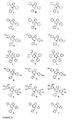
- Figure 1 represents examples of ligands prepared according to the present invention.
- Figure 2 represents the molecular structure of ligand D obtained by X-Ray.
- Figure 3 represents the molecular structure of the metallic compound resulting from the complexation of CrCl2 with ligand L.
Examples.
Synthesis of ligands.
-
The ligands were prepared following methods similar to those described for example in Lloyd and Preston (D. Lloyd, N.W. Preston, J. Chem. Soc. C, 2464-2469, 1969.)
-
All reactives were purchased from commercially available sources and used without purification and the solvents were purified following standard procedures. The NMR spectra were recorded either on a Brücker ARX 200 spectrometer, at 200 MHz for 1H spectra and at 50 MHz for 13C spectra, or on a Brücker AC 300P at 300 MHz for 1H spectra and at 75 MHz for 13C spectra. Mass spectras were obtained with a high resolution mass spectrometer Varian MAT 311 and microanalyses were carried out on a Flash EA1112 CHNS/O Thermo Electron (Centre Régional de Mesures des Physiques de l'Ouest, Rennes, France). Crystallographic data collection, unit cell constant and space group determination were carried out on an automatic 'Enraf Nonius FR590' NONIUS Kappa CCD diffractometer with graphite monochromatised Mo-Kα radiation at 120 K. The cell parameters are obtained with Denzo and Scalepack with 10 frames (psi rotation: 1° per frame). The structure was solved with SIR-97. The whole structure was refined with SHELXL97 by the full-matrix least-square techniques.
Parallel synthesis of carbonylamino fulvene ligands.
-
Carbonylamino fulvene ligands A, B, C, D, ... U were synthesised in parallel with a Büchi Syncore. In each tube, 0.2 to 0.6 mmol of hydroxycarbonyl fulvene were introduced with 1.1 equivalents of amine, 0.5 mg of paratoluene-sulfonic acid (PTSA) and 20 ml of ethanol.
-
The mixtures were heated for a period of time of 12 h at a temperature of 80 °C. Ligands A, B, C, J, K and L were heated for 12 additional hours at a temperature of 110 °C. Ligands D and H were crystallised from ethanol. Otherwise, the solvent was evaporated under vacuum for 1 night and crude products were purified by column chromatography on silica gel and dried over MgSO
4 to afford new carbonylamino fulvene ligands. Several ligands synthetised according to the present invention are displayed in
Figure 1. The results for different amines are displayed in TABLE I for benzylamine, in TABLE II for furfurylamine and in TABLEIII for picolylamine.
TABLE I . Synthesis with benzylamine. | | R1= | | | | | | | |
| | M hydroxycarbonylfulvene (g/mol) | 286,41 | 274,31 | 386,53 | 454,56 | 334,37 | 454,16 | 254,24 |
| m hydroxycarbonylfulvene (mg) | 165,6 | 168,2 | 218,5 | 109,7 | 200,0 | 167,6 | 105,1 |
| n hydroxycarbonylfulvene (mmol) | 0,578 | 0,613 | 0,565 | 0,241 | 0,598 | 0,369 | 0,413 |
| | V amine (µL) | 69 | 74 | 68 | 29 | 72 | 44 | 50 |
| n amine (mmol) | 0,636 | 0,674 | 0,622 | 0,265 | 0,658 | 0,406 | 0,455 |
| | | A | D | G | J | M | P | S |
| | Purification | EtOAc/C7 1/1 | EtOAc/C7 1/1 | recristallisation EtOH | DCM/C7 2/1 | recristallisation EtOH | EtOAc/C7 1/1 | EtOAc/C7 1/1 |
| | M carbonylamino fulvene(g/mol) | 375,56 | 363,46 | 475,68 | 543,71 | 423,52 | 543,31 | 343,39 |
| | m carbonylaminofulvene (mg) | 144 | 200 | 230 | 68 | 208 | 108 | 136 |
| | n carbonylaminofulvene (mmol) | 0,383 | 0,550 | 0,484 | 0,125 | 0,491 | 0,199 | 0,396 |
| | Yield (%) | 66 | 90 | 86 | 52 | 82 | 54 | 96 |
| EtOAc= ethyl acetate, DCM=dichloromethane, C7=heptane, EtOH=ethanol |
TABLE II Synthesis with furfurylamine | | R1= | | | | | | | |
| | M hydroxycarbonylfulvene (g/mol) | 286,41 | 274,31 | 386,53 | 454,56 | 334,37 | 454,16 | 254,24 |
| m hydroxycarbonylfulvene (mg) | 164,0 | 161,8 | 221,7 | 108,6 | 168,2 | 168,2 | 120,6 |
| n hydroxycarbonylfulvene (mmol) | 0,573 | 0,590 | 0,574 | 0,239 | 0,503 | 0,370 | 0,474 |
| | V amine (µL) | 69 | 71 | 69 | 29 | 49 | 44 | 57 |
| n amine (mmol) | 0,630 | 0,649 | 0,631 | 0,263 | 0,553 | 0,407 | 0,522 |
| | | B | E | H | K | N | Q | T |
| | Purification | EtOAc/C7 1/1 | EtOAc/C7 1/1 | EtOAc/C7 1/1 | DCM/C7 2/1 | EtOAc/C7 1/1 | EtOAc/C7 1/1 | EtOAc/C7 1/1 |
| | M carbonylamino fulvene(g/mol) | 365,53 | 353,43 | 465,65 | 533,68 | 413,49 | 533,28 | 333,36 |
| | m carbonylaminofulvene (mg) | 178,0 | 195,0 | 206,0 | 93,0 | 76,0 | 108,0 | 153,0 |
| | n carbonylaminofulvene (mmol) | 0,487 | 0,552 | 0,442 | 0,174 | 0,183 | 0,203 | 0,459 |
| | Yield (%) | 85 | 94 | 77 | 73 | 36 | 55 | 97 |
| EtOAc= ethyl acetate, DCM=dichloromethane, C7=heptane, EtOH=ethanol |
TABLE III Synthesis with 2-picolylamine | | R1= | | | | | | | |
| | M hydroxycarbonylfulvene (g/mol) | 286,41 | 274,31 | 386,53 | 454,56 | 334,37 | 454,16 | 254,24 |
| m hydroxycarbonylfulvene (mg) | 174,7 | 158,1 | 223,7 | 205,6 | 170,3 | 161,8 | 114,3 |
| n hydroxycarbonylfulvene (mmol) | 0,610 | 0,576 | 0,579 | 0,452 | 0,509 | 0,356 | 0,450 |
| | V amine (µL) | 73 | 69 | 70 | 54 | 61 | 43 | 54 |
| n amine (mmol) | 0,671 | 0,634 | 0,637 | 0,498 | 0,560 | 0,392 | 0,495 |
| | | C | F | I | L | O | R | U |
| | Purification | EtOAc/C7 1/1 | EtOAc/C7 1/1 | EtOAc/C7 1/1 | Ether/C7 1/1 | EtOAc/C7 2/1 | EtOAc/C7 2/1 | EtOAc/C7 1/1 |
| | M carbonylamino fulvene(g/mol) | 376,55 | 364,45 | 476,67 | 544,70 | 424,51 | 544,30 | 344,38 |
| | m carbonylaminofulvene (mg) | 187 | 193 | 187 | 174 | 129 | 109 | 93 |
| | n carbonylaminofulvene (mmol) | 0,497 | 0,530 | 0,392 | 0,319 | 0,304 | 0,200 | 0,270 |
| | Yield (%) | 81 | 92 | 68 | 71 | 60 | 56 | 60 |
| EtOAc= ethyl acetate, DCM=dichloromethane, C7=heptane, EtOH=ethanol |
Ligand A: -(cyclohexanoyl)-6-benzylamino-6-cyclohexyl fulvene
-
-
1H NMR (CDCl3, 300 MHz, ppm) δ: 14.87 (1H, s, N16H), 7.31 (2H, d, J=0.03 Hz, C2H and C4H), 7.21 (5H, m, C19H, C20H and C21H), 6.19 (1H, s, C3H), 4.63 (2H, d, J=0.23 Hz, C17H), 3.44-2.75 (2H, m, C12H and C7H), 1.83-0.97 (20H, m, C8H, C9H, C10H, C13H, C14H, C15H)
-
13C NMR (CDCl3, 50 MHz, ppm) δ: 199.23 (C11), 173.58 (C6), 137.93 (C18), 131.82 (C2), 130.60 (C4), 128.84 (C20), 127.67 (C21), 127.14 (C19), 123.97 (C1), 117.01 (C5), 116.03 (C3), 47.87 (C17), 47.04 (C12), 42.03 (C15), 32.26 (C8), 31.06 (C10), 26.99 (C13), 26.32 (C14), 26.21 (C9), 25.85 (C7).
-
HRMS: Calcd. for M+.(C26H33NO) m/z= 375.25621, found 375.2571 (2 ppm).
-
Anal. Cald for C26H33NO: C: 83.15, H: 8.86, N: 3.73, O: 4.26 found C: 82.71, H: 8.91, N: 4.00.
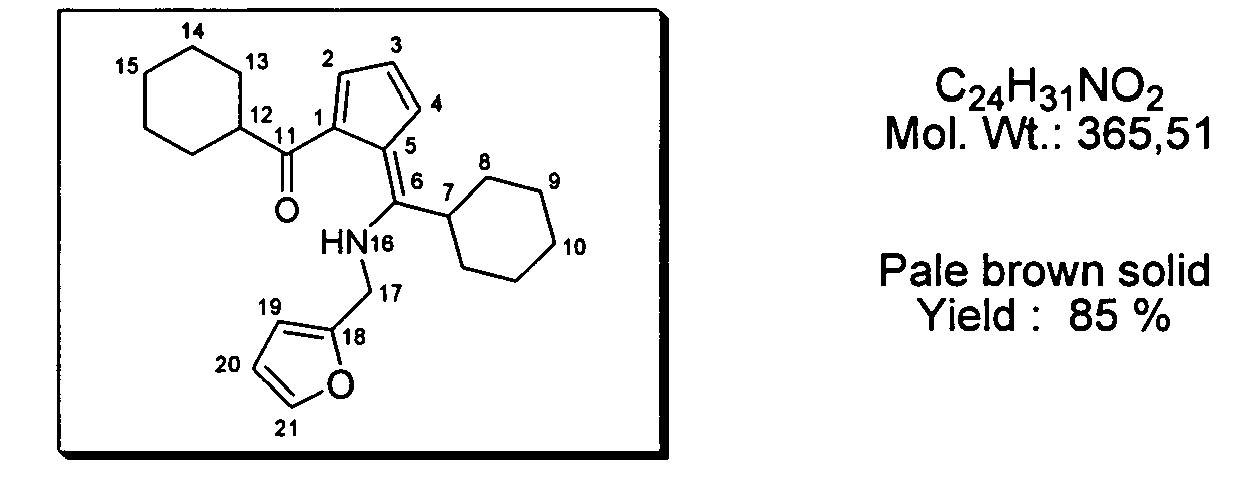
Ligand B: 1-(cyclohexanoyl)-6-(furan-2-yl methyl)amino-6-cycloheal fulvene
-
-
1H NMR (CDCl3, 300 MHz, ppm) δ: 14.92 (1H, s, N16H), 7.56 (1H, d, J=0.02 Hz, C21H) 7.43 (2H, d, J=0.025 Hz, C2H and C4H), 7.28 (1H, m, C20H), 6.34-6.40 (2H, m, C3H and C19H), 4.78 (2H, d, J=0.24 Hz, C17H), 3.52-3.09 (2H, m, C12H and C7H), 2.19-1.31 (20H, m, C8H, C9H, C10H, C13H, C14H, C15H)
-
13C NMR (CDCl3, 50 MHz, ppm) δ: 199.11 (C11), 173.22 (C6), 150.40 (C18), 142.43 (C21), 132.02 (C2), 130.83 (C4), 124.01 (C1), 117.06 (C5), 116.12 (C3), 110.68 (C20), 107.90 (C19), , 46.93 (C7), 41.74 (C10), 40.95 (C17), 32.44 (C13), 30.98 (C15), 27.00 (C8), 26.28 (C9), 26.17 (C14), 25.87 (C12).
-
HRMS: Calcd. for M+.(C24H31NO2) m/z= 365.23548, found 365.2344 (2 ppm).
-
Anal. Cald for C24H31NO2: C: 78.86, H: 8.55, N: 3.83, O: 8.75 found C: 78.54, H: 8.60, N: 3.89.
Ligand C: 1-(cyclohexanoyl)-6-(pyridine-2-methyl)amino-6-cyclohexyl fulvene
-
-
1H NMR (CDCl3, 300 MHz, ppm) δ: 15.01 (1 H, s, N16H), 8.59 (1H, d, J=0.01 Hz, C22H), 7.68 (1H, t, J=0.025 Hz, C20H), 7.45-7.51 (2H, m, C2H and C4H), 7.36 (1H, s, C19H), 7.22 (1H, t, J=0.02 Hz, C21H), 6.34 (1H, t, J=0.02 Hz, C3H), 4.92 (2H, d, J=0.26 Hz, C17H), 3.60-2.95 (2H, m, C12H and C7H), 1.96-1.31 (20H, m, C8H, C9H, C10H, C13H, C14H, C15H)
-
13C NMR (CDCl3, 50 MHz, ppm) δ: 199.72 (C11), 173.84 (C6), 157.76 (C18), 149.35 (C22), 137.09 (C19), 135.48 (C20), 132.15 (C2), 130.88 (C4), 124.03 (C1), 122.59 (C21), 117.06 (C5), 116.28 (C3), 49.88 (C17), 46.95 (C7), 41.86 (C10), 32.38 (C13), 31.02 (C15), 26.82 (C8), 26.26 (C9), 26.17 (C14), 25.76 (C12).
-
HRMS: Calcd. for M+.(C25H32N2O) m/z= 376.25146, found 376.2503 (3 ppm).
-
Anal. Cald for C25H32N2O : C: 79.75, H: 8.57, N: 7.44, O: 4.25 found C: 79.34, H: 8.67, N: 7.27.
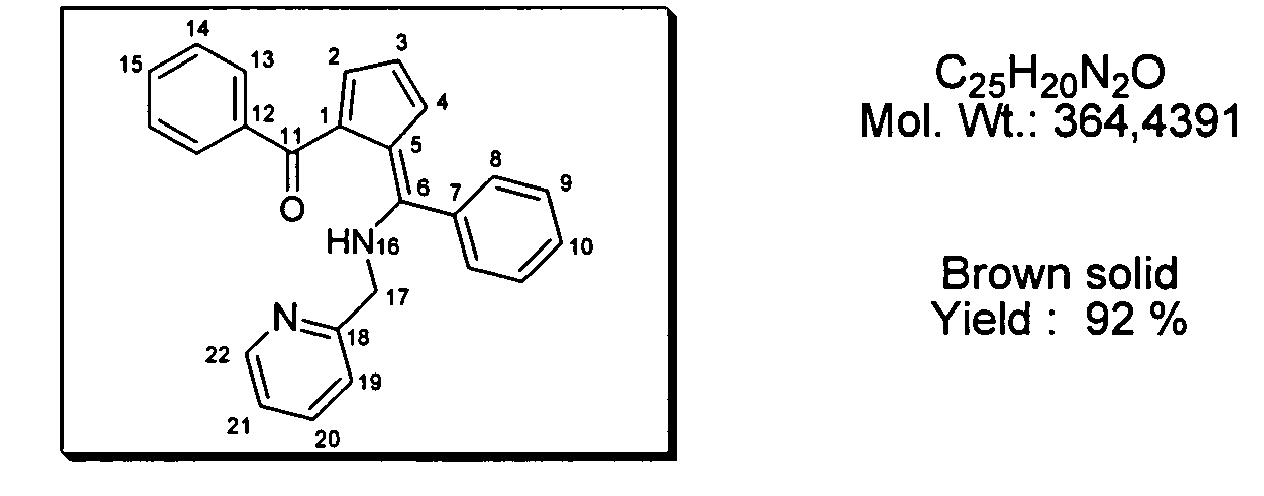
Ligand D: 1-benzoyl-6-benzylamino-6-phenyl fulvene
-
-
1H NMR (CDCl3, 300 MHz, ppm) δ: 15.28 (1 H, s, N16H), 7.51 (2H, m, C13H), 7.20-6.88 (13H, m, C8H, C9H, C10H, C14H, C15H, C19H, C20H, C21H), 6.74 (1H, m, C2H), 5.96 (1H, m, C4H), 5.75 (1H, t, J=0.02 Hz, C3H), 3.68 (2H, d, J=0.03 Hz, C17H)
-
13C NMR (CDCl3, 50 MHz, ppm) δ: 191.13 (C11), 166.39 (C6), 142.42 (C12), 139.71 (C7), 137.05 (C18), 135.80 (C15), 134.04 (C10), 129.94 (C2), 129.72 (C4), 128.94 (C20), 128.92 (C13), 128.40 (C14), 128.32 (C9), 127.87 (C8), 127.82 (C21), 127.47 (C19), 125.35 (C1), 119.98 (C5), 118.20 (C3), 49.76 (C17).
-
HRMS: Calcd. for M+.(C26H21NO) m/z= 363.16231, found 363.1594 (1 ppm).
-
Anal. Cald for C26H21NO: C: 85.92, H: 5.82, N: 3.85, O: 4.40 found C: 85.46, H: 6.06, N: 3.99.
-
Cristallography. Single crystals of compound D suitable for a single crystal X-ray determination were obtained by evaporation of a saturated solution in THF.
| Empirical formula | C26 H21 N O |
| Formula weight | 363.44 |
| Temperature | 120(2) K |
| Wavelength | 0.71073 A |
| Crystal system, space group | Monoclinic, P 21/c |
| Unit cell dimensions | a = 6.22050(10) A alpha = 90 deg. |
| | b = 17.5271(3) A beta = 91.6710(10) deg. |
| | c = 18.2524(3) A gamma = 90 deg. |
| Volume | 1989.16(6) A3 |
| Z, Calculated density | 4, 1.214 Mg/m3 |
| Absorption coefficient | 0.073 mm-1 |
| F(000) | 768 |
| Crystal size | 0.2x0.15x0.1 mm |
| Theta range for data collection | 3.22 to 27.47 deg. |
| Limiting indices | -8<=h<=8, -22<=k<=22, -23<=l<=23 |
| Reflections collected / unique | 8885 / 4522 [R(int) = 0.0472] |
| Completeness to theta = | 27.47 99.3 % |
| Absorption correction | none |
| Refinement method | Full-matrix least-squares on F2 |
| Data / restraints / parameters | 4522 / 0 / 257 |
| Goodness-of-fit on F^2 | 1.078 |
| Final R indices [l>2sigma(I)] | R1 = 0.0607, wR2 = 0.1598 |
| R indices (all data) | R1 = 0.0736, wR2 = 0.1702 |
| Extinction coefficient | 0.075(9) |
| Largest diff. peak and hole | 0.337 and -0.271 e.A-3 |
-
The molecular structure of ligand D obtained by X-Ray is displayed in figure 2.
Ligand E: 1-benzoyl-6-(1-(furan-2-methyl)amino)-6-phenyl fulvene
-
-
1H NMR (CDCl3, 300 MHz, ppm) δ: 14.36 (1H, s, N16H), 7.83 (2H, m, C13H), 7.59-7.50 (8H, m, C8H, C9H, C10H, C14H, C15H), 7.43 (1H, d, J=0.01 Hz, C2H), 7.20 (1H, m, C21H), 6.50 (1H, t, J=0.01 Hz, C20H), 6.37 (1H, m, C4H), 6.33-6.30 (2H, m, C3H and C19H), 4.49 (2H, d, J=0.02 Hz, C17H)
-
13C NMR (CDCl3, 50 MHz, ppm) δ: 191.13 (C11), 166.07 (C6), 149.82 (C18), 142.82 (C21), 142.30 (C12), 139.99 (C7), 135.95 (C15), 133.85 (C10), 129.95 (C2), 129.77 (C4), 128.92 (C13), 128.53 (C14), 128.35 (C9), 127.84 (C8), 125.48 (C1), 119.92 (C5), 118.35 (C3), 110.64 (C20), 108.22 (C19), 42.93 (C17).
-
HRMS: Calcd. for M+.(C24H19NO2) m/z= 353.14158, found 353.1417 (0 ppm).
-
Anal. Cald for C24H19NO2: C: 81.56, H: 5.42, N: 3.96, O: 9.05 found C: 80.35, H: 5.64, N: 4.13.
Ligand F: 1-benzoyl-6-(1-(pyridine-2-methyl)amino)-6-phenyl fulvene
-
-
1H NMR (CDCl3, 300 MHz, ppm) δ: 14.49 (1H, s, N16H), 8.56 (1H, d, J=0.01 Hz, C22H), 7.80 (2H, m, C13H), 7.70 (1H, t, J=0.025 Hz, C20H), 7.54-7.42 (9H, m, C8H, C9H, C10H, C14H, C15H, and C19H), 7.22-7.17 (2H, m, C2H, C21H), 6.48 (1H, m, C4H), 6.28 (1H, t, J=0.02 Hz, C3H), 4.67 (2H, d, J=0.02 Hz, C17H)
-
13C NMR (CDCl3, 50 MHz, ppm) δ: 191.14 (C11), 166.69 (C6), 156.79 (C18), 149.59 (C22), 142.27 (C7), 139.99 (C12), 137.13 (C20), 136.02 (C10), 133.89 (C15), 129.95 (C2), 129.72 (C4), 128.92 (C13), 128.31 (C14), 128.30 (C9), 127.81 (C8), 125.50 (C5), 122.60 (C19), 121.31 (C21), 119.97 (C1), 118.33 (C3), 51.41 (C17).
-
HRMS: Calcd. for M+.(C25H20N2O) m/z= 364.15756, found 364.1557 (5 ppm).
-
Anal. Cald for: C: 82.39 , H: 5.53, N: 7.69, O: 4.39 found C: 82.53, H: 5.56, N: 7.61.
Ligand G: 1-(4-tertbutylbenzoyl)-6-benzylamino-6-(4-tertbutylphenyl) fulvene
-
-
1H NMR (CDCl3, 300 MHz, ppm) δ: 14.32 (1H, s, N20H), 7.57 (2H, m, C15H), 7.40-7.13 (11H, m, C8H, C9H, C16H, C23H, C24H, C25H), 6.34 (1H, m, C2H), 6.11 (1H, m, C4H), 5.17 (1H, t, J=0.02 Hz, C3H), 4.38 (2H, d, J=0.02 Hz, C21H), 1.30 (18H, d, J=0.03 Hz, C12H3 and C19H3).
-
13C NMR (CDCl3, 50 MHz, ppm) δ: 191.05 (C13), 166.71 (C6), 153.13 (C17), 152.84 (C10), 139.50 (C14), 139.28 (C7), 137.13 (C22), 135.51 (C2), 131.01 (C4), 128.87 (C24), 128.79 (C8), 128.20 (C9), 127.63 (C16), 127.44 (C15), 125.19 (C25), 125.07 (C23), 124.70 (C1), 119.92 (C5), 117.70 (C3), 49.68 (C21), 34.92 (C11 and C18), 31.35 (C12 and C19).
-
HRMS: Calcd. for M+.(C34H37NO) m/z= 475.28752, found. 475.2899 (5 ppm)
-
Anal. Cald for C34H37NO: C: 85.85, H: 7.84, N: 2.94, O: 3.36 found C: 86.13, H: 7.99, N: 2.99.
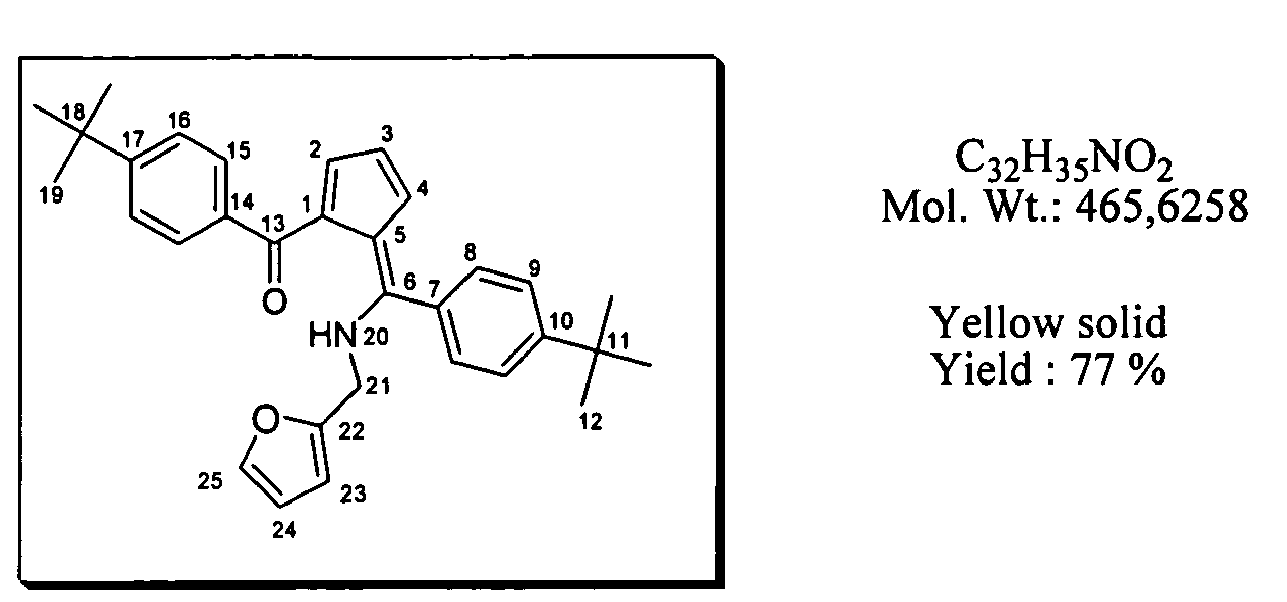
Ligand H: 1-(4-tertbutylbenzoyl)-6-(1-(furan-2-methyl)amino)-6-(4-tertbutylphenyl) fulvene
-
-
1H NMR (CDCl3, 300 MHz, ppm) δ: 14.14 (1H, s, N20H), 7.56 (2H, d, J=0.03 Hz, C15H), 7.42-7.27 (6H, m, C8H, C9H, C16H), 7.23 (1H, s, C2H), 7.03 (1H, d, J=0.01 Hz, C25H), 6.32 (1H, t, J=0.01 Hz, C24H), 6.18-6.09 (1H, m, C3H, C4H and C23H), 4.32 (2H, d, J=0.02 Hz, C21H), 1.26 (18H, d, J=0.03 Hz, C12H3 and C19H3)
-
13C NMR (CDCl3, 50 MHz, ppm) δ: 191.09 (C13), 166.41 (C6), 153.17 (C17), 152.91 (C10), 149.98 (C22), 142.66 (C25), 139.62 (C14), 139.46 (C7), 135.72 (C2), 130.88 (C4), 128.93 (C8), 128.38 (C9), 125.39 (C16), 125.15 (C15), 124.71 (C1), 119.93 (C5), 117.92 (C3), 110.58 (C24), 108.08 (C23), 42.99 (C21), 34.88 (C11 and C18), 31.39 (C12 and C19). HRMS: Calcd. for M+.(C32H35NO2) m/z= 465.26678, found 465.2669 (0 ppm).
-
Anal. Cald for C32H35NO2: C: 82.54, H: 7.58, N: 3.01, O: 3.01 found C: 81.98, H: 7.57, N: 3.14.
Ligand I: 1-(4-tertbutylbenzoyl)-6-(1-(pyridine-2-methyl)amino)-6-(4-tertbutylphenyl) fulvene
-
-
1H NMR (CDCl3, 300 MHz, ppm) δ: 14.35 (1H, s, N20H), 8.37 (1H, m, C26H), 7.54 (2H, m, C15H), 7.48 (1H, d, C24H), 7.35-7.19 (7H, m, C8H, C9H, C16H, C2H), 7.05 (1H, m, C23H), 7.01 (1H, t, J=0.02 Hz, C25H), 6.34 (1H, m, C4H), 6.11 (1H, t, J=0.02 Hz, C3H), 4.52 (2H, d, J=0.02 Hz, C21H), 1.24 (18H, s, C12H3 and C19H3)
-
13C NMR (CDCl3, 50 MHz, ppm) δ: 191.07 (C13), 167.04 (C6), 157.02 (C26), 153.21 (C17), 152.85 (C10), 149.53 (C24), 139.70 (C7), 139.46 (C14), 137.12 (C23), 135.90 (C2), 130.93 (C4), 128.99 (C8), 128.21 (C9), 125.46 (C16), 125.16 (C15), 124.74 (C1), 122.50 (C22), 121.24 (C25), 120.06 (C5), 118.02 (C3), 51.47 (C21), 34.92 (C11 and C18), 31.39 (C12 and C19).
-
HRMS: Calcd. for M+.(C33H36N2O) m/z= 476.28276, found 476.2830 (0 ppm).
-
Anal. Cald for C33H36N2O : C: 83.15, H: 7.61, N: 5.88, O: 3.36 found C: 82.65, H: 7.77, N: 5.81.
Ligand J: 1-(diphenylacetyl)-6-benzylamino-6-(diphenlymethyl) fulvene
-
-
1H NMR (CDCl3, 300 MHz, ppm) δ: 14.95 (1H, s, N18H), 7.64 (1H, m, C2H), 7.38-7.10 (25H, m, C9H, C10H, C11H, C15H, C16H, C17H, C21H, C22H and C23H), 7.04 (1H, m, C4H), 6.31 (1H, s, C13H), 6.25-6.22 (2H, m, C3H and C7H,), 4.54 (2H, d, J=0.02 Hz, C19H).
-
13C NMR (CDCl3, 50 MHz, ppm) δ: 193.03 (C12), 167.51 (C6), 141.30 (C14), 138.85 (C8), 136.42 (C20), 134.93 (C2), 133.10 (C4), 129.27 (C16), 128.95 (C15), 128.92 (C10), 128.58 (C22), 128.39 (C9), 127.31 (C17), 126.96 (C21), 126.65 (C11), 125.92 (C1), 120.39 (C5), 117.60 (C3), 58.95 (C13), 52.10 (C19), 49.46 (C7).
-
HRMS: Calcd. for M+.(C40H33NO) m/z= 543.25621, found 543.2539 (4 ppm).
-
Anal. Cald for C40H33NO: C: 88.36, H: 6.12, N: 2.58, O: 2.94 found C: 87.74, H: 6.07, N: 2.52.
Ligand K: 1-(diphenylacetyl)-6-(1-(furan-2-methyl)amino)-6-(diphenylmethyl) fulvene
-
-
1H NMR (CDCl3, 300 MHz, ppm) δ: 14.80 (1H, s, N18H), 7.64 (1H, m, C2H), 7.45-7.27 (21 H, m, C9H, C10H, C11H, C15H, C16H, C17H and C23H), 7.07 (1H, m, C4H), 6.44 (1H, s, C13H), 6.32 (1H, m, C22H), 6.25 (1H, t, J=0.02Hz, C3H), 6.19 (1H, s, C21H), 4.42 (2H, d, J=0.02 Hz, C19H).
-
13C NMR (CDCl3, 50 MHz, ppm) δ: 192.99 (C12), 167.02 (C6), 149.35 (C20), 142.34 (C23), 141.27 (C14), 138.66 (C8), 135.22 (C2), 133.07 (C4), 129.27 (C16), 128.99 (C15), 128.93 (C10), 128.36 (C9), 127.36 (C17), 126.62 (C11), 126.01 (C1), 120.29 (C5), 117.74 (C3), 110.52 (C22), 107.87 (C21), 58.94 (C13), 52.10 (C19), 43.26 (C7).
-
HRMS: Calcd. for M+.(C38H31NO2) m/z= 533.23548, found 533.2349 (1 ppm).
-
Anal. Cald for C38H31NO2: C: 85.52, H: 5.86, N: 2.62, O: 6.00 found C: 85.27, H: 5.95, N: 2.59.
Ligand L: 1-(diphenylacetyl)-6-(1-(pyridine-2-methyl)amino)-6-(diphenylmethyl) fulvene
-
-
1H NMR (CDCl3, 300 MHz, ppm) δ: 14.94 (1H, t, J=0.02Hz, N18H, ), 8.45 (1H, d, J=0.02Hz C24H), 7.68 (1H, m, C2H), 7.50 (1H, t, J=0.03Hz C22H), 7.46-7.27 (21H, m, C9H, C10H, C11H, C15H, C16H, C17H, C21H and C23H), 7.09 (1H, m, C4H), 6.39 (1H, s, C13H), 6.27 (1H, t, J=0.02Hz, C3H), 6.25 (1 H, s, C7H), 4.76 (2H, d, J=0.02 Hz, C19H). 13C NMR (CDCl3, 50 MHz, ppm) δ: 193.22 (C12), 167.99 (C6), 156.45 (C24), 149.16 (C22), 141.25 (C14), 138.54 (C8), 136.60 (C21), 135.50 (C2), 133.42 (C4), 129.27 (C16), 129.00 (C15), 128.85 (C10), 128.42 (C9), 127.22 (C17), 126.68 (C11), 126.06 (C1), 122.20 (C22), 120.8 (C25), 120.38 (C5), 117.90 (C3), (C22), (C21), 59.03 (C13), 52.06 (C19), 51.17 (C7).
-
HRMS: Calcd. For M+.(C39H32N2O) m/z= 544.25146, found 544.2533 (3 ppm).
-
Anal. Cald for C39H32N2O: C: 86.00, H: 5.92, N: 5.14, O: 2.94 found C: 86.08, H: 6.14, N: 4.80.
Ligand M: 1-(4-methoxybenzoyl)-6-(benzylamino)-6-(4-methoxyhhenyl) fulvene
-
-
1H NMR (CDCl3, 300 MHz, ppm) δ: 14.26 (1H, s, N18H), 7.64 (2H, m, C14H), 7.22-7.12 (7H, m, C8H, C21H, C22H and C23H), 7.03 (1H, m, C2H), 6.90 (4H, m, C9H and C15H), 6.12 (1H, m, C4H), 3.77 (1H, t, J=0.02Hz, C3H), 4.39 (2H, d, J=0.02 Hz, C19H), 3.78 (3H, s, C17H), 3.77 (3H, s, C11H).
-
13C NMR (CDCl3, 50 MHz, ppm) δ: 190.41 (C12), 166.52 (C6), 161.26 (C16), 160.56 (C10), 138.87 (C20), 137.27 (C13), 135.20 (C2), 134.82 (C4), 131.06 (C15), 130.01 (C9), 128.81 (C22), 127.61 (C23), 127.28 (C21), 126.14 (C7), 125.19 (C1), 120.09 (C5), 117.59 (C3), 113.56 (C14), 113.06 (C8), 55.42 (C17), 55.40 (C11), 49.57 (C19).
-
HRMS: Calcd. for M+.(C28H25NO3) m/z= 423.18344, found 423.1821 (3 ppm).
-
Anal. Cald for C28H25NO3: C: 79.41, H: 5.95, N: 3.31, O: 11.33 found C: 79.62, H: 5.95, N: 3.36.
Ligand N: 1-(4-methoxybenzoyl)-6-(1-(furan-2-methyl)amino)-6-(4methoxyphenyl) fulvene
-
-
1H NMR (CDCl3, 300 MHz, ppm) δ: 14.07 (1H, s, N18H), 7.63 (2H, d, J=0.04Hz, C14H), 7.29 (2H, d, J=0.04Hz, C8H), 7.27 (1H, m, C23H), 7.03 (1 H, m, C2H), 6.92 (2H, d, J=0.04Hz, C15H), 6.83 (2H, d, J=0.04Hz, C9H), 6.33 (1H, m, C4H), 6.22 (1H, m, C22H), 6.15 (1H, d, J=0.01Hz, C21H), 6.12 (1H, t, J=0.02Hz, C3H), 4.35 (2H, D, J=0.02Hz, C19H), 3.80 (3H, s, C17H), 3.78 (3H, s, C11H).
-
13C NMR (CDCl3, 50 MHz, ppm) δ: 190.41 (C12), 166.52 (C6), 161.26 (C16), 160.56 (C10), 142.64 (C23), 139.15 (C20), 137.27 (C13), 135.35 (C2), 134.82 (C4), 131.07 (C15), 130.17 (C9), 126.14 (C7), 125.19 (C1), 120.09 (C5), 117.74 (C3), 113.60 (C14), 113.02 (C8), 110.51 (C22), 107.96 (C21), 55.40 (C17 and C11), 42.84 (C19).
-
HRMS: Calcd. for M+.(C26H23NO4) m/z= 413.16271, found 413.1614 (3 ppm)
-
Anal. Cald for: C: 75.53, H: 5.61, N: 3.39, O: 15.48 found C: 74.96, H: 5.59, N: 3.36.
Ligand O: 1-(4-methoxybenzoyl)-6-(1-(pyridine-2-methyl)amino)-6-(4-methoxyphenyl) fulvene
-
-
1H NMR (CDCl3, 300 MHz, ppm) δ: 14.38 (1H, s, N18H), 8.53 (1H, d, J=0.01 Hz, C24H), 7.80 (2H, d, J=0.03Hz, C14H), 7.70 (1H, t, J=0.02Hz, C22H), 7.42 (1H, d, J=0.02Hz, C21H), 7.33 (2H, d, J=0.02Hz, C8H), 7.22-7.17 (2H, m, C2H and C23H), 6.96 (4H, d, J=0.03Hz, C15H and C9H), 6.47 (1H, m, C4H), 6.26 (1H, t, J=0.02Hz, C3H), 4.67 (2H, d, J=0.03Hz, C19H), 3.88 (3H, s, C17H), 3.87 (3H, s, C11H).
-
13C NMR (CDCl3, 50 MHz, ppm) δ: 190.46 (C12), 166.80 (C6), 161.35 (C16), 160.55 (C10), 156.90 (C24), 149.01 (C22), 139.34 (C20), 137.61 (C13), 135.57 (C2), 134.68 (C4), 131.14 (C15), 130.01 (C9), 125.90 (C7), 125.44 (C1), 122.65 (C21), 121.45 (C23), 120.19 (C5), 117.92 (C3), 113.67 (C14), 113.08 (C8) 55.39 (C17 and C11), 50.99 (C19). HRMS: Calcd. for M+.(C27H24N2O3) m/z= 424.17869, found 424.1775 (2 ppm).
-
Anal. Cald for C27H24N2O3: C: 76.39, H: 5.70, N: 6.60, O: 11.31 found C: 76.20, H: 5.73, N: 6.77.
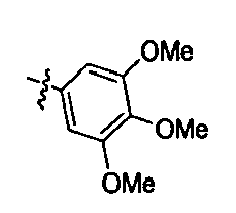
Ligand P: 1-(3,4,5-trimethoxybenzoyl)-6-(benzylamino)-6-(3,4,5-trimethoxyphenyl) fulvene
-
-
1H NMR (CDCl3, 300 MHz, ppm) δ: 14.36 (1H, t, J=0.02Hz, N20H), 7.33-7.22 (6H, m, C2H, C23H, C24H and C25H), 7.03 (2H, s, C15H ), 6.57 (1H, m, C4H), 6.51 (2H, s, C8H), 6.27 (1H, t, J=0.01 Hz, C3H), 4.50 (2H, d, J=0.02 Hz, C21H), 3.92 (12H, s, C11H and C18H), 3.74 (6H, s, C12H and C19H).
-
13C NMR (CDCl3, 50 MHz, ppm) δ: 190.40 (C13), 166.52 (C6), 152.95 (C16), 152.60 (C9), 139.70 (C17), 139.39 (C10), 138.70 (C14), 137.58 (C22), 137.53 (C2), 135.64 (C4), 128.96 (C7), 128.80 (C24), 127.64 (C23), 124.78 (C1), 119.46 (C5), 118.17 (C3), 106.42 (C15), 105.63 (C8), 61.05 (C19), 60.94 (C12), 56.26 (C18), 56.12 (C11), 49.56 (C21). HRMS: Calcd. for M+.(C32H33NO7) m/z= 543.22570, found 543.2273 (2 ppm).
-
Anal. Cald for C32H33NO7: C: 70.70, H: 6.12, N: 2.58, O: 20.60 found C: 70.93, H: 6.21, N: 2.61.
Ligand Q: 1-(3,4,5-trimethoxybenzoyl)-6-(furan-2-methyl)amino)-6-(3,4,5-trimethoxy phenyl) fulvene
-
-
1H NMR (CDCl3, 300 MHz, ppm) δ: 14.13 (1 H, t, J=0.02Hz, N20H), 7.38 (1H, m, C25H), 7.21 (1H, q, J=0.01Hz, C2H ), 7.00 (1H, s, C15H), 6.69 (1H, s, C8H), 6.58 (1H, q, J=0.01 Hz, C4H), 6.34 (1H, q, J=0.01Hz, C24H), 6.29-6.25 (2H, m, C3H and C23H), 4.47 (2H, d, J=0.02 Hz, C21H), 3.96 (3H, s, C19H), 3.92 (3H, s, C12H), 3.91 (6H, s, C18H), 3.87 (6H, s, C11H).
-
13C NMR (CDCl3, 50 MHz, ppm) δ: 190.37 (C13), 166.03 (C6), 153.08 (C16), 152.57 (C9), 149.95 (C25), 142.65 (C22), 139.70 (C17), 139.63 (C10), 138.82 (C14), 137.44 (C2), 135.86 (C4), 128.82 (C7), 124.92 (C1), 119.39 (C5), 118.31 (C3), 110.61 (C22), 108.12 (C15), 105.85 (C8), 61.06 (C19), 60.93 (C12), 56.27 (C18), 56.25 (C11), 42.92 (C21).
-
HRMS: Calcd. for M+.(C30H31NO8) m/z= 533.20497, found 533.2035 (2 ppm).
-
Anal. Cald for C30H31NO8: C: 67.53, H: 5.86, N: 2.63, O: 23.99 found C: 67.82, H: 5.99, N: 4.94.
Ligand R: 1-(3,4,5-trimethoxybenzoyl)-6-(1-(pyridine-2-methyl)amino)-6-(3,4,5-trimethoxyphenyl) fulvene
-
-
1H NMR (CDCl3, 300 MHz, ppm) δ: 14.30 (1H, t, J=0.02Hz, N20H), 8.55 (1H, d, J=0.01 Hz, C26H), 7.70 (1H, t, J=0.02Hz, C24H), 7.38 (1H, d, J=0.03Hz, C23H), 7.24-7.18 (2H, m, C2H and C25H), 7.02 (1H, s, C15H), 6.62 (1H, s, C8H), 6.58 (1H, q, J=0.02Hz, C4H), 6.27 (1H, t, J=0.01 Hz, C3H), 4.65 (2H, d, J=0.02 Hz, C21H), 3.92 (12H, s, C11H and C18H), 3.75 (6H, s,C12H and C19H).
-
13C NMR (CDCl3, 50 MHz, ppm) δ: 190.38 (C13), 166.68 (C6), 157.03 (C26), 152.98 (C16), 152.56 (C9), 149.60 (C25), 139.62 (C17 and C10), 138.82 (C14), 137.46 (C2), 137.01 (C22), 135.94 (C4), 128.89 (C7), 124.96 (C1), 122.58 (C25), 121.36 (C23), 119.50 (C5), 118.31 (C3), 106.48 (C15), 105.80 (C8), 61.01 (C19), 60.93 (C12), 56.24 (C18), 56.15 (C11), 51.27 (C21).
-
HRMS: Calcd. for M+.(C31H32N2O7) m/z= 544.22095, found 544.2181 (5 ppm).
-
Anal. Cald for C31H32N2O7: C: 68.37, H: 5.92, N: 5.14, O: 20.56 found C: 68.16, H: 6.02, N: 4.96.
Ligand S: 1-furanoyl-6-benzylamino-6-furanyl fulvene
-
-
1H NMR (CDCl3, 300 MHz, ppm) δ: 13.90 (1H, s, N16H), 7.80 (1H, q, J=0.01 Hz, C15H), 7.68-7.67 (2H, m, C10H and C13H), 7.35-7.21 (5H, m, C19H, C20H and C21H), 7.20 (1H, m, C2H), 6.92 (1H, q, J=0.01 Hz, C14H), 6.76 (1H, d, J=0.01 Hz, C8H), 6.59-6.57 (2H, m, C4H and C9H), 6.39 (1H, t, J=0.01 Hz, C3H), 4.65 (2H, d, J=0.02 Hz, C17H)
-
13C NMR (CDCl3, 50 MHz, ppm) δ: 176.37 (C11), 154.33 (C7), 153.95 (C12), 146.13 (C6), 145.32 (C15), 144.65 (C10), 137.64 (C2), 137.07 (C18), 134.91 (C4), 128.73 (C20), 127.69 (C21), 127.44 (C19), 124.71 (C1), 119.88 (C5), 118.83 (C3), 117.55 (C13), 117.34 (C14), 11.60 (C8), 111.45 (C9), 50.03 (C17).
-
HRMS: Calcd. for M+.(C22H17NO3) m/z= 343.12084, found 343.1210 (0 ppm).
-
Anal. Cald for C22H17NO3 : C: 76.95, H: 4.99, N: 4.08, O:13.98 found C: 76.75, H: 5.15, N: 3.95.
Ligand T: 1-(furanoyl)-6-(1-(furan-2-methyl)amino)-6-(furanyl) fulvene
-
-
1H NMR (CDCl3, 300 MHz, ppm) δ: 13.76 (1H, s, N16H), 7.79 (1H, q, J=0.01 Hz, C15H), 7.70 (1H, m, C10H), 7.66 (1H, m, C13H), 7.36 (1H, m, C19H), 7.19 (1H, d, J=0.01 Hz, C2H), 6.91 (1H, q, J=0.01 Hz, C14H), 6.84 (1H, d, J=0.01 Hz, C21H), 6.62 (1H, q, J=0.01 Hz, C20H), 6.56 (1H, q, J=0.01 Hz, C4H), 6.38 (1H, t, J=0.01 Hz, C3H), 6.31 (1H, m, C8H), 6.27 (1H, m, C9H), 4.62 (2H, d, J=0.02 Hz, C17H)
-
13C NMR (CDCl3, 50 MHz, ppm) δ: 176.36 (C11), 153.93 (C7), 153.85 (C12), 149.92 (C21), 146.01 (C6), 145.32 (C15), 144.80 (C10), 142.61 (C18), 137.94 (C2), 134.98 (C4), 124.84 (C1), 119.83 (C5), 119.82 (C3), 117.59 (C13 and C14), 111.60 (C8), 111.52 (C9), 110.52 (C20), 108.02 (C19), 43.07 (C17).
-
HRMS: Calcd. for M+.(C20H15NO4) m/z= 333.10011, found 333.1008 (2 ppm).
-
Anal. Cald for C20H15NO4: C: 72.06, H: 4.54, N: 4.20, O: 19.20, found C: 72.11, H: 4.55, N: 4.18.
Ligand U: 1-(furanoyl)-6-(1-(pyridine-2-methyl)amino)-6-(furanyl) fulvene
-
-
1H NMR (CDCl3, 300 MHz, ppm) δ: 13.90 (1H, s, N16H), 8.54 (1H, d, J=0.02 Hz, C22H), 7.80 (1H, q, J=0.01 Hz, C15H), 7.70-7.60 (3H, m, C10H, C13H and C24H), 7.42 (1H, d, J=0.03 Hz, C19H), 7.21-7.17 (2H, m, C21H and C2H), 6.92 (1H, q, J=0.01 Hz, C14H), 6.79 (1H, d, J=0.01 Hz, C8H), 6.57-6.54 (2H, m, C4H and C9H), 6.38 (1H, t, J=0.01 Hz, C3H), 4.78 (2H, d, J=0.02 Hz, C17H).
-
13C NMR (CDCl3, 50 MHz, ppm) δ: 176.40 (C11), 157.15 (C22), 154.59 (C7), 153.92 (C12), 149.35 (C20), 145.94 (C6), 145.35 (C15), 144.92 (C10), 137.98 (C2), 137.01 (C18), 135.15 (C4), 124.88 (C1), 122.45 (C19), 121.25 (C21), 119.87 (C5), 119.07 (C3), 117.63 (C13) 117.59 (C14), 111.61 (C8), 111.37 (C9), 51.77 (C17).
-
HRMS: Calcd. for M+.(C21H16N2O3) m/z= 344.11609, found 344.1155 (1 ppm).
-
Anal. Cald for C21H16N2O3: C: 73.24, H: 4.68, N: 8.13, O: 13.94, found C: 72.77, H: 4.73, N: 7.76.
Preparation of metallic complexes from carbonylaminofulvenes.
CrCl
3
/ ligand A complex.
-
7.51 mg (20 µmol) of ligand A and 3.75 mg (10 µmol) of CrCl3.3THF were introduced in a Schlenk with 100 µL of tetrahydrofuran (THF). The mixture was placed under stirring for 2 h at room temperature. The solvent was evaporated under vacuum overnight to yield a yellow brown solid.
CrCl
2
/ ligand A complex.
-
7.51 mg (20 µmol) of ligand A and 1.23 (10 µmol) of CrCl2 were introduced in a Schlenk with 100 µL of THF. The mixture was placed under stirring for 2 h at room temperature. The solvent was evaporated under vacuum overnight to yield a yellow brown solid.
CrCl
3
/ ligand D complex.
-
7.27 mg (20 µmol) of ligand D and 3.75 mg (10 µmol) of CrCl3.3THF were introduced in a Schlenk with 100 µL of tetrahydrofuran (THF). The mixture was placed under stirring for 2 h at room temperature. The solvent was evaporated under vacuum overnight to yield a yellow brown solid.
CrCl
3
/ ligand H complex.
-
9.31 mg (20 µmol) of ligand H and 3.75 mg (10 µmol) of CrCl3.3THF were introduced in a Schlenk with 100 µL of tetrahydrofuran (THF). The mixture was placed under stirring for 2 h at room temperature. The solvent was evaporated under vacuum overnight to yield a yellow brown solid.
CrCl
3
/ ligand E complex.
-
7.07 mg (20 µmol) of ligand E and 3.75 mg (10 µmol) of CrCl3.3THF were introduced in a Schlenk with 100 µL of tetrahydrofuran (THF). The mixture was placed under stirring for 2 h at room temperature. The solvent was evaporated under vacuum overnight to yield a red brown solid.
CrCl
3
/ ligand C complex.
-
7.53 mg (20 µmol) of ligand C and 3.75 mg (10 µmol) of CrCl3.3THF were introduced in a Schlenk with 100 µL of tetrahydrofuran (THF). The mixture was placed under stirring for 2 h at room temperature. The solvent was evaporated under vacuum overnight to yield a yellow brown solid.
CrCl
3
/ ligand B complex.
-
7.31 mg (20 µmol) of ligand B and 3.75 mg (10 µmol) of CrCl3.3THF were introduced in a Schlenk with 100 µL of tetrahydrofuran (THF). The mixture was placed under stirring for 2 h at room temperature. The solvent was evaporated under vacuum overnight to yield a yellow brown solid.
CrCl
3
/ ligand O complex.
-
8.49 mg (20 µmol) of ligand O and 3.75 mg (10 µmol) of CrCl3.3THF were introduced in a Schlenk with 100 µL of tetrahydrofuran (THF). The mixture was placed under stirring for 2 h at room temperature. The solvent was evaporated under vacuum overnight to yield a yellow brown solid.
CrCl
3
/ ligand L complex.
-
10.89 mg (20 µmol) of ligand L and 3.75 mg (10 µmol) of CrCl3.3THF were introduced in a Schlenk with 100 µL of tetrahydrofuran (THF). The mixture was placed under stirring for 2 h at room temperature. The solvent was evaporated under vacuum overnight to yield a yellow brown solid.
CrCl
2
/ ligand L complex.
-
10.89 mg (20 µmol) of ligand L and 1.23 (10 µmol) of CrCl
2 were introduced in a Schlenk with 100 µL of THF. The mixture was placed under stirring for 2 h at room temperature. The solvent was evaporated under vacuum overnight to yield a yellow brown solid.
-
The complex was recrystallised by slow diffusion of pentane in a saturated solution of the complex in THF. The crytals obtained were suitable for X-Ray analysis.
-
The complex crystallises in a monoclinic environment with space group P 21/c. The chromium atom is coordinated by one molecule of tridentate fulvene by its oxygen atom and its two nitrogen atoms. The chromium atom is further coordinated by two chlorine atom and a THF molecule. This can be seen in
Figure 3. The complex is characterised as follows.
| Empirical formula | C43 H39 Cl2 Cr N2 02 |
| Formula weight | 738.66 |
| Temperature | 100(2) K |
| Wavelength | 0.71073 A |
| Crystal system, space group | Monoclinic, P 21/c |
| Unit cell dimensions | a = 14.987(2) A alpha = 90 deg. |
| | b = 14.175(2) A beta = 99.485(9) deg. |
| | c = 17.412(3) A gamma = 90 deg. |
| Volume | 3648.4(9) A^3 |
| Z, Calculated density | 4, 1.345 Mg/m^3 |
| Absorption coefficient | 0.500 mm^-1 |
| F(000) | 1540 |
| Crystal size | 0.2 x 0.2 x 0.03 mm |
| Theta range for data collection | 2.92 to 27.48 deg. |
| Limiting indices | -19<=h<=19, -18<=k<=11, -22<=l<=22 |
| Reflections collected / unique | 38703/8296 [R(int) = 0.0659] |
| Completeness to theta = | 27.48 99.2 % |
| Absorption correction | Semi-empirical from equivalents |
| Max. and min. transmission | 0.985 and 0.885 |
| Refinement method | Full-matrix least-squares on F^2 |
| Data / restraints / parameters | 8296 / 0 / 451 |
| Goodness-of-fit on F^2 | 1.030 |
| Final R indices [I>2sigma(I)] | R1 = 0.0423, wR2 = 0.0840 |
| R indices (all data) | R1 = 0.0728, wR2 = 0.0941 |
| Largest diff. peak and hole | 0.331 and -0.492 e.A^-3 |
Homogeneous polymerisation of ethylene.
-
The metallic catalyst component were activated with 1.625 mL of methylaluminoxane (MAO). The solution was stirred for 5 minutes and then diluted with 3.375 mL of toluene. The reactor was dried under nitrogen at a temperature of 90 °C for a period of time of 30 minutes. The reactor was brought to a polymerisation temperature of 35 °C and 50 mL of toluene were added to the reactor under nitrogen. A scavenger solution consisting of 0.5 mL of MAO (30%) and 4.5 mL of toluene was added to the reactor and the solution was stirred for a few minutes. The solution of activated catalyst was added to the reactor under nitrogen. The flux of nitrogen was interrupted, the reactor was purged and placed under an ethylene pressure of 15 bars. It was placed under stirring for a period of time of 1 h. The reactor was purged and the polymerisation was stopped by adding a 10% solution of MeOH/HCl. The polymer was washed 3 times with 30 mL of MeOH and 3 times with 30 mL of acetone. The polymer was dried under vacuum overnight at room temperature. The results are summarised in Table IV for the chromium-based catalyst systems.
TABLE IV. | M/L | m PE (g) | Activity (kgPEl(mol.h) | Mn | Tm ( ° C) |
| CrCl3/A | 0,941 | 94,1 | - | 137 |
| CrCl2/A | 0,976 | 97,6 | insoluble | 137 |
| CrCl3/D | 0,995 | 99,5 | unfilterable | 119 |
| CrCl3/H | 1,045 | 104,5 | unfilterable | 135 |
| CrCl3/E | 1,244 | 124,4 | insoluble | 129 |
| CrCl3/C | 1,283 | 128,3 | unfilterable | 135 |
| CrCl3/B | 2,895 | 289,5 | unfilterable | 133 |
| CrCl3/O | 3,648 | 364,8 | insoluble | 136 |
| CrCl3/L | 5,415 | 541,5 | insoluble | 135 |
| CrCl2/L | 6,915 | 691,5 | insoluble | 136 |
-
For all polymerisations, the conditions were as follows: Cr 10 µmol, ligand 20 µmol, polymerisation temperature 35 °C, ethylene pressure 15 bars, 1000 eq. MAO, solvent: toluene, polymerisation time 1 h.
-
The highest activities were obtained with the catalyst systems based on CrCl
3 / ligand L and CrCl
2 / ligand L. As depicted in Table V, CrCl
2 based system is a selective catalyst whereas CrCl
3 based system is a mixed polymer/oligomer catalyst.
TABLE V | M/L | m PE (g) | Activity (kgPE /(mol.h) | Consumption (kgC2H4 /(mol.h)) |
| CrCl2/L | 4.11 | 411 | 385 |
| CrCl3/L | 3.38 | 338 | 590 |
-
For all polymerisations, the conditions were as follows: Cr 10 µmol, ligand 20 µmol, polymerisation temperature 35 °C, ethylene pressure 15 bars, 1000 eq. MAO, solvent: toluene, polymerisation time 1 h.
-
The activity of the system CrCl
2 / ligand L has been studied as a function of temperature and of ethylene pressure. The results are displayed in Table VI. It can be concluded that the activity of the catalyst system increases with increasing pressure and decreases when the temperature is raised above 35 °C. It can also be concluded that the activity increases with a lower amount of catalyst.
-
For all polymerisations, the conditions were as follows: 1000 eq. MAO, solvent: toluene, polymerisation time 1 h.
-
The consumptions were also measured and the results are displayed in Table VII.
TABLE VII | Temp. | m PE | Activity | Consumption |
| (°C) | (g) | (kgPE /(mol.h) | (kgC2H4 /(mol.h) |
| 35 | 7.49 | 2996 | 2729 |
| 25 | 10.77 | 4308 | 5738 |
-
For all polymerisations, the conditions were as follows: Cr 2.5 µmol, ligand L 5 µmol, ethylene pressure 45 bars, 1000 eq. MAO, solvent: toluène, polymerisation time 1 h.
Polymerisation of ethylene with supported catalyst systems.
-
The activity of the unsupported CrCl2 / ligand L catalyst system was evaluated in heptane. The catalyst system was not selective in polyethylene as the consumption of ethylene was larger than the amount of ethylene present in the polyethylene. The polymerisation conditions were as follows:
- complexation time: 2 hours,
- 5 µmol of ligand with 2.5 µmol of Cr,
- polymerisation temperature: 25 °C,
- polymerisation pressure: 45 bars,
- 1000 equ. of MAO,
- solvent: heptane,
- polymerisation time: 1 hour.
- The results are displayed in Table VIII.
TABLE VIII | m PE (g) | Activity | Consumption | Tm ( ° C) |
| (kgPEl(mol.h) | (kgC2H4 /(mol.h) |
| 6,77 | 2 708 | 6 768 | 137 |
Impregnation of the catalyst on silica/MAO.
-
5 µmol of complex CrCl2/L were dissolved in 600 µl of toluene and then introduced in a schlenk with 100 mg of silica/MAO (50 µmolCr/gSi) under stirring for a period of time of 30 minutes. The impregnated silica was filtered and washed either once with 600 µl of toluene and three times with 600 µl of heptane (condition 1) or three times with 600 µl of heptane (condition 2).
Polymerisation of ethylene with impregnated silica/MAO.
-
The reactor was dried under nitrogen for a period of time of 30 minutes and at a temperature of 90 °C. 50 mL of heptane were then introduced into the reactor with 100 mL of scavenger, MAO (30 %) diluted in 5 mL of heptane, at a temperature of 25 °C. 50 mg of silica, containing about 2.5 µmol of activated catalyst (50 µmol
Cr/g
Sio2) were introduced into the reactor with 5 mL of heptane. The polymerisation reaction was carried out at a temperature of 25 °C under an ethylene pressure of 45 bars and for a period of time of 1 hour for conditions 1 and 2. The results are displayed in Table IX.
TABLE IX | | m PE | Activity | Consumption | Activity | Consumption | Tm |
| | (g) | (kgPE /(mol.h) | ( kgC2H4 /(mol.h) | (gPE /(gsrh)) | (gC2H4 /(gsrh)) | (°C) |
| Cond. 1 | ∼ 0 | 0 | 4836 | 0 | 242 | - |
| Cond. 2 | 0,77 | 308 | 5061 | 15,4 | 253 | 138 |
Polymerisation of alpha-olefins.
-
The unsupported catalyst system CrCl2/L was used for the polymerisaton of hexene with the following conditions: CrCl2/ L / MAO / hexene = 1 / 100 / 2000. After a period of time of 24 hours and a polymerisation temperature of 30 °C the yield was of about 4.5 %.










 b) providing a metallic precursor MZn wherein M is a metal Group 6 to 11 of the Periodic Table, Z is a negative counter-anion and n is the valence of M;c) complexing the metallic precursor of step b) with the carbonylamino fulvene of step a);d) retrieving a metallic complex.