EP2018350B1 - Composition and method for improved aluminum hydroxide production - Google Patents
Composition and method for improved aluminum hydroxide production Download PDFInfo
- Publication number
- EP2018350B1 EP2018350B1 EP07783709.4A EP07783709A EP2018350B1 EP 2018350 B1 EP2018350 B1 EP 2018350B1 EP 07783709 A EP07783709 A EP 07783709A EP 2018350 B1 EP2018350 B1 EP 2018350B1
- Authority
- EP
- European Patent Office
- Prior art keywords
- modifier
- liquor
- fatty acid
- crystallization
- oxalate
- Prior art date
- Legal status (The legal status is an assumption and is not a legal conclusion. Google has not performed a legal analysis and makes no representation as to the accuracy of the status listed.)
- Active
Links
Images

Classifications
-
- C—CHEMISTRY; METALLURGY
- C01—INORGANIC CHEMISTRY
- C01F—COMPOUNDS OF THE METALS BERYLLIUM, MAGNESIUM, ALUMINIUM, CALCIUM, STRONTIUM, BARIUM, RADIUM, THORIUM, OR OF THE RARE-EARTH METALS
- C01F7/00—Compounds of aluminium
- C01F7/02—Aluminium oxide; Aluminium hydroxide; Aluminates
- C01F7/04—Preparation of alkali metal aluminates; Aluminium oxide or hydroxide therefrom
- C01F7/14—Aluminium oxide or hydroxide from alkali metal aluminates
- C01F7/144—Aluminium oxide or hydroxide from alkali metal aluminates from aqueous aluminate solutions by precipitation due to cooling, e.g. as part of the Bayer process
- C01F7/145—Aluminium oxide or hydroxide from alkali metal aluminates from aqueous aluminate solutions by precipitation due to cooling, e.g. as part of the Bayer process characterised by the use of a crystal growth modifying agent other than aluminium hydroxide seed
Definitions
- the present invention relates to improved aluminum hydroxide crystal production from the Bayer Process.
- the invention relates to compositions and methods for increasing particle size of aluminum hydroxide crystals without an excessive decreased yield.
- Aluminum hydroxide also known as alumina trihydrate
- Aluminum hydroxide is used to produce primary aluminum metal using electrolytic reduction processes.
- Aluminum hydroxide is produced on an industrial scale by a well-established procedure known as the Bayer Process. In this process, the steps involving crystallization and precipitation of solubilized aluminum hydroxide values from process liquors, are critical relative to the economic recovery of aluminum values. Economic recovery is realized by optimization of two commercially significant parameters: yield and average particle size.
- 4,737,352 (hereinafter the '352 patent) assigned to Nalco discloses a method providing a reduced percent of small size crystals and an increase in the yield of coarser aluminum hydroxide crystals by adding a blend of surfactant dispersed in oil to the pregnant liquor during the precipitation phase of the process.
- the claims in the patent limited the surfactant to a tall fatty acid.
- the specification of the '352 patent disclosed the surfactant as any fatty acid having at least a saturated or unsaturated four carbon alkyl backbone optionally containing at least one functional group. Additionally, the specification discloses a functionalized C 8 alkyl fatty acid as advantageous; the fatty acid was not claimed and the advantages of this fatty acid is not disclosed or taught by actual or constructive reduction to practice.
- the specification defines the improved method as treating hot caustic Bayer process green liquor with a surfactant/oil blend. The specification does not teach, describe, or remotely suggest that the length of the carbon chain of the fatty acid is a factor imparting novelty.
- a water-soluble crystallization modifier formulation comprising a first composition of a polyalkoxylated non-ionic surfactant and a second composition comprising a surfactant, or a precursor thereof, which is not polyalkoxylated.
- Ethylene oxide (EO) units are identified as essential components of the formulation in the polyalkoxylated non-ionic surfactant, preferably, ethylene oxide and propylene oxide (PO) units which form an ethylene oxide-propylene oxide block copolymer.
- the '767 patent discloses a composition which contains "substantially no mineral oil or silicone oil” and emphasizes regularly that the "advantage of the crystallization modifiers ... is that they do not require the presence of oils.” (e.g., see column 2, lines 21-25; col. 4, lines 25-35; col. 5, lines 21-33).
- the cost effectiveness of these components and their acceptance when compared to the surfactant/oil blends used in the majority of crystallization modifier formulations in most Bayer processing plants today remains questionable.
- Oxalate is a contaminate that can act as a seed site resulting in too many small hydroxide crystals, thereby lowering average particle size.
- screening processes intended to remove oxalate impurities also remove alumina, thereby reducing product yield. These phenomena must be considered in any recovery process.
- US 2,440,378 discloses that the precipitation of gelatinous sodium organic salts during the concentrating of a sodium aluminate solution, produced by digesting with a caustic soda solution an aluminous ore containing organic material, can be inhibited by adding to the solution a small amount of rosin, rosin oil, or tall oil.
- the present invention provides a process as defined in Claim 1.
- the present invention also provides a composition as defined in Claim 17.
- a method and composition for obtaining aluminum hydroxide crystals with increased particle size and yield in the Bayer process have been developed. This result is realized by the addition of emulsified C 8 -C 10 fatty acids, precursors, salts or blends thereof, said fatty acid carbon backbone free of functional groups.
- the C8-10 crystallization modifier is dissolved in an oil carrier before being emulsified in water.
- composition described and taught herein includes as an active ingredient a surfactant fatty acid, precursor, salt or blends thereof having an alkyl chain length of C 8 to C 10 saturated or unsaturated, branched or unbranched carbon atoms, said carbon atoms free of functional groups dissolved in an oil carrier having the boiling point above the temperature prevailing alumina hydrate crystallization.
- This fatty acid/oil blend is emulsified and then dosed in the Bayer process liquor according to the method described herein.
- a second composition described and taught includes as an active ingredient a surfactant fatty acid, precursor, salt or blends thereof having an alkyl chain length of C 8 to C 10 saturated or unsaturated, branched or unbranched carbon atoms, said carbon atoms free of functional groups.
- This fatty acid is emulsified and dosed into the liquor according to the method described herein.
- the appropriate crystallization modifier composition is incorporated into the method in an amount effective to shift in the particle size distribution of aluminum hydroxide crystals so that the resulting crystals have a reduced formation of product fines without substantial reduction in the overall product yield of aluminum hydroxide.
- This term is used to modify a numeric value and should be interpreted as a value which is equal to or within 2 integers of the specified number.
- Commercial Product 1 and Commercial Product 2 Describes commercialized crystal growth modifiers (CGM) having fatty acid chains of greater than ten carbons as identified and used in the examples of the '352 patent referenced above.
- CGM crystal growth modifiers
- Crystallization modifier composition The list, description and designated proportions of raw materials used to make the said additive comprising a C8-10 fatty acid.
- Fatty acid having an alkyl chain length of C 8 -C 10 carbon atoms Describes the product C-810L available from Proctor and Gamble. It is a nearly colorless, clear liquid with a slight yellow tint. It has an average molecular weight of 154 g/mol and an approximate composition of the following fatty acid chain lengths: C 6 ⁇ 6%, C 8 53 - 60%, C 10 34 - 42% and C 12 ⁇ 2%.
- the carbon chain may be saturated or unsaturated, branched or unbranched and is free of functional groups. Many other commercial fatty acid products are known to those skilled in the art and would work suitably for the present invention.
- Oil carrier Comprises a hydrophobic liquid that can be selected from the aliphatic or aromatic compounds such as paraffinic oils, naphthenic oils, or fuel oils. Suitable is also the oil carrier comprised of the bottoms or residual waste materials remaining from the production of alkyl alcohols. Such materials are generally comprised of a mixture of hydroformylation reactants (olefins), finished products (alcohols), and the ethers and ester by-products. The materials suitable as an oil carrier can be used neat or in a mixture of any proportion.
- Heavy oxo fraction Is a useful solvent for the present invention.
- HOF is primarily comprised of residual waste materials remaining from the production of alkyl alcohols.
- High boiling alkyl alcohol bottom products are included in this category and contain a mixture of hydroformylation reactants (olefins), finished products (alcohols), as well as ethers and ester by-products.
- Weight percent ratio The total weight fraction of one reagent within 100 grams of the composition or mixture. The corresponding fraction of the other component is the latter subtracted from 100.
- Free of functional group attachments Any alkyl chain of any length with hydrogen and carbon being the only atoms comprising that chain.
- Heated Bayer process liquor Any liquor within the Bayer process having a free alkalinity level above 100 g/L of Na 2 CO 3 and a temperature above ambient or 25°C.
- Spent Liquor Describes the Bayer liquor after the final classification stage which returns back to digestion in the Bayer process.
- Percent (%) increase over control quantile particle size The particle size distribution is conventionally given by the three quantiles, d(0.1), d(0.5) and d(0.9). Thus, 10%, 50% and 90%, respectively, of the total particle volume (or mass) is less than the size given in the tables.
- the percent (%) increase over the control quantile particle size is the difference between the additive dosed and control for the respective quantile particle size divided by the control quantile particle size.
- Effective amount An effective amount is deemed any dosage of any additive that affords an increase in one or all three quantiles when compared to an undosed control sample.
- Increased product yield Describes when a greater aluminum hydroxide solid content within the precipitating vessel at the end of the precipitation run is achieved. This is generally indicated by a lower liquor aluminum hydroxide concentration for the corresponding vessel.
- the examples employ a pregnant liquor (charge) for aluminum hydroxide precipitation, which is the hot caustic solution obtained after elimination of the red mud in the Bayer process.
- a C 8 -C 10 fatty acid in the presence or absence of oil carrier, emulsified in water.
- the green liquor after red mud separation, is a hot, caustic filtrate, the commercial production green liquor containing the aluminum values as dissolved sodium aluminate.
- This liquor and recirculated fine particle alumina trihydrate seeds are charged into a suitable precipitating tank or a series of connecting tanks.
- the charge is cooled under agitation to stress the contents, causing precipitation of aluminum hydroxide crystals on the seeds, which constitute growth sites.
- the precipitation process involves nucleation followed by (a) initial crystal growth and (b) agglomeration of those crystals into a coarse or sand-like aluminum hydroxide particle which will later be dried, and often calcined to obtain Al 2 O 3 as the commercial product of value.
- C 8 -C 10 fatty acid is the product C-810L available from Proctor and Gamble at a concentration of 150 g/L dispersed in a commercially available paraffinic hydrocarbon oil, ESCAID 110.
- ESCAID 110 a commercially available paraffinic hydrocarbon oil
- U.S. Patent No. 4,737,352 assigned to Nalco wherein generic tall oil fatty acid/oil formulations were first described, the invention in practice is unaffected by different proprietary precipitation techniques involving proprietary process parameters. This is of great significance because it establishes that regardless of the proprietary processing parameters maintained inside the precipitating tank, the present invention for actual practice only requires blending and in-line injection of an emulsion which composes the treatment.
- the constituents of the emulsion are (A) a C 8 -C 10 fatty acid together with (B) an oil carrier for the fatty acid, and (C) as much as 85% water, by weight.
- the oil need only be a solvent for the surfactant and have a boiling point safely above the temperature of the hot Bayer green liquor undergoing precipitation.
- the fatty acid may contain at least an eight carbon backbone free of any functional groups usually modifying such compounds.
- the oil carrier may be one selected from the paraffinic series, it may be an aromatic oil (e.g. naphthenic oil) or it may be any mixture of these.
- an emulsion of C 8 -C 10 unmodified fatty acid in a low aromatic or paraffinic oil as the oil carrier in the weight proportion of about 15:85, emulsified in water and having a dosage of from about 1 to about 50 ppm.
- Samples were evaluated first (TABLE 1) by comparing (1) an undosed control sample; (2) samples dosed with a hydrocarbon solution CGM as Comparative Example 1; and (3) samples dosed with the water-based C8-10/oil carrier blend of Example 2. Samples were then evaluated (TABLE 2) by comparing (1) an undosed control sample; (2) a Commercial Product CGM; and (3) samples dosed with the water-based C8-10/oil blend of Examples 3-5.
- the suitable CGM products can be prepared as water-in-oil or oil-in-water emulsions. However, CGM formulations prepared as microemulsions are preferred.
- Microemulsions are significantly different in structure from regular emulsions. Emulsions are comprised of separate oil droplets in water or water droplets in oil with a sharp transition between the two phases. Microemulsions have a particle size in the range from 10 to 600 nm, so that they appear as clear or opalescent one-phase formulations.
- microemulsions are thermodynamically stable. This means that microemulsions form spontaneously when the components are brought together and stay stable as long as the components are intact. Thus, their manufacturing may be reduced to simple kneading without the need for expensive high energy mixing. Also, microemulsions are not prone to separation or settling, which results in their long storage stability. Only gentle mixing is required to restore microemulsions upon their freezing or high temperature exposure. The examples and results are provided below.
- Example 2 has a coarsening effect similar to that of the hydrocarbon Example 1.
- Table 1 Effect of C8-10 Fatty Acid Products on Particle Size of Bayer Aluminum Hydroxide at 72° C. Comparison of Hydrocarbon Solutions and Water Emulsions.
- Example 1 3 47 75 119 Comp.
- Example 1 3 48 76 120 Average 3 47 76 120 8 8 7
- Table 2 below shows that the emulsion Examples 3 and 4 have a coarsening effect on particle size similar to that of an existing Commercial Product at various dosages.
- Table 2 Effect of C8-10 Fatty Acid Emulsion Products on Particle Size of Bayer Aluminum Hydroxide at 72°C at Different Dosing Levels. Results Compared to Existing Commercial Product.
- Example 3 The results show that the C8-10 emulsion of Example 3 was as effective at the three dosages in increasing particle size as the Commercial Product. Examples 4 and 5 were more effective than the Commercial Product in increasing particle size at all three dosage levels for each quantile.
- Fatty acids of >98 ⁇ 99% purity including butanoic (C4), hexanoic (C6), octanoic (C8), decanoic (C10), tetradecanoic (C14) and octadecanonic (C18) were purchased from Aldrich (www.aldrich.com).
- the Escaid 110 aliphatic solvent was used as the oil carrier.
- Alumina trihydrate C31 (from Alcoa, BET specific surface area of 0.38m 2 /g) was used as seed for precipitation. Spent liquor from a North American alumina facility and Alcoa C31 were used for the preparation of the pregnant liquor. Sodium gluconate (97% pure) was used for stopping the further crystal growth upon the bottle test completion.
- test parameters were used to simulate the common precipitation conditions in the Bayer process.
- the C4, C6, C8, C10, C14, and C18 fatty acids were prepared each as 15:85 solutions in R-4277 (Escaid 110) hydrocarbon oil and used in the CGM bottle test to determine their coarsening performance.
- Example 6 was prepared comprising 15% C-810 and 85% HOF and studied against Comparative Example 1, of TABLE 1. Both coarse seed crystals and fine seed crystals were tested with liquor from a North American alumina facility.
- oxalate precipitates as invisible needles, which could be due to either too many oxalate needles precipitated or too little CGM dosed.
- oxalate spiked at a reduced level of 0.5 g/l was tested. The results shown in TABLE 6 indicate that:
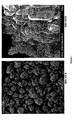
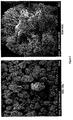
- FIGURES 1-3 The SEM micrographs of the precipitates are shown in FIGURES 1-3 .
- FIGURE 1 In the blank test (without CGM), shown in FIGURE 1 , oxalate needles incorporated into the trihydrate without distinct oxalate balls were observed with both fine and coarse seeds.
- Comparative Example 1 referring to FIGURE 2 , oxalate balls (up to 200 ⁇ m) co-precipitated with trihydrate were formed.
- Example 6 As shown in FIGURE 3 , clean oxalate balls up to 500 ⁇ m were observed.
- the SEM micrographs also visually show that the oxalate balls formed with Example 6 have less trihydrate trapped in the oxalate balls. This could result in lower alumina losses through the oxalate removal system.
Landscapes
- Chemical & Material Sciences (AREA)
- Organic Chemistry (AREA)
- Life Sciences & Earth Sciences (AREA)
- Geology (AREA)
- Inorganic Chemistry (AREA)
- Organic Low-Molecular-Weight Compounds And Preparation Thereof (AREA)
- Compounds Of Alkaline-Earth Elements, Aluminum Or Rare-Earth Metals (AREA)
Description
- The present invention relates to improved aluminum hydroxide crystal production from the Bayer Process. In particular, the invention relates to compositions and methods for increasing particle size of aluminum hydroxide crystals without an excessive decreased yield.
- Aluminum hydroxide (also known as alumina trihydrate) is used to produce primary aluminum metal using electrolytic reduction processes. Aluminum hydroxide is produced on an industrial scale by a well-established procedure known as the Bayer Process. In this process, the steps involving crystallization and precipitation of solubilized aluminum hydroxide values from process liquors, are critical relative to the economic recovery of aluminum values. Economic recovery is realized by optimization of two commercially significant parameters: yield and average particle size.
- Efforts to increase the yield and particle size of the aluminum hydroxide recovered from Bayer process liquor have failed to provide optimization of a commercially significant product. With the steep rise in energy costs during the past few years, aluminum hydroxide processing operators continue to seek optimal parameters for producing a commercially-acceptable aluminum hydroxide product. Despite efforts to identify chemical additives and methods to reduce the number of undersized alumina particles while maintaining process efficiency, none have been entirely successful in increasing yield and particle size of the alumina recovered in Bayer process liquors. The products of these efforts include filter aids such as coagulants or flocculants optionally containing polyacrylic acids (PAA), crystallization modifiers, and dewatering agents. For example,
U.S. Pat. No. 4,737,352 (hereinafter the '352 patent) assigned to Nalco discloses a method providing a reduced percent of small size crystals and an increase in the yield of coarser aluminum hydroxide crystals by adding a blend of surfactant dispersed in oil to the pregnant liquor during the precipitation phase of the process. - The claims in the patent limited the surfactant to a tall fatty acid. The specification of the '352 patent, however, disclosed the surfactant as any fatty acid having at least a saturated or unsaturated four carbon alkyl backbone optionally containing at least one functional group. Additionally, the specification discloses a functionalized C8 alkyl fatty acid as advantageous; the fatty acid was not claimed and the advantages of this fatty acid is not disclosed or taught by actual or constructive reduction to practice. The specification defines the improved method as treating hot caustic Bayer process green liquor with a surfactant/oil blend. The specification does not teach, describe, or remotely suggest that the length of the carbon chain of the fatty acid is a factor imparting novelty. Two commercial crystal growth modifiers having fatty acid chains of greater than ten carbons were commercialized and are referred to as
Commercial Product 1 and Commercial Product 2 in examples exemplifying the inventive step of teaching fatty acid chain length in improved aluminum hydroxide production. The '352 parent discloses a genus of fatty acids in oil that result in an improved commercial product. The fatty acid composition described herein is directed to a fatty acid species imparting unexpected results from those described in the genus patent. - The limitations of yield and particle size of alumina recovered from Bayer process liquors are also disclosed in
US 6,168,767 (hereinafter the '767 patent) entitled "Production of Alumina" assigned to Ciba Specialty Chemicals Water Treatments Limited. A water-soluble crystallization modifier formulation is disclosed comprising a first composition of a polyalkoxylated non-ionic surfactant and a second composition comprising a surfactant, or a precursor thereof, which is not polyalkoxylated. Ethylene oxide (EO) units are identified as essential components of the formulation in the polyalkoxylated non-ionic surfactant, preferably, ethylene oxide and propylene oxide (PO) units which form an ethylene oxide-propylene oxide block copolymer. The '767 patent discloses a composition which contains "substantially no mineral oil or silicone oil" and emphasizes regularly that the "advantage of the crystallization modifiers ... is that they do not require the presence of oils." (e.g., see column 2, lines 21-25; col. 4, lines 25-35; col. 5, lines 21-33). The cost effectiveness of these components and their acceptance when compared to the surfactant/oil blends used in the majority of crystallization modifier formulations in most Bayer processing plants today remains questionable. - Also affecting the particle size and product yield parameters in alumina recovery is the presence of oxalate in the pregnant liquor. Oxalate is a contaminate that can act as a seed site resulting in too many small hydroxide crystals, thereby lowering average particle size. Further, screening processes intended to remove oxalate impurities also remove alumina, thereby reducing product yield. These phenomena must be considered in any recovery process.
-
US 2,440,378 discloses that the precipitation of gelatinous sodium organic salts during the concentrating of a sodium aluminate solution, produced by digesting with a caustic soda solution an aluminous ore containing organic material, can be inhibited by adding to the solution a small amount of rosin, rosin oil, or tall oil. -
US 5,167,831 discloses that tall oily fatty acids, when combined with certain non-ionic surfactants having an HLB number from 10-14, are superior dewatering agents for Bayer Process alumina trihydrate filter cakes. - Despite efforts to satisfy the demands made by continuous and ongoing development of the Bayer process worldwide, the industry needs for an improved alumina product remain unfulfilled.
- The present invention provides a process as defined in
Claim 1. - The present invention also provides a composition as defined in Claim 17. To satisfy the long-felt but unsolved needs identified above, a method and composition for obtaining aluminum hydroxide crystals with increased particle size and yield in the Bayer process have been developed. This result is realized by the addition of emulsified C8-C10 fatty acids, precursors, salts or blends thereof, said fatty acid carbon backbone free of functional groups. Depending on the parameters of the processing system, the C8-10 crystallization modifier is dissolved in an oil carrier before being emulsified in water.
- Thus a composition described and taught herein includes as an active ingredient a surfactant fatty acid, precursor, salt or blends thereof having an alkyl chain length of C8 to C10 saturated or unsaturated, branched or unbranched carbon atoms, said carbon atoms free of functional groups dissolved in an oil carrier having the boiling point above the temperature prevailing alumina hydrate crystallization. This fatty acid/oil blend is emulsified and then dosed in the Bayer process liquor according to the method described herein.
- A second composition described and taught includes as an active ingredient a surfactant fatty acid, precursor, salt or blends thereof having an alkyl chain length of C8 to C10 saturated or unsaturated, branched or unbranched carbon atoms, said carbon atoms free of functional groups. This fatty acid is emulsified and dosed into the liquor according to the method described herein. The appropriate crystallization modifier composition is incorporated into the method in an amount effective to shift in the particle size distribution of aluminum hydroxide crystals so that the resulting crystals have a reduced formation of product fines without substantial reduction in the overall product yield of aluminum hydroxide.
-
-
FIGURE 1 is a pair of scanning electron microscope (SEM) micrographs taken at 100x and 5000x, respectively, of aluminum crystals from a blank test produced without a crystallization modifier. -
FIGURE 2 is a pair of SEM micrographs taken at 100x and 500x, respectively, of aluminum crystals from a test using 12 mg/m2 of a commercial modifier. -
FIGURE 3 is a pair of SEM micrographs taken at 100x and 500x, respectively, of aluminum crystals from a test using 12 mg/m2 of a C8-10 fatty acid modifier of the present invention. - The following are definitions which apply to the relevant terms as used throughout this specification.
- About: This term is used to modify a numeric value and should be interpreted as a value which is equal to or within 2 integers of the specified number.
-
Commercial Product 1 and Commercial Product 2: Describes commercialized crystal growth modifiers (CGM) having fatty acid chains of greater than ten carbons as identified and used in the examples of the '352 patent referenced above. - Crystallization modifier composition: The list, description and designated proportions of raw materials used to make the said additive comprising a C8-10 fatty acid.
- Fatty acid having an alkyl chain length of C 8 -C 10 carbon atoms: Describes the product C-810L available from Proctor and Gamble. It is a nearly colorless, clear liquid with a slight yellow tint. It has an average molecular weight of 154 g/mol and an approximate composition of the following fatty acid chain lengths: C6 < 6%, C8 53 - 60%, C10 34 - 42% and C12 < 2%. The carbon chain may be saturated or unsaturated, branched or unbranched and is free of functional groups. Many other commercial fatty acid products are known to those skilled in the art and would work suitably for the present invention.
- Oil carrier: Comprises a hydrophobic liquid that can be selected from the aliphatic or aromatic compounds such as paraffinic oils, naphthenic oils, or fuel oils. Suitable is also the oil carrier comprised of the bottoms or residual waste materials remaining from the production of alkyl alcohols. Such materials are generally comprised of a mixture of hydroformylation reactants (olefins), finished products (alcohols), and the ethers and ester by-products. The materials suitable as an oil carrier can be used neat or in a mixture of any proportion.
- Heavy oxo fraction (HOF): Is a useful solvent for the present invention. HOF is primarily comprised of residual waste materials remaining from the production of alkyl alcohols. High boiling alkyl alcohol bottom products are included in this category and contain a mixture of hydroformylation reactants (olefins), finished products (alcohols), as well as ethers and ester by-products.
- Weight percent ratio: The total weight fraction of one reagent within 100 grams of the composition or mixture. The corresponding fraction of the other component is the latter subtracted from 100.
- Free of functional group attachments: Any alkyl chain of any length with hydrogen and carbon being the only atoms comprising that chain.
- Heated Bayer process liquor: Any liquor within the Bayer process having a free alkalinity level above 100 g/L of Na2CO3 and a temperature above ambient or 25°C.
- Spent Liquor: Describes the Bayer liquor after the final classification stage which returns back to digestion in the Bayer process.
- Percent (%) increase over control quantile particle size: The particle size distribution is conventionally given by the three quantiles, d(0.1), d(0.5) and d(0.9). Thus, 10%, 50% and 90%, respectively, of the total particle volume (or mass) is less than the size given in the tables. The percent (%) increase over the control quantile particle size is the difference between the additive dosed and control for the respective quantile particle size divided by the control quantile particle size.
- Effective amount: An effective amount is deemed any dosage of any additive that affords an increase in one or all three quantiles when compared to an undosed control sample.
- Increased product yield: Describes when a greater aluminum hydroxide solid content within the precipitating vessel at the end of the precipitation run is achieved. This is generally indicated by a lower liquor aluminum hydroxide concentration for the corresponding vessel.
- The examples employ a pregnant liquor (charge) for aluminum hydroxide precipitation, which is the hot caustic solution obtained after elimination of the red mud in the Bayer process. An understanding of the entire Bayer Process is unnecessary to understanding the inventive concept: a C8-C10 fatty acid in the presence or absence of oil carrier, emulsified in water. The green liquor, after red mud separation, is a hot, caustic filtrate, the commercial production green liquor containing the aluminum values as dissolved sodium aluminate. This liquor and recirculated fine particle alumina trihydrate seeds are charged into a suitable precipitating tank or a series of connecting tanks. Here, the charge is cooled under agitation to stress the contents, causing precipitation of aluminum hydroxide crystals on the seeds, which constitute growth sites.
- Complete elimination of the fine particle material (e.g. -325 mesh or smaller) is not wanted. There needs to be a remnant source of seeds, following precipitation, for recirculation to serve the next generation of repeated growth in a continuous process.
- In brief, the precipitation process involves nucleation followed by (a) initial crystal growth and (b) agglomeration of those crystals into a coarse or sand-like aluminum hydroxide particle which will later be dried, and often calcined to obtain Al2O3 as the commercial product of value.
- An exemplified C8-C10 fatty acid is the product C-810L available from Proctor and Gamble at a concentration of 150 g/L dispersed in a commercially available paraffinic hydrocarbon oil, ESCAID 110. As described in
U.S. Patent No. 4,737,352 assigned to Nalco, wherein generic tall oil fatty acid/oil formulations were first described, the invention in practice is unaffected by different proprietary precipitation techniques involving proprietary process parameters. This is of great significance because it establishes that regardless of the proprietary processing parameters maintained inside the precipitating tank, the present invention for actual practice only requires blending and in-line injection of an emulsion which composes the treatment. The constituents of the emulsion are (A) a C8-C10 fatty acid together with (B) an oil carrier for the fatty acid, and (C) as much as 85% water, by weight. The oil need only be a solvent for the surfactant and have a boiling point safely above the temperature of the hot Bayer green liquor undergoing precipitation. Advantageously, the fatty acid may contain at least an eight carbon backbone free of any functional groups usually modifying such compounds. - Since the C8-C10 are oil soluble, the only limitation on which oil to choose is one with a boiling point above about 200° F. The oil carrier may be one selected from the paraffinic series, it may be an aromatic oil (e.g. naphthenic oil) or it may be any mixture of these. For example, an emulsion of C8-C10 unmodified fatty acid in a low aromatic or paraffinic oil as the oil carrier, in the weight proportion of about 15:85, emulsified in water and having a dosage of from about 1 to about 50 ppm.
- The test performed examples below demonstrate the improved commercial product obtained by employing the methods and compositions taught and described. The standard pretreatments, comparative pretreatments and testing used in the assessment of the efficacy of the C8-10 fatty acid are as follows:
- All precipitation tests were performed in 250-mL Nalgene® bottles rotated end-over-end, at 10 rpm, in an Intronics temperature-controlled water bath. The pregnant liquor having a density of 1.30 kg/L (∼72°C) was placed into the bottles by weight (200 mL = 260.0 g), for improved precision. The additive was dosed, with respect to the total surface area of the seed crystals (mg/m2), to the lid of the appropriate bottles using a micro-syringe and the bottles were then placed in the rotating bath for equilibration at 72°C (20 minutes). After equilibration, the bottles were removed, quickly charged with the required quantity of seed (50 g/L, based on liquor volume) and immediately returned to the water bath. The temperature of the water bath was set to 72°C. The bottles were rotated overnight for 15 hours.
- On completion of the 15 hours, the bottles were removed and for each bottle a 20-mL sample of the slurry was filtered through a syringe filter and submitted for liquor analysis. To prevent any further precipitation, 10 mL of a sodium gluconate solution (400 g/L) was added to the remaining slurry and mixed well. The solids were collected by vacuum filtration and were thoroughly washed with hot deionized water and dried at 110°C. The particle size distribution and specific surface area were determined on a Malvern Particle Sizer, which is well known in the art. The particle size distribution is conventionally given by three quantiles, d(0.1), d(0.5) and d(0.9). These represent the particle size at which the total particle volume (or mass) is less than about 10%, 50% and 90% respectively.
- Samples were evaluated first (TABLE 1) by comparing (1) an undosed control sample; (2) samples dosed with a hydrocarbon solution CGM as Comparative Example 1; and (3) samples dosed with the water-based C8-10/oil carrier blend of Example 2. Samples were then evaluated (TABLE 2) by comparing (1) an undosed control sample; (2) a Commercial Product CGM; and (3) samples dosed with the water-based C8-10/oil blend of Examples 3-5.
- The results below compare the CGM products of the present invention prepared as hydrocarbon solutions and water emulsions.
- The suitable CGM products can be prepared as water-in-oil or oil-in-water emulsions. However, CGM formulations prepared as microemulsions are preferred.
- Microemulsions are significantly different in structure from regular emulsions. Emulsions are comprised of separate oil droplets in water or water droplets in oil with a sharp transition between the two phases. Microemulsions have a particle size in the range from 10 to 600 nm, so that they appear as clear or opalescent one-phase formulations.
- Unlike regular emulsions, microemulsions are thermodynamically stable. This means that microemulsions form spontaneously when the components are brought together and stay stable as long as the components are intact. Thus, their manufacturing may be reduced to simple kneading without the need for expensive high energy mixing. Also, microemulsions are not prone to separation or settling, which results in their long storage stability. Only gentle mixing is required to restore microemulsions upon their freezing or high temperature exposure. The examples and results are provided below.
-
- 15% C8-10 fatty acid blend available from Proctor and Gamble Chemicals under the tradename C-810L, and
- 85% paraffinic oil (dearomatized aliphatic fluid) available from Exxon Mobil Corporation under the tradename Escaid 110.
-
- 15% C8-10 fatty acid blend available from Proctor and Gamble Chemicals under the tradename C-810L,
- 30% paraffinic oil (dearomatized aliphatic fluid) available from Exxon Mobil Corporation under the tradename Escaid 110,
- 5% ethoxylated C10-16 alcohol emulsifier, and
- 45% water.
-
- 15% C8-10 fatty acid blend available from Proctor and Gamble Chemicals under the tradename C-810L,
- 30% C10 alcohol distillation residue available from Nalco Company under the tradename NALCO 99DA 115,
- 15% ethoxylated propoxylated C14-C18 alcohol emulsifier available from Nalco Company under the tradename NALCO 60096,
- 20% pH adjuster (50% potassium hydroxide) available from Nalco (R-192), and
- 20% water.
-
- 15% C8-10 fatty acid blend available from Proctor and Gamble Chemicals under the tradename C-810L,
- 20% C10 alcohol distillation residue available from Nalco Company under the tradename NALCO 99DA115;
- 25% ethoxylated propoxylated C14-C18 alcohol emulsifier available from Nalco Company under the tradename NALCO 60096,
- 18% pH adjuster (50% potassium hydroxide) available from Nalco (R-192), and
- 22% water.
-
- 15% C8-10 fatty acid blend available from Proctor and Gamble Chemicals under the tradename C-810L,
- 45% ethoxylated propoxylated C14-C18 alcohol emulsifier available from Nalco Company under the tradename NALCO 60096,
- 10% pH adjuster (50% potassium hydroxide) available from Nalco (R-192), and
- 30% water.
- As shown in Table 1, the emulsion Example 2 has a coarsening effect similar to that of the hydrocarbon Example 1.
Table 1: Effect of C8-10 Fatty Acid Products on Particle Size of Bayer Aluminum Hydroxide at 72° C. Comparison of Hydrocarbon Solutions and Water Emulsions. Example Dose (mg/m2) Quantile Particle Size, µm % Increase in Mean of Control Quantile Particle Size d(0.1) d(0.5) d(0.9) d(0.1) d(0.5) d(0.9) Control 1 - 43 70 111 Control 2 - 44 70 112 Average - 43 70 112 Comp. Example 1 3 47 75 119 Comp. Example 1 3 48 76 120 Average 3 47 76 120 8 8 7 Example 2 3 46 75 119 Example 2 3 47 75 120 Average 3 47 75. 120 8 7 7 - The results show that the C8-10 emulsion product is as effective a CGM as the C8-10 hydrocarbon solution product at a dosage of 3 mg/m2, with increasing particle size at all three quantiles.
- Table 2 below shows that the emulsion Examples 3 and 4 have a coarsening effect on particle size similar to that of an existing Commercial Product at various dosages.
Table 2: Effect of C8-10 Fatty Acid Emulsion Products on Particle Size of Bayer Aluminum Hydroxide at 72°C at Different Dosing Levels. Results Compared to Existing Commercial Product. Example Dose (mg/m2) Quantile Particle Size, □m % Increase Over Control Quantile Particle Size d(0.1) d(0.5) d(0.9) d(0.1) D(0.5) d(0.9) Control 1 - 40.8 65.3 103.9 Control 2 - 41.3 66.2 105.1 Average 41.1 65.8 104.5 Commercial Product 1 42.8 68.6 108.0 4 4 3 Commercial Product 3 44.2 70.2 111.0 8 7 6 Commercial Product 5 45.3 71.8 113.3 10 9 8 Example 3 1 42.9 68.4 108.6 4 4 3 Example 3 3 44.2 70.1 110.7 8 7 6 Example 3 5 45.1 71.9 113.3 10 9 8 Example 4 1 43.1 68.6 109.2 5 5 4 Example 4 3 44.9 71.4 111.5 9 8 7 Example 4 5 45.9 72.5 114.4 12 10 9 Example 5 1 43.2 68.8 108.6 5 5 4 Example 5 3 45.4 72.0 112.7 10 9 8 Example 5 5 46.4 75.6 116.0 13 12 11 - The results show that the C8-10 emulsion of Example 3 was as effective at the three dosages in increasing particle size as the Commercial Product. Examples 4 and 5 were more effective than the Commercial Product in increasing particle size at all three dosage levels for each quantile.
- The next tests were conducted to support the contention that among a series of linear fatty acids, the optimal CGM performance is achieved in the C8-C10 range of chain lengths.
- Fatty acids of >98∼99% purity including butanoic (C4), hexanoic (C6), octanoic (C8), decanoic (C10), tetradecanoic (C14) and octadecanonic (C18) were purchased from Aldrich (www.aldrich.com). The Escaid 110 aliphatic solvent was used as the oil carrier. Alumina trihydrate C31 (from Alcoa, BET specific surface area of 0.38m2/g) was used as seed for precipitation. Spent liquor from a North American alumina facility and Alcoa C31 were used for the preparation of the pregnant liquor. Sodium gluconate (97% pure) was used for stopping the further crystal growth upon the bottle test completion.
- The following test parameters were used to simulate the common precipitation conditions in the Bayer process.
- Pregnant liquor: A/C=0.66∼0.70
- Precipitation temperature: 72° C
- Precipitation time: 15 h
- Seed charge: C31 = 50 g/L
- CGM dosage: 3 mg CGM/m2 seed surface (60 ppm in the pregnant liquor)
- The procedure for preparing the Nalgene® bottle samples is identical to that previously discussed, so it will not be repeated here. The results are reported in TABLE 3 below.
- The C4, C6, C8, C10, C14, and C18 fatty acids were prepared each as 15:85 solutions in R-4277 (Escaid 110) hydrocarbon oil and used in the CGM bottle test to determine their coarsening performance.
- The results shown in Table 3 indicate that the acid chain length has a significant impact on the crystal coarsening but only a marginal impact on the yield. With increasing carbon chain length in the fatty acids, the particle size of precipitates increases sharply for C8 and C10 fatty acids and then gradually decreases. This is in-line with the claims of the new patent application. This performance is more clear in the lower particle size range (d0.1). The d(0.1) is closely related to the volume percentage of the particles sized in the range from 0 to 45 µm, (-45 µm fraction), which is the characteristic commonly used in the industry. This is especially critical in the high seed charge refineries that operate their process on the number of the fine particles within the system.
TABLE 3: Effect of the Fatty Acid Chain Length on the Precipitate Granulometry and Yield, Relative to Blank. Chain Dose (mg/m2) Quantile Particle Size, µm % Increase Over Control Quantile Particle Size d(0.1) d(0.5) d(0.9) d(0.1) d(0.5) d(0.9) Control 1 - 42.7 69.3 111.1 Control 2 - 42.9 69.5 111.3 Average 42.8 69.4 111.2 Butanoic (C4) 3 43.1 69.6 111.0 Butanoic (C4) 3 43.0 69.5 111.2 Average 43.0 69.5 111.1 0.5 0.1 0 Hexanoic (C6) 3 43.2 69.9 112.0 Hexanoic (C6) 3 43.3 70.0 112.1 Average 43.2 70.0 112.1 0.9 0.9 0 Caprylic (C8) 3 44.3 71.7 114.6 Caprylic (C8) 3 44.8 72.4 115.7 Average 44.5 72.0 115.2 4.0 3.8 3.6 Decanoic (C10) 3 44.3 74.9 124.8 Decanoic (C10) 3 44.9 74.1 123.3 Average 44.6 74.5 124.1 4.2 7.2 11.6 Myristic (C14) 3 43.4 73.4 122.0 Myristic (C14) 3 43.5 73.6 122.6 Average 43.5 73.5 122.3 1.6 5.9 9.9 Octadecanoic (C18) 3 42.6 71.8 119.1 Octadecanoic (C18) 3 42.7 72.1 120.2 Average 42.6 72.0 119.7 -0.5 3.7 7.6 - Finally, the C8-10 fatty acids were tested for their ability to facilitate formation of oxalate balls in the Bayer liquor. Example 6 was prepared comprising 15% C-810 and 85% HOF and studied against Comparative Example 1, of TABLE 1. Both coarse seed crystals and fine seed crystals were tested with liquor from a North American alumina facility.
- The formation of oxalate balls in the Bayer liquor was very sensitive to the composition of Bayer liquor including organics and inorganics, process additives, precipitation conditions, etc. Therefore, the conditions for the oxalate ball formation were unpredictable, as often encountered in both research labs and commercial operations. To identify the conditions for oxalate ball formation, some diagnostic tests (CGM type, seed type, oxalate spike) were first carried out. From the results shown in TABLE 5, it can be concluded that:
- a. No visible oxalate balls were formed under all the test conditions;
- b. Oxalate precipitation occurs only if oxalate was spiked (to enhance the driving force). About 2 g/l of oxalate were precipitated out when the plant liquor was spiked with 1g/l oxalate;
- c. From the amount of oxalate precipitated, Δ[NaOX] initial-sp, C8-10 fatty acids can slightly stabilize oxalate (∼0.2 g/l), compared with Comparative Example 1; and
- d. There is no noticeable difference in oxalate precipitation among the three types of seeds, coarse seeds, fine seeds and C31 (see TABLE 4).
- Generally, oxalate precipitates as invisible needles, which could be due to either too many oxalate needles precipitated or too little CGM dosed. To facilitate oxalate forming visible balls, oxalate spiked at a reduced level of 0.5 g/l was tested. The results shown in TABLE 6 indicate that:
- a. CGM type greatly impacts oxalate ball formation under test conditions. Larger oxalate balls were formed with the Example 6 CGM and smaller oxalate balls were observed for the Comparative Example 1 while no visible oxalate balls being formed with the control (blank) tests;
- b. Example 6 can stabilize about ∼0.3 g/l oxalate (relative to Comparative Example 1); and
- c. Seed type showed marginal impact on oxalate precipitation and oxalate ball formation.
- To further observe the morphology of the oxalate balls, the precipitates were sent for Scanning Electron Microscope (SEM) analysis. The SEM micrographs of the precipitates are shown in
FIGURES 1-3 . In the blank test (without CGM), shown inFIGURE 1 , oxalate needles incorporated into the trihydrate without distinct oxalate balls were observed with both fine and coarse seeds. With Comparative Example 1, referring toFIGURE 2 , oxalate balls (up to 200µm) co-precipitated with trihydrate were formed. With Example 6, as shown inFIGURE 3 , clean oxalate balls up to 500µm were observed. The SEM micrographs also visually show that the oxalate balls formed with Example 6 have less trihydrate trapped in the oxalate balls. This could result in lower alumina losses through the oxalate removal system.
| Seeds | D(0.1), µm | D(0.5), µm | D(0.9), µm | B.E.T. specific area, m2/g |
| C31 | 4.2 | 33.5 | 79.0 | 0.038 |
| Coarse | 50.3 | 89.0 | 149.8 | 0.0867 |
| Fine | 27.06 | 65.15 | 121.7 | 0.157 |
| Precipitation Conditions | Spent Liquor (SP) | Δ[NaOx]* (Initial-SP), g/L | ||||
| Seed g/L | CGM | [NaOx] Spiked, g/L | Oxalate balls Visible | [NaOx], g/L | ||
| Mg/m2 | ppm | |||||
| C31=50 | Ex. 6=3.0 | 60 | 0 | N | 3.2 | 0 |
| Coarse=150 | Ex. 6=4.6 | 60 | 0 | N | 3.2 | 0 |
| Fine=100 | Ex. 6=3.8 | 60 | 0 | N | 3.3 | -0.1 |
| C31=50 | Ex. 6=3.0 | 60 | 1 | N | 2.2 | 2 |
| Coarse=150 | Ex. 6=4.6 | 60 | 1 | N | 2.3 | 1.9 |
| Fine=100 | Ex. 6=3.8 | 60 | 1 | N | 2.1 | 2.1 |
| Coarse=150 | Comp. Ex. 1=3.0 | 60 | 1 | N | 2.1 | 2.1 |
| Fine=100 | Comp. Ex. 1=3.0 | 60 | 1 | N | 2.1 | 2.1 |
| * [NaOx]Initial=[NaOx]LTP+[NaOx]Spiked |
| Precipitation Conditions | Spent Liquor (SP) | Δ[NaOx]* (Initial-SP), g/L | ||||
| Seed, g/L | CGM | [NaOx] Spiked, g/L | Oxalate balls Visible | [NaOx], g/L | ||
| mg/m2 | ppm | |||||
| C31=50 | Ex. 6=3.0 | 60 | 0.5 | Large balls | 2.3 | 1.4 |
| Coarse=150 | Ex. 6=4.6 | 60 | 0.5 | Large balls | 2.4 | 1.3 |
| Fine=100 | Ex. 6=3.8 | 60 | 0.5 | Large balls | 2.5 | 1.2 |
| C31=50 | Comp. Ex. 1=3.0 | 60 | 0.5 | Small balls | 2.1 | 1.6 |
| Coarse=150 | Comp. Ex. 1=4.6 | 60 | 0.5 | Small balls | 2.0 | 1.7 |
| Fine=100 | Comp. Ex. 1=3.8 | 60 | 0.5 | Small balls | 2.2 | 1.5 |
| Coarse=150 | Blank | 0 | 0.5 | None | 2.2 | 1.5 |
| Fine=100 | Blank | 0 | 0.5 | None | 2.1 | 1.6 |
| * [NaOx]Initial=[NaOx]LTP+[NaOx]Spiked |
Claims (17)
- A process for recovering aluminum hydroxide crystals from a pregnant Bayer process liquor comprising the steps of:preparing a crystallization modifier comprising:a C8 to C10 fatty acid, precursor, salt or blends thereof, the fatty acid carbon backbone being free of functional groups, andwater,emulsifying the crystallization modifier, andadding the emulsified crystallization modifier to the liquor.
- The process of claim 1, wherein the modifier further comprises an emulsifier.
- The process of claim 2, wherein the modifier further comprises a pH-adjuster.
- The process of claim 1, wherein the crystallization modifier further comprises an oil carrier having a boiling point above the temperature prevailing alumina hydrate crystallization.
- The process of claim 4, wherein the ratio of oil carrier to emulsifier is not greater than 2.
- The process of claim 2, wherein the emulsifier is present in an amount within the range of greater than 0% to 50% by weight.
- The process of claim 1, wherein the water content of the modifier is in the range of greater than 0% to 85% by weight.
- The process of claim 1, wherein the water content of the modifier is in the range of from 38% to 68% by weight.
- The process of claim 2, wherein the emulsifier comprises a non-ionic surfactant.
- The process pf claim 9, wherein the non-ionic surfactant comprises an ethoxylated propoxylated C4-18 alcohol having a molecular weight of 1000.
- The process of claim 4, wherein the oil carrier content of the modifier is in the range of from 60% to 99% by weight.
- The process of claim 4, wherein the boiling point is above 93.3 °C (200 °F).
- The process of claim 1, wherein the crystallization modifier further comprises a pH-adjuster.
- The process of claim 1, further comprising the steps of:adding the crystallization modifier to the liquor in an amount sufficient to effectively and simultaneously precipitate oxalate balls from the liquor, andremoving the oxalate balls, wherein the oxalate balls are substantially free of aluminum hydroxide crystals.
- The process of claim 14, wherein oxalate balls precipitate to a size in the range of from 200 to 700 µm.
- The process of claim 14, wherein the oxalate balls precipitate to a size greater than 300 µm.
- An emulsified crystallization modifier for use in recovering aluminum hydroxide crystals from a pregnant Bayer process liquor, the modifier comprising:(a) a surfactant fatty acid, precursor, salt or blends thereof, said fatty acid having an alkyl chain length of C8 to C10 carbon atoms free of functional groups;(b) water in an amount within a range of from greater than 0% to 85% by weight; and(c) an oil carrier having a boiling point above the temperature prevailing alumina hydrate crystallization.
Applications Claiming Priority (2)
| Application Number | Priority Date | Filing Date | Title |
|---|---|---|---|
| US11/434,490 US7976820B2 (en) | 2005-06-23 | 2006-05-15 | Composition and method for improved aluminum hydroxide production |
| PCT/US2007/068848 WO2007134276A2 (en) | 2006-05-15 | 2007-05-14 | Composition and method for improved aluminum hydroxide production |
Publications (3)
| Publication Number | Publication Date |
|---|---|
| EP2018350A2 EP2018350A2 (en) | 2009-01-28 |
| EP2018350A4 EP2018350A4 (en) | 2012-03-28 |
| EP2018350B1 true EP2018350B1 (en) | 2015-04-15 |
Family
ID=38694759
Family Applications (1)
| Application Number | Title | Priority Date | Filing Date |
|---|---|---|---|
| EP07783709.4A Active EP2018350B1 (en) | 2006-05-15 | 2007-05-14 | Composition and method for improved aluminum hydroxide production |
Country Status (7)
| Country | Link |
|---|---|
| US (1) | US7976820B2 (en) |
| EP (1) | EP2018350B1 (en) |
| CN (1) | CN101443274B (en) |
| AU (1) | AU2007249266B2 (en) |
| BR (1) | BRPI0711025B1 (en) |
| EA (1) | EA015656B1 (en) |
| WO (1) | WO2007134276A2 (en) |
Families Citing this family (12)
| Publication number | Priority date | Publication date | Assignee | Title |
|---|---|---|---|---|
| US7976821B2 (en) * | 2005-06-23 | 2011-07-12 | Nalco Company | Composition and method for improved aluminum hydroxide production |
| US8282689B2 (en) * | 2009-07-01 | 2012-10-09 | Nalco Company | Composition and method for enhancing the production of crystal agglomerates from a precipitation liquor |
| US8926939B2 (en) * | 2013-03-13 | 2015-01-06 | Ecolab Usa Inc. | Neopolyols suitable for crystal growth modification in the Bayer process |
| US8920768B2 (en) * | 2013-03-14 | 2014-12-30 | Ecolab Usa Inc. | Crystallization aids for bayer aluminum hydroxide |
| US9592456B2 (en) | 2015-02-11 | 2017-03-14 | Ecolab Usa Inc. | Methods for enhancing production of aluminum hydroxide in an aluminum hydroxide production process |
| AU2016229798B2 (en) | 2015-03-11 | 2019-01-24 | Cytec Industries Inc. | Oil-free crystal growth modifiers for alumina recovery |
| US10427950B2 (en) | 2015-12-04 | 2019-10-01 | Ecolab Usa Inc. | Recovery of mining processing product using boronic acid-containing polymers |
| CA3036178A1 (en) * | 2016-09-09 | 2018-03-15 | Cytec Industries Inc. | Oil-free crystal growth modifiers for the bayer process |
| US12006225B2 (en) | 2018-02-23 | 2024-06-11 | Rio Tinto Alcan International Limited | Bayer process |
| CN109292804A (en) * | 2018-12-03 | 2019-02-01 | 广西华银铝业有限公司 | A kind of minimizing technology of alumina producing Oxalate |
| AU2022220705A1 (en) | 2021-02-12 | 2023-08-17 | Ecolab Usa Inc. | Purification of bauxite ores using boronic acid-functional compounds |
| CN113461041B (en) * | 2021-08-03 | 2022-10-14 | 内蒙古鑫旺再生资源有限公司 | Method for removing oxalate from sodium aluminate solution |
Family Cites Families (12)
| Publication number | Priority date | Publication date | Assignee | Title |
|---|---|---|---|---|
| US2440378A (en) * | 1946-09-13 | 1948-04-27 | Aluminum Co Of America | Treatment of sodium aluminate solutions |
| US4608237A (en) | 1985-04-24 | 1986-08-26 | Nalco Chemical Company | Use of polymers in alumina precipitation in the Bayer process of bauxite beneficiation |
| US4737352A (en) | 1987-04-09 | 1988-04-12 | Nalco Chemical Company | Use of surfactants in alumina precipitation in the bayer process |
| US5106599A (en) | 1990-02-06 | 1992-04-21 | Nalco Chemical Company | Alumina crystal growth additive |
| DE4039053A1 (en) | 1990-12-07 | 1992-06-11 | Henkel Kgaa | POLYGLYCERINE IN THE BAYER PROCESS |
| US5167831A (en) | 1991-06-20 | 1992-12-01 | Nalco Chemical Company | Non-ionic surfactants plus fatty-acids as dewatering aids for alumina trihydrate |
| DE69308777T2 (en) | 1992-12-14 | 1997-07-31 | Nalco Chemical Co | Change of trihydrate crystals in the Bayer process |
| US5607598A (en) | 1995-07-14 | 1997-03-04 | Ormet Corporation | Treatment and disposal of red mud generated in the Bayer Process |
| US6293973B1 (en) | 1996-10-11 | 2001-09-25 | Nalco Chemical Company | Method of controlling oxalate precipitation in bayer process liquor |
| GB9800855D0 (en) | 1998-01-15 | 1998-03-11 | Allied Colloids Ltd | Production of alumina |
| US6217622B1 (en) | 1998-10-22 | 2001-04-17 | Alcan International Limited | Method and apparatus for precipitating and classifying solids in high concentrations |
| US7138472B2 (en) | 2001-01-29 | 2006-11-21 | Nalco Company | High molecular weight polymers containing pendant salicylic acid groups for clarifying bayer process liquors |
-
2006
- 2006-05-15 US US11/434,490 patent/US7976820B2/en not_active Expired - Fee Related
-
2007
- 2007-05-14 AU AU2007249266A patent/AU2007249266B2/en not_active Ceased
- 2007-05-14 EA EA200802294A patent/EA015656B1/en not_active IP Right Cessation
- 2007-05-14 CN CN2007800175199A patent/CN101443274B/en active Active
- 2007-05-14 EP EP07783709.4A patent/EP2018350B1/en active Active
- 2007-05-14 BR BRPI0711025-1A patent/BRPI0711025B1/en active IP Right Grant
- 2007-05-14 WO PCT/US2007/068848 patent/WO2007134276A2/en not_active Ceased
Also Published As
| Publication number | Publication date |
|---|---|
| US20070081932A1 (en) | 2007-04-12 |
| EA015656B1 (en) | 2011-10-31 |
| WO2007134276A2 (en) | 2007-11-22 |
| AU2007249266A1 (en) | 2007-11-22 |
| EP2018350A2 (en) | 2009-01-28 |
| BRPI0711025A2 (en) | 2011-05-31 |
| EA200802294A1 (en) | 2009-06-30 |
| BRPI0711025B1 (en) | 2020-11-17 |
| US7976820B2 (en) | 2011-07-12 |
| AU2007249266B2 (en) | 2012-05-10 |
| CN101443274A (en) | 2009-05-27 |
| WO2007134276A3 (en) | 2008-05-08 |
| CN101443274B (en) | 2013-05-01 |
| EP2018350A4 (en) | 2012-03-28 |
Similar Documents
| Publication | Publication Date | Title |
|---|---|---|
| AU2007249266B2 (en) | Composition and method for improved aluminum hydroxide production | |
| AU2007334021B2 (en) | Composition and method for improved aluminum hydroxide production | |
| EP0286034B1 (en) | Use of surfactants in alumina precipitation in the bayer process | |
| AU2007339867B2 (en) | Method for improved aluminum hydroxide production | |
| US8784509B2 (en) | Composition for enhancing the production of crystal agglomerates from a precipitation liquor | |
| EP1893532B1 (en) | Composition and method for improved aluminum hydroxide production | |
| EP3268313B1 (en) | Oil-free crystal growth modifiers for alumina recovery |
Legal Events
| Date | Code | Title | Description |
|---|---|---|---|
| PUAI | Public reference made under article 153(3) epc to a published international application that has entered the european phase |
Free format text: ORIGINAL CODE: 0009012 |
|
| 17P | Request for examination filed |
Effective date: 20081104 |
|
| AK | Designated contracting states |
Kind code of ref document: A2 Designated state(s): AT BE BG CH CY CZ DE DK EE ES FI FR GB GR HU IE IS IT LI LT LU LV MC MT NL PL PT RO SE SI SK TR |
|
| AX | Request for extension of the european patent |
Extension state: AL BA HR MK RS |
|
| A4 | Supplementary search report drawn up and despatched |
Effective date: 20120227 |
|
| RIC1 | Information provided on ipc code assigned before grant |
Ipc: C01F 7/04 20060101ALI20120221BHEP Ipc: C01F 7/14 20060101ALI20120221BHEP Ipc: C01F 7/02 20060101AFI20120221BHEP |
|
| RAX | Requested extension states of the european patent have changed |
Extension state: RS Payment date: 20081104 |
|
| 17Q | First examination report despatched |
Effective date: 20140207 |
|
| RIC1 | Information provided on ipc code assigned before grant |
Ipc: C01F 7/14 20060101ALI20140204BHEP Ipc: C01F 7/04 20060101ALI20140204BHEP Ipc: C01F 7/02 20060101AFI20140204BHEP |
|
| GRAP | Despatch of communication of intention to grant a patent |
Free format text: ORIGINAL CODE: EPIDOSNIGR1 |
|
| INTG | Intention to grant announced |
Effective date: 20141106 |
|
| GRAS | Grant fee paid |
Free format text: ORIGINAL CODE: EPIDOSNIGR3 |
|
| GRAA | (expected) grant |
Free format text: ORIGINAL CODE: 0009210 |
|
| AK | Designated contracting states |
Kind code of ref document: B1 Designated state(s): AT BE BG CH CY CZ DE DK EE ES FI FR GB GR HU IE IS IT LI LT LU LV MC MT NL PL PT RO SE SI SK TR |
|
| AX | Request for extension of the european patent |
Extension state: RS |
|
| REG | Reference to a national code |
Ref country code: GB Ref legal event code: FG4D Ref country code: CH Ref legal event code: EP |
|
| REG | Reference to a national code |
Ref country code: IE Ref legal event code: FG4D |
|
| REG | Reference to a national code |
Ref country code: FR Ref legal event code: PLFP Year of fee payment: 9 |
|
| REG | Reference to a national code |
Ref country code: AT Ref legal event code: REF Ref document number: 721850 Country of ref document: AT Kind code of ref document: T Effective date: 20150515 |
|
| REG | Reference to a national code |
Ref country code: DE Ref legal event code: R096 Ref document number: 602007041071 Country of ref document: DE Effective date: 20150528 |
|
| REG | Reference to a national code |
Ref country code: NL Ref legal event code: T3 |
|
| PGFP | Annual fee paid to national office [announced via postgrant information from national office to epo] |
Ref country code: ES Payment date: 20150428 Year of fee payment: 9 |
|
| REG | Reference to a national code |
Ref country code: AT Ref legal event code: MK05 Ref document number: 721850 Country of ref document: AT Kind code of ref document: T Effective date: 20150415 |
|
| REG | Reference to a national code |
Ref country code: LT Ref legal event code: MG4D |
|
| PG25 | Lapsed in a contracting state [announced via postgrant information from national office to epo] |
Ref country code: PT Free format text: LAPSE BECAUSE OF FAILURE TO SUBMIT A TRANSLATION OF THE DESCRIPTION OR TO PAY THE FEE WITHIN THE PRESCRIBED TIME-LIMIT Effective date: 20150817 Ref country code: LT Free format text: LAPSE BECAUSE OF FAILURE TO SUBMIT A TRANSLATION OF THE DESCRIPTION OR TO PAY THE FEE WITHIN THE PRESCRIBED TIME-LIMIT Effective date: 20150415 Ref country code: ES Free format text: LAPSE BECAUSE OF FAILURE TO SUBMIT A TRANSLATION OF THE DESCRIPTION OR TO PAY THE FEE WITHIN THE PRESCRIBED TIME-LIMIT Effective date: 20150415 Ref country code: FI Free format text: LAPSE BECAUSE OF FAILURE TO SUBMIT A TRANSLATION OF THE DESCRIPTION OR TO PAY THE FEE WITHIN THE PRESCRIBED TIME-LIMIT Effective date: 20150415 |
|
| PG25 | Lapsed in a contracting state [announced via postgrant information from national office to epo] |
Ref country code: LV Free format text: LAPSE BECAUSE OF FAILURE TO SUBMIT A TRANSLATION OF THE DESCRIPTION OR TO PAY THE FEE WITHIN THE PRESCRIBED TIME-LIMIT Effective date: 20150415 Ref country code: IS Free format text: LAPSE BECAUSE OF FAILURE TO SUBMIT A TRANSLATION OF THE DESCRIPTION OR TO PAY THE FEE WITHIN THE PRESCRIBED TIME-LIMIT Effective date: 20150815 Ref country code: AT Free format text: LAPSE BECAUSE OF FAILURE TO SUBMIT A TRANSLATION OF THE DESCRIPTION OR TO PAY THE FEE WITHIN THE PRESCRIBED TIME-LIMIT Effective date: 20150415 Ref country code: GR Free format text: LAPSE BECAUSE OF FAILURE TO SUBMIT A TRANSLATION OF THE DESCRIPTION OR TO PAY THE FEE WITHIN THE PRESCRIBED TIME-LIMIT Effective date: 20150716 |
|
| REG | Reference to a national code |
Ref country code: CH Ref legal event code: PL |
|
| REG | Reference to a national code |
Ref country code: DE Ref legal event code: R097 Ref document number: 602007041071 Country of ref document: DE |
|
| PG25 | Lapsed in a contracting state [announced via postgrant information from national office to epo] |
Ref country code: CH Free format text: LAPSE BECAUSE OF NON-PAYMENT OF DUE FEES Effective date: 20150531 Ref country code: DK Free format text: LAPSE BECAUSE OF FAILURE TO SUBMIT A TRANSLATION OF THE DESCRIPTION OR TO PAY THE FEE WITHIN THE PRESCRIBED TIME-LIMIT Effective date: 20150415 Ref country code: MC Free format text: LAPSE BECAUSE OF FAILURE TO SUBMIT A TRANSLATION OF THE DESCRIPTION OR TO PAY THE FEE WITHIN THE PRESCRIBED TIME-LIMIT Effective date: 20150415 Ref country code: LI Free format text: LAPSE BECAUSE OF NON-PAYMENT OF DUE FEES Effective date: 20150531 Ref country code: IT Free format text: LAPSE BECAUSE OF FAILURE TO SUBMIT A TRANSLATION OF THE DESCRIPTION OR TO PAY THE FEE WITHIN THE PRESCRIBED TIME-LIMIT Effective date: 20150415 Ref country code: EE Free format text: LAPSE BECAUSE OF FAILURE TO SUBMIT A TRANSLATION OF THE DESCRIPTION OR TO PAY THE FEE WITHIN THE PRESCRIBED TIME-LIMIT Effective date: 20150415 |
|
| PLBE | No opposition filed within time limit |
Free format text: ORIGINAL CODE: 0009261 |
|
| STAA | Information on the status of an ep patent application or granted ep patent |
Free format text: STATUS: NO OPPOSITION FILED WITHIN TIME LIMIT |
|
| PG25 | Lapsed in a contracting state [announced via postgrant information from national office to epo] |
Ref country code: SK Free format text: LAPSE BECAUSE OF FAILURE TO SUBMIT A TRANSLATION OF THE DESCRIPTION OR TO PAY THE FEE WITHIN THE PRESCRIBED TIME-LIMIT Effective date: 20150415 Ref country code: RO Free format text: LAPSE BECAUSE OF NON-PAYMENT OF DUE FEES Effective date: 20150415 Ref country code: CZ Free format text: LAPSE BECAUSE OF FAILURE TO SUBMIT A TRANSLATION OF THE DESCRIPTION OR TO PAY THE FEE WITHIN THE PRESCRIBED TIME-LIMIT Effective date: 20150415 Ref country code: PL Free format text: LAPSE BECAUSE OF FAILURE TO SUBMIT A TRANSLATION OF THE DESCRIPTION OR TO PAY THE FEE WITHIN THE PRESCRIBED TIME-LIMIT Effective date: 20150415 |
|
| 26N | No opposition filed |
Effective date: 20160118 |
|
| REG | Reference to a national code |
Ref country code: FR Ref legal event code: PLFP Year of fee payment: 10 |
|
| PG25 | Lapsed in a contracting state [announced via postgrant information from national office to epo] |
Ref country code: SI Free format text: LAPSE BECAUSE OF FAILURE TO SUBMIT A TRANSLATION OF THE DESCRIPTION OR TO PAY THE FEE WITHIN THE PRESCRIBED TIME-LIMIT Effective date: 20150415 |
|
| PG25 | Lapsed in a contracting state [announced via postgrant information from national office to epo] |
Ref country code: BE Free format text: LAPSE BECAUSE OF FAILURE TO SUBMIT A TRANSLATION OF THE DESCRIPTION OR TO PAY THE FEE WITHIN THE PRESCRIBED TIME-LIMIT Effective date: 20150415 |
|
| PG25 | Lapsed in a contracting state [announced via postgrant information from national office to epo] |
Ref country code: MT Free format text: LAPSE BECAUSE OF FAILURE TO SUBMIT A TRANSLATION OF THE DESCRIPTION OR TO PAY THE FEE WITHIN THE PRESCRIBED TIME-LIMIT Effective date: 20150415 |
|
| REG | Reference to a national code |
Ref country code: FR Ref legal event code: PLFP Year of fee payment: 11 |
|
| PG25 | Lapsed in a contracting state [announced via postgrant information from national office to epo] |
Ref country code: BG Free format text: LAPSE BECAUSE OF FAILURE TO SUBMIT A TRANSLATION OF THE DESCRIPTION OR TO PAY THE FEE WITHIN THE PRESCRIBED TIME-LIMIT Effective date: 20150415 Ref country code: HU Free format text: LAPSE BECAUSE OF FAILURE TO SUBMIT A TRANSLATION OF THE DESCRIPTION OR TO PAY THE FEE WITHIN THE PRESCRIBED TIME-LIMIT; INVALID AB INITIO Effective date: 20070514 |
|
| PG25 | Lapsed in a contracting state [announced via postgrant information from national office to epo] |
Ref country code: SE Free format text: LAPSE BECAUSE OF FAILURE TO SUBMIT A TRANSLATION OF THE DESCRIPTION OR TO PAY THE FEE WITHIN THE PRESCRIBED TIME-LIMIT Effective date: 20150415 Ref country code: CY Free format text: LAPSE BECAUSE OF FAILURE TO SUBMIT A TRANSLATION OF THE DESCRIPTION OR TO PAY THE FEE WITHIN THE PRESCRIBED TIME-LIMIT Effective date: 20150415 |
|
| PG25 | Lapsed in a contracting state [announced via postgrant information from national office to epo] |
Ref country code: TR Free format text: LAPSE BECAUSE OF FAILURE TO SUBMIT A TRANSLATION OF THE DESCRIPTION OR TO PAY THE FEE WITHIN THE PRESCRIBED TIME-LIMIT Effective date: 20150415 |
|
| PG25 | Lapsed in a contracting state [announced via postgrant information from national office to epo] |
Ref country code: LU Free format text: LAPSE BECAUSE OF NON-PAYMENT OF DUE FEES Effective date: 20150514 |
|
| REG | Reference to a national code |
Ref country code: FR Ref legal event code: PLFP Year of fee payment: 12 |
|
| PGFP | Annual fee paid to national office [announced via postgrant information from national office to epo] |
Ref country code: GB Payment date: 20260312 Year of fee payment: 20 |
|
| PGFP | Annual fee paid to national office [announced via postgrant information from national office to epo] |
Ref country code: IE Payment date: 20260310 Year of fee payment: 20 |
|
| PGFP | Annual fee paid to national office [announced via postgrant information from national office to epo] |
Ref country code: NL Payment date: 20260317 Year of fee payment: 20 |
|
| PGFP | Annual fee paid to national office [announced via postgrant information from national office to epo] |
Ref country code: FR Payment date: 20260309 Year of fee payment: 20 |
|
| PGFP | Annual fee paid to national office [announced via postgrant information from national office to epo] |
Ref country code: DE Payment date: 20260317 Year of fee payment: 20 |