EP2017964A1 - Packet interleaving method - Google Patents
Packet interleaving method Download PDFInfo
- Publication number
- EP2017964A1 EP2017964A1 EP07290690A EP07290690A EP2017964A1 EP 2017964 A1 EP2017964 A1 EP 2017964A1 EP 07290690 A EP07290690 A EP 07290690A EP 07290690 A EP07290690 A EP 07290690A EP 2017964 A1 EP2017964 A1 EP 2017964A1
- Authority
- EP
- European Patent Office
- Prior art keywords
- packets
- packet
- input
- output
- constellation points
- Prior art date
- Legal status (The legal status is an assumption and is not a legal conclusion. Google has not performed a legal analysis and makes no representation as to the accuracy of the status listed.)
- Withdrawn
Links
Images


Classifications
-
- H—ELECTRICITY
- H03—ELECTRONIC CIRCUITRY
- H03M—CODING; DECODING; CODE CONVERSION IN GENERAL
- H03M13/00—Coding, decoding or code conversion, for error detection or error correction; Coding theory basic assumptions; Coding bounds; Error probability evaluation methods; Channel models; Simulation or testing of codes
- H03M13/27—Coding, decoding or code conversion, for error detection or error correction; Coding theory basic assumptions; Coding bounds; Error probability evaluation methods; Channel models; Simulation or testing of codes using interleaving techniques
-
- H—ELECTRICITY
- H04—ELECTRIC COMMUNICATION TECHNIQUE
- H04L—TRANSMISSION OF DIGITAL INFORMATION, e.g. TELEGRAPHIC COMMUNICATION
- H04L1/00—Arrangements for detecting or preventing errors in the information received
- H04L1/004—Arrangements for detecting or preventing errors in the information received by using forward error control
- H04L1/0056—Systems characterized by the type of code used
- H04L1/0071—Use of interleaving
Definitions
- the present invention relates to a packet interleaving method, intended to be used in a wireless emitting device.
- the output packets are sent to a modulator that generates symbols emitted by an antenna. Each constellation point of the output packet is thus emitted by the antenna in a symbol.
- the invention relates to a packet interleaving method comprising:
- the invention further relates to a computer program product according to claim 10.
- the invention further relates to a packet interleaver according to claim 11.
- a data packet comprises a plurality of ordered elements, and will be represented as a vector.
- the length of a data packet designates the number of elements it contains.
- the elements of the information packets are either bits or bytes.
- each input data packet p k is a MPEG data packet.
- the emitting device 10 is configured for generating, from the input data packets p k , a waveform W that is provided to an antenna 12 for emitting the data.
- the emitting device 10 comprises three stages 14, 16, 18, implemented in the physical layer of the OSI model, through which the flow of data passes.
- the first stage is a forward error correction (FEC) module 14, which outputs FEC data packets X j .
- FEC forward error correction
- the rate of redundant information relative to the initial information data is referred to as the code rate.
- the FEC coder 20 uses for example the Turbo code.
- the FEC module 14 further comprises a bit interleaver 22 configured to mix up the bits, of the extended data packet Cj.
- the FEC module 14 further comprises a constellation mapper 24.
- a FEC data packet is a vector of constellation points of a chosen constellation diagram. The constellation points are usually represented by a complex number.
- the constellation diagram is for instance one of the QAM diagrams: QAM-4, QAM-16, QAM-64, QAM-256, etc.
- the constellation mapper 24 is able to encode each interleaved data packet with a different QAM constellation. The higher the constellation is, the more bits can be encoded in a single constellation point.
- the forward error correction module 14 is parameterized by three parameters, which each affects the quantity of data encoded in the L in constellation points. Those parameters are: the number Nb of input data packet p k , the code rate, and the chosen constellation diagram.
- the wireless data emitting device 10 comprises a controlling means 25 configured for setting parameters such that the forward error correction module 14 only outputs data packets comprising a fixed number L in of constellation points.
- the wireless data emitting device is able to set different FEC parameters for different data packets in a single frame, as it will be explained later.
- the fixed number L in is kept during normal operation of the emitting device.
- the fixed number L in may be changed by reconfiguring the controlling means 25. This is done for instance by the manufacturer.
- the second stage is a packet interleaver 16.
- the packet interleaver 16 is configured for selecting successive input sets of consecutive FEC data packets (X 1 ...X Nin ) received from the forward correction module 14.
- the functions of the packet interleaver 16 are for instance performed by a calculator configured accordingly.
- the packet interleaver 16 For each set, supposing that this set comprises N in consecutive FEC data packets X 1 ... X Nin , the packet interleaver 16 is configured for distributing their constellation points so as to form N out data packets O 1 ...O Nout , which will be called symbols.
- a symbol O m comprises the constellation points that are intended to be emitted by the antenna 12 in a modulation symbol, for instance an OFDM symbol when using OFDM modulation.
- the packet interleaver 16 is configured for segmenting each of the N in FEC data packets X j into N out fragments G j 1 ...G j Nout of a number A of consecutive constellation points.
- the packet interleaver 16 is further configured for forming each symbol (O m ) by, on the one end, choosing one fragment of constellation points in each of the N in data packets and, on the other end, aggregating the N in chosen fragments (G 1 m ... G Nin m ) to form the symbol (O m ).
- the chosen fragments are different for each formed symbol (O m ).
- the constellation points of each data packet is evenly distributed amongst a plurality of N out symbol O m . If a symbol is lost when it is transmitted by the antenna 12, only a part of each input data packet is lost, and the lost data can be retrieved by using the redundant information of the input data packet contained in the other symbols.
- Aggregating the N in chosen groups comprises mixing up the constellation points of each aggregated fragment with the constellation points of the other aggregated fragments, by alternating constellation points of each aggregated fragment, so as to interleave the aggregated fragments.
- the constellation points in a symbol O m are organized into a number A (same A as before) of sequences of N in constellation points, where the j-th element of the sequence comes from the aggregated fragment of the j-th FEC data packet X j .
- the packet interleaver 16 is configured for aggregating the chosen fragments in such a way that the constellation points a same data packet X j are positioned in the symbols O 1 ...O Nout at all the different possible positions. This is obtained in the described embodiment by shifting the position, in the symbols O 1 ...O Nout , of the constellation points coming from a same data packet X j , by a constant shift step B between a symbol O m and the next symbol O m+1 .
- the shifting is made circularly, that is, when the end of the symbol O m is attained, the remaining constellation point are placed at the start of the symbol O m .
- the shifting uses a constant shift step B.
- B is chosen so that B and Lout are co prime (also called relative prime). Two numbers are called co prime if their Greatest Common Divider is one.
- the modulator 18 further comprises a modulation unit 26 configured for receiving each symbol O m and for generating a modulated symbol O' m , taking into account modulation parameters ⁇ .
- the modulation parameters ⁇ are for example a number of pilots, a guard interval, etc.
- the modulator 18 further comprises a waveform generator 28, which generates a waveform from the modulated symbols O' m . More precisely, each constellation point of the symbol O' m modulates a respective carrier during a time T symbol .
- a time frame T frame i.e. the duration of a frame, is chosen.
- the time frame is chosen between 100 and 200 milliseconds.
- a symbol duration T symbol i.e. the time during which the antenna 12 sends a symbol O' m before sending the next one O' m+1 , is chosen.
- T symbol is chosen so that there is a whole number of symbol durations in a frame duration T frame .
- T symbol is chosen between 100 microseconds and 4 milliseconds.
- the number of symbols O' m that are sent in a frame is also deduced. It will be called in the following N symbois/frame . From what precedes, one can see that there is a number N symbols/frame of modulated symbol O' m in a frame. Similarly, there is a number N symbols/frame of symbol O m in a frame.
- the length L max of the modulated symbols O' m is determined as a function of the symbol duration T symbol and the available bandwidth. More precisely, L max is the product of T symbol with the available bandwidth. Basically, it may be considered that the length L max is related to the maximum number of available frequency carriers.
- a step 130 the modulation parameters ⁇ are chosen.
- the length Lout of the symbols O m is determined as a function of the length L max of the modulated symbols O' m and the modulation parameters ⁇ .
- the modulation parameters ⁇ leads to some frequency carriers being not available for transmitting data, because they are used for obtaining a robust transmission (for example, they are used for pilot carriers). This leads to L out being smaller than L max .
- a step 150 the number L in of constellation points in the FEC packets is set, by configuring accordingly the controlling means.
- a whole number P which represents the portion of the N FEC packets/frame FEC packets of a frame that will be interleaved at a time by the packet interleaver 16.
- the wireless data emitting device 10 comprises:
- controlling means 25 is configured for setting parameters such that the forward error correction module 14 only outputs packets comprising the number L in of constellation points.
Landscapes
- Engineering & Computer Science (AREA)
- Physics & Mathematics (AREA)
- Probability & Statistics with Applications (AREA)
- Theoretical Computer Science (AREA)
- Computer Networks & Wireless Communication (AREA)
- Signal Processing (AREA)
- Detection And Prevention Of Errors In Transmission (AREA)
- Error Detection And Correction (AREA)
Abstract
Description
- The present invention relates to a packet interleaving method, intended to be used in a wireless emitting device.
- It is known to interleave packets by:
- selecting successive input sets of consecutive input packets received from a forward correction module, each input packet being a vector of constellation points of a predetermined constellation diagram, and
- for each input set, generating an output set of output packets, each output packet being a vector of constellation points, from the input packets.
- The output packets are sent to a modulator that generates symbols emitted by an antenna. Each constellation point of the output packet is thus emitted by the antenna in a symbol.
- Several functions are known in the art, for performing the interleaving operation. However, they all have the same drawback of being dedicated to a predetermined set of modulation parameters (e.g. number of pilot carriers, guard interval, etc.).
- When the modulation parameters of the modulator are changed, these functions are not able to correctly interleave the constellation points of the input packets between the output packets.
- It is an object of the invention to provide a packet interleaving method that is able properly interleave the input packets, even when the modulation parameters of the modulator are changed.
- Accordingly, the invention relates to a packet interleaving method comprising:
- selecting successive input sets of consecutive input packets received from a forward correction module, each input packet being a vector of constellation points of a predetermined constellation diagram,
the packet interleaving method being characterized by, for each input set: - generating an output set of output packets, each output packet being a vector of constellation points, by distributing the constellation points of each input packet of the input set between the output packets of the output set,
- sending the output packets of the output set to a modulator configured for generating, from the output packets, a waveform, destined to be provided to an antenna,
- the input set comprising Nin input packets and each of the Nin input packets comprising a same number Lin of constellation points, the number Nout of output packets in the output set is related to Lin by the relation Lin = A x Nout, where A is a fixed whole number.
- Other features of the invention are introduced in the dependent claims.
- The invention further relates to a computer program product according to claim 10.
- The invention further relates to a packet interleaver according to claim 11.
- The invention will be explained in more detail hereafter, with reference to the drawings, wherein:
-
figure 1 is a bloc diagram of a wireless data emitting device according to an embodiment of the invention, -
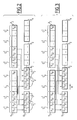
figures 2 and 3 are representations of data packets, illustrating the operation of a frame mapper of the wireless data emitting device offigure 1 , and -
figure 4 is a bloc diagram representing the steps of a method for setting up an emitting device. - Functional elements of a wireless data emitting device 10 are illustrated on
figure 1 . Of course, several physical implementations may be designed, which achieve the functions of the functional elements illustrated onfigure 1 , without departing from the scope of the invention. - In the following description, data is organized in data packets. A data packet comprises a plurality of ordered elements, and will be represented as a vector. The length of a data packet designates the number of elements it contains.
- The emitting device 10 is configured for receiving a flow of data constituted as a sequence of information packets pk = [p1...pK]. The elements of the information packets are either bits or bytes. In the described example, each input data packet pk is a MPEG data packet.
- The emitting device 10 is configured for generating, from the input data packets pk, a waveform W that is provided to an antenna 12 for emitting the data.
- The emitting device 10 comprises three
stages - The first stage is a forward error correction (FEC)
module 14, which outputs FEC data packets Xj. - More precisely, the
FEC module 14 first comprises aconcatenation module 19 configured for taking a number Nb of one or several information packets pk, and regrouping them into a large data packet Pj = [P1,j... PN,j]. - Considering one large data packet Pj, the
FEC module 14 comprises aFEC coder 20 configured for generating a coded data packet Cj = [C1,j...CM,j], which contains the initial information plus redundant information. The rate of redundant information relative to the initial information data is referred to as the code rate. TheFEC coder 20 uses for example the Turbo code. - The
FEC module 14 further comprises abit interleaver 22 configured to mix up the bits, of the extended data packet Cj. Thebit interleaver 22 thus outputs an interleaved data packet C'j = [C'1,j...C'M,j]. - The FEC
module 14 further comprises aconstellation mapper 24. Theconstellation mapper 24 is configured for encoding the interleaved data packet C'j into a FEC data packet Xj = [X1,j...XLin,j]. A FEC data packet is a vector of constellation points of a chosen constellation diagram. The constellation points are usually represented by a complex number. The constellation diagram is for instance one of the QAM diagrams: QAM-4, QAM-16, QAM-64, QAM-256, etc. Theconstellation mapper 24 is able to encode each interleaved data packet with a different QAM constellation. The higher the constellation is, the more bits can be encoded in a single constellation point. - As it can be appreciated, the forward
error correction module 14 is parameterized by three parameters, which each affects the quantity of data encoded in the Lin constellation points. Those parameters are: the number Nb of input data packet pk, the code rate, and the chosen constellation diagram. - In order to control the forward error correction module, the wireless data emitting device 10 comprises a controlling
means 25 configured for setting parameters such that the forwarderror correction module 14 only outputs data packets comprising a fixed number Lin of constellation points. In particular, the wireless data emitting device is able to set different FEC parameters for different data packets in a single frame, as it will be explained later. - Of course this same number Lin is kept during normal operation of the emitting device. The fixed number Lin may be changed by reconfiguring the controlling
means 25. This is done for instance by the manufacturer. - The second stage is a
packet interleaver 16. Thepacket interleaver 16 is configured for selecting successive input sets of consecutive FEC data packets (X1...XNin) received from theforward correction module 14. The functions of thepacket interleaver 16 are for instance performed by a calculator configured accordingly. - For each set, supposing that this set comprises Nin consecutive FEC data packets X1... XNin, the
packet interleaver 16 is configured for distributing their constellation points so as to form Nout data packets O1...ONout, which will be called symbols. As it will be explained later, a symbol Om comprises the constellation points that are intended to be emitted by the antenna 12 in a modulation symbol, for instance an OFDM symbol when using OFDM modulation. - The
packet interleaver 16 is configured so that the number Nout of formed symbols is related to the length Lin of each FEC data packet by the relation: Lin = A x Nout, where A is a fixed whole number (1, 2, 3, etc.). - With reference to
figures 2 and 3 , thepacket interleaver 16 is configured for segmenting each of the Nin FEC data packets Xj into Nout fragments Gj 1...Gj Nout of a number A of consecutive constellation points. Thepacket interleaver 16 is further configured for forming each symbol (Om) by, on the one end, choosing one fragment of constellation points in each of the Nin data packets and, on the other end, aggregating the Nin chosen fragments (G1 m... GNin m) to form the symbol (Om). The chosen fragments are different for each formed symbol (Om). - In this way, the constellation points of each data packet is evenly distributed amongst a plurality of Nout symbol Om. If a symbol is lost when it is transmitted by the antenna 12, only a part of each input data packet is lost, and the lost data can be retrieved by using the redundant information of the input data packet contained in the other symbols.
- Aggregating the Nin chosen groups (G1 m... GNin m) comprises mixing up the constellation points of each aggregated fragment with the constellation points of the other aggregated fragments, by alternating constellation points of each aggregated fragment, so as to interleave the aggregated fragments.
- For instance, the constellation points in a symbol Om are organized into a number A (same A as before) of sequences of Nin constellation points, where the j-th element of the sequence comes from the aggregated fragment of the j-th FEC data packet Xj.
- Preferably, the
packet interleaver 16 is configured for aggregating the chosen fragments in such a way that the constellation points a same data packet Xj are positioned in the symbols O1...ONout at all the different possible positions. This is obtained in the described embodiment by shifting the position, in the symbols O1...ONout, of the constellation points coming from a same data packet Xj, by a constant shift step B between a symbol Om and the next symbol Om+1. - The shifting is made circularly, that is, when the end of the symbol Om is attained, the remaining constellation point are placed at the start of the symbol Om. Preferably, the shifting uses a constant shift step B.
- In a preferred embodiment, the frame mapper (16) is configured for realizing the following operation:

m being the ceil operation of i divided by A,
where : - Xi,j is the i-th constellation point of the j-th FEC data packet (Xj),
- Ok,m is the k-th constellation point of the m-th symbol (Om), and
- ...%... denotes the modulo division, i.e. c = a % b, means that c is the remaining of a / b
- - therefore, c is a value from the set {0, 1, ... , a-1}.
- For instance, m is calculated with the relation: m = | i / A |, where, |...| denotes the ceil operation, i.e. rounding to the nearest superior integer.
- Alternatively, m is calculated with the relation: m = | (i -1) / A | + 1, where, |...| denotes the floor operation, i.e. rounding to the nearest inferior integer.
- So as to insure that the groups of elements are shifted on exactly all the length Lout of the symbols O1...ONout, B is chosen so that B and Lout are co prime (also called relative prime). Two numbers are called co prime if their Greatest Common Divider is one.
- An example of using this relation is shown on
figures 2 and 3 , with Nin = 2, Lin 8, Nout = 4, Lout = 4 and A = Lin/Nout = 2. Infigure 2 , B is set to zero (no shifting), while infigure 3 , B is set to one. - Referring back to
figure 1 , themodulator 18 further comprises amodulation unit 26 configured for receiving each symbol Om and for generating a modulated symbol O'm, taking into account modulation parameters Δ. The modulation parameters Δ are for example a number of pilots, a guard interval, etc. - The
modulator 18 further comprises awaveform generator 28, which generates a waveform from the modulated symbols O'm. More precisely, each constellation point of the symbol O'm modulates a respective carrier during a time Tsymbol. - Referring to
figure 4 , a method for setting up an emitting device, in order to obtain the wireless data emitting device offigure 1 , will now be explained. It would be appreciated that the order of the following steps can be different, without departing from the scope of the present invention, in particular for the steps that do not depend on the completion of a previous step. - In a
step 100, a time frame Tframe, i.e. the duration of a frame, is chosen. Preferably, the time frame is chosen between 100 and 200 milliseconds. - In a
step 110, a symbol duration Tsymbol, i.e. the time during which the antenna 12 sends a symbol O'm before sending the next one O'm+1, is chosen. Tsymbol is chosen so that there is a whole number of symbol durations in a frame duration Tframe. Preferably, Tsymbol is chosen between 100 microseconds and 4 milliseconds. - The number of symbols O'm that are sent in a frame is also deduced. It will be called in the following Nsymbois/frame. From what precedes, one can see that there is a number Nsymbols/frame of modulated symbol O'm in a frame. Similarly, there is a number Nsymbols/frame of symbol Om in a frame.
- In a
step 120, the length Lmax of the modulated symbols O'm is determined as a function of the symbol duration Tsymbol and the available bandwidth. More precisely, Lmax is the product of Tsymbol with the available bandwidth. Basically, it may be considered that the length Lmax is related to the maximum number of available frequency carriers. - In a step 130, the modulation parameters Δ are chosen.
- In a step 140, the length Lout of the symbols Om is determined as a function of the length Lmax of the modulated symbols O'm and the modulation parameters Δ. In fact, the modulation parameters Δ leads to some frequency carriers being not available for transmitting data, because they are used for obtaining a robust transmission (for example, they are used for pilot carriers). This leads to Lout being smaller than Lmax.
- In a step 150, the number Lin of constellation points in the FEC packets is set, by configuring accordingly the controlling means.
- For each frame, the forward
error correction module 14 generates NFEC packets/frame FEC data packets, whose data is to be emitted in the waveform W during the duration of the frame. Since there is no added information in thepacket interleaver 16, NFEC packets/frame is derived, in a step 160, from the relation: NFEC packets/frame = Nsymbols/frame X Lout / Lin. - From the previous relation, it can be seen that the FEC parameters (influencing Lin) and the modulation parameters Δ (influencing Nout) must be chosen such that Nsymbols/frame x Lout / Lin is a whole number.
- In a step 170, it is chosen a whole number P, which represents the portion of the NFEC packets/frame FEC packets of a frame that will be interleaved at a time by the
packet interleaver 16. - Accordingly, Nin is chosen so that Nin = NFEC packets/frame / P, where P is a divisor of NFEC packets/frame, and also of Nsymbols/frame, so that Nout = Nsymbols/frame / P.
- When P = 1, the whole frame is interleaved. On the contrary, when P is greater than 1, only a part of the frame is interleaved at a time. This is advantageous for decreasing the size of the memory needed in a receptor, for performing a "deinterleaving" operation, i.e. the inverse operation of the
packet interleaver 16. - It can be appreciated that it is possible to send different services, requiring a different quality of service and thus different modulation parameters, in a single frame. In fact, when the modulation parameters are changed, Lout changes (cf. step 140), as well as NFEC packets/frame (cf. step 160). However, because of the relation Lin = A x Nout, the
packet interleaver 16 will still give an optimal distribution of the Nin FEC packet between the Nout data symbols. - Moreover, because of the previous relation (Lin = A x Nout) and because Lin is fixed for every FEC data packet, the emitting device 10 always generates the same number Nsymbols/frame = Nout x P of symbols in a frame. A receiver is then able to demodulate efficiently received symbols. In fact, the receiver stays synchronized, because the number of symbols in a frame Nsymbols/frame remains constant. Once again, the receiver will not be affected by the fact that several different services are transmitted in a single frame.
- From the previous description, it can be seen that the wireless data emitting device 10 comprises:
- a forward
error correction module 14 configured for generating input packets Xj from information packets, each input packet Xj comprising Lin constellation points of a predetermined constellation diagram, the Lin constellation points encoding a quantity of data, the forwarderror correction module 14 being parameterized by at least two parameters, which each affects the quantity of data encoded in the Lin constellation points, - a controlling means 25 configured for setting the parameters of the forward
error correction module 14, - a
packet interleaver 16 configured for generating Nout output packets O1...ONout from Nin input packets X1...XNin, each output packet comprising Lout constellation points, thepacket interleaver 16 being configured for distributing the constellation points of each of the Nin packet Xj between the Nout symbols O1...ONout, - a
modulator 18 configured for generating a waveform W, destined to be provided to an antenna 12, from the symbols Om, - In particular, the controlling means 25 is configured for setting parameters such that the forward
error correction module 14 only outputs packets comprising the number Lin of constellation points.
Claims (11)
- A packet interleaving method comprising:- selecting successive input sets of consecutive input packets (X1...XNin) received from a forward correction module (14), each input packet (Xj) being a vector of constellation points of a predetermined constellation diagram, the packet interleaving method being characterized by, for each input set:- generating an output set of output packets (O1...ONout), each output packet (Om) being a vector of constellation points, by distributing the constellation points of each input packet (Xj) of the input set between the output packets (O1...ONout) of the output set,- sending the output packets (O1...ONout) of the output set to a modulator (18) configured for generating, from the output packets (O1...ONout), a waveform (W), destined to be provided to an antenna (12),- the input set comprising Nin input packets (X1...XNin) and each of the Nin input packets (X1...XNin) comprising a same number Lin of constellation points, the number Nout of output packets in the output set is related to Lin by the relation Lin = A x Nout,where A is a fixed whole number.
- The packet interleaving method of claim 1, characterized by, for each input set:- segmenting each of the Nin input packets (X1...XNin) of the input set into Nout fragments (Gj 1...Gj Nout) of A consecutive constellation points,- generating each output packets (Om) of the output set, by:wherein the chosen fragments are different for each formed output packet (Om).+ choosing one fragment of constellation points in each of the Nin input packets (X1...XNin),+ aggregating the chosen fragments (G1 m...GNin m) to form the output packet (Om),
- The packet interleaving method of claim 2, characterized in that, in each output packet (Om), aggregating the chosen fragments (G1 m... GNin m) comprises mixing up the constellation points of each aggregated fragment with the constellation points of the other aggregated fragments.
- The packet interleaving method of claim 3, characterized in that the mixing up of the constellation points in an output packet (Om) comprises alternating constellation points of each aggregated fragment, so as to interleave the aggregated fragments.
- The packet interleaving method of any one of claims 2 to 4, characterized by aggregating the chosen fragments in such a way that the constellation points a same packet (Xj), are positioned in the output packets (O1...ONout) at all the different possible positions.
- The packet interleaving method of claim 5, characterized in that positioning at all the different possible positions comprises shifting the position, in the output packets (O1...ONout), of the constellation points coming from a same packet (Xj), by a constant shift step B between a symbol (Om) and the next symbol (Om+1).
- The packet interleaving method of any one of claims 1 to 6, characterized by realizing the following operation:

m being the ceil operation of i divided by A,
where :Xi,j is the i-th constellation point of the j-th packet (Xj),Ok,m is the k-th constellation point of the m-th symbol (Om), and...%... denotes the modulo division. - The packet interleaving method of any one of claims 1 to 7, characterized in that, the time being divided into frames of constant duration, for each frame the forward error correction module (14) generating NFEC packets/frame input packets, whose is to be emitted in the waveform (W) during the duration of the frame:- selecting successive input sets comprises the NFEC packets/frame input packets.
- The packet interleaving method of any one of claims 1 to 7, characterized in that, the time being divided into frames of constant duration, for each frame the forward error correction module (14) generating NFEC packets/frame input packets, whose is to be emitted in the waveform (W) during the duration of the frame:- selecting successive input sets comprises selecting a whole number P, greater than one, of consecutive sets of Nin input packets (X1...XNin) of the NFEC packets/frame input packets, where Nin is a whole number verifying Nin = NFEC packets/frame / P.
- A computer program product directly loadable into the internal memory of a digital computer, comprising software code portions for performing the steps of any one of claims 1 to 9 when said product is run on a computer.
- A packet interleaver comprising a calculating unit configured for performing the steps of anyone of claims 1 to 9.
Priority Applications (3)
| Application Number | Priority Date | Filing Date | Title |
|---|---|---|---|
| EP07290690A EP2017964A1 (en) | 2007-06-04 | 2007-06-04 | Packet interleaving method |
| US12/602,907 US8458535B2 (en) | 2007-06-04 | 2008-06-04 | Packet interleaving method |
| PCT/EP2008/056943 WO2008148821A1 (en) | 2007-06-04 | 2008-06-04 | Packet interleaving method |
Applications Claiming Priority (1)
| Application Number | Priority Date | Filing Date | Title |
|---|---|---|---|
| EP07290690A EP2017964A1 (en) | 2007-06-04 | 2007-06-04 | Packet interleaving method |
Publications (1)
| Publication Number | Publication Date |
|---|---|
| EP2017964A1 true EP2017964A1 (en) | 2009-01-21 |
Family
ID=39540649
Family Applications (1)
| Application Number | Title | Priority Date | Filing Date |
|---|---|---|---|
| EP07290690A Withdrawn EP2017964A1 (en) | 2007-06-04 | 2007-06-04 | Packet interleaving method |
Country Status (3)
| Country | Link |
|---|---|
| US (1) | US8458535B2 (en) |
| EP (1) | EP2017964A1 (en) |
| WO (1) | WO2008148821A1 (en) |
Families Citing this family (1)
| Publication number | Priority date | Publication date | Assignee | Title |
|---|---|---|---|---|
| US8850293B2 (en) * | 2011-12-06 | 2014-09-30 | Welch Allyn, Inc. | Wireless transmission reliability |
Citations (1)
| Publication number | Priority date | Publication date | Assignee | Title |
|---|---|---|---|---|
| WO2005067192A1 (en) * | 2003-12-31 | 2005-07-21 | Intel Corporation | An apparatus and associated methods to perform space-frequency interleaving in a multicarrier wireless communication channel |
Family Cites Families (1)
| Publication number | Priority date | Publication date | Assignee | Title |
|---|---|---|---|---|
| KR100835134B1 (en) * | 2006-08-22 | 2008-06-04 | 한국과학기술원 | Forward error correction decoding method and decoder. |
-
2007
- 2007-06-04 EP EP07290690A patent/EP2017964A1/en not_active Withdrawn
-
2008
- 2008-06-04 WO PCT/EP2008/056943 patent/WO2008148821A1/en not_active Ceased
- 2008-06-04 US US12/602,907 patent/US8458535B2/en not_active Expired - Fee Related
Patent Citations (1)
| Publication number | Priority date | Publication date | Assignee | Title |
|---|---|---|---|---|
| WO2005067192A1 (en) * | 2003-12-31 | 2005-07-21 | Intel Corporation | An apparatus and associated methods to perform space-frequency interleaving in a multicarrier wireless communication channel |
Non-Patent Citations (4)
| Title |
|---|
| "IEEE Std 802.11a-1999(R2003)", 1999, Retrieved from the Internet <URL:http://infocom.uniroma1.it/alef/802.11/standard/802.11a-1999.pdf> [retrieved on 20171201] * |
| ANONYMOUS: "Matrix Inteleaver", MATHWORKS, MATLAB HELP, 31 December 2006 (2006-12-31), XP055660319, Retrieved from the Internet <URL:https://www.mathworks.com/help/comm/ref/matrixinterleaver.html> [retrieved on 20200121] * |
| C.DE SEGOVIA: "Interleaving for 802.22", 12 March 2007 (2007-03-12), Retrieved from the Internet <URL:www.ieee802.org/22/Meeting_documents/2007_Mar/22-07-0117-01-0000_Enhanced_Bit_and_Frequency_Interleaving.ppt> [retrieved on 20171201] * |
| CARLOS DE SEGOVIA ET AL: "Interleaving for 802.22,doc.: IEEE 802.22-07/0117r0", IEEE P802.22 WIRELESS RANS, 12 March 2007 (2007-03-12), XP055661460, Retrieved from the Internet <URL:http://www.ieee802.org/22/Meeting_documents/2007_Mar/22-07-0117-00-0000_Enhanced_Bit_and_Frequency_Interleaving.ppt> [retrieved on 20200123] * |
Also Published As
| Publication number | Publication date |
|---|---|
| US8458535B2 (en) | 2013-06-04 |
| US20100293429A1 (en) | 2010-11-18 |
| WO2008148821A1 (en) | 2008-12-11 |
Similar Documents
| Publication | Publication Date | Title |
|---|---|---|
| KR100877244B1 (en) | Method and apparatus for transmitting data according to the ARV method | |
| EP2252025B1 (en) | Method and apparatus for receiving and decoding control information in a communication system | |
| US12120206B2 (en) | Encoding parameters for a wireless communication system | |
| KR101536858B1 (en) | Method and apparatus for transmitting and receiving control information in a communication system | |
| JP5732151B2 (en) | Mobile station equipment | |
| RU2604992C2 (en) | Apparatus comprising circular buffer and method for assigning redundancy versions to circular buffer | |
| EP1959598A1 (en) | Communication method and communication apparatus | |
| US8873652B2 (en) | Parsing and encoding methods in a communication system | |
| US10389565B2 (en) | Interleaving processing method and device in OFMDA-based WLAN system | |
| CN110199490B (en) | Probability shaping operation method and device | |
| KR102079265B1 (en) | Method and device for data transmission | |
| CN103650351B (en) | Radio transmission/reception equipment, communication system and the chnnel coding processing method used thereof | |
| KR20080071949A (en) | Method and apparatus for dividing into code blocks in mobile communication system | |
| US20040248582A1 (en) | Method for rate matching between data transport channels and corresponding device, base station and mobile station | |
| US10230490B2 (en) | Systems, apparatuses and methods for a signal extension padding scheme | |
| JP2003527783A (en) | Method and apparatus for transmitting data frames and method and apparatus for adapting data rate | |
| US7281189B2 (en) | Apparatus and method for separately modulating systematic bits and parity bits in accordance with communication quality | |
| US8458535B2 (en) | Packet interleaving method | |
| KR102881203B1 (en) | Signal processing for different resource unit allocations | |
| JP2007288350A (en) | Transmitter, receiver, mapping method, and reception method | |
| JP2013128236A (en) | Data transmission device, data receiving device, data transmission/reception device, and data transmission/reception system | |
| KR101587340B1 (en) | Method for encoding contorl information in a communication system and transmission/reception method and apparatus thereof | |
| RU2235441C2 (en) | Device and method for multimedia data transfer in mobile communication system | |
| CN120091436A (en) | A resource mapping method and a data transmission method | |
| CN101305535A (en) | Communication method and communication device |
Legal Events
| Date | Code | Title | Description |
|---|---|---|---|
| PUAI | Public reference made under article 153(3) epc to a published international application that has entered the european phase |
Free format text: ORIGINAL CODE: 0009012 |
|
| PUAI | Public reference made under article 153(3) epc to a published international application that has entered the european phase |
Free format text: ORIGINAL CODE: 0009012 |
|
| AK | Designated contracting states |
Kind code of ref document: A1 Designated state(s): AT BE BG CH CY CZ DE DK EE ES FI FR GB GR HU IE IS IT LI LT LU LV MC MT NL PL PT RO SE SI SK TR |
|
| AX | Request for extension of the european patent |
Extension state: AL BA HR MK RS |
|
| 17P | Request for examination filed |
Effective date: 20090708 |
|
| AKX | Designation fees paid |
Designated state(s): FR |
|
| REG | Reference to a national code |
Ref country code: DE Ref legal event code: 8566 |
|
| 17Q | First examination report despatched |
Effective date: 20091022 |
|
| RAP1 | Party data changed (applicant data changed or rights of an application transferred) |
Owner name: PARROT |
|
| RAP1 | Party data changed (applicant data changed or rights of an application transferred) |
Owner name: PARROT AUTOMOTIVE |
|
| STAA | Information on the status of an ep patent application or granted ep patent |
Free format text: STATUS: EXAMINATION IS IN PROGRESS |
|
| STAA | Information on the status of an ep patent application or granted ep patent |
Free format text: STATUS: THE APPLICATION IS DEEMED TO BE WITHDRAWN |
|
| 18D | Application deemed to be withdrawn |
Effective date: 20210112 |