EP2017718B1 - System and method for peer to peer printing over a network - Google Patents
System and method for peer to peer printing over a network Download PDFInfo
- Publication number
- EP2017718B1 EP2017718B1 EP08160552.9A EP08160552A EP2017718B1 EP 2017718 B1 EP2017718 B1 EP 2017718B1 EP 08160552 A EP08160552 A EP 08160552A EP 2017718 B1 EP2017718 B1 EP 2017718B1
- Authority
- EP
- European Patent Office
- Prior art keywords
- user
- print device
- preferred
- print data
- Prior art date
- Legal status (The legal status is an assumption and is not a legal conclusion. Google has not performed a legal analysis and makes no representation as to the accuracy of the status listed.)
- Ceased
Links
Images




Classifications
-
- H—ELECTRICITY
- H04—ELECTRIC COMMUNICATION TECHNIQUE
- H04N—PICTORIAL COMMUNICATION, e.g. TELEVISION
- H04N1/00—Scanning, transmission or reproduction of documents or the like, e.g. facsimile transmission; Details thereof
- H04N1/00127—Connection or combination of a still picture apparatus with another apparatus, e.g. for storage, processing or transmission of still picture signals or of information associated with a still picture
- H04N1/00204—Connection or combination of a still picture apparatus with another apparatus, e.g. for storage, processing or transmission of still picture signals or of information associated with a still picture with a digital computer or a digital computer system, e.g. an internet server
-
- G—PHYSICS
- G06—COMPUTING OR CALCULATING; COUNTING
- G06F—ELECTRIC DIGITAL DATA PROCESSING
- G06F3/00—Input arrangements for transferring data to be processed into a form capable of being handled by the computer; Output arrangements for transferring data from processing unit to output unit, e.g. interface arrangements
- G06F3/12—Digital output to print unit, e.g. line printer, chain printer
- G06F3/1201—Dedicated interfaces to print systems
- G06F3/1202—Dedicated interfaces to print systems specifically adapted to achieve a particular effect
- G06F3/1203—Improving or facilitating administration, e.g. print management
- G06F3/1204—Improving or facilitating administration, e.g. print management resulting in reduced user or operator actions, e.g. presetting, automatic actions, using hardware token storing data
-
- G—PHYSICS
- G06—COMPUTING OR CALCULATING; COUNTING
- G06F—ELECTRIC DIGITAL DATA PROCESSING
- G06F3/00—Input arrangements for transferring data to be processed into a form capable of being handled by the computer; Output arrangements for transferring data from processing unit to output unit, e.g. interface arrangements
- G06F3/12—Digital output to print unit, e.g. line printer, chain printer
- G06F3/1201—Dedicated interfaces to print systems
- G06F3/1223—Dedicated interfaces to print systems specifically adapted to use a particular technique
- G06F3/1237—Print job management
- G06F3/126—Job scheduling, e.g. queuing, determine appropriate device
-
- G—PHYSICS
- G06—COMPUTING OR CALCULATING; COUNTING
- G06F—ELECTRIC DIGITAL DATA PROCESSING
- G06F3/00—Input arrangements for transferring data to be processed into a form capable of being handled by the computer; Output arrangements for transferring data from processing unit to output unit, e.g. interface arrangements
- G06F3/12—Digital output to print unit, e.g. line printer, chain printer
- G06F3/1201—Dedicated interfaces to print systems
- G06F3/1278—Dedicated interfaces to print systems specifically adapted to adopt a particular infrastructure
- G06F3/1285—Remote printer device, e.g. being remote from client or server
- G06F3/1288—Remote printer device, e.g. being remote from client or server in client-server-printer device configuration
-
- H—ELECTRICITY
- H04—ELECTRIC COMMUNICATION TECHNIQUE
- H04N—PICTORIAL COMMUNICATION, e.g. TELEVISION
- H04N1/00—Scanning, transmission or reproduction of documents or the like, e.g. facsimile transmission; Details thereof
- H04N1/00127—Connection or combination of a still picture apparatus with another apparatus, e.g. for storage, processing or transmission of still picture signals or of information associated with a still picture
- H04N1/00204—Connection or combination of a still picture apparatus with another apparatus, e.g. for storage, processing or transmission of still picture signals or of information associated with a still picture with a digital computer or a digital computer system, e.g. an internet server
- H04N1/00244—Connection or combination of a still picture apparatus with another apparatus, e.g. for storage, processing or transmission of still picture signals or of information associated with a still picture with a digital computer or a digital computer system, e.g. an internet server with a server, e.g. an internet server
-
- H—ELECTRICITY
- H04—ELECTRIC COMMUNICATION TECHNIQUE
- H04N—PICTORIAL COMMUNICATION, e.g. TELEVISION
- H04N1/00—Scanning, transmission or reproduction of documents or the like, e.g. facsimile transmission; Details thereof
- H04N1/32—Circuits or arrangements for control or supervision between transmitter and receiver or between image input and image output device, e.g. between a still-image camera and its memory or between a still-image camera and a printer device
- H04N1/32502—Circuits or arrangements for control or supervision between transmitter and receiver or between image input and image output device, e.g. between a still-image camera and its memory or between a still-image camera and a printer device in systems having a plurality of input or output devices
-
- H—ELECTRICITY
- H04—ELECTRIC COMMUNICATION TECHNIQUE
- H04N—PICTORIAL COMMUNICATION, e.g. TELEVISION
- H04N1/00—Scanning, transmission or reproduction of documents or the like, e.g. facsimile transmission; Details thereof
- H04N1/32—Circuits or arrangements for control or supervision between transmitter and receiver or between image input and image output device, e.g. between a still-image camera and its memory or between a still-image camera and a printer device
- H04N1/32502—Circuits or arrangements for control or supervision between transmitter and receiver or between image input and image output device, e.g. between a still-image camera and its memory or between a still-image camera and a printer device in systems having a plurality of input or output devices
- H04N1/32523—Circuits or arrangements for control or supervision between transmitter and receiver or between image input and image output device, e.g. between a still-image camera and its memory or between a still-image camera and a printer device in systems having a plurality of input or output devices a plurality of output devices
-
- H—ELECTRICITY
- H04—ELECTRIC COMMUNICATION TECHNIQUE
- H04N—PICTORIAL COMMUNICATION, e.g. TELEVISION
- H04N2201/00—Indexing scheme relating to scanning, transmission or reproduction of documents or the like, and to details thereof
- H04N2201/0008—Connection or combination of a still picture apparatus with another apparatus
- H04N2201/0034—Details of the connection, e.g. connector, interface
- H04N2201/0037—Topological details of the connection
- H04N2201/0039—Connection via a network
Definitions
- the present invention relates to peer to peer printing over a network and, more specifically, a method of peer to peer printing to a virtual printer over a network.
- An example of this would be virtual printing schemes where users could send a print job to an unspecified printer and retrieve the hard copy document from any convenient print device connected to the network.
- the document information is sent from the user's device to a central server where it is stored. Accordingly, the print device that the user chooses to print from accesses this central server and retrieves the print information for printing.
- EP 1229724 discloses a print system in which print jobs are stored on a server by a print file storage service and are accessible via a print service.
- Print jobs sent to the print service may be automatically printed or subject to interactive printing.
- the print service provides a list of all print jobs that may be printed. This list includes not only the interactive print jobs stored in the storage service, but also print jobs that are stored on other printers waiting to be printed.
- Embodiments of the present invention can provide means of peer to peer printing over a network.
- a user at a network connected client device can print a document to a virtual printer allowing him to collect the hard copy print at any network connected print device.
- a user is assigned a specific network connected print device and the user requests and/or collects hard copy prints of documents at the user assigned print device.
- a user is assigned a specific network connected print device but requests and/or collects hard copy prints of documents at a non-assigned print device.
- Fig. 1 is a block diagram illustrating a system for performing peer to peer printing over a network according to an embodiment of the present invention.
- the system includes a client device 110, a network 100, a directory server 120, preferred print device 130, and an auxiliary print device 140.
- the system includes a plurality of print devices connected to the network 100 with the above mentioned for explanation purposes only.
- the network 100 can be any network allowing transport of data by any means between devices communicatively coupled to the network 100.
- data can take the form of, but is not limited to, documents, network device information, and digital media files.
- the network 100 can be private or public, wired or wireless, in whole or in part.
- the directory server 120 can be any computer system or equivalent that provides services to other computing systems over a network. Generally, the directory server 120 manages information and/or has a mechanism for storage and retrieval of information. In an embodiment of the invention, the directory server 120 provides storage and retrieval of user preferred print device 130 information accessible to devices communicatively coupled to the network 100.
- the client device 110 can be, but is not limited to, a personal computer, a digital lifestyle device such as a digital still image camera, digital video camera, television, or digital reading/display device that is communicatively coupled to the network 100.
- the client device 110 is utilized by a user with a specific user identification, to print a document. The user does so by logging in with their user identification and using a print application which sends print data to be printed to a local virtual print driver. The virtual print driver then routes the print data to the user's preferred print device 130.
- the preferred print device 130 can be, but is not limited to, a multi-function printer, ink jet printer, laser printer or other device communicatively coupled to a network capable of sending, receiving, storing, and printing document information.
- the preferred print device 130 is assigned to a user identification associated with a user by a network administrator and it receives, stores, and/or prints documents printed by the user at a network 100 connected client device 110.
- the assignment of user identifications to printing devices is determined by the network administrator and remains static until the network administrator makes changes.
- the preferred print device 130 assignment is dynamic and a preferred print device 130 assignment changes independently and automatically depending on document retrieval. More specifically, when a user frequently prints documents at a print device other than his preferred, the information is collected and used to determine whether the user's preferred device should be reassigned to the frequented print device.
- the auxiliary print device 140 can be, but is not limited to, a multi-function printer, ink jet printer, laser printer or other device communicatively coupled to a network, capable of sending, receiving, storing, and printing document information.
- the auxiliary print device 140 is a printing device communicatively coupled to the network 100 which is not a user's preferred print device 130.
- a user walks up to the auxiliary print device 140 and requests a document printed at a network 100 connected client device 110 to be printed at that location. Since the auxiliary print device 140 is not the user's preferred print device 130, the auxiliary print device 140 does not have the document stored locally and must query the directory server 120 to obtain the user's preferred print device 130 information. After obtaining the user's preferred print device 130 information, the auxiliary print device 140 requests the printed document from the user's preferred print device 130 and prints the document locally.
- peer designations are variable and the roles of each peer can change anytime in respect to a device being a user's preferred print device 130 or auxiliary print device 140 and/or sending or receiving information. Designations are merely for explanation purposes and in no way limit a peer's function.
- Fig. 2 is a block diagram of a client device 110 according to an embodiment of the present invention.
- the client device 110 includes, but is not limited to, a print application 210, virtual print driver 220 and, a sending unit 230.
- the print application 210 can be any program that allows the client device 110 to send print data. This can be, but is not limited to, a word processing program, document viewing program, and/or digital media viewer.
- a user initiates the print application 210 and selects a document to be printed.
- the print application 210 sends print data associated with the selected document to be printed to the virtual print driver 220.
- the virtual print driver 220 can be any device and/or program, or combination thereof, which has the ability to send and receive print data and/or control commands to and from devices over the network 100.
- the virtual print driver 220 receives document print data from the print application 210 when a user initiates the printing of a document.
- the virtual print driver 220 determines what device is the user's preferred print device 130 by querying the directory server 120 for the user's preferred device assignment.
- the user's preferred print device 130 is determined when the user logs on to the network at the client device 110 with his user identification.
- the virtual print driver 220 sends the print data to the sending unit 230 which sends the print data to the user's assigned preferred print device 130.
- the sending unit 230 can be any device and/or program, or combination thereof, which allows the client device 110 to send information to another device over the network 100. Generally, the sending unit 230 receives print data and user preferred print device 130 information from the virtual print driver. It then sends the print data to the user's preferred print device 130 over the network.
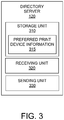
- Fig. 3 is a block diagram of a directory server 120 according to an embodiment of the present invention.
- the directory server 120 includes, but is not limited to, a storage unit 310, a receiving unit 320, and a sending unit 330.
- the storage unit 310 can be any device and/or program, or combination thereof, which stores information including network 100 users' preferred print device information 315.
- the preferred print device information 315 is assigned by a network administrator and stored in the storage unit 310.
- the preferred print device information is dynamic and can change according to a user's needs and printing history.
- the receiving unit 320 can be any device and/or program, or combination thereof, that allows the directory server 120 to receive information and requests for information, from devices communicatively coupled to the network 100.
- requests for information include information stored in the storage unit 310 such as requests for user preferred print device information 315.
- the sending unit 330 can be any device and/or program, or combination thereof, which allows the directory server 120 to send information to other devices communicatively coupled to the network 100. This generally includes, but is not limited to, information in response to requests from network 100 connected devices. For example, the sending of a user's assigned preferred print device to a print device connected to the network 100.
- Fig. 4 is a block diagram that illustrates a preferred print device 130 according to an embodiment of the present invention.
- the preferred print device 130 includes, but is not limited to, a storage unit 410, a receiving unit 420, a sending unit 430, and a printing unit 440.
- the storage unit 410 can be any device and/or program, or combination thereof, which allows the preferred print device 130 to store information including preferred users' print data 415.
- the print data 415 is information related to documents printed by a preferred user at a client device 110 over the network 100.
- the storage unit 410 generates a list of all documents received and stored from all preferred users.
- the receiving unit 420 can be any device and/or program, or combination thereof, which allows the preferred print device to receive information and requests for information from devices over the network 100.
- requests for information include, but are not limited to, information stored in the storage unit 410 such as requests for a list of documents printed by a preferred user and specific preferred user's print data 415 for printing at another print device connected to the network 100.
- the sending unit 430 can be any device and/or program, or combination thereof, which allows the preferred print device 130 to send information to other devices communicatively coupled to the network 100. This generally is information in response to a request from a network 100 connected device. For example, sending a list of documents stored at the storage unit 410, over the network 100, to an auxiliary print device 140 to allow selection of documents for local printing.
- the print unit 440 can be any device and/or program, or combination thereof, that allows the preferred print device 130 to process print data 415 and print a document therefrom. Generally, the print unit 440 prints a hard copy of a document for a preferred user from print data 415 stored locally in the storage unit 410. In another embodiment, a non-preferred user requests a hardcopy print at the preferred print device 130 and the print unit 440 receives the necessary print data from the non-preferred user's preferred print device 130 in order to print the document locally.
- Fig. 5 is a block diagram illustrating an auxiliary print device 140 according to an embodiment of the present invention.
- the auxiliary print device 140 includes, but is not limited to, a user interface unit 510, a receiving unit 520, a sending unit 530, and a printing unit 540.
- the user interface unit 510 can be any device and/or program, or combination thereof, which allows a user to physically walk up to the auxiliary print device 140 and operate its functions.
- the user interface is a type of control panel on the auxiliary print device 140 where users can input information to authenticate themselves in order to obtain a hard copy print of a document printed at a client device 110 communicatively coupled to the network 100.
- the receiving unit 520 can be any device and/or program, or combination thereof, which allows the auxiliary print device 140 to receive information from devices over the network 100.
- the information received is a list of documents stored at the non-preferred user's preferred print device 130 and/or specific print data 415 when local printing is requested at the user interface 510.
- the sending unit 530 can be any device and/or program, or combination thereof, which allows the auxiliary print device 140 to send information to other devices over the network 100. This generally includes sending requests to non-preferred users' preferred print devices 130 for a list of documents or specific print data 415 in response to instructions from the non-preferred user at the user interface unit 510.
- the print unit 540 can be any device and/or program, or combination thereof which allows the auxiliary print device 140 to process print data 415 and print a document there from.
- the print unit 510 prints a hardcopy of a document, for a non-preferred user, from print data 415 received at the receiving unit 520 from the non-preferred user's preferred print device 130.
- Fig. 6 is a flow diagram illustrating a client device 110 printing a document according to an embodiment of the present invention.
- a user of the client device 110 initiates S605 a print application 210.
- the print application 210 the user selects to print S610 a document.
- the print application 210 sends S615 the document to the virtual print driver 220.
- the virtual print driver 220 requests S620 the user's assigned preferred print device 130 assignment from the directory server 120 over the network 100.
- the virtual print driver 220 sends S625 the document to the user's preferred print device 130 over the network 100.
- the process is identical as the abovementioned except that the virtual print driver 220 receives a user's preferred print device 130 assignment in an authentication token upon accessing the network 100.
- Fig. 7 illustrates a flow diagram of a directory server 120 configured for peer to peer printing according to an embodiment of the present invention.
- the directory server 120 receives S705 user preferred print device information 315. Generally, this is input by a network administrator. Upon receipt, the preferred print device information 315 is stored S710 locally in the storage unit 310. Next, the directory server 120 waits S715 for a request from another device for preferred print device information 315. If no request has been made, the directory server continues to wait S715 for a request. If a request has been received, flow proceeds with the directory server 120 sending S715 the requested preferred print device information 315 to the requesting device over the network 100. In another embodiment, the operation of the directory server 120 is identical to the aforementioned except a user's stored preferred print device 130 assignment is dynamic and changes with respect to the user's needs and printing history.
- Fig. 8 is a flow diagram of a preferred print device 130 process where a user prints a hard copy of a document at their preferred print device 130 according to an embodiment of the present invention.
- the architecture utilizes network 100 connected devices including the client device 110, directory server 120, and preferred print device 130 as described and shown in FIGS. 2-4 respectively.
- the process begins with the preferred print device 130 receiving S805 a print request from a preferred user at the preferred print device 130.
- the preferred print device 130 identifies S810 the user and the user's printed documents.
- a list is presented S825 to the preferred user of all their stored documents.
- the preferred user selects S830 the documents he would like printed from the list.
- the requested documents are retrieved S815 locally from the storage unit 410 to allow for printing.
- the requested documents are printed S820 as requested by the user at the print unit 440.
- Fig. 9 is a flow diagram of an auxiliary print device 140 process where a user prints physical documents at the auxiliary print 140 device which is not the user's preferred print device 130 according to an embodiment of the present invention.
- the architecture utilizes network 100 connected devices including the client device 110, directory server 120, preferred print device 130, and auxiliary print device 140 as described and shown in FIGS. 2-5 respectively.
- the process begins with the auxiliary print device 140 receiving S905 a request to print from a local user at the user interface unit 510. After the request has been made, the auxiliary print device 140 identifies S910 the local user as a non-preferred user.
- a request S915 for the user's assigned preferred print device information 315 is sent using the sending unit 530 to the directory server 120.
- the auxiliary print device receives S920 the user's assigned preferred print device information from the directory server 120 and a request S920 is made for print data 415 from the user's assigned preferred print device 130.
- the auxiliary print device 140 receives S940 a list of documents stored by the non-preferred user at their preferred print device 130. From this list the non-preferred user selects S945 the documents he would like to print locally.
- a request S950 is made to the preferred print device 130 for the selected print data. Then, the auxiliary print device 140 receives S930 the print data 415 from the user's preferred print device 130 and the documents are printed S935 at the print unit 540.
- the process is identical as the abovementioned except that the auxiliary print device 140 receives a user's preferred print device 130 assignment in an authentication token upon accessing the network 100.
- the process is identical as the abovementioned except that the auxiliary print device 140 requests preferred print device information 315 for all users whether they are a preferred or non-preferred.
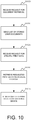
- Fig. 10 is a flow diagram of a preferred print device 130 process where a user prints physical documents at an auxiliary print device 140 in accordance with Fig. 9 according to an embodiment of the present invention.
- the process begins with the preferred print device 130 receiving S1005 a request for document retrieval from a network 100 connected device.
- the request is received from an auxiliary print device 140 where a non-preferred user requests a hard copy print of documents at an auxiliary print device 140.
- a list of stored documents associated with the user is sent S1020 to the requesting auxiliary print device 140.
- a request is received S1025 for specific print data that the user selected at the auxiliary print device 140 to print.
- the requested print data is retrieved S1010 from local storage in the preferred print device's 130 storage unit 410.
- the requested print data is sent S1015 to the requesting device over the network 100 by the sending unit 430 for printing at the auxiliary print device 140.
Landscapes
- Engineering & Computer Science (AREA)
- Theoretical Computer Science (AREA)
- General Engineering & Computer Science (AREA)
- Multimedia (AREA)
- Signal Processing (AREA)
- Human Computer Interaction (AREA)
- Physics & Mathematics (AREA)
- General Physics & Mathematics (AREA)
- Computing Systems (AREA)
- Accessory Devices And Overall Control Thereof (AREA)
- Computer And Data Communications (AREA)
Description
- The present invention relates to peer to peer printing over a network and, more specifically, a method of peer to peer printing to a virtual printer over a network.
- With the growing presence of multi-function devices on enterprise networks, there has been a trend to allow these devices not only to perform a specific task, but to perform many different tasks. Many of these tasks require the ability to retrieve information from other devices on the enterprise network.
- An example of this would be virtual printing schemes where users could send a print job to an unspecified printer and retrieve the hard copy document from any convenient print device connected to the network. In this example, the document information is sent from the user's device to a central server where it is stored. Accordingly, the print device that the user chooses to print from accesses this central server and retrieves the print information for printing.
- The problems with this approach are the need for a central server to store print information and the total cost associated with its presence. Needing a central server is not always practical because it places the entire burden of storing and distributing print information on one network device. Moreover, the need to have this server present on the network to sustain remote printing is an added expense compared to a system not needing one.
-
EP 1229724 discloses a print system in which print jobs are stored on a server by a print file storage service and are accessible via a print service. Print jobs sent to the print service may be automatically printed or subject to interactive printing. When print jobs are automatically printed, once the job is sent for printing on a printer, no further action is required from a user. In contrast, with interactive printing, the user releases the print jobs via the print service to a printer at which the user is located. In a case that a user is at a printer and wants to print a print job, the print service provides a list of all print jobs that may be printed. This list includes not only the interactive print jobs stored in the storage service, but also print jobs that are stored on other printers waiting to be printed. - According to a first aspect of the present invention there is provided a method according to claim 1. According to further aspects of the present invention there is provided a computer-readable storage medium according to claim 3 and a system according to claim 4.
- Further features and advantages of the present invention will become apparent from the following description of exemplary embodiments (with reference to the attached drawings).
-
-
Fig. 1 is a block diagram illustrating a system for performing peer to peer printing over a network according to an embodiment of the present invention. -
Fig. 2 is a block diagram of a client device according to an embodiment of the present invention. -
Fig. 3 is a block diagram of a directory server according to an embodiment of the present invention. -
Fig. 4 is a block diagram that illustrates a preferred print device according to an embodiment of the present invention. -
Fig. 5 is a block diagram illustrating an auxiliary print device according to an embodiment of the present invention. -
Fig. 6 is a flow diagram illustrating a client device printing a document according to an embodiment of the present invention. -
Fig. 7 illustrates a flow diagram of a directory server configured for peer to peer printing according to an embodiment of the present invention. -
Fig. 8 is a flow diagram of a preferred print device process where a user prints a hard copy of a document at their preferred print device according to an embodiment of the present invention. -
Fig. 9 is a flow diagram of an auxiliary print device process where a user prints physical documents at the auxiliary print device that is not their preferred print device according to an embodiment of the present invention. -
Fig. 10 is a flow diagram of a preferred print device process where a user prints physical documents at an auxiliary print device in accordance withFIG. 9 according to an embodiment of the present invention. - Embodiments of the present invention can provide means of peer to peer printing over a network. Pursuant to these embodiments, a user at a network connected client device, can print a document to a virtual printer allowing him to collect the hard copy print at any network connected print device.
- According to an embodiment of the invention, a user is assigned a specific network connected print device and the user requests and/or collects hard copy prints of documents at the user assigned print device.
- In another embodiment of the invention, a user is assigned a specific network connected print device but requests and/or collects hard copy prints of documents at a non-assigned print device.
-
Fig. 1 is a block diagram illustrating a system for performing peer to peer printing over a network according to an embodiment of the present invention. In one embodiment, the system includes aclient device 110, anetwork 100, adirectory server 120,preferred print device 130, and anauxiliary print device 140. Typically, the system includes a plurality of print devices connected to thenetwork 100 with the above mentioned for explanation purposes only. - The
network 100 can be any network allowing transport of data by any means between devices communicatively coupled to thenetwork 100. In general, data can take the form of, but is not limited to, documents, network device information, and digital media files. Thenetwork 100 can be private or public, wired or wireless, in whole or in part. - The
directory server 120 can be any computer system or equivalent that provides services to other computing systems over a network. Generally, thedirectory server 120 manages information and/or has a mechanism for storage and retrieval of information. In an embodiment of the invention, thedirectory server 120 provides storage and retrieval of user preferredprint device 130 information accessible to devices communicatively coupled to thenetwork 100. - The
client device 110 can be, but is not limited to, a personal computer, a digital lifestyle device such as a digital still image camera, digital video camera, television, or digital reading/display device that is communicatively coupled to thenetwork 100. In general, theclient device 110 is utilized by a user with a specific user identification, to print a document. The user does so by logging in with their user identification and using a print application which sends print data to be printed to a local virtual print driver. The virtual print driver then routes the print data to the user's preferredprint device 130. - The
preferred print device 130 can be, but is not limited to, a multi-function printer, ink jet printer, laser printer or other device communicatively coupled to a network capable of sending, receiving, storing, and printing document information. Generally, thepreferred print device 130 is assigned to a user identification associated with a user by a network administrator and it receives, stores, and/or prints documents printed by the user at anetwork 100 connectedclient device 110. In one embodiment, the assignment of user identifications to printing devices is determined by the network administrator and remains static until the network administrator makes changes. In another embodiment of the invention, thepreferred print device 130 assignment is dynamic and a preferredprint device 130 assignment changes independently and automatically depending on document retrieval. More specifically, when a user frequently prints documents at a print device other than his preferred, the information is collected and used to determine whether the user's preferred device should be reassigned to the frequented print device. - The
auxiliary print device 140 can be, but is not limited to, a multi-function printer, ink jet printer, laser printer or other device communicatively coupled to a network, capable of sending, receiving, storing, and printing document information. Generally, theauxiliary print device 140 is a printing device communicatively coupled to thenetwork 100 which is not a user's preferredprint device 130. In an embodiment of the invention, a user walks up to theauxiliary print device 140 and requests a document printed at anetwork 100 connectedclient device 110 to be printed at that location. Since theauxiliary print device 140 is not the user's preferredprint device 130, theauxiliary print device 140 does not have the document stored locally and must query thedirectory server 120 to obtain the user's preferredprint device 130 information. After obtaining the user's preferredprint device 130 information, theauxiliary print device 140 requests the printed document from the user's preferredprint device 130 and prints the document locally. - Respecting the nature of a peer-to-peer network, peer designations are variable and the roles of each peer can change anytime in respect to a device being a user's preferred
print device 130 orauxiliary print device 140 and/or sending or receiving information. Designations are merely for explanation purposes and in no way limit a peer's function. -
Fig. 2 is a block diagram of aclient device 110 according to an embodiment of the present invention. Theclient device 110 includes, but is not limited to, aprint application 210,virtual print driver 220 and, a sendingunit 230. - The
print application 210 can be any program that allows theclient device 110 to send print data. This can be, but is not limited to, a word processing program, document viewing program, and/or digital media viewer. In an embodiment of the invention, a user initiates theprint application 210 and selects a document to be printed. In turn, theprint application 210 sends print data associated with the selected document to be printed to thevirtual print driver 220. - The
virtual print driver 220 can be any device and/or program, or combination thereof, which has the ability to send and receive print data and/or control commands to and from devices over thenetwork 100. Generally, thevirtual print driver 220 receives document print data from theprint application 210 when a user initiates the printing of a document. Upon receipt, thevirtual print driver 220 determines what device is the user'spreferred print device 130 by querying thedirectory server 120 for the user's preferred device assignment. In another embodiment, the user'spreferred print device 130 is determined when the user logs on to the network at theclient device 110 with his user identification. - After making this determination, the
virtual print driver 220 sends the print data to the sendingunit 230 which sends the print data to the user's assignedpreferred print device 130. - The sending
unit 230 can be any device and/or program, or combination thereof, which allows theclient device 110 to send information to another device over thenetwork 100. Generally, the sendingunit 230 receives print data and user preferredprint device 130 information from the virtual print driver. It then sends the print data to the user'spreferred print device 130 over the network. -
Fig. 3 is a block diagram of adirectory server 120 according to an embodiment of the present invention. Thedirectory server 120 includes, but is not limited to, astorage unit 310, a receivingunit 320, and a sendingunit 330. - The
storage unit 310 can be any device and/or program, or combination thereof, which storesinformation including network 100 users' preferredprint device information 315. Generally, the preferredprint device information 315 is assigned by a network administrator and stored in thestorage unit 310. In another embodiment of the invention, the preferred print device information is dynamic and can change according to a user's needs and printing history. - The receiving
unit 320 can be any device and/or program, or combination thereof, that allows thedirectory server 120 to receive information and requests for information, from devices communicatively coupled to thenetwork 100. Generally, requests for information include information stored in thestorage unit 310 such as requests for user preferredprint device information 315. - The sending
unit 330 can be any device and/or program, or combination thereof, which allows thedirectory server 120 to send information to other devices communicatively coupled to thenetwork 100. This generally includes, but is not limited to, information in response to requests fromnetwork 100 connected devices. For example, the sending of a user's assigned preferred print device to a print device connected to thenetwork 100. -
Fig. 4 is a block diagram that illustrates apreferred print device 130 according to an embodiment of the present invention. Thepreferred print device 130 includes, but is not limited to, astorage unit 410, a receivingunit 420, a sendingunit 430, and aprinting unit 440. - The
storage unit 410 can be any device and/or program, or combination thereof, which allows thepreferred print device 130 to store information including preferred users'print data 415. Generally, theprint data 415 is information related to documents printed by a preferred user at aclient device 110 over thenetwork 100. Moreover, thestorage unit 410 generates a list of all documents received and stored from all preferred users. - The receiving
unit 420 can be any device and/or program, or combination thereof, which allows the preferred print device to receive information and requests for information from devices over thenetwork 100. Generally, requests for information include, but are not limited to, information stored in thestorage unit 410 such as requests for a list of documents printed by a preferred user and specific preferred user'sprint data 415 for printing at another print device connected to thenetwork 100. - The sending
unit 430 can be any device and/or program, or combination thereof, which allows thepreferred print device 130 to send information to other devices communicatively coupled to thenetwork 100. This generally is information in response to a request from anetwork 100 connected device. For example, sending a list of documents stored at thestorage unit 410, over thenetwork 100, to anauxiliary print device 140 to allow selection of documents for local printing. - The
print unit 440 can be any device and/or program, or combination thereof, that allows thepreferred print device 130 to processprint data 415 and print a document therefrom. Generally, theprint unit 440 prints a hard copy of a document for a preferred user fromprint data 415 stored locally in thestorage unit 410. In another embodiment, a non-preferred user requests a hardcopy print at thepreferred print device 130 and theprint unit 440 receives the necessary print data from the non-preferred user'spreferred print device 130 in order to print the document locally. -
Fig. 5 is a block diagram illustrating anauxiliary print device 140 according to an embodiment of the present invention. Theauxiliary print device 140 includes, but is not limited to, a user interface unit 510, a receivingunit 520, a sendingunit 530, and aprinting unit 540. - The user interface unit 510 can be any device and/or program, or combination thereof, which allows a user to physically walk up to the
auxiliary print device 140 and operate its functions. Generally, the user interface is a type of control panel on theauxiliary print device 140 where users can input information to authenticate themselves in order to obtain a hard copy print of a document printed at aclient device 110 communicatively coupled to thenetwork 100. - The receiving
unit 520 can be any device and/or program, or combination thereof, which allows theauxiliary print device 140 to receive information from devices over thenetwork 100. Generally, the information received is a list of documents stored at the non-preferred user'spreferred print device 130 and/orspecific print data 415 when local printing is requested at the user interface 510. - The sending
unit 530 can be any device and/or program, or combination thereof, which allows theauxiliary print device 140 to send information to other devices over thenetwork 100. This generally includes sending requests to non-preferred users'preferred print devices 130 for a list of documents orspecific print data 415 in response to instructions from the non-preferred user at the user interface unit 510. - The
print unit 540 can be any device and/or program, or combination thereof which allows theauxiliary print device 140 to processprint data 415 and print a document there from. Generally, the print unit 510 prints a hardcopy of a document, for a non-preferred user, fromprint data 415 received at the receivingunit 520 from the non-preferred user'spreferred print device 130. -
Fig. 6 is a flow diagram illustrating aclient device 110 printing a document according to an embodiment of the present invention. In one embodiment, a user of theclient device 110 initiates S605 aprint application 210. In theprint application 210, the user selects to print S610 a document. In response to the selection, theprint application 210 sends S615 the document to thevirtual print driver 220. After receiving the document, thevirtual print driver 220 requests S620 the user's assignedpreferred print device 130 assignment from thedirectory server 120 over thenetwork 100. Afterwards, thevirtual print driver 220 sends S625 the document to the user'spreferred print device 130 over thenetwork 100. - In another embodiment, the process is identical as the abovementioned except that the
virtual print driver 220 receives a user'spreferred print device 130 assignment in an authentication token upon accessing thenetwork 100. -
Fig. 7 illustrates a flow diagram of adirectory server 120 configured for peer to peer printing according to an embodiment of the present invention. In one embodiment, thedirectory server 120 receives S705 user preferredprint device information 315. Generally, this is input by a network administrator. Upon receipt, the preferredprint device information 315 is stored S710 locally in thestorage unit 310. Next, thedirectory server 120 waits S715 for a request from another device for preferredprint device information 315. If no request has been made, the directory server continues to wait S715 for a request. If a request has been received, flow proceeds with thedirectory server 120 sending S715 the requested preferredprint device information 315 to the requesting device over thenetwork 100. In another embodiment, the operation of thedirectory server 120 is identical to the aforementioned except a user's storedpreferred print device 130 assignment is dynamic and changes with respect to the user's needs and printing history. -
Fig. 8 is a flow diagram of apreferred print device 130 process where a user prints a hard copy of a document at theirpreferred print device 130 according to an embodiment of the present invention. In one embodiment, the architecture utilizesnetwork 100 connected devices including theclient device 110,directory server 120, andpreferred print device 130 as described and shown inFIGS. 2-4 respectively. The process begins with thepreferred print device 130 receiving S805 a print request from a preferred user at thepreferred print device 130. Next, thepreferred print device 130 identifies S810 the user and the user's printed documents. Afterwards, a list is presented S825 to the preferred user of all their stored documents. Then, the preferred user selects S830 the documents he would like printed from the list. After that, the requested documents are retrieved S815 locally from thestorage unit 410 to allow for printing. Lastly, the requested documents are printed S820 as requested by the user at theprint unit 440. -
Fig. 9 is a flow diagram of anauxiliary print device 140 process where a user prints physical documents at theauxiliary print 140 device which is not the user'spreferred print device 130 according to an embodiment of the present invention. In one embodiment, the architecture utilizesnetwork 100 connected devices including theclient device 110,directory server 120,preferred print device 130, andauxiliary print device 140 as described and shown inFIGS. 2-5 respectively. In general, the process begins with theauxiliary print device 140 receiving S905 a request to print from a local user at the user interface unit 510. After the request has been made, theauxiliary print device 140 identifies S910 the local user as a non-preferred user. Upon this determination, a request S915 for the user's assigned preferredprint device information 315 is sent using the sendingunit 530 to thedirectory server 120. Then, the auxiliary print device receives S920 the user's assigned preferred print device information from thedirectory server 120 and a request S920 is made forprint data 415 from the user's assignedpreferred print device 130. After the request is made, theauxiliary print device 140 receives S940 a list of documents stored by the non-preferred user at theirpreferred print device 130. From this list the non-preferred user selects S945 the documents he would like to print locally. - Upon making the selection, a request S950 is made to the
preferred print device 130 for the selected print data. Then, theauxiliary print device 140 receives S930 theprint data 415 from the user'spreferred print device 130 and the documents are printed S935 at theprint unit 540. - In another embodiment of the invention, the process is identical as the abovementioned except that the
auxiliary print device 140 receives a user'spreferred print device 130 assignment in an authentication token upon accessing thenetwork 100. - In yet another embodiment of the invention, the process is identical as the abovementioned except that the
auxiliary print device 140 requests preferredprint device information 315 for all users whether they are a preferred or non-preferred. -
Fig. 10 is a flow diagram of apreferred print device 130 process where a user prints physical documents at anauxiliary print device 140 in accordance withFig. 9 according to an embodiment of the present invention. In one embodiment, the process begins with thepreferred print device 130 receiving S1005 a request for document retrieval from anetwork 100 connected device. Typically, the request is received from anauxiliary print device 140 where a non-preferred user requests a hard copy print of documents at anauxiliary print device 140. - Next, a list of stored documents associated with the user is sent S1020 to the requesting
auxiliary print device 140. Afterwards, a request is received S1025 for specific print data that the user selected at theauxiliary print device 140 to print. Next, the requested print data is retrieved S1010 from local storage in the preferred print device's 130storage unit 410. After being retrieved, the requested print data is sent S1015 to the requesting device over thenetwork 100 by the sendingunit 430 for printing at theauxiliary print device 140. - While the present invention has been described with reference to exemplary embodiments, it is to be understood that the invention is not limited to the disclosed embodiments. On the contrary, the invention is intended to cover various modifications and equivalent arrangements included within the appended claims. The scope of the following claims is to be accorded the broadest interpretation so as to encompass all such modifications and equivalent structures and functions.
Claims (6)
- A method for peer-to-peer printing over a network, comprising:assigning a user identification to a first print device for storing print data from a client device (110) of a user associated with the user identification;storing the assignment of the user identification to the first print device as the user's assigned preferred print device on a directory server (120);generating, at the first print device (130), a list of the print data stored in the first print device and associated with the user identification;requesting (S915), by a second print device (140), information identifying the user's preferred print device from the directory server;requesting (S925), by the second print device, the list of the print data stored in the first print device, based on the user identification;transmitting the list of the print data from the first print device to the second print device in response to the request; andretrieving (S950) the print data from the first print device at the second print device based upon a selection from the list of the print data for printing locally,wherein the user identification is dynamically assigned automatically such that, when a user frequently prints documents at a print device other than the assigned preferred print device, it is determined whether the assigned preferred print device should be reassigned to the frequented print device.
- The method of claim 1, further comprising: requesting (S825) the list of the print data stored in the first print device (130), at the first device, based on the user identification; and
printing (S820) the print data at the first print device based upon a selection from the list of the print data received in response to the request. - A computer-readable storage medium storing a computer-executable process, the computer-executable process causing a computer to implement the method of claim 1.
- A system for peer-to-peer printing over a network, comprising:a first print device (130) configured to receive andstore print data from a user associated with a user identification;a directory server (120) configured to store an assignment of the user identification to the first print device as the user's preferred print device;a second print device (140) configured to receive and store print data, the second print device (140) including:a user interface unit (510) configured to identify the user based upon a user identification entered by the user at the user interface unit;a sending unit (530) configured to transmit a request to the directory server (120) for information identifying the user's preferred print device (140);wherein the sending unit (530) is further configured to transmit a request for print data associated with the user identified by the user interface unit to the user's preferred print device;a receiving unit (520) configured to receive the print data requested by the sending unit;anda print unit (540) configured to print the print data, wherein the user identification is dynamically assigned automatically such that, when a user frequently prints documents at a print device other than the assigned preferred print device, it is determined whether the assigned preferred print device should be reassigned to the frequented print device.
- The system of claim 4, wherein the first print device further includes a storage unit (410) assigned to the user.
- The system of claim 4, wherein the sending unit (530) determines a location of print data associated with a user based on the user identification associated with the user.
Applications Claiming Priority (1)
| Application Number | Priority Date | Filing Date | Title |
|---|---|---|---|
| US11/778,470 US8390843B2 (en) | 2007-07-16 | 2007-07-16 | Requesting print data of a second print device from a first print device |
Publications (3)
| Publication Number | Publication Date |
|---|---|
| EP2017718A2 EP2017718A2 (en) | 2009-01-21 |
| EP2017718A3 EP2017718A3 (en) | 2009-08-12 |
| EP2017718B1 true EP2017718B1 (en) | 2018-09-12 |
Family
ID=39811714
Family Applications (1)
| Application Number | Title | Priority Date | Filing Date |
|---|---|---|---|
| EP08160552.9A Ceased EP2017718B1 (en) | 2007-07-16 | 2008-07-16 | System and method for peer to peer printing over a network |
Country Status (3)
| Country | Link |
|---|---|
| US (1) | US8390843B2 (en) |
| EP (1) | EP2017718B1 (en) |
| CN (1) | CN101349965B (en) |
Families Citing this family (9)
| Publication number | Priority date | Publication date | Assignee | Title |
|---|---|---|---|---|
| JP2010157208A (en) * | 2008-12-02 | 2010-07-15 | Ricoh Co Ltd | Data processing apparatus, printer network system, data processing method, program, and recording medium |
| FR2957695B1 (en) * | 2010-03-22 | 2012-08-17 | Sagem Comm | PRINTING SYSTEM ON A PRINTER AVAILABLE THROUGH A COMMUNICATION NETWORK |
| FR2957696B1 (en) * | 2010-03-22 | 2012-08-17 | Sagem Comm | MASTER PRINTER FOR A PRINTING SYSTEM ON A PRINTER AVAILABLE THROUGH A COMMUNICATION NETWORK |
| FR2957697B1 (en) * | 2010-03-22 | 2012-08-17 | Sagem Comm | PRINTER FOR A PRINTING SYSTEM ON A PRINTER AVAILABLE THROUGH A COMMUNICATION NETWORK |
| FR2963122B1 (en) * | 2010-07-22 | 2014-04-11 | Sagemcom Documents Sas | PRINTING SYSTEM, PRINTING CUSTOMER AND PRINTERS, AND METHODS, COMPUTER PROGRAMS AND CORRESPONDING STORAGE MEANS |
| JP2012252579A (en) * | 2011-06-03 | 2012-12-20 | Fuji Xerox Co Ltd | Image forming system, image forming apparatus, and program |
| KR20150081081A (en) | 2014-01-03 | 2015-07-13 | 삼성전자주식회사 | Electronic apparatus, management server, print system and method for controllng of printing |
| CN108885540B (en) * | 2016-01-29 | 2022-07-08 | 惠普发展公司,有限责任合伙企业 | Printing system and storage medium for transferring jobs to service printers |
| FR3069350B1 (en) * | 2017-07-20 | 2019-08-09 | Mps Mobileprint Services | SECURE PRINTING SERVICE VIA A COMMUNICATION NETWORK ON ANY PRINTING EQUIPMENT BELONGING TO A GROUP OF INDEPENDENT PRINTING EQUIPMENTS |
Citations (1)
| Publication number | Priority date | Publication date | Assignee | Title |
|---|---|---|---|---|
| US20060244991A1 (en) * | 2005-04-28 | 2006-11-02 | Konica Minolta Business Technologies, Inc. | Image processing device, image processing method, and computer readable recording medium stored with image processing program |
Family Cites Families (19)
| Publication number | Priority date | Publication date | Assignee | Title |
|---|---|---|---|---|
| JPH07200215A (en) * | 1993-12-01 | 1995-08-04 | Internatl Business Mach Corp <Ibm> | Selection method of printing device and data processing network |
| US6552813B2 (en) * | 1996-06-11 | 2003-04-22 | Sun Microsystems, Inc. | Directing print jobs in a network printing system |
| US6571290B2 (en) * | 1997-06-19 | 2003-05-27 | Mymail, Inc. | Method and apparatus for providing fungible intercourse over a network |
| US7079269B2 (en) * | 1998-03-19 | 2006-07-18 | Océ-Technologies B.V. | Interactive printing with a plurality of printer devices |
| JP2000242463A (en) * | 1999-02-24 | 2000-09-08 | Nec Corp | Printing system |
| US6978019B1 (en) * | 1999-06-30 | 2005-12-20 | Silverbrook Research Pty Ltd | Method and system for user registration on terminal |
| US7113299B2 (en) * | 2001-07-12 | 2006-09-26 | Canon Development Americas, Inc. | Printing with credit card as identification |
| US6943905B2 (en) * | 2001-12-20 | 2005-09-13 | Sharp Laboratories Of America, Inc. | Virtual print driver system and method |
| JP4521154B2 (en) * | 2002-08-19 | 2010-08-11 | ブラザー工業株式会社 | Printing system, server apparatus, file printing method and program |
| US7634541B2 (en) * | 2003-04-14 | 2009-12-15 | Canon Development Americas Inc. | Automatic distribution of electronic documents into and from a printing apparatus mailbox |
| CN1567284A (en) * | 2003-06-13 | 2005-01-19 | 北京北佳信息系统有限公司 | Method for controlling using of printer under network environment |
| JP4873852B2 (en) * | 2004-02-26 | 2012-02-08 | 株式会社リコー | First communication device, information processing device, information processing program, recording medium |
| JP4613109B2 (en) * | 2004-07-29 | 2011-01-12 | オセ−テクノロジーズ・ベー・ヴエー | Method for printing digital print file and printer to which the above method is applied |
| US20060050294A1 (en) * | 2004-09-08 | 2006-03-09 | Xerox Corporation | Method and system for managing the distribution of print job files among shared printers on a computer network |
| US20060197972A1 (en) * | 2004-11-30 | 2006-09-07 | Kyocera Mita Corporation | Image forming device, image processing system, storage medium for storing printer driver, and image reading device |
| US20060227363A1 (en) * | 2005-03-29 | 2006-10-12 | Kabushiki Kaisha Toshiba | Apparatus and method for managing print jobs among a plurality of printers |
| JP3952064B2 (en) * | 2005-04-13 | 2007-08-01 | コニカミノルタビジネステクノロジーズ株式会社 | Image processing system, image processing apparatus, and control program therefor |
| JP4826265B2 (en) * | 2006-01-25 | 2011-11-30 | 富士ゼロックス株式会社 | Security policy assigning apparatus, program, and method |
| US7812984B2 (en) * | 2006-05-23 | 2010-10-12 | Ricoh Company, Ltd. | Remote stored print job retrieval |
-
2007
- 2007-07-16 US US11/778,470 patent/US8390843B2/en not_active Expired - Fee Related
-
2008
- 2008-07-16 EP EP08160552.9A patent/EP2017718B1/en not_active Ceased
- 2008-07-16 CN CN200810133640.4A patent/CN101349965B/en not_active Expired - Fee Related
Patent Citations (1)
| Publication number | Priority date | Publication date | Assignee | Title |
|---|---|---|---|---|
| US20060244991A1 (en) * | 2005-04-28 | 2006-11-02 | Konica Minolta Business Technologies, Inc. | Image processing device, image processing method, and computer readable recording medium stored with image processing program |
Also Published As
| Publication number | Publication date |
|---|---|
| CN101349965B (en) | 2015-04-22 |
| CN101349965A (en) | 2009-01-21 |
| EP2017718A2 (en) | 2009-01-21 |
| US8390843B2 (en) | 2013-03-05 |
| EP2017718A3 (en) | 2009-08-12 |
| US20090021768A1 (en) | 2009-01-22 |
Similar Documents
| Publication | Publication Date | Title |
|---|---|---|
| EP2017718A2 (en) | System and method for peer to peer printing over a network | |
| AU2008272894B2 (en) | Print management system and related methods | |
| JP6065462B2 (en) | Output control device, system and program | |
| JP4161265B2 (en) | Image processing system | |
| US20040218212A1 (en) | Printer management and printing control system used with printers | |
| US8537392B2 (en) | Follow-me printer driver | |
| JP5923931B2 (en) | Information processing apparatus, management method, and management program | |
| JP2010055558A (en) | Printing system, print control method and program | |
| JP5862240B2 (en) | Information processing apparatus, control system, control method, control program, and recording medium recording the program | |
| KR20180018386A (en) | Printing apparatus, control method for printing apparatus, and storage medium | |
| EP3073365A1 (en) | Networked image forming apparatus, networked image forming system and method of image forming | |
| KR20170105951A (en) | Management server and method for managing file | |
| EP1763216B1 (en) | Data delivery apparatus and data delivery method | |
| JP2009295080A (en) | Print processing system | |
| JP7392261B2 (en) | Printing system, printing device, printing system control method, and program | |
| EP3915004B1 (en) | A printing system and a method of printing | |
| JP7022519B2 (en) | Mobile terminals, their control methods, and storage media | |
| US20060248111A1 (en) | Image forming apparatus and method for providing a file list | |
| JP7041601B2 (en) | Information processing equipment, display methods and programs in information processing equipment | |
| US11675551B2 (en) | Printing system including server and printer printing image based on print job stored in the server | |
| JP6253246B2 (en) | Image processing system, image processing method, and program | |
| JP2012201041A (en) | Image processing apparatus and image processing system | |
| US20060268289A1 (en) | Multi image forming method and system using job retention functions | |
| JP2024506547A (en) | Printing system and printing method | |
| JP2004234289A (en) | Printer server |
Legal Events
| Date | Code | Title | Description |
|---|---|---|---|
| PUAI | Public reference made under article 153(3) epc to a published international application that has entered the european phase |
Free format text: ORIGINAL CODE: 0009012 |
|
| AK | Designated contracting states |
Kind code of ref document: A2 Designated state(s): AT BE BG CH CY CZ DE DK EE ES FI FR GB GR HR HU IE IS IT LI LT LU LV MC MT NL NO PL PT RO SE SI SK TR |
|
| AX | Request for extension of the european patent |
Extension state: AL BA MK RS |
|
| PUAL | Search report despatched |
Free format text: ORIGINAL CODE: 0009013 |
|
| AK | Designated contracting states |
Kind code of ref document: A3 Designated state(s): AT BE BG CH CY CZ DE DK EE ES FI FR GB GR HR HU IE IS IT LI LT LU LV MC MT NL NO PL PT RO SE SI SK TR |
|
| AX | Request for extension of the european patent |
Extension state: AL BA MK RS |
|
| 17P | Request for examination filed |
Effective date: 20100212 |
|
| AKX | Designation fees paid |
Designated state(s): DE FR GB IT |
|
| 17Q | First examination report despatched |
Effective date: 20161121 |
|
| GRAP | Despatch of communication of intention to grant a patent |
Free format text: ORIGINAL CODE: EPIDOSNIGR1 |
|
| RIC1 | Information provided on ipc code assigned before grant |
Ipc: H04N 1/32 20060101ALI20180215BHEP Ipc: G06F 3/12 20060101AFI20180215BHEP Ipc: H04N 1/00 20060101ALI20180215BHEP |
|
| INTG | Intention to grant announced |
Effective date: 20180316 |
|
| GRAS | Grant fee paid |
Free format text: ORIGINAL CODE: EPIDOSNIGR3 |
|
| GRAA | (expected) grant |
Free format text: ORIGINAL CODE: 0009210 |
|
| AK | Designated contracting states |
Kind code of ref document: B1 Designated state(s): DE FR GB IT |
|
| REG | Reference to a national code |
Ref country code: GB Ref legal event code: FG4D |
|
| REG | Reference to a national code |
Ref country code: DE Ref legal event code: R096 Ref document number: 602008056909 Country of ref document: DE |
|
| PG25 | Lapsed in a contracting state [announced via postgrant information from national office to epo] |
Ref country code: IT Free format text: LAPSE BECAUSE OF FAILURE TO SUBMIT A TRANSLATION OF THE DESCRIPTION OR TO PAY THE FEE WITHIN THE PRESCRIBED TIME-LIMIT Effective date: 20180912 |
|
| REG | Reference to a national code |
Ref country code: DE Ref legal event code: R097 Ref document number: 602008056909 Country of ref document: DE |
|
| PLBE | No opposition filed within time limit |
Free format text: ORIGINAL CODE: 0009261 |
|
| STAA | Information on the status of an ep patent application or granted ep patent |
Free format text: STATUS: NO OPPOSITION FILED WITHIN TIME LIMIT |
|
| 26N | No opposition filed |
Effective date: 20190613 |
|
| PGFP | Annual fee paid to national office [announced via postgrant information from national office to epo] |
Ref country code: DE Payment date: 20190930 Year of fee payment: 12 |
|
| GBPC | Gb: european patent ceased through non-payment of renewal fee |
Effective date: 20190716 |
|
| PG25 | Lapsed in a contracting state [announced via postgrant information from national office to epo] |
Ref country code: GB Free format text: LAPSE BECAUSE OF NON-PAYMENT OF DUE FEES Effective date: 20190716 |
|
| PG25 | Lapsed in a contracting state [announced via postgrant information from national office to epo] |
Ref country code: FR Free format text: LAPSE BECAUSE OF NON-PAYMENT OF DUE FEES Effective date: 20190731 |
|
| REG | Reference to a national code |
Ref country code: DE Ref legal event code: R119 Ref document number: 602008056909 Country of ref document: DE |
|
| PG25 | Lapsed in a contracting state [announced via postgrant information from national office to epo] |
Ref country code: DE Free format text: LAPSE BECAUSE OF NON-PAYMENT OF DUE FEES Effective date: 20210202 |