EP2017449A1 - A rotating shaft assembly - Google Patents
A rotating shaft assembly Download PDFInfo
- Publication number
- EP2017449A1 EP2017449A1 EP07110418A EP07110418A EP2017449A1 EP 2017449 A1 EP2017449 A1 EP 2017449A1 EP 07110418 A EP07110418 A EP 07110418A EP 07110418 A EP07110418 A EP 07110418A EP 2017449 A1 EP2017449 A1 EP 2017449A1
- Authority
- EP
- European Patent Office
- Prior art keywords
- rotating shaft
- shaft assembly
- assembly according
- shaft
- valve
- Prior art date
- Legal status (The legal status is an assumption and is not a legal conclusion. Google has not performed a legal analysis and makes no representation as to the accuracy of the status listed.)
- Withdrawn
Links
- 239000012530 fluid Substances 0.000 claims description 5
- 239000007769 metal material Substances 0.000 claims description 3
- 230000000712 assembly Effects 0.000 description 7
- 238000000429 assembly Methods 0.000 description 7
- 230000000694 effects Effects 0.000 description 4
- 239000000463 material Substances 0.000 description 3
- 239000007789 gas Substances 0.000 description 2
- 229910000831 Steel Inorganic materials 0.000 description 1
- 238000005219 brazing Methods 0.000 description 1
- 238000005260 corrosion Methods 0.000 description 1
- 230000007797 corrosion Effects 0.000 description 1
- 238000005304 joining Methods 0.000 description 1
- 239000007788 liquid Substances 0.000 description 1
- 238000004519 manufacturing process Methods 0.000 description 1
- 238000000034 method Methods 0.000 description 1
- 238000004806 packaging method and process Methods 0.000 description 1
- 239000007787 solid Substances 0.000 description 1
- 230000003068 static effect Effects 0.000 description 1
- 239000010959 steel Substances 0.000 description 1
- 238000003466 welding Methods 0.000 description 1
Images

Classifications
-
- F—MECHANICAL ENGINEERING; LIGHTING; HEATING; WEAPONS; BLASTING
- F02—COMBUSTION ENGINES; HOT-GAS OR COMBUSTION-PRODUCT ENGINE PLANTS
- F02D—CONTROLLING COMBUSTION ENGINES
- F02D9/00—Controlling engines by throttling air or fuel-and-air induction conduits or exhaust conduits
- F02D9/08—Throttle valves specially adapted therefor; Arrangements of such valves in conduits
- F02D9/10—Throttle valves specially adapted therefor; Arrangements of such valves in conduits having pivotally-mounted flaps
- F02D9/1065—Mechanical control linkage between an actuator and the flap, e.g. including levers, gears, springs, clutches, limit stops of the like
-
- F—MECHANICAL ENGINEERING; LIGHTING; HEATING; WEAPONS; BLASTING
- F16—ENGINEERING ELEMENTS AND UNITS; GENERAL MEASURES FOR PRODUCING AND MAINTAINING EFFECTIVE FUNCTIONING OF MACHINES OR INSTALLATIONS; THERMAL INSULATION IN GENERAL
- F16K—VALVES; TAPS; COCKS; ACTUATING-FLOATS; DEVICES FOR VENTING OR AERATING
- F16K1/00—Lift valves or globe valves, i.e. cut-off apparatus with closure members having at least a component of their opening and closing motion perpendicular to the closing faces
- F16K1/16—Lift valves or globe valves, i.e. cut-off apparatus with closure members having at least a component of their opening and closing motion perpendicular to the closing faces with pivoted closure-members
- F16K1/18—Lift valves or globe valves, i.e. cut-off apparatus with closure members having at least a component of their opening and closing motion perpendicular to the closing faces with pivoted closure-members with pivoted discs or flaps
- F16K1/22—Lift valves or globe valves, i.e. cut-off apparatus with closure members having at least a component of their opening and closing motion perpendicular to the closing faces with pivoted closure-members with pivoted discs or flaps with axis of rotation crossing the valve member, e.g. butterfly valves
- F16K1/224—Details of bearings for the axis of rotation
-
- F—MECHANICAL ENGINEERING; LIGHTING; HEATING; WEAPONS; BLASTING
- F02—COMBUSTION ENGINES; HOT-GAS OR COMBUSTION-PRODUCT ENGINE PLANTS
- F02D—CONTROLLING COMBUSTION ENGINES
- F02D9/00—Controlling engines by throttling air or fuel-and-air induction conduits or exhaust conduits
- F02D9/02—Controlling engines by throttling air or fuel-and-air induction conduits or exhaust conduits concerning induction conduits
- F02D2009/0201—Arrangements; Control features; Details thereof
- F02D2009/0269—Throttle closing springs; Acting of throttle closing springs on the throttle shaft
-
- F—MECHANICAL ENGINEERING; LIGHTING; HEATING; WEAPONS; BLASTING
- F02—COMBUSTION ENGINES; HOT-GAS OR COMBUSTION-PRODUCT ENGINE PLANTS
- F02D—CONTROLLING COMBUSTION ENGINES
- F02D9/00—Controlling engines by throttling air or fuel-and-air induction conduits or exhaust conduits
- F02D9/08—Throttle valves specially adapted therefor; Arrangements of such valves in conduits
- F02D9/10—Throttle valves specially adapted therefor; Arrangements of such valves in conduits having pivotally-mounted flaps
- F02D9/107—Manufacturing or mounting details
Definitions
- the present invention relates to assemblies including rotating shafts requiring a spring effect and in particular, but not exclusively, to assemblies including rotating shafts requiring a spring effect to return the shaft to an original position, such as, for example, the flap shaft of a throttle body.
- Rotating shafts requiring a spring effect to return the shaft to an original position are found in many mechanical applications and, in particular, valve assemblies.
- a typical valve assembly requiring such a shaft arrangement is a throttle valve assembly used in an automotive application.
- a known automotive throttle valve assembly (50) is shown in Figure 3 of the accompanying drawings.
- a flap shaft (52) is located in a housing (54) and rotatably mounted in bearings (60).
- the flap shaft (52) is rotated about its axis (0-0), between valve open and valve closed positions, by a motor (not shown) coupled to the flap shaft (52) via a drive gear (62).
- a flap (not shown) is mounted on the flap shaft (52) adapted to interface with the housing (54) to open and close the valve accordingly.
- a torsion coil spring (56) provides a return force to return the flap shaft (52) to a safe, default, valve position. Typically, this default valve position is open but maybe closed.
- the coil spring (56) is typically attached at one end to the housing (54) and coupled to the valve shaft (52) at its other end to allow the return force to be stored in the torsion spring (56) when the flap shaft (52) is rotated by the motor.
- the torsion spring (56) is mounted between spring bushings (58) to contain and guide the coil spring (56).
- a plug (64) is used to prevent excessive leakage through the bearing (60) and exiting the valve assembly (50).
- the spring (56), spring bushings (58), bearings (60) and plug (64) all amount to additional components in the valve assembly (50). As a result, the overall size of the valve assembly (50) is affected and manufacturing complexity and material costs are increased.
- Such assemblies are of course not limited to throttle assemblies and may be included in many applications comprising a rotating shaft requiring a spring effect.
- an assembly comprising:
- the return force is provided by the resilient member itself, which functions as a spring, eliminating the need for additional components, such as a spring, and hence reducing the overall cost, size and weight of the assembly.
- the at least one member is attached to the rotatable part by an intermediate component.
- the rotational force is applied via the intermediate component.
- the rotational force may be applied by a user or, more suitably, by a driving means such as a motor, directly or indirectly, coupled to the intermediate component.
- the intermediate member is mounted in means adapted to facilitate rotation of the at least one member.
- the intermediate component comprises a hollow member.
- the resilient member is disposed substantially within the hollow member. Disposing the resilient member within the hollow member advantageously provides for efficient packaging and minimises the overall size of the assembly.
- the resilient member and hollow member may have coaxial axes of rotation, advantageously allowing the resilient member and hollow member to rotate about the same axis.
- the hollow member may comprise a closed end and an open end.
- the rotatable part of the resilient member may be connected to the closed end of the hollow member and the fixed end of the resilient member may extend beyond the open end of the hollow member.
- the hollow member may be substantially cylindrical.
- the hollow member is rotatably mounted in at least one bearing.
- Mounting the hollow member in at least one bearing advantageously provides support to the closed end of the hollow member, especially when the distance between the closed and open ends of the hollow member is large enough to cause deflection at the closed end, if unsupported.
- the resilient member may be a shaft.
- the shaft may be solid or hollow.
- the resilient member maybe a coil spring or comprise a plurality of filaments, e.g. a cable.
- the shaft may be substantially circular in cross section but may be any suitable cross section, e.g. square or crucifix.
- the shaft maybe mounted in at least one bearing located within the hollow member.
- a bearing helps to minimise friction during rotation of the hollow member and shaft, which in turn helps to keep noise and heat, during use, to a minimum.
- the resilient member and hollow member are a metallic material.
- the material resists corrosion and is resilient to high temperatures, especially in an automotive application.
- the metallic material may be steel.
- a valve assembly comprising:
- the fluid may comprise a liquid or gas or a combination of gases, e.g. air.
- the valve assembly may be a throttle valve in either a static or dynamic application such as a motor vehicle engine.
- an assembly part (1) comprises a hollow member (2), embodied as a hollow cylinder, having a closed end (3) and an opposing open end (4) and a resilient member (5), embodied as a shaft of circular cross section being disposed within the hollow cylinder (2).
- the shaft (5) and the hollow cylinder have coaxial axes of rotation allowing the shaft (5) and hollow cylinder (2) to rotate about the same axis.
- the shaft (5) is fixed at a one end (6) to the internal face of the closed end (3) of the hollow cylinder and its opposing end (7) extends beyond the open end (4) of the hollow cylinder (2) and is fixed to a support (8).
- the hollow cylinder (2) is rotated about its longitudinal axis (0-0) in either direction by applying a rotational force at the closed end (3).
- the rotation of the hollow cylinder (2) subjects the shaft (5) to a torque (T) which is resisted due to the fixed end (6) of the shaft (5) and the torque is stored in the shaft (5) as a reaction torque.
- the reaction torque provides a return force urging the shaft (5), and the hollow cylinder (2), to its original position.
- the return force in the shaft (5) returns the hollow cylinder (2) to its original position.
- At least one member may be mounted on to the hollow cylinder (2) which may be moved between first and second positions when a rotational force is applied to the hollow cylinder (2) and which is also returned to an original position when the rotation is released.
- the at least one member may be any component which requires movement between a first and second position and a return force to return it to the first position in the event that the force producing the rotation is removed.
- the at least one member may be a gear or a valve member, for example.
- the shaft is not limited to a circular cross section (1) and may have different shapes of cross section, depending on the torsional stiffness requirements of the shaft, including cylindrical (2) and crucifix (3) cross sections. A number of other cross sections may be suitable.
- the at least one member may be at least one flap in a flap valve where the hollow cylinder (2) is the flap shaft on to which the at least one flap is mounted, for example.
- the first and second positions may be valve closed and valve open positions respectively and the at least one flap is returned towards the valve closed position on release of the rotational force; the shaft (5) providing the return force.
- the at least one flap maybe returned towards the valve open position on release of the rotational force.
- a throttle valve arrangement (10) comprising such an embodiment, according to the present invention, is illustrated in Figure 4 .
- a flap shaft assembly comprises a hollow cylinder (2) enclosing a shaft (5) and one or more valve members (not shown) mounted on the hollow cylinder (2) which interface with a housing (11) to open and close the throttle valve.
- the at least one valve member comprises at least one flap (not shown) arranged to contact with the housing (11) when in the valve closed position and substantially reduce or stop the flow of a fluid between an inlet and outlet (not shown).
- the housing (11) may suitably include a valve seat (not shown) for the at least one valve member to abut against when in the valve closed position to provide an effective seal.
- the shaft (5) is fixed rigidly at one end (fixed end) (7) to the housing (11). Suitable joining techniques may be used to attach the fixed end (7) of the shaft (5) to the housing (11), including welding, brazing or mechanical means.
- the other end (rotatable end) (6) of the shaft (5) is fixed to the closed end (3) of the hollow cylinder (2).
- the hollow cylinder (2) is free to rotate about its longitudinal axis (0-0), the axis being shared by the shaft (5) which is disposed within.
- valve member Mounting the valve member to the hollow cylinder (2), rather than to the shaft (5), reduces the amount of twist to which the valve member is subject. If the valve member were mounted to the shaft (5), the valve member would twist according to the amount of twist per unit length of the shaft (5). The amount of twist would increase with increased distance from the fixed end (7) of the shaft (5). Mounting the valve member on a hollow member (2), within which the shaft (5) is disposed, ensures the valve member is subject to minimal or negligible twisting.
- a small bearing (9) may be required between the shaft (5) and the hollow cylinder (2).
- a larger bearing (12) is also provided between the hollow cylinder (2) and the housing (11).
- the bearings (9, 12) allow the hollow cylinder (2) to rotate about the shaft (5).
- a motor (not shown) and drive gear (13) may be suitably coupled to the closed end (3) of the hollow cylinder (2) to open and close the flap valve.
- the angle of rotation between valve open and closed positions is 90 degrees or less.
- the return force provided by the shaft (5) will return the hollow cylinder (2), and a valve member mounted on the hollow cylinder (2), to a safe default position.
- the default position may be open or closed depending on requirements.
- the present invention eliminates the need for a torsional coil spring (5), spring bushings (6) and a plug (7) (as referenced in Figure 3 ), and the assembly may be reduced in size and complexity. Additionally, the material required will accordingly be reduced, importantly saving cost.
- throttle valve assemblies which comprise a rotating shaft requiring a return force to return the shaft to an original position.
Landscapes
- Engineering & Computer Science (AREA)
- General Engineering & Computer Science (AREA)
- Mechanical Engineering (AREA)
- Chemical & Material Sciences (AREA)
- Combustion & Propulsion (AREA)
- Lift Valve (AREA)
Abstract
Description
- The present invention relates to assemblies including rotating shafts requiring a spring effect and in particular, but not exclusively, to assemblies including rotating shafts requiring a spring effect to return the shaft to an original position, such as, for example, the flap shaft of a throttle body.
- Rotating shafts requiring a spring effect to return the shaft to an original position are found in many mechanical applications and, in particular, valve assemblies. A typical valve assembly requiring such a shaft arrangement is a throttle valve assembly used in an automotive application.
- A known automotive throttle valve assembly (50) is shown in
Figure 3 of the accompanying drawings. A flap shaft (52) is located in a housing (54) and rotatably mounted in bearings (60). The flap shaft (52) is rotated about its axis (0-0), between valve open and valve closed positions, by a motor (not shown) coupled to the flap shaft (52) via a drive gear (62). Typically, a flap (not shown) is mounted on the flap shaft (52) adapted to interface with the housing (54) to open and close the valve accordingly. In case of motor failure, a torsion coil spring (56) provides a return force to return the flap shaft (52) to a safe, default, valve position. Typically, this default valve position is open but maybe closed. The coil spring (56) is typically attached at one end to the housing (54) and coupled to the valve shaft (52) at its other end to allow the return force to be stored in the torsion spring (56) when the flap shaft (52) is rotated by the motor. Typically, the torsion spring (56) is mounted between spring bushings (58) to contain and guide the coil spring (56). In addition, a plug (64) is used to prevent excessive leakage through the bearing (60) and exiting the valve assembly (50). - The spring (56), spring bushings (58), bearings (60) and plug (64) all amount to additional components in the valve assembly (50). As a result, the overall size of the valve assembly (50) is affected and manufacturing complexity and material costs are increased.
- Such assemblies are of course not limited to throttle assemblies and may be included in many applications comprising a rotating shaft requiring a spring effect.
- According to one aspect of the present invention, there is provided an assembly comprising:
- a body;
- a resilient member having an end fixed to the body;
- a part that is rotatable relative to the fixed end;
- at least one member attached to the rotatable part;
- In many assemblies, where a rotating shaft requires a return force to help return it to an original position, a separate spring component is located externally of the shaft, the spring providing the return force. Advantageously, the return force, according to the present invention, is provided by the resilient member itself, which functions as a spring, eliminating the need for additional components, such as a spring, and hence reducing the overall cost, size and weight of the assembly.
- Preferably, the at least one member is attached to the rotatable part by an intermediate component.
- Further preferably, the rotational force is applied via the intermediate component. The rotational force may be applied by a user or, more suitably, by a driving means such as a motor, directly or indirectly, coupled to the intermediate component.
- Preferably, the intermediate member is mounted in means adapted to facilitate rotation of the at least one member.
- Preferably, the intermediate component comprises a hollow member.
- Further preferably, the resilient member is disposed substantially within the hollow member. Disposing the resilient member within the hollow member advantageously provides for efficient packaging and minimises the overall size of the assembly.
- Suitably, the resilient member and hollow member may have coaxial axes of rotation, advantageously allowing the resilient member and hollow member to rotate about the same axis.
- Suitably, the hollow member may comprise a closed end and an open end. The rotatable part of the resilient member may be connected to the closed end of the hollow member and the fixed end of the resilient member may extend beyond the open end of the hollow member.
- The hollow member may be substantially cylindrical.
- Preferably, the hollow member is rotatably mounted in at least one bearing.
- Mounting the hollow member in at least one bearing advantageously provides support to the closed end of the hollow member, especially when the distance between the closed and open ends of the hollow member is large enough to cause deflection at the closed end, if unsupported.
- The resilient member may be a shaft. The shaft may be solid or hollow. Alternatively, the resilient member maybe a coil spring or comprise a plurality of filaments, e.g. a cable. The shaft may be substantially circular in cross section but may be any suitable cross section, e.g. square or crucifix.
- The shaft maybe mounted in at least one bearing located within the hollow member.
- A bearing helps to minimise friction during rotation of the hollow member and shaft, which in turn helps to keep noise and heat, during use, to a minimum.
- Preferably, the resilient member and hollow member are a metallic material. Preferably, the material resists corrosion and is resilient to high temperatures, especially in an automotive application. Suitably, the metallic material may be steel.
- A valve assembly is also provided, comprising:
- a housing having at least one inlet and at least one outlet between which a fluid may flow; and
- an assembly as described above, wherein the at least one member is an at least one valve member moveable from one open position to another position.
- The fluid may comprise a liquid or gas or a combination of gases, e.g. air.
- The valve assembly may be a throttle valve in either a static or dynamic application such as a motor vehicle engine.
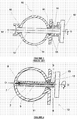
- The present invention will now be described, by way of example only, with reference to the accompanying drawings, in which:
-
Figure 1 is a schematic which illustrates the principle of the present invention; -
Figure 2 shows cross-sectional representations of different embodiments of the shaft in accordance with an embodiment of the present invention; -
Figure 3 is a sectional representation through a prior art throttle valve assembly; and -
Figure 4 is a sectional representation through a throttle valve assembly comprising an embodiment of the present invention. - As illustrated in
Figure 1 , an assembly part (1) comprises a hollow member (2), embodied as a hollow cylinder, having a closed end (3) and an opposing open end (4) and a resilient member (5), embodied as a shaft of circular cross section being disposed within the hollow cylinder (2).
The shaft (5) and the hollow cylinder have coaxial axes of rotation allowing the shaft (5) and hollow cylinder (2) to rotate about the same axis. The shaft (5) is fixed at a one end (6) to the internal face of the closed end (3) of the hollow cylinder and its opposing end (7) extends beyond the open end (4) of the hollow cylinder (2) and is fixed to a support (8). - The principle of the present invention will now be described with reference to
Figure 1 . The hollow cylinder (2) is rotated about its longitudinal axis (0-0) in either direction by applying a rotational force at the closed end (3). The rotation of the hollow cylinder (2) subjects the shaft (5) to a torque (T) which is resisted due to the fixed end (6) of the shaft (5) and the torque is stored in the shaft (5) as a reaction torque. The reaction torque provides a return force urging the shaft (5), and the hollow cylinder (2), to its original position. When the rotation is released, the return force in the shaft (5) returns the hollow cylinder (2) to its original position. - At least one member (not shown) may be mounted on to the hollow cylinder (2) which may be moved between first and second positions when a rotational force is applied to the hollow cylinder (2) and which is also returned to an original position when the rotation is released.
- The at least one member (not shown) may be any component which requires movement between a first and second position and a return force to return it to the first position in the event that the force producing the rotation is removed. The at least one member may be a gear or a valve member, for example.
- As illustrated in
Figure 2 , the shaft is not limited to a circular cross section (1) and may have different shapes of cross section, depending on the torsional stiffness requirements of the shaft, including cylindrical (2) and crucifix (3) cross sections. A number of other cross sections may be suitable. - The at least one member may be at least one flap in a flap valve where the hollow cylinder (2) is the flap shaft on to which the at least one flap is mounted, for example. In this example, the first and second positions may be valve closed and valve open positions respectively and the at least one flap is returned towards the valve closed position on release of the rotational force; the shaft (5) providing the return force. Alternatively, the at least one flap maybe returned towards the valve open position on release of the rotational force.
- A throttle valve arrangement (10) comprising such an embodiment, according to the present invention, is illustrated in
Figure 4 . A flap shaft assembly comprises a hollow cylinder (2) enclosing a shaft (5) and one or more valve members (not shown) mounted on the hollow cylinder (2) which interface with a housing (11) to open and close the throttle valve. Preferably, the at least one valve member comprises at least one flap (not shown) arranged to contact with the housing (11) when in the valve closed position and substantially reduce or stop the flow of a fluid between an inlet and outlet (not shown). The housing (11) may suitably include a valve seat (not shown) for the at least one valve member to abut against when in the valve closed position to provide an effective seal. - The shaft (5) is fixed rigidly at one end (fixed end) (7) to the housing (11). Suitable joining techniques may be used to attach the fixed end (7) of the shaft (5) to the housing (11), including welding, brazing or mechanical means.
- The other end (rotatable end) (6) of the shaft (5) is fixed to the closed end (3) of the hollow cylinder (2). The hollow cylinder (2) is free to rotate about its longitudinal axis (0-0), the axis being shared by the shaft (5) which is disposed within.
- Mounting the valve member to the hollow cylinder (2), rather than to the shaft (5), reduces the amount of twist to which the valve member is subject. If the valve member were mounted to the shaft (5), the valve member would twist according to the amount of twist per unit length of the shaft (5). The amount of twist would increase with increased distance from the fixed end (7) of the shaft (5). Mounting the valve member on a hollow member (2), within which the shaft (5) is disposed, ensures the valve member is subject to minimal or negligible twisting.
- A small bearing (9) may be required between the shaft (5) and the hollow cylinder (2). A larger bearing (12) is also provided between the hollow cylinder (2) and the housing (11). The bearings (9, 12) allow the hollow cylinder (2) to rotate about the shaft (5). A motor (not shown) and drive gear (13) may be suitably coupled to the closed end (3) of the hollow cylinder (2) to open and close the flap valve. Preferably, the angle of rotation between valve open and closed positions is 90 degrees or less.
- In the event of failure of the motor or other suitable driving means, the return force provided by the shaft (5) will return the hollow cylinder (2), and a valve member mounted on the hollow cylinder (2), to a safe default position. The default position may be open or closed depending on requirements.
- The present invention, as described above, eliminates the need for a torsional coil spring (5), spring bushings (6) and a plug (7) (as referenced in
Figure 3 ), and the assembly may be reduced in size and complexity. Additionally, the material required will accordingly be reduced, importantly saving cost. - These advantages may also be achieved in similar applications other than throttle valve assemblies, which comprise a rotating shaft requiring a return force to return the shaft to an original position.
Claims (15)
- A rotating shaft assembly comprising:- a body;- a resilient member having an end fixed to the body;- a part that is rotatable relative to the fixed end;- at least one member attached to the rotatable part;wherein, in use, a rotational force is applied to the rotatable part thereby moving the at least one member, which rotational force produces a return force in the resilient member, the return force opposing said rotational force.
- The rotating shaft assembly according to claim 1, wherein the at least one member is attached to the rotatable part by an intermediate component.
- The rotating shaft assembly according to claim 2, wherein the rotational force is applied via the intermediate component.
- The rotating shaft assembly according to claim 3, wherein the intermediate member is mounted in means adapted to facilitate rotation of the at least one member.
- The rotating shaft assembly according to any one of claims 2 to 4, wherein the intermediate component comprises a hollow member.
- The rotating shaft assembly according to claim 5, wherein the resilient member is disposed substantially within the hollow member.
- The rotating shaft assembly according to claims 5 or 6, wherein the resilient member and hollow member are concentric.
- The rotating shaft assembly according to any one of claims 5 to 7, wherein the hollow member comprises a closed end and an open end, the rotatable part of the resilient member being connected to the closed end of the hollow member and the fixed end of the resilient member extending beyond the open end of the hollow member.
- The rotating shaft assembly according to any one of claims 5 to 8, wherein the hollow member is substantially cylindrical.
- The rotating shaft assembly according to claim 9, wherein the hollow member is rotatably mounted in at least one bearing.
- The rotating shaft assembly according to any preceding claim, wherein the resilient member is a shaft.
- The rotating shaft assembly according to claim 11, wherein the shaft is substantially circular in cross section and is mounted in at least one bearing located within the hollow member.
- The rotating shaft assembly according to any preceding claim, wherein the resilient member is a metallic material.
- A valve assembly comprising:- a housing having at least one inlet and at least one outlet between which a fluid may flow; and- a rotating shaft assembly according to any one of claims 1 to 13,wherein the at least one member is an at least one valve member moveable from one open position to another position.
- The valve assembly according to claim 14, wherein the fluid comprises a gas.
Priority Applications (1)
| Application Number | Priority Date | Filing Date | Title |
|---|---|---|---|
| EP07110418A EP2017449A1 (en) | 2007-06-15 | 2007-06-15 | A rotating shaft assembly |
Applications Claiming Priority (1)
| Application Number | Priority Date | Filing Date | Title |
|---|---|---|---|
| EP07110418A EP2017449A1 (en) | 2007-06-15 | 2007-06-15 | A rotating shaft assembly |
Publications (1)
| Publication Number | Publication Date |
|---|---|
| EP2017449A1 true EP2017449A1 (en) | 2009-01-21 |
Family
ID=38616363
Family Applications (1)
| Application Number | Title | Priority Date | Filing Date |
|---|---|---|---|
| EP07110418A Withdrawn EP2017449A1 (en) | 2007-06-15 | 2007-06-15 | A rotating shaft assembly |
Country Status (1)
| Country | Link |
|---|---|
| EP (1) | EP2017449A1 (en) |
Citations (2)
| Publication number | Priority date | Publication date | Assignee | Title |
|---|---|---|---|---|
| DE4332157A1 (en) * | 1993-09-22 | 1995-03-23 | Pierburg Gmbh | Return spring system for throttle housings |
| US20020171059A1 (en) * | 2001-05-15 | 2002-11-21 | Toru Sakurai | Throttle devices having motors supported by elastic, metallic support members |
-
2007
- 2007-06-15 EP EP07110418A patent/EP2017449A1/en not_active Withdrawn
Patent Citations (2)
| Publication number | Priority date | Publication date | Assignee | Title |
|---|---|---|---|---|
| DE4332157A1 (en) * | 1993-09-22 | 1995-03-23 | Pierburg Gmbh | Return spring system for throttle housings |
| US20020171059A1 (en) * | 2001-05-15 | 2002-11-21 | Toru Sakurai | Throttle devices having motors supported by elastic, metallic support members |
Similar Documents
| Publication | Publication Date | Title |
|---|---|---|
| CN109630677B (en) | Electromechanically active dual redundant dual-motor actuator for operating vehicle components | |
| EP2180167B1 (en) | Exhaust gas valve drive for a motor vehicle | |
| US20180244303A1 (en) | Utility vehicle steering system | |
| JP7096463B2 (en) | Small gear motor | |
| CN115163313B (en) | Throttle device | |
| JP2013514501A5 (en) | ||
| US20160201781A1 (en) | Linear driving device, connector and exhaust gas recirculation control valve | |
| RU142143U1 (en) | ELECTRIC POWER STEERING FOR VEHICLES | |
| JP2013057312A (en) | Fluid circulation valve having axial return spring | |
| WO2019130647A1 (en) | Valve device | |
| JP2003511295A (en) | Electric power steering assist mechanism | |
| US7213557B2 (en) | Air intake control system | |
| CN210526275U (en) | Integrated electric drive assembly mechanism | |
| JP2010265923A (en) | Valve device | |
| JP2009090923A (en) | In-wheel motor with reduction gear | |
| JP2026015601A (en) | Throttle device | |
| EP2017449A1 (en) | A rotating shaft assembly | |
| JP2018204661A (en) | Worm reduction gear | |
| JP5729218B2 (en) | Electronic throttle | |
| KR102273742B1 (en) | Assembly method for assembling an exhaust line valve, and corresponding valve | |
| CN111511630B (en) | Steering gear for a motor vehicle | |
| US20250121879A1 (en) | Rotation-limiting device and steering device | |
| CN103718431B (en) | Actuator | |
| EP2772625B1 (en) | Drive assembly for a unit of an internal combustion engine | |
| JP2016130570A (en) | Power transmission device |
Legal Events
| Date | Code | Title | Description |
|---|---|---|---|
| PUAI | Public reference made under article 153(3) epc to a published international application that has entered the european phase |
Free format text: ORIGINAL CODE: 0009012 |
|
| PUAI | Public reference made under article 153(3) epc to a published international application that has entered the european phase |
Free format text: ORIGINAL CODE: 0009012 |
|
| 17P | Request for examination filed |
Effective date: 20080227 |
|
| AK | Designated contracting states |
Kind code of ref document: A1 Designated state(s): AT BE BG CH CY CZ DE DK EE ES FI FR GB GR HU IE IS IT LI LT LU LV MC MT NL PL PT RO SE SI SK TR |
|
| AX | Request for extension of the european patent |
Extension state: AL BA HR MK RS |
|
| GRAP | Despatch of communication of intention to grant a patent |
Free format text: ORIGINAL CODE: EPIDOSNIGR1 |
|
| AKX | Designation fees paid |
Designated state(s): AT BE BG CH CY CZ DE DK EE ES FI FR GB GR HU IE IS IT LI LT LU LV MC MT NL PL PT RO SE SI SK TR |
|
| STAA | Information on the status of an ep patent application or granted ep patent |
Free format text: STATUS: THE APPLICATION IS DEEMED TO BE WITHDRAWN |
|
| 18D | Application deemed to be withdrawn |
Effective date: 20090728 |