EP2017188A1 - Tamper evident band for a food container - Google Patents
Tamper evident band for a food container Download PDFInfo
- Publication number
- EP2017188A1 EP2017188A1 EP20080104784 EP08104784A EP2017188A1 EP 2017188 A1 EP2017188 A1 EP 2017188A1 EP 20080104784 EP20080104784 EP 20080104784 EP 08104784 A EP08104784 A EP 08104784A EP 2017188 A1 EP2017188 A1 EP 2017188A1
- Authority
- EP
- European Patent Office
- Prior art keywords
- band
- end portion
- seam
- tamper evident
- container
- Prior art date
- Legal status (The legal status is an assumption and is not a legal conclusion. Google has not performed a legal analysis and makes no representation as to the accuracy of the status listed.)
- Withdrawn
Links
- 235000013305 food Nutrition 0.000 title abstract description 16
- 239000000463 material Substances 0.000 claims description 11
- 239000000853 adhesive Substances 0.000 claims description 8
- 230000001070 adhesive effect Effects 0.000 claims description 8
- 238000000034 method Methods 0.000 claims description 6
- 239000004800 polyvinyl chloride Substances 0.000 claims description 3
- 229920000915 polyvinyl chloride Polymers 0.000 claims description 2
- 230000008014 freezing Effects 0.000 abstract description 8
- 238000007710 freezing Methods 0.000 abstract description 8
- 235000013611 frozen food Nutrition 0.000 abstract description 3
- 230000000007 visual effect Effects 0.000 description 9
- 239000003292 glue Substances 0.000 description 4
- 235000021185 dessert Nutrition 0.000 description 2
- 230000001010 compromised effect Effects 0.000 description 1
- 235000013409 condiments Nutrition 0.000 description 1
- 238000010276 construction Methods 0.000 description 1
- 239000006071 cream Substances 0.000 description 1
- 235000010746 mayonnaise Nutrition 0.000 description 1
- 239000008268 mayonnaise Substances 0.000 description 1
- 238000012986 modification Methods 0.000 description 1
- 230000004048 modification Effects 0.000 description 1
- 239000004033 plastic Substances 0.000 description 1
- 229920003023 plastic Polymers 0.000 description 1
- 239000012780 transparent material Substances 0.000 description 1
Images
Classifications
-
- B—PERFORMING OPERATIONS; TRANSPORTING
- B65—CONVEYING; PACKING; STORING; HANDLING THIN OR FILAMENTARY MATERIAL
- B65D—CONTAINERS FOR STORAGE OR TRANSPORT OF ARTICLES OR MATERIALS, e.g. BAGS, BARRELS, BOTTLES, BOXES, CANS, CARTONS, CRATES, DRUMS, JARS, TANKS, HOPPERS, FORWARDING CONTAINERS; ACCESSORIES, CLOSURES, OR FITTINGS THEREFOR; PACKAGING ELEMENTS; PACKAGES
- B65D55/00—Accessories for container closures not otherwise provided for
- B65D55/02—Locking devices; Means for discouraging or indicating unauthorised opening or removal of closure
- B65D55/06—Deformable or tearable wires, strings or strips; Use of seals
- B65D55/08—Annular elements encircling container necks
- B65D55/0818—Destructible or permanently removable bands, e.g. adhesive
-
- B—PERFORMING OPERATIONS; TRANSPORTING
- B65—CONVEYING; PACKING; STORING; HANDLING THIN OR FILAMENTARY MATERIAL
- B65D—CONTAINERS FOR STORAGE OR TRANSPORT OF ARTICLES OR MATERIALS, e.g. BAGS, BARRELS, BOTTLES, BOXES, CANS, CARTONS, CRATES, DRUMS, JARS, TANKS, HOPPERS, FORWARDING CONTAINERS; ACCESSORIES, CLOSURES, OR FITTINGS THEREFOR; PACKAGING ELEMENTS; PACKAGES
- B65D2401/00—Tamper-indicating means
- B65D2401/05—Tearable non-integral strips
-
- Y—GENERAL TAGGING OF NEW TECHNOLOGICAL DEVELOPMENTS; GENERAL TAGGING OF CROSS-SECTIONAL TECHNOLOGIES SPANNING OVER SEVERAL SECTIONS OF THE IPC; TECHNICAL SUBJECTS COVERED BY FORMER USPC CROSS-REFERENCE ART COLLECTIONS [XRACs] AND DIGESTS
- Y10—TECHNICAL SUBJECTS COVERED BY FORMER USPC
- Y10T—TECHNICAL SUBJECTS COVERED BY FORMER US CLASSIFICATION
- Y10T292/00—Closure fasteners
- Y10T292/48—Seals
- Y10T292/507—Tag type
Definitions
- tamper evident seal Food containers are often packaged with some type of tamper evident seal or band. These bands can also aid in keeping the container together prior to a consumer purchasing the product.
- One common tamper evident seal is to use a band or plastic strip that is wrapped around the outer rim of a container. The tamper evident band is wrapped around the edge of the container lid and an upper portion of the container base. The band is held together by a seam that is typically placed between an inner surface edge of an outer layer and an inner layer, forming a continuous band around the container rim such that the lid and base cannot be separated without first removing the tamper evident band or breaking its seal around the container rim. This feature of the band provides the visual indication necessary to show if the product has been tampered with and already opened.
- tamper evident band One drawback of using the tamper evident band is that it can prove difficult for the consumer to open.
- the overlapping ends of the tamper evident band are often sealed together at a seam such that the band forms one continuous ring or band around the container rim, without any flap or loose end to grab.
- the consumer In order for the consumer to open the band, the consumer must try to break through the band, either by hand or with the aid of an instrument that can cut through the band or rip through it.
- some tamper evident bands have been manufactured with features to aid in the removal of the bands.
- One such feature is placing a perforation through the band so it spans from a top edge to a bottom edge, to provide an easy tear point.
- One problem with perforations has been that the perforation can be difficult to separate easily since the consumer may attempt to grasp a section of the band adjacent to the perforation and try to begin tearing through the perforation.
- the typical perforated band has a high breakage rate during storage and transportation conditions.
- the perforated band also has problems withstanding freezing temperatures during storage, such as temperatures as low as about -5°F.
- the freezing temperatures can affect the durability of the perforation and often the typical perforated band can begin to separate at these colder temperatures and to break apart along the perforation.
- the typical perforated band does not stand up well under these cold conditions and the integrity of the tamper evident band can be compromised.
- a number of other variations of the single perforation band have also been tried, but have had similar problems.
- double perforations or a tear tape with a perforation have been used but also with the high breakage rates associated with the single perforation band.
- Another design consists of a seam with a small notch spaced from the seam; however, this design also can have a large breakage rate and can also prove to be difficult to open.
- a tamper evident band for a food container is provided that minimizes or avoids breakage of the band during transportation and storage at freezing temperatures and provides a pull tab extending past the seam for an easy to open feature.
- a strip of a tamper evident band is placed around a rim of the food container where two end portions are sealed together at a seam. One of the end portions overlaps the other to extend past this seam and functions as a pull tab for an easy to open feature.
- the pull tab may provide extra material which covers and protects the seam, and a perforation, if used, to protect it from breakage and to help the band remain intact.
- the pull tab extending past the seam is configured to withstand freezing storage temperatures and minimize or avoid breakage of the band during freezing and transportation, while providing an easy way to open the band.
- the pull tab may have a free-standing end or the end may be temporarily held in place by an adhesive, which can be easily overcome to lift up the pull-tab and pull to separate the band.
- the band may also include a perforation adjacent the seam to aid in opening. The perforation may be attached to the outer layer of the band by a light adhesive. The overlapping end of the pull tab can further protect the perforation by covering it and making it less susceptible to breakage.
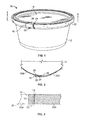
- FIG. 1 is a perspective view of a container with a tamper evident band
- FIG. 2 is a partial cross-sectional view of the container with the tamper evident band taken along line 2-2 of FIG. 1 ;
- FIG. 3 is an elevation view of a portion of the tamper evident band of FIG. 1 ;
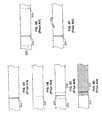
- FIG. 4A is an elevation view of a portion of a prior art tamper evident band
- FIG. 4B is an elevation view of a portion of another prior art tamper evident band
- FIG. 4C is an elevation view of a portion of another prior art tamper evident band
- FIG. 4D is an elevation view of a portion of another prior art tamper evident band
- FIG. 4E is an elevation view of a portion of another prior art tamper evident band.
- FiG. 4F is an eievaiion view of a portion of another prior art tamper evident band.
- FIGS. 1-4 An easy open tamper evident band for a food container and, in particular, an easy open tamper evident band for a frozen food container having a pull tab used to aid in opening, is disclosed herein and illustrated in FIGS. 1-4 .
- the pull tab extends past a seam that seals the band to itself and keeps the band in place about a rim of a container.
- the band, seam and the pull tab can withstand freezing temperatures, movements associated with transportation and storage conditions to minimize breakage of the band.
- a food container 10 having an easy-open tamper evident band 20 around its rim.
- the food container 10 has a lid 14 and a base 12 for containing a food product therein.
- the band 20 can fit around an edge of the lid 14 and part of an upper section of the base 12.
- the band 20 is sealed about the lid 14 and the base 12 such that the lid 14 cannot be removed unless the band 20 is first removed or torn off.
- the band 20 has a first end portion 16 and a second end portion 18, such that when the band 20 is wrapped around the rim of the container 10 the first end portion 16 can become the outer end and the second end portion 18 can become the inner end, as shown in FIG. 2 .
- the overlapping portions of the first and second end portions of the band 20 are sealed at a seam 24 to form a ring around a perimeter of the container 10.
- the band 20 can be shrink-wrapped around the container 10.
- the seam 24 can be positioned at an edge portion of the inner end portion 18 and spaced from the outer end portion 16, thus creating a free flap or pull tab 22, as shown in FIG. 2 .
- the seam 24 may be sized sufficient to join the end portions 16 and 18, but preferably spans the entire height of the band 20, from an upper edge adjacent the lid 14 to a lower edge adjacent the base 12.
- the seam 24 may also be generally linear, but other shapes may be used.
- the tab 22 overlaps the inner end 18 and extends past the seam 24.
- the outer end portion 16 of the band 20 becomes part of the pull tab 22 that can be grasped and pulled to easily break the seal of the band 20 at or near the area of the seam 24 to remove the band 20.
- the pull tab 22 can be a free-standing pull-tab, as illustrated in FIG. 2 , or it can be held in place temporarily against the inner portion 20a of the band 20 by a light adhesive. If the tab 22 is in place a light tack glue can be used, typically at or near the edge portion of the outer end 16 so that as little of a surface area of the tab 22 as possible is tacked down to the inner portion 20a of the band 20. Alternatively, the entire tab 22 or any portion of it can be tacked down to the inner portion 20a of the band 20, as long as it remains easy to lift up. The light tack glue can help to keep the tab 22 in place until the band 20 is to be removed and to prevent the tab 22 from catching on anything prior to opening.
- the band 20 may further include a perforation 26 adjacent the seam 24 to further aid in removing and tearing the band 20.
- the perforation 26 is preferably located between the seam 24 and the outer end portion 16, and may be located closer to the seam 24 than the outer end portion 16. Furthermore, the perforation 26 can be located on the inner portion 20a of the band 20 so that when it is torn apart, it tears the band 20 into two pieces. Additionally, the perforation 26 can also contain an adhesive or light tack glue, that holds it in place against the outer band 20b.
- the perforation 26 may take any shape but preferably is a line and may span the entire height of the band 20, from the upper edge adjacent the lid 14 to the lower edge adjacent the base 12.
- the perforation 26 generally aids in directing the direction of the tear through the band 20 upon opening and helps to open or separate the band 20, allowing the inner layer and the outer layer of the band 20 to separate along the perforation 26 instead of or in addition to separating at the seam 24.
- the band 20 will break at the perforation 26 before breaking at the seam 24 due to a directional change in material as it goes over a skirt of the container 10, which may require more force.
- the perforation 26 enables a consumer to use less force than tearing a band without a perforation and thus makes the opening of the band 20 much easier.
- the extra material of the first end 16 overlapping the second end 18 also overlaps the perforation 26, if one is present, and acts as a cover to protect the perforation 26 making it less susceptible to breakage.
- the band 20 may optionally have a visual demarcation adjacent the outer edge of the tab 22 and located on the inner portion 20a of the band 20.
- the visual demarcation aids in highlighting the location of the tab 22, since typically the band 20 will be made of a transparent material.
- the visual demarcation may be a line that is generally parallel to the outer edge of the first end portion 16 and may further be a colored line, such as a red-striped line, for example.
- the band 20 may also optionally contain other features such as a visual indicator to further highlight the existence of the visual demarcation and the tab 22.
- a visual indicator may consist of a series of arrows, for example, which point to the visual demarcation.
- the band 20 is typically wide enough such that it can be positioned about a lip of the lid 14 overlapping onto an upper portion of the base 12 adjacent the lid 14 in a closed state, and wraps around the entire perimeter of the container 10.
- the lid 14 and base 12 of the container 10 may be of any size and shape, but typically generally round shaped containers are used.
- the containers 10 and respective bands 20 must be able to withstand transportation and storage conditions which are required for the food product therein. Some of the storage conditions for the food and container 10 may be as low as about -5°F, over an extended period of time; the temperature being determined by the food product stored therein. Any type of food storage container or jar 10 may be used, such as a container used for the storage of a frozen dessert topping.
- the container may be used to store food items, such as a whipped dessert cream topping, mayonnaise, or other condiments.
- the material of construction of the band 20 may be any suitable material which will provide adequate closure about the rim and withstand storage and transportation conditions of the container 10 to minimize or prevent breakage of the band 20 prior to opening the container 10.
- the band 20 may be a polyvinyl chloride (PVC) material that is heat-shrinkable, such as is available by Bonset, in Greensboro, North Carolina. Any size or thickness material may be used, such as a 2.5 mil thickness PVC layer. A height of about 12.5 mm to about 38 mm may be used for the band, and preferably about 34 mm is used.
- the length of the pull tab i.e. the extra flap of material that overlaps the second end, can be from 6.4 mm to about 25.4 mm.
- the light adhesive used to keep the first end 16 attached to the inner layer 20a or for keeping the perforation along the inner layer 20a attached to the outer layer 20b may be an adhesive such as AL7001 or AL7002 available from Alcoa Inc., in Pittsburgh, Pennsylvania.
- the diameter of the container may be about 15 cm.
- the consumer can grab a hold of the pull-tab 22, either by grasping its free-standing end or by separating it from the light glue keeping it tacked down to the inner portion 20a of the band 20, and apply a force to the band 20 that is great enough to break the band 20 in order to remove it from around the container 10.
- the band 20 consists of only a seam 24, then the force applied should be great enough to overcome the seal at the seam 24 to separate the band 20 and to tear it off of the container 10.
- the band 20 also has a perforation 26, then the force applied should be great enough to overcome at least one of the seal at the seam 24 or the perforation 26.
- the band 20 can be presealed to itself by a band/film supplier, thus already containing the seam 24.
- the pre-sealed band film can be supplied on a roll having a "lay-flat" width of about 245 mm, before cutting the roll.
- the pre-formed band film can then be sent through standard bonding equipment, such as is provided by American Fuji Seal, in Fairfield, New Jersey. As the band film goes through the equipment, a mandrel can open the film and place it on the container 10 and a blade can cut the band film such that the height of the band film about the container 10 is about 34 mm.
- the container 10 with the band film placed around it can then receive a blast of heat to preshrink the band film around the container 10, followed by the container 10 being passed through a heat tunnel that shrinks the band down even more about the container lid 14 and base 12, such that it fits tightly about the container 10.
- the breakage rates of a variety of different bands were tested to determine which design band had the lowest breakage rate.
- the different bands were produced and placed around similar shaped containers. Each container underwent a six-sided drop from a height of about 24 inches at 0°F. A six-sided drop consisted of dropping each container a total of six times on six different sides of the container from the specified height. Each container was then manually inspected to see if there were any breaks or tears in the band.
- a control band was used that consisted of a single seam 224, as depicted in FIG. 4A , which is the band that is typically in use with many frozen food products and has a relatively low breakage rate (i.e., about 1.5% to about 4%), however, it can be difficult to open.
- an easy-open band it is preferred for an easy-open band to have a breakage rate at least as good as the control band.
- the other bands tested had a variety of features that tend not to be easy to open, as shown in FIGS. 4B-4F .
- some of the different bands tested consisted of a single micro-perforation (perf) 226 (i.e., a micro-perf contains perforations that are very close to each other in comparison to a regular perforation) (see FIG. 4B ), a double perf 228 and 230 (see FIG. 4E ), tear tape 232 with double perf 228 and 230 (i.e., where a tear tape 232 provides a path along which the tear is initiated) (see FIG.
- perf micro-perforation
- the pull tab version of the band (designated as "Pull Tab with Seam") had a breakage rate of about 2% and performed the closest to the control in that its breakage rate was right around the range of the control band, which was desired.
- an easy open tamper evident band for a food container is provided that allows for easy removal of the band and where the band can withstand transportation and cold temperatures.
- the disclosure is not limited to the aspects and embodiments described hereinabove, or to any particular embodiments.
- Various modifications to the easy-open tamper evident band can result in substantially the same band.
Landscapes
- Engineering & Computer Science (AREA)
- Mechanical Engineering (AREA)
- Packages (AREA)
Abstract
Description
- An easy to open, tamper evident band for a food container and, in particular, an easy to open, tamper evident band with a pull tab.
- Food containers are often packaged with some type of tamper evident seal or band. These bands can also aid in keeping the container together prior to a consumer purchasing the product. One common tamper evident seal is to use a band or plastic strip that is wrapped around the outer rim of a container. The tamper evident band is wrapped around the edge of the container lid and an upper portion of the container base. The band is held together by a seam that is typically placed between an inner surface edge of an outer layer and an inner layer, forming a continuous band around the container rim such that the lid and base cannot be separated without first removing the tamper evident band or breaking its seal around the container rim. This feature of the band provides the visual indication necessary to show if the product has been tampered with and already opened.
- One drawback of using the tamper evident band is that it can prove difficult for the consumer to open. The overlapping ends of the tamper evident band are often sealed together at a seam such that the band forms one continuous ring or band around the container rim, without any flap or loose end to grab. In order for the consumer to open the band, the consumer must try to break through the band, either by hand or with the aid of an instrument that can cut through the band or rip through it.
- As a result, some tamper evident bands have been manufactured with features to aid in the removal of the bands. One such feature is placing a perforation through the band so it spans from a top edge to a bottom edge, to provide an easy tear point. One problem with perforations, however, has been that the perforation can be difficult to separate easily since the consumer may attempt to grasp a section of the band adjacent to the perforation and try to begin tearing through the perforation.
- Another problem with the typical perforated band is that it has a high breakage rate during storage and transportation conditions. The perforated band also has problems withstanding freezing temperatures during storage, such as temperatures as low as about -5°F. The freezing temperatures can affect the durability of the perforation and often the typical perforated band can begin to separate at these colder temperatures and to break apart along the perforation. Thus, the typical perforated band does not stand up well under these cold conditions and the integrity of the tamper evident band can be compromised.
- A number of other variations of the single perforation band have also been tried, but have had similar problems. For example, double perforations or a tear tape with a perforation have been used but also with the high breakage rates associated with the single perforation band. Another design consists of a seam with a small notch spaced from the seam; however, this design also can have a large breakage rate and can also prove to be difficult to open.
- The integrity of most tamper evident bands does not hold up well to low temperatures and does not often hold up to storage and transportation conditions. While the containers are being shipped they often bounce around in the cartons or crates that they are packaged in, as well as within the vehicle used for transportation. During the movements endured during transport, the tamper evident bands can break.
- A tamper evident band for a food container is provided that minimizes or avoids breakage of the band during transportation and storage at freezing temperatures and provides a pull tab extending past the seam for an easy to open feature. A strip of a tamper evident band is placed around a rim of the food container where two end portions are sealed together at a seam. One of the end portions overlaps the other to extend past this seam and functions as a pull tab for an easy to open feature. The pull tab may provide extra material which covers and protects the seam, and a perforation, if used, to protect it from breakage and to help the band remain intact. The pull tab extending past the seam is configured to withstand freezing storage temperatures and minimize or avoid breakage of the band during freezing and transportation, while providing an easy way to open the band.
- The pull tab may have a free-standing end or the end may be temporarily held in place by an adhesive, which can be easily overcome to lift up the pull-tab and pull to separate the band. The band may also include a perforation adjacent the seam to aid in opening. The perforation may be attached to the outer layer of the band by a light adhesive. The overlapping end of the pull tab can further protect the perforation by covering it and making it less susceptible to breakage.
-
FIG. 1 is a perspective view of a container with a tamper evident band; -
FIG. 2 is a partial cross-sectional view of the container with the tamper evident band taken along line 2-2 ofFIG. 1 ; -
FIG. 3 is an elevation view of a portion of the tamper evident band ofFIG. 1 ; -
FIG. 4A is an elevation view of a portion of a prior art tamper evident band; -
FIG. 4B is an elevation view of a portion of another prior art tamper evident band; -
FIG. 4C is an elevation view of a portion of another prior art tamper evident band; -
FIG. 4D is an elevation view of a portion of another prior art tamper evident band; -
FIG. 4E is an elevation view of a portion of another prior art tamper evident band; and -
FiG. 4F is an eievaiion view of a portion of another prior art tamper evident band. - An easy open tamper evident band for a food container and, in particular, an easy open tamper evident band for a frozen food container having a pull tab used to aid in opening, is disclosed herein and illustrated in
FIGS. 1-4 . In particular, the pull tab extends past a seam that seals the band to itself and keeps the band in place about a rim of a container. The band, seam and the pull tab can withstand freezing temperatures, movements associated with transportation and storage conditions to minimize breakage of the band. - Turning to
FIG. 1 , afood container 10 is shown having an easy-open tamperevident band 20 around its rim. Thefood container 10 has alid 14 and abase 12 for containing a food product therein. Theband 20 can fit around an edge of thelid 14 and part of an upper section of thebase 12. Theband 20 is sealed about thelid 14 and thebase 12 such that thelid 14 cannot be removed unless theband 20 is first removed or torn off. Theband 20 has afirst end portion 16 and asecond end portion 18, such that when theband 20 is wrapped around the rim of thecontainer 10 thefirst end portion 16 can become the outer end and thesecond end portion 18 can become the inner end, as shown inFIG. 2 . - The overlapping portions of the first and second end portions of the
band 20 are sealed at aseam 24 to form a ring around a perimeter of thecontainer 10. Theband 20 can be shrink-wrapped around thecontainer 10. Theseam 24 can be positioned at an edge portion of theinner end portion 18 and spaced from theouter end portion 16, thus creating a free flap or pulltab 22, as shown inFIG. 2 . Theseam 24 may be sized sufficient to join theend portions band 20, from an upper edge adjacent thelid 14 to a lower edge adjacent thebase 12. Theseam 24 may also be generally linear, but other shapes may be used. Thetab 22 overlaps theinner end 18 and extends past theseam 24. Theouter end portion 16 of theband 20 becomes part of thepull tab 22 that can be grasped and pulled to easily break the seal of theband 20 at or near the area of theseam 24 to remove theband 20. - The
pull tab 22 can be a free-standing pull-tab, as illustrated inFIG. 2 , or it can be held in place temporarily against theinner portion 20a of theband 20 by a light adhesive. If thetab 22 is in place a light tack glue can be used, typically at or near the edge portion of theouter end 16 so that as little of a surface area of thetab 22 as possible is tacked down to theinner portion 20a of theband 20. Alternatively, theentire tab 22 or any portion of it can be tacked down to theinner portion 20a of theband 20, as long as it remains easy to lift up. The light tack glue can help to keep thetab 22 in place until theband 20 is to be removed and to prevent thetab 22 from catching on anything prior to opening. - The
band 20 may further include aperforation 26 adjacent theseam 24 to further aid in removing and tearing theband 20. Theperforation 26 is preferably located between theseam 24 and theouter end portion 16, and may be located closer to theseam 24 than theouter end portion 16. Furthermore, theperforation 26 can be located on theinner portion 20a of theband 20 so that when it is torn apart, it tears theband 20 into two pieces. Additionally, theperforation 26 can also contain an adhesive or light tack glue, that holds it in place against theouter band 20b. Theperforation 26 may take any shape but preferably is a line and may span the entire height of theband 20, from the upper edge adjacent thelid 14 to the lower edge adjacent thebase 12. Theperforation 26 generally aids in directing the direction of the tear through theband 20 upon opening and helps to open or separate theband 20, allowing the inner layer and the outer layer of theband 20 to separate along theperforation 26 instead of or in addition to separating at theseam 24. Typically, if tearing from the top down (i.e., from thelid 14 area down towards the base 12 area), theband 20 will break at theperforation 26 before breaking at theseam 24 due to a directional change in material as it goes over a skirt of thecontainer 10, which may require more force. However, if tearing from the bottom up (i.e., from the base 12 area upwards towards thelid 14 area), there is no directional change in the material, so the consumer can pull on the extra material and it will usually break at theseam 24. Regardless of what tearing direction is used, theperforation 26 enables a consumer to use less force than tearing a band without a perforation and thus makes the opening of theband 20 much easier. Furthermore, the extra material of thefirst end 16 overlapping thesecond end 18 also overlaps theperforation 26, if one is present, and acts as a cover to protect theperforation 26 making it less susceptible to breakage. - The
band 20 may optionally have a visual demarcation adjacent the outer edge of thetab 22 and located on theinner portion 20a of theband 20. The visual demarcation aids in highlighting the location of thetab 22, since typically theband 20 will be made of a transparent material. The visual demarcation may be a line that is generally parallel to the outer edge of thefirst end portion 16 and may further be a colored line, such as a red-striped line, for example. In addition to the visual demarcation, theband 20 may also optionally contain other features such as a visual indicator to further highlight the existence of the visual demarcation and thetab 22. A visual indicator may consist of a series of arrows, for example, which point to the visual demarcation. - The
band 20 is typically wide enough such that it can be positioned about a lip of thelid 14 overlapping onto an upper portion of the base 12 adjacent thelid 14 in a closed state, and wraps around the entire perimeter of thecontainer 10. Thelid 14 andbase 12 of thecontainer 10 may be of any size and shape, but typically generally round shaped containers are used. Thecontainers 10 andrespective bands 20 must be able to withstand transportation and storage conditions which are required for the food product therein. Some of the storage conditions for the food andcontainer 10 may be as low as about -5°F, over an extended period of time; the temperature being determined by the food product stored therein. Any type of food storage container orjar 10 may be used, such as a container used for the storage of a frozen dessert topping. The container may be used to store food items, such as a whipped dessert cream topping, mayonnaise, or other condiments. - The material of construction of the
band 20 may be any suitable material which will provide adequate closure about the rim and withstand storage and transportation conditions of thecontainer 10 to minimize or prevent breakage of theband 20 prior to opening thecontainer 10. For example, theband 20 may be a polyvinyl chloride (PVC) material that is heat-shrinkable, such as is available by Bonset, in Greensboro, North Carolina. Any size or thickness material may be used, such as a 2.5 mil thickness PVC layer. A height of about 12.5 mm to about 38 mm may be used for the band, and preferably about 34 mm is used. The length of the pull tab, i.e. the extra flap of material that overlaps the second end, can be from 6.4 mm to about 25.4 mm. The light adhesive used to keep thefirst end 16 attached to theinner layer 20a or for keeping the perforation along theinner layer 20a attached to theouter layer 20b may be an adhesive such as AL7001 or AL7002 available from Alcoa Inc., in Pittsburgh, Pennsylvania. The diameter of the container may be about 15 cm. - When the
container 10 is to be opened, the consumer can grab a hold of the pull-tab 22, either by grasping its free-standing end or by separating it from the light glue keeping it tacked down to theinner portion 20a of theband 20, and apply a force to theband 20 that is great enough to break theband 20 in order to remove it from around thecontainer 10. If theband 20 consists of only aseam 24, then the force applied should be great enough to overcome the seal at theseam 24 to separate theband 20 and to tear it off of thecontainer 10. If theband 20 also has aperforation 26, then the force applied should be great enough to overcome at least one of the seal at theseam 24 or theperforation 26. - A variety of methods for applying the
band 20 to thecontainer 10 described herein can be utilized. For example, theband 20 can be presealed to itself by a band/film supplier, thus already containing theseam 24. The pre-sealed band film can be supplied on a roll having a "lay-flat" width of about 245 mm, before cutting the roll. The pre-formed band film can then be sent through standard bonding equipment, such as is provided by American Fuji Seal, in Fairfield, New Jersey. As the band film goes through the equipment, a mandrel can open the film and place it on thecontainer 10 and a blade can cut the band film such that the height of the band film about thecontainer 10 is about 34 mm. Thecontainer 10 with the band film placed around it can then receive a blast of heat to preshrink the band film around thecontainer 10, followed by thecontainer 10 being passed through a heat tunnel that shrinks the band down even more about thecontainer lid 14 andbase 12, such that it fits tightly about thecontainer 10. - The breakage rates of a variety of different bands were tested to determine which design band had the lowest breakage rate. The different bands were produced and placed around similar shaped containers. Each container underwent a six-sided drop from a height of about 24 inches at 0°F. A six-sided drop consisted of dropping each container a total of six times on six different sides of the container from the specified height. Each container was then manually inspected to see if there were any breaks or tears in the band. A control band was used that consisted of a
single seam 224, as depicted inFIG. 4A , which is the band that is typically in use with many frozen food products and has a relatively low breakage rate (i.e., about 1.5% to about 4%), however, it can be difficult to open. It is preferred for an easy-open band to have a breakage rate at least as good as the control band. The other bands tested had a variety of features that tend not to be easy to open, as shown inFIGS. 4B-4F . For example, some of the different bands tested consisted of a single micro-perforation (perf) 226 (i.e., a micro-perf contains perforations that are very close to each other in comparison to a regular perforation) (seeFIG. 4B ), adouble perf 228 and 230 (seeFIG. 4E ),tear tape 232 withdouble perf 228 and 230 (i.e., where atear tape 232 provides a path along which the tear is initiated) (seeFIG. 4C ), a sealed film extension where a free-end extended past theseam 224 is sealed to the band underneath it at a second seal 216 (seeFIG. 4D ), and aseam 224 with a notch 234 (seeFIG. 4F ). All of these different bands and a band having thepull tab 22 extending past theseam 24 with aperforation 26, as disclosed herein and shown inFIG. 3 , were tested against the control. The Table below presents the average results from the breakage rate testing.Band Tested % Breakage Control ( FIG. 4A )1.5-4% Single Perf ( FIG. 4B )59% Double Perf ( FIG. 4E )35% Tear tape with Double Perf ( FIG. 4C )34-65% Sealed film extension ( FIG. 4D )4.8% Seam with notch ( FIG. 4F )17% Pull Tab with Seam ( FiG. 3 )2% - The pull tab version of the band (designated as "Pull Tab with Seam") had a breakage rate of about 2% and performed the closest to the control in that its breakage rate was right around the range of the control band, which was desired. The next closest band in terms of performance, was the sealed film extension, however, this band can be difficult to open and does not have an easy to open feature. From the foregoing, it is apparent that the pull tab with seam had reduced breakage in combination with an easy to open feature in the form of the
tab 22. - From the foregoing, it will be appreciated an easy open tamper evident band for a food container is provided that allows for easy removal of the band and where the band can withstand transportation and cold temperatures. However, the disclosure is not limited to the aspects and embodiments described hereinabove, or to any particular embodiments. Various modifications to the easy-open tamper evident band can result in substantially the same band.
Claims (16)
- A tamper evident seal for a container having an easy-open pull tab comprising:a band that is wrapped around a perimeter of a container rim, the band having a first end portion and a second end portion;the first end portion overlaps the second end portion, and the second end portion is sealed to the band along a seam spaced apart from the first end portion;a perforation adjacent the seam; andthe first end extends past the seam and past the second end to form the pull tab.
- The tamper evident seal of Claim 1, wherein the container rim includes a lip of a lid and a portion of a base adjacent the lid, and the band includes an inner layer adjacent the container and an outer layer that overlaps the inner layer.
- The tamper evident seal of Claims 1 or 2, wherein the perforation is a line that generally spans an entire height of the band, from an upper edge adjacent the lid to a lower edge adjacent the base and is between the first end and the seam.
- The tamper evident seal of any one or more of Claims 1 to 3, wherein the perforation is located on the inner layer of the band and is covered by the outer layer of the band which also includes the pull tab.
- The tamper evident seal of any one or more of Claims 1 to 4, wherein the seam is positioned along the band between the inner layer and the outer layer and generally spans the entire height of the band from an upper edge adjacent the lid to a lower edge adjacent the base.
- The tamper evident seal of any one or more of Claims 1 to 5, wherein one of the seam and the perforation do not separate until a tearing force is applied and both withstand temperatures as low as about -5°F without separating.
- The tamper evident seal of any one or more of Claims 1 to 5, wherein the band has a height of about 34 mm, and keeps the lid and base joined together.
- The tamper evident seal of Claim 2 or 3, wherein the pull tab is held in place against the inner layer of the band by an adhesive, and/or wherein the perforation is held in place against the outer layer of the band by an adhesive.
- The tamper evident seal of Claims 1 or 2, wherein the band is heat shrinked about the container rim and the seam is pre-sealed.
- The tamper evident seal of Claims 1 or 2, wherein the seam is spaced from the first end portion and positioned between an inner side of the outer layer containing the first end portion and an outer side of the inner layer containing the second end portion, and at the second end portion.
- A method of removing a tamper evident seal on a container comprising:grasping a tab at an edge of a first end portion, wherein the first end portion overlaps a second end portion of a band positioned around a perimeter of the container and the second end portion is sealed to the band along a seam spaced from the first end portion; andpulling the tab to break the band at one of a perforation or the seam.
- The method of Claim 11, wherein the perforation is adjacent the seam on an inner layer adjacent the container.
- The method of Claim 11, or the tamper evident seal of Claim 2 wherein the pull tab extends from the seam to the first end and has an overlapping length of about 6.4 mm, to about 25.4 mm.
- The method of Claim 11, or the tamper evident seal of any one or more of Claims 1 to 6 wherein the band does not separate until a tearing force is applied and further withstands temperatures as low as about -5°F without separating.
- The method of Claim 11, or the tamper evident seal of any one or more of Claims 1 to 7 wherein the band is made from a polyvinyl chloride material.
- A tamper evident band for a freezer container having an easy-open pull tab comprising:the band being wrapped around a perimeter of a container rim, the container rim comprising a lip of a lid and a portion of a base adjacent the lid;the band having a first end portion and a second end portion, the first end portion overlapping the second end portion;the second end portion is sealed to the band along a seam spaced apart from the first end portion, the first end portion extending past the seam to form the pull tab; and a perforated line positioned between the seam and the first end portion.
Applications Claiming Priority (1)
| Application Number | Priority Date | Filing Date | Title |
|---|---|---|---|
| US11/778,762 US20090021026A1 (en) | 2007-07-17 | 2007-07-17 | Tamper evident band for a food container |
Publications (1)
| Publication Number | Publication Date |
|---|---|
| EP2017188A1 true EP2017188A1 (en) | 2009-01-21 |
Family
ID=39745433
Family Applications (1)
| Application Number | Title | Priority Date | Filing Date |
|---|---|---|---|
| EP20080104784 Withdrawn EP2017188A1 (en) | 2007-07-17 | 2008-07-17 | Tamper evident band for a food container |
Country Status (3)
| Country | Link |
|---|---|
| US (1) | US20090021026A1 (en) |
| EP (1) | EP2017188A1 (en) |
| CA (1) | CA2637993A1 (en) |
Cited By (1)
| Publication number | Priority date | Publication date | Assignee | Title |
|---|---|---|---|---|
| FR3047233A1 (en) * | 2016-02-02 | 2017-08-04 | Eric Enjolras | ON PACKAGING CARDBOARD FOR TRAFFIC TRAFFIC TYPE MULTIPACK |
Families Citing this family (20)
| Publication number | Priority date | Publication date | Assignee | Title |
|---|---|---|---|---|
| US20140279268A1 (en) * | 2001-10-16 | 2014-09-18 | Concur Technologies, Inc. | Methods and systems for alternative trip comparisons and/or queue-based interactions |
| US8083089B2 (en) * | 2005-07-13 | 2011-12-27 | Pwp Industries Inc. | Versatile tamper-evident food container |
| US7631776B2 (en) * | 2005-06-10 | 2009-12-15 | Pwp Industries | Tamper evident container with tear-apart parts |
| US8251242B2 (en) * | 2005-06-10 | 2012-08-28 | Pwp Industries | Tamper-evident container with extended band |
| US7568589B2 (en) * | 2005-06-24 | 2009-08-04 | Pwp Industries | Edge-tearing tamper-evident container |
| US8251249B1 (en) | 2005-06-24 | 2012-08-28 | Pwp Industries | Hangable tamper resistant packaging system |
| US8360262B2 (en) | 2005-12-21 | 2013-01-29 | Pactiv Packaging Inc. | Integrated food packaging system having a cup, a container, and a cover |
| US8833589B2 (en) | 2005-12-21 | 2014-09-16 | Pactiv Packaging Inc. | Enhanced tamper evident bowl with blocked tab |
| US8127961B2 (en) | 2007-11-10 | 2012-03-06 | Pwp Industries | Double ribbed secure container |
| US8146766B2 (en) | 2009-04-29 | 2012-04-03 | Pwp Industries | Enhanced secure container |
| US9266576B1 (en) * | 2015-04-23 | 2016-02-23 | Arthur J. dela Houssaye | Tamper evident wheel support |
| US10220985B2 (en) | 2016-10-28 | 2019-03-05 | Genpak, Llc | Tamper-evident container with a tabbed hinge |
| US10351310B2 (en) | 2016-10-28 | 2019-07-16 | Genpak, Llc | Tamper-evident container with a bump near a tabbed hinge |
| US10894635B2 (en) | 2016-10-28 | 2021-01-19 | Genpak, Llc | Tamper-evident container with a wide tab extending beyond a hinge |
| US10889413B2 (en) | 2016-10-28 | 2021-01-12 | Genpak, Llc | Tamper-evident container with a tab extending beyond a hinge |
| US10669080B2 (en) | 2018-09-19 | 2020-06-02 | Sonoco Development, Inc. | Tamper evident closure |
| JP2022511825A (en) | 2018-12-07 | 2022-02-01 | ベッドフォード インダストリーズ インコーポレイテッド | Tag attachment with shrink film |
| USD1058310S1 (en) * | 2023-04-14 | 2025-01-21 | Hebei Fenger Intelligent Technology Co., Ltd | Round bowl |
| US20250035237A1 (en) * | 2023-07-24 | 2025-01-30 | Dale Baker | Cable tie device |
| CN119489997B (en) * | 2024-12-23 | 2025-11-21 | 东莞市翔临塑胶制品有限公司 | Bottle cap secondary forming structure and method for plastic bottle |
Citations (7)
| Publication number | Priority date | Publication date | Assignee | Title |
|---|---|---|---|---|
| US2330878A (en) * | 1939-12-21 | 1943-10-05 | George H Hutaff Jr | Container |
| US2747345A (en) * | 1949-10-03 | 1956-05-29 | James J Plastino | Method of sealing cans |
| US3334776A (en) * | 1965-10-01 | 1967-08-08 | American Can Co | Container sealing ring |
| DE2753239A1 (en) * | 1977-11-29 | 1979-06-07 | Zweckform Werk | Laminated adhesive tape as anti-tamper device for bottle closures - is coated with acrylic! glue and incorporates strong PVC, polyester or acetate lamina |
| US4633648A (en) * | 1985-05-06 | 1987-01-06 | Minnesota Mining And Manufacturing Company | Container closure seal and method of making |
| US4775076A (en) * | 1984-10-05 | 1988-10-04 | Cod Inter Techniques S.A. | Sealed package, method for manufacturing and utilization of said package |
| EP0517610A1 (en) * | 1991-06-07 | 1992-12-09 | Fromageries Bel | Container |
Family Cites Families (33)
| Publication number | Priority date | Publication date | Assignee | Title |
|---|---|---|---|---|
| US2967383A (en) * | 1957-11-07 | 1961-01-10 | Grace W R & Co | Packaged product and method of making the same |
| GB1124022A (en) * | 1964-07-22 | 1968-08-21 | Minnesota Mining & Mfg | Adhesive strip |
| US3367531A (en) * | 1966-03-22 | 1968-02-06 | American Can Co | Seam release container |
| US3363793A (en) * | 1966-05-27 | 1968-01-16 | Grace W R & Co | Closure elements |
| US3358902A (en) * | 1966-06-24 | 1967-12-19 | Dow Chemical Co | Secondary closure |
| FR1508837A (en) * | 1966-08-26 | 1968-03-25 | ||
| US3396899A (en) * | 1966-12-22 | 1968-08-13 | Owens Illinois Inc | Composite container and sealing means therefor |
| US3555764A (en) * | 1967-02-01 | 1971-01-19 | Continental Can Co | Apparatus and method for securing closures to container bodies |
| US3403810A (en) * | 1967-07-27 | 1968-10-01 | Continental Can Co | Tape sealed container |
| US3924771A (en) * | 1971-07-30 | 1975-12-09 | Gunther Cleff | Bottle cap having a preshrunk foil portion |
| US3873018A (en) * | 1973-02-20 | 1975-03-25 | Minnesota Mining & Mfg | Easily rupturable band of tape |
| US3955699A (en) * | 1973-02-20 | 1976-05-11 | Owens-Illinois, Inc. | Close nesting, tamperproof container closure |
| US4009793A (en) * | 1974-07-12 | 1977-03-01 | The Procter & Gamble Company | Tamper-proof closure seal |
| JPS5112284A (en) * | 1974-07-18 | 1976-01-30 | Fuji Seal Ind Co Ltd | Shoshitoo sonaeru kyatsupushiiru |
| US3997056A (en) * | 1975-05-08 | 1976-12-14 | Owens-Illinois, Inc. | Tamper-proof closure for a container |
| NZ180451A (en) * | 1975-05-08 | 1978-11-13 | Owens Illinois Inc | Sealing filled container: band of thermoplastic adhesive tape adheres lid of each container to container sidewall |
| US4000824A (en) * | 1975-07-24 | 1977-01-04 | Minnesota Mining And Manufacturing Company | Tape closures |
| US4732293A (en) * | 1986-11-05 | 1988-03-22 | Landis Plastics, Inc. | Tear strip closure for a container with a security ring |
| US4759465A (en) * | 1986-11-05 | 1988-07-26 | Landis Plastics, Inc. | Tear strip closure for a container with a security ring |
| US4758456A (en) * | 1987-03-18 | 1988-07-19 | Morgan Adhesives Company | Bottle seal |
| US4946723A (en) * | 1988-11-09 | 1990-08-07 | Paules Eugene H | Tamper-proof sealing strip with a tear tab and a container |
| US5052574A (en) * | 1990-02-16 | 1991-10-01 | Cardinal Packaging Inc. | Tamper-proof and tamper-evident container closure system |
| US5217307A (en) * | 1990-12-07 | 1993-06-08 | Morgan Adhesives Company | Container with an easy opening indicator or security break indicator |
| US5257704A (en) * | 1992-05-08 | 1993-11-02 | Revlon Consumer Products Corporation | Tamperproof lipstick seal |
| US5544770A (en) * | 1993-05-07 | 1996-08-13 | Travisano; Frank P. | Tamper evident seal and system |
| EP0771291B1 (en) * | 1994-07-20 | 1998-12-09 | The Pillsbury Company | Tamper evident shrink band |
| US5511697A (en) * | 1994-12-19 | 1996-04-30 | The Procter & Gamble Company | Reclosable pouch and method of construction |
| US5511679A (en) * | 1995-04-24 | 1996-04-30 | Creative Packaging Corp. | Closure for resealable container |
| US6322864B1 (en) * | 1996-12-10 | 2001-11-27 | Sleever International Company | Sleeve-type envelope of heat-shrinkable plastic material for packaging at least one item |
| US6000570A (en) * | 1997-05-01 | 1999-12-14 | Nelson; James L. | Container lid with tamper evident slip band |
| EP1044698A1 (en) * | 1999-04-14 | 2000-10-18 | Amgen Inc., | Pre-filled tamper evident syringe assembly |
| MXPA05011848A (en) * | 2003-05-06 | 2006-05-25 | Renaissance Mark Inc | Improved neck band using straight-tear film. |
| US7077017B2 (en) * | 2004-04-13 | 2006-07-18 | Sigma-Aldrich Co. | Container with a frangible seal |
-
2007
- 2007-07-17 US US11/778,762 patent/US20090021026A1/en not_active Abandoned
-
2008
- 2008-07-16 CA CA 2637993 patent/CA2637993A1/en not_active Abandoned
- 2008-07-17 EP EP20080104784 patent/EP2017188A1/en not_active Withdrawn
Patent Citations (7)
| Publication number | Priority date | Publication date | Assignee | Title |
|---|---|---|---|---|
| US2330878A (en) * | 1939-12-21 | 1943-10-05 | George H Hutaff Jr | Container |
| US2747345A (en) * | 1949-10-03 | 1956-05-29 | James J Plastino | Method of sealing cans |
| US3334776A (en) * | 1965-10-01 | 1967-08-08 | American Can Co | Container sealing ring |
| DE2753239A1 (en) * | 1977-11-29 | 1979-06-07 | Zweckform Werk | Laminated adhesive tape as anti-tamper device for bottle closures - is coated with acrylic! glue and incorporates strong PVC, polyester or acetate lamina |
| US4775076A (en) * | 1984-10-05 | 1988-10-04 | Cod Inter Techniques S.A. | Sealed package, method for manufacturing and utilization of said package |
| US4633648A (en) * | 1985-05-06 | 1987-01-06 | Minnesota Mining And Manufacturing Company | Container closure seal and method of making |
| EP0517610A1 (en) * | 1991-06-07 | 1992-12-09 | Fromageries Bel | Container |
Cited By (1)
| Publication number | Priority date | Publication date | Assignee | Title |
|---|---|---|---|---|
| FR3047233A1 (en) * | 2016-02-02 | 2017-08-04 | Eric Enjolras | ON PACKAGING CARDBOARD FOR TRAFFIC TRAFFIC TYPE MULTIPACK |
Also Published As
| Publication number | Publication date |
|---|---|
| CA2637993A1 (en) | 2009-01-17 |
| US20090021026A1 (en) | 2009-01-22 |
Similar Documents
| Publication | Publication Date | Title |
|---|---|---|
| US20090021026A1 (en) | Tamper evident band for a food container | |
| US11027892B2 (en) | Package integrity indicating closure | |
| US10829285B2 (en) | Package integrity indicating closure | |
| US8951591B2 (en) | Package integrity indicator for container closure | |
| US7963413B2 (en) | Tamper evident resealable closure | |
| US5063069A (en) | Zippered closure for thermoformed package | |
| US20160122109A1 (en) | Resealable package with segmented opening | |
| US20080105572A1 (en) | Reclosable Package Having An Accessible Zipper And A Method For Making The Same | |
| US6142366A (en) | Breakaway container with thumb slit | |
| US20120043324A1 (en) | Container with Reduced, Peel-Off-Force Tear Configuration | |
| JP2004535334A (en) | Product package with tearable tape system for handle formation | |
| US4919949A (en) | Refrigerated dough container | |
| US6168075B1 (en) | Breakaway container with thumb slit | |
| AU2019200812B2 (en) | Food package having a reclosable opening feature and method of opening, removing a food product and reclosing a reclosable food package | |
| WO2012154282A1 (en) | Containers with enhanced tamper evident performance | |
| JP4848334B2 (en) | Straw packaging and beverages with straw | |
| JPS6040440Y2 (en) | collective packaging | |
| JP2001301862A (en) | Nori-wrapped wrapping sheet for triangular onigiri and wrapping form of triangular onigiri |
Legal Events
| Date | Code | Title | Description |
|---|---|---|---|
| PUAI | Public reference made under article 153(3) epc to a published international application that has entered the european phase |
Free format text: ORIGINAL CODE: 0009012 |
|
| AK | Designated contracting states |
Kind code of ref document: A1 Designated state(s): AT BE BG CH CY CZ DE DK EE ES FI FR GB GR HR HU IE IS IT LI LT LU LV MC MT NL NO PL PT RO SE SI SK TR |
|
| AX | Request for extension of the european patent |
Extension state: AL BA MK RS |
|
| 17P | Request for examination filed |
Effective date: 20090612 |
|
| 17Q | First examination report despatched |
Effective date: 20090727 |
|
| AKX | Designation fees paid |
Designated state(s): AT BE BG CH CY CZ DE DK EE ES FI FR GB GR HR HU IE IS IT LI LT LU LV MC MT NL NO PL PT RO SE SI SK TR |
|
| RAP1 | Party data changed (applicant data changed or rights of an application transferred) |
Owner name: KRAFT FOODS GLOBAL BRANDS LLC |
|
| STAA | Information on the status of an ep patent application or granted ep patent |
Free format text: STATUS: THE APPLICATION IS DEEMED TO BE WITHDRAWN |
|
| 18D | Application deemed to be withdrawn |
Effective date: 20100918 |