EP2016085B9 - Transition metal complexes for inhibiting resistance in the treatment of cancer and metastasis - Google Patents
Transition metal complexes for inhibiting resistance in the treatment of cancer and metastasis Download PDFInfo
- Publication number
- EP2016085B9 EP2016085B9 EP07720131.7A EP07720131A EP2016085B9 EP 2016085 B9 EP2016085 B9 EP 2016085B9 EP 07720131 A EP07720131 A EP 07720131A EP 2016085 B9 EP2016085 B9 EP 2016085B9
- Authority
- EP
- European Patent Office
- Prior art keywords
- compound
- bioactive
- optionally
- formula
- ligands
- Prior art date
- Legal status (The legal status is an assumption and is not a legal conclusion. Google has not performed a legal analysis and makes no representation as to the accuracy of the status listed.)
- Not-in-force
Links
- 206010028980 Neoplasm Diseases 0.000 title claims description 27
- 206010027476 Metastases Diseases 0.000 title claims description 26
- 230000009401 metastasis Effects 0.000 title claims description 26
- 229910052723 transition metal Inorganic materials 0.000 title claims description 24
- 150000003624 transition metals Chemical class 0.000 title claims description 24
- 238000011282 treatment Methods 0.000 title claims description 18
- 201000011510 cancer Diseases 0.000 title claims description 16
- 230000002401 inhibitory effect Effects 0.000 title description 4
- 239000003446 ligand Substances 0.000 claims description 137
- 150000001875 compounds Chemical class 0.000 claims description 124
- 230000000975 bioactive effect Effects 0.000 claims description 87
- 150000002902 organometallic compounds Chemical class 0.000 claims description 66
- 125000005842 heteroatom Chemical group 0.000 claims description 42
- 150000004945 aromatic hydrocarbons Chemical class 0.000 claims description 34
- 125000003118 aryl group Chemical group 0.000 claims description 30
- 125000000217 alkyl group Chemical group 0.000 claims description 29
- 125000003342 alkenyl group Chemical group 0.000 claims description 27
- 125000000304 alkynyl group Chemical group 0.000 claims description 23
- 125000004122 cyclic group Chemical group 0.000 claims description 23
- 150000002894 organic compounds Chemical class 0.000 claims description 22
- 239000003814 drug Substances 0.000 claims description 21
- 125000000058 cyclopentadienyl group Chemical group C1(=CC=CC1)* 0.000 claims description 19
- ZSWFCLXCOIISFI-UHFFFAOYSA-N endo-cyclopentadiene Natural products C1C=CC=C1 ZSWFCLXCOIISFI-UHFFFAOYSA-N 0.000 claims description 18
- 229910052736 halogen Inorganic materials 0.000 claims description 18
- -1 terfernadine Chemical compound 0.000 claims description 18
- 239000002246 antineoplastic agent Substances 0.000 claims description 17
- 229940041181 antineoplastic drug Drugs 0.000 claims description 15
- 150000002367 halogens Chemical class 0.000 claims description 14
- AVOLMBLBETYQHX-UHFFFAOYSA-N etacrynic acid Chemical compound CCC(=C)C(=O)C1=CC=C(OCC(O)=O)C(Cl)=C1Cl AVOLMBLBETYQHX-UHFFFAOYSA-N 0.000 claims description 13
- 229960003199 etacrynic acid Drugs 0.000 claims description 13
- 125000000524 functional group Chemical group 0.000 claims description 12
- 229910052707 ruthenium Inorganic materials 0.000 claims description 12
- XLYOFNOQVPJJNP-UHFFFAOYSA-N water Substances O XLYOFNOQVPJJNP-UHFFFAOYSA-N 0.000 claims description 12
- 125000003367 polycyclic group Chemical group 0.000 claims description 10
- 239000000203 mixture Substances 0.000 claims description 9
- 125000002950 monocyclic group Chemical group 0.000 claims description 9
- KJTLSVCANCCWHF-UHFFFAOYSA-N Ruthenium Chemical group [Ru] KJTLSVCANCCWHF-UHFFFAOYSA-N 0.000 claims description 8
- 238000004519 manufacturing process Methods 0.000 claims description 8
- 150000003839 salts Chemical class 0.000 claims description 8
- RJKFOVLPORLFTN-LEKSSAKUSA-N Progesterone Chemical compound C1CC2=CC(=O)CC[C@]2(C)[C@@H]2[C@@H]1[C@@H]1CC[C@H](C(=O)C)[C@@]1(C)CC2 RJKFOVLPORLFTN-LEKSSAKUSA-N 0.000 claims description 6
- NKANXQFJJICGDU-QPLCGJKRSA-N Tamoxifen Chemical compound C=1C=CC=CC=1C(/CC)=C(C=1C=CC(OCCN(C)C)=CC=1)/C1=CC=CC=C1 NKANXQFJJICGDU-QPLCGJKRSA-N 0.000 claims description 6
- 125000004432 carbon atom Chemical group C* 0.000 claims description 6
- QBKSWRVVCFFDOT-UHFFFAOYSA-N gossypol Chemical compound CC(C)C1=C(O)C(O)=C(C=O)C2=C(O)C(C=3C(O)=C4C(C=O)=C(O)C(O)=C(C4=CC=3C)C(C)C)=C(C)C=C21 QBKSWRVVCFFDOT-UHFFFAOYSA-N 0.000 claims description 6
- CGIGDMFJXJATDK-UHFFFAOYSA-N indomethacin Chemical compound CC1=C(CC(O)=O)C2=CC(OC)=CC=C2N1C(=O)C1=CC=C(Cl)C=C1 CGIGDMFJXJATDK-UHFFFAOYSA-N 0.000 claims description 6
- 125000005647 linker group Chemical group 0.000 claims description 6
- BDJRBEYXGGNYIS-UHFFFAOYSA-N nonanedioic acid Chemical compound OC(=O)CCCCCCCC(O)=O BDJRBEYXGGNYIS-UHFFFAOYSA-N 0.000 claims description 6
- LOUPRKONTZGTKE-LHHVKLHASA-N quinidine Chemical compound C([C@H]([C@H](C1)C=C)C2)C[N@@]1[C@H]2[C@@H](O)C1=CC=NC2=CC=C(OC)C=C21 LOUPRKONTZGTKE-LHHVKLHASA-N 0.000 claims description 6
- 229910052739 hydrogen Inorganic materials 0.000 claims description 5
- 239000001257 hydrogen Substances 0.000 claims description 5
- 230000002265 prevention Effects 0.000 claims description 5
- 125000000623 heterocyclic group Chemical group 0.000 claims description 4
- 125000004435 hydrogen atom Chemical class [H]* 0.000 claims description 4
- 125000004437 phosphorous atom Chemical group 0.000 claims description 4
- QCPDBEXGCHOIDE-UHFFFAOYSA-N (-)-6xi-Methyl-(2ar,4axi,8at,12bt,12ct)-2a,3,4,4a,5,6,7,8a,12b,12c-decahydro-5xi,12dxi-aethano-furo[4',3',2';4,10]anthra[9,1-bc]oxepin-2,9,12-trion Natural products CC1COC2C(C(C=CC3=O)=O)=C3C3C4C22CCC1C2CCC4C(=O)O3 QCPDBEXGCHOIDE-UHFFFAOYSA-N 0.000 claims description 3
- IFQXRWHTFQTDOH-VKHMYHEASA-N (2s)-2-amino-4-sulfosulfanylbutanoic acid Chemical compound OC(=O)[C@@H](N)CCSS(O)(=O)=O IFQXRWHTFQTDOH-VKHMYHEASA-N 0.000 claims description 3
- 125000004169 (C1-C6) alkyl group Chemical group 0.000 claims description 3
- SGTNSNPWRIOYBX-UHFFFAOYSA-N 2-(3,4-dimethoxyphenyl)-5-{[2-(3,4-dimethoxyphenyl)ethyl](methyl)amino}-2-(propan-2-yl)pentanenitrile Chemical compound C1=C(OC)C(OC)=CC=C1CCN(C)CCCC(C#N)(C(C)C)C1=CC=C(OC)C(OC)=C1 SGTNSNPWRIOYBX-UHFFFAOYSA-N 0.000 claims description 3
- CZIIGGQJILPHEU-HCHVXQBBSA-N 5-[(4r,5r)-5-hydroxy-4-[(e,3s)-3-hydroxyoct-1-enyl]-1-phenyl-5,6-dihydro-4h-cyclopenta[b]pyrrol-2-yl]pentanoic acid Chemical compound C([C@@H](O)[C@@H]1/C=C/[C@@H](O)CCCCC)C2=C1C=C(CCCCC(O)=O)N2C1=CC=CC=C1 CZIIGGQJILPHEU-HCHVXQBBSA-N 0.000 claims description 3
- DLGOEMSEDOSKAD-UHFFFAOYSA-N Carmustine Chemical compound ClCCNC(=O)N(N=O)CCCl DLGOEMSEDOSKAD-UHFFFAOYSA-N 0.000 claims description 3
- PMATZTZNYRCHOR-CGLBZJNRSA-N Cyclosporin A Chemical compound CC[C@@H]1NC(=O)[C@H]([C@H](O)[C@H](C)C\C=C\C)N(C)C(=O)[C@H](C(C)C)N(C)C(=O)[C@H](CC(C)C)N(C)C(=O)[C@H](CC(C)C)N(C)C(=O)[C@@H](C)NC(=O)[C@H](C)NC(=O)[C@H](CC(C)C)N(C)C(=O)[C@H](C(C)C)NC(=O)[C@H](CC(C)C)N(C)C(=O)CN(C)C1=O PMATZTZNYRCHOR-CGLBZJNRSA-N 0.000 claims description 3
- 229930105110 Cyclosporin A Natural products 0.000 claims description 3
- 108010036949 Cyclosporine Proteins 0.000 claims description 3
- HEFNNWSXXWATRW-UHFFFAOYSA-N Ibuprofen Chemical compound CC(C)CC1=CC=C(C(C)C(O)=O)C=C1 HEFNNWSXXWATRW-UHFFFAOYSA-N 0.000 claims description 3
- UETNIIAIRMUTSM-UHFFFAOYSA-N Jacareubin Natural products CC1(C)OC2=CC3Oc4c(O)c(O)ccc4C(=O)C3C(=C2C=C1)O UETNIIAIRMUTSM-UHFFFAOYSA-N 0.000 claims description 3
- XVOYSCVBGLVSOL-UHFFFAOYSA-N L-cysteine sulfonic acid Natural products OC(=O)C(N)CS(O)(=O)=O XVOYSCVBGLVSOL-UHFFFAOYSA-N 0.000 claims description 3
- NOKPBJYHPHHWAN-REOHCLBHSA-N S-sulfo-L-cysteine Chemical compound OC(=O)[C@@H](N)CSS(O)(=O)=O NOKPBJYHPHHWAN-REOHCLBHSA-N 0.000 claims description 3
- QHOPXUFELLHKAS-UHFFFAOYSA-N Thespesin Natural products CC(C)c1c(O)c(O)c2C(O)Oc3c(c(C)cc1c23)-c1c2OC(O)c3c(O)c(O)c(C(C)C)c(cc1C)c23 QHOPXUFELLHKAS-UHFFFAOYSA-N 0.000 claims description 3
- JXLYSJRDGCGARV-WWYNWVTFSA-N Vinblastine Natural products O=C(O[C@H]1[C@](O)(C(=O)OC)[C@@H]2N(C)c3c(cc(c(OC)c3)[C@]3(C(=O)OC)c4[nH]c5c(c4CCN4C[C@](O)(CC)C[C@H](C3)C4)cccc5)[C@@]32[C@H]2[C@@]1(CC)C=CCN2CC3)C JXLYSJRDGCGARV-WWYNWVTFSA-N 0.000 claims description 3
- KRMDCWKBEZIMAB-UHFFFAOYSA-N amitriptyline Chemical compound C1CC2=CC=CC=C2C(=CCCN(C)C)C2=CC=CC=C21 KRMDCWKBEZIMAB-UHFFFAOYSA-N 0.000 claims description 3
- 229960000836 amitriptyline Drugs 0.000 claims description 3
- 230000003110 anti-inflammatory effect Effects 0.000 claims description 3
- 125000001797 benzyl group Chemical group [H]C1=C([H])C([H])=C(C([H])=C1[H])C([H])([H])* 0.000 claims description 3
- 229960001265 ciclosporin Drugs 0.000 claims description 3
- LOUPRKONTZGTKE-UHFFFAOYSA-N cinchonine Natural products C1C(C(C2)C=C)CCN2C1C(O)C1=CC=NC2=CC=C(OC)C=C21 LOUPRKONTZGTKE-UHFFFAOYSA-N 0.000 claims description 3
- TXCGAZHTZHNUAI-UHFFFAOYSA-N clofibric acid Chemical compound OC(=O)C(C)(C)OC1=CC=C(Cl)C=C1 TXCGAZHTZHNUAI-UHFFFAOYSA-N 0.000 claims description 3
- 125000000753 cycloalkyl group Chemical group 0.000 claims description 3
- 229930182912 cyclosporin Natural products 0.000 claims description 3
- OOTFVKOQINZBBF-UHFFFAOYSA-N cystamine Chemical compound CCSSCCN OOTFVKOQINZBBF-UHFFFAOYSA-N 0.000 claims description 3
- 229940099500 cystamine Drugs 0.000 claims description 3
- QVLQAXXFMIVMPV-UHFFFAOYSA-N deoxypreussomerin A Natural products C1=CC(OC2(C3OC3C(=O)C3=C2C=CC=C3O)O2)=C3C2=CC=CC3=C1 QVLQAXXFMIVMPV-UHFFFAOYSA-N 0.000 claims description 3
- 229930000755 gossypol Natural products 0.000 claims description 3
- 229950005277 gossypol Drugs 0.000 claims description 3
- 125000005843 halogen group Chemical group 0.000 claims description 3
- 229960001680 ibuprofen Drugs 0.000 claims description 3
- 229960000905 indomethacin Drugs 0.000 claims description 3
- DKYWVDODHFEZIM-UHFFFAOYSA-N ketoprofen Chemical compound OC(=O)C(C)C1=CC=CC(C(=O)C=2C=CC=CC=2)=C1 DKYWVDODHFEZIM-UHFFFAOYSA-N 0.000 claims description 3
- 229960000991 ketoprofen Drugs 0.000 claims description 3
- OBBCSXFCDPPXOL-UHFFFAOYSA-N misonidazole Chemical compound COCC(O)CN1C=CN=C1[N+]([O-])=O OBBCSXFCDPPXOL-UHFFFAOYSA-N 0.000 claims description 3
- 229950010514 misonidazole Drugs 0.000 claims description 3
- 239000000816 peptidomimetic Substances 0.000 claims description 3
- 229950000204 piriprost Drugs 0.000 claims description 3
- 229960003387 progesterone Drugs 0.000 claims description 3
- 239000000186 progesterone Substances 0.000 claims description 3
- 229960001404 quinidine Drugs 0.000 claims description 3
- 230000003637 steroidlike Effects 0.000 claims description 3
- NCEXYHBECQHGNR-QZQOTICOSA-N sulfasalazine Chemical compound C1=C(O)C(C(=O)O)=CC(\N=N\C=2C=CC(=CC=2)S(=O)(=O)NC=2N=CC=CC=2)=C1 NCEXYHBECQHGNR-QZQOTICOSA-N 0.000 claims description 3
- 229960001940 sulfasalazine Drugs 0.000 claims description 3
- NCEXYHBECQHGNR-UHFFFAOYSA-N sulfasalazine Natural products C1=C(O)C(C(=O)O)=CC(N=NC=2C=CC(=CC=2)S(=O)(=O)NC=2N=CC=CC=2)=C1 NCEXYHBECQHGNR-UHFFFAOYSA-N 0.000 claims description 3
- 125000004434 sulfur atom Chemical group 0.000 claims description 3
- 229960001603 tamoxifen Drugs 0.000 claims description 3
- 229960001722 verapamil Drugs 0.000 claims description 3
- 229960003048 vinblastine Drugs 0.000 claims description 3
- JXLYSJRDGCGARV-XQKSVPLYSA-N vincaleukoblastine Chemical compound C([C@@H](C[C@]1(C(=O)OC)C=2C(=CC3=C([C@]45[C@H]([C@@]([C@H](OC(C)=O)[C@]6(CC)C=CCN([C@H]56)CC4)(O)C(=O)OC)N3C)C=2)OC)C[C@@](C2)(O)CC)N2CCC2=C1NC1=CC=CC=C21 JXLYSJRDGCGARV-XQKSVPLYSA-N 0.000 claims description 3
- YMWUJEATGCHHMB-UHFFFAOYSA-N Dichloromethane Chemical compound ClCCl YMWUJEATGCHHMB-UHFFFAOYSA-N 0.000 description 44
- FXXRPTKTLVHPAR-UHFFFAOYSA-N 1,3,5-triaza-7-phosphaadamantane Chemical compound C1N(C2)CN3CN1CP2C3 FXXRPTKTLVHPAR-UHFFFAOYSA-N 0.000 description 35
- RTZKZFJDLAIYFH-UHFFFAOYSA-N Diethyl ether Chemical group CCOCC RTZKZFJDLAIYFH-UHFFFAOYSA-N 0.000 description 32
- 210000004027 cell Anatomy 0.000 description 31
- IAZDPXIOMUYVGZ-UHFFFAOYSA-N Dimethylsulphoxide Chemical compound CS(C)=O IAZDPXIOMUYVGZ-UHFFFAOYSA-N 0.000 description 27
- 125000001424 substituent group Chemical group 0.000 description 23
- UHOVQNZJYSORNB-UHFFFAOYSA-N Benzene Chemical compound C1=CC=CC=C1 UHOVQNZJYSORNB-UHFFFAOYSA-N 0.000 description 21
- HEDRZPFGACZZDS-MICDWDOJSA-N Trichloro(2H)methane Chemical compound [2H]C(Cl)(Cl)Cl HEDRZPFGACZZDS-MICDWDOJSA-N 0.000 description 20
- 108010070675 Glutathione transferase Proteins 0.000 description 18
- 102100029100 Hematopoietic prostaglandin D synthase Human genes 0.000 description 18
- 150000001336 alkenes Chemical class 0.000 description 18
- WWRCMNKATXZARA-UHFFFAOYSA-N 1-Isopropyl-2-methylbenzene Chemical compound CC(C)C1=CC=CC=C1C WWRCMNKATXZARA-UHFFFAOYSA-N 0.000 description 17
- 239000003112 inhibitor Substances 0.000 description 17
- 150000001345 alkine derivatives Chemical class 0.000 description 16
- 230000000694 effects Effects 0.000 description 16
- RAXXELZNTBOGNW-UHFFFAOYSA-N imidazole Natural products C1=CNC=N1 RAXXELZNTBOGNW-UHFFFAOYSA-N 0.000 description 16
- 239000002244 precipitate Substances 0.000 description 16
- 239000000243 solution Substances 0.000 description 16
- OKKJLVBELUTLKV-UHFFFAOYSA-N Methanol Chemical compound OC OKKJLVBELUTLKV-UHFFFAOYSA-N 0.000 description 15
- 125000003178 carboxy group Chemical group [H]OC(*)=O 0.000 description 10
- DQLATGHUWYMOKM-UHFFFAOYSA-L cisplatin Chemical compound N[Pt](N)(Cl)Cl DQLATGHUWYMOKM-UHFFFAOYSA-L 0.000 description 10
- 229960004316 cisplatin Drugs 0.000 description 10
- 229940079593 drug Drugs 0.000 description 10
- 230000037361 pathway Effects 0.000 description 10
- 238000012360 testing method Methods 0.000 description 10
- 238000005160 1H NMR spectroscopy Methods 0.000 description 9
- VYPSYNLAJGMNEJ-UHFFFAOYSA-N Silicium dioxide Chemical compound O=[Si]=O VYPSYNLAJGMNEJ-UHFFFAOYSA-N 0.000 description 9
- 239000000047 product Substances 0.000 description 9
- 239000002904 solvent Chemical class 0.000 description 9
- 241001120493 Arene Species 0.000 description 8
- RWSXRVCMGQZWBV-WDSKDSINSA-N glutathione Chemical compound OC(=O)[C@@H](N)CCC(=O)N[C@@H](CS)C(=O)NCC(O)=O RWSXRVCMGQZWBV-WDSKDSINSA-N 0.000 description 8
- CTSLXHKWHWQRSH-UHFFFAOYSA-N oxalyl chloride Chemical compound ClC(=O)C(Cl)=O CTSLXHKWHWQRSH-UHFFFAOYSA-N 0.000 description 8
- YAYGSLOSTXKUBW-UHFFFAOYSA-N ruthenium(2+) Chemical compound [Ru+2] YAYGSLOSTXKUBW-UHFFFAOYSA-N 0.000 description 8
- 210000004881 tumor cell Anatomy 0.000 description 8
- LFQSCWFLJHTTHZ-UHFFFAOYSA-N Ethanol Chemical compound CCO LFQSCWFLJHTTHZ-UHFFFAOYSA-N 0.000 description 7
- 239000002609 medium Substances 0.000 description 7
- 239000011541 reaction mixture Substances 0.000 description 7
- KYQCOXFCLRTKLS-UHFFFAOYSA-N Pyrazine Chemical class C1=CN=CC=N1 KYQCOXFCLRTKLS-UHFFFAOYSA-N 0.000 description 6
- 239000013592 cell lysate Substances 0.000 description 6
- UYTPUPDQBNUYGX-UHFFFAOYSA-N guanine Chemical compound O=C1NC(N)=NC2=C1N=CN2 UYTPUPDQBNUYGX-UHFFFAOYSA-N 0.000 description 6
- 238000001727 in vivo Methods 0.000 description 6
- 125000001449 isopropyl group Chemical group [H]C([H])([H])C([H])(*)C([H])([H])[H] 0.000 description 6
- WRMNZCZEMHIOCP-UHFFFAOYSA-N 2-phenylethanol Chemical compound OCCC1=CC=CC=C1 WRMNZCZEMHIOCP-UHFFFAOYSA-N 0.000 description 5
- 238000003556 assay Methods 0.000 description 5
- 229940126214 compound 3 Drugs 0.000 description 5
- 150000002148 esters Chemical group 0.000 description 5
- 230000005764 inhibitory process Effects 0.000 description 5
- 230000007935 neutral effect Effects 0.000 description 5
- KDCGOANMDULRCW-UHFFFAOYSA-N 7H-purine Chemical class N1=CNC2=NC=NC2=C1 KDCGOANMDULRCW-UHFFFAOYSA-N 0.000 description 4
- 206010058467 Lung neoplasm malignant Diseases 0.000 description 4
- OFBQJSOFQDEBGM-UHFFFAOYSA-N Pentane Chemical compound CCCCC OFBQJSOFQDEBGM-UHFFFAOYSA-N 0.000 description 4
- 229940125661 RAPTA-C Drugs 0.000 description 4
- UIIMBOGNXHQVGW-UHFFFAOYSA-M Sodium bicarbonate Chemical compound [Na+].OC([O-])=O UIIMBOGNXHQVGW-UHFFFAOYSA-M 0.000 description 4
- 150000001408 amides Chemical class 0.000 description 4
- 150000001412 amines Chemical class 0.000 description 4
- 230000001093 anti-cancer Effects 0.000 description 4
- 239000002585 base Substances 0.000 description 4
- DHCWLIOIJZJFJE-UHFFFAOYSA-L dichlororuthenium Chemical compound Cl[Ru]Cl DHCWLIOIJZJFJE-UHFFFAOYSA-L 0.000 description 4
- 201000010099 disease Diseases 0.000 description 4
- 208000037265 diseases, disorders, signs and symptoms Diseases 0.000 description 4
- 229960003180 glutathione Drugs 0.000 description 4
- 229930195733 hydrocarbon Natural products 0.000 description 4
- 150000002430 hydrocarbons Chemical class 0.000 description 4
- 125000002887 hydroxy group Chemical group [H]O* 0.000 description 4
- 238000000338 in vitro Methods 0.000 description 4
- 201000005296 lung carcinoma Diseases 0.000 description 4
- 229910052751 metal Inorganic materials 0.000 description 4
- 239000002184 metal Substances 0.000 description 4
- VAOCPAMSLUNLGC-UHFFFAOYSA-N metronidazole Chemical compound CC1=NC=C([N+]([O-])=O)N1CCO VAOCPAMSLUNLGC-UHFFFAOYSA-N 0.000 description 4
- 229960000282 metronidazole Drugs 0.000 description 4
- 150000002825 nitriles Chemical class 0.000 description 4
- 230000004083 survival effect Effects 0.000 description 4
- 238000002560 therapeutic procedure Methods 0.000 description 4
- 229910006400 μ-Cl Inorganic materials 0.000 description 4
- QTBSBXVTEAMEQO-UHFFFAOYSA-N Acetic acid Chemical compound CC(O)=O QTBSBXVTEAMEQO-UHFFFAOYSA-N 0.000 description 3
- CSCPPACGZOOCGX-UHFFFAOYSA-N Acetone Chemical compound CC(C)=O CSCPPACGZOOCGX-UHFFFAOYSA-N 0.000 description 3
- WEVYAHXRMPXWCK-UHFFFAOYSA-N Acetonitrile Chemical compound CC#N WEVYAHXRMPXWCK-UHFFFAOYSA-N 0.000 description 3
- 239000004215 Carbon black (E152) Substances 0.000 description 3
- VYZAHLCBVHPDDF-UHFFFAOYSA-N Dinitrochlorobenzene Chemical compound [O-][N+](=O)C1=CC=C(Cl)C([N+]([O-])=O)=C1 VYZAHLCBVHPDDF-UHFFFAOYSA-N 0.000 description 3
- 108010081687 Glutamate-cysteine ligase Proteins 0.000 description 3
- 108010024636 Glutathione Proteins 0.000 description 3
- KFZMGEQAYNKOFK-UHFFFAOYSA-N Isopropanol Chemical compound CC(C)O KFZMGEQAYNKOFK-UHFFFAOYSA-N 0.000 description 3
- 108010055717 JNK Mitogen-Activated Protein Kinases Proteins 0.000 description 3
- 102000014842 Multidrug resistance proteins Human genes 0.000 description 3
- 108050005144 Multidrug resistance proteins Proteins 0.000 description 3
- 241000699666 Mus <mouse, genus> Species 0.000 description 3
- MUBZPKHOEPUJKR-UHFFFAOYSA-N Oxalic acid Chemical compound OC(=O)C(O)=O MUBZPKHOEPUJKR-UHFFFAOYSA-N 0.000 description 3
- PCNDJXKNXGMECE-UHFFFAOYSA-N Phenazine Chemical class C1=CC=CC2=NC3=CC=CC=C3N=C21 PCNDJXKNXGMECE-UHFFFAOYSA-N 0.000 description 3
- KWYUFKZDYYNOTN-UHFFFAOYSA-M Potassium hydroxide Chemical compound [OH-].[K+] KWYUFKZDYYNOTN-UHFFFAOYSA-M 0.000 description 3
- CZPWVGJYEJSRLH-UHFFFAOYSA-N Pyrimidine Chemical class C1=CN=CN=C1 CZPWVGJYEJSRLH-UHFFFAOYSA-N 0.000 description 3
- 102220497176 Small vasohibin-binding protein_T47D_mutation Human genes 0.000 description 3
- HEMHJVSKTPXQMS-UHFFFAOYSA-M Sodium hydroxide Chemical compound [OH-].[Na+] HEMHJVSKTPXQMS-UHFFFAOYSA-M 0.000 description 3
- ZMANZCXQSJIPKH-UHFFFAOYSA-N Triethylamine Chemical compound CCN(CC)CC ZMANZCXQSJIPKH-UHFFFAOYSA-N 0.000 description 3
- 238000002835 absorbance Methods 0.000 description 3
- 125000003277 amino group Chemical group 0.000 description 3
- 230000015572 biosynthetic process Effects 0.000 description 3
- 125000002915 carbonyl group Chemical group [*:2]C([*:1])=O 0.000 description 3
- 230000003833 cell viability Effects 0.000 description 3
- KRKNYBCHXYNGOX-UHFFFAOYSA-N citric acid Chemical compound OC(=O)CC(O)(C(O)=O)CC(O)=O KRKNYBCHXYNGOX-UHFFFAOYSA-N 0.000 description 3
- 229910052741 iridium Inorganic materials 0.000 description 3
- 238000000034 method Methods 0.000 description 3
- 229910052757 nitrogen Inorganic materials 0.000 description 3
- 229910052762 osmium Inorganic materials 0.000 description 3
- 230000035755 proliferation Effects 0.000 description 3
- JUJWROOIHBZHMG-UHFFFAOYSA-N pyridine Substances C1=CC=NC=C1 JUJWROOIHBZHMG-UHFFFAOYSA-N 0.000 description 3
- 229910052703 rhodium Inorganic materials 0.000 description 3
- 150000003303 ruthenium Chemical class 0.000 description 3
- 238000004467 single crystal X-ray diffraction Methods 0.000 description 3
- 231100000419 toxicity Toxicity 0.000 description 3
- 230000001988 toxicity Effects 0.000 description 3
- POILWHVDKZOXJZ-ARJAWSKDSA-M (z)-4-oxopent-2-en-2-olate Chemical compound C\C([O-])=C\C(C)=O POILWHVDKZOXJZ-ARJAWSKDSA-M 0.000 description 2
- 238000004009 13C{1H}-NMR spectroscopy Methods 0.000 description 2
- BAXOFTOLAUCFNW-UHFFFAOYSA-N 1H-indazole Chemical compound C1=CC=C2C=NNC2=C1 BAXOFTOLAUCFNW-UHFFFAOYSA-N 0.000 description 2
- YBYIRNPNPLQARY-UHFFFAOYSA-N 1H-indene Chemical compound C1=CC=C2CC=CC2=C1 YBYIRNPNPLQARY-UHFFFAOYSA-N 0.000 description 2
- VAJVDSVGBWFCLW-UHFFFAOYSA-N 3-Phenyl-1-propanol Chemical compound OCCCC1=CC=CC=C1 VAJVDSVGBWFCLW-UHFFFAOYSA-N 0.000 description 2
- RKJUIXBNRJVNHR-UHFFFAOYSA-N 3H-indole Chemical compound C1=CC=C2CC=NC2=C1 RKJUIXBNRJVNHR-UHFFFAOYSA-N 0.000 description 2
- HBAQYPYDRFILMT-UHFFFAOYSA-N 8-[3-(1-cyclopropylpyrazol-4-yl)-1H-pyrazolo[4,3-d]pyrimidin-5-yl]-3-methyl-3,8-diazabicyclo[3.2.1]octan-2-one Chemical class C1(CC1)N1N=CC(=C1)C1=NNC2=C1N=C(N=C2)N1C2C(N(CC1CC2)C)=O HBAQYPYDRFILMT-UHFFFAOYSA-N 0.000 description 2
- IJGRMHOSHXDMSA-UHFFFAOYSA-N Atomic nitrogen Chemical compound N#N IJGRMHOSHXDMSA-UHFFFAOYSA-N 0.000 description 2
- KAKZBPTYRLMSJV-UHFFFAOYSA-N Butadiene Chemical compound C=CC=C KAKZBPTYRLMSJV-UHFFFAOYSA-N 0.000 description 2
- OKTJSMMVPCPJKN-UHFFFAOYSA-N Carbon Chemical compound [C] OKTJSMMVPCPJKN-UHFFFAOYSA-N 0.000 description 2
- HEDRZPFGACZZDS-UHFFFAOYSA-N Chloroform Chemical compound ClC(Cl)Cl HEDRZPFGACZZDS-UHFFFAOYSA-N 0.000 description 2
- 206010009944 Colon cancer Diseases 0.000 description 2
- AOJJSUZBOXZQNB-TZSSRYMLSA-N Doxorubicin Chemical compound O([C@H]1C[C@@](O)(CC=2C(O)=C3C(=O)C=4C=CC=C(C=4C(=O)C3=C(O)C=21)OC)C(=O)CO)[C@H]1C[C@H](N)[C@H](O)[C@H](C)O1 AOJJSUZBOXZQNB-TZSSRYMLSA-N 0.000 description 2
- 239000006144 Dulbecco’s modified Eagle's medium Substances 0.000 description 2
- KCXVZYZYPLLWCC-UHFFFAOYSA-N EDTA Chemical compound OC(=O)CN(CC(O)=O)CCN(CC(O)=O)CC(O)=O KCXVZYZYPLLWCC-UHFFFAOYSA-N 0.000 description 2
- WQZGKKKJIJFFOK-GASJEMHNSA-N Glucose Natural products OC[C@H]1OC(O)[C@H](O)[C@@H](O)[C@@H]1O WQZGKKKJIJFFOK-GASJEMHNSA-N 0.000 description 2
- 102100039696 Glutamate-cysteine ligase catalytic subunit Human genes 0.000 description 2
- AFVFQIVMOAPDHO-UHFFFAOYSA-N Methanesulfonic acid Chemical compound CS(O)(=O)=O AFVFQIVMOAPDHO-UHFFFAOYSA-N 0.000 description 2
- 241000699670 Mus sp. Species 0.000 description 2
- UFWIBTONFRDIAS-UHFFFAOYSA-N Naphthalene Chemical compound C1=CC=CC2=CC=CC=C21 UFWIBTONFRDIAS-UHFFFAOYSA-N 0.000 description 2
- 206010033128 Ovarian cancer Diseases 0.000 description 2
- NBIIXXVUZAFLBC-UHFFFAOYSA-N Phosphoric acid Chemical compound OP(O)(O)=O NBIIXXVUZAFLBC-UHFFFAOYSA-N 0.000 description 2
- QQONPFPTGQHPMA-UHFFFAOYSA-N Propene Chemical compound CC=C QQONPFPTGQHPMA-UHFFFAOYSA-N 0.000 description 2
- SMWDFEZZVXVKRB-UHFFFAOYSA-N Quinoline Chemical compound N1=CC=CC2=CC=CC=C21 SMWDFEZZVXVKRB-UHFFFAOYSA-N 0.000 description 2
- 229940125659 RAPTA-T Drugs 0.000 description 2
- 229910021607 Silver chloride Inorganic materials 0.000 description 2
- 102000018075 Subfamily B ATP Binding Cassette Transporter Human genes 0.000 description 2
- 108010091105 Subfamily B ATP Binding Cassette Transporter Proteins 0.000 description 2
- YXFVVABEGXRONW-UHFFFAOYSA-N Toluene Chemical compound CC1=CC=CC=C1 YXFVVABEGXRONW-UHFFFAOYSA-N 0.000 description 2
- XSQUKJJJFZCRTK-UHFFFAOYSA-N Urea Chemical compound NC(N)=O XSQUKJJJFZCRTK-UHFFFAOYSA-N 0.000 description 2
- 239000003513 alkali Substances 0.000 description 2
- 125000002947 alkylene group Chemical group 0.000 description 2
- 239000003242 anti bacterial agent Substances 0.000 description 2
- 230000002001 anti-metastasis Effects 0.000 description 2
- 229940088710 antibiotic agent Drugs 0.000 description 2
- CUFNKYGDVFVPHO-UHFFFAOYSA-N azulene Chemical compound C1=CC=CC2=CC=CC2=C1 CUFNKYGDVFVPHO-UHFFFAOYSA-N 0.000 description 2
- JPYQFYIEOUVJDU-UHFFFAOYSA-N beclamide Chemical compound ClCCC(=O)NCC1=CC=CC=C1 JPYQFYIEOUVJDU-UHFFFAOYSA-N 0.000 description 2
- WPYMKLBDIGXBTP-UHFFFAOYSA-N benzoic acid Chemical compound OC(=O)C1=CC=CC=C1 WPYMKLBDIGXBTP-UHFFFAOYSA-N 0.000 description 2
- WGQKYBSKWIADBV-UHFFFAOYSA-N benzylamine Chemical compound NCC1=CC=CC=C1 WGQKYBSKWIADBV-UHFFFAOYSA-N 0.000 description 2
- 125000002619 bicyclic group Chemical group 0.000 description 2
- 239000012267 brine Substances 0.000 description 2
- 244000309466 calf Species 0.000 description 2
- 229910052799 carbon Inorganic materials 0.000 description 2
- 150000007942 carboxylates Chemical class 0.000 description 2
- 230000010261 cell growth Effects 0.000 description 2
- 230000005754 cellular signaling Effects 0.000 description 2
- 230000008859 change Effects 0.000 description 2
- 238000006243 chemical reaction Methods 0.000 description 2
- 238000003776 cleavage reaction Methods 0.000 description 2
- 231100000135 cytotoxicity Toxicity 0.000 description 2
- 230000003013 cytotoxicity Effects 0.000 description 2
- 238000009510 drug design Methods 0.000 description 2
- 229960001484 edetic acid Drugs 0.000 description 2
- 125000001495 ethyl group Chemical group [H]C([H])([H])C([H])([H])* 0.000 description 2
- 239000008103 glucose Substances 0.000 description 2
- 230000003301 hydrolyzing effect Effects 0.000 description 2
- AWJUIBRHMBBTKR-UHFFFAOYSA-N isoquinoline Chemical compound C1=NC=CC2=CC=CC=C21 AWJUIBRHMBBTKR-UHFFFAOYSA-N 0.000 description 2
- BDAGIHXWWSANSR-UHFFFAOYSA-N methanoic acid Natural products OC=O BDAGIHXWWSANSR-UHFFFAOYSA-N 0.000 description 2
- 230000002438 mitochondrial effect Effects 0.000 description 2
- 150000004947 monocyclic arenes Chemical class 0.000 description 2
- VMGAPWLDMVPYIA-HIDZBRGKSA-N n'-amino-n-iminomethanimidamide Chemical compound N\N=C\N=N VMGAPWLDMVPYIA-HIDZBRGKSA-N 0.000 description 2
- 125000000449 nitro group Chemical group [O-][N+](*)=O 0.000 description 2
- 125000004433 nitrogen atom Chemical group N* 0.000 description 2
- 230000003647 oxidation Effects 0.000 description 2
- 238000007254 oxidation reaction Methods 0.000 description 2
- 229910052760 oxygen Inorganic materials 0.000 description 2
- 125000004430 oxygen atom Chemical group O* 0.000 description 2
- WLJVXDMOQOGPHL-UHFFFAOYSA-N phenylacetic acid Chemical compound OC(=O)CC1=CC=CC=C1 WLJVXDMOQOGPHL-UHFFFAOYSA-N 0.000 description 2
- 229910052698 phosphorus Inorganic materials 0.000 description 2
- 238000001556 precipitation Methods 0.000 description 2
- 108090000765 processed proteins & peptides Chemical group 0.000 description 2
- 238000000607 proton-decoupled 31P nuclear magnetic resonance spectroscopy Methods 0.000 description 2
- CPNGPNLZQNNVQM-UHFFFAOYSA-N pteridine Chemical compound N1=CN=CC2=NC=CN=C21 CPNGPNLZQNNVQM-UHFFFAOYSA-N 0.000 description 2
- PBMFSQRYOILNGV-UHFFFAOYSA-N pyridazine Chemical class C1=CC=NN=C1 PBMFSQRYOILNGV-UHFFFAOYSA-N 0.000 description 2
- UMJSCPRVCHMLSP-UHFFFAOYSA-N pyridine Natural products COC1=CC=CN=C1 UMJSCPRVCHMLSP-UHFFFAOYSA-N 0.000 description 2
- BOLDJAUMGUJJKM-LSDHHAIUSA-N renifolin D Natural products CC(=C)[C@@H]1Cc2c(O)c(O)ccc2[C@H]1CC(=O)c3ccc(O)cc3O BOLDJAUMGUJJKM-LSDHHAIUSA-N 0.000 description 2
- 230000007017 scission Effects 0.000 description 2
- 210000002966 serum Anatomy 0.000 description 2
- 239000000377 silicon dioxide Substances 0.000 description 2
- HKZLPVFGJNLROG-UHFFFAOYSA-M silver monochloride Chemical compound [Cl-].[Ag+] HKZLPVFGJNLROG-UHFFFAOYSA-M 0.000 description 2
- 239000002002 slurry Substances 0.000 description 2
- 229910000030 sodium bicarbonate Inorganic materials 0.000 description 2
- HPALAKNZSZLMCH-UHFFFAOYSA-M sodium;chloride;hydrate Chemical compound O.[Na+].[Cl-] HPALAKNZSZLMCH-UHFFFAOYSA-M 0.000 description 2
- 239000000126 substance Substances 0.000 description 2
- 229910052717 sulfur Inorganic materials 0.000 description 2
- 125000003831 tetrazolyl group Chemical group 0.000 description 2
- 150000003568 thioethers Chemical class 0.000 description 2
- DHCDFWKWKRSZHF-UHFFFAOYSA-L thiosulfate(2-) Chemical compound [O-]S([S-])(=O)=O DHCDFWKWKRSZHF-UHFFFAOYSA-L 0.000 description 2
- JOXIMZWYDAKGHI-UHFFFAOYSA-N toluene-4-sulfonic acid Chemical compound CC1=CC=C(S(O)(=O)=O)C=C1 JOXIMZWYDAKGHI-UHFFFAOYSA-N 0.000 description 2
- VYXHVRARDIDEHS-QGTKBVGQSA-N (1z,5z)-cycloocta-1,5-diene Chemical compound C\1C\C=C/CC\C=C/1 VYXHVRARDIDEHS-QGTKBVGQSA-N 0.000 description 1
- AKWRNBWMGFUAMF-ZESMOPTKSA-N (2s)-n-[(2s)-1-[[(2s,3r)-1-amino-3-hydroxy-1-oxobutan-2-yl]amino]-3-(4-hydroxyphenyl)-1-oxopropan-2-yl]-2-[[(2s,3r)-2-[[(2s,3r)-2-[[(2s,3r)-2-[[(2s)-2-[[(2r)-2-aminopropanoyl]amino]-3-hydroxypropanoyl]amino]-3-hydroxybutanoyl]amino]-3-hydroxybutanoyl]amin Chemical compound C[C@@H](N)C(=O)N[C@@H](CO)C(=O)N[C@@H]([C@@H](C)O)C(=O)N[C@@H]([C@@H](C)O)C(=O)N[C@@H]([C@@H](C)O)C(=O)N[C@@H](CC(N)=O)C(=O)N[C@H](C(=O)N[C@@H]([C@H](O)C)C(N)=O)CC1=CC=C(O)C=C1 AKWRNBWMGFUAMF-ZESMOPTKSA-N 0.000 description 1
- 125000000923 (C1-C30) alkyl group Chemical group 0.000 description 1
- 125000004209 (C1-C8) alkyl group Chemical group 0.000 description 1
- 150000005045 1,10-phenanthrolines Chemical class 0.000 description 1
- PQNPKQVPJAHPSB-UHFFFAOYSA-N 1,4,7-trithionane Chemical compound C1CSCCSCCS1 PQNPKQVPJAHPSB-UHFFFAOYSA-N 0.000 description 1
- MYJHMDGWZWBLCK-UHFFFAOYSA-N 1-(3-acetyl-1,3,7-triaza-5-phosphabicyclo[3.3.1]nonan-7-yl)ethanone Chemical compound C1N(C(C)=O)CP2CN(C(=O)C)CN1C2 MYJHMDGWZWBLCK-UHFFFAOYSA-N 0.000 description 1
- MEKOFIRRDATTAG-UHFFFAOYSA-N 2,2,5,8-tetramethyl-3,4-dihydrochromen-6-ol Chemical compound C1CC(C)(C)OC2=C1C(C)=C(O)C=C2C MEKOFIRRDATTAG-UHFFFAOYSA-N 0.000 description 1
- NGNBDVOYPDDBFK-UHFFFAOYSA-N 2-[2,4-di(pentan-2-yl)phenoxy]acetyl chloride Chemical compound CCCC(C)C1=CC=C(OCC(Cl)=O)C(C(C)CCC)=C1 NGNBDVOYPDDBFK-UHFFFAOYSA-N 0.000 description 1
- BHHGXPLMPWCGHP-UHFFFAOYSA-O 2-phenylethanaminium Chemical compound [NH3+]CCC1=CC=CC=C1 BHHGXPLMPWCGHP-UHFFFAOYSA-O 0.000 description 1
- VHMICKWLTGFITH-UHFFFAOYSA-N 2H-isoindole Chemical compound C1=CC=CC2=CNC=C21 VHMICKWLTGFITH-UHFFFAOYSA-N 0.000 description 1
- BMYNFMYTOJXKLE-UHFFFAOYSA-N 3-azaniumyl-2-hydroxypropanoate Chemical compound NCC(O)C(O)=O BMYNFMYTOJXKLE-UHFFFAOYSA-N 0.000 description 1
- KDHWOCLBMVSZPG-UHFFFAOYSA-N 3-imidazol-1-ylpropan-1-amine Chemical compound NCCCN1C=CN=C1 KDHWOCLBMVSZPG-UHFFFAOYSA-N 0.000 description 1
- WQOYKDRPXRNIEJ-UHFFFAOYSA-N 3-methyl-1,3,7-triaza-5-phosphabicyclo[3.3.1]nonane Chemical compound C1NCP2CN(C)CN1C2 WQOYKDRPXRNIEJ-UHFFFAOYSA-N 0.000 description 1
- LYUQWQRTDLVQGA-UHFFFAOYSA-N 3-phenylpropylamine Chemical compound NCCCC1=CC=CC=C1 LYUQWQRTDLVQGA-UHFFFAOYSA-N 0.000 description 1
- OSWFIVFLDKOXQC-UHFFFAOYSA-N 4-(3-methoxyphenyl)aniline Chemical compound COC1=CC=CC(C=2C=CC(N)=CC=2)=C1 OSWFIVFLDKOXQC-UHFFFAOYSA-N 0.000 description 1
- LDZLXQFDGRCELX-UHFFFAOYSA-N 4-phenylbutan-1-ol Chemical compound OCCCCC1=CC=CC=C1 LDZLXQFDGRCELX-UHFFFAOYSA-N 0.000 description 1
- AGNFWIZBEATIAK-UHFFFAOYSA-N 4-phenylbutylamine Chemical compound NCCCCC1=CC=CC=C1 AGNFWIZBEATIAK-UHFFFAOYSA-N 0.000 description 1
- GDRVFDDBLLKWRI-UHFFFAOYSA-N 4H-quinolizine Chemical compound C1=CC=CN2CC=CC=C21 GDRVFDDBLLKWRI-UHFFFAOYSA-N 0.000 description 1
- 125000002373 5 membered heterocyclic group Chemical group 0.000 description 1
- 125000004070 6 membered heterocyclic group Chemical group 0.000 description 1
- 229910015844 BCl3 Inorganic materials 0.000 description 1
- 239000005711 Benzoic acid Substances 0.000 description 1
- ROFVEXUMMXZLPA-UHFFFAOYSA-N Bipyridyl Chemical compound N1=CC=CC=C1C1=CC=CC=N1 ROFVEXUMMXZLPA-UHFFFAOYSA-N 0.000 description 1
- 206010006187 Breast cancer Diseases 0.000 description 1
- 208000026310 Breast neoplasm Diseases 0.000 description 1
- VCBOVIRRWXUOOY-UHFFFAOYSA-L C1(CCC1)(C(=O)[O-])C(=O)[O-].[Ag+2] Chemical compound C1(CCC1)(C(=O)[O-])C(=O)[O-].[Ag+2] VCBOVIRRWXUOOY-UHFFFAOYSA-L 0.000 description 1
- 0 C1*CC*C1 Chemical compound C1*CC*C1 0.000 description 1
- BVKZGUZCCUSVTD-UHFFFAOYSA-L Carbonate Chemical compound [O-]C([O-])=O BVKZGUZCCUSVTD-UHFFFAOYSA-L 0.000 description 1
- 229920002134 Carboxymethyl cellulose Polymers 0.000 description 1
- 201000009030 Carcinoma Diseases 0.000 description 1
- VEXZGXHMUGYJMC-UHFFFAOYSA-M Chloride anion Chemical compound [Cl-] VEXZGXHMUGYJMC-UHFFFAOYSA-M 0.000 description 1
- 208000001333 Colorectal Neoplasms Diseases 0.000 description 1
- 241000984642 Cura Species 0.000 description 1
- XFXPMWWXUTWYJX-UHFFFAOYSA-N Cyanide Chemical compound N#[C-] XFXPMWWXUTWYJX-UHFFFAOYSA-N 0.000 description 1
- 108020005199 Dehydrogenases Proteins 0.000 description 1
- FEWJPZIEWOKRBE-JCYAYHJZSA-N Dextrotartaric acid Chemical compound OC(=O)[C@H](O)[C@@H](O)C(O)=O FEWJPZIEWOKRBE-JCYAYHJZSA-N 0.000 description 1
- QOSSAOTZNIDXMA-UHFFFAOYSA-N Dicylcohexylcarbodiimide Chemical compound C1CCCCC1N=C=NC1CCCCC1 QOSSAOTZNIDXMA-UHFFFAOYSA-N 0.000 description 1
- 241000588724 Escherichia coli Species 0.000 description 1
- 102100030943 Glutathione S-transferase P Human genes 0.000 description 1
- 101001010139 Homo sapiens Glutathione S-transferase P Proteins 0.000 description 1
- VEXZGXHMUGYJMC-UHFFFAOYSA-N Hydrochloric acid Chemical compound Cl VEXZGXHMUGYJMC-UHFFFAOYSA-N 0.000 description 1
- 206010021143 Hypoxia Diseases 0.000 description 1
- SIKJAQJRHWYJAI-UHFFFAOYSA-N Indole Chemical compound C1=CC=C2NC=CC2=C1 SIKJAQJRHWYJAI-UHFFFAOYSA-N 0.000 description 1
- 108010044467 Isoenzymes Proteins 0.000 description 1
- PWKSKIMOESPYIA-BYPYZUCNSA-N L-N-acetyl-Cysteine Chemical compound CC(=O)N[C@@H](CS)C(O)=O PWKSKIMOESPYIA-BYPYZUCNSA-N 0.000 description 1
- 206010025323 Lymphomas Diseases 0.000 description 1
- 231100000002 MTT assay Toxicity 0.000 description 1
- 238000000134 MTT assay Methods 0.000 description 1
- 241001465754 Metazoa Species 0.000 description 1
- 239000007832 Na2SO4 Substances 0.000 description 1
- NHNBFGGVMKEFGY-UHFFFAOYSA-N Nitrate Chemical compound [O-][N+]([O-])=O NHNBFGGVMKEFGY-UHFFFAOYSA-N 0.000 description 1
- 206010061902 Pancreatic neoplasm Diseases 0.000 description 1
- BHHGXPLMPWCGHP-UHFFFAOYSA-N Phenethylamine Chemical compound NCCC1=CC=CC=C1 BHHGXPLMPWCGHP-UHFFFAOYSA-N 0.000 description 1
- OFOBLEOULBTSOW-UHFFFAOYSA-N Propanedioic acid Natural products OC(=O)CC(O)=O OFOBLEOULBTSOW-UHFFFAOYSA-N 0.000 description 1
- 229940124158 Protease/peptidase inhibitor Drugs 0.000 description 1
- 229910019891 RuCl3 Inorganic materials 0.000 description 1
- 239000012327 Ruthenium complex Substances 0.000 description 1
- PMZURENOXWZQFD-UHFFFAOYSA-L Sodium Sulfate Chemical compound [Na+].[Na+].[O-]S([O-])(=O)=O PMZURENOXWZQFD-UHFFFAOYSA-L 0.000 description 1
- FAPWRFPIFSIZLT-UHFFFAOYSA-M Sodium chloride Chemical compound [Na+].[Cl-] FAPWRFPIFSIZLT-UHFFFAOYSA-M 0.000 description 1
- QAOWNCQODCNURD-UHFFFAOYSA-L Sulfate Chemical compound [O-]S([O-])(=O)=O QAOWNCQODCNURD-UHFFFAOYSA-L 0.000 description 1
- NINIDFKCEFEMDL-UHFFFAOYSA-N Sulfur Chemical group [S] NINIDFKCEFEMDL-UHFFFAOYSA-N 0.000 description 1
- QAOWNCQODCNURD-UHFFFAOYSA-N Sulfuric acid Chemical compound OS(O)(=O)=O QAOWNCQODCNURD-UHFFFAOYSA-N 0.000 description 1
- FEWJPZIEWOKRBE-UHFFFAOYSA-N Tartaric acid Natural products [H+].[H+].[O-]C(=O)C(O)C(O)C([O-])=O FEWJPZIEWOKRBE-UHFFFAOYSA-N 0.000 description 1
- 235000011054 acetic acid Nutrition 0.000 description 1
- 230000002378 acidificating effect Effects 0.000 description 1
- 229940009456 adriamycin Drugs 0.000 description 1
- 229910000147 aluminium phosphate Inorganic materials 0.000 description 1
- 125000003368 amide group Chemical group 0.000 description 1
- 230000000259 anti-tumor effect Effects 0.000 description 1
- 230000006907 apoptotic process Effects 0.000 description 1
- 239000008346 aqueous phase Substances 0.000 description 1
- 229910052785 arsenic Inorganic materials 0.000 description 1
- 150000005840 aryl radicals Chemical class 0.000 description 1
- 125000004429 atom Chemical group 0.000 description 1
- JXLHNMVSKXFWAO-UHFFFAOYSA-N azane;7-fluoro-2,1,3-benzoxadiazole-4-sulfonic acid Chemical compound N.OS(=O)(=O)C1=CC=C(F)C2=NON=C12 JXLHNMVSKXFWAO-UHFFFAOYSA-N 0.000 description 1
- 150000001540 azides Chemical class 0.000 description 1
- 235000010233 benzoic acid Nutrition 0.000 description 1
- 239000012867 bioactive agent Substances 0.000 description 1
- 230000004071 biological effect Effects 0.000 description 1
- 230000037396 body weight Effects 0.000 description 1
- 229910052796 boron Inorganic materials 0.000 description 1
- 201000008275 breast carcinoma Diseases 0.000 description 1
- AXCZMVOFGPJBDE-UHFFFAOYSA-L calcium dihydroxide Chemical compound [OH-].[OH-].[Ca+2] AXCZMVOFGPJBDE-UHFFFAOYSA-L 0.000 description 1
- 239000000920 calcium hydroxide Substances 0.000 description 1
- 229910001861 calcium hydroxide Inorganic materials 0.000 description 1
- 239000003560 cancer drug Substances 0.000 description 1
- 239000004202 carbamide Substances 0.000 description 1
- 239000011203 carbon fibre reinforced carbon Substances 0.000 description 1
- 239000001768 carboxy methyl cellulose Substances 0.000 description 1
- 235000010948 carboxy methyl cellulose Nutrition 0.000 description 1
- 239000008112 carboxymethyl-cellulose Substances 0.000 description 1
- 238000001516 cell proliferation assay Methods 0.000 description 1
- 230000002032 cellular defenses Effects 0.000 description 1
- 230000006364 cellular survival Effects 0.000 description 1
- 238000002512 chemotherapy Methods 0.000 description 1
- 229940044683 chemotherapy drug Drugs 0.000 description 1
- 125000003790 chinazolinyl group Chemical group 0.000 description 1
- WCZVZNOTHYJIEI-UHFFFAOYSA-N cinnoline Chemical compound N1=NC=CC2=CC=CC=C21 WCZVZNOTHYJIEI-UHFFFAOYSA-N 0.000 description 1
- 235000015165 citric acid Nutrition 0.000 description 1
- XLJKHNWPARRRJB-UHFFFAOYSA-N cobalt(2+) Chemical compound [Co+2] XLJKHNWPARRRJB-UHFFFAOYSA-N 0.000 description 1
- 201000010989 colorectal carcinoma Diseases 0.000 description 1
- 238000007398 colorimetric assay Methods 0.000 description 1
- 230000000536 complexating effect Effects 0.000 description 1
- 230000021615 conjugation Effects 0.000 description 1
- 238000004320 controlled atmosphere Methods 0.000 description 1
- 150000001923 cyclic compounds Chemical class 0.000 description 1
- UVJHQYIOXKWHFD-UHFFFAOYSA-N cyclohexa-1,4-diene Chemical compound C1C=CCC=C1 UVJHQYIOXKWHFD-UHFFFAOYSA-N 0.000 description 1
- 125000002150 cyclohexa-1,4-dienyl group Chemical group [H]C1=C([H])C([H])(*)C([H])=C([H])C1([H])[H] 0.000 description 1
- 229930007927 cymene Natural products 0.000 description 1
- 238000002784 cytotoxicity assay Methods 0.000 description 1
- 231100000263 cytotoxicity test Toxicity 0.000 description 1
- 239000008367 deionised water Substances 0.000 description 1
- 230000001419 dependent effect Effects 0.000 description 1
- 238000011161 development Methods 0.000 description 1
- 150000004985 diamines Chemical class 0.000 description 1
- 239000002027 dichloromethane extract Substances 0.000 description 1
- NPOMSUOUAZCMBL-UHFFFAOYSA-N dichloromethane;ethoxyethane Chemical compound ClCCl.CCOCC NPOMSUOUAZCMBL-UHFFFAOYSA-N 0.000 description 1
- 238000007877 drug screening Methods 0.000 description 1
- 230000001909 effect on DNA Effects 0.000 description 1
- 238000002330 electrospray ionisation mass spectrometry Methods 0.000 description 1
- 230000008030 elimination Effects 0.000 description 1
- 238000003379 elimination reaction Methods 0.000 description 1
- 239000003480 eluent Substances 0.000 description 1
- MDKXBBPLEGPIRI-UHFFFAOYSA-N ethoxyethane;methanol Chemical compound OC.CCOCC MDKXBBPLEGPIRI-UHFFFAOYSA-N 0.000 description 1
- 238000002474 experimental method Methods 0.000 description 1
- 239000000706 filtrate Substances 0.000 description 1
- 235000019253 formic acid Nutrition 0.000 description 1
- 230000008014 freezing Effects 0.000 description 1
- 238000007710 freezing Methods 0.000 description 1
- 230000014509 gene expression Effects 0.000 description 1
- 108010092206 glutathione S-transferase alpha Proteins 0.000 description 1
- 230000012010 growth Effects 0.000 description 1
- 239000001963 growth medium Substances 0.000 description 1
- BHEPBYXIRTUNPN-UHFFFAOYSA-N hydridophosphorus(.) (triplet) Chemical compound [PH] BHEPBYXIRTUNPN-UHFFFAOYSA-N 0.000 description 1
- DOUHZFSGSXMPIE-UHFFFAOYSA-N hydroxidooxidosulfur(.) Chemical compound [O]SO DOUHZFSGSXMPIE-UHFFFAOYSA-N 0.000 description 1
- 230000001146 hypoxic effect Effects 0.000 description 1
- 125000002883 imidazolyl group Chemical group 0.000 description 1
- 125000000879 imine group Chemical group 0.000 description 1
- 150000002466 imines Chemical class 0.000 description 1
- HOBCFUWDNJPFHB-UHFFFAOYSA-N indolizine Chemical compound C1=CC=CN2C=CC=C21 HOBCFUWDNJPFHB-UHFFFAOYSA-N 0.000 description 1
- 230000006698 induction Effects 0.000 description 1
- 150000007529 inorganic bases Chemical class 0.000 description 1
- 238000007912 intraperitoneal administration Methods 0.000 description 1
- GWVMLCQWXVFZCN-UHFFFAOYSA-N isoindoline Chemical compound C1=CC=C2CNCC2=C1 GWVMLCQWXVFZCN-UHFFFAOYSA-N 0.000 description 1
- 150000002540 isothiocyanates Chemical class 0.000 description 1
- 239000007788 liquid Substances 0.000 description 1
- 238000001325 log-rank test Methods 0.000 description 1
- 231100000053 low toxicity Toxicity 0.000 description 1
- 239000006166 lysate Substances 0.000 description 1
- VZCYOOQTPOCHFL-UPHRSURJSA-N maleic acid Chemical compound OC(=O)\C=C/C(O)=O VZCYOOQTPOCHFL-UPHRSURJSA-N 0.000 description 1
- 239000011976 maleic acid Substances 0.000 description 1
- 208000015486 malignant pancreatic neoplasm Diseases 0.000 description 1
- 230000007246 mechanism Effects 0.000 description 1
- 230000002503 metabolic effect Effects 0.000 description 1
- 150000002736 metal compounds Chemical class 0.000 description 1
- 150000002739 metals Chemical class 0.000 description 1
- 230000001394 metastastic effect Effects 0.000 description 1
- 206010061289 metastatic neoplasm Diseases 0.000 description 1
- 229940098779 methanesulfonic acid Drugs 0.000 description 1
- MGJXBDMLVWIYOQ-UHFFFAOYSA-N methylazanide Chemical compound [NH-]C MGJXBDMLVWIYOQ-UHFFFAOYSA-N 0.000 description 1
- 150000007522 mineralic acids Chemical class 0.000 description 1
- 230000000877 morphologic effect Effects 0.000 description 1
- 239000010413 mother solution Substances 0.000 description 1
- 230000036457 multidrug resistance Effects 0.000 description 1
- PSHKMPUSSFXUIA-UHFFFAOYSA-N n,n-dimethylpyridin-2-amine Chemical compound CN(C)C1=CC=CC=N1 PSHKMPUSSFXUIA-UHFFFAOYSA-N 0.000 description 1
- 125000002560 nitrile group Chemical group 0.000 description 1
- 231100000252 nontoxic Toxicity 0.000 description 1
- 230000003000 nontoxic effect Effects 0.000 description 1
- 238000011275 oncology therapy Methods 0.000 description 1
- 230000003287 optical effect Effects 0.000 description 1
- 150000007524 organic acids Chemical class 0.000 description 1
- 235000005985 organic acids Nutrition 0.000 description 1
- 239000012074 organic phase Substances 0.000 description 1
- 125000002524 organometallic group Chemical group 0.000 description 1
- 230000002018 overexpression Effects 0.000 description 1
- HFPZCAJZSCWRBC-UHFFFAOYSA-N p-cymene Chemical compound CC(C)C1=CC=C(C)C=C1 HFPZCAJZSCWRBC-UHFFFAOYSA-N 0.000 description 1
- 201000002528 pancreatic cancer Diseases 0.000 description 1
- 208000008443 pancreatic carcinoma Diseases 0.000 description 1
- GUVXZFRDPCKWEM-UHFFFAOYSA-N pentalene Chemical compound C1=CC2=CC=CC2=C1 GUVXZFRDPCKWEM-UHFFFAOYSA-N 0.000 description 1
- 239000000137 peptide hydrolase inhibitor Substances 0.000 description 1
- 238000003359 percent control normalization Methods 0.000 description 1
- 210000003200 peritoneal cavity Anatomy 0.000 description 1
- 239000012071 phase Substances 0.000 description 1
- 125000001997 phenyl group Chemical group [H]C1=C([H])C([H])=C(*)C([H])=C1[H] 0.000 description 1
- WVDDGKGOMKODPV-ZQBYOMGUSA-N phenyl(114C)methanol Chemical compound O[14CH2]C1=CC=CC=C1 WVDDGKGOMKODPV-ZQBYOMGUSA-N 0.000 description 1
- 239000008363 phosphate buffer Substances 0.000 description 1
- 239000008055 phosphate buffer solution Substances 0.000 description 1
- 235000011007 phosphoric acid Nutrition 0.000 description 1
- 238000002360 preparation method Methods 0.000 description 1
- 125000002924 primary amino group Chemical group [H]N([H])* 0.000 description 1
- XOJVVFBFDXDTEG-UHFFFAOYSA-N pristane Chemical compound CC(C)CCCC(C)CCCC(C)CCCC(C)C XOJVVFBFDXDTEG-UHFFFAOYSA-N 0.000 description 1
- 125000001436 propyl group Chemical group [H]C([*])([H])C([H])([H])C([H])([H])[H] 0.000 description 1
- 150000003222 pyridines Chemical class 0.000 description 1
- 238000011002 quantification Methods 0.000 description 1
- 238000010791 quenching Methods 0.000 description 1
- JWVCLYRUEFBMGU-UHFFFAOYSA-N quinazoline Chemical compound N1=CN=CC2=CC=CC=C21 JWVCLYRUEFBMGU-UHFFFAOYSA-N 0.000 description 1
- 150000003252 quinoxalines Chemical class 0.000 description 1
- 230000005855 radiation Effects 0.000 description 1
- 150000003254 radicals Chemical class 0.000 description 1
- 208000016691 refractory malignant neoplasm Diseases 0.000 description 1
- BPEVHDGLPIIAGH-UHFFFAOYSA-N ruthenium(3+) Chemical class [Ru+3] BPEVHDGLPIIAGH-UHFFFAOYSA-N 0.000 description 1
- YBCAZPLXEGKKFM-UHFFFAOYSA-K ruthenium(iii) chloride Chemical compound [Cl-].[Cl-].[Cl-].[Ru+3] YBCAZPLXEGKKFM-UHFFFAOYSA-K 0.000 description 1
- 238000013207 serial dilution Methods 0.000 description 1
- 230000019491 signal transduction Effects 0.000 description 1
- 239000000741 silica gel Substances 0.000 description 1
- 229910002027 silica gel Inorganic materials 0.000 description 1
- 229910052710 silicon Inorganic materials 0.000 description 1
- XNGYKPINNDWGGF-UHFFFAOYSA-L silver oxalate Chemical compound [Ag+].[Ag+].[O-]C(=O)C([O-])=O XNGYKPINNDWGGF-UHFFFAOYSA-L 0.000 description 1
- 239000011780 sodium chloride Substances 0.000 description 1
- 229910052938 sodium sulfate Inorganic materials 0.000 description 1
- 229910001495 sodium tetrafluoroborate Inorganic materials 0.000 description 1
- 238000001228 spectrum Methods 0.000 description 1
- 125000000547 substituted alkyl group Chemical group 0.000 description 1
- 125000003107 substituted aryl group Chemical group 0.000 description 1
- 239000000758 substrate Substances 0.000 description 1
- 150000003462 sulfoxides Chemical class 0.000 description 1
- 239000001117 sulphuric acid Substances 0.000 description 1
- 235000011149 sulphuric acid Nutrition 0.000 description 1
- 239000006228 supernatant Substances 0.000 description 1
- 239000000725 suspension Substances 0.000 description 1
- 238000003786 synthesis reaction Methods 0.000 description 1
- 239000011975 tartaric acid Substances 0.000 description 1
- 235000002906 tartaric acid Nutrition 0.000 description 1
- 238000010257 thawing Methods 0.000 description 1
- 125000004149 thio group Chemical group *S* 0.000 description 1
- 125000003396 thiol group Chemical group [H]S* 0.000 description 1
- 150000007944 thiolates Chemical class 0.000 description 1
- 231100000167 toxic agent Toxicity 0.000 description 1
- VZCYOOQTPOCHFL-UHFFFAOYSA-N trans-butenedioic acid Natural products OC(=O)C=CC(O)=O VZCYOOQTPOCHFL-UHFFFAOYSA-N 0.000 description 1
- 239000003558 transferase inhibitor Substances 0.000 description 1
- 239000002676 xenobiotic agent Substances 0.000 description 1
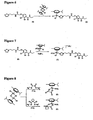
Images


Classifications
-
- A—HUMAN NECESSITIES
- A61—MEDICAL OR VETERINARY SCIENCE; HYGIENE
- A61K—PREPARATIONS FOR MEDICAL, DENTAL OR TOILETRY PURPOSES
- A61K31/00—Medicinal preparations containing organic active ingredients
- A61K31/28—Compounds containing heavy metals
-
- A—HUMAN NECESSITIES
- A61—MEDICAL OR VETERINARY SCIENCE; HYGIENE
- A61K—PREPARATIONS FOR MEDICAL, DENTAL OR TOILETRY PURPOSES
- A61K31/00—Medicinal preparations containing organic active ingredients
- A61K31/33—Heterocyclic compounds
- A61K31/555—Heterocyclic compounds containing heavy metals, e.g. hemin, hematin, melarsoprol
-
- A—HUMAN NECESSITIES
- A61—MEDICAL OR VETERINARY SCIENCE; HYGIENE
- A61K—PREPARATIONS FOR MEDICAL, DENTAL OR TOILETRY PURPOSES
- A61K45/00—Medicinal preparations containing active ingredients not provided for in groups A61K31/00 - A61K41/00
- A61K45/06—Mixtures of active ingredients without chemical characterisation, e.g. antiphlogistics and cardiaca
-
- A—HUMAN NECESSITIES
- A61—MEDICAL OR VETERINARY SCIENCE; HYGIENE
- A61P—SPECIFIC THERAPEUTIC ACTIVITY OF CHEMICAL COMPOUNDS OR MEDICINAL PREPARATIONS
- A61P35/00—Antineoplastic agents
-
- C—CHEMISTRY; METALLURGY
- C07—ORGANIC CHEMISTRY
- C07F—ACYCLIC, CARBOCYCLIC OR HETEROCYCLIC COMPOUNDS CONTAINING ELEMENTS OTHER THAN CARBON, HYDROGEN, HALOGEN, OXYGEN, NITROGEN, SULFUR, SELENIUM OR TELLURIUM
- C07F15/00—Compounds containing elements of Groups 8, 9, 10 or 18 of the Periodic Table
- C07F15/0006—Compounds containing elements of Groups 8, 9, 10 or 18 of the Periodic Table compounds of the platinum group
- C07F15/002—Osmium compounds
-
- C—CHEMISTRY; METALLURGY
- C07—ORGANIC CHEMISTRY
- C07F—ACYCLIC, CARBOCYCLIC OR HETEROCYCLIC COMPOUNDS CONTAINING ELEMENTS OTHER THAN CARBON, HYDROGEN, HALOGEN, OXYGEN, NITROGEN, SULFUR, SELENIUM OR TELLURIUM
- C07F15/00—Compounds containing elements of Groups 8, 9, 10 or 18 of the Periodic Table
- C07F15/0006—Compounds containing elements of Groups 8, 9, 10 or 18 of the Periodic Table compounds of the platinum group
- C07F15/0033—Iridium compounds
-
- C—CHEMISTRY; METALLURGY
- C07—ORGANIC CHEMISTRY
- C07F—ACYCLIC, CARBOCYCLIC OR HETEROCYCLIC COMPOUNDS CONTAINING ELEMENTS OTHER THAN CARBON, HYDROGEN, HALOGEN, OXYGEN, NITROGEN, SULFUR, SELENIUM OR TELLURIUM
- C07F15/00—Compounds containing elements of Groups 8, 9, 10 or 18 of the Periodic Table
- C07F15/0006—Compounds containing elements of Groups 8, 9, 10 or 18 of the Periodic Table compounds of the platinum group
- C07F15/0046—Ruthenium compounds
-
- C—CHEMISTRY; METALLURGY
- C07—ORGANIC CHEMISTRY
- C07F—ACYCLIC, CARBOCYCLIC OR HETEROCYCLIC COMPOUNDS CONTAINING ELEMENTS OTHER THAN CARBON, HYDROGEN, HALOGEN, OXYGEN, NITROGEN, SULFUR, SELENIUM OR TELLURIUM
- C07F15/00—Compounds containing elements of Groups 8, 9, 10 or 18 of the Periodic Table
- C07F15/0006—Compounds containing elements of Groups 8, 9, 10 or 18 of the Periodic Table compounds of the platinum group
- C07F15/0073—Rhodium compounds
Definitions
- This invention relates to organometallic compounds of the metals Ru, Os, Rh, and Ir, to their use in medicine, particularly for the treatment and/or prevention of cancer, and more particularly in the treatment of metastasis.
- This new class of compounds contains, covalently bound to any of the ligands of the metal, or directly to the metal, a bioactive organic compound which is an inhibitor of resistance pathway.
- Glutathione-S-Transferase is a superfamily class of isozymes that constitute the main cellular defense against xenobiotics, including bioactive principle designed for the treatment of a disease. They catalyse the conjugation of endogenous glutathione (GSH) with the electrophilic groups of substrates, the first step in the mercapturic acid pathway that leads to elimination of toxic compounds.
- GST- ⁇ and GST- ⁇ have been linked to the multidrug resistance phenomenon of certain anticancer drugs, such as Cisplatin and adriamycin.
- GSTP1-1 GSTP1-1 (GST- ⁇ subclass) was found to mediate the c-Jun N-Terminal Kinase (JNK) signal transduction pathway, an important control of cell survival. It was found to have a significant affinity for the C terminus of JNK and therefore could potentially interfere with and suppress downstream induction of cellular apoptosis.
- JNK c-Jun N-Terminal Kinase
- GST is a potential target for chemotherapeutic drug design, in order to inhibit resistance against anti-cancer drugs.
- Ruthenium-based compounds have shown some potential as anticancer drugs.
- US 4980473 discloses 1,10-phenanthroline complexes of ruthenium(II) and cobalt(II) which are said to be useful for the treatment of tumour cells in a subject.
- WO 02/102572 also discloses ruthenium(II) compounds that have activity against cancer cell lines. Again, the complexes are generally positively charged. Complexes are disclosed containing a bidentate ligand which is a neutral diamine ligand.
- Ang et al J. Am. Chem. Soc., volume 127, no 5, 1382, (2005 ), provides a compound (ethacraplatin) having two functional properties: anticancer activity and inhibiting activity of GST, wherein the cytotoxicity of the cisplatin anticancer drug is improved by linking a GST inhibitor to said drug.
- the anticancer activity of ethacraplatin is linked to the presence of the cisplatin.
- the linked GST inhibitor is able to reverse the intrinsic drug-associated resistance of cisplatin-resistant cancer cell lines in the presence of cisplatin in the ethacraplatin compound.
- Tumors of various kinds can be removed surgically, the most: relevant problem of these cancers being the development of metastasis. It is thus an objective of the present invention to prevent and/or treat metastasis. In particular, it is an objective of the invention to assist the treatment for prevention and/or treatment of metastasis.
- the present invention relates to complexes of transition metals comprising ligands in any form and of any nature, with the proviso that at least one of the ligands comprises at least one bioactive organic compound selected from inhibitors of resistance pathways and/or pharmaceutically acceptable derivatives thereof.
- Inhibitors may be directly attached to the transition metal as a ligand, or it may be covalently bound to a ligand of the transition metal.
- the present inventors observed low toxicity and high inhibition of resistance pathways when administering the organometallic compounds of the present invention. Surprisingly, high proliferation inhibition of the organometallic compounds of the present invention on carcinoma cells was observed. Moreover, toxicity against healthy, normal cells remained very low.
- the present invention provides, as claimed in claim 1, an organometallic compound of formula (XIV), in which A is an arene, optionally substituted and optionally comprising one or more heteroatoms; R 18 , R 19 , R 20 , are ligands of the central ruthenium atom which are, independently of each other, selected from halogens and/or N-, O-, S-, or P- donor ligands; R 17 is an optional residue selected from an alkyl, alkenyl, alkynyl, aryl, optionally substituted and optionally comprising one or more heteroatoms; whereby at least one bioactive organic compound constitutes at least one selected from R 17 - R 20 , or is covalently linked to any of the R 17 -R 20 , with the proviso that residues selected from R 17 - R 20 , which constitute the bioactive organic compound, or which are covalently bound the bioactive organic compound, are not halogens; and wherein said bioactive
- the arene A of this organometallic compound is an arene of the formula (VI) in which R 8 , R 9 , R 10 , R 11 , R 12 , R 13 are, independently of each other, hydrogen, alkyl, alkenyl, alkynyl, aryl, optionally substituted and optionally comprising one or more heteroatoms, and in which two or more residues selected from R 8 , R 9 , R 10 , R 11 , R 12 , R 13 may be covalently linked with each other thus forming a bi- or tri-, or polycyclic system, and in which any of the residues R 8 , R 9 , R 10 , R 11 , R 12 , R 13 optionally constitutes or is optionally bound to the bioactive compound.
- R 8 , R 9 , R 10 , R 11 , R 12 , R 13 are, independently of each other, hydrogen, alkyl, alkenyl, alkynyl, aryl, optionally substituted and optionally compris
- the organometallic compound of the invention comprises the structure of formula (X): in which, the arene A is an optionally substituted, benzyl or cyclopentadienyl, B is an optional linking group, which may be selected from alkyl, alkenyl, alkenyl and aryl, which is optionally substituted, which optionally comprises one or more heteroatoms and has 0-15, preferably 1-8 carbon atoms; and X is a functional group of B or the cyclic system, through which the bioactive compound is bound to B or to the cyclic system.
- the organometallic compound of the invention comprises the structure of formula (XI) or (XII):
- the N-donor ligand of the organometallic compound of the invention comprises the structure of formula (II).
- M is the transition metal Ru
- the dashed line represents bonding, as a monodentate ligand, to the transition metal Ru
- the circle represents a mono- or polycyclic system, comprising at least one N-heteroatom, indicated as N, which provides an electron pair enabling attachment to M, the cyclic system being optionally further substituted
- B is an optional linking group, which is selected from alkyl, alkenyl, alkynyl and aryl, is optionally substituted, and optionally comprises one or more heteroatoms and has 0-15 carbon atoms
- X is a functional group of B or the cyclic system, through which the bioactive compound is bound to B or to the cyclic system.
- the N-donor ligand of the above organometallic compound comprises the structure of formula (III) below, to which the bioactive compounds is linked by means of an amide bond and in which, M is the transition metal Ru; the dashed line represents bonding, as a monodentate ligand, to the transition metal Ru; the circle represents a mono- or polycyclic system comprising at least two N-heteroatoms; n is 1-10, preferably 2-6, most preferably 3-4; and X is as defined above.
- the P-donor ligand of the organometallic compound of the invention comprises the structure of formula (XIII): P R 14 R 15 R 16 (XIII), in which R 14 R 15 R 16 may be the same or different, are each C1-C6 alkyl, alkenyl, alkynyl, aryl, optionally substituted and optionally comprising one or more heteroatoms, or R 14 R 15 R 16 may together with the phosphorous atom form a cycloalkyl group, such group being optionally heterocyclic.
- the P-donor ligand of formula (XIII) in the organometallic compound of the invention is a residue suitable of increasing the solubility of the organometallic compound of claim 1 or 2 in water.
- the organometallic compound of the invention comprises the structure of formula (XV): in which X is a halogen; Y is a halogen or N-, P-, O- or S-donor ligand as defined above; and, in which, if the bioactive compound is bound to R 17 , R 17 is corresponds to "B-X-" as defined in formula (X) above, and R 18 is a N-, P-, O- or S-donor ligand as defined above; or, if the bioactive compound is bound to R 18 , or constitutes R 18 , R 18 is, respectively, a N-, P-, O -or S-donor ligand as defined above to which the bioactive compound is covalently bound; or R 18 constitutes the bioactive compound, the bioactive compound comprising itself N-, P-, O- or S-atoms functioning as donors suitable to attach it to the central Ru.
- formula (XV) in which X is a halogen; Y is a halogen
- these organometallic compounds of the invention are provided for use as a medicament.
- these organometallic compounds are provided for use in the treatment and/or prevention of cancer and/or metastasis.
- these organometallic compounds are provided for use in reducing resistance of cancers and/or metastasis against anti-cancer drugs.
- the invention provides a composition comprising an anti-cancer drug and the organometallic compound of the invention for use in treating and/or preventing metastasis.
- the invention provides the use of these organometallic compounds for the manufacture of a medicament for treating and/or preventing metastasis.
- the invention provides the use of the composition of the invention for the manufacture of a medicament for treating and/or preventing metastasis.
- the present invention relates to organometallic compounds and their use as medicaments.
- the organometallic compound comprises a transition metal M, and, linked to the transition metal, a number of ligands.
- Ligands include donors of electron pairs and/or donors of ⁇ -orbitals from unsaturated bonds in organic molecules, for example.
- the transition metal M is selected from the group of Ru, Os, Rh, and Ir.
- M is Ruthenium.
- the transition metal may be present in any oxidation state known with respect to the specific transition metal.
- the oxidation state may be II or III
- M is Ruthenium (II).
- R 1 , R 2 , R 3 , R 4 , R 5 , R 6 are neutral or charged ligands attached to the transition metal.
- Suitable ligands include halogen ions, such as F, Cl - , Br - and I - , preferably chloride.
- One, two or more ligands selected from R 1 - R 6 may be provided by halogens.
- R 1 - R 6 selected from a group indicated by "R 1 - R 6 ", for example, or "any of R N1 - R N3 " as in the above paragraph or indicated below, respectively, refers to the fact that one or more selected from all the individuals of the group may be selected independently of each other. Accordingly, if one specimen of R 1 - R 6 is to be selected, any one of R 1 , R 2 , R 3 , R 4 , R 5 , R 6 can be selected.
- One, two, three or more of the ligands R 1 , R 2 , R 3 , R 4 , R 5 , R 6 may be selected from ligands providing electron pairs.
- the ligands may be selected from N-, P-, O- or S-donor ligands.
- at least one ligand of the organometallic compound of the invention is selected from N-, P-, O- or S-donor ligands.
- at least one N-donor and/or at least one P-donor ligand is present.
- R may be selected from alkyl, alkenyl, alkynyl, and aryl, optionally substituted and optionally comprising one or more heteroatoms.
- Aromatic N-donor ligands include optionally substituted pyridine, pyridazine, pyrimidine, purine and pyrazine, for example.
- Substituents may be selected from alkyl, alkenyl, alkynyl, and aryl, optionally substituted and optionally comprising one or more heteroatoms.
- R N1 , R N2 , and R N3 may, independently of each other, be selected from H, alkyl, alkenyl, alkynyl, aryl, optionally substituted and optionally comprising one or more heteroatoms.
- R N1 - R N3 may be fused to form a cyclic N-donor compound.
- any of R N1 - R N3 may be linked covalently to any other ligand of M, to provide bi-, tridenate or other polyvalent ligands.
- R N1 , R N2 , and R N3 are, independently of each other, selected from H and C 1-8 alkyl, optionally substituted.
- At least one of the ligands selected from R 1 -R 6 is an N-donor ligand comprising the structure of formula (II) below, in which,
- the cyclic system may further be substituted.
- the circle is a heterocyclic ring, for example a heterocyclic arene.
- A is a C 1 -C1 6 , more preferably a C 2 -C 4 alkylene.
- X is selected from -O- and from NH-. Accordingly, X preferably represents an ether, ester or peptide group, of which the carbonyl part, if applicable, may be part of the "bioactive compound" or of B.
- any one of the ligands selected from R 1 -R 6 is a N-donor ligand comprising the structure of formula (III) below, to which the bioactive compound is linked by means of an amide bond: in which,
- the cyclic system may, for example, be selected from imidazole, purine, pyrazine, pyrimidine, 1,8-naphthydrin, chinoxaline, chinazoline, pteridine.
- the cyclic system is imidazole, resulting in N-donor ligands comprising structures as illustrated in formula (IV) and (V) below. in which n is as indicated for (III) above.
- the bioactive compound comprises, in its released and/or original, active form, a carboxy-group, which is linked to the N-atom or O-atom indicated in (IV) or (V), upon formation of a amide bond.
- P-donor ligands are PR P1 R P2 R P3 , in which R P1 , R P2 , and R P3 are defined as R N1 , R N2 , and R N3 above, wherein a fused P-donor ligand may arise if two or all three of R N1 -R N3 are fused.
- P-donor ligand is PTA (1,3,5-triaza-7-phospha-adamantane).
- S-donor ligands are ligands which bind to M via a sulphur atom. Examples include thiosulfate (S 2 O 3 2- ); isothiocyanate (NCS - ); sulfoxide ligands (R S1 R S2 SO); thioether ligands (R S1 R S2 S); thiolate ligands (R S1 S - ); sulfinate ligands (R S1 SO 2- ); and sulfenate ligands (R S1 SO - ), wherein R S1 and R S2 are independently selected from alkyls, alkenyls, alkynyls, aryls, optionally substituted and optionally comprising one or more heteroatoms.
- O-donor ligands are ligands which bind to M via an oxygen atom. Examples include carbonate (CO 3- ); carboxylate ligands (R C CO 2- ); nitrate (NO3 - ); sulfate (SO4 2- ) and sulphonate (R S1 O3 - ), wherein R C is selected from alkyls, alkenyls, alkynyl, aryls, optionally substituted and optionally comprising one or more heteroatoms.
- two, three or more of the ligands R 1 , R 2 , R 3 , R 4 , R 5 , R 6 may be present in the form of one or more single compounds, the single compound being
- Bi-, tri- or polydentate ligands generally comprise at least two donor ligands, such as N-, P-, O- or S-donor ligands as defined above, for example.
- a bi-, tri- or polydentate ligand may, furthermore, comprise different donor ligands within the same compound.
- An example of a bidentate N-donor ligand is 2,2'-bipyridine, optionally substituted.
- An example of a bidentate O-donor ligand is oxalate.
- a well known example of a polydentate ligand is EDTA (ethylene diamine tetraacetic acid), which comprise 6 donor locations. In this case, all residues R 1 -R 6 would be provided by one single polydentate compound.
- Two or more substituents of R 1 -R 6 may be present in the form of one or more single compounds being a alkene, alkyne, cyclopentadienyl, and/or arene.
- double bonds of the ligands may play a role in the formation of the bond with the central M, thus giving rise, if the ligands are formed by a cyclic compound, to sandwich or half-sandwich ("piano-stool") configurations, for example.
- three ligands of the organometallic compound of the present invention selected from R 1 , R 2 , R 3 , R 4 , R 5 , and R 6 , are present in the form of an alkene, alkyne, cyclopentadienyl and/or arene, optionally substituted and optionally comprising one or more heteroatoms, optionally bound covalently to the bioactive compound.
- linear alkenes that function as suitable ligands to M include alkene, propene, 1,3-butadiene.
- Examples of cyclic alkenes that function as suitable ligands to M include cyclohexa-1,4-diene and cycloocta-1,5-diene.
- three ligands selected from R 1 -R 6 are formed by an organic molecule such as an arene.
- the selected ligands result in a pseudo-octahedral arrangement around a central M, although other geometries are also possible, e.g. pentagonal bipyramid, square pyramid, tetrahedral and square planar or intermediate structures thereof.
- the compound of the invention may thus be a half-sandwich compound.
- three ligands selected from R 1 -R 6 are formed by a cyclic alkene, cyclopentadienyl and/or by an arene, optionally substituted, and optionally comprising one or more heteroatoms.
- the at least one cyclic "tridentate" ligand may be a mono-, bi-, tri- or polycyclic compound.
- it is monocyclic.
- it is an arene.
- Arenes are aromatic hydrocarbons. They may be substituted and comprise one or more heteroatoms.
- Examples of mono-cyclic arenes are benzene and cyclopentadienyl (C 5 H 5 - ). The later is considered by the present inventors being an arene, but is often mentioned explicitly for the sake of avoiding doubts.
- Examples of monocyclic arenes comprising at least one N-heteroatom are pyridine, pyrazine, pyrimidine, pyridazine, for example. Of course, other heteroatoms may be present in the arene besides or instead of N, such as those mentioned above.
- the arene may be polycyclic.
- polycyclic arenes are pentalene, indene, naphthalene, azulene, and so forth.
- polycyclic arenes comprising N-heteroatoms are indolizine, +H-indole, 2H-isoindole, 3H-indole, 1H-indazole, /H-purine, indoline, isoindoline, 4H-quinolizine, quinoline, isoquinoline, pteridine, phtalizine, naphthydrine, quinazoline, cinnoline.
- other heteroatoms may be present in the polycyclic arene besides or instead of N, such as those mentioned above.
- the organometallic compound of the present invention comprises, as at least one ligand, at least one are selected, independently, from benzene and cyclopentadienyl, which are optionally substituted by alkyl, alkenyl, alkynyl or aryl residues, optionally further substituted and comprising one or more heteroatoms.
- three adjacent ligands of the organometallic compound of the invention are formed by an arene of formula (VI) in which R 8 , R 9 , R 10 , R 11 , R 12 , R 13 may, independently of each other, be the same or different, are each hydrogen, alkyl, alkenyl, alkynyl, or aryl, which are, if applicable, optionally substituted and which optionally comprise one or more heteroatoms, and in which two or more residues selected from R 8 , R 9 , R 10 , R 11 , R 12 , R 13 may be covalently linked with each other thus forming a bi- or tri-, or polycyclic system, and in which any of the residues R 8 - R 13 is optionally bound to the bioactive compound.
- R 8 , R 9 , R 10 , R 11 , R 12 , R 13 may, independently of each other, be the same or different, are each hydrogen, alkyl, alkenyl, alkynyl, or aryl
- Monocyclic examples of arenes according to the compound of formula (VI) without heteroatoms are benzene, methylbenzene, cymene, for example.
- Monocyclic examples of arenes according to the compound of formula (VI) comprising any one or more residues selected from R 8 -R 13 being an alkyl, alkenyl or alkynyl that is substituted and/or comprising at least one heteroatom, the remaining residues being hydrogens are benzyl alcohol, 2-phenylethanol, 3-phenylpropanol, 4-phenylbutanol, benzylamine, 2-phenylethanamine, 3-phenylpropanamine, 4-phenylbutanamine, 2-phenylethanaminium, N,N,-dimethyl-2-phenylethanamine, all of which may be substituted to be bound to the bioactive organic compound.
- the residues R 8 -R 13 may thus comprise charges, but are preferably non-charged.
- One or more residues selected from R 8 -R 13 may comprise heteroatoms with electron pairs or double bonds that are linked to the central M, thus forming one of the ligands R 1 -R 6 , which is not yet occupied.
- An example of a compound falling in this category is reproduced by formula (VII) below: in which the bioactive organic compound may be linked to any of residues R 5 or R 6 or to an optional further residue of the benzene ring.
- the compound of formula (VI) comprises the structure of formula (X): in which,
- A is benzene.
- B is a C 1 -C1 6 , more preferably a C 2 -C 4 alkyl.
- the alkyl only comprises X as a substituent and is otherwise unsubstituted.
- X is selected from -O- and from NH-.
- X preferably represents ether or part of an ester or amide group, of which the carbonyl part, if applicable, may be part of the "bioactive compound" or of the alkylene.
- the bioactive compound, in its released and/or original, active form comprises a carboxy-group and is linked to the N-or O-heteroatom indicated as X in formula (X) by means of a amide bond or ester bond, respectively.
- a hydroxy goup of B may be esterified with a carboxy group of the bioactive compound, or, vice versa, a hydroxy group of the bioactive compound may be esterified with a carboxy-group optionally present on B. Both alternatives allow for hydrolytic cleavage and release of the bioactive compound.
- an amino group of B may be linked to a carboxy group of the bioactive compound, or, vice versa, an amine group of the bioactive compound may be esterified with a carboxy-group optionally present on B. Both alternatives allow for hydrolytic cleavage and release of the bioactive compound.
- the compound of formula (VI) comprises the structures of formula (XI) and (XII): in which, m is 1-10, preferably 2-8.
- the bioactive compound in its released and/or original, active form, comprises a carboxy-group and is linked to the O- or the N-atom indicated in (XI) and (XII), respectively, by means of an ester and peptide, bond, respectively.
- At least one of R 1 , R 2 , R 3 , R 4 , R 5 , R 6 of the organometallic compound of the present invention is a residue suitable of increasing the solubility of the complex of formula (I) in water (H 2 O).
- This residue is preferably selected specifically for this purpose.
- the bioactive organic compound may be linked to this residue.
- hydrocarbons having a high heteroatom:carbon ratio are suitable to increase the solubility.
- At least one of the residues R 1 -R 6 has the purpose of increasing the solubility of the organometallic compound of the invention in water.
- the at least one residue selected from R 1 -R 6 for increasing solubility in water may be a hydrocarbon comprising one or several groups capable of engaging in hydrogen bonding with water, such as, for example, hydroxy groups.
- R 14 , R 15 , R 16 together form a fused ring system comprising 1-5 heteroatoms, preferably N. This residue, if present, preferably increases the solubility of the organometallic compound of the present invention in water.
- An example of a residue capable of increasing solubility is 1,3,5-triaza-7-phospha-adamantane (PTA), 3-methyl-1,3,7-triaza-5-phosphabicyclo[3.3.1]nonane (MePTA), 3,7-diacetyl-1,3,7-triaza-5-phosphabicyclo[3.3.1]nonane (DAPTA), which may be linked via the P-atom to the central M in the compound of the present invention.
- An example of a bivalent ligand capable of increasing solubility of the compound of the present invention in water is oxalate.
- the organometallic compound of the present invention comprises the structure (XIV) below, inwhich,
- a and residues R 17 - R 20 are as indicated above. Accordingly, the grouping of A-R 17 may be selected from formulae (X) - (XII), and the residues R 18 -R 20 , may be selected from halogens mentioned above and from N-, O-, S-, or P- donor ligands mentioned above, for example. If the bioactive compound is bound to one or more of R 18 -R 20 , this/these residue(s) may be selected from formulae (III)-(V), for example.
- the organometallic compounds of the present invention comprise the structures (XV) below: in which,
- Y in (XV) is a halogen
- R 18 is P R 14 R 15 R 16 as defined above. Preferably, it is PTA.
- the bioactive compound is linked to R 17 by a amide or ester bond.
- the benzene to which R 17 is bound, R 17 and the bioactive compound together may correspond to the structure illustrated in formulae (XI) and (XII), for example.
- R 18 If the bioactive compound is linked to R 18 , R 18 and the bioactive compound preferably correspond to any of formula (II) - (V) above.
- R 18 is preferably a N-, P-, O-, or S-donor ligand, to which the bioactive compound is linked. Accordingly, R 18 preferably carries a functional group to which the bioactive compound can be linked, such as amide and ester bonds, as mentioned above.
- R 17 may represent one or more residues such as R 8 -R 13 in the compound of formula (VI) above.
- the organometallic compound comprises more than one bioactive compound covalently bound to a ligand selected from R 1 -R 6 .
- R 17 and R 18 may be covalently bound to a bioactive organic compound, whereby R 18 may, instead constitute the bioactive compound.
- the bioactive compounds may then be the same or different. It they are different, the second bioactive compound may have a biological activity different from the bioactive compound generally used in the context of the present invention.
- more than one bioactive compounds are present, all are useful in the treatment of cancer in general and/or metastasis in particular.
- the substituent comprising a functional group may be substituted at the functional group.
- Substituents may be branched and/or be further substituted.
- the present invention refers to an alkene, alkyne, cyclopentadienyl, and/or arene.
- the alkene or alkyne is considered to be an unsaturated C 2 -C 30 , more preferably a C 3 -C 15 and most preferably C 4 -C 8 hydrocarbon.
- the arene is preferably an aromatic C 5 -C 35 , more preferably C 6 -C 20 , most preferably C 6 -C 15 hydrocarbon.
- the alkene or alkyne may also be cyclic, if there are ⁇ 3 carbons.
- the alkene or alkyne may be branched, if there are ⁇ 4 or ⁇ 5 carbons, respectively.
- the alkene, alkyne, cyclopentadienyl and/or arene (or aryl radical) may further be substituted, as indicated above, and optionally comprising one or more heteroatoms.
- Alkenyl, alkynyl and/or aryl residues or substituents as mentioned, for example, with respect to nitrile and azo ligands, aromatic N-donor ligands, amine ligands, P-donor ligands, S-donor ligands, O-donor ligands, substituents of benzene or cyclopentadienyl ligands, substituents selected from R 8 -R 13 , R 17 in formula (III), substituents of the alkene, alkyne, cyclopentadienyl and/or arene mentioned in the above paragraph, substituents of an alkyl or with respect to substituents in general are radicals of the alkenes, alkynes, cyclopentadienyls and/or arenes as defined in the paragraph above.
- Alkyl substituents are preferably C 1 -C 30 alkyls, more preferably C 2 -C 25 alkyls, even more preferably C 4 -C 10 alkyls. If the alkyl comprises more than 3 carbons, it may be cyclic or
- a heteroatom for the purpose of the present invention may be any heteroatom, but is preferably selected from B, Si, N, P, As, O, S, Se, T, and halogens. If several heteroms are present, they may be the same or different. More preferably, heteroatoms are selected from N, O, P, S, and halogens. If the heteroatom is present in a substituent, alkene, alkyne, cyclopentadienyl or arene, it may change the chemical class of the compound. For example, an O present in a linear alkyl results in an ether. For the purpose of the present invention, this example would be considered to be an alkyl comprising one O heteroatom.
- the present invention provides an organometallic compound having a bioactive agent linked to at least one of the ligands of the central M.
- the bioactive organic compound is selected from inhibitors of resistance pathways and/or a pharmaceutically acceptable derivatives thereof.
- Inhibiting activity may, if it is not yet described, be assessed by specific, commercially obtainable or described assays. The skilled person is capable of using meaningful concentrations of an presumed inhibitor in such an assay.
- An example of an assay for testing Glutathione S-transferase inhibiting activity is mentioned in Example 6.
- the bioactive organic compound is an inhibitor of resistance selected from Glutathione S-transferase (GST) inhibitors, ⁇ -Glutamyl Cysteine Synthetase ( ⁇ -GCS) inhibitors, multidrug resistance protein (MRP)/P-glycoproteins (PgP) inhibitors, inhibitors of cell signalling pathways.
- GST Glutathione S-transferase
- ⁇ -GCS ⁇ -Glutamyl Cysteine Synthetase
- MRP multidrug resistance protein
- PgP P-glycoproteins
- inhibitors of Glutathione S-transferase inhibitors comprise, but not limited to, ethacrynic acid, peptidomimetics based on gluthatione, p-chlorophenoxyisobutyrate, Gossypol, indomethacin, non-steroidal anti-inflammatory compounds based on ibuprofen and ketoprofen, misonidazole, Piriprost, Sulfasalazine, and their derivatives.
- inhibitors of ⁇ -Glutamyl Cysteine Synthetase comprise, but not limited to, sulfoxime-based compounds such as buthinone sulfoxime and methinone sulfoxime, S-sulfocysteine, S-sulfohomocysteine, cystamine, and their derivatives.
- inhibitors of the multidrug resistance protein comprise, but not limited to, quinidine, vinblastine, terfemadine, tamoxifen, verapamil, cyclosporin, amitriptyline, progesterone, and their derivatives.
- inhibitors of cell signaling pathways comprise, but not limited to, pleurotin, azelaic acid, bischloroethylnitrosourea, palmarumycin , and their derivatives.
- Optically pure enantiomers such as racemates, diastereomers, mixtures of diastereomers, diastereomeric racemates, mixtures of diastereomeric racemates, and the meso-form, as well as pharmaceutically acceptable salts, solvent complexes and morphological forms of the bioactive organic compounds are also encompassed by the present invention.
- compositions and derivatives also encompasses, but is not limited to, salts.
- Salts comprise, for example, salts with inorganic acids or organic acids like hiydrochloric or hydrobromic acid, sulphuric acid, phosphoric acid, citric acid, formic acid, acetic acid, maleic acid, tartaric acid, benzoic acid, methanesulfonic acid, p-toluenesulfonic acid, and the like that are non toxic to living organisms or in case the compound (I) is acidic in nature with an inorganic base like an alkali or earth alkali base, e.g. sodium hydroxide, potassium hydroxide, calcium hydroxide and the like.
- inorganic acids or organic acids like hiydrochloric or hydrobromic acid, sulphuric acid, phosphoric acid, citric acid, formic acid, acetic acid, maleic acid, tartaric acid, benzoic acid, methanesulfonic acid, p-toluenesulfonic acid, and the like that are non toxic to living organisms or in
- the bioactive compound constitutes a ligand of the central M selected from R 1 -R 6 , or is covalently bound to a ligand to the central M of the organometallic compound of the invention.
- the covalent bond is a carbon heteronulcear bond.
- the organometallic compounds of the present invention are used as medicaments.
- the organometallic compound according to any of the preceding claims in the treatment and/or prevention of cancer and/or metastasis.
- the effectiveness of the present compounds for the treatment of metastasis is remarkable. With many cancers, tumors may be removed surgically, with the occurrence of metastasis remaining the principle problem to which so far no convincing remedy has been found.
- the compounds of the present invention are effective in overcoming the resistance of many cancer cells in metastasis to anti-cancer drugs. Thanks to the compounds of the present invention, anti-cancer drugs that are inefficient due to the onset of resistance against it, these very drugs may again be effectively employed. In addition, due to the increase of efficiency against cancer drugs, lower doses of the later may be applied, thus reducing the occurrence and severity of side effects.
- the organometallic compound according to the invention are useful for reducing resistance of cancers and/or metastasis against anti-cancer drugs.
- the present invention comprises a composition comprising an anti-cancer drug and the organometallic compound of any of the preceding claims for treating and/or preventing metastasis.
- the organometallic compound of the invention is most effective if administered together with an anti-cancer drug which may be conventional, and to which cancer cells have developed resistance, or a capable of developing resistance.
- the principle of the present invention does not only encompass a single, specific compound but is more general.
- the bioactive compound may also be directly attached to the central atom, increasing the variability.
- the bioactive compound may be linked to ligands of different general structure and to ligands that are linked to the central M in different ways, for example as free-electron-pair-donors or as donors of ⁇ -bonds that are capable of complexing or associating to a transition metal.
- the central M is Ruthenium (Ru), and the overall compound has a sandwich or half-sandwich structure.
- the arene-part shown in exemplary ligands of formula (VII) and (VIII) may be selected from a large number of possible arenes that can be used in sandwich- or half-sandwich compounds. These arenes may, of course, be substituted, for example for improving the physico-chemical properties of the overall compound, such as solubility, or for improving effectiveness and reducing toxicity to normal cells. Such substituents are not shown here in all the detail, they may be selected at the discretion of the skilled person and are not essential for the general principle described herein.
- the following examples illustrate the principle of the present invention on the basis of ethacrynic acid, which functions as the bioactive compound and which is shown to be effective in the treatment of metastasis.
- the examples also illustrate the structural variably of connecting the bioactive compound to ligands of different structures and being linked to the central M in different ways.
- Ethacrynic acid 500 mg, 1.65 mmol was refluxed in oxalyl chloride (5 ml) for 30 mins. Unreacted oxalyl chloride was removed in vacuo and dichloromethane (10 ml) was added to redissolve the residual colourless oil. (cyclohexa-1,4-dienyl)methamine (109 mg, 1.00 mmol) and triethylamine (1 ml) was added sequentially and the reaction mixture was refluxed for a further 6 h. On completion, a dark brown solution was obtained. The reaction mixture was washed with 5% NaHCO 3 (50 ml), brine (2 x 50 ml) and dried in vacuo.
- Ethacrynic acid 200 mg, 0.66 mmol
- N,N-dicyclohexylcarbodiimide 200 mg, 0.98 mmol
- N,N-dimethylaminopyridine 120 mg, 1.10 mmol
- ( ⁇ 6 :phenylethanol)Ru(PTA)Cl 2 ) 90 mg, 0.20 mmol
- dichloromethane 50 ml
- the reaction mixture was filtered through celite to remove the urea precipitate and separated on silica gel using acetone.
- Ethacrynic acid (349 mg, 1.16 mmol) was refluxed in dichloromethane (20 ml) with an excess of oxalyl chloride (2 ml) for 1 h. Unreacted oxalyl chloride was removed under vacuum and the reaction mixture concentrated to yield ethacrynic acid chloride as a colourless oil. The acid chloride was taken up in dichloromethane (20 ml) and N -(aminopropyl)imidazole (500 mg, 4.00 mmol) was added. The reaction mixture was then refluxed for 2 h.
- Human A549 lung carcinoma cells known to express high levels of Glutathione-S-Transferase, were routinely grown in flasks with DMEM medium containing 4.5 g/l glucose, 10% foetal calf serum (FCS) and antibiotics at 37°C and 6% CO 2 .
- FCS foetal calf serum
- FCS foetal calf serum
- the cells are confluent, they are trypsinised and concentrated in a centrifuge at 4°C.
- the cells were then diluted in phosphate-buffer saline (PBS) containing protease inhibitor cocktail (final concentration of 1 ⁇ g/ml) and homogenised by repeatedly freezing in liquid nitrogen and thawing (4 cycles).
- PBS phosphate-buffer saline
- protease inhibitor cocktail final concentration of 1 ⁇ g/ml
- the homogenised cell samples were centrifuged at 4°C and the supernatant, which is the cell lysates, was
- the Ru compounds are weighed, and dissolved in DMSO to 100 mM. They are diluted in water to 100 ⁇ M, such that the DMSO concentration did not exceed 0.1%.
- the cell lysates were exposed to the drug solutions for 90 mins. Control, containing the cell lysates with water/0.1% DMSO was also prepared.
- the GST activity in the treated cell lysates was determined using the glutathione-CDNB (1-chloro-2,4-dinitrobenzene) assay.
- Glutathione and CDNB were dissolved in deionised water and ethanol respectively to make up a 100 mM solutions.
- the developing solution was added to a 96-well plate at 200 ⁇ l per well, followed by the treated cell lysates at 2 ⁇ l per well.
- the absorbance at 340 nm was monitored continuously for 5 mins at 15 s intervals. The average slope of the change in absorbance was determined as a fraction of the control as the percentage of residual GST activity.
- Table 1 GST activity in lung carcinoma cells Teatment Residual GST activity (% control) Ethacrynic acid 86.32 ⁇ 13 - 5 (Ethacrynic- ⁇ 6 :phenylmethylamide)Ru(PTA)Cl 2 (3) 63.57 ⁇ 2.0 (Ethacrynic- ⁇ 6 :phenylethanol ester)Ru(PTA)Cl 2 (4) 42.77 ⁇ 13.9 ( ⁇ 6 -cymene)RuCl 2 (ethacrynic-propylamide-imidazole) (6) 23.70 ⁇ 10.7 [( ⁇ 6 -cymene)RuCl(PTA)(ethacrynic-propylamide-imidazole)]BF 4 - (7) 62.58 ⁇ 8.8
- the cells were routinely grown in flasks with DMEM medium containing 4.5 g/l glucose, 10% foetal calf serum (FCS) and antibiotics at 37°C and 6% CO 2 . When the cell are confluent, they are trypsinised and seeded in 48-well plates as monolayers for 24 h.
- FCS foetal calf serum
- the Ru compounds are weighed, and dissolved in DMSO to 100 mM. They are diluted in excess medium and diluted to 100 ⁇ M, such that the DMSO concentration did not exceed 0.12%.
- the 100 ⁇ M Ru complex solution was then serially diluted to make up 50 ⁇ M, 25 ⁇ M, 12.5 ⁇ M, 6.3 ⁇ M, 3.1 ⁇ M, 1.6 ⁇ M solutions.
- the media is removed from the cell plates are the drug solutions applied in triplicate. A set of control cells, with media containing 1.0% DMSO, was left on each plate. The cells were exposed to the drugs for 72 hours.
- the Ru compounds are weighed, and dissolved directly in medium to 1600 ⁇ M, then serially diluted to make up 800 ⁇ M 400 ⁇ M, 200 ⁇ M, 100 ⁇ M, 50 ⁇ M, 25 ⁇ M solutions.
- the media is removed from the cell plates are the drug solutions applied in triplicate.
- MTT final concentration 02 mg/ml
- the optical density which is directly proportional to number of surviving cells, was quantified at 540 nm using a multiwell plate reader and the fraction of surviving cells was calculated from the absorbance of untreated control cells.
- Example 8 IC 50 values of compounds tested on Tumor cell lines
- IC 50 values are determined as follows: Tumour cells are incubated in the appropriate complete medium at 37°C and under controlled atmosphere (5% CO2). Test compounds are tested at doses in the range of 100 nM and 100 ⁇ M. Cytotoxicity is determined by the MTT test, by measuring cell viability as the cell metabolic capacity to transform the tetrazolium salt of MTT in the blue formazan, by mitochondrial dehydrogenases; the blue colour is read at 570 nm with a spectrophotometer ( Alley MC, Scudiero DA, Monks A, Hursey ML, Czerwinski MJ, Fine DL, Abbott BJ, Mayo JG, Shoemaker RH, Boyd MR.
- Cell viability as determined by the MTT test is done on Day 4, after 3 days treatment. Each well is added with 10 ⁇ l/100 ⁇ l MTT (prepared previously by dissolving 5 mg/ml MTT in PBS, sterilized with filters at a cut-off of 0,22nm and stored at 4°C). Plates are put in an incubator at 37°C for 4hrs, then medium is eliminated and each well is added with 200 ⁇ l DMSO (Sigma Chemical Co., USA). Plates are read with a spectrophotometer (Spectra count Packard Bell, Meriden, CT, USA) at 570 nm wave length. IC50 is calculated with the GraphPad Prism4.
- IC 50 values for the tested compounds. The reported values are the most representative of two separate experiments. Test concentrations have been done by serial dilutions of each compound starting form a mother solution of 10-2 M prepared by dissolving Compound 3, Compound 4, Ethacrynic acid and cisplatin in dimehtylsulfoxide, and RAPTA-T (the moiety of the test compounds without the Ethacrynic acid moiety) in sterile apirogen water.
- Table 5 IC 50 values ( ⁇ M) A2780 A2780 /CDDP H460M HT-29 MIA PaCa-2 TLX5 Comp.
- Tumour cells (TLX5, see above in Example 8) were derived from mouse tumours and stabilised for in vivo propagation.
- TLX5 lymphona cells were injected in the peritoneal cavity of CBA brown-grey inbred mice (Harlan Nossan, San Rafael al Natisone, Udine, Italy) at day 0.
- Test compounds were applied at day 3 at various doses, also by the intraperitoneal route, with each drug (test compound or reference drug) diluted in appropriate physiological solution and injected in a volume of 0.1 ml/10g body weight.
Landscapes
- Chemical & Material Sciences (AREA)
- Health & Medical Sciences (AREA)
- Organic Chemistry (AREA)
- Animal Behavior & Ethology (AREA)
- Life Sciences & Earth Sciences (AREA)
- Pharmacology & Pharmacy (AREA)
- General Health & Medical Sciences (AREA)
- Public Health (AREA)
- Veterinary Medicine (AREA)
- Medicinal Chemistry (AREA)
- Epidemiology (AREA)
- Chemical Kinetics & Catalysis (AREA)
- General Chemical & Material Sciences (AREA)
- Nuclear Medicine, Radiotherapy & Molecular Imaging (AREA)
- Pharmaceuticals Containing Other Organic And Inorganic Compounds (AREA)
Description
- This invention relates to organometallic compounds of the metals Ru, Os, Rh, and Ir, to their use in medicine, particularly for the treatment and/or prevention of cancer, and more particularly in the treatment of metastasis. This new class of compounds contains, covalently bound to any of the ligands of the metal, or directly to the metal, a bioactive organic compound which is an inhibitor of resistance pathway.
- Resistance against bioactive principles that directly target the origin of a disease are widespread, and one or more of a number of known resistance pathways are at their origin. For example, the Glutathione-S-Transferase (GST) is a superfamily class of isozymes that constitute the main cellular defense against xenobiotics, including bioactive principle designed for the treatment of a disease. They catalyse the conjugation of endogenous glutathione (GSH) with the electrophilic groups of substrates, the first step in the mercapturic acid pathway that leads to elimination of toxic compounds. The overexpression of several subclasses of GST, namely GST-π and GST-α, has been linked to the multidrug resistance phenomenon of certain anticancer drugs, such as Cisplatin and adriamycin. More recently, GSTP1-1 (GST-π subclass) was found to mediate the c-Jun N-Terminal Kinase (JNK) signal transduction pathway, an important control of cell survival. It was found to have a significant affinity for the C terminus of JNK and therefore could potentially interfere with and suppress downstream induction of cellular apoptosis. Clearly, GST is a potential target for chemotherapeutic drug design, in order to inhibit resistance against anti-cancer drugs.
- Ruthenium-based compounds have shown some potential as anticancer drugs. For example,
US 4980473 discloses 1,10-phenanthroline complexes of ruthenium(II) and cobalt(II) which are said to be useful for the treatment of tumour cells in a subject. - Some other ruthenium(II) and ruthenium(III) complexes which have been shown to exhibit antitumour activity are mentioned in Guo et al, Inorganica Chimica Acta, 273 (1998), 1-7, specifically trans-[RuCl2(DMSO)4], trans-[RuCl4(imidazole)2] and trans-[RuCl4(indazole)2]. Clarke et al have reviewed the anticancer, and in particular the antimetastatic, activity of ruthenium complexes: Chem. Rev., 1999, 99, 251-253. Also, Sava has reviewed the antimetastatic activity in "Metal Compounds in Cancer Therapy" Ed by S P Fricker, Chapman and Hall, London 1994, p. 65-91.
- Dale et al, Anti-Cancer Drug Design, (1992), 7, 3-14, describes a metronidazole complex of ruthenium(II) ie, [(C6H6)RuCl2(metronidazole)] and its effect on DNA and on E. coli growth rates. Metronidazole sensitises hypoxic tumour cells to radiation and appears to be an essential element of the complexes of Dale et al. There is no indication that the complexes would be at all effective in the absence of the metronidazole ligand.
- Kramer et al, Chem Eur J., 1996, 2, No. 12, p. 1518-1526 discloses half sandwich complexes of ruthenium with amino esters, Bennett et al, Canadian Journal of Chemistry, (2001), 79, 655-669 discloses certain ruthenium(I1) complexes with acetylacetonate ligands. Oro et al, J Chem Soc, Dalton Trans, (1990), 1463 describes ruthenium(II) complexes containing -p-cymene and
acetylacetonate ligands WO 01/130790 -
WO 02/102572 - Chen et al, J. Am. Chem. Soc., volume 124, no 12, 3064, (2002), describes the mechanism of binding of ruthenium complexes to guanine bases. The binding model requires NH bonds from a diamino ligand to be present in the complex for hydrogen bonding to the guanine base. Similarly, Morris et al, J. Med. Chem., volume 44, 3616-3621, (2001), describes the selectivity of ruthenium(II) complexes for binding to guanine bases.
- Further references concerned with Ruthenium, complexes for treatment of cancer are
WO 06/018649 US 2006/0058270 ,US 2005/0239765 . - Serli et al, Eur. J. Inorg. Chem., no 17, 3423, (2005), demonstrates that the RuII-arene in Ruthenium organometallic complexes ("piano-stool" complexes) is not an essential feature for the in vitro anticancer activity and may be replaced by another ligand with a low steric demand, such as [9]aneS3.
- Ang et al, J. Am. Chem. Soc., volume 127, ), provides a compound (ethacraplatin) having two functional properties: anticancer activity and inhibiting activity of GST, wherein the cytotoxicity of the cisplatin anticancer drug is improved by linking a GST inhibitor to said drug. The anticancer activity of ethacraplatin is linked to the presence of the cisplatin. The linked GST inhibitor is able to reverse the intrinsic drug-associated resistance of cisplatin-resistant cancer cell lines in the presence of cisplatin in the ethacraplatin compound.
- Very few, if any, of the compounds and complexes of the prior art cited above have resulted in clinical phase studies, not to mention actual therapies. The reason for the poor performance of these principles are manifold and may be linked to toxicity problems or un-sufficient efficiency in treatment.
- It is thus an objective of the present invention to explore new ways for treating cancer, for example based on work done in the area of complexes of transition metals.
- It is a further aspect of the present invention to increase the activity and/or efficiency of therapies against diseases and in particular cancer. More particularly, it is an objective to reduce the resistance intrinsic to or developed against therapies, and in particular against resistance in cancer chemotherapies. By reducing resistance to bioactive principles against diseases an in particular cancer, it is hoped to increase the overall effciency of the therapy. With increased efficiency, lower levels of the bioactive principle needs to be administered, which may further reduce side effects linked to the treatment.
- Tumors of various kinds can be removed surgically, the most: relevant problem of these cancers being the development of metastasis. It is thus an objective of the present invention to prevent and/or treat metastasis. In particular, it is an objective of the invention to assist the treatment for prevention and/or treatment of metastasis.
- The present invention relates to complexes of transition metals comprising ligands in any form and of any nature, with the proviso that at least one of the ligands comprises at least one bioactive organic compound selected from inhibitors of resistance pathways and/or pharmaceutically acceptable derivatives thereof. Inhibitors may be directly attached to the transition metal as a ligand, or it may be covalently bound to a ligand of the transition metal.
- Remarkably, the present inventors observed low toxicity and high inhibition of resistance pathways when administering the organometallic compounds of the present invention. Surprisingly, high proliferation inhibition of the organometallic compounds of the present invention on carcinoma cells was observed. Moreover, toxicity against healthy, normal cells remained very low.
- Accordingly, in a first aspect, the present invention provides, as claimed in
claim 1, an organometallic compound of formula (XIV),
- In an embodiment, the arene A of this organometallic compound is an arene of the formula (VI)


- In a further embodiment, the N-donor ligand of the organometallic compound of the invention comprises the structure of formula (II).


- According to a further embodiment, the P-donor ligand of the organometallic compound of the invention comprises the structure of formula (XIII):
P R14R15R16 (XIII),
in which R14 R15 R16 may be the same or different, are each C1-C6 alkyl, alkenyl, alkynyl, aryl, optionally substituted and optionally comprising one or more heteroatoms, or R14 R15 R16 may together with the phosphorous atom form a cycloalkyl group, such group being optionally heterocyclic. Preferably, the P-donor ligand of formula (XIII) in the organometallic compound of the invention is a residue suitable of increasing the solubility of the organometallic compound ofclaim - In a preferred embodiment, the organometallic compound of the invention comprises the structure of formula (XV):

- In a further embodiment of the invention, these organometallic compounds of the invention are provided for use as a medicament.
- In a further embodiment, these organometallic compounds are provided for use in the treatment and/or prevention of cancer and/or metastasis.
- In a preferred embodiment, these organometallic compounds are provided for use in reducing resistance of cancers and/or metastasis against anti-cancer drugs.
- In a further aspect, the invention provides a composition comprising an anti-cancer drug and the organometallic compound of the invention for use in treating and/or preventing metastasis.
- According to another aspect, the invention provides the use of these organometallic compounds for the manufacture of a medicament for treating and/or preventing metastasis. In a further aspect, the invention provides the use of the composition of the invention for the manufacture of a medicament for treating and/or preventing metastasis.
- Further embodiments are provided in the appended claims and will be apparent from the detailed description of preferred embodiments below.
- Aside from the present invention as claimed in the aspects and embodiments above, an organometallic compound of the general formula (I) below is also described,
[M R1R2R3R4R5R6] (I),
which may be charged or neutral, and which may be present in the form of a salt and/or an optimally resolved enantiomer,
in which, - M is a transition metal selected from the group of Ru, Os, Rh, and Ir;
- R1, R2, R3, R4, R5, R6 are neutral or charged ligands of the transition metal, whereby two, three or more of the ligands R1, R2, R3, R4, R5, R6 may be present in the form of one or more single compounds, the single compound being
- a bi-, tri- or polydentate compound, and/or,
- an alkene, alkyne, cyclopentadienyl and/or an arene, the alkene, alkyne, cyclopentadienyl and/or an arene being optionally substituted and optionally I comprising one or more heteroatoms;
- In the figures,
-
Figure 1 shows a single crystal X-ray diffraction structure of compound (3), which is an example of an organometallic compound of the invention. -
Figure 2 shows a single crystal X-ray diffraction structure of compound (6), which is an example of an organometallic compound of the invention. -
Figure 3 shows a single crystal X-ray diffraction structure of compound (8), which is an organometallic compound having, amongst others, oxalate as a bivalent ligand. -
Figure 4 . illustrates the process for preparing (3), an example of an organometallic compound of the invention. -
Figure 6 illustrates the process for preparing (6), an example of an organometallic compound of the invention. -
Figure 7 illustrates the process for preparing (7), an example of an charged organometallic compound of the invention, present as its tetrafluoroborate salt. -
Figure 8 illustrates the process for preparing (8) and (9), organometallic compounds that are used as controls for evaluating the activity of organometallic compounds of the invention. - The present invention relates to organometallic compounds and their use as medicaments. The organometallic compound comprises a transition metal M, and, linked to the transition metal, a number of ligands. Ligands include donors of electron pairs and/or donors of π-orbitals from unsaturated bonds in organic molecules, for example.
- The term "comprise" or "comprising", for the purpose of the present invention is intended to mean "including amongst other". It is not intended to mean, "consisting only of".
- The transition metal M is selected from the group of Ru, Os, Rh, and Ir. Preferably, M is Ruthenium. The transition metal may be present in any oxidation state known with respect to the specific transition metal. For example, the oxidation state may be II or III Preferably, M is Ruthenium (II).
- R1, R2, R3, R4, R5, R6 are neutral or charged ligands attached to the transition metal. Suitable ligands include halogen ions, such as F, Cl-, Br- and I-, preferably chloride. One, two or more ligands selected from R1- R6 may be provided by halogens.
- The term "selected from" a group indicated by "R1- R6", for example, or "any of RN1 - RN3" as in the above paragraph or indicated below, respectively, refers to the fact that one or more selected from all the individuals of the group may be selected independently of each other. Accordingly, if one specimen of R1- R6 is to be selected, any one of R1, R2, R3, R4, R5, R6 can be selected.
- One, two, three or more of the ligands R1, R2, R3, R4, R5, R6 may be selected from ligands providing electron pairs. For example, the ligands may be selected from N-, P-, O- or S-donor ligands. Preferably, at least one ligand of the organometallic compound of the invention is selected from N-, P-, O- or S-donor ligands. For example, at least one N-donor and/or at least one P-donor ligand is present.
- Examples of N-donor ligands are nitrile ligands (N≡C-R); azo ligands (N=N-R); aromatic N-donor ligands; amine ligands (NRN1RN2RN3); azide (N3 -); cyanide (N≡C-); isothiocyantate (NCS-).
- In both nitrile and azo ligands, R may be selected from alkyl, alkenyl, alkynyl, and aryl, optionally substituted and optionally comprising one or more heteroatoms.
- Aromatic N-donor ligands include optionally substituted pyridine, pyridazine, pyrimidine, purine and pyrazine, for example. Substituents may be selected from alkyl, alkenyl, alkynyl, and aryl, optionally substituted and optionally comprising one or more heteroatoms.
- RN1, RN2, and RN3 may, independently of each other, be selected from H, alkyl, alkenyl, alkynyl, aryl, optionally substituted and optionally comprising one or more heteroatoms.
- Preferably, two or all three of RN1 - RN3 may be fused to form a cyclic N-donor compound. Furthermore, any of RN1 - RN3 may be linked covalently to any other ligand of M, to provide bi-, tridenate or other polyvalent ligands. Preferably, RN1, RN2, and RN3 are, independently of each other, selected from H and C1-8 alkyl, optionally substituted.
- According to a preferred embodiment, at least one of the ligands selected from R1-R6 is an N-donor ligand comprising the structure of formula (II) below,

- M is the transition metal;
- the circle represents a mono- or polycyclic system, comprising at least one N-heteroatom, indicated as N, which provides an electron pair enabling attachment to M;
- B is an optional linking group, which may be selected from alkyl, alkenyl, alkynyl and aryl, which is optionally substituted, which optionally comprises one or more heteroatoms and has 0-15, preferably 1-8 carbon atoms;
- X is a functional group of B or the cyclic system, through which the bioactive compound is bound to B or to the cyclic system.
- The cyclic system may further be substituted.
- Preferably, in formula (II), the circle is a heterocyclic ring, for example a heterocyclic arene.
- Preferably, it is a 5- or 6-membered heterocyclic ring, for example arene. Preferably, A is a C1-C16, more preferably a C2-C4 alkylene.
- Preferably, X is selected from -O- and from NH-. Accordingly, X preferably represents an ether, ester or peptide group, of which the carbonyl part, if applicable, may be part of the "bioactive compound" or of B.
- According to a particularly preferred embodiment, any one of the ligands selected from R1-R6 is a N-donor ligand comprising the structure of formula (III) below, to which the bioactive compound is linked by means of an amide bond:

- the dashed line represents bonding, as a monodentate ligand, to the transition metal;
- the circle represents a mono- or polycyclic system comprising at least two N-heteroatoms;
- n is 1-10, preferably 2-6, most preferably 3-4;
- X is as defined above for (III).
- The cyclic system may, for example, be selected from imidazole, purine, pyrazine, pyrimidine, 1,8-naphthydrin, chinoxaline, chinazoline, pteridine. Preferably, the cyclic system is imidazole, resulting in N-donor ligands comprising structures as illustrated in formula (IV) and (V) below.
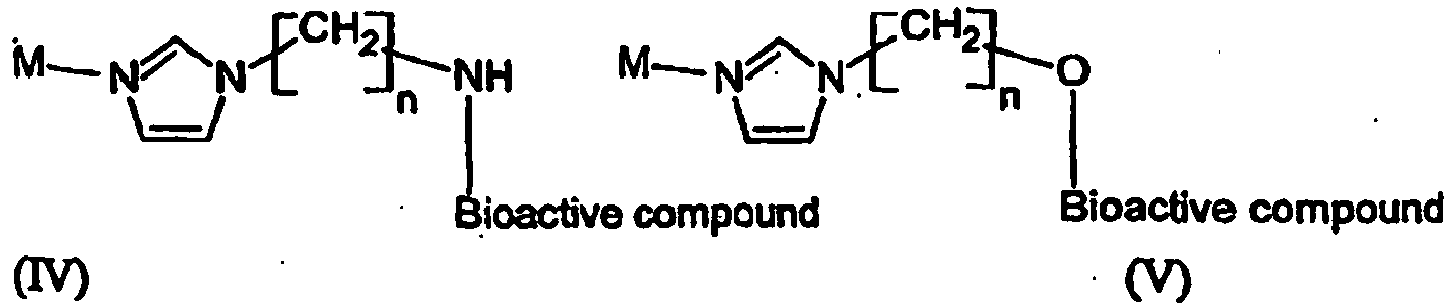
- The bioactive compound comprises, in its released and/or original, active form, a carboxy-group, which is linked to the N-atom or O-atom indicated in (IV) or (V), upon formation of a amide bond.
- Examples of P-donor ligands are PRP1RP2RP3, in which RP1, RP2, and RP3 are defined as RN1, RN2, and RN3 above, wherein a fused P-donor ligand may arise if two or all three of RN1-RN3 are fused.
- A preferred example of a P-donor ligand is PTA (1,3,5-triaza-7-phospha-adamantane).
- S-donor ligands are ligands which bind to M via a sulphur atom. Examples include thiosulfate (S2O3 2-); isothiocyanate (NCS-); sulfoxide ligands (RS1RS2SO); thioether ligands (RS1RS2S); thiolate ligands (RS1S-); sulfinate ligands (RS1SO2-); and sulfenate ligands (RS1SO-), wherein RS1 and RS2 are independently selected from alkyls, alkenyls, alkynyls, aryls, optionally substituted and optionally comprising one or more heteroatoms.
- O-donor ligands are ligands which bind to M via an oxygen atom. Examples include carbonate (CO3-); carboxylate ligands (RCCO2-); nitrate (NO3-); sulfate (SO42-) and sulphonate (RS1O3-), wherein RC is selected from alkyls, alkenyls, alkynyl, aryls, optionally substituted and optionally comprising one or more heteroatoms.
- According to the organometallic complex of the invention, two, three or more of the ligands R1, R2, R3, R4, R5, R6 may be present in the form of one or more single compounds, the single compound being
- a bi-, tri- or polydentate compound, and/or,
- an alkene, alkyne, cyclopentadienyl and/or an arene, the alkene, alkyne, cyclopentadienyl and/or an arene being optionally substituted and optionally comprising one or more heteroatoms.
- Bi-, tri- or polydentate ligands generally comprise at least two donor ligands, such as N-, P-, O- or S-donor ligands as defined above, for example. A bi-, tri- or polydentate ligand may, furthermore, comprise different donor ligands within the same compound.
- An example of a bidentate N-donor ligand is 2,2'-bipyridine, optionally substituted. An example of a bidentate O-donor ligand is oxalate. A well known example of a polydentate ligand is EDTA (ethylene diamine tetraacetic acid), which comprise 6 donor locations. In this case, all residues R1-R6 would be provided by one single polydentate compound.
- Two or more substituents of R1-R6 may be present in the form of one or more single compounds being a alkene, alkyne, cyclopentadienyl, and/or arene.
- In these cases, double bonds of the ligands may play a role in the formation of the bond with the central M, thus giving rise, if the ligands are formed by a cyclic compound, to sandwich or half-sandwich ("piano-stool") configurations, for example.
- Accordingly, in a preferred embodiment, three ligands of the organometallic compound of the present invention selected from R1, R2, R3, R4, R5, and R6, are present in the form of an alkene, alkyne, cyclopentadienyl and/or arene, optionally substituted and optionally comprising one or more heteroatoms, optionally bound covalently to the bioactive compound.
- Examples of linear alkenes that function as suitable ligands to M include alkene, propene, 1,3-butadiene.
- Examples of cyclic alkenes that function as suitable ligands to M include cyclohexa-1,4-diene and cycloocta-1,5-diene.
- Preferably, three ligands selected from R1-R6 are formed by an organic molecule such as an arene. Preferably, the selected ligands result in a pseudo-octahedral arrangement around a central M, although other geometries are also possible, e.g. pentagonal bipyramid, square pyramid, tetrahedral and square planar or intermediate structures thereof.
- The compound of the invention may thus be a half-sandwich compound. Preferably, three ligands selected from R1-R6 are formed by a cyclic alkene, cyclopentadienyl and/or by an arene, optionally substituted, and optionally comprising one or more heteroatoms. The at least one cyclic "tridentate" ligand may be a mono-, bi-, tri- or polycyclic compound. Preferably, it is monocyclic. Preferably, it is an arene. Arenes are aromatic hydrocarbons. They may be substituted and comprise one or more heteroatoms.
- Examples of mono-cyclic arenes are benzene and cyclopentadienyl (C5H5 -). The later is considered by the present inventors being an arene, but is often mentioned explicitly for the sake of avoiding doubts. Examples of monocyclic arenes comprising at least one N-heteroatom are pyridine, pyrazine, pyrimidine, pyridazine, for example. Of course, other heteroatoms may be present in the arene besides or instead of N, such as those mentioned above.
- Accordingly, the arene may be polycyclic. Examples of polycyclic arenes are pentalene, indene, naphthalene, azulene, and so forth. Examples of polycyclic arenes comprising N-heteroatoms are indolizine, +H-indole, 2H-isoindole, 3H-indole, 1H-indazole, /H-purine, indoline, isoindoline, 4H-quinolizine, quinoline, isoquinoline, pteridine, phtalizine, naphthydrine, quinazoline, cinnoline. Of course, other heteroatoms may be present in the polycyclic arene besides or instead of N, such as those mentioned above.
- Most preferably, the organometallic compound of the present invention comprises, as at least one ligand, at least one are selected, independently, from benzene and cyclopentadienyl, which are optionally substituted by alkyl, alkenyl, alkynyl or aryl residues, optionally further substituted and comprising one or more heteroatoms.
- According to a preferred embodiment of the present invention, three adjacent ligands of the organometallic compound of the invention, selected from R1, R2, R3, R4, R5, R6 are formed by an arene of formula (VI)

- Monocyclic examples of arenes according to the compound of formula (VI) without heteroatoms are benzene, methylbenzene, cymene, for example.
- Monocyclic examples of arenes according to the compound of formula (VI) comprising any one or more residues selected from R8-R13 being an alkyl, alkenyl or alkynyl that is substituted and/or comprising at least one heteroatom, the remaining residues being hydrogens are benzyl alcohol, 2-phenylethanol, 3-phenylpropanol, 4-phenylbutanol, benzylamine, 2-phenylethanamine, 3-phenylpropanamine, 4-phenylbutanamine, 2-phenylethanaminium, N,N,-dimethyl-2-phenylethanamine, all of which may be substituted to be bound to the bioactive organic compound.
- The residues R8-R13 may thus comprise charges, but are preferably non-charged.
- One or more residues selected from R8-R13 may comprise heteroatoms with electron pairs or double bonds that are linked to the central M, thus forming one of the ligands R1-R6, which is not yet occupied. An example of a compound falling in this category is reproduced by formula (VII) below:

- Examples of bicyclic variants of compound (VI), in which two residues, R12 and are R13 are covalently linked forming a bicyclic systems are indicated with formulae (VIII) and (IX) below

- Further substituents may be present on the cycle formed by R12 and R13, which are not shown here.
- According to a particularly preferred embodiment of the present invention, the compound of formula (VI) comprises the structure of formula (X):

- A is a optionally substituted, benzyl or cyclopentadienyl,
- B is an optional linking group, which may be selected from alkyl, alkenyl, alkynyl and aryl, which is optionally substituted, which optionally comprises one or more heteroatoms and has 0-15, preferably 1-8 carbon atoms;
- X is a functional group of B or the cyclic system, through which the bioactive compound is bound to B or to the cyclic system.
- Preferably, in (X), A is benzene.
- Preferably, in (X), B is a C1-C16, more preferably a C2-C4 alkyl. Preferably the alkyl only comprises X as a substituent and is otherwise unsubstituted.
- Preferably, X is selected from -O- and from NH-. Accordingly, X preferably represents ether or part of an ester or amide group, of which the carbonyl part, if applicable, may be part of the "bioactive compound" or of the alkylene. Preferably, the bioactive compound, in its released and/or original, active form, comprises a carboxy-group and is linked to the N-or O-heteroatom indicated as X in formula (X) by means of a amide bond or ester bond, respectively.
- Accordingly, in case of an ester bond, a hydroxy goup of B may be esterified with a carboxy group of the bioactive compound, or, vice versa, a hydroxy group of the bioactive compound may be esterified with a carboxy-group optionally present on B. Both alternatives allow for hydrolytic cleavage and release of the bioactive compound.
- In the case of an amide bond, an amino group of B may be linked to a carboxy group of the bioactive compound, or, vice versa, an amine group of the bioactive compound may be esterified with a carboxy-group optionally present on B. Both alternatives allow for hydrolytic cleavage and release of the bioactive compound.
- According to further, particularly preferred embodiments, the compound of formula (VI) comprises the structures of formula (XI) and (XII):

m is 1-10, preferably 2-8. - Preferably, -O- and -NH- represent ester and and peptide bonds, respectively, as defined for X in formula (X) above. More preferably, the bioactive compound, in its released and/or original, active form, comprises a carboxy-group and is linked to the O- or the N-atom indicated in (XI) and (XII), respectively, by means of an ester and peptide, bond, respectively.
- Most preferably, m in formula (XI) is 1 and in (XII) is 2.
- According to a preferred embodiment, at least one of R1, R2, R3, R4, R5, R6 of the organometallic compound of the present invention is a residue suitable of increasing the solubility of the complex of formula (I) in water (H2O). This residue is preferably selected specifically for this purpose. The bioactive organic compound may be linked to this residue. Generally, hydrocarbons having a high heteroatom:carbon ratio are suitable to increase the solubility.
- Accordingly, at least one of the residues R1-R6 has the purpose of increasing the solubility of the organometallic compound of the invention in water. Preferably, the at least one ligand has a hydrophilic group. Hydrophilic groups include (-OH), (=O), (-COOH), (-NH2), (-NHR-), (-O-), (-SH2), (-S-), (-SO3-), for example, with R being optionally substituted alkyl, alkenyl or aryl.
- For example, the at least one residue selected from R1-R6 for increasing solubility in water may be a hydrocarbon comprising one or several groups capable of engaging in hydrogen bonding with water, such as, for example, hydroxy groups.
- In a preferred embodiment of the organometallic compound of the present invention, at least one organometallic compound of
claim 1, in which any of R1, R2, R3, R4, R5, R6 has the formula (XIII).
PR14R15R16 (XIII),
in which,
R14, R15, R16 may be the same or different, are each C1-C6 alkyl, aryl or substituted aryl, or R14, R15, R16 may together with the phosphorous atom form a cycloalkyl group, such group being optionally heterocyclic. Preferably, R14, R15, R16 together form a fused ring system comprising 1-5 heteroatoms, preferably N. This residue, if present, preferably increases the solubility of the organometallic compound of the present invention in water. - An example of a residue capable of increasing solubility is 1,3,5-triaza-7-phospha-adamantane (PTA), 3-methyl-1,3,7-triaza-5-phosphabicyclo[3.3.1]nonane (MePTA), 3,7-diacetyl-1,3,7-triaza-5-phosphabicyclo[3.3.1]nonane (DAPTA), which may be linked via the P-atom to the central M in the compound of the present invention. An example of a bivalent ligand capable of increasing solubility of the compound of the present invention in water is oxalate.
- In a preferred embedment the organometallic compound of the present invention comprises the structure (XIV) below,

- A is an arene, optionally substituted and optionally comprising one or more heteroatoms;
- R18, R19, R20, are ligands of the central Ruthenium atom which are, independently of each other, selected from halogens and/or N-, O-, S-, or P- donor ligands;
- R17 is an optional residue selected from an alkyl, alkenyl, alkynyl, aryl, optionally substituted and optionally comprising one or more heteroatoms;
- whereby the at least one bioactive organic compound constitutes at least one selected from R17 - R20, or is covalently linked to any of the R17 - R20, with the proviso that residues selected from R17 - R20, which constitute the bioactive organic compound, or which are covalently bound the bioactive organic compound, are not halogens.
- Preferred A and residues R17 - R20 are as indicated above. Accordingly, the grouping of A-R17 may be selected from formulae (X) - (XII), and the residues R18-R20, may be selected from halogens mentioned above and from N-, O-, S-, or P- donor ligands mentioned above, for example. If the bioactive compound is bound to one or more of R18-R20, this/these residue(s) may be selected from formulae (III)-(V), for example.
- According to a still preferred embodiment, the organometallic compounds of the present invention comprise the structures (XV) below:
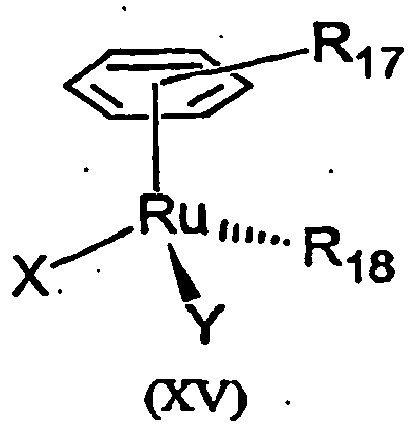
- X is a halogen;
- Y is a halogen or N-, P-, O- or S-donor ligand as defined above; and,
- Preferably, Y in (XV) is a halogen.
- Preferably, R18 is P R14 R15 R16 as defined above. Preferably, it is PTA.
- Preferably, in (XV), the bioactive compound is linked to R17 by a amide or ester bond. For example, the benzene to which R17 is bound, R17 and the bioactive compound together may correspond to the structure illustrated in formulae (XI) and (XII), for example.
- If the bioactive compound is linked to R18, R18 and the bioactive compound preferably correspond to any of formula (II) - (V) above.
- If the bioactive compound is linked to R18, R18 is preferably a N-, P-, O-, or S-donor ligand, to which the bioactive compound is linked. Accordingly, R18 preferably carries a functional group to which the bioactive compound can be linked, such as amide and ester bonds, as mentioned above.
- In this alternative case, with R18 being covalently bound to the bioactive compound, R17 may represent one or more residues such as R8-R13 in the compound of formula (VI) above.
- The present invention also envisages the possibility that the organometallic compound comprises more than one bioactive compound covalently bound to a ligand selected from R1-R6. Accordingly, in the above example of formula (XV), both, R17 and R18 may be covalently bound to a bioactive organic compound, whereby R18 may, instead constitute the bioactive compound. The bioactive compounds may then be the same or different. It they are different, the second bioactive compound may have a biological activity different from the bioactive compound generally used in the context of the present invention. Preferably, however, if more than one bioactive compounds are present, all are useful in the treatment of cancer in general and/or metastasis in particular.
- Many residues, and in particular ligands attached to M detailed above are indicated to be substituted. For the purpose of the present invention, substituents are preferably selected, independently from each other if there are more than one substituents, from alkyls, alkenyls, alkynyls, aryls, the alkyls, alkenyls, alkynyls, aryls, optionally comprising one or more heteroatoms, and functional groups such as, for example, imine-groups (=NH), amino groups (-NH2), hydroxy groups (-OH), thiol groups (-SH), carbonyl groups (=O), thio groups (=S), carboxyl groups (-COOH), nitrile groups (-C≡N), nitro groups (-NO2), any other functional group and, if applicable, charged derivatives (for example, if pH dependent) and salts of the functional groups, for example. The substituent comprising a functional group may be substituted at the functional group.
- Substituents may be branched and/or be further substituted.
- The present invention, for example in
claim 1, refers to an alkene, alkyne, cyclopentadienyl, and/or arene. The alkene or alkyne is considered to be an unsaturated C2-C30, more preferably a C3-C15 and most preferably C4-C8 hydrocarbon. An alkene comprises at least one (C=C)-double bound, whereas the alkyne comprises at least one (C≡C)-triple bond. The arene is preferably an aromatic C5-C35, more preferably C6-C20, most preferably C6-C15 hydrocarbon. The alkene or alkyne may also be cyclic, if there are ≥ 3 carbons. The alkene or alkyne may be branched, if there are ≥ 4 or ≥ 5 carbons, respectively. The alkene, alkyne, cyclopentadienyl and/or arene (or aryl radical) may further be substituted, as indicated above, and optionally comprising one or more heteroatoms. - Alkenyl, alkynyl and/or aryl residues or substituents, as mentioned, for example, with respect to nitrile and azo ligands, aromatic N-donor ligands, amine ligands, P-donor ligands, S-donor ligands, O-donor ligands, substituents of benzene or cyclopentadienyl ligands, substituents selected from R8-R13, R17 in formula (III), substituents of the alkene, alkyne, cyclopentadienyl and/or arene mentioned in the above paragraph, substituents of an alkyl or with respect to substituents in general are radicals of the alkenes, alkynes, cyclopentadienyls and/or arenes as defined in the paragraph above.
- Alkyl substituents, as mentioned, for example, with respect to substituents in general as defined above, N-donor ligands, in particular nitrile and azo ligands, aromatic N-donor ligands, amine ligands, substituents of B in formula (II), P-donor ligands, S-donor ligands, O-donor ligands, substituents of the alkene, alkyne and/or arene of
claim 1, substituents of benzene and/or cyclopentadienyl, substituents R8-R13 of formulae (VI), substituents of B in formula (IX), substituents selected from R14-R15, R17 in formula (III), are preferably C1-C30 alkyls, more preferably C2-C25 alkyls, even more preferably C4-C10 alkyls. If the alkyl comprises more than 3 carbons, it may be cyclic or branched. Alkyls that are cyclic and branched are also encompassed, if the comprise more than 6 carbons. Alkyls may generally be further substituted. - A heteroatom, for the purpose of the present invention may be any heteroatom, but is preferably selected from B, Si, N, P, As, O, S, Se, T, and halogens. If several heteroms are present, they may be the same or different. More preferably, heteroatoms are selected from N, O, P, S, and halogens. If the heteroatom is present in a substituent, alkene, alkyne, cyclopentadienyl or arene, it may change the chemical class of the compound. For example, an O present in a linear alkyl results in an ether. For the purpose of the present invention, this example would be considered to be an alkyl comprising one O heteroatom.
- The present invention provides an organometallic compound having a bioactive agent linked to at least one of the ligands of the central M.
- Preferably, the bioactive organic compound is selected from inhibitors of resistance pathways and/or a pharmaceutically acceptable derivatives thereof. Inhibiting activity may, if it is not yet described, be assessed by specific, commercially obtainable or described assays. The skilled person is capable of using meaningful concentrations of an presumed inhibitor in such an assay. An example of an assay for testing Glutathione S-transferase inhibiting activity is mentioned in Example 6.
- According to a preferred embodiment, the bioactive organic compound is an inhibitor of resistance selected from Glutathione S-transferase (GST) inhibitors, γ-Glutamyl Cysteine Synthetase (γ-GCS) inhibitors, multidrug resistance protein (MRP)/P-glycoproteins (PgP) inhibitors, inhibitors of cell signalling pathways.
- Examples of inhibitors of Glutathione S-transferase inhibitors comprise, but not limited to, ethacrynic acid, peptidomimetics based on gluthatione, p-chlorophenoxyisobutyrate, Gossypol, indomethacin, non-steroidal anti-inflammatory compounds based on ibuprofen and ketoprofen, misonidazole, Piriprost, Sulfasalazine, and their derivatives.
- Examples of inhibitors of γ-Glutamyl Cysteine Synthetase comprise, but not limited to, sulfoxime-based compounds such as buthinone sulfoxime and methinone sulfoxime, S-sulfocysteine, S-sulfohomocysteine, cystamine, and their derivatives.
- Examples of inhibitors of the multidrug resistance protein comprise, but not limited to, quinidine, vinblastine, terfemadine, tamoxifen, verapamil, cyclosporin, amitriptyline, progesterone, and their derivatives.
- Examples of inhibitors of cell signaling pathways comprise, but not limited to, pleurotin, azelaic acid, bischloroethylnitrosourea, palmarumycin , and their derivatives.
- Optically pure enantiomers, mixures of enantiomers such as racemates, diastereomers, mixtures of diastereomers, diastereomeric racemates, mixtures of diastereomeric racemates, and the meso-form, as well as pharmaceutically acceptable salts, solvent complexes and morphological forms of the bioactive organic compounds are also encompassed by the present invention.
- The expression pharmaceutical acceptable derivatives and derivatives also encompasses, but is not limited to, salts.
- Salts comprise, for example, salts with inorganic acids or organic acids like hiydrochloric or hydrobromic acid, sulphuric acid, phosphoric acid, citric acid, formic acid, acetic acid, maleic acid, tartaric acid, benzoic acid, methanesulfonic acid, p-toluenesulfonic acid, and the like that are non toxic to living organisms or in case the compound (I) is acidic in nature with an inorganic base like an alkali or earth alkali base, e.g. sodium hydroxide, potassium hydroxide, calcium hydroxide and the like.
- According to the present invention, the bioactive compound constitutes a ligand of the central M selected from R1-R6, or is covalently bound to a ligand to the central M of the organometallic compound of the invention. If the bioactive compound is covalently bound to the ligands, the covalent bond can be a carbon-carbon alkyl, alkenyl or alkynyl bonds, or carbon-heteronuclear bonds such as amide (-CONH-), ester (-CO2-), ether (-CH2O-), thioether (-CH2S-), amine (-CH2N-), imine (-CH=N-), phosphorous (-CH2-P-). Preferably, the covalent bond is a carbon heteronulcear bond.
- According to a preferred embodiment of the present invention, the organometallic compounds of the present invention are used as medicaments.
- More particularly, according to a preferred embodiment, the organometallic compound according to any of the preceding claims in the treatment and/or prevention of cancer and/or metastasis. The effectiveness of the present compounds for the treatment of metastasis is remarkable. With many cancers, tumors may be removed surgically, with the occurrence of metastasis remaining the principle problem to which so far no convincing remedy has been found. Surprisingly, the compounds of the present invention are effective in overcoming the resistance of many cancer cells in metastasis to anti-cancer drugs. Thanks to the compounds of the present invention, anti-cancer drugs that are inefficient due to the onset of resistance against it, these very drugs may again be effectively employed. In addition, due to the increase of efficiency against cancer drugs, lower doses of the later may be applied, thus reducing the occurrence and severity of side effects.
- Accordingly, according to a preferred embodiment, the organometallic compound according to the invention are useful for reducing resistance of cancers and/or metastasis against anti-cancer drugs.
- According to a further embodiment, the present invention comprises a composition comprising an anti-cancer drug and the organometallic compound of any of the preceding claims for treating and/or preventing metastasis. The organometallic compound of the invention is most effective if administered together with an anti-cancer drug which may be conventional, and to which cancer cells have developed resistance, or a capable of developing resistance.
- As becomes clear from the above, the principle of the present invention does not only encompass a single, specific compound but is more general. In particular, with respect to the different ligands bound to the central M, and to one of which the bioactive compound is covalently bound, a large variability is provided. The bioactive compound may also be directly attached to the central atom, increasing the variability. If the bioactive compound is bound to a ligand, it may be linked to ligands of different general structure and to ligands that are linked to the central M in different ways, for example as free-electron-pair-donors or as donors of π-bonds that are capable of complexing or associating to a transition metal. Preferably, however, the central M is Ruthenium (Ru), and the overall compound has a sandwich or half-sandwich structure.
- Therefore, a high variability exists with respect to the ligands. For examples, the arene-part shown in exemplary ligands of formula (VII) and (VIII) may be selected from a large number of possible arenes that can be used in sandwich- or half-sandwich compounds. These arenes may, of course, be substituted, for example for improving the physico-chemical properties of the overall compound, such as solubility, or for improving effectiveness and reducing toxicity to normal cells. Such substituents are not shown here in all the detail, they may be selected at the discretion of the skilled person and are not essential for the general principle described herein.
- The following examples illustrate the principle of the present invention on the basis of ethacrynic acid, which functions as the bioactive compound and which is shown to be effective in the treatment of metastasis. The examples also illustrate the structural variably of connecting the bioactive compound to ligands of different structures and being linked to the central M in different ways.
- Ethacrynic acid (500 mg, 1.65 mmol) was refluxed in oxalyl chloride (5 ml) for 30 mins. Unreacted oxalyl chloride was removed in vacuo and dichloromethane (10 ml) was added to redissolve the residual colourless oil. (cyclohexa-1,4-dienyl)methamine (109 mg, 1.00 mmol) and triethylamine (1 ml) was added sequentially and the reaction mixture was refluxed for a further 6 h. On completion, a dark brown solution was obtained. The reaction mixture was washed with 5% NaHCO3 (50 ml), brine (2 x 50 ml) and dried in vacuo. The residual oil was separated on silica using 5:95 MeOH:dichloromethane as the eluent to yield a colourless oil which crystallizes on standing (yield : 250 mg, 63.3 %). 1H NMR (CDCl3, 400.13 MHz) 7.19 (d, 1H, ArEA-H, 3 J HH = 8.4 Hz), 6.87 (d, 1H, ArEA-H, 3 J HH = 8.4 Hz), 6.81 (b, 1H, -CH2NH-), 5.95 (s, 1H, =CH2), 5.64-5.71 (m, 3H, C=CH-C), 5.58 (s, 1H, =CH 2), 4.60 (s, 2H, - OCH 2CO2-). 3.91 (d, 2H, -CH 2NH-, 3 J HH = 6.0 Hz), 2.83 (t, 2H, -CH2NH-, 3 J HH = 6.0 Hz), 2.61-2.72 (m, 4H, =C-CH 2-C=), 2.47 (q, 2H, -CH 2CH), 3 J HH = 7.6 Hz), 1.15 (t, 3H, -CH2CH 3, 3 J HH = 7.6 Hz).
- (1) (0.43 g, 3.32 mmol) was refluxed with RuCl3·3H2O (50 mg, 0.192 mmol) in degassed EtOH (25 ml) for 6 hours and left to stand at -4°C for 12 h, during which a reddish-orange precipitate separates from the dark green solution. The precipitate was filtered, dissolved in dichloromethane and precipitated using diethyl ether to yield a light orange precipitate. The product was dried in vacuo (yield : 76.0 mg, 70.4 %) . 1H NMR (CDCl3, 400.13 MHz) 8.11 (t, 1H, -CH2NH-), 7.16 (d, 1H, ArEA- H, 3 J HH = 8.4 Hz), 6.90 (d, 1H, ArEA-H, 3 J HH = 8.4 Hz), 5.97 (s, 1H, =CH2), 5.77 (t, 1H, p-ArPh-H, 3 J HH = 6.0 Hz), 5.63 (s, 1H, =CH 2), 5.56 (dd, 2H, m-Arph-H, 3 J HH = 6.0, 6.0 Hz), 5.43 (d, 2H, o-Arph-H, 3 J HH = 6.0 Hz), 4.80 (s, 2H, -OCH 2CO2-), 4.58 (d, 2H, -CH 2NH-, 3 J HH = 6.0 Hz), 2.47 (q, 2H, -CH2CH3, 3 J HH = 7.6 Hz), 1.15 (t, 3H, - CH2CH 3, 3 J HH = 7.6 Hz). Anal. (C40H38Cl8N2O6Ru2) C 42.57, H 3.39, N 2.48, Found C 42.48, H 3.52, N 2.70.
- (2) (28.4 mg, 0.025 mmol) was refluxed with PTA (9.3 mg, 0.059 mmol) in 1:1 MeOH/dichloromethane (15 ml) for 2 hours. The solvent was removed and the residual was recrystallised from dichloromethane/diethyl ether to yield and an orange precipitate (yield : 31 mg, 85.3 %). 1H NMR (CDCl3, 400.13 MHz) 7.87 (t, 1H, -CH2NH-), 7.18 (d, 1H, ArEA-H, 3 J HH = 8.4 Hz), 6.90 (d, 1H, ArEA-H, 3 J HH = 8.4 Hz), 5.96 (s, 1H, =CH2), 5.07 (t, 1H, p-ArPh-H, 3 J HH = 5.6 Hz), 5.60 (s, 1H, =CH 2), 5.70 (m, 2H, m-ArPh-H), 5.52 (d, 2H, o-ArPh-H, 3 J HH = 6.0 Hz), 4.69 (s, 2H, -OCH 2CO2-), 4.56 (d, 2H, -CH2NH-, 3 J HH = 6.0 Hz), 4.51 (s, 6H, PTA-N-CH2 -N), 4.32 (s, 6H, PTA-P-CH 2-N), 2.47 (q, 2H, -CH2CH3, 3 J HH = 7.6 Hz), 1.15 (t, 3H,-CH2CH 3, 3 J HH = 7.6 Hz). Anal. (C26H31Cl4N4O3PRu) C 42.23, H 4.50, N 7.58, Found C 42.54, H 4.40, N 7.74.
- Ethacrynic acid (200 mg, 0.66 mmol), N,N-dicyclohexylcarbodiimide (200 mg, 0.98 mmol), N,N-dimethylaminopyridine (120 mg, 1.10 mmol) and (η6:phenylethanol)Ru(PTA)Cl2) (90 mg, 0.20 mmol) was dissolved in dichloromethane (50 ml) and stirred for 96 h. The reaction mixture was filtered through celite to remove the urea precipitate and separated on silica gel using acetone. The product was triturated in diethyl ether and recrystallised from dichloromethane/diethyl ether to yield a brown precipitate (yield: 50 mg, 34.0%). 1H NMR (CDCl3, 400.13 MHz) 7.07 (d, 1H, ArEA-H, 3 J HH = 8.4 Hz), 6.72 (d, 1H, ArEA-H, 3 J HH = 8.4 Hz), 6.00 (s, 1H, =CH 2), 5.62 (s, 1H, =CH 2), 5.48 (m, 2H, m-ArPh-H), 5.22 (d, 2H, o-ArPh-H, 3 J HH = 5.6 Hz), 5.13 (t, 1H, p-ArPh-H, 3 J HH = 5.2 Hz), 4.81 (s, 2H, -OCH 2CO2-), 4.55 (s, 6H, PTA-N-CH 2-N), 4.50 (t, 2H, -CO2CH 2CH2-, 3 J HH = 6.0 Hz), 4.33 (s, 6H, PTA-P-CH 2-N), 2.83 (t, 2H, -CO2CH2CH 2-, 3 J HH = 6.0 Hz), 2.47 (q, 2H, -CH 2CH3, 3 J HH = 7.6 Hz). 1.16 (t, 3H, - CH2CH 3, 3 J HH = 7.6 Hz). Anal. (C27H32Cl4N3O4PRu) C 44.03, H 4.38, N 5.71, Found C 43.94, H 4.40, N5.72.
- Ethacrynic acid (349 mg, 1.16 mmol) was refluxed in dichloromethane (20 ml) with an excess of oxalyl chloride (2 ml) for 1 h. Unreacted oxalyl chloride was removed under vacuum and the reaction mixture concentrated to yield ethacrynic acid chloride as a colourless oil. The acid chloride was taken up in dichloromethane (20 ml) and N-(aminopropyl)imidazole (500 mg, 4.00 mmol) was added. The reaction mixture was then refluxed for 2 h. 5% NaHCO3 solution (25 ml) was added to quench the reaction and the aqueous phase was extracted with dichloromethane (3 x 25 ml). The organic phases were combined and washed with brine (2 x 25 ml) and dried over Na2SO4. The solvent was removed and the product was separated on silica using 20% EtOH/80% CHCl3. The solvent was removed to yield a colourless oil (yield: 378 mg, 79.5%). 1H NMR (CDCl3, 400.13 MHz) 7.52 7.07 6.96 (s, 3H, Arimidazole-H), 7.20 6.86 (d, 2H, ArEA-H, 3 J HH = 8.4 Hz), 6.82 (m, 1H, NH), 5.96 5.59 (s, 2H, =CH 2), 4.57 (s, 2H, -OCH 2CO2-), 4.04 (t, 2H, Im-CH 2-CH2), 3.42 (dt, 2H, CH2-CH 2-NH), 2.47 (q, 2H, -CH 2CH3, 3 J HH = 7.6 Hz), 2.10 (tt, 2H, CH2-CH 2-CH2), 1.16 (t, 3H, -CH2CH 3, 3 J HH = 7.6 Hz).
- [(η6-cymene)RuCl(µ-Cl)]2 (68 mg, 0.11 mmol) and (5) (94 mg, 0.23 mmol) was dissolved in dichloromethane (25 ml) and stirred for 12 h. The reaction mixture was concentrated and pentane was added to precipitate the product. The product was recyrstallised from dichloromethane/pentane to yield an orange precipitate (yield: 144 mg, 90.3%). 1H NMR (CDCl3, 400.13 MHz) 7.95 7.30 6.91 (s, 3H, imidazole-H), 7.19 6.90 (d, 2H, ArEA-H, 3 J HH = 8.4 Hz), 6.94 (t, 1H, N-H), 5.96 5.61 (s, 2H, =CH 2), 5.45 5.26 (dd, 4H, ArPh-H, 3 J HH = 6.0 Hz), 4.60 (s, 2H, -OCH 2CO2-), 3.89 (t, 2H, -CH2CH 2-imidazole, 3 J HH = 7.2 Hz) 3.36 (q, 2H, NHCH 2CH2-, 3 J HH = 7.2 Hz), 2.96 (septet, 1H, -CH3CHCH3, 3 J HH = 8.0 Hz), 2.47 (q, 2H, - CH2CH3, 3 J HH = 7.6 Hz), 2.16 (s, 3H, -ArCH 3), 1.93 (m, 2H, NHCH2CH 2-), 1.26 (d, 6H, - CH(CH 3)2, 3 J HH = 8.0 Hz), 1.15 (t, 3H, -CH2CH 3, 3 J HH = 7.6 Hz). Anal. (C29H35Cl4N3O3Ru) C 48.67, H 4.93, N 5.88, Found C 48.75, H 4.95, N 5.79.
- (η6-cymene)Ru(PTA)Cl2 (96 mg, 0.21 mmol), NaBF4 (92 mg, 0.84 mmol) and (5) (124 mg, 0.30 mmol) was suspended in methanol (15 ml) and refluxed for 2 h, during which a yellow solution was obtained. The reaction mixture was cooled to room temperature and the solvent removed. The residue was extracted with dichloromethane (2 x 25 ml) and filtered through celite. The dichloromethane extracts was concentrated and diethyl ether was added to precipitate the product. The product was recrystallised from dichloromethane/diethyl ether to yield a yellow precipitate (yield: 150 mg, 77.2%). 1H NMR (CDCl3, 400.13 MHz) 8.28 7.42 7.04 (s, 3H, imidazole-H), 7.22 (t, 1H, N-H), 7.17 6.99 (d, 2H, ArEA -H, 3 J HH = 8.4 Hz), 5.96 5.58 (s, 2H, =CH2), 5.81 5.61 (dd, 4H, ArPh-H), 4.72 (m, 2H, -OCH2CO2-), 4.41 (m, 6H, PTA-N-CH 2-N), 4.10 (m, 6H, PTA-P-CH 2-N), 3.89 (t, 2H, -CH2CH2-imidazole, 3 J HH = 7.2 Hz) 3.36 (q, 2H, NHCH 2CH2-, 3 J HH = 7.2 Hz), 2.96 (septet, 1H, -CH3CHCH3, 3 J HH, = 8.0 Hz), 2.47 (q, 2H, -CH 2CH3, 3 J HH = 7.6 Hz), 2.16 (s, 3H, -ArCH 3), 1.93 (m, 2H, NHCH2CH 2-), 1.26 (d, 6H, -CH(CH 3)2, 3 J HH = 8.0 Hz), 1.15 (t, 3H, -CH2CH 3, 3 J HH = 7.6 Hz). ESI-MS (CH2Cl2, +ve mode) m/z 840 [M]+. Anal. (C35H47BCl3F4N6O3PRu) C 45.45, H 5.12, N 9.09, Found C 45.60, H 5.15, N 9.07.
- [(η6-cymene)RuCl(µ-Cl)]2 (196.8 mg, 0.322 mmol) and silver oxalate (240 mg, 0.797 mmol) were stirred in water for 12 h. The mixture was then filtered through celite to remove the AgCl precipitate. The solvent was removed under vacuum and the residue was redissolved in methanol (25 ml). PTA (120 mg, 0.764 mmol) was added and the reaction was stirred for 2 h. The solvent was reduced to ca. 5% of its original volume and diethyl ether (25 ml) was added. The slurry was cooled to 4°C for 12 h to complete precipitation of the product. The precipitate was filtered and recrystallised from methanol-diethyl ether to yield a light orange precipitate (yield : 285 mg, 89 %). 1H NMR (D2O, 400.13 MHz) 5.98 5.89 (dd, 4H, Ar-H), 4.57 (s, 6H, PTA-N-CH 2-N), 4.15 (s, 6H, PTA-P-CH 2-N), 2.61 (septet, 1H, -CH(CH3)2), 2.05 (s, 3H, - CH 3). 1.22 (d, -CH(CH 3)2). 13C-{1H} NMR (D2O, 100.63 MHz) 166.2 (-CO2), 105.0 97.7 87.3 86.8 (Ar-C), 70.7 (N-CH 2-N), 48.7 (P-CH 2-N). 30.8 (-ArCH 3), 21.5 (-CH(CH3)2), 17.3 (-CH(CH3)2). 31P-{1H} NMR (D2O, 400.13 MHz) -33.39. Anal. (C18H26N3O4PRu·0.5H2O) C 44.08, H 5.55, N 8.57, Found C 44.24, H 5.58, N 8.69.
- [(η6-cymene)RuCl(µ-Cl)]2 (228 mg, 0.373 mmol) and
silver 1,1-cyclobutanedicarboxylate (300 mg, 0.838 mmol) were stirred in acetonitrile (50 ml) for 12 h, during which a yellow precipitate was formed. The solvent was removed and the residue was redissolved in methanol (25 ml). The mixture was filtered through celite to remove the AgCl precipitate. PTA (130 mg, 0.828 mmol) was added to the filtrate and the solution was stirred for 2 hours. The solvent was reduced to ca. 5% of its original volume and diethyl ether (25 ml) was added. The slurry was cooled to 4°C for 4 hours to complete precipitation of the product. The precipitate was filtered and recrystallised from dichloromethane-diethyl ether to yield an orange precipitate (yield : 288 mg, 72.2 %). 1H NMR (CDCl3, 400.13 MHz) 5.54 5.43 (dd, 4H, Ar-H), 4.49 (s, 6H, PTA-N-CH 2-N), 4.15 (s, 6H, PTA-P-CH 2-N), 2.76 2.66 (t, 4H,-CH2(CH 2)2), 2.58 (septet, 1H, -CH(CH3)2), 2.02 (s, 3H, -CH 3), 1.94 (quintet, 2H,-CH 2(CH2)2), 1.24 (d, -CH(CH 3)2). 13C-{1H} NMR (CDCl3, 100.63 MHz) 178.7 (-CO2), 102.5 96.1 87.9 85.3 (Ar-C), 72.9 (N-CH2-N), 50.8 (P-CH2-N), 30.9 (-(O2C)C(CH2)2), 30.9 (C(CH2)topCH2), 30.9 (C(CH2)bottomCH2), 30.9 ((-CH2)2 CH2), 30.9 (-ArCH 3), 22.5 (-CH(CH3)2), 17.3 (-CH(CH3)2). 31P-{1H} NMR (CDCl3, 400.13 MHz) -30.16. Anal. (C22H32N3O4PRu·H2O) C 47.73, H6.19, N 7.59, Found C 47.99, H 6.45, N 7.72. - Human A549 lung carcinoma cells, known to express high levels of Glutathione-S-Transferase, were routinely grown in flasks with DMEM medium containing 4.5 g/l glucose, 10% foetal calf serum (FCS) and antibiotics at 37°C and 6% CO2. When the cells are confluent, they are trypsinised and concentrated in a centrifuge at 4°C. The cells were then diluted in phosphate-buffer saline (PBS) containing protease inhibitor cocktail (final concentration of 1 µg/ml) and homogenised by repeatedly freezing in liquid nitrogen and thawing (4 cycles). The homogenised cell samples were centrifuged at 4°C and the supernatant, which is the cell lysates, was separated. The cell lysates are stored at -56 °C.
- The Ru compounds are weighed, and dissolved in DMSO to 100 mM. They are diluted in water to 100 µM, such that the DMSO concentration did not exceed 0.1%. The cell lysates were exposed to the drug solutions for 90 mins. Control, containing the cell lysates with water/0.1% DMSO was also prepared.
- The GST activity in the treated cell lysates was determined using the glutathione-CDNB (1-chloro-2,4-dinitrobenzene) assay. Glutathione and CDNB were dissolved in deionised water and ethanol respectively to make up a 100 mM solutions. A developing solution, containing 50 mM phosphate buffer solution (pH 6.5), was prepared and was added 1 % v/v, the 100 mM glutathione and 100 mM CDNB solutions such that their final concentrations are both 1 mM. The developing solution was added to a 96-well plate at 200 µl per well, followed by the treated cell lysates at 2 µl per well. The absorbance at 340 nm was monitored continuously for 5 mins at 15 s intervals. The average slope of the change in absorbance was determined as a fraction of the control as the percentage of residual GST activity.
- Cells lysates treated with complexes with good GST-inhibition ability should exhibit low residual GST activity. The summary of the results are shown in Table 1 below:
Table 1: GST activity in lung carcinoma cells Teatment Residual GST activity (% control) Ethacrynic acid 86.32 ± 13-5 (Ethacrynic-η6:phenylmethylamide)Ru(PTA)Cl2 (3) 63.57 ± 2.0 (Ethacrynic-η6:phenylethanol ester)Ru(PTA)Cl2 (4) 42.77 ± 13.9 (η6-cymene)RuCl2(ethacrynic-propylamide-imidazole) (6) 23.70 ± 10.7 [(η6-cymene)RuCl(PTA)(ethacrynic-propylamide-imidazole)]BF4 - (7) 62.58 ± 8.8 - The cells were routinely grown in flasks with DMEM medium containing 4.5 g/l glucose, 10% foetal calf serum (FCS) and antibiotics at 37°C and 6% CO2. When the cell are confluent, they are trypsinised and seeded in 48-well plates as monolayers for 24 h.
- For (3), (4), (5) and (7), the Ru compounds are weighed, and dissolved in DMSO to 100 mM. They are diluted in excess medium and diluted to 100 µM, such that the DMSO concentration did not exceed 0.12%. The 100 µM Ru complex solution was then serially diluted to make up 50 µM, 25 µM, 12.5 µM, 6.3 µM, 3.1 µM, 1.6 µM solutions. The media is removed from the cell plates are the drug solutions applied in triplicate. A set of control cells, with media containing 1.0% DMSO, was left on each plate. The cells were exposed to the drugs for 72 hours.
- For RAPTA-C, (8) and (9), the Ru compounds are weighed, and dissolved directly in medium to 1600 µM, then serially diluted to make up 800 µM 400 µM, 200 µM, 100 µM, 50 µM, 25 µM solutions. The media is removed from the cell plates are the drug solutions applied in triplicate. A set of control cells, with media containing 1.0% DMSO, was left on each plate. The cells were exposed to the drugs for 72 hours.
- Cell viability was determined using the standard MTT assay protocol, which allows the quantification of the mitochondrial activity in metabolically active cells. MTT (
final concentration 02 mg/ml) was added to the cells for 2 h, then the culture medium was aspirated and the violet formazan precipitate dissolved in 0.1 N HCl in 2-propanol. The optical density, which is directly proportional to number of surviving cells, was quantified at 540 nm using a multiwell plate reader and the fraction of surviving cells was calculated from the absorbance of untreated control cells. - Using the above protocol, the compounds were tested against human T47D and MCF-7 breast carcinoma, A549 lung carcinoma and HT-29 colon carcinoma cell lines (see
Figure 7 ).Table 2: Comparison of activity between RAPTA-C and Ru-ethacrynic acid derivatives Complexes IC50 (µM) HT29 A549 T47D MCF7 (η6-cymene)Ru(PTA)Cl2 436 1029 1063 >1600 Ethacrynic acid 73.5 50.7 7.73 66.0 (Ethacrynic-η6:phenylmethylamide)Ru(PTA)Cl2 (3) 50.7 32.3 2.91 19.9 (Ethacrynic-η6:phenylethanoate)Ru(PTA)Cl2 (4) 105.5 66.7 6.28 104.7 (η6-cymene)RuCl2(ethacrynic-propylamide-imidazole)(6) 39.1 34.0 4.80 10.7 [(η6-cymene)RuCl(PTA)(ethacrynic-propylamide-imidazole)]BF4 - (7) 64.2 65.1 5.97 19.9 Table 3: Comparison of activity between RAPTA-C and RAPTA-C carboxylate derivatives Complex IC50 (µM) HT29 A549 T47D MCF7 (η6-cymene)Ru(PTA)Cl2 436 1029 1063 >1600 (η6-cymene)Ru(PTA)(C2O4) (8) 267 1130 1174 >1600 (η6-cymene)Ru(PTA)(C6H6O4) (9) 265 1567 1088 >1600 - Tumor cell lines derived from human and mouse tumours listed below were stabilised for in vitro propagation.
Table 4: Tumor cell lines for in vitro study. Identification Tumor histotype HT-291 Human colorectal carcinoma MIA-PaCa-22 Human pancreatic cancer H460M3 Human lung carcinoma/metastatic A2780 Human ovarian carcinoma A2780/CDDP4 Human ovarian carcinoma resistant to Cistplatin TLX55 Mouse lymphona 1) Obtained from CRO, Aviano, Italy (Dr. P. Spessotto); 2) Obtained from Istituto Nazionale per lo Studio e la Cura dei Tumori, Milan (kindly supplied by Dr. D. Coradini); 3), as 2), but kindly supplied by Dr. G. Pratesi; 4) A2780cis is the variant of the parental A2780 resistant to Cisplatin (ECACC No. 93112517); 5) Originally obtained from Chester Beatty Institute, London, UK. - IC50 values are determined as follows: Tumour cells are incubated in the appropriate complete medium at 37°C and under controlled atmosphere (5% CO2). Test compounds are tested at doses in the range of 100 nM and 100 µM. Cytotoxicity is determined by the MTT test, by measuring cell viability as the cell metabolic capacity to transform the tetrazolium salt of MTT in the blue formazan, by mitochondrial dehydrogenases; the blue colour is read at 570 nm with a spectrophotometer (Alley MC, Scudiero DA, Monks A, Hursey ML, Czerwinski MJ, Fine DL, Abbott BJ, Mayo JG, Shoemaker RH, Boyd MR. Feasibility of drug screening with panels of human tumor cell lines using a microculture tetrazolium assay. Cancer Res 48: 598-601, 1988 . Mosmann T. Rapid colorimetric assay for cellular growth and survival: application to proliferation and cytotoxicity assays. J Immunol Methods 65: 55-63, 1983). Briefly, on day 0, in 96-well plates, 2-4000cells/well/100µl complete medium are plated. On
day 1, test compounds are added at the test concentrations of 10-7 M; 3*10-7M; 10-6 M; 3*10-6M; 10-5 M; 3*10-5M; 10-4 M. Each concentration is studied in triplicate. Cell viability, as determined by the MTT test is done onDay 4, after 3 days treatment. Each well is added with 10µl/100µl MTT (prepared previously by dissolving 5 mg/ml MTT in PBS, sterilized with filters at a cut-off of 0,22nm and stored at 4°C). Plates are put in an incubator at 37°C for 4hrs, then medium is eliminated and each well is added with 200µl DMSO (Sigma Chemical Co., USA). Plates are read with a spectrophotometer (Spectra count Packard Bell, Meriden, CT, USA) at 570 nm wave length. IC50 is calculated with the GraphPad Prism4. - The table below shows the IC50 values for the tested compounds. The reported values are the most representative of two separate experiments. Test concentrations have been done by serial dilutions of each compound starting form a mother solution of 10-2 M prepared by dissolving
Compound 3,Compound 4, Ethacrynic acid and cisplatin in dimehtylsulfoxide, and RAPTA-T (the moiety of the test compounds without the Ethacrynic acid moiety) in sterile apirogen water.Table 5: IC50 values (µM) A2780 A2780 /CDDP H460M HT-29 MIA PaCa-2 TLX5 Comp. 3 7.1 ÷ 9.5 4.6 ÷ 53 2.5 ÷ 3.8 2.3 ÷ 3.8 14.7 ÷ 20.1 0.8 ÷ 3.0 Comp. 4 ∼ 30 36.7 ÷ 38.7 29.1 ÷ 31.5 30.0 ÷ 32.6 81.5 ÷ 92.7 3.6 ÷ 4.3 Ethacrynic acid 91.1 ÷ 94.8 84.3 ÷ 97.6 58.1 + 63.3 35.2 ÷ 44.0 > 100 1.3 ÷ 1.8 Cisplatin 10.5 ÷ 11.8 > 100 1.3 ÷ 3.0 4.9 ÷ 32.6 10.6 ÷ 12.9 0.02 ÷ 0.2 RAPTA-T > 100 > 100 > 100 > 100 > 100 64.1 ÷ 92.9 - It can be seen from the table above that both
compounds - Tumour cells (TLX5, see above in Example 8) were derived from mouse tumours and stabilised for in vivo propagation. For the animal study, TLX5 lymphona cells were injected in the peritoneal cavity of CBA brown-grey inbred mice (Harlan Nossan, San Giovanni al Natisone, Udine, Italy) at day 0. Test compounds were applied at
day 3 at various doses, also by the intraperitoneal route, with each drug (test compound or reference drug) diluted in appropriate physiological solution and injected in a volume of 0.1 ml/10g body weight. - Results from the in vivo study are shown in the table below.
Table 6: Survival time in an in vivo TXL5 lymphoma model Mean survival time (days ± SD) % increase vs Controls Controls 10.0 ± 0.82 - Compound 3 at 200 mg/kg12.2 ± 1.79** 22 Cisplatin 8 mg/kg11.8 ± 1.79* 18 - As can be seen from the table above, control mice die 10 after tumor inplant. The treatment with compound 3'raises the mean survival time to 12.2 days, corresponding to +22% versus control, a result statistically significant (** p=0.0089, Logrank test). Cisplatin, known to have severe side effects, was also effective at the dose indicated, although to a lesser extent (* p=0.0182).
- While these results indicate that
Compound 3 of the present invention is active in vivo, it is to be noted that the compound was administered as a suspension of the compound in carboxymethylcellulose. This fact has most probably reduced the bioavalability of thecompound 3.
if the bioactive compound is bound to R17, R17 is corresponds to "B-X-" as defined in formula (X) above, and R18 is a N-, P-, O- or S-donor ligand as defined above; and/or,
if the bioactive compound is bound to R18, or constitutes R18, R18 is, respectively, a N-, P-, O-or S-donor ligand as defined above to which the bioactive compound is covalently bound; or R18 constitutes the bioactive compound, the bioactive compound comprising itself N-, P-, O-or S-atoms functioning as donors suitable to attach it to the central Ru.
Claims (15)
- An organometallic compound of formula (XIV),
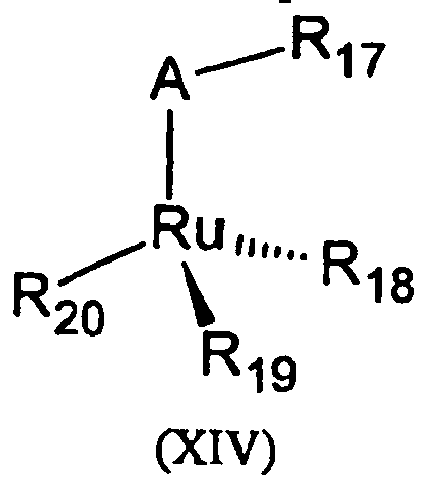 A is an arene, optionally substituted and optionally comprising one or more heteroatoms; R18, R19, R20, are ligands of the central ruthenium atom which are, independently of each other, selected from halogens and/or N-, O-, S-, or P- donor ligands;R17 is an optional residue selected from an alkyl, alkenyl, alkynyl, aryl, optionally substituted and optionally comprising one or more heteroatoms;whereby at least one bioactive organic compound constitutes at least one selected from R17 -R20, or is covalently linked to any of the R17 - R20, with the proviso that residues selected from R17 - R20, which constitute the bioactive organic compound, or which are covalently bound the bioactive organic compound, are not halogens; andwherein said bioactive organic compound is selected from ethacrynic acid, peptidomimetics based on gluthatione, p-chlorophenoxyisobutyrate, Gossypol, indomethacin, non-steroidal anti-inflammatory compounds based on ibuprofen and ketoprofen, misonidazole, Piriprost, Sulfasalazine, sulfoxime-based compounds such as buthinone sulfoxime and methinone sulfoxime, S-sulfocysteine, S-sulfohomocysteine, cystamine, quinidine, vinblastine, terfernadine, tamoxifen, verapamil, cyclosporin, amitriptyline, progesterone, pleurotin, azelaic acid, bischloroethylnitrosourea, or palmarumycin, and their pharmaceutical acceptable derivatives and salts.
 - The organometallic compound of claim 1, in which A is an arene of the formula (VI)

in which two or more residues selected from R8, R9, R10, R11, R12, R13 may be covalently linked with each other thus forming a bi- or tri-, or polycyclic system, and in which any of the residues R8, R9, R10, R11, R12, R13 optionally constitutes or is optionally bound to the bioactive compound. - The oganometallic compound according to any one of the preceding claims, wherein the N-donor ligand comprises the structure of formula (II):
 M is the transition metal Ru;the dashed line represents bonding, as a monodentate ligand, to the transition metal Ru the circle represents a mono- or polycyclic system, comprising at least one N-heteroatom, indicated as N, which provides an electron pair enabling attachment to M, the cyclic system being optionally further substituted;B is an optional linking group, which is selected from alkyl, alkenyl, alkynyl and aryl, is optionally substituted, and optionally comprises one or more heteroatoms and has 0-15 carbon atoms; andX is a functional group of B or the cyclic system, through which the bioactive compound is bound to B or to the cyclic system.
 - The oganometallic compound according to any one of the preceding claims, wherein the N-donor ligand comprises the structure of formula (III) below, to which the bioactive compound is linked by means of an amide bond:
 M is the transition metal Ru;the dashed line represents bonding, as a monodentate ligand, to the transition metal Ru;the circle represents a mono- or polycyclic system comprising at least two N-heteroatoms;n is 1-10, preferably 2-6, most preferably 3-4;X is as defined above.
 - The organometallic compound according to any one of claims 1-2 wherein the P-donor ligand comprises the structure of formula (XIII),
P R14 R15 R16 (XIII),
in which,
R14 R15 R16 may be the same or different, are each C1-C6 alkyl, alkenyl, alkynyl, aryl, optionally substituted and optionally comprising one or more heteroatoms, or R14 R15 R16 may together with the phosphorous atom form a cycloalkyl group, such group being optionally heterocyclic. - The organometallic compound according to claim 5, wherein the P-donor ligand of formula (XIII) is a residue suitable of increasing the solubility of the organometallic compound of claim 1 or 2 in water.
- The organometallic compound according to claim 2 comprises the structure of formula (X):
 A is an optionally substituted, benzyl or cyclopentadienyl,B is an optional linking group, which may be selected from alkyl, alkenyl, alkynyl and aryl, which is optionally substituted, which optionally comprises one or more heteroatoms and has 0-15, preferably 1-8 carbon atoms; andX is a functional group of B or the cyclic system, through which the bioactive compound is bound to B or to the cyclic system.
 - The organometallic compound according to any one of claims 2 and 7 comprises the structure of formula (XI) or (XII):
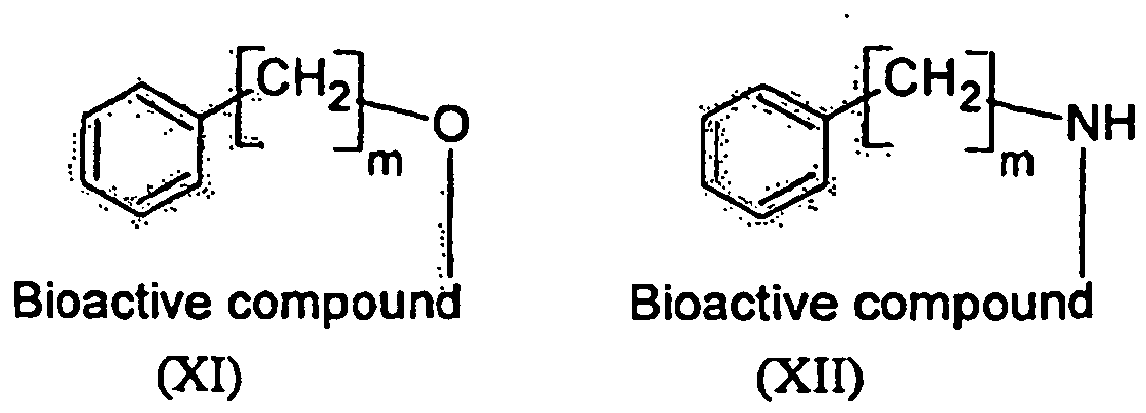
m is 1-10. - The organometallic compounds according to claim 1 comprises the structure of formula (XV):

X is a halogen;
Y is a halogen or N-, P-, O- or S-donor ligand as defined above; and,
in which,
if the bioactive compound is bound to R17, R17 is corresponds to "B-X-" as defined in formula (X) above, and R18 is a N-, P-, O- or S-donor ligand as defined above; or,
if the bioactive compound is bound to R18, or constitutes R18, R18 is, respectively, a N-, P-, O- or S-donor ligand as defined above to which the bioactive compound is covalently bound; or R18 constitutes the bioactive compound, the bioactive compound comprising itself N-, P-, O- or S-atoms functioning as donors suitable to attach it to the central Ru. - The organometallic compound according to any of the preceding claims for use as a medicament.
- The organometallic compound according to any of the preceding claims for use in the treatment and/or prevention of cancer and/or metastasis.
- The organometallic compound according to any of the preceding claims for use in reducing resistance of cancers and/or metastasis against anti-cancer drugs.
- A composition comprising an anti-cancer drug and the organometallic compound of any of the preceding claims for use in treating and/or preventing metastasis.
- Use of the organometallic compound according to any one of claims 1-12 for the manufacture of a medicament for treating and/or preventing metastasis.
- Use of the composition according to claim 13 for the manufacture of a medicament for treating and/or preventing metastasis.
Applications Claiming Priority (2)
| Application Number | Priority Date | Filing Date | Title |
|---|---|---|---|
| US79943306P | 2006-05-09 | 2006-05-09 | |
| PCT/CH2007/000234 WO2007128158A1 (en) | 2006-05-09 | 2007-05-09 | Transition metal complexes for inhibiting resistance in the treatment of cancer and metastasis |
Publications (3)
| Publication Number | Publication Date |
|---|---|
| EP2016085A1 EP2016085A1 (en) | 2009-01-21 |
| EP2016085B1 EP2016085B1 (en) | 2015-08-05 |
| EP2016085B9 true EP2016085B9 (en) | 2015-12-30 |
Family
ID=37770371
Family Applications (1)
| Application Number | Title | Priority Date | Filing Date |
|---|---|---|---|
| EP07720131.7A Not-in-force EP2016085B9 (en) | 2006-05-09 | 2007-05-09 | Transition metal complexes for inhibiting resistance in the treatment of cancer and metastasis |
Country Status (3)
| Country | Link |
|---|---|
| US (2) | US9018199B2 (en) |
| EP (1) | EP2016085B9 (en) |
| WO (1) | WO2007128158A1 (en) |
Families Citing this family (11)
| Publication number | Priority date | Publication date | Assignee | Title |
|---|---|---|---|---|
| KR20100060189A (en) * | 2008-11-27 | 2010-06-07 | 국립암센터 | A pharmaceutical composition for preventing or treating transglutaminase-related disease comprising ethacrynic acid, and a method for preventing or treating transglutaminase-related disease by using thereof |
| WO2010077310A2 (en) * | 2008-12-17 | 2010-07-08 | The Regents Of The University Of California | Amide derivatives of ethacrynic acid |
| DE102009053392A1 (en) * | 2009-11-14 | 2011-06-22 | Umicore AG & Co. KG, 63457 | Process for the preparation of Ru (0) olefin complexes |
| EP2409697A1 (en) | 2010-07-20 | 2012-01-25 | Université de Neuchâtel | Medicaments Based on Dinuclear Ruthenium, Osmium and Iron Complexes Comprising Triply Bridging Thiolato, Selenolato, Alkoxo and/or Amido Ligands |
| WO2013038395A1 (en) | 2011-09-16 | 2013-03-21 | Universidade De Lisboa | Transition metal complexes for pharmaceutical applications |
| WO2013136296A2 (en) | 2012-03-14 | 2013-09-19 | Universidade De Lisboa | Water-soluble organometallic ruthenium and iron compunds presenting heteroaromatic ligands |
| PT108082B (en) | 2014-12-06 | 2020-12-15 | Faculdade De Ciências Da Universidade De Lisboa | MACROMOLECULAR COMPLEXES OF TRANSITION METALS FOR CANCER TREATMENT AND ITS PREPARATION PROCESS |
| CN104844660B (en) * | 2015-04-01 | 2017-12-05 | 中国化学工程第六建设有限公司 | A kind of fluorobenzene ruthenium compound and its production and use |
| US11697851B2 (en) | 2016-05-24 | 2023-07-11 | The Regents Of The University Of California | Early ovarian cancer detection diagnostic test based on mRNA isoforms |
| CN113840827B (en) * | 2019-05-09 | 2024-05-14 | 默克专利有限公司 | Adamantane compound |
| EP4508058A1 (en) | 2022-04-13 | 2025-02-19 | Faculdade de Ciencias da Universidade de Lisboa | Organometallic complex, controlled-release multi-functional drug, pharmaceutical composition, processes for the preparation thereof and their use |
Family Cites Families (7)
| Publication number | Priority date | Publication date | Assignee | Title |
|---|---|---|---|---|
| US3999095A (en) * | 1975-10-06 | 1976-12-21 | General Motors Corporation | Lamp socket and bulb assembly with side contacts |
| US4980473A (en) * | 1985-01-18 | 1990-12-25 | The Trustees Of Columbia University In The City Of New York | Chemical probes for left-handed DNA and chiral metal complexes as Z-specific anti-tumor agents |
| JPH10323890A (en) * | 1997-05-23 | 1998-12-08 | Nippon Oil Co Ltd | Method for producing stretched fluororesin body |
| DE60022372T2 (en) * | 1999-10-27 | 2006-06-08 | The University Court Of The University Of Edinburgh | HALF SANDWICH RUTHENIUM (II) COMPOUNDS WITH NITROGEN-CONTAINING LIGANDS FOR CANCER THERAPY |
| JPWO2002102572A1 (en) | 2001-05-30 | 2004-09-30 | ダイキン工業株式会社 | Method for producing polytetrafluoroethylene resin molded article and resin molded article |
| GB0215526D0 (en) * | 2002-07-05 | 2002-08-14 | Univ Edinburgh | Anticancer compounds |
| GB0418643D0 (en) | 2004-08-20 | 2004-09-22 | Univ Edinburgh | Ruthenium (II) compounds |
-
2007
- 2007-05-09 WO PCT/CH2007/000234 patent/WO2007128158A1/en not_active Ceased
- 2007-05-09 EP EP07720131.7A patent/EP2016085B9/en not_active Not-in-force
- 2007-05-09 US US12/227,210 patent/US9018199B2/en not_active Expired - Fee Related
-
2015
- 2015-03-18 US US14/661,936 patent/US20150190362A1/en not_active Abandoned
Also Published As
| Publication number | Publication date |
|---|---|
| US20090312301A1 (en) | 2009-12-17 |
| EP2016085B1 (en) | 2015-08-05 |
| US20150190362A1 (en) | 2015-07-09 |
| EP2016085A1 (en) | 2009-01-21 |
| WO2007128158A1 (en) | 2007-11-15 |
| US9018199B2 (en) | 2015-04-28 |
Similar Documents
| Publication | Publication Date | Title |
|---|---|---|
| EP2016085B1 (en) | Transition metal complexes for inhibiting resistance in the treatment of cancer and metastasis | |
| Colina-Vegas et al. | Half sandwich Ru (II)-acylthiourea complexes: DNA/HSA-binding, anti-migration and cell death in a human breast tumor cell line | |
| Frik et al. | Cyclometalated iminophosphorane gold (III) and platinum (II) complexes. A highly permeable cationic platinum (II) compound with promising anticancer properties | |
| US8481522B2 (en) | Platinum-N-heterocyclic carbene derivatives, preparation thereof and therapeutic use thereof | |
| Kemp et al. | Degradation of bidentate-coordinated platinum (II)-based DNA intercalators by reduced L-glutathione | |
| CN101863925B (en) | Aryl ruthenium (11) composition and preparation method and application thereof | |
| Welsh et al. | Synthesis and antiproliferative activity of benzimidazole-based, trinuclear neutral cyclometallated and cationic, N^ N-chelated ruthenium (ii) complexes | |
| CN108774269B (en) | Novel targeted benzimidazole derivatives antitumor platinum (II) and ruthenium (II) complexes and their preparation methods and applications | |
| US11884685B2 (en) | Rhenium complexes and methods of use for treating cancer | |
| US9585861B1 (en) | Method for treating a cancer with a mixed ligand gold(III) complexes as anti-cancer agents | |
| US9649292B2 (en) | Method for treating prostate cancer and/or gastrointestinal cancer | |
| ITMI971594A1 (en) | PLATINUM CATIONIC TETRA- AND PENTA-NUCLEAR COMPLEXES WITH ANTI-TUMOR ACTIVITY | |
| Bartolucci et al. | Five-coordinate platinum (II) complexes containing substituted olefins: synthesis and cytostatic activity | |
| CN106795189A (en) | Platinum(IV) complexes with enhanced antitumor efficacy | |
| EP1618116B1 (en) | Ruthenium(ii) complexes for the treatment of tumors | |
| CN110128452B (en) | A kind of gold complex and its synthesis method and application | |
| Karki et al. | Synthesis, characterization and cytotoxic activity of some Ru (II) complexes | |
| INCESU et al. | THE EFFECTS OF SOME PHENANTHROLINE RUTHENIUM (II) COMPLEXES ON A549 CELL PROLIFERATION. | |
| US7268245B2 (en) | Multinuclear platinum compounds | |
| AU3862800A (en) | Water soluble transplatinum complexes with anti-cancer activity and method of using same | |
| KR101394878B1 (en) | Novel hexanuclear Arene-Ruthenium nano prismatic cage compound, preparation method thereof and pharmaceutical composition for preventing and treating cancer as active ingredient | |
| Welsh | The development of group VIII trinuclear transition metal complexes as chemotherapeutic and photodynamic therapy agents | |
| Fairlamb et al. | Palladacycles as Potential Anticancer Agents | |
| KARKI et al. | Synthesis, cytostatic and antiviral activity of some ruthenium (II) complexes | |
| WO2013038134A1 (en) | Synthesis and anticancer activity of ruthenium (11) cis-cis-1,3,5- triaminocyclohexane complexes |
Legal Events
| Date | Code | Title | Description |
|---|---|---|---|
| PUAI | Public reference made under article 153(3) epc to a published international application that has entered the european phase |
Free format text: ORIGINAL CODE: 0009012 |
|
| 17P | Request for examination filed |
Effective date: 20081121 |
|
| AK | Designated contracting states |
Kind code of ref document: A1 Designated state(s): AT BE BG CH CY CZ DE DK EE ES FI FR GB GR HU IE IS IT LI LT LU LV MC MT NL PL PT RO SE SI SK TR |
|
| AX | Request for extension of the european patent |
Extension state: AL BA HR MK RS |
|
| 17Q | First examination report despatched |
Effective date: 20090901 |
|
| DAX | Request for extension of the european patent (deleted) | ||
| GRAP | Despatch of communication of intention to grant a patent |
Free format text: ORIGINAL CODE: EPIDOSNIGR1 |
|
| INTG | Intention to grant announced |
Effective date: 20140422 |
|
| GRAP | Despatch of communication of intention to grant a patent |
Free format text: ORIGINAL CODE: EPIDOSNIGR1 |
|
| INTG | Intention to grant announced |
Effective date: 20150105 |
|
| GRAP | Despatch of communication of intention to grant a patent |
Free format text: ORIGINAL CODE: EPIDOSNIGR1 |
|
| INTG | Intention to grant announced |
Effective date: 20150408 |
|
| GRAP | Despatch of communication of intention to grant a patent |
Free format text: ORIGINAL CODE: EPIDOSNIGR1 |
|
| INTG | Intention to grant announced |
Effective date: 20150601 |
|
| GRAS | Grant fee paid |
Free format text: ORIGINAL CODE: EPIDOSNIGR3 |
|
| GRAA | (expected) grant |
Free format text: ORIGINAL CODE: 0009210 |
|
| RAP1 | Party data changed (applicant data changed or rights of an application transferred) |
Owner name: ECOLE POLYTECHNIQUE FEDERALE DE LAUSANNE (EPFL) |
|
| AK | Designated contracting states |
Kind code of ref document: B1 Designated state(s): AT BE BG CH CY CZ DE DK EE ES FI FR GB GR HU IE IS IT LI LT LU LV MC MT NL PL PT RO SE SI SK TR |
|
| REG | Reference to a national code |
Ref country code: GB Ref legal event code: FG4D |
|
| REG | Reference to a national code |
Ref country code: CH Ref legal event code: EP |
|
| REG | Reference to a national code |
Ref country code: AT Ref legal event code: REF Ref document number: 740669 Country of ref document: AT Kind code of ref document: T Effective date: 20150815 |
|
| REG | Reference to a national code |
Ref country code: IE Ref legal event code: FG4D |
|
| REG | Reference to a national code |
Ref country code: DE Ref legal event code: R096 Ref document number: 602007042430 Country of ref document: DE |
|
| REG | Reference to a national code |
Ref country code: AT Ref legal event code: MK05 Ref document number: 740669 Country of ref document: AT Kind code of ref document: T Effective date: 20150805 |
|
| REG | Reference to a national code |
Ref country code: LT Ref legal event code: MG4D |
|
| REG | Reference to a national code |
Ref country code: NL Ref legal event code: MP Effective date: 20150805 |
|
| PG25 | Lapsed in a contracting state [announced via postgrant information from national office to epo] |
Ref country code: GR Free format text: LAPSE BECAUSE OF FAILURE TO SUBMIT A TRANSLATION OF THE DESCRIPTION OR TO PAY THE FEE WITHIN THE PRESCRIBED TIME-LIMIT Effective date: 20151106 Ref country code: LV Free format text: LAPSE BECAUSE OF FAILURE TO SUBMIT A TRANSLATION OF THE DESCRIPTION OR TO PAY THE FEE WITHIN THE PRESCRIBED TIME-LIMIT Effective date: 20150805 Ref country code: FI Free format text: LAPSE BECAUSE OF FAILURE TO SUBMIT A TRANSLATION OF THE DESCRIPTION OR TO PAY THE FEE WITHIN THE PRESCRIBED TIME-LIMIT Effective date: 20150805 Ref country code: LT Free format text: LAPSE BECAUSE OF FAILURE TO SUBMIT A TRANSLATION OF THE DESCRIPTION OR TO PAY THE FEE WITHIN THE PRESCRIBED TIME-LIMIT Effective date: 20150805 |
|
| PG25 | Lapsed in a contracting state [announced via postgrant information from national office to epo] |
Ref country code: PL Free format text: LAPSE BECAUSE OF FAILURE TO SUBMIT A TRANSLATION OF THE DESCRIPTION OR TO PAY THE FEE WITHIN THE PRESCRIBED TIME-LIMIT Effective date: 20150805 Ref country code: PT Free format text: LAPSE BECAUSE OF FAILURE TO SUBMIT A TRANSLATION OF THE DESCRIPTION OR TO PAY THE FEE WITHIN THE PRESCRIBED TIME-LIMIT Effective date: 20151207 Ref country code: AT Free format text: LAPSE BECAUSE OF FAILURE TO SUBMIT A TRANSLATION OF THE DESCRIPTION OR TO PAY THE FEE WITHIN THE PRESCRIBED TIME-LIMIT Effective date: 20150805 Ref country code: SE Free format text: LAPSE BECAUSE OF FAILURE TO SUBMIT A TRANSLATION OF THE DESCRIPTION OR TO PAY THE FEE WITHIN THE PRESCRIBED TIME-LIMIT Effective date: 20150805 Ref country code: IS Free format text: LAPSE BECAUSE OF FAILURE TO SUBMIT A TRANSLATION OF THE DESCRIPTION OR TO PAY THE FEE WITHIN THE PRESCRIBED TIME-LIMIT Effective date: 20151205 Ref country code: ES Free format text: LAPSE BECAUSE OF FAILURE TO SUBMIT A TRANSLATION OF THE DESCRIPTION OR TO PAY THE FEE WITHIN THE PRESCRIBED TIME-LIMIT Effective date: 20150805 |
|
| PG25 | Lapsed in a contracting state [announced via postgrant information from national office to epo] |
Ref country code: NL Free format text: LAPSE BECAUSE OF FAILURE TO SUBMIT A TRANSLATION OF THE DESCRIPTION OR TO PAY THE FEE WITHIN THE PRESCRIBED TIME-LIMIT Effective date: 20150805 |
|
| PG25 | Lapsed in a contracting state [announced via postgrant information from national office to epo] |
Ref country code: SK Free format text: LAPSE BECAUSE OF FAILURE TO SUBMIT A TRANSLATION OF THE DESCRIPTION OR TO PAY THE FEE WITHIN THE PRESCRIBED TIME-LIMIT Effective date: 20150805 Ref country code: DK Free format text: LAPSE BECAUSE OF FAILURE TO SUBMIT A TRANSLATION OF THE DESCRIPTION OR TO PAY THE FEE WITHIN THE PRESCRIBED TIME-LIMIT Effective date: 20150805 Ref country code: EE Free format text: LAPSE BECAUSE OF FAILURE TO SUBMIT A TRANSLATION OF THE DESCRIPTION OR TO PAY THE FEE WITHIN THE PRESCRIBED TIME-LIMIT Effective date: 20150805 Ref country code: CZ Free format text: LAPSE BECAUSE OF FAILURE TO SUBMIT A TRANSLATION OF THE DESCRIPTION OR TO PAY THE FEE WITHIN THE PRESCRIBED TIME-LIMIT Effective date: 20150805 Ref country code: IT Free format text: LAPSE BECAUSE OF FAILURE TO SUBMIT A TRANSLATION OF THE DESCRIPTION OR TO PAY THE FEE WITHIN THE PRESCRIBED TIME-LIMIT Effective date: 20150805 |
|
| REG | Reference to a national code |
Ref country code: DE Ref legal event code: R097 Ref document number: 602007042430 Country of ref document: DE |
|
| PG25 | Lapsed in a contracting state [announced via postgrant information from national office to epo] |
Ref country code: RO Free format text: LAPSE BECAUSE OF FAILURE TO SUBMIT A TRANSLATION OF THE DESCRIPTION OR TO PAY THE FEE WITHIN THE PRESCRIBED TIME-LIMIT Effective date: 20150805 |
|
| PLBE | No opposition filed within time limit |
Free format text: ORIGINAL CODE: 0009261 |
|
| STAA | Information on the status of an ep patent application or granted ep patent |
Free format text: STATUS: NO OPPOSITION FILED WITHIN TIME LIMIT |
|
| 26N | No opposition filed |
Effective date: 20160509 |
|
| PG25 | Lapsed in a contracting state [announced via postgrant information from national office to epo] |
Ref country code: BE Free format text: LAPSE BECAUSE OF NON-PAYMENT OF DUE FEES Effective date: 20160531 Ref country code: SI Free format text: LAPSE BECAUSE OF FAILURE TO SUBMIT A TRANSLATION OF THE DESCRIPTION OR TO PAY THE FEE WITHIN THE PRESCRIBED TIME-LIMIT Effective date: 20150805 |
|
| REG | Reference to a national code |
Ref country code: DE Ref legal event code: R119 Ref document number: 602007042430 Country of ref document: DE |
|
| PG25 | Lapsed in a contracting state [announced via postgrant information from national office to epo] |
Ref country code: BE Free format text: LAPSE BECAUSE OF FAILURE TO SUBMIT A TRANSLATION OF THE DESCRIPTION OR TO PAY THE FEE WITHIN THE PRESCRIBED TIME-LIMIT Effective date: 20150805 Ref country code: LU Free format text: LAPSE BECAUSE OF FAILURE TO SUBMIT A TRANSLATION OF THE DESCRIPTION OR TO PAY THE FEE WITHIN THE PRESCRIBED TIME-LIMIT Effective date: 20160509 |
|
| REG | Reference to a national code |
Ref country code: CH Ref legal event code: PL |
|
| GBPC | Gb: european patent ceased through non-payment of renewal fee |
Effective date: 20160509 |
|
| PG25 | Lapsed in a contracting state [announced via postgrant information from national office to epo] |
Ref country code: CH Free format text: LAPSE BECAUSE OF NON-PAYMENT OF DUE FEES Effective date: 20160531 Ref country code: LI Free format text: LAPSE BECAUSE OF NON-PAYMENT OF DUE FEES Effective date: 20160531 |
|
| REG | Reference to a national code |
Ref country code: IE Ref legal event code: MM4A |
|
| REG | Reference to a national code |
Ref country code: FR Ref legal event code: ST Effective date: 20170131 |
|
| PG25 | Lapsed in a contracting state [announced via postgrant information from national office to epo] |
Ref country code: FR Free format text: LAPSE BECAUSE OF NON-PAYMENT OF DUE FEES Effective date: 20160531 Ref country code: DE Free format text: LAPSE BECAUSE OF NON-PAYMENT OF DUE FEES Effective date: 20161201 |
|
| PG25 | Lapsed in a contracting state [announced via postgrant information from national office to epo] |
Ref country code: IE Free format text: LAPSE BECAUSE OF NON-PAYMENT OF DUE FEES Effective date: 20160509 Ref country code: GB Free format text: LAPSE BECAUSE OF NON-PAYMENT OF DUE FEES Effective date: 20160509 |
|
| PG25 | Lapsed in a contracting state [announced via postgrant information from national office to epo] |
Ref country code: HU Free format text: LAPSE BECAUSE OF FAILURE TO SUBMIT A TRANSLATION OF THE DESCRIPTION OR TO PAY THE FEE WITHIN THE PRESCRIBED TIME-LIMIT; INVALID AB INITIO Effective date: 20070509 Ref country code: CY Free format text: LAPSE BECAUSE OF FAILURE TO SUBMIT A TRANSLATION OF THE DESCRIPTION OR TO PAY THE FEE WITHIN THE PRESCRIBED TIME-LIMIT Effective date: 20150805 |
|
| PG25 | Lapsed in a contracting state [announced via postgrant information from national office to epo] |
Ref country code: MT Free format text: LAPSE BECAUSE OF NON-PAYMENT OF DUE FEES Effective date: 20160531 Ref country code: MC Free format text: LAPSE BECAUSE OF FAILURE TO SUBMIT A TRANSLATION OF THE DESCRIPTION OR TO PAY THE FEE WITHIN THE PRESCRIBED TIME-LIMIT Effective date: 20150805 Ref country code: TR Free format text: LAPSE BECAUSE OF FAILURE TO SUBMIT A TRANSLATION OF THE DESCRIPTION OR TO PAY THE FEE WITHIN THE PRESCRIBED TIME-LIMIT Effective date: 20150805 |
|
| PG25 | Lapsed in a contracting state [announced via postgrant information from national office to epo] |
Ref country code: BG Free format text: LAPSE BECAUSE OF FAILURE TO SUBMIT A TRANSLATION OF THE DESCRIPTION OR TO PAY THE FEE WITHIN THE PRESCRIBED TIME-LIMIT Effective date: 20150805 |