EP2016080B1 - Dihydropyrazolopyrimidinone derivatives - Google Patents
Dihydropyrazolopyrimidinone derivatives Download PDFInfo
- Publication number
- EP2016080B1 EP2016080B1 EP07742843A EP07742843A EP2016080B1 EP 2016080 B1 EP2016080 B1 EP 2016080B1 EP 07742843 A EP07742843 A EP 07742843A EP 07742843 A EP07742843 A EP 07742843A EP 2016080 B1 EP2016080 B1 EP 2016080B1
- Authority
- EP
- European Patent Office
- Prior art keywords
- group
- anticancer
- compound
- phenyl
- pyrimidin
- Prior art date
- Legal status (The legal status is an assumption and is not a legal conclusion. Google has not performed a legal analysis and makes no representation as to the accuracy of the status listed.)
- Active
Links
- 0 CSc(nc1NN2*)ncc1C2=O Chemical compound CSc(nc1NN2*)ncc1C2=O 0.000 description 4
- JMFPCAYGFUVNGO-UHFFFAOYSA-N CC(C)(c1cccc(N(c2c3cnc(Nc(cc4)ccc4N4CCN(C)CC4)n2)N(CC#C)C3=O)n1)O Chemical compound CC(C)(c1cccc(N(c2c3cnc(Nc(cc4)ccc4N4CCN(C)CC4)n2)N(CC#C)C3=O)n1)O JMFPCAYGFUVNGO-UHFFFAOYSA-N 0.000 description 1
- SNNHLSHDDGJVDM-UHFFFAOYSA-N CCOC(c(cnc(SC)n1)c1Cl)=O Chemical compound CCOC(c(cnc(SC)n1)c1Cl)=O SNNHLSHDDGJVDM-UHFFFAOYSA-N 0.000 description 1
Classifications
-
- C—CHEMISTRY; METALLURGY
- C07—ORGANIC CHEMISTRY
- C07D—HETEROCYCLIC COMPOUNDS
- C07D487/00—Heterocyclic compounds containing nitrogen atoms as the only ring hetero atoms in the condensed system, not provided for by groups C07D451/00 - C07D477/00
- C07D487/02—Heterocyclic compounds containing nitrogen atoms as the only ring hetero atoms in the condensed system, not provided for by groups C07D451/00 - C07D477/00 in which the condensed system contains two hetero rings
- C07D487/04—Ortho-condensed systems
-
- A—HUMAN NECESSITIES
- A61—MEDICAL OR VETERINARY SCIENCE; HYGIENE
- A61K—PREPARATIONS FOR MEDICAL, DENTAL OR TOILETRY PURPOSES
- A61K31/00—Medicinal preparations containing organic active ingredients
- A61K31/33—Heterocyclic compounds
- A61K31/395—Heterocyclic compounds having nitrogen as a ring hetero atom, e.g. guanethidine or rifamycins
- A61K31/41—Heterocyclic compounds having nitrogen as a ring hetero atom, e.g. guanethidine or rifamycins having five-membered rings with two or more ring hetero atoms, at least one of which being nitrogen, e.g. tetrazole
- A61K31/415—1,2-Diazoles
- A61K31/4162—1,2-Diazoles condensed with heterocyclic ring systems
-
- A—HUMAN NECESSITIES
- A61—MEDICAL OR VETERINARY SCIENCE; HYGIENE
- A61K—PREPARATIONS FOR MEDICAL, DENTAL OR TOILETRY PURPOSES
- A61K31/00—Medicinal preparations containing organic active ingredients
- A61K31/33—Heterocyclic compounds
- A61K31/395—Heterocyclic compounds having nitrogen as a ring hetero atom, e.g. guanethidine or rifamycins
- A61K31/495—Heterocyclic compounds having nitrogen as a ring hetero atom, e.g. guanethidine or rifamycins having six-membered rings with two or more nitrogen atoms as the only ring heteroatoms, e.g. piperazine or tetrazines
- A61K31/505—Pyrimidines; Hydrogenated pyrimidines, e.g. trimethoprim
- A61K31/519—Pyrimidines; Hydrogenated pyrimidines, e.g. trimethoprim ortho- or peri-condensed with heterocyclic rings
-
- A—HUMAN NECESSITIES
- A61—MEDICAL OR VETERINARY SCIENCE; HYGIENE
- A61P—SPECIFIC THERAPEUTIC ACTIVITY OF CHEMICAL COMPOUNDS OR MEDICINAL PREPARATIONS
- A61P35/00—Antineoplastic agents
-
- A—HUMAN NECESSITIES
- A61—MEDICAL OR VETERINARY SCIENCE; HYGIENE
- A61P—SPECIFIC THERAPEUTIC ACTIVITY OF CHEMICAL COMPOUNDS OR MEDICINAL PREPARATIONS
- A61P35/00—Antineoplastic agents
- A61P35/02—Antineoplastic agents specific for leukemia
-
- A—HUMAN NECESSITIES
- A61—MEDICAL OR VETERINARY SCIENCE; HYGIENE
- A61P—SPECIFIC THERAPEUTIC ACTIVITY OF CHEMICAL COMPOUNDS OR MEDICINAL PREPARATIONS
- A61P43/00—Drugs for specific purposes, not provided for in groups A61P1/00-A61P41/00
Definitions
- the present invention is useful in the field of medicine. More precisely, the dihydropyrazolopyrimidinone derivatives of the invention are useful in the field of treatment of various cancers as a kinase inhibitor, especially as a Weel kinase inhibitor.
- Cells have a checkpoint mechanism of such that, when the DNA therein is damaged, then the cells temporarily stop the cell cycle and repair the damaged DNA ( Cell Proliferation, Vol. 33, pp. 261-274 ).
- a cancer-suppressor gene, p53 is mutated or depleted and the cells thereby have lost the G1 checkpoint function thereof.
- such cancer cells still keep the G2 checkpoint function remaining therein, which is considered to be one factor of lowering the sensitivity of the cells to DNA-active anticancer agents and to radiations.
- a Weel kinase is a tyrosine kinase that participates in the G2 checkpoint of a cell cycle.
- Weel phosphorylates Cdc2(Cdk1) tyrosine 15 that participates in the progress to the M stage from the G2 stage in a cell cycle, thereby inactivating Cdc2 and temporarily stopping the cell cycle at the G2 stage ( The EMBO Journal, Vol. 12, pp. 75-85 ). Accordingly, in cancer cells having lost the p53 function therein, it is considered that the G2 checkpoint function by Weel is important for repairing the damaged DNA so as to evade the cell death.
- RNA interference may increase the sensitivity of cancer cells to adriamycin, X ray and gamma ray ( Cancer Biology & Therapy, Vol. 3, pp. 305-313 ; Cancer Research, Vol. 61, pp. 8211-8217 ).
- a Weel inhibitor may inhibit the G2 checkpoint function of p53-depleted cancer cells, thereby enhancing the sensitivity of the cells to DNA-active anticancer agents and to radiations.
- weel kinase inhibitor As a low-molecular Weel kinase inhibitor, for example, known are compounds described in US Application 2005/0250836 , WO2003/091255 , Cancer Research, Vol. 61, pp. 8211-8217 , or Bioorg & Med. Chem. Lett., Vol. 15, pp. 1931-1935 . However, the compounds described in these references quite differ from the compounds of the invention in point of their structures.
- WO2004/056786 WO2005/021532 or WO2006/091737 disclose various compounds such as dihydropyrazolopyridines that are relatively similar to the compounds of the invention in point of their skeletons.
- these references do neither concretely disclose nor suggest any Weel kinase-inhibitory effect of those compounds as well as the compounds of the invention.
- An object of the invention is to provide a novel anticancer agent having a kinase-inhibitory effect, especially a Weel kinase-inhibitory effect.
- a 1 is selected from the following formula (aa1):
- R 1c is a hydrogen atom, a lower alkenyl group or a group of -Q 3 -A 3 (R 1d )R 1e ;
- a 3 is a nitrogen atom, or is a methine or 1-vinyl-2-ylidene group optionally substituted by a hydroxyl group, a lower alkyl group or a hydroxy-lower alkyl group;
- Q 3 is a single bond or a lower alkylene group, wherein one or two or more methylene groups constituting the lower alkylene group may be independently replaced by an oxygen atom, a sulfur atom, a carbonyl group, a sulfinyl group or a
- the compounds (I) of the invention have a kinase-inhibitory effect, especially a Weel kinase-inhibitory effect, and are therefore useful as remedies for various cancers such as brain cancer, cervicocerebral cancer, esophageal cancer, thyroid cancer, small cell cancer, non-small cell cancer, breast cancer, lung cancer, stomach cancer, gallbladder/bile duct cancer, liver cancer, pancreatic cancer, colon cancer, rectal cancer, ovarian cancer, choriocarcinoma, uterus body cancer, uterocervical cancer, renal pelvis/ureter cancer, bladder cancer, prostate cancer, penis cancer, testicles cancer, fetal cancer, Wilms' cancer, skin cancer, malignant melanoma, neuroblastoma, osteosarcoma, Ewing's tumor, soft part sarcoma, acute leukemia, chronic lymphatic leukemia, chronic myelocytic leukemia, Hodgkin's lymphoma.
- the compounds (I) of the invention are useful as remedies, for example, for breast cancer, lung cancer, pancreatic cancer, colon cancer, ovarian cancer, acute leukemia, chronic lymphatic leukemia, chronic myelocytic leukemia, Hodgkin's lymphoma.
- the invention relates to the compounds of formula (I) and their salts, as well as to their production methods and their use.
- Halogen atom means a fluorine atom, a chlorine atom, a bromine atom and an iodine atom.
- “Lower alkyl group” means a linear or branched alkyl group having from 1 to 6 carbon atoms, including, for example, a methyl group, an ethyl group, a propyl group, an isopropyl group, a butyl group, an isobutyl group, a sec-butyl group, a tert-butyl group, a pentyl group, an isopentyl group, a hexyl group, an isohexyl group.
- Halo-lower alkyl group means the above-mentioned lower alkyl group in which any substitutable position is substituted by one or two or more, preferably from 1 to 3, the same or different, above-mentioned halogen atoms, including, for example, a fluoromethyl group, a difluoromethyl group, a trifluoromethyl group, a 2-fluoroethyl group, a 1,2-difluoroethyl group, a chloromethyl group, a 2-chloroethyl group, a 1,2-dichloroethyl group, a bromomethyl group, an iodomethyl group.
- halogen atoms including, for example, a fluoromethyl group, a difluoromethyl group, a trifluoromethyl group, a 2-fluoroethyl group, a 1,2-difluoroethyl group, a chloromethyl group, a 2-chloroethyl group
- Hydro-lower alkyl group means the above-mentioned lower alkyl group in which any substitutable position is substituted by one or two or more, preferably 1 or 2 hydroxyl groups, including, for example, a hydroxymethyl group, a 2-hydroxyethyl group, a 1-hydroxy-1-methylethyl group, a 1,2-dihydroxyethyl group, a 3-hydroxypropyl group.
- “Lower alkoxy group” means a linear or branched alkoxy group having from 1 to 6 carbon atoms, including, for example, a methoxy group, an ethoxy group, a propoxy group, an isopropoxy group, a butoxy group, a sec-butoxy group, an isobutoxy group, a tert-butoxy group, a pentyloxy group, an isopentyloxy group, a hexyloxy group, an isohexyloxy group.
- “Lower alkanoyl group” means an alkanoyl group having the above-mentioned lower alkyl group, or that is, an alkanoyl group having from 2 to 7 carbon atoms, including, for example, an acetyl group, a propionyl group, a butyryl group, an isobutyryl group, a valeryl group, an isovaleryl group, a pivaloyl group.
- “Lower alkylene group” means a linear or branched alkylene group having from 1 to 6 carbon atoms, including, for example, a methylene group, an ethylene group, a trimethylene group, a tetramethylene group, a pentamethylene group, a hexamethylene group.
- “Lower alkenyl group” means a linear or branched alkenyl group having from 2 to 6 carbon atoms, including, for example, a vinyl group, a 1-propenyl group, an allyl group, an isopropenyl group, a 3-butenyl group, a 2-butenyl group, a 1-butenyl group, a 1-methyl-2-propenyl group, a 1-methyl-1-propenyl group, a 1-ethyl-1-ethenyl group, a 2-methyl-2-propenyl group, a 2-methyl-1-propenyl group, a 3-methyl-2-butenyl group, a 4-pentenyl group.
- “Lower alkynyl group” means a linear or branched alkynyl group having from 2 to 6 carbon atoms, including, for example, an ethynyl group, a 1-propynyl group, a 2-propynyl group, a 3-butynyl group, a 2-butynyl group, a 1-butynyl group, a 1-methyl-2-propynyl group, a 1-ethyl-2-propynyl group, a 1-methyl-2-butynyl group, a 4-pentynyl group.
- “Lower alkoxy-lower alkyl group” means the above-mentioned lower alkyl group in which any substitutable position is substituted by one or two or more, preferably 1 or 2, the same or different, above-mentioned lower alkoxy groups, including, for example, a methoxymethyl group, an ethoxymethyl group, a 2-methoxyethyl group, a 2-ethoxyethyl group, a 1-methoxy-1-methylethyl group, a 1,2-dimethoxyethyl group, a 3-methoxypropyl group.
- “Lower alkoxycarbonyl group” means an alkoxycarbonyl group having the above-mentioned lower alkoxy group, or that is, an alkoxycarbonyl group having from 2 to 7 carbon atoms, including, for example, a methoxycarbonyl group, an ethoxycarbonyl group, a propoxycarbonyl group, an isopropoxycarbonyl group, a butoxycarbonyl group, an isobutoxycarbonyl group, a tert-butoxycarbonyl group, a pentyloxycarbonyl group.
- “Lower alkylsulfonyl group” means a linear or branched alkylsulfonyl group having from 1 to 6 carbon atoms, including, for example, a methylsulfonyl group, an ethylsulfonyl group, a propylsulfonyl group, an isopropylsulfonyl group, a butylsulfonyl group, a sec-butylsulfonyl group, an isobutylsulfonyl group, a tert-butylsulfonyl group, a pentylsulfonyl group, an isopentylsulfonyl group, a hexylsulfonyl group, an isohexylsulfonyl group.
- Salts of the compounds of the invention mean ordinary, pharmaceutically-acceptable salts.
- the compounds when they have a carboxyl group, a hydroxyl group, or an acidic heterocyclic group such as a tetrazolyl group, then they may form base-addition salts at the carboxyl group, the hydroxyl group or the acidic heterocyclic group; or when the compounds have an amino group or a basic heterocyclic group, then they may form acid-addition salts at the amino group or the basic heterocyclic group.
- the base-addition salts include, for example, alkali metal salts such as sodium salts, potassium salts; alkaline earth metal salts such as calcium salts, magnesium salts; ammonium salts; and organic amine salts such as trimethylamine salts, triethylamine salts, dicyclohexylamine salts, ethanolamine salts, diethanolamine salts, triethanolamine salts, procaine salts, N,N'-dibenzylethylenediamine salts.
- alkali metal salts such as sodium salts, potassium salts
- alkaline earth metal salts such as calcium salts, magnesium salts
- ammonium salts such as sodium salts, potassium salts
- organic amine salts such as trimethylamine salts, triethylamine salts, dicyclohexylamine salts, ethanolamine salts, diethanolamine salts, triethanolamine salts, procaine salts, N,N'-dibenzylethylenediamine salts.
- the acid-addition salts include, for example, inorganic acid salts such as hydrochlorides, sulfates, nitrates, phosphates, perchlorates; organic acid salts such as maleates, fumarates, tartrates, citrates, ascorbates, trifluoroacetates; and sulfonates such as methanesulfonates, isethionates, benzenesulfonates, p-toluenesulfonates.
- inorganic acid salts such as hydrochlorides, sulfates, nitrates, phosphates, perchlorates
- organic acid salts such as maleates, fumarates, tartrates, citrates, ascorbates, trifluoroacetates
- sulfonates such as methanesulfonates, isethionates, benzenesulfonates, p-toluenesulfonates.
- Esters of the compounds of the invention means ordinary pharmaceutically-acceptable esters at the carboxyl group, if any, of the compounds. They include, for example, esters with a lower alkyl group such as a methyl group, an ethyl group, a propyl group, an isopropyl group, a butyl group, a sec-butyl group, a tert-butyl group, a pentyl group, an isopentyl group, a neopentyl group, a cyclopropyl group, a cyclobutyl group, a cyclopentyl group; esters with an aralkyl group such as a benzyl group, a phenethyl group; esters with a lower alkenyl group such as an allyl group, a 2-butenyl group; esters with a lower alkoxy-lower alkyl group such as a methoxymethyl group, a 2-methoxy
- R 1 is a lower alkenyl group or a lower alkynyl group.
- the "lower alkenyl group" for R 1 is, for example, preferably an allyl group, a 2-methyl-2-propenyl group, a 3-methyl-2-butenyl group, especially preferably an allyl group.
- the "lower alkynyl group" for R 1 is, for example, preferably a 2-propynyl group.
- R 1 are, for example, a lower alkenyl group optionally substituted by a halogen atom, more concretely, an allyl group, a 2-methyl-2-propenyl group, a 3-methyl-2-butenyl group; more preferably an allyl group.
- R 1 are, for example, a lower alkynyl group optionally substituted by a halogen atom, more concretely, a 2-propynyl group.
- R 1 Especially a lower alkenyl group such as an allyl group etc.is preferred for R 1 .
- R 1 is, for example, preferably an allyl group, a 2-methyl-2-propenyl group, a 3-methyl-2-butenyl group, a 2-propynyl group, more preferably an allyl group.
- R 2 is a phenyl, pyridyl or thienyl group, which may have a group of -Q 4 -A 4 (R 1g )R 1h .
- phenyl, pyridyl or thienyl group which may have a group of -Q 4 -A 4 (R 1g )R 1h " for R 2 means the above-mentioned unsubstituted phenyl, pyridyl or thienyl group, or the above-mentioned phenyl, pyridyl or thienyl group substituted by the group of -Q 4 -A 4 (R 1g )R 1h .
- the group may have the same or different, one or two or more, preferably 1 or 2 groups of -Q 4 -A 4 (R 1g )R 1h at any substitutable position therein.
- a 4 is a nitrogen atom, or is a methine group optionally substituted by a halogen atom, a hydroxyl group, a lower alkyl group or a hydroxy-lower alkyl group;
- Q 4 is a single bond or a lower alkylene group, wherein one or two or more methylene groups constituting the lower alkylene group may be independently replaced by an oxygen atom or a carbonyl group, and/or substituted by a lower alkyl group;
- R 1g and R 1h are independently a hydrogen atom, a halogen atom, a cyano group, a hydroxyl group, a lower alkyl group, a lower alkoxy-lower alkyl group, a lower alkanoyl group, a lower alkoxycarbonyl group or a lower alkylsulfonyl group, or together form a lower alkylene group, where
- the "methine group optionally substituted by a halogen atom, a hydroxyl group, a lower alkyl group or a hydroxy-lower alkyl group" for A 4 means an unsubstituted methine group, or a methine group having a substituent selected from a group consisting of a halogen atom, a hydroxyl group, a lower alkyl group and a hydroxy-lower alkyl group.
- One or two or more methylene groups constituting the lower alkylene group for Q 4 may be independently replaced by an oxygen atom or a carbonyl group, and/or substituted by a lower alkyl group.
- the lower alkylene group that R 1g and R 1h together form is, for example, preferably an ethylene group, a trimethylene group, a tetramethylene group, a pentamethylene group.
- a 4 " to which they bond is a nitrogen atom, then they form along with the nitrogen atom, a 1-aziridinyl group, a 1-azetidinyl group, a 1-pyrrolidinyl group, a piperidino group; when “A 4 " is a methine group, they form along with the methine group, a cyclopropyl group, a cyclobutyl group, a cyclopentyl group, a cyclohexyl group. Above all, more preferred are a 1-pyrrolidinyl group, a piperidino group, a cyclobutyl group, a cyclohexyl group.
- One or two or more methylene groups constituting the above-mentioned lower alkylene group may be independently replaced by an oxygen atom, a sulfur atom, a sulfinyl group or a sulfonyl group, a carbonyl group or a group of -N(R 1i )-, and/or substituted by a halogen atom or a lower alkyl group.
- Examples of the replaced or substituted groups are preferably selected from the following formula (bb3'):
- R 1i in the group of -N(R 1i )- is a hydrogen atom, a lower alkyl group or a halo-lower alkyl group.
- the lower alkyl group for R 1i is, for example, preferably a methyl group, an ethyl group.
- the halo-lower alkyl group for R 1i is, for example, preferably a fluoromethyl group, a difluoromethyl group.
- Preferred embodiments of the group of -Q 4 -A 4 (R 1g )R 1h are, for example, as follows:
- the group of -Q 4 -A 4 (R 1g )R 1h is, for example, preferably an amino group, a dimethylaminomethyl group, a methylsulfonylamino group, an N-methyl-N-methylsulfonylaminomethyl group, a carbamoyl group, a dimethylcarbamoyl group, a methyl group, a 1-fluoro-1-methylethyl group, a hydroxymethyl group, a 1-hydroxy-1-methylethyl group, a 2-hydroxy-1,1-dimethylethyl group, a 2-hydroxy-2-methylpropyl group, a 2-hydroxy-1,1-dimethylpropyl group, a methoxy group, a 2-hydroxyethoxy group, a 1-hydroxycyclobutyl group, a 2-oxo-1-pyrrolidinyl group, or a 3-methyl-2-oxoimidazolidin-1-yl group, even more preferably a
- R 2 are, for example, a phenyl or pyridyl, more preferably pyridyl group having a group of -Q 4 -A 4 (R 1g )R 1h .
- the phenyl, pyridyl or thienyl group which may have the group of -Q 4 -A 4 (R 1g )R 1h for R 2 is, for example, preferably a phenyl group, a 3-dimethylaminomethylphenyl group, a 3-dimethylcarbamoylphenyl group, a 3-(1-hydroxy-1-methylethyl)phenyl group, a 3-thienyl group, a 2-pyridyl group, a 6-amino-2-pyridyl group, a 6-(N-methyl-N-methylsulfonylaminomethyl)-2-pyridyl group, a 6-methyl-2-pyridyl group, a 6-(1-hydroxy-1-methylethyl)-2-pyridyl group, a 6-(2-hydroxy-1,1-dimethylethyl)-2-pyridyl group, a 6-(2-hydroxy-1,1-dimethyle
- R 1 and R 2 in formula (I) are, for example, R 1 is a lower alkenyl or lower alkynyl, more preferably lower alkenyl group, and R 2 is a phenyl or pyridyl, more preferably pyridyl group having a group of -Q 4 -A 4 (R 1g )R 1h .
- A1 in formula (I) is selected from the following formula (aa1):
- R 1c in the group of -N(R 1c )- is a hydrogen atom, a lower alkenyl group or a group of -Q 3 -A 3 (R 1d )R 1e .
- the lower alkenyl group for R 1c is, for example, preferably a vinyl group, an allyl group.
- a 3 is a nitrogen atom, or is a methine or 1-vinyl-2-ylidene group optionally substituted by a hydroxyl group, a lower alkyl group or a hydroxy-lower alkyl group;
- Q 3 is a single bond or a lower alkylene group, wherein one or two or more methylene groups constituting the lower alkylene group may be independently replaced by an oxygen atom, a sulfur atom, a carbonyl group, a sulfinyl group or a sulfonyl group, and/or substituted by a halogen atom, a cyano group, a hydroxyl group or a lower alkyl group;
- R 1d and R 1e are independently a hydrogen atom, a halogen atom, a cyano group, a hydroxyl group, a lower alkyl group or a hydroxy-lower alky
- the "methine or 1-vinyl-2-ylidene group optionally substituted by a hydroxyl group, a lower alkyl group or a hydroxy-lower alkyl group” for A 3 means an unsubstituted methine or 1-vinyl-2-ylidene group, or a methine or 1-vinyl-2-ylidene group having a substituent selected from a group consisting of a hydroxyl group, a lower alkyl group and a hydroxy-lower alkyl group.
- the substituent is preferably a hydroxyl group, a lower alkyl group such as a methyl group and an ethyl group.
- the lower alkylene group for Q 3 is, for example, preferably a methylene group, an ethylene group, a trimethylene group.
- One or two or more methylene groups constituting the lower alkylene group for Q 3 may be independently replaced by an oxygen atom, a sulfur atom, a carbonyl group, a sulfinyl group or a sulfonyl group, and/or substituted by a halogen atom, a cyano group, a hydroxyl group or a lower alkyl group.
- the halogen atom for R 1d or R 1e is, for example, preferably a fluorine atom, a chlorine atom.
- the lower alkyl for R 1d or R 1e is, for example, preferably a methyl group, an ethyl group.
- the hydroxy-lower alkyl group for R 1d or R 1e is, for example, preferably a hydroxymethyl group, a 2-hydroxyethyl group.
- the lower alkylene group which for R 1d and R 1e together form is, for example, preferably an ethylene group, a trimethylene group, a tetramethylene group.
- a 3 " to which they bond is a nitrogen atom, then they form along with the nitrogen atom, a 1-aziridinyl group, a 1-azetidinyl group, a 1-pyrrolidinyl group;
- a 3 " is a methine group they form along with the methine group, a cyclopropyl group, a cyclobutyl group, a cyclopentyl group;
- a 3 " is a 1-vinyl-2-ylidene group then they form along with the 1-vinyl-2-ylidene group, a 1-cyclobutenyl group, a 1-cyclopentenyl group, a 1-cyclohexenyl group.
- more preferred are a cyclopropyl group, a cyclobutyl group,
- One or two or more methylene groups constituting the above-mentioned lower alkylene group may be independently replaced by an oxygen atom, a sulfur atom, a sulfinyl group or a sulfonyl group, a carbonyl group, a vinylene group or a group of -N(R 1f )-, and/or substituted by a hydroxyl group or a lower alkyl group.
- R 1f in the group of -N(R 1f )- is a hydrogen atom, a lower alkyl group, a halo-lower alkyl group, a lower alkenyl group or a lower alkanoyl group.
- Preferred embodiments of the group of -Q 3 -A 3 (R 1d )R 1e are, for example, as follows:
- the group of -Q 3 -A 3 (R 1d )R 1e is, for example, preferably a methyl group, an ethyl group, a propyl group, an isopropyl group, a tert-butyl group, a hydroxymethyl group, a 1-hydroxy-1-methylethyl group, a 2-hydroxyethyl group, a 2-methoxyethyl group, a 2-ethoxyethyl group, a 2-hydroxy-2-methylpropyl group, a 3-fluoro-2-hydroxypropyl group, an acetyl group, a propionyl group, a 2-methoxyacetyl group, a tert-butoxycarbonyl group, a methylsulfonyl group, a 2-(methylsulfonyl)ethyl group; more preferably a methyl group, an ethyl group, a tert-butyl group, a 2-hydroxye
- R 1c is preferably a hydrogen atom or a group of -Q 3 -A 3 (R 1d )R 1e , more preferably a group of -Q 3 -A 3 (R 1d )R 1e .
- Preferred embodiments of A 1 are, for example, a 1-piperazinyl group, a 4-methyl-1-piperazinyl group, a 4-ethyl-1-piperazinyl group, a 4-isopropyl-1-piperazinyl group, a 4-tert-butyl-1-piperazinyl group, a 4-cyclopropyl-1-piperazinyl group, a 4-cyclobutyl-1-piperazinyl group, a 4-cyclopropylmethyl-1-piperazinyl group, a 4-(2-hydroxyethyl)-1-piperazinyl group, a 4-(2-methoxyethyl)-1-piperazinyl group, a 4-(2-methoxyacetyl)-1-piperazinyl group, a 4-acetyl-1-piperazinyl group, a 4-methylsulfonyl-1-piperazinyl group, a 4-methyl-3-oxo-1-piperazinyl group
- R 5 and R 6 are independently a hydrogen atom, a lower alkyl group or a hydroxy-lower alkyl group.
- R 5 and R 6 are, for example, such that both of them are hydrogen atoms, or any one of them is a hydrogen atom and the other is a lower alkyl grou such as a methyl group and an ethyl group or a hydroxy-lower alkyl group such as a hydroxymethyl group and a 2-hydroxyethyl group.
- R 5 , R 6 , and A 1 may be at any substitutable position of the adjacent phenyl group.
- the group of the formula: is preferably a 4-(4-methyl-1-piperazinyl)phenyl group, a 3-methyl-4-(4-methyl-1-piperazinyl)phenyl group, a 3-hydroxymethyl-4-(4-methyl-1-piperazinyl)phenyl group, a 4-(4-ethyl-1-piperazinyl)phenyl group, a 4-(4-(2-hydroxyethyl)-1-piperazinyl)phenyl group, a 4-(4-acetyl-1-piperazinyl)phenyl group, a 4-(1-methyl-4-piperidyl)phenyl group.
- any substitutable position mean positions having substitutable hydrogen(s) on carbon, nitrogen, oxygen and/or sulfur atom(s) where the substitution of hydrogen is chemically allowed and the substitution results in a stable compound.
- the replacement for methylene group(s) constituting the lower alkylene group by various radicals such as oxygen, sulfur, sulfinyl, sulfonyl, carbonyl, vinylene, and substituted or unsubstituted imine is allowed in case that the replacement is chemically allowed and the replacement results in a stable compound.
- the compounds of the invention may be in the form of stereoisomers and tautomers such as optical isomers, diastereomers, geometrical isomers; and the compounds of the invention include all those stereoisomers and tautomers and their mixtures.
- the invention includes various crystals, amorphous forms, salts, hydrates and solvates of the compounds of the invention.
- Examples of the compounds of formula (I) and their salts are, for example, the compounds and their salts described in Examples; and more preferred are the following compounds:
- Compounds (I) of the invention may be produced, for example, according to the production methods mentioned below or according to the methods shown in Examples and Production Examples. However, the production methods for compounds (I) of the invention should not be limited to those reaction examples.
- the leaving group for L 1 includes, for example, a halogen atom such as a chlorine atom, a bromine atom, an iodine atom; an organic sulfonyl group such as a methylsulfinyl group, a methylsulfonyl group, an ethylsulfonyl group, a phenylsulfonyl group; and an organic sulfonyloxy group such as a methylsulfonyloxy group, a trifluoromethylsulfonyloxy group, a p-tolylsulfonyloxy group; preferably a chlorine atom, a methylsulfinyl group, a methylsulfonyl group.
- a halogen atom such as a chlorine atom, a bromine atom, an iodine atom
- an organic sulfonyl group such as a methylsulfinyl
- This production method is a general method for producing the compounds of formula (I).
- the reactants when the reactants have an amino group, an imino group, a hydroxyl group, a carboxyl group, a carbonyl group or the like that does not participate in the reaction, then the amino group, the imino group, the hydroxyl group, the carboxyl group and the carbonyl group may be suitably protected with an amino or imino-protective group, a hydroxyl-protective group, a carboxyl-protective group or a carbonyl-protective group, and thereafter the reactants may be reacted, and after the reaction, the protective group may be removed.
- amino or imino-protective group may be any one having its function.
- it includes an aralkyl group such as a benzyl group, a p-methoxybenzyl group, a 3,4-dimethoxybenzyl group, an o-nitrobenzyl group, a p-nitrobenzyl group, a benzhydryl group, a trityl group; a lower alkanoyl group such as a formyl group, an acetyl group, a propionyl group, a butyryl group, a pivaloyl group; a benzoyl group; an arylalkanoyl group such as a phenylacetyl group, a phenoxyacetyl group; a lower alkoxycarbonyl group such as a methoxycarbonyl group, an ethoxycarbonyl group, a propyloxycarbonyl group, a tert-but
- hydroxyl-protective group may be any one having its function.
- it includes a lower alkyl group such as a methyl group, an ethyl group, a propyl group, an isopropyl group, a tert-butyl group; a lower alkylsilyl group such as a trimethylsilyl group, a tert-butyldimethylsilyl group; a lower alkoxymethyl group such as a methoxymethyl group, a 2-methoxyethoxymethyl group; a tetrahydropyranyl group; a trimethylsilylethoxymethyl group; an aralkyl group such as a benzyl group, a p-methoxybenzyl group, a 2,3-dimethoxybenzyl group, an o-nitrobenzyl group, a p-nitrobenzyl group, a trityl group; an acyl group such as a formyl group,
- Carboxyl-protective group may be any one having its function.
- it includes a lower alkyl group such as a methyl group, an ethyl group, a propyl group, an isopropyl group, a tert-butyl group; a halo-lower alkyl group such as a 2,2,2-trichloroethyl group; a lower alkenyl group such as an allyl group; an aralkyl group such as a benzyl group, a p-methoxybenzyl group, a p-nitrobenzyl group, a benzhydryl group, a trityl group; and is especially preferably a methyl group, an ethyl group, a tert-butyl group, an allyl group, a benzyl group, a p-methoxybenzyl group, a benzhydryl group.
- carbonyl-protective groups may be any one having its function.
- it includes acetals and ketals such as ethylene ketal, trimethylene ketal, dimethylene ketal.
- an equimolar or excessive molar amount preferably from an equimolar amount to 1.5 mols of the compound (III) is used relative to one mol of the compound (II).
- the reaction is attained generally in an inert solvent.
- the inert solvent is, for example, preferably toluene, benzene, methylene chloride, chloroform, tetrahydrofuran, dioxane, dimethylformamide, N-methylpyrrolidone, dimethylsulfoxide and their mixed solvents.
- the reaction is attained in the presence of a base.
- the base includes, for example, organic bases such as triethylamine, diisopropylethylamine, pyridine, 4-dimethylaminopyridine; and inorganic bases such as sodium hydrogencarbonate, sodium carbonate, potassium carbonate, cesium carbonate, sodium hydroxide, potassium hydroxide.
- the amount of the base to be used may be generally from an equimolar amount to an excessive molar amount, preferably from 1 to 3 mols relative to one mol of the compound of formula (II).
- the reaction temperature may be generally from 0°C to 200°C, preferably from 20°C to 150°C.
- the reaction time may be generally from 5 minutes to 7 days, preferably from 30 minutes to 24 hours.
- the system may be processed in an ordinary manner to obtain a crude product of the compound of formula (IV).
- the compound of formula (IV) is purified in an ordinary manner, or not purified, optionally it is processed for removing the protective group of the amino group, the hydroxyl group, the carboxyl group and the carbonyl group therein, optionally as suitably combined, thereby producing the compound of formula (I).
- the method of removing the protective group varies, depending on the type of the protective group and on the stability of the intended compound (I).
- the deprotection may be attained according to methods described in references [see Protective Groups in Organic Synthesis, 3rd. Ed., by T. W. Greene, John Wiley & Sons (1999 )] or according to methods similar thereto.
- a method of solvolysis with an acid or a base which comprises processing the protected compound with from 0.01 mols to a large excessive amount of an acid, preferably trifluoroacetic acid, formic acid or hydrochloric acid, or with from an equimolar amount to a large excessive amount of a base, preferably potassium hydroxide or calcium hydroxide; and a method of chemical reduction with a metal hydride complex, or catalytic reduction with a palladium-carbon catalyst or a Raney nickel catalyst.
- the compounds of formula (I) may be readily isolated and purified in any ordinary separation method. Examples of the method are, for example, solvent extraction, recrystallization, column chromatography, preparative thin-layer chromatography.
- the compounds may be converted into their pharmaceutically-acceptable salts or esters in an ordinary manner; and on the contrary, their salts or esters may also be converted into free compounds in an ordinary manner.
- Salts of the compound of formula (III) mean ordinary salts used in the field of organic chemistry. For example, when the compound has an amino group or a basic heterocyclic group, then its salt are acid-addition salts at the amino group or the basic heterocyclic group.
- the acid-addition salts include, for example, inorganic acid salts such as hydrochlorides, sulfates, nitrates, phosphates, perchlorates; organic acid salts such as maleates, fumarates, tartrates, citrates, ascorbates, trifluoroacetates; sulfonates such as methanesulfonates, isethionates, benzenesulfonates, p-toluenesulfonates.
- inorganic acid salts such as hydrochlorides, sulfates, nitrates, phosphates, perchlorates
- organic acid salts such as maleates, fumarates, tartrates, citrates, ascorbates, trifluoroacetates
- sulfonates such as methanesulfonates, isethionates, benzenesulfonates, p-toluenesulfonates.
- the compounds of formulae (II) and (III) may be commercially available, or may be produced according to methods described in references [see WO2006/004040 , WO2003/037872 ; Journal of Medicinal Chemistry, Vol. 48, pp. 2371-2387 ; Bioorg. & Med. Chem. Lett., Vol. 14, pp. 5793-5797 ; Journal of the Chemical Society, Perkin Transaction II, Vol. 3, p. 843 ] or according to methods similar thereto, or according to the methods described below, or according to the methods described in Examples and Production Examples, optionally as suitably combined.
- Et is an ethyl group
- L 2 is a leaving group
- Me is a methyl group
- R 1p and R 2p have the same meanings as above.
- the production method A is a method for producing a compound of formula (II) where the leaving group for L 1 is a methylsulfinyl group, or that is, a compound of formula (II-1).
- the compound of formula (II-1) can be produced by reacting a compound of formula (1) and a hydrazine derivative of formula (2) in the presence of a base to give a compound of formula (3), and thereafter introducing a group of R 1p into the compound (3) to give a compound (5), and finally oxidizing the methylthio group in the compound (5) into a methylsulfinyl group.
- the step of reacting the compound of formula (1) and the hydrazine derivative of formula (2) in the presence of a base to give the compound of formula (3) in general, from 0.5 mols to an excessive molar amount, preferably from an equimolar amount to 3.0 mols of the hydrazine derivative (2) is used relative to one mol of the compound (1).
- the reaction is attained in an inert solvent.
- the inert solvent is, for example, preferably methylene chloride, chloroform, tetrahydrofuran, ethyl ether, benzene, toluene, dimethylformamide, or their mixed solvents.
- the reaction is attained in the presence of a base.
- the base includes, for example, organic bases such as triethylamine, diisopropylethylamine, pyridine, 4-dimethylaminopyridine; inorganic bases such as sodium hydroxide, potassium hydroxide, sodium carbonate, potassium carbonate, sodium hydrogencarbonate.
- the amount of the base to be used is preferably from an equimolar amount to an excessive molar amount relative to one mol of the compound (1).
- the base may serve also as a solvent.
- the reaction temperature may be generally from -78°C to 100°C, preferably from 20°C to 80°C.
- the reaction time may be generally from 5 minutes to 7 days, preferably from 30 minutes to 24 hours.
- the step of reacting the compound (3) and the compound (4) to give the compound (5) in general, from 0.5 mols to an excessive molar amount, preferably from 2.0 mols to 5.0 mols of the compound (4) is used relative to one mol of the compound (3).
- the leaving group for L 2 is preferably a halogen atom such as a chlorine atom, a bromine atom, an iodine atom.
- the reaction may be attained in an inert solvent such as tetrahydrofuran, benzene, toluene, acetonitrile, dimethylformamide in the presence of a base such as sodium hydride, sodium amide, sodium alkoxide, or in a solvent such as methanol, ethanol, acetonitrile in the presence of a base such as sodium hydroxide, potassium hydroxide, potassium carbonate.
- a base such as sodium hydride, sodium amide, sodium alkoxide
- a solvent such as methanol, ethanol, acetonitrile in the presence of a base
- sodium hydroxide potassium hydroxide, potassium carbonate.
- reaction temperature is preferably from 0°C to the boiling point of the solvent used in the reaction; and, in general, the reaction time is preferably from 1 hour to 48 hours.
- an inert solvent such as benzene, toluene, methylene chloride, chloroform, tetrahydrofuran, acetonitrile or dimethylformamide
- an oxidizing agent such as metachloroperbenzoic acid or oxone
- the reaction temperature is, in general, preferably from 0°C to the boiling point of the solvent used in the reaction; and, in general, the reaction time is preferably from 30 minutes to 8 hours.
- the compounds of formulae (1) and (2) may be commercially available, or may be produced according to known methods or according to the methods described in Examples, or according to methods similar thereto, optionally as suitably combined.
- M is an ordinary organic metal atom
- RP is a hydrogen atom, or an imino-protective group
- Et, M, Me, R 1p and R 2p have the same meanings as above.
- the imino-protective group for RP is, for example, preferably a benzyl group, a paramethoxybenzyl group, a tert-butoxycarbonyl group, a benzyloxycarbonyl group.
- the production method B is a method for producing a compound of formula (II-1).
- the compound of formula (II-1) can be produced by reacting a compound of formula (1) and a hydrazine derivative of formula (8) in the presence of a base, then hydrolyzing the resulting compound and cyclizing it to give a compound of formula (9), and thereafter reacting the compound (9) with an organic metal compound of formula (10) in the presence of a catalyst to thereby introduce a group of R 2p thereinto to give a compound (5), and finally oxidizing the methylthio group in the compound (5) into a methylsulfonyl group.
- the amount of the hydrazine derivative (8) to be used may be from 0.5 mols to an excessive molar amount, preferably from an equimolar amount to 1.5 mols relative to one mol of the compound (1).
- the reaction may be attained generally in the presence of an organic base such as triethylamine, diisopropylethylamine, pyridine, 4-dimethylaminopyridine, or an inorganic base such as sodium hydroxide, potassium hydroxide, sodium carbonate, potassium carbonate, sodium hydrogencarbonate, in an inert solvent such as methylene chloride, chloroform, tetrahydrofuran, ethyl ether, benzene, toluene, dimethylformamide, or their mixed solvents.
- an organic base such as triethylamine, diisopropylethylamine, pyridine, 4-dimethylaminopyridine
- an inorganic base such as sodium hydroxide, potassium hydroxide, sodium carbonate, potassium carbonate, sodium hydrogencarbonate
- an inert solvent such as methylene chloride, chloroform, tetrahydrofuran, ethyl ether, benzene, toluene, dimethyl
- the amount of the base to be used is preferably from an equimolar amount to an excessive molar amount relative to one mol of the compound (1).
- the base may serve also as a solvent.
- the reaction temperature may be generally from -78°C to 200°C, preferably from 20°C to 100°C.
- the reaction time may be generally from 5 minutes to 7 days, preferably from 8 hours to 24 hours.
- the compound obtained in the above reaction is a method of hydrolysis of carboxylates per see well known in the field of organic chemistry.
- a solvent such as methanol, ethanol, tetrahydrofuran, dioxane, water or in their mixed solvent
- the compound may be processed with an acid such as hydrochloric acid or sulfuric acid, or a base such as sodium hydroxide, potassium hydroxide or calcium hydroxide.
- reaction temperature is preferably from 50°C to the boiling point of the solvent used in the reaction; and in general, the reaction time is preferably from 1 hour to 48 hours.
- the resulting compound is cyclized to produce the compound (9).
- the reaction liquid may be made acidic after the hydrolysis, whereupon the cyclization may go on as such.
- the hydrolyzed compound may be refluxed under heat in the presence of acetic anhydride, or the hydrolyzed compound may be processed with thionyl chloride to attain the intended cyclization of the compound.
- the amount of acetic anhydride to be used is preferably an excessive molar amount, and the reaction time is, in general, preferably from 1 hour to 48 hours.
- the amount of thionyl chloride to be used is preferably an excessive molar amount, and the reaction time is, in general, preferably from 1 hour to 48 hours.
- the step of reacting the compound (9) with the organic metal compound of formula (10) in the presence of a catalyst to thereby introduce a group of R 2p thereinto to produce the compound (5) may be attained, using a halide compound having a group of R 2p in place of the organic metal compound of formula (10).
- the catalyst is preferably a copper(I) iodide-diamine complex.
- the step of oxidizing the methylthio group in the compound (5) to produce the compound (II-1) may be attained in the same manner as that for the step of oxidizing the methylthio group in the compound (5) to produce the compound (II-1) in the production method A.
- the compound of formula (8) may be commercially available, or may be produced according to known methods or according to the methods described in Examples, or according to methods similar thereto, optionally as suitably combined.
- a cDNA of Weel kinase with glutathione-S-transferase (GST) fused at the amino terminal thereof was inserted into a baculovirus expression vector to construct a recombinant baculovirus, with which cells of an insect cell line Sf9 were infected for high expression therein.
- the infected cells were recovered and solubilized, and then the GST-tagged Weel kinase protein was adsorbed by a glutathione column, and eluted from the column with glutathione, and the active fraction was desalted in a desalting column to give a purified enzyme.
- the amount of the reaction mixture was 21.1 ⁇ L; and the composition of the reaction buffer was 50 mM Tris-HCl buffer (pH 7.4)/10 mM magnesium chloride/1 mM dithiothreitol.
- the purified Weel kinase, 2.5 ⁇ g of the substrate peptide, 10 ⁇ M of non-labeled adenosine triphosphate (ATP) and 1 ⁇ Ci of [ ⁇ - 33 P]-labeled ATP (2500 Ci/mmol or more) were added to it, and incubated at 30°C for 30 minutes. Next, 10 ⁇ L of 350 mM phosphate buffer was added to the reaction mixture to stop the reaction.
- the substrate peptide was adsorbed by a P81 paper filter 96-well plate, then washed a few times with 130 mM phosphate buffer, and its radioactivity was counted with a liquid scintillation counter.
- the [ ⁇ - 33 P]-labeled ATP was bought from Amersham Bioscience.
- the compound was diluted with dimethylsulfoxide (DMSO) to prepare a series of dilutions. 1.1 ⁇ L of each dilution was added to the reaction system. As a control, 1.1 ⁇ L of DMSO was added to the reaction system.
- DMSO dimethylsulfoxide
- Example 1 Compound Weel-Inhibitory Effect (IC50, nM) Example 1 7 Example 2 7.6 Example 3 13 Example 4 18 Example 5 20 Example 9 11 Example 18 8.8 Example 20 6.3 Example 21 17
- Table 2 Compound n %T/C day 3 day 6 day 10 day 13 Control 4 100 100 100 100 Gemcitabine 50 mg/kg 4 22 31 54 65 Compound of Example 9, 0.75 mg/kg/hr 3 86 74 81 89 Gemcitabine + Compound of Example 9, 0.5 mg/kg/hr 3 -1 3 24 43 Gemcitabine + Compound of Example 9, 0.75 mg/kg/hr 4 -20 -37 2 14
- Gemcitabine administration reduced the tumor growth percentage, but when gemcitabine is combined with the compound of the invention, then the tumor growth percentage was further reduced. In particular, in the group where the chemical dose was high, the animals showed tumor involution.
- the compound of the invention in combination with other anticancer agent augmented the effect of the other anticancer agent.
- Fetal bovine serum was gotten from Morgate; RPMI 1640 medium and 0.25 % trypsin EDTA were from Invitrogen; cycle test plus DNA reagent kit was from Becton Dickinson; and nylon net filter was from Millipore.
- NCI-H1299 Human non-small-cell lung cancer cells
- NCI-H1299 cells were suspended in 10 % FBS-added RPMI 1640 medium, and the cell suspension was applied to a 6-well Nunclondelta-processed plastic plate bought from Nunc, in an amount of 100,000 cell/2 ml/well, and incubated overnight in 5 % CO 2 -95 % air at 37°C.
- Softex's M-150WE the cells were irradiated with 5000 R X-rays, and then further incubated in 5 % CO 2 -95 % air at 37°C for 16 hours.
- a test compound was stepwise diluted with DMSO, and applied to a plate with the X-ray-processed cells sowed thereon, in an amount of 2 ⁇ L.
- the compound of the invention has an excellent DNA fragmentation-inducing effect to human-derived cancer cells (NCI-H1299).
- the compound of the invention in combination with X-ray augmented the effect of the X-ray.
- the compounds of formula (I) can be administered orally or parenterally, and after formulated into preparations suitable to such administration modes, the compounds can be used as pharmaceutical compositions and anticancer agents.
- cancer as referred to in this description includes various sarcoma and carcinoma and includes solid cancer and hematopoietic cancer.
- the solid cancer as referred to herein includes, for example, brain tumor, cervicocerebral cancer, esophageal cancer, thyroid cancer, small cell cancer, non-small cell cancer, breast cancer, lung cancer, stomach cancer, gallbladder/bile duct cancer, liver cancer, pancreatic cancer, colon cancer, rectal cancer, ovarian cancer, choriocarcinoma, uterus body cancer, uterocervical cancer, renal pelvis/ureter cancer, bladder cancer, prostate cancer, penis cancer, testicles cancer, fetal cancer, Wilms' tumor, skin cancer, malignant melanoma, neuroblastoma, osteosarcoma, Ewing's tumor, soft part sarcoma.
- the hematopoietic cancer includes, for example, acute leukemia, chronic lymphatic leukemia, chronic myelocytic leukemia, polycythemia vera, malignant lymphoma, multiple myeloma, Hodgkin's lymphoma, non-Hodgkin's lymphoma.
- treatment of cancer means that an anticancer agent is administered to a cancer case so as to inhibit the growth of the cancer cells in the case.
- the treatment results in cancer growth regression, or that is, it reduces the size of a detectable cancer. More preferably, the treatment results in complete disappearance of cancer.
- the compounds of the invention are expected to be effective especially to human solid cancer.
- the human solid cancer includes, for example, brain cancer, cervicocerebral cancer, esophageal cancer, thyroid cancer, small cell cancer, non-small cell cancer, breast cancer, lung cancer, stomach cancer, gallbladder/bile duct cancer, liver cancer, pancreatic cancer, colon cancer, rectal cancer, ovarian cancer, choriocarcinoma, uterus body cancer, uterocervical cancer, renal pelvis/ureter cancer, bladder cancer, prostate cancer, penis cancer, testicles cancer, fetal cancer, Wilms' cancer, skin cancer, malignant melanoma, neuroblastoma, osteosarcoma, Ewing's tumor, soft part sarcoma, acute leukemia, chronic lymphatic leukemia, chronic myelocytic leukemia, Hodgkin's lymphoma.
- the pharmaceutical composition and anticancer agent of the invention may contain a pharmaceutically acceptable carrier or diluent.
- the "pharmaceutically acceptable carrier or diluent” refers to excipients [e.g., fats, beeswax, semi-solid and liquid polyols, natural or hydrogenated oils, et.]; water (e.g., distilled water, particularly distilled water for injection, etc.), physiological saline, alcohol (e.g., ethanol), glycerol, polyols, aqueous glucose solution, mannitol, plant oils, etc.); additives [e.g., extending agent, disintegrating agent, binder, lubricant, wetting agent, stabilizer, emulsifier, dispersant, preservative, sweetener, colorant, seasoning agent or aromatizer, concentrating agent, diluent, buffer substance, solvent or solubilizing agent, chemical for achieving storage effect, salt for modifying osmotic pressure,
- each preparation of the pharmaceutical composition and anticancer agent of the invention various preparation forms can be selected, and examples thereof include oral preparations such as tablets, capsules, powders, granules or liquids, or sterilized liquid parenteral preparations such as solutions or suspensions, suppositories, ointments and the like.
- Solid preparations can be prepared in the forms of tablet, capsule, granule and powder without any additives, or prepared using appropriate carriers (additives).
- carriers may include saccharides such as lactose or glucose; starch of corn, wheat or rice; fatty acids such as stearic acid; inorganic salts such as magnesium metasilicate aluminate or anhydrous calcium phosphate; synthetic polymers such as polyvinylpyrrolidone or polyalkylene glycol; alcohols such as stearyl alcohol or benzyl alcohol; synthetic cellulose derivatives such as methylcellulose, carboxymethylcellulose, ethylcellulose or hydroxypropylmethylcellulose; and other conventionally used additives such as gelatin, talc, plant oil and gum arabic.
- These solid preparations such as tablets, capsules, granules and powders may generally contain, for example, 0.1 to 100% by weight, and preferably 5 to 98% by weight, of the compound of the above Formula (I) as an active ingredient, based on the total weight of the preparation.
- Liquid preparations are produced in the forms of suspension, syrup, injection and drip infusion (intravenous fluid) using appropriate additives that are conventionally used in liquid preparations, such as water, alcohol or a plant-derived oil such as soybean oil, peanut oil and sesame oil.
- appropriate solvent or diluent may be exemplified by distilled water for injection, an aqueous solution of lidocaine hydrochloride (for intramuscular injection), physiological saline, aqueous glucose solution, ethanol, polyethylene glycol, propylene glycol, liquid for intravenous injection (e.g., an aqueous solution of citric acid, sodium citrate and the like) or an electrolytic solution (for intravenous drip infusion and intravenous injection), or a mixed solution thereof.
- distilled water for injection an aqueous solution of lidocaine hydrochloride (for intramuscular injection), physiological saline, aqueous glucose solution, ethanol, polyethylene glycol, propylene glycol, liquid for intravenous injection (e.g., an aqueous solution of citric acid, sodium citrate and the like) or an electrolytic solution (for intravenous drip infusion and intravenous injection), or a mixed solution thereof.
- Such injection may be in a form of a preliminarily dissolved solution, or in a form of powder per se or powder associated with a suitable carrier (additive) which is dissolved at the time of use.
- the injection liquid may contain, for example, 0.1 to 10% by weight of an active ingredient based on the total weight of the preparation.
- Liquid preparations such as suspension or syrup for oral administration may contain, for example, 0.1 to 10% by weight of an active ingredient based on the total weight of the preparation.
- the preparation can be prepared by a person having ordinary skill in the art according to conventional methods or common techniques. For example, a preparation can be carried out, if the preparation is an oral preparation, for example, by mixing an appropriate amount of the compound of the invention with an appropriate amount of lactose and filling this mixture into hard gelatin capsules which are suitable for oral administration. On the other hand, preparation can be carried out, if the preparation containing the compound of the invention is an injection, for example, by mixing an appropriate amount of the compound of the invention with an appropriate amount of 0.9% physiological saline and filling this mixture in vials for injection.
- the compounds of the invention may be sued, optionally as combined with any other agent useful for treatment of various cancers or with radiotherapy.
- the individual ingredients for such combination may be administered at different times or at the same time as divided preparations or one preparation during the term of treatment. Accordingly, the invention should be so interpreted that it includes all modes of administration at the same time or at different times, and the administration in this invention should be interpreted so.
- the scope of the combination of the compound of the invention and any other agent useful for the above-mentioned diseases should include, in principle, any and every combination thereof with any and every pharmaceutical agent useful for the treatment of the above-mentioned diseases.
- Radiation therapy itself means an ordinary method in the field of treatment of cancer.
- employable are various radiations such as X-ray, ⁇ -ray, neutron ray, electron beam, proton beam; and radiation sources.
- a linear accelerator is used for irradiation with external radiations, ⁇ -ray.
- the compounds of the invention may be combined with radiation therapy to enhance the therapeutical effect in radiation therapy; and the compounds may be therefore useful as a radiation sensitizer in the field of treatment of cancer.
- Another aspect of the compounds of the invention is that the compounds are also useful as a sensitizer for any other anticancer agents in the field of treatment of cancer.
- the compounds of the invention may be combined with radiation therapy and/or combined with any other anticancer agents described below in their use for treatment of cancer.
- “Sensitizer” for radiation therapy or anticancer agent as referred to herein is meant to indicate a medical agent which, when used as combined with radiation therapy and/or chemotherapy with an anticancer agent, may additively or synergistically augment the therapeutical effect of that radiation therapy and/or chemotherapy.
- the agents to be in the combined preparations in the invention may have any forms selected in any manner, and they may be produced in the same manner as that for the above-mentioned preparations.
- the combined agent comprising the compound of the invention and some other anticancer agent may be readily produced by anyone skilled in the art according to ordinary methods or conventional techniques.
- the above-mentioned combination includes not only the compositions of the invention that contain one other active substance but also those containing two or more other active substances. There are a lot of examples of the combination of the composition of the invention and one or two or more active substances selected from the remedies for the above-mentioned diseases.
- the agents to be combined with the compositions include, for example, an anticancer agent selected from the group consisting of anticancer alkylating agents, anticancer antimetabolites, anticancer antibiotics, plant-derived anticancer agents, anticancer platinum coordination compounds, anticancer camptothecin derivatives, anticancer tyrosine kinase inhibitors, monoclonal antibodies, interferons, biological response modifiers and other anticancer agents as well as pharmaceutically acceptable salt(s) or ester(s) thereof.
- an anticancer agent selected from the group consisting of anticancer alkylating agents, anticancer antimetabolites, anticancer antibiotics, plant-derived anticancer agents, anticancer platinum coordination compounds, anticancer camptothecin derivatives, anticancer tyrosine kinase inhibitors, monoclonal antibodies, interferons, biological response modifiers and other anticancer agents as well as pharmaceutically acceptable salt(s) or ester(s) thereof.
- anticancer alkylating agent refers to an alkylating agent having anticancer activity
- alkylating agent generally refers to an agent giving an alkyl group in the alkylation reaction in which a hydrogen atom of an organic compound is substituted with an alkyl group.
- anticancer alkylating agent may be exemplified by nitrogen mustard N-oxide, cyclophosphamide, ifosfamide, melphalan, busulfan, mitobronitol, carboquone, thiotepa, ranimustine, nimustine, temozolomide or carmustine.
- anticancer antimetabolite refers to an antimetabolite having anticancer activity
- antimetabolite includes, in a broad sense, substances which disturb normal metabolism and substances which inhibit the electron transfer system to prevent the production of energy-rich intermediates, due to their structural or functional similarities to metabolites that are important for living organisms (such as vitamins, coenzymes, amino acids and saccharides).
- anticancer antimetabolites may be exemplified methotrexate, 6-mercaptopurine riboside, mercaptopurine, 5-fluorouracil, tegafur, doxifluridine, carmofur, cytarabine, cytarabine ocfosfate, enocitabine, S-1, gemcitabine, fludarabine or pemetrexed disodium, and preferred are cytarabine, gemcitabine and the like.
- anticancer antibiotic refers to an antibiotic having anticancer activity
- the "antibiotic” herein includes substances that are produced by microorganisms and inhibit cell growth and other functions of microorganisms and of other living organisms.
- the term “anticancer antibiotic” may be exemplified by actinomycin D, doxorubicin, daunorubicin, neocarzinostatin, bleomycin, peplomycin, mitomycin C, aclarubicin, pirarubicin, epirubicin, zinostatin stimalamer, idarubicin, sirolimus or valrubicin, and preferred are doxorubicin, mitomycin C and the like.
- plant-derived anticancer agent as used in the specification includes compounds having anticancer activities which originate from plants, or compounds prepared by applying chemical modification to the foregoing compounds.
- plant-derived anticancer agent may be exemplified by vincristine, vinblastine, vindesine, etoposide, sobuzoxane, docetaxel, paclitaxel and vinorelbine, and preferred are etoposide and the like.
- anticancer camptothecin derivative refers to compounds that are structurally related to camptothecin and inhibit cancer cell growth, including camptothecin per se.
- the term “anticancer camptothecin derivative” is not particularly limited to, but may be exemplified by, camptothecin, 10-hydroxycamptothecin, topotecan, irinotecan or 9-aminocamptothecin, with camptothecin being preferred. Further, irinotecan is metabolized in vivo and exhibits anticancer effect as SN-38.
- camptothecin derivatives are believed to be virtually the same as those of camptothecin (e.g., Nitta, et al., Gan to Kagaku Ryoho, 14, 850-857 (1987 )).
- platinum coordination compound refers to a platinum coordination compound having anticancer activity
- platinum coordination compound refers to a platinum coordination compound which provides platinum in ion form.
- Preferred platinum compounds include cisplatin; cis-diamminediaquoplatinum (II)-ion; chloro(diethylenetriamine)-platinum (II) chloride; dichloro(ethylenediamine)-platinum (II); diammine(1,1-cyclobutanedicarboxylato) platinum (II) (carboplatin); spiroplatin; iproplatin; diammine(2-ethylmalonato)platinum (II); ethylenediaminemalonatoplatinum (II); aqua(1,2-diaminodicyclohexane)sulfatoplatinum (II); aqua(1,2-diaminodicyclohexane)malonatoplatinum
- anticancer tyrosine kinase inhibitor refers to a tyrosine kinase inhibitor having anticancer activity
- tyrosine kinase inhibitor refers to a chemical substance inhibiting "tyrosine kinase” which transfers a ⁇ -phosphate group of ATP to a hydroxyl group of a specific tyrosine in protein.
- anticancer tyrosine kinase inhibitor may be exemplified by gefitinib, imatinib or erlotinib.
- monoclonal antibody refers to an antibody produced by a monoclonal antibody-producing cell, and examples thereof include cetuximab, bevacizumab, rituximab, alemtuzumab and trastuzumab.
- interferon refers to an interferon having anticancer activity, and it is a glycoprotein having a molecular weight of about 20,000 which is produced and secreted by most animal cells upon viral infection. It has not only the effect of inhibiting viral growth but also various immune effector mechanisms including inhibition of growth of cells (in particular, tumor cells) and enhancement of the natural killer cell activity, thus being designated as one type of cytokine.
- interferon include interferon ⁇ , interferon ⁇ -2a, interferon ⁇ -2b, interferon ⁇ , interferon ⁇ -1a and interferon ⁇ -n1.
- biological response modifier as used in the specification is the so-called biological response modifier or BRM and is generally the generic term for substances or drugs for modifying the defense mechanisms of living organisms or biological responses such as survival, growth or differentiation of tissue cells in order to direct them to be useful for an individual against tumor, infection or other diseases.
- biological response modifier include krestin, lentinan, sizofiran, picibanil and ubenimex.
- other anticancer agent refers to an anticancer agent which does not belong to any of the above-described agents having anticancer activities.
- examples of the “other anticancer agent” include mitoxantrone, L-asparaginase, procarbazine, dacarbazine, hydroxycarbamide, pentostatin, tretinoin, alefacept, darbepoetin alfa, anastrozole, exemestane, bicalutamide, leuprorelin, flutamide, fulvestrant, pegaptanib octasodium, denileukin diftitox, aldesleukin, thyrotropin alfa, arsenic trioxide, bortezomib, capecitabine, and goserelin.
- anticancer alkylating agent "anticancer antimetabolite”, “anticancer antibiotic”, “plant-derived anticancer agent”, “anticancer platinum coordination compound”, “anticancer camptothecin derivative”, “anticancer tyrosine kinase inhibitor”, “monoclonal antibody”, “interferon”, “biological response modifier” and “other anticancer agent” are all known and are either commercially available or producible by a person skilled in the art by methods known per se or by well-known or conventional methods. The process for preparation of gefitinib is described, for example, in USP No.
- anticancer alkylating agents are commercially available, as exemplified by the following: nitrogen mustard N-oxide from Mitsubishi Pharma Corp. as Nitromin (tradename); cyclophosphamide from Shionogi & Co., Ltd. as Endoxan (tradename); ifosfamide from Shionogi & Co., Ltd. as Ifomide (tradename); melphalan from GlaxoSmithKline Corp. as Alkeran (tradename); busulfan from Takeda Pharmaceutical Co., Ltd. as Mablin (tradename); mitobronitol from Kyorin Pharmaceutical Co., Ltd. as Myebrol (tradename); carboquone from Sankyo Co., Ltd.
- Esquinon tradename
- thiotepa from Sumitomo Pharmaceutical Co., Ltd. as Tespamin
- ranimustine from Mitsubishi Pharma Corp. as Cymerin
- nimustine from Sankyo Co., Ltd. as Nidran
- temozolomide from Schering Corp. as Temodar
- carmustine from Guilford Pharmaceuticals Inc. as Gliadel Wafer (tradename).
- anticancer antimetabolites are commercially available, as exemplified by the following: methotrexate from Takeda Pharmaceutical Co., Ltd. as Methotrexate (tradename); 6-mercaptopurine riboside from Aventis Corp. as Thioinosine (tradename); mercaptopurine from Takeda Pharmaceutical Co., Ltd. as Leukerin (tradename); 5-fluorouracil from Kyowa Hakko Kogyo Co., Ltd. as 5-FU (tradename); tegafur from Taiho Pharmaceutical Co., Ltd. as Futraful (tradename); doxyfluridine from Nippon Roche Co., Ltd.
- Furutulon tradename
- carmofur from Yamanouchi Pharmaceutical Co., Ltd. as Yamafur (tradename); cytarabine from Nippon Shinyaku Co., Ltd. as Cylocide (tradename); cytarabine ocfosfate from Nippon Kayaku Co., Ltd. as Strasid(tradename); enocitabine from Asahi Kasei Corp. as Sanrabin (tradename); S-1 from Taiho Pharmaceutical Co., Ltd. as TS-1 (tradename); gemcitabine from Eli Lilly & Co. as Gemzar (tradename); fludarabine from Nippon Schering Co., Ltd. as Fludara (tradename); and pemetrexed disodium from Eli Lilly & Co. as Alimta (tradename).
- anticancer antibiotics are commercially available, as exemplified by the following: actinomycin D from Banyu Pharmaceutical Co., Ltd. as Cosmegen (tradename); doxorubicin from Kyowa Hakko Kogyo Co., Ltd. as adriacin (tradename); daunorubicin from Meiji Seika Kaisha Ltd. as Daunomycin; neocarzinostatin from Yamanouchi Pharmaceutical Co., Ltd. as Neocarzinostatin (tradename); bleomycin from Nippon Kayaku Co., Ltd. as Bleo (tradename); pepromycin from Nippon Kayaku Co, Ltd.
- Pepro (tradename); mitomycin C from Kyowa Hakko Kogyo Co., Ltd. as Mitomycin (tradename); aclarubicin from Yamanouchi Pharmaceutical Co., Ltd. as Aclacinon (tradename); pirarubicin from Nippon Kayaku Co., Ltd. as Pinorubicin (tradename); epirubicin from Pharmacia Corp. as Pharmorubicin (tradename); zinostatin stimalamer from Yamanouchi Pharmaceutical Co., Ltd. as Smancs (tradename); idarubicin from Pharmacia Corp. as Idamycin (tradename); sirolimus from Wyeth Corp. as Rapamune (tradename); and valrubicin from Anthra Pharmaceuticals Inc. as Valstar (tradename).
- the above-mentioned plant-derived anticancer agents are commercially available as exemplified by the following: vincristine, from Shionogi & Co., Ltd. as Oncovin (tradename); vinblastine from Kyorin Pharmaceutical Co., Ltd. as Vinblastine (tradename); vindesine from Shionogi & Co., Ltd. as Fildesin (tradename); etoposide from Nippon Kayaku Co., Ltd. as Lastet (tradename); sobuzoxane from Zenyaku Kogyo Co., Ltd. as Perazolin (tradename); docetaxel from Aventis Corp. as Taxsotere (tradename); paclitaxel from Bristol-Myers Squibb Co. as Taxol (tradename); and vinorelbine from Kyowa Hakko Kogyo Co., Ltd. as Navelbine (tradename).
- anticancer platinum coordination compounds are commercially available, as exemplified by the following: cisplatin from Nippon Kayaku Co., Ltd. as Randa (tradename); carboplatin from Bristol-Myers Squibb Co. as Paraplatin (tradename); nedaplatin from Shionogi & Co., Ltd. as Aqupla (tradename); and oxaliplatin from Sanofi-Synthelabo Co. as Eloxatin (tradename).
- camptothecin derivatives are commercially available, as exemplified by the following: irinotecan from Yakult Honsha Co., Ltd. as Campto (tradename); topotecan from GlaxoSmithKline Corp. as Hycamtin (tradename); and camptothecin from Aldrich Chemical Co., Inc., U.S.A.
- anticancer tyrosine kinase inhibitors are commercially available, as exemplified by the following: gefitinib from AstraZeneca Corp. as Iressa (tradename); imatinib from Novartis AG as Gleevec (tradename); and erlotinib from OSI Pharmaceuticals Inc. as Tarceva (tradename).
- the above-mentioned monoclonal antibodies are commercially available, as exemplified by the following: cetuximab from Bristol-Myers Squibb Co. as Erbitux (tradename); bevacizumab from Genentech, Inc. as Avastin (tradename); rituximab from Biogen Idec Inc. as Rituxan (tradename); alemtuzumab from Berlex Inc. as Campath (tradename); and trastuzumab from Chugai Pharmaceutical Co., Ltd. as Herceptin (tradename).
- interferon ⁇ from Sumitomo Pharmaceutical Co., Ltd. as Sumiferon (tradename); interferon ⁇ -2a from Takeda Pharmaceutical Co., Ltd. as Canferon-A (tradename); interferon ⁇ -2b from Schering-Plough Corp. as Intron A (tradename); interferon ⁇ from Mochida Pharmaceutical Co., Ltd. as IFN ⁇ (tradename); interferon ⁇ -la from Shionogi & Co., Ltd. as Imunomax- ⁇ (tradename); and interferon ⁇ -n1 from Otsuka Pharmaceutical Co., Ltd. as Ogamma (tradename).
- the above-mentioned biological response modifiers are commercially available, as exemplified by the following: krestin from Sankyo Co., Ltd. as krestin (tradename); lentinan from Aventis Corp. as Lentinan (tradename); sizofiran from Kaken Seiyaku Co., Ltd. as Sonifiran (tradename); picibanil from Chugai Pharmaceutical Co., Ltd. as Picibanil (tradename); and ubenimex from Nippon Kayaku Co., Ltd. as Bestatin (tradename).
- anticancer agents are commercially available, as exemplified by the following: mitoxantrone from Wyeth Lederle Japan, Ltd. as Novantrone (tradename); L-asparaginase from Kyowa Hakko Kogyo Co., Ltd. as Leunase (tradename); procarbazine from Nippon Roche Co., Ltd. as Natulan (tradename); dacarbazine from Kyowa Hakko Kogyo Co., Ltd. as dacarbazine (tradename); hydroxycarbamide from Bristol-Myers Squibb Co.
- Leuplin tradename
- flutamide from Schering-Plough Corp. as Eulexin (tradename); fulvestrant from AstraZeneca Corp. as Faslodex (tradename); pegaptanib octasodium from Gilead Sciences, Inc. as Macugen (tradename); denileukin diftitox from Ligand Pharmaceuticals Inc. as Ontak (tradename); aldesleukin from Chiron Corp. as Proleukin (tradename); thyrotropin alfa from Genzyme Corp. as Thyrogen (tradename); arsenic trioxide from Cell Therapeutics, Inc. as Trisenox (tradename); bortezomib from Millennium Pharmaceuticals, Inc. as Velcade (tradename); capecitabine from Hoffmann-La Roche, Ltd. as Xeloda (tradename); and goserelin from AstraZeneca Corp as Zoladex (tradename).
- the compounds of the invention may be used in a method for the treatment of cancer, which comprises administering to a subject in need thereof a therapeutically-effective amount of the compound of the invention or its salt or ester thereof.
- Preferred therapeutic unit may vary in accordance with, for example, the administration route of the compound of the invention, the type of the compound of the invention used, and the dosage form of the compound of the invention used; the type, administration route and dosage form of the other anticancer agent used in combination; and the type of cells to be treated, the condition of patient, and the like.
- the optimal treatment under the given conditions can be determined by a person skilled in the art, based on the set conventional therapeutic unit and/or based on the content of the present specification.
- the therapeutic unit for the compound of the invention may vary in accordance with, specifically, the type of compound used, the type of compounded composition, application frequency and the specific site to be treated, seriousness of the disease, age of the patient, doctor's diagnosis, the type of cancer, or the like.
- the daily dose for an adult may be within a range of, for example, 1 to 1,000 mg in the case of oral administration.
- parenteral administration preferably intravenous administration, and more preferably intravenous drip infusion
- the daily dose may be within a range of, for example, 1 to 100 mg/m 2 (body surface area).
- administration may be continuously carried out for, for example, 1 to 48 hours.
- the administration frequency may vary depending on the administering method and symptoms, but it is, for example, once to five times a day. Alternatively, periodically intermittent administration such as administration every other day, administration every two days or the like may be employed as well in the administering method.
- the period of withdraw from medication in the case of parenteral administration is, for example, 1 to 6 weeks.
- the therapeutic unit for the other anticancer agent used in combination with the compound of the invention is not particularly limited, it can be determined, if needed, by those skilled in the art according to known literatures. Examples may be as follows.
- the therapeutic unit of 5-fluorouracil is such that, in the case of oral administration, for example, 200 to 300 mg per day is administered in once to three times consecutively, and in the case of injection, for example, 5 to 15 mg/kg per day is administered once a day for the first 5 consecutive days by intravenous injection or intravenous drip infusion, and then 5 to 7.5 mg/kg is administered once a day every other day by intravenous injection or intravenous drip infusion (the dose may be appropriately increased or decreased).
- the therapeutic unit of S-1 (Tegafur, Gimestat and Ostat potassium) is such that, for example, the initial dose (singe dose) is set to the following standard amount in accordance with the body surface area, and it is orally administered twice a day, after breakfast and after dinner, for 28 consecutive days, followed by withdrawal from medication for 14 days. This is set as one course of administration, which is repeated.
- the initial standard amount per unit body surface area (Tegafur equivalent) is 40 mg in one administration for an area less than 1.25 m 2 ; 50 mg in one administration for an area of 1.25 m 2 to less than 1.5 m 2 ; 60 mg in one administration for an area of 1.5 m 2 or more. This dose is appropriately increased or decreased depending on the condition of the patient.
- the therapeutic unit for gemcitabine is, for example, 1 g as gemcitabine/m 2 in one administration, which is administered by intravenous drip infusion over a period of 30 minutes, and one administration per week is continued for 3 weeks, followed by withdrawal from medication on the fourth week. This is set as one course of administration, which is repeated.
- the dose is appropriately decreased in accordance with age, symptom or development of side-effects.
- the therapeutic unit for doxorubicin is such that, for example, in the case of intravenous injection, 10 mg (0.2 mg/kg) (titer) is administered once a day by intravenous one-shot administration for 4 to 6 consecutive days, followed by withdrawal from medication for 7 to 10 days. This is set as one course of administration, which is repeated two or three times.
- the total dose is preferably 500 mg (titer)/m 2 (body surface area) or less, and it may be appropriately increased or decreased within the range.
- the therapeutic unit for etoposide is such that, for example, in the case of intravenous injection, 60 to 100 mg/m 2 (body surface area) per day is administered for 5 consecutive days, followed by withdrawal from medication for three weeks (the dose may be appropriately increased or decreased). This is set as one course of administration, which is repeated. Meanwhile, in the case of oral administration, for example, 175 to 200 mg per day is administered for 5 consecutive days, followed by withdrawal from medication for three weeks (the dose may be appropriately increased or decreased). This is set as one course of administration, which is repeated.
- the therapeutic unit for docetaxel is such that, for example, 60 mg as docetaxel/m 2 (body surface area) is administered once a day by intravenous drip infusion over a period of 1 hour or longer at an interval of 3 to 4 weeks (the dose may be appropriately increased or decreased).
- the therapeutic unit of paclitaxel is such that, for example, 210 mg/m 2 (body surface area) is administered once a day by intravenous drip infusion over a period of 3 hours, followed by withdrawal from medication for at least 3 weeks. This is set as one course of administration, which is repeated.
- the dose may be appropriately increased or decreased.
- the therapeutic unit for cisplatin is such that, for example, in the case of intravenous injection, 50 to 70 mg/m 2 (body surface area) is administered once a day, followed by withdrawal from medication for 3 weeks or longer (the dose may be appropriately increased or decreased). This is set as one course of administration, which is repeated.
- the therapeutic unit for carboplatin is such that, for example, 300 to 400 mg/m 2 is administered once a day by intravenous drip infusion over a period of 30 minutes or longer, followed by withdrawal from medication for at least 4 weeks (the dose may be appropriately increased or decreased). This is set as one course of administration, which is repeated.
- the therapeutic unit for oxaliplatin is such that 85 mg/m 2 is administered once a day by intravenous injection, followed by withdrawal from medication for two weeks. This is set as one course of administration, which is repeated.
- the therapeutic unit for irinotecan (e.g., irinotecan hydrochloride) is such that, for example, 100 mg/m 2 is administered once a day by intravenous drip infusion for 3 or 4 times at an interval of one week, followed by withdrawal from medication for at least two weeks.
- the therapeutic unit for topotecan is such that, for example, 1.5 mg/m 2 is administered once a day by intravenous drip infusion for 5 days, followed by withdrawal from medication for at least 3 weeks.
- the therapeutic unit for cyclophosphamide is such that, for example, in the case of intravenous injection, 100 mg is administered once a day by intravenous injection for consecutive days. If the patient can tolerate, the daily dose may be increased to 200 mg. The total dose is 3,000 to 8,000 mg, which may be appropriately increased or decreased. If necessary, it may be injected or infused intramuscularly, intrathoracically or intratumorally. On the other hand, in the case of oral administration, for example, 100 to 200 mg is administered a day.
- the therapeutic unit for gefitinib is such that 250 mg is orally administered once a day.
- the therapeutic unit for cetuximab is such that, for example, 400 mg/m 2 is administered on the first day by intravenous drip infusion, and then 250 mg/m 2 is administered every week by intravenous drip infusion.
- the therapeutic unit for bevacizumab is such that, for example, 3 mg/kg is administered every week by intravenous drip infusion.
- the therapeutic unit for trastuzumab is such that, for example, typically for an adult, once a day, 4 mg as trastuzumab/kg (body weight) is administered initially, followed by intravenous drip infusion of 2 mg/kg over a period of 90 minutes or longer every week from the second administration.
- the therapeutic unit for exemestane is such that, for example, typically for an adult, 25 mg is orally administered once a day after meal.
- the therapeutic unit for leuprorelin (e.g., leuprorelin acetate) is such that, for example, typically for an adult, 11.25 mg is subcutaneously administered once in 12 weeks.
- the therapeutic unit for imatinib is such that, for example, typically for an adult in the chronic phase of chronic myelogenous leukemia, 400 mg is orally administered once a day after meal.
- the therapeutic unit for a combination of 5-FU and leucovorin is such that, for example, 425 mg/m 2 of 5-FU and 200 mg/m 2 of leucovorin are administered from the first day to the fifth day by intravenous drip infusion, and this course is repeated at an interval of 4 weeks.
- Silica gel 60 F 254 (Merck) was used for the plate, and a UV detector was used for detection.
- MS spectrometry used was JMS-SX102A (JEOL) or QUATTROII (Micromass).
- dimethylsulfoxide was used as the internal standard in a heavy dimethylsulfoxide solution; a spectrometer of Gemini-300 (300 MHz; Varian), VXR—300 (300 MHz; Varian), Mercury 400 (400 MHz; Varian) or Inova 400(400 MHz; Varian) was used; and all ⁇ values are by ppm.
- the filtrate was evaporated under reduced pressure, the residue was cooled in an ice bath, 400 mL of trifluoroacetic acid was gradually added thereto, and stirred at room temperature for 1 hour and then at 70°C for 1 hour.
- the reaction solution was evaporated under reduced pressure, 500 mL of ethanol was added thereto and cooled in an ice bath, and 1.0 L of 6 N sodium hydroxide solution was added thereto and stirred at room temperature for 15 minutes. Cooled in an ice bath, the reaction solution was made acidic with 400 mL of concentrated hydrochloric acid, and then evaporated under reduced pressure.
- Aqueous 1 N sodium hydroxide solution was added to a 1,4-dioxane/methanol (50/50) solution of 2.2 g of methyl 3-(2-allyl-6- ⁇ [4-(4-methylpiperazin-1-yl)phenyl]amino ⁇ -3-oxo-1,2-dihydro-3H-pyrazolo[3,4-d]pyrimidin-1-yl]benzoate, and stirred at room temperature for 2.5 hours. This was neutralized with 1 N hydrochloric acid, and the solvent was evaporated away to obtain a free carboxylic acid of the starting ester.
- Example 17.5 mg of the entitled compound was obtained as a yellow solid in the same manner as in Example 1-1 to 1-3, for which, however, 3-thienylboronic acid was used in place of [3-(methoxycarbonyl)]phenylboric acid used in Example 1-1, and [5-amino-2-(4-methylpiperazin-1-yl)phenyl]methanol was used in place of 4-(4-methylpiperazin-1-yl)aniline used in Example 1-3.
- reaction liquid was washed with 0.5 N hydrochloric acid, and dried with anhydrous sodium sulfate.
- the solvent was evaporated away under reduced pressure to obtain crude 2-allyl-1-[3-(methylsulfonyloxymethyl)phenyl]-6-(methylthio)-1,2-dihydro-3H-pyrazolo[3,4-d]pyrimidin-3-one as a yellow oily substance.
- Example 5-1 2.00 g of the entitled compound was obtained as a white solid in the same manner as in Example 5-1, for which, however, di-tert-butyl (6-bromopyridin-2-yl)imidedicarboxylate was sued in place of 2-iodopyridine used in Example 5-1.
- Example 9-3 50.3 mg of the entitled compound was obtained as a yellow solid in the same manner as in Example 9-1 to 9-3, for which, however, 4-(4-ethyl-1-piperazinyl)aniline was used in place of 4-(4-methylpiperazin-1-yl)aniline used in Example 9-3.
- Example 9-3 66.4 mg of the entitled compound was obtained as a yellow solid in the same manner as in Example 9-1 to 9-3, for which, however, 4-(4-acetyl-1-piperazinyl)aniline was used in place of 4-(4-methylpiperazin-1-yl)aniline used in Example 9-3.
- Example 9-3 40 mg of the entitled compound was obtained as a yellow solid in the same manner as in Example 9-1 to 9-3, for which, however, 2-[4-(4-aminophenyl)-1-piperazinyl]ethanol was used in place of 4-(4-methylpiperazin-1-yl)aniline used in Example 9-3.
- Example 14-3 36.8 mg of the entitled compound was obtained as a yellow solid in the same manner as in Example 14-1 to 14-3, for which, however, 4-(1-methylpiperidin-4-yl)aniline was used in place of 4-(4-methylpiperazin-1-yl)aniline used in Example 14-3.
- Example 9-2 74.5 mg of the entitled compound was obtained as a yellow solid in the same manner as in Example 9-2 to 9-3, for which, however, the compound obtained in the above reaction was used in place of 2-(6-bromo-2-pyridyl)-2-propanol used in Example 9-2.
- Example 9-3 1.4 g of the entitled compound was obtained as a yellow solid in the same manner as in Example 9-3, for which, however, the compound obtained in the above reaction was used in place of 2-allyl-1-[6-(1-hydroxy-1-methylethyl)-2-pyridinyl]-6-(methylthio)-1,2-dihydro-3H-pyrazolo[3,4-d]pyrimidin-3-one used in Example 9-3.
- Example 9-3 7.3 mg of the entitled compound was obtained as a yellow solid in the same manner as in Example 9-3, for which, however, the compound obtained in the above reaction was used in place of 2-allyl-1-[6-(1-hydroxy-1-methylethyl)-2-pyridinyl]-6-(methylthio)-1,2-dihydro-3H-pyrazolo[3,4-d]pyrimidin-3-one used in Example 9-3.
- the reaction liquid was cooled, aqueous ammonia solution was added to it, and extracted three times with chloroform.
- the organic layer was washed with saturated saline water, dried with anhydrous magnesium sulfate, filtered, and the solvent was evaporated away.
- the obtained crude product was purified through silica gel column chromatography to obtain 136.4 mg of the entitled compound as a white solid.
- Example 5-2 In the same manner as in Example 5-2, but using 4-(4-methylpiperazin-1-yl)aniline in place of [5-amino-2-(4-methylpiperazin-1-yl)phenyl]methanol used in Example 5-2 and using 2-allyl-1-[6-(3-methyl-2-oxoimidazolidin-1-yl)pyridin-2-yl]-6-(methylthio)-1,2-dihydro-3H-pyrazolo[3,4-d]pyrimidin-3-one in place of 2-allyl-6-(methylthio)-1-pyridin-2-yl-3H-pyrazolo[3,4-d]pyrimidin-3-one, 115.6 mg of the entitled compound was obtained as a yellow solid.
- the compounds of the invention have excellent Weel kinase-inhibitory effect and are therefore useful in the field of medicines, especially treatment of various cancers.
Landscapes
- Health & Medical Sciences (AREA)
- Chemical & Material Sciences (AREA)
- Organic Chemistry (AREA)
- Animal Behavior & Ethology (AREA)
- Veterinary Medicine (AREA)
- Public Health (AREA)
- Medicinal Chemistry (AREA)
- General Health & Medical Sciences (AREA)
- Pharmacology & Pharmacy (AREA)
- Life Sciences & Earth Sciences (AREA)
- Epidemiology (AREA)
- General Chemical & Material Sciences (AREA)
- Nuclear Medicine, Radiotherapy & Molecular Imaging (AREA)
- Chemical Kinetics & Catalysis (AREA)
- Engineering & Computer Science (AREA)
- Hematology (AREA)
- Oncology (AREA)
- Bioinformatics & Cheminformatics (AREA)
- Pharmaceuticals Containing Other Organic And Inorganic Compounds (AREA)
- Nitrogen Condensed Heterocyclic Rings (AREA)
- Medicines That Contain Protein Lipid Enzymes And Other Medicines (AREA)
- Plural Heterocyclic Compounds (AREA)
Abstract
Description
- The present invention is useful in the field of medicine. More precisely, the dihydropyrazolopyrimidinone derivatives of the invention are useful in the field of treatment of various cancers as a kinase inhibitor, especially as a Weel kinase inhibitor.
- Cells have a checkpoint mechanism of such that, when the DNA therein is damaged, then the cells temporarily stop the cell cycle and repair the damaged DNA ( Cell Proliferation, Vol. 33, pp. 261-274). In about a half of human cancers, a cancer-suppressor gene, p53 is mutated or depleted and the cells thereby have lost the G1 checkpoint function thereof. However, such cancer cells still keep the G2 checkpoint function remaining therein, which is considered to be one factor of lowering the sensitivity of the cells to DNA-active anticancer agents and to radiations.
- A Weel kinase is a tyrosine kinase that participates in the G2 checkpoint of a cell cycle. Weel phosphorylates Cdc2(Cdk1) tyrosine 15 that participates in the progress to the M stage from the G2 stage in a cell cycle, thereby inactivating Cdc2 and temporarily stopping the cell cycle at the G2 stage (The EMBO Journal, Vol. 12, pp. 75-85). Accordingly, in cancer cells having lost the p53 function therein, it is considered that the G2 checkpoint function by Weel is important for repairing the damaged DNA so as to evade the cell death. Heretofore, it has been reported that the Weel expression reduction by RNA interference or the Weel inhibition by compounds may increase the sensitivity of cancer cells to adriamycin, X ray and gamma ray (Cancer Biology & Therapy, Vol. 3, pp. 305-313; Cancer Research, Vol. 61, pp. 8211-8217). From the above, it is considered that a Weel inhibitor may inhibit the G2 checkpoint function of p53-depleted cancer cells, thereby enhancing the sensitivity of the cells to DNA-active anticancer agents and to radiations.
- As a low-molecular Weel kinase inhibitor, for example, known are compounds described in
US Application 2005/0250836 ,WO2003/091255 , Cancer Research, Vol. 61, pp. 8211-8217, or Bioorg & Med. Chem. Lett., Vol. 15, pp. 1931-1935. However, the compounds described in these references quite differ from the compounds of the invention in point of their structures. - On the other hand,
WO2004/056786 WO2005/021532 orWO2006/091737 disclose various compounds such as dihydropyrazolopyridines that are relatively similar to the compounds of the invention in point of their skeletons. However, these references do neither concretely disclose nor suggest any Weel kinase-inhibitory effect of those compounds as well as the compounds of the invention. - An object of the invention is to provide a novel anticancer agent having a kinase-inhibitory effect, especially a Weel kinase-inhibitory effect.
- As a result of assiduous studies, the present inventors have found that compounds of the following general formula (I) have an excellent kinase-inhibitory effect, especially an excellent Weel kinase-inhibitory effect, and have completed the present invention:

A1 is selected from the following formula (aa1):
A3 is a nitrogen atom, or is a methine or 1-vinyl-2-ylidene group optionally substituted by a hydroxyl group, a lower alkyl group or a hydroxy-lower alkyl group;
Q3 is a single bond or a lower alkylene group, wherein one or two or more methylene groups constituting the lower alkylene group may be independently replaced by an oxygen atom, a sulfur atom, a carbonyl group, a sulfinyl group or a sulfonyl group, and/or substituted by a halogen atom, a cyano group, a hydroxyl group or a lower alkyl group;
R1d and R1e are independently a hydrogen atom, a halogen atom, a cyano group, a hydroxyl group, a lower alkyl group or a hydroxy-lower alkyl group, or together form a lower alkylene group wherein one or two or more methylene groups constituting the lower alkylene group may be independently replaced by an oxygen atom, a sulfur atom, a sulfinyl group, a sulfonyl group, a carbonyl group, a vinylene group or a group of -N(R1f)-, and/or substituted by a hydroxyl group or a lower alkyl group;
R1f is a hydrogen atom, a lower alkyl group, a halo-lower alkyl group, a lower alkenyl group or a lower alkanoyl group;
R1 is a lower alkenyl group or a lower alkynyl group;
R2 is a phenyl, pyridyl or thienyl group, which may have a group of -Q4-A4(R1g)R1h;
A4 is a nitrogen atom, or is a methine group optionally substituted by a halogen atom, a hydroxyl group, a lower alkyl group or a hydroxy-lower alkyl group;
Q4 is a single bond or a lower alkylene group, wherein one or two or more methylene groups constituting the lower alkylene group may be independently replaced by an oxygen atom or a carbonyl group, and/or substituted by a lower alkyl group;
R1g and R1h are independently a hydrogen atom, a halogen atom, a cyano group, a hydroxyl group, a lower alkyl group, a lower alkoxy-lower alkyl group, a lower alkanoyl group, a lower alkoxycarbonyl group or a lower alkylsulfonyl group, or together form a lower alkylene group, wherein one or two or more methylene groups constituting the lower alkylene group may be independently replaced by an oxygen atom, a sulfur atom, a sulfinyl group, a sulfonyl group, a carbonyl group or a group of -N(R1i)-, and/or substituted by a halogen atom or a lower alkyl group;
R1i is a hydrogen atom, a lower alkyl group or a halo-lower alkyl group;
R5 and R6 are independently a hydrogen atom, a lower alkyl group or a hydroxy-lower alkyl group. - The compounds (I) of the invention have a kinase-inhibitory effect, especially a Weel kinase-inhibitory effect, and are therefore useful as remedies for various cancers such as brain cancer, cervicocerebral cancer, esophageal cancer, thyroid cancer, small cell cancer, non-small cell cancer, breast cancer, lung cancer, stomach cancer, gallbladder/bile duct cancer, liver cancer, pancreatic cancer, colon cancer, rectal cancer, ovarian cancer, choriocarcinoma, uterus body cancer, uterocervical cancer, renal pelvis/ureter cancer, bladder cancer, prostate cancer, penis cancer, testicles cancer, fetal cancer, Wilms' cancer, skin cancer, malignant melanoma, neuroblastoma, osteosarcoma, Ewing's tumor, soft part sarcoma, acute leukemia, chronic lymphatic leukemia, chronic myelocytic leukemia, Hodgkin's lymphoma.
- In particular, the compounds (I) of the invention are useful as remedies, for example, for breast cancer, lung cancer, pancreatic cancer, colon cancer, ovarian cancer, acute leukemia, chronic lymphatic leukemia, chronic myelocytic leukemia, Hodgkin's lymphoma.
- The invention relates to the compounds of formula (I) and their salts, as well as to their production methods and their use.
- The meanings of the terms used in this description are described below, and the invention is described in more detail hereinunder.
- "Halogen atom" means a fluorine atom, a chlorine atom, a bromine atom and an iodine atom.
- "Lower alkyl group" means a linear or branched alkyl group having from 1 to 6 carbon atoms, including, for example, a methyl group, an ethyl group, a propyl group, an isopropyl group, a butyl group, an isobutyl group, a sec-butyl group, a tert-butyl group, a pentyl group, an isopentyl group, a hexyl group, an isohexyl group.
- "Halo-lower alkyl group" means the above-mentioned lower alkyl group in which any substitutable position is substituted by one or two or more, preferably from 1 to 3, the same or different, above-mentioned halogen atoms, including, for example, a fluoromethyl group, a difluoromethyl group, a trifluoromethyl group, a 2-fluoroethyl group, a 1,2-difluoroethyl group, a chloromethyl group, a 2-chloroethyl group, a 1,2-dichloroethyl group, a bromomethyl group, an iodomethyl group.
- "Hydroxy-lower alkyl group" means the above-mentioned lower alkyl group in which any substitutable position is substituted by one or two or more, preferably 1 or 2 hydroxyl groups, including, for example, a hydroxymethyl group, a 2-hydroxyethyl group, a 1-hydroxy-1-methylethyl group, a 1,2-dihydroxyethyl group, a 3-hydroxypropyl group.
- "Lower alkoxy group" means a linear or branched alkoxy group having from 1 to 6 carbon atoms, including, for example, a methoxy group, an ethoxy group, a propoxy group, an isopropoxy group, a butoxy group, a sec-butoxy group, an isobutoxy group, a tert-butoxy group, a pentyloxy group, an isopentyloxy group, a hexyloxy group, an isohexyloxy group.
- "Lower alkanoyl group" means an alkanoyl group having the above-mentioned lower alkyl group, or that is, an alkanoyl group having from 2 to 7 carbon atoms, including, for example, an acetyl group, a propionyl group, a butyryl group, an isobutyryl group, a valeryl group, an isovaleryl group, a pivaloyl group.
- "Lower alkylene group" means a linear or branched alkylene group having from 1 to 6 carbon atoms, including, for example, a methylene group, an ethylene group, a trimethylene group, a tetramethylene group, a pentamethylene group, a hexamethylene group.
- "Lower alkenyl group" means a linear or branched alkenyl group having from 2 to 6 carbon atoms, including, for example, a vinyl group, a 1-propenyl group, an allyl group, an isopropenyl group, a 3-butenyl group, a 2-butenyl group, a 1-butenyl group, a 1-methyl-2-propenyl group, a 1-methyl-1-propenyl group, a 1-ethyl-1-ethenyl group, a 2-methyl-2-propenyl group, a 2-methyl-1-propenyl group, a 3-methyl-2-butenyl group, a 4-pentenyl group.
- "Lower alkynyl group" means a linear or branched alkynyl group having from 2 to 6 carbon atoms, including, for example, an ethynyl group, a 1-propynyl group, a 2-propynyl group, a 3-butynyl group, a 2-butynyl group, a 1-butynyl group, a 1-methyl-2-propynyl group, a 1-ethyl-2-propynyl group, a 1-methyl-2-butynyl group, a 4-pentynyl group.
- "Lower alkoxy-lower alkyl group" means the above-mentioned lower alkyl group in which any substitutable position is substituted by one or two or more, preferably 1 or 2, the same or different, above-mentioned lower alkoxy groups, including, for example, a methoxymethyl group, an ethoxymethyl group, a 2-methoxyethyl group, a 2-ethoxyethyl group, a 1-methoxy-1-methylethyl group, a 1,2-dimethoxyethyl group, a 3-methoxypropyl group.
- "Lower alkoxycarbonyl group" means an alkoxycarbonyl group having the above-mentioned lower alkoxy group, or that is, an alkoxycarbonyl group having from 2 to 7 carbon atoms, including, for example, a methoxycarbonyl group, an ethoxycarbonyl group, a propoxycarbonyl group, an isopropoxycarbonyl group, a butoxycarbonyl group, an isobutoxycarbonyl group, a tert-butoxycarbonyl group, a pentyloxycarbonyl group.
- "Lower alkylsulfonyl group" means a linear or branched alkylsulfonyl group having from 1 to 6 carbon atoms, including, for example, a methylsulfonyl group, an ethylsulfonyl group, a propylsulfonyl group, an isopropylsulfonyl group, a butylsulfonyl group, a sec-butylsulfonyl group, an isobutylsulfonyl group, a tert-butylsulfonyl group, a pentylsulfonyl group, an isopentylsulfonyl group, a hexylsulfonyl group, an isohexylsulfonyl group.
- "Salts" of the compounds of the invention mean ordinary, pharmaceutically-acceptable salts. For example, when the compounds have a carboxyl group, a hydroxyl group, or an acidic heterocyclic group such as a tetrazolyl group, then they may form base-addition salts at the carboxyl group, the hydroxyl group or the acidic heterocyclic group; or when the compounds have an amino group or a basic heterocyclic group, then they may form acid-addition salts at the amino group or the basic heterocyclic group.
- The base-addition salts include, for example, alkali metal salts such as sodium salts, potassium salts; alkaline earth metal salts such as calcium salts, magnesium salts; ammonium salts; and organic amine salts such as trimethylamine salts, triethylamine salts, dicyclohexylamine salts, ethanolamine salts, diethanolamine salts, triethanolamine salts, procaine salts, N,N'-dibenzylethylenediamine salts.
- The acid-addition salts include, for example, inorganic acid salts such as hydrochlorides, sulfates, nitrates, phosphates, perchlorates; organic acid salts such as maleates, fumarates, tartrates, citrates, ascorbates, trifluoroacetates; and sulfonates such as methanesulfonates, isethionates, benzenesulfonates, p-toluenesulfonates.
- "Esters" of the compounds of the invention means ordinary pharmaceutically-acceptable esters at the carboxyl group, if any, of the compounds. They include, for example, esters with a lower alkyl group such as a methyl group, an ethyl group, a propyl group, an isopropyl group, a butyl group, a sec-butyl group, a tert-butyl group, a pentyl group, an isopentyl group, a neopentyl group, a cyclopropyl group, a cyclobutyl group, a cyclopentyl group; esters with an aralkyl group such as a benzyl group, a phenethyl group; esters with a lower alkenyl group such as an allyl group, a 2-butenyl group; esters with a lower alkoxy-lower alkyl group such as a methoxymethyl group, a 2-methoxyethyl group, a 2-ethoxyethyl group; esters with a lower alkanoyloxy-lower alkyl group such as an acetoxymethyl group, a pivaloyloxymethyl group, a 1-pivaloyloxyethyl group; esters with a lower alkoxycarbonyl-lower alkyl group such as a methoxycarbonylmethyl group, an isopropoxycarbonylmethyl group; esters with a carboxy-lower alkyl group such as a carboxymethyl group; esters with a lower alkoxycarbonyloxy-lower alkyl group such as a 1-(ethoxycarbonyloxy)ethyl group, a 1-(cyclohexyloxycarbonyloxy)ethyl group; esters with a carbamoyloxy-lower alkyl group such as a carbamoyloxymethyl group; esters with a phthalidyl group; esters with a (5-substituted-2-oxo-1,3-dioxol-4-yl)methyl group such as a (5-methyl-2-oxo-1,3-dioxol-4-yl)methyl group.
- For illustrating the compounds of the invention more concretely, preferred examples of the symbols used in formula (I) and others are described below in more detail.
- R1 is a lower alkenyl group or a lower alkynyl group.
- The "lower alkenyl group" for R1 is, for example, preferably an allyl group, a 2-methyl-2-propenyl group, a 3-methyl-2-butenyl group, especially preferably an allyl group.
- The "lower alkynyl group" for R1 is, for example, preferably a 2-propynyl group.
- Preferred embodiments of R1 are, for example, a lower alkenyl group optionally substituted by a halogen atom, more concretely, an allyl group, a 2-methyl-2-propenyl group, a 3-methyl-2-butenyl group; more preferably an allyl group.
- Another preferred embodiments of R1 are, for example, a lower alkynyl group optionally substituted by a halogen atom, more concretely, a 2-propynyl group.
- Especially a lower alkenyl group such as an allyl group etc.is preferred for R1.
- R1 is, for example, preferably an allyl group, a 2-methyl-2-propenyl group, a 3-methyl-2-butenyl group, a 2-propynyl group, more preferably an allyl group.
- R2 is a phenyl, pyridyl or thienyl group, which may have a group of -Q4-A4(R1g)R1h.
- The "phenyl, pyridyl or thienyl group, which may have a group of -Q4-A4(R1g)R1h" for R2 means the above-mentioned unsubstituted phenyl, pyridyl or thienyl group, or the above-mentioned phenyl, pyridyl or thienyl group substituted by the group of -Q4-A4(R1g)R1h. The group may have the same or different, one or two or more, preferably 1 or 2 groups of -Q4-A4(R1g)R1h at any substitutable position therein.
- In the group of -Q4-A4(R1g)R1h for the substituent, A4 is a nitrogen atom, or is a methine group optionally substituted by a halogen atom, a hydroxyl group, a lower alkyl group or a hydroxy-lower alkyl group; Q4 is a single bond or a lower alkylene group, wherein one or two or more methylene groups constituting the lower alkylene group may be independently replaced by an oxygen atom or a carbonyl group, and/or substituted by a lower alkyl group; R1g and R1h are independently a hydrogen atom, a halogen atom, a cyano group, a hydroxyl group, a lower alkyl group, a lower alkoxy-lower alkyl group, a lower alkanoyl group, a lower alkoxycarbonyl group or a lower alkylsulfonyl group, or together form a lower alkylene group, wherein one or two or more methylene groups constituting the lower alkylene group may be independently replaced by an oxygen atom, a sulfur atom, a sulfinyl group, a sulfonyl group, a carbonyl group or a group of -N(R1i)-, and/or substituted by a halogen atom or a lower alkyl group.
- The "methine group optionally substituted by a halogen atom, a hydroxyl group, a lower alkyl group or a hydroxy-lower alkyl group" for A4 means an unsubstituted methine group, or a methine group having a substituent selected from a group consisting of a halogen atom, a hydroxyl group, a lower alkyl group and a hydroxy-lower alkyl group.
- One or two or more methylene groups constituting the lower alkylene group for Q4 may be independently replaced by an oxygen atom or a carbonyl group, and/or substituted by a lower alkyl group.
- The lower alkylene group that R1g and R1h together form is, for example, preferably an ethylene group, a trimethylene group, a tetramethylene group, a pentamethylene group. When "A4" to which they bond is a nitrogen atom, then they form along with the nitrogen atom, a 1-aziridinyl group, a 1-azetidinyl group, a 1-pyrrolidinyl group, a piperidino group; when "A4" is a methine group, they form along with the methine group, a cyclopropyl group, a cyclobutyl group, a cyclopentyl group, a cyclohexyl group. Above all, more preferred are a 1-pyrrolidinyl group, a piperidino group, a cyclobutyl group, a cyclohexyl group.
- One or two or more methylene groups constituting the above-mentioned lower alkylene group may be independently replaced by an oxygen atom, a sulfur atom, a sulfinyl group or a sulfonyl group, a carbonyl group or a group of -N(R1i)-, and/or substituted by a halogen atom or a lower alkyl group. Examples of the replaced or substituted groups are preferably selected from the following formula (bb3'):

- R1i in the group of -N(R1i)- is a hydrogen atom, a lower alkyl group or a halo-lower alkyl group.
- The lower alkyl group for R1i is, for example, preferably a methyl group, an ethyl group.
- The halo-lower alkyl group for R1i is, for example, preferably a fluoromethyl group, a difluoromethyl group.
- Preferred embodiments of the group of -Q4-A4(R1g)R1h are, for example, as follows:
- (i) A4 is a nitrogen atom, Q4 is a single bond or a methylene group optionally substituted by a lower alkyl group, and R1g and R1h are independently a hydrogen atom, a lower alkyl group, a lower alkanoyl group, a lower alkoxycarbonyl group or a lower alkylsulfonyl group;
- (ii) A4 is a nitrogen atom or is a methine group optionally substituted by a halogen atom, a hydroxyl group, a lower alkyl group or a hydroxy-lower alkyl group, Q4 is a carbonyl group, and R1g and R1h are independently a hydrogen atom or a lower alkyl group;
- (iii) A4 is a methine group optionally substituted by a halogen atom, a hydroxyl group, a lower alkyl group or a hydroxy-lower alkyl group, Q4 is a single bond or a methylene group optionally replaced by an oxygen atom, and R1g and R1h are independently a hydrogen atom, a halogen atom, a hydroxyl group, a lower alkyl group or a lower alkoxycarbonyl group;
- (iv) A4 is a methine group optionally substituted by a halogen atom, a hydroxyl group, a lower alkyl group or a hydroxy-lower alkyl group, Q4 is a single bond, and R1g and R1h together form a lower alkylene group, in which one or two or more methylene groups constituting the lower alkylene group may be independently replaced by an oxygen atom or a group of -N(R1i)-; or
- (v) A4 is a nitrogen atom, Q4 is a single bond, and R1g and R1h together form a lower alkylene group, in which one or two or more methylene groups constituting the lower alkylene group may be independently replaced by a carbonyl group or a group of -N(R1i)-; more preferably above (iii).
- More concretely, the group of -Q4-A4(R1g)R1h is, for example, preferably an amino group, a dimethylaminomethyl group, a methylsulfonylamino group, an N-methyl-N-methylsulfonylaminomethyl group, a carbamoyl group, a dimethylcarbamoyl group, a methyl group, a 1-fluoro-1-methylethyl group, a hydroxymethyl group, a 1-hydroxy-1-methylethyl group, a 2-hydroxy-1,1-dimethylethyl group, a 2-hydroxy-2-methylpropyl group, a 2-hydroxy-1,1-dimethylpropyl group, a methoxy group, a 2-hydroxyethoxy group, a 1-hydroxycyclobutyl group, a 2-oxo-1-pyrrolidinyl group, or a 3-methyl-2-oxoimidazolidin-1-yl group, even more preferably a 1-hydroxy-1-methylethyl group etc..
- Preferred embodiments of R2 are, for example, a phenyl or pyridyl, more preferably pyridyl group having a group of -Q4-A4(R1g)R1h.
- Concretely, therefore, the phenyl, pyridyl or thienyl group which may have the group of -Q4-A4(R1g)R1h for R2 is, for example, preferably a phenyl group, a 3-dimethylaminomethylphenyl group, a 3-dimethylcarbamoylphenyl group, a 3-(1-hydroxy-1-methylethyl)phenyl group, a 3-thienyl group, a 2-pyridyl group, a 6-amino-2-pyridyl group, a 6-(N-methyl-N-methylsulfonylaminomethyl)-2-pyridyl group, a 6-methyl-2-pyridyl group, a 6-(1-hydroxy-1-methylethyl)-2-pyridyl group, a 6-(2-hydroxy-1,1-dimethylethyl)-2-pyridyl group, a 6-(2-hydroxy-2-methylpropyl)-2-pyridyl group, a 6-(2-hydroxy-1,1-dimethylpropyl)-2-pyridyl group, a 6-(2-hydroxyethoxy)-2-pyridyl group, a 6-(1-hydroxycyclobutyl)-2-pyridyl group, a 6-(2-oxo-1-pyrrolidinyl)-2-pyridyl group, or a 6-(3-methyl-2-oxoimidazolidin-1-yl)-2-pyridyl group, more preferably a 6-(1-hydroxy-1-methylethyl)-2-pyridyl group etc.
- Preferred embodiments of R1 and R2 in formula (I) are, for example, R1 is a lower alkenyl or lower alkynyl, more preferably lower alkenyl group, and R2 is a phenyl or pyridyl, more preferably pyridyl group having a group of -Q4-A4(R1g)R1h.
- A1 in formula (I) is selected from the following formula (aa1):

- The lower alkenyl group for R1c is, for example, preferably a vinyl group, an allyl group.
- In the group of -Q3-A3(R1d)R1e for R1c A3 is a nitrogen atom, or is a methine or 1-vinyl-2-ylidene group optionally substituted by a hydroxyl group, a lower alkyl group or a hydroxy-lower alkyl group; Q3 is a single bond or a lower alkylene group, wherein one or two or more methylene groups constituting the lower alkylene group may be independently replaced by an oxygen atom, a sulfur atom, a carbonyl group, a sulfinyl group or a sulfonyl group, and/or substituted by a halogen atom, a cyano group, a hydroxyl group or a lower alkyl group; R1d and R1e are independently a hydrogen atom, a halogen atom, a cyano group, a hydroxyl group, a lower alkyl group or a hydroxy-lower alkyl group, or together form a lower alkylene group wherein one or two or more methylene groups constituting the lower alkylene group may be independently replaced by an oxygen atom, a sulfur atom, a sulfinyl group, a sulfonyl group, a carbonyl group, a vinylene group or a group of -N(R1f)-, and/or substituted by a hydroxyl group or a lower alkyl group.
- The "methine or 1-vinyl-2-ylidene group optionally substituted by a hydroxyl group, a lower alkyl group or a hydroxy-lower alkyl group" for A3 means an unsubstituted methine or 1-vinyl-2-ylidene group, or a methine or 1-vinyl-2-ylidene group having a substituent selected from a group consisting of a hydroxyl group, a lower alkyl group and a hydroxy-lower alkyl group.
- The substituent is preferably a hydroxyl group, a lower alkyl group such as a methyl group and an ethyl group.
- The lower alkylene group for Q3 is, for example, preferably a methylene group, an ethylene group, a trimethylene group.
- One or two or more methylene groups constituting the lower alkylene group for Q3 may be independently replaced by an oxygen atom, a sulfur atom, a carbonyl group, a sulfinyl group or a sulfonyl group, and/or substituted by a halogen atom, a cyano group, a hydroxyl group or a lower alkyl group.
- The halogen atom for R1d or R1e is, for example, preferably a fluorine atom, a chlorine atom.
- The lower alkyl for R1d or R1e is, for example, preferably a methyl group, an ethyl group.
- The hydroxy-lower alkyl group for R1d or R1e is, for example, preferably a hydroxymethyl group, a 2-hydroxyethyl group.
- The lower alkylene group which for R1d and R1e together form is, for example, preferably an ethylene group, a trimethylene group, a tetramethylene group. When "A3" to which they bond is a nitrogen atom, then they form along with the nitrogen atom, a 1-aziridinyl group, a 1-azetidinyl group, a 1-pyrrolidinyl group; when "A3" is a methine group, they form along with the methine group, a cyclopropyl group, a cyclobutyl group, a cyclopentyl group; when "A3" is a 1-vinyl-2-ylidene group, then they form along with the 1-vinyl-2-ylidene group, a 1-cyclobutenyl group, a 1-cyclopentenyl group, a 1-cyclohexenyl group. Above all, more preferred are a cyclopropyl group, a cyclobutyl group, a cyclopentyl group.
- One or two or more methylene groups constituting the above-mentioned lower alkylene group may be independently replaced by an oxygen atom, a sulfur atom, a sulfinyl group or a sulfonyl group, a carbonyl group, a vinylene group or a group of -N(R1f)-, and/or substituted by a hydroxyl group or a lower alkyl group.
- R1f in the group of -N(R1f)- is a hydrogen atom, a lower alkyl group, a halo-lower alkyl group, a lower alkenyl group or a lower alkanoyl group.
- Preferred embodiments of the group of -Q3-A3(R1d)R1e are, for example, as follows:
- (i) A3 is a methine group optionally substituted by a hydroxyl group or a lower alkyl group, Q3 is a single bond, and R1d and R1e are independently a hydrogen atom or a lower alkyl group; or
- (ii) A3 is a methine group optionally substituted by a hydroxyl group or a lower alkyl group, Q3 is a lower alkylene group wherein one or two methylene groups constituting the lower alkylene group may be independently replaced by an oxygen atom, a carbonyl group or a sulfonyl group, and/or substituted by a hydroxyl group, and R1d and R1e are independently a hydrogen atom, a halogen atom, a cyano group or a lower alkyl group; more preferably above (i).
- More concretely, the group of -Q3-A3(R1d)R1e is, for example, preferably a methyl group, an ethyl group, a propyl group, an isopropyl group, a tert-butyl group, a hydroxymethyl group, a 1-hydroxy-1-methylethyl group, a 2-hydroxyethyl group, a 2-methoxyethyl group, a 2-ethoxyethyl group, a 2-hydroxy-2-methylpropyl group, a 3-fluoro-2-hydroxypropyl group, an acetyl group, a propionyl group, a 2-methoxyacetyl group, a tert-butoxycarbonyl group, a methylsulfonyl group, a 2-(methylsulfonyl)ethyl group; more preferably a methyl group, an ethyl group, a tert-butyl group, a 2-hydroxyethyl group, a 2-methoxyethyl group, an acetyl group; more preferably a methyl group..
- R1c is preferably a hydrogen atom or a group of -Q3-A3(R1d)R1e, more preferably a group of -Q3-A3(R1d)R1e.
- Preferred embodiments of A1 are, for example, a 1-piperazinyl group, a 4-methyl-1-piperazinyl group, a 4-ethyl-1-piperazinyl group, a 4-isopropyl-1-piperazinyl group, a 4-tert-butyl-1-piperazinyl group, a 4-cyclopropyl-1-piperazinyl group, a 4-cyclobutyl-1-piperazinyl group, a 4-cyclopropylmethyl-1-piperazinyl group, a 4-(2-hydroxyethyl)-1-piperazinyl group, a 4-(2-methoxyethyl)-1-piperazinyl group, a 4-(2-methoxyacetyl)-1-piperazinyl group, a 4-acetyl-1-piperazinyl group, a 4-methylsulfonyl-1-piperazinyl group, a 4-methyl-3-oxo-1-piperazinyl group, a 4-piperidyl group, a 1-methyl-4-piperidyl group, a 1-(2-hydroxyethyl)-4-piperidyl group, a 4-hydroxy-1-methyl-4-piperidyl group, more preferably a 4-methyl-1-piperazinyl group, a 4-ethyl-1-piperazinyl group, a 4-(2-hydroxyethyl)-1-piperazinyl group, a 4-acetyl-1- piperazinyl group, a 1-methyl-4-piperidyl group.
- R5 and R6 are independently a hydrogen atom, a lower alkyl group or a hydroxy-lower alkyl group.
- Preferred embodiments of R5 and R6 are, for example, such that both of them are hydrogen atoms, or any one of them is a hydrogen atom and the other is a lower alkyl grou such as a methyl group and an ethyl group or a hydroxy-lower alkyl group such as a hydroxymethyl group and a 2-hydroxyethyl group.
- In the compound of formula (I), R5, R6, and A1 may be at any substitutable position of the adjacent phenyl group.
- The group of the formula:

- The terms "any substitutable position" mean positions having substitutable hydrogen(s) on carbon, nitrogen, oxygen and/or sulfur atom(s) where the substitution of hydrogen is chemically allowed and the substitution results in a stable compound.
- In the compounds of the invention, the replacement for methylene group(s) constituting the lower alkylene group by various radicals such as oxygen, sulfur, sulfinyl, sulfonyl, carbonyl, vinylene, and substituted or unsubstituted imine is allowed in case that the replacement is chemically allowed and the replacement results in a stable compound.
- Depending on the type of the substituent and the salt form thereof, the compounds of the invention may be in the form of stereoisomers and tautomers such as optical isomers, diastereomers, geometrical isomers; and the compounds of the invention include all those stereoisomers and tautomers and their mixtures.
- The invention includes various crystals, amorphous forms, salts, hydrates and solvates of the compounds of the invention.
- Examples of the compounds of formula (I) and their salts are, for example, the compounds and their salts described in Examples; and more preferred are the following compounds:
- 3-(2-allyl-6-{[4-(4-methylpiperazin-1-yl)phenyl]amino}-3-oxo-1,2-dihydro-3H-pyrazolo[3,4-d]pyrimidin-1-yl)-N,N-dimethylbenzamide,
- 2-allyl-6-{[3-(hydroxymethyl)-4-(4-methylpiperazin-1-yl)phenyl]amino}-1-(3-thienyl)-1,2-dihydro-3H-pyrazolo[3,4-d]pyrimidin-3-one,
- 2-allyl-1-[3-(1-hydroxy-1-methylethyl)phenyl]-6-{[4-(4-methylpiperazin-1-yl)phenyl]amino}-1,2-dihydro-3H-pyrazolo[3,4-d]pyrimidin-3-one,
- 2-allyl-1-[3-(dimethylaminomethyl)phenyl]-6-{[4-(4-methylpiperazin-1-yl)phenyl]amino}-1,2-dihydro-3H-pyrazolo[3,4-d]pyrimidin-3-one,
- 2-allyl-6-{[3-hydroxymethyl-4-(4-methylpiperazin-1-yl)phenyl]amino}-1-pyridin-2-yl-1,2-dihydro-3H-pyrazolo[3,4-d]pyrimidin-3-one,
- 2-allyl-1-(6-aminopyridin-2-yl)-6-[{4-(4-methylpiperazin-1-yl)phenyl]amino}-1,2-dihydro-3H-pyrazolo[3,4-d]pyrimidin-3-one,
- 2-allyl-1-[6-(1-hydroxy-1-methylethyl)pyridin-2-yl]-6-{[4-(4-methylpiperazin-1-yl)phenyl]amino}-1,2-dihydro-3H-pyrazolo[3,4-d]pyrimidin-3-one,
- 2-allyl-6-{[4-(4-ethylpiperazin-1-yl)phenyl]amino}-1-[6-(1-hydroxy-1-methylethyl)pyridin-2-yl]-1,2-dihydro-3H-pyrazolo[3,4-d]pyrimidin-3-one,
- 6-{[4-(4-acetylpiperazin-1-yl)phenyl]amino}-2-allyl-1-[6-(1-hydroxy-1-methylethyl)pyridin-2-yl]-1,2-dihydro-3H-pyrazolo[3,4-d]pyrimidin-3-one,
- 2-allyl-6-({4-[4-(2-hydroxyethyl)piperazin-1-yl]phenyl}amino)-1-[6-(1-hydroxy-1-methylethyl)pyridin-2-yl]-1,2-dihydro-3H-pyrazolo[3,4-d]pyrimidin-3-one,
- 2-allyl-1-[6-(2-hydroxy-2-methylpropyl)pyridin-2-yl]-6-{[4-(1-methylpiperidin-4-yl)phenyl]amino}-1,2-dihydro-3H-pyrazolo[3,4-d]pyrimidin-3-one,
- 2-allyl-6-{[4-(4-methylpiperazin-1-yl)phenyl]amino}-1-[6-(2-oxopyrrolidin-1-yl)pyridin-2-yl]-1,2-dihydro-3H-pyrazolo[3,4-d]pyrimidin-3-one,
- N-{[6-(2-allyl-6-{[4-(4-methylpiperazin-1-yl)phenyl]amino}-3-oxo-1,2-dihydro-3H-pyrazolo[3,4-d]pyrimidin-1-yl)pyridin-2-yl]methyl}-N-methylmethanesulfonamide,
- 1-[6-(1-hydroxy-1-methylethyl)pyridin-2-yl]-6-{[4-(4-methylpiperazin-1-yl)phenyl]amino}-2-(2-propynyl)-1,2-dihydro-3H-pyrazolo[3,4-d]pyrimidin-3-one, and
- 2-allyl-1-[6-(3-methyl-2-oxoimidazolidin-1-yl)pyridin-2-yl]-6-{[4-(4-methylpiperazin-1-yl)phenyl]amino}-1,2-dihydro-3H-pyrazolo[3,4-d]pyrimidin-3-one.
- Methods for producing the compounds of the invention are described below.
- Compounds (I) of the invention may be produced, for example, according to the production methods mentioned below or according to the methods shown in Examples and Production Examples. However, the production methods for compounds (I) of the invention should not be limited to those reaction examples.
- A compound of a general formula (II):

is reacted with a compound of a general formula (III) or its salt:


- The leaving group for L1 includes, for example, a halogen atom such as a chlorine atom, a bromine atom, an iodine atom; an organic sulfonyl group such as a methylsulfinyl group, a methylsulfonyl group, an ethylsulfonyl group, a phenylsulfonyl group; and an organic sulfonyloxy group such as a methylsulfonyloxy group, a trifluoromethylsulfonyloxy group, a p-tolylsulfonyloxy group; preferably a chlorine atom, a methylsulfinyl group, a methylsulfonyl group.
- This production method is a general method for producing the compounds of formula (I).
- In the above reaction, when the reactants have an amino group, an imino group, a hydroxyl group, a carboxyl group, a carbonyl group or the like that does not participate in the reaction, then the amino group, the imino group, the hydroxyl group, the carboxyl group and the carbonyl group may be suitably protected with an amino or imino-protective group, a hydroxyl-protective group, a carboxyl-protective group or a carbonyl-protective group, and thereafter the reactants may be reacted, and after the reaction, the protective group may be removed.
- Not specifically defined, "amino or imino-protective group" may be any one having its function. For example, it includes an aralkyl group such as a benzyl group, a p-methoxybenzyl group, a 3,4-dimethoxybenzyl group, an o-nitrobenzyl group, a p-nitrobenzyl group, a benzhydryl group, a trityl group; a lower alkanoyl group such as a formyl group, an acetyl group, a propionyl group, a butyryl group, a pivaloyl group; a benzoyl group; an arylalkanoyl group such as a phenylacetyl group, a phenoxyacetyl group; a lower alkoxycarbonyl group such as a methoxycarbonyl group, an ethoxycarbonyl group, a propyloxycarbonyl group, a tert-butoxycarbonyl group; an aralkyloxycarbonyl group such as a benzyloxycarbonyl group, a p-nitrobenzyloxycarbonyl group, a phenethyloxycarbonyl group; a lower alkylsilyl group such as a trimethylsilyl group, a tert-butyldimethylsilyl group; a tetrahydropyranyl group; a trimethylsilylethoxymethyl group; a lower alkylsulfonyl group such as a methylsulfonyl group, an ethylsulfonyl group; an arylsulfonyl group such as benzenesulfonyl group, a toluenesulfonyl group; and is especially preferably an acetyl group, a benzoyl group, a tert-butoxycarbonyl group, a trimethylsilylethoxymethyl group, a methylsulfonyl group.
- Not specifically defined, "hydroxyl-protective group" may be any one having its function. For example, it includes a lower alkyl group such as a methyl group, an ethyl group, a propyl group, an isopropyl group, a tert-butyl group; a lower alkylsilyl group such as a trimethylsilyl group, a tert-butyldimethylsilyl group; a lower alkoxymethyl group such as a methoxymethyl group, a 2-methoxyethoxymethyl group; a tetrahydropyranyl group; a trimethylsilylethoxymethyl group; an aralkyl group such as a benzyl group, a p-methoxybenzyl group, a 2,3-dimethoxybenzyl group, an o-nitrobenzyl group, a p-nitrobenzyl group, a trityl group; an acyl group such as a formyl group, an acetyl group; and is especially preferably a methyl group, a methoxymethyl group, a tetrahydropyranyl group, a trityl group, a trimethylsilylethoxymethyl group, a tert-butyldimethylsilyl group, an acetyl group.
- Not specifically defined, "carboxyl-protective group" may be any one having its function. For example, it includes a lower alkyl group such as a methyl group, an ethyl group, a propyl group, an isopropyl group, a tert-butyl group; a halo-lower alkyl group such as a 2,2,2-trichloroethyl group; a lower alkenyl group such as an allyl group; an aralkyl group such as a benzyl group, a p-methoxybenzyl group, a p-nitrobenzyl group, a benzhydryl group, a trityl group; and is especially preferably a methyl group, an ethyl group, a tert-butyl group, an allyl group, a benzyl group, a p-methoxybenzyl group, a benzhydryl group.
- Not specifically defined, "carbonyl-protective groups" may be any one having its function. For example, it includes acetals and ketals such as ethylene ketal, trimethylene ketal, dimethylene ketal.
- For the reaction of the compound of formula (II) and the compound of formula (III), in general, an equimolar or excessive molar amount, preferably from an equimolar amount to 1.5 mols of the compound (III) is used relative to one mol of the compound (II).
- The reaction is attained generally in an inert solvent. The inert solvent is, for example, preferably toluene, benzene, methylene chloride, chloroform, tetrahydrofuran, dioxane, dimethylformamide, N-methylpyrrolidone, dimethylsulfoxide and their mixed solvents.
- Preferably, the reaction is attained in the presence of a base. The base includes, for example, organic bases such as triethylamine, diisopropylethylamine, pyridine, 4-dimethylaminopyridine; and inorganic bases such as sodium hydrogencarbonate, sodium carbonate, potassium carbonate, cesium carbonate, sodium hydroxide, potassium hydroxide.
- The amount of the base to be used may be generally from an equimolar amount to an excessive molar amount, preferably from 1 to 3 mols relative to one mol of the compound of formula (II).
- The reaction temperature may be generally from 0°C to 200°C, preferably from 20°C to 150°C.
- The reaction time may be generally from 5 minutes to 7 days, preferably from 30 minutes to 24 hours.
- After the reaction, the system may be processed in an ordinary manner to obtain a crude product of the compound of formula (IV). Thus obtained, the compound of formula (IV) is purified in an ordinary manner, or not purified, optionally it is processed for removing the protective group of the amino group, the hydroxyl group, the carboxyl group and the carbonyl group therein, optionally as suitably combined, thereby producing the compound of formula (I).
- The method of removing the protective group varies, depending on the type of the protective group and on the stability of the intended compound (I). For example, the deprotection may be attained according to methods described in references [see Protective Groups in Organic Synthesis, 3rd. Ed., by T. W. Greene, John Wiley & Sons (1999)] or according to methods similar thereto. For example, herein employable are a method of solvolysis with an acid or a base, which comprises processing the protected compound with from 0.01 mols to a large excessive amount of an acid, preferably trifluoroacetic acid, formic acid or hydrochloric acid, or with from an equimolar amount to a large excessive amount of a base, preferably potassium hydroxide or calcium hydroxide; and a method of chemical reduction with a metal hydride complex, or catalytic reduction with a palladium-carbon catalyst or a Raney nickel catalyst.
- The compounds of formula (I) may be readily isolated and purified in any ordinary separation method. Examples of the method are, for example, solvent extraction, recrystallization, column chromatography, preparative thin-layer chromatography.
- The compounds may be converted into their pharmaceutically-acceptable salts or esters in an ordinary manner; and on the contrary, their salts or esters may also be converted into free compounds in an ordinary manner.
- "Salts" of the compound of formula (III) mean ordinary salts used in the field of organic chemistry. For example, when the compound has an amino group or a basic heterocyclic group, then its salt are acid-addition salts at the amino group or the basic heterocyclic group.
- The acid-addition salts include, for example, inorganic acid salts such as hydrochlorides, sulfates, nitrates, phosphates, perchlorates; organic acid salts such as maleates, fumarates, tartrates, citrates, ascorbates, trifluoroacetates; sulfonates such as methanesulfonates, isethionates, benzenesulfonates, p-toluenesulfonates.
- The compounds of formulae (II) and (III) may be commercially available, or may be produced according to methods described in references [see
WO2006/004040 ,WO2003/037872 ; Journal of Medicinal Chemistry, Vol. 48, pp. 2371-2387; Bioorg. & Med. Chem. Lett., Vol. 14, pp. 5793-5797; Journal of the Chemical Society, Perkin Transaction II, Vol. 3, p. 843] or according to methods similar thereto, or according to the methods described below, or according to the methods described in Examples and Production Examples, optionally as suitably combined. -

- The production method A is a method for producing a compound of formula (II) where the leaving group for L1 is a methylsulfinyl group, or that is, a compound of formula (II-1).
- According to this production method, the compound of formula (II-1) can be produced by reacting a compound of formula (1) and a hydrazine derivative of formula (2) in the presence of a base to give a compound of formula (3), and thereafter introducing a group of R1p into the compound (3) to give a compound (5), and finally oxidizing the methylthio group in the compound (5) into a methylsulfinyl group.
- In the step of reacting the compound of formula (1) and the hydrazine derivative of formula (2) in the presence of a base to give the compound of formula (3), in general, from 0.5 mols to an excessive molar amount, preferably from an equimolar amount to 3.0 mols of the hydrazine derivative (2) is used relative to one mol of the compound (1).
- In general, the reaction is attained in an inert solvent. The inert solvent is, for example, preferably methylene chloride, chloroform, tetrahydrofuran, ethyl ether, benzene, toluene, dimethylformamide, or their mixed solvents.
- Preferably, the reaction is attained in the presence of a base. The base includes, for example, organic bases such as triethylamine, diisopropylethylamine, pyridine, 4-dimethylaminopyridine; inorganic bases such as sodium hydroxide, potassium hydroxide, sodium carbonate, potassium carbonate, sodium hydrogencarbonate.
- In general, the amount of the base to be used is preferably from an equimolar amount to an excessive molar amount relative to one mol of the compound (1). When the base is liquid, then the base may serve also as a solvent.
- The reaction temperature may be generally from -78°C to 100°C, preferably from 20°C to 80°C.
- The reaction time may be generally from 5 minutes to 7 days, preferably from 30 minutes to 24 hours.
- In the step of reacting the compound (3) and the compound (4) to give the compound (5), in general, from 0.5 mols to an excessive molar amount, preferably from 2.0 mols to 5.0 mols of the compound (4) is used relative to one mol of the compound (3).
- The leaving group for L2 is preferably a halogen atom such as a chlorine atom, a bromine atom, an iodine atom.
- In general, the reaction may be attained in an inert solvent such as tetrahydrofuran, benzene, toluene, acetonitrile, dimethylformamide in the presence of a base such as sodium hydride, sodium amide, sodium alkoxide, or in a solvent such as methanol, ethanol, acetonitrile in the presence of a base such as sodium hydroxide, potassium hydroxide, potassium carbonate.
- In general, the reaction temperature is preferably from 0°C to the boiling point of the solvent used in the reaction; and, in general, the reaction time is preferably from 1 hour to 48 hours.
- To the step of oxidizing the methylthio group in the compound (5) to produce the compound (II-1), applicable is a method of oxidizing a methylthio group into a methylsulfinyl group or a methylsulfonyl group per se well known in the field of organic chemistry. In general, for example, in an inert solvent such as benzene, toluene, methylene chloride, chloroform, tetrahydrofuran, acetonitrile or dimethylformamide, from 0.5 mols to an excessive molar amount, preferably from an equimolar amount to 1.5 mols of an oxidizing agent such as metachloroperbenzoic acid or oxone may be used relative to one mol of the compound (5) for the oxidization.
- The reaction temperature is, in general, preferably from 0°C to the boiling point of the solvent used in the reaction; and, in general, the reaction time is preferably from 30 minutes to 8 hours.
- The compounds of formulae (1) and (2) may be commercially available, or may be produced according to known methods or according to the methods described in Examples, or according to methods similar thereto, optionally as suitably combined.
-

- The imino-protective group for RP is, for example, preferably a benzyl group, a paramethoxybenzyl group, a tert-butoxycarbonyl group, a benzyloxycarbonyl group.
- The production method B is a method for producing a compound of formula (II-1). According to this production method, the compound of formula (II-1) can be produced by reacting a compound of formula (1) and a hydrazine derivative of formula (8) in the presence of a base, then hydrolyzing the resulting compound and cyclizing it to give a compound of formula (9), and thereafter reacting the compound (9) with an organic metal compound of formula (10) in the presence of a catalyst to thereby introduce a group of R2p thereinto to give a compound (5), and finally oxidizing the methylthio group in the compound (5) into a methylsulfonyl group.
- In the step of reacting the compound of formula (1) and the hydrazine derivative of formula (8) in the presence of a base, in general, the amount of the hydrazine derivative (8) to be used may be from 0.5 mols to an excessive molar amount, preferably from an equimolar amount to 1.5 mols relative to one mol of the compound (1).
- The reaction may be attained generally in the presence of an organic base such as triethylamine, diisopropylethylamine, pyridine, 4-dimethylaminopyridine, or an inorganic base such as sodium hydroxide, potassium hydroxide, sodium carbonate, potassium carbonate, sodium hydrogencarbonate, in an inert solvent such as methylene chloride, chloroform, tetrahydrofuran, ethyl ether, benzene, toluene, dimethylformamide, or their mixed solvents.
- In general, the amount of the base to be used is preferably from an equimolar amount to an excessive molar amount relative to one mol of the compound (1). When the base is liquid, the base may serve also as a solvent.
- The reaction temperature may be generally from -78°C to 200°C, preferably from 20°C to 100°C.
- The reaction time may be generally from 5 minutes to 7 days, preferably from 8 hours to 24 hours.
- To the step of hydrolyzing the compound obtained in the above reaction, applicable is a method of hydrolysis of carboxylates per see well known in the field of organic chemistry. In general, in a solvent such as methanol, ethanol, tetrahydrofuran, dioxane, water or in their mixed solvent, the compound may be processed with an acid such as hydrochloric acid or sulfuric acid, or a base such as sodium hydroxide, potassium hydroxide or calcium hydroxide.
- In general, the reaction temperature is preferably from 50°C to the boiling point of the solvent used in the reaction; and in general, the reaction time is preferably from 1 hour to 48 hours.
- After the hydrolysis, the resulting compound is cyclized to produce the compound (9). For this, the reaction liquid may be made acidic after the hydrolysis, whereupon the cyclization may go on as such. In case where the cyclization does not go on, then the hydrolyzed compound may be refluxed under heat in the presence of acetic anhydride, or the hydrolyzed compound may be processed with thionyl chloride to attain the intended cyclization of the compound.
- In the cyclization with acetic anhydride, the amount of acetic anhydride to be used is preferably an excessive molar amount, and the reaction time is, in general, preferably from 1 hour to 48 hours.
- In case where the hydrolyzed compound is processed with thionyl chloride, the amount of thionyl chloride to be used is preferably an excessive molar amount, and the reaction time is, in general, preferably from 1 hour to 48 hours.
- The step of reacting the compound (9) with the organic metal compound of formula (10) in the presence of a catalyst to thereby introduce a group of R2p thereinto to produce the compound (5) may be attained, using a halide compound having a group of R2p in place of the organic metal compound of formula (10). When such a halide compound is used, then the catalyst is preferably a copper(I) iodide-diamine complex.
- The step of oxidizing the methylthio group in the compound (5) to produce the compound (II-1) may be attained in the same manner as that for the step of oxidizing the methylthio group in the compound (5) to produce the compound (II-1) in the production method A.
- The compound of formula (8) may be commercially available, or may be produced according to known methods or according to the methods described in Examples, or according to methods similar thereto, optionally as suitably combined.
- The pharmaceutical test examples for the compounds of the invention are shown below.
- A cDNA of Weel kinase with glutathione-S-transferase (GST) fused at the amino terminal thereof was inserted into a baculovirus expression vector to construct a recombinant baculovirus, with which cells of an insect cell line Sf9 were infected for high expression therein. The infected cells were recovered and solubilized, and then the GST-tagged Weel kinase protein was adsorbed by a glutathione column, and eluted from the column with glutathione, and the active fraction was desalted in a desalting column to give a purified enzyme.
- In determination of the Weel kinase activity, a synthetic peptide, Poly(Lys,Tyr) Hydrobromide (Lys:Tyr (4:1)) bought from Sigma was used as the substrate.
- The amount of the reaction mixture was 21.1 µL; and the composition of the reaction buffer was 50 mM Tris-HCl buffer (pH 7.4)/10 mM magnesium chloride/1 mM dithiothreitol. The purified Weel kinase, 2.5 µg of the substrate peptide, 10 µM of non-labeled adenosine triphosphate (ATP) and 1 µCi of [γ-33P]-labeled ATP (2500 Ci/mmol or more) were added to it, and incubated at 30°C for 30 minutes. Next, 10 µL of 350 mM phosphate buffer was added to the reaction mixture to stop the reaction. The substrate peptide was adsorbed by a P81 paper filter 96-well plate, then washed a few times with 130 mM phosphate buffer, and its radioactivity was counted with a liquid scintillation counter. The [γ-33P]-labeled ATP was bought from Amersham Bioscience.
- To add the test compound to the reaction system, the compound was diluted with dimethylsulfoxide (DMSO) to prepare a series of dilutions. 1.1 µL of each dilution was added to the reaction system. As a control, 1.1 µL of DMSO was added to the reaction system.
- As in Table 1, the compounds of the invention exhibit an excellent Weel-inhibitory activity.
Table 1 Compound Weel-Inhibitory Effect (IC50, nM) Example 1 7 Example 2 7.6 Example 3 13 Example 4 18 Example 5 20 Example 9 11 Example 18 8.8 Example 20 6.3 Example 21 17 - Human colon cancer cells WiDr (gotten from ATCC) were implanted into the subcutaneous area of the back of F344/N Jcl-mu nude rats. Eight days after the implantation, gemcitabine (50 mg/kg, Gemzar injection, Eli-Lilly) was intravenously administered to them; and after 24 hours, a test compound was dissolved in a solvent (5 % glucose) and given to them through continuous intravenous injection for 8 hours. The tumor volume (0.5 × (major diameter) × (minor diameter)2) was determined on day 0, 3, 6, 10 and 13. Day 0 means the day on which gemcitabine was administered. The relative tumor volume is a relative value, as calculated on the basis of the tumor volume of 1 on day 0. The tumor growth percentage (%T/C) was obtained according to the following formula:
- When the tumor volume change from day 0 in the group subjected to test compound administration is more than 0 (> 0):

- When the tumor volume change from day 0 in the group subjected to test compound administration is less than 0 (< 0):

- The data of the tumor growth-inhibiting effect are shown in Table 2.
Table 2 Compound n %T/C day 3 day 6 day 10 day 13 Control 4 100 100 100 100 Gemcitabine 50 mg/kg 4 22 31 54 65 Compound of Example 9, 0.75 mg/kg/hr 3 86 74 81 89 Gemcitabine + Compound of Example 9, 0.5 mg/kg/hr 3 -1 3 24 43 Gemcitabine + Compound of Example 9, 0.75 mg/kg/hr 4 -20 -37 2 14 - Gemcitabine administration reduced the tumor growth percentage, but when gemcitabine is combined with the compound of the invention, then the tumor growth percentage was further reduced. In particular, in the group where the chemical dose was high, the animals showed tumor involution.
- As mentioned above, the compound of the invention in combination with other anticancer agent augmented the effect of the other anticancer agent.
- Fetal bovine serum (FBS) was gotten from Morgate; RPMI 1640 medium and 0.25 % trypsin EDTA were from Invitrogen; cycle test plus DNA reagent kit was from Becton Dickinson; and nylon net filter was from Millipore.
- Human non-small-cell lung cancer cells (NCI-H1299) were gotten from ATCC.
- NCI-H1299 cells were suspended in 10 % FBS-added RPMI 1640 medium, and the cell suspension was applied to a 6-well Nunclondelta-processed plastic plate bought from Nunc, in an amount of 100,000 cell/2 ml/well, and incubated overnight in 5 % CO2-95 % air at 37°C. Using Softex's M-150WE, the cells were irradiated with 5000 R X-rays, and then further incubated in 5 % CO2-95 % air at 37°C for 16 hours. A test compound was stepwise diluted with DMSO, and applied to a plate with the X-ray-processed cells sowed thereon, in an amount of 2 µL. This was incubated in 5 % CO2-95 % air at 37°C for 8 hours, and then the culture was partly taken out. 0.25 % trypsin was added to the cells remaining on the plate, in an amount of 600 µL, and statically kept at room temperature to prepare a single cell suspension. The single cell suspension and the previously-taken culture were mixed for every sample, then centrifuged, and the supernatant was removed. Sampling was thus completed. The sample was suspended in a buffer (1 mL) of cycle test plus DNA reagent kid, and frozen and stored at -80°C. The stored sample was thawed on the test date, centrifuged and the supernatant was removed, and this was suspended in cycle test plus A solution (250 µL), left statically at room temperature for 10 minutes, and then B solution (150 µL) was added thereto and further kept statically at room temperature for 10 minutes. Next, C solution (150 µL) was added to it, kept statically at 4°C for 10 minutes, and then filtered through nylon net filter to thereby complete DNA staining. Using Becton Dickinson's FACS Calibur, the DNA amount in each cell was quantitatively determined according to a FACS process, and the ratio of the cells having caused DNA fragmentation was determined.
Table 3 DNA Fragmentation-Inducing Effect (H1299) (subG1, %) X-ray Compound of Example 9 X-ray + Compound of Example 9 27.1 3.9 54.8 - As in Table 3, the compound of the invention has an excellent DNA fragmentation-inducing effect to human-derived cancer cells (NCI-H1299).
- As mentioned above, the compound of the invention in combination with X-ray augmented the effect of the X-ray.
- The compounds of formula (I) can be administered orally or parenterally, and after formulated into preparations suitable to such administration modes, the compounds can be used as pharmaceutical compositions and anticancer agents.
- The term "cancer" as referred to in this description includes various sarcoma and carcinoma and includes solid cancer and hematopoietic cancer. The solid cancer as referred to herein includes, for example, brain tumor, cervicocerebral cancer, esophageal cancer, thyroid cancer, small cell cancer, non-small cell cancer, breast cancer, lung cancer, stomach cancer, gallbladder/bile duct cancer, liver cancer, pancreatic cancer, colon cancer, rectal cancer, ovarian cancer, choriocarcinoma, uterus body cancer, uterocervical cancer, renal pelvis/ureter cancer, bladder cancer, prostate cancer, penis cancer, testicles cancer, fetal cancer, Wilms' tumor, skin cancer, malignant melanoma, neuroblastoma, osteosarcoma, Ewing's tumor, soft part sarcoma. On the other hand, the hematopoietic cancer includes, for example, acute leukemia, chronic lymphatic leukemia, chronic myelocytic leukemia, polycythemia vera, malignant lymphoma, multiple myeloma, Hodgkin's lymphoma, non-Hodgkin's lymphoma.
- The term "treatment of cancer" as referred to in this description means that an anticancer agent is administered to a cancer case so as to inhibit the growth of the cancer cells in the case. Preferably, the treatment results in cancer growth regression, or that is, it reduces the size of a detectable cancer. More preferably, the treatment results in complete disappearance of cancer.
- The compounds of the invention are expected to be effective especially to human solid cancer. The human solid cancer includes, for example, brain cancer, cervicocerebral cancer, esophageal cancer, thyroid cancer, small cell cancer, non-small cell cancer, breast cancer, lung cancer, stomach cancer, gallbladder/bile duct cancer, liver cancer, pancreatic cancer, colon cancer, rectal cancer, ovarian cancer, choriocarcinoma, uterus body cancer, uterocervical cancer, renal pelvis/ureter cancer, bladder cancer, prostate cancer, penis cancer, testicles cancer, fetal cancer, Wilms' cancer, skin cancer, malignant melanoma, neuroblastoma, osteosarcoma, Ewing's tumor, soft part sarcoma, acute leukemia, chronic lymphatic leukemia, chronic myelocytic leukemia, Hodgkin's lymphoma.
- The pharmaceutical composition and anticancer agent of the invention may contain a pharmaceutically acceptable carrier or diluent. Here, the "pharmaceutically acceptable carrier or diluent" refers to excipients [e.g., fats, beeswax, semi-solid and liquid polyols, natural or hydrogenated oils, et.]; water (e.g., distilled water, particularly distilled water for injection, etc.), physiological saline, alcohol (e.g., ethanol), glycerol, polyols, aqueous glucose solution, mannitol, plant oils, etc.); additives [e.g., extending agent, disintegrating agent, binder, lubricant, wetting agent, stabilizer, emulsifier, dispersant, preservative, sweetener, colorant, seasoning agent or aromatizer, concentrating agent, diluent, buffer substance, solvent or solubilizing agent, chemical for achieving storage effect, salt for modifying osmotic pressure, coating agent or antioxidant], and the like.
- With regard to each preparation of the pharmaceutical composition and anticancer agent of the invention, various preparation forms can be selected, and examples thereof include oral preparations such as tablets, capsules, powders, granules or liquids, or sterilized liquid parenteral preparations such as solutions or suspensions, suppositories, ointments and the like.
- Solid preparations can be prepared in the forms of tablet, capsule, granule and powder without any additives, or prepared using appropriate carriers (additives). Examples of such carriers (additives) may include saccharides such as lactose or glucose; starch of corn, wheat or rice; fatty acids such as stearic acid; inorganic salts such as magnesium metasilicate aluminate or anhydrous calcium phosphate; synthetic polymers such as polyvinylpyrrolidone or polyalkylene glycol; alcohols such as stearyl alcohol or benzyl alcohol; synthetic cellulose derivatives such as methylcellulose, carboxymethylcellulose, ethylcellulose or hydroxypropylmethylcellulose; and other conventionally used additives such as gelatin, talc, plant oil and gum arabic.
- These solid preparations such as tablets, capsules, granules and powders may generally contain, for example, 0.1 to 100% by weight, and preferably 5 to 98% by weight, of the compound of the above Formula (I) as an active ingredient, based on the total weight of the preparation.
- Liquid preparations are produced in the forms of suspension, syrup, injection and drip infusion (intravenous fluid) using appropriate additives that are conventionally used in liquid preparations, such as water, alcohol or a plant-derived oil such as soybean oil, peanut oil and sesame oil.
- In particular, when the preparation is administered parenterally in a form of intramuscular injection, intravenous injection or subcutaneous injection, appropriate solvent or diluent may be exemplified by distilled water for injection, an aqueous solution of lidocaine hydrochloride (for intramuscular injection), physiological saline, aqueous glucose solution, ethanol, polyethylene glycol, propylene glycol, liquid for intravenous injection (e.g., an aqueous solution of citric acid, sodium citrate and the like) or an electrolytic solution (for intravenous drip infusion and intravenous injection), or a mixed solution thereof.
- Such injection may be in a form of a preliminarily dissolved solution, or in a form of powder per se or powder associated with a suitable carrier (additive) which is dissolved at the time of use. The injection liquid may contain, for example, 0.1 to 10% by weight of an active ingredient based on the total weight of the preparation.
- Liquid preparations such as suspension or syrup for oral administration may contain, for example, 0.1 to 10% by weight of an active ingredient based on the total weight of the preparation.
- The preparation can be prepared by a person having ordinary skill in the art according to conventional methods or common techniques. For example, a preparation can be carried out, if the preparation is an oral preparation, for example, by mixing an appropriate amount of the compound of the invention with an appropriate amount of lactose and filling this mixture into hard gelatin capsules which are suitable for oral administration. On the other hand, preparation can be carried out, if the preparation containing the compound of the invention is an injection, for example, by mixing an appropriate amount of the compound of the invention with an appropriate amount of 0.9% physiological saline and filling this mixture in vials for injection.
- The compounds of the invention may be sued, optionally as combined with any other agent useful for treatment of various cancers or with radiotherapy. The individual ingredients for such combination may be administered at different times or at the same time as divided preparations or one preparation during the term of treatment. Accordingly, the invention should be so interpreted that it includes all modes of administration at the same time or at different times, and the administration in this invention should be interpreted so. The scope of the combination of the compound of the invention and any other agent useful for the above-mentioned diseases should include, in principle, any and every combination thereof with any and every pharmaceutical agent useful for the treatment of the above-mentioned diseases.
- Radiation therapy itself means an ordinary method in the field of treatment of cancer. For radiation therapy, employable are various radiations such as X-ray, γ-ray, neutron ray, electron beam, proton beam; and radiation sources. In a most popular radiation therapy, a linear accelerator is used for irradiation with external radiations, γ-ray.
- The compounds of the invention may be combined with radiation therapy to enhance the therapeutical effect in radiation therapy; and the compounds may be therefore useful as a radiation sensitizer in the field of treatment of cancer.
- Another aspect of the compounds of the invention is that the compounds are also useful as a sensitizer for any other anticancer agents in the field of treatment of cancer.
- The compounds of the invention may be combined with radiation therapy and/or combined with any other anticancer agents described below in their use for treatment of cancer.
- "Sensitizer" for radiation therapy or anticancer agent as referred to herein is meant to indicate a medical agent which, when used as combined with radiation therapy and/or chemotherapy with an anticancer agent, may additively or synergistically augment the therapeutical effect of that radiation therapy and/or chemotherapy.
- The agents to be in the combined preparations in the invention may have any forms selected in any manner, and they may be produced in the same manner as that for the above-mentioned preparations. The combined agent comprising the compound of the invention and some other anticancer agent may be readily produced by anyone skilled in the art according to ordinary methods or conventional techniques.
- The above-mentioned combination includes not only the compositions of the invention that contain one other active substance but also those containing two or more other active substances. There are a lot of examples of the combination of the composition of the invention and one or two or more active substances selected from the remedies for the above-mentioned diseases.
- The agents to be combined with the compositions include, for example, an anticancer agent selected from the group consisting of anticancer alkylating agents, anticancer antimetabolites, anticancer antibiotics, plant-derived anticancer agents, anticancer platinum coordination compounds, anticancer camptothecin derivatives, anticancer tyrosine kinase inhibitors, monoclonal antibodies, interferons, biological response modifiers and other anticancer agents as well as pharmaceutically acceptable salt(s) or ester(s) thereof.
- The term "anticancer alkylating agent" as used in the present specification refers to an alkylating agent having anticancer activity, and the term "alkylating agent" herein generally refers to an agent giving an alkyl group in the alkylation reaction in which a hydrogen atom of an organic compound is substituted with an alkyl group. The term "anticancer alkylating agent" may be exemplified by nitrogen mustard N-oxide, cyclophosphamide, ifosfamide, melphalan, busulfan, mitobronitol, carboquone, thiotepa, ranimustine, nimustine, temozolomide or carmustine.
- The term "anticancer antimetabolite" as used in the specification refers to an antimetabolite having anticancer activity, and the term "antimetabolite" herein includes, in a broad sense, substances which disturb normal metabolism and substances which inhibit the electron transfer system to prevent the production of energy-rich intermediates, due to their structural or functional similarities to metabolites that are important for living organisms (such as vitamins, coenzymes, amino acids and saccharides). The term "anticancer antimetabolites" may be exemplified methotrexate, 6-mercaptopurine riboside, mercaptopurine, 5-fluorouracil, tegafur, doxifluridine, carmofur, cytarabine, cytarabine ocfosfate, enocitabine, S-1, gemcitabine, fludarabine or pemetrexed disodium, and preferred are cytarabine, gemcitabine and the like.
- The term "anticancer antibiotic" as used in the specification refers to an antibiotic having anticancer activity, and the "antibiotic" herein includes substances that are produced by microorganisms and inhibit cell growth and other functions of microorganisms and of other living organisms. The term "anticancer antibiotic" may be exemplified by actinomycin D, doxorubicin, daunorubicin, neocarzinostatin, bleomycin, peplomycin, mitomycin C, aclarubicin, pirarubicin, epirubicin, zinostatin stimalamer, idarubicin, sirolimus or valrubicin, and preferred are doxorubicin, mitomycin C and the like.
- The term "plant-derived anticancer agent" as used in the specification includes compounds having anticancer activities which originate from plants, or compounds prepared by applying chemical modification to the foregoing compounds. The term "plant-derived anticancer agent" may be exemplified by vincristine, vinblastine, vindesine, etoposide, sobuzoxane, docetaxel, paclitaxel and vinorelbine, and preferred are etoposide and the like.
- The term "anticancer camptothecin derivative" as used in the specification refers to compounds that are structurally related to camptothecin and inhibit cancer cell growth, including camptothecin per se. The term "anticancer camptothecin derivative" is not particularly limited to, but may be exemplified by, camptothecin, 10-hydroxycamptothecin, topotecan, irinotecan or 9-aminocamptothecin, with camptothecin being preferred. Further, irinotecan is metabolized in vivo and exhibits anticancer effect as SN-38. The action mechanism and the activity of the camptothecin derivatives are believed to be virtually the same as those of camptothecin (e.g., Nitta, et al., Gan to Kagaku Ryoho, 14, 850-857 (1987)).
- The term "anticancer platinum coordination compound" as used in the specification refers to a platinum coordination compound having anticancer activity, and the term "platinum coordination compound" herein refers to a platinum coordination compound which provides platinum in ion form. Preferred platinum compounds include cisplatin; cis-diamminediaquoplatinum (II)-ion; chloro(diethylenetriamine)-platinum (II) chloride; dichloro(ethylenediamine)-platinum (II); diammine(1,1-cyclobutanedicarboxylato) platinum (II) (carboplatin); spiroplatin; iproplatin; diammine(2-ethylmalonato)platinum (II); ethylenediaminemalonatoplatinum (II); aqua(1,2-diaminodicyclohexane)sulfatoplatinum (II); aqua(1,2-diaminodicyclohexane)malonatoplatinum (II); (1,2-diaminocyclohexane)malonatoplatinum (II); (4-carboxyphthalato)(1,2-diaminocyclohexane) platinum (II); (1,2-diaminocyclohexane)-(isocitrato)platinum (II); (1,2-diaminocyclohexane)oxalatoplatinum (II); ormaplatin; tetraplatin; carboplatin, nedaplatin and oxaliplatin, and preferred is cisplatin. Further, other anticancer platinum coordination compounds mentioned in the specification are known and are commercially available and/or producible by a person having ordinary skill in the art by conventional techniques.
- The term "anticancer tyrosine kinase inhibitor" as used in the specification refers to a tyrosine kinase inhibitor having anticancer activity, and the term "tyrosine kinase inhibitor" herein refers to a chemical substance inhibiting "tyrosine kinase" which transfers a γ-phosphate group of ATP to a hydroxyl group of a specific tyrosine in protein. The term "anticancer tyrosine kinase inhibitor." may be exemplified by gefitinib, imatinib or erlotinib.
- The term "monoclonal antibody" as used in the specification, which is also known as single clonal antibody, refers to an antibody produced by a monoclonal antibody-producing cell, and examples thereof include cetuximab, bevacizumab, rituximab, alemtuzumab and trastuzumab.
- The term "interferon" as used in the specification refers to an interferon having anticancer activity, and it is a glycoprotein having a molecular weight of about 20,000 which is produced and secreted by most animal cells upon viral infection. It has not only the effect of inhibiting viral growth but also various immune effector mechanisms including inhibition of growth of cells (in particular, tumor cells) and enhancement of the natural killer cell activity, thus being designated as one type of cytokine. Examples of "interferon" include interferon α, interferon α-2a, interferon α-2b, interferon β, interferon γ-1a and interferon γ-n1.
- The term "biological response modifier" as used in the specification is the so-called biological response modifier or BRM and is generally the generic term for substances or drugs for modifying the defense mechanisms of living organisms or biological responses such as survival, growth or differentiation of tissue cells in order to direct them to be useful for an individual against tumor, infection or other diseases. Examples of the "biological response modifier" include krestin, lentinan, sizofiran, picibanil and ubenimex.
- The term "other anticancer agent" as used in the specification refers to an anticancer agent which does not belong to any of the above-described agents having anticancer activities. Examples of the "other anticancer agent" include mitoxantrone, L-asparaginase, procarbazine, dacarbazine, hydroxycarbamide, pentostatin, tretinoin, alefacept, darbepoetin alfa, anastrozole, exemestane, bicalutamide, leuprorelin, flutamide, fulvestrant, pegaptanib octasodium, denileukin diftitox, aldesleukin, thyrotropin alfa, arsenic trioxide, bortezomib, capecitabine, and goserelin.
- The above-described terms "anticancer alkylating agent", "anticancer antimetabolite", "anticancer antibiotic", "plant-derived anticancer agent", "anticancer platinum coordination compound", "anticancer camptothecin derivative", "anticancer tyrosine kinase inhibitor", "monoclonal antibody", "interferon", "biological response modifier" and "other anticancer agent" are all known and are either commercially available or producible by a person skilled in the art by methods known per se or by well-known or conventional methods. The process for preparation of gefitinib is described, for example, in
USP No. 5,770,599 ; the process for preparation of cetuximab is described, for example, inWO 96/40210 WO 94/10202 USP Nos. 5,420,319 and5,959,133 ; the process for preparation of gemcitabine is described, for example, inUSP Nos. 5,434,254 and5,223,608 ; and the process for preparation of camptothecin is described inUSP Nos. 5,162,532 ,5,247,089 ,5,191,082 ,5,200,524 ,5,243,050 and5,321,140 ; the process for preparation of irinotecan is described, for example, inUSP No. 4,604,463 ; the process for preparation of topotecan is described, for example, inUSP No. 5,734,056 ; the process for preparation of temozolomide is described, for example, inJP-B No. 4-5029 JP-W No. 2-503143 - The above-mentioned anticancer alkylating agents are commercially available, as exemplified by the following: nitrogen mustard N-oxide from Mitsubishi Pharma Corp. as Nitromin (tradename); cyclophosphamide from Shionogi & Co., Ltd. as Endoxan (tradename); ifosfamide from Shionogi & Co., Ltd. as Ifomide (tradename); melphalan from GlaxoSmithKline Corp. as Alkeran (tradename); busulfan from Takeda Pharmaceutical Co., Ltd. as Mablin (tradename); mitobronitol from Kyorin Pharmaceutical Co., Ltd. as Myebrol (tradename); carboquone from Sankyo Co., Ltd. as Esquinon (tradename); thiotepa from Sumitomo Pharmaceutical Co., Ltd. as Tespamin (tradename); ranimustine from Mitsubishi Pharma Corp. as Cymerin (tradename); nimustine from Sankyo Co., Ltd. as Nidran (tradename); temozolomide from Schering Corp. as Temodar (tradename); and carmustine from Guilford Pharmaceuticals Inc. as Gliadel Wafer (tradename).
- The above-mentioned anticancer antimetabolites are commercially available, as exemplified by the following: methotrexate from Takeda Pharmaceutical Co., Ltd. as Methotrexate (tradename); 6-mercaptopurine riboside from Aventis Corp. as Thioinosine (tradename); mercaptopurine from Takeda Pharmaceutical Co., Ltd. as Leukerin (tradename); 5-fluorouracil from Kyowa Hakko Kogyo Co., Ltd. as 5-FU (tradename); tegafur from Taiho Pharmaceutical Co., Ltd. as Futraful (tradename); doxyfluridine from Nippon Roche Co., Ltd. as Furutulon (tradename); carmofur from Yamanouchi Pharmaceutical Co., Ltd. as Yamafur (tradename); cytarabine from Nippon Shinyaku Co., Ltd. as Cylocide (tradename); cytarabine ocfosfate from Nippon Kayaku Co., Ltd. as Strasid(tradename); enocitabine from Asahi Kasei Corp. as Sanrabin (tradename); S-1 from Taiho Pharmaceutical Co., Ltd. as TS-1 (tradename); gemcitabine from Eli Lilly & Co. as Gemzar (tradename); fludarabine from Nippon Schering Co., Ltd. as Fludara (tradename); and pemetrexed disodium from Eli Lilly & Co. as Alimta (tradename).
- The above-mentioned anticancer antibiotics are commercially available, as exemplified by the following: actinomycin D from Banyu Pharmaceutical Co., Ltd. as Cosmegen (tradename); doxorubicin from Kyowa Hakko Kogyo Co., Ltd. as adriacin (tradename); daunorubicin from Meiji Seika Kaisha Ltd. as Daunomycin; neocarzinostatin from Yamanouchi Pharmaceutical Co., Ltd. as Neocarzinostatin (tradename); bleomycin from Nippon Kayaku Co., Ltd. as Bleo (tradename); pepromycin from Nippon Kayaku Co, Ltd. as Pepro (tradename); mitomycin C from Kyowa Hakko Kogyo Co., Ltd. as Mitomycin (tradename); aclarubicin from Yamanouchi Pharmaceutical Co., Ltd. as Aclacinon (tradename); pirarubicin from Nippon Kayaku Co., Ltd. as Pinorubicin (tradename); epirubicin from Pharmacia Corp. as Pharmorubicin (tradename); zinostatin stimalamer from Yamanouchi Pharmaceutical Co., Ltd. as Smancs (tradename); idarubicin from Pharmacia Corp. as Idamycin (tradename); sirolimus from Wyeth Corp. as Rapamune (tradename); and valrubicin from Anthra Pharmaceuticals Inc. as Valstar (tradename).
- The above-mentioned plant-derived anticancer agents are commercially available as exemplified by the following: vincristine, from Shionogi & Co., Ltd. as Oncovin (tradename); vinblastine from Kyorin Pharmaceutical Co., Ltd. as Vinblastine (tradename); vindesine from Shionogi & Co., Ltd. as Fildesin (tradename); etoposide from Nippon Kayaku Co., Ltd. as Lastet (tradename); sobuzoxane from Zenyaku Kogyo Co., Ltd. as Perazolin (tradename); docetaxel from Aventis Corp. as Taxsotere (tradename); paclitaxel from Bristol-Myers Squibb Co. as Taxol (tradename); and vinorelbine from Kyowa Hakko Kogyo Co., Ltd. as Navelbine (tradename).
- The above-mentioned anticancer platinum coordination compounds are commercially available, as exemplified by the following: cisplatin from Nippon Kayaku Co., Ltd. as Randa (tradename); carboplatin from Bristol-Myers Squibb Co. as Paraplatin (tradename); nedaplatin from Shionogi & Co., Ltd. as Aqupla (tradename); and oxaliplatin from Sanofi-Synthelabo Co. as Eloxatin (tradename).
- The above-mentioned anticancer camptothecin derivatives are commercially available, as exemplified by the following: irinotecan from Yakult Honsha Co., Ltd. as Campto (tradename); topotecan from GlaxoSmithKline Corp. as Hycamtin (tradename); and camptothecin from Aldrich Chemical Co., Inc., U.S.A.
- The above-mentioned anticancer tyrosine kinase inhibitors are commercially available, as exemplified by the following: gefitinib from AstraZeneca Corp. as Iressa (tradename); imatinib from Novartis AG as Gleevec (tradename); and erlotinib from OSI Pharmaceuticals Inc. as Tarceva (tradename).
- The above-mentioned monoclonal antibodies are commercially available, as exemplified by the following: cetuximab from Bristol-Myers Squibb Co. as Erbitux (tradename); bevacizumab from Genentech, Inc. as Avastin (tradename); rituximab from Biogen Idec Inc. as Rituxan (tradename); alemtuzumab from Berlex Inc. as Campath (tradename); and trastuzumab from Chugai Pharmaceutical Co., Ltd. as Herceptin (tradename).
- The above-mentioned interferons are commercially available, as exemplified by the following: interferon α from Sumitomo Pharmaceutical Co., Ltd. as Sumiferon (tradename); interferon α-2a from Takeda Pharmaceutical Co., Ltd. as Canferon-A (tradename); interferon α-2b from Schering-Plough Corp. as Intron A (tradename); interferon β from Mochida Pharmaceutical Co., Ltd. as IFNβ (tradename); interferon γ-la from Shionogi & Co., Ltd. as Imunomax-γ (tradename); and interferon γ-n1 from Otsuka Pharmaceutical Co., Ltd. as Ogamma (tradename).
- The above-mentioned biological response modifiers are commercially available, as exemplified by the following: krestin from Sankyo Co., Ltd. as krestin (tradename); lentinan from Aventis Corp. as Lentinan (tradename); sizofiran from Kaken Seiyaku Co., Ltd. as Sonifiran (tradename); picibanil from Chugai Pharmaceutical Co., Ltd. as Picibanil (tradename); and ubenimex from Nippon Kayaku Co., Ltd. as Bestatin (tradename).
- The above-mentioned other anticancer agents are commercially available, as exemplified by the following: mitoxantrone from Wyeth Lederle Japan, Ltd. as Novantrone (tradename); L-asparaginase from Kyowa Hakko Kogyo Co., Ltd. as Leunase (tradename); procarbazine from Nippon Roche Co., Ltd. as Natulan (tradename); dacarbazine from Kyowa Hakko Kogyo Co., Ltd. as Dacarbazine (tradename); hydroxycarbamide from Bristol-Myers Squibb Co. as Hydrea (tradename); pentostatin from Kagaku Oyobi Kessei Ryoho Kenkyusho as Coforin (tradename); tretinoin from Nippon Roche Co., Ltd. As Vesanoid (tradename); alefacept from Biogen Idec Inc. as Amevive (tradename); darbepoetin alfa from Amgen Inc. as Aranesp (tradename); anastrozole from AstraZeneca Corp. as Arimidex (tradename); exemestane from Pfizer Inc. as Aromasin (tradename); bicalutamide from AstraZeneca Corp. as Casodex (tradename); leuprorelin from Takeda Pharmaceutical Co., Ltd. as Leuplin (tradename); flutamide from Schering-Plough Corp. as Eulexin (tradename); fulvestrant from AstraZeneca Corp. as Faslodex (tradename); pegaptanib octasodium from Gilead Sciences, Inc. as Macugen (tradename); denileukin diftitox from Ligand Pharmaceuticals Inc. as Ontak (tradename); aldesleukin from Chiron Corp. as Proleukin (tradename); thyrotropin alfa from Genzyme Corp. as Thyrogen (tradename); arsenic trioxide from Cell Therapeutics, Inc. as Trisenox (tradename); bortezomib from Millennium Pharmaceuticals, Inc. as Velcade (tradename); capecitabine from Hoffmann-La Roche, Ltd. as Xeloda (tradename); and goserelin from AstraZeneca Corp as Zoladex (tradename).
- The compounds of the invention may be used in a method for the treatment of cancer, which comprises administering to a subject in need thereof a therapeutically-effective amount of the compound of the invention or its salt or ester thereof.
- Preferred therapeutic unit may vary in accordance with, for example, the administration route of the compound of the invention, the type of the compound of the invention used, and the dosage form of the compound of the invention used; the type, administration route and dosage form of the other anticancer agent used in combination; and the type of cells to be treated, the condition of patient, and the like. The optimal treatment under the given conditions can be determined by a person skilled in the art, based on the set conventional therapeutic unit and/or based on the content of the present specification.
- The therapeutic unit for the compound of the invention may vary in accordance with, specifically, the type of compound used, the type of compounded composition, application frequency and the specific site to be treated, seriousness of the disease, age of the patient, doctor's diagnosis, the type of cancer, or the like. However, as an exemplary reference, the daily dose for an adult may be within a range of, for example, 1 to 1,000 mg in the case of oral administration. In the case of parenteral administration, preferably intravenous administration, and more preferably intravenous drip infusion, the daily dose may be within a range of, for example, 1 to 100 mg/m2 (body surface area). Here, in the case of intravenous drip infusion, administration may be continuously carried out for, for example, 1 to 48 hours. Moreover, the administration frequency may vary depending on the administering method and symptoms, but it is, for example, once to five times a day. Alternatively, periodically intermittent administration such as administration every other day, administration every two days or the like may be employed as well in the administering method. The period of withdraw from medication in the case of parenteral administration is, for example, 1 to 6 weeks.
- Although the therapeutic unit for the other anticancer agent used in combination with the compound of the invention is not particularly limited, it can be determined, if needed, by those skilled in the art according to known literatures. Examples may be as follows.
- The therapeutic unit of 5-fluorouracil (5-FU) is such that, in the case of oral administration, for example, 200 to 300 mg per day is administered in once to three times consecutively, and in the case of injection, for example, 5 to 15 mg/kg per day is administered once a day for the first 5 consecutive days by intravenous injection or intravenous drip infusion, and then 5 to 7.5 mg/kg is administered once a day every other day by intravenous injection or intravenous drip infusion (the dose may be appropriately increased or decreased).
- The therapeutic unit of S-1 (Tegafur, Gimestat and Ostat potassium) is such that, for example, the initial dose (singe dose) is set to the following standard amount in accordance with the body surface area, and it is orally administered twice a day, after breakfast and after dinner, for 28 consecutive days, followed by withdrawal from medication for 14 days. This is set as one course of administration, which is repeated. The initial standard amount per unit body surface area (Tegafur equivalent) is 40 mg in one administration for an area less than 1.25 m2; 50 mg in one administration for an area of 1.25 m2 to less than 1.5 m2; 60 mg in one administration for an area of 1.5 m2 or more. This dose is appropriately increased or decreased depending on the condition of the patient.
- The therapeutic unit for gemcitabine is, for example, 1 g as gemcitabine/m2 in one administration, which is administered by intravenous drip infusion over a period of 30 minutes, and one administration per week is continued for 3 weeks, followed by withdrawal from medication on the fourth week. This is set as one course of administration, which is repeated. The dose is appropriately decreased in accordance with age, symptom or development of side-effects.
- The therapeutic unit for doxorubicin (e.g., doxorubicin hydrochloride) is such that, for example, in the case of intravenous injection, 10 mg (0.2 mg/kg) (titer) is administered once a day by intravenous one-shot administration for 4 to 6 consecutive days, followed by withdrawal from medication for 7 to 10 days. This is set as one course of administration, which is repeated two or three times. Here, the total dose is preferably 500 mg (titer)/m2 (body surface area) or less, and it may be appropriately increased or decreased within the range.
- The therapeutic unit for etoposide is such that, for example, in the case of intravenous injection, 60 to 100 mg/m2 (body surface area) per day is administered for 5 consecutive days, followed by withdrawal from medication for three weeks (the dose may be appropriately increased or decreased). This is set as one course of administration, which is repeated. Meanwhile, in the case of oral administration, for example, 175 to 200 mg per day is administered for 5 consecutive days, followed by withdrawal from medication for three weeks (the dose may be appropriately increased or decreased). This is set as one course of administration, which is repeated.
- The therapeutic unit for docetaxel (docetaxel hydrate) is such that, for example, 60 mg as docetaxel/m2 (body surface area) is administered once a day by intravenous drip infusion over a period of 1 hour or longer at an interval of 3 to 4 weeks (the dose may be appropriately increased or decreased).
- The therapeutic unit of paclitaxel is such that, for example, 210 mg/m2 (body surface area) is administered once a day by intravenous drip infusion over a period of 3 hours, followed by withdrawal from medication for at least 3 weeks. This is set as one course of administration, which is repeated. The dose may be appropriately increased or decreased.
- The therapeutic unit for cisplatin is such that, for example, in the case of intravenous injection, 50 to 70 mg/m2 (body surface area) is administered once a day, followed by withdrawal from medication for 3 weeks or longer (the dose may be appropriately increased or decreased). This is set as one course of administration, which is repeated.
- The therapeutic unit for carboplatin is such that, for example, 300 to 400 mg/m2 is administered once a day by intravenous drip infusion over a period of 30 minutes or longer, followed by withdrawal from medication for at least 4 weeks (the dose may be appropriately increased or decreased). This is set as one course of administration, which is repeated.
- The therapeutic unit for oxaliplatin is such that 85 mg/m2 is administered once a day by intravenous injection, followed by withdrawal from medication for two weeks. This is set as one course of administration, which is repeated.
- The therapeutic unit for irinotecan (e.g., irinotecan hydrochloride) is such that, for example, 100 mg/m2 is administered once a day by intravenous drip infusion for 3 or 4 times at an interval of one week, followed by withdrawal from medication for at least two weeks.
- The therapeutic unit for topotecan is such that, for example, 1.5 mg/m2 is administered once a day by intravenous drip infusion for 5 days, followed by withdrawal from medication for at least 3 weeks.
- The therapeutic unit for cyclophosphamide is such that, for example, in the case of intravenous injection, 100 mg is administered once a day by intravenous injection for consecutive days. If the patient can tolerate, the daily dose may be increased to 200 mg. The total dose is 3,000 to 8,000 mg, which may be appropriately increased or decreased. If necessary, it may be injected or infused intramuscularly, intrathoracically or intratumorally. On the other hand, in the case of oral administration, for example, 100 to 200 mg is administered a day.
- The therapeutic unit for gefitinib is such that 250 mg is orally administered once a day.
- The therapeutic unit for cetuximab is such that, for example, 400 mg/m2 is administered on the first day by intravenous drip infusion, and then 250 mg/m2 is administered every week by intravenous drip infusion.
- The therapeutic unit for bevacizumab is such that, for example, 3 mg/kg is administered every week by intravenous drip infusion.
- The therapeutic unit for trastuzumab is such that, for example, typically for an adult, once a day, 4 mg as trastuzumab/kg (body weight) is administered initially, followed by intravenous drip infusion of 2 mg/kg over a period of 90 minutes or longer every week from the second administration.
- The therapeutic unit for exemestane is such that, for example, typically for an adult, 25 mg is orally administered once a day after meal.
- The therapeutic unit for leuprorelin (e.g., leuprorelin acetate) is such that, for example, typically for an adult, 11.25 mg is subcutaneously administered once in 12 weeks.
- The therapeutic unit for imatinib is such that, for example, typically for an adult in the chronic phase of chronic myelogenous leukemia, 400 mg is orally administered once a day after meal.
- The therapeutic unit for a combination of 5-FU and leucovorin is such that, for example, 425 mg/m2 of 5-FU and 200 mg/m2 of leucovorin are administered from the first day to the fifth day by intravenous drip infusion, and this course is repeated at an interval of 4 weeks.
- The invention is described more concretely with reference to the following Examples and Production Examples, which, however, are not intended to restrict the scope of the invention.
- In thin-layer chromatography in Examples and Production Examples, Silica gel60F254 (Merck) was used for the plate, and a UV detector was used for detection. WakogelTM C—300 or C—200(Wako Pure Chemical Industries) or NH (Fuji Silysia Chemical) was used for column silica gel. In MS spectrometry, used was JMS-SX102A (JEOL) or QUATTROII (Micromass). In NMR spectrometry, dimethylsulfoxide was used as the internal standard in a heavy dimethylsulfoxide solution; a spectrometer of Gemini-300 (300 MHz; Varian), VXR—300 (300 MHz; Varian), Mercury 400 (400 MHz; Varian) or Inova 400(400 MHz; Varian) was used; and all δ values are by ppm.
- The meanings of the abbreviations in NMR are mentioned below.
- s: singlet
- d: doublet
- dd: double doublet
- t: triplet
- dt: double triplet
- q: quartet
- m: multiplet
- br: broad
- J: coupling constant
- Hz: hertz
- DMSO-d6: heavy dimethylsulfoxide
- 250 g of tert-butyl hydrazinecarboxylate was added to toluene (3 L) solution of 280 g of phthalic anhydride. Using a Dean-Stark water separator, the reaction mixture was heated under reflux for 3 hours. This was cooled to room temperature, the formed solid was taken out through filtration to obtain 516 g of crude tert-butyl (1,3-dioxo-1,3-dihydro-2H-isoindol-2-yl)carbamate.
- 520 g of potassium carbonate, 43.3 g of benzyltriethylammonium chloride and 250 mL of allyl bromide were added in that order to acetonitrile (3.5 L) solution of the above compound, and stirred at room temperature for 18 hours. 1.5 L of water was added to the reaction solution, and the acetonitrile layer was separated and concentrated. One L of water was added to the residue and the aqueous layer, extracted with ethyl acetate, and the ethyl acetate layer was washed with saturated saline water, and then dried with anhydrous sodium sulfate. The solvent was evaporated away under reduced pressure, and the precipitated colorless solid was washed with hexane and dried to obtain 460 g of crude tert-butyl allyl(1,3-dioxo-1,3-dihydro-2H-isoindol-2-yl)carbamate.
- With cooling in an ice bath, 100 mL of methylhydrazine was added to tetrahydrofuran (3.0 L) solution of the above compound, then restored to room temperature, and stirred for 18 hours. The precipitated insoluble matter was taken out through filtration, and the filtrate was concentrated. A mixed solvent of hexane/ethyl acetate (3/1) was added to the residue, and the precipitated insoluble matter was taken out through filtration. This operation was repeated five times, then the filtrate was concentrated under reduced pressure, the resulting residue was distilled under reduced pressure to obtain 211 g of the entitled compound as a pale yellow oily substance.
ESI-MS Found: m/z[M+H]+ 173.4. - 260 mL of N,N-diisopropylethylamine and 106 g of the hydrazine obtained in the above 1 were added to tetrahydrofuran (1.5 L) solution of 142 g of ethyl 4-chloro-2-(methylthio)pyridine-5-carboxylate, and stirred with heating under reflux for 18 hours. After cooled to room temperature, the reaction solution was evaporated under reduced pressure, and 500 mL of diethyl ether was added to the residue, and the precipitated solid was separated through filtration. The filtrate was evaporated under reduced pressure, the residue was cooled in an ice bath, 400 mL of trifluoroacetic acid was gradually added thereto, and stirred at room temperature for 1 hour and then at 70°C for 1 hour. The reaction solution was evaporated under reduced pressure, 500 mL of ethanol was added thereto and cooled in an ice bath, and 1.0 L of 6 N sodium hydroxide solution was added thereto and stirred at room temperature for 15 minutes. Cooled in an ice bath, the reaction solution was made acidic with 400 mL of concentrated hydrochloric acid, and then evaporated under reduced pressure. The residue was partitioned in chloroform and water, and the chloroform layer was extracted, washed with saturated saline water, and dried with anhydrous sodium sulfate. The solvent was evaporated away under reduced pressure, and the formed yellow solid was taken out through filtration, washed with ethanol and diethyl ether, and dried to obtain 99.1 g of the entitled compound as a yellow solid.
1H-NMR (400 MHz, DMSO-d6) δ: 8.66 (1.0H, brs), 5.83 (1.0H, ddt, J=17.1, 9.8, 5.4 Hz), 5.13 (1.0H, d, J=9.8 Hz), 5.06 (1.0H, d, J=17.1 Hz), 4.34 (2.0H, d, J=5.4 Hz), 2.51 (3.0H, s). ESI-MS Found: m/z[M+H]+ 223.3. - 60 mL of triethylamine was added to tetrahydrofuran (200 mL) solution of 25 g of ethyl 4-chloro-2-(methylthio)pyrimidine-5-carboxylate and 12.7 mL of phenylhydrazine, and stirred at room temperature for 18 hours. The solvent was concentrated under reduced pressure, water was added to the residue, then washed with ether, and made acidic with aqueous 5 N hydrochloric acid solution added thereto. The precipitated solid was taken out through filtration, and washed with water and 2-propanol to obtain 10.8 g of the entitled compound as a white solid.
1H-NMR (400 MHz, CDCl3) δ: 12.18 (1H, s), 9.02 (1H, s), 8.13 (2H, dd, J=8.8, 1.0 Hz), 7.52 (2H, td, J=7.1, 1.6 Hz), 7.26 (1H, tt, J=7.1, 1.0 Hz), 2.61 (3H, s).
ESI-MS Found: m/z[M+H]+ 259.1. -

- 20 mL of pyridine was added to a chloroform solution of 7.5 g of 2-allyl-6-(methylthio)-1,2-dihydro-3H-pyrazolo[3,4-d]pyrimidin-3-one, 6.1 g of copper(II) acetate and 10 g of [3-(methoxycarbonyl)]phenylboronic acid, and stirred at room temperature for 3 days. Aqueous 30 % ammonia solution and saturated saline water were added to the reaction liquid in that order, and extracted with chloroform. The organic layer was washed with saturated saline water, then dried with anhydrous magnesium sulfate, and the solvent was evaporated away. The crude product was purified through silica gel column chromatography (hexane/ethyl acetate) to obtain 6.7 g of methyl 3-[2-allyl-6-(methylthio)-3-oxo-1,2-dihydro-3H-pyrazolo[3,4-d]pyrimidin-1-yl]benzoate as a yellow oily substance.
1H-NMR (400 MHz, CDCl3) δ: 8.92 (1H, s), 8.11-8.06 (2H, m), 7.65-7.59 (2H, m), 5.68 (1H, ddd, J=17.1,10.2, 5.9 Hz), 5.13 (1H, dd, J=10.2,1.0 Hz), 4.97 (1H, dd, J=17.1,1.0 Hz), 4.45 (2H, d, J=5.9 Hz), 3.96 (3H, s), 2.51 (3H, s). - At 0°C, 6.5 g of m-chloroperbenzoic acid was added to a chloroform solution of 6.7 g of the compound obtained in the above reaction, and stirred for 30 minutes. Aqueous saturated sodium hydrogencarbonate solution was added to the reaction liquid, and extracted with chloroform/isopropanol (80/20). The organic layer was dried with anhydrous magnesium sulfate, and the solvent was evaporated away to obtain 5.6 g of crude methyl 3-[2-allyl-6-(methylsulfinyl)-3-oxo-1,2-dihydro-3H-pyrazolo[3,4-d]pyrimidin-1-yl]benzoate.
- 0.87 g of 4-(4-methyl-1-piperazinyl)aniline and 2 mL of N,N-diisopropylethylamine were added to a toluene solution of 1.7 g of the crude product obtained in the above reaction, and stirred at 70°C for 12 hours. The solvent was evaporated away, and the product was purified through silica gel column chromatography (chloroform/methanol) to obtain 2.2 g of methyl 3-(2-allyl-6-{[4-(4-methylpiperazin-1-yl)phenyl]amino}-3-oxo-1,2-dihydro-3H-pyrazolo[3,4-d]pyrimidin-1-yl]benzoate as a pale yellow solid.
1H-NMR (400 MHz, CDCl3) δ: 8.81 (1H, s), 8.18-8.13 (1H, m), 8.04 (1H, d, J=7.8 Hz), 7.66-7.56 (2H, m), 7.45 (2H, d, J=8.5 Hz), 6.88 (2H, d, J=8.5 Hz), 5.68 (1H, ddd, J=17.1, 10.2, 6.3 Hz), 5.10 (1H, dd, J=10.2, 1.0 Hz), 4.98 (1H, dd, J=17.1, 1.0 Hz), 4.40 (2H, d, J=6.3 Hz), 3.97 (3H, s), 3.26-3.21 (4H, m), 2.72-2.64 (4H, m), 2.43 (3H, brs). - Aqueous 1 N sodium hydroxide solution was added to a 1,4-dioxane/methanol (50/50) solution of 2.2 g of methyl 3-(2-allyl-6-{[4-(4-methylpiperazin-1-yl)phenyl]amino}-3-oxo-1,2-dihydro-3H-pyrazolo[3,4-d]pyrimidin-1-yl]benzoate, and stirred at room temperature for 2.5 hours. This was neutralized with 1 N hydrochloric acid, and the solvent was evaporated away to obtain a free carboxylic acid of the starting ester. To an N,N-dimethylformamide solution of the resulting carboxylic acid, added were 1.67 g of 1-(3-dimethylaminopropyl)-3-ethylcarbodiimide hydrochloride, 1.18 g of 1-hydroxybenzotriazole, and 11 mL of 1.0 M dimethylamine/tetrahydrofuran solution, and stirred at room temperature for 6 hours. Aqueous saturated sodium hydrogencarbonate solution and water were added to the reaction liquid, extracted with chloroform/isopropanol (80/20), and purified through silica gel column chromatography (chloroform/methanol) to obtain 560 mg of 3-(2-allyl-6-{[4-(4-methylpiperazin-1-yl)phenyl]amino}-3-oxo-1,2-dihydro-3H-pyrazolo[3,4-d]pyrimidin-1-yl)-N,N-dimethylbenzamide as a pale yellow solid.
1H-NMR (400 MHz, CDCl3) δ: 8.81 (1H, s), 7.57-7.51 (2H, m), 7.49-7.38 (4H, m), 6.90 (2H, d, J=8.8 Hz), 5.69 (1H, ddt, J=17.1, 10.2, 6.3 Hz), 5.10 (1H, dd, J=10.2, 1.0 Hz), 5.00 (1H, dd, J=17.1, 1.0 Hz), 4.40 (2H, d, J=6.3 Hz), 3.32 (3H, s), 3.14 (3H, s), 2.99-2.92 (4H, m), 2.84-2.71 (4H, m), 2.50 (3H, s). - ESI-MS Found: m/z[M+H]+ 513.
- 17.5 mg of the entitled compound was obtained as a yellow solid in the same manner as in Example 1-1 to 1-3, for which, however, 3-thienylboronic acid was used in place of [3-(methoxycarbonyl)]phenylboric acid used in Example 1-1, and [5-amino-2-(4-methylpiperazin-1-yl)phenyl]methanol was used in place of 4-(4-methylpiperazin-1-yl)aniline used in Example 1-3.
1H-NMR (400 MHz, CDCl3) δ: 8.82 (1H, s), 7.17-7.63 (6H, m), 5.65-5.77 (1H, m), 5.13 (1H, d, J=10.2 Hz), 5.04 (1H, d, J=17.1 Hz), 4.76 (2H, s), 4.42 (2H, d, J=6.3 Hz), 2.98-3.06 (4H, m), 2.50-2.76 (4H, m), 2.39 (3H, s).
ESI-MS Found: m/z[M+H]+ 478. - In a nitrogen atmosphere with cooling with ice, 5.29 mL of 3'-bromoacetophenone was added to 25 mL of 2 M methylmagnesium iodide/diethyl ether solution and 100 mL of diethyl ether, and stirred for 20 minutes. Water and 2 N hydrochloric acid were added to the reaction liquid, extracted with ethyl acetate, washed with aqueous saturated sodium hydrogencarbonate solution and saturated saline water, and dried with anhydrous magnesium sulfate. The solvent was evaporated away under reduced pressure to obtain crude 2-(3-bromophenyl)propan-2-ol.
- In a nitrogen atmosphere, 33 mL of 1.66 M n-butyllithium/hexane solution was dropwise added to tetrahydrofuran (200 mL) solution of the obtained compound at -60°C or lower, and stirred for 20 minutes. 11.08 mL of triisopropoxyborane was added to the reaction liquid, and stirred for 30 minutes. Water was added to the reaction liquid, washed with diethyl ether, and the resulting aqueous layer was made acidic with aqueous 10 % phosphoric acid solution. This was extracted with ethyl acetate, washed with aqueous saturated sodium hydrogencarbonate solution and saturated saline water, and dried with anhydrous magnesium sulfate. The solvent was evaporated away under reduced pressure, and the resulting crystal was collected to obtain 3.13 g of the entitled compound as a white solid.
1H-NMR (400 MHz, CDCl3) δ:7.96 (2H, s), 7.88 (1H, brs), 7.60 (1H, d, J=7.3 Hz), 7.50 (1H, d, J=8.3 Hz), 7.24 (1H, t, J=7.6 Hz), 4.93 (1H, s), 1.43 (6H, d, J=13.7 Hz). - 35.2 mg of the entitled compound was obtained as a yellow solid in the same manner as in Example 1-1 to 1-3, for which, however, the above boronic acid was used in place of [3-(methoxycarbonyl)]phenylboronic acid used in Example 1-1.
1H-NMR (400 MHz, CDCl3) δ: 8.80 (1H, s), 7.57 (1H, s), 7.47 (2H, d, J=4.9 Hz), 7.43 (2H, d, J=8.8 Hz), 7.31-7.28 (1H, m), 6.88 (2H, d, J=8.8 Hz), 5.70 (1H, ddt, J=17.1, 10.0, 6.3 Hz), 5.10 (1H, dd, J=10.0, 1.2 Hz), 4.98 (1H, dd, J=17.1, 1.5 Hz), 4.38 (2H, d, J=6.3 Hz), 3.21 (4H, t, J=4.1 Hz), 2.66 (4H, s), 2.41 (3H, s), 1.62 (6H, s).
ESI-MS Found: m/z[M+H]+ 500. - 2.9 mL of methanesulfonyl chloride and 11 mL of N,N-diisopropylethylamine were added in that order to chloroform (50 mL) solution of 3.0 g of 2-allyl-1-[3-(hydroxymethyl)phenyl]-6-(methylthio)-1,2-dihydro-3H-pyrazolo[3,4-d]pyrimidin-3-one that had been obtained by the use of [3-(hydroxymethyl)phenyl]boronic acid in place of [3-(methoxycarbonyl)]phenylboronic acid used in Example 1-1, and stirred at room temperature for 1 hour. The reaction liquid was washed with 0.5 N hydrochloric acid, and dried with anhydrous sodium sulfate. The solvent was evaporated away under reduced pressure to obtain crude 2-allyl-1-[3-(methylsulfonyloxymethyl)phenyl]-6-(methylthio)-1,2-dihydro-3H-pyrazolo[3,4-d]pyrimidin-3-one as a yellow oily substance.
- 20 mL of 2 M dimethylamine/tetrahydrofuran solution was added to tetrahydrofuran (100 mL) solution of 1.5 g of the above compound, and stirred at room temperature for 18 hours. The solvent was evaporated away under reduced pressure, and the residue was separated and purified through silica gel column chromatography (ethyl acetate) to obtain 2.5 g of the entitled compound as a yellow solid.
1H-NMR (400 MHz, CDCl3) δ: 8.90 (1H, s), 7.53-7.26 (4H, m), 5.73-5.62 (1H, m), 5.11 (1H, dd, J=10.2, 1.0 Hz), 4.95 (1H, dd, J=17.1, 1.0 Hz), 4.44 (2H, d, J=3.7 Hz), 3.49 (2H, s), 2.48 (3H, s), 2.27 (6H, s).
ESI-MS Found: m/z M+H]+356.1. - 4 N hydrochloric acid/ethyl acetate solution was added to 100 mg of the compound obtained in the above 1, stirred at room temperature, and the solvent was evaporated away under reduced pressure to obtain 2-allyl-1-[3-(dimethylaminomethyl)phenyl]-6-(methylthio)-1,2-dihydro-3H-pyrazolo[3,4-d]pyrimidin-3-one hydrochloride.
- 70 mg of m-chloroperbenzoic acid was added to N,N-dimethylformamide (2 mL) solution of the above compound, and stirred at room temperature for 15 minutes. The reaction liquid was washed with aqueous saturated sodium hydrogencarbonate solution, and dried with anhydrous sodium sulfate. The solvent was evaporated away under reduced pressure to obtain crude 2-allyl-1-[3-(dimethylaminomethyl)phenyl]-6-(methylsulfinyl)-1,2-dihydro-3H-pyrazolo[3,4-d]pyrimidin-3-one as a white solid.
- 50 mg of 4-(4-methylpiperazin-1-yl)aniline and 0.1 mL of N,N-diisopropylethylamine were added in that order to dimethylsulfoxide/toluene (1/10, 10 mL) solution of the above compound, and stirred at 120°C for 15 hours. The solvent was evaporated away under reduced pressure, water was added thereto, and extracted with ethyl acetate and dried with anhydrous sodium sulfate. The solvent was evaporated away under reduced pressure, and the residue was separated and purified through basic silica gel column chromatography (entyl acetate) to obtain 11.4 mg f the entitled compound as a yellow solid.
1H-NMR (400 MHz, CDCl3) δ: 8.80 (1H, s), 7.48-7.33 (6H, m), 6.87 (2H, d, J=8.8 Hz), 5.80-5.60 (1H, m), 5.09 (1H, dd, J=10.2, 1.0 Hz), 4.97 (1H, dd, J=17.1, 1.5 Hz), 4.38 (1H, d, J=5.9 Hz), 3.51 (2H, s), 3.18 (4H, t, J=4.9 Hz), 2.60 (4H, t, J=4.9 Hz), 2.37 (3H, s), 2.28 (6H, s).
ESI-MS Found: m/z[M+H]+ 499. -

- 2.4 mL of N,N'-dimethylethylenediamine was added to 1,4-dioxane (50 mL) solution of 4.44 g of 2-allyl-6-(methylthio)-1,2-dihydro-3H-pyrazolo[3,4-d]pyrimidin-3-one, 3,80 g of copper(I) iodide, 5.33 g of 2-iodopyridine and 3.80 g of potassium carbonate, and stirred overnight at 95°C. The reaction liquid was cooled, aqueous ammonia was added thereto and extracted with ethyl acetate, washed with saturated saline water and dried with anhydrous magnesium sulfate. The solvent was evaporated away under reduced pressure, and crystallized with ethyl acetate to obtain 5.15 g of the entitled compound as a white solid.
1H-NMR (400 MHz, CDCl3) δ: 8.94 (1H, s), 8.52 (1H, d, J=5.1 Hz), 7.90 (2H, d, J=3.5 Hz), 7.29-7.25 (1H, m), 5.68 (1H, ddt, J=17.0,10.2, 6.3 Hz), 5.05 (1H, d, J=10.2 Hz), 4.91 (1H, d, J=17.0 Hz), 4.85 (1H, d, J=6.3 Hz), 2.58 (3H, s).
ESI-MS Found: m/z[M+H]+ 300. - 796 mg of m-chloroperbenzoic acid (> 65 %) was added to toluene (20 mL) solution of 898 mg of 2-allyl-6-(methylthio)-1-pyridin-2-yl-3H-pyrazolo[3,4-d]pyrimidin-3-one, and stirred for 30 minutes. 1.60 mL of N,N-diisopropylethylamine, 800 mg of [5-amino-2-(4-methylpiperazin-1-yl)phenyl]methanol and 10 mL of tetrahydrofuran were added to the reaction liquid, and stirred overnight. Aqueous saturated sodium hydrogencarbonate solution was added to the reaction liquid, and extracted with a mixed solution of chloroform/isopropanol (80/20). This was dried with anhydrous magnesium sulfate, the solvent was evaporated away, and the residue was purified through basic silica gel column chromatography (hexane/ethyl acetate = 50/50 to 0/100). The resulting crystal was recrystallized from ethanol to obtain 941 mg of the entitled compound as a white crystal.
1H-NMR (400 MHz, CDCl3) δ: 8.84 (1H, s), 8.53 (1H, d, J=4.8 Hz), 7.91 (1H, dd, 7.88 (1H, dd, J=8.8, 7.6 Hz), 7.87 (1H, d, J=7.6 Hz), 7.64 (1H, s), 7.33 (1H, d, J=8.8 Hz), 7.26 (1H, dd, J=8.8, 4.8 Hz), 7.19 (1H, d, J=8.8 Hz), 5.68 (1H, ddd, J=17.2, 10.4, 5.6 Hz), 5.50 (1H, s), 5.01 (1H, d, 10.4 Hz), 4.91 (1H, d, J=17.2 Hz), 4.79 (2H, s), 4.79 (2H, d, J=5.6 Hz), 3.01 (4H, m), 2.62 (4H, m), 2.37 (3H, s).
ESI-MS Found: m/z[M+H]+ 472. - 2.00 g of the entitled compound was obtained as a white solid in the same manner as in Example 5-1, for which, however, di-tert-butyl (6-bromopyridin-2-yl)imidedicarboxylate was sued in place of 2-iodopyridine used in Example 5-1.
1H-NMR (400 MHz, CDCl3) δ: 8.92 (1H, s), 7.92 (1H, t, J=8.0 Hz), 7.80 (1H, d, J=8.8 Hz), 7.35 (1H, d, J=7.8 Hz), 5.63 (1H, ddt, J=17.1, 10.2, 6.3 Hz), 5.03 (1H, dd, J=10.2, 1.0 Hz), 5.00 (1H, dd, J=17.1, 1.2 Hz), 4.82 (2H, d, J=6.3 Hz), 2.58 (3H, s), 1.51 (18H, s).
ESI-MS Found: m/z[M+H]+ 515. - 53 mg of m-chloroperbenzoic acid (> 65 %) was added to toluene (2 mL) solution of 103 mg of di-tert-butyl {6-[2-allyl-6-(methylthio)-3-oxo-2,3-dihydro-1H-pyrazolo[3,4-d]pyrimidin-1-yl]-2-pyridinyllimidedicarboxylate, and stirred for 30 minutes. 0.105 mL of N,N-diisopropylethylamine and 49 mg of 3-methyl-4-(4-methylpiperazin-1-yl)aniline were added to the reaction liquid, and stirred overnight. Aqueous saturated sodium hydrogencarbonate solution was added to the reaction liquid, ethyl acetate was added thereto for extraction, the resulting extract was washed with saturated saline water, and dried with anhydrous magnesium sulfate. The solvent was evaporated away, and the residue was purified through basic silica gel column chromatography (hexane/ethyl acetate =1/1 to 0/1). After concentrated, 93.2 mg of a white solid was obtained.
- 2 mL of trifluoroacetic acid was added to the obtained compound, stirred, and saturated sodium hydrogencarbonate was added thereto, extracted with ethyl acetate, washed with saline water, and dried with anhydrous magnesium sulfate. The solvent was evaporated away under reduced pressure to obtain 51.8 mg of the entitled compound as a white solid.
1H-NMR (400 MHz, CDCl3) δ: 8.81 (1H, s), 7.60 (1H, t, J=7.8 Hz), 7.52 (1H, s), 7.34 (1H, dd, J=8.8, 2.4 Hz), 7.00 (1H, d, J=8.3 Hz), 6.43 (1H, d, J=7.8 Hz), 5.71 (1H, ddt, J=16.8, 10.2, 5.9 Hz), 5.06 (1H, dd, J=10.2, 1.0 Hz), 5.00 (1H, dd, J=16.8, 1.2 Hz), 4.71 (2H, d, J=5.9 Hz), 4.58 (2H, s), 2.95 (4H, t, J=4.6 Hz), 2.66 (4H, s), 2.42 (3H, s), 2.31 (3H, s).
ESI-MS Found: m/z[M+H]+ 412. - 966 mg of the entitled compound was obtained as a yellow solid in the same manner as in Example 6-1 to 6-2, for which, however, 4-(4-methylpiperazin-1-yl)aniline was used in place of 3-methyl-4-(4-methylpiperazin-1-yl)aniline used in Example 6-2.
1H-NMR (400 MHz, CDCl3) δ: 8.80 (1H, s), 7.59 (1H, t, J=7.8 Hz), 7.39 (1H, brs), 6.91 (2H, d, J=8.8 Hz), 6.42 (1H, d, J=8.3 Hz), 5.71 (1H, ddt, J=17.1, 10.2, 5.9 Hz), 5.06 (1H, dd, J=10.2,1.0 Hz), 5.00 (1H, dd, J=17.1, 1.0 Hz), 4.70 (2H, d, J=5.9 Hz), 4.57 (2H, s), 3.20 (4H, t, J=5.1 Hz), 2.61 (4H, t, J=4.9 Hz), 2.38 (3H, s).
ESI-MS Found: m/z[M+H]+ 458. - 3.40 g of the entitled compound was obtained as a white solid in the same manner as in Example 5-1, for which, however, (6-bromopyridin-2-yl)methanol was used in place of 2-iodopyridine used in Example 5-1.
1H-NMR (400 MHz, CDCl3) δ: 8.94 (1H, s), 7.91 (1H, t, J=7.8 Hz), 7.78 (1H, dd, J=8.0, 0.7 Hz), 7.27 (1H, d, J=7.8 Hz), 5.76-5.66 (1H, m), 5.07 (1H, dd, J=10.2, 1.0 Hz), 4.95 (1H, dd, J=17.1, 1.0 Hz), 4.84-4.77 (4H, m), 2.58 (3H, s).
ESI-MS Found: m/z[M+H]+ 330. - 1.16 mL of triethylamine and 0.451 mL of methanesulfonyl chloride were added to tetrahydrofuran (20 mL) solution of 1.37 g of the compound obtained in the above 1, and stirred for 30 minutes, and then 6 mL of 2.0 M dimethylamine/tetrahydrofuran solution was added to the reaction liquid and stirred for 8 hours. Water was added to the reaction liquid, and extracted with ethyl acetate. This was washed with saturated saline water, dried with anhydrous magnesium sulfate, and concentrated under reduced pressure. 10 mL of ethyl acetate and 1.5 mL of 4 N hydrochloric acid-dioxane solution were added to the resulting residue, then the solvent was concentrated under reduced pressure, and the residue was crystallized with methanol/diethyl ether to obtain 1.50 g of the entitled compound as a white solid.
1H-NMR (400 MHz, DMSO-d6) δ: 8.17 (1H, s), 7.36 (1H, t, J=7.8 Hz), 7.21 (1H, d, J=7.8 Hz), 6.76 (1H, d, J=7.3 Hz), 4.92 (1H, ddt, J=17.1,10.2, 6.0 Hz), 4.26 (1H, dd, J=10.2,1.5 Hz), 4.14 (1H, dd, J=17.1, 1.5 Hz), 4.00 (2H, dt, J=6.0, 1.3 Hz), 3.75 (2H, s), 2.14 (6H, s), 1.78(3H, s).
ESI-MS Found: m/z[M+H]+ 357. - 65 mg of m-chloroperbenzoic acid was added to N,N-dimethylformamide (2 mL) solution of 100 mg of the compound obtained in the above 2, and stirred at room temperature for 15 minutes. The reaction liquid was washed with aqueous saturated sodium hydrogencarbonate solution, and dried with anhydrous sodium sulfate. The solvent was evaporated away under reduced pressure to obtain crude 2-allyl-1-{6-[(dimethylamino)methyl]pyridin-2-yl}-6-(methylsulfinyl)-1,2-dihydro-3H-pyrazolo[3,4-d]pyrimidin-3-one as a white solid.
- 40 mg of 4-(4-methylpiperazin-1-yl)aniline and 0.1 mL of N,N-diisopropylethylamine were added in that order to dimethylsulfoxide/toluene (1/10, 10 mL) solution of 40 mg of the above compound, and stirred at 120°C for 15 hours. The solvent was evaporated away under reduced pressure, water was added thereto, extracted with ethyl acetate, and dried with anhydrous sodium sulfate. The solvent was evaporated away under reduced pressure, and the residue was separated and purified through basic silica gel column chromatography (ethyl acetate) to obtain 8.4 mg of the entitled compound as a yellow solid.
1H-NMR (400 MHz, CDCl3) δ: 8.82 (1H, s), 7.82 (1H, t, J=7.8 Hz), 7.74 (1H, d, J=7.8 Hz), 7.47 (2H, d, J=8.8 Hz), 7.39 (1H, d, J=7.3 Hz), 6.92 (2H, d, J=6.3 Hz), 5.74-5.63 (1H, m), 5.00 (1H, dd, J=10.2, 1.0 Hz), 4.89 (1H, dd, J=17.1,1.0 Hz), 4.80 (2H, d, J=5.9 Hz), 3.64 (2H, s), 3.22 (4H, t, J=4.9 Hz), 2.64 (4H, d, J=4.4 Hz), 2.39 (3H, s), 2.34 (6H, s).
ESI-MS Found: m/z[M+H]+ 500. -

- In a nitrogen atmosphere, 30 mL of 3 M methylmagnesium iodide/diethyl ether was added to 300 mL of diethyl ether solution of 8.72 g of methyl 6-bromopyridine-2-carboxylate. Water and 2 N hydrochloric acid were added to the reaction liquid, and extracted with ethyl acetate. This was washed with aqueous saturated sodium hydrogencarbonate solution and saturated saline water, and dried with anhydrous magnesium sulfate. The solvent was evaporated away under reduced pressure to obtain 8.51 g of crude 2-(6-bromo-2-pyridinyl)-2-propanol as a yellow oily substance.
1H-NMR (400 MHz, CDCl3) δ: 7.56 (1H, t, J=7.8 Hz), 7.38 (1H, dd, J=7.8, 1.0 Hz), 7.36 (1H, dd, J=7.8, 1.0 Hz), 1.55(6H, s).
ESI-MS Found: m/z[M+H]+ 216, 218. - 12.89 g of the entitled compound was obtained in the same manner as in Example 5-1, for which, however, the compound obtained in the above reaction was used in place of 2-iodopyridine used in Example 5-1.
1H-NMR (400 MHz, CDCl3) δ: 8.95 (1H, s), 7.91 (1H, t, J=8.0 Hz), 7.76 (1H, d, J=7.3 Hz), 7.40 (1H, dd, J=7.8, 1.0 Hz), 5.70 (1H, ddt, J=17.1, 10.2, 6.3 Hz), 5.06 (1H, dd, J=10.2, 1.0 Hz), 4.93 (1H, dd, J=17.1, 1.2 Hz), 4.81 (2H, d, J=6.3 Hz), 2.59 (4H, s), 1.59 (6H, s).
ESI-MS Found: m/z[M+H]+ :358. - 817 mg of m-chloroperbenzoic acid (> 65 %) was added to toluene (20 mL) solution of 1.10 g of the above produce, and stirred fro 20 minutes. 1.61 mL of N,N-diisopropylethylamine and 706 mg of 4-(4-methylpiperazin-1-yl)aniline were added to the reaction liquid, and stirred overnight. Aqueous saturated sodium hydrogencarbonate solution was added to the reaction liquid, extracted with ethyl acetate, washed with saturated saline water, and dried with anhydrous magnesium sulfate. The solvent was evaporated away, and the residue was purified through basic silica gel column chromatography (hexane/ethyl acetate = 1/1 to 0/1, ethyl acetate/ethanol =98/2). After concentrated, this was recrystallized from ethyl acetate to obtain 1.20 g of the entitled compound as a yellow solid.
1H-NMR (400 MHz, CDCl3) δ: 8.83 (1H, s), 7.86 (1H, dd, J=8.0, 7.8 Hz), 7.75 (1H, d, J=7.3 Hz), 7.49 (1H, brs), 7.48 (2H, d, J=9.0 Hz), 7.34 (1H, d, J=7.4 Hz), 6.93 (2H, d, J=9.0 Hz), 5.70 (1H, ddt, J=17.2, 10.0, 6.5 Hz), 5.04 (1H, d, J=10.0 Hz), 4.94 (1H, d, J=17.2 Hz), 4.74 (2H, d, J=6.5 Hz), 3.26 (4H, t, J=4.8 Hz), 2.73 (4H, brs), 2.44 (3H, s), 1.59 (6H, s).
ESI-MS Found: m/z[M+H]+ 501. - 50.3 mg of the entitled compound was obtained as a yellow solid in the same manner as in Example 9-1 to 9-3, for which, however, 4-(4-ethyl-1-piperazinyl)aniline was used in place of 4-(4-methylpiperazin-1-yl)aniline used in Example 9-3.
1H-NMR (400 MHz, CDCl3) δ: 8.83 (1H, s), 7.85 (1H, t, J=7.8 Hz), 7.76 (1H, d, J=7.8 Hz), 7.46 (2H, d, J=8.8 Hz), 7.34 (1H, d, J=8.3 Hz), 6.93 (2H, d, J=8.8 Hz), 5.76-5.64 (1H, m), 5.04 (1H, dd, J=10.2, 1.0 Hz), 4.94 (1H, dd, J=17.1,1.0 Hz), 4.75 (2H, d, J=6.3 Hz), 4.00 (1H, brs), 3.23 (4H, t, J=4.9 Hz), 2.65 (4H, t, J=4.9 Hz), 2.51 (2H, q, J=7.3 Hz), 1.59 (6H, s),1.16 (3H, t, J=7.3 Hz).
ESI-MS Found: m/z[M+H]+ 515. - 66.4 mg of the entitled compound was obtained as a yellow solid in the same manner as in Example 9-1 to 9-3, for which, however, 4-(4-acetyl-1-piperazinyl)aniline was used in place of 4-(4-methylpiperazin-1-yl)aniline used in Example 9-3.
1H-NMR (400 MHz, CDCl3) δ: 8.84 (1H, s), 7.87 (1H, t, J=7.8 Hz), 7.74 (1H, d, J=8.8 Hz), 7.50 (2H, d, J=8.8 Hz), 7.36 (1H, d, J=8.3 Hz), 6.94 (2H, d, J=8.8 Hz), 5.76-5.65 (1H, m), 5.04 (1H, d, J=10.2 Hz), 4.94 (1H, d, J=17.1 Hz), 4.74 (2H, d, J=5.9 Hz), 4.03-3.95 (1H, m), 3.80 (2H, t, J=4.9 Hz), 3.65 (2H, t, J=5.1 Hz), 3.17 (2H, t, J=4.9 Hz), 3.14 (2H, t, J=5.1 Hz), 2.16 (3H, s), 1.59 (6H, s).
ESI-MS Found: m/z[M+H]+ 529. - 40 mg of the entitled compound was obtained as a yellow solid in the same manner as in Example 9-1 to 9-3, for which, however, 2-[4-(4-aminophenyl)-1-piperazinyl]ethanol was used in place of 4-(4-methylpiperazin-1-yl)aniline used in Example 9-3. 1H-NMR (400 MHz, CDCl3) δ: 8.83 (1H, s), 7.86 (1H, t, J=7.8 Hz), 7.75 (1H, d, J=7.8 Hz), 7.47 (2H, d, J=8.8 Hz), 7.34 (1H, d, J=8.3 Hz), 6.93 (2H, d, J=8.8 Hz), 5.76-5.65 (1H, m), 5.04 (1H, d, J=10.2 Hz), 4.94 (1H, d, J=17.1 Hz), 4.74 (2H, d, J=6.3 Hz), 4.03-3.95 (1H, m), 3.69 (2H, t, J=5.1 Hz), 3.22 (4H, t, J=4.9 Hz), 2.73 (4H, t, J=4.6 Hz), 2.65 (2H, t, J=5.4 Hz), 1.59 (6H, s).
ESI-MS Found: m/z[M+H]+ 531. - In a nitrogen atmosphere at -10°C, 10.8 mL of 2.66 M n-butyllithium/hexane solution was dropwise added to 16 mL of 0.9 M n-butylmagnesium chloride/tetrahydrofuran solution, and toluene (60 mL) solution of 9.48 g of 2,6-dibromopyridine was dropwise added thereto at 0°C or lower. The reaction liquid was stirred for 1.5 hours, then cooled in a dry ice/acetone bath, and 5.0 g of cyclobutanone was added thereto at -50°C or lower. After stirred for 10 minutes, water and 2 N hydrochloric acid were added to the reaction liquid, and the organic layer was separated, washed with aqueous saturated sodium hydrogencarbonate solution and saturated saline water, and then dried with anhydrous magnesium sulfate. After concentrated under reduced pressure, the residue was purified through silica gel column chromatography (hexane/ethyl acetate = 20/1 to 4/1) to obtain 5.30 g of the entitled compound as a yellow oily substance.
1H-NMR (400 MHz, CDCl3) δ:7.60 (1H, t, J=7.8 Hz), 7.52 (1H, dd, J=7.8, 1.0 Hz), 7.40 (1H, dd, J=7.8,1.0 Hz), 2.53-2.48 (4H, m), 2.12-2.01 (1H, m), 1.91-1.82 (1H, m).
ESI-MS Found: m/z[M+H]+ 228, 230. - 1.44 g of the entitled compound was obtained in the same manner as in Example 9-2, for which, however, the compound obtained in the above reaction was used in place of 2-(6-bromo-2-pyridinyl)-2-propanol used in Example 9-2.
1H-NMR (400 MHz, CDCl3) δ: 8.94 (1H, s), 7.95 (1H, t, J=8.0 Hz), 7.77 (1H, d, J=7.8 Hz), 7.54 (1H, d, J=7.8 Hz), 5.70 (1H, ddt, J=17.1,10.2, 6.3 Hz), 5.07 (1H, d, J=10.2 Hz), 4.94 (1H, d, J=17.1 Hz), 4.80 (2H, d, J=6.3 Hz), 2.58 (3H, s), 2.56-2.50 (4H, m), 2.15-2.03 (1H, m), 1.97-1.84 (1H, m).
ESI-MS Found: m/z[M+H]+ 370. - 80.8 mg of the entitled compound was obtained as a yellow solid in the same manner as in Example 9-3, for which, however, the compound obtained in the above reaction was used in place of 2-allyl-1-[6-(1-hydroxy-1-methylethyl)-2-pyridinyl]-6-(methylthio)-1,2-dihydro-3H-pyrazolo[3,4-d]pyrimidin-3-one used in Example 9-3.
1H-NMR (400 MHz, CDCl3) δ: 8.83 (1H, s), 7.90 (1H, t, J=7.8 Hz), 7.77 (1H, d, J=7.8 Hz), 7.48 (2H, dd, J=12.2, 8.3 Hz), 7.48 (1H, brs), 6.93 (2H, d, J=9.3 Hz), 5.70 (1H, tdd, J=5.9, 17.1, 10.0 Hz), 5.04 (1H, dd, J=10.0, 1.2 Hz), 4.94 (1H, dd, J=17.1, 1.0 Hz), 4.73 (2H, d, J=5.9 Hz), 4.20 (1H, s), 3.24 (4H, t, J=4.6 Hz), 2.65 (4H, brs), 2.53 (4H, t, J=8.0 Hz), 2.41 (3H, s), 2.14-2.06 (1H, m), 1.96-1.84 (1H, m).
ESI-MS Found: m/z[M+H]+ 513. - In a nitrogen atmosphere, 400 mL of tetrahydrofuran containing 31 mL of diisopropylamine was cooled in a dry ice/acetone bath, and 82.7 mL of 2.66 M n-butyllithium/hexane solution was added thereto, and 50 mL of tetrahydrofuran containing 34.4 g of 6-bromopicoline was dropwise added thereto at -70°C or lower. After the addition, 29.4 mL of acetone was added thereto at -60°C or lower. After stirred for 35 minutes, water was added to the reaction liquid, and the organic solvent was concentrated under reduced pressure. This was extracted with diethyl ether, washed with saturated saline water, and dried with anhydrous magnesium sulfate. After concentrated under reduced pressure, the residue was purified through distillation to obtain 27.60 g of the entitled compound as a colorless oily substance.
1H-NMR (400 MHz, CDCl3) δ: 7.50 (1H, t, J=7.6 Hz), 7.37 (1H, d, J=7.8 Hz), 7.12 (1H, d, J=7.8 Hz), 2.91 (2H, s), 1.23 (6H, s).
ESI-MS Found: m/z[M+H]+ :230, 232. - 20.70 g of the entitled compound was obtained in the same manner as in Example 9-2, for which, however, the compound obtained in the above reaction was used in place of 2-(6-bromo-2-pyridinyl)-2-propanol used in Example 9-2.
1H-NMR (400 MHz, CDCl3) δ: 8.93 (1H, s), 7.84 (1H, t, J=7.8 Hz), 7.71 (1H, d, J=8.3 Hz), 7.15 (1H, d, J=7.3 Hz), 5.67 (1H, ddt, J=16.8, 10.2, 6.3 Hz), 5.05 (1H, dd, J=10.2, 1.0 Hz), 4.93 (1H, dd, J=16.8, 1.2 Hz), 4.77 (2H, d, J=6.3 Hz), 2.97 (2H, s), 2.58 (3H, s), 1.25 (6H, s).
ESI-MS Found: m/z[M+H]+ 372. - 1.06 g of the entitled compound was obtained as a yellow solid in the same manner as in Example 9-3, for which, however, the compound obtained in the above reaction was used in place of 2-allyl-1-[6-(1-hydroxy-1-methylethyl)-2-pyridinyl]-6-(methylthio)-1,2-dihydro-3H-pyrazolo[3,4-d]pyrimidin-3-one used in Example 9-3.
1H-NMR (400 MHz, CDCl3) δ: 8.82 (1H, s), 7.79 (1H, t, J=7.8 Hz), 7.66 (1H, brs), 7.45 (2H, d, J=8.8 Hz), 7.08 (1H, d, J=7.8 Hz), 6.93 (2H, d, J=8.8 Hz), 5.78-5.62 (1H, m), 5.13-4.94 (2H, m), 4.63 (2H, s), 3.23 (4H, t, J=4.6 Hz), 2.98 (2H, s), 2.64 (4H, s), 2.40 (3H, s), 1.24 (6H, s).
ESI-MS Found: m/z[M+H]+ 515. - 36.8 mg of the entitled compound was obtained as a yellow solid in the same manner as in Example 14-1 to 14-3, for which, however, 4-(1-methylpiperidin-4-yl)aniline was used in place of 4-(4-methylpiperazin-1-yl)aniline used in Example 14-3.
1H-NMR (400 MHz, CDCl3) δ: 8.85 (1H, s), 7.89-7.76 (2H, brm), 7.80 (1H, t, J=7.8 Hz), 7.52 (2H, d, J=8.3 Hz), 7.22 (2H, d, J=8.3 Hz), 7.10 (1H, d, J=7.8 Hz), 5.77-5.64 (1H, brm), 5.08 (1H, d, J=9.8 Hz), 5.01 (1H, d, J=17.6 Hz), 4.71-4.58 (2H, brm), 3.05 (2H, d, J=11.2 Hz), 2.99 (2H, s), 2.56-2.45 (1H, m), 2.38 (3H, s), 2.21-2.07 (2H, m), 1.95-1.81 (4H, m), 1.24 (6H, s).
ESI-MS Found: m/z[M+H]+ 514. - In a nitrogen atmosphere, 100 mL of tetrahydrofuran containing 14 mL of diisopropylamine was cooled in a dry ice-acetone bath, and 38 mL of 2.66 M n-butyllithium/hexane solution was added thereto to prepare lithium-diisopropylamide. This was dropwise added to 100 mL of tetrahydrofuran containing 4.55 mL of 6-bromopicoline and 6.06 mL of diethyl carbonate, at -60°C or lower. After stirred for 20 minutes, 6.23 mL of methyl iodide was added thereto and heated up to room temperature. Water was added to the reaction liquid, extracted with diethyl ether, washed with saturated saline water, and dried with anhydrous magnesium sulfate. After concentrated under reduced pressure, the residue was purified through silica gel column chromatography (hexane/ethyl acetate = 100/0 to 8/1) to obtain 10.72 g of the entitled compound as a colorless oily substance.
1H-NMR (400 MHz, CDCl3) δ: 7.49 (1H, t, J=7.8 Hz), 7.33 (1H, dd, J=7.8,1.0 Hz), 7.22 (1H, dd, J=7.8, 1.0 Hz), 4.16 (2H, q, J=7.0 Hz), 1.59 (6H, s), 1.20 (3H, t, J=7.1 Hz), 0.00 (1H, d, J=3.4 Hz).
ESI-MS Found: m/z[M+H]+ 272, 274. - In a nitrogen atmosphere, 13 mL of 2 M methylmagnesium iodide/diethyl ether solution was added to diethyl ether (20 mL) solution of 2.72 g of ethyl 2-(6-bromopyridin-2-yl)-2-methylpropionate with cooling in an ice bath. The reaction liquid was stirred at room temperature for 3 hours, and then water and aqueous 10 % phosphoric acid solution were added thereto, extracted with diethyl ether, washed with aqueous saturated sodium hydrogencarbonate solution and saturated saline water, and then dried with anhydrous magnesium sulfate. After concentrated under reduced pressure, the residue was purified through silica gel column chromatography (hexane/ethyl acetate = 9/1 to 8/1) to obtain 1.47 g of the entitled compound as a colorless oily substance.
1H-NMR (400 MHz, CDCl3) δ: 7.53 (1H, t, J=7.8 Hz), 7.35 (1H, d, J=7.3 Hz), 7.31 (1H, d, J=7.8 Hz), 1.38 (6H, s), 1.09 (6H, s).
ESI-MS Found: m/z[M+H]+ 258, 260. - 74.5 mg of the entitled compound was obtained as a yellow solid in the same manner as in Example 9-2 to 9-3, for which, however, the compound obtained in the above reaction was used in place of 2-(6-bromo-2-pyridyl)-2-propanol used in Example 9-2.
1H-NMR (400 MHz, CDCl3) δ: 8.82 (1H, s), 7.81 (1H, t, J=7.9 Hz), 7.81 (1H, brs), 7.45 (2H, d, J=8.4 Hz), 7.30 (1H, s), 6.93 (2H, d, J=9.2 Hz), 5.71 (1H, s), 5.08 (2H, s), 4.63 (2H, s), 3.24 (4H, s), 2.66 (4H, s), 2.41 (3H, s), 1.47 (6H, s),1.09 (6H, s).
ESI-MS Found: m/z[M+H]+ 543. - With cooling with ice, 0.012 mL of triethylamine and 12.4 mg of 4-chlorobutyric acid chloride were added to tetrahydrofuran (1 mL) solution of 20 mg of the compound obtained in Example 7, 2-allyl-1-(6-aminopyridin-2-yl)-6-{[4-(4-methylpiperazin-1-yl)phenyl]amino}-1,2-dihydro-3H-pyrazolo[3,4-d]pyrimidin-3-one, and stirred at room temperature for 1 hour. Water was added to the reaction mixture, extracted with chloroform, and the organic layer was washed with saturated saline water, and dried with anhydrous sodium sulfate. The solvent was evaporated away under reduced pressure, the resulting residue was dissolved in 1 mL of N,N-dimethylformamide, and 5 mg of potassium tert-butoxide was added thereto and stirred at room temperature for 30 minutes. Saturated ammonium chloride solution was added to the reaction mixture, extracted with ethyl acetate, and the organic layer was washed with saturated saline water and dried with anhydrous sodium sulfate. The solvent was evaporated away under reduced pressure, and the resulting residue was purified through preparative thin-layer chromatography (chloroform/methanol = 10/1) to obtain 5 mg of the entitled compound as a yellow solid.
1H-NMR (400 MHz, CDCl3) δ: 8.82 (1H, s), 8.34 (1H, d, J=8.0 Hz), 7.85 (1H, t, J=8.0 Hz), 7.58 (1H, d, J=8.0 Hz), 7.49-7.34 (1H, brm), 7.46 (2H, d, J=8.8 Hz), 6.92 (2H, d, J=8.8 Hz), 5.68 (1H, ddt, J=17.1, 10.2, 5.9 Hz), 5.04 (1H, dd, J=10.2, 1.0 Hz), 4.94 (1H, dd, J=17.1, 1.0 Hz), 4.76 (2H, d, J=5.9 Hz), 4.13-4.04 (2H, m), 3.30-3.20 (4H, m), 2.76-2.61 (6H, m), 2.42 (3H, s), 2.21-2.09 (2H, m).
ESI-MS Found: m/z[M+H]+ 526. - 1.36 g of imidazole and 1.81 g of tert-butyl(chloro)dimethylsilane were added to N,N-dimethylformamide (30 mL) solution of 3.29 g of the compound obtained in Example 8-1, and stirred overnight. Water was added to the reaction liquid, and extracted with diethyl ether. This was washed with saturated saline water, and dried with anhydrous magnesium sulfate. After concentrated under reduced pressure, the resulting residue was purified through silica gel column chromatography (hexane/ethyl acetate = 9/1 to 4/1), and the solvent was evaporated away under reduced pressure. 40 mL of toluene and 3.20 g of m-chloroperbenzoic acid (> 65 %) were added to the residue, and stirred for 30 minutes. 5.20 mL of N,N-diisopropylethylamine and 2.29 g of 4-(4-methylpiperazin-1-yl)aniline were added to the reaction liquid, and stirred overnight. Aqueous saturated sodium hydrogencarbonate solution was added to the reaction liquid, and extracted with ethyl acetate. This was dried with anhydrous magnesium sulfate, the solvent was evaporated away, the residue was purified through silica gel column chromatography (chloroform/ethanol = 100/1 to 100/3), and the solvent was evaporated away under reduced pressure. 50 mL of 4 N hydrochloric acid was added to the residue, and stirred, and then the solution was made alkaline with aqueous 4 N sodium hydroxide solution. This was extracted with a mixed solution of chloroform/isopropanol (80/20), dried with anhydrous magnesium sulfate, the solvent was evaporated away, and the residue was crystallized in ethyl acetate to obtain 3.78 g of the entitled compound as a yellow crystal.
1H-NMR (400 MHz, CDCl3) δ: 8.83 (1H, s), 7.86 (1H, t, J=6.0 Hz), 7.75 (1H, d, J=8.2 Hz), 7.46 (2H, d, J=8.6 Hz), 7.40 (1H, brs), 7.22 (1H, d, J=7.6 Hz), 6.92 (2H, d, J=9.0 Hz), 5.71 (1H, ddt, J=16.8, 10.2, 5.9 Hz), 5.06 (1H, d, J=10.2 Hz), 4.96 (1H, d, J=16.8 Hz), 4.81 (2H, d, J=5.5 Hz), 4.71 (1H, d, J=5.9 Hz), 3.23 (4H, brs), 3.14 (1H, t, J=5.5 Hz), 2.64 (4H, brs), 2.40 (3H, s).
ESI-MS Found: m/z[M+H]+ 473. - 4.46 mL of triethylamine and 1.0 mL of methanesulfonyl chloride were added to tetrahydrofuran (120 mL) solution of 3.78 g of the compound obtained in the above 1, and stirred. 20 mL of 2.0 M methylamine/tetrahydrofuran solution was added to the reaction liquid, and stirred overnight. Water was added to the reaction liquid, and extracted with ethyl acetate. This was washed with saturated saline water, dried with anhydrous magnesium sulfate, concentrated under reduced pressure, and the resulting residue was purified through basic silica gel column chromatography (hexane/ethyl acetate = 50/50 to 0/100 to chloroform) to obtain 3.38 g of the entitled compound as a yellow solid.
1H-NMR (400 MHz, CDCl3) δ: 8.82 (1H, s), 7.81 (1H, t, J=7.8 Hz), 7.72 (1H, d, J=7.8 Hz), 7.46 (2H, d, J=8.8 Hz), 7.25 (1H, d, J=7.3 Hz), 6.92 (2H, d, J=9.3 Hz), 5.69 (1H, ddt, J=17.1, 10.2, 6.3 Hz), 5.02 (1H, dd, J=10.2, 1.5 Hz), 4.92 (1H, dd, J=17.1, 1.5 Hz), 4.75 (2H, d, J=6.3 Hz), 3.91 (2H, s), 3.21 (4H, t, J=4.9 Hz), 2.62 (4H, t, J=4.9 Hz), 2.51 (3H, s), 2.38 (3H, s).
ESI-MS Found: m/z[M+H]+ 486. - 1.50 mL of triethylamine and 0.4 mL of methanesulfonyl chloride were added to tetrahydrofuran (50 mL) solution of 1.70 g of the compound obtained in the above 2, and stirred. Water was added to the reaction liquid, and extracted with ethyl acetate. This was washed with saturated saline water, dried with anhydrous magnesium sulfate, concentrated under reduced pressure, and the resulting residue was crystallized from 15 mL of ethyl acetate and 10 mL of ethanol to obtain 849 mg of the entitled compound as a yellow solid.
1H-NMR (400 MHz, CDCl3) δ: 8.83 (1H, s), 7.89 (1H, t, J=7.8 Hz), 7.81 (1H, d, J=8.3 Hz), 7.48 (1H, d, J=9.3 Hz), 7.47 (1H, brs), 7.41 (2H, d, J=7.3 Hz), 6.93 (2H, d, J=8.8 Hz), 5.68 (1H, ddt, J=17.1,10.2, 6.3 Hz), 5.03 (1H, d, J=10.2 Hz), 4.92 (1H, d, J=18.0 Hz), 4.75 (2H, d, J=6.3 Hz), 4.50 (2H, s), 3.38 (4H, brs), 2.95 (3H, s), 2.92 (4H, brs), 2.91 (3H, s), 2.58 (3H, s).
ESI-MS Found: m/z[M+H]+ 564. -

- In a dry ice/acetone bath, 100 mL of a toluene solution of 1.01 M diisobutylaluminium hydride was added to toluene (50 mL) solution of 10.72 g of the compound obtained in Example 16-1, heated up to room temperature, and stirred for 40 minutes. With cooling with ice, aqueous saturated ammonium chloride solution was added to the reaction liquid, and the organic layer was separated. This was washed with aqueous saturated sodium hydrogencarbonate solution and saturated saline water, dried with anhydrous magnesium sulfate, concentrated under reduced pressure, and the residue was purified through silica gel column chromatography (ethyl acetate) to obtain 8.74 g of the entitled compound as a colorless oily substance.
1H-NMR (400 MHz, CDCl3) δ: 7.52 (1H, t, J=7.8 Hz), 7.33 (1H, dd, J=7.8, 1.0 Hz), 7.27 (1H, d, J=7.8 Hz), 3.74 (2H, s), 1.32 (6H, s).
ESI-MS Found: m/z[M+H]+ 230, 232. - 7.45 g of the entitled compound was obtained in the same manner as in Example 9-2, for which, however, the compound obtained in the above reaction was used in place of 2-(6-bromo-2-pyridinyl)-2-propanol used in Example 9-2.
1H-NMR (400 MHz, CDCl3) δ: 8.93 (1H, s), 7.86 (1H, t, J=8.0 Hz), 7.60 (1H, d, J=8.8 Hz), 7.31 (1H, d, J=7.8 Hz), 5.67 (1H, ddt, J=17.1, 10.2, 6.3 Hz), 5.05 (1H, dd, J=10.2, 1.0 Hz), 4.92 (1H, dd, J=17.1, 1.5 Hz), 4.79 (2H, d, J=6.3 Hz), 3.78 (2H, s), 2.58 (3H, s), 1.37 (6H, s).
ESI-MS Found: m/z[M+H]+ 372. - 1.4 g of the entitled compound was obtained as a yellow solid in the same manner as in Example 9-3, for which, however, the compound obtained in the above reaction was used in place of 2-allyl-1-[6-(1-hydroxy-1-methylethyl)-2-pyridinyl]-6-(methylthio)-1,2-dihydro-3H-pyrazolo[3,4-d]pyrimidin-3-one used in Example 9-3.
1H-NMR (400 MHz, CDCl3) δ: 8.83 (1H, s), 7.81 (1H, t, J=7.8 Hz), 7.52-7.41 (3H, m), 7.25 (1H, d, J=9.3 Hz), 6.92 (2H, dd, J=6.8, 2.4 Hz), 5.72 (1H, brs), 5.14-4.96 (2H, brm), 4.64 (2H, brs), 3.79 (2H, d, J=6.3 Hz), 3.24 (4H, t, J=5.0 Hz), 2.65 (4H, brs), 2.41 (3H, s), 1.38 (6H, s).
ESI-MS Found: m/z[M+H]+ 515. -

- 440 mg of ammonium formate and 230 mg of [1,1'-bis(diphenylphosphino)ferrocene]palladium(II) dichloride were added to tetrahydrofuran (13.6 mL) solution of 500 mg of 2-allyl-1-[6-(1-hydroxy-1-methylethyl)-2-pyridinyl]-6-(methylthio)-1,2-dihydro-3H-pyrazolo[3,4-d]pyrimidin-3-one produced in Example 9, and stirred at 90°C for 3 hours. The reaction liquid was cooled to room temperature, distilled water was added thereof, and extracted with a mixed solution of chloroform/isopropanol (80/20). This was dried with anhydrous sodium sulfate, and the solvent was evaporated away under reduced pressure to obtain 770 mg of a black amorphous substance. 61.0 mg of sodium hydride was added to N,N-dimethylformamide (14.0 mL) solution of the resulting compound, and stirred for 30 minutes. 0.316 mL of propargyl bromide was added to the reaction solution, and stirred for 3.5 hours. Aqueous saturated sodium hydrogencarbonate solution and saturated saline water were added to the reaction liquid, and extracted with a mixed solution of chloroform/isopropanol (80/20). This was dried with anhydrous sodium sulfate, and the solvent was evaporated away under reduced pressure to obtain a black amorphous substance. The resulting amorphous substance was purified through silica gel column chromatography (hexane/ethyl acetate) to obtain 254 mg of the entitled compound as a white compound.
1H-NMR (400 MHz, CDCl3) δ: 8.94 (1H, s), 7.94 (2H, d, J=3.6 Hz), 7.43 (1H, t, J=3.6 Hz), 4.97 (2H, d, J=2.4 Hz), 2.62 (3H, s), 2.16 (1H, t, J=2.4 Hz), 1.59 (6H, s).
ESI-MS Found: m/z[M+H]+ 357. - 7.3 mg of the entitled compound was obtained as a yellow solid in the same manner as in Example 9-3, for which, however, the compound obtained in the above reaction was used in place of 2-allyl-1-[6-(1-hydroxy-1-methylethyl)-2-pyridinyl]-6-(methylthio)-1,2-dihydro-3H-pyrazolo[3,4-d]pyrimidin-3-one used in Example 9-3.
1H-NMR (400 MHz, CDCl3) δ: 8.83 (1H, s), 7.92 (1H, d, J=8.0 Hz), 7.87 (1H, dd, J=8.0, 8.0 Hz), 7.47 (2H, d, J=7.6 Hz), 7.35 (1H, d, J=8.0 Hz), 6.94 (2H, d, J=7.6 Hz), 4.89 (2H, d, J=2.0 Hz), 3.23 (4H, m), 2.63 (4H, m), 2.39 (3H, s), 2.13 (1H, t, J=2.0 Hz), 1.59 (6H, s).
ESI-MS Found: m/z[M+H]+ 499. - In the same manner as in Example 5-1, but using 2,6-dibromopyridin in place of 2-iodopyridin used in Example 5-1, 2.94 g of the entitled compound was obtained as a white solid.
1H-NMR(400MHz,CDCl3)
d:8.94(1H,s),7.95(1H,d,J=7.8Hz),7.73(1H,t,J=8.0Hz),7.43(1H,d,J=7.8Hz),5.69(1H,ddt,J=17.1,10 .2,6.3Hz),5.06(1H,dd,J=10.2,1.2Hz),5.00(1H,d,J=17.1Hz),4.88(2H,d,J=6.3Hz),2.60(3H,s). - 1-methylimidazolidin-2-one (96 mg), copper iodide (76 mg), potassium carbonate (110 mg) and N,N'-dimethylethane-1,2-diamine (85 µL) were added to a dioxane solution (5 mL) of 2-allyl-1-(6-bromopyridin-2-yl)-6-(methylthio)-1,2-dihydro-3H-pyrazolo[3,4-d]pyrimidin-3-one (150 mg), and stirred overnight in a sealed tube under heat at 100°C.
- The reaction liquid was cooled, aqueous ammonia solution was added to it, and extracted three times with chloroform. The organic layer was washed with saturated saline water, dried with anhydrous magnesium sulfate, filtered, and the solvent was evaporated away. The obtained crude product was purified through silica gel column chromatography to obtain 136.4 mg of the entitled compound as a white solid.
1H-NMR (400 MHz, CDCl3) d: 8.92 (1H, s), 8.26 (1H, d, J=8.4 Hz), 7.81 (1H, dd, J=8.4, 7.6 Hz), 7.41 (1H, d, J=7.6 Hz), 5.66 (1H, ddd, J=16.8, 10.0, 6.4 Hz), 5.06 (1H, d, J=10.0 Hz), 4.95 (1H, d, J=16.8 Hz), 4.80 (2H, d, J=6.4 Hz), 4.01 (2H, t, J=8.0 Hz), 3.51 (1H, t, J=8.0 Hz), 2.94 (3H, s), 2.57 (3H, s).
ESI-MS Found: m/z[M+H]398. - In the same manner as in Example 5-2, but using 4-(4-methylpiperazin-1-yl)aniline in place of [5-amino-2-(4-methylpiperazin-1-yl)phenyl]methanol used in Example 5-2 and using 2-allyl-1-[6-(3-methyl-2-oxoimidazolidin-1-yl)pyridin-2-yl]-6-(methylthio)-1,2-dihydro-3H-pyrazolo[3,4-d]pyrimidin-3-one in place of 2-allyl-6-(methylthio)-1-pyridin-2-yl-3H-pyrazolo[3,4-d]pyrimidin-3-one, 115.6 mg of the entitled compound was obtained as a yellow solid.
1H-NMR (400 MHz, CDCl3) d: 8.81 (1H, s), 8.22 (1H, d, J=8.4 Hz), 7.78 (1H, dd, J=8.4, 8.0 Hz), 7.46 (2H, d, J=8.0 Hz), 7.40 (1H, d, J=8.0 Hz), 6.90 (2H, d, J=8.0 Hz), 5.68 (1H, ddd, J=16.8, 10.4, 6.0 Hz), 5.04 (1H, d, J=10.4 Hz), 4.95 (1H, d, J=16.8 Hz), 4.74 (2H, d, J=6.0 Hz), 4.02 (2H, t, J=8.4 Hz), 3.49 (2H, t, J=8.4 Hz), 3.02 (4H, m), 2.94 (3H, S), 2.60 (4H, m), 2.37 (3H, s).
ESI-MS Found: m/z[M+H]541. - The compounds of the invention have excellent Weel kinase-inhibitory effect and are therefore useful in the field of medicines, especially treatment of various cancers.
Claims (17)
- A compound of a general formula (I):
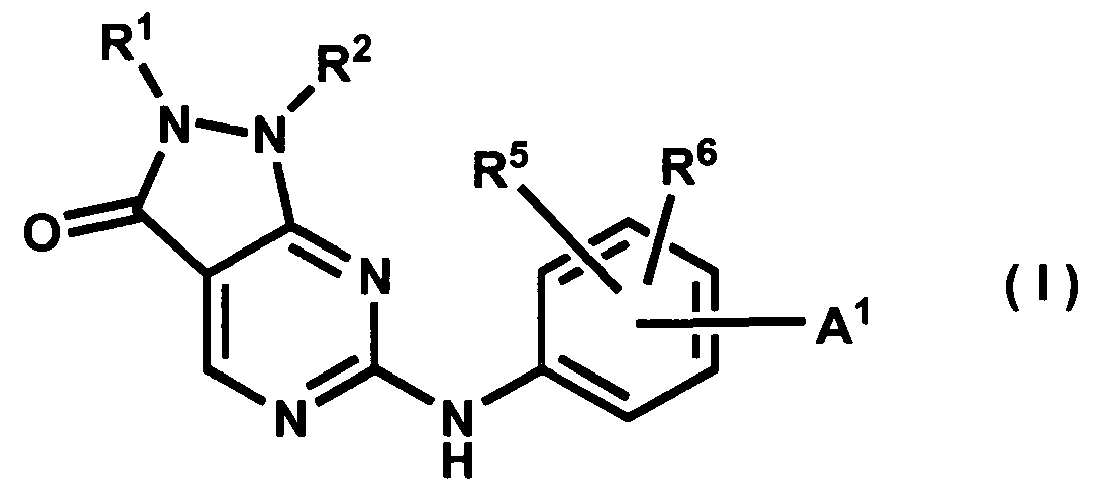
A1 is selected from the following formula (aal):
A3 is a nitrogen atom, or is a methine or 1-vinyl-2-ylidene group optionally substituted by a hydroxyl group, a C1-6alkyl group or a hydroxy-C1-6alkyl group;
Q3 is a single bond or a C1-6alkylene group, wherein one or two or more methylene groups constituting the alkylene group may be independently replaced by an oxygen atom, a sulfur atom, a carbonyl group, a sulfinyl group or a sulfonyl group, and/or substituted by a halogen atom, a cyano group, a hydroxyl group or a C1-6alkyl group;
R1d and R1e are independently a hydrogen atom, a halogen atom, a cyano group, a hydroxyl group, a C1-6alkyl group or a hydroxyl-C1-6alkyl group, or together form a C1-6alkylene group wherein one or two or more methylene groups constituting the alkylene group may be independently replaced by an oxygen atom, a sulfur atom, a sulfinyl group, a sulfonyl group, a carbonyl group, a vinylene group or a group of -N(R1f)-, and/or substituted by a hydroxyl group or a C1-6alkyl group;
R1f is a hydrogen atom, a C1-6alkyl group, a halo-C1-6alkyl group, a C2-6alkenyl group or a C2-7alkanoyl group;
R1 is a C2-6alkenyl group or a C2-6alkynyl group;
R2 is a phenyl, pyridyl or thienyl group, which may have a group of -Q4-A4(R1g)R1h;
A4 is a nitrogen atom, or is a methine group optionally substituted by a halogen atom, a hydroxyl group, a C1-6alkyl group or a hydroxy-C1-6alkyl group;
Q4 is a single bond or a C1-6alkylene group, wherein one or two or more methylene groups constituting the alkylene group may be independently replaced by an oxygen atom or a carbonyl group, and/or substituted by a C1-6alkyl group;
R1g and R1h are independently a hydrogen atom, a halogen atom, a cyano group, a hydroxyl group, a C1-6alkyl group, a C1-6alkoxy-C1-6alkyl group, a C2-7alkanoyl group, a C2-7alkoxycarbonyl group or a C1-6alkylsulfonyl group, or together form a C1-6alkylene group, wherein one or two or more methylene groups constituting the alkylene group may be independently replaced by an oxygen atom, a sulfur atom, a sulfinyl group, a sulfonyl group, a carbonyl group or a group of -N(R1i)-, and/or substituted by a halogen atom or a C1-6alkyl group;
R1i is a hydrogen atom, a C1-6alkyl group or a halo-C1-6alkyl group;
R5 and R6 are independently a hydrogen atom, a C1-6alkyl group or a hydroxy-C1-6alkyl group, or a salt thereof. - The compound as claimed in claim 1, or a salt thereof, wherein R1 is a C2-6alkenyl group.
- The compound as claimed in claim 2, or a salt thereof, wherein R1 is an allyl group.
- The compound as claimed in any previous claim, or a salt thereof, wherein R2 is a phenyl or pyridyl group having a group of -Q4-A4(R1g)R1h.
- The compound as claimed in any previous claim, or a salt thereof, wherein R1c is a hydrogen atom or a group of -Q3-A3(R1d)R1e, and in the group of -Q3-A3(R1d)R1e;(i) A3 is a methine group optionally substituted by a hydroxyl group or a C1-6alkyl group, Q3 is a single bond, and R1d and R1e are independently a hydrogen atom or a C1-6alkyl group; or(ii) A3 is a methine group optionally substituted by a hydroxyl group or a C1-6alkyl group, Q3 is a C1-6alkylene group wherein one or two methylene groups constituting the C1-6alkylene group may be independently replaced by an oxygen atom, a carbonyl group or a sulfonyl group, and/or substituted by a hydroxyl group, and R1d and R1e are independently a hydrogen atom, a halogen atom, a cyano group or a C1-6alkyl group.
- The compound as claimed in claim 1, or a salt thereof, which is as follows:3-(2-allyl-6-{[4-(4-methylpiperazin-1-yl)phenyl]amino}-3-oxo-1,2-dihydro-3H-pyrazolo[3,4-d]pyrimidin-1-yl)-N,N-dimethylbenzamide,2-allyl-1-[3-(1-hydroxy-1-methylethyl)phenyl]-6-{[4-(4-methylpiperazin-1-yl)phenyl]amino}-1,2-dihydro-3H-pyrazolo[3,4-d]pyrimidin-3-one,2-allyl-1-[3-(dimethylaminomethyl)phenyl]-6-{[4-(4-methylpiperazin-1-yl)phenyl]amino}-1,2-dihydro-3H-pyrazolo[3,4-d]pyrimidin-3-one,2-allyl-6-{[3-hydroxymethyl-4-(4-methylpiperazin-1-yl)phenyl]amino}-1-pyridin-2-yl-1,2-dihydro-3H-pyrazolo[3,4-d]pyrimidin-3-one,2-allyl-1-(6-aminopyridin-2-yl)-6-[{4-(4-methylpiperazin-1-yl)phenyl]amino}-1,2-dihydro-3H-pyrazolo[3,4-d]pyrimidin-3-one,2-allyl-1-[6-(1-hydroxy-1-methylethyl)pyridin-2-yl]-6-{[4-(4-methylpiperazin-1-yl)phenyl]amino}-1,2-dihydro-3H-pyrazolo[3,4-d]pyrimidin-3-one,2-allyl-6-{[4-(4-ethylpiperazin-1-yl)phenyl]amino}-1-[6-(1-hydroxy-1-methylethyl)pyridin-2-yl]-1,2-dihydro-3H-pyrazolo[3,4-d]pyrimidin-3-one,6-{[4-(4-acetylpiperazin-1-yl)phenyl]amino}-2-allyl-1-[6-(1-hydroxy-1-methylethyl)pyridin-2-yl]-1,2-dihydro-3H-pyrazolo[3,4-d]pyrimidin-3-one,2-allyl-6-({4-[4-(2-hydroxyethyl)piperazin-1-yl]phenyl}amino)-1-[6-(1-hydroxy-1-methylethyl)pyridin-2-yl]-1,2-dihydro-3H-pyrazolo[3,4-d]pyrimidin-3-one,2-allyl-1-[6-(2-hydroxy-2-methylpropyl)pyridin-2-yl]-6-{[4-(1-methylpiperidin-4-yl)phenyl]ammo}-1,2-dihydro-3H-pyrazolo[3,4-d]pyrimidin-3-one,2-allyl-6-{[4-(4-methylpiperazin-1-yl)phenyl]amino}-1-[6-(2-oxopyrrolidin-1-yl)pyridin-2-yl]-1,2-dihydro-3H-pyrazolo[3,4-d]pyrimidin-3-one,N-{[6-(2-allyl-6-{[4-(4-methylpiperazin-1-yl)phenyl]amino}-3-oxo-1,2-dihydro-3H-pyrazolo[3,4-d]pyrimidin-1-yl)pyridin-2-yl]methyl}-N-methylmethanesulfonamide, or1-[6-(1-hydroxy-1-methylethyl)pyridin-2-yl]-6-{[4-(4-methylpiperazin-1-yl)phenyl]amino}-2-(2-propynyl)-1,2-dihydro-3H-pyrazolo[3,4-d]pyrimidin-3-one.
- The compound as claimed in claim 1, or a salt thereof, which is 3-(2-allyl-6-{[4-(4-methylpiperazin-1-yl)phenyl]amino}-3-oxo-1,2-dihydro-3H-pyrazolo[3,4-d]pyrimidin-1-yl)-N,N-dimethylbenzamide.
- The compound as claimed in claim 1, or a salt thereof, which is 2-allyl-1-[6-(1-hydroxy-1-methylethyl)pyridin-2-yl]-6-{[4-(4-methylpiperazin-1-yl)phenyl]amino}-1,2-dihydro-3H-pyrazolo[3,4-d]pyrimidin-3-one.
- The compound as claimed in claim 1, or a salt thereof, which is 1-[6-(1-hydroxy-1-methylethyl)pyridin-2-yl]-6-{[4-(4-methylpiperazin-1-yl)phenyl]amino}-2-(2-propynyl)-1,2-dihydro-3H-pyrazolo[3,4-d]pyrimidin-3-one.
- A pharmaceutical composition comprising a therapeutically-effective amount of the compound as claimed in any previous claim, or a salt thereof, and pharmaceutically acceptable carrier or diluent.
- The compound of any one of claims 1 to 9, or a salt thereof for use in therapy.
- The compound of any one of claims 1 to 9, or a salt thereof for use in the treatment of cancer.
- The use of the compound of any one of claims 1 to 9, or a salt thereof for the manufacture of a medicament for the treatment of cancer.
- The compound of any one of claims 1 to 9, or a salt thereof for use as a radiation sensitizer.
- A combined preparation for simultaneous, separate, or sequential administration in the treatment of cancer, comprising following two separate preparations (a) and (b):(a) a preparation comprising, together with a pharmaceutically acceptable carrier or diluent, the compound of any one of claims 1 to 9 or a pharmaceutically acceptable salt thereof; and(b) a preparation comprising, together with a pharmaceutically acceptable carrier or diluent, one anticancer agent selected from the group consisting of anticancer alkylating agents, anticancer antimetabolites, anticancer antibiotics, plant-derived anticancer agents, anticancer platinum-coordinatedcomplex compounds, anticancer camptothecin derivatives, anticancer tyrosine kinase inhibitors, monoclonal antibodies, interferons, biological response modifiers, and other anticancer agents or a pharmaceutically acceptable salt thereof, wherein:the anticancer alkylating agents are nitrogen mustard N-oxide, cyclophosphamide, ifosfamide, melphalan, busulfan, mitobronitol, carboquone, thiotepa, ranimustine, nimustine, temozolomide, and carmustine;the anticancer antimetabolites are methotrexate, 6-mercaptopurine riboside, mercaptopurine, 5-fluorouracil, tegafur, doxifluridine, carmofur, cytarabine, cytarabine ocfosfate, enocitabine, S-1, gemcitabine, fludarabine, and pemetrexed disodium;the anticancer antibiotics are actinomycin D, doxorubicin, daunorubicin, neocarzinostatin, bleomycin, peplomycin, mitomycin C, aclarubicin, pirarubicin, epirubicin, zinostatin stimalamer, idarubicin, sirolimus, and valrubicin;the plant-derived anticancer agents are vincristine, vinblastine, vindeshine, etoposide, sobuzoxane, docetaxel, paclitaxel, and vinorelbine;the anticancer platinum-coordinatedcomplex compounds are cisplatin, carboplatin, nedaplatin, and oxaliplatin;the anticancer camptothecin derivatives are irinotecan, topotecan, and camptothecin;the anticancer tyrosine kinase inhibitors are gefitinib, imatinib, and erlotinib;the monoclonal antibodies are cetuximab, bevacizumab, rituximab, bevacizumab, alemtuzumab, and trastuzumab;the interferons are interferon α, interferon α-2a, interferon α-2b, interferon β, interferon γ-1a, and interferon γ-n1,the biological response modifiers are krestin, lentinan, sizofiran, picibanil, or ubenimex, andthe other anticancer agents are mitoxantrone, L-asparaginase, procarbazine, dacarbazine, hydroxycarbamide, pentostatin, tretinoin, alefacept, darbepoetin alfa, anastrozole, exemestane, bicalutamide, leuprorelin, flutamide, fulvestrant, pegaptanib octasodium, denileukin diftitox, aldesleukin, thyrotropin alfa, arsenic trioxide, bortezomib, capecitabine, and goserelin.
- A pharmaceutical composition comprising, together with a pharmaceutically acceptable carrier or diluent, the compound according to any one of Claims 1 to 9, or a pharmaceutically acceptable salt thereof; and an anticancer agent selected from the group consisting of anticancer alkylating agents, anticancer antimetabolites, anticancer antibiotics, plant-derived anticancer agents, anticancer platinum-coordinatedcomplex compounds, anticancer camptothecin derivatives, anticancer tyrosine kinase inhibitors, monoclonal antibodies, biological response modifiers, and other anticancer agents, wherein the definition of each anticancer agent is the same as defined in Claim 15, or a pharmaceutically acceptable salt thereof.
- A sensitizer for an anticancer agent comprising the pharmaceutical composition as claimed in claim 10, wherein the anticancer agent is selected from the group consisting of anticancer alkylating agents, anticancer antimetabolites, anticancer antibiotics, plant-derived anticancer agents, anticancer platinum-coordinatedcomplex compounds, anticancer camptothecin derivatives, anticancer tyrosine kinase inhibitors, monoclonal antibodies, biological response modifiers, and other anticancer agents, wherein the definition of each anticancer agent is the same as defined in Claim 15, or a pharmaceutically acceptable salt thereof.
Priority Applications (2)
| Application Number | Priority Date | Filing Date | Title |
|---|---|---|---|
| SI200730373T SI2016080T1 (en) | 2006-04-27 | 2007-04-25 | Dihydropyrazolopyrimidinone derivatives |
| PL07742843T PL2016080T3 (en) | 2006-04-27 | 2007-04-25 | Dihydropyrazolopyrimidinone derivatives |
Applications Claiming Priority (2)
| Application Number | Priority Date | Filing Date | Title |
|---|---|---|---|
| JP2006124208 | 2006-04-27 | ||
| PCT/JP2007/059408 WO2007126122A1 (en) | 2006-04-27 | 2007-04-25 | Dihydropyrazolopyrimidinone derivatives |
Publications (3)
| Publication Number | Publication Date |
|---|---|
| EP2016080A1 EP2016080A1 (en) | 2009-01-21 |
| EP2016080A4 EP2016080A4 (en) | 2009-05-13 |
| EP2016080B1 true EP2016080B1 (en) | 2010-07-28 |
Family
ID=38655640
Family Applications (2)
| Application Number | Title | Priority Date | Filing Date |
|---|---|---|---|
| EP07742851.4A Active EP2017278B1 (en) | 2006-04-27 | 2007-04-25 | Dihydropyrazolopyrimidinone derivative |
| EP07742843A Active EP2016080B1 (en) | 2006-04-27 | 2007-04-25 | Dihydropyrazolopyrimidinone derivatives |
Family Applications Before (1)
| Application Number | Title | Priority Date | Filing Date |
|---|---|---|---|
| EP07742851.4A Active EP2017278B1 (en) | 2006-04-27 | 2007-04-25 | Dihydropyrazolopyrimidinone derivative |
Country Status (38)
| Country | Link |
|---|---|
| US (4) | US7834019B2 (en) |
| EP (2) | EP2017278B1 (en) |
| JP (2) | JP4513919B2 (en) |
| KR (1) | KR101409161B1 (en) |
| CN (1) | CN101432284B (en) |
| AR (1) | AR060635A1 (en) |
| AT (1) | ATE475662T1 (en) |
| AU (1) | AU2007244185B2 (en) |
| BR (1) | BRPI0710081A2 (en) |
| CA (1) | CA2650119C (en) |
| CR (1) | CR10359A (en) |
| CY (2) | CY1111069T1 (en) |
| DE (1) | DE602007008085D1 (en) |
| DK (2) | DK2016080T3 (en) |
| DO (1) | DOP2007000084A (en) |
| EC (1) | ECSP088812A (en) |
| ES (2) | ES2348751T3 (en) |
| GT (1) | GT200800211A (en) |
| HN (1) | HN2008001532A (en) |
| HR (2) | HRP20100563T1 (en) |
| HU (1) | HUE032987T2 (en) |
| IL (1) | IL194367A (en) |
| LT (1) | LT2017278T (en) |
| MA (1) | MA30428B1 (en) |
| MX (1) | MX2008013063A (en) |
| MY (1) | MY145408A (en) |
| NO (1) | NO341617B1 (en) |
| NZ (1) | NZ571196A (en) |
| PE (1) | PE20080695A1 (en) |
| PL (2) | PL2016080T3 (en) |
| PT (2) | PT2016080E (en) |
| RU (1) | RU2437885C2 (en) |
| SI (2) | SI2016080T1 (en) |
| SV (1) | SV2009003060A (en) |
| TW (1) | TWI409262B (en) |
| UA (1) | UA96152C2 (en) |
| WO (2) | WO2007126128A1 (en) |
| ZA (1) | ZA200807748B (en) |
Families Citing this family (81)
| Publication number | Priority date | Publication date | Assignee | Title |
|---|---|---|---|---|
| PE20080695A1 (en) * | 2006-04-27 | 2008-06-28 | Banyu Pharma Co Ltd | DIHYDROPIRAZOLOPYRIMIDINONE DERIVATIVES AS KINASE WEEL INHIBITORS |
| US8198281B2 (en) * | 2007-04-25 | 2012-06-12 | Merck Sharp & Dohme Corp. | Crystalline forms of dihydropyrazolopyrimidinone |
| WO2008141385A1 (en) * | 2007-05-21 | 2008-11-27 | Biota Scientific Management Pty Ltd | Viral polymerase inhibitors |
| US8329711B2 (en) * | 2007-10-23 | 2012-12-11 | Msd K.K. | Pyridone-substituted-dihydropyrazolopyrimidinone derivative |
| ES2430053T3 (en) * | 2008-06-12 | 2013-11-18 | Merck Sharp & Dohme Corp. | Procedure to produce bicycloaniline derivatives |
| US8575179B2 (en) | 2008-12-12 | 2013-11-05 | Msd K.K. | Dihydropyrazolopyrimidinone derivatives |
| WO2010076887A1 (en) * | 2009-01-05 | 2010-07-08 | Banyu Pharmaceutical Co.,Ltd. | Predictive biomarkers useful for cancer therapy mediated by a wee1 inhibitor |
| US8288396B2 (en) | 2009-02-25 | 2012-10-16 | Msdkk | Pyrimidopyrimidoindazole derivative |
| WO2011027800A1 (en) * | 2009-09-02 | 2011-03-10 | Banyu Pharmaceutical Co.,Ltd. | Use of biomarker(s) to identify a wee1 inhibitor responsive patient and methods of treating cancer mediated by dysfunctional or aberrant p53 via administration of a wee1 inhibitor |
| HRP20140821T1 (en) | 2009-09-15 | 2014-10-10 | Merck Sharp & Dohme Corp. | Preparation of crystalline hemihydrate forms of dihydropyrazolopyrimidinone |
| TW201304778A (en) | 2010-11-16 | 2013-02-01 | Array Biopharma Inc | Combination of checkpoint kinase 1 inhibitors and WEE 1 kinase inhibitors |
| KR102093947B1 (en) * | 2011-04-27 | 2020-03-26 | 제온 코포레이션 | Polymerizable compound, polymerizable composition, polymer, and optically anisotropic material |
| US8796289B2 (en) | 2011-07-19 | 2014-08-05 | Abbvie Inc. | Pyridazino[4,5-D]pyrimidin-5(6H)-one inhibitors of kinases |
| EP2755482B1 (en) | 2011-09-15 | 2016-06-01 | Merck Sharp & Dohme Corp. | Combination of mk-1775 and mk-8776 for treating cancer |
| CA2851640A1 (en) | 2011-10-20 | 2013-04-25 | Abbvie Inc. | Pyridopyrimidinone inhibitors of kinases |
| MX2014010176A (en) * | 2012-02-23 | 2014-11-10 | Abbvie Inc | Pyridopyrimidinone inhibitors of kinases. |
| WO2014062454A1 (en) * | 2012-10-15 | 2014-04-24 | Merck Sharp & Dohme Corp. | Compositions and methods for treating cancer |
| DK2925888T3 (en) | 2012-11-28 | 2017-12-18 | Merck Sharp & Dohme | COMPOSITIONS AND METHODS OF CANCER TREATMENT |
| CA2909160C (en) | 2013-04-09 | 2021-05-25 | Lixte Biotechnology, Inc. | Formulations of oxabicycloheptanes and oxabicycloheptenes |
| GB201306610D0 (en) * | 2013-04-11 | 2013-05-29 | Almac Discovery Ltd | Pharmaceutical compounds |
| GB201322602D0 (en) | 2013-12-19 | 2014-02-05 | Almac Discovery Ltd | Pharmaceutical compounds |
| RU2689557C2 (en) * | 2014-12-17 | 2019-05-28 | Дельта-Флай Фарма, Инк. | Using pharmaceutical composition for treating or creating remission conditions in elderly patient with solid cancer |
| UY36630A (en) | 2015-04-17 | 2016-11-30 | Abbvie Inc | TRICYCLIC MODULATORS OF TNF SIGNALING |
| WO2016168633A1 (en) | 2015-04-17 | 2016-10-20 | Abbvie Inc. | Indazolones as modulators of tnf signaling |
| US9879016B2 (en) | 2015-04-17 | 2018-01-30 | Abbvie Inc. | Indazolones as modulators of TNF signaling |
| ES2799520T3 (en) * | 2015-09-01 | 2020-12-18 | Taiho Pharmaceutical Co Ltd | Pyrazolo [3,4-d] pyrimidine compounds or salts thereof |
| CN105130986B (en) * | 2015-09-30 | 2017-07-18 | 广州科擎新药开发有限公司 | Pyrimidine or pyridopyridine ketone compounds and its application |
| CA3003737C (en) * | 2015-11-01 | 2021-09-14 | The Regents Of The University Of Colorado, A Body Corporate | Wee1 kinase inhibitors and methods of making and using the same |
| GB201612092D0 (en) | 2016-07-12 | 2016-08-24 | Almac Discovery Ltd | Pharmaceutical compounds |
| SI3512833T1 (en) | 2016-09-15 | 2020-11-30 | Boehringer Ingelheim International Gmbh | Heteroaryl carboxamide compounds as inhibitors of ripk2 |
| CN106719769A (en) * | 2016-11-28 | 2017-05-31 | 山东农业大学 | A kind of disease pest containing lentinan, Difenoconazole and thiacloprid is simultaneous to control composition pesticide |
| WO2018107004A1 (en) | 2016-12-08 | 2018-06-14 | Lixte Biotechnology, Inc. | Oxabicycloheptanes for modulation of immune response |
| ES2902050T3 (en) * | 2017-01-23 | 2022-03-24 | Shijiazhuang Sagacity New Drug Dev Co Ltd | 1,2-dihydro-3H-pyrazolo[3,4-D]pyrimidin-3-one derivative as Wee1 inhibitor |
| GB201703881D0 (en) * | 2017-03-10 | 2017-04-26 | Almac Discovery Ltd | Pharmaceutical compounds |
| WO2018171633A1 (en) * | 2017-03-23 | 2018-09-27 | 上海迪诺医药科技有限公司 | Macrocyclic derivative of pyrazol[3,4-d]pyrimidin-3-one, pharmaceutical composition and use thereof |
| US20200108074A1 (en) | 2017-03-31 | 2020-04-09 | Seattle Genetics, Inc. | Combinations of chk1- and wee1- inhibitors |
| MX2020001235A (en) | 2017-08-01 | 2020-07-20 | Recurium Ip Holdings Llc | 1, 2 - dihydro- 3h- pyrazolo [3, 4 - d] pyrimidin -3 - one analogs. |
| WO2019037678A1 (en) * | 2017-08-24 | 2019-02-28 | 上海迪诺医药科技有限公司 | Pyrazolo[3,4-d]pyrimidin-3-one derivative, pharmaceutical composition and use thereof |
| WO2019074981A1 (en) | 2017-10-09 | 2019-04-18 | GiraFpharma LLC | Heterocyclic compounds and uses thereof |
| WO2019074979A1 (en) * | 2017-10-09 | 2019-04-18 | Girafpharma, Llc | Heterocyclic compounds and uses thereof |
| PT3712150T (en) | 2017-11-01 | 2024-08-22 | Wuxi Biocity Biopharmaceutics Co Ltd | Macrocyclic compound serving as wee1 inhibitor and applications thereof |
| WO2019096322A1 (en) * | 2017-11-20 | 2019-05-23 | 上海医药集团股份有限公司 | Pyrazolone-pyrimidine compound, preparation method therefor and application thereof |
| CN111315747B (en) * | 2018-01-05 | 2023-05-02 | 四川科伦博泰生物医药股份有限公司 | Dihydropyrazolopyrimidine compounds and their preparation methods and uses |
| WO2019165204A1 (en) | 2018-02-23 | 2019-08-29 | Newave Pharmaceutical Inc. | 1,2-dihydro-3h-pyrazolo[3,4-d]pyrimidine-3-one compounds as inhibitors of wee-1 kinase |
| CA3088997A1 (en) * | 2018-02-28 | 2019-09-06 | The Regents Of The University Of Colorado, A Body Corporate | Wee1 kinase inhibitors and methods of treating cancer using the same |
| US11261192B2 (en) * | 2018-03-09 | 2022-03-01 | Recurium Ip Holdings, Llc | Substituted 1,2-dihydro-3H-pyrazolo[3,4-D]pyrimidin-3-ones |
| CN108653282B (en) * | 2018-06-28 | 2020-08-14 | 中国科学院昆明植物研究所 | Application of benzothiazoles and benzopyrroles in the preparation of antitumor drugs |
| JP7481336B2 (en) * | 2018-10-26 | 2024-05-10 | ウーシー・バイオシティ・バイオファーマシューティクス・カンパニー・リミテッド | Pyrimidopyrazolone derivatives as Wee1 inhibitors and their use |
| CN113480541B (en) * | 2019-03-07 | 2022-09-02 | 湖南化工研究院有限公司 | Process for producing imidazopyridine compound and intermediate thereof |
| JP2022528047A (en) * | 2019-03-22 | 2022-06-08 | ショウヤオ ホールディングス(ベイジン) カンパニー, リミテッド | Wee1 inhibitor, its manufacture and use |
| WO2020210375A1 (en) | 2019-04-09 | 2020-10-15 | Nuvation Bio Inc. | Heterocyclic compounds and uses thereof |
| US20220220115A1 (en) * | 2019-04-09 | 2022-07-14 | Nuvation Bio Inc. | Heterocyclic compounds and uses thereof |
| WO2020210320A1 (en) * | 2019-04-11 | 2020-10-15 | Recurium Ip Holdings, Llc | Substituted l,2-dihydro-3h-pyrazolo[3,4-d]pyrimidin-3-ones |
| US12291536B2 (en) | 2019-04-30 | 2025-05-06 | Wuxi Biocity Biopharmaceutics Co., Ltd. | Crystal form of Wee1 inhibitor compound and use thereof |
| CN112142748B (en) | 2019-06-28 | 2023-07-04 | 上海医药集团股份有限公司 | Pyrazolopyrimidine compound, and preparation method and application thereof |
| CN112142747B (en) * | 2019-06-28 | 2024-03-01 | 上海医药集团股份有限公司 | A kind of pyrazolone pyrimidine compound, its preparation method and application |
| JP2022554157A (en) | 2019-10-25 | 2022-12-28 | アストラゼネカ・アクチエボラーグ | Methods of treating cancer |
| MX2022007628A (en) * | 2019-12-20 | 2022-08-25 | Recurium Ip Holdings Llc | Combinations. |
| CN113387962A (en) * | 2020-03-12 | 2021-09-14 | 上海迪诺医药科技有限公司 | Pyrazolo [3,4-d ] pyrimidine-3-one derivative, pharmaceutical composition and application thereof |
| US12522607B2 (en) | 2020-06-17 | 2026-01-13 | Wigen Biomedicine Technology (shanghai) Co., Ltd. | Substituted pyrazolo[3,4-d]pyrimidines as wee-1 inhibitors |
| US12551584B1 (en) | 2020-12-07 | 2026-02-17 | Actinium Pharmaceuticals, Inc. | Lewis Y radioimmunotherapy for the treatment of cancer |
| KR102549484B1 (en) * | 2020-12-08 | 2023-06-29 | 한국화학연구원 | Pyrazolopyrimidine sulfonamide derivatives and pharmaceutical composition for prevention or treatment of cancer-related disease containing the same as an active ingredient |
| CN116867787A (en) * | 2021-02-09 | 2023-10-10 | 微境生物医药科技(上海)有限公司 | Pyrazolo[3,4-d]pyrimidin-3-one derivatives |
| WO2022171128A1 (en) * | 2021-02-09 | 2022-08-18 | 微境生物医药科技(上海)有限公司 | Pyrazolo[3,4-d]pyrimidine-3-ketone derivative serving as wee-1 inhibitor |
| WO2022171126A1 (en) * | 2021-02-09 | 2022-08-18 | 微境生物医药科技(上海)有限公司 | Fused ring compound used as wee-1 inhibitor |
| CN115197221B (en) * | 2021-04-02 | 2024-05-24 | 轩竹(北京)医药科技有限公司 | Dihydropyrazolopyrimidinone macrocyclic derivatives and uses thereof |
| IL307863A (en) | 2021-04-29 | 2023-12-01 | Novartis Ag | Deubiquitinase-targeting chimeras and related methods |
| EP4332104A4 (en) | 2021-04-30 | 2025-04-16 | Wigen Biomedicine Technology (Shanghai) Co., Ltd. | Fused ring compound as wee-1 inhibitor, and preparation method therefor and use thereof |
| JP2024520969A (en) | 2021-05-28 | 2024-05-28 | 江蘇天士力帝益薬業有限公司 | Wee1 inhibitors and their uses |
| KR20240044409A (en) * | 2021-06-04 | 2024-04-04 | 아프레아 테라퓨틱스, 인크. | Pyridopyrimidine derivatives useful as WEE1 kinase inhibitors |
| TW202328142A (en) * | 2021-09-18 | 2023-07-16 | 香港商優領醫藥科技(香港)有限公司 | Pyrimidino-dihydropyrazolone-containing derivative, pharmaceutically acceptable salt thereof, preparation method and application of pyrimidino-dihydropyrazolone-containing derivative |
| CN113880844B (en) * | 2021-09-29 | 2023-02-14 | 武汉九州钰民医药科技有限公司 | Chemical synthesis method of Wee1 protein kinase inhibitor avaposertib |
| CN113735863A (en) * | 2021-09-29 | 2021-12-03 | 武汉九州钰民医药科技有限公司 | Preparation process of Wee1 inhibitor avaposertib |
| TW202322812A (en) * | 2021-11-01 | 2023-06-16 | 大陸商正大天晴藥業集團股份有限公司 | Pyrazolo[3,4-d]pyrimidin-3-one compound and medical use thereof |
| CN116462687B (en) | 2022-01-18 | 2025-01-07 | 江苏天士力帝益药业有限公司 | WEE1 inhibitors and their preparation and use |
| CN116836184B (en) * | 2022-03-25 | 2025-07-25 | 药雅科技(上海)有限公司 | Preparation and application of Wee1 kinase inhibitor |
| CN117402162A (en) | 2022-07-13 | 2024-01-16 | 江苏天士力帝益药业有限公司 | WEE1 inhibitors and their preparation and use |
| CN115073460B (en) * | 2022-07-13 | 2023-07-25 | 苏州施安鼎泰生物医药技术有限公司 | Pyrimido [5,4-c ] [2,6] naphthyridine derivative, preparation method thereof, pharmaceutical composition and application |
| CN119497714A (en) * | 2022-07-15 | 2025-02-21 | 映恩生物制药(苏州)有限公司 | A pyrimido five-membered heterocyclic compound, preparation method and use thereof |
| CN119798282A (en) * | 2023-10-11 | 2025-04-11 | 智擎生技制药股份有限公司 | Myt1 inhibitors based on fused pyridine rings |
| WO2025101691A1 (en) | 2023-11-08 | 2025-05-15 | Exelixis, Inc. | Methods for treating cancer using compounds that inhibit pkmyt1 |
Family Cites Families (28)
| Publication number | Priority date | Publication date | Assignee | Title |
|---|---|---|---|---|
| OA07174A (en) | 1981-08-24 | 1984-04-30 | May & Baker Ltd | New imidazotetrazionones, their preparation and medicines containing them. |
| JPS6019790A (en) | 1983-07-14 | 1985-01-31 | Yakult Honsha Co Ltd | Novel camptothecin derivative |
| IL85035A0 (en) | 1987-01-08 | 1988-06-30 | Int Genetic Eng | Polynucleotide molecule,a chimeric antibody with specificity for human b cell surface antigen,a process for the preparation and methods utilizing the same |
| JP2628707B2 (en) * | 1987-08-26 | 1997-07-09 | 三井製薬工業株式会社 | Pyrimidines and their pharmaceutically acceptable salts |
| US5223608A (en) | 1987-08-28 | 1993-06-29 | Eli Lilly And Company | Process for and intermediates of 2',2'-difluoronucleosides |
| JP2848958B2 (en) | 1990-09-28 | 1999-01-20 | スミスクライン・ビーチャム・コーポレイション | Water soluble camptothecin analogs, methods and means |
| US5162532A (en) | 1990-12-20 | 1992-11-10 | North Carolina State University | Intermediates and method of making camptothecin and camptothecin analogs |
| US5247089A (en) | 1990-12-20 | 1993-09-21 | North Carolina State University | Method of making intermediates useful for the manufacture of camptothecin and camptothecin analogs |
| US5243050A (en) | 1990-12-20 | 1993-09-07 | North Carolina State University | Alkylpyridone DE ring intermediates useful for the manufacture of camptothecin and camptothecin analogs |
| US5200524A (en) | 1990-12-20 | 1993-04-06 | North Carolina State University | Camptothecin intermediates and method of making same |
| US5191082A (en) | 1990-12-20 | 1993-03-02 | North Carolina State University | Camptothecin intermediate and method of making camptothecin intermediates |
| DK1975181T3 (en) | 1992-10-28 | 2011-06-06 | Genentech Inc | Use of vascular endothelial cell growth factor antagonists |
| JP3025602B2 (en) | 1993-05-21 | 2000-03-27 | デビオファーム エス.アー. | Method for producing optically high purity cis-oxalate (trans-l-l, 2-cyclohexanediamine) platinum (II) complex |
| GB9508538D0 (en) | 1995-04-27 | 1995-06-14 | Zeneca Ltd | Quinazoline derivatives |
| JPH11507535A (en) | 1995-06-07 | 1999-07-06 | イムクローン システムズ インコーポレイテッド | Antibodies and antibody fragments that suppress tumor growth |
| JP3154399B2 (en) | 1996-07-04 | 2001-04-09 | デビオファーム エス.アー. | Method for producing platinum compound |
| CZ27399A3 (en) | 1999-01-26 | 2000-08-16 | Ústav Experimentální Botaniky Av Čr | Substituted nitrogen heterocyclic derivatives process of their preparation, the derivatives employed as medicaments, pharmaceutical composition and a compound pharmaceutical preparation in which these derivatives are comprised as well as use of these derivatives for preparing medicaments |
| SE0103649D0 (en) | 2001-11-01 | 2001-11-01 | Astrazeneca Ab | Therapeutic quinoline compounds |
| CA2483496A1 (en) | 2002-04-26 | 2003-11-06 | Warner-Lambert Company Llc | Inhibitors of checkpoint kinases (wee1 and chk1) |
| UA80767C2 (en) | 2002-12-20 | 2007-10-25 | Pfizer Prod Inc | Pyrimidine derivatives for the treatment of abnormal cell growth |
| MXPA05007503A (en) * | 2003-01-17 | 2005-09-21 | Warner Lambert Co | 2-aminopyridine substituted heterocycles as inhibitors of cellular proliferation. |
| AU2004212421B2 (en) * | 2003-02-07 | 2009-08-20 | Vertex Pharmaceuticals Incorporated | Heteroaryl substituted pyrolls useful as inhibitors of protein kinases |
| US7320992B2 (en) | 2003-08-25 | 2008-01-22 | Amgen Inc. | Substituted 2,3-dihydro-1h-isoindol-1-one derivatives and methods of use |
| US20050250836A1 (en) * | 2004-05-03 | 2005-11-10 | Pfizer Inc | Inhibitors of checkpoint kinases (Wee1 and Chk1) |
| EP2433943B1 (en) | 2004-07-01 | 2013-09-11 | Daiichi Sankyo Company, Limited | Intermediates for thienopyrazole derivatives having PDE7 inhibitory activity |
| EP1846408B1 (en) * | 2005-01-14 | 2013-03-20 | Janssen Pharmaceutica NV | 5-membered annelated heterocyclic pyrimidines as kinase inhibitors |
| WO2006091737A1 (en) | 2005-02-24 | 2006-08-31 | Kemia, Inc. | Modulators of gsk-3 activity |
| PE20080695A1 (en) * | 2006-04-27 | 2008-06-28 | Banyu Pharma Co Ltd | DIHYDROPIRAZOLOPYRIMIDINONE DERIVATIVES AS KINASE WEEL INHIBITORS |
-
2007
- 2007-04-24 PE PE2007000511A patent/PE20080695A1/en active IP Right Grant
- 2007-04-24 AR ARP070101763A patent/AR060635A1/en active IP Right Grant
- 2007-04-25 WO PCT/JP2007/059416 patent/WO2007126128A1/en not_active Ceased
- 2007-04-25 WO PCT/JP2007/059408 patent/WO2007126122A1/en not_active Ceased
- 2007-04-25 SI SI200730373T patent/SI2016080T1/en unknown
- 2007-04-25 DE DE602007008085T patent/DE602007008085D1/en active Active
- 2007-04-25 CN CN2007800150647A patent/CN101432284B/en not_active Expired - Fee Related
- 2007-04-25 HR HR20100563T patent/HRP20100563T1/en unknown
- 2007-04-25 US US11/789,548 patent/US7834019B2/en active Active
- 2007-04-25 KR KR1020087026239A patent/KR101409161B1/en not_active Expired - Fee Related
- 2007-04-25 AU AU2007244185A patent/AU2007244185B2/en not_active Ceased
- 2007-04-25 US US12/226,707 patent/US7935708B2/en active Active
- 2007-04-25 PL PL07742843T patent/PL2016080T3/en unknown
- 2007-04-25 MX MX2008013063A patent/MX2008013063A/en active IP Right Grant
- 2007-04-25 UA UAA200813667A patent/UA96152C2/en unknown
- 2007-04-25 EP EP07742851.4A patent/EP2017278B1/en active Active
- 2007-04-25 DK DK07742843.1T patent/DK2016080T3/en active
- 2007-04-25 HU HUE07742851A patent/HUE032987T2/en unknown
- 2007-04-25 EP EP07742843A patent/EP2016080B1/en active Active
- 2007-04-25 NZ NZ571196A patent/NZ571196A/en not_active IP Right Cessation
- 2007-04-25 BR BRPI0710081-7A patent/BRPI0710081A2/en not_active Application Discontinuation
- 2007-04-25 HR HRP20161763TT patent/HRP20161763T1/en unknown
- 2007-04-25 LT LTEP07742851.4T patent/LT2017278T/en unknown
- 2007-04-25 RU RU2008146759/04A patent/RU2437885C2/en active
- 2007-04-25 JP JP2008513330A patent/JP4513919B2/en not_active Expired - Fee Related
- 2007-04-25 PL PL07742851T patent/PL2017278T3/en unknown
- 2007-04-25 DK DK07742851.4T patent/DK2017278T3/en active
- 2007-04-25 CA CA2650119A patent/CA2650119C/en active Active
- 2007-04-25 PT PT07742843T patent/PT2016080E/en unknown
- 2007-04-25 ES ES07742843T patent/ES2348751T3/en active Active
- 2007-04-25 SI SI200731875A patent/SI2017278T1/en unknown
- 2007-04-25 PT PT77428514T patent/PT2017278T/en unknown
- 2007-04-25 ES ES07742851.4T patent/ES2609087T3/en active Active
- 2007-04-25 AT AT07742843T patent/ATE475662T1/en active
- 2007-04-27 DO DO2007000084A patent/DOP2007000084A/en unknown
- 2007-04-27 TW TW096114902A patent/TWI409262B/en not_active IP Right Cessation
-
2008
- 2008-09-09 ZA ZA200807748A patent/ZA200807748B/en unknown
- 2008-09-18 MY MYPI20083651A patent/MY145408A/en unknown
- 2008-09-25 IL IL194367A patent/IL194367A/en active IP Right Grant
- 2008-10-09 EC EC2008008812A patent/ECSP088812A/en unknown
- 2008-10-10 CR CR10359A patent/CR10359A/en unknown
- 2008-10-10 SV SV2008003060A patent/SV2009003060A/en unknown
- 2008-10-10 HN HN2008001532A patent/HN2008001532A/en unknown
- 2008-10-10 GT GT200800211A patent/GT200800211A/en unknown
- 2008-11-24 MA MA31411A patent/MA30428B1/en unknown
- 2008-11-26 NO NO20084968A patent/NO341617B1/en unknown
-
2010
- 2010-02-08 JP JP2010025458A patent/JP5167291B2/en not_active Expired - Fee Related
- 2010-10-27 CY CY20101100973T patent/CY1111069T1/en unknown
-
2011
- 2011-03-22 US US13/053,798 patent/US8791125B2/en active Active
-
2014
- 2014-06-24 US US14/312,982 patent/US20140303178A1/en not_active Abandoned
-
2017
- 2017-01-27 CY CY20171100129T patent/CY1118526T1/en unknown
Also Published As
Similar Documents
| Publication | Publication Date | Title |
|---|---|---|
| RU2437885C2 (en) | Dihydropyrazolopyrimidinone derivatives | |
| EP2213673B1 (en) | Pyridone-substituted-dihydropyrazolopyrimidinone derivative | |
| EP2168966B1 (en) | Bicycloaniline derivative | |
| EP2303885B1 (en) | Process for producing bicycloaniline derivatives | |
| EP2376493B1 (en) | Dihydropyrimidopyrimidine derivative | |
| WO2010067888A1 (en) | Dihydropyrimidopyrimidine derivatives | |
| US8288396B2 (en) | Pyrimidopyrimidoindazole derivative |
Legal Events
| Date | Code | Title | Description |
|---|---|---|---|
| PUAI | Public reference made under article 153(3) epc to a published international application that has entered the european phase |
Free format text: ORIGINAL CODE: 0009012 |
|
| 17P | Request for examination filed |
Effective date: 20081127 |
|
| AK | Designated contracting states |
Kind code of ref document: A1 Designated state(s): AT BE BG CH CY CZ DE DK EE ES FI FR GB GR HU IE IS IT LI LT LU LV MC MT NL PL PT RO SE SI SK TR |
|
| AX | Request for extension of the european patent |
Extension state: AL BA HR MK RS |
|
| A4 | Supplementary search report drawn up and despatched |
Effective date: 20090414 |
|
| 17Q | First examination report despatched |
Effective date: 20090610 |
|
| GRAP | Despatch of communication of intention to grant a patent |
Free format text: ORIGINAL CODE: EPIDOSNIGR1 |
|
| RAX | Requested extension states of the european patent have changed |
Extension state: HR Payment date: 20081127 |
|
| GRAS | Grant fee paid |
Free format text: ORIGINAL CODE: EPIDOSNIGR3 |
|
| GRAA | (expected) grant |
Free format text: ORIGINAL CODE: 0009210 |
|
| AK | Designated contracting states |
Kind code of ref document: B1 Designated state(s): AT BE BG CH CY CZ DE DK EE ES FI FR GB GR HU IE IS IT LI LT LU LV MC MT NL PL PT RO SE SI SK TR |
|
| AX | Request for extension of the european patent |
Extension state: HR |
|
| REG | Reference to a national code |
Ref country code: GB Ref legal event code: FG4D |
|
| REG | Reference to a national code |
Ref country code: CH Ref legal event code: EP |
|
| REG | Reference to a national code |
Ref country code: IE Ref legal event code: FG4D |
|
| REF | Corresponds to: |
Ref document number: 602007008085 Country of ref document: DE Date of ref document: 20100909 Kind code of ref document: P |
|
| REG | Reference to a national code |
Ref country code: HR Ref legal event code: TUEP Ref document number: P20100563 Country of ref document: HR |
|
| REG | Reference to a national code |
Ref country code: RO Ref legal event code: EPE |
|
| REG | Reference to a national code |
Ref country code: NL Ref legal event code: T3 |
|
| REG | Reference to a national code |
Ref country code: SE Ref legal event code: TRGR |
|
| REG | Reference to a national code |
Ref country code: GR Ref legal event code: EP Ref document number: 20100402490 Country of ref document: GR |
|
| REG | Reference to a national code |
Ref country code: DK Ref legal event code: T3 |
|
| REG | Reference to a national code |
Ref country code: ES Ref legal event code: FG2A Effective date: 20101129 |
|
| REG | Reference to a national code |
Ref country code: HR Ref legal event code: T1PR Ref document number: P20100563 Country of ref document: HR |
|
| REG | Reference to a national code |
Ref country code: EE Ref legal event code: FG4A Ref document number: E004724 Country of ref document: EE Effective date: 20101027 |
|
| REG | Reference to a national code |
Ref country code: SK Ref legal event code: T3 Ref document number: E 8405 Country of ref document: SK |
|
| RAP2 | Party data changed (patent owner data changed or rights of a patent transferred) |
Owner name: MSD K.K. |
|
| REG | Reference to a national code |
Ref country code: HU Ref legal event code: AG4A Ref document number: E009180 Country of ref document: HU |
|
| REG | Reference to a national code |
Ref country code: CH Ref legal event code: PUE Owner name: MSD K.K. Free format text: BANYU PHARMACEUTICAL CO., LTD.#KITANOMARU SQUARE 1-13-12, KUDANKITA CHIYODA-KU#TOKYO 102-8667 (JP) -TRANSFER TO- MSD K.K.#KITANOMARU SQUARE 1-3-12 KUDANKITA CHIYODA KU,#TOKYO 102-8667 (JP) Ref country code: CH Ref legal event code: NV Representative=s name: SERVOPATENT GMBH Ref country code: PL Ref legal event code: T3 |
|
| REG | Reference to a national code |
Ref country code: HR Ref legal event code: PPPP Ref document number: P20100563 Country of ref document: HR Owner name: MSD K.K., JP |
|
| PLBE | No opposition filed within time limit |
Free format text: ORIGINAL CODE: 0009261 |
|
| STAA | Information on the status of an ep patent application or granted ep patent |
Free format text: STATUS: NO OPPOSITION FILED WITHIN TIME LIMIT |
|
| REG | Reference to a national code |
Ref country code: EE Ref legal event code: GB1A Ref document number: E004724 Country of ref document: EE |
|
| 26N | No opposition filed |
Effective date: 20110429 |
|
| REG | Reference to a national code |
Ref country code: GB Ref legal event code: 732E Free format text: REGISTERED BETWEEN 20110609 AND 20110615 Ref country code: SK Ref legal event code: PC4A Ref document number: E 8405 Country of ref document: SK Owner name: MSD K.K., CHIYODA-KU TOKYO, JP Free format text: FORMER OWNER: BANYU PHARMACEUTICAL CO., LTD., TOKYO, JP Effective date: 20110210 |
|
| REG | Reference to a national code |
Ref country code: NL Ref legal event code: SD Effective date: 20110708 |
|
| REG | Reference to a national code |
Ref country code: SI Ref legal event code: SP73 Owner name: MSD K.K.; JP Effective date: 20110609 |
|
| REG | Reference to a national code |
Ref country code: FR Ref legal event code: TP |
|
| REG | Reference to a national code |
Ref country code: DE Ref legal event code: R097 Ref document number: 602007008085 Country of ref document: DE Effective date: 20110429 |
|
| REG | Reference to a national code |
Ref country code: HU Ref legal event code: GB9C Owner name: MSD K.K., JP Free format text: FORMER OWNER(S): BANYU PHARMACEUTICAL CO., LTD., JP Ref country code: HU Ref legal event code: FH1C Free format text: FORMER REPRESENTATIVE(S): DR. TOEROEK FERENC, DANUBIA SZABADALMI ES JOGI IRODA KFT., HU Representative=s name: DANUBIA SZABADALMI ES JOGI IRODA KFT., HU |
|
| REG | Reference to a national code |
Ref country code: DE Ref legal event code: R081 Ref document number: 602007008085 Country of ref document: DE Owner name: MSD K.K., JP Free format text: FORMER OWNER: BANYU PHARMACEUTICAL CO., LTD., TOKIO/TOKYO, JP Effective date: 20110913 Ref country code: DE Ref legal event code: R082 Ref document number: 602007008085 Country of ref document: DE Representative=s name: ABITZ & PARTNER, DE Effective date: 20110913 Ref country code: DE Ref legal event code: R082 Ref document number: 602007008085 Country of ref document: DE Representative=s name: ABITZ & PARTNER PATENTANWAELTE MBB, DE Effective date: 20110913 |
|
| PG25 | Lapsed in a contracting state [announced via postgrant information from national office to epo] |
Ref country code: MC Free format text: LAPSE BECAUSE OF NON-PAYMENT OF DUE FEES Effective date: 20110430 |
|
| REG | Reference to a national code |
Ref country code: FR Ref legal event code: PLFP Year of fee payment: 10 |
|
| REG | Reference to a national code |
Ref country code: FR Ref legal event code: PLFP Year of fee payment: 11 |
|
| REG | Reference to a national code |
Ref country code: FR Ref legal event code: PLFP Year of fee payment: 12 |
|
| REG | Reference to a national code |
Ref country code: HR Ref legal event code: ODRP Ref document number: P20100563 Country of ref document: HR Payment date: 20190402 Year of fee payment: 13 |
|
| REG | Reference to a national code |
Ref country code: HR Ref legal event code: ODRP Ref document number: P20100563 Country of ref document: HR Payment date: 20200326 Year of fee payment: 14 |
|
| REG | Reference to a national code |
Ref country code: CH Ref legal event code: PCAR Free format text: NEW ADDRESS: WANNERSTRASSE 9/1, 8045 ZUERICH (CH) |
|
| REG | Reference to a national code |
Ref country code: HR Ref legal event code: ODRP Ref document number: P20100563 Country of ref document: HR Payment date: 20210414 Year of fee payment: 15 |
|
| REG | Reference to a national code |
Ref country code: HR Ref legal event code: ODRP Ref document number: P20100563 Country of ref document: HR Payment date: 20220413 Year of fee payment: 16 |
|
| REG | Reference to a national code |
Ref country code: HR Ref legal event code: ODRP Ref document number: P20100563 Country of ref document: HR Payment date: 20230331 Year of fee payment: 17 |
|
| P01 | Opt-out of the competence of the unified patent court (upc) registered |
Effective date: 20230519 |
|
| PGFP | Annual fee paid to national office [announced via postgrant information from national office to epo] |
Ref country code: GR Payment date: 20240326 Year of fee payment: 18 |
|
| PGFP | Annual fee paid to national office [announced via postgrant information from national office to epo] |
Ref country code: IS Payment date: 20240319 Year of fee payment: 18 |
|
| PGFP | Annual fee paid to national office [announced via postgrant information from national office to epo] |
Ref country code: LU Payment date: 20240319 Year of fee payment: 18 Ref country code: NL Payment date: 20240319 Year of fee payment: 18 Ref country code: IE Payment date: 20240326 Year of fee payment: 18 |
|
| REG | Reference to a national code |
Ref country code: HR Ref legal event code: ODRP Ref document number: P20100563 Country of ref document: HR Payment date: 20240320 Year of fee payment: 18 |
|
| PGFP | Annual fee paid to national office [announced via postgrant information from national office to epo] |
Ref country code: FI Payment date: 20240327 Year of fee payment: 18 Ref country code: EE Payment date: 20240318 Year of fee payment: 18 Ref country code: CZ Payment date: 20240320 Year of fee payment: 18 Ref country code: BG Payment date: 20240321 Year of fee payment: 18 Ref country code: PT Payment date: 20240326 Year of fee payment: 18 Ref country code: SK Payment date: 20240315 Year of fee payment: 18 |
|
| PGFP | Annual fee paid to national office [announced via postgrant information from national office to epo] |
Ref country code: TR Payment date: 20240318 Year of fee payment: 18 Ref country code: PL Payment date: 20240319 Year of fee payment: 18 Ref country code: MT Payment date: 20240327 Year of fee payment: 18 Ref country code: LV Payment date: 20240318 Year of fee payment: 18 Ref country code: DK Payment date: 20240327 Year of fee payment: 18 Ref country code: BE Payment date: 20240319 Year of fee payment: 18 |
|
| PGFP | Annual fee paid to national office [announced via postgrant information from national office to epo] |
Ref country code: LT Payment date: 20240403 Year of fee payment: 18 |
|
| PGFP | Annual fee paid to national office [announced via postgrant information from national office to epo] |
Ref country code: CH Payment date: 20240501 Year of fee payment: 18 |
|
| PGFP | Annual fee paid to national office [announced via postgrant information from national office to epo] |
Ref country code: ES Payment date: 20240510 Year of fee payment: 18 |
|
| PGFP | Annual fee paid to national office [announced via postgrant information from national office to epo] |
Ref country code: AT Payment date: 20240326 Year of fee payment: 18 |
|
| PGFP | Annual fee paid to national office [announced via postgrant information from national office to epo] |
Ref country code: RO Payment date: 20240408 Year of fee payment: 18 Ref country code: IT Payment date: 20240411 Year of fee payment: 18 Ref country code: CY Payment date: 20240321 Year of fee payment: 18 Ref country code: SI Payment date: 20240319 Year of fee payment: 18 |
|
| PGFP | Annual fee paid to national office [announced via postgrant information from national office to epo] |
Ref country code: SE Payment date: 20240408 Year of fee payment: 18 Ref country code: HU Payment date: 20240327 Year of fee payment: 18 |
|
| PGFP | Annual fee paid to national office [announced via postgrant information from national office to epo] |
Ref country code: DE Payment date: 20250317 Year of fee payment: 19 |
|
| REG | Reference to a national code |
Ref country code: HR Ref legal event code: PBON Ref document number: P20100563 Country of ref document: HR Effective date: 20250425 |
|
| REG | Reference to a national code |
Ref country code: DK Ref legal event code: EBP Effective date: 20250430 |
|
| REG | Reference to a national code |
Ref country code: CH Ref legal event code: H13 Free format text: ST27 STATUS EVENT CODE: U-0-0-H10-H13 (AS PROVIDED BY THE NATIONAL OFFICE) Effective date: 20251125 Ref country code: LT Ref legal event code: MM4D Effective date: 20250425 |
|
| REG | Reference to a national code |
Ref country code: SE Ref legal event code: EUG |
|
| REG | Reference to a national code |
Ref country code: NL Ref legal event code: MM Effective date: 20250501 |
|
| PG25 | Lapsed in a contracting state [announced via postgrant information from national office to epo] |
Ref country code: PT Free format text: LAPSE BECAUSE OF NON-PAYMENT OF DUE FEES Effective date: 20251027 |
|
| REG | Reference to a national code |
Ref country code: SK Ref legal event code: MM4A Ref document number: E 8405 Country of ref document: SK Effective date: 20250425 |
|
| PG25 | Lapsed in a contracting state [announced via postgrant information from national office to epo] |
Ref country code: HU Free format text: LAPSE BECAUSE OF NON-PAYMENT OF DUE FEES Effective date: 20250426 |
|
| PG25 | Lapsed in a contracting state [announced via postgrant information from national office to epo] |
Ref country code: LU Free format text: LAPSE BECAUSE OF NON-PAYMENT OF DUE FEES Effective date: 20250425 |
|
| REG | Reference to a national code |
Ref country code: AT Ref legal event code: MM01 Ref document number: 475662 Country of ref document: AT Kind code of ref document: T Effective date: 20250425 |
|
| REG | Reference to a national code |
Ref country code: BE Ref legal event code: MM Effective date: 20250430 |
|
| PG25 | Lapsed in a contracting state [announced via postgrant information from national office to epo] |
Ref country code: LT Free format text: LAPSE BECAUSE OF NON-PAYMENT OF DUE FEES Effective date: 20250425 |
|
| PG25 | Lapsed in a contracting state [announced via postgrant information from national office to epo] |
Ref country code: AT Free format text: LAPSE BECAUSE OF NON-PAYMENT OF DUE FEES Effective date: 20250425 |
|
| PG25 | Lapsed in a contracting state [announced via postgrant information from national office to epo] |
Ref country code: FI Free format text: LAPSE BECAUSE OF NON-PAYMENT OF DUE FEES Effective date: 20250425 |
|
| PG25 | Lapsed in a contracting state [announced via postgrant information from national office to epo] |
Ref country code: NL Free format text: LAPSE BECAUSE OF NON-PAYMENT OF DUE FEES Effective date: 20250501 |
|
| PG25 | Lapsed in a contracting state [announced via postgrant information from national office to epo] |
Ref country code: BE Free format text: LAPSE BECAUSE OF NON-PAYMENT OF DUE FEES Effective date: 20250430 Ref country code: GR Free format text: LAPSE BECAUSE OF NON-PAYMENT OF DUE FEES Effective date: 20251110 |
|
| PG25 | Lapsed in a contracting state [announced via postgrant information from national office to epo] |
Ref country code: CH Free format text: LAPSE BECAUSE OF NON-PAYMENT OF DUE FEES Effective date: 20250430 |
|
| PG25 | Lapsed in a contracting state [announced via postgrant information from national office to epo] |
Ref country code: CY Free format text: LAPSE BECAUSE OF NON-PAYMENT OF DUE FEES Effective date: 20250425 Ref country code: SE Free format text: LAPSE BECAUSE OF NON-PAYMENT OF DUE FEES Effective date: 20250426 Ref country code: CZ Free format text: LAPSE BECAUSE OF NON-PAYMENT OF DUE FEES Effective date: 20250425 |
|
| PG25 | Lapsed in a contracting state [announced via postgrant information from national office to epo] |
Ref country code: LV Free format text: LAPSE BECAUSE OF NON-PAYMENT OF DUE FEES Effective date: 20250425 |
|
| PG25 | Lapsed in a contracting state [announced via postgrant information from national office to epo] |
Ref country code: BG Free format text: LAPSE BECAUSE OF NON-PAYMENT OF DUE FEES Effective date: 20250425 |
|
| PG25 | Lapsed in a contracting state [announced via postgrant information from national office to epo] |
Ref country code: EE Free format text: LAPSE BECAUSE OF NON-PAYMENT OF DUE FEES Effective date: 20250430 |
|
| PG25 | Lapsed in a contracting state [announced via postgrant information from national office to epo] |
Ref country code: SK Free format text: LAPSE BECAUSE OF NON-PAYMENT OF DUE FEES Effective date: 20250425 Ref country code: RO Free format text: LAPSE BECAUSE OF NON-PAYMENT OF DUE FEES Effective date: 20250425 |
|
| PGFP | Annual fee paid to national office [announced via postgrant information from national office to epo] |
Ref country code: GB Payment date: 20260320 Year of fee payment: 20 |
|
| PG25 | Lapsed in a contracting state [announced via postgrant information from national office to epo] |
Ref country code: DK Free format text: LAPSE BECAUSE OF NON-PAYMENT OF DUE FEES Effective date: 20250430 Ref country code: IE Free format text: LAPSE BECAUSE OF NON-PAYMENT OF DUE FEES Effective date: 20250425 |
|
| PG25 | Lapsed in a contracting state [announced via postgrant information from national office to epo] |
Ref country code: IT Free format text: LAPSE BECAUSE OF NON-PAYMENT OF DUE FEES Effective date: 20250425 |
|
| PGFP | Annual fee paid to national office [announced via postgrant information from national office to epo] |
Ref country code: FR Payment date: 20260317 Year of fee payment: 20 |