EP2015542B1 - Peer-to-peer streaming of media content - Google Patents
Peer-to-peer streaming of media content Download PDFInfo
- Publication number
- EP2015542B1 EP2015542B1 EP08158835A EP08158835A EP2015542B1 EP 2015542 B1 EP2015542 B1 EP 2015542B1 EP 08158835 A EP08158835 A EP 08158835A EP 08158835 A EP08158835 A EP 08158835A EP 2015542 B1 EP2015542 B1 EP 2015542B1
- Authority
- EP
- European Patent Office
- Prior art keywords
- sub
- stream
- streams
- peer
- peers
- Prior art date
- Legal status (The legal status is an assumption and is not a legal conclusion. Google has not performed a legal analysis and makes no representation as to the accuracy of the status listed.)
- Not-in-force
Links
- 238000000034 method Methods 0.000 claims description 14
- 238000011144 upstream manufacturing Methods 0.000 description 2
- 102100024170 Cyclin-C Human genes 0.000 description 1
- 101000980770 Homo sapiens Cyclin-C Proteins 0.000 description 1
- 230000001419 dependent effect Effects 0.000 description 1
- 230000000694 effects Effects 0.000 description 1
- 230000006870 function Effects 0.000 description 1
- 239000000463 material Substances 0.000 description 1
- 230000006855 networking Effects 0.000 description 1
- 238000005457 optimization Methods 0.000 description 1
- 239000007787 solid Substances 0.000 description 1
- 230000001052 transient effect Effects 0.000 description 1
Images


Classifications
-
- H—ELECTRICITY
- H04—ELECTRIC COMMUNICATION TECHNIQUE
- H04L—TRANSMISSION OF DIGITAL INFORMATION, e.g. TELEGRAPHIC COMMUNICATION
- H04L67/00—Network arrangements or protocols for supporting network services or applications
- H04L67/01—Protocols
- H04L67/10—Protocols in which an application is distributed across nodes in the network
- H04L67/104—Peer-to-peer [P2P] networks
-
- H—ELECTRICITY
- H04—ELECTRIC COMMUNICATION TECHNIQUE
- H04L—TRANSMISSION OF DIGITAL INFORMATION, e.g. TELEGRAPHIC COMMUNICATION
- H04L65/00—Network arrangements, protocols or services for supporting real-time applications in data packet communication
- H04L65/80—Responding to QoS
-
- H—ELECTRICITY
- H04—ELECTRIC COMMUNICATION TECHNIQUE
- H04L—TRANSMISSION OF DIGITAL INFORMATION, e.g. TELEGRAPHIC COMMUNICATION
- H04L67/00—Network arrangements or protocols for supporting network services or applications
- H04L67/01—Protocols
- H04L67/10—Protocols in which an application is distributed across nodes in the network
- H04L67/104—Peer-to-peer [P2P] networks
- H04L67/1074—Peer-to-peer [P2P] networks for supporting data block transmission mechanisms
- H04L67/1078—Resource delivery mechanisms
- H04L67/1085—Resource delivery mechanisms involving dynamic management of active down- or uploading connections
-
- H—ELECTRICITY
- H04—ELECTRIC COMMUNICATION TECHNIQUE
- H04L—TRANSMISSION OF DIGITAL INFORMATION, e.g. TELEGRAPHIC COMMUNICATION
- H04L67/00—Network arrangements or protocols for supporting network services or applications
- H04L67/01—Protocols
- H04L67/10—Protocols in which an application is distributed across nodes in the network
- H04L67/104—Peer-to-peer [P2P] networks
- H04L67/1087—Peer-to-peer [P2P] networks using cross-functional networking aspects
- H04L67/1091—Interfacing with client-server systems or between P2P systems
-
- H—ELECTRICITY
- H04—ELECTRIC COMMUNICATION TECHNIQUE
- H04L—TRANSMISSION OF DIGITAL INFORMATION, e.g. TELEGRAPHIC COMMUNICATION
- H04L65/00—Network arrangements, protocols or services for supporting real-time applications in data packet communication
- H04L65/60—Network streaming of media packets
- H04L65/61—Network streaming of media packets for supporting one-way streaming services, e.g. Internet radio
- H04L65/612—Network streaming of media packets for supporting one-way streaming services, e.g. Internet radio for unicast
Definitions
- the present invention pertains to a method and system adapted to peer-to-peer streaming of media content in a network for distribution of data.
- the media may here represent any kind of digital content, such as music, video, digital films or images.
- Nodes (peers) in a peer-to-peer network may over time experience drastic changes in bandwidth availability, or even disappear completely. Moreover, the nodes may have asymmetric network connections, usually meaning that they have substantially higher downstream bandwidth than upstream bandwidth.
- Magharei Nazanin et al. discloses the impact of overlay properties on the global pattern of content delivery and delivered quality to individual peers.
- US 2004/0143672 discloses a system and method for distributing streaming content data from a server to multiple clients which enables the server to handle transient surges of requests by having the clients cooperate with the server and other clients to distribute content, thereby alleviating the load on the server.
- the server divides the streaming content into multiple sub-streams (e.g., by using multiple description coding), and constructs multiple distribution trees with itself at the root and each client as a node in each of the trees. Each sub-stream is transmitted down a corresponding one of the distribution trees. Clients that receive sub-streams from its parent nodes in the distribution trees in turn forward the sub-streams to their child nodes in the trees.
- US 2006/0190615 discloses a peer-to-peer novel video streaming scheme in which each peer stores and streams videos to the requesting client peers. Each video is encoded into multiple descriptions and each description is placed on a different node. If a serving peer disconnects in the middle of a streaming session, the system searches for a replacement peer that stores the same video description and has sufficient uplink bandwidth.
- Employing multiple description coding in a peer-to-peer based network improves the robustness of the distributed streaming content in the event a serving peer is lost.
- Video quality can be maintained in the presence of server peers being lost.
- the video codec design and network policies have a significant effect on the streamed video quality.
- the system performance generally improves as the number of descriptions M for the video increases, which implies that a higher video quality can be obtained with the same network loading.
- the present invention relates to the provision of streaming media from a central server and/or peers in a peer-to-peer network without bandwidth guarantees.
- the invention provides a method in accordance with claim 1, and a system in accordance with claim 4, for distribution of data in a network based on peer-to-peer streaming of media content.
- the network has a central server for streaming media content to clients.
- every peer has software for retrieval of a media stream from the central server and from other peers.
- the software is adapted to transmit sub-streams of streaming media to other peers when requested.
- a first set of a first number of sub-streams is generated from an original data stream, wherein any combination of a second number of sub-streams selected from the first set may be recombined to yield the original data stream.
- Each sub-stream in the first set is here encoded in such a manner that a given sub-block from a selected sub-stream can be combined with corresponding sub-blocks from the other selected sub-streams to yield the given block of the original data stream.
- the second number is larger than or equal to two and smaller than or equal to the first number.
- played media streams are recoded in such a manner that different peers, having sub-streams of the same media stream in their memory, have randomly chosen sub-streams of that media stream, thus increasing the number of available redundant sub-streams in the network.
- a method for distribution of data in a network based on peer-to-peer streaming of media content the network including a plurality of peers and a central server, the method being characterised by including: encoding, at the central server, an original stream of media content into a first number of sub-streams, wherein corresponding blocks of any combination of a given, second number of different sub-streams of the first number of sub-streams can be recombined to obtain the corresponding block of the original stream, the second number of sub-streams being smaller than the first number of sub-streams; retrieving, at each peer, a set of sub-streams of the first number of sub-streams from the central server and a number of the other peers, each sub-stream of the retrieved set of sub-streams being different in respect of each other and the number of sub-streams of the retrieved set of sub-streams corresponding to said second number; transmitting, by each peer, and on request, a sub-stream to another
- a system for distribution of data in a network based on peer-to-peer streaming of media content the system being characterised by including: a central server for distribution of streaming media content to a plurality of peers, the central server being configured to encode an original stream of media content into a first number of sub-streams, wherein corresponding blocks of any combination of a given, second number of different sub-streams of the first number of sub-streams can be recombined to obtain the corresponding block of the original stream, the second number of sub-streams being smaller than the first number of sub-streams; and a plurality of peers, each peer being configured to: retrieve a set of sub-streams of the first number of sub-streams from the central server and a number of the other peers, each sub-stream of the retrieved set of sub-streams being different in respect of each other and the number of sub-streams of the retrieved set of sub-streams corresponding to said second number; transmit, on request, a sub-
- the present invention introduces streaming media by splitting an original data stream length-wise, i.e., given only the first fraction of the parts in a stream of data, it is possible to recreate the first fraction of the original data stream.
- the invention provides a central server system with guaranteed bandwidth, and further provides a handover process, which allows a client to switch from retrieving data from its peers to the central system when required.
- By splitting the data length-wise individual peers from which a given client is streaming media need only serve data as fast as the original bit-rate divided by the number of concurrent streams.
- Fig. 1 schematically illustrates a prior-art embodiment of distributing streaming media 10.
- streaming media is depicted as being divided into blocks denoted 1, 2, 3 etc. and length-wise split into sub-streams denoted A, B, C and D, each comprising the sub-blocks A1, A2, A3 etc., B1, B2, B3 etc., C1, C2, C3 etc. and D1, D2, D3 etc., in order to guide the reader through the teaching of the present invention. It is appreciated that the numbers of sub-streams and sub-blocks of data respectively are not limited to those given as examples herein.
- FIG. 1 depicts prior art streaming media blocks 10, labeled 1, 2, 3 and 4 respectively, being distributed from a server to a client.
- the blocks 10 are transmitted to a client downloading them in a flow from 1 to 4 until the stream ends.
- existing peer-to-peer systems are unsuitable for streaming for a number of reasons, for instance data might arrive unordered, and in the typical case, it is not possible to start utilizing the received data packets until the final part of the streaming media has arrived.
- Nodes (peers) in a peer-to-peer network may experience drastic changes in bandwidth availability or even disappear completely.
- the nodes may have asymmetric network connections, which usually means that they have much higher downstream bandwidth than upstream ditto.
- the present invention provides a method and a system consistent with what is depicted in Fig. 2 to Fig. 7 .
- Fig. 2 schematically illustrates how a conventional stream of media content 10 in accordance with Fig. 1 is regenerated from the four sub-streams A, B, C and D, consisting of sub-blocks A1-4, B1-4, C1-4 and D1-4 respectively in this example according to the present invention.
- the four sub-streams can be seen as constituting a length-wise split of the data stream, depicted as broken lines in Fig. 2 .
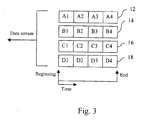
- Fig. 3 schematically illustrates distribution of sub-streams A, B, C and D - labeled 12, 14, 16 and 18 respectively - made up of interleaved sub-blocks of data A1, A2, A3, A4; B1, B2, B3, B4; C1, C2, C3, C4; and D1, D2, D3, D4 respectively from a central server in accordance with the present invention.
- the blocks of data may be individually obtained by a client from the central server, or from its peers.
- a number of different sub-streams are generated by the central server and any client having the data stream in its memory. Any set of a smaller or equal number - in the present example, four - of different sub-streams can be recombined to yield the original data stream 10.
- Each sub-stream is encoded in such a manner that the corresponding blocks of any combination of a given number - in the present example, four - of different sub-streams can be recombined to obtain the corresponding block of the original data stream.
- This is accomplished by a suitable algorithm for this purpose such as a Solomon-Reed-type of algorithm, or any other similar algorithm known to a person skilled in the art.
- the algorithm is thus implemented in software and hardware residing in the peer equipment for downloading media from other peers or from a central server.
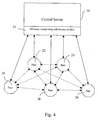
- Fig. 4 schematically illustrates a central server 20 storing the sub-streams 12, 14, 16, 18 in a memory area 21 for retrieval by peers 22, 24, 26, 28, 30 connected to the peer-to-peer network.
- Solid double arrows indicate communication between single peers with the central server 20 and vice versa, whereas broken-line double arrows designate communication between peers in the network.
- Every single peer 22, 24, 26, 28, 30 is provided the software mentioned to communicate with peers and the central server 20.
- the software also comprises a handover function that enables a peer to switch between receiving data streams from the central server and its peers.
- FIG. 4 schematically depicts the system of the present invention operated by the method described in here.
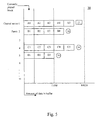
- Fig. 5 schematically illustrates a buffer in client 30 equipment or in any peer equipment receiving streaming media in accordance with the present invention.
- the number of possible sub-streams is higher than the number of sub-streams required to reconstruct the original data stream, and peers randomly choose among the possible sub-streams, which to generate. This increases the probability of different peers 22, 24, 26 having different sub-streams of the original streams wanted by the client 30, meaning that they can be utilized in conjunction by a client 30 retrieving a stream.
- the stream of media played at a client 30 is depicted at the arrow pointing from a currently played block at the block played. It is possible to play a block i of the media if and only if all of the sub-blocks Ai, Bi, Ci and Di from the sub-streams A, B, C, and D are available in the buffer memory. The blocks must be played in order, beginning with 1 and then 2, 3 etc. If there are any sub-blocks missing for the block i, these blocks must be obtained before the block i can be played. In Fig. 5 it is currently possible to play blocks 1-3, since sub-blocks 1-3 of all sub-streams have been downloaded. To play block 4, however, sub-block D4 must be obtained. As for now in Fig. 5 it is seen that there is still enough data available for playback.
- Every single sub-block can be concatenated in the correct order by the algorithm as described above, if they are stored/available in the buffer memory.
- Fig.5 In Fig.5 and according to the present invention there are defined two time constants: LOW and HIGH (see Fig.5 ) depicted as vertical broken lines, related to the amount of buffered material that is yet un-played by the client 30.
- the client starts streaming a number - in the present example, four - of sub-streams, from the peer-to-peer network and, if necessary in order to ensure low latency at startup, in conjunction with the central server 20.
- This is depicted in Fig. 5 , as one sub-stream A is fetched from the central server 20 memory 21, marked by a rectangle containing the number 21 in Fig. 5 .
- peers 22, 24, 26 with the appropriate sub-streams B, C, D, marked in an octagon with the peer's reference numeral from where the stream was fetched, are located via the software residing in participating peer equipment for downloading streaming media according to the present invention in the peer-to-peer network.
- FIG. 6 schematically illustrates updating of the streaming media in accordance with Fig. 5 of the present invention where it can be seen that the amount of sub-stream data being downloaded from peer 26 in the client buffer has fallen below the LOW constant.
- the situation requires faster communication in order to fetch sub-block number 4, which is now accomplished by, instead of fetching D4 from peer 26, fetching sub-block 4 of another sub-stream from the central server memory 21 through a handover to the same.
- sub-stream D for example sub-stream D, as depicted in Fig. 6 .
- downloading of that sub-stream is halted and replaced by downloading of another sub-stream from the central server 20 memory 21.
- sub-blocks A2, B2, C2, D2 of block 2 being played by the client equipment are now stored in a memory/cache by the client 30 software, as are all the sub-blocks of block 3.
- Sub-block D4 of block 4 has not yet been fetched from peer 26, causing sub-stream D to fall below the LOW constant.
- the peer software hands over/switches the fetching of streaming media to the central server 20 memory 21 in order to restore the buffer level of the fourth sub-stream.
- This replacement sub-stream is depicted in Fig. 7 as sub-stream D.
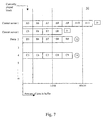
- Fig. 7 schematically illustrates updating of the streaming media in accordance with Fig. 5 of the present invention where it can be seen that the amount of sub-stream data of sub-stream A being downloaded from the central server 20 memory 21 in the client buffer has risen above the HIGH constant.
- the situation is here the opposite of the situation illustrated in Fig. 6 , and download of sub-stream A can seize, being replaced by download of another sub-stream from a peer through a handover to the same.
- a sub-stream downloaded from the central server 20 has more than HIGH data buffered
- downloading of that sub-stream is halted and replaced by downloading of another sub-stream from the peer-to-peer network, which is the case illustrated in Fig. 7 .
- This figure shows that buffer memory stored sub-blocks A5-A11 of sub-stream A exceed the high buffer level.
- the peer software hands over/switches the fetching of streaming media to a suitable peer in order to preserve central server bandwidth.
- the method and system of the present invention ensure to a greater degree than existing peer-to-peer solutions data distribution characteristics suitable for streaming media, and allow for lower server bandwidth consumption than existing client-server based streaming solutions.
- a possible optimization is to make sure that there is never more than one connection to the central server 20. This is accomplished by blockwise interleaving the streams, see Fig. 3 , that are concurrently being downloaded from the central server and treating the LOW constant as if it were set to the position of the central server 20 download whenever there is such a download. If there are no peers having sub-streams to provide the client 30, all sub-streams are of course fetched from the central server 20 memory 21.
- the collective content of the peer-to-peer network is the content of data caches of the peers.
- White retrieving sub-streams the original data is recreated in real-time for playback.
- the client Having played back a block, the client recodes the block as the sub-blocks of a number of new randomly chosen sub-streams, which are stored in the client's data cache. This means that the distribution of sub-streams in the peer-to-peer network is kept optimal.
- blocks can be arbitrarily recoded for instance, block 1 to A1, D1, F1 and T1.
Landscapes
- Engineering & Computer Science (AREA)
- Computer Networks & Wireless Communication (AREA)
- Signal Processing (AREA)
- Computing Systems (AREA)
- Multimedia (AREA)
- Information Transfer Between Computers (AREA)
- Two-Way Televisions, Distribution Of Moving Picture Or The Like (AREA)
Description
- The present invention pertains to a method and system adapted to peer-to-peer streaming of media content in a network for distribution of data.
- Today's solutions for media streaming being based on a client-server model are disadvantageous due to high bandwidth requirements on the server side. A reduction of these requirements would demand a peer-to-peer model for data distribution. However, the existing peer-to-peer systems are unsuitable for streaming for a number of reasons, for instance because data arrives unordered, and, in the typical case, it is not possible to start utilizing the received data packets until the final part of the streaming media has arrived. The media may here represent any kind of digital content, such as music, video, digital films or images.
- Nodes (peers) in a peer-to-peer network may over time experience drastic changes in bandwidth availability, or even disappear completely. Moreover, the nodes may have asymmetric network connections, usually meaning that they have substantially higher downstream bandwidth than upstream bandwidth.
- Hence, there is a need for an improved streaming-media distribution solution, which, on one hand, overcomes the above mentioned bandwidth requirements of the pure client-server model; and on the other hand, avoids the drawbacks of the existing peer-to-peer solutions.
- In "A Peer-to-Peer Framework for Cost-Effective On-demand Media Streaming", Consumer Communications and Networking Conference, IEEE CCNC 2006, vol. 1, 8 January 2006, pages 314-318, Xin Liu et al. discloses a system for publishing video by splitting the video into segments and distributing the segments to different peers.
- In "Understanding Mesh-based Peer-to-Peer Streaming", Magharei Nazanin et al. discloses the impact of overlay properties on the global pattern of content delivery and delivered quality to individual peers.
-
US 2004/0143672 discloses a system and method for distributing streaming content data from a server to multiple clients which enables the server to handle transient surges of requests by having the clients cooperate with the server and other clients to distribute content, thereby alleviating the load on the server. The server divides the streaming content into multiple sub-streams (e.g., by using multiple description coding), and constructs multiple distribution trees with itself at the root and each client as a node in each of the trees. Each sub-stream is transmitted down a corresponding one of the distribution trees. Clients that receive sub-streams from its parent nodes in the distribution trees in turn forward the sub-streams to their child nodes in the trees. -
US 2006/0190615 discloses a peer-to-peer novel video streaming scheme in which each peer stores and streams videos to the requesting client peers. Each video is encoded into multiple descriptions and each description is placed on a different node. If a serving peer disconnects in the middle of a streaming session, the system searches for a replacement peer that stores the same video description and has sufficient uplink bandwidth. Employing multiple description coding in a peer-to-peer based network improves the robustness of the distributed streaming content in the event a serving peer is lost. Video quality can be maintained in the presence of server peers being lost. The video codec design and network policies have a significant effect on the streamed video quality. The system performance generally improves as the number of descriptions M for the video increases, which implies that a higher video quality can be obtained with the same network loading. - The present invention relates to the provision of streaming media from a central server and/or peers in a peer-to-peer network without bandwidth guarantees.
- The invention provides a method in accordance with
claim 1, and a system in accordance withclaim 4, for distribution of data in a network based on peer-to-peer streaming of media content. - According to the invention, the network has a central server for streaming media content to clients.
- Further, every peer has software for retrieval of a media stream from the central server and from other peers. The software is adapted to transmit sub-streams of streaming media to other peers when requested.
- According to the invention, a first set of a first number of sub-streams is generated from an original data stream, wherein any combination of a second number of sub-streams selected from the first set may be recombined to yield the original data stream. Each sub-stream in the first set is here encoded in such a manner that a given sub-block from a selected sub-stream can be combined with corresponding sub-blocks from the other selected sub-streams to yield the given block of the original data stream. Moreover, the second number is larger than or equal to two and smaller than or equal to the first number.
- According to an embodiment, played media streams are recoded in such a manner that different peers, having sub-streams of the same media stream in their memory, have randomly chosen sub-streams of that media stream, thus increasing the number of available redundant sub-streams in the network.
- Further embodiments of the system of the present invention are set forth through the set of attached dependent system claims.
- According to one aspect of the present invention, there is provided a method for distribution of data in a network based on peer-to-peer streaming of media content, the network including a plurality of peers and a central server, the method being characterised by including: encoding, at the central server, an original stream of media content into a first number of sub-streams, wherein corresponding blocks of any combination of a given, second number of different sub-streams of the first number of sub-streams can be recombined to obtain the corresponding block of the original stream, the second number of sub-streams being smaller than the first number of sub-streams; retrieving, at each peer, a set of sub-streams of the first number of sub-streams from the central server and a number of the other peers, each sub-stream of the retrieved set of sub-streams being different in respect of each other and the number of sub-streams of the retrieved set of sub-streams corresponding to said second number; transmitting, by each peer, and on request, a sub-stream to another peer; replacing downloading of a sub-stream from one of the peers with downloading of another, different or identical, sub-stream from the central server, or from another of the peers, when it is determined that the amount of sub-stream data from said one of the peers is below a predefined amount of data in a reception buffer, wherein said another sub-stream is chosen such that each sub-stream of the retrieved set is different from the other sub-streams in the retrieved set; and replacing downloading of a sub-stream from the central server with downloading of another, different or identical, sub-stream from one of the peers, when a predefined condition is fulfilled.
- According to another aspect of the present invention, there is provided a system for distribution of data in a network based on peer-to-peer streaming of media content, the system being characterised by including: a central server for distribution of streaming media content to a plurality of peers, the central server being configured to encode an original stream of media content into a first number of sub-streams, wherein corresponding blocks of any combination of a given, second number of different sub-streams of the first number of sub-streams can be recombined to obtain the corresponding block of the original stream, the second number of sub-streams being smaller than the first number of sub-streams; and a plurality of peers, each peer being configured to: retrieve a set of sub-streams of the first number of sub-streams from the central server and a number of the other peers, each sub-stream of the retrieved set of sub-streams being different in respect of each other and the number of sub-streams of the retrieved set of sub-streams corresponding to said second number; transmit, on request, a sub-stream to another of the peers; replace downloading of a sub-stream from one of the peers with downloading of another sub-stream from the central server, or from another of the peers, when it is determined that the amount of sub-stream data from said one of the peers is below a predefined amount of data in a reception buffer, wherein the peer is configured to choose said another sub-stream such that each sub-stream of the retrieved set is different from the other sub-streams in the retrieved set, and replace downloading of a sub-stream from the central server with downloading of another, different or identical, sub-stream from one of the peers, when a predefined condition is fulfilled.
- Henceforth reference is made the accompanied drawings and its related text, whereby the present invention is described through given examples and provided embodiments for a better understanding of the invention, wherein:
- Fig. 1
- schematically illustrates a prior-art embodiment of distributing streaming media;
- Fig. 2
- schematically illustrates how a conventional stream of streaming media in accordance with
Fig. 1 is split length-wise in sub-streams according to the present invention; - Fig. 3
- schematically illustrates distribution sub-streams in accordance with
Fig. 2 from a central server in accordance with the present invention; - Fig. 4
- schematically illustrates a central server connected to a peer-to-peer network;
- Fig. 5
- schematically illustrates a buffer in client equipment receiving streaming media in accordance with the present invention;
- Fig. 6
- schematically illustrates updating of the streaming media in accordance with
Fig. 5 of the present invention; - Fig. 7
- schematically illustrates updating of the streaming media in accordance with
Fig. 5 of the present invention; - The present invention introduces streaming media by splitting an original data stream length-wise, i.e., given only the first fraction of the parts in a stream of data, it is possible to recreate the first fraction of the original data stream. To achieve this, the invention provides a central server system with guaranteed bandwidth, and further provides a handover process, which allows a client to switch from retrieving data from its peers to the central system when required. By splitting the data length-wise, individual peers from which a given client is streaming media need only serve data as fast as the original bit-rate divided by the number of concurrent streams.
-
Fig. 1 schematically illustrates a prior-art embodiment of distributingstreaming media 10. Throughout the present description streaming media is depicted as being divided into blocks denoted 1, 2, 3 etc. and length-wise split into sub-streams denoted A, B, C and D, each comprising the sub-blocks A1, A2, A3 etc., B1, B2, B3 etc., C1, C2, C3 etc. and D1, D2, D3 etc., in order to guide the reader through the teaching of the present invention. It is appreciated that the numbers of sub-streams and sub-blocks of data respectively are not limited to those given as examples herein. - Hence
Fig. 1 depicts prior artstreaming media blocks 10, labeled 1, 2, 3 and 4 respectively, being distributed from a server to a client. Theblocks 10 are transmitted to a client downloading them in a flow from 1 to 4 until the stream ends. As mentioned above, existing peer-to-peer systems are unsuitable for streaming for a number of reasons, for instance data might arrive unordered, and in the typical case, it is not possible to start utilizing the received data packets until the final part of the streaming media has arrived. - Nodes (peers) in a peer-to-peer network may experience drastic changes in bandwidth availability or even disappear completely. Moreover, the nodes may have asymmetric network connections, which usually means that they have much higher downstream bandwidth than upstream ditto.
- Hence, to solve existing problems, the present invention provides a method and a system consistent with what is depicted in
Fig. 2 to Fig. 7 . -
Fig. 2 schematically illustrates how a conventional stream ofmedia content 10 in accordance withFig. 1 is regenerated from the four sub-streams A, B, C and D, consisting of sub-blocks A1-4, B1-4, C1-4 and D1-4 respectively in this example according to the present invention. The four sub-streams can be seen as constituting a length-wise split of the data stream, depicted as broken lines inFig. 2 . -
Fig. 3 schematically illustrates distribution of sub-streams A, B, C and D - labeled 12, 14, 16 and 18 respectively - made up of interleaved sub-blocks of data A1, A2, A3, A4; B1, B2, B3, B4; C1, C2, C3, C4; and D1, D2, D3, D4 respectively from a central server in accordance with the present invention. The blocks of data may be individually obtained by a client from the central server, or from its peers. In any case, from theoriginal data stream 10, a number of different sub-streams are generated by the central server and any client having the data stream in its memory. Any set of a smaller or equal number - in the present example, four - of different sub-streams can be recombined to yield theoriginal data stream 10. - Each sub-stream is encoded in such a manner that the corresponding blocks of any combination of a given number - in the present example, four - of different sub-streams can be recombined to obtain the corresponding block of the original data stream. This is accomplished by a suitable algorithm for this purpose such as a Solomon-Reed-type of algorithm, or any other similar algorithm known to a person skilled in the art. The algorithm is thus implemented in software and hardware residing in the peer equipment for downloading media from other peers or from a central server.
-
Fig. 4 schematically illustrates acentral server 20 storing the sub-streams 12, 14, 16, 18 in amemory area 21 for retrieval bypeers central server 20 and vice versa, whereas broken-line double arrows designate communication between peers in the network. Everysingle peer central server 20. The software also comprises a handover function that enables a peer to switch between receiving data streams from the central server and its peers. - Moreover,
Fig. 4 schematically depicts the system of the present invention operated by the method described in here. -
Fig. 5 schematically illustrates a buffer inclient 30 equipment or in any peer equipment receiving streaming media in accordance with the present invention. - The number of possible sub-streams is higher than the number of sub-streams required to reconstruct the original data stream, and peers randomly choose among the possible sub-streams, which to generate. This increases the probability of
different peers client 30, meaning that they can be utilized in conjunction by aclient 30 retrieving a stream. - The stream of media played at a
client 30 is depicted at the arrow pointing from a currently played block at the block played. It is possible to play a block i of the media if and only if all of the sub-blocks Ai, Bi, Ci and Di from the sub-streams A, B, C, and D are available in the buffer memory. The blocks must be played in order, beginning with 1 and then 2, 3 etc. If there are any sub-blocks missing for the block i, these blocks must be obtained before the block i can be played. InFig. 5 it is currently possible to play blocks 1-3, since sub-blocks 1-3 of all sub-streams have been downloaded. To playblock 4, however, sub-block D4 must be obtained. As for now inFig. 5 it is seen that there is still enough data available for playback. - Every single sub-block can be concatenated in the correct order by the algorithm as described above, if they are stored/available in the buffer memory.
- In
Fig.5 and according to the present invention there are defined two time constants: LOW and HIGH (seeFig.5 ) depicted as vertical broken lines, related to the amount of buffered material that is yet un-played by theclient 30. - When the media streaming is about to start, the client starts streaming a number - in the present example, four - of sub-streams, from the peer-to-peer network and, if necessary in order to ensure low latency at startup, in conjunction with the
central server 20. This is depicted inFig. 5 , as one sub-stream A is fetched from thecentral server 20memory 21, marked by a rectangle containing thenumber 21 inFig. 5 . Meanwhile peers 22, 24, 26 with the appropriate sub-streams B, C, D, marked in an octagon with the peer's reference numeral from where the stream was fetched, are located via the software residing in participating peer equipment for downloading streaming media according to the present invention in the peer-to-peer network. -
Fig. 6 schematically illustrates updating of the streaming media in accordance withFig. 5 of the present invention where it can be seen that the amount of sub-stream data being downloaded frompeer 26 in the client buffer has fallen below the LOW constant. Hence, the situation requires faster communication in order to fetchsub-block number 4, which is now accomplished by, instead of fetching D4 frompeer 26, fetchingsub-block 4 of another sub-stream from thecentral server memory 21 through a handover to the same. - Whenever a sub-stream downloaded from the peer-to-peer network, for example sub-stream D, as depicted in
Fig. 6 , has less than LOW constant data buffered, downloading of that sub-stream is halted and replaced by downloading of another sub-stream from thecentral server 20memory 21. - The sub-blocks A2, B2, C2, D2 of
block 2 being played by the client equipment are now stored in a memory/cache by theclient 30 software, as are all the sub-blocks ofblock 3. Sub-block D4 ofblock 4, however, has not yet been fetched frompeer 26, causing sub-stream D to fall below the LOW constant. As such is the case, the peer software hands over/switches the fetching of streaming media to thecentral server 20memory 21 in order to restore the buffer level of the fourth sub-stream. This replacement sub-stream is depicted inFig. 7 as sub-stream D. -
Fig. 7 schematically illustrates updating of the streaming media in accordance withFig. 5 of the present invention where it can be seen that the amount of sub-stream data of sub-stream A being downloaded from thecentral server 20memory 21 in the client buffer has risen above the HIGH constant. Hence, the situation is here the opposite of the situation illustrated inFig. 6 , and download of sub-stream A can seize, being replaced by download of another sub-stream from a peer through a handover to the same. - Whenever a sub-stream downloaded from the
central server 20 has more than HIGH data buffered, downloading of that sub-stream is halted and replaced by downloading of another sub-stream from the peer-to-peer network, which is the case illustrated inFig. 7 . This figure shows that buffer memory stored sub-blocks A5-A11 of sub-stream A exceed the high buffer level. As such is the case, the peer software hands over/switches the fetching of streaming media to a suitable peer in order to preserve central server bandwidth. - The method and system of the present invention ensure to a greater degree than existing peer-to-peer solutions data distribution characteristics suitable for streaming media, and allow for lower server bandwidth consumption than existing client-server based streaming solutions.
- A possible optimization is to make sure that there is never more than one connection to the
central server 20. This is accomplished by blockwise interleaving the streams, seeFig. 3 , that are concurrently being downloaded from the central server and treating the LOW constant as if it were set to the position of thecentral server 20 download whenever there is such a download. If there are no peers having sub-streams to provide theclient 30, all sub-streams are of course fetched from thecentral server 20memory 21. - The collective content of the peer-to-peer network is the content of data caches of the peers. White retrieving sub-streams, the original data is recreated in real-time for playback. Having played back a block, the client recodes the block as the sub-blocks of a number of new randomly chosen sub-streams, which are stored in the client's data cache. This means that the distribution of sub-streams in the peer-to-peer network is kept optimal. As an example blocks can be arbitrarily recoded for instance, block 1 to A1, D1, F1 and T1.
- The attached set of claims provides further embodiments to a person skilled in the art, as such the present invention is not limited to the described embodiments and given examples.
Claims (6)
- A method for distribution of data in a network based on peer-to-peer streaming of media content, the network including a plurality of peers (22, 24, 26, 28, 30) and a central server (20), the method being characterised by including:encoding, at the central server, an original stream (10) of media content into a first number of sub-streams (A, B, C, D), wherein corresponding blocks of any combination of a given, second number of different sub-streams of the first number of sub-streams can be recombined to obtain the corresponding block of the original stream, the second number of sub-streams being smaller than the first number of sub-streams;retrieving, at each peer, a set of sub-streams of the first number of sub-streams from the central server and a number of the other peers, each sub-stream of the retrieved set of sub-streams being different in respect of each other and the number of sub-streams of the retrieved set of sub-streams corresponding to said second number;transmitting, by each peer, and on request, a sub-stream to another peer;replacing downloading of a sub-stream from one of the peers with downloading of another, different or identical, sub-stream from the central server, or from another of the peers, when it is determined that the amount of sub-stream data from said one of the peers is below a predefined amount of data in a reception buffer, wherein said another sub-stream is chosen such that each sub-stream of the retrieved set is different from the other sub-streams in the retrieved set; andreplacing downloading of a sub-stream from the central server with downloading of another, different or identical, sub-stream from one of the peers, when a predefined condition is fulfilled.
- The method of claim 1, wherein the predefined condition is fulfilled when it is determined that the sub-stream from the central server is above a predefined amount of data in the reception buffer.
- The method of claim 1, wherein the set of sub-streams retrieved by each peer form the encoded stream of media content, the method including
recoding the stream of media content in such a manner that different peers, storing sub-streams of the same media stream, have randomly chosen sub-streams of that media stream. - A system for distribution of data in a network based on peer-to-peer streaming of media content, the system being characterised by including:a central server (20) for distribution of streaming media content to a plurality of peers (22, 24, 26, 28, 30), the central server being configured to encode an original stream (10) of media content into a first number of sub-streams (A, B, C, D), wherein corresponding blocks of any combination of a given, second number of different sub-streams of the first number of sub-streams can be recombined to obtain the corresponding block of the original stream, the second number of sub-streams being smaller than the first number of sub-streams; anda plurality of peers, each peer being configured to:retrieve a set of sub-streams of the first number of sub-streams from the central server and a number of the other peers, each sub-stream of the retrieved set of sub-streams being different in respect of each other and the number of sub-streams of the retrieved set of sub-streams corresponding to said second number;transmit, on request, a sub-stream to another of the peers;replace downloading of a sub-stream from one of the peers with downloading of another sub-stream from the central server, or from another of the peers, when it is determined that the amount of sub-stream data from said one of the peers is below a predefined amount of data in a reception buffer, wherein the peer is configured to choose said another sub-stream such that each sub-stream of the retrieved set is different from the other sub-streams in the retrieved set, andreplace downloading of a sub-stream from the central server with downloading of another, different or identical, sub-stream from one of the peers, when a predefined condition is fulfilled.
- The system of claim 4, wherein the predefined condition is fulfilled when it is determined that the sub-stream from the central server is above a predefined amount of data in the reception buffer.
- The system of claim 4, wherein the set of sub-streams retrieved by each peer form the encoded stream of media content, each peer being further configured to
recode the stream of media content in such a manner that different peers, storing sub-streams of the same media stream, have randomly chosen sub-streams of that media stream.
Applications Claiming Priority (2)
| Application Number | Priority Date | Filing Date | Title |
|---|---|---|---|
| SE0701717A SE532173C2 (en) | 2007-07-13 | 2007-07-13 | Peer-to-Peer streaming of media content |
| US11/777,534 US8316146B2 (en) | 2007-07-13 | 2007-07-13 | Peer-to-peer streaming of media content |
Publications (2)
| Publication Number | Publication Date |
|---|---|
| EP2015542A1 EP2015542A1 (en) | 2009-01-14 |
| EP2015542B1 true EP2015542B1 (en) | 2013-01-16 |
Family
ID=39714223
Family Applications (1)
| Application Number | Title | Priority Date | Filing Date |
|---|---|---|---|
| EP08158835A Not-in-force EP2015542B1 (en) | 2007-07-13 | 2008-06-24 | Peer-to-peer streaming of media content |
Country Status (2)
| Country | Link |
|---|---|
| EP (1) | EP2015542B1 (en) |
| ES (1) | ES2409209T3 (en) |
Cited By (2)
| Publication number | Priority date | Publication date | Assignee | Title |
|---|---|---|---|---|
| US10467998B2 (en) | 2015-09-29 | 2019-11-05 | Amper Music, Inc. | Automated music composition and generation system for spotting digital media objects and event markers using emotion-type, style-type, timing-type and accent-type musical experience descriptors that characterize the digital music to be automatically composed and generated by the system |
| US10964299B1 (en) | 2019-10-15 | 2021-03-30 | Shutterstock, Inc. | Method of and system for automatically generating digital performances of music compositions using notes selected from virtual musical instruments based on the music-theoretic states of the music compositions |
Families Citing this family (7)
| Publication number | Priority date | Publication date | Assignee | Title |
|---|---|---|---|---|
| KR101594811B1 (en) | 2009-10-21 | 2016-02-18 | 삼성전자주식회사 | Network apparatus and system in mobile peer-to-peer environments |
| US9355174B2 (en) | 2012-09-07 | 2016-05-31 | Iheartmedia Management Services, Inc. | Multi-input playlist selection |
| AU2015342719B2 (en) * | 2014-11-04 | 2020-08-20 | Gt Systems Pty Ltd | Media distribution and management system and apparatus |
| US10854180B2 (en) | 2015-09-29 | 2020-12-01 | Amper Music, Inc. | Method of and system for controlling the qualities of musical energy embodied in and expressed by digital music to be automatically composed and generated by an automated music composition and generation engine |
| US11037538B2 (en) | 2019-10-15 | 2021-06-15 | Shutterstock, Inc. | Method of and system for automated musical arrangement and musical instrument performance style transformation supported within an automated music performance system |
| US11024275B2 (en) | 2019-10-15 | 2021-06-01 | Shutterstock, Inc. | Method of digitally performing a music composition using virtual musical instruments having performance logic executing within a virtual musical instrument (VMI) library management system |
| EP4075691B1 (en) | 2021-02-20 | 2024-05-01 | Wangsu Science & Technology Co., Ltd. | Resource requesting method and terminal |
Citations (2)
| Publication number | Priority date | Publication date | Assignee | Title |
|---|---|---|---|---|
| US20040143672A1 (en) * | 2003-01-07 | 2004-07-22 | Microsoft Corporation | System and method for distributing streaming content through cooperative networking |
| US20060190615A1 (en) * | 2005-01-21 | 2006-08-24 | Panwar Shivendra S | On demand peer-to-peer video streaming with multiple description coding |
-
2008
- 2008-06-24 EP EP08158835A patent/EP2015542B1/en not_active Not-in-force
- 2008-06-24 ES ES08158835T patent/ES2409209T3/en active Active
Patent Citations (2)
| Publication number | Priority date | Publication date | Assignee | Title |
|---|---|---|---|---|
| US20040143672A1 (en) * | 2003-01-07 | 2004-07-22 | Microsoft Corporation | System and method for distributing streaming content through cooperative networking |
| US20060190615A1 (en) * | 2005-01-21 | 2006-08-24 | Panwar Shivendra S | On demand peer-to-peer video streaming with multiple description coding |
Cited By (16)
| Publication number | Priority date | Publication date | Assignee | Title |
|---|---|---|---|---|
| US11037539B2 (en) | 2015-09-29 | 2021-06-15 | Shutterstock, Inc. | Autonomous music composition and performance system employing real-time analysis of a musical performance to automatically compose and perform music to accompany the musical performance |
| US11430418B2 (en) | 2015-09-29 | 2022-08-30 | Shutterstock, Inc. | Automatically managing the musical tastes and preferences of system users based on user feedback and autonomous analysis of music automatically composed and generated by an automated music composition and generation system |
| US12039959B2 (en) | 2015-09-29 | 2024-07-16 | Shutterstock, Inc. | Automated music composition and generation system employing virtual musical instrument libraries for producing notes contained in the digital pieces of automatically composed music |
| US11011144B2 (en) | 2015-09-29 | 2021-05-18 | Shutterstock, Inc. | Automated music composition and generation system supporting automated generation of musical kernels for use in replicating future music compositions and production environments |
| US11017750B2 (en) | 2015-09-29 | 2021-05-25 | Shutterstock, Inc. | Method of automatically confirming the uniqueness of digital pieces of music produced by an automated music composition and generation system while satisfying the creative intentions of system users |
| US11030984B2 (en) | 2015-09-29 | 2021-06-08 | Shutterstock, Inc. | Method of scoring digital media objects using musical experience descriptors to indicate what, where and when musical events should appear in pieces of digital music automatically composed and generated by an automated music composition and generation system |
| US10672371B2 (en) | 2015-09-29 | 2020-06-02 | Amper Music, Inc. | Method of and system for spotting digital media objects and event markers using musical experience descriptors to characterize digital music to be automatically composed and generated by an automated music composition and generation engine |
| US11037540B2 (en) | 2015-09-29 | 2021-06-15 | Shutterstock, Inc. | Automated music composition and generation systems, engines and methods employing parameter mapping configurations to enable automated music composition and generation |
| US10467998B2 (en) | 2015-09-29 | 2019-11-05 | Amper Music, Inc. | Automated music composition and generation system for spotting digital media objects and event markers using emotion-type, style-type, timing-type and accent-type musical experience descriptors that characterize the digital music to be automatically composed and generated by the system |
| US11037541B2 (en) | 2015-09-29 | 2021-06-15 | Shutterstock, Inc. | Method of composing a piece of digital music using musical experience descriptors to indicate what, when and how musical events should appear in the piece of digital music automatically composed and generated by an automated music composition and generation system |
| US11430419B2 (en) | 2015-09-29 | 2022-08-30 | Shutterstock, Inc. | Automatically managing the musical tastes and preferences of a population of users requesting digital pieces of music automatically composed and generated by an automated music composition and generation system |
| US11468871B2 (en) | 2015-09-29 | 2022-10-11 | Shutterstock, Inc. | Automated music composition and generation system employing an instrument selector for automatically selecting virtual instruments from a library of virtual instruments to perform the notes of the composed piece of digital music |
| US11651757B2 (en) | 2015-09-29 | 2023-05-16 | Shutterstock, Inc. | Automated music composition and generation system driven by lyrical input |
| US11657787B2 (en) | 2015-09-29 | 2023-05-23 | Shutterstock, Inc. | Method of and system for automatically generating music compositions and productions using lyrical input and music experience descriptors |
| US11776518B2 (en) | 2015-09-29 | 2023-10-03 | Shutterstock, Inc. | Automated music composition and generation system employing virtual musical instrument libraries for producing notes contained in the digital pieces of automatically composed music |
| US10964299B1 (en) | 2019-10-15 | 2021-03-30 | Shutterstock, Inc. | Method of and system for automatically generating digital performances of music compositions using notes selected from virtual musical instruments based on the music-theoretic states of the music compositions |
Also Published As
| Publication number | Publication date |
|---|---|
| ES2409209T3 (en) | 2013-06-25 |
| EP2015542A1 (en) | 2009-01-14 |
Similar Documents
| Publication | Publication Date | Title |
|---|---|---|
| US8316146B2 (en) | Peer-to-peer streaming of media content | |
| EP2015542A1 (en) | Peer-to-peer streaming of media content | |
| KR101299038B1 (en) | Multimedia content delivery method and system | |
| US7822855B2 (en) | Methods and systems combining push and pull protocols | |
| KR101422266B1 (en) | Multi-head hierarchically clustered peer-to-peer live streaming system | |
| US20100095016A1 (en) | Methods and systems capable of switching from pull mode to push mode | |
| Li | PeerStreaming: A practical receiver-driven peer-to-peer media streaming system | |
| Lederer et al. | Towards peer-assisted dynamic adaptive streaming over HTTP | |
| Meddour et al. | Open issues in P2P multimedia streaming | |
| US9866623B2 (en) | System and method for optimizing inter-node communication in content distribution network | |
| He et al. | Distributed throughput maximization in P2P VoD applications | |
| Colonnese et al. | Cloud-assisted buffer management for http-based mobilevideo streaming | |
| Bruneau-Queyreix et al. | A multiple-source adaptive streaming solution enhancing consumer's perceived quality | |
| Yahia et al. | When HTTP/2 rescues DASH: Video frame multiplexing | |
| Sánchez et al. | Improved caching for HTTP-based video on demand using scalable video coding | |
| CN101366235B (en) | Multimedia content delivery method and system | |
| Shen et al. | Peer-driven video streaming: Multiple descriptions versus layering | |
| Tian et al. | A novel caching mechanism for peer-to-peer based media-on-demand streaming | |
| Hwang et al. | Joint-family: Adaptive bitrate video-on-demand streaming over peer-to-peer networks with realistic abandonment patterns | |
| CA2553258C (en) | On-demand digital asset management and distribution method and system | |
| Zhou et al. | Exploring coding benefits in CDN-based VoD systems | |
| Liu et al. | Efficient substream encoding and transmission for P2P video on demand | |
| Varma et al. | WebRTC-based peer assisted framework for HTTP live streaming | |
| KR100797389B1 (en) | Cluster-based Streaming System Using Multiple Description Coding and Its Method | |
| Meier et al. | Peer-to-peer streaming in heterogeneous environments |
Legal Events
| Date | Code | Title | Description |
|---|---|---|---|
| PUAI | Public reference made under article 153(3) epc to a published international application that has entered the european phase |
Free format text: ORIGINAL CODE: 0009012 |
|
| AK | Designated contracting states |
Kind code of ref document: A1 Designated state(s): AT BE BG CH CY CZ DE DK EE ES FI FR GB GR HR HU IE IS IT LI LT LU LV MC MT NL NO PL PT RO SE SI SK TR |
|
| AX | Request for extension of the european patent |
Extension state: AL BA MK RS |
|
| 17P | Request for examination filed |
Effective date: 20090713 |
|
| AKX | Designation fees paid |
Designated state(s): AT BE BG CH CY CZ DE DK EE ES FI FR GB GR HR HU IE IS IT LI LT LU LV MC MT NL NO PL PT RO SE SI SK TR |
|
| 17Q | First examination report despatched |
Effective date: 20101006 |
|
| RAP1 | Party data changed (applicant data changed or rights of an application transferred) |
Owner name: SPOTIFY LTD |
|
| RAP1 | Party data changed (applicant data changed or rights of an application transferred) |
Owner name: SPOTIFY AB |
|
| GRAP | Despatch of communication of intention to grant a patent |
Free format text: ORIGINAL CODE: EPIDOSNIGR1 |
|
| GRAS | Grant fee paid |
Free format text: ORIGINAL CODE: EPIDOSNIGR3 |
|
| GRAA | (expected) grant |
Free format text: ORIGINAL CODE: 0009210 |
|
| AK | Designated contracting states |
Kind code of ref document: B1 Designated state(s): AT BE BG CH CY CZ DE DK EE ES FI FR GB GR HR HU IE IS IT LI LT LU LV MC MT NL NO PL PT RO SE SI SK TR |
|
| REG | Reference to a national code |
Ref country code: GB Ref legal event code: FG4D |
|
| REG | Reference to a national code |
Ref country code: CH Ref legal event code: EP |
|
| REG | Reference to a national code |
Ref country code: IE Ref legal event code: FG4D |
|
| REG | Reference to a national code |
Ref country code: CH Ref legal event code: EP Ref country code: AT Ref legal event code: REF Ref document number: 594402 Country of ref document: AT Kind code of ref document: T Effective date: 20130215 |
|
| REG | Reference to a national code |
Ref country code: DE Ref legal event code: R096 Ref document number: 602008021672 Country of ref document: DE Effective date: 20130314 |
|
| REG | Reference to a national code |
Ref country code: NL Ref legal event code: T3 |
|
| REG | Reference to a national code |
Ref country code: AT Ref legal event code: MK05 Ref document number: 594402 Country of ref document: AT Kind code of ref document: T Effective date: 20130116 |
|
| REG | Reference to a national code |
Ref country code: LT Ref legal event code: MG4D Ref country code: ES Ref legal event code: FG2A Ref document number: 2409209 Country of ref document: ES Kind code of ref document: T3 Effective date: 20130625 |
|
| PG25 | Lapsed in a contracting state [announced via postgrant information from national office to epo] |
Ref country code: SE Free format text: LAPSE BECAUSE OF FAILURE TO SUBMIT A TRANSLATION OF THE DESCRIPTION OR TO PAY THE FEE WITHIN THE PRESCRIBED TIME-LIMIT Effective date: 20130116 Ref country code: LT Free format text: LAPSE BECAUSE OF FAILURE TO SUBMIT A TRANSLATION OF THE DESCRIPTION OR TO PAY THE FEE WITHIN THE PRESCRIBED TIME-LIMIT Effective date: 20130116 Ref country code: NO Free format text: LAPSE BECAUSE OF FAILURE TO SUBMIT A TRANSLATION OF THE DESCRIPTION OR TO PAY THE FEE WITHIN THE PRESCRIBED TIME-LIMIT Effective date: 20130416 Ref country code: BE Free format text: LAPSE BECAUSE OF FAILURE TO SUBMIT A TRANSLATION OF THE DESCRIPTION OR TO PAY THE FEE WITHIN THE PRESCRIBED TIME-LIMIT Effective date: 20130116 Ref country code: IS Free format text: LAPSE BECAUSE OF FAILURE TO SUBMIT A TRANSLATION OF THE DESCRIPTION OR TO PAY THE FEE WITHIN THE PRESCRIBED TIME-LIMIT Effective date: 20130516 Ref country code: BG Free format text: LAPSE BECAUSE OF FAILURE TO SUBMIT A TRANSLATION OF THE DESCRIPTION OR TO PAY THE FEE WITHIN THE PRESCRIBED TIME-LIMIT Effective date: 20130416 Ref country code: AT Free format text: LAPSE BECAUSE OF FAILURE TO SUBMIT A TRANSLATION OF THE DESCRIPTION OR TO PAY THE FEE WITHIN THE PRESCRIBED TIME-LIMIT Effective date: 20130116 |
|
| PG25 | Lapsed in a contracting state [announced via postgrant information from national office to epo] |
Ref country code: SI Free format text: LAPSE BECAUSE OF FAILURE TO SUBMIT A TRANSLATION OF THE DESCRIPTION OR TO PAY THE FEE WITHIN THE PRESCRIBED TIME-LIMIT Effective date: 20130116 Ref country code: PT Free format text: LAPSE BECAUSE OF FAILURE TO SUBMIT A TRANSLATION OF THE DESCRIPTION OR TO PAY THE FEE WITHIN THE PRESCRIBED TIME-LIMIT Effective date: 20130516 Ref country code: LV Free format text: LAPSE BECAUSE OF FAILURE TO SUBMIT A TRANSLATION OF THE DESCRIPTION OR TO PAY THE FEE WITHIN THE PRESCRIBED TIME-LIMIT Effective date: 20130116 Ref country code: GR Free format text: LAPSE BECAUSE OF FAILURE TO SUBMIT A TRANSLATION OF THE DESCRIPTION OR TO PAY THE FEE WITHIN THE PRESCRIBED TIME-LIMIT Effective date: 20130417 Ref country code: PL Free format text: LAPSE BECAUSE OF FAILURE TO SUBMIT A TRANSLATION OF THE DESCRIPTION OR TO PAY THE FEE WITHIN THE PRESCRIBED TIME-LIMIT Effective date: 20130116 |
|
| PG25 | Lapsed in a contracting state [announced via postgrant information from national office to epo] |
Ref country code: HR Free format text: LAPSE BECAUSE OF FAILURE TO SUBMIT A TRANSLATION OF THE DESCRIPTION OR TO PAY THE FEE WITHIN THE PRESCRIBED TIME-LIMIT Effective date: 20130116 |
|
| PG25 | Lapsed in a contracting state [announced via postgrant information from national office to epo] |
Ref country code: RO Free format text: LAPSE BECAUSE OF FAILURE TO SUBMIT A TRANSLATION OF THE DESCRIPTION OR TO PAY THE FEE WITHIN THE PRESCRIBED TIME-LIMIT Effective date: 20130116 Ref country code: EE Free format text: LAPSE BECAUSE OF FAILURE TO SUBMIT A TRANSLATION OF THE DESCRIPTION OR TO PAY THE FEE WITHIN THE PRESCRIBED TIME-LIMIT Effective date: 20130116 Ref country code: SK Free format text: LAPSE BECAUSE OF FAILURE TO SUBMIT A TRANSLATION OF THE DESCRIPTION OR TO PAY THE FEE WITHIN THE PRESCRIBED TIME-LIMIT Effective date: 20130116 Ref country code: DK Free format text: LAPSE BECAUSE OF FAILURE TO SUBMIT A TRANSLATION OF THE DESCRIPTION OR TO PAY THE FEE WITHIN THE PRESCRIBED TIME-LIMIT Effective date: 20130116 Ref country code: CZ Free format text: LAPSE BECAUSE OF FAILURE TO SUBMIT A TRANSLATION OF THE DESCRIPTION OR TO PAY THE FEE WITHIN THE PRESCRIBED TIME-LIMIT Effective date: 20130116 |
|
| PLBE | No opposition filed within time limit |
Free format text: ORIGINAL CODE: 0009261 |
|
| STAA | Information on the status of an ep patent application or granted ep patent |
Free format text: STATUS: NO OPPOSITION FILED WITHIN TIME LIMIT |
|
| PG25 | Lapsed in a contracting state [announced via postgrant information from national office to epo] |
Ref country code: CY Free format text: LAPSE BECAUSE OF FAILURE TO SUBMIT A TRANSLATION OF THE DESCRIPTION OR TO PAY THE FEE WITHIN THE PRESCRIBED TIME-LIMIT Effective date: 20130116 |
|
| 26N | No opposition filed |
Effective date: 20131017 |
|
| PG25 | Lapsed in a contracting state [announced via postgrant information from national office to epo] |
Ref country code: MC Free format text: LAPSE BECAUSE OF FAILURE TO SUBMIT A TRANSLATION OF THE DESCRIPTION OR TO PAY THE FEE WITHIN THE PRESCRIBED TIME-LIMIT Effective date: 20130116 |
|
| REG | Reference to a national code |
Ref country code: DE Ref legal event code: R097 Ref document number: 602008021672 Country of ref document: DE Effective date: 20131017 |
|
| PG25 | Lapsed in a contracting state [announced via postgrant information from national office to epo] |
Ref country code: MT Free format text: LAPSE BECAUSE OF FAILURE TO SUBMIT A TRANSLATION OF THE DESCRIPTION OR TO PAY THE FEE WITHIN THE PRESCRIBED TIME-LIMIT Effective date: 20130116 |
|
| PG25 | Lapsed in a contracting state [announced via postgrant information from national office to epo] |
Ref country code: TR Free format text: LAPSE BECAUSE OF FAILURE TO SUBMIT A TRANSLATION OF THE DESCRIPTION OR TO PAY THE FEE WITHIN THE PRESCRIBED TIME-LIMIT Effective date: 20130116 |
|
| PG25 | Lapsed in a contracting state [announced via postgrant information from national office to epo] |
Ref country code: LU Free format text: LAPSE BECAUSE OF NON-PAYMENT OF DUE FEES Effective date: 20130624 Ref country code: HU Free format text: LAPSE BECAUSE OF FAILURE TO SUBMIT A TRANSLATION OF THE DESCRIPTION OR TO PAY THE FEE WITHIN THE PRESCRIBED TIME-LIMIT; INVALID AB INITIO Effective date: 20080624 |
|
| REG | Reference to a national code |
Ref country code: FR Ref legal event code: PLFP Year of fee payment: 9 |
|
| REG | Reference to a national code |
Ref country code: FR Ref legal event code: PLFP Year of fee payment: 10 |
|
| PGFP | Annual fee paid to national office [announced via postgrant information from national office to epo] |
Ref country code: NL Payment date: 20170425 Year of fee payment: 10 |
|
| PGFP | Annual fee paid to national office [announced via postgrant information from national office to epo] |
Ref country code: SK Payment date: 20170407 Year of fee payment: 10 Ref country code: CH Payment date: 20170529 Year of fee payment: 10 |
|
| PGFP | Annual fee paid to national office [announced via postgrant information from national office to epo] |
Ref country code: IT Payment date: 20170411 Year of fee payment: 10 Ref country code: FI Payment date: 20170425 Year of fee payment: 10 |
|
| PGFP | Annual fee paid to national office [announced via postgrant information from national office to epo] |
Ref country code: ES Payment date: 20170705 Year of fee payment: 10 |
|
| REG | Reference to a national code |
Ref country code: FR Ref legal event code: PLFP Year of fee payment: 11 |
|
| PG25 | Lapsed in a contracting state [announced via postgrant information from national office to epo] |
Ref country code: FI Free format text: LAPSE BECAUSE OF NON-PAYMENT OF DUE FEES Effective date: 20180624 |
|
| REG | Reference to a national code |
Ref country code: CH Ref legal event code: PL |
|
| REG | Reference to a national code |
Ref country code: NL Ref legal event code: MM Effective date: 20180701 |
|
| REG | Reference to a national code |
Ref country code: IE Ref legal event code: MM4A |
|
| PG25 | Lapsed in a contracting state [announced via postgrant information from national office to epo] |
Ref country code: NL Free format text: LAPSE BECAUSE OF NON-PAYMENT OF DUE FEES Effective date: 20180701 |
|
| PG25 | Lapsed in a contracting state [announced via postgrant information from national office to epo] |
Ref country code: CH Free format text: LAPSE BECAUSE OF NON-PAYMENT OF DUE FEES Effective date: 20180630 Ref country code: LI Free format text: LAPSE BECAUSE OF NON-PAYMENT OF DUE FEES Effective date: 20180630 Ref country code: IT Free format text: LAPSE BECAUSE OF NON-PAYMENT OF DUE FEES Effective date: 20180624 Ref country code: IE Free format text: LAPSE BECAUSE OF NON-PAYMENT OF DUE FEES Effective date: 20180624 |
|
| REG | Reference to a national code |
Ref country code: ES Ref legal event code: FD2A Effective date: 20190916 |
|
| PG25 | Lapsed in a contracting state [announced via postgrant information from national office to epo] |
Ref country code: ES Free format text: LAPSE BECAUSE OF NON-PAYMENT OF DUE FEES Effective date: 20180625 |
|
| REG | Reference to a national code |
Ref country code: DE Ref legal event code: R079 Ref document number: 602008021672 Country of ref document: DE Free format text: PREVIOUS MAIN CLASS: H04L0029080000 Ipc: H04L0065000000 |
|
| PGFP | Annual fee paid to national office [announced via postgrant information from national office to epo] |
Ref country code: GB Payment date: 20220513 Year of fee payment: 15 Ref country code: FR Payment date: 20220519 Year of fee payment: 15 Ref country code: DE Payment date: 20220505 Year of fee payment: 15 |
|
| REG | Reference to a national code |
Ref country code: DE Ref legal event code: R119 Ref document number: 602008021672 Country of ref document: DE |
|
| GBPC | Gb: european patent ceased through non-payment of renewal fee |
Effective date: 20230624 |
|
| PG25 | Lapsed in a contracting state [announced via postgrant information from national office to epo] |
Ref country code: DE Free format text: LAPSE BECAUSE OF NON-PAYMENT OF DUE FEES Effective date: 20240103 Ref country code: GB Free format text: LAPSE BECAUSE OF NON-PAYMENT OF DUE FEES Effective date: 20230624 |
|
| PG25 | Lapsed in a contracting state [announced via postgrant information from national office to epo] |
Ref country code: FR Free format text: LAPSE BECAUSE OF NON-PAYMENT OF DUE FEES Effective date: 20230630 |