EP2014704A1 - Low migration polyolefin composition comprising vitamin E-type stabiliser - Google Patents
Low migration polyolefin composition comprising vitamin E-type stabiliser Download PDFInfo
- Publication number
- EP2014704A1 EP2014704A1 EP07013786A EP07013786A EP2014704A1 EP 2014704 A1 EP2014704 A1 EP 2014704A1 EP 07013786 A EP07013786 A EP 07013786A EP 07013786 A EP07013786 A EP 07013786A EP 2014704 A1 EP2014704 A1 EP 2014704A1
- Authority
- EP
- European Patent Office
- Prior art keywords
- polyolefin composition
- composition according
- stabilizer
- polyolefin
- formula
- Prior art date
- Legal status (The legal status is an assumption and is not a legal conclusion. Google has not performed a legal analysis and makes no representation as to the accuracy of the status listed.)
- Granted
Links
- 0 *C(*)(CC1)Oc(c(*)c2*)c1c(*)c2O Chemical compound *C(*)(CC1)Oc(c(*)c2*)c1c(*)c2O 0.000 description 1
Classifications
-
- C—CHEMISTRY; METALLURGY
- C08—ORGANIC MACROMOLECULAR COMPOUNDS; THEIR PREPARATION OR CHEMICAL WORKING-UP; COMPOSITIONS BASED THEREON
- C08K—Use of inorganic or non-macromolecular organic substances as compounding ingredients
- C08K5/00—Use of organic ingredients
- C08K5/0008—Organic ingredients according to more than one of the "one dot" groups of C08K5/01 - C08K5/59
- C08K5/005—Stabilisers against oxidation, heat, light, ozone
-
- C—CHEMISTRY; METALLURGY
- C08—ORGANIC MACROMOLECULAR COMPOUNDS; THEIR PREPARATION OR CHEMICAL WORKING-UP; COMPOSITIONS BASED THEREON
- C08K—Use of inorganic or non-macromolecular organic substances as compounding ingredients
- C08K5/00—Use of organic ingredients
- C08K5/04—Oxygen-containing compounds
- C08K5/13—Phenols; Phenolates
-
- C—CHEMISTRY; METALLURGY
- C08—ORGANIC MACROMOLECULAR COMPOUNDS; THEIR PREPARATION OR CHEMICAL WORKING-UP; COMPOSITIONS BASED THEREON
- C08K—Use of inorganic or non-macromolecular organic substances as compounding ingredients
- C08K5/00—Use of organic ingredients
- C08K5/04—Oxygen-containing compounds
- C08K5/15—Heterocyclic compounds having oxygen in the ring
- C08K5/151—Heterocyclic compounds having oxygen in the ring having one oxygen atom in the ring
- C08K5/1545—Six-membered rings
-
- C—CHEMISTRY; METALLURGY
- C08—ORGANIC MACROMOLECULAR COMPOUNDS; THEIR PREPARATION OR CHEMICAL WORKING-UP; COMPOSITIONS BASED THEREON
- C08K—Use of inorganic or non-macromolecular organic substances as compounding ingredients
- C08K3/00—Use of inorganic substances as compounding ingredients
- C08K3/02—Elements
- C08K3/04—Carbon
-
- Y—GENERAL TAGGING OF NEW TECHNOLOGICAL DEVELOPMENTS; GENERAL TAGGING OF CROSS-SECTIONAL TECHNOLOGIES SPANNING OVER SEVERAL SECTIONS OF THE IPC; TECHNICAL SUBJECTS COVERED BY FORMER USPC CROSS-REFERENCE ART COLLECTIONS [XRACs] AND DIGESTS
- Y10—TECHNICAL SUBJECTS COVERED BY FORMER USPC
- Y10T—TECHNICAL SUBJECTS COVERED BY FORMER US CLASSIFICATION
- Y10T428/00—Stock material or miscellaneous articles
- Y10T428/13—Hollow or container type article [e.g., tube, vase, etc.]
- Y10T428/1352—Polymer or resin containing [i.e., natural or synthetic]
- Y10T428/139—Open-ended, self-supporting conduit, cylinder, or tube-type article
Definitions
- the present invention relates to a polyolefin composition wherein the migration of the used additives and its decomposition products, especially phenols, out of the composition is low and thus the composition is particularly suitable for pipe applications, e.g. for drinking water.
- Polymeric compounds for example polyolefins like polyethylene and polypropylene, undergo radical driven degradation processes especially during processing steps which might include moulding, extrusion, etc. However, degradation even proceeds during end-use by a radical mechanism under the influence of light or heat and will finally destroy the polymer properties.
- antioxidants and light stabilizers can prevent or at least reduce these effects.
- additives are added to polymers to protect them during processing and to achieve the desired end-use properties. Additives are generally divided in stabilizers and modifiers. Typically, modifiers are anti-static and anti-fogging agents, acid scavengers, blowing agents, lubricants, nucleating agents, slip and anti-blocking agents, as well as fillers, flame retardants and cross-linkers.
- Stabilizers like antioxidants, traditionally and currently used comprise sterically hindered phenolics, aromatic amines, organo-phosphites/phosphonites and thioethers. However, appropriate combinations of stabilizers have to be carefully selected, depending on the desired final properties the polymeric article should have.
- antioxidant compositions are disclosed for improving long-term heat stability of polymeric materials.
- polyolefins are used for the preparation of pipes for drinking water distribution systems. Due to the permanent contact to the inner pipe surface, compounds can migrate from the pipe material into the water. The admissible amounts of compounds within the drinking water are fixed by legal requirements and even stricter requirements are to be expected with the introduction of the so-called "European acceptance scheme".
- Migration behavior of stabilizers and modifiers and/or decomposition products added to polyolefin-based materials is dependent from a number of different properties such as diffusion rate of the molecules within the polymer matrix, chemical stability of the additives, etc.. Furthermore, it has to be taken into account that an improvement in migration behavior must not be obtained on the expense of stabilization of the polymer matrix. Thus, providing an additive composition of low migration tendency, is not straightforward but rather needs a careful selection of appropriate compounds.
- GB 2 305 180 discloses polyolefin compositions which are in permanent contact with an extracting media, these compositions further comprising organic phosphites/phosphonites, phenolic compounds or sterically hindered amines as stabilizing components.
- the present invention is based on the finding that the object of the invention can be achieved, if the polymer composition comprises a specific combination of additives including a vitamin E-type stabiliser as defined below.
- the invention therefore provides a polyolefin composition
- a polyolefin composition comprising
- the stabilized polyolefin compositions according to the invention show a reduced migration of phenolic compounds into water in contact with the composition compared to known, usual stabilized compositions. At the same time, a reduced total amount of stabilizers is needed to obtain the desired stabilization effects.
- the heteroatoms which may be present in the non-substituted or substituted aliphatic or aromatic hydrocarbyl radicals R1, R2, R3, R4 and/or R5 of the vitamin E-type stabiliser (B) according to formula (I) may be oxygen, sulphur, nitrogen, phosphorus or the like. It is, however, preferred that R1, R2, R3, R4 or R5, more preferred R1, R2, R3, R4 and R5, do not comprise heteroatoms, i.e. are non-substituted or substituted aliphatic or aromatic hydrocarbyl radicals only, or, as mentioned, H.
- R2, R3, R4 or R5, more preferably R2, R3, R4 and R5, are H, or saturated aliphatic hydrocarbyl radicals comprising from 1 to 5 carbon atoms, and still more preferably R2, R3, R4 or R5, more preferably R2, R3, R4 and R5, are H, or methyl groups.
- R5 is a methyl group, regardless of the nature of the other residues R2 to R4.
- R4 and R5 are methyl groups, and R2 and R3 are H, or methyl groups.
- R2, R3, R4 and R5 are all methyl groups.
- R1 is a non-substituted or substituted aliphatic or aromatic hydrocarbyl radical containing from 5 to 50 carbon atoms, more preferably R1 is a non-substituted or substituted aliphatic hydrocarbyl radical containing from 5 to 50, more preferably from 10 to 30, carbon atoms, and most preferably R1 is a 4,8,12-trimethyl-tridecyl group.
- Vitamin E-type stabiliser (B) is preferably contained in the composition in an amount of at most 0.5 wt%, more preferably of at most 0.2 wt%, still more preferably of at most 0.1 wt.%, and most preferably of at most 0.05 wt%, based on the total composition.
- vitamin E-type stabiliser (B) is preferably contained in the composition in an amount of at least 0.005 wt%, more preferably of at least 0.01 wt.%, and most preferably of at least 0.015 wt%, based on the total composition.
- residues R6, R7 and R8 independently are non-substituted or substituted aliphatic or aromatic hydrocarbyl radicals which may comprise OH-groups. This means that apart from OH-groups no further heteroatoms are present in R6, R7 and R8, so that phenolic stabilizer (C) is e.g. free of ester groups, amide groups and groups containing phosphorus.
- R6, R7 and R8 which independently are non-substituted or substituted aliphatic or aromatic, more preferably aliphatic, hydrocarbyl radicals which may comprise OH-groups, have from 2 to 200 carbon atoms.
- R6 and R7 independently have from 2 to 20 carbon atoms, more preferably from 3 to 10 carbon atoms.
- R6 and/or R7 are aliphatic hydrocarbyl groups with at least 3 carbon atoms which have a branch at the second carbon atom, and most preferably R6 and/or R7, more preferably R6 and R7, are tert. butyl groups.
- R8 has from 20 to 100 carbon atoms, more preferably has from 30 to 70 carbon atoms.
- R8 includes one or more phenyl residues.
- R8 includes one or more hydroxyphenyl residues.
- R8 is a 2,4,6-tri-methyl-3,5-di-(3,5,-di-tert. butyl-4-hydroxyphenyl) benzene residue.
- X1 is OH, and most preferably X1 is OH and X2 and X3 are H.
- the amount of phenolic stabilizer (C) preferably is 0.02 wt% or more, more preferably 0.05 wt% or more, and most preferably 0.08 wt% or more.
- the upper limit of the amount of phenolic stabilizer (C) preferably is equal to or less than 1 wt%, more preferably equal to or less than 0.5 wt%, and most preferably equal to or less than 0.3 wt%.
- the weight ratio between vitamin E-type stabiliser (B) and phenolic stabilizer (C) is from 1 : 20 to 1 : 1, more preferably is from 1 : 10 to 1 : 2, most preferably is from 1 : 6 to 1 : 2.
- the total amount of stabilisers (B) and (C) in the composition is at most 1.5 wt.%, more preferably at most 1 wt.%, and most preferably at most 0.5 wt.%.
- the total amount of stabilisers (B) and (C) in the composition is at least 0.05 wt.%, more preferably at least 0.08 wt.%, and most preferably at least 0.1 wt.%.
- the composition according to the invention comprises an UV stabilizer (D).
- UV stabilizer (D) is mandatorily present in the composition.
- the UV-light stabilizer (D) preferably comprises, more preferably consists of, a sterically hindered amine.
- Conventional sterically hindered amines working as UV-light stabilizer (frequently abbreviated as HALS: hindered amine light stabilizer) known in the art can be used, e.g. in WO 2005/014706 suitable sterically hindered amine are disclosed.
- the sterically hindered amine comprises one or more groups of the following formula: wherein G' and G'' are the same or different alkyl residues, Z' and Z'' are the same or different alkyl residues, or Z' and Z'' together form a linking moiety which may additionally be substituted by an ester, ether, amide, amino, carboxy or urethane group, and E is oxyl, hydroxyl, alkoxy, cycloalkoxy, aryloxy or alkyl residue or hydrogen.
- the sterically hindered amine is a polymer of 2,2,4,4-tetramethyl-7-oxa-3,20-diaza-dispiro -(5.1.11.2)- heneicosane-21-one and Epichlorohydrin
- the UV-light stabilizer is preferably used in an amount of 0.01 to 1 wt%, more preferred of 0.05 to 0.5 wt% , based on the total composition.
- the UV stabilizer (D) comprises, more preferably consists of, carbon black.
- carbon black preferably is used in an amount from 0.2 to 3.5 wt%, more preferably from 1.0 to 3.5 wt%, and most preferably from 2.0 to 3.0 wt%, based on the total composition.
- composition of the invention is free of any (additional) phosphoros-containing stabilisers, and it is even more preferred that apart from stabilizers (B), (C) and, optionally, (D) no further stabilizers are present in the composition, i.e. that the only stabilisers present in the composition are stabilizers (B) and (C) and, optionally, (D) in any of the embodiments as described herein.
- polyolefin (A) is an ethylene homo- or copolymer or a propylene homo- or copolymer. Most preferably, the polyolefin is an ethylene homo- or copolymer.
- the polyolefin (A) can be obtained by any method known in the art.
- inventive composition when using the inventive composition, further compounds selected from conventional additives, acid scavengers, fillers, minerals and lubricants may be added for improving processability and surface characteristics thereof.
- the polyolefin composition of the invention has a total release of phenols at 200 °C and 5 min of at most 5 nanogram per milligram of the composition (ng/mg), more preferably of at most 3 ng/mg, and most preferably of at most 2 ng/mg, measured according to the total-release-of-phenols polymer analysis method as described in the examples section.
- an amount of at most 1 microgram of phenolic decomposition and/or by-products per liter of water migrates into water, more preferably of at most 0.8 microg/liter, and most preferably of at most 0.5 microg/liter, measured according to the migration-into-water analysis method as described in the examples section.
- phenolic decomposition and/or by-products denotes those phenolic compounds present in the composition, which either were formed by the decomposition of phenolic compounds which have been originally incorporated into the composition or which are phenolic by-products present in the phenolic compounds, as impurities, e.g. phenolic compounds with different structure to those intentionally added.
- the only phenolic compounds incorporated into the composition are stabilizers, usually, and preferably, the only phenolic decomposition products present in the composition are originating from the stabilizers added.
- composition of the present invention is preferably used in pipes. This may be black as well as natural (i.e. non-colored) or colored pipes.
- such a pipe is used in a drinking water supply system.
- inventive composition in water pipes leads to a reduction of migration of additives and decomposition products thereof into water being in contact with said pipe.
- the pipe is a cold water pipe, i.e. that it is designed for the transport of cold water.
- the ratio of the surface area (S) of the test piece intended to come into contact with test water to volume (V) of the test water shall be expressed per decimeter, i.e. dm -1 (which is dm 2 /dm 3 or dm 2 /liter).
- Surface-to-volume (S/V) ratio should be in the range of 5 dm -1 to 40 dm -1 . In the present invention the ratio S/V was 15.4 dm -1 .
- Phenolic compounds were quantified using the same compounds as calibrant where possible. Other phenolic compounds found in the samples were quantified using structurally similar compounds.
- compositions (Example 1 and 2) were compounded/melt homogenized in a Buss-Co-Kneader 100 MDK/E-11 L/D. Polymer and additives were fed into the first mixer inlet of the Buss Co-Kneader which is a single screw extruder with a downstream discharge single extruder with pelletizing unit cutting pellets in molten stage and cooled via water.
- the mixer temperature profile was 113/173/199/193/200°C from first inlet to outlet, and discharge extruder temperature 166°C.
- the mixer screw rpm was 201 rpm and the throughput 200 kg/h.
- Pipes 32 x 3 mm (outer diameter x wall thickness) were prepared by extrusion in a Battenfeld 45-25B extruder, which gave an output of 33 kg/h at a screw speed of 39 rpm.
- the extruder melt temperature was 207°C.
- compositions prepared All data are given in wt.% Example 1 (Comp.)
- Example 2 base polymer A
- 93.88 93.96 calcium stearate 0.150 0.150 carbon black MB 5.75 5.75
- Irgafos 168 B
- 0.11 - Irganox 1010 C
- 0.11 - Ethanox 330 D
- 0.11 Vitamin E E
- 0.03 total amount stabilisers 0.22 0.14
- Example 1 Comp.
- Example 2 Polymer analysis (total release of phenols in ng/mg composition) 9.9 1.1 Phenolic decomposition and/or by-products migration-into-water (total amount in microg/liter, (Surface/Volume ratio was 15.4 dm -1 )) 1.2 (migrated decomposition and/or by-products from (B) and (C)) 0.1 (migrated decomposition and/or by-products from (D) and (E))
Landscapes
- Chemical & Material Sciences (AREA)
- Health & Medical Sciences (AREA)
- Chemical Kinetics & Catalysis (AREA)
- Medicinal Chemistry (AREA)
- Polymers & Plastics (AREA)
- Organic Chemistry (AREA)
- Compositions Of Macromolecular Compounds (AREA)
- Rigid Pipes And Flexible Pipes (AREA)
Abstract
(a) a polyolefin (A),
(b) a vitamin E-type stabiliser (B) according to formula (I):

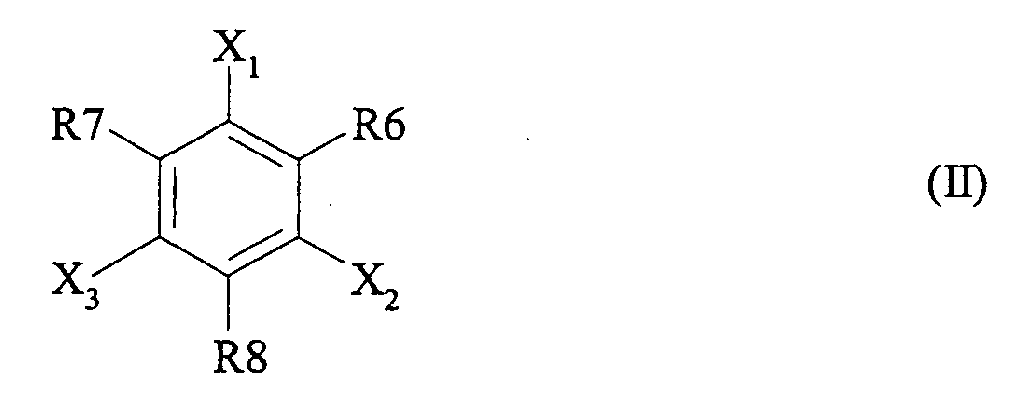
(c) a phenolic stabilizer (C) according to formula (II):
(d) optionally, an UV stabilizer,
to an article comprising such a polyolefin composition and to the use of such a composition for the production of an article.
Description
- The present invention relates to a polyolefin composition wherein the migration of the used additives and its decomposition products, especially phenols, out of the composition is low and thus the composition is particularly suitable for pipe applications, e.g. for drinking water.
- Recent progress in the manufacturing and processing of polymers have led to the application of plastics in virtually every aspect of modem day life. However, polymeric compounds are prone to aging under the effects of light, oxygen and heat. This results in a loss of strength, stiffness and flexibility, discoloration and scratching as well as loss of gloss.
- Polymeric compounds, for example polyolefins like polyethylene and polypropylene, undergo radical driven degradation processes especially during processing steps which might include moulding, extrusion, etc. However, degradation even proceeds during end-use by a radical mechanism under the influence of light or heat and will finally destroy the polymer properties.
- It is well-known in the art that antioxidants and light stabilizers can prevent or at least reduce these effects. Several types of additives are added to polymers to protect them during processing and to achieve the desired end-use properties. Additives are generally divided in stabilizers and modifiers. Typically, modifiers are anti-static and anti-fogging agents, acid scavengers, blowing agents, lubricants, nucleating agents, slip and anti-blocking agents, as well as fillers, flame retardants and cross-linkers.
- Stabilizers, like antioxidants, traditionally and currently used comprise sterically hindered phenolics, aromatic amines, organo-phosphites/phosphonites and thioethers. However, appropriate combinations of stabilizers have to be carefully selected, depending on the desired final properties the polymeric article should have.
- In
WO 2004/033545 , antioxidant compositions are disclosed for improving long-term heat stability of polymeric materials. - Besides many other applications, polyolefins are used for the preparation of pipes for drinking water distribution systems. Due to the permanent contact to the inner pipe surface, compounds can migrate from the pipe material into the water. The admissible amounts of compounds within the drinking water are fixed by legal requirements and even stricter requirements are to be expected with the introduction of the so-called "European acceptance scheme".
- Migration behavior of stabilizers and modifiers and/or decomposition products added to polyolefin-based materials is dependent from a number of different properties such as diffusion rate of the molecules within the polymer matrix, chemical stability of the additives, etc.. Furthermore, it has to be taken into account that an improvement in migration behavior must not be obtained on the expense of stabilization of the polymer matrix. Thus, providing an additive composition of low migration tendency, is not straightforward but rather needs a careful selection of appropriate compounds.
-
GB 2 305 180 - However, considering stricter legal requirements to be expected in the near future, it is highly appreciated to provide pipes of high thermal and chemical stability and releasing only very small amounts of additives and/or decomposition products into the water.
- Thus, it is an object of the present invention to provide a composition which has a low migration tendency of stabilisers and their decomposition products, in particular of phenolic compounds, without losing the stabilisation effect of the stabilisers, in particular as regards stabilisation during processing and for obtaining the desired long-term properties.
- The present invention is based on the finding that the object of the invention can be achieved, if the polymer composition comprises a specific combination of additives including a vitamin E-type stabiliser as defined below.
- The invention therefore provides a polyolefin composition comprising
- (a) a polyolefin (A),
- (b) a vitamin E-type stabiliser (B) according to formula (I):

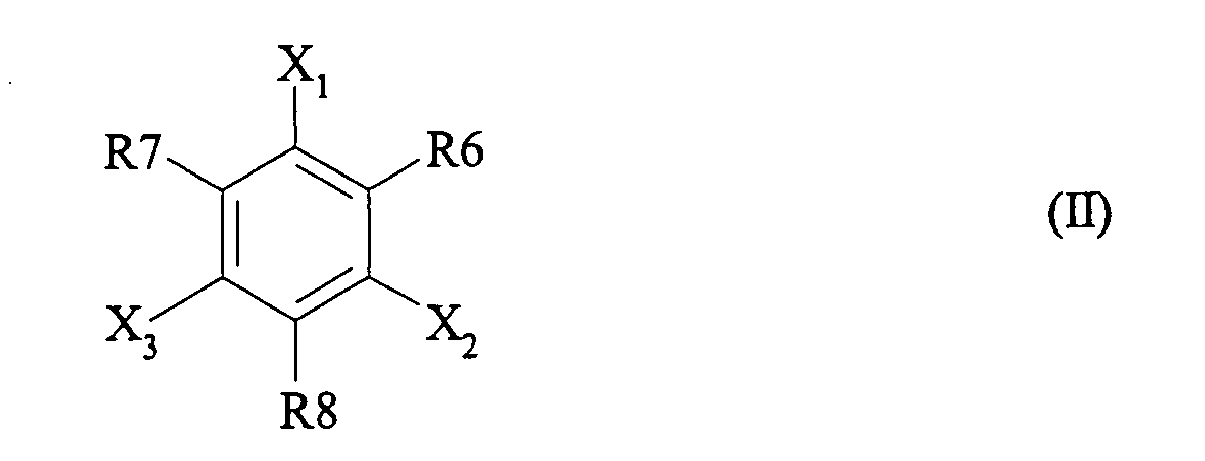
- (c) a phenolic stabilizer (C) according to formula (II):
- (d) optionally, an UV stabilizer (D).
- It has been found that the stabilized polyolefin compositions according to the invention show a reduced migration of phenolic compounds into water in contact with the composition compared to known, usual stabilized compositions. At the same time, a reduced total amount of stabilizers is needed to obtain the desired stabilization effects.
- The heteroatoms which may be present in the non-substituted or substituted aliphatic or aromatic hydrocarbyl radicals R1, R2, R3, R4 and/or R5 of the vitamin E-type stabiliser (B) according to formula (I) may be oxygen, sulphur, nitrogen, phosphorus or the like. It is, however, preferred that R1, R2, R3, R4 or R5, more preferred R1, R2, R3, R4 and R5, do not comprise heteroatoms, i.e. are non-substituted or substituted aliphatic or aromatic hydrocarbyl radicals only, or, as mentioned, H.
- Furthermore, preferably R2, R3, R4 or R5, more preferably R2, R3, R4 and R5, are H, or saturated aliphatic hydrocarbyl radicals comprising from 1 to 5 carbon atoms, and still more preferably R2, R3, R4 or R5, more preferably R2, R3, R4 and R5, are H, or methyl groups.
- Furthermore, preferably R5 is a methyl group, regardless of the nature of the other residues R2 to R4.
- In an especially preferred embodiment, R4 and R5 are methyl groups, and R2 and R3 are H, or methyl groups.
- Most preferably, R2, R3, R4 and R5 are all methyl groups.
- Still further, preferably R1 is a non-substituted or substituted aliphatic or aromatic hydrocarbyl radical containing from 5 to 50 carbon atoms, more preferably R1 is a non-substituted or substituted aliphatic hydrocarbyl radical containing from 5 to 50, more preferably from 10 to 30, carbon atoms, and most preferably R1 is a 4,8,12-trimethyl-tridecyl group.
- Vitamin E-type stabiliser (B) is preferably contained in the composition in an amount of at most 0.5 wt%, more preferably of at most 0.2 wt%, still more preferably of at most 0.1 wt.%, and most preferably of at most 0.05 wt%, based on the total composition.
- Furthermore, vitamin E-type stabiliser (B) is preferably contained in the composition in an amount of at least 0.005 wt%, more preferably of at least 0.01 wt.%, and most preferably of at least 0.015 wt%, based on the total composition.
- In the phenolic stabilizer (C) according to formula (II) residues R6, R7 and R8 independently are non-substituted or substituted aliphatic or aromatic hydrocarbyl radicals which may comprise OH-groups. This means that apart from OH-groups no further heteroatoms are present in R6, R7 and R8, so that phenolic stabilizer (C) is e.g. free of ester groups, amide groups and groups containing phosphorus.
- Preferably, R6, R7 and R8 which independently are non-substituted or substituted aliphatic or aromatic, more preferably aliphatic, hydrocarbyl radicals which may comprise OH-groups, have from 2 to 200 carbon atoms.
- Preferably, R6 and R7 independently have from 2 to 20 carbon atoms, more preferably from 3 to 10 carbon atoms.
- Furthermore, it is preferred that R6 and/or R7, more preferably R6 and R7, are aliphatic hydrocarbyl groups with at least 3 carbon atoms which have a branch at the second carbon atom, and most preferably R6 and/or R7, more preferably R6 and R7, are tert. butyl groups.
- Preferably, R8 has from 20 to 100 carbon atoms, more preferably has from 30 to 70 carbon atoms.
- Furthermore, it is preferred that R8 includes one or more phenyl residues.
- Still further, it is preferred that R8 includes one or more hydroxyphenyl residues.
- In the most preferred embodiment, R8 is a 2,4,6-tri-methyl-3,5-di-(3,5,-di-tert. butyl-4-hydroxyphenyl) benzene residue.
- Preferably, in phenolic stabilizer (C) of formula (II) X1 is OH, and most preferably X1 is OH and X2 and X3 are H.
- The amount of phenolic stabilizer (C) preferably is 0.02 wt% or more, more preferably 0.05 wt% or more, and most preferably 0.08 wt% or more.
- The upper limit of the amount of phenolic stabilizer (C) preferably is equal to or less than 1 wt%, more preferably equal to or less than 0.5 wt%, and most preferably equal to or less than 0.3 wt%.
- Preferably, the weight ratio between vitamin E-type stabiliser (B) and phenolic stabilizer (C) is from 1 : 20 to 1 : 1, more preferably is from 1 : 10 to 1 : 2, most preferably is from 1 : 6 to 1 : 2.
- Furthermore, it is preferred that the total amount of stabilisers (B) and (C) in the composition is at most 1.5 wt.%, more preferably at most 1 wt.%, and most preferably at most 0.5 wt.%.
- Preferably, the total amount of stabilisers (B) and (C) in the composition is at least 0.05 wt.%, more preferably at least 0.08 wt.%, and most preferably at least 0.1 wt.%.
- Opotinally, the composition according to the invention comprises an UV stabilizer (D). In a preferred embodiment of the invention UV stabilizer (D) is mandatorily present in the composition.
- The UV-light stabilizer (D) preferably comprises, more preferably consists of, a sterically hindered amine. Conventional sterically hindered amines working as UV-light stabilizer (frequently abbreviated as HALS: hindered amine light stabilizer) known in the art can be used, e.g. in
WO 2005/014706 suitable sterically hindered amine are disclosed. - In the present invention it is preferred that the sterically hindered amine comprises one or more groups of the following formula:

- In a preferred embodiment, the sterically hindered amine is a polymer of 2,2,4,4-tetramethyl-7-oxa-3,20-diaza-dispiro -(5.1.11.2)- heneicosane-21-one and Epichlorohydrin
- The UV-light stabilizer is preferably used in an amount of 0.01 to 1 wt%, more preferred of 0.05 to 0.5 wt% , based on the total composition.
- In another preferred embodiment the UV stabilizer (D) comprises, more preferably consists of, carbon black. In this embodiment, carbon black preferably is used in an amount from 0.2 to 3.5 wt%, more preferably from 1.0 to 3.5 wt%, and most preferably from 2.0 to 3.0 wt%, based on the total composition.
- It is preferred that the composition of the invention is free of any (additional) phosphoros-containing stabilisers, and it is even more preferred that apart from stabilizers (B), (C) and, optionally, (D) no further stabilizers are present in the composition, i.e. that the only stabilisers present in the composition are stabilizers (B) and (C) and, optionally, (D) in any of the embodiments as described herein.
- Furthermore, it is preferred that polyolefin (A) is an ethylene homo- or copolymer or a propylene homo- or copolymer. Most preferably, the polyolefin is an ethylene homo- or copolymer.
- The polyolefin (A) can be obtained by any method known in the art.
- Of course, when using the inventive composition, further compounds selected from conventional additives, acid scavengers, fillers, minerals and lubricants may be added for improving processability and surface characteristics thereof.
- Preferably, the polyolefin composition of the invention has a total release of phenols at 200 °C and 5 min of at most 5 nanogram per milligram of the composition (ng/mg), more preferably of at most 3 ng/mg, and most preferably of at most 2 ng/mg, measured according to the total-release-of-phenols polymer analysis method as described in the examples section.
- Furthermore, from the polyolefin composition of the invention an amount of at most 1 microgram of phenolic decomposition and/or by-products per liter of water (microg/liter) migrates into water, more preferably of at most 0.8 microg/liter, and most preferably of at most 0.5 microg/liter, measured according to the migration-into-water analysis method as described in the examples section.
- The term "phenolic decomposition and/or by-products" denotes those phenolic compounds present in the composition, which either were formed by the decomposition of phenolic compounds which have been originally incorporated into the composition or which are phenolic by-products present in the phenolic compounds, as impurities, e.g. phenolic compounds with different structure to those intentionally added. As usually, and preferably, the only phenolic compounds incorporated into the composition are stabilizers, usually, and preferably, the only phenolic decomposition products present in the composition are originating from the stabilizers added.
- The composition of the present invention is preferably used in pipes. This may be black as well as natural (i.e. non-colored) or colored pipes.
- Preferably, such a pipe is used in a drinking water supply system. As it is shown below the use of the inventive composition in water pipes leads to a reduction of migration of additives and decomposition products thereof into water being in contact with said pipe.
- It is furthermore preferred that the pipe is a cold water pipe, i.e. that it is designed for the transport of cold water.
-
- a) Melt flow rate (MFR) of the polymer was measured according to ISO 1133 at a temperature of 190 °C. The load is indicated as a subscript, i.e. MFR5 is measured under a load of 5 kg.
- b) Total-release-of-phenols polymer analysis
Pipe samples (in mg) were placed in an empty glass tube. The tube was heated to 200 °C during five minutes in Automated Thermal Desorption (ATD) device, the released organic substances were injected onto a gas chromatograph (GC) for separation, identified by mass spectrometry (MS) and quantified using flame ionization detector (FID).
Phenolic compounds were quantified using the same compounds as calibrant where possible. Other phenolic compounds found in the samples were quantified using structurally similar compounds. - c) Measurement of phenolic decomposition and/or by-products migration-into-water
Pipe samples were leached with unchlorinated water according to EN-12873-1 at room temperature (23 ± 2 °C). Water from the third migration period was analyzed for content of organic compounds. Water samples were extracted with methylene chloride. Isotopically labelled internal standards were added to the water before extraction. After concentration of the extracts, isotopically labelled injection standard was added, and the extracts were analyzed by gas chromatography with mass selective detector according to the draft CEN standard. "The GC-MS identification of water leachable organic substances from materials in contact with water intended for human consumption". This draft CEN Standard has been prepared by CEN TC 164 WG3 AHG7 based on the co-normative research project EVK1-CT 2000-00052 and work funded by DG Enterprise and Industry (Grant Agreement S12.403892). - As procedural blank, ultra pure water (Milli-Q) stored in acid washed glassware under the same time periods as leaching tests, was extracted with methylene chloride and all standards were added as described in the test method.
- The ratio of the surface area (S) of the test piece intended to come into contact with test water to volume (V) of the test water shall be expressed per decimeter, i.e. dm-1 (which is dm2/dm3 or dm2/liter). Surface-to-volume (S/V) ratio should be in the range of 5 dm-1 to 40 dm-1. In the present invention the ratio S/V was 15.4 dm-1.
- The concentrations were then calculated according to

- [D] is the concentration of a compounds D (in µg/liter);
- AD is the peak area of compound D;
- Al is the peak area of the internal standard;
- [I] is the concentration of the internal standard (in µg/liter)
- Phenolic compounds were quantified using the same compounds as calibrant where possible. Other phenolic compounds found in the samples were quantified using structurally similar compounds.
- The compositions (Example 1 and 2) were compounded/melt homogenized in a Buss-Co-Kneader 100 MDK/E-11 L/D. Polymer and additives were fed into the first mixer inlet of the Buss Co-Kneader which is a single screw extruder with a downstream discharge single extruder with pelletizing unit cutting pellets in molten stage and cooled via water. The mixer temperature profile was 113/173/199/193/200°C from first inlet to outlet, and discharge extruder temperature 166°C. The mixer screw rpm was 201 rpm and the throughput 200 kg/h. Pipes 32 x 3 mm (outer diameter x wall thickness) were prepared by extrusion in a Battenfeld 45-25B extruder, which gave an output of 33 kg/h at a screw speed of 39 rpm. The extruder melt temperature was 207°C.
- The following compounds were used in the preparation of the compositions/pipes:
- First stabilisers:
- 2,5,7,8-tetrametyl-2(4'8'12'-trimethyldecyl)chroman-6-ol (Irganox E 201™, vitamin E) commercially available from Ciba Speciality Chemical
- Tris(2,4-di-t-butylphenyl)phosphite (Irgafos 168™) commercially available from Ciba Speciality Chemical
- Phenolic Stabilisers:
- Pentaerythrityl-terakis(3-(3',5'-di-tert. Butyl-4-hydroxyphenyl)-propionate (Irganox 1010™) commercially available from Ciba Speciality Chemicals,
- 1,3,5-Tri-methyl-2-4,6-tris-(3,5-di-tert. butyl-4-hydroxy phenyl benzene (Ethanox 330™) commercially available from Albemarle
- Carbon black masterbatch:
- The carbon black masterbatch (CBMB) contained 60.4 wt% HDPE, 39.5 wt% CB and 0.1 wt% Irganox 1010.
- Base polymer:
- Polyolefin (A) used as base polymer in all samples was an unstabilised bimodal high density polyethylene with a total butene comonomer content of 1.05 wt.% whereby the comonomer was present exclusively in the high molecular weight part of the polyethylene, an MFR5 of 0.25 g/10min, and a density of 948 kg/m3.
- The following compositions have been prepared:
Table 1: Compositions prepared, all data are given in wt.% Example 1 (Comp.) Example 2 base polymer (A) 93.88 93.96 calcium stearate 0.150 0.150 carbon black MB 5.75 5.75 Irgafos 168 (B) 0.11 - Irganox 1010 (C) 0.11 - Ethanox 330 (D) - 0.11 Vitamin E (E) - 0.03 total amount stabilisers 0.22 0.14 - In Table 2, the results of both the polymer analysis as to total amount of phenols released at 200 °C and 5 min, and the measurement of phenolic decomposition and/or by-products migration-into-water are given.
- From the results in Table 2 it can be seen that in the composition according to the invention a very much lower amount of phenols is contained in the composition itself, because less phenols are released in the above described test method. Furthermore, the migration of phenolic decomposition and/or by-products of the stabilizers used into water is drastically reduced.
Table 2: Example 1 (Comp.) Example 2 Polymer analysis (total release of phenols in ng/mg composition) 9.9 1.1 Phenolic decomposition and/or by-products migration-into-water (total amount in microg/liter, (Surface/Volume ratio was 15.4 dm-1)) 1.2 (migrated decomposition and/or by-products from (B) and (C)) 0.1 (migrated decomposition and/or by-products from (D) and (E))
Claims (23)
- A polyolefin composition comprising(a) a polyolefin (A),(b) a vitamin E-type stabiliser (B) according to formula (I):
 (c) a phenolic stabilizer (C) according to formula (II):
and,(d) optionally, an UV stabilizer (D). - Polyolefin composition according to claim 1 wherein in vitamin E-type stabilizer of formula (I) R2, R3, R4 and R5 independently are H, or saturated aliphatic hydrocarbyl radicals comprising from 1 to 5 carbon atoms.
- Polyolefin composition according to claim 1 or 2 wherein in vitamin E-type stabilizer of formula (I) R1 is a non-substituted or substituted aliphatic hydrocarbyl radical containing from 5 to 50 carbon atoms.
- Polyolefin composition according to any of the preceding claims wherein vitamin E-type stabiliser (B) is contained in the composition in an amount of at most 0.5 wt%.
- Polyolefin composition according to any of the preceding claims wherein vitamin E-type stabiliser (B) is contained in the composition in an amount of at least 0.005 wt.%.
- Polyolefin composition according to any of the preceding claims wherein in phenolic stabilizer (C) of formula (II) R6, R7 and R8 independently are non-substituted or substituted aliphatic hydrocarbyl radicals which may comprise OH-groups, and have from 2 to 200 carbon atoms.
- Polyolefin composition according to any of the preceding claims wherein in phenolic stabilizer (C) of formula (II) R6 and R7 are aliphatic hydrocarbyl groups with at least 3 carbon atoms which have a branch at the second carbon atom.
- Polyolefin composition according to any of the preceding claims wherein in phenolic stabilizer (C) of formula (II) R8 has from 20 to 100 carbon atoms.
- Polyolefin composition according to any of the preceding claims wherein in phenolic stabilizer (C) of formula (II) R8 includes one or more hydroxy phenyl residues.
- Polyolefin composition according to any of the preceding claims wherein the amount of phenolic stabilizer (C) is 0.02 wt% or more.
- Polyolefin composition according to any of the preceding claims wherein the amount of phenolic stabilizer (C) is 1 wt% or less.
- Polyolefin composition according to any of the preceding claims wherein the weight ratio between vitamin E-type stabiliser (B) and phenolic stabilizer (C) is from 1 : 20 to 1 : 1.
- Polyolefin composition according to any of the preceding claims wherein the total amount of stabilisers (B) and (C) in the composition is at most 1.5 wt.%.
- Polyolefin composition according to any of the preceding claims wherein the total amount of stabilisers (B) and (C) in the composition is at least 0.05 wt.%.
- Polyolefin composition according to any of the preceding claims wherein UV stabilizer (D) is mandatorily present.
- Polyolefin composition according to claim 15 wherein the UV stabilizer comprises a sterically hindered amine and/or carbon black.
- Polyolefin composition according to any of the preceding claims wherein polyolefin (A) is an ethylene homo- or copolymer.
- Polyolefin composition according to any of the preceding claims wherein the composition has a total release of phenols at 200 °C and 5 min of at most 5 nanogram per milligram of the composition (ng/mg), measured according to the total-release-of-phenols polymer analysis method.
- Polyolefin composition according to any of the preceding claims wherein from the composition an amount of at most 1 microgram of phenolic decomposition and/or by-products per liter of water (microg/liter) migrates into water, measured according to the migration-into-water analysis method.
- Article comprising the polyolefin composition according to any of the preceding claims.
- Article according to claim 20 wherein the article is a pipe.
- Use of a polyolefin composition according to any of claims 1 to 19 for the production of an article.
- Use according to claim 22 wherein the article is a pipe.
Priority Applications (11)
| Application Number | Priority Date | Filing Date | Title |
|---|---|---|---|
| EP07013786A EP2014704B1 (en) | 2007-07-13 | 2007-07-13 | Low migration polyolefin composition comprising vitamin E-type stabiliser |
| DE602007011245T DE602007011245D1 (en) | 2007-07-13 | 2007-07-13 | Low migration polyolefin composition and a vitamin E-like stabilizer |
| ES07013786T ES2356137T3 (en) | 2007-07-13 | 2007-07-13 | LOW MIGRATION POLYOLEFIN COMPOSITION INCLUDING A VITAMIN E TYPE STABILIZER. |
| PT07013786T PT2014704E (en) | 2007-07-13 | 2007-07-13 | Low migration polyolefin composition comprising vitamin e-type stabiliser |
| PL07013786T PL2014704T3 (en) | 2007-07-13 | 2007-07-13 | Low migration polyolefin composition comprising vitamin E-type stabiliser |
| AT07013786T ATE491743T1 (en) | 2007-07-13 | 2007-07-13 | LOW MIGRATION POLYOLEFIN COMPOSITION AND A VITAMIN E-TYPE STABILIZER |
| CN2008800244865A CN101848963B (en) | 2007-07-13 | 2008-07-08 | Low migration polyolefin composition comprising vitamin E-type stabilizer |
| RU2010100878/05A RU2423638C1 (en) | 2007-07-13 | 2008-07-08 | Low-emission polyolefin composition containing vitamin e type stabiliser |
| US12/668,098 US8501844B2 (en) | 2007-07-13 | 2008-07-08 | Low migration polyolefin composition comprising vitamin E-type stabiliser |
| PCT/EP2008/005563 WO2009010211A1 (en) | 2007-07-13 | 2008-07-08 | Low migration polyolefin composition comprising vitamin e-type stabiliser |
| AU2008278010A AU2008278010B2 (en) | 2007-07-13 | 2008-07-08 | Low migration polyolefin composition comprising vitamin E-type stabiliser |
Applications Claiming Priority (1)
| Application Number | Priority Date | Filing Date | Title |
|---|---|---|---|
| EP07013786A EP2014704B1 (en) | 2007-07-13 | 2007-07-13 | Low migration polyolefin composition comprising vitamin E-type stabiliser |
Publications (2)
| Publication Number | Publication Date |
|---|---|
| EP2014704A1 true EP2014704A1 (en) | 2009-01-14 |
| EP2014704B1 EP2014704B1 (en) | 2010-12-15 |
Family
ID=38514109
Family Applications (1)
| Application Number | Title | Priority Date | Filing Date |
|---|---|---|---|
| EP07013786A Not-in-force EP2014704B1 (en) | 2007-07-13 | 2007-07-13 | Low migration polyolefin composition comprising vitamin E-type stabiliser |
Country Status (11)
| Country | Link |
|---|---|
| US (1) | US8501844B2 (en) |
| EP (1) | EP2014704B1 (en) |
| CN (1) | CN101848963B (en) |
| AT (1) | ATE491743T1 (en) |
| AU (1) | AU2008278010B2 (en) |
| DE (1) | DE602007011245D1 (en) |
| ES (1) | ES2356137T3 (en) |
| PL (1) | PL2014704T3 (en) |
| PT (1) | PT2014704E (en) |
| RU (1) | RU2423638C1 (en) |
| WO (1) | WO2009010211A1 (en) |
Cited By (8)
| Publication number | Priority date | Publication date | Assignee | Title |
|---|---|---|---|---|
| EP2199330A1 (en) * | 2008-12-22 | 2010-06-23 | Borealis AG | Polyolefin composition for water pipes with good resistance to chlorine dioxide and low migration |
| WO2012082578A3 (en) * | 2010-12-13 | 2012-08-16 | Cytec Technology Corp. | Processing additives and uses of same in rotational molding |
| EP2511332A1 (en) | 2011-04-15 | 2012-10-17 | Borealis AG | Polyolefin pipe with improved migration behaviour |
| WO2013004334A1 (en) * | 2011-07-05 | 2013-01-10 | Borealis Ag | Use of carbon black and antioxidants for reducing taste and/or odour in a polyolefin composition |
| EP2607417A1 (en) | 2011-12-22 | 2013-06-26 | Borealis AG | Polyolefin composition with increased resistance against degradation caused by chlorine dioxide |
| EP2725057A1 (en) | 2012-10-24 | 2014-04-30 | Borealis AG | Use of an acid scavenger to increase the resistance of a polyolefin composition against disinfectant containing water |
| WO2015078886A1 (en) | 2013-11-29 | 2015-06-04 | Saudi Basic Industries Corporation | Stabilised polyolefin composition |
| EP2987825A1 (en) | 2014-08-21 | 2016-02-24 | Borealis AG | Low volatile polyolefin composition comprising vitamin E-type stabiliser |
Families Citing this family (4)
| Publication number | Priority date | Publication date | Assignee | Title |
|---|---|---|---|---|
| US11267951B2 (en) | 2010-12-13 | 2022-03-08 | Cytec Technology Corp. | Stabilizer compositions containing substituted chroman compounds and methods of use |
| WO2014108382A1 (en) * | 2013-01-10 | 2014-07-17 | Saudi Basic Industries Corporation | Polyethylene composition |
| EP2889323A1 (en) | 2013-12-30 | 2015-07-01 | Abu Dhabi Polymers Company Limited (Borouge) | Polymer composition comprising carbon black and a carrier polymer for the carbon black |
| US10882986B2 (en) | 2015-10-01 | 2021-01-05 | Sabic Global Technologies B.V. | Pipe produced with a polymer composition comprising a polyolefin |
Citations (8)
| Publication number | Priority date | Publication date | Assignee | Title |
|---|---|---|---|---|
| EP0569950A1 (en) * | 1992-05-11 | 1993-11-18 | Fuji Photo Film Co., Ltd. | Molded articles for photographic photosensitive materials |
| GB2305180A (en) | 1995-09-15 | 1997-04-02 | Ciba Geigy Ag | Stabilisation of polyolefins in permanent contact with extracting media |
| WO1997049758A1 (en) * | 1996-06-27 | 1997-12-31 | Clariant International Limited | Stabilizer compositions |
| US5880186A (en) * | 1994-09-23 | 1999-03-09 | Ciba Specialty Chemicals Corporation | Stabilized filled polyolefins |
| US6465548B1 (en) * | 1997-10-02 | 2002-10-15 | Yoshitomi Fine Chemicals, Ltd. | Stabilizer for organic polymer material and organic polymer material composition |
| WO2004033545A1 (en) | 2002-10-08 | 2004-04-22 | Borealis Technology Oy | Stabilized polymer composition |
| US20050250889A1 (en) * | 2000-08-09 | 2005-11-10 | Jan Malik | Synergistc stabilizer composition for color stable pigmented thermophastic polymers in prolonged contact with water |
| US20060167146A1 (en) * | 2002-09-11 | 2006-07-27 | Bruno Rotzinger | Stabillization of organic materials |
Family Cites Families (6)
| Publication number | Priority date | Publication date | Assignee | Title |
|---|---|---|---|---|
| DE3374849D1 (en) * | 1983-05-04 | 1988-01-21 | Mitsui Petrochemical Ind | Poly-1-butene resin composition and water pipe manufactured therefrom |
| US4532165A (en) * | 1983-05-09 | 1985-07-30 | Mitsui Petrochemical Industries Ltd. | Poly-1-butene resin composition |
| ES2276335T3 (en) | 2003-07-18 | 2007-06-16 | Ciba Specialty Chemicals Holding Inc. | FLAME DELAY POLYLACTIC ACID. |
| CN1253496C (en) * | 2003-10-28 | 2006-04-26 | 宁波金海雅宝化工有限公司 | Combination of stabilizing agent in use for producing polyolefine resin |
| MY145338A (en) * | 2003-12-04 | 2012-01-31 | Dow Global Technologies Inc | Stabilized polyethylene material |
| EP2199330A1 (en) * | 2008-12-22 | 2010-06-23 | Borealis AG | Polyolefin composition for water pipes with good resistance to chlorine dioxide and low migration |
-
2007
- 2007-07-13 DE DE602007011245T patent/DE602007011245D1/en active Active
- 2007-07-13 PL PL07013786T patent/PL2014704T3/en unknown
- 2007-07-13 AT AT07013786T patent/ATE491743T1/en not_active IP Right Cessation
- 2007-07-13 ES ES07013786T patent/ES2356137T3/en active Active
- 2007-07-13 PT PT07013786T patent/PT2014704E/en unknown
- 2007-07-13 EP EP07013786A patent/EP2014704B1/en not_active Not-in-force
-
2008
- 2008-07-08 CN CN2008800244865A patent/CN101848963B/en active Active
- 2008-07-08 US US12/668,098 patent/US8501844B2/en active Active
- 2008-07-08 WO PCT/EP2008/005563 patent/WO2009010211A1/en not_active Ceased
- 2008-07-08 AU AU2008278010A patent/AU2008278010B2/en not_active Ceased
- 2008-07-08 RU RU2010100878/05A patent/RU2423638C1/en not_active IP Right Cessation
Patent Citations (8)
| Publication number | Priority date | Publication date | Assignee | Title |
|---|---|---|---|---|
| EP0569950A1 (en) * | 1992-05-11 | 1993-11-18 | Fuji Photo Film Co., Ltd. | Molded articles for photographic photosensitive materials |
| US5880186A (en) * | 1994-09-23 | 1999-03-09 | Ciba Specialty Chemicals Corporation | Stabilized filled polyolefins |
| GB2305180A (en) | 1995-09-15 | 1997-04-02 | Ciba Geigy Ag | Stabilisation of polyolefins in permanent contact with extracting media |
| WO1997049758A1 (en) * | 1996-06-27 | 1997-12-31 | Clariant International Limited | Stabilizer compositions |
| US6465548B1 (en) * | 1997-10-02 | 2002-10-15 | Yoshitomi Fine Chemicals, Ltd. | Stabilizer for organic polymer material and organic polymer material composition |
| US20050250889A1 (en) * | 2000-08-09 | 2005-11-10 | Jan Malik | Synergistc stabilizer composition for color stable pigmented thermophastic polymers in prolonged contact with water |
| US20060167146A1 (en) * | 2002-09-11 | 2006-07-27 | Bruno Rotzinger | Stabillization of organic materials |
| WO2004033545A1 (en) | 2002-10-08 | 2004-04-22 | Borealis Technology Oy | Stabilized polymer composition |
Non-Patent Citations (1)
| Title |
|---|
| YOUNG, SAI S. ET AL YOUNG, SAI S. ET AL: "A synergistic liquid antioxidant blend for stabilization of polyolefins A synergistic liquid antioxidant blend for stabilization of polyolefins", ADDCON '95: WORLDWIDE ADDITIVES & POLYMER MODIFIERS CONFERENCE, BOOK OF PAPERS, BASEL, APR. 5-6, 1995 , 8PP PAPER 14 PUBLISHER: RAPRA TECHNOLOGY, SHREWSBURY, UK. CODEN: 62WMAW ADDCON '95: WORLDWIDE ADDITIVES & POLYMER MODIFIERS CONFERENCE, BOOK OF PA, 5 April 1195 (1195-04-05), pages 1 - 8, XP009089887 * |
Cited By (16)
| Publication number | Priority date | Publication date | Assignee | Title |
|---|---|---|---|---|
| WO2010072373A1 (en) | 2008-12-22 | 2010-07-01 | Borealis Ag | Polyolefin composition for water pipes with good resistance to chlorine dioxide and low migration |
| EP2199330A1 (en) * | 2008-12-22 | 2010-06-23 | Borealis AG | Polyolefin composition for water pipes with good resistance to chlorine dioxide and low migration |
| US8969445B2 (en) | 2008-12-22 | 2015-03-03 | Borealis Ag | Polyolefin composition for water pipes with good resistance to chlorine dioxide and low migration |
| RU2597918C2 (en) * | 2010-12-13 | 2016-09-20 | Сайтек Текнолоджи Корп. | Process additives and use thereof in rotary moulding |
| WO2012082578A3 (en) * | 2010-12-13 | 2012-08-16 | Cytec Technology Corp. | Processing additives and uses of same in rotational molding |
| RU2742578C2 (en) * | 2010-12-13 | 2021-02-08 | Сайтек Текнолоджи Корп. | Process additives and their use in rotary molding |
| EP2511332A1 (en) | 2011-04-15 | 2012-10-17 | Borealis AG | Polyolefin pipe with improved migration behaviour |
| WO2012139673A1 (en) | 2011-04-15 | 2012-10-18 | Borealis Ag | Polyolefin pipe with improved migration behaviour |
| US9522988B2 (en) | 2011-04-15 | 2016-12-20 | Borealis Ag | Polyolefin pipe with improved migration behaviour |
| WO2013004334A1 (en) * | 2011-07-05 | 2013-01-10 | Borealis Ag | Use of carbon black and antioxidants for reducing taste and/or odour in a polyolefin composition |
| EP2607417A1 (en) | 2011-12-22 | 2013-06-26 | Borealis AG | Polyolefin composition with increased resistance against degradation caused by chlorine dioxide |
| WO2013091800A1 (en) | 2011-12-22 | 2013-06-27 | Borealis Ag | Polyolefin composition with increased resistance against degradation caused by chlorine dioxide |
| EP2725057A1 (en) | 2012-10-24 | 2014-04-30 | Borealis AG | Use of an acid scavenger to increase the resistance of a polyolefin composition against disinfectant containing water |
| WO2014063762A1 (en) | 2012-10-24 | 2014-05-01 | Borealis Ag | Use of an acid scavenger to increase the resistance of a polyolefin composition against disinfectant containing water |
| WO2015078886A1 (en) | 2013-11-29 | 2015-06-04 | Saudi Basic Industries Corporation | Stabilised polyolefin composition |
| EP2987825A1 (en) | 2014-08-21 | 2016-02-24 | Borealis AG | Low volatile polyolefin composition comprising vitamin E-type stabiliser |
Also Published As
| Publication number | Publication date |
|---|---|
| DE602007011245D1 (en) | 2011-01-27 |
| RU2423638C1 (en) | 2011-07-10 |
| AU2008278010B2 (en) | 2011-10-20 |
| ES2356137T3 (en) | 2011-04-05 |
| ATE491743T1 (en) | 2011-01-15 |
| CN101848963A (en) | 2010-09-29 |
| WO2009010211A1 (en) | 2009-01-22 |
| CN101848963B (en) | 2012-12-19 |
| AU2008278010A1 (en) | 2009-01-22 |
| US20100266798A1 (en) | 2010-10-21 |
| US8501844B2 (en) | 2013-08-06 |
| PT2014704E (en) | 2011-03-07 |
| EP2014704B1 (en) | 2010-12-15 |
| PL2014704T3 (en) | 2011-05-31 |
Similar Documents
| Publication | Publication Date | Title |
|---|---|---|
| EP2014704B1 (en) | Low migration polyolefin composition comprising vitamin E-type stabiliser | |
| EP2367877B1 (en) | Polyolefin composition for water pipes with good resistance to chlorine dioxide and low migration | |
| US8652604B2 (en) | Low migration polyolefin composition | |
| AU2012359241B2 (en) | Polyolefin composition with increased resistance against degradation caused by chlorine dioxide | |
| EP2511332B1 (en) | Polyolefin pipe with improved migration behaviour | |
| EP2361280B1 (en) | Polyethylene composition for water pipes with improved chlorine resistance | |
| EP2551297B1 (en) | Polyolefin composition with excellent colour and thermal stability as well as oxidation resistance for pipes | |
| AU2012289243C1 (en) | Polyolefin composition with excellent colour and thermal stability as well as oxidation resistance for pipes |
Legal Events
| Date | Code | Title | Description |
|---|---|---|---|
| PUAI | Public reference made under article 153(3) epc to a published international application that has entered the european phase |
Free format text: ORIGINAL CODE: 0009012 |
|
| 17P | Request for examination filed |
Effective date: 20070713 |
|
| AK | Designated contracting states |
Kind code of ref document: A1 Designated state(s): AT BE BG CH CY CZ DE DK EE ES FI FR GB GR HU IE IS IT LI LT LU LV MC MT NL PL PT RO SE SI SK TR |
|
| AX | Request for extension of the european patent |
Extension state: AL BA HR MK RS |
|
| 17Q | First examination report despatched |
Effective date: 20090226 |
|
| AKX | Designation fees paid |
Designated state(s): AT BE BG CH CY CZ DE DK EE ES FI FR GB GR HU IE IS IT LI LT LU LV MC MT NL PL PT RO SE SI SK TR |
|
| GRAP | Despatch of communication of intention to grant a patent |
Free format text: ORIGINAL CODE: EPIDOSNIGR1 |
|
| GRAS | Grant fee paid |
Free format text: ORIGINAL CODE: EPIDOSNIGR3 |
|
| GRAA | (expected) grant |
Free format text: ORIGINAL CODE: 0009210 |
|
| AK | Designated contracting states |
Kind code of ref document: B1 Designated state(s): AT BE BG CH CY CZ DE DK EE ES FI FR GB GR HU IE IS IT LI LT LU LV MC MT NL PL PT RO SE SI SK TR |
|
| REG | Reference to a national code |
Ref country code: GB Ref legal event code: FG4D Ref country code: CH Ref legal event code: EP |
|
| REG | Reference to a national code |
Ref country code: IE Ref legal event code: FG4D |
|
| REF | Corresponds to: |
Ref document number: 602007011245 Country of ref document: DE Date of ref document: 20110127 Kind code of ref document: P |
|
| RIN2 | Information on inventor provided after grant (corrected) |
Inventor name: ODERKERK, JEROEN Inventor name: ANKER, MARTIN Inventor name: JAMTVEDT, SVEIN |
|
| REG | Reference to a national code |
Ref country code: NL Ref legal event code: T3 |
|
| REG | Reference to a national code |
Ref country code: PT Ref legal event code: SC4A Free format text: AVAILABILITY OF NATIONAL TRANSLATION Effective date: 20110228 |
|
| REG | Reference to a national code |
Ref country code: SE Ref legal event code: TRGR |
|
| REG | Reference to a national code |
Ref country code: ES Ref legal event code: FG2A Ref document number: 2356137 Country of ref document: ES Kind code of ref document: T3 Effective date: 20110405 |
|
| PG25 | Lapsed in a contracting state [announced via postgrant information from national office to epo] |
Ref country code: LT Free format text: LAPSE BECAUSE OF FAILURE TO SUBMIT A TRANSLATION OF THE DESCRIPTION OR TO PAY THE FEE WITHIN THE PRESCRIBED TIME-LIMIT Effective date: 20101215 |
|
| LTIE | Lt: invalidation of european patent or patent extension |
Effective date: 20101215 |
|
| PG25 | Lapsed in a contracting state [announced via postgrant information from national office to epo] |
Ref country code: BG Free format text: LAPSE BECAUSE OF FAILURE TO SUBMIT A TRANSLATION OF THE DESCRIPTION OR TO PAY THE FEE WITHIN THE PRESCRIBED TIME-LIMIT Effective date: 20110315 Ref country code: FI Free format text: LAPSE BECAUSE OF FAILURE TO SUBMIT A TRANSLATION OF THE DESCRIPTION OR TO PAY THE FEE WITHIN THE PRESCRIBED TIME-LIMIT Effective date: 20101215 Ref country code: SI Free format text: LAPSE BECAUSE OF FAILURE TO SUBMIT A TRANSLATION OF THE DESCRIPTION OR TO PAY THE FEE WITHIN THE PRESCRIBED TIME-LIMIT Effective date: 20101215 Ref country code: CY Free format text: LAPSE BECAUSE OF FAILURE TO SUBMIT A TRANSLATION OF THE DESCRIPTION OR TO PAY THE FEE WITHIN THE PRESCRIBED TIME-LIMIT Effective date: 20101215 Ref country code: LV Free format text: LAPSE BECAUSE OF FAILURE TO SUBMIT A TRANSLATION OF THE DESCRIPTION OR TO PAY THE FEE WITHIN THE PRESCRIBED TIME-LIMIT Effective date: 20101215 Ref country code: AT Free format text: LAPSE BECAUSE OF FAILURE TO SUBMIT A TRANSLATION OF THE DESCRIPTION OR TO PAY THE FEE WITHIN THE PRESCRIBED TIME-LIMIT Effective date: 20101215 |
|
| REG | Reference to a national code |
Ref country code: PL Ref legal event code: T3 |
|
| PG25 | Lapsed in a contracting state [announced via postgrant information from national office to epo] |
Ref country code: GR Free format text: LAPSE BECAUSE OF FAILURE TO SUBMIT A TRANSLATION OF THE DESCRIPTION OR TO PAY THE FEE WITHIN THE PRESCRIBED TIME-LIMIT Effective date: 20110316 Ref country code: CZ Free format text: LAPSE BECAUSE OF FAILURE TO SUBMIT A TRANSLATION OF THE DESCRIPTION OR TO PAY THE FEE WITHIN THE PRESCRIBED TIME-LIMIT Effective date: 20101215 Ref country code: IS Free format text: LAPSE BECAUSE OF FAILURE TO SUBMIT A TRANSLATION OF THE DESCRIPTION OR TO PAY THE FEE WITHIN THE PRESCRIBED TIME-LIMIT Effective date: 20110415 Ref country code: EE Free format text: LAPSE BECAUSE OF FAILURE TO SUBMIT A TRANSLATION OF THE DESCRIPTION OR TO PAY THE FEE WITHIN THE PRESCRIBED TIME-LIMIT Effective date: 20101215 |
|
| PGFP | Annual fee paid to national office [announced via postgrant information from national office to epo] |
Ref country code: PT Payment date: 20110630 Year of fee payment: 5 |
|
| PG25 | Lapsed in a contracting state [announced via postgrant information from national office to epo] |
Ref country code: SK Free format text: LAPSE BECAUSE OF FAILURE TO SUBMIT A TRANSLATION OF THE DESCRIPTION OR TO PAY THE FEE WITHIN THE PRESCRIBED TIME-LIMIT Effective date: 20101215 Ref country code: RO Free format text: LAPSE BECAUSE OF FAILURE TO SUBMIT A TRANSLATION OF THE DESCRIPTION OR TO PAY THE FEE WITHIN THE PRESCRIBED TIME-LIMIT Effective date: 20101215 |
|
| PLBE | No opposition filed within time limit |
Free format text: ORIGINAL CODE: 0009261 |
|
| STAA | Information on the status of an ep patent application or granted ep patent |
Free format text: STATUS: NO OPPOSITION FILED WITHIN TIME LIMIT |
|
| PG25 | Lapsed in a contracting state [announced via postgrant information from national office to epo] |
Ref country code: DK Free format text: LAPSE BECAUSE OF FAILURE TO SUBMIT A TRANSLATION OF THE DESCRIPTION OR TO PAY THE FEE WITHIN THE PRESCRIBED TIME-LIMIT Effective date: 20101215 |
|
| 26N | No opposition filed |
Effective date: 20110916 |
|
| PGFP | Annual fee paid to national office [announced via postgrant information from national office to epo] |
Ref country code: PL Payment date: 20110704 Year of fee payment: 5 Ref country code: GB Payment date: 20110721 Year of fee payment: 5 Ref country code: SE Payment date: 20110722 Year of fee payment: 5 |
|
| PG25 | Lapsed in a contracting state [announced via postgrant information from national office to epo] |
Ref country code: MT Free format text: LAPSE BECAUSE OF FAILURE TO SUBMIT A TRANSLATION OF THE DESCRIPTION OR TO PAY THE FEE WITHIN THE PRESCRIBED TIME-LIMIT Effective date: 20101215 |
|
| PGFP | Annual fee paid to national office [announced via postgrant information from national office to epo] |
Ref country code: IT Payment date: 20110727 Year of fee payment: 5 |
|
| REG | Reference to a national code |
Ref country code: DE Ref legal event code: R097 Ref document number: 602007011245 Country of ref document: DE Effective date: 20110916 |
|
| PG25 | Lapsed in a contracting state [announced via postgrant information from national office to epo] |
Ref country code: MC Free format text: LAPSE BECAUSE OF NON-PAYMENT OF DUE FEES Effective date: 20110731 |
|
| REG | Reference to a national code |
Ref country code: CH Ref legal event code: PL |
|
| REG | Reference to a national code |
Ref country code: IE Ref legal event code: MM4A |
|
| PG25 | Lapsed in a contracting state [announced via postgrant information from national office to epo] |
Ref country code: LI Free format text: LAPSE BECAUSE OF NON-PAYMENT OF DUE FEES Effective date: 20110731 Ref country code: CH Free format text: LAPSE BECAUSE OF NON-PAYMENT OF DUE FEES Effective date: 20110731 |
|
| PG25 | Lapsed in a contracting state [announced via postgrant information from national office to epo] |
Ref country code: IE Free format text: LAPSE BECAUSE OF NON-PAYMENT OF DUE FEES Effective date: 20110713 |
|
| REG | Reference to a national code |
Ref country code: PT Ref legal event code: MM4A Free format text: LAPSE DUE TO NON-PAYMENT OF FEES Effective date: 20130114 |
|
| REG | Reference to a national code |
Ref country code: SE Ref legal event code: EUG |
|
| GBPC | Gb: european patent ceased through non-payment of renewal fee |
Effective date: 20120713 |
|
| PG25 | Lapsed in a contracting state [announced via postgrant information from national office to epo] |
Ref country code: SE Free format text: LAPSE BECAUSE OF NON-PAYMENT OF DUE FEES Effective date: 20120714 Ref country code: GB Free format text: LAPSE BECAUSE OF NON-PAYMENT OF DUE FEES Effective date: 20120713 |
|
| PG25 | Lapsed in a contracting state [announced via postgrant information from national office to epo] |
Ref country code: LU Free format text: LAPSE BECAUSE OF NON-PAYMENT OF DUE FEES Effective date: 20110713 Ref country code: PT Free format text: LAPSE BECAUSE OF NON-PAYMENT OF DUE FEES Effective date: 20130114 Ref country code: IT Free format text: LAPSE BECAUSE OF NON-PAYMENT OF DUE FEES Effective date: 20120713 |
|
| PG25 | Lapsed in a contracting state [announced via postgrant information from national office to epo] |
Ref country code: HU Free format text: LAPSE BECAUSE OF FAILURE TO SUBMIT A TRANSLATION OF THE DESCRIPTION OR TO PAY THE FEE WITHIN THE PRESCRIBED TIME-LIMIT Effective date: 20101215 |
|
| REG | Reference to a national code |
Ref country code: PL Ref legal event code: LAPE |
|
| PG25 | Lapsed in a contracting state [announced via postgrant information from national office to epo] |
Ref country code: PL Free format text: LAPSE BECAUSE OF NON-PAYMENT OF DUE FEES Effective date: 20120713 |
|
| REG | Reference to a national code |
Ref country code: FR Ref legal event code: PLFP Year of fee payment: 10 |
|
| REG | Reference to a national code |
Ref country code: FR Ref legal event code: PLFP Year of fee payment: 11 |
|
| PGFP | Annual fee paid to national office [announced via postgrant information from national office to epo] |
Ref country code: NL Payment date: 20170719 Year of fee payment: 11 |
|
| PGFP | Annual fee paid to national office [announced via postgrant information from national office to epo] |
Ref country code: BE Payment date: 20170719 Year of fee payment: 11 |
|
| REG | Reference to a national code |
Ref country code: FR Ref legal event code: PLFP Year of fee payment: 12 |
|
| REG | Reference to a national code |
Ref country code: NL Ref legal event code: MM Effective date: 20180801 |
|
| REG | Reference to a national code |
Ref country code: BE Ref legal event code: MM Effective date: 20180731 |
|
| PG25 | Lapsed in a contracting state [announced via postgrant information from national office to epo] |
Ref country code: NL Free format text: LAPSE BECAUSE OF NON-PAYMENT OF DUE FEES Effective date: 20180801 Ref country code: BE Free format text: LAPSE BECAUSE OF NON-PAYMENT OF DUE FEES Effective date: 20180731 |
|
| PGFP | Annual fee paid to national office [announced via postgrant information from national office to epo] |
Ref country code: TR Payment date: 20190703 Year of fee payment: 13 Ref country code: ES Payment date: 20190822 Year of fee payment: 13 |
|
| REG | Reference to a national code |
Ref country code: ES Ref legal event code: FD2A Effective date: 20211229 |
|
| PG25 | Lapsed in a contracting state [announced via postgrant information from national office to epo] |
Ref country code: ES Free format text: LAPSE BECAUSE OF NON-PAYMENT OF DUE FEES Effective date: 20200714 |
|
| PG25 | Lapsed in a contracting state [announced via postgrant information from national office to epo] |
Ref country code: TR Free format text: LAPSE BECAUSE OF NON-PAYMENT OF DUE FEES Effective date: 20200713 |
|
| P01 | Opt-out of the competence of the unified patent court (upc) registered |
Effective date: 20230602 |
|
| PGFP | Annual fee paid to national office [announced via postgrant information from national office to epo] |
Ref country code: DE Payment date: 20240719 Year of fee payment: 18 |
|
| PGFP | Annual fee paid to national office [announced via postgrant information from national office to epo] |
Ref country code: FR Payment date: 20240729 Year of fee payment: 18 |
|
| REG | Reference to a national code |
Ref country code: DE Ref legal event code: R119 Ref document number: 602007011245 Country of ref document: DE |
|
| PG25 | Lapsed in a contracting state [announced via postgrant information from national office to epo] |
Ref country code: DE Free format text: LAPSE BECAUSE OF NON-PAYMENT OF DUE FEES Effective date: 20260203 |
|
| PG25 | Lapsed in a contracting state [announced via postgrant information from national office to epo] |
Ref country code: FR Free format text: LAPSE BECAUSE OF NON-PAYMENT OF DUE FEES Effective date: 20250731 |