EP2014650A1 - Process and intermediate for the production of an intermediate in the production of montelukast - Google Patents
Process and intermediate for the production of an intermediate in the production of montelukast Download PDFInfo
- Publication number
- EP2014650A1 EP2014650A1 EP07013810A EP07013810A EP2014650A1 EP 2014650 A1 EP2014650 A1 EP 2014650A1 EP 07013810 A EP07013810 A EP 07013810A EP 07013810 A EP07013810 A EP 07013810A EP 2014650 A1 EP2014650 A1 EP 2014650A1
- Authority
- EP
- European Patent Office
- Prior art keywords
- formula
- phenyl
- ethenyl
- quinolinyl
- chloro
- Prior art date
- Legal status (The legal status is an assumption and is not a legal conclusion. Google has not performed a legal analysis and makes no representation as to the accuracy of the status listed.)
- Withdrawn
Links
- 238000004519 manufacturing process Methods 0.000 title claims abstract description 5
- 238000000034 method Methods 0.000 title claims description 26
- UCHDWCPVSPXUMX-TZIWLTJVSA-N Montelukast Chemical compound CC(C)(O)C1=CC=CC=C1CC[C@H](C=1C=C(\C=C\C=2N=C3C=C(Cl)C=CC3=CC=2)C=CC=1)SCC1(CC(O)=O)CC1 UCHDWCPVSPXUMX-TZIWLTJVSA-N 0.000 title abstract description 5
- 229960005127 montelukast Drugs 0.000 title abstract description 5
- KWGKDLIKAYFUFQ-UHFFFAOYSA-M lithium chloride Chemical compound [Li+].[Cl-] KWGKDLIKAYFUFQ-UHFFFAOYSA-M 0.000 claims abstract description 16
- 239000002904 solvent Substances 0.000 claims abstract description 13
- 239000007818 Grignard reagent Substances 0.000 claims abstract description 11
- 150000004795 grignard reagents Chemical class 0.000 claims abstract description 11
- ICAKDTKJOYSXGC-UHFFFAOYSA-K lanthanum(iii) chloride Chemical compound Cl[La](Cl)Cl ICAKDTKJOYSXGC-UHFFFAOYSA-K 0.000 claims abstract description 11
- 150000002601 lanthanoid compounds Chemical class 0.000 claims abstract description 3
- WYURNTSHIVDZCO-UHFFFAOYSA-N Tetrahydrofuran Chemical group C1CCOC1 WYURNTSHIVDZCO-UHFFFAOYSA-N 0.000 claims description 32
- YLQBMQCUIZJEEH-UHFFFAOYSA-N tetrahydrofuran Natural products C=1C=COC=1 YLQBMQCUIZJEEH-UHFFFAOYSA-N 0.000 claims description 16
- 125000003118 aryl group Chemical group 0.000 claims description 5
- 229910052799 carbon Inorganic materials 0.000 claims description 5
- 150000001733 carboxylic acid esters Chemical class 0.000 claims description 5
- 238000002360 preparation method Methods 0.000 claims description 5
- 125000004178 (C1-C4) alkyl group Chemical group 0.000 claims description 4
- QARHRYVEXSEWAF-MDWZMJQESA-N 3-[3-[(e)-2-(7-chloroquinolin-2-yl)ethenyl]phenyl]-4,5-dihydro-3h-2-benzoxepin-1-one Chemical compound C1CC2=CC=CC=C2C(=O)OC1C1=CC(/C=C/C=2C=CC3=CC=C(C=C3N=2)Cl)=CC=C1 QARHRYVEXSEWAF-MDWZMJQESA-N 0.000 claims description 4
- 125000003710 aryl alkyl group Chemical group 0.000 claims description 4
- 229910052801 chlorine Inorganic materials 0.000 claims description 4
- 239000000460 chlorine Substances 0.000 claims description 4
- 150000001875 compounds Chemical class 0.000 claims description 4
- 125000002496 methyl group Chemical group [H]C([H])([H])* 0.000 claims description 4
- 239000000203 mixture Substances 0.000 claims description 4
- 125000003198 secondary alcohol group Chemical group 0.000 claims description 4
- QARHRYVEXSEWAF-FQKQOIFNSA-N (3s)-3-[3-[(e)-2-(7-chloroquinolin-2-yl)ethenyl]phenyl]-4,5-dihydro-3h-2-benzoxepin-1-one Chemical compound C1CC2=CC=CC=C2C(=O)O[C@@H]1C1=CC(/C=C/C=2C=CC3=CC=C(C=C3N=2)Cl)=CC=C1 QARHRYVEXSEWAF-FQKQOIFNSA-N 0.000 claims description 3
- 125000000008 (C1-C10) alkyl group Chemical group 0.000 claims description 3
- 125000004432 carbon atom Chemical group C* 0.000 claims description 3
- 125000001309 chloro group Chemical group Cl* 0.000 claims description 3
- 239000012442 inert solvent Substances 0.000 claims description 3
- 150000004682 monohydrates Chemical group 0.000 claims description 3
- 125000003585 oxepinyl group Chemical group 0.000 claims description 3
- WKBOTKDWSSQWDR-UHFFFAOYSA-N Bromine atom Chemical group [Br] WKBOTKDWSSQWDR-UHFFFAOYSA-N 0.000 claims description 2
- GDTBXPJZTBHREO-UHFFFAOYSA-N bromine Chemical group BrBr GDTBXPJZTBHREO-UHFFFAOYSA-N 0.000 claims description 2
- 229910052794 bromium Inorganic materials 0.000 claims description 2
- PNDPGZBMCMUPRI-UHFFFAOYSA-N iodine Chemical group II PNDPGZBMCMUPRI-UHFFFAOYSA-N 0.000 claims description 2
- ATYBXHSAIOKLMG-UHFFFAOYSA-N oxepin Chemical group O1C=CC=CC=C1 ATYBXHSAIOKLMG-UHFFFAOYSA-N 0.000 claims description 2
- AWIYXCLBQJGYHB-RVDMUPIBSA-N 2-[2-[3-[(e)-2-(7-chloroquinolin-2-yl)ethenyl]phenyl]-6-(3-hydroxypropyl)phenyl]propan-2-ol Chemical compound CC(C)(O)C1=C(CCCO)C=CC=C1C1=CC=CC(\C=C\C=2N=C3C=C(Cl)C=CC3=CC=2)=C1 AWIYXCLBQJGYHB-RVDMUPIBSA-N 0.000 claims 1
- 150000002596 lactones Chemical class 0.000 abstract description 8
- ZSHIDKYITZZTLA-XNTDXEJSSA-N 1-[3-[(e)-2-(7-chloroquinolin-2-yl)ethenyl]phenyl]-3-[2-(2-hydroxypropan-2-yl)phenyl]propan-1-ol Chemical compound CC(C)(O)C1=CC=CC=C1CCC(O)C1=CC=CC(\C=C\C=2N=C3C=C(Cl)C=CC3=CC=2)=C1 ZSHIDKYITZZTLA-XNTDXEJSSA-N 0.000 abstract description 3
- -1 methylmagnesium halide Chemical class 0.000 abstract description 3
- 150000003509 tertiary alcohols Chemical class 0.000 abstract description 3
- 239000000243 solution Substances 0.000 description 12
- IMNFDUFMRHMDMM-UHFFFAOYSA-N N-Heptane Chemical compound CCCCCCC IMNFDUFMRHMDMM-UHFFFAOYSA-N 0.000 description 8
- VYLVYHXQOHJDJL-UHFFFAOYSA-K cerium trichloride Chemical class Cl[Ce](Cl)Cl VYLVYHXQOHJDJL-UHFFFAOYSA-K 0.000 description 7
- 239000011541 reaction mixture Substances 0.000 description 7
- QTBSBXVTEAMEQO-UHFFFAOYSA-N Acetic acid Chemical compound CC(O)=O QTBSBXVTEAMEQO-UHFFFAOYSA-N 0.000 description 6
- IAZDPXIOMUYVGZ-WFGJKAKNSA-N Dimethyl sulfoxide Chemical compound [2H]C([2H])([2H])S(=O)C([2H])([2H])[2H] IAZDPXIOMUYVGZ-WFGJKAKNSA-N 0.000 description 6
- CDBYLPFSWZWCQE-UHFFFAOYSA-L Sodium Carbonate Chemical compound [Na+].[Na+].[O-]C([O-])=O CDBYLPFSWZWCQE-UHFFFAOYSA-L 0.000 description 6
- 238000006243 chemical reaction Methods 0.000 description 6
- 230000015572 biosynthetic process Effects 0.000 description 5
- 239000000543 intermediate Substances 0.000 description 5
- IJGRMHOSHXDMSA-UHFFFAOYSA-N Atomic nitrogen Chemical compound N#N IJGRMHOSHXDMSA-UHFFFAOYSA-N 0.000 description 4
- BZLVMXJERCGZMT-UHFFFAOYSA-N Methyl tert-butyl ether Chemical compound COC(C)(C)C BZLVMXJERCGZMT-UHFFFAOYSA-N 0.000 description 4
- 125000000217 alkyl group Chemical group 0.000 description 4
- 239000000725 suspension Substances 0.000 description 4
- 229910004664 Cerium(III) chloride Inorganic materials 0.000 description 3
- RTZKZFJDLAIYFH-UHFFFAOYSA-N Diethyl ether Chemical compound CCOCC RTZKZFJDLAIYFH-UHFFFAOYSA-N 0.000 description 3
- YXFVVABEGXRONW-UHFFFAOYSA-N Toluene Chemical compound CC1=CC=CC=C1 YXFVVABEGXRONW-UHFFFAOYSA-N 0.000 description 3
- 230000004913 activation Effects 0.000 description 3
- 150000001721 carbon Chemical group 0.000 description 3
- CCERQOYLJJULMD-UHFFFAOYSA-M magnesium;carbanide;chloride Chemical compound [CH3-].[Mg+2].[Cl-] CCERQOYLJJULMD-UHFFFAOYSA-M 0.000 description 3
- 239000012074 organic phase Substances 0.000 description 3
- 125000001997 phenyl group Chemical group [H]C1=C([H])C([H])=C(*)C([H])=C1[H] 0.000 description 3
- 239000000047 product Substances 0.000 description 3
- 229910000029 sodium carbonate Inorganic materials 0.000 description 3
- 239000007858 starting material Substances 0.000 description 3
- 238000003786 synthesis reaction Methods 0.000 description 3
- XLYOFNOQVPJJNP-UHFFFAOYSA-N water Substances O XLYOFNOQVPJJNP-UHFFFAOYSA-N 0.000 description 3
- 238000010626 work up procedure Methods 0.000 description 3
- 238000001644 13C nuclear magnetic resonance spectroscopy Methods 0.000 description 2
- 238000005160 1H NMR spectroscopy Methods 0.000 description 2
- 238000004128 high performance liquid chromatography Methods 0.000 description 2
- 229910052757 nitrogen Inorganic materials 0.000 description 2
- 239000012071 phase Substances 0.000 description 2
- ZSHIDKYITZZTLA-FCPABOFRSA-N (1s)-1-[3-[(e)-2-(7-chloroquinolin-2-yl)ethenyl]phenyl]-3-[2-(2-hydroxypropan-2-yl)phenyl]propan-1-ol Chemical compound CC(C)(O)C1=CC=CC=C1CC[C@H](O)C1=CC=CC(\C=C\C=2N=C3C=C(Cl)C=CC3=CC=2)=C1 ZSHIDKYITZZTLA-FCPABOFRSA-N 0.000 description 1
- RYHBNJHYFVUHQT-UHFFFAOYSA-N 1,4-Dioxane Chemical compound C1COCCO1 RYHBNJHYFVUHQT-UHFFFAOYSA-N 0.000 description 1
- DURPTKYDGMDSBL-UHFFFAOYSA-N 1-butoxybutane Chemical compound CCCCOCCCC DURPTKYDGMDSBL-UHFFFAOYSA-N 0.000 description 1
- 229910052684 Cerium Inorganic materials 0.000 description 1
- VEXZGXHMUGYJMC-UHFFFAOYSA-M Chloride anion Chemical compound [Cl-] VEXZGXHMUGYJMC-UHFFFAOYSA-M 0.000 description 1
- ZAMOUSCENKQFHK-UHFFFAOYSA-N Chlorine atom Chemical compound [Cl] ZAMOUSCENKQFHK-UHFFFAOYSA-N 0.000 description 1
- XTHFKEDIFFGKHM-UHFFFAOYSA-N Dimethoxyethane Chemical compound COCCOC XTHFKEDIFFGKHM-UHFFFAOYSA-N 0.000 description 1
- LFQSCWFLJHTTHZ-UHFFFAOYSA-N Ethanol Chemical compound CCO LFQSCWFLJHTTHZ-UHFFFAOYSA-N 0.000 description 1
- 238000003747 Grignard reaction Methods 0.000 description 1
- VEXZGXHMUGYJMC-UHFFFAOYSA-N Hydrochloric acid Chemical group Cl VEXZGXHMUGYJMC-UHFFFAOYSA-N 0.000 description 1
- UFHFLCQGNIYNRP-UHFFFAOYSA-N Hydrogen Chemical compound [H][H] UFHFLCQGNIYNRP-UHFFFAOYSA-N 0.000 description 1
- 229910002249 LaCl3 Inorganic materials 0.000 description 1
- FYYHWMGAXLPEAU-UHFFFAOYSA-N Magnesium Chemical compound [Mg] FYYHWMGAXLPEAU-UHFFFAOYSA-N 0.000 description 1
- 125000002015 acyclic group Chemical group 0.000 description 1
- 150000001338 aliphatic hydrocarbons Chemical class 0.000 description 1
- 125000002178 anthracenyl group Chemical group C1(=CC=CC2=CC3=CC=CC=C3C=C12)* 0.000 description 1
- 239000011260 aqueous acid Substances 0.000 description 1
- 239000008346 aqueous phase Substances 0.000 description 1
- 150000004945 aromatic hydrocarbons Chemical class 0.000 description 1
- 238000010533 azeotropic distillation Methods 0.000 description 1
- 230000009286 beneficial effect Effects 0.000 description 1
- 125000001797 benzyl group Chemical group [H]C1=C([H])C([H])=C(C([H])=C1[H])C([H])([H])* 0.000 description 1
- 125000000484 butyl group Chemical group [H]C([*])([H])C([H])([H])C([H])([H])C([H])([H])[H] 0.000 description 1
- 239000006227 byproduct Substances 0.000 description 1
- ZMIGMASIKSOYAM-UHFFFAOYSA-N cerium Chemical compound [Ce][Ce][Ce][Ce][Ce][Ce][Ce][Ce][Ce][Ce][Ce][Ce][Ce][Ce][Ce][Ce][Ce][Ce][Ce][Ce][Ce][Ce][Ce][Ce][Ce][Ce][Ce][Ce][Ce][Ce][Ce][Ce][Ce][Ce][Ce][Ce][Ce][Ce] ZMIGMASIKSOYAM-UHFFFAOYSA-N 0.000 description 1
- 239000013078 crystal Substances 0.000 description 1
- 238000002425 crystallisation Methods 0.000 description 1
- 230000008025 crystallization Effects 0.000 description 1
- 150000004292 cyclic ethers Chemical class 0.000 description 1
- 125000002704 decyl group Chemical group [H]C([H])([H])C([H])([H])C([H])([H])C([H])([H])C([H])([H])C([H])([H])C([H])([H])C([H])([H])C([H])([H])C([H])([H])* 0.000 description 1
- 238000005837 enolization reaction Methods 0.000 description 1
- 150000002148 esters Chemical group 0.000 description 1
- 125000001495 ethyl group Chemical group [H]C([H])([H])C([H])([H])* 0.000 description 1
- 125000003983 fluorenyl group Chemical group C1(=CC=CC=2C3=CC=CC=C3CC12)* 0.000 description 1
- 229910052736 halogen Inorganic materials 0.000 description 1
- 150000002367 halogens Chemical class 0.000 description 1
- 125000003187 heptyl group Chemical group [H]C([*])([H])C([H])([H])C([H])([H])C([H])([H])C([H])([H])C([H])([H])C([H])([H])[H] 0.000 description 1
- 125000004051 hexyl group Chemical group [H]C([H])([H])C([H])([H])C([H])([H])C([H])([H])C([H])([H])C([H])([H])* 0.000 description 1
- 229910052739 hydrogen Inorganic materials 0.000 description 1
- 239000001257 hydrogen Substances 0.000 description 1
- 125000000959 isobutyl group Chemical group [H]C([H])([H])C([H])(C([H])([H])[H])C([H])([H])* 0.000 description 1
- 125000004491 isohexyl group Chemical group C(CCC(C)C)* 0.000 description 1
- 125000001972 isopentyl group Chemical group [H]C([H])([H])C([H])(C([H])([H])[H])C([H])([H])C([H])([H])* 0.000 description 1
- 125000001449 isopropyl group Chemical group [H]C([H])([H])C([H])(*)C([H])([H])[H] 0.000 description 1
- 150000002576 ketones Chemical class 0.000 description 1
- 239000007788 liquid Substances 0.000 description 1
- 229910052749 magnesium Inorganic materials 0.000 description 1
- 239000011777 magnesium Substances 0.000 description 1
- HIFGQTSRSNYUFC-ILSJZZIVSA-N methyl 2-[(3s)-3-[3-[(e)-2-(7-chloroquinolin-2-yl)ethenyl]phenyl]-3-hydroxypropyl]benzoate;hydrate Chemical compound O.COC(=O)C1=CC=CC=C1CC[C@H](O)C1=CC=CC(\C=C\C=2N=C3C=C(Cl)C=CC3=CC=2)=C1 HIFGQTSRSNYUFC-ILSJZZIVSA-N 0.000 description 1
- 150000004702 methyl esters Chemical class 0.000 description 1
- 125000001624 naphthyl group Chemical group 0.000 description 1
- 125000001971 neopentyl group Chemical group [H]C([*])([H])C(C([H])([H])[H])(C([H])([H])[H])C([H])([H])[H] 0.000 description 1
- 125000001400 nonyl group Chemical group [H]C([*])([H])C([H])([H])C([H])([H])C([H])([H])C([H])([H])C([H])([H])C([H])([H])C([H])([H])C([H])([H])[H] 0.000 description 1
- 125000002347 octyl group Chemical group [H]C([*])([H])C([H])([H])C([H])([H])C([H])([H])C([H])([H])C([H])([H])C([H])([H])C([H])([H])[H] 0.000 description 1
- 125000001147 pentyl group Chemical group C(CCCC)* 0.000 description 1
- 125000005561 phenanthryl group Chemical group 0.000 description 1
- 239000000843 powder Substances 0.000 description 1
- 239000002244 precipitate Substances 0.000 description 1
- 125000001436 propyl group Chemical group [H]C([*])([H])C([H])([H])C([H])([H])[H] 0.000 description 1
- 238000010791 quenching Methods 0.000 description 1
- 230000000171 quenching effect Effects 0.000 description 1
- 229910052761 rare earth metal Inorganic materials 0.000 description 1
- 150000002910 rare earth metals Chemical class 0.000 description 1
- 150000003839 salts Chemical class 0.000 description 1
- 125000002914 sec-butyl group Chemical group [H]C([H])([H])C([H])([H])C([H])(*)C([H])([H])[H] 0.000 description 1
- HPALAKNZSZLMCH-UHFFFAOYSA-M sodium;chloride;hydrate Chemical class O.[Na+].[Cl-] HPALAKNZSZLMCH-UHFFFAOYSA-M 0.000 description 1
- 239000007787 solid Substances 0.000 description 1
- 239000011877 solvent mixture Substances 0.000 description 1
- 238000003756 stirring Methods 0.000 description 1
- 230000001629 suppression Effects 0.000 description 1
- 125000000999 tert-butyl group Chemical group [H]C([H])([H])C(*)(C([H])([H])[H])C([H])([H])[H] 0.000 description 1
- 125000000391 vinyl group Chemical group [H]C([*])=C([H])[H] 0.000 description 1
- 239000002699 waste material Substances 0.000 description 1
Classifications
-
- C—CHEMISTRY; METALLURGY
- C07—ORGANIC CHEMISTRY
- C07D—HETEROCYCLIC COMPOUNDS
- C07D405/00—Heterocyclic compounds containing both one or more hetero rings having oxygen atoms as the only ring hetero atoms, and one or more rings having nitrogen as the only ring hetero atom
- C07D405/02—Heterocyclic compounds containing both one or more hetero rings having oxygen atoms as the only ring hetero atoms, and one or more rings having nitrogen as the only ring hetero atom containing two hetero rings
- C07D405/10—Heterocyclic compounds containing both one or more hetero rings having oxygen atoms as the only ring hetero atoms, and one or more rings having nitrogen as the only ring hetero atom containing two hetero rings linked by a carbon chain containing aromatic rings
-
- C—CHEMISTRY; METALLURGY
- C07—ORGANIC CHEMISTRY
- C07D—HETEROCYCLIC COMPOUNDS
- C07D215/00—Heterocyclic compounds containing quinoline or hydrogenated quinoline ring systems
- C07D215/02—Heterocyclic compounds containing quinoline or hydrogenated quinoline ring systems having no bond between the ring nitrogen atom and a non-ring member or having only hydrogen atoms or carbon atoms directly attached to the ring nitrogen atom
- C07D215/16—Heterocyclic compounds containing quinoline or hydrogenated quinoline ring systems having no bond between the ring nitrogen atom and a non-ring member or having only hydrogen atoms or carbon atoms directly attached to the ring nitrogen atom with hetero atoms or with carbon atoms having three bonds to hetero atoms with at the most one bond to halogen, e.g. ester or nitrile radicals, directly attached to ring carbon atoms
- C07D215/18—Halogen atoms or nitro radicals
Definitions
- the invention relates to a process for the production of a tertiary alcohol of formula namely, ⁇ -[3-[(1 E )-2-(7-chloro-2-quinolinyl)ethenyl]phenyl]-2-(1-hydroxy-1-methylethyl)-benzenepropanol, the ( ⁇ S )-stereoisomer of which is a key intermediate in the synthesis of the pharmaceutically active compound known as montelukast (1-[[[(1 R ) - 1-[3-[(1 E )-2-(7-chloro-2-quinolinyl)ethenyl]phenyl]-3-[2-(1-hydroxy-1-methylethyl)phenyl]propyl]thio]methyl]-cyclopropaneacetic acid).
- montelukast 1-[3-[(1 E )-2-(7-chloro-2-quinolinyl)ethenyl]pheny
- the method should not involve tedious activation steps, heterogeneous reaction mixtures and cumbersome work-up procedures.
- the desired product is readily available by reacting the lactone of formula namely, 3-[3-[( E )-2-(7-chloro-2-quinolinyl)ethenyl]phenyl]-4,5-dihydro-3 H -benzo[ c ]oxepin-1-one, with a Grignard reagent of formula CH 3 MgX (III), wherein X is chlorine, bromine or iodine, in an ethereal solvent in the presence of lanthanum trichloride and lithium chloride.
- ethereal solvent is to be understood to mean any solvent or solvent mixture comprising a substantial amount of an acyclic or cyclic ether that is liquid at the reaction temperature, such as diethyl ether, dibutyl ether, methyl tert- butyl ether, dimethoxyethane, tetrahydrofuran (THF), dioxane and the like.
- the lithium chloride solubilizes the lanthanum trichloride, resulting in a true solution of the two salts in the ethereal solvent and thus in a homogeneous reaction mixture.
- lanthanum trichloride and lithium chloride are present in a molar ratio of 1:2 or less.
- a tetrahydrofuran solution of LaCl 3 and LiCl in a molar ratio of 1:2 is commercially available from Chemetall GmbH, Frankfurt (Main), Germany.
- the halogen component X of the Grignard reagent III is preferably chlorine.
- the secondary alcohol group and the carbon atom in position 3 of the oxepine ring, respectively, of the above structures I and II have S -configuration to make them suitable as intermediates in the synthesis of (R)-montelukast.
- the ethereal solvent used in the process of the invention is preferably tetrahydrofuran alone or a mixture of tetrahydrofuran and an inert solvent such as an aliphatic or aromatic hydrocarbon.
- the reaction temperature can be in the range that is commonly employed in Grignard reactions, it is preferably between -20 °C and room temperature, more preferably from -10°C to +10°C.
- the work-up of the reaction mixture can be accomplished according to the methods commonly used in the art, e.g. by quenching with water or weak aqueous acids and extracting the product with a suitable solvent.
- a particular advantage of the process according to the invention resides in the fact that, in contrast to the hydroxyester conventionally used as starting material (cf. WO 95/18107 A1 ), the lactone II has no active hydrogen that would result in the consumption of another equivalent of Grignard reagent.
- Another advantage resides in the fact that the amount of lanthanum chloride required is substantially lower than the amount of cerium chloride employed in the prior art process.
- the prior art process used cerium trichloride in a molar ratio of CeCl 3 /hydroxyester starting material of about 1:1 while the process of the present invention can be carried out with substantially lower lanthanum trichloride/lactone ratios down to 1:4 or even less. This is especially advantageous in the work-up of the reaction mixture since the amount of magnesium and rare earth metal-containing wastes is quite substantially reduced.
- the lactone of formula II is a novel compound and likewise an object of the invention.
- the carbon atom in position 3 of the oxepine ring of the lactone II has S -configuration.
- a further object of the invention is a process for the preparation of the lactone II.
- Applicants have surprisingly found that this compound is obtained in high selectivity when a carboxylic ester of formula wherein R is C 1-10 alkyl, aryl or arylalkyl with a Grignard reagent of formula R 1 MgCl (V) wherein R 1 is C 1-4 alkyl, in an ethereal solvent in the absence of a lanthanoid compound, such as cerium or lanthanum chloride.
- C 1- n alkyl is here to be understood to comprise any linear or branched alkyl group having from 1 to n carbon atoms.
- the tenn "C 1-4 alkyl” comprises methyl, ethyl, propyl, isopropyl, butyl, isobutyl, sec -butyl and tert -butyl.
- the term "C 1-10 alkyl” comprises groups such as pentyl, isopentyl, neopentyl, hexyl, isohexyl, heptyl, octyl, nonyl, decyl and the like.
- aryl is to be understood to comprise any mono-, bi- or polycarbocyclic group comprising at least one aromatic ring, such as phenyl, naphthyl, anthracenyl, phenanthryl, biphenylyl, fluorenyl, tetrahydronaphthalenyl and the like.
- aromatic ring such as phenyl, naphthyl, anthracenyl, phenanthryl, biphenylyl, fluorenyl, tetrahydronaphthalenyl and the like.
- a preferred meaning of "aryl” is phenyl.
- arylalkyl is to be understood to comprise an alkyl group, and in particular a C 1-4 alkyl group, which is substituted with one of the groups mentioned above under “alkyl”.
- alkyl The most preferred meaning of arylalkyl is benzyl.
- the group R in the ester moiety is methyl.
- the methyl ester is employed in the form of its monohydrate without previous removal of its water of crystallization.
- Both the carbon atom in position 3 of the oxepin ring in formula II and the secondary alcohol group in formula IV are preferably in the S -configuration.
- the reaction mixture was added during 15 min to 2 M aqueous acetic acid which had been pre-cooled to 5°C. During the addition the temperature rose to 12 °C. The mixture was stirred at this temperature for another 5 min, and the phases were separated. The aqueous phase was discarded and the organic phase was washed with 10% aqueous sodium carbonate solution, and then with 1% aqueous sodium carbonate solution (320 mL each). The solution was evaporated in vacuo (40°C, 30 mbar) to yield 24 g residue which was dissolved in THF (15 mL) at 45 °C. Heptane (41 mL) was added dropwise to this solution.
- the reaction mixture was heated to 20°C and stirred at that temperature for another 1 h. Completion of the reaction was ensured by HPLC control.
- the solution was cooled to below 10°C, and 2 M aqueous acetic acid (50 ml) was added during 5 min, followed by methyl tert- butyl ether (50 mL).
- the phases were separated and the organic phase was washed first with 10% aqueous sodium carbonate solution (50 mL) and then with saturated brine (50 mL).
- the organic phase was concentrated in vacuo (40 °C, 280 mbar) to a weight of 6.83 g.
Landscapes
- Chemical & Material Sciences (AREA)
- Organic Chemistry (AREA)
- Plural Heterocyclic Compounds (AREA)
- Organic Low-Molecular-Weight Compounds And Preparation Thereof (AREA)
- Quinoline Compounds (AREA)
- Pharmaceuticals Containing Other Organic And Inorganic Compounds (AREA)
- Low-Molecular Organic Synthesis Reactions Using Catalysts (AREA)
Abstract
The tertiary alcohol α-[3-[(1E)2-(7-chloro-2-quinolinyl)ethenyl]phenyl]-2-(1-hydroxy-1-methylethyl)benzenepropanol, the (αS)-enantioner of which is an intermediate in the production of montelukast, is produced by reacting the novel lactone of formula
with a methylmagnesium halide in an ethereal solvent in the presence of lanthanum trichloride and lithium chloride. The lactone II can be prepared by reacting a corresponding hydroxycster with a Grignard reagent in the absence of a lanthanoid compound.
Description
- The invention relates to a process for the production of a tertiary alcohol of formula

- A known synthesis of(αS)-α-[3-[(1E)-2-(7-chloro-2-quinolinyl)ethenyl]phenyl]-2-(1-hydroxy-1-methylethyl)benzenepropanol, is based on the reaction of a carboxylic ester with two equivalents of a Grignard reagent. However, the yields are not always satisfactory as undesired reactions compete with the formation of the alcohol and result in the formation of byproducts, in particular when an alkylmagnesium chloride is used as Grignard reagent (D. A. Conlon et al., Adv. Synth. Catal. 2004, 346, 1307-1315). It has been found that "nearly anhydrous" activated cerium trichloride has a beneficial effect on the above reaction, which has been postulated to be due to suppression of the enolization of the ketone intermediate. The water content and activation method of the cerium trichloride as well as its crystal habit have been found to be critical. Moreover, the activation of the cerium chloride is somewhat tedious and the activated cerium chloride is sparingly soluble in ethereal solvents such as tetrahydrofuran which results in a heterogeneous reaction mixture. In the preparation of the above montelukast intermediate the starting material (which is available as a monohydrate) has first to be carefully dried (e.g. by azeotropic distillation), but nevertheless, about 5 equivalents of methylmagnesium chloride are required, instead of the theoretical amount of 3 equivalents (
WO 95/18107 A1 - It is an object of the present invention to provide an improved method for the preparation of the tertiary alcohol α-[3-[(1E)-2-(7-chloro-2-quinolinyl)ethenyl]phenyl]-2-(1-hydroxy-1-methylethyl)benzenepropanol from a corresponding carboxylic ester and a Grignard reagent which gives high yields of the desired product even if the chloride form of the Grignard reagent is used. The method should not involve tedious activation steps, heterogeneous reaction mixtures and cumbersome work-up procedures.
- Applicants have found that the desired product is readily available by reacting the lactone of formula
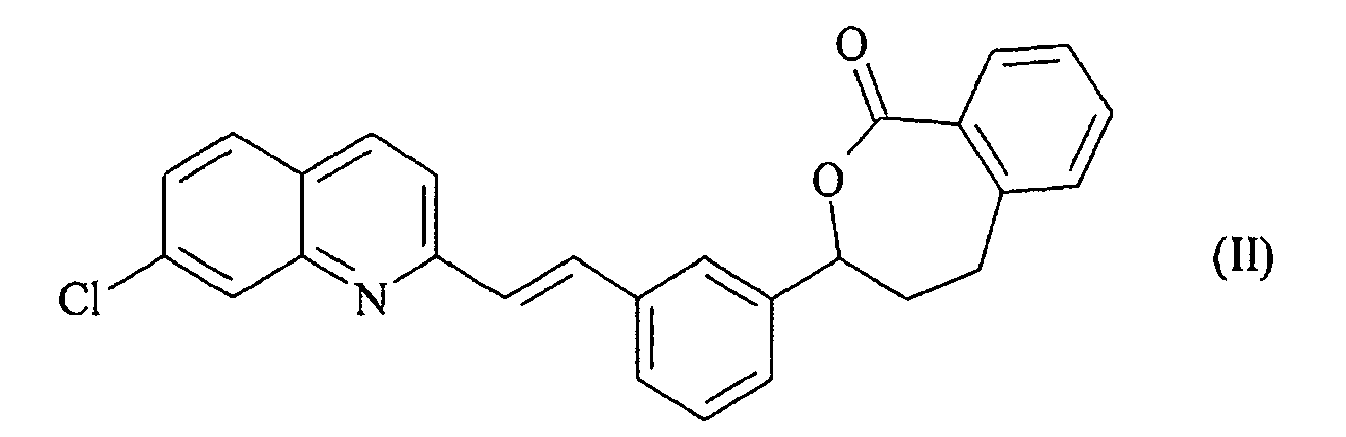
with a Grignard reagent of formula
CH3MgX (III),
wherein X is chlorine, bromine or iodine,
in an ethereal solvent in the presence of lanthanum trichloride and lithium chloride. - The term "ethereal solvent" is to be understood to mean any solvent or solvent mixture comprising a substantial amount of an acyclic or cyclic ether that is liquid at the reaction temperature, such as diethyl ether, dibutyl ether, methyl tert-butyl ether, dimethoxyethane, tetrahydrofuran (THF), dioxane and the like.
- The lithium chloride solubilizes the lanthanum trichloride, resulting in a true solution of the two salts in the ethereal solvent and thus in a homogeneous reaction mixture. In a preferred embodiment, lanthanum trichloride and lithium chloride are present in a molar ratio of 1:2 or less. A tetrahydrofuran solution of LaCl3 and LiCl in a molar ratio of 1:2 is commercially available from Chemetall GmbH, Frankfurt (Main), Germany.
- The halogen component X of the Grignard reagent III is preferably chlorine.
- Most preferably, the secondary alcohol group and the carbon atom in position 3 of the oxepine ring, respectively, of the above structures I and II have S-configuration to make them suitable as intermediates in the synthesis of (R)-montelukast.
- The ethereal solvent used in the process of the invention is preferably tetrahydrofuran alone or a mixture of tetrahydrofuran and an inert solvent such as an aliphatic or aromatic hydrocarbon.
- The reaction temperature can be in the range that is commonly employed in Grignard reactions, it is preferably between -20 °C and room temperature, more preferably from -10°C to +10°C.
- The work-up of the reaction mixture can be accomplished according to the methods commonly used in the art, e.g. by quenching with water or weak aqueous acids and extracting the product with a suitable solvent.
- A particular advantage of the process according to the invention resides in the fact that, in contrast to the hydroxyester conventionally used as starting material (cf.
WO 95/18107 A1 - The lactone of formula II is a novel compound and likewise an object of the invention.
- In a preferred embodiment, the carbon atom in position 3 of the oxepine ring of the lactone II has S-configuration.
- A further object of the invention is a process for the preparation of the lactone II. Applicants have surprisingly found that this compound is obtained in high selectivity when a carboxylic ester of formula
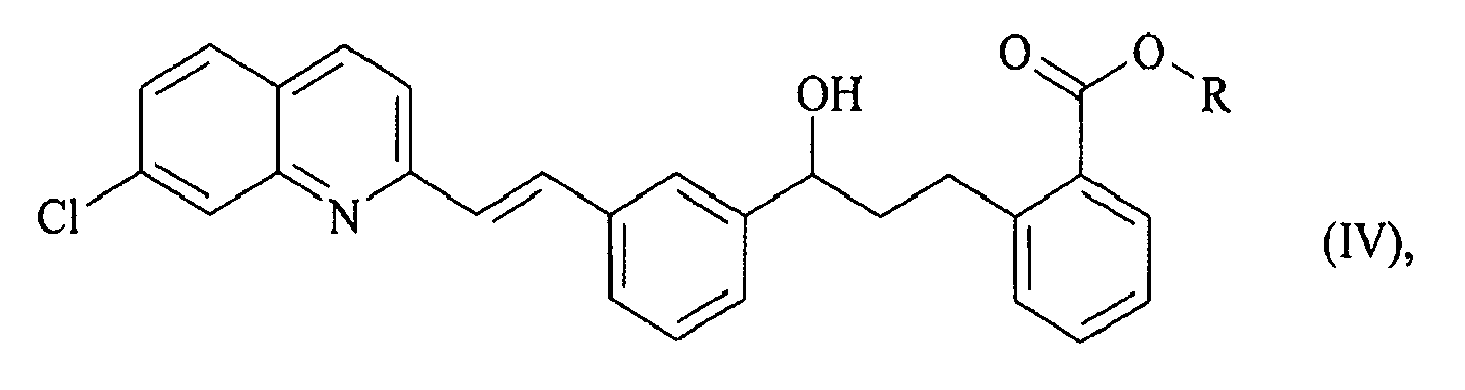
with a Grignard reagent of formula
R1MgCl (V)
wherein R1 is C1-4 alkyl,
in an ethereal solvent in the absence of a lanthanoid compound, such as cerium or lanthanum chloride. - The term "C1-n alkyl" is here to be understood to comprise any linear or branched alkyl group having from 1 to n carbon atoms. For example, the tenn "C1-4 alkyl" comprises methyl, ethyl, propyl, isopropyl, butyl, isobutyl, sec-butyl and tert-butyl. In addition to the beforementioned, the term "C1-10 alkyl" comprises groups such as pentyl, isopentyl, neopentyl, hexyl, isohexyl, heptyl, octyl, nonyl, decyl and the like.
- The term "aryl" is to be understood to comprise any mono-, bi- or polycarbocyclic group comprising at least one aromatic ring, such as phenyl, naphthyl, anthracenyl, phenanthryl, biphenylyl, fluorenyl, tetrahydronaphthalenyl and the like. A preferred meaning of "aryl" is phenyl.
- The term "arylalkyl" is to be understood to comprise an alkyl group, and in particular a C1-4 alkyl group, which is substituted with one of the groups mentioned above under "alkyl". The most preferred meaning of arylalkyl is benzyl.
- In a preferred embodiment, the group R in the ester moiety is methyl.
- More preferably, the methyl ester is employed in the form of its monohydrate without previous removal of its water of crystallization.
- Both the carbon atom in position 3 of the oxepin ring in formula II and the secondary alcohol group in formula IV are preferably in the S-configuration.
- The following non-limiting examples will illustrate the process of the invention.
- A suspension of methyl 2-[(3S)-3-[3-[(1E)-2-(7-chloro-2-quinolinyl)ethenyl]phenyl]-3-hydroxypropyl]benzoate monohydrate (18.32 g, 38.5 mmol) in 60 mL THF and 210 mL toluene was cooled to -5 °C in a 250 mL double-jacketed reactor under nitrogen. Methylmagnesium chloride (3 M solution in THF, 53.4 mL, 160 mmol) was added dropwise during 25 min while maintaining the temperature at -5 °C. The brown suspension was stirred at 0 °C for 4 h and at 20°C for 24 h. The reaction mixture was added during 15 min to 2 M aqueous acetic acid which had been pre-cooled to 5°C. During the addition the temperature rose to 12 °C. The mixture was stirred at this temperature for another 5 min, and the phases were separated. The aqueous phase was discarded and the organic phase was washed with 10% aqueous sodium carbonate solution, and then with 1% aqueous sodium carbonate solution (320 mL each). The solution was evaporated in vacuo (40°C, 30 mbar) to yield 24 g residue which was dissolved in THF (15 mL) at 45 °C. Heptane (41 mL) was added dropwise to this solution. The suspension formed was cooled to 0 °C, filtered, washed with heptane (30 mL) and dried to yield 8.57 g beige solid.
m.p.: 160 °C
IR (KBr): ṽ = 2931, 1714, 1608, 1497, 1455, 1410, 1297, 1251, 1121, 1084, 1039, 927, 875, 832, 799, 774, 755, 731, 693 cm-1
1H NMR (DMSO-d6, 500 MHz): δ = 2.28 (m, 1H), 2.45 (m, 1H), 2.98 (m, 1H), 3.04 (m, 1H), 5.17 (dd, J= 12.2, 4.9 Hz; 1H), 7.45 (m, 3H), 7.49 (m, 1H), 7.52 (d, J= 16.6 Hz, 1H), 7.58 (dd, J= 8.8, 1.9 Hz; 1H), 7.63 (t, J= 7.5 Hz, 1H), 7.68 (m, 1H), 7.71 (d, J= 7.3 Hz, 1H), 7,85 (s, 1H), 7.87 (d, J = 16.6 Hz, 1H), 7.88 (d, J = 8.8 Hz, 1H), 7.98 (d, J = 8.8 Hz, 1H), 8.0 (d, J= 1.5 Hz, 1H), 8.38 (d, J= 8.8 Hz, 1H).
13C NMR (DMSO-d6,126 MHz): δ = 29.24, 35.29, 78.86, 120.28, 125.20, 125.55, 126.61, 126.81, 127.16, 127.28, 128.71, 128.89,128.97,129.66,129.80,131.42,132.66,134.25,134.48, 136.20, 136.49, 137.60, 139.81, 147.96, 156.61, 170.01. - A solution of (3S)-3-[3-[(E)-2-(7-chloro-2-quinolinyl)ethenyl]phenyl]-4,5-dihydro-3H-benzo[c]oxepin-1-one (3.05 g, 7.2 mmol) in THF (45 mL) was cooled to 5 °C in a 250 mL double-jacketed reactor under nitrogen. Methylmagnesium chloride (3 M solution in THF, 7.11 g, 21.0 mmol) was added. Lanthanum chloride/lithium chloride (molar ratio 1:2, 16% solution in THF, 3.23 g, 1.6 mmol) was added with stirring at 5°C. The reaction mixture was heated to 20°C and stirred at that temperature for another 1 h. Completion of the reaction was ensured by HPLC control. The solution was cooled to below 10°C, and 2 M aqueous acetic acid (50 ml) was added during 5 min, followed by methyl tert-butyl ether (50 mL). The phases were separated and the organic phase was washed first with 10% aqueous sodium carbonate solution (50 mL) and then with saturated brine (50 mL). The organic phase was concentrated in vacuo (40 °C, 280 mbar) to a weight of 6.83 g. Heptane (17 mL) was added dropwise to this residue during 1 h at 25 °C, then the suspension was cooled to 0 °C and stirred for 1 h. The precipitate was filtered, washed with heptane (10 mL) and dried in vacuo at 30°C to yield 2.31 g light beige powder, purity (HPLC) 94.9%.
1H NMR (DMSO-d6, 500 MHz): δ = 1.51 (s, 3H); 1.52 (s, 3H); 2.00 (m, 2H), 2.96 (m, 1H); 3.10 (m, 1H); 4.72 (m, 1H); 4.94 (s, 1H); 5.36 (d, J = 4.4 Hz, 1H); 7.09 (t, J = 7.6 Hz, 1H); 7.14 (t, J = 7.8 Hz, I H); 7.18 (d, J = 6.4 Hz, 1H); 7.41 (m, 2H); 7.44 (d, J = 7.9 Hz, 1H); 7.49 (d, J = 16.6 Hz, 1H); 7.56 (dd, J = 8.3,2.2 Hz, 1H); 7.62 (d, J = 6.8 Hz, 1H); 7.77 (bs, 1H); 7.91 (d, J = 16.6 Hz, 1H); 7.92 (d, J = 8.7 Hz, 1H); 7.99 (d, J = 8.8 Hz, 1H); 8.03 (d, J = 2.0 Hz, I H); 8.38 (d, J = 8.4 Hz, I H).
13C NMR (DMSO-d6, 126 MHz): δ = 29.82, 31.55, 31.57, 42.34, 71.60, 72.31, 120.24, 124.73, 124.88, 125.24, 125.51, 125.71, 126.22, 126.54, 127.16, 128.04, 128.49, 129.65, 130.82, 134.23, 135.20, 135.67, 136.43, 140.25, 146.66, 146.93, 147.99, 156.78.
Claims (13)
- A process for the production of [3-[(1E)-2-(7-chloro-2-quinolinyl)ethenyl]phenyl]-2-(1-hydroxy-1-methylethyl)benzenepropanol of formula


CH3MgX (III),
wherein X is chlorine, bromine or iodine,
in an ethereal solvent in the presence of lanthanum trichloride and lithium chloride. - The process of claim 1, wherein lanthanum trichloride and lithium chloride are present in a molar ratio of 1:2.
- The process of claim 1 or 2, wherein X is chlorine.
- The process of any of claims 1 to 3, wherein the secondary alcohol group in I and the carbon atom in position 3 of the oxepine ring have S-configuration.
- The process of any of claim 1 to 4, wherein the ethereal solvent is tetrahydrofuran or a mixture of tetrahydrofuran and an inert solvent.
- 3-[3-[(E)-2-(7-chloro-2-quinolinyl)ethenyl]phenyl]-4,5-dihydro-3H-benzo[c]oxepin-1-one of formula

- The compound of claim 6, which is (3S)-3-[3-[(E)-2-(7-chloro-2-quinolinyl)ethenyl]-phenyl]-4,5-dihydro-3H-benzo[c]oxepin-1-one of formula

- A process for the preparation of 3-[3-[(E)-2-(7-chloro-2-quinolinyl)ethenyl]phenyl]-4,5-dihydro-3H-benzo[c]oxepin-1-one of formula


with a Grignard reagent of formula
R1 MgCl (V)
wherein R1 is C1-4 alkyl,
in an ethereal solvent in the absence of a lanthanoid compound. - The process of claim 8, wherein R is methyl.
- The process of claim 9, wherein the carboxylic ester IV is in the monohydrate form.
- The process of any of claims 8 to 10, wherein R1 is methyl.
- The process of any of claims 8 to 11, wherein the carbon atom in position 3 of the oxepin ring in formula II and the secondary alcohol group in formula IV have S-confguration.
- The process of any of claims 8 to 12, wherein the ethereal solvent is tetrahydrofuran or a mixture of tetrahydrofuran and an inert solvent.
Priority Applications (14)
| Application Number | Priority Date | Filing Date | Title |
|---|---|---|---|
| EP07013810A EP2014650A1 (en) | 2007-07-13 | 2007-07-13 | Process and intermediate for the production of an intermediate in the production of montelukast |
| CN200880024396A CN101808997A (en) | 2007-07-13 | 2008-07-10 | Process and intermediate for the production of a tertiary alcohol as an intermediate in the synthesis of montelukast |
| AT08773959T ATE531694T1 (en) | 2007-07-13 | 2008-07-10 | METHOD AND INTERMEDIATE PRODUCT FOR PRODUCING A TERTIARY ALCOHOL AS AN INTERMEDIATE PRODUCT IN THE SYNTHESIS OF MONTELUKAST |
| US12/668,320 US20100190987A1 (en) | 2007-07-13 | 2008-07-10 | Process and intermediate for the production of a tertiary alcohol as an intermediate in the synthesis of montelukast |
| EA201000099A EA201000099A1 (en) | 2007-07-13 | 2008-07-10 | METHOD AND INTERMEDIATE PRODUCT FOR OBTAINING A TERTIARY ALCOHOL AS AN INTERIM PRODUCT OF MONTLEUKAST SYNTHESIS |
| JP2010516405A JP2010533207A (en) | 2007-07-13 | 2008-07-10 | Methods and intermediates for the production of tertiary alcohols as intermediates in the synthesis of montelukast |
| BRPI0814526-1A2A BRPI0814526A2 (en) | 2007-07-13 | 2008-07-10 | PROCESS AND INTERMEDIATE FOR THE PRODUCTION OF A TERTIARY ALCOHOL AS AN INTERMEDIATE IN THE SYNTHESIS OF MONTELUCAST |
| AU2008277938A AU2008277938A1 (en) | 2007-07-13 | 2008-07-10 | Process and intermediate for the production of a tertiary alcohol as an intermediate in the synthesis of montelukast |
| EP08773959A EP2178841B1 (en) | 2007-07-13 | 2008-07-10 | Process and intermediate for the production of a tertiary alcohol as an intermediate in the synthesis of montelukast |
| PCT/EP2008/005637 WO2009010230A2 (en) | 2007-07-13 | 2008-07-10 | Process and intermediate for the production of a tertiary alcohol as an intermediate in the synthesis of montelukast |
| CA 2692896 CA2692896A1 (en) | 2007-07-13 | 2008-07-10 | Process and intermediate for the production of a tertiary alcohol as an intermediate in the synthesis of montelukast |
| KR1020107003157A KR20100044844A (en) | 2007-07-13 | 2008-07-10 | Process and intermediate for the production of a tertiary alcohol as an intermediate in the synthesis of montelukast |
| TW097126605A TW200914425A (en) | 2007-07-13 | 2008-07-14 | Process and intermediate for the production of a tertiary alcohol as an intermediate in the synthesis of montelukast |
| ZA201000238A ZA201000238B (en) | 2007-07-13 | 2010-01-12 | Process and intermediate for the production of a tertiary alcohol as an intermediate in the synthesis of montelukast |
Applications Claiming Priority (1)
| Application Number | Priority Date | Filing Date | Title |
|---|---|---|---|
| EP07013810A EP2014650A1 (en) | 2007-07-13 | 2007-07-13 | Process and intermediate for the production of an intermediate in the production of montelukast |
Publications (1)
| Publication Number | Publication Date |
|---|---|
| EP2014650A1 true EP2014650A1 (en) | 2009-01-14 |
Family
ID=38786992
Family Applications (2)
| Application Number | Title | Priority Date | Filing Date |
|---|---|---|---|
| EP07013810A Withdrawn EP2014650A1 (en) | 2007-07-13 | 2007-07-13 | Process and intermediate for the production of an intermediate in the production of montelukast |
| EP08773959A Active EP2178841B1 (en) | 2007-07-13 | 2008-07-10 | Process and intermediate for the production of a tertiary alcohol as an intermediate in the synthesis of montelukast |
Family Applications After (1)
| Application Number | Title | Priority Date | Filing Date |
|---|---|---|---|
| EP08773959A Active EP2178841B1 (en) | 2007-07-13 | 2008-07-10 | Process and intermediate for the production of a tertiary alcohol as an intermediate in the synthesis of montelukast |
Country Status (13)
| Country | Link |
|---|---|
| US (1) | US20100190987A1 (en) |
| EP (2) | EP2014650A1 (en) |
| JP (1) | JP2010533207A (en) |
| KR (1) | KR20100044844A (en) |
| CN (1) | CN101808997A (en) |
| AT (1) | ATE531694T1 (en) |
| AU (1) | AU2008277938A1 (en) |
| BR (1) | BRPI0814526A2 (en) |
| CA (1) | CA2692896A1 (en) |
| EA (1) | EA201000099A1 (en) |
| TW (1) | TW200914425A (en) |
| WO (1) | WO2009010230A2 (en) |
| ZA (1) | ZA201000238B (en) |
Families Citing this family (1)
| Publication number | Priority date | Publication date | Assignee | Title |
|---|---|---|---|---|
| CN116332220B (en) * | 2023-05-29 | 2023-08-11 | 研峰科技(北京)有限公司 | Synthesis method of lanthanum (III) chloride bis (lithium chloride) |
Citations (2)
| Publication number | Priority date | Publication date | Assignee | Title |
|---|---|---|---|---|
| US5266568A (en) * | 1990-10-12 | 1993-11-30 | Merck Frosst Canada, Inc. | Hydroxyalkylquinoline ether acids as leukotriene antagonists |
| WO2007057225A2 (en) * | 2005-11-18 | 2007-05-24 | Synthon B.V. | Process for making montelukast and intermediates therefor |
-
2007
- 2007-07-13 EP EP07013810A patent/EP2014650A1/en not_active Withdrawn
-
2008
- 2008-07-10 US US12/668,320 patent/US20100190987A1/en not_active Abandoned
- 2008-07-10 CN CN200880024396A patent/CN101808997A/en active Pending
- 2008-07-10 JP JP2010516405A patent/JP2010533207A/en not_active Withdrawn
- 2008-07-10 EA EA201000099A patent/EA201000099A1/en unknown
- 2008-07-10 KR KR1020107003157A patent/KR20100044844A/en not_active Withdrawn
- 2008-07-10 AU AU2008277938A patent/AU2008277938A1/en not_active Abandoned
- 2008-07-10 AT AT08773959T patent/ATE531694T1/en active
- 2008-07-10 CA CA 2692896 patent/CA2692896A1/en not_active Abandoned
- 2008-07-10 WO PCT/EP2008/005637 patent/WO2009010230A2/en not_active Ceased
- 2008-07-10 EP EP08773959A patent/EP2178841B1/en active Active
- 2008-07-10 BR BRPI0814526-1A2A patent/BRPI0814526A2/en not_active IP Right Cessation
- 2008-07-14 TW TW097126605A patent/TW200914425A/en unknown
-
2010
- 2010-01-12 ZA ZA201000238A patent/ZA201000238B/en unknown
Patent Citations (2)
| Publication number | Priority date | Publication date | Assignee | Title |
|---|---|---|---|---|
| US5266568A (en) * | 1990-10-12 | 1993-11-30 | Merck Frosst Canada, Inc. | Hydroxyalkylquinoline ether acids as leukotriene antagonists |
| WO2007057225A2 (en) * | 2005-11-18 | 2007-05-24 | Synthon B.V. | Process for making montelukast and intermediates therefor |
Non-Patent Citations (4)
| Title |
|---|
| CONLON D A ET AL: "INSIGHTS INTO THE CERIUM CHLORIDE-CATALYZED GRIGNARD ADDITION TO ESTERS", ADVANCED SYNTHESIS AND CATALYSIS, WILEY, WEINHEIM, DE, vol. 346, no. 11, 2004, pages 1307 - 1315, XP009058825, ISSN: 1615-4169 * |
| DUFRESNE C ET AL: "Synthesis of montelukast (MK-0476) metabolic oxidation products", JOURNAL OF ORGANIC CHEMISTRY, AMERICAN CHEMICAL SOCIETY. EASTON, US, vol. 61, no. 24, 1996, pages 8518 - 8525, XP002284162, ISSN: 0022-3263 * |
| EGEKEZE, JOHN O. ET AL: "Kinetic Analysis and Subambient Temperature Chromatography of an Active Ester", ANALYTICAL CHEMISTRY , 67(13), 2292-5 CODEN: ANCHAM; ISSN: 0003-2700, 1995, XP002462201 * |
| ROBERT D. LARSON ET AL.: "Practical Route to a New Class of LTD4 Receptor Antagonists", JOURNAL OF ORGANIC CHEMISTRY, vol. 61, no. 10, 1996, pages 3398 - 3405, XP002462200 * |
Also Published As
| Publication number | Publication date |
|---|---|
| WO2009010230A3 (en) | 2009-04-23 |
| JP2010533207A (en) | 2010-10-21 |
| AU2008277938A1 (en) | 2009-01-22 |
| EP2178841A2 (en) | 2010-04-28 |
| EP2178841B1 (en) | 2011-11-02 |
| BRPI0814526A2 (en) | 2015-01-27 |
| US20100190987A1 (en) | 2010-07-29 |
| TW200914425A (en) | 2009-04-01 |
| WO2009010230A2 (en) | 2009-01-22 |
| CA2692896A1 (en) | 2009-01-22 |
| ATE531694T1 (en) | 2011-11-15 |
| EA201000099A1 (en) | 2010-06-30 |
| ZA201000238B (en) | 2010-09-29 |
| CN101808997A (en) | 2010-08-18 |
| KR20100044844A (en) | 2010-04-30 |
Similar Documents
| Publication | Publication Date | Title |
|---|---|---|
| CN113227061A (en) | Novel salts and polymorphs of bipedac acid | |
| WO2012140490A2 (en) | Process for preparing quinoline derivative | |
| EP1466905B1 (en) | Process for producing optically active oxoheptenoic acid ester | |
| US20100217004A1 (en) | Process for the production of tertiary alcohols | |
| JP2009515922A (en) | Process for producing montelukast and intermediates therefor | |
| EP2178841B1 (en) | Process and intermediate for the production of a tertiary alcohol as an intermediate in the synthesis of montelukast | |
| US7700776B2 (en) | Compounds and preparation for montelukast sodium | |
| KR100995882B1 (en) | Process for preparing intermediate of pitavastatin or its salt | |
| KR100990046B1 (en) | New 4-halobenzylamine salts of montelukast and process for preparing montelukast sodium by using them | |
| EP2053043A1 (en) | Crystalline salt of montelukast | |
| HK1147478A (en) | Process and intermediate for the production of a tertiary alcohol as an intermediate in the synthesis of montelukast | |
| CN104031034A (en) | Preparing method for pitavastatin calcium bulk drug intermediate | |
| WO2007023503A1 (en) | A process for the preparation of fluvastatin sodium | |
| JP6059157B2 (en) | Montelukast Intermediate Camphorsulfonate | |
| CN101356157B (en) | Process for making montelukast and intermediates therefor | |
| JP6256469B2 (en) | Process for the preparation of spiro [2.5] octane-5,7-dione | |
| JP2014001176A (en) | Method for producing precursor of pitavastatin calcium | |
| WO2015003670A1 (en) | A new process for the preparation of elvitegravir | |
| KR20110134249A (en) | Method for preparing intermediates of pitavastatin or salts thereof | |
| CN103387540B (en) | A kind of salt forming method prepares the method for azoles bacterium ester | |
| HK1147470A (en) | Process for the production of tertiary alcohols | |
| EP2332923A1 (en) | 5-ý2-(methylthio)ethoxy¨pyrimidine-2-amine manufacturing method | |
| JP2001199985A (en) | High-purity phenothiazine compound, method for producing the same, method for producing an intermediate thereof, hydrate of starting material for the intermediate and novel crystal |
Legal Events
| Date | Code | Title | Description |
|---|---|---|---|
| PUAI | Public reference made under article 153(3) epc to a published international application that has entered the european phase |
Free format text: ORIGINAL CODE: 0009012 |
|
| AK | Designated contracting states |
Kind code of ref document: A1 Designated state(s): AT BE BG CH CY CZ DE DK EE ES FI FR GB GR HU IE IS IT LI LT LU LV MC MT NL PL PT RO SE SI SK TR |
|
| AX | Request for extension of the european patent |
Extension state: AL BA HR MK RS |
|
| AKX | Designation fees paid | ||
| REG | Reference to a national code |
Ref country code: DE Ref legal event code: 8566 |
|
| STAA | Information on the status of an ep patent application or granted ep patent |
Free format text: STATUS: THE APPLICATION IS DEEMED TO BE WITHDRAWN |
|
| 18D | Application deemed to be withdrawn |
Effective date: 20090715 |