EP2014121B1 - A method of operation in a dual carrier communication system - Google Patents
A method of operation in a dual carrier communication system Download PDFInfo
- Publication number
- EP2014121B1 EP2014121B1 EP07733589.1A EP07733589A EP2014121B1 EP 2014121 B1 EP2014121 B1 EP 2014121B1 EP 07733589 A EP07733589 A EP 07733589A EP 2014121 B1 EP2014121 B1 EP 2014121B1
- Authority
- EP
- European Patent Office
- Prior art keywords
- cell
- carrier
- mobile device
- network
- receiver
- Prior art date
- Legal status (The legal status is an assumption and is not a legal conclusion. Google has not performed a legal analysis and makes no representation as to the accuracy of the status listed.)
- Active
Links
Images


Classifications
-
- H—ELECTRICITY
- H04—ELECTRIC COMMUNICATION TECHNIQUE
- H04W—WIRELESS COMMUNICATION NETWORKS
- H04W76/00—Connection management
- H04W76/30—Connection release
- H04W76/34—Selective release of ongoing connections
- H04W76/36—Selective release of ongoing connections for reassigning the resources associated with the released connections
-
- H—ELECTRICITY
- H04—ELECTRIC COMMUNICATION TECHNIQUE
- H04W—WIRELESS COMMUNICATION NETWORKS
- H04W36/00—Hand-off or reselection arrangements
- H04W36/0005—Control or signalling for completing the hand-off
- H04W36/0009—Control or signalling for completing the hand-off for a plurality of users or terminals, e.g. group communication or moving wireless networks
-
- H—ELECTRICITY
- H04—ELECTRIC COMMUNICATION TECHNIQUE
- H04W—WIRELESS COMMUNICATION NETWORKS
- H04W36/00—Hand-off or reselection arrangements
- H04W36/0005—Control or signalling for completing the hand-off
- H04W36/0055—Transmission or use of information for re-establishing the radio link
- H04W36/0069—Transmission or use of information for re-establishing the radio link in case of dual connectivity, e.g. decoupled uplink/downlink
Definitions
- This invention relates to a method of operation in a dual carrier communication system, in particular for global system for mobile communications (GSM) systems, such as general packet radio service (GPRS) or voice group call systems.
- GSM global system for mobile communications
- GPRS general packet radio service
- voice group call systems such as voice group call systems.
- the MS drops its GPRS connection in the old cell, reads system information in the new cell, sends access bursts to request resources in the new cell, and finally performs a cell update to indicate to a serving GPRS support node (SGSN) in the network that the MS has moved to the new cell.
- SGSN serving GPRS support node
- the SGSN redirects the downlink data flow to the MS.
- a MS in group receive mode For voice group calls using voice group call service (VGCS) or voice broadcast service (VBS), a MS in group receive mode reads system information in a neighbouring cell in order to determine the position of a notification channel (NCH) and obtain some cell specific parameters such as the cell's identity which is needed to derive the ciphering keys. After cell reselection, the MS reads the NCH, if present, to find a location and description of the group, or broadcast channel for the particular group, or broadcast call. During this time the MS may not be able to listen to the downlink of the group, or broadcast channel in the new cell. Thus, there may be a noticeable interruption to the reception of speech on cell change. Additionally, the MS may miss the downlink signalling messages that are sent on the group, or broadcast channel.
- NCH notification channel
- These signalling messages can indicate the current status of the call (free or busy in VGCS only), the identity of the current talker (in VGCS only), new notifications (in both VGCS and VBS), or incoming short message service (SMS), either to the group or to the individual MS (applicable for both VGCS and VBS).
- Uplink BUSY messages are typically transmitted every 5 seconds, so for VGCS, the MS may have to wait some time to determine the current status of the uplink.
- PS handover procedures as defined for Release-6 of 3GPP GERAN standards, whereby resources are reserved in the target cell and core network signalling is used to prepare the target before the MS is commanded to handover to the target cell.
- This has the best performance in terms of service interruption, but requires complex core network signalling and is wasteful of radio resources in the target cell, which are reserved, but not used for a period of time.
- PS handover is aimed at being used for real-time PS services where the revenue is worth the cost of the procedure.
- the document 3GPP TSG-RAN WG1 #42bis R1-051109 titled "Further description of WCDMA based E-UTRA" by Qualcomm discloses a multi-carrier operation for a mobile station.
- the document WO 00/41429A describes the soft handoff of a mobile station. The mobile station uses both receivers to receive the signals of both frequencies f1 and f2. The two signals are isolated and then time and phase aligned to get combined to reinforce each of the two signals. Mobile station also transmits the same message in both frequencies to enable soft handoff uplink.
- the document D2 describes the concept of communicating with 2 transceivers of the mobile station to one access point in Multiple-Input Multiple-Output configuration.
- the present invention makes use of the ability of a dual carrier mobile to receive data from two cells at the same time, so that ongoing data transfer continues in the first cell, whilst the new cell is being set up.
- the method further comprises transferring resources for communicating between the mobile device and the first cell to use only one carrier, in order to free up the second receiver; and accessing the second cell from the mobile device using the other carrier.
- this transfer step can be omitted.
- the mobile device accesses the second cell via the second carrier to carry out a cell reselection procedure, although there might be other situations where accessing more than one cell at one time is useful.
- a cell reselection procedure for example, the use of dual carrier networks and mobile devices to receive the same MBMS (multi-media broadcast/multicast service) session from two cells at the same time in order to reduce the MBMS service interruption time on cell reselection.
- MBMS multi-media broadcast/multicast service
- the cell reselection procedure comprises, after the step of transferring resources from the second to the first carrier, continuing data exchange between the mobile device and the first cell on the first carrier; sending an uplink message to the second cell on the second carrier; switching downlink communication to the mobile via the second cell on the second carrier; and thereafter switching to uplink communication via the second cell on either carrier.
- VGCS voice group call service
- VBS voice broadcast service
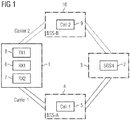
- Fig.1 illustrates a system operating in dual carrier mode, where cell reselection is required.
- a dual carrier mobile device (MS) such as a laptop or mobile phone, communicates with an SGSN 2 of a mobile core network 3 via a base station (BSS-A) 4 of a first, or source, cell 5.
- a dual carrier mobile has two receivers 6, 7, so it is able to receive on both channels at once, although the device is only provided with a single transmitter 8.
- the dual receivers are used to enable the mobile to receive data from two different cells at the same time, enhancing the GPRS cell reselection procedure with little or no impact on the core network.
- the mobile device chooses to move to a second, or target, cell 9 with a second base station (BSS-B) 10.
- BSS-B second base station
- BSS-A attempts to put all of the mobile's packet resources on to one carrier to free the mobile's second receiver up for receiving from the target cell parented by BSS-B. If this is not possible, then legacy procedures can be used for the cell reselection, or the network can choose to drop some of the data flows in order to free up the second receiver. In one embodiment, the BSS-A provides an acknowledgement to the mobile device, as to whether or not it can comply with the request to transfer resources.
- the MS After reading 16 system or packet system information (SI/PSI) in the target cell 9 via the second receiver 7 of MS 1, or by using NACC procedures having obtained this information via the source cell 5, the MS switches its transmitter 8 to make access in the target cell 9 and establish some UL packet resources in the target cell, using the transmitter 8 and one receiver 7, at the same time that it is receiving data on the other receiver 6 via the source cell 5.
- the MS may not be able to receive data in the source cell whilst the MS is transmitting in the target cell, but any lost data can be recovered, if needed, via the use of radio link control/medium access control (RLC/MAC) acknowledged mode when the transmitter is available again.
- RLC/MAC radio link control/medium access control
- the MS tunes its transmitter 8 to the target cell and starts sending UL LLC PDUs via the target cell and BSS-B 10 and drops radio resources in the source cell 5.
- Alternative termination criteria could be set if desired.
- the MS can ask BSS-B for more resources if required, which are allocated on 2 carriers in the downlink if necessary.
- GPRS users benefit from a virtually seamless PS service in the downlink with low PS service interruption in the uplink for cell reselection, without needing RIM or O&M configuration for the operator, as in the case of network assisted cell change, nor is there unnecessary resource reservation in the target cell whilst waiting for the MS to access the target cell as in PS Handover.
- the MS has had to wait before it can send uplink data via the new cell, there is no downlink delay because that continues in the old cell until the new connection is ready.
- a voice group call may include users operating through several different cells and whilst the call is ongoing, one of the listeners using receiver 6 in cell 5 that is parented by BSS 4 may need to carry out cell reselection, as described above.
- the listener needs to obtain system information messages from the broadcast control channel (BCCH) of the target cell that is parented by the target BSS in order to determine the position of the notification channel and determine some cell specific parameters.
- the MS then must read the messages on the notification channel (NCH), once in the target cell, to determine the location of the group, or broadcast channel for that call. In the meantime, the user is unable to receive the data on the group channel.
- BCCH broadcast control channel
- NCH notification channel
- Figs. 3 and 4 illustrate an example of VGCS/VBS using the present invention.
- the MS 1 receives data 25 on a group channel 22 in a first cell 5 parented by BSS-A 4 at a first receiver 6 using a first carrier.
- the MS also reads, using a second receiver 7 and second carrier, the system information on the BCCH and messages on the NCH of a second cell 9 parented by BSS-B 10.
- Data is received 25 from a group channel 22 by first receiver 6 in the first cell 5, and system information on the BCCH 23 and messages on the NCH 23 from the second cell 9 are both received in messages 26 at the second receiver whilst the MS is still receiving the data in the first cell 5.
- the MS is then able to receive 27 data from the group channel 24 of the second cell as soon as it moves to the second cell.
Landscapes
- Engineering & Computer Science (AREA)
- Computer Networks & Wireless Communication (AREA)
- Signal Processing (AREA)
- Mobile Radio Communication Systems (AREA)
Description
- This invention relates to a method of operation in a dual carrier communication system, in particular for global system for mobile communications (GSM) systems, such as general packet radio service (GPRS) or voice group call systems.
- GSM Edge Radio Access Network (GERAN) currently operates on one carrier at a time, but to increase capacity on the downlink, dual carrier operation is being introduced. Conventionally, general packet radio service (GPRS) mobility, without the use of packet switched (PS) handover, is handled by a cell reselection procedure. In the cell reselection procedure, a mobile station (MS) detects that a neighbouring cell has a stronger signal than that of its current cell and decides, either autonomously, or via network control, to reselect to the new cell. The MS drops its GPRS connection in the old cell, reads system information in the new cell, sends access bursts to request resources in the new cell, and finally performs a cell update to indicate to a serving GPRS support node (SGSN) in the network that the MS has moved to the new cell. Upon receiving the cell update, the SGSN redirects the downlink data flow to the MS.
- During this time no downlink data is being received by the MS and only when the cell update takes place can uplink data be sent to the core network. It also assumes that the transfer will be successful, by dropping its existing connection at the start, although in some cases, the new cell may not have the resources available to allocate to the MS, requiring it to try to reconnect elsewhere. GPRS service interruption of up to 5 seconds may be experienced.
- For voice group calls using voice group call service (VGCS) or voice broadcast service (VBS), a MS in group receive mode reads system information in a neighbouring cell in order to determine the position of a notification channel (NCH) and obtain some cell specific parameters such as the cell's identity which is needed to derive the ciphering keys. After cell reselection, the MS reads the NCH, if present, to find a location and description of the group, or broadcast channel for the particular group, or broadcast call. During this time the MS may not be able to listen to the downlink of the group, or broadcast channel in the new cell. Thus, there may be a noticeable interruption to the reception of speech on cell change. Additionally, the MS may miss the downlink signalling messages that are sent on the group, or broadcast channel. These signalling messages can indicate the current status of the call (free or busy in VGCS only), the identity of the current talker (in VGCS only), new notifications (in both VGCS and VBS), or incoming short message service (SMS), either to the group or to the individual MS (applicable for both VGCS and VBS). Uplink BUSY messages are typically transmitted every 5 seconds, so for VGCS, the MS may have to wait some time to determine the current status of the uplink.
- One proposal to speed up cell reselection for GPRS services has been to introduce a process of network assisted cell reselection, whereby the network can send the system information of the new cell to the MS whilst it is still in the old cell. This requires a radio access network (RAN) information management (RIM) implementation to automatically transfer system information from neighbour cells, or an operations and maintenance (O&M) application to configure neighbour cell information. Even with a network assisted cell change (NACC), there is still some extra service interruption time due to the MS accessing the new cell, being allocated resources, performing a cell update and waiting for downlink data to be received.
- Another option is to use PS handover procedures as defined for Release-6 of 3GPP GERAN standards, whereby resources are reserved in the target cell and core network signalling is used to prepare the target before the MS is commanded to handover to the target cell. This has the best performance in terms of service interruption, but requires complex core network signalling and is wasteful of radio resources in the target cell, which are reserved, but not used for a period of time. PS handover is aimed at being used for real-time PS services where the revenue is worth the cost of the procedure.
- For VGCS or VBS, there is no option but to simply accept a service interruption time. The document 3GPP TSG-RAN WG1 #42bis R1-051109 titled "Further description of WCDMA based E-UTRA" by Qualcomm discloses a multi-carrier operation for a mobile station. The
document WO 00/41429A
The two signals are isolated and then time and phase aligned to get combined to reinforce each of the two signals. Mobile station also transmits the same message in both frequencies to enable soft handoff uplink.
The document D2 describes the concept of communicating with 2 transceivers of the mobile station to one access point in Multiple-Input Multiple-Output configuration. - In accordance with a first aspect of the present invention, a method of operation in a dual carrier communication system comprising a mobile device communicating with a network via first and second carriers; comprises receiving data in the first cell via one of the first and second carriers on one carrier frequency, whilst receiving system information and/or downlink data from a second cell via the other of the first and second carriers on another carrier frequency.
- The present invention makes use of the ability of a dual carrier mobile to receive data from two cells at the same time, so that ongoing data transfer continues in the first cell, whilst the new cell is being set up.
- Preferably, the mobile device includes a transmitter and first and second receivers.
- Any implementation which enables reception on two different frequencies could be used.
- Preferably, the method further comprises transferring resources for communicating between the mobile device and the first cell to use only one carrier, in order to free up the second receiver; and accessing the second cell from the mobile device using the other carrier.
- If only one carrier is in use at the time, this transfer step can be omitted.
- Preferably, the mobile device accesses the second cell via the second carrier to carry out a cell reselection procedure, although there might be other situations where accessing more than one cell at one time is useful. One example of this is the use of dual carrier networks and mobile devices to receive the same MBMS (multi-media broadcast/multicast service) session from two cells at the same time in order to reduce the MBMS service interruption time on cell reselection.
- Preferably, the cell reselection procedure comprises, after the step of transferring resources from the second to the first carrier, continuing data exchange between the mobile device and the first cell on the first carrier; sending an uplink message to the second cell on the second carrier; switching downlink communication to the mobile via the second cell on the second carrier; and thereafter switching to uplink communication via the second cell on either carrier.
- Preferably, the second receiver receives the system information to find the location of the notification channel and obtains some cell specific parameters; decodes the notification channel of the second cell to determine if a group call is on-going; and if a group call is ongoing, determines the location of the group call channel. Once the mobile device has started listening to the group channel in the second cell it may then stop listening to the group channel in the first cell.
- This allows a user to move straight from one group call channel in one cell to the group call channel in a new cell, reducing the chances of service interruption to the listeners.
- In accordance with a second aspect of the present invention, a method of dual carrier mode cell reselection in a communication system comprising a mobile device and a network comprises transferring resources for communication between the mobile device and the network via a first cell from two carriers to one carrier to free-up the other carrier; initiating a cell reselection procedure with the other carrier; accessing the network via a second cell; in the network, switching downlink data from the first cell to the second cell; and switching uplink data to the second cell.
- In accordance with a third aspect of the present invention, a method of dual carrier mode cell reselection in a voice group call service (VGCS) or voice broadcast service (VBS) communication system comprising a mobile device and a VGCS/VBS network comprises the mobile device using one receiver to listen to a group channel in the first cell, whilst using a second receiver to obtain system information in a second cell.
- An example of a method of operation in a dual carrier communication system according to the present invention will now be described with reference to the accompanying drawings in which:
-
Figure 1 is a block diagram of a system for carrying out the method of the present invention; -
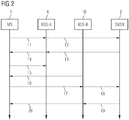
Figure 2 illustrates the sequence of messages between the mobile device and the network for operating according to the method of the present invention in a GPRS system; -
Figure 3 is a block diagram of a voice group call system carrying out a method of the present invention; and, -
Figure 4 illustrates a sequence of messages between a participating mobile device and a network supporting the voice group call. -
Fig.1 illustrates a system operating in dual carrier mode, where cell reselection is required. A dual carrier mobile device (MS) 1, such as a laptop or mobile phone, communicates with an SGSN 2 of amobile core network 3 via a base station (BSS-A) 4 of a first, or source,cell 5. A dual carrier mobile has tworeceivers single transmitter 8. In the present invention, the dual receivers are used to enable the mobile to receive data from two different cells at the same time, enhancing the GPRS cell reselection procedure with little or no impact on the core network. In this example, when cell reselection is required, the mobile device chooses to move to a second, or target,cell 9 with a second base station (BSS-B) 10. - The sequence of message exchanges is illustrated in
Fig. 2 . TheMS 1 is engaged in uplink (UL) 11, 12 and/or downlink (DL) 13, 14 data exchange with the SGSN 2 via BSS-A 4 and determines via legacy mechanisms that a cell reselection is required to acell 9 parented via BSS-B 10. The MS either sends anew message 15, or a new information element in an existing message to BSS-A 4 to indicate that it would like to perform a dual carrier (DC) optimised cell reselection, or if network controlled cell reselection is being used, the network will initiate the procedure. BSS-A attempts to put all of the mobile's packet resources on to one carrier to free the mobile's second receiver up for receiving from the target cell parented by BSS-B. If this is not possible, then legacy procedures can be used for the cell reselection, or the network can choose to drop some of the data flows in order to free up the second receiver. In one embodiment, the BSS-A provides an acknowledgement to the mobile device, as to whether or not it can comply with the request to transfer resources. - After reading 16 system or packet system information (SI/PSI) in the
target cell 9 via thesecond receiver 7 ofMS 1, or by using NACC procedures having obtained this information via thesource cell 5, the MS switches itstransmitter 8 to make access in thetarget cell 9 and establish some UL packet resources in the target cell, using thetransmitter 8 and onereceiver 7, at the same time that it is receiving data on theother receiver 6 via thesource cell 5. The MS may not be able to receive data in the source cell whilst the MS is transmitting in the target cell, but any lost data can be recovered, if needed, via the use of radio link control/medium access control (RLC/MAC) acknowledged mode when the transmitter is available again. In order to ensure that downlink resources are established on only one carrier an indication can be made to the network to this effect. - The MS sends 17, 18 a dummy UL logical link control (LLC) protocol data unit (PDU) to the SGSN 2 via resources in the
target cell 9 as a cell update. The MS then switches itstransmitter 8 back to the source cell for retransmissions and polling responses. Once the dummy UL LLC PDU has been sent, no further uplink data can be sent via thesource cell 5, although retransmissions and polling responses can still be sent, if required. Uponreceipt 18 of the UL LLC PDU at theSGSN 2, the SGSN switches DL LLC PDUs to flow via the target cell base station BSS-B 10. TheSGSN 2 then sends 19, 20 either a real DL LLC PDU, or a dummy one if no real LLC PDU exists, to theMS 1 via BSS-B 10. - When either the current DL LLC PDU being received by the MS in the
source cell 5 has been completely received and at least one DL RLC/MAC block has been received in the target cell, or at least one DL RLC/MAC data block addressed to the MS has been received in thetarget cell 9, then the MS tunes itstransmitter 8 to the target cell and starts sending UL LLC PDUs via the target cell and BSS-B 10 and drops radio resources in thesource cell 5. Alternative termination criteria could be set if desired. The MS can ask BSS-B for more resources if required, which are allocated on 2 carriers in the downlink if necessary. - Thus, GPRS users benefit from a virtually seamless PS service in the downlink with low PS service interruption in the uplink for cell reselection, without needing RIM or O&M configuration for the operator, as in the case of network assisted cell change, nor is there unnecessary resource reservation in the target cell whilst waiting for the MS to access the target cell as in PS Handover. Although, the MS has had to wait before it can send uplink data via the new cell, there is no downlink delay because that continues in the old cell until the new connection is ready.
- Another example of use of the present invention is with respect to voice group (or broadcast) calls. Currently, a voice group call may include users operating through several different cells and whilst the call is ongoing, one of the
listeners using receiver 6 incell 5 that is parented by BSS 4 may need to carry out cell reselection, as described above. Conventionally, the listener needs to obtain system information messages from the broadcast control channel (BCCH) of the target cell that is parented by the target BSS in order to determine the position of the notification channel and determine some cell specific parameters. The MS then must read the messages on the notification channel (NCH), once in the target cell, to determine the location of the group, or broadcast channel for that call. In the meantime, the user is unable to receive the data on the group channel. - Therefore, in the present invention, for VGCS/VBS, using a dual carrier VGCS/VBS listening MS, the MS reads the system information on the BCCH and the messages on the NCH of the target cell using the second receiver whilst still in the source cell and listening to the group call using the first receiver in the source cell to receive data from the group channel. With this information from the target cell, the VGCS/VBS MS can move straight to the group channel in the new cell, provided that this group call is actually active at the time of the move. The amount of time that is saved is related to how long it takes the MS to read the NCH in the new cell. The advantages are that there is a reduced service interruption to listeners in group receive mode and that there is less likelihood of missing important signalling and SMS messages, such as a notification of change of talker.
-
Figs. 3 and4 illustrate an example of VGCS/VBS using the present invention. TheMS 1 receivesdata 25 on agroup channel 22 in afirst cell 5 parented by BSS-A 4 at afirst receiver 6 using a first carrier. The MS also reads, using asecond receiver 7 and second carrier, the system information on the BCCH and messages on the NCH of asecond cell 9 parented by BSS-B 10. Data is received 25 from agroup channel 22 byfirst receiver 6 in thefirst cell 5, and system information on theBCCH 23 and messages on theNCH 23 from thesecond cell 9 are both received inmessages 26 at the second receiver whilst the MS is still receiving the data in thefirst cell 5. The MS is then able to receive 27 data from thegroup channel 24 of the second cell as soon as it moves to the second cell.
Claims (10)
- A method of operation in a dual carrier communication system comprising a mobile device (1) communicating with a network (4, 10, 3) via first and second carriers;
the method comprising:transferring resources for communicating between the mobile device (1) and a first cell (5) to use only one a first or second carrier, in order to free up the other carrier and accessing the second cell (9) from the mobile device (1) using the other carrier;receiving data in the first cell (5) via one of the first and second carrier on one carrier frequency, whilst receiving system information and/or downlink data from the second cell (9) via the other of the first and second carriers on another carrier frequency. - A method according to claim 1, wherein the mobile device (1) includes a transmitter (8) and first and second receivers (6, 7).
- A method according to any preceding claim, wherein the mobile device (1) accesses the second cell (9) via the second carrier to carry out a cell reselection procedure.
- A method according to claim 3, wherein the cell reselection procedure comprises, after the step of transferring resources from the second to the first carrier, continuing data exchange between the mobile device (1) and the first cell (5) on the first carrier; sending an uplink message to the second cell (9) on the second carrier; switching downlink communication to the mobile device (1) via the second cell (9) on the second carrier; and thereafter switching to uplink communication via the second cell (9) on either carrier.
- A method according to claim 2, wherein the second receiver (7) receives the system information to find the location of a notification channel and obtains some cell specific parameters; decodes the notification channel of the second cell (9) to determine if a group call is on-going; and if a group call is ongoing, determines the location of the group call channel.
- A method according to claim 1, wherein in a dual carrier mode cell reselection the method comprising
transferring resources for communication between the mobile device (1) and the network (4, 10, 3) via the first cell (5) from two carriers to one carrier to free-up the other carrier;
initiating a cell reselection procedure with the other carrier;
accessing the network via the second cell (9);
in the network, thereby switching downlink data in the network (4, 10, 3) from the first cell (5) to the second cell (9); and switching uplink data to the second cell (9). - A method according to claim 1, wherein in a dual carrier mode cell reselection in a voice group call service (VGCS) or voice broadcast service (VBS), the mobile device (1) uses one receiver (6, 7) to listen to a group channel in the first cell (5), whilst using a second receiver (6, 7) to obtain system information in the second cell (9).
- A mobile device MS (1) comprising:means (8, 6, 7) to communicate with a dual carrier communication network (4, 10, 3) via a first carrier and a second carrier,said means (8, 6, 7) being configured to transfer resources for communicating between the mobile device (1) and a first cell (5) to use only one a first or second carrier, in order to free up the other carrier and accessing the second cell (9) from the mobile device (1) using the other carrier;said means (8, 6, 7) being further configured to receive data in the first cell (5) via one of the first and second carriers on one carrier frequency, whilst receiving system information from a second cell (9) via the other of said first and second carriers on another carrier frequency.
- A mobile device MS (1) as claimed in claim 8, wherein said communicating means comprises a transmitter TX1 (8), a first receiver RX1 (6), and a second receiver RX2 (7).
- A communication system comprising the mobile device (1) of claim 8 and a network (4, 10, 30, 3) adapted to communicate with said mobile device (1) in the dual carrier mode for downlink data via the first and the second carrier.
Priority Applications (1)
| Application Number | Priority Date | Filing Date | Title |
|---|---|---|---|
| EP18200048.9A EP3445091A1 (en) | 2006-04-12 | 2007-03-29 | A method of operation in a dual carrier communication system |
Applications Claiming Priority (2)
| Application Number | Priority Date | Filing Date | Title |
|---|---|---|---|
| GB0607359A GB2437128B (en) | 2006-04-12 | 2006-04-12 | A Method Of Operation In A Dual Carrier Communication System |
| PCT/GB2007/050166 WO2007116227A1 (en) | 2006-04-12 | 2007-03-29 | A method of operation in a dual carrier communication system |
Related Child Applications (2)
| Application Number | Title | Priority Date | Filing Date |
|---|---|---|---|
| EP18200048.9A Division EP3445091A1 (en) | 2006-04-12 | 2007-03-29 | A method of operation in a dual carrier communication system |
| EP18200048.9A Division-Into EP3445091A1 (en) | 2006-04-12 | 2007-03-29 | A method of operation in a dual carrier communication system |
Publications (2)
| Publication Number | Publication Date |
|---|---|
| EP2014121A1 EP2014121A1 (en) | 2009-01-14 |
| EP2014121B1 true EP2014121B1 (en) | 2019-01-16 |
Family
ID=36571698
Family Applications (2)
| Application Number | Title | Priority Date | Filing Date |
|---|---|---|---|
| EP18200048.9A Withdrawn EP3445091A1 (en) | 2006-04-12 | 2007-03-29 | A method of operation in a dual carrier communication system |
| EP07733589.1A Active EP2014121B1 (en) | 2006-04-12 | 2007-03-29 | A method of operation in a dual carrier communication system |
Family Applications Before (1)
| Application Number | Title | Priority Date | Filing Date |
|---|---|---|---|
| EP18200048.9A Withdrawn EP3445091A1 (en) | 2006-04-12 | 2007-03-29 | A method of operation in a dual carrier communication system |
Country Status (5)
| Country | Link |
|---|---|
| US (1) | US10588172B2 (en) |
| EP (2) | EP3445091A1 (en) |
| CN (1) | CN101455113A (en) |
| GB (1) | GB2437128B (en) |
| WO (1) | WO2007116227A1 (en) |
Families Citing this family (14)
| Publication number | Priority date | Publication date | Assignee | Title |
|---|---|---|---|---|
| CN101554068B (en) | 2006-12-01 | 2013-01-02 | 艾利森电话股份有限公司 | Uplink access management |
| WO2010027176A2 (en) * | 2008-09-05 | 2010-03-11 | Electronics And Telecommunications Research Institute | Terminal and method for handover thereof |
| CN101883406B (en) * | 2009-05-07 | 2015-04-08 | 株式会社Ntt都科摩 | Switching method, mobile terminal and base station |
| CN101945428B (en) * | 2009-07-06 | 2014-09-10 | 中兴通讯股份有限公司 | Method and device for reporting and processing scheduling information in dual-carrier system |
| US8213974B2 (en) | 2009-09-01 | 2012-07-03 | Research In Motion Limited | System and method for sequencing radio items for a multi downlink multi carrier receiver |
| US8971292B2 (en) * | 2009-09-30 | 2015-03-03 | Qualcomm Incorporated | Method and apparatus for power control during TD-SCDMA baton handover |
| US8792890B2 (en) * | 2009-11-04 | 2014-07-29 | Blackberry Limited | Methods and apparatus to monitor a channel to determine neighbor cell information |
| US8577371B2 (en) * | 2009-11-04 | 2013-11-05 | Blackberry Limited | Methods and apparatus to avoid transmission of redundant neighbor cell information to mobile stations |
| CN102123366B (en) * | 2010-01-11 | 2015-05-13 | 中兴通讯股份有限公司 | Control method and system of non-service uplink enhanced wireless link of double-carrier system |
| US8750191B2 (en) * | 2010-03-12 | 2014-06-10 | Htc Corporation | Communication devices for providing multimedia broadcast/multicast services |
| US9106380B2 (en) | 2010-06-21 | 2015-08-11 | Telefonaktiebolaget L M Ericsson (Publ) | Method and arrangement for signaling of parameters in a wireless network |
| US9191867B2 (en) * | 2010-09-09 | 2015-11-17 | Qualcomm Incorporated | Dynamic switching between DC-HSDPA and SFDC-HSDPA |
| US9635646B2 (en) * | 2013-04-17 | 2017-04-25 | Qualcomm Incorporated | Method and apparatus for configuring uplink and downlink serving cells in wireless communications |
| WO2017033840A1 (en) * | 2015-08-21 | 2017-03-02 | 株式会社Nttドコモ | User terminal, wireless base station, and wireless communication method |
Family Cites Families (38)
| Publication number | Priority date | Publication date | Assignee | Title |
|---|---|---|---|---|
| FI96655C (en) * | 1992-12-17 | 1996-07-25 | Nokia Telecommunications Oy | Procedure for Maintaining a Group Call in a Radio Telephone System and System Controller and Subscriber Terminal for the Radio Telephone System |
| GB2322767B (en) * | 1997-03-01 | 2001-05-16 | Motorola Ltd | A method of transmitting call information |
| FI107861B (en) * | 1998-08-28 | 2001-10-15 | Nokia Mobile Phones Ltd | Neighbor cell measurements for cell reselection |
| US20020082019A1 (en) | 1998-12-30 | 2002-06-27 | Oguz Sunay | Methods and apparatus for accomplishing inter-frequency, inter-network, and inter-tier soft handoff using dual transmission/reception or compression |
| GB2389752B (en) * | 1999-05-28 | 2004-02-25 | Nec Corp | Mobile telecommunications system |
| US6606485B1 (en) * | 1999-10-06 | 2003-08-12 | Qualcomm, Incorporated | Candidate system search and soft handoff between frequencies in a multi-carrier mobile communication system |
| US6725052B1 (en) * | 1999-12-20 | 2004-04-20 | Ericsson Inc. | Cell assignment method during group calls |
| ATE343307T1 (en) * | 2000-12-08 | 2006-11-15 | Motorola Inc | CHANNEL ASSIGNMENT IN A COMMUNICATIONS SYSTEM |
| EP1493291B1 (en) * | 2001-10-17 | 2009-10-07 | Nokia Corporation | A handover method |
| JP4012394B2 (en) | 2001-11-13 | 2007-11-21 | 株式会社エヌ・ティ・ティ・ドコモ | Mobile communication terminal, broadcast information storage method, cell transition method, and mobile communication system |
| FR2832897B1 (en) * | 2001-11-23 | 2004-02-27 | Evolium Sas | METHOD FOR CELL CHANGE IN A PACKET MOBILE RADIO COMMUNICATION CELL SYSTEM |
| US6741587B2 (en) * | 2002-04-02 | 2004-05-25 | Nokia Corporation | Inter-frequency measurements with MIMO terminals |
| SE0201143D0 (en) * | 2002-04-15 | 2002-04-15 | Ericsson Telefon Ab L M | Packet switched Services |
| US7363039B2 (en) * | 2002-08-08 | 2008-04-22 | Qualcomm Incorporated | Method of creating and utilizing diversity in multiple carrier communication system |
| EP1467586B1 (en) | 2003-04-09 | 2010-05-19 | Samsung Electronics Co., Ltd. | Method for cell reselection in an MBMS mobile communication system |
| KR101085634B1 (en) * | 2003-08-22 | 2011-11-22 | 삼성전자주식회사 | Cell reselection method for receiving packet data in mobile communication system providing multimedia broadcast / multicast service (MBS) |
| US7689221B1 (en) * | 2004-03-05 | 2010-03-30 | At&T Mobility Ii Llc | System and method of providing intelligent cell reselection for delay sensitive data applications |
| US7613169B2 (en) * | 2004-03-16 | 2009-11-03 | Nokia Corporation | Enhancement of packet transfer mode when circuit switched resources are requested |
| US20050208943A1 (en) * | 2004-03-19 | 2005-09-22 | Pecen Mark E | Apparatus and method for handover between two networks during an ongoing communication |
| US7668075B2 (en) * | 2004-04-06 | 2010-02-23 | Texas Instruments Incorporated | Versatile system for dual carrier transformation in orthogonal frequency division multiplexing |
| FI20045258A0 (en) * | 2004-06-30 | 2004-06-30 | Nokia Corp | Cell specific information management |
| US7650142B2 (en) * | 2004-07-08 | 2010-01-19 | Nortel Networks Limited | Method for setting up a conference call |
| KR100689471B1 (en) * | 2004-08-09 | 2007-03-08 | 삼성전자주식회사 | Method and apparatus for distinguishing service of all frequency bands and service of specific frequency band in mobile communication system |
| CN100473206C (en) | 2004-08-13 | 2009-03-25 | 美国博通公司 | Method and system for performing communication handover in communication system |
| US8190161B2 (en) * | 2004-08-13 | 2012-05-29 | Broadcom Corporation | Multi-transceiver multi-path communication handoff |
| KR100965659B1 (en) * | 2004-09-14 | 2010-06-25 | 삼성전자주식회사 | Method for indicating cell selection upon termination of service session in multimedia broadcasting / multicast service system and system therefor |
| EP1643787A3 (en) * | 2004-09-30 | 2006-04-12 | Samsung Electronics Co., Ltd. | Method and apparatus for frequency selection at start of service session in MBMS system |
| US20060068792A1 (en) * | 2004-09-30 | 2006-03-30 | Motorola, Inc. | System and method for using determination of the operating parameters of a mobile device |
| US7414983B2 (en) * | 2004-12-30 | 2008-08-19 | Motorola, Inc. | Methods for managing data transmissions between a mobile station and a serving station |
| GB0501830D0 (en) * | 2005-01-28 | 2005-03-09 | Nokia Corp | Transfer between cells in a communication system |
| WO2006096036A1 (en) * | 2005-03-10 | 2006-09-14 | Samsung Electronics Co., Ltd. | Cell reselection method and apparatus for preventing ping-pong in a mobile communications system |
| US7421272B2 (en) * | 2005-03-29 | 2008-09-02 | Nokia Corporation | MBMS cell reselection to packet channel |
| US8031673B2 (en) * | 2005-06-03 | 2011-10-04 | Telefonaktiebolaget Lm Ericsson (Publ) | Cell change in cellular networks |
| US7274935B2 (en) * | 2005-07-07 | 2007-09-25 | Telefonaktiebolaget Lm Ericsson (Publ) | Method and base station controller for handover of simultaneous voice and data sessions |
| US9301228B2 (en) * | 2005-09-29 | 2016-03-29 | Vringo, Inc. | Method, device, system and software product for providing system information to enable packet switched handover |
| EP1987606B1 (en) * | 2006-02-06 | 2015-12-23 | LG Electronics, Inc. | Mbms dual receiver |
| CN101039459A (en) * | 2006-03-16 | 2007-09-19 | 华硕电脑股份有限公司 | Method and apparatus for multimedia broadcast and multicast service information |
| US8687589B2 (en) * | 2008-08-13 | 2014-04-01 | Qualcomm Incorporated | Neighbor cell search on a secondary carrier |
-
2006
- 2006-04-12 GB GB0607359A patent/GB2437128B/en not_active Expired - Lifetime
-
2007
- 2007-03-29 CN CNA2007800128643A patent/CN101455113A/en active Pending
- 2007-03-29 WO PCT/GB2007/050166 patent/WO2007116227A1/en not_active Ceased
- 2007-03-29 US US12/226,184 patent/US10588172B2/en active Active
- 2007-03-29 EP EP18200048.9A patent/EP3445091A1/en not_active Withdrawn
- 2007-03-29 EP EP07733589.1A patent/EP2014121B1/en active Active
Non-Patent Citations (1)
| Title |
|---|
| QUALCOMM EUROPE: "Further description of WCDMA based E-UTRA", 3GPP DRAFT; R1-051109, 3RD GENERATION PARTNERSHIP PROJECT (3GPP), MOBILE COMPETENCE CENTRE ; 650, ROUTE DES LUCIOLES ; F-06921 SOPHIA-ANTIPOLIS CEDEX ; FRANCE, vol. RAN WG1, no. San Diego, USA; 20051004, 4 October 2005 (2005-10-04), XP050100724 * |
Also Published As
| Publication number | Publication date |
|---|---|
| GB2437128A (en) | 2007-10-17 |
| EP3445091A1 (en) | 2019-02-20 |
| US20090219871A1 (en) | 2009-09-03 |
| US10588172B2 (en) | 2020-03-10 |
| WO2007116227A1 (en) | 2007-10-18 |
| GB0607359D0 (en) | 2006-05-24 |
| CN101455113A (en) | 2009-06-10 |
| GB2437128B (en) | 2008-07-23 |
| EP2014121A1 (en) | 2009-01-14 |
Similar Documents
| Publication | Publication Date | Title |
|---|---|---|
| US10588172B2 (en) | Method of operation in a dual carrier communication system | |
| US8520584B2 (en) | Data over signaling (DOS) optimization over wireless access networks | |
| JP5203431B2 (en) | Multimedia broadcast / multicast service transmission / reception processing method and related communication apparatus | |
| US20130010696A1 (en) | Method and an arrangement for legacy fallback between communication network systems | |
| EP1924102A2 (en) | Method and apparatus of selecting operating frequency for user equipment in a wireless communications system | |
| JP2008514047A (en) | Enhanced cell change support | |
| US8554201B2 (en) | Method of managing queuing operation for a wireless communications system and related apparatus | |
| CN101543130A (en) | Method for selecting access upon handover in a mobile communication system | |
| US9313755B2 (en) | Method, device, and system for synchronizing physical layer state | |
| WO2021203252A1 (en) | Method and device for transmitting and receiving data in inactive state, and user equipment | |
| JP2015195623A (en) | dedicated radio resource control | |
| CN101053183B (en) | Handover method for dual band/dual mode mobile communication terminal | |
| CN102572975B (en) | A kind of method of switching operating frequency of cells, system and equipment | |
| WO2014005425A1 (en) | Network switching method, system, and network side device | |
| WO2012094524A2 (en) | Voice and data connection control in a mobile device | |
| KR100718008B1 (en) | Control Method of Multiband Multimode Mobile Communication Terminal for Handover Between Asynchronous Network and Synchronous Network | |
| US20080026755A1 (en) | Method and system for establishing a multiple transfer mode session | |
| US20090061908A1 (en) | Method of Introducing Paging Reception into Queuing Operation for a Wireless Communications System and Related Apparatus | |
| US20070099621A1 (en) | Cell transfer during MBMS session with advance provision of mobile station ID | |
| US20230413380A1 (en) | Methods and apparatus to set mrb configuration for ue to receive mbs multicast in rrc inactive state | |
| KR20050106639A (en) | Mobile communication system and method for service change between asynchronous communication network and synchronous communication network | |
| CN118509913A (en) | Terminal equipment auxiliary information transmission method, device, equipment and medium | |
| KR100728626B1 (en) | Handover Method in Mobile Communication System with Asynchronous and Synchronous Networks | |
| CN117641611A (en) | Communication method, device, terminal and network equipment |
Legal Events
| Date | Code | Title | Description |
|---|---|---|---|
| PUAI | Public reference made under article 153(3) epc to a published international application that has entered the european phase |
Free format text: ORIGINAL CODE: 0009012 |
|
| 17P | Request for examination filed |
Effective date: 20081002 |
|
| AK | Designated contracting states |
Kind code of ref document: A1 Designated state(s): AT BE BG CH CY CZ DE DK EE ES FI FR GB GR HU IE IS IT LI LT LU LV MC MT NL PL PT RO SE SI SK TR |
|
| AX | Request for extension of the european patent |
Extension state: AL BA HR MK RS |
|
| DAX | Request for extension of the european patent (deleted) | ||
| RAP1 | Party data changed (applicant data changed or rights of an application transferred) |
Owner name: NOKIA SOLUTIONS AND NETWORKS GMBH & CO. KG |
|
| 17Q | First examination report despatched |
Effective date: 20150306 |
|
| STAA | Information on the status of an ep patent application or granted ep patent |
Free format text: STATUS: EXAMINATION IS IN PROGRESS |
|
| RAP1 | Party data changed (applicant data changed or rights of an application transferred) |
Owner name: HMD GLOBAL OY |
|
| REG | Reference to a national code |
Ref country code: DE Ref legal event code: R079 Ref document number: 602007057435 Country of ref document: DE Free format text: PREVIOUS MAIN CLASS: H04Q0007380000 Ipc: H04W0036280000 |
|
| GRAP | Despatch of communication of intention to grant a patent |
Free format text: ORIGINAL CODE: EPIDOSNIGR1 |
|
| STAA | Information on the status of an ep patent application or granted ep patent |
Free format text: STATUS: GRANT OF PATENT IS INTENDED |
|
| RIC1 | Information provided on ipc code assigned before grant |
Ipc: H04W 36/28 20090101AFI20180228BHEP Ipc: H04W 76/36 20180101ALI20180228BHEP |
|
| INTG | Intention to grant announced |
Effective date: 20180320 |
|
| GRAJ | Information related to disapproval of communication of intention to grant by the applicant or resumption of examination proceedings by the epo deleted |
Free format text: ORIGINAL CODE: EPIDOSDIGR1 |
|
| STAA | Information on the status of an ep patent application or granted ep patent |
Free format text: STATUS: EXAMINATION IS IN PROGRESS |
|
| GRAP | Despatch of communication of intention to grant a patent |
Free format text: ORIGINAL CODE: EPIDOSNIGR1 |
|
| STAA | Information on the status of an ep patent application or granted ep patent |
Free format text: STATUS: GRANT OF PATENT IS INTENDED |
|
| INTC | Intention to grant announced (deleted) | ||
| INTG | Intention to grant announced |
Effective date: 20180809 |
|
| GRAS | Grant fee paid |
Free format text: ORIGINAL CODE: EPIDOSNIGR3 |
|
| GRAA | (expected) grant |
Free format text: ORIGINAL CODE: 0009210 |
|
| STAA | Information on the status of an ep patent application or granted ep patent |
Free format text: STATUS: THE PATENT HAS BEEN GRANTED |
|
| AK | Designated contracting states |
Kind code of ref document: B1 Designated state(s): AT BE BG CH CY CZ DE DK EE ES FI FR GB GR HU IE IS IT LI LT LU LV MC MT NL PL PT RO SE SI SK TR |
|
| REG | Reference to a national code |
Ref country code: GB Ref legal event code: FG4D |
|
| REG | Reference to a national code |
Ref country code: CH Ref legal event code: EP Ref country code: CH Ref legal event code: PK Free format text: BERICHTIGUNGEN |
|
| REG | Reference to a national code |
Ref country code: IE Ref legal event code: FG4D |
|
| RIC2 | Information provided on ipc code assigned after grant |
Ipc: H04W 36/28 20090101AFI20180228BHEP Ipc: H04W 76/36 20180101ALI20180228BHEP |
|
| REG | Reference to a national code |
Ref country code: DE Ref legal event code: R096 Ref document number: 602007057435 Country of ref document: DE |
|
| REG | Reference to a national code |
Ref country code: AT Ref legal event code: REF Ref document number: 1090689 Country of ref document: AT Kind code of ref document: T Effective date: 20190215 |
|
| REG | Reference to a national code |
Ref country code: NL Ref legal event code: MP Effective date: 20190116 |
|
| REG | Reference to a national code |
Ref country code: LT Ref legal event code: MG4D |
|
| PG25 | Lapsed in a contracting state [announced via postgrant information from national office to epo] |
Ref country code: NL Free format text: LAPSE BECAUSE OF FAILURE TO SUBMIT A TRANSLATION OF THE DESCRIPTION OR TO PAY THE FEE WITHIN THE PRESCRIBED TIME-LIMIT Effective date: 20190116 |
|
| REG | Reference to a national code |
Ref country code: AT Ref legal event code: MK05 Ref document number: 1090689 Country of ref document: AT Kind code of ref document: T Effective date: 20190116 |
|
| PG25 | Lapsed in a contracting state [announced via postgrant information from national office to epo] |
Ref country code: SE Free format text: LAPSE BECAUSE OF FAILURE TO SUBMIT A TRANSLATION OF THE DESCRIPTION OR TO PAY THE FEE WITHIN THE PRESCRIBED TIME-LIMIT Effective date: 20190116 Ref country code: PL Free format text: LAPSE BECAUSE OF FAILURE TO SUBMIT A TRANSLATION OF THE DESCRIPTION OR TO PAY THE FEE WITHIN THE PRESCRIBED TIME-LIMIT Effective date: 20190116 Ref country code: LT Free format text: LAPSE BECAUSE OF FAILURE TO SUBMIT A TRANSLATION OF THE DESCRIPTION OR TO PAY THE FEE WITHIN THE PRESCRIBED TIME-LIMIT Effective date: 20190116 Ref country code: ES Free format text: LAPSE BECAUSE OF FAILURE TO SUBMIT A TRANSLATION OF THE DESCRIPTION OR TO PAY THE FEE WITHIN THE PRESCRIBED TIME-LIMIT Effective date: 20190116 Ref country code: PT Free format text: LAPSE BECAUSE OF FAILURE TO SUBMIT A TRANSLATION OF THE DESCRIPTION OR TO PAY THE FEE WITHIN THE PRESCRIBED TIME-LIMIT Effective date: 20190516 Ref country code: FI Free format text: LAPSE BECAUSE OF FAILURE TO SUBMIT A TRANSLATION OF THE DESCRIPTION OR TO PAY THE FEE WITHIN THE PRESCRIBED TIME-LIMIT Effective date: 20190116 |
|
| PG25 | Lapsed in a contracting state [announced via postgrant information from national office to epo] |
Ref country code: IS Free format text: LAPSE BECAUSE OF FAILURE TO SUBMIT A TRANSLATION OF THE DESCRIPTION OR TO PAY THE FEE WITHIN THE PRESCRIBED TIME-LIMIT Effective date: 20190516 Ref country code: BG Free format text: LAPSE BECAUSE OF FAILURE TO SUBMIT A TRANSLATION OF THE DESCRIPTION OR TO PAY THE FEE WITHIN THE PRESCRIBED TIME-LIMIT Effective date: 20190416 Ref country code: LV Free format text: LAPSE BECAUSE OF FAILURE TO SUBMIT A TRANSLATION OF THE DESCRIPTION OR TO PAY THE FEE WITHIN THE PRESCRIBED TIME-LIMIT Effective date: 20190116 Ref country code: GR Free format text: LAPSE BECAUSE OF FAILURE TO SUBMIT A TRANSLATION OF THE DESCRIPTION OR TO PAY THE FEE WITHIN THE PRESCRIBED TIME-LIMIT Effective date: 20190417 |
|
| REG | Reference to a national code |
Ref country code: DE Ref legal event code: R097 Ref document number: 602007057435 Country of ref document: DE |
|
| PG25 | Lapsed in a contracting state [announced via postgrant information from national office to epo] |
Ref country code: CZ Free format text: LAPSE BECAUSE OF FAILURE TO SUBMIT A TRANSLATION OF THE DESCRIPTION OR TO PAY THE FEE WITHIN THE PRESCRIBED TIME-LIMIT Effective date: 20190116 Ref country code: SK Free format text: LAPSE BECAUSE OF FAILURE TO SUBMIT A TRANSLATION OF THE DESCRIPTION OR TO PAY THE FEE WITHIN THE PRESCRIBED TIME-LIMIT Effective date: 20190116 Ref country code: MC Free format text: LAPSE BECAUSE OF FAILURE TO SUBMIT A TRANSLATION OF THE DESCRIPTION OR TO PAY THE FEE WITHIN THE PRESCRIBED TIME-LIMIT Effective date: 20190116 Ref country code: EE Free format text: LAPSE BECAUSE OF FAILURE TO SUBMIT A TRANSLATION OF THE DESCRIPTION OR TO PAY THE FEE WITHIN THE PRESCRIBED TIME-LIMIT Effective date: 20190116 Ref country code: DK Free format text: LAPSE BECAUSE OF FAILURE TO SUBMIT A TRANSLATION OF THE DESCRIPTION OR TO PAY THE FEE WITHIN THE PRESCRIBED TIME-LIMIT Effective date: 20190116 Ref country code: IT Free format text: LAPSE BECAUSE OF FAILURE TO SUBMIT A TRANSLATION OF THE DESCRIPTION OR TO PAY THE FEE WITHIN THE PRESCRIBED TIME-LIMIT Effective date: 20190116 Ref country code: RO Free format text: LAPSE BECAUSE OF FAILURE TO SUBMIT A TRANSLATION OF THE DESCRIPTION OR TO PAY THE FEE WITHIN THE PRESCRIBED TIME-LIMIT Effective date: 20190116 Ref country code: AT Free format text: LAPSE BECAUSE OF FAILURE TO SUBMIT A TRANSLATION OF THE DESCRIPTION OR TO PAY THE FEE WITHIN THE PRESCRIBED TIME-LIMIT Effective date: 20190116 |
|
| REG | Reference to a national code |
Ref country code: CH Ref legal event code: PL |
|
| PLBE | No opposition filed within time limit |
Free format text: ORIGINAL CODE: 0009261 |
|
| STAA | Information on the status of an ep patent application or granted ep patent |
Free format text: STATUS: NO OPPOSITION FILED WITHIN TIME LIMIT |
|
| PG25 | Lapsed in a contracting state [announced via postgrant information from national office to epo] |
Ref country code: LU Free format text: LAPSE BECAUSE OF NON-PAYMENT OF DUE FEES Effective date: 20190329 |
|
| REG | Reference to a national code |
Ref country code: BE Ref legal event code: MM Effective date: 20190331 |
|
| 26N | No opposition filed |
Effective date: 20191017 |
|
| GBPC | Gb: european patent ceased through non-payment of renewal fee |
Effective date: 20190416 |
|
| PG25 | Lapsed in a contracting state [announced via postgrant information from national office to epo] |
Ref country code: LI Free format text: LAPSE BECAUSE OF NON-PAYMENT OF DUE FEES Effective date: 20190331 Ref country code: IE Free format text: LAPSE BECAUSE OF NON-PAYMENT OF DUE FEES Effective date: 20190329 Ref country code: CH Free format text: LAPSE BECAUSE OF NON-PAYMENT OF DUE FEES Effective date: 20190331 Ref country code: GB Free format text: LAPSE BECAUSE OF NON-PAYMENT OF DUE FEES Effective date: 20190416 |
|
| PG25 | Lapsed in a contracting state [announced via postgrant information from national office to epo] |
Ref country code: SI Free format text: LAPSE BECAUSE OF FAILURE TO SUBMIT A TRANSLATION OF THE DESCRIPTION OR TO PAY THE FEE WITHIN THE PRESCRIBED TIME-LIMIT Effective date: 20190116 Ref country code: BE Free format text: LAPSE BECAUSE OF NON-PAYMENT OF DUE FEES Effective date: 20190331 Ref country code: FR Free format text: LAPSE BECAUSE OF NON-PAYMENT OF DUE FEES Effective date: 20190331 |
|
| PG25 | Lapsed in a contracting state [announced via postgrant information from national office to epo] |
Ref country code: TR Free format text: LAPSE BECAUSE OF FAILURE TO SUBMIT A TRANSLATION OF THE DESCRIPTION OR TO PAY THE FEE WITHIN THE PRESCRIBED TIME-LIMIT Effective date: 20190116 |
|
| PG25 | Lapsed in a contracting state [announced via postgrant information from national office to epo] |
Ref country code: MT Free format text: LAPSE BECAUSE OF NON-PAYMENT OF DUE FEES Effective date: 20190329 |
|
| PG25 | Lapsed in a contracting state [announced via postgrant information from national office to epo] |
Ref country code: CY Free format text: LAPSE BECAUSE OF FAILURE TO SUBMIT A TRANSLATION OF THE DESCRIPTION OR TO PAY THE FEE WITHIN THE PRESCRIBED TIME-LIMIT Effective date: 20190116 |
|
| PG25 | Lapsed in a contracting state [announced via postgrant information from national office to epo] |
Ref country code: HU Free format text: LAPSE BECAUSE OF FAILURE TO SUBMIT A TRANSLATION OF THE DESCRIPTION OR TO PAY THE FEE WITHIN THE PRESCRIBED TIME-LIMIT; INVALID AB INITIO Effective date: 20070329 |
|
| PGFP | Annual fee paid to national office [announced via postgrant information from national office to epo] |
Ref country code: DE Payment date: 20260319 Year of fee payment: 20 |