EP2011819A1 - Process - Google Patents
Process Download PDFInfo
- Publication number
- EP2011819A1 EP2011819A1 EP08075754A EP08075754A EP2011819A1 EP 2011819 A1 EP2011819 A1 EP 2011819A1 EP 08075754 A EP08075754 A EP 08075754A EP 08075754 A EP08075754 A EP 08075754A EP 2011819 A1 EP2011819 A1 EP 2011819A1
- Authority
- EP
- European Patent Office
- Prior art keywords
- compound
- group
- acyl group
- formula
- process according
- Prior art date
- Legal status (The legal status is an assumption and is not a legal conclusion. Google has not performed a legal analysis and makes no representation as to the accuracy of the status listed.)
- Withdrawn
Links
- 0 CC*CNCC Chemical compound CC*CNCC 0.000 description 2
- QMCZVOCOSNCRMD-UHFFFAOYSA-N CN[NH+](O[NH+]([NH-])[N](C)(N(C)O1)(O2)=C)[O-]2(NC)=[O]1(N)=O Chemical compound CN[NH+](O[NH+]([NH-])[N](C)(N(C)O1)(O2)=C)[O-]2(NC)=[O]1(N)=O QMCZVOCOSNCRMD-UHFFFAOYSA-N 0.000 description 1
Classifications
-
- C—CHEMISTRY; METALLURGY
- C11—ANIMAL OR VEGETABLE OILS, FATS, FATTY SUBSTANCES OR WAXES; FATTY ACIDS THEREFROM; DETERGENTS; CANDLES
- C11C—FATTY ACIDS FROM FATS, OILS OR WAXES; CANDLES; FATS, OILS OR FATTY ACIDS BY CHEMICAL MODIFICATION OF FATS, OILS, OR FATTY ACIDS OBTAINED THEREFROM
- C11C3/00—Fats, oils, or fatty acids by chemical modification of fats, oils, or fatty acids obtained therefrom
- C11C3/04—Fats, oils, or fatty acids by chemical modification of fats, oils, or fatty acids obtained therefrom by esterification of fats or fatty oils
- C11C3/10—Ester interchange
-
- C—CHEMISTRY; METALLURGY
- C08—ORGANIC MACROMOLECULAR COMPOUNDS; THEIR PREPARATION OR CHEMICAL WORKING-UP; COMPOSITIONS BASED THEREON
- C08K—Use of inorganic or non-macromolecular organic substances as compounding ingredients
- C08K5/00—Use of organic ingredients
- C08K5/04—Oxygen-containing compounds
- C08K5/10—Esters; Ether-esters
- C08K5/101—Esters; Ether-esters of monocarboxylic acids
- C08K5/103—Esters; Ether-esters of monocarboxylic acids with polyalcohols
-
- C—CHEMISTRY; METALLURGY
- C07—ORGANIC CHEMISTRY
- C07C—ACYCLIC OR CARBOCYCLIC COMPOUNDS
- C07C69/00—Esters of carboxylic acids; Esters of carbonic or haloformic acids
- C07C69/66—Esters of carboxylic acids having esterified carboxylic groups bound to acyclic carbon atoms and having any of the groups OH, O—metal, —CHO, keto, ether, acyloxy, groups, groups, or in the acid moiety
- C07C69/67—Esters of carboxylic acids having esterified carboxylic groups bound to acyclic carbon atoms and having any of the groups OH, O—metal, —CHO, keto, ether, acyloxy, groups, groups, or in the acid moiety of saturated acids
-
- C—CHEMISTRY; METALLURGY
- C11—ANIMAL OR VEGETABLE OILS, FATS, FATTY SUBSTANCES OR WAXES; FATTY ACIDS THEREFROM; DETERGENTS; CANDLES
- C11C—FATTY ACIDS FROM FATS, OILS OR WAXES; CANDLES; FATS, OILS OR FATTY ACIDS BY CHEMICAL MODIFICATION OF FATS, OILS, OR FATTY ACIDS OBTAINED THEREFROM
- C11C3/00—Fats, oils, or fatty acids by chemical modification of fats, oils, or fatty acids obtained therefrom
- C11C3/02—Fats, oils, or fatty acids by chemical modification of fats, oils, or fatty acids obtained therefrom by esterification of fatty acids with glycerol
- C11C3/025—Fats, oils, or fatty acids by chemical modification of fats, oils, or fatty acids obtained therefrom by esterification of fatty acids with glycerol with a stoechiometric excess of glycerol
-
- C—CHEMISTRY; METALLURGY
- C11—ANIMAL OR VEGETABLE OILS, FATS, FATTY SUBSTANCES OR WAXES; FATTY ACIDS THEREFROM; DETERGENTS; CANDLES
- C11C—FATTY ACIDS FROM FATS, OILS OR WAXES; CANDLES; FATS, OILS OR FATTY ACIDS BY CHEMICAL MODIFICATION OF FATS, OILS, OR FATTY ACIDS OBTAINED THEREFROM
- C11C3/00—Fats, oils, or fatty acids by chemical modification of fats, oils, or fatty acids obtained therefrom
- C11C3/04—Fats, oils, or fatty acids by chemical modification of fats, oils, or fatty acids obtained therefrom by esterification of fats or fatty oils
- C11C3/06—Fats, oils, or fatty acids by chemical modification of fats, oils, or fatty acids obtained therefrom by esterification of fats or fatty oils with glycerol
Definitions
- the present invention provides a composition
- a composition comprising i) a thermoplastic polymer ii) a compound having the formula wherein R 1 , R 2 and R 3 are independently selected from an acyl group or a hydrogen atom, wherein at least one of R 1 , R 2 and R 3 is an acyl group (a short acyl group) having from 2 to 6 carbon atoms, wherein at least one of R 1 , R 2 and R 3 is a branched chain acyl group (a long acyl group) consisting of a saturated chain having 10 to 20 carbon atoms and a hydrophilic branch group.
- R 1 , R 2 and R 3 are short acyl groups as described above and the other of R 1 , R 2 and R 3 is a long acyl group as described above.
- the compound may be of the formula
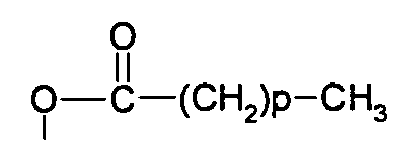
- hydrophilic branch group is a group of the formula wherein p is from 0 to 4 or 0 to 3.
- the chain of the long acyl group consists of a saturated chain having 14 to 20 carbon atoms. In a more preferred aspect, the chain of the long acyl group consists of a saturated chain having 16 to 20 carbon atoms.
- the long acyl group is of the formula wherein n is from 10 to 20 and m is 2n, and wherein p is from 0 to 4 or 0 to 3.
- the long acyl group is a group of the formula wherein x is from 7 to 10, preferably x is 10, and y is 2x, and wherein p is from 0 to 4 or 0 to 3, preferably p is 0.
- the group CxHy is a straight chain hydrocarbon group.
- the long acyl group is a group of the formula
- the short acyl group is an acyl group having from 2 to 5 carbon atoms. In a more preferred aspect, the short acyl group is an acyl group having 2 carbon atoms.
- the short acyl group is preferably of the formula
- the short acyl group and the hydrophilic branch group contain the same number of carbon atoms.
- the short acyl groups it is desirable for the short acyl groups to be present in a maximum amount with respect to the total amount glycerol and esters thereof present in the composition.
- the short acyl group is present in an amount, on average, of no greater than 2 moles per mole of glycerol and esters thereof present in the composition.
- the long acyl groups it is desirable for the long acyl groups to be present in a minimum amount with respect to the total amount glycerol and esters thereof present in the composition.
- the long acyl group is present in an amount, on average, of at least 0.4 moles, preferably from 0.9 to 2 moles, more preferably from 0.9 to 1 moles per mole of glycerol and esters thereof present in the composition.
- the majority of the glycerol present in the composition may also be preferred for the majority of the glycerol present in the composition to be fully acylated. Accordingly, in a preferred aspect the total amount of acyl groups is, on average, 2.7 to 3.0 moles per mole of glycerol and esters thereof
- the present invention provides a process for the preparation of a compound having the formula wherein R 1 , R 2 and R 3 are independently selected from an acyl group or a hydrogen atom; wherein at least one of R 1 , R 2 and R 3 is an acyl group (a short acyl group) having from 2 to 6 carbon atoms or from 2 to 5 carbons; wherein at least one of R 1 , R 2 and R 3 is a branched chain acyl group (a long acyl group) consisting of a chain having 10 to 20 carbon atoms and a hydrophilic branch group; the process comprising the steps of:
- the chain having 10 to 20 carbon may be saturated or unsaturated.
- the process of the present invention may utilise, for example, castor oil or hardened castor oil.
- the compound of the present invention may be prepared from hardened castor oil.
- a typical fatty acid profile of castor oil and hardened castor oil is given below.
- Ricinoleic acid hard (also known as 12-hydroxy stearic acid) has a hydroxyl group (OH) on the 12 th carbon.
- the second step comprising the removal of the glycerol followed by distillation is optional.
- the mixture of glycerol, glycerol monoester, glycerol diester, and glycerol triester may directly acetylated with acetic anhydride to form a mixture of acetylated products.
- the acetylated monoglyceride or the mixture of acetylated products may have a yellowish colour.
- the yellowish product may be distilled.
- the distilled product is clear.
- Typical further processing would involve the removal of glycerol and the subsequent distillation of the resulting mixture.
- an end product with a typical glycerol monoester content above 90% may be provided.
- the fatty acid profile of the end product would reflect the fatty acid profile of the castor oil starting material. This process, namely the production of a glycerol monoester, is described in Bailey's Industrial Oil & Fat Products, vol. 4, Fifth ed. P.572 ff
- the glycerol monoester may then be reacted with an excess of acetic anhydride resulting in acetic acid being esterified with the glycerol ester. Any excess of acetic anhydride is removed from the reaction mixture.
- the end product is a fully acetylated monoglyceride based on castor oil (which may be hardened or unhardened castor oil).
- Castor oil is reacted with acetic anhydride to produce an acetylated castor oil.
- the degree of acetylation may be defined as castor oil containing at least one acetic acid group and up to the average of three acetic acid groups per mole of castor oil.
- the acetylated castor oil is then reacted with triacetin to produce a reaction mixture of mainly acetylated glycerolesters with a fatty acid profile similar to that of the castor oil starting material. This mixture is purified by distillation.
- the end product is an acetylated monoglyceride based on hardened or unhardened castor oil.
- the compound of the present invention is selected from compounds of the formula
- the present invention further provides a compound of the formula wherein two of R 4 , R 5 , and R 6 are of the formula wherein for each of the two of R 4 , R 5 , and R 6 q is independently selected from 0 to 4 or from 0 to 3; and the other of R 4 , R 5 , and R 6 is a branched group of the formula wherein n is from 10 to 20 and m is 2n, and wherein p is from 0 to 4 or from 0 to 3.
- n is from 16 to 20, more preferably from 16 to 18, yet more preferably 17.
- the group CnHm is a straight chain hydrocarbon group.
- the branched group is a group of the formula wherein x is from 7 to 10, preferably x is 10, and y is 2x, and wherein p is from 0 to 4 or from 0 to 3, preferably p is 0.
- the group CxHy is a straight chain hydrocarbon group.
- thermoplastic polymer of the compositions of the present invention may be or comprise a vinyl chloride polymer or a vinyl chloride copolymer selected from vinyl chloride/vinyl acetate copolymer, vinyl chloride/vinylidene chloride copolymer, vinyl chloride/ethylene copolymer and a copolymer prepared by grafting vinyl chloride onto ethylene/vinyl acetate copolymer, or a mixture thereof.
- thermoplastic polymer is or comprises a polymer blend of a thermoplastic polymer, preferably a thermoplastic polymer as defined above, and a second polymer.
- the second polymer is a methacryl polymer or an acrylonitrile-butadiene-styrene polymer.
- compositions of the present invention may be formulated in any manner to provide the required plasticising properties of the compound.
- the composition of the present invention comprises the compound in an amount of 1 to 100 parts by weight per 100 parts by weight of the thermoplastic polymer.
- the present invention provides a process for the preparation of a compound having the formula wherein R 1 , R 2 and R 3 are independently selected from an acyl group or a hydrogen atom, wherein at least one of R 1 , R 2 and R 3 is an acyl group (a short acyl group) having from 2 to 5 or from 2 to 6 carbon atoms, wherein at least one of R 1 , R 2 and R 3 is a branched chain acyl group (a long acyl group) consisting of a chain having 10 to 20 carbon atoms and a hydrophilic branch group, the process comprising the steps of: (i) interesterification between glycerol and triglyceride compound having the formula wherein each of R 1 , R 2 and R 3 is a fatty acid group consisting of a chain having 10 to 20 carbon atoms, to provide a composition comprising glycerol, monoglyceride, diglyceride and/or triglyceride; (ii) optionally iso
- the compound prepared by the process is a compound of the present invention as described herein.
- the compound prepared by the process is a compound of the present invention as described herein.
- DOP, DINP and compound A are comparative compounds not in accordance with the compound/composition of the present invention.
- Compounds B, C and D are compounds containing saturated long chains in accordance with the present invention.
- the compounds were prepared as follows.
- composition A containing approximately 90 wt.% of a plasticiser compound A.
- composition B containing approximately 90 wt.% of a plasticiser compound B.
- composition C containing plasticiser compound C.
- composition D containing plasticiser compound D.
- Plasticiser composition B is tested for its function as a plasticiser using the following formulation.
- Vestolit S7054* 100 parts by weight Ca-Zn stabilizer 1 parts by weight Epoxidised soybean oil 3 parts by weight Plasticiser composition 50 parts by weight * - available from Hüls AG, Germany
- a predetermined amount of plasticiser composition is added to the above formulation and the mixture kneaded at 150 to 155°C for 5 minutes between 20 cm test rollers.
- the rolled sheet is further pressed at 160°C and 150 kg/cm 2 using a compression molding machine to form a 1-mm thick sheet.
- composition B provides a plasticising effect.
- Plasticiser composition B and the four plasticisers of Example 2 of US 4426477 are tested for their function as a plasticiser using a PVC paste resin formulation.
- Formulation PVC (K 78), Vestolit P1348K* 100 parts by weight Ca-Zn liquid stabilizer 3 parts by weight Plasticiser composition 60 parts by weight * - available from Hüls AG, Germany
- Bleeding Property - after dearation the compositions are spread over a glass plate to form a 1 mm thick film. The film is allowed to gel for 15 minutes in an oven at 180°C. The resulting sheet is left to stand at room temperature for a week. The bled matter is washed off with an acetone/IPA mixture. The sheet is dried to measure its weight loss.
- composition B bleeds less than each of the compositions of US 4426477 .
- Plasticiser composition B is evaluated by using an ethylene/vinyl chloride copolymer sheet formulation.
- Formulation Ethylene/vinyl copolymer (K 55)* 100 parts by weight Ca-Zn stabiliser 2.0 parts by weight Methylmethacryl-butadiene-styrene resin 5.0 parts by weight Lubricant, stearic acid monoglyceride 1.0 parts by weight Polyethylene wax 0.3 parts by weight Plasticiser composition 3.0 parts by weight * - available from Hüls AG, Germany
Landscapes
- Chemical & Material Sciences (AREA)
- Organic Chemistry (AREA)
- Chemical Kinetics & Catalysis (AREA)
- Engineering & Computer Science (AREA)
- Wood Science & Technology (AREA)
- Oil, Petroleum & Natural Gas (AREA)
- General Chemical & Material Sciences (AREA)
- Life Sciences & Earth Sciences (AREA)
- Polymers & Plastics (AREA)
- Health & Medical Sciences (AREA)
- Medicinal Chemistry (AREA)
- Compositions Of Macromolecular Compounds (AREA)
- Organic Low-Molecular-Weight Compounds And Preparation Thereof (AREA)
- Addition Polymer Or Copolymer, Post-Treatments, Or Chemical Modifications (AREA)
- Pharmaceuticals Containing Other Organic And Inorganic Compounds (AREA)
- Confectionery (AREA)
- Polyesters Or Polycarbonates (AREA)
Abstract

the process comprising the steps of:
(i) interesterification between glycerol and triglyceride compound having the formula

(ii) optionally isolating the monoglyceride and/or diglyceride from the composition;
(iii) acylating the monoglyceride and/or diglyceride or the composition containing the same.
Description
- The present invention relates to a composition. In particular, the present invention relates to a composition comprising a thermoplastic polymer and a compound which acts as a plasticiser.
- The manufacturing properties of thermoplastic polymers, for example the extruding properties of such polymers, is often modified/enhanced by the addition of plasticisers thereto. As acknowledged in the prior art, such as in
US-A-4426477 , there is a tendency toward avoiding the commonly used plasticisers such as dioctyl adipate (DOA) and phthalate plasticisers such as dioctyl phthalate (DOP). The safety of these plasticisers has been called into question, particularly in certain applications. -
US-A-4426477 discloses plasticisers based on glycerol esters. The plasticisers consist of compounds prepared by the acylation of glycerol. The compounds comprises triesters, wherein approximately two of the acyls have two carbons and the remaining one acyl has from 10 to 14 carbons. The compounds ofUS-A-4426477 provide a plasticising effect. However, in certain applications the plasticisers have a volatility such that they may migrate out of the thermoplastic polymer in which they are incorporated, such as PVC. - In a first aspect the present invention provides a composition comprising i) a thermoplastic polymer ii) a compound having the formula

- Preferably two of R1, R2 and R3 are short acyl groups as described above and the other of R1, R2 and R3 is a long acyl group as described above. In this aspect, the compound may be of the formula

- Preferably the hydrophilic branch group is a group selected from acyl and derivatives thereof. Preferred derivatives include groups of the formula -O-acyl.
- Preferably the hydrophilic branch group is a group of the formula
- In a preferred aspect of the present invention the chain of the long acyl group consists of a saturated chain having 14 to 20 carbon atoms. In a more preferred aspect, the chain of the long acyl group consists of a saturated chain having 16 to 20 carbon atoms.
- Preferably the long acyl group is of the formula

- Preferably n is from 16 to 20, more preferably from 16 to 18, yet more preferably 17.
- Preferably the group CnHm is a straight chain hydrocarbon group.
- In a highly preferred aspect the long acyl group is a group of the formula

- Preferably the group CxHy is a straight chain hydrocarbon group.
- In a highly preferred aspect the long acyl group is a group of the formula

- In a preferred aspect of the present invention the short acyl group is an acyl group having from 2 to 5 carbon atoms. In a more preferred aspect, the short acyl group is an acyl group having 2 carbon atoms. The short acyl group is preferably of the formula

- Preferably the short acyl group and the hydrophilic branch group contain the same number of carbon atoms. In a highly preferred aspect the hydrophilic branch group is a group of the formula


- In certain aspects, it is desirable for the short acyl groups to be present in a maximum amount with respect to the total amount glycerol and esters thereof present in the composition. Preferably the short acyl group is present in an amount, on average, of no greater than 2 moles per mole of glycerol and esters thereof present in the composition.
- In certain aspects, it is desirable for the long acyl groups to be present in a minimum amount with respect to the total amount glycerol and esters thereof present in the composition. Preferably the long acyl group is present in an amount, on average, of at least 0.4 moles, preferably from 0.9 to 2 moles, more preferably from 0.9 to 1 moles per mole of glycerol and esters thereof present in the composition.
- It may also be preferred for the majority of the glycerol present in the composition to be fully acylated. Accordingly, in a preferred aspect the total amount of acyl groups is, on average, 2.7 to 3.0 moles per mole of glycerol and esters thereof
- The compound of the present invention may be prepared by interesterification between glycerol and one or more oils, including natural oils and hardened natural oils followed by acylation. Thus, the compound of the present invention may be the product of a two part process comprising (i) an interesterification between glycerol and an oil selected from castor oil, including hardened castor oil, unhardened castor oil and mixtures thereof, and (ii) acylation.
- Thus in a further aspect the present invention provides a process for the preparation of a compound having the formula

the process comprising the steps of: - (i) interesterification between glycerol and triglyceride compound having the formula

- (ii) optionally isolating the monoglyceride and/or diglyceride from the composition;
- (iii) acylating the monoglyceride and/or diglyceride or the composition containing the same.
- In the process of the present invention the chain having 10 to 20 carbon may be saturated or unsaturated.
- The process of the present invention may utilise, for example, castor oil or hardened castor oil. The compound of the present invention may be prepared from hardened castor oil. A typical fatty acid profile of castor oil and hardened castor oil is given below.
Castor Oil Fatty Acid Content [%] Palmitic (C16) 1.0 Stearic (C18) 1.1 Oleic (C18:1) 3.8 Linoleic (C18:2) 4.4 Linolenic (C18:3) 0.5 Gadoleic (C20:1) 0.5 Ricinoleic (C18:1-OH) 87.4 Hardened Castor Oil Fatty Acid Content [%] Palmitic (C16) 1.3 Stearic (C18) 9.3 Oleic (C18:1) 0.9 Linoleic (C18:2) 0.2 Arachidic (C20) 0.7 Ricinoleic. hard (C18-OH) 84.9 - The nomenclature in parenthesis is Cxx:y where xx is the fatty acid carbon number and y indicates number of double bonds. Ricinoleic acid, hard (also known as 12-hydroxy stearic acid) has a hydroxyl group (OH) on the 12th carbon.
- In this aspect the product based on the castor oil, or indeed a product based on another oil, may be synthesised as follows. These synthetic routes are given by way of example only. Other routes would be appreciated by a person skilled in the art
- Castor oil and glycerol are reacted to produce an equilibrium mixture of different glycerol esters. This mixture can be distilled and subsequently acetylated to provide the desired end products. This route is illustrated below.

- The second step comprising the removal of the glycerol followed by distillation is optional. In other word the mixture of glycerol, glycerol monoester, glycerol diester, and glycerol triester may directly acetylated with acetic anhydride to form a mixture of acetylated products. The acetylated monoglyceride or the mixture of acetylated products may have a yellowish colour. The yellowish product may be distilled. The distilled product is clear.
- Depending on the ratio between castor oil and glycerol and depending on the reaction conditions, the described process provides different glycerol ester mixtures. The glycerol monoester is typically 45-65% and may be up to 65%. This is achieved in a typical reaction mixture. Such a composition may then, optionally, be further processed to provide a product having a higher purity, for example a monoester content of above 90%.
- Typical further processing would involve the removal of glycerol and the subsequent distillation of the resulting mixture. By means of this further processing an end product with a typical glycerol monoester content above 90% may be provided. The fatty acid profile of the end product would reflect the fatty acid profile of the castor oil starting material. This process, namely the production of a glycerol monoester, is described in Bailey's Industrial Oil & Fat Products, vol. 4, Fifth ed. P.572 ff
- The glycerol monoester may then be reacted with an excess of acetic anhydride resulting in acetic acid being esterified with the glycerol ester. Any excess of acetic anhydride is removed from the reaction mixture. The end product is a fully acetylated monoglyceride based on castor oil (which may be hardened or unhardened castor oil).
- Route 2 provides a further manner in which acetylated monoglycerides based on, for example, hardened and unhardened castor oil may be synthesised. An acetylated monoglyceride may be produced by the reaction of castor oil with acetic anhydride to provide an acetylated castor oil. The acetylated castor oil is then reacted with triacetin to produce acetylated monoglycerides based on hardened and unhardened castor oil. This process is illustrated below.

- Castor oil is reacted with acetic anhydride to produce an acetylated castor oil. The degree of acetylation may be defined as castor oil containing at least one acetic acid group and up to the average of three acetic acid groups per mole of castor oil. The acetylated castor oil is then reacted with triacetin to produce a reaction mixture of mainly acetylated glycerolesters with a fatty acid profile similar to that of the castor oil starting material. This mixture is purified by distillation. The end product is an acetylated monoglyceride based on hardened or unhardened castor oil.
- A process for obtaining acetylated glycerol esters from the reaction of a triglyceride and triacetin is described in the Danish Patent No.
93 786 - In a highly preferred aspect the compound of the present invention is selected from compounds of the formula


- These preferred compounds may be prepared and are preferably prepared in accordance with Route 1 or Route 2 above.
- The above compounds are specific compounds which may be provided by the present invention. In a broad aspect, the present invention further provides a compound of the formula


- Preferably q is 0. More preferably for both of the two of R4, R5, and R6 q is 0.
- Preferably n is from 16 to 20, more preferably from 16 to 18, yet more preferably 17.
- Preferably the group CnHm is a straight chain hydrocarbon group.
- In a preferred aspect the branched group is a group of the formula

- Preferably the group CxHy is a straight chain hydrocarbon group.
- The compounds provided by the present invention may be incorporated in a composition comprising a thermoplastic polymer. Accordingly in a further aspect the present invention provides a composition comprising a compound as defined above and a thermoplastic polymer.
- The thermoplastic polymer of the compositions of the present invention may be or comprise a vinyl chloride polymer or a vinyl chloride copolymer selected from vinyl chloride/vinyl acetate copolymer, vinyl chloride/vinylidene chloride copolymer, vinyl chloride/ethylene copolymer and a copolymer prepared by grafting vinyl chloride onto ethylene/vinyl acetate copolymer, or a mixture thereof.
- In a preferred aspect the thermoplastic polymer is or comprises a polymer blend of a thermoplastic polymer, preferably a thermoplastic polymer as defined above, and a second polymer. Preferably, the second polymer is a methacryl polymer or an acrylonitrile-butadiene-styrene polymer.
- The compositions of the present invention may be formulated in any manner to provide the required plasticising properties of the compound. In a particular aspect the composition of the present invention comprises the compound in an amount of 1 to 100 parts by weight per 100 parts by weight of the thermoplastic polymer.
- As disclosed above the present invention provides a process for the preparation of a compound having the formula


- In the process of the present invention the chain having 10 to 20 carbon atoms may be saturated or unsaturated.
- In preferred aspects the compound prepared by the process is a compound of the present invention as described herein. In a broader aspects
- the long acyl group is of the formula

- Preferably m is 2n or 2n-2.
- Preferably the group CnHm is a straight chain hydrocarbon group. The straight chain hydrocarbon group may be saturated or unsaturated. The straight chain hydrocarbon group may contain a single -C=C- bond.
- the long acyl group is a group of the formula
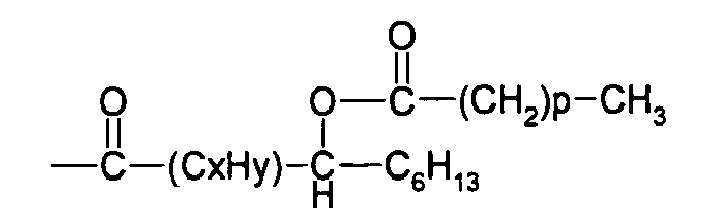
- Preferably the group CxHy is a straight chain hydrocarbon group. The straight chain hydrocarbon group may be saturated or unsaturated. The straight chain hydrocarbon group may contain a single -C=C- bond.
- the long acyl group is a group of the formula

- the compound is of the formula

- the compound is of the formula


or from 0 to 3
and the other of R4, R5, and R6 is a branched group of the formula
- the branched group is a group of the formula

- The invention will now be described in further detail with in the following Examples.
- Six plasticisers were evaluated. These were:
- 1. dioctyl phthalate (DOP) - a conventional phthalate based plasticiser. DOP is by far the most widely used plasticiser for PVC. DOP is available from Monsanto Europe, Belgium
- 2. Diisononyl phthalate (DINP) - a conventional phthalate based plasticiser from Monsanto Europe, Belgium
- 3. Compound A - a compound having the structure

- 4. Compound B - a compound having the structure

- 5. Compound C - a compound having the structure

- 6. Compound D - a compound having the structure

- DOP, DINP and compound A are comparative compounds not in accordance with the compound/composition of the present invention. Compounds B, C and D are compounds containing saturated long chains in accordance with the present invention.
- The compounds were prepared as follows.
- 100 gram of castor oil, 30 gram of glycerol and 0.3 gram of 50% sodium hydroxide is heated to 250°C and reacted for 60 minutes. The sodium hydroxide is neutralised with 0.5 gram of 85% phosphoric acid. The glycerol is removed by water vapour distillation at 140°C and 0.05 mbar. The monoglyceride is concentrated by short path distillation at 200°C and a pressure below 5*10-3 mbar. 40 gram of monoglyceride is then reacted with 40 gram of acetic anhydride at 140°C for 60 minutes and the formed acetic acid is removed by vacuum distillation. The yield of compound A is 50 gram.
- The synthesis provided a composition (Composition A) containing approximately 90 wt.% of a plasticiser compound A.
- 100 gram of hydrogenated castor oil is reacted with 32 gram of acetic anhydride at 140°C for 60 minutes and the formed acetic acid is removed by vacuum distillation. 100 gram of the fully acetylated hydrogenated castor oil is reacted with 100 gram of triacetin, 0.0045 of sodium methoxide and 0.825 gram of aluminium stearate at 250°C for 60 minutes. The non reacted triacetin is removed by vacuum distillation at 135°C and 0.01 mbar. Compound B is concentrated by short path distillation at 200°C and a pressure below 5*10-3 mbar. The yield of compound B is 40 gram.
- The synthesis provided a composition (Composition B) containing approximately 90 wt.% of a plasticiser compound B.
- 100 gram of hydrogenated castor oil, 30 gram of glycerol and 0.3 gram of 50% sodium hydroxide is heated to 250°C and reacted for 60 minutes. The sodium hydroxide is neutralised with 0.5 gram of 85% phosphoric acid. The glycerol is removed by water vapour distillation at 140°C and 0.05 mbar. The monoglyceride is concentrated by short path distillation at 200°C and a pressure below 5*10-3 mbar. 40 gram of monoglyceride is then reacted with 54 gram of butyric anhydride at 150°C for 90 minutes and the formed butyric acid is removed by vacuum distillation. The yield of compound C is 61 gram.
- The synthesis provided a composition (Composition C) containing plasticiser compound C.
- 100 gram of hydrogenated castor oil, 30 gram of glycerol and 0.3 gram of 50% sodium hydroxide is heated to 250°C and reacted for 60 minutes. The sodium hydroxide is neutralised with 0.5 gram of 85% phosphoric acid. The glycerol is removed by water vapour distillation at 140°C and 0.05 mbar. The monoglyceride is concentrated by short path distillation at 200°C and a pressure below 5*10-3 mbar. 40 gram of monoglyceride is then reacted with 74 gram of hexanoic acid anhydride at 160°C for 90 minutes and the formed hexanoic acid is removed by vacuum distillation. The yield of compound D is 67 gram.
- The synthesis provided a composition (Composition D) containing plasticiser compound D.
- Plasticiser composition B is tested for its function as a plasticiser using the following formulation.
Formulation PVC (K=70), Vestolit S7054* 100 parts by weight Ca-Zn stabilizer 1 parts by weight Epoxidised soybean oil 3 parts by weight Plasticiser composition 50 parts by weight * - available from Hüls AG, Germany - A predetermined amount of plasticiser composition is added to the above formulation and the mixture kneaded at 150 to 155°C for 5 minutes between 20 cm test rollers. The rolled sheet is further pressed at 160°C and 150 kg/cm2 using a compression molding machine to form a 1-mm thick sheet.
- The test procedure demonstrates that Composition B provides a plasticising effect.
- Plasticiser composition B and the four plasticisers of Example 2 of
US 4426477 are tested for their function as a plasticiser using a PVC paste resin formulation.Formulation PVC (K=78), Vestolit P1348K* 100 parts by weight Ca-Zn liquid stabilizer 3 parts by weight Plasticiser composition 60 parts by weight * - available from Hüls AG, Germany - Bleeding Property - after dearation the compositions are spread over a glass plate to form a 1 mm thick film. The film is allowed to gel for 15 minutes in an oven at 180°C. The resulting sheet is left to stand at room temperature for a week. The bled matter is washed off with an acetone/IPA mixture. The sheet is dried to measure its weight loss.
- The test procedure demonstrates that Composition B bleeds less than each of the compositions of
US 4426477 . - Plasticiser composition B is evaluated by using an ethylene/vinyl chloride copolymer sheet formulation.
Formulation Ethylene/vinyl copolymer (K = 55)* 100 parts by weight Ca-Zn stabiliser 2.0 parts by weight Methylmethacryl-butadiene-styrene resin 5.0 parts by weight Lubricant, stearic acid monoglyceride 1.0 parts by weight Polyethylene wax 0.3 parts by weight Plasticiser composition 3.0 parts by weight * - available from Hüls AG, Germany - The above formulation is kneaded at 180 to 190°C for 5 minutes between 20 cm test rollers. The processability is judged at this point. Next, the rolled sheet is further pressed at 180°C and 100 kg/cm2 to form a 1 mm thick sheet, and then the transparency is measured.
- The test procedure demonstrates that Composition B provides a polymer composition having good processability and good transparency.
- Plasticiser composition B is evaluated by using a PVC wrap formulation.
Formulation PVC (K=70), Vestolit S7054 100 parts by weight Epoxidised soybean oil 10 parts by weight Ca-Zn stabiliser 2 parts by weight Chelator 0.5 parts by weight Antifogging agent sorbitan laurate 1.0 parts by weight Polyoxyethylene alkyl ether 1.0 parts by weight Plasticiser composition 35 parts by weight - The above formulation is moulded into a wrap film by use of a 19 mm extruder and the film is subjected to tests for evaluation of properties.
- A Brabender extrusiograph Type 19/25 D
- Screw diameter 19 mm, L/D=25, die 25 mm wide die
- Screw compression ration 2:1
Extrusion Conditions Cylinder head temperature 195°C Die temperature 205°C Screw speed 35 rpm Take-off speed 12 m/min - The test procedure demonstrates that Composition B provides a polymer composition having good processability, good transparency, bleeding and antifogging properties.
- Each of the six compounds being evaluated were incorporated in PVC.
- The compounds were incorporated in the PVC in the following amounts.
PVC (K=70), Solvic S 271 GC* 100 parts by weight Plasticiser 40 parts by weight * - available from Solvay & Cie, Belgium - The PVC and plasticiser compounds were mixed in a Brabender Planetary Mixer Type P 600. The mixer was operated at 88°C and 100 RPM. The procedure is in accordance with ISO/DIS 4574.
- The individual compounds are compression moulded into sheets having a thickness of approximately 4 mm in accordance with ISO 293-1974. Conditions were 190°C and an applied pressure of 7.5 bar. Moulding time was set to 150 seconds.
- Dumbbell test specimens were cut from the compression moulded sheets according to DIN 53457 (Dumbbell no. 4). The properties measured to evaluate the plasticiser effect are shown in the table below. Shore A was measured according to DIN 53505. All other properties were recorded in accordance with DIN 53457.
-
Plasticiser Youngs Modulus [Mpa] Strain at Break [%] Stress at Break [MPa] Shore A (after 3 sec.) Shore A (after 15 sec.) SASE (100%) [Mpa] DOP 12.04 639.3 22.20 92.5 90.0 8.46 DINP 15.04 687.4 24.08 94.0 91.5 9.31 Compound A 16.14 678.7 28.01 91.0 88.0 10.40 Compound B 12.96 733.0 24.98 91.0 88.0 9.07 Compound C 25.89 690.4 23.83 95.0 92.0 10.51 Compound D 101.20 474.8 19.89 98.0 97.0 12.88 - The parameters typically used to describe the plasticising effect is Young's Modulus and Shore A values.
- Young's Modulus is also called the elasticity modulus and the lower the value of this parameter the better is the plasticising effect.
- Shore A is a measure of the hardness of the product. This value should in general be as low as possible.
- The stress required for a 100% elongation of the test specimen (SASE, 100%) is also used to evaluate the properties of a plasticiser. A low value on this parameter indicates a good plasticising effect.
- The "Strain at Break" and "Stress at Break" are two additional mechanical properties that are used to describe a plasticised PVC.
- In comparison to the industry standard plasticiser DOP, Compound B provided analogous performance to DOP. Compound B provided superior performance when compared to Compound A and DINP. Compound C and D exhibited a plasticising effect but exhibited inferior performance compared to Compound B.
- Each of the six compounds being evaluated were incorporated in PVC.
- The compounds were prepared in accordance with Example 5 and incorporated in the PVC in the following amounts.
PVC (K=70), Solvic S 271 GC* 100 parts by weight Plasticiser 60 parts by weight * - available from Solvay & Cie, Belgium Plasticiser Youngs Modulus [Mpa] Strain at Break [%1] Stress at Break [MPa] Shore A (after 3 sec.) Shore A (after 15 sec.) SASE (100%) [Mpa] DOP 3.87 878.4 17.71 79.0 76.5 3.81 DINP 4.46 882.0 19.15 83.5 80.0 4.31 Compound A 4.99 815.0 18.49 79.0 75.5 4.70 Compound B 4.19 868.2 18.42 80.5 78.0 3.88 Compound C 6.65 756.0 18.05 88.0 85.0 5.48 Compound D 64.43 487.5 18.23 97.0 93.5 10.73 - Results for this formulation which contains 60 parts plasticiser shows a better plasticising effect for all products in comparison to the results obtained with the formulation of Example 5 (40 parts plasticiser).
- As for Example 5 in comparison to industry standard DOP, Compound B provided analogous performance to DOP, in particular in respect of Young's Modulus, SASE (100%) and Shore A. Compound B provided superior performance when compared to Compound A and DINP. Compound C and D exhibited a plasticising effect but exhibit inferior performance than Compound B.
- Further aspects of the invention are described in the following numbered paragraphs.
- (1) A composition comprising
- i) a thermoplastic polymer;
- ii) a compound having the formula

wherein at least one of R1, R2 and R3 is an acyl group (a short acyl group) having from 2 to 6 carbon atoms
wherein at least one of R1, R2 and R3 is a branched chain acyl group (a long acyl group) consisting of a saturated chain having 10 to 20 carbon atoms and a hydrophilic branch group. - (2) A composition as described in paragraph 1 wherein the hydrophilic branch group is an acyl group or a derivative thereof.
- (3) A composition as described in paragraph 2 wherein the hydrophilic branch group is a group of the formula

- (4) A composition as described in any one of the preceding numbered paragraphs wherein two of R1, R2 and R3 are the short acyl groups and wherein the other of R1, R2 and R3 is a long acyl group.
- (5) A composition as described in any one of the preceding numbered paragraphs wherein the chain of the long acyl group consists of a chain having 14 to 20 carbon atoms.
- (6) A composition as described in paragraph 5 wherein the chain of the long acyl group consists of a chain having 16 to 20 carbon atoms.
- (7) A composition as described in any one of the preceding numbered paragraphs wherein the short acyl group is an acyl group having from 2 to 5 carbon atoms.
- (8) A composition as described in paragraph 7 wherein the short acyl group is an acyl group having 2 carbon atoms.
- (9) A composition as described in any one of the preceding numbered paragraphs wherein the short acyl group is present in an amount, on average, of no greater than 2 moles per mole of glycerol and esters thereof.
- (10) A composition as described in any one of the preceding numbered paragraphs wherein the long acyl group is present in an amount, on average, of at least 0.4 moles, preferably from 0.9 to 2 moles, more preferably from 0.9 to 1 moles per mole of glycerol and esters thereof.
- (11) A composition as described in any one of the preceding numbered paragraphs wherein the total amount of the acyl groups is, on average, 2.7 to 3.0 moles per mole of glycerol and esters thereof.
- (12) A composition as described in any one of the preceding numbered paragraphs wherein the compound is an acetylated interesterification product of glycerol and an oil selected from castor oil, including hardened castor oil, unhardened castor oil and mixtures thereof.
- (13) A composition as described in any one of the preceding numbered paragraphs wherein the thermoplastic polymer is or comprises a vinyl chloride polymer or a vinyl chloride copolymer selected from vinyl chloride/vinyl acetate copolymer, vinyl chloride/vinylidene chloride copolymer, vinyl chloride/ethylene copolymer and a copolymer prepared by grafting vinyl chloride onto ethylene/vinyl acetate copolymer, and mixtures thereof.
- (14) A composition as described in any one of the preceding numbered paragraphs wherein the thermoplastic polymer is or comprises a polymer blend of a thermoplastic polymer and a second polymer.
- (15) A composition as described in paragraph 14, wherein the second polymer is a methacryl polymer or an acrylonitrile-butadiene-styrene polymer.
- (16) A composition as described in any one of the preceding numbered paragraphs wherein the composition comprises the compound in an amount of 1 to 100 parts by weight per 100 parts by weight of the thermoplastic polymer.
- (17) A composition as described in any one of the preceding numbered paragraphs wherein the compound has the formula

- (18) A composition as described in any one of paragraphs 1 to 16 wherein the compound has the formula

- (19) A composition as described in any one of paragraphs 1 to 16 wherein the compound has the formula

- (20) A compound of the formula


- (21) A compound as described in paragraph 20 wherein p is from 0 to 3.
- (22) A compound as described in any one of paragraphs 20 or 21 wherein q is 0.
- (23) A compound as described in any one of paragraphs 20, 21 or 22 wherein n is from 16 to 20, preferably from 16 to 18, more preferably 17.
- (24) A compound as described in any one of paragraphs 20 to 23 wherein the branched group is a group of the formula

- (25) A compound as described in paragraph 24 wherein p is from 0 to 3.
- (26) A compound as described in any one of paragraphs 24 or 25 wherein p is 0.
- (27) A compound as described in any one of paragraphs 24, 25 or 26 wherein x is 10.
- (28) A compound of the formula

- (29) A compound of the formula

- (30) A compound of the formula

- (31) A composition comprising a compound as described in any one of paragraphs 20 to 30 and a thermoplastic polymer.
- (32) A process for the preparation of a compound having the formula

wherein at least one of R1, R2 and R3 is an acyl group (a short acyl group) having from 2 to 6 carbon atoms; wherein at least one of R1, R2 and R3 is a branched chain acyl group (a long acyl group) consisting of a chain having 10 to 20 carbon atoms and a hydrophilic branch group; the process comprising the steps of:- (i) interesterification between glycerol and triglyceride compound having the formula

- (ii) optionally isolating the monoglyceride and/or diglyceride from the composition;
- (iii) acylating the monoglyceride and/or diglyceride or the composition containing the same.
- (i) interesterification between glycerol and triglyceride compound having the formula
- (33) A process as described in paragraph 32 wherein the compound is a compound as described in any one of paragraphs 20 to 30.
- All publications mentioned in the above specification are herein incorporated by reference. Various modifications and variations of the described methods and system of the invention will be apparent to those skilled in the art without departing from the scope and spirit of the invention. Although the invention has been described in connection with specific preferred embodiments, it should be understood that the invention as claimed should not be unduly limited to such specific embodiments. Indeed, various modifications of the described modes for carrying out the invention which are obvious to those skilled in chemistry or related fields are intended to be within the scope of the following claims.
Claims (17)
- A process for the preparation of a compound having the formula

the process comprising the steps of:(i) interesterification between glycerol and triglyceride compound having the formula (ii) optionally isolating the monoglyceride and/or diglyceride from the composition;(iii) acylating the monoglyceride and/or diglyceride or the composition containing the same.
 - A process according to claim 1, wherein the monoglyceride and/or diglyceride is isolated from the composition in step (ii) by distillation.
- A process according to claim 1 or 2, wherein the compound is an acetylated interesterification product of glycerol and an oil selected from castor oil, including hardened castor oil, unhardened castor oil and mixtures thereof.
- A process according to any one of the preceding claims wherein the hydrophilic branch group is a group of the formula

- A process according to any one of the preceding claims wherein two of R1, R2 and R3 are the short acyl groups and wherein the other of R1, R2 and R3 is a long acyl group.
- A process according to any one of the preceding claims wherein the chain of the long acyl group consists of a chain having 14 to 20 carbon atoms.
- A process according to any one of the preceding claims wherein the short acyl group is an acyl group having from 2 to 5 carbon atoms.
- A process according to any one of the preceding claims wherein the short acyl group is present in an amount, on average, of no greater than 2 moles per mole of glycerol and esters thereof.
- A process according to any one of the preceding claims wherein the long acyl group is present in an amount, on average, of at least 0.4 moles per mole of glycerol and esters thereof.
- A process according to any one of the preceding claims wherein the total amount of the acyl groups is, on average, 2.7 to 3.0 moles per mole of glycerol and esters thereof.
- A process according to any one of the preceding claims, wherein monoglyceride and/or diglyceride or the composition containing the same is acylated in step (iii) with acetic anhydride.
- A process according to any one of the preceding claims wherein the compound has the formula

- A process according to any one of claims 1 to 12, wherein the compound has the formula

- A process according to any one of claims 1 to 12, wherein the compound has the formula

- A process according to claim 1, wherein the compound has the formula


- A process according to claim 15 wherein n is from 16 to 20.
- A process according to claim 15 or 16 wherein the branched group is a group of the formula

Applications Claiming Priority (4)
| Application Number | Priority Date | Filing Date | Title |
|---|---|---|---|
| GBGB9919683.4A GB9919683D0 (en) | 1999-08-19 | 1999-08-19 | Composition |
| US16792399P | 1999-11-29 | 1999-11-29 | |
| EP00953359A EP1218443B1 (en) | 1999-08-19 | 2000-08-09 | Specific acylated gylcerol compounds for plasticisers in polymers |
| EP05077261A EP1624014B1 (en) | 1999-08-19 | 2000-08-09 | Specific acylated glycerol compounds for plasticisers in polymers and process for their preparation |
Related Parent Applications (1)
| Application Number | Title | Priority Date | Filing Date |
|---|---|---|---|
| EP05077261A Division EP1624014B1 (en) | 1999-08-19 | 2000-08-09 | Specific acylated glycerol compounds for plasticisers in polymers and process for their preparation |
Publications (1)
| Publication Number | Publication Date |
|---|---|
| EP2011819A1 true EP2011819A1 (en) | 2009-01-07 |
Family
ID=26315863
Family Applications (3)
| Application Number | Title | Priority Date | Filing Date |
|---|---|---|---|
| EP00953359A Expired - Lifetime EP1218443B1 (en) | 1999-08-19 | 2000-08-09 | Specific acylated gylcerol compounds for plasticisers in polymers |
| EP05077261A Expired - Lifetime EP1624014B1 (en) | 1999-08-19 | 2000-08-09 | Specific acylated glycerol compounds for plasticisers in polymers and process for their preparation |
| EP08075754A Withdrawn EP2011819A1 (en) | 1999-08-19 | 2000-08-09 | Process |
Family Applications Before (2)
| Application Number | Title | Priority Date | Filing Date |
|---|---|---|---|
| EP00953359A Expired - Lifetime EP1218443B1 (en) | 1999-08-19 | 2000-08-09 | Specific acylated gylcerol compounds for plasticisers in polymers |
| EP05077261A Expired - Lifetime EP1624014B1 (en) | 1999-08-19 | 2000-08-09 | Specific acylated glycerol compounds for plasticisers in polymers and process for their preparation |
Country Status (13)
| Country | Link |
|---|---|
| US (1) | US6734241B1 (en) |
| EP (3) | EP1218443B1 (en) |
| JP (1) | JP5324518B2 (en) |
| CN (2) | CN1235957C (en) |
| AT (2) | ATE444987T1 (en) |
| AU (1) | AU6587000A (en) |
| CY (1) | CY1109703T1 (en) |
| DE (2) | DE60043123D1 (en) |
| DK (2) | DK1218443T3 (en) |
| ES (2) | ES2333885T3 (en) |
| PT (1) | PT1624014E (en) |
| SI (2) | SI1624014T1 (en) |
| WO (1) | WO2001014466A1 (en) |
Cited By (1)
| Publication number | Priority date | Publication date | Assignee | Title |
|---|---|---|---|---|
| WO2014106070A1 (en) | 2012-12-29 | 2014-07-03 | Saint-Gobain Performance Plastics Corporation | Flexible tube |
Families Citing this family (42)
| Publication number | Priority date | Publication date | Assignee | Title |
|---|---|---|---|---|
| US6734242B2 (en) | 2000-08-18 | 2004-05-11 | Danisco A/S | Composition |
| BR0210201B1 (en) * | 2001-06-06 | 2012-09-18 | composition, method for preparing a composition, method for dispersing a pigment or for improving dispersion of a pigment, and kit for preparing a composition. | |
| AU2003239271B2 (en) * | 2003-01-27 | 2008-09-18 | Dupont Nutrition Biosciences Aps | Composition |
| JP2006335874A (en) * | 2005-06-02 | 2006-12-14 | Kao Corp | Plasticizer for biodegradable resin |
| GB0700074D0 (en) * | 2007-01-03 | 2007-02-07 | Danisco | process |
| GB0700076D0 (en) * | 2007-01-03 | 2007-02-07 | Danisco | Compound |
| BRPI0704776A2 (en) * | 2007-09-12 | 2009-05-05 | Sgs Polimeros Ltda | vegetable oil derivatives |
| CN102007176A (en) | 2008-02-15 | 2011-04-06 | 联合碳化化学及塑料技术有限责任公司 | Alternative plasticizer systems for phthalate-plasticized formulations |
| US20110021680A1 (en) * | 2008-03-28 | 2011-01-27 | Colle Karla S | Polyol Ester Plasticizers and Process of Making the Same |
| DE102008026263A1 (en) * | 2008-06-02 | 2009-12-03 | Emery Oleochemicals Gmbh | Anti-fogging agent based on polyglycerol and native oils |
| US8163825B2 (en) * | 2008-09-03 | 2012-04-24 | Exxonmobil Chemical Patents Inc. | Triglyceride plasticizers having low average levels of branching and process of making the same |
| DE102008042718A1 (en) | 2008-10-09 | 2010-04-15 | Invendo Medical Gmbh | Medical engineering, elastic polymer tube and method for its production |
| US8476350B2 (en) * | 2008-12-24 | 2013-07-02 | Exxonmobil Research And Engineering Company | Triglyceride plasticizer and process of making |
| US8299281B2 (en) * | 2009-03-27 | 2012-10-30 | Exxonmobil Research And Engineering Company | Process for making triglyceride plasticizer from crude glycerol |
| GB0914572D0 (en) | 2009-08-20 | 2009-09-30 | Danisco | Process |
| KR101770005B1 (en) | 2009-09-30 | 2017-08-21 | 다우 글로벌 테크놀로지스 엘엘씨 | Heat stabilized polymeric composition with epoxidized fatty acid ester plasticizer |
| CA2775973C (en) * | 2009-09-30 | 2018-01-09 | Dow Global Technologies Llc | Acetylated glyceride of 12-hydroxystearic acid and blends with epoxidized fatty acid esters |
| US20120181057A1 (en) * | 2009-09-30 | 2012-07-19 | Chaudhary Bharat I | Acetylate Glycerin Esters and Their Blends with Epoxidized Fatty Acid Esters |
| WO2011041372A1 (en) | 2009-09-30 | 2011-04-07 | Dow Global Technologies Llc. | Acetylated polyglycerine fatty acid ester and a pvc insulator plasticised therewith |
| US8552098B2 (en) | 2009-09-30 | 2013-10-08 | Dow Global Technologies Llc | Purified acetylated derivatives of castor oil and compositions including same |
| CA2775930C (en) | 2009-09-30 | 2017-02-14 | Dow Global Technologies Inc. | Acetylated derivatives of castor oil and their blends with epoxidized fatty acid esters |
| US8771815B2 (en) | 2009-12-17 | 2014-07-08 | Exxonmobil Research And Engineering Company | Process for making triglyceride plasticizer |
| US8568846B2 (en) * | 2009-12-24 | 2013-10-29 | Exxonmobil Research And Engineering Company | Process for making polyol neoalkylester plasticizers from neo acids |
| KR101773606B1 (en) * | 2010-05-04 | 2017-09-12 | 에스케이이노베이션 주식회사 | A plasticizer and a preparing method of the same |
| WO2011143028A1 (en) * | 2010-05-10 | 2011-11-17 | Dow Global Technologies Llc | Flexible pvc compositions made with plasticizers derived from renewable sources |
| ES2542759T3 (en) * | 2010-05-10 | 2015-08-11 | Basf Se | Thermoplastic polyurethane containing glycerin, which is esterified with at least one aliphatic carboxylic acid as plasticizer |
| TW201209168A (en) | 2010-07-28 | 2012-03-01 | Dow Global Technologies Llc | Plasticizers made from oil extracted from microorganisms and polar polymeric compositions comprising the same |
| DE102010033035A1 (en) * | 2010-08-02 | 2012-02-02 | Emery Oleochemicals Gmbh | Lubricant combination for the processing of thermoplastics |
| WO2012036913A2 (en) | 2010-09-13 | 2012-03-22 | Regents Of The University Of Minnesota | Bio-renewable plasticizers derived from vegetable oil |
| US8507596B2 (en) | 2011-02-18 | 2013-08-13 | Galata Chemicals Llc | Bio-based plasticizer |
| MX357165B (en) | 2012-02-08 | 2018-06-28 | Dow Global Technologies Llc | Plasticizer compositions and methods for making plasticizer compositions. |
| CN104379653B (en) | 2012-06-22 | 2017-07-18 | 陶氏环球技术有限责任公司 | Acetylation polyol hydroxyls stearate plasticizer and the polymer composition through plasticising |
| EP2864406B1 (en) | 2012-06-26 | 2017-03-08 | Dow Global Technologies LLC | Plasticizers and plasticized polymeric compositions |
| CA2887048C (en) | 2012-10-18 | 2020-03-24 | Neeta RAO | Epoxidized fatty acid alkyl ester plasticizers and methods for making epoxidized fatty acid alkyl ester plasticizers |
| JP6189967B2 (en) | 2012-11-12 | 2017-08-30 | ダウ グローバル テクノロジーズ エルエルシー | Process for making epoxidized fatty acid alkyl esters |
| BR112015010692B1 (en) | 2012-11-12 | 2019-04-09 | Dow Global Technologies Llc | PLASIFYING COMPOSITION, POLYMERIC COMPOSITION AND PROCESS FOR PRODUCING ANY EPOXIDATED FATTY ACID ESTERS |
| WO2014130391A1 (en) | 2013-02-25 | 2014-08-28 | Arkema Inc. | Unsaturated fatty acid ester-based plastic additives |
| WO2014197327A1 (en) | 2013-06-03 | 2014-12-11 | Regents Of The University Of Minnesota | Epoxy estolide fatty acid alkyl esters useful as biorenewable plasticizers |
| EP3259311A4 (en) * | 2015-02-19 | 2018-12-12 | Fine Organic Industries Private Limited | A bio based plasticizer with improved properties and processing characteristics of polymer |
| US10144812B2 (en) | 2015-10-05 | 2018-12-04 | Regents Of The University Of Minnesota | Multi-functional fatty acid ester derivatives useful as biorenewable plasticizers |
| CN105503591B (en) * | 2015-12-01 | 2017-05-03 | 南京林业大学 | Method for preparing glycol ether acetoricinoleate with one-pot synthesis |
| CN108558659A (en) * | 2018-04-26 | 2018-09-21 | 武汉桀升生物科技有限公司 | The high-selectivity synthesis method of glycerine monofatty ester |
Citations (5)
| Publication number | Priority date | Publication date | Assignee | Title |
|---|---|---|---|---|
| DK93786C (en) | 1955-06-29 | 1962-07-02 | Eastman Kodak Co | Process for the preparation of mixed triglycerides. |
| US3748265A (en) * | 1971-03-01 | 1973-07-24 | Dynamit Nobel Ag | Oxidation- and low temperature-resistant glycerides of natural fatty acids |
| US4426477A (en) | 1981-08-21 | 1984-01-17 | Riken Vitamin Co., Ltd. | Thermoplastic resin composition |
| WO1992022627A1 (en) * | 1991-06-11 | 1992-12-23 | Henkel Kommanditgesellschaft Auf Aktien | Fatty acid glycerin esters having improved rheological properties |
| US5908655A (en) * | 1997-10-21 | 1999-06-01 | Danisco A/S | Shortening system, products therewith, and methods for making and using the same |
Family Cites Families (5)
| Publication number | Priority date | Publication date | Assignee | Title |
|---|---|---|---|---|
| NL131852C (en) | 1964-12-31 | |||
| CH512546A (en) * | 1964-12-31 | 1971-09-15 | Monsanto Co | Use of a polyalkoxylated triglyceride as antistatic |
| GB1139646A (en) * | 1964-12-31 | 1969-01-08 | Monsanto Co | Polycarbonamides having an improved antistatic property |
| DE3420226A1 (en) | 1984-05-30 | 1985-12-05 | Henkel KGaA, 4000 Düsseldorf | LUBRICANT FOR POLYVINYL CHLORIDE |
| AU8239191A (en) * | 1990-07-02 | 1992-01-23 | Monsanto Company | Plasticized polyvinyl butyral and sheet formed thereof |
-
2000
- 2000-08-09 CN CNB00814348XA patent/CN1235957C/en not_active Expired - Fee Related
- 2000-08-09 AT AT05077261T patent/ATE444987T1/en active
- 2000-08-09 PT PT05077261T patent/PT1624014E/en unknown
- 2000-08-09 WO PCT/IB2000/001173 patent/WO2001014466A1/en not_active Ceased
- 2000-08-09 DK DK00953359T patent/DK1218443T3/en active
- 2000-08-09 ES ES05077261T patent/ES2333885T3/en not_active Expired - Lifetime
- 2000-08-09 SI SI200031048T patent/SI1624014T1/en unknown
- 2000-08-09 AT AT00953359T patent/ATE307850T1/en active
- 2000-08-09 DE DE60043123T patent/DE60043123D1/en not_active Expired - Lifetime
- 2000-08-09 DK DK05077261T patent/DK1624014T3/en active
- 2000-08-09 AU AU65870/00A patent/AU6587000A/en not_active Abandoned
- 2000-08-09 EP EP00953359A patent/EP1218443B1/en not_active Expired - Lifetime
- 2000-08-09 EP EP05077261A patent/EP1624014B1/en not_active Expired - Lifetime
- 2000-08-09 ES ES00953359T patent/ES2252042T3/en not_active Expired - Lifetime
- 2000-08-09 SI SI200030778T patent/SI1218443T1/en unknown
- 2000-08-09 CN CNB2004100905645A patent/CN100404494C/en not_active Expired - Fee Related
- 2000-08-09 DE DE60023531T patent/DE60023531T2/en not_active Expired - Lifetime
- 2000-08-09 EP EP08075754A patent/EP2011819A1/en not_active Withdrawn
- 2000-08-18 US US09/642,480 patent/US6734241B1/en not_active Expired - Lifetime
-
2010
- 2010-01-05 CY CY20101100002T patent/CY1109703T1/en unknown
- 2010-04-27 JP JP2010102713A patent/JP5324518B2/en not_active Expired - Fee Related
Patent Citations (5)
| Publication number | Priority date | Publication date | Assignee | Title |
|---|---|---|---|---|
| DK93786C (en) | 1955-06-29 | 1962-07-02 | Eastman Kodak Co | Process for the preparation of mixed triglycerides. |
| US3748265A (en) * | 1971-03-01 | 1973-07-24 | Dynamit Nobel Ag | Oxidation- and low temperature-resistant glycerides of natural fatty acids |
| US4426477A (en) | 1981-08-21 | 1984-01-17 | Riken Vitamin Co., Ltd. | Thermoplastic resin composition |
| WO1992022627A1 (en) * | 1991-06-11 | 1992-12-23 | Henkel Kommanditgesellschaft Auf Aktien | Fatty acid glycerin esters having improved rheological properties |
| US5908655A (en) * | 1997-10-21 | 1999-06-01 | Danisco A/S | Shortening system, products therewith, and methods for making and using the same |
Non-Patent Citations (3)
| Title |
|---|
| "Bailey's Industrial Oil & Fat Products", vol. 4, pages: 572 |
| JAIN ET AL: "Evaluation of plasicization of characteristics of acylated/aroylated monoricinoleins for P.V.C. resins", J. OIL TECHNOL. IND. ASS. INDIA, vol. 4, no. 1, 1972, pages 27 - 32, XP000980004 * |
| TEUPEL, M; POLLENBERG J.: "Analyse von Rininolsäuremonoglyceriden mittels Saülenchromatographie und Kernresonanzspektroskopie", TENSIDE, no. 9/10, 1968, pages 275 - 278, XP002158355 * |
Cited By (4)
| Publication number | Priority date | Publication date | Assignee | Title |
|---|---|---|---|---|
| WO2014106070A1 (en) | 2012-12-29 | 2014-07-03 | Saint-Gobain Performance Plastics Corporation | Flexible tube |
| EP2938368A4 (en) * | 2012-12-29 | 2016-08-10 | Saint Gobain Performance Plast | FLEXIBLE TUBE |
| EP3466456A1 (en) * | 2012-12-29 | 2019-04-10 | Saint-Gobain Performance Plastics Corporation | Flexible tube |
| US10626248B2 (en) | 2012-12-29 | 2020-04-21 | Saint-Gobain Performance Plastics Corporation | Flexible tube |
Also Published As
| Publication number | Publication date |
|---|---|
| PT1624014E (en) | 2009-12-02 |
| DE60023531T2 (en) | 2006-07-20 |
| CN1235957C (en) | 2006-01-11 |
| JP5324518B2 (en) | 2013-10-23 |
| AU6587000A (en) | 2001-03-19 |
| ATE307850T1 (en) | 2005-11-15 |
| SI1218443T1 (en) | 2006-04-30 |
| ES2252042T3 (en) | 2006-05-16 |
| EP1218443B1 (en) | 2005-10-26 |
| EP1218443A1 (en) | 2002-07-03 |
| EP1624014B1 (en) | 2009-10-07 |
| ES2333885T3 (en) | 2010-03-02 |
| ATE444987T1 (en) | 2009-10-15 |
| WO2001014466A8 (en) | 2001-12-27 |
| DE60043123D1 (en) | 2009-11-19 |
| SI1624014T1 (en) | 2010-01-29 |
| JP2010209094A (en) | 2010-09-24 |
| CN1379795A (en) | 2002-11-13 |
| CN100404494C (en) | 2008-07-23 |
| DK1218443T3 (en) | 2006-02-20 |
| DK1624014T3 (en) | 2010-01-11 |
| EP1624014A1 (en) | 2006-02-08 |
| US6734241B1 (en) | 2004-05-11 |
| WO2001014466A1 (en) | 2001-03-01 |
| CY1109703T1 (en) | 2014-08-13 |
| CN1626497A (en) | 2005-06-15 |
| DE60023531D1 (en) | 2005-12-01 |
Similar Documents
| Publication | Publication Date | Title |
|---|---|---|
| EP1624014B1 (en) | Specific acylated glycerol compounds for plasticisers in polymers and process for their preparation | |
| US6949597B2 (en) | Composition | |
| US4426477A (en) | Thermoplastic resin composition | |
| EP2526147B1 (en) | Polyvinyl halide composition containing renewable source-based plasticizers | |
| US9303140B2 (en) | Primary PVC plasticizers derived from vegetable oils, process for obtaining primary PVC plasticizers derived from vegetable oils and plasticized PVC composition | |
| US8623947B2 (en) | Plasticized PVC composition | |
| EP2118047B1 (en) | Glycerol esters | |
| EP2609148B1 (en) | Non-phthalic plasticiser | |
| EP3434721A1 (en) | Plasticizer composition and resin composition comprising same | |
| EP3805303B1 (en) | Plasticizer composition, and resin composition comprising same | |
| EP3530690B1 (en) | Plasticizer composition comprising cyclohexane 1,4-diester-based compound, and resin composition comprising same | |
| CN121108579A (en) | Plasticizer compositions and resin compositions comprising the plasticizer compositions | |
| JP4791667B2 (en) | Composition | |
| EP3805302B1 (en) | Plasticizer composition and resin composition including the same | |
| US11932749B2 (en) | Plasticizer composition comprising tripentyl esters of 1,2,4-cyclohexanetricarboxylic acid | |
| US20110165355A1 (en) | Process For Making Polyol Neoalkylester Plasticizers From Neo Acids | |
| TWI922691B (en) | Plasticizer composition comprising tripentyl esters of 1,2,4-cyclohexanetricarboxylic acid | |
| ES2956465T3 (en) | Plasticizer composition and resin composition that includes the same | |
| KR100713101B1 (en) | Dipropyleneglycol ester plasticizer composition and process for preparing the same | |
| KR20180133827A (en) | Plasticizer composition and method for preparing thereof |
Legal Events
| Date | Code | Title | Description |
|---|---|---|---|
| PUAI | Public reference made under article 153(3) epc to a published international application that has entered the european phase |
Free format text: ORIGINAL CODE: 0009012 |
|
| AC | Divisional application: reference to earlier application |
Ref document number: 1218443 Country of ref document: EP Kind code of ref document: P Ref document number: 1624014 Country of ref document: EP Kind code of ref document: P |
|
| AK | Designated contracting states |
Kind code of ref document: A1 Designated state(s): AT BE CH CY DE DK ES FI FR GB GR IE IT LI LU MC NL PT SE |
|
| AX | Request for extension of the european patent |
Extension state: AL LT LV MK RO SI |
|
| RTI1 | Title (correction) |
Free format text: SPECIFIC ACYLATED GYLCEROL COMPOUNDS FOR PLASTICISERS IN POLYMERS AND PROCESS FOR THEIR PREPARATION |
|
| 17P | Request for examination filed |
Effective date: 20090608 |
|
| 17Q | First examination report despatched |
Effective date: 20090703 |
|
| AKX | Designation fees paid |
Designated state(s): AT BE CH CY DE DK ES FI FR GB GR IE IT LI LU MC NL PT SE |
|
| AXX | Extension fees paid |
Extension state: SI Payment date: 20090608 Extension state: RO Payment date: 20090608 Extension state: MK Payment date: 20090608 Extension state: LV Payment date: 20090608 Extension state: LT Payment date: 20090608 Extension state: AL Payment date: 20090608 |
|
| STAA | Information on the status of an ep patent application or granted ep patent |
Free format text: STATUS: THE APPLICATION IS DEEMED TO BE WITHDRAWN |
|
| 18D | Application deemed to be withdrawn |
Effective date: 20101103 |