EP2011791A1 - Process for production of methylene disulfonate compound - Google Patents
Process for production of methylene disulfonate compound Download PDFInfo
- Publication number
- EP2011791A1 EP2011791A1 EP07741035A EP07741035A EP2011791A1 EP 2011791 A1 EP2011791 A1 EP 2011791A1 EP 07741035 A EP07741035 A EP 07741035A EP 07741035 A EP07741035 A EP 07741035A EP 2011791 A1 EP2011791 A1 EP 2011791A1
- Authority
- EP
- European Patent Office
- Prior art keywords
- general formula
- methylene
- compound
- formaldehyde
- hydrogen atom
- Prior art date
- Legal status (The legal status is an assumption and is not a legal conclusion. Google has not performed a legal analysis and makes no representation as to the accuracy of the status listed.)
- Granted
Links
Classifications
-
- C—CHEMISTRY; METALLURGY
- C07—ORGANIC CHEMISTRY
- C07D—HETEROCYCLIC COMPOUNDS
- C07D327/00—Heterocyclic compounds containing rings having oxygen and sulfur atoms as the only ring hetero atoms
-
- C—CHEMISTRY; METALLURGY
- C07—ORGANIC CHEMISTRY
- C07C—ACYCLIC OR CARBOCYCLIC COMPOUNDS
- C07C309/00—Sulfonic acids; Halides, esters, or anhydrides thereof
- C07C309/01—Sulfonic acids
- C07C309/02—Sulfonic acids having sulfo groups bound to acyclic carbon atoms
- C07C309/03—Sulfonic acids having sulfo groups bound to acyclic carbon atoms of an acyclic saturated carbon skeleton
- C07C309/06—Sulfonic acids having sulfo groups bound to acyclic carbon atoms of an acyclic saturated carbon skeleton containing halogen atoms, or nitro or nitroso groups bound to the carbon skeleton
Definitions
- the present invention relates to a process for the production of a methylene disulfonate compound.
- Methylene disulfonate compounds are usable as pharmaceutical preparations for treating leukemia in animals, etc.
- Known methods for producing a methylene disulfonate compound include the following.
- An object of the present invention is to provide a method by which a methylene disulfonate compound can be industrially produced in a simple manner at low cost.
- the present invention provides a process for the production of a methylene disulfonate compound as below.
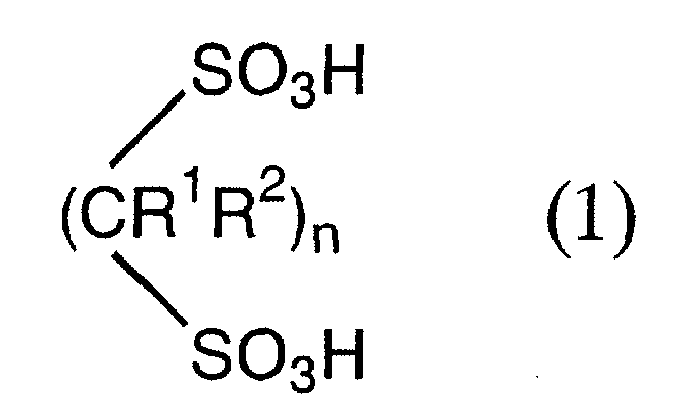
- the sulfonic acid compound used in the present invention is a compound represented by General Formula (1) below.
- R 1 and R 2 are independently a hydrogen atom or a C 1-4 alkyl group whose hydrogen atom may be substituted with halogen atom; and n is an integer from 1 to 4.
- n R 1 s and n R 2 s may be the same or different.
- Examples of the C 1-4 alkyl group wherein a hydrogen atom may be substituted with a halogen atom include a methyl group, ethyl group, n-propyl group, iso-propyl group, n-butyl group, iso-butyl group, sec-butyl group, tert-butyl group, chloromethyl group, bromomethyl group, fluoromethyl group, and trifluoromethyl group.
- R 1 and R 2 include a hydrogen atom, methyl group, ethyl group, and n-propyl group.
- sulfonic acid compounds may be used.
- a sulfonic acid compound obtained by a known method may be used.
- One example of a known method (disclosed in JP 2005-336155 A ) is reacting water with an alkanedisulfonyl halide represented by General Formula (3), wherein R 1 , R 2 , and n are the same as those in General Formula (1) described above; and X is a halogen atom.
- formaldehyde compounds usable in the present invention include paraformaldehyde, anhydrous formaldehyde obtained by heating paraformaldehyde, trioxane obtained by treating paraformaldehyde with acid, methylal and like acetalized formaldehydes. Among these, paraformaldehyde, anhydrous formaldehyde and trioxane are preferable. These formaldehyde compounds may be used singly or in combination.
- the amount of formaldehyde compound is preferably 0.2 to 10 moles and more preferably 0.3 to 3 moles per mole of sulfonic acid compound. If the amount of formaldehyde compound is less than 0.2 moles, the reaction may not be completed; however, when it exceeds 10 moles, no effect corresponding to the amount used can be obtained and is thus uneconomical.
- dehydrating agent used in the present invention there is no limitation to the dehydrating agent and, for example, phosphorus pentoxide, phosphorus pentachloride, phosphorus oxychloride, thionyl chloride, acetyl chloride and acetic anhydride can be used. Among these, phosphorus pentoxide is preferable due to its high reactivity. These dehydrating agents may be used singly or in combination.
- the amount of dehydrating agent is preferably 0.6 to 10 moles and more preferably 0.8 to 3 moles per mole of sulfonic acid compound. If the amount of the dehydrating agent is less than 0.6 moles, the reaction may not be completed; however, when it exceeds 10 moles, no effect corresponding to the amount used can be obtained and is thus uneconomical.
- a solvent inactive to the reaction may be used in the present invention if necessary.
- inactive solvents include toluene, xylene, monochlorobenzene, dichlorobenzene, trichlorobenzene, hexane, heptane, decane and like hydrocarbon-based solvents; diethyl ether, ethylene glycoldimethyl ether, diisopropyl ether, diphenyl ether, tetrahydrofuran, dioxane and like ether-based solvents; acetone, methyl ethyl ketone and like ketone-based solvents; dimethyl formamide, hexamethyl phosphorictriamide and like amide-based solvents; ethyl acetate and like acetate-based solvents; acetonitrile and like nitrile-based solvents; dimethyl sulfoxide, sulfolane and like sulfoxide/sulfone-based solvents.
- the amount of solvent preferably does not exceed 1000 parts by weight per 100 parts by weight of the sulfonic acid compound.
- the reaction temperature in the present invention is preferably 0 to 200°C, and more preferably 50 to 150°C.
- the reaction time depends on the reaction temperature but is preferably 0.1 to 10 hours.
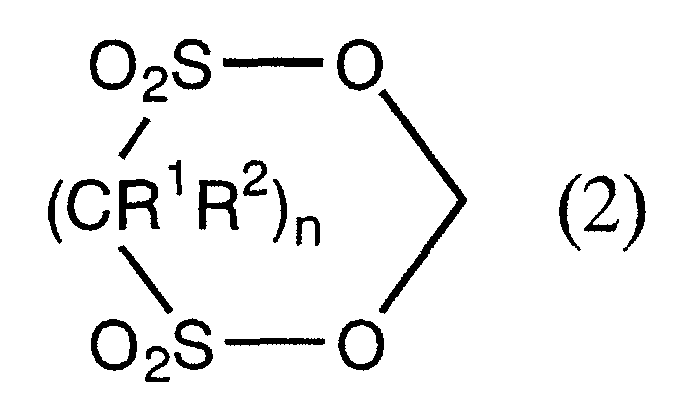
- the methylene disulfonate compound produced as described above is a compound represented by General Formula (2) below.
- R 1 , R 2 , and n in General Formula (2) are the same as those in General Formula (1).
- the methylene disulfonate compound produced in the present invention can be isolated by several methods, such as subjecting a reaction solution to extraction using a solvent or the like, and then conducting crystallization after washing with water, etc; filtering a reaction solution and concentrating the filtrate; subjecting a reaction solution to sublimation refining; etc.
- the methylene disulfonate compound represented by General Formula (2) can be obtained by reacting an acid anhydride of the sulfonic acid compound with the formaldehyde compound in the same manner as in the present invention. This reaction does not necessarily require a dehydrating agent.
- the acid anhydride can be obtained by, for example, reacting the corresponding sulfonic acid compound with phosphorus pentoxide or like dehydrating agent.
- the present invention allows a methylene disulfonate compound to be obtained in a simple manner at low cost.
- the resulting filtrate was concentrated to obtain crystals, and the resulting crystals were dried at 40°C and 10 mmHg for 6 hours, giving 4.7 g of light brown crystals of methylene methanedisulfonate represented by General Formula (2) wherein R 1 and R 2 are hydrogen atoms, and n is 1.
- the yield of the resulting methylene methanedisulfonate was 50.0% relative to methanedisulfonic acid.
Landscapes
- Chemical & Material Sciences (AREA)
- Organic Chemistry (AREA)
- Organic Low-Molecular-Weight Compounds And Preparation Thereof (AREA)
Abstract
The present invention provides a process for producing a methylene disulfonate compound represented by General Formula (2) comprising:
reacting, in the presence of a dehydrating agent, a formaldehyde compound with a sulfonic acid compound represented by General Formula (1):
wherein R1 and R2 are independently a hydrogen atom or a C1-4 alkyl group whose hydrogen atom may be substituted with halogen atom; n is an integer from 1 to 4; and when n is an integer from 2 to 4, n R1s and n R2s may be the same or different:
Description
- The present invention relates to a process for the production of a methylene disulfonate compound.
- Methylene disulfonate compounds are usable as pharmaceutical preparations for treating leukemia in animals, etc. Known methods for producing a methylene disulfonate compound include the following.
- (1) A method wherein sulfonyl chloride is reacted with silver carbonate, and the resulting silver sulfonate is reacted with diiodomethane (
WO85/03075 
- (2) A method wherein alkanedisulfonic acid is reacted with methylene diacetate (
JP 2005-336155 A 
- However, these methods have various drawbacks. For example, the silver carbonate and diiodomethane used in the method of (1) are expensive and the reaction is slow. The method of (2) uses methylene diacetate, which is not easily obtainable and expensive.
- An object of the present invention is to provide a method by which a methylene disulfonate compound can be industrially produced in a simple manner at low cost.
- The present invention provides a process for the production of a methylene disulfonate compound as below.
- 1. A process for producing a methylene disulfonate compound represented by General Formula (2) comprising:
- reacting, in the presence of a dehydrating agent, a formaldehyde compound with a sulfonic acid compound represented by General Formula (1):


- reacting, in the presence of a dehydrating agent, a formaldehyde compound with a sulfonic acid compound represented by General Formula (1):
- 2. The process according to Item 1, wherein the formaldehyde compound is at least one member selected from the group consisting of paraformaldehyde, anhydrous formaldehyde and trioxane.
- 3. The process according to Item 1 or 2, wherein the dehydrating agent is phosphorus pentoxide.
- The present invention is explained in detail below.
- The sulfonic acid compound used in the present invention is a compound represented by General Formula (1) below.

- In General Formula (1), R1 and R2 are independently a hydrogen atom or a C1-4 alkyl group whose hydrogen atom may be substituted with halogen atom; and n is an integer from 1 to 4.
- When n is an integer from 2 to 4, n R1s and n R2s may be the same or different.
- Examples of the C1-4 alkyl group wherein a hydrogen atom may be substituted with a halogen atom include a methyl group, ethyl group, n-propyl group, iso-propyl group, n-butyl group, iso-butyl group, sec-butyl group, tert-butyl group, chloromethyl group, bromomethyl group, fluoromethyl group, and trifluoromethyl group.
- Preferable examples of R1 and R2 include a hydrogen atom, methyl group, ethyl group, and n-propyl group.
- Examples of the sulfonic acid compounds represented by General Formula (1) include methanedisulfonic acid (R1 = R2 = H, n = 1); 1,2-ethanedisulfonic acid (R1 = R2 = H, n = 2); 1,1-ethanedisulfonic acid (R1 = CH3, R2 = H, n = 1); 2,2-propanedisulfonic acid (R1 = R2 = CH3, n = 1) and 1,1-propanedisulfonic acid (R1 = CH2CH3, R2 = H, n = 1).
- In the present invention, commercially available sulfonic acid compounds may be used. Alternatively, a sulfonic acid compound obtained by a known method may be used. One example of a known method (disclosed in
JP 2005-336155 A 
- Examples of formaldehyde compounds usable in the present invention include paraformaldehyde, anhydrous formaldehyde obtained by heating paraformaldehyde, trioxane obtained by treating paraformaldehyde with acid, methylal and like acetalized formaldehydes. Among these, paraformaldehyde, anhydrous formaldehyde and trioxane are preferable. These formaldehyde compounds may be used singly or in combination.
- The amount of formaldehyde compound is preferably 0.2 to 10 moles and more preferably 0.3 to 3 moles per mole of sulfonic acid compound. If the amount of formaldehyde compound is less than 0.2 moles, the reaction may not be completed; however, when it exceeds 10 moles, no effect corresponding to the amount used can be obtained and is thus uneconomical.
- There is no limitation to the dehydrating agent used in the present invention and, for example, phosphorus pentoxide, phosphorus pentachloride, phosphorus oxychloride, thionyl chloride, acetyl chloride and acetic anhydride can be used. Among these, phosphorus pentoxide is preferable due to its high reactivity. These dehydrating agents may be used singly or in combination.
- The amount of dehydrating agent is preferably 0.6 to 10 moles and more preferably 0.8 to 3 moles per mole of sulfonic acid compound. If the amount of the dehydrating agent is less than 0.6 moles, the reaction may not be completed; however, when it exceeds 10 moles, no effect corresponding to the amount used can be obtained and is thus uneconomical.
- A solvent inactive to the reaction may be used in the present invention if necessary. Examples of such inactive solvents include toluene, xylene, monochlorobenzene, dichlorobenzene, trichlorobenzene, hexane, heptane, decane and like hydrocarbon-based solvents; diethyl ether, ethylene glycoldimethyl ether, diisopropyl ether, diphenyl ether, tetrahydrofuran, dioxane and like ether-based solvents; acetone, methyl ethyl ketone and like ketone-based solvents; dimethyl formamide, hexamethyl phosphorictriamide and like amide-based solvents; ethyl acetate and like acetate-based solvents; acetonitrile and like nitrile-based solvents; dimethyl sulfoxide, sulfolane and like sulfoxide/sulfone-based solvents.
- The amount of solvent preferably does not exceed 1000 parts by weight per 100 parts by weight of the sulfonic acid compound.
- The reaction temperature in the present invention is preferably 0 to 200°C, and more preferably 50 to 150°C. The reaction time depends on the reaction temperature but is preferably 0.1 to 10 hours.
- The methylene disulfonate compound produced as described above is a compound represented by General Formula (2) below.

- R1, R2, and n in General Formula (2) are the same as those in General Formula (1).
- Examples of the methylene disulfonate compound represented by General Formula (2) include methylene methanedisulfonate (R1 = R2 = H, n = 1), methylene 1,2-ethanedisulfonate (R1 = R2 = H, n = 2), methylene 1,1-ethanedisulfonate (R1 = CH3, R2 = H, n = 1), methylene 2,2-propanedisulfonate (R1 = R2 = CH3, n = 1) and methylene 1,1-propanedisulfonate (R1 = CH2CH3, R2 = H, n = 1).
- The methylene disulfonate compound produced in the present invention can be isolated by several methods, such as subjecting a reaction solution to extraction using a solvent or the like, and then conducting crystallization after washing with water, etc; filtering a reaction solution and concentrating the filtrate; subjecting a reaction solution to sublimation refining; etc.
- The methylene disulfonate compound represented by General Formula (2) can be obtained by reacting an acid anhydride of the sulfonic acid compound with the formaldehyde compound in the same manner as in the present invention. This reaction does not necessarily require a dehydrating agent. The acid anhydride can be obtained by, for example, reacting the corresponding sulfonic acid compound with phosphorus pentoxide or like dehydrating agent.
- The present invention allows a methylene disulfonate compound to be obtained in a simple manner at low cost.
- The present invention is explained in detail with reference to Examples below. However, the scope of the present invention is not limited to these Examples.
- In a 200 ml four-necked flask equipped with a stirrer, a condenser, and a thermometer, were placed 8.8 g (0.05 mole) of methanedisulfonic acid and 7.1 g (0.05 mole) of phosphorus pentoxide. To the mixture, 1.6 g (0.05 mole) of 92% paraformaldehyde was added while stirring at room temperature. After completion of the addition, the mixture was heated to 120°C and stirred for one hour. The mixture was then cooled to room temperature and 100 g of methylene chloride was added thereto. After stirring for one hour, insoluble matter was filtered off. The resulting filtrate was concentrated to obtain crystals, and the resulting crystals were dried at 40°C and 10 mmHg for 6 hours, giving 4.7 g of light brown crystals of methylene methanedisulfonate represented by General Formula (2) wherein R1 and R2 are hydrogen atoms, and n is 1. The yield of the resulting methylene methanedisulfonate was 50.0% relative to methanedisulfonic acid.
- It was confirmed that the resulting light brown crystals were methylene methanedisulfonate by the following analysis results:
1H-NMR (400 MHz, CD3CN) δ (ppm): 5.33 (s, 2H), 6.00 (s, 2H). - In a 200 ml four-necked flask equipped with a stirrer, a condenser, and a thermometer, were placed 9.5 g (0.05 mole) of 1,2-ethanedisulfonic acid and 8.5 g (0.06 mole) of phosphorus pentoxide. To the mixture, 2.0 g (0.06 mole) of 92% paraformaldehyde was added while stirring at room temperature. After completion of the addition, the mixture was heated to 120°C and stirred for 10 hours. The mixture was then cooled to room temperature and 100 g of methylene chloride was added thereto. After stirring for one hour, insoluble matter was filtered off. The resulting filtrate was concentrated to obtain crystals, and the resulting crystals were dried at 40°C and 10 mmHg for 6 hours, giving 7.0 g of light brown crystals of methylene 1,2-ethanedisulfonate represented by General Formula (2) wherein R1 and R2 are hydrogen atoms, and n is 2. The yield of the resulting methylene 1,2-ethanedisulfonate was 69.2% relative to 1,2-ethanedisulfonic acid.
- It was confirmed that these light brown crystals were methylene 1,2-ethanedisulfonate by the following analysis results:
1H-NMR (400 MHz, CD3CN) δ (ppm): 3.83 (s, 4H), 5.63 (s, 2H).
Claims (3)
- A process for producing a methylene disulfonate compound represented by General Formula (2) comprising:reacting, in the presence of a dehydrating agent, a formaldehyde compound with a sulfonic acid compound represented by General Formula (1):wherein R1 and R2 are independently a hydrogen atom or a C1-4 alkyl group whose hydrogen atom may be substituted with halogen atom; n is an integer from 1 to 4; and when n is an integer from 2 to 4, n R1s and n R2s may be the same or different:


- The process according to claim 1, wherein the formaldehyde compound is at least one member selected from the group consisting of paraformaldehyde, anhydrous formaldehyde and trioxane.
- The process according to claim 1, wherein the dehydrating agent is phosphorus pentoxide.
Applications Claiming Priority (2)
| Application Number | Priority Date | Filing Date | Title |
|---|---|---|---|
| JP2006122525 | 2006-04-26 | ||
| PCT/JP2007/057599 WO2007125736A1 (en) | 2006-04-26 | 2007-04-04 | Process for production of methylene disulfonate compound |
Publications (3)
| Publication Number | Publication Date |
|---|---|
| EP2011791A1 true EP2011791A1 (en) | 2009-01-07 |
| EP2011791A4 EP2011791A4 (en) | 2010-09-22 |
| EP2011791B1 EP2011791B1 (en) | 2012-06-27 |
Family
ID=38655271
Family Applications (1)
| Application Number | Title | Priority Date | Filing Date |
|---|---|---|---|
| EP07741035A Active EP2011791B1 (en) | 2006-04-26 | 2007-04-04 | Process for production of methylene disulfonate compound |
Country Status (9)
| Country | Link |
|---|---|
| US (1) | US7829730B2 (en) |
| EP (1) | EP2011791B1 (en) |
| JP (1) | JP5247436B2 (en) |
| KR (1) | KR101355577B1 (en) |
| CN (1) | CN101426776B (en) |
| CA (1) | CA2648297C (en) |
| ES (1) | ES2388352T3 (en) |
| TW (1) | TWI410413B (en) |
| WO (1) | WO2007125736A1 (en) |
Families Citing this family (26)
| Publication number | Priority date | Publication date | Assignee | Title |
|---|---|---|---|---|
| JP5008404B2 (en) * | 2007-01-12 | 2012-08-22 | 住友精化株式会社 | Method for producing methylene disulfonate compound |
| JP4963970B2 (en) * | 2007-01-12 | 2012-06-27 | 住友精化株式会社 | Method for producing methylene disulfonate compound |
| DE102008007314A1 (en) * | 2008-02-02 | 2009-08-06 | Merck Patent Gmbh | Process for the preparation of 3,6-dihydro-1,3,5-triazine derivatives |
| JP5305446B2 (en) * | 2009-03-19 | 2013-10-02 | Necエナジーデバイス株式会社 | Nonaqueous electrolyte and nonaqueous electrolyte secondary battery using the same |
| TWI508956B (en) * | 2010-08-25 | 2015-11-21 | Sumitomo Seika Chemicals | Preparation method of methylene disulfonate compound |
| CN102464649A (en) * | 2010-11-03 | 2012-05-23 | 中国科学院福建物质结构研究所 | Synthesis of methylene methanedisulfonate by ball milling |
| CN102464648A (en) * | 2010-11-03 | 2012-05-23 | 中国科学院福建物质结构研究所 | Method for refining and purifying methylene disulfonate |
| JP5724366B2 (en) * | 2010-12-21 | 2015-05-27 | セントラル硝子株式会社 | Method for producing cyclic disulfonic acid ester compound |
| CN102344436B (en) * | 2011-08-19 | 2013-11-06 | 石家庄圣泰化工有限公司 | Preparation method of methylene-cyclo methane-disulfonate |
| JP5930930B2 (en) * | 2012-09-24 | 2016-06-08 | 住友精化株式会社 | Method for producing methylene disulfonyl chloride compound, methylene disulfonic acid compound and methylene disulfonate compound |
| TW201527263A (en) * | 2013-10-30 | 2015-07-16 | Sumitomo Seika Chemicals | Method for producing methylene-disulfonic acid compound |
| WO2015064711A1 (en) * | 2013-10-30 | 2015-05-07 | 住友精化株式会社 | Method for producing methylene disulfonyl chloride compound |
| EP2927209A1 (en) | 2014-03-31 | 2015-10-07 | Afinitica Technologies, S. L. | Process for preparing 1,1-disubstituted ethylenic monomers |
| CN106916138B (en) * | 2017-03-01 | 2019-04-09 | 山东永浩新材料科技有限公司 | A kind of synthetic method of methane-disulfonic acid methylene ester |
| CN107098882B (en) * | 2017-04-17 | 2019-11-12 | 泰兴华盛精细化工有限公司 | A kind of synthetic method of methane-disulfonic acid methylene ester |
| WO2019095245A1 (en) * | 2017-11-17 | 2019-05-23 | 石家庄圣泰化工有限公司 | Method for synthesizing methylene disulfonate compound |
| CN108840852A (en) * | 2018-08-13 | 2018-11-20 | 九江天赐高新材料有限公司 | A kind of preparation method of methane-disulfonic acid methylene ester |
| CN109180634A (en) * | 2018-08-26 | 2019-01-11 | 湖南阿斯达生化科技有限公司 | A kind of new method preparing cyclic annular ester type compound |
| WO2021015220A1 (en) * | 2019-07-23 | 2021-01-28 | 住友精化株式会社 | Method for producing cyclic disulfonic acid ester compound |
| CN114144406A (en) * | 2019-07-23 | 2022-03-04 | 住友精化株式会社 | Method for producing methylene disulfonate compound |
| CN111072626B (en) * | 2019-12-24 | 2022-11-15 | 湖南阿斯达新材料有限公司 | Preparation method of cyclic methylene disulfonate compound |
| CN116082294B (en) * | 2022-12-29 | 2024-12-03 | 湖南法恩莱特新能源科技有限公司 | Preparation method of methane disulfonic acid methylene cyclic ester |
| CN115872972B (en) * | 2022-12-30 | 2024-01-19 | 无锡零一未来新材料技术研究院有限公司 | A kind of preparation method of methylene methyl disulfonate |
| CN116768845A (en) * | 2023-08-22 | 2023-09-19 | 江苏华盛锂电材料股份有限公司 | Preparation method of methylene methane disulfonate |
| CN118561804B (en) * | 2024-05-16 | 2026-04-14 | 四平市精细化学品有限公司 | Synthetic method of high-purity methane disulfonic acid methylene ester |
| CN118458674B (en) * | 2024-06-11 | 2026-04-17 | 泰兴华盛精细化工有限公司 | A manufacturing process for a battery cathode film-forming additive |
Family Cites Families (5)
| Publication number | Priority date | Publication date | Assignee | Title |
|---|---|---|---|---|
| US4329478A (en) * | 1981-01-30 | 1982-05-11 | Minnesota Mining And Manufacturing Company | Cyclic perfluoroaliphaticdisulfonic acid anhydrides |
| DE3105006A1 (en) * | 1981-02-12 | 1982-08-19 | Degussa Ag, 6000 Frankfurt | Process for the preparation of aqueous sodium methioninate solutions (C) |
| US4950768A (en) | 1984-01-16 | 1990-08-21 | Cronyn Marshall W | Cyclic disulfonic ester cross-linking compounds |
| JP4588407B2 (en) * | 2004-04-28 | 2010-12-01 | 住友化学株式会社 | Method for producing cyclic disulfonic acid ester |
| JP2006188449A (en) | 2005-01-05 | 2006-07-20 | Sumitomo Chemical Co Ltd | Method for producing cyclic disulfonic acid ester |
-
2007
- 2007-04-03 TW TW096111806A patent/TWI410413B/en active
- 2007-04-04 JP JP2008513124A patent/JP5247436B2/en active Active
- 2007-04-04 EP EP07741035A patent/EP2011791B1/en active Active
- 2007-04-04 CA CA2648297A patent/CA2648297C/en active Active
- 2007-04-04 KR KR1020087023837A patent/KR101355577B1/en active Active
- 2007-04-04 US US12/297,276 patent/US7829730B2/en active Active
- 2007-04-04 ES ES07741035T patent/ES2388352T3/en active Active
- 2007-04-04 CN CN200780014629XA patent/CN101426776B/en active Active
- 2007-04-04 WO PCT/JP2007/057599 patent/WO2007125736A1/en not_active Ceased
Also Published As
| Publication number | Publication date |
|---|---|
| KR101355577B1 (en) | 2014-01-24 |
| KR20080112256A (en) | 2008-12-24 |
| TW200745076A (en) | 2007-12-16 |
| CN101426776B (en) | 2012-11-07 |
| ES2388352T3 (en) | 2012-10-11 |
| US7829730B2 (en) | 2010-11-09 |
| JPWO2007125736A1 (en) | 2009-09-10 |
| EP2011791A4 (en) | 2010-09-22 |
| US20090137820A1 (en) | 2009-05-28 |
| JP5247436B2 (en) | 2013-07-24 |
| CA2648297C (en) | 2013-07-30 |
| TWI410413B (en) | 2013-10-01 |
| WO2007125736A1 (en) | 2007-11-08 |
| CA2648297A1 (en) | 2007-11-08 |
| CN101426776A (en) | 2009-05-06 |
| EP2011791B1 (en) | 2012-06-27 |
Similar Documents
| Publication | Publication Date | Title |
|---|---|---|
| EP2011791B1 (en) | Process for production of methylene disulfonate compound | |
| EP2610250B1 (en) | Method for producing a methylene disulfonate compound | |
| CN111170855B (en) | Compound and method for synthesizing 8-hydroxy-2,2,14,14-tetramethylpentadecanedioic acid by using same | |
| JP7663497B2 (en) | Method for producing methylene disulfonate compounds | |
| US12215091B2 (en) | Method for producing methylene disulfonate compound | |
| JP5008404B2 (en) | Method for producing methylene disulfonate compound | |
| EP4006020B1 (en) | Method for producing cyclic disulfonic acid ester compound | |
| JP4963970B2 (en) | Method for producing methylene disulfonate compound | |
| KR20090116753A (en) | Novel method for preparing [3,4-d] pyridazin-7 (6H) -one with 3-methyl-4-phenylisoxazolo | |
| CN119039293B (en) | A synthetic method for 6-substituted 5,6-dihydropyridinebisindole compounds | |
| CN109456257B (en) | Preparation method of high-yield 2-chloro-5-nitropyridine | |
| CN111100096A (en) | Intermediate compound for synthesizing dithioerythritol and application thereof and method for synthesizing dithioerythritol | |
| KR20050097414A (en) | Novel process for the synthesis of torsemide |
Legal Events
| Date | Code | Title | Description |
|---|---|---|---|
| PUAI | Public reference made under article 153(3) epc to a published international application that has entered the european phase |
Free format text: ORIGINAL CODE: 0009012 |
|
| 17P | Request for examination filed |
Effective date: 20081112 |
|
| AK | Designated contracting states |
Kind code of ref document: A1 Designated state(s): AT BE BG CH CY CZ DE DK EE ES FI FR GB GR HU IE IS IT LI LT LU LV MC MT NL PL PT RO SE SI SK TR |
|
| AX | Request for extension of the european patent |
Extension state: AL BA HR MK RS |
|
| A4 | Supplementary search report drawn up and despatched |
Effective date: 20100823 |
|
| GRAP | Despatch of communication of intention to grant a patent |
Free format text: ORIGINAL CODE: EPIDOSNIGR1 |
|
| GRAS | Grant fee paid |
Free format text: ORIGINAL CODE: EPIDOSNIGR3 |
|
| GRAA | (expected) grant |
Free format text: ORIGINAL CODE: 0009210 |
|
| DAX | Request for extension of the european patent (deleted) | ||
| AK | Designated contracting states |
Kind code of ref document: B1 Designated state(s): AT BE BG CH CY CZ DE DK EE ES FI FR GB GR HU IE IS IT LI LT LU LV MC MT NL PL PT RO SE SI SK TR |
|
| REG | Reference to a national code |
Ref country code: GB Ref legal event code: FG4D |
|
| REG | Reference to a national code |
Ref country code: CH Ref legal event code: EP |
|
| REG | Reference to a national code |
Ref country code: CH Ref legal event code: NV Representative=s name: SERVOPATENT GMBH |
|
| REG | Reference to a national code |
Ref country code: AT Ref legal event code: REF Ref document number: 564152 Country of ref document: AT Kind code of ref document: T Effective date: 20120715 |
|
| REG | Reference to a national code |
Ref country code: IE Ref legal event code: FG4D |
|
| REG | Reference to a national code |
Ref country code: NL Ref legal event code: T3 |
|
| REG | Reference to a national code |
Ref country code: DE Ref legal event code: R096 Ref document number: 602007023617 Country of ref document: DE Effective date: 20120823 |
|
| REG | Reference to a national code |
Ref country code: ES Ref legal event code: FG2A Ref document number: 2388352 Country of ref document: ES Kind code of ref document: T3 Effective date: 20121011 |
|
| PG25 | Lapsed in a contracting state [announced via postgrant information from national office to epo] |
Ref country code: SE Free format text: LAPSE BECAUSE OF FAILURE TO SUBMIT A TRANSLATION OF THE DESCRIPTION OR TO PAY THE FEE WITHIN THE PRESCRIBED TIME-LIMIT Effective date: 20120627 Ref country code: FI Free format text: LAPSE BECAUSE OF FAILURE TO SUBMIT A TRANSLATION OF THE DESCRIPTION OR TO PAY THE FEE WITHIN THE PRESCRIBED TIME-LIMIT Effective date: 20120627 Ref country code: LT Free format text: LAPSE BECAUSE OF FAILURE TO SUBMIT A TRANSLATION OF THE DESCRIPTION OR TO PAY THE FEE WITHIN THE PRESCRIBED TIME-LIMIT Effective date: 20120627 |
|
| REG | Reference to a national code |
Ref country code: AT Ref legal event code: MK05 Ref document number: 564152 Country of ref document: AT Kind code of ref document: T Effective date: 20120627 |
|
| REG | Reference to a national code |
Ref country code: LT Ref legal event code: MG4D Effective date: 20120627 |
|
| PG25 | Lapsed in a contracting state [announced via postgrant information from national office to epo] |
Ref country code: GR Free format text: LAPSE BECAUSE OF FAILURE TO SUBMIT A TRANSLATION OF THE DESCRIPTION OR TO PAY THE FEE WITHIN THE PRESCRIBED TIME-LIMIT Effective date: 20120928 Ref country code: LV Free format text: LAPSE BECAUSE OF FAILURE TO SUBMIT A TRANSLATION OF THE DESCRIPTION OR TO PAY THE FEE WITHIN THE PRESCRIBED TIME-LIMIT Effective date: 20120627 Ref country code: SI Free format text: LAPSE BECAUSE OF FAILURE TO SUBMIT A TRANSLATION OF THE DESCRIPTION OR TO PAY THE FEE WITHIN THE PRESCRIBED TIME-LIMIT Effective date: 20120627 |
|
| PG25 | Lapsed in a contracting state [announced via postgrant information from national office to epo] |
Ref country code: EE Free format text: LAPSE BECAUSE OF FAILURE TO SUBMIT A TRANSLATION OF THE DESCRIPTION OR TO PAY THE FEE WITHIN THE PRESCRIBED TIME-LIMIT Effective date: 20120627 Ref country code: IS Free format text: LAPSE BECAUSE OF FAILURE TO SUBMIT A TRANSLATION OF THE DESCRIPTION OR TO PAY THE FEE WITHIN THE PRESCRIBED TIME-LIMIT Effective date: 20121027 Ref country code: AT Free format text: LAPSE BECAUSE OF FAILURE TO SUBMIT A TRANSLATION OF THE DESCRIPTION OR TO PAY THE FEE WITHIN THE PRESCRIBED TIME-LIMIT Effective date: 20120627 Ref country code: CZ Free format text: LAPSE BECAUSE OF FAILURE TO SUBMIT A TRANSLATION OF THE DESCRIPTION OR TO PAY THE FEE WITHIN THE PRESCRIBED TIME-LIMIT Effective date: 20120627 Ref country code: RO Free format text: LAPSE BECAUSE OF FAILURE TO SUBMIT A TRANSLATION OF THE DESCRIPTION OR TO PAY THE FEE WITHIN THE PRESCRIBED TIME-LIMIT Effective date: 20120627 Ref country code: CY Free format text: LAPSE BECAUSE OF FAILURE TO SUBMIT A TRANSLATION OF THE DESCRIPTION OR TO PAY THE FEE WITHIN THE PRESCRIBED TIME-LIMIT Effective date: 20120627 Ref country code: SK Free format text: LAPSE BECAUSE OF FAILURE TO SUBMIT A TRANSLATION OF THE DESCRIPTION OR TO PAY THE FEE WITHIN THE PRESCRIBED TIME-LIMIT Effective date: 20120627 |
|
| PG25 | Lapsed in a contracting state [announced via postgrant information from national office to epo] |
Ref country code: PL Free format text: LAPSE BECAUSE OF FAILURE TO SUBMIT A TRANSLATION OF THE DESCRIPTION OR TO PAY THE FEE WITHIN THE PRESCRIBED TIME-LIMIT Effective date: 20120627 Ref country code: PT Free format text: LAPSE BECAUSE OF FAILURE TO SUBMIT A TRANSLATION OF THE DESCRIPTION OR TO PAY THE FEE WITHIN THE PRESCRIBED TIME-LIMIT Effective date: 20121029 |
|
| PG25 | Lapsed in a contracting state [announced via postgrant information from national office to epo] |
Ref country code: DK Free format text: LAPSE BECAUSE OF FAILURE TO SUBMIT A TRANSLATION OF THE DESCRIPTION OR TO PAY THE FEE WITHIN THE PRESCRIBED TIME-LIMIT Effective date: 20120627 |
|
| PLBE | No opposition filed within time limit |
Free format text: ORIGINAL CODE: 0009261 |
|
| STAA | Information on the status of an ep patent application or granted ep patent |
Free format text: STATUS: NO OPPOSITION FILED WITHIN TIME LIMIT |
|
| 26N | No opposition filed |
Effective date: 20130328 |
|
| REG | Reference to a national code |
Ref country code: DE Ref legal event code: R097 Ref document number: 602007023617 Country of ref document: DE Effective date: 20130328 |
|
| PG25 | Lapsed in a contracting state [announced via postgrant information from national office to epo] |
Ref country code: BG Free format text: LAPSE BECAUSE OF FAILURE TO SUBMIT A TRANSLATION OF THE DESCRIPTION OR TO PAY THE FEE WITHIN THE PRESCRIBED TIME-LIMIT Effective date: 20120927 |
|
| PG25 | Lapsed in a contracting state [announced via postgrant information from national office to epo] |
Ref country code: MC Free format text: LAPSE BECAUSE OF FAILURE TO SUBMIT A TRANSLATION OF THE DESCRIPTION OR TO PAY THE FEE WITHIN THE PRESCRIBED TIME-LIMIT Effective date: 20120627 |
|
| REG | Reference to a national code |
Ref country code: IE Ref legal event code: MM4A |
|
| PG25 | Lapsed in a contracting state [announced via postgrant information from national office to epo] |
Ref country code: IE Free format text: LAPSE BECAUSE OF NON-PAYMENT OF DUE FEES Effective date: 20130404 |
|
| PG25 | Lapsed in a contracting state [announced via postgrant information from national office to epo] |
Ref country code: MT Free format text: LAPSE BECAUSE OF FAILURE TO SUBMIT A TRANSLATION OF THE DESCRIPTION OR TO PAY THE FEE WITHIN THE PRESCRIBED TIME-LIMIT Effective date: 20120627 |
|
| PG25 | Lapsed in a contracting state [announced via postgrant information from national office to epo] |
Ref country code: TR Free format text: LAPSE BECAUSE OF FAILURE TO SUBMIT A TRANSLATION OF THE DESCRIPTION OR TO PAY THE FEE WITHIN THE PRESCRIBED TIME-LIMIT Effective date: 20120627 |
|
| PG25 | Lapsed in a contracting state [announced via postgrant information from national office to epo] |
Ref country code: LU Free format text: LAPSE BECAUSE OF NON-PAYMENT OF DUE FEES Effective date: 20130404 Ref country code: HU Free format text: LAPSE BECAUSE OF FAILURE TO SUBMIT A TRANSLATION OF THE DESCRIPTION OR TO PAY THE FEE WITHIN THE PRESCRIBED TIME-LIMIT; INVALID AB INITIO Effective date: 20070404 |
|
| REG | Reference to a national code |
Ref country code: FR Ref legal event code: PLFP Year of fee payment: 10 |
|
| REG | Reference to a national code |
Ref country code: FR Ref legal event code: PLFP Year of fee payment: 11 |
|
| REG | Reference to a national code |
Ref country code: FR Ref legal event code: PLFP Year of fee payment: 12 |
|
| REG | Reference to a national code |
Ref country code: CH Ref legal event code: PCAR Free format text: NEW ADDRESS: WANNERSTRASSE 9/1, 8045 ZUERICH (CH) |
|
| P01 | Opt-out of the competence of the unified patent court (upc) registered |
Effective date: 20230524 |
|
| PGFP | Annual fee paid to national office [announced via postgrant information from national office to epo] |
Ref country code: NL Payment date: 20250418 Year of fee payment: 19 |
|
| PGFP | Annual fee paid to national office [announced via postgrant information from national office to epo] |
Ref country code: DE Payment date: 20250422 Year of fee payment: 19 |
|
| PGFP | Annual fee paid to national office [announced via postgrant information from national office to epo] |
Ref country code: GB Payment date: 20250418 Year of fee payment: 19 Ref country code: ES Payment date: 20250529 Year of fee payment: 19 |
|
| PGFP | Annual fee paid to national office [announced via postgrant information from national office to epo] |
Ref country code: BE Payment date: 20250418 Year of fee payment: 19 Ref country code: IT Payment date: 20250424 Year of fee payment: 19 |
|
| PGFP | Annual fee paid to national office [announced via postgrant information from national office to epo] |
Ref country code: FR Payment date: 20250424 Year of fee payment: 19 |
|
| PGFP | Annual fee paid to national office [announced via postgrant information from national office to epo] |
Ref country code: CH Payment date: 20250501 Year of fee payment: 19 |