EP2011297B1 - Variable ofdm subchannel coding and modulation - Google Patents
Variable ofdm subchannel coding and modulation Download PDFInfo
- Publication number
- EP2011297B1 EP2011297B1 EP07794367.8A EP07794367A EP2011297B1 EP 2011297 B1 EP2011297 B1 EP 2011297B1 EP 07794367 A EP07794367 A EP 07794367A EP 2011297 B1 EP2011297 B1 EP 2011297B1
- Authority
- EP
- European Patent Office
- Prior art keywords
- qam
- data rate
- subchannels
- error correction
- modulation scheme
- Prior art date
- Legal status (The legal status is an assumption and is not a legal conclusion. Google has not performed a legal analysis and makes no representation as to the accuracy of the status listed.)
- Active
Links
Images



Classifications
-
- H—ELECTRICITY
- H04—ELECTRIC COMMUNICATION TECHNIQUE
- H04L—TRANSMISSION OF DIGITAL INFORMATION, e.g. TELEGRAPHIC COMMUNICATION
- H04L5/00—Arrangements affording multiple use of the transmission path
- H04L5/003—Arrangements for allocating sub-channels of the transmission path
- H04L5/0044—Allocation of payload; Allocation of data channels, e.g. PDSCH or PUSCH
- H04L5/0046—Determination of the number of bits transmitted on different sub-channels
-
- H—ELECTRICITY
- H04—ELECTRIC COMMUNICATION TECHNIQUE
- H04L—TRANSMISSION OF DIGITAL INFORMATION, e.g. TELEGRAPHIC COMMUNICATION
- H04L1/00—Arrangements for detecting or preventing errors in the information received
- H04L1/0001—Systems modifying transmission characteristics according to link quality, e.g. power backoff
- H04L1/0002—Systems modifying transmission characteristics according to link quality, e.g. power backoff by adapting the transmission rate
- H04L1/0003—Systems modifying transmission characteristics according to link quality, e.g. power backoff by adapting the transmission rate by switching between different modulation schemes
-
- H—ELECTRICITY
- H04—ELECTRIC COMMUNICATION TECHNIQUE
- H04L—TRANSMISSION OF DIGITAL INFORMATION, e.g. TELEGRAPHIC COMMUNICATION
- H04L1/00—Arrangements for detecting or preventing errors in the information received
- H04L1/0001—Systems modifying transmission characteristics according to link quality, e.g. power backoff
- H04L1/0009—Systems modifying transmission characteristics according to link quality, e.g. power backoff by adapting the channel coding
-
- H—ELECTRICITY
- H04—ELECTRIC COMMUNICATION TECHNIQUE
- H04L—TRANSMISSION OF DIGITAL INFORMATION, e.g. TELEGRAPHIC COMMUNICATION
- H04L1/00—Arrangements for detecting or preventing errors in the information received
- H04L1/0001—Systems modifying transmission characteristics according to link quality, e.g. power backoff
- H04L1/0015—Systems modifying transmission characteristics according to link quality, e.g. power backoff characterised by the adaptation strategy
-
- H—ELECTRICITY
- H04—ELECTRIC COMMUNICATION TECHNIQUE
- H04L—TRANSMISSION OF DIGITAL INFORMATION, e.g. TELEGRAPHIC COMMUNICATION
- H04L1/00—Arrangements for detecting or preventing errors in the information received
- H04L1/004—Arrangements for detecting or preventing errors in the information received by using forward error control
- H04L1/0056—Systems characterized by the type of code used
- H04L1/0057—Block codes
-
- H—ELECTRICITY
- H04—ELECTRIC COMMUNICATION TECHNIQUE
- H04L—TRANSMISSION OF DIGITAL INFORMATION, e.g. TELEGRAPHIC COMMUNICATION
- H04L27/00—Modulated-carrier systems
- H04L27/0008—Modulated-carrier systems arrangements for allowing a transmitter or receiver to use more than one type of modulation
-
- H—ELECTRICITY
- H04—ELECTRIC COMMUNICATION TECHNIQUE
- H04L—TRANSMISSION OF DIGITAL INFORMATION, e.g. TELEGRAPHIC COMMUNICATION
- H04L27/00—Modulated-carrier systems
- H04L27/32—Carrier systems characterised by combinations of two or more of the types covered by groups H04L27/02, H04L27/10, H04L27/18 or H04L27/26
- H04L27/34—Amplitude- and phase-modulated carrier systems, e.g. quadrature-amplitude modulated carrier systems
-
- Y—GENERAL TAGGING OF NEW TECHNOLOGICAL DEVELOPMENTS; GENERAL TAGGING OF CROSS-SECTIONAL TECHNOLOGIES SPANNING OVER SEVERAL SECTIONS OF THE IPC; TECHNICAL SUBJECTS COVERED BY FORMER USPC CROSS-REFERENCE ART COLLECTIONS [XRACs] AND DIGESTS
- Y02—TECHNOLOGIES OR APPLICATIONS FOR MITIGATION OR ADAPTATION AGAINST CLIMATE CHANGE
- Y02D—CLIMATE CHANGE MITIGATION TECHNOLOGIES IN INFORMATION AND COMMUNICATION TECHNOLOGIES [ICT], I.E. INFORMATION AND COMMUNICATION TECHNOLOGIES AIMING AT THE REDUCTION OF THEIR OWN ENERGY USE
- Y02D30/00—Reducing energy consumption in communication networks
- Y02D30/50—Reducing energy consumption in communication networks in wire-line communication networks, e.g. low power modes or reduced link rate
Definitions
- the invention relates generally to wireless communication and more particularly to a system for efficiently using OFDM subchannels.
- Frequency Division Multiplexing is a well known process by which multiple signals are modulated on different frequency carrier waves.
- FDM has been used for decades in radio and television broadcast. Radio and television signals are sent and received on different frequencies, each corresponding to a different "channel.”
- Orthogonal Frequency Division Multiplexing has also been known in the art at least since the late 1960's.
- OFDM Orthogonal Frequency Division Multiplexing
- OFDM Orthogonal Frequency Division Multiplexing
- a single transmitter transmits on many different orthogonal frequencies simultaneously.
- Orthogonal frequencies are frequencies that are independent with respect to the relative phase relationship between the frequencies.
- the available bandwidth is subdivided into a number of equal-bandwidth "subchannels.” OFDM is advantageous for wireless communication because it reduces interference or crosstalk between signal transmissions, ultimately permitting data transmission at higher throughput with fewer errors.
- OFDM is also known as Discrete Multitone Modulation (DMT). OFDM is employed in many standards used today for wireless communication.
- DMT Discrete Multitone Modulation
- both the IEEE 802.1 la wireless LAN standard and the 802.11g wireless LAN standard rely on an implementation of OFDM for signal transmission.
- OFDM orthogonal signals for multi-channel data transmis-sion
- OFDM thus functions by breaking one high speed data stream into a number of lower-speed data streams, which are then transmitted in parallel (i.e., simultaneously). Each lower speed stream is used to modulate a subcarrier. This creates a "multi-carrier" transmission by dividing a wide frequency band (or channel) into a number of narrower frequency bands (or subchannels), each modulated with a signal stream. By sending multiple signal streams simultaneously, each at a lower rate, interference such as multipath or Raleigh fading can be attenuated or eliminated without decreasing the overall rate of transmission.
- WO 02/062002 A1 discloses determining signal-to-noise ratios for respective subchannels. Individual modulation schemes may be selected for each subchannel, and a total number of information bits for all transmission channels is determined.
- EP 1 480 400 A1 discloses maximizing data rate of an OFDM channel based on cost functions. Modes are selected for subchannels such that a power constraint is satisfied.
- Described herein are systems and methods for selecting a modulation scheme and an error correction coding scheme for each subchannel in an OFDM system based on the energy detected on that subchannel.
- each OFDM subchannel may be modulated with a different modulation scheme and/or error correction coding scheme specifically suited to the characteristics of that subchannel.
- the invention may be implemented in hardware or software, or some combination thereof.
- Embodiments include a system, a method, and instructions stored in a computer-readable medium.
- Computer readable media can be any available media that can be accessed by a computer.
- Computer readable media may comprise computer storage media and communication media.
- Computer storage media includes volatile and nonvolatile, removable and non-removable media implemented in any method or technology for storage of information such as computer readable instructions, data structures, program modules or other data.
- Computer storage media includes, but is not limited to, RAM, ROM, EEPROM, flash memory or other memory technology, CD-ROM, digital versatile disks (DVD) or other optical storage, magnetic cassettes, magnetic tape, magnetic disk storage or other magnetic storage devices, other types of volatile and non-volatile memory, any other medium which can be used to store the desired information and which can accessed by a computer, and any suitable combination of the foregoing.
- the computer-readable media may be transportable such that the instructions stored thereon can be loaded onto any suitable computer system resource to implement the aspects of the present invention discussed herein.
- the instructions stored on the computer-readable medium, described above are not limited to instructions embodied as part of an application program running on a host computer. Rather, the instructions may be embodied as any type of computer code (e.g., software or microcode) that can be employed to program a processor to implement the aspects of the present invention discussed below.
- the available channel bandwidth W is subdivided into a number of equal-bandwidth subchannels.
- Each subchannel is sufficiently narrow so that the frequency response characteristics of the subchannel are nearly ideal.
- the number of subchannels is the total available bandwidth divided by the bandwidth of each subchannel.
- Each subchannel k has an associated carrier wave.
- x k ( t ) is the carrier wave for subchannel k as a function of time t.
- f k is the mid-frequency of subchannel k, and k ranges from 0 to K -1.
- the symbol rate 1/ T is set for each subchannel to be equal to the separation ⁇ f of adjacent subcarriers.
- the symbol rate on each subchannel can be reduced relative to the symbol rate on a single carrier system that employs the entire bandwidth W and transmits data at the same rate as the OFDM system.
- T s is the symbol interval of a single-carrier system employing the entire bandwidth W and transmitting data at the same rate as the OFDM system. For example, if the symbol rate across the entire bandwidth for one channel is 72 million symbols per second, and the channel is divided into 48 subchannels, each subchannel would only need to carry 1.5 million symbols per second to achieve the same total data rate. This lower symbol rate reduces inter-symbol interference and thus mitigates the effects of multipath fading. Accordingly, OFDM provides for superior link quality and robustness of communication.
- the transmitter receives input data in the frequency domain and converts it to a time domain signal.
- a carrier wave is modulated by the time domain signal for wireless transmission.
- the receiver receives the signal, demodulates the wave, and converts the signal back to the frequency domain for further processing.
- the input data stream 201 is provided by the application to the OFDM transmitter 200.
- this data could be received at the physical layer or data link layer; however, the invention is not limited to any particular source of data or mechanism for providing the data to the transmitter, and could be implemented in hardware or software, and at various layers of the network stack.
- the input data stream 201 is received by a serial-to-parallel buffer 202.
- the serial-to-parallel buffer 202 breaks the serial data stream up into several parallel data streams.
- the number of parallel data streams is equal to the number of subchannels available for OFDM broadcast, or K as used above.
- the serial-to-parallel buffer 202 divides the information sequence received from input data 201 into frames of B f bits.
- Each of the parallel data streams generated by the serial-to-parallel buffer 202 is then sent to a multicarrier modulator 203.
- the multicarrier modulator 203 modulates each OFDM subcarrier with each of the parallel data streams.
- the multicarrier modulator 203 can be efficiently implemented by use of the Inverse Fast Fourier Transform algorithm to compute the time domain signal, although any algorithm may be used that converts a frequency domain signal to a time domain signal.
- the multicarrier modulator 203 may use any modulation scheme to modulate each of the incoming data streams.
- the signals are modulated with quadrature amplitude modulation (QAM). Any QAM constellation may be used.
- the modulator may use 16-QAM, 64-QAM, 128-QAM or 256-QAM.
- a modulation scheme may be selected based on the required data rate, the available subchannels, the noise on each subchannel, or other factors. Each subchannel may use a different constellation, depending, for example, on the noise on that subchannel.
- the novel claimed system for selecting a different modulation scheme and error correction scheme claimed in this patent is discussed below.
- the multicarrier modulator 203 thus generates K independent QAM subchannels, where the symbol rate for each subchannel is 1/ T and the signal in each subchannel has a distinct QAM constellation.
- X k represent the values of the Discrete Fourier Transform of a multicarrier OFDM signal x(t), where the modulation on each subcarrier is QAM. Since x(t) must be a real-valued signal, its N -point Discrete Fourier Transform X k must satisfy the symmetry property.
- X 0 is split into two parts, both of which are real.
- 1 N is a scale factor.
- a cyclic prefix which acts a guard interval, is added to each of the parallel modulated waves at 204. This guard interval insures that the subchannels will remain orthogonal, even if multipath fading causes the subcarriers to arrive at the receiver with some delay spread.
- the parallel streams with the cyclic prefix are then merged back into a single serial stream at 204. Finally, the digital data stream is converted to an analog signal 205, and output for wireless transmission.
- the transmitted signal can be received by the receiver 210 and processed to recover the original data stream.
- the analog signal is converted back to a digital signal by an analog to digital converter 211.
- the cyclic prefix is removed and the separate subcarriers are converted back to separate streams at 212.
- Each parallel data stream is demodulated by a multicarrier demodulator 213, preferably with a Fast Fourier Transform algorithm.
- the parallel streams are reassembled into a single serial stream and output to the receiving device 215.
- a key inventive aspect of this system that will be appreciated by one of ordinary skill in the art is the method for separately selecting the modulation scheme and error correction coding scheme to be used on each subchannel.
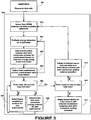
- One example of this method is illustrated in FIG. 3 .
- FIG. 3 depicts a flowchart illustrating one preferred embodiment of the invention.
- FIG. 3 illustrates a process that can be utilized by the transmitter to select a modulation scheme and error correction coding scheme to be used for each subchannel. This process could be implemented in hardware or software.
- the application or operating system requests a particular data rate for transmission at 301.
- the system 300 then follows several steps to select the optimal modulation scheme and error correction coding scheme to achieve this requested data rate.
- the system starts with a threshold vector that correlates a modulation scheme and error correction coding scheme with a detected signal-to-noise ratio.
- Each value in the ⁇ vector is a signal-to-noise ratio (or energy level) and a corresponding modulation scheme and error correction coding scheme.
- ⁇ 1 could be set at +20dB
- ⁇ 2 could be set at 0dB
- ⁇ 3 could be set at -20dB.
- the threshold vector sets a different modulation scheme and error coding scheme to correspond with each of these signal-to-noise ratios.
- the modulation scheme could be any modulation scheme, including, for example, the well known schemes of quadrature amplitude modulation (QAM), quadrature phase shift keying (QPSK), binary phase shift keying (BPSK), or any other scheme.
- QAM quadrature amplitude modulation
- QPSK quadrature phase shift keying
- BPSK binary phase shift keying
- the error coding scheme is not limited to any particular coding scheme, but could include Reed-Solomon coding, convolutional coding, Viterbi coding, or any other coding scheme.
- the vector will be optimized so that the modulation scheme and error correction coding scheme are appropriate for the corresponding signal-to-noise ratio.
- a base error correction coding scheme can be selected to apply to all OFDM subchannels. Higher error rate codes are then punctured from the base code and can be selected for each subchannel based on the noise detected on that subchannel. Puncturing is the process of removing some of the parity bits after an error correction code has been applied. Because there is less redundancy with some parity bits removed, puncturing has the same effect as encoding with a higher rate error correction code. Puncturing allows the same decoder to be used, regardless of how many bits have been punctured, and thus considerably increases the flexibility of the system without significantly increasing its complexity.
- the first subchannel from the available spectrum to be used is selected.
- the transmitter optionally with feedback from the receiver, detects the energy level on that subchannel at 303.
- the transmitter selects the modulation scheme and error correction scheme for the selected subchannel by comparing the detected energy level to the values in the threshold vector at 304. If the detected energy level falls between two values in the threshold vector, the corresponding modulation scheme and error correction coding scheme for the lower threshold value is selected. Expressed mathematically: if ⁇ j ⁇ E i ⁇ ⁇ j +1 , then modulation scheme m j and error correction coding rate r j are selected.
- the transmitter selects the next subchannel for testing at 305. This process is repeated from 303 to 305 until all subchannels have an associated modulation scheme and error correction coding scheme based on each subchannel's signal-to-noise ratio.
- the system can then check at 306 whether that total data rate exceeds the required rate provided by the application. If it does, the system has two nonexclusive options. It can select a lower order modulation scheme for one subchannel at 307, or it can select a lower rate error correction coding scheme for one subchannel at 308. If the system selects a lower order modulation scheme, it can select that scheme for the subchannel that has the highest order modulation scheme, or that has the highest signal-to-noise ratio, or could select any arbitrary subchannel.
- the system could select a lower rate error correction coding scheme for the noisiest subchannel or any other subchannel.
- the total data rate with the new modulation scheme or error correction coding scheme is then recalculated, and steps 306 to 308 are repeated until the total rate is equal to the required rate.
- the system must adjust the threshold vector at 310 such that the modulation schemes and error correction coding schemes selected for each noise level will provide a faster rate transmission.
- the process from 302 to 305 is then repeated with the new threshold vector.
- FIG. 4 illustrates another embodiment of the invention.
- This figure shows a system 400 that that accepts a data rate from an application 401 and provides information to an OFDM transmitter 405 as to how it will transmit data.
- the system 400 comprises an energy detection module 402, a modulation selection scheme module 403, and an error correction coding scheme module 404.
- the energy detection module 402 detects the noise level on each OFDM subchannel.
- the data gathered by the energy detection module 402 are provided to the modulation selection scheme module 403 as well as the error correction coding scheme module 404, which either independently or in concert will select a modulation scheme and an error correction coding scheme respectively.
- the selected schemes are then provided by the system 400 to the transmitter 405, which can then begin transmitting over OFDM using those schemes.
- the invention in yet another embodiment, relates to a computer-readable medium having computer-executable instructions for performing steps.
- the steps include measuring the signal-to-noise level on each OFDM subchannel and coding a modulated signal on each OFDM subchannel using an error correction coding scheme and modulation scheme based on the signal-to-noise level measured for each OFDM subchannel.
Landscapes
- Engineering & Computer Science (AREA)
- Signal Processing (AREA)
- Computer Networks & Wireless Communication (AREA)
- Quality & Reliability (AREA)
- Detection And Prevention Of Errors In Transmission (AREA)
- Digital Transmission Methods That Use Modulated Carrier Waves (AREA)
- Mobile Radio Communication Systems (AREA)
Description
- The invention relates generally to wireless communication and more particularly to a system for efficiently using OFDM subchannels.
- Frequency Division Multiplexing (FDM) is a well known process by which multiple signals are modulated on different frequency carrier waves. FDM has been used for decades in radio and television broadcast. Radio and television signals are sent and received on different frequencies, each corresponding to a different "channel."
- Orthogonal Frequency Division Multiplexing (OFDM) has also been known in the art at least since the late 1960's. In OFDM, a single transmitter transmits on many different orthogonal frequencies simultaneously. Orthogonal frequencies are frequencies that are independent with respect to the relative phase relationship between the frequencies. In OFDM, the available bandwidth is subdivided into a number of equal-bandwidth "subchannels." OFDM is advantageous for wireless communication because it reduces interference or crosstalk between signal transmissions, ultimately permitting data transmission at higher throughput with fewer errors. OFDM is also known as Discrete Multitone Modulation (DMT). OFDM is employed in many standards used today for wireless communication. For example, both the IEEE 802.1 la wireless LAN standard and the 802.11g wireless LAN standard rely on an implementation of OFDM for signal transmission. One early reference describing OFDM is R.W. Chang, Synthesis of band-limited orthogonal signals for multi-channel data transmis-sion, Bell System Technical Journal (46), 1775-1796 (1966).
- OFDM thus functions by breaking one high speed data stream into a number of lower-speed data streams, which are then transmitted in parallel (i.e., simultaneously). Each lower speed stream is used to modulate a subcarrier. This creates a "multi-carrier" transmission by dividing a wide frequency band (or channel) into a number of narrower frequency bands (or subchannels), each modulated with a signal stream. By sending multiple signal streams simultaneously, each at a lower rate, interference such as multipath or Raleigh fading can be attenuated or eliminated without decreasing the overall rate of transmission.
-
WO 02/062002 A1 -
EP 1 480 400 A1 - This Summary provides an illustrative context for aspects of the invention, in a simplified form. It is not intended to be used to determine the scope of the claimed subject matter. Aspects of the invention are described more fully below in the Detailed Description.
- Described herein are systems and methods for selecting a modulation scheme and an error correction coding scheme for each subchannel in an OFDM system based on the energy detected on that subchannel.
- The accompanying drawings are not intended to be drawn to scale. In the drawings, each identical or nearly identical component that is illustrated in various figures is represented by a like numeral. For purposes of clarity, not every component may be labeled in every drawing. In the drawings:
-
FIG. 1 is a spectrum diagram showing the subdivision of the channel bandwidth to be used into several subchannels of equal width. -
FIG. 2 is a block diagram of a multi-carrier OFDM digital communication system. -
FIG. 3 is a flow diagram illustrating one embodiment of the invention. -
FIG. 4 is a diagram of a system that implements some aspects of the invention. - This invention covers a novel use of OFDM subchannels. According to the claimed invention, each OFDM subchannel may be modulated with a different modulation scheme and/or error correction coding scheme specifically suited to the characteristics of that subchannel. The invention may be implemented in hardware or software, or some combination thereof. Embodiments include a system, a method, and instructions stored in a computer-readable medium.
- Computer readable media can be any available media that can be accessed by a computer. By way of example, and not limitation, computer readable media may comprise computer storage media and communication media. Computer storage media includes volatile and nonvolatile, removable and non-removable media implemented in any method or technology for storage of information such as computer readable instructions, data structures, program modules or other data. Computer storage media includes, but is not limited to, RAM, ROM, EEPROM, flash memory or other memory technology, CD-ROM, digital versatile disks (DVD) or other optical storage, magnetic cassettes, magnetic tape, magnetic disk storage or other magnetic storage devices, other types of volatile and non-volatile memory, any other medium which can be used to store the desired information and which can accessed by a computer, and any suitable combination of the foregoing.
- The computer-readable media may be transportable such that the instructions stored thereon can be loaded onto any suitable computer system resource to implement the aspects of the present invention discussed herein. In addition, it should be appreciated that the instructions stored on the computer-readable medium, described above, are not limited to instructions embodied as part of an application program running on a host computer. Rather, the instructions may be embodied as any type of computer code (e.g., software or microcode) that can be employed to program a processor to implement the aspects of the present invention discussed below.
- This invention is not limited in its application to the details of construction and the arrangement of components set forth in the following description or illustrated in the drawings. The invention is capable of other embodiments and of being practiced or of being carried out in various ways. Also, the phraseology and terminology used herein is for the purpose of description and should not be regarded as limiting. The use of "including," "comprising," or "having," "containing," "involving," and variations thereof herein, is meant to encompass the items listed thereafter and equivalents thereof as well as additional items.
- As shown in
FIG. 1 , in OFDM, the available channel bandwidth W is subdivided into a number of equal-bandwidth subchannels. Each subchannel is sufficiently narrow so that the frequency response characteristics of the subchannel are nearly ideal. The number of subchannels is the total available bandwidth divided by the bandwidth of each subchannel. The number of subchannels K can thus be expressed as:
- Each subchannel k has an associated carrier wave. This carrier wave can be expressed as:

- Where xk (t) is the carrier wave for subchannel k as a function of time t. fk is the mid-frequency of subchannel k, and k ranges from 0 to K-1.
- The
symbol rate 1/T is set for each subchannel to be equal to the separation Δf of adjacent subcarriers. The subcarriers will thus be orthogonal over the symbol interval T, independent of the relative phase relationship between subcarriers. This relationship can be expressed as:
- Where fk - fj = n/T, n = 1, 2, ..., independent of the values of the phases Φk and Φj .
- In an OFDM system, the symbol rate on each subchannel can be reduced relative to the symbol rate on a single carrier system that employs the entire bandwidth W and transmits data at the same rate as the OFDM system. Hence, the symbol interval T (the inverse of the symbol rate) in the OFDM system can be expressed as:

- Where Ts is the symbol interval of a single-carrier system employing the entire bandwidth W and transmitting data at the same rate as the OFDM system. For example, if the symbol rate across the entire bandwidth for one channel is 72 million symbols per second, and the channel is divided into 48 subchannels, each subchannel would only need to carry 1.5 million symbols per second to achieve the same total data rate. This lower symbol rate reduces inter-symbol interference and thus mitigates the effects of multipath fading. Accordingly, OFDM provides for superior link quality and robustness of communication.
- In an OFDM system, the transmitter receives input data in the frequency domain and converts it to a time domain signal. A carrier wave is modulated by the time domain signal for wireless transmission. The receiver receives the signal, demodulates the wave, and converts the signal back to the frequency domain for further processing.
- A simplified OFDM system is illustrated in
FIG. 2 . In the illustrated embodiment, theinput data stream 201 is provided by the application to theOFDM transmitter 200. In a standard TCP/IP communications stack, this data could be received at the physical layer or data link layer; however, the invention is not limited to any particular source of data or mechanism for providing the data to the transmitter, and could be implemented in hardware or software, and at various layers of the network stack. Theinput data stream 201 is received by a serial-to-parallel buffer 202. The serial-to-parallel buffer 202 breaks the serial data stream up into several parallel data streams. The number of parallel data streams is equal to the number of subchannels available for OFDM broadcast, or K as used above. - In one embodiment, the serial-to-
parallel buffer 202 divides the information sequence received frominput data 201 into frames of Bf bits. The Bf bits in each frame are parsed into K groups, where the ith group is assigned bi bits. This relationship may be expressed as:
- Each of the parallel data streams generated by the serial-to-
parallel buffer 202 is then sent to amulticarrier modulator 203. Themulticarrier modulator 203 modulates each OFDM subcarrier with each of the parallel data streams. Themulticarrier modulator 203 can be efficiently implemented by use of the Inverse Fast Fourier Transform algorithm to compute the time domain signal, although any algorithm may be used that converts a frequency domain signal to a time domain signal. - The
multicarrier modulator 203 may use any modulation scheme to modulate each of the incoming data streams. In a preferred embodiment, the signals are modulated with quadrature amplitude modulation (QAM). Any QAM constellation may be used. For example, the modulator may use 16-QAM, 64-QAM, 128-QAM or 256-QAM. A modulation scheme may be selected based on the required data rate, the available subchannels, the noise on each subchannel, or other factors. Each subchannel may use a different constellation, depending, for example, on the noise on that subchannel. The novel claimed system for selecting a different modulation scheme and error correction scheme claimed in this patent is discussed below. - In this example, the
multicarrier modulator 203 thus generates K independent QAM subchannels, where the symbol rate for each subchannel is 1/T and the signal in each subchannel has a distinct QAM constellation. According to this example, the number of signal points for the ith subchannel can be expressed as:
- The complex-valued signal points corresponding to the information signals on each of the K subchannels can be represented as Xk, where k = 0, 1, ..., K - 1. These symbols Xk represent the values of the Discrete Fourier Transform of a multicarrier OFDM signal x(t), where the modulation on each subcarrier is QAM. Since x(t) must be a real-valued signal, its N-point Discrete Fourier Transform Xk must satisfy the symmetry property. Therefore, the system creates N = 2K symbols from K information symbols by defining:


- Here X0 is split into two parts, both of which are real. The new sequence of symbols can be expressed as Xk ', where k = 0, 1, ..., N-1. The N-point Inverse Direct Fourier Transform for each subchannel xn can thus be expressed as:

- In this equation,

- A cyclic prefix, which acts a guard interval, is added to each of the parallel modulated waves at 204. This guard interval insures that the subchannels will remain orthogonal, even if multipath fading causes the subcarriers to arrive at the receiver with some delay spread. The parallel streams with the cyclic prefix are then merged back into a single serial stream at 204. Finally, the digital data stream is converted to an
analog signal 205, and output for wireless transmission. - The transmitted signal can be received by the
receiver 210 and processed to recover the original data stream. First, the analog signal is converted back to a digital signal by an analog todigital converter 211. The cyclic prefix is removed and the separate subcarriers are converted back to separate streams at 212. Each parallel data stream is demodulated by amulticarrier demodulator 213, preferably with a Fast Fourier Transform algorithm. Finally, at 214 the parallel streams are reassembled into a single serial stream and output to the receivingdevice 215. - A key inventive aspect of this system that will be appreciated by one of ordinary skill in the art is the method for separately selecting the modulation scheme and error correction coding scheme to be used on each subchannel. One example of this method is illustrated in
FIG. 3 . -
FIG. 3 depicts a flowchart illustrating one preferred embodiment of the invention.FIG. 3 illustrates a process that can be utilized by the transmitter to select a modulation scheme and error correction coding scheme to be used for each subchannel. This process could be implemented in hardware or software. - The application or operating system requests a particular data rate for transmission at 301. In this embodiment, the
system 300 then follows several steps to select the optimal modulation scheme and error correction coding scheme to achieve this requested data rate. - The system starts with a threshold vector that correlates a modulation scheme and error correction coding scheme with a detected signal-to-noise ratio. This vector can be expressed as:

- Each value in the Θ vector is a signal-to-noise ratio (or energy level) and a corresponding modulation scheme and error correction coding scheme. By way of illustration, θ1 could be set at +20dB, θ2 could be set at 0dB, and θ3 could be set at -20dB. The threshold vector sets a different modulation scheme and error coding scheme to correspond with each of these signal-to-noise ratios. The modulation scheme could be any modulation scheme, including, for example, the well known schemes of quadrature amplitude modulation (QAM), quadrature phase shift keying (QPSK), binary phase shift keying (BPSK), or any other scheme. Likewise, the error coding scheme is not limited to any particular coding scheme, but could include Reed-Solomon coding, convolutional coding, Viterbi coding, or any other coding scheme. The vector will be optimized so that the modulation scheme and error correction coding scheme are appropriate for the corresponding signal-to-noise ratio.
- In one embodiment of the invention, a base error correction coding scheme can be selected to apply to all OFDM subchannels. Higher error rate codes are then punctured from the base code and can be selected for each subchannel based on the noise detected on that subchannel. Puncturing is the process of removing some of the parity bits after an error correction code has been applied. Because there is less redundancy with some parity bits removed, puncturing has the same effect as encoding with a higher rate error correction code. Puncturing allows the same decoder to be used, regardless of how many bits have been punctured, and thus considerably increases the flexibility of the system without significantly increasing its complexity.
- At 302, the first subchannel from the available spectrum to be used is selected. The transmitter, optionally with feedback from the receiver, detects the energy level on that subchannel at 303. The transmitter then selects the modulation scheme and error correction scheme for the selected subchannel by comparing the detected energy level to the values in the threshold vector at 304. If the detected energy level falls between two values in the threshold vector, the corresponding modulation scheme and error correction coding scheme for the lower threshold value is selected. Expressed mathematically: if θ j < Ei < θ j+1, then modulation scheme mj and error correction coding rate rj are selected. The transmitter then selects the next subchannel for testing at 305. This process is repeated from 303 to 305 until all subchannels have an associated modulation scheme and error correction coding scheme based on each subchannel's signal-to-noise ratio.
- Once a modulation scheme and error correction coding scheme has been selected for each OFDM subchannel, it is possible to calculate a total data rate across all of the subchannels. The system can then check at 306 whether that total data rate exceeds the required rate provided by the application. If it does, the system has two nonexclusive options. It can select a lower order modulation scheme for one subchannel at 307, or it can select a lower rate error correction coding scheme for one subchannel at 308. If the system selects a lower order modulation scheme, it can select that scheme for the subchannel that has the highest order modulation scheme, or that has the highest signal-to-noise ratio, or could select any arbitrary subchannel. Similarly, the system could select a lower rate error correction coding scheme for the noisiest subchannel or any other subchannel. The total data rate with the new modulation scheme or error correction coding scheme is then recalculated, and steps 306 to 308 are repeated until the total rate is equal to the required rate.
- If, on the other hand, the required rate exceeds the total calculated rate of transmission at 309, the system must adjust the threshold vector at 310 such that the modulation schemes and error correction coding schemes selected for each noise level will provide a faster rate transmission. The process from 302 to 305 is then repeated with the new threshold vector.
-
FIG. 4 illustrates another embodiment of the invention. This figure shows asystem 400 that that accepts a data rate from anapplication 401 and provides information to anOFDM transmitter 405 as to how it will transmit data. Thesystem 400 comprises anenergy detection module 402, a modulationselection scheme module 403, and an error correctioncoding scheme module 404. Theenergy detection module 402 detects the noise level on each OFDM subchannel. The data gathered by theenergy detection module 402 are provided to the modulationselection scheme module 403 as well as the error correctioncoding scheme module 404, which either independently or in concert will select a modulation scheme and an error correction coding scheme respectively. The selected schemes are then provided by thesystem 400 to thetransmitter 405, which can then begin transmitting over OFDM using those schemes. - In yet another embodiment, the invention relates to a computer-readable medium having computer-executable instructions for performing steps. The steps include measuring the signal-to-noise level on each OFDM subchannel and coding a modulated signal on each OFDM subchannel using an error correction coding scheme and modulation scheme based on the signal-to-noise level measured for each OFDM subchannel.
- Having thus described several aspects of at least one embodiment of this invention, it is to be appreciated various alterations, modifications, and improvements will readily occur to those skilled in the art. Such alterations, modifications, and improvements are intended to be part of this disclosure, and are intended to be within the scope of the invention. Accordingly, the foregoing description and drawings are by way of example only.
Claims (9)
- A method of wireless communication between two or more devices using OFDM, the method comprising the acts of:receiving a required data rate for transmission;detecting (303) an energy level on one or more subchannels;selecting (394) a modulation scheme and an error correction coding scheme for each of said subchannels by comparing the energy level detected for each of said subchannels to values in a threshold vector, each of said values associating a signal-to-noise ratio with a corresponding modulation scheme and error correction coding scheme, wherein a lower value is selected if the detected energy level falls between two values in the threshold vector;calculating a total data rate across all of the subchannels;if the total data rate exceeds the required data rate, selecting (307, 308) a lower order modulation scheme and/or error correction coding scheme for at least one of the subchannels, replacing the total data rate and repeating said conditional selecting (307, 308);if the required data rate exceeds the total data rate, adjusting (310) the threshold vector to provide a faster rate transmission for each energy level; and repeating said detecting (303) and selecting (394).
- The method of Claim 1, wherein the modulation scheme for each of said subchannels is selected from 16-QAM, 64-QAM, 128-QAM, 256-QAM, 512- QAM, and 1024-QAM.
- The method of Claim 1, further comprising:
transmitting data over said subchannels using orthogonal frequency division multiplexing. - The method of Claim 1, wherein the error correction coding scheme is a convolutional coding scheme, or a block coding scheme.
- The method of Claim 1, wherein the error correction coding scheme is selected from a series of coding schemes, such that each coding scheme is punctured from a base coding scheme.
- A wireless communication system for transmitting data at a requested rate including a plurality of communication devices, the system comprising:an energy detection module (402) adapted to detect an energy level on one or more OFDM subchannels; anda modulation scheme selection module (403) and an error correction coding scheme module (404) adapted to select a modulation scheme and an error correction coding scheme for each OFDM subchannel by comparing the energy level detected for that subchannel to values in a threshold vector, each of said values associating a signal-to-noise ratio with a corresponding modulation scheme and error correction coding scheme, wherein a lower value is selected if the detected energy level falls between two values in the threshold vector, and further to calculate a total data rate across all of the subchannels;wherein a lower order modulation scheme and/or error correction encoding scheme is selected for at least one of the subchannels of the total data rate if the total data rate exceeds the required data rate, and to recalculate the total data rate and to repeat said conditional selecting;wherein the threshold vector is adjusted to provide a faster rate transmission for each energy level if the required data rate exceeds the total data rate, and to repeat said detecting and selecting.
- The system of Claim 6, wherein the modulation scheme selection module is adapted to select a quadrature amplitude modulation scheme, wherein the quadrature amplitude modulation scheme is selected from 16-QAM, 64-QAM, 128-QAM, 256-QAM, 512-QAM, and 1024- QAM.
- A computer-readable medium having computer-readable signals stored thereon that define instructions that, as a result of being executed by a computer, instruct the computer to perform the method of any one of the preceding claims 1 to 5.
- The computer-readable medium of Claim 13, wherein the modulation scheme is selected from quadrature amplitude modulation, quadrature phase shift keying, and binary phase shift keying.
Applications Claiming Priority (2)
| Application Number | Priority Date | Filing Date | Title |
|---|---|---|---|
| US11/410,409 US7634016B2 (en) | 2006-04-25 | 2006-04-25 | Variable OFDM subchannel coding and modulation |
| PCT/US2007/010021 WO2007127251A2 (en) | 2006-04-25 | 2007-04-25 | Variable ofdm subchannel coding and modulation |
Publications (3)
| Publication Number | Publication Date |
|---|---|
| EP2011297A2 EP2011297A2 (en) | 2009-01-07 |
| EP2011297A4 EP2011297A4 (en) | 2014-06-11 |
| EP2011297B1 true EP2011297B1 (en) | 2019-02-20 |
Family
ID=38619488
Family Applications (1)
| Application Number | Title | Priority Date | Filing Date |
|---|---|---|---|
| EP07794367.8A Active EP2011297B1 (en) | 2006-04-25 | 2007-04-25 | Variable ofdm subchannel coding and modulation |
Country Status (14)
| Country | Link |
|---|---|
| US (1) | US7634016B2 (en) |
| EP (1) | EP2011297B1 (en) |
| JP (1) | JP4542612B2 (en) |
| KR (1) | KR101312904B1 (en) |
| CN (1) | CN101433045B (en) |
| AU (1) | AU2007243349B2 (en) |
| BR (1) | BRPI0710014A2 (en) |
| CA (1) | CA2646622C (en) |
| IL (1) | IL194132A (en) |
| MX (1) | MX2008013326A (en) |
| NO (1) | NO20084116L (en) |
| RU (1) | RU2433555C2 (en) |
| WO (1) | WO2007127251A2 (en) |
| ZA (1) | ZA200808181B (en) |
Families Citing this family (20)
| Publication number | Priority date | Publication date | Assignee | Title |
|---|---|---|---|---|
| US8189621B2 (en) | 2006-05-12 | 2012-05-29 | Microsoft Corporation | Stack signaling to application with lack of requested bandwidth |
| US8144793B2 (en) | 2006-12-12 | 2012-03-27 | Microsoft Corporation | Cognitive multi-user OFDMA |
| US7970085B2 (en) | 2007-05-08 | 2011-06-28 | Microsoft Corporation | OFDM transmission and reception for non-OFDMA signals |
| US8374130B2 (en) | 2008-01-25 | 2013-02-12 | Microsoft Corporation | Orthogonal frequency division multiple access with carrier sense |
| US7970920B1 (en) * | 2008-12-15 | 2011-06-28 | Clear Wireless Llc | Dynamic two-dimensional coding for applications |
| US20110238498A1 (en) * | 2010-03-29 | 2011-09-29 | Microsoft Corporation | Service stage for subscription management |
| US9542203B2 (en) | 2010-12-06 | 2017-01-10 | Microsoft Technology Licensing, Llc | Universal dock for context sensitive computing device |
| US8923770B2 (en) | 2010-12-09 | 2014-12-30 | Microsoft Corporation | Cognitive use of multiple regulatory domains |
| US8792429B2 (en) | 2010-12-14 | 2014-07-29 | Microsoft Corporation | Direct connection with side channel control |
| US8589991B2 (en) | 2010-12-14 | 2013-11-19 | Microsoft Corporation | Direct connection with side channel control |
| US8948382B2 (en) | 2010-12-16 | 2015-02-03 | Microsoft Corporation | Secure protocol for peer-to-peer network |
| US9294545B2 (en) | 2010-12-16 | 2016-03-22 | Microsoft Technology Licensing, Llc | Fast join of peer to peer group with power saving mode |
| US8971841B2 (en) | 2010-12-17 | 2015-03-03 | Microsoft Corporation | Operating system supporting cost aware applications |
| EP2740247A4 (en) * | 2011-08-05 | 2015-03-25 | Intel Corp | Wireless communication device and method for multi-mcs ofdm transmissions at different transmission power levels |
| WO2013077838A1 (en) | 2011-11-21 | 2013-05-30 | Intel Corporation | Wireless device and method for low power and low data rate operation |
| US9584256B2 (en) * | 2014-06-09 | 2017-02-28 | Mitsubishi Electric Research Laboratories, Inc. | Adaptive error correction code for optical super-channels |
| US9660760B2 (en) | 2015-02-02 | 2017-05-23 | Intel IP Corporation | Apparatus, system and method of communicating a wireless transmission according to a physical layer scheme |
| WO2017171396A1 (en) * | 2016-03-29 | 2017-10-05 | 엘지전자 주식회사 | Method by which base station and terminal transmit and receive data signal in wireless communication system, and device for supporting same |
| CN110311770B (en) * | 2019-07-05 | 2022-08-23 | 北京神经元网络技术有限公司 | Time-frequency multiplexing method of high-speed industrial communication system based on OFDM communication system |
| CN112564854B (en) * | 2019-09-26 | 2022-09-20 | 北京东土科技股份有限公司 | Data transmission method, device, equipment and storage medium |
Family Cites Families (52)
| Publication number | Priority date | Publication date | Assignee | Title |
|---|---|---|---|---|
| US4210780A (en) | 1978-03-27 | 1980-07-01 | The Mitre Corporation | Multiple access digital communications system |
| FR2701178A1 (en) | 1993-02-03 | 1994-08-05 | Philips Electronique Lab | Spread spectrum communication system with multiple users. |
| US5790516A (en) | 1995-07-14 | 1998-08-04 | Telefonaktiebolaget Lm Ericsson | Pulse shaping for data transmission in an orthogonal frequency division multiplexed system |
| US5781543A (en) * | 1996-08-29 | 1998-07-14 | Qualcomm Incorporated | Power-efficient acquisition of a CDMA pilot signal |
| US6233456B1 (en) * | 1996-09-27 | 2001-05-15 | Qualcomm Inc. | Method and apparatus for adjacent coverage area handoff in communication systems |
| US6175550B1 (en) | 1997-04-01 | 2001-01-16 | Lucent Technologies, Inc. | Orthogonal frequency division multiplexing system with dynamically scalable operating parameters and method thereof |
| JPH1117643A (en) | 1997-06-19 | 1999-01-22 | Hitachi Denshi Ltd | OFDM modulator |
| US5867478A (en) | 1997-06-20 | 1999-02-02 | Motorola, Inc. | Synchronous coherent orthogonal frequency division multiplexing system, method, software and device |
| JP3724940B2 (en) | 1998-01-08 | 2005-12-07 | 株式会社東芝 | OFDM diversity receiver |
| WO2000030254A1 (en) | 1998-11-12 | 2000-05-25 | Matsushita Electric Industrial Co., Ltd. | Receiver for digital terrestrial broadcasting |
| US7020071B2 (en) | 1998-11-25 | 2006-03-28 | Lucent Technologies Inc. | Methods and apparatus for wireless communication using orthogonal frequency division multiplexing |
| US6763072B1 (en) | 1999-08-25 | 2004-07-13 | Victor Company Of Japan, Ltd. | Method and apparatus for modulation and demodulation related to orthogonal frequency division multiplexing |
| US6633614B1 (en) | 1999-09-15 | 2003-10-14 | Telcordia Technologies, Inc. | Multicarrier personal access communication system |
| US6952454B1 (en) | 2000-03-22 | 2005-10-04 | Qualcomm, Incorporated | Multiplexing of real time services and non-real time services for OFDM systems |
| US7020072B1 (en) | 2000-05-09 | 2006-03-28 | Lucent Technologies, Inc. | Orthogonal frequency division multiplexing transmit diversity system for frequency-selective fading channels |
| CA2395222C (en) * | 2000-10-21 | 2008-01-22 | Min-Goo Kim | Transmitting packet data in mobile communications systems |
| US6961388B2 (en) | 2001-02-01 | 2005-11-01 | Qualcomm, Incorporated | Coding scheme for a wireless communication system |
| US20020157058A1 (en) * | 2001-02-20 | 2002-10-24 | Cute Ltd. | System and method for feedback-based unequal error protection coding |
| US7035201B2 (en) | 2001-04-20 | 2006-04-25 | Mediatek Inc. | Programmable transceiver structure of multi-rate OFDM-CDMA for wireless multimedia communications |
| ES2188373B1 (en) | 2001-05-25 | 2004-10-16 | Diseño De Sistemas En Silencio, S.A. | COMMUNICATION OPTIMIZATION PROCEDURE FOR MULTI-USER DIGITAL TRANSMISSION SYSTEM ON ELECTRICAL NETWORK. |
| CA2390253A1 (en) | 2001-06-11 | 2002-12-11 | Unique Broadband Systems, Inc. | Ofdm multiple sub-channel communication system |
| US7164649B2 (en) | 2001-11-02 | 2007-01-16 | Qualcomm, Incorporated | Adaptive rate control for OFDM communication system |
| US7012883B2 (en) | 2001-11-21 | 2006-03-14 | Qualcomm Incorporated | Rate selection for an OFDM system |
| KR100911138B1 (en) * | 2002-04-25 | 2009-08-06 | 삼성전자주식회사 | Adaptive modulation and coding scheme for mobile power system and its method |
| TWI540863B (en) | 2002-05-10 | 2016-07-01 | 無線創新信號信託公司 | Cognitive flow control based on capacity distribution |
| US7184713B2 (en) | 2002-06-20 | 2007-02-27 | Qualcomm, Incorporated | Rate control for multi-channel communication systems |
| US20040005010A1 (en) | 2002-07-05 | 2004-01-08 | National University Of Singapore | Channel estimator and equalizer for OFDM systems |
| WO2004025870A1 (en) * | 2002-09-10 | 2004-03-25 | Koninklijke Philips Electronics N.V. | Transmission power optimization in ofdm wireless communication system |
| RU2298878C2 (en) * | 2002-11-07 | 2007-05-10 | Нокиа Корпорейшн | Transport-format data transfer |
| JP4084639B2 (en) * | 2002-11-19 | 2008-04-30 | 株式会社エヌ・ティ・ティ・ドコモ | Admission control method in mobile communication, mobile communication system, mobile station, admission control device, and admission control program |
| US7756002B2 (en) | 2003-01-30 | 2010-07-13 | Texas Instruments Incorporated | Time-frequency interleaved orthogonal frequency division multiplexing ultra wide band physical layer |
| JP4250002B2 (en) * | 2003-03-05 | 2009-04-08 | 富士通株式会社 | Adaptive modulation transmission system and adaptive modulation control method |
| CA2427403C (en) | 2003-04-21 | 2008-10-28 | Regents Of The University Of Minnesota | Space-time-frequency coded ofdm over frequency-selective fading channels |
| EP1480400A1 (en) | 2003-05-21 | 2004-11-24 | Siemens Mobile Communications S.p.A. | A method of bit and power loading in OFDM communication systems with modulation and coding adaptation |
| US7065150B2 (en) | 2003-06-16 | 2006-06-20 | Motorola, Inc. | System and method for generating a root raised cosine orthogonal frequency division multiplexing (RRC OFDM) modulation |
| US7103111B2 (en) | 2003-06-16 | 2006-09-05 | Motorola, Inc. | System and method for generating a spectral efficient root raised cosine (RRC) pulse for increasing spectral efficiency |
| US6934246B2 (en) | 2003-06-16 | 2005-08-23 | Motorola, Inc. | System and method for reducing adjacent channel interference (ACI) in a multicarrier modulation system |
| KR100640461B1 (en) | 2003-07-30 | 2006-10-30 | 삼성전자주식회사 | Apparatus and method for subchannel allocation in mobile communication system using orthogonal frequency division multiple access |
| CN1275480C (en) | 2003-07-31 | 2006-09-13 | 上海贝尔阿尔卡特股份有限公司 | Multi standard software radio (SDR) base band treating method |
| JP2005086479A (en) * | 2003-09-09 | 2005-03-31 | Hitachi Kokusai Electric Inc | Transmission equipment |
| KR100975720B1 (en) | 2003-11-13 | 2010-08-12 | 삼성전자주식회사 | Method and system for performing channel allocation considering spatial division multiplexing in orthogonal frequency division multiplexing system having multiple transmit / receive antennas |
| KR100557191B1 (en) | 2003-12-01 | 2006-03-03 | 삼성전자주식회사 | Soft modulation switching method that can change the modulation scheme according to the cell cover area in the broadband wireless access communication system |
| JP3910956B2 (en) | 2003-12-26 | 2007-04-25 | 株式会社東芝 | Propagation path estimator and receiving apparatus using the same for OFDM wireless communication system |
| US7123580B2 (en) | 2004-01-16 | 2006-10-17 | Nokia Corporation | Multiple user adaptive modulation scheme for MC-CDMA |
| KR101067772B1 (en) | 2004-04-22 | 2011-09-28 | 엘지전자 주식회사 | Subcarrier Allocation Method Applied to Orthogonal Frequency Division Multiplexing |
| WO2005125250A1 (en) | 2004-06-22 | 2005-12-29 | Nortel Networks Limited | Soft handoff in ofdma system |
| US7289972B2 (en) | 2004-06-25 | 2007-10-30 | Virginia Tech Intellectual Properties, Inc. | Cognitive radio engine based on genetic algorithms in a network |
| US8270512B2 (en) | 2004-08-12 | 2012-09-18 | Interdigital Technology Corporation | Method and apparatus for subcarrier and antenna selection in MIMO-OFDM system |
| JP3786129B2 (en) * | 2004-08-20 | 2006-06-14 | 日本電気株式会社 | Orthogonal frequency division multiplexing modulation / demodulation circuit |
| JP4698383B2 (en) * | 2004-10-26 | 2011-06-08 | パナソニック株式会社 | Wireless terminal device, management terminal device, and terminal management method |
| US7525988B2 (en) * | 2005-01-17 | 2009-04-28 | Broadcom Corporation | Method and system for rate selection algorithm to maximize throughput in closed loop multiple input multiple output (MIMO) wireless local area network (WLAN) system |
| JP4913820B2 (en) * | 2005-11-04 | 2012-04-11 | テレフオンアクチーボラゲット エル エム エリクソン(パブル) | Method and transmission unit for adaptive encoding, modulation and transmission of transmission of data words in a wireless communication system |
-
2006
- 2006-04-25 US US11/410,409 patent/US7634016B2/en active Active
-
2007
- 2007-04-25 AU AU2007243349A patent/AU2007243349B2/en not_active Ceased
- 2007-04-25 WO PCT/US2007/010021 patent/WO2007127251A2/en not_active Ceased
- 2007-04-25 EP EP07794367.8A patent/EP2011297B1/en active Active
- 2007-04-25 RU RU2008142422/08A patent/RU2433555C2/en not_active IP Right Cessation
- 2007-04-25 CN CN200780015143.8A patent/CN101433045B/en active Active
- 2007-04-25 MX MX2008013326A patent/MX2008013326A/en active IP Right Grant
- 2007-04-25 BR BRPI0710014-0A patent/BRPI0710014A2/en not_active Application Discontinuation
- 2007-04-25 KR KR1020087025735A patent/KR101312904B1/en not_active Expired - Fee Related
- 2007-04-25 JP JP2009507776A patent/JP4542612B2/en not_active Expired - Fee Related
- 2007-04-25 CA CA2646622A patent/CA2646622C/en active Active
-
2008
- 2008-09-16 IL IL194132A patent/IL194132A/en active IP Right Grant
- 2008-09-25 ZA ZA2008/08181A patent/ZA200808181B/en unknown
- 2008-09-29 NO NO20084116A patent/NO20084116L/en not_active Application Discontinuation
Non-Patent Citations (1)
| Title |
|---|
| None * |
Also Published As
| Publication number | Publication date |
|---|---|
| JP4542612B2 (en) | 2010-09-15 |
| EP2011297A2 (en) | 2009-01-07 |
| AU2007243349A1 (en) | 2007-11-08 |
| EP2011297A4 (en) | 2014-06-11 |
| US20070248179A1 (en) | 2007-10-25 |
| RU2008142422A (en) | 2010-04-27 |
| KR20080110849A (en) | 2008-12-19 |
| WO2007127251A3 (en) | 2007-12-13 |
| MX2008013326A (en) | 2008-10-27 |
| CN101433045A (en) | 2009-05-13 |
| CN101433045B (en) | 2014-03-26 |
| AU2007243349A2 (en) | 2008-12-11 |
| JP2009535911A (en) | 2009-10-01 |
| ZA200808181B (en) | 2009-12-30 |
| NO20084116L (en) | 2008-10-20 |
| RU2433555C2 (en) | 2011-11-10 |
| AU2007243349B2 (en) | 2010-11-25 |
| WO2007127251A2 (en) | 2007-11-08 |
| KR101312904B1 (en) | 2013-09-30 |
| CA2646622A1 (en) | 2007-11-08 |
| CA2646622C (en) | 2015-10-06 |
| IL194132A (en) | 2012-08-30 |
| BRPI0710014A2 (en) | 2011-08-02 |
| US7634016B2 (en) | 2009-12-15 |
Similar Documents
| Publication | Publication Date | Title |
|---|---|---|
| CA2646622C (en) | Variable ofdm subchannel coding and modulation | |
| EP2011296B1 (en) | Ofdma based on cognitive radio | |
| US7929623B2 (en) | FEC in cognitive multi-user OFDMA | |
| US7496028B2 (en) | Apparatus and method for minimizing PAPR in an OFDM communication system | |
| EP3203675B1 (en) | A low papr dual carrier modulation scheme for bpsk in wlan | |
| MXPA06006277A (en) | Modulating and coding apparatus and method in a high-rate wireless data communication system. | |
| US20080170636A1 (en) | Apparatus and method for reducing peak-to-average power ratio in a wireless communication system | |
| KR20060059221A (en) | Apparatus and method for reducing peak-to-average power ratio in multicarrier communication systems | |
| EP1924045A2 (en) | OFDM with bandwidth limitation | |
| WO2006064740A1 (en) | Ofdm transmission device, ofdm reception device, and ofdm communication method | |
| KR20060024886A (en) | Apparatus and method for transmitting and receiving multicast data in multicast orthogonal frequency division multiple communication system |
Legal Events
| Date | Code | Title | Description |
|---|---|---|---|
| PUAI | Public reference made under article 153(3) epc to a published international application that has entered the european phase |
Free format text: ORIGINAL CODE: 0009012 |
|
| 17P | Request for examination filed |
Effective date: 20080915 |
|
| AK | Designated contracting states |
Kind code of ref document: A2 Designated state(s): AT BE BG CH CY CZ DE DK EE ES FI FR GB GR HU IE IS IT LI LT LU LV MC MT NL PL PT RO SE SI SK TR |
|
| AX | Request for extension of the european patent |
Extension state: AL BA HR MK RS |
|
| DAX | Request for extension of the european patent (deleted) | ||
| A4 | Supplementary search report drawn up and despatched |
Effective date: 20140512 |
|
| RIC1 | Information provided on ipc code assigned before grant |
Ipc: H04L 1/00 20060101ALI20140506BHEP Ipc: H04L 27/26 20060101AFI20140506BHEP Ipc: H04J 11/00 20060101ALI20140506BHEP Ipc: H04L 5/00 20060101ALI20140506BHEP Ipc: H04L 27/00 20060101ALI20140506BHEP |
|
| RAP1 | Party data changed (applicant data changed or rights of an application transferred) |
Owner name: MICROSOFT TECHNOLOGY LICENSING, LLC |
|
| GRAP | Despatch of communication of intention to grant a patent |
Free format text: ORIGINAL CODE: EPIDOSNIGR1 |
|
| STAA | Information on the status of an ep patent application or granted ep patent |
Free format text: STATUS: GRANT OF PATENT IS INTENDED |
|
| RIC1 | Information provided on ipc code assigned before grant |
Ipc: H04L 27/26 20060101AFI20180103BHEP Ipc: H04J 11/00 20060101ALI20180103BHEP Ipc: H04L 5/00 20060101ALI20180103BHEP Ipc: H04L 27/00 20060101ALI20180103BHEP Ipc: H04L 1/00 20060101ALI20180103BHEP |
|
| INTG | Intention to grant announced |
Effective date: 20180129 |
|
| GRAJ | Information related to disapproval of communication of intention to grant by the applicant or resumption of examination proceedings by the epo deleted |
Free format text: ORIGINAL CODE: EPIDOSDIGR1 |
|
| STAA | Information on the status of an ep patent application or granted ep patent |
Free format text: STATUS: REQUEST FOR EXAMINATION WAS MADE |
|
| GRAP | Despatch of communication of intention to grant a patent |
Free format text: ORIGINAL CODE: EPIDOSNIGR1 |
|
| STAA | Information on the status of an ep patent application or granted ep patent |
Free format text: STATUS: GRANT OF PATENT IS INTENDED |
|
| INTC | Intention to grant announced (deleted) | ||
| GRAJ | Information related to disapproval of communication of intention to grant by the applicant or resumption of examination proceedings by the epo deleted |
Free format text: ORIGINAL CODE: EPIDOSDIGR1 |
|
| STAA | Information on the status of an ep patent application or granted ep patent |
Free format text: STATUS: REQUEST FOR EXAMINATION WAS MADE |
|
| INTG | Intention to grant announced |
Effective date: 20180621 |
|
| INTC | Intention to grant announced (deleted) | ||
| GRAP | Despatch of communication of intention to grant a patent |
Free format text: ORIGINAL CODE: EPIDOSNIGR1 |
|
| STAA | Information on the status of an ep patent application or granted ep patent |
Free format text: STATUS: GRANT OF PATENT IS INTENDED |
|
| INTG | Intention to grant announced |
Effective date: 20180830 |
|
| GRAS | Grant fee paid |
Free format text: ORIGINAL CODE: EPIDOSNIGR3 |
|
| GRAA | (expected) grant |
Free format text: ORIGINAL CODE: 0009210 |
|
| STAA | Information on the status of an ep patent application or granted ep patent |
Free format text: STATUS: THE PATENT HAS BEEN GRANTED |
|
| AK | Designated contracting states |
Kind code of ref document: B1 Designated state(s): AT BE BG CH CY CZ DE DK EE ES FI FR GB GR HU IE IS IT LI LT LU LV MC MT NL PL PT RO SE SI SK TR |
|
| REG | Reference to a national code |
Ref country code: GB Ref legal event code: FG4D |
|
| REG | Reference to a national code |
Ref country code: CH Ref legal event code: EP |
|
| REG | Reference to a national code |
Ref country code: DE Ref legal event code: R096 Ref document number: 602007057628 Country of ref document: DE |
|
| REG | Reference to a national code |
Ref country code: AT Ref legal event code: REF Ref document number: 1099694 Country of ref document: AT Kind code of ref document: T Effective date: 20190315 |
|
| REG | Reference to a national code |
Ref country code: IE Ref legal event code: FG4D |
|
| REG | Reference to a national code |
Ref country code: NL Ref legal event code: FP |
|
| REG | Reference to a national code |
Ref country code: LT Ref legal event code: MG4D |
|
| PG25 | Lapsed in a contracting state [announced via postgrant information from national office to epo] |
Ref country code: FI Free format text: LAPSE BECAUSE OF FAILURE TO SUBMIT A TRANSLATION OF THE DESCRIPTION OR TO PAY THE FEE WITHIN THE PRESCRIBED TIME-LIMIT Effective date: 20190220 Ref country code: LT Free format text: LAPSE BECAUSE OF FAILURE TO SUBMIT A TRANSLATION OF THE DESCRIPTION OR TO PAY THE FEE WITHIN THE PRESCRIBED TIME-LIMIT Effective date: 20190220 Ref country code: SE Free format text: LAPSE BECAUSE OF FAILURE TO SUBMIT A TRANSLATION OF THE DESCRIPTION OR TO PAY THE FEE WITHIN THE PRESCRIBED TIME-LIMIT Effective date: 20190220 Ref country code: PT Free format text: LAPSE BECAUSE OF FAILURE TO SUBMIT A TRANSLATION OF THE DESCRIPTION OR TO PAY THE FEE WITHIN THE PRESCRIBED TIME-LIMIT Effective date: 20190620 |
|
| PG25 | Lapsed in a contracting state [announced via postgrant information from national office to epo] |
Ref country code: GR Free format text: LAPSE BECAUSE OF FAILURE TO SUBMIT A TRANSLATION OF THE DESCRIPTION OR TO PAY THE FEE WITHIN THE PRESCRIBED TIME-LIMIT Effective date: 20190521 Ref country code: BG Free format text: LAPSE BECAUSE OF FAILURE TO SUBMIT A TRANSLATION OF THE DESCRIPTION OR TO PAY THE FEE WITHIN THE PRESCRIBED TIME-LIMIT Effective date: 20190520 Ref country code: IS Free format text: LAPSE BECAUSE OF FAILURE TO SUBMIT A TRANSLATION OF THE DESCRIPTION OR TO PAY THE FEE WITHIN THE PRESCRIBED TIME-LIMIT Effective date: 20190620 Ref country code: LV Free format text: LAPSE BECAUSE OF FAILURE TO SUBMIT A TRANSLATION OF THE DESCRIPTION OR TO PAY THE FEE WITHIN THE PRESCRIBED TIME-LIMIT Effective date: 20190220 |
|
| REG | Reference to a national code |
Ref country code: AT Ref legal event code: MK05 Ref document number: 1099694 Country of ref document: AT Kind code of ref document: T Effective date: 20190220 |
|
| PG25 | Lapsed in a contracting state [announced via postgrant information from national office to epo] |
Ref country code: EE Free format text: LAPSE BECAUSE OF FAILURE TO SUBMIT A TRANSLATION OF THE DESCRIPTION OR TO PAY THE FEE WITHIN THE PRESCRIBED TIME-LIMIT Effective date: 20190220 Ref country code: DK Free format text: LAPSE BECAUSE OF FAILURE TO SUBMIT A TRANSLATION OF THE DESCRIPTION OR TO PAY THE FEE WITHIN THE PRESCRIBED TIME-LIMIT Effective date: 20190220 Ref country code: SK Free format text: LAPSE BECAUSE OF FAILURE TO SUBMIT A TRANSLATION OF THE DESCRIPTION OR TO PAY THE FEE WITHIN THE PRESCRIBED TIME-LIMIT Effective date: 20190220 Ref country code: RO Free format text: LAPSE BECAUSE OF FAILURE TO SUBMIT A TRANSLATION OF THE DESCRIPTION OR TO PAY THE FEE WITHIN THE PRESCRIBED TIME-LIMIT Effective date: 20190220 Ref country code: IT Free format text: LAPSE BECAUSE OF FAILURE TO SUBMIT A TRANSLATION OF THE DESCRIPTION OR TO PAY THE FEE WITHIN THE PRESCRIBED TIME-LIMIT Effective date: 20190220 Ref country code: CZ Free format text: LAPSE BECAUSE OF FAILURE TO SUBMIT A TRANSLATION OF THE DESCRIPTION OR TO PAY THE FEE WITHIN THE PRESCRIBED TIME-LIMIT Effective date: 20190220 Ref country code: ES Free format text: LAPSE BECAUSE OF FAILURE TO SUBMIT A TRANSLATION OF THE DESCRIPTION OR TO PAY THE FEE WITHIN THE PRESCRIBED TIME-LIMIT Effective date: 20190220 |
|
| REG | Reference to a national code |
Ref country code: DE Ref legal event code: R097 Ref document number: 602007057628 Country of ref document: DE |
|
| PG25 | Lapsed in a contracting state [announced via postgrant information from national office to epo] |
Ref country code: PL Free format text: LAPSE BECAUSE OF FAILURE TO SUBMIT A TRANSLATION OF THE DESCRIPTION OR TO PAY THE FEE WITHIN THE PRESCRIBED TIME-LIMIT Effective date: 20190220 |
|
| REG | Reference to a national code |
Ref country code: CH Ref legal event code: PL |
|
| REG | Reference to a national code |
Ref country code: BE Ref legal event code: MM Effective date: 20190430 |
|
| PLBE | No opposition filed within time limit |
Free format text: ORIGINAL CODE: 0009261 |
|
| STAA | Information on the status of an ep patent application or granted ep patent |
Free format text: STATUS: NO OPPOSITION FILED WITHIN TIME LIMIT |
|
| PG25 | Lapsed in a contracting state [announced via postgrant information from national office to epo] |
Ref country code: MC Free format text: LAPSE BECAUSE OF FAILURE TO SUBMIT A TRANSLATION OF THE DESCRIPTION OR TO PAY THE FEE WITHIN THE PRESCRIBED TIME-LIMIT Effective date: 20190220 Ref country code: LU Free format text: LAPSE BECAUSE OF NON-PAYMENT OF DUE FEES Effective date: 20190425 Ref country code: AT Free format text: LAPSE BECAUSE OF FAILURE TO SUBMIT A TRANSLATION OF THE DESCRIPTION OR TO PAY THE FEE WITHIN THE PRESCRIBED TIME-LIMIT Effective date: 20190220 |
|
| REG | Reference to a national code |
Ref country code: DE Ref legal event code: R082 Ref document number: 602007057628 Country of ref document: DE Representative=s name: GRUENECKER PATENT- UND RECHTSANWAELTE PARTG MB, DE |
|
| 26N | No opposition filed |
Effective date: 20191121 |
|
| PG25 | Lapsed in a contracting state [announced via postgrant information from national office to epo] |
Ref country code: CH Free format text: LAPSE BECAUSE OF NON-PAYMENT OF DUE FEES Effective date: 20190430 Ref country code: LI Free format text: LAPSE BECAUSE OF NON-PAYMENT OF DUE FEES Effective date: 20190430 |
|
| PG25 | Lapsed in a contracting state [announced via postgrant information from national office to epo] |
Ref country code: BE Free format text: LAPSE BECAUSE OF NON-PAYMENT OF DUE FEES Effective date: 20190430 Ref country code: SI Free format text: LAPSE BECAUSE OF FAILURE TO SUBMIT A TRANSLATION OF THE DESCRIPTION OR TO PAY THE FEE WITHIN THE PRESCRIBED TIME-LIMIT Effective date: 20190220 |
|
| PG25 | Lapsed in a contracting state [announced via postgrant information from national office to epo] |
Ref country code: TR Free format text: LAPSE BECAUSE OF FAILURE TO SUBMIT A TRANSLATION OF THE DESCRIPTION OR TO PAY THE FEE WITHIN THE PRESCRIBED TIME-LIMIT Effective date: 20190220 |
|
| PG25 | Lapsed in a contracting state [announced via postgrant information from national office to epo] |
Ref country code: IE Free format text: LAPSE BECAUSE OF NON-PAYMENT OF DUE FEES Effective date: 20190425 |
|
| PG25 | Lapsed in a contracting state [announced via postgrant information from national office to epo] |
Ref country code: CY Free format text: LAPSE BECAUSE OF FAILURE TO SUBMIT A TRANSLATION OF THE DESCRIPTION OR TO PAY THE FEE WITHIN THE PRESCRIBED TIME-LIMIT Effective date: 20190220 |
|
| PG25 | Lapsed in a contracting state [announced via postgrant information from national office to epo] |
Ref country code: HU Free format text: LAPSE BECAUSE OF FAILURE TO SUBMIT A TRANSLATION OF THE DESCRIPTION OR TO PAY THE FEE WITHIN THE PRESCRIBED TIME-LIMIT; INVALID AB INITIO Effective date: 20070425 Ref country code: MT Free format text: LAPSE BECAUSE OF FAILURE TO SUBMIT A TRANSLATION OF THE DESCRIPTION OR TO PAY THE FEE WITHIN THE PRESCRIBED TIME-LIMIT Effective date: 20190220 |
|
| P01 | Opt-out of the competence of the unified patent court (upc) registered |
Effective date: 20230505 |
|
| PGFP | Annual fee paid to national office [announced via postgrant information from national office to epo] |
Ref country code: NL Payment date: 20230314 Year of fee payment: 17 |
|
| PGFP | Annual fee paid to national office [announced via postgrant information from national office to epo] |
Ref country code: FR Payment date: 20240320 Year of fee payment: 18 |
|
| REG | Reference to a national code |
Ref country code: NL Ref legal event code: MM Effective date: 20240501 |
|
| PG25 | Lapsed in a contracting state [announced via postgrant information from national office to epo] |
Ref country code: NL Free format text: LAPSE BECAUSE OF NON-PAYMENT OF DUE FEES Effective date: 20240501 |
|
| PG25 | Lapsed in a contracting state [announced via postgrant information from national office to epo] |
Ref country code: NL Free format text: LAPSE BECAUSE OF NON-PAYMENT OF DUE FEES Effective date: 20240501 |
|
| PGFP | Annual fee paid to national office [announced via postgrant information from national office to epo] |
Ref country code: DE Payment date: 20250319 Year of fee payment: 19 |
|
| PG25 | Lapsed in a contracting state [announced via postgrant information from national office to epo] |
Ref country code: FR Free format text: LAPSE BECAUSE OF NON-PAYMENT OF DUE FEES Effective date: 20250430 |
|
| PGFP | Annual fee paid to national office [announced via postgrant information from national office to epo] |
Ref country code: GB Payment date: 20260320 Year of fee payment: 20 |