EP2010129B1 - Hair conditioning cosmetic compositions containing a mixture of amidoamines - Google Patents
Hair conditioning cosmetic compositions containing a mixture of amidoamines Download PDFInfo
- Publication number
- EP2010129B1 EP2010129B1 EP07775140.2A EP07775140A EP2010129B1 EP 2010129 B1 EP2010129 B1 EP 2010129B1 EP 07775140 A EP07775140 A EP 07775140A EP 2010129 B1 EP2010129 B1 EP 2010129B1
- Authority
- EP
- European Patent Office
- Prior art keywords
- hair
- mixture
- amidoamines
- dimethylamine
- rapeseed oil
- Prior art date
- Legal status (The legal status is an assumption and is not a legal conclusion. Google has not performed a legal analysis and makes no representation as to the accuracy of the status listed.)
- Active
Links
Images
Classifications
-
- A—HUMAN NECESSITIES
- A61—MEDICAL OR VETERINARY SCIENCE; HYGIENE
- A61K—PREPARATIONS FOR MEDICAL, DENTAL OR TOILETRY PURPOSES
- A61K8/00—Cosmetics or similar toiletry preparations
- A61K8/18—Cosmetics or similar toiletry preparations characterised by the composition
- A61K8/30—Cosmetics or similar toiletry preparations characterised by the composition containing organic compounds
- A61K8/40—Cosmetics or similar toiletry preparations characterised by the composition containing organic compounds containing nitrogen
- A61K8/42—Amides
-
- A—HUMAN NECESSITIES
- A61—MEDICAL OR VETERINARY SCIENCE; HYGIENE
- A61Q—SPECIFIC USE OF COSMETICS OR SIMILAR TOILETRY PREPARATIONS
- A61Q5/00—Preparations for care of the hair
- A61Q5/12—Preparations containing hair conditioners
-
- A—HUMAN NECESSITIES
- A61—MEDICAL OR VETERINARY SCIENCE; HYGIENE
- A61K—PREPARATIONS FOR MEDICAL, DENTAL OR TOILETRY PURPOSES
- A61K2800/00—Properties of cosmetic compositions or active ingredients thereof or formulation aids used therein and process related aspects
- A61K2800/40—Chemical, physico-chemical or functional or structural properties of particular ingredients
- A61K2800/59—Mixtures
-
- A—HUMAN NECESSITIES
- A61—MEDICAL OR VETERINARY SCIENCE; HYGIENE
- A61K—PREPARATIONS FOR MEDICAL, DENTAL OR TOILETRY PURPOSES
- A61K2800/00—Properties of cosmetic compositions or active ingredients thereof or formulation aids used therein and process related aspects
- A61K2800/40—Chemical, physico-chemical or functional or structural properties of particular ingredients
- A61K2800/59—Mixtures
- A61K2800/592—Mixtures of compounds complementing their respective functions
Definitions
- Hair conditioners are utilized globally to improve the texture and appearance of human hair. These formulations may confer specific benefits that are broadly defined as hair manageability. More specifically, hair manageability may be thought of as a combination of benefits such as reduction and/or removal of static charge, detangling, strengthening, split-end removal, shine improvement, thickening, fragrance delivery, moisturization, lubrication and other properties that generally result in the perception of repair of damaged hair and of enhanced beautification.
- compositions have been discovered that provide conditioning benefits simultaneously with cleansing and are known in the field as "two-in-one shampoos.” Although these have gained significant popularity, the predominant proportion of hair conditioning products are applied after shampooing, and may be designed to be rinsed off (“rinse-off') or left on (“leave-on") the hair.
- a conditioner that is used after shampooing in a separate step is called a conventional conditioner.
- Conventional conditioner formulations are typically made in the form of oil-in-water (O/W) emulsions.
- O/W emulsion is the preferred type, other product forms such as gels, creams, solutions, pastes, sprays, and mousses are also provided.
- conditioners One property of conditioners that is preferred among consumers is for the viscosity of the product to be sufficiently high such that upon application, the product provides a feeling of creaminess and cushion between the hair and the hand. Another property that is preferred is that lubricity is provided by the conditioner, and during rinse-off, this lubricity is perceived as immediate improvement in the softness and smoothness of the hair. Yet another property that is preferred is that the hair surface be revitalized after the hair has dried out. This can be demonstrated by the ease with which combing or brushing is accomplished, and by visual characteristics such as shine. Yet another property that is preferred is that the hair maintains the shape and texture desired by the consumer just after drying, brushing and/or combing. Terms such as "frizziness” and "flyaway” are used in the field to describe loss of shape and/or texture. These terms have a negative connotation, and are generally associated with a lack of conditioning of the hair.
- Cationic materials have been found to be particularly effective for controlling viscosity, providing lubrication during rinse off, reducing wet and dry combing force, improving shine, and improving the texture and the shape of the hair.
- Hair consists predominantly of keratin, and its surface is rich in negatively charged amino acids.
- Cationic materials will thus bind to the hair by electrostatic attraction, and will not be rinsed out completely.
- Particularly effective cationic materials are those in which the cationic site is on one end of the molecule, with the remainder of the molecule consisting of a long hydrophobic moiety. Cationic materials of this type can create a temporary new hair surface in which the topography is filled with organic material.
- the smoother hair surface reduces friction between the hair surface and hair styling implements such as combs and brushes, as well as the hand. Additionally, the smoother surface will tend to improve the ability of light to reflect off of the hair that results in improved shininess. Although certain cationic materials are known to provide such benefits, there is an ongoing need for materials that improve upon them.
- a particularly useful class of cationic materials that may provide the aforementioned benefits are the amidoamines.
- Amidoamines are derived from the reaction of fatty acids with polyamines that contain at least one tertiary amine group.
- Stearamidopropyl dimethylamine (Lexamine® S-13, Inolex Chemical Company, Philadelphia, PA, USA) is the reaction product of stearic acid (linear, C-18) with dimethylaminopropylamine.
- Behenamidopropyl dimethylamine (Lexamine® B-13, Inolex Chemical Company, Philadelphia, PA, USA) is the reaction product of behenic acid (linear, C-22) with dimethylaminopropylamine.
- Stearamidoethyl diethylamine (Lexamine® 22, Inolex Chemical Company, Philadelphia, PA, USA) is the reaction product of stearic acid (linear, C-18) with diethylaminoethylamine. Each of these products has been used successfully for many years alone or in combination with other types of conditioning ingredients in hair conditioning compositions.
- behenic acid Commercial forms of behenic acid are known which are derived from Menhaden (fish) oil.
- One such product was available from Witco under the name Hystrene® 9022.
- the applicants are unaware of the actual behenic content.
- Applicants are also aware of a product which has a behenic amidoamine content of about 60-65% and a stearic amidoamine content of about 20-25%, such that the maximum stearic/behenic ratio is about 0.417. To the best of applicants' knowledge all such products were derived from the reaction of dimethylaminopropylamine with fatty acids.
- US 6,315,991 B1 discloses monomeric and polymeric compositions based upon polymeric urethane surfactants which are derived from linear, branched or aromatic compounds of synthetic or natural origin. The compounds may be incorporated into personal care formulations.
- US 6,592,856 B2 discloses hair conditioning compositions, which contain a combination of conditioning agents including emulsified silicones, cationic polymers and certain fatty acid polyesters of polyols. It is taught that fatty acids can be obtained from rapeseed oil and used in hair care combinations.
- EP 17147677 A1 discloses hair dyeing compositions containing a dyestuff and fatty acid dimethylammopropylamide and/or its salts as leveling agents. Behenic acid dimethylammopropylamide and stearamidopropyl dimethylamine are identified as potential leveling agents. However, a mixture of leveling agents is not disclosed.
- EP 1808157 A1 discloses hair cosmetic compositions including a gel emulsion containing at least one fatty alcohol, a cationic surfactant and an aqueous carrier, and an oil agent phase containing a vegetable oil and a volatile silicone.
- the disclosed hair composition comprises a mixture of stearamidopropyl dimethylamine and behenamidopropyl dimethylamine in a ratio of 0.88 wt%.
- the stearamidopropyl dimethylamine and behenamidopropyl dimethylamine are the reaction products of hydrogenated high erucic acid rapeseed oil with dimethylaminopropylamine.
- amidoamines in hair formulations include U.S. Pat. No. 4,954,335 , which describes the usefulness of amidoamines in the formulation of clear hair conditioners.
- U.S. Pat. No. 6,365,142 also discloses the use of amidoamines in combination with other ingredients to form a hair conditioner.
- U.S. Pat. No. 6,979,439 discloses the use of amidoamines in anti-dandruff preparations.
- the invention includes a hair conditioning composition, comprising a mixture of stearamidopropyl dimethylamine and behenamidopropyl dimethylamine, wherein a weight ratio of stearamidopropyl dimethylamine to behenamidopropyl dimethylamine is 0.60:1.00 to 0.85: 1.00, and wherein the mixture of the stearamidopropyl dimethylamine and the behenamidopropyl dimethylamine is obtained by reacting hydrogenated high erucic acid rapeseed oil with dimethylaminopropylamine.
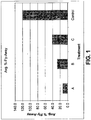
- Fig. 1 is a graphical representation of the average percentage flyaway hair for various samples in Example 1.
- This invention relates to hair conditioning compositions including as an active component a preferred mixture of amidoamines, as defined in the appended claims.
- the amidoamines used in the compositions of the present invention are stearamidopropyl dimethylamine and behenamidopropyl dimethylamine.
- the mixture of these two amidoamines provides enhanced conditioning benefits when applied to the hair.
- the two amidoamines are present in a ratio of 0.60:1.00 to 0.85:1.00 and are also derived from rapeseed oil as described further herein.
- the invention relates to mixtures of amidoamines, particularly a mixture of amidoamines, which may be derived from reaction of hydrogenated high erucic acid rapeseed oil (Hyd. HEAR oil) with dimethylaminopropylamine.
- Hydroated high erucic acid rapeseed oil Hydrogenated high erucic acid rapeseed oil
- Rapeseed oil may be derived from various sources, but is preferably, although not exclusively derived from Rapeseed in the family Brassicaceae.
- Preferred rapeseed oil for use in the present invention includes rapeseed oils derived from botanical sources including, for example, B. napobrassica, B. napus, B. rapa, B. campestris, B. juncea and/or Sinapsis alba or various combinations and derivatives thereof.
- these oils be hydrogenated, preferably to an iodine value of less than 20.0 cg I 2 /g, and more preferably to an iodine value of less than about 5.0 cg I 2 /g, and most preferably to an iodine value of less than 1.0 cg I 2 /g, prior to their being used.
- the rapeseed oil is reacted with dymethylaminopropylamine.
- the reaction occurs through the transamidation of hydrogenated rapeseed oil, in which the dialkylaminoalkylamine is reacted with hydrogenated rapeseed oil to yield amidoamine and about 9% glycerine that remains in the final reaction product.
- amidoamines for certain hair conditioning properties, applicants have surprisingly discovered that certain amidoamines mixtures, preferably when utilized in defined ratios provide unexpectedly improved results.
- the resulting amidoamine mixture formed by the reaction of rapeseed oil and dimethylaminopropylamine has beneficial properties for various compositions, including cosmetic compositions such as hair conditioning compositions.
- the preferred amidoamine reaction products produced from the above-noted reaction include certain preferred combinations of stearamidopropyl dimethylamine and behenamidopropyl dimethylamine. Such combinations provide unique properties.
- the invention includes mixtures of stearamidopropyl dimethylamine and behenamidopropyl dimethylamine in a weight ratio of 0.60:1.00 to 0.85:1.00 stearamidopropyl dimethylamine to behenamidopropyl dimethylamine.
- Such mixtures provide improvements in certain properties that are related to performance in hair conditioners that are generally above and beyond those that would be expected by the mere additive contributions of each compound.
- amidoamines including a mixture having stearamidopropyl dimethylamine and behenamidopropyl dimethylamine, wherein the mixture is prepared by reacting Hyd. HEAR oil with dimethylaminopropylamine.
- Such mixtures contribute properties such as the improved performance in reducing flyaway hair, which corresponds to improved performance when used in hair conditioner formulations.
- the preferred weight ratio of stearamidopropyl dimethylamine to behenamidopropyl dimethylamine preferably corresponds to that which is derived from the weight ratio of stearic acid to behenic acid naturally found in Hyd. HEAR oil. This ratio can vary according to the particular genus or species of botanical in which the rapeseed oil is derived, but generally falls within the preferred weight ratio noted above of 0.60:1.00 to 0.85:1.00.
- Additives which may be used in various compositions including hair conditioners include various anionic surfactants, cationic surfactants, amphoteric surfactants, nonionic surfactants, waxes, other oils and fats and derivatives thereof, fatty acid esters of varying chain lengths, synthetic oils and fats, polymers, alcohols, polyhydric alcohols, extracts useful for providing fragrance, amino acids, nucleic acids, vitamins, hydrolyzed proteins and derivatives thereof, glycerin and derivates thereof, enzymes, anti-inflammatory and other medicaments, microbiocides, antifungals, antiseptics, antioxidants, UV absorbers, dyes and pigments, sunscreen active agents, chelating agents, sweat retardants, oxidizers, pH balancing agents, moisturizers and the like approved for use in formulations for human use.
- hair conditioning compositions described herein include, in addition to the preferred amidoamine mixtures of the present invention, additives such as, EDTA, glutamic acid, glycerin, panthenol, stearyl alcohol, cetyl alcohol, cyclomethicone, dimethicone, pH adjustment additives, and preferably a water base.
- additives such as, EDTA, glutamic acid, glycerin, panthenol, stearyl alcohol, cetyl alcohol, cyclomethicone, dimethicone, pH adjustment additives, and preferably a water base.
- model hair conditioning formulations were prepared to test for the reduction in flyaway hair.
- the composition of the model formulations is shown in Table 1 below: TABLE 1 Ingredients % w/w Deionized water Q.S. to 100 EDTA 0.10 Glutamic acid 0.35 Glycerin, 96% 0.05 Panthenol 0.10 Stearyl alcohol 5.00 Cetyl alcohol 4.00 Conditioning Amidoamine 2.00 Cyclomethicone 2.00 Dimethicone 0.20 Citric acid, 25% aq. Solution Q.S. to 5.30 ⁇ 0.30 NaOH, 10% aq. Solution Q.S. to 5.30 ⁇ 0.30 Total 100.00
- the formulations were prepared using the following procedure. Deionized water, EDTA, glutamic acid, glycerin, and panthenol were combined in a vessel with propeller agitation and heated to about 70 to about 75°C and agitated until a uniform mixture was obtained. In a separate vessel, stearyl alcohol, cetyl alcohol, cyclomethicone, dimethicone, and the conditioning additive (amidoamine) were combined and heated to about 70 to about 75°C and agitated until a uniform mixture was obtained. The contents of the second vessel were added to the first, and agitated at a temperature of about 70 to about 75°C until a uniform mixture was obtained. The mixture was then homogenized for about 5 minutes at 3500 RPM.
- the mixture was then allowed to cool with gentle agitation to about 40°C to about 45°C.
- the pH of the mixture was then adjusted to about 4.9 to about 5.6 with citric acid and/or sodium hydroxide solution.
- the mixture was then allowed to cool to about 15°C to about 25°C with gentle agitation. Agitation was then stopped, and the completed conditioner formulation was poured off to containers.
- Test formulations were prepared using the above procedure that contained the following concentrations of conditioning additive as set forth in Table 2 (hereby test formulation A is according to the invention, and test formulations B, C and control are comparative formulations): TABLE 2 Test Formulation Identifier Stearamidopropyl Dimethylamine, weight ratio Behenamidopropyl Dimethylamine, weight ratio A 0.7 1.0 B 0.0 1.0 C 1.0 0.0 Control 0.0 0.0
- Flyaway properties of the test formulation were determined using the following procedure. Five hair tresses were prepared for each formulation by first washing in sodium lauryl ether sulfate solution. Each of the tresses were then combed as necessary to remove any knots or tangles, then allowed to dry thoroughly. The conditioning formulation was then applied to each tress and massaged in thoroughly, then rinsed with water. After treatment, each tress was then again combed to remove any knots or tangles, following which it was allowed to dry for about five hours. Each tress was then transferred to a controlled humidity environment and allowed to acclimate for about 30 minutes. The width of each tress was measured. Each tress was then combed twenty times after which the tress was again measured.
- an amidoamine was prepared from Hyd. HEAR oil using the following procedure.
- Dimethylaminopropylamine and Hyd. HEAR oil (Erucical H-103, Lambent Technologies, Gumee, Illinois, USA) were charged to a stirred batch reactor in a molar ratio of 2.0:1.4 and heated with inert gas sparging to about 120 to about 200°C. The mixture was held for about eight hours under this condition. Excess dimethylaminopropylamine was then removed by allowing the mixture to cool to about 140°C, and then by applying vacuum of about 750 to about 755 mm, and by steam stripping.
- HEAR oil amidoamine compared favorably to Formula A of Example 1, and had lower percentage fly-away than either Formula B or Formula C of Example 1, which represent the amidoamines used separately, and illustrates the improvement obtained when using the amidoamine prepared from Hyd. HEAR oil.
- Formula B is according to the claimed invention
- Formula A and Formula C are comparative formulations.
- TABLE 6 Part A Ingredients Formula A w/w % Formula B w/w% Formula C w/w% Deionized Water 86.63 86.85 86.87 EDTA 0.10 0.10 0.10 Glutamic Acid 0.37 0.35 0.33 Panthenol 0.10 0.10 0.10 Stearamidopropyl dimethylamine 1.50 -- -- Hyd.
- the formulations were prepared as follows. Part A having deionized water, EDTA, glutamic acid, panthenol, and the amidoamine were combined in a vessel and heated with propeller agitation to about 70°C to about 75°C and mixed until uniform. In a separate vessel, Part B having stearyl alcohol, cetyl alcohol, dimethicone, and cyclomethicone were combined and heated with propeller agitation to about 70°C to about 75°C and mixed until uniform. Part B was then added to Part A, and the combination was mixed at about 70°C to about 75°C until uniform.
- the mixture was then homogenized for about 5 minutes at 3500 revolutions per minute (RPM.) The mixture was then allowed to cool with gentle agitation to about 40°C to about 45°C. The pH of the mixture was then adjusted to about 4.9 to about 5.6 with citric acid and/or sodium hydroxide solution. The mixture was then allowed to cool to about 15°C to about 25°C with gentle agitation. Agitation was then stopped, and the completed conditioner formulation was poured off to containers.
- RPM. revolutions per minute
Landscapes
- Health & Medical Sciences (AREA)
- Life Sciences & Earth Sciences (AREA)
- Animal Behavior & Ethology (AREA)
- General Health & Medical Sciences (AREA)
- Public Health (AREA)
- Veterinary Medicine (AREA)
- Dermatology (AREA)
- Birds (AREA)
- Epidemiology (AREA)
- Cosmetics (AREA)
Description
- Hair Conditioning Cosmetic Compositions Containing A Mixture Of Amidoamines
- Hair conditioners are utilized globally to improve the texture and appearance of human hair. These formulations may confer specific benefits that are broadly defined as hair manageability. More specifically, hair manageability may be thought of as a combination of benefits such as reduction and/or removal of static charge, detangling, strengthening, split-end removal, shine improvement, thickening, fragrance delivery, moisturization, lubrication and other properties that generally result in the perception of repair of damaged hair and of enhanced beautification.
- Compositions have been discovered that provide conditioning benefits simultaneously with cleansing and are known in the field as "two-in-one shampoos." Although these have gained significant popularity, the predominant proportion of hair conditioning products are applied after shampooing, and may be designed to be rinsed off ("rinse-off') or left on ("leave-on") the hair. A conditioner that is used after shampooing in a separate step is called a conventional conditioner.
- Conventional conditioner formulations are typically made in the form of oil-in-water (O/W) emulsions. Although the O/W emulsion is the preferred type, other product forms such as gels, creams, solutions, pastes, sprays, and mousses are also provided.
- One property of conditioners that is preferred among consumers is for the viscosity of the product to be sufficiently high such that upon application, the product provides a feeling of creaminess and cushion between the hair and the hand. Another property that is preferred is that lubricity is provided by the conditioner, and during rinse-off, this lubricity is perceived as immediate improvement in the softness and smoothness of the hair. Yet another property that is preferred is that the hair surface be revitalized after the hair has dried out. This can be demonstrated by the ease with which combing or brushing is accomplished, and by visual characteristics such as shine. Yet another property that is preferred is that the hair maintains the shape and texture desired by the consumer just after drying, brushing and/or combing. Terms such as "frizziness" and "flyaway" are used in the field to describe loss of shape and/or texture. These terms have a negative connotation, and are generally associated with a lack of conditioning of the hair.
- Cationic materials have been found to be particularly effective for controlling viscosity, providing lubrication during rinse off, reducing wet and dry combing force, improving shine, and improving the texture and the shape of the hair. Hair consists predominantly of keratin, and its surface is rich in negatively charged amino acids. Cationic materials will thus bind to the hair by electrostatic attraction, and will not be rinsed out completely. Particularly effective cationic materials are those in which the cationic site is on one end of the molecule, with the remainder of the molecule consisting of a long hydrophobic moiety. Cationic materials of this type can create a temporary new hair surface in which the topography is filled with organic material. The smoother hair surface reduces friction between the hair surface and hair styling implements such as combs and brushes, as well as the hand. Additionally, the smoother surface will tend to improve the ability of light to reflect off of the hair that results in improved shininess. Although certain cationic materials are known to provide such benefits, there is an ongoing need for materials that improve upon them.
- A particularly useful class of cationic materials that may provide the aforementioned benefits are the amidoamines. Amidoamines are derived from the reaction of fatty acids with polyamines that contain at least one tertiary amine group. Stearamidopropyl dimethylamine (Lexamine® S-13, Inolex Chemical Company, Philadelphia, PA, USA) is the reaction product of stearic acid (linear, C-18) with dimethylaminopropylamine. Behenamidopropyl dimethylamine (Lexamine® B-13, Inolex Chemical Company, Philadelphia, PA, USA) is the reaction product of behenic acid (linear, C-22) with dimethylaminopropylamine. Stearamidoethyl diethylamine (Lexamine® 22, Inolex Chemical Company, Philadelphia, PA, USA) is the reaction product of stearic acid (linear, C-18) with diethylaminoethylamine. Each of these products has been used successfully for many years alone or in combination with other types of conditioning ingredients in hair conditioning compositions.
- Commercial forms of behenic acid are known which are derived from Menhaden (fish) oil. One such product was available from Witco under the name Hystrene® 9022. The applicants are unaware of the actual behenic content. Applicants are also aware of a product which has a behenic amidoamine content of about 60-65% and a stearic amidoamine content of about 20-25%, such that the maximum stearic/behenic ratio is about 0.417. To the best of applicants' knowledge all such products were derived from the reaction of dimethylaminopropylamine with fatty acids.
-
US 6,315,991 B1 discloses monomeric and polymeric compositions based upon polymeric urethane surfactants which are derived from linear, branched or aromatic compounds of synthetic or natural origin. The compounds may be incorporated into personal care formulations. -
US 6,592,856 B2 discloses hair conditioning compositions, which contain a combination of conditioning agents including emulsified silicones, cationic polymers and certain fatty acid polyesters of polyols. It is taught that fatty acids can be obtained from rapeseed oil and used in hair care combinations. -
EP 17147677 A1 -
EP 1808157 A1 discloses hair cosmetic compositions including a gel emulsion containing at least one fatty alcohol, a cationic surfactant and an aqueous carrier, and an oil agent phase containing a vegetable oil and a volatile silicone. The disclosed hair composition comprises a mixture of stearamidopropyl dimethylamine and behenamidopropyl dimethylamine in a ratio of 0.88 wt%. However, it is not disclosed that the stearamidopropyl dimethylamine and behenamidopropyl dimethylamine are the reaction products of hydrogenated high erucic acid rapeseed oil with dimethylaminopropylamine. - Representative patents directed to use of amidoamines in hair formulations include
U.S. Pat. No. 4,954,335 , which describes the usefulness of amidoamines in the formulation of clear hair conditioners.U.S. Pat. No. 6,365,142 also discloses the use of amidoamines in combination with other ingredients to form a hair conditioner.U.S. Pat. No. 6,979,439 discloses the use of amidoamines in anti-dandruff preparations. Although the prior art discloses the possible use of amidoamines in combination in hair care formulations, there have been no disclosures that suggest a particular advantage of any such combinations. Additionally, applicants are unaware of a particular theory that has been applied to account for or predict any a potential relationship between chemical structure and physical properties that would serve as a basis for one skilled in the art to predict the benefits or outcome of particular combinations of such compounds other than what would be expected in terms of general additive contributions of individual components. - The invention includes a hair conditioning composition, comprising a mixture of stearamidopropyl dimethylamine and behenamidopropyl dimethylamine, wherein a weight ratio of stearamidopropyl dimethylamine to behenamidopropyl dimethylamine is 0.60:1.00 to 0.85: 1.00, and wherein the mixture of the stearamidopropyl dimethylamine and the behenamidopropyl dimethylamine is obtained by reacting hydrogenated high erucic acid rapeseed oil with dimethylaminopropylamine.
- The foregoing summary, as well as the following detailed description of preferred embodiments of the invention, will be better understood when read in conjunction with the appended drawing. For the purpose of illustrating the invention, there is shown in the drawing results from an embodiment in Example 1 that includes embodiments which are presently preferred. It should be understood, however, that the invention is not limited to the precise arrangements and instrumentalities shown. In the drawings:
Fig. 1 is a graphical representation of the average percentage flyaway hair for various samples in Example 1. - This invention relates to hair conditioning compositions including as an active component a preferred mixture of amidoamines, as defined in the appended claims. The amidoamines used in the compositions of the present invention are stearamidopropyl dimethylamine and behenamidopropyl dimethylamine. The mixture of these two amidoamines provides enhanced conditioning benefits when applied to the hair. The two amidoamines are present in a ratio of 0.60:1.00 to 0.85:1.00 and are also derived from rapeseed oil as described further herein.
- More particularly, the invention relates to mixtures of amidoamines, particularly a mixture of amidoamines, which may be derived from reaction of hydrogenated high erucic acid rapeseed oil (Hyd. HEAR oil) with dimethylaminopropylamine.
- Rapeseed oil (Hyd. HEAR oil) may be derived from various sources, but is preferably, although not exclusively derived from Rapeseed in the family Brassicaceae. Preferred rapeseed oil for use in the present invention includes rapeseed oils derived from botanical sources including, for example, B. napobrassica, B. napus, B. rapa, B. campestris, B. juncea and/or Sinapsis alba or various combinations and derivatives thereof. It is a preferred for the purpose of the invention that these oils be hydrogenated, preferably to an iodine value of less than 20.0 cg I2/g, and more preferably to an iodine value of less than about 5.0 cg I2/g, and most preferably to an iodine value of less than 1.0 cg I2/g, prior to their being used.
- The rapeseed oil is reacted with dymethylaminopropylamine. Thus, the reaction occurs through the transamidation of hydrogenated rapeseed oil, in which the dialkylaminoalkylamine is reacted with hydrogenated rapeseed oil to yield amidoamine and about 9% glycerine that remains in the final reaction product.
- Upon investigation of amidoamines for certain hair conditioning properties, applicants have surprisingly discovered that certain amidoamines mixtures, preferably when utilized in defined ratios provide unexpectedly improved results.
- The resulting amidoamine mixture formed by the reaction of rapeseed oil and dimethylaminopropylamine has beneficial properties for various compositions, including cosmetic compositions such as hair conditioning compositions. The preferred amidoamine reaction products produced from the above-noted reaction include certain preferred combinations of stearamidopropyl dimethylamine and behenamidopropyl dimethylamine. Such combinations provide unique properties.
- The invention includes mixtures of stearamidopropyl dimethylamine and behenamidopropyl dimethylamine in a weight ratio of 0.60:1.00 to 0.85:1.00 stearamidopropyl dimethylamine to behenamidopropyl dimethylamine. Such mixtures provide improvements in certain properties that are related to performance in hair conditioners that are generally above and beyond those that would be expected by the mere additive contributions of each compound.
- It is further preferred to use in conditioning formulations combinations of amidoamines including a mixture having stearamidopropyl dimethylamine and behenamidopropyl dimethylamine, wherein the mixture is prepared by reacting Hyd. HEAR oil with dimethylaminopropylamine. Such mixtures contribute properties such as the improved performance in reducing flyaway hair, which corresponds to improved performance when used in hair conditioner formulations.
- In the preferred compositions according to the invention derived from Hyd. HEAR oil, the preferred weight ratio of stearamidopropyl dimethylamine to behenamidopropyl dimethylamine preferably corresponds to that which is derived from the weight ratio of stearic acid to behenic acid naturally found in Hyd. HEAR oil. This ratio can vary according to the particular genus or species of botanical in which the rapeseed oil is derived, but generally falls within the preferred weight ratio noted above of 0.60:1.00 to 0.85:1.00.
- Any other various ordinary additives may be added to compositions according to the invention, however, it is preferred that additives not be provided which may detract from the preferred beneficial results delivered by the invention. Additives which may be used in various compositions including hair conditioners include various anionic surfactants, cationic surfactants, amphoteric surfactants, nonionic surfactants, waxes, other oils and fats and derivatives thereof, fatty acid esters of varying chain lengths, synthetic oils and fats, polymers, alcohols, polyhydric alcohols, extracts useful for providing fragrance, amino acids, nucleic acids, vitamins, hydrolyzed proteins and derivatives thereof, glycerin and derivates thereof, enzymes, anti-inflammatory and other medicaments, microbiocides, antifungals, antiseptics, antioxidants, UV absorbers, dyes and pigments, sunscreen active agents, chelating agents, sweat retardants, oxidizers, pH balancing agents, moisturizers and the like approved for use in formulations for human use.
- Other components, including those selected from the above components, which may be typically used in such hair conditioning compositions may also be used in preferred embodiments of hair conditioning compositions described herein and include, in addition to the preferred amidoamine mixtures of the present invention, additives such as, EDTA, glutamic acid, glycerin, panthenol, stearyl alcohol, cetyl alcohol, cyclomethicone, dimethicone, pH adjustment additives, and preferably a water base.
- To demonstrate the new and unexpected results achieved by the present invention, model hair conditioning formulations were prepared to test for the reduction in flyaway hair. The composition of the model formulations is shown in Table 1 below:
TABLE 1 Ingredients % w/w Deionized water Q.S. to 100 EDTA 0.10 Glutamic acid 0.35 Glycerin, 96% 0.05 Panthenol 0.10 Stearyl alcohol 5.00 Cetyl alcohol 4.00 Conditioning Amidoamine 2.00 Cyclomethicone 2.00 Dimethicone 0.20 Citric acid, 25% aq. Solution Q.S. to 5.30 ± 0.30 NaOH, 10% aq. Solution Q.S. to 5.30 ± 0.30 Total 100.00 - The formulations were prepared using the following procedure. Deionized water, EDTA, glutamic acid, glycerin, and panthenol were combined in a vessel with propeller agitation and heated to about 70 to about 75°C and agitated until a uniform mixture was obtained. In a separate vessel, stearyl alcohol, cetyl alcohol, cyclomethicone, dimethicone, and the conditioning additive (amidoamine) were combined and heated to about 70 to about 75°C and agitated until a uniform mixture was obtained. The contents of the second vessel were added to the first, and agitated at a temperature of about 70 to about 75°C until a uniform mixture was obtained. The mixture was then homogenized for about 5 minutes at 3500 RPM. The mixture was then allowed to cool with gentle agitation to about 40°C to about 45°C. The pH of the mixture was then adjusted to about 4.9 to about 5.6 with citric acid and/or sodium hydroxide solution. The mixture was then allowed to cool to about 15°C to about 25°C with gentle agitation. Agitation was then stopped, and the completed conditioner formulation was poured off to containers.
- Test formulations were prepared using the above procedure that contained the following concentrations of conditioning additive as set forth in Table 2 (hereby test formulation A is according to the invention, and test formulations B, C and control are comparative formulations):
TABLE 2 Test Formulation Identifier Stearamidopropyl Dimethylamine, weight ratio Behenamidopropyl Dimethylamine, weight ratio A 0.7 1.0 B 0.0 1.0 C 1.0 0.0 Control 0.0 0.0 - Flyaway properties of the test formulation were determined using the following procedure. Five hair tresses were prepared for each formulation by first washing in sodium lauryl ether sulfate solution. Each of the tresses were then combed as necessary to remove any knots or tangles, then allowed to dry thoroughly. The conditioning formulation was then applied to each tress and massaged in thoroughly, then rinsed with water. After treatment, each tress was then again combed to remove any knots or tangles, following which it was allowed to dry for about five hours. Each tress was then transferred to a controlled humidity environment and allowed to acclimate for about 30 minutes. The width of each tress was measured. Each tress was then combed twenty times after which the tress was again measured. The percentage increase in the width of each tress after combing is directly related to the presence of fly-away hair, and is directly related to the conditioning benefit provided by the conditioner formulation with lower values being better. The following data in Table 3 were obtained.
TABLE 3 Treatment Tress Pre-Comb width (cm) Post-Comb width (cm) Difference (cm) % Fly Away Formula A A1 4.1 4.4 0.3 7.3 A2 4.0 4.5 0.5 12.5 A3 4.6 5.6 1.0 21.7 A4 4.0 4.4 0.4 10.0 A5 4.3 4.8 0.5 11.6 Average 4.2 4.7 0.5 12.6 Formula B B1 3.4 4.8 1.4 41.2 B2 3.6 5.0 1.4 38.9 B3 4.1 4.4 0.3 7.3 B4 3.0 3.7 0.7 23.3 B5 2.5 3.2 0.7 28.0 Average 3.3 4.2 0.9 27.7 Formula C C1 3.5 4.3 0.8 22.9 C2 3.1 4.1 1.0 32.3 C3 3.9 4.9 1.0 25.6 C4 3.7 4.8 1.1 29.7 C5 2.9 5.6 2.7 93.1 Average Average 3.4 4.7 1.3 40.7 Control CTRL-1 4.8 12.2 7.4 154.2 CTRL-2 4.1 8.9 4.8 117.1 CTRL-3 4.6 10.1 5.5 119.6 CTRL-4 6.1 14.0 7.9 129.5 CTRL-5 4.6 8.2 3.6 78.3 Average 4.8 10.7 5.8 119.7 - The results indicated in Table 3 and the chart in
Fig. 1 illustrate the results obtained for each of the test formulations. The results indicate that Formula A comprising the mixture of amidoamines had lower percentage fly-away then either of Formula B or Formula C, which represent the amidoamines used separately, and illustrates the improvement obtained when mixing the amidoamines in accordance with the invention. - To further demonstrate the invention, an amidoamine was prepared from Hyd. HEAR oil using the following procedure. Dimethylaminopropylamine and Hyd. HEAR oil (Erucical H-103, Lambent Technologies, Gumee, Illinois, USA) were charged to a stirred batch reactor in a molar ratio of 2.0:1.4 and heated with inert gas sparging to about 120 to about 200°C. The mixture was held for about eight hours under this condition. Excess dimethylaminopropylamine was then removed by allowing the mixture to cool to about 140°C, and then by applying vacuum of about 750 to about 755 mm, and by steam stripping. The resulting amidoamine product was then cooled and poured off to chilled metal pans, allowed to solidify, and was then broken up into flakes. The flakes were a pale yellow, waxy consistency. Color of the product was tested using AOCS (American Oil Chemists Society, Urbana, Illinois, USA) Official Method Td 1a. Acid Value was tested using ASTM (American Society of Testing and Materials International, West Conshohocken, PA, USA) Method D-974. Amine Value was tested using AOCS Tf 1b. Odor was evaluated olfactorily. Table 4 shows the results obtained.
TABLE 4 Property Result Color, Gardner 3 Acid Value, mg KOH/g 0.07 Amine Value, mg KOH/g 129.5 Odor Mild - The amidoamine described above was tested for flyaway using the protocol described previously and in the model test formulation described previously. Table 5 shows the results obtained.
TABLE 5 Treatment Tress Pre-Comb width (cm) Post-Comb width (cm) Difference (cm) % Fly Away Hyd. HEAR oil Amidoamine 1 3.1 3.3 0.2 6.5 2 4.3 4.3 0.0 0.0 3 3.9 4.9 1.0 25.6 4 3.9 4.9 1.0 25.6 5 3.4 3.9 0.5 14.7 Average 3.7 4.3 0.5 14.5 - The percentage fly-away for the Hyd. HEAR oil amidoamine compared favorably to Formula A of Example 1, and had lower percentage fly-away than either Formula B or Formula C of Example 1, which represent the amidoamines used separately, and illustrates the improvement obtained when using the amidoamine prepared from Hyd. HEAR oil.
- To further demonstrate the invention, the following formulations were prepared as shown in Table 6. Herein Formula B is according to the claimed invention, and Formula A and Formula C are comparative formulations.
TABLE 6 Part A Ingredients Formula A w/w % Formula B w/w% Formula C w/w% Deionized Water 86.63 86.85 86.87 EDTA 0.10 0.10 0.10 Glutamic Acid 0.37 0.35 0.33 Panthenol 0.10 0.10 0.10 Stearamidopropyl dimethylamine 1.50 -- -- Hyd. HEAR Oil Amidoamine -- 1.50 -- Behenamidopropyl dimethylamine -- -- 1.50 Part B Stearyl Alcohol 5.00 5.00 5.00 Cetyl Alcohol 4.00 4.00 4.00 Cyclomethicone 2.00 2.00 2.00 Dimethicone 0.10 0.10 0.10 Total 100.00 100.00 100.00 - The formulations were prepared as follows. Part A having deionized water, EDTA, glutamic acid, panthenol, and the amidoamine were combined in a vessel and heated with propeller agitation to about 70°C to about 75°C and mixed until uniform. In a separate vessel, Part B having stearyl alcohol, cetyl alcohol, dimethicone, and cyclomethicone were combined and heated with propeller agitation to about 70°C to about 75°C and mixed until uniform. Part B was then added to Part A, and the combination was mixed at about 70°C to about 75°C until uniform. The mixture was then homogenized for about 5 minutes at 3500 revolutions per minute (RPM.) The mixture was then allowed to cool with gentle agitation to about 40°C to about 45°C. The pH of the mixture was then adjusted to about 4.9 to about 5.6 with citric acid and/or sodium hydroxide solution. The mixture was then allowed to cool to about 15°C to about 25°C with gentle agitation. Agitation was then stopped, and the completed conditioner formulation was poured off to containers.
- The viscosity of each mixture was measured using a Brookfield RVT viscometer utilizing T spindles at 10 RPM with on helipath stand (Brookfield Engineering Laboratories Inc., Middleboro Massachusetts) at 20°C. The viscosity data obtained is found in Table 7.
TABLE 7 Formula A Formula B Formula C Viscosity@20°C, cP 9,400 39,667 16,733 - The results show that quite surprisingly, Formula B that was prepared from the Hyd. HEAR Oil Amidoamine developed a significantly higher viscosity in the test formulation than Formula A or Formula C, which represent the amidoamines used separately, and illustrates the improvement obtained when using the amidoamine prepared from Hyd. HEAR oil.
Claims (5)
- A hair conditioning composition comprising a mixture of stearamidopropyl dimethylamine and behenamidopropyl dimethylamine, wherein a weight ratio of stearamidopropyl dimethylamine to behenamidopropyl dimethylamine is 0.60:1.00 to 0.85:1.00, and wherein the mixture of the stearamidopropyl dimethylamine and the behenamidopropyl dimethylamine is obtained by reacting hydrogenated high erucic acid rapeseed oil with dimethylaminopropylamine.
- The composition according to claim 1, wherein the high erucic acid rapeseed oil comprises an oil derived from a botanical selected from the group consisting of B. napobrassica, B. napus, B. rapa, B. campestris, B. juncea, Sinapsis alba and combinations thereof.
- The composition according to claim 1, wherein the high erucic acid rapeseed oil has been hydrogenated and has an iodine value of 20.0 cg I2/g or less.
- The composition according to claim 3, wherein the high erucic acid rapeseed oil has an iodine value of 5.0 cg I2/g or less.
- The composition according to claim 4, wherein the high erucic acid rapeseed oil has an iodine value of 1.0 cg I2/g or less.
Priority Applications (2)
| Application Number | Priority Date | Filing Date | Title |
|---|---|---|---|
| PL07775140T PL2010129T3 (en) | 2006-04-10 | 2007-04-10 | Hair conditioning cosmetic compositions containing a mixture of amidoamines |
| EP18200336.8A EP3461471B1 (en) | 2006-04-10 | 2007-04-10 | Hair conditioning cosmetic compositions containing a mixture of amidoamines |
Applications Claiming Priority (2)
| Application Number | Priority Date | Filing Date | Title |
|---|---|---|---|
| US79065806P | 2006-04-10 | 2006-04-10 | |
| PCT/US2007/008889 WO2007120681A2 (en) | 2006-04-10 | 2007-04-10 | Hair conditioning cosmetic compositions containing a mixture of amidoamines |
Related Child Applications (1)
| Application Number | Title | Priority Date | Filing Date |
|---|---|---|---|
| EP18200336.8A Division EP3461471B1 (en) | 2006-04-10 | 2007-04-10 | Hair conditioning cosmetic compositions containing a mixture of amidoamines |
Publications (3)
| Publication Number | Publication Date |
|---|---|
| EP2010129A2 EP2010129A2 (en) | 2009-01-07 |
| EP2010129A4 EP2010129A4 (en) | 2012-11-28 |
| EP2010129B1 true EP2010129B1 (en) | 2018-10-17 |
Family
ID=38610139
Family Applications (2)
| Application Number | Title | Priority Date | Filing Date |
|---|---|---|---|
| EP18200336.8A Active EP3461471B1 (en) | 2006-04-10 | 2007-04-10 | Hair conditioning cosmetic compositions containing a mixture of amidoamines |
| EP07775140.2A Active EP2010129B1 (en) | 2006-04-10 | 2007-04-10 | Hair conditioning cosmetic compositions containing a mixture of amidoamines |
Family Applications Before (1)
| Application Number | Title | Priority Date | Filing Date |
|---|---|---|---|
| EP18200336.8A Active EP3461471B1 (en) | 2006-04-10 | 2007-04-10 | Hair conditioning cosmetic compositions containing a mixture of amidoamines |
Country Status (6)
| Country | Link |
|---|---|
| US (3) | US20070237736A1 (en) |
| EP (2) | EP3461471B1 (en) |
| ES (2) | ES2706017T3 (en) |
| PL (1) | PL2010129T3 (en) |
| TR (1) | TR201819460T4 (en) |
| WO (1) | WO2007120681A2 (en) |
Families Citing this family (12)
| Publication number | Priority date | Publication date | Assignee | Title |
|---|---|---|---|---|
| US8747823B2 (en) | 2012-08-10 | 2014-06-10 | The United States Of America, As Represented By The Secretary Of Agriculture | Compositions and methods for treating a keratin based substrate |
| DE102012216293A1 (en) * | 2012-09-13 | 2014-03-13 | Henkel Ag & Co. Kgaa | Hair care products containing anti-dandruff active ingredients and selected plant-based cationic surfactants |
| EP2764860A1 (en) | 2013-02-06 | 2014-08-13 | Basf Sa | Cupuassu fatty acid amidoamines and their derivatives |
| FR3083111B1 (en) * | 2018-06-28 | 2020-05-29 | L'oreal | KERATINIC FIBER COLORING COMPOSITION COMPRISING AT LEAST ONE COPOLYMER DERIVED FROM THE POLYMERIZATION OF AT LEAST ONE CROTONIC ACID MONOMER AND AT LEAST ONE VINYL ESTER MONOMER AND A FATTY AMINE |
| CN108969393B (en) * | 2018-09-14 | 2021-02-19 | 上海蜂花日用品有限公司 | Light oil-containing silicon-free wash-free hair conditioner and preparation method thereof |
| EP4065068A1 (en) | 2019-12-01 | 2022-10-05 | The Procter & Gamble Company | Hair conditioner compositions with a preservation system containing sodium benzoate and glycols and/or glyceryl esters |
| CN114929183B (en) * | 2019-12-01 | 2025-05-02 | 宝洁公司 | Hair conditioning composition containing behenamidopropyl dimethylamine |
| JP7513835B2 (en) | 2020-08-11 | 2024-07-09 | ザ プロクター アンド ギャンブル カンパニー | Low viscosity hair conditioner composition containing brush silvalinate esylate |
| MX2023001043A (en) | 2020-08-11 | 2023-02-16 | Procter & Gamble | CLEAN RINSE CONDITIONING COMPOSITIONS FOR HAIR CONTAINING BRASSCYL VALINATE ESILATE. |
| US11633338B2 (en) | 2020-08-11 | 2023-04-25 | The Procter & Gamble Company | Moisturizing hair conditioner compositions containing brassicyl valinate esylate |
| CA3201309A1 (en) | 2020-12-01 | 2022-06-09 | The Procter & Gamble Company | Aqueous hair conditioner compositions containing solubilized anti-dandruff actives |
| WO2025099700A1 (en) | 2023-11-08 | 2025-05-15 | Nouryon Chemicals International B.V. | Personal care composition |
Family Cites Families (15)
| Publication number | Priority date | Publication date | Assignee | Title |
|---|---|---|---|---|
| US4954335A (en) * | 1989-05-31 | 1990-09-04 | Helene Curtis, Inc. | Clear conditioning composition and method to impart improved properties to the hair |
| US6365142B1 (en) * | 1996-02-28 | 2002-04-02 | The Procter & Gamble Company | Hair conditioning compositions which provide superior wet hair feel attributes and which are substantially free of quaternary ammonium compounds |
| GB9800591D0 (en) * | 1998-01-12 | 1998-03-11 | Unilever Plc | Hair conditioning composition |
| GB9811754D0 (en) * | 1998-06-01 | 1998-07-29 | Unilever Plc | Hair treatment compositions |
| GB9902629D0 (en) * | 1999-02-05 | 1999-03-31 | Unilever Plc | Shampoo compositions |
| US6315991B1 (en) * | 1999-03-24 | 2001-11-13 | Fleet Bank, National Association | Urethane surfactants and their use in personal care formulations |
| EP1227784B1 (en) | 1999-11-11 | 2007-07-04 | The Procter & Gamble Company | Antidandruff hair conditioning composition |
| CN1186004C (en) * | 2000-06-26 | 2005-01-26 | 株式会社资生堂 | Hair grooming compsns. |
| CN1454074A (en) * | 2000-09-08 | 2003-11-05 | 宝洁公司 | Hair conditioning compositions comprising particles |
| JP2002114648A (en) | 2000-10-04 | 2002-04-16 | Kao Corp | Hair cosmetic |
| US6706674B2 (en) * | 2001-01-17 | 2004-03-16 | The Andrew Jergens Company | Nonaqueous hair styling composition and method of use |
| AU2003277104A1 (en) * | 2002-10-02 | 2004-04-23 | The Procter And Gamble Company | Hair conditioning composition comprising three kinds of silicones |
| JP4184312B2 (en) * | 2004-04-15 | 2008-11-19 | 花王株式会社 | Hair cosmetics |
| DK1714677T3 (en) * | 2005-04-22 | 2010-11-01 | Kao Corp Sa | Long-chain fatty acid dimethylaminopropylamide as a leveling agent for dyeing keratin fibers |
| JP4719575B2 (en) * | 2006-01-13 | 2011-07-06 | 花王株式会社 | Hair cosmetic and method for producing the same |
-
2007
- 2007-04-10 WO PCT/US2007/008889 patent/WO2007120681A2/en not_active Ceased
- 2007-04-10 TR TR2018/19460T patent/TR201819460T4/en unknown
- 2007-04-10 PL PL07775140T patent/PL2010129T3/en unknown
- 2007-04-10 ES ES07775140T patent/ES2706017T3/en active Active
- 2007-04-10 EP EP18200336.8A patent/EP3461471B1/en active Active
- 2007-04-10 US US11/784,899 patent/US20070237736A1/en not_active Abandoned
- 2007-04-10 EP EP07775140.2A patent/EP2010129B1/en active Active
- 2007-04-10 ES ES18200336T patent/ES2832923T3/en active Active
-
2014
- 2014-07-21 US US14/336,527 patent/US9662288B2/en active Active
-
2017
- 2017-05-19 US US15/599,974 patent/US10272023B2/en active Active
Non-Patent Citations (1)
| Title |
|---|
| None * |
Also Published As
| Publication number | Publication date |
|---|---|
| ES2706017T3 (en) | 2019-03-27 |
| EP2010129A4 (en) | 2012-11-28 |
| TR201819460T4 (en) | 2019-01-21 |
| ES2832923T3 (en) | 2021-06-11 |
| US10272023B2 (en) | 2019-04-30 |
| US20070237736A1 (en) | 2007-10-11 |
| EP2010129A2 (en) | 2009-01-07 |
| EP3461471B1 (en) | 2020-09-09 |
| US9662288B2 (en) | 2017-05-30 |
| US20170252279A1 (en) | 2017-09-07 |
| WO2007120681A3 (en) | 2008-08-07 |
| US20140328784A1 (en) | 2014-11-06 |
| EP3461471A1 (en) | 2019-04-03 |
| PL2010129T3 (en) | 2019-06-28 |
| WO2007120681A2 (en) | 2007-10-25 |
Similar Documents
| Publication | Publication Date | Title |
|---|---|---|
| US10272023B2 (en) | Hair conditioning cosmetic compositions containing a mixture of amidoamines | |
| USRE48770E1 (en) | Non-petrochemically derived cationic emulsifiers that are neutralized amino acid esters and related compositions and methods | |
| JP3576165B2 (en) | Ceramide and / or glycoceramide-based cationic dispersant | |
| DE112017002170T5 (en) | Hair-strengthening composition and a hair strengthening kit | |
| DE202016008491U1 (en) | Hair consolidation composition and its application for hair firming | |
| KR102485259B1 (en) | Liquid lipid composite composition for improving hair condition | |
| JP2005255627A (en) | Hair cosmetics | |
| JP5064664B2 (en) | Cation-modified Karaya gum and cosmetic composition containing the substance | |
| US6110450A (en) | Hair care compositions comprising ceramide | |
| EP1105093A1 (en) | Conditioning compositions | |
| WO2025099700A1 (en) | Personal care composition | |
| WO2025010139A1 (en) | Compositions and use of the compositions in personal care | |
| JP6718705B2 (en) | Hair cosmetics | |
| JP2002114647A (en) | Hair cosmetics |
Legal Events
| Date | Code | Title | Description |
|---|---|---|---|
| PUAI | Public reference made under article 153(3) epc to a published international application that has entered the european phase |
Free format text: ORIGINAL CODE: 0009012 |
|
| 17P | Request for examination filed |
Effective date: 20081107 |
|
| AK | Designated contracting states |
Kind code of ref document: A2 Designated state(s): AT BE BG CH CY CZ DE DK EE ES FI FR GB GR HU IE IS IT LI LT LU LV MC MT NL PL PT RO SE SI SK TR |
|
| AX | Request for extension of the european patent |
Extension state: AL BA HR MK RS |
|
| DAX | Request for extension of the european patent (deleted) | ||
| A4 | Supplementary search report drawn up and despatched |
Effective date: 20121026 |
|
| RIC1 | Information provided on ipc code assigned before grant |
Ipc: A61K 8/02 20060101AFI20121022BHEP Ipc: A61K 8/00 20060101ALI20121022BHEP Ipc: A61K 8/18 20060101ALI20121022BHEP Ipc: A61Q 9/00 20060101ALI20121022BHEP Ipc: A61Q 5/00 20060101ALI20121022BHEP |
|
| 17Q | First examination report despatched |
Effective date: 20141126 |
|
| STAA | Information on the status of an ep patent application or granted ep patent |
Free format text: STATUS: EXAMINATION IS IN PROGRESS |
|
| REG | Reference to a national code |
Ref country code: DE Ref legal event code: R079 Ref document number: 602007056521 Country of ref document: DE Free format text: PREVIOUS MAIN CLASS: A61K0008020000 Ipc: A61K0008420000 |
|
| GRAP | Despatch of communication of intention to grant a patent |
Free format text: ORIGINAL CODE: EPIDOSNIGR1 |
|
| STAA | Information on the status of an ep patent application or granted ep patent |
Free format text: STATUS: GRANT OF PATENT IS INTENDED |
|
| RIC1 | Information provided on ipc code assigned before grant |
Ipc: A61K 8/42 20060101AFI20180320BHEP Ipc: A61Q 5/12 20060101ALI20180320BHEP |
|
| INTG | Intention to grant announced |
Effective date: 20180419 |
|
| GRAS | Grant fee paid |
Free format text: ORIGINAL CODE: EPIDOSNIGR3 |
|
| GRAA | (expected) grant |
Free format text: ORIGINAL CODE: 0009210 |
|
| STAA | Information on the status of an ep patent application or granted ep patent |
Free format text: STATUS: THE PATENT HAS BEEN GRANTED |
|
| AK | Designated contracting states |
Kind code of ref document: B1 Designated state(s): AT BE BG CH CY CZ DE DK EE ES FI FR GB GR HU IE IS IT LI LT LU LV MC MT NL PL PT RO SE SI SK TR |
|
| REG | Reference to a national code |
Ref country code: GB Ref legal event code: FG4D |
|
| REG | Reference to a national code |
Ref country code: CH Ref legal event code: EP |
|
| REG | Reference to a national code |
Ref country code: IE Ref legal event code: FG4D |
|
| REG | Reference to a national code |
Ref country code: DE Ref legal event code: R096 Ref document number: 602007056521 Country of ref document: DE Ref country code: AT Ref legal event code: REF Ref document number: 1053140 Country of ref document: AT Kind code of ref document: T Effective date: 20181115 |
|
| REG | Reference to a national code |
Ref country code: NL Ref legal event code: MP Effective date: 20181017 |
|
| REG | Reference to a national code |
Ref country code: LT Ref legal event code: MG4D |
|
| REG | Reference to a national code |
Ref country code: AT Ref legal event code: MK05 Ref document number: 1053140 Country of ref document: AT Kind code of ref document: T Effective date: 20181017 |
|
| REG | Reference to a national code |
Ref country code: ES Ref legal event code: FG2A Ref document number: 2706017 Country of ref document: ES Kind code of ref document: T3 Effective date: 20190327 |
|
| PG25 | Lapsed in a contracting state [announced via postgrant information from national office to epo] |
Ref country code: NL Free format text: LAPSE BECAUSE OF FAILURE TO SUBMIT A TRANSLATION OF THE DESCRIPTION OR TO PAY THE FEE WITHIN THE PRESCRIBED TIME-LIMIT Effective date: 20181017 |
|
| PG25 | Lapsed in a contracting state [announced via postgrant information from national office to epo] |
Ref country code: IS Free format text: LAPSE BECAUSE OF FAILURE TO SUBMIT A TRANSLATION OF THE DESCRIPTION OR TO PAY THE FEE WITHIN THE PRESCRIBED TIME-LIMIT Effective date: 20190217 Ref country code: AT Free format text: LAPSE BECAUSE OF FAILURE TO SUBMIT A TRANSLATION OF THE DESCRIPTION OR TO PAY THE FEE WITHIN THE PRESCRIBED TIME-LIMIT Effective date: 20181017 Ref country code: LT Free format text: LAPSE BECAUSE OF FAILURE TO SUBMIT A TRANSLATION OF THE DESCRIPTION OR TO PAY THE FEE WITHIN THE PRESCRIBED TIME-LIMIT Effective date: 20181017 Ref country code: BG Free format text: LAPSE BECAUSE OF FAILURE TO SUBMIT A TRANSLATION OF THE DESCRIPTION OR TO PAY THE FEE WITHIN THE PRESCRIBED TIME-LIMIT Effective date: 20190117 Ref country code: FI Free format text: LAPSE BECAUSE OF FAILURE TO SUBMIT A TRANSLATION OF THE DESCRIPTION OR TO PAY THE FEE WITHIN THE PRESCRIBED TIME-LIMIT Effective date: 20181017 Ref country code: LV Free format text: LAPSE BECAUSE OF FAILURE TO SUBMIT A TRANSLATION OF THE DESCRIPTION OR TO PAY THE FEE WITHIN THE PRESCRIBED TIME-LIMIT Effective date: 20181017 |
|
| PG25 | Lapsed in a contracting state [announced via postgrant information from national office to epo] |
Ref country code: SE Free format text: LAPSE BECAUSE OF FAILURE TO SUBMIT A TRANSLATION OF THE DESCRIPTION OR TO PAY THE FEE WITHIN THE PRESCRIBED TIME-LIMIT Effective date: 20181017 Ref country code: PT Free format text: LAPSE BECAUSE OF FAILURE TO SUBMIT A TRANSLATION OF THE DESCRIPTION OR TO PAY THE FEE WITHIN THE PRESCRIBED TIME-LIMIT Effective date: 20190217 Ref country code: GR Free format text: LAPSE BECAUSE OF FAILURE TO SUBMIT A TRANSLATION OF THE DESCRIPTION OR TO PAY THE FEE WITHIN THE PRESCRIBED TIME-LIMIT Effective date: 20190118 |
|
| REG | Reference to a national code |
Ref country code: DE Ref legal event code: R097 Ref document number: 602007056521 Country of ref document: DE |
|
| PG25 | Lapsed in a contracting state [announced via postgrant information from national office to epo] |
Ref country code: DK Free format text: LAPSE BECAUSE OF FAILURE TO SUBMIT A TRANSLATION OF THE DESCRIPTION OR TO PAY THE FEE WITHIN THE PRESCRIBED TIME-LIMIT Effective date: 20181017 Ref country code: CZ Free format text: LAPSE BECAUSE OF FAILURE TO SUBMIT A TRANSLATION OF THE DESCRIPTION OR TO PAY THE FEE WITHIN THE PRESCRIBED TIME-LIMIT Effective date: 20181017 |
|
| PLBE | No opposition filed within time limit |
Free format text: ORIGINAL CODE: 0009261 |
|
| STAA | Information on the status of an ep patent application or granted ep patent |
Free format text: STATUS: NO OPPOSITION FILED WITHIN TIME LIMIT |
|
| PG25 | Lapsed in a contracting state [announced via postgrant information from national office to epo] |
Ref country code: EE Free format text: LAPSE BECAUSE OF FAILURE TO SUBMIT A TRANSLATION OF THE DESCRIPTION OR TO PAY THE FEE WITHIN THE PRESCRIBED TIME-LIMIT Effective date: 20181017 Ref country code: RO Free format text: LAPSE BECAUSE OF FAILURE TO SUBMIT A TRANSLATION OF THE DESCRIPTION OR TO PAY THE FEE WITHIN THE PRESCRIBED TIME-LIMIT Effective date: 20181017 Ref country code: SK Free format text: LAPSE BECAUSE OF FAILURE TO SUBMIT A TRANSLATION OF THE DESCRIPTION OR TO PAY THE FEE WITHIN THE PRESCRIBED TIME-LIMIT Effective date: 20181017 |
|
| 26N | No opposition filed |
Effective date: 20190718 |
|
| PG25 | Lapsed in a contracting state [announced via postgrant information from national office to epo] |
Ref country code: SI Free format text: LAPSE BECAUSE OF FAILURE TO SUBMIT A TRANSLATION OF THE DESCRIPTION OR TO PAY THE FEE WITHIN THE PRESCRIBED TIME-LIMIT Effective date: 20181017 |
|
| REG | Reference to a national code |
Ref country code: CH Ref legal event code: PL |
|
| REG | Reference to a national code |
Ref country code: BE Ref legal event code: MM Effective date: 20190430 |
|
| PG25 | Lapsed in a contracting state [announced via postgrant information from national office to epo] |
Ref country code: LU Free format text: LAPSE BECAUSE OF NON-PAYMENT OF DUE FEES Effective date: 20190410 Ref country code: MC Free format text: LAPSE BECAUSE OF FAILURE TO SUBMIT A TRANSLATION OF THE DESCRIPTION OR TO PAY THE FEE WITHIN THE PRESCRIBED TIME-LIMIT Effective date: 20181017 |
|
| PG25 | Lapsed in a contracting state [announced via postgrant information from national office to epo] |
Ref country code: LI Free format text: LAPSE BECAUSE OF NON-PAYMENT OF DUE FEES Effective date: 20190430 Ref country code: CH Free format text: LAPSE BECAUSE OF NON-PAYMENT OF DUE FEES Effective date: 20190430 |
|
| PG25 | Lapsed in a contracting state [announced via postgrant information from national office to epo] |
Ref country code: BE Free format text: LAPSE BECAUSE OF NON-PAYMENT OF DUE FEES Effective date: 20190430 |
|
| PG25 | Lapsed in a contracting state [announced via postgrant information from national office to epo] |
Ref country code: IE Free format text: LAPSE BECAUSE OF NON-PAYMENT OF DUE FEES Effective date: 20190410 |
|
| PG25 | Lapsed in a contracting state [announced via postgrant information from national office to epo] |
Ref country code: CY Free format text: LAPSE BECAUSE OF FAILURE TO SUBMIT A TRANSLATION OF THE DESCRIPTION OR TO PAY THE FEE WITHIN THE PRESCRIBED TIME-LIMIT Effective date: 20181017 |
|
| PG25 | Lapsed in a contracting state [announced via postgrant information from national office to epo] |
Ref country code: MT Free format text: LAPSE BECAUSE OF FAILURE TO SUBMIT A TRANSLATION OF THE DESCRIPTION OR TO PAY THE FEE WITHIN THE PRESCRIBED TIME-LIMIT Effective date: 20181017 Ref country code: HU Free format text: LAPSE BECAUSE OF FAILURE TO SUBMIT A TRANSLATION OF THE DESCRIPTION OR TO PAY THE FEE WITHIN THE PRESCRIBED TIME-LIMIT; INVALID AB INITIO Effective date: 20070410 |
|
| P01 | Opt-out of the competence of the unified patent court (upc) registered |
Effective date: 20230515 |
|
| PGFP | Annual fee paid to national office [announced via postgrant information from national office to epo] |
Ref country code: PL Payment date: 20250327 Year of fee payment: 19 |
|
| PGFP | Annual fee paid to national office [announced via postgrant information from national office to epo] |
Ref country code: GB Payment date: 20250327 Year of fee payment: 19 |
|
| PGFP | Annual fee paid to national office [announced via postgrant information from national office to epo] |
Ref country code: TR Payment date: 20250327 Year of fee payment: 19 |
|
| PGFP | Annual fee paid to national office [announced via postgrant information from national office to epo] |
Ref country code: DE Payment date: 20250402 Year of fee payment: 19 |
|
| PGFP | Annual fee paid to national office [announced via postgrant information from national office to epo] |
Ref country code: ES Payment date: 20250506 Year of fee payment: 19 |
|
| PGFP | Annual fee paid to national office [announced via postgrant information from national office to epo] |
Ref country code: IT Payment date: 20250422 Year of fee payment: 19 |
|
| PGFP | Annual fee paid to national office [announced via postgrant information from national office to epo] |
Ref country code: FR Payment date: 20250401 Year of fee payment: 19 |