EP2009232A1 - Hybrid rotary engine - Google Patents
Hybrid rotary engine Download PDFInfo
- Publication number
- EP2009232A1 EP2009232A1 EP07730500A EP07730500A EP2009232A1 EP 2009232 A1 EP2009232 A1 EP 2009232A1 EP 07730500 A EP07730500 A EP 07730500A EP 07730500 A EP07730500 A EP 07730500A EP 2009232 A1 EP2009232 A1 EP 2009232A1
- Authority
- EP
- European Patent Office
- Prior art keywords
- valve
- crankshaft
- engine
- air
- rotary engine
- Prior art date
- Legal status (The legal status is an assumption and is not a legal conclusion. Google has not performed a legal analysis and makes no representation as to the accuracy of the status listed.)
- Withdrawn
Links
- 239000000446 fuel Substances 0.000 claims abstract description 8
- 230000007246 mechanism Effects 0.000 claims description 10
- 230000033001 locomotion Effects 0.000 claims description 9
- 230000005540 biological transmission Effects 0.000 claims description 2
- 230000006835 compression Effects 0.000 claims description 2
- 238000007906 compression Methods 0.000 claims description 2
- 230000007704 transition Effects 0.000 abstract description 2
- 238000004880 explosion Methods 0.000 abstract 1
- 239000007789 gas Substances 0.000 abstract 1
- 238000000034 method Methods 0.000 abstract 1
- 230000004048 modification Effects 0.000 abstract 1
- 238000012986 modification Methods 0.000 abstract 1
- 230000002269 spontaneous effect Effects 0.000 abstract 1
- 238000002485 combustion reaction Methods 0.000 description 7
- 230000033228 biological regulation Effects 0.000 description 1
- 230000008859 change Effects 0.000 description 1
- 230000000295 complement effect Effects 0.000 description 1
- 230000007423 decrease Effects 0.000 description 1
- 238000010586 diagram Methods 0.000 description 1
- 238000012423 maintenance Methods 0.000 description 1
- 230000001105 regulatory effect Effects 0.000 description 1
- 230000001131 transforming effect Effects 0.000 description 1
Images





Classifications
-
- F—MECHANICAL ENGINEERING; LIGHTING; HEATING; WEAPONS; BLASTING
- F01—MACHINES OR ENGINES IN GENERAL; ENGINE PLANTS IN GENERAL; STEAM ENGINES
- F01B—MACHINES OR ENGINES, IN GENERAL OR OF POSITIVE-DISPLACEMENT TYPE, e.g. STEAM ENGINES
- F01B9/00—Reciprocating-piston machines or engines characterised by connections between pistons and main shafts, not specific to groups F01B1/00 - F01B7/00
- F01B9/04—Reciprocating-piston machines or engines characterised by connections between pistons and main shafts, not specific to groups F01B1/00 - F01B7/00 with rotary main shaft other than crankshaft
- F01B9/06—Reciprocating-piston machines or engines characterised by connections between pistons and main shafts, not specific to groups F01B1/00 - F01B7/00 with rotary main shaft other than crankshaft the piston motion being transmitted by curved surfaces
-
- F—MECHANICAL ENGINEERING; LIGHTING; HEATING; WEAPONS; BLASTING
- F01—MACHINES OR ENGINES IN GENERAL; ENGINE PLANTS IN GENERAL; STEAM ENGINES
- F01B—MACHINES OR ENGINES, IN GENERAL OR OF POSITIVE-DISPLACEMENT TYPE, e.g. STEAM ENGINES
- F01B13/00—Reciprocating-piston machines or engines with rotating cylinders in order to obtain the reciprocating-piston motion
- F01B13/04—Reciprocating-piston machines or engines with rotating cylinders in order to obtain the reciprocating-piston motion with more than one cylinder
- F01B13/045—Reciprocating-piston machines or engines with rotating cylinders in order to obtain the reciprocating-piston motion with more than one cylinder with cylinder axes arranged substantially tangentially to a circle centred on main shaft axis
-
- F—MECHANICAL ENGINEERING; LIGHTING; HEATING; WEAPONS; BLASTING
- F01—MACHINES OR ENGINES IN GENERAL; ENGINE PLANTS IN GENERAL; STEAM ENGINES
- F01B—MACHINES OR ENGINES, IN GENERAL OR OF POSITIVE-DISPLACEMENT TYPE, e.g. STEAM ENGINES
- F01B9/00—Reciprocating-piston machines or engines characterised by connections between pistons and main shafts, not specific to groups F01B1/00 - F01B7/00
- F01B9/04—Reciprocating-piston machines or engines characterised by connections between pistons and main shafts, not specific to groups F01B1/00 - F01B7/00 with rotary main shaft other than crankshaft
- F01B9/08—Reciprocating-piston machines or engines characterised by connections between pistons and main shafts, not specific to groups F01B1/00 - F01B7/00 with rotary main shaft other than crankshaft with ratchet and pawl
-
- F—MECHANICAL ENGINEERING; LIGHTING; HEATING; WEAPONS; BLASTING
- F02—COMBUSTION ENGINES; HOT-GAS OR COMBUSTION-PRODUCT ENGINE PLANTS
- F02B—INTERNAL-COMBUSTION PISTON ENGINES; COMBUSTION ENGINES IN GENERAL
- F02B57/00—Internal-combustion aspects of rotary engines in which the combusted gases displace one or more reciprocating pistons
- F02B57/06—Two-stroke engines or other engines with working-piston-controlled cylinder-charge admission or exhaust
-
- F—MECHANICAL ENGINEERING; LIGHTING; HEATING; WEAPONS; BLASTING
- F01—MACHINES OR ENGINES IN GENERAL; ENGINE PLANTS IN GENERAL; STEAM ENGINES
- F01B—MACHINES OR ENGINES, IN GENERAL OR OF POSITIVE-DISPLACEMENT TYPE, e.g. STEAM ENGINES
- F01B9/00—Reciprocating-piston machines or engines characterised by connections between pistons and main shafts, not specific to groups F01B1/00 - F01B7/00
- F01B9/04—Reciprocating-piston machines or engines characterised by connections between pistons and main shafts, not specific to groups F01B1/00 - F01B7/00 with rotary main shaft other than crankshaft
- F01B9/042—Reciprocating-piston machines or engines characterised by connections between pistons and main shafts, not specific to groups F01B1/00 - F01B7/00 with rotary main shaft other than crankshaft the connections comprising gear transmissions
- F01B2009/045—Planetary gearings
-
- F—MECHANICAL ENGINEERING; LIGHTING; HEATING; WEAPONS; BLASTING
- F02—COMBUSTION ENGINES; HOT-GAS OR COMBUSTION-PRODUCT ENGINE PLANTS
- F02B—INTERNAL-COMBUSTION PISTON ENGINES; COMBUSTION ENGINES IN GENERAL
- F02B75/00—Other engines
- F02B75/02—Engines characterised by their cycles, e.g. six-stroke
- F02B2075/022—Engines characterised by their cycles, e.g. six-stroke having less than six strokes per cycle
- F02B2075/025—Engines characterised by their cycles, e.g. six-stroke having less than six strokes per cycle two
-
- F—MECHANICAL ENGINEERING; LIGHTING; HEATING; WEAPONS; BLASTING
- F02—COMBUSTION ENGINES; HOT-GAS OR COMBUSTION-PRODUCT ENGINE PLANTS
- F02B—INTERNAL-COMBUSTION PISTON ENGINES; COMBUSTION ENGINES IN GENERAL
- F02B75/00—Other engines
- F02B75/02—Engines characterised by their cycles, e.g. six-stroke
- F02B2075/022—Engines characterised by their cycles, e.g. six-stroke having less than six strokes per cycle
- F02B2075/027—Engines characterised by their cycles, e.g. six-stroke having less than six strokes per cycle four
Definitions
- the present specification refers to a rotary, two-stroke engine, with tangential cylinders incorporating a mechanism that enables it to work by means of compressed gas. In this way, some of or all the cylinders can work alternately as an internal combustion engine or by means of compressed gas. In addition, it includes other mechanisms that improve its performance.
- Rotary engines with tangential pistons are heat engines with cylinders placed tangentially to the axis of rotation. They are comprised of a block with cylinders, pistons and connecting rods, as well as other elements for their control and regulation
- the crankshaft is placed in the centre of the assemblage and the cylinders are arranging tangent to the axis of rotation.
- the pistons transmit movement to the crankshaft by means of a lever articulated in two arms which rotate on an intermediate shaft: the outer arm is joined to the piston by means of a connecting rod and the inner arm has a slot where the crankshaft pivot slides. This arrangement causes the length of the arm's lever to vary continuously due to the rotation of the crankshaft, thus modifying the relationship between both arms.
- the present invention proposes to introduce a mechanism that allows this type of engine to operate with compressed gas.
- measures are proposed to improve the effort relationship between the arms of the articulated lever, and also to avoid the necessity to pull the block including all its elements during starting.
- the invention is based on the development of the engine with tangential pistons: Patents P9200867 , CA9400571 , P200401019 and requested PCT/ES2005/070047 .
- the inlet valve designed to operate as an internal combustion engine, in order to open and close, works by pressure differential, since it incorporates a spring in the closing direction, also it can be controlled electro-mechanically.
- This mechanism In order to work as a hybrid motor, (internal combustion-compressed gas) a mechanism, with several elements normally operated by compressed gas, although they can also be operated and/or controlled electro-mechanically, Ins been incorporated.
- This mechanism consists of an outer pressurized gas circuit, with a shutoff valve and a flow regulating valve, (worked by the accelerator for power control during operation with compressed gas); a rotary joint coupled to the forward rotation shaft where the gas enters the motor, and an internal circuit with a distribution valve, a valve to relieve the pressure in the cylinder's rear chamber, a valve to cut off the fuel to the engine, and a valve to allow the gas to enter and leave the expansion chamber.
- the distribution valve is controlled by a cam operated by the crankshaft and it has two functions: to open and close the gas valve to the expansion chamber at the right moment, and to allow the residual gas to be expelled, in order to avoid any resistance during the backward movement of the piston.
- the shutoff valve When the shutoff valve opens, the gas under pressure enters the engine by an rotary union, and it reaches the distribution valve, opens the valve which relieves the pressure in the cylinder's rear chamber, closes the fuel shut off valve, and opens the gas inlet valve to the cylinder.
- the distribution valve controls the gas flow which acts on the piston, and this transmits the energy to the crankshaft by means of the connecting rod and the articulated lever.
- a slot has been bored in the outer arm of the articulated lever, which modifies the union of the connecting rod with the lever.
- This slot is orientated such that, together with a lateral guide (the arc made by the ann makes sliding easier), it determines the support point of the connecting rod pivot, and means hat the arm of the lever increases as its moves away from the cylinder (expansion) and decreases during the return stroke (compression), thus improving the performance of the engine in both configurations.
- crankcase The union of the crankcase and the crankshaft is by means of a differential; therefore, both elements can rotate at different speeds. It is proposed to connect the crankcase with its transmission gear by means of a one-way clutch; and this means that only the crankshaft operates during starting, thereby reducing the power needed. This mechanism allows maintenance operations to be carried out without any difficulty.
- the preferred embodiment of a hybrid rotary engine is comprised of a crankcase, which contains the cylinders (10) where the pistons are located (11) that are joined by a connecting rod (12) to the outer arm of an articulated lever with two arms (13), which rotates around the pivot (14), and pulls the crankshaft pivot with its internal arm, that slides through the slot (15) also located in the arm, thus transforming the reciprocating motion of the piston to the rotary motion of the crankshaft.
- crankcase turns to the left and the crankshaft turns to the right, and both are joined to the exit shaft (16) by a gear train (17).
- a slot (28) has been bored in the outer articulated lever's arm and the crankcase has a lateral guide (9), which means that the union with the connecting rod is not at one fixed point but that the shaft slides through the slot, positioned by the lateral guide, thus varying the length of the lever arm according to the position of the piston.
- the one-way valve (7) is situated in the cylinder's rear chamber and allows the air to enter into this area through a filter (18), where there is also the depressurization valve (2); the exhaust nozzle (8) is located inside the cylinder at the end of the combustion chamber.
- the compressed air inlet valve (4) is in the cylinder head (19), and the admission valve (6) is connected by means of a duct (20) with the cylinder's rear chamber.
- the fuel injector (21) and a valve (22) that regulates the air flow are in this duct, at the inlet to the admission valve.
- the distribution valve (5) is coupled to the motor's crankcase, and this controls the inlet of compressed air to the cylinder, which is operated by a cam moved by the crankshaft, as well as the fuel shutoff valve (3).
- the rotary union (1) is coupled to the crankcase's forward shaft, at which point the pressurized gas enters, as well as the fuel feed.
Landscapes
- Engineering & Computer Science (AREA)
- Mechanical Engineering (AREA)
- General Engineering & Computer Science (AREA)
- Chemical & Material Sciences (AREA)
- Combustion & Propulsion (AREA)
- Output Control And Ontrol Of Special Type Engine (AREA)
- Hybrid Electric Vehicles (AREA)
Abstract
Hybrid rotary engine with tangential pistons that can operate, without distinction, as a two-stroke heat engine with spontaneous or controlled explosion or with compressed air, in which modification of the method of operation of the inlet valve (6) and the addition of a valve (4) in the cylinder head and another in the rear chamber (2), plus a fuel cut-off valve (3) and a distributor (5), in addition to the corresponding pneumatic system, make it possible for it to operate, without distinction, as conventional heat engine or by means of compressed gases, and the changeover from one type of operation to the other does not require any transition, the valves being able to operate pneumatically and/or electromechanically.
Description
- The present specification refers to a rotary, two-stroke engine, with tangential cylinders incorporating a mechanism that enables it to work by means of compressed gas. In this way, some of or all the cylinders can work alternately as an internal combustion engine or by means of compressed gas. In addition, it includes other mechanisms that improve its performance.
- Rotary engines with tangential pistons, currently under development, are heat engines with cylinders placed tangentially to the axis of rotation. They are comprised of a block with cylinders, pistons and connecting rods, as well as other elements for their control and regulation The crankshaft is placed in the centre of the assemblage and the cylinders are arranging tangent to the axis of rotation. The pistons transmit movement to the crankshaft by means of a lever articulated in two arms which rotate on an intermediate shaft: the outer arm is joined to the piston by means of a connecting rod and the inner arm has a slot where the crankshaft pivot slides. This arrangement causes the length of the arm's lever to vary continuously due to the rotation of the crankshaft, thus modifying the relationship between both arms.
- Also, since the block with all the elements, as well as the crankshaft, rotate (but in opposite directions), and they are joined by gears to a common shaft, considerable effort is required to move the whole unit during starting.
- The present invention proposes to introduce a mechanism that allows this type of engine to operate with compressed gas. On the other hand, measures are proposed to improve the effort relationship between the arms of the articulated lever, and also to avoid the necessity to pull the block including all its elements during starting.
- The invention is based on the development of the engine with tangential pistons: Patents
P9200867 CA9400571 ,P200401019 PCT/ES2005/070047 - The working of this engine with two-stroke internal combustion, is as follows: on starting, the crankshaft, by means of the articulated lever and the connecting rod, moves the piston forwards, drawing air into the rear chamber through a one-way valve; this air becomes pressurized when the piston inverts its motion, And then it opens the admission valve, entering into the combustion chamber. When the piston changes direction again, this air, now inside the combustion chamber, is compressed and, with the addition of fuel, starts the heat cycle, with spark-ignition or compression-ignition.
- The inlet valve, designed to operate as an internal combustion engine, in order to open and close, works by pressure differential, since it incorporates a spring in the closing direction, also it can be controlled electro-mechanically.
- In order to work as a hybrid motor, (internal combustion-compressed gas) a mechanism, with several elements normally operated by compressed gas, although they can also be operated and/or controlled electro-mechanically, Ins been incorporated. This mechanism consists of an outer pressurized gas circuit, with a shutoff valve and a flow regulating valve, (worked by the accelerator for power control during operation with compressed gas); a rotary joint coupled to the forward rotation shaft where the gas enters the motor, and an internal circuit with a distribution valve, a valve to relieve the pressure in the cylinder's rear chamber, a valve to cut off the fuel to the engine, and a valve to allow the gas to enter and leave the expansion chamber. The distribution valve is controlled by a cam operated by the crankshaft and it has two functions: to open and close the gas valve to the expansion chamber at the right moment, and to allow the residual gas to be expelled, in order to avoid any resistance during the backward movement of the piston.
- When the shutoff valve opens, the gas under pressure enters the engine by an rotary union, and it reaches the distribution valve, opens the valve which relieves the pressure in the cylinder's rear chamber, closes the fuel shut off valve, and opens the gas inlet valve to the cylinder. The distribution valve controls the gas flow which acts on the piston, and this transmits the energy to the crankshaft by means of the connecting rod and the articulated lever. When the shutoff valve for the compressed air is closed, the operation reverts to the previous condition, and no transition is necessary to change from one mode of operation to another.
- A slot has been bored in the outer arm of the articulated lever, which modifies the union of the connecting rod with the lever. This slot is orientated such that, together with a lateral guide (the arc made by the ann makes sliding easier), it determines the support point of the connecting rod pivot, and means hat the arm of the lever increases as its moves away from the cylinder (expansion) and decreases during the return stroke (compression), thus improving the performance of the engine in both configurations.
- The union of the crankcase and the crankshaft is by means of a differential; therefore, both elements can rotate at different speeds. It is proposed to connect the crankcase with its transmission gear by means of a one-way clutch; and this means that only the crankshaft operates during starting, thereby reducing the power needed. This mechanism allows maintenance operations to be carried out without any difficulty.
- To complement the description, and in order to understand the characteristics of the invention better, a set of drawings is attached to the present specification, as an integral part thereof, with an illustrative and non-limiting character, as follows:
-
Figure 1 shows a plan view of a two-cylinder hybrid rotary engine with tangential pistons. -
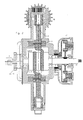
Figure 2 shows a section of a two-cylinder hybrid rotary engine and the union gears of both shafts. -
Figure 3 shows a scheme of the pneumatic system and the elements necessary for the operation of the engine with compressed air, arranged in both phases: Expansion and Backward Movement. -
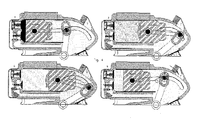
Figure 4 shows a diagram of the location of the mechanisms and the position of the valves during the operation as a heat engine, in four differentiated phases. -
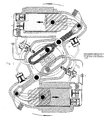
Figure 5 shows a plan view of a two-cylinder hybrid rotary engine with the position of the valves operated with compressed air during the expansion stage. -
Figure 6 shows a plan view of a two-cylinder hybrid rotary engine with the position of the valves operated with compressed air during the piston's backward movement phase. -
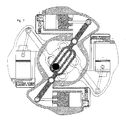
Figure 7 shows a plan view of a hybrid rotary engine with four cylinders, two equipped to operate as hybrids and two only as internal combustion, meaning that two cylinders could work by compressed air and two others with a heat cycle, or all four could work in this latter way. -
Figure 8 shows the way the crankcase's shaft is connected to the differential and the crankshaft by means of two pinions. -
Figure 9 shows a section of the rear chamber of the cylinder with the lateral guides that define the support point for the connecting rod shaft in the slot of the outer arm of the articulated lever. - As can be observed in the attached figures, the preferred embodiment of a hybrid rotary engine, based on the tangential piston engine, is comprised of a crankcase, which contains the cylinders (10) where the pistons are located (11) that are joined by a connecting rod (12) to the outer arm of an articulated lever with two arms (13), which rotates around the pivot (14), and pulls the crankshaft pivot with its internal arm, that slides through the slot (15) also located in the arm, thus transforming the reciprocating motion of the piston to the rotary motion of the crankshaft.
- The crankcase turns to the left and the crankshaft turns to the right, and both are joined to the exit shaft (16) by a gear train (17). A slot (28) has been bored in the outer articulated lever's arm and the crankcase has a lateral guide (9), which means that the union with the connecting rod is not at one fixed point but that the shaft slides through the slot, positioned by the lateral guide, thus varying the length of the lever arm according to the position of the piston.
- The one-way valve (7) is situated in the cylinder's rear chamber and allows the air to enter into this area through a filter (18), where there is also the depressurization valve (2); the exhaust nozzle (8) is located inside the cylinder at the end of the combustion chamber. The compressed air inlet valve (4) is in the cylinder head (19), and the admission valve (6) is connected by means of a duct (20) with the cylinder's rear chamber. For engines with controlled ignition, the fuel injector (21) and a valve (22) that regulates the air flow are in this duct, at the inlet to the admission valve. The distribution valve (5) is coupled to the motor's crankcase, and this controls the inlet of compressed air to the cylinder, which is operated by a cam moved by the crankshaft, as well as the fuel shutoff valve (3). The rotary union (1) is coupled to the crankcase's forward shaft, at which point the pressurized gas enters, as well as the fuel feed. The clutch (24) that is in the rear shaft, joins the crankcase to the wheel crown (23) of the differential (17), which is connected by means of pinions (25 and 26) to the crankshaft (16). The whole unit rotates and is supported by the front bearing (27) and by the differential's housing.
- A more extensive description than this one is not considered necessary so that any relevant expert can understand the scope of the invention and the advantages it implies.
- The terms under which this description has been written will have to be taken in a broad unlimited sense.
Claims (4)
- Hybrid rotary engine; that consists of a two-stroke rotary engine with tangential pistons, which it is composed of a block that contains two or more cylinders arranged tangentially to the axis of rotation where the pistons move and that transmit the movement to the crankshaft by means of a lever articulated in two arms; an outer one joined to the piston by means of a connecting rod and another that has a slot where the crankshaft pivot slides. The block with all the components turns in one direction and the crankshaft in another, and both are joined to a common shaft by means of gears. Characterized because it is fitted with a pneumatic mechanism that allows it to work with compressed air. The air pressure circuit is controlled by a shutoff valve and a regulator operated by the accelerator that controls the power during operation with compressed air, which passes into the engine crankcase through a rotary joint via the forward rotary shaft, acting on a pressure relief valve that opens the cylinder's rear chamber, a valve that cuts the fuel to the motor, opens the air valve at the entrance to the expansion chamber and provides pressure to the distribution valve. The latter is controlled by a cam worked by the crankshaft and it has two functions, to open and close the passage of air to the expansion chamber at the right moment, and allow the expulsion of the remaining air, thus avoiding any resistance during the backward movement of the piston. The inlet valve for the thermal cycle operates by pressure differential (and is slightly under load from a spring in the closing direction) and its operation is cancelled when the depressurization valve in the cylinder's rear chamber opens. Operation with compressed air can revert to conventional operation with a lack of air flow or due to closure of the shutoff valve.
- Hybrid rotary engine; according to claim 1, characterized because a slot has been incorporated in the outer arm of the articulated lever that modifies the union of the connecting rod with the lever. The slot has an inclination that, in conjunction with a lateral guide, defines the support point of the connecting rod shaft, in such a way that the arm of the lever increases as it moves away from the cylinder and becomes smaller during compression, thus improving the performance of the engine in both configurations.
- Hybrid rotary engine; according to claim 1, characterized because the link of the block shafts and the crankshaft carries out itself by means of an differential and, as a consequence, both components rotate at different speeds, with the relationship between them being adjusted as required, and the block's connection to its transmission gear is made by means of a mechanism that allows rotation between them only in one direction, which means that starting only acts on the crankshaft, thereby appreciably reducing the effort needed, and valve opening for operation with air is also reduced in the same way. This mechanism makes it easy to service and tune the engine.
- Hybrid rotary engine; according to claims 1, 2 and 3, characterized because the control valves for operation with compressed air, and the inlet valve, are worked electro-mechanically.
Applications Claiming Priority (2)
| Application Number | Priority Date | Filing Date | Title |
|---|---|---|---|
| ES200600752A ES2302608B1 (en) | 2006-03-23 | 2006-03-23 | ROTARY MOTOR HYBRID. |
| PCT/ES2007/070060 WO2007107617A1 (en) | 2006-03-23 | 2007-03-20 | Hybrid rotary engine |
Publications (1)
| Publication Number | Publication Date |
|---|---|
| EP2009232A1 true EP2009232A1 (en) | 2008-12-31 |
Family
ID=38522069
Family Applications (1)
| Application Number | Title | Priority Date | Filing Date |
|---|---|---|---|
| EP07730500A Withdrawn EP2009232A1 (en) | 2006-03-23 | 2007-03-20 | Hybrid rotary engine |
Country Status (3)
| Country | Link |
|---|---|
| EP (1) | EP2009232A1 (en) |
| ES (1) | ES2302608B1 (en) |
| WO (1) | WO2007107617A1 (en) |
Cited By (1)
| Publication number | Priority date | Publication date | Assignee | Title |
|---|---|---|---|---|
| CN104769220A (en) * | 2012-07-16 | 2015-07-08 | 弗朗西斯科·哈维尔·路易斯·马丁内兹 | A rotary piston heat engine |
Family Cites Families (6)
| Publication number | Priority date | Publication date | Assignee | Title |
|---|---|---|---|---|
| GB191204068A (en) * | 1912-02-17 | 1913-02-13 | Arthur George Lloyd Neighbour | An Improved Fluid Motor. |
| US1572541A (en) * | 1924-05-01 | 1926-02-09 | James S Lawrence | Rotary engine |
| JPS5546075A (en) * | 1978-09-29 | 1980-03-31 | Shimooka Tadao | Torque doubling device using lever |
| US5832885A (en) * | 1994-09-21 | 1998-11-10 | Moyer; David F. | Hybrid internal combustion engine |
| US7050900B2 (en) * | 2004-02-17 | 2006-05-23 | Miller Kenneth C | Dynamically reconfigurable internal combustion engine |
| CA2564683A1 (en) * | 2004-04-29 | 2005-11-10 | Francisco Javier Ruiz Martinez | Balanced rotary engine |
-
2006
- 2006-03-23 ES ES200600752A patent/ES2302608B1/en not_active Expired - Fee Related
-
2007
- 2007-03-20 EP EP07730500A patent/EP2009232A1/en not_active Withdrawn
- 2007-03-20 WO PCT/ES2007/070060 patent/WO2007107617A1/en not_active Ceased
Non-Patent Citations (1)
| Title |
|---|
| See references of WO2007107617A1 * |
Cited By (1)
| Publication number | Priority date | Publication date | Assignee | Title |
|---|---|---|---|---|
| CN104769220A (en) * | 2012-07-16 | 2015-07-08 | 弗朗西斯科·哈维尔·路易斯·马丁内兹 | A rotary piston heat engine |
Also Published As
| Publication number | Publication date |
|---|---|
| ES2302608A1 (en) | 2008-07-16 |
| ES2302608B1 (en) | 2009-05-20 |
| WO2007107617A1 (en) | 2007-09-27 |
Similar Documents
| Publication | Publication Date | Title |
|---|---|---|
| EP1042598B1 (en) | Engine braking with positive power valve actuation | |
| US4930315A (en) | Turbo-charger engine system | |
| US4461151A (en) | Internal combustion engine | |
| US20090038584A1 (en) | Internal combustion engine | |
| JP5570773B2 (en) | Partial exhaust flow extraction device and internal combustion engine comprising said device | |
| US4502282A (en) | Turbo-charged compression ignition engine operable at small compression ratio | |
| US7409943B2 (en) | Engine braking method for a supercharged internal combustion engine | |
| WO2001020136A1 (en) | Internal combustion engine | |
| KR101595610B1 (en) | Control arrangement for a gas exchange valve in a piston engine | |
| US5558049A (en) | Variable orbital aperture valve system for fluid processing machines | |
| US8448616B2 (en) | Internal combustion engine cycle | |
| US7823559B2 (en) | Internal combustion engine | |
| CN108603448B (en) | Internal combustion engine and method including controlling the engine to provide braking torque | |
| EP0330638A1 (en) | Valve gear for internal combustion engine | |
| US20210362721A1 (en) | A method for controlling a powertrain system during upshifting | |
| CN105829667B (en) | Internal combustion engine and its cover assembly | |
| US6394050B1 (en) | Actuator piston assembly for a rocker arm system | |
| EP2009232A1 (en) | Hybrid rotary engine | |
| WO2007058524A1 (en) | Internal combustion engine, vehicle and a method of operating them | |
| US5351660A (en) | Electrically activated dynamic valve for spark ignition engines | |
| EP2443324B1 (en) | A control arrangement for gas exchange in a piston engine | |
| US20210317794A1 (en) | Method for Operating an Internal Combustion Engine, in Particular of a Motor Vehicle, in an Engine Braking Operation | |
| JPS594533B2 (en) | Engine with turbocharger | |
| NO179224B (en) | Four-stroke internal combustion engine with overcharge and method for operating it | |
| WO2001053677A1 (en) | Method and apparatus for energy transfer in a four-cycle combustion engine |
Legal Events
| Date | Code | Title | Description |
|---|---|---|---|
| PUAI | Public reference made under article 153(3) epc to a published international application that has entered the european phase |
Free format text: ORIGINAL CODE: 0009012 |
|
| 17P | Request for examination filed |
Effective date: 20081022 |
|
| AK | Designated contracting states |
Kind code of ref document: A1 Designated state(s): AT BE BG CH CY CZ DE DK EE ES FI FR GB GR HU IE IS IT LI LT LU LV MC MT NL PL PT RO SE SI SK TR |
|
| AX | Request for extension of the european patent |
Extension state: AL BA HR MK RS |
|
| STAA | Information on the status of an ep patent application or granted ep patent |
Free format text: STATUS: THE APPLICATION HAS BEEN WITHDRAWN |
|
| 18W | Application withdrawn |
Effective date: 20120425 |