EP2009003A1 - Production method of diaminopyrimidine compounds - Google Patents
Production method of diaminopyrimidine compounds Download PDFInfo
- Publication number
- EP2009003A1 EP2009003A1 EP08252212A EP08252212A EP2009003A1 EP 2009003 A1 EP2009003 A1 EP 2009003A1 EP 08252212 A EP08252212 A EP 08252212A EP 08252212 A EP08252212 A EP 08252212A EP 2009003 A1 EP2009003 A1 EP 2009003A1
- Authority
- EP
- European Patent Office
- Prior art keywords
- substituent
- group optionally
- hydrogen atom
- formula
- alkyl group
- Prior art date
- Legal status (The legal status is an assumption and is not a legal conclusion. Google has not performed a legal analysis and makes no representation as to the accuracy of the status listed.)
- Withdrawn
Links
- 238000004519 manufacturing process Methods 0.000 title claims abstract description 23
- MISVBCMQSJUHMH-UHFFFAOYSA-N pyrimidine-4,6-diamine Chemical class NC1=CC(N)=NC=N1 MISVBCMQSJUHMH-UHFFFAOYSA-N 0.000 title 1
- 150000001875 compounds Chemical class 0.000 claims abstract description 96
- -1 diaminopyrimidine compound Chemical class 0.000 claims abstract description 76
- 125000001424 substituent group Chemical group 0.000 claims description 214
- 125000004435 hydrogen atom Chemical group [H]* 0.000 claims description 81
- 125000003710 aryl alkyl group Chemical group 0.000 claims description 69
- 125000000217 alkyl group Chemical group 0.000 claims description 68
- 125000003118 aryl group Chemical group 0.000 claims description 45
- 125000006239 protecting group Chemical group 0.000 claims description 42
- 125000001797 benzyl group Chemical group [H]C1=C([H])C([H])=C(C([H])=C1[H])C([H])([H])* 0.000 claims description 41
- 150000003839 salts Chemical class 0.000 claims description 30
- QGZKDVFQNNGYKY-UHFFFAOYSA-N Ammonia Chemical compound N QGZKDVFQNNGYKY-UHFFFAOYSA-N 0.000 claims description 12
- 229910021529 ammonia Inorganic materials 0.000 claims description 6
- 125000004043 oxo group Chemical group O=* 0.000 claims description 3
- 150000003212 purines Chemical class 0.000 claims description 2
- 230000000144 pharmacologic effect Effects 0.000 abstract description 6
- WEVYAHXRMPXWCK-UHFFFAOYSA-N Acetonitrile Chemical compound CC#N WEVYAHXRMPXWCK-UHFFFAOYSA-N 0.000 description 75
- IAZDPXIOMUYVGZ-UHFFFAOYSA-N Dimethylsulphoxide Chemical compound CS(C)=O IAZDPXIOMUYVGZ-UHFFFAOYSA-N 0.000 description 60
- ZMANZCXQSJIPKH-UHFFFAOYSA-N Triethylamine Chemical compound CCN(CC)CC ZMANZCXQSJIPKH-UHFFFAOYSA-N 0.000 description 57
- 239000002904 solvent Substances 0.000 description 52
- IAZDPXIOMUYVGZ-WFGJKAKNSA-N Dimethyl sulfoxide Chemical compound [2H]C([2H])([2H])S(=O)C([2H])([2H])[2H] IAZDPXIOMUYVGZ-WFGJKAKNSA-N 0.000 description 40
- 238000006243 chemical reaction Methods 0.000 description 40
- 239000000203 mixture Substances 0.000 description 40
- XLYOFNOQVPJJNP-UHFFFAOYSA-N water Substances O XLYOFNOQVPJJNP-UHFFFAOYSA-N 0.000 description 34
- KFZMGEQAYNKOFK-UHFFFAOYSA-N Isopropanol Chemical compound CC(C)O KFZMGEQAYNKOFK-UHFFFAOYSA-N 0.000 description 31
- 239000000243 solution Substances 0.000 description 31
- 238000000034 method Methods 0.000 description 29
- 239000013078 crystal Substances 0.000 description 27
- VLKZOEOYAKHREP-UHFFFAOYSA-N n-Hexane Chemical compound CCCCCC VLKZOEOYAKHREP-UHFFFAOYSA-N 0.000 description 24
- RTZKZFJDLAIYFH-UHFFFAOYSA-N Diethyl ether Chemical compound CCOCC RTZKZFJDLAIYFH-UHFFFAOYSA-N 0.000 description 21
- 238000005160 1H NMR spectroscopy Methods 0.000 description 20
- 238000001914 filtration Methods 0.000 description 20
- XHXFXVLFKHQFAL-UHFFFAOYSA-N phosphoryl trichloride Chemical compound ClP(Cl)(Cl)=O XHXFXVLFKHQFAL-UHFFFAOYSA-N 0.000 description 20
- 239000002244 precipitate Substances 0.000 description 19
- 238000001644 13C nuclear magnetic resonance spectroscopy Methods 0.000 description 18
- XEKOWRVHYACXOJ-UHFFFAOYSA-N Ethyl acetate Chemical compound CCOC(C)=O XEKOWRVHYACXOJ-UHFFFAOYSA-N 0.000 description 18
- YXFVVABEGXRONW-UHFFFAOYSA-N Toluene Chemical compound CC1=CC=CC=C1 YXFVVABEGXRONW-UHFFFAOYSA-N 0.000 description 18
- 125000004191 (C1-C6) alkoxy group Chemical group 0.000 description 16
- UIIMBOGNXHQVGW-UHFFFAOYSA-M Sodium bicarbonate Chemical compound [Na+].OC([O-])=O UIIMBOGNXHQVGW-UHFFFAOYSA-M 0.000 description 16
- UHOVQNZJYSORNB-UHFFFAOYSA-N Benzene Chemical compound C1=CC=CC=C1 UHOVQNZJYSORNB-UHFFFAOYSA-N 0.000 description 15
- YMWUJEATGCHHMB-UHFFFAOYSA-N Dichloromethane Chemical compound ClCCl YMWUJEATGCHHMB-UHFFFAOYSA-N 0.000 description 15
- 125000005843 halogen group Chemical group 0.000 description 15
- 239000011541 reaction mixture Substances 0.000 description 15
- 125000000449 nitro group Chemical group [O-][N+](*)=O 0.000 description 14
- 239000002585 base Substances 0.000 description 13
- 125000004169 (C1-C6) alkyl group Chemical group 0.000 description 12
- VEXZGXHMUGYJMC-UHFFFAOYSA-N Hydrochloric acid Chemical compound Cl VEXZGXHMUGYJMC-UHFFFAOYSA-N 0.000 description 12
- OKKJLVBELUTLKV-UHFFFAOYSA-N Methanol Chemical compound OC OKKJLVBELUTLKV-UHFFFAOYSA-N 0.000 description 12
- HEDRZPFGACZZDS-UHFFFAOYSA-N Chloroform Chemical compound ClC(Cl)Cl HEDRZPFGACZZDS-UHFFFAOYSA-N 0.000 description 10
- XTHFKEDIFFGKHM-UHFFFAOYSA-N Dimethoxyethane Chemical compound COCCOC XTHFKEDIFFGKHM-UHFFFAOYSA-N 0.000 description 10
- OFBQJSOFQDEBGM-UHFFFAOYSA-N Pentane Chemical compound CCCCC OFBQJSOFQDEBGM-UHFFFAOYSA-N 0.000 description 10
- WYURNTSHIVDZCO-UHFFFAOYSA-N Tetrahydrofuran Chemical compound C1CCOC1 WYURNTSHIVDZCO-UHFFFAOYSA-N 0.000 description 10
- 239000000543 intermediate Substances 0.000 description 10
- VZGDMQKNWNREIO-UHFFFAOYSA-N tetrachloromethane Chemical compound ClC(Cl)(Cl)Cl VZGDMQKNWNREIO-UHFFFAOYSA-N 0.000 description 10
- LFQSCWFLJHTTHZ-UHFFFAOYSA-N Ethanol Chemical compound CCO LFQSCWFLJHTTHZ-UHFFFAOYSA-N 0.000 description 9
- ZMXDDKWLCZADIW-UHFFFAOYSA-N N,N-Dimethylformamide Chemical compound CN(C)C=O ZMXDDKWLCZADIW-UHFFFAOYSA-N 0.000 description 9
- HEMHJVSKTPXQMS-UHFFFAOYSA-M Sodium hydroxide Chemical compound [OH-].[Na+] HEMHJVSKTPXQMS-UHFFFAOYSA-M 0.000 description 9
- 239000000460 chlorine Substances 0.000 description 9
- 125000004454 (C1-C6) alkoxycarbonyl group Chemical group 0.000 description 8
- 125000005098 aryl alkoxy carbonyl group Chemical group 0.000 description 8
- 239000003795 chemical substances by application Substances 0.000 description 8
- 229910000030 sodium bicarbonate Inorganic materials 0.000 description 8
- 235000017557 sodium bicarbonate Nutrition 0.000 description 8
- YMBCJWGVCUEGHA-UHFFFAOYSA-M tetraethylammonium chloride Chemical compound [Cl-].CC[N+](CC)(CC)CC YMBCJWGVCUEGHA-UHFFFAOYSA-M 0.000 description 8
- 125000003277 amino group Chemical group 0.000 description 7
- 125000001584 benzyloxycarbonyl group Chemical group C(=O)(OCC1=CC=CC=C1)* 0.000 description 7
- 150000002825 nitriles Chemical class 0.000 description 7
- UYWQUFXKFGHYNT-UHFFFAOYSA-N phenylmethyl ester of formic acid Natural products O=COCC1=CC=CC=C1 UYWQUFXKFGHYNT-UHFFFAOYSA-N 0.000 description 7
- 125000004916 (C1-C6) alkylcarbonyl group Chemical group 0.000 description 6
- GQHTUMJGOHRCHB-UHFFFAOYSA-N 2,3,4,6,7,8,9,10-octahydropyrimido[1,2-a]azepine Chemical compound C1CCCCN2CCCN=C21 GQHTUMJGOHRCHB-UHFFFAOYSA-N 0.000 description 6
- QTBSBXVTEAMEQO-UHFFFAOYSA-N Acetic acid Chemical compound CC(O)=O QTBSBXVTEAMEQO-UHFFFAOYSA-N 0.000 description 6
- WMFOQBRAJBCJND-UHFFFAOYSA-M Lithium hydroxide Chemical compound [Li+].[OH-] WMFOQBRAJBCJND-UHFFFAOYSA-M 0.000 description 6
- BZLVMXJERCGZMT-UHFFFAOYSA-N Methyl tert-butyl ether Chemical compound COC(C)(C)C BZLVMXJERCGZMT-UHFFFAOYSA-N 0.000 description 6
- JGFZNNIVVJXRND-UHFFFAOYSA-N N,N-Diisopropylethylamine (DIPEA) Chemical compound CCN(C(C)C)C(C)C JGFZNNIVVJXRND-UHFFFAOYSA-N 0.000 description 6
- KWYUFKZDYYNOTN-UHFFFAOYSA-M Potassium hydroxide Chemical compound [OH-].[K+] KWYUFKZDYYNOTN-UHFFFAOYSA-M 0.000 description 6
- JUJWROOIHBZHMG-UHFFFAOYSA-N Pyridine Chemical compound C1=CC=NC=C1 JUJWROOIHBZHMG-UHFFFAOYSA-N 0.000 description 6
- 125000002777 acetyl group Chemical group [H]C([H])([H])C(*)=O 0.000 description 6
- 239000005456 alcohol based solvent Substances 0.000 description 6
- 125000005099 aryl alkyl carbonyl group Chemical group 0.000 description 6
- 125000005129 aryl carbonyl group Chemical group 0.000 description 6
- 238000005187 foaming Methods 0.000 description 6
- 229920006395 saturated elastomer Polymers 0.000 description 6
- WSLDOOZREJYCGB-UHFFFAOYSA-N 1,2-Dichloroethane Chemical compound ClCCCl WSLDOOZREJYCGB-UHFFFAOYSA-N 0.000 description 5
- RYHBNJHYFVUHQT-UHFFFAOYSA-N 1,4-Dioxane Chemical compound C1COCCO1 RYHBNJHYFVUHQT-UHFFFAOYSA-N 0.000 description 5
- ZAFNJMIOTHYJRJ-UHFFFAOYSA-N Diisopropyl ether Chemical compound CC(C)OC(C)C ZAFNJMIOTHYJRJ-UHFFFAOYSA-N 0.000 description 5
- 150000001338 aliphatic hydrocarbons Chemical class 0.000 description 5
- 238000005576 amination reaction Methods 0.000 description 5
- 239000003849 aromatic solvent Substances 0.000 description 5
- 238000004440 column chromatography Methods 0.000 description 5
- 238000007796 conventional method Methods 0.000 description 5
- 239000004210 ether based solvent Substances 0.000 description 5
- 150000008282 halocarbons Chemical class 0.000 description 5
- 230000026030 halogenation Effects 0.000 description 5
- 238000005658 halogenation reaction Methods 0.000 description 5
- 238000002955 isolation Methods 0.000 description 5
- HWWHBCMNPHBZKB-UHFFFAOYSA-N n-(4-chloro-2-phenylpyrimidin-5-yl)acetamide Chemical compound N1=C(Cl)C(NC(=O)C)=CN=C1C1=CC=CC=C1 HWWHBCMNPHBZKB-UHFFFAOYSA-N 0.000 description 5
- FVSKHRXBFJPNKK-UHFFFAOYSA-N propionitrile Chemical compound CCC#N FVSKHRXBFJPNKK-UHFFFAOYSA-N 0.000 description 5
- 238000000746 purification Methods 0.000 description 5
- 230000035484 reaction time Effects 0.000 description 5
- 238000001953 recrystallisation Methods 0.000 description 5
- 238000005694 sulfonylation reaction Methods 0.000 description 5
- 150000003512 tertiary amines Chemical class 0.000 description 5
- YLQBMQCUIZJEEH-UHFFFAOYSA-N tetrahydrofuran Natural products C=1C=COC=1 YLQBMQCUIZJEEH-UHFFFAOYSA-N 0.000 description 5
- 0 *c(nc(*)nc1)c1N(*)* Chemical compound *c(nc(*)nc1)c1N(*)* 0.000 description 4
- MEKOFIRRDATTAG-UHFFFAOYSA-N 2,2,5,8-tetramethyl-3,4-dihydrochromen-6-ol Chemical compound C1CC(C)(C)OC2=C1C(C)=C(O)C=C2C MEKOFIRRDATTAG-UHFFFAOYSA-N 0.000 description 4
- YYROPELSRYBVMQ-UHFFFAOYSA-N 4-toluenesulfonyl chloride Chemical compound CC1=CC=C(S(Cl)(=O)=O)C=C1 YYROPELSRYBVMQ-UHFFFAOYSA-N 0.000 description 4
- CDBYLPFSWZWCQE-UHFFFAOYSA-L Sodium Carbonate Chemical compound [Na+].[Na+].[O-]C([O-])=O CDBYLPFSWZWCQE-UHFFFAOYSA-L 0.000 description 4
- WQDUMFSSJAZKTM-UHFFFAOYSA-N Sodium methoxide Chemical compound [Na+].[O-]C WQDUMFSSJAZKTM-UHFFFAOYSA-N 0.000 description 4
- QAOWNCQODCNURD-UHFFFAOYSA-N Sulfuric acid Chemical compound OS(O)(=O)=O QAOWNCQODCNURD-UHFFFAOYSA-N 0.000 description 4
- DTQVDTLACAAQTR-UHFFFAOYSA-N Trifluoroacetic acid Chemical compound OC(=O)C(F)(F)F DTQVDTLACAAQTR-UHFFFAOYSA-N 0.000 description 4
- 239000002253 acid Substances 0.000 description 4
- 230000001430 anti-depressive effect Effects 0.000 description 4
- 230000003579 anti-obesity Effects 0.000 description 4
- 239000000935 antidepressant agent Substances 0.000 description 4
- 229940005513 antidepressants Drugs 0.000 description 4
- WGQKYBSKWIADBV-UHFFFAOYSA-N benzylamine Chemical compound NCC1=CC=CC=C1 WGQKYBSKWIADBV-UHFFFAOYSA-N 0.000 description 4
- 125000004432 carbon atom Chemical group C* 0.000 description 4
- 238000005660 chlorination reaction Methods 0.000 description 4
- 229940079593 drug Drugs 0.000 description 4
- 239000003814 drug Substances 0.000 description 4
- 230000002140 halogenating effect Effects 0.000 description 4
- 125000002887 hydroxy group Chemical group [H]O* 0.000 description 4
- 125000002496 methyl group Chemical group [H]C([H])([H])* 0.000 description 4
- YQDULTLWAGNSNX-UHFFFAOYSA-N n-(4-chloro-2-phenylpyrimidin-5-yl)-2-phenylacetamide Chemical compound ClC1=NC(C=2C=CC=CC=2)=NC=C1NC(=O)CC1=CC=CC=C1 YQDULTLWAGNSNX-UHFFFAOYSA-N 0.000 description 4
- 125000001997 phenyl group Chemical group [H]C1=C([H])C([H])=C(*)C([H])=C1[H] 0.000 description 4
- BWHMMNNQKKPAPP-UHFFFAOYSA-L potassium carbonate Chemical compound [K+].[K+].[O-]C([O-])=O BWHMMNNQKKPAPP-UHFFFAOYSA-L 0.000 description 4
- 230000006103 sulfonylation Effects 0.000 description 4
- OLMBOHVAVKHHTK-UHFFFAOYSA-N (1-carboxy-2,2-dimethylpropyl)azanium;chloride Chemical compound Cl.CC(C)(C)C(N)C(O)=O OLMBOHVAVKHHTK-UHFFFAOYSA-N 0.000 description 3
- SGUVLZREKBPKCE-UHFFFAOYSA-N 1,5-diazabicyclo[4.3.0]-non-5-ene Chemical compound C1CCN=C2CCCN21 SGUVLZREKBPKCE-UHFFFAOYSA-N 0.000 description 3
- 239000012359 Methanesulfonyl chloride Substances 0.000 description 3
- FXHOOIRPVKKKFG-UHFFFAOYSA-N N,N-Dimethylacetamide Chemical compound CN(C)C(C)=O FXHOOIRPVKKKFG-UHFFFAOYSA-N 0.000 description 3
- SECXISVLQFMRJM-UHFFFAOYSA-N N-Methylpyrrolidone Chemical compound CN1CCCC1=O SECXISVLQFMRJM-UHFFFAOYSA-N 0.000 description 3
- MUBZPKHOEPUJKR-UHFFFAOYSA-N Oxalic acid Chemical compound OC(=O)C(O)=O MUBZPKHOEPUJKR-UHFFFAOYSA-N 0.000 description 3
- XBDQKXXYIPTUBI-UHFFFAOYSA-M Propionate Chemical compound CCC([O-])=O XBDQKXXYIPTUBI-UHFFFAOYSA-M 0.000 description 3
- KXKVLQRXCPHEJC-UHFFFAOYSA-N acetic acid trimethyl ester Natural products COC(C)=O KXKVLQRXCPHEJC-UHFFFAOYSA-N 0.000 description 3
- 230000002378 acidificating effect Effects 0.000 description 3
- 150000001408 amides Chemical class 0.000 description 3
- 150000004982 aromatic amines Chemical class 0.000 description 3
- 125000005279 aryl sulfonyloxy group Chemical group 0.000 description 3
- QLGFUCXBODJZIN-UHFFFAOYSA-N benzyl n-(4-chloro-2-phenylpyrimidin-5-yl)carbamate Chemical compound ClC1=NC(C=2C=CC=CC=2)=NC=C1NC(=O)OCC1=CC=CC=C1 QLGFUCXBODJZIN-UHFFFAOYSA-N 0.000 description 3
- KRKNYBCHXYNGOX-UHFFFAOYSA-N citric acid Chemical compound OC(=O)CC(O)(C(O)=O)CC(O)=O KRKNYBCHXYNGOX-UHFFFAOYSA-N 0.000 description 3
- 239000012141 concentrate Substances 0.000 description 3
- 238000001816 cooling Methods 0.000 description 3
- 238000010511 deprotection reaction Methods 0.000 description 3
- 239000003759 ester based solvent Substances 0.000 description 3
- QARBMVPHQWIHKH-UHFFFAOYSA-N methanesulfonyl chloride Chemical compound CS(Cl)(=O)=O QARBMVPHQWIHKH-UHFFFAOYSA-N 0.000 description 3
- PSHKMPUSSFXUIA-UHFFFAOYSA-N n,n-dimethylpyridin-2-amine Chemical compound CN(C)C1=CC=CC=N1 PSHKMPUSSFXUIA-UHFFFAOYSA-N 0.000 description 3
- 150000007530 organic bases Chemical class 0.000 description 3
- LPNYRYFBWFDTMA-UHFFFAOYSA-N potassium tert-butoxide Chemical compound [K+].CC(C)(C)[O-] LPNYRYFBWFDTMA-UHFFFAOYSA-N 0.000 description 3
- BDERNNFJNOPAEC-UHFFFAOYSA-N propan-1-ol Chemical compound CCCO BDERNNFJNOPAEC-UHFFFAOYSA-N 0.000 description 3
- UMJSCPRVCHMLSP-UHFFFAOYSA-N pyridine Natural products COC1=CC=CN=C1 UMJSCPRVCHMLSP-UHFFFAOYSA-N 0.000 description 3
- 150000003856 quaternary ammonium compounds Chemical class 0.000 description 3
- 238000007363 ring formation reaction Methods 0.000 description 3
- 238000010898 silica gel chromatography Methods 0.000 description 3
- 150000003462 sulfoxides Chemical class 0.000 description 3
- 238000003786 synthesis reaction Methods 0.000 description 3
- 125000001637 1-naphthyl group Chemical group [H]C1=C([H])C([H])=C2C(*)=C([H])C([H])=C([H])C2=C1[H] 0.000 description 2
- 125000004343 1-phenylethyl group Chemical group [H]C1=C([H])C([H])=C(C([H])=C1[H])C([H])(*)C([H])([H])[H] 0.000 description 2
- YQTCQNIPQMJNTI-UHFFFAOYSA-N 2,2-dimethylpropan-1-one Chemical group CC(C)(C)[C]=O YQTCQNIPQMJNTI-UHFFFAOYSA-N 0.000 description 2
- 125000006282 2-chlorobenzyl group Chemical group [H]C1=C([H])C(Cl)=C(C([H])=C1[H])C([H])([H])* 0.000 description 2
- 125000004847 2-fluorobenzyl group Chemical group [H]C1=C([H])C(F)=C(C([H])=C1[H])C([H])([H])* 0.000 description 2
- 125000006290 2-hydroxybenzyl group Chemical group [H]OC1=C(C([H])=C([H])C([H])=C1[H])C([H])([H])* 0.000 description 2
- 125000001622 2-naphthyl group Chemical group [H]C1=C([H])C([H])=C2C([H])=C(*)C([H])=C([H])C2=C1[H] 0.000 description 2
- 125000000094 2-phenylethyl group Chemical group [H]C1=C([H])C([H])=C(C([H])=C1[H])C([H])([H])C([H])([H])* 0.000 description 2
- 125000003852 3-chlorobenzyl group Chemical group [H]C1=C([H])C(=C([H])C(Cl)=C1[H])C([H])([H])* 0.000 description 2
- 125000006284 3-fluorobenzyl group Chemical group [H]C1=C([H])C(=C([H])C(F)=C1[H])C([H])([H])* 0.000 description 2
- 125000006291 3-hydroxybenzyl group Chemical group [H]OC1=C([H])C([H])=C([H])C(=C1[H])C([H])([H])* 0.000 description 2
- 125000006201 3-phenylpropyl group Chemical group [H]C1=C([H])C([H])=C(C([H])=C1[H])C([H])([H])C([H])([H])C([H])([H])* 0.000 description 2
- 125000006283 4-chlorobenzyl group Chemical group [H]C1=C([H])C(=C([H])C([H])=C1Cl)C([H])([H])* 0.000 description 2
- 125000004176 4-fluorobenzyl group Chemical group [H]C1=C([H])C(=C([H])C([H])=C1F)C([H])([H])* 0.000 description 2
- 125000003143 4-hydroxybenzyl group Chemical group [H]C([*])([H])C1=C([H])C([H])=C(O[H])C([H])=C1[H] 0.000 description 2
- 125000000041 C6-C10 aryl group Chemical group 0.000 description 2
- VZCYOOQTPOCHFL-OWOJBTEDSA-N Fumaric acid Chemical compound OC(=O)\C=C\C(O)=O VZCYOOQTPOCHFL-OWOJBTEDSA-N 0.000 description 2
- AFVFQIVMOAPDHO-UHFFFAOYSA-N Methanesulfonic acid Chemical compound CS(O)(=O)=O AFVFQIVMOAPDHO-UHFFFAOYSA-N 0.000 description 2
- GRYLNZFGIOXLOG-UHFFFAOYSA-N Nitric acid Chemical compound O[N+]([O-])=O GRYLNZFGIOXLOG-UHFFFAOYSA-N 0.000 description 2
- KDLHZDBZIXYQEI-UHFFFAOYSA-N Palladium Chemical compound [Pd] KDLHZDBZIXYQEI-UHFFFAOYSA-N 0.000 description 2
- NBIIXXVUZAFLBC-UHFFFAOYSA-N Phosphoric acid Chemical compound OP(O)(O)=O NBIIXXVUZAFLBC-UHFFFAOYSA-N 0.000 description 2
- KEAYESYHFKHZAL-UHFFFAOYSA-N Sodium Chemical compound [Na] KEAYESYHFKHZAL-UHFFFAOYSA-N 0.000 description 2
- PXIPVTKHYLBLMZ-UHFFFAOYSA-N Sodium azide Chemical compound [Na+].[N-]=[N+]=[N-] PXIPVTKHYLBLMZ-UHFFFAOYSA-N 0.000 description 2
- 229910000102 alkali metal hydride Inorganic materials 0.000 description 2
- 150000008046 alkali metal hydrides Chemical class 0.000 description 2
- 150000008044 alkali metal hydroxides Chemical class 0.000 description 2
- 150000001447 alkali salts Chemical class 0.000 description 2
- 150000004703 alkoxides Chemical class 0.000 description 2
- 125000005278 alkyl sulfonyloxy group Chemical group 0.000 description 2
- KQQCTWHSWXCZHB-UHFFFAOYSA-N azane;propan-2-ol Chemical compound N.CC(C)O KQQCTWHSWXCZHB-UHFFFAOYSA-N 0.000 description 2
- LZCZIHQBSCVGRD-UHFFFAOYSA-N benzenecarboximidamide;hydron;chloride Chemical compound [Cl-].NC(=[NH2+])C1=CC=CC=C1 LZCZIHQBSCVGRD-UHFFFAOYSA-N 0.000 description 2
- 125000003236 benzoyl group Chemical group [H]C1=C([H])C([H])=C(C([H])=C1[H])C(*)=O 0.000 description 2
- BLBQFMGZPMIIHU-UHFFFAOYSA-N benzyl n-(6-oxo-2-phenyl-1h-pyrimidin-5-yl)carbamate Chemical compound C=1C=CC=CC=1COC(=O)NC(C(N1)=O)=CN=C1C1=CC=CC=C1 BLBQFMGZPMIIHU-UHFFFAOYSA-N 0.000 description 2
- 125000000484 butyl group Chemical group [H]C([*])([H])C([H])([H])C([H])([H])C([H])([H])[H] 0.000 description 2
- 239000003054 catalyst Substances 0.000 description 2
- 239000012320 chlorinating reagent Substances 0.000 description 2
- 125000003754 ethoxycarbonyl group Chemical group C(=O)(OCC)* 0.000 description 2
- 125000001495 ethyl group Chemical group [H]C([H])([H])C([H])([H])* 0.000 description 2
- 239000000706 filtrate Substances 0.000 description 2
- 125000004051 hexyl group Chemical group [H]C([H])([H])C([H])([H])C([H])([H])C([H])([H])C([H])([H])C([H])([H])* 0.000 description 2
- 238000009776 industrial production Methods 0.000 description 2
- 150000007529 inorganic bases Chemical class 0.000 description 2
- 125000000959 isobutyl group Chemical group [H]C([H])([H])C([H])(C([H])([H])[H])C([H])([H])* 0.000 description 2
- 125000001449 isopropyl group Chemical group [H]C([H])([H])C([H])(*)C([H])([H])[H] 0.000 description 2
- 229910052751 metal Inorganic materials 0.000 description 2
- 239000002184 metal Substances 0.000 description 2
- BDAGIHXWWSANSR-UHFFFAOYSA-N methanoic acid Natural products OC=O BDAGIHXWWSANSR-UHFFFAOYSA-N 0.000 description 2
- 125000001160 methoxycarbonyl group Chemical group [H]C([H])([H])OC(*)=O 0.000 description 2
- NQMRYBIKMRVZLB-UHFFFAOYSA-N methylamine hydrochloride Chemical compound [Cl-].[NH3+]C NQMRYBIKMRVZLB-UHFFFAOYSA-N 0.000 description 2
- SYHSJOAHDMUMAJ-UHFFFAOYSA-N n-(4-amino-2-phenylpyrimidin-5-yl)acetamide Chemical compound N1=C(N)C(NC(=O)C)=CN=C1C1=CC=CC=C1 SYHSJOAHDMUMAJ-UHFFFAOYSA-N 0.000 description 2
- URIBUAWMYXTLAU-UHFFFAOYSA-N n-(6-oxo-2-phenyl-1h-pyrimidin-5-yl)acetamide Chemical compound N1C(=O)C(NC(=O)C)=CN=C1C1=CC=CC=C1 URIBUAWMYXTLAU-UHFFFAOYSA-N 0.000 description 2
- 229910017604 nitric acid Inorganic materials 0.000 description 2
- 150000002828 nitro derivatives Chemical class 0.000 description 2
- 150000007524 organic acids Chemical class 0.000 description 2
- 239000012044 organic layer Substances 0.000 description 2
- 125000006503 p-nitrobenzyl group Chemical group [H]C1=C([H])C(=C([H])C([H])=C1[N+]([O-])=O)C([H])([H])* 0.000 description 2
- 125000001147 pentyl group Chemical group C(CCCC)* 0.000 description 2
- UHZYTMXLRWXGPK-UHFFFAOYSA-N phosphorus pentachloride Chemical compound ClP(Cl)(Cl)(Cl)Cl UHZYTMXLRWXGPK-UHFFFAOYSA-N 0.000 description 2
- XNGIFLGASWRNHJ-UHFFFAOYSA-N phthalic acid Chemical compound OC(=O)C1=CC=CC=C1C(O)=O XNGIFLGASWRNHJ-UHFFFAOYSA-N 0.000 description 2
- 239000011736 potassium bicarbonate Substances 0.000 description 2
- 229910000028 potassium bicarbonate Inorganic materials 0.000 description 2
- 235000015497 potassium bicarbonate Nutrition 0.000 description 2
- 229910000027 potassium carbonate Inorganic materials 0.000 description 2
- 235000011181 potassium carbonates Nutrition 0.000 description 2
- NTTOTNSKUYCDAV-UHFFFAOYSA-N potassium hydride Chemical compound [KH] NTTOTNSKUYCDAV-UHFFFAOYSA-N 0.000 description 2
- 229910000105 potassium hydride Inorganic materials 0.000 description 2
- TYJJADVDDVDEDZ-UHFFFAOYSA-M potassium hydrogencarbonate Chemical compound [K+].OC([O-])=O TYJJADVDDVDEDZ-UHFFFAOYSA-M 0.000 description 2
- 229940086066 potassium hydrogencarbonate Drugs 0.000 description 2
- 125000001501 propionyl group Chemical group O=C([*])C([H])([H])C([H])([H])[H] 0.000 description 2
- 125000001436 propyl group Chemical group [H]C([*])([H])C([H])([H])C([H])([H])[H] 0.000 description 2
- 125000002914 sec-butyl group Chemical group [H]C([H])([H])C([H])([H])C([H])(*)C([H])([H])[H] 0.000 description 2
- 229910000029 sodium carbonate Inorganic materials 0.000 description 2
- 235000017550 sodium carbonate Nutrition 0.000 description 2
- 239000012312 sodium hydride Substances 0.000 description 2
- 229910000104 sodium hydride Inorganic materials 0.000 description 2
- HPALAKNZSZLMCH-UHFFFAOYSA-M sodium;chloride;hydrate Chemical class O.[Na+].[Cl-] HPALAKNZSZLMCH-UHFFFAOYSA-M 0.000 description 2
- NGKOOBMSZSRMDJ-UHFFFAOYSA-N tert-butyl 2-[[2-phenyl-5-(phenylmethoxycarbonylamino)pyrimidin-4-yl]amino]acetate;hydrochloride Chemical compound Cl.CC(C)(C)OC(=O)CNC1=NC(C=2C=CC=CC=2)=NC=C1NC(=O)OCC1=CC=CC=C1 NGKOOBMSZSRMDJ-UHFFFAOYSA-N 0.000 description 2
- 125000000999 tert-butyl group Chemical group [H]C([H])([H])C(*)(C([H])([H])[H])C([H])([H])[H] 0.000 description 2
- 125000005931 tert-butyloxycarbonyl group Chemical group [H]C([H])([H])C(OC(*)=O)(C([H])([H])[H])C([H])([H])[H] 0.000 description 2
- FYSNRJHAOHDILO-UHFFFAOYSA-N thionyl chloride Chemical compound ClS(Cl)=O FYSNRJHAOHDILO-UHFFFAOYSA-N 0.000 description 2
- JOXIMZWYDAKGHI-UHFFFAOYSA-N toluene-4-sulfonic acid Chemical compound CC1=CC=C(S(O)(=O)=O)C=C1 JOXIMZWYDAKGHI-UHFFFAOYSA-N 0.000 description 2
- VZCYOOQTPOCHFL-UHFFFAOYSA-N trans-butenedioic acid Natural products OC(=O)C=CC(O)=O VZCYOOQTPOCHFL-UHFFFAOYSA-N 0.000 description 2
- GRGCWBWNLSTIEN-UHFFFAOYSA-N trifluoromethanesulfonyl chloride Chemical compound FC(F)(F)S(Cl)(=O)=O GRGCWBWNLSTIEN-UHFFFAOYSA-N 0.000 description 2
- 125000000008 (C1-C10) alkyl group Chemical group 0.000 description 1
- 125000006700 (C1-C6) alkylthio group Chemical group 0.000 description 1
- BJEPYKJPYRNKOW-REOHCLBHSA-N (S)-malic acid Chemical compound OC(=O)[C@@H](O)CC(O)=O BJEPYKJPYRNKOW-REOHCLBHSA-N 0.000 description 1
- OGFAWKRXZLGJSK-UHFFFAOYSA-N 1-(2,4-dihydroxyphenyl)-2-(4-nitrophenyl)ethanone Chemical compound OC1=CC(O)=CC=C1C(=O)CC1=CC=C([N+]([O-])=O)C=C1 OGFAWKRXZLGJSK-UHFFFAOYSA-N 0.000 description 1
- QMQZIXCNLUPEIN-UHFFFAOYSA-N 1h-imidazole-2-carbonitrile Chemical compound N#CC1=NC=CN1 QMQZIXCNLUPEIN-UHFFFAOYSA-N 0.000 description 1
- UTQNKKSJPHTPBS-UHFFFAOYSA-N 2,2,2-trichloroethanone Chemical group ClC(Cl)(Cl)[C]=O UTQNKKSJPHTPBS-UHFFFAOYSA-N 0.000 description 1
- ZFFBIQMNKOJDJE-UHFFFAOYSA-N 2-bromo-1,2-diphenylethanone Chemical compound C=1C=CC=CC=1C(Br)C(=O)C1=CC=CC=C1 ZFFBIQMNKOJDJE-UHFFFAOYSA-N 0.000 description 1
- 125000004182 2-chlorophenyl group Chemical group [H]C1=C([H])C(Cl)=C(*)C([H])=C1[H] 0.000 description 1
- 125000004198 2-fluorophenyl group Chemical group [H]C1=C([H])C(F)=C(*)C([H])=C1[H] 0.000 description 1
- WHELKLAXMACOGX-UHFFFAOYSA-N 2-phenyl-7,9-dihydropurin-8-one;hydrochloride Chemical compound Cl.N1=C2NC(=O)NC2=CN=C1C1=CC=CC=C1 WHELKLAXMACOGX-UHFFFAOYSA-N 0.000 description 1
- XESPMTYNEOVTRC-UHFFFAOYSA-N 2-phenylpyrimidine-4,5-diamine;hydrochloride Chemical compound Cl.N1=C(N)C(N)=CN=C1C1=CC=CC=C1 XESPMTYNEOVTRC-UHFFFAOYSA-N 0.000 description 1
- BMYNFMYTOJXKLE-UHFFFAOYSA-N 3-azaniumyl-2-hydroxypropanoate Chemical compound NCC(O)C(O)=O BMYNFMYTOJXKLE-UHFFFAOYSA-N 0.000 description 1
- 125000004179 3-chlorophenyl group Chemical group [H]C1=C([H])C(*)=C([H])C(Cl)=C1[H] 0.000 description 1
- 125000004180 3-fluorophenyl group Chemical group [H]C1=C([H])C(*)=C([H])C(F)=C1[H] 0.000 description 1
- OSWFIVFLDKOXQC-UHFFFAOYSA-N 4-(3-methoxyphenyl)aniline Chemical compound COC1=CC=CC(C=2C=CC(N)=CC=2)=C1 OSWFIVFLDKOXQC-UHFFFAOYSA-N 0.000 description 1
- PWGFZVSPADHFPI-UHFFFAOYSA-N 4-chloro-2-phenylpyrimidin-5-amine Chemical compound N1=C(Cl)C(N)=CN=C1C1=CC=CC=C1 PWGFZVSPADHFPI-UHFFFAOYSA-N 0.000 description 1
- 125000001255 4-fluorophenyl group Chemical group [H]C1=C([H])C(*)=C([H])C([H])=C1F 0.000 description 1
- 125000004172 4-methoxyphenyl group Chemical group [H]C1=C([H])C(OC([H])([H])[H])=C([H])C([H])=C1* 0.000 description 1
- 125000000590 4-methylphenyl group Chemical group [H]C1=C([H])C(=C([H])C([H])=C1*)C([H])([H])[H] 0.000 description 1
- XWLBYEBHQNSCKA-UHFFFAOYSA-N 5-amino-1h-pyrimidin-6-one Chemical compound NC1=CN=CN=C1O XWLBYEBHQNSCKA-UHFFFAOYSA-N 0.000 description 1
- LYVFZVXRAUEWEQ-UHFFFAOYSA-N 5-amino-2-phenyl-1h-pyrimidin-6-one Chemical compound N1=C(O)C(N)=CN=C1C1=CC=CC=C1 LYVFZVXRAUEWEQ-UHFFFAOYSA-N 0.000 description 1
- 150000005008 5-aminopyrimidines Chemical class 0.000 description 1
- ZCYVEMRRCGMTRW-UHFFFAOYSA-N 7553-56-2 Chemical group [I] ZCYVEMRRCGMTRW-UHFFFAOYSA-N 0.000 description 1
- NLXLAEXVIDQMFP-UHFFFAOYSA-N Ammonium chloride Substances [NH4+].[Cl-] NLXLAEXVIDQMFP-UHFFFAOYSA-N 0.000 description 1
- VHUUQVKOLVNVRT-UHFFFAOYSA-N Ammonium hydroxide Chemical compound [NH4+].[OH-] VHUUQVKOLVNVRT-UHFFFAOYSA-N 0.000 description 1
- WKBOTKDWSSQWDR-UHFFFAOYSA-N Bromine atom Chemical group [Br] WKBOTKDWSSQWDR-UHFFFAOYSA-N 0.000 description 1
- 125000005947 C1-C6 alkylsulfonyloxy group Chemical group 0.000 description 1
- VEXZGXHMUGYJMC-UHFFFAOYSA-M Chloride anion Chemical compound [Cl-] VEXZGXHMUGYJMC-UHFFFAOYSA-M 0.000 description 1
- FEWJPZIEWOKRBE-JCYAYHJZSA-N Dextrotartaric acid Chemical compound OC(=O)[C@H](O)[C@@H](O)C(O)=O FEWJPZIEWOKRBE-JCYAYHJZSA-N 0.000 description 1
- OIFBSDVPJOWBCH-UHFFFAOYSA-N Diethyl carbonate Chemical compound CCOC(=O)OCC OIFBSDVPJOWBCH-UHFFFAOYSA-N 0.000 description 1
- UFHFLCQGNIYNRP-UHFFFAOYSA-N Hydrogen Chemical compound [H][H] UFHFLCQGNIYNRP-UHFFFAOYSA-N 0.000 description 1
- PHSPJQZRQAJPPF-UHFFFAOYSA-N N-alpha-Methylhistamine Chemical compound CNCCC1=CN=CN1 PHSPJQZRQAJPPF-UHFFFAOYSA-N 0.000 description 1
- OFOBLEOULBTSOW-UHFFFAOYSA-N Propanedioic acid Natural products OC(=O)CC(O)=O OFOBLEOULBTSOW-UHFFFAOYSA-N 0.000 description 1
- 239000007868 Raney catalyst Substances 0.000 description 1
- 229910000564 Raney nickel Inorganic materials 0.000 description 1
- NPXOKRUENSOPAO-UHFFFAOYSA-N Raney nickel Chemical compound [Al].[Ni] NPXOKRUENSOPAO-UHFFFAOYSA-N 0.000 description 1
- KDYFGRWQOYBRFD-UHFFFAOYSA-N Succinic acid Natural products OC(=O)CCC(O)=O KDYFGRWQOYBRFD-UHFFFAOYSA-N 0.000 description 1
- FEWJPZIEWOKRBE-UHFFFAOYSA-N Tartaric acid Natural products [H+].[H+].[O-]C(=O)C(O)C(O)C([O-])=O FEWJPZIEWOKRBE-UHFFFAOYSA-N 0.000 description 1
- 230000010933 acylation Effects 0.000 description 1
- 238000005917 acylation reaction Methods 0.000 description 1
- YKIOKAURTKXMSB-UHFFFAOYSA-N adams's catalyst Chemical compound O=[Pt]=O YKIOKAURTKXMSB-UHFFFAOYSA-N 0.000 description 1
- 229910045601 alloy Inorganic materials 0.000 description 1
- 239000000956 alloy Substances 0.000 description 1
- BJEPYKJPYRNKOW-UHFFFAOYSA-N alpha-hydroxysuccinic acid Natural products OC(=O)C(O)CC(O)=O BJEPYKJPYRNKOW-UHFFFAOYSA-N 0.000 description 1
- 229910000147 aluminium phosphate Inorganic materials 0.000 description 1
- 235000011114 ammonium hydroxide Nutrition 0.000 description 1
- SRSXLGNVWSONIS-UHFFFAOYSA-N benzenesulfonic acid Chemical compound OS(=O)(=O)C1=CC=CC=C1 SRSXLGNVWSONIS-UHFFFAOYSA-N 0.000 description 1
- 229940092714 benzenesulfonic acid Drugs 0.000 description 1
- CSKNSYBAZOQPLR-UHFFFAOYSA-N benzenesulfonyl chloride Chemical compound ClS(=O)(=O)C1=CC=CC=C1 CSKNSYBAZOQPLR-UHFFFAOYSA-N 0.000 description 1
- 244000309464 bull Species 0.000 description 1
- KDYFGRWQOYBRFD-NUQCWPJISA-N butanedioic acid Chemical compound O[14C](=O)CC[14C](O)=O KDYFGRWQOYBRFD-NUQCWPJISA-N 0.000 description 1
- PFKFTWBEEFSNDU-UHFFFAOYSA-N carbonyldiimidazole Chemical compound C1=CN=CN1C(=O)N1C=CN=C1 PFKFTWBEEFSNDU-UHFFFAOYSA-N 0.000 description 1
- 238000009903 catalytic hydrogenation reaction Methods 0.000 description 1
- 239000003153 chemical reaction reagent Substances 0.000 description 1
- 229910052801 chlorine Inorganic materials 0.000 description 1
- 125000001309 chloro group Chemical group Cl* 0.000 description 1
- 125000004218 chloromethyl group Chemical group [H]C([H])(Cl)* 0.000 description 1
- 238000000354 decomposition reaction Methods 0.000 description 1
- 125000002704 decyl group Chemical group [H]C([H])([H])C([H])([H])C([H])([H])C([H])([H])C([H])([H])C([H])([H])C([H])([H])C([H])([H])C([H])([H])C([H])([H])* 0.000 description 1
- 125000001664 diethylamino group Chemical group [H]C([H])([H])C([H])([H])N(*)C([H])([H])C([H])([H])[H] 0.000 description 1
- 125000002147 dimethylamino group Chemical group [H]C([H])([H])N(*)C([H])([H])[H] 0.000 description 1
- MKRTXPORKIRPDG-UHFFFAOYSA-N diphenylphosphoryl azide Chemical compound C=1C=CC=CC=1P(=O)(N=[N+]=[N-])C1=CC=CC=C1 MKRTXPORKIRPDG-UHFFFAOYSA-N 0.000 description 1
- 239000002360 explosive Substances 0.000 description 1
- 229910052731 fluorine Inorganic materials 0.000 description 1
- 125000001153 fluoro group Chemical group F* 0.000 description 1
- 125000004216 fluoromethyl group Chemical group [H]C([H])(F)* 0.000 description 1
- 235000019253 formic acid Nutrition 0.000 description 1
- 239000001530 fumaric acid Substances 0.000 description 1
- 235000011087 fumaric acid Nutrition 0.000 description 1
- 125000003187 heptyl group Chemical group [H]C([*])([H])C([H])([H])C([H])([H])C([H])([H])C([H])([H])C([H])([H])C([H])([H])[H] 0.000 description 1
- 229910052739 hydrogen Inorganic materials 0.000 description 1
- 239000001257 hydrogen Substances 0.000 description 1
- 125000004029 hydroxymethyl group Chemical group [H]OC([H])([H])* 0.000 description 1
- 229910052500 inorganic mineral Inorganic materials 0.000 description 1
- 229910052740 iodine Inorganic materials 0.000 description 1
- VZCYOOQTPOCHFL-UPHRSURJSA-N maleic acid Chemical compound OC(=O)\C=C/C(O)=O VZCYOOQTPOCHFL-UPHRSURJSA-N 0.000 description 1
- 239000011976 maleic acid Substances 0.000 description 1
- 239000001630 malic acid Substances 0.000 description 1
- 235000011090 malic acid Nutrition 0.000 description 1
- 229940098779 methanesulfonic acid Drugs 0.000 description 1
- 125000005948 methanesulfonyloxy group Chemical group 0.000 description 1
- 125000000956 methoxy group Chemical group [H]C([H])([H])O* 0.000 description 1
- 125000004184 methoxymethyl group Chemical group [H]C([H])([H])OC([H])([H])* 0.000 description 1
- DZYBBBYFLOPVOL-UHFFFAOYSA-N methyl 2-(phenylmethoxycarbonylamino)acetate Chemical compound COC(=O)CNC(=O)OCC1=CC=CC=C1 DZYBBBYFLOPVOL-UHFFFAOYSA-N 0.000 description 1
- 125000002816 methylsulfanyl group Chemical group [H]C([H])([H])S[*] 0.000 description 1
- 235000010755 mineral Nutrition 0.000 description 1
- 239000011707 mineral Substances 0.000 description 1
- 150000007522 mineralic acids Chemical class 0.000 description 1
- HXRAMSFGUAOAJR-UHFFFAOYSA-N n,n,n',n'-tetramethyl-1-[(2-methylpropan-2-yl)oxy]methanediamine Chemical compound CN(C)C(N(C)C)OC(C)(C)C HXRAMSFGUAOAJR-UHFFFAOYSA-N 0.000 description 1
- FVAKSKNZVLDEKK-UHFFFAOYSA-N n-(2-methoxy-6-oxo-1h-pyrimidin-5-yl)-2-phenylacetamide Chemical compound O=C1NC(OC)=NC=C1NC(=O)CC1=CC=CC=C1 FVAKSKNZVLDEKK-UHFFFAOYSA-N 0.000 description 1
- RFIVAODONVQUBR-UHFFFAOYSA-N n-(2-methylsulfanyl-6-oxo-1h-pyrimidin-5-yl)-2-phenylacetamide Chemical compound O=C1NC(SC)=NC=C1NC(=O)CC1=CC=CC=C1 RFIVAODONVQUBR-UHFFFAOYSA-N 0.000 description 1
- LCXDHZLXGDMZDW-UHFFFAOYSA-N n-(4-chloro-2-methoxypyrimidin-5-yl)-2-phenylacetamide Chemical compound ClC1=NC(OC)=NC=C1NC(=O)CC1=CC=CC=C1 LCXDHZLXGDMZDW-UHFFFAOYSA-N 0.000 description 1
- LTIYSMSMLZFMDJ-UHFFFAOYSA-N n-(4-chloro-2-methylsulfanylpyrimidin-5-yl)-2-phenylacetamide Chemical compound ClC1=NC(SC)=NC=C1NC(=O)CC1=CC=CC=C1 LTIYSMSMLZFMDJ-UHFFFAOYSA-N 0.000 description 1
- IWNSFXZMDAIVFG-UHFFFAOYSA-N n-(6-oxo-2-phenyl-1h-pyrimidin-5-yl)-2-phenylacetamide Chemical compound C=1N=C(C=2C=CC=CC=2)NC(=O)C=1NC(=O)CC1=CC=CC=C1 IWNSFXZMDAIVFG-UHFFFAOYSA-N 0.000 description 1
- YPKKRDKNOXXPJM-UHFFFAOYSA-N n-[2-(dimethylamino)-6-oxo-1h-pyrimidin-5-yl]-2-phenylacetamide Chemical compound O=C1NC(N(C)C)=NC=C1NC(=O)CC1=CC=CC=C1 YPKKRDKNOXXPJM-UHFFFAOYSA-N 0.000 description 1
- YUCXQZOLHWHKKR-UHFFFAOYSA-N n-[4-(benzylamino)-2-phenylpyrimidin-5-yl]-2-phenylacetamide;hydrochloride Chemical compound Cl.C=1N=C(C=2C=CC=CC=2)N=C(NCC=2C=CC=CC=2)C=1NC(=O)CC1=CC=CC=C1 YUCXQZOLHWHKKR-UHFFFAOYSA-N 0.000 description 1
- ZWOQWAZLPKUAIS-UHFFFAOYSA-N n-[4-(benzylamino)-2-phenylpyrimidin-5-yl]acetamide;hydrochloride Chemical compound Cl.CC(=O)NC1=CN=C(C=2C=CC=CC=2)N=C1NCC1=CC=CC=C1 ZWOQWAZLPKUAIS-UHFFFAOYSA-N 0.000 description 1
- OTOSTHUUDRIAFM-UHFFFAOYSA-N n-[4-(methylamino)-2-phenylpyrimidin-5-yl]-2-phenylacetamide;hydrochloride Chemical compound Cl.CNC1=NC(C=2C=CC=CC=2)=NC=C1NC(=O)CC1=CC=CC=C1 OTOSTHUUDRIAFM-UHFFFAOYSA-N 0.000 description 1
- QRQSYZVJWXUKPS-UHFFFAOYSA-N n-[4-(methylamino)-2-phenylpyrimidin-5-yl]acetamide;hydrochloride Chemical compound Cl.C1=C(NC(C)=O)C(NC)=NC(C=2C=CC=CC=2)=N1 QRQSYZVJWXUKPS-UHFFFAOYSA-N 0.000 description 1
- JKFUWPBRLYAPDL-UHFFFAOYSA-N n-[4-chloro-2-(dimethylamino)pyrimidin-5-yl]-2-phenylacetamide Chemical compound ClC1=NC(N(C)C)=NC=C1NC(=O)CC1=CC=CC=C1 JKFUWPBRLYAPDL-UHFFFAOYSA-N 0.000 description 1
- 125000001400 nonyl group Chemical group [H]C([*])([H])C([H])([H])C([H])([H])C([H])([H])C([H])([H])C([H])([H])C([H])([H])C([H])([H])C([H])([H])[H] 0.000 description 1
- 125000002347 octyl group Chemical group [H]C([*])([H])C([H])([H])C([H])([H])C([H])([H])C([H])([H])C([H])([H])C([H])([H])C([H])([H])[H] 0.000 description 1
- 235000006408 oxalic acid Nutrition 0.000 description 1
- 125000003854 p-chlorophenyl group Chemical group [H]C1=C([H])C(*)=C([H])C([H])=C1Cl 0.000 description 1
- 125000000636 p-nitrophenyl group Chemical group [H]C1=C([H])C(=C([H])C([H])=C1*)[N+]([O-])=O 0.000 description 1
- 230000020477 pH reduction Effects 0.000 description 1
- FAIAAWCVCHQXDN-UHFFFAOYSA-N phosphorus trichloride Chemical compound ClP(Cl)Cl FAIAAWCVCHQXDN-UHFFFAOYSA-N 0.000 description 1
- 230000008707 rearrangement Effects 0.000 description 1
- 238000010992 reflux Methods 0.000 description 1
- QDRKDTQENPPHOJ-UHFFFAOYSA-N sodium ethoxide Chemical compound [Na+].CC[O-] QDRKDTQENPPHOJ-UHFFFAOYSA-N 0.000 description 1
- YBBRCQOCSYXUOC-UHFFFAOYSA-N sulfuryl dichloride Chemical compound ClS(Cl)(=O)=O YBBRCQOCSYXUOC-UHFFFAOYSA-N 0.000 description 1
- 239000011975 tartaric acid Substances 0.000 description 1
- 235000002906 tartaric acid Nutrition 0.000 description 1
- ZNFXTTHKWQCJNF-UHFFFAOYSA-N tert-butyl 2-(8-oxo-2-phenyl-7h-purin-9-yl)acetate Chemical compound N=1C=C2NC(=O)N(CC(=O)OC(C)(C)C)C2=NC=1C1=CC=CC=C1 ZNFXTTHKWQCJNF-UHFFFAOYSA-N 0.000 description 1
- FCQXPXKAJMVMFE-UHFFFAOYSA-N tert-butyl 2-[(5-acetamido-2-phenylpyrimidin-4-yl)amino]acetate;hydrochloride Chemical compound Cl.N1=C(NCC(=O)OC(C)(C)C)C(NC(=O)C)=CN=C1C1=CC=CC=C1 FCQXPXKAJMVMFE-UHFFFAOYSA-N 0.000 description 1
- SBEVGLBGLKUCSE-UHFFFAOYSA-N tert-butyl 2-[[2-phenyl-5-[(2-phenylacetyl)amino]pyrimidin-4-yl]amino]acetate;hydrochloride Chemical compound Cl.CC(C)(C)OC(=O)CNC1=NC(C=2C=CC=CC=2)=NC=C1NC(=O)CC1=CC=CC=C1 SBEVGLBGLKUCSE-UHFFFAOYSA-N 0.000 description 1
- JRMUNVKIHCOMHV-UHFFFAOYSA-M tetrabutylammonium bromide Chemical compound [Br-].CCCC[N+](CCCC)(CCCC)CCCC JRMUNVKIHCOMHV-UHFFFAOYSA-M 0.000 description 1
- NHGXDBSUJJNIRV-UHFFFAOYSA-M tetrabutylammonium chloride Chemical compound [Cl-].CCCC[N+](CCCC)(CCCC)CCCC NHGXDBSUJJNIRV-UHFFFAOYSA-M 0.000 description 1
- HWCKGOZZJDHMNC-UHFFFAOYSA-M tetraethylammonium bromide Chemical compound [Br-].CC[N+](CC)(CC)CC HWCKGOZZJDHMNC-UHFFFAOYSA-M 0.000 description 1
- 125000005951 trifluoromethanesulfonyloxy group Chemical group 0.000 description 1
- 125000002023 trifluoromethyl group Chemical group FC(F)(F)* 0.000 description 1
Classifications
-
- C—CHEMISTRY; METALLURGY
- C07—ORGANIC CHEMISTRY
- C07D—HETEROCYCLIC COMPOUNDS
- C07D239/00—Heterocyclic compounds containing 1,3-diazine or hydrogenated 1,3-diazine rings
- C07D239/02—Heterocyclic compounds containing 1,3-diazine or hydrogenated 1,3-diazine rings not condensed with other rings
- C07D239/24—Heterocyclic compounds containing 1,3-diazine or hydrogenated 1,3-diazine rings not condensed with other rings having three or more double bonds between ring members or between ring members and non-ring members
- C07D239/28—Heterocyclic compounds containing 1,3-diazine or hydrogenated 1,3-diazine rings not condensed with other rings having three or more double bonds between ring members or between ring members and non-ring members with hetero atoms or with carbon atoms having three bonds to hetero atoms with at the most one bond to halogen, directly attached to ring carbon atoms
- C07D239/32—One oxygen, sulfur or nitrogen atom
- C07D239/42—One nitrogen atom
-
- C—CHEMISTRY; METALLURGY
- C07—ORGANIC CHEMISTRY
- C07D—HETEROCYCLIC COMPOUNDS
- C07D239/00—Heterocyclic compounds containing 1,3-diazine or hydrogenated 1,3-diazine rings
- C07D239/02—Heterocyclic compounds containing 1,3-diazine or hydrogenated 1,3-diazine rings not condensed with other rings
- C07D239/24—Heterocyclic compounds containing 1,3-diazine or hydrogenated 1,3-diazine rings not condensed with other rings having three or more double bonds between ring members or between ring members and non-ring members
- C07D239/28—Heterocyclic compounds containing 1,3-diazine or hydrogenated 1,3-diazine rings not condensed with other rings having three or more double bonds between ring members or between ring members and non-ring members with hetero atoms or with carbon atoms having three bonds to hetero atoms with at the most one bond to halogen, directly attached to ring carbon atoms
- C07D239/46—Two or more oxygen, sulphur or nitrogen atoms
- C07D239/48—Two nitrogen atoms
-
- C—CHEMISTRY; METALLURGY
- C07—ORGANIC CHEMISTRY
- C07D—HETEROCYCLIC COMPOUNDS
- C07D473/00—Heterocyclic compounds containing purine ring systems
- C07D473/26—Heterocyclic compounds containing purine ring systems with an oxygen, sulphur, or nitrogen atom directly attached in position 2 or 6, but not in both
- C07D473/28—Oxygen atom
Definitions
- the present invention relates to a novel production method of a diaminopyrimidine compound useful as an intermediate for various compounds having a pharmacological activity, a novel intermediate useful for producing said compound, and a production method of the intermediate.
- a 4,5-diaminopyrimidine compound of the following formula and a derivative thereof, i.e., 8-oxodihydropurine compound, are useful as intermediates for compounds having various pharmacological activities, such as an antiobesity drug, an antidepressant and the like ( WO99/28320 , WO2006/001266 ).
- a method including, after production of a 4,5-diaminopyrimidine compound by the aforementioned method, reacting the obtained compound with carbonyldiimidazole or diethyl carbonate, or reacting a 4-amino-5-carboxypyrimidine compound with an azide compound such as sodium azide, diphenylphosphoryl azide and the like is known ( WO99/28320 ).
- the former method is associated with the problem caused by the use of a nitro compound as mentioned above, and in the latter method, the azide compound is explodable. Similarly, therefore, a more preferable method for industrial production is desired.
- the problem to be solved by the present invention is provision of a method of efficiently producing a diaminopyrimidine compound of the below-mentioned formula (4), as well as a 8-oxodihydropurine compounds of the below-mentioned formulas (5) and (6), by industrially suitable methods, and further, an intermediate useful for the production, and a production method of the intermediate.
- the present inventors have conducted intensive studies in an attempt to solve the aforementioned problems and found that when a 5-amino-4-oxopyrimidine compound of the below-mentioned formula (1), wherein the amino group at the 5-position is protected, is used as a staring compound, introduction (e.g., chlorination etc.) of a leaving group into the 4-position proceeds smoothly, and a 5-aminopyrimidine compound of the below-mentioned formula (2), which is represented by a 5-amino-4-chloropyrimidine compound, can be obtained in a good yield.
- introduction e.g., chlorination etc.
- WO2006/127584 discloses in Examples 40 and 41 that, as shown below, a 4,5-diaminopyrimidine compound is produced via chlorination and amination steps of a 5-amino-4-oxopyrimidine compound having a diethylamino group at the 2-position, wherein the amino group at the 5-position is acylated or alkylated.
- the yield of the chlorination step in the reaction was 68%, when the present inventors tried chlorination of a compound having a dimethylamino group at the 2-position, wherein the amino group at the 5-position is not alkylated (acylation alone), the yield was markedly low (Reference Example 4).
- the yield of the subsequent amination step was 3.8%, and therefore, it is difficult to consider that an effective method is disclosed.
- the present invention relates to the following:
- a method of efficiently producing a 4,5-diaminopyrimidine compound and a derivative thereof, i.e., a 8-oxodihydropurine compound, which are useful as intermediates for a compound having various pharmacological activities, such as an antiobesity drug, an antidepressant and the like, by an industrially suitable method can be provided.
- Examples of the "leaving group" in the present specification include a halogen atom, an optionally substituted alkylsulfonyloxy group, an optionally substituted arylsulfonyloxy group and the like.
- halogen atom in the present specification means a fluorine atom, a chlorine atom, a bromine atom or an iodine atom.
- alkyl group in the present specification means a linear or branched chain alkyl group having 1 to 20, preferably 1 to 10, more preferably 1 to 6, carbon atoms. Specific examples include methyl, ethyl, propyl, isopropyl, butyl, isobutyl, sec-butyl, tert-butyl, pentyl, hexyl, heptyl, octyl, nonyl, decyl and the like.
- Examples of the substituent of the "alkyl group optionally having substituent(s)" in the present specification include a halogen atom, a C 1-6 alkoxy group, a hydroxy group, a nitro group and the like.
- the number and substitutable position of the substituents are not particularly limited.
- Specific examples of the "alkyl group optionally having substituent(s)” include fluoromethyl, trifluoromethyl, chloromethyl, methoxymethyl, hydroxymethyl and the like.
- alkyl group optionally having substituent(s) is preferably a C 1-10 alkyl group, particularly preferably a C 1-6 alkyl group.
- aryl group in the present specification means an aryl group having 6 to 20, preferably 6 to 14, more preferably 6 to 10, carbon atoms. Specific examples include phenyl, 1-naphthyl, 2-naphthyl and the like.
- substituents of the "aryl group optionally having substituent(s)" in the present specification include a halogen atom, a C 1-6 alkyl group, a C 1-6 alkoxy group, a hydroxy group, a nitro group and the like.
- the number and substitutable position of the substituents are not particularly limited.
- aryl group optionally having substituent(s) include phenyl, 1-naphthyl, 2-naphthyl, o-, m- or p-fluorophenyl, o-, m- or p-chlorophenyl, o-, m- or p-methylphenyl, o-, m- or p-methoxyphenyl, o-, m- or p-nitrophenyl, o-, m- or p-hydroxyphenyl and the like.
- aryl group optionally having substituent(s) is preferably a C 6-10 aryl group, particularly preferably phenyl.
- aralkyl group in the present specification means an aralkyl group wherein the aryl moiety is an aryl group having preferably 6 to 14, more preferably 6 to 10, carbon atoms, and the alkyl moiety is a linear or branched chain alkyl group having preferably 1 to 6, more preferably 1 to 3, carbon atoms.
- Specific examples include benzyl, 1-phenylethyl, 2-phenylethyl, 3-phenylpropyl, 1-naphthylmethyl, 2-naphthylmethyl and the like.
- substituents of the "aralkyl group optionally having substituent(s)" in the present specification include a halogen atom, a C 1-6 alkyl group, a C 1-6 alkoxy group, a hydroxy group, a nitro group and the like.
- the number and substitutable position of the substituents are not particularly limited.
- aralkyl group optionally having substituent(s) include benzyl, 1-phenylethyl, 2-phenylethyl, 3-phenylpropyl, 1-naphthylmethyl, 2-naphthylmethyl, o-, m- or p-fluorobenzyl, o-, m- or p-chlorobenzyl, o-, m- or p-methylbenzyl, o-, m- or p-methoxybenzyl, o-, m- or p-nitrobenzyl, o-, m- or p-hydroxybenzyl and the like.
- aralkyl group optionally having substituent(s) is preferably a C 7-13 aralkyl group, particularly preferably benzyl.
- substituents of the "benzyl group optionally having substituent(s)" in the present specification include a halogen atom, a C 1-6 alkyl group, a C 1-6 alkoxy group, a hydroxy group, a nitro group and the like.
- the number and substitutable position of the substituents are not particularly limited.
- benzyl group optionally having substituent(s) include benzyl, o-, m- or p-fluorobenzyl, o-, m- or p-chlorobenzyl, o-, m- or p-methylbenzyl, o-, m- or p-methoxybenzyl, o-, m- or p-nitrobenzyl, o-, m- or p-hydroxybenzyl and the like.
- the "benzyl group optionally having substituent(s)" is preferably a benzyl group.
- alkylsulfonyloxy group optionally having substituent(s) in the present specification means a sulfonyloxy group substituted by the above-mentioned "alkyl group optionally having substituent(s)", and it is preferably a C 1-6 alkylsulfonyloxy group optionally substituted by halogen atom(s). Specific examples include methanesulfonyloxy, trifluoromethanesulfonyloxy and the like.
- arylsulfonyloxy group optionally having substituent(s) in the present specification means a sulfonyloxy group substituted by the above-mentioned "aryl group optionally having substituent(s)", and it is preferably a C 6-10 arylsulfonyloxy group optionally substituted by C 1-6 alkyl group(s). Specific examples include benzenesulfonyloxy, p-toluenesulfonyloxy and the like.
- the "urethane-type protecting group" in the present specification is represented by, for example, P 3 -O-CO- wherein P 3 is an alkyl group optionally having substituent(s) or an aralkyl group optionally having substituent(s).
- the "urethane-type protecting group” is preferably a C 7-13 aralkyloxy-carbonyl group optionally substituted by a C 1-6 alkoxy group, a nitro group and the like (e.g., benzyloxycarbonyl, p-nitrobenzyloxycarbonyl); or a C 1-6 alkoxy-carbonyl group optionally substituted by halogen atom(s) (e.g., methoxycarbonyl, ethoxycarbonyl, tert-butoxycarbonyl, trichloroethoxycarbonyl), more preferably a C 7-13 aralkyloxy-carbonyl group (e.g., benzyloxycarbonyl) or a C 1-6 alkoxy-carbonyl group (e.g., methoxycarbonyl, ethoxycarbonyl, tert-butoxycarbonyl), particularly preferably benzyloxycarbonyl.
- halogen atom(s) e.g
- amide-type protecting group in the present specification is represented by, for example, P 4 -CO- wherein P 4 is an alkyl group optionally having substituent(s), an aryl group optionally having substituent(s) or an aralkyl group optionally having substituent(s).
- the "amide-type protecting group” is preferably a C 1-6 alkyl-carbonyl group optionally substituted by halogen atom(s) (e.g., acetyl, trichloroacetyl, propionyl, pivaloyl); a C 6-10 aryl-carbonyl group optionally substituted by a C 1-6 alkoxy group, a nitro group and the like (e.g., benzoyl, p-methoxybenzoyl); or a C 7-13 aralkyl-carbonyl group optionally substituted by a C 1-6 alkoxy group, a nitro group and the like (e.g., phenylacetyl, phenylpropanoyl), more preferably a C 1-6 alkyl-carbonyl group (e.g., acetyl, propionyl, pivaloyl), a C 6-10 aryl-carbonyl group (e.g., benzoyl)
- Examples of the C 1-6 alkyl group exemplified above as a substituent include methyl, ethyl, propyl, isopropyl, butyl, isobutyl, sec-butyl, tert-butyl, pentyl, hexyl and the like.
- Examples of the C 1-6 alkoxy group exemplified above as a substituent include methoxy, ethoxy, propoxy, isopropoxy, butoxy, isobutoxy, sec-butoxy, tert-butoxy, pentyloxy, hexyloxy and the like.
- P 1 is preferably a hydrogen atom.
- P 2 is preferably a urethane-type protecting group or an amide-type protecting group, more preferably a C 7-13 aralkyloxy-carbonyl group optionally substituted by a C 1-6 alkoxy group, a nitro group and the like; a C 1-6 alkoxy-carbonyl group optionally substituted by halogen atom(s); a C 1-6 alkyl-carbonyl group optionally substituted by a halogen atom and the like; a C 6-10 aryl-carbonyl group optionally substituted by a C 1-6 alkoxy group, a nitro group and the like; or a C 7-13 aralkyl-carbonyl group optionally substituted by a C 1-6 alkoxy group, a nitro group and the like, further more preferably a C 7-13 aralkyloxy-carbonyl group, a C 1-6 alkoxy-carbonyl group, a C 1-6 alkyl-carbonyl group, a C 6-10
- R 1 is preferably a C 6-10 aryl group, a C 1-6 alkoxy group or a C 1-6 alkylthio group, particularly preferably phenyl, methoxy or methylthio.
- R 3 is preferably a hydrogen atom, a C 1-6 alkyl group or a C 7 - 13 aralkyl group, particularly preferably a hydrogen atom.
- R 4 is preferably a hydrogen atom, a C 1-6 alkyl group, a C 7-13 aralkyl group or a -CH 2 COO-C 1-6 alkyl group, particularly preferably a hydrogen atom, methyl, benzyl or tert-butoxycarbonylmethyl.
- P 1a is preferably a hydrogen atom.
- P 2a is preferably an amide-type protecting group, more preferably a C 1-6 alkyl-carbonyl group optionally substituted by halogen atom(s); a C 6-10 aryl-carbonyl group optionally substituted by a C 1-6 alkoxy group, a nitro group and the like; or a C 7-13 aralkyl-carbonyl group optionally substituted by a C 1-6 alkoxy group, a nitro group and the like, further more preferably a C 1-6 alkyl-carbonyl group, a C 6-10 aryl-carbonyl group or a C 7-13 aralkyl-carbonyl group, particularly preferably acetyl or phenylacetyl.
- P 2b is preferably a C 7-13 aralkyloxy-carbonyl group optionally substituted by a C 1-6 alkoxy group, a nitro group and the like; or a C 1-6 alkoxy-carbonyl group optionally substituted by halogen atom(s), more preferably a C 7-13 aralkyloxy-carbonyl group or a C 1-6 alkoxy-carbonyl group, particularly preferably benzyloxycarbonyl.
- R 4b is preferably a C 1-6 alkyl group, a C 7-13 aralkyl group or a -CH 2 COO-C 1-6 alkyl group, particularly preferably methyl, benzyl or tert-butoxycarbonylmethyl.
- P 2c is preferably a C 7-13 aralkyloxy-carbonyl group optionally substituted by a C 1-6 alkoxy group, a nitro group and the like; or a C 1-6 alkoxy-carbonyl group optionally substituted by halogen atom(s), more preferably a C 7-13 aralkyloxy-carbonyl group or a C 1-6 alkoxy-carbonyl group, particularly preferably benzyloxycarbonyl.
- Examples of the salt of compounds (1) to (6) and compound (d) include acid addition salts, for example, salts with an inorganic acid such as hydrochloric acid, hydrobromic acid, nitric acid, sulfuric acid, phosphoric acid and the like; salts with an organic acid such as formic acid, acetic acid, trifluoroacetic acid, phthalic acid, fumaric acid, oxalic acid, tartaric acid, maleic acid, citric acid, succinic acid, malic acid, methanesulfonic acid, benzenesulfonic acid, p-toluenesulfonic acid and the like, and the like.
- an inorganic acid such as hydrochloric acid, hydrobromic acid, nitric acid, sulfuric acid, phosphoric acid and the like
- salts with an organic acid such as formic acid, acetic acid, trifluoroacetic acid, phthalic acid, fumaric acid, oxalic acid, tartaric acid, male
- the leaving group introduction reaction, amination reaction, cyclization reaction, deprotection and the like in the following steps are performed according to a method known per se, for example, Organic Synthesis, Comprehensive Organic Chemistry, Fieser and Fieser Reagent for Organic Synthesis, Protective Groups in Organic Synthesis and the like, or a method analogous thereto. wherein each symbol is as defined above.
- Step 1 Introduction of leaving group (halogenation or sulfonylation)
- compound (2) can be produced by converting the oxo group of compound (1) to a leaving group.
- the reaction is carried out by subjecting compound (1) to halogenation or sulfonylation.
- the halogenation is carried out using a halogenating agent.
- halogenating agent examples include chlorinating agents such as phosphorus trichloride, phosphorus pentachloride, phosphorus oxychloride, thionyl chloride, sulfuryl chloride and the like; brominating agents such as phosphorus tribromide, phosphorus pentabromide and the like, and the like.
- chlorinating agents such as phosphorus trichloride, phosphorus pentachloride, phosphorus oxychloride, thionyl chloride, sulfuryl chloride and the like
- brominating agents such as phosphorus tribromide, phosphorus pentabromide and the like, and the like.
- a chlorinating agent is preferable, and phosphorus oxychloride is more preferable.
- the amount of the halogenating agent to be used is generally 1 equivalent to a solvent amount, preferably 1 to 10 equivalents, more preferably 3 to 5 equivalents, relative to compound (1).
- the halogenation is preferably carried out in the presence of a base and a quaternary ammonium compound.
- the base examples include organic bases such as tertiary amines (e.g., triethylamine, diisopropylethylamine, dimethylaminopyridine, 1,8-diazabicyclo[5.4.0]undec-7-ene, 1,5-diazabicyclo[4.3.0]non-5-ene), aromatic amines (e.g., pyridine) and the like.
- organic bases such as tertiary amines (e.g., triethylamine, diisopropylethylamine, dimethylaminopyridine, 1,8-diazabicyclo[5.4.0]undec-7-ene, 1,5-diazabicyclo[4.3.0]non-5-ene), aromatic amines (e.g., pyridine) and the like.
- a tertiary amine is preferable, and triethylamine is particularly preferable.
- the amount of the base to be used is generally 0.2 to 10 equivalents, preferably 0.2 to 5 equivalents, more preferably 0.5 to 2 equivalents, relative to compound (1).
- a halogenating agent such as phosphorus oxychloride and the like is used as a solvent, a base is not required.
- Examples of the quaternary ammonium compound include tetraethylammonium chloride, tetraethylammonium bromide, tetra n-butylammonium chloride, tetra n-butyl ammonium bromide and the like. Of these, tetraethylammonium chloride is preferable.
- the amount of the quaternary ammonium compound to be used is generally 1 to 10 equivalents, preferably 1 to 5 equivalents, more preferably 1.5 to 3 equivalents, relative to compound (1).
- the sulfonylation is carried out using a sulfonylating agent.
- the sulfonylating agent examples include a C 1-6 alkylsulfonyl chloride optionally substituted by halogen atom(s) (e.g., methanesulfonyl chloride, trifluoromethanesulfonyl chloride), a C 6-10 arylsulfonyl chloride optionally substituted by C 1-6 alkyl group(s) (e.g., benzenephenylsulfonyl chloride, p-toluenesulfonyl chloride) and the like.
- halogen atom(s) e.g., methanesulfonyl chloride, trifluoromethanesulfonyl chloride
- C 6-10 arylsulfonyl chloride optionally substituted by C 1-6 alkyl group(s) (e.g., benzenephenylsulfonyl chloride, p-toluenesulf
- methanesulfonyl chloride trifluoromethanesulfonyl chloride, benzenesulfonyl chloride and p-toluenesulfonyl chloride are preferable, and methanesulfonyl chloride is more preferable.
- the amount of the sulfonylating agent to be used is generally 1 to 10 equivalents, preferably 1 to 5equivalents, more preferably 2 to 5 equivalents, relative to compound (1).
- the sulfonylation reaction is preferably carried out in the presence of a base.
- the base examples include inorganic bases such as alkali metal hydroxides (e.g., lithium hydroxide, sodium hydroxide, potassium hydroxide), alkali metal hydrides (e.g., sodium hydride, potassium hydride), basic salts (e.g., sodium carbonate, potassium carbonate, sodium hydrogen carbonate, potassium hydrogen carbonate) and the like; and organic bases such as tertiary amines (e.g., triethylamine, diisopropylethylamine, dimethylaminopyridine, 1,8-diazabicyclo[5.4.0]undec-7-ene, 1,5-diazabicyclo[4.3.0]non-5-ene), aromatic amines (e.g., pyridine) and the like. Of these, triethylamine is preferable.
- alkali metal hydroxides e.g., lithium hydroxide, sodium hydroxide, potassium hydroxide
- alkali metal hydrides e.g., sodium
- the amount of the base to be used is generally 1 to 10 equivalents, preferably 1 to 5 equivalents, more preferably 2 to 5 equivalents, relative to compound (1).
- the halogenation and sulfonylation are preferably carried out in a solvent.
- the solvent is not particularly limited as long as it does not inhibit the reaction. Specific examples thereof include nitrile solvents such as acetonitrile, propionitrile and the like; ether solvents such as diethyl ether, diisopropyl ether, tert-butyl methyl ether, tetrahydrofuran, 1,4-dioxane, 1,2-dimethoxyethane and the like; halogenated hydrocarbon solvents such as dichloromethane, chloroform, 1,2-dichloroethane, carbon tetrachloride and the like; aromatic solvents such as benzene, toluene and the like; aliphatic hydrocarbon solvents such as hexane, pentane and the like, and the like. Of these, nitrile solvent is preferable, and acetonitrile is particularly preferably. These solvents may be used alone
- the amount of the solvent to be used is generally 2- to 100-fold weight, preferably 5- to 10-fold weight, relative to compound (1).
- the reaction temperature is generally within the range of room temperature to 100°C, preferably within the range of 60 to 80°C.
- the reaction time is generally 0.25 to 15 hr, preferably 0.5 to 2 hr.
- a method of isolating the obtained compound (2) after completion of the reaction is not particularly limited, and a conventional method is employed.
- compound (2) can be isolated by adding water to the reaction mixture and collecting the precipitated crystals by filtration. It is also possible to concentrate or cool the reaction solution, add a poor solvent, and the like prior to the addition of water. After isolation, the crystals may be purified by conventional purification methods as necessary, such as recrystallization, column chromatography and the like.
- compound (3) can be produced by reacting compound (2) with compound (d). Where necessary, the reaction is carried out in the presence of a base.
- the amount of e compound (d) to be used is generally 1 to 10 equivalents, preferably 1 to 5 equivalents, more preferably 1 to 2 equivalents, relative to compound (2).
- the base examples include inorganic bases such as alkali metal hydroxides (e.g., lithium hydroxide, sodium hydroxide, potassium hydroxide), alkali metal hydrides (e.g., sodium hydride, potassium hydride), basic salts (e.g., sodium carbonate, potassium carbonate, sodium hydrogen carbonate, potassium hydrogen carbonate) and the like; and organic bases such as tertiary amines (e.g., triethylamine, diisopropylethylamine, dimethylaminopyridine, 1,8-diazabicyclo[5.4.0]undec-7-ene, 1,5-diazabicyclo[4.3.0]non-5-ene), aromatic amines (e.g., pyridine) and the like. Of these, tertiary amine is preferable, and triethylamine is particularly preferable.
- alkali metal hydroxides e.g., lithium hydroxide, sodium hydroxide, potassium hydroxide
- the amount of the base to be used is generally 1 to 10 equivalents, preferably 1 to 5 equivalents, more preferably 2 to 4 equivalents, relative to compound (2).
- the reaction is preferably carried out in a solvent.
- the solvent is not particularly limited as long as it does not inhibit the reaction. Specific examples thereof include alcohol solvents such as methanol, ethanol, propanol, isopropanol and the like; ether solvents such as diethyl ether, diisopropyl ether, tert-butyl methyl ether, tetrahydrofuran, 1,4-dioxane, 1,2-dimethoxyethane and the like; halogenated hydrocarbon solvents such as dichloromethane, chloroform, 1,2-dichloroethane, carbon tetrachloride and the like; aromatic solvents such as benzene, toluene and the like; aliphatic hydrocarbon solvents such as hexane, pentane and the like; nitrile solvents such as acetonitrile, propionitrile and the like; amide solvents such as N,N-dimethylformamide, N,N
- the amount of the solvent to be used is generally 2- to 100-fold weight, preferably 5- to 10-fold weight, relative to compound (2).
- the reaction temperature is generally within the range of 40 to 120°C, preferably within the range of 50 to 100°C.
- the reaction time is generally 10 to 48 hr, preferably 18 to 36 hr.
- a method of isolating the obtained compound (3) after completion of the reaction is not particularly limited, and a conventional method is employed.
- compound (3) can be isolated by adding water to the reaction mixture and collecting the precipitated crystals by filtration. It is also possible to concentrate or cool the reaction solution, add a poor solvent, and the like prior to the addition of water. After isolation, the crystals may be purified by conventional purification methods as necessary, such as recrystallization, column chromatography and the like.
- Step 2-2 Amination and cyclization
- compound (6) can be produced by reacting compound (2-c) with ammonia.
- Compound (2-c) is compound (2) wherein P 1 is a hydrogen atom, and P 2 is a urethane-type protecting group.
- the amount of the ammonia to be used is generally 1 to 100 equivalents, preferably 5 to 50 equivalents, more preferably 10 to 30 equivalents, relative to compound (2-c).
- the reaction is preferably carried out in a solvent.
- the solvent is not particularly limited as long as it does not inhibit the reaction. Specific examples thereof include alcohol solvents such as methanol, ethanol, propanol, isopropanol and the like; ether solvents such as diethyl ether, diisopropyl ether, tert-butyl methyl ether, tetrahydrofuran, 1,4-dioxane, 1,2-dimethoxyethane and the like; halogenated hydrocarbon solvents such as dichloromethane, chloroform, 1,2-dichloroethane, carbon tetrachloride and the like; aromatic solvents such as benzene, toluene and the like; aliphatic hydrocarbon solvents such as hexane, pentane and the like; nitrile solvents such as acetonitrile, propionitrile and the like; amide solvents such as N,N-dimethylformamide, N,N
- the amount of the solvent to be used is generally 2- to 100-fold weight, preferably 5- to 10-fold weight, relative to compound (2-c).
- the reaction temperature is generally within the range of 50 to 200°C, preferably within the range of 70 to 150°C.
- the reaction time is generally 12 to 72 hr, preferably 12 to 48 hr.
- This reaction may be carried out under pressurized conditions such as in a sealed tube and the like, as necessary.
- a method of isolating the obtained compound (6) after completion of the reaction is not particularly limited, and a conventional method is employed.
- compound (6) can be isolated by adding water to the reaction mixture, removing the precipitate by filtration and concentrating the filtrate. After isolation, the residue may be purified by conventional purification methods as necessary, such as recrystallization, column chromatography and the like.
- compound (4) can be produced by deprotecting the amino group at the 5-position of compound (3-a).
- Compound (3-a) is compound (3) other than a compound wherein P 1 is a hydrogen atom, and P 2 is a urethane-type protecting group.
- the deprotection of the amino group is determined depending on the kind of the protecting group, and is carried out according to a method known by those of ordinary skill in the art.
- the reaction is carried out, for example, under an acidic condition or basic condition, preferably an acidic condition.
- an acidic condition include, conditions using an organic acid such as acetic acid, trifluoroacetic acid and the like; and conditions using a mineral acid such as hydrochloric acid, sulfuric acid, nitric acid and the like. Of these, a condition using hydrochloric acid is preferable.
- the amount of the acid to be used is generally 0.05 to 50 equivalents, preferably 0.1 to 10 equivalents, more preferably 0.1 to 5 equivalents, relative to compound (3-a).
- the reaction can be carried out in a solvent. However, the reaction is preferably carried out without solvent (the above-mentioned acid is used as a solvent).
- amino-protecting group is a urethane-type protecting group (e.g., benzyloxycarbonyl) or a benzyl group optionally having substituent(s)
- the reaction is carried out, for example, by catalytic hydrogenation under hydrogen atmosphere.
- the catalyst examples include palladium/carbon, Raney-nickel alloy, platinum dioxide and the like. Of these, palladium/carbon is preferable.
- the amount of the catalyst to be used is preferably 0.005 to 1 equivalent, more preferably 0.01 to 0.2 equivalent, relative to compound (3-a).
- the reaction is preferably carried out in a solvent.
- the solvent is not particularly limited as long as it does not inhibit the reaction. Specific examples thereof include alcohol solvents such as methanol, ethanol, propanol, isopropanol and the like; ether solvents such as diethyl ether, diisopropyl ether, tert-butyl methyl ether, tetrahydrofuran, 1,4-dioxane, 1,2-dimethoxyethane and the like; halogenated hydrocarbon solvents such as dichloromethane, chloroform, 1,2-dichloroethane, carbon tetrachloride and the like; aromatic solvents such as benzene, toluene and the like; aliphatic hydrocarbon solvents such as hexane, pentane and the like; nitrile solvents such as acetonitrile, propionitrile and the like; amide solvents such as N,N-dimethylformamide, N,N
- the amount of the solvent to be used is generally 2- to 100-fold weight, preferably 5- to 10-fold weight, relative to compound (3-a).
- the reaction temperature is generally within the range of 0 to 150°C, preferably within the range of 20 to 100°C.
- the reaction time is generally 1 to 24 hr, preferably 2 to 5 hr.
- This reaction may be carried out under pressurized conditions, as necessary.
- a method of isolating the obtained compound (4) after completion of the reaction is not particularly limited, and a conventional method is employed.
- compound (4) can be isolated by concentrating the reaction solution, adding a poor solvent (e.g., diethyl ether) thereto, and collecting the precipitated crystals by filtration. After isolation, the crystals may be purified by conventional purification methods as necessary, such as recrystallization, column chromatography and the like.
- a poor solvent e.g., diethyl ether
- compound (5) can be produced by treating compound (3-b) with a base to cyclize compound (3-b).
- Compound (3-b) is compound (3) wherein P 1 is a hydrogen atom, and P 2 is a urethane-type protecting group (provided that R 3 is a hydrogen atom, and R 4 is not a hydrogen atom).
- the base examples include metal alkoxides such as sodium methoxide, sodium ethoxide, potassium tert-butoxide and the like, and the like. Of these metal alkoxides are preferable, and potassium tert-butoxide is particularly preferable.
- the amount of the base to be used is generally 1 to 10 equivalents, preferably 1 to 5 equivalents, more preferably 2 to 4 equivalents, relative to compound (3-b).
- the reaction is preferably carried out in a solvent.
- the solvent is not particularly limited as long as it does not inhibit the reaction. Specific examples thereof include nitrile solvents such as acetonitrile, propionitrile and the like; ether solvents such as diethyl ether, diisopropyl ether, tert-butyl methyl ether, tetrahydrofuran, 1,4-dioxane, 1,2-dimethoxyethane and the like; halogenated hydrocarbon solvents such as dichloromethane, chloroform, 1,2-dichloroethane, carbon tetrachloride and the like; aromatic solvents such as benzene, toluene and the like; aliphatic hydrocarbon solvents such as hexane, pentane and the like, and the like. Of these, nitrile solvents are preferable, and acetonitrile is particularly preferable. These solvents may be used alone or in a mixture of two or more kinds
- the amount of the solvent to be used is generally 2- to 100-fold weight, preferably 5- to 10-fold weight, relative to compound (3-b).
- the reaction temperature is generally within the range of 0 to 100°C, preferably within the range of 25 to 60°C.
- the reaction time is generally 1 to 24 hr, preferably 5 to 15 hr.
- a method of isolating the obtained compound (5) after completion of the reaction is not particularly limited, and a conventional method is employed.
- compound (5) can be isolated by acidifying the reaction mixture and collecting the precipitated crystals by filtration. It is also possible to concentrate or cool the reaction solution, add a poor solvent, and the like prior to the acidification. After isolation, the crystals may be purified by conventional purification methods as necessary, such as recrystallization, column chromatography and the like.
- the thus-obtained compounds (4) to (6) are useful as intermediates for compounds having various pharmacological activities, such as antiobesity drug, antidepressant and the like.
- Compound (2) and compound (3) which are the intermediates for the production of compounds (4) to (6) are novel compounds.
- a method of efficiently producing a 4,5-diaminopyrimidine compound and a derivative thereof, i.e., a 8-oxodihydropurine compound, which are useful as intermediates for a compound having various pharmacological activities, such as an antiobesity drug, an antidepressant and the like, by an industrially suitable method can be provided.
Landscapes
- Chemical & Material Sciences (AREA)
- Organic Chemistry (AREA)
- Pharmaceuticals Containing Other Organic And Inorganic Compounds (AREA)
Abstract
The present invention relates to a novel production method of a diaminopyrimidine compound useful as an intermediate for various compounds having a pharmacological activity, a novel intermediate useful for producing said compound, and a production method of the intermediate.
The present invention provides a novel 5-aminopyrimidine compound represented by the following formula (2) and a novel 4,5-diaminopyrimidine compound represented by the formula (3), as well as production methods of the compounds of the following formulas (2) to (6).


wherein each symbol is as defined in the specification.
Description
- The present invention relates to a novel production method of a diaminopyrimidine compound useful as an intermediate for various compounds having a pharmacological activity, a novel intermediate useful for producing said compound, and a production method of the intermediate.
- A 4,5-diaminopyrimidine compound of the following formula and a derivative thereof, i.e., 8-oxodihydropurine compound, are useful as intermediates for compounds having various pharmacological activities, such as an antiobesity drug, an antidepressant and the like (
WO99/28320 WO2006/001266 ).
- As the production method of a 4,5-diaminopyrimidine compound, a method including reduction of a 4-nitro-5-aminopyrimidine compound is known (
WO99/28320 WO99/28320 - In Tetrahedron Letters, 1966, 37, 4517-4521 and H.W. van Meeteren, RECUEIL, 1968, 87, 1089-1098, it is reported that an attempt was made to treat 5-amino-4-chloro-2-phenylpyrimidine with potassium amide in an ammonia solution to convert same to a 4-amino derivative, but a skeletal rearrangement occurred to afford cyanoimidazole and the attempt failed.
- Also, in H.W. van Meeteren, RECUEIL, 1968, 87, 1089-1098 and L. Maarchanl, Bull. Soc. Chim. Belg., 1960, 69, 177-193, it is reported that an attempt was made to treat 5-amino-4-oxopyrimidine or 5-amino-4-oxo-2-phenylpyrimidine with phosphorus oxychloride or phosphorus pentachloride to convert same to a 4-chloro derivative, but the attempt failed.
- Accordingly, the problem to be solved by the present invention is provision of a method of efficiently producing a diaminopyrimidine compound of the below-mentioned formula (4), as well as a 8-oxodihydropurine compounds of the below-mentioned formulas (5) and (6), by industrially suitable methods, and further, an intermediate useful for the production, and a production method of the intermediate.
- The present inventors have conducted intensive studies in an attempt to solve the aforementioned problems and found that when a 5-amino-4-oxopyrimidine compound of the below-mentioned formula (1), wherein the amino group at the 5-position is protected, is used as a staring compound, introduction (e.g., chlorination etc.) of a leaving group into the 4-position proceeds smoothly, and a 5-aminopyrimidine compound of the below-mentioned formula (2), which is represented by a 5-amino-4-chloropyrimidine compound, can be obtained in a good yield.
- In addition, they have found that the 4-position is efficiently aminated and a 4,5-diaminopyrimidine compound of the below-mentioned formula (3) can be obtained by reacting a 5-aminopyrimidine compound of the formula (2) with ammonia or an amine compound.
- Moreover, they have found that when the 5-aminopyrimidine compounds of the formula (2) wherein the amino group is protected with a urethane-type protecting group (5-aminopyrimidine compound of the below-mentioned formula (2-c)) is reacted with ammonia, a 8-oxodihydropurine compound of the below-mentioned formula (6) can be obtained, and that a 4,5-diaminopyrimidine compound of the formula (3) wherein the amino group is protected with a urethane-type protecting group, R3 is a hydrogen atom and R4 is not a hydrogen atom (4,5-diaminopyrimidine compound of the below-mentioned formula (3-b)) can be led to a 8-oxodihydropurine compound of the below-mentioned formula (5) under particular conditions. Based on these findings, the present inventors have completed the present invention.
-
WO2006/127584 discloses in Examples 40 and 41 that, as shown below, a 4,5-diaminopyrimidine compound is produced via chlorination and amination steps of a 5-amino-4-oxopyrimidine compound having a diethylamino group at the 2-position, wherein the amino group at the 5-position is acylated or alkylated. Although the yield of the chlorination step in the reaction was 68%, when the present inventors tried chlorination of a compound having a dimethylamino group at the 2-position, wherein the amino group at the 5-position is not alkylated (acylation alone), the yield was markedly low (Reference Example 4). The yield of the subsequent amination step was 3.8%, and therefore, it is difficult to consider that an effective method is disclosed.
- Accordingly, the present invention relates to the following:
- [1] A 5-aminopyrimidine compound represented by the formula (2):

- X is a leaving group,
- P1 is a hydrogen atom or a benzyl group optionally having substituent(s),
- P2 is a urethane-type protecting group or an amide-type protecting group when P1 is a hydrogen atom, or a benzyl group optionally having substituent(s) when P1 is a benzyl group optionally having substituent(s), and
- R1 is a hydrogen atom, an alkyl group optionally having substituent(s), an aryl group optionally having substituent(s), an aralkyl group optionally having substituent(s), or a group represented by the formula (a) or the formula (b):
-0-R 2 (a)
-S-R2 (b)
wherein R2 is an alkyl group optionally having substituent(s), an aryl group optionally having substituent(s) or an aralkyl group optionally having substituent(s), - or a salt thereof (hereinafter sometimes to be generically referred to as compound (2)).
- [2] A 4,5-diaminopyrimidine compound represented by the formula (3):
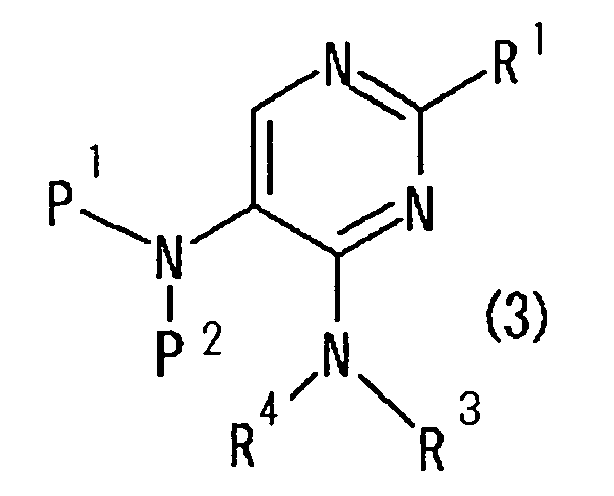
- P1 is a hydrogen atom or a benzyl group optionally having substituent(s),
- P2 is a urethane-type protecting group or an amide-type protecting group when P1 is a hydrogen atom, or a benzyl group optionally having substituent(s) when P1 is a benzyl group optionally having substituent(s),
- R1 is a hydrogen atom, an alkyl group optionally having substituent(s), an aryl group optionally having substituent(s), an aralkyl group optionally having substituent(s), or a group represented by the formula (a) or the formula (b):
-O-R2 (a)
-S-R2 (b)
wherein R2 is an alkyl group optionally having substituent(s), an aryl group optionally having substituent(s) or an aralkyl group optionally having substituent(s), - R3 is a hydrogen atom, an alkyl group optionally having substituent(s) or an aralkyl group optionally having substituent(s), and
- R4 is a hydrogen atom, an alkyl group optionally having substituent(s), an aralkyl group optionally having substituent(s), or a group represented by the formula (c):

- provided that a compound wherein P1 is a hydrogen atom, P2 is a urethane-type protecting group and R3 and R4 are hydrogen atoms is excluded,
- or a salt thereof (hereinafter sometimes to be generically referred to as compound (3)).
- [3] A production method of a 5-aminopyrimidine compound represented by the formula (2):

- X is a leaving group,
- P1 is a hydrogen atom or a benzyl group optionally having substituent(s),
- P2 is a urethane-type protecting group or an amide-type protecting group when P1 is a hydrogen atom, or a benzyl group optionally having substituent(s) when P1 is a benzyl group optionally having substituent(s), and
- R1 is a hydrogen atom, an alkyl group optionally having substituent(s), an aryl group optionally having substituent(s), an aralkyl group optionally having substituent(s), or a group represented by the formula (a) or the formula (b):
-0-R2 (a)
-S-R2 (b)
wherein R2 is an alkyl group optionally having substituent(s), an aryl group optionally having substituent(s) or an aralkyl group optionally having substituent(s), - or a salt thereof, which comprises converting the oxo group of a 5-amino-4-oxopyrimidine compound represented by the formula (1) :

- or a salt thereof (hereinafter sometimes to be generically referred to as compound (1)), to a leaving group.
- [4] A production method of a 4,5-diaminopyrimidine compound represented by the formula (3):

- P1 is a hydrogen atom or a benzyl group optionally having substituent(s),
- P2 is a urethane-type protecting group or an amide-type protecting group when P1 is a hydrogen atom, or a benzyl group optionally having substituent(s) when P1 is a benzyl group optionally having substituent(s),
- R1 is a hydrogen atom, an alkyl group optionally having substituent(s), an aryl group optionally having substituent(s), an aralkyl group optionally having substituent(s), or a group represented by the formula (a) or the formula (b):
-0-R2 (a)
-S-R2 (b)
wherein R2 is an alkyl group optionally having substituent(s), an aryl group optionally having substituent(s) or an aralkyl group optionally having substituent(s), - R3 is a hydrogen atom, an alkyl group optionally having substituent(s) or an aralkyl group optionally having substituent(s), and
- R4 is a hydrogen atom, an alkyl group optionally having substituent(s), an aralkyl group optionally having substituent(s), or a group represented by the formula (c):

- or a salt thereof, which comprises reacting a 5-aminopyrimidine compound represented by the formula (2):

- or a salt thereof, with an amine compound represented by the formula (d):

- or a salt thereof (hereinafter sometimes to be generically referred to as compound (d)),
- provided that when P1 is a hydrogen atom and P2 is a urethane-type protecting group, then both R3 and R4 should not be hydrogen atoms.
- [5] A production method of a 8-oxodihydropurine compound represented by the formula (6):

- R1 is a hydrogen atom, an alkyl group optionally having substituent(s), an aryl group optionally having substituent(s), an aralkyl group optionally having substituent(s), or a group represented by the formula (a) or the formula (b):
-0-R2 (a)
-S-R2 (b)
wherein R2 is an alkyl group optionally having substituent(s), an aryl group optionally having substituent(s) or an aralkyl group optionally having substituent(s), - or a salt thereof (hereinafter sometimes to be generically referred to as compound (6)), which comprises reacting a 5-aminopyrimidine compound represented by the formula (2-c):

- X is a leaving group,
- P1c is a hydrogen atom,
- P2c is a urethane-type protecting group, and
- R1 is as defined above,
- or a salt thereof (hereinafter sometimes to be generically referred to as compound (2-c)) with ammonia.
- R1 is a hydrogen atom, an alkyl group optionally having substituent(s), an aryl group optionally having substituent(s), an aralkyl group optionally having substituent(s), or a group represented by the formula (a) or the formula (b):
- [6] A production method of a 4,5-diaminopyrimidine compound represented by the formula (4):

- R1 is a hydrogen atom, an alkyl group optionally having substituent(s), an aryl group optionally having substituent(s), an aralkyl group optionally having substituent(s), or a group represented by the formula (a) or the formula (b):
-0-R2 (a)
-S-R2 (b)
wherein R2 is an alkyl group optionally having substituent(s), an aryl group optionally having substituent(s) or an aralkyl group optionally having substituent(s), - R3 is a hydrogen atom, an alkyl group optionally having substituent(s) or an aralkyl group optionally having substituent(s), and
- R4 is a hydrogen atom, an alkyl group optionally having substituent(s), an aralkyl group optionally having substituent(s), or a group represented by the formula (c):

- or a salt thereof (hereinafter sometimes to be generically referred to as compound (4)), which comprises removing the amino-protecting group at the 5-position of a 4,5-diaminopyrimidine compound represented by the formula (3-a):

- P1a is a hydrogen atom or a benzyl group optionally having substituent(s),
- P2a is an amide-type protecting group when P1a is a hydrogen atom, or a benzyl group optionally having substituent(s) when P1a is a benzyl group optionally having substituent(s), and other symbols are as defined above,
- or a salt thereof (hereinafter sometimes to be generically referred to as compound (3-a)).
- R1 is a hydrogen atom, an alkyl group optionally having substituent(s), an aryl group optionally having substituent(s), an aralkyl group optionally having substituent(s), or a group represented by the formula (a) or the formula (b):
- [7] A production method of a 8-oxodihydropurine compound represented by the formula (5):

- R1 is a hydrogen atom, an alkyl group optionally having substituent(s), an aryl group optionally having substituent(s), an aralkyl group optionally having substituent(s), or a group represented by the formula (a) or the formula (b):
-0-R2 (a)
-S-R2 (b)
wherein R2 is an alkyl group optionally having substituent(s), an aryl group optionally having substituent(s) or an aralkyl group optionally having substituent(s), and - R4b is an alkyl group optionally having substituent(s), an aralkyl group optionally having substituent(s), or a group represented by the formula (c):

- or a salt thereof (hereinafter sometimes to be generically referred to as compound (5)), which comprises converting a 4,5-diaminopyrimidine compound represented by the formula (3-b) :

- P1b is a hydrogen atom,
- P2b is a urethane-type protecting group,
- R3b is a hydrogen atom, and
- other symbols are as defined above,
- or a salt thereof (hereinafter sometimes to be generically referred to as compound (3-b)) to a purine derivative.
- R1 is a hydrogen atom, an alkyl group optionally having substituent(s), an aryl group optionally having substituent(s), an aralkyl group optionally having substituent(s), or a group represented by the formula (a) or the formula (b):
- According to the present invention, a method of efficiently producing a 4,5-diaminopyrimidine compound and a derivative thereof, i.e., a 8-oxodihydropurine compound, which are useful as intermediates for a compound having various pharmacological activities, such as an antiobesity drug, an antidepressant and the like, by an industrially suitable method can be provided.
- The definitions of the symbols and terms used in the present specification are explained in the following.
- Examples of the "leaving group" in the present specification include a halogen atom, an optionally substituted alkylsulfonyloxy group, an optionally substituted arylsulfonyloxy group and the like.
- The "halogen atom" in the present specification means a fluorine atom, a chlorine atom, a bromine atom or an iodine atom.
- The "alkyl group" in the present specification means a linear or branched chain alkyl group having 1 to 20, preferably 1 to 10, more preferably 1 to 6, carbon atoms. Specific examples include methyl, ethyl, propyl, isopropyl, butyl, isobutyl, sec-butyl, tert-butyl, pentyl, hexyl, heptyl, octyl, nonyl, decyl and the like.
- Examples of the substituent of the "alkyl group optionally having substituent(s)" in the present specification include a halogen atom, a C1-6 alkoxy group, a hydroxy group, a nitro group and the like. The number and substitutable position of the substituents are not particularly limited. Specific examples of the "alkyl group optionally having substituent(s)" include fluoromethyl, trifluoromethyl, chloromethyl, methoxymethyl, hydroxymethyl and the like.
- The "alkyl group optionally having substituent(s)" is preferably a C1-10 alkyl group, particularly preferably a C1-6 alkyl group.
- The "aryl group" in the present specification means an aryl group having 6 to 20, preferably 6 to 14, more preferably 6 to 10, carbon atoms. Specific examples include phenyl, 1-naphthyl, 2-naphthyl and the like.
- Examples of the substituent of the "aryl group optionally having substituent(s)" in the present specification include a halogen atom, a C1-6 alkyl group, a C1-6 alkoxy group, a hydroxy group, a nitro group and the like. The number and substitutable position of the substituents are not particularly limited. Specific examples of the "aryl group optionally having substituent(s)" include phenyl, 1-naphthyl, 2-naphthyl, o-, m- or p-fluorophenyl, o-, m- or p-chlorophenyl, o-, m- or p-methylphenyl, o-, m- or p-methoxyphenyl, o-, m- or p-nitrophenyl, o-, m- or p-hydroxyphenyl and the like.
- The "aryl group optionally having substituent(s)" is preferably a C6-10 aryl group, particularly preferably phenyl.
- The "aralkyl group" in the present specification means an aralkyl group wherein the aryl moiety is an aryl group having preferably 6 to 14, more preferably 6 to 10, carbon atoms, and the alkyl moiety is a linear or branched chain alkyl group having preferably 1 to 6, more preferably 1 to 3, carbon atoms. Specific examples include benzyl, 1-phenylethyl, 2-phenylethyl, 3-phenylpropyl, 1-naphthylmethyl, 2-naphthylmethyl and the like.
- Examples of the substituent of the "aralkyl group optionally having substituent(s)" in the present specification include a halogen atom, a C1-6 alkyl group, a C1-6 alkoxy group, a hydroxy group, a nitro group and the like. The number and substitutable position of the substituents are not particularly limited. Specific examples of the "aralkyl group optionally having substituent(s)" include benzyl, 1-phenylethyl, 2-phenylethyl, 3-phenylpropyl, 1-naphthylmethyl, 2-naphthylmethyl, o-, m- or p-fluorobenzyl, o-, m- or p-chlorobenzyl, o-, m- or p-methylbenzyl, o-, m- or p-methoxybenzyl, o-, m- or p-nitrobenzyl, o-, m- or p-hydroxybenzyl and the like.
- The "aralkyl group optionally having substituent(s)" is preferably a C7-13 aralkyl group, particularly preferably benzyl.
- Examples of the substituent of the "benzyl group optionally having substituent(s)" in the present specification include a halogen atom, a C1-6 alkyl group, a C1-6 alkoxy group, a hydroxy group, a nitro group and the like. The number and substitutable position of the substituents are not particularly limited. Specific examples of the "benzyl group optionally having substituent(s)" include benzyl, o-, m- or p-fluorobenzyl, o-, m- or p-chlorobenzyl, o-, m- or p-methylbenzyl, o-, m- or p-methoxybenzyl, o-, m- or p-nitrobenzyl, o-, m- or p-hydroxybenzyl and the like.
- The "benzyl group optionally having substituent(s)" is preferably a benzyl group.
- The "alkylsulfonyloxy group optionally having substituent(s)" in the present specification means a sulfonyloxy group substituted by the above-mentioned "alkyl group optionally having substituent(s)", and it is preferably a C1-6 alkylsulfonyloxy group optionally substituted by halogen atom(s). Specific examples include methanesulfonyloxy, trifluoromethanesulfonyloxy and the like.
- The "arylsulfonyloxy group optionally having substituent(s)" in the present specification means a sulfonyloxy group substituted by the above-mentioned "aryl group optionally having substituent(s)", and it is preferably a C6-10 arylsulfonyloxy group optionally substituted by C1-6 alkyl group(s). Specific examples include benzenesulfonyloxy, p-toluenesulfonyloxy and the like.
- The "urethane-type protecting group" in the present specification is represented by, for example, P3-O-CO- wherein P3 is an alkyl group optionally having substituent(s) or an aralkyl group optionally having substituent(s).
- The "urethane-type protecting group" is preferably a C7-13 aralkyloxy-carbonyl group optionally substituted by a C1-6 alkoxy group, a nitro group and the like (e.g., benzyloxycarbonyl, p-nitrobenzyloxycarbonyl); or a C1-6 alkoxy-carbonyl group optionally substituted by halogen atom(s) (e.g., methoxycarbonyl, ethoxycarbonyl, tert-butoxycarbonyl, trichloroethoxycarbonyl), more preferably a C7-13 aralkyloxy-carbonyl group (e.g., benzyloxycarbonyl) or a C1-6 alkoxy-carbonyl group (e.g., methoxycarbonyl, ethoxycarbonyl, tert-butoxycarbonyl), particularly preferably benzyloxycarbonyl.
- The "amide-type protecting group" in the present specification is represented by, for example, P4-CO- wherein P4 is an alkyl group optionally having substituent(s), an aryl group optionally having substituent(s) or an aralkyl group optionally having substituent(s).
- The "amide-type protecting group" is preferably a C1-6 alkyl-carbonyl group optionally substituted by halogen atom(s) (e.g., acetyl, trichloroacetyl, propionyl, pivaloyl); a C6-10 aryl-carbonyl group optionally substituted by a C1-6 alkoxy group, a nitro group and the like (e.g., benzoyl, p-methoxybenzoyl); or a C7-13 aralkyl-carbonyl group optionally substituted by a C1-6 alkoxy group, a nitro group and the like (e.g., phenylacetyl, phenylpropanoyl), more preferably a C1-6 alkyl-carbonyl group (e.g., acetyl, propionyl, pivaloyl), a C6-10 aryl-carbonyl group (e.g., benzoyl) or a C7-13 aralkyl-carbonyl group (e.g., phenylacetyl, phenylpropanoyl), particularly preferably acetyl or phenylacetyl.
- Examples of the C1-6 alkyl group exemplified above as a substituent include methyl, ethyl, propyl, isopropyl, butyl, isobutyl, sec-butyl, tert-butyl, pentyl, hexyl and the like. Examples of the C1-6 alkoxy group exemplified above as a substituent include methoxy, ethoxy, propoxy, isopropoxy, butoxy, isobutoxy, sec-butoxy, tert-butoxy, pentyloxy, hexyloxy and the like.
- P1 is preferably a hydrogen atom.
- P2 is preferably a urethane-type protecting group or an amide-type protecting group, more preferably a C7-13 aralkyloxy-carbonyl group optionally substituted by a C1-6 alkoxy group, a nitro group and the like; a C1-6 alkoxy-carbonyl group optionally substituted by halogen atom(s); a C1-6 alkyl-carbonyl group optionally substituted by a halogen atom and the like; a C6-10 aryl-carbonyl group optionally substituted by a C1-6 alkoxy group, a nitro group and the like; or a C7-13 aralkyl-carbonyl group optionally substituted by a C1-6 alkoxy group, a nitro group and the like, further more preferably a C7-13 aralkyloxy-carbonyl group, a C1-6 alkoxy-carbonyl group, a C1-6 alkyl-carbonyl group, a C6-10 aryl-carbonyl group or a C7-13 aralkyl-carbonyl group, particularly preferably benzyloxycarbonyl, acetyl or phenylacetyl.
- R1 is preferably a C6-10 aryl group, a C1-6 alkoxy group or a C1-6 alkylthio group, particularly preferably phenyl, methoxy or methylthio.
- R3 is preferably a hydrogen atom, a C1-6 alkyl group or a C7-13 aralkyl group, particularly preferably a hydrogen atom.
- R4 is preferably a hydrogen atom, a C1-6 alkyl group, a C7-13 aralkyl group or a -CH2COO-C1-6 alkyl group, particularly preferably a hydrogen atom, methyl, benzyl or tert-butoxycarbonylmethyl.
- P1a is preferably a hydrogen atom.
- P2a is preferably an amide-type protecting group, more preferably a C1-6 alkyl-carbonyl group optionally substituted by halogen atom(s); a C6-10 aryl-carbonyl group optionally substituted by a C1-6 alkoxy group, a nitro group and the like; or a C7-13 aralkyl-carbonyl group optionally substituted by a C1-6 alkoxy group, a nitro group and the like, further more preferably a C1-6 alkyl-carbonyl group, a C6-10 aryl-carbonyl group or a C7-13 aralkyl-carbonyl group, particularly preferably acetyl or phenylacetyl.
- P2b is preferably a C7-13 aralkyloxy-carbonyl group optionally substituted by a C1-6 alkoxy group, a nitro group and the like; or a C1-6 alkoxy-carbonyl group optionally substituted by halogen atom(s), more preferably a C7-13 aralkyloxy-carbonyl group or a C1-6 alkoxy-carbonyl group, particularly preferably benzyloxycarbonyl.
- R4b is preferably a C1-6 alkyl group, a C7-13 aralkyl group or a -CH2COO-C1-6 alkyl group, particularly preferably methyl, benzyl or tert-butoxycarbonylmethyl.
- P2c is preferably a C7-13 aralkyloxy-carbonyl group optionally substituted by a C1-6 alkoxy group, a nitro group and the like; or a C1-6 alkoxy-carbonyl group optionally substituted by halogen atom(s), more preferably a C7-13 aralkyloxy-carbonyl group or a C1-6 alkoxy-carbonyl group, particularly preferably benzyloxycarbonyl.
- Examples of the salt of compounds (1) to (6) and compound (d) include acid addition salts, for example, salts with an inorganic acid such as hydrochloric acid, hydrobromic acid, nitric acid, sulfuric acid, phosphoric acid and the like; salts with an organic acid such as formic acid, acetic acid, trifluoroacetic acid, phthalic acid, fumaric acid, oxalic acid, tartaric acid, maleic acid, citric acid, succinic acid, malic acid, methanesulfonic acid, benzenesulfonic acid, p-toluenesulfonic acid and the like, and the like.
- The production method of compounds (2) to (6) are explained in the following. Each compound can be produced, for example, according to the following scheme or a method analogous thereto.
- Unless otherwise specified, the leaving group introduction reaction, amination reaction, cyclization reaction, deprotection and the like in the following steps are performed according to a method known per se, for example, Organic Synthesis, Comprehensive Organic Chemistry, Fieser and Fieser Reagent for Organic Synthesis, Protective Groups in Organic Synthesis and the like, or a method analogous thereto.

- In this step, compound (2) can be produced by converting the oxo group of compound (1) to a leaving group. The reaction is carried out by subjecting compound (1) to halogenation or sulfonylation.
- The halogenation is carried out using a halogenating agent.
- Examples of the halogenating agent include chlorinating agents such as phosphorus trichloride, phosphorus pentachloride, phosphorus oxychloride, thionyl chloride, sulfuryl chloride and the like; brominating agents such as phosphorus tribromide, phosphorus pentabromide and the like, and the like. Of these, a chlorinating agent is preferable, and phosphorus oxychloride is more preferable.
- The amount of the halogenating agent to be used is generally 1 equivalent to a solvent amount, preferably 1 to 10 equivalents, more preferably 3 to 5 equivalents, relative to compound (1).
- The halogenation is preferably carried out in the presence of a base and a quaternary ammonium compound.
- Examples of the base include organic bases such as tertiary amines (e.g., triethylamine, diisopropylethylamine, dimethylaminopyridine, 1,8-diazabicyclo[5.4.0]undec-7-ene, 1,5-diazabicyclo[4.3.0]non-5-ene), aromatic amines (e.g., pyridine) and the like. Of these, a tertiary amine is preferable, and triethylamine is particularly preferable.
- The amount of the base to be used is generally 0.2 to 10 equivalents, preferably 0.2 to 5 equivalents, more preferably 0.5 to 2 equivalents, relative to compound (1). When a halogenating agent such as phosphorus oxychloride and the like is used as a solvent, a base is not required.
- Examples of the quaternary ammonium compound include tetraethylammonium chloride, tetraethylammonium bromide, tetra n-butylammonium chloride, tetra n-butyl ammonium bromide and the like. Of these, tetraethylammonium chloride is preferable.
- The amount of the quaternary ammonium compound to be used is generally 1 to 10 equivalents, preferably 1 to 5 equivalents, more preferably 1.5 to 3 equivalents, relative to compound (1).
- The sulfonylation is carried out using a sulfonylating agent.
- Examples of the sulfonylating agent include a C1-6 alkylsulfonyl chloride optionally substituted by halogen atom(s) (e.g., methanesulfonyl chloride, trifluoromethanesulfonyl chloride), a C6-10 arylsulfonyl chloride optionally substituted by C1-6 alkyl group(s) (e.g., benzenephenylsulfonyl chloride, p-toluenesulfonyl chloride) and the like. Of these, methanesulfonyl chloride, trifluoromethanesulfonyl chloride, benzenesulfonyl chloride and p-toluenesulfonyl chloride are preferable, and methanesulfonyl chloride is more preferable.
- The amount of the sulfonylating agent to be used is generally 1 to 10 equivalents, preferably 1 to 5equivalents, more preferably 2 to 5 equivalents, relative to compound (1).
- The sulfonylation reaction is preferably carried out in the presence of a base.
- Examples of the base include inorganic bases such as alkali metal hydroxides (e.g., lithium hydroxide, sodium hydroxide, potassium hydroxide), alkali metal hydrides (e.g., sodium hydride, potassium hydride), basic salts (e.g., sodium carbonate, potassium carbonate, sodium hydrogen carbonate, potassium hydrogen carbonate) and the like; and organic bases such as tertiary amines (e.g., triethylamine, diisopropylethylamine, dimethylaminopyridine, 1,8-diazabicyclo[5.4.0]undec-7-ene, 1,5-diazabicyclo[4.3.0]non-5-ene), aromatic amines (e.g., pyridine) and the like. Of these, triethylamine is preferable.
- The amount of the base to be used is generally 1 to 10 equivalents, preferably 1 to 5 equivalents, more preferably 2 to 5 equivalents, relative to compound (1).
- The halogenation and sulfonylation are preferably carried out in a solvent. The solvent is not particularly limited as long as it does not inhibit the reaction. Specific examples thereof include nitrile solvents such as acetonitrile, propionitrile and the like; ether solvents such as diethyl ether, diisopropyl ether, tert-butyl methyl ether, tetrahydrofuran, 1,4-dioxane, 1,2-dimethoxyethane and the like; halogenated hydrocarbon solvents such as dichloromethane, chloroform, 1,2-dichloroethane, carbon tetrachloride and the like; aromatic solvents such as benzene, toluene and the like; aliphatic hydrocarbon solvents such as hexane, pentane and the like, and the like. Of these, nitrile solvent is preferable, and acetonitrile is particularly preferably. These solvents may be used alone or in a mixture of two or more kinds thereof at an appropriate ratio.
- The amount of the solvent to be used is generally 2- to 100-fold weight, preferably 5- to 10-fold weight, relative to compound (1).
- The reaction temperature is generally within the range of room temperature to 100°C, preferably within the range of 60 to 80°C.
- The reaction time is generally 0.25 to 15 hr, preferably 0.5 to 2 hr.
- A method of isolating the obtained compound (2) after completion of the reaction is not particularly limited, and a conventional method is employed. Generally, compound (2) can be isolated by adding water to the reaction mixture and collecting the precipitated crystals by filtration. It is also possible to concentrate or cool the reaction solution, add a poor solvent, and the like prior to the addition of water. After isolation, the crystals may be purified by conventional purification methods as necessary, such as recrystallization, column chromatography and the like.
- In this step, compound (3) can be produced by reacting compound (2) with compound (d). Where necessary, the reaction is carried out in the presence of a base.
- The amount of e compound (d) to be used is generally 1 to 10 equivalents, preferably 1 to 5 equivalents, more preferably 1 to 2 equivalents, relative to compound (2).
- Examples of the base include inorganic bases such as alkali metal hydroxides (e.g., lithium hydroxide, sodium hydroxide, potassium hydroxide), alkali metal hydrides (e.g., sodium hydride, potassium hydride), basic salts (e.g., sodium carbonate, potassium carbonate, sodium hydrogen carbonate, potassium hydrogen carbonate) and the like; and organic bases such as tertiary amines (e.g., triethylamine, diisopropylethylamine, dimethylaminopyridine, 1,8-diazabicyclo[5.4.0]undec-7-ene, 1,5-diazabicyclo[4.3.0]non-5-ene), aromatic amines (e.g., pyridine) and the like. Of these, tertiary amine is preferable, and triethylamine is particularly preferable.
- The amount of the base to be used is generally 1 to 10 equivalents, preferably 1 to 5 equivalents, more preferably 2 to 4 equivalents, relative to compound (2).
- The reaction is preferably carried out in a solvent. The solvent is not particularly limited as long as it does not inhibit the reaction. Specific examples thereof include alcohol solvents such as methanol, ethanol, propanol, isopropanol and the like; ether solvents such as diethyl ether, diisopropyl ether, tert-butyl methyl ether, tetrahydrofuran, 1,4-dioxane, 1,2-dimethoxyethane and the like; halogenated hydrocarbon solvents such as dichloromethane, chloroform, 1,2-dichloroethane, carbon tetrachloride and the like; aromatic solvents such as benzene, toluene and the like; aliphatic hydrocarbon solvents such as hexane, pentane and the like; nitrile solvents such as acetonitrile, propionitrile and the like; amide solvents such as N,N-dimethylformamide, N,N-dimethylacetamide, N-methylpyrrolidone and the like; sulfoxide solvents such as dimethylsulfoxide and the like; ester solvents such as methyl acetate, ethyl acetate and the like, and the like. Of these, alcohol solvents are preferable, and isopropanol is particularly preferable. These solvents may be used alone or in a mixture of two or more kinds thereof at an appropriate ratio.
- The amount of the solvent to be used is generally 2- to 100-fold weight, preferably 5- to 10-fold weight, relative to compound (2).
- The reaction temperature is generally within the range of 40 to 120°C, preferably within the range of 50 to 100°C.
- The reaction time is generally 10 to 48 hr, preferably 18 to 36 hr.
- A method of isolating the obtained compound (3) after completion of the reaction is not particularly limited, and a conventional method is employed. Generally, compound (3) can be isolated by adding water to the reaction mixture and collecting the precipitated crystals by filtration. It is also possible to concentrate or cool the reaction solution, add a poor solvent, and the like prior to the addition of water. After isolation, the crystals may be purified by conventional purification methods as necessary, such as recrystallization, column chromatography and the like.
- In this step, compound (6) can be produced by reacting compound (2-c) with ammonia. Compound (2-c) is compound (2) wherein P1 is a hydrogen atom, and P2 is a urethane-type protecting group.
- The amount of the ammonia to be used is generally 1 to 100 equivalents, preferably 5 to 50 equivalents, more preferably 10 to 30 equivalents, relative to compound (2-c).
- The reaction is preferably carried out in a solvent. The solvent is not particularly limited as long as it does not inhibit the reaction. Specific examples thereof include alcohol solvents such as methanol, ethanol, propanol, isopropanol and the like; ether solvents such as diethyl ether, diisopropyl ether, tert-butyl methyl ether, tetrahydrofuran, 1,4-dioxane, 1,2-dimethoxyethane and the like; halogenated hydrocarbon solvents such as dichloromethane, chloroform, 1,2-dichloroethane, carbon tetrachloride and the like; aromatic solvents such as benzene, toluene and the like; aliphatic hydrocarbon solvents such as hexane, pentane and the like; nitrile solvents such as acetonitrile, propionitrile and the like; amide solvents such as N,N-dimethylformamide, N,N-dimethylacetamide, N-methylpyrrolidone and the like; sulfoxide solvents such as dimethylsulfoxide and the like; ester solvents such as methyl acetate, ethyl acetate and the like, and the like. Of these, alcohol solvents are preferable, and isopropanol is particularly preferable. These solvents may be used alone or in a mixture of two or more kinds thereof at an appropriate ratio.
- The amount of the solvent to be used is generally 2- to 100-fold weight, preferably 5- to 10-fold weight, relative to compound (2-c).
- The reaction temperature is generally within the range of 50 to 200°C, preferably within the range of 70 to 150°C.
- The reaction time is generally 12 to 72 hr, preferably 12 to 48 hr.
- This reaction may be carried out under pressurized conditions such as in a sealed tube and the like, as necessary.
- A method of isolating the obtained compound (6) after completion of the reaction is not particularly limited, and a conventional method is employed. Generally, compound (6) can be isolated by adding water to the reaction mixture, removing the precipitate by filtration and concentrating the filtrate. After isolation, the residue may be purified by conventional purification methods as necessary, such as recrystallization, column chromatography and the like.
- In this step, compound (4) can be produced by deprotecting the amino group at the 5-position of compound (3-a). Compound (3-a) is compound (3) other than a compound wherein P1 is a hydrogen atom, and P2 is a urethane-type protecting group.
- The deprotection of the amino group is determined depending on the kind of the protecting group, and is carried out according to a method known by those of ordinary skill in the art.
- When the amino-protecting group is an amide-type protecting group (e.g., acetyl, phenylacetyl), the reaction is carried out, for example, under an acidic condition or basic condition, preferably an acidic condition. Examples of the acidic condition include, conditions using an organic acid such as acetic acid, trifluoroacetic acid and the like; and conditions using a mineral acid such as hydrochloric acid, sulfuric acid, nitric acid and the like. Of these, a condition using hydrochloric acid is preferable.
- The amount of the acid to be used is generally 0.05 to 50 equivalents, preferably 0.1 to 10 equivalents, more preferably 0.1 to 5 equivalents, relative to compound (3-a).
- The reaction can be carried out in a solvent. However, the reaction is preferably carried out without solvent (the above-mentioned acid is used as a solvent).
- When amino-protecting group is a urethane-type protecting group (e.g., benzyloxycarbonyl) or a benzyl group optionally having substituent(s), the reaction is carried out, for example, by catalytic hydrogenation under hydrogen atmosphere.
- Examples of the catalyst include palladium/carbon, Raney-nickel alloy, platinum dioxide and the like. Of these, palladium/carbon is preferable.
- The amount of the catalyst to be used is preferably 0.005 to 1 equivalent, more preferably 0.01 to 0.2 equivalent, relative to compound (3-a).
- The reaction is preferably carried out in a solvent. The solvent is not particularly limited as long as it does not inhibit the reaction. Specific examples thereof include alcohol solvents such as methanol, ethanol, propanol, isopropanol and the like; ether solvents such as diethyl ether, diisopropyl ether, tert-butyl methyl ether, tetrahydrofuran, 1,4-dioxane, 1,2-dimethoxyethane and the like; halogenated hydrocarbon solvents such as dichloromethane, chloroform, 1,2-dichloroethane, carbon tetrachloride and the like; aromatic solvents such as benzene, toluene and the like; aliphatic hydrocarbon solvents such as hexane, pentane and the like; nitrile solvents such as acetonitrile, propionitrile and the like; amide solvents such as N,N-dimethylformamide, N,N-dimethylacetamide, N-methylpyrrolidone and the like; sulfoxide solvents such as dimethylsulfoxide and the like; ester solvents such as methyl acetate, ethyl acetate and the like, and the like. Of these, alcohol solvents are preferable. These solvents may be used alone or in a mixture of two or more kinds thereof at an appropriate ratio.
- The amount of the solvent to be used is generally 2- to 100-fold weight, preferably 5- to 10-fold weight, relative to compound (3-a).
- The reaction temperature is generally within the range of 0 to 150°C, preferably within the range of 20 to 100°C.
- The reaction time is generally 1 to 24 hr, preferably 2 to 5 hr.
- This reaction may be carried out under pressurized conditions, as necessary.
- A method of isolating the obtained compound (4) after completion of the reaction is not particularly limited, and a conventional method is employed. Generally; compound (4) can be isolated by concentrating the reaction solution, adding a poor solvent (e.g., diethyl ether) thereto, and collecting the precipitated crystals by filtration. After isolation, the crystals may be purified by conventional purification methods as necessary, such as recrystallization, column chromatography and the like.
- In this step, compound (5) can be produced by treating compound (3-b) with a base to cyclize compound (3-b). Compound (3-b) is compound (3) wherein P1 is a hydrogen atom, and P2 is a urethane-type protecting group (provided that R3 is a hydrogen atom, and R4 is not a hydrogen atom).
- Examples of the base include metal alkoxides such as sodium methoxide, sodium ethoxide, potassium tert-butoxide and the like, and the like. Of these metal alkoxides are preferable, and potassium tert-butoxide is particularly preferable.
- The amount of the base to be used is generally 1 to 10 equivalents, preferably 1 to 5 equivalents, more preferably 2 to 4 equivalents, relative to compound (3-b).
- The reaction is preferably carried out in a solvent. The solvent is not particularly limited as long as it does not inhibit the reaction. Specific examples thereof include nitrile solvents such as acetonitrile, propionitrile and the like; ether solvents such as diethyl ether, diisopropyl ether, tert-butyl methyl ether, tetrahydrofuran, 1,4-dioxane, 1,2-dimethoxyethane and the like; halogenated hydrocarbon solvents such as dichloromethane, chloroform, 1,2-dichloroethane, carbon tetrachloride and the like; aromatic solvents such as benzene, toluene and the like; aliphatic hydrocarbon solvents such as hexane, pentane and the like, and the like. Of these, nitrile solvents are preferable, and acetonitrile is particularly preferable. These solvents may be used alone or in a mixture of two or more kinds thereof at an appropriate ratio.
- The amount of the solvent to be used is generally 2- to 100-fold weight, preferably 5- to 10-fold weight, relative to compound (3-b).
- The reaction temperature is generally within the range of 0 to 100°C, preferably within the range of 25 to 60°C.
- The reaction time is generally 1 to 24 hr, preferably 5 to 15 hr.
- A method of isolating the obtained compound (5) after completion of the reaction is not particularly limited, and a conventional method is employed. Generally, compound (5) can be isolated by acidifying the reaction mixture and collecting the precipitated crystals by filtration. It is also possible to concentrate or cool the reaction solution, add a poor solvent, and the like prior to the acidification. After isolation, the crystals may be purified by conventional purification methods as necessary, such as recrystallization, column chromatography and the like.
- The thus-obtained compounds (4) to (6) are useful as intermediates for compounds having various pharmacological activities, such as antiobesity drug, antidepressant and the like. Compound (2) and compound (3) which are the intermediates for the production of compounds (4) to (6) are novel compounds.
- The present invention is explained in more detail in the following by referring to Reference Examples and Examples, which are not to be construed as limitative, and can be modified without substantially departing from the spirit and scope of the present invention.
- To a solution of methyl N-benzyloxycarbonylglycinate (1.25 g, 5.60 mmol) in toluene (12.5 ml) was added tert-butoxy bisdimethylaminomethane (1.5 ml, 7.28 mmol), and the mixture was stirred at 70°C overnight, washed with saturated brine, and concentrated under reduced pressure. To the residue were added MTBE (13.1 ml) and 1N hydrochloric acid (9.8 ml) under ice-cooling and the mixture was stirred at room temperature for 2 hr. The mixture was partitioned, and the organic layer was washed with saturated brine. A solution (1.08 g) of 28% sodium methoxide in methanol was added dropwise to the organic layer. After completion of the reaction, the mixture was concentrated under reduced pressure. Acetonitrile (18.6 ml) was added to the residue, then benzamidine hydrochloride (0.88 g) was added thereto, and the mixture was stirred overnight at 70°C. The reaction mixture was concentrated and water was added thereto, and the mixture was stirred for 1 hr. The precipitate was filtrated and dried under reduced pressure to give the title compound as crystals (1.30 g, 4.04 mmol).
1H-NMR(DMSO-d6) δppm : 5.18(2H, s), 7.32-7.57(8H, m), 8.06-8.09(2H, m), 8.46(1H, s), 8.79(1H, s), 13.0(1H, brs); 13C-NMR(DMSO, 400MHz) δ66.1, 124.8, 127.3, 127.6, 127.9, 128.3, 128.6, 131.1, 132.1, 136.3, 150.9, 153.4, 158.8, 158.9; MS(ESI) m/z [MH]- 320.1, m.p. 217.1-218.9°C - To a solution of 4-(N,N-dimethylaminomethylene)-2-methyl-5-oxazolinone (1.7 g, 11 mmol) in acetonitrile (21.2 ml) was added 2N sodium hydroxide solution (6.3 ml) under ice-cooling, and the mixture was stirred overnight at room temperature. Water was evaporated and acetonitrile (1.25 ml) was added thereto. The precipitate was filtered, washed with acetonitrile, and dried under reduced pressure at 100°C for 2 hr to give the title compound as white crystals (1.5 g, 10.06 mmol) .
DSC and TG were measured by a heat analyzer, and an endothermic peak and a clear weight change were not observed up to 220°C. Decomposition occurred at 220°C and above. 1H-NMR(DMSO-d6) δppm: 2.00(3H, s), 8.67(3H, s); MS(API-ES) m/z [MH]+ 126.1 - To a solution of 4-hydroxymethylene-2-methyl-5-oxazolinone sodium salt (1.5 g, 10 mmol) in acetonitrile (33.5 ml) was added benzamidine hydrochloride (1.58 g), and the mixture was stirred overnight at 80°C. The reaction mixture was concentrated, water was added thereto and the mixture was stirred for 1 hr. The precipitate was collected by filtration and dried under reduced pressure to give the title compound as crystals (1.20 g, 5.24 mmol).
1H-NMR(DMSO-d6) δppm : 2.15(3H, s), 7.50-7.58(3H, m), 8.06-8.09(2H, m), 8.85(1H, s), 9.50(1H, s), 13.0(1H, brs); 13C-NMR(DMSO, 400MHz) δ23.6, 125.2, 127.2, 128.6, 131.1, 132.0, 169.5, 150.5, 150.6, 169.5; MS(ESI) m/z [MH]- 228.1, m.p. 280.8-281.5°C - To a solution of 5-acetylamino-6-oxo-2-phenyl-1,6-dihydropyrimidine (0.8 g, 3.5 mmol) in acetonitrile (7.0 ml) were added triethylamine (0.25 ml, 1.75 mmol), tetraethylammonium chloride (1.16 g, 7.0 mmol) and phosphorus oxychloride (1.47 ml, 15.75 mmol), and the mixture was stirred at 80°C for 1 hr. After completion of the reaction, saturated aqueous sodium hydrogen carbonate solution was added under ice-cooling and the mixture was stirred for 30 min. When foaming stopped, water was added thereto, and the precipitate was collected by filtration and dried under reduced pressure to give the title compound as crystals (0.79 g, 3.19 mmol)
(yield 91.1%).
1H-NMR(DMSO-d6) δppm : 2.18(3H, s), 7.52-7.56(3H, m), 8.30-8.33(2H, m), 9.19(1H, s), 10.02(1H, s); 13C-NMR(DMSO, 400MHz) δ23.1, 127.5, 128.8, 129.1, 131.1, 135.3, 152.5, 153.9, 159.2, 169.3; MS(ESI) m/z [MH]- 246.1, m.p. 179.0-179.9°C - To a solution of 5-benzyloxycarbonylamino-6-oxo-2-phenyl-1,6-dihydropyrimidine (1.0 g, 3.11 mmol) in acetonitrile (6.2 ml) were added triethylamine (0.22 ml, 1.56 mmol), tetraethylammonium chloride (1.03 g, 6.22 mmol) and phosphorus oxychloride (1.3 ml, 14.0 mmol), and the mixture was stirred at 80°C for 30 min. After completion of the reaction, a saturated aqueous sodium hydrogen carbonate solution was added in an ice bath, and the mixture was stirred for 30 min. When foaming stopped, water was added, and the precipitate was collected by filtration and dried under reduced pressure to give the title compound as crystals (0.925 g, 2.72 mmol)
(yield 75.7%).
1H-NMR(DMSO-d6) δppm : 5.22(2H, s), 7.36-7.56(8H, m), 8.30-8.32(2H, m), 9.10(1H, s), 9.84(1H, s); 13C-NMR(DMSO, 400MHz) δ66.7, 127.2, 127.6, 128.0, 128.1, 128.4, 128.8, 131.1, 135.3, 136.0, 153.8, 154.0, 158.8, 159.4; MS(ESI) m/z [MH]- 338.1, m.p. 120.0-121.3°C - To a solution of 6-oxo-2-phenyl-5-phenylacetylamino-1,6-dihydropyrimidine (0.18 g, 0.59 mmol) in acetonitrile (1.2 ml) were added triethylamine (0.041 ml, 0.30 mmol), tetraethylammonium chloride (0.20 g, 1.18 mmol) and phosphorus oxychloride (0.25 ml, 2.65 mmol), and the mixture was stirred at 70°C for 1 hr. After completion of the reaction, a saturated aqueous sodium hydrogen carbonate solution was added in an ice bath, and the mixture was stirred for 30 min. When foaming stopped, water was added, and the precipitate was collected by filtration and dried under reduced pressure to give the title compound as crystals (0.175 g, 0.54 mmol)
(yield 91.6%).
1H-NMR(DMSO-d6) δppm : 3.83(2H, s), 7.35-7.55(8H, m), 8.30-8.32(2H, m), 9.18(1H, s), 10.20(1H, s); 13C-NMR(DMSO, 400MHz) δ42.6, 110.0, 120.0, 127.1, 128.1, 128.7, 129.3, 129.6, 131.6, 135.7, 141.8, 154.4, 159.9, 170.6; MS(ESI) m/z [MH]- 322.1, m.p. 168.6-168.9°C - To a solution of 2-methoxy-6-oxo-5-phenylacetylamino-1,6-dihydropyrimidine (50 mg, 0.19 mmol) in acetonitrile (0.39 ml) were added triethylamine (0.014 ml, 0.096 mmol), tetraethylammonium chloride (64 mg, 0.39 mmol) and phosphorus oxychloride (0.081 ml, 0.87 mmol), and the mixture was stirred at 70°C for 30 min. After completion of the reaction, a saturated aqueous sodium hydrogen carbonate solution was added in an ice bath, and the mixture was stirred for 30 min. When foaming stopped, water was added, and the precipitate was collected by filtration and dried under reduced pressure to give the title compound as crystals (36 mg, 0.13 mmol) (yield 80.2%).
1H-NMR(DMSO-d6) δppm : 3.72(2H, s), 3.93(3H, s), 7.23-7.35(5H, m), 8.70(1H, s), 10.02(1H, s); 13C-NMR(DMSO, 400MHz) δ41.9, 55.4, 124.5, 126.5, 128.2, 129.1, 135.3, 155.9, 157.7, 161.6, 169.9; MS(ESI) m/z [MH]- 276.2 - To a solution of 2-methylthio-6-oxo-5-phenylacetylamino-1,6-dihydropyrimidine (50 mg, 0.18 mmol) in acetonitrile (0.36 ml) were added triethylamine (0.013 ml, 0.091 mmol), tetraethylammonium chloride (60 mg, 0.36 mmol) and phosphorus oxychloride (0.076 ml, 0.82 mmol), and the mixture was stirred at 75°C for 30 min. After completion of the reaction, a saturated aqueous sodium hydrogen carbonate solution was added in an ice bath, and the mixture was stirred for 30 min. When foaming stopped, water was added, and the precipitate was collected by filtration and dried under reduced pressure to give the title compound as crystals (48 mg, 0.16 mmol) (yield 89.8%).
1H-NMR(DMSO-d6) δppm : 2.53(3H, s), 3.76(2H, s), 7.25-7.35(5H, m), 8.82(1H, s), 10.09(1H, s); 13C-NMR(DMSO, 400MHz) δ14.3, 42.4, 126.8, 127.0, 128.7, 129.6, 135.7, 154.3, 155.6, 167.9, 170.4; MS(ESI) m/z [MH]- 292.1 - To a solution of 5-acetylamino-4-chloro-2-phenylpyrimidine (0.1 g, 0.40 mmol) in isopropyl alcohol (0.8 ml) were added methylamine hydrochloride (0.03 g, 0.44 mmol) and triethylamine (0.13 ml, 0.89 mmol), and the mixture was stirred at 70°C overnight. The reaction mixture was allowed to cool to room temperature, and concentrated under reduced pressure. Acetonitrile was added, water was added in an ice bath, and the precipitate was collected by filtration and dried under reduced pressure to give the title compound as crystals (93 mg, 0.384 mmol) (yield 95.0%).
1H-NMR(DMSO-d6) δppm : 2.09(3H, s), 3.04(3H, d), 7.51-7.54(4H, m), 8.28-8.31(3H, m), 9.45(1H, s); 13C-NMR(DMSO, 400MHz) δ23.6, 27.5, 116.3, 127.9, 128.0, 128.7, 129.3, 130.4, 138.1, 157.8, 169.8; MS(ESI) m/z [M+Cl]- 277.1, m.p. 167.3-169.0°C - 5-acetylamino-4-benzylamino-2-phenylpyrimidine hydrochloride
- To a solution of 5-acetylamino-4-chloro-2-phenylpyrimidine (0.1 g, 0.40 mmol) in isopropyl alcohol (0.8ml) were added benzylamine (0.048 g, 0.44 mmol) and triethylamine (0.13 ml, 0.89 mmol), and the mixture was stirred at 70°C overnight. The reaction mixture was allowed to cool to room temperature, and concentrated under reduced pressure. Acetonitrile was added, water was added in an ice bath, and the precipitate was collected by filtration and dried under reduced pressure to give the title compound as crystals (0.11 g, 0.346 mmol) (yield 85.6%).
1H-NMR(DMSO-d6) δppm : 2.08(3H, s), 4.73(2H, d), 7.21-7.55(9H, m), 8.24-8.27(3H, m), 9.31 (1H, s); 13C-NMR(DMSO, 400MHz) δ23.7, 43.8, 116.3, 127.1, 127.7, 127.8, 128.6, 128.7, 130.2, 138.3, 140.3, 150.6, 157.0, 159.8, 169.7; MS(ESI) m/z [M+Cl]- 353.1, m.p. 161.9-164.5°C - To a solution of 5-acetylamino-4-chloro-2-phenylpyrimidine (0.1 g, 0.40 mmol) in isopropyl alcohol (0.8 ml) were added tert-butylglycine hydrochloride (0.075 g, 0.44 mmol) and triethylamine (0.13 ml, 0.89 mmol), and the mixture was stirred at 70°C for 2 days. The reaction mixture was allowed to cool to room temperature, and concentrated under reduced pressure. Acetonitrile was added, water was added in an ice bath, and the precipitate was collected by filtration and dried under reduced pressure to give the title compound as crystals (0.11 g, 0.326 mmol) (yield 80.7%).
1H-NMR(DMSO-d6) δppm : 1.40(9H, s), 2.50 (3H, s), 4.05(2H, d), 7.42-7.46(4H, m), 8.30-8.32(3H, m), 9.37(1H, s); 13C-NMR(DMSO, 400MHz) δ23.6, 28.1, 43.7, 80.8, 116.5, 127.8, 128.6, 137.9, 150.4, 156.7, 159.3, 169.6, 169.7; MS(ESI) m/z [M+Cl]-377.1, m.p. 80.4-85.3°C - To 5-acetylamino-4-chloro-2-phenylpyrimidine (0.2 g, 0.81 mmol) was added a 2M ammonia-isopropyl alcohol solution (10 ml), and the mixture was stirred at 100°C in an autoclave for 3 days. The reaction mixture was allowed to cool to room temperature, and concentrated under reduced pressure. Acetonitrile was added, water was added in an ice bath, and the precipitate was collected by filtration and dried under reduced pressure to give the title compound as crystals (0.13 g, 0.57 mmol) (yield 70.7%).
1H-NMR(DMSO-d6) δppm : 2.07(3H, s), 6.82(2H, brs), 7.44-7.47(3H, m), 8.26-8.28 (2H, m), 8.36(1H, s), 9.22(1H, s); 13C-NMR(DMSO, 400MHz) δ23.7, 115.8, 127.7, 128.6, 130.1, 138.1, 150.6, 158.4, 159.8, 169.5; MS(ESI) m/z [M+Cl]-227.1, m.p. 223.5-224.7°C - To a solution of 5-benzyloxycarbonylamino-4-chloro-2-phenylpyrimidine (0.25 g, 0.74 mmol) in isopropyl alcohol (1.5 ml) were added tert-butylglycine hydrochloride (0.14 g, 0.44 mmol) and triethylamine (0.23 ml, 0.89 mmol), and the mixture was stirred at 70°C for 3 days. The reaction mixture was allowed to cool to room temperature, concentrated under reduced pressure and purified by silica gel column chromatography (hexane:ethyl acetate=1:1) to give the title compound (0.27 g, 0.62 mmol) (yield 84.4%).
1H-NMR(DMSO-d6) δppm : 1.40(9H, s), 4.07(2H, s), 5.17(2H, s), 7.32-7.55(10H, m), 8.31-8.39(3H, m), 9.06(1H, brs); 13C-NMR(DMSO, 400MHz) δ27.7, 43.3, 66.3, 80.4, 116.2, 127.4, 127.6, 127.9, 128.1, 128.4, 130.0, 136.3, 137.3, 148.7, 154.2, 155.8, 158.5, 169.3; MS(ESI) m/z [M+Cl]- 469.1 - To a solution of 4-chloro-2-phenyl-5-phenylacetylaminopyrimidine (55 mg, 0.17 mmol) in isopropyl alcohol (0.34 ml) were added methylamine hydrochloride (13 mg, 0.187 mmol) and triethylamine (0.052 ml, 0.37 mmol), and the mixture was stirred at 70°C overnight. The mixture was allowed to cool to room temperature, and the precipitate was collected by filtration and dried under reduced pressure to give the title compound as crystals (46 mg, 0.145 mmol) (yield 85.1%).
1H-NMR(DMSO-d6) δppm : 3.14(3H, d), 3.84(2H, s), 7.26-7.67(9H, m), 8.25-8.27(2H, d), 8.56(1H, s), 10.25(1H, brs); 13C-NMR(DMSO, 400MHz) δ27.6, 42.8, 116.3, 126.9, 127.9, 128.6, 129.7, 130.3, 136.1, 138.1, 149.4, 157.5, 159.7, 170.5; MS(ESI) m/z [M+Cl]-353.1 - To a solution of 4-chloro-2-phenyl-5-phenylacetylaminopyrimidine (30 mg, 0.093 mmol) in isopropyl alcohol (0.24 ml) were added benzylamine (11 mg, 0.10 mmol) and triethylamine (0.028 ml, 0.20 mmol), and the mixture was stirred at 80°C overnight. The reaction mixture was allowed to cool to room temperature, concentrated under reduced pressure and purified by silica gel column chromatography (hexane:ethyl acetate=1:2) to give the title compound as crystals (20.4 mg, 0.052 mmol) (yield 55.8%).
1H-NMR(DMSO-d6) δppm : 3.14(3H, d), 3.84(2H, s), 7.26-7.67(9H, m), 8.25-8.27(2H, d), 8.56(1H, s), 10.25(1H, brs); MS(ESI) m/z [M+Cl]- 353.1 - To a solution of 4-chloro-2-phenyl-5-phenylacetylaminopyrimidine (55 mg, 0.17 mmol) in isopropyl alcohol (0.34 ml) were added tert-butylglycine hydrochloride (35 mg, 0.21 mmol) and triethylamine (0.057 ml, 0.41 mmol), and the mixture was stirred at 70°C for 2 days. The reaction mixture was allowed to cool to room temperature, and concentrated under reduced pressure. Acetonitrile was added, water was added in an ice bath, and the precipitate was collected by filtration and dried under reduced pressure to give the title compound as crystals (57 mg, 0.136 mmol) (yield 80.2%).
1H-NMR(DMSO-d6) δppm : 1.40(9H, s), 3.73(2H, s), 4.09(2H, d), 7.25-7.46(9H, m), 8.30-8.32(2H, m), 8.37(1H, s), 9.59(1H, s); 13C-NMR(DMSO, 400MHz) δ28.1, 42.8, 43.8, 80.9, 116.5, 126.9, 127.8, 128.6, 129.7, 130.4, 136.1, 137.9, 150.1, 156.4, 159.3, 169.9, 170.4; MS(ESI) m/z [M+Cl]- 453.1 - To 5-benzyloxycarbonylamino-4-chloro-2-phenylpyrimidine (0.1 g, 0.30 mmol) was added a 2M ammonia-isopropyl alcohol solution (10 ml), and the mixture was stirred at 100°C overnight in an autoclave. The reaction mixture was allowed to cool to room temperature, and concentrated under reduced pressure. Acetonitrile was added, water was added in an ice bath, and the precipitate was filtered off. The filtrate was concentrated under reduced pressure, and the residue was purified by silica gel column chromatography (hexane:ethyl acetate=1:2) to give the title compound as crystals (24 mg, 0.097 mmol) (yield 32.4%).
1H-NMR(DMSO-d6) δppm : 6.63(2H, s), 7.46-7.53(3H, m), 8.25-8.28(2H, m), 8.47(1H, s), 9.50(1H, s); 13C-NMR(DMSO, 400MHz) δ127.0, 128.7, 130.4, 131.0, 135.6, 148.0, 148.8, 155.0, 156.1; MS(ESI) m/z [M+Cl] 247.1 - To 5-acetylamino-4-amino-2-phenylpyrimidine (20 mg, 0.088 mmol) was added 2N hydrochloric acid (5 ml), and the mixture was stirred under reflux for 5 hr. The reaction mixture was allowed to cool to room temperature, and concentrated under reduced pressure. Diethyl ether was added, and the precipitate was collected by filtration and dried under reduced pressure to give the title compound as crystals (19 mg, 0.085 mmol) (yield 96.6%).
1H-NMR(DMSO-d6) δppm : 7.56-7.61(4H, m), 8.15-8.17(3H, m), 8.35(2H, brs), 8.82(2H, brs); 13C-NMR(DMSO, 400MHz) δ120.1, 127.0, 127.3, 128.9, 130.8, 131.6, 147.5, 155.9 - To a solution of N-(5-benzyloxycarbonylamino-2-phenyl-4-pyrimidinyl)glycine-tert-butyl ester hydrochloride (0.1 g, 0.23 mmol) in acetonitrile (5 ml) was added potassium tert-butoxide (52 mg, 0.46 mmol) in an ice bath, and the mixture was stirred at room temperature for 2 hr and at 45°C overnight. The mixture was allowed to cool to room temperature, water was added, and the mixture was concentrated under reduced pressure. Hydrochloric acid was added in an ice bath, and the precipitate was collected by filtration and dried under reduced pressure to give the title compound as crystals (58 mg, 0.178 mmol) (yield 77.3%).
1H-NMR(DMSO-d6) δppm: 1.43(9H, s), 4.61(2H, s), 5.16(1H, s), 7.44-7.51(3H, m), 8.31- 8.34(2H, m), 8.40(1H, s); 13C-NMR(DMSO, 400MHz) δ27.5, 40.9, 82.0, 120.6, 126.9, 128.4, 129.8, 133.3, 137.3, 150.1, 152.9, 155.9, 166.3; MS(ESI) m/z [MH1]- 325.2 - To a solution of 2-dimethylamino-6-oxo-5-phenylacetylamino-1,6-dihydropyrimidine (39 mg, 0.143 mmol) in acetonitrile (0.30 ml) were added triethylamine (0.010 ml, 0.072 mmol), tetraethylammonium chloride (50 mg, 0.29 mmol) and phosphorus oxychloride (0.060 ml, 0.65 mmol), and the mixture was stirred at 75°C for 3 hr. After completion of the reaction, a saturated aqueous sodium hydrogen carbonate solution was added in an ice bath, and the mixture was stirred for 30 min. When foaming stopped, water was added, and the precipitate was collected by filtration and dried under reduced pressure to give the title compound as crystals (4.5 mg, 0.0155 mmol) (yield 10.8%).
1H-NMR(DMSO-d6) δppm : 3.10(6H, s), 3.65(2H, s), 7.24-7.36(8H, m), 8.30(1H, s), 8.70 (1H, s), 9.73(1H); 13C-NMR(DMSO, 400MHz) δ37.3, 42.4, 118.3, 126.9, 127.5, 128.7, 129.0, 129.5, 136.1, 157.9, 170.4; MS(ESI) m/z [MH]+ 291.0 - According to the present invention, a method of efficiently producing a 4,5-diaminopyrimidine compound and a derivative thereof, i.e., a 8-oxodihydropurine compound, which are useful as intermediates for a compound having various pharmacological activities, such as an antiobesity drug, an antidepressant and the like, by an industrially suitable method can be provided.
Claims (7)
- A 5-aminopyrimidine compound represented by the formula (2):
 X is a leaving group,P1 is a hydrogen atom or a benzyl group optionally having substituent(s),P2 is a urethane-type protecting group or an amide-type protecting group when P1 is a hydrogen atom, or a benzyl group optionally having substituent(s) when P1 is a benzyl group optionally having substituent(s), andR1 is a hydrogen atom, an alkyl group optionally having substituent(s), an aryl group optionally having substituent(s), an aralkyl group optionally having substituent(s), or a group represented by the formula (a) or the formula (b):
-O-R2 (a)
-S-R2 (b)
wherein R2 is an alkyl group optionally having substituent(s), an aryl group optionally having substituent(s) or an aralkyl group optionally having substituent(s),or a salt thereof. - A 4,5-diaminopyrimidine compound represented by the formula (3) :
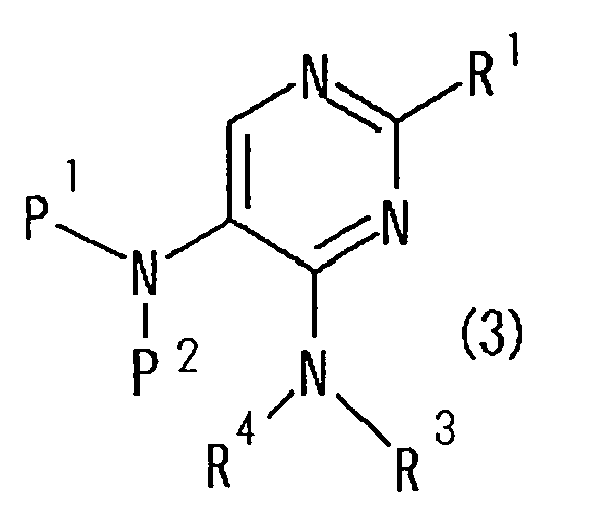 P1 is a hydrogen atom or a benzyl group optionally having substituent(s),P2 is a urethane-type protecting group or an amide-type protecting group when P1 is a hydrogen atom, or a benzyl group optionally having substituent(s) when P1 is a benzyl group optionally having substituent(s),R1 is a hydrogen atom, an alkyl group optionally having substituent(s), an aryl group optionally having substituent(s), an aralkyl group optionally having substituent(s), or a group represented by the formula (a) or the formula (b):
-0-R2 (a)
-S-R2 (b)
wherein R2 is an alkyl group optionally having substituent(s), an aryl group optionally having substituent(s) or an aralkyl group optionally having substituent(s),R3 is a hydrogen atom, an alkyl group optionally having substituent(s) or an aralkyl group optionally having substituent(s), andR4 is a hydrogen atom, an alkyl group optionally having substituent(s), an aralkyl group optionally having substituent(s), or a group represented by the formula (c): provided that a compound wherein P1 is a hydrogen atom, P2 is a urethane-type protecting group and R3 and R4 are hydrogen atoms is excluded,or a salt thereof.
 - A production method of a 5-aminopyrimidine compound represented by the formula (2):
 X is a leaving group,P1 is a hydrogen atom or a benzyl group optionally having substituent(s),P2 is a urethane-type protecting group or an amide-type protecting group when P1 is a hydrogen atom, or a benzyl group optionally having substituent(s) when P1 is a benzyl group optionally having substituent(s), andR1 is a hydrogen atom, an alkyl group optionally having substituent(s), an aryl group optionally having substituent(s), an aralkyl group optionally having substituent(s), or a group represented by the formula (a) or the formula (b):
-0-R2 (a)
-S-R2 (b)
wherein R2 is an alkyl group optionally having substituent(s), an aryl group optionally having substituent(s) or an aralkyl group optionally having substituent(s),or a salt thereof, which comprises converting the oxo group of a 5-amino-4-oxopyrimidine compound represented by the formula (1) : or a salt thereof, to a leaving group.
 - A production method of a 4,5-diaminopyrimidine compound represented by the formula (3):
 P1 is a hydrogen atom or a benzyl group optionally having substituent(s),P2 is a urethane-type protecting group or an amide-type protecting group when P1 is a hydrogen atom, or a benzyl group optionally having substituent(s) when P1 is a benzyl group optionally having substituent(s),R1 is a hydrogen atom, an alkyl group optionally having substituent(s), an aryl group optionally having substituent(s), an aralkyl group optionally having substituent(s), or a group represented by the formula (a) or the formula (b):
-0-R2 (a)
-S-R2 (b)
wherein R2 is an alkyl group optionally having substituent(s), an aryl group optionally having substituent(s) or an aralkyl group optionally having substituent(s),R3 is a hydrogen atom, an alkyl group optionally having substituent(s) or an aralkyl group optionally having substituent(s), andR4 is a hydrogen atom, an alkyl group optionally having substituent(s), an aralkyl group optionally having substituent(s), or a group represented by the formula (c): or a salt thereof, which comprises reacting a 5-aminopyrimidine compound represented by the formula (2):
 or a salt thereof, with an amine compound represented by the formula (d):
 or a salt thereof,provided that when P1 is a hydrogen atom and P2 is a urethane-type protecting group, then both R3 and R4 should not be hydrogen atoms.
 - A production method of a 8-oxodihydropurine compound represented by the formula (6):
 R1 is a hydrogen atom, an alkyl group optionally having substituent(s), an aryl group optionally having substituent(s), an aralkyl group optionally having substituent(s), or a group represented by the formula (a) or the formula (b):
-0-R2 (a)
-S-R2 (b)
wherein R2 is an alkyl group optionally having substituent(s), an aryl group optionally having substituent(s) or an aralkyl group optionally having substituent(s),or a salt thereof, which comprises reacting a 5-aminopyrimidine compound represented by the formula (2-c): X is a leaving group,P1c is a hydrogen atom,P2c is a urethane-type protecting group, andR1 is as defined above,or a salt thereof with ammonia.
 - A production method of a 4,5-diaminopyrimidine compound represented by the formula (4):
 R1 is a hydrogen atom, an alkyl group optionally having substituent(s), an aryl group optionally having substituent(s), an aralkyl group optionally having substituent(s), or a group represented by the formula (a) or the formula (b):
-0-R2 (a)
-S-R2 (b)
wherein R2 is an alkyl group optionally having substituent(s), an aryl group optionally having substituent(s) or an aralkyl group optionally having substituent(s),R3 is a hydrogen atom, an alkyl group optionally having substituent(s) or an aralkyl group optionally having substituent(s), andR4 is a hydrogen atom, an alkyl group optionally having substituent(s), an aralkyl group optionally having substituent(s), or a group represented by the formula (c): or a salt thereof, which comprises removing the amino-protecting group at the 5-position of a 4,5-diaminopyrimidine compound represented by the formula (3-a):
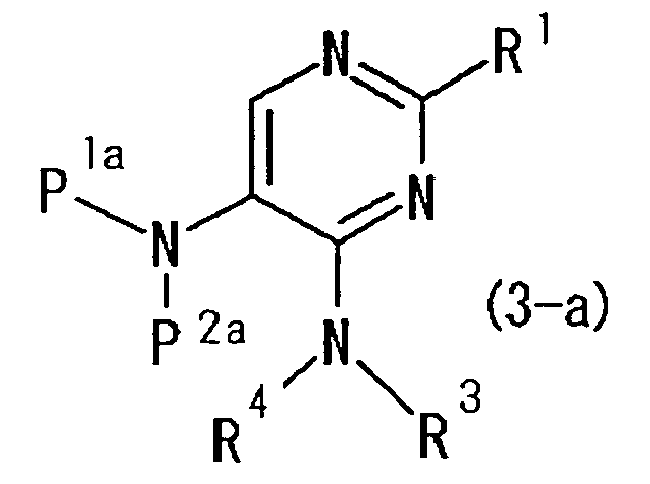 P1a is a hydrogen atom or a benzyl group optionally having substituent(s),P2a is an amide-type protecting group when P1a is a hydrogen atom, or a benzyl group optionally having substituent(s) when P1a is a benzyl group optionally having substituent(s), and other symbols are as defined above,or a salt thereof.
 - A production method of a 8-oxodihydropurine compound represented by the formula (5):
 R1 is a hydrogen atom, an alkyl group optionally having substituent(s), an aryl group optionally having substituent(s), an aralkyl group optionally having substituent(s), or a group represented by the formula (a) or the formula (b):
-0-R2 (a)
-S-R2 (b)
wherein R2 is an alkyl group optionally having substituent(s), an aryl group optionally having substituent(s) or an aralkyl group optionally having substituent(s), andR4b is an alkyl group optionally having substituent(s), an aralkyl group optionally having substituent(s), or a group represented by the formula (c): or a salt thereof, which comprises converting a 4,5-diaminopyrimidine compound represented by the formula (3-b):
 P1b is a hydrogen atom,P2b is a urethane-type protecting group,R3b is a hydrogen atom, andother symbols are as defined above,or a salt thereof to a purine derivative.
Applications Claiming Priority (1)
| Application Number | Priority Date | Filing Date | Title |
|---|---|---|---|
| JP2007168879A JP2009007273A (en) | 2007-06-27 | 2007-06-27 | Method for producing diaminopyrimidine compound |
Publications (1)
| Publication Number | Publication Date |
|---|---|
| EP2009003A1 true EP2009003A1 (en) | 2008-12-31 |
Family
ID=39708424
Family Applications (1)
| Application Number | Title | Priority Date | Filing Date |
|---|---|---|---|
| EP08252212A Withdrawn EP2009003A1 (en) | 2007-06-27 | 2008-06-27 | Production method of diaminopyrimidine compounds |
Country Status (3)
| Country | Link |
|---|---|
| US (1) | US20090005560A1 (en) |
| EP (1) | EP2009003A1 (en) |
| JP (1) | JP2009007273A (en) |
Cited By (2)
| Publication number | Priority date | Publication date | Assignee | Title |
|---|---|---|---|---|
| US8637527B2 (en) | 2007-12-17 | 2014-01-28 | Janssen Pharmaceutica Nv | Imidazolo-, oxazolo-, and thiazolopyrimidine modulators of TRPV1 |
| US8673895B2 (en) | 2006-03-21 | 2014-03-18 | Janssen Pharmaceutica Nv | Tetrahydro-pyrimidoazepines as modulators of TRPV1 |
Families Citing this family (8)
| Publication number | Priority date | Publication date | Assignee | Title |
|---|---|---|---|---|
| US20080059510A1 (en) * | 2006-08-31 | 2008-03-06 | Daniel Cardamore | Multimedia system framework having layer consolidating access to multiple media devices |
| AU2009333559B2 (en) | 2008-12-09 | 2015-03-12 | Gilead Sciences, Inc. | Modulators of toll-like receptors |
| MX336711B (en) * | 2010-03-04 | 2016-01-28 | Merck Sharp & Dohme | Inhibitors of catechol o-methyl transferase and their use in the treatment of psychotic disorders. |
| JP5860417B2 (en) | 2010-03-04 | 2016-02-16 | メルク・シャープ・エンド・ドーム・コーポレイション | Inhibitors of catechol O-methyltransferase and their use in the treatment of mental disorders |
| TWI733652B (en) | 2014-07-11 | 2021-07-21 | 美商基利科學股份有限公司 | Modulators of toll-like receptors for the treatment of hiv |
| JP2017526730A (en) | 2014-09-16 | 2017-09-14 | ギリアード サイエンシーズ, インコーポレイテッド | Solid form of Toll-like receptor modulator |
| EP3377493B1 (en) | 2015-11-20 | 2020-04-08 | Forma Therapeutics, Inc. | Purinones as ubiquitin-specific protease 1 inhibitors |
| KR20220011685A (en) | 2019-05-22 | 2022-01-28 | 길리애드 사이언시즈, 인코포레이티드 | Combination of a TLR7 modulating compound with an HIV vaccine |
Citations (6)
| Publication number | Priority date | Publication date | Assignee | Title |
|---|---|---|---|---|
| EP0184738A2 (en) * | 1984-12-12 | 1986-06-18 | Dr. Karl Thomae GmbH | Imidazole derivatives, medicaments containing these compounds, and process for their preparation |
| WO1999028320A1 (en) | 1997-12-03 | 1999-06-10 | Dainippon Pharmaceutical Co., Ltd. | 2-aryl-8-oxodihydropurine derivatives, process for producing the same, medicinal compositions containing the same, and intermediates thereof |
| WO2000073306A1 (en) * | 1999-05-31 | 2000-12-07 | Dainippon Pharmaceutical Co., Ltd. | 2-arylpurine-9-acetamide derivatives, process for the preparation thereof, medicinal compositions containing the same and intermediates of the derivatives |
| WO2005003099A2 (en) * | 2003-07-02 | 2005-01-13 | Vertex Pharmaceuticals Incorporated | Pyrimidines useful as modulators of voltage-gated ion channels |
| WO2006001266A1 (en) | 2004-06-23 | 2006-01-05 | Banyu Pharmaceutical Co., Ltd. | Method for producing 2-arylpurine derivative |
| WO2006127584A1 (en) | 2005-05-20 | 2006-11-30 | Elan Pharmaceuticals, Inc. | Imidazolone phenylalanine derivatives as vla-4 antagonists |
Family Cites Families (2)
| Publication number | Priority date | Publication date | Assignee | Title |
|---|---|---|---|---|
| FR2796142B1 (en) * | 1999-07-06 | 2002-08-09 | Saint Louis Inst | TWO-STAGE OPTICAL DETONATOR WITH SHOCK-DETONATION TRANSITION |
| JP4613501B2 (en) * | 2004-03-17 | 2011-01-19 | 味の素株式会社 | Process for producing 5-protected aminopyrimidine compound |
-
2007
- 2007-06-27 JP JP2007168879A patent/JP2009007273A/en active Pending
-
2008
- 2008-06-27 EP EP08252212A patent/EP2009003A1/en not_active Withdrawn
- 2008-06-27 US US12/163,053 patent/US20090005560A1/en not_active Abandoned
Patent Citations (7)
| Publication number | Priority date | Publication date | Assignee | Title |
|---|---|---|---|---|
| EP0184738A2 (en) * | 1984-12-12 | 1986-06-18 | Dr. Karl Thomae GmbH | Imidazole derivatives, medicaments containing these compounds, and process for their preparation |
| WO1999028320A1 (en) | 1997-12-03 | 1999-06-10 | Dainippon Pharmaceutical Co., Ltd. | 2-aryl-8-oxodihydropurine derivatives, process for producing the same, medicinal compositions containing the same, and intermediates thereof |
| EP1036794A1 (en) * | 1997-12-03 | 2000-09-20 | Dainippon Pharmaceutical Co., Ltd. | 2-aryl-8-oxodihydropurine derivatives, process for producing the same, medicinal compositions containing the same, and intermediates thereof |
| WO2000073306A1 (en) * | 1999-05-31 | 2000-12-07 | Dainippon Pharmaceutical Co., Ltd. | 2-arylpurine-9-acetamide derivatives, process for the preparation thereof, medicinal compositions containing the same and intermediates of the derivatives |
| WO2005003099A2 (en) * | 2003-07-02 | 2005-01-13 | Vertex Pharmaceuticals Incorporated | Pyrimidines useful as modulators of voltage-gated ion channels |
| WO2006001266A1 (en) | 2004-06-23 | 2006-01-05 | Banyu Pharmaceutical Co., Ltd. | Method for producing 2-arylpurine derivative |
| WO2006127584A1 (en) | 2005-05-20 | 2006-11-30 | Elan Pharmaceuticals, Inc. | Imidazolone phenylalanine derivatives as vla-4 antagonists |
Non-Patent Citations (3)
| Title |
|---|
| H.W. VAN MEETEREN, RECUEIL, vol. 87, 1968, pages 1089 - 1098 |
| L. MAARCHANL, BULL. SOC. CHIM. BELG., vol. 69, 1960, pages 177 - 193 |
| TETRAHEDRON LETTERS, vol. 37, 1966, pages 4517 - 4521 |
Cited By (5)
| Publication number | Priority date | Publication date | Assignee | Title |
|---|---|---|---|---|
| US8673895B2 (en) | 2006-03-21 | 2014-03-18 | Janssen Pharmaceutica Nv | Tetrahydro-pyrimidoazepines as modulators of TRPV1 |
| US9422293B2 (en) | 2006-03-21 | 2016-08-23 | Janssen Pharmaceutica Nv | Tetrahydro-pyrimidoazepines as modulators of TRPV1 |
| US9738649B2 (en) | 2006-03-21 | 2017-08-22 | Janssen Pharmaceutica N.V. | Tetrahydro-pyrimidoazepines as modulators of TRPV1 |
| US8637527B2 (en) | 2007-12-17 | 2014-01-28 | Janssen Pharmaceutica Nv | Imidazolo-, oxazolo-, and thiazolopyrimidine modulators of TRPV1 |
| US9440978B2 (en) | 2007-12-17 | 2016-09-13 | Janssen Pharmaceutica Nv | Imidazolo-, oxazolo-, and thiazolopyrimidine modulators of TRPV1 |
Also Published As
| Publication number | Publication date |
|---|---|
| US20090005560A1 (en) | 2009-01-01 |
| JP2009007273A (en) | 2009-01-15 |
Similar Documents
| Publication | Publication Date | Title |
|---|---|---|
| US20090005560A1 (en) | Production method of diaminopyrimidine compounds | |
| EP3398952B1 (en) | Synthesis process of ruxolitinib | |
| EP3658552B1 (en) | Process for preparing n-(5-((4-(4-((dimethylamino)methyl)-3-phenyl-1h-pyrazol-1-yl)pyrimidin-2-yl)amino)-4-methoxy-2-morpholinophenyl)acrylamide by reacting the corresponding amine with a 3-halo-propionyl chloride | |
| US11198684B2 (en) | Intermediates useful for the synthesis of a selective inhibitor against protein kinase and processes for preparing the same | |
| US10858353B2 (en) | Intermediates useful for the synthesis of aminopyrimidine derivatives, process for preparing the same, and process for preparing aminopyrimidine derivatives using the same | |
| SK11982003A3 (en) | Process for the preparation of 4,6-diaminopyrimido [5,4-d] pyrimidines and intermediates | |
| TWI679204B (en) | Preparation of benzoxazinoids, and intermediates and crystal forms thereof | |
| US9604985B2 (en) | Process for the preparation of chiral tert-butyl 4-((1R,2S,5R)-6(benzyloxy)-7-oxo-1,6-diazabicyclo[3.2.1]octane-2-carboxamido)piperidine-1-carb derivatives and (2S,5R)-7-oxo-N-piperidin-4-yl-6-(sulfoxy)-1,6-diazabicyclo[3.2.1]octane-2-carboxamide | |
| JP2023544678A (en) | Substituted tricyclic compounds | |
| KR20160093709A (en) | Synthesis of trans-8-chloro-5-methyl-1-[4-(pyridin-2-yloxy)-cyclohexyl]-5,6-dihydro-4h-2,3,5,10b-tetraaza-benzo[e]azulene and crytalline forms thereof | |
| US20090171084A1 (en) | Production method of aminopyrimidine compound | |
| EP0237899B1 (en) | Production of fluoroaniline derivatives | |
| CN110520406A (en) | Cyclopropyl pheynylalkylamine and preparation method thereof | |
| US20050143407A1 (en) | Process for porducing quinolonecarboxylic acid derivative | |
| AU2019268945B2 (en) | Novel processes for preparing a diaminopyrimidine derivative or acid addition salt thereof | |
| JP2004300101A (en) | Method for producing chloropyrimidine derivative | |
| US6964963B2 (en) | Preparation of 4-amino-1-naphthol ethers | |
| CN103649078A (en) | Substituted phenyl compounds | |
| KR20010103796A (en) | Process for producing 5-amino-8-alkylquinolonecarboxylic acid derivatives and intermediates in the production thereof | |
| WO2014104607A1 (en) | Method for preparing (2-methyl-1-(3-methylbenzyl)-1h-benzo[d]imidazol-5-yl)(piperidin-5-yl)methanone | |
| US20020193591A1 (en) | Process for producing 5-amino-8-alkylquinolonecarboxylic acid derivative and intermediates in the production thereof | |
| JP2005350390A (en) | Method for producing 3-aminoflavone compound | |
| NZ731073A (en) | Processes for preparing (cyclopentyl[d]pyrimidin-4-yl)piperazine compounds | |
| WO2015011010A1 (en) | Synthesis of substituted aminopyrimidines | |
| JP2006001847A (en) | Process for producing 2,5-diamino-4,6-dichloropyrimidine |
Legal Events
| Date | Code | Title | Description |
|---|---|---|---|
| PUAI | Public reference made under article 153(3) epc to a published international application that has entered the european phase |
Free format text: ORIGINAL CODE: 0009012 |
|
| AK | Designated contracting states |
Kind code of ref document: A1 Designated state(s): AT BE BG CH CY CZ DE DK EE ES FI FR GB GR HR HU IE IS IT LI LT LU LV MC MT NL NO PL PT RO SE SI SK TR |
|
| AX | Request for extension of the european patent |
Extension state: AL BA MK RS |
|
| AKX | Designation fees paid | ||
| REG | Reference to a national code |
Ref country code: DE Ref legal event code: 8566 |
|
| STAA | Information on the status of an ep patent application or granted ep patent |
Free format text: STATUS: THE APPLICATION IS DEEMED TO BE WITHDRAWN |
|
| 18D | Application deemed to be withdrawn |
Effective date: 20090701 |