EP2006434A2 - Sensing over suds condition to improve cleaning with oxidizing agents - Google Patents
Sensing over suds condition to improve cleaning with oxidizing agents Download PDFInfo
- Publication number
- EP2006434A2 EP2006434A2 EP08251599A EP08251599A EP2006434A2 EP 2006434 A2 EP2006434 A2 EP 2006434A2 EP 08251599 A EP08251599 A EP 08251599A EP 08251599 A EP08251599 A EP 08251599A EP 2006434 A2 EP2006434 A2 EP 2006434A2
- Authority
- EP
- European Patent Office
- Prior art keywords
- wash
- wash liquor
- washing
- fabric
- liquor
- Prior art date
- Legal status (The legal status is an assumption and is not a legal conclusion. Google has not performed a legal analysis and makes no representation as to the accuracy of the status listed.)
- Granted
Links
Images
Classifications
-
- D—TEXTILES; PAPER
- D06—TREATMENT OF TEXTILES OR THE LIKE; LAUNDERING; FLEXIBLE MATERIALS NOT OTHERWISE PROVIDED FOR
- D06F—LAUNDERING, DRYING, IRONING, PRESSING OR FOLDING TEXTILE ARTICLES
- D06F33/00—Control of operations performed in washing machines or washer-dryers
- D06F33/30—Control of washing machines characterised by the purpose or target of the control
- D06F33/32—Control of operational steps, e.g. optimisation or improvement of operational steps depending on the condition of the laundry
- D06F33/37—Control of operational steps, e.g. optimisation or improvement of operational steps depending on the condition of the laundry of metering of detergents or additives
-
- D—TEXTILES; PAPER
- D06—TREATMENT OF TEXTILES OR THE LIKE; LAUNDERING; FLEXIBLE MATERIALS NOT OTHERWISE PROVIDED FOR
- D06F—LAUNDERING, DRYING, IRONING, PRESSING OR FOLDING TEXTILE ARTICLES
- D06F2103/00—Parameters monitored or detected for the control of domestic laundry washing machines, washer-dryers or laundry dryers
- D06F2103/20—Washing liquid condition, e.g. turbidity
-
- D—TEXTILES; PAPER
- D06—TREATMENT OF TEXTILES OR THE LIKE; LAUNDERING; FLEXIBLE MATERIALS NOT OTHERWISE PROVIDED FOR
- D06F—LAUNDERING, DRYING, IRONING, PRESSING OR FOLDING TEXTILE ARTICLES
- D06F2105/00—Systems or parameters controlled or affected by the control systems of washing machines, washer-dryers or laundry dryers
- D06F2105/42—Detergent or additive supply
Definitions
- a wash cycle for a clothes washer in which the clothes washer has a wash zone for receiving a load of fabric defined within a rotating drum having an outer wall.
- the wash cycle includes a step of dispensing a detergent wash liquor into the wash zone. Another step is washing the fabric load in the wash zone with the detergent wash liquor. Another step is dispensing an oxidizing agent wash liquor into the wash zone. Another step is washing the fabric load in the wash zone with the oxidizing agent wash liquor.
- the washing steps include steps of sensing for an oversuds condition. If an oversuds condition is detected, steps are undertaken to reduce the oversuds condition during the step of washing the fabric load.
- the step of washing the fabric in the wash zone with the detergent wash liquor occurs prior to the step of washing the fabric in the wash zone with the oxidizing agent wash liquor.
- the step of washing the fabric in the wash zone with the oxidizing agent wash liquor occurs prior to the step of washing the fabric in the wash zone with the detergent wash liquor.
- the steps of reducing the oversuds condition comprise adding an anti-suds solution to the wash liquor.
- the anti-suds solution could be one or more of cold water, a surfactant, fine particles, or silicon.
- the suds may be reduced by applying ultrasonic energy or an electric shock to the wash liquor.
- the step of dispensing an oxidizing agent wash liquor includes incrementally dispensing the oxidizing agent to the wash liquor while continuously sensing for an oversuds condition, and terminating the further addition of the oxidizing agent until the oversuds condition is no longer sensed.
- the steps of reducing the oversuds condition include tumbling the fabric load in the wash zone by undertaking a low duty cycle intermittent rotation of the washer drum.
- the steps of reducing the oversuds condition include a timed pause in the wash cycle during which time there is no rotation of the washer drum.
- the steps of sensing for the oversuds condition during the washing steps include at least one of sensing an operating condition of a motor used to rotate the drum, the conductivity of the wash liquor, the capacitance of the wash liquor, the surface tension of the wash liquor, the turbidity of the wash liquor and an operating condition of a pump used to circulate the wash liquor.
- the steps of washing the fabric load include recirculating the wash liquor with a recirculation pump and the steps of reducing the oversuds condition include turning off the recirculation pump.
- Another aspect of the invention provides a wash cycle for a clothes washer, the clothes washer having a wash zone defined within a rotating drum having an outer wall, for receiving a load of fabric, comprising the steps:
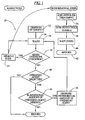
- FIG. 1 is a flow chart diagram of a portion of a wash cycle including suds sensing and removal steps.
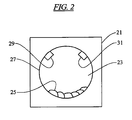
- FIG. 2 is a schematic illustration of a clothes washer in which the steps of the present invention can be carried out.
- a wash cycle 20 is provided for a clothes washer 21 in which the clothes washer has a wash zone 23 for receiving a load of fabric 25 defined within a rotating drum 27 having an outer wall.
- the wash cycle includes a step 22 of dispensing a detergent wash liquor via a dispensing outlet 29 into the wash zone 23.
- Another step 24 is washing the fabric load in the wash zone with the detergent wash liquor.
- Another step 26 is dispensing an oxidizing agent wash liquor via a dispensing outlet 31 into the wash zone 23.
- the dispensing outlet 29 for the detergent wash liquor may be the same or different than the dispensing outlet 31 for the oxidizing agent wash liquor.
- Another step 28 is washing the fabric load in the wash zone 23 with the oxidizing agent wash liquor.
- the washing steps include steps 30 of sensing for an oversuds condition. If an oversuds condition is detected, steps 34 are undertaken to reduce or remove the oversuds condition during the step of washing the fabric load.
- the oxidizing agents to be added to the wash zone are active oxygen releasing compounds, e.g., peroxides (peroxygen compounds) such as perborate, percarbonates, perphosphates, persilicates, persulfates, their sodium, ammonium, potassium and lithium analogs, calcium peroxide, zinc peroxide, sodium peroxide, carbamide peroxide, hydrogen peroxide, and the like.
- peroxides peroxygen compounds
- these agents also include peroxy acids and organic peroxides and various mixtures thereof.
- a peroxy acid is an acid in which an acidic -OH group has been replaced by an -OOH group. They are formed chiefly by elements in groups 14, 15 and 16 of the periodic table, but boron and certain transition elements are also known to form peroxy acids. Sulfur and phosphorus form the largest range of peroxy acids, including some condensed forms such as peroxydiphosphoric acid, H 4 P 2 O 8 and peroxydisulfuric acid, H 2 S 2 O 8 . This term also includes compounds such as peroxy-carboxylic acids and meta- chloroperoxybenzoic acid (mCPBA).
- mCPBA meta- chloroperoxybenzoic acid
- Organic peroxides are organic compounds containing the peroxide functional group (ROOR'). If the R' is hydrogen, the compound is called an organic hydroperoxide.
- Peresters have general structure RC(O)OOR. The O-O bond easily breaks and forms free radicals of the form RO ⁇ . This makes organic peroxides useful for cleaning purposes.
- oxidizing agent product composition based on concentration. "Ultra concentrated” means that 80 to 100% of the bleach is active. “Concentrated” means that 40 to 79% of the bleach is active. “Bleach with additive” means that 20-40 % of the bleach is active. “Cleaning product with bleach” means that less than 25% of the bleach is active.
- Oxidizing agents may be combined within a mixture that has a selection of other material, such as one or more of the following: builders, surfactants, enzymes, bleach activators, bleach catalysts, bleach boosters, alkalinity sources, antibacterial agents, colorants, perfumes, pro-perfumes, finishing aids, lime soap dispersants, composition malodor control agents, odor neutralizers, polymeric dye transfer inhibiting agents, crystal growth inhibitors, photobleaches, heavy metal ion sequestrants, anti-tarnishing agents, anti-microbial agents, anti-oxidants, linkers, anti-redeposition agents, electrolytes, pH modifiers, thickeners, abrasives, divalent or trivalent ions, metal ion salts, enzyme stabilizers, corrosion inhibitors, diamines or polyamines and/or their alkoxylates, suds stabilizing polymers, solvents, process aids, fabric softening agents, optical brighteners, hydrotropes, suds or foam suppressors, suds or foam booster
- a particular oxidizing agent to be added to form the oxidizing agent wash liquor could comprise a combination of water with one or more of sodium carbonate, sodium percarbonate, surfactants and enzymes.
- the steps 30 of sensing for the oversuds condition during the washing steps 24, 28 include at least one of sensing an operating condition of a motor used to rotate the drum, the conductivity of the wash liquor, the capacitance of the wash liquor, the surface tension of the wash liquor, the turbidity of the wash liquor and an operating condition of a pump used to circulate or recirculated the wash liquor.
- the step 24 of washing the fabric load 25 in the wash zone with the detergent wash liquor occurs prior to the step 28 of washing the fabric in the wash zone with the oxidizing agent wash liquor.
- the step 24 of washing the fabric load 25 in the wash zone with the oxidizing agent wash liquor occurs prior to the step 28 of washing the fabric in the wash zone with the detergent wash liquor.
- the steps 34 of removing or reducing the oversuds condition comprise a step 36 of adding an anti-suds treatment, such as a solution to the wash liquor.
- an anti-suds treatment such as a solution to the wash liquor.
- the anti-suds solution could be one or more of cold water, a surfactant, fine particles, or silicon.
- the suds may be removed or reduced by a treatment such as applying ultrasonic energy or an electric shock to the wash liquor.
- the steps 34 of reducing the oversuds condition may include a step 38 of tumbling the fabric load in the wash zone 23 by undertaking a low duty cycle intermittent rotation of the washer drum 27.
- the steps 34 of reducing the oversuds condition may include a step 40 of a timed pause in the wash cycle during which time there is no rotation of the washer drum 27.
- the steps 24, 28 of washing the fabric load 25 include recirculating the wash liquor with a recirculation pump and the steps 34 of reducing the oversuds condition include turning off the recirculation pump.
- a step 42 is preformed to return control back to the regular wash cycle 20 to resume the normal washing steps.
- control determines in step 44 whether the particular wash cycle selects an oxidizing agent.
- a step 46 is then carried out to determine whether an additional amount of oxidizing agent is needed.
- the step 26 of dispensing an oxidizing agent wash liquor includes incrementally dispensing the oxidizing agent to the wash liquor while continuously sensing in step 30 for an oversuds condition, and terminating the further addition of the oxidizing agent until the oversuds condition is no longer sensed.
- step 44 it would be determined that an oxidizing agent has been selected.
- step 46 it would be determined that an additional amount of oxidizing agent is needed, since none would have been added yet.
- an incremental amount of oxidizing agent is added to the wash zone 23 and the step 28 of washing the fabric load 25 would begin.
- the oversuds condition would be sensed in step 30, and if oversudsing is sensed, then the steps 34-40 of removing or reducing the suds would be carried out.
- step 28 The wash cycle 28 would be resumed and the oversuds condition would be checked again in step 30. If oversudsing is detected again, control would return to the suds removal steps 34-40, but if oversudsing is no longer detected, then control would pass to step 44 to determine, again, if an oxidizing agent was selected and then to step 46 to determine whether additional oxidizing agent is needed. If a further incremental amount of oxidizing agent is needed, then control passes again to step 26 to dispense a further amount of oxidizing agent and then to step 28 to continue the washing in the oxidizing agent wash liquor, while continuing to sense the oversuds condition in step 44.
Landscapes
- Engineering & Computer Science (AREA)
- Textile Engineering (AREA)
- Control Of Washing Machine And Dryer (AREA)
- Detergent Compositions (AREA)
- Detail Structures Of Washing Machines And Dryers (AREA)
- Treatment Of Fiber Materials (AREA)
Abstract
Description
- In connection with the use of clothes washers and other fabric washing appliances, consumers are being provided with a wide array of detergents and additives to assist the consumers in removing stains from fabric loads. One class of additives that is becoming popular is oxidizing agents. While the various chemistries available in the market are useful for removing various different types of stains, the wash cycles provided in wash machines have not always taken into account the various additives and optimized the wash cycles to accommodate those detergents and additives.
- Although suds detection and removal or reduction is known in regular washing cycles, such as those disclosed in
U.S. Patent Nos. 5,768,730 ,6,269,666 and4,410,329 using standard detergents, there do not appear to be any wash cycles specifically directed to monitoring oversudsing in a wash step utilizing an oxidizing agent wash liquor. - According to one aspect of the invention, a wash cycle is provided for a clothes washer in which the clothes washer has a wash zone for receiving a load of fabric defined within a rotating drum having an outer wall. The wash cycle includes a step of dispensing a detergent wash liquor into the wash zone. Another step is washing the fabric load in the wash zone with the detergent wash liquor. Another step is dispensing an oxidizing agent wash liquor into the wash zone. Another step is washing the fabric load in the wash zone with the oxidizing agent wash liquor. The washing steps include steps of sensing for an oversuds condition. If an oversuds condition is detected, steps are undertaken to reduce the oversuds condition during the step of washing the fabric load.
- In an embodiment, the step of washing the fabric in the wash zone with the detergent wash liquor occurs prior to the step of washing the fabric in the wash zone with the oxidizing agent wash liquor.
- In an embodiment, the step of washing the fabric in the wash zone with the oxidizing agent wash liquor occurs prior to the step of washing the fabric in the wash zone with the detergent wash liquor.
- In an embodiment, the steps of reducing the oversuds condition comprise adding an anti-suds solution to the wash liquor. In different embodiments, the anti-suds solution could be one or more of cold water, a surfactant, fine particles, or silicon. Instead of an anti-suds solution, in some embodiments, the suds may be reduced by applying ultrasonic energy or an electric shock to the wash liquor.
- In an embodiment, the step of dispensing an oxidizing agent wash liquor, includes incrementally dispensing the oxidizing agent to the wash liquor while continuously sensing for an oversuds condition, and terminating the further addition of the oxidizing agent until the oversuds condition is no longer sensed.
- In an embodiment, the steps of reducing the oversuds condition include tumbling the fabric load in the wash zone by undertaking a low duty cycle intermittent rotation of the washer drum.
- In an embodiment, the steps of reducing the oversuds condition include a timed pause in the wash cycle during which time there is no rotation of the washer drum.
- In an embodiment, the steps of sensing for the oversuds condition during the washing steps include at least one of sensing an operating condition of a motor used to rotate the drum, the conductivity of the wash liquor, the capacitance of the wash liquor, the surface tension of the wash liquor, the turbidity of the wash liquor and an operating condition of a pump used to circulate the wash liquor.
- In an embodiment, the steps of washing the fabric load include recirculating the wash liquor with a recirculation pump and the steps of reducing the oversuds condition include turning off the recirculation pump.
Another aspect of the invention provides a wash cycle for a clothes washer, the clothes washer having a wash zone defined within a rotating drum having an outer wall, for receiving a load of fabric, comprising the steps: - dispensing a detergent wash liquor into the wash zone,
- washing the fabric load in the wash zone with the detergent wash liquor while sensing for an oversuds condition, and if an oversuds condition is detected, undertaking steps to reduce the oversuds condition during this step of washing the fabric load,
- incrementally dispensing an oxidizing agent wash liquor into the wash zone while sensing for an oversuds condition, and if an oversuds condition is detected, undertaking steps to reduce the oversuds condition during this step of washing the fabric load, and if no oversuds condition is detected, continuing to incrementally dispense the oxidizing agent until a desired amount of oxidizing agent is added to the oxidizing agent wash liquor,
- the steps of reducing the oversuds condition comprise adding an anti-suds treatment to the wash liquor, tumbling the fabric load in the wash zone by undertaking a low duty cycle intermittent rotation of the washer drum, and thereafter, undertaking a timed pause in the wash cycle during which time there is no rotation of the washer drum, prior to returning to the step of washing the fabric load.
-
FIG. 1 is a flow chart diagram of a portion of a wash cycle including suds sensing and removal steps. -
FIG. 2 is a schematic illustration of a clothes washer in which the steps of the present invention can be carried out. - In an embodiment of the invention, a
wash cycle 20 is provided for aclothes washer 21 in which the clothes washer has awash zone 23 for receiving a load offabric 25 defined within a rotatingdrum 27 having an outer wall. The wash cycle includes astep 22 of dispensing a detergent wash liquor via a dispensingoutlet 29 into thewash zone 23. Anotherstep 24 is washing the fabric load in the wash zone with the detergent wash liquor. Anotherstep 26 is dispensing an oxidizing agent wash liquor via a dispensingoutlet 31 into thewash zone 23. The dispensingoutlet 29 for the detergent wash liquor may be the same or different than the dispensingoutlet 31 for the oxidizing agent wash liquor. Anotherstep 28 is washing the fabric load in thewash zone 23 with the oxidizing agent wash liquor. The washing steps includesteps 30 of sensing for an oversuds condition. If an oversuds condition is detected,steps 34 are undertaken to reduce or remove the oversuds condition during the step of washing the fabric load. - The oxidizing agents to be added to the wash zone are active oxygen releasing compounds, e.g., peroxides (peroxygen compounds) such as perborate, percarbonates, perphosphates, persilicates, persulfates, their sodium, ammonium, potassium and lithium analogs, calcium peroxide, zinc peroxide, sodium peroxide, carbamide peroxide, hydrogen peroxide, and the like. These agents also include peroxy acids and organic peroxides and various mixtures thereof.
- A peroxy acid is an acid in which an acidic -OH group has been replaced by an -OOH group. They are formed chiefly by elements in groups 14, 15 and 16 of the periodic table, but boron and certain transition elements are also known to form peroxy acids. Sulfur and phosphorus form the largest range of peroxy acids, including some condensed forms such as peroxydiphosphoric acid, H4P2O8 and peroxydisulfuric acid, H2S2O8. This term also includes compounds such as peroxy-carboxylic acids and meta-chloroperoxybenzoic acid (mCPBA).
- Organic peroxides are organic compounds containing the peroxide functional group (ROOR'). If the R' is hydrogen, the compound is called an organic hydroperoxide. Peresters have general structure RC(O)OOR. The O-O bond easily breaks and forms free radicals of the form RO·. This makes organic peroxides useful for cleaning purposes.
- There are four possible descriptions of the oxidizing agent product composition based on concentration. "Ultra concentrated" means that 80 to 100% of the bleach is active. "Concentrated" means that 40 to 79% of the bleach is active. "Bleach with additive" means that 20-40 % of the bleach is active. "Cleaning product with bleach" means that less than 25% of the bleach is active.
- Oxidizing agents may be combined within a mixture that has a selection of other material, such as one or more of the following: builders, surfactants, enzymes, bleach activators, bleach catalysts, bleach boosters, alkalinity sources, antibacterial agents, colorants, perfumes, pro-perfumes, finishing aids, lime soap dispersants, composition malodor control agents, odor neutralizers, polymeric dye transfer inhibiting agents, crystal growth inhibitors, photobleaches, heavy metal ion sequestrants, anti-tarnishing agents, anti-microbial agents, anti-oxidants, linkers, anti-redeposition agents, electrolytes, pH modifiers, thickeners, abrasives, divalent or trivalent ions, metal ion salts, enzyme stabilizers, corrosion inhibitors, diamines or polyamines and/or their alkoxylates, suds stabilizing polymers, solvents, process aids, fabric softening agents, optical brighteners, hydrotropes, suds or foam suppressors, suds or foam boosters, fabric softeners, antistatic agents, dye fixatives, dye abrasion inhibitors, anti-crocking agents, wrinkle reduction agents, wrinkle resistance agents, soil release polymers, soil repellency agents, sunscreen agents, anti-fade agents, water soluble polymers, water swellable polymers and mixtures thereof.
- A particular oxidizing agent to be added to form the oxidizing agent wash liquor could comprise a combination of water with one or more of sodium carbonate, sodium percarbonate, surfactants and enzymes.
- In an embodiment, the
steps 30 of sensing for the oversuds condition during thewashing steps - In an embodiment, the
step 24 of washing thefabric load 25 in the wash zone with the detergent wash liquor occurs prior to thestep 28 of washing the fabric in the wash zone with the oxidizing agent wash liquor. - In an embodiment, the
step 24 of washing thefabric load 25 in the wash zone with the oxidizing agent wash liquor occurs prior to thestep 28 of washing the fabric in the wash zone with the detergent wash liquor. - In an embodiment, the
steps 34 of removing or reducing the oversuds condition comprise astep 36 of adding an anti-suds treatment, such as a solution to the wash liquor. In different embodiments, the anti-suds solution could be one or more of cold water, a surfactant, fine particles, or silicon. Instead of an anti-suds solution, in some embodiments, the suds may be removed or reduced by a treatment such as applying ultrasonic energy or an electric shock to the wash liquor. - In an embodiment, the
steps 34 of reducing the oversuds condition may include astep 38 of tumbling the fabric load in thewash zone 23 by undertaking a low duty cycle intermittent rotation of thewasher drum 27. - In an embodiment, the
steps 34 of reducing the oversuds condition may include astep 40 of a timed pause in the wash cycle during which time there is no rotation of thewasher drum 27. - In an embodiment, the
steps fabric load 25 include recirculating the wash liquor with a recirculation pump and thesteps 34 of reducing the oversuds condition include turning off the recirculation pump. - Upon the completion of the
steps 34 of reducing the oversuds condition, astep 42 is preformed to return control back to theregular wash cycle 20 to resume the normal washing steps. - For example, after the
step 24 of washing thefabric load 25 in the detergent wash liquor, the control determines instep 44 whether the particular wash cycle selects an oxidizing agent. Astep 46 is then carried out to determine whether an additional amount of oxidizing agent is needed. - In an embodiment, the
step 26 of dispensing an oxidizing agent wash liquor, includes incrementally dispensing the oxidizing agent to the wash liquor while continuously sensing instep 30 for an oversuds condition, and terminating the further addition of the oxidizing agent until the oversuds condition is no longer sensed. As shown inFIG. 1 , during a first time through the various steps, instep 44, it would be determined that an oxidizing agent has been selected. Instep 46, it would be determined that an additional amount of oxidizing agent is needed, since none would have been added yet. Instep 26, an incremental amount of oxidizing agent is added to thewash zone 23 and thestep 28 of washing thefabric load 25 would begin. The oversuds condition would be sensed instep 30, and if oversudsing is sensed, then the steps 34-40 of removing or reducing the suds would be carried out. - The
wash cycle 28 would be resumed and the oversuds condition would be checked again instep 30. If oversudsing is detected again, control would return to the suds removal steps 34-40, but if oversudsing is no longer detected, then control would pass to step 44 to determine, again, if an oxidizing agent was selected and then to step 46 to determine whether additional oxidizing agent is needed. If a further incremental amount of oxidizing agent is needed, then control passes again to step 26 to dispense a further amount of oxidizing agent and then to step 28 to continue the washing in the oxidizing agent wash liquor, while continuing to sense the oversuds condition instep 44. - Various features of the
wash cycle 20 and suds sensing and removal steps have been described which may be incorporated singly or in various combinations into a desired system, even though only certain combinations are described herein. The described combinations should not be viewed in a limiting way, but only as illustrative examples of particular possible combinations of features. - As is apparent from the foregoing specification, the invention is susceptible of being embodied with various alterations and modifications which may differ particularly from those that have been described in the preceding description within the scope of the invention as defined in the appended claims.
-
- 20
- wash cycle
- 21
- clothes washer
- 22
- detergent dispensing step
- 23
- wash zone
- 24
- wash step
- 25
- fabric load
- 26
- oxidizing agent dispensing step
- 27
- drum
- 28
- wash step
- 29
- detergent dispenser
- 30
- oversuds condition sensing step
- 31
- oxidizing agent dispenser
- 34
- suds removal steps
- 36
- add anti-suds treatment step
- 38
- low duty cycle tumble step
- 40
- pause step
- 42
- return step
- 44
- oxidizing agent selection determination step
- 46
- amount of oxidizing agent determining step
The invention will be further described by way of example with reference to the accompanying drawings, in which:-
Claims (15)
- A wash cycle for a clothes washer, the clothes washer having a wash zone defined within a rotating drum having an outer wall, for receiving a load of fabric, comprising the steps:dispensing a detergent wash liquor into the wash zone,washing the fabric load in the wash zone with the detergent wash liquor,dispensing an oxidizing agent wash liquor into the wash zone,washing the fabric load in the wash zone with the oxidizing agent wash liquor,wherein the washing steps include sensing for an oversuds condition, and if an oversuds condition is detected, undertaking steps to reduce the oversuds condition during the step of washing the fabric load.
- The wash cycle of claim 1, wherein the step of washing the fabric in the wash zone with the detergent wash liquor occurs prior to the step of washing the fabric in the wash zone with the oxidizing agent wash liquor.
- The wash cycle of claim 1, wherein the step of washing the fabric in the wash zone with the oxidizing agent wash liquor occurs prior to the step of washing the fabric in the wash zone with the detergent wash liquor.
- The wash cycle of claim 1, 2 or 3, wherein the steps of reducing the oversuds condition comprise adding an anti-suds solution to the wash liquor.
- The wash cycle of claim 4, wherein the anti-suds solution comprises at least one of: cold water, a surfactant, fine particles, and silicon.
- The wash cycle of any one of the preceding claims, wherein the steps of reducing the oversuds condition comprise applying at least one of: ultrasonic energy and an electric shock to the wash liquor.
- The wash cycle of any one of the preceding claims, wherein the step of dispensing an oxidizing agent wash liquor, comprises incrementally dispensing the oxidizing agent to the wash liquor while continuously sensing for an oversuds condition, and terminating the further addition of the oxidizing agent until the oversuds condition is no longer sensed.
- The wash cycle of any one of the preceding claims, wherein the steps of reducing the oversuds condition comprises at least one of: tumbling the fabric load in the wash zone by undertaking a low duty cycle intermittent rotation of the washer drum; and a timed pause in the wash cycle during which time there is no rotation of the washer drum.
- The wash cycle of any one of the preceding claims, wherein the steps of sensing for the oversuds condition during the washing steps comprise at least one of sensing an operating condition of a motor used to rotate the drum, the conductivity of the wash liquor, the capacitance of the wash liquor, the surface tension of the wash liquor, the turbidity of the wash liquor and an operating condition of a pump used to circulate the wash liquor.
- A wash cycle for a clothes washer, the clothes washer having a wash zone defined within a rotating drum having an outer wall, for receiving a load of fabric, comprising the steps:dispensing a detergent wash liquor into the wash zone,washing the fabric load in the wash zone with the detergent wash liquor while sensing for an oversuds condition, and if an oversuds condition is detected, undertaking steps to reduce the oversuds condition during this step of washing the fabric load,incrementally dispensing an oxidizing agent wash liquor into the wash zone while sensing for an oversuds condition, and if an oversuds condition is detected, undertaking steps to reduce the oversuds condition during this step of washing the fabric load, and if no oversuds condition is detected, continuing to incrementally dispense the oxidizing agent until a desired amount of oxidizing agent is added to the oxidizing agent wash liquor,the steps of reducing the oversuds condition comprise adding an anti-suds treatment to the wash liquor, tumbling the fabric load in the wash zone by undertaking a low duty cycle intermittent rotation of the washer drum, and thereafter, undertaking a timed pause in the wash cycle during which time there is no rotation of the washer drum, prior to returning to the step of washing the fabric load.
- The wash cycle of claim 10, wherein the step of washing the fabric in the wash zone with the detergent wash liquor occurs prior to the step of washing the fabric in the wash zone with the oxidizing agent wash liquor.
- The wash cycle of claim 10, wherein the step of washing the fabric in the wash zone with the oxidizing agent wash liquor occurs prior to the step of washing the fabric in the wash zone with the detergent wash liquor.
- The wash cycle of claim 10, 11 or 12, wherein the step of adding an anti-suds treatment to the wash liquor comprises at least one of adding cold water, adding a surfactant, adding fine particles, adding silicon, applying ultrasonic energy and applying an electric shock to the wash liquor.
- The wash cycle of claim 10, 11, 12 or 13, wherein the steps of sensing for the oversuds condition during the washing steps comprise at least one of sensing an operating condition of a motor used to rotate the drum, the conductivity of the wash liquor, the capacitance of the wash liquor, the surface tension of the wash liquor, the turbidity of the wash liquor and an operating condition of a pump used to circulate the wash liquor.
- A clothes washer comprising a controller adapted to cause the washer to execute a wash cycle in accordance with any one of the preceding claims.
Applications Claiming Priority (1)
| Application Number | Priority Date | Filing Date | Title |
|---|---|---|---|
| US11/744,948 US20080276963A1 (en) | 2007-05-07 | 2007-05-07 | Sensing over suds condition to improve cleaning with oxidizing agents |
Publications (3)
| Publication Number | Publication Date |
|---|---|
| EP2006434A2 true EP2006434A2 (en) | 2008-12-24 |
| EP2006434A3 EP2006434A3 (en) | 2009-01-14 |
| EP2006434B1 EP2006434B1 (en) | 2015-07-22 |
Family
ID=39876499
Family Applications (1)
| Application Number | Title | Priority Date | Filing Date |
|---|---|---|---|
| EP08251599.0A Ceased EP2006434B1 (en) | 2007-05-07 | 2008-05-01 | Sensing over suds condition to improve cleaning with oxidizing agents |
Country Status (5)
| Country | Link |
|---|---|
| US (1) | US20080276963A1 (en) |
| EP (1) | EP2006434B1 (en) |
| BR (1) | BRPI0801319A2 (en) |
| CA (1) | CA2622836A1 (en) |
| MX (1) | MX2008005886A (en) |
Families Citing this family (6)
| Publication number | Priority date | Publication date | Assignee | Title |
|---|---|---|---|---|
| US20140327545A1 (en) * | 2011-06-07 | 2014-11-06 | Biovigil Hygiene Technologies, Llc | Hand cleanliness |
| ES2538901B1 (en) * | 2013-12-24 | 2016-05-03 | Bsh Electrodomésticos España, S.A. | Washing machine and method of using said washing machine |
| US10047469B2 (en) | 2015-12-21 | 2018-08-14 | Whirlpool Corporation | Laundry treating appliance with over-sudsing condition compensation measures |
| CN107142657B (en) * | 2017-04-10 | 2022-05-17 | 青岛海尔洗衣机有限公司 | A washing machine and its working method |
| DE102017215038A1 (en) * | 2017-08-29 | 2019-02-28 | Henkel Ag & Co. Kgaa | A method for washing clothes of a laundry load, apparatus, computer program and system |
| US20220120006A1 (en) * | 2020-10-19 | 2022-04-21 | Haier Us Appliance Solutions, Inc. | Machine appliance and a method for preventing an oversuds condition |
Citations (4)
| Publication number | Priority date | Publication date | Assignee | Title |
|---|---|---|---|---|
| US4410329A (en) | 1981-11-06 | 1983-10-18 | General Electric Company | Washing machine with oversuds detection and correction capability |
| US5768730A (en) | 1994-12-06 | 1998-06-23 | Sharp Kabushiki Kaisha | Drum type washing machine and dryer |
| US5890247A (en) | 1997-12-22 | 1999-04-06 | Maytag Corporation | Automatic washing machine incorporating a suds detection and control system |
| US6269666B1 (en) | 1999-06-22 | 2001-08-07 | Whirlpool Corporation | Control for an automatic washer with spray pretreatment |
Family Cites Families (14)
| Publication number | Priority date | Publication date | Assignee | Title |
|---|---|---|---|---|
| US1984210A (en) * | 1930-02-08 | 1934-12-11 | Electro Chem Eng | Method and apparatus for preventing foaming of liquids |
| US2489278A (en) * | 1948-07-16 | 1949-11-29 | Howard R Fink | Method of cleansing clothes |
| US3570272A (en) * | 1968-10-10 | 1971-03-16 | Blackstone Corp | Water saver and suds lock elimination system for washing machines |
| DE1914684B2 (en) * | 1969-03-22 | 1975-12-04 | Th. Goldschmidt Ag, 4300 Essen | Defoamer emulsion |
| US4489574A (en) * | 1981-11-10 | 1984-12-25 | The Procter & Gamble Company | Apparatus for highly efficient laundering of textiles |
| EP0915150A1 (en) * | 1997-10-31 | 1999-05-12 | The Procter & Gamble Company | Processes of soaking fabrics with a liquid aqueous persulfate salt-containing composition |
| DE59913725D1 (en) * | 1998-09-30 | 2006-09-14 | Siemens Ag | Method and arrangement for the computer-aided determination of clusters for detecting foaming in a washing machine, and method and arrangement for detecting foaming in a washing machine |
| US7021087B2 (en) * | 2000-06-05 | 2006-04-04 | Procter & Gamble Company | Methods and apparatus for applying a treatment fluid to fabrics |
| US6811811B2 (en) * | 2001-05-04 | 2004-11-02 | Procter & Gamble Company | Method for applying a treatment fluid to fabrics |
| US20030013675A1 (en) * | 2001-05-25 | 2003-01-16 | Boehringer Ingelheim Pharma Kg | Combination of an adenosine A2A-receptor agonist and tiotropium or a derivative thereof for treating obstructive airways and other inflammatory diseases |
| US6523205B1 (en) * | 2001-08-02 | 2003-02-25 | Maytag Corporation | Suds detection and display system for an automatic washing machine |
| US7168273B2 (en) * | 2002-11-07 | 2007-01-30 | The Procter & Gamble Company | Selective dispensing apparatus |
| US7340790B2 (en) * | 2002-02-13 | 2008-03-11 | Procter & Gamble Company | Universal dispenser for dispensing of laundry additives during automatic machine laundering of fabrics |
| KR101095555B1 (en) * | 2005-05-04 | 2011-12-19 | 삼성전자주식회사 | Washing machine and its foaming method |
-
2007
- 2007-05-07 US US11/744,948 patent/US20080276963A1/en not_active Abandoned
-
2008
- 2008-02-28 CA CA002622836A patent/CA2622836A1/en not_active Abandoned
- 2008-05-01 EP EP08251599.0A patent/EP2006434B1/en not_active Ceased
- 2008-05-05 BR BRPI0801319-5A patent/BRPI0801319A2/en not_active Application Discontinuation
- 2008-05-06 MX MX2008005886A patent/MX2008005886A/en unknown
Patent Citations (4)
| Publication number | Priority date | Publication date | Assignee | Title |
|---|---|---|---|---|
| US4410329A (en) | 1981-11-06 | 1983-10-18 | General Electric Company | Washing machine with oversuds detection and correction capability |
| US5768730A (en) | 1994-12-06 | 1998-06-23 | Sharp Kabushiki Kaisha | Drum type washing machine and dryer |
| US5890247A (en) | 1997-12-22 | 1999-04-06 | Maytag Corporation | Automatic washing machine incorporating a suds detection and control system |
| US6269666B1 (en) | 1999-06-22 | 2001-08-07 | Whirlpool Corporation | Control for an automatic washer with spray pretreatment |
Also Published As
| Publication number | Publication date |
|---|---|
| US20080276963A1 (en) | 2008-11-13 |
| BRPI0801319A2 (en) | 2010-01-12 |
| MX2008005886A (en) | 2009-03-02 |
| EP2006434B1 (en) | 2015-07-22 |
| EP2006434A3 (en) | 2009-01-14 |
| CA2622836A1 (en) | 2008-11-07 |
Similar Documents
| Publication | Publication Date | Title |
|---|---|---|
| US11098428B2 (en) | Washer and washer control with cycles for laundry additives and color safe bleaches/in-wash stain removers | |
| US8756738B2 (en) | Wash cycle for oxidizing agents | |
| EP2006435B1 (en) | Wash cycles using oxidising agents and sensors | |
| US8281439B2 (en) | Control and wash cycle for activation and deactivation of chemistry in the wash bath of an automatic washer | |
| CA2812152C (en) | Polymer treatment method | |
| US8490440B2 (en) | Timing control and timed wash cycle for an automatic washer | |
| EP2006434B1 (en) | Sensing over suds condition to improve cleaning with oxidizing agents | |
| US20170022649A1 (en) | Washing machine appliances and methods for washing articles therein | |
| US20170022648A1 (en) | Washing machine appliances and methods for washing articles therein | |
| KR20070099002A (en) | Laundry apparatus and method |
Legal Events
| Date | Code | Title | Description |
|---|---|---|---|
| PUAI | Public reference made under article 153(3) epc to a published international application that has entered the european phase |
Free format text: ORIGINAL CODE: 0009012 |
|
| PUAL | Search report despatched |
Free format text: ORIGINAL CODE: 0009013 |
|
| AK | Designated contracting states |
Kind code of ref document: A2 Designated state(s): AT BE BG CH CY CZ DE DK EE ES FI FR GB GR HR HU IE IS IT LI LT LU LV MC MT NL NO PL PT RO SE SI SK TR |
|
| AX | Request for extension of the european patent |
Extension state: AL BA MK RS |
|
| AK | Designated contracting states |
Kind code of ref document: A3 Designated state(s): AT BE BG CH CY CZ DE DK EE ES FI FR GB GR HR HU IE IS IT LI LT LU LV MC MT NL NO PL PT RO SE SI SK TR |
|
| AX | Request for extension of the european patent |
Extension state: AL BA MK RS |
|
| 17P | Request for examination filed |
Effective date: 20090421 |
|
| 17Q | First examination report despatched |
Effective date: 20090520 |
|
| AKX | Designation fees paid |
Designated state(s): DE |
|
| GRAP | Despatch of communication of intention to grant a patent |
Free format text: ORIGINAL CODE: EPIDOSNIGR1 |
|
| INTG | Intention to grant announced |
Effective date: 20150213 |
|
| GRAS | Grant fee paid |
Free format text: ORIGINAL CODE: EPIDOSNIGR3 |
|
| GRAA | (expected) grant |
Free format text: ORIGINAL CODE: 0009210 |
|
| AK | Designated contracting states |
Kind code of ref document: B1 Designated state(s): DE |
|
| REG | Reference to a national code |
Ref country code: DE Ref legal event code: R096 Ref document number: 602008039115 Country of ref document: DE |
|
| REG | Reference to a national code |
Ref country code: DE Ref legal event code: R097 Ref document number: 602008039115 Country of ref document: DE |
|
| PLBE | No opposition filed within time limit |
Free format text: ORIGINAL CODE: 0009261 |
|
| STAA | Information on the status of an ep patent application or granted ep patent |
Free format text: STATUS: NO OPPOSITION FILED WITHIN TIME LIMIT |
|
| 26N | No opposition filed |
Effective date: 20160425 |
|
| REG | Reference to a national code |
Ref country code: DE Ref legal event code: R079 Ref document number: 602008039115 Country of ref document: DE Free format text: PREVIOUS MAIN CLASS: D06F0033020000 Ipc: D06F0033300000 |
|
| P01 | Opt-out of the competence of the unified patent court (upc) registered |
Effective date: 20230522 |
|
| REG | Reference to a national code |
Ref country code: DE Ref legal event code: R082 Ref document number: 602008039115 Country of ref document: DE Representative=s name: SEIDE, CHRISTIAN, DIPL.-PHYS.(ETH ZUERICH) DR., DE |
|
| PGFP | Annual fee paid to national office [announced via postgrant information from national office to epo] |
Ref country code: DE Payment date: 20240529 Year of fee payment: 17 |
|
| REG | Reference to a national code |
Ref country code: DE Ref legal event code: R119 Ref document number: 602008039115 Country of ref document: DE |
|
| PG25 | Lapsed in a contracting state [announced via postgrant information from national office to epo] |
Ref country code: DE Free format text: LAPSE BECAUSE OF NON-PAYMENT OF DUE FEES Effective date: 20251202 |