EP2006386A1 - Process for the preparation of L-amino acids using strains of the Enterobacteriaceae family - Google Patents
Process for the preparation of L-amino acids using strains of the Enterobacteriaceae family Download PDFInfo
- Publication number
- EP2006386A1 EP2006386A1 EP08163518A EP08163518A EP2006386A1 EP 2006386 A1 EP2006386 A1 EP 2006386A1 EP 08163518 A EP08163518 A EP 08163518A EP 08163518 A EP08163518 A EP 08163518A EP 2006386 A1 EP2006386 A1 EP 2006386A1
- Authority
- EP
- European Patent Office
- Prior art keywords
- gene
- codes
- threonine
- coli
- protein
- Prior art date
- Legal status (The legal status is an assumption and is not a legal conclusion. Google has not performed a legal analysis and makes no representation as to the accuracy of the status listed.)
- Granted
Links
- 150000008575 L-amino acids Chemical class 0.000 title claims abstract description 30
- 238000000034 method Methods 0.000 title claims abstract description 20
- 238000002360 preparation method Methods 0.000 title claims abstract description 19
- 241000588921 Enterobacteriaceae Species 0.000 title claims abstract description 15
- 230000008569 process Effects 0.000 title claims abstract description 12
- AYFVYJQAPQTCCC-GBXIJSLDSA-N L-threonine Chemical compound C[C@@H](O)[C@H](N)C(O)=O AYFVYJQAPQTCCC-GBXIJSLDSA-N 0.000 claims abstract description 107
- 108090000623 proteins and genes Proteins 0.000 claims abstract description 78
- 239000004473 Threonine Substances 0.000 claims abstract description 55
- 229960002898 threonine Drugs 0.000 claims abstract description 55
- 244000005700 microbiome Species 0.000 claims abstract description 28
- 101150081631 aldA gene Proteins 0.000 claims abstract description 22
- 101150019439 aldB gene Proteins 0.000 claims abstract description 22
- 101150014855 betB gene Proteins 0.000 claims abstract description 20
- 101100246459 Escherichia coli (strain K12) puuC gene Proteins 0.000 claims abstract description 16
- 238000002955 isolation Methods 0.000 claims abstract description 11
- 238000000855 fermentation Methods 0.000 claims abstract description 9
- 230000004151 fermentation Effects 0.000 claims abstract description 9
- 241000588724 Escherichia coli Species 0.000 claims description 36
- 102000004190 Enzymes Human genes 0.000 claims description 24
- 108090000790 Enzymes Proteins 0.000 claims description 24
- 235000018102 proteins Nutrition 0.000 claims description 19
- 102000004169 proteins and genes Human genes 0.000 claims description 19
- WQZGKKKJIJFFOK-GASJEMHNSA-N Glucose Natural products OC[C@H]1OC(O)[C@H](O)[C@@H](O)[C@@H]1O WQZGKKKJIJFFOK-GASJEMHNSA-N 0.000 claims description 18
- 239000008103 glucose Substances 0.000 claims description 18
- 210000004027 cell Anatomy 0.000 claims description 14
- 230000000694 effects Effects 0.000 claims description 13
- 108091000080 Phosphotransferase Proteins 0.000 claims description 9
- 102000020233 phosphotransferase Human genes 0.000 claims description 9
- UKAUYVFTDYCKQA-VKHMYHEASA-N L-homoserine Chemical compound OC(=O)[C@@H](N)CCO UKAUYVFTDYCKQA-VKHMYHEASA-N 0.000 claims description 6
- ROHFNLRQFUQHCH-YFKPBYRVSA-N L-leucine Chemical compound CC(C)C[C@H](N)C(O)=O ROHFNLRQFUQHCH-YFKPBYRVSA-N 0.000 claims description 6
- 241000588722 Escherichia Species 0.000 claims description 5
- AYFVYJQAPQTCCC-UHFFFAOYSA-N Threonine Natural products CC(O)C(N)C(O)=O AYFVYJQAPQTCCC-UHFFFAOYSA-N 0.000 claims description 5
- 230000001419 dependent effect Effects 0.000 claims description 5
- UKAUYVFTDYCKQA-UHFFFAOYSA-N -2-Amino-4-hydroxybutanoic acid Natural products OC(=O)C(N)CCO UKAUYVFTDYCKQA-UHFFFAOYSA-N 0.000 claims description 4
- OWEGMIWEEQEYGQ-UHFFFAOYSA-N 100676-05-9 Natural products OC1C(O)C(O)C(CO)OC1OCC1C(O)C(O)C(O)C(OC2C(OC(O)C(O)C2O)CO)O1 OWEGMIWEEQEYGQ-UHFFFAOYSA-N 0.000 claims description 4
- KPGXRSRHYNQIFN-UHFFFAOYSA-N 2-oxoglutaric acid Chemical compound OC(=O)CCC(=O)C(O)=O KPGXRSRHYNQIFN-UHFFFAOYSA-N 0.000 claims description 4
- 108020002663 Aldehyde Dehydrogenase Proteins 0.000 claims description 4
- 102000005369 Aldehyde Dehydrogenase Human genes 0.000 claims description 4
- 101710088194 Dehydrogenase Proteins 0.000 claims description 4
- 229930091371 Fructose Natural products 0.000 claims description 4
- 239000005715 Fructose Substances 0.000 claims description 4
- RFSUNEUAIZKAJO-ARQDHWQXSA-N Fructose Chemical compound OC[C@H]1O[C@](O)(CO)[C@@H](O)[C@@H]1O RFSUNEUAIZKAJO-ARQDHWQXSA-N 0.000 claims description 4
- GUBGYTABKSRVRQ-PICCSMPSSA-N Maltose Natural products O[C@@H]1[C@@H](O)[C@H](O)[C@@H](CO)O[C@@H]1O[C@@H]1[C@@H](CO)OC(O)[C@H](O)[C@H]1O GUBGYTABKSRVRQ-PICCSMPSSA-N 0.000 claims description 4
- 108700026244 Open Reading Frames Proteins 0.000 claims description 4
- 102000007456 Peroxiredoxin Human genes 0.000 claims description 4
- 102000011929 Succinate-CoA Ligases Human genes 0.000 claims description 4
- 108010075728 Succinate-CoA Ligases Proteins 0.000 claims description 4
- 108010024840 Sulfite Reductase (NADPH) Proteins 0.000 claims description 4
- 229960003136 leucine Drugs 0.000 claims description 4
- 108030002458 peroxiredoxin Proteins 0.000 claims description 4
- 108010055400 Aspartate kinase Proteins 0.000 claims description 3
- 108010064711 Homoserine dehydrogenase Proteins 0.000 claims description 3
- 108010043075 L-threonine 3-dehydrogenase Proteins 0.000 claims description 3
- 108091000041 Phosphoenolpyruvate Carboxylase Proteins 0.000 claims description 3
- 102000001253 Protein Kinase Human genes 0.000 claims description 3
- 108010053763 Pyruvate Carboxylase Proteins 0.000 claims description 3
- 102100039895 Pyruvate carboxylase, mitochondrial Human genes 0.000 claims description 3
- 108010022394 Threonine synthase Proteins 0.000 claims description 3
- 102000006843 Threonine synthase Human genes 0.000 claims description 3
- 102100033451 Thyroid hormone receptor beta Human genes 0.000 claims description 3
- 235000014113 dietary fatty acids Nutrition 0.000 claims description 3
- 229930195729 fatty acid Natural products 0.000 claims description 3
- 239000000194 fatty acid Substances 0.000 claims description 3
- 150000004665 fatty acids Chemical class 0.000 claims description 3
- 108010071598 homoserine kinase Proteins 0.000 claims description 3
- 230000004060 metabolic process Effects 0.000 claims description 3
- 101150076849 rpoS gene Proteins 0.000 claims description 3
- 108010062110 water dikinase pyruvate Proteins 0.000 claims description 3
- 101150007902 ASPA gene Proteins 0.000 claims description 2
- 108010032655 Adenylyl-sulfate reductase Proteins 0.000 claims description 2
- 101710112890 Aldehyde dehydrogenase B Proteins 0.000 claims description 2
- 108700016171 Aspartate ammonia-lyases Proteins 0.000 claims description 2
- 101000950981 Bacillus subtilis (strain 168) Catabolic NAD-specific glutamate dehydrogenase RocG Proteins 0.000 claims description 2
- 101100488595 Bacillus subtilis (strain 168) yjfA gene Proteins 0.000 claims description 2
- 239000002028 Biomass Substances 0.000 claims description 2
- 108090000489 Carboxy-Lyases Proteins 0.000 claims description 2
- 101710147169 Catabolite repressor/activator Proteins 0.000 claims description 2
- 101710170530 Cysteine synthase A Proteins 0.000 claims description 2
- 102100037579 D-3-phosphoglycerate dehydrogenase Human genes 0.000 claims description 2
- 102000052510 DNA-Binding Proteins Human genes 0.000 claims description 2
- 101710096438 DNA-binding protein Proteins 0.000 claims description 2
- 101710204837 Envelope small membrane protein Proteins 0.000 claims description 2
- 108010057573 Flavoproteins Proteins 0.000 claims description 2
- 102000003983 Flavoproteins Human genes 0.000 claims description 2
- 102000001390 Fructose-Bisphosphate Aldolase Human genes 0.000 claims description 2
- 108010068561 Fructose-Bisphosphate Aldolase Proteins 0.000 claims description 2
- 101150099894 GDHA gene Proteins 0.000 claims description 2
- 102000016901 Glutamate dehydrogenase Human genes 0.000 claims description 2
- 108020003285 Isocitrate lyase Proteins 0.000 claims description 2
- ROHFNLRQFUQHCH-UHFFFAOYSA-N Leucine Natural products CC(C)CC(N)C(O)=O ROHFNLRQFUQHCH-UHFFFAOYSA-N 0.000 claims description 2
- 101150058595 MDH gene Proteins 0.000 claims description 2
- 108010026217 Malate Dehydrogenase Proteins 0.000 claims description 2
- 108050008732 Malate synthase A Proteins 0.000 claims description 2
- 101710155796 Malate:quinone oxidoreductase Proteins 0.000 claims description 2
- 102000018697 Membrane Proteins Human genes 0.000 claims description 2
- 108010052285 Membrane Proteins Proteins 0.000 claims description 2
- 108010006519 Molecular Chaperones Proteins 0.000 claims description 2
- 101710138316 O-acetylserine sulfhydrylase Proteins 0.000 claims description 2
- 101150049837 PGM gene Proteins 0.000 claims description 2
- 102000012435 Phosphofructokinase-1 Human genes 0.000 claims description 2
- 108010022684 Phosphofructokinase-1 Proteins 0.000 claims description 2
- 108010042687 Pyruvate Oxidase Proteins 0.000 claims description 2
- 101710088936 Pyruvate kinase I Proteins 0.000 claims description 2
- 101710088839 Replication initiation protein Proteins 0.000 claims description 2
- 102000019197 Superoxide Dismutase Human genes 0.000 claims description 2
- 108010012715 Superoxide dismutase Proteins 0.000 claims description 2
- 101150094017 aceA gene Proteins 0.000 claims description 2
- 101150036393 aceB gene Proteins 0.000 claims description 2
- 101150024831 ahpC gene Proteins 0.000 claims description 2
- 101150061301 ahpF gene Proteins 0.000 claims description 2
- 230000002238 attenuated effect Effects 0.000 claims description 2
- 210000000170 cell membrane Anatomy 0.000 claims description 2
- 239000000470 constituent Substances 0.000 claims description 2
- 101150001544 crr gene Proteins 0.000 claims description 2
- 101150000622 csrA gene Proteins 0.000 claims description 2
- 101150058227 cysB gene Proteins 0.000 claims description 2
- 101150041643 cysH gene Proteins 0.000 claims description 2
- 101150100268 cysI gene Proteins 0.000 claims description 2
- 101150036205 cysJ gene Proteins 0.000 claims description 2
- 101150094831 cysK gene Proteins 0.000 claims description 2
- 101150115959 fadR gene Proteins 0.000 claims description 2
- 101150031187 fba gene Proteins 0.000 claims description 2
- 101150025027 fruR gene Proteins 0.000 claims description 2
- 150000002402 hexoses Chemical class 0.000 claims description 2
- 101150065066 hns gene Proteins 0.000 claims description 2
- 101150067967 iclR gene Proteins 0.000 claims description 2
- 101150000411 lrp gene Proteins 0.000 claims description 2
- 101150106875 malE gene Proteins 0.000 claims description 2
- 101150089747 mopB gene Proteins 0.000 claims description 2
- 101150094267 mqo gene Proteins 0.000 claims description 2
- 101150088738 pckA gene Proteins 0.000 claims description 2
- 101150068006 phoB gene Proteins 0.000 claims description 2
- 101150058164 phoE gene Proteins 0.000 claims description 2
- 101150022503 phoR gene Proteins 0.000 claims description 2
- 229930029653 phosphoenolpyruvate Natural products 0.000 claims description 2
- DTBNBXWJWCWCIK-UHFFFAOYSA-N phosphoenolpyruvic acid Chemical compound OC(=O)C(=C)OP(O)(O)=O DTBNBXWJWCWCIK-UHFFFAOYSA-N 0.000 claims description 2
- FDIKHVQUPVCJFA-UHFFFAOYSA-N phosphohistidine Chemical compound OP(=O)(O)NC(C(=O)O)CC1=CN=CN1 FDIKHVQUPVCJFA-UHFFFAOYSA-N 0.000 claims description 2
- 101150073820 pntA gene Proteins 0.000 claims description 2
- 101150011666 pntB gene Proteins 0.000 claims description 2
- 101150060030 poxB gene Proteins 0.000 claims description 2
- 101150023641 ppc gene Proteins 0.000 claims description 2
- 101150043515 pps gene Proteins 0.000 claims description 2
- 101150109655 ptsG gene Proteins 0.000 claims description 2
- 101150045242 ptsH gene Proteins 0.000 claims description 2
- 101150118630 ptsI gene Proteins 0.000 claims description 2
- 101150096049 pyc gene Proteins 0.000 claims description 2
- 101150053304 pykF gene Proteins 0.000 claims description 2
- 101150033014 rhtB gene Proteins 0.000 claims description 2
- 101150094644 rhtC gene Proteins 0.000 claims description 2
- 101150115898 rseA gene Proteins 0.000 claims description 2
- 101150095611 rseC gene Proteins 0.000 claims description 2
- 101150087539 sodA gene Proteins 0.000 claims description 2
- 101150111745 sucA gene Proteins 0.000 claims description 2
- 101150055132 sucB gene Proteins 0.000 claims description 2
- 101150117385 sucC gene Proteins 0.000 claims description 2
- 101150031436 sucD gene Proteins 0.000 claims description 2
- 101150058720 tdh gene Proteins 0.000 claims description 2
- 101150082815 ytfP gene Proteins 0.000 claims description 2
- QTBSBXVTEAMEQO-UHFFFAOYSA-M Acetate Chemical compound CC([O-])=O QTBSBXVTEAMEQO-UHFFFAOYSA-M 0.000 claims 1
- 102100032948 Aspartoacylase Human genes 0.000 claims 1
- 101000797251 Homo sapiens Aspartoacylase Proteins 0.000 claims 1
- XJLXINKUBYWONI-NNYOXOHSSA-O NADP(+) Chemical compound NC(=O)C1=CC=C[N+]([C@H]2[C@@H]([C@H](O)[C@@H](COP(O)(=O)OP(O)(=O)OC[C@@H]3[C@H]([C@@H](OP(O)(O)=O)[C@@H](O3)N3C4=NC=NC(N)=C4N=C3)O)O2)O)=C1 XJLXINKUBYWONI-NNYOXOHSSA-O 0.000 claims 1
- 108091008324 binding proteins Proteins 0.000 claims 1
- 102000023732 binding proteins Human genes 0.000 claims 1
- 101150100557 pfkB gene Proteins 0.000 claims 1
- 108091033319 polynucleotide Proteins 0.000 claims 1
- 102000040430 polynucleotide Human genes 0.000 claims 1
- 239000002157 polynucleotide Substances 0.000 claims 1
- 108091028043 Nucleic acid sequence Proteins 0.000 abstract description 10
- 241000894006 Bacteria Species 0.000 abstract 1
- 238000003752 polymerase chain reaction Methods 0.000 description 29
- 229960000723 ampicillin Drugs 0.000 description 27
- AVKUERGKIZMTKX-NJBDSQKTSA-N ampicillin Chemical compound C1([C@@H](N)C(=O)N[C@H]2[C@H]3SC([C@@H](N3C2=O)C(O)=O)(C)C)=CC=CC=C1 AVKUERGKIZMTKX-NJBDSQKTSA-N 0.000 description 27
- 239000013598 vector Substances 0.000 description 25
- 108091008146 restriction endonucleases Proteins 0.000 description 22
- 108020004414 DNA Proteins 0.000 description 19
- VTYYLEPIZMXCLO-UHFFFAOYSA-L Calcium carbonate Chemical compound [Ca+2].[O-]C([O-])=O VTYYLEPIZMXCLO-UHFFFAOYSA-L 0.000 description 16
- 239000013612 plasmid Substances 0.000 description 15
- 239000002609 medium Substances 0.000 description 14
- 239000000203 mixture Substances 0.000 description 13
- 229910000402 monopotassium phosphate Inorganic materials 0.000 description 13
- 241001646716 Escherichia coli K-12 Species 0.000 description 12
- 239000007836 KH2PO4 Substances 0.000 description 12
- 239000006142 Luria-Bertani Agar Substances 0.000 description 12
- 101100381562 Rhizobium meliloti (strain 1021) betB1 gene Proteins 0.000 description 12
- 239000012634 fragment Substances 0.000 description 12
- GNSKLFRGEWLPPA-UHFFFAOYSA-M potassium dihydrogen phosphate Chemical compound [K+].OP(O)([O-])=O GNSKLFRGEWLPPA-UHFFFAOYSA-M 0.000 description 12
- -1 for example Chemical class 0.000 description 11
- 239000000047 product Substances 0.000 description 11
- BFNBIHQBYMNNAN-UHFFFAOYSA-N ammonium sulfate Chemical compound N.N.OS(O)(=O)=O BFNBIHQBYMNNAN-UHFFFAOYSA-N 0.000 description 9
- 229910052921 ammonium sulfate Inorganic materials 0.000 description 9
- 230000015572 biosynthetic process Effects 0.000 description 9
- 238000010367 cloning Methods 0.000 description 9
- 239000011543 agarose gel Substances 0.000 description 8
- 229940024606 amino acid Drugs 0.000 description 8
- 235000001014 amino acid Nutrition 0.000 description 8
- 150000001413 amino acids Chemical class 0.000 description 8
- 229910000019 calcium carbonate Inorganic materials 0.000 description 8
- 239000013613 expression plasmid Substances 0.000 description 8
- 238000005194 fractionation Methods 0.000 description 8
- 230000014509 gene expression Effects 0.000 description 8
- KZSNJWFQEVHDMF-BYPYZUCNSA-N L-valine Chemical compound CC(C)[C@H](N)C(O)=O KZSNJWFQEVHDMF-BYPYZUCNSA-N 0.000 description 7
- QTBSBXVTEAMEQO-UHFFFAOYSA-N Acetic acid Chemical compound CC(O)=O QTBSBXVTEAMEQO-UHFFFAOYSA-N 0.000 description 6
- NLXLAEXVIDQMFP-UHFFFAOYSA-N Ammonia chloride Chemical compound [NH4+].[Cl-] NLXLAEXVIDQMFP-UHFFFAOYSA-N 0.000 description 6
- LFQSCWFLJHTTHZ-UHFFFAOYSA-N Ethanol Chemical compound CCO LFQSCWFLJHTTHZ-UHFFFAOYSA-N 0.000 description 6
- PEDCQBHIVMGVHV-UHFFFAOYSA-N Glycerine Chemical compound OCC(O)CO PEDCQBHIVMGVHV-UHFFFAOYSA-N 0.000 description 6
- 241000607715 Serratia marcescens Species 0.000 description 6
- BPHPUYQFMNQIOC-NXRLNHOXSA-N isopropyl beta-D-thiogalactopyranoside Chemical compound CC(C)S[C@@H]1O[C@H](CO)[C@H](O)[C@H](O)[C@H]1O BPHPUYQFMNQIOC-NXRLNHOXSA-N 0.000 description 6
- 150000007523 nucleic acids Chemical group 0.000 description 6
- 239000002773 nucleotide Substances 0.000 description 6
- 125000003729 nucleotide group Chemical group 0.000 description 6
- 101150055425 aldh gene Proteins 0.000 description 5
- 229940041514 candida albicans extract Drugs 0.000 description 5
- 229910052799 carbon Inorganic materials 0.000 description 5
- 238000004255 ion exchange chromatography Methods 0.000 description 5
- 238000004519 manufacturing process Methods 0.000 description 5
- FEMOMIGRRWSMCU-UHFFFAOYSA-N ninhydrin Chemical compound C1=CC=C2C(=O)C(O)(O)C(=O)C2=C1 FEMOMIGRRWSMCU-UHFFFAOYSA-N 0.000 description 5
- 108020004707 nucleic acids Proteins 0.000 description 5
- 102000039446 nucleic acids Human genes 0.000 description 5
- 239000011734 sodium Substances 0.000 description 5
- 239000012138 yeast extract Substances 0.000 description 5
- MTCFGRXMJLQNBG-REOHCLBHSA-N (2S)-2-Amino-3-hydroxypropansäure Chemical compound OC[C@H](N)C(O)=O MTCFGRXMJLQNBG-REOHCLBHSA-N 0.000 description 4
- 229920001817 Agar Polymers 0.000 description 4
- 108700028369 Alleles Proteins 0.000 description 4
- IJGRMHOSHXDMSA-UHFFFAOYSA-N Atomic nitrogen Chemical compound N#N IJGRMHOSHXDMSA-UHFFFAOYSA-N 0.000 description 4
- 108091026890 Coding region Proteins 0.000 description 4
- FFEARJCKVFRZRR-UHFFFAOYSA-N L-Methionine Natural products CSCCC(N)C(O)=O FFEARJCKVFRZRR-UHFFFAOYSA-N 0.000 description 4
- FFEARJCKVFRZRR-BYPYZUCNSA-N L-methionine Chemical compound CSCC[C@H](N)C(O)=O FFEARJCKVFRZRR-BYPYZUCNSA-N 0.000 description 4
- 229930195722 L-methionine Natural products 0.000 description 4
- 108091034117 Oligonucleotide Proteins 0.000 description 4
- NBIIXXVUZAFLBC-UHFFFAOYSA-N Phosphoric acid Chemical compound OP(O)(O)=O NBIIXXVUZAFLBC-UHFFFAOYSA-N 0.000 description 4
- 238000012181 QIAquick gel extraction kit Methods 0.000 description 4
- 241000607720 Serratia Species 0.000 description 4
- 108010006785 Taq Polymerase Proteins 0.000 description 4
- JLCPHMBAVCMARE-UHFFFAOYSA-N [3-[[3-[[3-[[3-[[3-[[3-[[3-[[3-[[3-[[3-[[3-[[5-(2-amino-6-oxo-1H-purin-9-yl)-3-[[3-[[3-[[3-[[3-[[3-[[5-(2-amino-6-oxo-1H-purin-9-yl)-3-[[5-(2-amino-6-oxo-1H-purin-9-yl)-3-hydroxyoxolan-2-yl]methoxy-hydroxyphosphoryl]oxyoxolan-2-yl]methoxy-hydroxyphosphoryl]oxy-5-(5-methyl-2,4-dioxopyrimidin-1-yl)oxolan-2-yl]methoxy-hydroxyphosphoryl]oxy-5-(6-aminopurin-9-yl)oxolan-2-yl]methoxy-hydroxyphosphoryl]oxy-5-(6-aminopurin-9-yl)oxolan-2-yl]methoxy-hydroxyphosphoryl]oxy-5-(6-aminopurin-9-yl)oxolan-2-yl]methoxy-hydroxyphosphoryl]oxy-5-(6-aminopurin-9-yl)oxolan-2-yl]methoxy-hydroxyphosphoryl]oxyoxolan-2-yl]methoxy-hydroxyphosphoryl]oxy-5-(5-methyl-2,4-dioxopyrimidin-1-yl)oxolan-2-yl]methoxy-hydroxyphosphoryl]oxy-5-(4-amino-2-oxopyrimidin-1-yl)oxolan-2-yl]methoxy-hydroxyphosphoryl]oxy-5-(5-methyl-2,4-dioxopyrimidin-1-yl)oxolan-2-yl]methoxy-hydroxyphosphoryl]oxy-5-(5-methyl-2,4-dioxopyrimidin-1-yl)oxolan-2-yl]methoxy-hydroxyphosphoryl]oxy-5-(6-aminopurin-9-yl)oxolan-2-yl]methoxy-hydroxyphosphoryl]oxy-5-(6-aminopurin-9-yl)oxolan-2-yl]methoxy-hydroxyphosphoryl]oxy-5-(4-amino-2-oxopyrimidin-1-yl)oxolan-2-yl]methoxy-hydroxyphosphoryl]oxy-5-(4-amino-2-oxopyrimidin-1-yl)oxolan-2-yl]methoxy-hydroxyphosphoryl]oxy-5-(4-amino-2-oxopyrimidin-1-yl)oxolan-2-yl]methoxy-hydroxyphosphoryl]oxy-5-(6-aminopurin-9-yl)oxolan-2-yl]methoxy-hydroxyphosphoryl]oxy-5-(4-amino-2-oxopyrimidin-1-yl)oxolan-2-yl]methyl [5-(6-aminopurin-9-yl)-2-(hydroxymethyl)oxolan-3-yl] hydrogen phosphate Polymers Cc1cn(C2CC(OP(O)(=O)OCC3OC(CC3OP(O)(=O)OCC3OC(CC3O)n3cnc4c3nc(N)[nH]c4=O)n3cnc4c3nc(N)[nH]c4=O)C(COP(O)(=O)OC3CC(OC3COP(O)(=O)OC3CC(OC3COP(O)(=O)OC3CC(OC3COP(O)(=O)OC3CC(OC3COP(O)(=O)OC3CC(OC3COP(O)(=O)OC3CC(OC3COP(O)(=O)OC3CC(OC3COP(O)(=O)OC3CC(OC3COP(O)(=O)OC3CC(OC3COP(O)(=O)OC3CC(OC3COP(O)(=O)OC3CC(OC3COP(O)(=O)OC3CC(OC3COP(O)(=O)OC3CC(OC3COP(O)(=O)OC3CC(OC3COP(O)(=O)OC3CC(OC3COP(O)(=O)OC3CC(OC3COP(O)(=O)OC3CC(OC3CO)n3cnc4c(N)ncnc34)n3ccc(N)nc3=O)n3cnc4c(N)ncnc34)n3ccc(N)nc3=O)n3ccc(N)nc3=O)n3ccc(N)nc3=O)n3cnc4c(N)ncnc34)n3cnc4c(N)ncnc34)n3cc(C)c(=O)[nH]c3=O)n3cc(C)c(=O)[nH]c3=O)n3ccc(N)nc3=O)n3cc(C)c(=O)[nH]c3=O)n3cnc4c3nc(N)[nH]c4=O)n3cnc4c(N)ncnc34)n3cnc4c(N)ncnc34)n3cnc4c(N)ncnc34)n3cnc4c(N)ncnc34)O2)c(=O)[nH]c1=O JLCPHMBAVCMARE-UHFFFAOYSA-N 0.000 description 4
- 239000008272 agar Substances 0.000 description 4
- 238000006243 chemical reaction Methods 0.000 description 4
- 230000002759 chromosomal effect Effects 0.000 description 4
- 238000003776 cleavage reaction Methods 0.000 description 4
- 238000010276 construction Methods 0.000 description 4
- 239000012228 culture supernatant Substances 0.000 description 4
- 238000001514 detection method Methods 0.000 description 4
- 238000002474 experimental method Methods 0.000 description 4
- 239000001963 growth medium Substances 0.000 description 4
- XLYOFNOQVPJJNP-ZSJDYOACSA-N heavy water Substances [2H]O[2H] XLYOFNOQVPJJNP-ZSJDYOACSA-N 0.000 description 4
- 230000001965 increasing effect Effects 0.000 description 4
- 238000011534 incubation Methods 0.000 description 4
- SURQXAFEQWPFPV-UHFFFAOYSA-L iron(2+) sulfate heptahydrate Chemical compound O.O.O.O.O.O.O.[Fe+2].[O-]S([O-])(=O)=O SURQXAFEQWPFPV-UHFFFAOYSA-L 0.000 description 4
- WRUGWIBCXHJTDG-UHFFFAOYSA-L magnesium sulfate heptahydrate Chemical compound O.O.O.O.O.O.O.[Mg+2].[O-]S([O-])(=O)=O WRUGWIBCXHJTDG-UHFFFAOYSA-L 0.000 description 4
- 229960004452 methionine Drugs 0.000 description 4
- 230000003287 optical effect Effects 0.000 description 4
- 230000002018 overexpression Effects 0.000 description 4
- 239000013587 production medium Substances 0.000 description 4
- 230000007017 scission Effects 0.000 description 4
- 239000000126 substance Substances 0.000 description 4
- 239000000725 suspension Substances 0.000 description 4
- 229960004295 valine Drugs 0.000 description 4
- LGVJIYCMHMKTPB-UHFFFAOYSA-N 3-hydroxynorvaline Chemical compound CCC(O)C(N)C(O)=O LGVJIYCMHMKTPB-UHFFFAOYSA-N 0.000 description 3
- QGZKDVFQNNGYKY-UHFFFAOYSA-N Ammonia Chemical compound N QGZKDVFQNNGYKY-UHFFFAOYSA-N 0.000 description 3
- WHUUTDBJXJRKMK-VKHMYHEASA-N L-glutamic acid Chemical compound OC(=O)[C@@H](N)CCC(O)=O WHUUTDBJXJRKMK-VKHMYHEASA-N 0.000 description 3
- AGPKZVBTJJNPAG-WHFBIAKZSA-N L-isoleucine Chemical compound CC[C@H](C)[C@H](N)C(O)=O AGPKZVBTJJNPAG-WHFBIAKZSA-N 0.000 description 3
- 229930182844 L-isoleucine Natural products 0.000 description 3
- KWYUFKZDYYNOTN-UHFFFAOYSA-M Potassium hydroxide Chemical compound [OH-].[K+] KWYUFKZDYYNOTN-UHFFFAOYSA-M 0.000 description 3
- HEMHJVSKTPXQMS-UHFFFAOYSA-M Sodium hydroxide Chemical compound [OH-].[Na+] HEMHJVSKTPXQMS-UHFFFAOYSA-M 0.000 description 3
- CZMRCDWAGMRECN-UGDNZRGBSA-N Sucrose Chemical compound O[C@H]1[C@H](O)[C@@H](CO)O[C@@]1(CO)O[C@@H]1[C@H](O)[C@@H](O)[C@H](O)[C@@H](CO)O1 CZMRCDWAGMRECN-UGDNZRGBSA-N 0.000 description 3
- 229930006000 Sucrose Natural products 0.000 description 3
- 238000010923 batch production Methods 0.000 description 3
- 239000003814 drug Substances 0.000 description 3
- 235000019441 ethanol Nutrition 0.000 description 3
- 229960000310 isoleucine Drugs 0.000 description 3
- 239000013600 plasmid vector Substances 0.000 description 3
- 150000003839 salts Chemical class 0.000 description 3
- WPLOVIFNBMNBPD-ATHMIXSHSA-N subtilin Chemical compound CC1SCC(NC2=O)C(=O)NC(CC(N)=O)C(=O)NC(C(=O)NC(CCCCN)C(=O)NC(C(C)CC)C(=O)NC(=C)C(=O)NC(CCCCN)C(O)=O)CSC(C)C2NC(=O)C(CC(C)C)NC(=O)C1NC(=O)C(CCC(N)=O)NC(=O)C(CC(C)C)NC(=O)C(NC(=O)C1NC(=O)C(=C/C)/NC(=O)C(CCC(N)=O)NC(=O)C(CC(C)C)NC(=O)C(C)NC(=O)CNC(=O)C(NC(=O)C(NC(=O)C2NC(=O)CNC(=O)C3CCCN3C(=O)C(NC(=O)C3NC(=O)C(CC(C)C)NC(=O)C(=C)NC(=O)C(CCC(O)=O)NC(=O)C(NC(=O)C(CCCCN)NC(=O)C(N)CC=4C5=CC=CC=C5NC=4)CSC3)C(C)SC2)C(C)C)C(C)SC1)CC1=CC=CC=C1 WPLOVIFNBMNBPD-ATHMIXSHSA-N 0.000 description 3
- 239000005720 sucrose Substances 0.000 description 3
- PWKSKIMOESPYIA-UHFFFAOYSA-N 2-acetamido-3-sulfanylpropanoic acid Chemical compound CC(=O)NC(CS)C(O)=O PWKSKIMOESPYIA-UHFFFAOYSA-N 0.000 description 2
- QDGAVODICPCDMU-UHFFFAOYSA-N 2-amino-3-[3-[bis(2-chloroethyl)amino]phenyl]propanoic acid Chemical compound OC(=O)C(N)CC1=CC=CC(N(CCCl)CCCl)=C1 QDGAVODICPCDMU-UHFFFAOYSA-N 0.000 description 2
- GUBGYTABKSRVRQ-XLOQQCSPSA-N Alpha-Lactose Chemical compound O[C@@H]1[C@@H](O)[C@@H](O)[C@@H](CO)O[C@H]1O[C@@H]1[C@@H](CO)O[C@H](O)[C@H](O)[C@H]1O GUBGYTABKSRVRQ-XLOQQCSPSA-N 0.000 description 2
- DCXYFEDJOCDNAF-REOHCLBHSA-N L-asparagine Chemical compound OC(=O)[C@@H](N)CC(N)=O DCXYFEDJOCDNAF-REOHCLBHSA-N 0.000 description 2
- HNDVDQJCIGZPNO-YFKPBYRVSA-N L-histidine Chemical compound OC(=O)[C@@H](N)CC1=CN=CN1 HNDVDQJCIGZPNO-YFKPBYRVSA-N 0.000 description 2
- 239000004395 L-leucine Substances 0.000 description 2
- 235000019454 L-leucine Nutrition 0.000 description 2
- QIVBCDIJIAJPQS-VIFPVBQESA-N L-tryptophane Chemical compound C1=CC=C2C(C[C@H](N)C(O)=O)=CNC2=C1 QIVBCDIJIAJPQS-VIFPVBQESA-N 0.000 description 2
- OUYCCCASQSFEME-QMMMGPOBSA-N L-tyrosine Chemical compound OC(=O)[C@@H](N)CC1=CC=C(O)C=C1 OUYCCCASQSFEME-QMMMGPOBSA-N 0.000 description 2
- GUBGYTABKSRVRQ-QKKXKWKRSA-N Lactose Natural products OC[C@H]1O[C@@H](O[C@H]2[C@H](O)[C@@H](O)C(O)O[C@@H]2CO)[C@H](O)[C@@H](O)[C@H]1O GUBGYTABKSRVRQ-QKKXKWKRSA-N 0.000 description 2
- CSNNHWWHGAXBCP-UHFFFAOYSA-L Magnesium sulfate Chemical class [Mg+2].[O-][S+2]([O-])([O-])[O-] CSNNHWWHGAXBCP-UHFFFAOYSA-L 0.000 description 2
- BVIAOQMSVZHOJM-UHFFFAOYSA-N N(6),N(6)-dimethyladenine Chemical compound CN(C)C1=NC=NC2=C1N=CN2 BVIAOQMSVZHOJM-UHFFFAOYSA-N 0.000 description 2
- NMKJFZCBCIUYHI-UHFFFAOYSA-N N-(1,3-benzodioxol-5-ylmethyl)-2,6-dichlorobenzamide Chemical compound ClC1=CC=CC(Cl)=C1C(=O)NCC1=CC=C(OCO2)C2=C1 NMKJFZCBCIUYHI-UHFFFAOYSA-N 0.000 description 2
- 101100381563 Rhizobium meliloti (strain 1021) betB2 gene Proteins 0.000 description 2
- 229920002472 Starch Polymers 0.000 description 2
- QAOWNCQODCNURD-UHFFFAOYSA-N Sulfuric acid Chemical compound OS(O)(=O)=O QAOWNCQODCNURD-UHFFFAOYSA-N 0.000 description 2
- XSQUKJJJFZCRTK-UHFFFAOYSA-N Urea Chemical compound NC(N)=O XSQUKJJJFZCRTK-UHFFFAOYSA-N 0.000 description 2
- 229960000583 acetic acid Drugs 0.000 description 2
- 235000011054 acetic acid Nutrition 0.000 description 2
- 229910000147 aluminium phosphate Inorganic materials 0.000 description 2
- QVGXLLKOCUKJST-UHFFFAOYSA-N atomic oxygen Chemical compound [O] QVGXLLKOCUKJST-UHFFFAOYSA-N 0.000 description 2
- WQZGKKKJIJFFOK-VFUOTHLCSA-N beta-D-glucose Chemical compound OC[C@H]1O[C@@H](O)[C@H](O)[C@@H](O)[C@@H]1O WQZGKKKJIJFFOK-VFUOTHLCSA-N 0.000 description 2
- GUBGYTABKSRVRQ-QUYVBRFLSA-N beta-maltose Chemical compound OC[C@H]1O[C@H](O[C@H]2[C@H](O)[C@@H](O)[C@H](O)O[C@@H]2CO)[C@H](O)[C@@H](O)[C@@H]1O GUBGYTABKSRVRQ-QUYVBRFLSA-N 0.000 description 2
- 230000015556 catabolic process Effects 0.000 description 2
- 239000001913 cellulose Substances 0.000 description 2
- 229920002678 cellulose Polymers 0.000 description 2
- 238000005516 engineering process Methods 0.000 description 2
- 230000002068 genetic effect Effects 0.000 description 2
- IPCSVZSSVZVIGE-UHFFFAOYSA-N hexadecanoic acid Chemical compound CCCCCCCCCCCCCCCC(O)=O IPCSVZSSVZVIGE-UHFFFAOYSA-N 0.000 description 2
- 230000006872 improvement Effects 0.000 description 2
- 230000006698 induction Effects 0.000 description 2
- 230000003834 intracellular effect Effects 0.000 description 2
- 239000008101 lactose Substances 0.000 description 2
- 235000013379 molasses Nutrition 0.000 description 2
- 230000035772 mutation Effects 0.000 description 2
- 229950006238 nadide Drugs 0.000 description 2
- 229910052757 nitrogen Inorganic materials 0.000 description 2
- 229910052760 oxygen Inorganic materials 0.000 description 2
- 239000001301 oxygen Substances 0.000 description 2
- 229960001153 serine Drugs 0.000 description 2
- 239000008107 starch Substances 0.000 description 2
- 235000019698 starch Nutrition 0.000 description 2
- 235000000346 sugar Nutrition 0.000 description 2
- 238000011144 upstream manufacturing Methods 0.000 description 2
- OJCKRNPLOZHAOU-RSXXJMTFSA-N (1r,2r)-2-[(2s,4e,6e,8r,9s,11r,13s,15s,16s)-7-cyano-8,16-dihydroxy-9,11,13,15-tetramethyl-18-oxo-1-oxacyclooctadeca-4,6-dien-2-yl]cyclopentane-1-carboxylic acid Chemical compound O1C(=O)C[C@H](O)[C@@H](C)C[C@@H](C)C[C@@H](C)C[C@H](C)[C@@H](O)\C(C#N)=C\C=C\C[C@H]1[C@H]1[C@H](C(O)=O)CCC1 OJCKRNPLOZHAOU-RSXXJMTFSA-N 0.000 description 1
- GMKMEZVLHJARHF-UHFFFAOYSA-N (2R,6R)-form-2.6-Diaminoheptanedioic acid Natural products OC(=O)C(N)CCCC(N)C(O)=O GMKMEZVLHJARHF-UHFFFAOYSA-N 0.000 description 1
- 125000001560 (R)-dihydrolipoyl group Chemical group O=C([*])C([H])([H])C([H])([H])C([H])([H])C([H])([H])[C@](S[H])([H])C([H])([H])C([H])([H])S[H] 0.000 description 1
- AZUYLZMQTIKGSC-UHFFFAOYSA-N 1-[6-[4-(5-chloro-6-methyl-1H-indazol-4-yl)-5-methyl-3-(1-methylindazol-5-yl)pyrazol-1-yl]-2-azaspiro[3.3]heptan-2-yl]prop-2-en-1-one Chemical compound ClC=1C(=C2C=NNC2=CC=1C)C=1C(=NN(C=1C)C1CC2(CN(C2)C(C=C)=O)C1)C=1C=C2C=NN(C2=CC=1)C AZUYLZMQTIKGSC-UHFFFAOYSA-N 0.000 description 1
- PGNYNCTUBKSHHL-UHFFFAOYSA-N 2,3-diaminobutanedioic acid Chemical compound OC(=O)C(N)C(N)C(O)=O PGNYNCTUBKSHHL-UHFFFAOYSA-N 0.000 description 1
- PAWQVTBBRAZDMG-UHFFFAOYSA-N 2-(3-bromo-2-fluorophenyl)acetic acid Chemical compound OC(=O)CC1=CC=CC(Br)=C1F PAWQVTBBRAZDMG-UHFFFAOYSA-N 0.000 description 1
- QWCKQJZIFLGMSD-UHFFFAOYSA-N 2-Aminobutanoic acid Natural products CCC(N)C(O)=O QWCKQJZIFLGMSD-UHFFFAOYSA-N 0.000 description 1
- CDUUKBXTEOFITR-BYPYZUCNSA-N 2-methyl-L-serine Chemical compound OC[C@@]([NH3+])(C)C([O-])=O CDUUKBXTEOFITR-BYPYZUCNSA-N 0.000 description 1
- CXABZTLXNODUTD-UHFFFAOYSA-N 3-fluoropyruvic acid Chemical compound OC(=O)C(=O)CF CXABZTLXNODUTD-UHFFFAOYSA-N 0.000 description 1
- 108020005075 5S Ribosomal RNA Proteins 0.000 description 1
- 102000002260 Alkaline Phosphatase Human genes 0.000 description 1
- 108020004774 Alkaline Phosphatase Proteins 0.000 description 1
- 102100024085 Alpha-aminoadipic semialdehyde dehydrogenase Human genes 0.000 description 1
- ATRRKUHOCOJYRX-UHFFFAOYSA-N Ammonium bicarbonate Chemical compound [NH4+].OC([O-])=O ATRRKUHOCOJYRX-UHFFFAOYSA-N 0.000 description 1
- VHUUQVKOLVNVRT-UHFFFAOYSA-N Ammonium hydroxide Chemical compound [NH4+].[OH-] VHUUQVKOLVNVRT-UHFFFAOYSA-N 0.000 description 1
- 239000004254 Ammonium phosphate Substances 0.000 description 1
- 108020004652 Aspartate-Semialdehyde Dehydrogenase Proteins 0.000 description 1
- 241000193744 Bacillus amyloliquefaciens Species 0.000 description 1
- 108010049668 Betaine-Aldehyde Dehydrogenase Proteins 0.000 description 1
- OJCKRNPLOZHAOU-BNXNOGCYSA-N Borrelidin Natural products CC1CC(C)CC(C)C(O)C(=C/C=C/CC(OC(=O)CC(O)C(C)C1)C2CCCC2C(=O)O)C#N OJCKRNPLOZHAOU-BNXNOGCYSA-N 0.000 description 1
- OKTJSMMVPCPJKN-UHFFFAOYSA-N Carbon Chemical compound [C] OKTJSMMVPCPJKN-UHFFFAOYSA-N 0.000 description 1
- 241000186226 Corynebacterium glutamicum Species 0.000 description 1
- QNAYBMKLOCPYGJ-UHFFFAOYSA-N D-alpha-Ala Natural products CC([NH3+])C([O-])=O QNAYBMKLOCPYGJ-UHFFFAOYSA-N 0.000 description 1
- 101100364969 Dictyostelium discoideum scai gene Proteins 0.000 description 1
- 108010016626 Dipeptides Proteins 0.000 description 1
- 241000588698 Erwinia Species 0.000 description 1
- 108700039691 Genetic Promoter Regions Proteins 0.000 description 1
- 108700007698 Genetic Terminator Regions Proteins 0.000 description 1
- DHMQDGOQFOQNFH-UHFFFAOYSA-N Glycine Chemical compound NCC(O)=O DHMQDGOQFOQNFH-UHFFFAOYSA-N 0.000 description 1
- 244000068988 Glycine max Species 0.000 description 1
- 235000010469 Glycine max Nutrition 0.000 description 1
- 241000606768 Haemophilus influenzae Species 0.000 description 1
- DGAQECJNVWCQMB-PUAWFVPOSA-M Ilexoside XXIX Chemical compound C[C@@H]1CC[C@@]2(CC[C@@]3(C(=CC[C@H]4[C@]3(CC[C@@H]5[C@@]4(CC[C@@H](C5(C)C)OS(=O)(=O)[O-])C)C)[C@@H]2[C@]1(C)O)C)C(=O)O[C@H]6[C@@H]([C@H]([C@@H]([C@H](O6)CO)O)O)O.[Na+] DGAQECJNVWCQMB-PUAWFVPOSA-M 0.000 description 1
- QNAYBMKLOCPYGJ-UWTATZPHSA-N L-Alanine Natural products C[C@@H](N)C(O)=O QNAYBMKLOCPYGJ-UWTATZPHSA-N 0.000 description 1
- QNAYBMKLOCPYGJ-REOHCLBHSA-N L-alanine Chemical compound C[C@H](N)C(O)=O QNAYBMKLOCPYGJ-REOHCLBHSA-N 0.000 description 1
- QWCKQJZIFLGMSD-VKHMYHEASA-N L-alpha-aminobutyric acid Chemical compound CC[C@H](N)C(O)=O QWCKQJZIFLGMSD-VKHMYHEASA-N 0.000 description 1
- ODKSFYDXXFIFQN-BYPYZUCNSA-N L-arginine Chemical compound OC(=O)[C@@H](N)CCCN=C(N)N ODKSFYDXXFIFQN-BYPYZUCNSA-N 0.000 description 1
- 229930064664 L-arginine Natural products 0.000 description 1
- 235000014852 L-arginine Nutrition 0.000 description 1
- CKLJMWTZIZZHCS-REOHCLBHSA-N L-aspartic acid Chemical compound OC(=O)[C@@H](N)CC(O)=O CKLJMWTZIZZHCS-REOHCLBHSA-N 0.000 description 1
- GGLZPLKKBSSKCX-YFKPBYRVSA-N L-ethionine Chemical compound CCSCC[C@H](N)C(O)=O GGLZPLKKBSSKCX-YFKPBYRVSA-N 0.000 description 1
- 229930195714 L-glutamate Natural products 0.000 description 1
- 108010057617 Lactaldehyde dehydrogenase Proteins 0.000 description 1
- 108090000856 Lyases Proteins 0.000 description 1
- 102000004317 Lyases Human genes 0.000 description 1
- 101100364971 Mus musculus Scai gene Proteins 0.000 description 1
- ACFIXJIJDZMPPO-NNYOXOHSSA-N NADPH Chemical compound C1=CCC(C(=O)N)=CN1[C@H]1[C@H](O)[C@H](O)[C@@H](COP(O)(=O)OP(O)(=O)OC[C@@H]2[C@H]([C@@H](OP(O)(O)=O)[C@@H](O2)N2C3=NC=NC(N)=C3N=C2)O)O1 ACFIXJIJDZMPPO-NNYOXOHSSA-N 0.000 description 1
- 235000021314 Palmitic acid Nutrition 0.000 description 1
- 235000019483 Peanut oil Nutrition 0.000 description 1
- 239000001888 Peptone Substances 0.000 description 1
- 108010080698 Peptones Proteins 0.000 description 1
- 108010092494 Periplasmic binding proteins Proteins 0.000 description 1
- 102000009569 Phosphoglucomutase Human genes 0.000 description 1
- OAICVXFJPJFONN-UHFFFAOYSA-N Phosphorus Chemical compound [P] OAICVXFJPJFONN-UHFFFAOYSA-N 0.000 description 1
- 241000588768 Providencia Species 0.000 description 1
- 241000588778 Providencia stuartii Species 0.000 description 1
- 108020004511 Recombinant DNA Proteins 0.000 description 1
- 108010034634 Repressor Proteins Proteins 0.000 description 1
- 102000009661 Repressor Proteins Human genes 0.000 description 1
- 241000187562 Rhodococcus sp. Species 0.000 description 1
- 235000021355 Stearic acid Nutrition 0.000 description 1
- 241000187135 Streptomyces albus G Species 0.000 description 1
- NINIDFKCEFEMDL-UHFFFAOYSA-N Sulfur Chemical compound [S] NINIDFKCEFEMDL-UHFFFAOYSA-N 0.000 description 1
- 235000019486 Sunflower oil Nutrition 0.000 description 1
- KZSNJWFQEVHDMF-UHFFFAOYSA-N Valine Natural products CC(C)C(N)C(O)=O KZSNJWFQEVHDMF-UHFFFAOYSA-N 0.000 description 1
- 241000589634 Xanthomonas Species 0.000 description 1
- 241000566997 Xanthomonas vasicola Species 0.000 description 1
- 240000008042 Zea mays Species 0.000 description 1
- 235000005824 Zea mays ssp. parviglumis Nutrition 0.000 description 1
- 235000002017 Zea mays subsp mays Nutrition 0.000 description 1
- XJLXINKUBYWONI-DQQFMEOOSA-N [[(2r,3r,4r,5r)-5-(6-aminopurin-9-yl)-3-hydroxy-4-phosphonooxyoxolan-2-yl]methoxy-hydroxyphosphoryl] [(2s,3r,4s,5s)-5-(3-carbamoylpyridin-1-ium-1-yl)-3,4-dihydroxyoxolan-2-yl]methyl phosphate Chemical compound NC(=O)C1=CC=C[N+]([C@@H]2[C@H]([C@@H](O)[C@H](COP([O-])(=O)OP(O)(=O)OC[C@@H]3[C@H]([C@@H](OP(O)(O)=O)[C@@H](O3)N3C4=NC=NC(N)=C4N=C3)O)O2)O)=C1 XJLXINKUBYWONI-DQQFMEOOSA-N 0.000 description 1
- 150000007513 acids Chemical class 0.000 description 1
- 230000009471 action Effects 0.000 description 1
- 229960003767 alanine Drugs 0.000 description 1
- CDUUKBXTEOFITR-UHFFFAOYSA-N alpha-methylserine Natural products OCC([NH3+])(C)C([O-])=O CDUUKBXTEOFITR-UHFFFAOYSA-N 0.000 description 1
- 229910021529 ammonia Inorganic materials 0.000 description 1
- 239000001099 ammonium carbonate Substances 0.000 description 1
- 235000012501 ammonium carbonate Nutrition 0.000 description 1
- 235000019270 ammonium chloride Nutrition 0.000 description 1
- 229910000148 ammonium phosphate Inorganic materials 0.000 description 1
- 235000019289 ammonium phosphates Nutrition 0.000 description 1
- 235000011130 ammonium sulphate Nutrition 0.000 description 1
- 238000004458 analytical method Methods 0.000 description 1
- 235000019728 animal nutrition Nutrition 0.000 description 1
- 238000005571 anion exchange chromatography Methods 0.000 description 1
- 239000003242 anti bacterial agent Substances 0.000 description 1
- 230000000340 anti-metabolite Effects 0.000 description 1
- 229940088710 antibiotic agent Drugs 0.000 description 1
- 239000002518 antifoaming agent Substances 0.000 description 1
- 229940100197 antimetabolite Drugs 0.000 description 1
- 239000002256 antimetabolite Substances 0.000 description 1
- 229940045686 antimetabolites antineoplastic purine analogs Drugs 0.000 description 1
- 229960001230 asparagine Drugs 0.000 description 1
- 229940009098 aspartate Drugs 0.000 description 1
- 150000007514 bases Chemical class 0.000 description 1
- 238000012365 batch cultivation Methods 0.000 description 1
- 230000027455 binding Effects 0.000 description 1
- 230000033228 biological regulation Effects 0.000 description 1
- 238000009395 breeding Methods 0.000 description 1
- 230000001488 breeding effect Effects 0.000 description 1
- 239000004202 carbamide Substances 0.000 description 1
- 150000001720 carbohydrates Chemical class 0.000 description 1
- 235000014633 carbohydrates Nutrition 0.000 description 1
- 150000001722 carbon compounds Chemical class 0.000 description 1
- 230000003197 catalytic effect Effects 0.000 description 1
- 210000000349 chromosome Anatomy 0.000 description 1
- 239000003240 coconut oil Substances 0.000 description 1
- 235000019864 coconut oil Nutrition 0.000 description 1
- 230000021615 conjugation Effects 0.000 description 1
- 235000005822 corn Nutrition 0.000 description 1
- 101150018621 cra gene Proteins 0.000 description 1
- 238000012364 cultivation method Methods 0.000 description 1
- 238000012258 culturing Methods 0.000 description 1
- 230000002950 deficient Effects 0.000 description 1
- 238000006731 degradation reaction Methods 0.000 description 1
- 238000009795 derivation Methods 0.000 description 1
- MNNHAPBLZZVQHP-UHFFFAOYSA-N diammonium hydrogen phosphate Chemical compound [NH4+].[NH4+].OP([O-])([O-])=O MNNHAPBLZZVQHP-UHFFFAOYSA-N 0.000 description 1
- AIUDWMLXCFRVDR-UHFFFAOYSA-N dimethyl 2-(3-ethyl-3-methylpentyl)propanedioate Chemical class CCC(C)(CC)CCC(C(=O)OC)C(=O)OC AIUDWMLXCFRVDR-UHFFFAOYSA-N 0.000 description 1
- ZPWVASYFFYYZEW-UHFFFAOYSA-L dipotassium hydrogen phosphate Chemical compound [K+].[K+].OP([O-])([O-])=O ZPWVASYFFYYZEW-UHFFFAOYSA-L 0.000 description 1
- 229940079593 drug Drugs 0.000 description 1
- 230000008030 elimination Effects 0.000 description 1
- 238000003379 elimination reaction Methods 0.000 description 1
- 239000000284 extract Substances 0.000 description 1
- 238000012262 fermentative production Methods 0.000 description 1
- 235000013312 flour Nutrition 0.000 description 1
- 239000006260 foam Substances 0.000 description 1
- 239000007789 gas Substances 0.000 description 1
- 230000023266 generation of precursor metabolites and energy Effects 0.000 description 1
- 229960002989 glutamic acid Drugs 0.000 description 1
- 230000034659 glycolysis Effects 0.000 description 1
- 101150006844 groES gene Proteins 0.000 description 1
- 239000003630 growth substance Substances 0.000 description 1
- 229940093915 gynecological organic acid Drugs 0.000 description 1
- 229940047650 haemophilus influenzae Drugs 0.000 description 1
- 229960002885 histidine Drugs 0.000 description 1
- 230000001939 inductive effect Effects 0.000 description 1
- 150000002484 inorganic compounds Chemical class 0.000 description 1
- 229910010272 inorganic material Inorganic materials 0.000 description 1
- 229910000358 iron sulfate Chemical class 0.000 description 1
- BAUYGSIQEAFULO-UHFFFAOYSA-L iron(2+) sulfate (anhydrous) Chemical class [Fe+2].[O-]S([O-])(=O)=O BAUYGSIQEAFULO-UHFFFAOYSA-L 0.000 description 1
- 229960000318 kanamycin Drugs 0.000 description 1
- SBUJHOSQTJFQJX-NOAMYHISSA-N kanamycin Chemical compound O[C@@H]1[C@@H](O)[C@H](O)[C@@H](CN)O[C@@H]1O[C@H]1[C@H](O)[C@@H](O[C@@H]2[C@@H]([C@@H](N)[C@H](O)[C@@H](CO)O2)O)[C@H](N)C[C@@H]1N SBUJHOSQTJFQJX-NOAMYHISSA-N 0.000 description 1
- 229930027917 kanamycin Natural products 0.000 description 1
- 229930182823 kanamycin A Natural products 0.000 description 1
- 101150109249 lacI gene Proteins 0.000 description 1
- 229910052943 magnesium sulfate Inorganic materials 0.000 description 1
- 235000019341 magnesium sulphate Nutrition 0.000 description 1
- 235000013372 meat Nutrition 0.000 description 1
- GMKMEZVLHJARHF-SYDPRGILSA-N meso-2,6-diaminopimelic acid Chemical compound [O-]C(=O)[C@@H]([NH3+])CCC[C@@H]([NH3+])C([O-])=O GMKMEZVLHJARHF-SYDPRGILSA-N 0.000 description 1
- 108020004999 messenger RNA Proteins 0.000 description 1
- 239000002207 metabolite Substances 0.000 description 1
- 229910052751 metal Inorganic materials 0.000 description 1
- 239000002184 metal Substances 0.000 description 1
- 150000002739 metals Chemical class 0.000 description 1
- 239000013586 microbial product Substances 0.000 description 1
- 101150068477 mlc gene Proteins 0.000 description 1
- 235000019796 monopotassium phosphate Nutrition 0.000 description 1
- 238000002703 mutagenesis Methods 0.000 description 1
- 231100000350 mutagenesis Toxicity 0.000 description 1
- WQEPLUUGTLDZJY-UHFFFAOYSA-N n-Pentadecanoic acid Natural products CCCCCCCCCCCCCCC(O)=O WQEPLUUGTLDZJY-UHFFFAOYSA-N 0.000 description 1
- 230000007935 neutral effect Effects 0.000 description 1
- QJGQUHMNIGDVPM-UHFFFAOYSA-N nitrogen group Chemical group [N] QJGQUHMNIGDVPM-UHFFFAOYSA-N 0.000 description 1
- 235000015097 nutrients Nutrition 0.000 description 1
- QIQXTHQIDYTFRH-UHFFFAOYSA-N octadecanoic acid Chemical compound CCCCCCCCCCCCCCCCCC(O)=O QIQXTHQIDYTFRH-UHFFFAOYSA-N 0.000 description 1
- OQCDKBAXFALNLD-UHFFFAOYSA-N octadecanoic acid Natural products CCCCCCCC(C)CCCCCCCCC(O)=O OQCDKBAXFALNLD-UHFFFAOYSA-N 0.000 description 1
- 235000014593 oils and fats Nutrition 0.000 description 1
- 150000007524 organic acids Chemical class 0.000 description 1
- 235000005985 organic acids Nutrition 0.000 description 1
- 238000012261 overproduction Methods 0.000 description 1
- 230000037361 pathway Effects 0.000 description 1
- 239000000312 peanut oil Substances 0.000 description 1
- 235000019319 peptone Nutrition 0.000 description 1
- 229940066779 peptones Drugs 0.000 description 1
- 108091000115 phosphomannomutase Proteins 0.000 description 1
- PJNZPQUBCPKICU-UHFFFAOYSA-N phosphoric acid;potassium Chemical compound [K].OP(O)(O)=O PJNZPQUBCPKICU-UHFFFAOYSA-N 0.000 description 1
- 229910052698 phosphorus Inorganic materials 0.000 description 1
- 239000011574 phosphorus Substances 0.000 description 1
- 229920001522 polyglycol ester Polymers 0.000 description 1
- 239000002243 precursor Substances 0.000 description 1
- 150000003212 purines Chemical class 0.000 description 1
- 230000009467 reduction Effects 0.000 description 1
- 230000001105 regulatory effect Effects 0.000 description 1
- 238000004007 reversed phase HPLC Methods 0.000 description 1
- JQXXHWHPUNPDRT-WLSIYKJHSA-N rifampicin Chemical compound O([C@](C1=O)(C)O/C=C/[C@@H]([C@H]([C@@H](OC(C)=O)[C@H](C)[C@H](O)[C@H](C)[C@@H](O)[C@@H](C)\C=C\C=C(C)/C(=O)NC=2C(O)=C3C([O-])=C4C)C)OC)C4=C1C3=C(O)C=2\C=N\N1CC[NH+](C)CC1 JQXXHWHPUNPDRT-WLSIYKJHSA-N 0.000 description 1
- 229960001225 rifampicin Drugs 0.000 description 1
- GHSJKUNUIHUPDF-UHFFFAOYSA-N s-(2-aminoethyl)-l-cysteine Chemical compound NCCSCC(N)C(O)=O GHSJKUNUIHUPDF-UHFFFAOYSA-N 0.000 description 1
- 230000035945 sensitivity Effects 0.000 description 1
- 238000007086 side reaction Methods 0.000 description 1
- 150000003384 small molecules Chemical class 0.000 description 1
- 229910052708 sodium Inorganic materials 0.000 description 1
- 239000003549 soybean oil Substances 0.000 description 1
- 235000012424 soybean oil Nutrition 0.000 description 1
- 241000894007 species Species 0.000 description 1
- 239000008117 stearic acid Substances 0.000 description 1
- 238000003756 stirring Methods 0.000 description 1
- 150000008163 sugars Chemical class 0.000 description 1
- 229910052717 sulfur Inorganic materials 0.000 description 1
- 239000011593 sulfur Substances 0.000 description 1
- 239000002600 sunflower oil Substances 0.000 description 1
- 150000003588 threonines Chemical class 0.000 description 1
- 230000026683 transduction Effects 0.000 description 1
- 238000010361 transduction Methods 0.000 description 1
- 229960004799 tryptophan Drugs 0.000 description 1
- 229960004441 tyrosine Drugs 0.000 description 1
- 239000004474 valine Substances 0.000 description 1
- 150000003680 valines Chemical class 0.000 description 1
- 229940088594 vitamin Drugs 0.000 description 1
- 239000011782 vitamin Substances 0.000 description 1
- 235000013343 vitamin Nutrition 0.000 description 1
- 229930003231 vitamin Natural products 0.000 description 1
Images
Classifications
-
- C—CHEMISTRY; METALLURGY
- C12—BIOCHEMISTRY; BEER; SPIRITS; WINE; VINEGAR; MICROBIOLOGY; ENZYMOLOGY; MUTATION OR GENETIC ENGINEERING
- C12N—MICROORGANISMS OR ENZYMES; COMPOSITIONS THEREOF; PROPAGATING, PRESERVING, OR MAINTAINING MICROORGANISMS; MUTATION OR GENETIC ENGINEERING; CULTURE MEDIA
- C12N9/00—Enzymes; Proenzymes; Compositions thereof; Processes for preparing, activating, inhibiting, separating or purifying enzymes
- C12N9/0004—Oxidoreductases (1.)
- C12N9/0008—Oxidoreductases (1.) acting on the aldehyde or oxo group of donors (1.2)
-
- C—CHEMISTRY; METALLURGY
- C12—BIOCHEMISTRY; BEER; SPIRITS; WINE; VINEGAR; MICROBIOLOGY; ENZYMOLOGY; MUTATION OR GENETIC ENGINEERING
- C12P—FERMENTATION OR ENZYME-USING PROCESSES TO SYNTHESISE A DESIRED CHEMICAL COMPOUND OR COMPOSITION OR TO SEPARATE OPTICAL ISOMERS FROM A RACEMIC MIXTURE
- C12P13/00—Preparation of nitrogen-containing organic compounds
- C12P13/04—Alpha- or beta- amino acids
-
- C—CHEMISTRY; METALLURGY
- C12—BIOCHEMISTRY; BEER; SPIRITS; WINE; VINEGAR; MICROBIOLOGY; ENZYMOLOGY; MUTATION OR GENETIC ENGINEERING
- C12P—FERMENTATION OR ENZYME-USING PROCESSES TO SYNTHESISE A DESIRED CHEMICAL COMPOUND OR COMPOSITION OR TO SEPARATE OPTICAL ISOMERS FROM A RACEMIC MIXTURE
- C12P13/00—Preparation of nitrogen-containing organic compounds
- C12P13/04—Alpha- or beta- amino acids
- C12P13/08—Lysine; Diaminopimelic acid; Threonine; Valine
Definitions
- This invention relates to a process for the preparation of L-amino acids, in particular L-threonine, using strains of the Enterobacteriaceae family in which at least one or more of the genes selected from the group comprising aldA, aldB, aldH and betB is/are enhanced.
- L-amino acids in particular L-threonine, find application in human medicine and in the pharmaceuticals industry, in the foodstuffs industry and quite particularly in animal nutrition.
- L-amino acids are prepared by fermentation of strains of Enterobacteriaceae, in particular Escherichia coli (E. coli) and Serratia marcescens. Because of their great importance, work is constantly being undertaken to improve the preparation processes. Improvements to the process can relate to technical fermentation measures, such as, for example, stirring and supply of oxygen, or to the composition of the nutrient media, such as, for example, the sugar concentration during fermentation, or to the reworking into product form, for example by ion-exchange chromatography, or to the intrinsic output properties of the microorganism itself.
- Methods of mutagenesis, selection and mutant selection are used to improve the output properties of these microorganisms.
- Strains that are resistant to antimetabolites such as, for example, the threonine analogue ⁇ -amino- ⁇ -hydroxyvaleric acid (AHV), or that are auxotrophic in respect of metabolites of regulatory importance and produce L-amino acid, such as, for example, L-threonine, are obtained in this manner.
- antimetabolites such as, for example, the threonine analogue ⁇ -amino- ⁇ -hydroxyvaleric acid (AHV)
- HAV threonine analogue ⁇ -amino- ⁇ -hydroxyvaleric acid
- L-amino acid such as, for example, L-threonine
- Methods of recombinant DNA technology have also been employed for some years for strain improvement of strains of the Enterobacteriaceae family that produce L-amino acids, by amplifying individual amino-acid-biosynthesis genes and investigating the effect on production.
- the inventors had the object of providing new measures for improved preparation of L-amino acids, in particular L-threonine.
- the invention provides a process for the preparation of L-amino acids, in particular L-threonine, using microorganisms of the Enterobacteriaceae family which, in particular, already produce L-amino acids and in which at least one or more of the nucleotide sequence(s) that code(s) for the genes aldA, aldB, aldH and betB is/are enhanced.
- L-amino acids or amino acids are mentioned in the following, these terms mean one or more amino acids, including their salts, selected from the group comprising L-asparagine, L-threonine, L-serine, L-glutamate, L-glycine, L-alanine, L-cysteine, L-valine, L-methionine, L-isoleucine, L-leucine, L-tyrosine, L-phenylalanine, L-histidine, L-lysine, L-tryptophan and L-arginine.
- L-threonine is particularly preferred.
- enhancement in this connection describes the increase in the intracellular activity of one or more enzymes or proteins in a microorganism that are coded by the corresponding DNA, for example by increasing the number of copies of the gene or genes, using a strong promoter or a gene or allele that codes for a corresponding enzyme or protein with a high activity, and optionally combining these measures.
- the activity or concentration of the corresponding protein is generally increased by at least 10 %, 25 %, 50 %, 75 %, 100 %, 150 %, 200 %, 300 %, 400 % or 500 %, up to a maximum of 1000 % or 2000 %, relative to that of the wild-type protein or the activity or concentration of the protein in the initial microorganism.
- the microorganisms that the present invention provides can produce L-amino acids from glucose, sucrose, lactose, fructose, maltose, molasses, optionally starch, optionally cellulose or from glycerol and ethanol. They are representatives of the Enterobacteriaceae family selected from the genera Escherichia, Erwinia, Providencia and Serratia. The genera Escherichia and Serratia are preferred. Of the genus Escherichia the species Escherichia coli, and of the genus Serratia the species Serratia marcescens, are to be mentioned in particular.
- Suitable strains which produce L-threonine in particular, of the genus Escherichia, in particular of the species Escherichia coli, are, for example:
- Suitable L-threonine-producing strains of the genus Serratia are, for example:
- Strains from the Enterobacteriaceae family that produce L-threonine preferably have, inter alia, one or more genetic or phenotypic features selected from the group comprising: resistance to ⁇ -amino- ⁇ -hydroxyvaleric acid, resistance to thialysine, resistance to ethionine, resistance to ⁇ -methylserine, resistance to diaminosuccinic acid, resistance to ⁇ -aminobutyric acid, resistance to borrelidin, resistance to rifampicin, resistance to valine analogues such as, for example, valine hydroxamate, resistance to purine analogues such as, for example, 6-dimethylaminopurine, a need for L-methionine, optionally a partial and compensable need for L-isoleucine, a need for meso-diaminopimelic acid, auxotrophy in respect of threonine-containing dipeptides, resistance to L-threonine, resistance to L-homos
- microorganisms of the Enterobacteriaceae family produce L-amino acids, in particular L-threonine, in improved manner after enhancement, in particular over-expression, of at least one or more of the genes selected from the group comprising aldA, aldB, aldH and betB.
- the nucleotide sequences of the genes of Escherichia coli belong to the prior art (see the following text references) and can also be found in the genome sequence of Escherichia coli published by Blattner et al. (Science 277: 1453-1462 (1997 )).
- aldA gene Description: Aldehyde dehydrogenase, NAD-dependent EC No.: 1.2.1.22 Reference: Hidalgo et al.; Journal of Bacteriology 173(19): 6118-6123 (1991 ) Limon et al.; International Microbiology 2(1): 33-38 (1999 ) Accession No.: AE000239
- nucleic-acid sequences can be found in the databases of the National Center for Biotechnology Information (NCBI) of the National Library of Medicine (Bethesda, MD, USA), in the Nucleotide Sequence Database of the European Molecular Biologies Laboratories (EMBL, Heidelberg, Germany or Cambridge, UK) or in the DNA Database of Japan (DDBJ, Mishima, Japan).
- NCBI National Center for Biotechnology Information
- EMBL European Molecular Biologies Laboratories
- EMBL European Molecular Biologies Laboratories
- DDBJ Mishima, Japan
- genes described in the specified text references can be used in accordance with the invention. Alleles of the genes that arise from the degeneracy of the genetic code or as a result of functionally neutral sense mutations can furthermore be used. The use of endogenous genes is preferred.
- Endogenous genes or “endogenous nucleotide sequences” are to be understood as meaning the genes or alleles or nucleotide sequences that are present in the population of a species.
- the expression of the genes or the catalytic properties of the proteins can, for example, be enhanced.
- the two measures can optionally be combined.
- the number of copies of the corresponding genes can be increased, or the promoter and regulation region or the ribosome-binding site upstream of the structural gene can be mutated.
- Expression cassettes that are incorporated upstream of the structural gene act in the same way.
- inducible promoters it is additionally possible to intensify the expression in the course of fermentative production of L-threonine.
- the expression is likewise improved by measures to prolong the life of the mRNA.
- the enzyme activity is also increased by preventing the degradation of the enzyme protein.
- the genes or gene constructs may either be present in plasmids with a varying number of copies or may be integrated and amplified in the chromosome. Alternatively, an over-expression of the genes in question can furthermore be achieved by changing the composition of the media and the culture procedure.
- Plasmid vectors that can replicate in Enterobacteriaceae such as, for example, cloning vectors derived from pACYC184 ( Bartolomé et al.; Gene 102: 75-78 (1991 )), pTrc99A ( Amann et al.; Gene 69: 301-315 (1988 )) or pSC101 derivatives ( Vocke and Bastia, Proceedings of the National Academy of Sciences USA 80(21): 6557-6561 (1983 )) can be used.
- a strain transformed with a plasmid vector where the plasmid vector carries at least one or more of the genes selected from the group comprising aldA, aldB, aldH and betB, or nucleotide sequences that code for them, can be employed in a process according to the invention.
- L-amino acids in particular L-threonine
- strains of the Enterobacteriaceae family to enhance one or more enzymes of the known threonine-biosynthesis pathway or enzymes of anaplerotic metabolism or enzymes for the production of reduced nicotinamide adenine dinucleotide phosphate or enzymes of glycolysis or PTS enzymes or enzymes of sulfur metabolism, in addition to the enhancement of the betB gene and optionally one or more of the genes selected from the group comprising aldA, aldB and aldH.
- endogenous genes is generally preferred.
- L-amino acids in particular L-threonine
- the expression of L-amino acids in addition to the enhancement of one or more of the genes selected from the group comprising aldA, aldB, aldH and betB, for one or more genes selected from the group comprising
- the term "attenuation" in this connection describes the reduction or elimination of the intracellular activity of one or more enzymes (proteins) in a microorganism that are coded by the corresponding DNA, for example by using a weak promoter or a gene or allele that codes for a corresponding enzyme with a low activity or inactivates the corresponding enzyme (protein) or gene, and optionally combining these measures.
- the activity or concentration of the corresponding protein is generally lowered to 0 to 75 %, 0 to 50 %, 0 to 25 %, 0 to 10 % or 0 to 5 % of the activity or concentration of the wild-type protein, or of the activity or concentration of the protein in the initial microorganism.
- L-amino acids in particular L-threonine
- L-threonine in addition to the enhancement of one or more of the genes selected from the group comprising aldA, aldB, aldH and betB, to eliminate undesirable side reactions
- microorganisms produced in accordance with the invention can be cultured in the batch process (batch cultivation), in the fed-batch process or in the repeated-fed-batch process.
- batch cultivation in the fed-batch process or in the repeated-fed-batch process.
- Storhas Bioreaktoren und periphere bamboo (Vieweg Verlag, Braunschweig/Wiesbaden, 1994 )).
- the culture medium to be used must satisfy the requirements of the particular strains in suitable manner. Descriptions of culture media for various microorganisms are contained in the handbook " Manual of Methods for General Bacteriology” of the American Society for Bacteriology (Washington D.C., USA, 1981 ).
- Sugars and carbohydrates such as, for example, glucose, sucrose, lactose, fructose, maltose, molasses, starch and optionally cellulose, oils and fats, such as, for example, soybean oil, sunflower oil, peanut oil and coconut oil, fatty acids, such as, for example, palmitic acid, stearic acid and linoleic acid, alcohols, such as, for example, glycerol and ethanol, and organic acids, such as, for example, acetic acid, can be used as the source of carbon. These substances can be used individually or as a mixture.
- Organic nitrogenous compounds such as peptones, yeast extract, meat extract, malt extract, corn steep liquor, soybean flour and urea, or inorganic compounds, such as ammonium sulfate, ammonium chloride, ammonium phosphate, ammonium carbonate and ammonium nitrate, can be used as the source of nitrogen.
- the sources of nitrogen can be used individually or as a mixture.
- Phosphoric acid, potassium dihydrogenphosphate or dipotassium hydrogenphosphate or the corresponding sodium-containing salts can be used as the source of phosphorus.
- the culture medium must furthermore contain salts of metals, such as, for example, magnesium sulfate or iron sulfate, which are necessary for growth.
- essential growth substances such as amino acids and vitamins, can be employed in addition to the above-mentioned substances.
- Suitable precursors can moreover be added to the culture medium.
- the named feed substances can be added to the culture in the form of a single charge or can be fed in during the cultivation in suitable manner.
- the fermentation is generally carried out at a pH of 5.5 to 9.0, in particular 6.0 to 8.0.
- Basic compounds such as sodium hydroxide, potassium hydroxide, ammonia or aqueous ammonia, or acidic compounds, such as phosphoric acid or sulfuric acid, can be employed in suitable manner to control the pH of the culture.
- Anti-foaming agents such as, for example, fatty-acid polyglycol esters, can be employed to control the evolution of foam.
- Suitable substances having a selective action for example antibiotics, can be added to the medium to maintain the stability of plasmids.
- oxygen or oxygenous gas mixtures such as air for example, are introduced into the culture.
- the temperature of the culture is usually 25°C to 45°C, and preferably 30°C to 40°C. Culturing is continued until a maximum of L-amino acids or L-threonine has formed. This target is usually reached within 10 hours to 160 hours.
- L-amino acids can be undertaken by anion-exchange chromatography with subsequent ninhydrin derivation, as described by Spackman et al. (Analytical Chemistry, 30: 1190-1206 (1958 )), or it can be undertaken by reversed-phase HPLC, as described by Lindroth et al. (Analytical Chemistry 51: 1167-1174 (1979 )).
- the process according to the invention serves for the fermentative preparation of L-amino acids, such as, for example, L-threonine, L-isoleucine, L-valine, L-methionine, L-homoserine and L-lysine, in particular L-threonine.
- L-amino acids such as, for example, L-threonine, L-isoleucine, L-valine, L-methionine, L-homoserine and L-lysine, in particular L-threonine.
- the incubation-temperature in the preparation of strains and transformants is 37 °C.
- the aldA gene from E. coli K12 is amplified by applying the polymerase chain reaction (PCR) and also synthetic oligonucleotides. Proceeding from the nucleotide sequence of the aldA gene in E. coli K12 MG1655 (Accession Number AE000239, Blattner et al. (Science 277(5331): 1453-1474 (1997 )), PCR primers are synthesized (MWG Biotech, Ebersberg, Germany). The sequences of the primers are modified in such a way that recognition sites for restriction enzymes arise. For the aldA1 primer the recognition sequence for XbaI is chosen, and for the aldA2 primer the recognition sequence for HindIII is chosen, these recognition sequences being marked by underlining in the nucleotide sequences represented below:
- the chromosomal E. coli K12 MG1655 DNA employed for the PCR is isolated, in accordance with the manufacturer's instructions, with "Qiagen Genomic-tips 100/G" (QIAGEN, Hilden, Germany).
- a DNA fragment having a size of about 1490 bp can be amplified with the specific primers under standard PCR conditions ( Innis et al. (1990) PCR Protocols. A Guide to Methods and Applications, Academic Press ) with Taq -DNA-Polymerase (QIAGEN, Hilden, Germany).
- the PCR product is ligated, according to the manufacturer's instructions, with the vector pCR®2.1-TOPO (TOPO TA Cloning Kit, Invitrogen, Groningen, Netherlands) and transformed into the E. coli strain TOP10F'.
- the selection of plasmid-carrying cells is undertaken on LB agar which is pricked with 50 ⁇ g/ml ampicillin.
- the vector is cleaved with the restriction enzymes EcoRI, BamHI and HindIII/XbaI and, after checking by fractionation in the 0.8 % agarose gel, is designated by pCR2.1TOPOaldA.
- the vector pCR2.1TOPOaldA is restricted with the restriction enzymes HindIII and XbaI, and the aldA fragment is isolated after fractionation in the 0.8 % agarose gel with the aid of the QIAquick Gel Extraction Kit (QIAGEN, Hilden, Germany).
- the vector pTrc99A (Pharmacia Biotech, Uppsala, Sweden) is cleaved with the enzymes HindIII and XbaI and ligated with the isolated aldA fragment.
- coli strain XL1-Blue MRF' (Stratagene, La Jolla, USA) is transformed with the ligation charge and selected in respect of plasmid-carrying cells on LB agar which is pricked with 50 ⁇ g/ml ampicillin.
- the successful cloning can be confirmed after the isolation of plasmid DNA by control cleavage with the enzymes HindIII/XbaI and PstI.
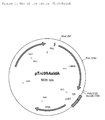
- the plasmid is designated as pTrc99AaldA ( Figure 1 ).
- the strain MG442 is transformed with the expression plasmid pTrc99AaldA described in Example 1a and with the vector pTrc99A and selected in respect of plasmid-carrying cells on LB agar with 50 ⁇ g/ml ampicillin. In this way the strains MG442/pTrc99AaldA and MG442/pTrc99A arise.
- Selected single colonies are subsequently multiplied further on minimal medium having the following composition: 3.5 g/l Na 2 HPO 4 .2H 2 O, 1.5 g/l KH 2 PO 4 , 1 g/l NH 4 Cl, 0.1 g/l MgSO 4 .7H 2 O, 2 g/l glucose, 20 g/l agar, 50 mg/l ampicillin.
- the formation of L-threonine is examined in batch cultures of 10 ml which are contained in 100 ml Erlenmeyer flasks.
- 10 ml of preculture medium having the following composition: 2 g/l yeast extract, 10 g/l (NH 4 ) 2 SO 4 , 1 g/l KH 2 PO 4 , 0.5 g/l MgSO 4 .7H 2 0, 15 g/l CaCO 3 , 20 g/l glucose, 50 mg/l ampicillin, is inoculated and incubated for 16 hours at 37 °C and at 180 rpm in an ESR incubator manufactured by kuhner AG (Birsfelden, Switzerland).
- 250 ⁇ l at a time of this preculture are inoculated into 10 ml of production medium (25 g/l (NH 4 ) 2 SO 4 , 2 g/l KH 2 PO 4 , 1 g/l MgSO 4 .7H 2 0, 0.03 g/l FeSO 4 .7H 2 O, 0.018 g/l MnSO 4 .1H 2 O, 30 g/l CaCO 3 , 20 g/l glucose, 50 mg/l ampicillin) and incubated for 48 hours at 37 °C.
- 100 mg/l isopropyl- ⁇ -D-thiogalactopyranoside (IPTG) are added in parallel charges.
- the concentration of L-threonine formed in the sterile-filtered culture supernatant is determined with an amino-acid analyzer manufactured by Eppendorf-BioTronik (Hamburg, Germany) by ion-exchange chromatography and post-column reaction with detection of ninhydrin.
- Table 1 Strain Admixtures OD (660 nm) L-threonine g/l MG442 - 5.6 1.4 MG442/pTrc99A - 3.8 1.3 MG442/pTrc99AaldA - 5.6 1.8 MG442/pTrc99AaldA IPTG 4.7 2.5
- the aldB gene from E. coli K12 is amplified by applying the polymerase chain reaction (PCR) and also synthetic oligonucleotides. Proceeding from the nucleotide sequence of the aldB gene in E. coli K12 MG1655 (Accession Number AE000436, Blattner et al. (Science 277(5331): 1453-1474 (1997 )), PCR primers are synthesized (MWG Biotech, Ebersberg, Germany). The sequences of the primers are modified in such a way that recognition sites for restriction enzymes arise.
- PCR polymerase chain reaction
- aldB1 For the aldB1 primer the recognition sequence for XbaI is chosen, and for the aldB2 primer the recognition sequence for HindIII is chosen, these recognition sequences being marked by underlining in the nucleotide sequences represented below: aldB1: 5' - CAACTATC TCTAGA ACCCTTGCCCG - 3' (SEQ ID No. 3) aldB2: 5' - CCAATGCGAC AAGCTT CTTATATC - 3' (SEQ ID No. 4)
- the chromosomal E. coli K12 MG1655 DNA employed for the PCR is isolated, in accordance with the manufacturer's instructions, with "Qiagen Genomic-tips 100/G" (QIAGEN, Hilden, Germany).
- a DNA fragment having a size of about 1680 bp can be amplified with the specific primers under standard PCR conditions ( Innis et al. (1990) PCR Protocols. A Guide to Methods and Applications, Academic Press ) with Taq -DNA-Polymerase (QIAGEN, Hilden, Germany).
- the PCR product is ligated, according to the manufacturer's instructions, with the vector pCR®2.1-TOPO (TOPO TA Cloning Kit, Invitrogen, Groningen, Netherlands) and transformed into the E. coli strain TOP10F'.
- the selection of plasmid-carrying cells is undertaken on LB agar which is pricked with 50 ⁇ g/ml ampicillin.
- the vector is cleaved with the restriction enzymes XhoI and HindIII/XbaI and, after checking by fractionation in the 0.8 % agarose gel, is designated by pCR2.1TOPOaldB.
- the vector pCR2.1TOPOaldB is restricted with the restriction enzymes HindIII and XbaI, and the aldB fragment is isolated after fractionation in the 0.8 % agarose gel with the aid of the QIAquick Gel Extraction Kit (QIAGEN, Hilden, Germany).
- the vector pTrc99A (Pharmacia Biotech, Uppsala, Sweden) is cleaved with the enzymes HindIII and XbaI and ligated with the isolated aldB fragment.
- coli strain XL1-Blue MRF' (Stratagene, La Jolla, USA) is transformed with the ligation charge and selected in respect of plasmid-carrying cells on LB agar which is pricked with 50 ⁇ g/ml ampicillin.
- the successful cloning can be confirmed after the isolation of plasmid DNA by control cleavage with the enzymes HindIII/XbaI, EcoRV and XhoI.
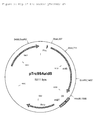
- the plasmid is designated as pTrc99AaldB ( Figure 2 ).
- the strain MG442 is transformed with the expression plasmid pTrc99AaldB described in Example 2a and with the vector pTrc99A and selected in respect of plasmid-carrying cells on LB agar with 50 ⁇ g/ml ampicillin. In this way the strains MG442/pTrc99AaldB and MG442/pTrc99A arise.
- Selected single colonies are subsequently multiplied further on minimal medium having the following composition: 3.5 g/l Na 2 HPO 4 .2H 2 O, 1.5 g/l KH 2 PO 4 , 1 g/l NH 4 Cl, 0.1 g/l MgSO 4 .7H 2 O, 2 g/l glucose, 20 g/l agar, 50 mg/l ampicillin.
- the formation of L-threonine is examined in batch cultures of 10 ml which are contained in 100 ml Erlenmeyer flasks.
- 10 ml of preculture medium having the following composition: 2 g/l yeast extract, 10 g/l (NH 4 ) 2 SO 4 , 1 g/l KH 2 PO 4 , 0.5 g/l MgSO 4 .7H 2 0, 15 g/l CaCO 3 , 20 g/l glucose, 50 mg/l ampicillin, is inoculated and incubated for 16 hours at 37 °C and at 180 rpm in an ESR incubator manufactured by kuhner AG (Birsfelden, Switzerland).
- 250 ⁇ l at a time of this preculture are inoculated into 10 ml of production medium (25 g/l (NH 4 ) 2 SO 4 , 2 g/l KH 2 PO 4 , 1 g/l MgSO 4 .7H 2 0, 0.03 g/l FeSO 4 .7H 2 O, 0.018 g/l MnSO 4 .1H 2 O, 30 g/l CaCO 3 , 20 g/l glucose, 50 mg/l ampicillin) and incubated for 48 hours at 37 °C.
- 100 mg/l isopropyl- ⁇ -D-thiogalactopyranoside (IPTG) are added in parallel charges.
- L-threonine by the parent strain MG442 is examined in the same way, but without addition of ampicillin to the medium. After the incubation, the optical density (OD) of the culture suspension is determined with an LP2W-Photometer manufactured by Dr. Lange (Düsseldorf, Germany) at a measuring-wavelength of 660 nm.
- the concentration of L-threonine formed in the sterile-filtered culture supernatant is determined with an amino-acid analyzer manufactured by Eppendorf-BioTronik (Hamburg, Germany) by ion-exchange chromatography and post-column reaction with detection of ninhydrin.
- the aldH gene from E. coli K12 is amplified by applying the polymerase chain reaction (PCR) and also synthetic oligonucleotides. Proceeding from the nucleotide sequence of the aldH gene in E. coli K12 MG1655 (Accession Number AE000228, Blattner et al. (Science 277(5331): 1453-1474 (1997 )), PCR primers are synthesized (MWG Biotech, Ebersberg, Germany). The sequences of the primers are modified in such a way that recognition sites for restriction enzymes arise.
- PCR polymerase chain reaction
- aldH5 the recognition sequence for BamHI is chosen
- the recognition sequence for SalI is chosen, these recognition sequences being marked by underlining in the nucleotide sequences represented below: aldH3: 5'- AGCC GTCGAC ACCACGCAAACGTCGCAGG -3' (SEQ ID No. 5)
- aldH5 5'- ATC GGATCC TCTGCGCCCTCACGTTCACA -3' (SEQ ID No. 6)
- the chromosomal E. coli K12 MG1655 DNA employed for the PCR is isolated, in accordance with the manufacturer's instructions, with "Qiagen Genomic-tips 100/G" (QIAGEN, Hilden, Germany).
- a DNA fragment having a size of about 1650 bp can be amplified with the specific primers under standard PCR conditions ( Innis et al. (1990) PCR Protocols. A Guide to Methods and Applications, Academic Press ) with Taq -DNA-Polymerase (QIAGEN, Hilden, Germany).
- the PCR product is ligated, according to the manufacturer's instructions, with the vector pCR-Blunt II-TOPO (Zero Blunt TOPO PCR Cloning Kit, Invitrogen, Groningen, Netherlands) and transformed into the E. coli strain TOP10.
- the selection of plasmid-carrying cells is undertaken on LB agar which is pricked with 50 ⁇ g/ml kanamycin.
- the vector is cleaved with the restriction enzymes BamHI and SalI and, after checking by fractionation in the 0.8 % agarose gel, is designated by pCRBluntaldH.
- the vector pCRBluntaldH is restricted with the restriction enzymes BamHI and SalI, and the aldH fragment is isolated after fractionation in the 0.8 % agarose gel with the aid of the QIAquick Gel Extraction Kit (QIAGEN, Hilden, Germany).
- the vector pTrc99A (Amersham Biosciences, Freiburg, Germany) is cleaved with the enzymes BamHI and SalI, subsequently dephosphorylated with alkaline phosphatase according to the manufacturer's instructions (Amersham Biosciences, Freiburg, Germany) and ligated with the isolated aldH fragment.
- coli strain XL1-Blue MRF' (Stratagene, La Jolla, USA) is transformed with the ligation charge and selected in respect of plasmid-carrying cells on LB agar which is pricked with 50 ⁇ g/ml ampicillin.
- the successful cloning can be confirmed after the isolation of plasmid DNA by control cleavage with the enzymes BamHI/SalI, EcoRI and NcoI.
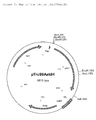
- the plasmid is designated as pTrc99AaldH ( Figure 3 ).
- the strain MG442 is transformed with the expression plasmid pTrc99AaldH described in Example 3a and with the vector pTrc99A and selected in respect of plasmid-carrying cells on LB agar with 50 ⁇ g/ml ampicillin. In this way the strains MG442/pTrc99AaldH and MG442/pTrc99A arise.
- Selected single colonies are subsequently multiplied further on minimal medium having the following composition: 3.5 g/l Na 2 HPO 4 .2H 2 O, 1.5 g/l KH 2 PO 4 , 1 g/l NH 4 Cl, 0.1 g/l MgSO 4 .7H 2 O, 2 g/l glucose, 20 g/l agar, 50 mg/l ampicillin.
- the formation of L-threonine is examined in batch cultures of 10 ml which are contained in 100 ml Erlenmeyer flasks.
- 10 ml of preculture medium having the following composition: 2 g/l yeast extract, 10 g/l (NH 4 ) 2 SO 4 , 1 g/l KH 2 PO 4 , 0.5 g/l MgSO 4 .7H 2 0, 15 g/l CaCO 3 , 20 g/l glucose, 50 mg/l ampicillin, is inoculated and incubated for 16 hours at 37 °C and at 180 rpm in an ESR incubator manufactured by kuhner AG (Birsfelden, Switzerland).
- 250 ⁇ l at a time of this preculture are inoculated into 10 ml of production medium (25 g/l (NH 4 ) 2 SO 4 , 2 g/l KH 2 PO 4 , 1 g/l MgSO 4 .7H 2 0, 0.03 g/l FeSO 4 .7H 2 O, 0.018 g/l MnSO 4 .1H 2 O, 30 g/l CaCO 3 , 20 g/l glucose, 50 mg/l ampicillin) and incubated for 48 hours at 37 °C.
- the formation of L-threonine by the parent strain MG442 is examined in the same way, but without addition of ampicillin to the medium.
- the optical density (OD) of the culture suspension is determined with an LP2W-Photometer manufactured by Dr. Lange (Düsseldorf, Germany) at a measuring-wavelength of 660 nm.
- the concentration of L-threonine formed in the sterile-filtered culture supernatant is determined with an amino-acid analyzer manufactured by Eppendorf-BioTronik (Hamburg, Germany) by ion-exchange chromatography and post-column reaction with detection of ninhydrin.
- the betB gene from E. coli K12 is amplified by applying the polymerase chain reaction (PCR) and also synthetic oligonucleotides. Proceeding from the nucleotide sequence of the betB gene in E. coli K12 MG1655 (Accession Number AE000138, Blattner et al. (Science 277: 1453-1474 (1997 )), PCR primers are synthesized (MWG Biotech, Ebersberg, Germany). The sequences of the primers are modified in such a way that recognition sites for restriction enzymes arise.
- PCR polymerase chain reaction
- betB1 For the betB1 primer the recognition sequence for XbaI is chosen, and for the betB2 primer the recognition sequence for HindIII is chosen, these recognition sequences being marked by underlining in the nucleotide sequences represented below: betB1: 5' - CAGCA TCTAGA CACCGATTAACCGAG - 3' (SEQ ID No. 7) betB2: 5' - CAAATTGCAAATA AAGCTT CTGGTTAG - 3' (SEQ ID No. 8)
- the chromosomal E. coli K12 MG1655 DNA employed for the PCR is isolated, in accordance with the manufacturer's instructions, with "Qiagen Genomic-tips 100/G" (QIAGEN, Hilden, Germany).
- a DNA fragment having a size of about 1530 bp can be amplified with the specific primers under standard PCR conditions ( Innis et al. (1990) PCR Protocols. A Guide to Methods and Applications, Academic Press ) with Taq -DNA-Polymerase (QIAGEN, Hilden, Germany).
- the PCR product is ligated, according to the manufacturer's instructions, with the vector pCR®2.1-TOPO (TOPO TA Cloning Kit, Invitrogen, Groningen, Netherlands) and transformed into the E. coli strain TOP10F'.
- the selection of plasmid-carrying cells is undertaken on LB agar which is pricked with 50 ⁇ g/ml ampicillin.
- the vector is cleaved with the restriction enzymes EcoRI and ScaI and, after checking by fractionation in the 0.8 % agarose gel, is designated by pCR2.1TOPObetB.
- the vector pCR2.iTOPObetB is restricted with the restriction enzymes HindIII and XbaI, and the betB fragment is isolated after fractionation in the 0.8 % agarose gel with the aid of the QIAquick Gel Extraction Kit (QIAGEN, Hilden, Germany).
- the vector pTrc99A (Pharmacia Biotech, Uppsala, Sweden) is cleaved with the enzymes HindIII and XbaI and ligated with the isolated betB fragment.
- coli strain XL1-Blue MRF' (Stratagene, La Jolla, USA) is transformed with the ligation charge and selected in respect of plasmid-carrying cells on LB agar which is pricked with 50 ⁇ g/ml ampicillin.
- the successful cloning can be confirmed after the isolation of plasmid DNA by control cleavage with the enzymes EcoRV, HindIII and XbaI.
- the plasmid is designated as pTrc99AbetB ( Figure 4 ).
- the strain MG442 is transformed with the expression plasmid pTrc99AbetB described in Example 4a and with the vector pTrc99A and selected in respect of plasmid-carrying cells on LB agar with 50 ⁇ g/ml ampicillin. In this way the strains MG442/pTrc99AbetB and MG442/pTrc99A arise.
- Selected single colonies are subsequently multiplied further on minimal medium having the following composition: 3.5 g/l Na 2 HPO 4 .2H 2 O, 1.5 g/l KH 2 PO 4 , 1 g/l NH 4 Cl, 0.1 g/l MgSO 4 .7H 2 O, 2 g/l glucose, 20 g/l agar, 50 mg/l ampicillin.
- the formation of L-threonine is examined in batch cultures of 10 ml which are contained in 100 ml Erlenmeyer flasks.
- 10 ml of preculture medium having the following composition: 2 g/l yeast extract, 10 g/l (NH 4 ) 2 SO 4 , 1 g/l KH 2 PO 4 , 0.5 g/l MgSO 4 .7H 2 0, 15 g/l CaCO 3 , 20 g/l glucose, 50 mg/l ampicillin, is inoculated and incubated for 16 hours at 37 °C and at 180 rpm in an ESR incubator manufactured by kuhner AG (Birsfelden, Switzerland).
- 250 ⁇ l at a time of this preculture are inoculated into 10 ml of production medium (25 g/l (NH 4 ) 2 SO 4 , 2 g/l KH 2 PO 4 , 1 g/l MgSO 4 .7H 2 0, 0.03 g/l FeSO 4 .7H 2 O, 0.018 g/l MnSO 4 .1H 2 O, 30 g/l CaCO 3 , 20 g/l glucose, 50 mg/l ampicillin) and incubated for 48 hours at 37 °C.
- the formation of L-threonine by the parent strain MG442 is examined in the same way, but without addition of ampicillin to the medium.
- the optical density (OD) of the culture suspension is determined with an LP2W-Photometer manufactured by Dr. Lange (Düsseldorf, Germany) at a measuring-wavelength of 660 nm.
- the concentration of L-threonine formed in the sterile-filtered culture supernatant is determined with an amino-acid analyzer manufactured by Eppendorf-BioTronik (Hamburg, Germany) by ion-exchange chromatography and post-column reaction with detection of ninhydrin.
- Length data are to be interpreted as approximate data.
- the abbreviations and designations that are used have the following meanings:
Landscapes
- Chemical & Material Sciences (AREA)
- Organic Chemistry (AREA)
- Life Sciences & Earth Sciences (AREA)
- Zoology (AREA)
- Engineering & Computer Science (AREA)
- Wood Science & Technology (AREA)
- Health & Medical Sciences (AREA)
- Genetics & Genomics (AREA)
- Bioinformatics & Cheminformatics (AREA)
- Microbiology (AREA)
- Biotechnology (AREA)
- Biochemistry (AREA)
- General Engineering & Computer Science (AREA)
- General Health & Medical Sciences (AREA)
- Chemical Kinetics & Catalysis (AREA)
- General Chemical & Material Sciences (AREA)
- Biomedical Technology (AREA)
- Molecular Biology (AREA)
- Medicinal Chemistry (AREA)
- Preparation Of Compounds By Using Micro-Organisms (AREA)
- Micro-Organisms Or Cultivation Processes Thereof (AREA)
Abstract
a) fermentation of the microorganisms of the Enterobacteriaceae family which produce the desired L-amino acid and in which at least the betB gene and optionally one or more of the genes selected from the group comprising aldA, aldB and aldH or nucleotide sequences that code for them, is/are enhanced, in particular over-expressed,
b) concentration of the desired L-amino acid in the medium or in the cells of the bacteria, and
c) isolation of the desired L-amino acid.
Description
- This invention relates to a process for the preparation of L-amino acids, in particular L-threonine, using strains of the Enterobacteriaceae family in which at least one or more of the genes selected from the group comprising aldA, aldB, aldH and betB is/are enhanced.
- L-amino acids, in particular L-threonine, find application in human medicine and in the pharmaceuticals industry, in the foodstuffs industry and quite particularly in animal nutrition.
- It is known that L-amino acids are prepared by fermentation of strains of Enterobacteriaceae, in particular Escherichia coli (E. coli) and Serratia marcescens. Because of their great importance, work is constantly being undertaken to improve the preparation processes. Improvements to the process can relate to technical fermentation measures, such as, for example, stirring and supply of oxygen, or to the composition of the nutrient media, such as, for example, the sugar concentration during fermentation, or to the reworking into product form, for example by ion-exchange chromatography, or to the intrinsic output properties of the microorganism itself.
- Methods of mutagenesis, selection and mutant selection are used to improve the output properties of these microorganisms. Strains that are resistant to antimetabolites, such as, for example, the threonine analogue α-amino-β-hydroxyvaleric acid (AHV), or that are auxotrophic in respect of metabolites of regulatory importance and produce L-amino acid, such as, for example, L-threonine, are obtained in this manner.
- Methods of recombinant DNA technology have also been employed for some years for strain improvement of strains of the Enterobacteriaceae family that produce L-amino acids, by amplifying individual amino-acid-biosynthesis genes and investigating the effect on production.
- The inventors had the object of providing new measures for improved preparation of L-amino acids, in particular L-threonine.
- The invention provides a process for the preparation of L-amino acids, in particular L-threonine, using microorganisms of the Enterobacteriaceae family which, in particular, already produce L-amino acids and in which at least one or more of the nucleotide sequence(s) that code(s) for the genes aldA, aldB, aldH and betB is/are enhanced.
- Where L-amino acids or amino acids are mentioned in the following, these terms mean one or more amino acids, including their salts, selected from the group comprising L-asparagine, L-threonine, L-serine, L-glutamate, L-glycine, L-alanine, L-cysteine, L-valine, L-methionine, L-isoleucine, L-leucine, L-tyrosine, L-phenylalanine, L-histidine, L-lysine, L-tryptophan and L-arginine. L-threonine is particularly preferred.
- The term "enhancement" in this connection describes the increase in the intracellular activity of one or more enzymes or proteins in a microorganism that are coded by the corresponding DNA, for example by increasing the number of copies of the gene or genes, using a strong promoter or a gene or allele that codes for a corresponding enzyme or protein with a high activity, and optionally combining these measures.
- By the measures of enhancement, in particular over-expression, the activity or concentration of the corresponding protein is generally increased by at least 10 %, 25 %, 50 %, 75 %, 100 %, 150 %, 200 %, 300 %, 400 % or 500 %, up to a maximum of 1000 % or 2000 %, relative to that of the wild-type protein or the activity or concentration of the protein in the initial microorganism.
- The process is characterized in that the following steps are carried out:
- a) fermentation of the microorganisms of the Enterobacteriaceae family which produce the desired L-amino acid and in which the betB gene and optionally one or more of the genes selected from the group comprising aldA, aldB and aldH or nucleotide sequences that code for them is/are enhanced, in particular over-expressed,
- b) concentration of the desired L-amino acid in the medium or in the cells of the microorganisms, and
- c) isolation of the desired L-amino acid, whereby constituents of the fermentation broth and/or the biomass in its entirety or in proportions (≥ 0 to 100 %) thereof optionally remain in the product.
- The microorganisms that the present invention provides can produce L-amino acids from glucose, sucrose, lactose, fructose, maltose, molasses, optionally starch, optionally cellulose or from glycerol and ethanol. They are representatives of the Enterobacteriaceae family selected from the genera Escherichia, Erwinia, Providencia and Serratia. The genera Escherichia and Serratia are preferred. Of the genus Escherichia the species Escherichia coli, and of the genus Serratia the species Serratia marcescens, are to be mentioned in particular.
- Suitable strains, which produce L-threonine in particular, of the genus Escherichia, in particular of the species Escherichia coli, are, for example:
- Escherichia coli TF427
- Escherichia coli H4578
- Escherichia coli KY10935
- Escherichia coli VNIIgenetika MG442
- Escherichia coli VNIIgenetika M1
- Escherichia coli VNIIgenetika 472T23
- Escherichia coli BKIIM B-3996
- Escherichia coli kat 13
- Escherichia coli KCCM-10132.
- Suitable L-threonine-producing strains of the genus Serratia, in particular of the species Serratia marcescens, are, for example:
- Serratia marcescens HNr21
- Serratia marcescens TLr156
- Serratia marcescens T2000.
- Strains from the Enterobacteriaceae family that produce L-threonine preferably have, inter alia, one or more genetic or phenotypic features selected from the group comprising: resistance to α-amino-β-hydroxyvaleric acid, resistance to thialysine, resistance to ethionine, resistance to α-methylserine, resistance to diaminosuccinic acid, resistance to α-aminobutyric acid, resistance to borrelidin, resistance to rifampicin, resistance to valine analogues such as, for example, valine hydroxamate, resistance to purine analogues such as, for example, 6-dimethylaminopurine, a need for L-methionine, optionally a partial and compensable need for L-isoleucine, a need for meso-diaminopimelic acid, auxotrophy in respect of threonine-containing dipeptides, resistance to L-threonine, resistance to L-homoserine, resistance to L-lysine, resistance to L-methionine, resistance to L-glutamic acid, resistance to L-aspartate, resistance to L-leucine, resistance to L-phenylalanine, resistance to L-serine, resistance to L-cysteine, resistance to L-valine, sensitivity to fluoropyruvate, defective threonine dehydrogenase, optionally a capacity for sucrose utilization, enhancement of the threonine operon, enhancement of homoserine dehydrogenase I-aspartate kinase I, preferably of the feedback-resistant form, enhancement of homoserine kinase, enhancement of threonine synthase, enhancement of aspartate kinase, optionally of the feedback-resistant form, enhancement of aspartate semialdehyde dehydrogenase, enhancement of phosphoenol pyruvate carboxylase, optionally of the feedback-resistant form, enhancement of phosphoenol pyruvate synthase, enhancement of transhydrogenase, enhancement of the RhtB gene product, enhancement of the RhtC gene product, enhancement of the YfiK gene product, enhancement of a pyruvate carboxylase, and attenuation of acetic-acid formation.
- It has been found that microorganisms of the Enterobacteriaceae family produce L-amino acids, in particular L-threonine, in improved manner after enhancement, in particular over-expression, of at least one or more of the genes selected from the group comprising aldA, aldB, aldH and betB.
- The nucleotide sequences of the genes of Escherichia coli belong to the prior art (see the following text references) and can also be found in the genome sequence of Escherichia coli published by Blattner et al. (Science 277: 1453-1462 (1997)).
- The genes aldA, aldB, aldH and betB are described by, inter alia, the following data:
aldA gene: Description: Aldehyde dehydrogenase, NAD-dependent EC No.: 1.2.1.22 Reference: Hidalgo et al.; Journal of Bacteriology 173(19): 6118-6123 (1991) Limon et al.; International Microbiology 2(1): 33-38 (1999) Accession No.: AE000239 Alternative gene name: ald aldB gene: Description: Aldehyde dehydrogenase B, lactaldehyde dehydrogenase, breakdown of small molecules (carbon compounds) EC No.: 1.2.1.22 Reference: Xu and Johnson; Journal of Bacteriology 177(11): 3166-3175 (1995) Accession No.: AE000436 aldH Gene: Description: Aldehyde dehydrogenase, NADP-dependent EC No.: 1.2.1.3 Reference: Heim and Strehler; Gene 99(1): 15-23 (1991) Accession No.: AE000228 betB gene: Description: Betaine aldehyde dehydrogenase, NAD-dependent EC No.: 1.2.1.8 Reference: Lamark et al.; Molecular Microbiology 5(5): 1049-1064 (1991) Falkenberg and Strom; Biochimica et Biophysica Acta 1034(3): 253-259 (1990) Accession No.: AE000138 - The nucleic-acid sequences can be found in the databases of the National Center for Biotechnology Information (NCBI) of the National Library of Medicine (Bethesda, MD, USA), in the Nucleotide Sequence Database of the European Molecular Biologies Laboratories (EMBL, Heidelberg, Germany or Cambridge, UK) or in the DNA Database of Japan (DDBJ, Mishima, Japan).
- The genes described in the specified text references can be used in accordance with the invention. Alleles of the genes that arise from the degeneracy of the genetic code or as a result of functionally neutral sense mutations can furthermore be used. The use of endogenous genes is preferred.
- "Endogenous genes" or "endogenous nucleotide sequences" are to be understood as meaning the genes or alleles or nucleotide sequences that are present in the population of a species.
- To achieve an enhancement, the expression of the genes or the catalytic properties of the proteins can, for example, be enhanced. The two measures can optionally be combined.
- To achieve an over-expression, the number of copies of the corresponding genes can be increased, or the promoter and regulation region or the ribosome-binding site upstream of the structural gene can be mutated. Expression cassettes that are incorporated upstream of the structural gene act in the same way. By means of inducible promoters it is additionally possible to intensify the expression in the course of fermentative production of L-threonine. The expression is likewise improved by measures to prolong the life of the mRNA. Furthermore, the enzyme activity is also increased by preventing the degradation of the enzyme protein. The genes or gene constructs may either be present in plasmids with a varying number of copies or may be integrated and amplified in the chromosome. Alternatively, an over-expression of the genes in question can furthermore be achieved by changing the composition of the media and the culture procedure.
- A person skilled in the art can find instructions on this, inter alia, in Chang and Cohen (Journal of Bacteriology 134: 1141-1156 (1978)), in Hartley and Gregori (Gene 13: 347-353 (1981)), in Amann and Brosius (Gene 40: 183-190 (1985)), in de Broer et al. (Proceedings of the National Academy of Sciences of the United States of America 80: 21-25 (1983)), in LaVallie et al. (BIO/TECHNOLOGY 11: 187-193 (1993)), in
PCT/US97/13359 - Plasmid vectors that can replicate in Enterobacteriaceae, such as, for example, cloning vectors derived from pACYC184 (Bartolomé et al.; Gene 102: 75-78 (1991)), pTrc99A (Amann et al.; Gene 69: 301-315 (1988)) or pSC101 derivatives (Vocke and Bastia, Proceedings of the National Academy of Sciences USA 80(21): 6557-6561 (1983)) can be used. A strain transformed with a plasmid vector, where the plasmid vector carries at least one or more of the genes selected from the group comprising aldA, aldB, aldH and betB, or nucleotide sequences that code for them, can be employed in a process according to the invention.
- It is also possible to transfer mutations that affect the expression of the particular genes into various strains by sequence exchange (Hamilton et al.; (Journal of Bacteriology 171: 4617-4622 (1989)), conjugation or transduction.
- It may furthermore be advantageous for the production of L-amino acids, in particular L-threonine, with strains of the Enterobacteriaceae family to enhance one or more enzymes of the known threonine-biosynthesis pathway or enzymes of anaplerotic metabolism or enzymes for the production of reduced nicotinamide adenine dinucleotide phosphate or enzymes of glycolysis or PTS enzymes or enzymes of sulfur metabolism, in addition to the enhancement of the betB gene and optionally one or more of the genes selected from the group comprising aldA, aldB and aldH. The use of endogenous genes is generally preferred.
- Thus, for example, at the same time one or more of the genes selected from the group comprising
- the thrABC operon which codes for aspartate kinase, homoserine dehydrogenase, homoserine kinase and threonine synthase (
US-A-4,278,765 ), - the pyc gene which codes for pyruvate carboxylase (
DE-A-19 831 609 ), - the pps gene which codes for phosphoenol pyruvate synthase (Molecular and General Genetics 231(2): 332-336 (1992)),
- the ppc gene which codes for phosphoenol pyruvate carboxylase (Gene 31: 279-283 (1984)),
- the pntA and pntB genes which code for transhydrogenase (European Journal of Biochemistry 158: 647-653 (1986)),
- the rhtB gene which imparts homoserine resistance (
EP-A-0 994 190 ), - the mqo gene which codes for malate:quinone oxidoreductase (
DE 100 348 33.5 ), - the rhtC gene which imparts threonine resistance (
EP-A-1 013 765 ), - the thrE gene of Corynebacterium glutamicum which codes for the threonine-export protein (
DE 100 264 94.8 ), - the gdhA gene which codes for glutamate dehydrogenase (Nucleic Acids Research 11: 5257-5266 (1983); Gene 23: 199-209 (1983)),
- the hns gene which codes for the DNA-binding protein HLP-II (Molecular and General Genetics 212: 199-202 (1988)),
- the pgm gene which codes for phosphoglucomutase (Journal of Bacteriology 176: 5847-5851 (1994)),
- the fba gene which codes for fructose biphosphate aldolase (Biochemical Journal 257: 529-534 (1989)),
- the ptsH gene of the ptsHIcrr operon which codes for the phosphohistidine protein hexose phosphotransferase of the phosphotransferase system PTS (Journal of Biological Chemistry 262: 16241-16253 (1987)),
- the ptsI gene of the ptsHIcrr operon which codes for enzyme I of the phosphotransferase system PTS (Journal of Biological Chemistry 262: 16241-16253 (1987)),
- the crr gene of the ptsHIcrr operon which codes for the glucose-specific IIA component of the phosphotransferase system PTS (Journal of Biological Chemistry 262: 16241-16253 (1987)),
- the ptsG gene which codes for the glucose-specific IIBC component (Journal of Biological Chemistry 261: 16398-16403 (1986)),
- the lrp gene which codes for the regulator of the leucine regulon (Journal of Biological Chemistry 266: 10768-10774 (1991)),
- the csrA gene which codes for the global regulator Csr (Journal of Bacteriology 175: 4744-4755 (1993)),
- the fadR gene which codes for the regulator of the fad regulon (Nucleic Acids Research 16: 7995-8009 (1988)),
- the iclR gene which codes for the regulator of central intermediary metabolism (Journal of Bacteriology 172: 2642-2649 (1990)),
- the mopB gene which codes for the 10 Kd chaperone (Journal of Biological Chemistry 261: 12414-12419 (1986)) and is also known by the name 'groES',
- the ahpC gene of the ahpCF operon which codes for the small subunit of alkyl hydroperoxide reductase (Proceedings of the National Academy of Sciences USA 92: 7617-7621 (1995)),
- the ahpF gene of the ahpCF operon which codes for the large subunit of alkyl hydroperoxide reductase (Proceedings of the National Academy of Sciences USA 92: 7617-7621 (1995)),
- the cysK gene which codes for cysteine synthase A (Journal of Bacteriology 170: 3150-3157 (1988)),
- the cysB gene which codes for the regulator of the cys regulon (Journal of Biological Chemistry 262: 5999-6005 (1987)),
- the cysJ gene of the cysJIH operon which codes for the flavoprotein of NADPH sulfite reductase (Journal of Biological Chemistry 264: 15796-15808 (1989), Journal of Biological Chemistry 264: 15726-15737 (1989)),
- the cysI gene of the cysJIH operon which codes for the haemoprotein of NADPH sulfite reductase (Journal of Biological Chemistry 264: 15796-15808 (1989), Journal of Biological Chemistry 264: 15726-15737 (1989)),
- the cysH gene of the cysJIH operon which codes for adenylyl sulfate reductase (Journal of Biological Chemistry 264: 15796-15808 (1989), Journal of Biological Chemistry 264: 15726-15737 (1989)),
- the phoB gene of the phoBR operon which codes for the positive regulator PhoB of the pho regulon (Journal of Molecular Chemistry 190 (1): 37-44 (1986)),
- the phoR gene of the phoBR operon which codes for the sensor protein of the pho regulon (Journal of Molecular Biology 192 (3): 549-556 (1986)),
- the phoE gene which codes for protein E of the outer cell membrane (Journal of Molecular Biology 163 (4): 513-532 (1983)),
- the pykF gene which codes for pyruvate kinase I which is stimulated by fructose (Journal of Bacteriology 177 (19): 5719-5722 (1995)),
- the pkfB gene which codes for 6-phosphofructokinase II (Gene 28 (3): 337-342 (1984)),
- the malE gene which codes for the periplasmic binding protein of maltose transport (Journal of Biological Chemistry 259 (16): 10606-10613 (1984)),
- the rseA gene of the rseABC operon which codes for a membrane protein with anti-sigmaE activity (Molecular Microbiology 24 (2): 355-371 (1997)),
- the rseC gene of the rseABC operon which codes for a global regulator of the sigmaE factor (Molecular Microbiology 24 (2): 355-371 (1997)),
- the sodA gene which codes for superoxide dismutase (Journal of Bacteriology 155 (3): 1078-1087 (1983)),
- the sucA gene of the sucABCD operon which codes for the decarboxylase subunit of 2-ketoglutarate dehydrogenase (European Journal of Biochemistry 141 (2): 351-359 (1984)),
- the sucB gene of the sucABCD operon which codes for the dihydrolipoyl transsuccinase E2 subunit of 2-ketoglutarate dehydrogenase (European Journal of Biochemistry 141 (2): 361-374 (1984)),
- the sucC gene of the sucABC operon which codes for the β-subunit of succinyl-CoA synthetase (Biochemistry 24 (22): 6245-6252 (1985)) and
- the sucD gene of the sucABCD operon which codes for the α-subunit of succinyl-CoA synthetase (Biochemistry 24 (22): 6245-6252 (1985))
can be enhanced, in particular over-expressed. - It may furthermore be advantageous for the production of L-amino acids, in particular L-threonine, in addition to the enhancement of one or more of the genes selected from the group comprising aldA, aldB, aldH and betB, for one or more genes selected from the group comprising
- the tdh gene which codes for threonine dehydrogenase (Journal of Bacteriology 169: 4716-4721 (1987)),
- the mdh gene which codes for malate dehydrogenase (E.C. 1.1.1.37) (Archives in Microbiology 149: 36-42 (1987)),
- the gene product of the open reading frame (orf) yjfA (Accession Number AAC77180 of the National Center for Biotechnology Information (NCBI, Bethesda, MD, USA)),
- the gene product of the open reading frame (orf) ytfP (Accession Number AAC77179 of the National Center for Biotechnology Information (NCBI, Bethesda, MD, USA)),
- the pckA gene which codes for the enzyme phosphoenol pyruvate carboxykinase (Journal of Bacteriology 172: 7151-7156 (1990)),
- the poxB gene which codes for pyruvate oxidase (Nucleic Acids Research 14 (13): 5449-5460 (1986)),
- the aceA gene which codes for the enzyme isocitrate lyase (Journal of Bacteriology 170: 4528-4536 (1988)),
- the dgsA gene which codes for the DgsA regulator of the phosphotransferase system (Bioscience, Biotechnology and Biochemistry 59: 256-261 (1995)) and is also known by the name 'mlc gene',
- the fruR gene which codes for the fructose repressor (Molecular and General Genetics 226: 332-336 (1991)) and is also known by the name 'cra gene',
- the rpoS gene which codes for the sigma38 factor (
WO 01/05939 - the aspA gene which codes for aspartate ammonium lyase (aspartase) (Nucleic Acids Research 13(6): 2063-2074 (1985)) and
- the aceB gene which codes for malate synthase A (Nucleic Acids Research 16(19): 9342 (1988))
to be attenuated, in particular eliminated, or for the expression thereof to be reduced. - The term "attenuation" in this connection describes the reduction or elimination of the intracellular activity of one or more enzymes (proteins) in a microorganism that are coded by the corresponding DNA, for example by using a weak promoter or a gene or allele that codes for a corresponding enzyme with a low activity or inactivates the corresponding enzyme (protein) or gene, and optionally combining these measures.
- By the measures of attenuation, the activity or concentration of the corresponding protein is generally lowered to 0 to 75 %, 0 to 50 %, 0 to 25 %, 0 to 10 % or 0 to 5 % of the activity or concentration of the wild-type protein, or of the activity or concentration of the protein in the initial microorganism.
- It may furthermore be advantageous for the production of L-amino acids, in particular L-threonine, in addition to the enhancement of one or more of the genes selected from the group comprising aldA, aldB, aldH and betB, to eliminate undesirable side reactions (Nakayama: "Breeding of Amino Acid Producing Microorganisms", in: Overproduction of Microbial Products, Krumphanzl, Sikyta, Vanek (eds.), Academic Press, London, UK, 1982).
- The microorganisms produced in accordance with the invention can be cultured in the batch process (batch cultivation), in the fed-batch process or in the repeated-fed-batch process. A summary of known cultivation methods is described in the textbook by Chmiel ()) or in the textbook by Storhas (Bioreaktoren und periphere Einrichtungen (Vieweg Verlag, Braunschweig/Wiesbaden, 1994)).
- The culture medium to be used must satisfy the requirements of the particular strains in suitable manner. Descriptions of culture media for various microorganisms are contained in the handbook "Manual of Methods for General Bacteriology" of the American Society for Bacteriology (Washington D.C., USA, 1981).
- Sugars and carbohydrates, such as, for example, glucose, sucrose, lactose, fructose, maltose, molasses, starch and optionally cellulose, oils and fats, such as, for example, soybean oil, sunflower oil, peanut oil and coconut oil, fatty acids, such as, for example, palmitic acid, stearic acid and linoleic acid, alcohols, such as, for example, glycerol and ethanol, and organic acids, such as, for example, acetic acid, can be used as the source of carbon. These substances can be used individually or as a mixture.
- Organic nitrogenous compounds, such as peptones, yeast extract, meat extract, malt extract, corn steep liquor, soybean flour and urea, or inorganic compounds, such as ammonium sulfate, ammonium chloride, ammonium phosphate, ammonium carbonate and ammonium nitrate, can be used as the source of nitrogen. The sources of nitrogen can be used individually or as a mixture.
- Phosphoric acid, potassium dihydrogenphosphate or dipotassium hydrogenphosphate or the corresponding sodium-containing salts can be used as the source of phosphorus. The culture medium must furthermore contain salts of metals, such as, for example, magnesium sulfate or iron sulfate, which are necessary for growth. Finally, essential growth substances, such as amino acids and vitamins, can be employed in addition to the above-mentioned substances. Suitable precursors can moreover be added to the culture medium. The named feed substances can be added to the culture in the form of a single charge or can be fed in during the cultivation in suitable manner.
- The fermentation is generally carried out at a pH of 5.5 to 9.0, in particular 6.0 to 8.0. Basic compounds, such as sodium hydroxide, potassium hydroxide, ammonia or aqueous ammonia, or acidic compounds, such as phosphoric acid or sulfuric acid, can be employed in suitable manner to control the pH of the culture. Anti-foaming agents, such as, for example, fatty-acid polyglycol esters, can be employed to control the evolution of foam. Suitable substances having a selective action, for example antibiotics, can be added to the medium to maintain the stability of plasmids. To maintain aerobic conditions, oxygen or oxygenous gas mixtures, such as air for example, are introduced into the culture. The temperature of the culture is usually 25°C to 45°C, and preferably 30°C to 40°C. Culturing is continued until a maximum of L-amino acids or L-threonine has formed. This target is usually reached within 10 hours to 160 hours.
- The analysis of L-amino acids can be undertaken by anion-exchange chromatography with subsequent ninhydrin derivation, as described by Spackman et al. (Analytical Chemistry, 30: 1190-1206 (1958)), or it can be undertaken by reversed-phase HPLC, as described by Lindroth et al. (Analytical Chemistry 51: 1167-1174 (1979)).
- The process according to the invention serves for the fermentative preparation of L-amino acids, such as, for example, L-threonine, L-isoleucine, L-valine, L-methionine, L-homoserine and L-lysine, in particular L-threonine.
- The incubation-temperature in the preparation of strains and transformants is 37 °C.
- The aldA gene from E. coli K12 is amplified by applying the polymerase chain reaction (PCR) and also synthetic oligonucleotides. Proceeding from the nucleotide sequence of the aldA gene in E. coli K12 MG1655 (Accession Number AE000239, Blattner et al. (Science 277(5331): 1453-1474 (1997)), PCR primers are synthesized (MWG Biotech, Ebersberg, Germany). The sequences of the primers are modified in such a way that recognition sites for restriction enzymes arise. For the aldA1 primer the recognition sequence for XbaI is chosen, and for the aldA2 primer the recognition sequence for HindIII is chosen, these recognition sequences being marked by underlining in the nucleotide sequences represented below:
- aldA1: 5'- CCGAAAACAAACATCTAGATCACAGGAG -3' (SEQ ID No. 1)
- aldA2: 5'- CCTCCGAAGCTTTCACTCATTAAG -3' (SEQ ID No. 2)
- The chromosomal E. coli K12 MG1655 DNA employed for the PCR is isolated, in accordance with the manufacturer's instructions, with "Qiagen Genomic-tips 100/G" (QIAGEN, Hilden, Germany). A DNA fragment having a size of about 1490 bp can be amplified with the specific primers under standard PCR conditions (Innis et al. (1990) PCR Protocols. A Guide to Methods and Applications, Academic Press) with Taq-DNA-Polymerase (QIAGEN, Hilden, Germany). The PCR product is ligated, according to the manufacturer's instructions, with the vector pCR®2.1-TOPO (TOPO TA Cloning Kit, Invitrogen, Groningen, Netherlands) and transformed into the E. coli strain TOP10F'. The selection of plasmid-carrying cells is undertaken on LB agar which is pricked with 50 µg/ml ampicillin. After the isolation of plasmid DNA, the vector is cleaved with the restriction enzymes EcoRI, BamHI and HindIII/XbaI and, after checking by fractionation in the 0.8 % agarose gel, is designated by pCR2.1TOPOaldA.
- Subsequently the vector pCR2.1TOPOaldA is restricted with the restriction enzymes HindIII and XbaI, and the aldA fragment is isolated after fractionation in the 0.8 % agarose gel with the aid of the QIAquick Gel Extraction Kit (QIAGEN, Hilden, Germany). The vector pTrc99A (Pharmacia Biotech, Uppsala, Sweden) is cleaved with the enzymes HindIII and XbaI and ligated with the isolated aldA fragment. The E. coli strain XL1-Blue MRF' (Stratagene, La Jolla, USA) is transformed with the ligation charge and selected in respect of plasmid-carrying cells on LB agar which is pricked with 50 µg/ml ampicillin. The successful cloning can be confirmed after the isolation of plasmid DNA by control cleavage with the enzymes HindIII/XbaI and PstI. The plasmid is designated as pTrc99AaldA (
Figure 1 ). - The E. coli strain MG442 which produces L-threonine is described in Patent
US-A-4,278,765 and has been deposited in the Russian National Collection of Industrial Microorganisms (VKPM, Moscow, Russia) as CMIM B-1628. - The strain MG442 is transformed with the expression plasmid pTrc99AaldA described in Example 1a and with the vector pTrc99A and selected in respect of plasmid-carrying cells on LB agar with 50 µg/ml ampicillin. In this way the strains MG442/pTrc99AaldA and MG442/pTrc99A arise.
Selected single colonies are subsequently multiplied further on minimal medium having the following composition: 3.5 g/l Na2HPO4.2H2O, 1.5 g/l KH2PO4, 1 g/l NH4Cl, 0.1 g/l MgSO4.7H2O, 2 g/l glucose, 20 g/l agar, 50 mg/l ampicillin. The formation of L-threonine is examined in batch cultures of 10 ml which are contained in 100 ml Erlenmeyer flasks. To this end, 10 ml of preculture medium having the following composition: 2 g/l yeast extract, 10 g/l (NH4)2SO4, 1 g/l KH2PO4, 0.5 g/l MgSO4.7H20, 15 g/l CaCO3, 20 g/l glucose, 50 mg/l ampicillin, is inoculated and incubated for 16 hours at 37 °C and at 180 rpm in an ESR incubator manufactured by Kühner AG (Birsfelden, Switzerland). 250 µl at a time of this preculture are inoculated into 10 ml of production medium (25 g/l (NH4)2SO4, 2 g/l KH2PO4, 1 g/l MgSO4.7H20, 0.03 g/l FeSO4.7H2O, 0.018 g/l MnSO4.1H2O, 30 g/l CaCO3, 20 g/l glucose, 50 mg/l ampicillin) and incubated for 48 hours at 37 °C. With a view to complete induction of the expression of the aldA gene, 100 mg/l isopropyl-β-D-thiogalactopyranoside (IPTG) are added in parallel charges. The formation of L-threonine by the parent strain MG442 is examined in the same way, but without addition of ampicillin to the medium. After the incubation, the optical density (OD) of the culture suspension is determined with an LP2W-Photometer manufactured by Dr. - Lange (Düsseldorf, Germany) at a measuring-wavelength of 660 nm.
- Subsequently the concentration of L-threonine formed in the sterile-filtered culture supernatant is determined with an amino-acid analyzer manufactured by Eppendorf-BioTronik (Hamburg, Germany) by ion-exchange chromatography and post-column reaction with detection of ninhydrin.
- The result of the experiment is presented in Table 1.
Table 1 Strain Admixtures OD
(660 nm)L-threonine g/l MG442 - 5.6 1.4 MG442/pTrc99A - 3.8 1.3 MG442/pTrc99AaldA - 5.6 1.8 MG442/pTrc99AaldA IPTG 4.7 2.5 - The aldB gene from E. coli K12 is amplified by applying the polymerase chain reaction (PCR) and also synthetic oligonucleotides. Proceeding from the nucleotide sequence of the aldB gene in E. coli K12 MG1655 (Accession Number AE000436, Blattner et al. (Science 277(5331): 1453-1474 (1997)), PCR primers are synthesized (MWG Biotech, Ebersberg, Germany). The sequences of the primers are modified in such a way that recognition sites for restriction enzymes arise. For the aldB1 primer the recognition sequence for XbaI is chosen, and for the aldB2 primer the recognition sequence for HindIII is chosen, these recognition sequences being marked by underlining in the nucleotide sequences represented below:
aldB1: 5' - CAACTATCTCTAGAACCCTTGCCCG - 3' (SEQ ID No. 3) aldB2: 5' - CCAATGCGACAAGCTTCTTATATC - 3' (SEQ ID No. 4) - The chromosomal E. coli K12 MG1655 DNA employed for the PCR is isolated, in accordance with the manufacturer's instructions, with "Qiagen Genomic-tips 100/G" (QIAGEN, Hilden, Germany). A DNA fragment having a size of about 1680 bp can be amplified with the specific primers under standard PCR conditions (Innis et al. (1990) PCR Protocols. A Guide to Methods and Applications, Academic Press) with Taq-DNA-Polymerase (QIAGEN, Hilden, Germany). The PCR product is ligated, according to the manufacturer's instructions, with the vector pCR®2.1-TOPO (TOPO TA Cloning Kit, Invitrogen, Groningen, Netherlands) and transformed into the E. coli strain TOP10F'. The selection of plasmid-carrying cells is undertaken on LB agar which is pricked with 50 µg/ml ampicillin. After the isolation of plasmid DNA, the vector is cleaved with the restriction enzymes XhoI and HindIII/XbaI and, after checking by fractionation in the 0.8 % agarose gel, is designated by pCR2.1TOPOaldB.
- Subsequently the vector pCR2.1TOPOaldB is restricted with the restriction enzymes HindIII and XbaI, and the aldB fragment is isolated after fractionation in the 0.8 % agarose gel with the aid of the QIAquick Gel Extraction Kit (QIAGEN, Hilden, Germany). The vector pTrc99A (Pharmacia Biotech, Uppsala, Sweden) is cleaved with the enzymes HindIII and XbaI and ligated with the isolated aldB fragment. The E. coli strain XL1-Blue MRF' (Stratagene, La Jolla, USA) is transformed with the ligation charge and selected in respect of plasmid-carrying cells on LB agar which is pricked with 50 µg/ml ampicillin. The successful cloning can be confirmed after the isolation of plasmid DNA by control cleavage with the enzymes HindIII/XbaI, EcoRV and XhoI. The plasmid is designated as pTrc99AaldB (
Figure 2 ). - The E. coli strain MG442 which produces L-threonine is described in Patent
US-A-4,278,765 and has been deposited in the Russian National Collection of Industrial Microorganisms (VKPM, Moscow, Russia) as CMIM B-1628. - The strain MG442 is transformed with the expression plasmid pTrc99AaldB described in Example 2a and with the vector pTrc99A and selected in respect of plasmid-carrying cells on LB agar with 50 µg/ml ampicillin. In this way the strains MG442/pTrc99AaldB and MG442/pTrc99A arise.
Selected single colonies are subsequently multiplied further on minimal medium having the following composition: 3.5 g/l Na2HPO4.2H2O, 1.5 g/l KH2PO4, 1 g/l NH4Cl, 0.1 g/l MgSO4.7H2O, 2 g/l glucose, 20 g/l agar, 50 mg/l ampicillin. The formation of L-threonine is examined in batch cultures of 10 ml which are contained in 100 ml Erlenmeyer flasks. To this end, 10 ml of preculture medium having the following composition: 2 g/l yeast extract, 10 g/l (NH4)2SO4, 1 g/l KH2PO4, 0.5 g/l MgSO4.7H20, 15 g/l CaCO3, 20 g/l glucose, 50 mg/l ampicillin, is inoculated and incubated for 16 hours at 37 °C and at 180 rpm in an ESR incubator manufactured by Kühner AG (Birsfelden, Switzerland). 250 µl at a time of this preculture are inoculated into 10 ml of production medium (25 g/l (NH4)2SO4, 2 g/l KH2PO4, 1 g/l MgSO4.7H20, 0.03 g/l FeSO4.7H2O, 0.018 g/l MnSO4.1H2O, 30 g/l CaCO3, 20 g/l glucose, 50 mg/l ampicillin) and incubated for 48 hours at 37 °C. With a view to complete induction of the expression of the aldB gene, 100 mg/l isopropyl-β-D-thiogalactopyranoside (IPTG) are added in parallel charges. The formation of L-threonine by the parent strain MG442 is examined in the same way, but without addition of ampicillin to the medium. After the incubation, the optical density (OD) of the culture suspension is determined with an LP2W-Photometer manufactured by Dr. Lange (Düsseldorf, Germany) at a measuring-wavelength of 660 nm. - Subsequently the concentration of L-threonine formed in the sterile-filtered culture supernatant is determined with an amino-acid analyzer manufactured by Eppendorf-BioTronik (Hamburg, Germany) by ion-exchange chromatography and post-column reaction with detection of ninhydrin.
- The result of the experiment is presented in Table 2.
Table 2 Strain Admixtures OD
(660 nm)L-threonine g/l MG442 - 5.6 1.4 MG442/pTrc99A - 3.8 1.3 MG442/pTrc99AaldB - 4.6 2.0 MG442/pTrc99AaldB IPTG 4.4 2.1 - The aldH gene from E. coli K12 is amplified by applying the polymerase chain reaction (PCR) and also synthetic oligonucleotides. Proceeding from the nucleotide sequence of the aldH gene in E. coli K12 MG1655 (Accession Number AE000228, Blattner et al. (Science 277(5331): 1453-1474 (1997)), PCR primers are synthesized (MWG Biotech, Ebersberg, Germany). The sequences of the primers are modified in such a way that recognition sites for restriction enzymes arise. For the aldH5 primer the recognition sequence for BamHI is chosen, and for the aldH3 primer the recognition sequence for SalI is chosen, these recognition sequences being marked by underlining in the nucleotide sequences represented below:
aldH3: 5'- AGCCGTCGACACCACGCAAACGTCGCAGG -3' (SEQ ID No. 5) aldH5: 5'- ATCGGATCCTCTGCGCCCTCACGTTCACA -3' (SEQ ID No. 6) - The chromosomal E. coli K12 MG1655 DNA employed for the PCR is isolated, in accordance with the manufacturer's instructions, with "Qiagen Genomic-tips 100/G" (QIAGEN, Hilden, Germany). A DNA fragment having a size of about 1650 bp can be amplified with the specific primers under standard PCR conditions (Innis et al. (1990) PCR Protocols. A Guide to Methods and Applications, Academic Press) with Taq-DNA-Polymerase (QIAGEN, Hilden, Germany). The PCR product is ligated, according to the manufacturer's instructions, with the vector pCR-Blunt II-TOPO (Zero Blunt TOPO PCR Cloning Kit, Invitrogen, Groningen, Netherlands) and transformed into the E. coli strain TOP10. The selection of plasmid-carrying cells is undertaken on LB agar which is pricked with 50 µg/ml kanamycin. After the isolation of plasmid DNA, the vector is cleaved with the restriction enzymes BamHI and SalI and, after checking by fractionation in the 0.8 % agarose gel, is designated by pCRBluntaldH.
- Subsequently the vector pCRBluntaldH is restricted with the restriction enzymes BamHI and SalI, and the aldH fragment is isolated after fractionation in the 0.8 % agarose gel with the aid of the QIAquick Gel Extraction Kit (QIAGEN, Hilden, Germany). The vector pTrc99A (Amersham Biosciences, Freiburg, Germany) is cleaved with the enzymes BamHI and SalI, subsequently dephosphorylated with alkaline phosphatase according to the manufacturer's instructions (Amersham Biosciences, Freiburg, Germany) and ligated with the isolated aldH fragment. The E. coli strain XL1-Blue MRF' (Stratagene, La Jolla, USA) is transformed with the ligation charge and selected in respect of plasmid-carrying cells on LB agar which is pricked with 50 µg/ml ampicillin. The successful cloning can be confirmed after the isolation of plasmid DNA by control cleavage with the enzymes BamHI/SalI, EcoRI and NcoI. The plasmid is designated as pTrc99AaldH (
Figure 3 ). - The E. coli strain MG442 which produces L-threonine is described in Patent
US-A-4,278,765 and has been deposited in the Russian National Collection of Industrial Microorganisms (VKPM, Moscow, Russia) as CMIM B-1628. - The strain MG442 is transformed with the expression plasmid pTrc99AaldH described in Example 3a and with the vector pTrc99A and selected in respect of plasmid-carrying cells on LB agar with 50 µg/ml ampicillin. In this way the strains MG442/pTrc99AaldH and MG442/pTrc99A arise.
Selected single colonies are subsequently multiplied further on minimal medium having the following composition: 3.5 g/l Na2HPO4.2H2O, 1.5 g/l KH2PO4, 1 g/l NH4Cl, 0.1 g/l MgSO4.7H2O, 2 g/l glucose, 20 g/l agar, 50 mg/l ampicillin. The formation of L-threonine is examined in batch cultures of 10 ml which are contained in 100 ml Erlenmeyer flasks. To this end, 10 ml of preculture medium having the following composition: 2 g/l yeast extract, 10 g/l (NH4)2SO4, 1 g/l KH2PO4, 0.5 g/l MgSO4.7H20, 15 g/l CaCO3, 20 g/l glucose, 50 mg/l ampicillin, is inoculated and incubated for 16 hours at 37 °C and at 180 rpm in an ESR incubator manufactured by Kühner AG (Birsfelden, Switzerland). 250 µl at a time of this preculture are inoculated into 10 ml of production medium (25 g/l (NH4)2SO4, 2 g/l KH2PO4, 1 g/l MgSO4.7H20, 0.03 g/l FeSO4.7H2O, 0.018 g/l MnSO4.1H2O, 30 g/l CaCO3, 20 g/l glucose, 50 mg/l ampicillin) and incubated for 48 hours at 37 °C. The formation of L-threonine by the parent strain MG442 is examined in the same way, but without addition of ampicillin to the medium. After the incubation, the optical density (OD) of the culture suspension is determined with an LP2W-Photometer manufactured by Dr. Lange (Düsseldorf, Germany) at a measuring-wavelength of 660 nm. - Subsequently the concentration of L-threonine formed in the sterile-filtered culture supernatant is determined with an amino-acid analyzer manufactured by Eppendorf-BioTronik (Hamburg, Germany) by ion-exchange chromatography and post-column reaction with detection of ninhydrin.
- The result of the experiment is presented in Table 3.
Table 3 Strain OD
(660 nm)L-threonine g/l MG442 5.6 1.4 MG442/pTrc99A 3.8 1.3 MG442/pTrc99AaldH 5.6 3.3 - The betB gene from E. coli K12 is amplified by applying the polymerase chain reaction (PCR) and also synthetic oligonucleotides. Proceeding from the nucleotide sequence of the betB gene in E. coli K12 MG1655 (Accession Number AE000138, Blattner et al. (Science 277: 1453-1474 (1997)), PCR primers are synthesized (MWG Biotech, Ebersberg, Germany). The sequences of the primers are modified in such a way that recognition sites for restriction enzymes arise. For the betB1 primer the recognition sequence for XbaI is chosen, and for the betB2 primer the recognition sequence for HindIII is chosen, these recognition sequences being marked by underlining in the nucleotide sequences represented below:
betB1: 5' - CAGCATCTAGACACCGATTAACCGAG - 3' (SEQ ID No. 7) betB2: 5' - CAAATTGCAAATAAAGCTTCTGGTTAG - 3' (SEQ ID No. 8) - The chromosomal E. coli K12 MG1655 DNA employed for the PCR is isolated, in accordance with the manufacturer's instructions, with "Qiagen Genomic-tips 100/G" (QIAGEN, Hilden, Germany). A DNA fragment having a size of about 1530 bp can be amplified with the specific primers under standard PCR conditions (Innis et al. (1990) PCR Protocols. A Guide to Methods and Applications, Academic Press) with Taq-DNA-Polymerase (QIAGEN, Hilden, Germany). The PCR product is ligated, according to the manufacturer's instructions, with the vector pCR®2.1-TOPO (TOPO TA Cloning Kit, Invitrogen, Groningen, Netherlands) and transformed into the E. coli strain TOP10F'. The selection of plasmid-carrying cells is undertaken on LB agar which is pricked with 50 µg/ml ampicillin. After the isolation of plasmid DNA, the vector is cleaved with the restriction enzymes EcoRI and ScaI and, after checking by fractionation in the 0.8 % agarose gel, is designated by pCR2.1TOPObetB.
- Subsequently the vector pCR2.iTOPObetB is restricted with the restriction enzymes HindIII and XbaI, and the betB fragment is isolated after fractionation in the 0.8 % agarose gel with the aid of the QIAquick Gel Extraction Kit (QIAGEN, Hilden, Germany). The vector pTrc99A (Pharmacia Biotech, Uppsala, Sweden) is cleaved with the enzymes HindIII and XbaI and ligated with the isolated betB fragment. The E. coli strain XL1-Blue MRF' (Stratagene, La Jolla, USA) is transformed with the ligation charge and selected in respect of plasmid-carrying cells on LB agar which is pricked with 50 µg/ml ampicillin. The successful cloning can be confirmed after the isolation of plasmid DNA by control cleavage with the enzymes EcoRV, HindIII and XbaI. The plasmid is designated as pTrc99AbetB (
Figure 4 ). - The E. coli strain MG442 which produces L-threonine is described in Patent
US-A-4,278,765 and has been deposited in the Russian National Collection of Industrial Microorganisms (VKPM, Moscow, Russia) as CMIM B-1628. - The strain MG442 is transformed with the expression plasmid pTrc99AbetB described in Example 4a and with the vector pTrc99A and selected in respect of plasmid-carrying cells on LB agar with 50 µg/ml ampicillin. In this way the strains MG442/pTrc99AbetB and MG442/pTrc99A arise.
Selected single colonies are subsequently multiplied further on minimal medium having the following composition: 3.5 g/l Na2HPO4.2H2O, 1.5 g/l KH2PO4, 1 g/l NH4Cl, 0.1 g/l MgSO4.7H2O, 2 g/l glucose, 20 g/l agar, 50 mg/l ampicillin. The formation of L-threonine is examined in batch cultures of 10 ml which are contained in 100 ml Erlenmeyer flasks. To this end, 10 ml of preculture medium having the following composition: 2 g/l yeast extract, 10 g/l (NH4)2SO4, 1 g/l KH2PO4, 0.5 g/l MgSO4.7H20, 15 g/l CaCO3, 20 g/l glucose, 50 mg/l ampicillin, is inoculated and incubated for 16 hours at 37 °C and at 180 rpm in an ESR incubator manufactured by Kühner AG (Birsfelden, Switzerland). 250 µl at a time of this preculture are inoculated into 10 ml of production medium (25 g/l (NH4)2SO4, 2 g/l KH2PO4, 1 g/l MgSO4.7H20, 0.03 g/l FeSO4.7H2O, 0.018 g/l MnSO4.1H2O, 30 g/l CaCO3, 20 g/l glucose, 50 mg/l ampicillin) and incubated for 48 hours at 37 °C. The formation of L-threonine by the parent strain MG442 is examined in the same way, but without addition of ampicillin to the medium. After the incubation, the optical density (OD) of the culture suspension is determined with an LP2W-Photometer manufactured by Dr. Lange (Düsseldorf, Germany) at a measuring-wavelength of 660 nm. - Subsequently the concentration of L-threonine formed in the sterile-filtered culture supernatant is determined with an amino-acid analyzer manufactured by Eppendorf-BioTronik (Hamburg, Germany) by ion-exchange chromatography and post-column reaction with detection of ninhydrin.
- The result of the experiment is presented in Table 4.
Table 4 Strain OD
(660 nm)L-threonine g/l MG442 5.6 1.4 MG442/pTrc99A 3.8 1.3 MG442/pTrc99AbetB 4.2 2.6 -
- Figure 1:
- Map of the vector pTrc99AaldA
- Figure 2:
- Map of the vector pTrc99AaldB
- Figure 3:
- Map of the vector pTrc99AaldH
- Figure 4:
- Map of the vector pTrc99AbetB
- Length data are to be interpreted as approximate data. The abbreviations and designations that are used have the following meanings:
- Amp: ampicillin-resistance gene
- lacI: gene for the repressor protein of the trc promoter
- Ptrc: trc promoter region, IPTG-inducible
- aldA: coding region of the aldA gene
- aldB: coding region of the aldB gene
- aldH: coding region of the aldH gene
- betB: coding region of the betB gene
- 5S: 5S rRNA region
- rrnBT: rRNA terminator region
- The abbreviations for the restriction enzymes have the following meanings:
- BamHI: restriction endonuclease derived from Bacillus amyloliquefaciens H
- EcoRI: restriction endonuclease derived from Escherichia coli RY13
- EcoRV: restriction endonuclease derived from Escherichia coli B946
- HindIII: restriction endonuclease derived from Haemophilus influenzae
- NcoI: restriction endonuclease derived from Rhodococcus sp. ATCC® 19070
- PstI: restriction endonuclease derived from Providencia stuartii
- SalI: restriction endonuclease derived from Streptomyces albus G
- XbaI: restriction endonuclease derived from Xanthomonas badrii
- XhoI: restriction endonuclease derived from Xanthomonas holcicola


Claims (6)
- A process for the preparation of L-amino acids, wherein the following steps are carried out:a) fermentation of microorganisms of the Enterobacteriaceae family which produce the desired L-amino acid and in which the betB gene is enhanced, in particular overexpressed,b) concentration of the desired L-amino acid in the medium or in the cells of the microorganisms, andc) isolation of the desired L-amino acid, whereby constituents of the fermentation broth and/or the biomass in its entirety or portions (> 0 to 100%) thereof optionally remain in the product.
- Process according to claim 1, wherein the
polynucleotides of one or more genes selected from the group comprising aldA aldB and aldH is (are) enhanced, whereby aldB encodes aldehyde dehydrogenase B, aldH encodes aldehyde dehydrogenase, NADP dependent and aldA encodes aldehyde dehydrogenase, NAD dependent. - Process according to claim 1 or 2, wherein for the preparation of L-amino acids microorganisms of the Enterobacteriaceae family are fermented in which additionally at the same time one or more of the genes selected from the group comprising:3.1 the thrABC operon which codes for aspartate kinase, homoserine dehydrogenase, homoserine kinase and threonine synthase,3.2 the pyc gene which codes for pyruvate carboxylase,3.3 the pps gene which codes for phosphoenolpyruvate synthase,3.4 the ppc gene which codes for phosphoenolpyruvate carboxylase,3.5 the pntA and pntB genes which code for transhydrogenase,3.6 the Escherichia coli rhtB gene coding for a protein imparting homoserine resistance,3.7 the mqo gene which codes for malate:quinone oxidoreductase,3.8 the Escherichia coli rhtC gene coding for a protein imparting threonine resistance,3.9 the thrE gene which codes for the threonine export protein,3.10 the gdhA gene which codes for glutamate dehydrogenase,3.11 the hns gene which codes for the DNA-binding protein HLP-II,3.12 the pgm gene, which codes for phosphoglucoisomerase,3.13 the fba gene which codes for fructose bisphosphate aldolase,3.14 the ptsH gene which codes for the phosphohistidine protein hexose phosphotransferase,3.15 the ptsI gene which codes for enzyme I of the phosphotransferase system,3.16 the crr gene which codes for the glucose-specific IIA component,3.17 the ptsG gene which codes for the glucose-specific IIBC component,3.18 the lrp gene, which codes for the regulator of the leucine regulon,3.19 the csrA gene, which codes for the global regulator Csr,3.20 the fadR gene, which codes for the regulator FadR of fatty acid and acetate metabolism,3.21 the iclR gene, which codes for the regulator IclR,3.22 the mopB gene, which codes for the 10 kD chaperone,3.23 the ahpC gene, which codes for the small subunit of alkyl hydroperoxide reductase,3.24 the ahpF gene, which codes for the large subunit of alkyl hydroperoxide reductase,3.25 the cysK gene, which codes for cysteine synthase A,3.26 the cysB gene, which codes for the regulator of the cys regulon,3.27 the cysJ gene, which codes for the flavoprotein of NADPH-sulfite reductase,3.28 the cysI gene, which codes for the haemoprotein of NADPH-sulfite reductase,3.29 the cysH gene, which codes for adenylyl sulfate reductase,3.30 the phoB gene, which codes for the positive regulator PhoB of the pho regulon,3.31 the phoR gene, which codes for the sensor protein of the pho regulon,3.32 the phoE gene, which codes for protein E of the outer cell membrane,3.33 the pykF gene, which codes for fructose-stimulated pyruvate kinase I,3.34 the pfkB gene, which codes for 6-phosphofructokinase II,3.35 the malE gene, which codes for the periplasmatic binding protein of maltose transport,3.36 the rseA gene, which codes for a membrane protein which acts as a negative regulator on sigmaE activity,3.37 the rseC gene, which codes for a global regulator of the sigmaE factor,3.38 the sodA gene, which codes for superoxide dismutase,3.39 the sucA gene, which codes for the decarboxylase subunit of 2-ketoglutarate dehydrogenase,3.40 the sucB gene, which codes for the dihydrolipoyltranssuccinase E2 subunit of 2-ketoglutarate dehydrogenase,3.41 the sucC gene, which codes for the β-subunit of succinyl-CoA synthetase and3.42 the sucD gene, which codes for the α-subunit of succinyl-CoA synthetase
is or are enhanced, especially over-expressed. - Process according to claim 1 or 2, wherein for the preparation of L-threonine microorganisms of the Enterobacteriaceae family are fermented in which additionally at the same time one or more of the genes selected from the group comprising:4.1 the tdh gene which codes for threonine dehydrogenase,4.2 the mdh gene which codes for malate dehydrogenase,4.3 the gene product of the open reading frame (orf) yjfA of E. coli, when said microorganism is from the species E. coli,4.4 the gene product of the open reading frame (orf) ytfP of E. coli, when said microorganism is from the species E. coli,4.5 the pckA gene which codes for phosphoenolpyruvate carboxykinase,4.6 the poxB gene which codes for pyruvate oxidase,4.7 the aceA gene which codes for isocitrate lyase,4.8 the dgsA gene which codes for the DgsA regulator of the phosphotransferase system,4.9 the fruR gene which codes for the fructose repressor,4.10 the rpoS gene which codes for the sigma38 factor,4.11 the aspA gene which codes for the aspartate ammonia-lyase (aspartase) and4.12 the aceB gene which codes for malate synthase A is or are attenuated, in particular eliminated.
- Transformed microorganisms of the genus Escherichia, in which the betB gene and one or more of the genes selected from the group comprising aldA, aldB and aldH are present in over-expressed form, and which produce L-threonine.
- Microorganisms according to claim 5, wherein the microorganisms originate from the species E. coli.
Applications Claiming Priority (2)
| Application Number | Priority Date | Filing Date | Title |
|---|---|---|---|
| DE10210960A DE10210960A1 (en) | 2002-03-13 | 2002-03-13 | Preparation of amino acids, particularly threonine, useful e.g. in animal nutrition, by growing Enterobacteriaceae having increased activity of aldA, B or H, or betB genes |
| EP03743821A EP1483388B1 (en) | 2002-03-13 | 2003-02-27 | Process for the preparation of l-amino acids using strains of the enterobacteriaceae family |
Related Parent Applications (2)
| Application Number | Title | Priority Date | Filing Date |
|---|---|---|---|
| EP03743821A Division EP1483388B1 (en) | 2002-03-13 | 2003-02-27 | Process for the preparation of l-amino acids using strains of the enterobacteriaceae family |
| EP03743821.5 Division | 2003-02-27 |
Publications (2)
| Publication Number | Publication Date |
|---|---|
| EP2006386A1 true EP2006386A1 (en) | 2008-12-24 |
| EP2006386B1 EP2006386B1 (en) | 2012-06-20 |
Family
ID=27771220
Family Applications (1)
| Application Number | Title | Priority Date | Filing Date |
|---|---|---|---|
| EP08163518A Expired - Lifetime EP2006386B1 (en) | 2002-03-13 | 2003-02-27 | Process for the preparation of L-amino acids using strains of the Enterobacteriaceae family |
Country Status (4)
| Country | Link |
|---|---|
| EP (1) | EP2006386B1 (en) |
| DE (1) | DE10210960A1 (en) |
| DK (1) | DK2006386T3 (en) |
| ES (1) | ES2389276T3 (en) |
Cited By (1)
| Publication number | Priority date | Publication date | Assignee | Title |
|---|---|---|---|---|
| EP2546331A4 (en) * | 2010-03-09 | 2013-10-23 | Mitsui Chemicals Inc | BACTERIA PRODUCING ISOPROPYL ALCOHOL HIGHLY PRODUCTIVE. |
Citations (11)
| Publication number | Priority date | Publication date | Assignee | Title |
|---|---|---|---|---|
| US4278765A (en) | 1978-06-30 | 1981-07-14 | Debabov Vladimir G | Method for preparing strains which produce aminoacids |
| DE3823451A1 (en) * | 1988-07-11 | 1990-01-18 | Kernforschungsanlage Juelich | Recombinant DNA, microorganisms transformed therewith, and process for the preparation of L-lysine using these microorganisms |
| EP0643135A1 (en) * | 1992-11-10 | 1995-03-15 | Ajinomoto Co., Inc. | Process for producing l-threonine by fermentation |
| WO1998004715A1 (en) | 1996-07-30 | 1998-02-05 | Archer-Daniels-Midland Company | Novel strains of escherichia coli, methods of preparing the same and use thereof in fermentation processes for l-threonine production |
| DE19831609A1 (en) | 1997-10-04 | 1999-04-15 | Forschungszentrum Juelich Gmbh | Increasing microbial production of specific amino acids by increasing activity or expression of pyruvate carboxylase |
| WO1999053035A1 (en) * | 1998-04-13 | 1999-10-21 | The University Of Georgia Research Foundation, Inc. | Pyruvate carboxylase overexpression for enhanced production of oxaloacetate-derived biochemicals in microbial cells |
| EP0994190A2 (en) | 1998-10-13 | 2000-04-19 | Ajinomoto Co., Inc. | DNA conferring L-homoserine resistance to bacteria, and its use |
| EP1013765A1 (en) | 1998-12-23 | 2000-06-28 | Ajinomoto Co., Ltd. | Gene and method for producing L-amino acids |
| WO2000061723A1 (en) * | 1999-04-09 | 2000-10-19 | Ajinomoto Co., Inc. | L-amino acid-producing bacteria and process for producing l-amino acid |
| WO2001005939A1 (en) | 1999-07-19 | 2001-01-25 | Ajinomoto Co., Inc. | Process for producing target substance by fermentation |
| WO2001016346A1 (en) * | 1999-08-30 | 2001-03-08 | Wisconsin Alumni Research Foundation | Production of 3-hydroxypropionic acid in recombinant organisms |
-
2002
- 2002-03-13 DE DE10210960A patent/DE10210960A1/en not_active Withdrawn
-
2003
- 2003-02-27 DK DK08163518.7T patent/DK2006386T3/en active
- 2003-02-27 EP EP08163518A patent/EP2006386B1/en not_active Expired - Lifetime
- 2003-02-27 ES ES08163518T patent/ES2389276T3/en not_active Expired - Lifetime
Patent Citations (12)
| Publication number | Priority date | Publication date | Assignee | Title |
|---|---|---|---|---|
| US4278765A (en) | 1978-06-30 | 1981-07-14 | Debabov Vladimir G | Method for preparing strains which produce aminoacids |
| DE3823451A1 (en) * | 1988-07-11 | 1990-01-18 | Kernforschungsanlage Juelich | Recombinant DNA, microorganisms transformed therewith, and process for the preparation of L-lysine using these microorganisms |
| EP0643135A1 (en) * | 1992-11-10 | 1995-03-15 | Ajinomoto Co., Inc. | Process for producing l-threonine by fermentation |
| WO1998004715A1 (en) | 1996-07-30 | 1998-02-05 | Archer-Daniels-Midland Company | Novel strains of escherichia coli, methods of preparing the same and use thereof in fermentation processes for l-threonine production |
| DE19831609A1 (en) | 1997-10-04 | 1999-04-15 | Forschungszentrum Juelich Gmbh | Increasing microbial production of specific amino acids by increasing activity or expression of pyruvate carboxylase |
| WO1999053035A1 (en) * | 1998-04-13 | 1999-10-21 | The University Of Georgia Research Foundation, Inc. | Pyruvate carboxylase overexpression for enhanced production of oxaloacetate-derived biochemicals in microbial cells |
| EP0994190A2 (en) | 1998-10-13 | 2000-04-19 | Ajinomoto Co., Inc. | DNA conferring L-homoserine resistance to bacteria, and its use |
| EP1013765A1 (en) | 1998-12-23 | 2000-06-28 | Ajinomoto Co., Ltd. | Gene and method for producing L-amino acids |
| WO2000061723A1 (en) * | 1999-04-09 | 2000-10-19 | Ajinomoto Co., Inc. | L-amino acid-producing bacteria and process for producing l-amino acid |
| EP1188822A1 (en) * | 1999-04-09 | 2002-03-20 | Ajinomoto Co., Inc. | L-amino acid-producing bacteria and process for producing l-amino acid |
| WO2001005939A1 (en) | 1999-07-19 | 2001-01-25 | Ajinomoto Co., Inc. | Process for producing target substance by fermentation |
| WO2001016346A1 (en) * | 1999-08-30 | 2001-03-08 | Wisconsin Alumni Research Foundation | Production of 3-hydroxypropionic acid in recombinant organisms |
Non-Patent Citations (74)
| Title |
|---|
| "Bioreaktoren und periphere Einrichtungen", 1994, VIEWEG VERLAG |
| "Einführung in die Bioverfahrenstechnik", 1991, GUSTAV FISCHER VERLAG. |
| "Manual of Methods for General Bacteriology", 1981, AMERICAN SOCIETY FOR BACTERIOLOGY |
| AMANN ET AL., GENE, vol. 69, 1988, pages 301 - 315 |
| AMANN; BROSIUS, GENE, vol. 40, 1985, pages 183 - 190 |
| ANALYTICAL CHEMISTRY, vol. 51, 1979, pages 1167 - 1174 |
| ANDRESEN P A ET AL: "Molecular cloning, physical mapping and expression of the bet genes governing the osmoregulatory choline-glycine betaine pathway of Escherichia coli.", JOURNAL OF GENERAL MICROBIOLOGY, vol. 134, no. 6, June 1988 (1988-06-01), pages 1737 - 1746, XP002933977, ISSN: 0022-1287 * |
| ARCHIVES IN MICROBIOLOGY, vol. 149, 1987, pages 36 - 42 |
| BARTOLOME ET AL., GENE, vol. 102, 1991, pages 75 - 78 |
| BIOCHEMICAL JOURNAL, vol. 257, 1989, pages 529 - 534 |
| BIOCHEMISTRY, vol. 24, no. 22, 1985, pages 6245 - 6252 |
| BIOSCIENCE, BIOTECHNOLOGY AND BIOCHEMISTRY, vol. 59, 1995, pages 256 - 261 |
| BLATTNER ET AL., SCIENCE, vol. 277, 1997, pages 1453 - 1462 |
| BLATTNER ET AL., SCIENCE, vol. 277, no. 5331, 1997, pages 1453 - 1474 |
| BOYD L A ET AL: "Characterization of an Escherichia coli gene encoding betaine aldehyde dehydrogenase (BADH) : structural similarity to mammalian ALDHs and a plant BADH", GENE, vol. 103, no. 1, 15 July 1991 (1991-07-15), pages 45 - 52, XP023541146, ISSN: 0378-1119, [retrieved on 19910715] * |
| CHANG; COHEN, JOURNAL OF BACTERIOLOGY, vol. 134, 1978, pages 1141 - 1156 |
| DE BROER. ET AL., PROCEEDINGS OF THE NATIONAL ACADEMY OF SCIENCES OF THE UNITED STATES OF AMERICA, vol. 80, 1983, pages 21 - 25 |
| EUROPEAN JOURNAL OF BIOCHEMISTRY, vol. 141, no. 2, 1984, pages 351 - 359 |
| EUROPEAN JOURNAL OF BIOCHEMISTRY, vol. 141, no. 2, 1984, pages 361 - 374 |
| EUROPEAN JOURNAL OF BIOCHEMISTRY, vol. 158, 1986, pages 647 - 653 |
| FALKENBERG P ET AL: "Purification and characterization of osmoregulatory betaine aldehyde dehydrogenase of Escherichia coli", BIOCHIMICA ET BIOPHYSICA ACTA - GENERAL SUBJECTS, vol. 1034, no. 3, 20 June 1990 (1990-06-20), pages 253 - 259, XP023318729, ISSN: 0304-4165, [retrieved on 19900620] * |
| FALKENBERG; STROM, BIOCHIMICA ETBIOPHYSICA ACTA, vol. 1034, no. 3, 1990, pages 253 - 259 |
| GENE, vol. 23, 1983, pages 199 - 209 |
| GENE, vol. 28, no. 3, 1984, pages 337 - 342 |
| GENE, vol. 31, 1984, pages 279 - 283 |
| HAMILTON ET AL., JOURNAL OF BACTERIOLOGY, vol. 171, 1989, pages 4617 - 4622 |
| HARTLEY; GREGORI, GENE, vol. 13, 1981, pages 347 - 353 |
| HEIM; STREHLER, GENE, vol. 99, no. 1, 1991, pages 15 - 23 |
| HIDALGO E ET AL.: "Molecular cloning and DNA sequencing of the Escherichia coli K-12 ald gene encoding aldehyde dehydrogenase", JOURNAL OF BACTERIOLOGY, vol. 173, no. 19, October 1991 (1991-10-01), pages 6118 - 6123, XP008015902, ISSN: 0021-9193 * |
| HIDALGO ET AL., JOURNAL OF BACTERIOLOGY, vol. 173, no. 19, 1991, pages 6118 - 6123 |
| JENSEN; HAMMER, BIOTECHNOLOGY AND BIOENGINEERING, vol. 58, 1998, pages 191 - 195 |
| JETTEN M S M ET AL.: "Recent advances in the physiology and genetics of amino acid-producing bacteria.", CRC CRITICAL REVIEWS IN BIOTECHNOLOGY, vol. 15, no. 1, 1995, pages 73 - 103, XP000613291, ISSN: 0738-8551 * |
| JOURNAL OF BACTERIOLOGY, vol. 155, no. 3, 1983, pages 1078 - 1087 |
| JOURNAL OF BACTERIOLOGY, vol. 169, 1987, pages 4716 - 4721 |
| JOURNAL OF BACTERIOLOGY, vol. 170, 1988, pages 3150 - 3157 |
| JOURNAL OF BACTERIOLOGY, vol. 170, 1988, pages 4528 - 4536 |
| JOURNAL OF BACTERIOLOGY, vol. 172, 1990, pages 2642 - 2649 |
| JOURNAL OF BACTERIOLOGY, vol. 172, 1990, pages 7151 - 7156 |
| JOURNAL OF BACTERIOLOGY, vol. 175, 1993, pages 4744 - 4755 |
| JOURNAL OF BACTERIOLOGY, vol. 176, 1994, pages 5847 - 5851 |
| JOURNAL OF BACTERIOLOGY, vol. 177, no. 19, 1995, pages 5719 - 5722 |
| JOURNAL OF BIOLOGICAL CHEMISTRY, vol. 259, no. 16, 1984, pages 10606 - 10613 |
| JOURNAL OF BIOLOGICAL CHEMISTRY, vol. 261, 1986, pages 12414 - 12419 |
| JOURNAL OF BIOLOGICAL CHEMISTRY, vol. 261, 1986, pages 16398 - 16403 |
| JOURNAL OF BIOLOGICAL CHEMISTRY, vol. 262, 1987, pages 16241 - 16253 |
| JOURNAL OF BIOLOGICAL CHEMISTRY, vol. 262, 1987, pages 5999 - 6005 |
| JOURNAL OF BIOLOGICAL CHEMISTRY, vol. 264, 1989, pages 15726 - 15737 |
| JOURNAL OF BIOLOGICAL CHEMISTRY, vol. 264, 1989, pages 15796 - 15808 |
| JOURNAL OF BIOLOGICAL CHEMISTRY, vol. 266, 1991, pages 10768 - 10774 |
| JOURNAL OF MOLECULAR BIOLOGY, vol. 163, no. 4, 1983, pages 513 - 532 |
| JOURNAL OF MOLECULAR 'BIOLOGY, vol. 192, no. 3, 1986, pages 549 - 556 |
| JOURNAL OF MOLECULAR CHEMISTRY, vol. 190, no. 1, 1986, pages 37 - 44 |
| JOURNAL OF.BIOLOGICAL CHEMISTRY, vol. 2·64, 1989, pages 15726 - 15737 |
| KRAEMER R: "Genetic and physiological approaches for the production of amino acids", JOURNAL OF BIOTECHNOLOGY, vol. 45, no. 1, 1996, pages 1 - 21, XP002178648, ISSN: 0168-1656 * |
| LAMARK ET AL., MOLECULAR MICROBIOLOGY, vol. 5, no. 5, 1991, pages 1049 - 1064 |
| LAMARK T ET AL: "DNA sequence and analysis of the bet genes encoding the osmoregulatory choline-glycine betaine pathway of Escherichia coli.", MOLECULAR MICROBIOLOGY, vol. 5, no. 5, May 1991 (1991-05-01), pages 1049 - 1064, XP002502250, ISSN: 0950-382X * |
| LAVALLIE ET AL., BIO/TECHNOLOGY, vol. 11, 1993, pages 187 - 193 |
| LIMON ET AL., INTERNATIONAL MICROBIOLOGY, vol. 2, no. 1, 1999, pages 33 - 38 |
| LLOSA ET AL., PLASMID, vol. 26, 1991, pages 222 - 224 |
| MICHAL G: "Biochemical pathways: an atlas of biochemistry and molecular biology", 1999, JOHN WILEY & SONS INC. AND SPEKTRUM AKADEMISCHER VERLAG, NEW YORK - HEIDELBERG, ISBN: 0-471-33130-9, XP002242199 * |
| MOLECULAR AND GENERAL GENETICS, vol. 212, 1988, pages 199 - 202 |
| MOLECULAR AND GENERAL GENETICS, vol. 226, 1991, pages 332 - 336 |
| MOLECULAR AND GENERAL GENETICS, vol. 231, no. 2, 1992, pages 332 - 336 |
| MOLECULAR MICROBIOLOGY, vol. 24, no. 2, 1997, pages 355 - 371 |
| NUCLEIC ACIDS RESEARCH, vol. 11, 1983, pages 5257 - 5266 |
| NUCLEIC ACIDS RESEARCH, vol. 13, no. 6, 1985, pages 2063 - 2074 |
| NUCLEIC ACIDS RESEARCH, vol. 14, no. 13, 1986, pages 5449 - 5460 |
| NUCLEIC ACIDS RESEARCH, vol. 16, 1988, pages 7995 - 8009 |
| NUCLEIC ACIDS RESEARCH, vol. 16, no. 19, 1988, pages 9342 |
| PROCEEDINGS OF THE NATIONAL ACADEMY OF SCIENCES USA, vol. 92, 1995, pages 7617 - 7621 |
| QUANDT; KLIPP, GENE, vol. 80, 1989, pages 161 - 169 |
| SPACKMAN ET AL., ANALYTICAL CHEMISTRY, vol. 30, 1958, pages 1190 - 1206 |
| VOCKE; BASTIA, PROCEEDINGS OF THE NATIONAL ACADEMY OF SCIENCES USA, vol. 80, no. 21, 1983, pages 6557 - 6561 |
| XU; JOHNSON, JOURNAL OF BACTERIOLOGY, vol. 177, no. 11, 1995, pages 3166 - 3175 |
Cited By (2)
| Publication number | Priority date | Publication date | Assignee | Title |
|---|---|---|---|---|
| EP2546331A4 (en) * | 2010-03-09 | 2013-10-23 | Mitsui Chemicals Inc | BACTERIA PRODUCING ISOPROPYL ALCOHOL HIGHLY PRODUCTIVE. |
| US8932845B2 (en) | 2010-03-09 | 2015-01-13 | Mitsui Chemicals, Inc. | Highly productive isopropyl alcohol-producing bacterium |
Also Published As
| Publication number | Publication date |
|---|---|
| DE10210960A1 (en) | 2003-09-25 |
| ES2389276T3 (en) | 2012-10-24 |
| DK2006386T3 (en) | 2012-09-17 |
| EP2006386B1 (en) | 2012-06-20 |
Similar Documents
| Publication | Publication Date | Title |
|---|---|---|
| EP1407028B1 (en) | Process for the preparation of l-threonine using strains of the enterobacteriaceae family which contain enhanced suca and sucb genes | |
| EP1404836B1 (en) | Process for the preparation of l-amino acids using strains of the enterobacteriaceae family | |
| EP1548120B1 (en) | A process for the production of L-amino acids using strains of the enterobacteriaceae family which contain an enhanced fadR gene | |
| EP1611245B1 (en) | Process for the production of l-threonine using strains of the enterobacteriaceae family which contain an enhance yfidd orf and/or pfld gene | |
| US20050095688A1 (en) | Process for the preparation of L-amino acids using strains of the family Enterobacteriaceae | |
| EP1483392B1 (en) | Process for the preparation of l-amino acids using strains of the family enterobacteriaceae | |
| EP1448778B1 (en) | Process for the preparation of non-aromatic l-amino acids using strains of the enterobacteriaceae family | |
| EP1483394B1 (en) | Process for the preparation of l-amino acids using strains of the enterobacteriaceae family | |
| EP1483388B1 (en) | Process for the preparation of l-amino acids using strains of the enterobacteriaceae family | |
| EP2006386B1 (en) | Process for the preparation of L-amino acids using strains of the Enterobacteriaceae family | |
| EP1382685B1 (en) | Process for the fermentative preparation of L-amino acids using strains of the enterobacteriaceae family with overexpressed rseB gene | |
| US20040241814A1 (en) | Process for the preparation of l-amino acids using strains of the enterobacteriaceae family which contain an enhanced rsea or rsec gene | |
| EP1483387B1 (en) | Process for the preparation of l-threonine using strains of the family enterobacteriaceae | |
| US20050032178A1 (en) | Process for the fermentative preparation of L-amino acids using strains of the enterobacteriaceae family |
Legal Events
| Date | Code | Title | Description |
|---|---|---|---|
| PUAI | Public reference made under article 153(3) epc to a published international application that has entered the european phase |
Free format text: ORIGINAL CODE: 0009012 |
|
| 17P | Request for examination filed |
Effective date: 20080902 |
|
| AC | Divisional application: reference to earlier application |
Ref document number: 1483388 Country of ref document: EP Kind code of ref document: P |
|
| AK | Designated contracting states |
Kind code of ref document: A1 Designated state(s): AT BE BG CH CY CZ DE DK EE ES FI FR GB GR HU IE IT LI LU MC NL PT SE SI SK TR |
|
| 17Q | First examination report despatched |
Effective date: 20090401 |
|
| AKX | Designation fees paid |
Designated state(s): AT BE BG CH CY CZ DE DK EE ES FI FR GB GR HU IE IT LI LU MC NL PT SE SI SK TR |
|
| GRAP | Despatch of communication of intention to grant a patent |
Free format text: ORIGINAL CODE: EPIDOSNIGR1 |
|
| GRAS | Grant fee paid |
Free format text: ORIGINAL CODE: EPIDOSNIGR3 |
|
| GRAA | (expected) grant |
Free format text: ORIGINAL CODE: 0009210 |
|
| AC | Divisional application: reference to earlier application |
Ref document number: 1483388 Country of ref document: EP Kind code of ref document: P |
|
| AK | Designated contracting states |
Kind code of ref document: B1 Designated state(s): AT BE BG CH CY CZ DE DK EE ES FI FR GB GR HU IE IT LI LU MC NL PT SE SI SK TR |
|
| REG | Reference to a national code |
Ref country code: GB Ref legal event code: FG4D |
|
| REG | Reference to a national code |
Ref country code: CH Ref legal event code: EP |
|
| REG | Reference to a national code |
Ref country code: AT Ref legal event code: REF Ref document number: 563105 Country of ref document: AT Kind code of ref document: T Effective date: 20120715 |
|
| REG | Reference to a national code |
Ref country code: IE Ref legal event code: FG4D |
|
| REG | Reference to a national code |
Ref country code: DE Ref legal event code: R096 Ref document number: 60341372 Country of ref document: DE Effective date: 20120816 |
|
| REG | Reference to a national code |
Ref country code: DK Ref legal event code: T3 |
|
| REG | Reference to a national code |
Ref country code: NL Ref legal event code: T3 |
|
| REG | Reference to a national code |
Ref country code: ES Ref legal event code: FG2A Ref document number: 2389276 Country of ref document: ES Kind code of ref document: T3 Effective date: 20121024 |
|
| PG25 | Lapsed in a contracting state [announced via postgrant information from national office to epo] |
Ref country code: FI Free format text: LAPSE BECAUSE OF FAILURE TO SUBMIT A TRANSLATION OF THE DESCRIPTION OR TO PAY THE FEE WITHIN THE PRESCRIBED TIME-LIMIT Effective date: 20120620 Ref country code: SE Free format text: LAPSE BECAUSE OF FAILURE TO SUBMIT A TRANSLATION OF THE DESCRIPTION OR TO PAY THE FEE WITHIN THE PRESCRIBED TIME-LIMIT Effective date: 20120620 |
|
| REG | Reference to a national code |
Ref country code: AT Ref legal event code: MK05 Ref document number: 563105 Country of ref document: AT Kind code of ref document: T Effective date: 20120620 |
|
| PG25 | Lapsed in a contracting state [announced via postgrant information from national office to epo] |
Ref country code: SI Free format text: LAPSE BECAUSE OF FAILURE TO SUBMIT A TRANSLATION OF THE DESCRIPTION OR TO PAY THE FEE WITHIN THE PRESCRIBED TIME-LIMIT Effective date: 20120620 Ref country code: GR Free format text: LAPSE BECAUSE OF FAILURE TO SUBMIT A TRANSLATION OF THE DESCRIPTION OR TO PAY THE FEE WITHIN THE PRESCRIBED TIME-LIMIT Effective date: 20120921 |
|
| PG25 | Lapsed in a contracting state [announced via postgrant information from national office to epo] |
Ref country code: SK Free format text: LAPSE BECAUSE OF FAILURE TO SUBMIT A TRANSLATION OF THE DESCRIPTION OR TO PAY THE FEE WITHIN THE PRESCRIBED TIME-LIMIT Effective date: 20120620 Ref country code: CZ Free format text: LAPSE BECAUSE OF FAILURE TO SUBMIT A TRANSLATION OF THE DESCRIPTION OR TO PAY THE FEE WITHIN THE PRESCRIBED TIME-LIMIT Effective date: 20120620 Ref country code: EE Free format text: LAPSE BECAUSE OF FAILURE TO SUBMIT A TRANSLATION OF THE DESCRIPTION OR TO PAY THE FEE WITHIN THE PRESCRIBED TIME-LIMIT Effective date: 20120620 Ref country code: AT Free format text: LAPSE BECAUSE OF FAILURE TO SUBMIT A TRANSLATION OF THE DESCRIPTION OR TO PAY THE FEE WITHIN THE PRESCRIBED TIME-LIMIT Effective date: 20120620 Ref country code: CY Free format text: LAPSE BECAUSE OF FAILURE TO SUBMIT A TRANSLATION OF THE DESCRIPTION OR TO PAY THE FEE WITHIN THE PRESCRIBED TIME-LIMIT Effective date: 20120620 |
|
| PG25 | Lapsed in a contracting state [announced via postgrant information from national office to epo] |
Ref country code: PT Free format text: LAPSE BECAUSE OF FAILURE TO SUBMIT A TRANSLATION OF THE DESCRIPTION OR TO PAY THE FEE WITHIN THE PRESCRIBED TIME-LIMIT Effective date: 20121022 Ref country code: IT Free format text: LAPSE BECAUSE OF FAILURE TO SUBMIT A TRANSLATION OF THE DESCRIPTION OR TO PAY THE FEE WITHIN THE PRESCRIBED TIME-LIMIT Effective date: 20120620 |
|
| PLBE | No opposition filed within time limit |
Free format text: ORIGINAL CODE: 0009261 |
|
| STAA | Information on the status of an ep patent application or granted ep patent |
Free format text: STATUS: NO OPPOSITION FILED WITHIN TIME LIMIT |
|
| 26N | No opposition filed |
Effective date: 20130321 |
|
| REG | Reference to a national code |
Ref country code: DE Ref legal event code: R097 Ref document number: 60341372 Country of ref document: DE Effective date: 20130321 |
|
| PG25 | Lapsed in a contracting state [announced via postgrant information from national office to epo] |
Ref country code: BG Free format text: LAPSE BECAUSE OF FAILURE TO SUBMIT A TRANSLATION OF THE DESCRIPTION OR TO PAY THE FEE WITHIN THE PRESCRIBED TIME-LIMIT Effective date: 20120920 |
|
| PG25 | Lapsed in a contracting state [announced via postgrant information from national office to epo] |
Ref country code: MC Free format text: LAPSE BECAUSE OF NON-PAYMENT OF DUE FEES Effective date: 20130228 |
|
| REG | Reference to a national code |
Ref country code: CH Ref legal event code: PL |
|
| PG25 | Lapsed in a contracting state [announced via postgrant information from national office to epo] |
Ref country code: LI Free format text: LAPSE BECAUSE OF NON-PAYMENT OF DUE FEES Effective date: 20130228 Ref country code: CH Free format text: LAPSE BECAUSE OF NON-PAYMENT OF DUE FEES Effective date: 20130228 |
|
| REG | Reference to a national code |
Ref country code: IE Ref legal event code: MM4A |
|
| PG25 | Lapsed in a contracting state [announced via postgrant information from national office to epo] |
Ref country code: IE Free format text: LAPSE BECAUSE OF NON-PAYMENT OF DUE FEES Effective date: 20130227 |
|
| PG25 | Lapsed in a contracting state [announced via postgrant information from national office to epo] |
Ref country code: TR Free format text: LAPSE BECAUSE OF FAILURE TO SUBMIT A TRANSLATION OF THE DESCRIPTION OR TO PAY THE FEE WITHIN THE PRESCRIBED TIME-LIMIT Effective date: 20120620 |
|
| PG25 | Lapsed in a contracting state [announced via postgrant information from national office to epo] |
Ref country code: HU Free format text: LAPSE BECAUSE OF FAILURE TO SUBMIT A TRANSLATION OF THE DESCRIPTION OR TO PAY THE FEE WITHIN THE PRESCRIBED TIME-LIMIT; INVALID AB INITIO Effective date: 20030227 Ref country code: LU Free format text: LAPSE BECAUSE OF NON-PAYMENT OF DUE FEES Effective date: 20130227 |
|
| REG | Reference to a national code |
Ref country code: FR Ref legal event code: PLFP Year of fee payment: 14 |
|
| PGFP | Annual fee paid to national office [announced via postgrant information from national office to epo] |
Ref country code: GB Payment date: 20160217 Year of fee payment: 14 |
|
| REG | Reference to a national code |
Ref country code: FR Ref legal event code: PLFP Year of fee payment: 15 |
|
| PGFP | Annual fee paid to national office [announced via postgrant information from national office to epo] |
Ref country code: FR Payment date: 20170217 Year of fee payment: 15 |
|
| PGFP | Annual fee paid to national office [announced via postgrant information from national office to epo] |
Ref country code: DK Payment date: 20170216 Year of fee payment: 15 |
|
| PGFP | Annual fee paid to national office [announced via postgrant information from national office to epo] |
Ref country code: ES Payment date: 20170213 Year of fee payment: 15 |
|
| GBPC | Gb: european patent ceased through non-payment of renewal fee |
Effective date: 20170227 |
|
| PG25 | Lapsed in a contracting state [announced via postgrant information from national office to epo] |
Ref country code: GB Free format text: LAPSE BECAUSE OF NON-PAYMENT OF DUE FEES Effective date: 20170227 |
|
| PGFP | Annual fee paid to national office [announced via postgrant information from national office to epo] |
Ref country code: NL Payment date: 20180216 Year of fee payment: 16 |
|
| PGFP | Annual fee paid to national office [announced via postgrant information from national office to epo] |
Ref country code: DE Payment date: 20180219 Year of fee payment: 16 |
|
| PGFP | Annual fee paid to national office [announced via postgrant information from national office to epo] |
Ref country code: BE Payment date: 20180216 Year of fee payment: 16 |
|
| REG | Reference to a national code |
Ref country code: DK Ref legal event code: EBP Effective date: 20180228 |
|
| REG | Reference to a national code |
Ref country code: FR Ref legal event code: ST Effective date: 20181031 |
|
| PG25 | Lapsed in a contracting state [announced via postgrant information from national office to epo] |
Ref country code: DK Free format text: LAPSE BECAUSE OF NON-PAYMENT OF DUE FEES Effective date: 20180228 |
|
| PG25 | Lapsed in a contracting state [announced via postgrant information from national office to epo] |
Ref country code: FR Free format text: LAPSE BECAUSE OF NON-PAYMENT OF DUE FEES Effective date: 20180228 |
|
| REG | Reference to a national code |
Ref country code: ES Ref legal event code: FD2A Effective date: 20190801 |
|
| REG | Reference to a national code |
Ref country code: DE Ref legal event code: R119 Ref document number: 60341372 Country of ref document: DE |
|
| REG | Reference to a national code |
Ref country code: NL Ref legal event code: MM Effective date: 20190301 |
|
| PG25 | Lapsed in a contracting state [announced via postgrant information from national office to epo] |
Ref country code: ES Free format text: LAPSE BECAUSE OF NON-PAYMENT OF DUE FEES Effective date: 20180228 |
|
| REG | Reference to a national code |
Ref country code: BE Ref legal event code: MM Effective date: 20190228 |
|
| PG25 | Lapsed in a contracting state [announced via postgrant information from national office to epo] |
Ref country code: DE Free format text: LAPSE BECAUSE OF NON-PAYMENT OF DUE FEES Effective date: 20190903 Ref country code: NL Free format text: LAPSE BECAUSE OF NON-PAYMENT OF DUE FEES Effective date: 20190301 |
|
| PG25 | Lapsed in a contracting state [announced via postgrant information from national office to epo] |
Ref country code: BE Free format text: LAPSE BECAUSE OF NON-PAYMENT OF DUE FEES Effective date: 20190228 |