EP2004642B1 - Bifunctional polyazamacrocyclic chelating agents - Google Patents
Bifunctional polyazamacrocyclic chelating agents Download PDFInfo
- Publication number
- EP2004642B1 EP2004642B1 EP07710703.5A EP07710703A EP2004642B1 EP 2004642 B1 EP2004642 B1 EP 2004642B1 EP 07710703 A EP07710703 A EP 07710703A EP 2004642 B1 EP2004642 B1 EP 2004642B1
- Authority
- EP
- European Patent Office
- Prior art keywords
- chelating agent
- formula
- complexation
- ligand
- bifunctional
- Prior art date
- Legal status (The legal status is an assumption and is not a legal conclusion. Google has not performed a legal analysis and makes no representation as to the accuracy of the status listed.)
- Active
Links
- 0 CC1N(CC(O*)=O)CCN(CC(O*)=O)CCN(C*)Cc2cccc1n2 Chemical compound CC1N(CC(O*)=O)CCN(CC(O*)=O)CCN(C*)Cc2cccc1n2 0.000 description 5
- FSOBASOXWBKMSC-QFIPXVFZSA-N OC(CN(CCN(CC(O)=O)C1)C[C@H](Cc(cc2)ccc2N=C=S)N(CC(O)=O)Cc2cccc1n2)=O Chemical compound OC(CN(CCN(CC(O)=O)C1)C[C@H](Cc(cc2)ccc2N=C=S)N(CC(O)=O)Cc2cccc1n2)=O FSOBASOXWBKMSC-QFIPXVFZSA-N 0.000 description 1
- LXHQTGPIFAGDKE-NRFANRHFSA-N [O-][N+](c1ccc(C[C@@H](CN(CC(O)=O)CCN(CC(O)=O)C2)N(CC(O)=O)Cc3cccc2n3)cc1)=O Chemical compound [O-][N+](c1ccc(C[C@@H](CN(CC(O)=O)CCN(CC(O)=O)C2)N(CC(O)=O)Cc3cccc2n3)cc1)=O LXHQTGPIFAGDKE-NRFANRHFSA-N 0.000 description 1
- LXHQTGPIFAGDKE-OAQYLSRUSA-N [O-][N+](c1ccc(C[C@H](CN(CC(O)=O)CCN(CC(O)=O)C2)N(CC(O)=O)Cc3nc2ccc3)cc1)=O Chemical compound [O-][N+](c1ccc(C[C@H](CN(CC(O)=O)CCN(CC(O)=O)C2)N(CC(O)=O)Cc3nc2ccc3)cc1)=O LXHQTGPIFAGDKE-OAQYLSRUSA-N 0.000 description 1
Images


Classifications
-
- C—CHEMISTRY; METALLURGY
- C07—ORGANIC CHEMISTRY
- C07D—HETEROCYCLIC COMPOUNDS
- C07D273/00—Heterocyclic compounds containing rings having nitrogen and oxygen atoms as the only ring hetero atoms, not provided for by groups C07D261/00 - C07D271/00
-
- A—HUMAN NECESSITIES
- A61—MEDICAL OR VETERINARY SCIENCE; HYGIENE
- A61K—PREPARATIONS FOR MEDICAL, DENTAL OR TOILETRY PURPOSES
- A61K51/00—Preparations containing radioactive substances for use in therapy or testing in vivo
- A61K51/02—Preparations containing radioactive substances for use in therapy or testing in vivo characterised by the carrier, i.e. characterised by the agent or material covalently linked or complexing the radioactive nucleus
- A61K51/04—Organic compounds
- A61K51/0474—Organic compounds complexes or complex-forming compounds, i.e. wherein a radioactive metal (e.g. 111In3+) is complexed or chelated by, e.g. a N2S2, N3S, NS3, N4 chelating group
- A61K51/0482—Organic compounds complexes or complex-forming compounds, i.e. wherein a radioactive metal (e.g. 111In3+) is complexed or chelated by, e.g. a N2S2, N3S, NS3, N4 chelating group chelates from cyclic ligands, e.g. DOTA
-
- A—HUMAN NECESSITIES
- A61—MEDICAL OR VETERINARY SCIENCE; HYGIENE
- A61K—PREPARATIONS FOR MEDICAL, DENTAL OR TOILETRY PURPOSES
- A61K51/00—Preparations containing radioactive substances for use in therapy or testing in vivo
- A61K51/02—Preparations containing radioactive substances for use in therapy or testing in vivo characterised by the carrier, i.e. characterised by the agent or material covalently linked or complexing the radioactive nucleus
- A61K51/04—Organic compounds
- A61K51/08—Peptides, e.g. proteins, carriers being peptides, polyamino acids, proteins
- A61K51/10—Antibodies or immunoglobulins; Fragments thereof, the carrier being an antibody, an immunoglobulin or a fragment thereof, e.g. a camelised human single domain antibody or the Fc fragment of an antibody
- A61K51/1093—Antibodies or immunoglobulins; Fragments thereof, the carrier being an antibody, an immunoglobulin or a fragment thereof, e.g. a camelised human single domain antibody or the Fc fragment of an antibody conjugates with carriers being antibodies
-
- A—HUMAN NECESSITIES
- A61—MEDICAL OR VETERINARY SCIENCE; HYGIENE
- A61K—PREPARATIONS FOR MEDICAL, DENTAL OR TOILETRY PURPOSES
- A61K9/00—Medicinal preparations characterised by special physical form
- A61K9/0012—Galenical forms characterised by the site of application
- A61K9/0019—Injectable compositions; Intramuscular, intravenous, arterial, subcutaneous administration; Compositions to be administered through the skin in an invasive manner
-
- A—HUMAN NECESSITIES
- A61—MEDICAL OR VETERINARY SCIENCE; HYGIENE
- A61P—SPECIFIC THERAPEUTIC ACTIVITY OF CHEMICAL COMPOUNDS OR MEDICINAL PREPARATIONS
- A61P35/00—Antineoplastic agents
-
- A—HUMAN NECESSITIES
- A61—MEDICAL OR VETERINARY SCIENCE; HYGIENE
- A61P—SPECIFIC THERAPEUTIC ACTIVITY OF CHEMICAL COMPOUNDS OR MEDICINAL PREPARATIONS
- A61P39/00—General protective or antinoxious agents
- A61P39/04—Chelating agents
-
- C—CHEMISTRY; METALLURGY
- C07—ORGANIC CHEMISTRY
- C07D—HETEROCYCLIC COMPOUNDS
- C07D257/00—Heterocyclic compounds containing rings having four nitrogen atoms as the only ring hetero atoms
- C07D257/02—Heterocyclic compounds containing rings having four nitrogen atoms as the only ring hetero atoms not condensed with other rings
-
- C—CHEMISTRY; METALLURGY
- C07—ORGANIC CHEMISTRY
- C07D—HETEROCYCLIC COMPOUNDS
- C07D471/00—Heterocyclic compounds containing nitrogen atoms as the only ring hetero atoms in the condensed system, at least one ring being a six-membered ring with one nitrogen atom, not provided for by groups C07D451/00 - C07D463/00
- C07D471/02—Heterocyclic compounds containing nitrogen atoms as the only ring hetero atoms in the condensed system, at least one ring being a six-membered ring with one nitrogen atom, not provided for by groups C07D451/00 - C07D463/00 in which the condensed system contains two hetero rings
- C07D471/08—Bridged systems
Definitions
- Chelating agents for the lanthanide metal ions have been the subject of intense fundamental and applied research for many years driven in part by advancements in medicine. 2 For example, the emergence of magnetic resonance imaging (MRI) as a new diagnostic modality brought with it the need for paramagnetic metal based contrast agents to enhance image quality, for this application gadolinium from the lanthanide series is preferred. 3 As a result, there has been an exponential acceleration in the design and synthesis of new ligand systems that can hold up to the rigors of in vivo applications for MRI.
- MRI magnetic resonance imaging
- U.S. Patent Nos. 6,670,456 and 5,403,572 disclose generic molecules having a polyazabicyclic core and a linking group having a terminal functional group capable of forming a bond with a biomolecule connected to the backbone of the polyazabicyclic core, and an optional functionalised cyclic aliphatic or aromatic group connected through one of the nitrogen atoms of the polyazabicyclic core, which is also capable of forming a bond with the biomolecule.
- DOTA-type ligand systems are documented as being the gold standard for biological applications which require high thermodynamic and kinetic stability. Up to this point, examples of ligand systems capable of surpassing the performance of DOTA has been lacking.
- the present invention relates to bifunctional polyazamacrocyclic chelating agents, to complexes of these chelating agents with metal ions, and to conjugates of these complexes with a biological carrier. More particularly, the present invention relates to ligand structures that exhibit unexpectedly rapid complexation kinetics with the lanthanide series of metal ions. The resulting chelate structures are useful in nuclear medicine applications where efficient and fast metal ion incorporation is a desirable feature.
- the present invention provides a bifunctional polyazamacrocyclic chelating agent of the formula (I): wherein:
- Examples of the bifunctional polyazamacrocyclic chelating agent of formula (I) include chelating agents of the formulas (II) to (V): wherein the variables M, R, L, X, Y, R 1 , m, n and r are as defined above, and u is 0, 1, 2, 3, 4 or 5.
- the present invention provides a bifunctional polyazamacrocyclic chelating agent of the of the formula (VI): wherein the variables A, Z, Z 1 , L, X, Y, Q, Q 1 , m, n and r are as defined above.
- Examples of the bifunctional polyazamacrocyclic chelating agent of formula (VI) include chelating agents of the formulas (VIa) to (VIf): wherein the variables A, Z, Z 1 , L, X, Y, Q, Q 1 , m, n and r are as defined above.
- the present invention also pertains to a bifunctional polyazamacrocyclic chelating agent of the formula (VII): wherein the variables L, X, Y, Q, Q 1 , m, n and r are as defined above.
- Examples of the bifunctional polyazamacrocyclic chelating agent of formula (VII) include chelating agents of the formulas (VIIa) to (VIIc): wherein the variables L, X, Y, Q, Q 1 , m, n and r are as defined above.
- bifunctional polyazamacrocyclic chelating agent of formula (VII) include chelating agents of the formula VIIb:
- the present invention also relates to the bifunctional polyazamacrocyclic chelating agent of formulas (VI) and (VII) above, wherein Q is (CHR 5 ) P CO 2 R, wherein R, R 5 and p are as defined above.
- the present invention further provides a bifunctional polyazamacrocyclic chelating agent of formula (VIII): wherein the variables L, X, Y, Q 1 , R, m, n and r are as defined above.
- Examples of the bifunctional polyazamacrocyclic chelating agent of formula (VIII) include chelating agents of the of the formulas (VIIIa) to (VIIIc): wherein the variables L, X, Y, Q 1 , R, m, n and r are as defined above.
- the present invention also provides a bifunctional polyazamacrocyclic chelating agent of formula (IX): wherein the variables L, X, Y, R, m, n and r are as defined above.
- Examples of the bifunctional polyazamacrocyclic chelating agent of formula (IX) include chelating agents of the of the formulas (IXa) to (IXc): wherein the variables L, X, Y, R, m, n and r are as defined above.
- the present invention further provides a bifunctional polyazamacrocyclic chelating agent of formula (X): wherein the variables R and R 1 are as defined above, and u is 0, 1, 2, 3, 4 or 5.
- bifunctional polyazamacrocyclic chelating agent of formula (X) examples include chelating agents of the of the formulas (Xa) to (Xc): wherein the variables R, R 1 and u are as defined above.
- Examples of the bifunctional polyazamacrocyclic chelating agent of formula (XI) include chelating agents of the of the formulas (XIa) to (XIc): wherein the variables R and R 1 are as defined above.
- Examples of the bifunctional polyazamacrocyclic chelating agent of formula (XII) include chelating agents of the of the formulas (XIIa) to (XIIc): wherein the variables L, X, Y, Q, Q 1 , m, n and r are as defined above.
- the present invention also relates to the bifunctional polyazamacrocyclic chelating agent of formula (XII) above, wherein Q is (CHR 5 ) p CO 2 R, and R, R 5 and p are as defined above.
- the present invention also provides a bifunctional polyazamacrocyclic chelating agent of formula (XIII): wherein the variables L, X, Y, Q 1 , R, m, n and r are as defined above.
- Examples of the bifunctional polyazamacrocyclic chelating agent of formula (XIII) include chelating agents of the of the formulas (XIIIa) to (XIIIc): wherein the variables L, X, Y, Q 1 , R, m, n and r are as defined above.
- Examples of the bifunctional polyazamacrocyclic chelating agent of formula (XIV) include chelating agents of the of the formulas (XIVa) to (XIVc): wherein the variables L, X, Y, R, m, n and r are as defined above.
- Examples of the bifunctional polyazamacrocyclic chelating agent of formula (XV) include chelating agents of the of the formulas (XVa) to (XVc): wherein the variables R, R 1 and s are as defined above.
- the present invention further provides a bifunctional polyazamacrocyclic chelating agent of formula (XVI): wherein the variables R and R 1 are as defined above.
- Examples of the bifunctional polyazamacrocyclic chelating agent of formula (XVI) include chelating agents of the of the formulas (XVIa) to (XVIc): wherein the variables R and R 1 are as defined above.
- the present invention also pertains to the bifunctional polyazamacrocyclic chelating agents of formulas (I), (II), (III), (IV), (IV), (VI), (VIa-f), (VII), (VIIa-c), (VIII), (vIIIa-c), (IX), (IXa-c), (X), (Xa-c), (XI), (XIa-c), (XII), (XIIa-c), (XIII), (XIIIa-c), (XIV), (XIVa-c), (XV), (XVa-c), (XVI), and (XVIa-c), defined above, wherein R 1 is NO 2 , NH 2 , isothiocyanato, semicarbazido, thiosemicarbazido, maleimido, bromoacetamido or carboxyl.
- the present invention provides a complex comprising the bifunctional polyazamacrocyclic chelating agent of one of formulas (I), (II), (III), (IV), (IV), (VI), (VIa-f), (VII), (VIIa-c), (VIII), (VIIIa-c), (IX), (IXa-c), (X), (Xa-c), (XI), (XIa-c), (XII), (XIIa-c), (XIII), (XIIIa-c), (XIV), (XIVa-c), (XV), (XVa-c), (XVI), and (XVIa-c), defined above, and an ion of a metal selected from a group consisting of 90 Y, 177 Lu, 111 In, 6a Cu, 67 Cu, 153 Sm 153 Gd, 159 Gd, 166 Ho, 149 Pm, 175 Yb, 47 Sc, 142 Pr, 99m Tc, 188 Re, 186
- the present invention provides a conjugate comprising one of the complexes defined above covalently attached to a biological carrier, such as a protein, antibody, antibody fragment, hormone, peptide, growth factor, antigen or hapten.
- a biological carrier such as a protein, antibody, antibody fragment, hormone, peptide, growth factor, antigen or hapten.
- the present invention provides a pharmaceutical composition
- a pharmaceutical composition comprising the conjugate defined above, and a pharmaceutically acceptable carrier.
- the present invention provides a method of therapeutic treatment of a mammal having cancer which comprises administering to said mammal a therapeutically effective amount of the pharmaceutical composition defined above.
- the chelators of the present application display improved kinetics for complexation to the metal ions 90 Y 3+ , 111 In 3+ and 177 Lu 3+ over those for 2,2',2",2"'-(2-(4-nitrobenzyl)-1,4,7,10-tetraazacyclododecane-1,4,7,10-tetrayl)tetraacetic acid [( ⁇ )- p- NO 2 -Bz-DOTA] and 2,2'-(6-(carboxy(2-methoxy-5-nitrophenyl)methyl)-3,6,9,15-tetraazabicyclo[9.3.1]pentadeca-1(15),11,13-triene-3,9-diyl)diacetic acid [( ⁇ )-NPCTA], as well as similar or better stability toward complexation with the metal ions 90 Y 3+ , 111 In 3+ and 177 Lu 3+ relative to ( ⁇ )- p -NO 2 -Bz-DOTA, and
- the chelators of the present application represent a selection over the chelators generically disclosed in U.S. Patent Nos. 6,670,456 and 5,403,572 , in that they do not include a functionalised cyclic aliphatic or aromatic group capable of forming a bond with a biomolecule connected through one of the nitrogen atoms of their polyazabicyclic core, which can reduce the stability of ions complexed to the chelators.
- the present invention relates to bifunctional polyazamacrocyclic chelating agents, to complexes of these chelating agents with metal ions, and to conjugates of these complexes with a biological carrier. More particularly, the present invention relates to ligand structures that exhibit unexpectedly rapid complexation kinetics with the lanthanide series of metal ions. The resulting chelate structures are useful in nuclear medicine applications where efficient and fast metal ion incorporation is a desirable feature.
- complex refers to a complex of the compound of the invention, e.g. Formula (I), complexed with a metal ion, where at least one metal atom is chelated or sequestered.
- the complexes of the present invention can be formed and administered at a ligand to metal molar ratio of at least about 1:1, from about 1:1 to about 3:1, or more particularly from about 1:1 to about 1.5:1.
- a large excess of ligand is undesirable since uncomplexed ligand may be toxic to the animal or may result in cardiac arrest or hypocalcemic convulsions.
- conjugate refers to a metal ion chelate that is covalently attached to a biological carrier.
- biological carrier refers to any biological targeting vector, such as a protein, an antibody, an antibody fragment, a hormone, a peptide, a growth factor, an antigen, a hapten or any other carrier, which functions in this invention to recognize a specific biological target site.
- Antibody and antibody fragment refers to any polyclonal, monoclonal, chimeric, human, mammalian, single chains, dimeric and tetrameric antibody or antibody fragment.
- Such biological carrier when attached to a functionalized complex, serves to carry the attached ion to specific targeted tissues.
- the bifunctional chelating agents described herein can be used to chelate or sequester a metal ion to form metal ion chelates (also referred to herein as "complexes", as defined above).
- the complexes because of the presence of the functionalizing moiety (represented by R 1 in Formula I), can be covalently attached to a biologically active material, such as dextran, molecules that have specific affinity for a receptor, or preferably covalently attached to antibodies or antibody fragments.
- the complexes described herein may be covalently attached to an antibody or antibody fragment or have specific affinity for a receptor and are referred to herein as "conjugates".
- salts means any salt or mixture of salts of a complex or conjugate of formula (I) which is sufficiently non-toxic to be useful in therapy or diagnosis of animals, preferably mammals. Thus, the salts are useful in accordance with this invention.
- salts formed by standard reactions from both organic and inorganic sources include, for example, sulfuric, hydrochloric, phosphoric, acetic, succinic, citric, lactic, maleic, fumaric, palmitic, cholic, palmoic, mucic, glutamic, gluconic, d-camphoric, glutaric, glycolic, phthalic, tartaric, formic, lauric, steric, salicylic, methanesulfonic, benzenesulfonic, sorbic, picric, benzoic, cinnamic acids and other suitable acids.
- chelants of the present invention may include the removal of undesirable metals (i.e. iron) from the body, attachment to polymeric supports for various purposes, e.g. as diagnostic agents, and removal of metal ion by selective extraction.
- undesirable metals i.e. iron
- the present invention also includes formulations comprising the conjugates of this invention and a pharmaceutically acceptable carrier, especially formulations where the pharmaceutically acceptable carrier is a liquid.
- Scheme 3 illustrates an example of a method that can be used to produce a compound of formula (XVIb).
- This method involves cyclizing 2,2'-oxybis(ethane-2,1-diyl) bis(4-methylbenzenesulfonate) (XXVIII) with (XXII) in DMF to produce 5-(4-nitrobenzyl)-1-oxa-4,7,10-triazacyclododecane-4,7,10-triyl tris(4-methylbenzenesulfonate) (XXIX), followed by deprotection and alkylation of (XXIX) using bromoacetic acid to yield 2,2',2"-(5-(4-nitrobenzyl)-1-oxa-4,7,10-triazacyclododecane-4,7,10-triyl)triacetic acid (XXX).
- Scheme 6 illustrates an example of a method that can be used to produce a compound of formula (XVIc).
- This method involves cyclizing 2, 2'-oxybis(ethane-2,1-diyl) bis(4-methylbenzenesulfonate) (XXIII) with (XXXIII) in DMF to produce 6-(4-nitrobenzyl)-4,7,10-tritosyl-1-oxa-4,7,10-triazacyclododecane (ILIII), followed by deprotection and alkylation of (ILIII) using bromoacetic acid to yield 2,2',2"-(6-(4-nitrobenzyl)-1-oxa-4,7,10-triazacyclododecane-4,7,10-triyl)triacetic acid (ILIV).
- the conjugates of the present invention can be prepared by first forming the complex and then attaching to the biological carrier.
- the process involves preparing or obtaining the ligand, forming the complex with an ion and then adding the biological carrier.
- the process may involve first conjugation of the ligand to the biological carrier and then the formation of the complex with an ion. Any suitable process that results in the formation of the ion-conjugates of this invention is within the scope of the present invention.
- the relatively slower kinetics of complexation associated with ( ⁇ )-NPCTA may be attributed to a steric or electronic effect associated with the position of the pendant linker p-NO 2 -Bz group on the macrocyclic ring.
- the relatively slower kinetics of complexation associated with ( ⁇ )-NPCTA may be attributed to a steric or electronic effect associated with the position of the pendant linker p-NO 2 -Bz group on the macrocyclic ring.
- a value of greater than 95% complexation was achieved with (L)- p -NO 2 -Bz-OXO at values of molar ratio of ligand/ 177 Lu 3+ of 2:1 and above.
- (L)- p -NO 2 -Bz-PCTA a value of percent complexation of ⁇ 95% was achieved with (L)- p -NO 2 -Bz-PCTA at a molar ratio of ligand/ 177 Lu 3+ of 5:1.
- (D)- p -NO 2 -Bz-PCTA greater than 95% complexation was achieved at a molar ratio of ligand/ 177 Lu 3+ of 5:1.
- (L)- p -NO 2 -Bz-PCTA- 90 Y 3+ complex was relatively more stable than the ( ⁇ )- p -NO 2 -Bz-DOTA- 90 Y 3+ complex in serum.
- the stability of the two complexes were similar in Glycine buffer, pH 2, 4 or 5.
Landscapes
- Health & Medical Sciences (AREA)
- Chemical & Material Sciences (AREA)
- Organic Chemistry (AREA)
- Life Sciences & Earth Sciences (AREA)
- Veterinary Medicine (AREA)
- Medicinal Chemistry (AREA)
- Pharmacology & Pharmacy (AREA)
- Animal Behavior & Ethology (AREA)
- General Health & Medical Sciences (AREA)
- Public Health (AREA)
- Proteomics, Peptides & Aminoacids (AREA)
- Epidemiology (AREA)
- Physics & Mathematics (AREA)
- Optics & Photonics (AREA)
- Dermatology (AREA)
- Nuclear Medicine, Radiotherapy & Molecular Imaging (AREA)
- Chemical Kinetics & Catalysis (AREA)
- General Chemical & Material Sciences (AREA)
- Immunology (AREA)
- Toxicology (AREA)
- Medicines Containing Antibodies Or Antigens For Use As Internal Diagnostic Agents (AREA)
- Medicinal Preparation (AREA)
- Peptides Or Proteins (AREA)
- Pharmaceuticals Containing Other Organic And Inorganic Compounds (AREA)
- Heterocyclic Carbon Compounds Containing A Hetero Ring Having Nitrogen And Oxygen As The Only Ring Hetero Atoms (AREA)
- Nitrogen Condensed Heterocyclic Rings (AREA)
- Medicines That Contain Protein Lipid Enzymes And Other Medicines (AREA)
Description
- The present invention relates to bifunctional polyazamacrocyclic chelating agents, to complexes of these chelating agents with metal ions, and to conjugates of these complexes with a biological carrier. More particularly, the present invention relates to ligand structures that exhibit unexpectedly rapid complexation kinetics with the lanthanide series of metal ions. The resulting chelate structures are useful in nuclear medicine applications where efficient and fast metal ion incorporation is a desirable feature.
- Diagnostic imaging and therapeutic radiopharmaceuticals play an important role in modem medicine. Many of the important radionuclides used in current applications are metals positioned in the lanthanide series.1 This family of metals possesses diversity in nuclear properties that can be harnessed for both diagnostic and therapeutic applications. In nearly all cases, these metal ions are inherently toxic in a simple salt form and must be sequestered into an organic chelating compound (ligand) in order to render them biologically compatible. Furthermore, the ligand architecture is vitally important for creating a linking group for attachment to a biological targeting molecule.
- Chelating agents for the lanthanide metal ions have been the subject of intense fundamental and applied research for many years driven in part by advancements in medicine.2 For example, the emergence of magnetic resonance imaging (MRI) as a new diagnostic modality brought with it the need for paramagnetic metal based contrast agents to enhance image quality, for this application gadolinium from the lanthanide series is preferred.3 As a result, there has been an exponential acceleration in the design and synthesis of new ligand systems that can hold up to the rigors of in vivo applications for MRI.4 Equally important is the fact that these same ligand systems are being recruited for other members of the lanthanide series (153Sm, 177Lu, 166Ho, 90Y) which possess highly desirable nuclear properties making them useful in radiopharmaceutical agents.5 The adaptability of similar ligands for all lanthanide ions is due to the very uniform and predictable properties intrinsic to the lanthanide series.
- The critical prerequisites of all chelates intended for human use is that they remain stable in the body (no dissociation of the metal) and that they can be prepared reasonably fast. This latter point is more applicable to nuclear applications where isotope half-life is a critical consideration in the formulation process. Chelate stability is assessed in terms of thermodynamic and kinetic inertness. The most desirable chelates for biomedical applications are those that have the highest thermodynamic stability. However, these ligand systems usually require longer reaction times and additional energy input is needed to form the final complex.
- One of the most popular ligands for both MRI and nuclear medicine has been diethylenetriamainepentaacetic acid (DTPA). DTPA is a linear ethyleneamine based chelating agent that forms thermodynamically stable complexes with the lanthanide series and displays reasonably fast kinetics of complexation. More recently the use of macrocyclic chelating agents based on 1,4,7,10-tetraazacyclododecane-1,4,7,10-tetraacetic acid (DOTA) have become increasingly important in medicine due to the improved thermodynamic stability with lanthanides relative to DTPA.6 Nevertheless, both DTPA and DOTA have been modified for covalent attachment to biological targeting vectors and these bifunctional chelating agents (BFCA's) are now a cornerstone of the growing biotargeted radiopharmaceutical market.7 The perceived advantage of using a DTPA-based bifunctional chelating agent is that the kinetics of complexation is faster than for DOTA and this can be a significant consideration in view of the very low number of BFCA's present on a monoclonal antibody and the necessarily dilute complexation environment. However, an increasing body of knowledge suggests that low levels of metal do indeed dissociate in vivo from DTPA targeted conjugates which can be a serious consideration. Conversely, this type of toxicity issue is circumvented by employing a DOTA-based BFCA however the slow kinetics of complexation remains an issue to be addressed.
- It would be advantageous to develop a bifunctional chelating agent (BFCA) that combined the rapid complexation kinetics of DTPA and the superior thermodynamic in vivo stability displayed by DOTA.8 A novel BFC possessing these desirable features would find broad utility in the radiopharmaceutical industry and furnish an unmet need in any application where fast complexation and long term stability is a requirement.
- Numerous tetraazamacrocyclic ligand systems have been reported in the literatue and shown to possess similar complexation properties as observed for related DOTA-type ligands. For example,
U.S. Patent Nos. 6,670,456 and5,403,572 disclose generic molecules having a polyazabicyclic core and a linking group having a terminal functional group capable of forming a bond with a biomolecule connected to the backbone of the polyazabicyclic core, and an optional functionalised cyclic aliphatic or aromatic group connected through one of the nitrogen atoms of the polyazabicyclic core, which is also capable of forming a bond with the biomolecule. In these reports DOTA-type ligand systems are documented as being the gold standard for biological applications which require high thermodynamic and kinetic stability. Up to this point, examples of ligand systems capable of surpassing the performance of DOTA has been lacking. - The present invention relates to bifunctional polyazamacrocyclic chelating agents, to complexes of these chelating agents with metal ions, and to conjugates of these complexes with a biological carrier. More particularly, the present invention relates to ligand structures that exhibit unexpectedly rapid complexation kinetics with the lanthanide series of metal ions. The resulting chelate structures are useful in nuclear medicine applications where efficient and fast metal ion incorporation is a desirable feature.
- The present invention provides a bifunctional polyazamacrocyclic chelating agent of the formula (I):


- each Q is independently (CHR5)pCO2R or (CHR5)pPO3R6R7;
- Q1 is hydrogen, (CHR5)wCO2R or (CHR5)wPO3R6R7;
- each R is independently hydrogen, benzyl or C1-C4 alkyl;
- R6 and R7 are independently H, C1-C6 alkyl or (C1-C2 alkyl) phenyl;
- each R5 is independently hydrogen; C1-C4 alkyl or (C1-C2 alkyl) phenyl;
- A is CH, N, C--Br, C-C1, C--SO3H, C--OR8, C--OR9, N+--R10X-, or

- Z and Z1 independently are CH, N, C--SO3H, N+--R10X-, C--CH2--OR8 or C--C(O)--R11;
- E is O, S or P;
- R8 is H, C1-C5 alkyl, benzyl, or benzyl substituted with at least one R12;
- R9 is C1-C16 alkylamino;
- R10 is C1-C16 alkyl, benzyl, or benzyl substituted with at least one R12;
- R11 is --O--(C1-C3 alkyl), OH or NHR-- ;
- R12 is H, NO2, NH2, isothiocyanato, semicarbazido, thiosemicarbazido, maleimido, bromoacetamido or carboxyl;
- X and Y are each independently hydrogen or may be taken with an adjacent X and Y to form an additional carbon--carbon bond;
- n is 0 or 1;
- m is an integer from 0 to 10 inclusive;
- p is 1 or 2;
- r is 0 or 1;
- w is 0 or 1;
- L is a linker/spacer group covalently bonded to, and replaces one hydrogen atom of one of the carbon atoms to which it is joined, said linker/spacer group being represented by the formula:

- s is an integer of 0 or 1;
- t is an integer of 0 to 20 inclusive;
- R1 is H or an electrophilic or nucleophilic moiety which allows for covalent attachment to a biological carrier, or synthetic linker which can be attached to a biological carrier, or precursor thereof; and
- Cyc represents a cyclic aliphatic moiety, aromatic moiety, aliphatic heterocyclic moiety, or aromatic heterocyclic moiety, each of said moieties optionally substituted with one or more groups which do not interfere with binding to a biological carrier;
- Examples of the bifunctional polyazamacrocyclic chelating agent of formula (I) include chelating agents of the formulas (II) to (V):


- More specifically, the present invention provides a bifunctional polyazamacrocyclic chelating agent of the of the formula (VI):

- Examples of the bifunctional polyazamacrocyclic chelating agent of formula (VI) include chelating agents of the formulas (VIa) to (VIf):


- The present invention also pertains to a bifunctional polyazamacrocyclic chelating agent of the formula (VII):
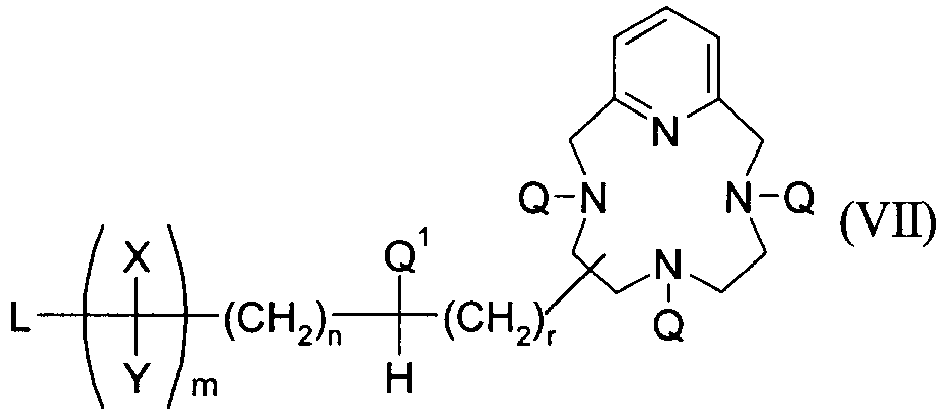
- Examples of the bifunctional polyazamacrocyclic chelating agent of formula (VII) include chelating agents of the formulas (VIIa) to (VIIc):


- Further examples of the bifunctional polyazamacrocyclic chelating agent of formula (VII) include chelating agents of the formula VIIb:

- wherein each Q is independently -(CHR5)pCO2R or -(CHR5)pPO3R6R7;
- Q1 is hydrogen;
- each R is independently hydrogen, benzyl or C1-C4 alkyl;
- R6 and R7 are independently H, C1-C6 alkyl or (C1-C2 alkyl) phenyl;
- each R5 is independently hydrogen; C1-C4 alkyl or (C1-C2 alkyl) phenyl;
- X and Y are each independently hydrogen or may be taken with an adjacent X
- and Y to form an additional carbon-carbon bond;
- n is 0 or 1;
- m is an integer from 0 to 10 inclusive;
- p is 1 or 2;
- r is 0 or 1;
- L is a linker/spacer group covalently bonded to, and replaces one hydrogen atom of one of the carbon atoms to which it is joined, said linker/spacer group being represented by the formula:

- s is 1;
- t is an integer of 0 to 20 inclusive;
- R1 is H or NO2, NH2, isothiocyanato, semicarbazido, thiosemicarbazido, maleimido, bromoacetamido or carboxyl; and
- Cyc represents a aromatic moiety, or aromatic heterocyclic moiety, each of said moieties optionally substituted with one or more groups which do not interfere with binding to a biological carrier;
- The present invention also relates to the bifunctional polyazamacrocyclic chelating agent of formulas (VI) and (VII) above, wherein Q is (CHR5)PCO2R, wherein R, R5 and p are as defined above.
- The present invention further provides a bifunctional polyazamacrocyclic chelating agent of formula (VIII):

- Examples of the bifunctional polyazamacrocyclic chelating agent of formula (VIII) include chelating agents of the of the formulas (VIIIa) to (VIIIc):


- The present invention also provides a bifunctional polyazamacrocyclic chelating agent of formula (IX):

- Examples of the bifunctional polyazamacrocyclic chelating agent of formula (IX) include chelating agents of the of the formulas (IXa) to (IXc):


- The present invention further provides a bifunctional polyazamacrocyclic chelating agent of formula (X):

- Examples of the bifunctional polyazamacrocyclic chelating agent of formula (X) include chelating agents of the of the formulas (Xa) to (Xc):


- The present invention further provides a bifunctional polyazamacrocyclic chelating agent of formula (XI):

- Examples of the bifunctional polyazamacrocyclic chelating agent of formula (XI) include chelating agents of the of the formulas (XIa) to (XIc):


- In another aspect, the present invention relates to a bifunctional polyazamacrocyclic chelating agent of the of the formula (XII):

- Examples of the bifunctional polyazamacrocyclic chelating agent of formula (XII) include chelating agents of the of the formulas (XIIa) to (XIIc):


- The present invention also relates to the bifunctional polyazamacrocyclic chelating agent of formula (XII) above, wherein Q is (CHR5)pCO2R, and R, R5 and p are as defined above.
- The present invention also provides a bifunctional polyazamacrocyclic chelating agent of formula (XIII):

- Examples of the bifunctional polyazamacrocyclic chelating agent of formula (XIII) include chelating agents of the of the formulas (XIIIa) to (XIIIc):

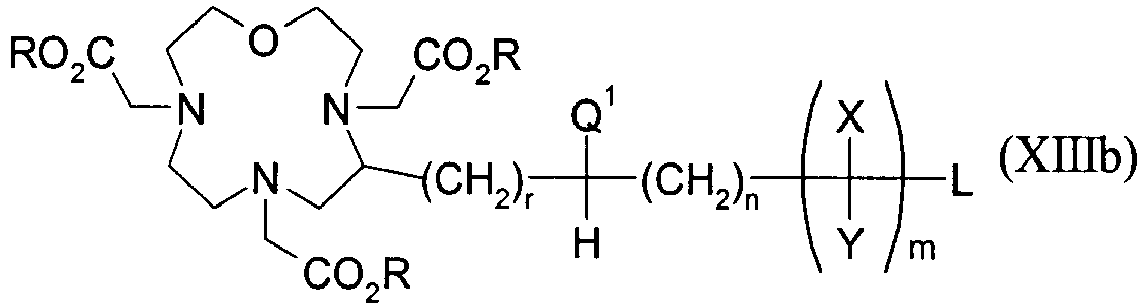

- The present invention further provides a bifunctional polyazamacrocyclic chelating agent of formula (XIV):

- Examples of the bifunctional polyazamacrocyclic chelating agent of formula (XIV) include chelating agents of the of the formulas (XIVa) to (XIVc):


- The present invention also provides a bifunctional polyazamacrocyclic chelating agent of formula (XV):

- Examples of the bifunctional polyazamacrocyclic chelating agent of formula (XV) include chelating agents of the of the formulas (XVa) to (XVc):


- The present invention further provides a bifunctional polyazamacrocyclic chelating agent of formula (XVI):

- Examples of the bifunctional polyazamacrocyclic chelating agent of formula (XVI) include chelating agents of the of the formulas (XVIa) to (XVIc):


- The present invention also pertains to the bifunctional polyazamacrocyclic chelating agents of formulas (I), (II), (III), (IV), (IV), (VI), (VIa-f), (VII), (VIIa-c), (VIII), (vIIIa-c), (IX), (IXa-c), (X), (Xa-c), (XI), (XIa-c), (XII), (XIIa-c), (XIII), (XIIIa-c), (XIV), (XIVa-c), (XV), (XVa-c), (XVI), and (XVIa-c), defined above, wherein R1 is NO2, NH2, isothiocyanato, semicarbazido, thiosemicarbazido, maleimido, bromoacetamido or carboxyl.
- In another aspect, the present invention provides a complex comprising the bifunctional polyazamacrocyclic chelating agent of one of formulas (I), (II), (III), (IV), (IV), (VI), (VIa-f), (VII), (VIIa-c), (VIII), (VIIIa-c), (IX), (IXa-c), (X), (Xa-c), (XI), (XIa-c), (XII), (XIIa-c), (XIII), (XIIIa-c), (XIV), (XIVa-c), (XV), (XVa-c), (XVI), and (XVIa-c), defined above, and an ion of a stable or radioactive metal selected from a group consisting of La, Sm, Eu, Gd, Tb, Dy, Ho, Er, Tm, Yb, Lu, Y, Pt, Cu, Re, Tc, Cr, Fe, Mg, Mn and Sc.
- In another aspect, the present invention provides a complex comprising the bifunctional polyazamacrocyclic chelating agent of one of formulas (I), (II), (III), (IV), (IV), (VI), (VIa-f), (VII), (VIIa-c), (VIII), (VIIIa-c), (IX), (IXa-c), (X), (Xa-c), (XI), (XIa-c), (XII), (XIIa-c), (XIII), (XIIIa-c), (XIV), (XIVa-c), (XV), (XVa-c), (XVI), and (XVIa-c), defined above, and an ion of a metal selected from a group consisting of 90Y, 177Lu, 111In, 6aCu, 67Cu, 153Sm 153Gd, 159Gd, 166Ho, 149Pm, 175Yb, 47Sc, 142Pr, 99mTc, 188Re, 186Re, 67Ga, 68Ga, 89Zr, and 212Bi.
- In a further aspect, the present invention provides a conjugate comprising one of the complexes defined above covalently attached to a biological carrier, such as a protein, antibody, antibody fragment, hormone, peptide, growth factor, antigen or hapten.
- In an even further aspect, the present invention provides a conjugate comprising the bifunctional polyazamacrocyclic chelating agent of one of formulas (I), (II), (III), (IV), (IV), (VI), (VIa-f), (VII), (VIIa-c), (VIII), (VIIIa-c), (IX), (IXa-c), (X), (Xa-c), (XI), (XIa-c), (XII), (XIIa-c), (XIII), (XIIIa-c), (XIV), (XIVa-c), (XV), (XVa-c), (XVI), and (XVIa-c), defined above, covalently attached to a biological carrier, such as a. protein, antibody, antibody fragment, hormone, peptide, growth factor, antigen or hapten.
- In another aspect, the present invention provides a pharmaceutical composition comprising the conjugate defined above, and a pharmaceutically acceptable carrier.
- In another aspect, the present invention provides a method of therapeutic treatment of a mammal having cancer which comprises administering to said mammal a therapeutically effective amount of the pharmaceutical composition defined above.
- The chelators of the present application display improved kinetics for complexation to the metal ions 90Y3+,111In3+ and 177Lu3+ over those for 2,2',2",2"'-(2-(4-nitrobenzyl)-1,4,7,10-tetraazacyclododecane-1,4,7,10-tetrayl)tetraacetic acid [(±)-p-NO2-Bz-DOTA] and 2,2'-(6-(carboxy(2-methoxy-5-nitrophenyl)methyl)-3,6,9,15-tetraazabicyclo[9.3.1]pentadeca-1(15),11,13-triene-3,9-diyl)diacetic acid [(±)-NPCTA], as well as similar or better stability toward complexation with the metal ions 90Y3+,111In3+ and 177Lu3+ relative to (±)-p-NO2-Bz-DOTA, and, are, therefore, more suited for therapeutic or diagnostic uses, where rapid complexation and high stability are vitally important to avoid toxic in vivo effects.
- Furthermore, the chelators of the present application represent a selection over the chelators generically disclosed in
U.S. Patent Nos. 6,670,456 and5,403,572 , in that they do not include a functionalised cyclic aliphatic or aromatic group capable of forming a bond with a biomolecule connected through one of the nitrogen atoms of their polyazabicyclic core, which can reduce the stability of ions complexed to the chelators. - These and other features of the invention will become more apparent from the following description in which reference is made to the appended drawings wherein:
- These and other features of the invention will become more apparent from the following description in which reference is made to the appended drawings wherein:;
-
Figure 1 illustrates the kinetics of complexation of (±)-p-NO2-Bz-DOTA, (L)-p-NO2-Bz-PCTA, (D)-p-NO2-Bz-PCTA, (±)-PCTA and (±)-OXO with 90Y3+. -
Figure 2 illustrates the kinetics of complexation of (±)-p-NO2-Bz-DOTA, (L)-p-NO2-Bz-PCTA, (D)-p-NO2-Bz-PCTA, (±)-PCTA, (±)-OXO and (±)-p-NCS-Bz-PCTA with 111In3+. -
Figure 3 illustrates the kinetics of complexation of (±)-p-NO2-Bz-DOTA, (L)-p-NO2-Bz-PCTA, (D)-p-NO2-Bz-PCTA, (±)-PCTA, (±)-OXO and (±)-p-NCS-Bz-PCTA with 177Lu3+. -
Figure 4 illustrates the effect of the ligand/metal ion ratio on the percent of complexation of the metal ion to the ligand, where the ligand is (±)-p-NO2-Bz-DOTA, (L)-p-NO2-Bz-PCTA, (D)-p-NO2-Bz-PCTA, (±)-PCTA or (±)-OXO, and the metal ion is 90Y3+. -
Figure 5 illustrates the effect of the ligand/metal ion ratio on the percent of complexation of the metal ion to the ligand, where the ligand is (±)-p-NO2-Bz-DOTA, (L)-p-NO2-Bz-PCTA, (D)-p-NO2-Bz-PCTA, (±)-NPCTA or (±)-OXO, and the metal ion is 111In3+. -
Figure 6 illustrates the effect of the ligand/metal ion ratio on the percent of complexation of the metal ion to the ligand, where the ligand is (±)-p-NO2-Bz-DOTA, (L)-p-NO2-Bz-PCTA, (D)-p-NO2-Bz-PCTA, (±)-NPCTA or (±)-OXO, and the metal ion is 177Lu3+. -
Figure 7 illustrates the stability of an (±)-p-NO2-Bz-DOTA-90Y3+ complex and a (L)-p-NO2-Bz-PCTA-90Y3+ complex in serum, or glycine buffer (pH = 2, 4 or 6) as a function of time. -
Figure 8 illustrates the stability of an (±)-p-NO2-Bz-DOTA-111In3+ complex and a (L)-p-NO2-Bz-PCTA-111In3+ complex in serum, or glycine buffer (pH = 2, 4 or 6) as a function of time. -
Figure 9 illustrates the stability of an (±)-p-NO2-Bz-DOTA-177Lu3+ complex and a (L)-p-NO2-Bz-PCTA-177Lu3+ complex in serum, or glycine buffer (pH = 2, 4 or 6) as a function of time. - The present invention relates to bifunctional polyazamacrocyclic chelating agents, to complexes of these chelating agents with metal ions, and to conjugates of these complexes with a biological carrier. More particularly, the present invention relates to ligand structures that exhibit unexpectedly rapid complexation kinetics with the lanthanide series of metal ions. The resulting chelate structures are useful in nuclear medicine applications where efficient and fast metal ion incorporation is a desirable feature.
- For the purposes of promoting an understanding of the principles of the invention, reference will now be made to the exemplary embodiments illustrated in the drawings, and specific language will be used to describe the same. It will nevertheless be understood that no limitation of the scope of the invention is thereby intended. Any alterations and further modifications of the inventive features illustrated herein, and any additional applications of the principles of the invention as illustrated herein, which would occur to one skilled in the relevant art and having possession of this disclosure, are to be considered within the scope of the invention.
- As used herein, "complex" refers to a complex of the compound of the invention, e.g. Formula (I), complexed with a metal ion, where at least one metal atom is chelated or sequestered.
- The complexes of the present invention can be prepared by methods well known in the art. Thus, for example, see Chelating Agents and Metal Chelates, Dwyer & Mellor, Academic Press (1964), Chapter 7. See also methods for making amino acids in Synthetic Production and Utilization of Amino Acids, (edited by Kameko, et al.) John Wiley & Sons (1974). An example of the preparation of a complex involves reacting a bicyclopolyazamacrocyclophosphonic acid with a paramagnetic metal ion under aqueous conditions at a pH from 5 to 7. The complex formed is by a chemical bond and results in a stable paramagnetic nuclide composition, e.g. stable to the disassociation of the paramagnetic nuclide from the ligand.
- The complexes of the present invention can be formed and administered at a ligand to metal molar ratio of at least about 1:1, from about 1:1 to about 3:1, or more particularly from about 1:1 to about 1.5:1. A large excess of ligand is undesirable since uncomplexed ligand may be toxic to the animal or may result in cardiac arrest or hypocalcemic convulsions.
- A "conjugate" refers to a metal ion chelate that is covalently attached to a biological carrier.
- As used herein, the term "biological carrier" refers to any biological targeting vector, such as a protein, an antibody, an antibody fragment, a hormone, a peptide, a growth factor, an antigen, a hapten or any other carrier, which functions in this invention to recognize a specific biological target site. Antibody and antibody fragment refers to any polyclonal, monoclonal, chimeric, human, mammalian, single chains, dimeric and tetrameric antibody or antibody fragment. Such biological carrier, when attached to a functionalized complex, serves to carry the attached ion to specific targeted tissues.
- The term "bifunctional chelating agent" refers to compounds that have a chelant moiety capable of chelating a metal ion and a moiety covalently bonded to the chelant moiety that is capable of serving as a means to covalently attach to a biological carrier for example, a molecule having specificity for tumor cell epitopes or antigens, such as an antibody or antibody fragment. Such compounds are of great utility for therapeutic and diagnostic applications when they are, for example, complexed with radioactive metal ions and covalently attached to a specific antibody. These types of complexes have been used to carry radioactive metals to tumor cells which are targeted by the specificity of the attached antibody [see, for example, Mears et al., Anal. Biochem. 142, 68-74 (1984); Krejcarek et al., Biochem. And Biophys. Res. Comm. 77, 581-585 (1977)].
- The bifunctional chelating agents described herein (represented by Formula I) can be used to chelate or sequester a metal ion to form metal ion chelates (also referred to herein as "complexes", as defined above). The complexes, because of the presence of the functionalizing moiety (represented by R1 in Formula I), can be covalently attached to a biologically active material, such as dextran, molecules that have specific affinity for a receptor, or preferably covalently attached to antibodies or antibody fragments. Thus, the complexes described herein may be covalently attached to an antibody or antibody fragment or have specific affinity for a receptor and are referred to herein as "conjugates".
- The term "antibody" refers to a polyclonal antibody, a monoclonal antibody, a chimeric antibody, a heteroantibody, or a fragment thereof. Antibodies used in the present invention may be directed against, for example, cancer, tumors, bacteria, fungi, leukemias, lymphomas, autoimune disorders involving cells of the immune system, normal cells that need to be ablated such as bone marrow and prostate tissue, virus infected cells including HIV, parasites, mycoplasma, differentiation and other cell membrane antigens, pathogen surface antigens, toxins, enzymes, allergens, drugs and any biologically active molecules. Some examples of antibodies are HuM195 (anti-CD33), CC-11, CC-46,CC-49, CC-49 F(ab')2, CC-83, CC-83 F(ab')2, and B72.3, 1116-NS-19-9 (anti-colorectal carcinoma), 1116-NS-3d (anti-CEA), 703D4 (anti-human lung cancer), 704A1 (anti-human lung cancer) and B72.3. The hybridoma cell lines 1116-NS-19-9, 1116-NS-3d, 703D4, 704A1, CC49, CC83 and B72.3 are deposited with the American Type Culture Collection, having the accession numbers ATCC HB 8059, ATCC CRL 8019, ATCC HB 8301, ATCC HB 8302, ATCC HB 9459, ATCC HB 9453 and ATCC HB 8108, respectively.
- Antibody fragment includes Fab fragments and F(ab')2 fragments, and any portion of an antibody having specificity toward a desired epitope or epitopes.
- When using the term "radioactive metal chelate/antibody conjugate" or "conjugate", the "antibody" is meant to include whole antibodies and/or antibody fragments, including semisynthetic or genetically engineered variants thereof. Such antibodies normally have a highly specific reactivity.
- The antibodies or antibody fragments which may be used in the conjugates described herein can be prepared by techniques well known in the art. Highly specific monoclonal antibodies can be produced by hybridization techniques well known in the art, see for example, Kohler and Milstein [Nature, 256, 495-497 (1975); and Eur. J. Immunol., 6, 511-519 (1976)]. Such antibodies normally have a highly specific reactivity in the antibody targeted conjugates, antibodies directed against any desired antigen or hapten may be used. Preferably the antibodies which are used in the conjugates are monoclonal antibodies, or fragments thereof having high specificity for a desired epitope(s).
- As used herein, "pharmaceutically-acceptable salt" means any salt or mixture of salts of a complex or conjugate of formula (I) which is sufficiently non-toxic to be useful in therapy or diagnosis of animals, preferably mammals. Thus, the salts are useful in accordance with this invention. Representative of those salts formed by standard reactions from both organic and inorganic sources include, for example, sulfuric, hydrochloric, phosphoric, acetic, succinic, citric, lactic, maleic, fumaric, palmitic, cholic, palmoic, mucic, glutamic, gluconic, d-camphoric, glutaric, glycolic, phthalic, tartaric, formic, lauric, steric, salicylic, methanesulfonic, benzenesulfonic, sorbic, picric, benzoic, cinnamic acids and other suitable acids. Also included are salts formed by standard reactions from both organic and inorganic sources such as ammonium or 1-deoxy-1-(methylamino)-D-glucitol, alkali metal ions, alkaline earth metal ions, and other similar ions. Particularly preferred are the salts of the complexes or conjugates of formula (I) where the salt is potassium, sodium or ammonium. Also included are mixtures of the above salts.
- This invention is used with a physiologically acceptable carrier, excipient or vehicle therefor. The methods for preparing such formulations are well known. The formulations may be in the form of a suspension, injectable solution or other suitable formulations. Physiologically acceptable suspending media, with or without adjuvants, may be used.
- An "effective amount" of the formulation is used for diagnosis or for therapeutic treatments of diseases. The dose will vary depending on the disease and physical parameters of the animal, such as weight. In vivo diagnostics are also contemplated using formulations of this invention.
- Other uses of some of the chelants of the present invention may include the removal of undesirable metals (i.e. iron) from the body, attachment to polymeric supports for various purposes, e.g. as diagnostic agents, and removal of metal ion by selective extraction.
- The free acid of the compounds of formula (I) may be used, also the protonated form of the compounds, for example when the carboxylate is protonated and/or the nitrogen atoms, i.e. when the HCl salt is formed.
- The complexes so formed can be attached (covalently bonded) to an antibody or fragment thereof and used for therapeutic and/or diagnostic purposes. The complexes and/or conjugates can be formulated for in vivo or in vitro uses. A preferred use of the formulated conjugates is the diagnosis of diseased states (e.g., cancer) in animals, especially humans.
- Biotargeted radiopharmaceuticals that employ the chelating agent (ligand) of the present invention to secure a metal radionuclide can be prepared by two methods: 1) Pre-complexation - the metal ligand complex (chelate) can first be prepared followed by covalent attachment of the chelate to a biotargeting group, for example a monoclonal antibody; 2) Post-complexation - a covalent conjugate between the ligand and the biotargeting molecule can be prepared in a first step followed by introduction and complexation of the metal radionuclide. Both methods have merits and shortcomings.
Method 1 is appealing from the standpoint that forcing conditions can be utilized to facilitate complexation however subsequent attachment of the complex to a targeting vector requires more elaborate chemical transformation that are difficult to perform rapidly in a hospital setting. In contrast,method 2 is desirable since it allows the more intricate chemistry required for conjugation of the ligand and targeting vector to be performed in controlled environment without time constraints introduced by the radionuclide. The complexation step can then be conducted onsite at the hospital pharmacy by clinical technicians however this step can be problematic since the ligand bound conjugate is much more sensitive to rigorous conditions that favor rapid and complete complexation. - Of the two approaches for preparing biotargeted radiopharmaceuticals, the post-complexation strategy is clearly the most desirable if appropriate ligands and/or conditions can be devised that facilitate rapid and complete incorporation of the radionuclide. The most desirable route to ligand design for the post-complexation approach is based on favorable thermodynamic attributes of macrocyclic polyamines such as cyclen and cyclen analogs. In addition, structural and conformational components can be introduced that can minimize kinetic barriers to complexation. For example, molecular architecture which can enhance pre-organization of the ligand binding site toward the necessary conformational requirements of the metal ion should produce faster complexation kinetics.
- The bifunctional chelating agents described herein (represented by formula I) are designed to form stable and inert complexes with the lanthanide series of metals. Complexation kinetics can be modulated by altering backbone structural rigidity, electronic character of the coordinate donor atoms, and conformational accessibility of the metal binding site.
- While not wishing to be bound by theory, it is believed that kinetic advantages associated with the present invention are a function of structural modifications that lead to preferred molecular geometries (pre-organization) which match ligating requirements of the metal. In this manner the ligand-metal binding event is accelerated without the need for harsh reaction conditions.
- In the context of bifunctional chelating agents, the generation of optimal pre-organized ligand structures conducive to rapid complexation kinetics is significantly influenced by the judicious placement of the linking group. In this manner, the linking group can be engineered to assume a position distant from the metal binding site during the initial stages of the metal docking process followed by the adoption of a secondary conformation induced by complexation that effectively shields the metal form reversible dissociation pathways. The positional orientation of the linking group also affects the electronic nature of the coordinate donor atoms and their juxtaposed lone pair electrons which are critical for satisfying the geometric requirements of the metal ion. The present invention will address this point utilizing comparative examples that exhibit dramatic differences not previously observed or exploited in earlier works.
- The present invention also includes formulations comprising the conjugates of this invention and a pharmaceutically acceptable carrier, especially formulations where the pharmaceutically acceptable carrier is a liquid.
- The present invention is also directed to a method of therapeutic treatment of a mammal having cancer which comprises administering to said mammal a therapeutically effective amount of the formulation of this invention.
- Thus, the present invention may be practiced with the conjugate of the present invention being provided in pharmaceutical formulation, both for veterinary and for human medical use. Such pharmaceutical formulations comprise the active agent (the conjugate) together with a physiologically acceptable carrier, excipient or vehicle therefore. The methods for preparing such formulations are well known. The carrier(s) must be physiologically acceptable in the sense of being compatible with the other ingredient(s) in the formulation and not unsuitably deleterious to the recipient thereof. The conjugate is provided in a therapeutically effective amount, as described above, and in a quantity appropriate to achieve the desired dose.
- Complexes of the chelating agent of the present invention with a suitable metal ion, and conjugates of these complexes can be used in diagnostic medical imaging procedures. For example, complexes of the present invention formed with a paramagnetic metal ion, such as Gd+3, Mn+2 or Fe+3, and corresponding conjugates of these complexes can act as contrast agents in magnetic resonance imaging (MRI). In addition, complexes of the present invention formed with a lanthanide metal ion such as, Tb3+, Eu3+, Sm3+ or Dy3+, and corresponding conjugates of these complexes can be used in fluorescent imaging procedures.
- This invention is used with a physiologically acceptable carrier, excipient or vehicle therefore. The formulations may be in the form of a suspension, injectable solution or other suitable formulations. Physiologically acceptable suspending media, with or without adjuvants, may be used.
- The formulations include those suitable for parenteral (including subcutaneous, intramuscular, intraperitoneal, and intravenous), oral, rectal, topical, nasal, or ophthalmic administration. Formulations may be prepared by any methods well known in the art of pharmacy. Such methods include the step of bringing the conjugate into association with a carrier, excipient or vehicle therefore. In general, the formulation may be prepared by uniformly and intimately bringing the conjugate into association with a liquid carrier, a finely divided solid carrier, or both, and then, if necessary, shaping the product into desired formulation. In addition, the formulations of this invention may further include one or more accessory ingredient(s) selected from diluents, buffers, binders, disintegrants, surface active agents, thickeners, lubricants, preservatives, and the like. In addition, a treatment regime might include pretreatment with non-radioactive carrier.
- Injectable compositions of the present invention may be either in suspension or solution form. In the preparation of suitable formulations it will be recognized that, in general, the water solubility of the salt is greater than the acid form. In solution form the complex (or when desired the separate components) is dissolved in a physiologically acceptable carrier. Such carriers comprise a suitable solvent, preservatives such as benzyl alcohol, if needed, and buffers. Useful solvents include, for example, water, aqueous alcohols, glycols, and phosphonate or carbonate esters. Such aqueous solutions contain no more than 50 percent of the organic solvent by volume.
- Injectable suspensions are compositions of the present invention that require a liquid suspending medium, with or without adjuvants, as a carrier. The suspending medium can be, for example, aqueous polyvinylpyrrolidone, inert oils such as vegetable oils or highly refined mineral oils, polyols, or aqueous carboxymethylcellulose. Suitable physiologically acceptable adjuvants, if necessary to keep the complex in suspension, may be chosen from among thickeners such as carboxymethylcellulose, polyvinylpyrrolidone, gelatin, and the alginates. Many surfactants are also useful as suspending agents, for example, lecithin, alkylphenol, polyethyleneoxide adducts, naphthalenesulfonates, alkylbenzenesulfonates, and polyoxyethylene sorbitan esters.
- General synthetic approach to a twelve-membered macrocyclic, bifunctional chelant of the present invention as represented by formula I involves the use of functionalized moieties in the formation of the twelve-membered tetraazamacrocycle in order to accomplish backbone substitution. Various synthetic routes to functionalized chelants of formula I can be envisioned by substituting these moieties into the schemes presented in
U.S. Pat. Nos. 5,428,139 ;5,480,990 ; and5,739,294 . - More specifically, compounds of formula (XI) can be synthesized based on a modification of the original synthetic procedure for PCTA (2,2',2"-(3,6,9,15-tetraazabicyclo[9.3.1]pentadeca-1(15),11,13-triene-3,6,9-triyl)triacetic acid) provided in Stetter et al. (Stetter, H.; Frank, W.; Mertens, R. Preparation and complexation of polyazacycloalkane-N-acetic acids. Tetrahedron (1981), 37(4), 767-72, or in Aime et al. (Aime, S.; Botta, M.; Crich, S. G.; Giovenzana, G. B.; Jommi, G.; Pagliarin, R.; Sisti, M. Inorg. Chem. 1997, 36, 2992-3000), the disclosures of which is incorporated herein by reference.
-
Scheme 1 illustrates an example of a method that can be used to produce a compound of formula (XIb). This method involves cyclizing 2,6-bis(chloromethyl)pyridine (XXIII) with (XXII) in DMF to produce (XXIV), followed by deprotection and alkylation of 4-(4-nitrobenzyl)-3,6,9-tritosyl-3,6,9,15-tetraazabicyclo[9.3.1]pentadeca-1(15),11,13-triene (XXIV) using bromoacetic acid to yield 2,2',2"-(4-(4-nitrobenzyl)-3,6,9,15-tetraazabicyclo[9.3.1]pentadeca-1(15),11,13-triene-3,6,9-triyl)triacetic acid (XXV). Hydrogenation of the nitro group of (XXV) is then achieved using 10% palladium on carbon catalyst at ambient pressure to give aniline intermediate 2,2',2"-(4-(4-aminobenzyl)-3,6,9,15-tetraazabicyclo[9.3.1]pentadeca-1(15),11,13-triene-3,6,9-triyl)triacetic acid (XXVI). Conversion of the aniline (XXVI) to the reactiveelectrophilic isothiocyanate 
- Intermediate XXII is prepared based on the synthetic approach shown in
Scheme 2. N1-(2-aminoethyl)-3-(4-nitrophenyl)propane-1,2-diamine (XX) is protected using tosyl chloride and triethylamine to afford tritosylated compound 4-methyl-N-(2-(4-methylphenylsulfonamido)-3-(4-nitrophenyl)propyl)-N-(2-(4-methylphenylsulfonamido)ethyl)benzenesulfonamide (XXI). Deprotonation of (XXI) with sodium ethoxide in ethanol produces a disodium salt of compound (XXI), compound (XXII). Compound (XX) is produced according to the method of Corson et al. (Corson, D.T.; Meares, C. F. Bioconjugate Chem. 2000, 11, 292-299, the disclosure of which is incorporated herein by reference).
- In another example, compounds of formula (XVIb) can be synthesized based on a modification of the original synthetic procedure for OXO-DO3A (2,2',2"-(1-oxa-4,7,10-triazacyclododecane-4,7,10-triyl)triacetic acid) set forth in Amorim et al. (Amorim, M. T. S.; Delgado, Rita; Frausto da Silva, J. J. R.; Candida, M.; Vaz, T. A.; Vilhena, M. Fernanda. Metal complexes of 1-oxa-4,7,10-triazacyclododecane-N,N',N"-triacetic acid. Cent. Quim. Estrut., Inst. Super. Tec., Lisbon, Port. Talanta (1988), 35(9), 741-5, the disclosure of which is incorporated by reference herein).
-
Scheme 3 illustrates an example of a method that can be used to produce a compound of formula (XVIb). This method involves cyclizing 2,2'-oxybis(ethane-2,1-diyl) bis(4-methylbenzenesulfonate) (XXVIII) with (XXII) in DMF to produce 5-(4-nitrobenzyl)-1-oxa-4,7,10-triazacyclododecane-4,7,10-triyl tris(4-methylbenzenesulfonate) (XXIX), followed by deprotection and alkylation of (XXIX) using bromoacetic acid to yield 2,2',2"-(5-(4-nitrobenzyl)-1-oxa-4,7,10-triazacyclododecane-4,7,10-triyl)triacetic acid (XXX). Hydrogenation of the nitro group of (XXX) is then achieved using 10% palladium on carbon catalyst at ambient pressure to give aniline intermediate 2,2',2"-(5-(4-aminobenzyl)-1-oxa-4,7,10-triazacyclododecane-4,7,10-triyl)triacetic acid (XXXI). Conversion of (XXXI) to the reactiveelectrophilic isothiocyanate 
-
Scheme 4 illustrates an example of a method that can be used to produce a compound of formula (XIc). This method involves cyclizing 2,6-bis(chloromethyl)pyridine (XXIII) with (XXXIII) in DMF to produce 5-(4-nitrobenzyl)-3,6,9-tritosyl-3,6,9,15-tetraazabicyclo[9.3.1]pentadeca-1(15),11,13-triene (XXXIV), followed by deprotection and alkylation of (XXXIV) using bromoacetic acid to yield 2,2',2"-(5-(4-nitrobenzyl)-3,6,9,15-tetraazabicyclo[9.3.1]pentadeca-1(15),11,13-triene-3,6,9-triyl)triacetic acid (XXXV). Hydrogenation of the nitro group of (XXXV) is then achieved using 10% palladium on carbon catalyst at ambient pressure to give aniline intermediate (XXXVI). Conversion of theaniline electrophilic isothiocyanate 
- Intermediate XXXIII is prepared based on the synthetic approach shown in
Scheme 5. The compound methyl 2-amino-3-(4-nitrophenyl)propanoate (XXXVIII), produced by treating methyl 2-amino-3-(4-nitrophenyl)propanoate hydrochloride with triethylamine, is allowed to react with methyl 2-bromoacetate and diisoproprylethylamine to produce methyl 2-(2-methoxy-2-oxoethylamino)-3-(4-nitrophenyl)propanoate (XXXIX). The compound 2-(2-amino-2-oxoethylamino)-3-(4-nitrophenyl)propanamide (IL) is produced by treating (XXXIX) with ammonia in methanol. Reduction of (IL) with BH3 in THF affords N2-(2-aminoethyl)-3-(4-nitrophenyl)propane-1,2-diamine (ILI). Protection of the amino groups of (ILI) with tosyl chloride yields 4-methyl-N-(1-(4-methylphenylsulfonamido)-3-(4-nitrophenyl)propan-2-yl)-N-(2-(4-methylphenylsulfonamido)ethyl) benzenesulfonamide (ILII). Deprotonation of the terminal amino groups of (ILII) results in the formation of the disodium salt (XXXIII).
-
Scheme 6 illustrates an example of a method that can be used to produce a compound of formula (XVIc). This method involves cyclizing 2, 2'-oxybis(ethane-2,1-diyl) bis(4-methylbenzenesulfonate) (XXIII) with (XXXIII) in DMF to produce 6-(4-nitrobenzyl)-4,7,10-tritosyl-1-oxa-4,7,10-triazacyclododecane (ILIII), followed by deprotection and alkylation of (ILIII) using bromoacetic acid to yield 2,2',2"-(6-(4-nitrobenzyl)-1-oxa-4,7,10-triazacyclododecane-4,7,10-triyl)triacetic acid (ILIV). Hydrogenation of the nitro group of (ILIV) is then achieved using 10% palladium on carbon catalyst at ambient pressure to give aniline intermediate 2,2',2"-(6-(4-aminobenzyl)-1-oxa-4,7,10-triazacyclododecane-4,7,10-triyl)triacetic acid (ILV). Conversion of the aniline (ILV) to the reactiveelectrophilic isothiocyanate 
- Scheme 7 illustrates an example of a method that can be used to produce a compound of formula (XIa). The compound pyridine-2,6-dicarbaldehyde (ILVII) is monoprotected to form the mono-acetal 6-(1,3-dioxolan-2-yl)picolinaldehyde (ILVIII). Reaction of (ILVIII) with the Grignard reagent (4-nitrobenzyl)magnesium bromide (ILIX) produces the alcohol 1-(6-(1,3-dioxolan-2-yl)pyridin-2-yl)-2-(4-nitrophenyl)ethanol (L). The alcohol (L) is deprotected with HCl, and the resulting aldehyde is reduced with NaBH4 to produce the diol 1-(6-(hydroxymethyl)pyridin-2-yl)-2-(4-nitrophenyl)ethanol (LI). Chlorination of (LI) with thionyl chloride yields the compound 2-(1-chloro-2-(4-nitrophenyl)ethyl)-6-(chloromethyl)pyridine (LII). Cyclization of (LII) with (LIII) results in the product 2-(4-nitrobenzyl)-3,6,9-tritosyl-3,6,9,15-tetraazabicyclo[9.3.1]pentadeca-1(15),11,13-triene (LIV). Finally, deprotection of (LIV) and alkylation with bromoacetic acid produces the
compound 
-
Scheme 8 illustrates an example of a method that can be used to produce a compound of formula (XVIa). Thecompound 2,2'-oxydiacetaldehyde (LVI) is monoprotected to form the mono-acetal 2-((1,3-dioxolan-2-yl)methoxy)acetaldehyde (LVII). Reaction of (LVII) with the Grignard reagent (4-nitrobenzyl)magnesium bromide (ILIX) produces the alcohol 1-((1,3-dioxolan-2-yl)methoxy)-3-(4-nitrophenyl)propan-2-ol (LVIII). The alcohol (LVIII) is deprotected with HCl, and the resulting aldehyde is reduced using NaBH4 to produce the diol 1-(2-hydroxyethoxy)-3-(4-nitrophenyl)propan-2-ol (LVIX). Chlorination of (LVIX) with thionyl chloride yields the compound 1-(2-chloro-3-(2-chloroethoxy)propyl)-4-nitrobenzene (LVX). Cyclization of (LVX) with (LIII) results in the product 3-(4-nitrobenzyl)-4,7,10-tritosyl-1-oxa-4,7,10-triazacyclododecane (LVXI). Finally, deprotection of (LVXI) and alkylation with bromoacetic acid produces thecompound 
- Although the synthetic schemes described above relate to the production of racemic ligands or chelators, it is to be understood that these schemes can be easily modified to produce enantiomerically pure or enantiomerically enriched ligands having the (L) or (D)-configuration by using enantiomerically pure or enantiomerically enriched starting materials, or by including one or more resolution steps within these schemes, which are generally known in the art.
- As used herein, the terms "degree of complexation" and "percent complexation" are used interchangeably and are defined to mean the percentage of the ion that is successfully complexed with the bifunctional chelant divided by the total ion used in the complexation reaction. The value of percent complexation obtained when making the ion complexes of the present reaction can be greater than 90% or greater than 95%, as measured by cation exchange.
- The conjugates of the present invention can be prepared by first forming the complex and then attaching to the biological carrier. Thus, the process involves preparing or obtaining the ligand, forming the complex with an ion and then adding the biological carrier. Alternatively, the process may involve first conjugation of the ligand to the biological carrier and then the formation of the complex with an ion. Any suitable process that results in the formation of the ion-conjugates of this invention is within the scope of the present invention.
- The complexes, bifunctional chelates and conjugates of the present invention are useful as diagnostic agents in the manner described. These formulations may be in kit form such that the two components (i.e., ligand and metal, complex and antibody, or ligand/antibody and metal) are mixed at the appropriate time prior to use. Whether premixed or as a kit, the formulations usually require a pharmaceutically acceptable carrier.
- Tissue specificity may also be realized by ionic or covalent attachment of the chelate of formula (I) (where R1 is NH2, isothiocyanato, semicarbazido, thiosemicarbazido, maleimido, bromoacetamido or carboxyl group) to a naturally occurring or synthetic molecule having specificity for a desired target tissue. One possible application of this approach is through the use of chelate conjugated monoclonal antibodies which would transport the chelate to diseased tissue enabling visualization. The surgeon could then illuminate soft tissue with a UV light source coupled with an appropriate detector, if necessary, and surgically remove the indicated tissue.
- The following examples are provided to further illustrate the present invention, and should not be construed as limiting thereof.
- The compounds 2,2',2"-((4S)-4-(4-nitrobenzyl)-3,6,9,15-tetraazabicyclo[9.3.1]pentadeca-1(15),11,13-triene-3,6,9-triyl)triacetic acid [(L)-p-NO2-Bz-PCTA]; and 2,2',2"-((4S)-4-(4-isothiocyanatobenzyl)-3,6,9,15-tetraazabicyclo[9.3.1]pentadeca-1(15),11, 13-triene-3,6,9-triyl)triacetic acid [(L)-p-NCS-Bz-PCTA] were prepared according to the method outlined in Scheme 1 starting from (S)-N1-(2-aminoethyl)-3-(4-nitrophenyl)propane-1,2-diamine. 2,2',2"-((4R)-4-(4-nitrobenzyl)-3,6,9,15-tetraazabicyclo[9.3.1]pentadeca-1(15),11,13-triene-3,6,9-triyl)triacetic acid [(D)-p-NO2-Bz-PCTA] was prepared according to the method outlined in Scheme 1 starting from (R)-N1-(2-aminoethyl)-3-(4-nitrophenyl)propane-1,2-diamine.

- 2,2',2",2"'-(2-(4-nitrobenzyl)-1,4,7,10-tetraazacyclododecane-1,4,7,10-tetrayl)tetraacetic acid [(±)-p-NO2-Bz-DOTA] and 2,2',2"-(1-oxa-4,7,10-triazacyclododecane-4,7,10-triyl)triacetic acid [(±)-OXO] were supplied by Macrocyclics, Inc. (Dallas, Tx). 2,2'-(6-(carboxy(2-methoxy-5-nitrophenyl)methyl)-3,6,9,15-tetraazabicyclo[9.3.1]pentadeca-1(15),11,13-triene-3,9-diyl)diacetic acid [(±)-PCTA] was prepared according to the method provided in
U.S. Patent No. 5,480,990 , the disclosure of which is incorporated by reference herein.
Scheme 3 starting from (S)-N1-(2-aminoethyl)-3-(4-nitrophenyl)propane-1,2-diamine and (R)-N1-(2-aminoethyl)-3-(4-nitrophenyl)propane-1,2-diamine, respectively.
- A polyazamacrocyclic ligand ((L)-p-NO2-Bz-PCTA; (D)-p-NO2-Bz-PCTA; (L)-p-NCS-Bz-PCTA; (±)-p-NO2-Bz-DOTA, (±)-PCTA, (±)-OXO and (L)-p-NO2-Bz-OXO) was combined with a metal ion (90Y3+, 111In3+, 177Lu3+) at room temperature in buffer at a molar ratio of the ligand to the metal ion of 100:1 for kinetic studies, 200:1 for stability studies or at values ranging from 2:1 to 200:1 for the molar ratio studies.
- Complexation studies involving 90Y3+ and 111In3+ were conducted with 50-100 mM sodium acetate buffer, pH 5.0-7.0, while complexation studies involving 177Lu3+ were performed with 50mM-100 mM sodium acetate buffer, pH 4-5.
- In the stability studies, 100 µL of a solution containing a complex of a ligand with a metal ion was mixed with 500 µL of serum, or 0.1 M Glycine buffer at pH = 2, 4 or 6
- 1 µL samples were taken at 10 minute intervals for kinetic studies, after 60 minutes in experiments studying the effect of the value of [ligand]/[metal ion] on the % complexation of the ligand, and at spaced intervals of 1-3 days for experiments studying the stability of complexes formed using the ligand of the present invention. Following the method generally described by SAHA (Fundamentals of Nuclear Pharmacy, Springer, 4th edition, pages 151-158, the disclosure of which is incorporated herein by reference), the free metal and labeled chelate are separated by thin layer chromatography using silica gel paper (1 cm x 6 cm) and a mobile phase (acetone: saline v/v = 1:1). The silica gel paper is cut in half and each half is measured in a gamma well counter. The results of the kinetic studies are illustrated in
Figures 1-3 , the results of the experiments studying the effect of [ligand]/[metal ion] on the % complexation of the ligand are shown inFigures 4-6 , and the results of the stability studies are illustrated inFigures 7-9 . Each result shown inFigures 4-9 is the average of three separate trials. - The fastest initial rate of complexation was observed with (L)-p-NO2-Bz-PCTA (95% complexation after 10 minutes), followed succesively by (±)-p-NO2-Bz-DOTA, (±)-OXO, (D)-p-NO2-Bz-PCTA, (L)-p-NCS-Bz-PCTA, (L)-p-NO2-Bz-OXO and (±)-NPCTA. For (±)-p-NO2-Bz-DOTA, (±)-OXO and (L)-p-NO2-Bz-OXO, values of percent complexation above 95% were achieved after 30 minutes. In general, the highest percent complexation of metal ion was observed with the ligands (L)-p-NO2-Bz-PCTA, (±)-p-NO2-Bz-DOTA, (±)-OXO and (L)-p-NO2-Bz-OXO.
- The relatively slower kinetics of complexation associated with (±)-NPCTA may be attributed to a steric or electronic effect associated with the position of the pendant linker p-NO2-Bz group on the macrocyclic ring.
- The fastest initial rate of complexation was observed with (±)-OXO, (L)-p-NO2-Bz-O and (L)-NCS-Bz-PCTA (each having a value of percent complxation of greater than 95% after 10 minutes, followed successively by (L)-p-NO2-Bz-PCTA (∼95% complexation after 10 minutes), (D)-p-NO2-Bz-PCTA, (±)-p-NO2-Bz-DOTA and (±)-NPCTA.
- The highest percent complexation of metal ion was observed with the ligands (±)-OXO, (L)-p-NO2-Bz-OXO, (±)-NCS-Bz-PCTA and (L)-p-NO2-Bz-PCTA, which had maximum values of complexation of greater than 95%. (±)-p-NO2-Bz-DOTA displayed a maximum values of complexation of ∼89% after 40 minutes.
- The relatively slower kinetics of complexation associated with (±)-NPCTA may be attributed to a steric or electronic effect associated with the position of the pendant linker p-NO2-Bz group on the macrocyclic ring.
- The fastest initial rate of complexation was observed with (L)-p-NO2-Bz-PCTA and (L)-p-NO2-Bz-OXO (>95% complexation after 10 minutes) followed successively by (±)-OXO, (±)-p-NO2-Bz-DOTA, (D)-p-NO2-Bz-PCTA, (±)-NPCTA and (L)-p-NCS-Bz-PCTA. (±)-OXO and (±)-p-NO2-Bz-DOTA each displayed ∼95% complexation after 10 minutes, while (D)-p-NO2-Bz-PCTA showed only ∼91% complexation after 10 minutes. With (±)-p-NO2-Bz-DOTA and (±)-PCTA, the maximum percent of complexation was observed only after 40 minutes and 50 minutes, respectively.
- In general, the highest percent complexation of metal ion was observed with the ligands (L)-p-NO2-Bz-PCTA, (L)-p-NO2-Bz-OXO, (±)-OXO, and (±)-p-NO2-Bz-DOTA.
- The relatively slower kinetics of complexation associated with (±)-NPCTA may be attributed to a steric or electronic effect associated with the position of the pendant linker p-NO2-Bz group on the macrocyclic ring.
- A value of percent complexation of above 95% was achieved with (±)-p-NO2-Bz-DOTA and (L)-p-NO2-Bz-PCTA at a molar ratio of ligand/90Y3+ of 2:1. With (D)-p-NO2-Bz-PCTA, ∼95% complexation was achieved at a molar ratio of ligand/90Y3+ of 10:1. For (±)-OXO and (L)-p-NO2-Bz-PCTA, a value of above 95% complexation was obtained at the molar ratio of ligand/90Y3+ of 5:1 or above. A value of 90% complexation was not achieved with (±)-NPCTA even at values of molar ratio of ligand/90Y3+ of greater than 20:1.
- A value of percent complexation of above 95% was achieved with (L)-p-NO2-Bz-PCTA and with (L)-p-NO2-Bz-OXO, at a molar ratio of ligand/111In3+ of 2:1. With (D)-p-NO2-Bz-PCTA, ∼95% complexation was achieved at a molar ratio of ligand/111In3+ of 10:1. With (±)-p-NO2-Bz-DOTA, ∼94% complexation was achieved at a molar ratio of ligand/111In3+ of 5:1. A value of percent complexation of above 95%, however, was not achieved with (±)-p-NO2-Bz-DOTA even at a molar ratio of ligand/111In3+ of greater than 20:1. For (±)-OXO, a value of above 95% complexation was obtained at a molar ratio of ligand/111In3+ of 5:1 or above. A value of ∼76% complexation was achieved with (±)-NPCTA at a molar ratio of ligand/111In3+of 5:1.
- A value of greater than 95% complexation was achieved with (L)-p-NO2-Bz-OXO at values of molar ratio of ligand/177Lu3+ of 2:1 and above. With (L)-p-NO2-Bz-PCTA, a value of percent complexation of ∼95% was achieved with (L)-p-NO2-Bz-PCTA at a molar ratio of ligand/177Lu3+ of 5:1. With (D)-p-NO2-Bz-PCTA, greater than 95% complexation was achieved at a molar ratio of ligand/177Lu3+ of 5:1. With (±)-p-NO2-Bz-DOTA, greater than 95% complexation was only achieved at a molar ratio of ligand/177Lu3+ of 100:1. For (±)-OXO, a value of above 95% complexation was obtained at the molar ratio of ligand/177Lu3+ of 10:1 or above. A value of ∼95% complexation was not achieved with (±)-NPCTA even at values of molar ratio of ligand/177Lu3+ of greater than 20:1.
-
Figures 7-9 illustrate the stability of (±)-p-NO2-Bz-DOTA-metal ion complex and a (L)-p-NO2-Bz-PCTA-metal ion complex in serum, or 0.1 M Glycine buffer (pH = 2, 4 or 6) as a function of time, where the metal ion is 90Y3+, 111In3+ or 177Lu3+. - (L)-p-NO2-Bz-PCTA-90Y3+ complex was relatively more stable than the (±)-p-NO2-Bz-DOTA-90Y3+ complex in serum. The stability of the two complexes were similar in Glycine buffer,
pH - Both the (L)-p-NO2-Bz-PCTA-111In3+ complex and the (±)-p-NO2-Bz-DOTA-111In3+ complex were similarly stable in 0.1 M Glycine buffer,
pH - Both the (L)-p-NO2-Bz-PCTA-177Lu3+ complex and the (±)-p-NO2-Bz-DOTA-177Lu3+ complex were relatively less stable in serum compared to 0.1 M Glycine buffer,
pH pH - The present invention has been described with regard to one or more embodiments. However, it will be apparent to persons skilled in the art that a number of variations and modifications can be made without departing from the scope of the invention as defined in the claims.
- All citations are hereby incorporated by reference.
-
- (1) Mark Woods, Z. K., A. Dean Sherry Journal of .
- (2) WynnA. Volkert, a. T. J. H. Chem. Rev. 1999,99,2269-2292.
- (3) Peter Caravan, J. J. E., Thomas J. McMurry, and Randall B. Lauffer Chem. Rev. 1999,99,2293-2352.
- (4) G. M. Lanza, R. L., S. Caruthers, S. A. Wickline MEDICAMUNDI 2003, 47, 34-39.
- (5) Edwards, S. L. a. D. S. Bioconjugate Chemistry 2001, 12, 7-34.
- (6) Paul A. Whetstone, N. G. B., Todd M. Corneillie, and Claude F. Meares Bioconjugate Chemistry 2004, 15, 3-6.
- (7) Julie B. Stimmel, M. E. S., and Frederick C. Kull, Jr. .
- (8) Hyun-soon Chong, K. G., Dangshe Ma, Diane E. Milenic, Terrish Overstreet, and; Brechbiel, M. W. J. Med. Chem. 2002, 45, 3458-3464.
Claims (12)
- A bifunctional polyazamacrocyclic chelating agent of the formula (VIIb):
 each Q is independently -(CHR5)pCO2R or -(CHR5)pPO3R6R7;Q1 is hydrogen;each R is independently hydrogen, benzyl or C1-C4 alkyl;R6 and R7 are independently H, C1-C6 alkyl or (C1-C2 alkyl) phenyl;each R5 is independently hydrogen; C1-C4 alkyl or (C1-C2 alkyl) phenyl;X and Y are each independently hydrogen or may be taken with an adjacent X and Y to form an additional carbon-carbon bond;or a pharmaceutically acceptable salt thereof.n is 0 or 1;m is an integer from 0 to 10 inclusive;p is 1 or 2;r is 0 or 1;L is a linker/spacer group covalently bonded to, and replaces one hydrogen atom of one of the carbon atoms to which it is joined, said linker/spacer group being represented by the formula:
 s is 1;t is an integer of 0 to 20 inclusive;R1 is H or NO2, NH2, isothiocyanato, semicarbazido, thiosemicarbazido, maleimido, bromoacetamido or carboxyl; andCyc represents a aromatic moiety, or aromatic heterocyclic moiety, each of said moieties optionally substituted with one or more groups which do not interfere with binding to a biological carrier;
 - The bifunctional polyazamacrocyclic chelating agent according to claim 1, wherein Q is -(CHR5)pCO2R and R, R5 and p are as defined in claim 1.
- The bifunctional polyazamacrocyclic chelating agent according to claim 2, wherein the chelating agent is of the of the formula (IXb):

- The bifunctional polyazamacrocyclic chelating agent according to claim 3, wherein the chelating agent is of formula (XIb):

- The bifunctional polyazamacrocyclic chelating agent according to claim 4, wherein the chelating agent is of formula (XXV):

- The bifunctional polyazamacrocyclic chelating agent according to claim 4, wherein the chelating agent is of formula (XXVI):

- The bifunctional polyazamacrocyclic chelating agent according to claim 4, wherein the chelating agent is of formula (XXVII):

- A complex comprising the bifunctional polyazamacrocyclic chelating agent as defined in any one of claims 1-7, and an ion of a stable or radioactive metal selected from a group consisting of La, Sm, Eu, Gd, Tb, Dy, Ho, Er, Tm, Yb, Lu, Y, Cr, Cu, Pt, Re, Tc, Fe, Mg, Mn and Sc.
- A complex comprising the bifunctional polyazamacrocyclic chelating agent as defined in any one of claims 1-7, and an ion of a metal selected from a group consisting of 90Y, 177Lu, 111In, 64Cu 67Cu, 153Sm, 153Gd, 159Gd, 166Ho 149Pm 175Yb, 47Sc, 142Pr, 99mTc, 188Re, 186Re, 67Ga, 68Ga, 89Zr, and 212Bi.
- A conjugate comprising the complex of claim 8 or 9 covalently attached to a biological carrier.
- A pharmaceutical composition comprising the conjugate of claim 10 and a pharmaceutically acceptable carrier.
- Use of a conjugate comprising the complex of claim 9 covalently attached to a biological carrier for preparation of a medicament for therapeutic treatment of a mammal having cancer.
Applications Claiming Priority (2)
| Application Number | Priority Date | Filing Date | Title |
|---|---|---|---|
| US78086506P | 2006-03-10 | 2006-03-10 | |
| PCT/CA2007/000369 WO2007104135A1 (en) | 2006-03-10 | 2007-03-06 | Bifunctional polyazamacrocyclic chelating agents |
Publications (3)
| Publication Number | Publication Date |
|---|---|
| EP2004642A1 EP2004642A1 (en) | 2008-12-24 |
| EP2004642A4 EP2004642A4 (en) | 2011-04-06 |
| EP2004642B1 true EP2004642B1 (en) | 2017-07-26 |
Family
ID=38508988
Family Applications (1)
| Application Number | Title | Priority Date | Filing Date |
|---|---|---|---|
| EP07710703.5A Active EP2004642B1 (en) | 2006-03-10 | 2007-03-06 | Bifunctional polyazamacrocyclic chelating agents |
Country Status (4)
| Country | Link |
|---|---|
| US (2) | US8198101B2 (en) |
| EP (1) | EP2004642B1 (en) |
| JP (1) | JP5503149B2 (en) |
| WO (1) | WO2007104135A1 (en) |
Families Citing this family (6)
| Publication number | Priority date | Publication date | Assignee | Title |
|---|---|---|---|---|
| WO2007104135A1 (en) * | 2006-03-10 | 2007-09-20 | Mds (Canada) Inc. | Bifunctional polyazamacrocyclic chelating agents |
| DE102013113156A1 (en) | 2013-11-28 | 2015-05-28 | Freie Universität Berlin | A compound and method for selectively radiolabeling polypeptides by solid phase synthesis |
| JP7691701B2 (en) | 2019-06-18 | 2025-06-12 | マックス-プランク-ゲゼルシャフト・ツア・フェルデルング・デア・ヴィッセンシャフテン・エー・ファオ | Site-specific, kinetically inert conjugation of labels and/or carriers to target molecules such as His-tagged proteins via metal complex reagents |
| KR102882392B1 (en) * | 2019-12-20 | 2025-11-06 | 엔알지 팔라스 비.브이. | Chromatographic separation of metals |
| CZ309827B6 (en) * | 2020-11-13 | 2023-11-15 | Ústav organické chemie a biochemie AV ČR, v. v. i. | The use of cyclene-based compounds for the separation of rare earth elements and the method of this separation |
| CN114105983B (en) * | 2021-11-09 | 2023-08-11 | 国科温州研究院(温州生物材料与工程研究所) | Preparation and application of chiral 1,4,7, 10-tetraaza-2, 6-pyridine cycloparaffin derivative and metal chelate thereof |
Family Cites Families (11)
| Publication number | Priority date | Publication date | Assignee | Title |
|---|---|---|---|---|
| EP0232751B1 (en) * | 1986-01-23 | 1991-09-11 | E.R. Squibb & Sons, Inc. | 1-substituted-4,7,10-triscarboxymethyl-1,4,7,10-tetraazacyclododecane and analogs |
| US4885363A (en) | 1987-04-24 | 1989-12-05 | E. R. Squibb & Sons, Inc. | 1-substituted-1,4,7-triscarboxymethyl-1,4,7,10-tetraazacyclododecane and analogs |
| US5531978A (en) * | 1987-07-16 | 1996-07-02 | Nycomed Imaging As | Aminopolycarboxylic acids and derivatives thereof |
| DE4001655A1 (en) * | 1990-01-18 | 1991-07-25 | Schering Ag | 6-RING MACROCYCLIC TETRAAZA COMPOUNDS, METHOD FOR PRODUCING THE SAME AND PHARMACEUTICAL PRODUCTS CONTAINING THEM |
| US5334371A (en) | 1988-07-20 | 1994-08-02 | Schering Aktiengesellschaft | Marcocyclic polyaza bicyclo compounds containing 5 or 6 membered rings, and method for MRI |
| US5480990A (en) * | 1991-12-10 | 1996-01-02 | The Dow Chemical Company | Bicyclopolyazamacrocyclocarboxylic acid complexes for use as contrast agents |
| KR20000010533A (en) | 1996-04-19 | 2000-02-15 | 텍사스 테크 유니버시티 | Fluorescent chelates as visual tissue specific imaging agents |
| US6670456B2 (en) | 2001-02-28 | 2003-12-30 | Dow Global Technologies Inc. | Actinium-225 complexes and conjugates for targeted radiotherapy |
| JP2004529763A (en) * | 2001-04-24 | 2004-09-30 | ティー・エス・コーポレーション | Synthesis catalyst for selectively cleaving protein and method for selective cleaving of protein using the same |
| WO2006020779A2 (en) * | 2004-08-10 | 2006-02-23 | Dow Global Technologies Inc. | Targeting chelants and chelates |
| WO2007104135A1 (en) * | 2006-03-10 | 2007-09-20 | Mds (Canada) Inc. | Bifunctional polyazamacrocyclic chelating agents |
-
2007
- 2007-03-06 WO PCT/CA2007/000369 patent/WO2007104135A1/en not_active Ceased
- 2007-03-06 US US12/282,333 patent/US8198101B2/en active Active
- 2007-03-06 JP JP2008557566A patent/JP5503149B2/en active Active
- 2007-03-06 EP EP07710703.5A patent/EP2004642B1/en active Active
-
2012
- 2012-05-21 US US13/476,794 patent/US8518715B2/en active Active
Also Published As
| Publication number | Publication date |
|---|---|
| JP2009529501A (en) | 2009-08-20 |
| US20120276001A1 (en) | 2012-11-01 |
| US8198101B2 (en) | 2012-06-12 |
| EP2004642A1 (en) | 2008-12-24 |
| JP5503149B2 (en) | 2014-05-28 |
| WO2007104135A1 (en) | 2007-09-20 |
| EP2004642A4 (en) | 2011-04-06 |
| US8518715B2 (en) | 2013-08-27 |
| US20090202521A1 (en) | 2009-08-13 |
Similar Documents
| Publication | Publication Date | Title |
|---|---|---|
| EP0299795B1 (en) | Aminopolycarboxylic acids and derivatives thereof | |
| EP0296522B1 (en) | Functionalized polyamine chelants and rhodium complexes thereof and process for their preparation | |
| US5480990A (en) | Bicyclopolyazamacrocyclocarboxylic acid complexes for use as contrast agents | |
| HU222761B1 (en) | Carboxamide-modified polyamine chelators and radioactive complexes as well as conjugates | |
| US8518715B2 (en) | Bifunctional polyazamacrocyclic chelating agents | |
| JPH02501141A (en) | Tetra-aza macrocycles and their metal complexes | |
| US6670456B2 (en) | Actinium-225 complexes and conjugates for targeted radiotherapy | |
| US20120219495A1 (en) | Novel tetraaza macrocyclic compound, preparation method thereof and use thereof | |
| EP2536691B1 (en) | Bifunctional chelating agents | |
| AU2002306598A1 (en) | Actinium-225 complexes and conjugates for targeted radiotherapy | |
| JPH02196761A (en) | Chelating agents with ortho binding functionality and their complex salts | |
| CA2381123C (en) | Actinium-225 complexes and conjugates for radioimmunotherapy | |
| US20030086868A1 (en) | Actinium-225 complexes and conjugates for radioimmunotherapy | |
| KR102302065B1 (en) | A novel radioactive compound for treating melanoma and use thereof | |
| US20120095185A1 (en) | Process for chelating copper ions using cb-te2a bifunctional chelate | |
| US5550160A (en) | Metal complexes of hydroxyaryl containing aminocarboxylic acid chelating agents | |
| WO2025063849A2 (en) | Dimeric fap targeting agents | |
| HK1006632B (en) | Carboxamide modified polyamine chelators and radioactive complexes and conjugates | |
| HU221187B1 (en) | Process for the production of 1,4,7,10-tetraazacyclododecane derivatives, complexes and conjugates with antibody thereof and medicaments containing the same and diagnostics compraising these conjugates and complexes |
Legal Events
| Date | Code | Title | Description |
|---|---|---|---|
| PUAI | Public reference made under article 153(3) epc to a published international application that has entered the european phase |
Free format text: ORIGINAL CODE: 0009012 |
|
| 17P | Request for examination filed |
Effective date: 20081009 |
|
| AK | Designated contracting states |
Kind code of ref document: A1 Designated state(s): AT BE BG CH CY CZ DE DK EE ES FI FR GB GR HU IE IS IT LI LT LU LV MC MT NL PL PT RO SE SI SK TR |
|
| A4 | Supplementary search report drawn up and despatched |
Effective date: 20110307 |
|
| DAX | Request for extension of the european patent (deleted) | ||
| 17Q | First examination report despatched |
Effective date: 20130909 |
|
| RAP1 | Party data changed (applicant data changed or rights of an application transferred) |
Owner name: NORDION (CANADA) INC. |
|
| GRAP | Despatch of communication of intention to grant a patent |
Free format text: ORIGINAL CODE: EPIDOSNIGR1 |
|
| INTG | Intention to grant announced |
Effective date: 20160826 |
|
| STAA | Information on the status of an ep patent application or granted ep patent |
Free format text: STATUS: GRANT OF PATENT IS INTENDED |
|
| GRAS | Grant fee paid |
Free format text: ORIGINAL CODE: EPIDOSNIGR3 |
|
| RIC1 | Information provided on ipc code assigned before grant |
Ipc: A61P 35/00 20060101ALI20170124BHEP Ipc: C07F 5/00 20060101ALI20170124BHEP Ipc: C07D 273/00 20060101ALI20170124BHEP Ipc: A61K 51/10 20060101ALI20170124BHEP Ipc: A61K 31/4353 20060101ALI20170124BHEP Ipc: C07D 471/04 20060101AFI20170124BHEP Ipc: C07D 257/10 20060101ALI20170124BHEP Ipc: A61K 31/395 20060101ALI20170124BHEP Ipc: A61K 47/42 20170101ALI20170124BHEP Ipc: A61K 31/555 20060101ALI20170124BHEP Ipc: C07F 15/00 20060101ALI20170124BHEP Ipc: A61K 51/08 20060101ALI20170124BHEP |
|
| GRAA | (expected) grant |
Free format text: ORIGINAL CODE: 0009210 |
|
| STAA | Information on the status of an ep patent application or granted ep patent |
Free format text: STATUS: THE PATENT HAS BEEN GRANTED |
|
| AK | Designated contracting states |
Kind code of ref document: B1 Designated state(s): AT BE BG CH CY CZ DE DK EE ES FI FR GB GR HU IE IS IT LI LT LU LV MC MT NL PL PT RO SE SI SK TR |
|
| REG | Reference to a national code |
Ref country code: GB Ref legal event code: FG4D |
|
| REG | Reference to a national code |
Ref country code: CH Ref legal event code: EP |
|
| REG | Reference to a national code |
Ref country code: AT Ref legal event code: REF Ref document number: 912259 Country of ref document: AT Kind code of ref document: T Effective date: 20170815 |
|
| REG | Reference to a national code |
Ref country code: IE Ref legal event code: FG4D |
|
| REG | Reference to a national code |
Ref country code: DE Ref legal event code: R096 Ref document number: 602007051754 Country of ref document: DE |
|
| REG | Reference to a national code |
Ref country code: NL Ref legal event code: FP |
|
| REG | Reference to a national code |
Ref country code: LT Ref legal event code: MG4D |
|
| REG | Reference to a national code |
Ref country code: AT Ref legal event code: MK05 Ref document number: 912259 Country of ref document: AT Kind code of ref document: T Effective date: 20170726 |
|
| PG25 | Lapsed in a contracting state [announced via postgrant information from national office to epo] |
Ref country code: SE Free format text: LAPSE BECAUSE OF FAILURE TO SUBMIT A TRANSLATION OF THE DESCRIPTION OR TO PAY THE FEE WITHIN THE PRESCRIBED TIME-LIMIT Effective date: 20170726 Ref country code: AT Free format text: LAPSE BECAUSE OF FAILURE TO SUBMIT A TRANSLATION OF THE DESCRIPTION OR TO PAY THE FEE WITHIN THE PRESCRIBED TIME-LIMIT Effective date: 20170726 Ref country code: FI Free format text: LAPSE BECAUSE OF FAILURE TO SUBMIT A TRANSLATION OF THE DESCRIPTION OR TO PAY THE FEE WITHIN THE PRESCRIBED TIME-LIMIT Effective date: 20170726 Ref country code: LT Free format text: LAPSE BECAUSE OF FAILURE TO SUBMIT A TRANSLATION OF THE DESCRIPTION OR TO PAY THE FEE WITHIN THE PRESCRIBED TIME-LIMIT Effective date: 20170726 |
|
| REG | Reference to a national code |
Ref country code: FR Ref legal event code: PLFP Year of fee payment: 12 |
|
| PG25 | Lapsed in a contracting state [announced via postgrant information from national office to epo] |
Ref country code: BG Free format text: LAPSE BECAUSE OF FAILURE TO SUBMIT A TRANSLATION OF THE DESCRIPTION OR TO PAY THE FEE WITHIN THE PRESCRIBED TIME-LIMIT Effective date: 20171026 Ref country code: IS Free format text: LAPSE BECAUSE OF FAILURE TO SUBMIT A TRANSLATION OF THE DESCRIPTION OR TO PAY THE FEE WITHIN THE PRESCRIBED TIME-LIMIT Effective date: 20171126 Ref country code: PL Free format text: LAPSE BECAUSE OF FAILURE TO SUBMIT A TRANSLATION OF THE DESCRIPTION OR TO PAY THE FEE WITHIN THE PRESCRIBED TIME-LIMIT Effective date: 20170726 Ref country code: GR Free format text: LAPSE BECAUSE OF FAILURE TO SUBMIT A TRANSLATION OF THE DESCRIPTION OR TO PAY THE FEE WITHIN THE PRESCRIBED TIME-LIMIT Effective date: 20171027 Ref country code: LV Free format text: LAPSE BECAUSE OF FAILURE TO SUBMIT A TRANSLATION OF THE DESCRIPTION OR TO PAY THE FEE WITHIN THE PRESCRIBED TIME-LIMIT Effective date: 20170726 |
|
| PG25 | Lapsed in a contracting state [announced via postgrant information from national office to epo] |
Ref country code: RO Free format text: LAPSE BECAUSE OF FAILURE TO SUBMIT A TRANSLATION OF THE DESCRIPTION OR TO PAY THE FEE WITHIN THE PRESCRIBED TIME-LIMIT Effective date: 20170726 Ref country code: CZ Free format text: LAPSE BECAUSE OF FAILURE TO SUBMIT A TRANSLATION OF THE DESCRIPTION OR TO PAY THE FEE WITHIN THE PRESCRIBED TIME-LIMIT Effective date: 20170726 Ref country code: DK Free format text: LAPSE BECAUSE OF FAILURE TO SUBMIT A TRANSLATION OF THE DESCRIPTION OR TO PAY THE FEE WITHIN THE PRESCRIBED TIME-LIMIT Effective date: 20170726 |
|
| REG | Reference to a national code |
Ref country code: DE Ref legal event code: R097 Ref document number: 602007051754 Country of ref document: DE |
|
| PG25 | Lapsed in a contracting state [announced via postgrant information from national office to epo] |
Ref country code: EE Free format text: LAPSE BECAUSE OF FAILURE TO SUBMIT A TRANSLATION OF THE DESCRIPTION OR TO PAY THE FEE WITHIN THE PRESCRIBED TIME-LIMIT Effective date: 20170726 Ref country code: IT Free format text: LAPSE BECAUSE OF FAILURE TO SUBMIT A TRANSLATION OF THE DESCRIPTION OR TO PAY THE FEE WITHIN THE PRESCRIBED TIME-LIMIT Effective date: 20170726 Ref country code: SK Free format text: LAPSE BECAUSE OF FAILURE TO SUBMIT A TRANSLATION OF THE DESCRIPTION OR TO PAY THE FEE WITHIN THE PRESCRIBED TIME-LIMIT Effective date: 20170726 |
|
| PLBE | No opposition filed within time limit |
Free format text: ORIGINAL CODE: 0009261 |
|
| STAA | Information on the status of an ep patent application or granted ep patent |
Free format text: STATUS: NO OPPOSITION FILED WITHIN TIME LIMIT |
|
| 26N | No opposition filed |
Effective date: 20180430 |
|
| PG25 | Lapsed in a contracting state [announced via postgrant information from national office to epo] |
Ref country code: SI Free format text: LAPSE BECAUSE OF FAILURE TO SUBMIT A TRANSLATION OF THE DESCRIPTION OR TO PAY THE FEE WITHIN THE PRESCRIBED TIME-LIMIT Effective date: 20170726 |
|
| REG | Reference to a national code |
Ref country code: CH Ref legal event code: PL Ref country code: GB Ref legal event code: 732E Free format text: REGISTERED BETWEEN 20181008 AND 20181010 |
|
| PG25 | Lapsed in a contracting state [announced via postgrant information from national office to epo] |
Ref country code: MC Free format text: LAPSE BECAUSE OF FAILURE TO SUBMIT A TRANSLATION OF THE DESCRIPTION OR TO PAY THE FEE WITHIN THE PRESCRIBED TIME-LIMIT Effective date: 20170726 |
|
| REG | Reference to a national code |
Ref country code: BE Ref legal event code: MM Effective date: 20180331 |
|
| PG25 | Lapsed in a contracting state [announced via postgrant information from national office to epo] |
Ref country code: LU Free format text: LAPSE BECAUSE OF NON-PAYMENT OF DUE FEES Effective date: 20180306 |
|
| REG | Reference to a national code |
Ref country code: DE Ref legal event code: R081 Ref document number: 602007051754 Country of ref document: DE Owner name: BWXT ITG CANADA, INC., CAMBRIDGE, CA Free format text: FORMER OWNER: NORDION (CANADA) INC., KANATA, ONTARIO, CA |
|
| PG25 | Lapsed in a contracting state [announced via postgrant information from national office to epo] |
Ref country code: LI Free format text: LAPSE BECAUSE OF NON-PAYMENT OF DUE FEES Effective date: 20180331 Ref country code: BE Free format text: LAPSE BECAUSE OF NON-PAYMENT OF DUE FEES Effective date: 20180331 Ref country code: CH Free format text: LAPSE BECAUSE OF NON-PAYMENT OF DUE FEES Effective date: 20180331 |
|
| PG25 | Lapsed in a contracting state [announced via postgrant information from national office to epo] |
Ref country code: ES Free format text: LAPSE BECAUSE OF FAILURE TO SUBMIT A TRANSLATION OF THE DESCRIPTION OR TO PAY THE FEE WITHIN THE PRESCRIBED TIME-LIMIT Effective date: 20170726 |
|
| PG25 | Lapsed in a contracting state [announced via postgrant information from national office to epo] |
Ref country code: MT Free format text: LAPSE BECAUSE OF NON-PAYMENT OF DUE FEES Effective date: 20180306 |
|
| PG25 | Lapsed in a contracting state [announced via postgrant information from national office to epo] |
Ref country code: TR Free format text: LAPSE BECAUSE OF FAILURE TO SUBMIT A TRANSLATION OF THE DESCRIPTION OR TO PAY THE FEE WITHIN THE PRESCRIBED TIME-LIMIT Effective date: 20170726 |
|
| PG25 | Lapsed in a contracting state [announced via postgrant information from national office to epo] |
Ref country code: PT Free format text: LAPSE BECAUSE OF FAILURE TO SUBMIT A TRANSLATION OF THE DESCRIPTION OR TO PAY THE FEE WITHIN THE PRESCRIBED TIME-LIMIT Effective date: 20170726 Ref country code: HU Free format text: LAPSE BECAUSE OF FAILURE TO SUBMIT A TRANSLATION OF THE DESCRIPTION OR TO PAY THE FEE WITHIN THE PRESCRIBED TIME-LIMIT; INVALID AB INITIO Effective date: 20070306 |
|
| PG25 | Lapsed in a contracting state [announced via postgrant information from national office to epo] |
Ref country code: CY Free format text: LAPSE BECAUSE OF FAILURE TO SUBMIT A TRANSLATION OF THE DESCRIPTION OR TO PAY THE FEE WITHIN THE PRESCRIBED TIME-LIMIT Effective date: 20170726 |
|
| PGFP | Annual fee paid to national office [announced via postgrant information from national office to epo] |
Ref country code: GB Payment date: 20260327 Year of fee payment: 20 |
|
| PGFP | Annual fee paid to national office [announced via postgrant information from national office to epo] |
Ref country code: DE Payment date: 20260327 Year of fee payment: 20 Ref country code: IE Payment date: 20260327 Year of fee payment: 20 |
|
| PGFP | Annual fee paid to national office [announced via postgrant information from national office to epo] |
Ref country code: NL Payment date: 20260326 Year of fee payment: 20 |
|
| PGFP | Annual fee paid to national office [announced via postgrant information from national office to epo] |
Ref country code: FR Payment date: 20260325 Year of fee payment: 20 |