EP2003350A2 - Low-friction sliding mechanism - Google Patents
Low-friction sliding mechanism Download PDFInfo
- Publication number
- EP2003350A2 EP2003350A2 EP07740845A EP07740845A EP2003350A2 EP 2003350 A2 EP2003350 A2 EP 2003350A2 EP 07740845 A EP07740845 A EP 07740845A EP 07740845 A EP07740845 A EP 07740845A EP 2003350 A2 EP2003350 A2 EP 2003350A2
- Authority
- EP
- European Patent Office
- Prior art keywords
- sliding
- friction
- low
- carbon thin
- hard carbon
- Prior art date
- Legal status (The legal status is an assumption and is not a legal conclusion. Google has not performed a legal analysis and makes no representation as to the accuracy of the status listed.)
- Withdrawn
Links
- 230000007246 mechanism Effects 0.000 title claims abstract description 32
- PEDCQBHIVMGVHV-UHFFFAOYSA-N Glycerine Chemical compound OCC(O)CO PEDCQBHIVMGVHV-UHFFFAOYSA-N 0.000 claims abstract description 79
- 239000010409 thin film Substances 0.000 claims abstract description 38
- 239000000314 lubricant Substances 0.000 claims abstract description 32
- 125000002887 hydroxy group Chemical group [H]O* 0.000 claims abstract description 28
- 229910021385 hard carbon Inorganic materials 0.000 claims abstract description 27
- 229910000831 Steel Inorganic materials 0.000 claims abstract description 14
- 229910052799 carbon Inorganic materials 0.000 claims abstract description 14
- 239000010959 steel Substances 0.000 claims abstract description 14
- 239000010408 film Substances 0.000 claims abstract description 11
- 239000010705 motor oil Substances 0.000 claims abstract description 11
- 150000001298 alcohols Chemical class 0.000 claims abstract description 9
- 238000005461 lubrication Methods 0.000 claims abstract description 8
- 229910003481 amorphous carbon Inorganic materials 0.000 claims description 17
- OKTJSMMVPCPJKN-UHFFFAOYSA-N Carbon Chemical compound [C] OKTJSMMVPCPJKN-UHFFFAOYSA-N 0.000 claims description 12
- 125000004435 hydrogen atom Chemical group [H]* 0.000 claims description 6
- 230000001747 exhibiting effect Effects 0.000 abstract description 4
- 239000000463 material Substances 0.000 description 63
- -1 and the like) Chemical compound 0.000 description 28
- 235000011187 glycerol Nutrition 0.000 description 24
- 125000000217 alkyl group Chemical group 0.000 description 16
- 230000000052 comparative effect Effects 0.000 description 13
- 238000000576 coating method Methods 0.000 description 10
- 239000011248 coating agent Substances 0.000 description 9
- 230000000694 effects Effects 0.000 description 9
- 239000010687 lubricating oil Substances 0.000 description 9
- 150000002894 organic compounds Chemical class 0.000 description 9
- LFQSCWFLJHTTHZ-UHFFFAOYSA-N Ethanol Chemical compound CCO LFQSCWFLJHTTHZ-UHFFFAOYSA-N 0.000 description 7
- HEBKCHPVOIAQTA-UHFFFAOYSA-N meso ribitol Natural products OCC(O)C(O)C(O)CO HEBKCHPVOIAQTA-UHFFFAOYSA-N 0.000 description 7
- 239000000203 mixture Substances 0.000 description 7
- LYCAIKOWRPUZTN-UHFFFAOYSA-N Ethylene glycol Chemical compound OCCO LYCAIKOWRPUZTN-UHFFFAOYSA-N 0.000 description 6
- DNIAPMSPPWPWGF-UHFFFAOYSA-N Propylene glycol Chemical compound CC(O)CO DNIAPMSPPWPWGF-UHFFFAOYSA-N 0.000 description 6
- 229910052782 aluminium Inorganic materials 0.000 description 6
- XAGFODPZIPBFFR-UHFFFAOYSA-N aluminium Chemical compound [Al] XAGFODPZIPBFFR-UHFFFAOYSA-N 0.000 description 6
- 125000004432 carbon atom Chemical group C* 0.000 description 6
- 239000003795 chemical substances by application Substances 0.000 description 6
- GLDOVTGHNKAZLK-UHFFFAOYSA-N octadecan-1-ol Chemical compound CCCCCCCCCCCCCCCCCCO GLDOVTGHNKAZLK-UHFFFAOYSA-N 0.000 description 6
- 150000005846 sugar alcohols Polymers 0.000 description 6
- RZRNAYUHWVFMIP-KTKRTIGZSA-N 1-oleoylglycerol Chemical compound CCCCCCCC\C=C/CCCCCCCC(=O)OCC(O)CO RZRNAYUHWVFMIP-KTKRTIGZSA-N 0.000 description 5
- LRHPLDYGYMQRHN-UHFFFAOYSA-N N-Butanol Chemical compound CCCCO LRHPLDYGYMQRHN-UHFFFAOYSA-N 0.000 description 5
- RZRNAYUHWVFMIP-HXUWFJFHSA-N glycerol monolinoleate Natural products CCCCCCCCC=CCCCCCCCC(=O)OC[C@H](O)CO RZRNAYUHWVFMIP-HXUWFJFHSA-N 0.000 description 5
- 239000007769 metal material Substances 0.000 description 5
- 239000003607 modifier Substances 0.000 description 5
- 229920013639 polyalphaolefin Polymers 0.000 description 5
- ARXKVVRQIIOZGF-UHFFFAOYSA-N 1,2,4-butanetriol Chemical compound OCCC(O)CO ARXKVVRQIIOZGF-UHFFFAOYSA-N 0.000 description 4
- KBPLFHHGFOOTCA-UHFFFAOYSA-N 1-Octanol Chemical compound CCCCCCCCO KBPLFHHGFOOTCA-UHFFFAOYSA-N 0.000 description 4
- BBMCTIGTTCKYKF-UHFFFAOYSA-N 1-heptanol Chemical compound CCCCCCCO BBMCTIGTTCKYKF-UHFFFAOYSA-N 0.000 description 4
- SVTBMSDMJJWYQN-UHFFFAOYSA-N 2-methylpentane-2,4-diol Chemical compound CC(O)CC(C)(C)O SVTBMSDMJJWYQN-UHFFFAOYSA-N 0.000 description 4
- FBPFZTCFMRRESA-FSIIMWSLSA-N D-Glucitol Natural products OC[C@H](O)[C@H](O)[C@@H](O)[C@H](O)CO FBPFZTCFMRRESA-FSIIMWSLSA-N 0.000 description 4
- FBPFZTCFMRRESA-JGWLITMVSA-N D-glucitol Chemical compound OC[C@H](O)[C@@H](O)[C@H](O)[C@H](O)CO FBPFZTCFMRRESA-JGWLITMVSA-N 0.000 description 4
- CWYNVVGOOAEACU-UHFFFAOYSA-N Fe2+ Chemical compound [Fe+2] CWYNVVGOOAEACU-UHFFFAOYSA-N 0.000 description 4
- XEEYBQQBJWHFJM-UHFFFAOYSA-N Iron Chemical compound [Fe] XEEYBQQBJWHFJM-UHFFFAOYSA-N 0.000 description 4
- AMQJEAYHLZJPGS-UHFFFAOYSA-N N-Pentanol Chemical compound CCCCCO AMQJEAYHLZJPGS-UHFFFAOYSA-N 0.000 description 4
- ZJCCRDAZUWHFQH-UHFFFAOYSA-N Trimethylolpropane Chemical compound CCC(CO)(CO)CO ZJCCRDAZUWHFQH-UHFFFAOYSA-N 0.000 description 4
- 238000005299 abrasion Methods 0.000 description 4
- WERYXYBDKMZEQL-UHFFFAOYSA-N butane-1,4-diol Chemical compound OCCCCO WERYXYBDKMZEQL-UHFFFAOYSA-N 0.000 description 4
- 238000002485 combustion reaction Methods 0.000 description 4
- MWKFXSUHUHTGQN-UHFFFAOYSA-N decan-1-ol Chemical compound CCCCCCCCCCO MWKFXSUHUHTGQN-UHFFFAOYSA-N 0.000 description 4
- GHLKSLMMWAKNBM-UHFFFAOYSA-N dodecane-1,12-diol Chemical compound OCCCCCCCCCCCCO GHLKSLMMWAKNBM-UHFFFAOYSA-N 0.000 description 4
- 239000000446 fuel Substances 0.000 description 4
- GOQYKNQRPGWPLP-UHFFFAOYSA-N heptadecan-1-ol Chemical compound CCCCCCCCCCCCCCCCCO GOQYKNQRPGWPLP-UHFFFAOYSA-N 0.000 description 4
- ZSIAUFGUXNUGDI-UHFFFAOYSA-N hexan-1-ol Chemical compound CCCCCCO ZSIAUFGUXNUGDI-UHFFFAOYSA-N 0.000 description 4
- 238000000034 method Methods 0.000 description 4
- 239000005078 molybdenum compound Substances 0.000 description 4
- 150000002752 molybdenum compounds Chemical class 0.000 description 4
- ZWRUINPWMLAQRD-UHFFFAOYSA-N nonan-1-ol Chemical compound CCCCCCCCCO ZWRUINPWMLAQRD-UHFFFAOYSA-N 0.000 description 4
- WXZMFSXDPGVJKK-UHFFFAOYSA-N pentaerythritol Chemical compound OCC(CO)(CO)CO WXZMFSXDPGVJKK-UHFFFAOYSA-N 0.000 description 4
- BDERNNFJNOPAEC-UHFFFAOYSA-N propan-1-ol Chemical compound CCCO BDERNNFJNOPAEC-UHFFFAOYSA-N 0.000 description 4
- 238000010008 shearing Methods 0.000 description 4
- 239000000600 sorbitol Substances 0.000 description 4
- 230000003746 surface roughness Effects 0.000 description 4
- 238000012360 testing method Methods 0.000 description 4
- XSMIOONHPKRREI-UHFFFAOYSA-N undecane-1,11-diol Chemical compound OCCCCCCCCCCCO XSMIOONHPKRREI-UHFFFAOYSA-N 0.000 description 4
- JNYAEWCLZODPBN-JGWLITMVSA-N (2r,3r,4s)-2-[(1r)-1,2-dihydroxyethyl]oxolane-3,4-diol Chemical compound OC[C@@H](O)[C@H]1OC[C@H](O)[C@H]1O JNYAEWCLZODPBN-JGWLITMVSA-N 0.000 description 3
- KJCVRFUGPWSIIH-UHFFFAOYSA-N 1-naphthol Chemical compound C1=CC=C2C(O)=CC=CC2=C1 KJCVRFUGPWSIIH-UHFFFAOYSA-N 0.000 description 3
- QPRQEDXDYOZYLA-UHFFFAOYSA-N 2-methylbutan-1-ol Chemical compound CCC(C)CO QPRQEDXDYOZYLA-UHFFFAOYSA-N 0.000 description 3
- MSXVEPNJUHWQHW-UHFFFAOYSA-N 2-methylbutan-2-ol Chemical compound CCC(C)(C)O MSXVEPNJUHWQHW-UHFFFAOYSA-N 0.000 description 3
- HEBKCHPVOIAQTA-QWWZWVQMSA-N D-arabinitol Chemical compound OC[C@@H](O)C(O)[C@H](O)CO HEBKCHPVOIAQTA-QWWZWVQMSA-N 0.000 description 3
- UNXHWFMMPAWVPI-UHFFFAOYSA-N Erythritol Natural products OCC(O)C(O)CO UNXHWFMMPAWVPI-UHFFFAOYSA-N 0.000 description 3
- WSFSSNUMVMOOMR-UHFFFAOYSA-N Formaldehyde Chemical compound O=C WSFSSNUMVMOOMR-UHFFFAOYSA-N 0.000 description 3
- KFZMGEQAYNKOFK-UHFFFAOYSA-N Isopropanol Chemical compound CC(C)O KFZMGEQAYNKOFK-UHFFFAOYSA-N 0.000 description 3
- FYYHWMGAXLPEAU-UHFFFAOYSA-N Magnesium Chemical compound [Mg] FYYHWMGAXLPEAU-UHFFFAOYSA-N 0.000 description 3
- OKKJLVBELUTLKV-UHFFFAOYSA-N Methanol Chemical compound OC OKKJLVBELUTLKV-UHFFFAOYSA-N 0.000 description 3
- NINIDFKCEFEMDL-UHFFFAOYSA-N Sulfur Chemical compound [S] NINIDFKCEFEMDL-UHFFFAOYSA-N 0.000 description 3
- RTAQQCXQSZGOHL-UHFFFAOYSA-N Titanium Chemical compound [Ti] RTAQQCXQSZGOHL-UHFFFAOYSA-N 0.000 description 3
- 125000003342 alkenyl group Chemical group 0.000 description 3
- BTANRVKWQNVYAZ-UHFFFAOYSA-N butan-2-ol Chemical compound CCC(C)O BTANRVKWQNVYAZ-UHFFFAOYSA-N 0.000 description 3
- YCIMNLLNPGFGHC-UHFFFAOYSA-N catechol Chemical compound OC1=CC=CC=C1O YCIMNLLNPGFGHC-UHFFFAOYSA-N 0.000 description 3
- 150000001875 compounds Chemical class 0.000 description 3
- 239000010949 copper Substances 0.000 description 3
- MTHSVFCYNBDYFN-UHFFFAOYSA-N diethylene glycol Chemical compound OCCOCCO MTHSVFCYNBDYFN-UHFFFAOYSA-N 0.000 description 3
- UNXHWFMMPAWVPI-ZXZARUISSA-N erythritol Chemical compound OC[C@H](O)[C@H](O)CO UNXHWFMMPAWVPI-ZXZARUISSA-N 0.000 description 3
- 239000011777 magnesium Substances 0.000 description 3
- 229910052749 magnesium Inorganic materials 0.000 description 3
- KHYKFSXXGRUKRE-UHFFFAOYSA-J molybdenum(4+) tetracarbamodithioate Chemical compound C(N)([S-])=S.[Mo+4].C(N)([S-])=S.C(N)([S-])=S.C(N)([S-])=S KHYKFSXXGRUKRE-UHFFFAOYSA-J 0.000 description 3
- SLCVBVWXLSEKPL-UHFFFAOYSA-N neopentyl glycol Chemical compound OCC(C)(C)CO SLCVBVWXLSEKPL-UHFFFAOYSA-N 0.000 description 3
- NMRPBPVERJPACX-UHFFFAOYSA-N octan-3-ol Chemical compound CCCCCC(O)CC NMRPBPVERJPACX-UHFFFAOYSA-N 0.000 description 3
- XMLQWXUVTXCDDL-UHFFFAOYSA-N oleyl alcohol Natural products CCCCCCC=CCCCCCCCCCCO XMLQWXUVTXCDDL-UHFFFAOYSA-N 0.000 description 3
- 239000011593 sulfur Substances 0.000 description 3
- 229910052717 sulfur Inorganic materials 0.000 description 3
- 239000010936 titanium Substances 0.000 description 3
- 229910052719 titanium Inorganic materials 0.000 description 3
- QXJQHYBHAIHNGG-UHFFFAOYSA-N trimethylolethane Chemical compound OCC(C)(CO)CO QXJQHYBHAIHNGG-UHFFFAOYSA-N 0.000 description 3
- ALSTYHKOOCGGFT-KTKRTIGZSA-N (9Z)-octadecen-1-ol Chemical compound CCCCCCCC\C=C/CCCCCCCCO ALSTYHKOOCGGFT-KTKRTIGZSA-N 0.000 description 2
- WNZVVHVYAKZZBU-UHFFFAOYSA-N 1,17-Heptadecanediol Chemical compound OCCCCCCCCCCCCCCCCCO WNZVVHVYAKZZBU-UHFFFAOYSA-N 0.000 description 2
- ZWVMLYRJXORSEP-UHFFFAOYSA-N 1,2,6-Hexanetriol Chemical compound OCCCCC(O)CO ZWVMLYRJXORSEP-UHFFFAOYSA-N 0.000 description 2
- RAZWADXTNBRANC-UHFFFAOYSA-N 1,2-dimethylcyclohexan-1-ol Chemical compound CC1CCCCC1(C)O RAZWADXTNBRANC-UHFFFAOYSA-N 0.000 description 2
- LMMTVYUCEFJZLC-UHFFFAOYSA-N 1,3,5-pentanetriol Chemical compound OCCC(O)CCO LMMTVYUCEFJZLC-UHFFFAOYSA-N 0.000 description 2
- ALVZNPYWJMLXKV-UHFFFAOYSA-N 1,9-Nonanediol Chemical compound OCCCCCCCCCO ALVZNPYWJMLXKV-UHFFFAOYSA-N 0.000 description 2
- RCHLXMOXBJRGNX-UHFFFAOYSA-N 1-butylcyclohexan-1-ol Chemical compound CCCCC1(O)CCCCC1 RCHLXMOXBJRGNX-UHFFFAOYSA-N 0.000 description 2
- SZSSMFVYZRQGIM-UHFFFAOYSA-N 2-(hydroxymethyl)-2-propylpropane-1,3-diol Chemical compound CCCC(CO)(CO)CO SZSSMFVYZRQGIM-UHFFFAOYSA-N 0.000 description 2
- PETRWTHZSKVLRE-UHFFFAOYSA-N 2-Methoxy-4-methylphenol Chemical compound COC1=CC(C)=CC=C1O PETRWTHZSKVLRE-UHFFFAOYSA-N 0.000 description 2
- QJQZRLXDLORINA-UHFFFAOYSA-N 2-cyclohexylethanol Chemical compound OCCC1CCCCC1 QJQZRLXDLORINA-UHFFFAOYSA-N 0.000 description 2
- VNAWKNVDKFZFSU-UHFFFAOYSA-N 2-ethyl-2-methylpropane-1,3-diol Chemical compound CCC(C)(CO)CO VNAWKNVDKFZFSU-UHFFFAOYSA-N 0.000 description 2
- CETWDUZRCINIHU-UHFFFAOYSA-N 2-heptanol Chemical compound CCCCCC(C)O CETWDUZRCINIHU-UHFFFAOYSA-N 0.000 description 2
- PFNHSEQQEPMLNI-UHFFFAOYSA-N 2-methyl-1-pentanol Chemical compound CCCC(C)CO PFNHSEQQEPMLNI-UHFFFAOYSA-N 0.000 description 2
- WFRBDWRZVBPBDO-UHFFFAOYSA-N 2-methyl-2-pentanol Chemical compound CCCC(C)(C)O WFRBDWRZVBPBDO-UHFFFAOYSA-N 0.000 description 2
- JWAZRIHNYRIHIV-UHFFFAOYSA-N 2-naphthol Chemical compound C1=CC=CC2=CC(O)=CC=C21 JWAZRIHNYRIHIV-UHFFFAOYSA-N 0.000 description 2
- NGDNVOAEIVQRFH-UHFFFAOYSA-N 2-nonanol Chemical compound CCCCCCCC(C)O NGDNVOAEIVQRFH-UHFFFAOYSA-N 0.000 description 2
- PRNCMAKCNVRZFX-UHFFFAOYSA-N 3,7-dimethyloctan-1-ol Chemical compound CC(C)CCCC(C)CCO PRNCMAKCNVRZFX-UHFFFAOYSA-N 0.000 description 2
- MXLMTQWGSQIYOW-UHFFFAOYSA-N 3-methyl-2-butanol Chemical compound CC(C)C(C)O MXLMTQWGSQIYOW-UHFFFAOYSA-N 0.000 description 2
- FRDAATYAJDYRNW-UHFFFAOYSA-N 3-methyl-3-pentanol Chemical compound CCC(C)(O)CC FRDAATYAJDYRNW-UHFFFAOYSA-N 0.000 description 2
- IWTBVKIGCDZRPL-UHFFFAOYSA-N 3-methylpentanol Chemical compound CCC(C)CCO IWTBVKIGCDZRPL-UHFFFAOYSA-N 0.000 description 2
- BKQICAFAUMRYLZ-UHFFFAOYSA-N 4-methylheptan-3-ol Chemical compound CCCC(C)C(O)CC BKQICAFAUMRYLZ-UHFFFAOYSA-N 0.000 description 2
- QHPQWRBYOIRBIT-UHFFFAOYSA-N 4-tert-butylphenol Chemical compound CC(C)(C)C1=CC=C(O)C=C1 QHPQWRBYOIRBIT-UHFFFAOYSA-N 0.000 description 2
- FCOUHTHQYOMLJT-UHFFFAOYSA-N 6-methylheptan-2-ol Chemical compound CC(C)CCCC(C)O FCOUHTHQYOMLJT-UHFFFAOYSA-N 0.000 description 2
- IKHGUXGNUITLKF-UHFFFAOYSA-N Acetaldehyde Chemical compound CC=O IKHGUXGNUITLKF-UHFFFAOYSA-N 0.000 description 2
- 229910000838 Al alloy Inorganic materials 0.000 description 2
- IJGRMHOSHXDMSA-UHFFFAOYSA-N Atomic nitrogen Chemical compound N#N IJGRMHOSHXDMSA-UHFFFAOYSA-N 0.000 description 2
- RYGMFSIKBFXOCR-UHFFFAOYSA-N Copper Chemical compound [Cu] RYGMFSIKBFXOCR-UHFFFAOYSA-N 0.000 description 2
- FBPFZTCFMRRESA-KVTDHHQDSA-N D-Mannitol Chemical compound OC[C@@H](O)[C@@H](O)[C@H](O)[C@H](O)CO FBPFZTCFMRRESA-KVTDHHQDSA-N 0.000 description 2
- SRBFZHDQGSBBOR-IOVATXLUSA-N D-xylopyranose Chemical compound O[C@@H]1COC(O)[C@H](O)[C@H]1O SRBFZHDQGSBBOR-IOVATXLUSA-N 0.000 description 2
- RZKSECIXORKHQS-UHFFFAOYSA-N Heptan-3-ol Chemical compound CCCCC(O)CC RZKSECIXORKHQS-UHFFFAOYSA-N 0.000 description 2
- UFHFLCQGNIYNRP-UHFFFAOYSA-N Hydrogen Chemical compound [H][H] UFHFLCQGNIYNRP-UHFFFAOYSA-N 0.000 description 2
- 229930195725 Mannitol Natural products 0.000 description 2
- PXHVJJICTQNCMI-UHFFFAOYSA-N Nickel Chemical compound [Ni] PXHVJJICTQNCMI-UHFFFAOYSA-N 0.000 description 2
- ALQSHHUCVQOPAS-UHFFFAOYSA-N Pentane-1,5-diol Chemical compound OCCCCCO ALQSHHUCVQOPAS-UHFFFAOYSA-N 0.000 description 2
- ATUOYWHBWRKTHZ-UHFFFAOYSA-N Propane Chemical compound CCC ATUOYWHBWRKTHZ-UHFFFAOYSA-N 0.000 description 2
- XUIMIQQOPSSXEZ-UHFFFAOYSA-N Silicon Chemical compound [Si] XUIMIQQOPSSXEZ-UHFFFAOYSA-N 0.000 description 2
- NRTOMJZYCJJWKI-UHFFFAOYSA-N Titanium nitride Chemical compound [Ti]#N NRTOMJZYCJJWKI-UHFFFAOYSA-N 0.000 description 2
- 229910009043 WC-Co Inorganic materials 0.000 description 2
- TVXBFESIOXBWNM-UHFFFAOYSA-N Xylitol Natural products OCCC(O)C(O)C(O)CCO TVXBFESIOXBWNM-UHFFFAOYSA-N 0.000 description 2
- 239000000654 additive Substances 0.000 description 2
- 229910045601 alloy Inorganic materials 0.000 description 2
- 239000000956 alloy Substances 0.000 description 2
- QVGXLLKOCUKJST-UHFFFAOYSA-N atomic oxygen Chemical compound [O] QVGXLLKOCUKJST-UHFFFAOYSA-N 0.000 description 2
- CXOWYMLTGOFURZ-UHFFFAOYSA-N azanylidynechromium Chemical compound [Cr]#N CXOWYMLTGOFURZ-UHFFFAOYSA-N 0.000 description 2
- 230000005540 biological transmission Effects 0.000 description 2
- 229910052802 copper Inorganic materials 0.000 description 2
- FOTKYAAJKYLFFN-UHFFFAOYSA-N decane-1,10-diol Chemical compound OCCCCCCCCCCO FOTKYAAJKYLFFN-UHFFFAOYSA-N 0.000 description 2
- 229910003460 diamond Inorganic materials 0.000 description 2
- 239000010432 diamond Substances 0.000 description 2
- LQZZUXJYWNFBMV-UHFFFAOYSA-N dodecan-1-ol Chemical compound CCCCCCCCCCCCO LQZZUXJYWNFBMV-UHFFFAOYSA-N 0.000 description 2
- 238000009501 film coating Methods 0.000 description 2
- FIPPFBHCBUDBRR-UHFFFAOYSA-N henicosan-1-ol Chemical compound CCCCCCCCCCCCCCCCCCCCCO FIPPFBHCBUDBRR-UHFFFAOYSA-N 0.000 description 2
- SXCBDZAEHILGLM-UHFFFAOYSA-N heptane-1,7-diol Chemical compound OCCCCCCCO SXCBDZAEHILGLM-UHFFFAOYSA-N 0.000 description 2
- GJBXIPOYHVMPQJ-UHFFFAOYSA-N hexadecane-1,16-diol Chemical compound OCCCCCCCCCCCCCCCCO GJBXIPOYHVMPQJ-UHFFFAOYSA-N 0.000 description 2
- QNVRIHYSUZMSGM-UHFFFAOYSA-N hexan-2-ol Chemical compound CCCCC(C)O QNVRIHYSUZMSGM-UHFFFAOYSA-N 0.000 description 2
- ZOCHHNOQQHDWHG-UHFFFAOYSA-N hexan-3-ol Chemical compound CCCC(O)CC ZOCHHNOQQHDWHG-UHFFFAOYSA-N 0.000 description 2
- XXMIOPMDWAUFGU-UHFFFAOYSA-N hexane-1,6-diol Chemical compound OCCCCCCO XXMIOPMDWAUFGU-UHFFFAOYSA-N 0.000 description 2
- 229910052739 hydrogen Inorganic materials 0.000 description 2
- 239000001257 hydrogen Substances 0.000 description 2
- 238000007733 ion plating Methods 0.000 description 2
- 229910052742 iron Inorganic materials 0.000 description 2
- PHTQWCKDNZKARW-UHFFFAOYSA-N isoamylol Chemical compound CC(C)CCO PHTQWCKDNZKARW-UHFFFAOYSA-N 0.000 description 2
- ZXEKIIBDNHEJCQ-UHFFFAOYSA-N isobutanol Chemical compound CC(C)CO ZXEKIIBDNHEJCQ-UHFFFAOYSA-N 0.000 description 2
- RLSSMJSEOOYNOY-UHFFFAOYSA-N m-cresol Chemical compound CC1=CC=CC(O)=C1 RLSSMJSEOOYNOY-UHFFFAOYSA-N 0.000 description 2
- 239000000594 mannitol Substances 0.000 description 2
- 235000010355 mannitol Nutrition 0.000 description 2
- 229910052751 metal Inorganic materials 0.000 description 2
- 239000002184 metal Substances 0.000 description 2
- 229910052755 nonmetal Inorganic materials 0.000 description 2
- QWVGKYWNOKOFNN-UHFFFAOYSA-N o-cresol Chemical compound CC1=CC=CC=C1O QWVGKYWNOKOFNN-UHFFFAOYSA-N 0.000 description 2
- LUUFSCNUZAYHAT-UHFFFAOYSA-N octadecane-1,18-diol Chemical compound OCCCCCCCCCCCCCCCCCCO LUUFSCNUZAYHAT-UHFFFAOYSA-N 0.000 description 2
- SJWFXCIHNDVPSH-UHFFFAOYSA-N octan-2-ol Chemical compound CCCCCCC(C)O SJWFXCIHNDVPSH-UHFFFAOYSA-N 0.000 description 2
- OEIJHBUUFURJLI-UHFFFAOYSA-N octane-1,8-diol Chemical compound OCCCCCCCCO OEIJHBUUFURJLI-UHFFFAOYSA-N 0.000 description 2
- 239000003921 oil Substances 0.000 description 2
- 229940055577 oleyl alcohol Drugs 0.000 description 2
- 229910052760 oxygen Inorganic materials 0.000 description 2
- 239000001301 oxygen Substances 0.000 description 2
- IWDCLRJOBJJRNH-UHFFFAOYSA-N p-cresol Chemical compound CC1=CC=C(O)C=C1 IWDCLRJOBJJRNH-UHFFFAOYSA-N 0.000 description 2
- REIUXOLGHVXAEO-UHFFFAOYSA-N pentadecan-1-ol Chemical compound CCCCCCCCCCCCCCCO REIUXOLGHVXAEO-UHFFFAOYSA-N 0.000 description 2
- JYVLIDXNZAXMDK-UHFFFAOYSA-N pentan-2-ol Chemical compound CCCC(C)O JYVLIDXNZAXMDK-UHFFFAOYSA-N 0.000 description 2
- AQIXEPGDORPWBJ-UHFFFAOYSA-N pentan-3-ol Chemical compound CCC(O)CC AQIXEPGDORPWBJ-UHFFFAOYSA-N 0.000 description 2
- HEBKCHPVOIAQTA-ZXFHETKHSA-N ribitol Chemical compound OC[C@H](O)[C@H](O)[C@H](O)CO HEBKCHPVOIAQTA-ZXFHETKHSA-N 0.000 description 2
- 239000010703 silicon Substances 0.000 description 2
- 229910052710 silicon Inorganic materials 0.000 description 2
- TYWMIZZBOVGFOV-UHFFFAOYSA-N tetracosan-1-ol Chemical compound CCCCCCCCCCCCCCCCCCCCCCCCO TYWMIZZBOVGFOV-UHFFFAOYSA-N 0.000 description 2
- HLZKNKRTKFSKGZ-UHFFFAOYSA-N tetradecan-1-ol Chemical compound CCCCCCCCCCCCCCO HLZKNKRTKFSKGZ-UHFFFAOYSA-N 0.000 description 2
- FPLNRAYTBIFSFW-UHFFFAOYSA-N tricosan-1-ol Chemical compound CCCCCCCCCCCCCCCCCCCCCCCO FPLNRAYTBIFSFW-UHFFFAOYSA-N 0.000 description 2
- HCEPYODGJFPWOI-UHFFFAOYSA-N tridecane-1,13-diol Chemical compound OCCCCCCCCCCCCCO HCEPYODGJFPWOI-UHFFFAOYSA-N 0.000 description 2
- 238000010792 warming Methods 0.000 description 2
- 239000000811 xylitol Substances 0.000 description 2
- 235000010447 xylitol Nutrition 0.000 description 2
- HEBKCHPVOIAQTA-SCDXWVJYSA-N xylitol Chemical compound OC[C@H](O)[C@@H](O)[C@H](O)CO HEBKCHPVOIAQTA-SCDXWVJYSA-N 0.000 description 2
- 229960002675 xylitol Drugs 0.000 description 2
- HDTRYLNUVZCQOY-UHFFFAOYSA-N α-D-glucopyranosyl-α-D-glucopyranoside Natural products OC1C(O)C(O)C(CO)OC1OC1C(O)C(O)C(O)C(CO)O1 HDTRYLNUVZCQOY-UHFFFAOYSA-N 0.000 description 1
- DNIAPMSPPWPWGF-VKHMYHEASA-N (+)-propylene glycol Chemical compound C[C@H](O)CO DNIAPMSPPWPWGF-VKHMYHEASA-N 0.000 description 1
- 239000001618 (3R)-3-methylpentan-1-ol Substances 0.000 description 1
- CQKHFONAFZDDKV-VAWYXSNFSA-N (e)-dodec-1-en-1-ol Chemical compound CCCCCCCCCC\C=C\O CQKHFONAFZDDKV-VAWYXSNFSA-N 0.000 description 1
- JHEPBQHNVNUAFL-AATRIKPKSA-N (e)-hex-1-en-1-ol Chemical compound CCCC\C=C\O JHEPBQHNVNUAFL-AATRIKPKSA-N 0.000 description 1
- MDVPRIBCAFEROC-BQYQJAHWSA-N (e)-oct-1-en-1-ol Chemical compound CCCCCC\C=C\O MDVPRIBCAFEROC-BQYQJAHWSA-N 0.000 description 1
- JEGNXMUWVCVSSQ-ISLYRVAYSA-N (e)-octadec-1-en-1-ol Chemical compound CCCCCCCCCCCCCCCC\C=C\O JEGNXMUWVCVSSQ-ISLYRVAYSA-N 0.000 description 1
- YPFDHNVEDLHUCE-UHFFFAOYSA-N 1,3-propanediol Substances OCCCO YPFDHNVEDLHUCE-UHFFFAOYSA-N 0.000 description 1
- 239000005968 1-Decanol Substances 0.000 description 1
- XFRVVPUIAFSTFO-UHFFFAOYSA-N 1-Tridecanol Chemical compound CCCCCCCCCCCCCO XFRVVPUIAFSTFO-UHFFFAOYSA-N 0.000 description 1
- MTUCYAOJXPTLHZ-UHFFFAOYSA-N 1-cyclohexylbutan-1-ol Chemical compound CCCC(O)C1CCCCC1 MTUCYAOJXPTLHZ-UHFFFAOYSA-N 0.000 description 1
- JMSUNAQVHOHLMX-UHFFFAOYSA-N 1-cyclohexylethanol Chemical compound CC(O)C1CCCCC1 JMSUNAQVHOHLMX-UHFFFAOYSA-N 0.000 description 1
- JVTXOMXEPFDMHB-UHFFFAOYSA-N 1-cyclohexylpropan-1-ol Chemical compound CCC(O)C1CCCCC1 JVTXOMXEPFDMHB-UHFFFAOYSA-N 0.000 description 1
- BUCJHJXFXUZJHL-UHFFFAOYSA-N 1-ethylcyclohexan-1-ol Chemical compound CCC1(O)CCCCC1 BUCJHJXFXUZJHL-UHFFFAOYSA-N 0.000 description 1
- CAKWRXVKWGUISE-UHFFFAOYSA-N 1-methylcyclopentan-1-ol Chemical compound CC1(O)CCCC1 CAKWRXVKWGUISE-UHFFFAOYSA-N 0.000 description 1
- PYLPYOPJKOJRNP-UHFFFAOYSA-N 1-propylcyclohexan-1-ol Chemical compound CCCC1(O)CCCCC1 PYLPYOPJKOJRNP-UHFFFAOYSA-N 0.000 description 1
- KGRVJHAUYBGFFP-UHFFFAOYSA-N 2,2'-Methylenebis(4-methyl-6-tert-butylphenol) Chemical compound CC(C)(C)C1=CC(C)=CC(CC=2C(=C(C=C(C)C=2)C(C)(C)C)O)=C1O KGRVJHAUYBGFFP-UHFFFAOYSA-N 0.000 description 1
- XRMVWAKMXZNZIL-UHFFFAOYSA-N 2,2-dimethyl-1-butanol Chemical compound CCC(C)(C)CO XRMVWAKMXZNZIL-UHFFFAOYSA-N 0.000 description 1
- GSSDZVRLQDXOPL-UHFFFAOYSA-N 2,2-dimethylhexan-1-ol Chemical compound CCCCC(C)(C)CO GSSDZVRLQDXOPL-UHFFFAOYSA-N 0.000 description 1
- HMSVXZJWPVIVIV-UHFFFAOYSA-N 2,2-dimethylpentan-3-ol Chemical compound CCC(O)C(C)(C)C HMSVXZJWPVIVIV-UHFFFAOYSA-N 0.000 description 1
- SXSWMAUXEHKFGX-UHFFFAOYSA-N 2,3-dimethylbutan-1-ol Chemical compound CC(C)C(C)CO SXSWMAUXEHKFGX-UHFFFAOYSA-N 0.000 description 1
- IKECULIHBUCAKR-UHFFFAOYSA-N 2,3-dimethylbutan-2-ol Chemical compound CC(C)C(C)(C)O IKECULIHBUCAKR-UHFFFAOYSA-N 0.000 description 1
- RFZHJHSNHYIRNE-UHFFFAOYSA-N 2,3-dimethylpentan-3-ol Chemical compound CCC(C)(O)C(C)C RFZHJHSNHYIRNE-UHFFFAOYSA-N 0.000 description 1
- ZNRVRWHPZZOTIE-UHFFFAOYSA-N 2,4,4-trimethylpentan-1-ol Chemical compound OCC(C)CC(C)(C)C ZNRVRWHPZZOTIE-UHFFFAOYSA-N 0.000 description 1
- SPZKOUBIZRBFQY-UHFFFAOYSA-N 2,4,6-trimethylheptan-1-ol Chemical compound CC(C)CC(C)CC(C)CO SPZKOUBIZRBFQY-UHFFFAOYSA-N 0.000 description 1
- BAYAKMPRFGNNFW-UHFFFAOYSA-N 2,4-dimethylpentan-3-ol Chemical compound CC(C)C(O)C(C)C BAYAKMPRFGNNFW-UHFFFAOYSA-N 0.000 description 1
- COCYNECLJRZCDK-UHFFFAOYSA-N 2,4-ditert-butylnaphthalen-1-ol Chemical compound C1=CC=CC2=C(O)C(C(C)(C)C)=CC(C(C)(C)C)=C21 COCYNECLJRZCDK-UHFFFAOYSA-N 0.000 description 1
- ROMMRTLCTSUNMY-UHFFFAOYSA-N 2,6-ditert-butyl-4-[1-(3,5-ditert-butyl-4-hydroxyphenyl)cyclohexyl]phenol Chemical compound CC(C)(C)C1=C(O)C(C(C)(C)C)=CC(C2(CCCCC2)C=2C=C(C(O)=C(C=2)C(C)(C)C)C(C)(C)C)=C1 ROMMRTLCTSUNMY-UHFFFAOYSA-N 0.000 description 1
- ACUZDYFTRHEKOS-SNVBAGLBSA-N 2-Decanol Natural products CCCCCCCC[C@@H](C)O ACUZDYFTRHEKOS-SNVBAGLBSA-N 0.000 description 1
- WOFPPJOZXUTRAU-UHFFFAOYSA-N 2-Ethyl-1-hexanol Natural products CCCCC(O)CCC WOFPPJOZXUTRAU-UHFFFAOYSA-N 0.000 description 1
- QNVRIHYSUZMSGM-LURJTMIESA-N 2-Hexanol Natural products CCCC[C@H](C)O QNVRIHYSUZMSGM-LURJTMIESA-N 0.000 description 1
- WMYINDVYGQKYMI-UHFFFAOYSA-N 2-[2,2-bis(hydroxymethyl)butoxymethyl]-2-ethylpropane-1,3-diol Chemical compound CCC(CO)(CO)COCC(CC)(CO)CO WMYINDVYGQKYMI-UHFFFAOYSA-N 0.000 description 1
- TXBCBTDQIULDIA-UHFFFAOYSA-N 2-[[3-hydroxy-2,2-bis(hydroxymethyl)propoxy]methyl]-2-(hydroxymethyl)propane-1,3-diol Chemical compound OCC(CO)(CO)COCC(CO)(CO)CO TXBCBTDQIULDIA-UHFFFAOYSA-N 0.000 description 1
- DSKYSDCYIODJPC-UHFFFAOYSA-N 2-butyl-2-ethylpropane-1,3-diol Chemical compound CCCCC(CC)(CO)CO DSKYSDCYIODJPC-UHFFFAOYSA-N 0.000 description 1
- TZYRSLHNPKPEFV-UHFFFAOYSA-N 2-ethyl-1-butanol Chemical compound CCC(CC)CO TZYRSLHNPKPEFV-UHFFFAOYSA-N 0.000 description 1
- YIWUKEYIRIRTPP-UHFFFAOYSA-N 2-ethylhexan-1-ol Chemical compound CCCCC(CC)CO YIWUKEYIRIRTPP-UHFFFAOYSA-N 0.000 description 1
- UKFQWAVMIMCNEH-UHFFFAOYSA-N 2-ethylpentan-1-ol Chemical compound CCCC(CC)CO UKFQWAVMIMCNEH-UHFFFAOYSA-N 0.000 description 1
- JVZZUPJFERSVRN-UHFFFAOYSA-N 2-methyl-2-propylpropane-1,3-diol Chemical compound CCCC(C)(CO)CO JVZZUPJFERSVRN-UHFFFAOYSA-N 0.000 description 1
- ISTJMQSHILQAEC-UHFFFAOYSA-N 2-methyl-3-pentanol Chemical compound CCC(O)C(C)C ISTJMQSHILQAEC-UHFFFAOYSA-N 0.000 description 1
- GYHSISZNKKTKGW-UHFFFAOYSA-N 2-methylcyclohexane-1,1-diol Chemical compound CC1CCCCC1(O)O GYHSISZNKKTKGW-UHFFFAOYSA-N 0.000 description 1
- QZESEQBMSFFHRY-UHFFFAOYSA-N 2-methylheptan-1-ol Chemical compound CCCCCC(C)CO QZESEQBMSFFHRY-UHFFFAOYSA-N 0.000 description 1
- LCFKURIJYIJNRU-UHFFFAOYSA-N 2-methylhexan-1-ol Chemical compound CCCCC(C)CO LCFKURIJYIJNRU-UHFFFAOYSA-N 0.000 description 1
- KRIMXCDMVRMCTC-UHFFFAOYSA-N 2-methylhexan-2-ol Chemical compound CCCCC(C)(C)O KRIMXCDMVRMCTC-UHFFFAOYSA-N 0.000 description 1
- RGRUUTLDBCWYBL-UHFFFAOYSA-N 2-methylhexan-3-ol Chemical compound CCCC(O)C(C)C RGRUUTLDBCWYBL-UHFFFAOYSA-N 0.000 description 1
- QWGRWMMWNDWRQN-UHFFFAOYSA-N 2-methylpropane-1,3-diol Chemical compound OCC(C)CO QWGRWMMWNDWRQN-UHFFFAOYSA-N 0.000 description 1
- LASHFHLFDRTERB-UHFFFAOYSA-N 2-propylpentan-1-ol Chemical compound CCCC(CO)CCC LASHFHLFDRTERB-UHFFFAOYSA-N 0.000 description 1
- HXIQYSLFEXIOAV-UHFFFAOYSA-N 2-tert-butyl-4-(5-tert-butyl-4-hydroxy-2-methylphenyl)sulfanyl-5-methylphenol Chemical compound CC1=CC(O)=C(C(C)(C)C)C=C1SC1=CC(C(C)(C)C)=C(O)C=C1C HXIQYSLFEXIOAV-UHFFFAOYSA-N 0.000 description 1
- PFANXOISJYKQRP-UHFFFAOYSA-N 2-tert-butyl-4-[1-(5-tert-butyl-4-hydroxy-2-methylphenyl)butyl]-5-methylphenol Chemical compound C=1C(C(C)(C)C)=C(O)C=C(C)C=1C(CCC)C1=CC(C(C)(C)C)=C(O)C=C1C PFANXOISJYKQRP-UHFFFAOYSA-N 0.000 description 1
- GPNYZBKIGXGYNU-UHFFFAOYSA-N 2-tert-butyl-6-[(3-tert-butyl-5-ethyl-2-hydroxyphenyl)methyl]-4-ethylphenol Chemical compound CC(C)(C)C1=CC(CC)=CC(CC=2C(=C(C=C(CC)C=2)C(C)(C)C)O)=C1O GPNYZBKIGXGYNU-UHFFFAOYSA-N 0.000 description 1
- PIQXIIHPQBQVTP-UHFFFAOYSA-N 3,3,5,5-tetramethylcyclohexan-1-ol Chemical compound CC1(C)CC(O)CC(C)(C)C1 PIQXIIHPQBQVTP-UHFFFAOYSA-N 0.000 description 1
- DUXCSEISVMREAX-UHFFFAOYSA-N 3,3-dimethylbutan-1-ol Chemical compound CC(C)(C)CCO DUXCSEISVMREAX-UHFFFAOYSA-N 0.000 description 1
- BODRLKRKPXBDBN-UHFFFAOYSA-N 3,5,5-Trimethyl-1-hexanol Chemical compound OCCC(C)CC(C)(C)C BODRLKRKPXBDBN-UHFFFAOYSA-N 0.000 description 1
- WETBJXIDTZXCBL-UHFFFAOYSA-N 3,5-dimethylhexan-1-ol Chemical compound CC(C)CC(C)CCO WETBJXIDTZXCBL-UHFFFAOYSA-N 0.000 description 1
- NMRPBPVERJPACX-QMMMGPOBSA-N 3-Octanol Natural products CCCCC[C@@H](O)CC NMRPBPVERJPACX-QMMMGPOBSA-N 0.000 description 1
- BJEMXPVDXFSROA-UHFFFAOYSA-N 3-butylbenzene-1,2-diol Chemical compound CCCCC1=CC=CC(O)=C1O BJEMXPVDXFSROA-UHFFFAOYSA-N 0.000 description 1
- CLYAQFSQLQTVNO-UHFFFAOYSA-N 3-cyclohexylpropan-1-ol Chemical compound OCCCC1CCCCC1 CLYAQFSQLQTVNO-UHFFFAOYSA-N 0.000 description 1
- CFWIFHZJKFFDFU-UHFFFAOYSA-N 3-ethyl-2,2-dimethylpentan-3-ol Chemical compound CCC(O)(CC)C(C)(C)C CFWIFHZJKFFDFU-UHFFFAOYSA-N 0.000 description 1
- UUCQGNWZASKXNN-UHFFFAOYSA-N 3-ethylcatechol Chemical compound CCC1=CC=CC(O)=C1O UUCQGNWZASKXNN-UHFFFAOYSA-N 0.000 description 1
- XKIRHOWVQWCYBT-UHFFFAOYSA-N 3-ethylpentan-3-ol Chemical compound CCC(O)(CC)CC XKIRHOWVQWCYBT-UHFFFAOYSA-N 0.000 description 1
- ZXNBBWHRUSXUFZ-UHFFFAOYSA-N 3-methyl-2-pentanol Chemical compound CCC(C)C(C)O ZXNBBWHRUSXUFZ-UHFFFAOYSA-N 0.000 description 1
- PGSWEKYNAOWQDF-UHFFFAOYSA-N 3-methylcatechol Chemical compound CC1=CC=CC(O)=C1O PGSWEKYNAOWQDF-UHFFFAOYSA-N 0.000 description 1
- YGZVAQICDGBHMD-UHFFFAOYSA-N 3-methylhexan-1-ol Chemical compound CCCC(C)CCO YGZVAQICDGBHMD-UHFFFAOYSA-N 0.000 description 1
- MDWVSAYEQPLWMX-UHFFFAOYSA-N 4,4'-Methylenebis(2,6-di-tert-butylphenol) Chemical compound CC(C)(C)C1=C(O)C(C(C)(C)C)=CC(CC=2C=C(C(O)=C(C=2)C(C)(C)C)C(C)(C)C)=C1 MDWVSAYEQPLWMX-UHFFFAOYSA-N 0.000 description 1
- OIBKGNPMOMMSSI-UHFFFAOYSA-N 4,4-dimethylpentan-2-ol Chemical compound CC(O)CC(C)(C)C OIBKGNPMOMMSSI-UHFFFAOYSA-N 0.000 description 1
- JHCCIUPVUCVKIJ-UHFFFAOYSA-N 4,6-ditert-butyl-2-(3,5-ditert-butyl-2,6-dihydroxyphenyl)sulfanylbenzene-1,3-diol Chemical compound CC(C)(C)C1=CC(C(C)(C)C)=C(O)C(SC=2C(=C(C=C(C=2O)C(C)(C)C)C(C)(C)C)O)=C1O JHCCIUPVUCVKIJ-UHFFFAOYSA-N 0.000 description 1
- KJFMXIXXYWHFAN-UHFFFAOYSA-N 4,6-ditert-butylbenzene-1,3-diol Chemical compound CC(C)(C)C1=CC(C(C)(C)C)=C(O)C=C1O KJFMXIXXYWHFAN-UHFFFAOYSA-N 0.000 description 1
- QRLSTWVLSWCGBT-UHFFFAOYSA-N 4-((4,6-bis(octylthio)-1,3,5-triazin-2-yl)amino)-2,6-di-tert-butylphenol Chemical compound CCCCCCCCSC1=NC(SCCCCCCCC)=NC(NC=2C=C(C(O)=C(C=2)C(C)(C)C)C(C)(C)C)=N1 QRLSTWVLSWCGBT-UHFFFAOYSA-N 0.000 description 1
- DTDMYWXTWWFLGJ-JTQLQIEISA-N 4-Decanol Natural products CCCCCC[C@@H](O)CCC DTDMYWXTWWFLGJ-JTQLQIEISA-N 0.000 description 1
- NZEBWPHHIQAVOH-UHFFFAOYSA-N 4-cyclohexylbutan-1-ol Chemical compound OCCCCC1CCCCC1 NZEBWPHHIQAVOH-UHFFFAOYSA-N 0.000 description 1
- WVYWICLMDOOCFB-UHFFFAOYSA-N 4-methyl-2-pentanol Chemical compound CC(C)CC(C)O WVYWICLMDOOCFB-UHFFFAOYSA-N 0.000 description 1
- MQWCXKGKQLNYQG-UHFFFAOYSA-N 4-methylcyclohexan-1-ol Chemical compound CC1CCC(O)CC1 MQWCXKGKQLNYQG-UHFFFAOYSA-N 0.000 description 1
- YNPVNLWKVZZBTM-UHFFFAOYSA-N 4-methylhexan-1-ol Chemical compound CCC(C)CCCO YNPVNLWKVZZBTM-UHFFFAOYSA-N 0.000 description 1
- PCWGTDULNUVNBN-UHFFFAOYSA-N 4-methylpentan-1-ol Chemical compound CC(C)CCCO PCWGTDULNUVNBN-UHFFFAOYSA-N 0.000 description 1
- XESZUVZBAMCAEJ-UHFFFAOYSA-N 4-tert-butylcatechol Chemical compound CC(C)(C)C1=CC=C(O)C(O)=C1 XESZUVZBAMCAEJ-UHFFFAOYSA-N 0.000 description 1
- ZVHAANQOQZVVFD-UHFFFAOYSA-N 5-methylhexan-1-ol Chemical compound CC(C)CCCCO ZVHAANQOQZVVFD-UHFFFAOYSA-N 0.000 description 1
- ZDVJGWXFXGJSIU-UHFFFAOYSA-N 5-methylhexan-2-ol Chemical compound CC(C)CCC(C)O ZDVJGWXFXGJSIU-UHFFFAOYSA-N 0.000 description 1
- CGCDFYUPZXVGIX-UHFFFAOYSA-N 5-methyloctan-1-ol Chemical compound CCCC(C)CCCCO CGCDFYUPZXVGIX-UHFFFAOYSA-N 0.000 description 1
- 229910000897 Babbitt (metal) Inorganic materials 0.000 description 1
- ZOXJGFHDIHLPTG-UHFFFAOYSA-N Boron Chemical compound [B] ZOXJGFHDIHLPTG-UHFFFAOYSA-N 0.000 description 1
- ZAMOUSCENKQFHK-UHFFFAOYSA-N Chlorine atom Chemical compound [Cl] ZAMOUSCENKQFHK-UHFFFAOYSA-N 0.000 description 1
- VYZAMTAEIAYCRO-UHFFFAOYSA-N Chromium Chemical compound [Cr] VYZAMTAEIAYCRO-UHFFFAOYSA-N 0.000 description 1
- GUBGYTABKSRVRQ-CUHNMECISA-N D-Cellobiose Chemical compound O[C@@H]1[C@@H](O)[C@H](O)[C@@H](CO)O[C@H]1O[C@@H]1[C@@H](CO)OC(O)[C@H](O)[C@H]1O GUBGYTABKSRVRQ-CUHNMECISA-N 0.000 description 1
- SHZGCJCMOBCMKK-UHFFFAOYSA-N D-mannomethylose Natural products CC1OC(O)C(O)C(O)C1O SHZGCJCMOBCMKK-UHFFFAOYSA-N 0.000 description 1
- WQZGKKKJIJFFOK-QTVWNMPRSA-N D-mannopyranose Chemical compound OC[C@H]1OC(O)[C@@H](O)[C@@H](O)[C@@H]1O WQZGKKKJIJFFOK-QTVWNMPRSA-N 0.000 description 1
- HMFHBZSHGGEWLO-SOOFDHNKSA-N D-ribofuranose Chemical compound OC[C@H]1OC(O)[C@H](O)[C@@H]1O HMFHBZSHGGEWLO-SOOFDHNKSA-N 0.000 description 1
- HXQPUEQDBSPXTE-UHFFFAOYSA-N Diisobutylcarbinol Chemical compound CC(C)CC(O)CC(C)C HXQPUEQDBSPXTE-UHFFFAOYSA-N 0.000 description 1
- 239000004386 Erythritol Substances 0.000 description 1
- IMROMDMJAWUWLK-UHFFFAOYSA-N Ethenol Chemical compound OC=C IMROMDMJAWUWLK-UHFFFAOYSA-N 0.000 description 1
- 229920000219 Ethylene vinyl alcohol Polymers 0.000 description 1
- 229910000640 Fe alloy Inorganic materials 0.000 description 1
- PXGOKWXKJXAPGV-UHFFFAOYSA-N Fluorine Chemical compound FF PXGOKWXKJXAPGV-UHFFFAOYSA-N 0.000 description 1
- 229930091371 Fructose Natural products 0.000 description 1
- RFSUNEUAIZKAJO-ARQDHWQXSA-N Fructose Chemical compound OC[C@H]1O[C@](O)(CO)[C@@H](O)[C@@H]1O RFSUNEUAIZKAJO-ARQDHWQXSA-N 0.000 description 1
- 239000005715 Fructose Substances 0.000 description 1
- WQZGKKKJIJFFOK-GASJEMHNSA-N Glucose Natural products OC[C@H]1OC(O)[C@H](O)[C@@H](O)[C@@H]1O WQZGKKKJIJFFOK-GASJEMHNSA-N 0.000 description 1
- 229910001366 Hypereutectic aluminum Inorganic materials 0.000 description 1
- AYRXSINWFIIFAE-SCLMCMATSA-N Isomaltose Natural products OC[C@H]1O[C@H](OC[C@@H](O)[C@@H](O)[C@H](O)[C@@H](O)C=O)[C@@H](O)[C@@H](O)[C@@H]1O AYRXSINWFIIFAE-SCLMCMATSA-N 0.000 description 1
- LKDRXBCSQODPBY-AMVSKUEXSA-N L-(-)-Sorbose Chemical compound OCC1(O)OC[C@H](O)[C@@H](O)[C@@H]1O LKDRXBCSQODPBY-AMVSKUEXSA-N 0.000 description 1
- SHZGCJCMOBCMKK-JFNONXLTSA-N L-rhamnopyranose Chemical compound C[C@@H]1OC(O)[C@H](O)[C@H](O)[C@H]1O SHZGCJCMOBCMKK-JFNONXLTSA-N 0.000 description 1
- PNNNRSAQSRJVSB-UHFFFAOYSA-N L-rhamnose Natural products CC(O)C(O)C(O)C(O)C=O PNNNRSAQSRJVSB-UHFFFAOYSA-N 0.000 description 1
- 229910000861 Mg alloy Inorganic materials 0.000 description 1
- ZOKXTWBITQBERF-UHFFFAOYSA-N Molybdenum Chemical compound [Mo] ZOKXTWBITQBERF-UHFFFAOYSA-N 0.000 description 1
- CBENFWSGALASAD-UHFFFAOYSA-N Ozone Chemical compound [O-][O+]=O CBENFWSGALASAD-UHFFFAOYSA-N 0.000 description 1
- ISWSIDIOOBJBQZ-UHFFFAOYSA-N Phenol Chemical compound OC1=CC=CC=C1 ISWSIDIOOBJBQZ-UHFFFAOYSA-N 0.000 description 1
- OAICVXFJPJFONN-UHFFFAOYSA-N Phosphorus Chemical compound [P] OAICVXFJPJFONN-UHFFFAOYSA-N 0.000 description 1
- 239000002202 Polyethylene glycol Substances 0.000 description 1
- PYMYPHUHKUWMLA-LMVFSUKVSA-N Ribose Natural products OC[C@@H](O)[C@@H](O)[C@@H](O)C=O PYMYPHUHKUWMLA-LMVFSUKVSA-N 0.000 description 1
- 229930006000 Sucrose Natural products 0.000 description 1
- CZMRCDWAGMRECN-UGDNZRGBSA-N Sucrose Chemical compound O[C@H]1[C@H](O)[C@@H](CO)O[C@@]1(CO)O[C@@H]1[C@H](O)[C@@H](O)[C@H](O)[C@@H](CO)O1 CZMRCDWAGMRECN-UGDNZRGBSA-N 0.000 description 1
- DKGAVHZHDRPRBM-UHFFFAOYSA-N Tert-Butanol Chemical compound CC(C)(C)O DKGAVHZHDRPRBM-UHFFFAOYSA-N 0.000 description 1
- HDTRYLNUVZCQOY-WSWWMNSNSA-N Trehalose Natural products O[C@@H]1[C@@H](O)[C@@H](O)[C@@H](CO)O[C@@H]1O[C@@H]1[C@H](O)[C@@H](O)[C@@H](O)[C@@H](CO)O1 HDTRYLNUVZCQOY-WSWWMNSNSA-N 0.000 description 1
- HCHKCACWOHOZIP-UHFFFAOYSA-N Zinc Chemical compound [Zn] HCHKCACWOHOZIP-UHFFFAOYSA-N 0.000 description 1
- XYRMLECORMNZEY-UHFFFAOYSA-B [Mo+4].[Mo+4].[Mo+4].[O-]P([O-])([S-])=S.[O-]P([O-])([S-])=S.[O-]P([O-])([S-])=S.[O-]P([O-])([S-])=S Chemical compound [Mo+4].[Mo+4].[Mo+4].[O-]P([O-])([S-])=S.[O-]P([O-])([S-])=S.[O-]P([O-])([S-])=S.[O-]P([O-])([S-])=S XYRMLECORMNZEY-UHFFFAOYSA-B 0.000 description 1
- 230000000996 additive effect Effects 0.000 description 1
- 238000013019 agitation Methods 0.000 description 1
- 125000005233 alkylalcohol group Chemical group 0.000 description 1
- HDTRYLNUVZCQOY-LIZSDCNHSA-N alpha,alpha-trehalose Chemical compound O[C@@H]1[C@@H](O)[C@H](O)[C@@H](CO)O[C@@H]1O[C@@H]1[C@H](O)[C@@H](O)[C@H](O)[C@@H](CO)O1 HDTRYLNUVZCQOY-LIZSDCNHSA-N 0.000 description 1
- HMFHBZSHGGEWLO-UHFFFAOYSA-N alpha-D-Furanose-Ribose Natural products OCC1OC(O)C(O)C1O HMFHBZSHGGEWLO-UHFFFAOYSA-N 0.000 description 1
- WQZGKKKJIJFFOK-PHYPRBDBSA-N alpha-D-galactose Chemical compound OC[C@H]1O[C@H](O)[C@H](O)[C@@H](O)[C@H]1O WQZGKKKJIJFFOK-PHYPRBDBSA-N 0.000 description 1
- 230000003064 anti-oxidating effect Effects 0.000 description 1
- 239000002518 antifoaming agent Substances 0.000 description 1
- 239000003963 antioxidant agent Substances 0.000 description 1
- 230000003078 antioxidant effect Effects 0.000 description 1
- PYMYPHUHKUWMLA-UHFFFAOYSA-N arabinose Natural products OCC(O)C(O)C(O)C=O PYMYPHUHKUWMLA-UHFFFAOYSA-N 0.000 description 1
- BTFJIXJJCSYFAL-UHFFFAOYSA-N arachidyl alcohol Natural products CCCCCCCCCCCCCCCCCCCCO BTFJIXJJCSYFAL-UHFFFAOYSA-N 0.000 description 1
- 239000002199 base oil Substances 0.000 description 1
- SRBFZHDQGSBBOR-UHFFFAOYSA-N beta-D-Pyranose-Lyxose Natural products OC1COC(O)C(O)C1O SRBFZHDQGSBBOR-UHFFFAOYSA-N 0.000 description 1
- WQZGKKKJIJFFOK-VFUOTHLCSA-N beta-D-glucose Chemical compound OC[C@H]1O[C@@H](O)[C@H](O)[C@@H](O)[C@@H]1O WQZGKKKJIJFFOK-VFUOTHLCSA-N 0.000 description 1
- 229910052796 boron Inorganic materials 0.000 description 1
- SIIVGPQREKVCOP-UHFFFAOYSA-N but-1-en-1-ol Chemical compound CCC=CO SIIVGPQREKVCOP-UHFFFAOYSA-N 0.000 description 1
- BMRWNKZVCUKKSR-UHFFFAOYSA-N butane-1,2-diol Chemical compound CCC(O)CO BMRWNKZVCUKKSR-UHFFFAOYSA-N 0.000 description 1
- 150000001720 carbohydrates Chemical class 0.000 description 1
- 150000001721 carbon Chemical group 0.000 description 1
- 239000000460 chlorine Substances 0.000 description 1
- 229910052801 chlorine Inorganic materials 0.000 description 1
- 229910052804 chromium Inorganic materials 0.000 description 1
- 239000011651 chromium Substances 0.000 description 1
- 239000012459 cleaning agent Substances 0.000 description 1
- 239000010941 cobalt Substances 0.000 description 1
- 229910017052 cobalt Inorganic materials 0.000 description 1
- GUTLYIVDDKVIGB-UHFFFAOYSA-N cobalt atom Chemical compound [Co] GUTLYIVDDKVIGB-UHFFFAOYSA-N 0.000 description 1
- 238000007796 conventional method Methods 0.000 description 1
- QCRFMSUKWRQZEM-UHFFFAOYSA-N cycloheptanol Chemical compound OC1CCCCCC1 QCRFMSUKWRQZEM-UHFFFAOYSA-N 0.000 description 1
- PDXRQENMIVHKPI-UHFFFAOYSA-N cyclohexane-1,1-diol Chemical compound OC1(O)CCCCC1 PDXRQENMIVHKPI-UHFFFAOYSA-N 0.000 description 1
- HPXRVTGHNJAIIH-UHFFFAOYSA-N cyclohexanol Chemical compound OC1CCCCC1 HPXRVTGHNJAIIH-UHFFFAOYSA-N 0.000 description 1
- VSSAZBXXNIABDN-UHFFFAOYSA-N cyclohexylmethanol Chemical compound OCC1CCCCC1 VSSAZBXXNIABDN-UHFFFAOYSA-N 0.000 description 1
- FHADSMKORVFYOS-UHFFFAOYSA-N cyclooctanol Chemical compound OC1CCCCCCC1 FHADSMKORVFYOS-UHFFFAOYSA-N 0.000 description 1
- XCIXKGXIYUWCLL-UHFFFAOYSA-N cyclopentanol Chemical compound OC1CCCC1 XCIXKGXIYUWCLL-UHFFFAOYSA-N 0.000 description 1
- ISQVBYGGNVVVHB-UHFFFAOYSA-N cyclopentylmethanol Chemical compound OCC1CCCC1 ISQVBYGGNVVVHB-UHFFFAOYSA-N 0.000 description 1
- 230000006378 damage Effects 0.000 description 1
- ACUZDYFTRHEKOS-UHFFFAOYSA-N decan-2-ol Chemical compound CCCCCCCCC(C)O ACUZDYFTRHEKOS-UHFFFAOYSA-N 0.000 description 1
- DTDMYWXTWWFLGJ-UHFFFAOYSA-N decan-4-ol Chemical compound CCCCCCC(O)CCC DTDMYWXTWWFLGJ-UHFFFAOYSA-N 0.000 description 1
- 229940105990 diglycerin Drugs 0.000 description 1
- GPLRAVKSCUXZTP-UHFFFAOYSA-N diglycerol Chemical compound OCC(O)COCC(O)CO GPLRAVKSCUXZTP-UHFFFAOYSA-N 0.000 description 1
- SZXQTJUDPRGNJN-UHFFFAOYSA-N dipropylene glycol Chemical compound OCCCOCCCO SZXQTJUDPRGNJN-UHFFFAOYSA-N 0.000 description 1
- 239000002270 dispersing agent Substances 0.000 description 1
- 229920001971 elastomer Polymers 0.000 description 1
- 230000007613 environmental effect Effects 0.000 description 1
- 235000019414 erythritol Nutrition 0.000 description 1
- 229940009714 erythritol Drugs 0.000 description 1
- 150000002148 esters Chemical class 0.000 description 1
- IIEWJVIFRVWJOD-UHFFFAOYSA-N ethyl cyclohexane Natural products CCC1CCCCC1 IIEWJVIFRVWJOD-UHFFFAOYSA-N 0.000 description 1
- 229910052731 fluorine Inorganic materials 0.000 description 1
- 239000011737 fluorine Substances 0.000 description 1
- 229930182830 galactose Natural products 0.000 description 1
- 239000008103 glucose Substances 0.000 description 1
- 150000002314 glycerols Chemical class 0.000 description 1
- 229910052736 halogen Inorganic materials 0.000 description 1
- 150000002367 halogens Chemical class 0.000 description 1
- BXWNKGSJHAJOGX-UHFFFAOYSA-N hexadecan-1-ol Chemical compound CCCCCCCCCCCCCCCCO BXWNKGSJHAJOGX-UHFFFAOYSA-N 0.000 description 1
- DLRVVLDZNNYCBX-RTPHMHGBSA-N isomaltose Chemical compound O[C@@H]1[C@@H](O)[C@H](O)[C@@H](CO)O[C@@H]1OC[C@@H]1[C@@H](O)[C@H](O)[C@@H](O)C(O)O1 DLRVVLDZNNYCBX-RTPHMHGBSA-N 0.000 description 1
- 239000011133 lead Substances 0.000 description 1
- 230000001050 lubricating effect Effects 0.000 description 1
- 238000001755 magnetron sputter deposition Methods 0.000 description 1
- 239000006078 metal deactivator Substances 0.000 description 1
- 229910052750 molybdenum Inorganic materials 0.000 description 1
- 239000011733 molybdenum Substances 0.000 description 1
- QQZOPKMRPOGIEB-UHFFFAOYSA-N n-butyl methyl ketone Natural products CCCCC(C)=O QQZOPKMRPOGIEB-UHFFFAOYSA-N 0.000 description 1
- XGFDHKJUZCCPKQ-UHFFFAOYSA-N n-nonadecyl alcohol Natural products CCCCCCCCCCCCCCCCCCCO XGFDHKJUZCCPKQ-UHFFFAOYSA-N 0.000 description 1
- KPSSIOMAKSHJJG-UHFFFAOYSA-N neopentyl alcohol Chemical compound CC(C)(C)CO KPSSIOMAKSHJJG-UHFFFAOYSA-N 0.000 description 1
- 229910052759 nickel Inorganic materials 0.000 description 1
- 229910052757 nitrogen Inorganic materials 0.000 description 1
- XKPKZJWXMSYCHL-UHFFFAOYSA-N nonadecane-1,19-diol Chemical compound OCCCCCCCCCCCCCCCCCCCO XKPKZJWXMSYCHL-UHFFFAOYSA-N 0.000 description 1
- 239000002736 nonionic surfactant Substances 0.000 description 1
- 229910052698 phosphorus Inorganic materials 0.000 description 1
- 239000011574 phosphorus Substances 0.000 description 1
- 238000005240 physical vapour deposition Methods 0.000 description 1
- DFOXKPDFWGNLJU-UHFFFAOYSA-N pinacolyl alcohol Chemical compound CC(O)C(C)(C)C DFOXKPDFWGNLJU-UHFFFAOYSA-N 0.000 description 1
- 239000004033 plastic Substances 0.000 description 1
- 229920003023 plastic Polymers 0.000 description 1
- 229920001223 polyethylene glycol Polymers 0.000 description 1
- 229920000642 polymer Polymers 0.000 description 1
- 229920001451 polypropylene glycol Polymers 0.000 description 1
- 229920000166 polytrimethylene carbonate Polymers 0.000 description 1
- XRVCFZPJAHWYTB-UHFFFAOYSA-N prenderol Chemical compound CCC(CC)(CO)CO XRVCFZPJAHWYTB-UHFFFAOYSA-N 0.000 description 1
- 229950006800 prenderol Drugs 0.000 description 1
- DOKHEARVIDLSFF-UHFFFAOYSA-N prop-1-en-1-ol Chemical compound CC=CO DOKHEARVIDLSFF-UHFFFAOYSA-N 0.000 description 1
- 239000001294 propane Substances 0.000 description 1
- 239000012260 resinous material Substances 0.000 description 1
- 239000005060 rubber Substances 0.000 description 1
- 239000005720 sucrose Substances 0.000 description 1
- XLKZJJVNBQCVIX-UHFFFAOYSA-N tetradecane-1,14-diol Chemical compound OCCCCCCCCCCCCCCO XLKZJJVNBQCVIX-UHFFFAOYSA-N 0.000 description 1
- 238000011282 treatment Methods 0.000 description 1
- KJIOQYGWTQBHNH-UHFFFAOYSA-N undecanol Chemical compound CCCCCCCCCCCO KJIOQYGWTQBHNH-UHFFFAOYSA-N 0.000 description 1
- 229910052725 zinc Inorganic materials 0.000 description 1
- 239000011701 zinc Substances 0.000 description 1
Images


Classifications
-
- F—MECHANICAL ENGINEERING; LIGHTING; HEATING; WEAPONS; BLASTING
- F16—ENGINEERING ELEMENTS AND UNITS; GENERAL MEASURES FOR PRODUCING AND MAINTAINING EFFECTIVE FUNCTIONING OF MACHINES OR INSTALLATIONS; THERMAL INSULATION IN GENERAL
- F16C—SHAFTS; FLEXIBLE SHAFTS; ELEMENTS OR CRANKSHAFT MECHANISMS; ROTARY BODIES OTHER THAN GEARING ELEMENTS; BEARINGS
- F16C33/00—Parts of bearings; Special methods for making bearings or parts thereof
- F16C33/02—Parts of sliding-contact bearings
- F16C33/04—Brasses; Bushes; Linings
- F16C33/06—Sliding surface mainly made of metal
- F16C33/12—Structural composition; Use of special materials or surface treatments, e.g. for rust-proofing
-
- F—MECHANICAL ENGINEERING; LIGHTING; HEATING; WEAPONS; BLASTING
- F16—ENGINEERING ELEMENTS AND UNITS; GENERAL MEASURES FOR PRODUCING AND MAINTAINING EFFECTIVE FUNCTIONING OF MACHINES OR INSTALLATIONS; THERMAL INSULATION IN GENERAL
- F16C—SHAFTS; FLEXIBLE SHAFTS; ELEMENTS OR CRANKSHAFT MECHANISMS; ROTARY BODIES OTHER THAN GEARING ELEMENTS; BEARINGS
- F16C33/00—Parts of bearings; Special methods for making bearings or parts thereof
- F16C33/02—Parts of sliding-contact bearings
- F16C33/04—Brasses; Bushes; Linings
- F16C33/16—Sliding surface consisting mainly of graphite
-
- C—CHEMISTRY; METALLURGY
- C10—PETROLEUM, GAS OR COKE INDUSTRIES; TECHNICAL GASES CONTAINING CARBON MONOXIDE; FUELS; LUBRICANTS; PEAT
- C10M—LUBRICATING COMPOSITIONS; USE OF CHEMICAL SUBSTANCES EITHER ALONE OR AS LUBRICATING INGREDIENTS IN A LUBRICATING COMPOSITION
- C10M105/00—Lubricating compositions characterised by the base-material being a non-macromolecular organic compound
- C10M105/08—Lubricating compositions characterised by the base-material being a non-macromolecular organic compound containing oxygen
- C10M105/10—Lubricating compositions characterised by the base-material being a non-macromolecular organic compound containing oxygen having hydroxy groups bound to acyclic or cycloaliphatic carbon atoms
- C10M105/14—Lubricating compositions characterised by the base-material being a non-macromolecular organic compound containing oxygen having hydroxy groups bound to acyclic or cycloaliphatic carbon atoms polyhydroxy
-
- C—CHEMISTRY; METALLURGY
- C10—PETROLEUM, GAS OR COKE INDUSTRIES; TECHNICAL GASES CONTAINING CARBON MONOXIDE; FUELS; LUBRICANTS; PEAT
- C10M—LUBRICATING COMPOSITIONS; USE OF CHEMICAL SUBSTANCES EITHER ALONE OR AS LUBRICATING INGREDIENTS IN A LUBRICATING COMPOSITION
- C10M5/00—Solid or semi-solid compositions containing as the essential lubricating ingredient mineral lubricating oils or fatty oils and their use
-
- F—MECHANICAL ENGINEERING; LIGHTING; HEATING; WEAPONS; BLASTING
- F16—ENGINEERING ELEMENTS AND UNITS; GENERAL MEASURES FOR PRODUCING AND MAINTAINING EFFECTIVE FUNCTIONING OF MACHINES OR INSTALLATIONS; THERMAL INSULATION IN GENERAL
- F16C—SHAFTS; FLEXIBLE SHAFTS; ELEMENTS OR CRANKSHAFT MECHANISMS; ROTARY BODIES OTHER THAN GEARING ELEMENTS; BEARINGS
- F16C33/00—Parts of bearings; Special methods for making bearings or parts thereof
- F16C33/02—Parts of sliding-contact bearings
- F16C33/04—Brasses; Bushes; Linings
- F16C33/06—Sliding surface mainly made of metal
- F16C33/10—Construction relative to lubrication
-
- F—MECHANICAL ENGINEERING; LIGHTING; HEATING; WEAPONS; BLASTING
- F16—ENGINEERING ELEMENTS AND UNITS; GENERAL MEASURES FOR PRODUCING AND MAINTAINING EFFECTIVE FUNCTIONING OF MACHINES OR INSTALLATIONS; THERMAL INSULATION IN GENERAL
- F16C—SHAFTS; FLEXIBLE SHAFTS; ELEMENTS OR CRANKSHAFT MECHANISMS; ROTARY BODIES OTHER THAN GEARING ELEMENTS; BEARINGS
- F16C33/00—Parts of bearings; Special methods for making bearings or parts thereof
- F16C33/02—Parts of sliding-contact bearings
- F16C33/04—Brasses; Bushes; Linings
- F16C33/24—Brasses; Bushes; Linings with different areas of the sliding surface consisting of different materials
-
- C—CHEMISTRY; METALLURGY
- C10—PETROLEUM, GAS OR COKE INDUSTRIES; TECHNICAL GASES CONTAINING CARBON MONOXIDE; FUELS; LUBRICANTS; PEAT
- C10N—INDEXING SCHEME ASSOCIATED WITH SUBCLASS C10M RELATING TO LUBRICATING COMPOSITIONS
- C10N2030/00—Specified physical or chemical properties which is improved by the additive characterising the lubricating composition, e.g. multifunctional additives
- C10N2030/06—Oiliness; Film-strength; Anti-wear; Resistance to extreme pressure
-
- C—CHEMISTRY; METALLURGY
- C10—PETROLEUM, GAS OR COKE INDUSTRIES; TECHNICAL GASES CONTAINING CARBON MONOXIDE; FUELS; LUBRICANTS; PEAT
- C10N—INDEXING SCHEME ASSOCIATED WITH SUBCLASS C10M RELATING TO LUBRICATING COMPOSITIONS
- C10N2040/00—Specified use or application for which the lubricating composition is intended
- C10N2040/25—Internal-combustion engines
-
- C—CHEMISTRY; METALLURGY
- C10—PETROLEUM, GAS OR COKE INDUSTRIES; TECHNICAL GASES CONTAINING CARBON MONOXIDE; FUELS; LUBRICANTS; PEAT
- C10N—INDEXING SCHEME ASSOCIATED WITH SUBCLASS C10M RELATING TO LUBRICATING COMPOSITIONS
- C10N2080/00—Special pretreatment of the material to be lubricated, e.g. phosphatising or chromatising of a metal
Definitions
- This invention relates to a low-friction sliding mechanism, and more particularly to a low-friction sliding mechanism capable of improving a friction characteristics of a variety of sliding faces, for example, in an internal combustion engine or a drive-system transmission machine.
- a DLC (diamond-like carbon) material is low in friction coefficient in air and in the absence of lubricating oil as compared with abrasion-resistant hard coating materials such as titanium nitride (TiN) and chromium nitride (CrN), and therefore it is expected as a low friction sliding material.
- TiN titanium nitride
- CrN chromium nitride
- This invention has been made in view of such problems of the conventional techniques and is intended to provide a low-friction sliding mechanism in which sliding faces existing under various applications can exhibit a highly excellent ultra-low friction characteristics.
- a low-friction sliding mechanism is a low-friction sliding mechanism characterized in that a lubricant containing glycerol exists at a sliding face which is formed between sliding members which respectively have hard carbon thin films, or scharacterized in that a friction coefficient of smaller than 0.02 is exhibited in a sliding contacting condition under a boundary lubrication which exhibits a friction coefficient of 0.1 to 0.14 at a sliding face between steels in the presence of an engine oil, at the sliding face which is formed between sliding members which respectively have hard carbon thin films.
- a preferable embodiment of the low-friction sliding mechanism according to the present invention is characterized in that the above-mentioned hard carbon thin film is a diamond-like carbon thin film formed of amorphous carbon (a-C) and/or tetrahedral carbon (ta-C).
- a-C amorphous carbon
- ta-C tetrahedral carbon
- the low-friction sliding mechanism according to the present invention is characterized in that the hard carbon thin film has a hardness of 1500 to 5000 Hv in micro-Vickers hardness under a load of 10 g, and the hard carbon thin film has a film thickness of 0.3 to 2.0 ⁇ m.
- a further preferable embodiment of the low-friction sliding mechanism according to the present invention is characterized in that the above-mentioned lubricant containing hydroxyl group is one of alcohols, particularly glycerol.
- the low-friction sliding mechanism according to the present invention is constituted by combining a lubricant containing glycerol with sliding members which respectively have hard carbon thin films thereby forming a very thin and low shearing stress compound, so as to making is possible to exhibit an extremely excellent ultra-low friction characteristics at a sliding face existing in a variety of uses.
- the low-friction sliding mechanism according to the present invention is constituted by disposing a lubricant containing glycerol or a lubricant containing hydroxyl group to a sliding face formed between sliding members which respectively have hard carbon thin films. Additionally, a friction coefficient of not less than 0.02 is exhibited in a sliding contacting condition at the sliding face under a boundary lubrication which exhibits a friction coefficient of 0.1 to 0.14 at a sliding face between steels in the presence of an engine oil.
- an organic compound layer having hydroxyl group and very low in shearing stress is formed at the surface of the sliding member, thereby exhibiting a ultra-low friction characteristics.
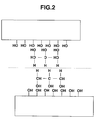
- a mechanism for forming this organic compound layer is not apparent at the present time; however, it is assumed that hydrogen group and hydrogen group face each other thereby to form a sliding interface of a tribo-film at the sliding face.
- hydrogen groups forming part of glycerol face each other thereby forming a sliding interface under hydrogen-bonding, when glycerol is used as a lubricant.
- the above-mentioned sliding member is formed by coating a base material with a hard carbon thin film.
- the hard carbon thin film are crystalline or amorphous thin films containing carbon, particularly a diamond thin film, a diamond-like carbon (DLC) thin film, and the like.
- This hard carbon thin film is preferably formed at whole the sliding section of the sliding member and may be formed at a part of the sliding section.
- the above-mentioned DLC thin film is constituted of a so-called DLC material.
- This DLC material is an amorphous material principally formed of carbon atom and includes two carbon-to-carbon bonding modes of a diamond structure (sp 3 bonding) and a graphite structure (sp 2 bonding).
- a specific example of the DLC material is a-C (amorphous carbon) based material formed substantially of only carbon; however, a ta-C (Tetrahedral Type amorphous carbon) based material mainly formed of sp 2 bonding may be suitably used.
- the above-mentioned hard carbon thin film are affected by kinds and required performances of objective sliding mechanisms, kinds of materials constituting the sliding member, surface roughness of the sliding section, and the like.
- the hard carbon thin film preferably has a surface hardness of 1500 to 5000 Hv in micro-Vickers hardness under a load of 10 g.
- the surface hardness is more preferably 2000 to 4000 Hv, and particularly preferably 2500 to 3500 Hv.
- the above-mentioned hard carbon thin film preferably has a film thickness of 0.3 to 2.0 ⁇ m.
- the film thickness is more preferably 0.5 to 1.5 ⁇ m and particularly preferably 0.7 to 1.2 ⁇ m.
- the above-mentioned hard carbon thin film has a surface roughness in Ra (according to JIS), preferably of not larger than 1 ⁇ m, more preferably of not larger than 0.05 ⁇ m, particularly preferably not larger than 0.03 ⁇ m. If Ra exceeds 1 ⁇ m, scuffing is locally formed, thereby resulting in the possibility of largely increasing the friction coefficient.
- the base material of the above-mentioned sliding members is not particularly restricted, so that examples thereof are metal materials and the like such as a ferrous material, an aluminum-based material, a magnesium-based material, a titanium-based material and the like.
- the base material are also resinous materials such as various rubbers, plastics, non-metal materials such as carbon and the like, and the like.
- the ferrous material, the aluminum-based material and the magnesium-based material are preferable from the viewpoints of being readily applicable to the sliding sections of existing machines, apparatuses and the like and of capable of extensively contributing to energy saving measures in various fields.
- the above-mentioned ferrous material is not particularly restricted, and therefore not only iron of high purity but also various ferrous alloys (containing nickel, copper, zinc, chromium, cobalt, molybdenum, lead, silicon or titanium, any combination thereof, or the like) can be used. Specific examples include carburized steel SCM 420, SCr 420 (according to JIS) and the like.
- the above-mentioned aluminum-based material is not particularly restricted, and therefore not only aluminum of high purity but also various aluminum-based alloys can be sued. Specifically, a hypo-eutectic or hyper-eutectic aluminum alloy and the like containing, for example, silicon (Si) by 4 to 20 % and copper (Cu) by 1.0 to 5.0 % is preferable.
- Preferred examples of the aluminum alloy include AC2A, AC8A, ADC12, ADC14 (according to JIS) and the like.
- a material formed by applying a thin film coating of various kinds on these metal materials or non-metal materials can be used as the base material.
- the material are various metal materials such as the ferrous material, the aluminum-based material, the magnesium-based material or the titanium-based material mentioned above with a thin film coating of TiN, CrN or the like.
- sliding face formed between the above-mentioned sliding members all sliding faces each of which is formed between the surfaces of two sliding members in such a manner that a lubricant containing hydroxyl group exists at the sliding face can be used without restriction.
- the sliding face are sliding faces at sliding sections in an internal combustion engine of a 4 stroke cycle engine or a 2 stroke cycle engine (for example, a valve driving system, a piston, a piston ring, a piston skirt, a cylinder liner, a connecting rod, a crank shaft, a bearing, a roller bearing, a bearing metal, a gear, a chain, a belt, an oil pump and the like), also at sliding sections in a drive system transmission mechanism (for example, gears and the like), sliding sections in a hard disc drive, and other various sliding faces which are severe in frictional conditions and requiring low friction characteristics.
- a 4 stroke cycle engine or a 2 stroke cycle engine for example, a valve driving system, a piston, a piston ring, a piston skirt, a cylinder
- the above-mentioned lubricant containing hydroxyl group is not particularly restricted if it is an organic compound whose molecule contains hydroxyl group.
- the lubricant containing hydroxyl group may be, for example, an organic compound is constituted of carbon, hydrogen and oxygen, and may be an organic compound containing elements other than the carbon, hydrogen and oxygen, such as nitrogen, sulfur, halogen (fluorine, chlorine and the like), phosphorus, boron, a metal and the like.
- the lubricant containing hydroxyl group is one of alcohols.
- the alcohols have two or more hydroxyl groups in a molecule, so that glycerol and the like are preferably used.
- the lubricant containing hydroxyl group is preferably an organic compound which is less in sulfur content or contains no sulfur.
- organic compounds examples include compounds having one or two hydroxyl groups in a molecule.
- alcohols are (A) to (D) set forth below.
- the above-mentioned monoalcohols (A) have one hydroxyl group in a molecule, and include, for example, monohydric alkyl alcohols having 1 to 40 carbon atoms (in which the alkyl group may be linear or branched) such as methanol, ethanol, propanol (1-propanol, 2-propanol), butanol (1-butanol, 2-butanol, 2-methyl-1-propanol, 2-methyl-2-propanol), pentanol (1-pentanol, 2-pentanol, 3-pentanol, 2-methyl-1-butanol, 3-methyl-1-butanol, 3-methyl-2-butanol, 2-methyl-2-butanol, 2,2-dimethyl-1-propanol), hexanol (1-hexanol, 2-hexanol, 3-hexanol, 2-methyl-1-pentanol, 2-methyl-2-pentanol, 2-methyl-3-p
- linear or branched alkyl or alkenyl alcohols having from 12 to 18 carbon atoms such as oleyl alcohol and stearyl alcohol are more preferable to be used from the viewpoints of more effectively reducing the friction at the sliding face and from the viewpoint of being low in volatility and of capable of exhibiting a friction reduction effect even at a high temperature condition, for example, a sliding condition in an internal combustion engine or the like.
- Dialcohols (B) are concretely those having two hydroxyl groups in the molecule, and include, for example, alkyl or alkenyldiols having 2 to 40 carbon atoms (in which the alkyl or alkenyl group may be linear or branched, the double bond of the alkenyl group may be in any desired position, and the hydroxyl group may also be in any desired position) such as ethylene glycol, diethylene glycol, polyethylene glycol, propylene glycol, dipropylene glycol, polypropylene glycol, neopentyl glycol, 1,3-propanediol, 1,4-butanediol, 1,2-butanediol, 2-methyl-1,3-propanediol, 1,5-pentanediol, 1,6-hexanediol, 2-ethyl-2-methyl-1,3-propanediol, 2-methyl-2,4-pentanediol, 1,
- dialcols preferred to be used are ethylene glycol, propylene glycol, neopentyl glycol, 1,4-butanediol, 1,5-pentanediol, neopentyl glycol, 1,6-hexanediol, 2-methyl-2,4-pentanediol, 2-ethyl-2-methyl-1,3-propanediol, 1,7-heptanediol, 1,8-octanediol, 1,9-nonanediol, 1,10-decanediol, 1,11-undecanediol, 1,12-dodecanediol, and the like, from the viewpoint of capable of more effectively reducing the friction at the sliding face.
- high-molecular-weight hindered alcohols having a molecular weight of not less than 300, preferably not less than 400 such as 2,6-di-tert-butyl-4-(3,5-di-tert-butyl-4-hydroxybenzyl)phenyl alcohol are also preferred from the viewpoint of being hardly volatile even at high temperature conditions (for example, in a sliding condition in an internal-combustion engine or the like) and excellent in heat resistance, being capable of exhibiting a friction reduction effect and providing an excellent antioxidation stability.
- Tri- and higher polyalcohols are concretely those having three or more hydroxyl groups.
- tri- to deca-alcohols preferably tri- to hexa-alcohols are used.
- these components are trimethylolalkanes such as glycerin, trimethylolethane, trimethylolpropane, trimethylolbutane; as well as erythritol, pentaerythritol, 1,2,4-butanetriol, 1,3,5-pentanetriol, 1,2,6-hexanetriol, 1,2,3,4-butanetetrol, sorbitol, adonitol, arabitol, xylitol, mannitol; and their polymers or condensates (e.g., glycerin dimers to octamers and the like such as diglycerin, triglycerin, tetraglycerin and the like; trimethylolpropane dimers
- Saccharides such as xylose, arabitol, ribose, rhamnose, glucose, fructose, galactose, mannose, sorbose, cellobiose, mantose, isomaltose, trehalose, sucrose and the like are also usable.
- polyalcohols of tri to hexa-alcohols such as glycerin, trimethylolalkanes (e.g., trimethylolethane, trimethylolpropane, trimethylolbutane), pentaerythritol, 1,2,4-butanetriol, 1,3,5-pentanetriol, 1,2,6-hexanetriol, 1,2,3,4-butanetetrol, sorbitol, sorbitan, sorbitol/glycerin condensate, adonitol, arabitol, xylitol, mannitol, and the like, and their mixtures; and even more preferred are glycerin, trimethylolethane, trimethylolpropane, pentaerythritol, sorbitan and their mixtures.
- glycerin trimethylolethane, trimethylolpropane, pentaerythritol, sorbitan and
- polyalcohols having a hydroxyl group content of not less than 20 %, preferably not less than 30 %, more preferably not less than 40 %. Polyalcohols that are higher than hexa-alcohols will too much increase the viscosity.
- the above-mentioned lubricant containing hydroxyl group is further blended with one or combination of plural kinds selected from an ashless dispersant, an abrasion preventing agent or extreme pressure agent, a metal-based cleaning agent, an antioxidant, a viscosity index improving agent, a friction modifier, an antirusting agent, a nonionic surfactant, a demulsification agent, a metal deactivator, a defoaming agent, and the like, thereby to be improved in required performances.
- the low-friction sliding mechanism having the above-mentioned configuration exhibits a friction coefficient of smaller than 0.02, preferably smaller than 0.01 in a sliding contacting condition under a boundary lubrication which exhibits a friction coefficient of 0.1 to 0.14 at a sliding face formed between steel and steel in the presence of an engine oil.
- typical examples of the engine oil is a 5W-30SF engine oil and the like which do not contain a friction modifier such as MoDTC and the like.
- examples of the above-mentioned steel are SNC415, SNC815 SNCM220, SNCM415, SNCM420, SNCM616, SNCM815 SCr415, SCr420, SCM415, SCM418, SCM420, SCM421, SCM822, SMn420, SMnC420 (according to JIS), and the like; however, the above-mentioned steel is not limited to these.
- a reciprocating sliding friction tester was used in which a reciprocating pin was pressed on a fixed disc plate wetted with a lubricating oil. At this time, a load is 400 N, the pin had a dimension of 22 mm x 18 mm diameter, and a plate had a dimension of 8 mm x 24 mm. Additionally, friction sliding specimens of respective Examples were produced according to the specifications of materials as shown in Table 1 mentioned below.
- the plate was formed of SCM415 carburized steel and of cemented carbide in a part of Examples. Additionally, 5 ml of a lubricant shown in Table 1 was dropped on the obtained plate in such a manner that the surface of the plate was uniformly wetted with the lubricant.
- a lubricant shown in Table 1 was dropped on the obtained plate in such a manner that the surface of the plate was uniformly wetted with the lubricant.
- glycerol 100 % was used as the lubricant.
- a lubricant used was prepared by adding 1.0 % of GMO (glycerol monooleate) to PAO (poly ⁇ -olefin) as a lubricant base oil.
- a 5W-30 engine oil was used as the lubricant.
- the pin was formed of a SUJ2 (according to JIS) heat-treated material and had a finished surface on which a variety of coatings were formed by PVD treatments.
- a-C indicates amorphous carbon, in which a DLC having a hardness of lower than 2000 Hv was coated by a UBM (Unbalanced Magnetron Sputtering) process, while a DLC having a hard DLC having a hardness of not lower than 2000 Hv was coated by an arc ion plating process.
- the surface hardness and the surface roughness in Table 1 are values which were obtained after the final finishing, i.e., after the finishing for the specimen with no coating, and after the coating for the specimen with coating.
- Example Pin-on-disc materials Film thickness ⁇ m Surface hardness Surface roughness Ra ⁇ m Lubricant specification Friction coefficient Plate Pin Plate Pin Plate Hv Pin Hv Plate Pin Lubricant used Base material Coating Base material Coating Example 1 SCM415 carburized a-C SUJ2 heat-treated material a-C 0.7 1.1 1500 1600 0.03 0.03 Glycerol 0.009
- Example 2 SCM415 carburized a-C SUJ2 heat-treated material a-C 0.8 1.8 1600 1800 0.03 0.03 Glycerol 0.008
- Example 3 SCM415 carburized a-C SUJ2 heat-treated material a-C 0.8 0.9 1600 1500 0.05 0.05 Glycerol 0.008
- Example 5 SCM415 carburized ta-C SUJ2 heat-treated material t
- Examples 1 to 9 it was confirmed that no problem arises in shape of the plates and the pins after the test, and the specimens were very excellent in abrasion resistance. It was confirmed that Examples 5 to 9 using the hard DLC (ta-C based) formed by the ion plating process were further improved in friction reduction effect as compared with Examples 1 to 4 using the relatively soft DLC material coated by the UBM process. Accordingly, it was confirmed that the thin film formed of the ta-C based DLC material providing a high friction reduction effect was more effective as a DLC thin film. Thus, a remarkable friction reduction effect can be expected to all mechanical sliding parts. For example, a remarkable effect in direct connection with a fuel economy improvement for an automotive engine can be obtained.
Landscapes
- Engineering & Computer Science (AREA)
- General Engineering & Computer Science (AREA)
- Chemical & Material Sciences (AREA)
- Mechanical Engineering (AREA)
- Chemical Kinetics & Catalysis (AREA)
- General Chemical & Material Sciences (AREA)
- Oil, Petroleum & Natural Gas (AREA)
- Organic Chemistry (AREA)
- Health & Medical Sciences (AREA)
- Emergency Medicine (AREA)
- Lubricants (AREA)
Abstract
[Object] To provide a low-friction sliding mechanism capable of exhibiting an extremely excellent ultra-low friction characteristics at a sliding face existing in a variety of uses.
[Solving means] A low-friction sliding mechanism is constituted by disposing a lubricant containing glycerol, at a sliding face formed between sliding members which have respectively hard carbon thin films. A low-friction sliding mechanism is constituted by disposing a lubricant containing hydroxyl group, at a sliding face formed between sliding members which have respectively hard carbon thin films, wherein a friction coefficient of smaller than 0.02 is exhibited in a sliding contacting condition under a boundary lubrication which exhibits a friction coefficient of 0.1 to 0.14 at a sliding face between a steel and a steel in presence of an engine oil. Each hard carbon thin film is formed of a-C or ta-C. Each hard carbon thin film has a hardness of 1500 to 5000 Hv in micro-Vickers hardness under a load of 10 g. Each hard carbon thin film has a film thickness of 0.3 to 2.0 µm. The lubricant containing hydroxyl group is one of alcohols, and is glycerol.
Description
- This invention relates to a low-friction sliding mechanism, and more particularly to a low-friction sliding mechanism capable of improving a friction characteristics of a variety of sliding faces, for example, in an internal combustion engine or a drive-system transmission machine.
- Global environmental problems such as global warming and ozone layer destruction of whole the earth are coming to the fore. As it has been said that the global warming is significantly affected by CO2 emission, the reduction of CO2 emission, notably the setting of CO2 emission standards, has become a big concern to each country.
One of challenges to reduce CO2 emission is to lower an energy loss due to friction loss of machines, facilities and the like, particularly to improve a fuel economy of motor vehicles, in which sliding materials and lubricants play important roles. - The roles of the sliding materials are to demonstrate an excellent wear resistance and a low friction coefficient in a section severe in frictional condition, sliding sections of an engine, an electric motor, a fuel pump and the like, in which application of a variety of hard thin films are recently proceeding.
In general, a DLC (diamond-like carbon) material is low in friction coefficient in air and in the absence of lubricating oil as compared with abrasion-resistant hard coating materials such as titanium nitride (TiN) and chromium nitride (CrN), and therefore it is expected as a low friction sliding material. - As fuel economy improving measures or the role played by the lubricating oil, the following are proposed: (1) lowering the viscosity of the lubricating oil, thereby reducing viscous resistance in hydrodynamic lubrication regions and agitation resistance in the engine; and (2) adding an optimum friction modifier and various additives into the lubricating oil so as to reduce friction losses under the conditions of mixed lubrication and boundary lubrication.
For example, for the friction modifier, many studies have been made on and around organic molybdenum compounds such as molybdenum dithiocarbamate (MoDTC) and molybdenum dithiophosphate (MoDTP). As a result of the studies, a lubricating oil composition blended with the organic molybdenum compound demonstrating an excellent low friction coefficient at an initial period in use is applied so as to be effective. - Such a friction characteristics of the DLC material and a performance of the organic molybdenum compound as the friction modifier are reported by, for example,
non-patent literatures - Non-patent literature 1: Japan Tribology Congress preliminary theses, May 1999, Tokyo, Pages 11-12, KANO et al.
- Non-patent literature: World Tribology Congress 2001. 9, Vienna, Proceeding Page 342, KANO et al.
- Additionally, it has been proposed to obtain a large friction reduction by lubricating a DLC and an iron-based material, an aluminum alloy, a magnesium alloy or a DLC material with an oil agent containing an ester-based additive or the like (see, for example,
Patent literatures 1 to 4). - Patent literature 1: Patent Provisional Publication No.
2002-45576 - Patent literature 2: Patent Provisional Publication No.
2002-322322 - Patent literature 3: Patent Provisional Publication No.
2003-208193 - Patent literature 4: Patent Provisional Publication No.
2003-207056 - However, in the
non-patent literature 1, it is reported that general DLC materials excellent in low friction characteristics in air are not always high in friction reduction effect in the presence of a lubricating oil.
Additionally, in thenon-patent literature 2, it is understood that there is such a possibility that a friction reduction effect cannot be sufficiently demonstrated even if a lubricating oil composition containing an organic molybdenum compound is applied to such a sliding material.
Further, in the above-mentioned patent literatures, it is not disclosed to demonstrate a super friction characteristics in which a friction coefficient exceeds a level of 1/1000 (smaller than 0.01). - This invention has been made in view of such problems of the conventional techniques and is intended to provide a low-friction sliding mechanism in which sliding faces existing under various applications can exhibit a highly excellent ultra-low friction characteristics.
- As a result of eagerly conducted studies in order to solve the above-mentioned problems, the present inventors have reached completion of the present invention upon finding to solve the above-mentioned problems by combining a lubricant containing hydroxyl group with sliding members which have respectively hard carbon thin films thereby forming a very thin and low shearing stress compound at the surfaces of the members.
- In other words, a low-friction sliding mechanism according to the present invention is a low-friction sliding mechanism characterized in that a lubricant containing glycerol exists at a sliding face which is formed between sliding members which respectively have hard carbon thin films, or scharacterized in that a friction coefficient of smaller than 0.02 is exhibited in a sliding contacting condition under a boundary lubrication which exhibits a friction coefficient of 0.1 to 0.14 at a sliding face between steels in the presence of an engine oil, at the sliding face which is formed between sliding members which respectively have hard carbon thin films.
- Additionally, a preferable embodiment of the low-friction sliding mechanism according to the present invention is characterized in that the above-mentioned hard carbon thin film is a diamond-like carbon thin film formed of amorphous carbon (a-C) and/or tetrahedral carbon (ta-C).
- Further, another preferable embodiment of the low-friction sliding mechanism according to the present invention is characterized in that the hard carbon thin film has a hardness of 1500 to 5000 Hv in micro-Vickers hardness under a load of 10 g, and the hard carbon thin film has a film thickness of 0.3 to 2.0 µm.
- Furthermore, a further preferable embodiment of the low-friction sliding mechanism according to the present invention is characterized in that the above-mentioned lubricant containing hydroxyl group is one of alcohols, particularly glycerol.
- The low-friction sliding mechanism according to the present invention is constituted by combining a lubricant containing glycerol with sliding members which respectively have hard carbon thin films thereby forming a very thin and low shearing stress compound, so as to making is possible to exhibit an extremely excellent ultra-low friction characteristics at a sliding face existing in a variety of uses.
- Hereinafter, the low-friction sliding mechanism according to the present invention will be discussed further in detail. In the specification and claims, [%] for concentration, content, filled amount and the like is represented by "mass percent" unless otherwise specified.
- As discussed above, the low-friction sliding mechanism according to the present invention is constituted by disposing a lubricant containing glycerol or a lubricant containing hydroxyl group to a sliding face formed between sliding members which respectively have hard carbon thin films.
Additionally, a friction coefficient of not less than 0.02 is exhibited in a sliding contacting condition at the sliding face under a boundary lubrication which exhibits a friction coefficient of 0.1 to 0.14 at a sliding face between steels in the presence of an engine oil. - With such a configuration, an organic compound layer having hydroxyl group and very low in shearing stress is formed at the surface of the sliding member, thereby exhibiting a ultra-low friction characteristics.
A mechanism for forming this organic compound layer is not apparent at the present time; however, it is assumed that hydrogen group and hydrogen group face each other thereby to form a sliding interface of a tribo-film at the sliding face. For example, as shown inFig. 2 , it is considered that hydrogen groups forming part of glycerol face each other thereby forming a sliding interface under hydrogen-bonding, when glycerol is used as a lubricant. - Here, the above-mentioned sliding member is formed by coating a base material with a hard carbon thin film.
Examples of the hard carbon thin film are crystalline or amorphous thin films containing carbon, particularly a diamond thin film, a diamond-like carbon (DLC) thin film, and the like.
This hard carbon thin film is preferably formed at whole the sliding section of the sliding member and may be formed at a part of the sliding section. - The above-mentioned DLC thin film is constituted of a so-called DLC material. This DLC material is an amorphous material principally formed of carbon atom and includes two carbon-to-carbon bonding modes of a diamond structure (sp3 bonding) and a graphite structure (sp2 bonding).
A specific example of the DLC material is a-C (amorphous carbon) based material formed substantially of only carbon; however, a ta-C (Tetrahedral Type amorphous carbon) based material mainly formed of sp2 bonding may be suitably used. - The above-mentioned hard carbon thin film are affected by kinds and required performances of objective sliding mechanisms, kinds of materials constituting the sliding member, surface roughness of the sliding section, and the like. For example, the hard carbon thin film preferably has a surface hardness of 1500 to 5000 Hv in micro-Vickers hardness under a load of 10 g. The surface hardness is more preferably 2000 to 4000 Hv, and particularly preferably 2500 to 3500 Hv.
Additionally, the above-mentioned hard carbon thin film preferably has a film thickness of 0.3 to 2.0 µm. The film thickness is more preferably 0.5 to 1.5 µm and particularly preferably 0.7 to 1.2 µm.
If the surface hardness and film thickness are outside the above-mentioned range so as to be smaller than 1500 Hv in hardness and 0.3 µm in thickness, abrasion tends to occur. To the contrary, if they are outside the above-mentioned range so as to exceed 3500 Hv in hardness and 2.0 µm in thickness, peeling tends to occur. - Further, the above-mentioned hard carbon thin film has a surface roughness in Ra (according to JIS), preferably of not larger than 1 µm, more preferably of not larger than 0.05 µm, particularly preferably not larger than 0.03 µm. If Ra exceeds 1 µm, scuffing is locally formed, thereby resulting in the possibility of largely increasing the friction coefficient.
- The base material of the above-mentioned sliding members is not particularly restricted, so that examples thereof are metal materials and the like such as a ferrous material, an aluminum-based material, a magnesium-based material, a titanium-based material and the like. Examples of the base material are also resinous materials such as various rubbers, plastics, non-metal materials such as carbon and the like, and the like.
Particularly, the ferrous material, the aluminum-based material and the magnesium-based material are preferable from the viewpoints of being readily applicable to the sliding sections of existing machines, apparatuses and the like and of capable of extensively contributing to energy saving measures in various fields. - The above-mentioned ferrous material is not particularly restricted, and therefore not only iron of high purity but also various ferrous alloys (containing nickel, copper, zinc, chromium, cobalt, molybdenum, lead, silicon or titanium, any combination thereof, or the like) can be used. Specific examples include carburized steel SCM 420, SCr 420 (according to JIS) and the like.
The above-mentioned aluminum-based material is not particularly restricted, and therefore not only aluminum of high purity but also various aluminum-based alloys can be sued. Specifically, a hypo-eutectic or hyper-eutectic aluminum alloy and the like containing, for example, silicon (Si) by 4 to 20 % and copper (Cu) by 1.0 to 5.0 % is preferable. Preferred examples of the aluminum alloy include AC2A, AC8A, ADC12, ADC14 (according to JIS) and the like. - Further, a material formed by applying a thin film coating of various kinds on these metal materials or non-metal materials can be used as the base material. Specific examples of the material are various metal materials such as the ferrous material, the aluminum-based material, the magnesium-based material or the titanium-based material mentioned above with a thin film coating of TiN, CrN or the like.
- As the sliding face formed between the above-mentioned sliding members, all sliding faces each of which is formed between the surfaces of two sliding members in such a manner that a lubricant containing hydroxyl group exists at the sliding face can be used without restriction. Examples of the sliding face are sliding faces at sliding sections in an internal combustion engine of a 4 stroke cycle engine or a 2 stroke cycle engine (for example, a valve driving system, a piston, a piston ring, a piston skirt, a cylinder liner, a connecting rod, a crank shaft, a bearing, a roller bearing, a bearing metal, a gear, a chain, a belt, an oil pump and the like), also at sliding sections in a drive system transmission mechanism (for example, gears and the like), sliding sections in a hard disc drive, and other various sliding faces which are severe in frictional conditions and requiring low friction characteristics.
- The above-mentioned lubricant containing hydroxyl group is not particularly restricted if it is an organic compound whose molecule contains hydroxyl group.
The lubricant containing hydroxyl group may be, for example, an organic compound is constituted of carbon, hydrogen and oxygen, and may be an organic compound containing elements other than the carbon, hydrogen and oxygen, such as nitrogen, sulfur, halogen (fluorine, chlorine and the like), phosphorus, boron, a metal and the like.
Particularly from the viewpoint of further reducing the friction at the sliding face, it is preferable that the lubricant containing hydroxyl group is one of alcohols. Additionally, the alcohols have two or more hydroxyl groups in a molecule, so that glycerol and the like are preferably used. For the same reason, the lubricant containing hydroxyl group is preferably an organic compound which is less in sulfur content or contains no sulfur. - Here, the above-mentioned alcohols are organic compounds represented by the following general formula (1):
- R-(OH)n ...(1)
- Examples of the organic compounds are compounds having one or two hydroxyl groups in a molecule.
- Specific examples of alcohols are (A) to (D) set forth below.
- Monoalcohols (A)
- Dialcohols (B).
- Tri and higher polyalcohols (C).
- Mixtures of one kind or more kinds selected from the above-mentioned three kinds of alcohols (D)
- The above-mentioned monoalcohols (A) have one hydroxyl group in a molecule, and include, for example, monohydric alkyl alcohols having 1 to 40 carbon atoms (in which the alkyl group may be linear or branched) such as methanol, ethanol, propanol (1-propanol, 2-propanol), butanol (1-butanol, 2-butanol, 2-methyl-1-propanol, 2-methyl-2-propanol), pentanol (1-pentanol, 2-pentanol, 3-pentanol, 2-methyl-1-butanol, 3-methyl-1-butanol, 3-methyl-2-butanol, 2-methyl-2-butanol, 2,2-dimethyl-1-propanol), hexanol (1-hexanol, 2-hexanol, 3-hexanol, 2-methyl-1-pentanol, 2-methyl-2-pentanol, 2-methyl-3-pentanol, 3-methyl-1-pentanol, 3-methyl-2-pentanol, 3-methyl-3-pentanol, 4-methyl-1-pentanol, 4-methyl-2-pentanol, 2,3-dimethyl-1-butanol, 2,3-dimethyl-2-butanol, 3,3-dimethyl-1-butanol, 3,3-dimethyl-2-butanol, 2-ethyl-1-butanol, 2,2-dimethylbutanol), heptanol (1-heptanol, 2-heptanol, 3-heptanol, 2-methyl-1-hexanol, 2-methyl-2-hexanol, 2-methyl-3-hexanol, 5-methyl-2-hexanol, 3-ethyl-3-pentanol, 2,2-dimethyl-3-pentanol, 2,3-dimethyl-3-pentanol, 2,4-dimethyl-3-pentanol, 4,4-dimethyl-2-pentanol, 3-methyl-1-hexanol, 4-methyl-1-hexanol, 5-methyl-1-hexanol, 2-ethylpentanol), octanol (1-octanol, 2-octanol, 3-octanol, 4-methyl-3-heptanol, 6-methyl-2-heptanol, 2-ethyl-1-hexanol, 2-propyl-1-pentanol, 2,4,4-trimethyl-1-pentanol, 3,5-dimethyl-1-hexanol, 2-methyl-1-heptanol, 2,2-dimethyl-1-hexanol), nonanol (1-nonanol, 2-nonanol, 3,5,5-trimethyl-1-hexanol, 2,6-dimethyl-4-heptanol, 3-ethyl-2,2-dimethyl-3-pentanol, 5-methyloctanol, and the like), decanol (1-decanol, 2-decanol, 4-decanol, 3,7-dimethyl-1-octanol, 2,4,6-trimethylheptanol, etc.), undecanol, dodecanol, tridecanol, tetradecanol, pentadecanol, hexadecanol, heptadecanol, octadecanol (stearyl alcohol, and the like), nonadecanol, eicosanol, heneicosanol, tricosanol, tetracosanol; monohydric alkenyl alcohols having 2 to 40 carbon atoms (in which the alkenyl group may be linear or branched, and the double bond may be in any desired position) such as ethenol, propenol, butenol, hexenol, octenol, decenol, dodecenol, octadecenol (oleyl alcohol, and the like); monohydric (alkyl)cycloalkyl alcohols having 3 to 40 carbon atoms (in which the alkyl group may be linear or branched, and the alkyl group and the hydroxyl group may be in any desired position) such as cyclopentanol, cyclohexanol, cycloheptanol, cyclooctanol, methylcyclopentanol, methylcyclohexanol, dimethylcyclohexanol, ethylcyclohexanol, propylcyclohexanol, butylcyclohexanol, dimethylcyclohexanol, cyclopentylmethanol, cyclohexylmethanol, cyclohexylethanol (1-cyclohexylethanol, 2-cyclohexylethanol, and the like), cyclohexylpropanol (3-cyclohexylpropanol, and the like), cyclohexylbutanol (4-cyclohexylbutanol, and the like) butylcyclohexanol, 3,3,5,5-tetramethylcyclohexanol, and the like; (alkyl)aryl alcohols (in which the alkyl group may be linear or branched, and the alkyl group and the hydroxyl group may be in any desired position) such as phenyl alcohol, methylphenyl alcohol (o-cresol, m-cresol, p-cresol), creosol, ethylphenyl alcohol, propylphenyl alcohol, butylphenyl alcohol, butylmethylphenyl alcohol (3-methyl-6-tert-butylphenyl alcohol, and the like), dimethylphenyl alcohol, diethylphenyl alcohol, dibutylphenyl alcohol (2,6-di-tert-butylphenyl alcohol, 2,4-di-tert-butylphenyl alcohol, and the like), dibutylmethylphenyl alcohol (2,6-di-tert-butyl-4-methylphenyl alcohol, and the like), dibutylethylphenyl alcohol (2,6-di-tert-butyl-4-ethylphenyl alcohol, and the like), tributylphenyl alcohol (2,4,6-tri-tert-butylphenyl alcohol, etc.), naphthol (α-naphthol, β-naphthol, and the like), dibutylnaphthol (2,4-di-tert-butyl-α-naphthol, and the like), and the like; 6-(4-hydroxy-3,5-di-tert-butylanilino)-2,4-bis(n-octylthio)-1,3,5-triazine, and the like; and their mixtures.
- Of these monoalcohols, linear or branched alkyl or alkenyl alcohols having from 12 to 18 carbon atoms such as oleyl alcohol and stearyl alcohol are more preferable to be used from the viewpoints of more effectively reducing the friction at the sliding face and from the viewpoint of being low in volatility and of capable of exhibiting a friction reduction effect even at a high temperature condition, for example, a sliding condition in an internal combustion engine or the like.
- Dialcohols (B) are concretely those having two hydroxyl groups in the molecule, and include, for example, alkyl or alkenyldiols having 2 to 40 carbon atoms (in which the alkyl or alkenyl group may be linear or branched, the double bond of the alkenyl group may be in any desired position, and the hydroxyl group may also be in any desired position) such as ethylene glycol, diethylene glycol, polyethylene glycol, propylene glycol, dipropylene glycol, polypropylene glycol, neopentyl glycol, 1,3-propanediol, 1,4-butanediol, 1,2-butanediol, 2-methyl-1,3-propanediol, 1,5-pentanediol, 1,6-hexanediol, 2-ethyl-2-methyl-1,3-propanediol, 2-methyl-2,4-pentanediol, 1,7-heptanediol, 2-methyl-2-propyl-1,3-propanediol, 2,2-diethyl-1,3-propanediol, 1,8-octanediol, 1,9-nonanediol, 2-butyl-2-ethyl-1,3-propanediol, 1,10-decanediol, 1,11-undecanediol, 1,12-dodecanediol, 1,13-tridecanediol, 1,14-tetradecanediol, 1,15-heptadecanediol, 1,16-hexadecanediol, 1,17-heptadecanediol, 1,18-octadecanediol, 1,19-nonadecanediol, 1,20-eicosadecanediol, and the like; (alkyl)cycloalkanediols (in which the alkyl group may be linear or branched, and the alkyl group and the hydroxyl group may be in any desired position) such as cyclohexanediol, methylcyclohexanediol, and the like; dihydric (alkyl)aryl alcohols having from 2 to 40 carbon atoms (in which the alkyl group may be linear or branched, and the alkyl group and the hydroxyl group may be in any desired position) and the like such as benzenediol (catechol, and the like), methylbenzenediol, ethylbenzenediol, butylbenzenediol (p-tert-butylcatechol, and the like) dibutylbenzenediol (4,6-di-tert-butylresorcinol, and the like), 4,4'-thiobis(3-methyl-6-tert-butylphenol), 4,4'-butylidenebis(3-methyl-6-tert-butylphenol), 2,2'-methylenebis(4-methyl-6-tert-butylphenol), 2,2'-thiobis(4,6-di-tert-butylresorcinol), 2,2'-methylenebis(4-ethyl-6-tert-butylphenol), 4,4'-methylenebis(2,6-di-tert-butylphenol), 2,2'-(3,5-di-tert-butylhydroxy)propane, 4,4'-cyclohexylidenebis(2,6-di-tert-butylphenol), and the like; p-tert-butylphenol/formaldehyde condensate, p-tert-butylphenol/acetaldehyde condensate, and the like; and their mixtures.
- Of these dialcols, preferred to be used are ethylene glycol, propylene glycol, neopentyl glycol, 1,4-butanediol, 1,5-pentanediol, neopentyl glycol, 1,6-hexanediol, 2-methyl-2,4-pentanediol, 2-ethyl-2-methyl-1,3-propanediol, 1,7-heptanediol, 1,8-octanediol, 1,9-nonanediol, 1,10-decanediol, 1,11-undecanediol, 1,12-dodecanediol, and the like, from the viewpoint of capable of more effectively reducing the friction at the sliding face. In addition, high-molecular-weight hindered alcohols having a molecular weight of not less than 300, preferably not less than 400 such as 2,6-di-tert-butyl-4-(3,5-di-tert-butyl-4-hydroxybenzyl)phenyl alcohol are also preferred from the viewpoint of being hardly volatile even at high temperature conditions (for example, in a sliding condition in an internal-combustion engine or the like) and excellent in heat resistance, being capable of exhibiting a friction reduction effect and providing an excellent antioxidation stability.
- Tri- and higher polyalcohols are concretely those having three or more hydroxyl groups. In general, tri- to deca-alcohols, preferably tri- to hexa-alcohols are used. Examples of these components are trimethylolalkanes such as glycerin, trimethylolethane, trimethylolpropane, trimethylolbutane; as well as erythritol, pentaerythritol, 1,2,4-butanetriol, 1,3,5-pentanetriol, 1,2,6-hexanetriol, 1,2,3,4-butanetetrol, sorbitol, adonitol, arabitol, xylitol, mannitol; and their polymers or condensates (e.g., glycerin dimers to octamers and the like such as diglycerin, triglycerin, tetraglycerin and the like; trimethylolpropane dimers to octamers and the like such as ditrimethylolpropane; pentaerythritol dimers to tetramers and the like such as dipentaerythritol and the like; sorbitan; condensates such as sorbitol/glycerin condensate (including intramolecular condensates, intermolecular condensates, and self-condensates), and the like.
- Saccharides such as xylose, arabitol, ribose, rhamnose, glucose, fructose, galactose, mannose, sorbose, cellobiose, mantose, isomaltose, trehalose, sucrose and the like are also usable.
- Of these tri- and higher polyalcohols, more preferred are polyalcohols of tri to hexa-alcohols such as glycerin, trimethylolalkanes (e.g., trimethylolethane, trimethylolpropane, trimethylolbutane), pentaerythritol, 1,2,4-butanetriol, 1,3,5-pentanetriol, 1,2,6-hexanetriol, 1,2,3,4-butanetetrol, sorbitol, sorbitan, sorbitol/glycerin condensate, adonitol, arabitol, xylitol, mannitol, and the like, and their mixtures; and even more preferred are glycerin, trimethylolethane, trimethylolpropane, pentaerythritol, sorbitan and their mixtures. Especially preferred are polyalcohols having a hydroxyl group content of not less than 20 %, preferably not less than 30 %, more preferably not less than 40 %. Polyalcohols that are higher than hexa-alcohols will too much increase the viscosity.
- The above-mentioned lubricant containing hydroxyl group is further blended with one or combination of plural kinds selected from an ashless dispersant, an abrasion preventing agent or extreme pressure agent, a metal-based cleaning agent, an antioxidant, a viscosity index improving agent, a friction modifier, an antirusting agent, a nonionic surfactant, a demulsification agent, a metal deactivator, a defoaming agent, and the like, thereby to be improved in required performances.
- The low-friction sliding mechanism having the above-mentioned configuration, according to the present invention exhibits a friction coefficient of smaller than 0.02, preferably smaller than 0.01 in a sliding contacting condition under a boundary lubrication which exhibits a friction coefficient of 0.1 to 0.14 at a sliding face formed between steel and steel in the presence of an engine oil.
Here, typical examples of the engine oil is a 5W-30SF engine oil and the like which do not contain a friction modifier such as MoDTC and the like.
Additionally, examples of the above-mentioned steel are SNC415, SNC815 SNCM220, SNCM415, SNCM420, SNCM616, SNCM815 SCr415, SCr420, SCM415, SCM418, SCM420, SCM421, SCM822, SMn420, SMnC420 (according to JIS), and the like; however, the above-mentioned steel is not limited to these. - Hereinafter, the present invention will be discussed with reference to Examples and Comparative Examples; however, the present invention is not limited to these Examples.
- As shown in
Fig. 3 , as a sliding mechanism of each Example, a reciprocating sliding friction tester was used in which a reciprocating pin was pressed on a fixed disc plate wetted with a lubricating oil. At this time, a load is 400 N, the pin had a dimension of 22 mm x 18 mm diameter, and a plate had a dimension of 8 mm x 24 mm.
Additionally, friction sliding specimens of respective Examples were produced according to the specifications of materials as shown in Table 1 mentioned below. - The plate was formed of SCM415 carburized steel and of cemented carbide in a part of Examples.
Additionally, 5 ml of a lubricant shown in Table 1 was dropped on the obtained plate in such a manner that the surface of the plate was uniformly wetted with the lubricant.
In Examples 1 to 9 and Comparative Examples 1 and 2, glycerol 100 % was used as the lubricant.
In Comparative Example 3, a lubricant used was prepared by adding 1.0 % of GMO (glycerol monooleate) to PAO (polyα-olefin) as a lubricant base oil.
In Comparative Examples 4 and 5, a 5W-30 engine oil was used as the lubricant. - The pin was formed of a SUJ2 (according to JIS) heat-treated material and had a finished surface on which a variety of coatings were formed by PVD treatments.
In Table 1, "a-C" indicates amorphous carbon, in which a DLC having a hardness of lower than 2000 Hv was coated by a UBM (Unbalanced Magnetron Sputtering) process, while a DLC having a hard DLC having a hardness of not lower than 2000 Hv was coated by an arc ion plating process. - Additionally, the surface hardness and the surface roughness in Table 1 are values which were obtained after the final finishing, i.e., after the finishing for the specimen with no coating, and after the coating for the specimen with coating.
-
[Reciprocating sliding friction test] Lubricating oil supply manner :No supply from outside Plate temperature :80 °C Maximum Hertz's pressure :270 MPa Amplitude of reciprocating movement :3 mm Frequency of reciprocating movement :50 Hz Test time :15 min -
TABLE 1 Example Pin-on-disc materials Film thickness µm Surface hardness Surface roughness Ra µm Lubricant specification Friction coefficient Plate Pin Plate Pin Plate Hv Pin Hv Plate Pin Lubricant used Base material Coating Base material Coating Example 1 SCM415 carburized a-C SUJ2 heat-treated material a-C 0.7 1.1 1500 1600 0.03 0.03 Glycerol 0.009 Example 2 SCM415 carburized a-C SUJ2 heat-treated material a-C 0.8 1.8 1600 1800 0.03 0.03 Glycerol 0.008 Example 3 SCM415 carburized a-C SUJ2 heat-treated material a-C 0.8 0.9 1600 1500 0.05 0.05 Glycerol 0.008 Example 4 SCM415 carburized a-C SUJ2 heat-treated material ta-C 0.9 0.9 1600 2800 0.05 0.05 Glycerol 0.008 Example 5 SCM415 carburized ta-C SUJ2 heat-treated material ta-C 1.1 0.9 2900 2800 0.04 0.05 Glycerol 0.007 Example 6 SCM415 carburized ta-C SUJ2 heat-treated material ta-C 1.1 0.8 2900 2700 0.05 0.02 Glycerol 0.007 Example 7 SCM415 carburized ta-C SUJ2 heat-treated material ta-C 0.9 1.1 2800 2900 0.05 0.03 Glycerol 0.007 Example 8 Cemented carbide WC-Co ta-C SUJ2 heat-treated material ta-C 0.3 0.9 2800 3500 0.05 0.10 Glycerol 0.007 Example 9 Cemented carbide WC-Co ta-C SUJ2 heat-treated material ta-C 0.7 0.3 3200 2900 0.05 0.04 Glycerol 0.007 Comparative example 1 SCM415 carburized a-C SUJ2 heat-treated material Nil 0.8 1600 750 0.10 0.03 Glycerol 0.02 Comparative example 2 SCM415 carburized ta-C SUJ2 heat-treated material Nil 0.8 2700 750 0.04 0.03 Glycerol 0.03 Comparative example 3 SCM415 carburized ta-C SUJ2 heat-treated material ta-C 0.9 0.8 2800 2700 0.04 0.04 PAO+GMO 1 mass % 0.02 Comparative example 4 SCM415 carburized ta-C SUJ2 heat-treated material ta-C 0.8 1.1 2700 2900 0.10 0.03 5W-30 engine oil 0.06 Comparative example 5 SCM415 carburized Nil SUJ2 heat-treated material Nil 710 750 0.05 0.03 5W-30 engine oil 0.14 Number indicates mass %
*PAO: Poly Alpha-Olefin *GMO: Glycerol monooleate - As depicted in Table 1, in the cases that sliding was made under the combination of the coating film obtained in Examples 1 to 9 and the lubricant, an excellent ultra-low friction called "Super-low friction" at which the friction coefficient was lower than 0.01 was exhibited in any case.
In the cases (Comparative Examples 1 and 2) that sliding was made under the combination of a steel material and a steel material (as base materials) either one of which was without coating of DLC, and in the cases (Comparative Examples 3 and 4) that sliding was made under the combination of the specimens with the lubricant containing no hydroxyl group, the friction coefficient could not lower below 0.01.
As understood from Comparative Example 5, the sliding mechanisms of Examples 1 to 9 which were within the preferable ranges of the present invention lower two digits in friction coefficient as compared with a case that sliding was made under a widely used combination of sliding materials of steel-to-steel and an engine oil. - Additionally, in Examples 1 to 9, it was confirmed that no problem arises in shape of the plates and the pins after the test, and the specimens were very excellent in abrasion resistance.
It was confirmed that Examples 5 to 9 using the hard DLC (ta-C based) formed by the ion plating process were further improved in friction reduction effect as compared with Examples 1 to 4 using the relatively soft DLC material coated by the UBM process.
Accordingly, it was confirmed that the thin film formed of the ta-C based DLC material providing a high friction reduction effect was more effective as a DLC thin film.
Thus, a remarkable friction reduction effect can be expected to all mechanical sliding parts. For example, a remarkable effect in direct connection with a fuel economy improvement for an automotive engine can be obtained. -
- [
Fig. 1 ] is an explanatory view showing the ranges of a a-C based material and a ta-C based material. - [
Fig. 2 ] is a schematic illustration of an organic compound of a low shearing stress. - [
Fig. 3 ] is a rough perspective view showing a reciprocating sliding type friction testing method. -
- 1
- pin
- 2
- plate
Claims (11)
- A low-friction sliding mechanism comprising sliding members which respectively have hard carbon thin films between which a sliding face is formed, and a lubricant containing glycerol, existing at the sliding face.
- A low-friction sliding mechanism comprising sliding members which respectively have hard carbon thin films between which a sliding face is formed, and a lubricant containing hydroxyl group, existing at the sliding face,
wherein a friction coefficient of smaller than 0.02 is exhibited in a sliding contacting condition under a boundary lubrication which exhibits a friction coefficient of 0.1 to 0.14 at a sliding face between steels in presence of an engine oil. - A low-friction sliding mechanism as claimed in Claim 1 or 2, wherein the hard carbon thin film is a diamond-like carbon thin film formed of amorphous carbon (a-C) and/or tetrahedral carbon (ta-C).
- A low-friction sliding mechanism as claimed in any one of Claims 1 to 3, wherein the hard carbon thin film has a hardness of 1500 to 5000 Hv in micro-Vickers hardness under a load of 10 g.
- A low-friction sliding mechanism as claimed in any of Claims 1 to 4, wherein the hard carbon thin film has a hardness of 2000 to 3500 Hv in micro-Vickers hardness under a load of 10 g.
- A low-friction sliding mechanism as claimed in any of Claims 1 to 5, wherein the hard carbon thin film has a film thickness of 0.3 to 2.0 µm.
- A low-friction sliding mechanism as claimed in any of Claims 1 to 6, wherein the hard carbon thin film has a film thickness of 0.5 to 1.5 µm.
- A low-friction sliding mechanism as claimed in any of Claims 2 to 7, wherein the lubricant containing hydroxyl group is one of alcohols.
- A low-friction sliding mechanism as claimed in any of Claims 2 to 8, wherein the lubricant containing hydroxyl group is glycerol.
- A low-friction sliding mechanism as claimed in any of Claims 1 to 9, wherein hydrogen group and hydrogen group face each other to form a sliding interface of a tribo-film, at the sliding face.
- A low-friction sliding mechanism as claimed in Claim 10, wherein the hydrogen group is a part of the lubricant.
Applications Claiming Priority (3)
| Application Number | Priority Date | Filing Date | Title |
|---|---|---|---|
| JP2006102831 | 2006-04-04 | ||
| JP2007052227A JP2007297592A (en) | 2006-04-04 | 2007-03-02 | Low friction sliding mechanism |
| PCT/JP2007/057409 WO2007116861A1 (en) | 2006-04-04 | 2007-04-02 | Low-friction sliding mechanism |
Publications (2)
| Publication Number | Publication Date |
|---|---|
| EP2003350A2 true EP2003350A2 (en) | 2008-12-17 |
| EP2003350A9 EP2003350A9 (en) | 2009-05-06 |
Family
ID=38581151
Family Applications (1)
| Application Number | Title | Priority Date | Filing Date |
|---|---|---|---|
| EP07740845A Withdrawn EP2003350A2 (en) | 2006-04-04 | 2007-04-02 | Low-friction sliding mechanism |
Country Status (5)
| Country | Link |
|---|---|
| US (1) | US20090118148A1 (en) |
| EP (1) | EP2003350A2 (en) |
| JP (1) | JP2007297592A (en) |
| KR (1) | KR20090012310A (en) |
| WO (1) | WO2007116861A1 (en) |
Families Citing this family (17)
| Publication number | Priority date | Publication date | Assignee | Title |
|---|---|---|---|---|
| US10100266B2 (en) | 2006-01-12 | 2018-10-16 | The Board Of Trustees Of The University Of Arkansas | Dielectric nanolubricant compositions |
| JP5603013B2 (en) * | 2006-01-12 | 2014-10-08 | ザ ボード オブ トラスティーズ オブ ザ ユニバーシティ オブ アーカンソー | Nanoparticle composition and method for producing and using |
| JP5245388B2 (en) * | 2007-12-18 | 2013-07-24 | Tdk株式会社 | Electrochemical sensor and electrochemical sensor system |
| DE102009032520A1 (en) * | 2009-07-10 | 2011-01-20 | Magna Steyr Fahrzeugtechnik Ag & Co Kg | Method for producing and commissioning a transmission with a lubricant based on water |
| WO2010040860A2 (en) * | 2008-10-10 | 2010-04-15 | Magna Steyr Fahrzeugtechnik Ag & Co Kg | Method for producing and operating for the first time a transmission unit with a lubricant based on water and such a lubricant |
| DE102011003254A1 (en) * | 2011-01-27 | 2012-08-02 | Federal-Mogul Burscheid Gmbh | Sliding element, in particular piston ring, with a coating and method for producing a sliding element |
| DE102011077556A1 (en) | 2011-06-15 | 2012-12-20 | Schaeffler Technologies AG & Co. KG | bearings |
| EP2587518B1 (en) * | 2011-10-31 | 2018-12-19 | IHI Hauzer Techno Coating B.V. | Apparatus and Method for depositing Hydrogen-free ta C Layers on Workpieces and Workpiece |
| WO2013141959A1 (en) * | 2012-03-22 | 2013-09-26 | The Timken Company | Anti-fretting additives for non-lubricated contact surfaces |
| BR102012012636B1 (en) * | 2012-05-25 | 2022-01-04 | Mahle Metal Leve S/A | CYLINDER FOR APPLICATION IN AN INTERNAL COMBUSTION ENGINE |
| US8476206B1 (en) | 2012-07-02 | 2013-07-02 | Ajay P. Malshe | Nanoparticle macro-compositions |
| US8486870B1 (en) | 2012-07-02 | 2013-07-16 | Ajay P. Malshe | Textured surfaces to enhance nano-lubrication |
| DE102013101246B4 (en) * | 2013-02-08 | 2025-05-08 | Bayerische Motoren Werke Aktiengesellschaft | Friction-reduced sliding system |
| JP6621401B2 (en) * | 2013-04-30 | 2019-12-18 | フラウンホッファー−ゲゼルシャフト・ツァー・フォデラング・デル・アンゲワンテン・フォーシュング・エー.ファウ. | Method for producing wear-resistant layer and wear-resistant layer produced by the method |
| WO2019089181A1 (en) * | 2017-10-30 | 2019-05-09 | Exxonmobil Research And Engineering Company | Lubricating oil compositions with engine wear protection |
| DE102020102645A1 (en) * | 2020-02-03 | 2021-08-05 | Klüber Lubrication München Se & Co. Kg | Tribological system |
| CN113512459B (en) * | 2021-07-13 | 2022-08-12 | 西北工业大学 | Ultra-low friction solid-liquid composition containing boronized layer and method for reducing workpiece friction |
Family Cites Families (11)
| Publication number | Priority date | Publication date | Assignee | Title |
|---|---|---|---|---|
| US6392823B1 (en) | 1999-10-28 | 2002-05-21 | David J. Burnett | Apparatus for examination of the bottom of the foot |
| JP2002322322A (en) | 2001-02-27 | 2002-11-08 | Bromine Compounds Ltd | Flame retardant polyolefin composition |
| US6610360B2 (en) * | 2001-11-28 | 2003-08-26 | Guardian Industries Corp. | Buffing diamond-like carbon (DLC) to improve scratch resistance |
| JP3985525B2 (en) | 2002-01-10 | 2007-10-03 | 日産自動車株式会社 | Voice recognition device |
| US6752378B2 (en) | 2002-01-14 | 2004-06-22 | Westinghouse Airbrake Technologies Corporation | Valve assembly with integral seat |
| JP3555891B2 (en) * | 2002-02-22 | 2004-08-18 | 新日本石油株式会社 | Low friction sliding material and lubricating oil composition used therefor |
| US6969198B2 (en) * | 2002-11-06 | 2005-11-29 | Nissan Motor Co., Ltd. | Low-friction sliding mechanism |
| EP1666573B1 (en) * | 2003-08-06 | 2019-05-15 | Nissan Motor Company Limited | Low-friction sliding mechanism and method of friction reduction |
| JP4614427B2 (en) * | 2003-08-06 | 2011-01-19 | 日産自動車株式会社 | Low friction sliding mechanism, manual transmission and final reduction gear |
| US7771821B2 (en) * | 2003-08-21 | 2010-08-10 | Nissan Motor Co., Ltd. | Low-friction sliding member and low-friction sliding mechanism using same |
| EP1508611B1 (en) * | 2003-08-22 | 2019-04-17 | Nissan Motor Co., Ltd. | Transmission comprising low-friction sliding members and transmission oil therefor |
-
2007
- 2007-03-02 JP JP2007052227A patent/JP2007297592A/en not_active Abandoned
- 2007-04-02 US US12/295,533 patent/US20090118148A1/en not_active Abandoned
- 2007-04-02 EP EP07740845A patent/EP2003350A2/en not_active Withdrawn
- 2007-04-02 WO PCT/JP2007/057409 patent/WO2007116861A1/en not_active Ceased
- 2007-04-02 KR KR1020087024232A patent/KR20090012310A/en not_active Ceased
Non-Patent Citations (1)
| Title |
|---|
| See references of WO2007116861A1 * |
Also Published As
| Publication number | Publication date |
|---|---|
| JP2007297592A (en) | 2007-11-15 |
| KR20090012310A (en) | 2009-02-03 |
| WO2007116861A1 (en) | 2007-10-18 |
| EP2003350A9 (en) | 2009-05-06 |
| US20090118148A1 (en) | 2009-05-07 |
Similar Documents
| Publication | Publication Date | Title |
|---|---|---|
| EP2003350A2 (en) | Low-friction sliding mechanism | |
| EP1510594B1 (en) | Low-friction sliding member and low-friction sliding mechanism using same | |
| KR101003865B1 (en) | Low friction sliding mechanism, low friction composition and friction reducing method | |
| CN104955984B (en) | Sliding member and its manufacturing method | |
| EP1666572B1 (en) | System having dlc contacting faces, method for lubricating the system and lubricating oil for the system | |
| JP4614427B2 (en) | Low friction sliding mechanism, manual transmission and final reduction gear | |
| EP1661971A1 (en) | System having dlc contacting faces, method for lubricating the system and lubricating oil for the system | |
| CN100587045C (en) | Low-friction sliding mechanism, low-friction agent composition, and method for reducing friction | |
| CN101410640A (en) | Low-friction sliding mechanism | |
| JP7040532B2 (en) | Low friction sliding mechanism | |
| JP4840635B2 (en) | Low friction oil-impregnated sliding mechanism | |
| JP2005097570A (en) | Low friction sliding member and low friction sliding mechanism using the same |
Legal Events
| Date | Code | Title | Description |
|---|---|---|---|
| PUAI | Public reference made under article 153(3) epc to a published international application that has entered the european phase |
Free format text: ORIGINAL CODE: 0009012 |
|
| 17P | Request for examination filed |
Effective date: 20081002 |
|
| AK | Designated contracting states |
Kind code of ref document: A2 Designated state(s): DE FR GB |
|
| PUAB | Information related to the publication of an a document modified or deleted |
Free format text: ORIGINAL CODE: 0009199EPPU |
|
| DAX | Request for extension of the european patent (deleted) | ||
| RBV | Designated contracting states (corrected) |
Designated state(s): DE FR GB |
|
| STAA | Information on the status of an ep patent application or granted ep patent |
Free format text: STATUS: THE APPLICATION HAS BEEN WITHDRAWN |
|
| 18W | Application withdrawn |
Effective date: 20120404 |