EP2003125A1 - New tridentate ligand compounds with imino furan units, method for manufacturing said compounds, and their use in the preparation of catalysts for the homopolymerisation and copolymerisation of ethylene and alpha-olefins - Google Patents
New tridentate ligand compounds with imino furan units, method for manufacturing said compounds, and their use in the preparation of catalysts for the homopolymerisation and copolymerisation of ethylene and alpha-olefins Download PDFInfo
- Publication number
- EP2003125A1 EP2003125A1 EP07110304A EP07110304A EP2003125A1 EP 2003125 A1 EP2003125 A1 EP 2003125A1 EP 07110304 A EP07110304 A EP 07110304A EP 07110304 A EP07110304 A EP 07110304A EP 2003125 A1 EP2003125 A1 EP 2003125A1
- Authority
- EP
- European Patent Office
- Prior art keywords
- furan
- methyleneamino
- phenol
- anyone
- group
- Prior art date
- Legal status (The legal status is an assumption and is not a legal conclusion. Google has not performed a legal analysis and makes no representation as to the accuracy of the status listed.)
- Withdrawn
Links
Images

Classifications
-
- C—CHEMISTRY; METALLURGY
- C07—ORGANIC CHEMISTRY
- C07F—ACYCLIC, CARBOCYCLIC OR HETEROCYCLIC COMPOUNDS CONTAINING ELEMENTS OTHER THAN CARBON, HYDROGEN, HALOGEN, OXYGEN, NITROGEN, SULFUR, SELENIUM OR TELLURIUM
- C07F7/00—Compounds containing elements of Groups 4 or 14 of the Periodic Table
-
- C—CHEMISTRY; METALLURGY
- C08—ORGANIC MACROMOLECULAR COMPOUNDS; THEIR PREPARATION OR CHEMICAL WORKING-UP; COMPOSITIONS BASED THEREON
- C08F—MACROMOLECULAR COMPOUNDS OBTAINED BY REACTIONS ONLY INVOLVING CARBON-TO-CARBON UNSATURATED BONDS
- C08F10/00—Homopolymers and copolymers of unsaturated aliphatic hydrocarbons having only one carbon-to-carbon double bond
-
- B—PERFORMING OPERATIONS; TRANSPORTING
- B01—PHYSICAL OR CHEMICAL PROCESSES OR APPARATUS IN GENERAL
- B01J—CHEMICAL OR PHYSICAL PROCESSES, e.g. CATALYSIS OR COLLOID CHEMISTRY; THEIR RELEVANT APPARATUS
- B01J31/00—Catalysts comprising hydrides, coordination complexes or organic compounds
- B01J31/26—Catalysts comprising hydrides, coordination complexes or organic compounds containing in addition, inorganic metal compounds not provided for in groups B01J31/02 - B01J31/24
- B01J31/38—Catalysts comprising hydrides, coordination complexes or organic compounds containing in addition, inorganic metal compounds not provided for in groups B01J31/02 - B01J31/24 of titanium, zirconium or hafnium
-
- C—CHEMISTRY; METALLURGY
- C07—ORGANIC CHEMISTRY
- C07F—ACYCLIC, CARBOCYCLIC OR HETEROCYCLIC COMPOUNDS CONTAINING ELEMENTS OTHER THAN CARBON, HYDROGEN, HALOGEN, OXYGEN, NITROGEN, SULFUR, SELENIUM OR TELLURIUM
- C07F7/00—Compounds containing elements of Groups 4 or 14 of the Periodic Table
- C07F7/28—Titanium compounds
-
- C—CHEMISTRY; METALLURGY
- C08—ORGANIC MACROMOLECULAR COMPOUNDS; THEIR PREPARATION OR CHEMICAL WORKING-UP; COMPOSITIONS BASED THEREON
- C08F—MACROMOLECULAR COMPOUNDS OBTAINED BY REACTIONS ONLY INVOLVING CARBON-TO-CARBON UNSATURATED BONDS
- C08F4/00—Polymerisation catalysts
- C08F4/42—Metals; Metal hydrides; Metallo-organic compounds; Use thereof as catalyst precursors
- C08F4/72—Metals; Metal hydrides; Metallo-organic compounds; Use thereof as catalyst precursors selected from metals not provided for in group C08F4/44
- C08F4/74—Metals; Metal hydrides; Metallo-organic compounds; Use thereof as catalyst precursors selected from metals not provided for in group C08F4/44 selected from refractory metals
- C08F4/76—Metals; Metal hydrides; Metallo-organic compounds; Use thereof as catalyst precursors selected from metals not provided for in group C08F4/44 selected from refractory metals selected from titanium, zirconium, hafnium, vanadium, niobium or tantalum
-
- C—CHEMISTRY; METALLURGY
- C08—ORGANIC MACROMOLECULAR COMPOUNDS; THEIR PREPARATION OR CHEMICAL WORKING-UP; COMPOSITIONS BASED THEREON
- C08F—MACROMOLECULAR COMPOUNDS OBTAINED BY REACTIONS ONLY INVOLVING CARBON-TO-CARBON UNSATURATED BONDS
- C08F110/00—Homopolymers of unsaturated aliphatic hydrocarbons having only one carbon-to-carbon double bond
- C08F110/02—Ethene
Definitions
- the present invention relates to new tridentate ligand compounds with imino furan units, to a method for manufacturing said compounds and to their use in the preparation of catalysts for the homopolymerisation and copolymerisation of ethylene and alpha-olefins.
- the present invention relates to the use of such new ligand compounds for preparing metallic complexes useful as catalysts for the homopolymerisation and copolymerisation of ethylene and ⁇ -olefins, to the catalytic systems including such metallic complexes and to a method for homopolymerising or copolymerising ethylene and ⁇ -olefins using such catalytic systems.
- the Applicant searched for other ligands in order to produce new catalysts for the polymerisation of ethylene and of ⁇ -olefins, and discovered the new tridentate anionic ligands with imino furane units, which are the subject-matter of the present invention.
- the homopolymers of ethylene obtained with such new catalysts are linear and have a monomodal distribution of polydispersity of 3 to 9 with very small tail ends.
- a first subject-matter of the present invention relates to a compound of formula (I) : wherein :
- the hydrocarbyl groups encompass methyl, tert-butyl and phenyl groups.
- the hydrocarbyl groups can include a heteroatom such as oxygen or nitrogen atoms in their chains.
- the possible substituents of hydrocarbyl groups can be selected among CF 3 , NO 2 , OMe and halogen such as Cl.
- the inert functional groups can be selected among CF 3 , NO 2 , OMe and halogen.
- R 1 to R 3 are each preferably selected independently from the group consisting of hydrogen and aryl groups.
- Aryl groups can be selected among phenyl, naphthyl, and substituted phenyl groups.
- R 4 is preferably selected in the group consisting of hydrogen and methyl group.
- R 5 to R 8 are preferably independently selected in the group consisting of hydrogen, alkyl, aryl, methoxy, halogen, nitro and cyano.
- Y is preferably O.
- m is preferably 0 or 1.
- Another subject-matter of the present invention relates to a method for manufacturing a compound of formula (I) as defined above, characterised in that a compound of formula (II) : wherein R 1 to R 4 are as defined above is reacted with a compound of formula (III) : wherein m is 0, 1 or 2 and R 5 to R 8 are as defined above.
- a further subject-matter of the present invention relates to the use of a compound as defined above or prepared by the method as defined above as a ligand of a metallic complex.
- a further subject-matter of the present invention relates to a metallic complex of the formula (IV): wherein :
- R 1 to R 8 , Y and m are as mentioned above for the compound of formula (I).
- M is preferably selected from the metals belonging to groups 3 to 8 of the Periodic Classification, being in particular Ti, Cr, Fe, Zr, Hf, V, Mn, a rare-earth metal, being preferably Ti, Cr, Fe and Zr.
- X preferably represents halogen, alkyl such as benzyl, amino such as dimethylamino, alkoxy such as isopropoxy, aryloxy such as phenoxy, preferably halogen such as chlorine.
- a further subject-matter of the present invention relates to a method for manufacturing a metallic complex as defined above, wherein a metallic compound of formula (V) : MX n+1 (V) wherein M, X and n are as defined above is reacted with a ligand of the formula (I) as defined above.
- a further subject-matter of the present invention relates to the use of the metallic complex as defined above or prepared by the process as defined above as a catalyst in the homopolymerisation and the copolymerisation of ethylene and ⁇ -olefins.
- Exemplary ⁇ -olefins are the ones having from 3 to 8 carbon atoms, preferably propylene.
- a further subject-matter of the present invention relates to a catalytic system comprising :
- the support if present, can be a porous mineral oxide. It is advantageously selected from silica, alumina and mixtures thereof. Preferably, it is silica.
- the activating agent is preferably an alkyl aluminum or an aluminoxane, the molar ratio Al/M being approximately 500 to 2000, preferably about 1000.
- Still a further subject-matter of the present invention relates to a method for homopolymerising or copolymerising ethylene and ⁇ -olefins, comprising the steps of :
- the scavenger may be selected from aluminium alkyls or diethyl zinc.
- the monomers that can be used in the present invention are selected among ethylene and ⁇ -olefins having from 3 to 8 carbon atoms, being preferably ethylene and propylene.
- the conditions of temperature and pressure for the polymerisation process are not particularly limited.
- the pressure in the reactor can vary from 0.5 to 50 bars, preferably from 15 to 29 bars.
- the polymerisation temperature can range from 10 to 100°C, preferably from 40 to 90°C.
- the solvent is typically selected from alcanes or toluene, being preferably toluene, heptane or isobutane.
- the reaction is usually carried out for a period of time of from 15 minutes to 24 hours.
- the polymer obtained according to the present invention is typically obtained as a powder.
- the homopolyethylene that can be obtained have a Mn of 25 to 75 kDa, preferably of 30-60 kDa, a Mw of 150-400 kDa, preferably of 175-350 kDa, and a Mw/Mn of about 3 to 9.
- the aminophenol (12 mmol) was added to a solution of furan-2-carbaldehyde (12 mmol) and acid acetic (0.4 ml) in ethanol (30 ml). The mixture was stirred at room temperature for 18 hours. Then the solvent was removed by evaporation under reduced pressure at 50°C.
- the yield is defined as follows:
- the support used was silica Sylopol® 952x1836 from Grace, modified with MAO to obtain a support with 60 wt% of MAO.
- the complex and the support were stirred in 50 ml of toluene at room temperature during 2 hours. Then the toluene was removed, the resulting catalyst was washed 3 times with pentane and dried under vacuum. The data are given in table 3.
- Ethylene polymerisation reactions were carried out in a 130 ml stainless steel autoclave equipped with mechanical stirring and a stainless steel injection cylinder.
- the reactor was first dried under nitrogen flow at 100°C during 10 min. Then it was cooled down to the reaction temperature (85°C) and 35 ml of isobutane were introduced into the reactor with a syringe pump, followed by the comonomer if required. The pressure was adjusted to the desired value (23.8 bar) with ethylene.
- the melting temperature Tm of example 42 was of 132.3°C as measured by DSC.
Landscapes
- Chemical & Material Sciences (AREA)
- Organic Chemistry (AREA)
- Chemical Kinetics & Catalysis (AREA)
- Health & Medical Sciences (AREA)
- Medicinal Chemistry (AREA)
- Polymers & Plastics (AREA)
- Engineering & Computer Science (AREA)
- Materials Engineering (AREA)
- Inorganic Chemistry (AREA)
- Organic Low-Molecular-Weight Compounds And Preparation Thereof (AREA)
- Transition And Organic Metals Composition Catalysts For Addition Polymerization (AREA)
- Furan Compounds (AREA)
Abstract
The present invention relates to new tridentate ligand compounds with imino furan units, to a method for manufacturing said compounds and to their use in the preparation of catalysts for the homopolymerisation or copolymerisation of ethylene and alpha-olefins.
Description
- The present invention relates to new tridentate ligand compounds with imino furan units, to a method for manufacturing said compounds and to their use in the preparation of catalysts for the homopolymerisation and copolymerisation of ethylene and alpha-olefins.
- More precisely, the present invention relates to the use of such new ligand compounds for preparing metallic complexes useful as catalysts for the homopolymerisation and copolymerisation of ethylene and α-olefins, to the catalytic systems including such metallic complexes and to a method for homopolymerising or copolymerising ethylene and α-olefins using such catalytic systems.
- Different neutral bidentate ligands with imino furan units are mentioned :
InUS patent 5,714,556 (ligand 78, column 36) :
inWO 00/50470 US patent 6,545,108 B1 
- The Applicant searched for other ligands in order to produce new catalysts for the polymerisation of ethylene and of α-olefins, and discovered the new tridentate anionic ligands with imino furane units, which are the subject-matter of the present invention. The homopolymers of ethylene obtained with such new catalysts are linear and have a monomodal distribution of polydispersity of 3 to 9 with very small tail ends.
- A first subject-matter of the present invention relates to a compound of formula (I) :
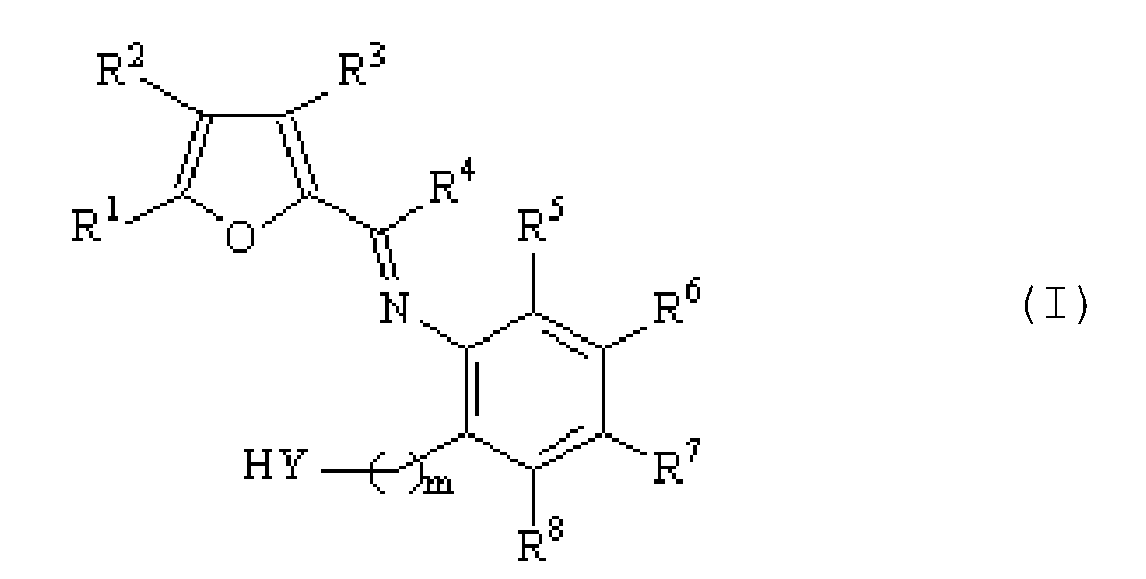
- R1 to R8 each represent independently hydrogen, halogen, a substituted or unsubstituted C1-C20 hydrocarbyl group, an inert functional group, wherein each of the radicals R1 to R8 can be linked to a neighbouring radical in order to form a cycle with carbon atoms to which said radicals are attached ;
- Y represents O or NR*, R* being a C1-C12 alkyl group or a C6-C12 aryl group ;
- m is 0, 1 or 2.
- The hydrocarbyl groups encompass methyl, tert-butyl and phenyl groups. The hydrocarbyl groups can include a heteroatom such as oxygen or nitrogen atoms in their chains.
- The possible substituents of hydrocarbyl groups can be selected among CF3, NO2, OMe and halogen such as Cl.
- The inert functional groups can be selected among CF3, NO2, OMe and halogen.
- R1 to R3 are each preferably selected independently from the group consisting of hydrogen and aryl groups. Aryl groups can be selected among phenyl, naphthyl, and substituted phenyl groups.
- R4 is preferably selected in the group consisting of hydrogen and methyl group.
- R5 to R8 are preferably independently selected in the group consisting of hydrogen, alkyl, aryl, methoxy, halogen, nitro and cyano.
- Y is preferably O. m is preferably 0 or 1.
- Specific compounds of formula (I) are the following ones :
- 2-{[5-(2-(trifluoromethyl)phenyl)furan-2-yl]methyleneamino}phenol
- 4-methyl-2-{[5-(2-(trifluoromethyl)phenyl)furan-2-yl]methyleneamino}phenol
- 4-tert-butyl-2-{[5-(2-(trifluoromethyl)phenyl)furan-2-1]methyleneamino}phenol
- 3-{ [5- (2- (trifluoromethyl)phenyl) furan-2-yl]methyleneamino}biphenyl-4-ol
- 4-chloro-2-{[5-(2-(trifluoromethyl)phenyl)furan-2-yl]methyleneamino}phenol
- 2-{[5-(3-(trifluoromethyl)phenyl)furan-2-yl]methyleneamino}phenol
- 4-nitro-2-{[5-(4-nitrophenyl)furan-2-yl]methyleneamino}phenol
- 2-{[5-(4-nitrophenyl)furan-2-yl]methyleneamino}phenol
- 2-{[5-(3-nitrophenyl)furan-2-yl]methyleneamino}phenol
- 2-{[5-(3-chlorophenyl)furan-2-yl)]methyleneamino}phenol
- 2-{[5-(2-chlorophenyl)furan-2-yl]methyleneamino}phenol
- 2-{[5-(4-chlorophenyl)furan-2-yl]methyleneamino}phenol
- Another subject-matter of the present invention relates to a method for manufacturing a compound of formula (I) as defined above, characterised in that a compound of formula (II) :

is reacted with a compound of formula (III) :
- The general conditions of such a reaction are as follows :
- Reacting compound (III) with compound (II) in an alcohol such as methanol or ethanol, in the presence of a catalytic amount of a protic acid such as acetic acid, at room temperature.
- Removing the solvent by evaporation under reduced pressure to recover compound (I).
- Recrystallising or washing the product in an alcane such as pentane or hexane.
- A further subject-matter of the present invention relates to the use of a compound as defined above or prepared by the method as defined above as a ligand of a metallic complex.
- A further subject-matter of the present invention relates to a metallic complex of the formula (IV):

- R1 to R8, Y and m are as defined above ;
- M is a metal belonging to groups 3 to 8 of the Periodic Classification ;
- X represents an halogen, a substituted or unsubstituted C1-C20 hydrocarbyl group, an amino group, an aryloxy group or an alkoxy group ; and
- n is a numeral value determined by the oxidation state of the metal minus one.
- The preferred definitions for R1 to R8, Y and m are as mentioned above for the compound of formula (I).
- M is preferably selected from the metals belonging to groups 3 to 8 of the Periodic Classification, being in particular Ti, Cr, Fe, Zr, Hf, V, Mn, a rare-earth metal, being preferably Ti, Cr, Fe and Zr.
- X preferably represents halogen, alkyl such as benzyl, amino such as dimethylamino, alkoxy such as isopropoxy, aryloxy such as phenoxy, preferably halogen such as chlorine.
- A further subject-matter of the present invention relates to a method for manufacturing a metallic complex as defined above, wherein a metallic compound of formula (V) :
MXn+1 (V)
wherein M, X and n are as defined above
is reacted with a ligand of the formula (I) as defined above. - The general conditions of such a reaction are as follows :
- Optionally reacting compound (I) with an equimolar amount of a deprotonating agent such as sodium hydride or butyl lithium, in tetrahydrofuran or diethyl ether at low temperature, under inert atmosphere.
- Adding the resulting mixture or a solution of compound (I) in tetrahydrofuran or diethyl ether to compound (V) and stirring at room temperature.
- Removing the solvent by evaporation under reduced pressure.
- Optionally dissolving the residue in an other solvent such as toluene or dichloromethane, filtering this solution to eliminate the sodium or the lithium salt and evaporating the filtrate to recover compound (IV).
- A further subject-matter of the present invention relates to the use of the metallic complex as defined above or prepared by the process as defined above as a catalyst in the homopolymerisation and the copolymerisation of ethylene and α-olefins.
- Exemplary α-olefins are the ones having from 3 to 8 carbon atoms, preferably propylene.
- A further subject-matter of the present invention relates to a catalytic system comprising :
- the metallic complex as defined above ;
- an activating agent selected in particular from the aluminum alkyls, the aluminoxanes and the boron-based activators ; and
- optionally, a carrier of the said metallic complex.
- The aluminum alkyls are represented by the formula AlRx, wherein R are all identical or different, and are selected from halides or from alkoxy or alkyl groups having from 1 to 12 carbon atoms and x is from 1 to 3. Especially suitable aluminum alkyls are dialkylaluminum chloride, the most preferred being diethylaluminum chloride (Et2AlCl).
- The preferred aluminoxanes comprise oligomeric linear and/or cyclic alkyl aluminoxanes represented by the formula :


- p is 1-40, preferably 10-20 ;
- o is 3-40, preferably 3-20 ; and
- R' or R" is a C1-C8 alkyl group, being preferably methyl.
- Suitable boron-based activating agents that can be used comprise a triphenyl carbenium boronate such as tetrakis-pentafluorophenyl-borato-triphenylcarbenium [C(Ph3)+ B (C6H5)- 4] as described in
EP-A-0, 427, 696 , or those of the general formula [L-H' ] + [BAr1Ar2X3X4]- as described inEP-A-0 277 004 (page 6, line 30 to page 7, line 7). - The support, if present, can be a porous mineral oxide. It is advantageously selected from silica, alumina and mixtures thereof. Preferably, it is silica.
- The activating agent is preferably an alkyl aluminum or an aluminoxane, the molar ratio Al/M being approximately 500 to 2000, preferably about 1000.
- Still a further subject-matter of the present invention relates to a method for homopolymerising or copolymerising ethylene and α-olefins, comprising the steps of :
- (a) injecting into the reactor the catalytic system as defined above, a solvent and optionally a scavenger ;
- (b) injecting the monomer and optional comonomer(s) into the reactor either before or after or simultaneously with step (a) ;
- (c) maintaining under polymerisation conditions ;
- (d) optionally adding an acidic solution of an alcohol to precipitate and filtrate the polymer ;
- (e) retrieving the polymer under the form of a powder.
- The scavenger may be selected from aluminium alkyls or diethyl zinc.
- The monomers that can be used in the present invention are selected among ethylene and α-olefins having from 3 to 8 carbon atoms, being preferably ethylene and propylene.
- The conditions of temperature and pressure for the polymerisation process are not particularly limited.
- The pressure in the reactor can vary from 0.5 to 50 bars, preferably from 15 to 29 bars.
- The polymerisation temperature can range from 10 to 100°C, preferably from 40 to 90°C.
- The solvent is typically selected from alcanes or toluene, being preferably toluene, heptane or isobutane.
- The reaction is usually carried out for a period of time of from 15 minutes to 24 hours.
- The polymer obtained according to the present invention is typically obtained as a powder. The homopolyethylene that can be obtained have a Mn of 25 to 75 kDa, preferably of 30-60 kDa, a Mw of 150-400 kDa, preferably of 175-350 kDa, and a Mw/Mn of about 3 to 9.
- The following Examples are intended to illustrate the present invention without limiting its scope.
- In these Examples, the following abbreviation have been used .
- MAO : Methylaluminoxane
- Me : Methyl
- Ph : Phenyl
- tBu : tert-Butyl
- TiBAl : Triisobutylaluminium
-

- The aminophenol (12 mmol) was added to a solution of furan-2-carbaldehyde (12 mmol) and acid acetic (0.4 ml) in ethanol (30 ml). The mixture was stirred at room temperature for 18 hours. Then the solvent was removed by evaporation under reduced pressure at 50°C.
- The residue was recrystallised in pentane at a temperature of -20°C (Examples 1 to 6). Alternatively, the residue was stirred with 250 ml of pentane, filtered and dried under vacuum (Examples 7 to 12).
- Using 2-aminophenol and 5-(2-(trifluoromethyl)phenyl)furan-2-carbaldehyde, 3.53 g of 2-{ [5- (2- (trifluoromethyl)phenyl) furan-2-yl]methyleneamino}phenol were obtained as a yellow powder (yield 89%).
RMN1 H (CD2C12, 500 MHz) : ppm 8.57 (s, 1H, HC=N), 7.92 (d, 1H, CF3-C6H4), 7.86 (d, 1H, CF3-C6H4), 7.69 (t, 1H, CF3-C6H4), 7.57 (t, 1H, CF3-C6H4), 7.50 (s, 1H, OH), 7.35 (dd, 1H, C6H4OH), 7.23 (td, 1H, C6H4OH), 7.18 (d, 1H, C4H2O), 7.02 (dd, 1H, C6H4OH), 6.95 (td, 1H, C6H4OH), 6.94 (d, 1H, C4H2O). - Using 2-amino-4-methylphenol and 5-(2-(trifluoromethyl)phenyl)furan-2-carbaldehyde, 3.82 g of 4-methyl-2-{[5-(2-(trifluoromethyl)phenyl)furan-2-yl]methyleneamino}phenol were obtained as a yellow powder (yield 92 %).
RMN 1H (CD2Cl2, 500 MHz) : ppm 8.53 (s, 1H, HC=N), 7.90 (d, 1H, CF3-C6H4), 7.85 (d, 1H, CF3-C6H4), 7.68 (t, 1H, CF3-C6H4), 7.56 (t, 1H, CF3-C6H4), 7.36 (s, 1H, OH), 7.15 (m, 2H, C6H3OH and C4H2O), 7.05 (dq, 1H, C6H3OH), 6.92 (m, 2H, C6H3OH and C4H2O), 2.35 (s, 3H, CH3). - Using 2-amino-4-tert-butylphenol and 5-(2-(trifluoromethyl)phenyl)furan-2-carbaldehyde, 4.25 g of 4-tert-butyl-2-{[5-(2-(trifluoromethyl)phenyl)furan-2-yl]methyleneamino}phenol were obtained as a yellow powder (yield 91 %).
RMN 1H (CD2C12, 500 MHz) : ppm 8.57 (s, 1H, HC=N), 7.91 (d, 1H, CF3-C6H4), 7.85 (d, 1H, CF3-C6H4), 7.67 (t, 1H, CF3-C6H4), 7.56 (t, 1H, CF3-C6H4), 7.39 (s, 1H, OH), 7.35 (d, 1H, C6H3OH), 7.28 (dd, 1H, C6H3OH), 7.16 (d, 1H, C4H2O), 6.94 (m, 2H, C6H3OH and C4H2O), 1.37 (s, 9H, tBu). - Using 3-aminobiphenyl-4-ol and 5-(2-(trifluoromethyl)phenyl)furan-2-carbaldehyde, 1.64 g of 3-{[5-(2-(trifluoromethyl)phenyl)furan-2-yl]methyleneamino}biphenyl-4-ol was obtained as an orange powder (yield 34 %).
RMN 1H (CD2Cl2, 500 MHz) : ppm 8.62 (s, 1H, HC=N), 7.91 (d, 1H, CF3-C6H4), 7.85 (d, 1H, CF3-C6H4), 7.67 (t, 1H, CF3-C6H4), 7.63 (m, 3H, Ph), 7.56 (m, 2H, OH and CF3-C6H4), 7, 49 (m, 3H, C6H3OH and Ph), 7.37 (tt, 1H, C6H3OH), 7.19 (d, 1H, C4H2O), 7.11 (d, 1H, C6H3OH), 6.95 (d, 1H, C4H2O). - Using 2-amino-4-chlorophenol and 5-(2-(trifluoromethyl)phenyl)furan-2-carbaldehyde, 3.76 g of 4-chloro-2-{[5-(2-(trifluoromethyl)phenyl)furan-2-yl]methyleneamino}phenol were obtained as a yellow powder (yield 86 %).
RMN 1H (CD2C12, 500 MHz) : ppm 8.52 (s, 1H, HC=N), 7.91 (d, 1H, CF3-C6H4), 7.86 (d, 1H, CF3-C6H4), 7.71 (t, 1H, CF3-C6H4), 7.59 (t, 1H, CF3-C6H4), 7.38 (s, 1H, OH), 7.34 (d, 1H, C6H3OH), 7.22 (d, 1H, C4H2O), 7.19 (dd, 1H, C6H3OH), 6.97 (d, 1H, C6H3OH), 6.95 (d, 1H, C4H2O). - Using 2-aminophenol and 5-(3-(trifluoromethyl)phenyl)furan-2-carbaldehyde, 3.44 g of 2-{[5-(3-(trifluoromethyl)phenyl)furan-2-yl]methyleneamino}phenol were obtained as a yellow powder (yield 86 %).
RMN 1H (CD2Cl2, 500 MHz) : ppm 8.59 (s, 1H, HC=N), 8.10 (m, 1H, CF3-C6H4), 8.05 (dm, 1H, CF3-C6H4), 7.64 (m, 2H, CF3-C6H4), 7.44 (s, 1H, OH), 7.36 6 (dd, 1H, C6H4OH), 7.24 (ddd, 1H, C6H4OH), 7.20 (d, 1H, C4H2O), 7.03 (dd, 1H, C6H4OH), 7.01 (d, 1H, C4H2O), 6.96 (ddd, 1H, C6H4OH). - Using 2-amino-4-nitrophenol and 5-(4-nitrophenyl)furan-2-carbaldehyde, 4.10 g of 4-nitro-2-{[5-(4-nitrophenyl)furan-2-yl]methyleneamino}phenol were obtained as a yellow powder (yield 97 %).
RMN 1H (CD2Cl2, 500 MHz) : ppm 8.72 (s, 1H, HC=N), 8.36 6 (m, 2H, NO2-C6H4), 8.31 (d, 1H, C6H3OH), 8.2 (dd, 1H, C6H3OH), 8.04 (m, 2H, NO2-C6H4), 7.34 (d, 1H, C6H3OH), 7.16 (m, 2H, C4H2O). - Using 2-aminophenol and 5-(4-nitrophenyl)furan-2-carbaldehyde, 3.62 g of 2-{[5-(4-nitrophenyl)furan-2-yl]methyleneamino}phenol were obtained as a yellow powder (yield 98%).
RMN 1H (CD2C12, 500 MHz) : ppm 8.59 (s, 1H, HC=N), 8.33 (m, 2H, NO2-C6H4), 7.99 (m, 2H, NO2-C6H4), 7.49 (s, 1H, OH), 7.37 (dd, 1H, C6H4OH), 7.25 (td, 1H, C6H4OH), 7.21 (d, 1H, C4H2O), 7.12 (d, 1H, C4H2O), 7.04 (dd, 1H, C6H4OH), 6.97 (td, 1H, C6H4OH). - Using 2-aminophenol and 5-(3-nitrophenyl)furan-2-carbaldehyde, 3.51 g of 2-{[5-(3-nitrophenyl)furan-2-yl]methyleneamino}phenol were obtained as a yellow powder (yield 95 %).
RMN 1H (CD2Cl2, 500 MHz) : ppm 8.62 (t, 1H, NO2-C6H4), 8.55 (s, 1H, HC=N), 8.24 4 (dm, 1H, NO2-C6H4), 8.13 (dm, 1H, NO2-C6H4), 7.65 (t, 1H, NO2-C6H4), 7.34 (dd, 1H, C6H4OH), 7.24 (td, 1H, C6H4OH), 7.18 (d, 1H, C4H2O), 7.05 (d, 1H, C4H2), 7 .04 (dd, 1H, C6H4OH), 6.96 (td, 1H, C6H4OH). - Using 2-aminophenol and 5-(3-chlorophenyl)furan-2-carbaldehyde, 2.94 g of 2-{[5-(3-chlorophenyl)furan-2-yl]methyleneamino}phenol were obtained as a yellow powder (yield 82 %).
RMN 1H (CD2Cl2, 500 0 MHz) : ppm 8.43 (s, 1H, HC=N), 7. 9 (s, 1H, OH), 7 .78 (m, 1H, Cl-C6H4), 7.64 (dt, 1H, Cl-C6H4), 7 .35 (m, 2H, Cl-C6H4 and C6H4OH), 7.27 (m, 2H, Cl-C6H4 and C6H4OH), 7.06 (m, 2H, C6H4OH and C4H2O), 6.95 (td, 1H, C6H4OH), 6.88 (d, 1H, C4H2O). - Using 2-aminophenol and 5-(2-chlorophenyl)furan-2-carbaldehyde, 2.69 g of 2-{[5-(2-chlorophenyl)furan-2-yl]methyleneamino}phenol were obtained as a yellow powder (yield 75 %).
RMN 1H (CD2Cl2, 500 MHz) : ppm 8.59 (s, 1H, HC=N), 8.08 (dd, 1H, Cl-C6H4), 7.54 (dd, 1H, Cl-C6H4), 7.44 (td, 2H, Cl-C6H4 and OH), 7.36 (m, 3H, Cl-C6H4 and C6H4OH and C4H2O), 7.23 (td, 1H, C6H4OH), 7.21 (d, 1H, C4H2O), 7.02 (dd, 1H, C6H4OH), 6.96 (td, 1H, C6H4OH). - Using 2-aminophenol and 5-(4-chlorophenyl)furan-2-carbaldehyde, 3.18 g of 2-{[5-(4-chlorophenyl)furan-2-yl]methyleneamino}phenol were obtained as a yellow powder (yield 89 %).
RMN 1H (CD2C12, 500 MHz) : ppm 8.55 (s, 1H, HC=N), 7.81 (dm, 2H, Cl-C6H4), 7.47 (dm, 2H, Cl-C6H4), 7.35 (dd, 1H, C6H4OH), 7.23 (td, 1H, C6H4OH), 7.22 (d, 1H, C4H2O), 7.03 (dd, 1H, C6H4OH), 6.96 (dt, 1H, C6H4OH), 6.92 (d, 1H, C4H2O). -

- The synthesis was done under inert atmosphere with dried solvents. Sodium hydride (2.5 mmol, 0.06 g) was added to a solution of a ligand (2.5 mmol as prepared in Examples 1 to 12, respectively) in THF (15 ml) at -20°C. After 2 hours, this red solution was added dropwise to ZrCl4 (2.5 mmol, 0.583 g) and the mixture was stirred overnight at room temperature. Then the solvent was removed by evaporation under reduced pressure and the residue was dissolved in 30 ml of dichloromethane. The solution was filtered through a pad of celite and the filtrate was dried under vacuum. The residue was washed with pentane and dried under vacuum to result in a final product under the form of a red or orange powder.
- In Table 1 thereafter are listed the complexes obtained thereby as well as for each of them the amount obtained and the yield.
- The yield is defined as follows:
- mass of complex obtained/mass of complex expected for 2.5 mmol
- Polymerisation reactions were realised on a 24 parallel reactor unit containing 50 ml glass inserts with magnetic stirrers. In a glove box, 1 mg of complex (as prepared in Examples 13 to 19) was introduced into a vial. Then, 0,8 ml of MAO (30 wt % in toluene) and 24 ml of toluene were added. The vials were crimped with a septum and installed into the reactor unit heated at 60°C. The septa of the vials were pierced by the needles of the reactor unit. The stirring was started and regulated at 1000 rpm. Ethylene was then injected and the pressure was regulated at 22 bar, while the temperature was increased to 80°C. These conditions were maintained during 30 min., then the reactors were depressurised and cooled down. The vials were opened and an acidic alcoholic solution was added. The polymers were filtered, washed and dried. GPC curves are illustrated in
figure 1 .
Results are summarised as follows:Table 2 Example Complex of Example Mass of complex (mg) µmol of Complex Mass of PE (g) Activity* Tm** (°C) (g/g/h) kg/mmol/h 20 13 1.18 2.23 0.79 1344 0.71 n.d. 21 13 1.12 2.13 0.95 1692 0.89 132.8 22 14 1.20 2.22 0.91 1513 0.82 132.8 23 14 1.09 2.02 0.98 1792 0.97 132.8 24 15 1.04 1.78 0.99 1904 1.11 134.1 25 15 1.13 1.94 0.85 1499 0.88 n.d. 26 16 1.14 1.89 1.09 1512 1.15 132.8 27 16 1.28 2.12 1.03 1609 0.97 n.d. 28 17 1.04 1.84 0.90 1736 0.98 n.d. 29 17 1.08 1.93 1.32 2435 1.37 133.4 30 18 1.05 1.99 0.89 1695 0.89 n.d. 31 18 1.11 2.10 0.98 1769 0.93 134 32 19 1.08 1.96 0.91 1690 0.93 n.d. 33 19 1.20 2.18 0.85 1421 0.78 133.2 *Activity = Mass of PE (g)/Mass of complex (g)/0.5 h or Mass of PE (g)/µmol of complex/0.5 h
**Tm = measured by DSC method (Differential Scanning Calorimetry) at the second heating (Ramp of 50°C/min from -40°C to 180°C
n.d. = not determined - The support used was silica Sylopol® 952x1836 from Grace, modified with MAO to obtain a support with 60 wt% of MAO. The complex and the support were stirred in 50 ml of toluene at room temperature during 2 hours. Then the toluene was removed, the resulting catalyst was washed 3 times with pentane and dried under vacuum. The data are given in table 3.
Table 3 Example Complex of example Mass of support (g) Mass of complex (g) Al* (%) Zr* (%) 34 15 5.003 0.113 13.85 0.26 35 16 5.262 0.116 13.45 0.28 36 17 5.154 0.119 13.5 0.29 37 18 5.057 0.12 13.60 0.35 *Elemental analysis measured by ICP-AES (Inductively Complet Plasma Atomic Emission Spectrometry) - Ethylene polymerisation reactions were carried out in a 130 ml stainless steel autoclave equipped with mechanical stirring and a stainless steel injection cylinder. In a typical reaction run, the reactor was first dried under nitrogen flow at 100°C during 10 min. Then it was cooled down to the reaction temperature (85°C) and 35 ml of isobutane were introduced into the reactor with a syringe pump, followed by the comonomer if required. The pressure was adjusted to the desired value (23.8 bar) with ethylene. In an argon-filled glove box, 100 mg of the supported catalyst of examples 34 to 37, the scavenger (0.3 ml of TiBAl 10 wt% in hexanes) and 0.4 ml of n-heptane were placed into the injection cylinder. The valve was closed and the cylinder was connected to the reactor under nitrogen flow. The active catalyst mixture was then introduced into the reactor with 40 ml of isobutane. After 1 hour, the reactor was cooled down to room temperature and slowly depressurised, and the polymer was recovered. The polymerisation results are displayed in table 4.
TABLE 4 Example Catalyst of example Mass of catalyst (mg) Mass of PE (g) Activity* (g/g/h) 38 34 99.7 1.30 13.04 39 34 99.9 1.48 14.81 40 35 100.1 1.50 14.99 41 35 100.4 1.16 11.56 42 36 101.1 1.89** 18.69 43 36 100.0 1.79 17.91 44 37 99.7 0.90 9.03 45 37 99.9 0.98 9.81 *Activity is expressed as g polyethylene per g catalyst per hour. - The melting temperature Tm of example 42 was of 132.3°C as measured by DSC.
| Example | Ligand of Example | Complex | Mass (g) | Yield (%) |
| 13 | 1 |  | 1.31 | 99 |
| 14 | 2 |  | 1.34 | 99 |
| 15 | 3 |  | 1.38 | 95 |
| 16 | 4 |  | 1.50 | 99 |
| 17 | 5 |  | 1.12 | 80 |
| 18 | 6 |  | 1.16 | 88 |
| 19 | 7 |  | 1.34 | 97 |
Claims (19)
1. A compound of formula (I):

wherein :
- R1 to R8 each represent independently H, halogen, substituted or unsubstituted C1-C20 hydrocarbyl, an inert functional group, wherein each of the radicals R1 to R8 can be linked to a neighbouring substituent in order to form a cycle with carbon atoms to which said radicals are attached;
- Y represents O or NR*, R* being C1-C12 alkyl or C6-C12 aryl; and
- m is 0, 1 or 2.
2. The compound according to claim 1, wherein R1 to R3 are each selected independently from the group consisting of H, halogen, alkyl and aryl.
3. The compound according to claim 1 or claim 2, wherein R4 is selected in the group consisting ofhydrogen and methyl.
4. The compound according to anyone of claims 1 to 3, wherein R5 to R8 are each independently selected from the group consisting of H, alkyl, aryl, halogen, methoxy, nitro and cyano.
5. The compound according to anyone of claims 1 to 4, wherein Y is O.
6. The compound according to anyone of claims 1 to 5, wherein it is selected from the group consisting of :
• 2-{[5-(2-(trifluoromethyl)phenyl)furan-2-yl]methyleneamino}phenol
• 4-methyl-2-{[5-(2-(trifluoromethyl)phenyl)furan-2-yl]methyleneamino}phenol
• 4-tert-butyl-2-{[5-(2-(trifluoromethyl)phenyl)furan-2-1]methyleneamino}phenol
• 3-{[5-(2-(trifluoromethyl)phenyl)furan-2-yl]methyleneamino}biphenyl-4-ol
• 4-chloro-2-{[5-(2-(trifluoromethyl)phenyl)furan-2-yl]methyleneamino}phenol
• 2-{[5-(3-(trifluoromethyl)phenyl)furan-2-yl]methyleneamino}phenol
• 4-nitro-2-{[5-(4-nitrophenyl)furan-2-yl]methyleneamino}phenol
• 2-{[5-(4-nitrophenyl)furan-2-yl]methyleneamino}phenol
• 2-{[5-(3-nitrophenyl)furan-2-yl]methyleneamino}phenol
• 2-{[5-(3-chlorophenyl)furan-2-yl)]methyleneamino}phenol
• 2-{[5-(2-chlorophenyl)furan-2-yl]methyleneamino}phenol
• 2-{[5-(4-chlorophenyl)furan-2-yl]methyleneamino}phenol
7. A method for manufacturing a compound of formula (I) as defined in anyone of claims 1 to 6, wherein a compound of formula (II):

wherein R1 to R4 are as defined in claim 1
is reacted with a compound of formula (III) : 
wherein m is 0, 1 or 2 and R5 to R8 are as defined in claim 1.
is reacted with a compound of formula (III) :
8. Use of a compound as defined in anyone of claims 1 to 6 or prepared by the method as defined in the claim 7 as a ligand of a metallic complex.
9. A metallic complex of formula (IV) :

wherein :
- R1 to R8, Y and m are as defined in claim 1;
- M is a metal belonging to the groups 3 to 8 of the Periodic Classification;
- X represents an halogen, a substituted or unsubstituted C1-C20 hydrocarbyl group, an amino, an aryloxy group or an alkoxy group ; and
- n is a numeral value determined by the oxidation state of M minus one.
10. The metallic complex according the claim 9, wherein each of R1 to R3 is independently selected from the group consisting of H, halogen, alkyl and aryl.
11. The metallic complex according to anyone of claims 9 and 10, wherein R4 is H or methyl.
12. The metallic complex according to anyone of claims 9 to 11, wherein each of R5 to R8 is independently selected in the group consisting of H, alkyl, aryl, halogen, methoxy, nitro and cyano.
13. The metallic complex according one of the claims 9 to 12, wherein M is selected from the metals belonging to groups 3 to 8 of the Periodic Classification, being in particular Ti, Cr, Fe, Zr, Hf, V, a rare-earth metal, M being preferably Ti, Cr, Fe and Zr.
14. The metallic complex according to anyone of claims 9 to 13, wherein X is halogen, amino, alkyl, alkoxy, aryloxy, preferably halogen.
15. A method for manufacturing a metallic complex as defined in anyone of claims 9 to 14, wherein a metallic compound of formula (V):
MXn+1 (V)
wherein M, X and n are as defined in claim 9
is reacted with a ligand of the formula (I) as defined in anyone of the claims 1 to 6.
MXn+1 (V)
wherein M, X and n are as defined in claim 9
is reacted with a ligand of the formula (I) as defined in anyone of the claims 1 to 6.
16. Use of the metallic complex as defined in anyone of claims 9 to 14 or prepared by the process as defined in claim 15 as a catalyst for the homopolymerisation and the copolymerisation of ethylene and α-olefins.
17. A catalytic system comprising .
- the metallic complex as defined in anyone of claims 9 to 14 ;
- an activating agent selected in particular among aluminium alkyls, aluminoxanes and boron-based activators, in particular aluminoxanes, preferably methylaluminoxane ; and
- optionally, a support of said metallic complex.
18. The catalytic system according to claim 17, wherein the activating agent is aluminium alkyl or aluminoxane, the molar ratio Al/M being approximately 500 to 2000, preferably 1000.
19. A method for homopolymerising or copolymerising ethylene and α-olefins, that comprises the steps of :
(a) injecting into the reactor the catalytic system as defined in claim 17 and a solvent and optionally a scavenger ;
(b) injecting the monomer and optional comonomer(s) into the reactor, either before or after or simultaneously with step (a) ;
(c) maintaining under polymerisation conditions ;
(d) optionally adding an acidic solution of an alcohol to precipitate and filtrate the polymer ;
(e) retrieving the polymer under the form of a powder.
Priority Applications (7)
| Application Number | Priority Date | Filing Date | Title |
|---|---|---|---|
| EP07110304A EP2003125A1 (en) | 2007-06-14 | 2007-06-14 | New tridentate ligand compounds with imino furan units, method for manufacturing said compounds, and their use in the preparation of catalysts for the homopolymerisation and copolymerisation of ethylene and alpha-olefins |
| JP2010511575A JP5186559B2 (en) | 2007-06-14 | 2008-05-30 | Novel tridentate ligand compound having an iminofuran unit, a process for the preparation of this compound and its use in the preparation of catalysts for the homopolymerization of ethylene and copolymerization with α-olefins |
| KR1020097025943A KR101166402B1 (en) | 2007-06-14 | 2008-05-30 | New tridentate ligand compounds with imino furan units, method for manufacturing said compounds, and their use in the preparation of catalysts for the homopolymerisation and copolymerisation of ethylene and alpha-olefins |
| US12/664,461 US8426540B2 (en) | 2007-06-14 | 2008-05-30 | Tridentate ligand compounds with imino furan units, method for manufacturing said compounds, and their use in the preparation of catalysts for the homopolymerisation and copolymerisation of ethylene and alpha-olefins |
| EP08826827A EP2155379A1 (en) | 2007-06-14 | 2008-05-30 | New tridentate ligand compounds with imino furan units, method for manufacturing said compounds, and their use in the preparation of catalysts for the homopolymerisation and copolymerisation of ethylene and alpha-olefins. |
| PCT/EP2008/056692 WO2009015922A1 (en) | 2007-06-14 | 2008-05-30 | New tridentate ligand compounds with imino furan units, method for manufacturing said compounds, and their use in the preparation of catalysts for the homopolymerisation and copolymerisation of ethylene and alpha-olefins. |
| CN200880019908XA CN101678319B (en) | 2007-06-14 | 2008-05-30 | New tridentate ligand compounds with imino furan units, method for manufacturing the compounds, and their use in the preparation of catalysts for the homopolymerisation and copolymerisation of ethylen |
Applications Claiming Priority (1)
| Application Number | Priority Date | Filing Date | Title |
|---|---|---|---|
| EP07110304A EP2003125A1 (en) | 2007-06-14 | 2007-06-14 | New tridentate ligand compounds with imino furan units, method for manufacturing said compounds, and their use in the preparation of catalysts for the homopolymerisation and copolymerisation of ethylene and alpha-olefins |
Publications (1)
| Publication Number | Publication Date |
|---|---|
| EP2003125A1 true EP2003125A1 (en) | 2008-12-17 |
Family
ID=38744886
Family Applications (2)
| Application Number | Title | Priority Date | Filing Date |
|---|---|---|---|
| EP07110304A Withdrawn EP2003125A1 (en) | 2007-06-14 | 2007-06-14 | New tridentate ligand compounds with imino furan units, method for manufacturing said compounds, and their use in the preparation of catalysts for the homopolymerisation and copolymerisation of ethylene and alpha-olefins |
| EP08826827A Withdrawn EP2155379A1 (en) | 2007-06-14 | 2008-05-30 | New tridentate ligand compounds with imino furan units, method for manufacturing said compounds, and their use in the preparation of catalysts for the homopolymerisation and copolymerisation of ethylene and alpha-olefins. |
Family Applications After (1)
| Application Number | Title | Priority Date | Filing Date |
|---|---|---|---|
| EP08826827A Withdrawn EP2155379A1 (en) | 2007-06-14 | 2008-05-30 | New tridentate ligand compounds with imino furan units, method for manufacturing said compounds, and their use in the preparation of catalysts for the homopolymerisation and copolymerisation of ethylene and alpha-olefins. |
Country Status (6)
| Country | Link |
|---|---|
| US (1) | US8426540B2 (en) |
| EP (2) | EP2003125A1 (en) |
| JP (1) | JP5186559B2 (en) |
| KR (1) | KR101166402B1 (en) |
| CN (1) | CN101678319B (en) |
| WO (1) | WO2009015922A1 (en) |
Families Citing this family (4)
| Publication number | Priority date | Publication date | Assignee | Title |
|---|---|---|---|---|
| SG176983A1 (en) | 2009-07-08 | 2012-02-28 | Dermira Canada Inc | Tofa analogs useful in treating dermatological disorders or conditions |
| US9255088B2 (en) | 2010-08-11 | 2016-02-09 | The Regents Of The University Of California | Premature-termination-codons readthrough compounds |
| US9598395B2 (en) | 2012-03-23 | 2017-03-21 | The Regents Of The University Of California | Premature-termination-codons readthrough compounds |
| KR102448251B1 (en) * | 2016-09-30 | 2022-09-28 | 다우 글로벌 테크놀로지스 엘엘씨 | Thioguanidine Group IV Transition Metal Catalysts and Polymerization Systems |
Citations (4)
| Publication number | Priority date | Publication date | Assignee | Title |
|---|---|---|---|---|
| US3637734A (en) * | 1964-12-31 | 1972-01-25 | Bayer Ag | Benzimidazolylfuran compounds |
| US5714556A (en) * | 1995-06-30 | 1998-02-03 | E. I. Dupont De Nemours And Company | Olefin polymerization process |
| US20020107345A1 (en) * | 1999-12-17 | 2002-08-08 | Ittel Steven Dale | Polymerization of olefins |
| WO2005037257A2 (en) * | 2003-10-15 | 2005-04-28 | Imtm Gmbh | Novel alanyl-amino peptidase inhibitors for functionally influencing different cells and treating immunological, inflammatory, neuronal, and other diseases |
Family Cites Families (6)
| Publication number | Priority date | Publication date | Assignee | Title |
|---|---|---|---|---|
| DE69514156T2 (en) * | 1994-06-24 | 2000-06-29 | Praxair S.T. Technology, Inc. | Process for the production of a coating based on MCrAlY with finely divided oxides |
| WO2001068724A2 (en) * | 2000-03-10 | 2001-09-20 | E.I. Dupont De Nemours And Company | Polymerization of olefins |
| KR100844062B1 (en) | 2001-02-21 | 2008-07-07 | 미쓰이 가가쿠 가부시키가이샤 | Catalyst for olefin polymerizaion and method for producing olefin polymers using the catalyst |
| DE10251513A1 (en) * | 2002-11-04 | 2004-05-19 | Basf Ag | Compounds with 5-membered heterocycle linked by amino- or phosphino-methyl to a benzene ring with an ortho-hydroxy, alkoxy, thiol or amino group, used as multidentate ligands in olefin polymerization catalysts |
| EP1749841A1 (en) | 2005-08-03 | 2007-02-07 | Total Petrochemicals Research Feluy | Activating fluorinated supports with iron-based post-metallocene complexes |
| EP1925623A1 (en) * | 2006-11-24 | 2008-05-28 | Total Petrochemicals Research Feluy | Polymerisation of ethylene and alpha-olefins with pyrrol-iminophenol complexes. |
-
2007
- 2007-06-14 EP EP07110304A patent/EP2003125A1/en not_active Withdrawn
-
2008
- 2008-05-30 US US12/664,461 patent/US8426540B2/en not_active Expired - Fee Related
- 2008-05-30 JP JP2010511575A patent/JP5186559B2/en not_active Expired - Fee Related
- 2008-05-30 WO PCT/EP2008/056692 patent/WO2009015922A1/en not_active Ceased
- 2008-05-30 EP EP08826827A patent/EP2155379A1/en not_active Withdrawn
- 2008-05-30 CN CN200880019908XA patent/CN101678319B/en not_active Expired - Fee Related
- 2008-05-30 KR KR1020097025943A patent/KR101166402B1/en not_active Expired - Fee Related
Patent Citations (4)
| Publication number | Priority date | Publication date | Assignee | Title |
|---|---|---|---|---|
| US3637734A (en) * | 1964-12-31 | 1972-01-25 | Bayer Ag | Benzimidazolylfuran compounds |
| US5714556A (en) * | 1995-06-30 | 1998-02-03 | E. I. Dupont De Nemours And Company | Olefin polymerization process |
| US20020107345A1 (en) * | 1999-12-17 | 2002-08-08 | Ittel Steven Dale | Polymerization of olefins |
| WO2005037257A2 (en) * | 2003-10-15 | 2005-04-28 | Imtm Gmbh | Novel alanyl-amino peptidase inhibitors for functionally influencing different cells and treating immunological, inflammatory, neuronal, and other diseases |
Non-Patent Citations (20)
| Title |
|---|
| "AKos Screening Library", 7 February 2006, AKOS CONSULTING AND SOLUTIONS GMBH, P O BOX 141, BASEL, CH-4010, SWITZERLAND * |
| "Ambinter Stock Screening Collection", 1 June 2007, AMBINTER, 50, AVENUE DE VERSAILLES, PARIS, F-75016, FRANCE * |
| "ChemBridge Screening Library", 1 January 2007, CHEMBRIDGE CORPORATION, 16981 VIA TAZON, SUITE G, SAN DIEGO, CA, 92127 USA * |
| "MCL Screening Compounds", 5 January 2007, MCL MOSCOW LTD., 1812- YEAR STR. 7 APT. 6, MOSCOW, 121170, RUSSIA * |
| "Nanosyn Compound Library", 17 April 2007, NANOSYN COMBINATORIAL SYNTHESIS INC., 3760- HAVEN AVE., MENLO PARK, CA, 94025, USA * |
| "Scientific Exchange Product List", 18 May 2007, SCIENTIFIC EXCHANGE, INC., 105 PINE RIVER ROAD, P O BOX 918, CENTER OSSIPEE, NH 03814, USA * |
| "TimTec Overseas Stock", 16 April 2007, TIMTEC, INC, HARMONY BUSINESS PARK 301-A, NEWARK, DE, 19711, USA * |
| "Vitas-M Stock Building Blocks", 7 June 2007, VITAS-M, ROOM-223, LABORATORY BUILDING "B", CENTER OF MOLECULAR MEDICINE, VOROB'EVI GORI, MOSCOW, 119829, RUSSIA * |
| "Zelinsky Screening Library", 9 April 2007, ZELINSKY INSTITUTE, PO BOX 8941, NEWARK, DE, 19714-8941, USA * |
| BELAL A A M: "Complexes of Co(II), Ni(II), Cu(II), UO2(II), Fe(III), Y(III) and La(III) with Schiff bases derived from 2-furancarboxaldehyde and hydroxyanilines", ASW.SC.TEC.BULL., vol. 17, 1996, pages 2 - 11, XP002461185 * |
| DATABASE CHEMCATS [online] CHEMICAL ABSTRACTS SERVICE, COLUMBUS, OHIO, US; XP002461186, retrieved from STN * |
| DATABASE CHEMCATS [online] CHEMICAL ABSTRACTS SERVICE, COLUMBUS, OHIO, US; XP002461187, retrieved from STN * |
| DATABASE CHEMCATS [online] CHEMICAL ABSTRACTS SERVICE, COLUMBUS, OHIO, US; XP002461188, retrieved from STN * |
| DATABASE CHEMCATS [online] CHEMICAL ABSTRACTS SERVICE, COLUMBUS, OHIO, US; XP002461189, retrieved from STN * |
| DATABASE CHEMCATS [online] CHEMICAL ABSTRACTS SERVICE, COLUMBUS, OHIO, US; XP002461190, retrieved from STN * |
| DATABASE CHEMCATS [online] CHEMICAL ABSTRACTS SERVICE, COLUMBUS, OHIO, US; XP002461191, retrieved from STN * |
| DATABASE CHEMCATS [online] CHEMICAL ABSTRACTS SERVICE, COLUMBUS, OHIO, US; XP002461192, retrieved from STN * |
| DATABASE CHEMCATS [online] CHEMICAL ABSTRACTS SERVICE, COLUMBUS, OHIO, US; XP002461193, retrieved from STN * |
| DATABASE CHEMCATS CHEMICAL ABSTRACTS SERVICE, COLUMBUS, OHIO, US; XP002461194 * |
| MATSUI S ET AL: "FI Catalysts: super active new ethylene polymerization catalysts", CATALYSIS TODAY, ELSEVIER, vol. 66, no. 1, 2001, pages 63 - 73, XP002438748, ISSN: 0920-5861 * |
Also Published As
| Publication number | Publication date |
|---|---|
| JP5186559B2 (en) | 2013-04-17 |
| JP2010530850A (en) | 2010-09-16 |
| WO2009015922A1 (en) | 2009-02-05 |
| CN101678319B (en) | 2012-11-21 |
| EP2155379A1 (en) | 2010-02-24 |
| KR20100021449A (en) | 2010-02-24 |
| KR101166402B1 (en) | 2012-07-23 |
| US8426540B2 (en) | 2013-04-23 |
| CN101678319A (en) | 2010-03-24 |
| US20100311930A1 (en) | 2010-12-09 |
Similar Documents
| Publication | Publication Date | Title |
|---|---|---|
| EP2837640B1 (en) | Method for producing catalyst for polyolefin polymerization and method for preparing polyolefin | |
| EP1115758A2 (en) | Polymerization of olefins | |
| US6946532B2 (en) | Catalysts containing per-ortho aryl substituted aryl or heteroaryl substituted nitrogen donors | |
| EP2739655B1 (en) | Catalysts for preparing ultra high molecular weight polyethylene (uhmwpe) | |
| EP2671639B1 (en) | Guanidinate complexes and their use as chain transfer polymerization catalysts | |
| RU2317306C2 (en) | Monometallocene catalyst comprising schiff's reagent bis-ligand for polymerization of olefins, method for its preparing and its using | |
| EP1994006B1 (en) | Polymerisation of ethylene and alpha-olefins with imino-quinolinol complexes | |
| US8426540B2 (en) | Tridentate ligand compounds with imino furan units, method for manufacturing said compounds, and their use in the preparation of catalysts for the homopolymerisation and copolymerisation of ethylene and alpha-olefins | |
| EP1994040B1 (en) | Polymerisation of ethylene and alpha-olefins with phosphino-iminophenol complexes | |
| US6605677B2 (en) | Olefin polymerization processes using supported catalysts | |
| EP2268651B1 (en) | Sterically emcumbered bidentate and tridentate naphthoxy-imine metallic complexes | |
| US20080306226A1 (en) | Polymerization Catalyst System Based on Monooxime Ligands | |
| EP2046841B1 (en) | Polymerisation catalyst system based on oxime-ether ligands | |
| WO2005049659A1 (en) | Ziegler-natta catalyst for olefin polymerization including aryloxy group and method for polymerization of olefin using the same | |
| CN118496263B (en) | Preparation method of anthracene skeleton pyridine amino binuclear metal titanium zirconium hafnium catalyst and synthetic polyolefin elastomer thereof | |
| US20070293710A1 (en) | Catalyst For Olefin Polymerization Including Phenoxy Ligand And Method Of (Co) Polymerization Of Olefin Using Same | |
| CN120058786A (en) | CNN-tridentate coordination titanium zirconium hafnium metal catalyst and preparation of high-melting-point polyolefin block copolymer thereof | |
| EP1404723A2 (en) | Olefin polymerization processes using supported catalysts | |
| EP1746111A1 (en) | Polymerisation catalyst system based on dioxime ligands | |
| CN118324823A (en) | A kind of heterofluorene rare earth compound and its preparation method and application in olefin polymerization | |
| MXPA01000875A (en) | Polymerization of olefins |
Legal Events
| Date | Code | Title | Description |
|---|---|---|---|
| PUAI | Public reference made under article 153(3) epc to a published international application that has entered the european phase |
Free format text: ORIGINAL CODE: 0009012 |
|
| AK | Designated contracting states |
Kind code of ref document: A1 Designated state(s): AT BE BG CH CY CZ DE DK EE ES FI FR GB GR HU IE IS IT LI LT LU LV MC MT NL PL PT RO SE SI SK TR |
|
| AX | Request for extension of the european patent |
Extension state: AL BA HR MK RS |
|
| AKX | Designation fees paid | ||
| REG | Reference to a national code |
Ref country code: DE Ref legal event code: 8566 |
|
| STAA | Information on the status of an ep patent application or granted ep patent |
Free format text: STATUS: THE APPLICATION IS DEEMED TO BE WITHDRAWN |
|
| 18D | Application deemed to be withdrawn |
Effective date: 20090618 |