EP2001322B1 - A method for making a composite item including a poured cosmetic product and a decorative element - Google Patents
A method for making a composite item including a poured cosmetic product and a decorative element Download PDFInfo
- Publication number
- EP2001322B1 EP2001322B1 EP07733950A EP07733950A EP2001322B1 EP 2001322 B1 EP2001322 B1 EP 2001322B1 EP 07733950 A EP07733950 A EP 07733950A EP 07733950 A EP07733950 A EP 07733950A EP 2001322 B1 EP2001322 B1 EP 2001322B1
- Authority
- EP
- European Patent Office
- Prior art keywords
- decorative element
- cosmetic product
- solid decorative
- mould
- support
- Prior art date
- Legal status (The legal status is an assumption and is not a legal conclusion. Google has not performed a legal analysis and makes no representation as to the accuracy of the status listed.)
- Not-in-force
Links
Images

Classifications
-
- A—HUMAN NECESSITIES
- A45—HAND OR TRAVELLING ARTICLES
- A45D—HAIRDRESSING OR SHAVING EQUIPMENT; EQUIPMENT FOR COSMETICS OR COSMETIC TREATMENTS, e.g. FOR MANICURING OR PEDICURING
- A45D40/00—Casings or accessories specially adapted for storing or handling solid or pasty toiletry or cosmetic substances, e.g. shaving soaps or lipsticks
- A45D40/16—Refill sticks; Moulding devices for producing sticks
-
- A—HUMAN NECESSITIES
- A44—HABERDASHERY; JEWELLERY
- A44C—PERSONAL ADORNMENTS, e.g. JEWELLERY; COINS
- A44C17/00—Gems or the like
- A44C17/02—Settings for holding gems or the like, e.g. for ornaments or decorations
-
- A—HUMAN NECESSITIES
- A45—HAND OR TRAVELLING ARTICLES
- A45D—HAIRDRESSING OR SHAVING EQUIPMENT; EQUIPMENT FOR COSMETICS OR COSMETIC TREATMENTS, e.g. FOR MANICURING OR PEDICURING
- A45D33/00—Containers or accessories specially adapted for handling powdery toiletry or cosmetic substances
- A45D33/18—Containers or accessories specially adapted for handling powdery toiletry or cosmetic substances with special decorative arrangements or form
Definitions
- the present invention relates to a method for making a composite item comprising at least one cast (i.e. poured) cosmetic product and at least one solid decorative element such as a stone, crystal, or gem.
- the French patent FR 2.759.941 in the name of CHRISTIAN DIOR, describes a method for ink-jet printing decorative patterns on the surface of a solid cosmetic product.
- the ink used comprises cosmetically acceptable pigments and/or colorants and the cosmetic product can be a lipstick.
- the decorated cosmetic products known in the art can also be in the form of composite items in which a different decorative cosmetic product is associated with a base cosmetic product by means of mechanical or chemical bonds (such as gluing).
- the Spanish patent application ES 2.027.585 in the name of AVON relates to a method for incorporating suitably shaped decorative cosmetic products within a base cosmetic product, such as cast in a mould and then solidified.
- the method by AVON provides that the decorative product, though being of a different colour from the base cosmetic product, has the same composition of the latter and is previously cast, within a suitable removable mask, within the mould intended for the casting of the base cosmetic product.
- the mask can be removed and the base cosmetic product can be cast within the mould, such that the decorative cosmetic product is incorporated within the base product.
- the method by AVON assumes that the decorative cosmetic product has the same composition as the base cosmetic product and that this decorative cosmetic product can adhere, after it has solidified, to the inner walls of the mould for the base cosmetic product.
- the method by AVON when the decorative cosmetic product does not sufficiently adhere to the mould of the base cosmetic product, obviously, the achievement of the decoration in the finished product can be compromised.
- the method by AVON teaches to make decorations that are always substantially flush with the outer surface of the base cosmetic product, without providing for these decorations to be made in relief relative to the latter.
- EP-A-1285858 to L'OREAL refers to a device for mounting a decorative item that can be associated with a container containing a cosmetic or a care product.
- EP-A-1285858 is silent about directly associating a decorative item to a cosmetic product.
- WO-A-2007-072149 to GAMMA CROMA filed before the present Patent, but published thereafter, relates to a composite item comprising a cosmetic product and a decorative element.
- Another object of the present invention is to provide a method for making a composite item comprising a cast cosmetic product and a solid decorative element, which is simple to implement, allows the solid decorative element to possibly protrude from the cosmetic product surface and ensures a firm coupling of this cosmetic product and decorative element, even when the latter is an object made of glass, crystal, stone, plastics or any other non-cosmetic material.
- Yet another object of the present invention is to provide an equipment for implementing the method claimed herein to provide a composite item of the type described above.
- the method for making a composite item comprising at least one cast (i.e. poured) cosmetic product within a filling volume defined by the inner walls of a mould, and subsequently solidified, and at least one solid decorative element comprises the steps of:
- solid decorative element any solid element, such as a stone or crystal or an object made of plastic or glass, substantially different from the cast cosmetic product with which it is associated, and which is in the solid state also and mainly during the casting of this cosmetic product.
- This solid decorative element can thus be held to, such as mechanically or preferably by means of suction, a portion of the inner surface of mould for said cast cosmetic product, and it is not substantially subjected to deformations or breakage upon casting (pouring) of the latter.
- the method provides that the solid decorative element is first bonded, and usually fixed, to a support made of plastics provided with a portion shaped to be anchored to the cosmetic product, when the latter, after it has solidified, completely wraps this anchorage portion. Due to the plastic support, that is for instance thermo-formed, it is obtained both a firmer anchorage between the solid decorative element and the finished cosmetic product, and, also as a function of the shape of this support, a possible simplification of the mechanical, magnetic or fluid hold of the solid decorative element at a wall of the mould for the cosmetic product, when the latter is being cast.
- the method provides that the solid decorative element is held at an inner surface portion of the mould for the cosmetic product, due to fluid suction holding means, which provide that at least one through hole is formed within the inner surface of the mould.
- the method of the present invention for making a composite item comprising a cast cosmetic product 10 for make up, such as a lipstick, gloss, or a cosmetic composition for the eye contour area, etc., and a solid decorative element 1, in brief, provides the steps of:
- this embodiment provides a first step ( Fig. 1a and 1b ) of placing and bonding a solid decorative element 1, such as a crystal, glass or stone, either precious or semiprecious, or any other object desired to be incorporated within the finished item, to a respective support 2, preferably made of a thermo-formed plastic material.
- a solid decorative element such as a crystal, glass or stone, either precious or semiprecious, or any other object desired to be incorporated within the finished item
- the bond between the decorative element 1 and the support 2, which bond preferably causes the two entities 1 and 2 to be integral to each other, can be obtained by gluing the latter, or as shown in Fig. 3 , by means of a shape-coupling between a duly shaped rest portion 8 of the support 2 and a corresponding engaging portion of the decorative element 1.
- this support 2 comprises a rest portion 8, having a substantially cylindrical development with a circular base, provided with an inner seat having at least one elastically-deformable edge, which allows the snap-fitting and subsequent integral mechanical hold of a complementary outer surface portion of the decorative element 1, such as to substantially mount the latter within the rest portion 8.
- the rest portion 8 of the support 2 allows the decorative element 1 to partially project in a protruding manner from the upper surface of the support 2.
- the support 2 also comprises an anchorage portion 7, which is intended to be incorporated within the cosmetic product 10 during the casting and subsequent solidification of the latter, and as in the embodiment in Fig. 3 , it can consist of a sort of circular flange placed at the base of said rest portion 8.
- the support 2 can be preferably made by thermoforming a plastic material, or alternatively, by means of any other suitable method and material (such as by forging a metallic material) which allows the bond between the decorative element 1 and the support 2 and between the latter and the cosmetic product 10.
- the support 2 can provide any other shape of the anchorage portion 7, such as for example the provision of wings or bent portions or the like, which allows the support 2 to be firmly bonded to the cosmetic product 10, once the latter, after casting (i.e. pouring), has solidified about this anchoring portion 7.
- the decorative element 1 can be shaped such as to have an anchorage portion relative to the cosmetic product 1, such as projecting parts intended to be coated by the cosmetic product 1 after it has been cast and solidified.
- the half-mould 3a which, with the complementary half-mould 3b, defines an inner volume 6 to be filled with the cosmetic product 10 in the substantially liquid state (also with high viscosity), is provided with holding means for the decorative element 1 comprising, in the particular embodiment shown herein, a through hole 4 connecting the inner volume 9 of the mould 3a, 3b, when assembled, to the external environment.
- the through hole 4 can be connected to, at an outlet section 1 1 b thereof, a suitable machine for generating a suction fluid flow (not shown), such a way that the decorative element 1, by resting at the opposite inlet section 11a of the hole 4, allows this decorative element 1 to be held to the inner wall 5a of the half-mould 3a by suction.
- the assembly of the mould 3a, 3b provided with mechanic and/or preferably fluid suction 4 holding means on at least part of an inner wall 5a thereof, constitutes the equipment for making a composite item of the type described herein, according to the method of the present invention.
- This equipment preferably comprises a through hole 4 that is formed within a portion of an inner wall 5a of the mould 3a, 3b, which is fluidically fastened, at a section 11 b thereof, to a machine (not shown) for generating a suction fluid (air) flow and has a fluid flow inlet section 11 a that is shaped such as to hold said decorative element 1 substantially in a sealed manner in correspondence to at least one surface portion thereof.
- the suction intended to hold the decorative element 1 in the desired position within the filling volume 6 does not interfere with the casting of the cosmetic product 10 within the volume 6.
- the decorative element 1 is substantially fixed to the surface 5a of the half-mould 3a at the part thereof which is desired to be viewed in the finished composite item and is also placed to project only partially within the filling volume 6 of the mould 3a, 3b.
- the anchorage portion 7 of the support 2 for the decorative element 1 completely projects within the filling volume 6, such as to be completely surrounded by the cosmetic product 10 during the casting and subsequent solidification of the latter.
- the method described herein provides a step of casting the cosmetic product 10 in the liquid state, within the inner volume 6.
- Fig. 1f which illustrates a sectional side view of the finished composite item
- the support 2 is almost completely drowned within the cosmetic product 10, such that the anchorage portion 7 thereof results to be held within the product 10 and counteracts any thrust which is intended to detach the decorative element 1 from the cosmetic product 10.
- at least one surface portion of the decorative element 1 projects from the outer side surface of the cosmetic product 10, such as to be well visible from the outside.
- the finished composite item a lipstick in the present case
- the mould 3a, 3b after the hold by suction of the decorative element 1 has been released, and then it is inserted within a suitable container, or a base of the lift mechanism 9, intended for the end user.
- the container, or base 9, can be duly shaped to allow the decorative element 1 to be viewed by the end user, also upon use of the cosmetic products 10.
- the decorative element 1 can be quite easily removed from its housing within the cosmetic product 10, for example by means of simple thrust mechanical actions by the end user, who can thus hold the decorative element 1 even when he/she has finished using the cosmetic product 10.
Landscapes
- Cosmetics (AREA)
- Casting Or Compression Moulding Of Plastics Or The Like (AREA)
Abstract
Description
- The present invention relates to a method for making a composite item comprising at least one cast (i.e. poured) cosmetic product and at least one solid decorative element such as a stone, crystal, or gem.
- It is known in the art to decorate the visible surfaces of a cosmetic product with foreign materials that are not noxious to the end user, such as inks having cosmetically acceptable pigments and/or colorants, or foreign cosmetic products in order to make the cosmetic product more appealing to the customer.
- For example, the French patent
FR 2.759.941 - This method by DIOR, though being rather effective in the flexibility of use, however, results in the decorative patterns being provided on the cosmetic product only on the surface thereof. Consequently, after a few uses of the cosmetic products these patterns will fade, and furthermore the surface on which this print is carried out is required to be substantially flat, or at least smooth.
- The decorated cosmetic products known in the art can also be in the form of composite items in which a different decorative cosmetic product is associated with a base cosmetic product by means of mechanical or chemical bonds (such as gluing).
- The Spanish patent application
ES 2.027.585 - While the method in the patent application
ES 2.027.585 - In fact, the method by AVON assumes that the decorative cosmetic product has the same composition as the base cosmetic product and that this decorative cosmetic product can adhere, after it has solidified, to the inner walls of the mould for the base cosmetic product. With the method by AVON, when the decorative cosmetic product does not sufficiently adhere to the mould of the base cosmetic product, obviously, the achievement of the decoration in the finished product can be compromised.
- Furthermore, the method by AVON teaches to make decorations that are always substantially flush with the outer surface of the base cosmetic product, without providing for these decorations to be made in relief relative to the latter.
- In the Registered Community Design No. RCD 000120316, the Applicant has finally suggested to couple, such as by means of gluing, solid decorative elements, such as for example objects of glass, crystal or stones, either semiprecious or precious, with a base cosmetic product, of the type preferably obtained by pressing cosmetic powders or by means of extrusion and solidification of an initial cosmetic slurry.
- These composite items, illustrated in the document RCD 000120316, do not contemplate the coupling of solid decorative elements to cast (i.e. poured) cosmetic products, such as for example lipsticks or glosses, since in this case problems may arise concerning the stability of the bond between the solid decorative element and the cast cosmetic product.
-
EP-A-1285858 to L'OREAL refers to a device for mounting a decorative item that can be associated with a container containing a cosmetic or a care product.EP-A-1285858 is silent about directly associating a decorative item to a cosmetic product. -
WO-A-2007-072149 to GAMMA CROMA, filed before the present Patent, but published thereafter, relates to a composite item comprising a cosmetic product and a decorative element. - It is thus an object of the present invention to propose a method for making a composite item comprising a cast base cosmetic product and a solid decorative element that does not suffer from the drawback of the prior art, and thus allows a firm coupling of a solid decorative element to a cast cosmetic product, even when the materials of the decorative element and cosmetic product are essentially different from each other.
- Another object of the present invention is to provide a method for making a composite item comprising a cast cosmetic product and a solid decorative element, which is simple to implement, allows the solid decorative element to possibly protrude from the cosmetic product surface and ensures a firm coupling of this cosmetic product and decorative element, even when the latter is an object made of glass, crystal, stone, plastics or any other non-cosmetic material.
- Yet another object of the present invention is to provide an equipment for implementing the method claimed herein to provide a composite item of the type described above.
- These and other objects are achieved by means of the method according to the first independent claim and the subsequent claims depending thereon, and by the equipment for implementing the same according to the fourteenth independent claim, and the subsequent claims depending thereon.
- The method for making a composite item comprising at least one cast (i.e. poured) cosmetic product within a filling volume defined by the inner walls of a mould, and subsequently solidified, and at least one solid decorative element, according to the present invention, comprises the steps of:
- a. holding, due to suitable holding means, the solid decorative element at a portion of an inner wall of the mould for the cast cosmetic product such that the solid decorative element projects at least partially within said filling volume;
- b. then pouring the cast cosmetic product, substantially in the liquid state, within the mould until when this filling volume is reached;
- c. solidifying the cosmetic product;
- d. removing the solidified cosmetic product from the mould after said step of holding the solid decorative element has been completed.
- The use of the method according to the present invention, as will be understood from the description below of a particular embodiment thereof, thanks to the holding, preferably mechanically or fluidically, of the decorative element to the mould for the cast cosmetic product allows a solid decorative element to be easily incorporated to a cast (i.e. poured) cosmetic product by means of shape-coupling, without requiring the decorative element material to be the same as that of the cast product, or the decorative element to be flush with the outer surface of the cosmetic product.
- It should be observed that, herein and below, by the term "solid decorative element", it is meant any solid element, such as a stone or crystal or an object made of plastic or glass, substantially different from the cast cosmetic product with which it is associated, and which is in the solid state also and mainly during the casting of this cosmetic product. This solid decorative element can thus be held to, such as mechanically or preferably by means of suction, a portion of the inner surface of mould for said cast cosmetic product, and it is not substantially subjected to deformations or breakage upon casting (pouring) of the latter.
- According to a preferred aspect of the present invention, the method provides that the solid decorative element is first bonded, and usually fixed, to a support made of plastics provided with a portion shaped to be anchored to the cosmetic product, when the latter, after it has solidified, completely wraps this anchorage portion. Due to the plastic support, that is for instance thermo-formed, it is obtained both a firmer anchorage between the solid decorative element and the finished cosmetic product, and, also as a function of the shape of this support, a possible simplification of the mechanical, magnetic or fluid hold of the solid decorative element at a wall of the mould for the cosmetic product, when the latter is being cast.
- According to another aspect of the present invention, the method provides that the solid decorative element is held at an inner surface portion of the mould for the cosmetic product, due to fluid suction holding means, which provide that at least one through hole is formed within the inner surface of the mould.
- The above-cited assembly of the fluid suction holding means and of the complementary mould for casting the cosmetic product are a particular embodiment of the equipment claimed herein.
- A preferred embodiment of the method according to the present invention, and an equipment therefor will be now described by way of non-limiting example, with the aid of the annexed figures, in which:
-
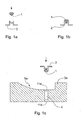
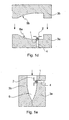
Fig. 1a-1f schematically illustrate a preferred embodiment of the method for making a composite item according to the present invention; -
Fig. 2 illustrates a composite item obtained by means of the method of the present invention; and -
Fig. 3 show a side sectional view of a particular support for the solid decorative element that can be also used in the method inFig. 1a-1f . - With general reference to
Fig. 1a-1f , the method of the present invention for making a composite item comprising a castcosmetic product 10 for make up, such as a lipstick, gloss, or a cosmetic composition for the eye contour area, etc., and a soliddecorative element 1, in brief, provides the steps of: - a) opening the
mould cosmetic product 10, or however gain access to theinner walls mould 3a, in order to place said soliddecorative element 1 in a predetermined portion of theseinner walls - b) holding (
Fig. 1 ) by means of suitable holding means 4, a soliddecorative element 1, at a portion of at least oneinner wall 5a of amould cosmetic product 10; then - c) closing (
Fig. 1 d, 1 e ) themould filling volume 6 is defined within the latter for thecosmetic product 10; then - d) casting the
cosmetic product 10, in the liquid state, within thefilling volume 6, while holding the decorative element 10 (Fig. 1e ); and finally - e) leaving the
cosmetic product 10 to solidify, releasing the hold of the soliddecorative element 1, re-opening themould cosmetic product 10 to insert the latter within a suitable container, or base, 9 (Fig. 1f ). - With reference to the preferred embodiment of the method according to the present invention, illustrated in
Fig. 1a-1f , this embodiment provides a first step (Fig. 1a and 1b ) of placing and bonding a soliddecorative element 1, such as a crystal, glass or stone, either precious or semiprecious, or any other object desired to be incorporated within the finished item, to arespective support 2, preferably made of a thermo-formed plastic material. - The bond between the
decorative element 1 and thesupport 2, which bond preferably causes the twoentities Fig. 3 , by means of a shape-coupling between a dulyshaped rest portion 8 of thesupport 2 and a corresponding engaging portion of thedecorative element 1. - In particular, when the
support 2 is used, as shown inFig. 3 , thissupport 2 comprises arest portion 8, having a substantially cylindrical development with a circular base, provided with an inner seat having at least one elastically-deformable edge, which allows the snap-fitting and subsequent integral mechanical hold of a complementary outer surface portion of thedecorative element 1, such as to substantially mount the latter within therest portion 8. - As may be seen in
Fig. 3 , therest portion 8 of thesupport 2 allows thedecorative element 1 to partially project in a protruding manner from the upper surface of thesupport 2. - The
support 2 also comprises ananchorage portion 7, which is intended to be incorporated within thecosmetic product 10 during the casting and subsequent solidification of the latter, and as in the embodiment inFig. 3 , it can consist of a sort of circular flange placed at the base of saidrest portion 8. - Finally, the
support 2, according to a preferred aspect of the present invention can be preferably made by thermoforming a plastic material, or alternatively, by means of any other suitable method and material (such as by forging a metallic material) which allows the bond between thedecorative element 1 and thesupport 2 and between the latter and thecosmetic product 10. - It should be observed that, while a
support 2 has been described above which is provided with arest portion 8 shaped such as to allow the mechanical hold of thedecorative element 1, any other shape of thisrest portion 8 which allows bonding, also by gluing, thisdecorative element 1 to thesupport 2 can be alternatively used. - Similarly, the
support 2 can provide any other shape of theanchorage portion 7, such as for example the provision of wings or bent portions or the like, which allows thesupport 2 to be firmly bonded to thecosmetic product 10, once the latter, after casting (i.e. pouring), has solidified about this anchoringportion 7. - Naturally, in the absence of the
support 2 provided withanchorage portion 7, thedecorative element 1 can be shaped such as to have an anchorage portion relative to thecosmetic product 1, such as projecting parts intended to be coated by thecosmetic product 1 after it has been cast and solidified. - In the particular embodiment of the method of the present invention as illustrated in
Fig. 1a-1f , once the soliddecorative element 1 has been integrally bonded to thesupport 2, the latter is placed (Fig. 1 c) on a portion of aninner wall 5a of a half-mould 3a, which portion is duly provided with mechanical, magnetic (in the case ofsupport 2 ordecorative element 1 made of metallic material) and/or fluid holding means 4, such as to allow a subsequent step of holding thedecorative element 1, andsupport 2 thereof, to thisinner wall 5a of the half-mould 3a. - Particularly, the half-
mould 3a, which, with the complementary half-mould 3b, defines aninner volume 6 to be filled with thecosmetic product 10 in the substantially liquid state (also with high viscosity), is provided with holding means for thedecorative element 1 comprising, in the particular embodiment shown herein, a throughhole 4 connecting theinner volume 9 of themould hole 4 can be connected to, at anoutlet section 1 1 b thereof, a suitable machine for generating a suction fluid flow (not shown), such a way that thedecorative element 1, by resting at theopposite inlet section 11a of thehole 4, allows thisdecorative element 1 to be held to theinner wall 5a of the half-mould 3a by suction. - The assembly of the
mould fluid suction 4 holding means on at least part of aninner wall 5a thereof, constitutes the equipment for making a composite item of the type described herein, according to the method of the present invention. - This equipment, as stated above, preferably comprises a through
hole 4 that is formed within a portion of aninner wall 5a of themould section 11 b thereof, to a machine (not shown) for generating a suction fluid (air) flow and has a fluidflow inlet section 11 a that is shaped such as to hold saiddecorative element 1 substantially in a sealed manner in correspondence to at least one surface portion thereof. - Thereby, the suction intended to hold the
decorative element 1 in the desired position within the fillingvolume 6, does not interfere with the casting of thecosmetic product 10 within thevolume 6. - It should be noted that mechanical means (not shown), such as staples or clips can be alternatively used, this being however a more complicated use, which are shaped to hold the solid
decorative element 1, or thesupport 2 thereof, to thewall 5a of the half-mould 3a during the casting and solidification of thecosmetic product 10. - As may be seen in
Fig. 1d , thedecorative element 1 is substantially fixed to thesurface 5a of the half-mould 3a at the part thereof which is desired to be viewed in the finished composite item and is also placed to project only partially within the fillingvolume 6 of themould anchorage portion 7 of thesupport 2 for thedecorative element 1 completely projects within the fillingvolume 6, such as to be completely surrounded by thecosmetic product 10 during the casting and subsequent solidification of the latter. - After the two half-
moulds Fig. 1e ) and holding the soliddecorative element 1 locked, with thesupport 2 thereof, at theinlet section 11 a of the throughhole 4 on thewall 5a of the half-mould 3a, the method described herein provides a step of casting thecosmetic product 10 in the liquid state, within theinner volume 6. - Therefore, after the
inner volume 6 has been completely filled with thecosmetic product 10 in the liquid state, thereby at least partially wrapping thedecorative element 1, and on the other hand completely wrapping theanchorage portion 7 of thesupport 2 for thedecorative element 1, the inflow of thecosmetic product 1 is interrupted and the latter is then left to solidify. - As may be seen in
Fig. 1f , which illustrates a sectional side view of the finished composite item, after the solidification has been completed, also due to the shape and spatial arrangement of thesupport 2 and thus of thedecorative element 1, thesupport 2 is almost completely drowned within thecosmetic product 10, such that theanchorage portion 7 thereof results to be held within theproduct 10 and counteracts any thrust which is intended to detach thedecorative element 1 from thecosmetic product 10. In the meanwhile, at least one surface portion of thedecorative element 1 projects from the outer side surface of thecosmetic product 10, such as to be well visible from the outside. - Finally, as shown also in
Fig. 1f and 2 , the finished composite item, a lipstick in the present case, is removed from themould decorative element 1 has been released, and then it is inserted within a suitable container, or a base of thelift mechanism 9, intended for the end user. The container, orbase 9, can be duly shaped to allow thedecorative element 1 to be viewed by the end user, also upon use of thecosmetic products 10. - It should be observed that in the particular embodiment of the method according to the present invention illustrated herein in
Fig. 1 a-1f , it is not required to use any glue to hold the soliddecorative element 1 on a part of the outer side surface of thecosmetic product 10, because, also due to the particular shape of thesupport 2, thisdecorative element 1 is mechanically fastened by shape-coupling to therest portion 8 of thesupport 2 and the latter, due to the anchorage portion thereof is, in turn, firmly fastened to theproduct 10, when it has solidified. - Thereby, in addition to the fact that the composite item described herein does not provide the use of potentially dangerous foreign materials, such as glues, the
decorative element 1 can be quite easily removed from its housing within thecosmetic product 10, for example by means of simple thrust mechanical actions by the end user, who can thus hold thedecorative element 1 even when he/she has finished using thecosmetic product 10.
Claims (20)
- A method for making a composite item comprising at least one cast cosmetic product (10) within a filling volume (6) defined by the inner walls (5a, 5b) of a mould (3a, 3b), and subsequently solidified, and at least one solid decorative element (1), said at least one solid decorative element (1) comprising a portion thereof that is shaped for anchorage to said cast cosmetic product (10) or said at least one solid decorative element (1) being preliminary fastened to a corresponding support (2) that has at least one shaped portion (7) to anchoring said support (2) within said at least one cast cosmetic product after it has solidified, the method comprising the steps of:a. holding said at least one solid decorative element (1) at a portion of an inner wall (5a) of the mould for said cast cosmetic product, said at least one solid decorative element at least partially projecting within said filling volume (6);b. pouring said at least one cast cosmetic product (10) within the mould until when said filling volume has been filled;c. solidifying said at least one cosmetic product;d. removing said at least one solidified cosmetic product from said mould, after said step of holding said at least one solid decorative element (1) has been completed.
- The method according to claim 1, characterized in that prior to said step of holding said at least one solid decorative element, a step is provided of fastening said at least one solid decorative element (1) to a corresponding support (2).
- The method according to claim 2, characterized in that said support comprises at least one shaped portion (7) to anchoring said support within said at least one cast cosmetic product, after it has solidified.
- The method according to claim 3, characterized in that during said step of holding said at least one solid decorative element, said anchorage portion (7) projects within said filling volume.
- The method according to any claim 2, 3 or 4, wherein said support comprises at least one rest portion (8) for fastening said at least one solid decorative element.
- The method according to claim 5, wherein said at least one rest portion is shaped to allow the mechanical hold of said at least one solid decorative element.
- The method according to claim 1, wherein said at least one solid decorative element (1) comprises a portion thereof that is shaped for anchorage to said cast cosmetic product (10).
- The method according to any preceding claim, wherein said step of holding said at least one solid decorative element at a portion of the inner surface of said mould is provided by means of mechanical and/or magnetic and/or fluid suction holding means.
- The method according to any preceding claim, wherein said at least one solid decorative element is held at a portion of the inner walls of said mould such as to only partially project within said filling volume.
- The method according to any preceding claim, characterized in that it comprises a subsequent step of inserting said at least one cosmetic product within a respective container or base.
- The method according to any preceding claim, wherein said at least one solid decorative element is selected from semiprecious stones, precious stones, glass, crystal, objects made of plastic or metallic material.
- The method according to any preceding claim, wherein said at least one cast cosmetic product is a product for make-up.
- The method according to any preceding claim, wherein said at least one support is made of plastics.
- An equipment for making a composite item comprising at least one cast cosmetic product (10) and at least one solid decorative element (1), said at least one solid decorative element (1) comprising a portion thereof that is shaped for anchorage to said cast cosmetic product (10) or said at least one solid decorative element (1) being preliminary fastened to a corresponding support (2) that has at least one shaped portion (7) to anchoring said support (2) within said at least one cast cosmetic product after it has solidified, the equipment being provided with a mould (3a, 3b), of which the inner walls (5a, 5b) define at least one filling volume (6) therein for said cosmetic product (10), said equipment being characterized in that it comprises means for the mechanical and/or magnetic and/or fluid holding of said at least one solid decorative element (1) in correspondence to at least one portion of an inner wall (5a) of said mould (3a, 3b).
- The equipment according to claim 14, characterized in that said holding means are fluid suction means.
- The equipment according to claim 15, wherein said fluid aspiration means comprise at least one through hole (4) formed within a portion of an inner wall (5a) of said mould (3a, 3b), said through hole being fluidically connected to a machine for generating a suction fluid flow.
- The equipment according to claim 16, wherein said at least one through hole (4) has an inlet section for the sucked fluid flow that is shaped such as to hold at least one surface portion of said at least one decorative element (1) in a substantially sealed manner.
- A support (2) for a solid decorative element (1) intended to provide a composite item with at least one cast cosmetic product (10), according to the method of any claim 1 to 13, said support comprising at least one rest portion (8) for said solid decorative element (1) and at least one anchorage portion (7) within said cosmetic product (10), characterized in that said at least one rest portion is shaped to mechanically hold, by means of shape-coupling, said solid decorative element (1).
- The support according to claim 18, wherein at least said rest portion (8) comprises a seat for a portion of said decorative element (1), said seat having at least one elastically deformable edge.
- The support according to claim 18 or 19, characterized in that it is made of a plastic material for thermoforming.
Applications Claiming Priority (2)
| Application Number | Priority Date | Filing Date | Title |
|---|---|---|---|
| IT000679A ITMI20060679A1 (en) | 2006-04-06 | 2006-04-06 | METHOD FOR REALIZING A COMPOSITE ARTICLE INCLUDING A CASTING COSMETIC PRODUCT AND A DECORATIVE ELEMENT |
| PCT/IB2007/000592 WO2007113629A2 (en) | 2006-04-06 | 2007-03-13 | A method for making a composite item including a poured cosmetic product and a decorative element |
Publications (2)
| Publication Number | Publication Date |
|---|---|
| EP2001322A2 EP2001322A2 (en) | 2008-12-17 |
| EP2001322B1 true EP2001322B1 (en) | 2011-04-13 |
Family
ID=38537762
Family Applications (1)
| Application Number | Title | Priority Date | Filing Date |
|---|---|---|---|
| EP07733950A Not-in-force EP2001322B1 (en) | 2006-04-06 | 2007-03-13 | A method for making a composite item including a poured cosmetic product and a decorative element |
Country Status (6)
| Country | Link |
|---|---|
| EP (1) | EP2001322B1 (en) |
| AT (1) | ATE505105T1 (en) |
| DE (1) | DE602007013883D1 (en) |
| ES (1) | ES2364589T3 (en) |
| IT (1) | ITMI20060679A1 (en) |
| WO (1) | WO2007113629A2 (en) |
Families Citing this family (1)
| Publication number | Priority date | Publication date | Assignee | Title |
|---|---|---|---|---|
| ITPD20080243A1 (en) * | 2008-08-06 | 2010-02-07 | Mavi S R L | CONTAINER FOR COSMETICS POWDER PRESSED, TYPE FARD, EARTH, CYPRUS, EYESHADOW AND SIMILAR |
Family Cites Families (3)
| Publication number | Priority date | Publication date | Assignee | Title |
|---|---|---|---|---|
| ES2027585A6 (en) * | 1991-01-14 | 1992-06-01 | Avon Cosmetics | Procedure for decorating cosmetics, and decorated cosmetic articles so obtained |
| US6752294B2 (en) * | 2001-08-10 | 2004-06-22 | L'oreal, Sa | Device for mounting an item |
| ITMI20052438A1 (en) * | 2005-12-21 | 2007-06-22 | Gamma Croma Spa | METHOD FOR REALIZING A COMPOSITE ARTICLE INCLUDING A COSMETIC PRODUCT AND A DECORATIVE ELEMENT |
-
2006
- 2006-04-06 IT IT000679A patent/ITMI20060679A1/en unknown
-
2007
- 2007-03-13 AT AT07733950T patent/ATE505105T1/en not_active IP Right Cessation
- 2007-03-13 DE DE602007013883T patent/DE602007013883D1/en active Active
- 2007-03-13 ES ES07733950T patent/ES2364589T3/en active Active
- 2007-03-13 EP EP07733950A patent/EP2001322B1/en not_active Not-in-force
- 2007-03-13 WO PCT/IB2007/000592 patent/WO2007113629A2/en not_active Ceased
Also Published As
| Publication number | Publication date |
|---|---|
| WO2007113629A2 (en) | 2007-10-11 |
| EP2001322A2 (en) | 2008-12-17 |
| ES2364589T3 (en) | 2011-09-07 |
| WO2007113629A3 (en) | 2007-12-21 |
| DE602007013883D1 (en) | 2011-05-26 |
| ITMI20060679A1 (en) | 2007-10-07 |
| ATE505105T1 (en) | 2011-04-15 |
Similar Documents
| Publication | Publication Date | Title |
|---|---|---|
| KR102023515B1 (en) | Method for manufacturing a cosmetic article having a decorative embossed and/or debossed surface | |
| US6764568B1 (en) | Three-dimensional decoration with raised image and filler | |
| US4065539A (en) | Method of molding plastic containers | |
| CN102481713A (en) | Method and injection molded article for producing an injection molded ornament | |
| CN100418500C (en) | Ear muffs for use as hearing protection devices and method for producing the same | |
| EP2001322A2 (en) | A method for making a composite item including a poured cosmetic product and a decorative element | |
| EP1962634B1 (en) | Method for making a composite item comprising a cosmetic product and an ornamental element | |
| CN100421995C (en) | Surface decoration for covering parts and method for producing same | |
| US20140116910A1 (en) | Keepsake Arrangement and Method of Making a Keepsake | |
| EP1785785A2 (en) | External watch case with lens made of artificial crystal glass and manufacturing method for the same | |
| KR200433616Y1 (en) | Decorative one-piece cosmetic container | |
| US6986858B2 (en) | Method of manufacturing super-thin advertising and decorative zipper tab | |
| JP2002085124A (en) | Worked milk tooth, suspended decoration and necklace using the same, and method for manufacture thereof | |
| JP2005198958A (en) | Compact vessel | |
| US20260114588A1 (en) | Device for packaging and applying a cosmetic product | |
| JPH0245579B2 (en) | ||
| KR200203647Y1 (en) | Marble opener | |
| JP5026664B2 (en) | chopsticks | |
| KR200333902Y1 (en) | the handle of an umbrella | |
| CN201150438Y (en) | Cup seat | |
| GB2438177A (en) | A method of forming a sign | |
| JP3128416U (en) | Memorial | |
| JP2002220952A (en) | Character lock and its manufacturing method | |
| KR20050101297A (en) | The method for forming hole on making accessory and the accessory with the hole | |
| HK1102145A (en) | External watch case with lens made of artificial crystal glass and manufacturing method for the same |
Legal Events
| Date | Code | Title | Description |
|---|---|---|---|
| PUAI | Public reference made under article 153(3) epc to a published international application that has entered the european phase |
Free format text: ORIGINAL CODE: 0009012 |
|
| 17P | Request for examination filed |
Effective date: 20080930 |
|
| AK | Designated contracting states |
Kind code of ref document: A2 Designated state(s): AT BE BG CH CY CZ DE DK EE ES FI FR GB GR HU IE IS IT LI LT LU LV MC MT NL PL PT RO SE SI SK TR |
|
| 17Q | First examination report despatched |
Effective date: 20090204 |
|
| RAP1 | Party data changed (applicant data changed or rights of an application transferred) |
Owner name: CHROMAVIS S.P.A. |
|
| GRAJ | Information related to disapproval of communication of intention to grant by the applicant or resumption of examination proceedings by the epo deleted |
Free format text: ORIGINAL CODE: EPIDOSDIGR1 |
|
| GRAP | Despatch of communication of intention to grant a patent |
Free format text: ORIGINAL CODE: EPIDOSNIGR1 |
|
| GRAP | Despatch of communication of intention to grant a patent |
Free format text: ORIGINAL CODE: EPIDOSNIGR1 |
|
| DAX | Request for extension of the european patent (deleted) | ||
| GRAS | Grant fee paid |
Free format text: ORIGINAL CODE: EPIDOSNIGR3 |
|
| GRAA | (expected) grant |
Free format text: ORIGINAL CODE: 0009210 |
|
| AK | Designated contracting states |
Kind code of ref document: B1 Designated state(s): AT BE BG CH CY CZ DE DK EE ES FI FR GB GR HU IE IS IT LI LT LU LV MC MT NL PL PT RO SE SI SK TR |
|
| REG | Reference to a national code |
Ref country code: GB Ref legal event code: FG4D |
|
| REG | Reference to a national code |
Ref country code: CH Ref legal event code: EP Ref country code: CH Ref legal event code: NV Representative=s name: TROESCH SCHEIDEGGER WERNER AG |
|
| REG | Reference to a national code |
Ref country code: IE Ref legal event code: FG4D |
|
| REF | Corresponds to: |
Ref document number: 602007013883 Country of ref document: DE Date of ref document: 20110526 Kind code of ref document: P |
|
| REG | Reference to a national code |
Ref country code: DE Ref legal event code: R096 Ref document number: 602007013883 Country of ref document: DE Effective date: 20110526 |
|
| REG | Reference to a national code |
Ref country code: NL Ref legal event code: VDEP Effective date: 20110413 |
|
| REG | Reference to a national code |
Ref country code: ES Ref legal event code: FG2A Ref document number: 2364589 Country of ref document: ES Kind code of ref document: T3 Effective date: 20110907 |
|
| LTIE | Lt: invalidation of european patent or patent extension |
Effective date: 20110413 |
|
| PG25 | Lapsed in a contracting state [announced via postgrant information from national office to epo] |
Ref country code: PT Free format text: LAPSE BECAUSE OF FAILURE TO SUBMIT A TRANSLATION OF THE DESCRIPTION OR TO PAY THE FEE WITHIN THE PRESCRIBED TIME-LIMIT Effective date: 20110816 Ref country code: LT Free format text: LAPSE BECAUSE OF FAILURE TO SUBMIT A TRANSLATION OF THE DESCRIPTION OR TO PAY THE FEE WITHIN THE PRESCRIBED TIME-LIMIT Effective date: 20110413 Ref country code: SE Free format text: LAPSE BECAUSE OF FAILURE TO SUBMIT A TRANSLATION OF THE DESCRIPTION OR TO PAY THE FEE WITHIN THE PRESCRIBED TIME-LIMIT Effective date: 20110413 |
|
| PG25 | Lapsed in a contracting state [announced via postgrant information from national office to epo] |
Ref country code: IS Free format text: LAPSE BECAUSE OF FAILURE TO SUBMIT A TRANSLATION OF THE DESCRIPTION OR TO PAY THE FEE WITHIN THE PRESCRIBED TIME-LIMIT Effective date: 20110813 Ref country code: FI Free format text: LAPSE BECAUSE OF FAILURE TO SUBMIT A TRANSLATION OF THE DESCRIPTION OR TO PAY THE FEE WITHIN THE PRESCRIBED TIME-LIMIT Effective date: 20110413 Ref country code: GR Free format text: LAPSE BECAUSE OF FAILURE TO SUBMIT A TRANSLATION OF THE DESCRIPTION OR TO PAY THE FEE WITHIN THE PRESCRIBED TIME-LIMIT Effective date: 20110714 Ref country code: CY Free format text: LAPSE BECAUSE OF FAILURE TO SUBMIT A TRANSLATION OF THE DESCRIPTION OR TO PAY THE FEE WITHIN THE PRESCRIBED TIME-LIMIT Effective date: 20110413 Ref country code: AT Free format text: LAPSE BECAUSE OF FAILURE TO SUBMIT A TRANSLATION OF THE DESCRIPTION OR TO PAY THE FEE WITHIN THE PRESCRIBED TIME-LIMIT Effective date: 20110413 Ref country code: SI Free format text: LAPSE BECAUSE OF FAILURE TO SUBMIT A TRANSLATION OF THE DESCRIPTION OR TO PAY THE FEE WITHIN THE PRESCRIBED TIME-LIMIT Effective date: 20110413 Ref country code: BE Free format text: LAPSE BECAUSE OF FAILURE TO SUBMIT A TRANSLATION OF THE DESCRIPTION OR TO PAY THE FEE WITHIN THE PRESCRIBED TIME-LIMIT Effective date: 20110413 Ref country code: LV Free format text: LAPSE BECAUSE OF FAILURE TO SUBMIT A TRANSLATION OF THE DESCRIPTION OR TO PAY THE FEE WITHIN THE PRESCRIBED TIME-LIMIT Effective date: 20110413 |
|
| PG25 | Lapsed in a contracting state [announced via postgrant information from national office to epo] |
Ref country code: NL Free format text: LAPSE BECAUSE OF FAILURE TO SUBMIT A TRANSLATION OF THE DESCRIPTION OR TO PAY THE FEE WITHIN THE PRESCRIBED TIME-LIMIT Effective date: 20110413 |
|
| PG25 | Lapsed in a contracting state [announced via postgrant information from national office to epo] |
Ref country code: CZ Free format text: LAPSE BECAUSE OF FAILURE TO SUBMIT A TRANSLATION OF THE DESCRIPTION OR TO PAY THE FEE WITHIN THE PRESCRIBED TIME-LIMIT Effective date: 20110413 Ref country code: EE Free format text: LAPSE BECAUSE OF FAILURE TO SUBMIT A TRANSLATION OF THE DESCRIPTION OR TO PAY THE FEE WITHIN THE PRESCRIBED TIME-LIMIT Effective date: 20110413 |
|
| PLBE | No opposition filed within time limit |
Free format text: ORIGINAL CODE: 0009261 |
|
| STAA | Information on the status of an ep patent application or granted ep patent |
Free format text: STATUS: NO OPPOSITION FILED WITHIN TIME LIMIT |
|
| PG25 | Lapsed in a contracting state [announced via postgrant information from national office to epo] |
Ref country code: PL Free format text: LAPSE BECAUSE OF FAILURE TO SUBMIT A TRANSLATION OF THE DESCRIPTION OR TO PAY THE FEE WITHIN THE PRESCRIBED TIME-LIMIT Effective date: 20110413 Ref country code: DK Free format text: LAPSE BECAUSE OF FAILURE TO SUBMIT A TRANSLATION OF THE DESCRIPTION OR TO PAY THE FEE WITHIN THE PRESCRIBED TIME-LIMIT Effective date: 20110413 Ref country code: RO Free format text: LAPSE BECAUSE OF FAILURE TO SUBMIT A TRANSLATION OF THE DESCRIPTION OR TO PAY THE FEE WITHIN THE PRESCRIBED TIME-LIMIT Effective date: 20110413 Ref country code: SK Free format text: LAPSE BECAUSE OF FAILURE TO SUBMIT A TRANSLATION OF THE DESCRIPTION OR TO PAY THE FEE WITHIN THE PRESCRIBED TIME-LIMIT Effective date: 20110413 |
|
| 26N | No opposition filed |
Effective date: 20120116 |
|
| REG | Reference to a national code |
Ref country code: DE Ref legal event code: R097 Ref document number: 602007013883 Country of ref document: DE Effective date: 20120116 |
|
| PG25 | Lapsed in a contracting state [announced via postgrant information from national office to epo] |
Ref country code: MC Free format text: LAPSE BECAUSE OF NON-PAYMENT OF DUE FEES Effective date: 20120331 |
|
| REG | Reference to a national code |
Ref country code: IE Ref legal event code: MM4A |
|
| PG25 | Lapsed in a contracting state [announced via postgrant information from national office to epo] |
Ref country code: IE Free format text: LAPSE BECAUSE OF NON-PAYMENT OF DUE FEES Effective date: 20120313 |
|
| PG25 | Lapsed in a contracting state [announced via postgrant information from national office to epo] |
Ref country code: BG Free format text: LAPSE BECAUSE OF FAILURE TO SUBMIT A TRANSLATION OF THE DESCRIPTION OR TO PAY THE FEE WITHIN THE PRESCRIBED TIME-LIMIT Effective date: 20110713 |
|
| PG25 | Lapsed in a contracting state [announced via postgrant information from national office to epo] |
Ref country code: MT Free format text: LAPSE BECAUSE OF FAILURE TO SUBMIT A TRANSLATION OF THE DESCRIPTION OR TO PAY THE FEE WITHIN THE PRESCRIBED TIME-LIMIT Effective date: 20110413 |
|
| PG25 | Lapsed in a contracting state [announced via postgrant information from national office to epo] |
Ref country code: TR Free format text: LAPSE BECAUSE OF FAILURE TO SUBMIT A TRANSLATION OF THE DESCRIPTION OR TO PAY THE FEE WITHIN THE PRESCRIBED TIME-LIMIT Effective date: 20110413 |
|
| PG25 | Lapsed in a contracting state [announced via postgrant information from national office to epo] |
Ref country code: LU Free format text: LAPSE BECAUSE OF NON-PAYMENT OF DUE FEES Effective date: 20120313 |
|
| PG25 | Lapsed in a contracting state [announced via postgrant information from national office to epo] |
Ref country code: HU Free format text: LAPSE BECAUSE OF FAILURE TO SUBMIT A TRANSLATION OF THE DESCRIPTION OR TO PAY THE FEE WITHIN THE PRESCRIBED TIME-LIMIT Effective date: 20070313 |
|
| PGFP | Annual fee paid to national office [announced via postgrant information from national office to epo] |
Ref country code: CH Payment date: 20150327 Year of fee payment: 9 Ref country code: ES Payment date: 20150326 Year of fee payment: 9 Ref country code: DE Payment date: 20150327 Year of fee payment: 9 |
|
| PGFP | Annual fee paid to national office [announced via postgrant information from national office to epo] |
Ref country code: GB Payment date: 20150327 Year of fee payment: 9 |
|
| REG | Reference to a national code |
Ref country code: FR Ref legal event code: PLFP Year of fee payment: 10 |
|
| REG | Reference to a national code |
Ref country code: DE Ref legal event code: R119 Ref document number: 602007013883 Country of ref document: DE |
|
| REG | Reference to a national code |
Ref country code: CH Ref legal event code: PL |
|
| GBPC | Gb: european patent ceased through non-payment of renewal fee |
Effective date: 20160313 |
|
| PG25 | Lapsed in a contracting state [announced via postgrant information from national office to epo] |
Ref country code: CH Free format text: LAPSE BECAUSE OF NON-PAYMENT OF DUE FEES Effective date: 20160331 Ref country code: GB Free format text: LAPSE BECAUSE OF NON-PAYMENT OF DUE FEES Effective date: 20160313 Ref country code: DE Free format text: LAPSE BECAUSE OF NON-PAYMENT OF DUE FEES Effective date: 20161001 Ref country code: LI Free format text: LAPSE BECAUSE OF NON-PAYMENT OF DUE FEES Effective date: 20160331 |
|
| REG | Reference to a national code |
Ref country code: FR Ref legal event code: PLFP Year of fee payment: 11 |
|
| REG | Reference to a national code |
Ref country code: FR Ref legal event code: PLFP Year of fee payment: 12 |
|
| PG25 | Lapsed in a contracting state [announced via postgrant information from national office to epo] |
Ref country code: ES Free format text: LAPSE BECAUSE OF NON-PAYMENT OF DUE FEES Effective date: 20160314 |
|
| PGFP | Annual fee paid to national office [announced via postgrant information from national office to epo] |
Ref country code: FR Payment date: 20180329 Year of fee payment: 12 |
|
| PGFP | Annual fee paid to national office [announced via postgrant information from national office to epo] |
Ref country code: IT Payment date: 20180327 Year of fee payment: 12 |
|
| REG | Reference to a national code |
Ref country code: ES Ref legal event code: FD2A Effective date: 20181207 |
|
| PG25 | Lapsed in a contracting state [announced via postgrant information from national office to epo] |
Ref country code: FR Free format text: LAPSE BECAUSE OF NON-PAYMENT OF DUE FEES Effective date: 20190331 Ref country code: IT Free format text: LAPSE BECAUSE OF NON-PAYMENT OF DUE FEES Effective date: 20190313 |