EP1999604B1 - Method and apparatus for roaming digital rights management content in device - Google Patents
Method and apparatus for roaming digital rights management content in device Download PDFInfo
- Publication number
- EP1999604B1 EP1999604B1 EP07708829.2A EP07708829A EP1999604B1 EP 1999604 B1 EP1999604 B1 EP 1999604B1 EP 07708829 A EP07708829 A EP 07708829A EP 1999604 B1 EP1999604 B1 EP 1999604B1
- Authority
- EP
- European Patent Office
- Prior art keywords
- authentication
- unauthorized
- remote authentication
- rights object
- mobile device
- Prior art date
- Legal status (The legal status is an assumption and is not a legal conclusion. Google has not performed a legal analysis and makes no representation as to the accuracy of the status listed.)
- Not-in-force
Links
Images





Classifications
-
- G—PHYSICS
- G06—COMPUTING OR CALCULATING; COUNTING
- G06F—ELECTRIC DIGITAL DATA PROCESSING
- G06F15/00—Digital computers in general; Data processing equipment in general
-
- H—ELECTRICITY
- H04—ELECTRIC COMMUNICATION TECHNIQUE
- H04L—TRANSMISSION OF DIGITAL INFORMATION, e.g. TELEGRAPHIC COMMUNICATION
- H04L63/00—Network architectures or network communication protocols for network security
- H04L63/10—Network architectures or network communication protocols for network security for controlling access to devices or network resources
-
- G—PHYSICS
- G06—COMPUTING OR CALCULATING; COUNTING
- G06F—ELECTRIC DIGITAL DATA PROCESSING
- G06F17/00—Digital computing or data processing equipment or methods, specially adapted for specific functions
-
- G—PHYSICS
- G06—COMPUTING OR CALCULATING; COUNTING
- G06F—ELECTRIC DIGITAL DATA PROCESSING
- G06F21/00—Security arrangements for protecting computers, components thereof, programs or data against unauthorised activity
- G06F21/10—Protecting distributed programs or content, e.g. vending or licensing of copyrighted material ; Digital rights management [DRM]
-
- H—ELECTRICITY
- H04—ELECTRIC COMMUNICATION TECHNIQUE
- H04L—TRANSMISSION OF DIGITAL INFORMATION, e.g. TELEGRAPHIC COMMUNICATION
- H04L63/00—Network architectures or network communication protocols for network security
- H04L63/08—Network architectures or network communication protocols for network security for authentication of entities
-
- H—ELECTRICITY
- H04—ELECTRIC COMMUNICATION TECHNIQUE
- H04W—WIRELESS COMMUNICATION NETWORKS
- H04W12/00—Security arrangements; Authentication; Protecting privacy or anonymity
- H04W12/06—Authentication
- H04W12/069—Authentication using certificates or pre-shared keys
-
- H—ELECTRICITY
- H04—ELECTRIC COMMUNICATION TECHNIQUE
- H04L—TRANSMISSION OF DIGITAL INFORMATION, e.g. TELEGRAPHIC COMMUNICATION
- H04L2463/00—Additional details relating to network architectures or network communication protocols for network security covered by H04L63/00
- H04L2463/101—Additional details relating to network architectures or network communication protocols for network security covered by H04L63/00 applying security measures for digital rights management
-
- H—ELECTRICITY
- H04—ELECTRIC COMMUNICATION TECHNIQUE
- H04W—WIRELESS COMMUNICATION NETWORKS
- H04W88/00—Devices specially adapted for wireless communication networks, e.g. terminals, base stations or access point devices
- H04W88/02—Terminal devices
Definitions
- the present invention relates to a method and apparatus for using digital rights management (DRM) content, and more particularly, to a method and apparatus for roaming the DRM content in a device.
- DRM digital rights management
- DRM was introduced as a way of protecting digital content under copyright. Conventionally, DRM has been applied to the content but the emphasis has gradually changed to the rights object that controls content consumption or use.
- content can be constrained depending on who owns the rights object. For example, a rights object that allows user A to use content does not allow user B who has this rights object to use the content.
- Another aspect of the present invention is to enable temporary use of content in another device via a mobile device.
- the present invention is directed to subject-matter as disclosed by the appended claims.
- These computer program instructions may also be stored in a computer usable or computer-readable memory that can direct a computer or other programmable data processing apparatus to function in a particular manner, such that the instructions stored in the computer usable or computer-readable memory produce an article of manufacture including instruction means that implement the function specified in the flowchart block or blocks.
- the computer program instructions may also be loaded into a computer or other programmable data processing apparatus to cause a series of operational steps to be performed in the computer or other programmable apparatus to produce a computer implemented process such that the instructions that execute in the computer or other programmable apparatus provide steps for implementing the functions specified in the flowchart block or blocks.
- each block of the flowchart illustrations may represent a module, segment, or portion of code, which comprises one or more executable instructions for implementing the specified logical function(s). It should also be noted that in some alternative implementations, the functions noted in the blocks may occur out of order. For example, two blocks shown in succession may in fact be executed substantially concurrently or the blocks may sometimes be executed in reverse order depending upon the functionality involved.
- FIG. 1 illustrates the roaming of a rights object according to an exemplary embodiment.
- a user has content 104 and a rights object 102 required to use the content.
- the rights object 102 is acquired from a rights issuer, and stored in a device 1 110.
- disposable authentication information 106 acquired from the device 1 110 is stored in a mobile node device 3 130. Then the user moves to device 2 120, executes authentication through the disposable authentication information 106 using the mobile node device 3, acquires the content object 104 and the rights object 102 and uses the content in device 2 120.
- the rights object 102 may be the rights object acquired from the rights issuer by the device 1 110, or a second rights object that is newly created to be used in device 2120.
- device 3 130 is a medium that facilitates the use of the rights object 102 by device 2 120.
- An authenticated token 108 is data transmitted while authentication is in progress between device 3 130 and device 2 120. Since device 3 130 is near device 2 120, the device 1 110 can authenticate device 2 120.
- a process required for authenticating the device will be described with reference to FIG. 2 .
- FIG. 2 illustrates an authentication process according to an exemplary embodiment of the present invention.
- a device 3 130 transmits an authentication information-request message REQ_SEED to a device 1 110 with its identifier ID3 S201.
- the device 1 110 transmits disposable authentication information SEED and a secret key K3 to device 3 130, and stores the SEED.
- the transmission may be executed via a neighboring telecommunication medium.
- the transmission may also be executed by physically connecting device 3 130 to the device 1 110.
- Device 3 130 is a mobile node and moves to a position of device 2 120, and transmits a remote authentication-request message REQ_AUTH, the ID3, and the device 1 110's identifier ID1 to device 2 120 via the neighboring telecommunication medium or the physical connection S203.
- Device 2 120 refers to ID1 received in S203, and transmits a remote authentication-request message REQ_AUTH ⁇ ID3 ⁇ ID2 S204.
- the remote authentication-request message may be transmitted with ID3 and ID2.
- the device 1 110 decodes the authentication-request message received in S204, checks whether ID3 matches the identifier stored in its storage and is included in the device certification revocation list, encodes an authentication interrogation in a secret key K3, and transmits it to device 2 120 S205.
- the authentication interrogation may input the SEED value generated in S202 as an initial value, acquire the nth pseudo number from a predetermined calculation, and use the n as the authentication interrogation value.
- Device 2 120 transmits the encoded authentication interrogation received from the device 1 110 in S205 to device 3 130 via neighboring or physical media S206.
- Device 3 130 decodes the encoded authentication interrogation in the K3 received in S202 in order to acquire an interrogation value, and outputs the query to a user.
- the user inputs a response value RES with respect to the query to device 3 130.
- the user may receive a pseudo number corresponding to the query from the device 1 110 in S202 as the RES S207.
- Device 2 120 transmits the RES to the device 1 110.
- the device 1 110 allows content playing in device 2 120 if the received RES is true S209.
- Device 2 120 informs device 3 130 that the remote authentication has been approved S210.
- Device 130 then transmits the disposable rights object to device 2 120 S211.
- the content object is transmitted to device 2 120.
- Device 3 130 or the device 1110 may be in charge of the transmission of the content object, or device 2 120 may download the content directly from a provider.
- Device 3 130 creates a disposable rights object, and transmits it to device 2 120.
- the device 1 110 may create the disposable rights object and transmit it to the device 120.
- steps S210 and S211 may be omitted.
- the user can use the contents in other devices based on his/ her mobile node.
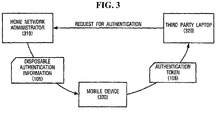
- FIG. 3 illustrates an execution process in a home network according to an exemplary embodiment of the present invention.
- a home network administrator 310 has a rights object and may transmit content to other devices.
- a user wishes play the content on a laptop of a third party 320 but cannot use the rights object of the home network administrator 310 because the laptop belongs to the third party. Therefore, the home network administrator 310 transmits disposable authentication information 106 to a mobile device 330.
- the mobile device 330 creates an authentication token 108 based on the disposable authentication information, and transmits to the third party laptop 320.
- the third party laptop 320 requests the home network administrator 310 for authentication using the authentication token 108.
- the third party laptop 320 then executes the authentication process described with respect to FIG. 2 , and receives a disposable rights object.
- the rights object transmitted to the third party laptop is a temporary rights object, and thus, may provide convenience without infringing copyright.
- the rights object may be transmitted to the third party laptop when the mobile device 330 and the third party laptop 320 are within a prescribed distance, and helps the home network administrator 310 execute an authentication process with respect to the laptop 320 based on the existence of the mobile device 330.
- FIG. 4 illustrates a configuration of a device according to an exemplary embodiment of the present invention.
- a module means, but is not limited to, a software or hardware component, such as a Field Programmable Gate Array (FPGA) or an Application Specific Integrated Circuit (ASIC), which executes certain tasks.
- a module may advantageously be configured to reside in the addressable storage medium, and configured to execute on one or more processors.
- a module may include, by way of example, components, such as software components, object-oriented software components, class components and task components, processes, functions, attributes, procedures, subroutines, segments of program code, drivers, firmware, microcode, circuitry, data, databases, data structures, tables, arrays, and variables.
- components such as software components, object-oriented software components, class components and task components, processes, functions, attributes, procedures, subroutines, segments of program code, drivers, firmware, microcode, circuitry, data, databases, data structures, tables, arrays, and variables.
- the functionality provided for in the components and modules may be combined into fewer components and modules or further separated into additional components and modules.
- FIG. 4 illustrates the configuration of a device working as a home network administrator.
- a device 400 includes a transmitter 410, a receiver 420, a rights-object-storage unit 440, an authentication unit 430, and a control unit 450.
- the transmitter 410 transmits authentication-related information in addition to a rights object to other devices.
- the receiver 420 receives the rights object from a rights issuer, and processes data received from other devices.
- the transmitter 410 and the receiver 420 may exist separately or integratedly. Common rights objects are transmitted via a physical connection or a network.
- the rights-object-storage unit 440 stores the received rights object.
- the received rights object may be transmitted to other devices, and a temporary rights object may be created and stored.
- the rights-object-storage unit 440 may also store information on the devices, which is required in an authentication process. For example, information on an identifier of the device that will receive the corresponding rights object may be stored.
- the authentication unit 430 processes the authentication of other devices. As described above, when the disposable authentication information is requested for in the mobile terminal, the authentication unit 430 issues the disposable authentication information, and processes the creation of the query and a remote authentication approval. Accordingly, the identifier stored in advance may be used and a seed may be created for the authentication. Once the remote authentication has been successfully executed, a request may be made for the control unit 450 to transmit the rights object stored in the storage 440.
- the control unit 450 controls the aforementioned elements so they can interact with each other.
- the control unit 450 may also control computational steps in the authentication process, e.g., the comparison of the authentication values, the generation of the query.
- the configuration of FIG. 4 may be used as a configuration of a mobile device.
- the transmitter 410 and the receiver 420 may provide a function to measure a physical distance from an unauthorized device such as the third party laptop in FIG. 3 .
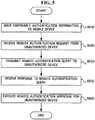
- FIG. 5 is a flow chart illustrating roaming a rights object and providing it to a device.
- An unauthorized device herein is a third party device that plays content, and includes device 2 120 of FIGS. 1 and 2 , or a third party laptop 320 of FIG. 3 .
- a device that manages a home network issues disposable authentication information to a mobile terminal S510.
- the device may store information on the mobile terminal while issuing the disposable authentication information.
- the unauthorized device executes the remote authentication request.
- the device receives the remote authentication request from the unauthorized device S520.
- the device checks if the identifier of the mobile terminal included in the received remote authentication request matches the stored mobile terminal information in S510, and transmits the remote authentication query to the unauthorized device.
- the identifier of the mobile terminal is also included and authentication can be executed on the unauthorized device and a remote authentication query is transmitted to the unauthorized device.
- the unauthorized device Once the unauthorized device has received a response to the remote authentication query via the mobile terminal, it transmits the received response back to the device. Therefore, the device receives the response to the remote authentication query S540, and executes the remote authentication approval to the unauthorized device according to S550. The unauthorized device informs the mobile terminal that it has received the remote authentication approval, receives a disposable rights object, and consumes or uses the content.
- FIGS. 6 and 7 compare methods of the exemplary embodiments included herein with related art methods.
- a user receives authentication from a rights issuer 680 and a rights object in order to play content in an unauthorized device 622. Accordingly, a home network administrator 612 is not involved therein. However, because authentication must be received from the rights issuer 680 even for a one-time content playing, the use of the content is inconvenient.
- a user stores disposable authentication information 106 in a mobile device 634.
- the user moves the mobile device 634 near a device 624 in another area.
- content can be roamed only when the mobile device is a predetermined distance away from the third device 624.
- the distance between the two devices may be measured via a wireless network or infrared ray telecommunications.
- the third device 624 may execute authentication with the home network administrator or a first device 614 as opposed to the rights issuer 680, and play the content.
- the third device 624 can protect a content provider from illegal use of the content by allowing temporary content playing as opposed to permanent content playing.
- the mobile device 634 is not limited to telecommunications devices such as mobile phones.
- the mobile device 634 includes mobile storage devices with a built-in flash memory, digital devices such as laptops and PDAs, and memory cards.
- the mobile device 634 herein is portable, and refers to all devices including a storage unit that stores disposable authentication information.
- a user can receive proper authentication on purchased content with the help of a remote device.
- a digital device that stores the broadcasting content has been described as an example of a filtering interface according to embodiments of the present invention.
- the filtering interface provision method may be applied when a menu is filtered according to user preferences and displayed in digital devices storing digital content such as computers, PDAs, PMPs, mobile phones, and digital broadcasting receivers. Therefore, it should be understood that the above embodiments are not restrictive but illustrative in all aspects.
Landscapes
- Engineering & Computer Science (AREA)
- Computer Security & Cryptography (AREA)
- General Engineering & Computer Science (AREA)
- Theoretical Computer Science (AREA)
- Computer Hardware Design (AREA)
- Computer Networks & Wireless Communication (AREA)
- Signal Processing (AREA)
- Software Systems (AREA)
- Physics & Mathematics (AREA)
- Computing Systems (AREA)
- General Physics & Mathematics (AREA)
- Multimedia (AREA)
- Technology Law (AREA)
- Data Mining & Analysis (AREA)
- Databases & Information Systems (AREA)
- Mathematical Physics (AREA)
- Storage Device Security (AREA)
- Mobile Radio Communication Systems (AREA)
- Two-Way Televisions, Distribution Of Moving Picture Or The Like (AREA)
Description
- The present invention relates to a method and apparatus for using digital rights management (DRM) content, and more particularly, to a method and apparatus for roaming the DRM content in a device.
- DRM was introduced as a way of protecting digital content under copyright. Conventionally, DRM has been applied to the content but the emphasis has gradually changed to the rights object that controls content consumption or use.
- In DRM, content can be constrained depending on who owns the rights object. For example, a rights object that allows user A to use content does not allow user B who has this rights object to use the content.
- The concept of a domain is applied in DRM, wherein it is deemed that devices in a specific domain are owned by one user allowing the user to use the rights object. Accordingly, the rights object in the domain can be used in the corresponding domain but cannot be used in other domains. In order to be used in other domains, an additional rights object is required. Documents
EP1465380 ,US2005/268098 disclose different mechanisms for enabling the roaming of a rights object between different devices. - Due to an increase in wireless Internet and portable digital devices, various attempts have been made to use content by moving a mobile node among different domains. For example, when a mobile node in domain E is moved to domain F and content in a device therein is used, how an available rights object in domain E should be used becomes an issue.
- In addition, even when the rights object is not available in units of a domain, it is not easy for other devices to acquire a rights object without an infringement of copyright. Accordingly, this can be a major obstacle to the distribution of DRM systems.
- In view of the above, it is an aspect of the present invention to enable use of content in an unauthorized device via a mobile device.
- Another aspect of the present invention is to enable temporary use of content in another device via a mobile device.
- The aspects, features and advantages of the present invention will become clear to those skilled in the art upon review of the following description, attached drawings and appended claims.
- The present invention is directed to subject-matter as disclosed by the appended claims.
- The above and other features and advantages of the present invention will become apparent by describing in detail exemplary embodiments thereof with reference to the attached drawings, in which:
-
FIG. 1 illustrates the roaming of a rights object in a wireless device according to an exemplary embodiment; -
FIG. 2 illustrates an authentication process according to an exemplary embodiment of the present invention; -
FIG. 3 illustrates an execution process in a home network according to an exemplary embodiment of the present invention; -
FIG. 4 illustrates a configuration of a device according to an exemplary embodiment of the present invention; -
FIG. 5 is a flow chart illustrating roaming of a rights object, and providing it to a device; and -
FIGS. 6 and7 compare methods included herein with related art methods. - Exemplary embodiments of the present invention will be described in detail with reference to the accompanying drawings.
- Advantages and features of the present invention and methods of accomplishing the same may be understood more readily by reference to the following detailed description of the exemplary embodiments and the accompanying drawings. The present invention may, however, be embodied in many different forms and should not be construed as being limited to the embodiments set forth herein. Rather, these embodiments are provided so that this disclosure will be thorough and complete and will fully convey the concept of the invention to those skilled in the art, and the present invention will only be defined by the appended claims. Like reference numerals refer to like elements throughout the specification.
- The present invention is described hereinafter with reference to flowchart illustrations of user interfaces, methods, and computer program products according to embodiments of the invention.
- It will be understood that each block of the flowchart illustrations, and combinations of blocks in the flowchart illustrations can be implemented by computer program instructions. These computer program instructions can be provided to a processor of a general purpose computer, special purpose computer, or other programmable data processing apparatus to produce a machine, such that the instructions, which execute via the processor of the computer or other programmable data processing apparatus, create means for implementing the functions specified in the flowchart block or blocks.
- These computer program instructions may also be stored in a computer usable or computer-readable memory that can direct a computer or other programmable data processing apparatus to function in a particular manner, such that the instructions stored in the computer usable or computer-readable memory produce an article of manufacture including instruction means that implement the function specified in the flowchart block or blocks. The computer program instructions may also be loaded into a computer or other programmable data processing apparatus to cause a series of operational steps to be performed in the computer or other programmable apparatus to produce a computer implemented process such that the instructions that execute in the computer or other programmable apparatus provide steps for implementing the functions specified in the flowchart block or blocks.
- And each block of the flowchart illustrations may represent a module, segment, or portion of code, which comprises one or more executable instructions for implementing the specified logical function(s). It should also be noted that in some alternative implementations, the functions noted in the blocks may occur out of order. For example, two blocks shown in succession may in fact be executed substantially concurrently or the blocks may sometimes be executed in reverse order depending upon the functionality involved.
-
FIG. 1 illustrates the roaming of a rights object according to an exemplary embodiment. - A user has
content 104 and a rights object 102 required to use the content. The rights object 102 is acquired from a rights issuer, and stored in adevice 1 110. In order to play thecontent object 104 in awireless device 2 120 when the user is not an issuee of the rights subject,disposable authentication information 106 acquired from thedevice 1 110 is stored in amobile node device 3 130. Then the user moves todevice 2 120, executes authentication through thedisposable authentication information 106 using themobile node device 3, acquires thecontent object 104 and the rights object 102 and uses the content indevice 2 120. - Here, the rights object 102 may be the rights object acquired from the rights issuer by the
device 1 110, or a second rights object that is newly created to be used in device 2120. - In
FIG. 1 ,device 3 130 is a medium that facilitates the use of the rights object 102 bydevice 2 120. Anauthenticated token 108 is data transmitted while authentication is in progress betweendevice 3 130 anddevice 2 120. Sincedevice 3 130 is neardevice 2 120, thedevice 1 110 can authenticatedevice 2 120. Hereinafter, a process required for authenticating the device will be described with reference toFIG. 2 . -
FIG. 2 illustrates an authentication process according to an exemplary embodiment of the present invention. - A
device 3 130 transmits an authentication information-request message REQ_SEED to adevice 1 110 with its identifier ID3 S201. Thedevice 1 110 transmits disposable authentication information SEED and a secret key K3 todevice 3 130, and stores the SEED. In this case, the transmission may be executed via a neighboring telecommunication medium. The transmission may also be executed by physically connectingdevice 3 130 to thedevice 1 110. -
Device 3 130 is a mobile node and moves to a position ofdevice 2 120, and transmits a remote authentication-request message REQ_AUTH, the ID3, and thedevice 1 110's identifier ID1 todevice 2 120 via the neighboring telecommunication medium or the physical connection S203. -
Device 2 120 refers to ID1 received in S203, and transmits a remote authentication-request message REQ_AUTH ∥ ID3 ∥ ID2 S204. The remote authentication-request message may be transmitted with ID3 and ID2. Thedevice 1 110 decodes the authentication-request message received in S204, checks whether ID3 matches the identifier stored in its storage and is included in the device certification revocation list, encodes an authentication interrogation in a secret key K3, and transmits it todevice 2 120 S205. In this case, the authentication interrogation may input the SEED value generated in S202 as an initial value, acquire the nth pseudo number from a predetermined calculation, and use the n as the authentication interrogation value. -
Device 2 120 transmits the encoded authentication interrogation received from thedevice 1 110 in S205 todevice 3 130 via neighboring or physical media S206.Device 3 130 decodes the encoded authentication interrogation in the K3 received in S202 in order to acquire an interrogation value, and outputs the query to a user. The user inputs a response value RES with respect to the query todevice 3 130. In this case, the user may receive a pseudo number corresponding to the query from thedevice 1 110 in S202 as the RES S207. -
Device 2 120 transmits the RES to thedevice 1 110. Thedevice 1 110 allows content playing indevice 2 120 if the received RES is true S209.Device 2 120 informsdevice 3 130 that the remote authentication has been approved S210.Device 130 then transmits the disposable rights object todevice 2 120 S211. - Once the content playing has been approved, the content object is transmitted to
device 2 120.Device 3 130 or the device 1110 may be in charge of the transmission of the content object, ordevice 2 120 may download the content directly from a provider. -
Device 3 130 creates a disposable rights object, and transmits it todevice 2 120. Along with the remote authentication approval in S209, thedevice 1 110 may create the disposable rights object and transmit it to thedevice 120. In this case, steps S210 and S211 may be omitted. The user can use the contents in other devices based on his/ her mobile node. -
FIG. 3 illustrates an execution process in a home network according to an exemplary embodiment of the present invention. InFIG. 3 , ahome network administrator 310 has a rights object and may transmit content to other devices. InFIG. 3 , a user wishes play the content on a laptop of athird party 320 but cannot use the rights object of thehome network administrator 310 because the laptop belongs to the third party. Therefore, thehome network administrator 310 transmitsdisposable authentication information 106 to amobile device 330. - The
mobile device 330 creates anauthentication token 108 based on the disposable authentication information, and transmits to thethird party laptop 320. Thethird party laptop 320 requests thehome network administrator 310 for authentication using theauthentication token 108. Thethird party laptop 320 then executes the authentication process described with respect toFIG. 2 , and receives a disposable rights object. As a result, the user can use his/her content on thethird party laptop 320 as opposed to his/ her own device. The rights object transmitted to the third party laptop is a temporary rights object, and thus, may provide convenience without infringing copyright. Here, the rights object may be transmitted to the third party laptop when themobile device 330 and thethird party laptop 320 are within a prescribed distance, and helps thehome network administrator 310 execute an authentication process with respect to thelaptop 320 based on the existence of themobile device 330. -
FIG. 4 illustrates a configuration of a device according to an exemplary embodiment of the present invention. - The term 'module' means, but is not limited to, a software or hardware component, such as a Field Programmable Gate Array (FPGA) or an Application Specific Integrated Circuit (ASIC), which executes certain tasks. A module may advantageously be configured to reside in the addressable storage medium, and configured to execute on one or more processors. Thus, a module may include, by way of example, components, such as software components, object-oriented software components, class components and task components, processes, functions, attributes, procedures, subroutines, segments of program code, drivers, firmware, microcode, circuitry, data, databases, data structures, tables, arrays, and variables. The functionality provided for in the components and modules may be combined into fewer components and modules or further separated into additional components and modules.
-
FIG. 4 illustrates the configuration of a device working as a home network administrator. - In
Fig. 4 , adevice 400 includes atransmitter 410, areceiver 420, a rights-object-storage unit 440, an authentication unit 430, and acontrol unit 450. Thetransmitter 410 transmits authentication-related information in addition to a rights object to other devices. Thereceiver 420 receives the rights object from a rights issuer, and processes data received from other devices. - The
transmitter 410 and thereceiver 420 may exist separately or integratedly. Common rights objects are transmitted via a physical connection or a network. - The rights-object-
storage unit 440 stores the received rights object. The received rights object may be transmitted to other devices, and a temporary rights object may be created and stored. The rights-object-storage unit 440 may also store information on the devices, which is required in an authentication process. For example, information on an identifier of the device that will receive the corresponding rights object may be stored. - The authentication unit 430 processes the authentication of other devices. As described above, when the disposable authentication information is requested for in the mobile terminal, the authentication unit 430 issues the disposable authentication information, and processes the creation of the query and a remote authentication approval. Accordingly, the identifier stored in advance may be used and a seed may be created for the authentication. Once the remote authentication has been successfully executed, a request may be made for the
control unit 450 to transmit the rights object stored in thestorage 440. - The
control unit 450 controls the aforementioned elements so they can interact with each other. Thecontrol unit 450 may also control computational steps in the authentication process, e.g., the comparison of the authentication values, the generation of the query. - The configuration of
FIG. 4 may be used as a configuration of a mobile device. In this case, thetransmitter 410 and thereceiver 420 may provide a function to measure a physical distance from an unauthorized device such as the third party laptop inFIG. 3 . -
FIG. 5 is a flow chart illustrating roaming a rights object and providing it to a device. An unauthorized device herein is a third party device that plays content, and includesdevice 2 120 ofFIGS. 1 and2 , or athird party laptop 320 ofFIG. 3 . - A device that manages a home network issues disposable authentication information to a mobile terminal S510. The device may store information on the mobile terminal while issuing the disposable authentication information. When the mobile terminal that has received the disposable authentication information requests the unauthorized device for a remote authentication, the unauthorized device executes the remote authentication request. Accordingly, the device receives the remote authentication request from the unauthorized device S520. The device checks if the identifier of the mobile terminal included in the received remote authentication request matches the stored mobile terminal information in S510, and transmits the remote authentication query to the unauthorized device. Here, the identifier of the mobile terminal is also included and authentication can be executed on the unauthorized device and a remote authentication query is transmitted to the unauthorized device.
- Once the unauthorized device has received a response to the remote authentication query via the mobile terminal, it transmits the received response back to the device. Therefore, the device receives the response to the remote authentication query S540, and executes the remote authentication approval to the unauthorized device according to S550. The unauthorized device informs the mobile terminal that it has received the remote authentication approval, receives a disposable rights object, and consumes or uses the content.
-
FIGS. 6 and7 compare methods of the exemplary embodiments included herein with related art methods. InFIG. 6 , a user receives authentication from arights issuer 680 and a rights object in order to play content in an unauthorized device 622. Accordingly, ahome network administrator 612 is not involved therein. However, because authentication must be received from therights issuer 680 even for a one-time content playing, the use of the content is inconvenient. - In
FIG. 7 , on the other hand, a user storesdisposable authentication information 106 in amobile device 634. The user moves themobile device 634 near adevice 624 in another area. Here, content can be roamed only when the mobile device is a predetermined distance away from thethird device 624. The distance between the two devices may be measured via a wireless network or infrared ray telecommunications. Thethird device 624 may execute authentication with the home network administrator or afirst device 614 as opposed to therights issuer 680, and play the content. In addition, thethird device 624 can protect a content provider from illegal use of the content by allowing temporary content playing as opposed to permanent content playing. - The
mobile device 634 is not limited to telecommunications devices such as mobile phones. Themobile device 634 includes mobile storage devices with a built-in flash memory, digital devices such as laptops and PDAs, and memory cards. Themobile device 634 herein is portable, and refers to all devices including a storage unit that stores disposable authentication information. - As described above, according to the present invention, the following effects can be anticipated.
- First, a user can receive proper authentication on purchased content with the help of a remote device.
- Second, appropriate content rights are granted to a remote device for user convenience, and content provider benefits are protected by banning indiscreet distribution of the content.
- The exemplary embodiments of the present invention have been explained with reference to the accompanying drawings, but it will be apparent to those skilled in the art that various modifications and changes may be made thereto. For example, a digital device that stores the broadcasting content has been described as an example of a filtering interface according to embodiments of the present invention. However, the filtering interface provision method may be applied when a menu is filtered according to user preferences and displayed in digital devices storing digital content such as computers, PDAs, PMPs, mobile phones, and digital broadcasting receivers. Therefore, it should be understood that the above embodiments are not restrictive but illustrative in all aspects.
Claims (6)
- A method of enabling roaming of a rights object stored in a device (110) in a digital rights management, DRM, system, the method comprising:a device (110) issuing disposable authentication information to a mobile device (130), said device storing information on the mobile device;the mobile device (130) receiving said disposable authentication information and requesting an unauthorized device (120) for a remote authentication;the unauthorized device (120) executing the remote authentication request;the device (110) receiving a corresponding remote authentication request from the unauthorized device (120), said corresponding remote authentication request comprising an identifier of the mobile device;the device (110) checking if the identifier of the mobile device matches the stored information on the mobile device;if the identifier matches, the device (110) transmitting a remote authentication query to the unauthorized device (120) including the identifier of the mobile device;the unauthorized device (120) sending the remote authentication query to the mobile device (130); the unauthorized device (120) receiving a response to the remote authentication query via the mobile device (130) and transmitting said response back to the device (110), said response being based on the disposable authentication information; based on said response, the device (110) executing a remote authentication approval to the unauthorized device (120);the unauthorized device (120) informing the mobile (130) that it has received a remote authentication approval;the unauthorized device (120) receiving a content object, and receiving a rights object acquired from a rights issuer by the device (110) or a rights object that is newly created, said rights object being required to use said content object.
- The method of claim 1, wherein the request for remote authentication comprises an identifier of the unauthorized device, said method further comprising checking if the unauthorized device is included in a certification revocation list after the receiving of the request for the remote authentication.
- The method of any of claims 1-2, wherein the mobile device stores the disposable authentication information.
- The method of any of claims 1-3, wherein data that approves of the authentication of the unauthorized device is encoded using a key included in the disposable authentication information.
- A device suitable for the implementation of the method of any of the previous claims, comprising:a rights object storage unit to store the rights object;an authentication unit configured to issue the disposable authentication information to the mobile device, and to process the creation of the remote authentication query and the remote authentication approval;a receiver to receive the request for remote authentication from an unauthorized device; anda transmitter to transmit the query required for the remote authentication to the unauthorized device, wherein the receiver is further configured to receive a response to the query from the unauthorized device, said response being based on the disposable authentication information, and wherein the transmitter is further configured to transmit data that approves of the authentication of the unauthorized device to the unauthorized device and to transmit the rights object stored in the storage unit
- The device of claim 5, wherein the authentication unit is configured to store and delete the disposable authentication information, and includes a key used for encoding the query for remote authentication.
Applications Claiming Priority (2)
| Application Number | Priority Date | Filing Date | Title |
|---|---|---|---|
| KR1020060013263A KR100791291B1 (en) | 2006-02-10 | 2006-02-10 | Method and apparatus for roaming and using DDR content on device |
| PCT/KR2007/000679 WO2007091852A1 (en) | 2006-02-10 | 2007-02-08 | Method and apparatus for roaming digital rights management content in device |
Publications (3)
| Publication Number | Publication Date |
|---|---|
| EP1999604A1 EP1999604A1 (en) | 2008-12-10 |
| EP1999604A4 EP1999604A4 (en) | 2014-07-02 |
| EP1999604B1 true EP1999604B1 (en) | 2017-09-20 |
Family
ID=38345397
Family Applications (1)
| Application Number | Title | Priority Date | Filing Date |
|---|---|---|---|
| EP07708829.2A Not-in-force EP1999604B1 (en) | 2006-02-10 | 2007-02-08 | Method and apparatus for roaming digital rights management content in device |
Country Status (6)
| Country | Link |
|---|---|
| US (2) | US20070192616A1 (en) |
| EP (1) | EP1999604B1 (en) |
| JP (1) | JP4981821B2 (en) |
| KR (1) | KR100791291B1 (en) |
| CN (1) | CN101385013B (en) |
| WO (1) | WO2007091852A1 (en) |
Families Citing this family (3)
| Publication number | Priority date | Publication date | Assignee | Title |
|---|---|---|---|---|
| KR100703805B1 (en) * | 2006-02-15 | 2007-04-09 | 삼성전자주식회사 | Method and apparatus for roaming and using DDR content on a device in a remote domain |
| US8949925B2 (en) * | 2008-08-01 | 2015-02-03 | Dell Products, Lp | System and method for roaming protected content backup and distribution |
| KR101771437B1 (en) | 2009-11-04 | 2017-08-28 | 삼성전자주식회사 | Method for determining device according to contents attribute and providing contents to the device and electronic device using the same |
Family Cites Families (39)
| Publication number | Priority date | Publication date | Assignee | Title |
|---|---|---|---|---|
| JPH06290152A (en) | 1993-03-31 | 1994-10-18 | Toshiba Corp | User authentication device |
| US5999711A (en) * | 1994-07-18 | 1999-12-07 | Microsoft Corporation | Method and system for providing certificates holding authentication and authorization information for users/machines |
| EP1083699A1 (en) * | 1998-05-18 | 2001-03-14 | Mitsubishi Materials Corporation | Information sharing system |
| SG103829A1 (en) * | 2000-01-28 | 2004-05-26 | Canon Kk | Digital contents distribution system, digital contents distribution method, roaming server, information processor, and information processing method |
| JP2001351322A (en) * | 2000-06-07 | 2001-12-21 | Sony Corp | Information processing apparatus, information processing method, information recording medium, and program providing medium |
| JP4415232B2 (en) * | 2000-10-12 | 2010-02-17 | ソニー株式会社 | Information processing apparatus and method, and program recording medium |
| EP1209592A1 (en) * | 2000-11-28 | 2002-05-29 | Hewlett-Packard Company, A Delaware Corporation | Method and apparatus for distributing electronic content |
| JP2002163235A (en) * | 2000-11-28 | 2002-06-07 | Mitsubishi Electric Corp | Access right transfer device, shared resource management system, and access right setting method |
| US7668315B2 (en) * | 2001-01-05 | 2010-02-23 | Qualcomm Incorporated | Local authentication of mobile subscribers outside their home systems |
| US7028009B2 (en) * | 2001-01-17 | 2006-04-11 | Contentguardiholdings, Inc. | Method and apparatus for distributing enforceable property rights |
| US7483958B1 (en) * | 2001-03-26 | 2009-01-27 | Microsoft Corporation | Methods and apparatuses for sharing media content, libraries and playlists |
| US7809944B2 (en) * | 2001-05-02 | 2010-10-05 | Sony Corporation | Method and apparatus for providing information for decrypting content, and program executed on information processor |
| US8140845B2 (en) * | 2001-09-13 | 2012-03-20 | Alcatel Lucent | Scheme for authentication and dynamic key exchange |
| EP1454493B1 (en) * | 2001-12-11 | 2009-09-23 | Telefonaktiebolaget LM Ericsson (publ) | Method of rights management for streaming media |
| JP3748106B2 (en) * | 2002-04-25 | 2006-02-22 | ソニー株式会社 | COMMUNICATION SYSTEM, INFORMATION PROCESSING DEVICE AND METHOD, RECORDING MEDIUM, AND PROGRAM |
| JP4129783B2 (en) | 2002-07-10 | 2008-08-06 | ソニー株式会社 | Remote access system and remote access method |
| US7822688B2 (en) * | 2002-08-08 | 2010-10-26 | Fujitsu Limited | Wireless wallet |
| SE0202451D0 (en) * | 2002-08-15 | 2002-08-15 | Ericsson Telefon Ab L M | Flexible Sim-Based DRM agent and architecture |
| KR20040019704A (en) | 2002-08-29 | 2004-03-06 | 다림기술 주식회사 | A method to prevent e-mail address from being stolew and communized on a metwork |
| CN1685706A (en) | 2002-09-23 | 2005-10-19 | 皇家飞利浦电子股份有限公司 | domain based certificate authority |
| JP4201566B2 (en) * | 2002-10-10 | 2008-12-24 | 三洋電機株式会社 | Storage device and server device |
| JP4040424B2 (en) * | 2002-10-16 | 2008-01-30 | Kddi株式会社 | Software license management method, software license management system, and computer program |
| BR0315550A (en) * | 2002-10-22 | 2005-08-23 | Koninkl Philips Electronics Nv | Method for authorizing an operation requested by a first user on a content item, and device arranged to perform an operation requested by a first user on a content item |
| US8387106B2 (en) * | 2002-12-11 | 2013-02-26 | Broadcom Corporation | Method and system for secure linking with authentication and authorization in a media exchange network |
| JP2004302921A (en) * | 2003-03-31 | 2004-10-28 | Toshiba Corp | Device authentication apparatus and device authentication method using offline information |
| JP2004303111A (en) * | 2003-04-01 | 2004-10-28 | Hitachi Ltd | Mobile terminal with license management function |
| EP1623355A1 (en) * | 2003-05-15 | 2006-02-08 | Nokia Corporation | Transferring content between digital rights management systems |
| EP1692587A1 (en) * | 2003-12-04 | 2006-08-23 | Koninklijke Philips Electronics N.V. | Connection linked rights protection |
| WO2005071515A1 (en) * | 2004-01-22 | 2005-08-04 | Koninklijke Philips Electronics N.V. | Method of authorizing access to content |
| CN101002421A (en) * | 2004-03-29 | 2007-07-18 | 斯马特互联网技术Crc有限公司 | Digital license sharing system and method |
| US7984488B2 (en) * | 2004-04-09 | 2011-07-19 | Microsoft Corporation | Credential roaming in electronic computing systems |
| KR101169021B1 (en) * | 2004-05-31 | 2012-07-26 | 삼성전자주식회사 | Method and Apparatus for sending right object information between device and portable storage |
| JP4565895B2 (en) * | 2004-06-07 | 2010-10-20 | 大日本印刷株式会社 | Authentication system, authentication method, authentication program, etc. |
| US7552322B2 (en) * | 2004-06-24 | 2009-06-23 | Palo Alto Research Center Incorporated | Using a portable security token to facilitate public key certification for devices in a network |
| EP1632828A1 (en) * | 2004-09-02 | 2006-03-08 | Axalto SA | DRM system for device communicating with a portable device |
| WO2006077526A1 (en) * | 2005-01-21 | 2006-07-27 | Koninklijke Philips Electronics, N.V. | Ordering content by mobile phone to be played on consumer devices |
| FR2881596A1 (en) * | 2005-01-28 | 2006-08-04 | Thomson Licensing Sa | METHOD FOR PROTECTING AUDIO AND / OR VIDEO DIGITAL CONTENTS AND ELECTRONIC DEVICES USING THE SAME |
| US7458510B1 (en) * | 2005-04-19 | 2008-12-02 | Sprint Spectrum L.P. | Authentication of automated vending machines by wireless communications devices |
| US20070086372A1 (en) * | 2005-10-18 | 2007-04-19 | Motorola, Inc. | Method and system for ubiquitous license and access using mobile communication devices |
-
2006
- 2006-02-10 KR KR1020060013263A patent/KR100791291B1/en not_active Expired - Fee Related
-
2007
- 2007-01-23 US US11/656,403 patent/US20070192616A1/en not_active Abandoned
- 2007-02-08 EP EP07708829.2A patent/EP1999604B1/en not_active Not-in-force
- 2007-02-08 JP JP2008554142A patent/JP4981821B2/en not_active Expired - Fee Related
- 2007-02-08 CN CN2007800051406A patent/CN101385013B/en not_active Expired - Fee Related
- 2007-02-08 WO PCT/KR2007/000679 patent/WO2007091852A1/en not_active Ceased
-
2013
- 2013-04-24 US US13/869,256 patent/US9300668B2/en not_active Expired - Fee Related
Non-Patent Citations (1)
| Title |
|---|
| None * |
Also Published As
| Publication number | Publication date |
|---|---|
| KR20070081363A (en) | 2007-08-16 |
| US9300668B2 (en) | 2016-03-29 |
| US20070192616A1 (en) | 2007-08-16 |
| JP4981821B2 (en) | 2012-07-25 |
| JP2009526305A (en) | 2009-07-16 |
| WO2007091852A1 (en) | 2007-08-16 |
| CN101385013A (en) | 2009-03-11 |
| CN101385013B (en) | 2010-12-22 |
| US20130232585A1 (en) | 2013-09-05 |
| EP1999604A1 (en) | 2008-12-10 |
| EP1999604A4 (en) | 2014-07-02 |
| KR100791291B1 (en) | 2008-01-04 |
Similar Documents
| Publication | Publication Date | Title |
|---|---|---|
| CN112771826B (en) | Application program registration method, application program registration device and mobile terminal | |
| CN110892672B (en) | Key authentication assertion generation providing device anonymity | |
| KR101419984B1 (en) | System and method for sharing content suing nfc in cloud circumstance | |
| KR101891420B1 (en) | Content protection for data as a service (daas) | |
| CN108614878B (en) | Protocol data management method, device, storage medium and system | |
| CN107431924B (en) | Device theft protection associating device identifiers with user identifiers | |
| CN108733986B (en) | Method and apparatus for protecting digital content using device authentication | |
| EP2628125B1 (en) | Method and apparatus for downloading drm module | |
| JP4740885B2 (en) | Method and apparatus for roaming and using DRM content on a device in a remote domain | |
| CN104346548A (en) | Wearable equipment and authentication method thereof | |
| CN105207774A (en) | Key negotiation method and device of verification information | |
| US8369528B2 (en) | Method and apparatus for providing encrypted key based on DRM type of host device | |
| JP2014531659A (en) | System and method for user authentication | |
| CN104378205A (en) | Proximity Wireless Two-Factor Authentication, Authorization and Auditing System Between Mass Storage Devices and Communication Devices | |
| JP2018530054A (en) | Payment authentication method and apparatus for mobile terminal and mobile terminal | |
| US9300668B2 (en) | Method and apparatus for roaming digital rights management content in device | |
| CN106992978B (en) | Network security management method and server | |
| US20130326591A1 (en) | Wireless communication device and wireless communication method | |
| CN108460251A (en) | Run the method, apparatus and system of application program | |
| WO2021114113A1 (en) | Flash processing method and relevant apparatus | |
| KR20090044969A (en) | Method and device for managing rights object of contents | |
| CN116032504B (en) | Data decryption method, device and storage medium | |
| CN115913794A (en) | Data security transmission method, equipment and medium | |
| KR101532927B1 (en) | Method and apparatus for providing encrypted key based on DRM type of host device | |
| CN119227110A (en) | Model acquisition method, model deployment method, device, electronic device, server, medium and computer program product |
Legal Events
| Date | Code | Title | Description |
|---|---|---|---|
| PUAI | Public reference made under article 153(3) epc to a published international application that has entered the european phase |
Free format text: ORIGINAL CODE: 0009012 |
|
| 17P | Request for examination filed |
Effective date: 20080910 |
|
| AK | Designated contracting states |
Kind code of ref document: A1 Designated state(s): DE FR GB |
|
| DAX | Request for extension of the european patent (deleted) | ||
| RBV | Designated contracting states (corrected) |
Designated state(s): DE FR GB |
|
| RAP1 | Party data changed (applicant data changed or rights of an application transferred) |
Owner name: SAMSUNG ELECTRONICS CO., LTD. |
|
| A4 | Supplementary search report drawn up and despatched |
Effective date: 20140530 |
|
| RIC1 | Information provided on ipc code assigned before grant |
Ipc: G06F 21/10 20130101ALI20140523BHEP Ipc: H04L 29/06 20060101AFI20140523BHEP Ipc: G06F 21/35 20130101ALI20140523BHEP Ipc: H04W 12/06 20090101ALI20140523BHEP |
|
| REG | Reference to a national code |
Ref country code: DE Ref legal event code: R079 Ref document number: 602007052415 Country of ref document: DE Free format text: PREVIOUS MAIN CLASS: G06F0015000000 Ipc: H04W0088020000 |
|
| RIC1 | Information provided on ipc code assigned before grant |
Ipc: H04W 12/06 20090101ALI20170215BHEP Ipc: H04L 29/06 20060101ALI20170215BHEP Ipc: G06F 21/35 20130101ALI20170215BHEP Ipc: H04W 88/02 20090101AFI20170215BHEP Ipc: G06F 21/10 20130101ALI20170215BHEP |
|
| GRAP | Despatch of communication of intention to grant a patent |
Free format text: ORIGINAL CODE: EPIDOSNIGR1 |
|
| INTG | Intention to grant announced |
Effective date: 20170331 |
|
| GRAS | Grant fee paid |
Free format text: ORIGINAL CODE: EPIDOSNIGR3 |
|
| GRAA | (expected) grant |
Free format text: ORIGINAL CODE: 0009210 |
|
| AK | Designated contracting states |
Kind code of ref document: B1 Designated state(s): DE FR GB |
|
| REG | Reference to a national code |
Ref country code: GB Ref legal event code: FG4D |
|
| REG | Reference to a national code |
Ref country code: DE Ref legal event code: R096 Ref document number: 602007052415 Country of ref document: DE |
|
| REG | Reference to a national code |
Ref country code: DE Ref legal event code: R097 Ref document number: 602007052415 Country of ref document: DE |
|
| PLBE | No opposition filed within time limit |
Free format text: ORIGINAL CODE: 0009261 |
|
| STAA | Information on the status of an ep patent application or granted ep patent |
Free format text: STATUS: NO OPPOSITION FILED WITHIN TIME LIMIT |
|
| 26N | No opposition filed |
Effective date: 20180621 |
|
| REG | Reference to a national code |
Ref country code: DE Ref legal event code: R119 Ref document number: 602007052415 Country of ref document: DE |
|
| REG | Reference to a national code |
Ref country code: FR Ref legal event code: ST Effective date: 20181031 |
|
| PG25 | Lapsed in a contracting state [announced via postgrant information from national office to epo] |
Ref country code: DE Free format text: LAPSE BECAUSE OF NON-PAYMENT OF DUE FEES Effective date: 20180901 |
|
| PG25 | Lapsed in a contracting state [announced via postgrant information from national office to epo] |
Ref country code: FR Free format text: LAPSE BECAUSE OF NON-PAYMENT OF DUE FEES Effective date: 20180228 |
|
| PGFP | Annual fee paid to national office [announced via postgrant information from national office to epo] |
Ref country code: GB Payment date: 20200123 Year of fee payment: 14 |
|
| GBPC | Gb: european patent ceased through non-payment of renewal fee |
Effective date: 20210208 |
|
| PG25 | Lapsed in a contracting state [announced via postgrant information from national office to epo] |
Ref country code: GB Free format text: LAPSE BECAUSE OF NON-PAYMENT OF DUE FEES Effective date: 20210208 |