EP1998587A1 - METHOD FOR COMPRESSING AND SETTING UP WIRELESS ACCESS BEARER AND METHOD FOR TRANSFERRING Iu RAB SETTING - Google Patents
METHOD FOR COMPRESSING AND SETTING UP WIRELESS ACCESS BEARER AND METHOD FOR TRANSFERRING Iu RAB SETTING Download PDFInfo
- Publication number
- EP1998587A1 EP1998587A1 EP07739365A EP07739365A EP1998587A1 EP 1998587 A1 EP1998587 A1 EP 1998587A1 EP 07739365 A EP07739365 A EP 07739365A EP 07739365 A EP07739365 A EP 07739365A EP 1998587 A1 EP1998587 A1 EP 1998587A1
- Authority
- EP
- European Patent Office
- Prior art keywords
- rab
- network
- radio access
- access bearer
- configuration
- Prior art date
- Legal status (The legal status is an assumption and is not a legal conclusion. Google has not performed a legal analysis and makes no representation as to the accuracy of the status listed.)
- Granted
Links
Images



Classifications
-
- H—ELECTRICITY
- H04—ELECTRIC COMMUNICATION TECHNIQUE
- H04W—WIRELESS COMMUNICATION NETWORKS
- H04W28/00—Network traffic management; Network resource management
- H04W28/02—Traffic management, e.g. flow control or congestion control
- H04W28/06—Optimizing the usage of the radio link, e.g. header compression, information sizing, discarding information
-
- H—ELECTRICITY
- H04—ELECTRIC COMMUNICATION TECHNIQUE
- H04W—WIRELESS COMMUNICATION NETWORKS
- H04W28/00—Network traffic management; Network resource management
- H04W28/16—Central resource management; Negotiation of resources or communication parameters, e.g. negotiating bandwidth or QoS [Quality of Service]
- H04W28/18—Negotiating wireless communication parameters
-
- H—ELECTRICITY
- H04—ELECTRIC COMMUNICATION TECHNIQUE
- H04W—WIRELESS COMMUNICATION NETWORKS
- H04W8/00—Network data management
- H04W8/26—Network addressing or numbering for mobility support
-
- H—ELECTRICITY
- H04—ELECTRIC COMMUNICATION TECHNIQUE
- H04W—WIRELESS COMMUNICATION NETWORKS
- H04W92/00—Interfaces specially adapted for wireless communication networks
- H04W92/04—Interfaces between hierarchically different network devices
- H04W92/14—Interfaces between hierarchically different network devices between access point controllers and backbone network device
Definitions
- the present invention relates to methods for the compression of Radio Access Bearer (RAB), configuration and for the transfer of such Iu RAB configurations (configuration information) within a mobile radio communication network.
- RAB Radio Access Bearer
- Interface radio access bearer configurations such as the Iu RAB configuration commonly form part of the signaling information transferred between the User Equipment (UE) and the Universal Terrestrial Radio Network (UTRAN) of a mobile radio communications system.
- UE User Equipment
- UTRAN Universal Terrestrial Radio Network
- a major part of the need-data comprises Iu RAB configuration data which can have a size of up to 2.4 K octets.
- the need-data has to be stored on the user equipment, and eventually retrieved and provided on an uplink channel.
- the present invention therefore seeks to provide for a scheme for compressing the Iu RAB configurations and a scheme for transferring such compressed configurations between, for example, the UE (User Equipment) and the UTRAN (Universal Terrestrial Radio Network).
- a method of compressing radio access bearer parameter sets comprising dividing the radio access bearer parameter set into first and second portions, the first portion comprising a fixed portion (parameter fixed portion) common to a plurality of sets, and the second portion comprising a variable portion (parameter variable portion), the method including the step of compressing the fixed portion through allocation of a radio access bearer identifier thereto.
- the present invention is arranged to take advantage of the fact that a network operator only ever employs a subset of RABs supported in each communication system and the fact that the RABs are the same for each party in the Public Land Mobile Network (PLMN) and commonly used in the parties, with the exception of a small number of parameters which may vary and which may be based on the requirement of maximum data rates.
- PLMN Public Land Mobile Network
- the size of the data that is then available for transfer between, for example, the UE (User Equipment) and the UTRAN (Universal Terrestrial Radio Network), is in the order of a few octets at most, in addition to any parameters that are deemed variable and associated with a particular subscriber to the network.
- the RAB identifier is associated to the RAB within the PLMN (Public Land Mobile Network).
- PLMN Public Land Mobile Network
- such allocation can be achieved via operations and maintenance procedures within the network.
- variable portion of the configuration is formed of variable parameters of the configuration.
- An advantageous arrangement for compressing the Iu RAB configuration can likewise be advantageously employed both in relation to the storage and transfer of such configuration.
- the present invention accordingly also provides for a method for transferring radio access bearer parameter sets between user equipment and a mobile radio communications network associated therewith and including compressing the radio access bearer sets.
- the signaling pay load for such transfer is then advantageously limited which serves to achieve efficient transfer of data and thus, in turn, advantageously fast call sep-up times.
- the transferring of the Iu RAB configuration can advantageously include the allocation of a set of Iu RAB configurations for each UTRAN (Universal Terrestrial Radio Network)/Core Network (CN) pair within a PLMN (Public Land Mobile Network).
- UTRAN Universal Terrestrial Radio Network
- CN Core Network
- Each such set of Iu RAB configurations can advantageously be allocated a subset of RAB identifiers.
- the RAB identifier and variable parameters of the Iu RAB configuration are arranged to be stored within the UE (User Equipment) for transfer to the UTRAN (Universal Terrestrial Radio Network) as required.
- UE User Equipment
- UTRAN Universal Terrestrial Radio Network
- the method of transfer of Iu RAB configurations can form part of a call set-up procedure for user equipment.
- the present invention also provides for a method of re-establishing previously released radio access bearers in a network when received from a transfer and including the step of referring to a stored radio access bearer configuration by means of the radio access bearer identifiers.
- the reconnection of the Iu RAB configuration can be achieved through operations and maintenance procedures.
- the present invention proposes the compression of the Iu RAB signaling data, and which can be achieved in a particularly advantageous manner.
- the present invention is described further hereinafter, by way of examples only, and which illustrate, by examples, arrangements by which a network operator can configure the system for two different CN/UTRAN (Core Network/Universal Terrestrial Radio Network) pairs within its PLMN (Public Land Mobile Network).
- CN/UTRAN Core Network/Universal Terrestrial Radio Network
- PLMN Public Land Mobile Network
- the present invention is particularly and advantageously employed in reducing the amount of data to be transported between the UE (User Equipment) and the UTRAN (Universal Terrestrial Radio Network) particularly when relatively fast call set-up times are required.
- UE User Equipment
- UTRAN Universal Terrestrial Radio Network
- the present invention takes advantage of the fact that the network operator only ever deploys a subset of RABs in the system.
- the RAB for "interactive" and “background” configurations is basically common to all parties within the PLMN (Public Land Mobile Network) and there are only a very small number of parameters which might vary in this configuration.
- variable parameters can comprise aspects of priority, pre-emption, guaranteed bit-rate, guaranteed delay, minimum bit-rate, BLER (Block Error), and QoS (Quality of Service) Class, i.e. whether streaming, conversational, background, or interactive.
- the Iu RAB configuration to be transferred to the UTRAN can therefore advantageously be partitioned into a fixed part and a variable part, with the fixed part being compressed by the allocation to it, through standard operations and maintenance procedures, of a value associated to the RAB within the PLMN (Public Land Mobile Network).
- PLMN Public Land Mobile Network
- this value can advantageously be calculated by the operator and will depend on some extent upon a number of RABs that the particular operator supports within the PLMN (Public Land Mobile Network) concerned.
- PLMN Public Land Mobile Network
- This compression scheme advantageously reduces the 2.4 K octet value down to within the region of 1 octet in addition to any parameters which are deemed variable and associated with the subscriber.
- the present invention is advantageous in first proposing a scheme for compressing the Iu RAB signaling data, and for then forwarding that data from the UE (User Equipment) to the Radio Network System (RNS) by way of the Uu interface.
- UE User Equipment
- RNS Radio Network System
- the present invention can apply to the network signaling so as to reduce the signaling load on the Iu and network interfaces.
- the network operator is required to allocate, for its PLMN (Public Land Mobile Network), a set of Iu RAB configurations, with one configuration being provided for each UTRAN/CN pair (per manufacturer pair).
- PLMN Public Land Mobile Network
- Iu RAB configurations with one configuration being provided for each UTRAN/CN pair (per manufacturer pair).
- each set of Iu RAB configurations is allocated a subset of RAB identifiers so as to identify the particular RAB within each set.
- this RAB identifier in addition to the variable parameters associated with the Iu RAB, and the identifier is transferred to the user equipment for storage in the user equipment, and for subsequent provision on an uplink channel during attempted fast call set-up between the UE (User Equipment) and the UTRAN (Universal Terrestrial Radio Network).
- UE User Equipment
- UTRAN Universal Terrestrial Radio Network
- the network is able to readily reconstitute the Iu RAB data on the basis of the RAB identifier by using the RAB identifier to accurately refer to the RAB configuration held and maintained by the operator by means of operations and maintenance procedures.
- the new UTRAN/CN pair can be arranged to reconstruct the original Iu RAB configuration through interworking the previous UTRAN/CN pair RAB identifiers to RAB identifiers supported by the new UTRAN/CN pair.
- UTRAN/CN Universal Terrestrial Radio Network/Core Network
- mapping from these RAB identifiers can advantageously be controlled by a means of tables maintained by the network operator.
- a method for compressing the Iu RAB configurations and likewise a method for transferring such compressed configurations between, for example, the UE and the UTRAN.
- the following example shows a method by which the network operator configures the system for two different CN/UTRAN (Core Network/Universal Terrestrial Radio Network) pairs in its PLMN (Public Land Mobile Network) of the system.
- CN/UTRAN Core Network/Universal Terrestrial Radio Network
- PLMN Public Land Mobile Network
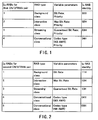
- FIG. 1 shows a table for a first UTRAN/CN pair. This UTRAN/CN pair has implemented priority but has not implemented the support of WB AMR (Wideband Adaptive multi-rate).
- WB AMR Wideband Adaptive multi-rate
- FIG. 2 shows a table for a second UTRAN/CN pair which has not implemented priority.
- mapping rules shown in FIG. 3 may be applied by the second CN/UTRAN.
- mapping rules shown in FIG. 4 may be applied by the first CN/UTRAN.
- the WB AMR Wideband Adaptive multi-rate
- NB AMR Wideband Adaptive multi-rate
- the second CN/UTRAN takes a default value until such time as it is informed as to what the priority actually is.
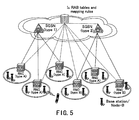
- FIG. 5 shows an example of PLMN (Public Land Mobile Network) with 2 SGSN (Serving GPRS Support Node) types and 2 UTRAN types (RNC (Radio Network Controller) with Node-Bs).
- the full line represents interfaces where Iu connections and RAB can be established.
- the dashed line represents the Iu RAB tables and mapping rules as defined by the operator.
- Each RNC and SGSN receives and stores:
- each RNC/SGSN stores one of these tables, plus mapping tables for each Iu RAB from the other two tables.
- UE User Equipment
- RNC Radio Network Controller
- SGSN Serving GPRS Support Node
- signaling messages shown in FIG. 6 will be exchanged between UE, RNC, and SGSN.
- RRC connection requests will be transmitted from UE to RNC when UE (User Equipment) originates calling or UE is called in.
- UE User Equipment
- SGSN transmits to RNC the common ID showing which subset it belongs to.
- the SGSN replaces the 'RAB parameters' included in the 'RAB Assignment Request' message with the Iu RAB identity and the associated variable parameters.
- the RNC Radio Network Controller
- the SGSN Serving GPRS Support Node
- the Iu RAB identity is identity information showing in more detail what RAB to be used and containing the order of few octets.
- the amount of data transferred from SGSN to RNC is 2.4 K octets.
- the amount of data transferred from SGSN to RNC is data amount of only a few octets Iu RAB identity and (variable) parameters. As a result, reducing the amount of transferring data can be provided and fast call set-up times can be achieved.
- the network as configured before can provide all the RNCs with mapping rules, so as to translate Iu RAB identity for another (SGSN type, RNC type) and its parameter(s) (if any) into a RAB for this RNC and the SGSN it is connected to.
- the receiving UTRAN can configure the radio resources without informing the CN (Core Network) what RABs are necessary as specified in IDLE state (05/32).
- the RNC provides, as illustrated in FIG. 7 , Iu RAB identity and parameters to the UE, so that UE stores Iu RAB identity and parameters.
- connection is released, e.g. because the user is no more using the service. Then the user moves into the network.
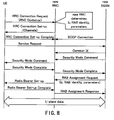
- the setup procedure is performed as illustrated in FIG. 8 .
- the new RNC Radio Network Controller
- the new SGSN Server GPRS Support Node
- RNC can setup the physical or transport channels with the UE immediately, without waiting for RAB Assignment Request message:
- the transport mechanism and signaling can be completely defined by the operator and need not necessarily be standardized as such as it is a PLMN (Public Land Mobile Network) issue. If this proposal is accepted, the compression of the RABs is essential in order to allow the compression to be both stored and transported by the UE in order to meet the call setup timing requirements.
- PLMN Public Land Mobile Network
- UE User Equipment
- UE User Equipment
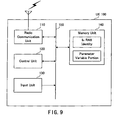
- UE 100 as illustrated in the drawing, comprises a radio communication unit 110, a control unit 120, an input unit 130, a memory unit 140, and a bus 150.
- the radio communication unit 110, the control unit 120, the input unit 130, and the memory unit 140 are connected by the bus 150.
- the radio communication unit 110 for example, comprises a radio antenna and NIC (Network Interface Card), and transmits and receives data with RNC (Radio Network Controller).
- NIC Network Interface Card
- RNC Radio Network Controller
- the control unit 120 for example, comprises CPU (Central Processing Unit) and performs, for example, processing data in the radio communication unit 110 and the memory unit 140, transmitting and receiving data with the radio communication unit 110, and storing data in the memory unit 140.
- CPU Central Processing Unit
- the input unit 130 for example, comprises a numeric-keyboard, accepts inputs from the users of UE 100, and transmits the input contents to the control unit 120.
- the memory unit 140 for example, comprises ROM (Read Only Memory) and RAM (Random Access Memory).
- RAM is used as a work area of the control unit 120, and ROM and RAM store a program for the control unit 120 to perform processing.
- RAM for example, stores RAB configuration information (Iu RAB identity, parameters variable portion) and provides RAB configuration information to the control unit 120 if required by the control unit 120.
- SGSN (Serving GPRS Support Node) according to this embodiment comprises a structure illustrated in FIG. 10 .
- SGSN 200 as illustrated in the drawing, comprises a communication unit 210, a control unit 220, a memory unit 230, and a bus 240.
- the communication unit 210, the control unit 220, and the memory unit 230 are connected by the bus 240.
- the communication unit 210 for example, comprises NIC (Network Interface Card) and transmits and receives data with RNC (Radio Network Controller) by wired connection.
- NIC Network Interface Card
- RNC Radio Network Controller
- the control unit 220 for example, comprises CPU (Central Processing Unit) and performs, for example, processing data in the communication unit 210 and the memory unit 230, transmitting and receiving data with the communication unit 210, and storing data in the memory unit 230.
- CPU Central Processing Unit
- the memory unit 230 for example, comprises ROM (Read Only Memory) and RAM (Random Access Memory).
- RAM is used as a work area of the control unit 220, and ROM and RAM store a program for the control unit 220 to perform processing.
- control unit 220 divides radio access bearer parameter sets 231 stored in ROM or RAM of the memory unit 230, by a dividing program 233 stored in ROM or RAM of the memory unit 230, into fixed portion and variable portion per parameter set. Next, assembling parameters, which are a fixed portion, as a first portion and parameters, which are a variable portion, as a second portion, then it is stored into the work area of RAM of the memory unit 230.
- control unit 220 executes compression program 234 stored in the memory unit 230 and compresses the first portion. Then, it stores a set 232 comprising the compressed first portion (radio access bearer identifier) and its associated second portion in RAM of the memory unit 230.
- communication program 235 and setting program 236 are stored.
- the control unit 220 establishes communication with RNC (Radio Network Controller) and UE (User Equipment) by executing the communication program 235 and performs RAB allocation and common ID allocation, etc. by executing the setting program 236.
- RNC Radio Network Controller
- UE User Equipment
- the present invention is not limited to the above-described embodiments and various modifications and applications thereof are possible.
- the structures of such UE, RNC, and SGSN can be changed in any way.
- anything can be used as a method of dividing parameter sets, a method of compressing the parameters fixed portion, communication method and protocol, and configuration method, etc.
- the RABs are not limited to the contents shown in FIG. 1 to FIG. 4 and these may be changed accordingly.
- the system structures exemplified in FIG. 5 , FIG. 9 , and FIG. 10 may also be changed.
- the communication and setting procedure exemplified in FIG. 6 to FIG. 8 may also be changed accordingly.
- the present invention can be applied to the mobile phone sets and the mobile phone network.
Landscapes
- Engineering & Computer Science (AREA)
- Computer Networks & Wireless Communication (AREA)
- Signal Processing (AREA)
- Mobile Radio Communication Systems (AREA)
Abstract
Description
- The present invention relates to methods for the compression of Radio Access Bearer (RAB), configuration and for the transfer of such Iu RAB configurations (configuration information) within a mobile radio communication network.
- Interface radio access bearer configurations such as the Iu RAB configuration commonly form part of the signaling information transferred between the User Equipment (UE) and the Universal Terrestrial Radio Network (UTRAN) of a mobile radio communications system.
- In an attempt to improve call set-up times for a mobile device, and in particular to improve the call set-up times from an IDLE state, it has been found that a major part of the need-data comprises Iu RAB configuration data which can have a size of up to 2.4 K octets. The need-data has to be stored on the user equipment, and eventually retrieved and provided on an uplink channel.
- The compression of such configurations would therefore prove particularly advantageous in assisting with the efficiency of radio interface signaling and, in particular, the provision of relatively fast call set-up times.
- A proposal for providing such fast call set-up times is known from
UK patent application No. 0600330.5 - The present invention therefore seeks to provide for a scheme for compressing the Iu RAB configurations and a scheme for transferring such compressed configurations between, for example, the UE (User Equipment) and the UTRAN (Universal Terrestrial Radio Network).
- According to a first aspect of the present invention, there is provided a method of compressing radio access bearer parameter sets comprising dividing the radio access bearer parameter set into first and second portions, the first portion comprising a fixed portion (parameter fixed portion) common to a plurality of sets, and the second portion comprising a variable portion (parameter variable portion), the method including the step of compressing the fixed portion through allocation of a radio access bearer identifier thereto.
- As will be appreciated, and as is discussed in further detail below, the present invention is arranged to take advantage of the fact that a network operator only ever employs a subset of RABs supported in each communication system and the fact that the RABs are the same for each party in the Public Land Mobile Network (PLMN) and commonly used in the parties, with the exception of a small number of parameters which may vary and which may be based on the requirement of maximum data rates.
- Through the division of the Iu RAB configuration into a fixed, i.e. common, part and variable part, it becomes possible to advantageously compress the whole configuration through the compression of the fixed part in a particularly advantageous manner through the allocation of a value associated with the RAB within the PLMN (Public Land Mobile Network).
- The size of the data that is then available for transfer between, for example, the UE (User Equipment) and the UTRAN (Universal Terrestrial Radio Network), is in the order of a few octets at most, in addition to any parameters that are deemed variable and associated with a particular subscriber to the network.
- Advantageously therefore, the RAB identifier is associated to the RAB within the PLMN (Public Land Mobile Network).
- Preferably, such allocation can be achieved via operations and maintenance procedures within the network.
- As a further advantage, the variable portion of the configuration is formed of variable parameters of the configuration.
- An advantageous arrangement for compressing the Iu RAB configuration can likewise be advantageously employed both in relation to the storage and transfer of such configuration.
- The present invention accordingly also provides for a method for transferring radio access bearer parameter sets between user equipment and a mobile radio communications network associated therewith and including compressing the radio access bearer sets.
- The signaling pay load for such transfer is then advantageously limited which serves to achieve efficient transfer of data and thus, in turn, advantageously fast call sep-up times.
- The transferring of the Iu RAB configuration can advantageously include the allocation of a set of Iu RAB configurations for each UTRAN (Universal Terrestrial Radio Network)/Core Network (CN) pair within a PLMN (Public Land Mobile Network).
- Each such set of Iu RAB configurations can advantageously be allocated a subset of RAB identifiers.
- In particular, the RAB identifier and variable parameters of the Iu RAB configuration are arranged to be stored within the UE (User Equipment) for transfer to the UTRAN (Universal Terrestrial Radio Network) as required.
- As noted above, the method of transfer of Iu RAB configurations can form part of a call set-up procedure for user equipment.
- The present invention also provides for a method of re-establishing previously released radio access bearers in a network when received from a transfer and including the step of referring to a stored radio access bearer configuration by means of the radio access bearer identifiers.
- Of course, it should be appreciated that the Iu RAB configuration is advantageously held by the network operator.
- Yet further, the reconnection of the Iu RAB configuration can be achieved through operations and maintenance procedures.
- As will be appreciated from the above, through the use of the present invention, it becomes possible to compress the size of Iu RAB configuration data down to a size which readily allows for fast call set-up times. Such fast call set-up times were sought to be provided in accordance with the above mentioned UK patent application.
- The present invention proposes the compression of the Iu RAB signaling data, and which can be achieved in a particularly advantageous manner.
- The present invention is described further hereinafter, by way of examples only, and which illustrate, by examples, arrangements by which a network operator can configure the system for two different CN/UTRAN (Core Network/Universal Terrestrial Radio Network) pairs within its PLMN (Public Land Mobile Network).
- As will be illustrated further below, the present invention is particularly and advantageously employed in reducing the amount of data to be transported between the UE (User Equipment) and the UTRAN (Universal Terrestrial Radio Network) particularly when relatively fast call set-up times are required.
- It has become recognized that a major part of such 2.4 K octets of data comprises the Iu RAB configuration such that the compression of this configuration will advantageously lead to a reduction in signaling overhead on the radio interface and therefore a cast call set-up time.
- The present invention takes advantage of the fact that the network operator only ever deploys a subset of RABs in the system. For example, the RAB for "interactive" and "background" configurations is basically common to all parties within the PLMN (Public Land Mobile Network) and there are only a very small number of parameters which might vary in this configuration.
- As will be clear from the following, such variable parameters can comprise aspects of priority, pre-emption, guaranteed bit-rate, guaranteed delay, minimum bit-rate, BLER (Block Error), and QoS (Quality of Service) Class, i.e. whether streaming, conversational, background, or interactive.
- As defined above, the Iu RAB configuration to be transferred to the UTRAN (Universal Terrestrial Radio Network) can therefore advantageously be partitioned into a fixed part and a variable part, with the fixed part being compressed by the allocation to it, through standard operations and maintenance procedures, of a value associated to the RAB within the PLMN (Public Land Mobile Network).
- It should be noted that the size of this value can advantageously be calculated by the operator and will depend on some extent upon a number of RABs that the particular operator supports within the PLMN (Public Land Mobile Network) concerned.
- This compression scheme advantageously reduces the 2.4 K octet value down to within the region of 1 octet in addition to any parameters which are deemed variable and associated with the subscriber.
- The present invention is advantageous in first proposing a scheme for compressing the Iu RAB signaling data, and for then forwarding that data from the UE (User Equipment) to the Radio Network System (RNS) by way of the Uu interface.
- It should of course also be appreciated that the present invention can apply to the network signaling so as to reduce the signaling load on the Iu and network interfaces.
- In order to use and efficiently operate the present invention, the network operator is required to allocate, for its PLMN (Public Land Mobile Network), a set of Iu RAB configurations, with one configuration being provided for each UTRAN/CN pair (per manufacturer pair).
- For example, if the network operator has two CN (Core Network) and three UTRAN (Universal Terrestrial Radio Network) suppliers, the operator may then have to allocate a total of six sets of compressed Iu RAB configurations. Importantly, each set of Iu RAB configurations is allocated a subset of RAB identifiers so as to identify the particular RAB within each set.
- In such scenario, it is this RAB identifier, in addition to the variable parameters associated with the Iu RAB, and the identifier is transferred to the user equipment for storage in the user equipment, and for subsequent provision on an uplink channel during attempted fast call set-up between the UE (User Equipment) and the UTRAN (Universal Terrestrial Radio Network).
- Thus, when the user equipment eventually returns the compressed Iu RAB data as part of the attempted fast call set-up procedure, the network is able to readily reconstitute the Iu RAB data on the basis of the RAB identifier by using the RAB identifier to accurately refer to the RAB configuration held and maintained by the operator by means of operations and maintenance procedures.
- In the situation in which the user equipment might seek to re-establish contact with a different UTRAN/CN (Universal Terrestrial Radio Network/Core Network) pair on the same PLMN (Public Land Mobile Network), the new UTRAN/CN pair can be arranged to reconstruct the original Iu RAB configuration through interworking the previous UTRAN/CN pair RAB identifiers to RAB identifiers supported by the new UTRAN/CN pair.
- The mapping from these RAB identifiers can advantageously be controlled by a means of tables maintained by the network operator.
- According to the present invention, a method for compressing the Iu RAB configurations and likewise a method for transferring such compressed configurations between, for example, the UE and the UTRAN.
-
-
FIG. 1 shows a table for a first UTRAN/CN pair. -
FIG. 2 shows a table for a second UTRAN/CN pair which has not implemented priority. -
FIG. 3 shows mapping rules that may be applied by the second CN/UTRAN. -
FIG. 4 shows mapping rules that may be applied by the first CN/UTRAN. -
FIG. 5 illustrates an example of PLMN. -
FIG. 6 shows signaling messages that are exchanged between UE, RNC, and SGSN according to 3GPP specification. -
FIG. 7 is a diagram showing data flow sent from RNC to UE. -
FIG. 8 is a diagram showing the setup procedure to reconnect. -
FIG. 9 shows a structure of UE. -
FIG. 10 shows a structure of SGSN. - The following example shows a method by which the network operator configures the system for two different CN/UTRAN (Core Network/Universal Terrestrial Radio Network) pairs in its PLMN (Public Land Mobile Network) of the system.
- There may be a need to have some subtle changes of support between the different UTRANs.
-
FIG. 1 shows a table for a first UTRAN/CN pair. This UTRAN/CN pair has implemented priority but has not implemented the support of WB AMR (Wideband Adaptive multi-rate). -
FIG. 2 shows a table for a second UTRAN/CN pair which has not implemented priority. - It should be noted that in this example, the support of speech is not equal in the two different systems so there is a need to interwork the support of WB AMR to NB AMR (Narrowband Adaptive multi-rate) in the first pair.
- Further, if the mobile (Mobile Equipment) moves from the first CN/UTRAN pair to the second CN/UTRAN pair, mapping rules shown in
FIG. 3 may be applied by the second CN/UTRAN. - Further, if the mobile (Mobile Equipment) moves from the second CN/UTRAN pair to the first CN/UTRAN pair, mapping rules shown in
FIG. 4 may be applied by the first CN/UTRAN. - Here, the WB AMR (Wideband Adaptive multi-rate) RAB is mapped to a NB AMR (Narrowband Adaptive multi-rate) RAB. Because the priority is not received, the second CN/UTRAN takes a default value until such time as it is informed as to what the priority actually is.
-
FIG. 5 shows an example of PLMN (Public Land Mobile Network) with 2 SGSN (Serving GPRS Support Node) types and 2 UTRAN types (RNC (Radio Network Controller) with Node-Bs). The full line represents interfaces where Iu connections and RAB can be established. The dashed line represents the Iu RAB tables and mapping rules as defined by the operator. Each RNC and SGSN receives and stores: - a table of Iu RABs that it can use; and
- mapping rules for Iu RAB identities used by other (RNC, SGSN) pair.
- With this example, there are 3 different Iu RAB tables, (RNC A, SGSN 1), (RNC B, SGSN 2), and (RNC A, SGSN 2), and each RNC/SGSN stores one of these tables, plus mapping tables for each Iu RAB from the other two tables.
- When a connection is established between UE (User Equipment) and RNC (Radio Network Controller) as illustrated in
FIG. 6 , after the RRC connection to the RNC and the signaling connection to the SGSN (Serving GPRS Support Node) are established, the user requests a service e.g. public internet access which needs a RAB for transmission of user data between UE and SGSN. - According to current 3GPP specification, signaling messages shown in
FIG. 6 will be exchanged between UE, RNC, and SGSN. - RRC connection requests will be transmitted from UE to RNC when UE (User Equipment) originates calling or UE is called in.
- SGSN transmits to RNC the common ID showing which subset it belongs to.
- Using the table of Iu RAB between SGSN (Serving GPRS Support Node)
type 1 and RNC type A as defined in the present invention, stored in the SGSN, the SGSN replaces the 'RAB parameters' included in the 'RAB Assignment Request' message with the Iu RAB identity and the associated variable parameters. - Using the Iu RAB identities and the variable parameters, the RNC (Radio Network Controller) knows what RAB is requested by the SGSN (Serving GPRS Support Node), without the need to transmit RAB parameters on the Iu interface. Also, the Iu RAB identity is identity information showing in more detail what RAB to be used and containing the order of few octets.
- With existing RAB Assignment Request, the amount of data transferred from SGSN to RNC is 2.4 K octets. However, with the method of the present invention, the amount of data transferred from SGSN to RNC is data amount of only a few octets Iu RAB identity and (variable) parameters. As a result, reducing the amount of transferring data can be provided and fast call set-up times can be achieved.
- Also, the network as configured before can provide all the RNCs with mapping rules, so as to translate Iu RAB identity for another (SGSN type, RNC type) and its parameter(s) (if any) into a RAB for this RNC and the SGSN it is connected to.
- When furnished with the PLMN ID and also these arrays of data, the receiving UTRAN (Universal Terrestrial Radio Network) can configure the radio resources without informing the CN (Core Network) what RABs are necessary as specified in IDLE state (05/32).
- If the UE (User Equipment) is first connected to RNC type A/
SGSN type 1, as illustrated inFIG. 5 andFIG. 6 , after the RAB is setup, the RNC provides, as illustrated inFIG. 7 , Iu RAB identity and parameters to the UE, so that UE stores Iu RAB identity and parameters. - Later, the connection is released, e.g. because the user is no more using the service. Then the user moves into the network. When reconnection is desired, according to the IDLE state, the setup procedure is performed as illustrated in
FIG. 8 . - Using the Iu RAB identity and parameters provided with the RRC connection request, the new RNC (Radio Network Controller) knows the RAB parameters without any information from the new SGSN (Serving GPRS Support Node), so RNC can setup the physical or transport channels with the UE immediately, without waiting for RAB Assignment Request message:
- if the "Iu RAB identity" sent from the UE belongs to the (new SGSN, new RNC) table:
- This is the case when UE is connecting to RNC type A/
SGSN type 1 again: the new RNC can use directly "Iu RAB identity" and its parameters, as if received from new SGSN.
- This is the case when UE is connecting to RNC type A/
- if the "Iu RAB identity" sent from the UE does not belong to the (new SGSN, new RNC) table:
- It is difficult to give a precise implementation. As in general, the transport mechanism and signaling can be completely defined by the operator and need not necessarily be standardized as such as it is a PLMN (Public Land Mobile Network) issue. If this proposal is accepted, the compression of the RABs is essential in order to allow the compression to be both stored and transported by the UE in order to meet the call setup timing requirements.
- UE (User Equipment) according to this embodiment contains, for example, a structure illustrated in
FIG. 9 . -
UE 100, as illustrated in the drawing, comprises aradio communication unit 110, acontrol unit 120, aninput unit 130, amemory unit 140, and abus 150. Theradio communication unit 110, thecontrol unit 120, theinput unit 130, and thememory unit 140 are connected by thebus 150. - The
radio communication unit 110, for example, comprises a radio antenna and NIC (Network Interface Card), and transmits and receives data with RNC (Radio Network Controller). - The
control unit 120, for example, comprises CPU (Central Processing Unit) and performs, for example, processing data in theradio communication unit 110 and thememory unit 140, transmitting and receiving data with theradio communication unit 110, and storing data in thememory unit 140. - The
input unit 130, for example, comprises a numeric-keyboard, accepts inputs from the users ofUE 100, and transmits the input contents to thecontrol unit 120. - The
memory unit 140, for example, comprises ROM (Read Only Memory) and RAM (Random Access Memory). RAM is used as a work area of thecontrol unit 120, and ROM and RAM store a program for thecontrol unit 120 to perform processing. Also, RAM, for example, stores RAB configuration information (Iu RAB identity, parameters variable portion) and provides RAB configuration information to thecontrol unit 120 if required by thecontrol unit 120. - SGSN (Serving GPRS Support Node) according to this embodiment comprises a structure illustrated in
FIG. 10 . -
SGSN 200, as illustrated in the drawing, comprises acommunication unit 210, acontrol unit 220, amemory unit 230, and abus 240. Thecommunication unit 210, thecontrol unit 220, and thememory unit 230 are connected by thebus 240. - The
communication unit 210, for example, comprises NIC (Network Interface Card) and transmits and receives data with RNC (Radio Network Controller) by wired connection. - The
control unit 220, for example, comprises CPU (Central Processing Unit) and performs, for example, processing data in thecommunication unit 210 and thememory unit 230, transmitting and receiving data with thecommunication unit 210, and storing data in thememory unit 230. - The
memory unit 230, for example, comprises ROM (Read Only Memory) and RAM (Random Access Memory). RAM is used as a work area of thecontrol unit 220, and ROM and RAM store a program for thecontrol unit 220 to perform processing. - Specifically, the
control unit 220 divides radio access bearer parameter sets 231 stored in ROM or RAM of thememory unit 230, by adividing program 233 stored in ROM or RAM of thememory unit 230, into fixed portion and variable portion per parameter set. Next, assembling parameters, which are a fixed portion, as a first portion and parameters, which are a variable portion, as a second portion, then it is stored into the work area of RAM of thememory unit 230. - Moreover, the
control unit 220 executescompression program 234 stored in thememory unit 230 and compresses the first portion. Then, it stores aset 232 comprising the compressed first portion (radio access bearer identifier) and its associated second portion in RAM of thememory unit 230. - Further, in the
memory unit 230,communication program 235 andsetting program 236 are stored. Thecontrol unit 220 establishes communication with RNC (Radio Network Controller) and UE (User Equipment) by executing thecommunication program 235 and performs RAB allocation and common ID allocation, etc. by executing thesetting program 236. By these processes, for example, it achieves performances such as communication processes, allocation processes, and setting processes described with reference toFIG. 6 to FIG. 8 . - Moreover, the present invention is not limited to the above-described embodiments and various modifications and applications thereof are possible.
For example, the structures of such UE, RNC, and SGSN can be changed in any way. Also, anything can be used as a method of dividing parameter sets, a method of compressing the parameters fixed portion, communication method and protocol, and configuration method, etc.
In addition, the RABs are not limited to the contents shown inFIG. 1 to FIG. 4 and these may be changed accordingly. Also, the system structures exemplified inFIG. 5 ,FIG. 9 , andFIG. 10 may also be changed. Moreover, the communication and setting procedure exemplified inFIG. 6 to FIG. 8 may also be changed accordingly. - The present invention can be applied to the mobile phone sets and the mobile phone network.
Claims (19)
- A method of compressing radio access bearer parameter sets comprising dividing the parameter set into a first portion and a second portion, the first portion comprising a fixed portion common to a plurality of sets, and the second portion comprising a variable portion, the method including the step of compressing the fixed portion through allocation of a radio access bearer identifier thereto.
- The method according to Claim 1, wherein the parameter sets comprise Iu RAB configurations.
- The method according to Claim 2, wherein the RAB (radio access bearer) identifier is associated with the RAB within a PLMN (Public Land Mobile Network).
- The method according to Claim 3, wherein the association is achieved via operations and maintenance procedures within the network.
- The method according to Claim 2, 3, or 4, wherein the variable portion is formed of variable parameters of the configuration.
- The method according to Claim 1, wherein the radio access bearer parameter sets comprise LTE (Long Term Evolution) radio access bearer parameters.
- The method according to Claim 1, wherein the radio access bearer parameter sets comprise GERAN (GSM/EDGE Radio Access Network) radio access bearer parameters.
- A method of transferring radio access bearer parameter sets between user equipment and a mobile radio communications network associated with the user equipment, including compressing the radio access bearer sets configuration according to a method according to any one of Claims 1 to 7.
- The method according to Claim 8, when dependent upon any one of Claims 2 to 5, and including the allocation of a set of Iu RAB configurations for each UTRAN/CN (Universal Terrestrial Radio Network/ Core Network) pair.
- The method according to Claim 9, wherein each set of Iu RAB configurations is allocated a subset of RAB identifiers.
- The method according to any one of Claims 8 to 10, when dependent upon any one of Claims 2 to 5, wherein the RAB identifier and variable parameters of the Iu RAB configuration are arranged to be stored within the user equipment for transfer to the UTRAN as required.
- The method according to any one of Claims 8 to 11, wherein the transfer forms part of a call set-up procedure for the user equipment.
- A method of re-establishing previously released radio access bearers in a network when received a transfer according to any one of Claims 8 to 12, including the step of referring to a stored radio access bearer configuration by means of the radio access bearer identifiers.
- The method according to Claim 13, when dependent upon any one of Claims 9, 10, or 11, and including establishing Iu RAB data in the network.
- The method according to Claim 14, wherein the Iu RAB configuration is held by the network operator.
- The method according to Claim 14 or 15, wherein the re-establishment of the Iu RAB configuration is achieved through operations and maintenance procedures.
- A method of compressing Iu RAB configurations substantially as hereinbefore described.
- A method of transferring Iu RAB configurations within a mobile radio communications network and substantially as hereinbefore described.
- A method of re-establishing Iu RAB data in a network and substantially as hereinbefore described.
Applications Claiming Priority (2)
| Application Number | Priority Date | Filing Date | Title |
|---|---|---|---|
| GB0605705A GB2436417B (en) | 2006-03-22 | 2006-03-22 | Radio access bearer transfer |
| PCT/JP2007/055922 WO2007116640A1 (en) | 2006-03-22 | 2007-03-22 | METHOD FOR COMPRESSING AND SETTING UP WIRELESS ACCESS BEARER AND METHOD FOR TRANSFERRING Iu RAB SETTING |
Publications (3)
| Publication Number | Publication Date |
|---|---|
| EP1998587A1 true EP1998587A1 (en) | 2008-12-03 |
| EP1998587A4 EP1998587A4 (en) | 2013-01-02 |
| EP1998587B1 EP1998587B1 (en) | 2015-08-26 |
Family
ID=36383928
Family Applications (1)
| Application Number | Title | Priority Date | Filing Date |
|---|---|---|---|
| EP07739365.0A Not-in-force EP1998587B1 (en) | 2006-03-22 | 2007-03-22 | METHOD FOR COMPRESSING AND SETTING UP WIRELESS ACCESS BEARER AND METHOD FOR TRANSFERRING Iu RAB SETTING |
Country Status (6)
| Country | Link |
|---|---|
| US (1) | US20090207754A1 (en) |
| EP (1) | EP1998587B1 (en) |
| JP (2) | JP4952715B2 (en) |
| CN (1) | CN101406084B (en) |
| GB (1) | GB2436417B (en) |
| WO (1) | WO2007116640A1 (en) |
Families Citing this family (2)
| Publication number | Priority date | Publication date | Assignee | Title |
|---|---|---|---|---|
| US9137844B2 (en) * | 2007-10-04 | 2015-09-15 | Qualcomm Incorporated | Method and apparatus for handling user equipment capability information |
| KR101851030B1 (en) * | 2010-10-12 | 2018-04-20 | 삼성전자주식회사 | Method and apparatus of communicating machine type communication data over an iu interface in a universal mobile telecommunications system |
Family Cites Families (20)
| Publication number | Priority date | Publication date | Assignee | Title |
|---|---|---|---|---|
| US7346472B1 (en) * | 2000-09-07 | 2008-03-18 | Blue Spike, Inc. | Method and device for monitoring and analyzing signals |
| JP2001069195A (en) * | 1999-08-31 | 2001-03-16 | Matsushita Electric Works Ltd | Communication equipment |
| ATE335333T1 (en) * | 2000-02-18 | 2006-08-15 | Nokia Corp | COMMUNICATION SYSTEM WITH HALF RATE DATA CHANNELS |
| JP3450295B2 (en) * | 2000-12-14 | 2003-09-22 | 日本電気株式会社 | Communication system and method and switching node |
| FI20002903L (en) * | 2000-12-29 | 2002-06-30 | Nokia Corp | Setting the bit rate |
| FR2823053B1 (en) * | 2001-03-30 | 2003-08-29 | Evolium Sas | METHOD FOR ESTABLISHING A LIST OF NEIGHBORING CELLS IN A MOBILE RADIO COMMUNICATION SYSTEM |
| KR100487245B1 (en) * | 2001-11-28 | 2005-05-03 | 삼성전자주식회사 | Apparatus for minimizing transmission impossibility time due to compressed mode in mobile communication system using high speed downlink packet access scheme and method thereof |
| AU2003245633A1 (en) * | 2002-06-21 | 2004-01-06 | Thomson Licensing S.A. | Registration of a wlan as a umts routing area for wlan-umts interworking |
| JP3853765B2 (en) * | 2002-11-08 | 2006-12-06 | Necインフロンティア株式会社 | Packet compression method, packet restoration method, packet compression method, and packet restoration method |
| US7995470B2 (en) * | 2002-12-10 | 2011-08-09 | Nokia Corporation | Traffic class support for QoS activation |
| WO2004057823A2 (en) * | 2002-12-19 | 2004-07-08 | Sonic Mobility Inc. | Proxy method and system for secure wireless administration of managed entities |
| GB2399713A (en) * | 2003-03-17 | 2004-09-22 | Orange Personal Comm Serv Ltd | Telecommunications apparatus and method based on quality of service |
| WO2004084502A1 (en) * | 2003-03-17 | 2004-09-30 | Orange Sa | Radio network for communicating internet data packets containing different types of data |
| GB2399712A (en) * | 2003-03-17 | 2004-09-22 | Orange Personal Comm Serv Ltd | Telecommunications apparatus and method for multiple data type packets |
| US20050064821A1 (en) * | 2003-09-22 | 2005-03-24 | Telefonaktiebolaget Lm Ericsson (Publ) | Alternative service management |
| KR100964684B1 (en) * | 2003-09-29 | 2010-06-21 | 엘지전자 주식회사 | Broadcasting and multicast service providing method of mobile communication system |
| GB0407140D0 (en) * | 2004-03-30 | 2004-05-05 | Nokia Corp | Delivering services in a wireless communications system |
| US8254921B2 (en) * | 2004-08-12 | 2012-08-28 | Qualcomm Incorporated | Default configurations with differential encoding in a wireless communication system |
| DE602004015333D1 (en) * | 2004-12-15 | 2008-09-04 | Matsushita Electric Industrial Co Ltd | Support for guaranteed bitrate traffic for uplink transmissions |
| GB2434054B (en) | 2006-01-09 | 2008-04-02 | Nec Technologies | Mobile radio communications device and related method of establishing network communication |
-
2006
- 2006-03-22 GB GB0605705A patent/GB2436417B/en not_active Expired - Fee Related
-
2007
- 2007-03-22 WO PCT/JP2007/055922 patent/WO2007116640A1/en not_active Ceased
- 2007-03-22 US US12/293,987 patent/US20090207754A1/en not_active Abandoned
- 2007-03-22 JP JP2008509718A patent/JP4952715B2/en not_active Expired - Fee Related
- 2007-03-22 CN CN2007800102253A patent/CN101406084B/en not_active Expired - Fee Related
- 2007-03-22 EP EP07739365.0A patent/EP1998587B1/en not_active Not-in-force
-
2012
- 2012-01-04 JP JP2012000207A patent/JP5354034B2/en not_active Expired - Fee Related
Also Published As
| Publication number | Publication date |
|---|---|
| CN101406084B (en) | 2012-09-05 |
| JPWO2007116640A1 (en) | 2009-08-20 |
| EP1998587A4 (en) | 2013-01-02 |
| WO2007116640A1 (en) | 2007-10-18 |
| EP1998587B1 (en) | 2015-08-26 |
| JP4952715B2 (en) | 2012-06-13 |
| JP2012095347A (en) | 2012-05-17 |
| GB0605705D0 (en) | 2006-05-03 |
| US20090207754A1 (en) | 2009-08-20 |
| GB2436417A (en) | 2007-09-26 |
| GB2436417B (en) | 2008-02-20 |
| CN101406084A (en) | 2009-04-08 |
| JP5354034B2 (en) | 2013-11-27 |
Similar Documents
| Publication | Publication Date | Title |
|---|---|---|
| AU2002246300B2 (en) | Technique for providing announcements in mobile-originated calls | |
| FI114768B (en) | Improved method and apparatus for transmitting information in a packet radio service | |
| US6760344B2 (en) | Method and apparatus for providing differentiated quality of service in a GPRS network | |
| US9350566B2 (en) | Handling traffic flows in a mobile communications network | |
| KR101018901B1 (en) | User equipment for a communication network, an RRC connection-setup procedure for reducing radio resource control connection setup time, a communication method for communicating data between radio resource control (RCC) and medium access control (MC), and signaling used in the method Wireless bearer | |
| KR100735225B1 (en) | Vocoder Resource Management Method in Mobile Communication System | |
| CN100518136C (en) | Method for quality of service differentiation in packet-mode mobile communication networks | |
| US8532033B2 (en) | Selective RAB assignment | |
| JP4985652B2 (en) | Wireless communication apparatus, wireless communication method, and wireless communication system | |
| US8180345B2 (en) | Method for optimizing the load distribution between a first mobile radio network and a second mobile radio network | |
| CN110035461A (en) | Communication means, access network equipment and terminal device | |
| JP2002518952A (en) | Bearer management method and system in third generation mobile telecommunications system | |
| US8144650B2 (en) | Method and arrangement relating to communications network services request activation | |
| KR20050004814A (en) | Method and device for transmitting ip packets between a radio network controller(rnc) and another element of a mobile radio network | |
| CN102282905B (en) | A kind of method, Apparatus and system setting up radio bearer | |
| CN113950851B (en) | Wireless communication method and device | |
| WO2009128754A1 (en) | Unique radio bearer (rb) procedure | |
| CN108076449B (en) | Emergency call method, trunking communication system, base station and control device | |
| US20010027104A1 (en) | Method for data connections in a cellular mobile communication network | |
| EP1998587B1 (en) | METHOD FOR COMPRESSING AND SETTING UP WIRELESS ACCESS BEARER AND METHOD FOR TRANSFERRING Iu RAB SETTING | |
| CN101179857A (en) | A Call Establishment Method Applied in UMA Network | |
| EP2211482A1 (en) | A method for negotiating codec between a wireless network and a core network in a mobile | |
| CN102695231B (en) | Voice service bearing and switching method and system | |
| CN100518375C (en) | Method, system, control device, terminal and core network for controlling service priority | |
| FI116769B (en) | Circuit-switched call rerouting |
Legal Events
| Date | Code | Title | Description |
|---|---|---|---|
| PUAI | Public reference made under article 153(3) epc to a published international application that has entered the european phase |
Free format text: ORIGINAL CODE: 0009012 |
|
| 17P | Request for examination filed |
Effective date: 20080919 |
|
| AK | Designated contracting states |
Kind code of ref document: A1 Designated state(s): DE FR GB IT |
|
| RIN1 | Information on inventor provided before grant (corrected) |
Inventor name: ROBERTS, MICHAELC/O NEC PATENT SERVICES, LTD. |
|
| RBV | Designated contracting states (corrected) |
Designated state(s): DE FR GB IT |
|
| DAX | Request for extension of the european patent (deleted) | ||
| A4 | Supplementary search report drawn up and despatched |
Effective date: 20121205 |
|
| 17Q | First examination report despatched |
Effective date: 20130827 |
|
| REG | Reference to a national code |
Ref country code: DE Ref legal event code: R079 Ref document number: 602007042782 Country of ref document: DE Free format text: PREVIOUS MAIN CLASS: H04Q0007380000 Ipc: H04W0028060000 |
|
| RIC1 | Information provided on ipc code assigned before grant |
Ipc: H04W 28/06 20090101AFI20150122BHEP Ipc: H04W 8/26 20090101ALN20150122BHEP Ipc: H04W 28/18 20090101ALN20150122BHEP Ipc: H04W 92/14 20090101ALN20150122BHEP |
|
| GRAP | Despatch of communication of intention to grant a patent |
Free format text: ORIGINAL CODE: EPIDOSNIGR1 |
|
| INTG | Intention to grant announced |
Effective date: 20150227 |
|
| RIC1 | Information provided on ipc code assigned before grant |
Ipc: H04W 28/06 20090101AFI20150217BHEP Ipc: H04W 92/14 20090101ALN20150217BHEP Ipc: H04W 8/26 20090101ALN20150217BHEP Ipc: H04W 28/18 20090101ALN20150217BHEP |
|
| RIN1 | Information on inventor provided before grant (corrected) |
Inventor name: ROBERTS, MICHAEL |
|
| GRAS | Grant fee paid |
Free format text: ORIGINAL CODE: EPIDOSNIGR3 |
|
| GRAA | (expected) grant |
Free format text: ORIGINAL CODE: 0009210 |
|
| AK | Designated contracting states |
Kind code of ref document: B1 Designated state(s): DE FR GB IT |
|
| REG | Reference to a national code |
Ref country code: GB Ref legal event code: FG4D |
|
| REG | Reference to a national code |
Ref country code: DE Ref legal event code: R096 Ref document number: 602007042782 Country of ref document: DE |
|
| REG | Reference to a national code |
Ref country code: FR Ref legal event code: PLFP Year of fee payment: 10 |
|
| PG25 | Lapsed in a contracting state [announced via postgrant information from national office to epo] |
Ref country code: IT Free format text: LAPSE BECAUSE OF FAILURE TO SUBMIT A TRANSLATION OF THE DESCRIPTION OR TO PAY THE FEE WITHIN THE PRESCRIBED TIME-LIMIT Effective date: 20150826 |
|
| REG | Reference to a national code |
Ref country code: DE Ref legal event code: R097 Ref document number: 602007042782 Country of ref document: DE |
|
| PGFP | Annual fee paid to national office [announced via postgrant information from national office to epo] |
Ref country code: FR Payment date: 20160208 Year of fee payment: 10 |
|
| RAP2 | Party data changed (patent owner data changed or rights of a patent transferred) |
Owner name: LENOVO INNOVATIONS LIMITED (HONG KONG) |
|
| PLBE | No opposition filed within time limit |
Free format text: ORIGINAL CODE: 0009261 |
|
| STAA | Information on the status of an ep patent application or granted ep patent |
Free format text: STATUS: NO OPPOSITION FILED WITHIN TIME LIMIT |
|
| 26N | No opposition filed |
Effective date: 20160530 |
|
| REG | Reference to a national code |
Ref country code: FR Ref legal event code: ST Effective date: 20171130 |
|
| PG25 | Lapsed in a contracting state [announced via postgrant information from national office to epo] |
Ref country code: FR Free format text: LAPSE BECAUSE OF NON-PAYMENT OF DUE FEES Effective date: 20170331 |
|
| PGFP | Annual fee paid to national office [announced via postgrant information from national office to epo] |
Ref country code: GB Payment date: 20190327 Year of fee payment: 13 |
|
| PGFP | Annual fee paid to national office [announced via postgrant information from national office to epo] |
Ref country code: DE Payment date: 20190401 Year of fee payment: 13 |
|
| REG | Reference to a national code |
Ref country code: DE Ref legal event code: R119 Ref document number: 602007042782 Country of ref document: DE |
|
| PG25 | Lapsed in a contracting state [announced via postgrant information from national office to epo] |
Ref country code: DE Free format text: LAPSE BECAUSE OF NON-PAYMENT OF DUE FEES Effective date: 20201001 |
|
| GBPC | Gb: european patent ceased through non-payment of renewal fee |
Effective date: 20200322 |
|
| PG25 | Lapsed in a contracting state [announced via postgrant information from national office to epo] |
Ref country code: GB Free format text: LAPSE BECAUSE OF NON-PAYMENT OF DUE FEES Effective date: 20200322 |