EP1998247A2 - Model-based planning with multi-capacity resources - Google Patents
Model-based planning with multi-capacity resources Download PDFInfo
- Publication number
- EP1998247A2 EP1998247A2 EP08157087A EP08157087A EP1998247A2 EP 1998247 A2 EP1998247 A2 EP 1998247A2 EP 08157087 A EP08157087 A EP 08157087A EP 08157087 A EP08157087 A EP 08157087A EP 1998247 A2 EP1998247 A2 EP 1998247A2
- Authority
- EP
- European Patent Office
- Prior art keywords
- allocations
- allocation
- capacity
- ordering
- model
- Prior art date
- Legal status (The legal status is an assumption and is not a legal conclusion. Google has not performed a legal analysis and makes no representation as to the accuracy of the status listed.)
- Granted
Links
Images



Classifications
-
- G—PHYSICS
- G06—COMPUTING OR CALCULATING; COUNTING
- G06F—ELECTRIC DIGITAL DATA PROCESSING
- G06F9/00—Arrangements for program control, e.g. control units
- G06F9/06—Arrangements for program control, e.g. control units using stored programs, i.e. using an internal store of processing equipment to receive or retain programs
- G06F9/46—Multiprogramming arrangements
- G06F9/50—Allocation of resources, e.g. of the central processing unit [CPU]
- G06F9/5005—Allocation of resources, e.g. of the central processing unit [CPU] to service a request
- G06F9/5011—Allocation of resources, e.g. of the central processing unit [CPU] to service a request the resources being hardware resources other than CPUs, Servers and Terminals
- G06F9/5016—Allocation of resources, e.g. of the central processing unit [CPU] to service a request the resources being hardware resources other than CPUs, Servers and Terminals the resource being the memory
-
- G—PHYSICS
- G06—COMPUTING OR CALCULATING; COUNTING
- G06F—ELECTRIC DIGITAL DATA PROCESSING
- G06F9/00—Arrangements for program control, e.g. control units
- G06F9/06—Arrangements for program control, e.g. control units using stored programs, i.e. using an internal store of processing equipment to receive or retain programs
- G06F9/46—Multiprogramming arrangements
- G06F9/50—Allocation of resources, e.g. of the central processing unit [CPU]
- G06F9/5005—Allocation of resources, e.g. of the central processing unit [CPU] to service a request
- G06F9/5011—Allocation of resources, e.g. of the central processing unit [CPU] to service a request the resources being hardware resources other than CPUs, Servers and Terminals
-
- G—PHYSICS
- G03—PHOTOGRAPHY; CINEMATOGRAPHY; ANALOGOUS TECHNIQUES USING WAVES OTHER THAN OPTICAL WAVES; ELECTROGRAPHY; HOLOGRAPHY
- G03G—ELECTROGRAPHY; ELECTROPHOTOGRAPHY; MAGNETOGRAPHY
- G03G15/00—Apparatus for electrographic processes using a charge pattern
- G03G15/06—Apparatus for electrographic processes using a charge pattern for developing
-
- G—PHYSICS
- G06—COMPUTING OR CALCULATING; COUNTING
- G06Q—INFORMATION AND COMMUNICATION TECHNOLOGY [ICT] SPECIALLY ADAPTED FOR ADMINISTRATIVE, COMMERCIAL, FINANCIAL, MANAGERIAL OR SUPERVISORY PURPOSES; SYSTEMS OR METHODS SPECIALLY ADAPTED FOR ADMINISTRATIVE, COMMERCIAL, FINANCIAL, MANAGERIAL OR SUPERVISORY PURPOSES, NOT OTHERWISE PROVIDED FOR
- G06Q10/00—Administration; Management
- G06Q10/06—Resources, workflows, human or project management; Enterprise or organisation planning; Enterprise or organisation modelling
Definitions
- control mechanisms that permit a machine to fully exploit system capabilities.
- printers, photocopiers, and the like conventional control mechanisms are limited in the manner in which they process information, allocate resources, perform jobs or tasks, etc.
- a resource that is capable of multiple concurrent allocations may be employed to provide improved performance in a machine, such as a printer or photocopier.
- a single resource could be allocated to a single component or for a single task at a given time.
- control mechanisms to date have failed to provide planning and scheduling mechanisms that optimize resource capacity.
- a method for machine control may comprise evaluating a model of an ordered listing of allocations of a multi-capacity resource, selecting an insertion point for a new allocation into the ordered listing of allocations of the multi-capacity resource, posting one or more temporal constraints that govern an order of execution of allocations, and determining whether execution of the model is feasible after insertion of the new allocation at the selected insertion point.
- the method may further comprise storing the model for comparison and/or execution if it is feasible, comparing a plurality of models, each with a different selected insertion point for the new allocation, and selecting a model for execution based on a level of feasibility relative to other models.
- the one or more temporal constraints may comprise a first-in-first-out constraint and/or a serial constraint that ensures that an Nth preceding allocation is complete before the new allocation is started, where N is an integer.
- a system that facilitates model-based planning for a multi-capacity resource may comprise a planner that selects an insertion point for a new allocation into an ordering of existing allocations of the multi-capacity resource, a plan generator that specifies at least one temporal constraint on allocations of the multi-capacity resource, and a plan tester that determines whether a new ordering of allocations, which comprises the new allocation at the selected insertion point, is feasible in view of the specified constraints.
- the multi-capacity resource may be a sheet buffer in a xerographic machine, the ordering of allocations may be an ordering of pages to be passed through the sheet buffer, and the new allocation may be a new page that is inserted into the ordering of pages.
- At least one temporal constraint may comprise a first-in-first-out (FIFO) constraint that ensures that a first page enters the sheet buffer before a second page enters the sheet buffer, and leaves the sheet buffer before the second page leaves the sheet buffer, as well as a capacity-based constraint that ensures that a maximum capacity associated with the sheet buffer is not exceeded.
- the capacity-based constraint may stipulate that a current page does not enter the sheet buffer until an Nth preceding page has left the sheet buffer, where N is an integer equal to the maximum capacity of the sheet buffer.
- the multi-capacity resource is a sheet buffer in a xerographic machine.
- the ordering of allocations is an ordering of pages to be passed through the sheet buffer, and wherein the new allocation is a new page that is inserted into the ordering of pages.
- the at least one temporal constraint comprises a first-in-first-out (FIFO) constraint that ensures that a first page enters the sheet buffer before a second page enters the sheet buffer, and leaves the sheet buffer before the second page leaves the sheet buffer.
- the at least one temporal constraint further comprises a capacity-based constraint that ensures that a maximum capacity associated with the sheet buffer is not exceeded.
- the capacity-based constraint stipulates that a current page does not enter the sheet buffer until an Nth preceding page has left the sheet buffer, where N is an integer equal to the maximum capacity of the sheet buffer.
- the plan tester determines whether the new ordering of the allocations of the multi-capacity resource violates the at least one temporal constraint.
- the system further comprises a memory that stores a model of the new ordering of allocations of the multi-capacity resource if the new ordering of allocations does not violate the at least one temporal constraint.
- the planner compares a plurality of stored models and selects an optimal model for execution to maximize throughput.
- the planner abandons the new ordering of allocations if the at least one temporal constraint is violated.
- Yet another feature relates to a print platform, comprising one or more xerographic components that execute instructions for performing a xerographic process, a planner that selects an insertion point for a new allocation into an existing allocation ordering of a multi-capacity resource, generates an updated allocation ordering, and assigns at least one temporal constraint to govern the allocation ordering, and a plan tester that determines the feasibility of the updated allocation ordering as a function of whether the updated allocation ordering violates those ordering temporal constraints.
- the temporal constraints governing the allocation ordering may contain at least a first-in-first-out (FIFO) constraint and a capacity constraint that delineates a maximum capacity for the multi-capacity resource.
- FIFO first-in-first-out
- FIGURE 1 illustrates a system that depicts a plurality of components, such as may be employed in a universal production printer with a color print sheet buffer;
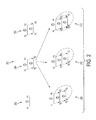
- FIGURE 2 is an illustration of a set of events that represents a plurality of permutations of potential planning schedules that may be employed to insert a new allocation of a multi-capacity resource into an existing ordering of allocations, in accordance with various aspects;
- FIGURE 3 is an illustration of a methodology for planning allocation orderings for a multi-capacity resource, in accordance with one or more features described herein;
- FIGURE 4 illustrates a methodology for evaluating multiple possible orderings of a set of events, such as allocations of a multi-capacity resource, and selecting an optimal allocation ordering, in accordance with one or more features disclosed herein;
- FIGURE 5 is an illustration of a methodology for utilizing temporal constraints to facilitate model-based planning for multi-capacity resources
- FIGURE 6 is an illustration of a system that facilitates performing model-based planning for multi-capacity resource allocation, in accordance with various aspects.
- a framework is presented that extends current model-based planning algorithms to mitigate a need for separate specialized software to handle a multi-capacity resource while retaining the ability of an online planner to output optimal plans. For example, by adding appropriate temporal points that represent multi-capacity resource allocations, and temporal constraints there between, a planner may determine an optimal manner in which to utilize the multi-capacity resource, given an objective function. Modeling language used by a planner may be analyzed to determine whether the planner permits different tasks to share one or more resources. In this manner, a model-based general-purpose online planner may be used to optimally control multi-capacity resources using temporal constraints.
- a system 100 that depicts a plurality of components, such as may be employed in a universal production printer with a color print sheet buffer.
- the system 100 comprises a paper source 102, which may comprise one or more sheets of paper, and which is operatively associated with a color engine 104 and an inserter 108. Paper from the paper source 102 may follow one of two paths. For instance, paper may be routed from the paper source 102 to the color print engine 104, and on to a color print buffer 106, before entering the inserter 108. Additionally or alternatively, paper may be routed directly from the paper source 102 to the inserter 108 using the transporter 116 (e.g., bypassing the color engine 104 and the color print buffer 106).
- Paper that has been routed directly from the paper source 102 to the inserter 108 may be passed to a black-and-white print engine 110, then through a merger 112 that merges black-and-white and color pages, before proceeding on to a finisher 114 that finishes the document for presentation to a user.
- a black-and-white print engine 110 Prior to insertion by inserter 108, paper may pass through the transporter 116. Paper that has been routed through the color print engine 104 and into the color print buffer 106 for temporary storage until such time as the color-printed page may be passed through the inserter 108 and the transporter 118 and is merged by merger 112 with other black-and-white pages that are printed by the black-and-white engine 110.
- a page may pass through all components of the system 100 and may have both color portions and black-and-white portions.
- model-based planning may be employed to explicitly handle resources
- typically such resources are in the form of "unit resources," where tasks can not share resources at the same time, as opposed to multi-capacity resources, which may be shared by multiple tasks or allocations.
- a planning framework may be created to handle multi-capacity resources in which different tasks can share a given resource up to its capacity. This type of multi-capacity resource with unrestricted allocation time can facilitate providing storage and buffer locations for materials in manufacturing domains, and thus may facilitate optimal usage of multi-capacity resources.
- a sheet buffer such as the color print sheet buffer(s) 106
- TIPP tightly-integrated parallel printing
- a sheet buffer such as the color print sheet buffer(s) 106
- TIPP tightly-integrated parallel printing
- a sheet buffer such as the color print sheet buffer(s) 106
- TIPP tightly-integrated parallel printing
- One example of how it can be done is to print color sheets early using a slower color engine 104 and then quickly feed them out of the temporary storage buffer 106 as needed to merge with sheets printed by a faster B&W engine 110.
- the planner may add temporal constraints between the new allocation and the previous allocations on R to guarantee that only up to C allocations can overlap at any given moment in time. That is, C represents a maximum allowable capacity of overlapping allocations of resource R.
- the planner may also select from all possible ways to add the new resource allocation to find the one leading to an optimal plan given any objective function. For example, if the objective function is to minimize overall end time to complete all tasks, then the planner may try to arrange as many overlapping resources as possible so that the resources are still within capacity while allowing the tasks to finish as soon as possible.
- the manner in which the planner adds and maintains temporal constraints between different allocations of multi-capacity resources need not rule out any given potential solution and need not change any property of the search algorithm used by the planner, such as completeness or optimality.
- Some continuous planning/re-planning systems work in an on-line planning environment and deal with real-time constraints similar to a TIPP environment.
- such systems rely on user-defined local-rules to guide the planning and plan-repair processes, which do not guarantee either completeness or optimality.
- the handling of multi-capacity resources in model-based planning as discussed here is generic, does not depend on local rules, and does not violate the completeness or optimality of the underlying search algorithm used.
- FIGURE 2 is an illustration of a set of events 200 that represents a plurality of permutations of potential planning schedules that may be employed to insert a new allocation of a multi-capacity resource into an existing ordering of allocations, in accordance with various aspects.
- planning involves choosing actions to achieve a given goal, and scheduling involves deciding when the chosen actions should take place.
- Planning and scheduling may be integrated to facilitate making an informed decision regarding an optimal plan.
- Constraints that are employed to solve scheduling problems may also be utilized as part of a constraint-based planning system. For instance, with regard to multi-capacity resources, some actions may not be performed concurrently due to resource unavailability.
- a printer may have a print buffer (e.g., a multi-capacity resource) where pages accumulate as they await further action, and the buffer may have a limited capacity.
- a print buffer e.g., a multi-capacity resource
- allocation scheduling/planning models may be evaluated for feasibility to facilitate model-based planning for optimized utilization of the multi-capacity resource.
- the resource allocations (e.g., of a resource, R) are described as having a maximum capacity, C, of 2, although any capacity may be employed in conjunction with the various features set forth herein, as will be appreciated.
- a first allocation (1) is depicted, for which there is only one possible ordering, or model, 202.
- ordering 204 where allocation (2) is inserted after allocation (1)
- ordering 206 where allocation (2) is inserted before allocation (1). Note that the two temporal constraints (solid arrows) do not prevent the two allocations from overlapping each other in time, but rather they enforce that an allocation that starts earlier ends earlier.
- ordering 204 illustrates that allocation (1) may start at time s 1 and end at time e 1
- allocation (2) may start at time s 2 and end at time e 2
- the solid arrow from s 1 to e 1 is slanted slightly to the right (in positive time) to represent the constraint that s 2 occurs after s 1 in time
- the solid arrow from e 1 to e 2 indicates that allocation (1) is constrained to end before allocation (2) ends.
- ordering 204 may be extended by adding another allocation (3), such that there are three possible permutations of adding allocation (3), which are shown in the scenarios 208, 210, and 212, respectively.
- the new constraints added in each scenario are constraints to ensure that, in any scenario, three consecutive allocations cannot overlap over a single time point.
- a planner employing such possible permutations to determine an optimal ordering may select the optimal ordering for further extension from among the new orderings.
- the multi-capacity resource may be a 2-sheet-capacity sheet buffer, and constraints may be applied to ensure that only two allocations of the resource are permitted to occur at a given time.
- the solid arrows of 204 may represent a constraint that ensures that allocation (1) comes before allocation (2). If a third allocation is added, such as is depicted by ordering 208, then constraints may be added to enforce a temporal ordering (straight dashed arrows), as well as capacity (curved and dashed arrow), where the capacity constraint ensures that only two sheets are present in the sheet buffer at a given time.
- the curved dashed arrow 208 which extends from e 1 to S 3 , represents a constraint that allocation (1) ends before allocation (3) starts.
- ordering 208 illustrates that a first sheet (1) enters the buffer at a start time S 1 before a second sheet (2) enters the buffer at its respective start time S 2 , and leaves the sheet buffer at and end time e 1 before the second sheet leaves the buffer at e 2 .
- sheet (3) may not enter the buffer until sheet (2) has entered the buffer, and may not leave the buffer until after sheet (2) has left the buffer.
- the curved dashed arrow shows that sheet (3) is further constrained not to enter the sheet buffer until after sheet one has left the sheet buffer, in order to enforce the two-sheet maximum allocation of the resource.
- Orderings 210 and 212 illustrate other possible insertion points for sheet (3).
- the solid curved arrows represent the constraint shown in ordering 206, which may become redundant when sheet (3) is inserted between sheets (2) and (1).
- redundant constraints may be deleted from, for instance, a constraint database in order to minimize storage space therein.
- a redundant constraint may be left in the constraint database in order to avoid computational overhead associated with a typically expensive deletion action.
- multiple models such as models 208, 210, and 212, may be evaluated in parallel (e.g., rather than serially) if desired to minimize processing time. It will further be appreciated that any number of models and/or ordering permutations may concurrently be evaluated for optimization purposes, and that the described features are not limited to three models as described with regard to the above example.
- FIGURE 3 is an illustration of a methodology 300 for planning allocation orderings for a multi-capacity resource, in accordance with one or more features described herein.
- an ordering of existing allocations of a multi-capacity resource may be determined and/or evaluated.
- the multi-capacity resource may be a sheet buffer having a maximum capacity of N sheets, where N is an integer.
- an insertion point for a new allocation (e.g., such as a page) may be selected.
- Temporal constraints such as those described above with regard to Figure 2 , may be posted at 306.
- a first temporal constraint may be added that requires a first-in-first out ordering for allocations, such that an allocation that begins using the multi-capacity resource prior to another allocation may be constrained to finish using the resource prior to the other allocation's completion of use of the resource.
- a second constraint may relate to ensuring that a maximum capacity of the multi-capacity resource is not exceeded. It will be appreciated that the foregoing constraints are exemplary in nature and are not intended to limit the number of constraints that may be posted for a given planning session or the manner in which constraints operate to organize allocations of a multi-capacity resource.
- a posted constraint e.g., causes the constraint to fail.
- multiple permutations of allocation orderings may be evaluated to facilitate selection of a desirable ordering of allocations for the multi-capacity resources.
- the evaluation of different allocation orderings having different insertion points for a new allocation are depicted as occurring serially through an iterative method in Figures 3-5 , it is to be understood that multiple allocation orderings may be evaluated in parallel to reduce processing time associated with evaluating various ordering permutations of a given allocation set.
- the three permutations of models 208, 210, and 212 for the addition of allocation (3) in Figure 2 may be evaluated in parallel to minimize processing time.
- FIGURE 4 illustrates a methodology 400 for evaluating multiple possible orderings of a set of events, such as allocations of a multi-capacity resource, and selecting an optimal allocation ordering, in accordance with one or more features disclosed herein.
- an extant ordering of existing allocations for a multi-capacity resource may be evaluated to facilitate selecting an insertion point for a new allocation into the ordering, which may occur at 404.
- one or more temporal constraints may be specified, which govern the timing of the allocations relative to each other.
- a determination may be made regarding whether one or more of the specified constraints has failed (e.g., whether the selected insertion point results in a valid ordering.
- the new ordering may be recorded as a feasible ordering and the method may revert to 404 for evaluation of another ordering having a different insertion point for the new allocation. If one or more specified constraints is determined to be violated by the selected insertion point, then the new ordering may be recorded as infeasible at 412, and the method may revert to 404 for evaluation of another ordering with a difference selected insertion point.
- a comparison may be performed for new orderings that have been recorded as feasible.
- An optimal ordering may be selected and scheduled for execution at 416.
- two orderings that have been recorded as feasible may be compared to determine which has a better value relative to a predefined metric. For instance, a first feasible ordering may have a shorter execution time given the set of specified constraints, and may therefore be selected over a second feasible ordering.
- the metric(s) by which a feasible ordering is selected over another feasible ordering is not limited to execution duration, but rather may be any suitable metric for comparing two or more feasible orderings and determining an optimal ordering based on the metric.
- FIGURE 5 is an illustration of a methodology 500 for utilizing temporal constraints to facilitate model-based planning for multi-capacity resources.
- an insertion point may be selected for a new allocation of a multi-capacity resource in an existing ordering of multi-capacity resource allocations.
- the ordering of existing allocations may be defined in terms of temporal variables rather than absolute times.
- the selection of an insertion point may be relative to the timing of other allocations, and not necessarily to a specific time.
- a first set of temporal constraints may be posted, such as a set of first-in-first-out (FIFO) constraints, which ensure that an allocation that begins before another allocation ends before the other allocation.
- the FIFO constraints posted at 504 may additionally indicate the insertion point of the new allocation relative to extant allocations in the ordering.
- FIFO first-in-first-out
- a second set of temporal constraints may be added to ensure that, at any given time, a maximum capacity associated with the multi-capacity resource is not exceeded. For example, if the multi-capacity resource is a sheet buffer in a printer device, with a maximum capacity of 5 sheets, then the constraint posted at 506 may ensure that the fifth sheet ahead of the current sheet (e.g., the new allocation) has left the sheet buffer before the current sheet enters the buffer.
- a determination may be made at 508 regarding whether one or more of the constraints has failed (e.g., whether the selected insertion point for the new allocation results in an ordering that is not feasible given the posted constraints). If not, then at 510 the new ordering may be recorded (e.g., stored in a database) as a feasible ordering. If one or more of the posted constraints has failed, then at 512, the new ordering may be recorded as infeasible.
- FIGURE 6 is an illustration of a system 600 that facilitates performing model-based planning for multi-capacity resource allocation, in accordance with various aspects.
- the system 600 comprises a planner 602 that evaluates a multi-capacity resource 604 and one or more allocations 606 1 -606 N (collectively referred to as "allocations 606" hereinafter) thereof to identify an existing ordering of allocations 606.
- allocations 606 may comprise and/or be employed in a variety of environments, such as an electronic imaging environment, as well as a xerographic environment, whereby one or more xerographic components are utilized to perform a xerographic procedure or function.
- the planner 602 may comprise a plan generator 608, a plan tester 610, and a constraint library 612, and may be associated with a machine, such as a print platform as described above with regard to Figure 1 .
- a scheduler (indicated by dotted line 601) may be provided with planning capability such as is described with regard to the planner 602.
- the scheduler may be operatively associated with the planner 602 to handle multi-capacity resources, and may utilize a continuous quantity handled by a general-purpose academic planner to approximate multi-capacity resources.
- the plan generator 608 may select an insertion point for a new allocation of the multi-capacity resource, as detailed above with regard to the preceding figures, and may access the constraint library 612 to specify one or more constraints to govern the execution of the ordering of allocations with the inserted new allocation.
- constraints may comprise temporal constraints (e.g., FIFO, LIFO, etc.), capacity constraints (e.g., maximum of N allocations at a given time, where N is an integer), and the like.
- the plan tester 612 may evaluate a given ordering of allocations, after insertion of the new allocation, against constraints posted by the plan generator 608, to determine whether a given allocation ordering model is valid.
- Valid models 616 may be store in a memory 614 for later evaluation and/or implementation by planner 602.
- non-deterministic pseudo-code for allocating on a FIFO multi-capacity resource may comprise, without being limited to:
- the above example describes pseudo-code for adding a resource allocation 606 when a planning task requires a multi-capacity FIFO resource, R, with capacity C, where C represents a maximum allowable number of overlapping (e.g., concurrent) allocations of resource R.
- Each allocation is represented by a pair of time points (start, end) that are assumed to be previously appropriately constrained relative to each other (e.g., separated by a fixed duration).
- a planner may evaluate all possible permutations of inserting a new allocation in between two consecutive existing allocations, in addition to trying to add the new allocation as the first or last allocation. It may then add constraints between all allocations within C allocations of the new allocation to ensure that any two allocations with indexes separated by C do not overlap.
Landscapes
- Engineering & Computer Science (AREA)
- Theoretical Computer Science (AREA)
- Software Systems (AREA)
- Physics & Mathematics (AREA)
- General Physics & Mathematics (AREA)
- Business, Economics & Management (AREA)
- General Engineering & Computer Science (AREA)
- Human Resources & Organizations (AREA)
- Strategic Management (AREA)
- Economics (AREA)
- Entrepreneurship & Innovation (AREA)
- Quality & Reliability (AREA)
- Development Economics (AREA)
- Game Theory and Decision Science (AREA)
- Marketing (AREA)
- Operations Research (AREA)
- Educational Administration (AREA)
- Tourism & Hospitality (AREA)
- General Business, Economics & Management (AREA)
- Accessory Devices And Overall Control Thereof (AREA)
- Management, Administration, Business Operations System, And Electronic Commerce (AREA)
- General Factory Administration (AREA)
- Control Or Security For Electrophotography (AREA)
- Record Information Processing For Printing (AREA)
Abstract
Description
- As processing power and memory capacity increase, a need arises for control mechanisms that permit a machine to fully exploit system capabilities. In the case of printers, photocopiers, and the like, conventional control mechanisms are limited in the manner in which they process information, allocate resources, perform jobs or tasks, etc. When designing a control system for a machine, it is desirable to optimize resource allocation and utilization in order to reduce cost and increase throughput. For instance, a resource that is capable of multiple concurrent allocations may be employed to provide improved performance in a machine, such as a printer or photocopier. Traditionally, a single resource could be allocated to a single component or for a single task at a given time. However, in the case of multi-capacity resources (e.g., resources capable of multiple allocations at a given time), control mechanisms to date have failed to provide planning and scheduling mechanisms that optimize resource capacity.
- For instance, some attempts at control optimization for multi-function, multi-resource parallel-operation systems have employed manually encoded rules, which to date have not been concluded to be optimal or complete. Other approaches, such as adding component descriptions to responsibilities associated with a planning engine may be functional but may lead to combinatorial challenges in planner performance. However, there exists an unmet need in the art for systems and/or methodologies that facilitate optimizing multi-capacity resource utilization while minimizing computational overhead to improve throughput and reduce costs associated with machine control.
- In accordance with various aspects described herein, systems and methods are described that facilitate model-based planning of resource allocations using a multi-capacity resource. For example, a method for machine control may comprise evaluating a model of an ordered listing of allocations of a multi-capacity resource, selecting an insertion point for a new allocation into the ordered listing of allocations of the multi-capacity resource, posting one or more temporal constraints that govern an order of execution of allocations, and determining whether execution of the model is feasible after insertion of the new allocation at the selected insertion point. The method may further comprise storing the model for comparison and/or execution if it is feasible, comparing a plurality of models, each with a different selected insertion point for the new allocation, and selecting a model for execution based on a level of feasibility relative to other models. The one or more temporal constraints may comprise a first-in-first-out constraint and/or a serial constraint that ensures that an Nth preceding allocation is complete before the new allocation is started, where N is an integer.
- According to another feature described herein, a system that facilitates model-based planning for a multi-capacity resource may comprise a planner that selects an insertion point for a new allocation into an ordering of existing allocations of the multi-capacity resource, a plan generator that specifies at least one temporal constraint on allocations of the multi-capacity resource, and a plan tester that determines whether a new ordering of allocations, which comprises the new allocation at the selected insertion point, is feasible in view of the specified constraints. The multi-capacity resource may be a sheet buffer in a xerographic machine, the ordering of allocations may be an ordering of pages to be passed through the sheet buffer, and the new allocation may be a new page that is inserted into the ordering of pages. Moreover, at least one temporal constraint may comprise a first-in-first-out (FIFO) constraint that ensures that a first page enters the sheet buffer before a second page enters the sheet buffer, and leaves the sheet buffer before the second page leaves the sheet buffer, as well as a capacity-based constraint that ensures that a maximum capacity associated with the sheet buffer is not exceeded. The capacity-based constraint may stipulate that a current page does not enter the sheet buffer until an Nth preceding page has left the sheet buffer, where N is an integer equal to the maximum capacity of the sheet buffer. In a further embodiment the multi-capacity resource is a sheet buffer in a xerographic machine.
- In a further embodiment the ordering of allocations is an ordering of pages to be passed through the sheet buffer, and wherein the new allocation is a new page that is inserted into the ordering of pages.
- In a further embodiment the at least one temporal constraint comprises a first-in-first-out (FIFO) constraint that ensures that a first page enters the sheet buffer before a second page enters the sheet buffer, and leaves the sheet buffer before the second page leaves the sheet buffer.
In a further embodiment the at least one temporal constraint further comprises a capacity-based constraint that ensures that a maximum capacity associated with the sheet buffer is not exceeded.
In a further embodiment the capacity-based constraint stipulates that a current page does not enter the sheet buffer until an Nth preceding page has left the sheet buffer, where N is an integer equal to the maximum capacity of the sheet buffer.
In a further embodiment the plan tester determines whether the new ordering of the allocations of the multi-capacity resource violates the at least one temporal constraint.
In a further embodiment the system further comprises a memory that stores a model of the new ordering of allocations of the multi-capacity resource if the new ordering of allocations does not violate the at least one temporal constraint.
In a further embodiment the planner compares a plurality of stored models and selects an optimal model for execution to maximize throughput.
In a further embodiment the planner abandons the new ordering of allocations if the at least one temporal constraint is violated. - Yet another feature relates to a print platform, comprising one or more xerographic components that execute instructions for performing a xerographic process, a planner that selects an insertion point for a new allocation into an existing allocation ordering of a multi-capacity resource, generates an updated allocation ordering, and assigns at least one temporal constraint to govern the allocation ordering, and a plan tester that determines the feasibility of the updated allocation ordering as a function of whether the updated allocation ordering violates those ordering temporal constraints. The temporal constraints governing the allocation ordering may contain at least a first-in-first-out (FIFO) constraint and a capacity constraint that delineates a maximum capacity for the multi-capacity resource.
-
FIGURE 1 illustrates a system that depicts a plurality of components, such as may be employed in a universal production printer with a color print sheet buffer; -
FIGURE 2 is an illustration of a set of events that represents a plurality of permutations of potential planning schedules that may be employed to insert a new allocation of a multi-capacity resource into an existing ordering of allocations, in accordance with various aspects; -
FIGURE 3 is an illustration of a methodology for planning allocation orderings for a multi-capacity resource, in accordance with one or more features described herein; -
FIGURE 4 illustrates a methodology for evaluating multiple possible orderings of a set of events, such as allocations of a multi-capacity resource, and selecting an optimal allocation ordering, in accordance with one or more features disclosed herein; -
FIGURE 5 is an illustration of a methodology for utilizing temporal constraints to facilitate model-based planning for multi-capacity resources; and -
FIGURE 6 is an illustration of a system that facilitates performing model-based planning for multi-capacity resource allocation, in accordance with various aspects. - In accordance with various features described herein, a framework is presented that extends current model-based planning algorithms to mitigate a need for separate specialized software to handle a multi-capacity resource while retaining the ability of an online planner to output optimal plans. For example, by adding appropriate temporal points that represent multi-capacity resource allocations, and temporal constraints there between, a planner may determine an optimal manner in which to utilize the multi-capacity resource, given an objective function. Modeling language used by a planner may be analyzed to determine whether the planner permits different tasks to share one or more resources. In this manner, a model-based general-purpose online planner may be used to optimally control multi-capacity resources using temporal constraints.
- With reference to
FIGURE 1 , asystem 100 is illustrated that depicts a plurality of components, such as may be employed in a universal production printer with a color print sheet buffer. Thesystem 100 comprises apaper source 102, which may comprise one or more sheets of paper, and which is operatively associated with acolor engine 104 and aninserter 108. Paper from thepaper source 102 may follow one of two paths. For instance, paper may be routed from thepaper source 102 to thecolor print engine 104, and on to acolor print buffer 106, before entering theinserter 108. Additionally or alternatively, paper may be routed directly from thepaper source 102 to theinserter 108 using the transporter 116 (e.g., bypassing thecolor engine 104 and the color print buffer 106). - Paper that has been routed directly from the
paper source 102 to theinserter 108 may be passed to a black-and-white print engine 110, then through amerger 112 that merges black-and-white and color pages, before proceeding on to afinisher 114 that finishes the document for presentation to a user. Prior to insertion byinserter 108, paper may pass through thetransporter 116. Paper that has been routed through thecolor print engine 104 and into thecolor print buffer 106 for temporary storage until such time as the color-printed page may be passed through theinserter 108 and thetransporter 118 and is merged bymerger 112 with other black-and-white pages that are printed by the black-and-white engine 110. It will be appreciated that according to other examples, a page may pass through all components of thesystem 100 and may have both color portions and black-and-white portions. - In conventional systems, although model-based planning may be employed to explicitly handle resources, typically such resources are in the form of "unit resources," where tasks can not share resources at the same time, as opposed to multi-capacity resources, which may be shared by multiple tasks or allocations. According to various features described herein, a planning framework may be created to handle multi-capacity resources in which different tasks can share a given resource up to its capacity. This type of multi-capacity resource with unrestricted allocation time can facilitate providing storage and buffer locations for materials in manufacturing domains, and thus may facilitate optimal usage of multi-capacity resources. One application for such model-based planning for multi-capacity resources is planning for tightly-integrated parallel printing (TIPP), where a sheet buffer, such as the color print sheet buffer(s) 106, can be modeled as a multi-capacity resource to enable speeding up printing jobs with mixed color and black-and-white sheets. One example of how it can be done is to print color sheets early using a
slower color engine 104 and then quickly feed them out of thetemporary storage buffer 106 as needed to merge with sheets printed by afaster B&W engine 110. - For example, when a manufacturing task requires a resource allocation for a multi-capacity resource R with capacity C, the planner may add temporal constraints between the new allocation and the previous allocations on R to guarantee that only up to C allocations can overlap at any given moment in time. That is, C represents a maximum allowable capacity of overlapping allocations of resource R. The planner may also select from all possible ways to add the new resource allocation to find the one leading to an optimal plan given any objective function. For example, if the objective function is to minimize overall end time to complete all tasks, then the planner may try to arrange as many overlapping resources as possible so that the resources are still within capacity while allowing the tasks to finish as soon as possible. The manner in which the planner adds and maintains temporal constraints between different allocations of multi-capacity resources need not rule out any given potential solution and need not change any property of the search algorithm used by the planner, such as completeness or optimality.
- Some continuous planning/re-planning systems work in an on-line planning environment and deal with real-time constraints similar to a TIPP environment. However, such systems rely on user-defined local-rules to guide the planning and plan-repair processes, which do not guarantee either completeness or optimality. In contrast, the handling of multi-capacity resources in model-based planning as discussed here is generic, does not depend on local rules, and does not violate the completeness or optimality of the underlying search algorithm used.
- Conventional systems and methods do not provide a general-purpose planning system that handles multi-capacity resources directly. Rather, a multi-capacity resource is typically handled by specialized solver or using a scheduler. By way of adding appropriate time points representing multi-capacity resource allocations and temporal constraints between them, the planning algorithms and systems described herein are able to determine an optimal manner in which to use the multi-capacity resources (leading to an optimal solution), given any objective function.
-
FIGURE 2 is an illustration of a set ofevents 200 that represents a plurality of permutations of potential planning schedules that may be employed to insert a new allocation of a multi-capacity resource into an existing ordering of allocations, in accordance with various aspects. As described herein, planning involves choosing actions to achieve a given goal, and scheduling involves deciding when the chosen actions should take place. Planning and scheduling may be integrated to facilitate making an informed decision regarding an optimal plan. Constraints that are employed to solve scheduling problems may also be utilized as part of a constraint-based planning system. For instance, with regard to multi-capacity resources, some actions may not be performed concurrently due to resource unavailability. For example, a printer may have a print buffer (e.g., a multi-capacity resource) where pages accumulate as they await further action, and the buffer may have a limited capacity. By utilizing a temporal database and network wherein a plurality of constraints and allocation orderings may be stored and evaluated, allocation scheduling/planning models may be evaluated for feasibility to facilitate model-based planning for optimized utilization of the multi-capacity resource. - For simplicity of illustration, the resource allocations (e.g., of a resource, R) are described as having a maximum capacity, C, of 2, although any capacity may be employed in conjunction with the various features set forth herein, as will be appreciated. According to the example, a first allocation (1) is depicted, for which there is only one possible ordering, or model, 202. When a second allocation (2) is added, there are two possible orderings: ordering 204, where allocation (2) is inserted after allocation (1), and ordering 206, where allocation (2) is inserted before allocation (1). Note that the two temporal constraints (solid arrows) do not prevent the two allocations from overlapping each other in time, but rather they enforce that an allocation that starts earlier ends earlier. For example, ordering 204 illustrates that allocation (1) may start at time s1 and end at time e1, while allocation (2) may start at time s2 and end at time e2. The solid arrow from s1 to e1 is slanted slightly to the right (in positive time) to represent the constraint that s2 occurs after s1 in time, and the solid arrow from e1 to e2 indicates that allocation (1) is constrained to end before allocation (2) ends. Thus, allocations (1) and (2) are permitted to overlap in time so long as the constraints are adhered to.
- According to another example, ordering 204 may be extended by adding another allocation (3), such that there are three possible permutations of adding allocation (3), which are shown in the
scenarios - To further the above example, the multi-capacity resource may be a 2-sheet-capacity sheet buffer, and constraints may be applied to ensure that only two allocations of the resource are permitted to occur at a given time. For instance, the solid arrows of 204 may represent a constraint that ensures that allocation (1) comes before allocation (2). If a third allocation is added, such as is depicted by ordering 208, then constraints may be added to enforce a temporal ordering (straight dashed arrows), as well as capacity (curved and dashed arrow), where the capacity constraint ensures that only two sheets are present in the sheet buffer at a given time. That is, the curved dashed
arrow 208, which extends from e1 to S3, represents a constraint that allocation (1) ends before allocation (3) starts. Thus, ordering 208 illustrates that a first sheet (1) enters the buffer at a start time S1 before a second sheet (2) enters the buffer at its respective start time S2, and leaves the sheet buffer at and end time e1 before the second sheet leaves the buffer at e2. Similarly, sheet (3) may not enter the buffer until sheet (2) has entered the buffer, and may not leave the buffer until after sheet (2) has left the buffer. The curved dashed arrow shows that sheet (3) is further constrained not to enter the sheet buffer until after sheet one has left the sheet buffer, in order to enforce the two-sheet maximum allocation of the resource. -
Orderings models -
FIGURE 3 is an illustration of amethodology 300 for planning allocation orderings for a multi-capacity resource, in accordance with one or more features described herein. At 302, an ordering of existing allocations of a multi-capacity resource may be determined and/or evaluated. For instance, the multi-capacity resource may be a sheet buffer having a maximum capacity of N sheets, where N is an integer. At 304, an insertion point for a new allocation (e.g., such as a page) may be selected. Temporal constraints, such as those described above with regard toFigure 2 , may be posted at 306. For instance, a first temporal constraint may be added that requires a first-in-first out ordering for allocations, such that an allocation that begins using the multi-capacity resource prior to another allocation may be constrained to finish using the resource prior to the other allocation's completion of use of the resource. A second constraint may relate to ensuring that a maximum capacity of the multi-capacity resource is not exceeded. It will be appreciated that the foregoing constraints are exemplary in nature and are not intended to limit the number of constraints that may be posted for a given planning session or the manner in which constraints operate to organize allocations of a multi-capacity resource. - At 308, a determination may be made regarding whether insertion of the new allocation at the selected insertion point conflicts with a posted constraint (e.g., causes the constraint to fail). If no post failure is determined to exist, then at 310 the new ordering of allocations (with the new allocation inserted) may be recorded as a feasible ordering of allocations, and the method may revert to 304 for a further iteration of insertion point selection, constraint posting, and ordering evaluation. If it is determined at 308 that one or more posted constraints has failed, then at 312 the new ordering may be recorded as infeasible before the method reverts to 304 for evaluation of another ordering with a different insertion point for the new allocation. In this manner, multiple permutations of allocation orderings may be evaluated to facilitate selection of a desirable ordering of allocations for the multi-capacity resources. Moreover, although the evaluation of different allocation orderings having different insertion points for a new allocation are depicted as occurring serially through an iterative method in
Figures 3-5 , it is to be understood that multiple allocation orderings may be evaluated in parallel to reduce processing time associated with evaluating various ordering permutations of a given allocation set. For example, the three permutations ofmodels Figure 2 may be evaluated in parallel to minimize processing time. -
FIGURE 4 illustrates amethodology 400 for evaluating multiple possible orderings of a set of events, such as allocations of a multi-capacity resource, and selecting an optimal allocation ordering, in accordance with one or more features disclosed herein. At 402, an extant ordering of existing allocations for a multi-capacity resource may be evaluated to facilitate selecting an insertion point for a new allocation into the ordering, which may occur at 404. At 406, one or more temporal constraints may be specified, which govern the timing of the allocations relative to each other. At 408, a determination may be made regarding whether one or more of the specified constraints has failed (e.g., whether the selected insertion point results in a valid ordering. If the determination at 408 indicates that none of the specified constraints has been violated, then at 410 the new ordering may be recorded as a feasible ordering and the method may revert to 404 for evaluation of another ordering having a different insertion point for the new allocation. If one or more specified constraints is determined to be violated by the selected insertion point, then the new ordering may be recorded as infeasible at 412, and the method may revert to 404 for evaluation of another ordering with a difference selected insertion point. - At 414 a comparison may be performed for new orderings that have been recorded as feasible. An optimal ordering may be selected and scheduled for execution at 416. According to an example, two orderings that have been recorded as feasible may be compared to determine which has a better value relative to a predefined metric. For instance, a first feasible ordering may have a shorter execution time given the set of specified constraints, and may therefore be selected over a second feasible ordering. It will be apparent to those of skill that the metric(s) by which a feasible ordering is selected over another feasible ordering is not limited to execution duration, but rather may be any suitable metric for comparing two or more feasible orderings and determining an optimal ordering based on the metric.
-
FIGURE 5 is an illustration of amethodology 500 for utilizing temporal constraints to facilitate model-based planning for multi-capacity resources. According to the figure, at 502, an insertion point may be selected for a new allocation of a multi-capacity resource in an existing ordering of multi-capacity resource allocations. For instance, the ordering of existing allocations may be defined in terms of temporal variables rather than absolute times. Thus, when a new allocation is detected, the selection of an insertion point may be relative to the timing of other allocations, and not necessarily to a specific time. At 504, a first set of temporal constraints may be posted, such as a set of first-in-first-out (FIFO) constraints, which ensure that an allocation that begins before another allocation ends before the other allocation. The FIFO constraints posted at 504 may additionally indicate the insertion point of the new allocation relative to extant allocations in the ordering. - At 506, a second set of temporal constraints may be added to ensure that, at any given time, a maximum capacity associated with the multi-capacity resource is not exceeded. For example, if the multi-capacity resource is a sheet buffer in a printer device, with a maximum capacity of 5 sheets, then the constraint posted at 506 may ensure that the fifth sheet ahead of the current sheet (e.g., the new allocation) has left the sheet buffer before the current sheet enters the buffer. A determination may be made at 508 regarding whether one or more of the constraints has failed (e.g., whether the selected insertion point for the new allocation results in an ordering that is not feasible given the posted constraints). If not, then at 510 the new ordering may be recorded (e.g., stored in a database) as a feasible ordering. If one or more of the posted constraints has failed, then at 512, the new ordering may be recorded as infeasible.
-
FIGURE 6 is an illustration of asystem 600 that facilitates performing model-based planning for multi-capacity resource allocation, in accordance with various aspects. Thesystem 600 comprises aplanner 602 that evaluates amulti-capacity resource 604 and one or more allocations 6061-606N (collectively referred to as "allocations 606" hereinafter) thereof to identify an existing ordering of allocations 606. It is to be understood that thesystem 600 may comprise and/or be employed in a variety of environments, such as an electronic imaging environment, as well as a xerographic environment, whereby one or more xerographic components are utilized to perform a xerographic procedure or function. Theplanner 602 may comprise aplan generator 608, aplan tester 610, and aconstraint library 612, and may be associated with a machine, such as a print platform as described above with regard toFigure 1 . According to some aspects, a scheduler (indicated by dotted line 601) may be provided with planning capability such as is described with regard to theplanner 602. For instance, the scheduler may be operatively associated with theplanner 602 to handle multi-capacity resources, and may utilize a continuous quantity handled by a general-purpose academic planner to approximate multi-capacity resources. - The
plan generator 608 may select an insertion point for a new allocation of the multi-capacity resource, as detailed above with regard to the preceding figures, and may access theconstraint library 612 to specify one or more constraints to govern the execution of the ordering of allocations with the inserted new allocation. For instance, constraints may comprise temporal constraints (e.g., FIFO, LIFO, etc.), capacity constraints (e.g., maximum of N allocations at a given time, where N is an integer), and the like. Theplan tester 612 may evaluate a given ordering of allocations, after insertion of the new allocation, against constraints posted by theplan generator 608, to determine whether a given allocation ordering model is valid.Valid models 616 may be store in amemory 614 for later evaluation and/or implementation byplanner 602. - According to an example, non-deterministic pseudo-code for allocating on a FIFO multi-capacity resource may comprise, without being limited to:
- 1. Given existing ordered list of existing allocations (s1,e1),(s2,e2), .... (sn,en), select a place to insert the new allocation: point (si,ei).
- 2. Post temporal constraints Si-1→Si, ei-1→ei, Si→Si+1 and ei→ei+1 to enforce the order.
- 3. Post temporal constraint ej→sj+c for all j such that (I-C)≤j≤ (i+C), to ensure that for every allocation, the allocation is finished before the Cth one ahead of it starts. (If any of these allocations doesn't exist, ignore its constraints.)
- 4. If none of the previous posts failed, record the ordering as a feasible possibility.
- The above example describes pseudo-code for adding a resource allocation 606 when a planning task requires a multi-capacity FIFO resource, R, with capacity C, where C represents a maximum allowable number of overlapping (e.g., concurrent) allocations of resource R. Each allocation is represented by a pair of time points (start, end) that are assumed to be previously appropriately constrained relative to each other (e.g., separated by a fixed duration). A planner may evaluate all possible permutations of inserting a new allocation in between two consecutive existing allocations, in addition to trying to add the new allocation as the first or last allocation. It may then add constraints between all allocations within C allocations of the new allocation to ensure that any two allocations with indexes separated by C do not overlap. For instance, if C=5, then a first and a sixth allocation may not overlap. Thus, there need not be more than C allocations of resource R at any given time. It will be noted that the pseudo-code is written in a non-deterministic style such that the "select" operation may result in many possibilities, each of which is explored separately with its own independent set of temporal constraints. A "post" operation may detect that the temporal constraints have become inconsistent, in which case the possibility being explored may be abandoned (e.g., recorded as infeasible). Any remaining feasible orderings may be added to a search queue. The planner may then take into account all other planning constraints and select the best ordering of allocations on R according to the given objective function (e.g. maximize throughput of the manufacturing plant, minimize execution time, etc.). It will be appreciated that the foregoing may be easily modified to support non-FIFO constraints, such as last-in-first-out (LIFO), random access, and other types of capacitated resources.
Claims (10)
- A method of employing model-based planning of multi-capacity resources for machine control, comprising:evaluating a model of an ordered listing of allocations of a multi-capacity resource;selecting an insertion point for a new allocation into the ordered listing of allocations of the multi-capacity resource;posting one or more temporal constraints that govern an order of execution of allocations;determining whether execution of the model is feasible after insertion of the new allocation at the selected insertion point; andstoring the model for comparison and/or execution if it is feasible.
- The method of claim 1, further comprising comparing a plurality of models, each with a different selected insertion point for the new allocation.
- The method of claim 2, further comprising comparing the plurality of models in parallel to minimize processing time.
- The method of claim 2, further comprising selecting a model for execution based on a level of feasibility relative to other models.
- The method of claim 4, further comprising executing the selected model.
- The method of claim 1, further comprising executing the model.
- The method of claim 1, wherein the one or more temporal constraints comprises a first-in-first-out constraint.
- The method of claim 1, wherein the one or more temporal constraints comprises a serial constraint that ensures that an Nth allocation is complete before the new allocation is started, where N is an integer.
- The method of claim 1, wherein the multi-capacity resource is a sheet buffer.
- A system that facilitates model-based planning for a multi-capacity resource, comprising:a planner that selects an insertion point for a new allocation into an ordering of existing allocations of the multi-capacity resource;a plan generator that specifies at least one temporal constraint on allocations of the multi-capacity resource; anda plan tester that determines whether a new ordering of allocations, which comprises the new allocation at the selected insertion point, is feasible in view of the specified constraints.
Applications Claiming Priority (1)
| Application Number | Priority Date | Filing Date | Title |
|---|---|---|---|
| US11/807,473 US9250967B2 (en) | 2004-08-23 | 2007-05-29 | Model-based planning with multi-capacity resources |
Publications (3)
| Publication Number | Publication Date |
|---|---|
| EP1998247A2 true EP1998247A2 (en) | 2008-12-03 |
| EP1998247A3 EP1998247A3 (en) | 2008-12-24 |
| EP1998247B1 EP1998247B1 (en) | 2019-02-27 |
Family
ID=39878024
Family Applications (1)
| Application Number | Title | Priority Date | Filing Date |
|---|---|---|---|
| EP08157087.1A Ceased EP1998247B1 (en) | 2007-05-29 | 2008-05-28 | Model-based planning with multi-capacity resources |
Country Status (3)
| Country | Link |
|---|---|
| US (1) | US9250967B2 (en) |
| EP (1) | EP1998247B1 (en) |
| JP (1) | JP5433166B2 (en) |
Families Citing this family (5)
| Publication number | Priority date | Publication date | Assignee | Title |
|---|---|---|---|---|
| US8230439B2 (en) * | 2008-08-22 | 2012-07-24 | International Business Machines Corporation | Green computing interchange switching function |
| US8458368B2 (en) * | 2009-05-26 | 2013-06-04 | Oracle America, Inc. | System and method for discovering and protecting shared allocated resources in a shared virtualized I/O device |
| US8671413B2 (en) * | 2010-01-11 | 2014-03-11 | Qualcomm Incorporated | System and method of dynamic clock and voltage scaling for workload based power management of a wireless mobile device |
| JP2016040665A (en) * | 2014-08-12 | 2016-03-24 | 株式会社Ihi | Sequence generation method |
| JP6507521B2 (en) * | 2014-08-12 | 2019-05-08 | 株式会社Ihi | Sequence generation method |
Family Cites Families (118)
| Publication number | Priority date | Publication date | Assignee | Title |
|---|---|---|---|---|
| US552531A (en) * | 1896-01-07 | Fire-escape | ||
| US4579446A (en) * | 1982-07-12 | 1986-04-01 | Canon Kabushiki Kaisha | Both-side recording system |
| US4587532A (en) * | 1983-05-02 | 1986-05-06 | Canon Kabushiki Kaisha | Recording apparatus producing multiple copies simultaneously |
| JP2590477B2 (en) * | 1987-05-13 | 1997-03-12 | 富士ゼロックス株式会社 | Paper transport direction change device |
| EP0303276B1 (en) | 1987-08-12 | 1994-11-30 | Canon Kabushiki Kaisha | Sheet conveying apparatus and sheet conveying method |
| US4836119A (en) * | 1988-03-21 | 1989-06-06 | The Charles Stark Draper Laboratory, Inc. | Sperical ball positioning apparatus for seamed limp material article assembly system |
| JP2636441B2 (en) * | 1989-11-09 | 1997-07-30 | 富士ゼロックス株式会社 | Image recording device |
| US5095342A (en) * | 1990-09-28 | 1992-03-10 | Xerox Corporation | Methods for sheet scheduling in an imaging system having an endless duplex paper path loop |
| US5080340A (en) * | 1991-01-02 | 1992-01-14 | Eastman Kodak Company | Modular finisher for a reproduction apparatus |
| US5159395A (en) * | 1991-08-29 | 1992-10-27 | Xerox Corporation | Method of scheduling copy sheets in a dual mode duplex printing system |
| US5272511A (en) | 1992-04-30 | 1993-12-21 | Xerox Corporation | Sheet inserter and methods of inserting sheets into a continuous stream of sheets |
| US5358238A (en) * | 1993-04-27 | 1994-10-25 | Xerox Corporation | Shared user printer output dynamic "mailbox" system |
| US5326093A (en) * | 1993-05-24 | 1994-07-05 | Xerox Corporation | Universal interface module interconnecting various copiers and printers with various sheet output processors |
| US5473419A (en) | 1993-11-08 | 1995-12-05 | Eastman Kodak Company | Image forming apparatus having a duplex path with an inverter |
| US5596416A (en) | 1994-01-13 | 1997-01-21 | T/R Systems | Multiple printer module electrophotographic printing device |
| US5525031A (en) | 1994-02-18 | 1996-06-11 | Xerox Corporation | Automated print jobs distribution system for shared user centralized printer |
| US5596146A (en) * | 1994-06-06 | 1997-01-21 | Iowa State University Research Foundation, Inc. | Photoacoustic measurement of unburned carbon in fly-ash |
| US5778377A (en) * | 1994-11-04 | 1998-07-07 | International Business Machines Corporation | Table driven graphical user interface |
| US5570172A (en) * | 1995-01-18 | 1996-10-29 | Xerox Corporation | Two up high speed printing system |
| US5489969A (en) * | 1995-03-27 | 1996-02-06 | Xerox Corporation | Apparatus and method of controlling interposition of sheet in a stream of imaged substrates |
| US5557367A (en) * | 1995-03-27 | 1996-09-17 | Xerox Corporation | Method and apparatus for optimizing scheduling in imaging devices |
| US5504568A (en) * | 1995-04-21 | 1996-04-02 | Xerox Corporation | Print sequence scheduling system for duplex printing apparatus |
| US5629762A (en) * | 1995-06-07 | 1997-05-13 | Eastman Kodak Company | Image forming apparatus having a duplex path and/or an inverter |
| US5710968A (en) * | 1995-08-28 | 1998-01-20 | Xerox Corporation | Bypass transport loop sheet insertion system |
| US5568246A (en) * | 1995-09-29 | 1996-10-22 | Xerox Corporation | High productivity dual engine simplex and duplex printing system using a reversible duplex path |
| US6493098B1 (en) | 1996-06-05 | 2002-12-10 | John S. Cornell | Desk-top printer and related method for two-sided printing |
| US6297886B1 (en) * | 1996-06-05 | 2001-10-02 | John S. Cornell | Tandem printer printing apparatus |
| US6476923B1 (en) * | 1996-06-05 | 2002-11-05 | John S. Cornell | Tandem printer printing apparatus |
| US5995721A (en) * | 1996-10-18 | 1999-11-30 | Xerox Corporation | Distributed printing system |
| US6059284A (en) * | 1997-01-21 | 2000-05-09 | Xerox Corporation | Process, lateral and skew sheet positioning apparatus and method |
| US5884910A (en) * | 1997-08-18 | 1999-03-23 | Xerox Corporation | Evenly retractable and self-leveling nips sheets ejection system |
| US6097500A (en) * | 1998-01-12 | 2000-08-01 | Xerox Corporation | Operation scheduling system for a digital printing apparatus, where new constraints can be added |
| US6456996B1 (en) * | 1998-06-05 | 2002-09-24 | I2 Technologies Us, Inc. | Computer implemented scheduling system and process using abstract local search technique |
| US6210813B1 (en) * | 1998-09-02 | 2001-04-03 | Micron Technology, Inc. | Forming metal silicide resistant to subsequent thermal processing |
| US6125248A (en) * | 1998-11-30 | 2000-09-26 | Xerox Corporation | Electrostatographic reproduction machine including a plurality of selectable fusing assemblies |
| IT1308720B1 (en) * | 1999-06-08 | 2002-01-10 | Tecnau Srl | DYNAMIC SEQUENCER FOR PRINTED SHEETS OF PAPER |
| US6241242B1 (en) * | 1999-10-12 | 2001-06-05 | Hewlett-Packard Company | Deskew of print media |
| US6577925B1 (en) * | 1999-11-24 | 2003-06-10 | Xerox Corporation | Apparatus and method of distributed object handling |
| US6384918B1 (en) * | 1999-11-24 | 2002-05-07 | Xerox Corporation | Spectrophotometer for color printer color control with displacement insensitive optics |
| US7864346B2 (en) * | 2000-05-16 | 2011-01-04 | Xerox Corporation | Apparatus and method for describing, planning and automatically programming complex finishing tasks |
| US6550762B2 (en) * | 2000-12-05 | 2003-04-22 | Xerox Corporation | High speed printer with dual alternate sheet inverters |
| US6450711B1 (en) * | 2000-12-05 | 2002-09-17 | Xerox Corporation | High speed printer with dual alternate sheet inverters |
| US6633790B2 (en) * | 2001-01-29 | 2003-10-14 | Xerox Corporation | Systems and methods for optimizing a production facility |
| US6607320B2 (en) * | 2001-03-30 | 2003-08-19 | Xerox Corporation | Mobius combination of reversion and return path in a paper transport system |
| US6554276B2 (en) * | 2001-03-30 | 2003-04-29 | Xerox Corporation | Flexible sheet reversion using an omni-directional transport system |
| US6633382B2 (en) * | 2001-05-22 | 2003-10-14 | Xerox Corporation | Angular, azimuthal and displacement insensitive spectrophotometer for color printer color control systems |
| US6621576B2 (en) * | 2001-05-22 | 2003-09-16 | Xerox Corporation | Color imager bar based spectrophotometer for color printer color control system |
| JP4449255B2 (en) * | 2001-06-07 | 2010-04-14 | 株式会社デンソー | Task scheduling apparatus and task scheduling method |
| US6639669B2 (en) * | 2001-09-10 | 2003-10-28 | Xerox Corporation | Diagnostics for color printer on-line spectrophotometer control system |
| US6608988B2 (en) * | 2001-10-18 | 2003-08-19 | Xerox Corporation | Constant inverter speed timing method and apparatus for duplex sheets in a tandem printer |
| US6612571B2 (en) * | 2001-12-06 | 2003-09-02 | Xerox Corporation | Sheet conveying device having multiple outputs |
| US6476376B1 (en) * | 2002-01-16 | 2002-11-05 | Xerox Corporation | Two dimensional object position sensor |
| US7230736B2 (en) * | 2002-10-30 | 2007-06-12 | Palo Alto Research Center, Incorporated | Planning and scheduling reconfigurable systems with alternative capabilities |
| US7233405B2 (en) * | 2002-10-30 | 2007-06-19 | Palo Alto Research Center, Incorporated | Planning and scheduling reconfigurable systems with regular and diagnostic jobs |
| US8315898B2 (en) * | 2002-10-30 | 2012-11-20 | Palo Alto Research Center, Incorporated | Planning and scheduling reconfigurable systems around off-line resources |
| US6944838B2 (en) * | 2003-02-03 | 2005-09-13 | Cadence Design Systems, Inc. | Method and system for design verification using proof-partitioning |
| US20040150156A1 (en) * | 2003-02-04 | 2004-08-05 | Palo Alto Research Center, Incorporated. | Frameless media path modules |
| US7093831B2 (en) * | 2003-02-04 | 2006-08-22 | Palo Alto Research Center Inc. | Media path modules |
| US7139629B2 (en) * | 2003-04-28 | 2006-11-21 | Palo Alto Research Center Incorporated | Planning and scheduling for failure recovery system and method |
| US6856845B2 (en) * | 2003-04-28 | 2005-02-15 | Palo Alto Research Center Inc. | Monitoring and reporting incremental job status system and method |
| US6895292B2 (en) * | 2003-04-28 | 2005-05-17 | Palo Alto Research Center Inc. | Predictive and preemptive planning and scheduling for different job priorities system and method |
| US7226049B2 (en) | 2003-06-06 | 2007-06-05 | Xerox Corporation | Universal flexible plural printer to plural finisher sheet integration system |
| JP2005056201A (en) * | 2003-08-05 | 2005-03-03 | Hitachi Software Eng Co Ltd | Heterogeneous hybrid computer connecting system and processing assignment method and charging method in same system |
| US6819906B1 (en) * | 2003-08-29 | 2004-11-16 | Xerox Corporation | Printer output sets compiler to stacker system |
| US6973286B2 (en) * | 2004-01-21 | 2005-12-06 | Xerox Corporation | High print rate merging and finishing system for parallel printing |
| US7451132B2 (en) * | 2004-05-27 | 2008-11-11 | Palo Alto Research Center Incorporated | System and method for production planning utilizing on-line state-space planning |
| US7206532B2 (en) * | 2004-08-13 | 2007-04-17 | Xerox Corporation | Multiple object sources controlled and/or selected based on a common sensor |
| US7188929B2 (en) * | 2004-08-13 | 2007-03-13 | Xerox Corporation | Parallel printing architecture with containerized image marking engines |
| US7742185B2 (en) * | 2004-08-23 | 2010-06-22 | Xerox Corporation | Print sequence scheduling for reliability |
| US7024152B2 (en) * | 2004-08-23 | 2006-04-04 | Xerox Corporation | Printing system with horizontal highway and single pass duplex |
| US7302199B2 (en) | 2005-05-25 | 2007-11-27 | Xerox Corporation | Document processing system and methods for reducing stress therein |
| US7649645B2 (en) | 2005-06-21 | 2010-01-19 | Xerox Corporation | Method of ordering job queue of marking systems |
| US7308218B2 (en) | 2005-06-14 | 2007-12-11 | Xerox Corporation | Warm-up of multiple integrated marking engines |
| US7245838B2 (en) | 2005-06-20 | 2007-07-17 | Xerox Corporation | Printing platform |
| US7224913B2 (en) | 2005-05-05 | 2007-05-29 | Xerox Corporation | Printing system and scheduling method |
| US7787138B2 (en) | 2005-05-25 | 2010-08-31 | Xerox Corporation | Scheduling system |
| US7123873B2 (en) * | 2004-08-23 | 2006-10-17 | Xerox Corporation | Printing system with inverter disposed for media velocity buffering and registration |
| US7619769B2 (en) | 2005-05-25 | 2009-11-17 | Xerox Corporation | Printing system |
| US20070002085A1 (en) * | 2005-06-30 | 2007-01-04 | Xerox Corporation | High availability printing systems |
| US7336920B2 (en) * | 2004-09-28 | 2008-02-26 | Xerox Corporation | Printing system |
| US7324779B2 (en) * | 2004-09-28 | 2008-01-29 | Xerox Corporation | Printing system with primary and secondary fusing devices |
| US7751072B2 (en) * | 2004-09-29 | 2010-07-06 | Xerox Corporation | Automated modification of a marking engine in a printing system |
| JP4410661B2 (en) * | 2004-11-09 | 2010-02-03 | 株式会社日立製作所 | Distributed control system |
| US7245856B2 (en) * | 2004-11-30 | 2007-07-17 | Xerox Corporation | Systems and methods for reducing image registration errors |
| US7310108B2 (en) * | 2004-11-30 | 2007-12-18 | Xerox Corporation | Printing system |
| US7283762B2 (en) * | 2004-11-30 | 2007-10-16 | Xerox Corporation | Glossing system for use in a printing architecture |
| US7162172B2 (en) * | 2004-11-30 | 2007-01-09 | Xerox Corporation | Semi-automatic image quality adjustment for multiple marking engine systems |
| US7791751B2 (en) * | 2004-11-30 | 2010-09-07 | Palo Alto Research Corporation | Printing systems |
| US7412180B2 (en) * | 2004-11-30 | 2008-08-12 | Xerox Corporation | Glossing system for use in a printing system |
| US20060114497A1 (en) * | 2004-11-30 | 2006-06-01 | Xerox Corporation | Printing system |
| US7226158B2 (en) * | 2005-02-04 | 2007-06-05 | Xerox Corporation | Printing systems |
| US7791741B2 (en) * | 2005-04-08 | 2010-09-07 | Palo Alto Research Center Incorporated | On-the-fly state synchronization in a distributed system |
| US7873962B2 (en) * | 2005-04-08 | 2011-01-18 | Xerox Corporation | Distributed control systems and methods that selectively activate respective coordinators for respective tasks |
| US8819103B2 (en) * | 2005-04-08 | 2014-08-26 | Palo Alto Research Center, Incorporated | Communication in a distributed system |
| US8014024B2 (en) * | 2005-03-02 | 2011-09-06 | Xerox Corporation | Gray balance for a printing system of multiple marking engines |
| US7515305B2 (en) * | 2005-03-18 | 2009-04-07 | Xerox Corporation | Systems and methods for measuring uniformity in images |
| US7416185B2 (en) * | 2005-03-25 | 2008-08-26 | Xerox Corporation | Inverter with return/bypass paper path |
| US7697151B2 (en) * | 2005-03-25 | 2010-04-13 | Xerox Corporation | Image quality control method and apparatus for multiple marking engine systems |
| US7258340B2 (en) * | 2005-03-25 | 2007-08-21 | Xerox Corporation | Sheet registration within a media inverter |
| US7206536B2 (en) * | 2005-03-29 | 2007-04-17 | Xerox Corporation | Printing system with custom marking module and method of printing |
| US7305198B2 (en) * | 2005-03-31 | 2007-12-04 | Xerox Corporation | Printing system |
| US7444108B2 (en) * | 2005-03-31 | 2008-10-28 | Xerox Corporation | Parallel printing architecture with parallel horizontal printing modules |
| US7245844B2 (en) * | 2005-03-31 | 2007-07-17 | Xerox Corporation | Printing system |
| US7272334B2 (en) * | 2005-03-31 | 2007-09-18 | Xerox Corporation | Image on paper registration alignment |
| US7706007B2 (en) * | 2005-04-08 | 2010-04-27 | Palo Alto Research Center Incorporated | Synchronization in a distributed system |
| US7593130B2 (en) * | 2005-04-20 | 2009-09-22 | Xerox Corporation | Printing systems |
| US20060244980A1 (en) * | 2005-04-27 | 2006-11-02 | Xerox Corporation | Image quality adjustment method and system |
| US7486416B2 (en) | 2005-06-02 | 2009-02-03 | Xerox Corporation | Inter-separation decorrelator |
| US8004729B2 (en) | 2005-06-07 | 2011-08-23 | Xerox Corporation | Low cost adjustment method for printing systems |
| US8203768B2 (en) | 2005-06-30 | 2012-06-19 | Xerox Corporaiton | Method and system for processing scanned patches for use in imaging device calibration |
| US8259369B2 (en) * | 2005-06-30 | 2012-09-04 | Xerox Corporation | Color characterization or calibration targets with noise-dependent patch size or number |
| JP4636246B2 (en) * | 2005-06-30 | 2011-02-23 | ブラザー工業株式会社 | Image reading device |
| US7647018B2 (en) * | 2005-07-26 | 2010-01-12 | Xerox Corporation | Printing system |
| US7466940B2 (en) * | 2005-08-22 | 2008-12-16 | Xerox Corporation | Modular marking architecture for wide media printing platform |
| US7911652B2 (en) * | 2005-09-08 | 2011-03-22 | Xerox Corporation | Methods and systems for determining banding compensation parameters in printing systems |
| US7444088B2 (en) * | 2005-10-11 | 2008-10-28 | Xerox Corporation | Printing system with balanced consumable usage |
| US7811017B2 (en) * | 2005-10-12 | 2010-10-12 | Xerox Corporation | Media path crossover for printing system |
| US7706737B2 (en) * | 2005-11-30 | 2010-04-27 | Xerox Corporation | Mixed output printing system |
-
2007
- 2007-05-29 US US11/807,473 patent/US9250967B2/en not_active Expired - Fee Related
-
2008
- 2008-05-22 JP JP2008134223A patent/JP5433166B2/en not_active Expired - Fee Related
- 2008-05-28 EP EP08157087.1A patent/EP1998247B1/en not_active Ceased
Non-Patent Citations (1)
| Title |
|---|
| "OZ SCHEDULER: A WORKBENCH FOR SCHEDULING PROBLEMS", PROCEEDINGS OF THE 8TH IEEE INTERNATIONAL CONFERENCE ON TOOLS WITH ARTIFICIAL INTELLIGENCE. TOULOUSE, NOV. 16 - 19, 1996; [PROCEEDINGS OF THE IEEE INTERNATIONAL CONFERENCE ON TOOLS WITH ARTIFICIAL INTELLIGENCE], LOS ALAMITOS, CA : IEEE COMPUTER SOC, 16 November 1996 (1996-11-16), pages 149 - 156 |
Also Published As
| Publication number | Publication date |
|---|---|
| EP1998247B1 (en) | 2019-02-27 |
| EP1998247A3 (en) | 2008-12-24 |
| JP2008299841A (en) | 2008-12-11 |
| US9250967B2 (en) | 2016-02-02 |
| JP5433166B2 (en) | 2014-03-05 |
| US20080301690A1 (en) | 2008-12-04 |
Similar Documents
| Publication | Publication Date | Title |
|---|---|---|
| Bornot et al. | Modeling urgency in timed systems | |
| US7925366B2 (en) | System and method for real-time system control using precomputed plans | |
| CN115033357B (en) | Microservice workflow scheduling method and device based on dynamic resource selection strategy | |
| Valente et al. | Improved heuristics for the early/tardy scheduling problem with no idle time | |
| Yang | Single machine rescheduling with new jobs arrivals and processing time compression | |
| CN108628672A (en) | Method for scheduling task, system, terminal device and storage medium | |
| EP1998247B1 (en) | Model-based planning with multi-capacity resources | |
| McGough et al. | Making the grid predictable through reservations and performance modelling | |
| Srivastava et al. | Scaling up planning by teasing out resource scheduling | |
| Schalekamp et al. | Split scheduling with uniform setup times | |
| Joseph et al. | Analysis of dynamic due-date assignment models in a flexible manufacturing system | |
| US7966336B2 (en) | Bounded sub-optimal problem solving | |
| US20120044529A1 (en) | Processing order determining apparatus, processing order determining method, and non-transitory computer-readable recording medium encoded with processing order determining program | |
| US8463416B2 (en) | System and method for on-line planning utilizing multiple planning queues | |
| Klusacek et al. | Improving QoS in computational Grids through schedule-based approach | |
| KR20230058857A (en) | Multi-machine and performance based continuous production planning global optimization scheduling method and device | |
| JP6753521B2 (en) | Computational resource management equipment, computational resource management methods, and programs | |
| Horn | One-pass algorithms with revocable acceptances for job interval selection | |
| Wolf | Better propagation for non-preemptive single-resource constraint problems | |
| CN117234695B (en) | Scheduling method and device for processing tasks of automatic driving system | |
| US20140058787A1 (en) | Plan Choosing in Digital Commercial Print Workflows | |
| Hernandez et al. | Reliable DAG scheduling on grids with rewinding and migration | |
| US8477335B2 (en) | System and method for developing a print shop configuration | |
| Elci | Essays on logic-based benders decomposition, portfolio optimization, and fair allocation of resources | |
| Detienne | Minimizing the weighted number of late semi-resumable jobs with deterministic machine availability constraints |
Legal Events
| Date | Code | Title | Description |
|---|---|---|---|
| PUAI | Public reference made under article 153(3) epc to a published international application that has entered the european phase |
Free format text: ORIGINAL CODE: 0009012 |
|
| PUAL | Search report despatched |
Free format text: ORIGINAL CODE: 0009013 |
|
| AK | Designated contracting states |
Kind code of ref document: A2 Designated state(s): AT BE BG CH CY CZ DE DK EE ES FI FR GB GR HR HU IE IS IT LI LT LU LV MC MT NL NO PL PT RO SE SI SK TR |
|
| AX | Request for extension of the european patent |
Extension state: AL BA MK RS |
|
| AK | Designated contracting states |
Kind code of ref document: A3 Designated state(s): AT BE BG CH CY CZ DE DK EE ES FI FR GB GR HR HU IE IS IT LI LT LU LV MC MT NL NO PL PT RO SE SI SK TR |
|
| AX | Request for extension of the european patent |
Extension state: AL BA MK RS |
|
| 17P | Request for examination filed |
Effective date: 20090624 |
|
| 17Q | First examination report despatched |
Effective date: 20090722 |
|
| AKX | Designation fees paid |
Designated state(s): DE FR GB |
|
| REG | Reference to a national code |
Ref country code: DE Ref legal event code: R079 Ref document number: 602008059106 Country of ref document: DE Free format text: PREVIOUS MAIN CLASS: G06F0003120000 Ipc: G06Q0010060000 |
|
| GRAP | Despatch of communication of intention to grant a patent |
Free format text: ORIGINAL CODE: EPIDOSNIGR1 |
|
| RIC1 | Information provided on ipc code assigned before grant |
Ipc: G06Q 10/06 20081203AFI20181011BHEP Ipc: G06F 9/50 20060101ALI20181011BHEP Ipc: G03G 15/06 20060101ALI20181011BHEP |
|
| INTG | Intention to grant announced |
Effective date: 20181102 |
|
| RIC1 | Information provided on ipc code assigned before grant |
Ipc: G03G 15/06 20060101ALI20181011BHEP Ipc: G06F 9/50 20060101ALI20181011BHEP Ipc: G06Q 10/06 20120101AFI20181011BHEP |
|
| GRAS | Grant fee paid |
Free format text: ORIGINAL CODE: EPIDOSNIGR3 |
|
| GRAA | (expected) grant |
Free format text: ORIGINAL CODE: 0009210 |
|
| RIC1 | Information provided on ipc code assigned before grant |
Ipc: G06Q 10/06 20120101AFI20181011BHEP Ipc: G06F 9/50 20060101ALI20181011BHEP Ipc: G03G 15/06 20060101ALI20181011BHEP |
|
| AK | Designated contracting states |
Kind code of ref document: B1 Designated state(s): DE FR GB |
|
| REG | Reference to a national code |
Ref country code: GB Ref legal event code: FG4D |
|
| REG | Reference to a national code |
Ref country code: DE Ref legal event code: R096 Ref document number: 602008059106 Country of ref document: DE |
|
| REG | Reference to a national code |
Ref country code: DE Ref legal event code: R097 Ref document number: 602008059106 Country of ref document: DE |
|
| PLBE | No opposition filed within time limit |
Free format text: ORIGINAL CODE: 0009261 |
|
| STAA | Information on the status of an ep patent application or granted ep patent |
Free format text: STATUS: NO OPPOSITION FILED WITHIN TIME LIMIT |
|
| 26N | No opposition filed |
Effective date: 20191128 |
|
| PGFP | Annual fee paid to national office [announced via postgrant information from national office to epo] |
Ref country code: FR Payment date: 20230420 Year of fee payment: 16 Ref country code: DE Payment date: 20230419 Year of fee payment: 16 |
|
| PGFP | Annual fee paid to national office [announced via postgrant information from national office to epo] |
Ref country code: GB Payment date: 20230420 Year of fee payment: 16 |
|
| REG | Reference to a national code |
Ref country code: DE Ref legal event code: R119 Ref document number: 602008059106 Country of ref document: DE |
|
| GBPC | Gb: european patent ceased through non-payment of renewal fee |
Effective date: 20240528 |
|
| PG25 | Lapsed in a contracting state [announced via postgrant information from national office to epo] |
Ref country code: DE Free format text: LAPSE BECAUSE OF NON-PAYMENT OF DUE FEES Effective date: 20241203 |
|
| PG25 | Lapsed in a contracting state [announced via postgrant information from national office to epo] |
Ref country code: FR Free format text: LAPSE BECAUSE OF NON-PAYMENT OF DUE FEES Effective date: 20240531 |
|
| PG25 | Lapsed in a contracting state [announced via postgrant information from national office to epo] |
Ref country code: GB Free format text: LAPSE BECAUSE OF NON-PAYMENT OF DUE FEES Effective date: 20240528 |