EP1997808A1 - Process for the production of pyrazoles - Google Patents
Process for the production of pyrazoles Download PDFInfo
- Publication number
- EP1997808A1 EP1997808A1 EP07010770A EP07010770A EP1997808A1 EP 1997808 A1 EP1997808 A1 EP 1997808A1 EP 07010770 A EP07010770 A EP 07010770A EP 07010770 A EP07010770 A EP 07010770A EP 1997808 A1 EP1997808 A1 EP 1997808A1
- Authority
- EP
- European Patent Office
- Prior art keywords
- formula
- compound
- process according
- acid
- added
- Prior art date
- Legal status (The legal status is an assumption and is not a legal conclusion. Google has not performed a legal analysis and makes no representation as to the accuracy of the status listed.)
- Withdrawn
Links
Classifications
-
- C—CHEMISTRY; METALLURGY
- C07—ORGANIC CHEMISTRY
- C07D—HETEROCYCLIC COMPOUNDS
- C07D231/00—Heterocyclic compounds containing 1,2-diazole or hydrogenated 1,2-diazole rings
- C07D231/02—Heterocyclic compounds containing 1,2-diazole or hydrogenated 1,2-diazole rings not condensed with other rings
- C07D231/10—Heterocyclic compounds containing 1,2-diazole or hydrogenated 1,2-diazole rings not condensed with other rings having two or three double bonds between ring members or between ring members and non-ring members
- C07D231/14—Heterocyclic compounds containing 1,2-diazole or hydrogenated 1,2-diazole rings not condensed with other rings having two or three double bonds between ring members or between ring members and non-ring members with hetero atoms or with carbon atoms having three bonds to hetero atoms with at the most one bond to halogen, e.g. ester or nitrile radicals, directly attached to ring carbon atoms
Definitions
- the present invention relates to a process for the production of 3-difluoromethyl-1-methyl-1H-pyrazole-4-carboxylic acid, which is useful as intermediate in fungicide production.
- Said 3-difluoromethyl-1-methyl-1H-pyrazole-4-carboxylic acid (compound of formula I) can be used for the production of fungicides, which are described, for example, in WO 03/74491 , WO 04/35589 , WO 03/70705 , WO 07/17450 , WO 06/120219 and WO 06/87343 .
- Fungicides are generally produced in large quantities.
- the fungicide chlorothalonil has been produced in the year 2005 in a quantity of over 23,000 metric tons.
- the aim of the present invention is therefore to provide a novel process for the production of 3-difluoromethyl-1-methyl-1H-pyrazole-4-carboxylic acid that makes it possible to prepare said compound with high regioselectivity (in respect to the two isomers 3-difluoromethyl- and 5-difluoromethyl-1-methyl-1H-pyrazol-4-carboxylic acid), in high yields and good quality in an economically advantageous and easily handled way.
- the present invention accordingly relates to a process for the production of a compound of formula I which comprises
- alkyl groups appearing in the above substituent definitions may be straight-chain or branched and are, for example, methyl, ethyl, n-propyl, isopropyl, n-butyl, sec-butyl, isobutyl or tert-butyl, preferably methyl or ethyl.
- methylhydrazine is reacted in process step a) with compounds of formula II wherein R 1 and R 2 are both ethyl.
- methylhydrazine in step a), can be used in equimolar amounts, in sub-equimolar amounts or in excess relative to compounds of formula II, preferably methylhydrazine is used in equimolar amounts.
- methylhydrazine is used in the form of an aqueous solution, such as a 35%(w/w) or 40%(w/w) aqueous solution.
- the organic solvent used in step a) is inert in saponification reactions as said solvent is present also in the saponification step b).
- the organic solvent used in step a) is water-immiscible.
- water-immiscible means that when the organic solvent is mixed with water under the conditions of the process according to the invention two seperate liquid phases are formed.
- Preferred organic solvents are optionally halogenated aromatic hydrocarbon solvents, ketone solvents, optionally halogenated hydrocarbon solvents or ether solvents.
- halogen is generally fluorine, chlorine, bromine and/or iodine, preferably fluorine, bromine and/or chlorine.
- Preferred "optionally halogenated aromatic hydrocarbon solvents” are benzene, toluene, xylene, chlorobenzene and dichlorobenzene; more preferred are toluene and xylene; most preferred is xylene.
- Preferred "ketone solvent” is methylisobutylketone.
- Preferred "optionally halogenated hydrocarbon solvents” are pentane, hexane, octane, cyclohexane, chloroform and carbon tetrachloride; more preferred is cyclohexane.
- Preferred "ether solvent” is dioxane.
- organic solvents are optionally halogenated aromatic hydrocarbon solvents and/or ketone solvents; more preferred are aromatic hydrocarbon solvents and/or ketone solvents.
- the organic solvent is an aromatic hydrocarbon solvent.
- the organic solvent is methylisobutylketone.
- process step a) preferably at least one equivalent of water is added at the start of the reaction relative to compounds of formula II; more preferably at least 10 equivalents of water are added. In one embodiment of the invention from 10 to 30 equivalents of water are added.
- the molar ratio between water added at the start of the reaction and the organic solvent is preferably from 20:1 to 1:20; more preferably from 10:1 to 1:10. In one embodiment said molar ratio is from 10:1 to 1:1.
- This molar ratio according to the invention does not include the water being formed by the consumption of compounds of formula II by the condensation reaction of step a). Maximally one equivalent of water relative to compounds of formula II can be formed.
- Process step a) is preferably carried out in a temperature range of from 0°C to 50°C, especially from 10°C to 25°C.
- the reaction time for process step a) is generally from 1 to 48 hours, preferably from 1 to 18 hours, more preferably 1 to 5 hours.
- Said step can be carried out at normal, elevated or reduced pressure. In one embodiment, said step is carried out at normal pressure.
- process step a) is a process step comprising:
- the compounds of formula II are known or can be prepared analogously to processes known in the literature.
- such compounds can be prepared from the 3-oxo-carboxylic acid esters on which they are based as described in WO 93/11117 .
- Step b) the saponification, is carried out directly after step a) without isolation of compounds of formula II (the compounds of formula II are used in situ). This is an important advantage of the process according to the invention, which leads to significant cost savings taken especially into account the large-scale production of fungicides.
- step b) can be carried out as described under step b1) (alkaline saponification) or under step b2) (acidic saponification).
- Step b1) can be divided into two sub-steps: i) the formation of the anion of the compound of formula I ("the anion") by adding a base and ii) the formation of the compound of formula I ("the free acid”) by later adding an acid.
- the base is preferably selected from inorganic bases, such as hydroxides, for example LiOH, NaOH or KOH.
- bases such as hydroxides, for example LiOH, NaOH or KOH.
- Bases to which preference is given are hydroxides, such as NaOH or KOH; especially preferred is NaOH.
- a suitable amount of base for anion formation is, for example, at least one equivalent relative to compounds of formula II used in step a), preferably from 1 to 5 equivalents; more preferably from 1 to 3 equivalents.
- the formation of the anion is preferably carried out in a temperature range of from 40°C to 100°C, especially from 40°C to 60°C.
- the reaction time for anion formation is generally from 1 to 48 hours, preferably from 1 to 18 hours, more preferably 1 to 5 hours.
- Said anion formation can be carried out at normal, elevated or reduced pressure, preferably at normal pressure.
- a base is already present in step a).
- Said base is typically the same as used later for anion formation in step b1) and is preferably a hydroxide, such as NaOH or KOH (especially preferably NaOH).
- An example of a step a) according to this embodiment is a process step comprising:
- said anion is typically present in the aqueous phase of the reaction mixture.
- the aqueous phase is isolated from the organic phase before the acid is added.
- the acid is added leading to an adjustment of the pH of the aqueous phase to a value of 7 or below, preferably 6 or below, more preferably 5 or below.
- Suitable acids are inorganic acids, such as hydrochloric acid or sulfuric acid; or organic acids, such as formic acid, acetic acid or propionic acid. Preference is given to inorganic acids and special preference is given to hydrochloric acid.
- the acid is added preferably in a temperature range of from 50°C to 95°C, especially from 80°C to 95°C.
- the reaction time for formation of the free acid is generally from 1 to 48 hours, preferably from 1 to 18 hours, more preferably 1 to 5 hours.
- Said free acid formation can be carried out at normal, elevated or reduced pressure, preferably at normal pressure.
- the acid used in step b2) is typically an inorganic acid, such as hydrochloric acid or sulfuric acid; or an organic acid, such as formic acid, acetic acid or propionic acid. Preference is given to inorganic acids and special preference is given to hydrochloric acid.
- a preferable amount of acid is at least 0.01 equivalents relative to compounds of formula II used in step a), more preferably from 0.01 to 5 equivalents; even more preferably from 1 to 5 equivalents, most preferably from 1 to 3 equivalents.
- the formation of the free acid is preferably carried out in a temperature range of from 40°C to 100°C, especially from 40°C to 60°C.
- the reaction time is generally from 1 to 48 hours, preferably from 1 to 18 hours, more preferably 1 to 5 hours.
- Said free acid formation can be carried out at normal, elevated or reduced pressure, preferably at normal pressure.
- the organic phase is isolated from the aqueous phase before the acid is added in step b2).
- the compounds of formula I precipitate and can be easily isolated after performing process steps b1) or b2). Typically this is done by cooling followed by filtration.
- the present invention makes it possible to produce compounds of formula I in a high yield, with a high degree of regioselectivity and at low cost.
- a further advantage of the present invention is that methylhydrazine can be used in aqueous diluted form, which is less hazardous then using methylhydrazine in substantially pure form. This advantage makes the invention particular useful for large-scale production in agrochemistry.
- 450mmol NaOH in the form of a 30%(w/w) aqueous solution
- aqueous phase is isolated from the organic phase at 65°C and added to a solution of 50 g water and 570mmol HCl (in the form of a 32%(w/w) solution), which is pre-heated to 95°C.
- the reaction mixture is stirred for 10 minutes at 95°C and a precipitate is formed.
- 3-Difluoromethyl-1-methyl-1 H-pyrazole-4-carboxylic acid is obtained in the form of white crystals (m.p.: 204°C; yield: 88%; ratio wanted/unwanted isomer: 99.99 : 0.01).
- the "desired isomer” is 3-difluoromethyl-1-methyl-1H-pyrazole-4-carboxylic acid; the “undesired isomer” is 5-difluoromethyl-1-methyl-1H-pyrazole-4-carboxylic acid.
- Example P2 Preparation of 3-difluoromethyl-1-methyl-1 H-pyrazole-4-carboxylic acid using process steps a) and b1): various organic solvents:
- Example P2 different solvents are tested. Besides using different solvents, all other reaction conditions are as described in Example P1 above. Yields and regioselectivity are measured on the stage of the anion of the compound of formula ! being in aqueous solution, i.e. after isolation of the aqueous phase and before adding said aqueous phase to the HCl-solution. For example 2, the amount of base-solution in step a) was replaced by water.
- Solvent Base present in step a) Yield ratio desired / undesired isomer 1 Xylene NaOH 94% 97:3 2 Xylene - 84% 89:11 3 Toluene NaOH 94% 97:3 4 Chlorbenzene NaOH 87% 95:5 5 Methylisobutylketone NaOH 90% 97:3 6 Cyclohexane NaOH 86% 91:9 7 Dioxane NaOH 78% 91:9 C1 - NaOH 75% 85:15 C2 Ethanol NaOH 74% 80:20
Landscapes
- Chemical & Material Sciences (AREA)
- Organic Chemistry (AREA)
- Low-Molecular Organic Synthesis Reactions Using Catalysts (AREA)
- Pharmaceuticals Containing Other Organic And Inorganic Compounds (AREA)
Abstract
A process for the production of a compound of formula I

which comprises
a) reacting a compound of formula II 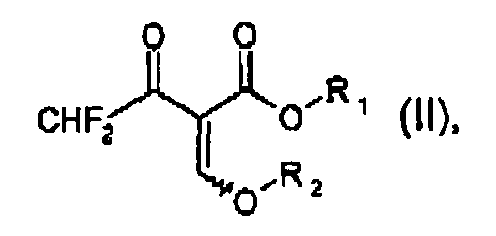
wherein R1 and R2 are both independently C1-C6alkyl, with methylhydrazine in the presence of water and a water-immiscible organic solvent being inert in saponification reactions, to form a compound of formula III
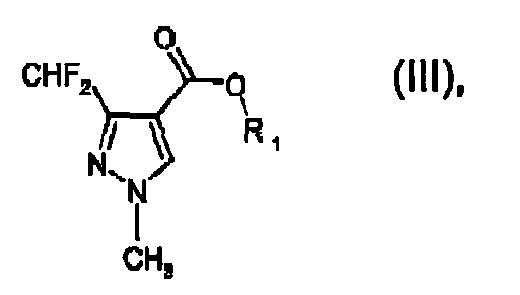
wherein R1 is as defined for formula I; and
b) saponifying that compound in situ leading to the formation of the compound of formula I by
b1) adding a base to form the anion of the compound of formula I and then adding an acid to form the compound of formula I; or
b2) adding an acid to form the compound of formula I.
a) reacting a compound of formula II
b) saponifying that compound in situ leading to the formation of the compound of formula I by
b1) adding a base to form the anion of the compound of formula I and then adding an acid to form the compound of formula I; or
b2) adding an acid to form the compound of formula I.
Description
- The present invention relates to a process for the production of 3-difluoromethyl-1-methyl-1H-pyrazole-4-carboxylic acid, which is useful as intermediate in fungicide production.
- Said 3-difluoromethyl-1-methyl-1H-pyrazole-4-carboxylic acid (compound of formula I) can be used for the production of fungicides, which are described, for example, in
WO 03/74491 WO 04/35589 WO 03/70705 WO 07/17450 WO 06/120219 WO 06/87343 - Fungicides are generally produced in large quantities. For example, the fungicide chlorothalonil has been produced in the year 2005 in a quantity of over 23,000 metric tons.
- The aim of the present invention is therefore to provide a novel process for the production of 3-difluoromethyl-1-methyl-1H-pyrazole-4-carboxylic acid that makes it possible to prepare said compound with high regioselectivity (in respect to the two isomers 3-difluoromethyl- and 5-difluoromethyl-1-methyl-1H-pyrazol-4-carboxylic acid), in high yields and good quality in an economically advantageous and easily handled way.
- The present invention accordingly relates to a process for the production of a compound of formula I

- a) reacting a compbund of formula II

with methylhydrazine in the presence of water and a water-immiscible organic solvent being inert in saponification reactions, to form a compound of formula III
- b) saponifying that compound in situ leading to the formation of the compound of formula I by
- b1) adding a base to form the anion of the compound of formula I and then adding an acid to form the compound of formula I; or
- b2) adding an acid to form the compound of formula I.
- The alkyl groups appearing in the above substituent definitions may be straight-chain or branched and are, for example, methyl, ethyl, n-propyl, isopropyl, n-butyl, sec-butyl, isobutyl or tert-butyl, preferably methyl or ethyl.
- Compounds of formula II occur in two isomers with regard to the double bond substituted by the alkoxy group -O-R2: the E- and the Z-isomer. Both isomers or mixtures thereof can be used in the processes according to the invention.
- In preferred processes, methylhydrazine is reacted in process step a) with compounds of formula II wherein R1 and R2 are both ethyl.
- In step a), methylhydrazine can be used in equimolar amounts, in sub-equimolar amounts or in excess relative to compounds of formula II, preferably methylhydrazine is used in equimolar amounts. In one embodiment of the invention, methylhydrazine is used in the form of an aqueous solution, such as a 35%(w/w) or 40%(w/w) aqueous solution.
- The organic solvent used in step a) is inert in saponification reactions as said solvent is present also in the saponification step b).
- The organic solvent used in step a) is water-immiscible. According to the invention "water-immiscible" means that when the organic solvent is mixed with water under the conditions of the process according to the invention two seperate liquid phases are formed.
- Preferred organic solvents are optionally halogenated aromatic hydrocarbon solvents, ketone solvents, optionally halogenated hydrocarbon solvents or ether solvents. In said definitions, halogen is generally fluorine, chlorine, bromine and/or iodine, preferably fluorine, bromine and/or chlorine.
- Preferred "optionally halogenated aromatic hydrocarbon solvents" are benzene, toluene, xylene, chlorobenzene and dichlorobenzene; more preferred are toluene and xylene; most preferred is xylene.
Preferred "ketone solvent" is methylisobutylketone.
Preferred "optionally halogenated hydrocarbon solvents" are pentane, hexane, octane, cyclohexane, chloroform and carbon tetrachloride; more preferred is cyclohexane.
Preferred "ether solvent" is dioxane. - Preferred organic solvents are optionally halogenated aromatic hydrocarbon solvents and/or ketone solvents; more preferred are aromatic hydrocarbon solvents and/or ketone solvents. In one embodiment of the invention, the organic solvent is an aromatic hydrocarbon solvent. In one embodiment of the invention, the organic solvent is methylisobutylketone.
- In process step a) preferably at least one equivalent of water is added at the start of the reaction relative to compounds of formula II; more preferably at least 10 equivalents of water are added. In one embodiment of the invention from 10 to 30 equivalents of water are added.
- In process step a) the molar ratio between water added at the start of the reaction and the organic solvent is preferably from 20:1 to 1:20; more preferably from 10:1 to 1:10. In one embodiment said molar ratio is from 10:1 to 1:1. This molar ratio according to the invention does not include the water being formed by the consumption of compounds of formula II by the condensation reaction of step a). Maximally one equivalent of water relative to compounds of formula II can be formed.
- Process step a) is preferably carried out in a temperature range of from 0°C to 50°C, especially from 10°C to 25°C.
- The reaction time for process step a) is generally from 1 to 48 hours, preferably from 1 to 18 hours, more preferably 1 to 5 hours. Said step can be carried out at normal, elevated or reduced pressure. In one embodiment, said step is carried out at normal pressure.
- One embodiment of process step a) is a process step comprising:
- preparing an aqueous solution comprising methylhydrazine,
- preparing a solution of the compound of formula II in the organic solvent, and
- mixing both solutions.
- The compounds of formula II are known or can be prepared analogously to processes known in the literature. For example, such compounds can be prepared from the 3-oxo-carboxylic acid esters on which they are based as described in
WO 93/11117 - Step b), the saponification, is carried out directly after step a) without isolation of compounds of formula II (the compounds of formula II are used in situ). This is an important advantage of the process according to the invention, which leads to significant cost savings taken especially into account the large-scale production of fungicides. According to the invention, step b) can be carried out as described under step b1) (alkaline saponification) or under step b2) (acidic saponification).
- Step b1) can be divided into two sub-steps: i) the formation of the anion of the compound of formula I ("the anion") by adding a base and ii) the formation of the compound of formula I ("the free acid") by later adding an acid.
- The base is preferably selected from inorganic bases, such as hydroxides, for example LiOH, NaOH or KOH. Bases to which preference is given are hydroxides, such as NaOH or KOH; especially preferred is NaOH.
- A suitable amount of base for anion formation is, for example, at least one equivalent relative to compounds of formula II used in step a), preferably from 1 to 5 equivalents; more preferably from 1 to 3 equivalents.
- The formation of the anion is preferably carried out in a temperature range of from 40°C to 100°C, especially from 40°C to 60°C. The reaction time for anion formation is generally from 1 to 48 hours, preferably from 1 to 18 hours, more preferably 1 to 5 hours. Said anion formation can be carried out at normal, elevated or reduced pressure, preferably at normal pressure.
- In an important embodiment of the invention, a base is already present in step a). Said base is typically the same as used later for anion formation in step b1) and is preferably a hydroxide, such as NaOH or KOH (especially preferably NaOH). An example of a step a) according to this embodiment is a process step comprising:
- preparing an aqueous solution comprising methylhydrazine and the base,
- preparing a solution of the compound of formula II in the organic solvent, and
- mixing both solutions.
- After formation of the anion, said anion is typically present in the aqueous phase of the reaction mixture. In a preferred embodiment of the invention, the aqueous phase is isolated from the organic phase before the acid is added.
- In one embodiment of the invention, the acid is added leading to an adjustment of the pH of the aqueous phase to a value of 7 or below, preferably 6 or below, more preferably 5 or below.
- Suitable acids are inorganic acids, such as hydrochloric acid or sulfuric acid; or organic acids, such as formic acid, acetic acid or propionic acid. Preference is given to inorganic acids and special preference is given to hydrochloric acid.
- The acid is added preferably in a temperature range of from 50°C to 95°C, especially from 80°C to 95°C.
- The reaction time for formation of the free acid is generally from 1 to 48 hours, preferably from 1 to 18 hours, more preferably 1 to 5 hours. Said free acid formation can be carried out at normal, elevated or reduced pressure, preferably at normal pressure.
- In process step b2) the compound of formula I ("the free acid") is formed directly by acidic saponification.
- The acid used in step b2) is typically an inorganic acid, such as hydrochloric acid or sulfuric acid; or an organic acid, such as formic acid, acetic acid or propionic acid. Preference is given to inorganic acids and special preference is given to hydrochloric acid.
- A preferable amount of acid is at least 0.01 equivalents relative to compounds of formula II used in step a), more preferably from 0.01 to 5 equivalents; even more preferably from 1 to 5 equivalents, most preferably from 1 to 3 equivalents.
- The formation of the free acid is preferably carried out in a temperature range of from 40°C to 100°C, especially from 40°C to 60°C. The reaction time is generally from 1 to 48 hours, preferably from 1 to 18 hours, more preferably 1 to 5 hours. Said free acid formation can be carried out at normal, elevated or reduced pressure, preferably at normal pressure.
- As the compound of formula II typically is present in the organic phase after step a), in a preferred embodiment of the invention, the organic phase is isolated from the aqueous phase before the acid is added in step b2).
- Under typical process conditions, the compounds of formula I precipitate and can be easily isolated after performing process steps b1) or b2). Typically this is done by cooling followed by filtration.
- The present invention makes it possible to produce compounds of formula I in a high yield, with a high degree of regioselectivity and at low cost.
- A further advantage of the present invention is that methylhydrazine can be used in aqueous diluted form, which is less hazardous then using methylhydrazine in substantially pure form. This advantage makes the invention particular useful for large-scale production in agrochemistry.
- The present invention is illustrated with the aid of the following Examples:
- 300mmol of methylhydrazine (in the form of a 35%(w/w) aqueous solution) and 60mmol NaOH (in the form !of a 30%(w/w) aqueous solution) are dissolved in 75 g water (total amount of water is 19.7 equivalents relative to the compound of formula II). A solution of 2-[1-Ethoxy-meth-(Z)-ylidene]-4,4-difluoro-3-oxo-butyric acid ethyl ester in 90 g xylene (2.8 equivalents relative to the compound of formula II) is added during 30 minutes at 15°C. The reaction mixture is stirred for 10 minutes at 25°C.
- 450mmol NaOH (in the form of a 30%(w/w) aqueous solution) is added and the reaction mixture is stirred for 45 minutes at 65°C.
The aqueous phase is isolated from the organic phase at 65°C and added to a solution of 50 g water and 570mmol HCl (in the form of a 32%(w/w) solution), which is pre-heated to 95°C. The reaction mixture is stirred for 10 minutes at 95°C and a precipitate is formed. - The suspension is cooled to 25°C over 3 hours and the precipitate is collected by filtration, washed twice with 75g water at a temperature of 0°C and dried at 60°C under vacuum. 3-Difluoromethyl-1-methyl-1 H-pyrazole-4-carboxylic acid is obtained in the form of white crystals (m.p.: 204°C; yield: 88%; ratio wanted/unwanted isomer: 99.99 : 0.01). The "desired isomer" is 3-difluoromethyl-1-methyl-1H-pyrazole-4-carboxylic acid; the "undesired isomer" is 5-difluoromethyl-1-methyl-1H-pyrazole-4-carboxylic acid.
- In Example P2, different solvents are tested. Besides using different solvents, all other reaction conditions are as described in Example P1 above. Yields and regioselectivity are measured on the stage of the anion of the compound of formula ! being in aqueous solution, i.e. after isolation of the aqueous phase and before adding said aqueous phase to the HCl-solution. For example 2, the amount of base-solution in step a) was replaced by water. For comparative example C1 (no organic solvent) the amount of organic solvent in step a) was replaced by water and the 2-[1-Ethoxy-meth-(Z)-ylidene]-4,4-difluoro-3-oxo-butyric acid ethyl ester was added in pure form. For comparative example C2 the water-miscible organic solvent ethanol was used.
Example no. Solvent Base present in step a) Yield ratio desired / undesired isomer 1 Xylene NaOH 94% 97:3 2 Xylene - 84% 89:11 3 Toluene NaOH 94% 97:3 4 Chlorbenzene NaOH 87% 95:5 5 Methylisobutylketone NaOH 90% 97:3 6 Cyclohexane NaOH 86% 91:9 7 Dioxane NaOH 78% 91:9 C1 - NaOH 75% 85:15 C2 Ethanol NaOH 74% 80:20
Preferably the base is present in step a) in an amount of 0.1 to 0.5 equivalents relative to the compounds of formula II used and further base is added for anion formation so that a total amount of base is then present of at least 1 equivalent relative to the amount of compounds of formula II, preferably from 1 to 5 equivalents; more preferably from 1 to 3 equivalents. In one embodiment, about 0.2 equivalents relative to the compounds of formula II are present in step a).
Claims (18)
- A process for the production of a compound of formula I
 a) reacting a compound of formula II
with methylhydrazine in the presence of water and a water-immiscible organic solvent being inert in saponification reactions, to form a compound of formula III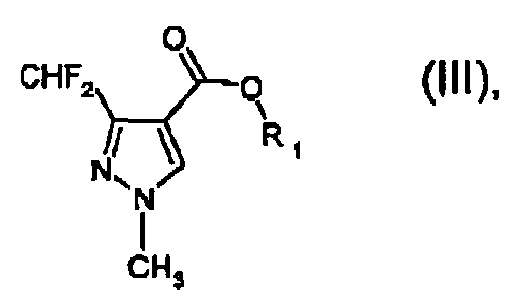 b) saponifying that compound in situ leading to the formation of the compound of formula I byb1) adding a base to form the anion of the compound of formula I and then adding an acid to form the compound of formula I; orb2) adding an acid to form the compound of formula I.
 - A process according to claim 1, wherein R1 and R2 are both ethyl.
- A process according to claim 1, wherein the organic solvent is an optionally halogenated aromatic hydrocarbon solvent, a ketone solvent, an optionally halogenated hydrocarbon solvent or an ether solvent.
- A process according to claim 3, wherein the organic solvent is an aromatic hydrocarbon solvent.
- A process according to claim 3, wherein the organic solvent is xylene.
- A process according to claim 1, wherein in process step a) at least one equivalent of water is added at the start of the reaction relative to compounds of formula II.
- A process according to claim 6, wherein the molar ratio between the water added at the start of the reaction and the organic solvent is from 20:1 to 1:20.
- A process according to claim 1, wherein the compound of formula III is saponified byb1) adding a base to form the anion of the compound of formula I and then adding an acid to form the compound of formula I.
- A process according to claim 8, wherein the acid is added leading to an adjustment of the pH of the aqueous phase to a value of 7 or below.
- A process according to claim 8, wherein in step a) a base is present.
- A process according to daim 10, wherein in step a) a hydroxide is present; and in step b1) a hydroxide is used.
- A process according to claim 11, wherein in step a) the hydroxide base is present in an amount of 0.1 to 0.5 equivalents relative to the compounds of formula II; and in step b1) the hydroxide base is added so that a total amount of hydroxide base is present in an amount of at least 1 equivalent relative to the amount of compounds of formula II used.
- A process according to claim 8, wherein the aqueous phase is isolated before the addition of the acid.
- A process according to claim 8, wherein step a) is carried out at a reaction temperature of from 0°C to 40°C and step b1) is carried out at a reaction temperature of 50°C to 100°C.
- A process according to claim 1. wherein the compound of formula III is saponified by b2) adding an acid to form the compound of formula I.
- A process according to claim 15, wherein the acid is used in the amount of at least 0.01 equivalents relative to compounds of formula II used in step a).
- A process according to claim 15, wherein the organic phase is isolated before the acid is added and wherein the acid is added to said organic phase.
- A process according to claim 15, wherein step a) is carried out at a reaction temperature of from 0°C to 40°C and step b2) is carried out at a reaction temperature of 50°C to 100°C.
Priority Applications (20)
| Application Number | Priority Date | Filing Date | Title |
|---|---|---|---|
| EP07010770A EP1997808A1 (en) | 2007-05-31 | 2007-05-31 | Process for the production of pyrazoles |
| EP20080749448 EP2150536A1 (en) | 2007-05-31 | 2008-05-13 | Process for the production of pyrazoles |
| MX2009012602A MX2009012602A (en) | 2007-05-31 | 2008-05-13 | Process for the production of pyrazoles. |
| CA2687176A CA2687176C (en) | 2007-05-31 | 2008-05-13 | Process for the production of pyrazoles |
| RU2009148884/04A RU2459807C2 (en) | 2007-05-31 | 2008-05-13 | Method of producing pyrazoles |
| US12/601,647 US8124787B2 (en) | 2007-05-31 | 2008-05-13 | Process for the production of pyrazoles |
| UAA200913319A UA99294C2 (en) | 2007-05-31 | 2008-05-13 | Process for the production of pyrazoles |
| JP2010509705A JP5260636B2 (en) | 2007-05-31 | 2008-05-13 | Process for producing pyrazole |
| KR1020097024773A KR20100017431A (en) | 2007-05-31 | 2008-05-13 | Process for the production of pyrazoles |
| AU2008255284A AU2008255284B9 (en) | 2007-05-31 | 2008-05-13 | Process for the production of pyrazoles |
| PCT/EP2008/003841 WO2008145257A1 (en) | 2007-05-31 | 2008-05-13 | Process for the production of pyrazoles |
| CN2008800180914A CN101679281B (en) | 2007-05-31 | 2008-05-13 | Process for the production of pyrazoles |
| BRPI0811644-0A2A BRPI0811644A2 (en) | 2007-05-31 | 2008-05-13 | PROCESS FOR PIRAZOIS PRODUCTION |
| TW097119100A TWI465436B (en) | 2007-05-31 | 2008-05-23 | Process for the production of pyrazoles |
| ARP080102191A AR066709A1 (en) | 2007-05-31 | 2008-05-23 | PROCESS FOR THE PRODUCTION OF PIRAZOLES |
| CL2008001590A CL2008001590A1 (en) | 2007-05-31 | 2008-05-30 | Process for the production of 3-difluoromethyl-1-methyl-1h-pyrazole-4-carboxylic acid, where a compound of formula II is reacted with methylhydrazine, water and a solvent immiscible with water, and then saponified by adding a base and then an acid, or an acid. |
| IL202153A IL202153A0 (en) | 2007-05-31 | 2009-11-16 | Process for the production of pyrazoles |
| CR11129A CR11129A (en) | 2007-05-31 | 2009-11-26 | PROCESS FOR THE PRODUCTION OF PIRAZOLES |
| EC2009009768A ECSP099768A (en) | 2007-05-31 | 2009-11-27 | PROCESS FOR THE PRODUCTION OF PIRAZOLES |
| CO09135635A CO6140055A2 (en) | 2007-05-31 | 2009-11-27 | PROCESS FOR THE PRODUCTION OF PIRAZOLES |
Applications Claiming Priority (1)
| Application Number | Priority Date | Filing Date | Title |
|---|---|---|---|
| EP07010770A EP1997808A1 (en) | 2007-05-31 | 2007-05-31 | Process for the production of pyrazoles |
Publications (1)
| Publication Number | Publication Date |
|---|---|
| EP1997808A1 true EP1997808A1 (en) | 2008-12-03 |
Family
ID=38561704
Family Applications (1)
| Application Number | Title | Priority Date | Filing Date |
|---|---|---|---|
| EP07010770A Withdrawn EP1997808A1 (en) | 2007-05-31 | 2007-05-31 | Process for the production of pyrazoles |
Country Status (2)
| Country | Link |
|---|---|
| EP (1) | EP1997808A1 (en) |
| UA (1) | UA99294C2 (en) |
Cited By (2)
| Publication number | Priority date | Publication date | Assignee | Title |
|---|---|---|---|---|
| WO2009106619A1 (en) * | 2008-02-29 | 2009-09-03 | Basf Se | Process for preparing alkyl 2-alkoxymethylene-4,4-difluoro-3-oxobutyrates |
| WO2019224677A1 (en) | 2018-05-21 | 2019-11-28 | Pi Industries Ltd. | Method for preparing substituted heterocyclic compounds |
Citations (5)
| Publication number | Priority date | Publication date | Assignee | Title |
|---|---|---|---|---|
| JP2002128763A (en) * | 2000-10-27 | 2002-05-09 | Mitsui Chemicals Inc | Method for purifying 1,3-dialkylpyrazole-4-carboxylic acid |
| WO2005003077A1 (en) * | 2003-07-01 | 2005-01-13 | Bayer Cropscience Aktiengesellschaft | Method for producing difluoro-acetyl-acetic acid alkylesters |
| WO2005042468A1 (en) * | 2003-10-23 | 2005-05-12 | Bayer Cropscience Aktiengesellschaft | Method for producing 2-dihaloacyl-3-amino-acrylic acid esters and 3-dihalomethyl-pyrazole-4-carboxylic acid esters |
| WO2005123690A1 (en) * | 2004-06-18 | 2005-12-29 | Basf Aktiengesellschaft | 1-methyl-3-difluoromethyl-pyrazol-4-carbonic acid-(ortho-phenyl)-anilides, and use thereof as a fungicide |
| WO2006090778A1 (en) * | 2005-02-25 | 2006-08-31 | Sagami Chemical Research Center | Method for producing 1-substituted-3-fluoroalkyl pyrazole-4-carboxylate |
-
2007
- 2007-05-31 EP EP07010770A patent/EP1997808A1/en not_active Withdrawn
-
2008
- 2008-05-13 UA UAA200913319A patent/UA99294C2/en unknown
Patent Citations (5)
| Publication number | Priority date | Publication date | Assignee | Title |
|---|---|---|---|---|
| JP2002128763A (en) * | 2000-10-27 | 2002-05-09 | Mitsui Chemicals Inc | Method for purifying 1,3-dialkylpyrazole-4-carboxylic acid |
| WO2005003077A1 (en) * | 2003-07-01 | 2005-01-13 | Bayer Cropscience Aktiengesellschaft | Method for producing difluoro-acetyl-acetic acid alkylesters |
| WO2005042468A1 (en) * | 2003-10-23 | 2005-05-12 | Bayer Cropscience Aktiengesellschaft | Method for producing 2-dihaloacyl-3-amino-acrylic acid esters and 3-dihalomethyl-pyrazole-4-carboxylic acid esters |
| WO2005123690A1 (en) * | 2004-06-18 | 2005-12-29 | Basf Aktiengesellschaft | 1-methyl-3-difluoromethyl-pyrazol-4-carbonic acid-(ortho-phenyl)-anilides, and use thereof as a fungicide |
| WO2006090778A1 (en) * | 2005-02-25 | 2006-08-31 | Sagami Chemical Research Center | Method for producing 1-substituted-3-fluoroalkyl pyrazole-4-carboxylate |
Non-Patent Citations (3)
| Title |
|---|
| "CRC HANDBOOK OF CHEMISTRY AND PHYSICS , 76th Edition", 1995, CRC PRESS, BOCA RATON, US, XP002455005 * |
| DATABASE CAPLUS CHEMICAL ABSTRACTS SERVICE, COLUMBUS, OHIO, US; XP002455007, retrieved from STN Database accession no. 2002:344916 * |
| DATABASE CASREACT CHEMICAL ABSTRACTS SERVICE, COLUMBUS, OHIO, US; XP002454520, retrieved from STN Database accession no. 145:271773 * |
Cited By (4)
| Publication number | Priority date | Publication date | Assignee | Title |
|---|---|---|---|---|
| WO2009106619A1 (en) * | 2008-02-29 | 2009-09-03 | Basf Se | Process for preparing alkyl 2-alkoxymethylene-4,4-difluoro-3-oxobutyrates |
| US8207354B2 (en) | 2008-02-29 | 2012-06-26 | Basf Se | Process for preparing alkyl 2-alkoxymethylene-4,4-difluoro-3-oxobutyrates |
| EA019427B1 (en) * | 2008-02-29 | 2014-03-31 | Басф Се | Process for preparing alkyl 2-alkoxymethylene-4,4-difluoro-3-oxobutyrates |
| WO2019224677A1 (en) | 2018-05-21 | 2019-11-28 | Pi Industries Ltd. | Method for preparing substituted heterocyclic compounds |
Also Published As
| Publication number | Publication date |
|---|---|
| UA99294C2 (en) | 2012-08-10 |
Similar Documents
| Publication | Publication Date | Title |
|---|---|---|
| CA2687176C (en) | Process for the production of pyrazoles | |
| US10457645B2 (en) | Method for the preparation of 3-fluoroalkyl-1-methylpyrazol-4-carboxylic acid | |
| US20060252944A1 (en) | Method for producing 2-dihaloacyl-3-amino-acrylic acid esters and 3-dihalomethyl pyrazole-4-carboxylic acid esters | |
| CN104245676B (en) | Process for the preparation of 3,5-bis(fluoroalkyl)pyrazole-4-carboxylic acid derivatives and 3,5-bis(fluoroalkyl)pyrazoles | |
| WO2009135860A1 (en) | Method for manufacturing aryl carboxamides | |
| EP2257532A1 (en) | Process for the regioselective synthesis of l-alkyl-3-haloalkylpyrazole-4-carboxylic acid derivatives | |
| US8884028B2 (en) | Process for preparing alkyl 2-alkoxymethylene-4,4-difluoro-3-oxobutyrates | |
| US8735600B2 (en) | Process for purification of 1-methylpyrazole-4-carboxylic acid esters | |
| EP1644314B1 (en) | Method for producing difluoro-acetyl-acetic acid alkylesters | |
| EP1997808A1 (en) | Process for the production of pyrazoles | |
| JP5830957B2 (en) | Method for producing pyrazole compound | |
| KR20200103744A (en) | Method for preparing iminium compound and its application in preparing pyrazole derivatives | |
| US7820830B2 (en) | Process for the production of carboxanilides | |
| US8455664B2 (en) | Process for preparing 1-alkyl-3-difluoromethyl-5-hydroxypyrazoles | |
| KR100352924B1 (en) | 5-aminopyrazole-4-carboxylate derivative and process for preparing the same |
Legal Events
| Date | Code | Title | Description |
|---|---|---|---|
| PUAI | Public reference made under article 153(3) epc to a published international application that has entered the european phase |
Free format text: ORIGINAL CODE: 0009012 |
|
| AK | Designated contracting states |
Kind code of ref document: A1 Designated state(s): AT BE BG CH CY CZ DE DK EE ES FI FR GB GR HU IE IS IT LI LT LU LV MC MT NL PL PT RO SE SI SK TR |
|
| AX | Request for extension of the european patent |
Extension state: AL BA HR MK RS |
|
| STAA | Information on the status of an ep patent application or granted ep patent |
Free format text: STATUS: THE APPLICATION HAS BEEN WITHDRAWN |
|
| 18W | Application withdrawn |
Effective date: 20081218 |