EP1996930B1 - Device and methods for reducing pressure and flow perturbations in a chromatographic system - Google Patents
Device and methods for reducing pressure and flow perturbations in a chromatographic system Download PDFInfo
- Publication number
- EP1996930B1 EP1996930B1 EP07758679.0A EP07758679A EP1996930B1 EP 1996930 B1 EP1996930 B1 EP 1996930B1 EP 07758679 A EP07758679 A EP 07758679A EP 1996930 B1 EP1996930 B1 EP 1996930B1
- Authority
- EP
- European Patent Office
- Prior art keywords
- sample
- port
- loop
- valve
- pressure
- Prior art date
- Legal status (The legal status is an assumption and is not a legal conclusion. Google has not performed a legal analysis and makes no representation as to the accuracy of the status listed.)
- Revoked
Links
- 238000000034 method Methods 0.000 title claims description 8
- 238000004891 communication Methods 0.000 claims description 66
- 239000012530 fluid Substances 0.000 claims description 54
- 238000004587 chromatography analysis Methods 0.000 claims description 20
- 238000007906 compression Methods 0.000 claims description 9
- 230000006835 compression Effects 0.000 claims description 8
- 239000002904 solvent Substances 0.000 claims description 7
- 230000003068 static effect Effects 0.000 claims description 2
- 239000000203 mixture Substances 0.000 description 12
- 239000000243 solution Substances 0.000 description 10
- 230000005526 G1 to G0 transition Effects 0.000 description 8
- 238000004128 high performance liquid chromatography Methods 0.000 description 7
- 239000007788 liquid Substances 0.000 description 5
- 239000003643 water by type Substances 0.000 description 5
- 230000003287 optical effect Effects 0.000 description 4
- 239000007789 gas Substances 0.000 description 3
- 239000000463 material Substances 0.000 description 3
- 238000000926 separation method Methods 0.000 description 3
- 238000002835 absorbance Methods 0.000 description 2
- 238000000149 argon plasma sintering Methods 0.000 description 2
- 230000005540 biological transmission Effects 0.000 description 2
- 230000000694 effects Effects 0.000 description 2
- 238000002347 injection Methods 0.000 description 2
- 239000007924 injection Substances 0.000 description 2
- 238000004811 liquid chromatography Methods 0.000 description 2
- 230000011664 signaling Effects 0.000 description 2
- 240000008213 Brosimum alicastrum Species 0.000 description 1
- 238000001311 chemical methods and process Methods 0.000 description 1
- 230000001627 detrimental effect Effects 0.000 description 1
- 238000007599 discharging Methods 0.000 description 1
- 238000004817 gas chromatography Methods 0.000 description 1
- 238000002955 isolation Methods 0.000 description 1
- 238000005086 pumping Methods 0.000 description 1
- 235000005828 ramon Nutrition 0.000 description 1
- 238000005070 sampling Methods 0.000 description 1
- 239000000126 substance Substances 0.000 description 1
- -1 such as Substances 0.000 description 1
- 238000004808 supercritical fluid chromatography Methods 0.000 description 1
- 238000011144 upstream manufacturing Methods 0.000 description 1
Images

Classifications
-
- G—PHYSICS
- G01—MEASURING; TESTING
- G01N—INVESTIGATING OR ANALYSING MATERIALS BY DETERMINING THEIR CHEMICAL OR PHYSICAL PROPERTIES
- G01N30/00—Investigating or analysing materials by separation into components using adsorption, absorption or similar phenomena or using ion-exchange, e.g. chromatography or field flow fractionation
- G01N30/02—Column chromatography
- G01N30/04—Preparation or injection of sample to be analysed
- G01N30/16—Injection
- G01N30/20—Injection using a sampling valve
-
- G—PHYSICS
- G05—CONTROLLING; REGULATING
- G05D—SYSTEMS FOR CONTROLLING OR REGULATING NON-ELECTRIC VARIABLES
- G05D16/00—Control of fluid pressure
- G05D16/20—Control of fluid pressure characterised by the use of electric means
- G05D16/2006—Control of fluid pressure characterised by the use of electric means with direct action of electric energy on controlling means
- G05D16/208—Control of fluid pressure characterised by the use of electric means with direct action of electric energy on controlling means using a combination of controlling means as defined in G05D16/2013 and G05D16/2066
-
- G—PHYSICS
- G05—CONTROLLING; REGULATING
- G05D—SYSTEMS FOR CONTROLLING OR REGULATING NON-ELECTRIC VARIABLES
- G05D7/00—Control of flow
- G05D7/06—Control of flow characterised by the use of electric means
- G05D7/0617—Control of flow characterised by the use of electric means specially adapted for fluid materials
- G05D7/0629—Control of flow characterised by the use of electric means specially adapted for fluid materials characterised by the type of regulator means
- G05D7/0688—Control of flow characterised by the use of electric means specially adapted for fluid materials characterised by the type of regulator means by combined action on throttling means and flow sources
-
- G—PHYSICS
- G01—MEASURING; TESTING
- G01N—INVESTIGATING OR ANALYSING MATERIALS BY DETERMINING THEIR CHEMICAL OR PHYSICAL PROPERTIES
- G01N30/00—Investigating or analysing materials by separation into components using adsorption, absorption or similar phenomena or using ion-exchange, e.g. chromatography or field flow fractionation
- G01N30/02—Column chromatography
- G01N30/04—Preparation or injection of sample to be analysed
- G01N30/16—Injection
- G01N30/20—Injection using a sampling valve
- G01N2030/201—Injection using a sampling valve multiport valves, i.e. having more than two ports
-
- G—PHYSICS
- G01—MEASURING; TESTING
- G01N—INVESTIGATING OR ANALYSING MATERIALS BY DETERMINING THEIR CHEMICAL OR PHYSICAL PROPERTIES
- G01N30/00—Investigating or analysing materials by separation into components using adsorption, absorption or similar phenomena or using ion-exchange, e.g. chromatography or field flow fractionation
- G01N30/02—Column chromatography
- G01N30/04—Preparation or injection of sample to be analysed
- G01N30/16—Injection
- G01N30/20—Injection using a sampling valve
- G01N2030/202—Injection using a sampling valve rotary valves
-
- G—PHYSICS
- G01—MEASURING; TESTING
- G01N—INVESTIGATING OR ANALYSING MATERIALS BY DETERMINING THEIR CHEMICAL OR PHYSICAL PROPERTIES
- G01N30/00—Investigating or analysing materials by separation into components using adsorption, absorption or similar phenomena or using ion-exchange, e.g. chromatography or field flow fractionation
- G01N30/02—Column chromatography
- G01N30/04—Preparation or injection of sample to be analysed
- G01N30/16—Injection
- G01N30/22—Injection in high pressure liquid systems
Definitions
- the present invention relates to instrumentation for performing chromatography.
- Embodiments of the present invention are directed to apparatus and methods for reducing pressure and flow perturbations in fluid conduits.
- pressure and flow perturbations refer to rapid changes in the movement of fluid in a conduit or rapid changes in the pressure of fluid in a conduit. These flow and pressure perturbations may compromise “sample integrity".
- sample integrity refers to the desired composition of the sample. The boundaries of the sample become less sharp or distinct.
- Chromatography is a chemical process in which compositions in solution (solutes) are separated from each other as the solution moves through a stationary material or phase.
- the compositions separate from each other based on the different affinity each composition has for the stationary phase.
- the solutions may comprise any fluid, such as, liquids, gases, supercritical fluids or mixtures thereof.
- Chromatography is used to identify and quantify compositions held in a sample.
- sample is used herein to refer to any material that one desires to analyze.
- HPLC High performance liquid chromatography
- the stationary phase is held in a column.
- a typical HPLC instrument may comprise a pump, conduits, sample injector, one or more columns and a detector.
- the solution is pumped through a conduit to a sample injector.
- a sample is added to the solution in the conduit and conveyed to the column and through the stationary phase.
- Compositions in the solution separate as they traverse the stationary media in the column.
- the separated compositions are detected by a detector downstream of the column.
- PSI pounds per square inch
- system pressure refers to the pressure in which the column operates.
- HPLC refers to liquid
- the principles of HPLC, for the purpose of this invention apply equally to gases or supercritical fluids. Therefore, this document will use the term HPLC to refer to liquid, gas or supercritical fluid chromatography operating at pressures of up to five thousand PSI and up to and including extreme pressures of fifteen thousand PSI and above.
- the term “conduit” refers to pipes, tubes, capillaries, microfluidic channels, and the like.
- valve refers to means to control, redirect, restrict or stop flow.
- valve means means one or more valves or moving a conduit to communicate with a different element of the instrument.
- sample injectors are often equipped with needles which are placed in fluid communication with vials containing sample and are able to move to different vials, solutions and other instrument stations.
- sample injector refers to a form of valve and conduits used to bring a section of conduit holding a sample into fluid communication with conduits upstream of a column.
- Sample injectors normally comprise multiport valves and a loop of conduit for holding a sample, needles and syringe pumps for withdrawing samples.
- column refers to columns, cartridges, capillaries and the like for performing separations of a chromatographic nature. Columns are typically packed or loaded with a stationary phase.
- This stationary phase can be particulate or beadlike or a porous monolith or a substantially inert material.
- the term "column” also refers to capillaries which are not packed or loaded with a stationary phase but rely on the surface area of the inner capillary wall to effect separations.
- Solutions used in chromatography may take many forms and it is not unusual for the composition of the solution to change over the course of a separation. For example, it is often desirable to release components of a sample held on a stationary phase. By changing the composition of a solution flowing through the stationary phase, the components of the sample can be released. It is desirable to control the composition of the mixture such that the components of the sample are released in a reproducible manner.
- WO 2004/025272 A1 discloses a pressurized fluid sample injector system consisting of a sample needle, a multiport valve, a sample loop, a metering syringe and a pressure assist pump.
- the speed of sample transport into the sample loop is increased by pressurizing the fluid in the system and metering the sample into the sample loop.
- the elevated system pressure allows the fluids to be moved faster than the vapor pressure would normally allow in a system at ambient pressure.
- US 4 957 009 A discloses a pushloop liquid sampling method as an improvement in the method of introducing liquid samples into test equipment (such as for liquid chromatography) via a six port valve.
- the method involves pulling the sample completely past the sample loop in the six port valve and then pushing the desired amount of sample back into the sample loop.
- the present invention is directed to a device according to claim 1 for placing a sample in a chromatography system having a system pressure.
- the valve means is for selectively placing sample in a column line.
- the valve means comprises a sample port, withdrawing port, first loop port, second loop port, column port and constant flow port.
- the valve means has a plurality of positions comprising a first position, second position and third position. In the first position, one of the first loop port and the second loop port is in communication with the sample port and the remaining first loop port and second loop port is in communication with the withdrawal port. And, in the first position, the constant flow port is in communication with the column port. In the second position, at least one of the first loop port and the second loop port is in fluid communication with a pressure source. And, in the third position, the first loop port and said second loop port are in fluid communication with the constant flow port and the column port.
- the valve means in signal communication with control means and assumes the first position upon receiving a first signal command, assuming the second position upon receiving a second signal command and assuming the third position upon receiving a third signal command.
- the sample introduction line is in fluid communication with the sample port and with a source of sample, and, upon the valve means assuming a second position, a source of pressure.
- the sample introduction line is for receiving sample and conveying the sample into the valve means and through at least one of the first sample port and second sample port and into the sample loop when the valve means is in the first position. And, the sample introduction line pressurizes the sample in the sample loop upon the valve means assuming the second position.
- the withdrawal line is in fluid communication with the withdrawal port and a source of reduced pressure to withdraw sample through the sample introduction line and into valve means and the sample loop upon the valve means assuming the first position.
- the sample loop is in fluid communication with the first sample port and the second sample port for receiving sample withdrawn through the valve means and holding the sample. And, upon the valve means assuming the second position, pressurizing the sample. And, upon the valve means assuming a third position, discharging the sample through the valve means and the column port as the sample loop is placed in communication with the constant flow port and the column port.
- the column line is in fluid communication with the column port for receiving sample from the sample loop and for directing sample to one or more columns.
- the constant flow line is for being placed in communication with a source of solvent.
- the withdrawal pump is in fluid communication with the withdrawal line and in signal communication with control means.
- the withdrawal pump depressurizes the withdrawal line to pull sample into the sample introduction line when the valve means is in the first position.
- the pressure source is in fluid communication with at least one of the sample introduction line and the sample loop for placing the sample, held in the sample loop, under pressure.
- the control means is in signal communication with the pressure source, the withdrawal pump and the valve means.
- the control means instructs by issuing a first command signal to the valve means to assume the first position in which a sample is received in the sample introduction line.
- the control means issues a second command signal to the valve means to assume the second position and signaling the pressure source to pressurize the sample loop while the sample is received therein to 70 to 100% of the system pressure to reduce pressure perturbations as the valve means moves to the third position.
- Embodiments of the present device are particularly useful to reduce flow and pressure perturbations in sample having trailing end and lead fronts in which an air bubble is placed to provide definition to the sample.
- the air bubbles allow the fluid to change volumes when the pressures are not matched and contribute to pressure and flow perturbations.
- control means refers to computer processing units (CPUs), microprocessors, mainframe computers, and personal computers. Computers and CPUs can be integrated in the device or communicate via networks.
- signal communicate refers to electromagnetic communication by wire, or wireless radio-wave, optics, and the like.
- fluid communication refers to plumbed together or capable of exchanging fluids.
- the pressure source is placed in fluid communication with the sample introduction line and with the sample loop during pressurization.
- the pressure source may comprise a pump or a source of compressed fluid.
- One embodiment of the pressure source is a valve in fluid communication with a pressure source.
- An example of the pressure source is sample introduction line having a needle capable of being placed in communication with a pressure source. The needle is used to descend into a sample vial and is moved robotically to a pressure source to which such needle is placed in fluid communication.
- the needle has two positions. In one position, the needle is placed in a sample vial and upon the withdrawal pump depressurizing the sample introduction line, sample is drawn up into such line and into the sample loop. In the second position, needle is placed in fluid communication with a pressure source to pressurize the sample and fluids in the sample loop.
- a pressure source to pressurize the sample and fluids in the sample loop.
- Embodiments of the present invention preferably place the sample under pressure in said sample loop under static conditions.
- a preferred sample loop has a volume in the range of 0.5 microliter to 50 microliters.
- a preferred sample has a volume of 0.1 to 45 microliters.
- the sample has a pre-compression volume prior to pressurization and a post compression volume after pressurization.
- a preferred post compression volume is 85 to 95% of the pre-compression volume.
- a preferred pressure source comprises a pump such as a syringe pump that change volume at the rate of approximately 10 to 800 microliter per minute.
- detector refers to optical detectors such as absorbance detectors, fluorescence detectors, light scattering detectors, light refraction detectors, electromagnetic detectors, mass detectors, such as mass spectrometers and the like.
- embodiments of the present invention are directed to maintaining sample integrity, and improving chromatographic results, particularly with detectors that may be sensitive to pressure and flow perturbations.
- a chromatography system generally designated by the numeral 11 , is depicted in Figure 1 .
- the chromatography system comprises the following major elements: a pump 13, a sample injector 15, a column 17, a detector 19 and control means 21.
- the pump 13, sample injector 15, column 17 and detector 19 are in fluid communication by means of conduits 23a, 23b, and 23c respectively.
- the control means 21 is in signal communication with the pump 13, sample injector 15 and detector 19 by wires 25a, 25b, and 25c.
- wires 25a, 25b and 25c represent one or more wires in the nature of a network or bundle.
- the control means 21 may also be in signal communication with the column 17, however, wires are not shown for purposes of simplification and clarity.
- Wires 25a, 25b, and 25c, and all wires referred to in this paper represent communication by all means.
- Such wires 25a, 25b, and 25c represent wireless communication by infrared and radio transmissions, optical communication by fiber-optic cables and other information transmission means.
- Control means 21 is a computer, CPU, microprocessor, mainframe computer or personal computer.
- Such computers are wed known in the art and are available from numerous vendors such as Apple Corporation (Cupertino, California, U.S.A.) or Dell Computer Corporation (Round Rock, Texas, U.S.A.).
- CPUs and microprocessors are available from numerous vendors including Intel Corporation (Santa Clara, California, USA), AMD Corporation (Sunnyvale, California, U.S.A. and Freescale (Austin, Texas, U.S.A.).
- Control means 21 operates with software or firmware.
- Software for performing chromatography and controlling chromatography instruments is available from several vendors, such as EMPOWERTM software from Waters Corporation (Milford, Massachusetts, U.S.A.) or CHEMSTATION® software from Agilent Corporation (Waldbronn, Germany).
- Pump 13 is a chromatography pump which are available from several vendors such as the ALLIANCE® series pumps and ACQUITY series pumps available from Waters Corporation (Milford, Massachusetts, U.S.A.) or 1100® series pumps from Agilent Corporation (Waldbronn, Germany).
- Column 17 is a chromatography column, column cartridge, or capillary known in the art.
- Such columns and capillaries are available from numerous vendors such as Waters Corporation (Milford, Massachusetts, U.S.A.) and Phenomenex (Torrance, California, U.S.A.).
- Embodiments of the present invention have particular application for small scale chromatography using capillaries, small columns and microfluidics.
- Detector 19 is an analytical detector of an optical, electro-chemical or mass type.
- Typical optical detectors comprise absorbance detectors, Ramon detectors, fluorescence or chemiluminescence detectors, light scattering detectors, and the like,
- Typical mass type detectors are mass spectrometers. All such detectors are available from several sources including Waters Corporation (Milford, Massachusetts, U.S.A.), Agilent Corporation (Waldbronn, Germany), Thermo Electron Corporation (Waltham, Massachusetts, U.S.A.).
- Sample injector 15 is a sample processing instrument known in the art and available from several venders including Waters Corporation (Milford, Massachusetts, U.S.A.), Agilent Corporation (Waldbronn, Germany), Thermo Electron Corporation (Waltham, Massachusetts, U.S.A.).
- the sample injection device 15 embodying features of the present invention is depicted in Figure 2 with the major elements; a pump 13, a column 17, a detector 19 and control means 21.
- the pump 13, sample injector 15, column 17 and detector 19 are in fluid communication by means of conduits 23a, 23b, and 23c respectively.
- the control means 21 is in signal communication with the pump 13, and detector 19 by wires 25a, and 25c and with sample injector 15 via wires 25b', 25b" and 25b''', the purpose of which will be described in greater detail later.
- the sample injection device 15 comprises the following major elements: a valve means 29a, 29b, and 55' a sample introduction line 31, a withdrawal line 33, a sample loop 35, a column line which has been previously designated as 23b, a constant flow line which has been previously designated as 23a, a withdrawal pump 35, a pressure source 37.
- valve means 29a, 29b and 55' is for selectively placing sample in a column line 23b.
- Valve means 29a, 29b and 55' is comprised of a first valve 29a and a second valve 29b or needle positioning means represented generally by the numeral 55' which forms not part of the present invention.
- the first valve 29a is in the nature of a multi-port valve of which six are depicted.
- Such multiport valves are available from several venders such as Valco (Houston, Texas, U.S.A.) and Rheodyne (Rohnert Park, California, U. SA).
- First valve 29a has a sample port 41, withdrawing port 43, first loop port 45, second loop port 47, column port 49 and constant flow port 51.
- the first valve 29a has a plurality of positions comprising a first position and third position. A second position will be described with respect to the second valve 29b and needle positioning means 55'.
- the sample introduction line 31 is for receiving sample and conveying the sample into the valve means 29a, 29b, and through at least one of the first sample port 45 and second sample port 47 and into the sample loop 35 when the first valve 29a is in the first position. And, the sample introduction line 31 pressurizes the sample in the sample loop 35 upon the second valve 29b assuming the second position.
- the withdrawal line 33 is in fluid communication with the withdrawal port 43 and a source of reduced pressure 35 to withdraw sample through the sample introduction line 31 and into valve means 29a and 29b and the sample loop 35 upon the valve means assuming the first position.
- the source of reduced pressure 35 can be a vacuum line [not shown] with suitable valves [not shown] or, as depicted, a withdrawal pump.
- Withdrawal pump 35 is a syringe pump and is in fluid communication with the withdrawal line 33.
- Withdrawal pump 35, or a suitable valve connected to a vacuum source [not shown] are in signal communication with control means 21.
- the withdrawal pump 35 depressurizes the withdrawal fine 33 to pull sample into the sample introduction line 31 when the first valve 29a is in the first position.
- the sample loop 35 is in fluid communication with the first sample port 45 and the second sample port 47 for receiving sample withdrawn through the valve means 29a and 29b and holding the sample.
- the sample loop 35 has a volume of approximately 0.5 to 50 microliters.
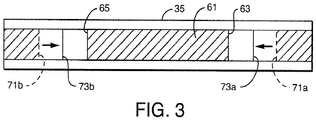
- FIG 3 a sample loop 35 is depicted containing a sample 61.
- the sample 61 is withdrawn into the sample loop with a leading front 63 and a trailing end 65.
- a front bubble 67 and a back bubble 69 separate the sample 65 from solvent or preceding or following samples 71a and 71b.
- a sample 65 has a volume of .01 to 45 microliters.
- the front bubble 67 and back bubble 69 preserve sample integrity and isolation. However, the front bubble 67 and back bubble 69 are placed in sample loop 35 under relatively low pressure with a volume of 0.1 to 3.0 microliters. The gaseous nature of the front bubble 67 and back bubble 69 makes the bubbles compressible. A sudden increase in pressure causes a sudden compression of the front bubble 67 and back bubble 69 moving the solvent or preceding or following samples inward to new compressed positions 73a and 73b. This sudden increase in pressure will result as the first valve 29a assumes a third position as best seen in Figure 2 . In the third position, the sample 61 is discharged through the first valve 29a and through column port 49 as the sample loop 35 is placed in communication with the constant flow port 51. The constant flow port 51 is in communication with pump 13 and has a pressure of 103.421,36 MPa (15,000 PSI) or greater.
- a sudden increase in pressure in sample loop 35 causes pressure and flow perturbations that can be detrimental to sample integrity and downstream components such as column 17 and detector 19.
- the pressure and flow perturbations are also a source of deviation in chromatographic results.
- the pressure source 37 is in fluid communication with at least one of the sample introduction line 31 and the sample loop 35 for placing the sample, held in the sample loop 35, under pressure via second valve or needle movement means 29b. And, upon the valve means 29a and 29b assuming the second position, pressurizing the sample. This pressurization is preferably ramped to avoid sudden changes in the volumes of the front bubble 67 and back bubble 69. The ramp can be quite short from one to 90 seconds. This controlled movement of the solvent or preceding or following samples inward to new compressed positions 73a and 73b preserves sample integrity.
- the pressure source 37 as depicted is a syringe pump but may be other pumps or sources of compressed fluids. In the event the pump 13 and column 17 have a higher operating pressure then can be attained by the pressure source 37, the control means 21 sends a command to the pump 13 to reduce pumping to lower the operating pressure to correspond to the pressure source 37.
- the column line 23b is in fluid communication with the column port 49 for receiving sample from the sample loop 35 and for directing sample to one or more columns 17.
- the column 17 is in fluid communication with the detector 19 via line 23c.
- the constant flow line 23a is for being placed in communication with a source of solvent such as pump 13 with suitable solvent reservoirs [not shown]. Pump 13 has an operation pressure of up to and even exceeding 15,000 PSI.
- the constant flow line has a pressure detector 77 which is in communication with the control means 21.
- sample loop 35 has a pressure detector 79 in communication with the control means allowing the control means 21 to compare values and control pressure source 37 to match the operating pressure.
- the control means 21 can be set with predetermined values based on volumes or pressures to raise the pressure of the sample loop 35 to 75 to 125% of the operating pressure of the pump 13 as the sample 61 is held statically in sample loop 35.
- the post-compression volume is preferably, 85 to 95% of the pre-compression volume.
- first valve 29a in the first position, one of the first loop port 45 and the second loop port 47 is in fluid communication with the sample port 41 and the remaining first loop port 45 and second loop port 47 is in fluid communication with the withdrawal port 43. And, in the first position, the constant flow port 51 is in communication with the column port 49.
- Second valve 29b and/or needle positioning means 55' which forms not part of the present invention, is capable of assuming the second position. In the second position, at least one of the first loop port 45 and the second loop port 47 is in fluid communication with the pressure source, syringe pump 37 or 37'.
- the first loop port 45 and said second loop port 47 are in fluid communication with the constant flow port 51 and the column port 49.
- the valve means 29a and 29b are in signal communication with control means 21.
- the valve means 29a and 29b assume the first position upon receiving a first signal, assumes the second position upon receiving a second signal command and assumes the third position upon receiving a third signal command.
- a command signal those skilled in the art will recognize that the command signal may comprise a series of instructions to effect an operation.
- the sample introduction line 31 is in fluid communication with the sample port 41 and with a source of sample.
- the source of sample may take several forms.
- the source of sample is a needle 55.
- Needle 55 is robotically controlled by control means 21.
- the needle 55 is used to descend into a sample vial 57 where sample is withdrawn.
- the sample injector device 15 would have a plurality of vials 57 and the needle 55 would move from vial to vial.
- Second valve 29b has two positions, one in which the sample receiving line 31 is in communication with sample and a second position in which the valve assumes the second position previously described.
- the needle 55 can be used in the sense of a valve to redirect the sample introduction line 31 robotically to the pressure source 37 to which such needle 55 is placed in fluid communication.
- the needle 55 has two positions. In one position, the needle 55 is placed in a sample vial 57 and upon the withdrawal pump 35 depressurizing the sample introduction line 31, sample is drawn up into such line, in the second position, needle, designated now by the numeral 55' to denote the second position, is placed in fluid communication with the pressure source, syringe pump 37' to pressurize the sample and fluids in the sample loop 35.
- the control means 21 is in signal communication with the pressure source 37, the withdrawal pump 35 and the valve means, first valve 29a and second valve 29b or needle movement means as represented by needle 55'.
- the control means instructs by issuing a first command signal to the valve means 29a and 29b or 55' to assume the first position in which a sample is received in the sample introduction line.
- the control means issues a second command signal to the valve means 29a, 29b and/or 55' to assume the second position and signaling the pressure source 37 or 37' to pressurize the sample loop 35 while the sample is received therein to 70 to 100 % of the system pressure to reduce pressure perturbations as the valve means moves to the third position.
- the operation of the invention will be described with respect to a method as an example for placing a sample in a chromatography system having a system pressure.
- the method comprises the steps of providing a device 15 having a valve means 29a, 29b or 55', a sample introduction line 31, a withdrawal line 33, a sample loop 35, a column line 23b, a constant flow line23a, a withdrawal pump 35, a pressure source 37, and a control means 21, as previously described.
- the device 15 is operated or programmed to operate to place sample in the sample loop 35 under pressure from said pressure source 37 or 37' at 70% to 100% of the system pressure prior to placing the valve means 29a in the third position to reduce pressure perturbations.
Landscapes
- Physics & Mathematics (AREA)
- General Physics & Mathematics (AREA)
- Engineering & Computer Science (AREA)
- Automation & Control Theory (AREA)
- Fluid Mechanics (AREA)
- Health & Medical Sciences (AREA)
- Life Sciences & Earth Sciences (AREA)
- Chemical & Material Sciences (AREA)
- Analytical Chemistry (AREA)
- Biochemistry (AREA)
- General Health & Medical Sciences (AREA)
- Immunology (AREA)
- Pathology (AREA)
- Treatment Of Liquids With Adsorbents In General (AREA)
- Sampling And Sample Adjustment (AREA)
- Automatic Analysis And Handling Materials Therefor (AREA)
Description
- The present invention relates to instrumentation for performing chromatography.
- Embodiments of the present invention are directed to apparatus and methods for reducing pressure and flow perturbations in fluid conduits. As used herein the term "pressure and flow perturbations" refer to rapid changes in the movement of fluid in a conduit or rapid changes in the pressure of fluid in a conduit. These flow and pressure perturbations may compromise "sample integrity". As used herein, the term "sample integrity" refers to the desired composition of the sample. The boundaries of the sample become less sharp or distinct.
- Aspects of the present invention are particularly useful in the field of chromatography. Chromatography is a chemical process in which compositions in solution (solutes) are separated from each other as the solution moves through a stationary material or phase. The compositions separate from each other based on the different affinity each composition has for the stationary phase. The solutions may comprise any fluid, such as, liquids, gases, supercritical fluids or mixtures thereof.
- Chromatography is used to identify and quantify compositions held in a sample. The term "sample" is used herein to refer to any material that one desires to analyze.
- High performance liquid chromatography, or HPLC, is a form of chromatography performed under pressure. The stationary phase is held in a column. A typical HPLC instrument may comprise a pump, conduits, sample injector, one or more columns and a detector. The solution is pumped through a conduit to a sample injector. At the sample injector, a sample is added to the solution in the conduit and conveyed to the column and through the stationary phase. Compositions in the solution separate as they traverse the stationary media in the column. The separated compositions are detected by a detector downstream of the column.
A typical HPLC instrument may operate at system pressures exceeding five thousand pounds per square inch (PSI)(5000 PSI = 345 bar). The term "system pressure" refers to the pressure in which the column operates. Recently, instruments have been introduced into the marketplace capable of operation at fifteen thousand PSL Although the term HPLC refers to liquid, the principles of HPLC, for the purpose of this invention, apply equally to gases or supercritical fluids. Therefore, this document will use the term HPLC to refer to liquid, gas or supercritical fluid chromatography operating at pressures of up to five thousand PSI and up to and including extreme pressures of fifteen thousand PSI and above.
As used herein, the term "conduit" refers to pipes, tubes, capillaries, microfluidic channels, and the like.
The term "valve" refers to means to control, redirect, restrict or stop flow. The term "valve means" means one or more valves or moving a conduit to communicate with a different element of the instrument. For example, without limitation, sample injectors are often equipped with needles which are placed in fluid communication with vials containing sample and are able to move to different vials, solutions and other instrument stations. The term "sample injector" refers to a form of valve and conduits used to bring a section of conduit holding a sample into fluid communication with conduits upstream of a column. Sample injectors normally comprise multiport valves and a loop of conduit for holding a sample, needles and syringe pumps for withdrawing samples.
The term "column" refers to columns, cartridges, capillaries and the like for performing separations of a chromatographic nature. Columns are typically packed or loaded with a stationary phase. This stationary phase can be particulate or beadlike or a porous monolith or a substantially inert material. For the purpose of the present invention, the term "column" also refers to capillaries which are not packed or loaded with a stationary phase but rely on the surface area of the inner capillary wall to effect separations.
Solutions used in chromatography may take many forms and it is not unusual for the composition of the solution to change over the course of a separation. For example, it is often desirable to release components of a sample held on a stationary phase. By changing the composition of a solution flowing through the stationary phase, the components of the sample can be released. It is desirable to control the composition of the mixture such that the components of the sample are released in a reproducible manner. - It is difficult to maintain the integrity of a fluid sample in a conduit as flow is interrupted or the fluid experiences pressure disturbances.
-
WO 2004/025272 A1 discloses a pressurized fluid sample injector system consisting of a sample needle, a multiport valve, a sample loop, a metering syringe and a pressure assist pump. The speed of sample transport into the sample loop is increased by pressurizing the fluid in the system and metering the sample into the sample loop. The elevated system pressure allows the fluids to be moved faster than the vapor pressure would normally allow in a system at ambient pressure. -
US 4 957 009 A discloses a pushloop liquid sampling method as an improvement in the method of introducing liquid samples into test equipment (such as for liquid chromatography) via a six port valve. The method involves pulling the sample completely past the sample loop in the six port valve and then pushing the desired amount of sample back into the sample loop. - The present invention is directed to a device according to claim 1 for placing a sample in a chromatography system having a system pressure.
- The valve means is for selectively placing sample in a column line. The valve means comprises a sample port, withdrawing port, first loop port, second loop port, column port and constant flow port. The valve means has a plurality of positions comprising a first position, second position and third position. In the first position, one of the first loop port and the second loop port is in communication with the sample port and the remaining first loop port and second loop port is in communication with the withdrawal port. And, in the first position, the constant flow port is in communication with the column port. In the second position, at least one of the first loop port and the second loop port is in fluid communication with a pressure source. And, in the third position, the first loop port and said second loop port are in fluid communication with the constant flow port and the column port. The valve means in signal communication with control means and assumes the first position upon receiving a first signal command, assuming the second position upon receiving a second signal command and assuming the third position upon receiving a third signal command.
- The sample introduction line is in fluid communication with the sample port and with a source of sample, and, upon the valve means assuming a second position, a source of pressure. The sample introduction line is for receiving sample and conveying the sample into the valve means and through at least one of the first sample port and second sample port and into the sample loop when the valve means is in the first position. And, the sample introduction line pressurizes the sample in the sample loop upon the valve means assuming the second position.
- The withdrawal line is in fluid communication with the withdrawal port and a source of reduced pressure to withdraw sample through the sample introduction line and into valve means and the sample loop upon the valve means assuming the first position. The sample loop is in fluid communication with the first sample port and the second sample port for receiving sample withdrawn through the valve means and holding the sample. And, upon the valve means assuming the second position, pressurizing the sample. And, upon the valve means assuming a third position, discharging the sample through the valve means and the column port as the sample loop is placed in communication with the constant flow port and the column port.
- The column line is in fluid communication with the column port for receiving sample from the sample loop and for directing sample to one or more columns. The constant flow line is for being placed in communication with a source of solvent.
- The withdrawal pump is in fluid communication with the withdrawal line and in signal communication with control means. The withdrawal pump depressurizes the withdrawal line to pull sample into the sample introduction line when the valve means is in the first position. The pressure source is in fluid communication with at least one of the sample introduction line and the sample loop for placing the sample, held in the sample loop, under pressure.
- The control means is in signal communication with the pressure source, the withdrawal pump and the valve means. The control means instructs by issuing a first command signal to the valve means to assume the first position in which a sample is received in the sample introduction line. The control means issues a second command signal to the valve means to assume the second position and signaling the pressure source to pressurize the sample loop while the sample is received therein to 70 to 100% of the system pressure to reduce pressure perturbations as the valve means moves to the third position.
- Embodiments of the present device are particularly useful to reduce flow and pressure perturbations in sample having trailing end and lead fronts in which an air bubble is placed to provide definition to the sample. The air bubbles allow the fluid to change volumes when the pressures are not matched and contribute to pressure and flow perturbations.
- The term "control means" refers to computer processing units (CPUs), microprocessors, mainframe computers, and personal computers. Computers and CPUs can be integrated in the device or communicate via networks. As used herein, the term "signal communicate" refers to electromagnetic communication by wire, or wireless radio-wave, optics, and the like. In contrast, the term "fluid communication" refers to plumbed together or capable of exchanging fluids.
- The pressure source is placed in fluid communication with the sample introduction line and with the sample loop during pressurization. The pressure source may comprise a pump or a source of compressed fluid. One embodiment of the pressure source is a valve in fluid communication with a pressure source. An example of the pressure source is sample introduction line having a needle capable of being placed in communication with a pressure source. The needle is used to descend into a sample vial and is moved robotically to a pressure source to which such needle is placed in fluid communication.
- Thus, the needle has two positions. In one position, the needle is placed in a sample vial and upon the withdrawal pump depressurizing the sample introduction line, sample is drawn up into such line and into the sample loop. In the second position, needle is placed in fluid communication with a pressure source to pressurize the sample and fluids in the sample loop. Embodiments of the present invention preferably place the sample under pressure in said sample loop under static conditions.
- A preferred sample loop has a volume in the range of 0.5 microliter to 50 microliters. A preferred sample has a volume of 0.1 to 45 microliters. The sample has a pre-compression volume prior to pressurization and a post compression volume after pressurization. A preferred post compression volume is 85 to 95% of the pre-compression volume.
- A preferred pressure source comprises a pump such as a syringe pump that change volume at the rate of approximately 10 to 800 microliter per minute.
- As used herein, the term "detector" refers to optical detectors such as absorbance detectors, fluorescence detectors, light scattering detectors, light refraction detectors, electromagnetic detectors, mass detectors, such as mass spectrometers and the like.
- Thus, embodiments of the present invention are directed to maintaining sample integrity, and improving chromatographic results, particularly with detectors that may be sensitive to pressure and flow perturbations. These and other features and advantages will be apparent to those skilled in the art upon viewing the Figures, briefly described hereinafter, and reading the detailed description of the invention that follows.
-
-
Figure 1 is a schematic representation of a device embodying features of the present invention; -
Figure 2 is a schematic representation of a device embodying features of the present invention; and, -
Figure 3 depicts a sample loop in cross section showing compressed and pre-compressed volumes. - A chromatography system, generally designated by the numeral 11 , is depicted in
Figure 1 . The chromatography system comprises the following major elements: apump 13, asample injector 15, acolumn 17, adetector 19 and control means 21. Thepump 13,sample injector 15,column 17 anddetector 19 are in fluid communication by means ofconduits pump 13,sample injector 15 anddetector 19 bywires wires column 17, however, wires are not shown for purposes of simplification and clarity. -
Wires Such wires - Control means 21 is a computer, CPU, microprocessor, mainframe computer or personal computer. Such computers are wed known in the art and are available from numerous vendors such as Apple Corporation (Cupertino, California, U.S.A.) or Dell Computer Corporation (Round Rock, Texas, U.S.A.). CPUs and microprocessors are available from numerous vendors including Intel Corporation (Santa Clara, California, USA), AMD Corporation (Sunnyvale, California, U.S.A. and Freescale (Austin, Texas, U.S.A.).
- Control means 21 operates with software or firmware. Software for performing chromatography and controlling chromatography instruments is available from several vendors, such as EMPOWER™ software from Waters Corporation (Milford, Massachusetts, U.S.A.) or CHEMSTATION® software from Agilent Corporation (Waldbronn, Germany).
-
Pump 13 is a chromatography pump which are available from several vendors such as the ALLIANCE® series pumps and ACQUITY series pumps available from Waters Corporation (Milford, Massachusetts, U.S.A.) or 1100® series pumps from Agilent Corporation (Waldbronn, Germany). -
Column 17 is a chromatography column, column cartridge, or capillary known in the art. Such columns and capillaries are available from numerous vendors such as Waters Corporation (Milford, Massachusetts, U.S.A.) and Phenomenex (Torrance, California, U.S.A.). Embodiments of the present invention have particular application for small scale chromatography using capillaries, small columns and microfluidics. -
Detector 19 is an analytical detector of an optical, electro-chemical or mass type. Typical optical detectors comprise absorbance detectors, Ramon detectors, fluorescence or chemiluminescence detectors, light scattering detectors, and the like, Typical mass type detectors are mass spectrometers. All such detectors are available from several sources including Waters Corporation (Milford, Massachusetts, U.S.A.), Agilent Corporation (Waldbronn, Germany), Thermo Electron Corporation (Waltham, Massachusetts, U.S.A.). -
Sample injector 15 is a sample processing instrument known in the art and available from several venders including Waters Corporation (Milford, Massachusetts, U.S.A.), Agilent Corporation (Waldbronn, Germany), Thermo Electron Corporation (Waltham, Massachusetts, U.S.A.). - The
sample injection device 15 embodying features of the present invention is depicted inFigure 2 with the major elements; apump 13, acolumn 17, adetector 19 and control means 21. Thepump 13,sample injector 15,column 17 anddetector 19 are in fluid communication by means ofconduits pump 13, anddetector 19 bywires sample injector 15 viawires 25b', 25b" and 25b''', the purpose of which will be described in greater detail later. - The
sample injection device 15 comprises the following major elements: a valve means 29a, 29b, and 55' asample introduction line 31, awithdrawal line 33, asample loop 35, a column line which has been previously designated as 23b, a constant flow line which has been previously designated as 23a, awithdrawal pump 35, apressure source 37. - The valve means 29a, 29b and 55' is for selectively placing sample in a
column line 23b. Valve means 29a, 29b and 55' is comprised of afirst valve 29a and asecond valve 29b or needle positioning means represented generally by the numeral 55' which forms not part of the present invention. - The
first valve 29a is in the nature of a multi-port valve of which six are depicted. Such multiport valves are available from several venders such as Valco (Houston, Texas, U.S.A.) and Rheodyne (Rohnert Park, California, U. SA). -
First valve 29a has asample port 41, withdrawingport 43,first loop port 45,second loop port 47,column port 49 andconstant flow port 51. Thefirst valve 29a has a plurality of positions comprising a first position and third position. A second position will be described with respect to thesecond valve 29b and needle positioning means 55'. - The
sample introduction line 31 is for receiving sample and conveying the sample into the valve means 29a, 29b, and through at least one of thefirst sample port 45 andsecond sample port 47 and into thesample loop 35 when thefirst valve 29a is in the first position. And, thesample introduction line 31 pressurizes the sample in thesample loop 35 upon thesecond valve 29b assuming the second position. - The
withdrawal line 33 is in fluid communication with thewithdrawal port 43 and a source of reducedpressure 35 to withdraw sample through thesample introduction line 31 and into valve means 29a and 29b and thesample loop 35 upon the valve means assuming the first position. - The source of reduced
pressure 35 can be a vacuum line [not shown] with suitable valves [not shown] or, as depicted, a withdrawal pump.Withdrawal pump 35 is a syringe pump and is in fluid communication with thewithdrawal line 33.Withdrawal pump 35, or a suitable valve connected to a vacuum source [not shown], are in signal communication with control means 21. Thewithdrawal pump 35 depressurizes thewithdrawal fine 33 to pull sample into thesample introduction line 31 when thefirst valve 29a is in the first position. - The
sample loop 35 is in fluid communication with thefirst sample port 45 and thesecond sample port 47 for receiving sample withdrawn through the valve means 29a and 29b and holding the sample. Thesample loop 35 has a volume of approximately 0.5 to 50 microliters. Turning now toFigure 3 , asample loop 35 is depicted containing asample 61. Thesample 61 is withdrawn into the sample loop with a leadingfront 63 and a trailingend 65. A front bubble 67 and a back bubble 69 separate thesample 65 from solvent or preceding or followingsamples sample 65 has a volume of .01 to 45 microliters. - The front bubble 67 and back bubble 69 preserve sample integrity and isolation. However, the front bubble 67 and back bubble 69 are placed in
sample loop 35 under relatively low pressure with a volume of 0.1 to 3.0 microliters. The gaseous nature of the front bubble 67 and back bubble 69 makes the bubbles compressible. A sudden increase in pressure causes a sudden compression of the front bubble 67 and back bubble 69 moving the solvent or preceding or following samples inward to newcompressed positions first valve 29a assumes a third position as best seen inFigure 2 . In the third position, thesample 61 is discharged through thefirst valve 29a and throughcolumn port 49 as thesample loop 35 is placed in communication with theconstant flow port 51. Theconstant flow port 51 is in communication withpump 13 and has a pressure of 103.421,36 MPa (15,000 PSI) or greater. - A sudden increase in pressure in
sample loop 35 causes pressure and flow perturbations that can be detrimental to sample integrity and downstream components such ascolumn 17 anddetector 19. The pressure and flow perturbations are also a source of deviation in chromatographic results. - The
pressure source 37 is in fluid communication with at least one of thesample introduction line 31 and thesample loop 35 for placing the sample, held in thesample loop 35, under pressure via second valve or needle movement means 29b. And, upon the valve means 29a and 29b assuming the second position, pressurizing the sample. This pressurization is preferably ramped to avoid sudden changes in the volumes of the front bubble 67 and back bubble 69. The ramp can be quite short from one to 90 seconds. This controlled movement of the solvent or preceding or following samples inward to newcompressed positions pressure source 37, as depicted is a syringe pump but may be other pumps or sources of compressed fluids. In the event thepump 13 andcolumn 17 have a higher operating pressure then can be attained by thepressure source 37, the control means 21 sends a command to thepump 13 to reduce pumping to lower the operating pressure to correspond to thepressure source 37. - The
column line 23b is in fluid communication with thecolumn port 49 for receiving sample from thesample loop 35 and for directing sample to one ormore columns 17. Thecolumn 17 is in fluid communication with thedetector 19 vialine 23c. - The
constant flow line 23a is for being placed in communication with a source of solvent such aspump 13 with suitable solvent reservoirs [not shown].Pump 13 has an operation pressure of up to and even exceeding 15,000 PSI. Preferably, the constant flow line has apressure detector 77 which is in communication with the control means 21. Preferably,sample loop 35 has apressure detector 79 in communication with the control means allowing the control means 21 to compare values and controlpressure source 37 to match the operating pressure. In the alternative, the control means 21 can be set with predetermined values based on volumes or pressures to raise the pressure of thesample loop 35 to 75 to 125% of the operating pressure of thepump 13 as thesample 61 is held statically insample loop 35. For example, the post-compression volume is preferably, 85 to 95% of the pre-compression volume. - Returning now to valve means 29a, 29b and 55',
first valve 29a, in the first position, one of thefirst loop port 45 and thesecond loop port 47 is in fluid communication with thesample port 41 and the remainingfirst loop port 45 andsecond loop port 47 is in fluid communication with thewithdrawal port 43. And, in the first position, theconstant flow port 51 is in communication with thecolumn port 49. -
Second valve 29b and/or needle positioning means 55' which forms not part of the present invention, is capable of assuming the second position. In the second position, at least one of thefirst loop port 45 and thesecond loop port 47 is in fluid communication with the pressure source,syringe pump 37 or 37'. - In the third position, the
first loop port 45 and saidsecond loop port 47 are in fluid communication with theconstant flow port 51 and thecolumn port 49. The valve means 29a and 29b are in signal communication with control means 21. The valve means 29a and 29b assume the first position upon receiving a first signal, assumes the second position upon receiving a second signal command and assumes the third position upon receiving a third signal command. Although referred to as a command signal those skilled in the art will recognize that the command signal may comprise a series of instructions to effect an operation. - The
sample introduction line 31 is in fluid communication with thesample port 41 and with a source of sample. The source of sample may take several forms. Typically, as depicted inFigure 2 , the source of sample is aneedle 55.Needle 55 is robotically controlled by control means 21. Theneedle 55 is used to descend into asample vial 57 where sample is withdrawn. Typically, thesample injector device 15 would have a plurality ofvials 57 and theneedle 55 would move from vial to vial. - As depicted in
Figure 2 , a second valve is labeled with thenumeric designation 29b.Second valve 29b has two positions, one in which thesample receiving line 31 is in communication with sample and a second position in which the valve assumes the second position previously described. - As an example, as depicted by dotted lines, the
needle 55 can be used in the sense of a valve to redirect thesample introduction line 31 robotically to thepressure source 37 to whichsuch needle 55 is placed in fluid communication. Thus, theneedle 55 has two positions. In one position, theneedle 55 is placed in asample vial 57 and upon thewithdrawal pump 35 depressurizing thesample introduction line 31, sample is drawn up into such line, in the second position, needle, designated now by the numeral 55' to denote the second position, is placed in fluid communication with the pressure source, syringe pump 37' to pressurize the sample and fluids in thesample loop 35. - The control means 21 is in signal communication with the
pressure source 37, thewithdrawal pump 35 and the valve means,first valve 29a andsecond valve 29b or needle movement means as represented by needle 55'. The control means instructs by issuing a first command signal to the valve means 29a and 29b or 55' to assume the first position in which a sample is received in the sample introduction line. The control means issues a second command signal to the valve means 29a, 29b and/or 55' to assume the second position and signaling thepressure source 37 or 37' to pressurize thesample loop 35 while the sample is received therein to 70 to 100 % of the system pressure to reduce pressure perturbations as the valve means moves to the third position. - The operation of the invention will be described with respect to a method as an example for placing a sample in a chromatography system having a system pressure. The method comprises the steps of providing a
device 15 having a valve means 29a, 29b or 55', asample introduction line 31, awithdrawal line 33, asample loop 35, acolumn line 23b, a constant flow line23a, awithdrawal pump 35, apressure source 37, and a control means 21, as previously described. Thedevice 15 is operated or programmed to operate to place sample in thesample loop 35 under pressure from saidpressure source 37 or 37' at 70% to 100% of the system pressure prior to placing the valve means 29a in the third position to reduce pressure perturbations.
Claims (8)
- A device for placing a sample (61) in a chromatography system (11) having a system pressure,
the chromatography system (11) comprising a chromatography pump (13), a sample injector (15), a chromatography column (17), a detector (19) and control means (21) in signal communication with the pump (13), the sample injector (15) and the detector (19),
the sample injector (15) comprising a valve means (29a, 29b) having a first valve (29a) and a second valve (29b), a sample introduction line (31), a withdrawal line (33), a sample loop (35), a column line (23b), a constant flow line (23a), a withdrawal pump, a pressure source (37) and a sample source, wherein the control means (21) is in signal communication with the pressure source (37), the withdrawal pump and the first and second valves (29a, 29b), which first and second valves (29a, 29b) being configured for selectively placing the sample (61) in the column line (23b),
the first valve (29a) comprising a sample port (41), a withdrawal port (43), a first loop port (45), a second loop port (47), a column port (49) and a constant flow port (51),
the valve means (29a, 29b) having a plurality of positions comprising a first position of the first and second valves (29a, 29b), a second position of the second valve (29b) and a third position of the first valve (29a), wherein the first and second valves (29a, 29b) assume their first positions upon a first signal command of the control means (21), the second valve (29b) assumes its second position upon a second signal command of the control means (21) and the first valve (29a) assumes its third position upon a third signal command of the control means (21), wherein
in the first position of the second valve (29b), the sample introduction line (31) is in fluid communication with the sample source (55), and in the first position of the first valve (29a), the sample introduction line (31) is in fluid communication with the sample port (41) communicating with one of the first and second loop ports (45, 47) with the other one thereof communicating with the withdrawal port (43), the constant flow port (51) is in communication with the column port (49) and the withdrawal port (43) is in fluid communication with the withdrawal line (33) depressurized by the withdrawal pump for pulling the sample (61) into the sample introduction line (31) and the sample loop (35) communicating with the first and second loop ports (45, 47),
in the second position of the second valve (29b), the pressure source (37) is in fluid communication with the sample introduction line (31) and the sample loop (35) for placing the sample (61) held in the sample loop (35) under pressure, wherein the control means (21) being set with predetermined values based on volumes or pressures for raising the pressure of the sample loop (35) to 75 to 125% of an operating pressure of the pump (13) as the sample (61) is held in the sample loop (35), and
in the third position of the first valve (29a), the sample loop (35), via the first and second loop ports (45, 47), is in fluid communication with the constant flow port (51) and the column port (49), the constant flow port (51) is in fluid communication with the constant flow line (23a) communicating with the pump (13), and the column line (23b) is in fluid communication with the column port (49) for receiving the sample (61) from the sample loop (35) and directing it to the column (17). - The device of claim 1, wherein said sample (61) has a trailing end (65) and a lead front (63)in which an air bubble (67, 69) is placed for separating the sample (61) from solvent or preceding or following samples (71a, 71b).
- The device of claim 1, wherein said sample loop (35) has a volume in the range of 0.5 microliter to 50 microliters.
- The device of claim 3, wherein said sample (61) has a volume of 0.1 to 45 microliters.
- The device of claim 1, wherein said sample (61) has a precompression volume and a post compression volume, said post compression volume being 85 to 95% of the precompression volume.
- The device of claim 1, wherein said pressure source (37) places said sample loop (35) under pressure by changing volume at a rate of approximately 10 to 800 microliter per minute.
- The device of claim 1, wherein said sample (61) is placed under pressure in said sample loop (35) under static conditions.
- The use of the device according to any one of claims 1 to 6 in a method of placing a sample in a chromatography system (11) having a system pressure.
Applications Claiming Priority (2)
| Application Number | Priority Date | Filing Date | Title |
|---|---|---|---|
| US78334706P | 2006-03-17 | 2006-03-17 | |
| PCT/US2007/064152 WO2007109529A2 (en) | 2006-03-17 | 2007-03-16 | Device and methods for reducing pressure and flow perturbations in a chromatographic system |
Publications (3)
| Publication Number | Publication Date |
|---|---|
| EP1996930A2 EP1996930A2 (en) | 2008-12-03 |
| EP1996930A4 EP1996930A4 (en) | 2011-01-19 |
| EP1996930B1 true EP1996930B1 (en) | 2018-01-10 |
Family
ID=38523180
Family Applications (1)
| Application Number | Title | Priority Date | Filing Date |
|---|---|---|---|
| EP07758679.0A Revoked EP1996930B1 (en) | 2006-03-17 | 2007-03-16 | Device and methods for reducing pressure and flow perturbations in a chromatographic system |
Country Status (4)
| Country | Link |
|---|---|
| US (1) | US8312762B2 (en) |
| EP (1) | EP1996930B1 (en) |
| JP (1) | JP5114471B2 (en) |
| WO (1) | WO2007109529A2 (en) |
Families Citing this family (14)
| Publication number | Priority date | Publication date | Assignee | Title |
|---|---|---|---|---|
| US8881582B2 (en) * | 2005-01-31 | 2014-11-11 | Waters Technologies Corporation | Method and apparatus for sample injection in liquid chromatography |
| DE102008006266B4 (en) | 2008-01-25 | 2011-06-09 | Dionex Softron Gmbh | Sampler for liquid chromatography, in particular for high performance liquid chromatography |
| CA2764047C (en) | 2009-06-03 | 2016-12-13 | Agilent Technologies, Inc. | Sample injector with metering device balancing pressure differences in an intermediate valve state |
| DE112012006845T5 (en) * | 2012-08-24 | 2015-06-03 | Centennial Technology Company | Sample pretreatment device and sample pretreatment method |
| US20140061133A1 (en) * | 2012-08-31 | 2014-03-06 | Joseph Lewis HERMAN | Method and Apparatus for Split-Flow-Mixing Liquid Chromatography |
| US9945820B2 (en) * | 2012-11-30 | 2018-04-17 | Agilent Technologies, Inc. | Mixer bypass sample injection for liquid chromatography |
| US9945762B2 (en) * | 2014-12-30 | 2018-04-17 | Agilent Technologies, Inc. | Apparatus and method for introducing sample into a separation unit of a chromatography system without disrupting a mobile phase |
| DE202016100451U1 (en) | 2015-06-25 | 2016-02-16 | Dionex Softron Gmbh | Sampler for liquid chromatography, in particular for high performance liquid chromatography |
| JP2020505592A (en) * | 2017-01-17 | 2020-02-20 | ウオーターズ・テクノロジーズ・コーポレイシヨン | Systems, methods and apparatus for providing pressurized solvent flow |
| JP6992810B2 (en) * | 2017-07-04 | 2022-01-13 | 株式会社島津製作所 | Autosampler and fluid chromatograph |
| CN111164423B (en) * | 2017-10-04 | 2024-04-09 | 沃特世科技公司 | Systems and methods for chromatography analysis |
| US11307181B1 (en) * | 2018-07-14 | 2022-04-19 | Sielc Technologies Corporation | HPLC system with mixed-mode columns for measuring charged analytes in complex mixtures |
| JP7655127B2 (en) | 2021-07-26 | 2025-04-02 | ウシオ電機株式会社 | LIQUID CHROMATOGRAPHY AND METHOD FOR ANALYZING LIQUID SAMPLES |
| DE102021122886A1 (en) | 2021-09-03 | 2023-03-09 | Dionex Softron Gmbh | Loading a fluidic element |
Citations (8)
| Publication number | Priority date | Publication date | Assignee | Title |
|---|---|---|---|---|
| US3915013A (en) | 1974-02-04 | 1975-10-28 | Ethyl Corp | Low pressure gas sample apparatus and method |
| JPS5995458A (en) | 1982-11-22 | 1984-06-01 | Yanagimoto Seisakusho:Kk | Sampling method of gas chromatograph |
| US4957009A (en) * | 1988-09-23 | 1990-09-18 | Spectra-Physics, Inc. | Pushloop liquid sampling method |
| WO2004025272A1 (en) | 2002-09-11 | 2004-03-25 | Waters Investments Limited | Pressurized fluid sample injector apparatus and method |
| US20050019216A1 (en) | 2003-07-24 | 2005-01-27 | Hans-Heinrich Trutnau | Apparatus for introducing a sample into a flowthrough analysis system |
| WO2006023828A2 (en) | 2004-08-24 | 2006-03-02 | Waters Investments Limited | Devices, systems, and methods for flow-compensating pump-injector sychronization |
| JP2006058146A (en) | 2004-08-20 | 2006-03-02 | Daicel Chem Ind Ltd | Sample injection method, sample injection apparatus, and supercritical fluid chromatography apparatus having the same |
| WO2006083776A2 (en) | 2005-01-31 | 2006-08-10 | Waters Investments Limited | Method and apparatus for sample injection in liquid chromatography |
Family Cites Families (6)
| Publication number | Priority date | Publication date | Assignee | Title |
|---|---|---|---|---|
| DE3943524A1 (en) * | 1989-08-23 | 1991-02-28 | Gynkotek Ges Fuer Den Bau Wiss | High pressure liq. chromatography sample vessels - delivering into reciprocating hollow needle are mounted in belt-advanced rotary carrier disc |
| US5699665A (en) * | 1996-04-10 | 1997-12-23 | Commercial Intertech Corp. | Control system with induced load isolation and relief |
| US5701933A (en) * | 1996-06-27 | 1997-12-30 | Caterpillar Inc. | Hydraulic control system having a bypass valve |
| JP3815322B2 (en) * | 2001-12-27 | 2006-08-30 | 株式会社島津製作所 | Sample introduction device |
| JP4459633B2 (en) | 2004-01-13 | 2010-04-28 | ダイセル化学工業株式会社 | Sample injection method and injection apparatus |
| US20060037607A1 (en) * | 2004-08-19 | 2006-02-23 | Cesar Trujillo | Integrated snorkel mask front-mounted snorkel |
-
2007
- 2007-03-16 WO PCT/US2007/064152 patent/WO2007109529A2/en not_active Ceased
- 2007-03-16 JP JP2009500623A patent/JP5114471B2/en not_active Expired - Fee Related
- 2007-03-16 US US12/282,895 patent/US8312762B2/en active Active
- 2007-03-16 EP EP07758679.0A patent/EP1996930B1/en not_active Revoked
Patent Citations (8)
| Publication number | Priority date | Publication date | Assignee | Title |
|---|---|---|---|---|
| US3915013A (en) | 1974-02-04 | 1975-10-28 | Ethyl Corp | Low pressure gas sample apparatus and method |
| JPS5995458A (en) | 1982-11-22 | 1984-06-01 | Yanagimoto Seisakusho:Kk | Sampling method of gas chromatograph |
| US4957009A (en) * | 1988-09-23 | 1990-09-18 | Spectra-Physics, Inc. | Pushloop liquid sampling method |
| WO2004025272A1 (en) | 2002-09-11 | 2004-03-25 | Waters Investments Limited | Pressurized fluid sample injector apparatus and method |
| US20050019216A1 (en) | 2003-07-24 | 2005-01-27 | Hans-Heinrich Trutnau | Apparatus for introducing a sample into a flowthrough analysis system |
| JP2006058146A (en) | 2004-08-20 | 2006-03-02 | Daicel Chem Ind Ltd | Sample injection method, sample injection apparatus, and supercritical fluid chromatography apparatus having the same |
| WO2006023828A2 (en) | 2004-08-24 | 2006-03-02 | Waters Investments Limited | Devices, systems, and methods for flow-compensating pump-injector sychronization |
| WO2006083776A2 (en) | 2005-01-31 | 2006-08-10 | Waters Investments Limited | Method and apparatus for sample injection in liquid chromatography |
Also Published As
| Publication number | Publication date |
|---|---|
| JP2009530623A (en) | 2009-08-27 |
| WO2007109529A3 (en) | 2008-04-10 |
| JP5114471B2 (en) | 2013-01-09 |
| WO2007109529A2 (en) | 2007-09-27 |
| EP1996930A4 (en) | 2011-01-19 |
| EP1996930A2 (en) | 2008-12-03 |
| US20100043539A1 (en) | 2010-02-25 |
| US8312762B2 (en) | 2012-11-20 |
Similar Documents
| Publication | Publication Date | Title |
|---|---|---|
| US8312762B2 (en) | Device and methods for reducing pressure and flow perturbations in a chromatographic system | |
| CN104813164B (en) | Sample injection is bypassed for the mixer of liquid chromatogram | |
| US8673144B2 (en) | Flow rate control | |
| EP2993471B1 (en) | Injector with controllable sample dilution for a liquid chromatography system | |
| US8343774B2 (en) | Chromatography-based monitoring and control of multiple process streams | |
| CN106662554B (en) | Analysis device and analysis method | |
| US9632064B2 (en) | Gas chromatograph system employing hydrogen carrier gas | |
| US10677766B2 (en) | Volumetric flow regulation in multi-dimensional liquid analysis systems | |
| EP3330705B1 (en) | Microfluidic check valve and related devices and systems | |
| EP2788639B1 (en) | Select valve for liquid chromatography systems | |
| US9791080B2 (en) | Microfluidic interconnect | |
| US10307691B2 (en) | Apparatus and methods for preparative liquid chromatography | |
| CN111837032A (en) | Sample handling and distribution of individual sample packs | |
| US9297682B1 (en) | Inline flow rate meter with auxiliary fluid injection and detection | |
| EP2035788A2 (en) | Mitigation of sample-introduction decompression effects in high-pressure liquid chromatography | |
| EP3607316B1 (en) | Biocompatible component with structural reinforcement | |
| GB2593061A (en) | Two-dimensional fluid separation with push-pull modulation | |
| EP2626697B1 (en) | Liquid chromatography device | |
| GB2487941A (en) | Fluid separation system for determining an injection time | |
| CN119925989A (en) | Sample separation device with decoupling of fluid drive unit |
Legal Events
| Date | Code | Title | Description |
|---|---|---|---|
| PUAI | Public reference made under article 153(3) epc to a published international application that has entered the european phase |
Free format text: ORIGINAL CODE: 0009012 |
|
| 17P | Request for examination filed |
Effective date: 20080915 |
|
| AK | Designated contracting states |
Kind code of ref document: A2 Designated state(s): DE GB |
|
| RAP1 | Party data changed (applicant data changed or rights of an application transferred) |
Owner name: WATERS TECHNOLOGIES CORPORATION |
|
| DAX | Request for extension of the european patent (deleted) | ||
| RBV | Designated contracting states (corrected) |
Designated state(s): DE GB |
|
| A4 | Supplementary search report drawn up and despatched |
Effective date: 20101221 |
|
| RIC1 | Information provided on ipc code assigned before grant |
Ipc: G01N 30/20 20060101ALI20101215BHEP Ipc: G01N 30/02 20060101AFI20081003BHEP |
|
| 17Q | First examination report despatched |
Effective date: 20160418 |
|
| STAA | Information on the status of an ep patent application or granted ep patent |
Free format text: STATUS: EXAMINATION IS IN PROGRESS |
|
| GRAP | Despatch of communication of intention to grant a patent |
Free format text: ORIGINAL CODE: EPIDOSNIGR1 |
|
| STAA | Information on the status of an ep patent application or granted ep patent |
Free format text: STATUS: GRANT OF PATENT IS INTENDED |
|
| INTG | Intention to grant announced |
Effective date: 20170823 |
|
| GRAS | Grant fee paid |
Free format text: ORIGINAL CODE: EPIDOSNIGR3 |
|
| GRAA | (expected) grant |
Free format text: ORIGINAL CODE: 0009210 |
|
| STAA | Information on the status of an ep patent application or granted ep patent |
Free format text: STATUS: THE PATENT HAS BEEN GRANTED |
|
| AK | Designated contracting states |
Kind code of ref document: B1 Designated state(s): DE GB |
|
| REG | Reference to a national code |
Ref country code: GB Ref legal event code: FG4D |
|
| REG | Reference to a national code |
Ref country code: DE Ref legal event code: R096 Ref document number: 602007053661 Country of ref document: DE |
|
| REG | Reference to a national code |
Ref country code: DE Ref legal event code: R026 Ref document number: 602007053661 Country of ref document: DE |
|
| PLBI | Opposition filed |
Free format text: ORIGINAL CODE: 0009260 |
|
| PLAX | Notice of opposition and request to file observation + time limit sent |
Free format text: ORIGINAL CODE: EPIDOSNOBS2 |
|
| 26 | Opposition filed |
Opponent name: AGILENT TECHNOLOGIES, INC. Effective date: 20181010 |
|
| PLBB | Reply of patent proprietor to notice(s) of opposition received |
Free format text: ORIGINAL CODE: EPIDOSNOBS3 |
|
| RDAF | Communication despatched that patent is revoked |
Free format text: ORIGINAL CODE: EPIDOSNREV1 |
|
| APBM | Appeal reference recorded |
Free format text: ORIGINAL CODE: EPIDOSNREFNO |
|
| APBP | Date of receipt of notice of appeal recorded |
Free format text: ORIGINAL CODE: EPIDOSNNOA2O |
|
| APAH | Appeal reference modified |
Free format text: ORIGINAL CODE: EPIDOSCREFNO |
|
| APBQ | Date of receipt of statement of grounds of appeal recorded |
Free format text: ORIGINAL CODE: EPIDOSNNOA3O |
|
| PGFP | Annual fee paid to national office [announced via postgrant information from national office to epo] |
Ref country code: GB Payment date: 20220225 Year of fee payment: 16 Ref country code: DE Payment date: 20220217 Year of fee payment: 16 |
|
| APBU | Appeal procedure closed |
Free format text: ORIGINAL CODE: EPIDOSNNOA9O |
|
| REG | Reference to a national code |
Ref country code: DE Ref legal event code: R103 Ref document number: 602007053661 Country of ref document: DE Ref country code: DE Ref legal event code: R064 Ref document number: 602007053661 Country of ref document: DE |
|
| RDAG | Patent revoked |
Free format text: ORIGINAL CODE: 0009271 |
|
| STAA | Information on the status of an ep patent application or granted ep patent |
Free format text: STATUS: PATENT REVOKED |
|
| 27W | Patent revoked |
Effective date: 20221221 |
|
| GBPR | Gb: patent revoked under art. 102 of the ep convention designating the uk as contracting state |
Effective date: 20221221 |