EP1996567B1 - Novel acetyl-coa carboxylase (acc) inhibitors and their use in diabetes, obesity and metabolic syndrome - Google Patents
Novel acetyl-coa carboxylase (acc) inhibitors and their use in diabetes, obesity and metabolic syndrome Download PDFInfo
- Publication number
- EP1996567B1 EP1996567B1 EP07757025.7A EP07757025A EP1996567B1 EP 1996567 B1 EP1996567 B1 EP 1996567B1 EP 07757025 A EP07757025 A EP 07757025A EP 1996567 B1 EP1996567 B1 EP 1996567B1
- Authority
- EP
- European Patent Office
- Prior art keywords
- benzothiazol
- formula
- phenyl
- hydrogen
- acetamide
- Prior art date
- Legal status (The legal status is an assumption and is not a legal conclusion. Google has not performed a legal analysis and makes no representation as to the accuracy of the status listed.)
- Active
Links
- 208000008589 Obesity Diseases 0.000 title claims description 17
- 235000020824 obesity Nutrition 0.000 title claims description 17
- 208000001145 Metabolic Syndrome Diseases 0.000 title claims description 13
- 201000000690 abdominal obesity-metabolic syndrome Diseases 0.000 title claims description 13
- 108010018763 Biotin carboxylase Proteins 0.000 title description 30
- 102000000452 Acetyl-CoA carboxylase Human genes 0.000 title description 26
- 108010016219 Acetyl-CoA carboxylase Proteins 0.000 title description 26
- 239000003112 inhibitor Substances 0.000 title description 6
- 206010012601 diabetes mellitus Diseases 0.000 title description 4
- 150000001875 compounds Chemical class 0.000 claims description 195
- 229910052739 hydrogen Inorganic materials 0.000 claims description 80
- 239000001257 hydrogen Substances 0.000 claims description 80
- 125000004435 hydrogen atom Chemical group [H]* 0.000 claims description 54
- 125000002496 methyl group Chemical group [H]C([H])([H])* 0.000 claims description 52
- 125000001997 phenyl group Chemical group [H]C1=C([H])C([H])=C(*)C([H])=C1[H] 0.000 claims description 51
- 125000001624 naphthyl group Chemical group 0.000 claims description 35
- 150000003839 salts Chemical class 0.000 claims description 31
- UFHFLCQGNIYNRP-UHFFFAOYSA-N Hydrogen Chemical compound [H][H] UFHFLCQGNIYNRP-UHFFFAOYSA-N 0.000 claims description 28
- 238000011282 treatment Methods 0.000 claims description 24
- 101000894929 Homo sapiens Bcl-2-related protein A1 Proteins 0.000 claims description 19
- 125000003253 isopropoxy group Chemical group [H]C([H])([H])C([H])(O*)C([H])([H])[H] 0.000 claims description 19
- 208000037265 diseases, disorders, signs and symptoms Diseases 0.000 claims description 17
- 208000001072 type 2 diabetes mellitus Diseases 0.000 claims description 16
- 125000004076 pyridyl group Chemical group 0.000 claims description 13
- 125000001449 isopropyl group Chemical group [H]C([H])([H])C([H])(*)C([H])([H])[H] 0.000 claims description 12
- 230000002401 inhibitory effect Effects 0.000 claims description 10
- 206010022489 Insulin Resistance Diseases 0.000 claims description 6
- 229910052731 fluorine Inorganic materials 0.000 claims description 6
- 102100021334 Bcl-2-related protein A1 Human genes 0.000 claims description 5
- 239000008194 pharmaceutical composition Substances 0.000 claims description 5
- NNSFQIJLVALOFY-UHFFFAOYSA-N 1-[2-(4-phenoxyphenoxy)-1,3-benzothiazol-6-yl]ethanamine Chemical compound S1C2=CC(C(N)C)=CC=C2N=C1OC(C=C1)=CC=C1OC1=CC=CC=C1 NNSFQIJLVALOFY-UHFFFAOYSA-N 0.000 claims description 4
- 201000010099 disease Diseases 0.000 claims description 4
- 150000002431 hydrogen Chemical class 0.000 claims description 4
- GCMWFZHPEHEAND-UHFFFAOYSA-N n-[2-(2-quinolin-3-yloxy-1,3-benzothiazol-6-yl)propyl]acetamide Chemical compound C1=CC=CC2=CC(OC3=NC4=CC=C(C=C4S3)C(CNC(C)=O)C)=CN=C21 GCMWFZHPEHEAND-UHFFFAOYSA-N 0.000 claims description 4
- IYSCALOAVWZJDG-UHFFFAOYSA-N n-[2-[2-(3-propan-2-yloxyphenoxy)-1,3-benzothiazol-6-yl]propyl]acetamide Chemical compound CC(C)OC1=CC=CC(OC=2SC3=CC(=CC=C3N=2)C(C)CNC(C)=O)=C1 IYSCALOAVWZJDG-UHFFFAOYSA-N 0.000 claims description 4
- BYRUOXCLSXAWHN-UHFFFAOYSA-N n-[2-[2-[4-(4-propan-2-yloxyphenoxy)phenoxy]-1,3-benzothiazol-6-yl]propyl]acetamide Chemical compound C1=CC(OC(C)C)=CC=C1OC(C=C1)=CC=C1OC1=NC2=CC=C(C(C)CNC(C)=O)C=C2S1 BYRUOXCLSXAWHN-UHFFFAOYSA-N 0.000 claims description 4
- GZRONGRYKCOIBM-UHFFFAOYSA-N 1-[2-(4-phenoxyphenoxy)-1,3-benzothiazol-6-yl]ethanol Chemical compound S1C2=CC(C(O)C)=CC=C2N=C1OC(C=C1)=CC=C1OC1=CC=CC=C1 GZRONGRYKCOIBM-UHFFFAOYSA-N 0.000 claims description 3
- AXNXYQHHXZSXLW-UHFFFAOYSA-N 1-[2-(4-phenoxyphenoxy)-1,3-benzothiazol-6-yl]ethyl acetate Chemical compound S1C2=CC(C(OC(C)=O)C)=CC=C2N=C1OC(C=C1)=CC=C1OC1=CC=CC=C1 AXNXYQHHXZSXLW-UHFFFAOYSA-N 0.000 claims description 3
- BNMICVDCKXIYRY-UHFFFAOYSA-N 1-[2-(4-phenoxyphenoxy)-1,3-benzothiazol-6-yl]ethylurea Chemical compound S1C2=CC(C(NC(N)=O)C)=CC=C2N=C1OC(C=C1)=CC=C1OC1=CC=CC=C1 BNMICVDCKXIYRY-UHFFFAOYSA-N 0.000 claims description 3
- ONEFZMVLWVDNLQ-UHFFFAOYSA-N 2-[2-(4-phenoxyphenoxy)-1,3-benzothiazol-6-yl]propan-1-amine Chemical compound S1C2=CC(C(CN)C)=CC=C2N=C1OC(C=C1)=CC=C1OC1=CC=CC=C1 ONEFZMVLWVDNLQ-UHFFFAOYSA-N 0.000 claims description 3
- DSQJCHXFVKGGJM-UHFFFAOYSA-N 2-[2-(4-propan-2-yloxyphenoxy)-1,3-benzothiazol-6-yl]propan-1-amine Chemical compound C1=CC(OC(C)C)=CC=C1OC1=NC2=CC=C(C(C)CN)C=C2S1 DSQJCHXFVKGGJM-UHFFFAOYSA-N 0.000 claims description 3
- DYRVCWNUVJXUAG-UHFFFAOYSA-N 2-[2-(4-propan-2-yloxyphenoxy)-1,3-benzothiazol-6-yl]propanenitrile Chemical compound C1=CC(OC(C)C)=CC=C1OC1=NC2=CC=C(C(C)C#N)C=C2S1 DYRVCWNUVJXUAG-UHFFFAOYSA-N 0.000 claims description 3
- 101000963440 Bacillus subtilis (strain 168) Biotin carboxylase 1 Proteins 0.000 claims description 3
- 239000003937 drug carrier Substances 0.000 claims description 3
- OQSJQZYKHHMBLH-UHFFFAOYSA-N n-[1-[2-(4-phenoxyphenoxy)-1,3-benzothiazol-6-yl]ethyl]acetamide Chemical compound S1C2=CC(C(NC(C)=O)C)=CC=C2N=C1OC(C=C1)=CC=C1OC1=CC=CC=C1 OQSJQZYKHHMBLH-UHFFFAOYSA-N 0.000 claims description 3
- STMTZCMYVYNTNB-UHFFFAOYSA-N n-[2-(2-naphthalen-2-yloxy-1,3-benzothiazol-6-yl)propyl]acetamide Chemical compound C1=CC=CC2=CC(OC3=NC4=CC=C(C=C4S3)C(CNC(C)=O)C)=CC=C21 STMTZCMYVYNTNB-UHFFFAOYSA-N 0.000 claims description 3
- NOLIRPIQHRQGMW-UHFFFAOYSA-N n-[2-(2-quinolin-6-yloxy-1,3-benzothiazol-6-yl)propyl]acetamide Chemical compound N1=CC=CC2=CC(OC3=NC4=CC=C(C=C4S3)C(CNC(C)=O)C)=CC=C21 NOLIRPIQHRQGMW-UHFFFAOYSA-N 0.000 claims description 3
- DZLYGIXICGGHTJ-UHFFFAOYSA-N n-[2-[2-(3-anilinophenoxy)-1,3-benzothiazol-6-yl]propyl]acetamide Chemical compound S1C2=CC(C(CNC(C)=O)C)=CC=C2N=C1OC(C=1)=CC=CC=1NC1=CC=CC=C1 DZLYGIXICGGHTJ-UHFFFAOYSA-N 0.000 claims description 3
- OQEXXNOZHLRUOT-UHFFFAOYSA-N n-[2-[2-(3-phenoxyphenoxy)-1,3-benzothiazol-6-yl]propyl]acetamide Chemical compound S1C2=CC(C(CNC(C)=O)C)=CC=C2N=C1OC(C=1)=CC=CC=1OC1=CC=CC=C1 OQEXXNOZHLRUOT-UHFFFAOYSA-N 0.000 claims description 3
- LIOHRNQHMSJLSI-UHFFFAOYSA-N n-[2-[2-(4-anilinophenoxy)-1,3-benzothiazol-6-yl]propyl]acetamide Chemical compound S1C2=CC(C(CNC(C)=O)C)=CC=C2N=C1OC(C=C1)=CC=C1NC1=CC=CC=C1 LIOHRNQHMSJLSI-UHFFFAOYSA-N 0.000 claims description 3
- BPHQKNDQQGKFDZ-UHFFFAOYSA-N n-[2-[2-(4-phenoxyphenoxy)-1,3-benzothiazol-6-yl]propyl]acetamide Chemical compound S1C2=CC(C(CNC(C)=O)C)=CC=C2N=C1OC(C=C1)=CC=C1OC1=CC=CC=C1 BPHQKNDQQGKFDZ-UHFFFAOYSA-N 0.000 claims description 3
- HUHUQDPDQCMBKF-UHFFFAOYSA-N n-[2-[2-(4-propan-2-yloxyphenoxy)-1,3-benzothiazol-6-yl]propyl]acetamide Chemical compound C1=CC(OC(C)C)=CC=C1OC1=NC2=CC=C(C(C)CNC(C)=O)C=C2S1 HUHUQDPDQCMBKF-UHFFFAOYSA-N 0.000 claims description 3
- JGVBDNCKBWTVOF-UHFFFAOYSA-N n-[2-[2-(6-methoxynaphthalen-2-yl)oxy-1,3-benzothiazol-6-yl]propyl]acetamide Chemical compound C1=C(C(C)CNC(C)=O)C=C2SC(OC3=CC4=CC=C(C=C4C=C3)OC)=NC2=C1 JGVBDNCKBWTVOF-UHFFFAOYSA-N 0.000 claims description 3
- XEWKFIXPPIMHKD-UHFFFAOYSA-N n-[2-[2-(7-methoxynaphthalen-2-yl)oxy-1,3-benzothiazol-6-yl]propyl]acetamide Chemical compound C1=C(C(C)CNC(C)=O)C=C2SC(OC=3C=CC4=CC=C(C=C4C=3)OC)=NC2=C1 XEWKFIXPPIMHKD-UHFFFAOYSA-N 0.000 claims description 3
- JUHBDQKSCBXKGL-UHFFFAOYSA-N n-[2-[2-[4-(naphthalen-2-ylamino)phenoxy]-1,3-benzothiazol-6-yl]propyl]acetamide Chemical compound C1=CC=CC2=CC(NC3=CC=C(C=C3)OC3=NC4=CC=C(C=C4S3)C(CNC(C)=O)C)=CC=C21 JUHBDQKSCBXKGL-UHFFFAOYSA-N 0.000 claims description 3
- QFRNLPZBEAQJHB-UHFFFAOYSA-N 2-[2-(4-phenoxyphenoxy)-1,3-benzothiazol-6-yl]propanenitrile Chemical compound S1C2=CC(C(C#N)C)=CC=C2N=C1OC(C=C1)=CC=C1OC1=CC=CC=C1 QFRNLPZBEAQJHB-UHFFFAOYSA-N 0.000 claims description 2
- 101000782621 Bacillus subtilis (strain 168) Biotin carboxylase 2 Proteins 0.000 claims description 2
- 208000031226 Hyperlipidaemia Diseases 0.000 claims description 2
- 206010020772 Hypertension Diseases 0.000 claims description 2
- XEKOWRVHYACXOJ-UHFFFAOYSA-N Ethyl acetate Chemical compound CCOC(C)=O XEKOWRVHYACXOJ-UHFFFAOYSA-N 0.000 description 138
- -1 aminopyridine-substituted benzothiazoles Chemical class 0.000 description 75
- 238000006243 chemical reaction Methods 0.000 description 74
- YMWUJEATGCHHMB-UHFFFAOYSA-N Dichloromethane Chemical compound ClCCl YMWUJEATGCHHMB-UHFFFAOYSA-N 0.000 description 60
- VYPSYNLAJGMNEJ-UHFFFAOYSA-N Silicium dioxide Chemical compound O=[Si]=O VYPSYNLAJGMNEJ-UHFFFAOYSA-N 0.000 description 51
- VLKZOEOYAKHREP-UHFFFAOYSA-N n-Hexane Chemical class CCCCCC VLKZOEOYAKHREP-UHFFFAOYSA-N 0.000 description 48
- HEDRZPFGACZZDS-MICDWDOJSA-N Trichloro(2H)methane Chemical compound [2H]C(Cl)(Cl)Cl HEDRZPFGACZZDS-MICDWDOJSA-N 0.000 description 47
- 238000000034 method Methods 0.000 description 39
- OKKJLVBELUTLKV-UHFFFAOYSA-N Methanol Chemical compound OC OKKJLVBELUTLKV-UHFFFAOYSA-N 0.000 description 36
- 238000005160 1H NMR spectroscopy Methods 0.000 description 35
- 239000002904 solvent Substances 0.000 description 33
- QTBSBXVTEAMEQO-UHFFFAOYSA-N Acetic acid Chemical compound CC(O)=O QTBSBXVTEAMEQO-UHFFFAOYSA-N 0.000 description 32
- 239000000203 mixture Substances 0.000 description 31
- 239000012043 crude product Substances 0.000 description 28
- LFQSCWFLJHTTHZ-UHFFFAOYSA-N Ethanol Chemical compound CCO LFQSCWFLJHTTHZ-UHFFFAOYSA-N 0.000 description 26
- 238000003818 flash chromatography Methods 0.000 description 25
- ZMANZCXQSJIPKH-UHFFFAOYSA-N Triethylamine Chemical compound CCN(CC)CC ZMANZCXQSJIPKH-UHFFFAOYSA-N 0.000 description 24
- 229910052681 coesite Inorganic materials 0.000 description 24
- 229910052906 cristobalite Inorganic materials 0.000 description 24
- 239000000377 silicon dioxide Substances 0.000 description 24
- 229910052682 stishovite Inorganic materials 0.000 description 24
- 229910052905 tridymite Inorganic materials 0.000 description 24
- WEVYAHXRMPXWCK-UHFFFAOYSA-N Acetonitrile Chemical compound CC#N WEVYAHXRMPXWCK-UHFFFAOYSA-N 0.000 description 22
- XLYOFNOQVPJJNP-UHFFFAOYSA-N water Substances O XLYOFNOQVPJJNP-UHFFFAOYSA-N 0.000 description 22
- 239000000243 solution Substances 0.000 description 20
- 102100021641 Acetyl-CoA carboxylase 2 Human genes 0.000 description 18
- IAZDPXIOMUYVGZ-WFGJKAKNSA-N Dimethyl sulfoxide Chemical compound [2H]C([2H])([2H])S(=O)C([2H])([2H])[2H] IAZDPXIOMUYVGZ-WFGJKAKNSA-N 0.000 description 18
- WYURNTSHIVDZCO-UHFFFAOYSA-N Tetrahydrofuran Chemical compound C1CCOC1 WYURNTSHIVDZCO-UHFFFAOYSA-N 0.000 description 16
- 101000677540 Homo sapiens Acetyl-CoA carboxylase 2 Proteins 0.000 description 15
- YXFVVABEGXRONW-UHFFFAOYSA-N Toluene Chemical compound CC1=CC=CC=C1 YXFVVABEGXRONW-UHFFFAOYSA-N 0.000 description 15
- 239000012267 brine Substances 0.000 description 15
- HPALAKNZSZLMCH-UHFFFAOYSA-M sodium;chloride;hydrate Chemical compound O.[Na+].[Cl-] HPALAKNZSZLMCH-UHFFFAOYSA-M 0.000 description 15
- IAZDPXIOMUYVGZ-UHFFFAOYSA-N Dimethylsulphoxide Chemical compound CS(C)=O IAZDPXIOMUYVGZ-UHFFFAOYSA-N 0.000 description 14
- 239000002253 acid Substances 0.000 description 14
- 150000001412 amines Chemical class 0.000 description 14
- 125000004093 cyano group Chemical group *C#N 0.000 description 14
- 125000000217 alkyl group Chemical group 0.000 description 13
- 239000007832 Na2SO4 Substances 0.000 description 12
- PMZURENOXWZQFD-UHFFFAOYSA-L Sodium Sulfate Chemical compound [Na+].[Na+].[O-]S([O-])(=O)=O PMZURENOXWZQFD-UHFFFAOYSA-L 0.000 description 12
- 229910052757 nitrogen Inorganic materials 0.000 description 12
- 239000012044 organic layer Substances 0.000 description 12
- 229910052938 sodium sulfate Inorganic materials 0.000 description 12
- JTTMYKSFKOOQLP-UHFFFAOYSA-N 4-hydroxydiphenylamine Chemical compound C1=CC(O)=CC=C1NC1=CC=CC=C1 JTTMYKSFKOOQLP-UHFFFAOYSA-N 0.000 description 11
- 101710190443 Acetyl-CoA carboxylase 1 Proteins 0.000 description 11
- 102100039164 Acetyl-CoA carboxylase 1 Human genes 0.000 description 11
- VHUUQVKOLVNVRT-UHFFFAOYSA-N Ammonium hydroxide Chemical compound [NH4+].[OH-] VHUUQVKOLVNVRT-UHFFFAOYSA-N 0.000 description 11
- RTZKZFJDLAIYFH-UHFFFAOYSA-N Diethyl ether Chemical compound CCOCC RTZKZFJDLAIYFH-UHFFFAOYSA-N 0.000 description 11
- VEXZGXHMUGYJMC-UHFFFAOYSA-N Hydrochloric acid Chemical compound Cl VEXZGXHMUGYJMC-UHFFFAOYSA-N 0.000 description 11
- 229960000583 acetic acid Drugs 0.000 description 11
- 125000002911 monocyclic heterocycle group Chemical group 0.000 description 11
- QGZKDVFQNNGYKY-UHFFFAOYSA-N Ammonia Chemical compound N QGZKDVFQNNGYKY-UHFFFAOYSA-N 0.000 description 10
- UIIMBOGNXHQVGW-UHFFFAOYSA-M Sodium bicarbonate Chemical compound [Na+].OC([O-])=O UIIMBOGNXHQVGW-UHFFFAOYSA-M 0.000 description 10
- 150000002148 esters Chemical class 0.000 description 10
- KWYUFKZDYYNOTN-UHFFFAOYSA-M Potassium hydroxide Chemical compound [OH-].[K+] KWYUFKZDYYNOTN-UHFFFAOYSA-M 0.000 description 9
- 150000001408 amides Chemical class 0.000 description 9
- 229910052799 carbon Inorganic materials 0.000 description 9
- 239000000284 extract Substances 0.000 description 9
- 125000002950 monocyclic group Chemical group 0.000 description 9
- MZRVEZGGRBJDDB-UHFFFAOYSA-N N-Butyllithium Chemical compound [Li]CCCC MZRVEZGGRBJDDB-UHFFFAOYSA-N 0.000 description 8
- QAOWNCQODCNURD-UHFFFAOYSA-N Sulfuric acid Chemical compound OS(O)(=O)=O QAOWNCQODCNURD-UHFFFAOYSA-N 0.000 description 8
- 125000001797 benzyl group Chemical group [H]C1=C([H])C([H])=C(C([H])=C1[H])C([H])([H])* 0.000 description 8
- 229910052794 bromium Inorganic materials 0.000 description 8
- 125000005842 heteroatom Chemical group 0.000 description 8
- 238000010992 reflux Methods 0.000 description 8
- 239000007787 solid Substances 0.000 description 8
- 229910052717 sulfur Inorganic materials 0.000 description 8
- YLQBMQCUIZJEEH-UHFFFAOYSA-N tetrahydrofuran Natural products C=1C=COC=1 YLQBMQCUIZJEEH-UHFFFAOYSA-N 0.000 description 8
- 0 CCC(c(c([*+])c1)c(*)c(*)c1[N+]([O-])=O)I1NC1 Chemical compound CCC(c(c([*+])c1)c(*)c(*)c1[N+]([O-])=O)I1NC1 0.000 description 7
- KDLHZDBZIXYQEI-UHFFFAOYSA-N Palladium Chemical compound [Pd] KDLHZDBZIXYQEI-UHFFFAOYSA-N 0.000 description 7
- 125000002777 acetyl group Chemical group [H]C([H])([H])C(*)=O 0.000 description 7
- WPYMKLBDIGXBTP-UHFFFAOYSA-N benzoic acid Chemical compound OC(=O)C1=CC=CC=C1 WPYMKLBDIGXBTP-UHFFFAOYSA-N 0.000 description 7
- 125000002619 bicyclic group Chemical group 0.000 description 7
- 125000000753 cycloalkyl group Chemical group 0.000 description 7
- 229910052760 oxygen Inorganic materials 0.000 description 7
- XKJCHHZQLQNZHY-UHFFFAOYSA-N phthalimide Chemical compound C1=CC=C2C(=O)NC(=O)C2=C1 XKJCHHZQLQNZHY-UHFFFAOYSA-N 0.000 description 7
- 238000003786 synthesis reaction Methods 0.000 description 7
- IJGRMHOSHXDMSA-UHFFFAOYSA-N Atomic nitrogen Chemical compound N#N IJGRMHOSHXDMSA-UHFFFAOYSA-N 0.000 description 6
- JGFZNNIVVJXRND-UHFFFAOYSA-N N,N-Diisopropylethylamine (DIPEA) Chemical compound CCN(C(C)C)C(C)C JGFZNNIVVJXRND-UHFFFAOYSA-N 0.000 description 6
- ZMXDDKWLCZADIW-UHFFFAOYSA-N N,N-Dimethylformamide Chemical compound CN(C)C=O ZMXDDKWLCZADIW-UHFFFAOYSA-N 0.000 description 6
- HEMHJVSKTPXQMS-UHFFFAOYSA-M Sodium hydroxide Chemical compound [OH-].[Na+] HEMHJVSKTPXQMS-UHFFFAOYSA-M 0.000 description 6
- DTQVDTLACAAQTR-UHFFFAOYSA-N Trifluoroacetic acid Chemical compound OC(=O)C(F)(F)F DTQVDTLACAAQTR-UHFFFAOYSA-N 0.000 description 6
- 125000001584 benzyloxycarbonyl group Chemical group C(=O)(OCC1=CC=CC=C1)* 0.000 description 6
- 125000002618 bicyclic heterocycle group Chemical group 0.000 description 6
- 125000004432 carbon atom Chemical group C* 0.000 description 6
- 235000014113 dietary fatty acids Nutrition 0.000 description 6
- 230000000694 effects Effects 0.000 description 6
- 239000000194 fatty acid Substances 0.000 description 6
- 229930195729 fatty acid Natural products 0.000 description 6
- 150000004665 fatty acids Chemical class 0.000 description 6
- 230000005764 inhibitory process Effects 0.000 description 6
- 125000004433 nitrogen atom Chemical group N* 0.000 description 6
- 230000003647 oxidation Effects 0.000 description 6
- 238000007254 oxidation reaction Methods 0.000 description 6
- UYWQUFXKFGHYNT-UHFFFAOYSA-N phenylmethyl ester of formic acid Natural products O=COCC1=CC=CC=C1 UYWQUFXKFGHYNT-UHFFFAOYSA-N 0.000 description 6
- BWHMMNNQKKPAPP-UHFFFAOYSA-L potassium carbonate Chemical compound [K+].[K+].[O-]C([O-])=O BWHMMNNQKKPAPP-UHFFFAOYSA-L 0.000 description 6
- 125000001424 substituent group Chemical group 0.000 description 6
- 125000005931 tert-butyloxycarbonyl group Chemical group [H]C([H])([H])C(OC(*)=O)(C([H])([H])[H])C([H])([H])[H] 0.000 description 6
- 210000001519 tissue Anatomy 0.000 description 6
- RIOQSEWOXXDEQQ-UHFFFAOYSA-N triphenylphosphine Chemical compound C1=CC=CC=C1P(C=1C=CC=CC=1)C1=CC=CC=C1 RIOQSEWOXXDEQQ-UHFFFAOYSA-N 0.000 description 6
- 201000001320 Atherosclerosis Diseases 0.000 description 5
- 208000024172 Cardiovascular disease Diseases 0.000 description 5
- LTYOQGRJFJAKNA-KKIMTKSISA-N Malonyl CoA Natural products S(C(=O)CC(=O)O)CCNC(=O)CCNC(=O)[C@@H](O)C(CO[P@](=O)(O[P@](=O)(OC[C@H]1[C@@H](OP(=O)(O)O)[C@@H](O)[C@@H](n2c3ncnc(N)c3nc2)O1)O)O)(C)C LTYOQGRJFJAKNA-KKIMTKSISA-N 0.000 description 5
- 241000124008 Mammalia Species 0.000 description 5
- 239000007868 Raney catalyst Substances 0.000 description 5
- NPXOKRUENSOPAO-UHFFFAOYSA-N Raney nickel Chemical compound [Al].[Ni] NPXOKRUENSOPAO-UHFFFAOYSA-N 0.000 description 5
- 229910000564 Raney nickel Inorganic materials 0.000 description 5
- 125000004429 atom Chemical group 0.000 description 5
- 230000015572 biosynthetic process Effects 0.000 description 5
- 229910052801 chlorine Inorganic materials 0.000 description 5
- 125000000392 cycloalkenyl group Chemical group 0.000 description 5
- 239000000706 filtrate Substances 0.000 description 5
- 125000002887 hydroxy group Chemical group [H]O* 0.000 description 5
- LTYOQGRJFJAKNA-DVVLENMVSA-N malonyl-CoA Chemical compound O[C@@H]1[C@H](OP(O)(O)=O)[C@@H](COP(O)(=O)OP(O)(=O)OCC(C)(C)[C@@H](O)C(=O)NCCC(=O)NCCSC(=O)CC(O)=O)O[C@H]1N1C2=NC=NC(N)=C2N=C1 LTYOQGRJFJAKNA-DVVLENMVSA-N 0.000 description 5
- 239000000546 pharmaceutical excipient Substances 0.000 description 5
- 230000002265 prevention Effects 0.000 description 5
- 238000000746 purification Methods 0.000 description 5
- 229910000030 sodium bicarbonate Inorganic materials 0.000 description 5
- GQHTUMJGOHRCHB-UHFFFAOYSA-N 2,3,4,6,7,8,9,10-octahydropyrimido[1,2-a]azepine Chemical compound C1CCCCN2CCCN=C21 GQHTUMJGOHRCHB-UHFFFAOYSA-N 0.000 description 4
- 241000282412 Homo Species 0.000 description 4
- OAKJQQAXSVQMHS-UHFFFAOYSA-N Hydrazine Chemical compound NN OAKJQQAXSVQMHS-UHFFFAOYSA-N 0.000 description 4
- CSNNHWWHGAXBCP-UHFFFAOYSA-L Magnesium sulfate Chemical compound [Mg+2].[O-][S+2]([O-])([O-])[O-] CSNNHWWHGAXBCP-UHFFFAOYSA-L 0.000 description 4
- BAVYZALUXZFZLV-UHFFFAOYSA-N Methylamine Chemical compound NC BAVYZALUXZFZLV-UHFFFAOYSA-N 0.000 description 4
- NQRYJNQNLNOLGT-UHFFFAOYSA-N Piperidine Chemical compound C1CCNCC1 NQRYJNQNLNOLGT-UHFFFAOYSA-N 0.000 description 4
- 238000010521 absorption reaction Methods 0.000 description 4
- 125000003545 alkoxy group Chemical group 0.000 description 4
- 125000003118 aryl group Chemical group 0.000 description 4
- 239000012131 assay buffer Substances 0.000 description 4
- 230000008901 benefit Effects 0.000 description 4
- 230000037396 body weight Effects 0.000 description 4
- 239000002775 capsule Substances 0.000 description 4
- 150000001721 carbon Chemical group 0.000 description 4
- 125000002843 carboxylic acid group Chemical group 0.000 description 4
- 239000003054 catalyst Substances 0.000 description 4
- 239000003814 drug Substances 0.000 description 4
- 125000002485 formyl group Chemical group [H]C(*)=O 0.000 description 4
- 229910052736 halogen Inorganic materials 0.000 description 4
- 125000001072 heteroaryl group Chemical group 0.000 description 4
- 238000004128 high performance liquid chromatography Methods 0.000 description 4
- 150000002430 hydrocarbons Chemical class 0.000 description 4
- 238000001727 in vivo Methods 0.000 description 4
- 239000007788 liquid Substances 0.000 description 4
- 210000004185 liver Anatomy 0.000 description 4
- 150000002825 nitriles Chemical class 0.000 description 4
- 231100000252 nontoxic Toxicity 0.000 description 4
- 230000003000 nontoxic effect Effects 0.000 description 4
- 150000007530 organic bases Chemical class 0.000 description 4
- 125000004430 oxygen atom Chemical group O* 0.000 description 4
- 238000002360 preparation method Methods 0.000 description 4
- 230000008569 process Effects 0.000 description 4
- 238000003756 stirring Methods 0.000 description 4
- WFDIJRYMOXRFFG-UHFFFAOYSA-N Acetic anhydride Chemical compound CC(=O)OC(C)=O WFDIJRYMOXRFFG-UHFFFAOYSA-N 0.000 description 3
- 239000005711 Benzoic acid Substances 0.000 description 3
- WKBOTKDWSSQWDR-UHFFFAOYSA-N Bromine atom Chemical compound [Br] WKBOTKDWSSQWDR-UHFFFAOYSA-N 0.000 description 3
- OKTJSMMVPCPJKN-UHFFFAOYSA-N Carbon Chemical compound [C] OKTJSMMVPCPJKN-UHFFFAOYSA-N 0.000 description 3
- 239000004215 Carbon black (E152) Substances 0.000 description 3
- 241000699670 Mus sp. Species 0.000 description 3
- SJRJJKPEHAURKC-UHFFFAOYSA-N N-Methylmorpholine Chemical compound CN1CCOCC1 SJRJJKPEHAURKC-UHFFFAOYSA-N 0.000 description 3
- 102000001708 Protein Isoforms Human genes 0.000 description 3
- 108010029485 Protein Isoforms Proteins 0.000 description 3
- 150000001298 alcohols Chemical class 0.000 description 3
- 125000003277 amino group Chemical group 0.000 description 3
- 229910021529 ammonia Inorganic materials 0.000 description 3
- 235000010233 benzoic acid Nutrition 0.000 description 3
- GDTBXPJZTBHREO-UHFFFAOYSA-N bromine Substances BrBr GDTBXPJZTBHREO-UHFFFAOYSA-N 0.000 description 3
- 239000011203 carbon fibre reinforced carbon Substances 0.000 description 3
- 239000003795 chemical substances by application Substances 0.000 description 3
- 125000004122 cyclic group Chemical group 0.000 description 3
- 238000011161 development Methods 0.000 description 3
- 239000003085 diluting agent Substances 0.000 description 3
- 238000009472 formulation Methods 0.000 description 3
- 239000012362 glacial acetic acid Substances 0.000 description 3
- 125000004438 haloalkoxy group Chemical group 0.000 description 3
- 150000002367 halogens Chemical class 0.000 description 3
- 125000000623 heterocyclic group Chemical group 0.000 description 3
- 229930195733 hydrocarbon Natural products 0.000 description 3
- FMKOJHQHASLBPH-UHFFFAOYSA-N isopropyl iodide Chemical compound CC(C)I FMKOJHQHASLBPH-UHFFFAOYSA-N 0.000 description 3
- 239000010410 layer Substances 0.000 description 3
- 239000000463 material Substances 0.000 description 3
- 230000004060 metabolic process Effects 0.000 description 3
- 229910052751 metal Inorganic materials 0.000 description 3
- 239000002184 metal Substances 0.000 description 3
- 125000000449 nitro group Chemical group [O-][N+](*)=O 0.000 description 3
- 239000003921 oil Substances 0.000 description 3
- NFHFRUOZVGFOOS-UHFFFAOYSA-N palladium;triphenylphosphane Chemical compound [Pd].C1=CC=CC=C1P(C=1C=CC=CC=1)C1=CC=CC=C1.C1=CC=CC=C1P(C=1C=CC=CC=1)C1=CC=CC=C1.C1=CC=CC=C1P(C=1C=CC=CC=1)C1=CC=CC=C1.C1=CC=CC=C1P(C=1C=CC=CC=1)C1=CC=CC=C1 NFHFRUOZVGFOOS-UHFFFAOYSA-N 0.000 description 3
- 239000006187 pill Substances 0.000 description 3
- 229920000642 polymer Polymers 0.000 description 3
- 229910000027 potassium carbonate Inorganic materials 0.000 description 3
- ZNNZYHKDIALBAK-UHFFFAOYSA-M potassium thiocyanate Chemical compound [K+].[S-]C#N ZNNZYHKDIALBAK-UHFFFAOYSA-M 0.000 description 3
- 229940116357 potassium thiocyanate Drugs 0.000 description 3
- 150000003141 primary amines Chemical class 0.000 description 3
- 108090000623 proteins and genes Proteins 0.000 description 3
- 150000003335 secondary amines Chemical class 0.000 description 3
- 238000000926 separation method Methods 0.000 description 3
- 210000002027 skeletal muscle Anatomy 0.000 description 3
- 239000007858 starting material Substances 0.000 description 3
- 230000004960 subcellular localization Effects 0.000 description 3
- 239000003826 tablet Substances 0.000 description 3
- IOGXOCVLYRDXLW-UHFFFAOYSA-N tert-butyl nitrite Chemical compound CC(C)(C)ON=O IOGXOCVLYRDXLW-UHFFFAOYSA-N 0.000 description 3
- 238000012360 testing method Methods 0.000 description 3
- VZCYOOQTPOCHFL-UHFFFAOYSA-N trans-butenedioic acid Natural products OC(=O)C=CC(O)=O VZCYOOQTPOCHFL-UHFFFAOYSA-N 0.000 description 3
- 230000009466 transformation Effects 0.000 description 3
- 239000000080 wetting agent Substances 0.000 description 3
- IAYSDKUKIIYRRA-UHFFFAOYSA-N 1-(isocyanatomethylsulfonyl)-4-methylbenzene Chemical compound CC1=CC=C(S(=O)(=O)CN=C=O)C=C1 IAYSDKUKIIYRRA-UHFFFAOYSA-N 0.000 description 2
- NSSTZVVGRULGAP-UHFFFAOYSA-N 1-[2-(4-phenoxyphenoxy)-1,3-benzothiazol-6-yl]ethanone Chemical compound S1C2=CC(C(=O)C)=CC=C2N=C1OC(C=C1)=CC=C1OC1=CC=CC=C1 NSSTZVVGRULGAP-UHFFFAOYSA-N 0.000 description 2
- PHJQZPIGRYFLCO-UHFFFAOYSA-N 1-[2-(4-propan-2-yloxyphenoxy)-1,3-benzothiazol-6-yl]ethanone Chemical compound C1=CC(OC(C)C)=CC=C1OC1=NC2=CC=C(C(C)=O)C=C2S1 PHJQZPIGRYFLCO-UHFFFAOYSA-N 0.000 description 2
- PAMIQIKDUOTOBW-UHFFFAOYSA-N 1-methylpiperidine Chemical compound CN1CCCCC1 PAMIQIKDUOTOBW-UHFFFAOYSA-N 0.000 description 2
- HZAXFHJVJLSVMW-UHFFFAOYSA-N 2-Aminoethan-1-ol Chemical compound NCCO HZAXFHJVJLSVMW-UHFFFAOYSA-N 0.000 description 2
- ZSBDGXGICLIJGD-UHFFFAOYSA-N 4-phenoxyphenol Chemical compound C1=CC(O)=CC=C1OC1=CC=CC=C1 ZSBDGXGICLIJGD-UHFFFAOYSA-N 0.000 description 2
- 208000004611 Abdominal Obesity Diseases 0.000 description 2
- 102000011690 Adiponectin Human genes 0.000 description 2
- 108010076365 Adiponectin Proteins 0.000 description 2
- 206010065941 Central obesity Diseases 0.000 description 2
- KRKNYBCHXYNGOX-UHFFFAOYSA-K Citrate Chemical compound [O-]C(=O)CC(O)(CC([O-])=O)C([O-])=O KRKNYBCHXYNGOX-UHFFFAOYSA-K 0.000 description 2
- ROSDSFDQCJNGOL-UHFFFAOYSA-N Dimethylamine Chemical compound CNC ROSDSFDQCJNGOL-UHFFFAOYSA-N 0.000 description 2
- QUSNBJAOOMFDIB-UHFFFAOYSA-N Ethylamine Chemical compound CCN QUSNBJAOOMFDIB-UHFFFAOYSA-N 0.000 description 2
- 102000015303 Fatty Acid Synthases Human genes 0.000 description 2
- 108010039731 Fatty Acid Synthases Proteins 0.000 description 2
- 229910004373 HOAc Inorganic materials 0.000 description 2
- QIGBRXMKCJKVMJ-UHFFFAOYSA-N Hydroquinone Chemical compound OC1=CC=C(O)C=C1 QIGBRXMKCJKVMJ-UHFFFAOYSA-N 0.000 description 2
- WHXSMMKQMYFTQS-UHFFFAOYSA-N Lithium Chemical compound [Li] WHXSMMKQMYFTQS-UHFFFAOYSA-N 0.000 description 2
- TWRXJAOTZQYOKJ-UHFFFAOYSA-L Magnesium chloride Chemical compound [Mg+2].[Cl-].[Cl-] TWRXJAOTZQYOKJ-UHFFFAOYSA-L 0.000 description 2
- 241001465754 Metazoa Species 0.000 description 2
- JLTDJTHDQAWBAV-UHFFFAOYSA-N N,N-dimethylaniline Chemical compound CN(C)C1=CC=CC=C1 JLTDJTHDQAWBAV-UHFFFAOYSA-N 0.000 description 2
- MUBZPKHOEPUJKR-UHFFFAOYSA-N Oxalic acid Chemical compound OC(=O)C(O)=O MUBZPKHOEPUJKR-UHFFFAOYSA-N 0.000 description 2
- KFSLWBXXFJQRDL-UHFFFAOYSA-N Peracetic acid Chemical compound CC(=O)OO KFSLWBXXFJQRDL-UHFFFAOYSA-N 0.000 description 2
- GLUUGHFHXGJENI-UHFFFAOYSA-N Piperazine Chemical compound C1CNCCN1 GLUUGHFHXGJENI-UHFFFAOYSA-N 0.000 description 2
- JUJWROOIHBZHMG-UHFFFAOYSA-N Pyridine Chemical compound C1=CC=NC=C1 JUJWROOIHBZHMG-UHFFFAOYSA-N 0.000 description 2
- 229910005948 SO2Cl Inorganic materials 0.000 description 2
- KEAYESYHFKHZAL-UHFFFAOYSA-N Sodium Chemical compound [Na] KEAYESYHFKHZAL-UHFFFAOYSA-N 0.000 description 2
- CDBYLPFSWZWCQE-UHFFFAOYSA-L Sodium Carbonate Chemical compound [Na+].[Na+].[O-]C([O-])=O CDBYLPFSWZWCQE-UHFFFAOYSA-L 0.000 description 2
- DKGAVHZHDRPRBM-UHFFFAOYSA-N Tert-Butanol Chemical compound CC(C)(C)O DKGAVHZHDRPRBM-UHFFFAOYSA-N 0.000 description 2
- ZSLZBFCDCINBPY-ZSJPKINUSA-N acetyl-CoA Chemical compound O[C@@H]1[C@H](OP(O)(O)=O)[C@@H](COP(O)(=O)OP(O)(=O)OCC(C)(C)[C@@H](O)C(=O)NCCC(=O)NCCSC(=O)C)O[C@H]1N1C2=NC=NC(N)=C2N=C1 ZSLZBFCDCINBPY-ZSJPKINUSA-N 0.000 description 2
- 230000009471 action Effects 0.000 description 2
- 150000001266 acyl halides Chemical class 0.000 description 2
- 125000003342 alkenyl group Chemical group 0.000 description 2
- 125000004183 alkoxy alkyl group Chemical group 0.000 description 2
- 125000005466 alkylenyl group Chemical group 0.000 description 2
- 229940024606 amino acid Drugs 0.000 description 2
- 150000001413 amino acids Chemical class 0.000 description 2
- 125000003710 aryl alkyl group Chemical group 0.000 description 2
- 238000003556 assay Methods 0.000 description 2
- QVGXLLKOCUKJST-UHFFFAOYSA-N atomic oxygen Chemical compound [O] QVGXLLKOCUKJST-UHFFFAOYSA-N 0.000 description 2
- 150000001649 bromium compounds Chemical class 0.000 description 2
- ODWXUNBKCRECNW-UHFFFAOYSA-M bromocopper(1+) Chemical compound Br[Cu+] ODWXUNBKCRECNW-UHFFFAOYSA-M 0.000 description 2
- 150000004657 carbamic acid derivatives Chemical class 0.000 description 2
- 238000000576 coating method Methods 0.000 description 2
- 238000007796 conventional method Methods 0.000 description 2
- 125000004966 cyanoalkyl group Chemical group 0.000 description 2
- 230000003111 delayed effect Effects 0.000 description 2
- 238000001212 derivatisation Methods 0.000 description 2
- 125000005265 dialkylamine group Chemical group 0.000 description 2
- 235000005911 diet Nutrition 0.000 description 2
- 230000037213 diet Effects 0.000 description 2
- HPNMFZURTQLUMO-UHFFFAOYSA-N diethylamine Chemical compound CCNCC HPNMFZURTQLUMO-UHFFFAOYSA-N 0.000 description 2
- MKRTXPORKIRPDG-UHFFFAOYSA-N diphenylphosphoryl azide Chemical compound C=1C=CC=CC=1P(=O)(N=[N+]=[N-])C1=CC=CC=C1 MKRTXPORKIRPDG-UHFFFAOYSA-N 0.000 description 2
- 229940079593 drug Drugs 0.000 description 2
- 239000003995 emulsifying agent Substances 0.000 description 2
- 239000000839 emulsion Substances 0.000 description 2
- 238000007824 enzymatic assay Methods 0.000 description 2
- 125000001495 ethyl group Chemical group [H]C([H])([H])C([H])([H])* 0.000 description 2
- 230000004136 fatty acid synthesis Effects 0.000 description 2
- 230000002349 favourable effect Effects 0.000 description 2
- 239000000945 filler Substances 0.000 description 2
- 239000000796 flavoring agent Substances 0.000 description 2
- 239000012530 fluid Substances 0.000 description 2
- 239000008187 granular material Substances 0.000 description 2
- 125000001188 haloalkyl group Chemical group 0.000 description 2
- 125000004446 heteroarylalkyl group Chemical group 0.000 description 2
- 125000000592 heterocycloalkyl group Chemical group 0.000 description 2
- 235000009200 high fat diet Nutrition 0.000 description 2
- 238000005984 hydrogenation reaction Methods 0.000 description 2
- 125000002768 hydroxyalkyl group Chemical group 0.000 description 2
- 239000003701 inert diluent Substances 0.000 description 2
- NOESYZHRGYRDHS-UHFFFAOYSA-N insulin Chemical compound N1C(=O)C(NC(=O)C(CCC(N)=O)NC(=O)C(CCC(O)=O)NC(=O)C(C(C)C)NC(=O)C(NC(=O)CN)C(C)CC)CSSCC(C(NC(CO)C(=O)NC(CC(C)C)C(=O)NC(CC=2C=CC(O)=CC=2)C(=O)NC(CCC(N)=O)C(=O)NC(CC(C)C)C(=O)NC(CCC(O)=O)C(=O)NC(CC(N)=O)C(=O)NC(CC=2C=CC(O)=CC=2)C(=O)NC(CSSCC(NC(=O)C(C(C)C)NC(=O)C(CC(C)C)NC(=O)C(CC=2C=CC(O)=CC=2)NC(=O)C(CC(C)C)NC(=O)C(C)NC(=O)C(CCC(O)=O)NC(=O)C(C(C)C)NC(=O)C(CC(C)C)NC(=O)C(CC=2NC=NC=2)NC(=O)C(CO)NC(=O)CNC2=O)C(=O)NCC(=O)NC(CCC(O)=O)C(=O)NC(CCCNC(N)=N)C(=O)NCC(=O)NC(CC=3C=CC=CC=3)C(=O)NC(CC=3C=CC=CC=3)C(=O)NC(CC=3C=CC(O)=CC=3)C(=O)NC(C(C)O)C(=O)N3C(CCC3)C(=O)NC(CCCCN)C(=O)NC(C)C(O)=O)C(=O)NC(CC(N)=O)C(O)=O)=O)NC(=O)C(C(C)CC)NC(=O)C(CO)NC(=O)C(C(C)O)NC(=O)C1CSSCC2NC(=O)C(CC(C)C)NC(=O)C(NC(=O)C(CCC(N)=O)NC(=O)C(CC(N)=O)NC(=O)C(NC(=O)C(N)CC=1C=CC=CC=1)C(C)C)CC1=CN=CN1 NOESYZHRGYRDHS-UHFFFAOYSA-N 0.000 description 2
- 239000000543 intermediate Substances 0.000 description 2
- 238000002955 isolation Methods 0.000 description 2
- 239000003446 ligand Substances 0.000 description 2
- 150000002632 lipids Chemical class 0.000 description 2
- 239000008297 liquid dosage form Substances 0.000 description 2
- 229910052744 lithium Inorganic materials 0.000 description 2
- 239000000314 lubricant Substances 0.000 description 2
- 229910052943 magnesium sulfate Inorganic materials 0.000 description 2
- VZCYOOQTPOCHFL-UPHRSURJSA-N maleic acid Chemical compound OC(=O)\C=C/C(O)=O VZCYOOQTPOCHFL-UPHRSURJSA-N 0.000 description 2
- 230000001404 mediated effect Effects 0.000 description 2
- 239000012528 membrane Substances 0.000 description 2
- 230000002503 metabolic effect Effects 0.000 description 2
- 239000004530 micro-emulsion Substances 0.000 description 2
- 230000002438 mitochondrial effect Effects 0.000 description 2
- 230000004048 modification Effects 0.000 description 2
- 238000012986 modification Methods 0.000 description 2
- LCEDQNDDFOCWGG-UHFFFAOYSA-N morpholine-4-carbaldehyde Chemical compound O=CN1CCOCC1 LCEDQNDDFOCWGG-UHFFFAOYSA-N 0.000 description 2
- NTRGLSVBUIGDSA-UHFFFAOYSA-N n-acetyl-n-[2-(trifluoromethyl)phenyl]acetamide Chemical compound CC(=O)N(C(C)=O)C1=CC=CC=C1C(F)(F)F NTRGLSVBUIGDSA-UHFFFAOYSA-N 0.000 description 2
- 229910000069 nitrogen hydride Inorganic materials 0.000 description 2
- 239000001301 oxygen Substances 0.000 description 2
- 229910052763 palladium Inorganic materials 0.000 description 2
- 239000002304 perfume Substances 0.000 description 2
- 150000002978 peroxides Chemical class 0.000 description 2
- LPNYRYFBWFDTMA-UHFFFAOYSA-N potassium tert-butoxide Chemical compound [K+].CC(C)(C)[O-] LPNYRYFBWFDTMA-UHFFFAOYSA-N 0.000 description 2
- 239000000047 product Substances 0.000 description 2
- 125000006239 protecting group Chemical group 0.000 description 2
- 102000004169 proteins and genes Human genes 0.000 description 2
- 230000009467 reduction Effects 0.000 description 2
- 230000002829 reductive effect Effects 0.000 description 2
- 239000000741 silica gel Substances 0.000 description 2
- 229910002027 silica gel Inorganic materials 0.000 description 2
- 239000012279 sodium borohydride Substances 0.000 description 2
- 229910000033 sodium borohydride Inorganic materials 0.000 description 2
- 239000012312 sodium hydride Substances 0.000 description 2
- 229910000104 sodium hydride Inorganic materials 0.000 description 2
- MFRIHAYPQRLWNB-UHFFFAOYSA-N sodium tert-butoxide Chemical compound [Na+].CC(C)(C)[O-] MFRIHAYPQRLWNB-UHFFFAOYSA-N 0.000 description 2
- 239000007909 solid dosage form Substances 0.000 description 2
- 239000000126 substance Substances 0.000 description 2
- 239000000758 substrate Substances 0.000 description 2
- 229940124530 sulfonamide Drugs 0.000 description 2
- 150000003456 sulfonamides Chemical class 0.000 description 2
- 125000004434 sulfur atom Chemical group 0.000 description 2
- YBBRCQOCSYXUOC-UHFFFAOYSA-N sulfuryl dichloride Chemical class ClS(Cl)(=O)=O YBBRCQOCSYXUOC-UHFFFAOYSA-N 0.000 description 2
- 239000000725 suspension Substances 0.000 description 2
- 239000003765 sweetening agent Substances 0.000 description 2
- FPGGTKZVZWFYPV-UHFFFAOYSA-M tetrabutylammonium fluoride Chemical compound [F-].CCCC[N+](CCCC)(CCCC)CCCC FPGGTKZVZWFYPV-UHFFFAOYSA-M 0.000 description 2
- 238000002560 therapeutic procedure Methods 0.000 description 2
- 238000011285 therapeutic regimen Methods 0.000 description 2
- JOXIMZWYDAKGHI-UHFFFAOYSA-N toluene-4-sulfonic acid Chemical compound CC1=CC=C(S(O)(=O)=O)C=C1 JOXIMZWYDAKGHI-UHFFFAOYSA-N 0.000 description 2
- ITMCEJHCFYSIIV-UHFFFAOYSA-M triflate Chemical compound [O-]S(=O)(=O)C(F)(F)F ITMCEJHCFYSIIV-UHFFFAOYSA-M 0.000 description 2
- 125000002023 trifluoromethyl group Chemical group FC(F)(F)* 0.000 description 2
- GETQZCLCWQTVFV-UHFFFAOYSA-N trimethylamine Chemical compound CN(C)C GETQZCLCWQTVFV-UHFFFAOYSA-N 0.000 description 2
- BWHDROKFUHTORW-UHFFFAOYSA-N tritert-butylphosphane Chemical compound CC(C)(C)P(C(C)(C)C)C(C)(C)C BWHDROKFUHTORW-UHFFFAOYSA-N 0.000 description 2
- 238000003828 vacuum filtration Methods 0.000 description 2
- 238000009736 wetting Methods 0.000 description 2
- LSPHULWDVZXLIL-UHFFFAOYSA-N (+/-)-Camphoric acid Chemical compound CC1(C)C(C(O)=O)CCC1(C)C(O)=O LSPHULWDVZXLIL-UHFFFAOYSA-N 0.000 description 1
- NAWXUBYGYWOOIX-SFHVURJKSA-N (2s)-2-[[4-[2-(2,4-diaminoquinazolin-6-yl)ethyl]benzoyl]amino]-4-methylidenepentanedioic acid Chemical compound C1=CC2=NC(N)=NC(N)=C2C=C1CCC1=CC=C(C(=O)N[C@@H](CC(=C)C(O)=O)C(O)=O)C=C1 NAWXUBYGYWOOIX-SFHVURJKSA-N 0.000 description 1
- FIARMZDBEGVMLV-UHFFFAOYSA-N 1,1,2,2,2-pentafluoroethanolate Chemical group [O-]C(F)(F)C(F)(F)F FIARMZDBEGVMLV-UHFFFAOYSA-N 0.000 description 1
- 125000004607 1,2,3,4-tetrahydroquinolinyl group Chemical group N1(CCCC2=CC=CC=C12)* 0.000 description 1
- IGERFAHWSHDDHX-UHFFFAOYSA-N 1,3-dioxanyl Chemical group [CH]1OCCCO1 IGERFAHWSHDDHX-UHFFFAOYSA-N 0.000 description 1
- JPRPJUMQRZTTED-UHFFFAOYSA-N 1,3-dioxolanyl Chemical group [CH]1OCCO1 JPRPJUMQRZTTED-UHFFFAOYSA-N 0.000 description 1
- ILWJAOPQHOZXAN-UHFFFAOYSA-N 1,3-dithianyl Chemical group [CH]1SCCCS1 ILWJAOPQHOZXAN-UHFFFAOYSA-N 0.000 description 1
- FLOJNXXFMHCMMR-UHFFFAOYSA-N 1,3-dithiolanyl Chemical group [CH]1SCCS1 FLOJNXXFMHCMMR-UHFFFAOYSA-N 0.000 description 1
- YJEVAUSLDPCMNO-UHFFFAOYSA-N 1,6-dihydropentalene Chemical compound C1C=CC2=C1CC=C2 YJEVAUSLDPCMNO-UHFFFAOYSA-N 0.000 description 1
- OKAQYTQTHTXQQH-UHFFFAOYSA-N 1-(2-amino-1,3-benzothiazol-6-yl)ethanone Chemical compound CC(=O)C1=CC=C2N=C(N)SC2=C1 OKAQYTQTHTXQQH-UHFFFAOYSA-N 0.000 description 1
- CBHZUGGQNGVHTN-UHFFFAOYSA-N 1-(2-bromo-1,3-benzothiazol-6-yl)ethanone Chemical compound CC(=O)C1=CC=C2N=C(Br)SC2=C1 CBHZUGGQNGVHTN-UHFFFAOYSA-N 0.000 description 1
- GPRYKVSEZCQIHD-UHFFFAOYSA-N 1-(4-aminophenyl)ethanone Chemical compound CC(=O)C1=CC=C(N)C=C1 GPRYKVSEZCQIHD-UHFFFAOYSA-N 0.000 description 1
- XEZNGIUYQVAUSS-UHFFFAOYSA-N 18-crown-6 Chemical compound C1COCCOCCOCCOCCOCCO1 XEZNGIUYQVAUSS-UHFFFAOYSA-N 0.000 description 1
- YBYIRNPNPLQARY-UHFFFAOYSA-N 1H-indene Natural products C1=CC=C2CC=CC2=C1 YBYIRNPNPLQARY-UHFFFAOYSA-N 0.000 description 1
- GRNOZCCBOFGDCL-UHFFFAOYSA-N 2,2,2-trichloroacetyl isocyanate Chemical compound ClC(Cl)(Cl)C(=O)N=C=O GRNOZCCBOFGDCL-UHFFFAOYSA-N 0.000 description 1
- 125000003562 2,2-dimethylpentyl group Chemical group [H]C([H])([H])C([H])([H])C([H])([H])C(C([H])([H])[H])(C([H])([H])[H])C([H])([H])* 0.000 description 1
- 125000003660 2,3-dimethylpentyl group Chemical group [H]C([H])([H])C([H])([H])C([H])(C([H])([H])[H])C([H])(C([H])([H])[H])C([H])([H])* 0.000 description 1
- QCPKTMACPAKCKW-UHFFFAOYSA-N 2-(4-nitrophenyl)propanenitrile Chemical compound N#CC(C)C1=CC=C([N+]([O-])=O)C=C1 QCPKTMACPAKCKW-UHFFFAOYSA-N 0.000 description 1
- ZDHWHGTVUDIQTF-UHFFFAOYSA-N 2-[2-(4-phenoxyphenoxy)-1,3-benzothiazol-5-yl]propanenitrile Chemical compound N=1C2=CC(C(C#N)C)=CC=C2SC=1OC(C=C1)=CC=C1OC1=CC=CC=C1 ZDHWHGTVUDIQTF-UHFFFAOYSA-N 0.000 description 1
- JKMHFZQWWAIEOD-UHFFFAOYSA-N 2-[4-(2-hydroxyethyl)piperazin-1-yl]ethanesulfonic acid Chemical compound OCC[NH+]1CCN(CCS([O-])(=O)=O)CC1 JKMHFZQWWAIEOD-UHFFFAOYSA-N 0.000 description 1
- MBWYZECWEVLZGI-UHFFFAOYSA-N 2-benzyl-1,3-benzothiazole Chemical class N=1C2=CC=CC=C2SC=1CC1=CC=CC=C1 MBWYZECWEVLZGI-UHFFFAOYSA-N 0.000 description 1
- 125000001731 2-cyanoethyl group Chemical group [H]C([H])(*)C([H])([H])C#N 0.000 description 1
- 125000004777 2-fluoroethyl group Chemical group [H]C([H])(F)C([H])([H])* 0.000 description 1
- 125000000954 2-hydroxyethyl group Chemical group [H]C([*])([H])C([H])([H])O[H] 0.000 description 1
- 125000006022 2-methyl-2-propenyl group Chemical group 0.000 description 1
- 125000000094 2-phenylethyl group Chemical group [H]C1=C([H])C([H])=C(C([H])=C1[H])C([H])([H])C([H])([H])* 0.000 description 1
- 125000003903 2-propenyl group Chemical group [H]C([*])([H])C([H])=C([H])[H] 0.000 description 1
- ZGIKWINFUGEQEO-UHFFFAOYSA-N 3-bromoquinoline Chemical compound C1=CC=CC2=CC(Br)=CN=C21 ZGIKWINFUGEQEO-UHFFFAOYSA-N 0.000 description 1
- 125000004975 3-butenyl group Chemical group C(CC=C)* 0.000 description 1
- NDACNGSDAFKTGE-UHFFFAOYSA-N 3-hydroxydiphenylamine Chemical group OC1=CC=CC(NC=2C=CC=CC=2)=C1 NDACNGSDAFKTGE-UHFFFAOYSA-N 0.000 description 1
- QOXOZONBQWIKDA-UHFFFAOYSA-N 3-hydroxypropyl Chemical group [CH2]CCO QOXOZONBQWIKDA-UHFFFAOYSA-N 0.000 description 1
- 125000003469 3-methylhexyl group Chemical group [H]C([H])([H])C([H])([H])C([H])([H])C([H])(C([H])([H])[H])C([H])([H])C([H])([H])* 0.000 description 1
- HBUCPZGYBSEEHF-UHFFFAOYSA-N 3-phenoxyphenol Chemical group OC1=CC=CC(OC=2C=CC=CC=2)=C1 HBUCPZGYBSEEHF-UHFFFAOYSA-N 0.000 description 1
- XMIIGOLPHOKFCH-UHFFFAOYSA-M 3-phenylpropionate Chemical compound [O-]C(=O)CCC1=CC=CC=C1 XMIIGOLPHOKFCH-UHFFFAOYSA-M 0.000 description 1
- 125000006201 3-phenylpropyl group Chemical group [H]C1=C([H])C([H])=C(C([H])=C1[H])C([H])([H])C([H])([H])C([H])([H])* 0.000 description 1
- GZMVGNWHSXIDKT-UHFFFAOYSA-N 3-propan-2-yloxyphenol Chemical compound CC(C)OC1=CC=CC(O)=C1 GZMVGNWHSXIDKT-UHFFFAOYSA-N 0.000 description 1
- JRBAQAMOIBHJRP-UHFFFAOYSA-N 4,5,6,7-tetrahydro-3ah-indene Chemical compound C1CCCC2=CC=CC21 JRBAQAMOIBHJRP-UHFFFAOYSA-N 0.000 description 1
- RDARQCCLTDLTCW-UHFFFAOYSA-N 4-(1-aminopropan-2-yl)aniline Chemical compound NCC(C)C1=CC=C(N)C=C1 RDARQCCLTDLTCW-UHFFFAOYSA-N 0.000 description 1
- NZGQHKSLKRFZFL-UHFFFAOYSA-N 4-(4-hydroxyphenoxy)phenol Chemical compound C1=CC(O)=CC=C1OC1=CC=C(O)C=C1 NZGQHKSLKRFZFL-UHFFFAOYSA-N 0.000 description 1
- JNTAHLHINMYRSP-UHFFFAOYSA-N 4-(4-propan-2-yloxyphenoxy)phenol Chemical compound C1=CC(OC(C)C)=CC=C1OC1=CC=C(O)C=C1 JNTAHLHINMYRSP-UHFFFAOYSA-N 0.000 description 1
- RACMGQBQYYWANW-UHFFFAOYSA-N 4-(naphthalen-2-ylamino)phenol Chemical group C1=CC(O)=CC=C1NC1=CC=C(C=CC=C2)C2=C1 RACMGQBQYYWANW-UHFFFAOYSA-N 0.000 description 1
- VHYFNPMBLIVWCW-UHFFFAOYSA-N 4-Dimethylaminopyridine Chemical compound CN(C)C1=CC=NC=C1 VHYFNPMBLIVWCW-UHFFFAOYSA-N 0.000 description 1
- QEYQMWSESURNPP-UHFFFAOYSA-N 4-propan-2-yloxyphenol Chemical compound CC(C)OC1=CC=C(O)C=C1 QEYQMWSESURNPP-UHFFFAOYSA-N 0.000 description 1
- 125000006043 5-hexenyl group Chemical group 0.000 description 1
- WWPKRXOOVICNJY-UHFFFAOYSA-N 6-methoxynaphthalen-2-ol Chemical group C1=C(O)C=CC2=CC(OC)=CC=C21 WWPKRXOOVICNJY-UHFFFAOYSA-N 0.000 description 1
- FHVDTGUDJYJELY-UHFFFAOYSA-N 6-{[2-carboxy-4,5-dihydroxy-6-(phosphanyloxy)oxan-3-yl]oxy}-4,5-dihydroxy-3-phosphanyloxane-2-carboxylic acid Chemical compound O1C(C(O)=O)C(P)C(O)C(O)C1OC1C(C(O)=O)OC(OP)C(O)C1O FHVDTGUDJYJELY-UHFFFAOYSA-N 0.000 description 1
- UNFNRIIETORURP-UHFFFAOYSA-N 7-methoxynaphthalen-2-ol Chemical group C1=CC(O)=CC2=CC(OC)=CC=C21 UNFNRIIETORURP-UHFFFAOYSA-N 0.000 description 1
- HBAQYPYDRFILMT-UHFFFAOYSA-N 8-[3-(1-cyclopropylpyrazol-4-yl)-1H-pyrazolo[4,3-d]pyrimidin-5-yl]-3-methyl-3,8-diazabicyclo[3.2.1]octan-2-one Chemical class C1(CC1)N1N=CC(=C1)C1=NNC2=C1N=C(N=C2)N1C2C(N(CC1CC2)C)=O HBAQYPYDRFILMT-UHFFFAOYSA-N 0.000 description 1
- QTBSBXVTEAMEQO-UHFFFAOYSA-M Acetate Chemical compound CC([O-])=O QTBSBXVTEAMEQO-UHFFFAOYSA-M 0.000 description 1
- 102000002281 Adenylate kinase Human genes 0.000 description 1
- 108020000543 Adenylate kinase Proteins 0.000 description 1
- BVKZGUZCCUSVTD-UHFFFAOYSA-M Bicarbonate Chemical compound OC([O-])=O BVKZGUZCCUSVTD-UHFFFAOYSA-M 0.000 description 1
- FERIUCNNQQJTOY-UHFFFAOYSA-M Butyrate Chemical compound CCCC([O-])=O FERIUCNNQQJTOY-UHFFFAOYSA-M 0.000 description 1
- FERIUCNNQQJTOY-UHFFFAOYSA-N Butyric acid Natural products CCCC(O)=O FERIUCNNQQJTOY-UHFFFAOYSA-N 0.000 description 1
- OYPRJOBELJOOCE-UHFFFAOYSA-N Calcium Chemical compound [Ca] OYPRJOBELJOOCE-UHFFFAOYSA-N 0.000 description 1
- BVKZGUZCCUSVTD-UHFFFAOYSA-L Carbonate Chemical compound [O-]C([O-])=O BVKZGUZCCUSVTD-UHFFFAOYSA-L 0.000 description 1
- 102000002666 Carnitine O-palmitoyltransferase Human genes 0.000 description 1
- 108010018424 Carnitine O-palmitoyltransferase Proteins 0.000 description 1
- VEXZGXHMUGYJMC-UHFFFAOYSA-M Chloride anion Chemical compound [Cl-] VEXZGXHMUGYJMC-UHFFFAOYSA-M 0.000 description 1
- RYGMFSIKBFXOCR-UHFFFAOYSA-N Copper Chemical compound [Cu] RYGMFSIKBFXOCR-UHFFFAOYSA-N 0.000 description 1
- 229910021595 Copper(I) iodide Inorganic materials 0.000 description 1
- 102000004127 Cytokines Human genes 0.000 description 1
- 108090000695 Cytokines Proteins 0.000 description 1
- BWLUMTFWVZZZND-UHFFFAOYSA-N Dibenzylamine Chemical compound C=1C=CC=CC=1CNCC1=CC=CC=C1 BWLUMTFWVZZZND-UHFFFAOYSA-N 0.000 description 1
- XBPCUCUWBYBCDP-UHFFFAOYSA-N Dicyclohexylamine Chemical compound C1CCCCC1NC1CCCCC1 XBPCUCUWBYBCDP-UHFFFAOYSA-N 0.000 description 1
- QOSSAOTZNIDXMA-UHFFFAOYSA-N Dicylcohexylcarbodiimide Chemical compound C1CCCCC1N=C=NC1CCCCC1 QOSSAOTZNIDXMA-UHFFFAOYSA-N 0.000 description 1
- QRLVDLBMBULFAL-UHFFFAOYSA-N Digitonin Natural products CC1CCC2(OC1)OC3C(O)C4C5CCC6CC(OC7OC(CO)C(OC8OC(CO)C(O)C(OC9OCC(O)C(O)C9OC%10OC(CO)C(O)C(OC%11OC(CO)C(O)C(O)C%11O)C%10O)C8O)C(O)C7O)C(O)CC6(C)C5CCC4(C)C3C2C QRLVDLBMBULFAL-UHFFFAOYSA-N 0.000 description 1
- MYMOFIZGZYHOMD-UHFFFAOYSA-N Dioxygen Chemical compound O=O MYMOFIZGZYHOMD-UHFFFAOYSA-N 0.000 description 1
- 102000004190 Enzymes Human genes 0.000 description 1
- 108090000790 Enzymes Proteins 0.000 description 1
- PIICEJLVQHRZGT-UHFFFAOYSA-N Ethylenediamine Chemical compound NCCN PIICEJLVQHRZGT-UHFFFAOYSA-N 0.000 description 1
- 239000004606 Fillers/Extenders Substances 0.000 description 1
- BDAGIHXWWSANSR-UHFFFAOYSA-M Formate Chemical compound [O-]C=O BDAGIHXWWSANSR-UHFFFAOYSA-M 0.000 description 1
- 101000963424 Homo sapiens Acetyl-CoA carboxylase 1 Proteins 0.000 description 1
- DGAQECJNVWCQMB-PUAWFVPOSA-M Ilexoside XXIX Chemical compound C[C@@H]1CC[C@@]2(CC[C@@]3(C(=CC[C@H]4[C@]3(CC[C@@H]5[C@@]4(CC[C@@H](C5(C)C)OS(=O)(=O)[O-])C)C)[C@@H]2[C@]1(C)O)C)C(=O)O[C@H]6[C@@H]([C@H]([C@@H]([C@H](O6)CO)O)O)O.[Na+] DGAQECJNVWCQMB-PUAWFVPOSA-M 0.000 description 1
- 102000004877 Insulin Human genes 0.000 description 1
- 108090001061 Insulin Proteins 0.000 description 1
- CKLJMWTZIZZHCS-REOHCLBHSA-N L-aspartic acid Chemical compound OC(=O)[C@@H](N)CC(O)=O CKLJMWTZIZZHCS-REOHCLBHSA-N 0.000 description 1
- WHUUTDBJXJRKMK-VKHMYHEASA-N L-glutamic acid Chemical compound OC(=O)[C@@H](N)CCC(O)=O WHUUTDBJXJRKMK-VKHMYHEASA-N 0.000 description 1
- FEWJPZIEWOKRBE-JCYAYHJZSA-L L-tartrate(2-) Chemical compound [O-]C(=O)[C@H](O)[C@@H](O)C([O-])=O FEWJPZIEWOKRBE-JCYAYHJZSA-L 0.000 description 1
- JVTAAEKCZFNVCJ-UHFFFAOYSA-M Lactate Chemical compound CC(O)C([O-])=O JVTAAEKCZFNVCJ-UHFFFAOYSA-M 0.000 description 1
- 102000016267 Leptin Human genes 0.000 description 1
- 108010092277 Leptin Proteins 0.000 description 1
- 206010024604 Lipoatrophy Diseases 0.000 description 1
- 229910015853 MSO4 Inorganic materials 0.000 description 1
- FYYHWMGAXLPEAU-UHFFFAOYSA-N Magnesium Chemical compound [Mg] FYYHWMGAXLPEAU-UHFFFAOYSA-N 0.000 description 1
- 108010052285 Membrane Proteins Proteins 0.000 description 1
- 102000018697 Membrane Proteins Human genes 0.000 description 1
- AFVFQIVMOAPDHO-UHFFFAOYSA-N Methanesulfonic acid Chemical compound CS(O)(=O)=O AFVFQIVMOAPDHO-UHFFFAOYSA-N 0.000 description 1
- PVNIIMVLHYAWGP-UHFFFAOYSA-N Niacin Chemical compound OC(=O)C1=CC=CN=C1 PVNIIMVLHYAWGP-UHFFFAOYSA-N 0.000 description 1
- 239000004677 Nylon Substances 0.000 description 1
- 102000000536 PPAR gamma Human genes 0.000 description 1
- 108010016731 PPAR gamma Proteins 0.000 description 1
- ZLMJMSJWJFRBEC-UHFFFAOYSA-N Potassium Chemical compound [K] ZLMJMSJWJFRBEC-UHFFFAOYSA-N 0.000 description 1
- XBDQKXXYIPTUBI-UHFFFAOYSA-M Propionate Chemical compound CCC([O-])=O XBDQKXXYIPTUBI-UHFFFAOYSA-M 0.000 description 1
- 241000283984 Rodentia Species 0.000 description 1
- DWAQJAXMDSEUJJ-UHFFFAOYSA-M Sodium bisulfite Chemical compound [Na+].OS([O-])=O DWAQJAXMDSEUJJ-UHFFFAOYSA-M 0.000 description 1
- NINIDFKCEFEMDL-UHFFFAOYSA-N Sulfur Chemical compound [S] NINIDFKCEFEMDL-UHFFFAOYSA-N 0.000 description 1
- 208000001435 Thromboembolism Diseases 0.000 description 1
- 239000007983 Tris buffer Substances 0.000 description 1
- ZWPUSIPAMUKNJR-UHFFFAOYSA-N [Br].[Cu] Chemical compound [Br].[Cu] ZWPUSIPAMUKNJR-UHFFFAOYSA-N 0.000 description 1
- 239000002250 absorbent Substances 0.000 description 1
- 230000002745 absorbent Effects 0.000 description 1
- WETWJCDKMRHUPV-UHFFFAOYSA-N acetyl chloride Chemical compound CC(Cl)=O WETWJCDKMRHUPV-UHFFFAOYSA-N 0.000 description 1
- 239000012346 acetyl chloride Substances 0.000 description 1
- 229940121373 acetyl-coa carboxylase inhibitor Drugs 0.000 description 1
- 239000013543 active substance Substances 0.000 description 1
- 230000010933 acylation Effects 0.000 description 1
- 238000005917 acylation reaction Methods 0.000 description 1
- WNLRTRBMVRJNCN-UHFFFAOYSA-L adipate(2-) Chemical compound [O-]C(=O)CCCCC([O-])=O WNLRTRBMVRJNCN-UHFFFAOYSA-L 0.000 description 1
- 210000000577 adipose tissue Anatomy 0.000 description 1
- 150000001299 aldehydes Chemical class 0.000 description 1
- 229940072056 alginate Drugs 0.000 description 1
- 235000010443 alginic acid Nutrition 0.000 description 1
- 229920000615 alginic acid Polymers 0.000 description 1
- 150000003973 alkyl amines Chemical class 0.000 description 1
- 150000001348 alkyl chlorides Chemical class 0.000 description 1
- 125000005907 alkyl ester group Chemical group 0.000 description 1
- 150000001350 alkyl halides Chemical class 0.000 description 1
- 208000026935 allergic disease Diseases 0.000 description 1
- 229940125528 allosteric inhibitor Drugs 0.000 description 1
- AWUCVROLDVIAJX-UHFFFAOYSA-N alpha-glycerophosphate Natural products OCC(O)COP(O)(O)=O AWUCVROLDVIAJX-UHFFFAOYSA-N 0.000 description 1
- 229910052782 aluminium Inorganic materials 0.000 description 1
- XAGFODPZIPBFFR-UHFFFAOYSA-N aluminium Chemical compound [Al] XAGFODPZIPBFFR-UHFFFAOYSA-N 0.000 description 1
- 230000001668 ameliorated effect Effects 0.000 description 1
- 108010075362 aminoglycoside N1-acetyltransferase Proteins 0.000 description 1
- 239000008346 aqueous phase Substances 0.000 description 1
- 150000001502 aryl halides Chemical class 0.000 description 1
- 229940009098 aspartate Drugs 0.000 description 1
- 125000003725 azepanyl group Chemical group 0.000 description 1
- 125000002393 azetidinyl group Chemical group 0.000 description 1
- 125000004069 aziridinyl group Chemical group 0.000 description 1
- 230000009286 beneficial effect Effects 0.000 description 1
- JUHORIMYRDESRB-UHFFFAOYSA-N benzathine Chemical compound C=1C=CC=CC=1CNCCNCC1=CC=CC=C1 JUHORIMYRDESRB-UHFFFAOYSA-N 0.000 description 1
- SRSXLGNVWSONIS-UHFFFAOYSA-M benzenesulfonate Chemical compound [O-]S(=O)(=O)C1=CC=CC=C1 SRSXLGNVWSONIS-UHFFFAOYSA-M 0.000 description 1
- 229940077388 benzenesulfonate Drugs 0.000 description 1
- 125000003785 benzimidazolyl group Chemical group N1=C(NC2=C1C=CC=C2)* 0.000 description 1
- 229940050390 benzoate Drugs 0.000 description 1
- 125000004619 benzopyranyl group Chemical group O1C(C=CC2=C1C=CC=C2)* 0.000 description 1
- 125000004196 benzothienyl group Chemical group S1C(=CC2=C1C=CC=C2)* 0.000 description 1
- 125000004600 benzothiopyranyl group Chemical group S1C(C=CC2=C1C=CC=C2)* 0.000 description 1
- 125000004541 benzoxazolyl group Chemical group O1C(=NC2=C1C=CC=C2)* 0.000 description 1
- XMIIGOLPHOKFCH-UHFFFAOYSA-N beta-phenylpropanoic acid Natural products OC(=O)CCC1=CC=CC=C1 XMIIGOLPHOKFCH-UHFFFAOYSA-N 0.000 description 1
- MUALRAIOVNYAIW-UHFFFAOYSA-N binap Chemical group C1=CC=CC=C1P(C=1C(=C2C=CC=CC2=CC=1)C=1C2=CC=CC=C2C=CC=1P(C=1C=CC=CC=1)C=1C=CC=CC=1)C1=CC=CC=C1 MUALRAIOVNYAIW-UHFFFAOYSA-N 0.000 description 1
- 229920002988 biodegradable polymer Polymers 0.000 description 1
- 239000004621 biodegradable polymer Substances 0.000 description 1
- 230000033228 biological regulation Effects 0.000 description 1
- 230000036983 biotransformation Effects 0.000 description 1
- 230000031709 bromination Effects 0.000 description 1
- 238000005893 bromination reaction Methods 0.000 description 1
- 239000006172 buffering agent Substances 0.000 description 1
- 230000003139 buffering effect Effects 0.000 description 1
- 125000000484 butyl group Chemical group [H]C([*])([H])C([H])([H])C([H])([H])C([H])([H])[H] 0.000 description 1
- FJDQFPXHSGXQBY-UHFFFAOYSA-L caesium carbonate Chemical compound [Cs+].[Cs+].[O-]C([O-])=O FJDQFPXHSGXQBY-UHFFFAOYSA-L 0.000 description 1
- 229910000024 caesium carbonate Inorganic materials 0.000 description 1
- 239000011575 calcium Substances 0.000 description 1
- 229910052791 calcium Inorganic materials 0.000 description 1
- MIOPJNTWMNEORI-UHFFFAOYSA-N camphorsulfonic acid Chemical compound C1CC2(CS(O)(=O)=O)C(=O)CC1C2(C)C MIOPJNTWMNEORI-UHFFFAOYSA-N 0.000 description 1
- 235000013877 carbamide Nutrition 0.000 description 1
- 125000003917 carbamoyl group Chemical group [H]N([H])C(*)=O 0.000 description 1
- PFKFTWBEEFSNDU-UHFFFAOYSA-N carbonyldiimidazole Chemical compound C1=CN=CN1C(=O)N1C=CN=C1 PFKFTWBEEFSNDU-UHFFFAOYSA-N 0.000 description 1
- 125000003178 carboxy group Chemical group [H]OC(*)=O 0.000 description 1
- 230000003197 catalytic effect Effects 0.000 description 1
- 150000001768 cations Chemical class 0.000 description 1
- 210000004027 cell Anatomy 0.000 description 1
- 239000001913 cellulose Substances 0.000 description 1
- 229920002678 cellulose Polymers 0.000 description 1
- 238000012512 characterization method Methods 0.000 description 1
- 239000003153 chemical reaction reagent Substances 0.000 description 1
- 239000003638 chemical reducing agent Substances 0.000 description 1
- AOGYCOYQMAVAFD-UHFFFAOYSA-N chlorocarbonic acid Chemical class OC(Cl)=O AOGYCOYQMAVAFD-UHFFFAOYSA-N 0.000 description 1
- 125000004218 chloromethyl group Chemical group [H]C([H])(Cl)* 0.000 description 1
- 238000004587 chromatography analysis Methods 0.000 description 1
- 230000002759 chromosomal effect Effects 0.000 description 1
- 229940001468 citrate Drugs 0.000 description 1
- 239000011248 coating agent Substances 0.000 description 1
- 238000004040 coloring Methods 0.000 description 1
- 230000000052 comparative effect Effects 0.000 description 1
- 229910052802 copper Inorganic materials 0.000 description 1
- 239000010949 copper Substances 0.000 description 1
- ORTQZVOHEJQUHG-UHFFFAOYSA-L copper(II) chloride Chemical group Cl[Cu]Cl ORTQZVOHEJQUHG-UHFFFAOYSA-L 0.000 description 1
- 239000013058 crude material Substances 0.000 description 1
- 150000001924 cycloalkanes Chemical class 0.000 description 1
- 150000001925 cycloalkenes Chemical class 0.000 description 1
- 125000001047 cyclobutenyl group Chemical group C1(=CCC1)* 0.000 description 1
- 125000001995 cyclobutyl group Chemical group [H]C1([H])C([H])([H])C([H])(*)C1([H])[H] 0.000 description 1
- 125000001162 cycloheptenyl group Chemical group C1(=CCCCCC1)* 0.000 description 1
- 125000000582 cycloheptyl group Chemical group [H]C1([H])C([H])([H])C([H])([H])C([H])([H])C([H])(*)C([H])([H])C1([H])[H] 0.000 description 1
- 125000000596 cyclohexenyl group Chemical group C1(=CCCCC1)* 0.000 description 1
- 125000000113 cyclohexyl group Chemical group [H]C1([H])C([H])([H])C([H])([H])C([H])(*)C([H])([H])C1([H])[H] 0.000 description 1
- 125000000522 cyclooctenyl group Chemical group C1(=CCCCCCC1)* 0.000 description 1
- 125000000640 cyclooctyl group Chemical group [H]C1([H])C([H])([H])C([H])([H])C([H])([H])C([H])(*)C([H])([H])C([H])([H])C1([H])[H] 0.000 description 1
- 125000002433 cyclopentenyl group Chemical group C1(=CCCC1)* 0.000 description 1
- 125000001511 cyclopentyl group Chemical group [H]C1([H])C([H])([H])C([H])([H])C([H])(*)C1([H])[H] 0.000 description 1
- 125000001559 cyclopropyl group Chemical group [H]C1([H])C([H])([H])C1([H])* 0.000 description 1
- 210000000172 cytosol Anatomy 0.000 description 1
- 230000003247 decreasing effect Effects 0.000 description 1
- 239000012024 dehydrating agents Substances 0.000 description 1
- 238000010511 deprotection reaction Methods 0.000 description 1
- 125000005959 diazepanyl group Chemical group 0.000 description 1
- CIPPOXBTWQGHOL-UHFFFAOYSA-N diazonio-[1-[2-(4-phenoxyphenoxy)-1,3-benzothiazol-6-yl]ethyl]azanide Chemical compound S1C2=CC(C(N=[N+]=[N-])C)=CC=C2N=C1OC(C=C1)=CC=C1OC1=CC=CC=C1 CIPPOXBTWQGHOL-UHFFFAOYSA-N 0.000 description 1
- ZBCBWPMODOFKDW-UHFFFAOYSA-N diethanolamine Chemical compound OCCNCCO ZBCBWPMODOFKDW-UHFFFAOYSA-N 0.000 description 1
- FAMRKDQNMBBFBR-BQYQJAHWSA-N diethyl azodicarboxylate Substances CCOC(=O)\N=N\C(=O)OCC FAMRKDQNMBBFBR-BQYQJAHWSA-N 0.000 description 1
- 125000001028 difluoromethyl group Chemical group [H]C(F)(F)* 0.000 description 1
- UVYVLBIGDKGWPX-KUAJCENISA-N digitonin Chemical compound O([C@@H]1[C@@H]([C@]2(CC[C@@H]3[C@@]4(C)C[C@@H](O)[C@H](O[C@H]5[C@@H]([C@@H](O)[C@@H](O[C@H]6[C@@H]([C@@H](O[C@H]7[C@@H]([C@@H](O)[C@H](O)CO7)O)[C@H](O)[C@@H](CO)O6)O[C@H]6[C@@H]([C@@H](O[C@H]7[C@@H]([C@@H](O)[C@H](O)[C@@H](CO)O7)O)[C@@H](O)[C@@H](CO)O6)O)[C@@H](CO)O5)O)C[C@@H]4CC[C@H]3[C@@H]2[C@@H]1O)C)[C@@H]1C)[C@]11CC[C@@H](C)CO1 UVYVLBIGDKGWPX-KUAJCENISA-N 0.000 description 1
- UVYVLBIGDKGWPX-UHFFFAOYSA-N digitonine Natural products CC1C(C2(CCC3C4(C)CC(O)C(OC5C(C(O)C(OC6C(C(OC7C(C(O)C(O)CO7)O)C(O)C(CO)O6)OC6C(C(OC7C(C(O)C(O)C(CO)O7)O)C(O)C(CO)O6)O)C(CO)O5)O)CC4CCC3C2C2O)C)C2OC11CCC(C)CO1 UVYVLBIGDKGWPX-UHFFFAOYSA-N 0.000 description 1
- 125000004639 dihydroindenyl group Chemical group C1(CCC2=CC=CC=C12)* 0.000 description 1
- 239000002270 dispersing agent Substances 0.000 description 1
- 238000004090 dissolution Methods 0.000 description 1
- 239000012153 distilled water Substances 0.000 description 1
- 238000009826 distribution Methods 0.000 description 1
- 125000003438 dodecyl group Chemical group [H]C([H])([H])C([H])([H])C([H])([H])C([H])([H])C([H])([H])C([H])([H])C([H])([H])C([H])([H])C([H])([H])C([H])([H])C([H])([H])C([H])([H])* 0.000 description 1
- 239000002552 dosage form Substances 0.000 description 1
- 231100000673 dose–response relationship Toxicity 0.000 description 1
- 239000008298 dragée Substances 0.000 description 1
- 230000009977 dual effect Effects 0.000 description 1
- 230000008482 dysregulation Effects 0.000 description 1
- 230000001804 emulsifying effect Effects 0.000 description 1
- 239000003623 enhancer Substances 0.000 description 1
- 230000002255 enzymatic effect Effects 0.000 description 1
- 125000005745 ethoxymethyl group Chemical group [H]C([H])([H])C([H])([H])OC([H])([H])* 0.000 description 1
- FAMRKDQNMBBFBR-UHFFFAOYSA-N ethyl n-ethoxycarbonyliminocarbamate Chemical compound CCOC(=O)N=NC(=O)OCC FAMRKDQNMBBFBR-UHFFFAOYSA-N 0.000 description 1
- 230000029142 excretion Effects 0.000 description 1
- 230000001747 exhibiting effect Effects 0.000 description 1
- 230000004129 fatty acid metabolism Effects 0.000 description 1
- 150000002185 fatty acyl-CoAs Chemical class 0.000 description 1
- 238000001914 filtration Methods 0.000 description 1
- 230000004907 flux Effects 0.000 description 1
- 230000037406 food intake Effects 0.000 description 1
- 235000012631 food intake Nutrition 0.000 description 1
- 230000022244 formylation Effects 0.000 description 1
- 238000006170 formylation reaction Methods 0.000 description 1
- VZCYOOQTPOCHFL-OWOJBTEDSA-L fumarate(2-) Chemical compound [O-]C(=O)\C=C\C([O-])=O VZCYOOQTPOCHFL-OWOJBTEDSA-L 0.000 description 1
- 239000003517 fume Substances 0.000 description 1
- 125000002541 furyl group Chemical group 0.000 description 1
- 210000001035 gastrointestinal tract Anatomy 0.000 description 1
- 239000000499 gel Substances 0.000 description 1
- 230000002068 genetic effect Effects 0.000 description 1
- 229930195712 glutamate Natural products 0.000 description 1
- 150000002334 glycols Chemical class 0.000 description 1
- 229940093915 gynecological organic acid Drugs 0.000 description 1
- 125000004994 halo alkoxy alkyl group Chemical group 0.000 description 1
- 125000005843 halogen group Chemical group 0.000 description 1
- 230000036541 health Effects 0.000 description 1
- 210000002216 heart Anatomy 0.000 description 1
- 230000002440 hepatic effect Effects 0.000 description 1
- MNWFXJYAOYHMED-UHFFFAOYSA-N heptanoic acid Chemical compound CCCCCCC(O)=O MNWFXJYAOYHMED-UHFFFAOYSA-N 0.000 description 1
- FUZZWVXGSFPDMH-UHFFFAOYSA-N hexanoic acid Chemical compound CCCCCC(O)=O FUZZWVXGSFPDMH-UHFFFAOYSA-N 0.000 description 1
- 125000003707 hexyloxy group Chemical group [H]C([H])([H])C([H])([H])C([H])([H])C([H])([H])C([H])([H])C([H])([H])O* 0.000 description 1
- 229940088597 hormone Drugs 0.000 description 1
- 239000005556 hormone Substances 0.000 description 1
- 102000047784 human ACACB Human genes 0.000 description 1
- QAOWNCQODCNURD-UHFFFAOYSA-M hydrogensulfate Chemical compound OS([O-])(=O)=O QAOWNCQODCNURD-UHFFFAOYSA-M 0.000 description 1
- XLYOFNOQVPJJNP-UHFFFAOYSA-M hydroxide Chemical compound [OH-] XLYOFNOQVPJJNP-UHFFFAOYSA-M 0.000 description 1
- 125000004029 hydroxymethyl group Chemical group [H]OC([H])([H])* 0.000 description 1
- 125000002632 imidazolidinyl group Chemical group 0.000 description 1
- 125000002636 imidazolinyl group Chemical group 0.000 description 1
- 125000002883 imidazolyl group Chemical group 0.000 description 1
- 238000000338 in vitro Methods 0.000 description 1
- 238000010348 incorporation Methods 0.000 description 1
- 125000003453 indazolyl group Chemical group N1N=C(C2=C1C=CC=C2)* 0.000 description 1
- 125000003454 indenyl group Chemical group C1(C=CC2=CC=CC=C12)* 0.000 description 1
- 125000001041 indolyl group Chemical group 0.000 description 1
- 239000007972 injectable composition Substances 0.000 description 1
- 239000007924 injection Substances 0.000 description 1
- 238000002347 injection Methods 0.000 description 1
- 229940125396 insulin Drugs 0.000 description 1
- 150000004694 iodide salts Chemical class 0.000 description 1
- PCEBAZIVZVIQEO-UHFFFAOYSA-N iodocyclopentane Chemical compound IC1CCCC1 PCEBAZIVZVIQEO-UHFFFAOYSA-N 0.000 description 1
- INQOMBQAUSQDDS-UHFFFAOYSA-N iodomethane Chemical compound IC INQOMBQAUSQDDS-UHFFFAOYSA-N 0.000 description 1
- XJTQJERLRPWUGL-UHFFFAOYSA-N iodomethylbenzene Chemical compound ICC1=CC=CC=C1 XJTQJERLRPWUGL-UHFFFAOYSA-N 0.000 description 1
- 230000007794 irritation Effects 0.000 description 1
- SUMDYPCJJOFFON-UHFFFAOYSA-N isethionic acid Chemical compound OCCS(O)(=O)=O SUMDYPCJJOFFON-UHFFFAOYSA-N 0.000 description 1
- 125000000959 isobutyl group Chemical group [H]C([H])([H])C([H])(C([H])([H])[H])C([H])([H])* 0.000 description 1
- 239000012948 isocyanate Substances 0.000 description 1
- 150000002513 isocyanates Chemical class 0.000 description 1
- 125000000904 isoindolyl group Chemical group C=1(NC=C2C=CC=CC12)* 0.000 description 1
- 125000001972 isopentyl group Chemical group [H]C([H])([H])C([H])(C([H])([H])[H])C([H])([H])C([H])([H])* 0.000 description 1
- 125000002183 isoquinolinyl group Chemical group C1(=NC=CC2=CC=CC=C12)* 0.000 description 1
- 125000004628 isothiazolidinyl group Chemical group S1N(CCC1)* 0.000 description 1
- 125000005969 isothiazolinyl group Chemical group 0.000 description 1
- 125000001786 isothiazolyl group Chemical group 0.000 description 1
- 125000003965 isoxazolidinyl group Chemical group 0.000 description 1
- 125000003971 isoxazolinyl group Chemical group 0.000 description 1
- 125000000842 isoxazolyl group Chemical group 0.000 description 1
- 238000011813 knockout mouse model Methods 0.000 description 1
- NRYBAZVQPHGZNS-ZSOCWYAHSA-N leptin Chemical compound O=C([C@H](CO)NC(=O)[C@H](CC(C)C)NC(=O)[C@H](CC(O)=O)NC(=O)[C@H](CC(C)C)NC(=O)[C@H](CCC(N)=O)NC(=O)[C@H](CC=1C2=CC=CC=C2NC=1)NC(=O)[C@H](CC(C)C)NC(=O)[C@@H](NC(=O)[C@H](CC(O)=O)NC(=O)[C@H](CCC(N)=O)NC(=O)[C@H](CC(C)C)NC(=O)[C@H](CO)NC(=O)CNC(=O)[C@H](CCC(N)=O)NC(=O)[C@@H](N)CC(C)C)CCSC)N1CCC[C@H]1C(=O)NCC(=O)N[C@@H](CS)C(O)=O NRYBAZVQPHGZNS-ZSOCWYAHSA-N 0.000 description 1
- 229940039781 leptin Drugs 0.000 description 1
- 230000004132 lipogenesis Effects 0.000 description 1
- 230000003520 lipogenic effect Effects 0.000 description 1
- 239000002502 liposome Substances 0.000 description 1
- 239000006194 liquid suspension Substances 0.000 description 1
- 239000006166 lysate Substances 0.000 description 1
- 239000011777 magnesium Substances 0.000 description 1
- 229910052749 magnesium Inorganic materials 0.000 description 1
- 229910001629 magnesium chloride Inorganic materials 0.000 description 1
- 238000013507 mapping Methods 0.000 description 1
- 239000011159 matrix material Substances 0.000 description 1
- 108020004999 messenger RNA Proteins 0.000 description 1
- 125000004184 methoxymethyl group Chemical group [H]C([H])([H])OC([H])([H])* 0.000 description 1
- 150000007522 mineralic acids Chemical class 0.000 description 1
- 210000003470 mitochondria Anatomy 0.000 description 1
- 210000001700 mitochondrial membrane Anatomy 0.000 description 1
- 238000002156 mixing Methods 0.000 description 1
- 238000010369 molecular cloning Methods 0.000 description 1
- 239000002808 molecular sieve Substances 0.000 description 1
- 125000002757 morpholinyl group Chemical group 0.000 description 1
- 125000001421 myristyl group Chemical group [H]C([*])([H])C([H])([H])C([H])([H])C([H])([H])C([H])([H])C([H])([H])C([H])([H])C([H])([H])C([H])([H])C([H])([H])C([H])([H])C([H])([H])C([H])([H])C([H])([H])[H] 0.000 description 1
- UQEIFYRRSNJVDO-UHFFFAOYSA-N n,n-dibenzyl-2-phenylethanamine Chemical compound C=1C=CC=CC=1CN(CC=1C=CC=CC=1)CCC1=CC=CC=C1 UQEIFYRRSNJVDO-UHFFFAOYSA-N 0.000 description 1
- SAXOAPQIRFODQQ-UHFFFAOYSA-N n-[2-(2-amino-1,3-benzothiazol-6-yl)propyl]acetamide Chemical compound CC(=O)NCC(C)C1=CC=C2N=C(N)SC2=C1 SAXOAPQIRFODQQ-UHFFFAOYSA-N 0.000 description 1
- ATPIJDPXJOQVEE-UHFFFAOYSA-N n-[2-(2-bromo-1,3-benzothiazol-6-yl)propyl]acetamide Chemical compound CC(=O)NCC(C)C1=CC=C2N=C(Br)SC2=C1 ATPIJDPXJOQVEE-UHFFFAOYSA-N 0.000 description 1
- RCWLLMPGGMTUKN-UHFFFAOYSA-N n-[2-(4-aminophenyl)propyl]acetamide Chemical compound CC(=O)NCC(C)C1=CC=C(N)C=C1 RCWLLMPGGMTUKN-UHFFFAOYSA-N 0.000 description 1
- PJOAUXYQTMGJRU-UHFFFAOYSA-N n-[2-[2-(4-aminophenoxy)-1,3-benzothiazol-6-yl]propyl]acetamide Chemical compound S1C2=CC(C(CNC(C)=O)C)=CC=C2N=C1OC1=CC=C(N)C=C1 PJOAUXYQTMGJRU-UHFFFAOYSA-N 0.000 description 1
- 125000004108 n-butyl group Chemical group [H]C([H])([H])C([H])([H])C([H])([H])C([H])([H])* 0.000 description 1
- 125000003136 n-heptyl group Chemical group [H]C([H])([H])C([H])([H])C([H])([H])C([H])([H])C([H])([H])C([H])([H])C([H])([H])* 0.000 description 1
- 125000001280 n-hexyl group Chemical group C(CCCCC)* 0.000 description 1
- 125000000740 n-pentyl group Chemical group [H]C([H])([H])C([H])([H])C([H])([H])C([H])([H])C([H])([H])* 0.000 description 1
- 125000004123 n-propyl group Chemical group [H]C([H])([H])C([H])([H])C([H])([H])* 0.000 description 1
- 125000004593 naphthyridinyl group Chemical group N1=C(C=CC2=CC=CN=C12)* 0.000 description 1
- 125000001971 neopentyl group Chemical group [H]C([*])([H])C(C([H])([H])[H])(C([H])([H])[H])C([H])([H])[H] 0.000 description 1
- 235000001968 nicotinic acid Nutrition 0.000 description 1
- 239000011664 nicotinic acid Substances 0.000 description 1
- 125000004971 nitroalkyl group Chemical group 0.000 description 1
- QJGQUHMNIGDVPM-UHFFFAOYSA-N nitrogen group Chemical group [N] QJGQUHMNIGDVPM-UHFFFAOYSA-N 0.000 description 1
- 231100000344 non-irritating Toxicity 0.000 description 1
- 229920001778 nylon Polymers 0.000 description 1
- 150000007524 organic acids Chemical class 0.000 description 1
- 235000005985 organic acids Nutrition 0.000 description 1
- 125000005963 oxadiazolidinyl group Chemical group 0.000 description 1
- 125000005882 oxadiazolinyl group Chemical group 0.000 description 1
- 125000001715 oxadiazolyl group Chemical group 0.000 description 1
- 125000000160 oxazolidinyl group Chemical group 0.000 description 1
- 125000005968 oxazolinyl group Chemical group 0.000 description 1
- 125000002971 oxazolyl group Chemical group 0.000 description 1
- 230000001590 oxidative effect Effects 0.000 description 1
- YJVFFLUZDVXJQI-UHFFFAOYSA-L palladium(ii) acetate Chemical compound [Pd+2].CC([O-])=O.CC([O-])=O YJVFFLUZDVXJQI-UHFFFAOYSA-L 0.000 description 1
- 125000006340 pentafluoro ethyl group Chemical group FC(F)(F)C(F)(F)* 0.000 description 1
- JRKICGRDRMAZLK-UHFFFAOYSA-L peroxydisulfate Chemical compound [O-]S(=O)(=O)OOS([O-])(=O)=O JRKICGRDRMAZLK-UHFFFAOYSA-L 0.000 description 1
- 229940075930 picrate Drugs 0.000 description 1
- OXNIZHLAWKMVMX-UHFFFAOYSA-M picrate anion Chemical compound [O-]C1=C([N+]([O-])=O)C=C([N+]([O-])=O)C=C1[N+]([O-])=O OXNIZHLAWKMVMX-UHFFFAOYSA-M 0.000 description 1
- 125000004193 piperazinyl group Chemical group 0.000 description 1
- 125000003386 piperidinyl group Chemical group 0.000 description 1
- IUGYQRQAERSCNH-UHFFFAOYSA-M pivalate Chemical compound CC(C)(C)C([O-])=O IUGYQRQAERSCNH-UHFFFAOYSA-M 0.000 description 1
- 229950010765 pivalate Drugs 0.000 description 1
- 229910052700 potassium Inorganic materials 0.000 description 1
- 239000011591 potassium Substances 0.000 description 1
- 230000003389 potentiating effect Effects 0.000 description 1
- 239000000843 powder Substances 0.000 description 1
- 239000002244 precipitate Substances 0.000 description 1
- 238000001556 precipitation Methods 0.000 description 1
- MFDFERRIHVXMIY-UHFFFAOYSA-N procaine Chemical compound CCN(CC)CCOC(=O)C1=CC=C(N)C=C1 MFDFERRIHVXMIY-UHFFFAOYSA-N 0.000 description 1
- 229960004919 procaine Drugs 0.000 description 1
- 230000035755 proliferation Effects 0.000 description 1
- 125000001436 propyl group Chemical group [H]C([*])([H])C([H])([H])C([H])([H])[H] 0.000 description 1
- 125000004309 pyranyl group Chemical group O1C(C=CC=C1)* 0.000 description 1
- 125000003373 pyrazinyl group Chemical group 0.000 description 1
- 125000003072 pyrazolidinyl group Chemical group 0.000 description 1
- 125000002755 pyrazolinyl group Chemical group 0.000 description 1
- 125000003226 pyrazolyl group Chemical group 0.000 description 1
- 125000002098 pyridazinyl group Chemical group 0.000 description 1
- UMJSCPRVCHMLSP-UHFFFAOYSA-N pyridine Natural products COC1=CC=CN=C1 UMJSCPRVCHMLSP-UHFFFAOYSA-N 0.000 description 1
- 125000006513 pyridinyl methyl group Chemical group 0.000 description 1
- 125000000714 pyrimidinyl group Chemical group 0.000 description 1
- 125000000719 pyrrolidinyl group Chemical group 0.000 description 1
- 125000001422 pyrrolinyl group Chemical group 0.000 description 1
- 125000000168 pyrrolyl group Chemical group 0.000 description 1
- IQQDNMHUOLMLNJ-UHFFFAOYSA-N quinolin-3-ol Chemical compound C1=CC=CC2=CC(O)=CN=C21 IQQDNMHUOLMLNJ-UHFFFAOYSA-N 0.000 description 1
- OVYWMEWYEJLIER-UHFFFAOYSA-N quinolin-6-ol Chemical group N1=CC=CC2=CC(O)=CC=C21 OVYWMEWYEJLIER-UHFFFAOYSA-N 0.000 description 1
- 125000002943 quinolinyl group Chemical group N1=C(C=CC2=CC=CC=C12)* 0.000 description 1
- 239000011541 reaction mixture Substances 0.000 description 1
- 238000001953 recrystallisation Methods 0.000 description 1
- 210000000664 rectum Anatomy 0.000 description 1
- GHMLBKRAJCXXBS-UHFFFAOYSA-N resorcinol Chemical compound OC1=CC=CC(O)=C1 GHMLBKRAJCXXBS-UHFFFAOYSA-N 0.000 description 1
- 239000003340 retarding agent Substances 0.000 description 1
- 229910052701 rubidium Inorganic materials 0.000 description 1
- 125000002914 sec-butyl group Chemical group [H]C([H])([H])C([H])([H])C([H])(*)C([H])([H])[H] 0.000 description 1
- 150000003334 secondary amides Chemical class 0.000 description 1
- 230000000276 sedentary effect Effects 0.000 description 1
- 150000003384 small molecules Chemical class 0.000 description 1
- AWUCVROLDVIAJX-GSVOUGTGSA-N sn-glycerol 3-phosphate Chemical compound OC[C@@H](O)COP(O)(O)=O AWUCVROLDVIAJX-GSVOUGTGSA-N 0.000 description 1
- 239000011734 sodium Substances 0.000 description 1
- 229910052708 sodium Inorganic materials 0.000 description 1
- URGAHOPLAPQHLN-UHFFFAOYSA-N sodium aluminosilicate Chemical compound [Na+].[Al+3].[O-][Si]([O-])=O.[O-][Si]([O-])=O URGAHOPLAPQHLN-UHFFFAOYSA-N 0.000 description 1
- 229910000029 sodium carbonate Inorganic materials 0.000 description 1
- 235000010267 sodium hydrogen sulphite Nutrition 0.000 description 1
- 230000003381 solubilizing effect Effects 0.000 description 1
- 125000004079 stearyl group Chemical group [H]C([*])([H])C([H])([H])C([H])([H])C([H])([H])C([H])([H])C([H])([H])C([H])([H])C([H])([H])C([H])([H])C([H])([H])C([H])([H])C([H])([H])C([H])([H])C([H])([H])C([H])([H])C([H])([H])C([H])([H])C([H])([H])[H] 0.000 description 1
- 239000003206 sterilizing agent Substances 0.000 description 1
- 238000003860 storage Methods 0.000 description 1
- KDYFGRWQOYBRFD-UHFFFAOYSA-L succinate(2-) Chemical compound [O-]C(=O)CCC([O-])=O KDYFGRWQOYBRFD-UHFFFAOYSA-L 0.000 description 1
- 235000000346 sugar Nutrition 0.000 description 1
- 150000008163 sugars Chemical class 0.000 description 1
- 150000003871 sulfonates Chemical class 0.000 description 1
- 239000011593 sulfur Substances 0.000 description 1
- 239000000829 suppository Substances 0.000 description 1
- 239000000375 suspending agent Substances 0.000 description 1
- 238000010189 synthetic method Methods 0.000 description 1
- 239000006188 syrup Substances 0.000 description 1
- 235000020357 syrup Nutrition 0.000 description 1
- 230000008685 targeting Effects 0.000 description 1
- 229940095064 tartrate Drugs 0.000 description 1
- 125000000999 tert-butyl group Chemical group [H]C([H])([H])C(*)(C([H])([H])[H])C([H])([H])[H] 0.000 description 1
- 150000003512 tertiary amines Chemical class 0.000 description 1
- 125000003718 tetrahydrofuranyl group Chemical group 0.000 description 1
- 125000001412 tetrahydropyranyl group Chemical group 0.000 description 1
- 125000005958 tetrahydrothienyl group Chemical group 0.000 description 1
- 125000003831 tetrazolyl group Chemical group 0.000 description 1
- 229940124597 therapeutic agent Drugs 0.000 description 1
- 230000001225 therapeutic effect Effects 0.000 description 1
- 230000035924 thermogenesis Effects 0.000 description 1
- 125000005304 thiadiazolidinyl group Chemical group 0.000 description 1
- 125000005305 thiadiazolinyl group Chemical group 0.000 description 1
- 125000001113 thiadiazolyl group Chemical group 0.000 description 1
- 125000001984 thiazolidinyl group Chemical group 0.000 description 1
- 125000002769 thiazolinyl group Chemical group 0.000 description 1
- 125000000335 thiazolyl group Chemical group 0.000 description 1
- 125000001544 thienyl group Chemical group 0.000 description 1
- 125000004568 thiomorpholinyl group Chemical group 0.000 description 1
- JOXIMZWYDAKGHI-UHFFFAOYSA-M toluene-4-sulfonate Chemical compound CC1=CC=C(S([O-])(=O)=O)C=C1 JOXIMZWYDAKGHI-UHFFFAOYSA-M 0.000 description 1
- 231100000419 toxicity Toxicity 0.000 description 1
- 230000001988 toxicity Effects 0.000 description 1
- 238000011269 treatment regimen Methods 0.000 description 1
- 125000004306 triazinyl group Chemical group 0.000 description 1
- 125000001425 triazolyl group Chemical group 0.000 description 1
- OXBFBRZWBIXFGO-UHFFFAOYSA-N trichloro(isocyanato)methane Chemical compound ClC(Cl)(Cl)N=C=O OXBFBRZWBIXFGO-UHFFFAOYSA-N 0.000 description 1
- MWKJTNBSKNUMFN-UHFFFAOYSA-N trifluoromethyltrimethylsilane Chemical compound C[Si](C)(C)C(F)(F)F MWKJTNBSKNUMFN-UHFFFAOYSA-N 0.000 description 1
- WRECIMRULFAWHA-UHFFFAOYSA-N trimethyl borate Chemical compound COB(OC)OC WRECIMRULFAWHA-UHFFFAOYSA-N 0.000 description 1
- BPLUKJNHPBNVQL-UHFFFAOYSA-N triphenylarsine Chemical compound C1=CC=CC=C1[As](C=1C=CC=CC=1)C1=CC=CC=C1 BPLUKJNHPBNVQL-UHFFFAOYSA-N 0.000 description 1
- DLQYXUGCCKQSRJ-UHFFFAOYSA-N tris(furan-2-yl)phosphane Chemical compound C1=COC(P(C=2OC=CC=2)C=2OC=CC=2)=C1 DLQYXUGCCKQSRJ-UHFFFAOYSA-N 0.000 description 1
- 125000005455 trithianyl group Chemical group 0.000 description 1
- ZDPHROOEEOARMN-UHFFFAOYSA-N undecanoic acid Chemical compound CCCCCCCCCCC(O)=O ZDPHROOEEOARMN-UHFFFAOYSA-N 0.000 description 1
- 241000701447 unidentified baculovirus Species 0.000 description 1
- 150000003672 ureas Chemical class 0.000 description 1
- 125000000391 vinyl group Chemical group [H]C([*])=C([H])[H] 0.000 description 1
Classifications
-
- C—CHEMISTRY; METALLURGY
- C07—ORGANIC CHEMISTRY
- C07D—HETEROCYCLIC COMPOUNDS
- C07D277/00—Heterocyclic compounds containing 1,3-thiazole or hydrogenated 1,3-thiazole rings
- C07D277/60—Heterocyclic compounds containing 1,3-thiazole or hydrogenated 1,3-thiazole rings condensed with carbocyclic rings or ring systems
- C07D277/62—Benzothiazoles
- C07D277/68—Benzothiazoles with hetero atoms or with carbon atoms having three bonds to hetero atoms with at the most one bond to halogen, e.g. ester or nitrile radicals, directly attached in position 2
-
- A—HUMAN NECESSITIES
- A61—MEDICAL OR VETERINARY SCIENCE; HYGIENE
- A61P—SPECIFIC THERAPEUTIC ACTIVITY OF CHEMICAL COMPOUNDS OR MEDICINAL PREPARATIONS
- A61P3/00—Drugs for disorders of the metabolism
- A61P3/04—Anorexiants; Antiobesity agents
-
- A—HUMAN NECESSITIES
- A61—MEDICAL OR VETERINARY SCIENCE; HYGIENE
- A61P—SPECIFIC THERAPEUTIC ACTIVITY OF CHEMICAL COMPOUNDS OR MEDICINAL PREPARATIONS
- A61P3/00—Drugs for disorders of the metabolism
- A61P3/08—Drugs for disorders of the metabolism for glucose homeostasis
- A61P3/10—Drugs for disorders of the metabolism for glucose homeostasis for hyperglycaemia, e.g. antidiabetics
-
- A—HUMAN NECESSITIES
- A61—MEDICAL OR VETERINARY SCIENCE; HYGIENE
- A61P—SPECIFIC THERAPEUTIC ACTIVITY OF CHEMICAL COMPOUNDS OR MEDICINAL PREPARATIONS
- A61P43/00—Drugs for specific purposes, not provided for in groups A61P1/00-A61P41/00
-
- A—HUMAN NECESSITIES
- A61—MEDICAL OR VETERINARY SCIENCE; HYGIENE
- A61P—SPECIFIC THERAPEUTIC ACTIVITY OF CHEMICAL COMPOUNDS OR MEDICINAL PREPARATIONS
- A61P9/00—Drugs for disorders of the cardiovascular system
- A61P9/10—Drugs for disorders of the cardiovascular system for treating ischaemic or atherosclerotic diseases, e.g. antianginal drugs, coronary vasodilators, drugs for myocardial infarction, retinopathy, cerebrovascula insufficiency, renal arteriosclerosis
-
- C—CHEMISTRY; METALLURGY
- C07—ORGANIC CHEMISTRY
- C07D—HETEROCYCLIC COMPOUNDS
- C07D277/00—Heterocyclic compounds containing 1,3-thiazole or hydrogenated 1,3-thiazole rings
- C07D277/60—Heterocyclic compounds containing 1,3-thiazole or hydrogenated 1,3-thiazole rings condensed with carbocyclic rings or ring systems
- C07D277/62—Benzothiazoles
- C07D277/68—Benzothiazoles with hetero atoms or with carbon atoms having three bonds to hetero atoms with at the most one bond to halogen, e.g. ester or nitrile radicals, directly attached in position 2
- C07D277/82—Nitrogen atoms
-
- C—CHEMISTRY; METALLURGY
- C07—ORGANIC CHEMISTRY
- C07D—HETEROCYCLIC COMPOUNDS
- C07D417/00—Heterocyclic compounds containing two or more hetero rings, at least one ring having nitrogen and sulfur atoms as the only ring hetero atoms, not provided for by group C07D415/00
- C07D417/02—Heterocyclic compounds containing two or more hetero rings, at least one ring having nitrogen and sulfur atoms as the only ring hetero atoms, not provided for by group C07D415/00 containing two hetero rings
- C07D417/12—Heterocyclic compounds containing two or more hetero rings, at least one ring having nitrogen and sulfur atoms as the only ring hetero atoms, not provided for by group C07D415/00 containing two hetero rings linked by a chain containing hetero atoms as chain links
Definitions
- the present invention relates to compounds, which inhibit acetyl-CoA carboxylase (ACC) and are useful for the prevention or treatment of metabolic syndrome, type 2 diabetes, obesity, atherosclerosis and cardiovascular diseases in humans.
- ACC acetyl-CoA carboxylase
- type 2 diabetes has dramatically increased over the past decade. This epidemic is largely attributed to proliferation of key risk factors, which include a sedentary lifestyle, a high fat diet, obesity and the demographic shift to a more aged population. There is ample evidence to indicate that increased abdominal obesity and physical inactivity contribute significantly to the development of type 2 diabetes ( Turkoglu C, Duman BS, Gunay D, Cagatay P, Ozcan R, Buyukdevrim AS: Effect of abdominal obesity on insulin resistance and the components of the metabolic syndrome: evidence supporting obesity as the central feature. Obes Surg 2003; 13: 699-705 .
- an increase in ectopic fat storage in nonadipose tissues such as in muscle, liver and pancreas is a strong predictor of the development of insulin resistance and type 2 diabeties ( Hulver MW, Berggren JR, Cortright RN, Dudek RW, Thompson RP, Pories WJ, MacDonald KG, Cline GW, Shulman GI, Dohm GL, Houmard JA: Skeletal muscle lipid metabolism with obesity. Am J Physiol Endocrinol Metab 2003; 284: E741-7 .
- ACC Acetyl CoA Carboxylase
- Malonyl-CoA is an intermediate substrate that plays an important role in the overall fatty acid metabolism: Malonyl-CoA is utilized by fatty acid synthase for de novo lipogenesis, and also acts as a potent allosteric inhibitor of carnitine palmitoyltransferase 1 (CPT1), a mitochondrial membrane protein that shuttles long chain fatty acyl CoAs into the mitochondrial where they are oxidized ( Ruderman N, Prentki M: AMP kinase and malonyl-CoA: targets for therapy of the metabolic syndrome. Nat Rev Drug Discov 2004; 3: 340-51 ).
- CPT1 carnitine palmitoyltransferase 1
- a small molecule inhibitor of ACC would thus limit de novo lipid synthesis, de-inhibit CPT1 and subsequently increase fat oxidation.
- ACC1 which encodes a 265 KD protein
- 280 KD ACC2 protein is preferentially expressed in oxidative tissues, skeletal muscle and heart
- Abu-Elheiga L Almarza-Ortega DB, Baldini A, Wakil SJ: Human acetyl-CoA carboxylase 2. Molecular cloning, characterization, chromosomal mapping, and evidence for two isoforms J Biol Chem 1997; 272: 10669-77 ).
- ACC2 has a unique 114 amino acid N-terminus with a putative transmembrane domain (TM), which is thought to be responsible for mitochondrial targeting ( Abu-Elheiga L, Brinkley WR, Zhong L, Chirala SS, Woldegiorgis G, Wakil SJ: The subcellular localization of acetyl-CoA carboxylase 2.
- mice are resistant against high fat diet-induced obesity and insulin resistance ( Abu-Elheiga L, Oh W, Kordari P, Wakil SJ: Acetyl-CoA carboxylase 2 mutant mice are protected against obesity and diabetes induced by high-fat/high-carbohydrate diets. Proc Natl Acad Sci U S A 2003; 100: 10207-12 ).
- WO2005/070290 discloses aminopyridine-substituted benzothiazoles and their use in pharmaceutical compositions for the treatment of thromboembolic diseases.
- WO2004/176409 discloses 2-phenoxy and 2-benzyl-benzothiazoles that are useful for the treatment of diabetes and obesity and are inhibitors of PPAR gamma.
- WO2005/113069 discloses the use of circumin and its derivatives as inhibitors of ACC1 and ACC2.
- WO02/051355 discloses the role of ACC1 and ACC2 in the regulation of fat burning.
- the present invention is directed to compounds of formula (I), or a pharmaceutical acceptable salt, or a combination thereof; wherein R 1 is methyl; L 1 is -O-; R A R B and R C are hydrogen; Z is -CN, -OR 2 , -N(R 3 )(R 4 ) or -CH 2 -N(R 3 )(R 4 ); R 2 is hydrogen or -C(O)(methyl); R 3 is hydrogen; R 4 is hydrogen, -C(O)N(R a )(R b ), -C(O) (methyl); Ar 1 is unsubstituted phenyl or unsubstituted pyridinyl, each of which is fused to an unsubstituted phenyl or an unsubstituted pyridinyl ring, or is a group of formula (a), (b), (c) or (d) A 1 , A 2 , A 3 and A 4 are -C(R E )-, or one
- the invention is also directed to the pharmaceutical compositions including compounds of the invention.
- Such compositions can be administered in accordance with a method of the invention, typically as part of a therapeutic regimen for treatment or prevention of conditions and disorders related to ACC.
- a method of inhibiting ACC activity is useful for treating, or preventing conditions and disorders related to ACC in mammals. More particularly, the method is useful for treating or preventing conditions and disorders related to metabolic syndrome, type II diabetes, obesity, atherosclerosis and cardiovascular diseases in mammals.
- the compounds and compositions of the invention are useful as a medicament for treating or preventing disease modulated by ACC. Processes for making compounds of the invention also are contemplated.
- the compounds, compositions including the compounds, methods for making the compounds, and methods for treating or preventing conditions and disorders by administering the compounds are further described herein.
- alkenyl as used herein, means a straight or branched chain hydrocarbon containing from 2 to 10 carbons and containing at least one carbon-carbon double bond formed by the removal of two hydrogens.
- Representative examples of alkenyl include, but are not limited to, ethenyl, 2-propenyl, 2-methyl-2-propenyl, 3-butenyl, 4-pentenyl, 5-hexenyl, 2-heptenyl, 2-methyl-1-heptenyl, and 3-decenyl.
- alkoxy as used herein, means an alkyl group, as defined herein, appended to the parent molecular moiety through an oxygen atom.
- Representative examples of alkoxy include, but are not limited to, methoxy, ethoxy, propoxy, isopropoxy, butoxy, isobutoxy, tert-butoxy, pentyloxy, and hexyloxy.
- alkoxyalkyl as used herein, means an alkyl group, as defined herein, in which one or two hydrogen atoms are replaced by alkoxy groups, as defined herein.
- Representative examples of alkoxyalkyl include, but are not limited to, methoxymethyl and ethoxymethyl.
- alkyl as used herein, means a straight or branched chain hydrocarbon containing from 1 to 10 carbon atoms.
- Representative examples of alkyl include, but are not limited to, methyl, ethyl, n-propyl, isopropyl, n-butyl, sec-butyl, isobutyl, tert-butyl, n-pentyl, isopentyl, neopentyl, n-hexyl, 3-methylhexyl, 2,2-dimethylpentyl, 2,3-dimethylpentyl, n-heptyl, n-octyl, n-nonyl, and n-decyl.
- alkylenyl as used herein, means a divalent group derived from a straight or branched chain hydrocarbon of from 1 to 6 carbon atoms.
- Representative examples of alkylenyl include, but are not limited to, -CH 2 -, -CH(CH 3 )-, -C(CH 3 ) 2 -, -CH 2 CH 2 -,-CH 2 CH 2 CH 2 -, -CH 2 CH 2 CH 2 CH 2 -, -CH 2 CH 2 CH 2 CH 2 -, -CH 2 CH 2 CH 2 CH 2 - and -CH 2 CH(CH 3 )CH 2 -.
- aryl as used herein, means phenyl or a bicyclic aryl.
- the bicyclic aryl is naphthyl, or a phenyl fused to a monocylic cycloalkyl, or a phenyl fused to a monocyclic cycloalkenyl.
- the phenyl and the bicyclic aryl groups of the present invention are unsubstituted or substituted.
- the bicyclic aryl is attached to the parent molecular moiety through any carbon atom contained within the bicyclic aryl.
- Representative examples of the aryl groups include, but are not limited to, dihydroindenyl, indenyl, naphthyl, dihydronaphthalenyl, and 5,6,7,8-tetrahydronaphthalenyl.
- arylalkyl as used herein, means an aryl group, as defined herein, appended to the parent molecular moiety through an alkyl group, as defined herein.
- Representative examples of arylalkyl include, but are not limited to, benzyl, 2-phenylethyl, 3-phenylpropyl, and 2-naphth-2-ylethyl.
- cyano as used herein, means -CN.
- cyanoalkyl as used herein, means an alkyl group as defined herein, in which one or two hydrogen atoms are replaced by cyano.
- Representative examples of cyanoalkyl include, but are not limited to, 1-methyl-1-cyanoethyl and cyanoethyl.
- cycloalkyl or "cycloalkane” as used herein, means a monocyclic or bicyclic cycloalkyl.
- the monocyclic cycloalkyl has three to eight carbon atoms, zero heteroatom and zero double bond.
- the monocyclic cycloalkyl can be attached to the parent molecular moiety through any substitutable atom contained within the monocyclic cycloalkyl.
- Examples of monocyclic cycloalkyls include, but are not limited to, cyclopropyl, cyclobutyl, cyclopentyl, cyclohexyl, cycloheptyl, and cyclooctyl.
- the bicyclic cycloalkyl is a monocyclic cycloalkyl fused to a monocyclic cycloalkyl.
- the bicyclic cycloalkyl can be attached to the parent molecular moiety through any substitutable atom contained within the bicyclic cycloalkyl.
- the monocyclic and bicyclic cycloalkyl groups of the present invention can be unsubstituted or substituted.
- cycloalkenyl or "cycloalkene” as used herein, means a monocyclic or a bicyclic hydrocarbon ring system.
- the monocyclic cycloalkenyl has four-, five-, six-, seven-or eight carbon atoms and zero heteroatom.
- the four-membered ring systems have one double bond, the five-or six-membered ring systems have one or two double bonds, and the seven- or eight-membered ring systems have one, two or three double bonds.
- the monocyclic cycloalkenyl can be attached to the parent molecular moiety through any substitutable atom contained within the monocyclic cycloalkenyl,
- Representative examples of monocyclic cycloalkenyl groups include, but not limited to cyclobutenyl, cyclopentenyl, cyclohexenyl, cycloheptenyl and cyclooctenyl.
- the bicyclic cycloalkenyl is a monocyclic cycloalkenyl fused to a monocyclic cycloalkyl group, or a monocyclic cycloalkenyl fused to a monocyclic cycloalkenyl group.
- the bicyclic cycloalkenyl can be attached to the parent molecular moiety through any substitutable atom contained within the bicyclic cycloalkenyl.
- Representative examples of the bicyclic cycloalkenyl groups include, but not limited to, 4,5,6,7-tetrahydro-3aH-indene, octahydronaphthalenyl and 1,6-dihydro-pentalene.
- the monocyclic and bicyclic cycloalkenyl groups of the present invention can be unsubstituted or substituted.
- ethylenedioxy as used herein, means a -O-(CH 2 ) 2 -O- group wherein the oxygen atoms of the ethylenedioxy group are attached to two adjacent carbon atoms of the parent molecular moiety, forming a six membered ring with the parent molecular moiety.
- halo or halogen as used herein, means -Cl, -Br, -I or -F.
- haloalkoxy means an alkoxy group, as defined herein, in which one, two, three or four hydrogen atoms are replaced by halogen.
- Representative examples of haloalkoxy include, but are not limited to, chloromethoxy, 2-fluoroethoxy, trifluoromethoxy, 2-chloro-3-fluoropentyloxy, and pentafluoroethoxy.
- haloalkoxyalkyl as used herein, means a haloalkoxy group, as defined herein, appended to the parent moiety through an alkyl group, as defined herein.
- haloalkyl as used herein, means an alkyl group, as defined herein, in which one, two, three, four, five or six hydrogen atoms are replaced by halogen.
- Representative examples of haloalkyl include, but are not limited to, chloromethyl, 2-fluoroethyl, difluoromethyl, trifluoromethyl, pentafluoroethyl, and 2-chloro-3-fluoropentyl.
- heterocycle or “heterocyclic” as used herein, means a monocyclic heterocycle or a bicyclic heterocycle.
- the monocyclic heterocycle is a three-, four-, five-, six- or seven-membered ring containing at least one heteroatom independently selected from the group consisting of O, N, and S, in addition to the carbon within the ring.
- the three- or four membered ring contains zero or one double bond, and one heteroatom selected from the group consisting of O, N and S.
- the five-membered ring contains zero or one double bond and one, two or three heteroatoms selected from the group consisting of O, N and S.
- the six-membered ring contains zero, one or two double bonds and one, two or three heteroatoms selected from the group consisting of O, N and S.
- the seven-membered ring contains zero, one, two, or three double bonds and one, two or three heteroatoms selected from the group consisting of O, N and S.
- the monocyclic heterocycle connects to the parent molecular moiety through any carbon atom or any nitrogen atom contained within the monocyclic heterocycle.
- monocyclic heterocycle include, but are not limited to, azetidinyl, azepanyl, aziridinyl, diazepanyl, 1,3-dioxanyl, 1,3-dioxolanyl, 1,3-dithiolanyl, 1,3-dithianyl, imidazolinyl, imidazolidinyl, isothiazolinyl, isothiazolidinyl, isoxazolinyl, isoxazolidinyl, morpholinyl, oxadiazolinyl, oxadiazolidinyl, oxazolinyl, oxazolidinyl, piperazinyl, piperidinyl, pyranyl, pyrazolinyl, pyrazolidinyl, pyrrolinyl, pyrrolidinyl, tetrahydrofuranyl, tetrahydropyranyl, tetrahydropyr
- the bicyclic heterocycle is a monocyclic heterocycle fused to a phenyl group, or a monocyclic heterocycle fused to a monocyclic cycloalkyl, or a monocyclic heterocycle fused to a monocyclic cycloalkenyl, a monocyclic heterocycle fused to a monocyclic heterocycle, or a monocyclic heterocycle fused to a monocyclic heteroaryl.
- the bicyclic heterocycle is connected to the parent molecular moiety through any carbon atom or any nitrogen atom contained within the bicyclic heterocycle.
- bicyclic heterocycle include, but are not limited to, 1,3-benzodithiolyl, benzopyranyl, benzothiopyranyl, 2,3-dihydrobenzofuranyl, 2,3-dihydrobenzothienyl, 2,3-dihydro-1H-indolyl, 2,3-dihydroisoindol-2-yl, 2,3-dihydroisoindol-3-yl, 1,3-dioxo-1H-isoindolyl, 2-(trifluoromethyl)-5,6-dihydroimidazo-[1,2-a]pyrazin-7(8H)-yl, 1-acetyl-2,3-dihydro-1H-indol-6-yl, 3-(trifluoromethyl)-5,6-dihydro[1,2,4]triazolo[4,3-a]pyrazin-7(8H)-yl, 1,2,3,4-tetrahydro
- heteroaryl as used herein, means a monocyclic heteroaryl or a bicyclic heteroaryl.
- the monocyclic heteroaryl is a five- or six-membered ring.
- the five-membered ring consists of two double bonds, and one sulfur, nitrogen or oxygen atom, and four carbons.
- the five-membered ring has two double bonds, two, three or four nitrogen atoms and optionally one oxygen or one sulfur atom, and the others are carbon.
- the six-membered ring consists of three double bonds and one, two, or three nitrogen atoms, and the others are carbon.
- the monocyclic heteroaryl connects to the parent molecular moiety through any substitutable atom contained within the monocyclic heteroaryl.
- monocyclic heteroaryl include, but are not limited to, furanyl, imidazolyl, isoxazolyl, isothiazolyl, oxadiazolyl, oxazolyl, pyridinyl, pyridazinyl, pyrimidinyl, pyrazinyl, pyrazolyl, pyrrolyl, tetrazolyl, thiadiazolyl, thiazolyl, thienyl, triazolyl, and triazinyl.
- the bicyclic heteroaryl consists of a monocyclic heteroaryl fused to a phenyl, or a monocyclic heteroaryl fused to a monocyclic cycloalkyl, or a monocyclic heteroaryl fused to a monocyclic cycloalkenyl, or a monocyclic heteroaryl fused to a monocyclic heteroaryl.
- the bicyclic heteroaryl connects to the parent molecular moiety through any carbon atom or any nitrogen atom contained within the bicyclic heteroaryl.
- bicyclic heteroaryl groups include, but not limited to, benzothienyl, benzoxazolyl, benzimidazolyl, benzoxadiazolyl, 6,7-dihydro-1,3-benzothiazolyl, imidazo[1,2-a]pyridinyl, indazolyl, indolyl, isoindolyl, isoquinolinyl, naphthyridinyl, pyridoimidazolyl, quinolinyl, and 5,6,7,8-tetrahydroquinolin-5-yl.
- the monocyclic and bicyclic heteroaryl groups of the present invention can be substituted or unsubstituted.
- heteroarylalkyl refers to a heteroaryl group, as defined herein, appended to the parent molecular moiety through an alkyl group, as defined herein.
- Representative examples of heteroarylalkyl include, but not limited to, pyridinylmethyl, thienylethyl, thiadiazolylmethyl.
- heteroatom refers to nitrogen, oxygen or sulfur atom.
- hydroxy or "hydroxyl” as used herein, means an -OH group.
- hydroxyalkyl as used herein, means an alkyl group, as defined herein, in which one or two hydrogen atoms are replaced by a hydroxyl group, as defined herein.
- Representative examples of hydroxyalkyl include, but are not limited to, hydroxymethyl, 2-hydroxyethyl, 3-hydroxypropyl, 2,3-dihydroxypentyl, and 2-ethyl-4-hydroxyheptyl.
- methylenedioxy as used herein, means a -O-(CH 2 )-O- group wherein the oxygen atoms of the methylenedioxy group are attached to two adjacent carbon atoms of the parent molecular moiety, forming a five membered ring with the parent molecular moiety
- nitro refers to an -NO 2 group.
- nitroalkyl as used herein, means a nitro group, as defined herein, appended to the parent moiety through an alkyl group, as defined herein.
- R 1 is methyl
- L 1 is -O-.
- R A , R B and R C are hydrogen.
- Z is -CN, -OR 2 , -N(R 3 )(R 4 ) or CH 2 -N(R 3 )(R 4 ) wherein R 2 is hydrogen or -C(O)R 3 wherein R 3 is methyl, R 3 is hydrogen and R 4 is hydrogen, -C(O)N(R a )(R b ) wherein R a is hydrogen and R b is hydrogen or methyl, or -C(O)(methyl).
- Ar 1 is unsubstituted phenyl or unsubstituted pyridinyl, each of which is fused to an unsubstituted phenyl or unsubstituted pyridinyl; or Ar 1 is a group of formula (a), (b), (c) or (d) wherein
- X is -OR 6 wherein R 6 is methyl, isopropyl, phenyl or naphthyl, wherein the phenyl and naphthyl are independently unsubstituted or substituted with one isopropoxy, or X is -N(R 7 )(R 6 ) wherein R 7 is hydrogen and R 6 is phenyl or naphthyl, wherein the phenyl and naphthyl are independently unsubstituted or substituted with one isopropoxy.
- a 1 , A 2 , A 3 , A 4 are -C(R E )-, or one of A 1 , A 2 , A 3 , A 4 is N and the others are -C(R E )-, A 5 , A 6 , and A 7 are -C(R F )-, or one of A 5 , A 6 , and A 7 is N and the others are -C(R F )-, A 8 , A 9 , and A 10 are -C(R F )-, or one of A 8 , A 9 , and A 10 is N and the others are -C(R F )-, wherein R E and R F , at each occurrence, are each independently selected from the group consisting of hydrogen, -I, -Br, -Cl and -F.
- one aspect of the invention is related to compounds of formula (I), or a pharmaceutically acceptable salt, or a combination thereof; wherein
- Ar 1 is unsubstituted phenyl or unsubstituted pyridinyl, each of which is fused to an unsubstituled phenyl or unsubstituted pyridinyl; or Ar 1 is a group of formula (a), (b), (c) or (d) wherein A 1 , A 2 , A 3 , A 4 is are -C(R E )-, or one of A 1 , A 2 , A 3 , A 4 is N and the others are -C(R E )-, A 5 , A 6 , and A 7 are -C(R F )-, or one of A 5 , A 6 , and A 7 is N and the others are -C(R F )-, A 8 , A 9 , and A 10 are -C(R F )-, or one of A 8 , A 9 , and A 10 is N and the others are -C(R F )-, wherein R E and R F are
- Another aspect of the invention relates to compounds having formula (I), or a pharmaceutically acceptable salt, or a combination thereof; wherein Ar 1 is formula (a), A 1 , A 2 , A 3 and A 4 are -C(R E )-, or one of A 1 , A 2 , A 3 and A 4 is N and the others are -C(R E )-; wherein each R E is independently selected from the group consisting of hydrogen, -I, -Br, -Cl, and -F; 16 R A , R B and R C are hydrogen; X is -OR 6 wherein R 6 is selected from the group consisting of methyl, isopropyl, phenyl, and naphthyl, wherein the phenyl and naphthyl are independently unsubstituted or substituted with one isopropoxy; L 1 1 is-O-; R 1 is methyl; and Z is -CN, -OR 2 , -N(R 3 )(R 4 ), or
- Another aspect of the invention relates to compounds having formula (I), or a pharmaceutically acceptable salt, or a combination thereof; wherein Ar 1 is formula (a), A 1 , A 2 , A 3 and A 4 are -C(R E )-, or one of A 1 , A 2 , A 3 and A 4 is N and the others are -C(R E )-; wherein each R E is independently selected from the group consisting of hydrogen, -I, -Br, -Cl, and -F; X is -N(R 6 )(R 7 ) wherein R 7 is hydrogen and R 6 is phenyl or naphthyl wherein each R 6 is independently unsubstituted or substituted with one isopropoxy; R A , R B and R C are hydrogen; L 1 is -O-; R 1 is methyl; and Z is -CN, -OR 2 , -N(R 3 )(R 4 ), or -CH 2 -N(R 3 )(R
- Another aspect of the invention relates to compounds having formula (I), or a pharmaceutically acceptable salt, or a combination thereof; wherein Ar 1 is formula (h), A 1 , A 2 , A 3 and A 4 are -C(R E )-, or one of A 1 , A 2 , A 3 and A 4 is N and the others are -C(R E )-; wherein each R E is independently selected from the group consisting of hydrogen, -I, -Br, -Cl, and -F; R A , R B and R C are hydrogen; X is -OR 6 wherein R 6 is selected from the group consisting of methyl, isopropyl, phenyl and naphthyl, wherein the phenyl and the naphthyl are independently unsubstituted or substituted with one isopropoxy; L 1 is -O-; R 1 is methyl; and Z is -CN, -OR 2 , -N(R 3 )(R 4 ), or -
- Another aspect of the invention relates to compounds having formula (I), or a pharmaceutically acceptable salt, or a combination thereof; wherein Ar 1 is formula (b), A 1 , A 2 , A 3 and A 4 are -C(R E )-, or one of A 1 , A 2 , A 3 and A 4 is N and the others are -C(R E )-;; wherein each R E is independently selected from the group consisting of hydrogen, -I, -Br, -Cl, and -F; R A , R B and R C are hydrogen; X is -N(R 6 )(R 7 ) wherein R 7 is hydrogen and R 6 is phenyl or naphthyl, wherein each R 6 is independently unsubstituted or substituted with one isopropoxy; L 1 is -O-; R 1 is methyl; and Z is -CN, -OR 2 , -N(R 3 )(R 4 ), or -CH 2 -N(R 3 )
- Another aspect of the invention relates to compounds having formula (I), or a pharmaceutically acceptable salt, or a combination thereof; wherein Ar 1 is formula (c) or (d), A 5 , A 6 , and A 7 are -C(R F )-, or one of A 5 , A 6 , and A 7 is N and the others are -C(R F )-, A 8 , A 9 , and A 10 are -C(R F )-, or one of A 8 , A 9 , and A 10 is N and the others are -C(R F )-, R F , at each occurrence, are each independently selected from the group consisting of hydrogen, -I, -Br, -Cl and -F; R A , R B and R C are hydrogen; X is OR 6 wherein R 6 is selected from the group consisting of methyl, isopropyl, phenyl and naphthyl, wherein the phenyl and naphthyl are independently unsubstituted
- Another aspect of the invention relates to compounds having formula (I), or a pharmaceutically acceptable salt, or a combination thereof; wherein Ar 1 is unsubstituted phenyl or unsubstituted pyridinyl, each of which is fused to an unsubstituted phenyl or unsubstituted pyridinyl; L 1 is -O-; R A , R B and R C are hydrogen; R 1 is methyl; and Z is -CN, -OR 2 , -N(R 3 )(R 4 ), or -CH 2 -N(R 3 )(R 4 ); wherein R 2 is hydrogen or -C(O)(methyl); R 3 is hydrogen; and R 4 is hydrogen, -C(O)(methyl), or C(O)N(R a )(R b ) wherein R a is hydrogen and R b is hydrogen or methyl.
- Ar 1 is unsubstituted phenyl or unsubstituted pyr
- Exemplary compounds of the present invention having formula (I) include, but are not limited to, 1-[2-(4-phenoxyphenoxy)-1,3-benzothiazol-6-yl]ethanol; N- ⁇ 1-[2-(4-phenoxyphenoxy)-1,3-benzothiazol-6-yl]ethyl ⁇ acetamide; 1-[2-(4-phenoxyphenoxy)-1,3-benzothiazol-6-yl]ethyl acetate; 1-[2-(4-phenoxyphenoxy)-1,3-benzothiazol-6-yl]ethanamine; 2-[2-(4-phenoxyphenoxy)-1,3-benzothiazol-6-yl]propanenitrile; 2-[2-(4-phenoxyphenoxy)-1,3-benzothiazol-6-yl]propan-1-amine; N- ⁇ 1-[2-(4-phenoxyphenoxy)-1,3-benzothiazol-6-yl]ethyl ⁇ urea; N- ⁇ 2-[2-(
- Asymmetric centers can exist in the present compounds.
- Individual stereoisomers of the compounds are prepared by synthesis from chiral starting materials or by preparation of racemic mixtures and separation by conversion to a mixture of diastereomers followed by separation or recrystallization, chromatographic techniques, or direct separation of the enantiomers on chiral chromatographic columns.
- Starting materials of particular stereochemistry are either commercially available or are made by the methods described herein and resolved by techniques well known in the art
- Geometric isomers can exist in the present compounds.
- the invention contemplates the various geometric isomers and mixtures thereof resulting from the disposal of substituents around a carbon-carbon double bond, a cycloalkyl group, or a heterocycloalkyl group.
- Substituents around a carbon-carbon double bond are designated as being of Z or E configuration and substituents around a cycloalkyl or heterocycloalkyl are designated as being of cis or trans configuration.
- the invention also provides pharmaceutical compositions including a therapeutically effective amount of a compound of formula (I) in combination with a pharmaceutically acceptable carrier.
- the compositions comprise compounds of the invention formulated together with one or more non-toxic pharmaceutically acceptable carriers.
- the pharmaceutical compositions can be formulated for oral administration in solid or liquid form, for parenteral injection or for rectal administration.
- therapeutically acceptable carrier means a non-toxic, solid, semi-solid or liquid filler, diluent, encapsulating material, or formulation auxiliary of any type.
- therapeutically suitable excipients include sugars; cellulose and derivatives thereof; oils; glycols; solutions; buffering, coloring, releasing, coating, sweetening, flavoring, and perfuming agents; and the like. These therapeutic compositions can be administered parenterally, intracisternally, orally, rectally, or intraperitoneally.
- Liquid dosage forms for oral administration of the present compounds comprise formulations of the same as emulsions, microemulsions, solutions, suspensions, syrups, and elixirs.
- the liquid dosage forms can contain diluents and/or solubilizing or emulsifying agents.
- the oral compositions can include wetting, emulsifying, sweetening, flavoring, and perfuming agents.
- injectable preparations of the present compounds comprise sterile, injectable, aqueous and oleaginous solutions, suspensions or emulsions, any of which can be optionally formulated with parenterally suitable diluents, dispersing, wetting, or suspending agents. These injectable preparations can be sterilized by filtration through a bacterial-retaining filter or formulated with sterilizing agents that dissolve or disperse in the injectable media.
- Inhibition of ACC by the compounds of the present invention can be delayed by using a liquid suspension of crystalline or amorphous material with poor water solubility.
- the rate of absorption of the compounds depends upon their rate of dissolution that, in turn, depends on their crystallinity. Delayed absorption of a parenterally administered compound can be accomplished by dissolving or suspending the compound in oil.
- Injectable depot forms of the compounds can also be prepared by microencapsulating the same in biodegradable polymers Depending upon the ratio of compound to polymer and the nature of the polymer employed, the rate of release can be controlled. Depot injectable formulations are also prepared by entrapping the compounds in liposomes or microemulsions that are compatible with body tissues.
- Solid dosage forms for oral administration of the present compounds include capsules, tablets, pills, powders, and granules.
- the compound is mixed with at least one inert, therapeutically suitable excipient such as a carrier, filler, extender, disintegrating agent, solution-retarding agent, wetting agent, absorbent, or lubricant.
- the excipient can also contain buffering agents.
- Suppositories for rectal administration can be prepared by mixing the compounds with a suitable non-irritating excipient that is solid at ordinary temperature but fluid in the rectum.
- the present compounds can be microencapsulated with one or more of the excipients discussed previously.
- the solid dosage forms of tablets, dragees, capsules, pills, and granules can be prepared with coatings and shells such as enteric and release controlling.
- the compounds can be mixed with at least one inert diluent and can optionally comprise tableting lubricants and aids.
- Capsules can also optionally contain opacifying agents that delay release of the compounds in a desired part of the intestinal tract.
- Transdermal patches have the added advantage of providing controlled delivery of the present compounds to the body.
- dosage forms are prepared by dissolving or dispensing the compounds in the proper medium.
- Absorption enhancers can also be used to increase the flux of the compounds across the skin, and the rate of absorption can be controlled by providing a rate controlling membrane or by dispersing the compounds in a polymer matrix or gel.
- the compounds of the invention can be used in the form of pharmaceutically acceptable salts, esters, or amides derived from inorganic or organic acids.
- pharmaceutically acceptable salts, esters and amides include salts, zwitterions, esters and amides of compounds of formula (I) which are, within the scope of sound medical judgment, suitable for use in contact with the tissues of humans and lower animals without undue toxicity, irritation, allergic response, and the like, are commensurate with a reasonable benefit/risk ratio, and are effective for their intended use.
- salts are well known in the art.
- the salts can be prepared during the final isolation and purification of the compounds or separately by reacting an amino group of the compounds with a suitable acid.
- Representative salts include acetate, adipate, alginate, citrate, aspartate, benzoate, benzenesulfonate, bisulfate, butyrate, camphorate, camphorsulfonate, digluconate, glycerophosphate, hemisulfate, heptanoate, hexanoate, formate, isethionate, fumarate, lactate, maleate, methanesulfonate, naphthylenesulfonate, nicotinate, oxalate, pamoate, pectinate, persulfate, 3-phenylpropionate, picrate, oxalate, maleate, pivalate, propionate, succinate, tartrate, trichloroacetic, trifluoroacetic
- the amino groups of the compounds can also be quaternized with alkyl chlorides, bromides, and iodides such as methyl, ethyl, propyl, isopropyl, butyl, lauryl, myristyl, stearyl, and the like.
- alkyl chlorides, bromides, and iodides such as methyl, ethyl, propyl, isopropyl, butyl, lauryl, myristyl, stearyl, and the like.
- the present invention contemplates pharmaceutically suitable salts formed at the nitrogen of formula (1).
- Basic addition salts can be prepared during the final isolation and purification of the present compounds by reaction of a carboxyl group with a suitable base such as the hydroxide, carbonate, or bicarbonate of a metal cation such as lithium, sodium, potassium, calcium, magnesium, or aluminum, or an organic primary, secondary, or tertiary amine.
- a suitable base such as the hydroxide, carbonate, or bicarbonate of a metal cation such as lithium, sodium, potassium, calcium, magnesium, or aluminum, or an organic primary, secondary, or tertiary amine.
- esters of compounds of the invention which hydrolyze in vivo and include those that break down readily in the human body to leave the parent compound or a salt thereof.
- examples of pharmaceutically acceptable, non-toxic esters of the invention include C 1 -to-C 6 alkyl esters and C 5 -to-C 7 cycloalkyl esters, although C 1 -to-C 4 alkyl esters are preferred.
- Esters of the compounds of formula (I) can be prepared according to conventional methods.
- esters can be appended onto hydroxy groups by reaction of the compound that contains the hydroxy group with acid and an alkylcarboxylic acid such as acetic acid, or with acid and an arylcarboxylic acid such as benzoic acid.
- the pharmaceutically acceptable esters are prepared from compounds containing the carboxylic acid groups by reaction of the compound with base such as triethylamine and an alkyl halide, alkyl trifilate, for example with methyl iodide, benzyl iodide, cyclopentyl iodide. They also can be prepared by reaction of the compound with an acid such as hydrochloric acid and an alkylcarboxylic acid such as acetic acid, or with acid and an arylcarboxylic acid such as benzoic acid.
- pharmaceutically acceptable amide refers to non-toxic amides of the invention derived from ammonia, primary C 1 -to-C 6 alkyl amines and secondary C 1 -to-C 6 dialkyl amines. In the case of secondary amines, the amine can also be in the form of a 5- or 6-membered heterocycle containing one nitrogen atom. Amides derived from ammonia, C 1 -to-C 3 alkyl primary amides and C 1 -to-C 2 dialkyl secondary amides are preferred. Amides of the compounds of formula (I) can be prepared according to conventional methods.
- Pharmaceutically acceptable amides can be prepared from compounds containing primary or secondary amine groups by reaction of the compound that contains the amino group with an alkyl anhydride, aryl anhydride, acyl halide, or aroyl halide.
- the pharmaceutically acceptable esters are prepared from compounds containing the carboxylic acid groups by reaction of the compound with base such as triethylamine, a dehydrating agent such as dicyclohexyl carbodiimide or carbonyl diimidazole, and an alkyl amine, dialkylamine, for example with methylamine, diethylamine, piperidine.
- They also can be prepared by reaction of the compound with an acid such as sulfuric acid and an alkylcarboxylic acid such as acetic acid, or with acid and an arylcarboxylic acid such as benzoic acid under dehydrating conditions as with molecular sieves added.
- an acid such as sulfuric acid and an alkylcarboxylic acid such as acetic acid
- an arylcarboxylic acid such as benzoic acid
- the invention contemplates pharmaceutically active compounds either chemically synthesized or formed by in vivo biotransformation to compounds of formula (I).
- the present invention is also directed to a method of inhibiting acetyl-CoA carboxylase (ACC).
- ACC acetyl-CoA carboxylase
- the compounds of the present invention can be useful as therapeutic agents for the treatment or prevention of disorders such as but not limited to metabolic syndrome, type II diabetes, obesity, atherosclerosis and cardiovascular disease. Therefore, according to an embodiment of the present invention compounds of formula (I), can be useful for the treatment of metabolic syndrome, type II diabetes, obesity, atherosclerosis and cardiovascular disease.
- Compounds and compositions of the invention are useful for inhibiting the effects of ACC, and more particularly that of ACC1 and ACC2.
- the compounds and 30 compositions of the invention can be used for treating and preventing disorders modulated by ACC.
- disorders can be ameliorated by selectively inhibiting the ACC in a mammal, preferably by administering a compound or composition of the invention, either alone or in combination with another active agent, for example, as part of a therapeutic regimen.
- the compounds of the invention inhibit ACC.
- the compounds of the invention can be useful for the treatment and prevention of a number of ACC mediated diseases or conditions.
- Compounds of the invention are particularly useful for the treatment or prevention of metabolic syndrome, type II diabetes, obesity, atherosclerosis and cardiovascular diseases in humans.
- the present invention is directed to a method of inhibiting ACC, including administering a therapeutically effective amount of a compound of formula (I).
- the present invention is also directed toward a method of inhibiting ACC-1, including administering a therapeutically effective amount of a compound of formula (I).
- the present invention is also directed toward a method of inhibiting ACC-2, including administering a therapeutically effective amount of a compound of formula (I).
- Another embodiment of the present invention is directed toward a method of treating metabolic syndrome in a mammal, including administering a therapeutically effective amount of a compound of formula (I).
- Another embodiment of the present invention is directed toward a method of treating type II diabetes in a mammal, including administering a therapeutically effective amount of a compound of formula (I).
- Another embodiment of the present invention is directed toward a method of treating obesity, including administering a therapeutically effective amount of a compound of formula (I).
- a therapeutically effective amount refers to a sufficient amount of a compound of formula (I) to effectively ameliorate disorders by inhibiting ACC at a reasonable benefit/risk ratio applicable to any medical treatment.
- the specific therapeutically effective dose level for any particular patient depends upon a variety of factors including the disorder being treated and the severity of the disorder; the activity of the compound employed; the specific composition employed; the age, body weight, general health, sex, and diet of the patient; the time of administration, route of administration, rate of excretion; the duration of the treatment; and drugs used in combination or coincidental therapy.
- the total daily dose of the compounds of the present invention necessary to inhibit the action of ACC in single or divided doses can be in amounts, for example, from about 0.1 to 50 mg/kg body weight. In a more preferred range, compounds of the present invention inhibit the action of ACC in a single or divided doses from about 1 to 25 mg/kg body weight.
- Single dose compositions can contain such amounts or submultiple doses thereof of the compounds of the present invention to make up the daily dose.
- treatment regimens comprise administration to a patient in need of such treatment from about 1 mg to about 1000 mg of the compounds per day in single or multiple doses.
- the ACC2 enzymatic assay has been developed using either crude digitonin lysates of hACC2 overexpressing HEK 293 cells or recombinant human ACC2 expressed in baculovirus/Sf9 system. In both cases in order to increase the expression and solubility of the protein, a chimeric version of ACC2 ("mito-minus"), in which the N-terminal transmembrane domain (1-275 aa's of ACC2) was replaced with the corresponding ACC1 sequence (1-133 aa's). The enzymatic assay measures ACC mediated incorporation of [ 14 C] CO2 into [ 14 C]-Malonyl CoA.
- Mono-Avidin purified rat liver ACC1 was used as ACC1 enzyme source for the ACC-1 activity assay.
- the assay was preformed in 40 ⁇ L reaction in a 96-well plate format.
- the 1x assay buffer contains 50 mM Hepes/NaOH, pH 7.5, 10 mM citrate, 20 mM MgCl 2 and 0.075% BSA.
- 20 ⁇ L of test compounds was dissolved in 1% DMSO in 1x assay buffer was dispensed into 96-well. Then, 10 ⁇ L of enzyme in 1x assay buffer was dispensed.
- the reaction was initiated by adding the following substrate mixture in 1x assay buffer: 2 mM ATP, 1 mM acetyl-CoA, and 17.6 mM NaHCO 3 (0.12 ⁇ Ci). The reaction was carried out at room temperature for 40 minutes and the reaction was terminated by adding 50 ⁇ L of 1N HCl. The plate was air-dried in a fume hood at room temperature overnight. 20 ⁇ L of distilled water was added followed by adding 150 ⁇ L of SuperMix liquid scintillation fluid (PerkinElmer). The radioactivity was determined in PerkinElmer microbeta after vigorous shaking. The IC50 value was calculated from 8-dose response curve of test compounds. Table 1.
- ACC is known to modulate fatty acid synthesis and fatty acid oxidation in insulin responsive tissues such as liver, adipose and skeletal muscles.
- the ACC inhibitors of the present invention have the potential to decrease de novo lipid synthesis and increase fat oxidation in vivo. Therefore, these chemotypes represent a novel method to treat insulin resistance/type 2 diabetes, as well as obesity, hypertension and hyperlipidemia.
- This invention is intended to encompass compounds having formula (I) when prepared by synthetic processes or by metabolic processes. Preparation of the compounds of the invention by metabolic processes includes those occurring in the human or animal body ( in vivo ) or processes occurring in vitro.
- the reaction can generally be performed in a solvent such as, but not limited to, N,N-dimethylformamide or dimethylsulfoxide, at a temperature from about room temperature to about 180°C.
- a solvent such as, but not limited to, N,N-dimethylformamide or dimethylsulfoxide
- the reaction can also be conducted in a microwave oven.
- compounds of formula (3) can also be obtained from the reaction of formula (1) wherein X 1 is Br, Cl, F or triflate, and compounds of formula (2) wherein X 2 is L 1 -H.
- the transformation can also be effected in the presence of a metal catalyst such as, but not limited to, copper metal, CuI, or palladium acetate, optionally in the presence of a ligand such as, but not limited to, 2,2'-bis(diphenylphosphino)-1,1'-binaphthyl or tri-tert-butylphosphine, and optionally in the presence of a base such as, but not limited to, sodium tert-butoxide, cesium carbonate, or sodium hydride.
- a metal catalyst such as, but not limited to, copper metal, CuI, or palladium acetate
- a ligand such as, but not limited to, 2,2'-bis(diphenylphosphino)-1,1'-binaphthyl or tri-tert-butylphosphine
- a base such as, but not limited to, sodium tert-butoxide, cesium carbonate, or sodium hydride.
- compounds of formula (3) can also be obtained from the reaction of formula (1) wherein X 1 is -Sn(alkyl) 3 , and compounds of formula (2) wherein X 2 is L 1 -H and Z is -CN, -O-C(O)CH 3 , -alkylenyl-OC(O)CH 3 , -N(R 3 )(P) or -alkylenyl-N(R 3 )(P), wherein P is acetyl, phthalimide, benzyl, benzyloxycarbonyl or tert-butoxycarbonyl, using the aforementioned reaction conditions.
- Stannanes of formula (1) when X 1 is -Sn(alkyl) 3 or (2) when X 2 is -Sn(alkyl) 3 can be purchased or prepared from heteroarylhalides, heteroaryltriflates, arylhalides or aryltriflates by reaction with hexa-alkyl distannanes of formula ((alkyl) 3 Sn) 2 in the presence of a palladium source like tetrakis(triphenylphosphine) palladium(0).
- stannanes of formula (1) or (2) can be obtained from metal-halogen exchange of compounds of formula (1) or (2) wherein X 1 or X 2 is bromide, with n-butyl lithium at about -78 °C, followed by reaction with tributyl tin halide at a temperature from about -78 °C to about room temperature, in a solvent such as tetrahydrofuran.
- conversion ofP is phthalimide to P is H can be effected by reaction with hydrazine, in a solvent such as, but not limited to, dichloromethane, ethanol, or a mixture thereof, at a temperature from about room temperature to about the reflux temperature of the solvent employed.
- the benzyl and benzyloxycarbonyl protecting groups can be removed using hydrogenation in the presence of a catalyst such as, but not limited to, palladium on carbon.
- Tert-butoxycarbonyl protecting group can be removed by stirring with an acid such as, but not limited to, trifluoroacetic acid, hydrochloric acid or p-toluene sulfonic acid.
- the amines of formula (3) wherein Z is -N(R 3 )(H) or -alkylenyl-N(R 3 )(H) can also be derivatized by acylating the amines with acetic anhydride or acyl halides of formula R a C(O)Y wherein Y is Br or Cl; and R a is as defined in formula (I), in the presence of an organic base such as, but not limited to, triethylamine or diisopropyl ethyl amine.
- the reaction is generally performed in a solvent such as, but not limited to, dichloromethane or tehahydrofuran, at about room temperature.
- Sulfonamides of formula (3) wherein Z is -N(R 3 )S(O) 2 R a or -alkylenyl-N(R 3 )S(O) 2 R a can be prepared from amines of formula (3) wherein Z is -N(R 3 )(H) or -alkylenyl-N(R 3 )(H) by treatment with sulfonyl chlorides of formula R a SO 2 Cl in the presence of an organic base such as, but not limited to, triethylamine or diisopropyl ethyl amine.
- Bromination of compounds of formula (5) can be achieved by treatment with t-butylnitrite and copper bromine in a solvent such as, but not limited to, acetonitrile, and at about room temperature, to produce compounds of formula (6) wherein Y is Br.
- a solvent such as, but not limited to, acetonitrile, and at about room temperature.
- the corresponding chloride could also be prepared by substituting copper chloride for copper bromide.
- Reduction of the nitriles of formula (8) with hydrogen in the presence of a catalyst such as Raney-Nickel provides amines of formula (9).
- the reaction is generally conducted in a solvent such as methanol, and at about room temperature.
- the hydrogenation can be conducted in a mixture of ammonia and methanol in the presence of Raney-Nickel, under about 60 psi of hydrogen and at about room temperature.
- a catalyst such as, but not limited to, Raney-Nickel
- a solvent such as, methanol and aqueous ammonia
- amines of formula (13) can be converted to compounds of formula (14).
- Conversion of compounds of formula (7) wherein X 3 is hydrogen to compounds of formula (7) wherein X 3 is formyl group can be effected by employing n-butyl lithium followed by treatment with a formylation agent such as, but not limited to, N-formylmorpholine.
- Compounds of formula (7) wherein X 3 is hydrogen can be converted to compounds of formula (16) by treatment with a lithium base such as, but not limited to, n-butyl lithium in a solvent such as, but not limited to, tetrahydrofuran or dichloromethane, followed by aldehydes of formula R 1 CHO.
- a lithium base such as, but not limited to, n-butyl lithium in a solvent such as, but not limited to, tetrahydrofuran or dichloromethane
- compounds of formula (16) can be (a) treated with diphenylphosphorylazide and 1,8-diazabicyclo[5.4.0]undec-7-ene in a solvent such as, but not limited to toluene, at a temperature of about 0 °C to about 50 °C; and (b) treated with the asides obtained from step (a) with triphenylphosphine in a mixture of tetrahydrofuran and water and at about the reflux temperature of the solvent, to provide compounds of formula (18).
- a solvent such as, but not limited to toluene
- Derivatization of amines of formula (18) as described in Scheme 1 provide compounds of formula (19) wherein Z is -N(H)(R 4 ) wherein R 3 is as defined in formula (1) and R 4 is -C(O)R a , -C(O)N(R a )(R b ), -C(O)OR a or -S(O) 2 R a wherein R a and R b are as defined in formula (I).
- compounds of formula (16) can be converted to compounds of formula (18) wherein Z is -N(H)C(O)CH 3 , by treatment with acetonitrile in the presence of a mixture of glacial acetic acid and sulfuric acid at room temperature.
- Conversion of the alcohols of formula (16) to sulfonates of formula (18) wherein Z is -O-S(O) 2 R a wherein R a is as defined in formula (I) can be achieved by treatment with sulfonyl chlorides of formula R a SO 2 Cl in the presence of an organic base such as, but not limited to, triethylamine, and optionally in the presence of 4-(dimethylamino)pyridine, in a solvent such as, but not limited to, dichloromethane.
- an organic base such as, but not limited to, triethylamine
- 4-(dimethylamino)pyridine in a solvent such as, but not limited to, dichloromethane.
- Compounds of the invention were named by ACD/ChemSketch version 5.60 (developed by Advanced Chemistry Development, Inc., Toronto, ON, Canada) or were given names consistent with ACD nomenclature.
- Example 1B (1.84 g, 7.20 mmol) was dissolved in anhydrous dimethyl sulfoxide (12 mL) and treated with 4-phenoxyphenol (1.41 g, 7.56 mmol) followed by potassium carbonate (1.0 g, 7.20 mmol). The solution was then heated to 130°C for 3 hr. It was then poured into H 2 O (100 mL) and extracted with dichloromethane (5 x 50 mL). The combined extracts were washed with H 2 O (5 x 100 mL) and brine (1 x 100 mL). They were dried (Na 2 SO 4 ), filtered, and the solvent removed in vacuo.
- Example 1C (1.0 g, 2.77 mmoL) was dissolved in a mixture of ethanol and tetrahydrofuran (1.0 mL, 1:1, v/v). This was treated with sodium borohydride (0.011 g, 2.77 mmoL) and the reaction was stirred at room temperature for 1.5 hr. The reaction was then poured into 1N HCl (25 mL) and extracted with ethyl acetate (3 x 25 mL). The combined extracts were washed with H 2 O (1 x 25 mL) and brine (1 x 25 mL). The organic layer was dried (Na 2 SO 4 ), filtered, and the solvent removed in vacuo to give 1.03 g (100 %) of the title compound.
- Example 2 (0.095 g, 0.262 mmoL) was dissolved in glacial acetic acid (0.27 mL) and cooled to 0°C. It was then treated with acetonitrile (0.107 mL, 0.137 g, 2.62 mmoL) followed by sulfuric acid (0.03 mL). The reaction was then allowed to stir at room temperature for 16 hr. The reaction was poured into sat NaHCO 3 (25 mL). This was extracted with ethyl acetate (1 x 25 mL). The organic layer was then washed with H 2 O (1 x 25 mL) and brine (1 x 25 mL).
- Example 2 (0.095 g, 0.262 mmoL) was dissolved in glacial acetic acid (0.27 mL) and cooled to 0°C. It was then treated with acetonitrile (0.107 mL, 0.137 g, 2.62 mmoL) followed by sulfuric acid (0.03 mL). The reaction was then allowed to stir at room temperature for 16 hr. The reaction was poured into sat NaHCO 3 (25 mL). This was extracted with ethyl acetate (1 x 25 mL). The organic layer was then washed with H 2 O (1 x 25 mL) and brine (1 x 25 mL).
- Example 2 (0.415 g, 1.14 mmoL)was dissolved in anhydrous toluene (2 mL) and treated with diphenylphosphorylazide (0.30 mL, 0.380 g, 1.38 mmoL). The solution was then cooled to 0°C and treated with 1,8-diazabicyclo[5.4.0]undec-7-ene (0.207 mL, 0.210 g, 1.38 mmoL). It was stirred at 0°C for 2 hr then at room temperature for 40 hr then at 45°C for 3 hr.
- Example 5A (0.132 g, 0.358 mmoL) was dissolved in a mixture of tetrahydrofuran (3.0 mL) / H 2 O (0.02 mL). This was then treated with triphenylphosphine (0.137 g, 0.510 mmoL) and heated to reflux for 16 hr. The reaction was diluted with ethyl acetate (25 mL) and washed with brine (1 x 25 mL). The organic layer was dried (Na 2 SO 4 ), filtered, and the solvent removed in vacuo.
- Example 1C (0.250 g, 0.693 mmol) was dissolved in anhydrous DME (3.0 mL) and treated with tosylmethyl isocyanate (0.284 g, 1.45 mmol). The solution was then cooled to 0°C and treated with a solution of potassium t -butoxide (0.204 g, 1.82 mmol) dissolved in anhydrous t-butanol (3.0 mL). The reaction was stirred at 0°C for 15 min then at room temperature for 20 hr.
- the reaction was then diluted with ethyl acetate (25 mL) and washed with 4% acetic acid (2 x 25 mL), H 2 O (1 x 25 mL), sat NaHCO 3 (1 x 25 mL), and brine (1 x 25 mL).
- the organic layer was dried (Na 2 SO 4 ), filtered, and the solvent removed in vacuo.
- the crude product was purified by flash chromatography (SiO 2 , ethyl acetate:hexanes (15:85) to ethyl acetate:hexanes (35:65)) to afford 0.158 g (61%) of the title compound.
- Example 6 (0.051 g, 0.138 mmol) was dissolved in a methanol / 2N NH 3 solution. This was treated with Raney-Nickel (0.256 g) and hydrogenated under balloon pressure hydrogen for 2 hr. The reaction was filtered through a pad of Celite and the filtrate concentrated in vacuo. The crude product was purified by flash chromatography (SiO 2 , 100% dichloromethane + 2% NH 4 OH to 94 dichloromethane + 2% NH 4 OH / 6 methanol + 2% NH 4 OH) to afford 0.027 g (53 %) of the title compound.
- Example 5B (0.078 g, 0.216 mmoL) was dissolved in anhydrous dichloromethane (3.2 mL) and treated with trichloromethyl isocyanate (0.027 mL, 0.042 g, 0.259 mmoL). The reaction was then stirred at room temperature for 15 min and diluted with dichloromethane (25 mL). It was washed with sat NaHCO 3 (1 x 25 mL) and brine (1 x 25 mL). The organic layer was dried (Na 2 SO 4 ), filtered, and the solvent removed in vacuo. The residue was then dissolved in methanol (5 mL) and the solution heated at reflux for 2 hr.
- Example 7 (0.020 g, 0.052 mmol) was dissolved in anhydrous dichloromethane (1.0 mL) and cooled to 0°C. It was then treated with triethylamine (0.008 mL, 0.057 mmol) followed by acetyl chloride (0.004 mL, 0.057 mmol). The reaction was then stirred at 0°C for 1 hr and concentrated in vacuo. The crude product was purified by flash chromatography (SiO 2 , ethyl acetate:hexanes (2:8) to 100% ethyl acetate) to afford 0.0072 g (33 %) of the title compound.
- Example 10A Example 10A for Example 1B.
- the crude product was purified by flash chromatography (SiO 2 , ethyl acetate:hexanes (1:9) to ethyl acetate:hexanes(3:7)) to afford 0.600 g (85%) of the title compound.
- Example 10B The reaction was carried out using the same method as described in Example 6 except for substituting Example 10B for Example 1C.
- the crude product was purified by flash chromatography (SiO 2 , ethyl acetate:hexanes (15:85) to ethyl acetate:hexanes (35:65)) to afford 0.303 g (59%) of the title compound.
- Example 11 The reaction was carried out using the same method as described in Example 7 except for substituting Example 11 for Example 6.
- the crude product was purified by flash chromatography (SiO 2 , 100 dichloromethane + 2% NH 4 OH to 94 dichloromethane + 2% NH 4 OH / 6 methanol + 2% NH 4 OH) to afford 0.148 g (49 %) of the title compound.
- Example 12 The reaction was carried out using the same method as described in Example 9 except for substituting Example 12 for Example 7.
- the crude product was purified by flash chromatography (SiO 2 , ethyl acetate:hexanes (60:40) to 100% ethyl acetate) to afford 0.061 g (47 %) of the title compound.
- the reaction was carried out using the same method as described in Example 17E except for substituting 2-hydroxynapthalene for 4-hydroxydiphenylamine.
- the crude product was purified by flash chromatography (SiO 2 , 50 ethyl acetate / 50 hexanes to 100% ethyl acetate) to afford 0.086 g (24 %) of the title compound.
- Example 16A 4-hydroxydiphenylamine.
- the crude product was purified by HPLC using 5-80% acetonitrile and 0,1% trifluoroacetic acid to afford 0.045 g (48%) of the title compound.
- 2-(4-Nitrophenyl)propionitrile (5.0 g, 28.38 mmoL) was dissolved in a 20% NH 3 / methanol mixture (100 mL) and treated with Raney Nickel (24.79 g). It was then hydrogenated at 60 psi at room temperature for 4 hr. The reaction was then filtered through a nylon membrane. The filtrate was then concentrated in vacuo to give 4.26 g (100%) of the title compound. It was used without further purification.
- Example 17A (1.10 g, 7.33 mmoL) was dissolved in anhydrous EtOH (24 mL) and cooled to 0°C. It was then treated with N -acetyl- N -(2-trifluoromethyl-phenyl)acetamide (1.98 g, 8.07 mmoL) and placed in the freezer for 16 hr. It was then concentrated in vacuo. The crude product was purified by flash chromatography (SiO 2 , 100% ethyl acetate) to afford 1.20 g (85%) of the title compound.
- Example 17B (1.20 g, 6.26 mmoL) was dissolved in HOAc (9.0 mL), treated with potassium thiocyanate (2.43 g, 25.04 mmoL), and stirred together for 20 min. Next the reaction was treated with a solution of bromine (0.32 mL, 1.00 g, 6.26 mmoL) in HOAc (6.2 mL) by slow addition over 20 min. The reaction was stirred at room temperature for 16 hr then poured into H 2 O (125 mL). This was basified with NH 4 OH ( ⁇ 25 mL) and extracted with ethyl acetate (3 x 100 mL).
- Example 17D (0.074 g, 0.238 mmoL), 4-hydroxydiphenylamine (0.048 g, 0.261 mmoL), and potassium carbonate (0.033, 0.234 mmoL) were dissolved in anhydrous dimethyl sulfoxide (0.9 mL). The mixture was then heated in the microwave at 130°C for 30 min. H 2 O (25 mL) was added to the reaction. This was extracted with dichloromethane (3 x 25 mL). The extracts were then washed with H 2 O (4 x 25 mL) followed by brine (1 x 25 mL). They were dried (Na 2 SO 4 ), filtered and concentrated in vacuo.
- 3-Bromoquinoline (5.0 g, 24.03 mmoL) was dissolved in anhydrous ether and cooled to -78°C. It was then treated with n -butyllithium (10.57 mL, 26.43 mmoL, 2.5M in hexanes) by slow addition over 30 min. The reaction was stirred at -78°C for 30 min then it was treated with trimethylborate (2.50 g, 24.03 mmoL) by slow addition over 10-15 min. The reaction was then allowed to stir at 0°C for 45 min then at room temperature for 15 min.
- reaction was then cooled back to -78°C and treated with peracetic acid (5.49 g, 26.44 mmoL) and stirred at room temperature for 20 hr.
- the reaction was diluted with H 2 O (40 mL) and solid sodium bisulfite was added until the peroxides were destroyed as indicated with peroxide test strips.
- the layers were separated and the aqueous layer extracted with ethyl acetate (2 x 50 mL).
- the organic layer was concentrated in vacuo and the residue was azeodried with toluene (4 x 50 mL).
- the residue was triturated with toluene and the solids were collected by vacuum filtration to give 1.43 g (41%) of the title compound.
- Example 21A 4-hydroxydiphenylamine.
- the crude product was purified by flash chromatography (SiO 2 , 100% ethyl acetate) to afford 0.072 g (79 %) of the title compound.
- Example 22A 4-hydroxydiphenylamine.
- the crude product was purified by flash chromatography (SiO 2 , 100% ethyl acetate) to afford 0.044 g (38 %) of the title compound.
Landscapes
- Organic Chemistry (AREA)
- Chemical & Material Sciences (AREA)
- Health & Medical Sciences (AREA)
- Bioinformatics & Cheminformatics (AREA)
- Engineering & Computer Science (AREA)
- Veterinary Medicine (AREA)
- Nuclear Medicine, Radiotherapy & Molecular Imaging (AREA)
- General Chemical & Material Sciences (AREA)
- Pharmacology & Pharmacy (AREA)
- Life Sciences & Earth Sciences (AREA)
- Animal Behavior & Ethology (AREA)
- General Health & Medical Sciences (AREA)
- Public Health (AREA)
- Chemical Kinetics & Catalysis (AREA)
- Diabetes (AREA)
- Medicinal Chemistry (AREA)
- Hematology (AREA)
- Obesity (AREA)
- Emergency Medicine (AREA)
- Endocrinology (AREA)
- Urology & Nephrology (AREA)
- Vascular Medicine (AREA)
- Cardiology (AREA)
- Heart & Thoracic Surgery (AREA)
- Child & Adolescent Psychology (AREA)
- Pharmaceuticals Containing Other Organic And Inorganic Compounds (AREA)
- Thiazole And Isothizaole Compounds (AREA)
- Plural Heterocyclic Compounds (AREA)
- Medicines That Contain Protein Lipid Enzymes And Other Medicines (AREA)
Description
- The present invention relates to compounds, which inhibit acetyl-CoA carboxylase (ACC) and are useful for the prevention or treatment of metabolic syndrome, type 2 diabetes, obesity, atherosclerosis and cardiovascular diseases in humans.
- The incidence of type 2 diabetes has dramatically increased over the past decade. This epidemic is largely attributed to proliferation of key risk factors, which include a sedentary lifestyle, a high fat diet, obesity and the demographic shift to a more aged population. There is ample evidence to indicate that increased abdominal obesity and physical inactivity contribute significantly to the development of type 2 diabetes (Turkoglu C, Duman BS, Gunay D, Cagatay P, Ozcan R, Buyukdevrim AS: Effect of abdominal obesity on insulin resistance and the components of the metabolic syndrome: evidence supporting obesity as the central feature. Obes Surg 2003; 13: 699-705. Steyn NP, Mann J, Bennett PH, Temple N, Zimmet P, Tuomilehto J, Lindstrom J, Louheranta A: Diet, nutrition and the prevention of type 2 diabetes. Public Health Nutr 2004; 7: 147-65).
- At the cellular level, an increase in ectopic fat storage in nonadipose tissues such as in muscle, liver and pancreas is a strong predictor of the development of insulin resistance and type 2 diabeties (Hulver MW, Berggren JR, Cortright RN, Dudek RW, Thompson RP, Pories WJ, MacDonald KG, Cline GW, Shulman GI, Dohm GL, Houmard JA: Skeletal muscle lipid metabolism with obesity. Am J Physiol Endocrinol Metab 2003; 284: E741-7. Sinha R, Dufour S, Petersen KF, LeBon V, Enoksson S, Ma YZ, Savoye M, Rothman DL, Shulman GI, Caprio S: Assessment of skeletal muscle triglyceride content by 1H nuclear magnetic resonance spectroscopy in lean and obese adolescents: relationships to insulin sensitivity, total body fat, and central adiposity. Diabetes 2002; 51: 1022-7). The precise mechanism of how increased intracellular lipid content exacerbates whole body insulin sensitivity is unclear at present but it has been postulated that increased long chain fatty acyl-CoAs, ceramide or diacylglycerol, whose contents are proportional to the accumulation of intramyocellular triglyceride, antagonizes metabolic actions of insulin, reduces muscle glucose uptake and inhibits hepatic glucose production (Sinha R, Dufour S, Petersen KF, LeBon V, Enoksson S, Ma YZ, Savoye M, Rothman DL, Shulman GI, Caprio S: Assessment of skeletal muscle triglyceride content by 1H nuclear magnetic resonance spectroscopy in lean and obese adolescents: relationships to insulin sensitivity, total body fat, and central adiposity. Diabetes 2002; 51: 1022-7. Friedman J: Fat in all the wrong places. Nature 2002; 415: 268-9). As muscle is the primary site of metabolic action of insulin, the development of muscle insulin resistance along with liver insulin resistance are thus inherently linked to the development of whole body insulin resistance.
- In order to increase muscle and liver fat oxidation and thus limit the concentration of LCFACoA's we aim to inhibit the activity of Acetyl CoA Carboxylase (ACC), which catalyzes the production of malonyl-CoA from acetyl-CoA. Malonyl-CoA is an intermediate substrate that plays an important role in the overall fatty acid metabolism: Malonyl-CoA is utilized by fatty acid synthase for de novo lipogenesis, and also acts as a potent allosteric inhibitor of carnitine palmitoyltransferase 1 (CPT1), a mitochondrial membrane protein that shuttles long chain fatty acyl CoAs into the mitochondrial where they are oxidized (Ruderman N, Prentki M: AMP kinase and malonyl-CoA: targets for therapy of the metabolic syndrome. Nat Rev Drug Discov 2004; 3: 340-51). A small molecule inhibitor of ACC would thus limit de novo lipid synthesis, de-inhibit CPT1 and subsequently increase fat oxidation.
- In rodents and in humans, there are two known isoforms of ACC that are encoded by distinct genes and share approximately 70% amino acids identity. ACC1, which encodes a 265 KD protein, is highly expressed in the cytosol of lipogenic tissues such as liver and adipose, whereas 280 KD ACC2 protein is preferentially expressed in oxidative tissues, skeletal muscle and heart (Mao J, Chirala SS, Wakil SJ: Human acetyl-CoA carboxylase 1 gene: presence of three promoters and heterogeneity at the 5'-untranslated mRNA region. Proc Natl Acad Sci U S A 2003; 100: 7515-20. Abu-Elheiga L, Almarza-Ortega DB, Baldini A, Wakil SJ: Human acetyl-CoA carboxylase 2. Molecular cloning, characterization, chromosomal mapping, and evidence for two isoforms J Biol Chem 1997; 272: 10669-77). ACC2 has a unique 114 amino acid N-terminus with a putative transmembrane domain (TM), which is thought to be responsible for mitochondrial targeting (Abu-Elheiga L, Brinkley WR, Zhong L, Chirala SS, Woldegiorgis G, Wakil SJ: The subcellular localization of acetyl-CoA carboxylase 2. Proc Natl Acad Sci U S A 2000; 97: 1444-9). Based on tissue distribution and subcellular localization of these two isoforms, the current hypothesis is that a distinct pool of Malonyl-CoA produced by ACC1 is preferentially converted into fatty acids by fatty acid synthase, whereas another pool of Malonyl-CoA synthesized primarily by ACC2, presumed localized in near mitochondria, can be involved in the inhibition of CPT1 (Abu-Elheiga L, Brinkley WR, Zhong L, Chirala SS, Woldegiorgis G, Wakil SJ: The subcellular localization of acetyl-CoA carboxylase 2. Proc Natl Acad Sci U S A 2000; 97: 1444-9). Therefore, ACC1 inhibition reduces fatty acid synthesis and can be beneficial for use in treating diseases such as metabolic syndrome.
- Genetic studies have demonstrated that ACC2 knockout mice are healthy and fertile with a favorable metabolic phenotype, increased fatty acid oxidation, increased thermogenesis, reduced hepatic TG content and subsequent decrease in body weight despite increase in food intake compared to their littermates (Abu-Elheiga L, Matzuk MM, Abo-Hashema KA, Wakil SJ: Continuous fatty acid oxidation and reduced fat storage in mice lacking acetyl-CoA carboxylase 2. Science 2001; 291: 2613-6). In addition, these mice are resistant against high fat diet-induced obesity and insulin resistance (Abu-Elheiga L, Oh W, Kordari P, Wakil SJ: Acetyl-CoA carboxylase 2 mutant mice are protected against obesity and diabetes induced by high-fat/high-carbohydrate diets. Proc Natl Acad Sci U S A 2003; 100: 10207-12). Also, recently it was demonstrated that the effects of leptin and adiponectin, cytokines secreted from adipose tissue, to increase fatty acid oxidation are at least due in part to the inhibition of ACC in liver and skeletal muscle (Yamauchi T, Kamon J, Waki H, Terauchi Y, Kubota N, Hara K, Mori Y, Ide T, Murakami K, Tsuboyama-Kasaoka N, Ezaki O, Akanuma Y, Gavrilova O, Vinson C, Reitman ML, Kagechika H, Shudo K, Yoda M, Nakano Y, Tobe K, Nagai R, Kimura S, Tomita M, Froguel P, Kadowaki T: The fat-derived hormone adiponectin reverses insulin resistance associated with both lipoatrophy and obesity, Nat Med 2001; 7: 941-6). Taken together these data support that the discovery of small molecular inhibitors of ACC2 can provide a favorable metabolic profile against obesity induced type 2 diabetic patients. Furthermore, the dual inhibition of ACC1 and ACC2 can provide the profile needed to demonstrate benefit for patients exhibiting conditions of metabolic syndrome.
-
WO2005/070290 discloses aminopyridine-substituted benzothiazoles and their use in pharmaceutical compositions for the treatment of thromboembolic diseases. -
WO2004/176409 discloses 2-phenoxy and 2-benzyl-benzothiazoles that are useful for the treatment of diabetes and obesity and are inhibitors of PPAR gamma. -
WO2005/113069 discloses the use of circumin and its derivatives as inhibitors of ACC1 and ACC2. -
WO02/051355 - The present invention is directed to compounds of formula (I), or a pharmaceutical acceptable salt, or a combination thereof;

R1 is methyl;
L1 is -O-;
RA RB and RC are hydrogen;
Z is -CN, -OR2, -N(R3)(R4) or -CH2-N(R3)(R4);
R2 is hydrogen or -C(O)(methyl);
R3 is hydrogen;
R4 is hydrogen, -C(O)N(Ra)(Rb), -C(O) (methyl);
Ar1 is unsubstituted phenyl or unsubstituted pyridinyl, each of which is fused to an unsubstituted phenyl or an unsubstituted pyridinyl ring, or is a group of formula (a), (b), (c) or (d)
A5, A6, and A7 are -C(RF)-, or one of A5, A6, and A7 is N and the others are -C(RF)-,
A8, A9, and A10 are -C(RF)-, or one of A8, A9, and A10 is N and the others are -C(RF)-,
wherein RE and RF, at each occurrence, are each independently selected from the group consisting of hydrogen, -I, -Br, -Cl or -F;
X is OR6, wherein R6 is selected from the group consisting of methyl, isopropyl, phenyl, and naphthyl, wherein phenyl and naphthyl are independently unsubstituted or substituted with one isopropoxy; or
N(R6)(R7) wherein R7 is hydrogen and R6 is phenyl or naphthyl, wherein each R6 is independently unsubstituted or substituted with one isopropoxy;
Ra is hydrogen, and
Rb is hydrogen or methyl. - The invention is also directed to the pharmaceutical compositions including compounds of the invention. Such compositions can be administered in accordance with a method of the invention, typically as part of a therapeutic regimen for treatment or prevention of conditions and disorders related to ACC. According to another aspect which is not part of the invention as claimed there is described a method of inhibiting ACC activity. The method is useful for treating, or preventing conditions and disorders related to ACC in mammals. More particularly, the method is useful for treating or preventing conditions and disorders related to metabolic syndrome, type II diabetes, obesity, atherosclerosis and cardiovascular diseases in mammals. Accordingly, the compounds and compositions of the invention are useful as a medicament for treating or preventing disease modulated by ACC. Processes for making compounds of the invention also are contemplated. Finally, the compounds, compositions including the compounds, methods for making the compounds, and methods for treating or preventing conditions and disorders by administering the compounds are further described herein.
- For a variable that occurs more than one time in any substituent or in the compound of the invention or any other formulae herein, its definition on each occurrence is independent of its definition at every other occurrence. Combinations of substituents are permissible only if such combinations result in stable compounds. Stable compounds are compounds, which can be isolated in a useful degree of purity from a reaction mixture.
- Certain terms as used in the specification are intended to refer to the following definitions, as detailed below.
- The term "alkenyl" as used herein, means a straight or branched chain hydrocarbon containing from 2 to 10 carbons and containing at least one carbon-carbon double bond formed by the removal of two hydrogens. Representative examples of alkenyl include, but are not limited to, ethenyl, 2-propenyl, 2-methyl-2-propenyl, 3-butenyl, 4-pentenyl, 5-hexenyl, 2-heptenyl, 2-methyl-1-heptenyl, and 3-decenyl.
- The term "alkoxy" as used herein, means an alkyl group, as defined herein, appended to the parent molecular moiety through an oxygen atom. Representative examples of alkoxy include, but are not limited to, methoxy, ethoxy, propoxy, isopropoxy, butoxy, isobutoxy, tert-butoxy, pentyloxy, and hexyloxy.
- The term "alkoxyalkyl" as used herein, means an alkyl group, as defined herein, in which one or two hydrogen atoms are replaced by alkoxy groups, as defined herein. Representative examples of alkoxyalkyl include, but are not limited to, methoxymethyl and ethoxymethyl.
- The term "alkyl" as used herein, means a straight or branched chain hydrocarbon containing from 1 to 10 carbon atoms. Representative examples of alkyl include, but are not limited to, methyl, ethyl, n-propyl, isopropyl, n-butyl, sec-butyl, isobutyl, tert-butyl, n-pentyl, isopentyl, neopentyl, n-hexyl, 3-methylhexyl, 2,2-dimethylpentyl, 2,3-dimethylpentyl, n-heptyl, n-octyl, n-nonyl, and n-decyl.
- The term "alkylenyl" as used herein, means a divalent group derived from a straight or branched chain hydrocarbon of from 1 to 6 carbon atoms. Representative examples of alkylenyl include, but are not limited to, -CH2-, -CH(CH3)-, -C(CH3)2-, -CH2CH2-,-CH2CH2CH2-, -CH2CH2CH2CH2-, -CH2CH2CH2CH2CH2- and -CH2CH(CH3)CH2-.
- The term "aryl" as used herein, means phenyl or a bicyclic aryl. The bicyclic aryl is naphthyl, or a phenyl fused to a monocylic cycloalkyl, or a phenyl fused to a monocyclic cycloalkenyl. The phenyl and the bicyclic aryl groups of the present invention are unsubstituted or substituted. The bicyclic aryl is attached to the parent molecular moiety through any carbon atom contained within the bicyclic aryl. Representative examples of the aryl groups include, but are not limited to, dihydroindenyl, indenyl, naphthyl, dihydronaphthalenyl, and 5,6,7,8-tetrahydronaphthalenyl.
- The term "arylalkyl" as used herein, means an aryl group, as defined herein, appended to the parent molecular moiety through an alkyl group, as defined herein. Representative examples of arylalkyl include, but are not limited to, benzyl, 2-phenylethyl, 3-phenylpropyl, and 2-naphth-2-ylethyl.
- The term "cyano" as used herein, means -CN.
- The term "cyanoalkyl" as used herein, means an alkyl group as defined herein, in which one or two hydrogen atoms are replaced by cyano. Representative examples of cyanoalkyl include, but are not limited to, 1-methyl-1-cyanoethyl and cyanoethyl.
- The term "cycloalkyl" or "cycloalkane" as used herein, means a monocyclic or bicyclic cycloalkyl. The monocyclic cycloalkyl has three to eight carbon atoms, zero heteroatom and zero double bond. The monocyclic cycloalkyl can be attached to the parent molecular moiety through any substitutable atom contained within the monocyclic cycloalkyl. Examples of monocyclic cycloalkyls include, but are not limited to, cyclopropyl, cyclobutyl, cyclopentyl, cyclohexyl, cycloheptyl, and cyclooctyl. The bicyclic cycloalkyl is a monocyclic cycloalkyl fused to a monocyclic cycloalkyl. The bicyclic cycloalkyl can be attached to the parent molecular moiety through any substitutable atom contained within the bicyclic cycloalkyl. The monocyclic and bicyclic cycloalkyl groups of the present invention can be unsubstituted or substituted.
- The term "cycloalkenyl" or "cycloalkene" as used herein, means a monocyclic or a bicyclic hydrocarbon ring system. The monocyclic cycloalkenyl has four-, five-, six-, seven-or eight carbon atoms and zero heteroatom. The four-membered ring systems have one double bond, the five-or six-membered ring systems have one or two double bonds, and the seven- or eight-membered ring systems have one, two or three double bonds. The monocyclic cycloalkenyl can be attached to the parent molecular moiety through any substitutable atom contained within the monocyclic cycloalkenyl, Representative examples of monocyclic cycloalkenyl groups include, but not limited to cyclobutenyl, cyclopentenyl, cyclohexenyl, cycloheptenyl and cyclooctenyl. The bicyclic cycloalkenyl is a monocyclic cycloalkenyl fused to a monocyclic cycloalkyl group, or a monocyclic cycloalkenyl fused to a monocyclic cycloalkenyl group. The bicyclic cycloalkenyl can be attached to the parent molecular moiety through any substitutable atom contained within the bicyclic cycloalkenyl. Representative examples of the bicyclic cycloalkenyl groups include, but not limited to, 4,5,6,7-tetrahydro-3aH-indene, octahydronaphthalenyl and 1,6-dihydro-pentalene. The monocyclic and bicyclic cycloalkenyl groups of the present invention can be unsubstituted or substituted.
- The term "ethylenedioxy" as used herein, means a -O-(CH2)2-O- group wherein the oxygen atoms of the ethylenedioxy group are attached to two adjacent carbon atoms of the parent molecular moiety, forming a six membered ring with the parent molecular moiety.
- The term "halo" or "halogen" as used herein, means -Cl, -Br, -I or -F.
- The term "haloalkoxy" as used herein, means an alkoxy group, as defined herein, in which one, two, three or four hydrogen atoms are replaced by halogen. Representative examples of haloalkoxy include, but are not limited to, chloromethoxy, 2-fluoroethoxy, trifluoromethoxy, 2-chloro-3-fluoropentyloxy, and pentafluoroethoxy.
- The term "haloalkoxyalkyl" as used herein, means a haloalkoxy group, as defined herein, appended to the parent moiety through an alkyl group, as defined herein.
- The term "haloalkyl" as used herein, means an alkyl group, as defined herein, in which one, two, three, four, five or six hydrogen atoms are replaced by halogen. Representative examples of haloalkyl include, but are not limited to, chloromethyl, 2-fluoroethyl, difluoromethyl, trifluoromethyl, pentafluoroethyl, and 2-chloro-3-fluoropentyl.
- The term "heterocycle" or "heterocyclic" as used herein, means a monocyclic heterocycle or a bicyclic heterocycle. The monocyclic heterocycle is a three-, four-, five-, six- or seven-membered ring containing at least one heteroatom independently selected from the group consisting of O, N, and S, in addition to the carbon within the ring. The three- or four membered ring contains zero or one double bond, and one heteroatom selected from the group consisting of O, N and S. The five-membered ring contains zero or one double bond and one, two or three heteroatoms selected from the group consisting of O, N and S. The six-membered ring contains zero, one or two double bonds and one, two or three heteroatoms selected from the group consisting of O, N and S. The seven-membered ring contains zero, one, two, or three double bonds and one, two or three heteroatoms selected from the group consisting of O, N and S. The monocyclic heterocycle connects to the parent molecular moiety through any carbon atom or any nitrogen atom contained within the monocyclic heterocycle. Representative examples of monocyclic heterocycle include, but are not limited to, azetidinyl, azepanyl, aziridinyl, diazepanyl, 1,3-dioxanyl, 1,3-dioxolanyl, 1,3-dithiolanyl, 1,3-dithianyl, imidazolinyl, imidazolidinyl, isothiazolinyl, isothiazolidinyl, isoxazolinyl, isoxazolidinyl, morpholinyl, oxadiazolinyl, oxadiazolidinyl, oxazolinyl, oxazolidinyl, piperazinyl, piperidinyl, pyranyl, pyrazolinyl, pyrazolidinyl, pyrrolinyl, pyrrolidinyl, tetrahydrofuranyl, tetrahydropyranyl, tetrahydrothienyl, thiadiazolinyl, thiadiazolidinyl, thiazolinyl, thiazolidinyl, thiomorpholinyl, 1,1-dioxidothiomorpholinyl (thiomorpholine sulfone), thiopyranyl, and trithianyl. The bicyclic heterocycle is a monocyclic heterocycle fused to a phenyl group, or a monocyclic heterocycle fused to a monocyclic cycloalkyl, or a monocyclic heterocycle fused to a monocyclic cycloalkenyl, a monocyclic heterocycle fused to a monocyclic heterocycle, or a monocyclic heterocycle fused to a monocyclic heteroaryl. The bicyclic heterocycle is connected to the parent molecular moiety through any carbon atom or any nitrogen atom contained within the bicyclic heterocycle. Representative examples of bicyclic heterocycle include, but are not limited to, 1,3-benzodithiolyl, benzopyranyl, benzothiopyranyl, 2,3-dihydrobenzofuranyl, 2,3-dihydrobenzothienyl, 2,3-dihydro-1H-indolyl, 2,3-dihydroisoindol-2-yl, 2,3-dihydroisoindol-3-yl, 1,3-dioxo-1H-isoindolyl, 2-(trifluoromethyl)-5,6-dihydroimidazo-[1,2-a]pyrazin-7(8H)-yl, 1-acetyl-2,3-dihydro-1H-indol-6-yl, 3-(trifluoromethyl)-5,6-dihydro[1,2,4]triazolo[4,3-a]pyrazin-7(8H)-yl, 1,2,3,4-tetrahydroisoquinolin-2-yl, and 1,2,3,4-tetrahydroquinolinyl. The monocyclic and bicyclic heterocycle of the present invention can be unsubstituted or substituted.
- The term "heteroaryl" as used herein, means a monocyclic heteroaryl or a bicyclic heteroaryl. The monocyclic heteroaryl is a five- or six-membered ring. The five-membered ring consists of two double bonds, and one sulfur, nitrogen or oxygen atom, and four carbons. Alternatively, the five-membered ring has two double bonds, two, three or four nitrogen atoms and optionally one oxygen or one sulfur atom, and the others are carbon. The six-membered ring consists of three double bonds and one, two, or three nitrogen atoms, and the others are carbon. The monocyclic heteroaryl connects to the parent molecular moiety through any substitutable atom contained within the monocyclic heteroaryl. Representative examples of monocyclic heteroaryl include, but are not limited to, furanyl, imidazolyl, isoxazolyl, isothiazolyl, oxadiazolyl, oxazolyl, pyridinyl, pyridazinyl, pyrimidinyl, pyrazinyl, pyrazolyl, pyrrolyl, tetrazolyl, thiadiazolyl, thiazolyl, thienyl, triazolyl, and triazinyl. The bicyclic heteroaryl consists of a monocyclic heteroaryl fused to a phenyl, or a monocyclic heteroaryl fused to a monocyclic cycloalkyl, or a monocyclic heteroaryl fused to a monocyclic cycloalkenyl, or a monocyclic heteroaryl fused to a monocyclic heteroaryl. The bicyclic heteroaryl connects to the parent molecular moiety through any carbon atom or any nitrogen atom contained within the bicyclic heteroaryl. Representative examples of bicyclic heteroaryl groups include, but not limited to, benzothienyl, benzoxazolyl, benzimidazolyl, benzoxadiazolyl, 6,7-dihydro-1,3-benzothiazolyl, imidazo[1,2-a]pyridinyl, indazolyl, indolyl, isoindolyl, isoquinolinyl, naphthyridinyl, pyridoimidazolyl, quinolinyl, and 5,6,7,8-tetrahydroquinolin-5-yl. The monocyclic and bicyclic heteroaryl groups of the present invention can be substituted or unsubstituted.
- The term "heteroarylalkyl" as used herein, refers to a heteroaryl group, as defined herein, appended to the parent molecular moiety through an alkyl group, as defined herein. Representative examples of heteroarylalkyl include, but not limited to, pyridinylmethyl, thienylethyl, thiadiazolylmethyl.
- The term "heteroatom" as used herein, refers to nitrogen, oxygen or sulfur atom.
- The term "hydroxy" or "hydroxyl" as used herein, means an -OH group.
- The term "hydroxyalkyl" as used herein, means an alkyl group, as defined herein, in which one or two hydrogen atoms are replaced by a hydroxyl group, as defined herein. Representative examples of hydroxyalkyl include, but are not limited to, hydroxymethyl, 2-hydroxyethyl, 3-hydroxypropyl, 2,3-dihydroxypentyl, and 2-ethyl-4-hydroxyheptyl.
- The term "methylenedioxy" as used herein, means a -O-(CH2)-O- group wherein the oxygen atoms of the methylenedioxy group are attached to two adjacent carbon atoms of the parent molecular moiety, forming a five membered ring with the parent molecular moiety
- The term "nitro" as used herein, refers to an -NO2 group.
- The term "nitroalkyl" as used herein, means a nitro group, as defined herein, appended to the parent moiety through an alkyl group, as defined herein.
- The term "oxo" as used herein, means =O.
- Compounds of the invention have the formula (I) as described in the summary of the invention.
- In compounds of formula (I), R1 is methyl.
- L1 is -O-.
- RA, RB and RC are hydrogen.
- Z is -CN, -OR2, -N(R3)(R4) or CH2-N(R3)(R4) wherein R2 is hydrogen or -C(O)R3 wherein R3 is methyl, R3 is hydrogen and R4 is hydrogen, -C(O)N(Ra)(Rb) wherein Ra is hydrogen and Rb is hydrogen or methyl, or -C(O)(methyl).
- Ar1 is unsubstituted phenyl or unsubstituted pyridinyl, each of which is fused to an unsubstituted phenyl or unsubstituted pyridinyl; or Ar1 is a group of formula (a), (b), (c) or (d)

- X is -OR6 wherein R6 is methyl, isopropyl, phenyl or naphthyl, wherein the phenyl and naphthyl are independently unsubstituted or substituted with one isopropoxy, or X is -N(R7)(R6) wherein R7 is hydrogen and R6 is phenyl or naphthyl, wherein the phenyl and naphthyl are independently unsubstituted or substituted with one isopropoxy.
- A1, A2, A3, A4 are -C(RE)-, or one of A1, A2, A3, A4 is N and the others are -C(RE)-, A5, A6, and A7 are -C(RF)-, or one of A5, A6, and A7 is N and the others are -C(RF)-, A8, A9, and A10 are -C(RF)-, or one of A8, A9, and A10 is N and the others are -C(RF)-,
wherein RE and RF, at each occurrence, are each independently selected from the group consisting of hydrogen, -I, -Br, -Cl and -F. - It is appreciated that the present invention contemplates compounds of formula (I) with combinations of the above embodiments, including particular, more particular, preferred, more preferred and most preferred embodiments.
- Accordingly, one aspect of the invention is related to compounds of formula (I), or a pharmaceutically acceptable salt, or a combination thereof; wherein
- Ar1 is unsubstituted phenyl or unsubstituted pyridinyl, each of which is fused to an unsubstituled phenyl or unsubstituted pyridinyl; or Ar1 is a group of formula (a), (b), (c) or (d)

- Another aspect of the invention relates to compounds having formula (I), or a pharmaceutically acceptable salt, or a combination thereof; wherein Ar1 is formula (a),

RA, RB and RC are hydrogen;
X is -OR6 wherein R6 is selected from the group consisting of methyl, isopropyl, phenyl, and naphthyl, wherein the phenyl and naphthyl are independently unsubstituted or substituted with one isopropoxy;
L1 1 is-O-;
R1 is methyl; and
Z is -CN, -OR2, -N(R3)(R4), or -CH2-N(R3)(R4); wherein
R2 is hydrogen or -C(O)(methyl);
R3 is hydrogen; and
R4 is hydrogen, -C(O)(methyl), or -C(O)N(Ra)(Rb) wherein Ra is hydrogen and Rb is hydrogen or methyl. - Another aspect of the invention relates to compounds having formula (I), or a pharmaceutically acceptable salt, or a combination thereof; wherein
Ar1 is formula (a),
X is -N(R6)(R7) wherein R7 is hydrogen and R6 is phenyl or naphthyl wherein each R6 is independently unsubstituted or substituted with one isopropoxy;
RA, RB and RC are hydrogen;
L1 is -O-;
R1 is methyl; and
Z is -CN, -OR2, -N(R3)(R4), or -CH2-N(R3)(R4); wherein
R2 is hydrogen or -C(O)(methyl);
R3 is hydrogen; and
R4 is hydrogen, -C(O)(methyl), or -C(O)N(Ra)(Rb) wherein Ra is hydrogen and Rb is hydrogen or methyl. - Another aspect of the invention relates to compounds having formula (I), or a pharmaceutically acceptable salt, or a combination thereof; wherein
Ar1 is formula (h),
RA, RB and RC are hydrogen;
X is -OR6 wherein R6 is selected from the group consisting of methyl, isopropyl, phenyl and naphthyl, wherein the phenyl and the naphthyl are independently unsubstituted or substituted with one isopropoxy;
L1 is -O-;
R1 is methyl; and
Z is -CN, -OR2, -N(R3)(R4), or -CH2-N(R3)(R4); wherein
R2 is hydrogen or -C(O)(methyl);
R3 is hydrogen; and
R4 is hydrogen, -C(O)(methyl), or -C(O)N(Ra)(Rb) wherein Ra is hydrogen and Rb is hydrogen or methyl. - Another aspect of the invention relates to compounds having formula (I), or a pharmaceutically acceptable salt, or a combination thereof; wherein
Ar1 is formula (b),
RA, RB and RC are hydrogen;
X is -N(R6)(R7) wherein R7 is hydrogen and R6 is phenyl or naphthyl, wherein each R6 is independently unsubstituted or substituted with one isopropoxy;
L1 is -O-;
R1 is methyl; and
Z is -CN, -OR2, -N(R3)(R4), or -CH2-N(R3)(R4); wherein
R2 is hydrogen or -C(O)(methyl);
R3 is hydrogen; and
R4 is hydrogen, -C(O)(methyl), or -C(O)N(Ra)(Rb) wherein Ra is hydrogen and Rb is hydrogen or methyl. - Another aspect of the invention relates to compounds having formula (I), or a pharmaceutically acceptable salt, or a combination thereof; wherein
Ar1 is formula (c) or (d),
A8, A9, and A10 are -C(RF)-, or one of A8, A9, and A10 is N and the others are -C(RF)-,
RF, at each occurrence, are each independently selected from the group consisting of hydrogen, -I, -Br, -Cl and -F;
RA, RB and RC are hydrogen;
X is OR6 wherein R6 is selected from the group consisting of methyl, isopropyl, phenyl and naphthyl, wherein the phenyl and naphthyl are independently unsubstituted or substituted with one isopropoxy; or -N(R6)(R7) wherein R7 is hydrogen and R6 is phenyl or naphthyl, wherein the phenyl and naphthyl are independently unsubstituted or substituted with one isopropoxy;
L1 is -O-;
R1 is methyl; and
Z is -CN, -OR2, -N(R3)(R4), or -CH2-N(R3)(R4); wherein
R2 is hydrogen or-C(O)(methyl);
R3 is hydrogen; and
R4 is hydrogen, -C(O)(methyl), or -C(O)N(Ra)(Rb) wherein Ra is hydrogen and Rb is hydrogen or methyl. - Another aspect of the invention relates to compounds having formula (I), or a pharmaceutically acceptable salt, or a combination thereof; wherein
Ar1 is unsubstituted phenyl or unsubstituted pyridinyl, each of which is fused to an unsubstituted phenyl or unsubstituted pyridinyl;
L1 is -O-;
RA, RB and RC are hydrogen;
R1 is methyl; and
Z is -CN, -OR2, -N(R3)(R4), or -CH2-N(R3)(R4); wherein
R2 is hydrogen or -C(O)(methyl);
R3 is hydrogen; and
R4 is hydrogen, -C(O)(methyl), or C(O)N(Ra)(Rb) wherein Ra is hydrogen and Rb is hydrogen or methyl. - Exemplary compounds of the present invention having formula (I) include, but are not limited to,
1-[2-(4-phenoxyphenoxy)-1,3-benzothiazol-6-yl]ethanol;
N-{1-[2-(4-phenoxyphenoxy)-1,3-benzothiazol-6-yl]ethyl} acetamide;
1-[2-(4-phenoxyphenoxy)-1,3-benzothiazol-6-yl]ethyl acetate;
1-[2-(4-phenoxyphenoxy)-1,3-benzothiazol-6-yl]ethanamine;
2-[2-(4-phenoxyphenoxy)-1,3-benzothiazol-6-yl]propanenitrile;
2-[2-(4-phenoxyphenoxy)-1,3-benzothiazol-6-yl]propan-1-amine;
N-{1-[2-(4-phenoxyphenoxy)-1,3-benzothiazol-6-yl]ethyl}urea;
N-{2-[2-(4-phenoxyphenoxy)-1,3-benzothiazol-6-yl]propyl}acetamide;
2-[2-(4-isopropoxyphenoxy)-1,3-benzothiazol-6-yl]propanenitrile;
2-[2-(4-isopropoxyphenoxy)-1,3-benzothiazol-6-yl]propan-1-amine;
N-{2-[2-(4-isopropoxyphenoxy)-1,3-benzothiazol-6-yl]propyl}acetamide;
N-{2-[2-(2-naphthyloxy)-1,3-benzothiazol-6-yl]propyl}acetamide;
N-{2-[2-(3-phenoxyphenoxy)-1,3-benzothiazol-6-yl]propyl}acetamide;
N-{2-[2-(3-isopropoxyphenoxy)-1,3-benzothiazol-6-yl]propyl}acetamide;
N-{2-[2-(4-anilinophenoxy)-1,3-benzothiazol-6-yl]propyl}acetamide;
N-(2-{2-[4-(2-naphthylamino)phenoxy]-1,3-benzothiazol-6-yl}propyl)acetamide;
N-(2-{2-[(6-methoxy-2-naphthyl)oxy]-1,3-benzothiazol-6-yl}propyl)acetamide;
N-(2-{2-[(7-methoxy-2-naphthyl)oxy]-1,3-benzothiazol-6-yl}propyl)acetamide;
N-{2-[2-(quinolin-3-yloxy)-1,3-benzothiazol-6-yl]propyl}acetamide;
N-(2-{2-[4-(4-isopropoxyphenoxy)phenoxy]-1,3-benzothiazol-6-yl}propyl)acetamide;
N-{2-[2-(3-anilinophenoxy)-1,3-benzothiazol-6-yl]propyl}acetamide; and
N-{2-[2-(quinolin-6-yloxy)-1,3-benzothiazol-6-yl]propyl}acetamide;
or a pharmaceutically acceptable salt, or a combination thereof - Asymmetric centers can exist in the present compounds. Individual stereoisomers of the compounds are prepared by synthesis from chiral starting materials or by preparation of racemic mixtures and separation by conversion to a mixture of diastereomers followed by separation or recrystallization, chromatographic techniques, or direct separation of the enantiomers on chiral chromatographic columns. Starting materials of particular stereochemistry are either commercially available or are made by the methods described herein and resolved by techniques well known in the art
- Geometric isomers can exist in the present compounds. The invention contemplates the various geometric isomers and mixtures thereof resulting from the disposal of substituents around a carbon-carbon double bond, a cycloalkyl group, or a heterocycloalkyl group. Substituents around a carbon-carbon double bond are designated as being of Z or E configuration and substituents around a cycloalkyl or heterocycloalkyl are designated as being of cis or trans configuration.
- The invention also provides pharmaceutical compositions including a therapeutically effective amount of a compound of formula (I) in combination with a pharmaceutically acceptable carrier. The compositions comprise compounds of the invention formulated together with one or more non-toxic pharmaceutically acceptable carriers. The pharmaceutical compositions can be formulated for oral administration in solid or liquid form, for parenteral injection or for rectal administration.
- The term "therapeutically acceptable carrier" as used herein, means a non-toxic, solid, semi-solid or liquid filler, diluent, encapsulating material, or formulation auxiliary of any type. Examples of therapeutically suitable excipients include sugars; cellulose and derivatives thereof; oils; glycols; solutions; buffering, coloring, releasing, coating, sweetening, flavoring, and perfuming agents; and the like. These therapeutic compositions can be administered parenterally, intracisternally, orally, rectally, or intraperitoneally.
- Liquid dosage forms for oral administration of the present compounds comprise formulations of the same as emulsions, microemulsions, solutions, suspensions, syrups, and elixirs. In addition to the compounds, the liquid dosage forms can contain diluents and/or solubilizing or emulsifying agents. Besides inert diluents, the oral compositions can include wetting, emulsifying, sweetening, flavoring, and perfuming agents.
- Injectable preparations of the present compounds comprise sterile, injectable, aqueous and oleaginous solutions, suspensions or emulsions, any of which can be optionally formulated with parenterally suitable diluents, dispersing, wetting, or suspending agents. These injectable preparations can be sterilized by filtration through a bacterial-retaining filter or formulated with sterilizing agents that dissolve or disperse in the injectable media.
- Inhibition of ACC by the compounds of the present invention can be delayed by using a liquid suspension of crystalline or amorphous material with poor water solubility. The rate of absorption of the compounds depends upon their rate of dissolution that, in turn, depends on their crystallinity. Delayed absorption of a parenterally administered compound can be accomplished by dissolving or suspending the compound in oil. Injectable depot forms of the compounds can also be prepared by microencapsulating the same in biodegradable polymers Depending upon the ratio of compound to polymer and the nature of the polymer employed, the rate of release can be controlled. Depot injectable formulations are also prepared by entrapping the compounds in liposomes or microemulsions that are compatible with body tissues.
- Solid dosage forms for oral administration of the present compounds include capsules, tablets, pills, powders, and granules. In such forms, the compound is mixed with at least one inert, therapeutically suitable excipient such as a carrier, filler, extender, disintegrating agent, solution-retarding agent, wetting agent, absorbent, or lubricant. With capsules, tablets, and pills, the excipient can also contain buffering agents. Suppositories for rectal administration can be prepared by mixing the compounds with a suitable non-irritating excipient that is solid at ordinary temperature but fluid in the rectum.
- The present compounds can be microencapsulated with one or more of the excipients discussed previously. The solid dosage forms of tablets, dragees, capsules, pills, and granules can be prepared with coatings and shells such as enteric and release controlling. In these forms, the compounds can be mixed with at least one inert diluent and can optionally comprise tableting lubricants and aids. Capsules can also optionally contain opacifying agents that delay release of the compounds in a desired part of the intestinal tract.
- Transdermal patches have the added advantage of providing controlled delivery of the present compounds to the body. Such dosage forms are prepared by dissolving or dispensing the compounds in the proper medium. Absorption enhancers can also be used to increase the flux of the compounds across the skin, and the rate of absorption can be controlled by providing a rate controlling membrane or by dispersing the compounds in a polymer matrix or gel.
- The compounds of the invention can be used in the form of pharmaceutically acceptable salts, esters, or amides derived from inorganic or organic acids. The term "pharmaceutically acceptable salts, esters and amides," as used herein, include salts, zwitterions, esters and amides of compounds of formula (I) which are, within the scope of sound medical judgment, suitable for use in contact with the tissues of humans and lower animals without undue toxicity, irritation, allergic response, and the like, are commensurate with a reasonable benefit/risk ratio, and are effective for their intended use.
- Pharmaceutically acceptable salts are well known in the art. The salts can be prepared during the final isolation and purification of the compounds or separately by reacting an amino group of the compounds with a suitable acid. Representative salts include acetate, adipate, alginate, citrate, aspartate, benzoate, benzenesulfonate, bisulfate, butyrate, camphorate, camphorsulfonate, digluconate, glycerophosphate, hemisulfate, heptanoate, hexanoate, formate, isethionate, fumarate, lactate, maleate, methanesulfonate, naphthylenesulfonate, nicotinate, oxalate, pamoate, pectinate, persulfate, 3-phenylpropionate, picrate, oxalate, maleate, pivalate, propionate, succinate, tartrate, trichloroacetic, trifluoroacetic, glutamate, para-toluenesulfonate, undecanoate, hydrochloric, hydrobromic, sulfuric, phosphoric, and the like. The amino groups of the compounds can also be quaternized with alkyl chlorides, bromides, and iodides such as methyl, ethyl, propyl, isopropyl, butyl, lauryl, myristyl, stearyl, and the like. The present invention contemplates pharmaceutically suitable salts formed at the nitrogen of formula (1).
- Basic addition salts can be prepared during the final isolation and purification of the present compounds by reaction of a carboxyl group with a suitable base such as the hydroxide, carbonate, or bicarbonate of a metal cation such as lithium, sodium, potassium, calcium, magnesium, or aluminum, or an organic primary, secondary, or tertiary amine. Quaternary amine salts derived from methylamine, dimethylamine, trimethylamine, triethylamine, diethylamine, ethylamine, tributlyamine, pyridine, N,N-dimethylaniline, N-methylpiperidine, N-methylmorpholine, dicyclohexylamine, procaine, dibenzylamine, N,N-dibenzylphenethylamine, 1-ephenamine, and N,N'-dibenzylethylenediamine, ethylenediamine, ethanolamine, diethanolamine, piperidine, piperazine, and the like, are contemplated as being within the scope of the present invention.
- The term "pharmaceutically acceptable ester," as used herein, refers to esters of compounds of the invention which hydrolyze in vivo and include those that break down readily in the human body to leave the parent compound or a salt thereof. Examples of pharmaceutically acceptable, non-toxic esters of the invention include C1-to-C6 alkyl esters and C5-to-C7 cycloalkyl esters, although C1-to-C4 alkyl esters are preferred. Esters of the compounds of formula (I) can be prepared according to conventional methods. Pharmaceutically acceptable esters can be appended onto hydroxy groups by reaction of the compound that contains the hydroxy group with acid and an alkylcarboxylic acid such as acetic acid, or with acid and an arylcarboxylic acid such as benzoic acid. In the case of compounds containing carboxylic acid groups, the pharmaceutically acceptable esters are prepared from compounds containing the carboxylic acid groups by reaction of the compound with base such as triethylamine and an alkyl halide, alkyl trifilate, for example with methyl iodide, benzyl iodide, cyclopentyl iodide. They also can be prepared by reaction of the compound with an acid such as hydrochloric acid and an alkylcarboxylic acid such as acetic acid, or with acid and an arylcarboxylic acid such as benzoic acid.
- The term "pharmaceutically acceptable amide," as used herein, refers to non-toxic amides of the invention derived from ammonia, primary C1-to-C6 alkyl amines and secondary C1-to-C6 dialkyl amines. In the case of secondary amines, the amine can also be in the form of a 5- or 6-membered heterocycle containing one nitrogen atom. Amides derived from ammonia, C1-to-C3 alkyl primary amides and C1-to-C2 dialkyl secondary amides are preferred. Amides of the compounds of formula (I) can be prepared according to conventional methods. Pharmaceutically acceptable amides can be prepared from compounds containing primary or secondary amine groups by reaction of the compound that contains the amino group with an alkyl anhydride, aryl anhydride, acyl halide, or aroyl halide. In the case of compounds containing carboxylic acid groups, the pharmaceutically acceptable esters are prepared from compounds containing the carboxylic acid groups by reaction of the compound with base such as triethylamine, a dehydrating agent such as dicyclohexyl carbodiimide or carbonyl diimidazole, and an alkyl amine, dialkylamine, for example with methylamine, diethylamine, piperidine. They also can be prepared by reaction of the compound with an acid such as sulfuric acid and an alkylcarboxylic acid such as acetic acid, or with acid and an arylcarboxylic acid such as benzoic acid under dehydrating conditions as with molecular sieves added.
- The invention contemplates pharmaceutically active compounds either chemically synthesized or formed by in vivo biotransformation to compounds of formula (I).
- The present invention is also directed to a method of inhibiting acetyl-CoA carboxylase (ACC). By inhibiting ACC, the compounds of the present invention can be useful as therapeutic agents for the treatment or prevention of disorders such as but not limited to metabolic syndrome, type II diabetes, obesity, atherosclerosis and cardiovascular disease. Therefore, according to an embodiment of the present invention compounds of formula (I), can be useful for the treatment of metabolic syndrome, type II diabetes, obesity, atherosclerosis and cardiovascular disease.
- Compounds and compositions of the invention are useful for inhibiting the effects of ACC, and more particularly that of ACC1 and ACC2. In particular, the compounds and 30 compositions of the invention can be used for treating and preventing disorders modulated by ACC. Typically, such disorders can be ameliorated by selectively inhibiting the ACC in a mammal, preferably by administering a compound or composition of the invention, either alone or in combination with another active agent, for example, as part of a therapeutic regimen.
- The compounds of the invention, including but not limited to those specified in the examples, inhibit ACC. As inhibitors of ACC, the compounds of the invention can be useful for the treatment and prevention of a number of ACC mediated diseases or conditions. Compounds of the invention are particularly useful for the treatment or prevention of metabolic syndrome, type II diabetes, obesity, atherosclerosis and cardiovascular diseases in humans.
- Accordingly, the present invention is directed to a method of inhibiting ACC, including administering a therapeutically effective amount of a compound of formula (I).
- The present invention is also directed toward a method of inhibiting ACC-1, including administering a therapeutically effective amount of a compound of formula (I).
- The present invention is also directed toward a method of inhibiting ACC-2, including administering a therapeutically effective amount of a compound of formula (I).
- Another embodiment of the present invention is directed toward a method of treating metabolic syndrome in a mammal, including administering a therapeutically effective amount of a compound of formula (I).
- Another embodiment of the present invention is directed toward a method of treating type II diabetes in a mammal, including administering a therapeutically effective amount of a compound of formula (I).
- Another embodiment of the present invention is directed toward a method of treating obesity, including administering a therapeutically effective amount of a compound of formula (I).
- Disorders that can be treated or prevented in a patient by administering to the patient, a therapeutically effective amount of compound of the present invention in such an amount and for such time as is necessary to achieve the desired result. The term "therapeutically effective amount," refers to a sufficient amount of a compound of formula (I) to effectively ameliorate disorders by inhibiting ACC at a reasonable benefit/risk ratio applicable to any medical treatment. The specific therapeutically effective dose level for any particular patient depends upon a variety of factors including the disorder being treated and the severity of the disorder; the activity of the compound employed; the specific composition employed; the age, body weight, general health, sex, and diet of the patient; the time of administration, route of administration, rate of excretion; the duration of the treatment; and drugs used in combination or coincidental therapy.
- The total daily dose of the compounds of the present invention necessary to inhibit the action of ACC in single or divided doses can be in amounts, for example, from about 0.1 to 50 mg/kg body weight. In a more preferred range, compounds of the present invention inhibit the action of ACC in a single or divided doses from about 1 to 25 mg/kg body weight. Single dose compositions can contain such amounts or submultiple doses thereof of the compounds of the present invention to make up the daily dose. In general, treatment regimens comprise administration to a patient in need of such treatment from about 1 mg to about 1000 mg of the compounds per day in single or multiple doses.
- The ACC2 enzymatic assay has been developed using either crude digitonin lysates of hACC2 overexpressing HEK 293 cells or recombinant human ACC2 expressed in baculovirus/Sf9 system. In both cases in order to increase the expression and solubility of the protein, a chimeric version of ACC2 ("mito-minus"), in which the N-terminal transmembrane domain (1-275 aa's of ACC2) was replaced with the corresponding ACC1 sequence (1-133 aa's). The enzymatic assay measures ACC mediated incorporation of [14C] CO2 into [14C]-Malonyl CoA. Mono-Avidin purified rat liver ACC1 was used as ACC1 enzyme source for the ACC-1 activity assay. The assay was preformed in 40 µL reaction in a 96-well plate format. The 1x assay buffer contains 50 mM Hepes/NaOH, pH 7.5, 10 mM citrate, 20 mM MgCl2 and 0.075% BSA. First, 20 µL of test compounds was dissolved in 1% DMSO in 1x assay buffer was dispensed into 96-well. Then, 10 µL of enzyme in 1x assay buffer was dispensed. The reaction was initiated by adding the following substrate mixture in 1x assay buffer: 2 mM ATP, 1 mM acetyl-CoA, and 17.6 mM NaHCO3 (0.12 µCi). The reaction was carried out at room temperature for 40 minutes and the reaction was terminated by adding 50 µL of 1N HCl. The plate was air-dried in a fume hood at room temperature overnight. 20 µL of distilled water was added followed by adding 150 µL of SuperMix liquid scintillation fluid (PerkinElmer). The radioactivity was determined in PerkinElmer microbeta after vigorous shaking. The IC50 value was calculated from 8-dose response curve of test compounds.
Table 1. Inhibition of ACC1 and ACC2 Enzymatic Activities ACC1 IC50 (µM) ACC2 IC50 (µM) 20 4.3 19 3.6 7 3.3 0.49 0.086 1.6 0.27 >30 20 1.4 0.14 0.66 0.19 >30 6.7 >30 11 0.071 0.032 >30 4.5 3.5 0.15 0.036 0.09 0.49 0.38 0.61 1.6 >30 4.5 0.68 0.97 17 >30 5.6 >30 >30 5.4 >30 4.6 - Dysregulation of fatty acids metabolism contributes to decreased insulin sensitivity and the development of metabolic syndrome. ACC is known to modulate fatty acid synthesis and fatty acid oxidation in insulin responsive tissues such as liver, adipose and skeletal muscles. The ACC inhibitors of the present invention have the potential to decrease de novo lipid synthesis and increase fat oxidation in vivo. Therefore, these chemotypes represent a novel method to treat insulin resistance/type 2 diabetes, as well as obesity, hypertension and hyperlipidemia.
- The compounds and processes of the present invention will be better understood in connection with the following synthetic schemes, which together illustrate the methods by which the compounds of the invention can be prepared. The synthesis of compounds of formula (I) wherein the groups Ar1, R1, R4, L', Z, RA, RB and RC are as defined in the summary of the invention unless otherwise noted, are exemplified in Schemes 1- 4.
- Starting materials can be obtained from commercial sources or prepared by well-established literature methods known to those of ordinary skill in the art.
- This invention is intended to encompass compounds having formula (I) when prepared by synthetic processes or by metabolic processes. Preparation of the compounds of the invention by metabolic processes includes those occurring in the human or animal body (in vivo) or processes occurring in vitro.
- As used in the descriptions of the schemes and the examples, certain abbreviations are intended to have the following meanings: DMSO for dimethylsulfoxide; and HPLC for highpressure liquid chromatography.

- Compounds of formula (3) wherein Ar1, RA, RB, RC, R1, and Z are as defined in formula (I), and L1 is -O-, -N(alkyl)-, -N(H)- or -S-, can be prepared as shown in Scheme 1.
- Compounds of formula (1) wherein X1 is L1-H, can be reacted with compounds of formula (2) wherein X2 is Br, Cl, F or triflate, and X3 is -CN, -O-C(O)CH3, -alkylenyl-OC(O)CH3, -N(R3)(P) or -alkylenyl-N(R3)(P), wherein P is acetyl, phthalimide, benzyl, benzyloxycarbonyl or tert-butoxycarbonyl, in the presence of a base such as, but not limited to sodium hydride or potassium carbonate, and optionally in the presence of 18-crown-6. The reaction can generally be performed in a solvent such as, but not limited to, N,N-dimethylformamide or dimethylsulfoxide, at a temperature from about room temperature to about 180°C. The reaction can also be conducted in a microwave oven. It is appreciated compounds of formula (3) can also be obtained from the reaction of formula (1) wherein X1 is Br, Cl, F or triflate, and compounds of formula (2) wherein X2 is L1-H.
- Alternatively, the transformation can also be effected in the presence of a metal catalyst such as, but not limited to, copper metal, CuI, or palladium acetate, optionally in the presence of a ligand such as, but not limited to, 2,2'-bis(diphenylphosphino)-1,1'-binaphthyl or tri-tert-butylphosphine, and optionally in the presence of a base such as, but not limited to, sodium tert-butoxide, cesium carbonate, or sodium hydride. The reaction is generally performed at a temperature from about room temperature to about 180°C, in a solvent such as, but not limited to, toluene or N,N-dimethylformamide.
- Compounds of formula (1) wherein X1 is L1-H, when reacted with compounds of formula (2) wherein X2 is -Sn(alkyl)3, and Z is -CN, -O-C(O)CH3, -alkylenyl-OC(O)CH3, -N(R3)(P) or -alkylenyl-N(R3)(P), wherein P is acetyl, phthalimide, benzyl, benzyloxycarbonyl or tert-butoxycarbonyl, in the presence of a palladium source such as tris(dibenzylidineacetone)dipalladium, tetrakis(ttiphenylphosphine) palladium(0), and optionally in the presence of a ligand such as tri(2-furyl)phosphine or triphenylarsine, provide compounds of formula (3). It is appreciated compounds of formula (3) can also be obtained from the reaction of formula (1) wherein X1 is -Sn(alkyl)3, and compounds of formula (2) wherein X2 is L1-H and Z is -CN, -O-C(O)CH3, -alkylenyl-OC(O)CH3, -N(R3)(P) or -alkylenyl-N(R3)(P), wherein P is acetyl, phthalimide, benzyl, benzyloxycarbonyl or tert-butoxycarbonyl, using the aforementioned reaction conditions.
- Stannanes of formula (1) when X1 is -Sn(alkyl)3 or (2) when X2 is -Sn(alkyl)3 can be purchased or prepared from heteroarylhalides, heteroaryltriflates, arylhalides or aryltriflates by reaction with hexa-alkyl distannanes of formula ((alkyl)3Sn)2 in the presence of a palladium source like tetrakis(triphenylphosphine) palladium(0). Alternatively, stannanes of formula (1) or (2) can be obtained from metal-halogen exchange of compounds of formula (1) or (2) wherein X1 or X2 is bromide, with n-butyl lithium at about -78 °C, followed by reaction with tributyl tin halide at a temperature from about -78 °C to about room temperature, in a solvent such as tetrahydrofuran.
- Compounds of formula (3) wherein Z is -N(R3)(P) or -alkylenyl-N(R3)(P), and P is acetyl, phthalimide, benzyl, benzyloxycarbonyl or tert-butoxycarbonyl, can be converted to compounds of formula (3) wherein Z is -N(R3)(H) or -alkylenyl-N(R3)(H), by using reaction conditions that are known by one skilled in the art. Many of these manipulations can be found in "Protective Groups in Organic Synthesis", T.W. Greene and P.G.M. Wuts, 3rd edition, John Wiley & Sons, Inc., 1999. For example, conversion ofP is phthalimide to P is H can be effected by reaction with hydrazine, in a solvent such as, but not limited to, dichloromethane, ethanol, or a mixture thereof, at a temperature from about room temperature to about the reflux temperature of the solvent employed. The benzyl and benzyloxycarbonyl protecting groups can be removed using hydrogenation in the presence of a catalyst such as, but not limited to, palladium on carbon. Tert-butoxycarbonyl protecting group can be removed by stirring with an acid such as, but not limited to, trifluoroacetic acid, hydrochloric acid or p-toluene sulfonic acid.
- Compounds of formula (3) wherein Z is -N(R3)(H) or -alkylenyl-N(R3)(H), can be further derivatized to the corresponding ureas, carbamates, amides and sulfonamides using reaction conditions that are known to one skilled in the art. For example, reaction of the amines of formula (3) wherein Z is -N(R3)(H) or -alkylenyl-N(R3)(H) with trichloroacetyl isocyanate in a solvent such as dichloromethane and the like, at room temperature, followed by refluxing in methanol in catalytic amount of sodium carbonate and water, affords compounds of formula (3) wherein Z is -N(R3)C(O)NH2 or -alkylenyl-N(R3)C(O)NH2-Ureas of formula (3) wherein Z is -N(R3)C(O)N(H)(Ra) or -alkylenyl-N(R3)C(O)N(H)(Ra) and Ra is as defined in formula (I), can be prepared by treatment of (3) wherein Z is N(R3)(H) or -alkylenyl-N(R3)(H) with isocyanates of formula RaNCO, in a solvent such as dichloromethane and the like, at about room temperature.
- Reaction of the amines of formula (3) wherein Z is -N(R3)(H) or -alkylenyl-N(R3)(H) with chloroformates of formula ClC(O)ORa at room temperature in the presence of an organic base such as, but not limited to, triethylamine or diisopropyl ethyl amine, and in a solvent such as, but not limited to, dichloromethane, affords carbamates of formula (3) wherein Z is -N(R3)C(O)ORa or -alkylenyl-N(R3)C(O)ORa and Ra is as defined in formula (I).
- The amines of formula (3) wherein Z is -N(R3)(H) or -alkylenyl-N(R3)(H) can also be derivatized by acylating the amines with acetic anhydride or acyl halides of formula RaC(O)Y wherein Y is Br or Cl; and Ra is as defined in formula (I), in the presence of an organic base such as, but not limited to, triethylamine or diisopropyl ethyl amine. The reaction is generally performed in a solvent such as, but not limited to, dichloromethane or tehahydrofuran, at about room temperature.
- Sulfonamides of formula (3) wherein Z is -N(R3)S(O)2Ra or -alkylenyl-N(R3)S(O)2Ra can be prepared from amines of formula (3) wherein Z is -N(R3)(H) or -alkylenyl-N(R3)(H) by treatment with sulfonyl chlorides of formula RaSO2Cl in the presence of an organic base such as, but not limited to, triethylamine or diisopropyl ethyl amine.

- Compounds of formula (8) and (10) wherein L1 -O-, -N(alkyl)-, -N(H) or-S-, R4 is -C(O)ORa, -C(O)N(Ra)(Rb), -C(O)Ra, or -S(O)2Ra and RA, RB, RC, Ra, Rb and Ar1 are as defined in formula (I) can be prepared as outlined in Scheme 2.
- Compounds of formula (4) wherein X3 is hydrogen, formyl, R1-C(O)-, -C(H)(R1)(OP1), -C(H)(R1)(-alkylenyl-OP1), -C(H)(R1)(N(R3)(P)), or-C(H)(R1)(-alkylenyl-N(R3)(P)), wherein R1 and R3 are as defined in formula (I), P1 is an oxygen protecting group such as, but not limited to, -Si(alkyl)3, acetyl, or benzyl, and P is a nitrogen protecting group such as, but not limited to, acetyl, phthalimide, benzyl, benzyloxycarbonyl or tert-butoxycarbonyl, together with potassium thiocyanate in acetic acid, can be treated with a solution of bromine in acetic acid at about room temperature, to provide compounds of formula (5).
- Bromination of compounds of formula (5) can be achieved by treatment with t-butylnitrite and copper bromine in a solvent such as, but not limited to, acetonitrile, and at about room temperature, to produce compounds of formula (6) wherein Y is Br. The corresponding chloride could also be prepared by substituting copper chloride for copper bromide.
- Reaction of compounds of formula (6) wherein Y is Br or Cl, with Ar1-L1-H, using reaction conditions for the transformation of compounds of formula (2) wherein X2 is Br or Cl, to compounds of formula (3) as described in Scheme 1, provides compounds of formula (7).
- Compounds of formula (7) wherein X3 is R1-C(O)- and R1 is CH3, when treated with tosylmethyl isocyanate, in the presence of a base such as potassium t-butoxide at about room temperature, provide nitriles of formula (8).
- Reduction of the nitriles of formula (8) with hydrogen in the presence of a catalyst such as Raney-Nickel provides amines of formula (9). The reaction is generally conducted in a solvent such as methanol, and at about room temperature. Alternatively, the hydrogenation can be conducted in a mixture of ammonia and methanol in the presence of Raney-Nickel, under about 60 psi of hydrogen and at about room temperature.
- Derivatization of amines of formula (9) to amines of formula (10) wherein R4 is -C(O)N(Ra)(Rb), -C(O)Ra, -C(O)ORa or -S(O)2Ra wherein Ra is as defined in formula (I) is described in Scheme 1.

- Compounds of formula (14) wherein L1 is -O-, -N(alkyl)-, -N(H)- or -S-, and RA, RB, RC, Ar1 are as defined in formula (I), can be prepared from nitriles of formula (11) as shown in Scheme 3.
- Nitriles of formula (11), upon treatment with about 60 psi of hydrogen, in the presence of a catalyst such as, but not limited to, Raney-Nickel, and in a solvent such as, methanol and aqueous ammonia, affords amines of formula (12). Selective acylation of the amines of formula (12) by treatment with about one equivalent of N-acetyl-N-(2-trifluoromethyl-phenyl)acetamide, in a solvent such as, but not limited to, ethanol, and at a temperature of about 0 °C to about room temperature, provides mono acylated amines of formula (13). Using reaction conditions for the transformation of (4) to (7) as described in Scheme 2, amines of formula (13) can be converted to compounds of formula (14).

- Compounds of formula (19) wherein L1 is -O-, -N(alkyl)-, -N(H)- or -S-, Z is -OR2 or -N(H)(R4), and RA, RB, RC, Ar1, R1, R2 and R4 are as defined in formula (I) can be prepared from compounds of formula (15) or compounds of formula (7) wherein X3 is formyl, as shown in Scheme 4.
- Conversion of compounds of formula (7) wherein X3 is hydrogen to compounds of formula (7) wherein X3 is formyl group can be effected by employing n-butyl lithium followed by treatment with a formylation agent such as, but not limited to, N-formylmorpholine.
- Compounds of formula (7) wherein X3 is hydrogen can be converted to compounds of formula (16) by treatment with a lithium base such as, but not limited to, n-butyl lithium in a solvent such as, but not limited to, tetrahydrofuran or dichloromethane, followed by aldehydes of formula R1CHO.
- Treatment of compounds of formula (7) wherein X3 is formyl with trimethyl(trifluoromethyl)silane and tetrabutylammonium fluoride in a solvent such as, but not limited to, tetrahydrofuran, provides compounds of formula (16) wherein R1 is trifluoromethyl.
- Reduction of compounds of formula (15) with a reducing agent such as, but not limited to, sodium borohydride in a mixture of solvent of methanol and tetrahydrofuran affords alcohols of formula (16).
- Treatment of alcohols of formula (16) with phthalimide, triphenylphosphine, and diethyl azodicarboxylate in a solvent such as, but not limited to, tetrahydrofuran, at room temperature provides compounds of formula (17).
- Treatment of compounds of formula (17) with hydrazine, in a solvent such as, but not limited to, dichloromethane, ethanol, or a mixture thereof, at a temperature from about room temperature to about the reflux temperature of the solvent employed, provides primary amines of formula (18).
- Alternatively, compounds of formula (16) can be (a) treated with diphenylphosphorylazide and 1,8-diazabicyclo[5.4.0]undec-7-ene in a solvent such as, but not limited to toluene, at a temperature of about 0 °C to about 50 °C; and (b) treated with the asides obtained from step (a) with triphenylphosphine in a mixture of tetrahydrofuran and water and at about the reflux temperature of the solvent, to provide compounds of formula (18).
- Derivatization of amines of formula (18) as described in Scheme 1 provide compounds of formula (19) wherein Z is -N(H)(R4) wherein R3 is as defined in formula (1) and R4 is -C(O)Ra, -C(O)N(Ra)(Rb), -C(O)ORa or -S(O)2Ra wherein Ra and Rb are as defined in formula (I).
- Alternatively, compounds of formula (16) can be converted to compounds of formula (18) wherein Z is -N(H)C(O)CH3, by treatment with acetonitrile in the presence of a mixture of glacial acetic acid and sulfuric acid at room temperature.
- Conversion of the alcohols of formula (16) to sulfonates of formula (18) wherein Z is -O-S(O)2Ra wherein Ra is as defined in formula (I) can be achieved by treatment with sulfonyl chlorides of formula RaSO2Cl in the presence of an organic base such as, but not limited to, triethylamine, and optionally in the presence of 4-(dimethylamino)pyridine, in a solvent such as, but not limited to, dichloromethane.
- The present invention will now be described in connection with certain preferred embodiments which are not intended to limit its scope. On the contrary, the present invention covers all alternatives, modifications, and equivalents as can be included within the scope of the claims. Routine experimentation, including appropriate manipulation of the reaction conditions, solvents and reagents used, and sequence of the synthetic route, protection of any chemical functionality that can not be compatible with the reaction conditions, and deprotection thereafter are included in the scope of the invention. Synthesis of the compounds of formula (I) can be accomplished by methods analogous to those described above and in the following examples. Thus, the following examples, which include preferred embodiments, will illustrate the preferred practice of the present invention, it being understood that the examples are for the purpose of illustration of certain preferred embodiments and are presented to provide what is believed to be the most useful and readily understood description of its procedures and conceptual aspects.
- Compounds of the invention were named by ACD/ChemSketch version 5.60 (developed by Advanced Chemistry Development, Inc., Toronto, ON, Canada) or were given names consistent with ACD nomenclature.
- 4-Aminoacetophenone (3.0 g, 22.19 mmol) and potassium thiocyanate (8.87 g, 88.78 mmol) were dissolved in acetic acid (35 mL) and stirred together until they dissolved (∼15 - 20 min). The solution was then treated with a solution of bromine (1.14 mL, 22.19 mmol) dissolved in acetic acid (15 mL) by slow addition over 20 min. The reaction was then stirred at room temperature for 19 hr and then poured into H2O (100 mL). The solution was then basified to pH = 9 -10 with NH4OH. The resulting precipitate was collected by vacuum filtration. The solids were then dissolved in hot ethyl acetate and filtered again. The filtrate was concentrated in vacuo to give 3.35 g (76%) of the title compound. 1H NMR (300 MHz, DMSO-d 6) δ ppm 8.32 (d, J=1.47 Hz, 1 H) 7.91 (s, 2 H) 7.83 (dd, J=8.46, 1.84 Hz, 1 H) 7.37 (d, J=8.46 Hz, 1 H) 2.55 (s, 3 H). MS m/z (DCI) 193.0 (M + H)+.
- t-Butylnitrite (2.90 mL, 24.4 mmol) and copper bromide (4.19 g, 18.75 mmol) were dissolved in anhydrous acetonitrile (65 mL). The solution was cooled to 0°C then it was treated with Example 1A (3.12 g, 16.3 mmol) by portion-wise addition over 20 min. The reaction was then stirred at room temperature for 1.5 hr and poured into 1N HCl (100 mL). This was extracted with ethyl acetate (3 x 100 mL). The extracts were then washed with H2O (1 x 100 mL) followed by brine (1 x 100 mL). The extracts were dried (Na2SO4), filtered, and the solvent removed in vacuo. The crude product was purified by flash chromatography (SiO2, 100% hexanes to 10% ethyl acetate in hexanes) to afford 1.84 g (44%) of the title compound.
- Example 1B (1.84 g, 7.20 mmol) was dissolved in anhydrous dimethyl sulfoxide (12 mL) and treated with 4-phenoxyphenol (1.41 g, 7.56 mmol) followed by potassium carbonate (1.0 g, 7.20 mmol). The solution was then heated to 130°C for 3 hr. It was then poured into H2O (100 mL) and extracted with dichloromethane (5 x 50 mL). The combined extracts were washed with H2O (5 x 100 mL) and brine (1 x 100 mL). They were dried (Na2SO4), filtered, and the solvent removed in vacuo. The crude product was purified by flash chromatography (SiO2, 10% ethyl acetate in hexanes to 30% ethyl acetate in hexanes) to afford 2.45 g (94%) of the title compound. 1H NMR (300 MHz, CDCl3) δ ppm 8.33 (d, J=1.84 Hz, 1 H) 8.00 (dd, J=8.64, 1.65 Hz, 1 H) 7.77 (d, J=8.46 Hz, 1 H) 7.23 - 7.48 (m, 3 H) 7.02 - 7.20 (m, 4 H) 6.78 - 6.98 (m, 1 H) 2.65 (s, 3 H). MS m/z (DCI) 362.1 (M + H)+.
- Example 1C (1.0 g, 2.77 mmoL) was dissolved in a mixture of ethanol and tetrahydrofuran (1.0 mL, 1:1, v/v). This was treated with sodium borohydride (0.011 g, 2.77 mmoL) and the reaction was stirred at room temperature for 1.5 hr. The reaction was then poured into 1N HCl (25 mL) and extracted with ethyl acetate (3 x 25 mL). The combined extracts were washed with H2O (1 x 25 mL) and brine (1 x 25 mL). The organic layer was dried (Na2SO4), filtered, and the solvent removed in vacuo to give 1.03 g (100 %) of the title compound. It was used in the next step without further purification. 1H NMR (300 MHz, CDCl3) δ ppm 7.70 (s, 1 H) 7.68 (s, 1 H) 7.19 - 7.42 (m, 6 H) 7.13 (t, J=7.35 Hz, 1 H) 6.96 - 7.09 (m, 3 H) 4.98 (q, J=6.37 Hz, 1 H) 1.52 (d, J=6.25 Hz, 3 H). MS m/z (DCI) 364.1 (M + H)+.
- Example 2 (0.095 g, 0.262 mmoL) was dissolved in glacial acetic acid (0.27 mL) and cooled to 0°C. It was then treated with acetonitrile (0.107 mL, 0.137 g, 2.62 mmoL) followed by sulfuric acid (0.03 mL). The reaction was then allowed to stir at room temperature for 16 hr. The reaction was poured into sat NaHCO3 (25 mL). This was extracted with ethyl acetate (1 x 25 mL). The organic layer was then washed with H2O (1 x 25 mL) and brine (1 x 25 mL). The organic layer was dried (Na2SO4), filtered, and the solvent removed in vacuo. The crude product was purified by flash chromatography (SiO2, ethyl acetate: hexanes (2:8) to ethyl acetate:hexanes (1:1)) to afford 0.038 g (36%) of the title compound. 1H NMR (300 MHz, CDCl3) δ ppm 7.67 (d, J=8.09 Hz, 1 H) 7.63 (d, 1 H) 7.25 - 7.42 (m, 6 H) 7.13 (t, J=7.35 Hz, 1 H) 7.01 - 7.10 (m, 3 H) 6.06 (d, J=6.62 Hz, 1 H) 5.11 - 5.26 (m, 1 H) 1.98 (s, 3 H) 1.51 (d, J=6.62 Hz, 3 H). MS m/z (DCI) 405.1 (M + H)+.
- Example 2 (0.095 g, 0.262 mmoL) was dissolved in glacial acetic acid (0.27 mL) and cooled to 0°C. It was then treated with acetonitrile (0.107 mL, 0.137 g, 2.62 mmoL) followed by sulfuric acid (0.03 mL). The reaction was then allowed to stir at room temperature for 16 hr. The reaction was poured into sat NaHCO3 (25 mL). This was extracted with ethyl acetate (1 x 25 mL). The organic layer was then washed with H2O (1 x 25 mL) and brine (1 x 25 mL). The organic layer was dried (Na2SO4), filtered, and the solvent removed in vacuo. The crude product was purified by flash chromatography (SiO2, ethyl acetate:hexanes (2:8) to ethyl acetate:hexanes(1:1)) to afford 0.044 g (42 %) of the title compound. 1H NMR (300 MHz, CDCl3) δ ppm 7.65 - 7.76 (m, 2 H) 7.23 - 7.44 (m, 5 H) 6.98 - 7.19 (m, 4 H) 6.86 - 6.97 (m, 1 H) 6.74 - 6.83 (m, 1 H) 5.95 (q, J=6.62 Hz, 1 H) 2.08 (s, 3 H) 1.57 (d, J=6.62 Hz, 3 H). MS m/z (DCI) 406.1 (M + H)+.
- Example 2 (0.415 g, 1.14 mmoL)was dissolved in anhydrous toluene (2 mL) and treated with diphenylphosphorylazide (0.30 mL, 0.380 g, 1.38 mmoL). The solution was then cooled to 0°C and treated with 1,8-diazabicyclo[5.4.0]undec-7-ene (0.207 mL, 0.210 g, 1.38 mmoL). It was stirred at 0°C for 2 hr then at room temperature for 40 hr then at 45°C for 3 hr. The reaction was then diluted with ethyl acetate (25 mL) and washed with 1N HCl (1 x 25 mL), H2O (1 x 25 mL), and brine (1 x 25 mL). The organic layer was dried (Na2SO4), filtered, and the solvent removed in vacuo. The crude product was purified by flash chromatography (SiO2, ethyl acetate:hexanes (3:97) to ethyl acetate:hexanes (1:9)) to afford 0.267 g (60 %) of the title compound. 1H NMR (300 MHz, CDCl3) δ ppm 7.95 (d, 1 H) 7.7 (d, J=8.09 Hz, 1 H) 7.38-7.45 (m, 5 H) 7.05-7.20 (m, 5 H) 4.90 (q, J=6.62 Hz, 1 H) 1.45 (d, J=6.62 Hz, 3 H). MS m/z (DCI) 389.1 (M + H)+.
- Example 5A (0.132 g, 0.358 mmoL) was dissolved in a mixture of tetrahydrofuran (3.0 mL) / H2O (0.02 mL). This was then treated with triphenylphosphine (0.137 g, 0.510 mmoL) and heated to reflux for 16 hr. The reaction was diluted with ethyl acetate (25 mL) and washed with brine (1 x 25 mL). The organic layer was dried (Na2SO4), filtered, and the solvent removed in vacuo. The crude product was purified by flash chromatography (SiO2, 100% dichloromethane to 96 dichloromethane + 2% NH4OH / 4 methanol + 2% NH4OH) to afford 0.078 g (60 %) of the title compound. 1H NMR (300 MHz, CDCl3) δ ppm 7.70 (s, 2 H) 7.68 (s, 1 H) 7.24 - 7.42 (m, 5 H) 7.02 - 7.19 (m, 6 H) 4.23 (q, J=6.37 Hz, 1 H) 1.43 (d, J=6.62 Hz, 3 H). MS m/z (DCI) 363.1 (M + H)+.
- Example 1C (0.250 g, 0.693 mmol) was dissolved in anhydrous DME (3.0 mL) and treated with tosylmethyl isocyanate (0.284 g, 1.45 mmol). The solution was then cooled to 0°C and treated with a solution of potassium t-butoxide (0.204 g, 1.82 mmol) dissolved in anhydrous t-butanol (3.0 mL). The reaction was stirred at 0°C for 15 min then at room temperature for 20 hr. The reaction was then diluted with ethyl acetate (25 mL) and washed with 4% acetic acid (2 x 25 mL), H2O (1 x 25 mL), sat NaHCO3 (1 x 25 mL), and brine (1 x 25 mL). The organic layer was dried (Na2SO4), filtered, and the solvent removed in vacuo. The crude product was purified by flash chromatography (SiO2, ethyl acetate:hexanes (15:85) to ethyl acetate:hexanes (35:65)) to afford 0.158 g (61%) of the title compound. 1H NMR (300 MHz, CDCl3) δ ppm 7.67 - 7.82 (m, 1 H) 7.23 - 7.48 (m, 4 H) 7.00 - 7.21 (m, 3 H) 6.75 - 6.99 (m, 1 H) 4.12 (q, J=6.99 Hz, 1H) 1.69 (d, J=6.99 Hz, 3 H). MS m/z (DCI) 373.1 (M + H)+.
- Example 6 (0.051 g, 0.138 mmol) was dissolved in a methanol / 2N NH3 solution. This was treated with Raney-Nickel (0.256 g) and hydrogenated under balloon pressure hydrogen for 2 hr. The reaction was filtered through a pad of Celite and the filtrate concentrated in vacuo. The crude product was purified by flash chromatography (SiO2, 100% dichloromethane + 2% NH4OH to 94 dichloromethane + 2% NH4OH / 6 methanol + 2% NH4OH) to afford 0.027 g (53 %) of the title compound. 1H NMR (300 MHz, CDCl3) δ ppm 7.69 (d, J=8.46 Hz, 1 H) 7.52 (d, J=1.84 Hz, 1 H) 7.20 - 7.45 (m, 4 H) 6.99 - 7.20 (m, 4 H) 2.75 - 2.98 (m, 3 H) 1 42 (s, 3 H) 1.28 (t, J=6.99 Hz, 3 H). MS m/z (DCI) 377.1 (M + H)+.
- Example 5B (0.078 g, 0.216 mmoL)was dissolved in anhydrous dichloromethane (3.2 mL) and treated with trichloromethyl isocyanate (0.027 mL, 0.042 g, 0.259 mmoL). The reaction was then stirred at room temperature for 15 min and diluted with dichloromethane (25 mL). It was washed with sat NaHCO3 (1 x 25 mL) and brine (1 x 25 mL). The organic layer was dried (Na2SO4), filtered, and the solvent removed in vacuo. The residue was then dissolved in methanol (5 mL) and the solution heated at reflux for 2 hr. After precipitation with diethyl ether 0.027 g (31 %) of the title compound was obtained. 1H NMR (300 MHz, DMSO-d6) δ ppm 7.82 (d, J=1.84 Hz, 1 H) 7.64 (d, J=8.46 Hz, 1 H) 7.31 - 7.52 (m, 5 H) 7.05 - 7.24 (m, 5 H) 6.47 (d, J=8.09 Hz, 1 H) 5.43 (s, 2 H) 4.70 - 4.86 (m, 1 H) 1.34 (d, J=6.99 Hz, 3H) MS m/z (DCI) 406.1 (M + H)+.
- Example 7 (0.020 g, 0.052 mmol) was dissolved in anhydrous dichloromethane (1.0 mL) and cooled to 0°C. It was then treated with triethylamine (0.008 mL, 0.057 mmol) followed by acetyl chloride (0.004 mL, 0.057 mmol). The reaction was then stirred at 0°C for 1 hr and concentrated in vacuo. The crude product was purified by flash chromatography (SiO2, ethyl acetate:hexanes (2:8) to 100% ethyl acetate) to afford 0.0072 g (33 %) of the title compound. 1H NMR (.300 MHz, CDCl3) δ ppm 7.69 (d, 1 H) 7.52 (d, 1 H) 7.20 - 7.43 (m, 4 H) 7.01 - 7.19 (m, 3 H) 5.25 - 5.38 (m, 1 H) 3.59 - 3.72 (m, 1 H) 3.18 - 3.32 (m, 1 H) 2.96 - 3.13 (m, 1 H) 1.56 - 1.70 (m, 1 H) 1.31 (d, 3 H) 1.23 - 1.28 (m, 1 H).
- To a solution of hydroquinone (55.7 g, 0.5 mol) and 2-iodopropane (57.5 g, 0.33 mol) in ethanol was added a solution of potassium hydroxide (78.5 g, 0.5 mol) in water (100 mL). The dark brown solution was then refluxed for 16 hours. Ethanol was removed and the aqueous phase was acidified with 2N HCl and extracted with ethyl acetate (3 x 200 mL). The combined organic layers were washed with brine, dried (MgSO4) and filtered. The filtrate was concentrated in vacuo to give over 70 g of crude material, which was triturated with dichloromethane and filtered. The filtrate was concentrated and purified on silica gel (5-35% ethyl acetate/hexane) to give 23.0 g of product as a brown oil (46% yield). 1H NMR (300 MHz, CDCl3) δ ppm 1.30 (d, J=5.88 Hz, 6 H) 4.30 - 4.50 (m, 1 H) 4.78 (s, 1 H) 6.66 - 6.86 (m, 4 H). MS (ESI): m/z 151 (M-H) 1H NMR (300 MHz, CDCl3) δ ppm 8.31 (d, J=1.84 Hz, 1 H) 7.99 (dd, J=8.46, 1.84 Hz, 1 H) 7.77 (d, J=9.19 Hz, 1 H) 7.20 - 7.34 (m, 2 H) 6.89 - 7.01 (m, 2 H) 4.48 - 4.62 (m, 1 H) 2.65 (s, 3 H) 1.37 (d, J=5.88 Hz, 6 H). MS m/z (DCI) 405.1 (M + H)+.
- The reaction was carried out using the same method as described in Example 1C except for substituting Example 10A for Example 1B. The crude product was purified by flash chromatography (SiO2, ethyl acetate:hexanes (1:9) to ethyl acetate:hexanes(3:7)) to afford 0.600 g (85%) of the title compound. 1H NMR (300 MHz, CDCl3) δ ppm 8.31 (d, J=1.84 Hz, 1 H) 7.99 (dd, J=8.46, 1.84 Hz, 1 H) 7.77 (d, J=9.19 Hz, 1 H) 7.20 - 7.34 (m, 2 H) 6.89 - 7.01 (m, 2 H) 4.48 - 4.62 (m, 1 H) 2.65 (s, 3 H) 1.37 (d, J=5.88 Hz, 6 H). MS m/z (DCI) 405.1 (M + H)+.
- The reaction was carried out using the same method as described in Example 6 except for substituting Example 10B for Example 1C. The crude product was purified by flash chromatography (SiO2, ethyl acetate:hexanes (15:85) to ethyl acetate:hexanes (35:65)) to afford 0.303 g (59%) of the title compound. 1H NMR (300 MHz, CHLOROFORM-D) δ ppm 7.73 (d, J=8.46 Hz, 1 H) 7.68 (d, J=1.84 Hz, 1 H) 7.34 (dd, J=8.46, 2.21 Hz, 1H) 7.25 (d, 1 H) 7.20 - 7.29 (m, 2 H) 6.94 (d, 1 H) 4.48 - 4.61 (m, 1 H) 3.98 (q, J=7.35 Hz, 1 H) 1.68 (d, J=7.35 Hz, 3 H) 1.36 (d, J=5.88 Hz, 6 H). MS m/z (DCI) 339.1 (M + H)+.
- The reaction was carried out using the same method as described in Example 7 except for substituting Example 11 for Example 6. The crude product was purified by flash chromatography (SiO2, 100 dichloromethane + 2% NH4OH to 94 dichloromethane + 2% NH4OH / 6 methanol + 2% NH4OH) to afford 0.148 g (49 %) of the title compound. 1H NMR (300 MHz, methanol) δ ppm 7.86 (d, J=1.84 Hz, 1 H) 7.78 (d, J=8.09 Hz, 1 H) 7.49 (dd, J=8.46, 1.84 Hz, 1 H) 7.39 (d, 2 H) 7.14 (d, 2 H) 6.76 - 6.92 (m, 1 H) 4.67 - 4.82 (m, 1 H) 4.45 - 4.57 (m, 1 H) 1.51 (d, J=6.62 Hz, 2 H) 1.47 (d, J=5.88 Hz, 6 H) 1.37 (d, J=6.25 Hz, 3 H). MS m/z (DCI) 343.1 (M + H)+
- The reaction was carried out using the same method as described in Example 9 except for substituting Example 12 for Example 7. The crude product was purified by flash chromatography (SiO2, ethyl acetate:hexanes (60:40) to 100% ethyl acetate) to afford 0.061 g (47 %) of the title compound. 1H NMR (300 MHz, DMSO-d6) δ ppm 7.83 (t, J=5.52 Hz, 1 H) 7.76 (d, J=1.47 Hz, 1 H) 7.60 (d, J=8.46 Hz, 1 H) 7.33 (d, 2 H) 7.27 (dd, J=8.46, 1.84 Hz, 1 H) 7.02 (d, 2 H) 4.55 - 4.70 (m, 1 H) 3.14 - 3.25 (m, 2 H) 2.94 (q, J=7.23 Hz, 1 H) 1.75 (s, 3 H) 1.29 (d, J=6.25 Hz, 6 H) 1.16 - 1.23 (m, 3 H). MS m/z (DCI) 385.1 (M + H)+.
- The reaction was carried out using the same method as described in Example 17E except for substituting 2-hydroxynapthalene for 4-hydroxydiphenylamine. The crude product was purified by flash chromatography (SiO2, 50 ethyl acetate / 50 hexanes to 100% ethyl acetate) to afford 0.086 g (24 %) of the title compound. 1H NMR (300 MHz, DMSO-d6) δ ppm 8.09 (d, J=9.19 Hz, 1 H) 7.95 - 8.05 (m, 3 H) 7.85 (t, J=5.70 Hz, 1 H) 7.81 (d, J=1.47 Hz, 1 H) 7.56 - 7.66 (m, 3 H) 7.29 (dd, J=8.27, 1.65 Hz, 1 H) 3.21 (t, J=6.43 Hz, 2 H) 2.89 - 3.03 (m, 1 H) 1.71 - 1.80 (m, 3 H) 1.20 (d, J=6.43 Hz, 3 H). MS m/z (DCI) 377.1 (M + H)+,
- The reaction was carried out using the same method as described in Example 17E except for substituting 3-phenoxyphenol for 4-hydroxydiphenylamine. The crude product was purified by HPLC using 5-80% acetonitrile and 0.1% trifluoroacetic acid to afford 0.031 g (46%) of the title compound. 1H NMR (300 MHz, DMSO-d6) δ ppm 7.84 (t, J=5.70 Hz, 1 H) 7.80 (d, J=1.84 Hz, 1 H) 7.63 (d, J=8.09 Hz, 1 H) 7.39 - 7.56 (m, 3 H) 7.29 (dd, J=8.27, 1.65 Hz, 1 H) 7.16 - 7.24 (m, J=7.35, 7.35 Hz, 2 H) 7.06 - 7.15 (m, 2 H) 6.97 (dd, J=8.27, 2.39 Hz, 1 H) 3.20 (t, 2 H) 2.87 - 3.02 (m, 1 H) 1.71 - 1.79 (m, 3 H) 1.20 (d, J=6.99 Hz, 3 H). MS m/z (DCI) 419.1 (M + H)+.
- To a mixture of 3-hydroxyphenol (20.0 g, 0.182 mmoL), 2-iodopropane (30.9 g, 0.182 mmoL) in ethanol (25 mL) at refluxing was added KOH (88%, 12.2 g, 0.191mmoL) in water (30 mL) over a period of 60 min. The resulting mixture was refluxed for 3 hours. The mixture was poured into 1N NaOH and extracted with ether (1x). The aqueous layer was acidified with 10% HCl to pH ∼5 and extracted with ether (2x). The combined extracts were washed with brine (1x), dried over MgSO4 and concentrated. The residue was purified on silica gel eluting with ethyl acetate:hexane (1:8) to give the desired product as a colorless liquid (11.7 g, 43 %). This was used directly in the next step. 1H NMR (500 MHz, CDCl3) δ ppm 7.10 (t, 1 H) 6.47 (d, J=7.32 Hz, 1 H) 6.36 - 6.42 (m, 1 H) 4.70 (s, 1 H) 4.45 - 4.55 (m, 1 H) 4.13 (q, J=7.32 Hz, 1 H) 1.32 (d, 6 H). MS m/z (DCI) 153.0 (M + H)+.
- The reaction was carried out using the same method as described in Example 17E except for substituting Example 16A for 4-hydroxydiphenylamine. The crude product was purified by HPLC using 5-80% acetonitrile and 0,1% trifluoroacetic acid to afford 0.045 g (48%) of the title compound. 1H NMR (300 MHz, DMSO-d6) δ ppm 7.84 (t, J=5.70 Hz, 1 H) 7.78 (d, 1 H) 7.62 (d, J=8.09 Hz, 1 H) 7.39 (t, J=8.27 Hz, 1 H) 7.28 (dd, J=8.46, 1.84 Hz, 1 H) 7.01 (t, J=2.21 Hz, 1 H) 6.95 (dd, J=7.91, 2.39 Hz, 1 H) 6.91 (dd, J=8.46, 1.84 Hz, 1 H) 4.58 - 4.74 (m, 1 H) 3.20 (t, 2 H) 2.94 (q, J=7.23 Hz, 1 H) 1.70 - 1.82 (m, 2 H) 1.28 (d, J=5.88 Hz, 6 H) 1.20 (d, J=6.99 Hz, 3 H). MS m/z (DCI) 385.1 (M + H)+.
- 2-(4-Nitrophenyl)propionitrile (5.0 g, 28.38 mmoL) was dissolved in a 20% NH3 / methanol mixture (100 mL) and treated with Raney Nickel (24.79 g). It was then hydrogenated at 60 psi at room temperature for 4 hr. The reaction was then filtered through a nylon membrane. The filtrate was then concentrated in vacuo to give 4.26 g (100%) of the title compound. It was used without further purification. 1H NMR (300 MHz, CDCl3) δ ppm 7.00 (d, J=8.46 Hz, 2 H) 6.66 (d, J=8.09 Hz, 2 H) 3.58 (s, 2 H) 2.71 - 2.85 (m, 2 H) 2.56 - 2.70 (m, 1 H) 1.20 (d, J=6.62 Hz, 3 H). MS m/z (DCI) 151.0 (M + H)+.
- Example 17A (1.10 g, 7.33 mmoL) was dissolved in anhydrous EtOH (24 mL) and cooled to 0°C. It was then treated with N-acetyl-N-(2-trifluoromethyl-phenyl)acetamide (1.98 g, 8.07 mmoL) and placed in the freezer for 16 hr. It was then concentrated in vacuo. The crude product was purified by flash chromatography (SiO2, 100% ethyl acetate) to afford 1.20 g (85%) of the title compound. 1H NMR (300 MHz, CDCl3) δ ppm 6.99 (d, J=8.46 Hz, 2 H) 6.66 (d, J=8.46 Hz, 2 H) 5.30 (s, 1 H) 3.49 - 3.74 (m, 3 H) 3.04 - 3.22 (m, 1 H) 2.71 - 2.89 (m, 1 H) 1.88 (s, 3 H) 1.23 (d, 3 H). MS m/z (DCI) 193.1 (M + H)+.
- Example 17B (1.20 g, 6.26 mmoL) was dissolved in HOAc (9.0 mL), treated with potassium thiocyanate (2.43 g, 25.04 mmoL), and stirred together for 20 min. Next the reaction was treated with a solution of bromine (0.32 mL, 1.00 g, 6.26 mmoL) in HOAc (6.2 mL) by slow addition over 20 min. The reaction was stirred at room temperature for 16 hr then poured into H2O (125 mL). This was basified with NH4OH (∼25 mL) and extracted with ethyl acetate (3 x 100 mL). The combined extracts were washed with brine (2 x 100 mL), dried (Na2SO4), and concentrated in vacuo to give 1.45 g (93%) of the title compound. The material was used without further purification. 1H NMR (300 MHz, DMSO-d6) δ ppm 7.82 (t, J=5.70 Hz, 1 H) 7.49 (d, J=1.47 Hz, 1 H) 7.35 (s, 2 H) 7.24 (d, J=8.46 Hz, 1 H) 7.04 (dd, J=8.27, 1.65 Hz, 1 H) 3.16 (t, J=6.62 Hz, 2 H) 2.77 - 2.93 (m, 1 H) 1.76 (s, 3 H) 1.18 (d, J=6.25 Hz, 3 H). MS m/z (DCI) 250.0 (M + H)+.
- t-Butylnitrite (0.960 mL, 0.832 g, 5.38 mmoL) was dissolved in anhydrous CH3CN (15 mL) and cooled to 0°C. The solution was then treated with Example 17C (1.34 g, 5.38 mmoL) by portion-wise addition of the solid over 25 min. The reaction was then stirred at room temperature for 1.5 lu and then poured into 1N HCl (100 mL). This was extracted with ethyl acetate (3 x 100 mL). The combined extracts were washed with H2O (1 x 100 mL) followed by brine (1 x 100 mL). The extracts were dried (Na2SO4) and concentrated in vacuo to give the crude product. The crude product was purified by flash chromatography (SiO2, 100% ethyl acetate) to afford 1.18 g (70%) of the title compound. 1H NMR (300 MHz, CDCl3) δ ppm 7.93 (d, 1 H) 7.65 (d, J=1.84 Hz, 1 H) 7.33 (dd, 1 H) 5.37 (s, 1 H) 3.57 - 3.74 (m, 1 H) 3.22 - 3.37 (m, 1 H) 3.02 - 3.19 (m, 1 H) 1.87 - 1.93 (m, 3 H) 1.34 (d, J=7.54 Hz, 3 H). MS m/z (DCI) 312.9 (M + H)+.
- Example 17D (0.074 g, 0.238 mmoL), 4-hydroxydiphenylamine (0.048 g, 0.261 mmoL), and potassium carbonate (0.033, 0.234 mmoL) were dissolved in anhydrous dimethyl sulfoxide (0.9 mL). The mixture was then heated in the microwave at 130°C for 30 min. H2O (25 mL) was added to the reaction. This was extracted with dichloromethane (3 x 25 mL). The extracts were then washed with H2O (4 x 25 mL) followed by brine (1 x 25 mL). They were dried (Na2SO4), filtered and concentrated in vacuo. The crude product was purified by flash chromatography (SiO2, 100% ethyl acetate) to afford 0.34 g (35%) of the title compound. 1H NMR (300 MHz, DMSO-d6) δ ppm 7.84 (t, J=5.33 Hz, 1 H) 7.76 (s, 1 H) 7.60 (d, J=8.09 Hz, 1 H) 7.21 - 7.35 (m, 4 H) 7.07 - 7.20 (m, 3 H) 6.86 (t, J=7.17 Hz, 1 H) 3.14 - 3.27 (m, 2 H) 2.86 - 3.05 (m, 1 H) 2.09 (s, 2 H) 1.75 (s, 3 H) 1.21 (t, J=7.17 Hz, 3 H). MS m/z (DCI) 418.0 (M + H)+.
- The reaction was carried out using the same method as described in Example 17E except for substituting N-(4-hydroxyphenyl)-2-naphthylamine for 4-hydroxydiphenylamine The crude product was purified by flash chromatography (SiO2, 100% ethyl acetate) to afford 0.027 g (25 %) of the title compound. 1H NMR (300 MHz, DMSO-d6) δ ppm 3 91 - 4.12 (m, 1H) 3.12 - 3.28 (m, 1H) 3.21 (t, 2H) 2.87 - 3.04 (m, 1H) 1.75 (s, 3H) 1.11 - 1.28 (m, 13 H). MS m/z (DCI) 468.1 (M + H)+.
- The reaction was carried out using the same method as described in Example 17E except for substituting 6-methoxy-2-naphthol for 4-hydroxydiphenylamine. The crude product was purified by flash chromatography (SciO2, 100% ethyl acetate) to afford 0.069 g (72 %) of the title compound. 1H NMR (300 MHz, CDCl3) δ ppm 7.66 - 7.76 (m, 3 H) 7.51 (d, J=1.47 Hz, 1 H) 7.43 (dd, J=8.82, 2.21 Hz, 1 H) 7,16 - 7.28 (m, 4 H) 5.25 - 5.39 (m, 1H) 3.94 (s, 3 H) 3.59 - 3.72 (m, 1 H) 3,17 - 3.30 (m, 1H) 2.95 - 3.11 (m, 1H) 1.89 (s, 3 H) 1.30 (d, 3H). MS m/z (DCI) 407.0 (M + H)+.
- The reaction was carried out using the same method as described in Example 17E except for substituting 7-methoxy-2-naphthol for 4-hydroxydiphenylamine. The crude product was purified by flash chromatography (SiO2, 100% ethyl acetate) to afford -0.084 g (86 %) of the title compound. 1H NMR (300 MHz, CDCl3) δ ppm 7.85 (d, J=8.82 Hz, 1H) 7.77 (d, J=9.19 Hz, 1 H) 7.67 - 7.74 (m, 2 H) 7.52 (d, J= 1.84 Hz, 1 H) 7.31 (dd, J=8.82, 2.21 Hz, 1 H) 7.24 (dd, 1 H) 7.11 - 7.20 (m, 2 H) 5.30 (s, 1 H) 3.93 (s, 3H) 3.60 - 3-72 (m, 1 H) 3.17 - 3.31 (m, 1H) 2.93 - 3.10 (m, 1 H) 1.90 (s, 3 H) 1.31 (d, J=6.99 Hz, 3 H). MS mlz (DCI) 407.2 (M + H)+.
- 3-Bromoquinoline (5.0 g, 24.03 mmoL) was dissolved in anhydrous ether and cooled to -78°C. It was then treated with n-butyllithium (10.57 mL, 26.43 mmoL, 2.5M in hexanes) by slow addition over 30 min. The reaction was stirred at -78°C for 30 min then it was treated with trimethylborate (2.50 g, 24.03 mmoL) by slow addition over 10-15 min. The reaction was then allowed to stir at 0°C for 45 min then at room temperature for 15 min. The reaction was then cooled back to -78°C and treated with peracetic acid (5.49 g, 26.44 mmoL) and stirred at room temperature for 20 hr. The reaction was diluted with H2O (40 mL) and solid sodium bisulfite was added until the peroxides were destroyed as indicated with peroxide test strips. The layers were separated and the aqueous layer extracted with ethyl acetate (2 x 50 mL). The organic layer was concentrated in vacuo and the residue was azeodried with toluene (4 x 50 mL). The residue was triturated with toluene and the solids were collected by vacuum filtration to give 1.43 g (41%) of the title compound. 1H NMR (300 MHz, DMSO-d6) δ ppm 10.29 (s, 1 H) 8.58 (d, J=2.57 Hz, 1H) 7.85 - 7.95 (m, 1H) 7.72 - 7.83 (m, 1H) 7.40 - 7.57 (m, 3 H). MS m/z (DCI) 146.0 (M + H)+.
- The reaction was carried out using the same method as described in Example 17E except for substituting Example 21A for 4-hydroxydiphenylamine. The crude product was purified by flash chromatography (SiO2, 100% ethyl acetate) to afford 0.072 g (79 %) of the title compound. 1H NMR (300 MHz, CDCl3) δ ppm 8.97 (d, J=2.57 Hz, 1H) 8.27 (d, J=2.94 Hz, 1H) 8.16 (d, J=8.46 Hz, 1 H) 7.86 (d, J=8.09 Hz, 1 H) 7.54 - 7.80 (m, 4 H) 7.26 (d, 1 H) 5.33 (s, 1 H) 3.57 - 3.74 (m, 1H) 3.16 - 3.35 (m, 1H) 2.99 - 3.14 (m, 1 H) 1.87 - 1.93 (m, 3 H) 1.32 (d, J=6.99 Hz, 3H). MS m/z (DCI) 378.1 (M + H)+.
- 4,4'-Oxydiphenol (3.68 g, 0.018 mmoL) and 2-iodopropane (1.82 mL, 0.018 mmoL) were dissolved in ethanol (3 mL) and heated at reflux. It was then treated with a solution of potassium hydroxide (0.0012 g, 0.019 mmoL) dissolved in H2O (3 mL) by addition over 10 min. The reaction was refluxed for 1 hr then it was concentrated in vacuo. The residue was dissolved in diethyl ether (50 mL) and washed with brine (1 x 50 mL). The organic layer was dried (MSO4), filtered and concentrated in vacuo. The crude product was purified by flash chromatography (SiO2 ethyl acetate:hexanes (25:75)) to afford 1:97 g (44 %) of the title compound. 1H NMR (300 MHz, CDCl3) δ ppm 6.74 - 6.92 (m, 8 H) 4.57 (s, 1 H) 4.40 - 4 51 (m, 1 H) 1.32 (d, J=5.88 Hz, 6 H). MS m/z (DCI) 266 (M + NH4)+
- The reaction was carried out using the same method as described in Example 17E except for substituting Example 22A for 4-hydroxydiphenylamine. The crude product was purified by flash chromatography (SiO2, 100% ethyl acetate) to afford 0.044 g (38 %) of the title compound. 1H NMR (300 MHz, CDCl3) δ ppm 7.69 (d, J=8.09 Hz, 1 H) 7.51 (d, J=1.47 Hz, 1 H) 7.19 - 7.32 (m, 3 H) 6.96 - 7.04 (m, 4 H) 6,86 - 6.93 (m, 2 H) 5.28 (s, 1 H) 4.44 - 4.56 (m, 1 H) 3.60 - 3.73 (m, 1 H) 3.16 - 3.30 (m, 1 H) 2.96 - 3.10 (m, 1 H) 1.89 (s, 3 H) 1.35 (d, J=6.25 Hz, 6 H) 1:30 (d, 3 H). MS m/z (DCI) 477.1 (M + H)+.
- The reaction was carried out using the same method as described in Example 17E except for substituting 3-hydroxydiphenylamine for 4-hydroxydiphenylamine. The crude product was purified by flash chromatography (SiO2, 100% ethyl acetate) to afford 0.053 g (73 %) of the title compound. 1H NMR (300 MHz, CDCl3) δ ppm 7.51 (d, J=1.84 Hz, 1 H) 7.19 - 7.36 (m, 5 H) 7.13 (d, J=7.72 Hz, 2 H) 7.06 (t, J=2.21 Hz, 1H) 6.89 - 7.03 (m, 2 H) 6.86 (dd, J=8.09, 1.47 Hz, 1H) 5.86 (s, 1H) 5,29 (s, 1H) 3.58 - 3.75 (m, 1H) 3.16 - 3.31 (m, 1 H) 2.95 - 3.12 (m, 1H) 1.55 - 1-60 (m, 3H) 1.30 (d, J=6.99 Hz, 3 H). MS m/z (DCI) 418.1 (M+H)+.
- The reaction was carried out using the same method as described in Example 17E except for substituting 6-hydroxyquinoline for 4-hydroxydiphenylamine. The crude product was purified by flash chromatography (SiO2, 100% ethyl acetate) to afford 0.030 g (31 %) of the title compound. 1H NMR (300 MHz, CDCl3) δ ppm 8.95 (dd, J=4.23,1.65 Hz, 1 H) 8.19 (t, J=8.46 Hz, 2 H) 7.86 (d, J=2.94 Hz, 1 H) 7.66 - 7.77 (m, 2 H) 7.56 (d, J=1.47 Hz, 1 H) 7.46 (dd, J=8.27, 4.23 Hz, 1H) 7.26 (dd, 1H) 5.30 (s, 1 H) 3.58 - 3.73 (m, 1H) 3.19 - 3.34 (m, 1 H) 2.95 - 3.13 (m, 1 H) 1.87 - 1.92 (m, 3 H) 1.32 (d, J=6.99 Hz, 3 H). MS m/z (DCI) 378.2 (M + H)+.
- It is understood that the foregoing detailed description and accompanying examples are merely illustrative and are not to be taken as limitations upon the scope of the invention, which is defined solely by the appended claims and their equivalents. Various changes and modifications including, but not limited to, those relating to the chemical structures, substituents, derivatives, intermediates, syntheses, formulations and/or methods of use of the invention, can be made without departing from the spirit and scope thereof.
Claims (16)
- A compound comprising formula (I), or a pharmaceutically acceptable salt, or a combination thereof,

R1 is methyl;
L1 is -O-;
RA, RB and RC are hydrogen;
Z is -CN, -OR2, -N(R3)(R4) or -CH2-N(R3)(R4);
R2 is hydrogen or -C(O)(methyl);
R3 is hydrogen;
R4 is hydrogen, -C(0)N(Ra)(Rb), -C(O) (methyl);
Ar1 is unsubstituted phenyl or unsubstituted pyridinyl, each of which is fused to an unsubstituted phenyl or an unsubstituted pyridinyl ring, or is a group of formula (a), (b), (c) or (d)
A5, A6, and A7 are -C(RF)-, or one of A5, A6, and A7 is N and the others are -C(RF)-,
A8, A9, and A10 are -C(RF)-, or one of A8, A9, and A10 is N and the others are -C(RF)-,
wherein RE and RF, at each occurrence, are each independently selected from the group consisting of hydrogen, -I, -Br, -Cl or -F;
X is OR6, wherein R6 is selected from the group consisting of methyl, isopropyl, phenyl, and naphthyl, wherein phenyl and naphthyl are independently
unsubstituted or substituted with one isopropoxy; or
N(R6)(R7) wherein R7 is hydrogen and R6 is phenyl or naphthyl, wherein each R6 is independently unsubstituted or substituted with one isopropoxy;
Ra is hydrogen, and
Rb is hydrogen or methyl. - The compound of claim 1 or a pharmaceutically acceptable salt, or a combination thereof, wherein
Ar1 is formula (a),
- The compound of claim 2 selected from the group consisting of:1-[2-(4-phenoxyphenoxy)-1,3-benzothiazol-6-yl]ethanol;N-{1-[2-(4-phenoxyphenoxy)-1,3-benzothiazol-6-yl]ethyl}acetamide;1-[2-(4-phenoxyphenoxy)-1,3-benzothiazol-6-yl]ethyl acetate;1-[2-(4-phenoxyphenoxy)-1,3-benzothiazol-6-yl]ethanamine;2-[2-(4-phenoxyphenoxy)-1,3-benzothiazol-6-yl]propanenitrile;2-[2-(4-phenoxyphenoxy)-1,3-benzothiazol-6-yl]propan-1-amine;N-{1-[2-(4-phenoxyphenoxy)-1, 3-benzothiazol-6-yl]ethyl urea;N-{2-[2-(4-phenoxyphenoxy)-1,3-benzothiazol-6-yl]propyl}acetamide;2-[2-(4-isopropoxyphenoxy)-1,3-benzothiazol-6-yl]propanenitrile;2-[2-(4-isopropoxyphenoxy)-1 ,3-benzothiazol-6-yl]propan-1-amine;N-{2-[2-(4-isopropoxyphenoxy)-1,3-benzothiazol-6-yl]propyl}acetamide; andN-(2-{2-[4-(4-isopropoxyphenoxy)phenoxy]-1,3-benzothiazol-6-yl}propyl)acetamide or a pharmaceutically acceptable salt, or a combination thereof.
- The compound of claim 1 or a pharmaceutically acceptable salt, or a combination thereof, wherein
Ar1 is formula (a),
- The compound of claim 4 selected from the group consisting of:N-{2-[2-(4-anilinophenoxy)-1,3-benzothiazol-6-yl]propyl}acetamide; andN-(2-{2-[4-(2-naphthylamino)phenoxy]-1,3-benzothiazol-6-yl}propyl)acetamide or a pharmaceutically acceptable salt, or a combination thereof.
- The compound of claim 1 or a pharmaceutically acceptable salt, or a combination thereof, wherein
Ar1 is formula (b),
- The compound of claim 6 selected from the group consisting of:N-{2-[2-(3-phenoxyphenoxy)-1,3-benzothiazol-6-yl]propyl}acetamide; andN-{2-[2-(3-isopropoxyphenoxy)-1,3-benzothiazol-6-yl]propyl}acetamide; or a pharmaceutically acceptable salt, or a combination thereof.
- The compound of claim 1 or a pharmaceutically acceptable salt, or a combination thereof, wherein
Ar1 is formula (b),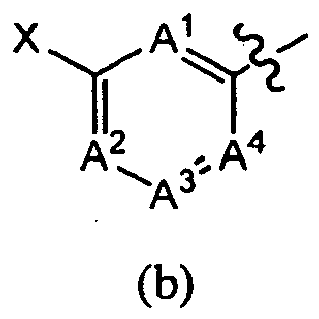
- The compound of claim 8 is N-{2-[2-(3-anilinophenoxy)-1,3-benzothiazol-6-yl]propyl}acetamide or a pharmaceutically acceptable salt, or a combination thereof.
- The compound of claim 1 or a pharmaceutically acceptable salt, or a combination thereof, wherein
Ar1 is formula (c) or (d),
- The compound of claim 10 selected from the group consisting of:N-(2-{2-[(6-methoxy-2-naphthyl)oxy]-1,3-benzothiazol-6-yl}propyl)acetamide; andN-(2-{2-[(7-methoxy-2-naphthyl)oxy]-1,3-benzothiazol-6-yl}propyl)acetamide; or a pharmaceutically acceptable salt, or a combination thereof.
- The compound of claim 1 or a pharmaceutically acceptable salt, or a combination thereof, wherein
Ar1 is unsubstituted phenyl or unsubstituted pyridinyl, each of which is fused to an unsubstituted phenyl or unsubstituted pyridinyl. - The compound of claim 12 selected from the group consisting of:N-{2-[2-(2-naphthyloxy)-1,3-benzothiazol-6-yl]propyl}acetamide;N-{2-[2-(quinolin-3-yloxy)-1,3-benzothiazol-6-yl]propyl}acetamide; andN-{2-[2-(quinolin-6-yloxy)-1,3-benzothiazol-6-yl]propyl}acetamide or a pharmaceutically acceptable salt, or a combination thereof.
- A compound of claim 1 for use in the treatment of a disease selected from insulin resistance-type 2 diabetes, obesity, hypertension and hyperlipidemia by inhibiting ACC wherein ACC is selected from the group consisting of ACC, ACC-1 and ACC-2.
- A compound of claim 1 for treating or preventing a disorder wherein the disorder is selected from the group consisting of metabolic syndrome, type II diabetes and obesity.
- A pharmaceutical composition comprising a therapeutically effective amount of a compound of claim 1 in combination with a pharmaceutically acceptable carrier.
Applications Claiming Priority (2)
| Application Number | Priority Date | Filing Date | Title |
|---|---|---|---|
| US77344006P | 2006-02-15 | 2006-02-15 | |
| PCT/US2007/062179 WO2007095601A2 (en) | 2006-02-15 | 2007-02-15 | Novel acetyl-coa carboxylase (acc) inhibitors and their use in diabetes, obesity and metabolic syndrome |
Publications (2)
| Publication Number | Publication Date |
|---|---|
| EP1996567A2 EP1996567A2 (en) | 2008-12-03 |
| EP1996567B1 true EP1996567B1 (en) | 2013-09-18 |
Family
ID=38293991
Family Applications (1)
| Application Number | Title | Priority Date | Filing Date |
|---|---|---|---|
| EP07757025.7A Active EP1996567B1 (en) | 2006-02-15 | 2007-02-15 | Novel acetyl-coa carboxylase (acc) inhibitors and their use in diabetes, obesity and metabolic syndrome |
Country Status (6)
| Country | Link |
|---|---|
| US (2) | US20070219258A1 (en) |
| EP (1) | EP1996567B1 (en) |
| JP (1) | JP5291471B2 (en) |
| CN (1) | CN101421255A (en) |
| CA (1) | CA2641673A1 (en) |
| WO (1) | WO2007095601A2 (en) |
Families Citing this family (21)
| Publication number | Priority date | Publication date | Assignee | Title |
|---|---|---|---|---|
| CN101384568B (en) * | 2006-02-15 | 2012-12-12 | 雅培制药有限公司 | Acetyl-CoA carboxylase (ACC) inhibitors and their use in diabetes, obesity and metabolic syndrome |
| CN103554095A (en) * | 2006-02-15 | 2014-02-05 | Abbvie公司 | Novel acetyl-coa carboxylase (acc) inhibitors and their use in diabetes, obesity and metabolic syndrome |
| EP2025674A1 (en) | 2007-08-15 | 2009-02-18 | sanofi-aventis | Substituted tetra hydro naphthalines, method for their manufacture and their use as drugs |
| US8759535B2 (en) | 2010-02-18 | 2014-06-24 | High Point Pharmaceuticals, Llc | Substituted fused imidazole derivatives, pharmaceutical compositions, and methods of use thereof |
| ES2679918T3 (en) | 2010-02-18 | 2018-08-31 | Vtv Therapeutics Llc | Substituted condensed imidazole derivatives, pharmaceutical compositions and methods of use thereof |
| CN103025716B (en) * | 2010-04-27 | 2014-12-24 | 武田药品工业株式会社 | Bicyclic compound derivatives and their use as acc inhibitors |
| US8450350B2 (en) | 2010-05-05 | 2013-05-28 | Infinity Pharmaceuticals, Inc. | Triazoles as inhibitors of fatty acid synthase |
| WO2011140190A1 (en) | 2010-05-05 | 2011-11-10 | Infinity Pharmaceuticals | Tetrazolones as inhibitors of fatty acid synthase |
| US8729102B2 (en) * | 2010-11-30 | 2014-05-20 | Takeda Pharmaceutical Company Limited | Bicyclic compound |
| WO2012090219A2 (en) * | 2010-12-31 | 2012-07-05 | Jubilant Biosys Ltd. | Thiazole compounds useful as acetyl-coa carboxylase (acc) inhibitors |
| EP2766349B1 (en) | 2011-03-08 | 2016-06-01 | Sanofi | Oxathiazine derivatives substituted with carbocycles or heterocycles, method for producing same, drugs containing said compounds, and use thereof |
| WO2012120056A1 (en) | 2011-03-08 | 2012-09-13 | Sanofi | Tetrasubstituted oxathiazine derivatives, method for producing them, their use as medicine and drug containing said derivatives and the use thereof |
| EP2683704B1 (en) | 2011-03-08 | 2014-12-17 | Sanofi | Branched oxathiazine derivatives, method for the production thereof, use thereof as medicine and drug containing said derivatives and use thereof |
| US8710050B2 (en) | 2011-03-08 | 2014-04-29 | Sanofi | Di and tri- substituted oxathiazine derivatives, method for the production, method for the production thereof, use thereof as medicine and drug containing said derivatives and use thereof |
| WO2012120054A1 (en) | 2011-03-08 | 2012-09-13 | Sanofi | Di- and tri-substituted oxathiazine derivates, method for the production thereof, use thereof as medicine and drug containing said derivatives and use thereof |
| BR112016004118A2 (en) | 2013-09-12 | 2017-10-17 | Pfizer | use of acetyl-coa carboxylase inhibitors for acne vulgaris treatment |
| JPWO2015056782A1 (en) | 2013-10-17 | 2017-03-09 | 塩野義製薬株式会社 | New alkylene derivatives |
| JP2016079168A (en) | 2014-10-17 | 2016-05-16 | 塩野義製薬株式会社 | 9 membered condensed-ring derivative |
| US10301292B2 (en) | 2014-11-26 | 2019-05-28 | Takeda Pharmaceutical Company Limited | Bicyclic compound |
| WO2016089648A1 (en) | 2014-12-01 | 2016-06-09 | Vtv Therapeutics Llc | Bach 1 inhibitors in combination with nrf2 activators and pharmaceutical compositions thereof |
| EP4434520A4 (en) | 2021-11-19 | 2025-10-29 | Shionogi & Co | MEDICINES FOR THE TREATMENT OF CARDIAC OR SKELETON MUSCLE DISEASES |
Family Cites Families (11)
| Publication number | Priority date | Publication date | Assignee | Title |
|---|---|---|---|---|
| JPH11171848A (en) * | 1997-09-26 | 1999-06-29 | Fujirebio Inc | Aromatic amide derivative |
| SK288236B6 (en) * | 2000-06-28 | 2015-01-07 | Amgen Inc. | Quinolinyl phenyl sulfonamide compound, its use as medicament and pharmaceutical preparation comprising it |
| US20030171399A1 (en) * | 2000-06-28 | 2003-09-11 | Tularik Inc. | Quinolinyl and benzothiazolyl modulators |
| CA2432415A1 (en) * | 2000-12-26 | 2002-07-04 | Research Development Foundation | Acetyl-coenzyme a carboxylase 2 as a target in fat regulation and insulin action |
| JP2005162612A (en) * | 2002-01-09 | 2005-06-23 | Ajinomoto Co Inc | Acylsulfonamide derivative |
| MY139563A (en) * | 2002-09-04 | 2009-10-30 | Bristol Myers Squibb Co | Heterocyclic aromatic compounds useful as growth hormone secretagogues |
| WO2004076409A2 (en) | 2003-02-06 | 2004-09-10 | Sun Pharmaceutical Industries Limited | Regiospecific process for the preparation of 4-[1- (4-cyanophenyl)-1-(1,2,4-triazol-1-yl)methyl]benzonitrile |
| CA2543707A1 (en) | 2003-10-31 | 2005-05-19 | Takeda Pharmaceutical Company Limited | Nitrogen-containing fused heterocyclic compounds |
| US7470712B2 (en) * | 2004-01-21 | 2008-12-30 | Bristol-Myers Squibb Company | Amino-benzazoles as P2Y1 receptor inhibitors |
| SE0400145D0 (en) | 2004-01-27 | 2004-01-27 | Anders Johansson | An arrangement and method for assessing joints |
| WO2005113069A2 (en) * | 2004-05-14 | 2005-12-01 | Research Development Foundation | Use of circumin and analogues as inhibitors of acc2 |
-
2007
- 2007-02-15 EP EP07757025.7A patent/EP1996567B1/en active Active
- 2007-02-15 US US11/675,426 patent/US20070219258A1/en not_active Abandoned
- 2007-02-15 WO PCT/US2007/062179 patent/WO2007095601A2/en not_active Ceased
- 2007-02-15 CN CNA2007800128380A patent/CN101421255A/en active Pending
- 2007-02-15 JP JP2008555482A patent/JP5291471B2/en not_active Expired - Fee Related
- 2007-02-15 CA CA002641673A patent/CA2641673A1/en not_active Abandoned
-
2008
- 2008-10-27 US US12/259,090 patent/US8207350B2/en not_active Expired - Fee Related
Also Published As
| Publication number | Publication date |
|---|---|
| US8207350B2 (en) | 2012-06-26 |
| US20090048298A1 (en) | 2009-02-19 |
| US20070219258A1 (en) | 2007-09-20 |
| CA2641673A1 (en) | 2007-08-23 |
| JP2009526866A (en) | 2009-07-23 |
| CN101421255A (en) | 2009-04-29 |
| WO2007095601A2 (en) | 2007-08-23 |
| JP5291471B2 (en) | 2013-09-18 |
| WO2007095601A3 (en) | 2007-10-04 |
| EP1996567A2 (en) | 2008-12-03 |
Similar Documents
| Publication | Publication Date | Title |
|---|---|---|
| US8207350B2 (en) | Acetyl-CoA carboxylase (ACC) inhibitors and their use in diabetes, obesity and metabolic syndrome | |
| US8735595B2 (en) | Acetyl-CoA carboxylase (ACC) inhibitors and their use in diabetes, obesity and metabolic syndrome | |
| US8748627B2 (en) | Acetyl-CoA carboxylase (ACC) inhibitors and their use in diabetes, obesity and metabolic syndrome | |
| US7928243B2 (en) | Acetyl-CoA carboxylase (ACC) inhibitors and their use in diabetes, obesity and metabolic syndrome | |
| US20100137315A1 (en) | Sphingosine Kinase Inhibitors and Methods of Their Use | |
| JP2008516978A (en) | Production and use of biphenyl-4-yl-carbonylamino acid derivatives for the treatment of obesity | |
| HRP20040810A2 (en) | Thiazole and oxazole derivatives that modulate ppar activity | |
| CN103635458A (en) | Trpv1 antagonists | |
| CA2998034A1 (en) | A group of compounds used for the treatment or prevention of hyperuricemia or gout | |
| AU2015336458A1 (en) | KCNQ2-5 channel activator | |
| CZ323094A3 (en) | Branched amino derivatives of thiazole, process of their preparation and pharmaceutical compositions containing thereof | |
| US20060178400A1 (en) | Novel acetyl-CoA carboxylase (ACC) inhibitors and their use in diabetes, obesity and metabolic syndrome | |
| TW201033214A (en) | 6-(6-NH-substituted triazolopyridazine sulphanyl) benzothiazole and 6-(6-NH-substituted triazolopyridazine sulphanyl) benzimidazole derivatives: preparation, use as medicaments and use as MET inhibitors | |
| JP7814782B2 (en) | Imidazothiazole derivatives, their preparation and use | |
| MX2008010471A (en) | Novel acetyl-coa carboxylase (acc) inhibitors and their use in diabetes, obesity and metabolic syndrome | |
| US20070093504A1 (en) | Salts of Modulators Of PPAR and Methods of Treating Metabolic Disorders | |
| MX2008010469A (en) | Novel acetyl-coa carboxylase (acc) inhibitors and their use in diabetes, obesity and metabolic syndrome | |
| WO2006117743A1 (en) | Substituted aromatic compounds as antidiabetic agents | |
| EP1841748B1 (en) | Organoselenium containing compounds and their use | |
| MX2008010467A (en) | Novel acetyl-coa carboxylase (acc) inhibitors and their use in diabetes, obesity and metabolic syndrome | |
| Yadla | Satish Koppireddi, Jayaram Reddy Komsani, Ashok K. Tiwari b, Amtul Z. Ali b and |
Legal Events
| Date | Code | Title | Description |
|---|---|---|---|
| PUAI | Public reference made under article 153(3) epc to a published international application that has entered the european phase |
Free format text: ORIGINAL CODE: 0009012 |
|
| 17P | Request for examination filed |
Effective date: 20080912 |
|
| AK | Designated contracting states |
Kind code of ref document: A2 Designated state(s): AT BE BG CH CY CZ DE DK EE ES FI FR GB GR HU IE IS IT LI LT LU LV MC NL PL PT RO SE SI SK TR |
|
| AX | Request for extension of the european patent |
Extension state: AL BA HR MK RS |
|
| 17Q | First examination report despatched |
Effective date: 20090819 |
|
| GRAP | Despatch of communication of intention to grant a patent |
Free format text: ORIGINAL CODE: EPIDOSNIGR1 |
|
| INTG | Intention to grant announced |
Effective date: 20130326 |
|
| RAP1 | Party data changed (applicant data changed or rights of an application transferred) |
Owner name: ABBOTT LABORATORIES |
|
| RAP1 | Party data changed (applicant data changed or rights of an application transferred) |
Owner name: ABBVIE INC. |
|
| GRAS | Grant fee paid |
Free format text: ORIGINAL CODE: EPIDOSNIGR3 |
|
| GRAA | (expected) grant |
Free format text: ORIGINAL CODE: 0009210 |
|
| AK | Designated contracting states |
Kind code of ref document: B1 Designated state(s): AT BE BG CH CY CZ DE DK EE ES FI FR GB GR HU IE IS IT LI LT LU LV MC NL PL PT RO SE SI SK TR |
|
| AX | Request for extension of the european patent |
Extension state: AL BA HR MK RS |
|
| REG | Reference to a national code |
Ref country code: GB Ref legal event code: FG4D |
|
| REG | Reference to a national code |
Ref country code: CH Ref legal event code: EP |
|
| REG | Reference to a national code |
Ref country code: IE Ref legal event code: FG4D |
|
| REG | Reference to a national code |
Ref country code: AT Ref legal event code: REF Ref document number: 632712 Country of ref document: AT Kind code of ref document: T Effective date: 20131015 |
|
| REG | Reference to a national code |
Ref country code: DE Ref legal event code: R096 Ref document number: 602007032936 Country of ref document: DE Effective date: 20131114 |
|
| PG25 | Lapsed in a contracting state [announced via postgrant information from national office to epo] |
Ref country code: LT Free format text: LAPSE BECAUSE OF FAILURE TO SUBMIT A TRANSLATION OF THE DESCRIPTION OR TO PAY THE FEE WITHIN THE PRESCRIBED TIME-LIMIT Effective date: 20130918 Ref country code: CY Free format text: LAPSE BECAUSE OF FAILURE TO SUBMIT A TRANSLATION OF THE DESCRIPTION OR TO PAY THE FEE WITHIN THE PRESCRIBED TIME-LIMIT Effective date: 20130619 Ref country code: SE Free format text: LAPSE BECAUSE OF FAILURE TO SUBMIT A TRANSLATION OF THE DESCRIPTION OR TO PAY THE FEE WITHIN THE PRESCRIBED TIME-LIMIT Effective date: 20130918 |
|
| REG | Reference to a national code |
Ref country code: NL Ref legal event code: VDEP Effective date: 20130918 |
|
| REG | Reference to a national code |
Ref country code: AT Ref legal event code: MK05 Ref document number: 632712 Country of ref document: AT Kind code of ref document: T Effective date: 20130918 |
|
| REG | Reference to a national code |
Ref country code: LT Ref legal event code: MG4D |
|
| PG25 | Lapsed in a contracting state [announced via postgrant information from national office to epo] |
Ref country code: LV Free format text: LAPSE BECAUSE OF FAILURE TO SUBMIT A TRANSLATION OF THE DESCRIPTION OR TO PAY THE FEE WITHIN THE PRESCRIBED TIME-LIMIT Effective date: 20130918 Ref country code: FI Free format text: LAPSE BECAUSE OF FAILURE TO SUBMIT A TRANSLATION OF THE DESCRIPTION OR TO PAY THE FEE WITHIN THE PRESCRIBED TIME-LIMIT Effective date: 20130918 Ref country code: ES Free format text: LAPSE BECAUSE OF FAILURE TO SUBMIT A TRANSLATION OF THE DESCRIPTION OR TO PAY THE FEE WITHIN THE PRESCRIBED TIME-LIMIT Effective date: 20130918 Ref country code: GR Free format text: LAPSE BECAUSE OF FAILURE TO SUBMIT A TRANSLATION OF THE DESCRIPTION OR TO PAY THE FEE WITHIN THE PRESCRIBED TIME-LIMIT Effective date: 20131219 Ref country code: SI Free format text: LAPSE BECAUSE OF FAILURE TO SUBMIT A TRANSLATION OF THE DESCRIPTION OR TO PAY THE FEE WITHIN THE PRESCRIBED TIME-LIMIT Effective date: 20130918 |
|
| PG25 | Lapsed in a contracting state [announced via postgrant information from national office to epo] |
Ref country code: BE Free format text: LAPSE BECAUSE OF FAILURE TO SUBMIT A TRANSLATION OF THE DESCRIPTION OR TO PAY THE FEE WITHIN THE PRESCRIBED TIME-LIMIT Effective date: 20130918 Ref country code: CY Free format text: LAPSE BECAUSE OF FAILURE TO SUBMIT A TRANSLATION OF THE DESCRIPTION OR TO PAY THE FEE WITHIN THE PRESCRIBED TIME-LIMIT Effective date: 20130918 |
|
| PG25 | Lapsed in a contracting state [announced via postgrant information from national office to epo] |
Ref country code: EE Free format text: LAPSE BECAUSE OF FAILURE TO SUBMIT A TRANSLATION OF THE DESCRIPTION OR TO PAY THE FEE WITHIN THE PRESCRIBED TIME-LIMIT Effective date: 20130918 Ref country code: NL Free format text: LAPSE BECAUSE OF FAILURE TO SUBMIT A TRANSLATION OF THE DESCRIPTION OR TO PAY THE FEE WITHIN THE PRESCRIBED TIME-LIMIT Effective date: 20130918 Ref country code: SK Free format text: LAPSE BECAUSE OF FAILURE TO SUBMIT A TRANSLATION OF THE DESCRIPTION OR TO PAY THE FEE WITHIN THE PRESCRIBED TIME-LIMIT Effective date: 20130918 Ref country code: RO Free format text: LAPSE BECAUSE OF FAILURE TO SUBMIT A TRANSLATION OF THE DESCRIPTION OR TO PAY THE FEE WITHIN THE PRESCRIBED TIME-LIMIT Effective date: 20130918 Ref country code: IS Free format text: LAPSE BECAUSE OF FAILURE TO SUBMIT A TRANSLATION OF THE DESCRIPTION OR TO PAY THE FEE WITHIN THE PRESCRIBED TIME-LIMIT Effective date: 20140118 Ref country code: CZ Free format text: LAPSE BECAUSE OF FAILURE TO SUBMIT A TRANSLATION OF THE DESCRIPTION OR TO PAY THE FEE WITHIN THE PRESCRIBED TIME-LIMIT Effective date: 20130918 |
|
| PG25 | Lapsed in a contracting state [announced via postgrant information from national office to epo] |
Ref country code: PL Free format text: LAPSE BECAUSE OF FAILURE TO SUBMIT A TRANSLATION OF THE DESCRIPTION OR TO PAY THE FEE WITHIN THE PRESCRIBED TIME-LIMIT Effective date: 20130918 Ref country code: AT Free format text: LAPSE BECAUSE OF FAILURE TO SUBMIT A TRANSLATION OF THE DESCRIPTION OR TO PAY THE FEE WITHIN THE PRESCRIBED TIME-LIMIT Effective date: 20130918 |
|
| REG | Reference to a national code |
Ref country code: DE Ref legal event code: R097 Ref document number: 602007032936 Country of ref document: DE |
|
| PG25 | Lapsed in a contracting state [announced via postgrant information from national office to epo] |
Ref country code: PT Free format text: LAPSE BECAUSE OF FAILURE TO SUBMIT A TRANSLATION OF THE DESCRIPTION OR TO PAY THE FEE WITHIN THE PRESCRIBED TIME-LIMIT Effective date: 20140120 |
|
| PLBE | No opposition filed within time limit |
Free format text: ORIGINAL CODE: 0009261 |
|
| STAA | Information on the status of an ep patent application or granted ep patent |
Free format text: STATUS: NO OPPOSITION FILED WITHIN TIME LIMIT |
|
| 26N | No opposition filed |
Effective date: 20140619 |
|
| PG25 | Lapsed in a contracting state [announced via postgrant information from national office to epo] |
Ref country code: IT Free format text: LAPSE BECAUSE OF FAILURE TO SUBMIT A TRANSLATION OF THE DESCRIPTION OR TO PAY THE FEE WITHIN THE PRESCRIBED TIME-LIMIT Effective date: 20130918 |
|
| REG | Reference to a national code |
Ref country code: DE Ref legal event code: R119 Ref document number: 602007032936 Country of ref document: DE |
|
| PG25 | Lapsed in a contracting state [announced via postgrant information from national office to epo] |
Ref country code: LU Free format text: LAPSE BECAUSE OF FAILURE TO SUBMIT A TRANSLATION OF THE DESCRIPTION OR TO PAY THE FEE WITHIN THE PRESCRIBED TIME-LIMIT Effective date: 20140215 Ref country code: MC Free format text: LAPSE BECAUSE OF FAILURE TO SUBMIT A TRANSLATION OF THE DESCRIPTION OR TO PAY THE FEE WITHIN THE PRESCRIBED TIME-LIMIT Effective date: 20130918 Ref country code: DK Free format text: LAPSE BECAUSE OF FAILURE TO SUBMIT A TRANSLATION OF THE DESCRIPTION OR TO PAY THE FEE WITHIN THE PRESCRIBED TIME-LIMIT Effective date: 20130918 |
|
| REG | Reference to a national code |
Ref country code: CH Ref legal event code: PL |
|
| REG | Reference to a national code |
Ref country code: DE Ref legal event code: R097 Ref document number: 602007032936 Country of ref document: DE Effective date: 20140619 |
|
| GBPC | Gb: european patent ceased through non-payment of renewal fee |
Effective date: 20140215 |
|
| PG25 | Lapsed in a contracting state [announced via postgrant information from national office to epo] |
Ref country code: CH Free format text: LAPSE BECAUSE OF NON-PAYMENT OF DUE FEES Effective date: 20140228 Ref country code: LI Free format text: LAPSE BECAUSE OF NON-PAYMENT OF DUE FEES Effective date: 20140228 |
|
| REG | Reference to a national code |
Ref country code: FR Ref legal event code: ST Effective date: 20141031 |
|
| REG | Reference to a national code |
Ref country code: DE Ref legal event code: R119 Ref document number: 602007032936 Country of ref document: DE Effective date: 20140902 |
|
| REG | Reference to a national code |
Ref country code: IE Ref legal event code: MM4A |
|
| PG25 | Lapsed in a contracting state [announced via postgrant information from national office to epo] |
Ref country code: DE Free format text: LAPSE BECAUSE OF NON-PAYMENT OF DUE FEES Effective date: 20140902 Ref country code: GB Free format text: LAPSE BECAUSE OF NON-PAYMENT OF DUE FEES Effective date: 20140215 Ref country code: FR Free format text: LAPSE BECAUSE OF NON-PAYMENT OF DUE FEES Effective date: 20140228 Ref country code: IE Free format text: LAPSE BECAUSE OF NON-PAYMENT OF DUE FEES Effective date: 20140215 |
|
| PG25 | Lapsed in a contracting state [announced via postgrant information from national office to epo] |
Ref country code: BG Free format text: LAPSE BECAUSE OF FAILURE TO SUBMIT A TRANSLATION OF THE DESCRIPTION OR TO PAY THE FEE WITHIN THE PRESCRIBED TIME-LIMIT Effective date: 20130918 |
|
| PG25 | Lapsed in a contracting state [announced via postgrant information from national office to epo] |
Ref country code: TR Free format text: LAPSE BECAUSE OF FAILURE TO SUBMIT A TRANSLATION OF THE DESCRIPTION OR TO PAY THE FEE WITHIN THE PRESCRIBED TIME-LIMIT Effective date: 20130918 Ref country code: HU Free format text: LAPSE BECAUSE OF FAILURE TO SUBMIT A TRANSLATION OF THE DESCRIPTION OR TO PAY THE FEE WITHIN THE PRESCRIBED TIME-LIMIT; INVALID AB INITIO Effective date: 20070215 |