EP1996180B1 - Benzamide and pyridylamide derivatives as antibacterial agents - Google Patents
Benzamide and pyridylamide derivatives as antibacterial agents Download PDFInfo
- Publication number
- EP1996180B1 EP1996180B1 EP07712942A EP07712942A EP1996180B1 EP 1996180 B1 EP1996180 B1 EP 1996180B1 EP 07712942 A EP07712942 A EP 07712942A EP 07712942 A EP07712942 A EP 07712942A EP 1996180 B1 EP1996180 B1 EP 1996180B1
- Authority
- EP
- European Patent Office
- Prior art keywords
- mmol
- reaction mixture
- phenyl
- added
- compound
- Prior art date
- Legal status (The legal status is an assumption and is not a legal conclusion. Google has not performed a legal analysis and makes no representation as to the accuracy of the status listed.)
- Active
Links
- 0 Cc1nc2cc(*)ccc2cc1 Chemical compound Cc1nc2cc(*)ccc2cc1 0.000 description 5
- JFJWSTUZCXXARQ-UHFFFAOYSA-N BrCc1nc(cc(cc2)Oc3ccccc3)c2[s]1 Chemical compound BrCc1nc(cc(cc2)Oc3ccccc3)c2[s]1 JFJWSTUZCXXARQ-UHFFFAOYSA-N 0.000 description 1
- JYTZLNKGLKALQE-UHFFFAOYSA-N CC(C)(C)OC(Nc(cc1)ccc1-c1n[o]c(CCl)n1)=O Chemical compound CC(C)(C)OC(Nc(cc1)ccc1-c1n[o]c(CCl)n1)=O JYTZLNKGLKALQE-UHFFFAOYSA-N 0.000 description 1
- OEFAZKNDHZVHMY-UHFFFAOYSA-N CCCc1c(-c(cc2)ccc2OC)nc(COc(ccc(F)c2C(N)=O)c2F)[s]1 Chemical compound CCCc1c(-c(cc2)ccc2OC)nc(COc(ccc(F)c2C(N)=O)c2F)[s]1 OEFAZKNDHZVHMY-UHFFFAOYSA-N 0.000 description 1
- GSXBEHIPXIEOFU-UHFFFAOYSA-N COc(cc1)cc2c1nc(COc(ccc(F)c1C(N)=O)c1F)[s]2 Chemical compound COc(cc1)cc2c1nc(COc(ccc(F)c1C(N)=O)c1F)[s]2 GSXBEHIPXIEOFU-UHFFFAOYSA-N 0.000 description 1
- QDFQWUCTXVZWKA-UHFFFAOYSA-N COc(cc1)ccc1-c1c(CC=C)[s]c(COc(ccc([F]C)c2C(N)=O)c2F)n1 Chemical compound COc(cc1)ccc1-c1c(CC=C)[s]c(COc(ccc([F]C)c2C(N)=O)c2F)n1 QDFQWUCTXVZWKA-UHFFFAOYSA-N 0.000 description 1
- UYAILRZXWIGDFN-UHFFFAOYSA-N ClCc1nc(-c2ncc[s]2)n[o]1 Chemical compound ClCc1nc(-c2ncc[s]2)n[o]1 UYAILRZXWIGDFN-UHFFFAOYSA-N 0.000 description 1
- DKQHFSFEYNHTEN-UHFFFAOYSA-N NC(c(c(F)c(cc1)OCc2nc(-c(cc3)ccc3O)n[o]2)c1F)=O Chemical compound NC(c(c(F)c(cc1)OCc2nc(-c(cc3)ccc3O)n[o]2)c1F)=O DKQHFSFEYNHTEN-UHFFFAOYSA-N 0.000 description 1
- DANPCURGBGOWJD-UHFFFAOYSA-N NC(c(c(F)c(cc1)OCc2nc3cc(Oc4ccccc4)ccc3[s]2)c1F)=O Chemical compound NC(c(c(F)c(cc1)OCc2nc3cc(Oc4ccccc4)ccc3[s]2)c1F)=O DANPCURGBGOWJD-UHFFFAOYSA-N 0.000 description 1
- RTJWWBNNLIQONV-UHFFFAOYSA-N NC(c(c(F)ccc1O)c1Cl)=O Chemical compound NC(c(c(F)ccc1O)c1Cl)=O RTJWWBNNLIQONV-UHFFFAOYSA-N 0.000 description 1
- LZWPEXZPLYSCEG-UHFFFAOYSA-N NC(c(cccc1O)c1F)=O Chemical compound NC(c(cccc1O)c1F)=O LZWPEXZPLYSCEG-UHFFFAOYSA-N 0.000 description 1
- DNHUMXQOSODLHM-UHFFFAOYSA-N NC(c1cccc(OCCCCCCCBr)c1)=O Chemical compound NC(c1cccc(OCCCCCCCBr)c1)=O DNHUMXQOSODLHM-UHFFFAOYSA-N 0.000 description 1
- VNAXUEKNOUWSGU-UHFFFAOYSA-N O=CNc(cc1)ccc1Oc1ccccc1 Chemical compound O=CNc(cc1)ccc1Oc1ccccc1 VNAXUEKNOUWSGU-UHFFFAOYSA-N 0.000 description 1
Classifications
-
- C—CHEMISTRY; METALLURGY
- C07—ORGANIC CHEMISTRY
- C07C—ACYCLIC OR CARBOCYCLIC COMPOUNDS
- C07C235/00—Carboxylic acid amides, the carbon skeleton of the acid part being further substituted by oxygen atoms
- C07C235/42—Carboxylic acid amides, the carbon skeleton of the acid part being further substituted by oxygen atoms having carbon atoms of carboxamide groups bound to carbon atoms of six-membered aromatic rings and singly-bound oxygen atoms bound to the same carbon skeleton
- C07C235/44—Carboxylic acid amides, the carbon skeleton of the acid part being further substituted by oxygen atoms having carbon atoms of carboxamide groups bound to carbon atoms of six-membered aromatic rings and singly-bound oxygen atoms bound to the same carbon skeleton with carbon atoms of carboxamide groups and singly-bound oxygen atoms bound to carbon atoms of the same non-condensed six-membered aromatic ring
- C07C235/46—Carboxylic acid amides, the carbon skeleton of the acid part being further substituted by oxygen atoms having carbon atoms of carboxamide groups bound to carbon atoms of six-membered aromatic rings and singly-bound oxygen atoms bound to the same carbon skeleton with carbon atoms of carboxamide groups and singly-bound oxygen atoms bound to carbon atoms of the same non-condensed six-membered aromatic ring having the nitrogen atoms of the carboxamide groups bound to hydrogen atoms or to acyclic carbon atoms
-
- A—HUMAN NECESSITIES
- A01—AGRICULTURE; FORESTRY; ANIMAL HUSBANDRY; HUNTING; TRAPPING; FISHING
- A01N—PRESERVATION OF BODIES OF HUMANS OR ANIMALS OR PLANTS OR PARTS THEREOF; BIOCIDES, e.g. AS DISINFECTANTS, AS PESTICIDES OR AS HERBICIDES; PEST REPELLANTS OR ATTRACTANTS; PLANT GROWTH REGULATORS
- A01N37/00—Biocides, pest repellants or attractants, or plant growth regulators containing organic compounds containing a carbon atom having three bonds to hetero atoms with at the most two bonds to halogen, e.g. carboxylic acids
- A01N37/36—Biocides, pest repellants or attractants, or plant growth regulators containing organic compounds containing a carbon atom having three bonds to hetero atoms with at the most two bonds to halogen, e.g. carboxylic acids containing at least one carboxylic group or a thio analogue, or a derivative thereof, and a singly bound oxygen or sulfur atom attached to the same carbon skeleton, this oxygen or sulfur atom not being a member of a carboxylic group or of a thio analogue, or of a derivative thereof, e.g. hydroxy-carboxylic acids
- A01N37/38—Biocides, pest repellants or attractants, or plant growth regulators containing organic compounds containing a carbon atom having three bonds to hetero atoms with at the most two bonds to halogen, e.g. carboxylic acids containing at least one carboxylic group or a thio analogue, or a derivative thereof, and a singly bound oxygen or sulfur atom attached to the same carbon skeleton, this oxygen or sulfur atom not being a member of a carboxylic group or of a thio analogue, or of a derivative thereof, e.g. hydroxy-carboxylic acids having at least one oxygen or sulfur atom attached to an aromatic ring system
- A01N37/40—Biocides, pest repellants or attractants, or plant growth regulators containing organic compounds containing a carbon atom having three bonds to hetero atoms with at the most two bonds to halogen, e.g. carboxylic acids containing at least one carboxylic group or a thio analogue, or a derivative thereof, and a singly bound oxygen or sulfur atom attached to the same carbon skeleton, this oxygen or sulfur atom not being a member of a carboxylic group or of a thio analogue, or of a derivative thereof, e.g. hydroxy-carboxylic acids having at least one oxygen or sulfur atom attached to an aromatic ring system having at least one carboxylic group or a thio analogue, or a derivative thereof, and one oxygen or sulfur atom attached to the same aromatic ring system
-
- A—HUMAN NECESSITIES
- A01—AGRICULTURE; FORESTRY; ANIMAL HUSBANDRY; HUNTING; TRAPPING; FISHING
- A01N—PRESERVATION OF BODIES OF HUMANS OR ANIMALS OR PLANTS OR PARTS THEREOF; BIOCIDES, e.g. AS DISINFECTANTS, AS PESTICIDES OR AS HERBICIDES; PEST REPELLANTS OR ATTRACTANTS; PLANT GROWTH REGULATORS
- A01N41/00—Biocides, pest repellants or attractants, or plant growth regulators containing organic compounds containing a sulfur atom bound to a hetero atom
- A01N41/02—Biocides, pest repellants or attractants, or plant growth regulators containing organic compounds containing a sulfur atom bound to a hetero atom containing a sulfur-to-oxygen double bond
- A01N41/04—Sulfonic acids; Derivatives thereof
-
- A—HUMAN NECESSITIES
- A01—AGRICULTURE; FORESTRY; ANIMAL HUSBANDRY; HUNTING; TRAPPING; FISHING
- A01N—PRESERVATION OF BODIES OF HUMANS OR ANIMALS OR PLANTS OR PARTS THEREOF; BIOCIDES, e.g. AS DISINFECTANTS, AS PESTICIDES OR AS HERBICIDES; PEST REPELLANTS OR ATTRACTANTS; PLANT GROWTH REGULATORS
- A01N43/00—Biocides, pest repellants or attractants, or plant growth regulators containing heterocyclic compounds
- A01N43/02—Biocides, pest repellants or attractants, or plant growth regulators containing heterocyclic compounds having rings with one or more oxygen or sulfur atoms as the only ring hetero atoms
- A01N43/04—Biocides, pest repellants or attractants, or plant growth regulators containing heterocyclic compounds having rings with one or more oxygen or sulfur atoms as the only ring hetero atoms with one hetero atom
- A01N43/06—Biocides, pest repellants or attractants, or plant growth regulators containing heterocyclic compounds having rings with one or more oxygen or sulfur atoms as the only ring hetero atoms with one hetero atom five-membered rings
- A01N43/08—Biocides, pest repellants or attractants, or plant growth regulators containing heterocyclic compounds having rings with one or more oxygen or sulfur atoms as the only ring hetero atoms with one hetero atom five-membered rings with oxygen as the ring hetero atom
-
- A—HUMAN NECESSITIES
- A01—AGRICULTURE; FORESTRY; ANIMAL HUSBANDRY; HUNTING; TRAPPING; FISHING
- A01N—PRESERVATION OF BODIES OF HUMANS OR ANIMALS OR PLANTS OR PARTS THEREOF; BIOCIDES, e.g. AS DISINFECTANTS, AS PESTICIDES OR AS HERBICIDES; PEST REPELLANTS OR ATTRACTANTS; PLANT GROWTH REGULATORS
- A01N43/00—Biocides, pest repellants or attractants, or plant growth regulators containing heterocyclic compounds
- A01N43/02—Biocides, pest repellants or attractants, or plant growth regulators containing heterocyclic compounds having rings with one or more oxygen or sulfur atoms as the only ring hetero atoms
- A01N43/04—Biocides, pest repellants or attractants, or plant growth regulators containing heterocyclic compounds having rings with one or more oxygen or sulfur atoms as the only ring hetero atoms with one hetero atom
- A01N43/06—Biocides, pest repellants or attractants, or plant growth regulators containing heterocyclic compounds having rings with one or more oxygen or sulfur atoms as the only ring hetero atoms with one hetero atom five-membered rings
- A01N43/10—Biocides, pest repellants or attractants, or plant growth regulators containing heterocyclic compounds having rings with one or more oxygen or sulfur atoms as the only ring hetero atoms with one hetero atom five-membered rings with sulfur as the ring hetero atom
-
- A—HUMAN NECESSITIES
- A01—AGRICULTURE; FORESTRY; ANIMAL HUSBANDRY; HUNTING; TRAPPING; FISHING
- A01N—PRESERVATION OF BODIES OF HUMANS OR ANIMALS OR PLANTS OR PARTS THEREOF; BIOCIDES, e.g. AS DISINFECTANTS, AS PESTICIDES OR AS HERBICIDES; PEST REPELLANTS OR ATTRACTANTS; PLANT GROWTH REGULATORS
- A01N43/00—Biocides, pest repellants or attractants, or plant growth regulators containing heterocyclic compounds
- A01N43/34—Biocides, pest repellants or attractants, or plant growth regulators containing heterocyclic compounds having rings with one nitrogen atom as the only ring hetero atom
- A01N43/40—Biocides, pest repellants or attractants, or plant growth regulators containing heterocyclic compounds having rings with one nitrogen atom as the only ring hetero atom six-membered rings
-
- A—HUMAN NECESSITIES
- A01—AGRICULTURE; FORESTRY; ANIMAL HUSBANDRY; HUNTING; TRAPPING; FISHING
- A01N—PRESERVATION OF BODIES OF HUMANS OR ANIMALS OR PLANTS OR PARTS THEREOF; BIOCIDES, e.g. AS DISINFECTANTS, AS PESTICIDES OR AS HERBICIDES; PEST REPELLANTS OR ATTRACTANTS; PLANT GROWTH REGULATORS
- A01N43/00—Biocides, pest repellants or attractants, or plant growth regulators containing heterocyclic compounds
- A01N43/34—Biocides, pest repellants or attractants, or plant growth regulators containing heterocyclic compounds having rings with one nitrogen atom as the only ring hetero atom
- A01N43/40—Biocides, pest repellants or attractants, or plant growth regulators containing heterocyclic compounds having rings with one nitrogen atom as the only ring hetero atom six-membered rings
- A01N43/42—Biocides, pest repellants or attractants, or plant growth regulators containing heterocyclic compounds having rings with one nitrogen atom as the only ring hetero atom six-membered rings condensed with carbocyclic rings
-
- A—HUMAN NECESSITIES
- A01—AGRICULTURE; FORESTRY; ANIMAL HUSBANDRY; HUNTING; TRAPPING; FISHING
- A01N—PRESERVATION OF BODIES OF HUMANS OR ANIMALS OR PLANTS OR PARTS THEREOF; BIOCIDES, e.g. AS DISINFECTANTS, AS PESTICIDES OR AS HERBICIDES; PEST REPELLANTS OR ATTRACTANTS; PLANT GROWTH REGULATORS
- A01N43/00—Biocides, pest repellants or attractants, or plant growth regulators containing heterocyclic compounds
- A01N43/72—Biocides, pest repellants or attractants, or plant growth regulators containing heterocyclic compounds having rings with nitrogen atoms and oxygen or sulfur atoms as ring hetero atoms
- A01N43/74—Biocides, pest repellants or attractants, or plant growth regulators containing heterocyclic compounds having rings with nitrogen atoms and oxygen or sulfur atoms as ring hetero atoms five-membered rings with one nitrogen atom and either one oxygen atom or one sulfur atom in positions 1,3
- A01N43/76—1,3-Oxazoles; Hydrogenated 1,3-oxazoles
-
- A—HUMAN NECESSITIES
- A01—AGRICULTURE; FORESTRY; ANIMAL HUSBANDRY; HUNTING; TRAPPING; FISHING
- A01N—PRESERVATION OF BODIES OF HUMANS OR ANIMALS OR PLANTS OR PARTS THEREOF; BIOCIDES, e.g. AS DISINFECTANTS, AS PESTICIDES OR AS HERBICIDES; PEST REPELLANTS OR ATTRACTANTS; PLANT GROWTH REGULATORS
- A01N43/00—Biocides, pest repellants or attractants, or plant growth regulators containing heterocyclic compounds
- A01N43/72—Biocides, pest repellants or attractants, or plant growth regulators containing heterocyclic compounds having rings with nitrogen atoms and oxygen or sulfur atoms as ring hetero atoms
- A01N43/74—Biocides, pest repellants or attractants, or plant growth regulators containing heterocyclic compounds having rings with nitrogen atoms and oxygen or sulfur atoms as ring hetero atoms five-membered rings with one nitrogen atom and either one oxygen atom or one sulfur atom in positions 1,3
- A01N43/78—1,3-Thiazoles; Hydrogenated 1,3-thiazoles
-
- A—HUMAN NECESSITIES
- A01—AGRICULTURE; FORESTRY; ANIMAL HUSBANDRY; HUNTING; TRAPPING; FISHING
- A01N—PRESERVATION OF BODIES OF HUMANS OR ANIMALS OR PLANTS OR PARTS THEREOF; BIOCIDES, e.g. AS DISINFECTANTS, AS PESTICIDES OR AS HERBICIDES; PEST REPELLANTS OR ATTRACTANTS; PLANT GROWTH REGULATORS
- A01N43/00—Biocides, pest repellants or attractants, or plant growth regulators containing heterocyclic compounds
- A01N43/72—Biocides, pest repellants or attractants, or plant growth regulators containing heterocyclic compounds having rings with nitrogen atoms and oxygen or sulfur atoms as ring hetero atoms
- A01N43/82—Biocides, pest repellants or attractants, or plant growth regulators containing heterocyclic compounds having rings with nitrogen atoms and oxygen or sulfur atoms as ring hetero atoms five-membered rings with three ring hetero atoms
-
- A—HUMAN NECESSITIES
- A01—AGRICULTURE; FORESTRY; ANIMAL HUSBANDRY; HUNTING; TRAPPING; FISHING
- A01N—PRESERVATION OF BODIES OF HUMANS OR ANIMALS OR PLANTS OR PARTS THEREOF; BIOCIDES, e.g. AS DISINFECTANTS, AS PESTICIDES OR AS HERBICIDES; PEST REPELLANTS OR ATTRACTANTS; PLANT GROWTH REGULATORS
- A01N43/00—Biocides, pest repellants or attractants, or plant growth regulators containing heterocyclic compounds
- A01N43/90—Biocides, pest repellants or attractants, or plant growth regulators containing heterocyclic compounds having two or more relevant hetero rings, condensed among themselves or with a common carbocyclic ring system
-
- A—HUMAN NECESSITIES
- A61—MEDICAL OR VETERINARY SCIENCE; HYGIENE
- A61K—PREPARATIONS FOR MEDICAL, DENTAL OR TOILETRY PURPOSES
- A61K31/00—Medicinal preparations containing organic active ingredients
- A61K31/16—Amides, e.g. hydroxamic acids
- A61K31/165—Amides, e.g. hydroxamic acids having aromatic rings, e.g. colchicine, atenolol, progabide
- A61K31/166—Amides, e.g. hydroxamic acids having aromatic rings, e.g. colchicine, atenolol, progabide having the carbon of a carboxamide group directly attached to the aromatic ring, e.g. procainamide, procarbazine, metoclopramide, labetalol
-
- A—HUMAN NECESSITIES
- A61—MEDICAL OR VETERINARY SCIENCE; HYGIENE
- A61K—PREPARATIONS FOR MEDICAL, DENTAL OR TOILETRY PURPOSES
- A61K31/00—Medicinal preparations containing organic active ingredients
- A61K31/33—Heterocyclic compounds
- A61K31/335—Heterocyclic compounds having oxygen as the only ring hetero atom, e.g. fungichromin
- A61K31/34—Heterocyclic compounds having oxygen as the only ring hetero atom, e.g. fungichromin having five-membered rings with one oxygen as the only ring hetero atom, e.g. isosorbide
- A61K31/341—Heterocyclic compounds having oxygen as the only ring hetero atom, e.g. fungichromin having five-membered rings with one oxygen as the only ring hetero atom, e.g. isosorbide not condensed with another ring, e.g. ranitidine, furosemide, bufetolol, muscarine
-
- A—HUMAN NECESSITIES
- A61—MEDICAL OR VETERINARY SCIENCE; HYGIENE
- A61K—PREPARATIONS FOR MEDICAL, DENTAL OR TOILETRY PURPOSES
- A61K31/00—Medicinal preparations containing organic active ingredients
- A61K31/33—Heterocyclic compounds
- A61K31/335—Heterocyclic compounds having oxygen as the only ring hetero atom, e.g. fungichromin
- A61K31/34—Heterocyclic compounds having oxygen as the only ring hetero atom, e.g. fungichromin having five-membered rings with one oxygen as the only ring hetero atom, e.g. isosorbide
- A61K31/343—Heterocyclic compounds having oxygen as the only ring hetero atom, e.g. fungichromin having five-membered rings with one oxygen as the only ring hetero atom, e.g. isosorbide condensed with a carbocyclic ring, e.g. coumaran, bufuralol, befunolol, clobenfurol, amiodarone
-
- A—HUMAN NECESSITIES
- A61—MEDICAL OR VETERINARY SCIENCE; HYGIENE
- A61K—PREPARATIONS FOR MEDICAL, DENTAL OR TOILETRY PURPOSES
- A61K31/00—Medicinal preparations containing organic active ingredients
- A61K31/33—Heterocyclic compounds
- A61K31/38—Heterocyclic compounds having sulfur as a ring hetero atom
- A61K31/381—Heterocyclic compounds having sulfur as a ring hetero atom having five-membered rings
-
- A—HUMAN NECESSITIES
- A61—MEDICAL OR VETERINARY SCIENCE; HYGIENE
- A61K—PREPARATIONS FOR MEDICAL, DENTAL OR TOILETRY PURPOSES
- A61K31/00—Medicinal preparations containing organic active ingredients
- A61K31/33—Heterocyclic compounds
- A61K31/395—Heterocyclic compounds having nitrogen as a ring hetero atom, e.g. guanethidine or rifamycins
- A61K31/40—Heterocyclic compounds having nitrogen as a ring hetero atom, e.g. guanethidine or rifamycins having five-membered rings with one nitrogen as the only ring hetero atom, e.g. sulpiride, succinimide, tolmetin, buflomedil
- A61K31/4025—Heterocyclic compounds having nitrogen as a ring hetero atom, e.g. guanethidine or rifamycins having five-membered rings with one nitrogen as the only ring hetero atom, e.g. sulpiride, succinimide, tolmetin, buflomedil not condensed and containing further heterocyclic rings, e.g. cromakalim
-
- A—HUMAN NECESSITIES
- A61—MEDICAL OR VETERINARY SCIENCE; HYGIENE
- A61K—PREPARATIONS FOR MEDICAL, DENTAL OR TOILETRY PURPOSES
- A61K31/00—Medicinal preparations containing organic active ingredients
- A61K31/33—Heterocyclic compounds
- A61K31/395—Heterocyclic compounds having nitrogen as a ring hetero atom, e.g. guanethidine or rifamycins
- A61K31/41—Heterocyclic compounds having nitrogen as a ring hetero atom, e.g. guanethidine or rifamycins having five-membered rings with two or more ring hetero atoms, at least one of which being nitrogen, e.g. tetrazole
- A61K31/415—1,2-Diazoles
- A61K31/4155—1,2-Diazoles non condensed and containing further heterocyclic rings
-
- A—HUMAN NECESSITIES
- A61—MEDICAL OR VETERINARY SCIENCE; HYGIENE
- A61K—PREPARATIONS FOR MEDICAL, DENTAL OR TOILETRY PURPOSES
- A61K31/00—Medicinal preparations containing organic active ingredients
- A61K31/33—Heterocyclic compounds
- A61K31/395—Heterocyclic compounds having nitrogen as a ring hetero atom, e.g. guanethidine or rifamycins
- A61K31/41—Heterocyclic compounds having nitrogen as a ring hetero atom, e.g. guanethidine or rifamycins having five-membered rings with two or more ring hetero atoms, at least one of which being nitrogen, e.g. tetrazole
- A61K31/4164—1,3-Diazoles
- A61K31/4178—1,3-Diazoles not condensed 1,3-diazoles and containing further heterocyclic rings, e.g. pilocarpine, nitrofurantoin
-
- A—HUMAN NECESSITIES
- A61—MEDICAL OR VETERINARY SCIENCE; HYGIENE
- A61K—PREPARATIONS FOR MEDICAL, DENTAL OR TOILETRY PURPOSES
- A61K31/00—Medicinal preparations containing organic active ingredients
- A61K31/33—Heterocyclic compounds
- A61K31/395—Heterocyclic compounds having nitrogen as a ring hetero atom, e.g. guanethidine or rifamycins
- A61K31/41—Heterocyclic compounds having nitrogen as a ring hetero atom, e.g. guanethidine or rifamycins having five-membered rings with two or more ring hetero atoms, at least one of which being nitrogen, e.g. tetrazole
- A61K31/4164—1,3-Diazoles
- A61K31/4184—1,3-Diazoles condensed with carbocyclic rings, e.g. benzimidazoles
-
- A—HUMAN NECESSITIES
- A61—MEDICAL OR VETERINARY SCIENCE; HYGIENE
- A61K—PREPARATIONS FOR MEDICAL, DENTAL OR TOILETRY PURPOSES
- A61K31/00—Medicinal preparations containing organic active ingredients
- A61K31/33—Heterocyclic compounds
- A61K31/395—Heterocyclic compounds having nitrogen as a ring hetero atom, e.g. guanethidine or rifamycins
- A61K31/41—Heterocyclic compounds having nitrogen as a ring hetero atom, e.g. guanethidine or rifamycins having five-membered rings with two or more ring hetero atoms, at least one of which being nitrogen, e.g. tetrazole
- A61K31/4192—1,2,3-Triazoles
-
- A—HUMAN NECESSITIES
- A61—MEDICAL OR VETERINARY SCIENCE; HYGIENE
- A61K—PREPARATIONS FOR MEDICAL, DENTAL OR TOILETRY PURPOSES
- A61K31/00—Medicinal preparations containing organic active ingredients
- A61K31/33—Heterocyclic compounds
- A61K31/395—Heterocyclic compounds having nitrogen as a ring hetero atom, e.g. guanethidine or rifamycins
- A61K31/41—Heterocyclic compounds having nitrogen as a ring hetero atom, e.g. guanethidine or rifamycins having five-membered rings with two or more ring hetero atoms, at least one of which being nitrogen, e.g. tetrazole
- A61K31/4196—1,2,4-Triazoles
-
- A—HUMAN NECESSITIES
- A61—MEDICAL OR VETERINARY SCIENCE; HYGIENE
- A61K—PREPARATIONS FOR MEDICAL, DENTAL OR TOILETRY PURPOSES
- A61K31/00—Medicinal preparations containing organic active ingredients
- A61K31/33—Heterocyclic compounds
- A61K31/395—Heterocyclic compounds having nitrogen as a ring hetero atom, e.g. guanethidine or rifamycins
- A61K31/41—Heterocyclic compounds having nitrogen as a ring hetero atom, e.g. guanethidine or rifamycins having five-membered rings with two or more ring hetero atoms, at least one of which being nitrogen, e.g. tetrazole
- A61K31/42—Oxazoles
- A61K31/422—Oxazoles not condensed and containing further heterocyclic rings
-
- A—HUMAN NECESSITIES
- A61—MEDICAL OR VETERINARY SCIENCE; HYGIENE
- A61K—PREPARATIONS FOR MEDICAL, DENTAL OR TOILETRY PURPOSES
- A61K31/00—Medicinal preparations containing organic active ingredients
- A61K31/33—Heterocyclic compounds
- A61K31/395—Heterocyclic compounds having nitrogen as a ring hetero atom, e.g. guanethidine or rifamycins
- A61K31/41—Heterocyclic compounds having nitrogen as a ring hetero atom, e.g. guanethidine or rifamycins having five-membered rings with two or more ring hetero atoms, at least one of which being nitrogen, e.g. tetrazole
- A61K31/42—Oxazoles
- A61K31/423—Oxazoles condensed with carbocyclic rings
-
- A—HUMAN NECESSITIES
- A61—MEDICAL OR VETERINARY SCIENCE; HYGIENE
- A61K—PREPARATIONS FOR MEDICAL, DENTAL OR TOILETRY PURPOSES
- A61K31/00—Medicinal preparations containing organic active ingredients
- A61K31/33—Heterocyclic compounds
- A61K31/395—Heterocyclic compounds having nitrogen as a ring hetero atom, e.g. guanethidine or rifamycins
- A61K31/41—Heterocyclic compounds having nitrogen as a ring hetero atom, e.g. guanethidine or rifamycins having five-membered rings with two or more ring hetero atoms, at least one of which being nitrogen, e.g. tetrazole
- A61K31/4245—Oxadiazoles
-
- A—HUMAN NECESSITIES
- A61—MEDICAL OR VETERINARY SCIENCE; HYGIENE
- A61K—PREPARATIONS FOR MEDICAL, DENTAL OR TOILETRY PURPOSES
- A61K31/00—Medicinal preparations containing organic active ingredients
- A61K31/33—Heterocyclic compounds
- A61K31/395—Heterocyclic compounds having nitrogen as a ring hetero atom, e.g. guanethidine or rifamycins
- A61K31/41—Heterocyclic compounds having nitrogen as a ring hetero atom, e.g. guanethidine or rifamycins having five-membered rings with two or more ring hetero atoms, at least one of which being nitrogen, e.g. tetrazole
- A61K31/425—Thiazoles
- A61K31/427—Thiazoles not condensed and containing further heterocyclic rings
-
- A—HUMAN NECESSITIES
- A61—MEDICAL OR VETERINARY SCIENCE; HYGIENE
- A61K—PREPARATIONS FOR MEDICAL, DENTAL OR TOILETRY PURPOSES
- A61K31/00—Medicinal preparations containing organic active ingredients
- A61K31/33—Heterocyclic compounds
- A61K31/395—Heterocyclic compounds having nitrogen as a ring hetero atom, e.g. guanethidine or rifamycins
- A61K31/41—Heterocyclic compounds having nitrogen as a ring hetero atom, e.g. guanethidine or rifamycins having five-membered rings with two or more ring hetero atoms, at least one of which being nitrogen, e.g. tetrazole
- A61K31/425—Thiazoles
- A61K31/428—Thiazoles condensed with carbocyclic rings
-
- A—HUMAN NECESSITIES
- A61—MEDICAL OR VETERINARY SCIENCE; HYGIENE
- A61K—PREPARATIONS FOR MEDICAL, DENTAL OR TOILETRY PURPOSES
- A61K31/00—Medicinal preparations containing organic active ingredients
- A61K31/33—Heterocyclic compounds
- A61K31/395—Heterocyclic compounds having nitrogen as a ring hetero atom, e.g. guanethidine or rifamycins
- A61K31/41—Heterocyclic compounds having nitrogen as a ring hetero atom, e.g. guanethidine or rifamycins having five-membered rings with two or more ring hetero atoms, at least one of which being nitrogen, e.g. tetrazole
- A61K31/425—Thiazoles
- A61K31/429—Thiazoles condensed with heterocyclic ring systems
-
- A—HUMAN NECESSITIES
- A61—MEDICAL OR VETERINARY SCIENCE; HYGIENE
- A61K—PREPARATIONS FOR MEDICAL, DENTAL OR TOILETRY PURPOSES
- A61K31/00—Medicinal preparations containing organic active ingredients
- A61K31/33—Heterocyclic compounds
- A61K31/395—Heterocyclic compounds having nitrogen as a ring hetero atom, e.g. guanethidine or rifamycins
- A61K31/41—Heterocyclic compounds having nitrogen as a ring hetero atom, e.g. guanethidine or rifamycins having five-membered rings with two or more ring hetero atoms, at least one of which being nitrogen, e.g. tetrazole
- A61K31/433—Thidiazoles
-
- A—HUMAN NECESSITIES
- A61—MEDICAL OR VETERINARY SCIENCE; HYGIENE
- A61K—PREPARATIONS FOR MEDICAL, DENTAL OR TOILETRY PURPOSES
- A61K31/00—Medicinal preparations containing organic active ingredients
- A61K31/33—Heterocyclic compounds
- A61K31/395—Heterocyclic compounds having nitrogen as a ring hetero atom, e.g. guanethidine or rifamycins
- A61K31/435—Heterocyclic compounds having nitrogen as a ring hetero atom, e.g. guanethidine or rifamycins having six-membered rings with one nitrogen as the only ring hetero atom
- A61K31/44—Non condensed pyridines; Hydrogenated derivatives thereof
-
- A—HUMAN NECESSITIES
- A61—MEDICAL OR VETERINARY SCIENCE; HYGIENE
- A61K—PREPARATIONS FOR MEDICAL, DENTAL OR TOILETRY PURPOSES
- A61K31/00—Medicinal preparations containing organic active ingredients
- A61K31/33—Heterocyclic compounds
- A61K31/395—Heterocyclic compounds having nitrogen as a ring hetero atom, e.g. guanethidine or rifamycins
- A61K31/435—Heterocyclic compounds having nitrogen as a ring hetero atom, e.g. guanethidine or rifamycins having six-membered rings with one nitrogen as the only ring hetero atom
- A61K31/44—Non condensed pyridines; Hydrogenated derivatives thereof
- A61K31/4422—1,4-Dihydropyridines, e.g. nifedipine, nicardipine
-
- A—HUMAN NECESSITIES
- A61—MEDICAL OR VETERINARY SCIENCE; HYGIENE
- A61K—PREPARATIONS FOR MEDICAL, DENTAL OR TOILETRY PURPOSES
- A61K31/00—Medicinal preparations containing organic active ingredients
- A61K31/33—Heterocyclic compounds
- A61K31/395—Heterocyclic compounds having nitrogen as a ring hetero atom, e.g. guanethidine or rifamycins
- A61K31/435—Heterocyclic compounds having nitrogen as a ring hetero atom, e.g. guanethidine or rifamycins having six-membered rings with one nitrogen as the only ring hetero atom
- A61K31/44—Non condensed pyridines; Hydrogenated derivatives thereof
- A61K31/445—Non condensed piperidines, e.g. piperocaine
- A61K31/4523—Non condensed piperidines, e.g. piperocaine containing further heterocyclic ring systems
-
- A—HUMAN NECESSITIES
- A61—MEDICAL OR VETERINARY SCIENCE; HYGIENE
- A61K—PREPARATIONS FOR MEDICAL, DENTAL OR TOILETRY PURPOSES
- A61K31/00—Medicinal preparations containing organic active ingredients
- A61K31/33—Heterocyclic compounds
- A61K31/395—Heterocyclic compounds having nitrogen as a ring hetero atom, e.g. guanethidine or rifamycins
- A61K31/435—Heterocyclic compounds having nitrogen as a ring hetero atom, e.g. guanethidine or rifamycins having six-membered rings with one nitrogen as the only ring hetero atom
- A61K31/47—Quinolines; Isoquinolines
- A61K31/4709—Non-condensed quinolines and containing further heterocyclic rings
-
- A—HUMAN NECESSITIES
- A61—MEDICAL OR VETERINARY SCIENCE; HYGIENE
- A61P—SPECIFIC THERAPEUTIC ACTIVITY OF CHEMICAL COMPOUNDS OR MEDICINAL PREPARATIONS
- A61P31/00—Antiinfectives, i.e. antibiotics, antiseptics, chemotherapeutics
- A61P31/04—Antibacterial agents
-
- C—CHEMISTRY; METALLURGY
- C07—ORGANIC CHEMISTRY
- C07C—ACYCLIC OR CARBOCYCLIC COMPOUNDS
- C07C255/00—Carboxylic acid nitriles
- C07C255/01—Carboxylic acid nitriles having cyano groups bound to acyclic carbon atoms
- C07C255/16—Carboxylic acid nitriles having cyano groups bound to acyclic carbon atoms containing cyano groups and singly-bound oxygen atoms bound to the same carbon atom of an acyclic carbon skeleton
-
- C—CHEMISTRY; METALLURGY
- C07—ORGANIC CHEMISTRY
- C07C—ACYCLIC OR CARBOCYCLIC COMPOUNDS
- C07C309/00—Sulfonic acids; Halides, esters, or anhydrides thereof
- C07C309/63—Esters of sulfonic acids
- C07C309/72—Esters of sulfonic acids having sulfur atoms of esterified sulfo groups bound to carbon atoms of six-membered aromatic rings of a carbon skeleton
- C07C309/73—Esters of sulfonic acids having sulfur atoms of esterified sulfo groups bound to carbon atoms of six-membered aromatic rings of a carbon skeleton to carbon atoms of non-condensed six-membered aromatic rings
-
- C—CHEMISTRY; METALLURGY
- C07—ORGANIC CHEMISTRY
- C07D—HETEROCYCLIC COMPOUNDS
- C07D213/00—Heterocyclic compounds containing six-membered rings, not condensed with other rings, with one nitrogen atom as the only ring hetero atom and three or more double bonds between ring members or between ring members and non-ring members
- C07D213/02—Heterocyclic compounds containing six-membered rings, not condensed with other rings, with one nitrogen atom as the only ring hetero atom and three or more double bonds between ring members or between ring members and non-ring members having three double bonds between ring members or between ring members and non-ring members
- C07D213/04—Heterocyclic compounds containing six-membered rings, not condensed with other rings, with one nitrogen atom as the only ring hetero atom and three or more double bonds between ring members or between ring members and non-ring members having three double bonds between ring members or between ring members and non-ring members having no bond between the ring nitrogen atom and a non-ring member or having only hydrogen or carbon atoms directly attached to the ring nitrogen atom
- C07D213/24—Heterocyclic compounds containing six-membered rings, not condensed with other rings, with one nitrogen atom as the only ring hetero atom and three or more double bonds between ring members or between ring members and non-ring members having three double bonds between ring members or between ring members and non-ring members having no bond between the ring nitrogen atom and a non-ring member or having only hydrogen or carbon atoms directly attached to the ring nitrogen atom with substituted hydrocarbon radicals attached to ring carbon atoms
- C07D213/28—Radicals substituted by singly-bound oxygen or sulphur atoms
- C07D213/30—Oxygen atoms
-
- C—CHEMISTRY; METALLURGY
- C07—ORGANIC CHEMISTRY
- C07D—HETEROCYCLIC COMPOUNDS
- C07D213/00—Heterocyclic compounds containing six-membered rings, not condensed with other rings, with one nitrogen atom as the only ring hetero atom and three or more double bonds between ring members or between ring members and non-ring members
- C07D213/02—Heterocyclic compounds containing six-membered rings, not condensed with other rings, with one nitrogen atom as the only ring hetero atom and three or more double bonds between ring members or between ring members and non-ring members having three double bonds between ring members or between ring members and non-ring members
- C07D213/04—Heterocyclic compounds containing six-membered rings, not condensed with other rings, with one nitrogen atom as the only ring hetero atom and three or more double bonds between ring members or between ring members and non-ring members having three double bonds between ring members or between ring members and non-ring members having no bond between the ring nitrogen atom and a non-ring member or having only hydrogen or carbon atoms directly attached to the ring nitrogen atom
- C07D213/60—Heterocyclic compounds containing six-membered rings, not condensed with other rings, with one nitrogen atom as the only ring hetero atom and three or more double bonds between ring members or between ring members and non-ring members having three double bonds between ring members or between ring members and non-ring members having no bond between the ring nitrogen atom and a non-ring member or having only hydrogen or carbon atoms directly attached to the ring nitrogen atom with hetero atoms or with carbon atoms having three bonds to hetero atoms with at the most one bond to halogen, e.g. ester or nitrile radicals, directly attached to ring carbon atoms
- C07D213/78—Carbon atoms having three bonds to hetero atoms, with at the most one bond to halogen, e.g. ester or nitrile radicals
- C07D213/81—Amides; Imides
-
- C—CHEMISTRY; METALLURGY
- C07—ORGANIC CHEMISTRY
- C07D—HETEROCYCLIC COMPOUNDS
- C07D215/00—Heterocyclic compounds containing quinoline or hydrogenated quinoline ring systems
- C07D215/02—Heterocyclic compounds containing quinoline or hydrogenated quinoline ring systems having no bond between the ring nitrogen atom and a non-ring member or having only hydrogen atoms or carbon atoms directly attached to the ring nitrogen atom
- C07D215/12—Heterocyclic compounds containing quinoline or hydrogenated quinoline ring systems having no bond between the ring nitrogen atom and a non-ring member or having only hydrogen atoms or carbon atoms directly attached to the ring nitrogen atom with substituted hydrocarbon radicals attached to ring carbon atoms
-
- C—CHEMISTRY; METALLURGY
- C07—ORGANIC CHEMISTRY
- C07D—HETEROCYCLIC COMPOUNDS
- C07D215/00—Heterocyclic compounds containing quinoline or hydrogenated quinoline ring systems
- C07D215/02—Heterocyclic compounds containing quinoline or hydrogenated quinoline ring systems having no bond between the ring nitrogen atom and a non-ring member or having only hydrogen atoms or carbon atoms directly attached to the ring nitrogen atom
- C07D215/12—Heterocyclic compounds containing quinoline or hydrogenated quinoline ring systems having no bond between the ring nitrogen atom and a non-ring member or having only hydrogen atoms or carbon atoms directly attached to the ring nitrogen atom with substituted hydrocarbon radicals attached to ring carbon atoms
- C07D215/14—Radicals substituted by oxygen atoms
-
- C—CHEMISTRY; METALLURGY
- C07—ORGANIC CHEMISTRY
- C07D—HETEROCYCLIC COMPOUNDS
- C07D231/00—Heterocyclic compounds containing 1,2-diazole or hydrogenated 1,2-diazole rings
- C07D231/02—Heterocyclic compounds containing 1,2-diazole or hydrogenated 1,2-diazole rings not condensed with other rings
- C07D231/10—Heterocyclic compounds containing 1,2-diazole or hydrogenated 1,2-diazole rings not condensed with other rings having two or three double bonds between ring members or between ring members and non-ring members
- C07D231/12—Heterocyclic compounds containing 1,2-diazole or hydrogenated 1,2-diazole rings not condensed with other rings having two or three double bonds between ring members or between ring members and non-ring members with only hydrogen atoms, hydrocarbon or substituted hydrocarbon radicals, directly attached to ring carbon atoms
-
- C—CHEMISTRY; METALLURGY
- C07—ORGANIC CHEMISTRY
- C07D—HETEROCYCLIC COMPOUNDS
- C07D233/00—Heterocyclic compounds containing 1,3-diazole or hydrogenated 1,3-diazole rings, not condensed with other rings
- C07D233/54—Heterocyclic compounds containing 1,3-diazole or hydrogenated 1,3-diazole rings, not condensed with other rings having two double bonds between ring members or between ring members and non-ring members
- C07D233/64—Heterocyclic compounds containing 1,3-diazole or hydrogenated 1,3-diazole rings, not condensed with other rings having two double bonds between ring members or between ring members and non-ring members with substituted hydrocarbon radicals attached to ring carbon atoms, e.g. histidine
-
- C—CHEMISTRY; METALLURGY
- C07—ORGANIC CHEMISTRY
- C07D—HETEROCYCLIC COMPOUNDS
- C07D249/00—Heterocyclic compounds containing five-membered rings having three nitrogen atoms as the only ring hetero atoms
- C07D249/02—Heterocyclic compounds containing five-membered rings having three nitrogen atoms as the only ring hetero atoms not condensed with other rings
- C07D249/04—1,2,3-Triazoles; Hydrogenated 1,2,3-triazoles
-
- C—CHEMISTRY; METALLURGY
- C07—ORGANIC CHEMISTRY
- C07D—HETEROCYCLIC COMPOUNDS
- C07D261/00—Heterocyclic compounds containing 1,2-oxazole or hydrogenated 1,2-oxazole rings
- C07D261/02—Heterocyclic compounds containing 1,2-oxazole or hydrogenated 1,2-oxazole rings not condensed with other rings
- C07D261/06—Heterocyclic compounds containing 1,2-oxazole or hydrogenated 1,2-oxazole rings not condensed with other rings having two or more double bonds between ring members or between ring members and non-ring members
- C07D261/08—Heterocyclic compounds containing 1,2-oxazole or hydrogenated 1,2-oxazole rings not condensed with other rings having two or more double bonds between ring members or between ring members and non-ring members with only hydrogen atoms, hydrocarbon or substituted hydrocarbon radicals, directly attached to ring carbon atoms
-
- C—CHEMISTRY; METALLURGY
- C07—ORGANIC CHEMISTRY
- C07D—HETEROCYCLIC COMPOUNDS
- C07D263/00—Heterocyclic compounds containing 1,3-oxazole or hydrogenated 1,3-oxazole rings
- C07D263/02—Heterocyclic compounds containing 1,3-oxazole or hydrogenated 1,3-oxazole rings not condensed with other rings
- C07D263/30—Heterocyclic compounds containing 1,3-oxazole or hydrogenated 1,3-oxazole rings not condensed with other rings having two or three double bonds between ring members or between ring members and non-ring members
- C07D263/32—Heterocyclic compounds containing 1,3-oxazole or hydrogenated 1,3-oxazole rings not condensed with other rings having two or three double bonds between ring members or between ring members and non-ring members with only hydrogen atoms, hydrocarbon or substituted hydrocarbon radicals, directly attached to ring carbon atoms
-
- C—CHEMISTRY; METALLURGY
- C07—ORGANIC CHEMISTRY
- C07D—HETEROCYCLIC COMPOUNDS
- C07D263/00—Heterocyclic compounds containing 1,3-oxazole or hydrogenated 1,3-oxazole rings
- C07D263/52—Heterocyclic compounds containing 1,3-oxazole or hydrogenated 1,3-oxazole rings condensed with carbocyclic rings or ring systems
- C07D263/54—Benzoxazoles; Hydrogenated benzoxazoles
- C07D263/56—Benzoxazoles; Hydrogenated benzoxazoles with only hydrogen atoms, hydrocarbon or substituted hydrocarbon radicals, directly attached in position 2
-
- C—CHEMISTRY; METALLURGY
- C07—ORGANIC CHEMISTRY
- C07D—HETEROCYCLIC COMPOUNDS
- C07D271/00—Heterocyclic compounds containing five-membered rings having two nitrogen atoms and one oxygen atom as the only ring hetero atoms
- C07D271/02—Heterocyclic compounds containing five-membered rings having two nitrogen atoms and one oxygen atom as the only ring hetero atoms not condensed with other rings
- C07D271/06—1,2,4-Oxadiazoles; Hydrogenated 1,2,4-oxadiazoles
-
- C—CHEMISTRY; METALLURGY
- C07—ORGANIC CHEMISTRY
- C07D—HETEROCYCLIC COMPOUNDS
- C07D271/00—Heterocyclic compounds containing five-membered rings having two nitrogen atoms and one oxygen atom as the only ring hetero atoms
- C07D271/02—Heterocyclic compounds containing five-membered rings having two nitrogen atoms and one oxygen atom as the only ring hetero atoms not condensed with other rings
- C07D271/10—1,3,4-Oxadiazoles; Hydrogenated 1,3,4-oxadiazoles
-
- C—CHEMISTRY; METALLURGY
- C07—ORGANIC CHEMISTRY
- C07D—HETEROCYCLIC COMPOUNDS
- C07D277/00—Heterocyclic compounds containing 1,3-thiazole or hydrogenated 1,3-thiazole rings
- C07D277/02—Heterocyclic compounds containing 1,3-thiazole or hydrogenated 1,3-thiazole rings not condensed with other rings
- C07D277/20—Heterocyclic compounds containing 1,3-thiazole or hydrogenated 1,3-thiazole rings not condensed with other rings having two or three double bonds between ring members or between ring members and non-ring members
- C07D277/22—Heterocyclic compounds containing 1,3-thiazole or hydrogenated 1,3-thiazole rings not condensed with other rings having two or three double bonds between ring members or between ring members and non-ring members with only hydrogen atoms, hydrocarbon or substituted hydrocarbon radicals, directly attached to ring carbon atoms
- C07D277/24—Radicals substituted by oxygen atoms
-
- C—CHEMISTRY; METALLURGY
- C07—ORGANIC CHEMISTRY
- C07D—HETEROCYCLIC COMPOUNDS
- C07D277/00—Heterocyclic compounds containing 1,3-thiazole or hydrogenated 1,3-thiazole rings
- C07D277/02—Heterocyclic compounds containing 1,3-thiazole or hydrogenated 1,3-thiazole rings not condensed with other rings
- C07D277/20—Heterocyclic compounds containing 1,3-thiazole or hydrogenated 1,3-thiazole rings not condensed with other rings having two or three double bonds between ring members or between ring members and non-ring members
- C07D277/32—Heterocyclic compounds containing 1,3-thiazole or hydrogenated 1,3-thiazole rings not condensed with other rings having two or three double bonds between ring members or between ring members and non-ring members with hetero atoms or with carbon atoms having three bonds to hetero atoms with at the most one bond to halogen, e.g. ester or nitrile radicals, directly attached to ring carbon atoms
-
- C—CHEMISTRY; METALLURGY
- C07—ORGANIC CHEMISTRY
- C07D—HETEROCYCLIC COMPOUNDS
- C07D277/00—Heterocyclic compounds containing 1,3-thiazole or hydrogenated 1,3-thiazole rings
- C07D277/60—Heterocyclic compounds containing 1,3-thiazole or hydrogenated 1,3-thiazole rings condensed with carbocyclic rings or ring systems
- C07D277/62—Benzothiazoles
- C07D277/64—Benzothiazoles with only hydrocarbon or substituted hydrocarbon radicals attached in position 2
-
- C—CHEMISTRY; METALLURGY
- C07—ORGANIC CHEMISTRY
- C07D—HETEROCYCLIC COMPOUNDS
- C07D307/00—Heterocyclic compounds containing five-membered rings having one oxygen atom as the only ring hetero atom
- C07D307/02—Heterocyclic compounds containing five-membered rings having one oxygen atom as the only ring hetero atom not condensed with other rings
- C07D307/34—Heterocyclic compounds containing five-membered rings having one oxygen atom as the only ring hetero atom not condensed with other rings having two or three double bonds between ring members or between ring members and non-ring members
- C07D307/38—Heterocyclic compounds containing five-membered rings having one oxygen atom as the only ring hetero atom not condensed with other rings having two or three double bonds between ring members or between ring members and non-ring members with substituted hydrocarbon radicals attached to ring carbon atoms
- C07D307/40—Radicals substituted by oxygen atoms
- C07D307/42—Singly bound oxygen atoms
-
- C—CHEMISTRY; METALLURGY
- C07—ORGANIC CHEMISTRY
- C07D—HETEROCYCLIC COMPOUNDS
- C07D307/00—Heterocyclic compounds containing five-membered rings having one oxygen atom as the only ring hetero atom
- C07D307/02—Heterocyclic compounds containing five-membered rings having one oxygen atom as the only ring hetero atom not condensed with other rings
- C07D307/34—Heterocyclic compounds containing five-membered rings having one oxygen atom as the only ring hetero atom not condensed with other rings having two or three double bonds between ring members or between ring members and non-ring members
- C07D307/56—Heterocyclic compounds containing five-membered rings having one oxygen atom as the only ring hetero atom not condensed with other rings having two or three double bonds between ring members or between ring members and non-ring members with hetero atoms or with carbon atoms having three bonds to hetero atoms with at the most one bond to halogen, e.g. ester or nitrile radicals, directly attached to ring carbon atoms
-
- C—CHEMISTRY; METALLURGY
- C07—ORGANIC CHEMISTRY
- C07D—HETEROCYCLIC COMPOUNDS
- C07D319/00—Heterocyclic compounds containing six-membered rings having two oxygen atoms as the only ring hetero atoms
- C07D319/10—1,4-Dioxanes; Hydrogenated 1,4-dioxanes
- C07D319/14—1,4-Dioxanes; Hydrogenated 1,4-dioxanes condensed with carbocyclic rings or ring systems
- C07D319/16—1,4-Dioxanes; Hydrogenated 1,4-dioxanes condensed with carbocyclic rings or ring systems condensed with one six-membered ring
- C07D319/20—1,4-Dioxanes; Hydrogenated 1,4-dioxanes condensed with carbocyclic rings or ring systems condensed with one six-membered ring with substituents attached to the hetero ring
-
- C—CHEMISTRY; METALLURGY
- C07—ORGANIC CHEMISTRY
- C07D—HETEROCYCLIC COMPOUNDS
- C07D333/00—Heterocyclic compounds containing five-membered rings having one sulfur atom as the only ring hetero atom
- C07D333/02—Heterocyclic compounds containing five-membered rings having one sulfur atom as the only ring hetero atom not condensed with other rings
- C07D333/04—Heterocyclic compounds containing five-membered rings having one sulfur atom as the only ring hetero atom not condensed with other rings not substituted on the ring sulphur atom
- C07D333/06—Heterocyclic compounds containing five-membered rings having one sulfur atom as the only ring hetero atom not condensed with other rings not substituted on the ring sulphur atom with only hydrogen atoms, hydrocarbon or substituted hydrocarbon radicals, directly attached to the ring carbon atoms
-
- C—CHEMISTRY; METALLURGY
- C07—ORGANIC CHEMISTRY
- C07D—HETEROCYCLIC COMPOUNDS
- C07D333/00—Heterocyclic compounds containing five-membered rings having one sulfur atom as the only ring hetero atom
- C07D333/02—Heterocyclic compounds containing five-membered rings having one sulfur atom as the only ring hetero atom not condensed with other rings
- C07D333/04—Heterocyclic compounds containing five-membered rings having one sulfur atom as the only ring hetero atom not condensed with other rings not substituted on the ring sulphur atom
- C07D333/06—Heterocyclic compounds containing five-membered rings having one sulfur atom as the only ring hetero atom not condensed with other rings not substituted on the ring sulphur atom with only hydrogen atoms, hydrocarbon or substituted hydrocarbon radicals, directly attached to the ring carbon atoms
- C07D333/12—Radicals substituted by halogen atoms or nitro or nitroso radicals
-
- C—CHEMISTRY; METALLURGY
- C07—ORGANIC CHEMISTRY
- C07D—HETEROCYCLIC COMPOUNDS
- C07D333/00—Heterocyclic compounds containing five-membered rings having one sulfur atom as the only ring hetero atom
- C07D333/02—Heterocyclic compounds containing five-membered rings having one sulfur atom as the only ring hetero atom not condensed with other rings
- C07D333/04—Heterocyclic compounds containing five-membered rings having one sulfur atom as the only ring hetero atom not condensed with other rings not substituted on the ring sulphur atom
- C07D333/06—Heterocyclic compounds containing five-membered rings having one sulfur atom as the only ring hetero atom not condensed with other rings not substituted on the ring sulphur atom with only hydrogen atoms, hydrocarbon or substituted hydrocarbon radicals, directly attached to the ring carbon atoms
- C07D333/14—Radicals substituted by singly bound hetero atoms other than halogen
- C07D333/16—Radicals substituted by singly bound hetero atoms other than halogen by oxygen atoms
-
- C—CHEMISTRY; METALLURGY
- C07—ORGANIC CHEMISTRY
- C07D—HETEROCYCLIC COMPOUNDS
- C07D333/00—Heterocyclic compounds containing five-membered rings having one sulfur atom as the only ring hetero atom
- C07D333/50—Heterocyclic compounds containing five-membered rings having one sulfur atom as the only ring hetero atom condensed with carbocyclic rings or ring systems
- C07D333/52—Benzo[b]thiophenes; Hydrogenated benzo[b]thiophenes
- C07D333/54—Benzo[b]thiophenes; Hydrogenated benzo[b]thiophenes with only hydrogen atoms, hydrocarbon or substituted hydrocarbon radicals, directly attached to carbon atoms of the hetero ring
- C07D333/56—Radicals substituted by oxygen atoms
-
- C—CHEMISTRY; METALLURGY
- C07—ORGANIC CHEMISTRY
- C07D—HETEROCYCLIC COMPOUNDS
- C07D413/00—Heterocyclic compounds containing two or more hetero rings, at least one ring having nitrogen and oxygen atoms as the only ring hetero atoms
- C07D413/02—Heterocyclic compounds containing two or more hetero rings, at least one ring having nitrogen and oxygen atoms as the only ring hetero atoms containing two hetero rings
- C07D413/04—Heterocyclic compounds containing two or more hetero rings, at least one ring having nitrogen and oxygen atoms as the only ring hetero atoms containing two hetero rings directly linked by a ring-member-to-ring-member bond
-
- C—CHEMISTRY; METALLURGY
- C07—ORGANIC CHEMISTRY
- C07D—HETEROCYCLIC COMPOUNDS
- C07D417/00—Heterocyclic compounds containing two or more hetero rings, at least one ring having nitrogen and sulfur atoms as the only ring hetero atoms, not provided for by group C07D415/00
- C07D417/02—Heterocyclic compounds containing two or more hetero rings, at least one ring having nitrogen and sulfur atoms as the only ring hetero atoms, not provided for by group C07D415/00 containing two hetero rings
- C07D417/04—Heterocyclic compounds containing two or more hetero rings, at least one ring having nitrogen and sulfur atoms as the only ring hetero atoms, not provided for by group C07D415/00 containing two hetero rings directly linked by a ring-member-to-ring-member bond
-
- C—CHEMISTRY; METALLURGY
- C07—ORGANIC CHEMISTRY
- C07D—HETEROCYCLIC COMPOUNDS
- C07D417/00—Heterocyclic compounds containing two or more hetero rings, at least one ring having nitrogen and sulfur atoms as the only ring hetero atoms, not provided for by group C07D415/00
- C07D417/02—Heterocyclic compounds containing two or more hetero rings, at least one ring having nitrogen and sulfur atoms as the only ring hetero atoms, not provided for by group C07D415/00 containing two hetero rings
- C07D417/06—Heterocyclic compounds containing two or more hetero rings, at least one ring having nitrogen and sulfur atoms as the only ring hetero atoms, not provided for by group C07D415/00 containing two hetero rings linked by a carbon chain containing only aliphatic carbon atoms
-
- C—CHEMISTRY; METALLURGY
- C07—ORGANIC CHEMISTRY
- C07D—HETEROCYCLIC COMPOUNDS
- C07D417/00—Heterocyclic compounds containing two or more hetero rings, at least one ring having nitrogen and sulfur atoms as the only ring hetero atoms, not provided for by group C07D415/00
- C07D417/14—Heterocyclic compounds containing two or more hetero rings, at least one ring having nitrogen and sulfur atoms as the only ring hetero atoms, not provided for by group C07D415/00 containing three or more hetero rings
-
- C—CHEMISTRY; METALLURGY
- C07—ORGANIC CHEMISTRY
- C07D—HETEROCYCLIC COMPOUNDS
- C07D471/00—Heterocyclic compounds containing nitrogen atoms as the only ring hetero atoms in the condensed system, at least one ring being a six-membered ring with one nitrogen atom, not provided for by groups C07D451/00 - C07D463/00
- C07D471/02—Heterocyclic compounds containing nitrogen atoms as the only ring hetero atoms in the condensed system, at least one ring being a six-membered ring with one nitrogen atom, not provided for by groups C07D451/00 - C07D463/00 in which the condensed system contains two hetero rings
- C07D471/04—Ortho-condensed systems
-
- C—CHEMISTRY; METALLURGY
- C07—ORGANIC CHEMISTRY
- C07D—HETEROCYCLIC COMPOUNDS
- C07D498/00—Heterocyclic compounds containing in the condensed system at least one hetero ring having nitrogen and oxygen atoms as the only ring hetero atoms
- C07D498/02—Heterocyclic compounds containing in the condensed system at least one hetero ring having nitrogen and oxygen atoms as the only ring hetero atoms in which the condensed system contains two hetero rings
- C07D498/04—Ortho-condensed systems
-
- C—CHEMISTRY; METALLURGY
- C07—ORGANIC CHEMISTRY
- C07D—HETEROCYCLIC COMPOUNDS
- C07D513/00—Heterocyclic compounds containing in the condensed system at least one hetero ring having nitrogen and sulfur atoms as the only ring hetero atoms, not provided for in groups C07D463/00, C07D477/00 or C07D499/00 - C07D507/00
- C07D513/02—Heterocyclic compounds containing in the condensed system at least one hetero ring having nitrogen and sulfur atoms as the only ring hetero atoms, not provided for in groups C07D463/00, C07D477/00 or C07D499/00 - C07D507/00 in which the condensed system contains two hetero rings
- C07D513/04—Ortho-condensed systems
-
- C—CHEMISTRY; METALLURGY
- C07—ORGANIC CHEMISTRY
- C07C—ACYCLIC OR CARBOCYCLIC COMPOUNDS
- C07C2601/00—Systems containing only non-condensed rings
- C07C2601/02—Systems containing only non-condensed rings with a three-membered ring
-
- C—CHEMISTRY; METALLURGY
- C07—ORGANIC CHEMISTRY
- C07C—ACYCLIC OR CARBOCYCLIC COMPOUNDS
- C07C2601/00—Systems containing only non-condensed rings
- C07C2601/12—Systems containing only non-condensed rings with a six-membered ring
- C07C2601/14—The ring being saturated
-
- C—CHEMISTRY; METALLURGY
- C07—ORGANIC CHEMISTRY
- C07C—ACYCLIC OR CARBOCYCLIC COMPOUNDS
- C07C2601/00—Systems containing only non-condensed rings
- C07C2601/18—Systems containing only non-condensed rings with a ring being at least seven-membered
Definitions
- This invention relates to the use of a class of substituted benzamides and pyridylamides as antibacterial agents, to novel members of that class per se , and to pharmaceutical compositions comprising such compounds.
- antibacterial agents including the penicillins and cephalosporins, tetracyclines, sulfonamides, monobactams, fluoroquinolones and quinolones, aminoglycosides, glycopeptides, macrolides, polymyxins, lincosamides, trimethoprim and chloramphenicol.
- penicillins and cephalosporins including the penicillins and cephalosporins, tetracyclines, sulfonamides, monobactams, fluoroquinolones and quinolones, aminoglycosides, glycopeptides, macrolides, polymyxins, lincosamides, trimethoprim and chloramphenicol.
- penicillins and cephalosporins tetracyclines
- sulfonamides monobactams
- fluoroquinolones and quinolones aminoglycosides
- glycopeptides
- MRSA methicillin resistant Staphylococcus aureus
- MRCNS methicillin resistant coagulase negative staphylococci
- Streptococcus pneumoniae and multiply resistant Enterococcus faecium.
- Cell division has been of considerable interest to the pharmaceutical industry as a target because it comprises a group of well conserved target proteins that are all essential for the viability of a wide range of bacteria, and their activities are completely different from those of the proteins involved in cell division of mammalian cells.
- a number of compounds that act on components of the cell division machinery have been described ( Ohashi, Y. et al. J. Bacteriol. 181, 1348-1351 (1999 ), Jennings, L.D. et al. Bioorg Med Chem 12, 5115-5131 (2004 ), Sutherland, A.G. et al. Org Biomol Chem 1, 4138-4140 (2003 ),
- This invention is based on the finding that a class of substituted benzamides and pyridylamides has antibacterial activity as evidenced by inhibition of bacterial growth by members of that class.
- the compounds exhibit activity against strains of Gram-positive bacteria, such as staphylococci, clostridia, listeria and bacilli, for example Staphy / ococcus aureus, Staphylococcus epidermidis, Staphylococcus haemolyticus and Staphylococcus saprophyticus, Bacillus subtilis, Bacillus anthracis and Bacillus cereus.
- Staphylococci such as staphylococci, clostridia, listeria and bacilli
- Staphylococci such as staphylococci, clostridia, listeria and bacilli
- Staphy / ococcus aureus Staphylococcus epidermidis
- a compound which is a substituted benzamide or pyridylamide of formula (I) or a salt, hydrate, or solvate thereof in the manufacture of a medicament for use in treating bacterial infection: wherein R represents hydrogen or 1, 2 or 3 optional substituents independently selected from (C 1 -C 6 )alkyl, (C 2 -C 6 )alkenyl, (C 2 -C e )alkynyl, (C 1 -C 6 )alkoxy, hydroxy, hydroxy(C 1 -C 6 )alkyl, mercapto, mercapto(C 1 -C 6 )alkyl, (C 1 -C 6 )alkylthio, halo, fully or partially fluorinated (C 1 -C 3 )alkyl, (C 1 -C 3 )alkoxy or (C 1 -C 3 )alkylthio" nitro, n
- the invention also includes novel pyridylamide compounds of formula (ID) and salts, hydrates or solvates thereof:
- (C a -C b )alkyl wherein a and b are integers refers to a straight or branched chain alkyl radical having from a to b carbon atoms.
- a 1 and b is 6, for example, the term includes methyl, ethyl, n-propyl, isopropyl, n-butyl, isobutyl, sec-butyl, t-butyl, n-pentyl and n-hexyl.
- divalent (C a -C b )alkylene radical wherein a and b are integers refers to a saturated hydrocarbon chain having from a to b carbon atoms and two unsatisfied valences.
- the term includes, for example, methylene, ethylene, n-propylene and n-butylene.
- (C a -C b )alkenyl wherein a and b are integers refers to a straight or branched chain alkenyl moiety having from a to b carbon atoms having at least one double bond of either E or Z stereochemistry where applicable.
- the term includes, for example, vinyl, allyl, 1- and 2-butenyl and 2-methyl-2-propenyl.
- divalent (C a -C b )alkenylene radical means a hydrocarbon chain having from a to b carbon atoms, at least one double bond, and two unsatisfied valences.
- C a -C b alkynyl wherein a and b are integers refers to straight chain or branched chain hydrocarbon groups having from a to b carbon atoms and having in addition at least one triple bond. This term would include for example, ethynyl, 1-propynyl, 1- and 2-butynyl, 2-methyl-2-propynyl, 2-pentynyl, 3-pentynyl, 4-pentynyl, 2-hexynyl, 3-hexynyl, 4-hexynyl and 5-hexynyl.
- divalent (C a -C b )alkynylene radical wherein a and b are integers refers to a divalent hydrocarbon chain having from a to b carbon atoms, and at least one triple bond.
- the term includes, for example, -C ⁇ C-, -C ⁇ C-CH 2 -, and -CH 2 -C ⁇ CH-.
- cycloalkyl refers to a monocyclic or bridged monocyclic saturated carbocyclic radical having from 3-8 carbon atoms and includes, for example, cyclopropyl, cyclobutyl, cyclopentyl, cyclohexyl, cycloheptyl, cyclooctyl and bicyclo[2.2.1]hept-1-yl.
- aryl refers to a mono- or bi-cyclic carbocyclic aromatic radical. Illustrative of such radicals are phenyl and naphthyl.
- heteroaryl refers to a mono-, or bi-cyclic aromatic radical containing one or more heteroatoms selected from S, N and O, and includes radicals having two such monocyclic rings, or one such monocyclic ring and one monocyclic aryl ring, which are fused or directly linked by a covalent bond.
- Illustrative of such radicals are thienyl, benzthienyl, furyl, benzfuryl, pyrrolyl, imidazolyl, benzimidazolyl, thiazolyl, benzthiazolyl, thiazolopyridinyl, isothiazolyl, benzisothiazolyl, pyrazolyl, oxazolyl, benzoxazolyl, isoxazolyl, benzisoxazolyl, isothiazolyl, triazolyl, benztriazolyl, thiadiazolyl, oxadiazolyl, pyridinyl, pyridazinyl, pyrimidinyl, pyridazinyl, triazinyl, indolyl and indazolyl.
- heterocyclyl or “heterocyclic” includes “heteroaryl” as defined above, and in addition means a mono-, or bi-cyclic non-aromatic radical containing one or more heteroatoms selected from S, N and O.
- radicals are pyrrolyl, furanyl, thienyl, piperidinyl, imidazolyl, oxazolyl, isoxazolyl, thiazolyl, thiadiazolyl, pyrazolyl, pyridinyl, pyrrolidinyl, pyrimidinyl, morpholinyl, piperazinyl, indolyl, morpholinyl, benzfuranyl, pyranyl, isoxazolyl, benzimidazolyl, methylenedioxyphenyl, ethylenedioxyphenyl, maleimido and succinimido groups.
- substituted as applied to any moiety herein means substituted with up to four compatible substituents, each of which independently may be, for example, (C 1 -C 6 )alkyl, (C 2 -C 6 )alkenyl, (C 2 -C 6 )alkynyl, (C 1 -C 6 )alkoxy, hydroxy, hydroxy(C 1 -C 6 )alkyl, mercapto, mercapto(C 1 -C 6 )alkyl, (C 1 -C 6 )alkylthio, halo (including fluoro, bromo and chloro), fully or partially fluorinated (C 1 -C 3 )alkyl, (C 1 -C 3 )alkoxy or (C 1 -C 3 )alkylthio such as trifluoromethyl, trifluoromethoxy, and trifluoromethylthio, nitro, nitrile
- substituent is phenyl, phenoxy or monocyclic heteroaryl or heteroaryloxy with 5 or 6 ring atoms
- the phenyl or heteroaryl ring thereof may itself be substituted by any of the above substituents except phenyl phenoxy, heteroaryl or heteroaryloxy.
- An "optional substituent” or “substituent” may be one of the foregoing specified groups.
- salt includes base addition, acid addition and quaternary salts.
- Compounds of the invention which are acidic can form salts, including pharmaceutically acceptable salts, with bases such as alkali metal hydroxides, e.g. sodium and potassium hydroxides; alkaline earth metal hydroxides e.g. calcium, barium and magnesium hydroxides; with organic bases e.g. N-methyl-D-glucamine, choline tris(hydroxymethyl)amino-methane, L-arginine, L-lysine, N-ethyl piperidine, dibenzylamine and the like.
- bases such as alkali metal hydroxides, e.g. sodium and potassium hydroxides; alkaline earth metal hydroxides e.g. calcium, barium and magnesium hydroxides; with organic bases e.g. N-methyl-D-glucamine, choline tris(hydroxymethyl)amino-methane, L-arginine, L-lysine, N-ethyl pipe
- hydrohalic acids such as hydrochloric or hydrobromic acids, sulphuric acid, nitric acid or phosphoric acid and the like
- organic acids e.g. with acetic, tartaric, succinic, fumaric, maleic, malic, salicylic, citric, methanesulphonic, p-toluenesulphonic, benzoic, benzenesulfonic, glutamic, lactic, and mandelic acids and the like.
- suitable salts see Handbook of Pharmaceutical Salts: Properties. Selection, and Use by Stahl and Wermuth (Wiley-VCH, Weinheim, Germany, 2002 ).
- 'solvate' is used herein to describe a molecular complex comprising the compound of the invention and a stoichiometric amount of one or more pharmaceutically acceptable solvent molecules, for example, ethanol.
- solvent molecules for example, ethanol.
- 'hydrate' is employed when said solvent is water.
- a particular subclass of compounds for antibacterial use in accordance with the invention is concerned consists of those of formula (IA) wherein R 4 and R 5 are independently fluoro or chloro, or one of R 4 and R 5 is hydrogen while the other is fluoro or chloro, and R 1 , R 2 and R 3 are as defined with reference to formula (I) above.
- R 1 and R 2 are hydrogen; and in the compounds of formula (IB) above R 2 is hydrogen.
- R 3 In the radical R 3 , p may be 0, and m and/or n may be 1.
- p may be 1, and Z may be an optionally substituted carbocyclic or heteroaryl radical having 3 to 6 ring atoms or an optionally substituted bicyclic carbocyclic or heteroaryl radical having 5 to 10 ring atoms, which is linked to the -(Alk 1 ) m - part of R 3 and to the - (Alk 2 ) n -Q part of R 3 via ring carbon or nitrogen atoms.
- divalent radicals Z in this embodiment include those selected from the following, in either orientation:
- Z is an optionally substituted monocyclic non-aromatic carbocyclic or heterocyclic radical having 3 to 6 ring atoms or an optionally substituted bicyclic non-aromatic carbocyclic or heterocyclic having 5 to 10 ring atoms, which is linked to the -(Alk 1 ) m - part, of R 3 and to the -(Alk 2 ) n -Q part of R 3 via ring carbon or nitrogen atoms.
- Z radicals, which are optionally substituted, in this embodiment include those selected from the following, in either orientation:
- Q may be hydrogen.
- Q may also be a radical selected from any of the divalent Z radicals specifically identified above but with one of the unsatisfied valencies thereof satisfied with hydrogen or an optional substituent.
- n and/or m may be 0.
- the radical R 3 when fully extended, does not exceed the length of an unbranched saturated hydrocarbon chain of 14 carbon atoms, ie does not exceed about 16 Angstroms.
- that length may be equivalent to that of an unbranched saturated hydrocarbon chain of from 6 to 12, or 9 to 12 carbon atoms, ie from about 6 to about 14, and from about 10 to about 14 Angstroms respectively.
- any optional substituents R and any optional substituents present in Alk 1 , Alk 2 , Z and Q may be selected.from, for example, methyl, -OCH 3 , -CF 3 , -OCF 3 , ethyl, cyclopropyl, oxo, hydroxyl, -F, -Cl, -Br, cyano, acetyl, amino, methylamino, dimethylamino, acetylamino, carbamate, -CONH 2 , nitro, -COOH and -CH 2 OH.
- W be CH- and R 2 be hydrogen.
- Q in radical R3 may be hydrogen or optionally substituted phenyl.
- R 3 is optionally substituted quinolin-2-yl, benzothiazol-2-yl, thiazol-2-yl, thiazol-4-yl, thiazol-5-yl, oxadiazol-3-yl, oxadiazol-5-yl, oxazol-2-yl, oxazol-4-yl, oxazol-5-yl or thiazolopyridin-2-yl.
- Optional substituents which may be present in R 3 in the compound per se aspect of the invention include methyl, -OCH 3 , -CF 3 , -OCF 3 , ethyl, cyclopropyl, oxo, hydroxyl, - F, -Cl, -Br, cyano, acetyl, amino, methylamino, dimethylamino, acetylamino, carbamate, -CONH 2 , nitro, -COOH and -CH 2 OH.
- Compounds (I) may be prepared, for example, by introduction of the radical -(Alk 1 ) m -(Z) p -(Alk 2 ) n -Q onto the hydroxyl group of a compound (II)
- the compounds with which the invention are concerned are antibacterially active, since they inhibit bacterial growth. They are therefore of use in the treatment of bacterial infection in humans and non-human animals e.g. other mammals, birds and fish.
- the compounds include those which inhibit growth of Gram-positive organisms such as Bacillus subtilis and Staphylococcus aureus and some show activity against certain Gram-negative organisms also.
- the specific dose level for any particular patient will depend upon a variety of factors including the activity of the specific compound employed, the age, body weight, general health, sex, diet, time of administration, route of administration, rate of excretion, drug combination and the severity of the particular disease undergoing therapy.
- safe and permitted doses will be determined by clinical trial, but daily dosages can vary within wide limits and will be adjusted to the individual requirements in each particular case.
- the dosage adopted for each route of administration when a compound is administered alone to adult humans is 0.0001 to 150 mg/kg body weight.
- Such a dosage may be given, for example, from 1 to 5 times daily.
- a suitable daily dose is from 0.0001 to 150 mg/kg body weight.
- a daily dosage can be administered as a single dosage or according to a divided dose schedule.
- the compounds with which the invention is concerned may be prepared for administration by any route consistent with their pharmacokinetic properties, such as oral, topical, or sterile parenteral solutions or suspensions.
- the orally administrable compositions may be in the form of tablets, capsules, powders, granules, lozenges, liquid or gel preparations.
- Tablets and capsules for oral administration may be in unit dose presentation form, and may contain conventional excipients such as binding agents, for example syrup, acacia, gelatin, sorbitol, tragacanth, or polyvinylpyrrolidone; fillers for example lactose, sugar, maize-starch, calcium phosphate, sorbitol or glycine; tabletting lubricant, for example magnesium stearate, talc, polyethylene glycol or silica; disintegrants for example potato starch, or acceptable wetting agents such as sodium lauryl sulphate.
- the tablets may be coated according to methods well known in normal pharmaceutical practice.
- Oral liquid preparations may be in the form of, for example, aqueous or oily suspensions, solutions, emulsions, syrups or elixirs, or may be presented as a dry product for reconstitution with water or other suitable vehicle before use.
- Such liquid preparations may contain conventional additives such as suspending agents, for example sorbitol, syrup, methyl cellulose, glucose syrup, gelatin hydrogenated edible fats; emulsifying agents, for example lecithin, sorbitan monooleate, or acacia; non-aqueous vehicles (which may include edible oils), for example almond oil, fractionated coconut oil, oily esters such as glycerine, propylene glycol, or ethyl alcohol; preservatives, for example methyl or propyl p-hydroxybenzoate or sorbic acid, and if desired conventional flavouring or colouring agents.
- suspending agents for example sorbitol, syrup, methyl cellulose, glucose syrup, gelatin hydrogenated edible fats
- emulsifying agents for example lecithin, sorbitan monooleate, or acacia
- non-aqueous vehicles which may include edible oils
- almond oil fractionated coconut oil
- oily esters such as glycerine, propylene
- the drug may be made up into a cream, lotion or ointment.
- Cream or ointment formulations which may be used for the drug are conventional formulations well known in the art, for example as described in standard textbooks of pharmaceutics such as the British Pharmacopoeia.
- the drug may be made up into a solution or suspension in a suitable sterile aqueous or non aqueous vehicle.
- Additives for instance buffers such as sodium metabisulphite or disodium edeate; preservatives including bactericidal and fungicidal agents such as phenyl mercuric acetate or nitrate, benzalkonium chloride or chlorhexidine, and thickening agents such as hypromellose may also be included.
- the active ingredient may also be administered parenterally in a sterile medium, either subcutaneously, or intravenously, or intramuscularly, or intrasternally, or by infusion techniques, in the form of sterile injectable aqueous or oleaginous suspensions.
- a sterile medium either subcutaneously, or intravenously, or intramuscularly, or intrasternally, or by infusion techniques, in the form of sterile injectable aqueous or oleaginous suspensions.
- the drug can either be suspended or dissolved in the vehicle.
- adjuvants such as a local anaesthetic, preservative and buffering agents can be dissolved in the vehicle.
- the compounds with which the invention is concerned are antibacterially active and inhibit bacterial growth, they are also of use in treating bacterial contamination of a substrate, such as hospital instruments or work surfaces.
- the compounds may be applied to the site of such contamination in an amount sufficient to inhibit bacterial growth.
- 3-Hydroxybenzoic acid (110.5 g, 0.8 mol, 1 equiv.) was suspended in toluene (500 ml) and thionyl chloride (88.0 ml, 1.2 mol, 1.5 equiv.) was added slowly, at room temperature. The solution was heated to reflux where it was maintained for 5 h. After this time, the reaction was cooled to room temperature and concentrated in vacuo. The residue was dissolved in tetrahydrofuran (300 ml) and cooled in an ice-methanol bath. Concentrated aqueous ammonia solution (-300 ml) was added slowly, dropwise and the reaction mixture was warmed slowly to room temperature where it was stirred for 16 h.
- Example 1 3- Nonyloxy-benzenecarboxamide.
- NB 1 The final purification step was dependent on the nature of the R group. Other purification methods used in course of the library synthesis were:
- NB 2 In the case of water soluble target compounds, the aqueous phase was concentrated in vacuo and then washed with MeOH. The methanolic fractions were concentrated in vacuo and the crude product purified by preparative HPLC.
- Example Compound name 2 3-Propoxybenzenecarboxamide 3 3-lsopropoxybenzenecarboxamide 4 3-(Cyclopropylmethoxy)benzenecarboxamide 5 3-(Pentyloxy)benzenecarboxamide 6 3-(Allyloxy)benzenecarboxamide 7 3-Butoxybenzenecarboxamide 8 3-(Hexyloxy)benzenecarboxamide 9 3-(2-Methoxyethoxy)benzenecarboxamide 10 3-(4-Phenoxybutoxy)benzenecarboxamide 11 3-[(2-Methyl-2-propenyl)oxy]benzenecarboxamide 12 3-(7-Octenyloxy)benzenecarboxamide 13 3-(Isopentyloxy)benzenecarboxamide 14 3-[(4-Methylpentyl)oxy]benzenecarboxamide 15 3-(5-Hexenyloxy)benzenecarboxamide 16 3-(2-Propoxyethoxy)benzenecarboxamide 17 3-
- NB 1 In some cases diethylazodicarboxylate (0.38 ml, 2.4 mmol, 1.2 equiv.) was used instead of diisopropylazodicarboxylate.
- NB 2 In some cases unsupported triphenyl phosphine was used. In the case of phenols containing fluorine atoms, no product could be detected when using polymer-supported triphenyl phosphine and so the reactions were performed with triphenyl phosphine.
- Example Compound name 46 3-(10-Undecynyloxy)benzenecarboxamide 47 3-[( Z )-2-Nonenyloxy]benzenecarboxamide 48 3-(5-Decynyloxy)benzenecarboxamide 49 3-[( E )-2-Nonenyloxy]benzenecarboxamide 50 3-(2-Nonynyloxy)benzenecarboxamide 51 3-(3-Nonynyloxy)benzenecarboxamide 52 3-[( Z )-5-Octenyloxy]benzenecarboxamide 53 3-[2-(Pentyloxy)ethoxy]benzenecarboxamide 54 3-[2-(Hexyloxy)ethoxy]benzenecarboxamide 55 3- ⁇ [(5 E )-2,6,10-Trimethyl-5,9-undecadienyl]oxy ⁇ benzenecarboxamide 56 3-[(2 E ,6 Z )-2,6-Nonadienyloxy]benzenecar
- Example 62 3- ⁇ [( Z )-7-(3-Thienyl)-6-heptenyl]oxy ⁇ benzenecarboxamide.
- Example 64 3- ⁇ [( Z )-7-(5-Chloro-2-furyl)-6-heptenyl]oxy ⁇ benzenecarboxamide.
- Example 65 3-(8-Nonynyloxy)benzenecarboxamide.
- Example 66 3-(11-Dodecynyloxy)benzenecarboxamide.
- Example Compound name 70 2-Fluoro-5-(nonyloxy)benzenecarboxamide 71 2-Fluoro-5-(decyloxy)benzenecarboxamide 72 2-Fluoro-5-(undecyloxy)benzenecarboxamide 73 2-Fluoro-5-[( Z )-5-octenyloxylbenzenecarboxamide 74 2-Fluoro-5-[( E )-2-noneny)oxy]benzenecarboxamide 75 2-Fluoro-5-(10-undecynyloxy)benzenecarboxamide
- Example 80 2,4-Difluoro-3-(hexyloxy)benzenecarboxamide.
- n-Bromohexane (0.077 ml, 0.55 mmol, 1.05 equiv.) was added to a suspension of 2-[3-(aminocarbonyl)-2,4-difluorophenoxy]acetic acid (120 mg, 0.52 mmol, 1 equiv.) and K 2 CO 3 (215 mg, 1.56 mmol, 3 equiv.) in DMF (3 ml) and the mixture was stirred at 70°C for 1.5 h. After cooling at r.t., the mixture was poured into water (25 ml) and the precipitant solid was filtered and washed with water (2x20 ml).
- Example 90 7-Octynyl 2-[3-(aminocarbonyl)-2,4-difluorophenoxy]acetate.
- a solution of diethyl zinc (1.1 M in toluene, 1.84 ml, 2.02 mmol, 1 equiv.) was added to a solution of example 52 (500 mg, 2.02 mmol, 1 equiv.) in dry toluene (1 ml), at r.t., under N 2 .
- Diiodomethane (0.244 ml, 3.03 mmol, 1.5 equiv.) was added slowly, dropwise and the reaction mixture was stirred at r.t. for 5 days.
- the mixture was diluted with water (40 ml) and extracted with CH 2 Cl 2 (4 ⁇ 40 ml). The combined organic extracts were dried (MgSO 4 ) and the solvents were removed under reduced pressure.
- Example 92 9-[3-(Aminocarbonyl)phenoxy]nonyl 4-methylbenzenesulfonate.
- 1,2-Dibromoheptane (5.11 g, 19.8 mmol, 1.1 equiv.) was added to a mixture of dihydroxy benzonitrile (2.43 g, 18 mmol, 1 equiv.) and K 2 CO 3 (12.4 g, 90 mmol, 5 equiv.) in CH 3 CN (100 ml).
- the reaction mixture was heated under reflux for 4 days. After cooling to r.t., the solvent was removed under reduced pressure; the residue was diluted with water (200 ml) and extracted with EtOAc (3 ⁇ 150 ml). The combined organic phases were washed with brine, dried (Na 2 SO 4 ) and evaporated under reduced pressure to dryness.
- Example 95 3-Pentyl-2,3-dihydro-1,4-benzodioxine-6-carboxamide and 2-pentyl-2,3-dihydro-1,4-benzodioxine-6-carboxamide.
- reaction mixture was heated at 120°C for 12 h under the nitrogen atmosphere.
- DMF was distilled off, after cooling to r.t. water was added into reaction mixture and extracted with ethyl acetate, The combined organic layers were dried over anhydrous Na 2 SO 4 , and evaporated to dryness under reduced pressure.
- the compound was purified by chromatography on silica (230-400 ⁇ ) using ethyl acetate/hexane (50:50) as the eluent to provide the title compound as white solid (0.045g, 49%).
- reaction mixture was evaporated to dryness under reduced pressure and the residue was purified by column chromatography on silica (230-400 ⁇ ) using ethyl acetate/hexane (35:65) as the eluent to provide the title compound as white solid (0.050g, 13%).
- reaction mixture was evaporated to dryness under reduced pressure and the residue was purified by column chromatography on silica (230-400 ⁇ ) using ethyl acetate/hexane (35:65) as the eluent to provide the title compound as white solid (0.025g, 25%).
- Example 170 3-[(5-Methyl-3-pyridinyl)methoxy]benzenecarboxamide.
- N-Bromosuccinimide (2.13 g, 12 mmol) and subsequent ⁇ , ⁇ '-azoisobutyronitrile (16 mg, 0.1 mmol) were added to a solution of 3,5-lutidine (1.14 ml, 10 mmol) in CCl 4 (40 ml).
- the reaction mixture was stirred at reflux for 2 hrs.
- succinimide was removed by filtration and the filtrate was evaporated to smaller volume (10 ml).
- a mixture of 3-hydroxybenzenecarboxamide (550 mg, 4 mmol) and K 2 CO 3 (830 mg, 6 mmol) in DMF (5 ml) was added and the new reaction mixture was stirred at 60°C for 24 h.
- Example 171 3-[(3-Bromobenzyl)oxy]benzenecarboxamide.
- Example 172 3-[3-(Aminocarbonyl)phenoxy]methylphenyl acetate.
- Example 179 Methyl 4-[3-(aminocarbonyl)-2,4-difluorophenoxy]-2-butenoate.
- Example 180 Butyl 4-[3-(aminocarbonyl)-2,4-difluorophenoxy]-2-butenoate.
- Example 200 2,6-Difluoro-3-(2-quinolinylmethoxy)benzenecarboxamide.
- Example 201 3-(1-Benzothiophen-5-ylmethoxy)-2,6-difluorobenzenecarboxamide.
- Example Compound name 202 3-(1-Benzothiophen-3-ylmethoxy)-2,6-difluorobenzenecarboxamide 203 2,6-Difluoro-3-(imidazo[1,2-a]pyridin-2-ylmethoxy)benzenecarboxamide 204 3-(2,3-Dihydro-1,4-benzodioxin-2-ylmethoxy)-2,6-difluorobenzenecarboxamide 205 2,6-Difluoro-3-[(5-methyl-1-benzothiophen-2-yl)methoxy]benzenecarboxamide 206 3-(1-Benzothiophen-2-ylmethoxy)-2,6-difluorobenzenecarboxamide 207 3-(1-Benzofuran-2-ylmethoxy)-2,6-difluorobenzenecarboxamide
- Example 208 2,6-Difluoro-3-[5-(trifluoromethyl)-1-benzothiophen-2-yl]methoxybenzenecarboxamide.
- Example Compound name 209 3-(1,3-Benzoxazol-2-ylmethoxy)-2,6-difluorobenzenecarboxamide 210 3-[(5-Chloro-1,3-benzoxazol-2-yl)methoxy]-2,6-difluorobenzenecarboxamide 211 2,6-Difluoro-3-[(6-methyl-1,3-benzoxazol-2-yl)methoxy]benzenecarboxamide 212 2,6-Difluoro-3-[(5-methyl-1,3-benzoxazol-2-yl)methoxy]benzenecarboxamide 213 3-[5-( tert- Butyl)-1,3-benzoxazol-2-yl]methoxy-2,6-difluorobenzenecarboxamide 214 2,6-Difluoro-3-[(5-nitro-1,3-benzoxazol-2-yl)methoxy]benzenecarboxamide 215
- Example Compound name 218 3-[(5-Chloro-1,3-benzothiazol-2-yl)methoxy]-2,6-difluorobenzenecarboxamide 219 3-[(5-Chloro-1,3-benzothiazol-2-yl)methoxy]-2-fluorobenzenecarboxamide 220 6-Chloro-3-[(5-chloro-1,3-benzothiazol-2-yl)methoxy]-2-fluorobenzenecarboxamide 221 2-Chloro-3-[(5-chloro-1,3-benzothiazol-2-yl)methoxy]-6-fluorobenzenecarboxamide
- 2-Hydroxy-4-cyano-pyridine (240 mg, 2 mmol, 1 equiv.) was dissolved in DMF (6 ml), K 2 CO 3 (415 mg, 3 mmol, 1.5 equiv.) and Nal (60 mg, 0.4 mmol, 0.2 equiv.) were added and the mixture was stirred at r.t. for 10 min.
- 5-Chloro-2-(chloromethyl)-1,3-benzothiazole (436 mg, 2 mmol, 1 equiv.) was added and the reaction mixture was stirred at 60°C for 3 h and at r.t. overnight.
- Example 222 2-[(5-Chloro-1,3-benzothiazol-2-yl)methoxy]isonicotinamide.
- Example 223 3-[(4-Ethyl-1,3-benzothiazol-2-yl)methoxy]-2,6-difluorobenzenecarboxamide.
- Example 224 2,6-Difluoro-3-[(6-methoxy-1,3-benzothiazol-2-yl)methoxy]benzenecarboxamide.
- Example 225 3-(Cyanomethoxy)-2,6-difluorobenzenecarboxamide.
- Example 226 3-[(4-Chloro-1,3-benzothiazol-2-yl)methoxy]-2,6-difluorobenzenecarboxamide.
- Example 227 3-[(6-Chloro-1,3-benzothiazol-2-yl)methoxy]-2,6-difluorobenzenecarboxamide.
- Example 228 2,6-Difluoro-3-[(4-methyl-1,3-benzothiazol-2-yl)methoxy]benzenecarboxamide.
- Example 230 2,6-Difluoro-3-[6-(trifluoromethoxy)-1,3-benzothiazol-2-yl]methoxybenzenecarboxamide.
- Example 231 2,6-Difluoro-3-[(6-propyl-1,3-benzothiazol-2-yl)methoxy]benzenecarboxamide.
- N-Bromosuccinimide (4.45 g, 25 mmol, 1.4 equiv.) and subsequently ⁇ , ⁇ '-azoisobutyronitrile (110 mg, 0.7 mmol, 0.04 equiv.) were added to a solution of 5-bromo-2-methyl-benzothiazole (4.07 g, 17.85 mmol, 1 equiv.) in CCl 4 (110 ml).
- the reaction mixture was stirred at reflux for 24 hrs. After cooling, succinimide was removed by filtration and was rinsed with CCl 4 (100 ml).
- Example Compound name 233 2,6-Difluoro-3-[(2-phenyl-1,3-thiazol-4-yl)methoxy]benzenecarboxamide 234 3-[5-(4-Chlorophenyl)-1,3,4-thiadiazol-2-yl]methoxy-2,6-difluorobenzenecarboxamide 235 2,6-Difluoro-3-[(4-phenyl-1,3-thiazol-2-yl)methoxy]benzenecarboxamide 236 2,6-Difluoro-3-[2-(4-methylphenyl)-1,3-thiazol-4-yl]methoxybenzenecarboxamide 237 3-[(2-Amino-1,3-thiazol-4-yl)methoxy]-2,6-difluorobenzenecarboxamide 238 2,6-Difluoro-3-[(5-phenyl-1,3,4-oxadiazol-2-yl)methoxy]benzen
- Example 242 2,6-Difluoro-3-[3-(4-hydroxyphenyl)-1,2,4-oxadiazol-5-yl]methoxybenzenecarboxamide.
- Boc anhydride (1.04 g, 4.75 mmol, 1.05 equiv.) was added portionwise, and the reaction mixture was stirred at r.t. for 3 days. The solvent was evaporated under reduced pressure, the residue was triturated with Et 2 O and the solid was removed by filtration.
- Example 251 3-[3-(4-Aminophenyl)-1,2,4-oxadiazol-5-yl]methoxy-2,6-difluorobenzenecarboxamide hydrochloride salt.
- Examples 271-276 were synthesised according to the following general procedure: To a solution of reactant (A) in anhydrous DMF was added reactant (B) and potassium carbonate (C). The reaction mixture was stirred at 25°C for 24 h under nitrogen atmosphere. The reaction mixture was evaporated to dryness under reduced pressure and the residue was purified by column chromatography on silica (60-120 M) using ethyl acetate/hexane as the eluent to provide the product compound.
- Examples 277-287 were synthesised according to the following general procedure: To a solution of 3-[5-bromo-4-(4-methoxy-phenyl)-thiazol-2-ylmethoxy]-2,6-difluoro-benzamide (A) in 5 ml of anhydrous DMF and water (2.5 ml) was added reactant (B) and potassium phosphate (C). The reaction mixture was degassed for 10 minutes followed by addition of dichlorobis(triphenyl phosphine) palladium (II) (D). The reaction mixture was heated at 120°C for 12 h under the nitrogen atmosphere.
- reaction mixture was cooled to room temperature added water (25 mL) and extracted the compound with ethyl acetate (3 x 50 mL). The combined organic layers were dried over anhydrous Na 2 SO 4 , and evaporated to dryness under reduced pressure. The compound was purified by column chromatography on silica (230-400 M) using ethyl acetate/ Hexane (40:60) as the eluent to provide the title compound as white solid (0.072g, 36%).
- reaction mixture was cooled to room temperature added water (25 mL) and extracted the compound with ethyl acetate.
- the combined organic layers were dried over anhydrous Na 2 SO 4 , and evaporated to dryness under reduced pressure.
- the compounds was purified by column chromatography on silica (100-200 M) using ethyl acetate/ Hexane (60:40) as the eluent to provide the title compound (0.10 g, 75%).
- the reaction mixture was then cooled to room temperature, added water (25 mL) and extracted the compound witch ethyl acetate.
- the combined organic layers were dried over anhydrous Na 2 SO 4 , and evaporated to dryness under reduced pressure.
- the compound was purified by column chromatography on silica (230-400 M) using ethyl acetate/ hexane (40:60) as the eluent to provide the title compound as brick red solid (0.020 g, 20%).
- the reaction mixture was then cooled to room temperature, added water (25 mL) and extracted the compound with ethyl acetate. The combined organic layers were dried over anhydrous Na 2 SO 4 , and evaporated to dryness under reduced pressure. The compound was purified by column chromatography on silica (230-400 M) using ethyl acetate/ Hexane (40:60) as the eluent to provide the title compound as yellow solid (0.032 g, 32%).
- Examples 303-310 were synthesised according to the following general procedure: To a solution of reactant (A) in 2 ml of anhydrous DMF was added 2,6-Difluoro-3-hydroxy-benzamide (B) and potassium carbonate (C). The reaction mixture was stirred at 25 °C for 24 h under nitrogen atmosphere. The reaction mixture was evaporated to dryness under reduced pressure and the residue was purified by column chromatography on silica (60-120 M) using ethyl acetate/hexane (50:50) as the eluent to provide the product compound.
- the reaction mixture was degassed for 10 minutes followed by addition of dichlorobis(triphenyl phosphine) palladium (II) (0.02 g, 0.03 mmol).
- the reaction mixture was heated at 80°C for 1 h under the nitrogen atmosphere.
- water 25 mL was added and extracted with ethyl acetate (3 x 50 mL).
- the combined organics was washed with water, brine, dried (Na 2 SO 4 ), filtered and concentrated.
- the crude residue was purified over silica gel (230-400 M, 45% EtOAc-Hexane) to get the desired product (0.017g, 19%) as a white solid.
- reaction mixture was heated at 80°C for 1 h under the nitrogen atmosphere. After the completion of the reaction mixture (TLC monitoring), water (25 mL) was added and extracted with ethyl acetate (3 x 50 mL). The combined organics was washed with water, brine, dried (Na 2 SO 4 ), filtered and concentrated. The crude residue was purified over silica gel (230-400 M, 45% EtOAc-Hexane) to get the desired product (0.14 g, 65%) as a white solid.
- Examples 318-333 were synthesised according to the following general procedure: To a solution of reactant (A) in anhydrous DMF was added 2,6-Difluoro-3-hydroxy-benzamide (B) and potassium carbonate (C). The reaction mixture was stirred at 25°C for 24 h under nitrogen atmosphere. The reaction mixture was evaporated to dryness under reduced pressure and the residue was purified by column chromatography on silica using ethyl acetate/hexane as the eluent to provide the product compound.
- B 2,6-Difluoro-3-hydroxy-benzamide
- C potassium carbonate
- reaction mixture was evaporated to dryness under reduced pressure and the residue was purified by column chromatography on silica (60-120M) using ethyl acetate/hexane (50:50) as the eluent to provide the title compound as white solid (0.50 g, 49%).
- test compounds were tested for antimicrobial activity by susceptibility testing in liquid media. MICs for compounds against each strain were determined by a broth microdilution method according to the National Committee for Clinical Laboratory Standards (NCCLS) guidelines. (NCCLS. 2000. Methods for dilution antimicrobial susceptibility tests for bacteria that grow aerobically-fifth edition. Approved standard M7-A5. NCCLS, Wayne, Pa.) Briefly, test compounds are prepared in 100 ⁇ l of 1.6% DMSO solution in multiwell plates. Several bacterial colonies from a freshly streaked plate are transferred to an appropriate rich broth, such as Mueller Hinton. The cell suspension is adjusted to an optical density of 0.09 and further diluted 1:100 with warm 2x broth.
- This cell suspension is dispensed into the wells containing compound solution so that the final volume is 200 ⁇ l.
- the plates are incubated overnight (16-20 hours) at 37°C and turbidity is scored by eye and quantified spectrophotometrically.
- the MIC is defined as the lowest concentration inhibiting visible growth.
- Compounds of the current invention were found to have antimicrobial activity in the MIC assay described above.
- Table 1 shows the Minimal Inhibitory Concentration (MIC) of the Examples against Bacillus subtilis 168 CA . Activities were scored as 'A' if the MIC was ⁇ 8 micrograms/ml, 'B' if the MIC was 16 to 64 micrograms/ml and 'C' if the MIC was greater than 64 micrograms/ml.
- Table 2 shows the MICs of the Examples against Staphylococcus aureus. Activities were again scored as 'A' if the MIC was ⁇ 8 micrograms/ml, 'B' if the MIC was 16 to 64 micrograms/ml and 'C' if the MIC was greater than 64 micrograms/ml.
- Table 3 shows the MICs of the Examples against various bacterial species. Activities were again scored as 'A' if the MIC was ⁇ 8 micrograms/ml, 'B' if the MIC was 16 to 64 micrograms/ml and 'C' if the MIC was greater than 64 micrograms/ml.
- Table 4 shows the MICs of the examples against various clinical isolates Activities were again scored as 'A' if the MIC was ⁇ 8 micrograms/ml, 'B' if the MIC was 16 to 64 micrograms/ml and 'C' if the MIC was greater than 64 micrograms/ml.
- Table 4 MICs against clinical isolates Example - Activity Organism No. Oxacillin (S/R 1 ) Antibiotic Susceptibility 2 Other Information 217 236 218 S.
- Table 5 shows the survival at day 7 of infected mice treated with a single intraperitoneal dose of 100 mg/kg of each Example at 1 hour after intraperitoneal inoculation with a lethal dose of Staphylococcus aureus.
- Table 5 Murine Survival Example Percent survival Vehicle control 0 218 100 106 100 241 100 247 100 246 100
Landscapes
- Chemical & Material Sciences (AREA)
- Organic Chemistry (AREA)
- Health & Medical Sciences (AREA)
- Life Sciences & Earth Sciences (AREA)
- General Health & Medical Sciences (AREA)
- Animal Behavior & Ethology (AREA)
- Veterinary Medicine (AREA)
- Public Health (AREA)
- Medicinal Chemistry (AREA)
- Pharmacology & Pharmacy (AREA)
- Epidemiology (AREA)
- Engineering & Computer Science (AREA)
- Dentistry (AREA)
- Environmental Sciences (AREA)
- Zoology (AREA)
- Agronomy & Crop Science (AREA)
- Pest Control & Pesticides (AREA)
- Plant Pathology (AREA)
- Wood Science & Technology (AREA)
- Pharmaceuticals Containing Other Organic And Inorganic Compounds (AREA)
- Oncology (AREA)
- Chemical Kinetics & Catalysis (AREA)
- General Chemical & Material Sciences (AREA)
- Communicable Diseases (AREA)
- Nuclear Medicine, Radiotherapy & Molecular Imaging (AREA)
- Pyridine Compounds (AREA)
- Thiazole And Isothizaole Compounds (AREA)
- Quinoline Compounds (AREA)
- Heterocyclic Compounds That Contain Two Or More Ring Oxygen Atoms (AREA)
- Acyclic And Carbocyclic Compounds In Medicinal Compositions (AREA)
- Heterocyclic Carbon Compounds Containing A Hetero Ring Having Nitrogen And Oxygen As The Only Ring Hetero Atoms (AREA)
- Plural Heterocyclic Compounds (AREA)
- Organic Low-Molecular-Weight Compounds And Preparation Thereof (AREA)
- Heterocyclic Compounds Containing Sulfur Atoms (AREA)
- Nitrogen- Or Sulfur-Containing Heterocyclic Ring Compounds With Rings Of Six Or More Members (AREA)
- Agricultural Chemicals And Associated Chemicals (AREA)
- Nitrogen Condensed Heterocyclic Rings (AREA)
- Pyrrole Compounds (AREA)
- Nitrogen And Oxygen Or Sulfur-Condensed Heterocyclic Ring Systems (AREA)
Abstract
Description
- This invention relates to the use of a class of substituted benzamides and pyridylamides as antibacterial agents, to novel members of that class per se, and to pharmaceutical compositions comprising such compounds.
- Many classes of antibacterial agents are known, including the penicillins and cephalosporins, tetracyclines, sulfonamides, monobactams, fluoroquinolones and quinolones, aminoglycosides, glycopeptides, macrolides, polymyxins, lincosamides, trimethoprim and chloramphenicol. The fundamental mechanisms of action of these antibacterial classes vary.
- Bacterial resistance to many known antibacterials is a growing problem. Accordingly there is a continuing need in the art for alternative antibacterial agents, especially those that have mechanisms of action fundamentally different from the known classes.
- Amongst the Gram-positive pathogens, such as staphylococci, streptococci, mycobacteria and enterococci, resistant strains have evolved/arisen which make them particularly difficult to eradicate. Examples of such strains are methicillin resistant Staphylococcus aureus (MRSA), methicillin resistant coagulase negative staphylococci (MRCNS), penicillin resistant Streptococcus pneumoniae and multiply resistant Enterococcus faecium. In view of the rapid emergence of multidrug-resistant bacteria, the development of antibacterial agents with novel modes of action that are effective against the growing number of resistant bacteria, particularly the vancomycin resistant enterococci and beta-lactam antibiotic-resistant bacteria, such as methicillin-resistant Staphylococcus aureus, is of utmost importance.
- Cell division has been of considerable interest to the pharmaceutical industry as a target because it comprises a group of well conserved target proteins that are all essential for the viability of a wide range of bacteria, and their activities are completely different from those of the proteins involved in cell division of mammalian cells. A number of compounds that act on components of the cell division machinery have been described (Ohashi, Y. et al. J. Bacteriol. 181, 1348-1351 (1999), Jennings, L.D. et al. Bioorg Med Chem 12, 5115-5131 (2004), Sutherland, A.G. et al. Org Biomol Chem 1, 4138-4140 (2003),
- Margalit, D.N. et al. Proc. Natl. Acad. Sci. USA 101, 11821-11826 (2004), Wang, J. et al. J. Biol. Chem. 278, 44424-44428 (2003), White, E.L. et al. J. Antimicrob. Chemother. 50, 111-114 (2002), Reynolds, R.C. et al. Bioorg Med Chem Lett 14, 3161-3164 (2004) and Stokes et al. J Biol Chem. 280, 39709-39715 (2005)). So far, most effort has been directed at the FtsZ protein, since it has several biochemical activities that can be assayed in vitro. Unfortunately, most of the compounds described so far either have relatively low potency, undesirable pharmacological properties or unknown specificity.
- The publication
WO 00/66120 EP-A1-1500643 andWO 2004/078748 refer to benzamide derivatives to treat bacterial infection. - This invention is based on the finding that a class of substituted benzamides and pyridylamides has antibacterial activity as evidenced by inhibition of bacterial growth by members of that class. The compounds exhibit activity against strains of Gram-positive bacteria, such as staphylococci, clostridia, listeria and bacilli, for example Staphy/ococcus aureus, Staphylococcus epidermidis, Staphylococcus haemolyticus and Staphylococcus saprophyticus, Bacillus subtilis, Bacillus anthracis and Bacillus cereus. Whilst the invention is not limited by any particular hypothesis as to the mechanism of action of the compounds, it is presently believed that such activity is mediated by the compounds inhibiting cell division through binding to FtsZ.
- According to a broad aspect of the invention, there is provided the use of a compound which is a substituted benzamide or pyridylamide of formula (I) or a salt, hydrate, or solvate thereof, in the manufacture of a medicament for use in treating bacterial infection:

R represents hydrogen or 1, 2 or 3 optional substituents independently selected from (C1-C6)alkyl, (C2-C6)alkenyl, (C2-Ce)alkynyl, (C1-C6)alkoxy, hydroxy, hydroxy(C1-C6)alkyl, mercapto, mercapto(C1-C6)alkyl, (C1-C6)alkylthio, halo, fully or partially fluorinated (C1-C3)alkyl, (C1-C3)alkoxy or (C1-C3)alkylthio" nitro, nitrile (-CN), oxo (=O), phenyl, phenoxy, monocyclic heteroaryl or heteroaryloxy with 5 or 6 ring atoms, -COORA, -CORA, -OCORA, -SO2RA, -CONRARB, -SO2NRARB, -NRARB, -OCONRARB, -NRBCORA, -NRBCOORA, -NRBSO2ORA or -NRACONRARB wherein RA and RB are independently hydrogen or a (C1-C6)alkyl group or, in the case where RA and RB are linked to the same N atom, RA and RB taken together with that nitrogen may form a cyclic amino ring, and where the substituent is phenyl, phenoxy or monocyclic heteroaryl or heteroaryloxy with 5 or 6 ring atoms, the phenyl or heteroaryl ring thereof may itself be substituted by any of the foregoing substituents except phenyl, phenoxy, heteroaryl or heteroaryloxy;
W is=C(R1)-or=N-:
R, is hydrogen and R2 is methyl, hydrogen or fluorine; or R1 and R2 taken together are -CH2-, -CH2CH2-, -O-, or, in either orientation, -O-CH2-, - OCH2CH2-;
R3 is a radical of formula -(Alk1)m-(Z)p-(Alk2)n-Q wherein
m, p and n are independently 0 or 1, provided that at least one of m, p and n is 1,
Z is -O-, -S-, -S(O)-. -S(O2)-. -NH-, -N(CH3)-. -N(CH2CH3)-, -C(=O)-, -O-, -(C=O)-, -C(=O)-O-, or an optionally substituted divalent monocyclic carbocyclic or heterocyclic radical having 3 to 6 ring atoms; or an optionally substituted divalent bicyclic heterocyclic radical having 5 to 10 ring atoms;
Alk1 and Alk2 are optionally substituted C1-C6 alkylene, C2-C6 alkenylene, or C2-C6 alkynylene radicals, which may optionally terminate with or be interrupted by -O-, -S-, -S(O)-. -S(O2)-, -NH-, -N(CH3)-, or -N(CH2CH3)-; and
Q is hydrogen, halogen, nitrile (-CN), or hydroxyl or an optionally substituted monocyclic carbocyclic or heterocyclic radical having 3 to 7 ring atoms; or an optionally substituted bicyclic heterocyclic radical having 5 to 10 ring atoms; and in the definitions of 2 alk1, Alk2 and Q the term "substitued" means substitued with up to four compatible substituents, each of which is independently selected from (C1-C6)alkyl, (C2-C6)alkenyl, (C2-Ce)alkynyl, (C1-C6)alkoxy, hydroxy, hydroxy(C1-C6)alkyl, mercapto, mercapto(C1-C6)alkyl, (C1-C6)alkylthio, halo, fully or partially fluorinated (C1-C3)alkyl, (C1-C3)alkoxy or (C1-C3)alkylthio" nitro, nitrile (-CN), oxo (=O), phenyl, phenoxy, monocyclic heteroaryl or heteroaryloxy with 5 or 6 ring atoms, -COORA, -CORA, -OCORA, -SO2RA, -CONRARB, -SO2NRARB, -NRARB, -OCONRARB, -NRBCORA, -NRBCOORA, -NRBSO2ORA or -NRACONRARB wherein RA and RB are independently hydrogen or a (C1-C6)alkyl group or, in the case where RA and RB are linked to the same N atom, RA and RB taken together with that nitrogen may form a cyclic amino ring, and where the substituent is phenyl, phenoxy or monocyclic heteroaryl or heteroaryloxy with 5 or 6 ring atoms, the phenyl or heteroaryl ring thereof may itself be substituted by any of the foregoing substituents except phenyl, phenoxy, heteroaryl or heteroaryloxy; - Some members of the class of compounds defined by formula (I) above are believed novel in their own right, and the invention includes all such novel members of the class.
- Thus the invention also includes novel compounds which are substituted benzamides or pyridylamides of formula (IC) and salts, hydrates or solvates thereof:
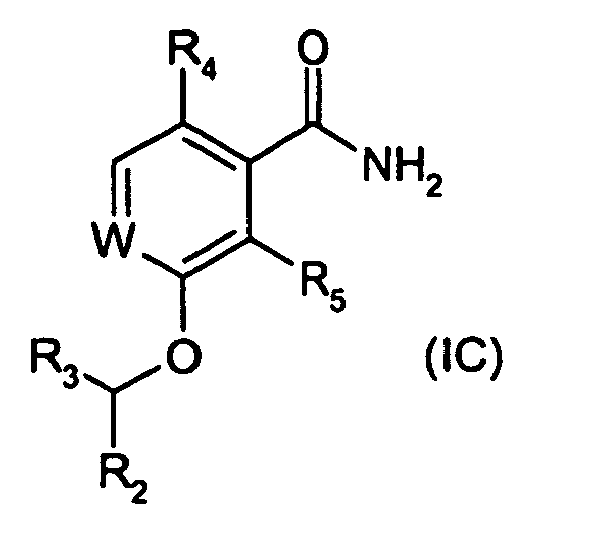


- The invention also includes novel pyridylamide compounds of formula (ID) and salts, hydrates or solvates thereof:
-

- As used herein, the term "(Ca-Cb)alkyl" wherein a and b are integers refers to a straight or branched chain alkyl radical having from a to b carbon atoms. Thus when a is 1 and b is 6, for example, the term includes methyl, ethyl, n-propyl, isopropyl, n-butyl, isobutyl, sec-butyl, t-butyl, n-pentyl and n-hexyl.
- As used herein the term "divalent (Ca-Cb)alkylene radical" wherein a and b are integers refers to a saturated hydrocarbon chain having from a to b carbon atoms and two unsatisfied valences. The term includes, for example, methylene, ethylene, n-propylene and n-butylene.
- As used herein the term "(Ca-Cb)alkenyl" wherein a and b are integers refers to a straight or branched chain alkenyl moiety having from a to b carbon atoms having at least one double bond of either E or Z stereochemistry where applicable. The term includes, for example, vinyl, allyl, 1- and 2-butenyl and 2-methyl-2-propenyl.
- As used herein the term "divalent (Ca-Cb)alkenylene radical" means a hydrocarbon chain having from a to b carbon atoms, at least one double bond, and two unsatisfied valences. The term includes, for example, -CH=CH- (vinylene), -CH=CH-CH2-, -CH2-CH=CH-, -CH=CH-CH2-CH2-, -CH=CH-CH2-CH2-CH2-, -CH=CH-CH=CH-, -CH=CH-CH=CH-CH2-, -CH=CH-CH=CH-CH2-CH2-, -CH=CH-CH2-CH=CH-, and -CH=CH-CH2-CH2-CH=CH-.
- As used herein the term "Ca-Cb alkynyl" wherein a and b are integers refers to straight chain or branched chain hydrocarbon groups having from a to b carbon atoms and having in addition at least one triple bond. This term would include for example, ethynyl, 1-propynyl, 1- and 2-butynyl, 2-methyl-2-propynyl, 2-pentynyl, 3-pentynyl, 4-pentynyl, 2-hexynyl, 3-hexynyl, 4-hexynyl and 5-hexynyl.
- As used herein the term "divalent (Ca-Cb)alkynylene radical" wherein a and b are integers refers to a divalent hydrocarbon chain having from a to b carbon atoms, and at least one triple bond. The term includes, for example, -C≡C-, -C≡C-CH2-, and -CH2-C≡CH-.
- As used herein the term "cycloalkyl" refers to a monocyclic or bridged monocyclic saturated carbocyclic radical having from 3-8 carbon atoms and includes, for example, cyclopropyl, cyclobutyl, cyclopentyl, cyclohexyl, cycloheptyl, cyclooctyl and bicyclo[2.2.1]hept-1-yl.
- As used herein the unqualified term "aryl" refers to a mono- or bi-cyclic carbocyclic aromatic radical. Illustrative of such radicals are phenyl and naphthyl.
- As used herein the unqualified term "heteroaryl" refers to a mono-, or bi-cyclic aromatic radical containing one or more heteroatoms selected from S, N and O, and includes radicals having two such monocyclic rings, or one such monocyclic ring and one monocyclic aryl ring, which are fused or directly linked by a covalent bond. Illustrative of such radicals are thienyl, benzthienyl, furyl, benzfuryl, pyrrolyl, imidazolyl, benzimidazolyl, thiazolyl, benzthiazolyl, thiazolopyridinyl, isothiazolyl, benzisothiazolyl, pyrazolyl, oxazolyl, benzoxazolyl, isoxazolyl, benzisoxazolyl, isothiazolyl, triazolyl, benztriazolyl, thiadiazolyl, oxadiazolyl, pyridinyl, pyridazinyl, pyrimidinyl, pyridazinyl, triazinyl, indolyl and indazolyl.
- As used herein the unqualified term "heterocyclyl" or "heterocyclic" includes "heteroaryl" as defined above, and in addition means a mono-, or bi-cyclic non-aromatic radical containing one or more heteroatoms selected from S, N and O. Illustrative of such radicals are pyrrolyl, furanyl, thienyl, piperidinyl, imidazolyl, oxazolyl, isoxazolyl, thiazolyl, thiadiazolyl, pyrazolyl, pyridinyl, pyrrolidinyl, pyrimidinyl, morpholinyl, piperazinyl, indolyl, morpholinyl, benzfuranyl, pyranyl, isoxazolyl, benzimidazolyl, methylenedioxyphenyl, ethylenedioxyphenyl, maleimido and succinimido groups.
- Unless otherwise specified in the context in which it occurs, the term "substituted" as applied to any moiety herein means substituted with up to four compatible substituents, each of which independently may be, for example, (C1-C6)alkyl, (C2-C6)alkenyl, (C2-C6)alkynyl, (C1-C6)alkoxy, hydroxy, hydroxy(C1-C6)alkyl, mercapto, mercapto(C1-C6)alkyl, (C1-C6)alkylthio, halo (including fluoro, bromo and chloro), fully or partially fluorinated (C1-C3)alkyl, (C1-C3)alkoxy or (C1-C3)alkylthio such as trifluoromethyl, trifluoromethoxy, and trifluoromethylthio, nitro, nitrile (-CN), oxo (=O), phenyl, phenoxy, monocyclic heteroaryl or heteroaryloxy with 5 or 6 ring atoms, -COORA, -CORA, -OCORA, -SO2RA, -CONRARB, -SO2NRARB, -NRARB, OCONRARB, -NRBCORA, -NRBCOORA, -NRBSO2ORA or -NRACONRARB wherein RA and RB are independently hydrogen or a (C1-C6)alkyl group or, in the case where RA and RB are linked to the same N atom, RA and RB taken together with that nitrogen may form a cyclic amino ring. Where the substituent is phenyl, phenoxy or monocyclic heteroaryl or heteroaryloxy with 5 or 6 ring atoms, the phenyl or heteroaryl ring thereof may itself be substituted by any of the above substituents except phenyl phenoxy, heteroaryl or heteroaryloxy. An "optional substituent" or "substituent" may be one of the foregoing specified groups.
- As used herein the term "salt" includes base addition, acid addition and quaternary salts. Compounds of the invention which are acidic can form salts, including pharmaceutically acceptable salts, with bases such as alkali metal hydroxides, e.g. sodium and potassium hydroxides; alkaline earth metal hydroxides e.g. calcium, barium and magnesium hydroxides; with organic bases e.g. N-methyl-D-glucamine, choline tris(hydroxymethyl)amino-methane, L-arginine, L-lysine, N-ethyl piperidine, dibenzylamine and the like. Those compounds (I) which are basic can form salts, including pharmaceutically acceptable salts with inorganic acids, e.g. with hydrohalic acids such as hydrochloric or hydrobromic acids, sulphuric acid, nitric acid or phosphoric acid and the like, and with organic acids e.g. with acetic, tartaric, succinic, fumaric, maleic, malic, salicylic, citric, methanesulphonic, p-toluenesulphonic, benzoic, benzenesulfonic, glutamic, lactic, and mandelic acids and the like. For a review on suitable salts, see Handbook of Pharmaceutical Salts: Properties. Selection, and Use by Stahl and Wermuth (Wiley-VCH, Weinheim, Germany, 2002).
- The term 'solvate' is used herein to describe a molecular complex comprising the compound of the invention and a stoichiometric amount of one or more pharmaceutically acceptable solvent molecules, for example, ethanol. The term 'hydrate' is employed when said solvent is water.
- Compounds of the invention which contain one or more actual or potential chiral centres, because of the presence of asymmetric carbon atoms, can exist as a number of enantiomers or diastereoisomers with R or S stereochemistry at each chiral centre. The invention includes all such enantiomers and diastereoisomers and mixtures thereof.
- A particular subclass of compounds for antibacterial use in accordance with the invention is concerned consists of those of formula (IA)

- Another particular subclass of compounds for antibacterial use in accordance with the invention is concerned consists of those of formula (IB)

- In a narrow subclass of compounds for antibacterial use in accordance with the invention is concerned, including those of formula (IA) above, R1 and R2 are hydrogen; and in the compounds of formula (IB) above R2 is hydrogen. In the radical R3, p may be 0, and m and/or n may be 1. Alternatively, p may be 1, and Z may be an optionally substituted carbocyclic or heteroaryl radical having 3 to 6 ring atoms or an optionally substituted bicyclic carbocyclic or heteroaryl radical having 5 to 10 ring atoms, which is linked to the -(Alk1)m- part of R3 and to the - (Alk2)n-Q part of R3 via ring carbon or nitrogen atoms. Examples of divalent radicals Z in this embodiment include those selected from the following, in either orientation:


- In another alternative embodiment p is 1, and Z is an optionally substituted monocyclic non-aromatic carbocyclic or heterocyclic radical having 3 to 6 ring atoms or an optionally substituted bicyclic non-aromatic carbocyclic or heterocyclic having 5 to 10 ring atoms, which is linked to the -(Alk1)m- part, of R3 and to the -(Alk2)n-Q part of R3 via ring carbon or nitrogen atoms. Examples of Z radicals, which are optionally substituted, in this embodiment include those selected from the following, in either orientation:

- In the compounds with which the invention is concerned, and in any of the subclasses or embodiments of such compounds discussed above, Q may be hydrogen. However Q may also be a radical selected from any of the divalent Z radicals specifically identified above but with one of the unsatisfied valencies thereof satisfied with hydrogen or an optional substituent.
- In the compounds with which the invention is concerned, and in any of the subclasses or embodiments of such compounds discussed above n and/or m may be 0.
- In all compounds and classes of compounds with which the invention is concerned, it is typical that the radical R3, when fully extended, does not exceed the length of an unbranched saturated hydrocarbon chain of 14 carbon atoms, ie does not exceed about 16 Angstroms. For example, that length may be equivalent to that of an unbranched saturated hydrocarbon chain of from 6 to 12, or 9 to 12 carbon atoms, ie from about 6 to about 14, and from about 10 to about 14 Angstroms respectively.
- In the compounds with which the invention is concerned, Alk1 and Alk2, when present, may be, for example, optionally substituted straight chain C1-C6 alkylene, C2-C6 alkenylene, or C2-C6 alkynylene radicals, each of which may optionally terminate with or be interrupted by -0-, -S-, -S(O)-, -S(O2)-, -NH-, -N(CH3)-, or -N(CH2CH3)-, - C(=O)-, -O-(C=O)-, -C(=O)-O-.
- Any optional substituents R and any optional substituents present in Alk1, Alk2, Z and Q may be selected.from, for example, methyl, -OCH3, -CF3, -OCF3, ethyl, cyclopropyl, oxo, hydroxyl, -F, -Cl, -Br, cyano, acetyl, amino, methylamino, dimethylamino, acetylamino, carbamate, -CONH2, nitro, -COOH and -CH2OH.
- Compounds of formula (IC) per se, and salts, hydrates or solvates thereof constitute a distinct aspect of the invention:

R1 is hydrogen and R2 is hydrogen, methyl, or fluoro; or R1 and R2 taken together are -CH2-, -CH2CH2-, -O-, or, in either orientation, -O-CH2-or -OCH2CH2-;
R4 and R5 are independently fluoro or chloro, or one of R4 and R5 is hydrogen while the other is fluoro or chloro;
R3 is a radical selected from those of the following formulae A-H, in which any vacant ring position is optionally substituted:


- In compounds (IC) it is currently preferred that W be =CH- and R2 be hydrogen.
- In compounds (IC) Q in radical R3 may be hydrogen or optionally substituted phenyl.
- In a particular subset of compounds (IC), R3 is optionally substituted quinolin-2-yl, benzothiazol-2-yl, thiazol-2-yl, thiazol-4-yl, thiazol-5-yl, oxadiazol-3-yl, oxadiazol-5-yl, oxazol-2-yl, oxazol-4-yl, oxazol-5-yl or thiazolopyridin-2-yl.
- Optional substituents which may be present in R3 in the compound per se aspect of the invention include methyl, -OCH3, -CF3, -OCF3, ethyl, cyclopropyl, oxo, hydroxyl, - F, -Cl, -Br, cyano, acetyl, amino, methylamino, dimethylamino, acetylamino, carbamate, -CONH2, nitro, -COOH and -CH2OH.
- Compounds of formula (ID) per se, and salts, hydrates or solvates thereof also constitute a distinct aspect of the invention:

- Specific examples of compounds with which the invention is concerned include those of the Examples herein.
- There are multiple synthetic strategies for the synthesis of the compounds (I) with which the present invention is concerned, but all rely on known chemistry, known to the synthetic organic chemist. Thus, compounds according to formula (I) can be synthesised according to procedures described in the standard literature and are well-known to the one skilled in the art. Typical literature sources are advanced Organic Chemistry", 4th Edition (Wiley), J March, " Comprehensive Organic Transformation", 2nd Edition (Wiley), R.C. Larock , " Handbook of Heterocyclic Chemistry", 2nd Edition (Pergamon), A.R. Katritzky), review articles such as found in "synthesis", "Acc. Chem. Revs.", "Chem. Rev", or primary literature sources identified by standard literature searches online or from secondary sources such as "Chemical Abstracts" or "Beilstein".
- Compounds (I) may be prepared, for example, by introduction of the radical -(Alk1)m-(Z)p-(Alk2)n-Q onto the hydroxyl group of a compound (II)

- Further details of the synthetic approaches and schemes for the preparation of the intermediate (II) are given in the Examples herein. As mentioned above, the compounds with which the invention are concerned are antibacterially active, since they inhibit bacterial growth. They are therefore of use in the treatment of bacterial infection in humans and non-human animals e.g. other mammals, birds and fish. The compounds include those which inhibit growth of Gram-positive organisms such as Bacillus subtilis and Staphylococcus aureus and some show activity against certain Gram-negative organisms also.
- It will be understood that the specific dose level for any particular patient will depend upon a variety of factors including the activity of the specific compound employed, the age, body weight, general health, sex, diet, time of administration, route of administration, rate of excretion, drug combination and the severity of the particular disease undergoing therapy. As is required in the pharmaceutical art, safe and permitted doses will be determined by clinical trial, but daily dosages can vary within wide limits and will be adjusted to the individual requirements in each particular case. Typically, however, the dosage adopted for each route of administration when a compound is administered alone to adult humans is 0.0001 to 150 mg/kg body weight. Such a dosage may be given, for example, from 1 to 5 times daily. For intravenous injection a suitable daily dose is from 0.0001 to 150 mg/kg body weight. A daily dosage can be administered as a single dosage or according to a divided dose schedule.
- The compounds with which the invention is concerned may be prepared for administration by any route consistent with their pharmacokinetic properties, such as oral, topical, or sterile parenteral solutions or suspensions. The orally administrable compositions may be in the form of tablets, capsules, powders, granules, lozenges, liquid or gel preparations. Tablets and capsules for oral administration may be in unit dose presentation form, and may contain conventional excipients such as binding agents, for example syrup, acacia, gelatin, sorbitol, tragacanth, or polyvinylpyrrolidone; fillers for example lactose, sugar, maize-starch, calcium phosphate, sorbitol or glycine; tabletting lubricant, for example magnesium stearate, talc, polyethylene glycol or silica; disintegrants for example potato starch, or acceptable wetting agents such as sodium lauryl sulphate. The tablets may be coated according to methods well known in normal pharmaceutical practice. Oral liquid preparations may be in the form of, for example, aqueous or oily suspensions, solutions, emulsions, syrups or elixirs, or may be presented as a dry product for reconstitution with water or other suitable vehicle before use. Such liquid preparations may contain conventional additives such as suspending agents, for example sorbitol, syrup, methyl cellulose, glucose syrup, gelatin hydrogenated edible fats; emulsifying agents, for example lecithin, sorbitan monooleate, or acacia; non-aqueous vehicles (which may include edible oils), for example almond oil, fractionated coconut oil, oily esters such as glycerine, propylene glycol, or ethyl alcohol; preservatives, for example methyl or propyl p-hydroxybenzoate or sorbic acid, and if desired conventional flavouring or colouring agents.
- For topical application to the skin, the drug may be made up into a cream, lotion or ointment. Cream or ointment formulations which may be used for the drug are conventional formulations well known in the art, for example as described in standard textbooks of pharmaceutics such as the British Pharmacopoeia.
- For topical application to the eye, the drug may be made up into a solution or suspension in a suitable sterile aqueous or non aqueous vehicle. Additives, for instance buffers such as sodium metabisulphite or disodium edeate; preservatives including bactericidal and fungicidal agents such as phenyl mercuric acetate or nitrate, benzalkonium chloride or chlorhexidine, and thickening agents such as hypromellose may also be included.
- The active ingredient may also be administered parenterally in a sterile medium, either subcutaneously, or intravenously, or intramuscularly, or intrasternally, or by infusion techniques, in the form of sterile injectable aqueous or oleaginous suspensions. Depending on the vehicle and concentration used, the drug can either be suspended or dissolved in the vehicle. Advantageously, adjuvants such as a local anaesthetic, preservative and buffering agents can be dissolved in the vehicle.
- Since the compounds with which the invention is concerned are antibacterially active and inhibit bacterial growth, they are also of use in treating bacterial contamination of a substrate, such as hospital instruments or work surfaces. In order to treat a contaminated substrate, the compounds may be applied to the site of such contamination in an amount sufficient to inhibit bacterial growth.
- The following examples illustrate the synthesis of compounds with which the invention is concerned.
- The analytical methods used to characterise compounds included HPLC-MS and 1H NMR.
-
Mobile Phase: A = Acetonitrile B = 10mM aqueous ammonium acetate Gradient: Time (mins) %A %B 0.00 20 80 0.30 20 80 4.00 90 10 5.00 90 10 5.03 20 80 Run Time : 7 min Flow Rate: 1 ml/min Injection vol: variable dependant on sample concentration Column temperature: 40 °C Column: 50 x 4.6 mm Gemini C18; 5µm PDA Detector: 220, 240, and 254 nm analysed -
Mobile Phase: A = Acetonitrile B = 10mM aqueous ammonium acetate Gradient: Time (mins) %A %B 0.00 20 80 0.30 20 80 24.00 90 10 28.00 90 10 28.03 20 80 Run Time : 30 min Flow Rate: 1 ml/min Injection vol: variable dependant on sample concentration Column temperature: 40°C Column: 50 x 4.6 mm Gemini C18; 5µm PDA Detector: 220, 240, and 254 nm analysed -
Mobile Phase: A = Acetonitrile + 0.1 % Trifluoroacetic acid B = Water + 0.1 % Trifluoroacetic acid Gradient: Time (mins) %A %B 0.0 0 100 1.8 95 5 2.1 95 5 2.3 0 100 2.4 0 100 Run time: 2.4 min Flow rate: 1 ml/min Injection vol. 3µl Column temperature: ambient (20°C) Column: 50 x 2.0mm Hypersil C18 BDS; 5µm UV Detector Variable wavelength detector set at 215nm -
Mobile Phase: A = Acetonitrile + 0.1 % Formic acid B = Water + 0.1 % Formic acid Gradient: Time (mins) %A %B 0.0 0 100 2.5 100 0 2.7 100 0 2.71 0 100 3.0 0 100 Run time: 3.5 min Flow rate: 1 ml/min Injection vol: 3 µl Column temperature: ambient (20°C) Column: 50 x 2.1mm Atlantis dC18; 5µm UV Detector Variable wavelength detector set at 215nm -
Column Purospher Star C-18 Mobile Phase ACN:0.1% Formic acid (FA) Flow Mode Time%ACN % FA 0.00 10.0 90.0 7.00 10.0 90.0 15.00 90.0 10.0 18.00 90.0 10.0 25.00 10.0 90.0 30.0 10.0 90.0 Flow 1.00 ml/min UV Max Variable Column Temperature 30°C Sample preparation MeOH + DMSO + H2O Injection volume Variable -
Column Discovery HSC-18 Column 250x4.6, 5.0 µm Mobile Phase A - Acetonitrile B - 0.1 % Formic acid Flow Mode Time A B 0.0 5.0 95.0 4.0 5.0 95.0 8.0 95.0 5.0 16.0 950 5.0 18.0 5 95.0 20.0 5.0 95.0 Flow 1.00 ml/min UV Max 286.0 nm Column Temperature 45.0 deg. Sample preparation Acetonitrile : Water (50 : 50) Injection volume Variable -
Column Discovery HSC-18 Column 250x4.6, 5.0 µm Mobile Phase A - Acetonitrile B - 0.1 % Formic acid Flow Mode Time A B 0.0 5.0 95.0 4.0 5.0 95.0 8.0 95.0 5.0 16.0 950 5.0 18.0* 5 95.0 20.0 5.0 95.0 Flow 1.00 ml/min UV Max variable Column Temperature 45.0 deg. Sample preparation Methanol Injection volume Variable -
Mobile Phase: A = Acetonitrile + 0.1 % Formic acid B = Water + 0.1 % Formic acid Gradient: Time (mins) %A %B 0.0 10 90 7.0 10 90 15.0 90 10 18.0 90 10 25.0 10 90 30.0 10 90 Run time: 30.0 min Flow rate: 1 ml/min Column temperature: Ambient (25°C) Column: 250 x 4.6mm Xbridge dC18; 5µm UV Detector Variable wavelength detector set at 215nm -
Mobile Phase: A = Acetonitrile + 0.1% Formic acid B = Water + 0.1% Formic acid Gradient: Time (mins) %A %B 0.0 10 90 7.0 10 90 15.0 90 10 18.0 90 10 25.0 10 90 30.0 10 90 Run time: 30:0 min Flow rate: 1 ml/min Column temperature: ambient (25°C) Column: 250 x 4.6mm Purospher Star dC18; 5µm UV Detector Variable wavelength detector set at 262 nm - 1H NMR spectra were consistent with the required structures.
- Melting points were measured on a Stuart Scientific SMP10 apparatus and are uncorrected.
- Yields given are not optimised.
-


-

- NB 1: The final purification step was dependent on the nature of the R group. Other purification methods used in course of the library synthesis were:
- 1. Recrystallisation (e.g. neat MeOH, EtOAc/hexanes, CH3CN).
- 2. Normal phase column chromatography (silica gel).
- 3. Preparative HPLC or preparative TLC.
- NB 2: In the case of water soluble target compounds, the aqueous phase was concentrated in vacuo and then washed with MeOH. The methanolic fractions were concentrated in vacuo and the crude product purified by preparative HPLC.

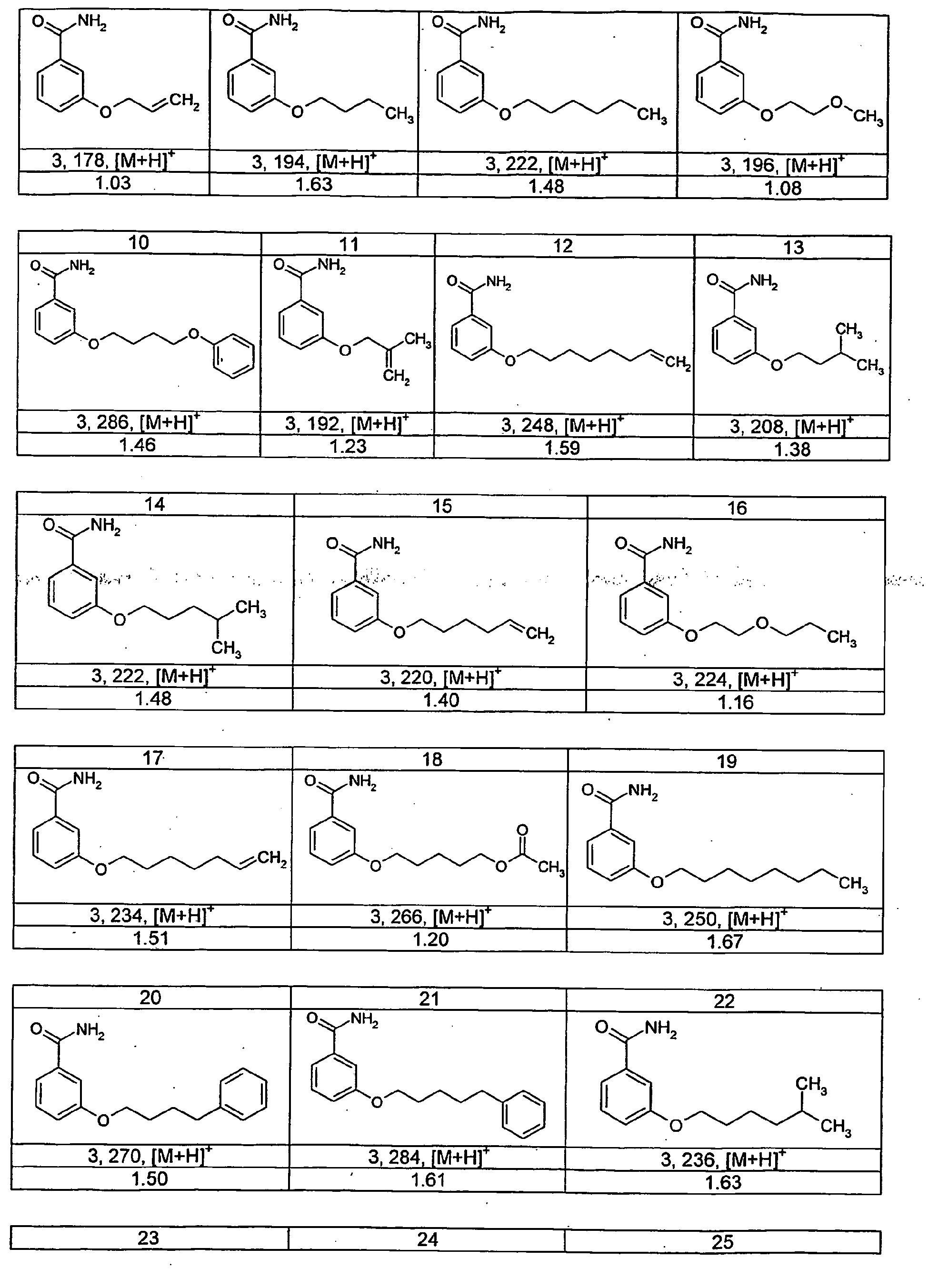


-
Example Compound name 2 3-Propoxybenzenecarboxamide 3 3-lsopropoxybenzenecarboxamide 4 3-(Cyclopropylmethoxy)benzenecarboxamide 5 3-(Pentyloxy)benzenecarboxamide 6 3-(Allyloxy)benzenecarboxamide 7 3-Butoxybenzenecarboxamide 8 3-(Hexyloxy)benzenecarboxamide 9 3-(2-Methoxyethoxy)benzenecarboxamide 10 3-(4-Phenoxybutoxy)benzenecarboxamide 11 3-[(2-Methyl-2-propenyl)oxy]benzenecarboxamide 12 3-(7-Octenyloxy)benzenecarboxamide 13 3-(Isopentyloxy)benzenecarboxamide 14 3-[(4-Methylpentyl)oxy]benzenecarboxamide 15 3-(5-Hexenyloxy)benzenecarboxamide 16 3-(2-Propoxyethoxy)benzenecarboxamide 17 3-(6-Heptenyloxy)benzenecarboxamide 18 5-[3-(Aminocarbonyl)phenoxy]pentyl acetate 19 3-(Octyloxy)benzenecarboxamide 20 3-(4-Phenylbutoxy)benzenecarboxamide 21 3-[(5-Phenylpentyl)oxy]benzenecarboxamide 22 3-[(5-Methylhexyl)oxy]benzenecarboxamide 23 3-(2-Quinolinylmethoxy)benzenecarboxamide 24 3-(Heptyloxy)benzenecarboxamide 25 Ethyl 4-[3-(aminocarbonyl)phenoxy]butanoate 26 Methyl 4-[3-(aminocarbonyl)phenoxy]butanoate 27 Cyclohexyl 2-[3-(aminocarbonyl)phenoxy]acetate 28 3-(2-Cycloheptylethoxy)benzenecarboxamide 29 3-[(3-Methylbenzyl)oxy]benzenecarboxamide 30 3-[2-Butenyloxy]benzenecarboxamide 31 3-(2-Octynyloxy)benzenecarboxamide 32 3-(4-Nonynyloxy)benzenecarboxamide 33 Ethyl 2-[3-(aminocarbonyl)phenoxy]acetate 34 3-[(4-Fluorophenethyl)oxy]benzenecarboxamide 35 3-[(4-Methoxyphenethyl)oxy]benzenecarboxamide 36 3-[(6-Phenylhexyl)oxy]benzenecarboxamide 37 Ethyl 6-[3-(aminocarbonyl)phenoxy]hexanoate 38 Methyl 10-[3-(aminocarbonyl)phenoxy]decanoate 39 3-[(2-Methylpentyl)oxy]benzenecarboxamide 40 3-[(E)-3-Octenyloxy]benzenecarboxamide 41 Butyl 2-[3-(aminocarbonyl)phenoxy]acetate 42 3-(4-Hydroxybutoxy)benzenecarboxamide 43 Butyl 4-[3-(aminocarbonyl)phenoxy]butanoate 44 3-(4-Cyclohexylbutoxy)benzenecarboxamide 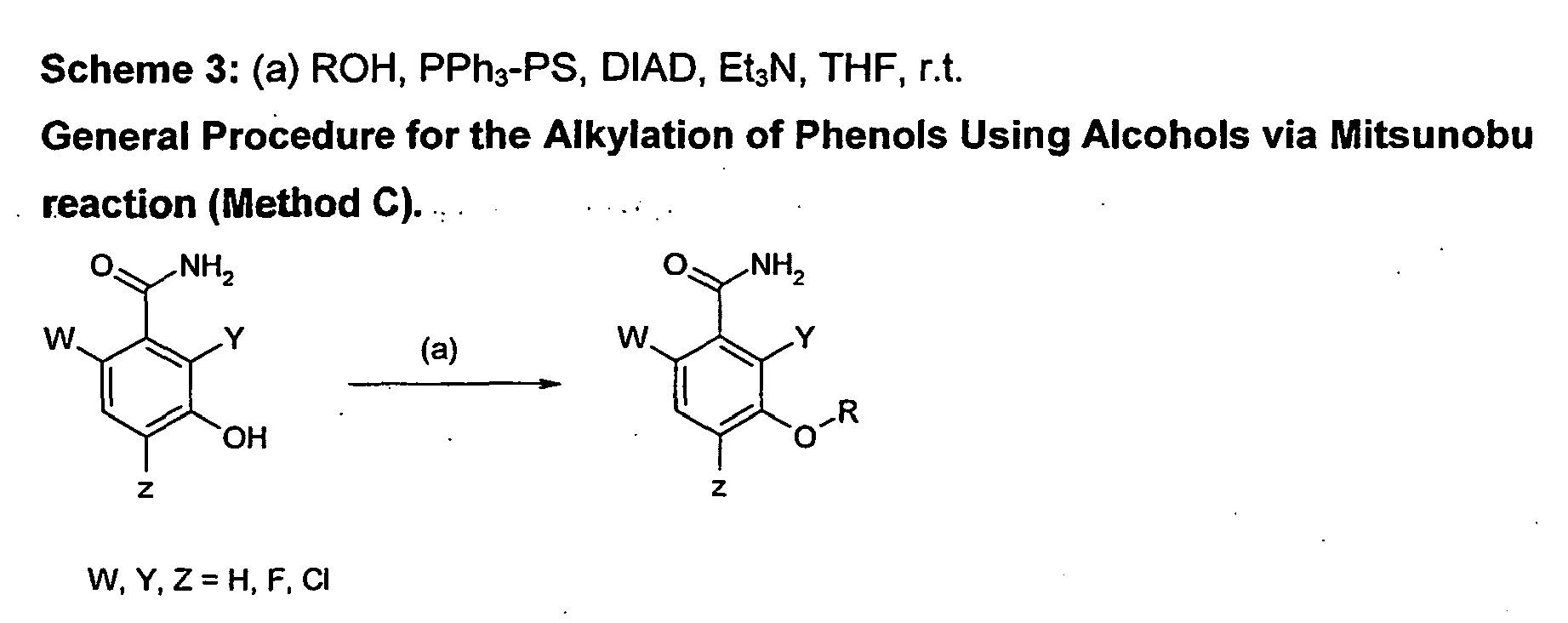
-

- To a suspension of polymer-supported triphenyl phosphine (1.4 g, 3 mmol, based on a loading of 2.15 mmol/g [purchased from Argonaut], 1.5 equiv.) swollen in THF (20 ml) at room temperature was added diisopropylazodicarboxylate (0.47 ml, 2.4 mmol, 1.2 equiv.). The mixture was shaken for 5 min before 3-hydroxybenzamide (274 mg, 2 mmol, 1 equiv.), triethylamine (0.28 ml, 2 mmol, 1 equiv.) and cis-5-decenol (313 mg, 2 mmol, 1 equiv.) were added. The resulting suspension was shaken at room temperature for 16 h and then filtered. The resin was washed with additional THF (x 3) and then the combined filtrate and washings were concentrated under reduced pressure, to give the crude product as a colorless semi-solid. It was purified by column chromatography on silica eluting with EtOAc/hexane (20%-40% gradient) to give the desired compound as a white solid (390 mg, 71 %), mp 98-100°C. HPLC-MS (method 1): m/z 276 [M+H]+, Rt = 5.00 min. 1H NMR (CDCl3) δ = 7.35 (s, 1H), 7.32-7.28 (m, 2H), 7.08-7.02 (m, 1H), 6.18 (br, 2H), 5.41-5.32 (m, 2H), 3.98 (t, J = 6.4 Hz, 2H), 2.12-2.05 (m, 2H), 2.05-1.98 (m, 2H), 1.79 (m, 2H), 1.51 (m, 2H), 1.34-1.28 (m, 4H), 0.88 (t, J = 7.0 Hz, 3H).
- NB 1: In some cases diethylazodicarboxylate (0.38 ml, 2.4 mmol, 1.2 equiv.) was used instead of diisopropylazodicarboxylate.
- NB 2: In some cases unsupported triphenyl phosphine was used. In the case of phenols containing fluorine atoms, no product could be detected when using polymer-supported triphenyl phosphine and so the reactions were performed with triphenyl phosphine.


-
Example Compound name 46 3-(10-Undecynyloxy)benzenecarboxamide 47 3-[(Z)-2-Nonenyloxy]benzenecarboxamide 48 3-(5-Decynyloxy)benzenecarboxamide 49 3-[(E)-2-Nonenyloxy]benzenecarboxamide 50 3-(2-Nonynyloxy)benzenecarboxamide 51 3-(3-Nonynyloxy)benzenecarboxamide 52 3-[(Z)-5-Octenyloxy]benzenecarboxamide 53 3-[2-(Pentyloxy)ethoxy]benzenecarboxamide 54 3-[2-(Hexyloxy)ethoxy]benzenecarboxamide 55 3-{[(5E)-2,6,10-Trimethyl-5,9-undecadienyl]oxy} benzenecarboxamide 56 3-[(2E,6Z)-2,6-Nonadienyloxy]benzenecarboxamide 57 3-{3-[2-(tert-Butyl)-5-(trifluoromethyl)-1,3-oxazol-4-yl]propoxy}benzenecarboxamide 58 3-[(E)-5-Decenyloxy]benzenecarboxamide 59 3-(3-Octynyloxy)benzenecarboxamide 60 3-[(3-Methylpentyl)oxy]benzenecarboxamide 61 3-[(Z)-6-Nonenyloxy]benzenecarboxamide 

-

-

-

-

-

- Synthesised from 6-[3-(aminocarbonyl)phenoxy]hexyl(triphenyl) phosphonium bromide according to Method E. Yield 72%, mp 53-56°C. By 1H NMR analysis it consisted of a mixture of Z:E (81:19). HPLC-MS (method 1): m/z 334 [M+H]+, Rt = 4.80 min.

-

-

-

-


-

- (Method G) A solution of commercially available 2-[(8-bromooctyl)oxy]tetrahydro-2H-pyran (1.0 g, 3.4 mmol, 1 equiv.) in DMSO (5 ml), was added, slowly, dropwise, at r.t., under N2, to a stirred suspension of lithium acetylide ethylenediamine complex (350 mg, 3.8 mmol, 1.1 equiv.) in DMSO (5 ml). The reaction mixture was stirred at r.t. for 18 h and diluted with n-pentane (50 ml). The organic phase was washed with 1 N HCl solution (2×20 ml) and water (2×20 ml), dried (Na2SO4) and evaporated to dryness under reduced pressure. The residue (colourless liquid, 570 mg, yield 70%) was dissolved in 95% EtOH (20 ml) together with p-toluenesulfonic acid (150 mg) and the mixture was heated under reflux for 2.5 h. After being cooled, the solvent was evaporated under reduced pressure. The residue was purified by column chromatography on silica eluting with EtOAc/hexane (10%-30% gradient), to give the desired compound as a colourless oil (240 mg, overall yield 48%).
-


-

-

-


-


-
Example Compound name 70 2-Fluoro-5-(nonyloxy)benzenecarboxamide 71 2-Fluoro-5-(decyloxy)benzenecarboxamide 72 2-Fluoro-5-(undecyloxy)benzenecarboxamide 73 2-Fluoro-5-[(Z)-5-octenyloxylbenzenecarboxamide 74 2-Fluoro-5-[(E)-2-noneny)oxy]benzenecarboxamide 75 2-Fluoro-5-(10-undecynyloxy)benzenecarboxamide 
-

-

-


-

-

-


-
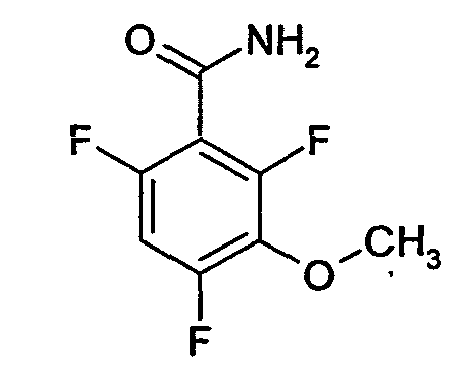
- Synthesised from commercially available 2,4,6-trifluoro-3-methoxybenzenecarboxylic acid, according to Method A, scheme 1. Yield 85%, mp 102°C, HPLC-MS (method 1): m/z 206 [M+H]+, Rt = 2.40 min.
-

- Synthesised from 2,4,6-trifluoro-3-methoxybenzenecarboxamide according to Method H. Yield 100%, HPLC-MS (method 1): m/z 190 [M-H]-, Rt = 1.07 min.
-

- Synthesised from 2,4,6-trifluoro-3-hydroxybenzenecarboxamide according to Method B, scheme 2. Yield 54%, mp 89-90°C, HPLC-MS: m/z 276 [M+H]+, Rt = 4.36 min.
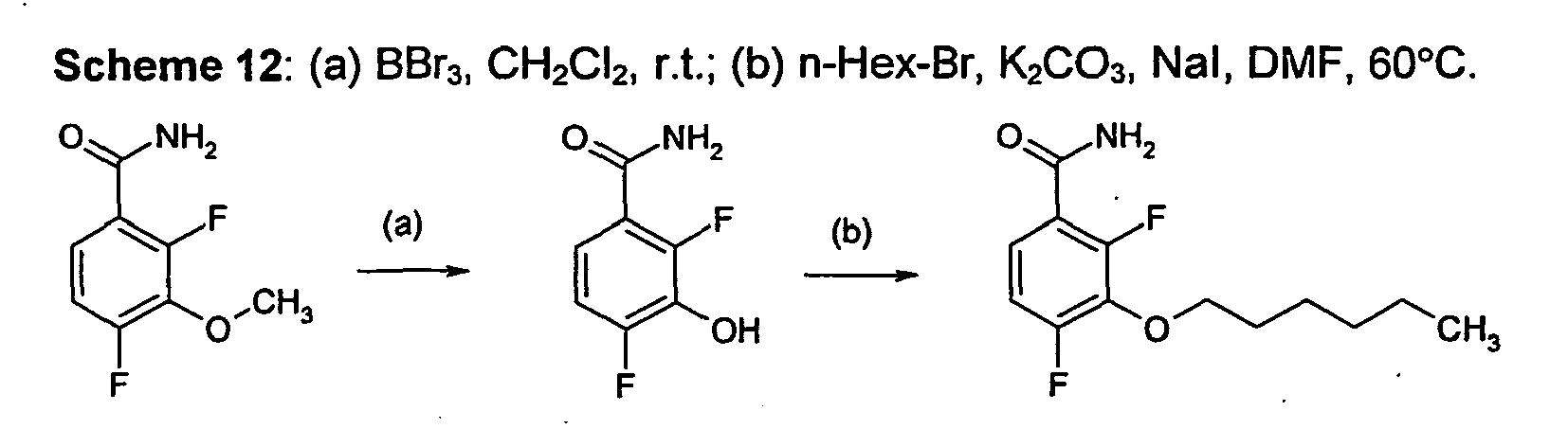
-

-


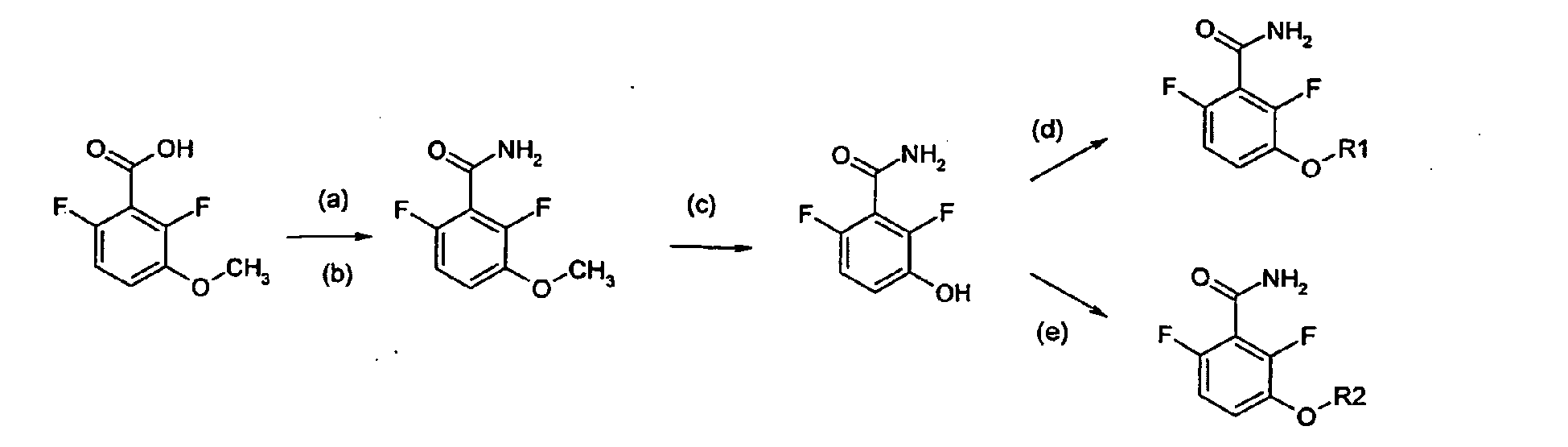
-

-
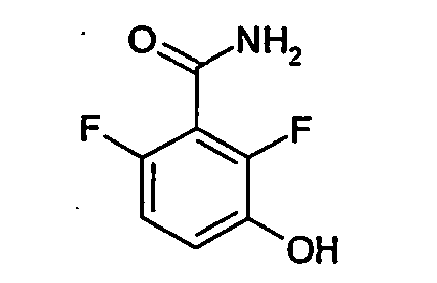


-
Example Compound name 81 2,6-Difluoro-3-(hexyloxy)benzenecarboxamide 82 2,6-Difluoro-3-(nonyloxy)benzenecarboxamide 83 Butyl 2-[3-(aminocarbonyl)-2,4-difluorophenoxylacetate 84 2,6-Difluoro-3-[(E)-2-nonenytoxy]benzenecarboxamide 85 2,6-Difluoro-3-[2-(hexyloxy)ethoxy]benzenecarboxamide 86 2,6-Difluoro-3-[(Z)-6-nonenyloxy]benzenecarboxamide 87 2,6-Difluoro-3-[(Z)-5-decenyloxy]benzenecarboxamide 88 2,6-Difluoro-3-(10-undecynyloxy)benzenecarboxamide 

-

-
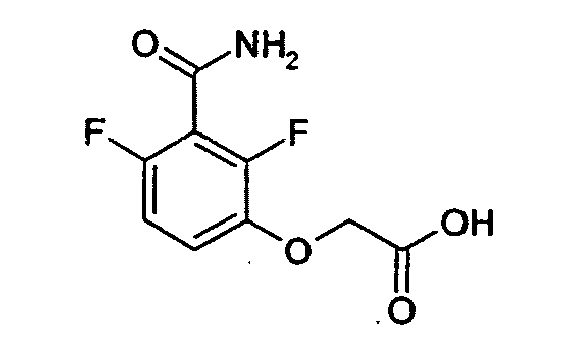
-


-

-

-


-


-

-

-


-

-


-

-

-

- The compounds of Examples 96-99, 101-116, 117, 119, 122, 124, 128-134, 137-139, 142, 144-154, 156-159 and 161-163 were synthesized according to the following general procedure: To a solution of reactant (A) in anhydrous DMF (B), 2,6-difluoro-3-hydroxybenzamide (C) and potassium carbonate (D) were added. The reaction mixture was stirred at room temperature or 25°C under nitrogen atmosphere. The reaction mixture was evaporated to dryness under reduced pressure and the residue was purified by column chromatography on silica (230-400µ) using ethyl acetate/hexane as the eluent to provide the product compound.


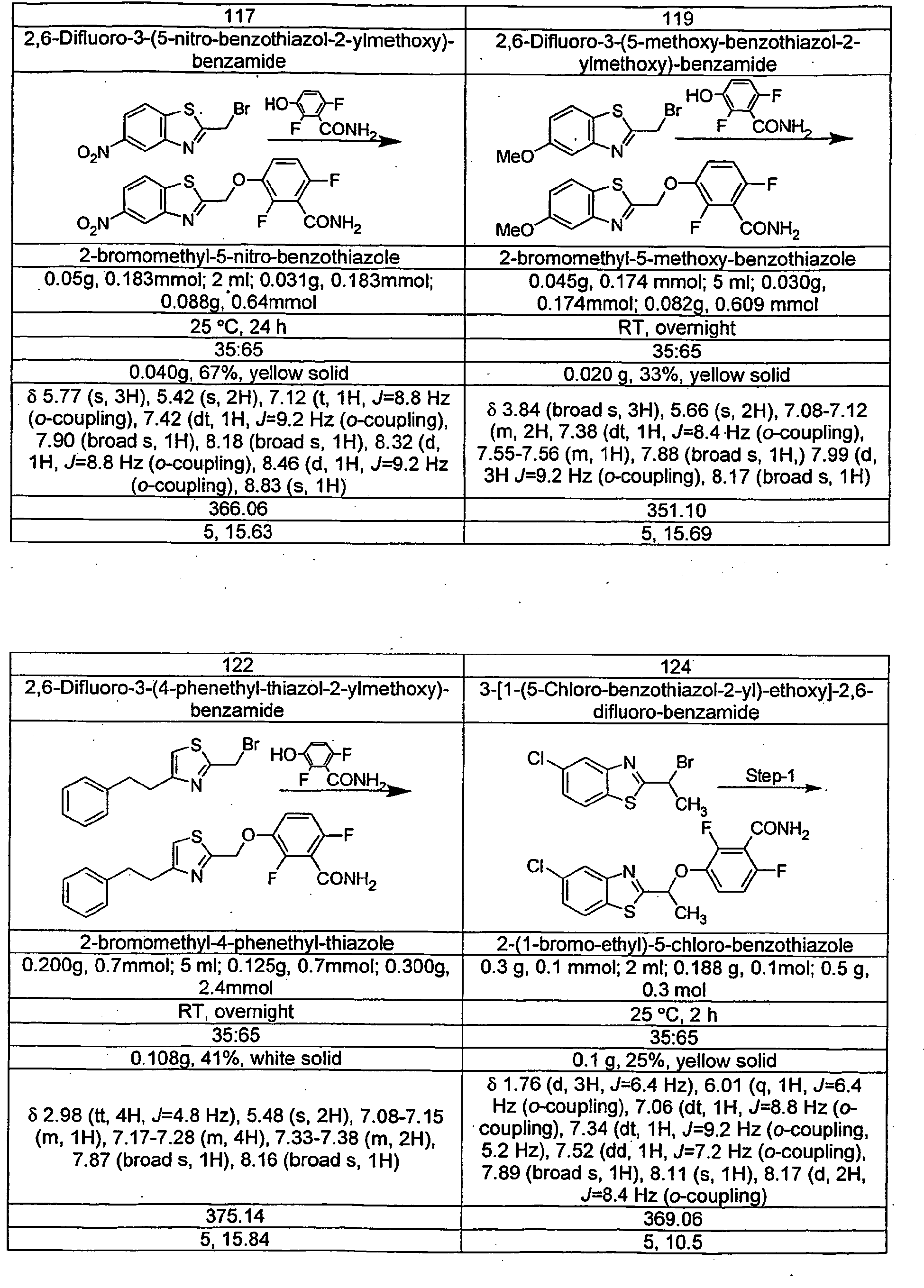


-

-

-

-

-

-

-

-

-

-

-

-

-

-

-

-

-

-

-

-
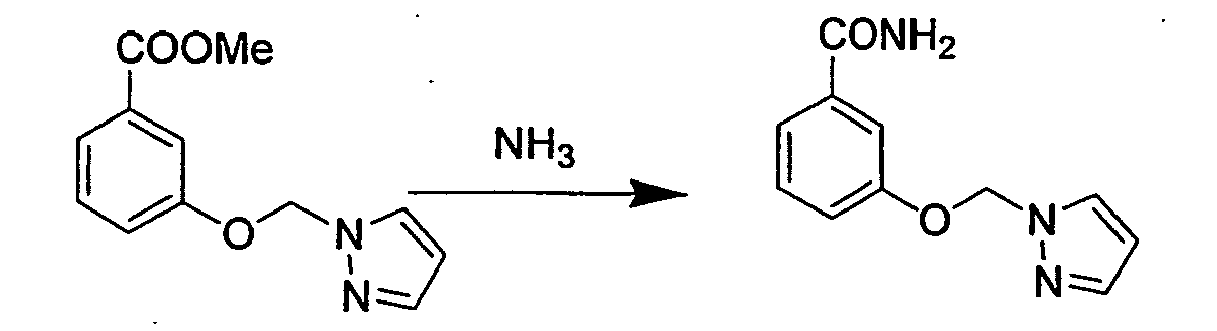
-

-

-



-

-

-


-

-

-


-
Example Compound name 175 2-Fluoro-3-(nonyloxy)benzenecarboxamide 176 Butyl 2-[3-(aminocarbonyl)-2-fluorophenoxy]acetate 177 2-Fluoro-3-(10-undecynyloxy)benzenecarboxamide 178 2,6-Difluoro-3-(4-hydroxybutoxy)benzenecarboxamide 
-
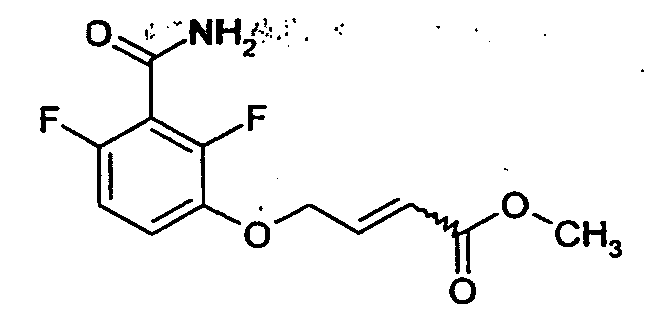
-

- The aqueous phase was extracted with Et2O (2x50 ml) and the combined extracts were dried (Na2SO4) and evaporated to dryness under reduced pressure, to give a light orange solid, 418 mg, 35% yield, mp 127-128°C, HPLC-MS (method 1): m/z 258 [M+H]+, Rt = .0.99 min. By 1H-NMR analysis it was determined to be a mixture of isomeres in a ratio (3:40) E:Z.
-
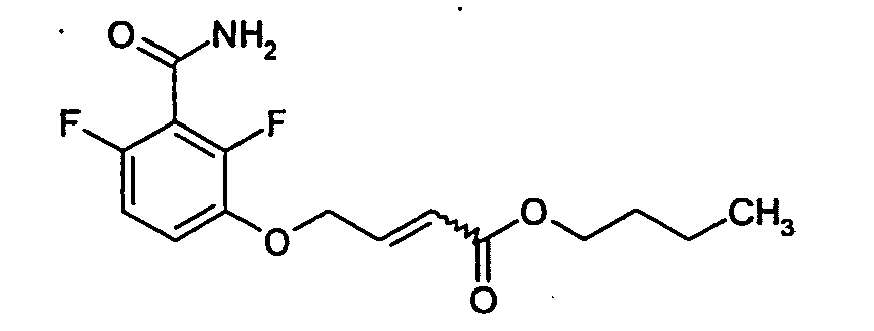
-


-
Example Compound name 182 2,6-Difluoro-3-[(5-methyl-3-isoxazolyl)methoxy]benzenecarboxamide 183 2,6-Difluoro-3-(2-furylmethoxy)benzenecarboxamide 184 2,6-Difluoro-3-(3-furylmethoxy)benzenecarboxamide 185 2,6-Difluoro-3-[(5-methyl-2-furyl)methoxy]benzenecarboxamide 186 2,6-Difluoro-3-(2-thienylmethoxy)benzenecarboxamide 187 2,6-Difluoro-3-[(4-methyl-2-thienyl)methoxy]benzenecarboxamide 188 2,6-Difluoro-3-(3-thienylmethoxy)benzenecarboxamide 189 2,6-Difluoro-3-(1,3-thiazol-5-ylmethoxy)benzenecarboxamide 190 2,6-Difluoro-3-[(2-methyl-1,3-thiazol-4-yl)methoxy]benzenecarboxamide 191 2,6-Difluoro-3-(1,3-thiazol-2-ylmethoxy)benzenecarboxamide 192 2,6-Difluoro-3-[(5-methyl-1,3-thiazol-2-yl)methoxy]benzenecarboxamide 193 2,6-Difluoro-3-[(4-methyl-1,3-thiazol-2-yl)methoxy]benzenecarboxamide 194 2,6-Difluoro-3-[(1-methy)-1H-imidazol-2-yl)methoxy]benzenecarboxamide 195 2,6-Difluoro-3-[(3-methylbenzyl)oxy]benzenecarboxamide 196 3-[(3-Ethoxybenzyl)oxy]-2,6-difluorobenzenecarboxamide 197 2,6-Difluoro-3-[(6-methyl-2-pyridinyl)methoxy]benzenecarboxamide 

-

-

-

-


-
Example Compound name 202 3-(1-Benzothiophen-3-ylmethoxy)-2,6-difluorobenzenecarboxamide 203 2,6-Difluoro-3-(imidazo[1,2-a]pyridin-2-ylmethoxy)benzenecarboxamide 204 3-(2,3-Dihydro-1,4-benzodioxin-2-ylmethoxy)-2,6-difluorobenzenecarboxamide 205 2,6-Difluoro-3-[(5-methyl-1-benzothiophen-2-yl)methoxy]benzenecarboxamide 206 3-(1-Benzothiophen-2-ylmethoxy)-2,6-difluorobenzenecarboxamide 207 3-(1-Benzofuran-2-ylmethoxy)-2,6-difluorobenzenecarboxamide -

-


-
Example Compound name 209 3-(1,3-Benzoxazol-2-ylmethoxy)-2,6-difluorobenzenecarboxamide 210 3-[(5-Chloro-1,3-benzoxazol-2-yl)methoxy]-2,6-difluorobenzenecarboxamide 211 2,6-Difluoro-3-[(6-methyl-1,3-benzoxazol-2-yl)methoxy]benzenecarboxamide 212 2,6-Difluoro-3-[(5-methyl-1,3-benzoxazol-2-yl)methoxy]benzenecarboxamide 213 3-[5-(tert-Butyl)-1,3-benzoxazol-2-yl]methoxy-2,6-difluorobenzenecarboxamide 214 2,6-Difluoro-3-[(5-nitro-1,3-benzoxazol-2-yl)methoxy]benzenecarboxamide 215 3-(1,3-Benzothiazol-2-ylmethoxy)-2,6-difluorobenzenecarboxamide 216 2,6-Difluoro-3-[(5-fiuoro-1,3-benzothiazol-2-yl)methoxy]benzenecarboxamide 217 2,6-Difluoro-3-[5-(trifluoromethyl)-1,3-benzothiazol-2-yl]methoxybenzenecarboxamide -


-
Example Compound name 218 3-[(5-Chloro-1,3-benzothiazol-2-yl)methoxy]-2,6-difluorobenzenecarboxamide 219 3-[(5-Chloro-1,3-benzothiazol-2-yl)methoxy]-2-fluorobenzenecarboxamide 220 6-Chloro-3-[(5-chloro-1,3-benzothiazol-2-yl)methoxy]-2-fluorobenzenecarboxamide 221 2-Chloro-3-[(5-chloro-1,3-benzothiazol-2-yl)methoxy]-6-fluorobenzenecarboxamide 
-

-


-

-

-

-


-

-

-

-

-

-

-

-


-

-

-


-
Example Compound name 233 2,6-Difluoro-3-[(2-phenyl-1,3-thiazol-4-yl)methoxy]benzenecarboxamide 234 3-[5-(4-Chlorophenyl)-1,3,4-thiadiazol-2-yl]methoxy-2,6-difluorobenzenecarboxamide 235 2,6-Difluoro-3-[(4-phenyl-1,3-thiazol-2-yl)methoxy]benzenecarboxamide 236 2,6-Difluoro-3-[2-(4-methylphenyl)-1,3-thiazol-4-yl]methoxybenzenecarboxamide 237 3-[(2-Amino-1,3-thiazol-4-yl)methoxy]-2,6-difluorobenzenecarboxamide 238 2,6-Difluoro-3-[(5-phenyl-1,3,4-oxadiazol-2-yl)methoxy]benzenecarboxamide 239 2,6-Difluoro-3-[(5-phenyl-1,2,4-oxadiazol-3-yl)methoxy]benzenecarboxamide 240 2,6-Difluoro-3-[(3-phenyl-1,2,4-oxadiazol-5-yl)methoxy]benzenecarboxamide 241 2,6-Difluoro-3-[3-(4-methoxyphenyl)-1,2,4-oxadiazol-5-yl]methoxybenzenecarboxamide -


-
Example Compound name 243 2,6-Difluoro-3-(3-[4-(trifluoromethyl)phenyl]-1,2,4-oxadiazol-5-ylmethoxy)benzenecarboxamide 245 2,6-Difluoro-3-[3-(4-fluorophenyl)-1,2,4-oxadiazol-5-yl]methoxybenzenecarboxamide 246 3-[3-(4-Chlorophenyl)-1,2,4-oxadiazol-5-yl]methoxy-2,6-difluorobenzenecarboxamide 247 2,6-Difluoro-3-[3-(4-methylphenyl)-1,2,4-oxadiazol-5-yl]methoxybenzenecarboxamide 248 2,6-Difluoro-3-[3-(4-isopropylphenyl)-1,2,4-oxadiazol-5-yl]methoxybenzenecarboxamide 249 3-(3-[4-(tert-Butyl)phenyl]-1,2,4-oxadiazol-5-ylmethoxy)-2,6-difluorobenzenecarboxamide 250 3-[3-(4-Ethylphenyl)-1,2,4-oxadiazol-5-yl]methoxy-2,6-difluorobenzenecarboxamide 

-

-

-


-
Example Compound name 252 2,6-Difluoro-3-[3-(2-methylphenyl)-1,2,4-oxadiazol-5-yl]methoxybenzenecarboxamide 252a 2,6-Difluoro-3-[3-(2-methoxyphenyl)-1,2,4-oxadiazol-5-yl]methoxybenzenecarboxamide 253 2,6-Difluoro-3-[3-(2-hydroxyphenyl)-1,2,4-oxadiazol-5-yl]methoxybenzenecarboxamide 254 3-[3-(2-Chlorophenyl)-1,2,4-oxadiazol-5-yl]methoxy-2,6-difluorobenzenecarboxamide 255 3-[3-(3-Chlorophenyl)-1,2,4-oxadiazol-5-yl]methoxy-2,6-difluorobenzenecarboxamide 256 2,6-Difluoro-3-[3-(3-methoxyphenyl)-1,2,4-oxadiazol-5-yl]methoxybenzenecarboxamide 257 2,6-Difluoro-3-[3-(3-hydroxyphenyl)-1,2,4-oxadiazol-5-yl]methoxybenzenecarboxamide 258 2,6-Difluoro-3-(3-[3-(trifluoromethyl)phenyl]-1,2,4-oxadiazol-5-ylmethoxy)benzenecarboxamide 259 2,6-Difluoro-3-[3-(3-nitrophenyl)-1,2,4-oxadiazol-5-yl]methoxybenzenecarboxamide 260 3-[3-(2,6-Dichlorophenyl)-1,2,4-oxadiazol-5-yl]methoxy-2,6-difluorobenzenecarboxamide 261 3-[3-(2,4-Dimethoxyphenyl)-1,2,4-oxadiazol-5-yl]methoxy-2,6-difluorobenzenecarboxamide 262 2,6-Difluoro-3-[3-(3-pyridinyl)-1,2,4-oxadiazol-5-yl]methoxybenzenecarboxamide 263 2,6-Difluoro-3-(3-[(4-methylphenoxy)methyl]-1,2,4-oxadiazol-5-ylmethoxy)benzenecarboxamide 264 3-(3-[(2,6-Dichlorophenoxy)methyl]-1,2,4-oxadiazol-5-ylmethoxy)-2,6-difluorobenzenecarboxamide 265 3-[3-(4-Chlorobenzyl)-1,2,4-oxadiazol-5-yl]methoxy-2,6-difluorobenzenecarboxamide 266 3-[(3-Benzyl-1,2,4-oxadiazol-5-yl)methoxy]-2,6-difluorobenzenecarboxamide 
-

-

- The compounds of Examples 267-270 were synthesised according to the following general procedure: To a solution of 5-bromomethyl-3-(4-chloro-phenyl)-[1,2,4]oxadiazole (A) in 2 ml of anhydrous DMF was added reactant (B) and potassium carbonate (C). The reaction mixture was stirred at 25°C for 24 h under nitrogen atmosphere. The reaction mixture was evaporated to dryness under reduced pressure and the residue was purified by column chromatography on silica (230-400 M) using ethyl acetate/hexane (45:55) as the eluent to provide the product compound.


-

- To the solution of 2-Benzyloxy-thioacetamide (3.0g, 16.57 mmol) in 3 ml of DMF was added 2-Bromo-1-(4-chloro-phenyl)-ethanone (3.0 g, 12.87 mmol). The reaction mixture was heated at 130°C for 24 h under nitrogen atmosphere. After the completion of the reaction mixture (TLC monitoring), water (25 mL) was added and extracted with ethyl acetate (3 x 50 mL). The combined organics was washed with water, brine, dried (Na2SO4), filtered and concentrated. The crude residue was purified over silica gel (230-400 M, 2% EtOAc-Hexane) to get the desired product (2.0 g, 49%). The corresponding cyano derivative was also prepared by the same general method.
-

- A solution of 2-Benzyloxymethyl-4-(4-chloro-phenyl)-thiazole (2.0g, 6.34 mmol) in 25 ml of DCM was cooled to -78° C followed by addition of BBr3 (2.38 ml, 25.3 mmol). The reaction mixture was stirred at 25°C for 2 h. After the completion of the reaction mixture (TLC monitoring), solution of NaHCO3 (20 mL) was added at 0° C and extracted with ethyl acetate (3 x 50 mL). The combined organics was washed with water, brine, dried (Na2SO4), filtered and concentrated. The crude residue was purified over silica gel (60-120 M, 40% EtOAc-Hexane) to get the desired product (0.8g, 57%). The corresponding cyano derivative was also prepared by the same general method.
-

- To the solution of [4-(4-Chloro-phenyl)-thiazol-2-yl]-methanol (0.80g, 3.55 mmol) in 10 ml of toluene was added PBr3 (0.51 ml, 5.33 mmol) and the reaction mixture was heated at 120°C for 20 min under nitrogen atmosphere. After the completion of the reaction mixture (TLC monitoring), water (25 mL) was added and extracted with ethyl acetate (3 x 50 mL). The combined organics was washed with water, brine, dried (Na2SO4), filtered and concentrated to get the desired product (0.17 g, 17%). The corresponding cyano derivative was also prepared by the same general method.
- The compounds of Examples 271-276 were synthesised according to the following general procedure: To a solution of reactant (A) in anhydrous DMF was added reactant (B) and potassium carbonate (C). The reaction mixture was stirred at 25°C for 24 h under nitrogen atmosphere. The reaction mixture was evaporated to dryness under reduced pressure and the residue was purified by column chromatography on silica (60-120 M) using ethyl acetate/hexane as the eluent to provide the product compound.


-

- The mixture of thioacetamide (16.0 g, 213 mmol) and 2-bromo-1-(4-methoxy-phenyl)-ethanone (4.0 g, 17.5 mmol) was heated at 140°C for 24 h under nitrogen atmosphere. After the completion of the reaction mixture (TLC monitoring), water (100 mL) was added and extracted with ethyl acetate (3 x 100 mL). The combined organics was washed with water, brine, dried (Na2SO4), filtered and concentrated. The crude residue was purified over silica gel (230-400 M, 1% EtOAc-Hexane) to get the desired product (2.5 g, 69%).
-

- To the solution 4-(4-Methoxy-phenyl)-2-methyl-thiazole (5.0, 24.3 mmol) in CCl4 (20 mL) was added NBS (7.43 g, 41.74 mmol) and the reaction mixture was heated at 100°C for 2 h under nitrogen atmosphere. After the completion of the reaction mixture (TLC monitoring), the reaction mixture was evaporated to dryness under reduced pressure and the residue was purified by column chromatography on silica (230-400 M) using 1% ethyl acetate/hexane to give the desired product (3.0 g, 34%).
-

- To a solution of 5-Bromo-2-bromomethyl-4-(4-methoxy-phenyl)-thiazole (0.50 g, 1.37 mmol) in 5 ml of anhydrous DMF was added 2,6-Difluoro-3-hydroxy-benzamide (0.23 g, 1.37 mmol) and potassium carbonate (0.75 g, 5.43 mmol). The reaction mixture was stirred at 25°C for 24 h under nitrogen atmosphere. The reaction mixture was evaporated to dryness under reduced pressure and the residue was purified by column chromatography on silica (60-120 M) using ethyl acetate/hexane (30:70) as the eluent to provide the title compound (0.30 g, 48%).
- The compounds of Examples 277-287 were synthesised according to the following general procedure: To a solution of 3-[5-bromo-4-(4-methoxy-phenyl)-thiazol-2-ylmethoxy]-2,6-difluoro-benzamide (A) in 5 ml of anhydrous DMF and water (2.5 ml) was added reactant (B) and potassium phosphate (C). The reaction mixture was degassed for 10 minutes followed by addition of dichlorobis(triphenyl phosphine) palladium (II) (D). The reaction mixture was heated at 120°C for 12 h under the nitrogen atmosphere. After the completion of the reaction mixture (TLC monitoring), water (25 mL) was added and extracted with ethyl acetate (3 x 50 mL). The combined organics was washed with water, brine, dried (Na2SO4), filtered and concentrated. The crude residue was purified over silica gel (45% EtOAc-Hexane) to get the desired product compound.

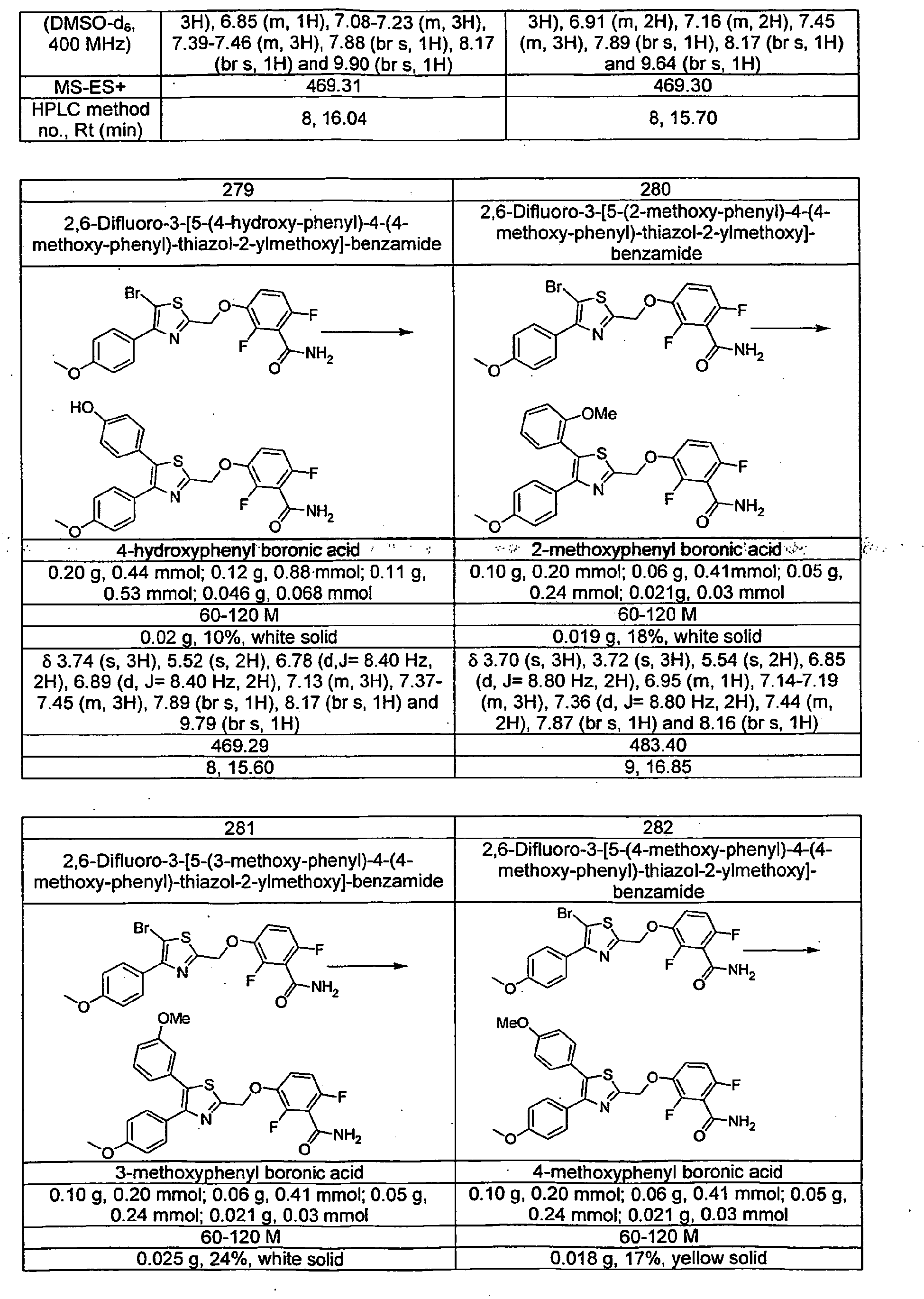

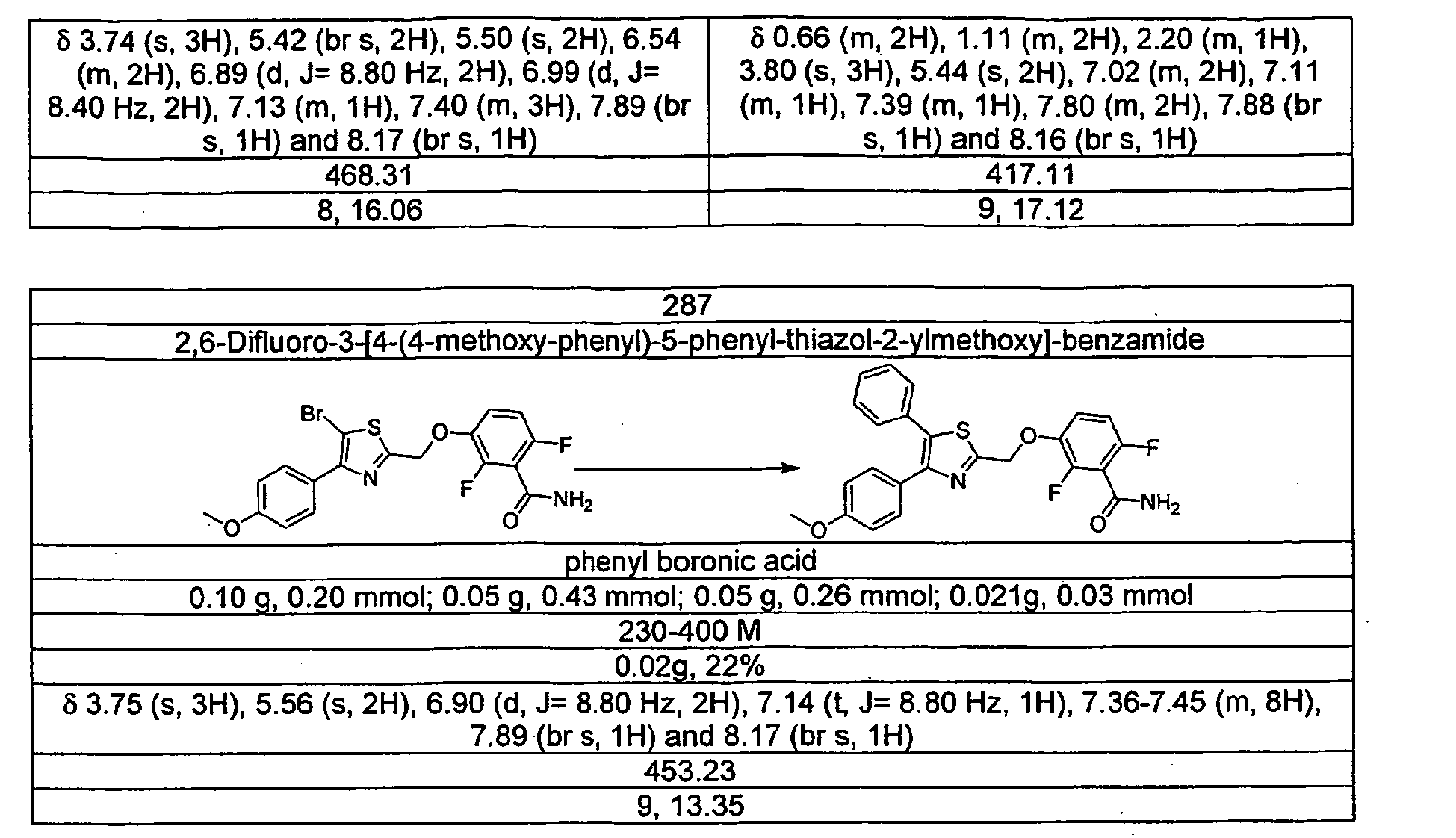
-

- To a solution of 3-[5-bromo-4-(4-methoxy-phenyl)-thiazol-2-ylmethoxy]-2,6-difluoro-benzamide (0.20 g, 0.043 mmol) in 5 ml of anhydrous DMF was added 4-tributylstannyl thiazole (0.16 g , 0.43 mmol) and degassed the reaction mixture for 10 minutes. Tetrakis(triphenylphosphine) Palladium (0) (0.05 g, 0.043 mmol) was then added and the reaction mixture was heated at 120°C for 12 h under the nitrogen atmosphere. Then reaction mixture was cooled to room temperature added water (25 mL) and extracted the compound with ethyl acetate (3 x 50 mL). The combined organic layers were dried over anhydrous Na2SO4, and evaporated to dryness under reduced pressure. The compound was purified by column chromatography on silica (230-400 M) using ethyl acetate/ Hexane (40:60) as the eluent to provide the title compound as white solid (0.072g, 36%). 1H NMR (DMSO-d6, 400 MHz): δ3.80 (s, 3H), 5.56 (s, 2H), 7.01 (d, J= 8.80 Hz, 2H), 7.13 (m, 1H), 7.41-7.50 (m, 4H), 7.90 (br s, 1H), 8.18 (br s, 1H) and 9.18 (s, 1H). MS ES+ (460.32), HPLC (method II) Rt = 16.37 min.
-

- To a solution of 3-[5-bromo-4-(4-methoxy-phenyl)-thiazol-2-ylmethoxy]-2,6-difluoro-benzamide (0.20 g, 0.43 mmol) in pyridine (4.0 mL) was added CuCN (0.19 g, 2.19 mmol). The reaction mixture was heated to 150°C in microwave for 2 h. After the completion of the reaction, pH was adjusted to 3-4 with 1 N HCl solution and extracted with ethyl acetate (3 x 50 mL). The combined organics was washed with water, brine, dried (Na2SO4), filtered and concentrated. The crude residue was purified over silica gel (60-120 M, 45% EtOAc-Hexane) to get the desired product (0.02 g, 11 %) as a brown solid. 1HNMR (DMSO-d6, 400 MHz): δ 3.79 (s, 3H), 5.67 (s, 2H), 7.16 (m, 3H), 7.42 (m, 1H), 7.88 (br s, 1H), 8.03 (d, J= 8.80 Hz, 2H) and 8.19 (br s, 1H). MS ES+ (402.07), HPLC (method I) Rt = 16.60 min.

-

- To a solution of 3-[5-bromo-4-(4-methoxy-phenyl)-thiazol-2-ylmethoxy]-2,6-difluoro-benzamide (2.0 g, 4.37 mmol) in the 50 ml of acetic acid was added Zn dust (2.0 g). The reaction mixture was heated at 120°C for 1 h. After the completion of the reaction mixture (TLC monitoring), water (100 mL) was added and pH was adjusted to 8-9 with NaOH solution and extracted with ethyl acetate (3 x 150 mL). The combined organics was washed with water, brine, dried (Na2SO4), filtered and concentrated to get the desired product (0.8 g, 50%) as a white solid.
-

- A solution of 2,6-Difluoro-3-[4-(4-methoxy-phenyl)-thiazol-2-ylmethoxy]-benzamide (0.20 g, 0.53 mmol) in 15 ml of DCM was cooled to -78° C followed by addition of BBr3 (0.2ml, 2.14 mmol). The reaction mixture was stirred at 25°C for 2 h. After the completion of the reaction mixture (TLC monitoring), solution of NaHCO3 (20 mL) was added at 0°C and extracted with ethyl acetate (3 x 50 mL). The combined organics was washed with Water, brine, dried (Na2SO4), filtered and concentrated, the residue was purified by column chromatography on silica (60-120 M) using ethyl acetate/hexane (50:50) as the eluent to provide the title compound as light yellow solid (0.06 g, 31%). 1H NMR (DMSO-d6, 400 MHz): δ 5.55 (s, 2H), 6.83 (d, J= 8.40 Hz, 2H), 7.13 (m, 1H), 7.40 (m, 1H), 7.78 (d, J= 8.80 Hz, 2H), 7.88 (br s, 1H), 7.91 (s, 1H), 8.17 (br s, 1H) and 9.64 (br s, 1H). MS ES+(363.25), HPLC (method I) Rt = 14.57 min.

-

- The compound was prepared following the general method as described in the preparation of 4-(4-Methoxy-phenyl)-2-methyl-thiazole (Scheme 31).
-

- The compound was prepared following the general method as described in the preparation of 5-Bromo-2-bromomethyl-4-(4-methoxy-phenyl)-thiazole (Scheme 31).
-

- To a solution of 4-(5-Bromo-2-bromomethyl-thiazol-4-yl)-benzonitrile (0.43 g, 1.20 mmol) in 5 ml of anhydrous DMF was added 2,6-difluoro-3-hydroxy-behzamide (0.20 g, 1.20 mmol) and potassium carbonate (0.58 g, 4.20 mmol). The reaction mixture was stirred at 25°C for 24 h under nitrogen atmosphere. The reaction mixture was evaporated to dryness under reduced pressure and the residue was purified by column chromatography on silica (60-120 M) using ethyl acetate/hexane (30:70) as the eluent to provide the title compound as a white solid (0.35 g, 66%). 1H NMR (DMSO-d6, 400 MHz): δ 5.57 (s, 2H), 7.13 (m, 1H), 7.44 (m, 1H), 7.89 (br s, 1H), 8.0 (d, J= 8.40 Hz, 2H), 8.10 (d, J= 8.40 Hz, 2H) and 8.17 (br s, 1H). MS ES+(450.09), HPLC (method I) Rt = 16.127min.


-

- To a solution of 4-Trifluoromethoxybenzonitrile (1.0 g, 5.0 mmol) in EtOH (20 mL) was added hydroxylamine hydrochloride (0.365 g, 5.0 mmol) and NaOH (0.212 g, 5.0 mmol). The resulting reaction mixture was refluxed for 15h. After the completion of the reaction (TLC monitoring), the mixture was concentrated, added EtOH and filtered. The filtrate was evaporated in vacuo and used as such for the next step (crude yield 12.0 g, 66%).
-

- Bromoacetyl bromide (2.0 mL, 23.12 mmol) was added to trifluoromethoxy-N-hydroxy-benzamide (0.40 g, 5.86 mmol) and K2CO3 (0.87 g, 6.0 mmol). The reaction mixture was heated at 100°C for 15 min. After the completion of the reaction mixture (TLC monitoring), water (100 mL) was added and extracted with ethyl acetate (3 x 50 mL). The combined organics was washed with water, brine, dried (Na2SO4), filtered and concentrated. The crude residue was purified over silica gel (60-120 M, 3% EtOAc-Hexane) to get the desired product (0.25 g, 43%) as a white solid.
-


-

-

-


-

-
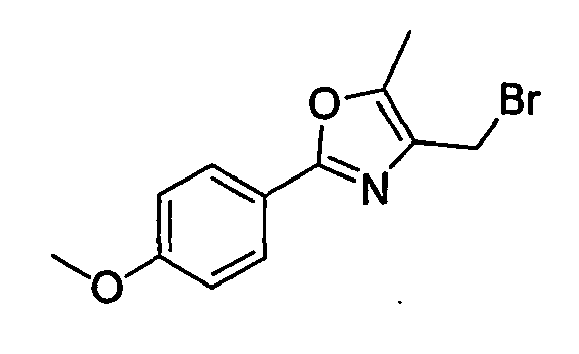
- To the solution of 4-Bromomethyl-2-(4-methoxy-phenyl)-5-methyl-oxazole (0.17 g , 0.80 mmol) in acetonitrile (4.0 mL) was added NBS (7.43 g, 41.74 mmol). The reaction mixture was stirred at 25°C for 1 h under nitrogen atmosphere. After the completion of the reaction mixture (TLC monitoring), the reaction mixture was cooled to 0°C and 2 ml of water was added. The resulting precipitate was filtered and dried to give the desired product (0.11 g, 46%). The corresponding chloro derivative was also prepared by the same general method.
-

- To a solution of 4-Bromomethyl-2-(4-methoxy-phenyl)-5-methyl-oxazole (0.10 g, 0.35 mmol) in 2 ml of anhydrous DMF was added 2,6-Difluoro-3-hydroxy-benzamide (0.061 g, 0.35 mmol) and potassium carbonate (0.171 g, 1.05 mmol). The reaction mixture was stirred at 25°C for 24 h under nitrogen atmosphere. The reaction mixture was evaporated to dryness under reduced pressure and the residue was purified by column chromatography on silica (60-120 M) using ethyl acetate/hexane (50:50) as the eluent to provide the title compound as white solid (0.117 g, 87%). 1H NMR (DMSO-d6, 400 MHz): δ 2.42 (s, 3H), 3.82 (s, 3H), 5.06 (s, 2H), 7.10 (m, 3H), 7.37 (m, 1H), 7.86 (m, 3H) and 8.13 (br s, 1H). MS ES+(375.12), HPLC (method I) Rt = 15.78 min.
-

- To a solution of 4-Bromomethyl-2-(4-chloro-phenyl)-5-methyl-oxazole (0.12 g, 0.42 mmol) in 2 ml of anhydrous DMF was added 2,6-Difluoro-3-hydroxy-benzamide (0.072 g, 0.42 mmol) and potassium carbonate (0.203 g, 1.20 mmol). The reaction mixture was stirred at 25°C for 24 h under nitrogen atmosphere. The reaction mixture was evaporated to dryness under reduced pressure and the residue was purified by column chromatography on silica (60-120 M) using ethyl acetate/hexane (50:50) as the eluent to provide the title compound as white solid (0.01 g, 6%). 1H NMR (DMSO-d6, 400 MHz): δ 2.49 (s, 3H), 5.09 (s, 2H), 7.11 (m, 1H), 7.38 (m, 1H), 7.60 (d, J= 8.40 Hz, 2H), 7.85 (br s, 1H), 7.95 (d, J= 8.40 Hz, 2H) and 8.13 (br s, 1H). MS ES+(379.25), HPLC (method I) Rt = 16.71 min.

-

- To a solution of 5-Bromo-3-nitro-pyridin-2-ol (10.0 g, 45.66 mmol) in 70 ml of toluene and 7 ml of DMF was added PBr3 (6.60 ml, 68.49 mmol) and the reaction mixture was heated at 120°C for 20 min under nitrogen atmosphere. After the completion of the reaction mixture (TLC monitoring), water (100 mL) was added and extracted with ethyl acetate (3 x 200 mL). The combined organics was washed with water, brine, dried (Na2SO4), filtered and concentrated to get the desired product (10.30 g, 80.03%).
-

-

-

-

- A solution of 2-Benzyloxymethyl-5-bromo-thiazolo[5,4-b]pyridine (1.60 g, 4.77 mmol) DCM (15 mL) was cooled to -78° C followed by addition of BBr3 (2.27 ml, 23.86 mmol). The reaction mixture was stirred at 25°C for 2 h. After the completion of the reaction mixture (TLC monitoring), solution of NaHCO3 (20 mL) was added at 0° C and extracted with ethyl acetate (3 x 50 mL). The combined organics was washed with water, brine, dried (Na2SO4), filtered and concentrated to get the desired product (2.0 g, Crude yield).
-

-

- To a solution of 3-(5-bromo-thiazolo[5,4-b]pyridin-2-ylmethoxy)-2,6-difluoro-benzamide (0.15 g, 0.37 mmol) in 5 ml of anhydrous DMF was added allyl tributyltin (0.26 ml , 0.86 mmol) and degassed the reaction mixture for the 10 minutes. Tetrakis(triphenylphosphine) palladium (0) (0.007 g, 0.0056 mmol) was then added and the reaction mixture was heated at 120°C for 1 h under the nitrogen atmosphere. Then reaction mixture was cooled to room temperature added water (25 mL) and extracted the compound with ethyl acetate. The combined organic layers were dried over anhydrous Na2SO4, and evaporated to dryness under reduced pressure. The compounds was purified by column chromatography on silica (100-200 M) using ethyl acetate/ Hexane (60:40) as the eluent to provide the title compound (0.10 g, 75%).
-

- To a solution of 3-(5-Allyl-thiazolo[5,4-b]pyridin-2-ylmethoxy)-2,6-difluoro-benzamide (0.018 g, 0.049 mmol) in 5 ml of anhydrous methanol was added Pd-C (10%, 5 mg) and the reaction mixture was stirred at 25°C for 12 h under hydrogen atmosphere. The reaction mixture was filtered over the bed of celite and the filtrate was evaporated to dryness under reduced pressure to give the title compound as white solid (0.0078 g, 43%). 1H NMR (DMSO-d6, 400 MHz); δ 0.91 (m, 3H), 1.65 (m, 2H), 2.74 (m, 2H), 5.69 (s, 2H), 7.12 (m, 1H), 7.39 (m, 1H), 7.90 (br s, 1H), 8.18 (br s, 1H), 8.27 (br s, 1H) and 8.52 (br s, 1H). MS ES+ (364.11), HPLC (method I) Rt = 15.85 min.
-

- To a solution of 3-(5-bromo-thiazolo[5,4-b]pyridin-2-ylmethoxy)-2,6-difluoro-benzamide (0.10 g, 0.24 mmol) in 5 ml of anhydrous DMF was added 1-methyl-2-tributylstannanyl-1H-imidazole (0.120 g , 0.32 mmol) and degassed the reaction mixture for the 10 minutes. Tetrakis(triphenylphosphine) palladium (0) (0.004 g, 0.0037 mmol) was then added and the reaction mixture was heated at 120°C for 12 h under the nitrogen atmosphere. The reaction mixture was then cooled to room temperature, added water (25 mL) and extracted the compound witch ethyl acetate. The combined organic layers were dried over anhydrous Na2SO4, and evaporated to dryness under reduced pressure. The compound was purified by column chromatography on silica (230-400 M) using ethyl acetate/ hexane (40:60) as the eluent to provide the title compound as brick red solid (0.020 g, 20%). 1H NMR (DMSO-d6, 400 MHz): δ 3.14 (s, 3H), 5.67 (s, 2H), 7.07 (m, 1H), 7.28-7.37 (m, 2H), 7.87 (m, 2H), 8.28 (s, 1H), 8.53 (s, 1H) and 8.75 (br s, 1H). MS ES+(402.22), HPLC (method I) Rt = 12.05 min.
-

- To a solution of 3-(5-bromo-thiazolo[5,4-b]pyridin-2-ylmethoxy)-2,6-difluoro-benzamide (0.10 g, 0.24 mmol) in 5 ml of anhydrous DMF was added 1-methyl-2-tributylstannanyl-1 H-pyrrole (0.120 g , 0.32 mmol) and degassed the reaction mixture for the 10 minutes. Tetrakis(triphenylphosphine) palladium (0) (0.004 g, 0.0037 mmol) was then added and the reaction mixture was heated at 120°C for 12 h under the nitrogen atmosphere. The reaction mixture was then cooled to room temperature, added water (25 mL) and extracted the compound with ethyl acetate. The combined organic layers were dried over anhydrous Na2SO4, and evaporated to dryness under reduced pressure. The compound was purified by column chromatography on silica (230-400 M) using ethyl acetate/ Hexane (40:60) as the eluent to provide the title compound as yellow solid (0.032 g, 32%). 1H NMR (DMSO-d6, 400 MHz): δ 3.73 (s, 3H), 5.72 (s, 2H), 6.13 (br s, 1H), 6.40 (br s, 1H), 6.97 (s, 1H), 7.12 (m, 1H), 7.42 (m, 1H), 7.90 (br s, 1H), 8.18 (br s, 1H), 8.48 (s, 1H) and 8.75 (s, 1H). MS ES+(401.26), HPLC (method I) Rt = 15.61 min.
-


-

- To a solution of 1,3 dichloroacetone (0.84 g, 6.62 mmol) in toluene (5 ml) was added 4-methylthiobenzamide (0.50 g, 3.31 mmol) and the reaction mixture was heated at 120°C for 1 h. After the completion of the reaction mixture (TLC monitoring), the reaction mixture was evaporated to dryness under reduced pressure and the residue was purified over silica gel (230-400 M, 15% EtOAc-Hexane) to get the desired product (0.49 g, 67%). The other derivatives were also prepared by the same general method.
-

- To a solution of 1,3 dichloroacetone (0.42 g, 3.26 mmol) in toluene (5 mL) was added 3-hydroxythiobenzamide (0.25 g, 1.63 mmol) and the reaction mixture was heated at 120°C for 1 h. After completion of the reaction mixture (TLC monitoring), the reaction mixture was evaporated to dryness, added water and extracted with EtOAc (x 3). The combined organics was washed with water, brine, dried (Na2SO4), filtered and concentrated. The crude residue was purified over silica gel (230-400 M, 10% EtOAc-Hexane) to get the desired product (0.14 g, 38%).

-

- To a solution of 2-Benzyloxy-acetamide (1.40 g, 8.56 mmol) in 4 ml of DMF was added 2-Bromo-1-(4-chloro-phenyl)-ethanone (2.0 g, 8.56 mmol) and the reaction mixture was heated at 130°C for 6 h under nitrogen atmosphere. After the completion of the reaction mixture (TLC monitoring), water (25 mL) was added and extracted with ethyl acetate (3 x 50 mL). The combined organics was washed with water, brine, dried (Na2SO4), filtered and concentrated. The crude residue was purified over silica gel (230-400 M, 10% EtOAc-Hexane) to get the desired product (1:1 g, 44%).
-

- A solution of 2-Benzyloxymethyl-4-(4-chloro-phenyl)-oxazole (1.10 g, 3.6 mmol) in 10 ml of DCM was cooled to -78° C followed by addition of BBr3 (1.76 ml, 18.0 mmol). The reaction mixture was stirred at 25°C for 2 h. After the completion of the reaction mixture (TLC monitoring), solution of NaHCO3 (20 mL) was added at 0°C and extracted with ethyl acetate (3 x 50 mL). The combined organics was washed with water, brine, dried (Na2SO4), filtered and concentrated to get the desired product, (0.5g, 49%, crude).
- The compounds of Examples 303-310 were synthesised according to the following general procedure: To a solution of reactant (A) in 2 ml of anhydrous DMF was added 2,6-Difluoro-3-hydroxy-benzamide (B) and potassium carbonate (C). The reaction mixture was stirred at 25 °C for 24 h under nitrogen atmosphere. The reaction mixture was evaporated to dryness under reduced pressure and the residue was purified by column chromatography on silica (60-120 M) using ethyl acetate/hexane (50:50) as the eluent to provide the product compound.


-

-

-

-

-


-

- A mixture of thioacetamide (16.0 g, 213 mmol) and 2-Bromo-1-(4-methoxy-phenyl)-ethanone (4.0 g, 17.5 mmol) was heated at 140°C for 24 h under nitrogen atmosphere. After the completion of the reaction mixture (TLC monitoring), water (25 mL) was added and extracted with ethyl acetate (3 x 50 mL). The combined organics was washed with water, brine, dried (Na2SO4), filtered and concentrated. The crude residue was purified over silica gel (230-400 M, 1% EtOAc-Hexane) to get the desired product (2.5 g, 69%).
-
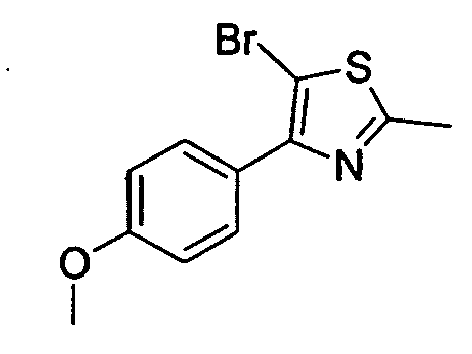
- To the solution of 5-Bromo-2-bromomethyl-4-(4-methoxy-phenyl)-thiazole (5.0 g, 24.3 mmol) in the 20 ml of CCl4 was added NBS (4.32 g, 24.3 mmol) and AIBN ( 0.4 g, 2.43 mmol). The reaction mixture was heated at 100°C for 2 h under nitrogen atmosphere. After the completion of the reaction mixture (TLC monitoring), the reaction mixture was evaporated to dryness under reduced pressure and the residue was purified by column chromatography on silica (230-400 M) using 1% ethyl acetate/hexane eluent to give the desired product (4.0 g, 58%).
-

- To a solution of 5-Bromo-4-(4-methoxy-phenyl)-2-methyl-thiazole (2.0 g, 7.0 mmol) in 15 ml of pyridine was added CuCN (3.10 g, 35.2 mmol)and the reaction mixture was heated to 150°C in microwave for 2 h. After the completion of the reaction pH was adjusted to 3-4 with 1 N HCl solution and extracted with ethyl acetate (3 x 50 mL). The combined organics was washed with water, brine, dried (Na2SO4), filtered and concentrated. The crude residue was purified over silica gel (60-120 M, 12% EtOAc-Hexane) to get the desired product (1.5 g, 92%) as a white solid.
-

- To a solution of 4-(4-Methoxy-phenyl)-2-methyl-thiazole-5-carbonitrile (0.50 g, 2.1 mmol) in 15 ml of methanol was passed dry HCl gas for 1 h at 0° C. The reaction mixture was stirred at 25°C for 24 h. After the completion of the reaction mixture (TLC monitoring), The reaction mixture was evaporated to dryness under reduced pressure. Water (50 ml) was added and pH was adjusted to 7-8 with NaHCO3 solution and extracted with ethyl acetate (3 x 50 mL). The combined organics was washed with water, brine, dried (Na2SO4), filtered and concentrated to get the desired product (0.25g, 44%) as a white solid.
-

- To the solution of 4-(4-Methoxy-phenyl)-2-methyl-thiazole-5-carboxylic acid methyl ester (0.25 g, 0.94 mmol) in the 20 ml of CCl4 was added NBS (0.16 g, 0.94 mmol) and AIBN ( 0.015 g, 0.094 mmol). The reaction mixture was heated at 100°C for 2 h under nitrogen atmosphere. After the completion of the reaction mixture (TLC monitoring), the reaction mixture was evaporated to dryness under reduced pressure and the residue was purified by column chromatography on silica (230-400 M) using 10% ethyl acetate/hexane as a eluent to give the desired product (0.078 g, 24%).
-
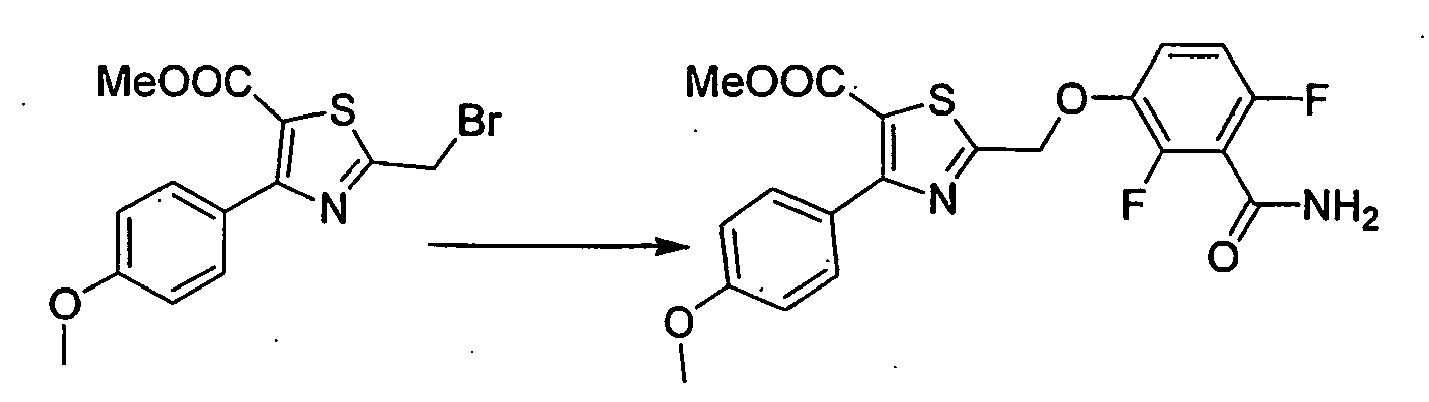
- To a solution of 2-Bromomethyl-4-(4-methoxy-phenyl)-thiazole-5-carboxylic acid methyl ester (0.05 g, 0.14 mmol) in 2 ml of anhydrous DMF was added 2,6-Difluoro-3-hydroxy-benzamide (0.025 g, 0.14 mmol) and potassium carbonate (0.07 g, 0.50 mmol). The reaction mixture was stirred at 25°C for 24 h under nitrogen atmosphere. The reaction mixture was evaporated to dryness under reduced pressure and the residue was purified by column chromatography on silica (60-120 M) using ethyl acetate/hexane (50:50) as the eluent to provide the title compound as white solid (0.025g, 40%). 1H NMR (DMSO-d6, 400 MHz): δ 3.76 (s, 3H), 3.81 (s, 3H), 5.60 (s, 2H), 7.01 (d, J= 8.40 Hz, 2H), 7.12 (m, 1H), 7.41 (m, 1H), 7.74 (d, J= 8.40 Hz, 2H), 7.90 (br s, 1H) and 8.18 (br s, 1H). MS ES+(435.06), HPLC (method I) Rt = 15.86 min.

-

- To a solution of cyclohexanone (5.0 g, 51 mmol) in the 80 ml of DCM was added pyridine (4.48 ml, 56.0 mmol) and the resulting reaction mixture was cooled to -78°C. To the reaction mixture the solution of triflic anhydride (7.40 ml, 56.0 mmol) in 30 ml of DCM was added over the period of 1 h. Reaction mixture was stirred at 25° C for 24 h. After the completion of the reaction mixture (TLC monitoring), the reaction mixture was evaporated to dryness under reduced pressure. The residue was triturated with n-pentane and decanted the organic layer, dried (Na2SO4), filtered and concentrated to give the desired product (5.0 g, 42%).
-

- To a solution of 2,6-Difluoro-3-[5-(4,4,5,5-tetramethyl-[1,3,2]dioxaborolan-2-yl)-1H-inden-2-ylmethoxy]-benzamide (0.10 g, 0.20 mmol) in 3 ml of anhydrous DMF and water (1.5 ml) was added trifluoromethanesulfonic acid cyclohex-1-enyl ester (0.15 g, 0.60 mmol) and potassium phosphate (0.057 g, 0.20 mmol). The reaction mixture was degassed for 10 minutes followed by addition of dichlorobis(triphenyl phosphine) palladium (II) (0.02 g, 0.03 mmol). The reaction mixture was heated at 80°C for 1 h under the nitrogen atmosphere. After the completion of the reaction mixture (TLC monitoring), water (25 mL) was added and extracted with ethyl acetate (3 x 50 mL). The combined organics was washed with water, brine, dried (Na2SO4), filtered and concentrated. The crude residue was purified over silica gel (230-400 M, 45% EtOAc-Hexane) to get the desired product (0.017g, 19%) as a white solid. 1H NMR (DMSO-d6, 400 MHz): δ 1.63 (m, 4H), 2.20 (m, 2H), 2.45 (m, 2H), 5.67 (s, 2H), 6.29 (m, 1H), 7.12 (m, 1H), 7.37 (m, 1H), 7.57 (m, 2H), 7.90 (br s, 1H), 8.03 (d, J= 8.40 Hz, 1H) and 8.18 (br s, 1H). MS ES+ (401.16), HPLC (method II) Rt = 14.13 min.
-

- To a solution of 3-(5-Cyclohex-1-enyl-1H-inden-2-ylmethoxy)-2,6-difluoro-benzamide (0.01 g, 0.25 mmol) in 5 ml of anhydrous methanol was added Pd-C (10%, 100 mg). The reaction mixture was stirred at 25°C for 48 h under hydrogen atmosphere. The reaction mixture was filtered over the bed of celite and evaporated to dryness under reduced pressure to give the title compound as white solid (0.01 g, 10%). 1H NMR (DMSO-d6, 400 MHz); δ 1.40 (m, 6H), 1.72 (m, 4H), 2.63 (m, 1H), 5.66 (s, 2H), 7.09 (m, 1H), 7.35 (m, 2H), 7.83 (br s, 1H), 7.89 (d, J= 8.40 Hz, 1H), 7.99 (d, J= 8.40 Hz, 1H) and 8.18 (br s, 1H). MS ES+ (403.33), HPLC (method II) Rt = 18.76 min.

-

- To a solution of cyclopentanone (5.0 g, 59 mmol) in the 80 ml of DCM was added pyridine (5.2 ml, 65.0 mmol) and the resulting reaction mixture was cooled to -78°C. To the reaction mixture the solution of triflic anhydride (9.2 ml, 65.0 mmol) in 30 ml of DCM was added over the period of 1 h. Reaction mixture was stirred at 25° C for 24 h. After the completion of the reaction mixture (TLC monitoring), the reaction mixture was evaporated to dryness under reduced pressure. The residue was triturated with n-pentane and decanted the organic layer, dried (Na2SO4), filtered and concentrated to give the desired product (2.4 g, 22%).
-

- To a solution of 2,6-Difluoro-3- [5-(4,4,5,5-tetramethyl-[1,3,2]dioxaborolan-2-yl)-1H-inden-2-ylmethoxy]-benzamide (0.25 g, 0.56 mmol) in 7 ml of anhydrous DMF and water (3.5 ml) was added trifluoromethanesulfonic acid cyclopent-1-enyl ester (0.37g, 1.70 mmol) and potassium phosphate (0.14 g, 0.60 mmol). The reaction mixture was degassed for 10 minutes followed by addition of dichlorobis(triphenyl phosphine) palladium (II) (0.05 g, 0.08 mmol). The reaction mixture was heated at 80°C for 1 h under the nitrogen atmosphere. After the completion of the reaction mixture (TLC monitoring), water (25 mL) was added and extracted with ethyl acetate (3 x 50 mL). The combined organics was washed with water, brine, dried (Na2SO4), filtered and concentrated. The crude residue was purified over silica gel (230-400 M, 45% EtOAc-Hexane) to get the desired product (0.14 g, 65%) as a white solid. 1H NMR (DMSO-d6, 400 MHz): δ 1.22 (m, 2H), 2.01 (m, 2H), 2.88 (m, 2H), 5.68 (s, 2H), 6.43 (s, 1H), 7.01 (t, J= 9.20 Hz, 1H), 7.37 (m, 1H), 7.67 (d, J= 8.40 Hz, 1H), 7.89 (br s, 1H), 7.94 (s, 1H), 8.07 (d, J= 8.40 Hz, 1H) and 8.18 (br s, 1H). MS ES+ (387.15), HPLC (method II) Rt = 13.74 min.
-

- To a solution of 3-(5-Cyclopent-1-enyl-1H-inden-2-ylmethoxy)-2,6-difluoro-benzamide (0.05 g, 0.10 mmol) in 5 ml of anhydrous methanol was added Pd-C (10%, 100 mg). The reaction mixture was stirred at 25°C for 48 h under hydrogen atmosphere. The reaction mixture was filtered over the bed of celite and evaporated to dryness under reduced pressure to give the title compound as white solid (0.005 g, 10%). 1H NMR (DMSO-d6, 400 MHz); δ 1.22 (m, 2H), 1.67 (m, 4H), 1.80 (m, 2H), 2.07 (m, 2H), 3.20 (m, 1H), 5.67 (s, 2H), 7.09 (m, 1H), 7.37 (m, 2H), 7.87 (m, 2H), 8.0 (m, 1H) and 8.18 (br s, 1H). MS ES+ (389.12), HPLC (method II) Rt = 18.19 min.
-

-

- To the solution of ethyl oxamate (10.0 g, 85.30 mmol) in 120 ml of toluene was added Lawesson's reagent (24.15 g, 59.7 mmol) and the reaction mixture was heated at 120°C for 12 h. After the completion of the reaction mixture (TLC monitoring), the reaction mixture was evaporated to dryness under reduced pressure. The residue was purified by column chromatography on silica (230-400 M) using ethyl acetate/hexane (5:95) as the eluent to provide the title compound (1.8 g, 16%).
-

- To the solution of 2-Bromo-1-(4-trifluoromethyl-phenyl)-ethanone (0.50 g, 0.80 mmol) in 7 ml of ethanol was added ethyl thio-oxamate (0.15 g, 1.14 mmol). The reaction mixture was heated at 80°C for 2 h under nitrogen atmosphere. After the completion of the reaction mixture (TLC monitoring), the reaction mixture was concentrated under reduced pressure, water (25 mL) was added and extracted with ethyl acetate (3 x 50 mL). The combined organics was washed with water, brine, dried (Na2SO4), filtered and concentrated. The crude residue was purified over silica gel (230-400 M, 2% EtOAc-Hexane) to get the desired product (0.21 g, 76%). The other derivatives were also prepared by the same general method.
-
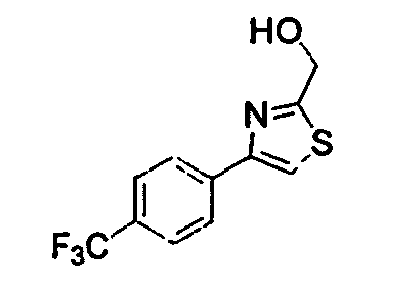
- To an ice-cold suspension of LAH (0.056 g, 1.40 mmol) the 8 ml of anhydrous THF was added dropwise a solution of 4-(4-Trifluoromethyl-phenyl)-thiazole-2-carboxylic acid ethyl ester (0.21 g, 0.71 mmol) in the 5 ml of THF. The reaction mixture was stirred at 25°C for 1 h. After the completion of the reaction mixture (TLC monitoring), cooled the reaction mixture to 0°C and quenched with 2.5 ml of water followed by the addition of 15% NaOH solution (2 mL) and finally 4 ml of water. The resulting solution was filtered through celite bed and the filtrate was concentrated under reduced pressure. Water (50 mL) was added and extracted with ethyl acetate (3 x 50 mL). The combined organics was washed with water brine, dried (Na2SO4), filtered and concentrated to give the desired product (0.13 g, 70%). The other derivatives were also prepared by the same general method.
-

- To the solution of [4-(4-Trifluoromethyl-phenyl)-thiazol-2-yl]-methanol (0.13g, 0.50 mmol) in 2 ml of toluene was added PBr3 (0.072 ml, 0.752 mmol) and the reaction mixture was heated at 120°C for 20 min under nitrogen atmosphere. After the completion of the reaction mixture (TLC monitoring), water (25 mL) was added and extracted with ethyl acetate (3 x 50 mL). The combined organics was washed with water, brine, dried (Na2SO4), filtered and concentrated. The crude residue was purified over silica gel (230-400 M, 1% EtOAc-Hexane) to get the desired product (0.04 g, 25%). The other derivatives were also prepared by the same general method.

-

- To a Solution of 4-chloro-3-nitrobenzoic acid (5.0 g, 24.81 mmol) in 50 ml of methanol was added H2SO4 (2ml, 37.02 mmol) and the reaction mixture was heated at 70°C for 5 h. After completion of the reaction mixture (TLC monitoring), the reaction mixture was evaporated to dryness under reduced pressure. Water (50 mL) was added and extracted with ethyl acetate (3 x 50 mL). The combined organics was, dried (Na2SO4), filtered and concentrated to give the desired product (5.04 g, 94%).
-

- To a solution of 4-Chloro-3-nitro-benzoic acid methyl ester (5.0 g, 23.19 mmol) in 100 ml of ethanol was added SnCl2.2H2O (26.0 g, 115.96 mmol) and the reaction mixture was heated at 80°C for 2 h. After the completion of the reaction mixture (TLC monitoring), the reaction mixture was evaporated to dryness under reduced pressure. Water (100 mL) was added, basified the reaction mixture with NaOH solution and extracted with hot EtOAc (3 x 250 mL). The combined organics was dried over Na2SO4, filtered and concentrated to give the desired product (3.0 g, 69%).
-

- A solution of carbonic acid monobenzyl ester (3.50 g, 21.0 mmol) in the 50 ml of DCM and 0.50 ml of DMF was cooled to -78° C followed by addition of oxalyl chloride (11.79 ml, 105 mmol). The resulting reaction mixture was stirred at room temperature for 1 h. After the completion of the reaction mixture (TLC monitoring) concentrated it to give 2-benzyloxyacetyl chloride (3.0 g, 96%). To an ice cold solution of 3-amino-4-chloro-benzoic acid methyl ester in 10 ml of DCM was added triethylamine (2.47 ml, 17.78 mmol) followed by addition of 2-benzyloxyacetyl chloride (3.0 g, 17.78 mmol) in 10 ml of DCM .The reaction mixture was stirred at 25°C for 12 hr. After the completion of the reaction mixture (TLC monitoring), the reaction mixture was evaporated to dryness under reduced pressure. The residue was purified by column chromatography on silica (60-120 M) using ethyl acetate/hexane (5:95) as the eluent to provide the title compound (1.70 g, 31 %).
-

- To the solution of 3-(2-Benzyloxy-acetylamino)-4-chloro-benzoic acid methyl ester (1.70 g, 5.10 mmol) in 20 ml of toluene was added Lawesson's reagent (1.03 g, 2.50 mmol) and the reaction mixture was heated at 120° C for 2 h. After the completion of the reaction mixture (TLC monitoring), the reaction mixture was evaporated to dryness under reduced pressure. The residue was purified by column chromatography on silica (60-120 M) using ethyl acetate/hexane (5:95) as the eluent to provide the title compound (1.20 g, 67%).
-

- To a solution of 3-(2-Benzyloxy-thioacetylamino)-4-chloro-benzoic acid methyl ester (1.20 g, 3.40 mmol) in the 8 ml of NMP was added NaH (0.12 g, 5.10 mmol) portion wise. The reaction mixture was heated at 160°C for 3 h. After the completion of the reaction mixture (TLC monitoring), the reaction mixture was poured info 150 ml of ice-cold water and extracted with ethyl acetate (3 x 150 mL). The combined organics was dried (Na2SO4), filtered and concentrated to give the desired product. (1.07 g, 56%).
-

- A solution of 2-Benzyloxymethyl-benzothiazole-6-carboxylic acid methyl ester (0.10 g, 0.32 mmol) in 2 ml of DCM was cooled to -78° C followed by addition of BBr3 (0.06 ml, 0.64 mmol). The reaction mixture was stirred at 25°C for 2 h. After the completion of the reaction mixture (TLC monitoring), solution of NaHCO3 (20 mL) was added at 0°C and extracted with ethyl acetate (3 x 50 mL). The combined organics was washed with water, brine, dried (Na2SO4), filtered and concentrated to get the desired product (0.08 g, Crude yield).
-

- To a solution of 2-Hydroxymethyl-benzothiazole-6-carboxylic acid methyl ester (0.08 g, 0.40 mmol) in 5 ml of toluene and 1 ml of DMF was added PBr3 (0.06 ml, 0.60 mmol). The reaction mixture was heated at 120°C for 20 min under nitrogen atmosphere. After the completion of the reaction mixture (TLC monitoring), water (25 mL) was added and extracted with ethyl acetate (3 x 50 mL). The combined organics was washed with water, brine, dried (Na2SO4), filtered and concentrated to get the desired product (0.044 g, 36%).

-

- To a solution of 3,4 Dihydroxy benzonitrile (5.0 g, 37.0 mmol) in 20 ml of DMF was added dibromomethane (19.25 g, 110.0 mmol) and potassium carbonate (25.50 g, 184.90 mmol). The reaction mixture was heated at 120°C for 2 h under the nitrogen atmosphere. After the completion of the reaction mixture (TLC monitoring), reaction mixture was cooled to room temperature. Water (50 ml) was added to the reaction mixture and extracted the compound with ethyl acetate (3 x 100 mL). The combined organic layers were dried over anhydrous Na2SO4, and evaporated to dryness under reduced pressure to give the title compound as yellow solid (5.16 g, 94.8%).
-

- To a solution of Benzo[1,3]dioxole-5-carbonitrile (5.0 g, 33.9 mmol) in EtOH (100 mL) was added hydroxylamine hydrochloride (4.68 g, 67.90 mmol) and NaOH (2.71 g, 67.9 mmol). The resulting reaction mixture was refluxed for 12 h. After the completion of the reaction (TLC monitoring), the mixture was concentrated, added EtOH and filtered. The filtrate was evaporated under reduced pressure and used as such for the next step (crude yield 4.8 g, 78.68%).
-

- Bromoacetyl bromide (0.22 g, 1.10 mmol) was added to N-Hydroxy-benzo[1,3]dioxole-5-carboxamidine (0.40 g, 0.55 mmol) and K2CO3 (0.38 g, 0.78 mmol). The reaction mixture was heated at 100°C for 15 min. After the completion of the reaction mixture (TLC monitoring), water (25 mL) was added and extracted with ethyl acetate (3 x 50 mL). The combined organics was washed with water, brine, dried (Na2SO4), filtered and concentrated. The crude residue was purified over silica gel (60-120 M, 5% EtOAc-Hexane) to get the desired product (0.05 g, 31%).

-

- To an ice-cold solution of 4-methoxy-thiobenzamide (0.50 g, 2.98 mmol) in ethanol (25 ml) was added triethylamine (0.41 ml, 2.98 mmol) followed by dropwise addition of ethyl bromopyruvate (0.56 ml, 4.40 mmol). The reaction mixture was heated at 65°C for 12 h. After the completion of the reaction mixture (TLC monitoring), the reaction mixture was evaporated to dryness under reduced pressure, water (25 mL) was added and extracted with ethyl acetate (3 x 50 mL). The combined organics was washed with water, brine, dried (Na2SO4), filtered and concentrated. The crude residue was purified over silica gel (60-120 M, 10% EtOAc-Hexane) to get the desired product (0.38 g, 48%).
-

- To an ice-cold suspension of LAH (0.08 g, 2.07 mmol) in 10 ml of anhydrous THF was added a solution of 2-(4-Methoxy-phenyl)-thiazole-4-carboxylic acid ethyl ester (0.26 g, 0.98 mmol) in 5 ml of THF. The reaction mixture was heated up to 60°C for 1h. After the completion of the reaction mixture (TLC monitoring), the reaction mixture was cooled to 0°C, water (2.0 ml) was added followed by the addition of 15% NaOH solution (2 mL) and finally 4 ml of water. The resulting solution was filtered through celite bed and concentrated under reduced pressure; water (25 mL) was added and extracted with ethyl acetate (3 x 50 mL). The combined organics was washed with water, brine, dried (Na2SO4), filtered and concentrated to give the desired product (0.14 g, 64%).
-

- To a solution of [2-(4-Methoxy-phenyl)-thiazol-4-yl]-methanol (0.12 g, 0.50 mmol) in 3 ml of toluene was added PBr3 (0.078 ml, 0.813 mmol) and the reaction mixture was heated at 120°C for 20 min under nitrogen atmosphere. After the completion of the reaction mixture (TLC monitoring), water (25 mL) was added and extracted with ethyl acetate (3 x 50 mL). The combined organics was washed with water, brine, dried (Na2SO4), filtered and concentrated to get the desired product (0.13 g, 84%).


-

- Propionic anhydride (0.75 mL, 5.79 mmol) was added to 4-Chloro-N-hydroxy-benzamide (0.50 g, 2.89 mmol) and K2CO3 (2.0 g, 14.48 mmol). The reaction mixture was heated at 100°C for 30 min. After the completion of the reaction mixture (TLC monitoring), the reaction mixture was cooled to 0°C, added water (25 mL) and extracted with ethyl, acetate (3 x 50 mL). The combined organics was washed with waster, brine, dried (Na2SO4), filtered and concentrated. The crude residue was purified over silica gel (60-120 M, 5% EtOAc-Hexane) to get the desired product (0.29 g, 48%).
-

- To a solution of 3-(4-Chloro-phenyl)-5-ethyl-[1,2,4]oxadiazole (0.29 g, 1.38 mmol) in CCl4 (10 mL) was added NBS (0.24 g, 1.38 mmol) and AIBN ( 0.02 g, 0.0001 mmol). The reaction mixture was heated at 100°C for 2 h under nitrogen atmosphere. After the completion of the reaction mixture (TLC monitoring), the reaction mixture was evaporated to dryness under reduced pressure and the residue was purified by column chromatography on silica (230-400 M) using 1% ethyl acetate/hexane as eluent to give the desired product (0.12 g, 30%).

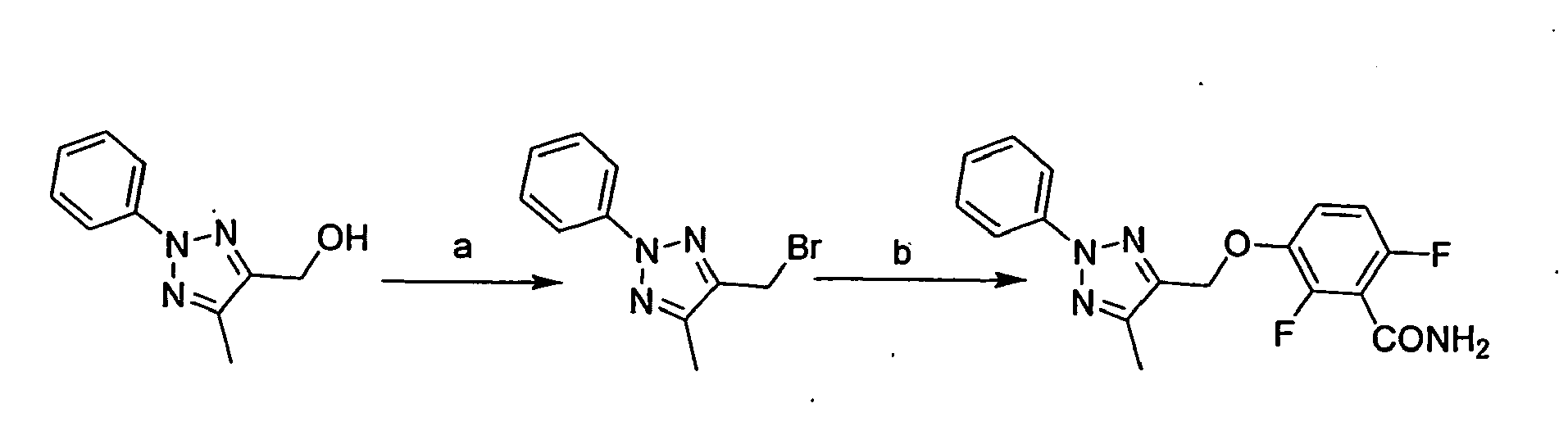
-

- To a solution of (5-Methyl-2-phenyl-2H-[1,2,3]triazol-4-yl)-methanol (0.25 g, 1.30 mmol) in 10 ml of toluene was added PBr3 (0.53 g, 1.90 mmol) and the reaction mixture was heated at 120°C for 20 min under nitrogen atmosphere. After the completion of the reaction, mixture (TLC monitoring), water (25 mL) was added and extracted with ethyl acetate (3 x 50 mL). The combined organics was washed with water, brine, dried (Na2SO4), filtered and concentrated to get the desired product (0.30 g, 90%) as a yellow solid.

-

- To a solution of 2-bromothiazole (1.0 g, 6.09 mmol) in 4 ml of pyridine was added CuCN (1.09 g, 12.19 mmol). The reaction mixture was heated to 150°C for 3 h. After the completion of the reaction, pH was adjusted to 3-4 with 1 N HCl solution and extracted with ethyl acetate (3 x 50 mL). The combined organics was washed with water, brine, dried (Na2SO4), filtered and concentrated to get the desired product (0.42 g, 63%).
-

- To a solution of thiazole-2-carbonitrile (0.42 g, 3.80 mmol) in EtOH (20 mL) was added hydroxylamine hydrochloride (0.53 g, 7.60 mmol) and pyridine (0.27 g, 3.40 mmol). The resulting reaction mixture was refluxed for 15h. After the completion of the reaction (TLC monitoring), the mixture was concentrated, added EtOH and filtered. The filtrate was evaporated under reduced pressure and used as such for the next step (crude yield 0.50 g, 91 % crude yield).
-

- Chloroacetyl Chloride (5.0 mL, 44.5 mmol) was added to N-Hydroxy-thiazole-2-carboxamidine (0.50 g, 3.49 mmol) and K2O3 (1.0 g 7.20 mmol). The reaction mixture was heated at 100°C for 15 min. After the completion of the reaction mixture (TLC monitoring), water (25 mL) was added and extracted with ethyl acetate (3 x 50 mL). The combined organics was washed with water, brine, dried (Na2SO4), filtered and concentrated. The crude residue was purified over silica gel (230-400 M, 10% EtOAc-Hexane) to get the desired product (0.18 g, 25%) as a white solid.

-

- To an ice-cold solution of 4-phenoxy-phenylamine (1.0 g, 5.39 mmol) in 10 ml of DCM was added triethylamine (0.90 ml, 5.93 mmol) followed by acetyl chloride (0.50 g, 6.47mmol). The reaction mixture was stirred at 25°C for 2 h. After the completion of the reaction mixture (TLC monitoring), water was added extracted with DCM (3 x 50 mL). The combined organics was dried (Na2SO4), filtered and concentrated to get the desired product (1.20 g, crude yield).
-

- To a solution of N-(4-phenoxy-phenyl)-acetamide (1.20 g, 5.28 mmol) in 10 ml of toluene was added Lawesson's reagent (1.50 g, 3.70 mmol). The reaction mixture was heated at 120°C for 2 h. After the completion of the reaction (TLC monitoring), the reaction mixture was evaporated to dryness under reduced pressure. The residue was purified by column chromatography on silica (60-120M) using ethyl acetate/hexane (5:95) as the eluent to provide the title compound (0.78 g, 60.7%).
-

- To an ice-cold solution of N-(4-phenoxy-phenyl)-thioacetamide (0.78 g, 3.20 mmol) in 10 ml of DCM was added Br2 (0.32 ml, 6.40 mmol) dropwise. The reaction mixture was heated at 45°C for 2 h. After the completion of the reaction (TLC monitoring), the reaction mixture was evaporated under reduced pressure. The residue was basified with NH4OH solution arid extracted with ethyl acetate .The combined organics were, dried, (Na2SO4), filtered and concentrated. The residue was purified by column chromatography on silica (230-400 M) using ethyl acetate/hexane (3:97) as the eluent to provide the title compound (0.08 g, 10.3%).
-

- To a solution of 2-methyl-6-phenoxy-benzothiazole (0.06 g, 0.24 mmol) in 5 ml of CCl4 was added NBS (0.039 g, 0.22 mmol) and AIBN (0.004 g, 0.024 mmol). The reaction mixture was heated at 100°C for 2 h under nitrogen atmosphere. After the completion of the reaction mixture (TLC monitoring), the reaction mixture was evaporated to dryness under reduced pressure and the residue was purified by column chromatography on silica (230-400M) using 1% ethyl acetate/hexane eluent to give the desired product (0.005g, 6.3%).

-

- To a solution of 7-methylquinoline (0.10 g, 0.70 mmol) in 5 ml of CCl4 was added NBS (0.14 g, 0.77 mmol) and AIBN (0.025 g, 0.15 mmol). The reaction mixture was heated at 100°C for 2 h under nitrogen atmosphere. After the completion of the reaction mixture (TLC monitoring), the reaction mixture was evaporated to dryness under reduced pressure and the residue was purified by column chromatography on silica (230-400M) using 1% ethyl acetate/hexane eluent to give the desired product (0.090g, 58%).
- The compounds of Examples 318-333 were synthesised according to the following general procedure: To a solution of reactant (A) in anhydrous DMF was added 2,6-Difluoro-3-hydroxy-benzamide (B) and potassium carbonate (C). The reaction mixture was stirred at 25°C for 24 h under nitrogen atmosphere. The reaction mixture was evaporated to dryness under reduced pressure and the residue was purified by column chromatography on silica using ethyl acetate/hexane as the eluent to provide the product compound.


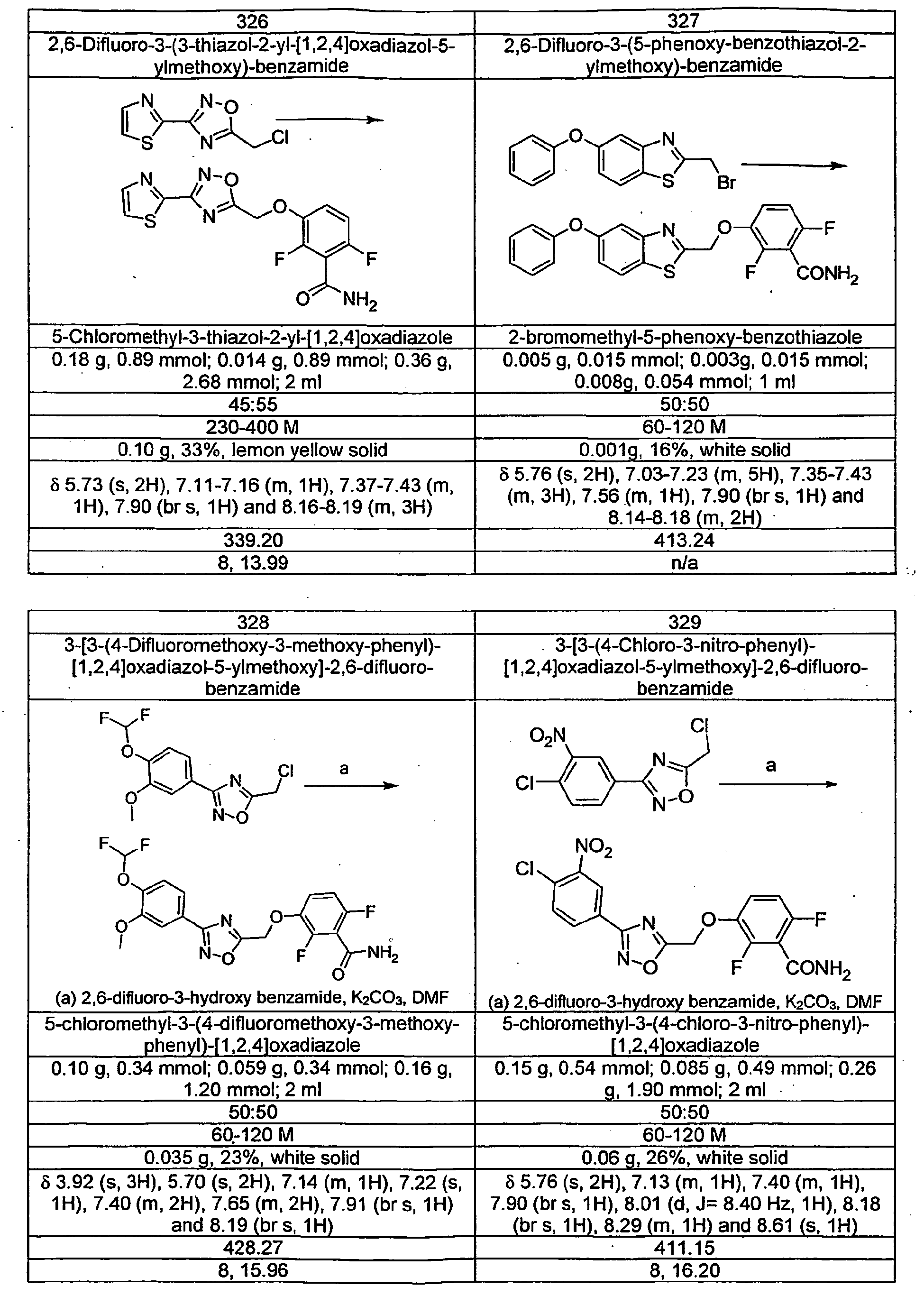


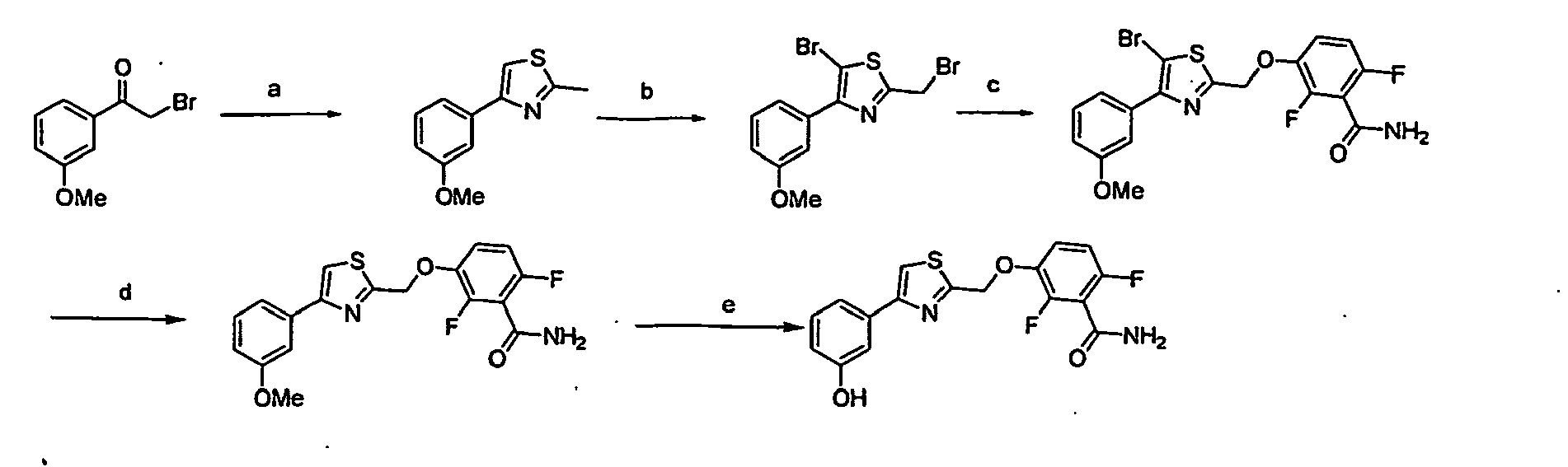
-
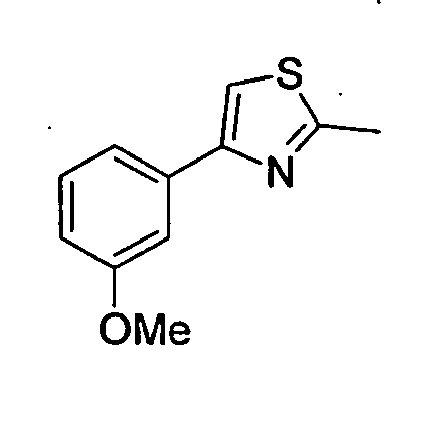
- A mixture of thioacetamide (8.0 g, 106.0 mmol) and 2-bromo-1-(3-methoxy-phenyl)-ethanone (2.0 g, 8.81 mmol) was heated at 140°C for 6 h under nitrogen atmosphere. After completion of the reaction mixture (TLC monitoring), water (50 mL) was added and extracted with ethyl acetate (3 x 50 mL). The combined organics was washed with water, brine, dried (Na2SO4), filtered and concentrated. The crude residue was purified over silica gel (230-400 M, 2% EtOAc-Hexane) to get the desired product (1.5g, 83%).
-
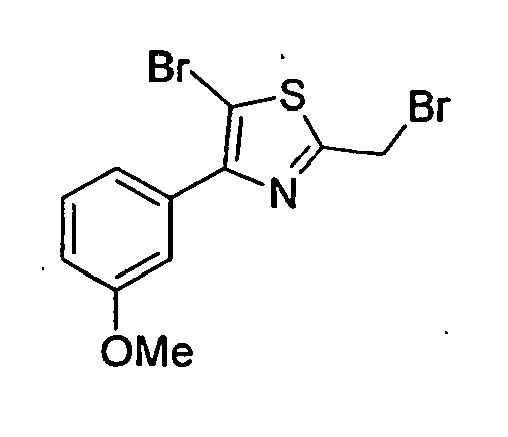
- To a solution 4-(3-methoxy-phenyl)-2-methyl-thiazole (1.50, 7.30 mmol) in the 20 ml of CCl4 was added NBS (2.60 g, 14.60 mmol) and AIBN (0.12 g, 0.73 mmol). The reaction mixture was heated at 100°C for 2 h under nitrogen atmosphere. After completion of the reaction mixture (TLC monitoring), the reaction mixture was evaporated to dryness under reduced pressure and the residue was purified by column chromatography on silica (230-400 M) using 2% ethyl acetate/hexane as a eluent to give the desired product (1.20 g, 45%).
-

- To a solution of 5-Bromo-2-bromomethyl-4-(3-methoxy-phenyl)-thiazole (0.80 g, 2.20 mmol) in 5 ml of anhydrous DMF was added 2,6-Difluoro-3-hydroxy-benzamide (0.38 g, 2.20 mmol) and potassium carbonate (1.06 g, 7.70 mmol). The reaction mixture was stirred at 25°C for 24 h under nitrogen atmosphere. The reaction mixture was evaporated to dryness under reduced pressure and the residue was purified by column chromatography on silica (60-120M) using ethyl acetate/hexane (50:50) as the eluent to provide the title compound as white solid (0.50 g, 49%).
-

- To the solution of 3-[5-bromo-4-(3-methoxy-phenyl)-thiazol-2-ylmethoxy]-2,6-difluoro-benzamide (0.50 g, 1.10 mmol) in the 10 ml of acetic acid was added Zn dust (0.50 g, w/w). The reaction mixture was heated at 120°C for 1 h. After the completion of the reaction mixture (TLC monitoring), water (50 mL) was added and pH was adjusted to 8-9 with NaOH solution and extracted with ethyl acetate (3 x 100 mL). The combined organics was washed with water, brine, dried (Na2SO4), filtered and concentrated to get the desired product (0.22 g, 53%).
-

- A solution of 2,6-Difluoro-3-[4-(3-methoxy-phenyl)-thiazol-2-ylmethoxy]-benzamide (0.20 g, 0.53 mmol) in 15 ml of DCM was cooled to -78°C followed by addition of BBr3 (0.20 ml, 2.14 mmol). The reaction mixture was stirred at 25°C for 2 h. After the completion of the reaction mixture (TLC monitoring), solution of NaHCO3 (20 mL) was added at 0°C and extracted with ethyl acetate (3 x 50 mL). The combined organics was washed with water, brine, dried (Na2SO4), filtered and concentrated. The residue was purified by column chromatography on silica (60-120 M) using ethyl acetate/hexane (50:50) as the eluent to provide the title compound as white solid (0.065 g, 33%). 1H NMR (DMSO-d6, 400 MHz): δ 5.60 (s, 2H), 6.74 (m, 1H), 7.10 (m, 1H), 7.24 (m, 1H). 7.37-7.45 (m, 3H), 7.90 (br s, 1H), 8.10 (s, 1H), 8.17 (br s, 1H) and 9.55 (s, 1H). MS ES+(362.99), HPLC (method II) Rt = 14.95 min.
- Compounds of this invention were tested for antimicrobial activity by susceptibility testing in liquid media. MICs for compounds against each strain were determined by a broth microdilution method according to the National Committee for Clinical Laboratory Standards (NCCLS) guidelines. (NCCLS. 2000. Methods for dilution antimicrobial susceptibility tests for bacteria that grow aerobically-fifth edition. Approved standard M7-A5. NCCLS, Wayne, Pa.)
Briefly, test compounds are prepared in 100 µl of 1.6% DMSO solution in multiwell plates. Several bacterial colonies from a freshly streaked plate are transferred to an appropriate rich broth, such as Mueller Hinton. The cell suspension is adjusted to an optical density of 0.09 and further diluted 1:100 with warm 2x broth. This cell suspension is dispensed into the wells containing compound solution so that the final volume is 200 µl. The plates are incubated overnight (16-20 hours) at 37°C and turbidity is scored by eye and quantified spectrophotometrically. The MIC is defined as the lowest concentration inhibiting visible growth.
Compounds of the current invention were found to have antimicrobial activity in the MIC assay described above. - Table 1 shows the Minimal Inhibitory Concentration (MIC) of the Examples against Bacillus subtilis 168CA. Activities were scored as 'A' if the MIC was ≤8 micrograms/ml, 'B' if the MIC was 16 to 64 micrograms/ml and 'C' if the MIC was greater than 64 micrograms/ml.
Table 1 Bacillus subtilis MICs Example Activity Example Activity Example Activity 1 A 33 C 65 A 2 C 34 B 66 A 3 C 35 B 67 A 4 C 36 A 68 A 5 B 37 C 69 A 6 C 38 A 70 A 7 C 39 B 71 A 8 B 40 A 72 B 9 C 41 B 73 A 10 A 42 B 74 A 11 C 43 B 75 A 12 B 44 A 76 A 13 B 45 A 77 B 14 B 46 A 78 A 15 B 47 A 79 B 16 C 48 A 80 B 17 B 49 A 81 A 18 C 50 A 82 A 19 A 51 A 83 A 20 A 52 A 84 A 21 B 53 C 85 A 22 B 54 B 86 A 23 B 55 A 87 A 24 A 56 A 88 A 25 C 57 A 89 A 26 C 58 A 90 A 27 C 59 A 91 A 28 A 60 B 92 A 29 B 61 A 93 A 30 C 62 A 94 A 31 B 63 A 95 B 32 A 64 A 96 B 153 A 210 A 97 A 154 A 211 A 98 A 155 A 212 A 99 A 156 A 213 A 100 A 157 A 214 B 101 B 158 A 215 A 102 A 159 A 216 A 103 A 160 A 217 A 104 A 161 A 218 A 105 A 162 A 219 A 106 A 163 A 220 A 107 A 164 A 221 A 108 B 165 A 222 A 109 A 166 C 223 A 110 A 167 B 224 B 111 A 168 C 225 C 112 A 169 C 226 B 113 A 170 C 227 A 114 A 171 B 228 A 115 B 172 C 229 A 116 B 173 C 230 A 117 A 174 B 231 A 118 A 175 A 232 B 119 A 176 A 233 A 120 A 177 A 234 A 121 A 178 B 235 A 122 A 179 C 236 A 123 A 180 A 237 B 124 A 181 A 238 B 125 A 182 C 239 B 126 A 183 B 240 A 127 A 184 B 241 A 128 A 185 C 242 A 129 C 186 A 243 A 130 A 187 B 244 131 B 188 B 245 A 132 A 189 C 246 A 133 A 190 B 247 A 134 B 191 B 248 A 135 A 192 C 249 A 136 A 193 B 250 A 137 B 194 C 251 B 138 C 195 A 252 A 139 A 196 A 253 B 140 C 197 B 254 A 141 A 198 B 255 A 142 A 199 C 256 A 143 C 200 A 257 A 144 C 201 A 258 A 145 B 202 A 259 A 146 A 203 C 260 A 147 B 204 B 261 B 148 A 205 A 262 B 149 A 206 A 263 A 150 A 207 A 264 B 151 A 208 A 265 A 152 B 209 B 266 B 267 A 290 A 314 A 268 A 291 A 315 A 269 A 292 A 316 A 270 A 293 A 317 A 271 A 294 A 318 A 272 A 295 A 319 A 273 A 296 A 320 A 274 A 297 A 321 A 275 B 298 A 322 A 276 A 299 A 323 A 277 A 301 A 324 A 278 A 302 A 325 A 279 A 303 A 326 B 280 A 304 A 327 A 281 A 305 A 328 A 282 A 306 A 329 A 283 A 307 A 330 B 284 A 308 A 331 A 285 A 309 A 332 B 286 A 310 A 333 A 287 A 311 A 334 B 288 A 312 B 289 A 313 A - Some of the compounds of the Examples were also tested for activity against the pathogenic organism Staphylococcus aureus ATCC29213. Table 2 shows the MICs of the Examples against Staphylococcus aureus. Activities were again scored as 'A' if the MIC was ≤8 micrograms/ml, 'B' if the MIC was 16 to 64 micrograms/ml and 'C' if the MIC was greater than 64 micrograms/ml.
Table 2 Staphylococcus aureus MICs Example Activity Example Activity Example Activity 1 A 46 A 72 B 5 B 47 B 73 A 8 B 49 A 74 A 12 A 51 B 75 A 15 B 52 A 76 A 17 B 53 C 77 B 18 C 54 B 78 A 19 A 55 A 79 B 24 A 56 A 80 B 26 C 57 B 81 A 27 C 58 A 82 A 28 C 59 B 83 B 29 B 60 B 84 A 30 C 61 A 85 A 31 B 62 A 86 A 32 B 64 A 87 A 36 C 65 A 88 A 39 B 66 A 89 A 40 A 67 A 90 A 41 B 68 A 91 A 42 B 69 A 93 B 43 B 70 A 94 A 45 A 71 A 95 C 98 A 153 A 208 A 99 A 155 A 209 C 100 A 156 A 210 A 101 B 157 A 211 B 102 A 158 A 212 B 103 A 159 A 213 B 104 A 161 A 214 B 105 A 162 A 215 A 106 A 163 A 216 A 107 A 164 A 217 A 108 B 165 A 218 A 109 B 166 C 219 A 111 A 167 B 220 A 114 A 168 C 221 A 115 A 169 C 222 A 116 B 170 C 223 A 117 A 171 B 224 C 118 A 172 C 225 C 119 A 173 C 226 B 120 A 174 B 227 A 121 A 175 A 228 B 122 A 176 B 229 A 123 A 177 A 230 A 124 A 178 B 231 A 125 A 179 C 232 A 126 A 180 B 233 A 127 A 181 B 235 A 128 B 182 C 236 A 129 B 183 B 237 B 130 A 184 B 239 B 132 A 185 C 240 A 133 A 186 B 241 A 134 B 187 B 242 A 135 A 188 B 243 A 136 A 189 C 245 A 137 B 190 B 246 A 138 C 191 B 247 A 139 A 192 C 248 A 140 A 193 B 249 A 141 A 194 C 250 A 143 A 195 B 251 B 144 C 196 B 252 A 145 C 197 B 256 B 146 B 200 B 257 A 147 B 201 B 260 A 148 A 202 B 262 B 149 B 204 B 263 B 150 B 205 A 265 B 151 B 206 C 266 B 152 B 207 B 267 A 289 A 311 A 268 B 290 A 312 A 269 A 291 A 313 A 270 A 292 A 314 B 271 A 293 A 315 A 272 A 294 A 316 A 273 A 295 A 317 A 274 A 296 A 318 A 275 B 297 A 319 A 276 A 298 A 320 A 277 A 299 A 321 A 278 A 300 B 322 A 279 A 301 B 323 A 280 A 302 A 324 A 281 A 303 A 325 B 282 A 304 A 326 B 283 A 305 A 327 A 284 A 306 A 331 B 285 A 307 A 333 A 286 A 308 B 334 A 287 A 309 A 288 A 310 B - Some of the Examples were also tested for activity against other bacterial species. Table 3 shows the MICs of the Examples against various bacterial species. Activities were again scored as 'A' if the MIC was ≤8 micrograms/ml, 'B' if the MIC was 16 to 64 micrograms/ml and 'C' if the MIC was greater than 64 micrograms/ml.
Table 3 MICs against various bacteria Activity Example Bacillus cereus
ATCC 14579Staphylococcus epidermidis
ATCC 12228Staphylococcus haemolyticus
ATCC 29970Staphylococcus saprophyticus
ATCC 1530546 A 84 A 87 A 88 A 175 A 215 A 177 A 217 A A A 218 A A A A 236 A A 111 A 208 A A 114 A A 106 A A A A 246 A A A A 242 A A 135 A 139 A A 287 A 271 A 282 A 311 A - Some of the Examples were also tested for activity against staphylococcal clinical isolates. Table 4 shows the MICs of the examples against various clinical isolates Activities were again scored as 'A' if the MIC was ≤8 micrograms/ml, 'B' if the MIC was 16 to 64 micrograms/ml and 'C' if the MIC was greater than 64 micrograms/ml.
Table 4 MICs against clinical isolates Example - Activity Organism No. Oxacillin (S/R1) Antibiotic Susceptibility2 Other Information 217 236 218 S. aureus 0100 S ATCC 29213 A A A 1134 S Hospital A A A 753 S Hospital A A A 1662 S Hospital A A A 1015 R Van-S, LZD-S Hospital A A A 1135 R Van-S, LZD-S Hospital A A A 2012 R Van-I, LZD-S Hospital A A A 2018 R Van-I, LZD-S Hospital A A A 1651 R Van-S, LZD-R Hospital (G2576T,G) A A A 1652 R Van-S, LZD-R Hospital (T2500T,A) A A A 1725 R Van-S, LZD-R Hospital (G2576T) A A A 2011 R Tet-R, MI-S Hospital (tetK) A A A 757 R Tet-R, MI-R Hospital (tetM) A A A 1729 R Tet-R, MI-R Hospital A A A 2147 R CC-S, SXT-S Community A A A 2142 R CC-S, SXT-S Community A A A 2158 R CC-R, Doxy-I Community A A A 2150 R CC-R, SXT-S Community A A A 2149 R CC-R (iMLS), SXT-S Community A A A 2175 R TMP-R Community A A A 2143 R Rif-R Community A A A S. epidermidis 835 S A A A 1139 S A A A 831 R A A A 1142 R A A A 1144 R A A A 1 S, susceptible; I, intermediate; R, resistant
2 Van, vancomycin; LZD, linezolid; Tet, tetracycline; MI, minocycline; CC, clindamycin, SXT, trimethoprim/sulfamethoxazole; Doxy, doxycycline; iMLS, inducible macrolide-lincosamide-streptogramin B resistance; TMP, trimethoprim; Rif, rifampin - Some of the Examples were also tested for activity in a mouse Staphylococcus aureus septicaemia model of infection. Table 5 shows the survival at day 7 of infected mice treated with a single intraperitoneal dose of 100 mg/kg of each Example at 1 hour after intraperitoneal inoculation with a lethal dose of Staphylococcus aureus.
Table 5 Murine Survival Example Percent survival Vehicle control 0 218 100 106 100 241 100 247 100 246 100
Claims (21)
- The use of a compound which is a substituted benzamide or pyridylamide of formula (I) or a salt, hydrate, or solvate thereof, in the manufacture of a medicament for use in treating bacterial infection:

R represents hydrogen or 1, 2 or 3 substituents independently selected from (C1-C6)alkyl, (C2-C6)alkenyl, (C2-C6)alkynyl, (C1-C6)alkoxy, hydroxy, hydroxy(C1-C6)alkyl, mercapto, mercapto(C1-C6)alkyl, (C1-C6)alkylthio, halo, fully or partially fluorinated (C1-C3)alkyl, (C1-C3)alkoxy or (C1-C3)alkylthio, nitro, nitrile (-CN), oxo (=O), phenyl, phenoxy, monocyclic heteroaryl or heteroaryloxy with 5 or 6 ring atoms, -COORA, -CORA, -OCORA, -SO2RA, -CONRARB, -SO2NRARB, -NRARB, -OCONRARB, -NRBCORA, -NRBCOORA, -NRBSO2ORA or -NRACONRARB wherein RA and RB are independently hydrogen or a (C1-C6)alkyl group or, in the case where RA and RB are linked to the same N atom, RA and RB taken together with that nitrogen may form a cyclic amino ring, and where the substituent is phenyl, phenoxy or monocyclic heteroaryl or heteroaryloxy with 5 or 6 ring atoms, the phenyl or heteroaryl ring thereof may itself be substituted by any of the foregoing substituents except phenyl, phenoxy, heteroaryl or heteroaryloxy;
W is =C(R1)- or =N-;
R1 is hydrogen and R2 is hydrogen, methyl, or fluorine; or R1 and R2 taken together are -CH2-, -CH2CH2-, -O-, or, in either orientation, -O-CH2- or -OCH2CH2-;
R3 is a radical of formula -(Alk1)m-(Z)p-(Alk2)n-Q wherein
m, p and n are independently 0 or 1, provided that at least one of m, p and n is 1,
Z is -O-, -S-, -S(O)-, -S(O2)-, -NH-, -N(CH3)-, -N(CH2CH3)-, -C(=O)-, -O-(C=O)-, -C(=O)-O-, or an optionally substituted divalent monocyclic carbocyclic or heterocyclic radical having 3 to 6 ring atoms; or an optionally substituted divalent bicyclic heterocyclic radical having 5 to 10 ring atoms;
Alk1 and Alk2 are optionally substituted C1-C6 alkylene, C2-C6 alkenylene, or C2-C6 alkynylene radicals, which may optionally terminate with or be interrupted by -O-, -S-, -S(O)-, -S(O2)-, -NH-, -N(CH3)-, or -N(CH2CH3)-; and
Q is hydrogen, halogen, nitrile, or hydroxyl or an optionally substituted monocyclic carbocyclic or heterocyclic radical having 3 to 6 ring atoms; or an optionally substituted bicyclic heterocyclic radical having 5 to 10 ring atoms;
and in the definitions of Z, Alk1, Alk2 and Q the term "substituted" means substituted with up to four compatible substituents, each of which independently is selected from (C1-C6)alkyl, (C2-C6)alkenyl, (C2-C6)alkynyl, (C1-C6)alkoxy, hydroxy, hydroxy(C1-C6)alkyl, mercapto, mercapto(C1-C6)alkyl, (C1-C6)alkylthio, halo, fully or partially fluorinated (C1-C3)alkyl, (C1-C3)alkoxy or (C1-C3)alkylthio, nitro, nitrile (-CN), oxo (=O), phenyl, phenoxy, monocyclic heteroaryl or heteroaryloxy with 5 or 6 ring atoms, -COORA, -CORA, -OCORA, -SO2R, -CONRARB, -SO2NRARB, -NRARB, OCONRARB, - NRBCORA, -NRBCOORA, -NRBSO2ORA or -NRACONRARB wherein RA and RB are independently hydrogen or a (C1-C6)alkyl group or, in the case where RA and RB are linked to the same N atom, RA and RB taken together with that nitrogen may form a cyclic amino ringand where the substituent is phenyl, phenoxy or monocyclic heteroaryl or heteroaryloxy with 5 or 6 ring atoms, the phenyl or heteroaryl ring thereof may itself be substituted by any of the above substituents except phenyl phenoxy, heteroaryl or heteroaryloxy. - The use as claimed in claim 1 wherein the compound has formula (IA)

- The use as claimed in claim 1 wherein the compound has formula (IB)

- The use as claimed in any of claims 1 to 3 wherein R1 and R2 are hydrogen.
- The use as claimed in any of claims 1 to 4 wherein p is 1, and Z is an optionally substituted monocyclic non-aromatic carbocyclic or heterocyclic radical having 3 to 6 ring atoms or an optionally substituted bicyclic non-aromatic carbocyclic or heterocyclic having 5 to 10 ring atoms, which is linked to the -(Alk1)m- part of R3 and to the -(Alk2)n-Q part of R3 via ring carbon or nitrogen atoms.
- The use as claimed in claim 2 wherein R2 is hydrogen, and R3 is optionally substituted quinolin-2-yl, benzothiazol-2-yl, thiazolopyridin-2-yl , thiazol-2-yl, thiazol-4-yl, thiazol-5-yl, oxazol-2-yl, oxazol-4-yl, oxadiazol-3-yl or oxadiazol-5-yl.
- The use as claimed in claim 6 wherein R3 is substituted by optionally substituted phenyl.
- The use as claimed in claim 6 wherein any optional substituents in R3 are selected from methyl, -OCH3, -CF3, -OCF3, ethyl, cyclopropyl, oxo, hydroxyl, -F, -Cl,-Br, cyano, acetyl, amino, methylamino, dimethylamino, acetylamino, carbamate, - CONH2, nitro, -COOH and -CH2OH.
- A compound which is a substituted benzamide or pyridylamide of formula (IC) or a salt, hydrate or solvate thereof:

R1 is hydrogen and R2 is hydrogen, methyl, or fluoro; or R1 and R2 taken together are -CH2-, -CH2CH2-, -O-, or, in either orientation, -O-CH2-or -OCH2CH2-;
R4 and R5 are independently fluoro or chloro, or one of R4 and R5 is hydrogen while the other is fluoro or chloro;
R3 is a radical selected from those of the following formulae A-H, in which any vacant ring position is optionally substituted:


- A compound as claimed in claim 9 wherein W is =CH- and R2 is hydrogen.
- A compound as claimed in claim 9 or claim 10 wherein Q in radical R3 is hydrogen or optionally substituted phenyl.
- A compound as claimed in claim 9 or claim 10 wherein R3 is optionally substituted quinolin-2-yl, benzothiazol-2-yl, thiazol-2-yl, thiazol-4-yl, thiazol-5-yl, oxadiazol-3-yl, oxadiazol-5-yl, oxazol-2-yl, oxazol-4-yl, oxazol-5-yl or thiazolopyridin-2-yl.
- A compound as claimed in claim 12 wherein R3 is substituted by optionally substituted phenyl.
- A compound as claimed in any of claims 9 to 13 wherein any optional substituents in R3 are selected from methyl, -OCH3, -CF3, -OCF3, ethyl, cyclopropyl, oxo, hydroxyl, -F, -Cl, -Br, cyano, acetyl, amino, methylamino, dimethylamino, acetylamino, carbamate, -CONH2, nitro, -COOH and -CH2OH.
- A compound which is a pyridylamide of formula (ID) or a salt, hydrate or solvate thereof:

- A compound as claimed in claim 15 wherein R2 is hydrogen.
- A compound as claimed in claim 15 or claim 16 wherein Q in radical R3 is hydrogen or optionally substituted phenyl.
- A compound as claimed in claim 15 or claim 16 wherein R3 is optionally substituted quinolin-2-yl, benzothiazol-2-yl, thiazol-2-yl, thiazol-4-yl, thiazol-5-yl, oxadiazol-3-yl, oxadiazol-5-yl, oxazol-2-yl, oxazol-4-yl, oxazol-5-yl or thiazolopyridin-2-yl.
- A compound as claimed in claim 18 wherein R3 is substituted by optionally substituted phenyl.
- A compound as claimed in any of claims 15 to 19 wherein any optional substituents in R3 are selected from methyl, -OCH3, -CF3, -OCF3, ethyl, cyclopropyl, oxo, hydroxyl, -F, -Cl, -Br, cyano, acetyl, amino, methylamino, dimethylamino, acetylamino, carbamate, -CONH2, nitro, -COOH and -CH2OH.
- A pharmaceutical composition comprising a compound as claimed in any of claims 9 to 20, together with a pharmaceutically acceptable carrier.
Priority Applications (1)
| Application Number | Priority Date | Filing Date | Title |
|---|---|---|---|
| PL07712942T PL1996180T3 (en) | 2006-03-23 | 2007-03-22 | Benzamide and pyridylamide derivatives as antibacterial agents |
Applications Claiming Priority (3)
| Application Number | Priority Date | Filing Date | Title |
|---|---|---|---|
| GB0605881A GB0605881D0 (en) | 2006-03-23 | 2006-03-23 | Antibacterial Agents |
| GB0623070A GB0623070D0 (en) | 2006-11-16 | 2006-11-16 | Antibacterial agents |
| PCT/GB2007/001012 WO2007107758A1 (en) | 2006-03-23 | 2007-03-22 | Antibacterial agents |
Publications (2)
| Publication Number | Publication Date |
|---|---|
| EP1996180A1 EP1996180A1 (en) | 2008-12-03 |
| EP1996180B1 true EP1996180B1 (en) | 2011-08-03 |
Family
ID=38045577
Family Applications (1)
| Application Number | Title | Priority Date | Filing Date |
|---|---|---|---|
| EP07712942A Active EP1996180B1 (en) | 2006-03-23 | 2007-03-22 | Benzamide and pyridylamide derivatives as antibacterial agents |
Country Status (17)
| Country | Link |
|---|---|
| US (4) | US8088791B2 (en) |
| EP (1) | EP1996180B1 (en) |
| JP (1) | JP2009531322A (en) |
| KR (1) | KR20090017483A (en) |
| CN (1) | CN102008459B (en) |
| AT (1) | ATE518564T1 (en) |
| AU (1) | AU2007228539B2 (en) |
| BR (1) | BRPI0709110A2 (en) |
| CA (1) | CA2648785A1 (en) |
| DK (1) | DK1996180T3 (en) |
| EA (1) | EA015198B1 (en) |
| IL (1) | IL193834A0 (en) |
| MX (1) | MX2008011857A (en) |
| MY (1) | MY148430A (en) |
| NZ (1) | NZ571271A (en) |
| PL (1) | PL1996180T3 (en) |
| WO (1) | WO2007107758A1 (en) |
Families Citing this family (38)
| Publication number | Priority date | Publication date | Assignee | Title |
|---|---|---|---|---|
| JP4999923B2 (en) * | 2006-06-13 | 2012-08-15 | 中国科学院上海薬物研究所 | Heterocyclic non-nucleoside compounds, antiviral pharmaceutical compositions, and drugs for treating viral diseases |
| WO2008068470A1 (en) | 2006-12-04 | 2008-06-12 | Astrazeneca Ab | Antibacterial polycyclic urea compounds |
| GB0718335D0 (en) * | 2007-09-20 | 2007-10-31 | Prolysis Ltd | Antibacterial agents |
| GB0718735D0 (en) * | 2007-09-25 | 2007-11-07 | Prolysis Ltd | Antibacterial agents |
| SMT202000257T1 (en) * | 2008-10-10 | 2020-07-08 | Vm Discovery Inc | Compositions and methods for treating alcohol use disorders, pain and other diseases |
| BR112013000925A2 (en) | 2010-07-15 | 2020-12-01 | Bayer Intellectual Property Gmbh | heterocyclic compounds as pesticides |
| WO2012109527A2 (en) | 2011-02-10 | 2012-08-16 | University Of Pittsburgh - Of The Commonwealth System Of Higher Education | Class of hdac inhibitors expands the renal progenitor cells population and improves the rate of recovery from acute kidney injury |
| CN103635466A (en) * | 2011-04-20 | 2014-03-12 | 生物科学管理有限责任公司 | Aromatic amides and uses thereof |
| WO2013106756A2 (en) | 2012-01-13 | 2013-07-18 | Rutgers, The State University Of New Jersey | Antimicrobial agents |
| EP2822931B1 (en) | 2012-03-09 | 2017-05-03 | Inception 2, Inc. | Triazolone compounds and uses thereof |
| AU2013235038A1 (en) | 2012-03-21 | 2014-10-09 | Malvika Kaul | Antimicrobial agents |
| CN103724360B (en) * | 2012-10-10 | 2016-08-10 | 上海医药工业研究院 | Pyridine (or benzene) thiazolium compounds and intermediate, preparation method and application |
| US9670236B2 (en) | 2012-10-31 | 2017-06-06 | University of Pittsburgh—of the Commonwealth System of Higher Education | Class of HDAC inhibitors expands the renal progenitor cells population and improves the rate of recovery from acute kidney injury |
| SG11201503620RA (en) * | 2012-11-08 | 2015-06-29 | Univ Rutgers | Antimicrobial agents |
| EP2945936A1 (en) | 2012-11-12 | 2015-11-25 | Lupin Limited | Thiazole derivatives as alpha 7 nachr modulators |
| ES2660249T3 (en) | 2012-12-20 | 2018-03-21 | Inception 2, Inc. | Triazolone type compounds and their uses |
| JP2016529311A (en) | 2013-09-06 | 2016-09-23 | インセプション 2、 インコーポレイテッド | Triazolone compounds and their use |
| US9458150B2 (en) | 2013-11-08 | 2016-10-04 | Rutgers, The State University Of New Jersey | Antimicrobial agents |
| JP6327841B2 (en) * | 2013-12-06 | 2018-05-23 | 住友精化株式会社 | Process for producing aromatic thiazole compound |
| WO2015179697A1 (en) | 2014-05-21 | 2015-11-26 | Taxis Pharmaceuticals, Inc. | Compounds for the treatment of bacterial infections |
| CN105461585A (en) * | 2014-09-09 | 2016-04-06 | 香港理工大学 | 3-aminobenzamide derivatives as β-lactam auxiliary antibiotics, preparation method and application |
| NZ739211A (en) | 2015-07-27 | 2019-05-31 | Chong Kun Dang Pharmaceutical Corp | 1,3,4-oxadiazole amide derivative compound as histone deacetylase 6 inhibitor, and pharmaceutical composition containing same |
| PL3328843T3 (en) | 2015-07-27 | 2023-02-27 | Chong Kun Dang Pharmaceutical Corp. | 1,3,4-oxadiazole sulfonamide derivative compounds as histone deacetylase 6 inhibitor, and the pharmaceutical composition comprising the same |
| RU2695227C9 (en) | 2015-07-27 | 2020-03-04 | Чонг Кун Данг Фармасьютикал Корп. | 1,3,4-oxadiazole sulphamide derivatives as histone deacetylase 6 inhibitor and pharmaceutical composition containing them |
| PT3331864T (en) | 2015-08-04 | 2022-01-18 | Chong Kun Dang Pharmaceutical Corp | 1,3,4-oxadiazole derivative compounds as histone deacetylase 6 inhibitor, and the pharmaceutical composition comprising the same |
| CA3001666C (en) | 2015-10-12 | 2021-03-30 | Chong Kun Dang Pharmaceutical Corp. | Oxadiazole amine derivative compounds as histone deacetylase 6 inhibitor, and the pharmaceutical composition comprising the same |
| CN109195957A (en) | 2016-02-25 | 2019-01-11 | 塔克西斯医药股份有限公司 | Synthetic method and intermediate |
| CA3058183A1 (en) | 2017-03-30 | 2018-10-04 | Taxis Pharmaceuticals, Inc. | Synthetic processes and synthetic intermediates towardthe production of txa709 |
| SG11202009438UA (en) | 2018-04-18 | 2020-11-27 | Constellation Pharmaceuticals Inc | Modulators of methyl modifying enzymes, compositions and uses thereof |
| CN112262143A (en) | 2018-05-21 | 2021-01-22 | 星座制药公司 | Modulators of methyl-modified enzymes, compositions and uses thereof |
| CN108929273A (en) * | 2018-06-27 | 2018-12-04 | 合肥医工医药有限公司 | A kind of preparation method of imidazole ethyl vanillic acid ether sodium salt |
| KR102316234B1 (en) | 2018-07-26 | 2021-10-22 | 주식회사 종근당 | 1,3,4-Oxadiazole Derivative Compounds as Histone Deacetylase 6 Inhibitor, and the Pharmaceutical Composition Comprising the same |
| EP3643705A1 (en) * | 2018-10-24 | 2020-04-29 | Basf Se | Pesticidal compounds |
| AR118673A1 (en) * | 2019-04-18 | 2021-10-20 | Syngenta Crop Protection Ag | PROCEDURE FOR THE PREPARATION OF OXADIAZOLE DERIVATIVES MICROBIOCIDES |
| MY207444A (en) | 2019-05-31 | 2025-02-27 | Chong Kun Dang Pharmaceutical Corp | 1,3,4-oxadiazole homophthalimide derivative compounds as histone deacetylase 6 inhibitor, and the pharmaceutical composition comprising the same |
| PH12022550188A1 (en) | 2019-07-24 | 2022-11-21 | Constellation Pharmaceuticals Inc | Crystalline forms of 7-chloro-2-(4-(3-methoxyazetidin-1-yl)cyclohexyl)-2,4-dimethyl-n-((6-methyl-4-(methylthio)-2-oxo-1,2-dihydropyridin-3-yl)methyl)benzo[d][1,3]dioxole-5-carboxamide |
| CN111728837A (en) * | 2020-07-22 | 2020-10-02 | 万贤能 | A kind of sports massage belt capable of rubbing abdomen and chest and throwing butterfly sleeves and preparation method thereof |
| CN117510431A (en) * | 2023-11-08 | 2024-02-06 | 浙江雅辰药物科技股份有限公司 | An isothiazol-3-one and its derivatives and synthesis method |
Family Cites Families (7)
| Publication number | Priority date | Publication date | Assignee | Title |
|---|---|---|---|---|
| US5032617A (en) * | 1985-05-03 | 1991-07-16 | Sri International | Substituted benzamide radiosensitizers |
| US5510375A (en) * | 1993-11-19 | 1996-04-23 | Warner-Lambert Company | Coumarin derivatives as protease inhibitors and antiviral agents |
| WO2000066120A1 (en) * | 1999-05-05 | 2000-11-09 | Merck & Co., Inc. | Novel catechols as antimicrobial agents |
| AU2003220935A1 (en) * | 2002-04-03 | 2003-10-13 | Sumitomo Pharmaceuticals Company, Limited. | Benzamide derivatives |
| JP5229853B2 (en) * | 2003-02-28 | 2013-07-03 | ニッポネックス インコーポレイテッド | Novel bicyclic urea derivatives useful for the treatment of cancer and other diseases |
| PE20050444A1 (en) * | 2003-10-31 | 2005-08-09 | Takeda Pharmaceutical | PYRIDINE COMPOUNDS AS PEPTIDASE INHIBITORS |
| JP2006063064A (en) * | 2004-07-27 | 2006-03-09 | Takeda Chem Ind Ltd | Receptor agonist |
-
2007
- 2007-03-22 WO PCT/GB2007/001012 patent/WO2007107758A1/en not_active Ceased
- 2007-03-22 EA EA200802036A patent/EA015198B1/en not_active IP Right Cessation
- 2007-03-22 AU AU2007228539A patent/AU2007228539B2/en active Active
- 2007-03-22 NZ NZ571271A patent/NZ571271A/en unknown
- 2007-03-22 KR KR1020087025801A patent/KR20090017483A/en not_active Ceased
- 2007-03-22 CN CN2010105379406A patent/CN102008459B/en active Active
- 2007-03-22 MX MX2008011857A patent/MX2008011857A/en active IP Right Grant
- 2007-03-22 BR BRPI0709110-9A patent/BRPI0709110A2/en not_active IP Right Cessation
- 2007-03-22 CA CA002648785A patent/CA2648785A1/en not_active Abandoned
- 2007-03-22 JP JP2009500923A patent/JP2009531322A/en active Pending
- 2007-03-22 PL PL07712942T patent/PL1996180T3/en unknown
- 2007-03-22 MY MYPI20083737A patent/MY148430A/en unknown
- 2007-03-22 AT AT07712942T patent/ATE518564T1/en not_active IP Right Cessation
- 2007-03-22 US US12/293,608 patent/US8088791B2/en active Active
- 2007-03-22 EP EP07712942A patent/EP1996180B1/en active Active
- 2007-03-22 DK DK07712942.7T patent/DK1996180T3/en active
-
2008
- 2008-09-02 IL IL193834A patent/IL193834A0/en unknown
-
2011
- 2011-11-28 US US13/304,748 patent/US8865736B2/en active Active
-
2014
- 2014-08-18 US US14/462,256 patent/US20150191420A1/en not_active Abandoned
-
2025
- 2025-01-27 US US19/037,815 patent/US20250179008A1/en active Pending
Also Published As
| Publication number | Publication date |
|---|---|
| NZ571271A (en) | 2011-10-28 |
| IL193834A0 (en) | 2009-08-03 |
| JP2009531322A (en) | 2009-09-03 |
| CN102008459B (en) | 2013-05-29 |
| US8088791B2 (en) | 2012-01-03 |
| US20150191420A1 (en) | 2015-07-09 |
| US20120122918A1 (en) | 2012-05-17 |
| EP1996180A1 (en) | 2008-12-03 |
| CA2648785A1 (en) | 2007-09-27 |
| EA200802036A1 (en) | 2009-04-28 |
| EA015198B1 (en) | 2011-06-30 |
| US8865736B2 (en) | 2014-10-21 |
| US20130072520A2 (en) | 2013-03-21 |
| PL1996180T3 (en) | 2012-05-31 |
| US20100173933A1 (en) | 2010-07-08 |
| AU2007228539B2 (en) | 2013-01-10 |
| AU2007228539A1 (en) | 2007-09-27 |
| MX2008011857A (en) | 2008-12-15 |
| MY148430A (en) | 2013-04-30 |
| DK1996180T3 (en) | 2011-10-31 |
| US20250179008A1 (en) | 2025-06-05 |
| BRPI0709110A2 (en) | 2011-06-28 |
| ATE518564T1 (en) | 2011-08-15 |
| WO2007107758A1 (en) | 2007-09-27 |
| CN102008459A (en) | 2011-04-13 |
| KR20090017483A (en) | 2009-02-18 |
Similar Documents
| Publication | Publication Date | Title |
|---|---|---|
| US8865736B2 (en) | Antibacterial agents | |
| JP4805916B2 (en) | Compounds, compositions and methods | |
| EP2520575B1 (en) | 1,3,4-oxadiazole-2-carboxamide compound | |
| EP2203219B1 (en) | Substituted benzamidines as antibacterial agents | |
| CN104718213B (en) | 5, 5-heteroaromatic anti-infective compounds | |
| EP2325181B1 (en) | Stat3 inhibitor containing quinolinecarboxamide derivative as active ingredient | |
| JP5597542B2 (en) | Triazole derivatives as SCD inhibitors | |
| CN101404989B (en) | Antibacterial agents | |
| EP2200991B1 (en) | Antibacterial agents | |
| CA3210002A1 (en) | Small molecule inhibitors of lactate dehydrogenase and methods of use thereof | |
| JP2006503081A (en) | Chemical compound | |
| WO2009041972A1 (en) | Antibacterial compounds and methods of using same | |
| WO2009082398A1 (en) | Antibacterial compounds and methods of using same | |
| HK1156254A (en) | Antibacterial agents | |
| AU2016378108B2 (en) | 4-hydroxy-2-phenyl-1,3-thiazol-5-yl methanone derivatives as TRPM8 antagonists | |
| EP1731513A1 (en) | Phenoxyacetic acid derivative and medicine containing the same |
Legal Events
| Date | Code | Title | Description |
|---|---|---|---|
| PUAI | Public reference made under article 153(3) epc to a published international application that has entered the european phase |
Free format text: ORIGINAL CODE: 0009012 |
|
| 17P | Request for examination filed |
Effective date: 20080910 |
|
| AK | Designated contracting states |
Kind code of ref document: A1 Designated state(s): AT BE BG CH CY CZ DE DK EE ES FI FR GB GR HU IE IS IT LI LT LU LV MC MT NL PL PT RO SE SI SK TR |
|
| 17Q | First examination report despatched |
Effective date: 20090128 |
|
| RAP1 | Party data changed (applicant data changed or rights of an application transferred) |
Owner name: BIOTA EUROPE LTD |
|
| GRAP | Despatch of communication of intention to grant a patent |
Free format text: ORIGINAL CODE: EPIDOSNIGR1 |
|
| RIC1 | Information provided on ipc code assigned before grant |
Ipc: A61K 31/4245 20060101ALI20110128BHEP Ipc: A61K 31/4184 20060101ALI20110128BHEP Ipc: A61K 31/4025 20060101ALI20110128BHEP Ipc: A61K 31/381 20060101ALI20110128BHEP Ipc: A61K 31/166 20060101ALI20110128BHEP Ipc: A61K 31/429 20060101ALI20110128BHEP Ipc: A61K 31/352 20060101ALI20110128BHEP Ipc: A61P 31/04 20060101AFI20110128BHEP Ipc: A61K 31/422 20060101ALI20110128BHEP Ipc: A61K 31/4192 20060101ALI20110128BHEP Ipc: A61K 31/423 20060101ALI20110128BHEP Ipc: A61K 31/341 20060101ALI20110128BHEP Ipc: A61K 31/428 20060101ALI20110128BHEP Ipc: A61K 31/427 20060101ALI20110128BHEP Ipc: A61K 31/343 20060101ALI20110128BHEP Ipc: A61K 31/4155 20060101ALI20110128BHEP |
|
| RTI1 | Title (correction) |
Free format text: BENZAMIDE AND PYRIDYLAMIDE DERIVATIVES AS ANTIBACTERIAL AGENTS |
|
| DAX | Request for extension of the european patent (deleted) | ||
| GRAS | Grant fee paid |
Free format text: ORIGINAL CODE: EPIDOSNIGR3 |
|
| GRAA | (expected) grant |
Free format text: ORIGINAL CODE: 0009210 |
|
| AK | Designated contracting states |
Kind code of ref document: B1 Designated state(s): AT BE BG CH CY CZ DE DK EE ES FI FR GB GR HU IE IS IT LI LT LU LV MC MT NL PL PT RO SE SI SK TR |
|
| REG | Reference to a national code |
Ref country code: GB Ref legal event code: FG4D |
|
| REG | Reference to a national code |
Ref country code: CH Ref legal event code: EP |
|
| REG | Reference to a national code |
Ref country code: IE Ref legal event code: FG4D |
|
| REG | Reference to a national code |
Ref country code: DE Ref legal event code: R096 Ref document number: 602007016263 Country of ref document: DE Effective date: 20111013 |
|
| REG | Reference to a national code |
Ref country code: NL Ref legal event code: T3 |
|
| REG | Reference to a national code |
Ref country code: DE Ref legal event code: R082 Ref document number: 602007016263 Country of ref document: DE Representative=s name: PATENTANWALTSKANZLEI MEYER, DE |
|
| REG | Reference to a national code |
Ref country code: DK Ref legal event code: T3 |
|
| REG | Reference to a national code |
Ref country code: SE Ref legal event code: TRGR |
|
| RAP2 | Party data changed (patent owner data changed or rights of a patent transferred) |
Owner name: BIOTA SCIENTIFIC MANAGEMENT PTY LTD |
|
| REG | Reference to a national code |
Ref country code: NL Ref legal event code: SD Effective date: 20111024 |
|
| REG | Reference to a national code |
Ref country code: GB Ref legal event code: 732E Free format text: REGISTERED BETWEEN 20111110 AND 20111116 |
|
| REG | Reference to a national code |
Ref country code: DE Ref legal event code: R082 Ref document number: 602007016263 Country of ref document: DE Representative=s name: PATENTANWALTSKANZLEI MEYER, DE Effective date: 20111025 Ref country code: DE Ref legal event code: R081 Ref document number: 602007016263 Country of ref document: DE Owner name: BIOTA SCIENTIFIC MANAGEMENT PTY. LTD., NOTTING, AU Free format text: FORMER OWNER: BIOTA EUROPE LTD., YARNTON, OXFORDSHIRE, GB Effective date: 20111025 |
|
| REG | Reference to a national code |
Ref country code: ES Ref legal event code: FG2A Ref document number: 2370529 Country of ref document: ES Kind code of ref document: T3 Effective date: 20111219 |
|
| REG | Reference to a national code |
Ref country code: CH Ref legal event code: NV Representative=s name: MEYER & KOLLEGEN |
|
| REG | Reference to a national code |
Ref country code: GR Ref legal event code: EP Ref document number: 20110402551 Country of ref document: GR Effective date: 20111117 |
|
| LTIE | Lt: invalidation of european patent or patent extension |
Effective date: 20110803 |
|
| PG25 | Lapsed in a contracting state [announced via postgrant information from national office to epo] |
Ref country code: FI Free format text: LAPSE BECAUSE OF FAILURE TO SUBMIT A TRANSLATION OF THE DESCRIPTION OR TO PAY THE FEE WITHIN THE PRESCRIBED TIME-LIMIT Effective date: 20110803 Ref country code: LT Free format text: LAPSE BECAUSE OF FAILURE TO SUBMIT A TRANSLATION OF THE DESCRIPTION OR TO PAY THE FEE WITHIN THE PRESCRIBED TIME-LIMIT Effective date: 20110803 Ref country code: PT Free format text: LAPSE BECAUSE OF FAILURE TO SUBMIT A TRANSLATION OF THE DESCRIPTION OR TO PAY THE FEE WITHIN THE PRESCRIBED TIME-LIMIT Effective date: 20111205 Ref country code: IS Free format text: LAPSE BECAUSE OF FAILURE TO SUBMIT A TRANSLATION OF THE DESCRIPTION OR TO PAY THE FEE WITHIN THE PRESCRIBED TIME-LIMIT Effective date: 20111203 |
|
| REG | Reference to a national code |
Ref country code: AT Ref legal event code: MK05 Ref document number: 518564 Country of ref document: AT Kind code of ref document: T Effective date: 20110803 |
|
| PG25 | Lapsed in a contracting state [announced via postgrant information from national office to epo] |
Ref country code: LV Free format text: LAPSE BECAUSE OF FAILURE TO SUBMIT A TRANSLATION OF THE DESCRIPTION OR TO PAY THE FEE WITHIN THE PRESCRIBED TIME-LIMIT Effective date: 20110803 Ref country code: SI Free format text: LAPSE BECAUSE OF FAILURE TO SUBMIT A TRANSLATION OF THE DESCRIPTION OR TO PAY THE FEE WITHIN THE PRESCRIBED TIME-LIMIT Effective date: 20110803 Ref country code: CY Free format text: LAPSE BECAUSE OF FAILURE TO SUBMIT A TRANSLATION OF THE DESCRIPTION OR TO PAY THE FEE WITHIN THE PRESCRIBED TIME-LIMIT Effective date: 20110803 Ref country code: AT Free format text: LAPSE BECAUSE OF FAILURE TO SUBMIT A TRANSLATION OF THE DESCRIPTION OR TO PAY THE FEE WITHIN THE PRESCRIBED TIME-LIMIT Effective date: 20110803 |
|
| REG | Reference to a national code |
Ref country code: CH Ref legal event code: PCAR Free format text: MEYER & KOLLEGEN;RINGSTRASSE 35C;7000 CHUR (CH) |
|
| PG25 | Lapsed in a contracting state [announced via postgrant information from national office to epo] |
Ref country code: BE Free format text: LAPSE BECAUSE OF FAILURE TO SUBMIT A TRANSLATION OF THE DESCRIPTION OR TO PAY THE FEE WITHIN THE PRESCRIBED TIME-LIMIT Effective date: 20110803 |
|
| PG25 | Lapsed in a contracting state [announced via postgrant information from national office to epo] |
Ref country code: CZ Free format text: LAPSE BECAUSE OF FAILURE TO SUBMIT A TRANSLATION OF THE DESCRIPTION OR TO PAY THE FEE WITHIN THE PRESCRIBED TIME-LIMIT Effective date: 20110803 Ref country code: SK Free format text: LAPSE BECAUSE OF FAILURE TO SUBMIT A TRANSLATION OF THE DESCRIPTION OR TO PAY THE FEE WITHIN THE PRESCRIBED TIME-LIMIT Effective date: 20110803 |
|
| PGFP | Annual fee paid to national office [announced via postgrant information from national office to epo] |
Ref country code: IE Payment date: 20120312 Year of fee payment: 6 Ref country code: HU Payment date: 20120227 Year of fee payment: 6 Ref country code: CH Payment date: 20120313 Year of fee payment: 6 |
|
| REG | Reference to a national code |
Ref country code: HU Ref legal event code: AG4A Ref document number: E012741 Country of ref document: HU |
|
| PG25 | Lapsed in a contracting state [announced via postgrant information from national office to epo] |
Ref country code: RO Free format text: LAPSE BECAUSE OF FAILURE TO SUBMIT A TRANSLATION OF THE DESCRIPTION OR TO PAY THE FEE WITHIN THE PRESCRIBED TIME-LIMIT Effective date: 20110803 Ref country code: EE Free format text: LAPSE BECAUSE OF FAILURE TO SUBMIT A TRANSLATION OF THE DESCRIPTION OR TO PAY THE FEE WITHIN THE PRESCRIBED TIME-LIMIT Effective date: 20110803 |
|
| PGFP | Annual fee paid to national office [announced via postgrant information from national office to epo] |
Ref country code: TR Payment date: 20120229 Year of fee payment: 6 |
|
| REG | Reference to a national code |
Ref country code: PL Ref legal event code: T3 |
|
| PLBE | No opposition filed within time limit |
Free format text: ORIGINAL CODE: 0009261 |
|
| STAA | Information on the status of an ep patent application or granted ep patent |
Free format text: STATUS: NO OPPOSITION FILED WITHIN TIME LIMIT |
|
| PGFP | Annual fee paid to national office [announced via postgrant information from national office to epo] |
Ref country code: DK Payment date: 20120312 Year of fee payment: 6 Ref country code: SE Payment date: 20120313 Year of fee payment: 6 Ref country code: GR Payment date: 20120215 Year of fee payment: 6 |
|
| 26N | No opposition filed |
Effective date: 20120504 |
|
| PGFP | Annual fee paid to national office [announced via postgrant information from national office to epo] |
Ref country code: NL Payment date: 20120321 Year of fee payment: 6 |
|
| REG | Reference to a national code |
Ref country code: DE Ref legal event code: R097 Ref document number: 602007016263 Country of ref document: DE Effective date: 20120504 |
|
| PG25 | Lapsed in a contracting state [announced via postgrant information from national office to epo] |
Ref country code: MC Free format text: LAPSE BECAUSE OF NON-PAYMENT OF DUE FEES Effective date: 20120331 |
|
| PG25 | Lapsed in a contracting state [announced via postgrant information from national office to epo] |
Ref country code: BG Free format text: LAPSE BECAUSE OF FAILURE TO SUBMIT A TRANSLATION OF THE DESCRIPTION OR TO PAY THE FEE WITHIN THE PRESCRIBED TIME-LIMIT Effective date: 20111103 |
|
| PG25 | Lapsed in a contracting state [announced via postgrant information from national office to epo] |
Ref country code: MT Free format text: LAPSE BECAUSE OF FAILURE TO SUBMIT A TRANSLATION OF THE DESCRIPTION OR TO PAY THE FEE WITHIN THE PRESCRIBED TIME-LIMIT Effective date: 20110803 |
|
| REG | Reference to a national code |
Ref country code: NL Ref legal event code: V1 Effective date: 20131001 |
|
| REG | Reference to a national code |
Ref country code: DK Ref country code: DK Ref legal event code: EBP Effective date: 20130331 |
|
| REG | Reference to a national code |
Ref country code: SE Ref legal event code: EUG |
|
| PG25 | Lapsed in a contracting state [announced via postgrant information from national office to epo] |
Ref country code: SE Free format text: LAPSE BECAUSE OF NON-PAYMENT OF DUE FEES Effective date: 20130323 |
|
| REG | Reference to a national code |
Ref country code: CH Ref legal event code: PL |
|
| REG | Reference to a national code |
Ref country code: GR Ref legal event code: ML Ref document number: 20110402551 Country of ref document: GR Effective date: 20131002 |
|
| REG | Reference to a national code |
Ref country code: IE Ref legal event code: MM4A |
|
| PG25 | Lapsed in a contracting state [announced via postgrant information from national office to epo] |
Ref country code: CH Free format text: LAPSE BECAUSE OF NON-PAYMENT OF DUE FEES Effective date: 20130331 Ref country code: IE Free format text: LAPSE BECAUSE OF NON-PAYMENT OF DUE FEES Effective date: 20130322 Ref country code: LI Free format text: LAPSE BECAUSE OF NON-PAYMENT OF DUE FEES Effective date: 20130331 |
|
| PG25 | Lapsed in a contracting state [announced via postgrant information from national office to epo] |
Ref country code: HU Free format text: LAPSE BECAUSE OF NON-PAYMENT OF DUE FEES Effective date: 20130323 Ref country code: NL Free format text: LAPSE BECAUSE OF NON-PAYMENT OF DUE FEES Effective date: 20131001 Ref country code: GR Free format text: LAPSE BECAUSE OF NON-PAYMENT OF DUE FEES Effective date: 20131002 |
|
| PG25 | Lapsed in a contracting state [announced via postgrant information from national office to epo] |
Ref country code: DK Free format text: LAPSE BECAUSE OF NON-PAYMENT OF DUE FEES Effective date: 20130331 |
|
| PG25 | Lapsed in a contracting state [announced via postgrant information from national office to epo] |
Ref country code: LU Free format text: LAPSE BECAUSE OF NON-PAYMENT OF DUE FEES Effective date: 20120322 Ref country code: PL Free format text: LAPSE BECAUSE OF NON-PAYMENT OF DUE FEES Effective date: 20130322 |
|
| REG | Reference to a national code |
Ref country code: PL Ref legal event code: LAPE |
|
| PG25 | Lapsed in a contracting state [announced via postgrant information from national office to epo] |
Ref country code: TR Free format text: LAPSE BECAUSE OF NON-PAYMENT OF DUE FEES Effective date: 20130322 |
|
| REG | Reference to a national code |
Ref country code: FR Ref legal event code: PLFP Year of fee payment: 10 |
|
| REG | Reference to a national code |
Ref country code: FR Ref legal event code: PLFP Year of fee payment: 11 |
|
| REG | Reference to a national code |
Ref country code: FR Ref legal event code: PLFP Year of fee payment: 12 |
|
| P01 | Opt-out of the competence of the unified patent court (upc) registered |
Effective date: 20230520 |
|
| PGFP | Annual fee paid to national office [announced via postgrant information from national office to epo] |
Ref country code: ES Payment date: 20250404 Year of fee payment: 19 |
|
| PGFP | Annual fee paid to national office [announced via postgrant information from national office to epo] |
Ref country code: GB Payment date: 20260312 Year of fee payment: 20 |
|
| PGFP | Annual fee paid to national office [announced via postgrant information from national office to epo] |
Ref country code: DE Payment date: 20260310 Year of fee payment: 20 |
|
| PGFP | Annual fee paid to national office [announced via postgrant information from national office to epo] |
Ref country code: IT Payment date: 20260320 Year of fee payment: 20 |
|
| PGFP | Annual fee paid to national office [announced via postgrant information from national office to epo] |
Ref country code: FR Payment date: 20260309 Year of fee payment: 20 |