EP1995133A2 - Method for controlling the horizontal brush of a vehicle washing system - Google Patents
Method for controlling the horizontal brush of a vehicle washing system Download PDFInfo
- Publication number
- EP1995133A2 EP1995133A2 EP08009327A EP08009327A EP1995133A2 EP 1995133 A2 EP1995133 A2 EP 1995133A2 EP 08009327 A EP08009327 A EP 08009327A EP 08009327 A EP08009327 A EP 08009327A EP 1995133 A2 EP1995133 A2 EP 1995133A2
- Authority
- EP
- European Patent Office
- Prior art keywords
- vehicle
- brush
- profile
- controlling
- movement
- Prior art date
- Legal status (The legal status is an assumption and is not a legal conclusion. Google has not performed a legal analysis and makes no representation as to the accuracy of the status listed.)
- Withdrawn
Links
Images


Classifications
-
- B—PERFORMING OPERATIONS; TRANSPORTING
- B60—VEHICLES IN GENERAL
- B60S—SERVICING, CLEANING, REPAIRING, SUPPORTING, LIFTING, OR MANOEUVRING OF VEHICLES, NOT OTHERWISE PROVIDED FOR
- B60S3/00—Vehicle cleaning apparatus not integral with vehicles
- B60S3/04—Vehicle cleaning apparatus not integral with vehicles for exteriors of land vehicles
- B60S3/06—Vehicle cleaning apparatus not integral with vehicles for exteriors of land vehicles with rotary bodies contacting the vehicle
- B60S3/066—Vehicle cleaning apparatus not integral with vehicles for exteriors of land vehicles with rotary bodies contacting the vehicle the axis of rotation being approximately horizontal
Definitions
- the present invention refers to a method for controlling the horizontal brush of a vehicle washing system.
- the system for controlling the horizontal brush in the rollover units or tunnel washing systems has the task of moving the same along the entire profile of the vehicle maintaining a determined travel velocity and regulating the contact between the bristles and the bodywork in the best way possible.
- the pressure exerted by the bristles onto the surface must be uniform on all the points of contact and for the entire length of the longitudinal profile of the vehicle.
- the pressure of the bristles on the bodywork must be comprised between fixed minimum and maximum values.
- control systems based on reading the absorption of the brush rotation motor operate on the total force obtained from the sum of the forces applied on all the points of the contact surface.
- the absorption current is approximately proportional to the total contact area of the brush against the vehicle. This surface can be interpreted as a rectangle of the same width as the bodywork at the point of contact and of a length proportional to the plunge. Given that the control attempts maintain the absorption current constant while the brush follows the profile of the vehicle, what occurs is that the plunge is modified in a manner inversely proportional to the width of the of the contact surface at all points. In other words the smaller the width the greater the plunge and, vice versa, the greater the width the smaller the plunge.
- This situation divides types of vehicles in two categories: safe vehicles with regular surfaces, usually vehicles with closed bodyworks and without projecting accessories, for which the variation of the width is restricted and the plunge difference obtained is usually tolerable; and potentially risky vehicles with an irregular surface, usually vehicles with parts of the bodywork open such as pick-ups with an open rear an/or with roll bars, vehicles with ski boxes or other boxes fixed on the roof, off-road vehicles witth spare wheels, vehicles with particular thin projections such as lights etc, which require special solutions from time to time.
- the technical task at the basis of the invention is that of providing a method for controlling the horizontal brush in the vehicle washing systems, capable of eliminating the technical drawbacks observed in the known art.
- an objective of the present invention is that of providing a method for controlling the horizontal brush in the vehicle washing systems capable of allowing proper washing with a suitable contact between the brush and the vehicle without risks of damage as well as also being useable universally with the same ideal performances regardless of the profile of the vehicle to be subjected to washing.
- the method for controlling the movement of the horizontal brush 1 of a vehicle washing system for example of rollover type or of the tunnel type provides for a first and a second control mode of the vector velocity of brush 1 and an alternating logic between the first and the second control mode.
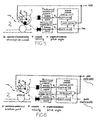
- the first control mode is based on the control of the absorption current of the rotation motor of the brush 1 while the second control mode is based on the geometric limitation of the plunge of the brush 1 on the vehicle 2 to be washed.
- the first control mode is illustrated in figure 5 and it is exhaustively described in the patent application n° PCT/EP2006/010219 owned by the present Applicant.
- the first control mode consists in setting an ideal reference value for the plunge of the brush 1 on the vehicle 2, corresponding to which is a reference absorption current value Ia r , detecting the actual plunge level corresponding to an actual absorption current Ia and, when there is a mismatch between the ideal and the actual plunge value (that is between Ia and Ia r ) modifying the relative movement velocity between the brush 1 and the vehicle 2 to eliminate such mismatch.
- the brush 1 has a vertical movement system according to the axis indicated with Y, and a horizontal movement system, according to the axis indicated with X.
- the second control mode is illustrated in figure 6 .
- the second control mode consists in acquiring the profile of the vehicle to be washed and, starting from the profile of the vehicle thus acquired, processing a gauge profile for geometric limitation of the plunge of the brush on the vehicle over the entire profile covered by the brush.
- the control parameter in the first control mode the control parameter is Ia r ) becomes the sequence of memorised points of the gauge profile and the comparison one becomes the point actually reached at any time (in the first control mode the comparison parameter is Ia).
- the velocity vector of the relative movement between the brush 1 and the vehicle 2 is modified in such a manner to compensate such mismatch.
- the physical variables describing the system in an exhaustive manner are:
- control system involves an alternation between the two modes of operation, a first mode "for absorbing” and a second mode "for obtaining a gauge profile".
- the alternating logic provides for switching from the first mode to the second mode when the plunge of the brush exceeds the level provided for by the gauge profile, and the switching from the second mode to the first mode when the absorption current reaches the minimum threshold value.
- control unit checks the position of the brush with respect to the gauge profile, while during the control section through the second control mode, the control unit checks the current absorption value.
- the acquisition of the profile of the vehicle consists in acquiring the profile of the longitudinal overall dimension of the vehicle considering the entire width of the vehicle itself. It is important to point out that the profile required for this control is, absolutely, the profile of maximum overall longitudinal dimension of the vehicle, considering the entire length of the same.
- a profile read only on one plane (for example with a vertical or longitudinal plane, derived from a laser reading) is not required. On the contrary required is a reading capable of integrating the maximum projections on the width, that is, reading laterally and not vertically. Therefore, a reading performed by means of pairs of photocells arranged horizontally on both sides of the moveable washing structure is preferred.
- the detection of the profile 3 of the vehicle 2 to be washed is obtained by copying by means of photocells performed by the horizontal drying nozzle 4.
- the horizontal nozzle 4 also comprises the softener supplying device and the high pressure.
- Use of washing cycles starting with a pass of this product is becoming more and more common, especially in case of the self-service operation. Therefore, memorising the profile of the vehicle is obvious at this step.
- simultaneous performance of the copying by means of the nozzle is provided for due to the fact that the devices do not interfere with each other and that the foaming velocity as well as the sequence of colours (referring to levels and not times) are compatible with the movements required for said copying.
- the detection of the profile 3 of the vehicle 2 to be washed is obtained through reading by means of the photocells barrier which though involving the addition of other devices, it adds various advantages among which: enhancing the accuracy and the fact that it is capable of reading without the obligation of performing a determined process before the passage of the brush. Additionally, if the group of photocells is mounted ahead with respect to the brush, the detection can be performed in the same washing pass. In case of double rollover units the battery of photocells can be mounted on the drying rollover in order to have the possibility of copying in the first pass in almost all the configurations of washing cycles.
- the profile 3 obtained from the reading is corrected mathematically to create a corrected profile 6a and 6b respectively of the vehicle (indicated by the dashed line).
- FIG 3 Illustrated in figure 3 is the creation of the gauge profile 7.
- the corrected profile of the vehicle 6a ( figure 1 ) or 6b ( figure 2 ) must be calculated mathematically to obtain the gauge profile 7.
- the algorithms processed by the control unit also provide for the processing of a series of parameters (K1, K2, K3 in figure 3 ) which allow to adjust the tolerable plunge limits afterwards depending on the type of bristles or other conditions.
- K1, K2, K3 in figure 3 a series of parameters which allow to adjust the tolerable plunge limits afterwards depending on the type of bristles or other conditions.
- Figure 3 also illustrates the movement trajectory 8 of the brush 1.
- the subsequent figure 4 shows the development of a pass of the horizontal brush 1 with the double control; it should be observed that both the directions of movement are represented.
- the plunge obtained is indicated by the line 11.
- the movement trajectory 8 of the brush 1 is divided by points A, B, C, D (to which points A', B', C', D' correspond on the gauge profile 7) into segments 9 in which the first control mode operates and segments 10 in which the second control mode operates.
- the inclination value of the profile of the vehicle (indicated by arrows in figure 4 ) and then transfer it to the vector control during the first control mode in order to obtain the initial value indispensable to guarantee a smooth switching without discontinuity.
- the inclination of the surface can be calculated geometrically at all points and this information can be transferred to the vector control of the first control mode which can provide for the profile in a quicker manner (always maintaining the inclination calculated from the variation in the absorption current as the reference), thus becoming more sensitive and accurate in the control.
- a further advantageous aspect of the present invention is a result of the following consideration: among the vehicles available in the market there will always be a share of them having profiles or particular elements on their bodyworks. Therefore, there shall always be the need to apply forces - manual or automatic - on the movement of the brushes in such a manner to allow avoiding potential drawbacks.
- the forced movements can be generated by modifying the calculated gauge profile geometrically.
- the brush (which cannot be detached from the bodywork) could only be "lightened” or the movements could be generated as backwards movements or lifting movements without matching the actual profile of the vehicle.
- the present invention introduces a new concept consisting in the geometric limitation of the plunge on the entire profile covered by the brush, with the limitation of the plunge provided through constant control of the position of the brush with respect to the gauge profile calculated starting from a profile detected previously.
- the control of the brush according to the present invention is advantageously applicable for washing all types of vehicles (according to the classification: cars, pick-ups and vehicles with special accessories) without requiring the selection of a specific programme. All this is achieved still maintaining all the vector control characteristics due to the control of the absorption current, that is the smoothness, accuracy and quickness of the washing operation.
Landscapes
- Engineering & Computer Science (AREA)
- Mechanical Engineering (AREA)
- Vehicle Cleaning, Maintenance, Repair, Refitting, And Outriggers (AREA)
Abstract
Description
- The present invention refers to a method for controlling the horizontal brush of a vehicle washing system.
- The system for controlling the horizontal brush in the rollover units or tunnel washing systems, has the task of moving the same along the entire profile of the vehicle maintaining a determined travel velocity and regulating the contact between the bristles and the bodywork in the best way possible.
- Regardless of the travel speed, in order to have the ideal performances the pressure exerted by the bristles onto the surface must be uniform on all the points of contact and for the entire length of the longitudinal profile of the vehicle.
- For proper washing with a suitable contact and the minimum risk of damage, the pressure of the bristles on the bodywork must be comprised between fixed minimum and maximum values.
- Therefore, all the known control systems are based on the direct or indirect reading of the contact pressure.
- A serious drawback is encountered when the vehicle to be washed has such an irregular surface to hinder the control, at certain points, from obtaining an accurate calculation of this fundamental parameter.
- It is known that the control systems based on reading the absorption of the brush rotation motor operate on the total force obtained from the sum of the forces applied on all the points of the contact surface.
- Regarding the regular and smooth surfaces it can be argued that the absorption current is approximately proportional to the total contact area of the brush against the vehicle. This surface can be interpreted as a rectangle of the same width as the bodywork at the point of contact and of a length proportional to the plunge. Given that the control attempts maintain the absorption current constant while the brush follows the profile of the vehicle, what occurs is that the plunge is modified in a manner inversely proportional to the width of the of the contact surface at all points. In other words the smaller the width the greater the plunge and, vice versa, the greater the width the smaller the plunge.
- This situation divides types of vehicles in two categories: safe vehicles with regular surfaces, usually vehicles with closed bodyworks and without projecting accessories, for which the variation of the width is restricted and the plunge difference obtained is usually tolerable; and potentially risky vehicles with an irregular surface, usually vehicles with parts of the bodywork open such as pick-ups with an open rear an/or with roll bars, vehicles with ski boxes or other boxes fixed on the roof, off-road vehicles witth spare wheels, vehicles with particular thin projections such as lights etc, which require special solutions from time to time.
- For example, there is a special solution for vehicles of the pick-up type which prevents the brush from lowering onto the rear part where, possibly, critical situations might occur. For cleaning cycles which start from the rear part during the first travel forward, the brush moves only upwards, that is once it reaches the maximum height it remains at that position up to the end of the vehicle, while during the second travel backwards the brush starts from a low position at the rear moving only upwards and once it reaches the point where it had left the surface in the previous pass, the downwards movement is enabled. On the contrary, if the washing cycle starts from the rear part of the vehicle during the first travel backwards, the brush starts at a low position at the rear moving only upwards and once it reaches a preset distance from the front of the vehicle, the downward movement is enabled.
- The drawbacks of this type of control lie: first and foremost in the fact that it does not consider the projections on the front or on the roof of the vehicle, for example spare wheels on the bonnet, ski-boxes, lights etc; secondly, in the fact that some projecting parts such as bars on the rear part of the vehicle or the absence of the rear door of a pick-up might lead to damages on the vehicle or the blocking of the system due to emergency; thirdly in the fact that it does not have a universal use in that it cannot be used on the other vehicles (vehicles with a regular profile etc) given that, during the forward travel it would not wash the entire rear from the roof to the bumpers, and hence, there arises the need to identify the pick-ups before selecting the washing programme; and fourthly, in the fact that the pick-ups cannot be identified in an accurate manner through automatic means due to the danger of causing damage, thus the selection is performed manually by the client.
- Therefore, the technical task at the basis of the invention is that of providing a method for controlling the horizontal brush in the vehicle washing systems, capable of eliminating the technical drawbacks observed in the known art.
- Within this technical task, an objective of the present invention is that of providing a method for controlling the horizontal brush in the vehicle washing systems capable of allowing proper washing with a suitable contact between the brush and the vehicle without risks of damage as well as also being useable universally with the same ideal performances regardless of the profile of the vehicle to be subjected to washing.
- The technical task, as well as this and other objectives according to the present invention are attained by providing a method for controlling the horizontal brush in the vehicle washing systems according to
claim 1. - Furthermore, other characteristics of the invention are defined in the subsequent claims.
- Further characteristics and advantages of the invention shall be clearer from the description of a preferred but not exclusive embodiment of the method for controlling the horizontal brush in the vehicle washing systems according to the invention illustrated for indicative and non-limiting purposes in the attached drawings wherein:
-
Figure 1 schematically shows a vehicle profile detection system with the drying nozzle of the washing system, according to a first embodiment of the invention; -
Figure 2 schematically shows a vehicle profile detection system with a photocells barrier according to a second embodiment of the invention; -
Figure 3 shows the generation of the gauge profile of the vehicle to be washed, according to the present invention; -
Figure 4 shows the operation of the alternating control for current absorption and with limitation of the brush plunge, according to the present invention; -
Figure 5 shows the vector movement of the brush with the control of the absorption current, according to the present invention; and -
Figure 6 shows the vector movement of the brush with the control of the brush plunge, according to the present invention. - The method for controlling the movement of the
horizontal brush 1 of a vehicle washing system for example of rollover type or of the tunnel type, provides for a first and a second control mode of the vector velocity ofbrush 1 and an alternating logic between the first and the second control mode. - The first control mode is based on the control of the absorption current of the rotation motor of the
brush 1 while the second control mode is based on the geometric limitation of the plunge of thebrush 1 on thevehicle 2 to be washed. - In particular the first control mode is illustrated in
figure 5 and it is exhaustively described in the patent application n°PCT/EP2006/010219 brush 1 on thevehicle 2, corresponding to which is a reference absorption current value Iar, detecting the actual plunge level corresponding to an actual absorption current Ia and, when there is a mismatch between the ideal and the actual plunge value (that is between Ia and Iar) modifying the relative movement velocity between thebrush 1 and thevehicle 2 to eliminate such mismatch. Thebrush 1 has a vertical movement system according to the axis indicated with Y, and a horizontal movement system, according to the axis indicated with X. Instead of controlling the vertical Vy and the horizontal Vx components of the velocity vector V independently, it is preferably provided for controlling the direction of velocity vector directly in such a manner to maintain it tangent to the profile of the vehicle at all points and guarantee a uniform plunge level, maintaining the modulus V at a constant value. The physical variables describing the system in an exhaustive system are: - Vx=Vx(t), component along the X axis of the velocity vector V, as a function of time t;
- Vy=Vy(t), component along the Y axis of the velocity vector V, as a function of time t;
- V=V(t), modulus of the velocity vector V as a function of time t;
- α=α(t) pitch angle of the vector V, as a function of time t; Ia=Ia (t)
- Iar= reference absorption current
- K = Constant
- The second control mode is illustrated in
figure 6 . The second control mode consists in acquiring the profile of the vehicle to be washed and, starting from the profile of the vehicle thus acquired, processing a gauge profile for geometric limitation of the plunge of the brush on the vehicle over the entire profile covered by the brush. In this second control mode, the control parameter (in the first control mode the control parameter is Iar) becomes the sequence of memorised points of the gauge profile and the comparison one becomes the point actually reached at any time (in the first control mode the comparison parameter is Ia). Also in this case, when there is a position mismatch between the point reached and the memorised point provided by the gauge profile, the velocity vector of the relative movement between thebrush 1 and thevehicle 2 is modified in such a manner to compensate such mismatch. The physical variables describing the system in an exhaustive manner are: - Vx=Vx(t), component along the X axis of the velocity vector V, as a function of time t;
- Vy=Vy(t), component along the Y axis of the velocity vector V, as a function of time t;
- V=V(t), modulus of the velocity vector V, as a function of the time t;
- P(t)=(x(t), y(t)), instantaneous position of plunge
- Pr(t)=(xr(t), yr(t))= instantaneous position of the gauge profile
- α(t)=f(p(t); Pr(t)), the function linking the pitch angle of the velocity vector V to the instantaneous values of p(t) and pr(t)
- Therefore, the control system involves an alternation between the two modes of operation, a first mode "for absorbing" and a second mode "for obtaining a gauge profile".
- The alternating logic provides for switching from the first mode to the second mode when the plunge of the brush exceeds the level provided for by the gauge profile, and the switching from the second mode to the first mode when the absorption current reaches the minimum threshold value.
- In order to do this, during the control section performed through the first control mode, the control unit checks the position of the brush with respect to the gauge profile, while during the control section through the second control mode, the control unit checks the current absorption value.
- The acquisition of the profile of the vehicle consists in acquiring the profile of the longitudinal overall dimension of the vehicle considering the entire width of the vehicle itself. It is important to point out that the profile required for this control is, absolutely, the profile of maximum overall longitudinal dimension of the vehicle, considering the entire length of the same. A profile read only on one plane (for example with a vertical or longitudinal plane, derived from a laser reading) is not required. On the contrary required is a reading capable of integrating the maximum projections on the width, that is, reading laterally and not vertically. Therefore, a reading performed by means of pairs of photocells arranged horizontally on both sides of the moveable washing structure is preferred.
- Referring to
figure 1 , the detection of theprofile 3 of thevehicle 2 to be washed is obtained by copying by means of photocells performed by the horizontal drying nozzle 4. - The horizontal nozzle 4 also comprises the softener supplying device and the high pressure. Use of washing cycles starting with a pass of this product is becoming more and more common, especially in case of the self-service operation. Therefore, memorising the profile of the vehicle is obvious at this step. For cases where the operation starts with foam pass, simultaneous performance of the copying by means of the nozzle (without any product being dispensed) is provided for due to the fact that the devices do not interfere with each other and that the foaming velocity as well as the sequence of colours (referring to levels and not times) are compatible with the movements required for said copying.
- Referring to
figure 2 , the detection of theprofile 3 of thevehicle 2 to be washed is obtained through reading by means of the photocells barrier which though involving the addition of other devices, it adds various advantages among which: enhancing the accuracy and the fact that it is capable of reading without the obligation of performing a determined process before the passage of the brush. Additionally, if the group of photocells is mounted ahead with respect to the brush, the detection can be performed in the same washing pass. In case of double rollover units the battery of photocells can be mounted on the drying rollover in order to have the possibility of copying in the first pass in almost all the configurations of washing cycles. - In both abovementioned cases, the
profile 3 obtained from the reading is corrected mathematically to create a correctedprofile - Illustrated in
figure 3 is the creation of the gauge profile 7. The corrected profile of thevehicle 6a (figure 1 ) or 6b (figure 2 ) must be calculated mathematically to obtain the gauge profile 7. - The algorithms processed by the control unit also provide for the processing of a series of parameters (K1, K2, K3 in
figure 3 ) which allow to adjust the tolerable plunge limits afterwards depending on the type of bristles or other conditions. Should the reading of the profile be performed by means of a photocells barrier, in the same travel and immediately before the arrival of thebrush 1, provided for is an algorithm which calculates the gauge profile 7 in real time for each section detected; such system can be used in any type of programme. -
Figure 3 also illustrates themovement trajectory 8 of thebrush 1. - The subsequent
figure 4 shows the development of a pass of thehorizontal brush 1 with the double control; it should be observed that both the directions of movement are represented. The plunge obtained is indicated by theline 11. - The
movement trajectory 8 of thebrush 1 is divided by points A, B, C, D (to which points A', B', C', D' correspond on the gauge profile 7) intosegments 9 in which the first control mode operates andsegments 10 in which the second control mode operates. - In the
trajectory 8segments 10 of thebrush 1 in which the second control mode operates theplunge curve 11 and the gauge profile 7 practically coincide. - According to an advantageous aspect of the present invention, it is preferable to calculate, during the second control mode, the inclination value of the profile of the vehicle (indicated by arrows in
figure 4 ) and then transfer it to the vector control during the first control mode in order to obtain the initial value indispensable to guarantee a smooth switching without discontinuity. - Given that the gauge profile of the vehicle is known, the inclination of the surface can be calculated geometrically at all points and this information can be transferred to the vector control of the first control mode which can provide for the profile in a quicker manner (always maintaining the inclination calculated from the variation in the absorption current as the reference), thus becoming more sensitive and accurate in the control.
- A further advantageous aspect of the present invention, is a result of the following consideration: among the vehicles available in the market there will always be a share of them having profiles or particular elements on their bodyworks. Therefore, there shall always be the need to apply forces - manual or automatic - on the movement of the brushes in such a manner to allow avoiding potential drawbacks.
- The mirrors on the rear windscreen of certain vans, special wipers (generally rear), certain fixed antennas, loosely fixed lights, bicycle carriers, ladders etc, are examples of these situations.
- Advantageously, the forced movements can be generated by modifying the calculated gauge profile geometrically.
- Up to date, on the contrary, the brush (which cannot be detached from the bodywork) could only be "lightened" or the movements could be generated as backwards movements or lifting movements without matching the actual profile of the vehicle.
- In conclusion, with the aim of maintaining all the advantages of controlling the absorption current but avoiding the critical situations caused by lack of sufficient contact surface, the present invention introduces a new concept consisting in the geometric limitation of the plunge on the entire profile covered by the brush, with the limitation of the plunge provided through constant control of the position of the brush with respect to the gauge profile calculated starting from a profile detected previously.
- From a more general point of view, it can be argued that with the new double control system, various problems can be tackled depending on their nature; that is those referring to the quality of the bodywork/bristles contact shall concern the first control mode, while on the contrary, those involving the plunge and movement limits without contact shall regard the second control mode.
- The control of the brush according to the present invention is advantageously applicable for washing all types of vehicles (according to the classification: cars, pick-ups and vehicles with special accessories) without requiring the selection of a specific programme. All this is achieved still maintaining all the vector control characteristics due to the control of the absorption current, that is the smoothness, accuracy and quickness of the washing operation.
- The method for controlling the horizontal brush of an automatic washing system thus conceived is susceptible to various modifications and variants all falling within the invention concept. Furthermore, all the details can be replaced by technically equivalent elements.
Claims (9)
- Method for controlling the movement of the horizontal brush of a vehicle washing system, characterised in that it provides for a first and a second vector velocity control mode of said brush and an alternating logic between said first and second control mode, said first control mode being based on the control of the absorption current of the rotation motor of said brush, said second control mode being based on the geometric limitation of the plunge of said brush.
- Method for controlling the movement of the horizontal brush of a vehicle washing system according to claim 1, characterised in that said second control mode provides for acquiring the profile of the vehicle to be washed and, starting from the said acquired profile of the vehicle, processing a gauge profile for the geometric limitation of the plunge of said brush on said vehicle over the entire profile covered by said brush.
- Method for controlling the movement of the horizontal brush of a vehicle washing system according to one or more of the preceding claims, characterised in that said alternating logic provides for the switching from said first mode to said second mode when said plunge exceeds said gauge profile, and the switching from said second mode to said first mode when said absorption current reaches a minimum threshold value.
- Method for controlling the movement of the horizontal brush of a vehicle washing system according to one or more of the preceding claims, characterised in that said acquisition of said profile of the vehicle consists in acquiring the profile of the maximum overall longitudinal dimension of the vehicle considering the entire width of the vehicle itself.
- Method for controlling the movement of the horizontal brush of a vehicle washing system according to one or more of the preceding claims, characterised in that said acquisition of said profile of the vehicle is performed by means of pairs of photocells arranged horizontally on both sides of said washing system.
- Method for controlling the movement of the horizontal brush of a vehicle washing system according to one or more of the preceding claims, characterised in calculating, starting from said acquired profile of the vehicle, the inclination value of said profile of the vehicle at all its points to be used in said first control mode to enhance the control sensitivity in said first control mode.
- Method for controlling the movement of the horizontal brush of a vehicle washing system according to one or more of the preceding claims, characterised in calculating, starting from said acquired profile of the vehicle, the inclination value of said profile of the vehicle during said second control mode, to be used during said first control mode in order to obtain the initial value indispensable to guarantee a smooth switching without discontinuity.
- Method for controlling the movement of the horizontal brush of a vehicle washing system according to one or more of the preceding claims, characterised in generating a forced movement of said brush geometrically modifying said gauge profile.
- Method for controlling the movement of the horizontal brush of a vehicle washing system as described and claimed.
Applications Claiming Priority (1)
| Application Number | Priority Date | Filing Date | Title |
|---|---|---|---|
| IT001040A ITMI20071040A1 (en) | 2007-05-23 | 2007-05-23 | PROCEDURE FOR CHECKING THE HORIZONTAL BRUSH OF A VEHICLE WASHING SYSTEM |
Publications (2)
| Publication Number | Publication Date |
|---|---|
| EP1995133A2 true EP1995133A2 (en) | 2008-11-26 |
| EP1995133A3 EP1995133A3 (en) | 2010-01-20 |
Family
ID=39711921
Family Applications (1)
| Application Number | Title | Priority Date | Filing Date |
|---|---|---|---|
| EP08009327A Withdrawn EP1995133A3 (en) | 2007-05-23 | 2008-05-21 | Method for controlling the horizontal brush of a vehicle washing system |
Country Status (3)
| Country | Link |
|---|---|
| US (1) | US8163097B2 (en) |
| EP (1) | EP1995133A3 (en) |
| IT (1) | ITMI20071040A1 (en) |
Cited By (2)
| Publication number | Priority date | Publication date | Assignee | Title |
|---|---|---|---|---|
| EP2500219A2 (en) | 2011-03-16 | 2012-09-19 | Tammermatic Oy | Method and apparatus for washing or drying a vehicle |
| IT201900006921A1 (en) * | 2019-05-16 | 2020-11-16 | Ceccato & Co | METHOD OF CONTROL OF A VEHICLE WASHING SYSTEM |
Families Citing this family (5)
| Publication number | Priority date | Publication date | Assignee | Title |
|---|---|---|---|---|
| US9082201B2 (en) | 2013-01-04 | 2015-07-14 | International Business Machines Corporation | Surface contamination determination system |
| DE102018108343A1 (en) * | 2018-04-09 | 2019-10-10 | Washtec Holding Gmbh | Method for automatic recognition of a loading area |
| US11115476B1 (en) * | 2020-04-22 | 2021-09-07 | Drb Systems, Llc | System for and method of controlling operations of a car wash |
| ES3032217T3 (en) | 2022-01-31 | 2025-07-16 | Christ Otto Ag | Control method for a vehicle treatment system |
| CN114435315B (en) * | 2022-03-22 | 2023-12-19 | 陕西蜗牛智能科技有限公司 | Control method for lifting process of transverse brush of automatic car washer |
Citations (1)
| Publication number | Priority date | Publication date | Assignee | Title |
|---|---|---|---|---|
| WO2007048568A1 (en) | 2005-10-26 | 2007-05-03 | Ceccato S.P.A. | Brush control method and device on an automatic car-wash installation |
Family Cites Families (4)
| Publication number | Priority date | Publication date | Assignee | Title |
|---|---|---|---|---|
| US5093951A (en) | 1990-05-29 | 1992-03-10 | Ryko Manufacturing Company | Top brush interrupt system for a car wash |
| DE29908866U1 (en) * | 1999-05-21 | 2000-02-24 | California Kleindienst Holding GmbH, 86153 Augsburg | Vehicle treatment plant |
| US7219385B1 (en) | 2003-04-04 | 2007-05-22 | Rietsch Jr Gilbert J | Brush and method for car wash |
| JP4653554B2 (en) * | 2005-05-06 | 2011-03-16 | エムケー精工株式会社 | Car wash machine |
-
2007
- 2007-05-23 IT IT001040A patent/ITMI20071040A1/en unknown
-
2008
- 2008-05-21 EP EP08009327A patent/EP1995133A3/en not_active Withdrawn
- 2008-05-21 US US12/124,656 patent/US8163097B2/en not_active Expired - Fee Related
Patent Citations (1)
| Publication number | Priority date | Publication date | Assignee | Title |
|---|---|---|---|---|
| WO2007048568A1 (en) | 2005-10-26 | 2007-05-03 | Ceccato S.P.A. | Brush control method and device on an automatic car-wash installation |
Cited By (3)
| Publication number | Priority date | Publication date | Assignee | Title |
|---|---|---|---|---|
| EP2500219A2 (en) | 2011-03-16 | 2012-09-19 | Tammermatic Oy | Method and apparatus for washing or drying a vehicle |
| EP3626551A1 (en) | 2011-03-16 | 2020-03-25 | Tammermatic Oy | Method and apparatus for washing or drying a vehicle |
| IT201900006921A1 (en) * | 2019-05-16 | 2020-11-16 | Ceccato & Co | METHOD OF CONTROL OF A VEHICLE WASHING SYSTEM |
Also Published As
| Publication number | Publication date |
|---|---|
| EP1995133A3 (en) | 2010-01-20 |
| US20080300724A1 (en) | 2008-12-04 |
| ITMI20071040A1 (en) | 2008-11-24 |
| US8163097B2 (en) | 2012-04-24 |
Similar Documents
| Publication | Publication Date | Title |
|---|---|---|
| US8163097B2 (en) | Method for controlling the horizontal brush of a vehicle washing system | |
| JP4123259B2 (en) | Object detection apparatus and object detection method | |
| JP4688849B2 (en) | Collision detection device | |
| US20120060863A1 (en) | Method and apparatus for washing a vehicle | |
| CN112519592B (en) | Vehicle wheel speed control method and device and electric vehicle | |
| US20110148663A1 (en) | Method and apparatus for supporting a parking process of a vehicle | |
| JP7532466B2 (en) | Control device and control method for protection device | |
| CN111409572A (en) | Control method and device for vehicle body closing system | |
| US20100063685A1 (en) | Motor vechicle having a preventive action protection system | |
| CN107531238A (en) | Object Tracking Before or During a Collision | |
| CN109131251A (en) | A kind of unmanned car-washing method and device | |
| US20130090814A1 (en) | Method and device for the determination of at least one triggering parameter of personal protection means of a vehicle | |
| KR20170008510A (en) | Apparatus and method for monitoring tire pressure considering low pressure situation | |
| JP2020528026A (en) | How to control at least one cleaning device for at least one sensor located on the outer contour of the vehicle | |
| CN1813193A (en) | Method for recognising a collision by means of an upfront sensor system and device for carrying out said method | |
| CN113246967A (en) | Automatic parking method and device | |
| KR20220107789A (en) | Rctb system and control method thereof | |
| US11987217B2 (en) | Method and apparatus for treating a vehicle having at least one outer surface | |
| KR102272076B1 (en) | Airbag deployment method in accordance with Small overlap collision | |
| CN110139784B (en) | Method for operating a vehicle washing system and vehicle washing system | |
| JP6698264B2 (en) | Vehicle collision evaluation method and device and computer program | |
| JP2004536742A (en) | Vehicle impact detection system and control method | |
| JP7668211B2 (en) | Vehicle control module and method including rear wheel speed estimation based solely on front wheels - Patent 7336363 | |
| JP4876847B2 (en) | Vehicle traveling direction estimation device and driving support system | |
| US10605699B2 (en) | Method for detecting a defective damper device of a vehicle |
Legal Events
| Date | Code | Title | Description |
|---|---|---|---|
| PUAI | Public reference made under article 153(3) epc to a published international application that has entered the european phase |
Free format text: ORIGINAL CODE: 0009012 |
|
| AK | Designated contracting states |
Kind code of ref document: A2 Designated state(s): AT BE BG CH CY CZ DE DK EE ES FI FR GB GR HR HU IE IS IT LI LT LU LV MC MT NL NO PL PT RO SE SI SK TR |
|
| AX | Request for extension of the european patent |
Extension state: AL BA MK RS |
|
| PUAL | Search report despatched |
Free format text: ORIGINAL CODE: 0009013 |
|
| AK | Designated contracting states |
Kind code of ref document: A3 Designated state(s): AT BE BG CH CY CZ DE DK EE ES FI FR GB GR HR HU IE IS IT LI LT LU LV MC MT NL NO PL PT RO SE SI SK TR |
|
| AX | Request for extension of the european patent |
Extension state: AL BA MK RS |
|
| 17P | Request for examination filed |
Effective date: 20100716 |
|
| 17Q | First examination report despatched |
Effective date: 20100819 |
|
| AKX | Designation fees paid |
Designated state(s): AT BE BG CH CY CZ DE DK EE ES FI FR GB GR HR HU IE IS IT LI LT LU LV MC MT NL NO PL PT RO SE SI SK TR |
|
| STAA | Information on the status of an ep patent application or granted ep patent |
Free format text: STATUS: THE APPLICATION IS DEEMED TO BE WITHDRAWN |
|
| 18D | Application deemed to be withdrawn |
Effective date: 20121201 |