EP1991554B1 - Thiopyrophosphate organic compounds, method for preparing thereof and compositions containing them - Google Patents
Thiopyrophosphate organic compounds, method for preparing thereof and compositions containing them Download PDFInfo
- Publication number
- EP1991554B1 EP1991554B1 EP07712384.2A EP07712384A EP1991554B1 EP 1991554 B1 EP1991554 B1 EP 1991554B1 EP 07712384 A EP07712384 A EP 07712384A EP 1991554 B1 EP1991554 B1 EP 1991554B1
- Authority
- EP
- European Patent Office
- Prior art keywords
- group
- compound
- formula
- carbon atoms
- physiologically acceptable
- Prior art date
- Legal status (The legal status is an assumption and is not a legal conclusion. Google has not performed a legal analysis and makes no representation as to the accuracy of the status listed.)
- Not-in-force
Links
- 238000000034 method Methods 0.000 title claims abstract description 15
- 239000000203 mixture Substances 0.000 title description 7
- 150000002894 organic compounds Chemical class 0.000 title description 5
- 150000001875 compounds Chemical class 0.000 claims abstract description 81
- 239000008194 pharmaceutical composition Substances 0.000 claims abstract description 9
- 210000001744 T-lymphocyte Anatomy 0.000 claims description 39
- 125000004432 carbon atom Chemical group C* 0.000 claims description 18
- 125000000623 heterocyclic group Chemical group 0.000 claims description 14
- LFQSCWFLJHTTHZ-UHFFFAOYSA-N Ethanol Chemical compound CCO LFQSCWFLJHTTHZ-UHFFFAOYSA-N 0.000 claims description 10
- 239000007787 solid Substances 0.000 claims description 10
- 125000003118 aryl group Chemical group 0.000 claims description 9
- 230000003213 activating effect Effects 0.000 claims description 8
- 125000005843 halogen group Chemical group 0.000 claims description 8
- 210000005259 peripheral blood Anatomy 0.000 claims description 8
- 239000011886 peripheral blood Substances 0.000 claims description 8
- JUJWROOIHBZHMG-UHFFFAOYSA-N Pyridine Chemical compound C1=CC=NC=C1 JUJWROOIHBZHMG-UHFFFAOYSA-N 0.000 claims description 7
- 125000001931 aliphatic group Chemical group 0.000 claims description 7
- 150000001767 cationic compounds Chemical class 0.000 claims description 7
- 238000006243 chemical reaction Methods 0.000 claims description 7
- 125000000753 cycloalkyl group Chemical group 0.000 claims description 7
- 125000004435 hydrogen atom Chemical group [H]* 0.000 claims description 7
- 125000002887 hydroxy group Chemical group [H]O* 0.000 claims description 7
- 229910001411 inorganic cation Inorganic materials 0.000 claims description 7
- 125000002560 nitrile group Chemical group 0.000 claims description 7
- 229920006395 saturated elastomer Polymers 0.000 claims description 7
- UHOVQNZJYSORNB-UHFFFAOYSA-N Benzene Chemical compound C1=CC=CC=C1 UHOVQNZJYSORNB-UHFFFAOYSA-N 0.000 claims description 6
- KDXKERNSBIXSRK-YFKPBYRVSA-N L-lysine Chemical compound NCCCC[C@H](N)C(O)=O KDXKERNSBIXSRK-YFKPBYRVSA-N 0.000 claims description 6
- KDXKERNSBIXSRK-UHFFFAOYSA-N Lysine Natural products NCCCCC(N)C(O)=O KDXKERNSBIXSRK-UHFFFAOYSA-N 0.000 claims description 6
- 239000004472 Lysine Substances 0.000 claims description 6
- MBBZMMPHUWSWHV-BDVNFPICSA-N N-methylglucamine Chemical compound CNC[C@H](O)[C@@H](O)[C@H](O)[C@H](O)CO MBBZMMPHUWSWHV-BDVNFPICSA-N 0.000 claims description 6
- GSEJCLTVZPLZKY-UHFFFAOYSA-N Triethanolamine Chemical compound OCCN(CCO)CCO GSEJCLTVZPLZKY-UHFFFAOYSA-N 0.000 claims description 6
- 229910052783 alkali metal Inorganic materials 0.000 claims description 6
- 150000001340 alkali metals Chemical class 0.000 claims description 6
- 229910052784 alkaline earth metal Inorganic materials 0.000 claims description 6
- 150000001342 alkaline earth metals Chemical class 0.000 claims description 6
- 210000004369 blood Anatomy 0.000 claims description 6
- 239000008280 blood Substances 0.000 claims description 6
- 150000002892 organic cations Chemical class 0.000 claims description 6
- LENZDBCJOHFCAS-UHFFFAOYSA-N tris Chemical compound OCC(N)(CO)CO LENZDBCJOHFCAS-UHFFFAOYSA-N 0.000 claims description 6
- 229960000281 trometamol Drugs 0.000 claims description 6
- QGZKDVFQNNGYKY-UHFFFAOYSA-O Ammonium Chemical compound [NH4+] QGZKDVFQNNGYKY-UHFFFAOYSA-O 0.000 claims description 5
- 239000004475 Arginine Substances 0.000 claims description 5
- ODKSFYDXXFIFQN-BYPYZUCNSA-P L-argininium(2+) Chemical compound NC(=[NH2+])NCCC[C@H]([NH3+])C(O)=O ODKSFYDXXFIFQN-BYPYZUCNSA-P 0.000 claims description 5
- NINIDFKCEFEMDL-UHFFFAOYSA-N Sulfur Chemical group [S] NINIDFKCEFEMDL-UHFFFAOYSA-N 0.000 claims description 5
- ODKSFYDXXFIFQN-UHFFFAOYSA-N arginine Natural products OC(=O)C(N)CCCNC(N)=N ODKSFYDXXFIFQN-UHFFFAOYSA-N 0.000 claims description 5
- XBRDBODLCHKXHI-UHFFFAOYSA-N epolamine Chemical compound OCCN1CCCC1 XBRDBODLCHKXHI-UHFFFAOYSA-N 0.000 claims description 5
- 229910052760 oxygen Inorganic materials 0.000 claims description 5
- 125000004430 oxygen atom Chemical group O* 0.000 claims description 5
- 229910052717 sulfur Inorganic materials 0.000 claims description 5
- 239000007790 solid phase Substances 0.000 claims description 4
- 238000011068 loading method Methods 0.000 claims description 3
- 230000035755 proliferation Effects 0.000 claims description 3
- UMJSCPRVCHMLSP-UHFFFAOYSA-N pyridine Natural products COC1=CC=CN=C1 UMJSCPRVCHMLSP-UHFFFAOYSA-N 0.000 claims description 3
- WNXJIVFYUVYPPR-UHFFFAOYSA-N 1,3-dioxolane Chemical compound C1COCO1 WNXJIVFYUVYPPR-UHFFFAOYSA-N 0.000 claims description 2
- PXGOKWXKJXAPGV-UHFFFAOYSA-N Fluorine Chemical compound FF PXGOKWXKJXAPGV-UHFFFAOYSA-N 0.000 claims description 2
- 239000004793 Polystyrene Substances 0.000 claims description 2
- DHXVGJBLRPWPCS-UHFFFAOYSA-N Tetrahydropyran Chemical compound C1CCOCC1 DHXVGJBLRPWPCS-UHFFFAOYSA-N 0.000 claims description 2
- CSKNSYBAZOQPLR-UHFFFAOYSA-N benzenesulfonyl chloride Chemical compound ClS(=O)(=O)C1=CC=CC=C1 CSKNSYBAZOQPLR-UHFFFAOYSA-N 0.000 claims description 2
- 229910052801 chlorine Inorganic materials 0.000 claims description 2
- 239000000460 chlorine Substances 0.000 claims description 2
- 229910052731 fluorine Inorganic materials 0.000 claims description 2
- 239000011737 fluorine Substances 0.000 claims description 2
- 238000001990 intravenous administration Methods 0.000 claims description 2
- 229920002223 polystyrene Polymers 0.000 claims description 2
- 238000005070 sampling Methods 0.000 claims description 2
- VJQHJNIGWOABDZ-UHFFFAOYSA-N 3-methyloxetane Chemical compound CC1COC1 VJQHJNIGWOABDZ-UHFFFAOYSA-N 0.000 claims 1
- 125000001309 chloro group Chemical group Cl* 0.000 claims 1
- 102000000588 Interleukin-2 Human genes 0.000 description 37
- 108010002350 Interleukin-2 Proteins 0.000 description 37
- WEVYAHXRMPXWCK-UHFFFAOYSA-N Acetonitrile Chemical group CC#N WEVYAHXRMPXWCK-UHFFFAOYSA-N 0.000 description 33
- WYURNTSHIVDZCO-UHFFFAOYSA-N Tetrahydrofuran Chemical compound C1CCOC1 WYURNTSHIVDZCO-UHFFFAOYSA-N 0.000 description 30
- 210000004027 cell Anatomy 0.000 description 29
- NUHSROFQTUXZQQ-UHFFFAOYSA-N isopentenyl diphosphate Chemical compound CC(=C)CCO[P@](O)(=O)OP(O)(O)=O NUHSROFQTUXZQQ-UHFFFAOYSA-N 0.000 description 23
- 239000000243 solution Substances 0.000 description 22
- YMWUJEATGCHHMB-UHFFFAOYSA-N Dichloromethane Chemical compound ClCCl YMWUJEATGCHHMB-UHFFFAOYSA-N 0.000 description 21
- 239000011347 resin Substances 0.000 description 21
- 229920005989 resin Polymers 0.000 description 21
- 238000005160 1H NMR spectroscopy Methods 0.000 description 16
- 150000002148 esters Chemical class 0.000 description 16
- ZMXDDKWLCZADIW-UHFFFAOYSA-N N,N-Dimethylformamide Chemical compound CN(C)C=O ZMXDDKWLCZADIW-UHFFFAOYSA-N 0.000 description 15
- YLQBMQCUIZJEEH-UHFFFAOYSA-N tetrahydrofuran Natural products C=1C=COC=1 YLQBMQCUIZJEEH-UHFFFAOYSA-N 0.000 description 15
- HRXKRNGNAMMEHJ-UHFFFAOYSA-K trisodium citrate Chemical compound [Na+].[Na+].[Na+].[O-]C(=O)CC(O)(CC([O-])=O)C([O-])=O HRXKRNGNAMMEHJ-UHFFFAOYSA-K 0.000 description 15
- 239000002253 acid Substances 0.000 description 14
- 238000004458 analytical method Methods 0.000 description 13
- 238000012360 testing method Methods 0.000 description 13
- 239000000047 product Substances 0.000 description 11
- KFZMGEQAYNKOFK-UHFFFAOYSA-N Isopropanol Chemical compound CC(C)O KFZMGEQAYNKOFK-UHFFFAOYSA-N 0.000 description 10
- QLXYFQJHBFMZMK-UHFFFAOYSA-N [hydroxy(3-methylbut-3-enoxy)phosphinothioyl] dihydrogen phosphate Chemical compound CC(=C)CCOP(O)(=S)OP(O)(O)=O QLXYFQJHBFMZMK-UHFFFAOYSA-N 0.000 description 10
- 230000000694 effects Effects 0.000 description 10
- 108060008682 Tumor Necrosis Factor Proteins 0.000 description 8
- 102000000852 Tumor Necrosis Factor-alpha Human genes 0.000 description 8
- 229920002678 cellulose Polymers 0.000 description 8
- 239000001913 cellulose Substances 0.000 description 8
- 238000004587 chromatography analysis Methods 0.000 description 8
- JFULCZQLQRKBSQ-UHFFFAOYSA-J dioxidophosphinothioyl phosphate tetrabutylazanium Chemical compound [O-]P([O-])(=S)OP(=O)([O-])[O-].C(CCC)[N+](CCCC)(CCCC)CCCC.C(CCC)[N+](CCCC)(CCCC)CCCC.C(CCC)[N+](CCCC)(CCCC)CCCC.C(CCC)[N+](CCCC)(CCCC)CCCC JFULCZQLQRKBSQ-UHFFFAOYSA-J 0.000 description 8
- 229910052739 hydrogen Inorganic materials 0.000 description 8
- 238000000746 purification Methods 0.000 description 8
- 229920001467 poly(styrenesulfonates) Polymers 0.000 description 7
- QGZKDVFQNNGYKY-UHFFFAOYSA-N Ammonia Chemical compound N QGZKDVFQNNGYKY-UHFFFAOYSA-N 0.000 description 6
- 239000003480 eluent Substances 0.000 description 6
- 239000000706 filtrate Substances 0.000 description 6
- 238000011835 investigation Methods 0.000 description 6
- 238000005342 ion exchange Methods 0.000 description 6
- 238000004895 liquid chromatography mass spectrometry Methods 0.000 description 6
- 239000011541 reaction mixture Substances 0.000 description 6
- 238000003756 stirring Methods 0.000 description 6
- 238000011282 treatment Methods 0.000 description 6
- 238000002965 ELISA Methods 0.000 description 5
- 229940126214 compound 3 Drugs 0.000 description 5
- 229940125898 compound 5 Drugs 0.000 description 5
- 239000002552 dosage form Substances 0.000 description 5
- 238000004108 freeze drying Methods 0.000 description 5
- 238000004519 manufacturing process Methods 0.000 description 5
- 238000001556 precipitation Methods 0.000 description 5
- 102000004190 Enzymes Human genes 0.000 description 4
- 108090000790 Enzymes Proteins 0.000 description 4
- 206010025323 Lymphomas Diseases 0.000 description 4
- 230000004913 activation Effects 0.000 description 4
- 238000003556 assay Methods 0.000 description 4
- 229940125904 compound 1 Drugs 0.000 description 4
- 229940125773 compound 10 Drugs 0.000 description 4
- 229940125782 compound 2 Drugs 0.000 description 4
- DAKIDYQCFJQMDF-UHFFFAOYSA-N dichloromethane;pyridine Chemical compound ClCCl.C1=CC=NC=C1 DAKIDYQCFJQMDF-UHFFFAOYSA-N 0.000 description 4
- XPPKVPWEQAFLFU-UHFFFAOYSA-N diphosphoric acid Chemical compound OP(O)(=O)OP(O)(O)=O XPPKVPWEQAFLFU-UHFFFAOYSA-N 0.000 description 4
- 208000037265 diseases, disorders, signs and symptoms Diseases 0.000 description 4
- ZLVXBBHTMQJRSX-VMGNSXQWSA-N jdtic Chemical compound C1([C@]2(C)CCN(C[C@@H]2C)C[C@H](C(C)C)NC(=O)[C@@H]2NCC3=CC(O)=CC=C3C2)=CC=CC(O)=C1 ZLVXBBHTMQJRSX-VMGNSXQWSA-N 0.000 description 4
- 238000002372 labelling Methods 0.000 description 4
- 239000000758 substrate Substances 0.000 description 4
- 102000004127 Cytokines Human genes 0.000 description 3
- 108090000695 Cytokines Proteins 0.000 description 3
- 229910014572 C—O—P Inorganic materials 0.000 description 3
- 241000725303 Human immunodeficiency virus Species 0.000 description 3
- 241000187479 Mycobacterium tuberculosis Species 0.000 description 3
- 206010028980 Neoplasm Diseases 0.000 description 3
- 206010035226 Plasma cell myeloma Diseases 0.000 description 3
- 239000000427 antigen Substances 0.000 description 3
- 102000036639 antigens Human genes 0.000 description 3
- 108091007433 antigens Proteins 0.000 description 3
- 230000008901 benefit Effects 0.000 description 3
- UDSAIICHUKSCKT-UHFFFAOYSA-N bromophenol blue Chemical compound C1=C(Br)C(O)=C(Br)C=C1C1(C=2C=C(Br)C(O)=C(Br)C=2)C2=CC=CC=C2S(=O)(=O)O1 UDSAIICHUKSCKT-UHFFFAOYSA-N 0.000 description 3
- -1 compound (E)-4-hydroxy-3-methyl-2-butenyl pyrophosphate Chemical class 0.000 description 3
- 201000010099 disease Diseases 0.000 description 3
- 238000002474 experimental method Methods 0.000 description 3
- 208000015181 infectious disease Diseases 0.000 description 3
- 239000003112 inhibitor Substances 0.000 description 3
- 239000002609 medium Substances 0.000 description 3
- 201000000050 myeloid neoplasm Diseases 0.000 description 3
- PSHKMPUSSFXUIA-UHFFFAOYSA-N n,n-dimethylpyridin-2-amine Chemical compound CN(C)C1=CC=CC=N1 PSHKMPUSSFXUIA-UHFFFAOYSA-N 0.000 description 3
- 239000000376 reactant Substances 0.000 description 3
- XLYOFNOQVPJJNP-UHFFFAOYSA-N water Substances O XLYOFNOQVPJJNP-UHFFFAOYSA-N 0.000 description 3
- 229920000936 Agarose Polymers 0.000 description 2
- 102000002260 Alkaline Phosphatase Human genes 0.000 description 2
- 108020004774 Alkaline Phosphatase Proteins 0.000 description 2
- TWRXJAOTZQYOKJ-UHFFFAOYSA-L Magnesium chloride Chemical compound [Mg+2].[Cl-].[Cl-] TWRXJAOTZQYOKJ-UHFFFAOYSA-L 0.000 description 2
- 241000124008 Mammalia Species 0.000 description 2
- LRHPLDYGYMQRHN-UHFFFAOYSA-N N-Butanol Chemical compound CCCCO LRHPLDYGYMQRHN-UHFFFAOYSA-N 0.000 description 2
- 238000005481 NMR spectroscopy Methods 0.000 description 2
- 229910004856 P—O—P Inorganic materials 0.000 description 2
- 206010038389 Renal cancer Diseases 0.000 description 2
- RYYWUUFWQRZTIU-UHFFFAOYSA-N Thiophosphoric acid Chemical compound OP(O)(S)=O RYYWUUFWQRZTIU-UHFFFAOYSA-N 0.000 description 2
- 239000012190 activator Substances 0.000 description 2
- 125000003342 alkenyl group Chemical group 0.000 description 2
- 150000003863 ammonium salts Chemical class 0.000 description 2
- 239000000872 buffer Substances 0.000 description 2
- 235000011180 diphosphates Nutrition 0.000 description 2
- 125000001495 ethyl group Chemical group [H]C([H])([H])C([H])([H])* 0.000 description 2
- 125000004030 farnesyl group Chemical group [H]C([*])([H])C([H])=C(C([H])([H])[H])C([H])([H])C([H])([H])C([H])=C(C([H])([H])[H])C([H])([H])C([H])([H])C([H])=C(C([H])([H])[H])C([H])([H])[H] 0.000 description 2
- 125000002350 geranyl group Chemical group [H]C([*])([H])/C([H])=C(C([H])([H])[H])/C([H])([H])C([H])([H])C([H])=C(C([H])([H])[H])C([H])([H])[H] 0.000 description 2
- 238000000589 high-performance liquid chromatography-mass spectrometry Methods 0.000 description 2
- 230000007062 hydrolysis Effects 0.000 description 2
- 238000006460 hydrolysis reaction Methods 0.000 description 2
- 239000004615 ingredient Substances 0.000 description 2
- 239000012528 membrane Substances 0.000 description 2
- 229940005657 pyrophosphoric acid Drugs 0.000 description 2
- 201000010174 renal carcinoma Diseases 0.000 description 2
- 150000003839 salts Chemical class 0.000 description 2
- 159000000000 sodium salts Chemical class 0.000 description 2
- 239000002904 solvent Substances 0.000 description 2
- 238000013112 stability test Methods 0.000 description 2
- 238000006467 substitution reaction Methods 0.000 description 2
- 239000006228 supernatant Substances 0.000 description 2
- 239000003826 tablet Substances 0.000 description 2
- 238000011200 topical administration Methods 0.000 description 2
- 238000005406 washing Methods 0.000 description 2
- KJTLQQUUPVSXIM-ZCFIWIBFSA-M (R)-mevalonate Chemical compound OCC[C@](O)(C)CC([O-])=O KJTLQQUUPVSXIM-ZCFIWIBFSA-M 0.000 description 1
- NWUYHJFMYQTDRP-UHFFFAOYSA-N 1,2-bis(ethenyl)benzene;1-ethenyl-2-ethylbenzene;styrene Chemical compound C=CC1=CC=CC=C1.CCC1=CC=CC=C1C=C.C=CC1=CC=CC=C1C=C NWUYHJFMYQTDRP-UHFFFAOYSA-N 0.000 description 1
- CWLUFVAFWWNXJZ-UHFFFAOYSA-N 1-hydroxypyrrolidine Chemical compound ON1CCCC1 CWLUFVAFWWNXJZ-UHFFFAOYSA-N 0.000 description 1
- LECMBPWEOVZHKN-UHFFFAOYSA-N 2-(2-chloroethoxy)ethanol Chemical compound OCCOCCCl LECMBPWEOVZHKN-UHFFFAOYSA-N 0.000 description 1
- QKNYBSVHEMOAJP-UHFFFAOYSA-N 2-amino-2-(hydroxymethyl)propane-1,3-diol;hydron;chloride Chemical compound Cl.OCC(N)(CO)CO QKNYBSVHEMOAJP-UHFFFAOYSA-N 0.000 description 1
- LUNMJRJMSXZSLC-UHFFFAOYSA-N 2-cyclopropylethanol Chemical compound OCCC1CC1 LUNMJRJMSXZSLC-UHFFFAOYSA-N 0.000 description 1
- GCYHRYNSUGLLMA-UHFFFAOYSA-N 2-prop-2-enoxyethanol Chemical compound OCCOCC=C GCYHRYNSUGLLMA-UHFFFAOYSA-N 0.000 description 1
- KKRCXGGGEPQALO-UHFFFAOYSA-N 3-methylbut-3-enyl 4-methylbenzenesulfonate Chemical compound CC(=C)CCOS(=O)(=O)C1=CC=C(C)C=C1 KKRCXGGGEPQALO-UHFFFAOYSA-N 0.000 description 1
- HXHGULXINZUGJX-UHFFFAOYSA-N 4-chlorobutanol Chemical compound OCCCCCl HXHGULXINZUGJX-UHFFFAOYSA-N 0.000 description 1
- 208000030507 AIDS Diseases 0.000 description 1
- 229940122361 Bisphosphonate Drugs 0.000 description 1
- 0 C*P(*)(OP([N+]([O-])=I)(SCCC1(C)COC1)=O)=O Chemical compound C*P(*)(OP([N+]([O-])=I)(SCCC1(C)COC1)=O)=O 0.000 description 1
- ZAMOUSCENKQFHK-UHFFFAOYSA-N Chlorine atom Chemical compound [Cl] ZAMOUSCENKQFHK-UHFFFAOYSA-N 0.000 description 1
- 208000035473 Communicable disease Diseases 0.000 description 1
- KJTLQQUUPVSXIM-UHFFFAOYSA-N DL-mevalonic acid Natural products OCCC(O)(C)CC(O)=O KJTLQQUUPVSXIM-UHFFFAOYSA-N 0.000 description 1
- 108010006731 Dimethylallyltranstransferase Proteins 0.000 description 1
- 239000004150 EU approved colour Substances 0.000 description 1
- 241000588724 Escherichia coli Species 0.000 description 1
- PIICEJLVQHRZGT-UHFFFAOYSA-N Ethylenediamine Chemical compound NCCN PIICEJLVQHRZGT-UHFFFAOYSA-N 0.000 description 1
- VWFJDQUYCIWHTN-UHFFFAOYSA-N Farnesyl pyrophosphate Natural products CC(C)=CCCC(C)=CCCC(C)=CCOP(O)(=O)OP(O)(O)=O VWFJDQUYCIWHTN-UHFFFAOYSA-N 0.000 description 1
- 229920001917 Ficoll Polymers 0.000 description 1
- 108010026318 Geranyltranstransferase Proteins 0.000 description 1
- 102000013404 Geranyltranstransferase Human genes 0.000 description 1
- 101000611183 Homo sapiens Tumor necrosis factor Proteins 0.000 description 1
- ODKSFYDXXFIFQN-BYPYZUCNSA-N L-arginine Chemical compound OC(=O)[C@@H](N)CCCN=C(N)N ODKSFYDXXFIFQN-BYPYZUCNSA-N 0.000 description 1
- ZDXPYRJPNDTMRX-VKHMYHEASA-N L-glutamine Chemical compound OC(=O)[C@@H](N)CCC(N)=O ZDXPYRJPNDTMRX-VKHMYHEASA-N 0.000 description 1
- 229930182816 L-glutamine Natural products 0.000 description 1
- 206010024229 Leprosy Diseases 0.000 description 1
- OUDFXZQCAIEONJ-UHFFFAOYSA-N NOP(O[NH3+])(OP(ON)(SCCC1CCCCC1)=O)=O Chemical compound NOP(O[NH3+])(OP(ON)(SCCC1CCCCC1)=O)=O OUDFXZQCAIEONJ-UHFFFAOYSA-N 0.000 description 1
- 241000475481 Nebula Species 0.000 description 1
- 229910019142 PO4 Inorganic materials 0.000 description 1
- 102000003992 Peroxidases Human genes 0.000 description 1
- ZJPGOXWRFNKIQL-JYJNAYRXSA-N Phe-Pro-Pro Chemical compound C([C@H](N)C(=O)N1[C@@H](CCC1)C(=O)N1[C@@H](CCC1)C(O)=O)C1=CC=CC=C1 ZJPGOXWRFNKIQL-JYJNAYRXSA-N 0.000 description 1
- 102000045595 Phosphoprotein Phosphatases Human genes 0.000 description 1
- 108700019535 Phosphoprotein Phosphatases Proteins 0.000 description 1
- 102000004160 Phosphoric Monoester Hydrolases Human genes 0.000 description 1
- 108090000608 Phosphoric Monoester Hydrolases Proteins 0.000 description 1
- 239000012980 RPMI-1640 medium Substances 0.000 description 1
- 102000016266 T-Cell Antigen Receptors Human genes 0.000 description 1
- 108010092262 T-Cell Antigen Receptors Proteins 0.000 description 1
- GLNADSQYFUSGOU-GPTZEZBUSA-J Trypan blue Chemical compound [Na+].[Na+].[Na+].[Na+].C1=C(S([O-])(=O)=O)C=C2C=C(S([O-])(=O)=O)C(/N=N/C3=CC=C(C=C3C)C=3C=C(C(=CC=3)\N=N\C=3C(=CC4=CC(=CC(N)=C4C=3O)S([O-])(=O)=O)S([O-])(=O)=O)C)=C(O)C2=C1N GLNADSQYFUSGOU-GPTZEZBUSA-J 0.000 description 1
- 239000000443 aerosol Substances 0.000 description 1
- 125000003158 alcohol group Chemical group 0.000 description 1
- 125000000217 alkyl group Chemical group 0.000 description 1
- 230000000172 allergic effect Effects 0.000 description 1
- 125000003277 amino group Chemical group 0.000 description 1
- 208000007502 anemia Diseases 0.000 description 1
- 239000007864 aqueous solution Substances 0.000 description 1
- 208000006673 asthma Diseases 0.000 description 1
- 208000010668 atopic eczema Diseases 0.000 description 1
- AGEZXYOZHKGVCM-UHFFFAOYSA-N benzyl bromide Chemical compound BrCC1=CC=CC=C1 AGEZXYOZHKGVCM-UHFFFAOYSA-N 0.000 description 1
- 230000004071 biological effect Effects 0.000 description 1
- 230000037396 body weight Effects 0.000 description 1
- 125000004799 bromophenyl group Chemical group 0.000 description 1
- 239000008366 buffered solution Substances 0.000 description 1
- 125000000484 butyl group Chemical group [H]C([*])([H])C([H])([H])C([H])([H])C([H])([H])[H] 0.000 description 1
- 244000309466 calf Species 0.000 description 1
- 239000002775 capsule Substances 0.000 description 1
- 125000002915 carbonyl group Chemical group [*:2]C([*:1])=O 0.000 description 1
- 150000001768 cations Chemical class 0.000 description 1
- 230000001413 cellular effect Effects 0.000 description 1
- 238000012512 characterization method Methods 0.000 description 1
- 239000003593 chromogenic compound Substances 0.000 description 1
- 206010009887 colitis Diseases 0.000 description 1
- 230000000052 comparative effect Effects 0.000 description 1
- 238000007906 compression Methods 0.000 description 1
- 230000006835 compression Effects 0.000 description 1
- 239000006071 cream Substances 0.000 description 1
- 239000013058 crude material Substances 0.000 description 1
- 210000004748 cultured cell Anatomy 0.000 description 1
- 230000016396 cytokine production Effects 0.000 description 1
- 230000001472 cytotoxic effect Effects 0.000 description 1
- 230000003111 delayed effect Effects 0.000 description 1
- 238000010511 deprotection reaction Methods 0.000 description 1
- 208000035475 disorder Diseases 0.000 description 1
- 238000004090 dissolution Methods 0.000 description 1
- 239000003995 emulsifying agent Substances 0.000 description 1
- 238000001704 evaporation Methods 0.000 description 1
- 230000008020 evaporation Effects 0.000 description 1
- 239000000284 extract Substances 0.000 description 1
- 238000001914 filtration Methods 0.000 description 1
- 239000000796 flavoring agent Substances 0.000 description 1
- 235000003599 food sweetener Nutrition 0.000 description 1
- 239000012737 fresh medium Substances 0.000 description 1
- RWDHJWUJHZOTGB-UHFFFAOYSA-N germyl phosphono hydrogen phosphate Chemical compound OP(=O)(O)OP(=O)(O)O[GeH3] RWDHJWUJHZOTGB-UHFFFAOYSA-N 0.000 description 1
- 239000008187 granular material Substances 0.000 description 1
- 238000005469 granulation Methods 0.000 description 1
- 230000003179 granulation Effects 0.000 description 1
- 239000003102 growth factor Substances 0.000 description 1
- 229910052736 halogen Inorganic materials 0.000 description 1
- 150000002367 halogens Chemical class 0.000 description 1
- 150000003944 halohydrins Chemical class 0.000 description 1
- 102000057041 human TNF Human genes 0.000 description 1
- 230000001900 immune effect Effects 0.000 description 1
- 238000009169 immunotherapy Methods 0.000 description 1
- 239000012535 impurity Substances 0.000 description 1
- 238000011534 incubation Methods 0.000 description 1
- 230000001939 inductive effect Effects 0.000 description 1
- 230000002401 inhibitory effect Effects 0.000 description 1
- 238000007918 intramuscular administration Methods 0.000 description 1
- 238000007912 intraperitoneal administration Methods 0.000 description 1
- 229910052740 iodine Inorganic materials 0.000 description 1
- 239000003456 ion exchange resin Substances 0.000 description 1
- 229920003303 ion-exchange polymer Polymers 0.000 description 1
- 208000032839 leukemia Diseases 0.000 description 1
- 210000004698 lymphocyte Anatomy 0.000 description 1
- 229910001629 magnesium chloride Inorganic materials 0.000 description 1
- 201000004792 malaria Diseases 0.000 description 1
- 238000005259 measurement Methods 0.000 description 1
- 230000002503 metabolic effect Effects 0.000 description 1
- 230000037353 metabolic pathway Effects 0.000 description 1
- 239000002207 metabolite Substances 0.000 description 1
- 125000002496 methyl group Chemical group [H]C([H])([H])* 0.000 description 1
- 238000002156 mixing Methods 0.000 description 1
- 238000012986 modification Methods 0.000 description 1
- 230000004048 modification Effects 0.000 description 1
- 230000009456 molecular mechanism Effects 0.000 description 1
- 201000006417 multiple sclerosis Diseases 0.000 description 1
- 230000031942 natural killer cell mediated cytotoxicity Effects 0.000 description 1
- 229930014626 natural product Natural products 0.000 description 1
- 239000006225 natural substrate Substances 0.000 description 1
- 239000002674 ointment Substances 0.000 description 1
- 229940006093 opthalmologic coloring agent diagnostic Drugs 0.000 description 1
- 239000003960 organic solvent Substances 0.000 description 1
- 230000003204 osmotic effect Effects 0.000 description 1
- AHHWIHXENZJRFG-UHFFFAOYSA-N oxetane Chemical compound C1COC1 AHHWIHXENZJRFG-UHFFFAOYSA-N 0.000 description 1
- 230000001575 pathological effect Effects 0.000 description 1
- 239000011049 pearl Substances 0.000 description 1
- 108040007629 peroxidase activity proteins Proteins 0.000 description 1
- 239000002831 pharmacologic agent Substances 0.000 description 1
- NBIIXXVUZAFLBC-UHFFFAOYSA-K phosphate Chemical compound [O-]P([O-])([O-])=O NBIIXXVUZAFLBC-UHFFFAOYSA-K 0.000 description 1
- 239000010452 phosphate Substances 0.000 description 1
- ZOSOVKQQDLQWGZ-UHFFFAOYSA-J phosphonato phosphate;tetrabutylazanium Chemical compound [O-]P([O-])(=O)OP([O-])([O-])=O.CCCC[N+](CCCC)(CCCC)CCCC.CCCC[N+](CCCC)(CCCC)CCCC.CCCC[N+](CCCC)(CCCC)CCCC.CCCC[N+](CCCC)(CCCC)CCCC ZOSOVKQQDLQWGZ-UHFFFAOYSA-J 0.000 description 1
- 230000001376 precipitating effect Effects 0.000 description 1
- 238000002360 preparation method Methods 0.000 description 1
- 239000003755 preservative agent Substances 0.000 description 1
- 125000001436 propyl group Chemical group [H]C([*])([H])C([H])([H])C([H])([H])[H] 0.000 description 1
- 238000000425 proton nuclear magnetic resonance spectrum Methods 0.000 description 1
- 230000035484 reaction time Effects 0.000 description 1
- 230000009467 reduction Effects 0.000 description 1
- 230000004044 response Effects 0.000 description 1
- 206010039073 rheumatoid arthritis Diseases 0.000 description 1
- 238000012216 screening Methods 0.000 description 1
- 230000011664 signaling Effects 0.000 description 1
- 238000010532 solid phase synthesis reaction Methods 0.000 description 1
- 230000003381 solubilizing effect Effects 0.000 description 1
- 230000003019 stabilising effect Effects 0.000 description 1
- 239000008174 sterile solution Substances 0.000 description 1
- 238000004659 sterilization and disinfection Methods 0.000 description 1
- 230000000638 stimulation Effects 0.000 description 1
- 229960005322 streptomycin Drugs 0.000 description 1
- 238000007920 subcutaneous administration Methods 0.000 description 1
- 239000000829 suppository Substances 0.000 description 1
- 239000004094 surface-active agent Substances 0.000 description 1
- 230000002459 sustained effect Effects 0.000 description 1
- 239000003765 sweetening agent Substances 0.000 description 1
- 239000006188 syrup Substances 0.000 description 1
- 235000020357 syrup Nutrition 0.000 description 1
- 125000005207 tetraalkylammonium group Chemical group 0.000 description 1
- KJESLQSWFBVUCS-UHFFFAOYSA-N tetraazanium dioxidophosphinothioyl phosphate Chemical compound [O-]P([O-])(=S)OP(=O)([O-])[O-].[NH4+].[NH4+].[NH4+].[NH4+] KJESLQSWFBVUCS-UHFFFAOYSA-N 0.000 description 1
- DZLFLBLQUQXARW-UHFFFAOYSA-N tetrabutylammonium Chemical class CCCC[N+](CCCC)(CCCC)CCCC DZLFLBLQUQXARW-UHFFFAOYSA-N 0.000 description 1
- 230000001225 therapeutic effect Effects 0.000 description 1
- 230000000699 topical effect Effects 0.000 description 1
- 201000008827 tuberculosis Diseases 0.000 description 1
- 108010028731 undecaprenyl pyrophosphate synthetase Proteins 0.000 description 1
- 230000009385 viral infection Effects 0.000 description 1
Images

Classifications
-
- C—CHEMISTRY; METALLURGY
- C07—ORGANIC CHEMISTRY
- C07F—ACYCLIC, CARBOCYCLIC OR HETEROCYCLIC COMPOUNDS CONTAINING ELEMENTS OTHER THAN CARBON, HYDROGEN, HALOGEN, OXYGEN, NITROGEN, SULFUR, SELENIUM OR TELLURIUM
- C07F9/00—Compounds containing elements of Groups 5 or 15 of the Periodic Table
- C07F9/02—Phosphorus compounds
- C07F9/06—Phosphorus compounds without P—C bonds
- C07F9/16—Esters of thiophosphoric acids or thiophosphorous acids
- C07F9/165—Esters of thiophosphoric acids
- C07F9/1658—Esters of thiopolyphosphoric acids or anhydrides
-
- A—HUMAN NECESSITIES
- A61—MEDICAL OR VETERINARY SCIENCE; HYGIENE
- A61P—SPECIFIC THERAPEUTIC ACTIVITY OF CHEMICAL COMPOUNDS OR MEDICINAL PREPARATIONS
- A61P29/00—Non-central analgesic, antipyretic or antiinflammatory agents, e.g. antirheumatic agents; Non-steroidal antiinflammatory drugs [NSAID]
-
- A—HUMAN NECESSITIES
- A61—MEDICAL OR VETERINARY SCIENCE; HYGIENE
- A61P—SPECIFIC THERAPEUTIC ACTIVITY OF CHEMICAL COMPOUNDS OR MEDICINAL PREPARATIONS
- A61P35/00—Antineoplastic agents
-
- A—HUMAN NECESSITIES
- A61—MEDICAL OR VETERINARY SCIENCE; HYGIENE
- A61P—SPECIFIC THERAPEUTIC ACTIVITY OF CHEMICAL COMPOUNDS OR MEDICINAL PREPARATIONS
- A61P37/00—Drugs for immunological or allergic disorders
Definitions
- This invention relates to a thiopyrophosphate organic compound, a method for preparing thereof and a composition containing it.
- thiopyrophosphate organic compound according to this invention has activating activity on ⁇ T lymphocytes.
- U.S. 5,639, 653 describes the use of compounds of formula ROPO(OH)OP(OH) 2 where R is a straight or branched alkyl radical having from 1 to 4 carbon atoms, or a straight or branched alkenyl radical having from 2 to 20 carbon atoms, to stimulate the proliferation of V ⁇ 2V ⁇ 2 T cells in mammals and in particular for the treatment of lymphomas, leukaemia, leprosy, malaria, AIDS, rheumatoid arthritis, ulcerous colitis and anaemia
- IPP isopentenyl pyrophosphate
- the alkenyl chain associated with the pyrophosphate group showing activating properties on ⁇ T lymphocytes may have of from 3 to 5 carbon atoms and a double bond in 2 or 3 position ( Morita, C. et al., J. Immunol. 2001, 167, 36-41 ).
- sequence C-O-P has also been investigated on account of its limited metabolic stability, which is crucial for possible clinical applications in immunotherapy; structural modifications in which the sequence C-C-P is present instead of the sequence C-O-P have recently been investigated ( Zgani, I. et al., J. Med. Chem. 2004, 47, 4600-4612 ) obtaining compounds in which the mean lifetime increases and preserves the activity of the corresponding metabolite.
- Antigen activity on ⁇ T lymphocytes has never been evaluated in these thioderivatives.
- this invention relates to a compound of general formula (I): in which
- one hydrogen atom of said straight or branched saturated or unsaturated aliphatic group having 1 to 9 carbon atoms is replaced by a halogen atom, a hydroxy group, a nitrile group, a cycloalkyl group having 3 to 6 carbon atoms, an aryl group or a heterocyclic group.
- halogen are chlorine and fluorine.
- aryl are benzene and pyridine.
- heterocyclics are oxetane, dioxolane and tetrahydropyran.
- Typical examples of inorganic cations are ammonium, alkali metals and alkaline earth metals. Preferred meanings of inorganic cations are NH 4 + , Na + and K + .
- organic cations are lysine, arginine, tromethamine, hydroxypyrrolidine, triethanolamine and N-methylglucamine.
- the compounds of formula (I) according to the invention activate ⁇ T lymphocytes with a potency which is at least similar to that of natural phosphoantigens. They also have the advantage that they are appreciably more stable to enzyme hydrolysys than natural phosphoantigens.
- this invention relates to a method for preparing a compound of formula (I) in which n, X, R and Cat + have the above mentioned meanings, characterised in that an alcohol of formula (II) R-X-(CH 2 ) n -OH (II) in which n, X and R have the above mentioned meanings, is reacted in solid phase with a thiopyrophosphate of formula (III) in which Cat + has the above mentioned meanings.
- Cat + is a cation which is capable of solubilizing the compound (III) in organic solvents.
- Cat + is a tetraalkyl ammonium group of formula (R") 4 N + where R" is an alkyl having 1 to 5 carbon atoms.
- R" is butyl
- the compound of formula (III) can be prepared according to known methods, such as, for example, the procedure described by Poulter, D.C. and Phan, R.M. (Organic Letters 2000, 2, 2287-2289 ) which result in the desired compound in 4 stages as shown in Scheme 1 below:
- the solid support used to carry out the reaction in solid pase according to this invention is polystyrene benzene sulphonyl chloride (PS-TsCl) having a low loading capacity-(1.3 mmol/g).
- PS-TsCl polystyrene benzene sulphonyl chloride
- the equivalents of the alcohol of formula (II) which are bound to the solid support according to the method of this invention range from 1 to 5 depending upon the nature of the R group.
- the alcohol of formula (II) is loaded onto the solid support in dichloromethane in the presence of pyridine or dimethylaminopyridine.
- the reaction time for the alcohol of formula (II) with the solid support ranges from 24 to 48 hours.
- the progress of this reaction is monitored qualitatively by the bromophenol blue test, in which a small amount of resin is taken and 1,2-diaminoethane (5% solution in dimethyl formamide) is added thereto and binds to the sites on the resin which have not yet reacted.
- the resin is then washed and reacted with a solution of bromophenol blue which reacts with the amine groups.
- the blue colour of the resin pearls therefore shows that loading with the alcohol of formula (II) is not complete and that further alcohol of formula (II) must be loaded.
- a solution of thiopyrophosphate of formula (III) is then added to the solid support to which the alcohol of formula (II) had been bound.
- the solvent is acetonitrile.
- the amount of thiopyrophosphate of formula (III) added to the solid support having the alcohol of formula (II) bound thereto ranges from 0.8 to 1 equivalent.
- this stage is performed under stirring, for a time of approximately 24 hours at ambient temperature.
- the compounds of formula (I) of this invention may also be prepared in solution (see Examples 7, 8 and 10-16) in a manner similar to that described by Poulter (J. Org. Chem. 2001, 66, 6705-6710 ).
- this invention relates to a pharmaceutical composition
- a pharmaceutical composition comprising a compound of formula (I) of this invention and at least a physiologically acceptable carrier.
- Typical examples of pathological conditions which may derive benefit from treatment with a pharmaceutical composition according to this invention are therefore infections with HIV virus, infections with Mycobacterium tuberculosis, myelomas, lymphomas and some kinds of tumour such as kidney carcinoma ( Viey, E. et al., J. Immunol. 174 (2005) 1338-1347 ).
- compositions according to this invention are prepared in the form of suitable dosage forms comprising an effective dose of at least one compound of formula I and at least one physiologically acceptable inert ingredient suitable for oral, rectal, topical, intravenous, subcutaneous, intramuscular or intraperitoneal administration.
- suitable dosage forms are tablets, capsules, coated tablets, granules, solutions and syrups for oral administration, medicated creams, ointments and plasters for topical administration, suppositories for rectal administration and sterile solutions for administration by injectable, aerosol or ophthalmic route.
- the dosage forms may also contain other conventional ingredients such as: stabilising preservatives, surfactants, buffers, salts to regulate osmotic pressure, emulsifiers, sweeteners, colouring agents, flavourings and the like.
- composition of this invention may contain other pharmacologically active ingredients which it is useful to administer at the same time.
- the amount of compound of formula I in the pharmaceutical composition of this invention may vary over a wide range depending upon known factors such as, for example, the nature of the disease to be treated, the severity of the disease, the patient's body weight, the dosage form, the selected administration route, the number of administrations per day and the efficacy of the selected compound of formula I. However, the optimum amount may be determined easily and routinely by those skilled in the art.
- the amount of compound of formula I in the pharmaceutical composition of this invention is such as to ensure a level of administration of from 1 to 500 mg/kg/day.
- the dosage forms of the pharmaceutical composition of this invention may be prepared according to techniques which are well known to pharmaceutical chemists, which include mixing, granulation, compression, dissolution, sterilisation and the like.
- this invention relates to a method for activating ⁇ T lymphocytes in mammals comprising contacting said lymphocytes with an effective amount of a compound of formula I.
- the said method is used for the treatment of human patients affected by HIV virus infections, Mycobacterium tuberculosis infections, myelomas, lymphomas and some forms of tumours such as kidney carcinoma.
- the said method comprises sampling a suitable amount of peripheral blood from a patient, contacting the said blood with a compound of formula I according to this invention for a sufficient time to stimulate the ex vivo proliferation of ⁇ T lymphocytes; collecting the thus treated ⁇ T cells and intravenously administering the same to the patient.
- the reaction mixture was kept under stirring for 24 hours, the excess of reactant was filtered off and the resin was washed with dichloromethane (3 x 1 ml), dimethyl formamide (3 x 1 ml), 3:1 tetrahydrofuran/water (3 x 1 ml), and tetrahydrofuran (3 x 1 ml) in succession.
- This resin was monitored with the bromophenol blue test until the blue colour of the resin disappeared.
- the product obtained by lyophilisation of the eluate was purified of possible inorganic monothiophosphates or thiopyrophosphates by precipitation of these impurities with an iPrOH:CH 3 CN:NH 4 HCO 3 (0.1 M) mixture (4.5:2.5:3). After centrifuging the supernatant was recovered and again lyophilised.
- reaction mixture was allowed to stand under stirring for 24 hours, the excess reactant had been filtered off and the resin was washed with DCM (3 x 1 ml), dimethyl formamide (DMF) (3 x 1 ml), 3:1 THF/water (3 x 1 ml) and THF (3 x 1 ml), in succession.
- DCM dimethyl formamide
- DMF dimethyl formamide
- Tetrabutylammonium thiopyrophosphate (63 mg, 0.067 mmol) dissolved in 0.5 ml of acetonitrile was added at 0°C to a 3.56 ⁇ l (0.03 mmol) solution of benzyl bromide in acetonitrile (0.5 ml). The reaction mixture was kept under stirring at room temperature for 3 hours.
- PBMCs peripheral blood mononucleate cells
- ⁇ T lymphocyte activation was tested by an assay involving the production of cytokines such as TNF ⁇ and IFN ⁇ by the ⁇ T lymphocytes of peripheral blood mononucleate cells (PBMCs) from healthy donors ( Poccia, F. et al., The Journal of Immunology 1997, 159, 6009-6017 ).
- PBMCs peripheral blood mononucleate cells
- PBMCs Mononucleate cells
- cytofluorimetric labelling using specific monoclonal antibodies (membrane labelling for the expansion and intra-cytoplasm labelling for the cytokines) and a cytofluorimetric measurement in order to establish the percentage of ⁇ T cells producing TNF ⁇ and IFN ⁇ (cytokine production assay).
- PBMC/IL-2 denotes the peripheral blood mononucleate cells from healthy donors in the presence of the complete substrate alone.
- Table 2 Percentage increase in ⁇ T lymphocytes producing TNF ⁇ and IFN ⁇ Compound Experimental conditions % increase in ⁇ T lymphocytes producing INF ⁇ TNF ⁇ PBMC/IL-2 (blank) 2-8 4-11 IPP (std) PBMC/IL-2/IPP (10 ⁇ M) 100 100 Compound 1 PBMC/IL-2/compound 1 (10 ⁇ M) 131 81 PBMC/IL-2/compound 1 (100 ⁇ M) 94 127 PBMC/IL-2/compound 1 (1000 ⁇ M) 132 81.5 Compound 2 PBMC/IL-2/compound 2 (10 ⁇ M) 56.4 60.4 PBMC/IL-2/compound 2 (100 ⁇ M) 67 71.8 PBMC/IL-2/compound 2 (1000 ⁇ M) 97.3 765 Compound 3 PBMC/IL-2/2/
- Table 2 shows that all the compounds of this invention increase the number of ⁇ T cells producing cytokines (activation of ⁇ T lymphocytes); in particular Compound 9 has an activity similar to that of natural antigen IPP under the same experimental conditions (i.e. at a concentration of 10 ⁇ M), and a very clear increase at 100 and 1000 ⁇ M.
- PBMC Peripheral blood mononucleate cell
- PBMCs peripheral blood mononucleate cells from healthy donors
- the PBMCs were separated by centrifuging (Ficoll) on whole blood from samples (residual samples) from 7 healthy donors.
- V ⁇ 9V ⁇ 2 cells from each donor had been evaluated by labelling with an anti-Vd2-FITC antibody and cytofluorimetric analysis
- the cells were placed on 24-well plates (10 6 cells/ml) in complete medium (having the composition mentioned in section 1 of this example) in the presence of Compound 9 of this invention (20 ⁇ M).
- the cells were treated with IPP at the same concentrations and under the same Experimental conditions.
- the expansion index was calculated using the ratio between the absolute number of V ⁇ 9V ⁇ 2 cells after expansion and the absolute number of initial V ⁇ 9V ⁇ 2 cells ( Poccia, F. et al., J. Immunol., 1997, 159: 6009-6017 ).
- the PBMCs were separated out and cultured at a concentration of 1 x 10 6 cells/ml in the presence of IPP (160 ng/ml) and IL-2 (100 U/ml).
- This cell line was then used to evaluate the production of TNF ⁇ following stimulation of the cells with the compounds under investigation, using an ELISA test.
- the cells were then stimulated with the compounds under investigation and with isopentenyl pyrophosphate (IPP) as a reference at scalar doses.
- IPP isopentenyl pyrophosphate
- the supernatants from the wells containing the stimulated cells were sampled and the ELISA test was carried out using the "Human TNF ⁇ Screening Set" kit (Endogen).
- the kit provides for treatment with an anti-TNF ⁇ biotinylate polyclonal antibody, the addition of peroxidase conjugated with streptavidine and quantitative determination using a chromogenic substrate.
- the plates were read spectrophotometrically at 450 nm.
- Table 4 EC 50 values obtained using the ELISA test for the production of TNF ⁇ in the ⁇ T lymphocyte line Compound EC50 ( ⁇ M) IPP 5.92 1 100 2 0.39 3 13 4 10 5 14 6 75 7 55 8 3.75 9 0.0048 10 0.055
- Table 3 shows that the EC 50 values for the compounds in Examples 10 and 9 are equal to 100 and 1000 times the EC 50 for IPP, respectively.
Landscapes
- Health & Medical Sciences (AREA)
- Chemical & Material Sciences (AREA)
- Organic Chemistry (AREA)
- General Health & Medical Sciences (AREA)
- Life Sciences & Earth Sciences (AREA)
- Pharmacology & Pharmacy (AREA)
- Public Health (AREA)
- Medicinal Chemistry (AREA)
- Nuclear Medicine, Radiotherapy & Molecular Imaging (AREA)
- Chemical Kinetics & Catalysis (AREA)
- General Chemical & Material Sciences (AREA)
- Veterinary Medicine (AREA)
- Animal Behavior & Ethology (AREA)
- Immunology (AREA)
- Engineering & Computer Science (AREA)
- Bioinformatics & Cheminformatics (AREA)
- Pain & Pain Management (AREA)
- Rheumatology (AREA)
- Biochemistry (AREA)
- Molecular Biology (AREA)
- Pharmaceuticals Containing Other Organic And Inorganic Compounds (AREA)
- Organic Low-Molecular-Weight Compounds And Preparation Thereof (AREA)
Abstract
Description
- This invention relates to a thiopyrophosphate organic compound, a method for preparing thereof and a composition containing it.
- More particularly the thiopyrophosphate organic compound according to this invention has activating activity on γδ T lymphocytes.
- It is known that some organic compounds of pyrophosphoric acid, both natural and synthetic, have activating activity on γ9δ2 T lymphocytes (Fournié et al., Microbes and Infection 2001, 3, 645-654). Owing to this activity they are useful in the treatment of immunological and allergic disorders (asthma, Chron's disease, multiple sclerosis) (Bendelac et al., Nat. Rev. Immunol. 2001, 1, 177-185) and infectious diseases (Wang et al., J. Clin. Invest. 2001, 108, 1349-1357) and tumours (Girardi et al., Science 2001, 294, 605-609; Sicard et al., Mol. Med. 2001, 7, 711-722).
- Moreover
U.S. 5,639, 653 describes the use of compounds of formula
ROPO(OH)OP(OH)2
where
R is a straight or branched alkyl radical having from 1 to 4 carbon atoms, or a straight or branched alkenyl radical having from 2 to 20 carbon atoms,
to stimulate the proliferation of Vγ2Vδ2 T cells in mammals and in particular for the treatment of lymphomas, leukaemia, leprosy, malaria, AIDS, rheumatoid arthritis, ulcerous colitis and anaemia - It is also known that other organic compounds of pyrophosphoric acid, both natural and synthetic, behave as activators of γδ T lymphocytes. One example of these natural compounds is isopentenyl pyrophosphate (IPP) ("Isopentenyl Pyrophosphate, a Mycoobacterial Non-peptidic Antigen, Triggers Delayed and Highly Sustained Signaling in Human γδ T Lymphocytes without Inducing Down-modulation of T Cell Antigen Receptor" Lafont, V. et al., J. Biol. Chem. 2001, 276, 15961-15967), while of the synthetic compounds known so far the most active appear to be the phosphohalodrins disclosed in
U.S. 6,660,723 B1 and Espinosa, E. et al., (J. Biol. Chem. 2001, 276, 18337-18344) - The formulae of IPP and the above mentioned phosphohalodrins are as follows:

- Among the natural phosphoantigens initially identified in extracts from Mycobacterium tuberculosis, the compound (E)-4-hydroxy-3-methyl-2-butenyl pyrophosphate (an intermediate in the alternative Rohmer metabolic pathway to mevalonate) extracted from E.coli is today the most active stimulant of γ9δ2 cells (Hintz, M. et al., Febs. Lett. 2001, 509, 317-322).
- As a result of investigations of the relationship between structure and activity in a class of products having γδ T lymphocyte activating activity, it has been reported that two molecular components have to be present: an alkenyl chain and a pyrophosphonic group.
- The alkenyl chain associated with the pyrophosphate group showing activating properties on γδ T lymphocytes may have of from 3 to 5 carbon atoms and a double bond in 2 or 3 position (Morita, C. et al., J. Immunol. 2001, 167, 36-41).
- In other investigations an increase in activity due to addition of a halohydrin in C3 position or substitution of the double bond between C3 and C4 with a carbonyl group in the C4 position (Belmant, C. et al., FASEB J., 2000, 14, 1669-1670) has been observed. In these investigations it has been shown that it is also necessary for a hydrolysable phosphodiester bond to be present (Belmant, C. et al., FASEB J., 2000, 14, 1669-1670). ,
- After activating compounds have been incubated with γδ T cells it has been found that a molecule of free phosphate is produced.
- Furthermore, in the literature there have been reported inconsistent data concerning the activity of bisphosphonate compounds in which the P-CH2-P sequence of bonds is present instead of the P-O-P sequence. In fact according to some authors substitution of the P-O-P sequence with the P-CH2-P sequence gives rise to a drastic reduction in the ability to activate γgδ2 T lymphocytes (Bioorg. & Med. Chem. Lett. 13, (2003) 1257-1260). Conversely, according to other authors compounds having the sequence P-CH2-P behave as γgδ2 T lymphocyte inhibitors (
Belmant et al., U.S. 6,624,151 B1 ).
- The presence of the sequence C-O-P has also been investigated on account of its limited metabolic stability, which is crucial for possible clinical applications in immunotherapy; structural modifications in which the sequence C-C-P is present instead of the sequence C-O-P have recently been investigated (Zgani, I. et al., J. Med. Chem. 2004, 47, 4600-4612) obtaining compounds in which the mean lifetime increases and preserves the activity of the corresponding metabolite.

- Finally, some compounds of the thiopyrophosphate type which have the sequence C-S-P instead of the sequence C-O-P, analogues of isopentenyl pyrophosphate and derivatives (geranyl, farnesyl pyrophosphates) are also known in the literature, but of these only their activity as inhibitors/substrates for the enzyme farnesyl/geranyl/ undecaprenyl pyrophosphate synthetase have been evaluated (Phan, R.M.; Poulter, D., J. Org. Chem. 2001, 66, 6705-6710). In these experiments the presence of a thiopyrophosphate group instead of a pyrophosphate group converts the substrates (FPP into FsPP) into inhibitors (Chen et al., J. Biol. Chem. 2002, 277, 7369-7376).
- It has also been reported in the literature that the conversion of germanyl pyrophosphate into the corresponding thiopyrophosphate confers inhibiting activity on farnesyl pyrophosphate synthetase (FFPase) of which it is a natural substrate (Dale Poulter et al., J. Am. Chem. Soc. 1991, 113, 4895; Organic Letters 2000, 15, 2287).
- Antigen activity on γδ T lymphocytes has never been evaluated in these thioderivatives.
- Thus as the basis of the molecular mechanism of the γδ TCR-phosphoantigens recognition is still unknown and it has not yet been proven that this direct recognition is really responsible for activation, those skilled in the art do not yet have any means of foreseeing what effect changes in the structure of natural phosphoantigens might have on the function of γδ T lymphocytes.
- Now, surprisingly, a class of thiopyrophosphates which are chemically more stable than the corresponding pyrophosphates and which have activating activity on γδ T lymphocytes has been found.
- In a fist aspect this invention relates to a compound of general formula (I):

- X is an oxygen atom, a sulphur atom or a covalent bond,
- n is zero when X is a covalent bond and is 1, 2 or 3 when X is O or S,
- R is
- (i) a straight or branched saturated or unsaturated aliphatic group having 1 to 9 carbon atoms, in which one hydrogen atom may be replaced by a halogen atom, a hydroxy group, a nitrile group, a cycloalkyl group having 3 to 6 carbon atoms, an aryl group or a heterocyclic group, or
- (ii) a heterocyclic group, and
- Cat+ is a physiologically acceptable organic cation selected from lysine, arginina, tromethamine, hydroxyethylpyrrolidine, triethanolamine and N-methylglucamine or a physiologically acceptable inorganic cation selected from alkali metals and alkaline earth metals.
- Preferably, one hydrogen atom of said straight or branched saturated or unsaturated aliphatic group having 1 to 9 carbon atoms is replaced by a halogen atom, a hydroxy group, a nitrile group, a cycloalkyl group having 3 to 6 carbon atoms, an aryl group or a heterocyclic group.
- Preferred meanings of halogen are chlorine and fluorine.
- Preferred meanings of aryl are benzene and pyridine.
- Preferred meanings of heterocyclics are oxetane, dioxolane and tetrahydropyran.
- Typical examples of inorganic cations are ammonium, alkali metals and alkaline earth metals. Preferred meanings of inorganic cations are NH4 +, Na+ and K+.
- Typical examples of organic cations are lysine, arginine, tromethamine, hydroxypyrrolidine, triethanolamine and N-methylglucamine.
- The compounds of formula (I) according to the invention activate γδ T lymphocytes with a potency which is at least similar to that of natural phosphoantigens. They also have the advantage that they are appreciably more stable to enzyme hydrolysys than natural phosphoantigens.
- This stability has been proved in an experiment in which the concentration of a IPP compound (isopentenyl pyrophosphate) and Compound 8 of this invention (isopentenyl thiopyrophosphate) in buffered solutions in the presence of alkaline phosphatase (Example 17) was monitored over time.
- This makes the compounds of formula I according to this invention metabolically more stable and confers major therapeutic advantages upon them.
- In a second aspect, this invention relates to a method for preparing a compound of formula (I) in which n, X, R and Cat+ have the above mentioned meanings, characterised in that an alcohol of formula (II)
R-X-(CH2)n-OH (II)
in which n, X and R have the above mentioned meanings, is reacted in solid phase with a thiopyrophosphate of formula (III)
- Preferably Cat+ is a cation which is capable of solubilizing the compound (III) in organic solvents.
- Typically Cat+ is a tetraalkyl ammonium group of formula (R")4N+ where R" is an alkyl having 1 to 5 carbon atoms.
- A preferred meaning of R" is butyl.
- The compound of formula (III) can be prepared according to known methods, such as, for example, the procedure described by Poulter, D.C. and Phan, R.M. (Organic Letters 2000, 2, 2287-2289) which result in the desired compound in 4 stages as shown in Scheme 1 below:

- Preferably the solid support used to carry out the reaction in solid pase according to this invention is polystyrene benzene sulphonyl chloride (PS-TsCl) having a low loading capacity-(1.3 mmol/g).
- Preferably the equivalents of the alcohol of formula (II) which are bound to the solid support according to the method of this invention range from 1 to 5 depending upon the nature of the R group.
- In a preferred embodiment the alcohol of formula (II) is loaded onto the solid support in dichloromethane in the presence of pyridine or dimethylaminopyridine.
- - Advantageously the reaction time for the alcohol of formula (II) with the solid support ranges from 24 to 48 hours. Typically the progress of this reaction is monitored qualitatively by the bromophenol blue test, in which a small amount of resin is taken and 1,2-diaminoethane (5% solution in dimethyl formamide) is added thereto and binds to the sites on the resin which have not yet reacted. The resin is then washed and reacted with a solution of bromophenol blue which reacts with the amine groups. The blue colour of the resin pearls therefore shows that loading with the alcohol of formula (II) is not complete and that further alcohol of formula (II) must be loaded.
- When the reaction is complete the excess of reactants is removed by filtration and subsequent washings. Advantageously these washings are carried out with dichloromethane, dimethyl formamide, 3:1 tetrahydrofuran/water and finally tetrahydrofuran in succession.
- A solution of thiopyrophosphate of formula (III) is then added to the solid support to which the alcohol of formula (II) had been bound.
- In a preferred embodiment the solvent is acetonitrile.
- Advantageously the amount of thiopyrophosphate of formula (III) added to the solid support having the alcohol of formula (II) bound thereto ranges from 0.8 to 1 equivalent.
- Typically this stage is performed under stirring, for a time of approximately 24 hours at ambient temperature.
- When the reaction is complete the filtrate is collected and the thus obtained product is converted into the ammonium or sodium salt thereof with an ion exchange resin (DOWEX® 50-WX8-200) in a suitable form (NH4 + or Na+ form).
- The thus obtained products are analysed by LC-MS (negative or positive ESI) and are purified if necessary by precipitation and/or chromatography on a cellulose column.
- As an alternative to the solid phase synthesis, the compounds of formula (I) of this invention may also be prepared in solution (see Examples 7, 8 and 10-16) in a manner similar to that described by Poulter (J. Org. Chem. 2001, 66, 6705-6710).
- The products obtained in this way are however less pure than those obtained in solid phase and require further purifications.
- In a third aspect this invention relates to a pharmaceutical composition comprising a compound of formula (I) of this invention and at least a physiologically acceptable carrier.
- In literature, it has been reported that γδ T lymphocytes show cytotoxic activity in response to cells infected with HIV virus (Poccia, F. et al., J. Immunol. 159, 6009-6017; Wallace, M. et al., Clin. Exp. Immunol., 103, 177-184; Poccia, F. et al., J. Infect. Dis. 180, 858-861; Agerberth, B. et al., Blood 96, 3086-3093) and show killer activity towards Mycobacterium tuberculosis (Dieli, F. et al., J. Infect. Dis. 184, 1082-1085; Dieli F. et al., Eur. J. Immunol. 30, 1512-1519) and to a number of myelomas and lymphomas (Wihelmm, M. et al., Blood 102, 200-206; Kunzmann, V. et al., Blood 96, 384-392; Fisch, P. et al., Eur. J. Immunol. 27, 3368-3379; Sicard, H.T. et al., Mol. Med. 7, 711-722).
- Typical examples of pathological conditions which may derive benefit from treatment with a pharmaceutical composition according to this invention are therefore infections with HIV virus, infections with Mycobacterium tuberculosis, myelomas, lymphomas and some kinds of tumour such as kidney carcinoma (Viey, E. et al., J. Immunol. 174 (2005) 1338-1347).
- Preferably the pharmaceutical compositions according to this invention are prepared in the form of suitable dosage forms comprising an effective dose of at least one compound of formula I and at least one physiologically acceptable inert ingredient suitable for oral, rectal, topical, intravenous, subcutaneous, intramuscular or intraperitoneal administration.
- Examples of suitable dosage forms are tablets, capsules, coated tablets, granules, solutions and syrups for oral administration, medicated creams, ointments and plasters for topical administration, suppositories for rectal administration and sterile solutions for administration by injectable, aerosol or ophthalmic route.
- The dosage forms may also contain other conventional ingredients such as: stabilising preservatives, surfactants, buffers, salts to regulate osmotic pressure, emulsifiers, sweeteners, colouring agents, flavourings and the like.
- If required by particular treatments the pharmaceutical composition of this invention may contain other pharmacologically active ingredients which it is useful to administer at the same time.
- The amount of compound of formula I in the pharmaceutical composition of this invention may vary over a wide range depending upon known factors such as, for example, the nature of the disease to be treated, the severity of the disease, the patient's body weight, the dosage form, the selected administration route, the number of administrations per day and the efficacy of the selected compound of formula I. However, the optimum amount may be determined easily and routinely by those skilled in the art.
- Typically the amount of compound of formula I in the pharmaceutical composition of this invention is such as to ensure a level of administration of from 1 to 500 mg/kg/day.
- The dosage forms of the pharmaceutical composition of this invention may be prepared according to techniques which are well known to pharmaceutical chemists, which include mixing, granulation, compression, dissolution, sterilisation and the like.
- In a fourth aspect this invention relates to a method for activating γδ T lymphocytes in mammals comprising contacting said lymphocytes with an effective amount of a compound of formula I.
- Typically the said method is used for the treatment of human patients affected by HIV virus infections, Mycobacterium tuberculosis infections, myelomas, lymphomas and some forms of tumours such as kidney carcinoma.
- Advantageously the said method comprises sampling a suitable amount of peripheral blood from a patient, contacting the said blood with a compound of formula I according to this invention for a sufficient time to stimulate the ex vivo proliferation of γδ T lymphocytes; collecting the thus treated γδ T cells and intravenously administering the same to the patient.
- The examples which follow describe the preparation of some compounds of formula I according to this invention (Examples 1-16), the results of comparative tests (i) of stability to enzyme hydrolysis (Example 17) and (ii) the biological properties of compounds of formula I of this invention in comparison with the most representative natural γδ T lymphocyte activator (IPP) (Example 18).
- The analytical characterisations of the compounds have been carried out by means of a HPLC-MS Nebula system (Gilson-Thermofinnegan), a Synergy Polar RP column (150 x 4.6; Phenomenex) or ODS3 column (150 x 4.6; GL Science) and nuclear magnetic resonance spectroscopy (1H-NMR).
- 1H-NMR spectra were recorded by means of a
Bruker Avance 300 MHz instrument. -

- 27 mg of 4-chlorobutanol (0.248 mmol) in 0.6 ml of dichloromethanepyridine (1:1) were added to 114 mg (0.165 mmol) of PS-TsCl resin (1.47 mmol/g) swelled in THF.
- The reaction mixture was kept under stirring for 24 hours, the excess of reactant was filtered off and the resin was washed with dichloromethane (3 x 1 ml), dimethyl formamide (3 x 1 ml), 3:1 tetrahydrofuran/water (3 x 1 ml), and tetrahydrofuran (3 x 1 ml) in succession. This resin was monitored with the bromophenol blue test until the blue colour of the resin disappeared.
- Afterwards the resin was re-swelled in THF and tetrabutylammonium thiopyrophosphate (152 mg, 0.165 mmol) dissolved in acetonitrile (0.6 ml) was added. The reaction mixture was allowed to stand under stirring for 24 hours. The reaction mixture was then filtered and the filtrate containing the product was passed over a DOWEX® (NH4 +) resin to convert the tetrabutylammonium salt into ammonium salt by eluting with a mixture of 2% of 25 mmol NH4HCO3 in isopropanol (iPrOH).
- The product obtained by lyophilisation of the eluate was purified of possible inorganic monothiophosphates or thiopyrophosphates by precipitation of these impurities with an iPrOH:CH3CN:NH4HCO3 (0.1 M) mixture (4.5:2.5:3). After centrifuging the supernatant was recovered and again lyophilised.
- To complete the purification, the product obtained from lyophilisation was further purified by chromatography on cellulose using an iPrOH:CH3CN:NH4HCO3 (0.1 M) mixture (4.5:2.5:3.) as an isocratic eluent. After lyophilisation the product (32 mg, yield: 61 %) was characterised by LC-MS and 1H -NMR analysis.
Analysis (ESI-) = 283.2 (M-1).
1H-NMR (300 MHz, D2O): δ (ppm) 3.70 (2H, m), 2.92-2.85 (2H, m), 2.01-1.80 (4H, m). -

- Working in a way similar to that described in Example 1, 90 µl of 2-(2-chloroethoxy)ethanol (0.850 mmol) in 0.6 ml of dichloromethane (DCM)-pyridine (1:1) were added to 116 mg (0.170 mmol) of PS-TsCl resin (1.45 mmol/g) in tetrahydrofuran (THF).
- The reaction mixture was allowed to stand under stirring for 24 hours, the excess reactant had been filtered off and the resin was washed with DCM (3 x 1 ml), dimethyl formamide (DMF) (3 x 1 ml), 3:1 THF/water (3 x 1 ml) and THF (3 x 1 ml), in succession.
- When the bromophenyl blue test was positive, this resin was re-swelled in THF and then tetrabutyl ammonium thiopyrophosphate (155 mg, 0.17 mmol) dissolved in acetonitrile (0.6 ml) was added.
- After 24 hours the reaction mixture was filtered and the filtrate was passed over DOWEX® resin (NH4+) for conversion into ammonium salt (eluent 25 mM of 2% NH4HCO3 in iPrOH). After lyophilisation the thus obtained product was purified from possible inorganic monothiophosphates and thiopyrophosphates by precipitating them out with an i-PrOH:CH3CN:NH4HCO3 (0.1 M) mixture (4.5:2.5:3).
Analysis (ESI-) = 299.1 (M-1).
1H-NMR (300 MHz, D2O): δ (ppm) 4.05-3.95 (4H, m), 3.92-3.84 (2H, m), 3.24-3.12 (2H, m). -

- Working in a similar way to that described in Example 1, 71 mg of 2-cyclopropylethanol (0.825 mmol) in 0.6 ml of DCM-pyridine (1:1) were added to 114 mg (0.165 mmol) of PS-TsCl resin (1.450 mmol/g) in THF.
- Then 151.3 mg (0.165 mmol) of tetraburyl ammonium thiopyrophosphate (155 mg, 0.17 mmol) dissolved in acetonitrile (0.6 ml) were added. Purification, carried out by precipitation and chromatography on a cellulose column, yielded 40 mg of Compound 3 (yield: 77%).
Analysis (ESI-) = 261.2 (M-1). -
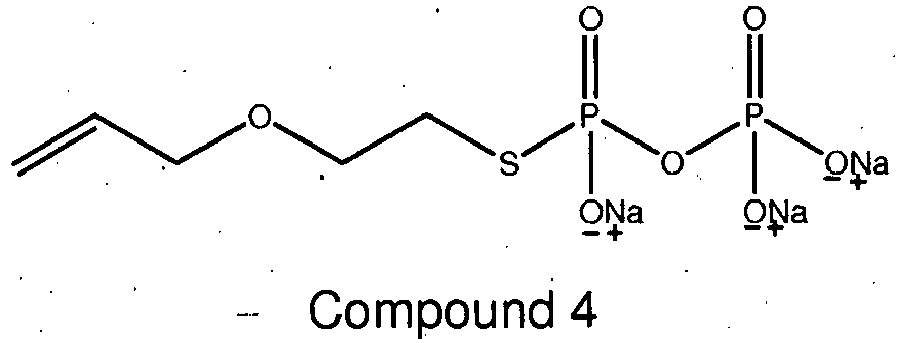
- Working in a manner similar to that described in Example 1, 160 µl of 2-(allyloxy)ethanol (1.5 mmol) in 0.8 ml of DCM-pyridine (1:1) were added to 206 mg (0.300 mmol) of PS-TsCl resin (1.45 mmol/g) in THF. 275.4 mg (0.3 mmol) of tetrabutylammonium thiopyrophosphate dissolved in acetonitrile (0.8 ml) were then added. The filtrate was passed over an ion exchange column (DOWEX®-NH4 + resin). Purification was carried out by chromatography on a cellulose column with NH4HCO3 (25 mMol):iPrOH:CH3CN eluent (1:2:1).
- After lyophilisation 26.7 mg of Compound 4 were obtained (yield: 30%).
Analysis (ESI-) = 277.2 (M-1)
1H-NMR (300 MHz, D2O): δ (ppm) 6.18-6.04 (1 H, m), 5.48 (1 H, d), 5.38 (1 H, d), 4.22 (2H, d), 3.92 (2H, t), 3.62 (1H, d), 3.21-3.10 (2H, m). -

- Working In a manner similar to that described in Example 1, 144.5 µl of (3-methyloxyethane-3-yl)-methanol (1.5 mmol) in 0.8 ml of DCM-pyridine (1:1) were added to 200 mg (0.29 mmol) of PS-TsCl resin (1.45 mmol/g) in THF.
- 293 mg (0.32 mmol) of tetrabutylammonium thiopyrophosphate dissolved in acetonitrile (0.8 ml) were then added. The filtrate was passed over an ion exchange column (DOWEX® NH4 + resin). Purification was carried out by chromatography on a cellulose column with NH4HCO3 (25 mMol):iPrOH:CH3CN eluent (1:2:1).
- 88.2 mg of Compound 5 were thus obtained (yield: 92%).
Analysis (ESI-) = 291.2 (M-1)
1H-NMR (300 MHz, D2O): δ (ppm) 4.80 (2H, d), 4.55 (2H, d), 3.27 (2H, d), 1.51 (3H, s). -

- Working in a manner similar to that described in Example 1, 52 µl of S-(3-hyroxy)butanol (0.6 mmol) in 0.8 ml of a solution of DCM and dimethylaminopyridine (DMAP) (35.4 mg, 0.29 mmol) were added to 200 mg (0.29 mmol) of PS-TsCl resin (1.45 mmol/g) in THF.
- After 24 hours 293 mg (0.32 mmol) of tetrabutylammonium thiopyrophosphate dissolved in acetonitrile (0.8 ml) were added. The filtrate was passed over an ion exchange column (DOWEX® NH4 + resin). Purification was carried out by chromatography on a cellulose column with NH4HCO3 (25 mMol):iPrOH:CH3CN eluent (1:2:1).
- 79 mg of Compound 6 were thus obtained (yield: 86%).
Analysis (ESI-) = 279.0 (M-1)
1H-NMR (300 MHz, D2O): δ (ppm) 4.12-4.07 (1 H, m), 3.07-2.97 (1 H, m), 2.90-2.84 (1 H, m), 1.98-1.85 (2H, m), 1.30 (3H, d). -

- Tetrabutylammonium thiopyrophosphate (63 mg, 0.067 mmol) dissolved in 0.5 ml of acetonitrile was added at 0°C to a 3.56 µl (0.03 mmol) solution of benzyl bromide in acetonitrile (0.5 ml). The reaction mixture was kept under stirring at room temperature for 3 hours.
- After removal of the solvent by evaporation at reduced pressure the crude material was purified as described in Example 1 (DOWEX® NH4 + ion exchange column, precipitation and chromatography on a cellulose column) to yield 8.2 mg of a pure product (yield: 81%).
Analysis (ESI-) = 283.2 (M-1)
1H-NMR (300 MHz, D2O): δ (ppm) 7.50 (2H, d), 7.42 (2H, t), 7.37-7.33 (1 H, m), 4.13 (2H, d). -

- Working in a manner similar to that described by Poulter in J. Org. Chem. 2001, 66, 6705-6710, 11.1 mg of isopentenyl tosylate (0.046 mmol) and 100 mg of tetrabutylammonium thiopyrophosphate (0.106 mmol) were used. After purification (NH4+ ion exchange column, precipitation and chromatography on a cellulose column) 7.1 mg of Compound 8 were thus obtained (yield: 49%).
Analysis (ESI-) = 261.0 (M-1)
1H-NMR (300 MHz, D2O): δ (ppm) 4.85 (2H, d), 3.04-2.97 (2H, m), 2.44 (2H, t), 1.77 (3H, s). -

- Compound 9 was obtained by working in a way similar to that described by Amslinger et al. (J. Org. Chem. 2002, 67, 4590) except that tetrabutylammonium thiopyrophosphate was used instead of tetrabutylammonium pyrophosphate and the deprotection of the alcohol group was carried out in a different way (see Scheme 2):


- After purification on an ion exchange column (eluent: 2% 25 mM NH4HCO3 in IsPrOH) 32 mg of pure product were isolated in the form of sodium salt.
Analysis (ESI-) = 276.97 (M-1)
1H-NMR (300 MHz, D2O): δ (ppm) 5.57 (1 H, t), 3.90 (2H, s), 3.48-3.40 (2H, m), 1.62 (3H, s). - The following compounds were obtained working in a way similar to that described in Example 7.
-

1H-NMR (300 MHz, D2O): δ (ppm) 3.14-2.96 (2H, m), 2.81 (2H, t), 2.71 (2H, q), 2.12-2.04 (2H, m), 1.35 (3H, t). -

1H-NMR (300 MHz, D2O): δ (ppm) 2.84-2.72 (2H, m), 2.45 (2H, t), 1.80-1.65 (4H, m). -

1H-NMR (300 MHz, D2O): δ (ppm) 4.98 (1 H, t), 3.98-3.83 (4H, m), 2.87-2.77 (2H, m), 2.04-1.98 (2H, m). -

1H-NMR (300 MHz, D2O): δ (ppm) 4.55 (1 H, t), 4.39 (1 H, t), 2.84-2.73 (2H, m), 1.84-1.64 (4H, m). -

1H-NMR (300 MHz, D2O): δ (ppm) 5.90-5.73 (1 H, m), 4.96 (1 H, d), 4.88 (1 H, d), 2.78-2.70 (2H, m), 1.99-1.96 (2H, m), 1.61-1.56 (2H, m). -

1H-NMR (300 MHz, D2O): δ (ppm) 4.75 (1 H, m), 3.94-3.81 (2H, m), 3.78-3.71 (1 H, m), 3.55-3.49 (1 H, m), 3.02-2.93 (2H, m), 1.73-1.70 (2H, m), 1.48-1.46 (2H, m). -

1H-NMR (300 MHz, D2O): δ (ppm) 2.83-2.73 (2H, m), 1.64-1.43 (7H, m), 1.15-1.08 (4H, m), 0.86-0.78 (2H, m). - The following compounds were selected for the stability tests in alkaline aqueous solution in the presence of alkaline phosphatase (SIGMA Phosphatase, alkaline-Agarose from calf intestine-P0762):

- Solution A:
- pH 8 solution: TRIS-HCl buffer and 2 mM of MgCl2;
- Solution B:
- comparison versus solution A: 2 mM isopentenyl pyrophosphate (IPP) solution ;
- Solution C:
- 2 mM isopentenyl thiopyrophosphate solution (Compound 8) of this invention into Solution A,
- Solution D:
- Solution of phosphatase enzyme immobilised on a solid substrate (agarose), 50 biological units into 10 ml of Solution A.
- 20 µl of Solution D were added to 0.5 ml of Solution B. The system was allowed to stand at ambient temperature under stirring. The solution was filtered to remove the enzyme and it was then analysed with HPLC-MS at predetermined time intervals (20, 30, 40, 50 and 60 minutes).
- The same procedure was carried out with Solution C.
- The results are shown in Table 1 below.
Table 1 Percentage of non-hydrolysed compound t = 0 min t = 20 min t = 30 min t = 40 min t = 50 min t = 60 min IPP 94% 48% 54% - - 27% Compound 8 100% 90% 90% 90% 90% 90% - γδ T lymphocyte activation was tested by an assay involving the production of cytokines such as TNFα and IFNγ by the γδ T lymphocytes of peripheral blood mononucleate cells (PBMCs) from healthy donors (Poccia, F. et al., The Journal of Immunology 1997, 159, 6009-6017).
- Mononucleate cells (PBMCs) were isolated from the peripheral blood of healthy donors, cultured at 37°C on a complete medium comprising RPMI 1640, 10% FCS, 1% L-glutamine, 1% penicillin-streptomycin in the presence of interleukin 2 (IL-2), T lymphocyte growth factor, and 5% CO2 in a controlled humidity environment, and then stimulated with isopentenyl pyrophosphate (IPP 10 µM) as a positive activation control and with various doses (10 µM, 100 µM) and 1000 µM) of compounds according to the invention, respectively.
- Then it was performed a cytofluorimetric labelling using specific monoclonal antibodies (membrane labelling for the expansion and intra-cytoplasm labelling for the cytokines) and a cytofluorimetric measurement in order to establish the percentage of γδ T cells producing TNFα and IFNγ (cytokine production assay).
- The results are shown in Table 2 below, where "PBMC/IL-2" denotes the peripheral blood mononucleate cells from healthy donors in the presence of the complete substrate alone.
Table 2 Percentage increase in γδ T lymphocytes producing TNFα and IFNγ Compound Experimental conditions % increase in γδ T lymphocytes producing INFγ TNFα PBMC/IL-2 (blank) 2-8 4-11 IPP (std) PBMC/IL-2/IPP (10 µM) 100 100 Compound 1 PBMC/IL-2/compound 1 (10 µM) 131 81 PBMC/IL-2/compound 1 (100 µM) 94 127 PBMC/IL-2/compound 1 (1000 µM) 132 81.5 Compound 2 PBMC/IL-2/compound 2 (10 µM) 56.4 60.4 PBMC/IL-2/compound 2 (100 µM) 67 71.8 PBMC/IL-2/compound 2 (1000 µM) 97.3 765 Compound 3 PBMC/IL-2/compound 3 (10 µM) - 495 PBMC/IL-2/compound 3 (100 µM) - 123 PBMC/IL-2/compound 3 (1000 µM) - 158.4 Compound 4 PBMC/IL-2/compound 4 (10 µm) - 70.7 PBMC/IL-2/compound 4 (100 µM) - 130.4 PBMC/IL-2/compound 4 (1000 µM) - 299.3 Compound 5 PBMC/IL-2/compound 5 (10 µM) - 48 PBMC/IL-2/compound 5 (100 µM) - 229 PBMC/IL-2/compound 5 (1000 µM) - 337 Compound 6 PBMC/IL-2/compound 6 (10 µM) - 40 PBMC/IL-2/compound 6 (100 µM) - 114 PBMC/IL-2/compound 6 (1000 µM) - 310 Compound 7 PBMC/IL-2/compound 7 (10 µM) 82 86 PBMC/IL-2/compound 7 (100 µM) 112 116 PBMC/IL-2/compound 7 (1000 µM) 95 87 Compound 8 PBMC/IL-2/compound 8 (10 µM) 21 39 PBMC/IL-2/compound 8 (100 µM) 865 92.6 PBMC/IL-2/compound 8 (1000 µM) 182 174.3 Compound 9 PBMC/IL-2/compound 9 (10 µM) - 82.3 PBMC/IL-2/compound 9 (100 µM) - 175 PBMC/IL-2/compound 9 (1000 µM) - 464 Compound 10 PBMC/IL-2/compound 10 (10 µM) - - PBMC/IL-2/compound 10 (100 µM) - - PBMC/IL-2/compound 10 (1000 µM) - - - = not tested - The data in Table 2 shows that all the compounds of this invention increase the number of γδ T cells producing cytokines (activation of γδ T lymphocytes); in particular Compound 9 has an activity similar to that of natural antigen IPP under the same experimental conditions (i.e. at a concentration of 10 µM), and a very clear increase at 100 and 1000 µM.
- The effect of the compounds of this invention on the expansion of γδ T lymphocytes was investigated through an assay carried out on γδ T lymphocytes originating from the peripheral blood mononucleate cells from healthy donors (PBMCs).
- The PBMCs were separated by centrifuging (Ficoll) on whole blood from samples (residual samples) from 7 healthy donors.
- After the initial percentage of Vγ9Vδ2 cells from each donor had been evaluated by labelling with an anti-Vd2-FITC antibody and cytofluorimetric analysis, the cells were placed on 24-well plates (106 cells/ml) in complete medium (having the composition mentioned in section 1 of this example) in the presence of Compound 9 of this invention (20 µM). In control experiments the cells were treated with IPP at the same concentrations and under the same Experimental conditions.
- On the tenth day of culture the cells were recovered and counted by means of a living count with Trypan Blue, and labelled with the same anti-Vd2-FITC antibody, and finally tested by cytofluorimetry to evaluate the percentage of Vγ9Vδ2 cells.
- The absolute number of Vγ9Vδ2 cells was calculated using the following formula:

- The expansion index was calculated using the ratio between the absolute number of Vγ9Vδ2 cells after expansion and the absolute number of initial Vγ9Vδ2 cells (Poccia, F. et al., J. Immunol., 1997, 159: 6009-6017).
- The results obtained are shown in Table 3 below and in
Figure 1 .Table 3 Donor Expansion Index Compound 9 (20 γM) IPP (20 γM) A 129.28 5.41 B 80.96 2.42 C 5.30 11.11 D 59.10 2.81 E 624.02 72.92 F 35.37 23.87 G 42.09 3.35 - A buffy coat from a healthy donor with a high basal percentage of γδ T lymphocytes (approximately 6%) was selected for growth of the γδ T lymphocyte lines.
- The PBMCs were separated out and cultured at a concentration of 1 x 10⁶ cells/ml in the presence of IPP (160 ng/ml) and IL-2 (100 U/ml).
- After 7 days incubation at 37°C with 5% CO2, 3 ml of medium were sampled and replaced with the same amount of fresh medium ennched with IL-2 (final concentration 100 U/ml).
- After a further 7 days in the incubator an aliquot of the cultured cells was taken to label the membrane and measure the percentage of γδ T cells obtained from the expansion.
- In the specific instance a cell population of 85% of γδ2 positive T cells was obtained.
- This cell line was then used to evaluate the production of TNFα following stimulation of the cells with the compounds under investigation, using an ELISA test.
- In the ELISA test there were used cells from the line produced as disclosed above in a concentration of 2.5 x 10⁵ cells/ml (5 x 10⁴ cells/well).
- The cells were then stimulated with the compounds under investigation and with isopentenyl pyrophosphate (IPP) as a reference at scalar doses.
- After 24 hours the supernatants from the wells containing the stimulated cells were sampled and the ELISA test was carried out using the "Human TNFα Screening Set" kit (Endogen). The kit provides for treatment with an anti-TNFα biotinylate polyclonal antibody, the addition of peroxidase conjugated with streptavidine and quantitative determination using a chromogenic substrate. The plates were read spectrophotometrically at 450 nm.
- Each compound was tested in duplicate.
- The results obtained were then analysed using a specific analysis program (Graph Pad Prism) and yielded the EC50 for the compounds under investigation (Table 4).
Table 4 EC50 values obtained using the ELISA test for the production of TNFα in the γδ T lymphocyte line Compound EC50 (µM) IPP 5.92 1 100 2 0.39 3 13 4 10 5 14 6 75 7 55 8 3.75 9 0.0048 10 0.055
Claims (11)
- A compound of general formula (I):

X is an oxygen atom, a sulphur atom or a covalent bond,
n is zero when X is a covalent bond and is 1, 2 or 3 when X is O or S,
R is(i) a straight or branched saturated or unsaturated aliphatic group
having 1 to 9 carbon atoms, in which one hydrogen atom may be replaced by a halogen atom, a hydroxy group, a nitrile group, a cycloalkyl group having 3 to 6 carbon atoms, an aryl group or a heterocyclic group, or(ii) a heterocyclic group, andCat+ is a physiologically acceptable organic cation selected from lysine, arginine, tromethamine, hydroxyethylpyrrolidine, triethanolamine and N-methylglucamine or a physiologically acceptable inorganic cation selected from alkali metals and alkaline earth metals. - A compound of formula (I) according to Claim 1, characterised in that one hydrogen atom of said straight or branched saturated or unsaturated aliphatic group having 1 to 9 carbon atoms is replaced by a halogen atom, a hydroxy group, a nitrile group, a cycloalkyl group having 3 to 6 carbon atoms, an aryl group or a heterocyclic group.
- A compound of formula (I) according to Claim 2, characterised in that the halogen atom is chlorine or fluorine.
- A compound of formula (I) according to Claim 2, characterised in that the aryl group is selected from the group comprising benzene and pyridine.
- A compound of formula (I) according to Claim 2, characterised in that the heterocyclic group is selected from the group comprising 3-methyloxetane, dioxolane and tetrahydropyran.
- A method for preparing a compound of formula (I)

X is an oxygen atom, a sulphur atom or a covalent bond,
n is zero when X is a covalent bond and is 1, 2 or 3 when X is O or S,
R is(i) a straight or branched saturated or unsaturated aliphatic group
having 1 to 9 carbon atoms, in which one hydrogen atom may be replaced by a halogen atom, a hydroxy group, a nitrile group, a cycloalkyl group having 3 to 6 carbon atoms, an aryl group or a heterocyclic group, or(ii) a heterocyclic group, andCat+ is a physiologically acceptable organic cation selected from lysine, arginine, tromethamine, hydroxyethylpyrrolidine, triethanolamine and N-methylglucamine or a physiologically acceptable inorganic cation selected from alkali metals and alkaline earth metals,
characterised in that an alcohol of formula (II)
R-X-(CH2)n-OH (II)
where n, X and R have the above mentioned meanings, is reacted in solid phase with a thiopyrophosphate of formula (III)
- A method according to Claim 6, characterised in that the solid support used to carry out the reaction in solid phase according to this invention is polystyrene benzene sulphonyl chloride (PS-TsCl) having a low loading capacity (1.3 mmol/g).
- A method according to any one of Claims 6 to 7, characterised in that the equivalents of alcohol of formula (II) which are bound to the solid support range from 1 to 5 depending upon the nature of the R group.
- A pharmaceutical composition comprising a compound of formula (I)
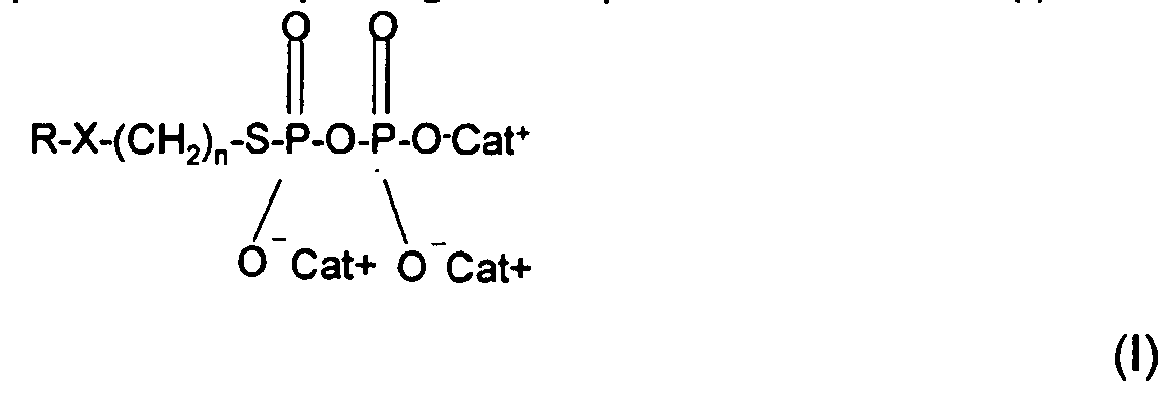
X is an oxygen atom, a sulphur atom or a covalent bond,
n is zero when X is a covalent bond and is 1, 2 or 3 when X is O or S,
R is(i) a straight or branched saturated or unsaturated aliphatic group
having 1 to 9 carbon atoms, in which one hydrogen atom may be replaced by a halogen atom, a hydroxy group, a nitrile group, a cycloalkyl group having 3 to 6 carbon atoms, an aryl group or a heterocyclic group, or(ii) a heterocyclic group, andCat+ is a physiologically acceptable organic cation selected from lysine, arginine, tromethamine, hydroxyethylpyrrolidine, triethanolamine and N-methylglucamine or a physiologically acceptable inorganic cation selected from alkali metals and alkaline earth metals,
and at least one physiologically acceptable carrier. - A compound for use in activating mammalian γδ T lymphocytes characterised in that said compound is represented by the following formula I

X is an oxygen atom, a sulphur atom or a covalent bond,
n is zero when X is a covalent bond and is 1, 2 or 3 when X is O or S,
R is(i) a straight or branched saturated or unsaturated aliphatic group having 1 to 9 carbon atoms, in which one hydrogen atom may be replaced by a halogen atom, a hydroxy group, a nitrile group, a cycloalkyl group having 3 to 6 carbon atoms, an aryl group or a heterocyclic group, or(ii) a heterocyclic group, andCat+ is a physiologically acceptable organic cation selected from lysine, arginine, tromethamine, hydroxyethylpyrrolidine, triethanolamine and N-methylglucamine or a physiologically acceptable inorganic cation selected from ammonium, alkali metals and alkaline earth metals. - A compound for use according to Claim 10, characterised in that said use comprises- sampling a suitable amount of peripheral blood from a patient,- contacting the said blood with said compound of formula I for sufficient time to stimulate ex vivo proliferation of γδ T lymphocytes,- collecting the thus treated γδ T cells, and- administering them to the patient by intravenous route.
Applications Claiming Priority (2)
| Application Number | Priority Date | Filing Date | Title |
|---|---|---|---|
| IT000366A ITMI20060366A1 (en) | 2006-03-01 | 2006-03-01 | ORGAN THIOPHYPOSPHATE COMPOUNDS METHOD FOR PREPARING AND COMPOSITIONS THAT CONTAIN THEM |
| PCT/EP2007/051896 WO2007099117A1 (en) | 2006-03-01 | 2007-02-28 | Thiopyrophosphate organic compounds, method for preparing thereof and compositions containing them |
Publications (2)
| Publication Number | Publication Date |
|---|---|
| EP1991554A1 EP1991554A1 (en) | 2008-11-19 |
| EP1991554B1 true EP1991554B1 (en) | 2013-12-25 |
Family
ID=37988970
Family Applications (1)
| Application Number | Title | Priority Date | Filing Date |
|---|---|---|---|
| EP07712384.2A Not-in-force EP1991554B1 (en) | 2006-03-01 | 2007-02-28 | Thiopyrophosphate organic compounds, method for preparing thereof and compositions containing them |
Country Status (3)
| Country | Link |
|---|---|
| EP (1) | EP1991554B1 (en) |
| IT (1) | ITMI20060366A1 (en) |
| WO (1) | WO2007099117A1 (en) |
Families Citing this family (1)
| Publication number | Priority date | Publication date | Assignee | Title |
|---|---|---|---|---|
| CA2547008A1 (en) | 2003-12-02 | 2005-06-16 | Innate Pharma | New class of gamma delta t cells activators and use thereof |
Citations (1)
| Publication number | Priority date | Publication date | Assignee | Title |
|---|---|---|---|---|
| EP1987063B1 (en) * | 2006-02-23 | 2009-09-23 | Fibrex Medical Research & Development GmbH | Peptides and peptide derivatives, the production thereof as well as their use for preparing a therapeutically and/or preventively active pharmaceutical composition |
Family Cites Families (2)
| Publication number | Priority date | Publication date | Assignee | Title |
|---|---|---|---|---|
| FR2836483B1 (en) * | 2002-02-22 | 2006-09-15 | Innate Pharma | METHODS FOR PRODUCING GAMMA DELTA T LYMPHOCYTES |
| JP2007534743A (en) * | 2004-04-26 | 2007-11-29 | イネイト・ファーマ | Adjuvant compositions and methods of use thereof |
-
2006
- 2006-03-01 IT IT000366A patent/ITMI20060366A1/en unknown
-
2007
- 2007-02-28 EP EP07712384.2A patent/EP1991554B1/en not_active Not-in-force
- 2007-02-28 WO PCT/EP2007/051896 patent/WO2007099117A1/en not_active Ceased
Patent Citations (1)
| Publication number | Priority date | Publication date | Assignee | Title |
|---|---|---|---|---|
| EP1987063B1 (en) * | 2006-02-23 | 2009-09-23 | Fibrex Medical Research & Development GmbH | Peptides and peptide derivatives, the production thereof as well as their use for preparing a therapeutically and/or preventively active pharmaceutical composition |
Non-Patent Citations (5)
| Title |
|---|
| "acceptable", Retrieved from the Internet <URL:http://www.thefreedictionary.co/acceptable> * |
| "physiological", Retrieved from the Internet <URL:http://www.thefreedictionary.co/physiological> * |
| MIYAKAWA ET AL, BRAIN RES. BULL., vol. 56, no. 6, 2001, pages 517 - 519 * |
| SCIENCELAB.COM; MATERIAL SAFETY DATA SHEET: "Tetrabutylammonium bromide" * |
| SCIENCELAB.COM; MATERIAL SAFETY DATA SHEET: "Tetrabutylammonium hydroxide" * |
Also Published As
| Publication number | Publication date |
|---|---|
| WO2007099117A1 (en) | 2007-09-07 |
| ITMI20060366A1 (en) | 2007-09-02 |
| EP1991554A1 (en) | 2008-11-19 |
Similar Documents
| Publication | Publication Date | Title |
|---|---|---|
| AU707196B2 (en) | Chemical compounds | |
| CA2090024C (en) | Phospholipid derivatives of nucleosides, their preparation, as well as their use as anti-viral medicaments | |
| AU2012223012B2 (en) | Phosphoramidate derivatives of 5 - fluoro - 2 ' - deoxyuridine for use in the treatment of cancer | |
| AU2002339423B2 (en) | Organo-phosphorous compounds for activating gamma/delta T cells | |
| Belmant et al. | A chemical basis for recognition of nonpeptide antigens by human γδ T cells | |
| JP4603163B2 (en) | Phosphohalohydrins, methods for their production and uses | |
| DE68906183T2 (en) | 2'-DESOXY-5-FLUORURIDINE DERIVATIVES. | |
| US5043437A (en) | 5'phosphonates of 3'-azido-2',3'dideoxynucleosides | |
| HUT74686A (en) | Rapamycin derivatives, their pharmaceutical use, process for producing them and pharmaceutical composition containing them as active agents | |
| CZ541288A3 (en) | 4'-phosphate epipodophyllotoxin glucosides, process of their preparation and pharmaceutical preparation in which they are comprised | |
| JPH05507929A (en) | Ether lipid-nucleoside covalent conjugate | |
| JPS62174094A (en) | Alpha, alpha-trehalose derivative and production thereof | |
| JP2005511748A (en) | Phosphonates useful as modulators of T-gamma-9-delta-2 lymphocyte activity | |
| JPH05509327A (en) | Protein kinase C modulator with anti-inflammatory and antiviral activity | |
| EP0593595B1 (en) | Derivatives of inositol, preparations containing them and their use | |
| US4988682A (en) | Myo-inositol analogs and method for their use | |
| US7101711B1 (en) | Phosphoepoxides, method for making same and uses | |
| EP0561523A2 (en) | Sugar compound, sialic acid-containing sugar chains' biosynthesis inhibitor, production process thereof and intermediate | |
| US5023239A (en) | Sialosyl cholesterol, process for producing the same, and neuropathy remedy comprising the same | |
| EP1991554A1 (en) | Thiopyrophosphate organic compounds, method for preparing thereof and compositions containing them | |
| JPH0551597B2 (en) | ||
| AU672994B2 (en) | Liponucleotides of seco-nucleosides, their preparation and their use as anti-viral drugs | |
| US5053399A (en) | Myo-inositol analogs and methods for their use | |
| US4421768A (en) | Fluorinated diamino-heptene and-heptyne derivatives | |
| US5169842A (en) | Oligophosphates with an antiviral action |
Legal Events
| Date | Code | Title | Description |
|---|---|---|---|
| PUAI | Public reference made under article 153(3) epc to a published international application that has entered the european phase |
Free format text: ORIGINAL CODE: 0009012 |
|
| 17P | Request for examination filed |
Effective date: 20080925 |
|
| AK | Designated contracting states |
Kind code of ref document: A1 Designated state(s): AT BE BG CH CY CZ DE DK EE ES FI FR GB GR HU IE IS IT LI LT LU LV MC NL PL PT RO SE SI SK TR |
|
| 17Q | First examination report despatched |
Effective date: 20090126 |
|
| DAX | Request for extension of the european patent (deleted) | ||
| GRAP | Despatch of communication of intention to grant a patent |
Free format text: ORIGINAL CODE: EPIDOSNIGR1 |
|
| INTG | Intention to grant announced |
Effective date: 20130708 |
|
| GRAS | Grant fee paid |
Free format text: ORIGINAL CODE: EPIDOSNIGR3 |
|
| GRAA | (expected) grant |
Free format text: ORIGINAL CODE: 0009210 |
|
| AK | Designated contracting states |
Kind code of ref document: B1 Designated state(s): AT BE BG CH CY CZ DE DK EE ES FI FR GB GR HU IE IS IT LI LT LU LV MC NL PL PT RO SE SI SK TR |
|
| REG | Reference to a national code |
Ref country code: GB Ref legal event code: FG4D |
|
| REG | Reference to a national code |
Ref country code: CH Ref legal event code: EP |
|
| REG | Reference to a national code |
Ref country code: AT Ref legal event code: REF Ref document number: 646599 Country of ref document: AT Kind code of ref document: T Effective date: 20140115 |
|
| REG | Reference to a national code |
Ref country code: IE Ref legal event code: FG4D |
|
| REG | Reference to a national code |
Ref country code: DE Ref legal event code: R096 Ref document number: 602007034425 Country of ref document: DE Effective date: 20140213 |
|
| PG25 | Lapsed in a contracting state [announced via postgrant information from national office to epo] |
Ref country code: SE Free format text: LAPSE BECAUSE OF FAILURE TO SUBMIT A TRANSLATION OF THE DESCRIPTION OR TO PAY THE FEE WITHIN THE PRESCRIBED TIME-LIMIT Effective date: 20131225 Ref country code: LT Free format text: LAPSE BECAUSE OF FAILURE TO SUBMIT A TRANSLATION OF THE DESCRIPTION OR TO PAY THE FEE WITHIN THE PRESCRIBED TIME-LIMIT Effective date: 20131225 Ref country code: FI Free format text: LAPSE BECAUSE OF FAILURE TO SUBMIT A TRANSLATION OF THE DESCRIPTION OR TO PAY THE FEE WITHIN THE PRESCRIBED TIME-LIMIT Effective date: 20131225 |
|
| REG | Reference to a national code |
Ref country code: NL Ref legal event code: VDEP Effective date: 20131225 |
|
| REG | Reference to a national code |
Ref country code: AT Ref legal event code: MK05 Ref document number: 646599 Country of ref document: AT Kind code of ref document: T Effective date: 20131225 |
|
| REG | Reference to a national code |
Ref country code: LT Ref legal event code: MG4D |
|
| PG25 | Lapsed in a contracting state [announced via postgrant information from national office to epo] |
Ref country code: LV Free format text: LAPSE BECAUSE OF FAILURE TO SUBMIT A TRANSLATION OF THE DESCRIPTION OR TO PAY THE FEE WITHIN THE PRESCRIBED TIME-LIMIT Effective date: 20131225 |
|
| PG25 | Lapsed in a contracting state [announced via postgrant information from national office to epo] |
Ref country code: BE Free format text: LAPSE BECAUSE OF FAILURE TO SUBMIT A TRANSLATION OF THE DESCRIPTION OR TO PAY THE FEE WITHIN THE PRESCRIBED TIME-LIMIT Effective date: 20131225 Ref country code: EE Free format text: LAPSE BECAUSE OF FAILURE TO SUBMIT A TRANSLATION OF THE DESCRIPTION OR TO PAY THE FEE WITHIN THE PRESCRIBED TIME-LIMIT Effective date: 20131225 Ref country code: IS Free format text: LAPSE BECAUSE OF FAILURE TO SUBMIT A TRANSLATION OF THE DESCRIPTION OR TO PAY THE FEE WITHIN THE PRESCRIBED TIME-LIMIT Effective date: 20140425 |
|
| PG25 | Lapsed in a contracting state [announced via postgrant information from national office to epo] |
Ref country code: PL Free format text: LAPSE BECAUSE OF FAILURE TO SUBMIT A TRANSLATION OF THE DESCRIPTION OR TO PAY THE FEE WITHIN THE PRESCRIBED TIME-LIMIT Effective date: 20131225 Ref country code: ES Free format text: LAPSE BECAUSE OF FAILURE TO SUBMIT A TRANSLATION OF THE DESCRIPTION OR TO PAY THE FEE WITHIN THE PRESCRIBED TIME-LIMIT Effective date: 20131225 Ref country code: PT Free format text: LAPSE BECAUSE OF FAILURE TO SUBMIT A TRANSLATION OF THE DESCRIPTION OR TO PAY THE FEE WITHIN THE PRESCRIBED TIME-LIMIT Effective date: 20140428 Ref country code: SK Free format text: LAPSE BECAUSE OF FAILURE TO SUBMIT A TRANSLATION OF THE DESCRIPTION OR TO PAY THE FEE WITHIN THE PRESCRIBED TIME-LIMIT Effective date: 20131225 Ref country code: NL Free format text: LAPSE BECAUSE OF FAILURE TO SUBMIT A TRANSLATION OF THE DESCRIPTION OR TO PAY THE FEE WITHIN THE PRESCRIBED TIME-LIMIT Effective date: 20131225 Ref country code: CZ Free format text: LAPSE BECAUSE OF FAILURE TO SUBMIT A TRANSLATION OF THE DESCRIPTION OR TO PAY THE FEE WITHIN THE PRESCRIBED TIME-LIMIT Effective date: 20131225 Ref country code: CY Free format text: LAPSE BECAUSE OF FAILURE TO SUBMIT A TRANSLATION OF THE DESCRIPTION OR TO PAY THE FEE WITHIN THE PRESCRIBED TIME-LIMIT Effective date: 20131225 Ref country code: RO Free format text: LAPSE BECAUSE OF FAILURE TO SUBMIT A TRANSLATION OF THE DESCRIPTION OR TO PAY THE FEE WITHIN THE PRESCRIBED TIME-LIMIT Effective date: 20131225 Ref country code: AT Free format text: LAPSE BECAUSE OF FAILURE TO SUBMIT A TRANSLATION OF THE DESCRIPTION OR TO PAY THE FEE WITHIN THE PRESCRIBED TIME-LIMIT Effective date: 20131225 |
|
| REG | Reference to a national code |
Ref country code: DE Ref legal event code: R119 Ref document number: 602007034425 Country of ref document: DE |
|
| PG25 | Lapsed in a contracting state [announced via postgrant information from national office to epo] |
Ref country code: MC Free format text: LAPSE BECAUSE OF FAILURE TO SUBMIT A TRANSLATION OF THE DESCRIPTION OR TO PAY THE FEE WITHIN THE PRESCRIBED TIME-LIMIT Effective date: 20131225 Ref country code: LU Free format text: LAPSE BECAUSE OF FAILURE TO SUBMIT A TRANSLATION OF THE DESCRIPTION OR TO PAY THE FEE WITHIN THE PRESCRIBED TIME-LIMIT Effective date: 20140228 |
|
| REG | Reference to a national code |
Ref country code: CH Ref legal event code: PL |
|
| PG25 | Lapsed in a contracting state [announced via postgrant information from national office to epo] |
Ref country code: CH Free format text: LAPSE BECAUSE OF NON-PAYMENT OF DUE FEES Effective date: 20140228 Ref country code: DK Free format text: LAPSE BECAUSE OF FAILURE TO SUBMIT A TRANSLATION OF THE DESCRIPTION OR TO PAY THE FEE WITHIN THE PRESCRIBED TIME-LIMIT Effective date: 20131225 Ref country code: LI Free format text: LAPSE BECAUSE OF NON-PAYMENT OF DUE FEES Effective date: 20140228 |
|
| PLBE | No opposition filed within time limit |
Free format text: ORIGINAL CODE: 0009261 |
|
| STAA | Information on the status of an ep patent application or granted ep patent |
Free format text: STATUS: NO OPPOSITION FILED WITHIN TIME LIMIT |
|
| REG | Reference to a national code |
Ref country code: FR Ref legal event code: ST Effective date: 20141031 |
|
| GBPC | Gb: european patent ceased through non-payment of renewal fee |
Effective date: 20140325 |
|
| REG | Reference to a national code |
Ref country code: DE Ref legal event code: R119 Ref document number: 602007034425 Country of ref document: DE Effective date: 20140902 |
|
| 26N | No opposition filed |
Effective date: 20140926 |
|
| REG | Reference to a national code |
Ref country code: IE Ref legal event code: MM4A |
|
| PG25 | Lapsed in a contracting state [announced via postgrant information from national office to epo] |
Ref country code: FR Free format text: LAPSE BECAUSE OF NON-PAYMENT OF DUE FEES Effective date: 20140228 Ref country code: DE Free format text: LAPSE BECAUSE OF NON-PAYMENT OF DUE FEES Effective date: 20140902 Ref country code: GB Free format text: LAPSE BECAUSE OF NON-PAYMENT OF DUE FEES Effective date: 20140325 Ref country code: IE Free format text: LAPSE BECAUSE OF NON-PAYMENT OF DUE FEES Effective date: 20140228 |
|
| PG25 | Lapsed in a contracting state [announced via postgrant information from national office to epo] |
Ref country code: SI Free format text: LAPSE BECAUSE OF FAILURE TO SUBMIT A TRANSLATION OF THE DESCRIPTION OR TO PAY THE FEE WITHIN THE PRESCRIBED TIME-LIMIT Effective date: 20131225 |
|
| PG25 | Lapsed in a contracting state [announced via postgrant information from national office to epo] |
Ref country code: BG Free format text: LAPSE BECAUSE OF FAILURE TO SUBMIT A TRANSLATION OF THE DESCRIPTION OR TO PAY THE FEE WITHIN THE PRESCRIBED TIME-LIMIT Effective date: 20131225 |
|
| PG25 | Lapsed in a contracting state [announced via postgrant information from national office to epo] |
Ref country code: GR Free format text: LAPSE BECAUSE OF FAILURE TO SUBMIT A TRANSLATION OF THE DESCRIPTION OR TO PAY THE FEE WITHIN THE PRESCRIBED TIME-LIMIT Effective date: 20140326 Ref country code: IT Free format text: LAPSE BECAUSE OF FAILURE TO SUBMIT A TRANSLATION OF THE DESCRIPTION OR TO PAY THE FEE WITHIN THE PRESCRIBED TIME-LIMIT Effective date: 20131225 |
|
| PG25 | Lapsed in a contracting state [announced via postgrant information from national office to epo] |
Ref country code: TR Free format text: LAPSE BECAUSE OF FAILURE TO SUBMIT A TRANSLATION OF THE DESCRIPTION OR TO PAY THE FEE WITHIN THE PRESCRIBED TIME-LIMIT Effective date: 20131225 Ref country code: HU Free format text: LAPSE BECAUSE OF FAILURE TO SUBMIT A TRANSLATION OF THE DESCRIPTION OR TO PAY THE FEE WITHIN THE PRESCRIBED TIME-LIMIT; INVALID AB INITIO Effective date: 20070228 |