EP1990978A1 - Sharing the common session between two applications on the same server - Google Patents
Sharing the common session between two applications on the same server Download PDFInfo
- Publication number
- EP1990978A1 EP1990978A1 EP08155926A EP08155926A EP1990978A1 EP 1990978 A1 EP1990978 A1 EP 1990978A1 EP 08155926 A EP08155926 A EP 08155926A EP 08155926 A EP08155926 A EP 08155926A EP 1990978 A1 EP1990978 A1 EP 1990978A1
- Authority
- EP
- European Patent Office
- Prior art keywords
- session
- application
- server
- session data
- storing
- Prior art date
- Legal status (The legal status is an assumption and is not a legal conclusion. Google has not performed a legal analysis and makes no representation as to the accuracy of the status listed.)
- Withdrawn
Links
- 238000000034 method Methods 0.000 claims abstract description 19
- 230000003993 interaction Effects 0.000 claims description 6
- 230000005540 biological transmission Effects 0.000 description 2
- 238000010586 diagram Methods 0.000 description 2
- 238000009434 installation Methods 0.000 description 2
- 238000012546 transfer Methods 0.000 description 2
- 101000737578 Arabidopsis thaliana Bifunctional cystathionine gamma-lyase/cysteine synthase Proteins 0.000 description 1
- 238000013475 authorization Methods 0.000 description 1
- 230000009286 beneficial effect Effects 0.000 description 1
- 239000000969 carrier Substances 0.000 description 1
- 238000013461 design Methods 0.000 description 1
- 230000000977 initiatory effect Effects 0.000 description 1
- 239000000463 material Substances 0.000 description 1
Images

Classifications
-
- H—ELECTRICITY
- H04—ELECTRIC COMMUNICATION TECHNIQUE
- H04L—TRANSMISSION OF DIGITAL INFORMATION, e.g. TELEGRAPHIC COMMUNICATION
- H04L63/00—Network architectures or network communication protocols for network security
- H04L63/08—Network architectures or network communication protocols for network security for authentication of entities
- H04L63/0815—Network architectures or network communication protocols for network security for authentication of entities providing single-sign-on or federations
-
- H—ELECTRICITY
- H04—ELECTRIC COMMUNICATION TECHNIQUE
- H04L—TRANSMISSION OF DIGITAL INFORMATION, e.g. TELEGRAPHIC COMMUNICATION
- H04L67/00—Network arrangements or protocols for supporting network services or applications
- H04L67/14—Session management
-
- H—ELECTRICITY
- H04—ELECTRIC COMMUNICATION TECHNIQUE
- H04L—TRANSMISSION OF DIGITAL INFORMATION, e.g. TELEGRAPHIC COMMUNICATION
- H04L67/00—Network arrangements or protocols for supporting network services or applications
- H04L67/14—Session management
- H04L67/142—Managing session states for stateless protocols; Signalling session states; State transitions; Keeping-state mechanisms
Definitions
- the present application relates to web services accessible by users via a network, and in particular to sharing the common session between two applications on the same server.
- Web services to deliver information content to users, via a network such as an intranet or the Internet, is well known.
- a web service will be deployed on a server which can be accessed via the network.
- the server may be composed of a single computer, or a cluster of two or more computers connected together (for example via a Local Area Network) into a single operating domain, as is well known in the art.
- a web service it is convenient to configure a web service as a set of two or more applications, each of which provides a respective portion of the functionality of the web service.
- a first application may be provided to handle user login, authentication, and rights management.
- a second application may provide a search window to enable the user to find information accessible through the web service, while a third application handles encoding and transmission of user-selected data to the user in accordance with the user's authorizations and preferences.
- the division of functionality between each of the applications forming the web service is transparent to the subscriber. This requires that information must be shared between the respective sessions of each of the involved applications.
- a "session" is a logical entity that encompasses a user's interactions with an application.
- Each user of an application has a respective unique session. If a user accesses more than one application, then each application will instantiate a respective session encompassing the user's interactions with that application.
- each session is associated with a data object used to store information relevant to the session. Representative information that may be stored in such a session data object includes: user ID information; user access permissions; and state variables indicating the state of the application, which may include information identifying open web pages of the application, for example.
- This arrangement facilitates multi-user access to applications executing on a server, allowing each user to store and retrieve data when accessing different web pages of each application.
- OTASL Over The Air Software Loading
- One aspect of the present application provides a method of automatically sharing session data between two or more applications executing on a common server. Each application has a respective session. The method comprises: storing a copy of all session data of a first application's session in a servlet context resident on the server; copying the stored session data to a second application's session on the server; and thereafter deleting the stored session data.
- the storing a copy of session data of the first application's session may include selecting a unique key in respect of the first application's session, and storing the session data in an entry of the servlet context, associated with the selected key.
- the unique key may correspond with a session key of the first application session and the session key may be included in a link used to access the second application from the first application.
- a server comprising a processor for controlling operation of the server; a first input device coupled to the processor for accepting an input; a communications subsystem coupled to the processor for communicating with a communications network; a memory coupled to the processor; and a storage device coupled to the processor.
- the server includes a software module resident in the memory for execution by the processor, the software module for automatically sharing session data between two or more applications executing on the server. Each application has a respective session.
- the software module is configured to: store a copy of all session data of a first application's session in a servlet context resident on the server, copy the stored session data to a second application's session on the server, and thereafter delete the stored session data.
- FIG. 1 is a block diagram schematically illustrating a network system
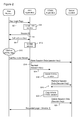
- FIG. 2 is a flow diagram schematically illustrating principle steps in a representative embodiment.
- the present disclosure provides a method of sharing session data between two or more applications executing on a common server.
- Each application has a respective session.
- a copy of session data of a first application's session is stored in a servlet context resident on the server.
- the stored session data is copied to the respective session of at least one other application. Thereafter, the stored session data is deleted.
- the stored session data may correspond with user login, authentication and role management information. Embodiments are described below, by way of example only, with reference to FIGs. 1 and 2 .
- a plurality of wireless devices 4 are hosted by a server 6 of a service provider in accordance with the terms of a service contract between the service provider and the owner of each wireless device.
- the server 6 is also coupled to a data network 8 (such as, for example, any one or more of a Local Area Network, an intranet or the internet) so as to enable authorized parties to access management functionality of the server 6, as will be explained in greater detail below.
- the server (6) comprises components known to those skilled in the art, such as a processor for controlling operation of the server; one or more input devices coupled to the processor for accepting an input; a communications subsystem coupled to the processor for communicating with a communications network; a memory coupled to the processor; and a storage device coupled to the processor.
- the server 6 also includes various software modules resident in the memory for execution by the processor.
- the server 6, and indeed any server may be provided by a single computer, or a cluster of two or more computers connected by a network (such as, for example, a local area network) and operating under the authority of a single management domain.
- a network such as, for example, a local area network
- the server preferably provides a registry 10, which may be co-resident with the server 6 or may be located remotely from the server 6 and accessed via the data network 8.
- the registry 10 generally comprises a profiles registry 12 and an applications registry 14.
- the profiles registry 12 contains, for each terminal device 4, a respective profile which contains information identifying each software application installed on that terminal device 4, and possibly additional information such as the version of the installed software.
- the applications registry 14 contains information identifying wireless applications that are available to the terminal devices 4, and possibly also addresses (e.g., Universal Resources Look-ups (URLs)) of respective back-end data sources and/or web services of the data network 8 that may be accessed by each application.
- URLs Universal Resources Look-ups
- the server 6 also provides device management services 16, which may be co-resident with the server 6 or may be located remotely from the server 6 and accessed via the data network 8.
- the device management services suite 16 provides a mechanism by which authorized parties can manage the implementation of software updates to the wireless devices 4 hosted by the server 6.
- authorized parties may include any party who is authorized to access and use the management services 16. These may include software application developers, device manufacturers, network service carriers, etc.
- each authorized party will use an Administration Client application 18 to interact with the management services 16, via the data network 8, as shown in FIG. 1 .
- the management services suite 16 In order to accommodate the wide and growing variety of wireless devices, it is convenient to design the management services suite 16 as a set of applications, each of which provides a respective portion of the functionality of the management services suite 16. For example, in order to install a new software application or an application update on a wireless terminal, the user of the terminal may access a main provisioning application (e.g., a first application) of the management services suite 16. This may be accomplished by selecting an icon on a display of the wireless terminal, or in the case of an update selecting a link contained in an update initiation message sent to the wireless terminal 4. In either case, the main provisioning application, which may be configured as a web application, may enable the user to browse through a number of available applications/updates, and select those that are desired to be installed on their wireless terminal.
- a main provisioning application e.g., a first application
- an Over The Air Software Loading (OTASL) application (e.g., a second application) is instantiated to manage the transfer of the selected applications/updates to the wireless terminal.
- OTASL Over The Air Software Loading
- This arrangement may be beneficial in that it may enable a common (e.g., nominally generic) main provisioning application to be deployed on the server 6 to handle user authentication and role management, while a respective OTASL application tailored to the particular requirements of the subscriber's wireless terminal handles selection of applications/updates by the subscriber, and subsequent transfer of application code to the wireless device.
- Both the main provisioning application and the OATSL application(s) may conveniently be configured as web applications, and may execute on the same server 6.
- the division of functionality between the main provisioning application and the OTASL application may be transparent to the subscriber. For this to occur, information may be shared between at least the main provisioning and OTASL sessions.
- session data of the Provisioning application is shared with the OTASL application.
- the Provisioning application instantiates a respective session (i.e., PRV session) for the user (at step S4); sends the log-in page and session identifier to the user (at step S6); and initiates user login and authentication routines (at step S8).
- the provisioning application updates the PRV session (at step S10) with applicable user login, authentication and/or role management information.
- the server also downloads an "opening" web page for display on the user's web browser.
- the opening web page contains icons and URLs enabling the user to access various sub-pages of the web service.
- icons/URLs links to the OTASL application.
- the link may include the session key associated with PRV session.
- a redirector servlet (not shown) associated with the provisioning application.
- a redirector servlet is a software entity typically deployed on a web server to receive external requests and redirect the received requests to appropriate addresses of the web server.
- the special redirector servlet is configured to enable messaging between the provisioning and OTASL applications, using the session key associated with the PRV session.
- Use of a special redirector servlet in this manner is advantageous in that it leverages the conventional functionality provided by a redirector servlet, and thus avoids the need to develop additional software to provide equivalent functionality.
- the special redirector servlet provides a servlet context in a conventional manner.
- the servlet context is an area of a server's memory that is shared between all applications running on that server, and is accessible to all of them. In the present technique, this servlet context is leveraged to facilitate passing of session data between applications. It will be appreciated, however, that there are other means by which this functionality could be implemented.
- the special redirector servlet creates an entry in its Servlet Context, within which a copy of the Provisioning application's session data can be stored under a predetermined session key that is unique to the PRV session.
- the special redirector servlet opens the required entry in the servlet context, and then stores the PRV session data in the servlet context (at step S14).
- PRV session data stored in the servlet context may be a copy of the entire PRV session, or a predetermined portion of it.
- the stored PRV session data may comprise all PRV session data including any one or more of user login, user authentication, user information, user account information, payment information, and role management information.
- the PRV session data is stored under a unique key because each application will typically have multiple concurrent sessions, one for each user currently logged into the web service.
- a convenient way of providing a unique key is to set the key equal to the session key of the provisioning application's session, as in the illustrated embodiment, but this is optional.
- this session key may be included in the link to the OTASL application, thereby providing completely automatic and seamless session information sharing from the perspective of the user.
- the special redirector servlet then passes the key to the OTASL application, which then instantiates a respective session (i.e., OTASL session) for the user (at step S18), and retrieves the stored PRV session data from the server context, at step S20.
- a respective session i.e., OTASL session
- the OTASL application then copies at least a portion of the retrieved PRV session data to its own OTASL session (at step S22), so that the OTASL session contains a duplicate of the authentication and permission information contained in the PRV session.
- this session data sharing is done entirely on the server side.
- Provisioning application session data stored in the servlet context can then be deleted, either by the special redirector servlet of the OTASL application, as shown in FIG. 2 at step S24.
- the present technique has been described with reverence to a specific embodiment in which it is desired to share session data between two applications, in this case a main provisioning application and an OTASL application.
- this embodiment is not limitative.
- those of ordinary skill in the art will recognize that the methods disclosed herein can be readily extended to enable session information to be shared between any two or more applications running on the same server.
- the PRV session information is copied to the OTASL application session. More generally, in a web service composed of multiple applications, one application will normally be provided to handle the initial interaction with the user, including user login and authentication. The session data from this application would then be copied to the respective sessions of other applications (or sub-applications) as needed during the course of the user's interaction with the web service.
Landscapes
- Engineering & Computer Science (AREA)
- Computer Networks & Wireless Communication (AREA)
- Signal Processing (AREA)
- Computer Hardware Design (AREA)
- Computer Security & Cryptography (AREA)
- Computing Systems (AREA)
- General Engineering & Computer Science (AREA)
- Computer And Data Communications (AREA)
Abstract
Description
- This application claims priority to
U.S. Provisional Application No. 60/917,237, filed May 10, 2007 - The present application relates to web services accessible by users via a network, and in particular to sharing the common session between two applications on the same server.
- The use of Web services to deliver information content to users, via a network such as an intranet or the Internet, is well known. Typically, a web service will be deployed on a server which can be accessed via the network. The server may be composed of a single computer, or a cluster of two or more computers connected together (for example via a Local Area Network) into a single operating domain, as is well known in the art.
- In many cases, it is convenient to configure a web service as a set of two or more applications, each of which provides a respective portion of the functionality of the web service. For example, a first application may be provided to handle user login, authentication, and rights management. A second application may provide a search window to enable the user to find information accessible through the web service, while a third application handles encoding and transmission of user-selected data to the user in accordance with the user's authorizations and preferences.
- Preferably, the division of functionality between each of the applications forming the web service is transparent to the subscriber. This requires that information must be shared between the respective sessions of each of the involved applications.
- For at least the purposes of the present application, a "session" is a logical entity that encompasses a user's interactions with an application. Each user of an application has a respective unique session. If a user accesses more than one application, then each application will instantiate a respective session encompassing the user's interactions with that application. Typically, each session is associated with a data object used to store information relevant to the session. Representative information that may be stored in such a session data object includes: user ID information; user access permissions; and state variables indicating the state of the application, which may include information identifying open web pages of the application, for example. This arrangement facilitates multi-user access to applications executing on a server, allowing each user to store and retrieve data when accessing different web pages of each application.
- As is well known in the art, web servers typically prohibit sharing of session data between two or more web applications. This is done primarily due to security concerns. However, in some cases this can interfere with the users' experience of the applications they are accessing. One situation in which this occurs is a web service configured to facilitate installation of applications and application updates on a user's wireless terminal, wherein a main provisioning application handles user login and authentication and an Over The Air Software Loading (OTASL) application handles transmission and installation of software updates to the user's wireless terminal. From the user's perspective, both applications should look and feel as a single application. This means that the OTASL application needs to use the authentication and role management provided by the main Provisioning application. In order to do that, session data of the Provisioning application needs to be shared with the OTASL application.
- Methods and techniques that overcome at least some the of above difficulties remain highly desirable.
- One aspect of the present application provides a method of automatically sharing session data between two or more applications executing on a common server. Each application has a respective session. The method comprises: storing a copy of all session data of a first application's session in a servlet context resident on the server; copying the stored session data to a second application's session on the server; and thereafter deleting the stored session data.
- The storing a copy of session data of the first application's session may include selecting a unique key in respect of the first application's session, and storing the session data in an entry of the servlet context, associated with the selected key. The unique key may correspond with a session key of the first application session and the session key may be included in a link used to access the second application from the first application.
- Another aspect of the present application provides a server comprising a processor for controlling operation of the server; a first input device coupled to the processor for accepting an input; a communications subsystem coupled to the processor for communicating with a communications network; a memory coupled to the processor; and a storage device coupled to the processor. The server includes a software module resident in the memory for execution by the processor, the software module for automatically sharing session data between two or more applications executing on the server. Each application has a respective session. The software module is configured to: store a copy of all session data of a first application's session in a servlet context resident on the server, copy the stored session data to a second application's session on the server, and thereafter delete the stored session data.
- Further features and advantages of the present invention will become apparent from the following detailed description, taken in combination with the appended drawings, in which:
-
FIG. 1 is a block diagram schematically illustrating a network system; and -
FIG. 2 is a flow diagram schematically illustrating principle steps in a representative embodiment. - It will be noted that throughout the appended drawings, like features are identified by like reference numerals.
- In general, the present disclosure provides a method of sharing session data between two or more applications executing on a common server. Each application has a respective session. In general, a copy of session data of a first application's session is stored in a servlet context resident on the server. The stored session data is copied to the respective session of at least one other application. Thereafter, the stored session data is deleted. The stored session data may correspond with user login, authentication and role management information. Embodiments are described below, by way of example only, with reference to
FIGs. 1 and2 . - As shown in
FIG. 1 , in a typicalwireless network 2, a plurality ofwireless devices 4 are hosted by aserver 6 of a service provider in accordance with the terms of a service contract between the service provider and the owner of each wireless device. Typically, theserver 6 is also coupled to a data network 8 (such as, for example, any one or more of a Local Area Network, an intranet or the internet) so as to enable authorized parties to access management functionality of theserver 6, as will be explained in greater detail below. The server (6) comprises components known to those skilled in the art, such as a processor for controlling operation of the server; one or more input devices coupled to the processor for accepting an input; a communications subsystem coupled to the processor for communicating with a communications network; a memory coupled to the processor; and a storage device coupled to the processor. Theserver 6 also includes various software modules resident in the memory for execution by the processor. - For the purposes of the present description, the
server 6, and indeed any server, may be provided by a single computer, or a cluster of two or more computers connected by a network (such as, for example, a local area network) and operating under the authority of a single management domain. - The server preferably provides a
registry 10, which may be co-resident with theserver 6 or may be located remotely from theserver 6 and accessed via thedata network 8. Theregistry 10 generally comprises aprofiles registry 12 and anapplications registry 14. Theprofiles registry 12 contains, for eachterminal device 4, a respective profile which contains information identifying each software application installed on thatterminal device 4, and possibly additional information such as the version of the installed software. Theapplications registry 14 contains information identifying wireless applications that are available to theterminal devices 4, and possibly also addresses (e.g., Universal Resources Look-ups (URLs)) of respective back-end data sources and/or web services of thedata network 8 that may be accessed by each application. - The
server 6 also providesdevice management services 16, which may be co-resident with theserver 6 or may be located remotely from theserver 6 and accessed via thedata network 8. - In general, the device
management services suite 16 provides a mechanism by which authorized parties can manage the implementation of software updates to thewireless devices 4 hosted by theserver 6. For the purposes of the present application, "authorized parties" may include any party who is authorized to access and use themanagement services 16. These may include software application developers, device manufacturers, network service carriers, etc. Typically, each authorized party will use anAdministration Client application 18 to interact with themanagement services 16, via thedata network 8, as shown inFIG. 1 . - In order to accommodate the wide and growing variety of wireless devices, it is convenient to design the
management services suite 16 as a set of applications, each of which provides a respective portion of the functionality of themanagement services suite 16. For example, in order to install a new software application or an application update on a wireless terminal, the user of the terminal may access a main provisioning application (e.g., a first application) of themanagement services suite 16. This may be accomplished by selecting an icon on a display of the wireless terminal, or in the case of an update selecting a link contained in an update initiation message sent to thewireless terminal 4. In either case, the main provisioning application, which may be configured as a web application, may enable the user to browse through a number of available applications/updates, and select those that are desired to be installed on their wireless terminal. Once the applications/updates have been selected, an Over The Air Software Loading (OTASL) application (e.g., a second application) is instantiated to manage the transfer of the selected applications/updates to the wireless terminal. This arrangement may be beneficial in that it may enable a common (e.g., nominally generic) main provisioning application to be deployed on theserver 6 to handle user authentication and role management, while a respective OTASL application tailored to the particular requirements of the subscriber's wireless terminal handles selection of applications/updates by the subscriber, and subsequent transfer of application code to the wireless device. - Both the main provisioning application and the OATSL application(s) may conveniently be configured as web applications, and may execute on the
same server 6. The division of functionality between the main provisioning application and the OTASL application may be transparent to the subscriber. For this to occur, information may be shared between at least the main provisioning and OTASL sessions. In the present example, session data of the Provisioning application is shared with the OTASL application. - This can be accomplished by means of the method illustrated in
FIG. 2 , and described below: - When the user accesses the server (at step S2) to download an application or update, the Provisioning application instantiates a respective session (i.e., PRV session) for the user (at step S4); sends the log-in page and session identifier to the user (at step S6); and initiates user login and authentication routines (at step S8). Upon successful completion of login and authentication, the provisioning application updates the PRV session (at step S10) with applicable user login, authentication and/or role management information.
- The server also downloads an "opening" web page for display on the user's web browser. Among other things, the opening web page contains icons and URLs enabling the user to access various sub-pages of the web service. One of these icons/URLs links to the OTASL application. The link may include the session key associated with PRV session. When the user selects that icon/URL (at step S12), the user's request is received and handled by a special redirector servlet (not shown) associated with the provisioning application. As is known in the art, a redirector servlet is a software entity typically deployed on a web server to receive external requests and redirect the received requests to appropriate addresses of the web server. In the present case, the special redirector servlet is configured to enable messaging between the provisioning and OTASL applications, using the session key associated with the PRV session. Use of a special redirector servlet in this manner is advantageous in that it leverages the conventional functionality provided by a redirector servlet, and thus avoids the need to develop additional software to provide equivalent functionality.
- In the present case, the special redirector servlet provides a servlet context in a conventional manner. As is known in the art, the servlet context is an area of a server's memory that is shared between all applications running on that server, and is accessible to all of them. In the present technique, this servlet context is leveraged to facilitate passing of session data between applications. It will be appreciated, however, that there are other means by which this functionality could be implemented.
- The special redirector servlet creates an entry in its Servlet Context, within which a copy of the Provisioning application's session data can be stored under a predetermined session key that is unique to the PRV session.
- In the illustrated embodiment, the special redirector servlet opens the required entry in the servlet context, and then stores the PRV session data in the servlet context (at step S14). As may be appreciated, PRV session data stored in the servlet context, may be a copy of the entire PRV session, or a predetermined portion of it. For example, the stored PRV session data may comprise all PRV session data including any one or more of user login, user authentication, user information, user account information, payment information, and role management information.
- As may be appreciated, the PRV session data is stored under a unique key because each application will typically have multiple concurrent sessions, one for each user currently logged into the web service. A convenient way of providing a unique key is to set the key equal to the session key of the provisioning application's session, as in the illustrated embodiment, but this is optional. As mentioned above, this session key may be included in the link to the OTASL application, thereby providing completely automatic and seamless session information sharing from the perspective of the user.
- Referring back to
FIG. 2 , at step S16 the special redirector servlet then passes the key to the OTASL application, which then instantiates a respective session (i.e., OTASL session) for the user (at step S18), and retrieves the stored PRV session data from the server context, at step S20. - The OTASL application then copies at least a portion of the retrieved PRV session data to its own OTASL session (at step S22), so that the OTASL session contains a duplicate of the authentication and permission information contained in the PRV session. In one embodiment, this session data sharing is done entirely on the server side.
- The Provisioning application session data stored in the servlet context can then be deleted, either by the special redirector servlet of the OTASL application, as shown in
FIG. 2 at step S24. - The above described process results in the OASTL application's session containing a duplicate of at least selected portions of the provisioning application's session, so that the user experiences the two applications as a single seamlessly integrated whole.
- In the foregoing description, the present technique has been described with reverence to a specific embodiment in which it is desired to share session data between two applications, in this case a main provisioning application and an OTASL application. However, it will be appreciated that this embodiment is not limitative. In particular, those of ordinary skill in the art will recognize that the methods disclosed herein can be readily extended to enable session information to be shared between any two or more applications running on the same server. In the above example embodiment, the PRV session information is copied to the OTASL application session. More generally, in a web service composed of multiple applications, one application will normally be provided to handle the initial interaction with the user, including user login and authentication. The session data from this application would then be copied to the respective sessions of other applications (or sub-applications) as needed during the course of the user's interaction with the web service.
- The embodiments described above are intended to be illustrative only. The scope of the invention is therefore intended to be limited solely by the scope of the appended claims.
- A portion of the disclosure of this patent document may contain material that is subject to copyright protection. The copyright owner has no objection to the facsimile reproduction by anyone of the patent document or patent disclosure, as it appears in the Patent and Trademark Office patent file or records, but otherwise reserves all copyright.
Claims (15)
- A method of automatically sharing session data between two or more applications (16) executing on a common server (6), each application having a respective session, the method comprising steps of:storing a copy of session data of a first application's session in a servlet context resident on the server (6);copying the stored session data to a second application's session on the server (6); andthereafter deleting the stored session data.
- A method as claimed in claim 1, wherein the step of storing a copy of session data of the first application's session comprises steps of:selecting a unique key in respect of the first application's session; andstoring the session data in an entry of the servlet context, associated with the selected key.
- A method as claimed in claim 2, wherein the unique key corresponds with a session key of the first application's session and the session key is included in a link used to access the second application from the first application.
- A method as claimed in any one of claims 1-3, wherein the servlet context is instantiated by a redirector servlet executing on the server (6) to enable interaction between at least the first and second applications (16).
- A method as claimed in any one of claims 1-4, wherein the step of storing a copy of session data of the first application's session comprises storing the entire session of the first application.
- A method as claimed in any one of claims 1-4, wherein the step of storing a copy of session data of the first application's session comprises storing a predetermined portion of the session of the first application.
- A method as claimed in claim 6, wherein the predetermined portion of the session of the first application comprises session data associated with the session including any one or more of: user login; user authentication; user information; user account information; payment information; and role management information.
- A server (6) comprising:a processor for controlling operation of the server;a first input device coupled to the processor for accepting an input;a communications subsystem coupled to the processor for communicating with a communications network;a memory coupled to the processor; anda storage device coupled to the processor;the server including a software module resident in the memory for execution by the processor, the software module for automatically sharing session data between two or more applications (16) executing on the server (6), each application having a respective session, the software module being configured to:store a copy of session data of a first application's session in a servlet context resident on the server (6);copy the stored session data to a second application's session on the server (6); andthereafter delete the stored session data.
- The server (6) as claimed in claim 8, wherein the storing a copy of session data of the first application's session comprises:selecting a unique key in respect of the first application's session; andstoring the session data in an entry of the servlet context, associated with the selected key.
- The server as claimed in claim 9, wherein the unique key corresponds with a session key of the first application's session and the session key is included in a link used to access the second application from the first application.
- The server as claimed in any one of claims 8-10, wherein the servlet context is instantiated by a redirector servlet executing on the server (6) to enable interaction between at least the first and second applications (16).
- The server as claimed in any one of claims 8-11, wherein the storing a copy of session data of the first application's session comprises storing the entire session of the first application.
- The server as claimed in any one of claims 8-11, wherein the step of storing a copy of session data of the first application's session comprises storing a predetermined portion of the session of the first application.
- The server as claimed in claim 13, wherein the predetermined portion of the session of the first application comprises session data associated with the session including any one or more of: user login; user authentication; user information; user account information; payment information; and role management information.
- A computer readable medium comprising instructions that, when executed by a processor of a computer adapt the computer to perform all of the steps of any of claims 1 to 7.
Applications Claiming Priority (1)
| Application Number | Priority Date | Filing Date | Title |
|---|---|---|---|
| US91723707P | 2007-05-10 | 2007-05-10 |
Publications (1)
| Publication Number | Publication Date |
|---|---|
| EP1990978A1 true EP1990978A1 (en) | 2008-11-12 |
Family
ID=39591519
Family Applications (1)
| Application Number | Title | Priority Date | Filing Date |
|---|---|---|---|
| EP08155926A Withdrawn EP1990978A1 (en) | 2007-05-10 | 2008-05-08 | Sharing the common session between two applications on the same server |
Country Status (3)
| Country | Link |
|---|---|
| US (1) | US20080282258A1 (en) |
| EP (1) | EP1990978A1 (en) |
| CA (1) | CA2631016A1 (en) |
Cited By (1)
| Publication number | Priority date | Publication date | Assignee | Title |
|---|---|---|---|---|
| US9872087B2 (en) | 2010-10-19 | 2018-01-16 | Welch Allyn, Inc. | Platform for patient monitoring |
Families Citing this family (1)
| Publication number | Priority date | Publication date | Assignee | Title |
|---|---|---|---|---|
| CN110413349B (en) * | 2019-07-31 | 2022-10-14 | 中国工商银行股份有限公司 | Service calling method and device, electronic equipment and storage medium |
Citations (4)
| Publication number | Priority date | Publication date | Assignee | Title |
|---|---|---|---|---|
| EP1091598A1 (en) * | 1999-10-08 | 2001-04-11 | Alcatel | Method for accessing a service platform via an internet browser session |
| US20010020274A1 (en) * | 1997-02-12 | 2001-09-06 | Shambroom W. David | Platform-neutral system and method for providing secure remote operations over an insecure computer network |
| US20030033367A1 (en) | 2001-08-01 | 2003-02-13 | International Business Machines Corporation | Session managing method, session managing system, and program |
| US20070088831A1 (en) * | 2005-10-14 | 2007-04-19 | Bea Systems, Inc. | Sharing sessions between web-based applications |
Family Cites Families (11)
| Publication number | Priority date | Publication date | Assignee | Title |
|---|---|---|---|---|
| US5241668A (en) * | 1992-04-20 | 1993-08-31 | International Business Machines Corporation | Method and system for automated termination and resumption in a time zero backup copy process |
| US6308212B1 (en) * | 1998-05-29 | 2001-10-23 | Hewlett-Packard Company | Web user interface session and sharing of session environment information |
| US7188181B1 (en) * | 1999-06-30 | 2007-03-06 | Sun Microsystems, Inc. | Universal session sharing |
| US6701367B1 (en) * | 1999-09-24 | 2004-03-02 | Sun Microsystems, Inc. | Mechanism for enabling customized session managers to interact with a network server |
| US6856989B1 (en) * | 2000-04-07 | 2005-02-15 | Arcsoft, Inc. | Dynamic link |
| FI20001078A7 (en) * | 2000-05-08 | 2001-11-09 | Nokia Corp | Shared application access to data services of wireless communication systems |
| US7299403B1 (en) * | 2000-10-11 | 2007-11-20 | Cisco Technology, Inc. | Methods and apparatus for obtaining a state of a browser |
| US7073181B2 (en) * | 2001-11-13 | 2006-07-04 | International Business Machines Corporation | System and method for sharing secure sockets layer sessions across multiple processes |
| US6990666B2 (en) * | 2002-03-18 | 2006-01-24 | Surgient Inc. | Near on-line server |
| US7574714B2 (en) * | 2002-08-23 | 2009-08-11 | At&T Intellectual Property I, L.P. | System and method for providing interoperability between different programming protocols |
| US6874031B2 (en) * | 2002-10-07 | 2005-03-29 | Qualcomm Inc. | Method and apparatus for sharing authentication session state in a global distributed network |
-
2008
- 2008-05-08 US US12/117,260 patent/US20080282258A1/en not_active Abandoned
- 2008-05-08 EP EP08155926A patent/EP1990978A1/en not_active Withdrawn
- 2008-05-08 CA CA002631016A patent/CA2631016A1/en not_active Abandoned
Patent Citations (4)
| Publication number | Priority date | Publication date | Assignee | Title |
|---|---|---|---|---|
| US20010020274A1 (en) * | 1997-02-12 | 2001-09-06 | Shambroom W. David | Platform-neutral system and method for providing secure remote operations over an insecure computer network |
| EP1091598A1 (en) * | 1999-10-08 | 2001-04-11 | Alcatel | Method for accessing a service platform via an internet browser session |
| US20030033367A1 (en) | 2001-08-01 | 2003-02-13 | International Business Machines Corporation | Session managing method, session managing system, and program |
| US20070088831A1 (en) * | 2005-10-14 | 2007-04-19 | Bea Systems, Inc. | Sharing sessions between web-based applications |
Cited By (1)
| Publication number | Priority date | Publication date | Assignee | Title |
|---|---|---|---|---|
| US9872087B2 (en) | 2010-10-19 | 2018-01-16 | Welch Allyn, Inc. | Platform for patient monitoring |
Also Published As
| Publication number | Publication date |
|---|---|
| US20080282258A1 (en) | 2008-11-13 |
| CA2631016A1 (en) | 2008-11-10 |
Similar Documents
| Publication | Publication Date | Title |
|---|---|---|
| US6446109B2 (en) | Application computing environment | |
| US7313826B2 (en) | Connected support entitlement system method of operation | |
| US6157953A (en) | Authentication and access control in a management console program for managing services in a computer network | |
| AU2009222468B2 (en) | Segregating anonymous access to dynamic content on a web server, with cached logons | |
| JP3518958B2 (en) | Distributed file system translator with extended attribute support | |
| US8533227B2 (en) | Managing website blacklists | |
| US8122130B2 (en) | Access control system and method for wireless application provisioning | |
| EP1170664A2 (en) | Method and apparatus for device management, and internet service provision method | |
| US20080066164A1 (en) | Remote administration of computer access settings | |
| RU2237275C2 (en) | Server and method (variants) for determining software surroundings of client node in a network having client/server architecture | |
| JP4882546B2 (en) | Information processing system and control program | |
| US20050154915A1 (en) | Networked computer user identification and authentication apparatus method and system | |
| CN102929659B (en) | The method of selecting between manner of execution for the predetermined quantity in application program | |
| US20050229106A1 (en) | Method and system for automatically creating and storing shortcuts to web sites/pages | |
| JP2016148919A (en) | User attribute information management system and user attribute information management method | |
| EP1169675A2 (en) | Resource locator | |
| EP1990978A1 (en) | Sharing the common session between two applications on the same server | |
| AU2005222507A1 (en) | Portable computing environment | |
| La Lau | Web Server Part 1: Apache/Nginx Basics | |
| KR100463514B1 (en) | operation method of system for perform login and system for the same | |
| EP3791552A1 (en) | Deploying data-loss-prevention policies to user devices | |
| US8505017B1 (en) | Method and system to protect multiple applications in an application server | |
| JP2005293088A (en) | Authentication system and authentication method | |
| EP1909466B1 (en) | Access control system and method for wireless application provisioning | |
| Kamath | Oracle Fusion Middleware Upgrade Guide for Oracle Service Bus, 11g Release 1 (11.1. 1.7. 0) E15032-05 |
Legal Events
| Date | Code | Title | Description |
|---|---|---|---|
| PUAI | Public reference made under article 153(3) epc to a published international application that has entered the european phase |
Free format text: ORIGINAL CODE: 0009012 |
|
| 17P | Request for examination filed |
Effective date: 20080508 |
|
| AK | Designated contracting states |
Kind code of ref document: A1 Designated state(s): AT BE BG CH CY CZ DE DK EE ES FI FR GB GR HR HU IE IS IT LI LT LU LV MC MT NL NO PL PT RO SE SI SK TR |
|
| AX | Request for extension of the european patent |
Extension state: AL BA MK RS |
|
| AKX | Designation fees paid |
Designated state(s): AT BE BG CH CY CZ DE DK EE ES FI FR GB GR HR HU IE IS IT LI LT LU LV MC MT NL NO PL PT RO SE SI SK TR |
|
| AXX | Extension fees paid |
Extension state: RS Payment date: 20080508 Extension state: MK Payment date: 20080508 Extension state: BA Payment date: 20080508 Extension state: AL Payment date: 20080508 |
|
| 17Q | First examination report despatched |
Effective date: 20090827 |
|
| RAP1 | Party data changed (applicant data changed or rights of an application transferred) |
Owner name: BLACKBERRY LIMITED |
|
| RAP1 | Party data changed (applicant data changed or rights of an application transferred) |
Owner name: BLACKBERRY LIMITED |
|
| STAA | Information on the status of an ep patent application or granted ep patent |
Free format text: STATUS: THE APPLICATION IS DEEMED TO BE WITHDRAWN |
|
| 18D | Application deemed to be withdrawn |
Effective date: 20140513 |