EP1990758A2 - System and method for verifying face of user using light mask - Google Patents
System and method for verifying face of user using light mask Download PDFInfo
- Publication number
- EP1990758A2 EP1990758A2 EP08155324A EP08155324A EP1990758A2 EP 1990758 A2 EP1990758 A2 EP 1990758A2 EP 08155324 A EP08155324 A EP 08155324A EP 08155324 A EP08155324 A EP 08155324A EP 1990758 A2 EP1990758 A2 EP 1990758A2
- Authority
- EP
- European Patent Office
- Prior art keywords
- user
- gmm
- facial
- facial image
- unit
- Prior art date
- Legal status (The legal status is an assumption and is not a legal conclusion. Google has not performed a legal analysis and makes no representation as to the accuracy of the status listed.)
- Granted
Links
Images




Classifications
-
- G—PHYSICS
- G06—COMPUTING OR CALCULATING; COUNTING
- G06V—IMAGE OR VIDEO RECOGNITION OR UNDERSTANDING
- G06V10/00—Arrangements for image or video recognition or understanding
- G06V10/20—Image preprocessing
-
- G—PHYSICS
- G06—COMPUTING OR CALCULATING; COUNTING
- G06V—IMAGE OR VIDEO RECOGNITION OR UNDERSTANDING
- G06V40/00—Recognition of biometric, human-related or animal-related patterns in image or video data
- G06V40/10—Human or animal bodies, e.g. vehicle occupants or pedestrians; Body parts, e.g. hands
- G06V40/16—Human faces, e.g. facial parts, sketches or expressions
- G06V40/168—Feature extraction; Face representation
- G06V40/169—Holistic features and representations, i.e. based on the facial image taken as a whole
-
- G—PHYSICS
- G06—COMPUTING OR CALCULATING; COUNTING
- G06F—ELECTRIC DIGITAL DATA PROCESSING
- G06F18/00—Pattern recognition
- G06F18/20—Analysing
- G06F18/28—Determining representative reference patterns, e.g. by averaging or distorting; Generating dictionaries
-
- G—PHYSICS
- G06—COMPUTING OR CALCULATING; COUNTING
- G06T—IMAGE DATA PROCESSING OR GENERATION, IN GENERAL
- G06T7/00—Image analysis
- G06T7/40—Analysis of texture
-
- G—PHYSICS
- G06—COMPUTING OR CALCULATING; COUNTING
- G06V—IMAGE OR VIDEO RECOGNITION OR UNDERSTANDING
- G06V10/00—Arrangements for image or video recognition or understanding
- G06V10/40—Extraction of image or video features
- G06V10/42—Global feature extraction by analysis of the whole pattern, e.g. using frequency domain transformations or autocorrelation
-
- G—PHYSICS
- G06—COMPUTING OR CALCULATING; COUNTING
- G06V—IMAGE OR VIDEO RECOGNITION OR UNDERSTANDING
- G06V10/00—Arrangements for image or video recognition or understanding
- G06V10/70—Arrangements for image or video recognition or understanding using pattern recognition or machine learning
- G06V10/77—Processing image or video features in feature spaces; using data integration or data reduction, e.g. principal component analysis [PCA] or independent component analysis [ICA] or self-organising maps [SOM]; Blind source separation
- G06V10/772—Determining representative reference patterns, e.g. averaging or distorting patterns; Generating dictionaries
-
- G—PHYSICS
- G06—COMPUTING OR CALCULATING; COUNTING
- G06V—IMAGE OR VIDEO RECOGNITION OR UNDERSTANDING
- G06V40/00—Recognition of biometric, human-related or animal-related patterns in image or video data
- G06V40/10—Human or animal bodies, e.g. vehicle occupants or pedestrians; Body parts, e.g. hands
- G06V40/16—Human faces, e.g. facial parts, sketches or expressions
- G06V40/172—Classification, e.g. identification
-
- G—PHYSICS
- G06—COMPUTING OR CALCULATING; COUNTING
- G06F—ELECTRIC DIGITAL DATA PROCESSING
- G06F18/00—Pattern recognition
- G06F18/20—Analysing
- G06F18/24—Classification techniques
- G06F18/241—Classification techniques relating to the classification model, e.g. parametric or non-parametric approaches
- G06F18/2415—Classification techniques relating to the classification model, e.g. parametric or non-parametric approaches based on parametric or probabilistic models, e.g. based on likelihood ratio or false acceptance rate versus a false rejection rate
Definitions
- the present invention relates generally to a system and method for verifying the face of a user using a light mask, and in particular, to a system and method for recognizing an image input through a camera and verifying a registered user in a robotic environment.
- an aspect of the present invention is to address at least the above problems and/or disadvantages and to provide at least the advantages described below. Accordingly, an aspect of the present invention is to provide a face verification system and methodthat extract features from an entire facial area, unlike a conventional method of dividing a facial area into blocks and extracting facial features from the blocks, thus sufficiently taking into account the entire facial area.
- facial features are extracted from the entire facial area, as shown in FIG. 1B according to the present invention, without the entire facial area being separately divided into blocks.
- Another aspect of the present invention is to provide a face verification system and method, which increase the amount of data through linear transformation that applies light masks to a face, in order to cope with situations in which the amount of data extracted through feature extraction from the entire facial area is decreased.
- a single facial image is combined with light masks having various effects of directing illumination in various directions, so that various facial images, in which a face is illuminated in various directions, can be created.
- the present invention provides a face verification system and method using light masks, which can overcome the vulnerability of the conventional face verification system and method to illumination.
- a system for verifying a face of a user using a light mask includes a facial feature extraction unit for extracting a facial feature vector from a specific facial image, a non-user Gaussian Mixture Model (GMM) configuration unit for generating a non-user GMM from a non-user facial image stored in a non-user database (DB), a user GMM configuration unit for generating a user GMM by applying light masks to a user facial image stored in a user DB, a log-likelihood value calculation unit for inputting the facial feature vector both to the non-user GMM and to the user GMM, thus calculating log-likelihood values, and a user verification unit for comparing the calculated log-likelihood values with a predetermined threshold, thus verifying whether the specific facial image is a facial image of the user.
- GMM Gaussian Mixture Model
- a method of verifying a face of a user using a light mask includes extracting a facial feature vector from a specific facial image, calculating log-likelihood values by inputting the facial feature vector to a Gaussian Mixture Model (GMM) configuration unit for storing a non-user GMM and a user GMM, storing a non-user GMM, generated from a non-user facial image stored in a non-user Database (DB) required to calculate log-likelihood values, and a user GMM, generated by applying light masks to a user facial image stored in a user DB, comparing the calculated log-likelihood values with a predetermined threshold, thus verifying whether the specific facial image is a facial image of the user.
- GMM Gaussian Mixture Model
- FIG. 3 is a diagram showing the construction of a system for verifying the face of a user using a light mask according to an embodiment of the present invention.
- a system 300 for verifying the face of a user using a light mask includes an image input unit 310, a facial feature extraction unit 320, a non-user GMM configuration unit 400, a user GMM configuration unit 500, a log-likelihood value calculation unit 330, and a user verification unit 340.
- the components of the user face verification system 300 are described below.
- the image input unit 310 receives a specific facial image from a camera or the like mounted on a robot.
- the image input unit 3 10 is not limited to the camera, but may include any components, such as diskettes, to which images can be input, without requiring a procedure for capturing an image using a camera.
- the facial feature extraction unit 320 performs preprocessing on the specific facial image received from the image input unit 310, and thereafter extracts a facial feature vector from the preprocessed image.
- the facial feature vector can be extracted using an entire facial area as a unit for facial feature extraction.
- the non-user GMM configuration unit 400 generates and stores a non-user GMM for the non-user facial image of each non-user registered in a non-user DB.
- the user GMM configuration unit 500 generates and stores a user GMM for the user facial image of each user registered in a user DB.
- the user GMM configuration unit 500 generates facial images illuminated by a plurality of lighting devices by applying light masks to the facial feature vector extracted from the facial feature extraction unit 320. Therefore, the amount of data about the facial feature vector increases, and verification probability can be increased when user verification is performed. Construction related to the generation of a typical GMM will be described later.
- the log-likelihood value calculation unit 330 calculates log-likelihood values by inputting the facial feature vector, extracted from the facial feature extraction unit 320, both to the non-user GMM and to the user GMM. Equation [1] indicates a procedure for calculating log-likelihood values. When there is a plurality of users, a plurality of resultant values for the user GMM is obtained. In this case, the largest log-likelihood value is taken and calculated.
- z log p X
- the user verification unit 340 compares the value z, obtained by the log-likelihood value calculation unit 330, with an actual threshold, thus verifying whether the face in the image received from the image input unit 310 is the user's face.
- the value z is equal to or greater than the threshold, the specific facial image is determined to be the user's face, whereas, when the value z is less than the threshold, the specific facial image is determined to be the non-user's face.
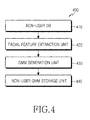
- FIG. 4 is a diagram showing the non-user GMM configuration unit 400 according to an embodiment of the present invention.
- facial features are extracted by a facial feature extraction unit 420 from the facial image of each non-user registered in a non-user DB 410.
- preprocessing is primarily performed by the facial feature extraction unit 420 on the facial image, and the facial feature vector is subsequently extracted.
- geometric normalization for aligning the location of a face on the basis of eyes and histogram normalization for adjusting the brightness of an image are performed.
- principal component analysis can be used.
- a GMM generation unit 430 generates a non-user GMM using the features extracted in this way, and stores the non-user GMM in a non-user GMM storage unit 440.
- a procedure actually performed by the non-user GMM configuration unit 400 is represented by the following equations.
- data about the facial images is modeled in the form of a Gaussian Mixture Model (GMM).
- GMM Gaussian probability density
- Equation [2] when the dimension of facial image data is D and facial image data is x.
- GMM Gaussian probability densities
- parameters can be summarized as follows: the mean ⁇ j , covariance ⁇ j (or ⁇ j ), and weight P ( j ) (or ⁇ j ) of each mixture component j. These parameters are learned using given facial image data x. A learning method is performed to find parameters for allowing a mixture model to most satisfactorily represent the facial image data x, that is, parameters for maximizing a log-likelihood value.
- j 1, ⁇ , M ⁇ .
- j 1, ⁇ , M ⁇ .
- Equation [4] In order to find the parameters for maximizing the log-likelihood function of Equation [4], the parameters are initialized using K-means, and then an Expectation-Maximization algorithm (hereinafter 'EM algorithm') is used. By means of this algorithm, respective data items are divided into several groups. This clustering procedure is performed according to the following process.
- 'EM algorithm' Expectation-Maximization algorithm
- the EM algorithm is executed using the values ⁇ of respective groups, obtained by performing initialization, as initial values, and the parameters are obtained.
- the EM algorithm is divided into an E-step and an M-step.
- E-step sufficient statistics are predicted, and, in M-step, the parameters are predicted on the basis of the sufficient statistics.
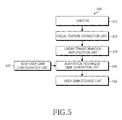
- FIG. 5 is a diagram showing the construction of the user GMM configuration unit 500 according to an embodiment of the present invention.
- a user DB 510 the facial image of a user is registered in advance.
- a user may be an individual, or a group of users.
- preprocessing and facial feature extraction are performed by a facial feature extraction unit 520 on the facial image registered in the user DB 510.
- a facial feature vector is extracted from an entire facial area, using the entire facial area as a single feature extraction unit, unlike the prior art in which a facial area is divided into a plurality of blocks and facial feature vectors are extracted from the blocks.
- a linear transformation amplification unit 530 increases the number of facial feature vectors through linear transformation.
- the term 'linear transformation amplification' means the use of a light mask.
- An adaptation technique GMM generation unit 540 generates a user GMM on the basis of an increased number of feature vectors and the non-user GMM, generated by the GMM configuration unit 400. As an adaptation technique, typical relevance adaptation is used. This adaptation technique is divided into the following two procedures.
- FIG. 6 is a diagram showing linear transformation calculation for a specific facial image using a light mask according to an embodiment of the present invention.
- preprocessing and feature vector extraction are performed by a facial feature extraction unit 620a on the non-user facial image of a non-user registered in a non-user DB, similar to FIG. 4 .
- a normal feature storage unit 630a receives and stores a facial feature vector.
- a light mask application unit 620b covers the facial image stored in the non-user DB with light masks for directing illumination in various directions, and thus a facial feature extraction unit 630b extracts facial feature vectors.
- a linearly amplified feature storage unit 640b stores the facial feature vectors.
- a linear transformation calculation unit 650 calculates linear transformations using the differences between the facial feature vectors respectively stored in the normal feature storage unit 630a and the linearly amplified feature storage unit 640b. The linear transformations calculated using the system of FIG. 6 are used when the user GMM is generated.
- FIG. 7 is a flowchart showing a method of verifying the face of a user using a light mask according to an embodiment of the present invention.
- the feature extraction unit 320 extracts a facial feature vector using the entire facial area of the specific facial image as an extraction unit in facial feature extraction step S720.
- the facial feature vector, extracted in the facial feature extraction step S720 is input to the non-user GMM and the user GMM, which are respectively stored in the non-user GMM storage unit 440 and the user GMM storage unit 550, and thus log-likelihood values are calculated.
- the non-user GMM storage unit 440 and the user GMM storage unit 550 store non-user GMMs and user GMMs, which are respectively generated by the non-user GMM configuration unit 400 and the user GMM configuration unit 500.
- each user GMM is generated after facial feature vectors are extracted by covering the user facial image of the user, registered in the user DB, with various light masks.
- user verification step S750 the log-likelihood values are compared to a threshold, so that verification is performed by determining whether the specific facial image received through the image input unit 310 is the user's face or the non-user's face.
- facial features are extracted from an entire facial area, without a facial area being divided into blocks and features being extracted from the blocks, thereby performing verification, with the features of the entire facial area sufficiently taken into account.
- light masks are applied to a facial image, so that the amount of data, which is reduced due to the above construction, can be increased, and the verification of a face vulnerable to illumination can be compensated for.
Landscapes
- Engineering & Computer Science (AREA)
- Theoretical Computer Science (AREA)
- General Physics & Mathematics (AREA)
- Physics & Mathematics (AREA)
- Multimedia (AREA)
- Health & Medical Sciences (AREA)
- Computer Vision & Pattern Recognition (AREA)
- Oral & Maxillofacial Surgery (AREA)
- General Health & Medical Sciences (AREA)
- Human Computer Interaction (AREA)
- Evolutionary Computation (AREA)
- Artificial Intelligence (AREA)
- Computing Systems (AREA)
- Databases & Information Systems (AREA)
- Data Mining & Analysis (AREA)
- Software Systems (AREA)
- Medical Informatics (AREA)
- Life Sciences & Earth Sciences (AREA)
- Bioinformatics & Cheminformatics (AREA)
- Bioinformatics & Computational Biology (AREA)
- Evolutionary Biology (AREA)
- General Engineering & Computer Science (AREA)
- Collating Specific Patterns (AREA)
- Image Processing (AREA)
Abstract
Description
- The present invention relates generally to a system and method for verifying the face of a user using a light mask, and in particular, to a system and method for recognizing an image input through a camera and verifying a registered user in a robotic environment.
- In the prior art, there are many technologies for recognizing and verifying a face. Conventional face verification technologies are mainly related to a process for dividing a facial image into blocks, extracting features from respective blocks, and creating Gaussian Mixture Models (GMMs). The division of a facial image into blocks is shown in
FIG. 1A . In the method of dividing a facial image into small blocks and extracting features from the blocks in this way, GMM learning may be excellently performed because a plurality of data items can be obtained using a small number of images, but learning and adaptation time and verification time may increase due to the increased number of GMMs, and the entire facial image may not be sufficiently taken into account. - An aspect of the present invention is to address at least the above problems and/or disadvantages and to provide at least the advantages described below. Accordingly, an aspect of the present invention is to provide a face verification system and methodthat extract features from an entire facial area, unlike a conventional method of dividing a facial area into blocks and extracting facial features from the blocks, thus sufficiently taking into account the entire facial area. In detail, facial features are extracted from the entire facial area, as shown in
FIG. 1B according to the present invention, without the entire facial area being separately divided into blocks. - Another aspect of the present invention is to provide a face verification system and method, which increase the amount of data through linear transformation that applies light masks to a face, in order to cope with situations in which the amount of data extracted through feature extraction from the entire facial area is decreased. In detail, as shown in
FIG. 2 , a single facial image is combined with light masks having various effects of directing illumination in various directions, so that various facial images, in which a face is illuminated in various directions, can be created. In this way, a face is verified using light masks, and thus the present invention provides a face verification system and method using light masks, which can overcome the vulnerability of the conventional face verification system and method to illumination. - According to one aspect of the present invention, there is provided a system for verifying a face of a user using a light mask. The system includes a facial feature extraction unit for extracting a facial feature vector from a specific facial image, a non-user Gaussian Mixture Model (GMM) configuration unit for generating a non-user GMM from a non-user facial image stored in a non-user database (DB), a user GMM configuration unit for generating a user GMM by applying light masks to a user facial image stored in a user DB, a log-likelihood value calculation unit for inputting the facial feature vector both to the non-user GMM and to the user GMM, thus calculating log-likelihood values, and a user verification unit for comparing the calculated log-likelihood values with a predetermined threshold, thus verifying whether the specific facial image is a facial image of the user.
- According to another aspect of the present invention, there is provided a method of verifying a face of a user using a light mask. The method includes extracting a facial feature vector from a specific facial image, calculating log-likelihood values by inputting the facial feature vector to a Gaussian Mixture Model (GMM) configuration unit for storing a non-user GMM and a user GMM, storing a non-user GMM, generated from a non-user facial image stored in a non-user Database (DB) required to calculate log-likelihood values, and a user GMM, generated by applying light masks to a user facial image stored in a user DB, comparing the calculated log-likelihood values with a predetermined threshold, thus verifying whether the specific facial image is a facial image of the user.
- The above and other aspects, features and advantages of the present invention will become more apparent from the following detailed description when taken in conjunction with the accompanying drawings in which:
-
FIGS. 1A and 1B are, respectively, diagrams showing examples of division of a facial area into blocks according to the prior art, and of facial feature extraction from an entire facial area according to an embodiment of the present invention; -
FIGS. 2A to 2C are diagrams showing examples of facial image processing using light masks according to an embodiment of the present invention; -
FIG. 3 is a diagram showing the construction of a system for verifying the face of a user using a light mask according to an embodiment of the present invention; -
FIG. 4 is diagram showing the construction of a non-user Gaussian Mixture Model (GMM) configuration unit according to an embodiment of the present invention; -
FIG. 5 is a diagram showing the construction of a user GMM configuration unit according to an embodiment of the present invention; -
FIG. 6 is a diagram showing linear transformation calculation for a facial image using a light mask according to an embodiment of the present invention; and -
FIG. 7 is a flowchart showing a method of verifying the face of a user using a light mask according to an embodiment of the present invention. - Preferred embodiments of the present invention will now be described in detail with reference to the annexed drawings. In the drawings, the same or similar elements are denoted by the same reference numerals even though they are depicted in different drawings. In the following description, a detailed description of known functions and configurations incorporated herein has been omitted for clarity and conciseness.
-
FIG. 3 is a diagram showing the construction of a system for verifying the face of a user using a light mask according to an embodiment of the present invention. Referring toFIG. 3 , asystem 300 for verifying the face of a user using a light mask (hereinafter 'user face verification system') includes animage input unit 310, a facialfeature extraction unit 320, a non-userGMM configuration unit 400, a userGMM configuration unit 500, a log-likelihood value calculation unit 330, and auser verification unit 340. The components of the userface verification system 300 are described below. Theimage input unit 310 receives a specific facial image from a camera or the like mounted on a robot. The image input unit 3 10 is not limited to the camera, but may include any components, such as diskettes, to which images can be input, without requiring a procedure for capturing an image using a camera. - The facial
feature extraction unit 320 performs preprocessing on the specific facial image received from theimage input unit 310, and thereafter extracts a facial feature vector from the preprocessed image. The facial feature vector can be extracted using an entire facial area as a unit for facial feature extraction. - The non-user
GMM configuration unit 400 generates and stores a non-user GMM for the non-user facial image of each non-user registered in a non-user DB. The userGMM configuration unit 500 generates and stores a user GMM for the user facial image of each user registered in a user DB. In particular, the userGMM configuration unit 500 generates facial images illuminated by a plurality of lighting devices by applying light masks to the facial feature vector extracted from the facialfeature extraction unit 320. Therefore, the amount of data about the facial feature vector increases, and verification probability can be increased when user verification is performed. Construction related to the generation of a typical GMM will be described later. - The log-likelihood value calculation unit 330 calculates log-likelihood values by inputting the facial feature vector, extracted from the facial
feature extraction unit 320, both to the non-user GMM and to the user GMM. Equation [1] indicates a procedure for calculating log-likelihood values. When there is a plurality of users, a plurality of resultant values for the user GMM is obtained. In this case, the largest log-likelihood value is taken and calculated.
- The
user verification unit 340 compares the value z, obtained by the log-likelihood value calculation unit 330, with an actual threshold, thus verifying whether the face in the image received from theimage input unit 310 is the user's face. When the value z is equal to or greater than the threshold, the specific facial image is determined to be the user's face, whereas, when the value z is less than the threshold, the specific facial image is determined to be the non-user's face. -
FIG. 4 is a diagram showing the non-userGMM configuration unit 400 according to an embodiment of the present invention. Referring toFIG. 4 , facial features are extracted by a facialfeature extraction unit 420 from the facial image of each non-user registered in anon-user DB 410. Although not shown in the drawing, before a facial feature vector is extracted, preprocessing is primarily performed by the facialfeature extraction unit 420 on the facial image, and the facial feature vector is subsequently extracted. For preprocessing, geometric normalization for aligning the location of a face on the basis of eyes and histogram normalization for adjusting the brightness of an image are performed. When facial features are extracted, principal component analysis can be used. AGMM generation unit 430 generates a non-user GMM using the features extracted in this way, and stores the non-user GMM in a non-userGMM storage unit 440. - A procedure actually performed by the non-user
GMM configuration unit 400 is represented by the following equations. When the number of facial images stored in thenon-user DB 410 is N and is represented by X=[x1, ... , xN], data about the facial images is modeled in the form of a Gaussian Mixture Model (GMM). Typically, Gaussian probability density is obtained by the following Equation [2] when the dimension of facial image data is D and facial image data is x.
- A plurality of Gaussian probability densities forms a single probability model. This probability model is designated as a GMM, which can be represented by the following Equation [3], where M is the number of mixtures.

- In this model, parameters can be summarized as follows: the mean µ j , covariance Σ j (or σ j ), and weight P(j) (or ωj ) of each mixture component j. These parameters are learned using given facial image data x. A learning method is performed to find parameters for allowing a mixture model to most satisfactorily represent the facial image data x, that is, parameters for maximizing a log-likelihood value. A log-likelihood function to be maximized is represented by the following Equation [4], where λ = {µ j ,Σ j ,ω j |j=1,···,M}.

- In order to find the parameters for maximizing the log-likelihood function of Equation [4], the parameters are initialized using K-means, and then an Expectation-Maximization algorithm (hereinafter 'EM algorithm') is used. By means of this algorithm, respective data items are divided into several groups. This clustering procedure is performed according to the following process.
- 1. M facial image data items are arbitrarily selected and designated as µ of respective groups.
- 2. The following procedure is repeated until convergence is achieved.
- (1) Euclidian distance ∥xi - µ j ∥2 for each facial image data item i is obtained and is classified as the closest group.
- (2) Values µ of respective groups are calculated again using the classified data.
- The EM algorithm is executed using the values µ of respective groups, obtained by performing initialization, as initial values, and the parameters are obtained. The EM algorithm is divided into an E-step and an M-step. In E-step, sufficient statistics are predicted, and, in M-step, the parameters are predicted on the basis of the sufficient statistics. Theses E-step and M-step are described below. First, sufficient statistics for each facial image data item, given in E-step, are represented by the following Equation [5].

- The parameters are obtained in M-step on the basis of the sufficient statistics obtained in E-step, as in Equation [6].


- The EM algorithm is repeated until satisfactory convergence is achieved. Consequently, the parameters {ω j ,µ j ,σ j |j=1···M} of the probability model for representing a non-user GMM can be obtained through the EM algorithm.
-
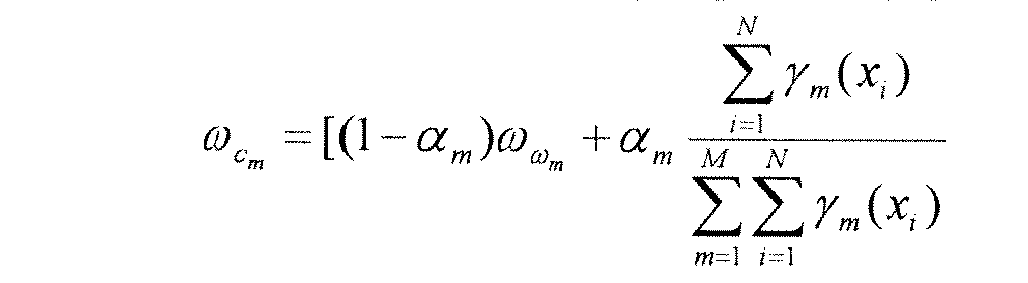
FIG. 5 is a diagram showing the construction of the userGMM configuration unit 500 according to an embodiment of the present invention. Referring toFIG. 5 , in auser DB 510, the facial image of a user is registered in advance. A user may be an individual, or a group of users. Similar toFIG. 4 , preprocessing and facial feature extraction are performed by a facialfeature extraction unit 520 on the facial image registered in theuser DB 510. At the time of extracting facial features, a facial feature vector is extracted from an entire facial area, using the entire facial area as a single feature extraction unit, unlike the prior art in which a facial area is divided into a plurality of blocks and facial feature vectors are extracted from the blocks. Therefore, in the present invention, the dimension of the extracted facial feature vector is large, but the number of facial feature vectors is small, and thus the amount of data decreases. In order to compensate for the decrease in the amount of data, a lineartransformation amplification unit 530 increases the number of facial feature vectors through linear transformation. The term 'linear transformation amplification' means the use of a light mask. An adaptation techniqueGMM generation unit 540 generates a user GMM on the basis of an increased number of feature vectors and the non-user GMM, generated by theGMM configuration unit 400. As an adaptation technique, typical relevance adaptation is used. This adaptation technique is divided into the following two procedures. - 1. Occupation probability γm (xi ) for each mixture m is obtained in Equation [7].

- 2. A user GMM is generated from the non-user GMM on the basis of the occupation probability obtained in this way. The adaptation procedure is represented by the following Equation [8],


-
FIG. 6 is a diagram showing linear transformation calculation for a specific facial image using a light mask according to an embodiment of the present invention. Referring toFIG. 6 , preprocessing and feature vector extraction are performed by a facialfeature extraction unit 620a on the non-user facial image of a non-user registered in a non-user DB, similar toFIG. 4 . A normalfeature storage unit 630a receives and stores a facial feature vector. A lightmask application unit 620b covers the facial image stored in the non-user DB with light masks for directing illumination in various directions, and thus a facialfeature extraction unit 630b extracts facial feature vectors. A linearly amplifiedfeature storage unit 640b stores the facial feature vectors. - A linear
transformation calculation unit 650 calculates linear transformations using the differences between the facial feature vectors respectively stored in the normalfeature storage unit 630a and the linearly amplifiedfeature storage unit 640b. The linear transformations calculated using the system ofFIG. 6 are used when the user GMM is generated. -
FIG. 7 is a flowchart showing a method of verifying the face of a user using a light mask according to an embodiment of the present invention. Referring toFIG. 7 , when, in the image input step S710, a specific facial image is received through theimage input unit 310, thefeature extraction unit 320 extracts a facial feature vector using the entire facial area of the specific facial image as an extraction unit in facial feature extraction step S720. In log-likelihood value calculation step S740, the facial feature vector, extracted in the facial feature extraction step S720, is input to the non-user GMM and the user GMM, which are respectively stored in the non-userGMM storage unit 440 and the userGMM storage unit 550, and thus log-likelihood values are calculated. The non-userGMM storage unit 440 and the userGMM storage unit 550 store non-user GMMs and user GMMs, which are respectively generated by the non-userGMM configuration unit 400 and the userGMM configuration unit 500. In GMM generation step S730, each user GMM is generated after facial feature vectors are extracted by covering the user facial image of the user, registered in the user DB, with various light masks. Thereafter, in user verification step S750, the log-likelihood values are compared to a threshold, so that verification is performed by determining whether the specific facial image received through theimage input unit 310 is the user's face or the non-user's face. - As is apparent from the foregoing description, according to the present invention, facial features are extracted from an entire facial area, without a facial area being divided into blocks and features being extracted from the blocks, thereby performing verification, with the features of the entire facial area sufficiently taken into account.
- In addition, light masks are applied to a facial image, so that the amount of data, which is reduced due to the above construction, can be increased, and the verification of a face vulnerable to illumination can be compensated for.
- While the invention has been shown and described with reference to a certain preferred embodiment thereof, it will be understood by those skilled in the art that various changes in form and details may be made therein without departing from the spirit and scope of the invention as defined by the appended claims.
Claims (6)
- A system for verifying a face of a user by using a light mask, comprising:a facial feature extraction unit for extracting a facial feature vector from a specific facial image;a non-user Gaussian Mixture Model (GMM) configuration unit for generating a non-user GMM from a non-user facial image of a non-user;a user GMM configuration unit for generating a user GMM by applying light masks to a user facial image of a user;a log-likelihood value calculation unit for inputting the facial feature vector both to the non-user GMM and to the user GMM, thus calculating log-likelihood values; anda user verification unit for comparing the calculated log-likelihood values with a predetermined threshold, thus verifying whether the specific facial image is a facial image of the user.
- The system of claim 1, further comprising an image input unit for receiving the specific facial image and transmitting the specific facial image to the facial feature extraction unit.
- The system of claim 1, wherein the facial feature extraction unit extracts facial features from the specific facial image by using an entire facial area of the specific facial image as a single extraction unit.
- The system of claim 3, wherein the user GMM configuration unit comprises:a user database (DB) for storing the user facial image;a linear transformation amplification unit for performing linear transformation amplification by applying light masks to the extracted facial feature vector;an adaptation technique GMM generation unit for generating the user GMM through the non-user GMM configuration unit by using relevance adaptation; anda user GMM storage unit for storing the generated user GMM.
- A method of verifying a face of a user by using a light mask, comprising:extracting a facial feature vector from a specific facial image;calculating log-likelihood values by inputting the facial feature vector to a Gaussian Mixture Model (GMM) configuration unit;storing a non-user GMM in a non-user Database (DB) and a user GMM in a user DB, the non-user GMM generated from a non-user facial image stored in the non-user DB, , the user GMM generated by applying light masks to a user facial image stored in the user DB;calculating log-likelihood values for both the non-user GMM and the user GMM; andcomparing the calculated log-likelihood values with a predetermined threshold, thus verifying whether the specific facial image is a facial image of the user.
- The method of claim 5, wherein, in the extracting the facial feature vector, facial features are extracted from the specific facial image by using an entire facial area of the specific facial image as a single extraction unit.
Applications Claiming Priority (1)
| Application Number | Priority Date | Filing Date | Title |
|---|---|---|---|
| KR1020070044981A KR100876786B1 (en) | 2007-05-09 | 2007-05-09 | User face verification system and method using light mask |
Publications (3)
| Publication Number | Publication Date |
|---|---|
| EP1990758A2 true EP1990758A2 (en) | 2008-11-12 |
| EP1990758A3 EP1990758A3 (en) | 2017-12-13 |
| EP1990758B1 EP1990758B1 (en) | 2022-03-02 |
Family
ID=39712227
Family Applications (1)
| Application Number | Title | Priority Date | Filing Date |
|---|---|---|---|
| EP08155324.0A Active EP1990758B1 (en) | 2007-05-09 | 2008-04-29 | System and method for verifying face of user using light masks |
Country Status (4)
| Country | Link |
|---|---|
| US (1) | US8116538B2 (en) |
| EP (1) | EP1990758B1 (en) |
| KR (1) | KR100876786B1 (en) |
| CN (1) | CN101320424B (en) |
Families Citing this family (7)
| Publication number | Priority date | Publication date | Assignee | Title |
|---|---|---|---|---|
| TWI391876B (en) * | 2009-02-16 | 2013-04-01 | Inst Information Industry | Method and system for foreground detection using multi-modality fusion graph cut and computer program product |
| KR20150140644A (en) * | 2013-02-08 | 2015-12-16 | 이모션트 | Collection of machine learning training data for expression recognition |
| US10424072B2 (en) | 2016-03-01 | 2019-09-24 | Samsung Electronics Co., Ltd. | Leveraging multi cues for fine-grained object classification |
| US10579860B2 (en) | 2016-06-06 | 2020-03-03 | Samsung Electronics Co., Ltd. | Learning model for salient facial region detection |
| RU2697627C1 (en) | 2018-08-01 | 2019-08-15 | Самсунг Электроникс Ко., Лтд. | Method of correcting illumination of an object on an image in a sequence of images and a user's computing device which implements said method |
| CN115050064B (en) * | 2021-03-08 | 2025-03-25 | 腾讯科技(深圳)有限公司 | Human face liveness detection method, device, equipment and medium |
| CN118570485B (en) * | 2024-06-05 | 2025-03-18 | 南通大学 | A method for extracting line features from building 3D point clouds based on deep learning |
Family Cites Families (17)
| Publication number | Priority date | Publication date | Assignee | Title |
|---|---|---|---|---|
| US6188777B1 (en) * | 1997-08-01 | 2001-02-13 | Interval Research Corporation | Method and apparatus for personnel detection and tracking |
| KR100287216B1 (en) * | 1998-04-09 | 2001-04-16 | 윤종용 | Robust face recognition system under varying illumination |
| US6160903A (en) * | 1998-04-24 | 2000-12-12 | Dew Engineering And Development Limited | Method of providing secure user access |
| EP1343108A3 (en) * | 2002-03-04 | 2005-03-23 | Samsung Electronics Co., Ltd. | Method and apparatus for recognising faces using principal component analysis and second order independent component analysis |
| US20030225719A1 (en) * | 2002-05-31 | 2003-12-04 | Lucent Technologies, Inc. | Methods and apparatus for fast and robust model training for object classification |
| US7603276B2 (en) * | 2002-11-21 | 2009-10-13 | Panasonic Corporation | Standard-model generation for speech recognition using a reference model |
| KR20030066512A (en) * | 2003-07-04 | 2003-08-09 | 김재민 | Iris Recognition System Robust to noises |
| WO2005024707A1 (en) * | 2003-09-10 | 2005-03-17 | Koninklijke Philips Electronics N.V. | Apparatus and method for feature recognition |
| US7596247B2 (en) * | 2003-11-14 | 2009-09-29 | Fujifilm Corporation | Method and apparatus for object recognition using probability models |
| US20060015497A1 (en) * | 2003-11-26 | 2006-01-19 | Yesvideo, Inc. | Content-based indexing or grouping of visual images, with particular use of image similarity to effect same |
| KR100567765B1 (en) * | 2004-03-12 | 2006-04-05 | 학교법인 인하학원 | Face recognition system and method through lighting environment analysis and preprocessing |
| US7454039B2 (en) * | 2004-07-12 | 2008-11-18 | The Board Of Trustees Of The University Of Illinois | Method of performing shape localization |
| US7779268B2 (en) * | 2004-12-07 | 2010-08-17 | Mitsubishi Electric Research Laboratories, Inc. | Biometric based user authentication and data encryption |
| US7620818B2 (en) * | 2004-12-07 | 2009-11-17 | Mitsubishi Electric Research Laboratories, Inc. | Biometric based user authentication and data encryption |
| US7509259B2 (en) * | 2004-12-21 | 2009-03-24 | Motorola, Inc. | Method of refining statistical pattern recognition models and statistical pattern recognizers |
| US7787011B2 (en) * | 2005-09-07 | 2010-08-31 | Fuji Xerox Co., Ltd. | System and method for analyzing and monitoring 3-D video streams from multiple cameras |
| US7680664B2 (en) * | 2006-08-16 | 2010-03-16 | Microsoft Corporation | Parsimonious modeling by non-uniform kernel allocation |
-
2007
- 2007-05-09 KR KR1020070044981A patent/KR100876786B1/en not_active Expired - Fee Related
-
2008
- 2008-04-29 EP EP08155324.0A patent/EP1990758B1/en active Active
- 2008-05-06 US US12/115,905 patent/US8116538B2/en active Active
- 2008-05-09 CN CN200810096436XA patent/CN101320424B/en active Active
Non-Patent Citations (1)
| Title |
|---|
| None * |
Also Published As
| Publication number | Publication date |
|---|---|
| US20080279426A1 (en) | 2008-11-13 |
| EP1990758B1 (en) | 2022-03-02 |
| KR20080099443A (en) | 2008-11-13 |
| US8116538B2 (en) | 2012-02-14 |
| EP1990758A3 (en) | 2017-12-13 |
| CN101320424A (en) | 2008-12-10 |
| CN101320424B (en) | 2011-11-16 |
| KR100876786B1 (en) | 2009-01-09 |
Similar Documents
| Publication | Publication Date | Title |
|---|---|---|
| US7162076B2 (en) | Face detection method and apparatus | |
| EP1460580B1 (en) | Face meta-data creation and face similarity calculation | |
| US8320643B2 (en) | Face authentication device | |
| US7596247B2 (en) | Method and apparatus for object recognition using probability models | |
| US8744144B2 (en) | Feature point generation system, feature point generation method, and feature point generation program | |
| US8913798B2 (en) | System for recognizing disguised face using gabor feature and SVM classifier and method thereof | |
| EP1990758B1 (en) | System and method for verifying face of user using light masks | |
| US9633044B2 (en) | Apparatus and method for recognizing image, and method for generating morphable face images from original image | |
| US20040013286A1 (en) | Object recognition system | |
| US20080144891A1 (en) | Method and apparatus for calculating similarity of face image, method and apparatus for retrieving face image, and method of synthesizing face image | |
| US8023701B2 (en) | Method, apparatus, and program for human figure region extraction | |
| US20120155718A1 (en) | Face recognition apparatus and method | |
| US11763435B2 (en) | Person verification device and method and non-transitory computer readable media | |
| CN111667001A (en) | Target re-identification method and device, computer equipment and storage medium | |
| CN110378414B (en) | Multi-mode biological characteristic fusion identity recognition method based on evolution strategy | |
| EP1909228B1 (en) | Face image detecting device, face image detecting method, and face image detecting program | |
| US20190311216A1 (en) | Image processing device, image processing method, and image processing program | |
| Bae et al. | Real-time face detection and recognition using hybrid-information extracted from face space and facial features | |
| KR101727833B1 (en) | Apparatus and method for constructing composite feature vector based on discriminant analysis for face recognition | |
| KR20040037179A (en) | Face recognition from a temporal sequence of face images | |
| US20070140550A1 (en) | Method and apparatus for performing object detection | |
| WO2015037973A1 (en) | A face identification method | |
| KR20110094947A (en) | Door opening and closing system using face recognition and detection and its method | |
| KR20150120188A (en) | authentication method and authentication device using the same | |
| CN121033917B (en) | Face recognition attendance checking method and system based on improved ArcFace algorithm |
Legal Events
| Date | Code | Title | Description |
|---|---|---|---|
| PUAI | Public reference made under article 153(3) epc to a published international application that has entered the european phase |
Free format text: ORIGINAL CODE: 0009012 |
|
| 17P | Request for examination filed |
Effective date: 20080429 |
|
| AK | Designated contracting states |
Kind code of ref document: A2 Designated state(s): AT BE BG CH CY CZ DE DK EE ES FI FR GB GR HR HU IE IS IT LI LT LU LV MC MT NL NO PL PT RO SE SI SK TR |
|
| AX | Request for extension of the european patent |
Extension state: AL BA MK RS |
|
| RTI1 | Title (correction) |
Free format text: SYSTEM AND METHOD FOR VERIFYING FACE OF USER USING LIGHT MASKS |
|
| RAP1 | Party data changed (applicant data changed or rights of an application transferred) |
Owner name: SAMSUNG ELECTRONICS CO., LTD. Owner name: ELECTRONICS AND TELECOMMUNICATIONS RESEARCH INSTIT |
|
| REG | Reference to a national code |
Ref country code: DE Ref legal event code: R079 Ref document number: 602008064413 Country of ref document: DE Free format text: PREVIOUS MAIN CLASS: G06K0009200000 Ipc: G06K0009000000 |
|
| PUAL | Search report despatched |
Free format text: ORIGINAL CODE: 0009013 |
|
| AK | Designated contracting states |
Kind code of ref document: A3 Designated state(s): AT BE BG CH CY CZ DE DK EE ES FI FR GB GR HR HU IE IS IT LI LT LU LV MC MT NL NO PL PT RO SE SI SK TR |
|
| AX | Request for extension of the european patent |
Extension state: AL BA MK RS |
|
| RIC1 | Information provided on ipc code assigned before grant |
Ipc: G06K 9/00 20060101AFI20171106BHEP Ipc: G06K 9/62 20060101ALI20171106BHEP |
|
| STAA | Information on the status of an ep patent application or granted ep patent |
Free format text: STATUS: EXAMINATION IS IN PROGRESS |
|
| 17Q | First examination report despatched |
Effective date: 20180118 |
|
| AKX | Designation fees paid |
Designated state(s): DE FR GB |
|
| AXX | Extension fees paid |
Extension state: MK Extension state: BA Extension state: AL Extension state: RS |
|
| GRAP | Despatch of communication of intention to grant a patent |
Free format text: ORIGINAL CODE: EPIDOSNIGR1 |
|
| STAA | Information on the status of an ep patent application or granted ep patent |
Free format text: STATUS: GRANT OF PATENT IS INTENDED |
|
| INTG | Intention to grant announced |
Effective date: 20210929 |
|
| RIN1 | Information on inventor provided before grant (corrected) |
Inventor name: YUN, WOO-HAN Inventor name: CHI, SOO-YOUNG Inventor name: LEE, JAE-YEON Inventor name: LEE, JI-HYO Inventor name: YOON, JE-HAN Inventor name: KIM, HYUN-SOO |
|
| GRAS | Grant fee paid |
Free format text: ORIGINAL CODE: EPIDOSNIGR3 |
|
| GRAA | (expected) grant |
Free format text: ORIGINAL CODE: 0009210 |
|
| STAA | Information on the status of an ep patent application or granted ep patent |
Free format text: STATUS: THE PATENT HAS BEEN GRANTED |
|
| AK | Designated contracting states |
Kind code of ref document: B1 Designated state(s): DE FR GB |
|
| REG | Reference to a national code |
Ref country code: GB Ref legal event code: FG4D |
|
| REG | Reference to a national code |
Ref country code: DE Ref legal event code: R096 Ref document number: 602008064413 Country of ref document: DE |
|
| REG | Reference to a national code |
Ref country code: DE Ref legal event code: R079 Ref document number: 602008064413 Country of ref document: DE Free format text: PREVIOUS MAIN CLASS: G06K0009000000 Ipc: G06V0010000000 |
|
| REG | Reference to a national code |
Ref country code: DE Ref legal event code: R097 Ref document number: 602008064413 Country of ref document: DE |
|
| PLBE | No opposition filed within time limit |
Free format text: ORIGINAL CODE: 0009261 |
|
| STAA | Information on the status of an ep patent application or granted ep patent |
Free format text: STATUS: NO OPPOSITION FILED WITHIN TIME LIMIT |
|
| PG25 | Lapsed in a contracting state [announced via postgrant information from national office to epo] |
Ref country code: FR Free format text: LAPSE BECAUSE OF NON-PAYMENT OF DUE FEES Effective date: 20220502 |
|
| 26N | No opposition filed |
Effective date: 20221205 |
|
| GBPC | Gb: european patent ceased through non-payment of renewal fee |
Effective date: 20220602 |
|
| PG25 | Lapsed in a contracting state [announced via postgrant information from national office to epo] |
Ref country code: GB Free format text: LAPSE BECAUSE OF NON-PAYMENT OF DUE FEES Effective date: 20220602 |
|
| PGFP | Annual fee paid to national office [announced via postgrant information from national office to epo] |
Ref country code: DE Payment date: 20250320 Year of fee payment: 18 |