EP1988083A1 - Triazole derivative - Google Patents
Triazole derivative Download PDFInfo
- Publication number
- EP1988083A1 EP1988083A1 EP07708069A EP07708069A EP1988083A1 EP 1988083 A1 EP1988083 A1 EP 1988083A1 EP 07708069 A EP07708069 A EP 07708069A EP 07708069 A EP07708069 A EP 07708069A EP 1988083 A1 EP1988083 A1 EP 1988083A1
- Authority
- EP
- European Patent Office
- Prior art keywords
- group
- carbon atoms
- optionally substituted
- compound
- alkyl
- Prior art date
- Legal status (The legal status is an assumption and is not a legal conclusion. Google has not performed a legal analysis and makes no representation as to the accuracy of the status listed.)
- Granted
Links
- 0 CC*1C(Oc2cccc(*3CC*(C)CC3)c2)=**=C1[C@@](C)* Chemical compound CC*1C(Oc2cccc(*3CC*(C)CC3)c2)=**=C1[C@@](C)* 0.000 description 37
- NBDKHCGDTMGAAX-UHFFFAOYSA-N CC1=C2C1CCNCC2 Chemical compound CC1=C2C1CCNCC2 NBDKHCGDTMGAAX-UHFFFAOYSA-N 0.000 description 1
- VKZCGTJVXQBCQT-UHFFFAOYSA-N CC1=CCC2C(Cl)=CC=CC2=C1 Chemical compound CC1=CCC2C(Cl)=CC=CC2=C1 VKZCGTJVXQBCQT-UHFFFAOYSA-N 0.000 description 1
- CIGANTHMYLMZKD-UHFFFAOYSA-N CC1=CS(C)C(C)=N1 Chemical compound CC1=CS(C)C(C)=N1 CIGANTHMYLMZKD-UHFFFAOYSA-N 0.000 description 1
- SBRBPFHRQPLPLX-UHFFFAOYSA-N CCC(C)(C)CNCC Chemical compound CCC(C)(C)CNCC SBRBPFHRQPLPLX-UHFFFAOYSA-N 0.000 description 1
- HAWGDMIKYWBIJN-IJABNACRSA-N CCC/C=C(/C)\C(\[C@H](C)Cc1ccccc1)=N/N=C(\C)/Oc1ccccc1 Chemical compound CCC/C=C(/C)\C(\[C@H](C)Cc1ccccc1)=N/N=C(\C)/Oc1ccccc1 HAWGDMIKYWBIJN-IJABNACRSA-N 0.000 description 1
- GDWDJSONXTXOEE-UHFFFAOYSA-N CCCCc1ccc(C)c(C)c1 Chemical compound CCCCc1ccc(C)c(C)c1 GDWDJSONXTXOEE-UHFFFAOYSA-N 0.000 description 1
- FRQMCBCWPWMEBH-LYSZQXJVSA-N CC[n]1c(OC(C=CC2)=CC2N2C[C@@H]3OCCOC3CC2)nnc1[C@@H](C)N Chemical compound CC[n]1c(OC(C=CC2)=CC2N2C[C@@H]3OCCOC3CC2)nnc1[C@@H](C)N FRQMCBCWPWMEBH-LYSZQXJVSA-N 0.000 description 1
- URTQPMGRZXHJMV-ZIAGYGMSSA-N CC[n]1c(Oc2cccc(N(CC3)CCN3[C@@H](C)O)c2)nnc1[C@@H](C)N Chemical compound CC[n]1c(Oc2cccc(N(CC3)CCN3[C@@H](C)O)c2)nnc1[C@@H](C)N URTQPMGRZXHJMV-ZIAGYGMSSA-N 0.000 description 1
- ONQQREOGAWKUJO-IAPIXIRKSA-N C[C@H](c([n]1C)nnc1Oc1cc(C(O)OC(C)(C)C)ccc1)N Chemical compound C[C@H](c([n]1C)nnc1Oc1cc(C(O)OC(C)(C)C)ccc1)N ONQQREOGAWKUJO-IAPIXIRKSA-N 0.000 description 1
Classifications
-
- C—CHEMISTRY; METALLURGY
- C07—ORGANIC CHEMISTRY
- C07D—HETEROCYCLIC COMPOUNDS
- C07D249/00—Heterocyclic compounds containing five-membered rings having three nitrogen atoms as the only ring hetero atoms
- C07D249/02—Heterocyclic compounds containing five-membered rings having three nitrogen atoms as the only ring hetero atoms not condensed with other rings
- C07D249/08—1,2,4-Triazoles; Hydrogenated 1,2,4-triazoles
-
- A—HUMAN NECESSITIES
- A61—MEDICAL OR VETERINARY SCIENCE; HYGIENE
- A61P—SPECIFIC THERAPEUTIC ACTIVITY OF CHEMICAL COMPOUNDS OR MEDICINAL PREPARATIONS
- A61P1/00—Drugs for disorders of the alimentary tract or the digestive system
- A61P1/04—Drugs for disorders of the alimentary tract or the digestive system for ulcers, gastritis or reflux esophagitis, e.g. antacids, inhibitors of acid secretion, mucosal protectants
-
- A—HUMAN NECESSITIES
- A61—MEDICAL OR VETERINARY SCIENCE; HYGIENE
- A61P—SPECIFIC THERAPEUTIC ACTIVITY OF CHEMICAL COMPOUNDS OR MEDICINAL PREPARATIONS
- A61P11/00—Drugs for disorders of the respiratory system
- A61P11/06—Antiasthmatics
-
- A—HUMAN NECESSITIES
- A61—MEDICAL OR VETERINARY SCIENCE; HYGIENE
- A61P—SPECIFIC THERAPEUTIC ACTIVITY OF CHEMICAL COMPOUNDS OR MEDICINAL PREPARATIONS
- A61P17/00—Drugs for dermatological disorders
-
- A—HUMAN NECESSITIES
- A61—MEDICAL OR VETERINARY SCIENCE; HYGIENE
- A61P—SPECIFIC THERAPEUTIC ACTIVITY OF CHEMICAL COMPOUNDS OR MEDICINAL PREPARATIONS
- A61P17/00—Drugs for dermatological disorders
- A61P17/06—Antipsoriatics
-
- A—HUMAN NECESSITIES
- A61—MEDICAL OR VETERINARY SCIENCE; HYGIENE
- A61P—SPECIFIC THERAPEUTIC ACTIVITY OF CHEMICAL COMPOUNDS OR MEDICINAL PREPARATIONS
- A61P19/00—Drugs for skeletal disorders
- A61P19/02—Drugs for skeletal disorders for joint disorders, e.g. arthritis, arthrosis
-
- A—HUMAN NECESSITIES
- A61—MEDICAL OR VETERINARY SCIENCE; HYGIENE
- A61P—SPECIFIC THERAPEUTIC ACTIVITY OF CHEMICAL COMPOUNDS OR MEDICINAL PREPARATIONS
- A61P25/00—Drugs for disorders of the nervous system
-
- A—HUMAN NECESSITIES
- A61—MEDICAL OR VETERINARY SCIENCE; HYGIENE
- A61P—SPECIFIC THERAPEUTIC ACTIVITY OF CHEMICAL COMPOUNDS OR MEDICINAL PREPARATIONS
- A61P27/00—Drugs for disorders of the senses
- A61P27/02—Ophthalmic agents
-
- A—HUMAN NECESSITIES
- A61—MEDICAL OR VETERINARY SCIENCE; HYGIENE
- A61P—SPECIFIC THERAPEUTIC ACTIVITY OF CHEMICAL COMPOUNDS OR MEDICINAL PREPARATIONS
- A61P29/00—Non-central analgesic, antipyretic or antiinflammatory agents, e.g. antirheumatic agents; Non-steroidal antiinflammatory drugs [NSAID]
-
- A—HUMAN NECESSITIES
- A61—MEDICAL OR VETERINARY SCIENCE; HYGIENE
- A61P—SPECIFIC THERAPEUTIC ACTIVITY OF CHEMICAL COMPOUNDS OR MEDICINAL PREPARATIONS
- A61P35/00—Antineoplastic agents
-
- A—HUMAN NECESSITIES
- A61—MEDICAL OR VETERINARY SCIENCE; HYGIENE
- A61P—SPECIFIC THERAPEUTIC ACTIVITY OF CHEMICAL COMPOUNDS OR MEDICINAL PREPARATIONS
- A61P37/00—Drugs for immunological or allergic disorders
-
- A—HUMAN NECESSITIES
- A61—MEDICAL OR VETERINARY SCIENCE; HYGIENE
- A61P—SPECIFIC THERAPEUTIC ACTIVITY OF CHEMICAL COMPOUNDS OR MEDICINAL PREPARATIONS
- A61P37/00—Drugs for immunological or allergic disorders
- A61P37/02—Immunomodulators
-
- A—HUMAN NECESSITIES
- A61—MEDICAL OR VETERINARY SCIENCE; HYGIENE
- A61P—SPECIFIC THERAPEUTIC ACTIVITY OF CHEMICAL COMPOUNDS OR MEDICINAL PREPARATIONS
- A61P37/00—Drugs for immunological or allergic disorders
- A61P37/02—Immunomodulators
- A61P37/06—Immunosuppressants, e.g. drugs for graft rejection
-
- A—HUMAN NECESSITIES
- A61—MEDICAL OR VETERINARY SCIENCE; HYGIENE
- A61P—SPECIFIC THERAPEUTIC ACTIVITY OF CHEMICAL COMPOUNDS OR MEDICINAL PREPARATIONS
- A61P37/00—Drugs for immunological or allergic disorders
- A61P37/08—Antiallergic agents
-
- A—HUMAN NECESSITIES
- A61—MEDICAL OR VETERINARY SCIENCE; HYGIENE
- A61P—SPECIFIC THERAPEUTIC ACTIVITY OF CHEMICAL COMPOUNDS OR MEDICINAL PREPARATIONS
- A61P43/00—Drugs for specific purposes, not provided for in groups A61P1/00-A61P41/00
-
- A—HUMAN NECESSITIES
- A61—MEDICAL OR VETERINARY SCIENCE; HYGIENE
- A61P—SPECIFIC THERAPEUTIC ACTIVITY OF CHEMICAL COMPOUNDS OR MEDICINAL PREPARATIONS
- A61P9/00—Drugs for disorders of the cardiovascular system
-
- A—HUMAN NECESSITIES
- A61—MEDICAL OR VETERINARY SCIENCE; HYGIENE
- A61P—SPECIFIC THERAPEUTIC ACTIVITY OF CHEMICAL COMPOUNDS OR MEDICINAL PREPARATIONS
- A61P9/00—Drugs for disorders of the cardiovascular system
- A61P9/06—Antiarrhythmics
-
- A—HUMAN NECESSITIES
- A61—MEDICAL OR VETERINARY SCIENCE; HYGIENE
- A61P—SPECIFIC THERAPEUTIC ACTIVITY OF CHEMICAL COMPOUNDS OR MEDICINAL PREPARATIONS
- A61P9/00—Drugs for disorders of the cardiovascular system
- A61P9/10—Drugs for disorders of the cardiovascular system for treating ischaemic or atherosclerotic diseases, e.g. antianginal drugs, coronary vasodilators, drugs for myocardial infarction, retinopathy, cerebrovascula insufficiency, renal arteriosclerosis
Definitions
- the present invention relates to novel triazole derivatives which have an inhibitory effect on the binding between sphingosine-1-phosphate having various physiological actions and its receptor Edg-1 (Endothelial differentiation gene receptor type-1, S1P1).
- the present invention also relates to pharmaceutical preparations comprising these compounds as active ingredients, and synthetic intermediates for these compounds.
- Sphingosine-1-phosphate (hereinafter referred to as "S1P") is a physiologically active lipid which is generated when sphingolipids (typified by sphingomyelin) are metabolized in cells.
- S1P is known to have a wide variety of actions such as cell differentiation induction, cell growth stimulation, cell motility inhibition and apoptosis inhibition, and is also known to show physiological actions such as angiogenesis, bradycardia induction, inflammatory cell activation and platelet activation (Non-patent Document 1).
- Non-patent Document 2 As S1P receptors, the following 5 subtypes have been reported: Edg-1(S1P1), Edg-3(S1P3), Edg-5(S1P2), Edg-6(S1P4) and Edg-8(S1P5) (Non-patent Document 2).
- Edg-1(S1P1) is highly expressed in immunocytes (e.g., T cells, dendritic cells) and vascular endothelial cells, suggesting that Edg-1(S1P1) contributes deeply to S1P-stimulated T cell migration (Non-patent Document 3), mast cell migration (Non-patent Document 4), T and B cell egress from lymphoid organs (Non-patent Document 5) and angiogenesis (Non-patent Document 6), and is involved in autoimmune diseases such as Crohn's disease, irritable colitis, Sjogren's syndrome, multiple sclerosis and systemic lupus erythematosus, as well as other diseases such as rheumatoid arthritis, asthma, atopic dermatitis, rejection after organ transplantation, cancer, retinopathy, psoriasis, osteoarthritis, age-related macular degeneration, etc.
- autoimmune diseases such as Crohn's disease, irritable colitis, Sjogren
- ligands for Edg-1(S1P1) would be effective for treatment or prevention of these diseases.
- Edg-1(S1P1) ligands previously known include certain types of thiophene derivatives (Non-patent Document 7), phosphoric acid derivatives (Patent Documents 1 and 2, Non-patent Documents 8 and 9) and thiazolidine derivatives (Patent Document 3), carboxylic acid derivatives (Patent Documents 4, 5, 6 and 8, Non-patent Documents 10 and 11), amino group-containing derivatives (Patent Document 7), and pyrrole derivatives (Patent Document 9).
- the present invention has as an object to provide a compound with a new skeletal structure, which compound has an action of inhibiting binding between S1P and its receptor Edg-1 (S1P 1 ) and is useful as a pharmaceutical product.
- the inventors of the present invention have diligently studied in an attempt to find ligand compounds for Edg-1 (S1P 1 ). As a result, they find that the object is attained with a triazole derivative of Formula (I) below or a pharmaceutically acceptable salt thereof (a feature is that R 3 in the formula is an optionally substituted aryl group). This finding has led to the accomplishment of the present invention.
- the triazole derivative of Formula (I) below with this feature is a completely new compound.
- compounds having an alkyl group corresponding to R 3 of Formula (I) are commercially available from Bionet as reagents, they differ in structure from that of the compound of the subject application, and pharmaceutical use of the compounds of Bionet has not been known at all.
- R 1 , R 1A , R 2 , and R 3 are as defined in Embodiment 1, and A' represents an oxygen atom or NH.
- Example 3-(2) To a solution of the compound (0.300 g) of Example 3-(2) in chloroform (6 mL), m-chloroperbenzoic acid (0.329 g) was added, and the mixture was stirred at room temperature for one hour. Then, a further portion of m-chloroperbenzoic acid (0.329 g) was added, and the mixture was stirred at room temperature for 15 hours. Thereafter, a further portion of m-chloroperbenzoic acid (0.329 g) was added, and the mixture was stirred at room temperature for two hours.
- Example 7 To a solution of the compound (0.981 g) of Example 7 in THF (10 mL), 2N aqueous hydrochloric acid (8.4 mL) was added, and the mixture was stirred at room temperature for one hour. Concentrated hydrochloric acid (2 mL) was added, and the mixture was stirred at 50°C for six hours. Saturated aqueous sodium bicarbonate was added for neutralization, and the mixture was extracted with ethyl acetate. The organic layer was washed with saturated aqueous sodium chloride, dried over anhydrous magnesium sulfate, filtered, and then evaporated under reduced pressure to remove the solvent.
- NaBH 4 (0.021 g) was added at 0°C to a solution of the compound (0.150 g) of Example 8 in methanol (3.0 ml), and the mixture was stirred at room temperature for 16 hours. Water was added, and the mixture was extracted with ethyl acetate. The organic layer was washed with saturated aqueous sodium chloride, dried over MgSO 4 , filtered, and evaporated under reduced pressure to remove the solvent.
- Methanesulfonyl chloride (114 mg) was added to a solution of the compound (300 mg) of Example 10-(2) in pyridine (1.32 ml), and the mixture was stirred at room temperature for three hours. Hydrochloric acid (1.0 N) was added, and the mixture was extracted with methanol/chloroform (1/4).
- Example 1-(7) To a solution of the compound (12.5 mg) of Example 1-(7) in THF (0.3 ml), triethylamine (25 ⁇ l) was added, and then a solution of 4-methoxybenzenesulfonylchloride (15.5 mg) in THF (0.3 ml) was added. The mixture was stirred at room temperature for two hours. PSA (product name: VARIAN Inc. polymer supported amine, 1.4 meq/g) (75 ⁇ l) was added to the reaction mixture, and the mixture was stirred at room temperature for 12 hours. The insoluble matter was filtered off, and the resulting residue was evaporated to remove the solvent.
- PSA product name: VARIAN Inc. polymer supported amine, 1.4 meq/g
- N,N'-dimethylpropyleneurea (DMPU) (4.0 ml), 3-(4-methylpiperazin-1-yl)-phenol (500 mg), and cesium carbonate (2.21 g) were added to the compound (750 mg) obtained in Example 1-(6), and the mixture was stirred at 160°C for three hours.
- the mixture was brought to room temperature, and saturated aqueous sodium chloride was added.
- the mixture was extracted with ethyl acetate.
- the organic layer was dried over anhydrous sodium sulfate, filtered, and evaporated under reduced pressure to remove the solvent.
- Triethylamine (0.41 mL) and 3,4-dichlorobenzenesulfonyl chloride (0.232 mL) were added at room temperature to a solution of the compound (427 mg) of Example 21-(1) in THF (8.0 mL), and the mixture was stirred at room temperature overnight.
- N,N'-dimethylpropyleneurea (5.0 ml), 1H-indol-6-ol (601 mg), and cesium carbonate (2.94 g) were added to the compound (1.00 g) obtained in Example 1-(6), and the mixture was stirred at 200°C for one hour and then brought to room temperature. Saturated aqueous sodium chloride was added, and the mixture was extracted with ethyl acetate. The organic layer was dried (MgSO 4 ) filtered, and evaporated under reduced pressure to remove the solvent.
- DMPU N,N'-dimethylpropyleneurea
- Triethylamine (0.77 mL) and 3,4-dichlorobenzenesulfonyl chloride (1.02 g) were added at room temperature to the compound (748 mg) of Example 22-(1) in THF (10.0 mL), and the mixture was stirred at room temperature overnight.
- the membrane fraction was obtained by treating the cells with a solubilizing buffer (1 mM Tris/HCl, pH 7.2) for 10 minutes on ice, centrifuging at 1000 x g for 5 minutes to remove insoluble fractions, and then centrifuging at 40000 x g for 30 minutes at 4°C.
- the resulting membrane fraction was dissolved in a binding buffer (20 mM TrisHCl, pH 7.4, 100 mM NaCl, 15mM NaF, 2 mM deoxypyridoxine, 4 mg/mL fatty acid-free BSA), and then [ 33 P]-S1P (manufactured by ARC, final concentration 0.1nM) and a DMSO solution (final concentration of the compound 10 -5 M, final concentration of DMSO 0.1%) of the test compound were added. Thereafter, the mixture was stirred and then treated for one hour at 30°C.
- a binding buffer (20 mM TrisHCl, pH 7.4, 100 mM NaCl, 15mM NaF, 2 mM deoxypyridoxine, 4 mg/mL fatty acid-free BSA
- [ 33 P]-S1P manufactured by ARC, final concentration 0.1nM
- a DMSO solution final concentration of the compound 10 -5 M, final concentration of DMSO 0.16%
- the membrane fraction was harvested onto unifilter-96 GF/C filter (manufactured by Perkin Elmer), washing was carried out four times with the binding buffer, and the filter was dried. Twenty five ⁇ L Microscint 0 (manufactured by Perkin Elmer) was added, and radioactivity was measured using Top Count NXT (manufactured by Packard) to calculate the amount (A) of [ 33 P]-S1P bound to the membrane fraction at the time when the compound was added.
- the compounds below each had an IC 50 value of 35nM or lower and showed particularly strong activity.
- Compound 45 4.2. Compound 46: 28.5. Compound 49: 6.0. Compound 61: 39.0. Compound 73: 2.2. Compound 74: 15.0. Compound 83: 8.1. Compound 88: 5.4. Compound 99: 25.0. Compound 100: 18.5. Compound 105: 2.9. Compound 108: 18.0. Compound 120: 1.7. Compound 129: 20.0. Compound 130: 2.9. Compound 136: 8.1. Compound 143: 7.3. Compound 144: 7.9. Compound 146: 12.0. Compound 148: 1.9. Compound 149: 7.8. Compound 670: 5.2. Compound 678: 10.2. Compound 680: 1.4. Compound 688: 1.5. Compound 691: 2.6. Compound 692: 5.1. Compound 694: 2.9. Compound 698: 2.3.
- Example 7-(1) Starting from the corresponding amine in place of 1,4-dioxa-8-azaspiro[4,5]decane used in Example 7-(1), the same procedure as used in Example 7-(1) was repeated to give the titled compounds.
- the compounds of the present invention are excellent Edg-1 (S1P 1 ) ligands, they are useful as agents for treating or preventing autoimmune diseases, such as Crohn disease, hypersensitivity colitis, Sjogren's syndrome, multiple sclerosis, and systemic lupus erythematosus, and diseases such as rheumatoid arthritis, asthma, atopic dermatitis, organ transplant rejection, cancer, retinopathy, psoriasis, osteoarthritis, and age-related macular degeneration.
- autoimmune diseases such as Crohn disease, hypersensitivity colitis, Sjogren's syndrome, multiple sclerosis, and systemic lupus erythematosus
- diseases such as rheumatoid arthritis, asthma, atopic dermatitis, organ transplant rejection, cancer, retinopathy, psoriasis, osteoarthritis, and age-related macular degeneration.
Landscapes
- Health & Medical Sciences (AREA)
- Chemical & Material Sciences (AREA)
- Organic Chemistry (AREA)
- General Health & Medical Sciences (AREA)
- Animal Behavior & Ethology (AREA)
- Veterinary Medicine (AREA)
- Public Health (AREA)
- Engineering & Computer Science (AREA)
- Chemical Kinetics & Catalysis (AREA)
- General Chemical & Material Sciences (AREA)
- Medicinal Chemistry (AREA)
- Nuclear Medicine, Radiotherapy & Molecular Imaging (AREA)
- Bioinformatics & Cheminformatics (AREA)
- Pharmacology & Pharmacy (AREA)
- Life Sciences & Earth Sciences (AREA)
- Immunology (AREA)
- Pulmonology (AREA)
- Cardiology (AREA)
- Heart & Thoracic Surgery (AREA)
- Rheumatology (AREA)
- Dermatology (AREA)
- Neurology (AREA)
- Ophthalmology & Optometry (AREA)
- Pain & Pain Management (AREA)
- Urology & Nephrology (AREA)
- Biomedical Technology (AREA)
- Transplantation (AREA)
- Neurosurgery (AREA)
- Vascular Medicine (AREA)
- Orthopedic Medicine & Surgery (AREA)
- Physical Education & Sports Medicine (AREA)
- Pharmaceuticals Containing Other Organic And Inorganic Compounds (AREA)
- Nitrogen Condensed Heterocyclic Rings (AREA)
- Plural Heterocyclic Compounds (AREA)
Abstract

Description
- The present invention relates to novel triazole derivatives which have an inhibitory effect on the binding between sphingosine-1-phosphate having various physiological actions and its receptor Edg-1 (Endothelial differentiation gene receptor type-1, S1P1). The present invention also relates to pharmaceutical preparations comprising these compounds as active ingredients, and synthetic intermediates for these compounds.
- Sphingosine-1-phosphate (hereinafter referred to as "S1P") is a physiologically active lipid which is generated when sphingolipids (typified by sphingomyelin) are metabolized in cells. S1P is known to have a wide variety of actions such as cell differentiation induction, cell growth stimulation, cell motility inhibition and apoptosis inhibition, and is also known to show physiological actions such as angiogenesis, bradycardia induction, inflammatory cell activation and platelet activation (Non-patent Document 1).
- As S1P receptors, the following 5 subtypes have been reported: Edg-1(S1P1), Edg-3(S1P3), Edg-5(S1P2), Edg-6(S1P4) and Edg-8(S1P5) (Non-patent Document 2).
- Among these subtypes, Edg-1(S1P1) is highly expressed in immunocytes (e.g., T cells, dendritic cells) and vascular endothelial cells, suggesting that Edg-1(S1P1) contributes deeply to S1P-stimulated T cell migration (Non-patent Document 3), mast cell migration (Non-patent Document 4), T and B cell egress from lymphoid organs (Non-patent Document 5) and angiogenesis (Non-patent Document 6), and is involved in autoimmune diseases such as Crohn's disease, irritable colitis, Sjogren's syndrome, multiple sclerosis and systemic lupus erythematosus, as well as other diseases such as rheumatoid arthritis, asthma, atopic dermatitis, rejection after organ transplantation, cancer, retinopathy, psoriasis, osteoarthritis, age-related macular degeneration, etc.
- Thus, ligands for Edg-1(S1P1) would be effective for treatment or prevention of these diseases.
- Edg-1(S1P1) ligands previously known include certain types of thiophene derivatives (Non-patent Document 7), phosphoric acid derivatives (Patent Documents 1 and 2, Non-patent Documents 8 and 9) and thiazolidine derivatives (Patent Document 3), carboxylic acid derivatives (Patent Documents 4, 5, 6 and 8, Non-patent Documents 10 and 11), amino group-containing derivatives (Patent Document 7), and pyrrole derivatives (Patent Document 9).
- Patent Document 1:
WO2002-18395 - Patent Document 2:
JP 2003-137894 A - Patent Document 3:
JP 2002-332278 A - Patent Document 4:
WO2002-092068 - Patent Document 5:
WO2003-105771 - Patent Document 6:
WO2004-058149 - Patent Document 7:
WO2004-103279 - Patent Document 8:
WO2005-1058848 - Patent Document 9:
WO2005-123677 - Non-patent Document 1: J Biol Chem. 2004, 279: 20555, FASEB J 2002, 16: 625, Proceedings of the Japanese Society for Immunology 2003, 33: 2-J-W30-20-P
- Non-patent Document 2: Pharmacol Res 2003, 47: 401
- Non-patent Document 3: FASEB J 2002, 16:1874
- Non-patent Document 4: J Exp Med 2004, 199: 959
- Non-patent Document 5: Nature 2004, 427: 355
- Non-patent Document 6: J Clin Invest 2000, 106: 951, Biocchim Biophys Acta 2002, 1582: 222
- Non-patent Document 7: J Biol Chem 2004, 279: 13839
- Non-patent Document 8: Bioorg Med Chem Lett 2003, 13: 3401
- Non-patent Document 9: J Med Chem. 2004, 47: 6662
- Non-patent Document 10: J Med Chem. 2005, 48: 6169
- Non-patent Document 11: J Biol Chem. 2005; 280: 9833
- The present invention has as an object to provide a compound with a new skeletal structure, which compound has an action of inhibiting binding between S1P and its receptor Edg-1 (S1P1) and is useful as a pharmaceutical product.
- The inventors of the present invention have diligently studied in an attempt to find ligand compounds for Edg-1 (S1P1). As a result, they find that the object is attained with a triazole derivative of Formula (I) below or a pharmaceutically acceptable salt thereof (a feature is that R3 in the formula is an optionally substituted aryl group). This finding has led to the accomplishment of the present invention. The triazole derivative of Formula (I) below with this feature is a completely new compound. Although compounds having an alkyl group corresponding to R3 of Formula (I) are commercially available from Bionet as reagents, they differ in structure from that of the compound of the subject application, and pharmaceutical use of the compounds of Bionet has not been known at all.
- The following are embodiments of the triazole derivatives of Formula (I) and compounds of Formula (II), which are intermediates of the triazole derivatives (hereinafter, all of them will be referred to as "compounds of the present invention").
-
- 1. A compound represented by Formula (I)

A represents:- an oxygen atom,
- a sulfur atom,
- a group represented by Formula -SO-,
- a group represented by Formula -SO2-,
- a group represented by Formula -CH2- , or
- a group represented by Formula -NR6-, wherein R6 represents a hydrogen atom or an alkyl group having from 1 to 6 carbon atoms;
- a hydrogen atom,
- an alkyl group having from 1 to 6 carbon atoms and
- optionally substituted with a substituent(s) selected from
- the group consisting of:
- a hydroxyl group,
- a halogen atom,
- an alkoxy group having from 1 to 6 carbon atoms, said alkoxy group optionally substituted with a phenyl group, and
- a phenyl group, optionally substituted with a substituent(s) selected from the group consisting of a halogen atom and an alkyl group having from 1 to 6
- carbon atoms,
- a cycloalkyl group having from 3 to 8 carbon atoms,
- an alkenyl group having from 2 to 8 carbon atoms,
- an alkynyl group having from 2 to 8 carbon atoms, or
- a phenyl group;
- a hydrogen atom or
- an alkyl group having from 1 to 6 carbon atoms;
R2 represents:- a hydrogen atom,
- an alkyl group having from 1 to 6 carbon atoms,
- an alkenyl group having from 2 to 8 carbon atoms,
- an alkynyl group having from 2 to 8 carbon atoms, or
- a cycloalkyl group having from 3 to 6 carbon atoms;
R4 represents:- a hydrogen atom or
- an alkyl group having from 1 to 6 carbon atoms and
- optionally substituted with a carboxyl group;
- (i) an alkyl group having from 1 to 10 carbon atoms,
- (ii) an alkyl group having from 1 to 10 carbon atoms and substituted with 1 to 2 substituents selected from the group consisting of:
- a cycloalkyl group having from 3 to 8 carbon atoms, a pyridyl group, and
- a phenyl group, a phenoxy group, and a naphthyl group, each optionally substituted with 1 to 2 substituents selected from the group consisting of a halogen atom and an alkoxy group having from 1 to 6 carbon atoms,
- (iii) a cycloalkyl group having from 3 to 8 carbon atoms,
- (iv) an alkenyl group having from 2 to 8 carbon atoms,
- (v) an alkenyl group having from 2 to 8 carbon atoms and substituted with a phenyl group,
- (vi) an alkynyl group having from 2 to 8 carbon atoms,
- (vii) an alkynyl group having from 2 to 8 carbon atoms and substituted with a phenyl group, or
- (viii) an optionally substituted aryl group.
- 2. The compound of Embodiment 1, or a pharmaceutically acceptable salt thereof, wherein, in Formula (I):
- R1 represents:
- a hydrogen atom,
- an alkyl group having from 1 to 6 carbon atoms,
- an alkyl group having from 1 to 6 carbon atoms and
- substituted with a phenyl group,
- a cycloalkyl group having from 3 to 8 carbon atoms,
- an alkenyl group having from 2 to 8 carbon atoms,
- an alkynyl group having from 2 to 8 carbon atoms, or
- a phenyl group;
- R1A represents a hydrogen atom;
- R2 represents:
- an alkyl group having from 1 to 6 carbon atoms,
- an alkenyl group having from 2 to 8 carbon atoms,
- an alkynyl group having from 2 to 8 carbon atoms, or
- a cycloalkyl group having from 3 to 6 carbon atoms;
- R4 represents:
- a hydrogen atom, or
- an alkyl group having from 1 to 6 carbon atoms;
- R5 represents:
- (i) an alkyl group having from 1 to 10 carbon atoms,
- (ii) an alkyl group having from 1 to 10 carbon atoms and substituted with 1 to 2 substituents selected from the group consisting of:
- a cycloalkyl group having from 3 to 8 carbon atoms, a phenyl group,
- a naphthyl group,
- a pyridyl group, and
a phenyl group substituted with 1 to 2 substituents selected from the group consisting of a halogen atom and an alkoxy group having from 1 to 6 carbon atoms,
- (iii) a cycloalkyl group having from 3 to 8 carbon atoms,
- (iv) an alkenyl group having from 2 to 8 carbon atoms,
- (v) an alkenyl group having from 2 to 8 carbon atoms and substituted with a phenyl group,
- (vi) an alkynyl group having from 2 to 8 carbon atoms,
- (vii) an alkynyl group having from 2 to 8 carbon atoms and substituted with a phenyl group, or
- (viii) an optionally substituted aryl group.
- R1 represents:
- 3. The compound of Embodiment 1 or 2, or a pharmaceutically acceptable salt thereof, wherein A is an oxygen atom or a group represented by Formula -NR6-.
- 4. The compound of Embodiment 1 or 2, or a pharmaceutically acceptable salt thereof, wherein A is an oxygen atom.
- 5. The compound of Embodiment 1 or 2, or a pharmaceutically acceptable salt thereof, wherein A is a group represented by Formula -NH-.
- 6. The compound of any one of Embodiments 1 and 3-5, or a pharmaceutically acceptable salt thereof, wherein:
- R1 represents an alkyl group having from 1 to 6 carbon atoms and optionally substituted with a substituent(s) selected from the group consisting of:
- a hydroxyl group,
- a halogen atom,
- an alkoxy group having from 1 to 6 carbon atoms, said alkoxy group optionally substituted with a phenyl group;
- and
- a phenyl group, optionally substituted with a substituent(s) selected from the group consisting of a halogen atom and an alkyl group having from 1 to 6 carbon atoms;
- R1A represents:
- a hydrogen atom; or
- an alkyl group having from 1 to 6 carbon atoms; and
- R2 and R1A optionally form, together with a carbon atom to which said R1 and R1A are attached, a cycloalkyl group having from 3 to 6 carbon atoms.
- R1 represents an alkyl group having from 1 to 6 carbon atoms and optionally substituted with a substituent(s) selected from the group consisting of:
- 7. The compound of any one of Embodiments 1 and 3-5, or a pharmaceutically acceptable salt thereof, wherein:
- R1 is:
- an alkyl group having from 1 to 6 carbon atoms and optionally substituted with a halogen atom(s), or
- a benzyl group optionally substituted with a substituent(s) selected from the group consisting of a halogen atom and an alkyl group having from 1 to 6 carbon atoms; and
- R1A is a hydrogen atom.
- R1 is:
- 8. The compound of any one of Embodiments 1-5, or a pharmaceutically acceptable salt thereof, wherein R1 is a methyl group or an ethyl group, and R1A is a hydrogen atom.
- 9. The compound of any one of Embodiments 1-8, or a pharmaceutically acceptable salt thereof, wherein R4 is a hydrogen atom.
- 10. The compound of any one of Embodiments 1-9, or a pharmaceutically acceptable salt thereof, wherein R2 is an alkyl group having from 1 to 6 carbon atoms, or a cycloalkyl group having from 3 to 6 carbon atoms.
- 11. The compound of any one of Embodiments 1-9, or a pharmaceutically acceptable salt thereof, wherein R2 is an ethyl group or a cyclopropyl group.
- 12. The compound of any one of Embodiments 1 and 3-11, or a pharmaceutically acceptable salt thereof, wherein R5 is:
- (i) an alkyl group having from 1 to 10 carbon atoms,
- (ii) an alkyl group having from 1 to 10 carbon atoms and substituted with 1 to 2 substituents selected from the group consisting of:
- a cycloalkyl group having from 3 to 8 carbon atoms, a pyridyl group, and
- a phenyl group, a phenoxy group, and a naphthyl group, each optionally substituted with 1 to 2 substituents selected from the group consisting of a halogen atom and an alkoxy group having from 1 to 6 carbon atoms;
- (iii) an alkenyl group having from 2 to 8 carbon atoms and optionally substituted with a phenyl group, or
- (iv) a phenyl group, a naphthyl group, a thienyl group, a pyrrolyl group, a pyrazolyl group, a pyridyl group, a furanyl group, a benzothienyl group, an isoquinolinyl, an isoxazolyl group, a thiazolyl group, a benzothiadiazolyl group, a benzoxadiazolyl group, a dihydrobenzodioxepinyl group, a dihydrobenzodioxynyl group, a benzodioxolyl group, a dihydrobenzofuranyl group, an indanyl group, an uracil group, a coumaryl group, a chromanyl group, a dihydroindolyl group, a tetrahydronaphthyl group, or a tetrahydroisoquinolinyl group, each optionally substituted with 1 to 5 substituents selected from the group consisting of:
- an alkyl group having from 1 to 6 carbon atoms and
- optionally substituted with a fluorine atom(s),
- an alkenyl group having from 2 to 8 carbon atoms,
- a halogen atom,
- an alkoxy group having from 1 to 6 carbon atoms and
- optionally substituted with a fluorine atom(s),
- a pyrazolyl group, an oxazolyl group, an isoxazolyl group, a thiadiazolyl group, and a pyrimidinyl group, each optionally substituted with a substituent(s) selected from Group X consisting of a methyl group, a trifluoromethyl group, a halogen atom, and a methylsulfanyl group,
- an alkylthio group having from 1 to 6 carbon atoms,
- an alkylsulfonyl group having from 1 to 6 carbon atoms,
- a benzenesulfonyl group,
- a morpholinosulfonyl group,
- a morpholinocarbonylamino group,
- an aminosulfonyl group,
- an alkoxycarbonyl group having from 2 to 10 carbon atoms,
- a morpholino group optionally substituted with an
alkyl group(s) having from 1 to 6 carbon atoms - a phenyl group optionally substituted with an alkoxy group(s) having from 1 to 6 carbon atoms,
- a phenoxy group,
- a pyridinecarbonyl group,
- a pyridineoxy group,
- a cyano group,
- an alkanoyl group having from 2 to 7 carbon atoms and optionally substituted with a fluorine atom(s), and
- an alkanoylamino group having from 2 to 7 carbon atoms.
- 13. The compound of any one of Embodiments 1-11, or a pharmaceutically acceptable salt thereof, wherein R5 is:
- an alkyl group having from 1 to 10 carbon atoms and substituted with a cycloalkyl group having from 3 to 8 carbon atoms,
- an alkyl group having from 1 to 10 carbon atoms and substituted with a naphthyl group,
- an alkenyl group having from 2 to 8 carbon atoms and substituted with a phenyl group,
- a phenyl group or a naphthyl group, each optionally substituted with 1 to 5 substituents selected from the group consisting of:
- an alkyl group having from 1 to 6 carbon atoms;
- a halogen atom,
- an alkoxy group having from 1 to 6 carbon atoms;
- a trifluoromethoxy group,
- a difluoromethoxy group,
- a trifluoromethyl group,
- an alkenyl group having from 1 to 6 carbon atoms,
- an alkylsulfonyl group having from 1 to 6 carbon atoms,
- an alkanoyl group having from 2 to 7 carbon atoms,
- an alkoxycarbonyl group having from 2 to 7 carbon atoms, and
- a cyano group,
- a pyrrolyl group optionally substituted with a substituent(s) selected from the group consisting of an alkyl group having from 1 to 6 carbon atoms and a methoxycarbonyl group;
- a furanyl group optionally selected from a substituent(s) selected from the group consisting of an alkyl group having from 1 to 6 carbon atoms, a trifluoromethyl group, and a halogen atom;
- a thienyl group optionally substituted with a substituent (s) selected from the group consisting of an alkyl group having from 1 to 6 carbon atoms, a trifluoromethyl group, a thiadiazolyl group, an oxazolyl group, and a halogen atom; or
- a benzothienyl group, a dihydrobenzodioxepinyl group, a benzodioxolyl group, a dihydrobenzodioxynyl group, a dihydrobenzofuranyl group, a tetrahydronaphthyl group, an indanyl group, a thiadiazolyl group, a benzoxadiazolyl group, or a benzothiadiazolyl group, each optionally substituted with a substituent(s) selected from the group consisting of an alkyl group having from 1 to 6 carbon atoms and a halogen atom.
- 14. The compound of any one of Embodiments 1-11, or a pharmaceutically acceptable salt thereof, wherein R5 is:
- an alkyl group having from 1 to 6 carbon atoms and substituted with a naphthyl group,
- an alkenyl group having from 2 to 6 carbon atoms and substituted with a phenyl group;
- an unsubstituted phenyl group,
- a phenyl group substituted with 1 to 5 substituents selected from the group consisting of a methyl group, a methoxy group, and a halogen atom,
- a phenyl group substituted with 1 to 3 substituents selected from the group consisting of:
- an alkyl group having from 1 to 6 carbon atoms,
- a halogen atom,
- a methoxy group,
- a trifluoromethoxy group,
- a difluoromethoxy group,
- a trifluoromethyl group,
- an alkenyl group having from 1 to 6 carbon atoms,
- a methylsulfonyl group,
- an acetyl group,
- a methoxycarbonyl group, and
- a cyano group,
- said phenyl group substituted at either 3 or 4 position or both;
- a naphthyl group optionally substituted with a substituent(s) selected from the group consisting of:
- a halogen atom,
- an alkyl group having from 1 to 6 carbon atoms,
- a cyano group, and
- an alkylsulfonyl group having from 1 to 6 carbon atoms, or
- a benzothienyl group, a benzoxadiazolyl group, a benzodioxolyl group, a dihydrobenzodioxynyl group, a dihydrobenzofuranyl group, an indanyl group, or a benzothiadiazolyl group, each optionally substituted with a substituent(s) selected from the group consisting of an alkyl group having from 1 to 6 carbon atoms and a halogen atom.
- 15. The compound of any one of Embodiments 1-11, or a pharmaceutically acceptable salt thereof, wherein R5 is:
- a phenyl group substituted at 3 and 4 positions each with a halogen atom, or
- a naphthyl group optionally substituted with a substituent(s) selected from the group consisting of a halogen atom, an alkyl group having from 1 to 6 carbon atoms, and a cyano group.
- 16. The compound of any one of Embodiments 1-15, or a pharmaceutically acceptable salt thereof, wherein R3 is a phenyl group, a naphthyl group, a pyrazolyl group, a pyridyl group, an indolyl group, a benzothiazolyl group, a benzothiadiazolyl group, a pyrazolopyrimidinyl group, a quinolinyl group, an isoquinolinyl group, a benzothienyl group, or a dihydroquinolinonyl group, each optionally substituted with 1 to 3 substituents selected from the group consisting of the following substituents:
- an alkyl group having from 1 to 6 carbon atoms and optionally substituted with a fluorine atom(s),
- a cycloalkyl group having from 3 to 8 carbon atoms,
- a halogen atom,
- an alkoxy group having from 1 to 6 carbon atoms, said alkoxy group optionally substituted with a substituent(s) selected from the group consisting of a fluorine atom, a phenyl group, an amino group substituted with two alkyl groups each having from 1 to 4 carbon atoms, and a morpholino group;
- a phenoxy group,
- a phenyl group,
- a carboxyl group,
- an alkoxycarbonyl group having from 2 to 10 carbon atoms,
- a hydroxyl group,
- a monocylic saturated hydrocarbon group having from 2 to 7 carbon atoms and having a nitrogen atom(s) as a ring atom(s), said saturated hydrocarbon group optionally substituted with an alkyl group(s) having from 1 to 6 carbon atoms,
- a nitrogen-containing monocylic unsaturated hydrocarbon group,
- a morpholinyl group optionally substituted with an alkyl group(s) having from 1 to 6 carbon atoms,
- a piperazino group optionally substituted with a substituent(s) selected from the group consisting of:
- an alkyl group having from 1 to 6 carbon atoms, said alkyl group optionally substituted with an amino group optionally substituted with one or two alkyl groups each having from 1 to 6 carbon atoms, a morpholino group, a hydroxyl group, or an alkoxy group having from 1 to 6 carbon atoms,
- a formyl group,
- an alkanoyl group having from 2 to 7 carbon atoms,
- a carbamoyl group optionally substituted with one or two alkyl groups each having from 1 to 4 carbon atoms,
- an aminosulfonyl group optionally substituted with one or two alkyl groups each having from 1 to 6 carbon atoms, and
- an alkylsulfonyl group having from 1 to 6 carbon atoms, and
Formula -NR7R8, wherein:- R7 and R8 each represent:
- a hydrogen atom,
- an alkyl group having from 1 to 6 carbon atoms, said alkyl group optionally substituted with an amino group optionally substituted with one or two alkyl groups each having from 1 to 6 carbon atoms, a hydroxyl group, or an alkoxy group having from 1 to 6 carbon atoms,
- an alkanoyl group having from 1 to 6 carbon atoms,
- a carbamoyl group optionally substituted with one or two alkyl groups each having from 1 to 4 carbon atoms,
- a morpholinocarbonyl group,
- an aminosulfonyl group optionally substituted with one or two alkyl groups each having from 1 to 6 carbon atoms, or
- an alkylsulfonyl group having from 1 to 6 carbon atoms, or
- R7 and R8 optionally form, together with the nitrogen atom to which said R7 and R8 are attached, a 3- to 8-membered saturated hydrocarbon ring, said ring optionally substituted with a substituent(s) selected from the group consisting of a dimethylenedioxy group, an oxo group, and a hydroxyl group.
- R7 and R8 each represent:
- 17. The compound of any one of Embodiments 1-15, or a pharmaceutically acceptable salt thereof, wherein R3 is:
- a 2-naphthyl group, optionally substituted with a substituent(s) selected from the group consisting of a halogen atom and an alkyl group having from 1 to 6 carbon atoms,
- a 3-pyrazolyl group, optionally substituted with a substituent(s) selected from the group consisting of an alkyl group having from 1 to 6 carbon atoms, a trifluoromethyl group, and a halogen atom, or
- a 5-benzothiazolyl group, a 5-benzothiadiazolyl group, a 7-dihydroquinolinonyl group, a 7-isoquinolinyl group, a 7-quinolinyl group, a 3-pyridyl group, or an indolyl group, each optionally substituted with an alkyl group(s) having from 1 to 6 carbon atoms,
- an unsubstituted phenyl group, or
- a substituted phenyl group (A), (B), or (C) below:
- (A) a phenyl group substituted at 4 position with a substituent selected from the group consisting of:
- an alkyl group having from 1 to 6 carbon atoms,
- a cycloalkyl group having from 3 to 8 carbon atoms,
- an alkoxy group having from 1 to 6 carbon atoms, said alkoxy group optionally substituted with a substituent(s) selected from the group consisting of an amino group substituted with two alkyl groups each having from 1 to 4 carbon atoms, a morpholino group, and a phenyl group,
- a halogen atom,
- a trifluoromethoxy group,
- a phenoxy group,
- a phenyl group,
- a 1-pyrrolyl group, and
- NRARB, wherein each of RA and RB is an alkyl group having from 1 to 6 carbon atoms, or RA and RB optionally form, together with the nitrogen atom to which said RA and RB are attached, a 3- to 5-membered saturated hydrocarbon ring,
- (B) a phenyl group substituted at 3 position with a substituent selected from the group consisting of:
- a hydroxyl group,
- an alkyl group having from 1 to 6 carbon atoms, and
- an alkoxy group having from 1 to 6 carbon atoms, said alkoxy group optionally substituted with a substituent(s) selected from the group consisting of an amino group substituted with two alkyl groups each having from 1 to 4 carbon atoms, a morpholino group, and a phenyl group,
- (C) a phenyl group substituted at 3 position with a substituent selected from the group consisting of nitrogen-containing groups (i)-(v) below, said phenyl group further optionally substituted at 4 position with a halogen atom:
- (i) a monocylic saturated hydrocarbon group having from 2 to 7 carbon atoms and having a nitrogen atom(s) as a ring atom(s), said saturated hydrocarbon group optionally substituted with an alkyl group(s) having from 1 to 6 carbon atoms,
- (ii) a nitrogen-containing monocylic unsaturated hydrocarbon group,
- (iii) a morpholinyl group optionally substituted with an alkyl group(s) having from 1 to 6 carbon atoms,
- (iv) a piperazino group, optionally substituted with an alkanoyl group having from 2 to 7 carbon atoms or an alkyl group having from 1 to 6 carbon atoms and optionally substituted with a substituent(s) selected from the group consisting of:
- an amino group substituted with two alkyl groups each having from 1 to 4 carbon atoms, and
- a morpholino group, and
- (v) Formula -NR7R8, wherein:
- R7 and R8 each represent:
- a hydrogen atom,
- an alkyl group having from 1 to 6 carbon atoms, said alkyl group optionally substituted with an amino group optionally substituted with one or two alkyl groups each having from 1 to 6 carbon atoms, a morpholino group, a hydroxyl group, or an alkoxy group having from 1 to 6 carbon atoms,
- an alkanoyl group having from 1 to 6 carbon atoms,
- a carbamoyl group optionally substituted with one or two alkyl groups each having from 1 to 4 carbon atoms,
- a morpholinocarbonyl group,
- an aminosulfonyl group optionally substituted with one or two alkyl groups each having from 1 to 6 carbon atoms, or
- an alkylsulfonyl group having from 1 to 6 carbon atoms, or
R7 and R8 optionally form, together with the nitrogen atom to which said R7 and R8 are attached, a 3- to 8-membered saturated hydrocarbon ring, said ring optionally substituted with a substituent(s) selected from the group consisting of a dimethylenedioxy group, an oxo group, and a hydroxyl group.
- R7 and R8 each represent:
- (A) a phenyl group substituted at 4 position with a substituent selected from the group consisting of:
- 18. The compound of any one of Embodiments 1-15, or a pharmaceutically acceptable salt thereof, wherein R3 is a phenyl group substituted at 3 position with a substituent selected from the group consisting of nitrogen-containing groups (i)-(v) below, said phenyl group further optionally substituted at 4 position with a halogen atom:
- (i) a monocylic saturated hydrocarbon group having from 2 to 7 carbon atoms and having a nitrogen atom(s) as a ring atom(s), said saturated hydrocarbon group optionally substituted with an alkyl group(s) having from 1 to 6 carbon atoms,
- (ii) a nitrogen-containing monocylic unsaturated hydrocarbon group,
- (iii) a morpholinyl group optionally substituted with an alkyl group(s) having from 1 to 6 carbon atoms,
- (iv) a piperazino group, optionally substituted with an alkanoyl group having from 2 to 7 carbon atoms or an alkyl group having from 1 to 6 carbon atoms and optionally substituted with a substituent(s) selected from the group consisting of:
- an amino group substituted with two alkyl groups each having from 1 to 4 carbon atoms, and
- a morpholino group, and
- (v) Formula -NR7R8, wherein:
- R7 and R8 each represent:
- a hydrogen atom,
- an alkyl group having from 1 to 6 carbon atoms, said alkyl group optionally substituted with an amino group optionally substituted with one or two alkyl groups each having from 1 to 6 carbon atoms, a morpholino group, a hydroxyl group, or an alkoxy group having from 1 to 6 carbon atoms,
- an alkanoyl group having from 1 to 6 carbon atoms,
- a carbamoyl group optionally substituted with one or two alkyl groups each having from 1 to 4 carbon atoms,
- a morpholinocarbonyl group,
- an aminosulfonyl group optionally substituted with one or two alkyl groups each having from 1 to 6 carbon atoms, or
- an alkylsulfonyl group having from 1 to 6 carbon atoms, or
R7 and R8 optionally form, together with the nitrogen atom to which said R7 and R8 are attached, a 3- to 8-membered saturated hydrocarbon ring, said ring optionally substituted with a substituent(s) selected from the group consisting of a dimethylenedioxy group, an oxo group, and a hydroxyl group.
- R7 and R8 each represent:
- 19. The compound of any one of Embodiments 1-15, or a pharmaceutically acceptable salt thereof, wherein R3 is a phenyl group substituted at 4 position with a fluorine atom or a chlorine atom.
- 20. The compound of any one of Embodiments 1-15, or a pharmaceutically acceptable salt thereof, wherein R3 is a 6-indolyl group.
- 21. A pharmaceutical preparation, comprising the compound of any one of Embodiments 1-20 or a pharmaceutically acceptable salt thereof.
- 22. The pharmaceutical preparation of Embodiment 21, which is for treatment of an autoimmune disease, such as Crohn disease, hypersensitivity colitis, Sjogren's syndrome, multiple sclerosis, and systemic lupus erythematosus, rheumatoid arthritis, asthma, atopic dermatitis, organ transplant rejection, cancer, retinopathy, psoriasis, osteoarthritis, or age-related macular degeneration.
- 23. A compound represented by Formula (II)
-

- 24. The compound of Embodiment 23, or a salt thereof, wherein, in Formula (II):
- A' represents an oxygen atom;
- R1 represents:
- a hydrogen atom,
- an alkyl group having from 1 to 6 carbon atoms,
- an alkyl group having from 1 to 6 carbon atoms and substituted with a phenyl group,
- a cycloalkyl group having from 3 to 8 carbon atoms,
- an alkenyl group having from 2 to 8 carbon atoms,
- an alkynyl group having from 2 to 8 carbon atoms, or
- a phenyl group;
- R1A represents a hydrogen atom; and
- R2 represents:
- an alkyl group having from 1 to 6 carbon atoms,
- an alkenyl group having from 2 to 8 carbon atoms,
- an alkynyl group having from 2 to 8 carbon atoms, or
- a cycloalkyl group having from 3 to 6 carbon atoms.
- 25. The compound of Embodiment 23, or a salt thereof, wherein, in Formula (II):
- A' represents NH;
- R1 represents:
- a hydrogen atom,
- an alkyl group having from 1 to 6 carbon atoms,
- an alkyl group having from 1 to 6 carbon atoms and substituted with a phenyl group,
- a cycloalkyl group having from 3 to 8 carbon atoms,
- an alkenyl group having from 2 to 8 carbon atoms,
- an alkynyl group having from 2 to 8 carbon atoms, or
- a phenyl group;
- R1A represents a hydrogen atom; and
- R2 represents:
- an alkyl group having from 1 to 6 carbon atoms,
- an alkenyl group having from 2 to 8 carbon atoms,
- an alkynyl group having from 2 to 8 carbon atoms, or
- a cycloalkyl group having from 3 to 6 carbon atoms.
- 26. The compound of Embodiment 23, or a salt thereof, wherein:
- R1 represents an alkyl group having from 1 to 6 carbon atoms and optionally substituted with a substituent(s) selected from the group consisting of:
- a hydroxyl group,
- a halogen atom,
- an alkoxy group having from 1 to 6 carbon atoms, said alkoxy group optionally substituted with a phenyl group, and
- a phenyl group, optionally substituted with a substituent(s) selected from the group consisting of a halogen atom and an alkyl group having from 1 to 6 carbon atoms;
R1A represents a hydrogen atom or an alkyl group having from 1 to 6 carbon atoms; and R1 and R1A optionally form, together with a carbon atom to which said R1 and R1A are attached, a cycloalkyl group having from 3 to 6 carbon atoms.
- R1 represents an alkyl group having from 1 to 6 carbon atoms and optionally substituted with a substituent(s) selected from the group consisting of:
- 27. The compound of Embodiment 23, or a salt thereof, wherein:
- R1 is an alkyl group having from 1 to 6 carbon atoms and optionally substituted with a halogen atom(s), or a benzyl group optionally substituted with a substituent(s) selected from the group consisting of a halogen atom and an alkyl group having from 1 to 6 carbon atoms; and
- R1A is a hydrogen atom.
- 28. The compound of any one of Embodiments 23-25, or a salt thereof, wherein R1 is a methyl group or an ethyl group, and R1A is a hydrogen atom.
- 29. The compound of any one of Embodiments 23-28, or a salt thereof, wherein R2 is an alkyl group having from 1 to 6 carbon atoms, or a cycloalkyl group having from 3 to 8 carbon atoms.
- 30. The compound of any one of Embodiments 23-28, or a salt thereof, wherein R2 is an ethyl group or a cyclopropyl group.
- 31. The compound of any one of Embodiments 23-30, or a salt thereof, wherein:
- R3 is a phenyl group, a naphthyl group, a pyrazolyl group, a pyridyl group, an indolyl group, a benzothiazolyl group, a benzothiadiazolyl group, a pyrazolopyrimidinyl group, a quinolinyl group, an isoquinolinyl group, a benzothienyl group, or a dihydroquinolinonyl group, each optionally substituted with 1 to 3 substituents selected from the group consisting of the following substituents:
- an alkyl group having from 1 to 6 carbon atoms and optionally substituted with a fluorine atom(s),
- a cycloalkyl group having from 3 to 8 carbon atoms,
- a halogen atom,
- an alkoxy group having from 1 to 6 carbon atoms, said alkoxy group optionally substituted with a substituent(s) selected from the group consisting of a fluorine atom, a phenyl group, an amino group substituted with two alkyl groups each having from 1 to 4 carbon atoms, and a morpholino group,
- a phenoxy group,
- a phenyl group,
- a carboxyl group,
- an alkoxycarbonyl group having from 2 to 10 carbon atoms, a hydroxyl group,
- a monocylic saturated hydrocarbon group having from 2 to 7 carbon atoms and having a nitrogen atom(s) as a ring atom(s), said saturated hydrocarbon group optionally substituted with an alkyl group(s) having from 1 to 6 carbon atoms;
- a nitrogen-containing monocylic unsaturated hydrocarbon group,
- a morpholinyl group optionally substituted with an alkyl group(s) having from 1 to 6 carbon atoms,
- a piperazino group optionally substituted with a substituent(s) selected from the group consisting of:
- an alkyl group having from 1 to 6 carbon atoms, said alkyl group optionally substituted with an amino group optionally substituted with one or two alkyl groups each having from 1 to 6 carbon atoms, a morpholino group, a hydroxyl group, or an alkoxy group having from 1 to 6 carbon atoms,
- a formyl group,
- an alkanoyl group having from 2 to 7 carbon atoms,
- a carbamoyl group optionally substituted with one or two alkyl groups each having from 1 to 4 carbon atoms,
- an aminosulfonyl group optionally substituted with one or two alkyl groups each having from 1 to 6 carbon atoms, and
- an alkylsulfonyl group having from 1 to 6 carbon atoms; and
Formula -NR7R8, wherein:- R7 and R8 each represent:
- a hydrogen atom,
- an alkyl group having from 1 to 6 carbon atoms, said alkyl group optionally substituted with an amino group optionally substituted with one or two alkyl groups each having from 1 to 6 carbon atoms, a hydroxyl group, or an alkoxy group having from 1 to 6 carbon atoms,
- an alkanoyl group having from 1 to 6 carbon atoms,
- a carbamoyl group optionally substituted with one or two alkyl groups each having from 1 to 4 carbon atoms,
- a morpholinocarbonyl group,
- an aminosulfonyl group optionally substituted with one or two alkyl groups each having from 1 to 6 carbon atoms, or
- an alkylsulfonyl group having from 1 to 6 carbon atoms, or
R7 and R8 optionally form, together with the nitrogen atom to which said R7 and R8 are attached, a 3- to 8-membered saturated hydrocarbon ring, said ring optionally substituted with a substituent(s) selected from the group consisting of a dimethylenedioxy group, an oxo group, and a hydroxyl group.
- R7 and R8 each represent:
- R3 is a phenyl group, a naphthyl group, a pyrazolyl group, a pyridyl group, an indolyl group, a benzothiazolyl group, a benzothiadiazolyl group, a pyrazolopyrimidinyl group, a quinolinyl group, an isoquinolinyl group, a benzothienyl group, or a dihydroquinolinonyl group, each optionally substituted with 1 to 3 substituents selected from the group consisting of the following substituents:
- 32. The compound of any one of Embodiments 23-30, or a salt thereof, wherein R3 is:
- a 2-naphthyl group, optionally substituted with a substituent(s) selected from the group consisting of a halogen atom and an alkyl group having from 1 to 6 carbon atoms;
- a 3-pyrazolyl group, optionally substituted with a substituent(s) selected from the group consisting of an alkyl group having from 1 to 6 carbon atoms, a trifluoromethyl group, and a halogen atom;
- a 5-benzothiazolyl group, a 5-benzothiadiazolyl group, a 7-dihydroquinolinonyl group, a 7-isoquinolinyl group, a 7-quinolinyl group, a 3-pyridyl group, or an indolyl group, each optionally substituted with an alkyl group(s) having from 1 to 6 carbon atoms;
- an unsubstituted phenyl group; or
- a substituted phenyl group (A), (B), or (C) below:
- (A) a phenyl group substituted at 4 position with a substituent selected from the group consisting of:
- an alkyl group having from 1 to 6 carbon atoms,
- a cycloalkyl group having from 3 to 8 carbon atoms,
- an alkoxy group having from 1 to 6 carbon atoms, said alkoxy group optionally substituted with a substituent(s) selected from the group consisting of an amino group substituted with two alkyl groups each having from 1 to 4 carbon atoms, a morpholino group, and a phenyl group,
- a halogen atom,
- a trifluoromethoxy group,
- a phenoxy group,
- a phenyl group,
- a 1-pyrrolyl group, and
- NRARB, wherein each of RA and RB is an alkyl group having from 1 to 6 carbon atoms, or RA and RB optionally form, together with the nitrogen atom to which said RA and RB are attached, a 3- to 5-membered saturated hydrocarbon ring,
- (B) a phenyl group substituted at 3 position with a substituent selected from the group consisting of:
- a hydroxyl group,
- an alkyl group having from 1 to 6 carbon atoms, and
- an alkoxy group having from 1 to 6 carbon atoms, said alkoxy group optionally substituted with a substituent(s) selected from the group consisting of an amino group substituted with two alkyl groups each having from 1 to 4 carbon atoms, a morpholino group, and a phenyl group,
- (C) a phenyl group substituted at 3 position with a substituent selected from the group consisting of nitrogen-containing groups (i)-(v) below, said phenyl group further optionally substituted at 4 position with a halogen atom:
- (i) a monocylic saturated hydrocarbon group having from 2 to 7 carbon atoms and having a nitrogen atom(s) as a ring atom(s), said saturated hydrocarbon group optionally substituted with an alkyl group(s) having from 1 to 6 carbon atoms,
- (ii) a nitrogen-containing monocylic unsaturated hydrocarbon group,
- (iii) a morpholinyl group optionally substituted with an alkyl group(s) having from 1 to 6 carbon atoms,
- (iv) a piperazino group, optionally substituted with an alkanoyl group having from 2 to 7 carbon atoms or an alkyl group having from 1 to 6 carbon atoms and optionally substituted with a substituent(s) selected from the group consisting of:
- an amino group substituted with two alkyl groups each having from 1 to 4 carbon atoms; and
- a morpholino group, and
- (v) Formula -NR7R8, wherein:
- R7 and R8 each represent:
- a hydrogen atom,
- an alkyl group having from I to 6 carbon atoms, said alkyl group optionally substituted with an amino group optionally substituted with one or two alkyl groups each having from 1 to 6 carbon atoms, a morpholino group, a hydroxyl group, or an alkoxy group having from 1 to 6 carbon atoms;
- an alkanoyl group having from 1 to 6 carbon atoms,
- a carbamoyl group optionally substituted with one or two alkyl groups each having from 1 to 4 carbon atoms,
- a morpholinocarbonyl group,
- an aminosulfonyl group optionally substituted with one or two alkyl groups each having from 1 to 6 carbon atoms, or
- an alkylsulfonyl group having from 1 to 6 carbon atoms, or
- R7 and R8 each represent:
- (A) a phenyl group substituted at 4 position with a substituent selected from the group consisting of:
The present invention is described in detail as follows.
The term "halogen atom" means a fluorine atom, a chlorine atom, a bromine atom, or an iodine atom.
The term "alkyl group having from 1 to 6 carbon atoms" refers to a linear or branched alkyl group containing 1 to 6 carbon atoms. Examples include a methyl group, an ethyl group, a n-propyl group, an isopropyl group, a n-butyl group, an isobutyl group, a tert-butyl group, a sec-butyl group, a n-pentyl group, an isopentyl group, a neopentyl group, a tert-pentyl group, and a n-hexyl group.
The term "cycloalkyl group having from 3 to 8 carbon atoms" refers to a cycloalkyl group containing 3 to 8 carbon atoms. Examples include a cyclopropyl group, a cyclobutyl group, a cyclopentyl group, and a cyclohexyl group.
The term "alkenyl group having from 2 to 8 carbon atoms" refers to a linear or branched alkenyl group containing 2 to 8 carbon atoms. Examples include a vinyl group, an allyl group, a 1-propenyl group, an isopropenyl group, a 1-butenyl group, a 2-butenyl group, a 3-butenyl group, a 1,3-butadienyl group, a 2-methylallyl group, a 2-methyl-propenyl group, a 2-pentenyl group, and a 3-methyl-but-2-enyl group.
The term "alkynyl group having from 2 to 8 carbon atoms" refers to a linear or branched alkynyl group containing 2 to 8 carbon atoms. Examples include an ethynyl group, a 2-propynyl group, a 2-butynyl group, a 1-methyl-prop-2-ynyl group, a 2-pentynyl group, and a 4-pentynyl group.
The term "alkoxy group having from 1 to 6 carbon atoms" refers to a linear or branched alkoxy group containing 1 to 6 carbon atoms. Examples include a methoxy group, an ethoxy group, a propoxy group, an isopropoxy group, a butoxy group, an isobutoxy group, a sec-butoxy group, a tert-butoxy group, a pentyloxy group, and a hexyloxy group.
The term "alkyl group having from 1 to 10 carbon atoms" refers to a linear or branched alkyl group containing 1 to 10 carbon atoms. Examples include a methyl group, an ethyl group, a n-propyl group, an isopropyl group, a n-butyl group, an isobutyl group, a tert-butyl group, a sec-butyl group, a n-pentyl group, an isopentyl group, a neopentyl group, a tert-pentyl group, a n-hexyl group, a n-heptyl group, a n-octyl group, and a n-hexadecyl group.
The term "alkylthio group having from 1 to 6 carbon atoms" refers to a linear or branched alkylthio group containing 1 to 6 carbon atoms. Examples include a methylthio group, an ethylthio group, a propylthio group, an isopropylthio group, a butylthio group, an isobutylthio group, a pentylthio group, and a hexylthio group.
The term "alkylsulfonyl group having from 1 to 6 carbon atoms" refers to a linear or branched alkylsulfonyl group containing 1 to 6 carbon atoms. Examples include a methanesulfonyl group, an ethanesulfonyl group, a propane-2-sulfonyl group, and a hexanesulfonyl group.
The term "alkoxycarbonyl group having from 2 to 10 carbon atoms" refers to a linear or branched alkoxycarbonyl group containing 2 to 10 carbon atoms. Examples include alkanoyl group having from 2 to 7 carbon atoms such as a methoxycarbonyl group, an ethoxycarbonyl group and a t-butoxycarbonyl group, as well as an octyloxycarbonyl group.
The term "alkanoyl group having from 2 to 7 carbon atoms" refers to a linear or branched alkanoyl group containing 2 to 7 carbon atoms. Examples include an acetyl group, a propanoyl group, a butanoyl group, and a hexanoyl group.
The term "alkanoyl group having from 1 to 6 carbon atoms" refers to a linear or branched alkanoyl group containing 1 to 6 carbon atoms. Examples include a formyl group, an acetyl group, a propanoyl group, and a butanoyl group.
The phrase "amine group optionally substituted with one or two alkyl groups each having from 1 to 6 carbon atoms" is intended to include, for example, an amino group, a methylamino group, an ethylamino group, an isopropylamino group, a hexylamino group, a dimethylamino group, a diethylamino group, a diisopropylamino group, and a dihexylamino group.
The phrase "aminosulfonyl group optionally substituted with one or two alkyl groups each having from 1 to 6 carbon atoms" is intended to include, for example, a sulfamoyl group, a dimethylaminosulfonyl group, and a diethylaminosulfonyl group.
The phrase "carbamoyl group optionally substituted with an alkyl group(s) having from 1 to 4 carbon atoms" is intended to include a carbamoyl group, a methylcarbamoyl group, an ethylcarbamoyl group, and a propylcarbamoyl group.
The phrase "piperazino group which may be substituted" or "optionally substituted piperazino group" refers to a piperazino group which may be substituted (preferably on its nitrogen atom) with a substituent(s) selected from the group consisting of an alkyl group having 1-6 carbon atoms (wherein said alkyl group may be substituted with an amino group which may be substituted with one or two alkyl groups each having 1-6 carbon atoms, a morpholino group, a hydroxyl group, or an alkoxy group having 1-6 carbon atoms), a formyl group, an alkanoyl group having 2-7 carbon atoms, a carbamoyl group which may be substituted with one or two alkyl groups each having 1-4 carbon atoms, an aminosulfonyl group optionally substituted with one or two alkyl groups each having 1-6 carbon atoms, and an alkylsulfonyl group having 1-6 carbon atoms. Specific examples include a piperazino group, a methylpiperazino group, an isopropylpiperazino group, a dimethylaminoethylpiperazino group, and an acetylpiperazino group.
The term monocylic saturated hydrocarbon group having from 2 to 7 carbon atoms and having a nitrogen atom(s) as a ring atom(s)" means a 3- to 9-membered monocylic saturated hydrocarbon group containing one or two nitrogen atoms as ring-forming atoms and substituted at a ring carbon atom. Examples of the monocylic saturated hydrocarbon group include aziridinyl groups, azetidinyl groups, pyrrolidinyl groups, and piperidinyl groups (e.g., 4-piperidinyl groups).
The term "nitrogen-containing monocyclic unsaturated hydrocarbon group" refers to a 5- or 6-membered unsaturated ring containing 1 to 3 nitrogen atoms as its ring members. Examples include a pyrrolyl group (e.g., a pyrrol-1-yl group), an imidazol-1-yl group (e.g., an imidazolyl group), a pyrazolyl group, a triazol-4-yl group (e.g., a [1,2,4]triazol-4-yl group), and a pyridyl group.
The 3- to 5-membered saturated hydrocarbon ring formed by RA and RB together with the nitrogen atom to which RA and RB are attached is intended to include an aziridinyl group, an azetidinyl group, and a pyrrolidinyl group.
The 3- to 8-membered saturated hydrocarbon ring formed by R7 and R8 (or RC and RD) together with the nitrogen atom to which R7 and R8 (or RC and RD) are attached is intended to include an aziridinyl group, an azetidinyl group, a pyrrolidinyl group, and a piperidinyl group.
The term "aryl group" as used herein refers to an aromatic hydrocarbon group, a partially saturated aromatic hydrocarbon group, an aromatic heterocyclic group, or a partially saturated aromatic heterocyclic ring. The aromatic hydrocarbon group refers to, for example, an aromatic hydrocarbon group containing 6-14 carbon atoms, including a phenyl group, a naphthyl group, and an anthryl group.
The partially saturated aromatic hydrocarbon group refers to a group obtained by partial saturation of a polycyclic aromatic hydrocarbon group having 6-14 carbon atoms. Examples include a tetrahydronaphthyl group and an indanyl group.
The aromatic heterocyclic group refers to a monocylic or polycyclic aromatic heterocyclic group containing 2-13 carbon atoms and having 1-6 hetero atoms (e.g., oxygen, sulfur and/or nitrogen atoms). Examples include a thienyl group, a furanyl group, a pyrrolyl group, an isothiazolyl group, an isoxazolyl group, a pyrazolyl group, a thiazolyl group, an oxazolyl group, an imidazolyl group, a pyridyl group, a pyridazinyl group, a pyrimidinyl group, a pyrazinyl group, a benzothienyl group, a benzofuranyl group, an indolyl group, a benzothiazolyl group, a benzoxazolyl group, a benzimidazolyl group, a quinolinyl group, an isoquinolinyl group, a benzoxadiazolyl group, a benzothiadiazolyl group, and a pyrazolopyrimidinyl group (e.g., a 5,7-dimethyl-pyrazolo[1,5-a]pyrimidin-2-yl group).
The partially saturated aromatic heterocyclic ring refers to a heterocyclic ring obtained by partial saturation of a polycyclic aromatic heterocyclic group. Such a heterocyclic ring may be substituted with an oxo group. Examples include a dihydroquinolinonyl group:

In a case where such an aryl group is substituted, substituents for the aryl group include those listed below and the aryl group can be substituted with 1 to 5 of these substituents:- a halogen atom, a cyano group, a nitro group, a sulfamoyl group, a hydroxyl group, a carboxyl group, an alkyl group having 1-6 carbon atoms, a trifluoromethyl group, a methoxycarbonylethyl group, an alkoxy group having 1-6 carbon atoms (the alkoxy group is optionally substituted with a phenyl group, an alkylamino group having 1-6 carbon atoms, a dialkylamino group having 2-12 carbon atoms, or a morpholino group), a trifluoromethoxy group, a difluoromethoxy group, a cyanoethoxy group,
- an alkenyl group having 2-8 carbon atoms, an alkynyl group having 2-8 carbon atoms,
- a cycloalkyl group having 3-8 carbon atoms, an alkanoyl group having 2-7 carbon atoms, a trifluoroacetyl group, an alkoxycarbonyl group having 2-10 carbon atoms,
- a phenyl group (the phenyl group is optionally substituted with an alkanoyl group having 2-7 carbon atoms or an alkoxy group having 1-6 carbon atoms),
- a phenoxy group optionally substituted with an alkoxy group having 1-6 carbon atoms,
- a pyrazolyl group, a 1-methyl-5-trifluoromethyl-1H-pyrazol-3-yl group, a methylpyrimidinyl group, a 2-methylsulfanyl-pyrimidin-4-yl groups, an oxazolyl group (e.g., oxazol-5-yl group), an isooxazol-5-yl group, a 5-trifluoromethyl-isooxazol-3-yl group, a pyridyloxy group (e.g., 4-pyridyloxy group), a pyridinecarbonyl group, a benzoyl group, a pyrrolyl group (e.g., pyrrol-1-yl group), an imidazolyl group (e.g., imidazol-1-yl group), a thiazolyl group, a [1,2,3]thiadiazol-4-yl group, a triazolyl group (e.g., [1,2,4]triazol-4-yl group), an alkylthio group having 1-6 carbon atoms (e.g., methylthio group), an alkylsulfonyl group having 1-6 carbon atoms (e.g., methanesulfonyl group), a benzenesulfonyl group, a pyrrolidinesulfonyl group, a morpholinylsulfonyl group, a 4-piperidinyl group optionally substituted with an alkyl group having 1-6 carbon atoms, a morpholino group optionally substituted with an alkyl group having 1-6 carbon atoms, a piperazino group substituted with an alkyl group having 1-6 carbon atoms or an alkyl group having 1-6 carbon atoms and substituted with a dimethylamino group, or a group represented by Formula -NR7R8, where R7 and R8 each represent a hydrogen atom, an alkyl group having 1-6 carbon atoms (the alkyl group is optionally substituted with an alkoxy group having 1-6 carbon atoms or a dimethylamino group), an alkanoyl group having 1-6 carbon atoms, a carbamoyl group, a carbamoyl group substituted with an alkyl group(s) having 1-4 carbon atoms, a morpholinocarbonyl group, a dimethylaminosulfonyl group, or an alkylsulfonyl group having 1-6 carbon atoms, or R7 and R8 optionally form, together with the nitrogen atom to which R7 and R8 are attached, to form a 3- to 8-membered saturated hydrocarbon ring, which ring is optionally substituted with a dimethylenedioxy group, an oxo group, or a hydroxyl group, (e.g., acetamide groups, dimethylamino groups, methylureido groups, butylureido groups, trimethylureido groups, morpholinylcarbonylamino), a methoxyethylureido group, a pyridylethoxycarbonylamino group.
The term "pharmaceutically acceptable salt" refers to a salt with an alkali metal, an alkaline earth metal, ammonium or an alkylammonium, or a salt with a mineral acid or an organic acid. Examples include a sodium salt, a potassium salt, a calcium salt, an ammonium salt, an aluminum salt, a triethylammonium salt, an acetate salt, a propionate salt, a butyrate salt, a formate salt, a trifluoroacetate salt, a maleate salt, a tartrate salt, a citrate salt, a stearate salt, a succinate salt, an ethylsuccinate salt, a lactobionate salt, a gluconate salt, a glucoheptate salt, a benzoate salt, a methanesulfonate salt, an ethanesulfonate salt, a 2-hydroxyethanesulfonate salt, a benzenesulfonate salt, a paratoluenesulfonate salt, a lauryl sulfate salt, a malate salt, an aspartate salt, a glutamate salt, an adipate salt, a salt with cysteine, a salt with N-acetylcysteine, a hydrochloride salt, a hydrobromide salt, a phosphate salt, a sulfate salt, a hydroiodide salt, a nicotinate salt, an oxalate salt, a picrate salt, a thiocyanate salt, an undecanoate salt, a salt with an acrylate polymer, and a salt with a carboxyvinyl polymer.
The compounds of the present invention may have stereoisomers including optical isomers, diastereoisomers and geometrical isomers. All of these stereoisomers and mixtures thereof also fall within the scope of the present invention. Some of the compounds and intermediates of the present invention may also exist, e.g., as keto-enol tautomers.
As shown in Test Example below, the compounds of the present invention show strong activity in an action of inhibiting binding between S1P and its receptor, Edg-1 (S1P1). Thus, the compounds are expected to have preventive or therapeutic effects on autoimmune diseases, such as Crohn disease, hypersensitivity colitis, Sjogren's syndrome, multiple sclerosis, and systemic lupus erythematosus, and diseases such as rheumatoid arthritis, asthma, atopic dermatitis, organ transplant rejection, cancer, retinopathy, psoriasis, osteoarthritis, and age-related macular degeneration.
Preferred embodiments of the compound of the present invention are described as follows.
A preferred example of A is an oxygen atom or -NR6- (it is preferable that R6 be hydrogen). A more preferred example of A is an oxygen atom.
A preferred example of R1 is an alkyl group having 1-6 carbon atoms which may be substituted with a halogen atom(s), or a benzyl group which may be substituted with a substituent(s) selected from the group consisting of a halogen atom and an alkyl group having 1-6 carbon atoms. More preferred is a methyl group, an ethyl group, or a benzyl group which may be substituted with a halogen atom(s), and even more preferred is a methyl group.
A preferred example of R1A is a hydrogen atom.
Preferred examples of R2 are an ethyl group and a cyclopropyl group.
A preferred example of R4 is a hydrogen atom.
In a preferred embodiment, R3 is: a optionally substituted phenyl group; a 2-naphthyl group (the naphthyl group is optionally substituted with a substituent(s) selected from the group consisting of a halogen atom and an alkyl group having 1-6 carbon atoms); a 3-pyrazolyl group (the pyrazolyl group is optionally substituted with a substituent(s) selected from the group consisting of an alkyl group having 1-6 carbon atoms (preferably a methyl group), a trifluoromethyl group, and a halogen atom); or a 5-benzothiazolyl group, a 5-benzothiadiazolyl group, a 7-dihydroquinolinonyl group, a 7-isoquinolinyl group, a 7-quinolinyl group, a 3-pyridyl group, or an indolyl group (preferably a 6-indolyl group), each optionally substituted with an alkyl group(s) having 1-6 carbon atoms (preferably a methyl group).
The optionally substituted phenyl group" in the preferred embodiment of R3 includes unsubstituted phenyl groups and substituted phenyl groups (A)-(C) below:- (A) a phenyl group substituted at 4 position with a substituent selected from the group consisting of an alkyl group having 1-6 carbon atoms, a cycloalkyl group having 3-8 carbon atoms, an alkoxy group having 1-6 carbon atoms (the alkoxy group is optionally substituted with a substituent(s) selected from the group consisting of an amino group substituted with two alkyl groups each having 1-4 carbon atoms, a morpholino group, and a phenyl group), a halogen atom, a trifluoromethoxy group, a phenoxy group, a phenyl group, a 1-pyrrolyl group, and -NRARB (RA and RB are alkyl groups each having 1-6 carbon atoms, or RA and RB optionally form, together with the nitrogen atom to which RA and RB are attached, a 3- to 5-membered saturated hydrocarbon ring), which phenyl group substituted at 4 position is optionally further substituted at 3 position with a substituent selected from the group consisting of an alkyl group having 1-6 carbon atoms, a halogen atom, and an alkoxy group having 1-6 carbon atoms;
- (B) a phenyl group substituted at 3 position with a substituent selected from the group consisting of a hydroxyl group, an alkyl group having 1-6 carbon atoms, and an alkoxy group having 1-6 carbon atoms (the alkoxy group is optionally substituted with a substituent(s) selected from the group consisting of an amino group substituted with two alkyl groups each having 1-4 carbon atoms, a morpholino group, and a phenyl group), which phenyl group substituted at 3 position is optionally further substituted with one or two alkyl groups each having 1-6 carbon atoms, or is optionally further substituted at 4 position with a halogen atom; and
- (C) a phenyl group substituted at 3 position with a substituent selected from the group consisting of nitrogen-containing groups (i)-(v) below and, in some cases, optionally further substituted at 4 position with a halogen atom, which nitrogen-containing groups preferably have a tertiary nitrogen and are attached to the phenyl group at a nitrogen atom:
- (i) a monocylic saturated hydrocarbon group having 2-7 carbon atoms, having a nitrogen atom(s) as a ring atom(s), and substituted with a phenyl group at a carbon atom (the saturated hydrocarbon group is optionally substituted with an alkyl group(s) having 1-6 carbon atoms) (e.g., a piperidinyl group optionally substituted with an alkyl group(s) having 1-6 carbon atoms, such as a 4-piperidinyl group);
- (ii) a nitrogen-containing monocylic unsaturated hydrocarbon group (e.g., a pyrrolyl group, an imidazolyl group);
- (iii) a morpholinyl group optionally substituted with an alkyl group(s) having 1-6 carbon atoms, such as a morpholino group;
- (iv) an optionally substituted piperazino group (e.g., a piperazino group optionally substituted (preferably on a nitrogen atom constituting a ring) with a substituent(s) selected from the group consisting of an alkyl group having 1-6 carbon atoms (the alkyl group is optionally substituted with a substituent(s) selected from the group consisting of an amino group substituted with two alkyl groups each having 1-4 carbon atoms, and a morpholino group), and an alkanoyl group having 2-7 carbon atoms); and
- (v) Formula -NR7R8, in which R7 and R8 each represent a hydrogen atom, an alkyl group having 1-6 carbon atoms (the alkyl group is optionally substituted with an amino group optionally substituted with one or two alkyl groups each having 1-6 carbon atoms, a morpholino group, a hydroxyl group, or an alkoxy group having 1-6 carbon atoms), an alkanoyl group having 1-6 carbon atoms, a carbamoyl group optionally substituted with one or two alkyl groups each having 1-4 carbon atoms, a morpholinocarbonyl group, an aminosulfonyl group optionally substituted with one or two alkyl groups each having 1-6 carbon atoms, or an alkylsulfonyl group having 1-6 carbon atoms, or R7 and R8 optionally form, together with the nitrogen atom to which R7 and R8 are attached, a 3- to 8-membered saturated hydrocarbon ring, which ring is optionally substituted with a substituent(s) selected from the group consisting of a dimethylenedioxy group, an oxo group, and a hydroxyl group.
It is preferable that Formula -NR7R8 in item (v) above be - NRCRD as defined below.
RC and RD each represent a hydrogen atom, an alkyl group having 1-6 carbon atoms (the alkyl group is optionally substituted with an amino group optionally substituted with one or two alkyl groups each having 1-4 carbon atoms, a hydroxyl group, or an alkoxy group having 1-4 carbon atoms), a formyl group, an acetyl group, an aminocarbonyl group, a dimethylaminosulfonyl group, or a methylsulfonyl group, or RC and RD optionally form, together with the nitrogen atom to which RC and RD are attached, a 3- to 8-membered saturated hydrocarbon ring, which ring is optionally substituted with a substituent(s) selected from the group consisting of a dimethylenedioxy group, an oxo group, and a hydroxyl group.
In an especially preferred embodiment, R3 is a phenyl group substituted at 4 position with a fluorine atom or a chlorine atom, a 6-indolyl group, and nitrogen-containing groups (i), (iv), and (v) shown in item (C) above, which phenyl group substituted with a substituent selected from the above group is optionally further substituted at 4 position with a halogen atom.
In a preferred embodiment, R5 is: an alkyl group having 1-10 carbon atoms (preferably 1-6 carbon atoms) and substituted with a cycloalkyl group having 3-8 carbon atoms; an alkyl group having 1-10 carbon atoms (preferably 1-6 carbon atoms) and substituted with a naphthyl group; an alkenyl group having 2-8 carbon atoms (preferably 2-6 carbon atoms) and substituted with a phenyl group; a phenyl group or a naphthyl group (preferably 2-naphthyl group) each optionally substituted with 1-5 substituents selected from the group consisting of an alkyl group having 1-6 carbon atoms, a halogen atom, an alkoxy group having 1-6 carbon atoms, a trifluoromethoxy group, a difluoromethoxy group, a trifluoromethyl group, an alkenyl group having 1-6 carbon atoms, an alkylsulfonyl group having 1-6 carbon atoms, an alkanoyl group having 2-7 carbon atoms, an alkoxycarbonyl group having 2-7 carbon atoms, and a cyano group; a pyrrolyl group optionally substituted with a substituent(s) selected from the group consisting of an alkyl group having 1-6 carbon atoms (preferably a methyl group) and a methoxycarbonyl group; a furanyl group optionally substituted with a substituent(s) selected from the group consisting of an alkyl group having 1-6 carbon atoms (preferably a methyl group), a trifluoromethyl group, and a halogen atom; a thienyl group optionally substituted with a substituent(s) selected from the group consisting of an alkyl group having 1-6 carbon atoms (preferably a methyl group), a trifluoromethyl group, a thiadiazolyl group, an oxazolyl group, and a halogen atom; or a benzothienyl group (preferably a 2-benzothienyl group), a phenyl group condensed with a 5- to 7-membered saturated hydrocarbon ring which may contain one or two oxygen atoms as ring-forming atoms (e.g., a dihydrobenzodioxepinyl group, a benzodioxolyl group, a dihydrobenzodioxynyl group, a dihydrobenzofuranyl group, a tetrahydronaphthyl group, an indanyl group), a thiadiazolyl group, a benzoxadiazolyl group, or a benzothiadiazolyl group (preferably 5-benzothiadiazolyl groups), each optionally substituted with a substituent(s) selected from the group consisting of an alkyl group having 1-6 carbon atoms (preferably a methyl group) and a halogen atom.
In a preferred embodiment of R5, examples of the "phenyl group which is optionally substituted" include an unsubstituted phenyl group, a phenyl group substituted with 1-5 substituents selected from the group consisting of an alkyl group having 1-6 carbon atoms (preferably a methyl group), an alkoxy group having 1-6 carbon atoms (preferably a methoxy group), and a halogen atom, and a phenyl group substituted at either 3 or 4 position or both and substituted with 1-3 substituents selected from the group consisting of an alkyl group having 1-6 carbon atoms, a halogen atom, an alkoxy group having 1-6 carbon atoms (preferably a methoxy group), a trifluoromethoxy group, a difluoromethoxy group, a trifluoromethyl group, an alkenyl group having 1-6 carbon atoms, an alkylsulfonyl group having 1-6 carbon atoms (preferably a methylsulfonyl group), a methoxycarbonyl group, an acetyl group, and a cyano group, preferably a halogen atom, a methyl group, and a methoxy group, and more preferably a halogen atom.
In a preferred embodiment of R5, an example of the "naphthyl group which is optionally substituted" is a naphthyl group optionally substituted with a substituent(s) (preferably 1-3 substituents) selected from the group consisting of a halogen atom, an alkyl group having 1-6 carbon atoms (preferably a methyl group), a cyano group, and an alkylsulfonyl group having 1-6 carbon atoms (preferably a methylsulfonyl group). More preferably, it is a naphthyl group optionally substituted with a substituent(s) selected from the group consisting of a halogen atom, an alkyl group having 1-6 carbon atoms (preferably a methyl group), and a cyano group. Examples in a case of a 2-naphthyl group include an unsubstituted 2-naphthyl group and a 2-naphthyl group substituted with a substituent(s) selected from the group consisting of an alkyl group having 1-6 carbon atoms (substituted at any position, preferably at 5, 7 and/or 8 position) and other substituents (substituted at 5, 7 and/or 8 position). Examples in a case of a 1-naphthyl group include an unsubstituted 1-naphthyl group and a 1-naphthyl group substituted with a substituent(s) selected from the group consisting of an alkyl group having 1-6 carbon atoms (substituted at any position) and other substituents, preferably a halogen atom (substituted preferably at 4 position).
In an especially preferred embodiment, R5 is a phenyl group substituted at 3 and 4 positions with a halogen atom, an unsubstituted 2-naphthyl group, and a 2-naphthyl group substituted at 5, 7 and/or 8 position with a substituent(s) selected from the group consisting of a halogen atom, an alkyl group having 1-6 carbon atoms (preferably a methyl group), and a cyano group.
The following are combinations of R3 and R5 that are especially preferred. In a case in which R3 is a phenyl group substituted at 4 position with a fluorine atom or a chlorine atom, R5 is: an alkyl group having 1-10 carbon atoms (preferably 1-6 carbon atoms) and substituted with a naphthyl group; an alkenyl group having 2-8 carbon atoms (preferably 2-6 carbon atoms) and substituted with a phenyl group; a substituted phenyl group (e.g., a phenyl group substituted with 1-5 methyl groups, a phenyl group substituted at either 3 or 4 position or both and substituted with 1-3 substituents selected from the group consisting of an alkyl group having 1-6 a carbon atom (preferably a methyl group, an ethyl group, a propyl group), a halogen atom, a methoxy group, a trifluoromethoxy group, a difluoromethoxy group, a trifluoromethyl group, an alkenyl group having 1-6 carbon atoms (preferably a vinyl group), a methoxycarbonyl group, an acetyl group, and a cyano group; a benzothienyl group; a naphthyl group optionally substituted with a substituent(s) selected from the group consisting of a halogen atom, an alkyl group having 1-6 carbon atoms (preferably a methyl group), a cyano group, and an alkylsulfonyl group having 1-6 carbon atoms (preferably a methylsulfonyl group); a pyrrolyl group optionally substituted with a substituent(s) selected from the group consisting of a methyl group and a methoxycarbonyl group; a thienyl group substituted with an alkyl group(s) having 1-6 carbon atoms (preferably a methyl group); a benzodioxolyl group; a dihydrobenzodioxynyl group; a dihydrobenzofuranyl group; a tetrahydronaphthyl group; an indanyl group; or a benzothiadiazolyl group (preferably a 5-benzothiadiazolyl group).
In a case in which R3 is a 6-indolyl group, R5 is: an alkyl group having 1-10 carbon atoms (preferably 1-6 carbon atoms) and substituted with a naphthyl group; an alkenyl group having 2-8 carbon atoms (preferably 2-6 carbon atoms) and substituted with a phenyl group; a phenyl group which is optionally substituted (e.g., an unsubstituted phenyl group, a phenyl group substituted with 1-5 methyl groups, a phenyl group substituted at either 3 or 4 position or both and substituted with 1-3 substituents selected from the group consisting of an alkyl group having 1-6 carbon atoms (preferably a methyl group, an ethyl group, a propyl group), a halogen atom, a methoxy group, a trifluoromethoxy group, a difluoromethoxy group, a trifluoromethyl group, an alkenyl group having 1-6 carbon atoms (preferably a vinyl group), a methoxycarbonyl group, an acetyl group, and a cyano group); a benzothienyl group; a naphthyl group optionally substituted with a substituent(s) selected from the group consisting of a halogen atom, an alkyl group having 1-6 carbon atoms (preferably a methyl group), a cyano group, and an alkylsulfonyl group having 1-6 carbon atoms (preferably a methylsulfonyl group); a pyrrolyl group optionally substituted with a substituent(s) selected from the group consisting of an alkyl group having 1-6 carbon atoms (preferably a methyl group) and a methoxycarbonyl group; or a benzodioxolyl group, a dihydrobenzodioxynyl group, a dihydrobenzofuranyl group, a tetrahydronaphtyl group, an indanyl group, or a benzothiadiazolyl group (preferably, 5-benzothiadiazolyl group), each optionally substituted with a substituent(s) selected from the group consisting of an alkyl group having 1-6 carbon atoms (preferably a methyl group) and a halogen atom.
In a case in which R3 is of the embodiment shown in item (C) above, R5 is: an alkyl group having 1-6 carbon atoms and substituted with a cycloalkyl group having 3-8 carbon atoms; an alkyl group having 1-10 carbon atoms (preferably 1-6 carbon atoms) and substituted with a naphthyl group; an alkenyl group having 2-8 carbon atoms (preferably 2-6 carbon atoms) and substituted with a phenyl group; a optionally substituted phenyl group (e.g., an unsubstituted phenyl group, a phenyl group substituted with 1-5 substituents selected from the group consisting of an alkyl group having 1-6 carbon atoms (preferably a methyl group) and a halogen atom, a phenyl group substituted at 3 or 4 position or both and substituted with 1-3 substituents selected from the group consisting of an alkyl group having 1-6 carbon atoms, a halogen atom, a methoxy group, a trifluoromethoxy group, a difluoromethoxy group, a trifluoromethyl group, an alkenyl group having 1-6 carbon atoms, an alkylsulfonyl group having 1-6 carbon atoms (preferably a methylsulfonyl group), a methoxycarbonyl group, an acetyl group, and a cyano group; a naphthyl group optionally substituted with a substituent(s) selected from the group consisting of a halogen atom, an alkyl group having 1-6 carbon atoms (preferably a methyl group), a cyano group, and an alkylsulfonyl group having 1-6 carbon atoms (preferably a methylsulfonyl group); a pyrrolyl group optionally substituted with a substituent(s) selected from the group consisting of an alkyl group having 1-6 carbon atoms (preferably a methyl group)and a methoxycarbonyl group ; a thienyl group optionally substituted with a substituent(s) selected from the group consisting of an alkyl group having 1-6 carbon atoms (preferably a methyl group), a trifluoromethyl group, a thiadiazolyl group, an oxazolyl group, and a halogen atom; a furanyl group optionally substituted with a substituent(s) selected from the group consisting of an alkyl group having 1-6 carbon atoms (preferably a methyl group), a trifluoromethyl group, and a halogen atom; or a benzothienyl group, a benzodioxolyl group, a dihydrobenzodioxynyl group, a dihydrobenzofuranyl group, a tetrahydronaphthyl group, an indanyl group, a thiadiazolyl group (preferably a 5-thiadiazolyl group), a benzoxadiazolyl group, or a benzothiadiazolyl group (preferably a 5-benzothiadiazolyl group), each optionally substituted with a substituent(s) selected from the group consisting of an alkyl group having 1-6 carbon atoms (preferably a methyl group) and a halogen atom.
A preferred optically-active compound of the present compound having R1A being a hydrogen atom has the structure below.


In the present invention, a compound having A being an oxygen atom, a sulfur atom, or a group represented by -NR6- can be synthesized by, for instance, the method shown in Scheme 1.
The compound represented by Formula (b) can be obtained by allowing the compound represented by Formula (a) to react with hydrazine in a solvent or in the absence of a solvent. The amount of the hydrazine used is generally 1-30 equivalent weight with respect to Compound (a), preferably 5-30 equivalent weight. A solvent to be used when it is necessary is not particularly limited, as long as it is inert. Examples of the solvent to be used include alcohols such as methanol and ethanol. The reaction temperature is generally a room temperature to a solvent reflux temperature. The reaction time is generally 12-24 hours, but it depends on the reaction temperature and starting compounds.
The compound represented by Formula (d) can be obtained by allowing the compound represented by Formula (b) to react with the compound represented by Formula (c) in a solvent or in the absence of a solvent. The amount of the compound represented by Formula (c) to be used is generally 1-3 equivalent weight with respect to the compound represented by Formula (b), preferably 1.1-1.5 equivalent weight. A solvent to be used when it is necessary is not particularly limited, as long as it is inert. For instance, alcohols, such as methanol and ethanol, and halogenated hydrocarbons, such as dichloromethane and chloroform, are preferably used. The reaction temperature is generally a room temperature to a solvent reflux temperature. The reaction time is generally 30 minutes to 24 hours, but it depends on the reaction temperature and starting compounds.
The compound represented by Formula (e) can be obtained by allowing the compound of Formula (d) to react with a base in a solvent or in the absence of a solvent to cyclize. The base to be used includes alkali metal hydroxides such as NaOH and KOH, and alkali metal salts such as NaHCO3 and K2CO3. The amount of the base used is 1-10 equivalent weight with respect to the compound represented by Formula (d), preferably 1.1-1.5 equivalent weight. If a solvent is necessary, the following can be used as the solvent: water, alcohols such as methanol and ethanol, ethers such as dioxane and tetrahydrofuran (THF), and mixed solvents thereof. The reaction temperature is generally a room temperature to a solvent reflux temperature. The reaction time is generally a period of 30 minutes to 24 hours, but it depends on the reaction temperature and starting compounds.
The compound represented by Formula (g) can be obtained by allowing, in a solvent or in the absence of a solvent, the compound represented by Formula (e) to react with the compound represented by Formula (f) in the presence of a base. The amount of the compound represented by Formula (f) to be used is generally 1-5 equivalent weight, preferably 1.1-1.5 equivalent weight, with respect to the compound represented by Formula (e). The base to be used includes alkali metal hydroxides, such as NaOH and KOH, alkali metal salts, such as NaHCO3 and K2CO3, and amines, such as triethylamine, diisopropylethylamine, and diisopropylamine. The amount of the base used is 1-10 equivalent weight with respect to the compound represented by Formula (e), preferably 1.0-3.0 equivalent weight. The reaction temperature is 0°C to a solvent reflux temperature, preferably 0°C to a room temperature. A solvent to be used when it is necessary is not particularly limited, as long as it is inert. Examples of the solvent to be used include water, ethers such as dioxane and THF, dimethylformamide (DMF), N,N'-dimethylacetamide (DMA), N,N'-dimethylpropyleneurea (DMPU), hexamethylphosphoramide (HMPA), and mixed solvents thereof. The reaction time is generally a period of 30 minutes to 24 hours, but it depends on the reaction temperature and starting compounds.
The compound represented by Formula (h) can be obtained by allowing the compound represented by Formula (g) to react with an oxidant in a solvent. Examples of the solvent to be used include organic peroxyacids such as m-chloroperbenzoic acid, magnesium monoperphthalate hexahydrate, peroxyacetic acid, and peroxyformic acid, inorganic or organic peroxides such as hydrogen peroxide, hydrogen peroxide urea adduct/phthalic anhydride, tert-butylhydroperoxide, and cumenehydroperoxide, sodium periodate, Oxone (registered trademark), N-bromosuccinimide, N-chlorosuccinimide, chloramine-T, hypochlorite tert-butyl, iodobenzene diacetate, and bromine-1,4-diazabicyclo[2,2,2]octane addition complex. The amount of the oxidant used is 2-10 equivalent weight with respect to the compound represented by Formula (g), preferably 2-3 equivalent weight. A solvent to be used when it is necessary is not particularly limited, as long as it is inert. Examples of the solvent to be used include halogenated hydrocarbons such as methylene chloride and chloroform. The reaction temperature is 0°C to a solvent reflux temperature, preferably 0°C-40°C. The reaction time is generally a period of 30 minutes to 24 hours, but it depends on the reaction temperature and starting compound.
The compound represented by Formula (i) or a salt of the compound can be obtained by subjecting the compound represented by Formula (h) to deprotection of an amino group in a solvent under a conventional condition, e.g., allowing it to react with an acid. Examples of the acid used include inorganic acids (e.g., hydrochloric acid, hydrobromic acid, hydroiodic acid, sulfuric acid, nitric acid) and organic acids (e.g., trifluoroacetic acid, p-toluenesulfonic acid, methanesulfonic acid). The amount of the acid used is 1-50 equivalent weight with respect to the compound represented by Formula (h). The reaction temperature is 0°C to a solvent reflux temperature, preferably a room temperature to 40°C. A solvent to be used when it is necessary is not particularly limited, as long as it is inert. Examples of the solvent to be used include halogenated hydrocarbons such as methylene chloride and chloroform. The reaction time is generally a period of 30 minutes to 24 hours, but it depends on the reaction temperature and starting compound.
The compound represented by Formula (k) or a pharmaceutically acceptable salt of the compound can be obtained by allowing, in a solvent or in the absence of a solvent, the compound represented by Formula (i) to react with the compound represented by Formula (j) (where A1 represents an oxygen atom, a sulfur atom, or a group represented by Formula -NR6-, and R3 is as defined above) in the presence of a base and, when necessary, forming a salt. The amount of the compound of Formula (j) to be used is generally 1-5 equivalent weight with respect to the compound represented by Formula (i), preferably 1-3 equivalent weight. Examples of the base used include alkali metal salts, such as sodium carbonate, potassium carbonate, cesium carbonate, sodium hydrogen carbonate, potassium hydrogen carbonate, sodium hydroxide, dimsyl sodium, sodium hydride, sodium amide, tert-butoxypotassium, and tert-butoxysodium, amines, such as triethylamine, diisopropylamine, pyrrolidine, and piperidine, sodium acetate, and potassium acetate. The amount of the base used is generally 1-10 equivalent weight with respect to the compound represented by Formula (i), preferably 1-3 equivalent weight. The reaction temperature is 0°C to a solvent reflux temperature, and it can be carried out under ordinary pressure, increased pressure, microwave irradiation, or the like. The reaction solvent to be used includes ethers such as dioxane and THF, DMF, DMA, DMPU, HMPA, or the like, or mixed solvents thereof. The reaction time is generally a period of 1-12 hours, but it depends on the reaction temperature and starting compound.
The compound represented by Formula (m) or a pharmaceutically acceptable salt of the compound can be obtained by allowing, in a solvent or in the absence of a solvent, the compound represented by Formula (k) to react with the compound represented by Formula (1) in the presence of a base and, when necessary, forming a salt. The amount of the compound represented by Formula (1) used is 1-5 equivalent weight with respect to the compound represented by Formula (k), preferably 1-1.2 equivalent weight. The base to be used includes alkali metal hydroxides, such as NaOH and KOH, alkali metal salts, such as NaHCO3 and K2CO3, or amines, such as triethylamine, diisopropylethylamine, and diisopropylamine. The amount of the base used is 1-10 equivalent weight with respect to the compound represented by Formula (k), preferably 1.0-3.0 equivalent weight. The reaction temperature is 0°C to a solvent reflux temperature, preferably 0°C to a room temperature. A solvent to be used when it is necessary is not particularly limited, as long as it is inert. Examples of the solvent to be used include halogenated hydrocarbons such as methylene chloride and chloroform, ethers such as dioxane and THF, and mixed solvents thereof. The reaction time is generally a period of 30 minutes to 24 hours, but it depends on the reaction temperature and starting compound.


In the present invention, a compound having A represented by Formula -SO- or Formula -SO2- can be synthesized by the method shown in Scheme 2.
The compound represented by Formula (m2), the compound represented by Formula (m3), or pharmaceutically acceptable salts of the compounds can be obtained by allowing, among the compounds obtained in Scheme 1 and represented by Formula (m), the compound represented by Formula (m1) having A1 being a sulfur atom to react with an oxidant and, when necessary, forming a salt. Examples of the oxidant to be used include organic peroxyacids such as m-chloroperbenzoic acid, magnesium monoperphthalate hexahydrate, peroxyacetic acid, and peroxyformic acid, inorganic or organic peroxides such as hydrogen peroxide, hydrogen peroxide urea adduct/phthalic anhydride, tert-butylhydroperoxide, and cumenehydroperoxide, sodium periodate, Oxone (registered trademark), N-bromosuccinimide, N-chlorosuccinimide, chloramine-T, hypochlorite tert-butyl, iodobenzene diacetate, and bromine-1,4-diazabicyclo[2,2,2]octane addition complex. The amount of the oxidant used is 1-10 equivalent weight with respect to the compound represented by Formula (m1), preferably 1-3 equivalent weight. A solvent to be used when it is necessary is not particularly limited, as long as it is inert. Examples of the solvent to be used include halogenated hydrocarbons such as methylene chloride and chloroform. The reaction temperature is - 78°C to a solvent reflux temperature, preferably 0°-40°C. The reaction time is generally a period of 30 minutes to 24 hours, but it depends on the reaction temperature and starting compound.
In the present invention, a compound having A represented by -CH2- can be synthesized by the method shown in Scheme 3.
The compound represented by Formula (o) can be obtained by allowing the compound represented by Formula (a) to react with the compound represented by Formula (n) (R2 is as defined above) in a solvent or in the absence of a solvent. The amount of the compound represented by Formula (n) to be used is 1-10 equivalent weight with respect to the compound represented by Formula (a), preferably 1-1.2 equivalent weight. A solvent to be used when it is necessary is not particularly limited, as long as it is inert. Examples of the solvent to be used include alcohols such as methanol and ethanol. The reaction temperature is generally a room temperature to a solvent reflux temperature, preferably a room temperature to 50°C. The reaction time is generally a period of 12-24 hours, but it depends on the reaction temperature and starting compound.
The compound represented by Formula (p) can be obtained by allowing the compound represented by Formula (o) to react with a Lawesson's reagent in a solvent or in the absence of a solvent. The amount of the Lawesson's reagent used is 1-5 equivalent weight with respect to the compound represented by Formula (o), preferably 1-1.2 equivalent weight. The reaction solvent to be used includes ethers such as dioxane and THF, and mixed solvents thereof. The reaction temperature is a room temperature to a solvent reflux temperature, preferably a room temperature to 50°C. The reaction time is generally 1-12 hours, but it depends on the reaction temperature and starting compounds.
The compound represented by Formula (r) can be obtained by allowing the compound represented by Formula (p) to react with the compound represented by Formula (q) in the presence of a mercury compound. The amount of the compound represented by Formula (q) to be used is 1-10 equivalent weight with respect to the compound represented by Formula (p), preferably 1-1.2 equivalent weight. Examples of the mercury compound include HgCl2 and Hg(OAc)2. The amount of the mercury compound used is 1-10 equivalent weight with respect to the compound represented by Formula (p), preferably 1-1.2 equivalent weight. The solvent to be used includes acetonitrile, THF, dioxane, and the like. The reaction temperature is a room temperature to a solvent reflux temperature, preferably a room temperature to 50°C. The reaction time is generally a period of 12-48 hours, but it depends on the reaction temperature and starting compound.
The compound represented by Formula (k1) or a salt of the compound can be obtained by subjecting the compound represented by Formula (r) to deprotection of an amino group in a solvent under a conventional condition, e.g., allowing it to react with an acid. Examples of the acid include inorganic acids (e.g., hydrochloric acid, hydrobromic acid, hydroiodic acid, sulfuric acid, nitric acid) and organic acids (e.g., trifluoroacetic acid, p-toluenesulfonic acid, methanesulfonic acid). The amount of the acid used is 1-50 equivalent weight with respect to the compound represented by Formula (r). The reaction temperature is 0°C to a solvent reflux temperature, preferably a room temperature to 40°C. A solvent to be used when it is necessary is not particularly limited, as long as it is inert. Examples of the solvent to be used include halogenated hydrocarbons such as methylene chloride and chloroform. The reaction time is generally a period of 30 minutes to 24 hours, but it depends on the reaction temperature and starting compound.
The compound represented by Formula (m4) or a pharmaceutically acceptable salt of the compound can be obtained by allowing, in a solvent or in the absence of a solvent, the compound represented by Formula (k1) to react with the compound represented by Formula (1) in the presence of a base and, when necessary, forming a salt. The amount of the compound represented by Formula (1) to be used is 1-5 equivalent weight with respect to the compound represented by Formula (k1), preferably 1-1.2 equivalent weight. The base to be used includes alkali metal hydroxides, such as NaOH and KOH, alkali metal salts, such as NaHCO3 and K2CO3, and amines, such as triethylamine, diisopropylethylamine, and diisopropylamine. The amount of the base is 1-10 equivalent weight, preferably 1.0-3.0 equivalent weight. The reaction temperature is 0°C to a solvent reflux temperature, preferably 0°C to a room temperature. A solvent to be used when it is necessary is not particularly limited, as long as it is inert. Examples of the solvent to be used include halogenated hydrocarbons such as methylene chloride and chloroform, ethers such as dioxane and THF, and mixed solvents thereof. The reaction time is generally a period of 30 minutes to 24 hours, but it depends on the reaction temperature and starting compound.
The compound represented by Formula (u) or a pharmaceutically acceptable salt of the compound can be obtained by allowing, in a solvent or in the absence of a solvent, the compound represented by Formula (m5) to react with the compound represented by Formula (s) in the presence of a base and, when necessary, forming a salt. The amount of the compound represented by Formula (s) to be used is generally 1-10 equivalent weight with respect to the compound represented by Formula (m5), preferably 1.1-1.5 equivalent weight. The base to be used includes alkali metal hydroxides, such as NaOH and KOH, alkali metal salts, such as NaHCO3 and K2CO3, and amines, such as triethylamine, diisopropylethylamine, and diisopropylamine. The amount of the base used is 1-10 equivalent weight with respect to the compound represented by Formula (m5), preferably 1.0-3.0 equivalent weight. The reaction temperature is 0°C to a solvent reflux temperature, preferably 0°C to a room temperature. A solvent to be used when it is necessary is not particularly limited, as long as it is inert. Examples of the solvent to be used include water, ethers such as dioxane and THF, dimethylformamide (DMF), N,N'-dimethylacetamide (DMA), N,N'-dimethylpropyleneurea (DMPU), hexamethylphosphoramide (HMPA), and mixed solvents thereof. The reaction time is generally a period of 30 minutes to 24 hours, but it depends on the reaction temperature and starting compound.
Further, a functional group can be introduced to R3 by carrying out protection, deprotection, functional group transformation in the process described above.
For use as pharmaceutical preparations, the compounds of the present invention may be supplemented with commonly used excipients, extenders, pH regulators, solubilizers and so on, and then formulated using standard techniques into tablets, granules, pills, capsules, powders, solutions, suspensions, injections, etc. The pharmaceutical preparations thus obtained can be administered as oral or parenteral formulations.
The compound of the present invention can be administered to an adult patient at a dose of 1-1000 mg per day in several separated doses. This dosage can be increased or reduced according to a type of a disease, an age, a weight, and a symptom of a patient, or the like. - As the Test Example described below shows, it is found that the compounds of the present invention are strong Edg-1 (S1P1) ligands.
- The following describes the present invention in more detail, with reference to Examples and the Test Example.
-

-

- (1) Hydrazine monohydrate (30 ml) was added to a solution of N-(t-butoxycarbonyl)-D-alanine methyl ester (41.8 g) in methanol (180 ml), and the mixture was stirred at room temperature for 12 hours. The reaction solution was concentrated, and the resulting crude crystal was washed with a mixed solvent of hexane and ethyl acetate (1:1, 300 ml) and then dried to give the titled compound as a colorless powder (32.6 g).
1H NMR (300 MHz, DMDO-d6) δ ppm: 1.14 (d, J = 7.2 Hz, 3H), 1.37 (s, 9H), 3.30-4.09 (m, 3H), 6.70-6.90 (m, 1H), 8.96 (br s, 1H) -


- (2) Ethyl isothiocyanate (14.6 ml) was added to a solution of the compound (30.8 g) of Example 1-(1) in ethanol (152 ml), and the mixture was heated under reflux for two hours. Then, the mixture was cooled to room temperature, and the resulting crystal was filtered. The filtrate was concentrated, and the resulting residue was purified by silica-gel chromatography with a mixed solvent of ethyl acetate and chloroform to give the titled compound as a colorless amorphous substance (43.2 g).
1H NMR (300 MHz, DMSO-d6) δ ppm: 0.98-1.28 (m, 6H), 1.40 (s, 9H), 3.25-3.65 (m, 2H), 3.77-3.95 (m, 1H), 7.20-7.39 (m, 1H), 7.45-7.60 (m, 1H), 9.25 (s, 1H), 10.00 (s, 1H) -

- (3) One mol/l aqueous sodium hydroxide (218 ml) was added to a mixed solution of the compound (42.1 g) of Example 1-(2) in methanol (120 ml) and dioxane (240 ml), and the mixture was heated under reflux for three hours. The reaction solution was concentrated, and an aqueous hydrochloric acid (2N, 100 ml) was added. The mixture was extracted with a mixed solution of ethyl acetate, chloroform, and methanol (10:10:1, 500 ml). The organic layer was dried over anhydrous magnesium sulfate and evaporated under reduced pressure to remove the solvent. The resulting residue was washed with a mixed solvent of hexane and ethyl acetate (1:1, 300 ml) and then dried to give the titled compound as a white solid (29.22 g).
1H NMR (300MHz, DMSO-d6) δ ppm: 1.21 (t, J = 7.1 Hz, 3H), 1.30-1.50 (m, 3H), 1.39 (s, 9H), 3.82-4.05 (m, 2H), 4.72-4.88 (m, 1H), 7.58 (d, J = 8.5 Hz, 1H), 13.60 (br s, 1H) -

- (4) Diisopropylamine (17.4 ml) and MeI (7.7 ml) were added to a solution of the compound (28.12 g) of Example 1-(3) in THF (200 ml), and the mixture was stirred at room temperature for one hour. Thereafter, the resulting crystal was filtered. The filtrate was concentrated, and the resulting crude crystal was washed with a mixed solvent of hexane and ethyl acetate (3:1, 200 ml) and then dried to give the titled compound as a white powder (29.5 g).
1H NMR (300 MHz, DMSO-d6) δ ppm: 1.21 (t, J = 7.0 Hz, 3H), 1.38 (s, 9H), 1.45 (t, J = 7.0 Hz, 3H), 2.62 (s, 3H), 3.80-4.00 (m, 2H), 4.85-4.92 (m,1H), 7.52 (d, J = 8.5 Hz, 1H) -

- (5) With ice cooling, m-chloroperbenzoic acid (43.0 g) was added in four portions to a solution of the compound (21.0 g) of Example 1-(4) in chloroform (293 ml), and the mixture was stirred at room temperature for three hours and thereafter at 40°C for one hour. Na2S2O3 (12.9 g) and 1 mol/l aqueous sodium hydroxide (300 ml) were added to the reaction solution to separate the organic layer, and the organic layer was washed with saturated aqueous sodium chloride, dried over anhydrous magnesium sulfate, and evaporated under reduced pressure to remove the solvent. The resulting residue was purified by silica-gel flush column chromatography with a mixed solvent of hexane and ethyl acetate, and then recrystallized with hexane and chloroform to give the titled compound as a white powder (17.2 g).
1H NMR (300 MHz, CDCl3) δ ppm: 1.44 (s, 9H), 1.49 (t, J = 7.1 Hz, 3H), 1.67 (t, J = 6.8 Hz, 3H), 3.53 (s, 3H), 4.25-4.59 (m, 2H), 4.92-5.20 (m, 2H) -

- (6) Trifluoroacetic acid (121 ml) was added to the compound (100.0 g) obtained in Example 1-(5), and the mixture was stirred at room temperature for two hours. The reaction solution was concentrated under reduced pressure to give the titled compound as a white powder (103.8 g).
1H NMR (300 MHz, DMSO-d6) δ ppm: 1.37 (t, J = 7.2 Hz, 3H), 1.59 (d, J = 6.8 Hz, 3H), 3.65 (s, 3H), 4.21-4.50 (m, 2H), 4.72-4.90 (m, 1H), 8.69 (br s, 3H) -

- (7) In a pressure-resistant screw cap test tube, N,N'-dimethylpropyleneurea (DMPU) (5 mL), 4-fluorophenol (1.01 g) and cesium carbonate (2.94 g) were added to the compound (1.00 g) obtained in Example 1-(6), and the mixture was stirred at 200°C for one hour. The mixture was brought to room temperature, and saturated aqueous sodium chloride was added. The mixture was extracted with ethyl acetate (100 ml × 5). The organic layer was dried over anhydrous sodium sulfate, filtered, and evaporated under reduced pressure to remove the solvent. The resulting crude product was purified by column chromatography (NH SiO2, hexane/ethyl acetate = 50/50 to 20/80, chloroform/methanol = 30/1) to give the titled compound (brown oil compound, 0.586 g).
1H NMR (600 MHz, CDCl3) δ ppm: 1.41 (t, J = 7.3 Hz, 3H), 1.58 (d, J = 6.4 Hz, 3H), 3.95-4.23 (m, 3H), 6.90-7.15 (m, 2H), 7.30-7.44 (m, 2H) -

- (8) Triethylamine (0.93 mL, 6.64 mmol) and 3,4-dichlorobenzenesulfonyl chloride (0.45 mL, 2.88 mmol) were added at room temperature to a solution of the compound (0.554 g) of Example 1-(7) in THF (10 mL), and the mixture was stirred at room temperature for 2.5 hours. Then, ethyl acetate was added. The organic layer was washed with 1N aqueous hydrochloric acid and thereafter with saturated aqueous sodium chloride, dried over anhydrous magnesium sulfate, filtered, and evaporated under reduced pressure to remove the solvent. The resulting crude product was purified by column chromatography (acidic OH SiO2, hexane/ethyl acetate = 50/50 to 10/90) and then recrystallized (ethyl acetate-hexane) to give 0.447 g of the titled compound (Compound 12) as a colorless powder.
Melting point: 190.0°C to 192.0°C -

-

- (1) To the compound (4.30 g) obtained in Example 1-(6), n-BuNH2 (20 ml) was added, and the mixture was stirred at room temperature for one hour. The reaction solution was concentrated, and the resulting crude product was purified by NH silica-gel chromatography with a mixed solvent of methanol and chloroform (methanol/chloroform = 10%) to give the titled compound as a colorless crystal (2.737 g).
1H NMR (200 MHz, CDCl3) δ ppm: 1.53 (t, J = 7.3 Hz, 3H), 1.65 (d, J = 6.8 Hz, 3H), 3.53 (s, 3H), 4.14-4.58 (m, 3H) -

- (2) The compound (437 mg) obtained in Example 2-(1), DMPU (2.0 mL), 4-toluidine (257 mg), and NaH (240 mg, 60-72wt% oily) were put in a pressure-resistant screw cap test tube. The mixture was stirred at 200°C for 1.0 hour and then brought to room temperature, and 10% methanol/chloroform was added to the reaction solution. The reaction solution was filtered through NH silica gel and then concentrated, and the resulting brown oily substance was purified by column chromatography (NH SiO2, ethyl acetate/hexane = 50-99%, methanol/chloroform = 5%) to give the titled compound (brown oil compound, 224 mg).
1H NMR (200 MHz, CDCl3) δ ppm: 1.31 (t, J = 7.3 Hz, 3H), 1.60 (d, J = 6.6 Hz, 3H), 2.28 (s, 3H), 3.60-4.30 (m, 3H), 6.96-7.02 (m, 4H) -

1H NMR (600 MHz, DMSO-d6) δ ppm 1.18 (t, J = 7.1 Hz, 3H), 1.30 (d, J = 6.9 Hz, 3H), 2.23 (s, 3H), 3.87-4.03 (m, 2H), 4.63-4.72 (m, 1H), 7.00-7.12 (m, 2H), 7.35-7.45 (m, 2H), 7.74 (dd, J = 8.6, 1.9 Hz, 1H), 7.86 (d, J = 8.6 Hz, 1H), 7.96 (d, J = 1.9 Hz, 1H), 8.27 (s, 1H), 8.57-8.66 (m, 1H)
Melting point: 93.0°C to 99.0°C -


-

- (1) The compound (5.00 g, 15.1 mmol) obtained in Example 1-(6), DMF (50 mL), 4-methylbenzenethiol (3.74 g, 30.1 mmol), and cesium carbonate (14.7 g, 45.1 mmol) were put in a pressure-resistant screw cap test tube. The mixture was stirred at 150°C for four hours and thereafter brought back to room temperature, and a mixed solvent of chloroform/methanol (10/1) was added. The insoluble matter was filtered off. The filtrate was removed by evaporation under reduced pressure, and the resulting crude product was purified by column chromatography (NH SiO2, hexane/ethyl acetate = 50/50 to 10/90, chloroform/methanol = 40/1) to give 3.01 g of the titled compound (colorless oily compound).
1H NMR (600 MHz, CDCl3) δ ppm 1.21 (t, J = 7.3 Hz, 3H), 1.59 (d, J = 6.4 Hz, 3H), 2.31 (s, 3H), 4.00-4.18 (m, 3H), 7.06-7.14 (m, 2H), 7.26-7.30 (m, 2H) -

- (2) Starting from the compound obtained in Example 3-(1), the same procedure as used in Example 1-(8) was repeated to give the titled compound.
1H NMR (600 MHz, DMSO-d6) δ ppm 1.08 (t, J = 7.3Hz, 3H), 1.32 (d, J = 6.9 Hz, 3H), 2.28 (s, 3H), 3.90-4.11 (m, 2H), 4.78 (q, J = 6.9 Hz, 1H), 7.17-7.23 (m, 4H), 7.67-7.74 (m, 1H), 7.81-7.88 (m,1H), 7.92-7.94 (m,1H), 8.77 (s,1H)
Yield: 46%, Melting point: 141.0°C to 143.0°C -

1H NMR (600 MHz, DMSO-d6) δ ppm 1.25-1.35 (m, 6H), 2.45 (s, 3H), 4.23-4.40 (m, 2H), 4.78-4.86 (m, 1H), 7.52-7.56 (m, 2H), 7.62-7.67 (m, 1H), 7.78-7.82 (m,1H), 7.86-7.94 (m,3H)
Melting point: 164.0°C to 165.0°C -


-

- (1) EtNH2 (10 ml, 70% aqueous solution) was added to N-(t-butoxycarbonyl)-D-alanine methyl ester (4.76 g) in methanol (20 ml), and the mixture was stirred at room temperature for 19 hours. The reaction solution was concentrated, and the resulting crude product was purified by column chromatography (acidic OH SiO2, chloroform/ethyl acetate = 10-50%) to give 3.96 g of the titled compound (colorless amorphous substance).
1H NMR (200 MHz, CDCl3) δ ppm: 1.12 (t, J = 7.2 Hz, 3H), 1.35 (d, J = 7.2 Hz, 3H), 1.46 (s, 9H), 3.18-3.37 (m, 2H), 4.00-4.20 (m, 1H), 4.90-5.10 (m, 1H), 6.04-6.22 (m, 1H) -

- (2) A Lawesson's reagent (8.89 g) was added to a solution of the compound (3.96 g) of Example 5-(1) in THF (92 ml), and the mixture was stirred at room temperature for one hour and thereafter at 50°C for 30 minutes. The reaction solution was cooled to room temperature, and the insoluble matter was filtered off. Then, the resulting residue was concentrated. The resulting crude product was purified by column chromatography (acidic OH SiO2, chloroform/ethyl acetate = 10-50%) and thereafter by NH silica-gel column chromatography (ethyl acetate/hexane = 50%) to give the titled compound (3.75 g) as a colorless powder.
1H NMR (200 MHz, CDCl3) δ ppm: 1.26 (t, J = 7.2 Hz, 3H), 1.38-1.52 (m, 3H), 1.45 (s, 9H), 3.60-3.77 (m, 2H), 4.36-4.53 (m, 1H), 5.10-5.32 (m, 1H), 7.99-8.24 (m, 1H) -

- (3) Hg (OAc)2 (2.43 g) was added to a solution of the compound (1.61 g) obtained in Example 5-(2) and 4-methylphenylacetic acid hydrazide (1.25 g) in CH3CN (30 mL), and the mixture was stirred at room temperature for 42 hours. Ethyl acetate was added to the reaction solution, and the insoluble matter was filtered off through celite. The filtrate was washed with 1N aqueous KHSO4 solution and thereafter with saturated aqueous sodium chloride, dried over anhydrous magnesium sulfate, filtered, and evaporated under reduced pressure to remove the solvent. The resulting crude product was purified by column chromatography (acidic OH SiO2, ethyl acetate/hexane = 50-100%, methanol /chloroform = 1/1) (neutral OH SiO2, methanol/chloroform = 1/10) to give 0.530 g of the titled compound (colorless amorphous substance).
1H NMR (600 MHz, CDCl3) δ ppm: 1.04 (t, J = 7.3 Hz, 3H), 1.41 (s, 9H), 1.61 (d, J = 6.9 Hz, 3H), 2.30 (s, 3H), 3.73-3.90 (m, 2H), 4.06-4.20 (m, 2H), 4.85-4.94 (m, 1H), 5.11-5.17 (m, 1H), 7.09 (s, 4H) -

- (4) Trifluoroacetic acid (5 mL) was added to a solution of the compound (0.496 g) of Example 5-(3) in chloroform (5 mL), and the mixture was stirred at room temperature for 18 hours. Aqueous sodium hydroxide (1.0N) was added, and the mixture was extracted with ethyl acetate. The organic layer was washed with saturated aqueous sodium chloride, dried over anhydrous sodium sulfate, filtered, and evaporated under reduced pressure to remove the solvent, whereby 0.148g of the titled compound was obtained as a colorless oily compound.
1H NMR (600 MHz, CDCl3) δ ppm: 1.09 (t, J = 7.3 Hz, 3H), 1.57 (d, J = 6.9 Hz, 3H), 2.30 (s, 3H), 3.74-3.94 (m, 2H), 4.01-4.20 (m, 3H), 7.10 (s, 4H) -

- (5) Triethylamine (0.25 mL) and 3,4-dichlorobenzenesulfonyl chloride (0.707 mL) were added to a solution of the compound (0.144 g) of Example 5-(4) in THF (3 mL), and the mixture was stirred at room temperature for 3.5 hours. Then, 2N aqueous hydrochloric acid was added, and the mixture was extracted with ethyl acetate. The organic layer was washed with saturated aqueous sodium chloride, dried over anhydrous magnesium sulfate, filtered, and evaporated under reduced pressure to remove the solvent. The resulting residue was purified by column chromatography (acidic OH SiO2, chloroform/methanol = 50/1 to 10/1) and then recrystallized (ethyl acetate-hexane) to give 0.100 g of the titled compound (Compound 56) as a colorless powdered compound.
1H NMR (600 MHz, DMSO-D6) δ ppm: 0.91 (t, J = 7.1 Hz, 3H), 1.26 (d, J = 6.9 Hz, 3H), 2.23 (s, 3H), 3.77-3.92 (m, 2H), 4.00 (s, 2H), 4.60-4.70 (m, 1H), 7.03-7.12 (m, 4H), 7.64-7.68 (m, 1H), 7.79-7.82 (m, 1H), 7.89-7.91 (m, 1H), 8.64 (s, 1H)
Melting point: 189.0°C to 191.0°C -

Melting point: 125.5°C to 126.5°C -

-

- (1) In a pressure-resistant screw cap test tube, 3-bromophenol (1.50 g), 1,4-dioxa-8-azaspiro[4,5]decan (1.49 g), Pd2(dba)3 (0.079 g), (2'-dicyclohexylphosphanyl-biphenyl-2-yl)-dimethylamine (0.082 g), and LiN(TMS)2 (20% in THF, 18 mL) were put, and the mixture was stirred at 65°C for 7.5 hours. Ethyl acetate was added, and the organic layer was washed with 1N aqueous hydrochloric acid and thereafter with saturated aqueous sodium bicarbonate, dried over anhydrous sodium sulfate, filtered, and evaporated under reduced pressure to remove the solvent. The resulting residue was purified by column chromatography (acidic OH SiO2, hexane/ethyl acetate = 70/30 to 60/40) to give 1.96 g of the titled compound (brown oil).
1H NMR (600 MHz, CDCl3) δ ppm: 1.79-1.83 (m, 4H), 3.27-3.35 (m, 4H), 3.98 (s, 4H), 4.86 (s, 1H), 6.28 (dd, J = 8.0, 2.5 Hz, 1H), 6.41 (t, J = 2.3 Hz, 1H), 6.51 (dd, J = 8.5, 2.5 Hz, 1H), 7.08 (t, J = 8.3 Hz, 1H) -

- (2) Starting from the compound obtained in Example 7-(1) in place of 4-fluorophenol, the same procedure as used in Example 1-(7) was repeated to give the titled compound (brown oily substance, yield 58%).
1H NMR (600 MHz, CDCl3) δ ppm: 1.38 (t, J = 7.3 Hz, 3H), 1.57 (d, J = 6.9 Hz, 3H), 1.77-1.83 (m, 4H), 3.27-3.36 (m, 4H), 3.95-4.06 (m, 6H), 4.14 (q, J = 6.9 Hz, 1H), 6.70-6.75 (m, 2H), 6.97 (t, J = 2.3 Hz, 1H), 7.20 (t, J = 8.3 Hz, 1H) -


- (3) Starting from the compound obtained in Example 7-(2), the same procedure as used in Example 1-(8) was repeated to give the titled compound (colorless powder, yield 64%).
Melting point: 174.0°C to 179.0°C -

Melting point: 188.5°C to 190.5°C -

Melting point: 167.5°C to 169.5°C -

-

- (1) Starting from 3-aminophenol in place of 4-fluorophenol, the same procedure as used in Example 1-(7) was repeated to give the titled compound (brown oily substance, yield 99%).
1H NMR (600 MHz, CDCl3) δ ppm: 1.37 (t, J = 7.1 Hz, 3H), 1.58 (d, J = 6.9 Hz, 3H), 3.96-4.05 (m, 2H), 4.15 (q, J = 6.7 Hz, 1H), 6.45-6.50 (m, 1H), 6.62-6.67 (m, 1H), 6.71-6.75 (m, 1H), 7.11 (t, J = 8.0 Hz, 1H) -

- (2) Triethylamine (4.16 ml) and 3,4-dichlorobenzenesulfonyl chloride (3.73 g) were added to a solution of the compound (3.69 g) of Example 10-(1) in THF (15 ml), and the mixture was stirred at room temperature overnight. The reaction solution was concentrated, and the resulting crude product was purified by column chromatography (NH SiO2, methanol/chloroform) and recrystallized (ethyl acetate/hexane) to give 3.60 g of the titled compound (Compound 82) (colorless powdered compound). Melting point: 142.0°C to 145. 0°C
-

-

Melting point: 168.0°C to 170.0°C -

Melting point: 137.0°C to 138.0°C -

Melting point: 158.0°C to 159.0°C -


Melting point: 118.0°C to 120.0°C -

-

-

- (1) Starting from 3-benzyloxyphenol in place of 4-fluorophenol, the same procedure as used in Example 1-(7) was repeated to give the titled compound (brown oily substance, yield 84%).
1H NMR (600 MHz, CDCl3), δ ppm: 1.39 (t, J = 7.3 Hz, 3H), 1.60 (d, J = 6.4 Hz, 3H), 3.96-4.09 (m, 2H), 4.17 (q, J = 6.9 Hz, 1H), 5.06 (s, 2H), 6.79-6.84 (m, 1H), 6.91-6.96 (m, 1H), 7.04-7.08 (m, 1H), 7.22-7.46 (m, 6H) -

- (2) A suspension of the compound (1.5 g) of Example 17-(1) and Pd(OH)2/C (150 mg, Pd 20wt%) in methanol (4.0 ml) was stirred at room temperature for a day under a hydrogen atmosphere (approximately 1 atmospheric pressure). The reaction mixture was filtered through celite and evaporated to remove the solvent. The resulting crude product was purified by column chromatography (NH SiO2, methanol/chloroform = 0-25%) to give the titled compound (gray amorphous substance, 323mg).
- 1H NMR (600 MHz, DMSO-d6), δ ppm: 1.23 (t, J = 7.3 Hz, 3H), 1.54 (d, J = 6.9 Hz, 3H), 3.82-4.09 (m, 2H), 4.60 (q, J = 6.0 Hz, 1H), 6.61-6.69 (m, 2H), 6.70-6.77 (m, 1H), 7.14-7.21 (m, 1H), 8.28-9.11 (m, 2H), 9.43-10.55 (m, 1H)
-

- (3) Triethylamine (0.225 ml) and 3,4-dichlorobenzenesulfonyl chloride (198 mg) were added at room temperature to a solution of the compound (200 mg) of Example 17-(2) in THF (2.0 ml), and the mixture was stirred at room temperature for 12 hours. The mixture was evaporated to remove the solvent, and KOH (104 mg), ethanol (4.0 ml), and water (4.0 ml) were added to the resulting crude product. The mixture was stirred at 120°C for 40 minutes, and then cooled to room temperature. HCl (1.0 N) was added, and the mixture was extracted with a mixed solution of methanol/chloroform (methanol/chloroform = 1/4), dried (MgSO4), filtered, and evaporated under reduced pressure to remove the solvent. The resulting crude product was purified by column chromatography (acidic OH SiO2, ethyl acetate/hexane = 30-70%) and then recrystallized (methanol/chloroform/hexane) to give 37 mg of the titled compound (Compound 114) as a colorless powder. Melting point: 185.0°C to 186.0°C
-

-

- (1) Starting from 3-hydroxybenzoic acid t-butyl ester in place of 4-fluorophenol, the same procedure as used in Example 1-(7) was repeated to give the titled compound (colorless and oily, yield 24%).
1H NMR (600 MHz, CDCl3), δ ppm: 1.43 (t, J = 7.1 Hz, 3H), 1.58-1.62 (m, 12H), 4.01-4.13 (m, 2H), 4.18 (q, J = 6.6 Hz, 1H), 7.42-7.46 (m, 1H), 7.61-7.65 (m, 1H), 7.82-7.85 (m, 1H), 7.87-7.91 (m, 1H) -

- (2) Starting from the compound obtained in Example 18-(1), the same procedure as used in Example 1-(8) was repeated to give the titled compound (colorless powder, yield 68%).
1H NMR (600 MHz, CDCl3), δ ppm: 1.38 (t, J = 7.3 Hz, 3H), 1.51 (d, J = 6.9 Hz, 3H), 1.58 (s, 9H), 3.93-4.01 (m, 2H), 4.29-4.35 (m, 1H), 7.43-7.48 (m, 1H), 7.50-7.60 (m, 3H), 7.64-7.69 (m, 1H), 7.81-7.89 (m, 2H), 7.90-7.94 (m, 1H) -

-

APCI MS(M-H)-: 419, APCI MS(M+H)+: 421 -

- (1) The following compound was obtained by the same procedure as used in Example 1-(7) (the procedure will be specifically described below).
-

1H NMR (600 MHz, CDCl3) δ ppm: 1.40 (t, J = 7.3 Hz, 3H), 1.59 (d, J = 6.9 Hz, 3H), 2.35 (s, 3H), 2.52-2.61 (m, 4H), 3.22-3.27 (m, 4H), 3.97-4.08 (m, 2H), 4.15 (q, J = 6.9 Hz, 1H), 6.71-6.80 (m, 2H), 6.99-7.03 (m, 1H), 7.20-7.25 (m, 1H) - (2) The following compound was obtained by the same procedure as used in Example 1-(8) (the procedure will be specifically described below).
-

Melting point: 194.0°C to 196.0°C -

- (1) The following compound was obtained by the same procedure as used in Example 1-(7) (the procedure will be specifically described below).
-

1H NMR (600 MHz, CDCl3) δ ppm: 1.42 (t, J = 7.1 Hz, 3H), 1.58 (d, J = 6.4 Hz, 3H), 3.98-4.10 (m, 2H), 4.15 (q, J = 6.7 Hz, 1H), 6.30-6.39 (m, 1H), 6.87-7.00 (m, 2H), 7.39-7.52 (m, 2H), 9.55 (s, 1H) - (2) The following compound was obtained by the same procedure as used in Example 1-(8) (the procedure will be specifically described below).
-

Melting point: 223.0°C to 224.0°C -

1H NMR (200 MHz, CDCl3) δ ppm: 1.31 (t, J = 7.3 Hz, 3H), 3.65-4.03 (m, 4H), 4.35 (s, 2H), 4.67 (q, J = 7.9 Hz, 1H), 7.03-7.39 (m, 10 H), 7.68 (dd, J = 8.8, 2.2 Hz, 1H), 7.93 (d, J = 2.2 Hz, 1H) -

1H NMR (200 MHz, CDCl3) δ ppm: 1.41 (t, J = 7.5Hz, 3H), 3.62 (dd, J = 4.8, 11.8 Hz, 1H), 3.88 (dd, J = 4.8, 11.8 Hz, 1H), 4.05 (q, J = 7.5 Hz, 2H), 4.51-4.60 (m, 1H), 7.04-7.13 (m, 2H), 7.23-7.31 (m, 3H), 7.53 (d, J = 8.8 Hz, 1H), 7.70 (dd, J = 8.8, 2.2 Hz, 1H), 7.93 (d, J = 2.2 Hz, 1H) -

1H NMR (200 MHz, CDCl3) δ ppm 1.39 (t, J = 7.5 Hz, 3H), 4.01 (q, J = 7.5 Hz, 2H), 4.45-4.86 (m, 3H), 6.98 (br, 1H), 7.05-7.36 (m, 4H), 7.48 (d, J = 8.5 Hz, 1H), 7.69 (dd, J = 8.5, 2.2 Hz, 1H), 7.93 (d, J = 2.2 Hz, 1H) -

-

- (1) To a solution of diethyl formate (48.64 g) in MeOH (100 ml), a solution of hydrazine monohydrate (16.33 g) in MeOH (100 ml) was added dropwise at -5°C over 1.5 hours, and ethylisothiocyanate (29.00 g) was added at the same temperature. The mixture was warmed to room temperature and stirred overnight. The insoluble matter was filtered off, and the resulting residue was evaporated to remove the solvent. The resulting solid was washed with a mixed solution of hexane/AcOEt (1/1) and dried, and the resulting white powder (55.30 g) was added to an aqueous solution (228 ml) of NaOH (913 mg). The mixture was stirred at 70°C for four hours, at room temperature overnight, and then at 100°C for seven hours. The reaction mixture was concentrated to approximately 1/3, and then a saturated aqueous NH4Cl solution (300 ml) was added. The resulting white precipitate was filtered and dried to give the titled compound (15.06 g) as a colorless powder.
1H NMR (200 MHz, CDCl3) δ ppm 1.38 (t, J = 6.6 Hz, 3H), 1.45 (t, J = 6.5 Hz, 3H), 4.40-4.57 (m, 4H), 11.58-11.84 (m, 1H) -

- (2) Starting from the compound obtained in Example 26-(1), the same procedure as used in Example 1-(4) was repeated to give the titled compound as a light yellow solid (yield 84%).
1H NMR (200 MHz, CDCl3) δ ppm 1.31-1.50 (m, 6H), 2.80 (s, 3H), 4.31 (q, J = 7.2 Hz, 2H), 4.47 (q, J = 7.1 Hz, 2H) -

- (3) Starting from the compound obtained in Example 26-(2), the same procedure as used in Example 1-(5) was repeated to give the titled compound as a light yellow solid (yield 84%).
1H NMR (200 MHz, CDCl3) δ ppm 1.48 (t, J = 7.1 Hz, 3H), 1.53 (t, J = 7.2 Hz, 3H), 3.60 (s, 3H), 4.53 (q, J = 7.1 Hz, 2H), 4.75 (q, J = 7.2 Hz, 2H) -

- (4) To a suspension of NaH (1.236 g, oil free) in THF (68 ml), 4-fluorophenol (4.62 g) was added at 0°C, and the mixture was warmed to room temperature and stirred for 30 minutes. The reaction mixture was cooled to 0°C, and a solution of the compound (8.49 g) of Example 26-(3) in THF (20 ml) was added. The mixture was stirred at room temperature for 30 minutes and thereafter at 70°C for 1.5 hours. The temperature was cooled to room temperature, and then the reaction mixture was added to a saturated aqueous NH4Cl solution (500 ml). The mixture was extracted with AcOEt (500 ml) and washed with saturated aqueous sodium chloride. The organic layer was dried (MgSO4), filtered, and concentrated, and the resulting crude product was purified by column chromatography (OH acid SiO2 AcOEt/hexane = 10-99%) to give the titled compound (5.144 g, light yellow solid).
1H NMR (200 MHz, CDCl3) δ ppm 1.35-1.52 (m, 6H), 4.36 (q, J = 7.2 Hz, 2H), 4.48 (q, J = 7.2 Hz, 2H), 7.02-7.18 (m, 2H), 7.28-7.48 (m, 2H) -


- (5) DiBAl-H (0.99 M, toluene solution, 36.1 ml) was added at - 5°C to a solution of the compound (5.00 g) of Example 26-(4) in THF (50 ml), and the mixture was stirred at the same temperature for three hours. Then, 1N-hydrochloric acid was added to the reaction solution, and the mixture was extracted with AcOEt. The organic layer was washed with saturated aqueous sodium chloride, dried (MgSO4), filtered, and concentrated, and the resulting crude product was purified by column chromatography (neutral OH SiO2, AcOEt/hexane = 5-40%) to give the titled compound (2.22 g, colorless and oily).
1H NMR (600 MHz, CDCl3) δ ppm ppm 1.44 (t, J = 7.3 Hz, 3H), 4.37 (J = 7.3 Hz, 2H), 7.10-7.17 (m, 2H), 7.36-7.40 (m, 2H) -

- (6) A solution of the compound (1.00 g) obtained in Example 26-(5), 4-methylbenzene sulfonic acid amide (660 mg), and cesium carbonate (1.39 g) in chloroform (21 ml) was stirred at 45°C for nine hours. The reaction solution was filtered through celite, and the filtrate was concentrated. The resulting residue was purified by silica-gel chromatography (neutral OH silica gel, elution solvent: AcOEt/hexane 0-30%) to give the titled compound (630 mg) as a pale yellow solid.
1H NMR (600 MHz, CDCl3) δ ppm 1.30 (t, J = 7.1 Hz, 3H), 2.42 (s, 3H), 4.27-4.43 (m, 2H), 7.07-7.15 (m, 2H), 7.31-7.39 (m, 4H), 7.57-7.62 (m, 2H), 8.85 (s, 1H) -

- (7) Under an argon atmosphere, a solution of (trifluoromethyl)trimethyl silane (120 µl) in THF (5.0 ml) was added at -35°C to a suspension of the compound (200 mg) of Example 26-(6) and tetramethylfluoride (60 mg) in THF (5.0 ml), and the mixture was stirred at the same temperature for an hour and a half. A further portion of tetramethylfluoride (60 mg) and thereafter a further portion of (trifluoromethyl)trimethyl silane (60 mg) were added to the reaction solution at the same temperature, and the mixture was stirred at the same temperature for two hours and warmed to -10°C, and a saturated aqueous ammonium chloride solution was added, and the aqueous layer was extracted with ethyl acetate. The organic layer was dried over magnesium sulfate and filtered, and the filtrate was concentrated. The resulting residue was purified by silica-gel column chromatography (neutral -OH silica gel, AcOEt/hexane 0-40%) to give the titled compound (219 mg) as a pale yellow oily substance.
1H NMR (600 MHz, CDCl3) δ ppm 1.32 (t, J = 7.3 Hz, 3H), 2.40 (s, 3H), 3.80-3.87 (m, 2H), 4.86-4.92 (m, 1H), 5.59 (d, J = 8.3 Hz, 1H), 7.06-7.13 (m, 2H), 7.27-7.31 (m, 2H), 7.32-7.37 (m, 2H), 7.53-7.59 (m, 2H) -

- (8) HCl (4N, dioxane solution, 1.25 ml) was added at room temperature to a solution of the compound (215 mg) of Example 26-(7) in methanol (5.0 ml), and the mixture was stirred at 85°C for two hours. The reaction solution was concentrated, and the resulting residue was purified by silica-gel column chromatography (NH SiO2, AcOEt/hexane 0-50%) to give the titled compound (82 mg) as a colorless oily substance. (600 MHz, CDCl3) δ ppm: 1.43 (t, J = 7.3 Hz, 3H), 3.97-4.11 (m, 2H), 4.47-4.54 (m, 1H), 7.06-7.12 (m, 2H), 7.35-7.40(m,2H)
-

- (9) Starting from the compound (79 mg) obtained in Example 26-(8), the same procedure as used in Example 1-(8) was repeated to give the titled compound (3 mg) as a light yellow oily substance.
(600 MHz, CDCl3) δ ppm: 1.43 (t, J = 7.1 Hz, 3H), 3.91-4.07 (m, 2H), 5.06-5.13 (m, 1H), 7.07-7.16 (m, 2H), 7.29-7.35 (m, 2H), 7.50-7.57 (m, 1H), 7.67-7.74 (m, 1H), 7.90 (s, 1H) -

-


- (1) In a pressure-resistant screw cap test tube, DMPU (10 ml), 3-piperazinylphenol (1.34 g), and Cs2CO3 (6.13 g) were added to the compound (2.08 g) obtained in Example 1-(6), and the mixture was stirred at 200°C for 40 minutes. It was cooled to room temperature and then concentrated under reduced pressure, and the resulting crude product was purified by column chromatography (NH SiO2, AcOEt to MeOH/CHCl3 = 1/50) to give the titled compound (yellow oily compound, 1.17 g).
1H NMR (600 MHz, CDCl3) δ ppm: 1.40 (t, J = 7.1 Hz, 3H), 1.59 (d, J = 6.9 Hz, 3H), 2.98-3.04 (m, 4H), 3.14-3.19 (m, 4H), 3.97-4.09 (m, 2H), 4.13-4.18 (m, 1H), 6.70-6.80 (m, 2H), 6.97-7.03 (m, 1H), 7.21-7.26 (m, 1H) -

- (2) AcCl (0.24 ml) was added at -30°C to a solution of the compound (1.06 g) of Example 27-(1) and Et3N (1.4 ml) in THF (20 ml), and the mixture was stirred at the same temperature for two hours. Then, the mixture was warmed to room temperature and then stirred for another five hours. The reaction mixture was concentrated, and the resulting crude product was purified by column chromatography (neutral OH SiO2, MeOH/CHCl3 = 1/5) to give a mixture (315 mg, colorless solid) of the titled compound and triethylamine hydrochloride.
1H NMR (600 MHz, CDCl3) δ ppm: 1.35 (t, J = 7.3 Hz, 3H), 1.72 (d, J = 6.4 Hz, 3H), 2.12 (s, 3H), 3.14-3.23 (m, 4H), 3.57-3.64 (m, 2H), 3.71-3.77 (m, 2H), 3.87-4.10 (m, 2H), 4.57-4.66 (m, 1H), 6.70-6.81 (m, 2H), 6.95-6.99 (m, 1H), 7.21-7.26 (m, 1H) -

- (3) Water was added to a mixture (307 mg) of 1-(4-[3-[5-((R)-1-aminoethyl)-4-ethyl-4H-[1,2,4]triazol-3-yloxy]-phenyl]-piperazin-1-yl)-ethanone obtained in Example 27-(2) and triethylamine hydrochloride, 3,4-dichlorobenzenesulfonyl chloride (0.13 ml), and K2CO3 (355 mg). The mixture was stirred at room temperature for 15 hours. The precipitated solid was filtered and purified by column chromatography (NH SiO2, MeOH/CHCl3 = 1/50) to give the titled compound (Compound 697) (117 mg, colorless syrup).
1H NMR (600 MHz, CDCl3) δ ppm: 1.38 (t, J = 7.3 Hz, 3H), 1.52 (d, J = 6.9 Hz, 3H), 2.14 (s, 3H), 3.14-3.27 (m, 4H), 3.56-3.64 (m, 2H), 3.72-3.80 (m, 2H), 3.88-4.01 (m, 2H), 4.58-4.68 (m, 1H), 5.98-6.06 (m, 1H), 6.72-6.82 (m, 2H), 6.95-7.01 (m, 1H), 7.25-7.30 (m, 1H), 7.51-7.57 (m, 1H), 7.65-7.73 (m, 1H), 7.89-7.97 (m, 1H) -

1H NMR (600 MHz, DMSO-d6) δ ppm: 1.24 (t, J = 7.3 Hz, 3H), 1.31 (d, J = 6.9 Hz, 3H), 2.77-2.86 (m, 4H), 3.03-3.10 (m, 4H), 3.81-3.99 (m, 2H), 4.67-4.75 (m, 1H), 6.56-6.62 (m, 1H), 6.76-6.85 (m, 2H), 7.19-7.27 (m, 1H), 7.69-7.77 (m, 1H), 7.88 (d, J = 8.7 Hz, 1H), 7.93-7.97 (m, 1H)
Melting point: 175.0°C to 178.0°C
The compounds shown in Table 1 were obtained using the corresponding starting compounds and the procedures shown in Examples 1 to 28. - The compounds obtained in the Examples above are also shown in Table 1 together with the other compounds.
- Using a human Edg-1 (SlP1) gene transferred HEK-293 cell strain membrane fraction, the Edg-1 (S1P1) binding inhibiting action of the compounds of the present invention was determined in accordance with the method described in the literature (Science. 2002, 296: 346) (showing a binding of Kd = 0.15nM, Bmax = 2.5 fmol/µg to [33P]-S1P). The membrane fraction was obtained by treating the cells with a solubilizing buffer (1 mM Tris/HCl, pH 7.2) for 10 minutes on ice, centrifuging at 1000 x g for 5 minutes to remove insoluble fractions, and then centrifuging at 40000 x g for 30 minutes at 4°C. The resulting membrane fraction was dissolved in a binding buffer (20 mM TrisHCl, pH 7.4, 100 mM NaCl, 15mM NaF, 2 mM deoxypyridoxine, 4 mg/mL fatty acid-free BSA), and then [33P]-S1P (manufactured by ARC, final concentration 0.1nM) and a DMSO solution (final concentration of the compound 10-5M, final concentration of DMSO 0.1%) of the test compound were added. Thereafter, the mixture was stirred and then treated for one hour at 30°C. Using a harvester, the membrane fraction was harvested onto unifilter-96 GF/C filter (manufactured by Perkin Elmer), washing was carried out four times with the binding buffer, and the filter was dried. Twenty five µL Microscint 0 (manufactured by Perkin Elmer) was added, and radioactivity was measured using Top Count NXT (manufactured by Packard) to calculate the amount (A) of [33P]-S1P bound to the membrane fraction at the time when the compound was added.
- The same procedure was carried out in the absence of the test compound, and the amount (B) of [33P]-S1P bound was calculated. Further, the same procedure was carried out in the absence of the test compound by use of HEK-293 cells to which no Edg-1 (S1P1) gene was introduced, and the background amount (C) of [33P]-S1P bound was calculated.
- The Edg-1 (S1P1) binding inhibition rates of the compound calculated using the following equation are shown in Table 1.

- The compounds below each had an IC50 value of 35nM or lower and showed particularly strong activity.
- Compounds 5, 13, 16, 18, 21, 23, 25, 26, 32, 35, 37, 43, 46, 64, 69, 76, 101, 102, 109, 122, 123, 125, 131, 134, 141, 142, 145, 665.
The following compounds had an IC50 value of 10 nM or below, and showed even stronger activity. - Compounds 24, 39, 40, 70, 75, 87, 93, 94, 107, 111, 112, 121, 132, 133, 137, 138, 139, 140, 147, 151, 663, 666, 667, 669, 671, 681, 683, 690.
Specific IC50 values of the individual compounds are as follows (unit: nM).
Compound 3: 4.2. Compound 7: 35.5. Compound 8: 18.5. Compound 10: 17.5. Compound 11: 8.9. Compound 12: 20.0. Compound 14: 6.4. Compound 15: 32.5. Compound 22: 14.0. Compound 28: 3.1. Compound 34: 2.0. Compound 36: 17.5. Compound 38: 11.7. Compound 42: 22.0. Compound 45: 4.2. Compound 46: 28.5. Compound 49: 6.0. Compound 61: 39.0. Compound 73: 2.2. Compound 74: 15.0. Compound 83: 8.1. Compound 88: 5.4. Compound 99: 25.0. Compound 100: 18.5. Compound 105: 2.9. Compound 108: 18.0. Compound 120: 1.7. Compound 129: 20.0. Compound 130: 2.9. Compound 136: 8.1. Compound 143: 7.3. Compound 144: 7.9. Compound 146: 12.0. Compound 148: 1.9. Compound 149: 7.8. Compound 670: 5.2. Compound 678: 10.2. Compound 680: 1.4. Compound 688: 1.5. Compound 691: 2.6. Compound 692: 5.1. Compound 694: 2.9. Compound 698: 2.3. -
[Table 1-1] Compound number Chemical structure Melting point (°C) Binding assay (membrane) % inhibition (10µM) Compound 1 
182.0-184.0 100.8 Compound 2 
134,0-138.0 97.8 Compound 3 
183.5-187.5 98.7 Compound 4 
198.5-200.5 95.7 Compound 5 
160,0-161,0 97.3 Compound 6 
180.0-190.0 98.2 Compound 7 
159.5-161.5 99.4 -
[Table 1-2] Compound number Chemical structure Melting point (°C) Binding assay (membrane) % inhibition (10µ M) Compound 8 
179.0-179.5 100.1 Compound 9 
145.0-148.0 100.3 Compound 10 
182.5-184.5 99.8 Compound 11 
155.0-160.0 98.5 Compound 12 
190.0-192.0 99.2 Compound 13 
152.0-156.0 102.0 Compound 14 
161.0-162.5 99.5 -
[Table 1-3] Compound number Chemical structure Melting point (°C) Binding assay (membrane) % inhibition (10µM) Compound 15 
200.0-205.0 102.7 Compound 16 
125.0-127.0 101.3 Compound 17 
129.5-131.5 95.4 Compound 18 
189.0-194.0 102.1 Compound 19 
145.0-150.0 97,9 Compound 20 
118.0-120.0 97.4 Compound 21 
146.5-149.5 96.7 -
[Table 1-4] Compound number Chemical structure Melting point (°C) Binding assay (membrane) % inhibition (10µM) Compound 22 
163.0-167.5 95.4 Compound 23 
173.0-176.0 96.7 Compound 24 
172.5-173.0 101.0 Compound 25 
155.0-156.0 97.5 Compound 26 
159.0-164.0 97.9 Compound 27 
163.0-168.0 100.1 Compound 28 
165.0-170.0 104.4 -
[Table 1-5] Compound number Chemical structure Melting point (°C) Binding assay (membrane) % inhibition (10µM) Compound 29 
177.0-178.5 101.4 Compound 30 
212.0-216.0 100.4 Compound 31 
143.0-146.0 101.2 Compound 32 
147.0-148.0 104.1 Compound 33 
173.5-174.5 100.8 Compound 34 
192.5-195.5 106.1 Compound 35 
156.0-159.0 100.4 Compound 36 
125.0-130.0 102.2 -
[Table 1-6] Compound number Chemical structure Melting point (°C) Binding assay (membrane) % inhibition (10µM) Compound 37 
145.0-147.0 100.3 Compound 38 
148.5-150.0 104.8 Compound 39 
176.0-178.0 98.5 Compound 40 
155.5-156.5 105.6 Compound 41 
166.0-170.0 92.0 Compound 42 
176.5-179.5 102.4 Compound 43 
182.5-185.0 99.8 -
[Table 1-7] Compound number Chemical structure Melting point (°C) Binding assay (membrane) % inhibition (10µM) Compound 44 
140.0-145.5 100.1 Compound 45 
194.0-196.0 106.0 Compound 46 
247.0-250.0 94.6 Compound 47 
191.0-192.0 102.3 Compound 48 
195.5-196.5 96.7 Compound 49 
198.0-199.0 102.5 Compound 50 
129.0-130.0 92.9 -
[Table 1-8] Compound number Chemical structure Melting point (°C) Binding assay (membrane) % inhibition (10µM) Compound 51 
148.5-150.5 99.9 Compound 52 
203.0-205.0 100.2 Compound 53 
172.0-173.0 86.8 Compound 54 
192.0-193.0 104.1 Compound 55 
141.0-143.0 80.6 Compound 56 
189.0-191.0 88.3 Compound 57 
164.0-165.0 -
[Table 1-9] Compound number Chemical structure Melting point (°C) Binding assay (membrane) % inhibition (10µM) Compound 58 
181.0-183.0 99.7 Compound 59 
169.5-170.5 94.3 Compound 60 
192.5-195.0 98.9 Compound 61 
93.0-99.0 102.2 Compound 62 
186.0-188.5 83.5 Compound 63 
216.5-217.5 104.7 Compound 64 
223.0-224.0 100.8 -
[Table 1-10] Compound number Chemical structure Melting point (°C) Binding assay (membrane) % inhibition (10µM) Compound 65 
201.0-202.0 105.3 Compound 66 
183.0-190.0 93.4 Compound 67 
182.0-188.0 95.5 Compound 68 
212.0-223.0 100.9 Compound 69 
119.0-120.5 103.2 Compound 70 
144.0-146.0 96.5 Compound 71 
126.0-135.0 99.3 -
[Table 1-11] Compound number Chemical structure Melting point (°C) Binding assay (membrane) % inhibition (10µM) Compound 72 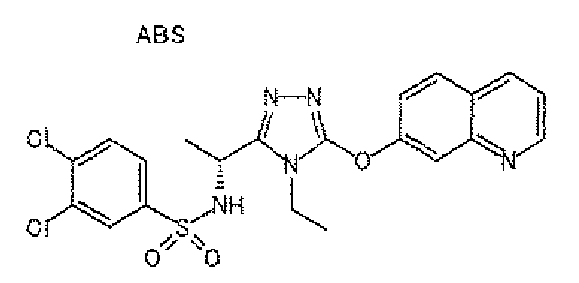
198.0-200.5 99.0 Compound 73 
185.0-187.0 103.3 Compound 74 
218.5-227.0 104.9 Compound 75 
177.0-179.0 95.0 Compound 76 
151.5-153.5 99.2 Compound 77 
123.0-127.0 99.7 Compound 78 
178.0-179.0 90.7 Compound 79 
190.0-195.0 103.7 -
[Table 1-12] Compound number Chemical structure Melting point (°C) Binding assay (membrane) % inhibition (10µM) Compound 80 
164.0-165.0 87.6 Compound 81 
160.0-165.0 93.2 Compound 82 
142.0-145.0 100.8 Compound 83 
170.0-173.0 100.7 Compound 84 
160.0-165.0 100.5 Compound 85 
133.0-134.0 100.0 Compound 86 
176.0-177.0 106.7 Compound 87 
174.0-179.0 99.9 -
[Table 1-13] Compound number Chemical structure Melting point (°C) Binding assay (membrane) % inhibition (10µM) Compound 88 
188.5-190.5 99.5 Compound 89 
101.0-103.0 90.3 Compound 90 
168.0-170.0 99.0 Compound 91 
137.0-138.0 90.6 Compound 92 
118.0-120.0 92.1 Compound 93 
167.5-169.5 99.9 Compound 94 
190.0-192.0 106.4 Compound 95 
205.0-208.5 92.4 -
[Table 1-14] Compound number Chemical structure Melting point (°C) Binding assay (membrane) % inhibition (10µM) Compound 96 
191.0-194.0 78.7 Compound 97 
158.0-159.0 93.0 Compound 98 
143.0-144.0 100.4 Compound 99 
103.0-105.5 102.4 Compound 100 
109.9 Compound 101 
142.0-143.0 100.9 Compound 102 
117.0-118.0 104.2 Compound 103 
146.5-147.5 91.2 -
[Table 1-15] Compound number Chemical structure Melting point (°C) Binding assay (membrane) % inhibition (10µM) Compound 104 
187.0-187.5 95.2 Compound 105 
121.0-123.0 104.4 Compound 106 
132.0-134.0 110.2 Compound 107 
159.0-162.0 103.8 Compound 108 
175.0-180.0 101.3 Compound 109 
152.0-153.0 103.5 Compound 110 
187.5-188.5 103.6 Compound 111 
204.0-205.0 108.7 -
[Table 1-16] Compound number Chemical structure Melting point (°C) Binding assay (membrane) % inhibition (10µM) Compound 112 
171.0-173.0 99.2 Compound 113 
183.0-185.0 74.2 Compound 114 
185.0-186.0 94.5 Compound 115 
125.5-126.5 81.8 Compound 116 
192.0-195.0 83.1 Compound 117 
153.5-155.5 87.1 Compound 118 
Compound 119 
-
[Table 1-17] Compound number Chemical structure Melting point (°C) Binding assay (membrane) % inhibition (10µM) Compound 120 
211.5-216.5 93.03 Compound 121 
195.5-198.5 103.45 Compound 122 
167.0-170.0 81.93 Compound 123 
162.0-165.0 97.12 Compound 124 
178.5-180.0 97.44 Compound 125 
253.5-254.5 94.28 Compound 126 
176.5-178.0 91.80 Compound 127 
94.44 -
[Table 1-18] Compound number Chemical structure Melting point (°C) Binding assay (membrane) % inhibition (10µM) Compound 128 
182.5-183.5 90.70 Compound 129 
96.0-104.0 96.79 Compound 130 
107.0-114.0 98.87 Compound 131 
102.0-110.5 97.35 Compound 132 
95.0-104.0 99.52 Compound 133 
164.0-169.5 101.11 Compound 134 
108.5-114.5 101.47 -
[Table 1-19] Compound number Chemical structure Melting point (°C) Binding assay (membrane) % inhibition (10µM) Compound 135 
188.5-192.0 100.63 Compound 136 
100.0-106.0 96.51 Compound 137 
173.5-177.0 101.74 Compound 138 
167.5-169.0 99.58 Compound 139 
174.0-177.0 101.46 Compound 140 
110.0-119.0 101.57 Compound 141 
169.0-173.0 104.70 -
[Table 1-20] Compound number Chemical structure Melting point (°C) Binding assay (membrane) % inhibition (10µM) Compound 142 
183.0-184.0 98.11 Compound 143 
144.0-145.0 99.89 Compound 144 
187.0-188.0 99.38 Compound 145 
150.0-152.0 101.30 Compound 146 
121.0-122.0 101.65 Compound 147 
141.0-143.0 102.74 Compound 148 
154.5-155.5 102.47 Compound 149 
212.0-214.5 100.70 -
[Table 1-21] Compound number Chemical structure Melting point (°C) Binding assay (membrane) % inhibition (10µM) Compound 1 
191.5-196.0 93.40 Compound 2 
252.0-255.0 102.84 -
[Table 1-22] Compound number Chemical structure APCI MS (M-H)- APCI MS (M+H)+ Binding assay (membrane) % inhibition (10µM) Compound 152 
467 469 Compound 153 
446 448 Compound 154 
431 433 92.3 Compound 155 
389 391 59.9 Compound 156 
467,469 469, 471 106.6 Compound 157 
445 447 74.6 Compound 158 
467, 469 469, 471 -
[Table 1-23] Compound number Chemical structure APCI MS (M-H)- APCI MS (M+H)+ Binding assay (membrane) % inhibition (10µM) Compound 159 
461 463 Compound 160 
467, 469 469, 471 96.9 Compound 161 
551, 553 553, 554 Compound 162 
423 425 109.3 Compound 163 
414 416 Compound 164 
465 467 Compound 165 
414 416 72.9 -
[Table 1-24] Compound number Chemical structure APCI MS (M-H)- APCI MS (M+H)+ Binding assay (membrane) % inhibition (10µM) Compound 166 
493 495 Compound 167 
451 453 113.3 Compound 168 
457 459 68.4 Compound 169 
457 459 Compound 170 
449 451 76.0 Compound 171 
341 343 Compound 172 
417 419 92.0 -
[Table 1-25] Compound number Chemical structure APCI MS (M-H)- APCI MS (M+H)+ Binding assay (membrane) % inhibition (10µM) Compound 173 
407 409 97.2 Compound 174 
431 433 52.5 Compound 175 
419 421 102.7 Compound 176 
327 329 Compound 177 
467 469 55.3 Compound 178 
467 469 Compound 179 
439 441 83.0 -
[Table 1-26] Compound number Chemical structure APCI MS (M-H)- APCI MS (M+H)+ Binding assay (membrane) % inhibition (10µM) Compound 180 
467 469 94.6 Compound 181 
479 481 50.4 Compound 182 
514 517 109.3 Compound 183 
415 417 92.8 Compound 184 
491, 493 493, 495 97.3 Compound 185 
515 517 Compound 186 
403 405 86.8 -
[Table 1-27] Compound number Chemical structure APCI MS (M-H)- APCI MS (M+H)+ Binding assay (membrane) % inhibition (10µM) Compound 187 
403 405 Compound 188 
457 459 106.6 Compound 189 
403 405 99.7 Compound 190 
473 475 87.9 Compound 191 
415 417 96.9 Compound 192 
403 405 95.2 Compound 193 
530 532 -
[Table 1-28] Compound number Chemical structure APCI MS (M-H)- APCI MS (M+H)+ Binding assay (membrane) % inhibition (10µM) Compound 194 
540 542 80.7 Compound 195 
417 419 90.1 Compound 196 
479 481 65.6 Compound 197 
535 537 Compound 198 
441 443 Compound 199 
408 410 Compound 200 
465 467 -
[Table 1-29] Compound number Chemical structure APCI MS (M-H)- APCI MS (M+H)+ Binding assay (membrane) % inhibition (10 µM) Compound 201 
450 452 84.3 Compound 202 
421 423 Compound 203 
447 449 Compound 204 
457 459 Compound 205 
465 467 Compound 206 
431 433 85.4 Compound 207 
491,493 493, 495 107.7 -
[Table 1-30] Compound number Chemical structure APCI MS (M-H)- APCI MS (M+H)+ Binding assay (membrane) % inhibition (10µM) Compound 208 
445 447 80.2 Compound 209 
457 459 91.4 Compound 210 
437 439 Compound 211 
423 425 Compound 212 
525 527 69.7 Compound 213 
457 459 101.9 Compound 214 
437 439 102.1 -
[Table 1-31] Compound number Chemical structure APCI MS (M-H)- APCI MS (M+H)+ Binding assay (membrane) % inhibition (10µM) Compound 215 
419 421 91.4 Compound 216 
503, 505 505, 507 88.9 Compound 217 
461 463 57.5 Compound 218 
497, 499 499, 501 74.7 Compound 219 
421 423 70.8 Compound 220 
459 461 93.7 Compound 221 
433 435 69.2 -
[Table 1-32] Compound number Chemical structure APCI MS (M-H)- APCI MS (M+H)+ Binding assay (membrane) % inhibition (10µM) Compound 222 
473 475 Compound 223 
414 416 90.8 Compound 224 
481 483 Compound 225 
491, 93 493, 495 Compound 226 
457 459 80.4 Compound 227 
425 427 51.4 Compound 228 
449 451 53.9 -
[Table 1-33] Compound number Chemical structure APCI MS (M-H)- APCI MS (M+H)+ Binding assay (membrane) % inhibition (10µM) Compound 229 
441 443 Compound 230 
407 409 Compound 231 
423 425 65.1 Compound 232 
431 433 68.7 Compound 233 
455 457 87.1 Compound 234 
495, 97 497, 499 50.6 Compound 235 
481, 483 483, 485 82.9 -
[Table 1-34] Compound number Chemical structure APCI MS (M-H)- APCI MS (M+H)+ Binding assay (membrane) % inhibition (10µM) Compound 236 
448 450 Compound 237 
443 445 64.8 Compound 238 
425 427 Compound 239 
525 527 Compound 240 
459 461 82.5 Compound 241 
425 427 95.8 Compound 242 
485, 487 487, 489 85.9 -
[Table 1-35] Compound number Chemical structure APCI MS (M-H)- APCI MS (M+H)+ Binding assay (membrane) % inhibition (10µM) Compound 243 
459 461 90.0 Compound 244 
503, 505 505, 507 94.6 Compound 245 
459 461 89.3 Compound 246 
471 473 Compound 247 
493 495 Compound 248 
471 473 104.9 Compound 249 
581, 583 583, 585 -
[Table 1-36] Compound number Chemical structure APCI MS (M-H)- APCI MS (M+H)+ Binding assay (membrane) % inhibition (10µM) Compound 250 
425 427 Compound 251 
491 493 59.0 Compound 252 
407 409 82.8 Compound 253 
480 482 Compound 254 
453 455 75.1 Compound 255 
471 473 86.4 Compound 256 
443 445 85.2 -
[Table 1-37] Compound number Chemical structure APCI MS (M-H)- APCI MS (M+H)+ Binding assay (membrane) % inhibition (10µM) Compound 257 
545, 547 547, 549 78.2 Compound 258 
462 464 67.9 Compound 259 
437 439 Compound 260 
545, 547 547, 549 74.1 Compound 261 
432 434 73.6 Compound 262 
417 419 79.6 Compound 263 
455 457 82.6 -
[Table 1-38] Compound number Chemical structure APCI MS (M-H)- APCI MS (M+H)+ Blinding assay (membrane) % inhibition (10µM) Compound 264 
455 457 95.9 Compound 265 
503, 505 505, 507 59.1 Compound 266 
425 427 99.0 Compound 267 
441 443 89.6 Compound 268 
443 445 99.9 Compound 269 
485, 487 487, 489 91.5 Compound 270 
535, 537 537, 539 73.0 -
[Table 1-39] Compound number Chemical structure APCI MS (M-H)- APCI MS (M+H)+ Binding assay (membrane) % inhibition (10µM) Compound 271 
535, 537 537, 539 57.1 Compound 272 
421 423 104.3 Compound 273 
421 423 71.6 Compound 274 
441 443 53.5 Compound 275 
485,487 487, 489 107.1 Compound 276 
501, 503 503, 505 94.4 Compound 277 
535, 537 537, 539 -
[Table 1-40] Compound number Chemical structure APCI MS (M-H)- APCI MS (M+H)+ Binding assay (membrane) % inhibition (10µM) Compound 278 
477 479 Compound 279 
421 423 79.6 Compound 280 
441 443 87.3 Compound 281 
475 477 Compound 282 
495 497 Compound 283 
482 484 Compound 284 
404 406 -
[Table 1-41] Compound number Chemical structure APCI MS (M-H)- APCI MS (M+H)+ Binding assay (membrane) % inhibition (10µM) Compound 285 
419 421 Compound 286 
409 411 60.6 Compound 287 
456 455 Compound 288 
394 396 Compound 289 
447 449 105.6 Compound 290 
424 426 Compound 291 
447 449 -
[Table 1-42] Compound number Chemical structure APCI MS (M-H)- APCI MS (M+H)+ Binding assay (membrane) % inhibition (10µM) Compound 292 
447 449 106.9 Compound 293 
431 433 Compound 294 
395 397 50.8 Compound 295 
462 464 Compound 296 
469 471 Compounds 297 
478 480 Compound 298 
543 545 -
[Table 1-43] Compound number Chemical structure APGI MS (M-H)- APCI MS (M+H)+ Binding assay (membrane) % inhibition (10µM) Compound 299 
519 521 Compound 300 
423 425 82.1 Compound 301 
449 451 78.8 Compound 302 
538 540 Compound 303 
491 493 77.4 Compound 304 
517 519 Compound 305 
561 563 -
[Table 1-44] Compound number Chemical structure APCI MS (M-H)- APCI MS (M+H)+ Binding assay (membrane) % inhibition (10µM) Compound 306 
431 433 60.2 Compound 307 
457 459 94.4 Compound 308 
490 492 Compound 309 
490 492 Compound 310 
494 496 Compound 311 
447 449 76.5 Compound 312 
461 463 -
[Table 1-45] Compound number Chemical structure APCI MS (M-H)- APCI MS (M+H)+ Binding assay (membrane) % inhibition (10µM) Compound 313 
437 439 Compound 314 
502 504 52.2 Compound 315 
440 442 Compound 316 
525 527 Compound 317 
535, 537 537, 539 Compound 318 
535, 537 537, 539 78.9 Compound 319 
535, 537 537, 539 61.7 -
[Table 1-46] Compound number Chemical structure APCI MS (M-H)- APCI MS (M+H)+ Binding assay (membrane) % inhibition (10µM) Compound 320 
390 392 Compound 321 
475 477 Compound 322 
539 541 Compound 323 
445 447 77.9 Compound 324 
445 447 81.8 Compound 325 
488 490 Compound 326 
467 469 -
[Table 1-47] Compound number Chemical structure APCI MS (M-H)- APCI MS (M+H)+ Binding assay (membrane) % inhibition (10µM) Compound 327 
452 454 92.3 Compound 328 
410 412 85.2 Compound 329 
488, 490 490, 492 100.8 Compound 330 
466 468 81.6 Compound 331 
488, 490 490, 492 59.8 Compound 332 
482 484 Compound 333 
488, 490 490, 492 102.2 -
[Table 1-48] Compound number Chemical structure APCI MS (M-H)- APCI MS (M+H)+ Binding assay (membrane) % inhibition (10µM) Compound 334 
572, 574 574, 576 Compound 335 
444 446 106.1 Compound 336 
435 437 56.8 Compound 337 
486 488 Compound 338 
435 437 69.2 Compound 339 
514 516 62.8 Compound 340 
472 474 100.0 -
[Table 1-49] Compound number Chemical structure APCI MS (M-H)- APCI MS (M+H)+ Binding assay (membrane) % inhibition (10µM) Compound 341 
478 480 92.8 Compound 342 
478 480 53.6 Compound 343 
470 472 86.5 Compound 344 
362 364 Compound 345 
438 440 90.4 Compound 346 
428 430 89.2 Compound 347 
452 454 50.1 -
[Table 1-50] Compound number Chemical structure APCI MS (M-H)- APCI MS (M+H)+ Binding assay (membrane) % inhibition (10µM) Compound 348 
440 442 109.1 Compound 349 
348 350 Compound 350 
488 490 75.0 Compound 351 
488 490 Compound 352 
460 462 88.5 Compound 353 
488 490 92.3 Compound 354 
500 502 -
[Table 1-51] Compound number Chemical structure APCI MS (M-H)- APCI MS (M+H)+ Binding assay (membrane) % inhibition (10µM) Compound 355 
536 538 98.8 Compound 356 
436 438 95.6 Compound 357 
512, 514 514, 516 106.1 Compound 358 
536 538 Compound 359 
424 426 95.7 Compound 360 
424 426 Compound 361 
424 426 96.9 -
[Table 1-52] Compound number Chemical structure APCI MS (M-H)- APCI MS (M+H)+ Binding assay (membrane) % inhibition (10µM) Compound 362 
494 496 95.1 Compound 363 
436 438 96.2 Compound 364 
424 426 87.5 Compound 365 
551 553 Compound 366 
561 563 63.2 Compound 367 
438 440 94.3 Compound 368 
500 502 60.5 Compound 369 
556 558 -
[Table 1-53] Compound number Chemical structure APCI MS (M-H)- APCI MS (M+H)+ Binding assay (membrane) % inhibition (10µM) Compound 370 
462 464 Compound 371 
429 431 Compound 372 
471 473 106.3 Compound 373 
442 444 Compound 374 
468 470 Compound 375 
478 480 Compound 376 
486 488 -
[Table 1-54] Compound number Chemical structure APCI MS (M-H)- APCI MS (M+H)+ Binding assay (membrane) % inhibition (10µM) Compound 377 
452 454 73.9 Compound 378 
466 468 71.6 Compound 379 
478 480 89.2 Compound 380 
458 460 Compound 381 
444 446 Compound 382 
546 548 66.9 Compound 383 
478 480 83.6 -
[Table 1-55] Compound number Chemical structure APCI MS (M-H)- APCI MS (M+H)+ Binding assay (membrane) % inhibition (10µM) Compound 384 
458 460 88.1 Compound 385 
462 464 98.0 Compound 386 
440 442 84.0 Compound 387 
524, 526 526, 528 63.5 Compound 388 
482 484 65.8 Compound 389 
518, 520 520, 522 88.0 Compound 390 
442 444 65.9 -
[Table 1-56] Compound number Chemical structure APCI MS (M-H)- APCI MS (M+H)+ Binding assay (membrane) % inhibition (10µM) Compound 391 
480 482 80.4 Compound 392 
566, 568 568, 570 73.6 Compound 393 
454 456 79.7 Compound 394 
494 496 Compound 395 
435 437 79.1 Compound 396 
502 504 Compound 397 
512,514 514, 516 -
[Table 1-57] Compound number Chemical structure APCI MS (M-H)- APCI MS (M+H)+ Binding assay (membrane) % inhibition (10µM) Compound 398 
478 480 84.7 Compound 399 
446 448 Compound 400 
470 472 75.3 Compound 401 
462 464 Compound 402 
428 430 Compound 403 
444 446 72.5 Compound 404 
452 454 60.2 -
[Table 1-58] Compound number Chemical structure APCI MS (M-H-) APCI MS (M+H)+ Binding assay (membrane) % inhibition (10µM) Compound 405 
476 478 61.4 Compound, 406 
516, 518 518, 520 56.3 Compound 407 
502, 04 504, 506 68.2 Compound 408 
469 471 Compound 409 
464 466 74.7 Compound 410 
446 448 Compound 411 
546 548 -
[Table 1-59] Compound number Chemical structure APCI MS (M-H)- APCI MS (M+H)+ Binding assay (membrane) % inhibition (10µM) Compound 412 
480 482 82.5 Compound 413 
446 448 95.3 Compound 414 
506, 508 508, 510 92.5 Compound 415 
480 482 91.5 Compound 416 
524, 526 526, 528 83.2 Compound 417 
480 482 90.8 Compound 418 
492 494 -
[Table 1-60] Compound number Chemical structure APCI MS (M-H)- APCI MS (M+H)+ Binding assay (membrane) % inhibition (10µM) Compound 419 
514 516 Compound 420 
602, 604 604, 606 61.0 Compound 421 
446 448 Compound 422 
512 514 83.1 Compound 423 
428 430 87.8 Compound 424 
501 503 Compound 425 
474 476 90.1 -
[Table 1-61] Compound number Chemical structure APCI MS (M-H)- APCI MS (M+H)+ Binding assay (membrane) % inhibition (10µM) Compound 426 
492 494 92.3 Compound 427 
464 466 86.5 Compound 428 
566, 568 568, 570 81.4 Compound 429 
483 485 71.1 Compound 430 
458 460 50.0 Compound 431 
566, 568 568, 570 80.5 Compound 432 
453 455 84.2 -
[Table 1-62] Compound number Chemical structure APCI MS (M-H)- APCI MS (M+H)+ Binding assay (membrane) % inhibition (10µM) Compound 433 
438 440 93.8 Compound 434 
476 478 79.5 Compound 435 
476 478 94.6 Compound 436 
524, 526 526, 528 67.5 Compound 437 
446 448 97.3 Compound 438 
462 464 71.6 Compound 439 
464 466 98.1 -
[Table 1-63] Compound number Chemical structure APCI MS (M-H)- APCI MS (M+H)+ Binding assay (membrane) % inhibition (10µM) Compound 440 
502, 504 504, 506 88.4 Compound 441 
506, 508 508, 510 63.0 Compound 442 
556, 558 558 560 70.1 Compound 443 
556, 558 558, 560 55.7 Compound 444 
442 444 100.2 Compound 445 
442 444 55.6 Compound 446 
462 464 75.8 -
[Table 1-64] Compound number Chemical structure APCI MS (M-H)- APCI MS (M+H)+ Binding assay (membrane) % inhibition (10µM) Compound 447 
506, 508 508, 510 95.5 Compound 448 
522, 524 524, 526 81.1 Compound 449 
555, 558 558, 560 Compound 450 
498 500 Compounds 451 
442 444 76.8 Compound 452 
462 464 68.9 Compound 453 
496 498 -
[Table 1-65] Compound number Chemical structure APCI MS (M-H)- APCI MS (M+H)+ Binding assay (membrane) % inhibition (10µM) Compound 454 
516 518 Compound 455 
503 505 Compound 456 
425 427 Compound 457 
440 442 Compound 458 
430 432 83.8 Compound 459 
474 476 Compound 460 
482 484 53.2 -
[Table 1-66] Compound number Chemical structure APCI MS (M-H)- APCI MS (M+H)+ Binding assay (membrane) % inhibition (10µM) Compound 461 
468 470 99.7 Compound 462 
445 447 Compound 463 
468 470 Compound 464 
468 470 87.9 Compound 465 
452 454 Compound 466 
416 418 51.1 Compound 467 
483 485 59.9 -
[Table 1-67] Compound number Chemical structure APCI MS (M-H)- APCI MS (M+H)+ Binding assay (membrane) % inhibition (10µM) Compound 468 
490 492 56.2 Compound 469 
499 501 Compound 470 
564 566 Compound 471 
540 542 Compound 472 
444 446 55.3 Compound 473 
470 472 74.5 Compound 474 
559 561 -
[Table 1-68] Compound number Chemical structure APCI MS (M-H)- APCI MS (M+H)+ Binding assay (membrane) % inhibition (10µM) Compound 475 
512 514 51.8 Compound 476 
482 484 Compound 477 
452 454 58.1 Compound 478 
478 480 87.0 Compound 479 
511 513 Compound 480 
511 513 Compound 481 
515 517 -
[Table 1-69] Compound number Chemical structure APCI MS (M-H)- APCI MS (M+H)+ Binding assay (membrane) % inhibition (10µM) Compound 482 
468 470 87.4 Compound 483 
482 484 Compound 484 
523 525 65.3 Compound 485 
461 463 Compound 486 
546 548 Compound 487 
556, 558 558, 560 Compound 488 
556, 558 558, 560 62.5 -
[Table 1-70] Compound number Chemical structure APCI MS (M-H)- APCI MS (M+H)+ Binding assay (membrane) % inhibition (10µM) Compound 489 
556, 558 558, 560 Compound 490 
411 413 Compound 491 
496 498 Compound 492 
560 562 Compound 493 
466 468 83.1 Compound 494 
466 468 66.0 Compound 495 
547 549 Compound 496 
526 528 -
[Table 1-71] Compound number Chemical structure APCI MS (M-H)- APCI MS (M+H)+ Binding assay (membrane) % inhibition (10µM) Compound 497 
511 513 103.6 Compound 498 
469 471 84.0 Compound 499 
547, 549 549, 551 108.9 Compound 500 
525 527 90.2 Compound 501 
547, 549 549, 551 61.7 Compound 502 
541 543 75.5 Compound 503 
547, 549 549, 551 116.0 Compound 504 
631, 633 633, 635 53.5 -
[Table 1-72] Compound number Chemical structure APCI MS (M-H)- APCI MS (M+H)+ Binding assay (membrane) % inhibition (10µM) Compound 505 
503 505 108.0 Compound 506 
494 496 83.2 Compound 507 
545 547 84.8 Compound 508 
494 496 Compound 509 
573 575 87.0 Compound 510 
531 533 113.5 Compound 511 
537 539 98.6 Compound 512 
537 539 60.7 -
[Table 1-73] Compound number Chemical structure APCI MS (M-H)- APCI MS (M+H)+ Binding assay (membrane) % inhibition (10µM) Compound 513 
529 531 96.6 Compound 514 
421 423 Compound 515 
497 499 108.9 Compound 516 
487 489 16.7 Compound 517 
511 513 69.6 Compound 518 
499 501 110.8 Compound 519 
407 409 Compound 520 
547 549 69.9 -
[Table 1-74] Compound number Chemical structure APCI MS (M-H)- APCI MS (M+H)+ Binding assay (membrane) % inhibition (10µM) Compound 521 
547 549 Compound 522 
519 521 98.4 Compound 523 
547 549 113.5 Compound 524 
559 561 83.0 Compound 525 
595 597 110.9 Compound 526 
577, 573 573, 575 111.8 Compound 527 
595 597 52.1 Compound 528 
483 485 106.2 -
[Table 1-75] Compound number Chemical structure APCI MS (M-H)- APCI MS (M+H)+ Binding assay (membrane) % inhibition (10µM) Compound 529 
483 485 Compound 530 
537 539 114.7 Compound 531 
483 485 100.1 Compound 532 
553 555 99.2 Compound 533 
495 497 Compound 534 
483 485 100.8 Compound 535 
610 612 Compound 536 
620 622 50.3 -
[Table 1-76] Compound number Chemical structure APCI MS (M-H)- APCI MS (M+H)+ Binding assay (membrane) % inhibition (10µM) Compound 537 
497 499 96.7 Compound 538 
559 561 97.1 Compound 539 
615 617 Compound 540 
521 523 64.3 Compound 541 
488 490 65.5 Compound 542 
545 547 50.1 Compound 543 
530 532 111.8 Compound 544 
501 503 53.9 -
[Table 1-77] Compound number Chemical structure APCI MS (M-H)- APCI MS (M+H)+ Binding assay (membrane) % inhibition (10µM) Compound 545 
527 529 50.7 Compound 546 
537 539 55.8 Compound 547 
545 547 Compound 548 
511 513 96.7 Compound 549 
525 527 89.2 Compound 550 
537 539 103.6 Compound 551 
517 519 76.1 Compound 552 
503 505 67.2 -
[Table 1-78] Compound number Chemical structure APCI MS (M-H)- APCI MS (M+H)+ Binding assay (membrane) % inhibition (10µM) Compound 553 
605 607 106.6 Compound 554 
537 539 116.5 Compound 555 
517 519 102.0 Compound 556 
499 501 104.8 Compound 557 
593, 585 585, 587 107.3 Compound 558 
541 543 64.8 Compound 559 
577, 579 579, 581 79.3 Compound 560 
501 503 74.4 -
[Table 1-79] Compound number Chemical structure APCI MS (M-H)- APCI MS (M+H)+ Binding assay (membrane) % inhibition (10µM) Compound 561 
539 541 92.4 Compound 562 
513 515 93.3 Compound 563 
553 555 64.1 Compound 564 
494 496 105.4 Compound 565 
561 563 Compound 566 
571, 573 573, 575 88.7 Compound 567 
537 539 101.6 Compound 568 
505 507 71.1 -
[Table 1-80] Compound number Chemical structure APCI MS (M-H)- APCI MS (M+H)+ Binding assay (membrane) % inhibition (10µM) Compound 569 
529 531 75.0 Compound 570 
521 523 77.4 Compound 571 
487 489 55.7 Compound 572 
503 505 96.5 Compound 573 
511 513 86.3 Compound 574 
575, 577 577,579 86.9 Compound 575 
561, 563 563, 565 103.7 Compound 576 
528 530 81.4 -
[Table 1-81] Compound number Chemical structure APCI MS (M-H)- APCI MS (M+H)+ Binding assay (membrane) % inhibition (10µM) Compound 577 
523 525 92.4 Compound 578 
505 507 Compound 579 
605 607 87.6 Compound 580 
539 541 89.2 Compound 581 
505 507 99.9 Compound 582 
565, 567 567, 569 106.0 Compound 583 
539 541 108.9 Compound 584 
583, 585 585, 587 96.2 -
[Table 1-82] Compound number Chemical structure APCI MS (M-H)- APCI MS (M+H)+ Binding assay (membrane) % inhibition (10µM) Compound 585 
539 541 103.0 Compound 586 
551 553 87.9 Compound 587 
573 575 60.0 Compound 588 
551 553 109.3 Compound 589 
661, 663 663, 665 80.2 Compound 590 
505 507 62.3 Compound 591 
571 573 77.5 Compound 592 
487 489 95.8 -
[Table 1-83] Compound number Chemical structure APCI MS (M-H)- APCI MS (M+H)+ Binding assay (membrane) % inhibition (10µM) Compound 593 
560 562 65.9 Compound 594 
533 535 84.0 Compound 595 
551 553 93.7 Compound 596 
523 525 100.3 Compound 597 
625, 627 627, 629 97.3 Compound 598 
542 544 89.5 Compound 599 
517 519 80.6 Compound 600 
625.627 627, 629 100.5 -
[Table 1-84] Compound number Chemical structure APCI MS (M-H)- APCI MS (M+H)+ Binding assay (membrane) % inhibition (10µM) Compound 601 
512 514 100.4 Compound 602 
497 499 106.7 Compound 603 
535 537 106.8 Compound 604 
535 537 109.4 Compound 605 
583, 585 585, 587 83.4 Compound 606 
505 507 107.8 Compound 607 
521 523 Compound 608 
523 525 108.6 -
[Table 1-85] Compound number Chemical structure APCI MS (M-H)- APCI MS (M+H)+ Binding assay (membrane) % inhibition (10µM) Compound 609 
565, 567 567, 569 93.1 Compound 610 
615, 617 617, 619 91.2 Compound 611 
615, 617 617, 619 63.9 Compound 612 
501 503 114.0 Compound 613 
501 503 90.9 Compound 614 
521 523 77.8 Compound 615 
565, 567 567, 569 110.3 Compound 616 
581, 583 583, 585 99.9 -
[Table 1-86] Compound number Chemical structure APCI MS (M-H)- APCI MS (M+H)+ Binding assay (membrane) % inhibition (10µM) Compound 617 
615, 617 617, 619 77.5 Compound 618 
557 559 65.4 Compound 619 
497 499 114.2 Compound 620 
501 503 88.4 Compound 621 
521 523 95.4 Compound 622 
555 557 58.9 Compound 623 
575 577 Compound 624 
562 564 -
[Table 1-87] Compound number Chemical structure APCI MS (M-H)- APCI MS (M+H)+ Binding assay (membrane) % inhibition (10µM) Compound 625 
484 486 Compound 626 
499 501 61.1 Compound 627 
489 491 90.0 Compound 628 
533 535 64.4 Compound 629 
541 543 101.1 Compound 630 
527 529 107.4 Compound 631 
504 506 95.2 Compound 632 
527 529 59.9 -
[Table 1-88] Compound number Chemical structure APCI MS (M-H)- APCI MS (M+H)+ Binding assay (membrane) % inhibition (10µM) Compound 633 
527 529 111.2 Compound 634 
511 513 51.0 Compound 635 
475 477 68.7 Compound 636 
542 544 85.7 Compound 637 
549 551 50.6 Compound 638 
558 560 Compound 639 
623 625 Compound 640 
599 601 59.5 -
[Table 1-89] Compound number Chemical structure APCI MS (M-H)- APCI MS (M+H)+ Binding assay (membrane) % inhibition (10µM) Compound 641 
503 505 85.2 Compound 642 
529 531 85.5 Compound 643 
618 620 Compound 644 
571 573 93.0 Compound 645 
597 599 Compound 646 
641 643 Compound 647 
511 513 99.0 Compound 648 
537 539 107.8 -
[Table 1-90] Compound number Chemical structure APCI MS (M-H)- APCI MS (M+H)+ Binding assay (membrane) % inhibition (10µM) Compound 649 
570 572 64.7 Compound 650 
570 572 Compound 651 
574 576 Compound 652 
527 529 91.9 Compound 653 
541 543 Compound 654 
582 584 71.7 Compound 655 
605 607 -
[Table 1-91] Compound number Chemical structure APCI MS (M-H)- APCI MS (M+H)+ Binding assay (membrane) % inhibition (10 µM) Compound 656 
615, 617 617, 619 Compound 657 
615, 617 617, 619 94.9 Compound 658 
615, 617 617, 619 80.4 Compound 659 
470 472 Compound 660 
555 557 Compound 661 
619 621 Compound 662 
525 527 95.4 -
[Table 1-92] Compound number Chemical structure Melting point (°C) Binding assay (membrane) % inhibition (10µM) Compound 663 
210.0-217.0 99.5 Compound 664 
218.0-221.5 85.4 Compound 665 
197.0-201.0 100.3 Compound 666 
143.5-144.5 97.9 Compound 667 
207.0-208.0 99.2 Compound 668 
98.6 Compound 669 
131.5-132.5 100.3 -
[Table 1-93] Compound number Chemical structure Melting point (°C) Binding assay (membrane) % inhibition (10µM) Compound 670 
214.5-218.0 100.8 Compound 671 
100.6 Compound 672 
102.7 Compound 673 
62,0 Compound 674 
97.0 Compound 675 
96.6 Compound 676 
92.6 -
[Table 1-94] Compound number Chemical structure Melting point (°C) Binding assay (membrane) % inhibition (10µM) Compound 677 
60.8 Compound 678 
97.4 Compound 679 
104.0 Compound 680 
169.5-170.5 100.1 Compound 681 
189.0-189.5 100.2 Compound 682 
228.0-228.5 76.6 Compound 683 
175.0-178.0 100.5 -
[Table 1-95] Compound number Chemical structure Melting point (°C) Binding assay (membrane) % inhibition (10µM) Compound 684 
169.5-171.5 Compound 685 
255.0-260.0 65.1 Compound 686 
220.5-221.0 92.7 Compound 687 
80.1 Compound 688 
192.0-193.0 100.5 Compound 689 
92.7 Compound 690 
198.0-200.0 102.2 -
[Table 1-96] Compound number Chemical structure Melting point (°C) Binding assay (membrane) % inhibition (10µM) Compound 691 
180.0-182.0 98.5 Compound 692 
227.0-229.0 98.5 Compound 693 
158.0-161.0 97.7 Compound 694 
189.0-191.0 106.0 Compound 695 
Compound 696 
Compound 697 
-
[Table 1-97] Compound number Chemical structure Melting point (°C) Binding assay (membrane) % inhibition (10µM) Compound 698 
For the compounds listed below, 1H-NMR data is shown. - Compound 100: (600 MHz, DMSO-d6) δ ppm: 1.21 (t, J = 7.1 Hz, 3H) 1.27 (d, J = 6.9 Hz, 3H) 3.22 (s, 6H) 3.40-3.50 (m, 8 H) 3.77-3.93 (m, 2H) 4.68 (q, J = 6.9 Hz, 1H) 6.34 (dd, J = 7.3, 2.29 Hz, 1H) 6.52 (dd, J = 8.3, 2.29 Hz, 1H) 6.56 (t, J = 2.3 Hz, 1H) 7.12 (t, J = 8.3 Hz, 1H) 7.70 (dd, J = 8.3, 2.3 Hz, 1H) 7.85 (d, J = 8.3 Hz, 1H) 7.92 (d, J = 1.8 Hz, 1H) 8.66 (s, 1H).
- Compound 119: (600 MHz, CDCl3) δ ppm: 1.34 (t, J = 7.3 Hz, 3H), 1.50 (d, J = 7.3 Hz, 3H), 3.89-3.98 (m, 2H), 4.59-4.65 (m, 1H), 5.06 (s, 2H) 6.37-6.42 (m, 1H), 6.80-6.95 (m, 2H), 7.01-7.04 (m, 1H), 7.24-7.36 (m, 2H), 7.36-7.44 (m, 4H), 7.49-7.53 (m, 1H), 7.67-7.73 (m, 1H), 7.93-7.96 (m, 1H).
- Compound 127: (600 MHz, CDCl3) δ ppm: 1.38 (t, J = 7.1 Hz, 3H), 1.49 (d, J = 6.9 Hz, 3H), 2.41 (s, 3H), 3.93-4.02 (m, 2H), 4.59-4.65 (m, 1H), 5.47 (d, J = 9.6 Hz, 1H), 7.05-7.10 (m, 2H), 7.31-7.37 (m, 3H), 7.61-7.64 (m, 1H), 7.80-7.82 (m, 1H).
- Compound 129: (600 MHz, DMSO-d6) δ ppm: 1.21-1.29 (m, 6H), 2.29 (s, 6H), 3.83-4.01 (m, 2H), 4.61 (q, J = 6.4 Hz, 1H), 6.43-6.47 (m, 1H), 6.89-6.93 (m, 1H), 7.34-7.40 (m, 3H), 7.52-7.60 (m, 3H), 8.24 (s, 1H), 11.18 (s, 1H).
- Compound 130: (600 MHz, DMSO-d6) δ ppm: 1.22 (d, J = 6.8 Hz, 3H), 1.26 (t, J = 7.1 Hz, 3H), 3.87-4.02 (m, 2H), 4.70 (q, J = 6.8 Hz, 1H), 6.43-6.45 (m, 1H), 6.77-6.80 (m, 1H), 7.28-7.30 (m, 1H), 7.36-7.38 (m, 1H), 7.50-7.53 (m, 1H), 7.67-7.75 (m, 2H), 7.83-7.86 (m, 1H), 8.04-8.07 (m, 1H), 8.12-8.19 (m, 2H), 8.45-8.47 (m, 1H), 8.52 (s, 1H), 11.16 (s, 1H).
- Compound 131: (600 MHz, DMSO-d6) δ ppm: 1.28 (t, J = 7.1 Hz, 3H), 1.35 (d, J = 6.9 Hz, 3H), 2.36 (s, 3H), 3.89-4.03 (m, 2H), 4.64-4.72 (m, 1H), 6.44-6.46 (m, 1H), 6.87-6.90 (m, 1H), 7.36-7.38 (m, 2H), 7.53-7.57 (m, 1H), 7.82-7.84 (m, 1H), 7.88-7.91 (m, 1H), 8.77 (s, 1H), 11.18 (s, 1H).
- Compound 132: (600 MHz, DMSO-d6) δ ppm: 1.23-1.31 (m, 6H), 2.39 (s, 3H), 3.85-4.02 (m, 2H), 4.69 (q, J = 6.9 Hz, 1H), 6.43-6.47 (m, 1H), 6.88-6.92 (m, 1H), 7.36-7.39 (m, 2H), 7.53-7.60 (m, 2H), 7.64-7.68 (m, 1H), 7.77-7.80 (m, 1H), 8.51 (s, 1H), 11.18 (s, 1H).
- Compound 134: (600 MHz, DMSO-d6) δ ppm: 1.29 (t, J = 7.3 Hz, 3H), 1.36 (d, J = 6.9 Hz, 3H), 3.89-4.05 (m, 2H), 4.67-4.73 (m, 1H), 6.44-6.46 (m, 1H), 6.86-6.90 (m, 1H), 7.35-7.39 (m, 2H), 7.54-7.57 (m, 1H), 7.83-7.88 (m, 1H), 7.91-7.94 (m, 1H), 9.01 (s, 1H), 11.17 (s, 1H).
- Compound 136: (600 MHz, DMSO-d6) δ ppm: 1.23-1.31 (m, 6H), 3.85-4.02 (m, 2H), 4.72 (q, J = 6.9 Hz, 1H), 6.44-6.47 (m, 1H), 6.87-6.91 (m, 1H), 7.34-7.39 (m, 2H), 7.52-7.57 (m, 1H), 7.97-8.05 (m, 4H), 8.74 (s, 1H), 11.17 (s, 1H).
- Compound 150: (200 MHz, CDC13) δ ppm: 0.94 (d, J = 6.4 Hz, 3H), 0.97 (d, J = 6.4 Hz, 3H), 1.30 (t, J = 7.3 Hz, 3H), 2.00-2.20 (m, 1H), 2.37 (s, 3H), 3.70-3.88 (m, 2H), 4.10 (dd, J = 6.9, 9.4 Hz, 1H), 6.71 (d, J = 9.4 Hz, 2H), 7.12-7.22 (m, 4H), 7.40 (d, J = 8.4 Hz, 1H), 7.65 (dd, J = 2.2, 8.4 Hz, 1H), 7.84 (d, J = 2.2 Hz, 1H).
- Compound 668: (600 MHz, DMSO-d6) ppm: 1.19-1.25 (m, 6H), 2.22 (s, 3H), 2.41-2.46 (m, 4H), 2.49-2.54 (m, 3H), 3.11-3.17 (m, 4H), 3.83-3.99 (m, 2H), 4.65-4.71 (m, 1H), 6.47-6.51 (m, 1H), 6.77-6.82 (m, 2H), 7.17-7.22 (m, 1H), 7.51-7.55 (m, 1H), 7.77-7.84 (m, 2H), 8.01-8.10 (m, 2H), 8.38-8.51 (m, 2H).
- Compound 671: (200 MHz, CDCl3) δ ppm: 0.89 (t, J = 7.5 Hz, 3H), 1.23 (t, J = 7.3 Hz, 3H), 1.70-2.06 (m, 2H), 2.42 (s, 3H), 2.66 (bs, 4H), 3.29 (t, J = 5.1 Hz, 4H), 3.68-3.92 (m, 2H), 4.38 (dd, J = 7.0, 15.4 Hz, 1H), 6.50 (bs, 1H), 6.56 (dd, J = 2.0, 8.1 Hz, 1H), 6.72 (dd, J = 2.0, 8.4 Hz, 1H), 6.89 (t, J = 2.0 Hz, 1H), 7.20 (t, J = 8.4 Hz, 1H), 7.46 (t, J = 8.1 Hz, 1H), 7.69 (d, J = 8.0 Hz, 1H), 7.80 (d, J = 8.0 Hz, 1H), 7.94 (d, J = 2.0, 9.0 Hz, 1H), 8.28 (d, J = 9.0 Hz, 1H), 8.4 (d, J = 2.0 Hz, 1H).
- Compound 672: (200 MHz, CnCl3) δ ppm: 1.33 (t, J = 7.3 Hz, 3H), 1.49 (d, J = 6.8 Hz, 3H), 2.41 (s, 3H), 2.57-2.70 (m, 4H), 3.16-3.33 (m, 6H), 3.91 (q, J = 7.3 Hz, 2H), 4.52-4.69 (m, 3H), 5.08 (d, J = 9.0 Hz, 1H), 6.73 (dd, J = 2.2, 8.6 Hz, 2H), 6.81 (d, J = 9.0 Hz, 1H), 6.97 (t, J = 2.2 Hz, 1H), 7.23 (t, J = 8.1 Hz, 1H), 7.62-7.68 (m, 2H).
- Compound 673: (200 MHz, CDCl3) δ ppm: 1.31 (t, J = 7.0 Hz, 3H), 1.33 (s, 6H), 1.49 (d, J = 7.0 Hz, 3H), 1.80 (t, J = 6.6 Hz, 2H), 2.39 (s, 3H), 2.59 (t, J = 5.0 Hz, 4H), 2.79 (t, J = 7.0 Hz, 2H), 3.25 (t, J = 5.0 Hz, 4H), 3.90 (q, J = 7.0 Hz, 2H), 4.48-4.65 (m, 1H), 5.07 (d, J = 9.5 Hz, 1H), 6.73 (dd, J = 2.4, 8.1 Hz, 2H), 6.82 (d, J = 9.2 Hz, 1H), 6.97 (t, J = 2.4 Hz, 1H), 7.23 (t, J = 8.1 Hz, 1H), 7.51-7.57 (m, 2H).
- Compound 674: (200 MHz, CDCl3) δ ppm: 1.34 (t, J = 7.3 Hz, 3H), 1.49 (d, J = 6.8 Hz, 3H), 2.21 (quint, J = 6.0 Hz, 2H), 2.37 (s, 3H), 2.59 (t, J = 4.6 Hz, 4H), 3.25 (t, J = 4.6 Hz, 4H), 3.93 (q, J = 7.3 Hz, 2H), 4.27 (dd, J = 6.0, 11.6 Hz, 4H) 4.51-4.66 (m, 1H), 5.15 (d, J = 9.5 Hz, 1H), 6.74 (dd, J = 2.2, 8.4 Hz, 1H), 7.07-7.13 (m, 2H), 7.23 (t, J = 8.1 Hz, 1H), 7.38 (dd, J = 2.4, 8.1 Hz, 1H), 7.43 (d, J = 2.0 Hz, 1H).
- Compound 675: (200 MHz, CDCl3) δ ppm: 1.36 (t, J = 7.3 Hz, 3H), 1.49 (d, J = 6.8 Hz, 3H), 2.39 (s, 3H), 2.59 (t, J = 5.0 Hz, 4H), 3.26 (t, J = 5.0 Hz, 4H), 3.95 (q, J = 7.3 Hz, 2H), 4.50-4.68 (m, 1H), 5.18 (d, J = 9.5 Hz, 1H), 6.05 (s, 2H), 6.74 (dd, J = 2.4, 8.1 Hz, 2H), 6.86 (d, J = 8.4 Hz, 1H), 6.98 (t, J = 2.4 Hz, 1H), 7.19-7.27 (m, 2H), 7.42 (dd, J = 1.8, 8.1 Hz, 1H).
- Compound 676: (200 MHz, CDCl3) δ ppm: 1.27-1.33 (m, 15 H), 1.47 (d, J = 6.8 Hz, 3H), 2.43 (s, 3H), 2.61-2.72 (m, 4H), 3.25-3.33 (m, 4H), 3.90 (q, J = 7.5 Hz, 2H), 4.57 (dd, J = 6.8, 9.2 Hz, 1H), 5.13 (d, J = 9.2 Hz, 1H), 6.70-6.79 (m, 2H), 6.99 (t, J = 2.2 Hz, 1H), 7.22 (t, J = 8.1 Hz, 1H), 7.41 (d, J = 8.6 Hz, 1H), 7.57 (dd, J = 2.0, 8.1 Hz, 1H), 7.79 (d, J = 2.0 Hz, 1H).
- Compound 677: (200 MHz, CDCl3) δ ppm: 1.32 (t, J = 7.3 Hz, 3H), 1.49 (d, J = 6.8 Hz, 3H), 2.22 (s, 3H), 2.38 (s, 3H), 2.56-2.63 (m, 4H), 3.14-3.30 (m, 6H), 3.84-4.10 (m, 4H), 4.53-4.64 (m, 1H), 5.25 (d, J = 9.5 Hz, 1H), 6.71-6.79 (m, 2H), 7.01 (t, J = 2.4 Hz, 1H), 7.22 (t, J = 8.4 Hz, 1H), 7.57 (s, 1H), 7.69 (dd, J = 2.0, 8.4 Hz, 1H), 8.27 (d, J = 8.4 Hz, 1H).
- Compound 678: (200 MHz, CDCl3) δ ppm: 1.32 (t, J = 7.3 Hz, 3H), 1.46 (d, J = 6.8 Hz, 3H), 2.11 (quint, J = 7.5 Hz, 2H), 2.36 (s, 3H), 2.58 (t, J = 5.0 Hz, 4H), 2.94 (t, J = 7.5 Hz, 4H), 3.25 (t, J = 5.0 Hz, 4H), 3.92 (q, J = 7.3 Hz, 2H), 4.52-4.67 (m, 1H), 5.15 (d, J = 10.0 Hz, 1H), 6.73 (dd, J = 2.2, 8.1 Hz, 2H), 6.98 (t, J = 2.2 Hz, 1H), 7.22 (t, J = 7.9 Hz, 1H), 7.31 (d, J = 8.1 Hz, 1H), 7.62 (dd, J = 2.2, 7.9 Hz, 1H), 7.67 (s, 1H).
- Compound 679: (600 MHz, DMSO-d6) δ ppm: 1.24 (t, J = 7.1 Hz, 3H), 1.29 (d, J = 6.9 Hz, 3H), 2.22 (s, 3H), 2.40-2.46 (m, 4H), 3.12-3.16 (m, 4H), 3.81-3.97 (m, 2H), 4.64-4.72 (m, 1H), 6.53-6.58 (m, 1H), 6.60-6.65 (m, 1H), 6.77-6.82 (m, 2H), 7.20 (t, J = 8.3 Hz, 1H), 7.60 (d, J = 8.7 Hz, 1H), 7.94-7.99 (m, 1H), 8.17-8.23 (m, 2H), 8.54-8.61 (m, 1H).
- Compound 698: (600 MHz, CDCl3) δ ppm: 1.33 (t, J = 7.1 Hz, 3H), 1.43 (d, J = 6.9 Hz, 3H), 2.11 (s, 3H), 3.10-3.20 (m, 4H), 3.53-3.59 (m, 2H), 3.67-3.74 (m, 2H), 3.89-4.00 (m, 2H), 4.67 (q, J = 7.1 Hz, 1H), 6.65-6.75 (m, 2H), 6.94-6.97 (m, 1H), 7.21-7.25 (m, 1H), 7.46-7.50 (m, 1H), 7.69-7.73 (m, 1H), 7.80-7.84 (m, 1H), 7.95-7.99 (m, 1H), 8.29-8.34 (m, 1H), 8.45-8.47 (m, 1H).
- The following describes exemplary methods of preparing starting materials used to produce the compounds of the present application.
- Starting from the corresponding amine in place of 1,4-dioxa-8-azaspiro[4,5]decane used in Example 7-(1), the same procedure as used in Example 7-(1) was repeated to give the titled compounds.
-

1H NMR (600 MHz, CDCl3) δ ppm: 1.24 (d, J = 6.0 Hz, 6H), 2.36 - 2.45 (m, 2H), 3.37 - 3.46 (m, 2H), 3.73 - 3.83 (m, 2H), 5.01 (s, 1H), 6.28 - 6.33 (m, 1H), 6.36 - 6.38 (m, 1H), 6.46 - 6.51 (m, 1H), 7.10 (t, J = 8.0 Hz, 1H) -

1H NMR (600 MHz, CDCl3) δ ppm: 2.29 (s, 6H), 2.48-2.57 (m, 4H), 2.57-2.64 (m, 4H), 3.11-3.16 (m, 4H), 6.24-6.30 (m, 1H), 6.32-6.37 (m, 1H), 6.42-6.49 (m, 1H), 7.04-7.09 (m, 1H) -

1H NMR (600 MHz, CDCl3) δ ppm: 2.27 (s, 6H), 2.44-2.50 (m, 2H), 2.87 (s, 3H), 3.37-3.44 (m, 2H), 6.09-6.16 (m, 2H), 6.19-6.24 (m, 1H), 7.01 (t, J = 8.0 Hz, 1H) -

1H NMR (600 MHz, CDCl3) δ ppm: 1.11 (d, J = 6.4 Hz, 6H), 2.68 - 2.72 (m, 4H), 2.71 - 2.78 (m, 1H), 3.15 - 3.23 (m, 4H), 6.28 - 6.32 (m, 1H), 6.36 (t, J = 2.3 Hz, 1H), 6.50 (dd, J = 8.3, 2.3 Hz, 1H), 7.09 (t, J = 8.3 Hz, 1H) -

1H NMR (600 MHz, CDCl3) δ ppm: 1.16 (d, J = 6.4 Hz, 6H), 1.76-1.86 (m, 2H), 1.91-2.01 (m, 2H), 2.31-2.50 (m, 3H), 2.92-3.02 (m, 1H), 3.08-3.19 (m, 2H), 6.66-6.72 (m, 2H), 6.74-6.79 (m, 1H), 7.11 (t, J = 7.8 Hz, 1H) -

-


- (1) A suspension of 3-chloro-4-fluorophenol (2.00 g), benzyl chloride (1.88 ml), and potassium carbonate (2.82 g) in dimethylformamide (10 ml) was stirred at room temperature for three hours. Water was added to the reaction mixture, and the mixture was extracted with ethyl acetate. The organic layer was washed with saturated aqueous sodium chloride, dried (MgSO4), filtered, and concentrated, and the resulting residue was purified by silica-gel column chromatography (OH SiO2, AcOEt/hexane = 0-10%) to give the titled compound (2.00 g) as a light yellow oily substance.
1H NMR (600 MHz, CDCl3) δ ppm: 5.01 (s, 2H), 6.77-6.86 (m, 1H), 6.96-7.09 (m, 2H), 7.30-7.46 (m, 5 H) -

- (2) Under an argon atmosphere at room temperature, the compound (7.5 g) obtained in Reference Example 6-(1) and thereafter a solution of 2,8,9-triisobutyl-2,5,8,9-tetraaza-1-1 phosphino-bicyclo[3,3,3]-undecane (1.1 g) in toluene (320 ml) were added to tris dibenzylidenedipalladium (1.45 g) and t-butoxysodium (4.26 g). Then, a solution of N-methylpiperazine (1.02 g) in toluene (20 ml) was added at room temperature, and the mixture was stirred at 100°C for 60 hours. The reaction mixture was concentrated, and the resulting residue was purified by silica-gel column chromatography (NH SiO2, AcOEt/hexane = 0-30%) to give the titled compound (2.27g) as a yellow oily substance.
1H NMR (600 MHz, CDCl3) δ ppm: 2.35 (s, 3H), 2.55-2.63 (m, 4H), 3.06-3.15 (m, 4H), 5.00 (s, 2H), 6.46-6.51 (m, 1H), 6.56-6.59 (m, 1H), 6.89-6.95 (m, 1H), 7.29-7.45 (m, 5 H) -

- (3) A suspension of the compound (2.48 g) obtained in Reference Example 6-(2) and palladium hydroxide (10%, 250 mg) in methanol (30 ml) was stirred under a hydrogen atmosphere at 65°C for two hours and a half and thereafter at room temperature for overnight. The reaction solution was filtered through celite, and the filtrate was concentrated. The resulting residue was purified by silica-gel column chromatography (NH SiO2, AcOEt/hexane = 0-99%, methanol/chloroform = 0-10%). Thereafter, the resulting compound was purified again by silica-gel column chromatography (OH SiO2, methanol/chloroform = 0-10%) to give the titled compound (877 mg) as an ocher solid.
1H NMR (600 MHz, DMSO-d6) δ ppm: 2.21 (s, 3H), 2.39-2.48 (m, 4H), 2.89-2.99 (m, 4H), 6.26-6.31 (m, 1H), 6.35-6.39 (m, 1H), 6.84-6.91 (m, 1H), 9.20 (s, 1H)
The following describes an exemplary method of producing an intermediate represented by Formula (II) of the present application.
Starting from the corresponding starting materials, the same procedures as shown in Examples 1-(1) to 1-(7), Examples 2-(1) and 2-(2), Examples 7-(1) and 7-(2), Examples 17-(1) and 17-(2), Example 18-(1), Example 21-(1), Example 22-(1), Example 23-(1), and Examples 26-(1) to 26-(8) were repeated, followed by salt formation as needed to obtain compounds or salts of the compounds which are intermediates useful in producing the compound of Formula (I) of the present application. The resulting intermediates are shown in Table 2 together with the intermediates obtained in the Examples above. -
[Table 2-1] Compound number Chemical structure 1H NMR Intermediate 1 
(200MHz, CDCl3) δ ppm: 1.25(t, J=7.3Hz, 3H), 3.12(dd, J=13.3,8.6Hz, 1H), 3.38(dd, J=13.3,6.1Hz, 1H), 3.60-4.30 (m, 3H), 7.10-7.46(m, 10H) Intermediate 2 
(600MHz, DMSO-d6) δ ppm: 1.29(t, J=7.3Hz, 3H), 1.41(d, J=6.9Hz, 3H), 2.30(s, 3H), 3.96-4.09(m,3H), 7.15-7.30(m, 4H) Intermediate 3 
(600MHz, DMSO-d6) δ ppm: 1.33(t, J=7.1Hz, 3H), 1.42(d, J=6.4Hz, 3H), 2.23(s, 3H), 4.00 4.18(m,3H), 7.10-7.40(m, 4H) Intermediate 4 
(600MHz, DMSO-d6) δ ppm: 1.22-1.30(m, 3H), 1.41-1.48(m, 3H), 2.33(s, 3H), 3.83-4.10(m,3H), 7.04-7.14(m, 3H), 7.26-7.37(m, 1H) Intermediate 5 
(600MHz, CDCl3) δ ppm: 1.46(t, J=7.1Hz, 3H), 1.57(d, J=6.9Hz, 3H), 4.05-4.25(m,3H), 6.81-7.32(m, 4H) Intermediate 6 
(200MHz, CDCl3) δ ppm: 1.41(t, J=7.3Hz, 3H), 1.59(d, J=6.6Hz, 3H), 3.87-4.26(m,3H), 7.14-7.26(m, 1H), 7.30-7.45(m,4H) Intermediate 7 
(600MHz, CDCl3) δ ppm: 1.35-1.45(m, 3H), 1.53-1.62(m, 3H), 3.95-4.20(m, 3H), 7.27-7.40(m, 4H) -
[Table 2-2] Intermediate 8 
(600MHz, CDCl3) δ ppm: 1.41(t, J=7.1Hz, 3H), 1.60(d, J=6.9Hz, 3H). 3.90-4.25(m,3H), 7.15-7,50(m, 4H) Intermediate 9 
(600 MHz, DMSO-d6) δ ppm: 1.14(t, J=7.3Hz, 3H), 2.30(s, 3H), 3.00(dd, J=13.3,7.3Hz, 1H), 3.19(dd, J=13.3,6.9Hz, 1H), 3.77-3.98(m, 2H), 4.11(t, J=7.1Hz, 1H), 7.13-7.139(m, 9H) Intermediate 10 
(600MHz, CDCl3) δ ppm: 1.41(t, J=7.4Hz, 3H). 1.57(d, J=6.8Hz, 3H), 3.80(s, 3H), 3.95-4.20(m,3H), 6.82-6.97(m, 2H), 7.21-7.34(m, 2H) Intermediate 11 
(600MHz, CDCl3) δ ppm: 1.41(t, J=7.3Hz, 3H), 1.58(d, J=6.4Hz, 3H), 3.95-4.23(m. 3H), 6.90-7.15(m, 2H), 7.30-7.44(m, 2H) intermediate 12 
(600MHz, CDCl3) δ ppm: 1.41(t, J=7.4Hz, 3H), 1.60(d, J=6.8Hz, 3H), 3.98-4.21(m,3H), 7.26-7.65(m, 3H) Intermediate 13 
(600MHz, CDCl3) δ ppm: 1.40(t, J=7.1Hz, 3H), 1.58(d, J=6.9Hz, 3H), 2.24(s, 3H), 2.25(s, 3H), 3.95-4.23(m,3H), 7.00-7.19(m,3H) Intermediate 14 
(200MHz, CDCl3) δ ppm : 1.05-2.03(m, 16 H), 2.32 -2.65 (m, 1 H), 3.87 - 4.29 (m, 3H), 7.00 - 7.46 (m, 4 H) Intermediate 15 
(200 MHz, CDCl3) δ ppm: 1.43 (t, J=7.3 Hz, 3 H), 1.59 (d, J=7.0 Hz, 3 H), 3.87 (s, 6 H), 3.96 - 4.27 (m, 3 H), 6.82 - 6.88 (m, 2 H), 6.97 (d, J=2.6 Hz, 1 H) -
[Table 2-3] Intermediate 16 
(600 MHz, , CDCl3) δ ppm: 1.42 (t, J=7.3 Hz, 3 H), 1.59 (d, J=6.4 Hz, 3 H), 3.80 (s, 3 H), 3.82 (s, 6 H), 3.99 - 4.12 (m, 2 H), 4.13 - 4.13 (m, 1 H), 6.63 (s, 2 H) Intermediate 17 
(600 MHz, CDCl3) δ ppm: 1.39 (t, J=7.3 Hz, 3 H), 1.57 (d, J=6.9 Hz, 3 H), 2.12 (s, 3 H), 2.26 (s, 6 H), 3,96 - 4.07 (m, 2 H), 4.14 (q, J=6.6 Hz, 1 H), 6.97 (s, 2 H) Intermediate 18 
(600 MHz, , CDCl3) δ ppm: 1.38 (t, J=7.3 Hz, 3 H), 1.57 (d, J=6.9 Hz, 3 H), 2.30 (s, 6 H), 3.94 - 4.08 (m, 2 H) 4.15 (q, J=6.9 Hz, 1 H), 6.81 (s, 1 H), 6,95 (s, 2 H) Intermediate 19 
(600 MHz, , CDCl3) δ ppm: 1.43 (t, J=7.3 Hz, 3 H), 1.63 (d, J=6.9 Hz, 3 H), 3.81 (s, 6 H), 4.00 - 4.12 (m, 2 H), 4.20 (q, J=6.7 Hz, 1 H), 6.33 (s, 1 H), 6.59 (s, 2 H) Intermediate 20 
(600 MHz, , CDCl3) δ ppm: 0.95 - 0.98 (m, 3 H), 1.40 (t. J=7.3 Hz, 3 H), 1.43 - 1.52 (m, 2 H), 1.56 (d, J=6.9 Hz, 3 H), 1.71 - 1.78 (m, 2H), 3.93 (t, J=6.4 Hz, 2 H), 3.97 - 4.08 (m, 2 H), 4.15 (q, J=6.6 Hz, 1 H), 6.85 - 6.89 (m, 2 H) 7.23 - 7.28 (m, 2 H) Intermediate 21 
(600 MHz, CDCl3) δ ppm: 1.42(t, J=7,3Hz, 3H), 1.59(d, J=6.9Hz, 3H), 3.99-4.13(m, 2H), 4.17(q, J=6.9Hz, 1H), 6.98-7.05(m, 4H), 7.07-7.13(m, 1H), 7.29-7.39(m, 4H) intermediate 22 
(600 MHz, CDCl3) δ ppm: 1.41(t, J=7.1Hz, 3H). 1.58(d, J=6.9Hz, 3H), 3.99-4.10(m, 2H), 4.16(q. J=6.9Hz, 1H). 5.05(s, 2H), 6.94-7.00(m, 2H), 7.25- 7.31(m, 2H), 7.31-7.35(m, 1H), 7.36-7.41(m,2H), 7.41-7.44(m, 2H) Intermediate 23 
(600 MHz, CDCl3), δ ppm: 1.23 (t, J=7.6 Hz, 3 H), 1.40 (t, J=7.3 Hz, 3 H), 1.58 (d, J=6.4 Hz, 3 H), 2.64 (q, J=7.5 Hz, 2 H), 3.98 - 4.11 (m, 2 H), 4.16 (q, J=6.9 Hz, 1 H), 7.16 - 7.31 (m, 4 H) -
[Table 2-4] Intermediate 24 
(600 MHz, CDCl3), δ ppm: 0.94 (t, J=7.3 Hz, 3 H), 1.40 (t, J=7.3 Hz, 3 H), 1.54 - 1.67 (m, 5 H), 2.53 - 2.61 (m, 2 H), 3.94 - 4.10 (m, 2 H), 4.17 (q, J=6.4 Hz, 1H), 7.12 - 7.31 (m, 4 H) Intermediate 25 
(600 MHz, , CDCl3) δ ppm: 1.39 (t, J=7.3 Hz, 3 H), 1.57 (d, J=6,9 Hz, 3 H), 2.35 (s, 3 H), 3.96 - 4.09 (m, 2 H), 4.14 (q, J=6.6 Hz, 1 H), 7.14 (dd, J=8.7, 3.7 Hz, 1 H), 7.27 (d, J=3.2 Hz, 1 H), 7.31 (d, J=8.7 Hz, 1 H) Intermediate 26 
(600 MHz, , CDCl3) δ ppm: 1.40 (t, J=7.3 Hz, 3 H), 1.56 (d, J=6.9 Hz, 3 H), 3.99 - 4.10 (m, 2 H), 4.14 (q, J=6.7 Hz, 1 H), 6.30 - 6.33 (m, 2 H), 6.99 - 7.03 (m, 2 H), 7.34 - 7.38 (m, 2 H), 7.41 - 7.44 (m, 2 H) Intermediate 27 
(600 MHz, , CDCl3) δ ppm: 1.38 (t, J=7.1 Hz, 3 H), 1.57 (d, J=6.9 Hz, 3 H), 2.94 (s, 6 H), 3.95 - 4.07 (m, 2 H), 4.14 (q, J=6.9 Hz, 1 H), 6.52 (dd, J=8.7, 2.8 Hz, 1 H), 6.60 (dd, J=8.7, 2.3 Hz, 1 H), 6.72 (t, J=2.3 Hz, 1 H), 7.18 (t, J=8.3 Hz, 1 H) Intermediate 28 
(600 MHz, CDCl3) δ ppm: 1.43(t, J=7.1Hz, 3H), 1.60(d, J=6.9Hz, 3H), 4.02-4.13(m, 2H), 4.19(q, J=6.9Hz. 1H), 7.32-7.37(m, 1H), 7.40-7.48(m, 4H), 7.55-7.62(m, 4H) Intermediate 29 
(600 MHz, CDCl3) δ ppm: 1.40(t, J=7.3Hz, 3H), 1.61(d, J=6.9Hz, 3H), 4.00-4,12(m, 2H), 4.17-4.23(m, 1H), 7.19-7.23(m, 1H), 7.37-7.42(m, 2H) Intermediate 30 
(600 MHz, CDCl3) δ ppm: 1.42(t, J=7.1Hz, 3H), 1.60(d. J=6.4Hz, 3H), 4.01-4.13(m, 2H), 4.17(q, J=6.4Hz, 1H), 7.13-7.18(m, 1H), 7.30-7.34(m, 1H), 7.51-7.54(m, 1H) Intermediate 31 
(600 MHz, CDCl3), δ ppm; 0.92 (t, J=7.6 Hz, 3 H), 1.30 - 1.44 (m, 5 H), 1,54 - 1.63 (m, 5 H), 2.55 - 2.64 (m, 2 H), 3.97 - 4.10 (m, 2 H), 4.17 (q, J=6.6 Hz, 1 H), 7.15 - 7.29 (m, 4 H) -
[Table 2-5] Intermediate 32 
(600 MHz, CDCl3), δ ppm: 1.42 (t, J=7.3 Hz, 3 H), 1.60 (d, J=6.9 Hz, 3 H), 4.00 - 4.15 (m, 2 H), 4.18 (q, J=6.9Hz, 1 H), 7.19 - 7.28 (m, 2 H), 7,39 - 7.47 (m, 2 H) Intermediate 33 
(600 MHz, , CDCl3) δ ppm: 1.39 (t, J=7.3 Hz, 3 H), 1.58 (d, J=6,4 Hz, 3 H), 3.12 - 3.19 (m, 4 H), 3.79 - 3.86 (m, 4 H), 3.95-4.09 (m, 2 H), 4.14 (q, J=6.7 Hz, 1 H), 6.71 (dd, J=8.0, 2.1 Hz, 1 H), 6.79 (dd, J=8.3, 2.3 Hz, 1 H) 7.00 - 7.03 (m, 1 H), 7.21 - 7.25 (m, 1 H) Intermediate 34 
(600 MHz, , CDCl3) δ ppm: 1.39 (t, J=7.1 Hz, 3 H), 1.56 (d, J=6.9 Hz, 3 H), 2.33 (s, 6 H), 2.67 - 2.76 (m, 2 H), 3.95 - 4.08 (m, 4 H), 4.14 (q, J=6.6 Hz, 1 H), 6.84 - 6.93 (m, 2 H), 7.19 - 7.31 (m, 2 H) Intermediate 35 
(600 MHz, , CDCl3) δ ppm: 1.40 (t, J=7.1 Hz, 3 H), 1.56 (d, J=6.9 Hz, 3 H), 2.54 - 2.59 (m, 4 H), 2.78 (t, J=5.7 Hz, 2 H), 3.71 - 3.75 (m, 4 H), 3.98 - 4.06 (m, 2 H), 4.08 (t, J=5.7 Hz, 2 H), 4.14 (q, J=6.6 Hz, 1 H), 6.86 - 6.90 (m, 2 H), 7.24 - 7.28 (m, 2 H) Intermediate 36 
(600 MHz, CDCl3), δ ppm: 1.41 (t, J=7.3 Hz, 3 H), 1.59 (d, J=6.9 Hz, 3 H), 2.27 (d, J=1.8 Hz, 3 H), 3.98 - 4.11 (m, 2 H), 4,17 (q, J=6.9 Hz, 1 H), 6,95 - 7.03 (m, 1 H), 7.11 - 7.16 (m, 1 H), 7.21 - 7.24 (m, 1 H) Intermediate 37 
(200 MHz, CDCl3) δ ppm: 1.00-1.20(m, 4H), 1.58(d, J=6.6Hz, 3H), 2.90-3.06(m, 1H), 3.80(s, 3H). 4.05- 4.32(m, 1H), 6.38-6.95(m, 2H), 7.20-7.30(m, 2H) Intermediate 38 
(600 MHz, , CDCl3) δ ppm: 1.23 (d, J=7.3 Hz, 6 H), 1.39 (t, J=7 1 Hz, 3 H), 1.57 (d, J=6.9 Hz, 3 H), 2.86 - 2.93 (m, 1 H), 3.97-4.09 (m, 2 H), 4.15 (q, J=6.6 Hz, 1 H), 7.19 - 7.23 (m, 2 H) 7.24 - 7.27 (m, 2 H) Intermediate 39 
(600 MHz, CDCl3), δ ppm: 1.25 (d, J=6.9 Hz, 6 H), 1.41 (t, J=7.3 Hz, 3 H), 1.59 (d, J=6.4 Hz, 3 H), 2.85 - 2.97 (m, I H), 3.99 - 4,10 (m, 2 H), 4.16 (q, J=6.7 Hz, 1 H), 7.06 - 7,10 (m, 1 H), 7.13 - 7.18 (m, 1 H), 7.20 - 7.24 (m, 1 H), 7.26 - 7.32 (m, 1 H) -
[Table 2-6] Intermediate 40 
(600 MHz, , CDCl3) δ ppm; 1.48 (t, J=7.3 Hz, 3 H), 1.61 (d, J=6.9 Hz, 3 H), 4.09 - 4.24 (m, 3 H), 7.43 (t, J=8.0 Hz, 1 H), 7.51 - 7.56 (m, 2 H), 7.61 (d, J=6.9 Hz, 1 H), 7.68 (d, J=8.3 Hz, 1 H), 7.85 - 7.90 (m, 1 H), 8.11 - 8.16 (m, 1 H) Intermediate 41 
(600 MHz, , CDCl3) δ ppm: 1.43 (t, J=7.3 Hz, 3 H), 1.60 (d, J=6.4 Hz, 3 H), 4.02 - 4.13 (m, 2 H), 4.18 (q, J=6.6 Hz, 1 H), 7.41 - 7.51 (m, 3 H), 7.76 - 7.92 (m, 4 H) Intermediate 42 
(600 MHz, CDCl3), δ ppm: 1.41 (t, J=7.1 Hz, 3 H), 1.57 (d, J=6.9 Hz, 3 H), 2.93 (s, 6 H), 3.96 - 4.09 (m, 2 H), 4.15 (q, J=6,9 Hz, 1 H), 6.66 - 6.76 (m, 2 H), 7.17 - 7.25 (m, 2 H) intermediate 43 
(600 MHz, CDCl3) δ ppm 1.38-1.61(m, 6H),4.00-4.19(m, 3 H), 6.69 - 7.37(m, 3 H) Intermediate 44 
(600 MHz, CDCl3) δ ppm; 1.40(t,J=7.31Hz,3H), 1.59(d,J=6.9Hz,3H), 2.35(s,3H), 2.52-2.61(m,4H), 3.22-3,27(m,4H), 3.97-4.08(m,2H). 4.15(q,J=6.9Hz,1H), 6.71-6.80 (m,2H), 6.99- 7.03(m,1H), 7.20-7.25(m,1H) Intermediate 45 
(600 MHz, , CDCl3) δ ppm: 1.43 (t, J=7.1 Hz, 3 H), 1.59 (d, J=6.9 Hz, 3 H), 2.82 (s, 3 H), 4.02 - 4.14 (m, 2 H), 4.18 (q, J=6.7 Hz, 1 H), 7.42 (dd, J=8.7, 2.8 Hz, 1 H), 7.77 (d, J=8.7 Hz, 1 H), 7.85 (d, J=2.3 Hz, 1 H) Intermediate 46 
(200 MHz, CDCl3), δ ppm: 1.33 - 1.47 (m, 3 H), 1.57 (d, J=7.0 Hz, 3 H), 3.03 - 3.19 (m, 4 H), 3.78 - 3.92 (m, 4 H), 3.95 - 4.25 (m, 3 H), 6.81 - 7.00 (m, 2 H), 7.18-7.33 (m, 2 H) Intermediate 47 
(200 MHz, CDCl3), δ ppm: 1.34 - 1.46 (m, 3 H), 1.48 - 1.82 (m, 9 H), 3.02 - 3,18 (m, 4 H), 3.89 - 4.27 (m, 3 H), 6.88 - 7.00 (m, 2 H), 7.16 - 7.29 (m, 2 H) -
[Table 2-7] Intermediate 48 
(600 MHz, CDCl3), δ ppm: 1.41 (t, J=7.1 Hz, 3 H), 1.57 (d, J=6.4 Hz, 3 H), 1.96 - 2.03 (m, 4 H), 3.23 - 3.30 (m, 4 H), 3.96 - 4.09 (m, 2 H), 4.16 (q, J=6.6 Hz, 1 H), 6.47 - 6.56 (m, 2 H), 7.15 - 7.22 (m, 2 H) Intermediate 49 
(600 MHz, CDCl3), δ ppm: 1.41 (t, J=7,1 Hz, 3 H), 1.57 (d, J=6.4 Hz, 3 H), 1.96 - 2.03 (m, 4 H), 3.23 - 3.30 (m, 4 H), 3.96 - 4.09 (m, 2 H), 4.16 (q, J=6.6 Hz, 1 H), 6.47 - 6.56 (m, 2 H), 7.15 - 7.22 (m, 2 H) Intermediate 50 
(600 MHz, , CDCl3) δ ppm: 1.43 (t, J=7.1 Hz, 3 H), 1.59 (d, J=6.9 Hz, 3 H), 2.56 (s, 3 H), 4.03 4.14 (m, 2 H), 4.17 (q, J=6.6 Hz, 1 H), 7.19 (d, J=8.7 Hz, 1 H), 7.81 (dd, J=8.7, 2.8 Hz, 1 H), 8.52 (d, J=3.2 Hz, 1 H) Intermediate 51 
(600 MHz, CDCl3) δ ppm: 1.40(t, J=7.3Hz, 3H), 1.59(d, J=6.9Hz, 3H), 2.35(s, 3H), 2.52-2.61(m, 4H), 3.22-3.27(m, 4H), 3.97-4.08(m, 2H), 4.15(q, J=6.9Hz. 1H), 6.71-6.80 (m, 2H), 6.99-7.03(m, 1H), 7.20- 7.25(m, 1H) Intermediate 52 
(600 MHz, CDCl3) δ ppm: 1.39 (t, J=7.3 Hz, 3 H), 1.63 (d, J=6.9 Hz, 3 H), 3.96 - 4.09 (m, 2 H), 4.20 (q, J=6.9 Hz, 1 H), 7.13 - 7.17 (m, 1 H), 7.30 - 7.34 (m, 1 H), 7.77 - 7.81 (m, 1 H), 8.22 - 8.25 (m, 1 H) Intermediate 53 
(600 MHz, CDCl3) δ ppm 1.46 (t, J=7.3 Hz, 3 H), 1.62 (d, J=6.4 Hz, 3 H), 4.06 - 4.17 (m, 2 H), 4.20 (q, J=6.6 Hz, 1 H), 7.64 - 7.68 (m, 1 H), 7.70 - 7.73 (m, 1 H), 7.85 - 7.90 (m, I H), 8.10 - 8.13 (m, 1 H), 8.52 - 8.54 (m, 1 H), 9.19 - 9.25 (m, 1 H) Intermediate 54 
(600 MHz, CDCl3) δ ppm: 1.57(d, J=6.9Hz, 3H), 2.34(s, 3H), 3.59(s, 3H), 4.16-4.22(m, 1H), 7.15- 7.18(m, 2H), 7.21-7.25(m, 2H) Intermediate 55 
(600 MHz, CDCl3) δ ppm: 0.99(t, J=7.3Hz, 3H), 1.58(d, J=6.9Hz, 3H). 1.77-1.85(m, 2H), 2.34(s, 3H), 3.85-3.99(m, 2H), 4.12(q, J=6.9Hz, 1H), 7.15-7.18(m, 2H), 7.21-7.24(m, 2H) -
[Table 2-8] Intermediate 56 
(600 MHz, CDCl3) δ ppm: 1.53-1.68(m, 9H), 2.34(s, 3H), 4.20(q, J=6.9Hz, 1H), 4,66-4.72(m, 1H), 7.15 7.19(m, 2H), 7.21-7.24(m, 2H) Intermediate 57 
(200MHz, CDCl3) δ ppm : 1.31. (t, J=7.3Hz. 3H). 1.60 (d, J=6.6Hz. 3H), 2.28 (s, 3H), 3.60-4.30 (m, 3H), 6.96-7.02 (m, 4H) Intermediate 58 
(600 MHz, CDCl3, δ ppm: 1.40(t, J=7.3Hz, 3H), 1.58(d. J=6.4Hz, 3H), 2.34(s, 3H), 3.99-4.09(m, 2H), 4.16(q, J=6.4Hz, 1H), 7.15-7.19(m, 2H), 7.22-7.25(m, 2H) Intermediate 59 
(600 MHz, CDCl3), δ ppm: 1.44 (t, J =7.1 Hz, 3H), 1.59 (d, J=6.9 Hz, 3H), 4.02 - 4.13 (m, 2 H), 4.17 (q, J=6.6 Hz, 1H), 6.44 - 6.47 (m, 1H), 7.04 - 7.08 (m, 1 H), 7.15 - 7.25 (m, 2H), 7.50-7.57 (m, 1 H), 8.72 (s, 1 H) Intermediate 60 
(600 MHz, CDCl3), δ ppm 1.42 (t, J=7.1 Hz, 3 H), 1.58 (d, J=6.4 Hz, 3 H), 3.98 - 4.10 (m, 2 H), 4.15 (q, J=6.7 Hz, 1 H), 6.30 - 6.39 (m, 1H), 6.87 - 7.00 (m, 2 H), 7.39 - 7.52 (m, 2 H), 9.55 (s, 1H) Intermediate 61 
(600 MHz, CDCl3), δ ppm: 1.43 (t, J=7.3 Hz, 3 H), 1.59 (d, J =6.9 Hz, 3 H), 2.34 (s, 3 H), 3.99 - 4.12 (m, 2 H), 4.16 (q, J=6.9 Hz, 1 H), 6.03 - 6.13 (m, 1 H), 6.86 - 7.07 (m, 2 H), 7.28 - 7.37 (m, 1H), 8.76 (s, 1 H) Intermediate 62 
(600 MHz, CDCl3) δ ppm: 1.38(t, J=7.1Hz, 3H), 1.61(d, J=6.9Hz 3H), 2.40(s, 3H), 3.96-4.07(m, 2H), 4.23(q, J=6.9Hz, 1H), 6.96-6.97(m. 1H), 7.13-7.15(m, 1H), 8.07-8-09 (m, 1H) Intermediate 63 
(600 MHz, CDCl3) δ ppm: 1.36-1.45(m. 3H), 1.60- 1.70(m, 3H), 2.32(s, 3H), 3.96-4.10(m, 2H), 4.16- 4.27(m, 1H), 7.22-7.27(m, 1H), 7.56-7.06(m, 1H), 8.02-8.10(m, 1H) -
[Table 2-9] intermediate 64 
(60 MHz. CDCl3) δ ppm: 1.43(t, J=7.3Hz, 3H), 159(d, J=6.4Hz, 3H), 2.59-2.63(m, 2H), 2.92-2.99(m, 2H), 4.00-4.11(m, 2H), 4.18(q, J=6.4Hz, 1H), 6.80- 6.84(m, 1H), 7.11-7.16(m, 1H), 7.21-7.25(m. 1H), 8.28-8.72(m, 1H) Intermediate 65 
(600 MHz, CDCl3) δ ppm: 1.35 (t, J=7.3 Hz, 3 H), 1.54 (d, J=6.9 Hz, 3 H), 3.76 (s, 3 H), 3.93 - 4.05 (m, 2 H), 4.11 (q, J=6.4 Hz, 1H), 6.69 (dd, J=8.3, 2.3 Hz, 1 H), 6.87 (dd, J=8.3, 2.3Hz, 1H), 6.92 (t, J=2.3 Hz, 1 H), 7.18 - 7.24 (m, 1H) Intermediate 66 
(600 MHz, , CDCl3) δ ppm: 1.14 (t, J=7.1 Hz, 6 H), 1.38 (t, J=7.3 Hz, 3 H), 1.57 (d, J=6.9 Hz, 3 H), 3.32 (q, J=6.9Hz, 4 H), 3.95 - 4.07 (m, 2 H), 4.11 - 4.17 (m, 1 H), 6.46 (dd, J=8.7, 2.3 Hz, 1 H), 6.50 (dd, J=8.0, 2.5 Hz, 1 H), 6.67 (t, J=2.5 Hz, 1 H), 7.14 (t, J=8.3 Hz, 1 H) Intermediate 67 
(600 MHz, CDCl3) δ ppm: 1.39(t, J=7.3Hz, 3H), 1.62(d, J=6.4Hz, 3H), 2.45(s, 3H), 3.97-4.09(m, 2H), 4.19(q, J=6.4Hz, 1H), 6.98-7.01(m, 1H), 7.13-7.16(m, 1H), 7.64-7.67 (m, 1H) Intermediate 68 
(600 MHz, CDCl3) δ ppm: 1.45(t, J=7.3Hz, 3H), 1.62(d, J=6.9Hz, 3H), 4.05-4.15(m, 2H), 4.20(q, J=6.9Hz, 1H), 7.37-741(m, 1H). 7.65-7.68(m, 1H), 7.84-7.88(m, 1H), 7.94-7.96(m, 1H), 8.14-8.19(m, 1H), 8.90-8.93(m, 1H) Intermediate 69 
(600 MHz, , CDC13) δ ppm: 1.38 (t, J=7.1 Hz, 3 H), 1.53 - 1.60 (m, 5 H), 1.64 - 1.71 (m, 4 H), 3.95 - 4.07 (m, 2 H), 4.14 (q, J=6.7 Hz, 1 H), 6.69 - 6.74 (m, 2 H), 6.95 (t, J=2.5 Hz, 1 H), 7.19 (t, J=8.3 Hz, 1 H) Intermediate 70 
(600 MHz, CDCl3) δ ppm: 1.41(t, J=7.1Hz, 3H), 1.58(d, J=6.9Hz, 3H), 2.57-2.61(m, 2H), 2.89-2.93(m, 2H), 3,99-4.11(m, 2H), 4.17(q, J=6.9Hz, 1H), 6.90 6.97(m, 2H), 7.11-7.15(m, 1H), 8.66(s, 1H) Intermediate 71 
(600 MHz, CDCl3) δ ppm: 1.38 (t, J=7.3 Hz, 3 H), 1.58 (d, J=6.9 Hz, 3 H), 2.30 - 2.39 (m, 2 H), 3.85 - 3.89 (m, 4 H), 3.34 - 4.06 (m, 2 H), 4.15 (q, J=6.6 Hz, 1 H), 6.22 - 6.25 (m, 1 H), 6.43 (t, J=2.3 Hz, 1 H), 6.59 - 6.63 (m, 1 H), 7.15 (t, J=8.0 Hz, 1 H) -
[Table 2-10] Intermediate 72 
(600 MHz, CDCl3) δ ppm: 1.24 (d, J=6.4 Hz, 6 H), 1.39 (t, J=7.3 Hz, 3 H), 1.58 (d, J=6.9 Hz, 3 H), 2.39- 2.46 (m, 2 H), 3.42 3.46 (m, 2 H), 3.73 - 3.81 (m, 2 H), 3.97 - 4.09 (m, 2 H), 4.15 (q, J=6.9 Hz, 1 H), 6.71 (dd, J=8.0, 2.1 Hz, 1 H), 6.76 (dd, J=8.5, 2.1 Hz, 1 H), 6.98 (t, J=2.3 Hz, 1 H), 7.22 (t, J=8.3 Hz,1 H) Intermediate 73 
(600 MHz, CDCl3) δ ppm: 1.42(t, J=7.3Hz, 3H), 1.59(d. J=6.9Hz, 3H), 3.92(s, 3H), 4.02-4.13 (m, 2H), 416(q, J=6.9Hz, 1H), 6.90(s, 1H) Intermediate 74 
(600 MHz, CDCl3) δ ppm: 1.45 (t, J=7.3 Hz, 3 H), 1.63 d, J=6.4 Hz, 3 H). 4.06 - 4.17 (m, 2 H), 4.18 - 4.23 (m, 1 H), 7.39 - 7.44 (m, 1 H), 7.65 - 7.71 (m, 1 H), 8.02 - 8.05 (m, 1 H), 8.11 - 8.16 (m, 2 H), 8.88 - 8.91 (m, 1 H) Intermediate 75 
(600 MHz, , CDCl3) δ ppm: 1.38 (t, J=7.1 Hz, 3 H), 1.57 (d, J=6.4 Hz, 3 H), 1.94 - 2.02 (m, 4 H), 3.22 - 3.29 (m, 4 H), 3.95 - 4.07 (m, 2 H), 4.10 - 4.19 (m, 1 H), 6.36 (dd, J=8.2, 2.3 Hz, 1 H), 6.50 - 6.56 (m, 2 H), 7.16 (t, J=8.3 Hz, 1 H) Intermediate 76 
(600 MHz, CDCl3) δ ppm: 1.38(t, J=7.3Hz, 3H), 1.61(d, J=6.9Hz, 3H), 2.53(s, 6H), 3.98-4.11(m, 2H), 4.18(q, J=6.9)Hz, 1H), 7.05(s, 2H) Intermediate 77 
(600 MHz, CDCl3) δ ppm: 1.46(t, J=7.1Hz, 3H), 1.63(d, J=6.9Hz. 3H), 4.07-4.24(m, 3H), 7.63-7.66(m, 1H), 8.00-8.03(m, 1H), 8.11-8.13(m, 1H) Intermediate 78 
(600 MHz, , CDCl3) δ ppm: 1.37 (t, J=7.1 Hz, 3 H), 1.58 (d, J=6.9 Hz, 3 H), 3.96 - 4.05 (m, 2 H), 4.15 (q, J=6.7 Hz, 1 H), 6.45 - 6.60 (m, 1 H), 6.62 - 6.67 (m, 1 H), 6.71 - 6.75 (m, 1 H), 7.11 (t, J=8.0 Hz, 1 H) Intermediate 79 
(600 MHz, , CDCl3) δ ppm: 1.38 (t, J=7.1 Hz, 3 H) 1.58 (d, J=6.9 Hz, 3 H), 2.27 (s, 6 H), 2.45 - 2.56 (m, 4 H), 2.58 - 2.63 (m, 4 H), 3.20 - 3.24 (m, 4 H), 3.95 - 4.07 (m, 2 H), 4.11 - 4.17 (m, 1 H), 6.68 - 6.78 (m, 2 H), 6.95 - 6.98 (m, 1 H), 7.21 (t, J=8.3 Hz, 1 H) -
[Table 2-11] Intermediate 80 
(600 MHz, CDCl3) δ ppm: 1.43 (t, J=7.1 Hz, 3 H), 1.60 (d, J=6.9 Hz, 3 H), 4.02 - 4.15 (m, 2 H), 4.15 - 4.22 (m, 1 H), 7.18 - 7.20 (m, I H), 7.22 - 7.25 (m, I H), 7.28 - 7.30 (m, 1 H), 7.38 - 7.41 (m, 1 H), 7.46 - 7.51 (m, I H), 7.54 - 7.57 (m, 1 H), 7.85 - 7.89 (m, 1 H) Intermediate 81 
(600 MHz, , COCl3) δ ppm: 1.38 (t, J=7.3 Hz, 3 H), 1.57 (d, J=6.9 Hz, 3 H), 1.77 - 1.83 (m, 4 H), 3.27 - 3.36 (m, 4 H), 3.95 - 4.06 (m, 6 H), 4.14 (q, J=6.9 Hz, 1 H), 6.70 - 6.75 (m, 2 H), 6.97 (t, J=2.3 Hz, 1 H). 7.20 (t, J=8.3 Hz. 1 H) Intermediate 82 
(600 MHz, CDCl3) δ ppm 1.42 - 1.47 (m, 3 H) 1.62 (dd, J=6.65, 2.06 Hz, 3 H) 4.05 - 4.17 (m, 2 H) 4.17 - 4.22 (m, 1 H) 7.24 - 728 (m, 1 H) 7.48 - 7.6 (m, 2 H) 7.66 (s, 1 H) 8.52 (s, 2 H) Intermediate 83 
(600 MHz, , CDCl3) δ ppm 1.07 (d, J=6.9 Hz, 6 H), 1.38 (t, J=7.3 Hz, 3 H), 1.57 (d, J=6.4 Hz, 3 H), 2.62 - 2.67 (m, 4 H), 2.67 - 2.74 (m, 1 H), 3.19 - 3.24 (m, 4 H), 3.96 - 4.08 (m, 2 H), 4.14 (q, J=6.7 Hz, 1 H), 6.71 (dd, J=8.3, 2.3 Hz. 1 H), 6.75 (dd, J=8.3, 2.3 Hz, 1 H), 6.97 (t, J=2.3 Hz, 1 H), 7.21 (t, J=8.3 Hz, 1 H) Intermediate 84 
(600 MHz, CDCl3) δ ppm: 1.38(t, J=7.3Hz, 3H), 1.61(d, J=6.9Hz, 3H), 2.33(s, 3H), 2.40(s, 3H), 3.97- 4.09(m, 2H), 4.18(q, J=6.9Hz. 1H), 6.82-6.83(m, 1H), (6.97-6.98(m, 1H) Intermediate 85 
(600 MHz, CDCl3 δ ppm: 1.30-1.76(m, 6H), 2.56(s, 3H), 2.68(s, 3H), 4.08-4.19(m, 3H), 6.59(s, 1H), 6.73(s, 1H) Intermediate 86 
(600 MHz, CDCl3) δ ppm: 1.26(d, J=6.9Hz, 6H), 1.40(t, J=7.3Hz, 3H), 1.57(d, J=6.9Hz, 3H), 2.87-2.94 (m, 1H), 3.72(s, 3H), 3.99-4.11 (m, 2H), 4.14(q, J=6.9Hz. 1H), 6.25(s, 1H) Intermediate 87 
(600 MHz, , CDCl3) δ ppm: 1.39 (t, J=7.3 Hz, 3 H), 9.57 (d, J=6.9 Hz, 3 H), 3.34 (s, 6 H), 3.50 - 3.57 (m, 8 H), 3.96 - 4.07 (m, 2 H), 4.15 (q, J=6.6 Hz, 1 H), 6.51 (dd, J=8.5, 2.5 Hz, 1 H), 6.56 (dd, J=7.8, 2.3 Hz, 1 H), 6.69 (t, J=2.3 Hz, 1 H), 7.15 (t, J=8.3 Hz, 1 H) -
[Table 2-12] Intermediate 88 
(600 MHz, , CDCl3) δ ppm: 1.36 - 1.41 (m, 3 H), 1.57 (d, J=6.9 Hz, 3 H), 2.28 (s, 6 H), 2.45 - 2.50 (m, 2 H), 2.94 (s, 3 H), 3.39 - 3.48 (m, 2 H), 3.94 - 4.08 (m, 2 H), 4.14 (q, J=6.9 Hz, 1 H), 6.50 (dd, J=8.3, 2.3 Hz, 1 H), 6.58 (dd, J=8.3, 2.3 Hz, 1 H), 6.67 (t, J=2.5 Hz, 1 H), 7.16 (t, J=8.3 Hz, 1 H) Intermediate 89 
(600 MHz, CDCl3 δ ppm: 1.39(t. J=7.1Hz, 3H), 1.59(d, J=6.4Hz, 3H), 2.34(s, 6H), 2.73(t, J=5.7Hz, 2H), 3.98-4.09(m, 4H), 4.16(q, J=6.4Hz, 1H), 6.75- 6.77 (m, 1H), 6.91-6.93(m, 1H), 6.98-7.00(m, 1H), 7.24-7.27(m, 1H) Intermediate 90 
(600 MHz, CDCl3) δ ppm: 1.25(d, J=6.9Hz, 12H), 1.40(t, J=7.1Hz, 3H), 1.58(d, J=6.9Hz, 3H), 3.76- 3.85(m, 2H), 3.96-4.08(m, 2H), 4.15(q, J=6.9Hz, 1H), 6.57-6.70 (m, 2H), 6.88-6.93(m, 1H), 7.10-7.17(m, 1H) Intermediate 91 
(600 MHz,, CDCl3) δ ppm: 1.06 (d, J=6.42 Hz, 6 H), 1.39 (t, J=7.3 Hz, 3 H), 1.58 (d, J=6.9 Hz, 3 H), 1.68 - 1.89 (m, 4 H), 2.17 - 2.25 (m, 2 H), 2.44 - 2.53 (m, 1 H), 2.70 - 2.77 (m, 1 H), 2.94 - 3.03 (m, 2 H) 3.96 - 4.08 (m, 2 H), 4.15 (q, J=6.6 Hz, 1 H), 7.03 - 7.07 (m, 1 H), 7.15 - 7.22 (m, 2 H), 7.28 (t, J=8.0 Hz, 1 H) Intermediates 92 
(600 MHz, CDCl3), δ ppm: 1.43 (t, J=7.1Hz, 3 H), 1.58 - 1.62(m, 12 H), 4.01 - 4.13 (m, 2 H), 4.18 (q, J=6.6Hz, 1 H), 7.42 - 7.46 (m, 1 H), 7.67 - 7.65 (m, 1 H), 7.82 - 7.85 (m, 1 H), 7.87 - 7.91 (m, 1 H) Intermediate 93 
(600 MHz, DMSO-d6), δ ppm: 1.23 (t, J=7.3 Hz, 3 H), 1.54 (d, J=6 9 Hz, 3 H), 3.82 - 4.09 (m, 2 H), 4.60 (q, J=6.0 Hz, 1 H), 6.61 - 6.69 (m, 2 H), 6.70 - 6.77 (m, 1 H), 7.14 - 7.21 (m, 1 H), 8.28 - 9.17 (m, 2 H), 9.43 - 10.55 (m, 1 H) Intermediate 94 
(600 MHz, CDCl3), δ ppm: 1.39 (t, J=7.3 Hz, 3 H), 1.60 (d, J=6.4 Hz, 3 H), 3.96 - 4.09 (m, 2 H), 4.17 (q, J=6.9 Hz, 1 H), 5.06 (s, 2 H), 6.79 - 6.84 (m, 1 H), 6.91 - 6.96 (m, 1 H), 7.04 - 7.08 (m, 1 H), 7.22 - 7.46 (m, 6 H) Intermediate 95 
(200MHz, CDCl3 δ ppm : 1.34(t, J=7.3Hz, 3H), 1.61(d, J=6.8Hz, 3H), 3.80-4.23(m, 3H), 5.96 (br s, 1H), 6.88-7.05(m, 2H), 7.08-7.25(m, 2H) -
[Table 2-13] Intermediate 96 
(600 MHz, CDCl3) δ ppm: 1.42-1.66(m, 9H), 4.06- 4.20(m, 5H), 7.01-7.05(m, 1H), 7.24-7.26(m, 1H), 7.62-7.69(m, 2H) Intermediate 97 
(600 MHz, CDCl3) δ ppm: 1.02 - 1.16 (m, 4 H), 1.59 (d, J=6.9 Hz, 3 H), 2.35 (s, 3 H), 2.52 - 2.61 (m, 4H), 2.92 - 3.01 (m, I H), 3.21 - 3.25 (m, 4 H), 4.24 (q, J=6.6 Hz, 1 H), 6.68 - 6.75 (m, 2 H), 6.94 - 6.98 (m, 1 H), 7.19 - 7.25 (m, I H) Intermediate 98 
(600 MHz, CDCL3) δ ppm: 1.03 - 1.18 (m, 4 H), 1.59 (d, J=6.9 Hz, 2 H), 2.98 - 3.04 (m, 1 H), 4.25 (q, J=6.6 Hz, I H), 7.04 - 7.10 (m, 2 H), 7.30 - 7.35 (m, 2 H) Intermediate 99 
(600 MHz, CDCl3) δ ppm: 0.98 - 1.20 (m, 4 H), 1.59 (d, J=6.9 Hz, 3 H), 2.93 - 3.05 (m, 1 H), 4.22 - 4.31 (m, 1 H), 6.33 - 6.44 (m, 1 H), 6.90 - 7.05 (m, 2 H), 7.31 - 7.43 (m, 1 H), 7.46 - 7.55 (m, 1 H), 9.08- 9.32 (m, 1 H) Intermediate 100 
(CDCl3, 200MHz) δ 1.02(t, J=7.5Hz, 3H), 1.39(t, J=7.3Hz, 3H), 1.68(bs, 2H), 1.91-2.14(m, 2H), 2.34(s, 3H), 3.90(t, J=6.4Hz, 1H), 4.03(q, J=7.3Hz, 2H), 7.16(d, J=8.1Hz, 2H), 7.24(d, J=8.1Hz, 2H) Intermediate 101 
(CDCl3, 200MHz) δ 0.96(d, J=6.8Hz, 3H), 1.07(d, J=6.8Hz, 3H), 1.39(t, J=7.3Hz, 3H), 1.71(bs, 2H), 2.06-2.24(m, 1H), 2.34(s, 3H), 3.69(d, J=7.5Hz, 1H), 4.01(q, J=7.3Hz, 2H), 7,16(d, J=8.6Hz, 2H), 7.25(d, J=8.6Hz, 2H) -
[Table 2-14] Intermediate 102 
(200 MHz, CDCl3) δ ppm: 1.01(t,J=7.3Hz,3H), 1.39(t,J=7.3Hz,3H), 1.70-2.11(m,2H), 2.35(s,3H), 2.56(1,J=5.0Hz,4H), 3.24(t,J=5.0Hz,4H), 3.89(t,J=7.3Hz,1H), 4.02(q,J=7.3Hz,2H), 6.74(dt,J=2.4, 8.4Hz,2H), 7.02(t,J=2.4Hz,1H), 7.22(t,J=8.4Hz,1H) Intermediate 103 
(600 MHz, CDCl3) δ ppm: 1.41(t,J=7.3Hz,3H), 1.59(d,J=6.4Hz,3H), 2.36(s,3H), 2.55-2.65(m,4H), 3.11-3.19(m,4H), 3.98-4.19(m,3H), 6.87- 6.92(m,1H), 6.96-7.04(m,2H) Intermediate 104 
(600 MHz, CDCl3) δ ppm: 1.42(t,J=6.9Hz,3H), 1.62(s,6H), 4.31(q,J=6.9Hz,2H), 7.04-7.09(m,2H), 7.34-7.40(m,2H) Intermediate 105 
(600 MHz, CDCl3) δ ppm: 1.40(t,J=7.1Hz,3H), 1.59(d,J=6.9Hz, 3H), 2.98-3.04(m,4H), 3.14- 3.19(m,4H), 3.97-4.09(m,2H), 4.13-4.18(m,1H), 6.70-6.80(m,2H), 6.97-7.03(m,1H), 7.21- 7.26(m,1H) Intermediate 106 
(600 MHz, ODCl3) δ ppm: 1.35(t,J=7.3Hz,3H), 1.72(d,J=6.4Hz,3H), 2.12(s,3H), 3.14-3.23(m,4H), 3.57-3.64(m,2H), 3.71-3.77(m,2H), 3.87- 4.10(m,3H), 4.57-4.66(m,1H), 6.70-6.81(m,2H), 6.95-6.99(m,1H), 7.21-7.26(m,1H) Intermediate 107 
(200 MHz, CDCl3) δ ppm: 0.94-1.08(m,2H), 1.22- 1.31(m,2H), 1.47(t,J=7.1Hz,3H), 4.18(q,J=7.1Hz,2H), 6.98-7.15(m,2H), 7.29- 7.42(m,2H) Intermediate 108 
(600 MHz, CDCl3) δ ppm; 1.43 (t,J=7.3Hz,3H), 3.97-4.11(m,2H), 4.47-4.54(m,1H), 7.06- 7.12(m,2H), 7.35-7.40(m,2H) Intermediate 109 
(200 MHz, CDCl3) δ ppm: 1.41(t,J=7.5Hz,3H), 3.62(dd,J=4.8, 11.8Hz,1H), 3.88(dd,J=4.8, 11.8Hz,1H), 4.05(q,J=7.5Hz,2H), 4.51-4.60(m,1H), 7.04-7.13(m,2H), 7.23-7.31(m,3H), 7.53(d,J=8.8Hz,1H), 7.70(dd,J=8.8, 2.2Hz,1H), 7.93(d,J=2.2Hz,1H) - Since the compounds of the present invention are excellent Edg-1 (S1P1) ligands, they are useful as agents for treating or preventing autoimmune diseases, such as Crohn disease, hypersensitivity colitis, Sjogren's syndrome, multiple sclerosis, and systemic lupus erythematosus, and diseases such as rheumatoid arthritis, asthma, atopic dermatitis, organ transplant rejection, cancer, retinopathy, psoriasis, osteoarthritis, and age-related macular degeneration.
Claims (32)
- A compound represented by Formula (I)

A represents:an oxygen atom,a sulfur atom,a group represented by Formula -SO-,a group represented by Formula -SO2-,a group represented by Formula -CH2-, ora group represented by Formula -NR6-, wherein R6 represents a hydrogen atom or an alkyl group having from 1 to 6 carbon atoms;R1 represents:a hydrogen atom,an alkyl group having from 1 to 6 carbon atoms andoptionally substituted with a substituent(s) selected from the group consisting of:a hydroxyl group,a halogen atom,an alkoxy group having from 1 to 6 carbon atoms, said alkoxy group optionally substituted with a phenyl group, anda phenyl group, optionally substituted with a substituent(s) selected from the group consisting of a halogen atom and an alkyl group having from 1 to 6carbon atoms,a cycloalkyl group having from 3 to 8 carbon atoms,an alkenyl group having from 2 to 8 carbon atoms,an alkynyl group having from 2 to 8 carbon atoms, ora phenyl group;R1A represents:a hydrogen atom oran alkyl group having from 1 to 6 carbon atoms;R1 and R1A optionally form, together with a carbon atom to which said R1 and R1A are attached, a cycloalkyl group having from 3 to 6 carbon atoms;
R2 represents:a hydrogen atom,an alkyl group having from 1 to 6 carbon atoms,an alkenyl group having from 2 to 8 carbon atoms,an alkynyl group having from 2 to 8 carbon atoms, ora cycloalkyl group having from 3 to 6 carbon atoms;R3 represents an optionally substituted aryl group;
R4 represents:a hydrogen atom oran alkyl group having from 1 to 6 carbon atoms andoptionally substituted with a carboxyl group;R5 represents:(i) an alkyl group having from 1 to 10 carbon atoms,(ii) an alkyl group having from 1 to 10 carbon atoms and substituted with 1 to 2 substituents selected from the group consisting of:a cycloalkyl group having from 3 to 8 carbon atoms, a pyridyl group, anda phenyl group, a phenoxy group, and a naphthyl group, each optionally substituted with 1 to 2 substituents selected from the group consisting of a halogen atom and an alkoxy group having from 1 to 6 carbon atoms,(iii) a cycloalkyl group having from 3 to 8 carbon atoms,(iv) an alkenyl group having from 2 to 8 carbon atoms,(v) an alkenyl group having from 2 to 8 carbon atoms and substituted with a phenyl group,(vi) an alkynyl group having from 2 to 8 carbon atoms,(vii) an alkynyl group having from 2 to 8 carbon atoms and substituted with a phenyl group, or(viii) an optionally substituted aryl group. - The compound of Claim 1, or a pharmaceutically acceptable salt thereof, wherein, in Formula (I):R1 represents:a hydrogen atom,an alkyl group having from 1 to 6 carbon atoms,an alkyl group having from 1 to 6 carbon atoms and substituted with a phenyl group,a cycloalkyl group having from 3 to 8 carbon atoms,an alkenyl group having from 2 to 8 carbon atoms,an alkynyl group having from 2 to 8 carbon atoms, or a phenyl group;R1A represents a hydrogen atom;R2 represents:an alkyl group having from 1 to 6 carbon atoms,an alkenyl group having from 2 to 8 carbon atoms,an alkynyl group having from 2 to 8 carbon atoms, ora cycloalkyl group having from 3 to 6 carbon atoms;R4 represents:a hydrogen atom, oran alkyl group having from 1 to 6 carbon atoms;R5 represents:(i) an alkyl group having from 1 to 10 carbon atoms,(ii) an alkyl group having from 1 to 10 carbon atoms and substituted with 1 to 2 substituents selected from the group consisting of:a cycloalkyl group having from 3 to 8 carbon atoms,a phenyl group,a naphthyl group,a pyridyl group, and
a phenyl group substituted with 1 to 2 substituents selected from the group consisting of a halogen atom and an alkoxy group having from 1 to 6 carbon atoms,(iii) a cycloalkyl group having from 3 to 8 carbon atoms,(iv) an alkenyl group having from 2 to 8 carbon atoms,(v) an alkenyl group having from 2 to 8 carbon atoms and substituted with a phenyl group,(vi) an alkynyl group having from 2 to 8 carbon atoms,(vii) an alkynyl group having from 2 to 8 carbon atoms and substituted with a phenyl group, or(viii) an optionally substituted aryl group. - The compound of Claim 1 or 2, or a pharmaceutically acceptable salt thereof, wherein A is an oxygen atom or a group represented by Formula -NR6-.
- The compound of Claim 1 or 2, or a pharmaceutically acceptable salt thereof, wherein A is an oxygen atom.
- The compound of Claim 1 or 2, or a pharmaceutically acceptable salt thereof, wherein A is a group represented by Formula -NH-.
- The compound of any one of Claims 1 and 3-5, or a pharmaceutically acceptable salt thereof, wherein:R1 represents an alkyl group having from 1 to 6 carbon atoms and optionally substituted with a substituent(s) selected from the group consisting of:a hydroxyl group,a halogen atom,an alkoxy group having from 1 to 6 carbon atoms, said alkoxy group optionally substituted with a phenyl group; anda phenyl group, optionally substituted with a substituent(s) selected from the group consisting of a halogen atom and an alkyl group having from 1 to 6 carbon atoms;R1A represents:a hydrogen atom; oran alkyl group having from 1 to 6 carbon atoms; and R1 and R1A optionally form, together with a carbon atom to which said R1 and R1A are attached, a cycloalkyl group having from 3 to 6 carbon atoms.
- The compound of any one of Claims 1 and 3-5, or a pharmaceutically acceptable salt thereof, wherein:R1 is:an alkyl group having from 1 to 6 carbon atoms and optionally substituted with a halogen atom(s), ora benzyl group optionally substituted with a substituent(s) selected from the group consisting of a halogen atom and an alkyl group having from 1 to 6 carbon atoms; and R1A is a hydrogen atom.
- The compound of any one of Claims 1-5, or a pharmaceutically acceptable salt thereof, wherein R1 is a methyl group or an ethyl group, and R1A is a hydrogen atom.
- The compound of any one of Claims 1-8, or a pharmaceutically acceptable salt thereof, wherein R4 is a hydrogen atom.
- The compound of any one of Claims 1-9, or a pharmaceutically acceptable salt thereof, wherein R2 is an alkyl group having from 1 to 6 carbon atoms, or a cycloalkyl group having from 3 to 6 carbon atoms.
- The compound of any one of Claims 1-9, or a pharmaceutically acceptable salt thereof, wherein R2 is an ethyl group or a cyclopropyl group.
- The compound of any one of Claims 1 and 3-11, or a pharmaceutically acceptable salt thereof, wherein R5 is:(i) an alkyl group having from 1 to 10 carbon atoms,(ii) an alkyl group having from 1 to 10 carbon atoms and substituted with 1 to 2 substituents selected from the group consisting of:a cycloalkyl group having from 3 to 8 carbon atoms, a pyridyl group, anda phenyl group, a phenoxy group, and a naphthyl group, each optionally substituted with 1 to 2 substituents selected from the group consisting of a halogen atom and an alkoxy group having from 1 to 6 carbon atoms;(iii) an alkenyl group having from 2 to 8 carbon atoms and optionally substituted with a phenyl group, or(iv) a phenyl group, a naphthyl group, a thienyl group, a pyrrolyl group, a pyrazolyl group, a pyridyl group, a furanyl group, a benzothienyl group, an isoquinolinyl, an isoxazolyl group, a thiazolyl group, a benzothiadiazolyl group, a benzoxadiazolyl group, a dihydrobenzodioxepinyl group, a dihydrobenzodioxynyl group, a benzodioxolyl group, a dihydrobenzofuranyl group, an indanyl group, an uracil group, a coumaryl group, a chromanyl group, a dihydroindolyl group, a tetrahydronaphthyl group, or a tetrahydroisoquinolinyl group, each optionally substituted with 1 to 5 substituents selected from the group consisting of:an alkyl group having from 1 to 6 carbon atoms and optionally substituted with a fluorine atom(s),an alkenyl group having from 2 to 8 carbon atoms,a halogen atom,an alkoxy group having from 1 to 6 carbon atoms and optionally substituted with a fluorine atom(s),a pyrazolyl group, an oxazolyl group, an isoxazolyl group, a thiadiazolyl group, and a pyrimidinyl group, each optionally substituted with a substituent(s) selected from Group X consisting of a methyl group, a trifluoromethyl group, a halogen atom, and a methylsulfanyl group,an alkylthio group having from 1 to 6 carbon atoms,an alkylsulfonyl group having from 1 to 6 carbon atoms,a benzenesulfonyl group,a morpholinosulfonyl group,a morpholinocarbonylamino group,an aminosulfonyl group,an alkoxycarbonyl group having from 2 to 10 carbon atoms,a morpholino group optionally substituted with an alkyl group(s) having from 1 to 6 carbon atomsa phenyl group optionally substituted with an alkoxy group(s) having from 1 to 6 carbon atoms,a phenoxy group,a pyridinecarbonyl group,a pyridineoxy group,a cyano group,an alkanoyl group having from 2 to 7 carbon atoms and optionally substituted with a fluorine atom(s), andan alkanoylamino group having from 2 to 7 carbon atoms.
- The compound of any one of Claims 1-11, or a pharmaceutically acceptable salt thereof, wherein R5 is:an alkyl group having from 1 to 10 carbon atoms and substituted with a cycloalkyl group having from 3 to 8 carbon atoms,an alkyl group having from 1 to 10 carbon atoms and substituted with a naphthyl group,an alkenyl group having from 2 to 8 carbon atoms and substituted with a phenyl group,a phenyl group or a naphthyl group, each optionally substituted with 1 to 5 substituents selected from the group consisting of:an alkyl group having from 1 to 6 carbon atoms;a halogen atom,an alkoxy group having from 1 to 6 carbon atoms;a trifluoromethoxy group,a difluoromethoxy group,a trifluoromethyl group,an alkenyl group having from 1 to 6 carbon atoms,an alkylsulfonyl group having from 1 to 6 carbon atoms,an alkanoyl group having from 2 to 7 carbon atoms,an alkoxycarbonyl group having from 2 to 7 carbon atoms, anda cyano group,a pyrrolyl group optionally substituted with a substituent(s) selected from the group consisting of an alkyl group having from 1 to 6 carbon atoms and a methoxycarbonyl group;a furanyl group optionally selected from a substituent(s) selected from the group consisting of an alkyl group having from 1 to 6 carbon atoms, a trifluoromethyl group, and a halogen atom;a thienyl group optionally substituted with a substituent (s) selected from the group consisting of an alkyl group having from 1 to 6 carbon atoms, a trifluoromethyl group, a thiadiazolyl group, an oxazolyl group, and a halogen atom; ora benzothienyl group, a dihydrobenzodioxepinyl group, a benzodioxolyl group, a dihydrobenzodioxynyl group, a dihydrobenzofuranyl group, a tetrahydronaphthyl group, an indanyl group, a thiadiazolyl group, a benzoxadiazolyl group, or a benzothiadiazolyl group, each optionally substituted with a substituent(s) selected from the group consisting of an alkyl group having from 1 to 6 carbon atoms and a halogen atom.
- The compound of any one of Claims 1-11, or a pharmaceutically acceptable salt thereof, wherein R5 is:an alkyl group having from 1 to 6 carbon atoms and substituted with a naphthyl group,an alkenyl group having from 2 to 6 carbon atoms and substituted with a phenyl group;an unsubstituted phenyl group,a phenyl group substituted with 1 to 5 substituents selected from the group consisting of a methyl group, a methoxy group, and a halogen atom,a phenyl group substituted with 1 to 3 substituents selected from the group consisting of:an alkyl group having from 1 to 6 carbon atoms,a halogen atom,a methoxy group,a trifluoromethoxy group,a difluoromethoxy group,a trifluoromethyl group,an alkenyl group having from 1 to 6 carbon atoms,a methylsulfonyl group,an acetyl group,a methoxycarbonyl group, anda cyano group,said phenyl group substituted at either 3 or 4 position or both;a naphthyl group optionally substituted with a substituent(s) selected from the group consisting of:a halogen atom,an alkyl group having from 1 to 6 carbon atoms,a cyano group, andan alkylsulfonyl group having from 1 to 6 carbon atoms, ora benzothienyl group, a benzoxadiazolyl group, a benzodioxolyl group, a dihydrobenzodioxynyl group, a dihydrobenzofuranyl group, an indanyl group, or a benzothiadiazolyl group, each optionally substituted with a substituent(s) selected from the group consisting of an alkyl group having from 1 to 6 carbon atoms and a halogen atom.
- The compound of any one of Claims 1-11, or a pharmaceutically acceptable salt thereof, wherein R5 is:a phenyl group substituted at 3 and 4 positions each with a halogen atom, ora naphthyl group optionally substituted with a substituent(s) selected from the group consisting of a halogen atom, an alkyl group having from 1 to 6 carbon atoms, and a cyano group.
- The compound of any one of Claims 1-15, or a pharmaceutically acceptable salt thereof, wherein R3 is a phenyl group, a naphthyl group, a pyrazolyl group, a pyridyl group, an indolyl group, a benzothiazolyl group, a benzothiadiazolyl group, a pyrazolopyrimidinyl group, a quinolinyl group, an isoquinolinyl group, a benzothienyl group, or a dihydroquinolinonyl group, each optionally substituted with 1 to 3 substituents selected from the group consisting of the following substituents:an alkyl group having from 1 to 6 carbon atoms and optionally substituted with a fluorine atom(s),a cycloalkyl group having from 3 to 8 carbon atoms,a halogen atom,an alkoxy group having from 1 to 6 carbon atoms, said alkoxy group optionally substituted with a substituent(s) selected from the group consisting of a fluorine atom, a phenyl group, an amino group substituted with two alkyl groups each having from 1 to 4 carbon atoms, and a morpholino group;a phenoxy group,a phenyl group,a carboxyl group,an alkoxycarbonyl group having from 2 to 10 carbon atoms,a hydroxyl group,a monocylic saturated hydrocarbon group having from 2 to 7 carbon atoms and having a nitrogen atom(s) as a ring atom(s), said saturated hydrocarbon group optionally substituted with an alkyl group(s) having from 1 to 6 carbon atoms,a nitrogen-containing monocylic unsaturated hydrocarbon group,a morpholinyl group optionally substituted with an alkyl group(s) having from 1 to 6 carbon atoms,a piperazino group optionally substituted with a substituent(s) selected from the group consisting of:an alkyl group having from 1 to 6 carbon atoms, said alkyl group optionally substituted with an amino group optionally substituted with one or two alkyl groups each having from 1 to 6 carbon atoms, a morpholino group, a hydroxyl group, or an alkoxy group having from 1 to 6 carbon atoms,a formyl group,an alkanoyl group having from 2 to 7 carbon atoms,a carbamoyl group optionally substituted with one or two alkyl groups each having from 1 to 4 carbon atoms,an aminosulfonyl group optionally substituted with one or two alkyl groups each having from 1 to 6 carbon atoms, andan alkylsulfonyl group having from 1 to 6 carbon atoms, and
Formula -NR7R8, wherein:R7 and R8 each represent:a hydrogen atom,an alkyl group having from 1 to 6 carbon atoms, said alkyl group optionally substituted with an amino group optionally substituted with one or two alkyl groups each having from 1 to 6 carbon atoms, a hydroxyl group, or an alkoxy group having from 1 to 6 carbon atoms,an alkanoyl group having from 1 to 6 carbon atoms,a carbamoyl group optionally substituted with one or two alkyl groups each having from 1 to 4 carbon atoms,a morpholinocarbonyl group,an aminosulfonyl group optionally substituted with one or two alkyl groups each having from 1 to 6 carbon atoms, oran alkylsulfonyl group having from 1 to 6 carbon atoms, orR7 and R8 optionally form, together with the nitrogen atom to which said R7 and R8 are attached, a 3- to 8-membered saturated hydrocarbon ring, said ring optionally substituted with a substituent(s) selected from the group consisting of a dimethylenedioxy group, an oxo group, and a hydroxyl group. - The compound of any one of Claims 1-15, or a pharmaceutically acceptable salt thereof, wherein R3 is:a 2-naphthyl group, optionally substituted with a substituent(s) selected from the group consisting of a halogen atom and an alkyl group having from 1 to 6 carbon atoms,a 3-pyrazolyl group, optionally substituted with a substituent(s) selected from the group consisting of an alkyl group having from 1 to 6 carbon atoms, a trifluoromethyl group, and a halogen atom, ora 5-benzothiazolyl group, a 5-benzothiadiazolyl group, a 7-dihydroquinolinonyl group, a 7-isoquinolinyl group, a 7-quinolinyl group, a 3-pyridyl group, or an indolyl group, each optionally substituted with an alkyl group(s) having from 1 to 6 carbon atoms,an unsubstituted phenyl group, ora substituted phenyl group (A), (B), or (C) below:(A) a phenyl group substituted at 4 position with a substituent selected from the group consisting of:an alkyl group having from 1 to 6 carbon atoms,a cycloalkyl group having from 3 to 8 carbon atoms,an alkoxy group having from 1 to 6 carbon atoms, said alkoxy group optionally substituted with a substituent(s) selected from the group consisting of an amino group substituted with two alkyl groups each having from 1 to 4 carbon atoms, a morpholino group, and a phenyl group,a halogen atom,a trifluoromethoxy group,a phenoxy group,a phenyl group,a 1-pyrrolyl group, and-NRARB, wherein each of RA and RB is an alkyl group having from 1 to 6 carbon atoms, or RA and RB optionally form, together with the nitrogen atom to which said RA and RB are attached, a 3- to 5-membered saturated hydrocarbon ring,wherein said phenyl group substituted at 4 position is further optionally substituted at 3 position with a substituent selected from the group consisting of an alkyl group having from 1 to 6 carbon atoms, a halogen atom, and an alkoxy group having from 1 to 6 carbon atoms;(B) a phenyl group substituted at 3 position with a substituent selected from the group consisting of:a hydroxyl group,an alkyl group having from 1 to 6 carbon atoms, andan alkoxy group having from 1 to 6 carbon atoms, said alkoxy group optionally substituted with a substituent(s) selected from the group consisting of an amino group substituted with two alkyl groups each having from 1 to 4 carbon atoms, a morpholino group, and a phenyl group,wherein said phenyl group substituted at 3 position is further optionally substituted with one or two alkyl groups each having from 1 to 6 carbon atoms, or is further optionally substituted at 4 position with a halogen atom; and(C) a phenyl group substituted at 3 position with a substituent selected from the group consisting of nitrogen-containing groups (i)-(v) below, said phenyl group further optionally substituted at 4 position with a halogen atom:(i) a monocylic saturated hydrocarbon group having from 2 to 7 carbon atoms and having a nitrogen atom(s) as a ring atom(s), said saturated hydrocarbon group optionally substituted with an alkyl group(s) having from 1 to 6 carbon atoms,(ii) a nitrogen-containing monocylic unsaturated hydrocarbon group,(iii) a morpholinyl group optionally substituted with an alkyl group(s) having from 1 to 6 carbon atoms,(iv) a piperazino group, optionally substituted with an alkanoyl group having from 2 to 7 carbon atoms or an alkyl group having from 1 to 6 carbon atoms and optionally substituted with a substituent(s) selected from the group consisting of:an amino group substituted with two alkyl groups each having from 1 to 4 carbon atoms, anda morpholino group, and(v) Formula -NR7R8, wherein:R7 and R8 each represent:R7 and R8 optionally form, together with the nitrogen atom to which said R7 and R8 are attached, a 3- to 8-membered saturated hydrocarbon ring, said ring optionally substituted with a substituent(s) selected from the group consisting of a dimethylenedioxy group, an oxo group, and a hydroxyl group.a hydrogen atom,an alkyl group having from 1 to 6 carbon atoms, said alkyl group optionally substituted with an amino group optionally substituted with one or two alkyl groups each having from 1 to 6 carbon atoms, a morpholino group, a hydroxyl group, or an alkoxy group having from 1 to 6 carbon atoms,an alkanoyl group having from 1 to 6 carbon atoms,a carbamoyl group optionally substituted with one or two alkyl groups each having from 1 to 4 carbon atoms,a morpholinocarbonyl group,an aminosulfonyl group optionally substituted with one or two alkyl groups each having from 1 to 6 carbon atoms, oran alkylsulfonyl group having from 1 to 6 carbon atoms, or
- The compound of any one of Claims 1-15, or a pharmaceutically acceptable salt thereof, wherein R3 is a phenyl group substituted at 3 position with a substituent selected from the group consisting of nitrogen-containing groups (i)-(v) below, said phenyl group further optionally substituted at 4 position with a halogen atom:(i) a monocylic saturated hydrocarbon group having from 2 to 7 carbon atoms and having a nitrogen atom(s) as a ring atom(s), said saturated hydrocarbon group optionally substituted with an alkyl group(s) having from 1 to 6 carbon atoms,(ii) a nitrogen-containing monocylic unsaturated hydrocarbon group,(iii) a morpholinyl group optionally substituted with an alkyl group(s) having from 1 to 6 carbon atoms,(iv) a piperazino group, optionally substituted with an alkanoyl group having from 2 to 7 carbon atoms or an alkyl group having from 1 to 6 carbon atoms and optionally substituted with a substituent(s) selected from the group consisting of:an amino group substituted with two alkyl groups each having from 1 to 4 carbon atoms, anda morpholino group, and(v) Formula -NR7R8, wherein:R7 and R8 each represent:a hydrogen atom,an alkyl group having from 1 to 6 carbon atoms, said alkyl group optionally substituted with an amino group optionally substituted with one or two alkyl groups each having from 1 to 6 carbon atoms, a morpholino group, a hydroxyl group, or an alkoxy group having from 1 to 6 carbon atoms,an alkanoyl group having from 1 to 6 carbon atoms,a carbamoyl group optionally substituted with one or two alkyl groups each having from 1 to 4 carbon atoms,a morpholinocarbonyl group,an aminosulfonyl group optionally substituted with one or two alkyl groups each having from 1 to 6 carbon atoms, oran alkylsulfonyl group having from 1 to 6 carbon atoms, or
R7 and R8 optionally form, together with the nitrogen atom to which said R7 and R8 are attached, a 3- to 8-membered saturated hydrocarbon ring, said ring optionally substituted with a substituent(s) selected from the group consisting of a dimethylenedioxy group, an oxo group, and a hydroxyl group. - The compound of any one of Claims 1-15, or a pharmaceutically acceptable salt thereof, wherein R3 is a phenyl group substituted at 4 position with a fluorine atom or a chlorine atom.
- The compound of any one of Claims 1-15, or a pharmaceutically acceptable salt thereof, wherein R3 is a 6-indolyl group.
- A pharmaceutical preparation, comprising the compound of any one of Claims 1-20 or a pharmaceutically acceptable salt thereof.
- The pharmaceutical preparation of Claim 21, which is for treatment of an autoimmune disease, such as Crohn disease, hypersensitivity colitis, Sjogren's syndrome, multiple sclerosis, and systemic lupus erythematosus, rheumatoid arthritis, asthma, atopic dermatitis, organ transplant rejection, cancer, retinopathy, psoriasis, osteoarthrites, or age-related macular degeneration.
- A compound represented by Formula (II)

- The compound of Claim 23, or a salt thereof, wherein, in Formula (II):A' represents an oxygen atom;R1 represents:a hydrogen atom,an alkyl group having from 1 to 6 carbon atoms,an alkyl group having from 1 to 6 carbon atoms and substituted with a phenyl group,a cycloalkyl group having from 3 to 8 carbon atoms,an alkenyl group having from 2 to 8 carbon atoms,an alkynyl group having from 2 to 8 carbon atoms, ora phenyl group;R1A represents a hydrogen atom; and
R2 represents:an alkyl group having from 1 to 6 carbon atoms,an alkenyl group having from 2 to 8 carbon atoms,an alkynyl group having from 2 to 8 carbon atoms, ora cycloalkyl group having from 3 to 6 carbon atoms. - The compound of Claim 23, or a salt thereof, wherein, in Formula (II):A' represents NH;R1 represents:a hydrogen atom,an alkyl group having from 1 to 6 carbon atoms,an alkyl group having from 1 to 6 carbon atoms and substituted with a phenyl group,a cycloalkyl group having from 3 to 8 carbon atoms,an alkenyl group having from 2 to 8 carbon atoms,an alkynyl group having from 2 to 8 carbon atoms, ora phenyl group;R1A represents a hydrogen atom; andR2 represents:an alkyl group having from 1 to 6 carbon atoms,an alkenyl group having from 2 to 8 carbon atoms,an alkynyl group having from 2 to 8 carbon atoms, ora cycloalkyl group having from 3 to 6 carbon atoms.
- The compound of Claim 23, or a salt thereof, wherein:R1 represents an alkyl group having from 1 to 6 carbon atoms and optionally substituted with a substituent(s) selected from the group consisting of:a hydroxyl group,a halogen atom,an alkoxy group having from 1 to 6 carbon atoms, said alkoxy group optionally substituted with a phenyl group, anda phenyl group, optionally substituted with a substituent(s) selected from the group consisting of a halogen atom and an alkyl group having from 1 to 6 carbon atoms;R1A represents a hydrogen atom or an alkyl group having from 1 to 6 carbon atoms; andR1 and R1A optionally form, together with a carbon atom to which said R1 and R1A are attached, a cycloalkyl group having from 3 to 6 carbon atoms.
- The compound of Claim 23, or a salt thereof, wherein:R1 is an alkyl group having from 1 to 6 carbon atoms and optionally substituted with a halogen atom(s), or a benzyl group optionally substituted with a substituent(s) selected from the group consisting of a halogen atom and an alkyl group having from 1 to 6 carbon atoms; andR1A is a hydrogen atom.
- The compound of any one of Claims 23-25, or a salt thereof,
wherein R1 is a methyl group or an ethyl group, and R1A is a hydrogen atom. - The compound of any one of Claims 23-28, or a salt thereof,
wherein R2 is an alkyl group having from 1 to 6 carbon atoms, or a cycloalkyl group having from 3 to 8 carbon atoms. - The compound of any one of Claims 23-28, or a salt thereof,
wherein R2 is an ethyl group or a cyclopropyl group. - The compound of any one of Claims 23-30, or a salt thereof,
wherein:R3 is a phenyl group, a naphthyl group, a pyrazolyl group, a pyridyl group, an indolyl group, a benzothiazolyl group, a benzothiadiazolyl group, a pyrazolopyrimidinyl group, a quinolinyl group, an isoquinolinyl group, a benzothienyl group, or a dihydroquinolinonyl group, each optionally substituted with 1 to 3 substituents selected from the group consisting of the following substituents:an alkyl group having from 1 to 6 carbon atoms and optionally substituted with a fluorine atom(s),a cycloalkyl group having from 3 to 8 carbon atoms,a halogen atom,an alkoxy group having from 1 to 6 carbon atoms, said alkoxy group optionally substituted with a substituent(s) selected from the group consisting of a fluorine atom, a phenyl group, an amino group substituted with two alkyl groups each having from 1 to 4 carbon atoms, and a morpholino group,a phenoxy group,a phenyl group,a carboxyl group,an alkoxycarbonyl group having from 2 to 10 carbon atoms,a hydroxyl group,a monocylic saturated hydrocarbon group having from 2 to 7 carbon atoms and having a nitrogen atom(s) as a ring atom(s), said saturated hydrocarbon group optionally substituted with an alkyl group(s) having from 1 to 6 carbon atoms;a nitrogen-containing monocylic unsaturated hydrocarbon group,a morpholinyl group optionally substituted with an alkyl group(s) having from 1 to 6 carbon atoms,a piperazino group optionally substituted with a substituent(s) selected from the group consisting of:an alkyl group having from 1 to 6 carbon atoms, said alkyl group optionally substituted with an amino group optionally substituted with one or two alkyl groups each having from 1 to 6 carbon atoms, a morpholino group, a hydroxyl group, or an alkoxy group having from 1 to 6 carbon atoms,a formyl group,an alkanoyl group having from 2 to 7 carbon atoms,a carbamoyl group optionally substituted with one or two alkyl groups each having from 1 to 4 carbon atoms,an aminosulfonyl group optionally substituted with one or two alkyl groups each having from 1 to 6 carbon atoms, andan alkylsulfonyl group having from 1 to 6 carbon atoms; and
Formula -NR7R8, wherein:R7 and R8 each represent:a hydrogen atom,an alkyl group having from 1 to 6 carbon atoms, said alkyl group optionally substituted with an amino group optionally substituted with one or two alkyl groups each having from 1 to 6 carbon atoms, a hydroxyl group, or an alkoxy group having from 1 to 6 carbon atoms,an alkanoyl group having from 1 to 6 carbon atoms,a carbamoyl group optionally substituted with one or two alkyl groups each having from 1 to 4 carbon atoms,a morpholinocarbonyl group,an aminosulfonyl group optionally substituted with one or two alkyl groups each having from 1 to 6 carbon atoms, oran alkylsulfonyl group having from 1 to 6 carbon atoms, orR7 and R8 optionally form, together with the nitrogen atom to which said R7 and R8 are attached, a 3- to 8-membered saturated hydrocarbon ring, said ring optionally substituted with a substituent(s) selected from the group consisting of a dimethylenedioxy group, an oxo group, and a hydroxyl group. - The compound of any one of Claims 23-30, or a salt thereof,
wherein R3 is:a 2-naphthyl group, optionally substituted with a substituent(s) selected from the group consisting of a halogen atom and an alkyl group having from 1 to 6 carbon atoms;a 3-pyrazolyl group, optionally substituted with a substituent(s) selected from the group consisting of an alkyl group having from 1 to 6 carbon atoms, a trifluoromethyl group, and a halogen atom;a 5-benzothiazolyl group, a 5-benzothiadiazolyl group, a 7-dihydroquinolinonyl group, a 7-isoquinolinyl group, a 7-quinolinyl group, a 3-pyridyl group, or an indolyl group, each optionally substituted with an alkyl group(s) having from 1 to 6 carbon atoms;an unsubstituted phenyl group; ora substituted phenyl group (A), (B), or (C) below:(A) a phenyl group substituted at 4 position with a substituent selected from the group consisting of:wherein said phenyl group substituted at 4 position is further optionally substituted at 3 position with a substituent selected from the group consisting of an alkyl group having from 1 to 6 carbon atoms, a halogen atom, and an alkoxy group having from 1 to 6 carbon atoms;an alkyl group having from 1 to 6 carbon atoms,a cycloalkyl group having from 3 to 8 carbon atoms,an alkoxy group having from 1 to 6 carbon atoms, said alkoxy group optionally substituted with a substituent(s) selected from the group consisting of an amino group substituted with two alkyl groups each having from 1 to 4 carbon atoms, a morpholino group, and a phenyl group,a halogen atom,a trifluoromethoxy group,a phenoxy group,a phenyl group,a 1-pyrrolyl group, and-NRARB, wherein each of RA and RB is an alkyl group having from 1 to 6 carbon atoms, or RA and RB optionally form, together with the nitrogen atom to which said RA and RB are attached, a 3- to 5-membered saturated hydrocarbon ring,(B) a phenyl group substituted at 3 position with a substituent selected from the group consisting of:a hydroxyl group,an alkyl group having from 1 to 6 carbon atoms, andan alkoxy group having from 1 to 6 carbon atoms, said alkoxy group optionally substituted with a substituent(s) selected from the group consisting of an amino group substituted with two alkyl groups each having from 1 to 4 carbon atoms, a morpholino group, and a phenyl group,wherein said phenyl group substituted at 3 position is further optionally substituted with one or two alkyl groups each having from 1 to 6 carbon atoms, or is further optionally substituted at 4 position with a halogen atom; and(C) a phenyl group substituted at 3 position with a substituent selected from the group consisting of nitrogen-containing groups (i)-(v) below, said phenyl group further optionally substituted at 4 position with a halogen atom:(i) a monocylic saturated hydrocarbon group having from 2 to 7 carbon atoms and having a nitrogen atom(s) as a ring atom(s), said saturated hydrocarbon group optionally substituted with an alkyl group(s) having from 1 to 6 carbon atoms,(ii) a nitrogen-containing monocylic unsaturated hydrocarbon group,(iii) a morpholinyl group optionally substituted with an alkyl group(s) having from 1 to 6 carbon atoms,(iv) a piperazino group, optionally substituted with an alkanoyl group having from 2 to 7 carbon atoms or an alkyl group having from 1 to 6 carbon atoms and optionally substituted with a substituent(s) selected from the group consisting of:an amino group substituted with two alkyl groups each having from 1 to 4 carbon atoms; anda morpholino group, and(v) Formula -NR7R8, wherein:R7 and R8 each represent:a hydrogen atom,an alkyl group having from 1 to 6 carbon atoms, said alkyl group optionally substituted with an amino group optionally substituted with one or two alkyl groups each having from 1 to 6 carbon atoms, a morpholino group, a hydroxyl group, or an alkoxy group having from 1 to 6 carbon atoms;an alkanoyl group having from 1 to 6 carbon atoms,a carbamoyl group optionally substituted with one or two alkyl groups each having from 1 to 4 carbon atoms,a morpholinocarbonyl group,an aminosulfonyl group optionally substituted with one or two alkyl groups each having from 1 to 6 carbon atoms, oran alkylsulfonyl group having from 1 to 6 carbon atoms, orR7 and R8 optionally form, together with the nitrogen atom to which said R7 and R8 are attached, a 3- to 8-membered saturated hydrocarbon ring, said ring optionally substituted with a substituent(s) selected from the group consisting of a dimethylenedioxy group, an oxo group, and a hydroxyl group.
Priority Applications (1)
| Application Number | Priority Date | Filing Date | Title |
|---|---|---|---|
| PL07708069T PL1988083T3 (en) | 2006-02-03 | 2007-02-05 | Triazole derivative |
Applications Claiming Priority (2)
| Application Number | Priority Date | Filing Date | Title |
|---|---|---|---|
| JP2006027799 | 2006-02-03 | ||
| PCT/JP2007/051951 WO2007089018A1 (en) | 2006-02-03 | 2007-02-05 | Triazole derivative |
Publications (3)
| Publication Number | Publication Date |
|---|---|
| EP1988083A1 true EP1988083A1 (en) | 2008-11-05 |
| EP1988083A4 EP1988083A4 (en) | 2009-11-11 |
| EP1988083B1 EP1988083B1 (en) | 2014-04-02 |
Family
ID=38327575
Family Applications (1)
| Application Number | Title | Priority Date | Filing Date |
|---|---|---|---|
| EP07708069.5A Active EP1988083B1 (en) | 2006-02-03 | 2007-02-05 | Triazole derivative |
Country Status (8)
| Country | Link |
|---|---|
| US (2) | US8022091B2 (en) |
| EP (1) | EP1988083B1 (en) |
| JP (1) | JP5035752B2 (en) |
| CN (1) | CN101415691B (en) |
| ES (1) | ES2458615T3 (en) |
| PL (1) | PL1988083T3 (en) |
| RU (1) | RU2409570C2 (en) |
| WO (1) | WO2007089018A1 (en) |
Cited By (4)
| Publication number | Priority date | Publication date | Assignee | Title |
|---|---|---|---|---|
| WO2009108633A3 (en) * | 2008-02-25 | 2009-12-03 | Expression Drug Designs, Llc. | Sphingosine 1-phosphate antagonism |
| US8212010B2 (en) | 2008-02-25 | 2012-07-03 | Expression Drug Designs, Llc | Sphingosine 1-phosphate antagonism |
| US8785488B2 (en) | 2009-02-12 | 2014-07-22 | Exelixis Patent Company Llc | Triazole and imidazole derivatives for use as TGR5 agonists in the treatment of diabetes and obesity |
| US20200405697A1 (en) * | 2017-11-29 | 2020-12-31 | Taiho Pharmaceutical Co., Ltd. | Antitumor Agent |
Families Citing this family (12)
| Publication number | Priority date | Publication date | Assignee | Title |
|---|---|---|---|---|
| RU2383536C2 (en) * | 2004-08-04 | 2010-03-10 | Тайсо Фармасьютикал Ко., Лтд. | Triazole derivative |
| JP5218737B2 (en) | 2006-02-06 | 2013-06-26 | 大正製薬株式会社 | Sphingosine-1-phosphate binding inhibitor |
| EP2177512B1 (en) * | 2007-08-01 | 2012-04-18 | Taisho Pharmaceutical Co., Ltd. | Inhibitor of binding of s1p1 |
| HRP20150592T4 (en) | 2008-06-17 | 2025-02-14 | Millennium Pharmaceuticals, Inc | ORGANOBORO ESTER COMPOUNDS AND THEIR PHARMACEUTICAL COMPOSITIONS |
| EP2539706B1 (en) | 2010-02-24 | 2015-03-04 | Research Triangle Institute | Arylpiperazine opioid receptor antagonists |
| EP2788332A1 (en) * | 2011-12-07 | 2014-10-15 | Amgen, Inc. | Bicyclic aryl and heteroaryl sodium channel inhibitors |
| JP6294872B2 (en) | 2013-04-26 | 2018-03-14 | 国立大学法人京都大学 | Pharmaceutical composition for inhibiting or reducing the formation and / or increase of cerebral aneurysms |
| AU2017275209C1 (en) * | 2016-05-31 | 2020-01-23 | Taiho Pharmaceutical Co., Ltd. | Sulfonamide compound or salt thereof |
| US10889555B2 (en) | 2016-05-31 | 2021-01-12 | Taiho Pharmaceutical Co., Ltd. | Sulfonamide compound or salt thereof |
| AU2018377036B2 (en) * | 2017-11-29 | 2022-04-14 | Taiho Pharmaceutical Co., Ltd. | Sulfonamide compounds and use thereof |
| KR20200116953A (en) | 2018-02-02 | 2020-10-13 | 고쿠리츠 다이가쿠 호진 교토 다이가쿠 | Medications for the prevention or treatment of ophthalmic diseases accompanying intraocular angiogenesis and/or hyperintraocular vascular permeability |
| CA3139285A1 (en) * | 2019-06-27 | 2020-12-30 | Hangzhou Healzen Therapeutics Co., Ltd. | Casein kinase 1e inhibitor, pharmaceutical composition and application thereof |
Family Cites Families (32)
| Publication number | Priority date | Publication date | Assignee | Title |
|---|---|---|---|---|
| JPH05194412A (en) | 1991-12-28 | 1993-08-03 | Advance Co Ltd | Diazoline compound |
| GB9202791D0 (en) * | 1992-02-11 | 1992-03-25 | British Bio Technology | Compounds |
| JP3682075B2 (en) * | 1993-04-16 | 2005-08-10 | クミアイ化学工業株式会社 | Triazole derivatives and insecticides, acaricides |
| DE69532245T2 (en) * | 1994-09-26 | 2004-09-16 | Shionogi & Co., Ltd. | imidazole |
| TW533205B (en) * | 1996-06-25 | 2003-05-21 | Novartis Ag | Substituted 3,5-diphenyl-l,2,4-triazoles and their pharmaceutical composition |
| ATE400563T1 (en) | 2000-04-06 | 2008-07-15 | Astrazeneca Ab | NEW NEUROKININ ANTAGONISTS FOR USE AS MEDICINAL PRODUCTS |
| AU8533101A (en) | 2000-08-31 | 2002-03-13 | Merck & Co Inc | Phosphate derivatives as immunoregulatory agents |
| JP2002212070A (en) | 2001-01-24 | 2002-07-31 | Ono Pharmaceut Co Ltd | Sphingosine-1-phosphate antagonist containing aspartic acid derivative as active ingredient |
| JP2002332278A (en) * | 2001-05-08 | 2002-11-22 | Human Science Shinko Zaidan | Heterocyclic derivatives having Edg receptor antagonistic activity |
| US7179817B2 (en) | 2001-05-10 | 2007-02-20 | Ono Pharmaceutical Co., Ltd. | Carboxylic acid derivatives and drugs containing the same as the active ingredient |
| GB0113524D0 (en) | 2001-06-04 | 2001-07-25 | Hoffmann La Roche | Pyrazole derivatives |
| DE10130397A1 (en) | 2001-06-23 | 2003-01-09 | Bayer Cropscience Gmbh | Herbicidally substituted pyridines, processes for their preparation and their use as herbicides and plant growth regulators |
| JP4035759B2 (en) | 2001-11-06 | 2008-01-23 | 独立行政法人産業技術総合研究所 | Aminoalcohol phosphate compound, production method, and method of use thereof |
| EP1482896A4 (en) | 2002-03-01 | 2005-11-23 | Merck & Co Inc | AMINOALKYLPHOSPHONATES AND ASSOCIATED COMPOUNDS AS EDG RECEPTOR AGONISTS |
| JP2005531506A (en) | 2002-03-01 | 2005-10-20 | メルク エンド カムパニー インコーポレーテッド | Aminoalkylphosphonates and related compounds as agonists of EDG receptors |
| CA2483594C (en) | 2002-05-16 | 2011-02-15 | Novartis Ag | Use of edg receptor binding agents in cancer |
| JP2005533058A (en) | 2002-06-17 | 2005-11-04 | メルク エンド カムパニー インコーポレーテッド | 1-((5-Aryl-1,2,4-oxadiazol-3-yl) benzyl) azetidine-3-carboxylate and 1-((5-aryl-1,2,4) as EDG receptor agonists -Oxadiazol-3-yl) benzyl) pyrrolidine-3-carboxylate |
| EP1538142A4 (en) * | 2002-09-11 | 2006-07-26 | Nippon Chemiphar Co | Amine derivative |
| AU2003273865A1 (en) | 2002-09-13 | 2004-04-30 | Novartis Ag | Amino-propanol derivatives |
| JP4516430B2 (en) | 2002-12-20 | 2010-08-04 | メルク・シャープ・エンド・ドーム・コーポレイション | 1- (Amino) indane and (1,2-dihydro-3-amino) -benzofuran, benzothiophene and indole |
| TW200423930A (en) | 2003-02-18 | 2004-11-16 | Hoffmann La Roche | Non-nucleoside reverse transcriptase inhibitors |
| US7425631B2 (en) * | 2003-04-10 | 2008-09-16 | Amgen Inc. | Compounds and methods of use |
| WO2004089367A1 (en) | 2003-04-11 | 2004-10-21 | Novo Nordisk A/S | Pharmaceutical use of substituted 1,2,4-triazoles |
| CA2524867A1 (en) | 2003-05-15 | 2004-12-02 | Merck & Co., Inc. | 3-(2-amino-1-azacyclyl)-5-aryl-1,2,4-oxadiazoles as s1p receptor agonists |
| WO2005123677A1 (en) | 2004-06-16 | 2005-12-29 | Actelion Pharmaceuticals Ltd | 4-carbonyl substituted 1,1,2-trimethyl-1a,4,5,5a-tetrahydro-1h-4-aza-cyclopropa'a!pentalene derivatives as agonists for the g-protein-coupled receptor s1p1/edg1 and immunosuppressive agents |
| RU2383536C2 (en) | 2004-08-04 | 2010-03-10 | Тайсо Фармасьютикал Ко., Лтд. | Triazole derivative |
| US20080161187A1 (en) | 2005-03-16 | 2008-07-03 | Basf Aktiengesellschaft | Biphenyl-N-(4-Pyridyl) Methylsulfonamides |
| TW200736234A (en) | 2006-01-17 | 2007-10-01 | Astrazeneca Ab | Chemical compounds |
| JP5218737B2 (en) * | 2006-02-06 | 2013-06-26 | 大正製薬株式会社 | Sphingosine-1-phosphate binding inhibitor |
| WO2007112322A2 (en) | 2006-03-28 | 2007-10-04 | Allergan, Inc. | Indole compounds having sphingosine-1-phosphate (s1p) receptor agonist and/or antagonist biological activity |
| EP2013186A1 (en) | 2006-04-21 | 2009-01-14 | AstraZeneca AB | Imidazole derivatives for use as edg-1 antagonists |
| JP2009534365A (en) | 2006-04-21 | 2009-09-24 | アストラゼネカ アクチボラグ | Sulfonamide compounds useful as ADG receptor modifiers |
-
2007
- 2007-02-05 ES ES07708069.5T patent/ES2458615T3/en active Active
- 2007-02-05 JP JP2007556950A patent/JP5035752B2/en not_active Expired - Fee Related
- 2007-02-05 PL PL07708069T patent/PL1988083T3/en unknown
- 2007-02-05 WO PCT/JP2007/051951 patent/WO2007089018A1/en not_active Ceased
- 2007-02-05 RU RU2008135694/04A patent/RU2409570C2/en not_active IP Right Cessation
- 2007-02-05 US US12/278,054 patent/US8022091B2/en not_active Expired - Fee Related
- 2007-02-05 CN CN2007800118463A patent/CN101415691B/en not_active Expired - Fee Related
- 2007-02-05 EP EP07708069.5A patent/EP1988083B1/en active Active
-
2011
- 2011-07-11 US US13/180,011 patent/US20110269960A1/en not_active Abandoned
Cited By (5)
| Publication number | Priority date | Publication date | Assignee | Title |
|---|---|---|---|---|
| WO2009108633A3 (en) * | 2008-02-25 | 2009-12-03 | Expression Drug Designs, Llc. | Sphingosine 1-phosphate antagonism |
| US8212010B2 (en) | 2008-02-25 | 2012-07-03 | Expression Drug Designs, Llc | Sphingosine 1-phosphate antagonism |
| US8785488B2 (en) | 2009-02-12 | 2014-07-22 | Exelixis Patent Company Llc | Triazole and imidazole derivatives for use as TGR5 agonists in the treatment of diabetes and obesity |
| US20200405697A1 (en) * | 2017-11-29 | 2020-12-31 | Taiho Pharmaceutical Co., Ltd. | Antitumor Agent |
| EP3718545A4 (en) * | 2017-11-29 | 2021-09-08 | Taiho Pharmaceutical Co., Ltd. | ANTITUMOR AGENTS |
Also Published As
| Publication number | Publication date |
|---|---|
| CN101415691A (en) | 2009-04-22 |
| HK1131128A1 (en) | 2010-01-15 |
| ES2458615T3 (en) | 2014-05-06 |
| EP1988083A4 (en) | 2009-11-11 |
| US20110269960A1 (en) | 2011-11-03 |
| US20100041655A1 (en) | 2010-02-18 |
| RU2008135694A (en) | 2010-03-10 |
| RU2409570C2 (en) | 2011-01-20 |
| US8022091B2 (en) | 2011-09-20 |
| EP1988083B1 (en) | 2014-04-02 |
| JPWO2007089018A1 (en) | 2009-06-25 |
| WO2007089018A1 (en) | 2007-08-09 |
| CN101415691B (en) | 2011-12-14 |
| JP5035752B2 (en) | 2012-09-26 |
| PL1988083T3 (en) | 2014-08-29 |
Similar Documents
| Publication | Publication Date | Title |
|---|---|---|
| EP1988083B1 (en) | Triazole derivative | |
| EP1988081B1 (en) | Binding inhibitor of sphingosine-1-phosphate | |
| RU2383536C2 (en) | Triazole derivative | |
| EP3331864B1 (en) | 1,3,4-oxadiazole derivative compounds as histone deacetylase 6 inhibitor, and the pharmaceutical composition comprising the same | |
| EP3328843B1 (en) | 1,3,4-oxadiazole sulfonamide derivative compounds as histone deacetylase 6 inhibitor, and the pharmaceutical composition comprising the same | |
| US8785488B2 (en) | Triazole and imidazole derivatives for use as TGR5 agonists in the treatment of diabetes and obesity | |
| AU773273B2 (en) | Novel sulfonamide compounds and uses thereof | |
| EP2687507B1 (en) | Nitrogen-containing condensed heterocyclic compound | |
| EP1567498B1 (en) | Mandelic acid derivatives | |
| EP2172450A1 (en) | Novel malonic acid sulfonamide derivative and pharmaceutical use thereof | |
| EP2017263A1 (en) | Heteroarylamide lower carboxylic acid derivative | |
| HK1041476B (en) | Cell adhesion-inhibiting antiinflammatory and immune-suppressive compounds | |
| EP4230618A1 (en) | Benzylamine or benzyl alcohol derivative and use thereof | |
| EP1816128A1 (en) | Carboxylic acid derivative containing thiazole ring and pharmaceutical use thereof | |
| EP2177512B1 (en) | Inhibitor of binding of s1p1 | |
| HK1131128B (en) | Triazole derivative | |
| SK16692001A3 (en) | Cinnamoylaminoalkyl-substituted benzenesulfonamide derivatives, process for the preparation thereof and pharmaceutical composition | |
| HK1107977B (en) | Triazole derivative | |
| MXPA00007383A (en) | Potassium channel inhibitors |
Legal Events
| Date | Code | Title | Description |
|---|---|---|---|
| PUAI | Public reference made under article 153(3) epc to a published international application that has entered the european phase |
Free format text: ORIGINAL CODE: 0009012 |
|
| 17P | Request for examination filed |
Effective date: 20080828 |
|
| AK | Designated contracting states |
Kind code of ref document: A1 Designated state(s): AT BE BG CH CY CZ DE DK EE ES FI FR GB GR HU IE IS IT LI LT LU LV MC NL PL PT RO SE SI SK TR |
|
| AX | Request for extension of the european patent |
Extension state: AL BA HR MK RS |
|
| A4 | Supplementary search report drawn up and despatched |
Effective date: 20091013 |
|
| 17Q | First examination report despatched |
Effective date: 20101020 |
|
| GRAP | Despatch of communication of intention to grant a patent |
Free format text: ORIGINAL CODE: EPIDOSNIGR1 |
|
| INTG | Intention to grant announced |
Effective date: 20131001 |
|
| GRAS | Grant fee paid |
Free format text: ORIGINAL CODE: EPIDOSNIGR3 |
|
| RAP1 | Party data changed (applicant data changed or rights of an application transferred) |
Owner name: TAISHO PHARMACEUTICAL CO., LTD. |
|
| RIN1 | Information on inventor provided before grant (corrected) |
Inventor name: TAKAYAMA, TETSUO Inventor name: YAGI, MAKOTO Inventor name: KATAKAI, HIRONORI Inventor name: ONO, NAOYA Inventor name: SATO, MASAKAZU Inventor name: SHIOZAWA, FUMIYASU Inventor name: OTA, TOMOMI Inventor name: YABUUCHI, TETSUYA |
|
| GRAA | (expected) grant |
Free format text: ORIGINAL CODE: 0009210 |
|
| AK | Designated contracting states |
Kind code of ref document: B1 Designated state(s): AT BE BG CH CY CZ DE DK EE ES FI FR GB GR HU IE IS IT LI LT LU LV MC NL PL PT RO SE SI SK TR |
|
| AX | Request for extension of the european patent |
Extension state: AL BA HR MK RS |
|
| REG | Reference to a national code |
Ref country code: GB Ref legal event code: FG4D |
|
| REG | Reference to a national code |
Ref country code: AT Ref legal event code: REF Ref document number: 660038 Country of ref document: AT Kind code of ref document: T Effective date: 20140415 Ref country code: CH Ref legal event code: NV Representative=s name: E. BLUM AND CO. AG PATENT- UND MARKENANWAELTE , CH Ref country code: CH Ref legal event code: EP |
|
| REG | Reference to a national code |
Ref country code: NL Ref legal event code: T3 |
|
| REG | Reference to a national code |
Ref country code: ES Ref legal event code: FG2A Ref document number: 2458615 Country of ref document: ES Kind code of ref document: T3 Effective date: 20140506 |
|
| REG | Reference to a national code |
Ref country code: IE Ref legal event code: FG4D |
|
| REG | Reference to a national code |
Ref country code: DE Ref legal event code: R096 Ref document number: 602007035874 Country of ref document: DE Effective date: 20140515 |
|
| REG | Reference to a national code |
Ref country code: AT Ref legal event code: MK05 Ref document number: 660038 Country of ref document: AT Kind code of ref document: T Effective date: 20140402 |
|
| REG | Reference to a national code |
Ref country code: PL Ref legal event code: T3 |
|
| REG | Reference to a national code |
Ref country code: GR Ref legal event code: EP Ref document number: 20140401207 Country of ref document: GR Effective date: 20140718 |
|
| REG | Reference to a national code |
Ref country code: LT Ref legal event code: MG4D |
|
| PG25 | Lapsed in a contracting state [announced via postgrant information from national office to epo] |
Ref country code: LT Free format text: LAPSE BECAUSE OF FAILURE TO SUBMIT A TRANSLATION OF THE DESCRIPTION OR TO PAY THE FEE WITHIN THE PRESCRIBED TIME-LIMIT Effective date: 20140402 Ref country code: CY Free format text: LAPSE BECAUSE OF FAILURE TO SUBMIT A TRANSLATION OF THE DESCRIPTION OR TO PAY THE FEE WITHIN THE PRESCRIBED TIME-LIMIT Effective date: 20140402 Ref country code: IS Free format text: LAPSE BECAUSE OF FAILURE TO SUBMIT A TRANSLATION OF THE DESCRIPTION OR TO PAY THE FEE WITHIN THE PRESCRIBED TIME-LIMIT Effective date: 20140802 Ref country code: CZ Free format text: LAPSE BECAUSE OF FAILURE TO SUBMIT A TRANSLATION OF THE DESCRIPTION OR TO PAY THE FEE WITHIN THE PRESCRIBED TIME-LIMIT Effective date: 20140402 Ref country code: FI Free format text: LAPSE BECAUSE OF FAILURE TO SUBMIT A TRANSLATION OF THE DESCRIPTION OR TO PAY THE FEE WITHIN THE PRESCRIBED TIME-LIMIT Effective date: 20140402 Ref country code: BG Free format text: LAPSE BECAUSE OF FAILURE TO SUBMIT A TRANSLATION OF THE DESCRIPTION OR TO PAY THE FEE WITHIN THE PRESCRIBED TIME-LIMIT Effective date: 20140702 |
|
| PG25 | Lapsed in a contracting state [announced via postgrant information from national office to epo] |
Ref country code: AT Free format text: LAPSE BECAUSE OF FAILURE TO SUBMIT A TRANSLATION OF THE DESCRIPTION OR TO PAY THE FEE WITHIN THE PRESCRIBED TIME-LIMIT Effective date: 20140402 Ref country code: SE Free format text: LAPSE BECAUSE OF FAILURE TO SUBMIT A TRANSLATION OF THE DESCRIPTION OR TO PAY THE FEE WITHIN THE PRESCRIBED TIME-LIMIT Effective date: 20140402 Ref country code: LV Free format text: LAPSE BECAUSE OF FAILURE TO SUBMIT A TRANSLATION OF THE DESCRIPTION OR TO PAY THE FEE WITHIN THE PRESCRIBED TIME-LIMIT Effective date: 20140402 |
|
| PG25 | Lapsed in a contracting state [announced via postgrant information from national office to epo] |
Ref country code: PT Free format text: LAPSE BECAUSE OF FAILURE TO SUBMIT A TRANSLATION OF THE DESCRIPTION OR TO PAY THE FEE WITHIN THE PRESCRIBED TIME-LIMIT Effective date: 20140804 |
|
| REG | Reference to a national code |
Ref country code: DE Ref legal event code: R097 Ref document number: 602007035874 Country of ref document: DE |
|
| PG25 | Lapsed in a contracting state [announced via postgrant information from national office to epo] |
Ref country code: RO Free format text: LAPSE BECAUSE OF FAILURE TO SUBMIT A TRANSLATION OF THE DESCRIPTION OR TO PAY THE FEE WITHIN THE PRESCRIBED TIME-LIMIT Effective date: 20140402 Ref country code: DK Free format text: LAPSE BECAUSE OF FAILURE TO SUBMIT A TRANSLATION OF THE DESCRIPTION OR TO PAY THE FEE WITHIN THE PRESCRIBED TIME-LIMIT Effective date: 20140402 Ref country code: EE Free format text: LAPSE BECAUSE OF FAILURE TO SUBMIT A TRANSLATION OF THE DESCRIPTION OR TO PAY THE FEE WITHIN THE PRESCRIBED TIME-LIMIT Effective date: 20140402 Ref country code: SK Free format text: LAPSE BECAUSE OF FAILURE TO SUBMIT A TRANSLATION OF THE DESCRIPTION OR TO PAY THE FEE WITHIN THE PRESCRIBED TIME-LIMIT Effective date: 20140402 |
|
| PLBE | No opposition filed within time limit |
Free format text: ORIGINAL CODE: 0009261 |
|
| STAA | Information on the status of an ep patent application or granted ep patent |
Free format text: STATUS: NO OPPOSITION FILED WITHIN TIME LIMIT |
|
| 26N | No opposition filed |
Effective date: 20150106 |
|
| REG | Reference to a national code |
Ref country code: DE Ref legal event code: R097 Ref document number: 602007035874 Country of ref document: DE Effective date: 20150106 |
|
| PG25 | Lapsed in a contracting state [announced via postgrant information from national office to epo] |
Ref country code: BE Free format text: LAPSE BECAUSE OF NON-PAYMENT OF DUE FEES Effective date: 20150228 |
|
| PG25 | Lapsed in a contracting state [announced via postgrant information from national office to epo] |
Ref country code: SI Free format text: LAPSE BECAUSE OF FAILURE TO SUBMIT A TRANSLATION OF THE DESCRIPTION OR TO PAY THE FEE WITHIN THE PRESCRIBED TIME-LIMIT Effective date: 20140402 |
|
| REG | Reference to a national code |
Ref country code: DE Ref legal event code: R119 Ref document number: 602007035874 Country of ref document: DE |
|
| REG | Reference to a national code |
Ref country code: NL Ref legal event code: V1 Effective date: 20150901 |
|
| PG25 | Lapsed in a contracting state [announced via postgrant information from national office to epo] |
Ref country code: LU Free format text: LAPSE BECAUSE OF FAILURE TO SUBMIT A TRANSLATION OF THE DESCRIPTION OR TO PAY THE FEE WITHIN THE PRESCRIBED TIME-LIMIT Effective date: 20150205 Ref country code: NL Free format text: LAPSE BECAUSE OF NON-PAYMENT OF DUE FEES Effective date: 20150901 |
|
| REG | Reference to a national code |
Ref country code: CH Ref legal event code: PL |
|
| GBPC | Gb: european patent ceased through non-payment of renewal fee |
Effective date: 20150205 |
|
| PG25 | Lapsed in a contracting state [announced via postgrant information from national office to epo] |
Ref country code: LI Free format text: LAPSE BECAUSE OF NON-PAYMENT OF DUE FEES Effective date: 20150228 Ref country code: MC Free format text: LAPSE BECAUSE OF FAILURE TO SUBMIT A TRANSLATION OF THE DESCRIPTION OR TO PAY THE FEE WITHIN THE PRESCRIBED TIME-LIMIT Effective date: 20140402 Ref country code: CH Free format text: LAPSE BECAUSE OF NON-PAYMENT OF DUE FEES Effective date: 20150228 |
|
| REG | Reference to a national code |
Ref country code: GR Ref legal event code: ML Ref document number: 20140401207 Country of ref document: GR Effective date: 20150902 |
|
| REG | Reference to a national code |
Ref country code: IE Ref legal event code: MM4A |
|
| REG | Reference to a national code |
Ref country code: FR Ref legal event code: ST Effective date: 20151030 |
|
| PG25 | Lapsed in a contracting state [announced via postgrant information from national office to epo] |
Ref country code: GR Free format text: LAPSE BECAUSE OF NON-PAYMENT OF DUE FEES Effective date: 20150902 |
|
| PG25 | Lapsed in a contracting state [announced via postgrant information from national office to epo] |
Ref country code: IT Free format text: LAPSE BECAUSE OF NON-PAYMENT OF DUE FEES Effective date: 20150205 |
|
| PG25 | Lapsed in a contracting state [announced via postgrant information from national office to epo] |
Ref country code: DE Free format text: LAPSE BECAUSE OF NON-PAYMENT OF DUE FEES Effective date: 20150901 Ref country code: GB Free format text: LAPSE BECAUSE OF NON-PAYMENT OF DUE FEES Effective date: 20150205 Ref country code: IE Free format text: LAPSE BECAUSE OF NON-PAYMENT OF DUE FEES Effective date: 20150205 |
|
| PG25 | Lapsed in a contracting state [announced via postgrant information from national office to epo] |
Ref country code: FR Free format text: LAPSE BECAUSE OF NON-PAYMENT OF DUE FEES Effective date: 20150302 |
|
| PG25 | Lapsed in a contracting state [announced via postgrant information from national office to epo] |
Ref country code: PL Free format text: LAPSE BECAUSE OF NON-PAYMENT OF DUE FEES Effective date: 20150205 |
|
| PG25 | Lapsed in a contracting state [announced via postgrant information from national office to epo] |
Ref country code: HU Free format text: LAPSE BECAUSE OF FAILURE TO SUBMIT A TRANSLATION OF THE DESCRIPTION OR TO PAY THE FEE WITHIN THE PRESCRIBED TIME-LIMIT; INVALID AB INITIO Effective date: 20070205 |
|
| PG25 | Lapsed in a contracting state [announced via postgrant information from national office to epo] |
Ref country code: ES Free format text: LAPSE BECAUSE OF NON-PAYMENT OF DUE FEES Effective date: 20150206 |
|
| REG | Reference to a national code |
Ref country code: ES Ref legal event code: FD2A Effective date: 20180706 |
|
| PG25 | Lapsed in a contracting state [announced via postgrant information from national office to epo] |
Ref country code: TR Free format text: LAPSE BECAUSE OF NON-PAYMENT OF DUE FEES Effective date: 20150205 |