EP1988082A1 - Polynuclear complex and polymer thereof - Google Patents

Polynuclear complex and polymer thereof Download PDF

Info

Publication number
EP1988082A1
EP1988082A1 EP07714121A EP07714121A EP1988082A1 EP 1988082 A1 EP1988082 A1 EP 1988082A1 EP 07714121 A EP07714121 A EP 07714121A EP 07714121 A EP07714121 A EP 07714121A EP 1988082 A1 EP1988082 A1 EP 1988082A1
Authority
EP
European Patent Office
Prior art keywords
group
ring
atom
multinuclear complex
ligand
Prior art date
Legal status (The legal status is an assumption and is not a legal conclusion. Google has not performed a legal analysis and makes no representation as to the accuracy of the status listed.)
Withdrawn
Application number
EP07714121A
Other languages
German (de)
French (fr)
Other versions
EP1988082A4 (en
Inventor
Takeshi Ishiyama
Hideyuki Higashimura
Current Assignee (The listed assignees may be inaccurate. Google has not performed a legal analysis and makes no representation or warranty as to the accuracy of the list.)
Sumitomo Chemical Co Ltd
Original Assignee
Sumitomo Chemical Co Ltd
Priority date (The priority date is an assumption and is not a legal conclusion. Google has not performed a legal analysis and makes no representation as to the accuracy of the date listed.)
Filing date
Publication date
Application filed by Sumitomo Chemical Co Ltd filed Critical Sumitomo Chemical Co Ltd
Publication of EP1988082A1 publication Critical patent/EP1988082A1/en
Publication of EP1988082A4 publication Critical patent/EP1988082A4/en
Withdrawn legal-status Critical Current

Links

Images

Classifications

    • CCHEMISTRY; METALLURGY
    • C07ORGANIC CHEMISTRY
    • C07DHETEROCYCLIC COMPOUNDS
    • C07D235/00Heterocyclic compounds containing 1,3-diazole or hydrogenated 1,3-diazole rings, condensed with other rings
    • C07D235/02Heterocyclic compounds containing 1,3-diazole or hydrogenated 1,3-diazole rings, condensed with other rings condensed with carbocyclic rings or ring systems
    • C07D235/04Benzimidazoles; Hydrogenated benzimidazoles
    • C07D235/06Benzimidazoles; Hydrogenated benzimidazoles with only hydrogen atoms, hydrocarbon or substituted hydrocarbon radicals, directly attached in position 2
    • C07D235/14Radicals substituted by nitrogen atoms
    • BPERFORMING OPERATIONS; TRANSPORTING
    • B01PHYSICAL OR CHEMICAL PROCESSES OR APPARATUS IN GENERAL
    • B01JCHEMICAL OR PHYSICAL PROCESSES, e.g. CATALYSIS OR COLLOID CHEMISTRY; THEIR RELEVANT APPARATUS
    • B01J31/00Catalysts comprising hydrides, coordination complexes or organic compounds
    • B01J31/16Catalysts comprising hydrides, coordination complexes or organic compounds containing coordination complexes
    • B01J31/22Organic complexes
    • BPERFORMING OPERATIONS; TRANSPORTING
    • B01PHYSICAL OR CHEMICAL PROCESSES OR APPARATUS IN GENERAL
    • B01JCHEMICAL OR PHYSICAL PROCESSES, e.g. CATALYSIS OR COLLOID CHEMISTRY; THEIR RELEVANT APPARATUS
    • B01J31/00Catalysts comprising hydrides, coordination complexes or organic compounds
    • B01J31/16Catalysts comprising hydrides, coordination complexes or organic compounds containing coordination complexes
    • B01J31/22Organic complexes
    • B01J31/2204Organic complexes the ligands containing oxygen or sulfur as complexing atoms
    • B01J31/2208Oxygen, e.g. acetylacetonates
    • B01J31/2226Anionic ligands, i.e. the overall ligand carries at least one formal negative charge
    • B01J31/2243At least one oxygen and one nitrogen atom present as complexing atoms in an at least bidentate or bridging ligand
    • CCHEMISTRY; METALLURGY
    • C07ORGANIC CHEMISTRY
    • C07DHETEROCYCLIC COMPOUNDS
    • C07D403/00Heterocyclic compounds containing two or more hetero rings, having nitrogen atoms as the only ring hetero atoms, not provided for by group C07D401/00
    • C07D403/14Heterocyclic compounds containing two or more hetero rings, having nitrogen atoms as the only ring hetero atoms, not provided for by group C07D401/00 containing three or more hetero rings
    • CCHEMISTRY; METALLURGY
    • C07ORGANIC CHEMISTRY
    • C07DHETEROCYCLIC COMPOUNDS
    • C07D405/00Heterocyclic compounds containing both one or more hetero rings having oxygen atoms as the only ring hetero atoms, and one or more rings having nitrogen as the only ring hetero atom
    • C07D405/14Heterocyclic compounds containing both one or more hetero rings having oxygen atoms as the only ring hetero atoms, and one or more rings having nitrogen as the only ring hetero atom containing three or more hetero rings
    • CCHEMISTRY; METALLURGY
    • C07ORGANIC CHEMISTRY
    • C07FACYCLIC, CARBOCYCLIC OR HETEROCYCLIC COMPOUNDS CONTAINING ELEMENTS OTHER THAN CARBON, HYDROGEN, HALOGEN, OXYGEN, NITROGEN, SULFUR, SELENIUM OR TELLURIUM
    • C07F1/00Compounds containing elements of Groups 1 or 11 of the Periodic Table
    • C07F1/005Compounds containing elements of Groups 1 or 11 of the Periodic Table without C-Metal linkages
    • CCHEMISTRY; METALLURGY
    • C07ORGANIC CHEMISTRY
    • C07FACYCLIC, CARBOCYCLIC OR HETEROCYCLIC COMPOUNDS CONTAINING ELEMENTS OTHER THAN CARBON, HYDROGEN, HALOGEN, OXYGEN, NITROGEN, SULFUR, SELENIUM OR TELLURIUM
    • C07F1/00Compounds containing elements of Groups 1 or 11 of the Periodic Table
    • C07F1/08Copper compounds
    • CCHEMISTRY; METALLURGY
    • C07ORGANIC CHEMISTRY
    • C07FACYCLIC, CARBOCYCLIC OR HETEROCYCLIC COMPOUNDS CONTAINING ELEMENTS OTHER THAN CARBON, HYDROGEN, HALOGEN, OXYGEN, NITROGEN, SULFUR, SELENIUM OR TELLURIUM
    • C07F13/00Compounds containing elements of Groups 7 or 17 of the Periodic Table
    • C07F13/005Compounds without a metal-carbon linkage
    • CCHEMISTRY; METALLURGY
    • C07ORGANIC CHEMISTRY
    • C07FACYCLIC, CARBOCYCLIC OR HETEROCYCLIC COMPOUNDS CONTAINING ELEMENTS OTHER THAN CARBON, HYDROGEN, HALOGEN, OXYGEN, NITROGEN, SULFUR, SELENIUM OR TELLURIUM
    • C07F15/00Compounds containing elements of Groups 8, 9, 10 or 18 of the Periodic Table
    • C07F15/02Iron compounds
    • C07F15/025Iron compounds without a metal-carbon linkage
    • CCHEMISTRY; METALLURGY
    • C07ORGANIC CHEMISTRY
    • C07FACYCLIC, CARBOCYCLIC OR HETEROCYCLIC COMPOUNDS CONTAINING ELEMENTS OTHER THAN CARBON, HYDROGEN, HALOGEN, OXYGEN, NITROGEN, SULFUR, SELENIUM OR TELLURIUM
    • C07F15/00Compounds containing elements of Groups 8, 9, 10 or 18 of the Periodic Table
    • C07F15/04Nickel compounds
    • C07F15/045Nickel compounds without a metal-carbon linkage
    • CCHEMISTRY; METALLURGY
    • C07ORGANIC CHEMISTRY
    • C07FACYCLIC, CARBOCYCLIC OR HETEROCYCLIC COMPOUNDS CONTAINING ELEMENTS OTHER THAN CARBON, HYDROGEN, HALOGEN, OXYGEN, NITROGEN, SULFUR, SELENIUM OR TELLURIUM
    • C07F15/00Compounds containing elements of Groups 8, 9, 10 or 18 of the Periodic Table
    • C07F15/06Cobalt compounds
    • C07F15/065Cobalt compounds without a metal-carbon linkage
    • CCHEMISTRY; METALLURGY
    • C07ORGANIC CHEMISTRY
    • C07FACYCLIC, CARBOCYCLIC OR HETEROCYCLIC COMPOUNDS CONTAINING ELEMENTS OTHER THAN CARBON, HYDROGEN, HALOGEN, OXYGEN, NITROGEN, SULFUR, SELENIUM OR TELLURIUM
    • C07F9/00Compounds containing elements of Groups 5 or 15 of the Periodic Table
    • C07F9/02Phosphorus compounds
    • C07F9/547Heterocyclic compounds, e.g. containing phosphorus as a ring hetero atom
    • C07F9/6558Heterocyclic compounds, e.g. containing phosphorus as a ring hetero atom containing at least two different or differently substituted hetero rings neither condensed among themselves nor condensed with a common carbocyclic ring or ring system
    • C07F9/65583Heterocyclic compounds, e.g. containing phosphorus as a ring hetero atom containing at least two different or differently substituted hetero rings neither condensed among themselves nor condensed with a common carbocyclic ring or ring system each of the hetero rings containing nitrogen as ring hetero atom
    • CCHEMISTRY; METALLURGY
    • C08ORGANIC MACROMOLECULAR COMPOUNDS; THEIR PREPARATION OR CHEMICAL WORKING-UP; COMPOSITIONS BASED THEREON
    • C08FMACROMOLECULAR COMPOUNDS OBTAINED BY REACTIONS ONLY INVOLVING CARBON-TO-CARBON UNSATURATED BONDS
    • C08F4/00Polymerisation catalysts
    • C08F4/06Metallic compounds other than hydrides and other than metallo-organic compounds; Boron halide or aluminium halide complexes with organic compounds containing oxygen
    • C08F4/26Metallic compounds other than hydrides and other than metallo-organic compounds; Boron halide or aluminium halide complexes with organic compounds containing oxygen of manganese, iron group metals or platinum group metals
    • CCHEMISTRY; METALLURGY
    • C08ORGANIC MACROMOLECULAR COMPOUNDS; THEIR PREPARATION OR CHEMICAL WORKING-UP; COMPOSITIONS BASED THEREON
    • C08FMACROMOLECULAR COMPOUNDS OBTAINED BY REACTIONS ONLY INVOLVING CARBON-TO-CARBON UNSATURATED BONDS
    • C08F4/00Polymerisation catalysts
    • C08F4/40Redox systems
    • BPERFORMING OPERATIONS; TRANSPORTING
    • B01PHYSICAL OR CHEMICAL PROCESSES OR APPARATUS IN GENERAL
    • B01JCHEMICAL OR PHYSICAL PROCESSES, e.g. CATALYSIS OR COLLOID CHEMISTRY; THEIR RELEVANT APPARATUS
    • B01J2231/00Catalytic reactions performed with catalysts classified in B01J31/00
    • B01J2231/60Reduction reactions, e.g. hydrogenation
    • B01J2231/62Reductions in general of inorganic substrates, e.g. formal hydrogenation, e.g. of N2
    • BPERFORMING OPERATIONS; TRANSPORTING
    • B01PHYSICAL OR CHEMICAL PROCESSES OR APPARATUS IN GENERAL
    • B01JCHEMICAL OR PHYSICAL PROCESSES, e.g. CATALYSIS OR COLLOID CHEMISTRY; THEIR RELEVANT APPARATUS
    • B01J2531/00Additional information regarding catalytic systems classified in B01J31/00
    • B01J2531/02Compositional aspects of complexes used, e.g. polynuclearity
    • B01J2531/0213Complexes without C-metal linkages
    • B01J2531/0216Bi- or polynuclear complexes, i.e. comprising two or more metal coordination centres, without metal-metal bonds, e.g. Cp(Lx)Zr-imidazole-Zr(Lx)Cp
    • BPERFORMING OPERATIONS; TRANSPORTING
    • B01PHYSICAL OR CHEMICAL PROCESSES OR APPARATUS IN GENERAL
    • B01JCHEMICAL OR PHYSICAL PROCESSES, e.g. CATALYSIS OR COLLOID CHEMISTRY; THEIR RELEVANT APPARATUS
    • B01J2531/00Additional information regarding catalytic systems classified in B01J31/00
    • B01J2531/02Compositional aspects of complexes used, e.g. polynuclearity
    • B01J2531/0238Complexes comprising multidentate ligands, i.e. more than 2 ionic or coordinative bonds from the central metal to the ligand, the latter having at least two donor atoms, e.g. N, O, S, P
    • B01J2531/0258Flexible ligands, e.g. mainly sp3-carbon framework as exemplified by the "tedicyp" ligand, i.e. cis-cis-cis-1,2,3,4-tetrakis(diphenylphosphinomethyl)cyclopentane
    • BPERFORMING OPERATIONS; TRANSPORTING
    • B01PHYSICAL OR CHEMICAL PROCESSES OR APPARATUS IN GENERAL
    • B01JCHEMICAL OR PHYSICAL PROCESSES, e.g. CATALYSIS OR COLLOID CHEMISTRY; THEIR RELEVANT APPARATUS
    • B01J2531/00Additional information regarding catalytic systems classified in B01J31/00
    • B01J2531/10Complexes comprising metals of Group I (IA or IB) as the central metal
    • B01J2531/16Copper
    • BPERFORMING OPERATIONS; TRANSPORTING
    • B01PHYSICAL OR CHEMICAL PROCESSES OR APPARATUS IN GENERAL
    • B01JCHEMICAL OR PHYSICAL PROCESSES, e.g. CATALYSIS OR COLLOID CHEMISTRY; THEIR RELEVANT APPARATUS
    • B01J2531/00Additional information regarding catalytic systems classified in B01J31/00
    • B01J2531/70Complexes comprising metals of Group VII (VIIB) as the central metal
    • B01J2531/72Manganese
    • BPERFORMING OPERATIONS; TRANSPORTING
    • B01PHYSICAL OR CHEMICAL PROCESSES OR APPARATUS IN GENERAL
    • B01JCHEMICAL OR PHYSICAL PROCESSES, e.g. CATALYSIS OR COLLOID CHEMISTRY; THEIR RELEVANT APPARATUS
    • B01J2531/00Additional information regarding catalytic systems classified in B01J31/00
    • B01J2531/80Complexes comprising metals of Group VIII as the central metal
    • B01J2531/84Metals of the iron group
    • B01J2531/842Iron
    • BPERFORMING OPERATIONS; TRANSPORTING
    • B01PHYSICAL OR CHEMICAL PROCESSES OR APPARATUS IN GENERAL
    • B01JCHEMICAL OR PHYSICAL PROCESSES, e.g. CATALYSIS OR COLLOID CHEMISTRY; THEIR RELEVANT APPARATUS
    • B01J2531/00Additional information regarding catalytic systems classified in B01J31/00
    • B01J2531/80Complexes comprising metals of Group VIII as the central metal
    • B01J2531/84Metals of the iron group
    • B01J2531/845Cobalt
    • BPERFORMING OPERATIONS; TRANSPORTING
    • B01PHYSICAL OR CHEMICAL PROCESSES OR APPARATUS IN GENERAL
    • B01JCHEMICAL OR PHYSICAL PROCESSES, e.g. CATALYSIS OR COLLOID CHEMISTRY; THEIR RELEVANT APPARATUS
    • B01J2531/00Additional information regarding catalytic systems classified in B01J31/00
    • B01J2531/80Complexes comprising metals of Group VIII as the central metal
    • B01J2531/84Metals of the iron group
    • B01J2531/847Nickel
    • BPERFORMING OPERATIONS; TRANSPORTING
    • B01PHYSICAL OR CHEMICAL PROCESSES OR APPARATUS IN GENERAL
    • B01JCHEMICAL OR PHYSICAL PROCESSES, e.g. CATALYSIS OR COLLOID CHEMISTRY; THEIR RELEVANT APPARATUS
    • B01J31/00Catalysts comprising hydrides, coordination complexes or organic compounds
    • B01J31/16Catalysts comprising hydrides, coordination complexes or organic compounds containing coordination complexes
    • B01J31/18Catalysts comprising hydrides, coordination complexes or organic compounds containing coordination complexes containing nitrogen, phosphorus, arsenic or antimony as complexing atoms, e.g. in pyridine ligands, or in resonance therewith, e.g. in isocyanide ligands C=N-R or as complexed central atoms
    • B01J31/1805Catalysts comprising hydrides, coordination complexes or organic compounds containing coordination complexes containing nitrogen, phosphorus, arsenic or antimony as complexing atoms, e.g. in pyridine ligands, or in resonance therewith, e.g. in isocyanide ligands C=N-R or as complexed central atoms the ligands containing nitrogen
    • B01J31/181Cyclic ligands, including e.g. non-condensed polycyclic ligands, comprising at least one complexing nitrogen atom as ring member, e.g. pyridine
    • B01J31/1825Ligands comprising condensed ring systems, e.g. acridine, carbazole
    • B01J31/183Ligands comprising condensed ring systems, e.g. acridine, carbazole with more than one complexing nitrogen atom, e.g. phenanthroline

Definitions

  • the present invention relates to a multinuclear complex containing a group having polymerizable multiple bonds and/or a ring-opening polymerizable ring, and a polymer that the multinuclear complex is polymerized. It further relates to a multinuclear complex or a polymer of the multinuclear complex suitable for a redox catalyst.
  • a multinuclear complex means one that contains two or more metal atoms as a central atom in one complex, and since it has an unusual, multiple reactivity based on interactions between a plurality of metal sites, it is a complex capable of being a unique catalyst for reaction, above all, it is used in an application of catalyst related to a chemical reaction involving electron transfer such as a redox catalyst (see for example, Hyomen 2003, 41 (3), 22 by Oyaizu Kenichi and Yuasa Makoto ).
  • a binuclear manganese complex as a catalyst for decomposing hydrogen peroxide into water and oxygen (hydrogen peroxide decomposition catalyst) while suppressing the generation of free radicals (hydroxyl radical, hydroperoxy radical, etc.) in hydrogen peroxide (see A.E. Boelrijk and G.C. Dismukes, Inorg. Chem. 2000, 39, 3020 ).
  • a catalyst that a metal enzyme was calcined is also known as a multinuclear complex (see for example, Japanese Unexamined Patent Publication No. 2004-217507 ).
  • An object of the present invention is to provide a multinuclear complex with an excellent heat stability as well as having a unique catalyst activity, in particular, in a hydrogen peroxide decomposition catalyst, to provide a catalyst with more excellent heat stability and having a catalyst ability capable of decomposition into water and oxygen while suppressing the generation of free radicals, and further to provide a novel multinuclear complex being a precursor of the catalyst.
  • the present inventors have keenly made efforts to find a technique which can improve the distance between a plurality of metal atoms and heat stability of conformation, and as a result, have found that a polymer or copolymer obtained by polymerizing a multinuclear complex having a specific ligand has a high stability without lowering a reaction activity as a redox catalyst, and thus completed the present invention.
  • the present invention provides multinuclear complexes described in the following [1] to [8].
  • the multinuclear complex of the present invention contains a plurality of metal atoms.
  • the metal atoms may be non-charged or charged ions.
  • the number of the metal atoms is preferably 2 or more and 8 or less, more preferably 2 or more and 4 or less, and particularly preferably 2 or 3.
  • the metal atoms are selected from transition metals, and they may be the same or different each other.
  • the transition metals for example, there can be exemplified transition metals of the first transition element series selected from the group consisting of scandium, titanium, vanadium, chromium, manganese, iron, cobalt, nickel, copper and zinc; yttrium, zirconium, niobium, molybdenum, ruthenium, rhodium, palladium, silver, cadmium, lanthanum, cerium, praseodymium, neodymium, promethium, samarium, europium, gadolinium, terbium, dysprosium, holmium, erbium, thulium, ytterbium, lutetium, hafnium, tantalum, tungsten, rhenium, osmium, iridium, platinum, gold, mercury, actinium,
  • transition metal atoms selected from the transition metal atoms of the first transition element series; zirconium, niobium, molybdenum, ruthenium, rhodium, palladium, silver, lanthanum, cerium, praseodymium, neodymium, promethium, samarium, europium, gadolinium, terbium, dysprosium, holmium, erbium, thulium, ytterbium, lutetium, tantalum, tungsten, rhenium, osmium, iridium, platinum, and gold;
  • transition metal atoms selected from the transition metal atoms of the first transition element series; zirconium, niobium, molybdenum, ruthenium, rhodium, palladium, silver, lanthanum, cerium, samarium, europium, ytterbium, lutetium, tantalum, tungsten, rhenium, osmium, iridium, platinum and gold;
  • transition metal atoms of the first transition element series are preferable.
  • transition metal atoms selected from vanadium, chromium, manganese, iron, cobalt, nickel and copper are preferable.
  • the multinuclear complex of the present invention has at least one ligand L satisfying the requirements (i), (ii) and (iii).
  • the number of the ligands L in the multinuclear complex is preferably 1 or more, and 6 or less, further preferably 1 or more, and 3 or less, especially preferably 1 or 2, and particularly preferably 1. Additionally, when there are a plurality of ligands L in the multinuclear complex, they may be the same or different.
  • the ligand L as the above requirement (i), has at least one group having polymerizable reactive multiple bonds, and/or one ring-opening polymerizable ring. These groups or rings may be present in plural, and when there is a plurality, these groups or rings may be the same or different.
  • a group having polymerizable reactive multiple bonds is a group having a carbon-carbon double bond, a carbon-carbon triple bond and a carbon-nitrogen triple bond capable of giving addition polymerization such as radical polymerization (including thermal polymerization, photo polymerization using a photo initiator) and ion polymerization
  • the group having these multiple bonds may also have a divalent linking group, as the divalent linking group, there are included carboxylgroup, carbonyl group, sulfonyl group, thioxygroup, oxy group, alkylene groups having 1 to 16 carbon atoms, and divalent aromatic groups having 2 to 60 carbon atoms (including a heteroaromatic group) and the like, which may be a divalent group that these divalent groups are linked.
  • examples of groups having polymerizable reactive multiple bonds include such as vinyl group, allylgroup, propenyl group, butenyl group, butadienyl group, cyclopentadienyl group, cyclohexenyl group, maleimidegroup, acroyl group, styryl group, vinylbenzyl group, ethynyl group, propynyl group, ethynylphenyl group, cyano group and isonitrile group.
  • vinyl group, styryl group, vinylbenzyl group, allyl group, ethynyl group and cyano group and more preferable are vinyl group, styryl group, vinylbenzyl group, allyl group and cyano group, further preferable are vinyl group, styryl group, vinylbenzyl group and allyl group, which are groups having a carbon-carbon double bond.
  • an alkylene group or an aromatic group related to the divalent linking group may have a monovalent substituent, as the example, there are included hydroxyl group, mercapto group, carboxyl group, phophonic acid group, sulfonic acid group, nitro group, halogeno groups (fluoro group, chloro group, bromo group or iodo group), carbamoyl group, alkyl groups having 1 to 50 carbon atoms, aromatic groups having 2 to 60 carbon atoms (including an aromatic heterocyclic group), alkoxy groups or an alkylthio groups composed of the alkyl groups and oxy groups or thioether groups; aryloxy groups or arylthio groups composed of the aromatic groups and oxy groups or thioether groups; alkyl sulfonyl groups or aryl sulfonyl groups composed of the alkyl groups or the aromatic groups and sulfonyl groups; acyl groups or aryl carbonyl groups composed of the alkyl group
  • alkyl groups having 1 to 50 carbon atoms there are included alkyl groups that can be obtained by removing one hydrogen atom from a saturate hydrocarbon compound, that is, linear alkyl groups, branched alkyl groups or cycloalkyl groups, such as methyl group, ethyl group, propyl group, isopropyl group, butyl group, isobutyl group, 2,2-dimethyl butyl group, octyl group, decyl group, dodecyl group, hexadecyl group, icosyl group, triacontyl group, pentacontyl group, cyclopentyl group, cyclohexyl group and adamantyl group.
  • linear alkyl groups such as methyl group, ethyl group, propyl group, isopropyl group, butyl group, isobutyl group, 2,2-dimethyl butyl group, octyl group,
  • the alkyl groups are preferably alkyl groups having 1 to 30 carbon atoms, more preferably alkyl groups having 1 to 16 carbon atoms, and particularly preferably alkyl groups having 1 to 8 carbon atoms.
  • aromatic groups including an aromatic heterocyclic group
  • aromatic groups that can be obtained by removing one hydrogen atom from an aromatic compound having carbon atoms of about 2 to 60, such as phenyl group, tolyl group, 4-t-butylphenyl group, naphthyl group, furyl group, thiophenyl group, pyrroyl group, pyridyl group, furazanyl group, oxazoyl group, imidazoyl group, pyrazolyl group, pyrazyl group, pyrimidyl group, pyridazyl group, benzoimidazoyl group, triazinyl group and the like.
  • the aromatic groups are preferably aromatic groups having 2 to 30 carbon atoms, more preferably aromatic groups having 2 to 16 carbon atoms, and further preferably aromatic groups having 2 to 10 carbon atoms.
  • alkyl groups or the aromatic groups may have a substituent such as hydoxy group, mercapto group, carboxylic group, sulfonic group, phosphonic group, nitro group and halogeno group.
  • the ring-opening polymerizable ring is a ring that gives an active species through any one of ⁇ ring-opening, ⁇ ring-opening and ⁇ ring-opening generally by a cationic initiator or an anionic initiator.
  • rings described in " Polymer synthesis” (written by Furukawa Junji, p. 99 to 103, issued on 20 February, 1987 by Kagaku Dozin Co., Ltd. ), such as cyclopropane ring, cyclopropene ring, cyclopropanone ring, cyclopropenone ring, cyclobutene ring, ethylene oxide ring (1,2-epoxy ring), oxetane ring, tetrahydrofuran ring, ethylene sulfide ring, thiethane ring, ethyleneimine ring, trimethyleneimine ring, pyrrolidine ring, piperidine ring, lactone ring and lactam ring.
  • these rings may have a substituent, and as the substituent, there can be included one that is similar to one described as the substituent in the group having polymerizable reactive multiple bonds.
  • Preferable ring-opening polymerizable rings are epoxide ring, oxetane ring, or thiethane ring, and these having alkylene groups as a linking group are further preferable, specifically, there are included epoxy alkylene groups, oxacyclobutyl alkylene groups and thiranyl alkylene groups. In particular, glycidyl group and oxacyclobutyl methylene group are preferable.
  • the ligand L has at least one group having a polymerizable reactive multiple bonds or a group having a ring-opening polymerizable ring, when there is a plurality, they may be the same or different, needless to say, may have a group having polymerizable reactive multiple bonds and also a group having a ring-opening polymerizable ring.
  • the ligand L of the present invention preferably has a group having polymerizable reactive multiple bonds.
  • the ligand L of the present invention has 5 of more coordination atoms in a molecule.
  • a coordination atom represents an atom that has an unshared electron pair giving electrons in a vacant orbital of a metal atom and can form a coordinate bond with the metal atom, as described in " Iwanami, Physical and chemical science dictionary, fourth edition” (edited by Kubo Ryougo, et. al, issued on 10 January, 1991, p. 966, by Iwanami Shoten Publisher ).
  • the number of coordination atoms present in the ligand L is preferably 5 or more and 20 or less, more preferably 5 or more and 12 or less, and further preferably 7 or more and 10 or less.
  • the number of coordinate bond with the ligand L is each preferably 3 or more, more preferably 3 or more, and 20 or less, further preferably 3 or more, and 7 or less, more further preferably 4 or more, and 6 or less, and particularly preferably 4 or 5.
  • the coordination atom is preferably an atom selected from the group consisting of a carbon atom, a nitrogen atom, an oxygen atom, a phosphorus atom and a sulfur atom, and more preferably a nitrogen atom, an oxygen atom, a phosphorus atom or a sulfur atom, above all, a nitrogen atom, an oxygen atom or a sulfur atom is preferable, a nitrogen atom or an oxygen atom is particularly preferable. Additionally, a plurality of coordination atoms may be the same or different each other.
  • the ligand L itself namely, a compound which can be a ligand L is soluble in a solvent.
  • the solvent is not particularly limited, and a solvent which gives a complex reaction smoothly to obtain a multinuclear complex easily is preferable.
  • a part or whole thereof is preferably a nitrogen atom having a double bond with carbon. Containing such nitrogen atom as a coordination atom is preferable because redox catalyst activity, particularly, catalyst activity in peroxide decomposition reaction is superior.
  • a nitrogen atom having a double bond with carbon includes such as a nitrogen atom of an imino group obtained by condensation of a carbonyl group of a ketone compound or an aldehyde compound with an amine compound, and a nitrogen atom of an aromatic heterocyclic ring having a carbon-nitrogen double bond.
  • aromatic heterocyclic ring having a carbon-nitrogen double bond in a ligand L means that a monovalent or multivalent aromatic heterocyclic group obtained by removing one or more hydrogen atoms from an aromatic heterocyclic molecule or a condensed ring molecule containing these aromatic heterocyclic molecule are present in the ligand L.
  • the aromatic heterocyclic group may have a substituent.
  • aromatic heterocyclic molecule such as imidazole, pyrazole, 2H-1,2,3-triazole, 1H-1,2,4-triazole, 4H-1,2,4-triazole, 1H-tetrazole, oxazole, isooxazole, thiazole, isothiazole, furazan, pyridine, pyrazine, pyrimidine, pyridazine, 1,3,5-triazine, 1,3,4,5-tetrazine is exemplified.
  • benzoimidazole 1H-indazole, benzooxazole, benzothiazole, quinoline, isoquinoline, cinnoline, quinazoline, quinoxaline, phthalazine, 1,8-naphthylidine, pteridine, phenanthridine, 1,10-phenanthroline, purine, perimidine and the like are exemplified.
  • a condensed ring represents a ring structure that each ring shares 2 or more atoms in a ring compound having 2 or more rings, as described in " Comprehensive dictionary on Chemistry” (first edition, 1994, Tokyo Kagaku Dozin Co., Ltd. ).
  • aromatic heterocyclic groups exemplified, preferable is a monovalent or multivalent aromatic heterocyclic group obtained by removing one or more hydrogen atoms from an aromatic heterocyclic molecule or the condensed ring molecule, such as imidazole, pyrazole, pyridine, pyrazine, pyrimidine, benzoimidazole, 1H-indazole, quinoline, isoquinoline, cinnoline, phthalazine, 1,8-naphthylidine and purine.
  • an aromatic heterocyclic group is preferable as the group containing a carbon-nitrogen double bond.
  • the multinuclear complex of the present invention may have other ligand in addition to the ligand L.
  • Other ligand may be an ionic or an electrically neutral compound, and when it has a plurality of such other ligands, these other ligands may be the same or different.
  • a nitrogen atom-containing compound such as ammonia, pyridine, pyrrole, pyridazine, pyrimidine, pyrazine, 1,2,4-triazine, pyrazole, imidazole, 1,2,3-triazole, oxazole, isooxazole, 1,3,4-oxadiazole, thiazole, isothiazole, indole, indazole, quinoline, isoquinoline, phenanthridine, cinnoline, phthalazine, quinazoline, quinoxaline, 1,8-naphthylidine, acridine, 2,2'-bipyridine, 4,4'-bipyridine, 1,10-phenanthroline, ethylenediamine, propylenediamine, phenylenediamine, cyclohexanediamine, pyridine N-oxide,
  • ammonia pyridine, pyrrole, pyridazine, pyrimidine, pyrazine, 1,2,4-triazine, pyrazole, imidazole, 1,2,3-triazole, oxazole, isooxazole, 1,3,4-oxadiazole, indole, indazole, quinoline, isoquinoline, phenanthridine, cinnoline, phthalazine, quinazoline, quinoxaline, 1,8-naphthylidine, acridine, 2,2'-bipyridine, 4,4'-bipyridine, 1,10-phenanthroline, ethylenediamine, propylenediamine, phenylenediamine, cyclohexanediamine, pyridine N-oxide, 2,2'-bipyridine N,N'-dioxide, oxamide, dimethyl glyoxime, o-aminophenol
  • pyridine pyrrole, pyridazine, pyrimidine, pyrazine, pyrazole, imidazole, oxazole, indole, quinoline, isoquinoline, acridine, 2,2'-bipyridine, 4,4'-bipyridine, 1,10-phenanthroline, phenylenediamine, pyridine N-oxide, 2,2'-bipyridine N,N'-dioxide, o-aminophenol and phenol.
  • an anionic ligand there are included hydroxide ion, peroxide, super oxide, cyanide ion, thiocyanate ion, halide ions such as fluoride ion, chloride ion, bromide ion and iodide ion; sulfate ion, nitrate ion, carbonate ion, perchlorate ion, tetrafluoroborate ion, tetraarylborate ions such as tetraphenylborate ion, hexafluorophosphate ion, sulfonate ions such as methanesulfonate ion, trifluoromethanesulfonate ion, p-toluenesulfonate ion, benzenesulfonate ion and dodecylbenzenesulfonate ion, dodecylsulfate ion, do
  • the ions exemplified as the anionic ligand may act as a counter ion to electrically neutralize the multinuclear metal complex itself of the present invention.
  • the multinuclear complex of the present invention has a cationic counter ion for maintaining electrical neutrality.
  • a cationic counter ion alkali metal ions, alkaline earth metal ions, tetraalkylammonium ions such as tetra (n-butyl) ammonium ion and tetraethylammonium ion, and tetraarylphosphonium ions such as tetraphenylammonium ion are exemplified, specifically, there are included lithium ion, sodium ion, potassium ion, rubidium ion, cesium ion, magnesium ion, calcium ion, strontium ion, barium ion, tetra(n-butyl)ammonium ion, tetraethylammonium ion and tetraphenylphosphonium ion; and more preferably tetra(n
  • tetra(n-butyl)ammonium ion and tetraethylammonium ion are preferable as a cationic counter ion.
  • using various counter ions suitably can also adjust such as solubility or dispersibility of a multinuclear complex in a solvent.
  • the multinuclear complex of the present invention has a plurality of metal atoms, and one or more of the ligands L described above, in particular, it is preferable that at least 2 metal atoms of a plurality of metal atoms are located closely in a molecule.
  • AM 1 and AM 2 coordination atoms bonding to M 1 and M 2
  • they preferably have a combination of AM 1 and AM 2 such that the minimum of a covalent bond linking AM 1 and AM 2 is 4 or less.
  • the minimum is more preferably 3 or less, further preferably 2 or less, and particularly preferably 1.
  • it is a multinuclear complex that two metal atoms (M 1 , M 2 ) selected from the plurality of metal atoms form a coordinate bond with the same coordination atom.
  • M 1 and M 2 are crosslinked coordinatively with the same coordination atom. According to the above, the distance between M 1 and M 2 becomes small, and an interaction of between two metal atoms tends to be exhibited, and thus a catalyst activity of the multinuclear complex becomes higher.
  • the M 1 and M 2 may also both be coordination atoms present in the ligand L, or may both be coordination atoms present in a ligand other than the ligand L.
  • coordination atoms crosslink-bonding to two metal atoms may also be coordination atoms of the ligand L or coordination atoms in a ligand other than the ligand L.
  • the multinuclear complex of the present invention preferably has a molecular weight of 6000 or less. It is preferable because synthesis of a multinuclear complex itself is easy if it is within such molecular weight range.
  • the molecular weight is more preferably 5000 or less, further preferably 4000 or less, and particularly preferably 2000 or less.
  • the lower molecular weight of a multinuclear complex is preferable because operations become simple in polymerization or copolymerization of the multinuclear complex described later.
  • the ligand L preferably contains a nitrogen atom on a carbon-nitrogen double bond as a coordination atom, and in particular, more preferably has a nitrogen atom on the carbon-nitrogen double bond in an aromatic heterocyclic group.
  • the ligand L having a nitrogen atom on a carbon-nitrogen double bond as a coordination atom can be exemplified by a ligand that a hydrogen atom in the compound described in a document ( Anna L. Govicova and Brice Bosnich, Chem. Rev. 2004, 104, 349 .), that is, Ligand Numbers 52 to 55, 56a, 56b, 56c, 57a, 57b, 57c, 57d, 58a, 58b, 58c and 60 in Table 5 (p. 357) ; Ligand Numbers 73 and 74 in Table 7 (p. 360) ; Ligand Numbers 79, 80, 83 and 85 in Table 8 (p.
  • a particularly preferable ligand one having an aromatic heterocyclic group containing a carbon-nitrogen double bond is preferable, which can be exemplified by a ligand that a hydrogen atom in the compound expressed by Ligand Numbers 52 to 55, 56a, 56b, 56c, 57a, 57b, 57c, 57d, 58a, 58b, 58c and 60 in Table 5 (p. 357); Ligand Numbers 73 and74 in Table 7 (p. 360) ; Ligand Numbers 79, 80, 83 and 85 in Table 8 (p.362); Ligand Numbers 90, 91 and 92 in Table 9 (p.
  • Ligand Numbers 100, 101, 106 to 108, 110, 111 and 113 to 118 in Table 10 (p. 366); Ligand Numbers 123, 124, 126, 129, 131, 132, 134 to 138 and 141 to 147 in Table 11 (p. 370 to 371); Ligand Numbers 155 to 157 in Table 12 (p. 373); Ligand Number 174 in Table 14 (p. 377); and Ligand Numbers 177 and 179 in Table 15 (p. 378) was substituted with the group having polymerizable reactive multiple bonds and/or a group containing a ring-opening polymerizable ring.
  • the ligand L related to the multinuclear complex of the present invention preferably has the aromatic heterocyclic group described above and a molecular weight of 6000 or less, and from such viewpoints, in particular, a compound expressed by the following formula (1) is preferable: wherein Ar 1 , Ar 2 , Ar 3 and Ar 4 (hereinafter sometimes denoted as Ar 1 to Ar 4 ) each independently represents an aromatic heterocyclic group, R 1 , R 2 , R 3 , R 4 and R 5 (hereinafter sometimes denoted as R 1 to R 5 ) represent a divalent linking group, Z 1 and Z 2 each independently represents a nitrogen atom or a trivalent group; at least one of Ar 1 to Ar 4 and R 1 to R 5 has a group having polymerizable reactive multiple bonds, and/or a ring-opening polymerizable ring.
  • Ar 1 , Ar 2 , Ar 3 and Ar 4 each independently represents an aromatic heterocyclic group
  • R 1 , R 2 , R 3 , R 4 and R 5
  • Ar 1 to Ar 4 are preferably the aromatic heterocyclic groups exemplified above, for example, there can be exemplified imidazolyl group, pyrazolyl group, 2H-1,2,3-triazolyl group, 1H-1,2,4-triazolyl group, 4H-1,2,4-triazolyl group, 1H-tetrazolyl group, oxazolyl group, isooxazolyl group, thiazolyl group, isothiazolyl group, furazyl group, pyridyl group, pyradyl group, pyrimidyl group, pyridazyl group, 1,3,5-triazyl group and 1,3,4,5-tetrazyl group.
  • aromatic heterocyclic ring they may also be a condensed ring group thereof for example, there can be exemplified benzoimidazoyl group, 1H-imidazoyl group, benzooxazoyl group, benzothiazoyl group, quinolyl group, isoquinolyl grouop, cinnolyl group, quinazoyl group, quinoxalyl group, phtahlazyl group, 1,8-naphthylidyl group, pteridyl group, carbazolyl group, phenanthridyl group, 1,10-phenanthrolyl group, puryl group, and perimidyl group.
  • these aromatic heterocyclic rings may have a substituent.
  • the substituent it is similar to the substituent exemplified in the group having a multiple bond. Further, the substituting position and the number of the substituent, and the combinations thereof are arbitrary.
  • the group having polymerizable reactive multiple bonds or the group having a polymerizable ring may be bonded to the aromatic heterocyclic group.
  • aromatic heterocyclic rings Ar 1 to Ar 4 in the formula (1) preferably, they are benzoimidazoyl group, pyridyl group, imidazoyl group, pyrazoyl group, oxazoyl group, thiazolyl group, isooxazolyl group, isothiazolyl group, pyrazyl group, pyrimidiyl group, pyridazyl group, and N-alkylbenzoimidazoyl groups and N-alkylimidazoyl groups having the alkyl group exemplified above on its nitrogen;
  • benzoimidazoyl group N-alkylbenzoimidazoyl groups, pyridyl group, imidazoyl group, N-alkylimidazoyl groups and pyrazoyl group;
  • pyridyl group N-alkylbenzoimidazoyl groups and N-alkylimidazoyl groups.
  • R 5 is also a divalent group which may have a coordination atom or a group containing a coordination atom, it is selected from an alkylene group, a divalent aromatic group and a divalent organic group containing a hetero atom shown below, and may be a group that these are arbitrarily bonded and combined.
  • alkylene groups that are obtained by removing two hydrogen atoms from a saturated hydrocarbon having about 1 to 50 total carbon atoms such as methane, ethane, propane, butane, octane, decane, icosane, triacontane, pentacontane, cycloheptane and cyclohexane.
  • alkylene groups may also have substituents in any position, the number of the substituents and the combinations thereof are arbitrary, and as the substituents, the ones similar to the exemplifications in the group having polymerizable reactive multiple bonds can be included.
  • the carbon atoms contained are preferably 1 to 30, more preferably 1 to 16, further preferably 1 to 8, and particularly preferably 1 to 4.
  • the divalent aromatic group there are included groups that are obtained by removing two hydrogen atoms from an aromatic compound, a heterocyclic compound or a compound having substituents in these compounds such as benzene, naphthalene, anthracene, tetracene, biphenyl, acenaphthylene, phenalene, pyrene, furan, thiophene, pyrrole, pyridine, oxazole, isooxazole, thiazole, isothiazole, imidazole, pyrazole, pyrazine, pyrimidine, pyridazine, benzofuran, isobenzofuran, 1-benzothiophene, 2-benzothiophene, indole, isoindole, indolizine, carbazole, xanthene, quinoline, isoquinoline, 4H-quinolizine, phenanthridine, acrydine
  • Substituents in these divalent aromatic groups may be located at an arbitrary position, the number and the combinations thereof are arbitrary.
  • the substituents exemplified in the group having polymerizable reactive multiple bonds can be included. Further, as the substituent, it may have the group having polymerizable reactive multiple bonds and/or the group having a ring-opening polymerizable ring of the present invention.
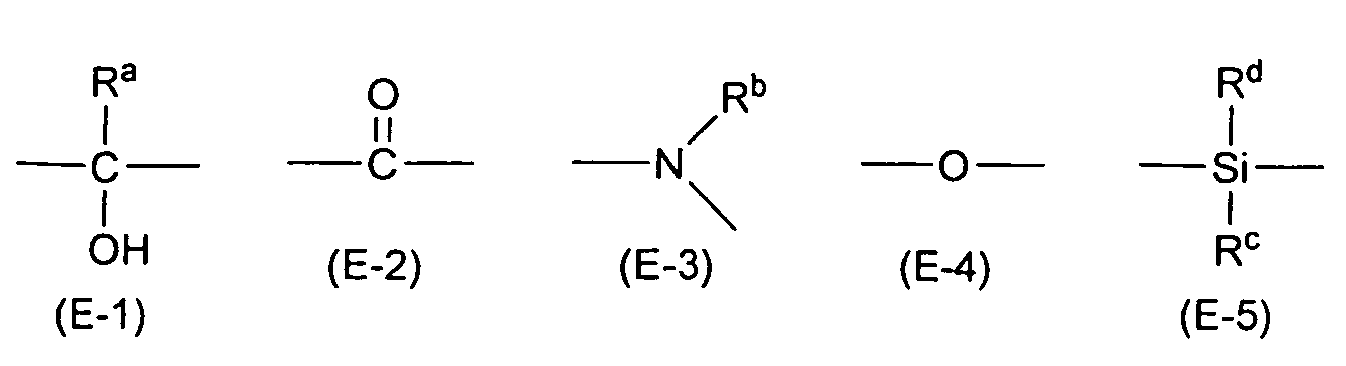
  • R a , R e , R f and R g represent an alkyl group having 1 to 50 carbon atoms, an aromatic group having 2 to 60 carbon atoms, an alkoxy group having 1 to 50 carbon atoms, an aryloxy group having 2 to 60 carbon atoms, a hydroxyl group, or a hydrogen atom.
  • R b represents an alkyl group having 1 to 50 carbon atoms, an aromatic group having 2 to 60 carbon atoms, or a hydrogen atom
  • R d and R c represent an alkyl group having 1 to 50 carbon atoms, or an aromatic group having 2 to 60 carbon atoms.
  • R 5 preferably contains a functional group capable of coordinating to a metal atom.
  • the functional group capable of coordinating to a metal atom there are included hydroxyl group, carboxyl group, mercapto group, sulfonic acid group, phosphonic acid group, nitro group, cyano group, ether group, acyl groups, ester groups, amino group, carbamoyl group, acid amide group, phospholyl group, thiophospholyl group, sulfide group, sulfonyl group, pyrrolyl group, pyridyl group, oxazolyl group, isooxazolyl group, thiazolyl group, isothizoyl group, imidazolyl group, pyrazolyl group, pyrazyl group, pyrimidyl group, pyridazyl group, indolyl group, isoindolyl group, carbazolyl group, quinolyl group, isoqun
  • hydroxyl group there are included hydroxyl group, carboxyl group, sulfonic acid group, phosphonic acid group, nitro group, cyano group, ether group, acyl groups, amino group, phospholyl group, thiophospholyl group, sulfonyl group, pyrrolyl group, pyridyl group, oxazolyl group, isooxazolyl group, thiazolyl group, isothizoyl group, imidazolyl group, pyrazolyl group, pyrazyl group, pyrimidyl group, pyridazyl group, indolyl group, isoindolyl group, quinolyl group, isoqunolyl group, 1,8-naphthyridyl group, benzoimidazolyl group, 1H-indazolyl group, quinoxalyl group, quinazolyl group, cinnolyl group, phtalazyl
  • R 5 As a particularly preferable R 5 , the following (R5-1), (R5-2), (R5-3) or (R5-4) can be exemplified, and (R5-1) is particularly preferable.
  • a hydroxyl group in (R5-1) and (R5-2), a pyrazole ring in (R5-3), and a phosphinic group in (R5-4) sometimes become anionic by releasing a proton in coordinating to a metal atom as a ligand.
  • R 1 to R 4 are a divalent group that may be substituted, and may be each independently the same or different.
  • R 1 to R 4 the one similar to the alkylene group, a divalent aromatic group and the divalent organic group containing a hetero atom, and the divalent group that these groups are bonded and combined arbitrarily exemplified in R 5 can be included.
  • R 1 to R 4 As an example of R 1 to R 4 , a methylene group, a 1,1-ethylene group, a 2,2-propylne group, a 1,2-ethylene group and a 1,2-phenylene group are preferable, and a methylene group and a 1,2-ethylene group are more preferable.
  • Z 1 and Z 2 in the formula (1) are selected from a nitrogen atom or a trivalent organic group, and as the trivalent organic group, the following groups are included.
  • R a and R c are the same meanings as described above.
  • Z 1 or Z 2 is a nitrogen atom, and particularly preferable that both are nitrogen atoms.
  • a compound expressed by the foregoing formula (1) is preferably a compound expressed by the formula (2). wherein Ar 1 to Ar 2 , and R 1 to R 5 are the same definitions as in the formula (1), at least one of them has a group having polymeriazable reactive multiple bonds or a group having a polymerizable ring.
  • R 1 to R 5 are the same meanings as in the formula (1).
  • X 1 , X 2 , X 3 and X 4 (hereinafter sometimes denoted as X1 to X 4 ) are selected from a nitrogen atom or CH.
  • Y 1 , Y 2 , Y 3 and Y 4 represent a hydrogen atom, an alkyl group having 1 to 50 carbon atoms, an aromatic group having 2 to 60 carbon atoms, a group having a polymerizable reactive carbon-carbon double bond or a group having a ring-opening polymerizable ring, and at least one of Y 1 to Y 4 is a group having a polymerizable reactive carbon-carbon double bond or a group having a ring-opening polymerizable ring.
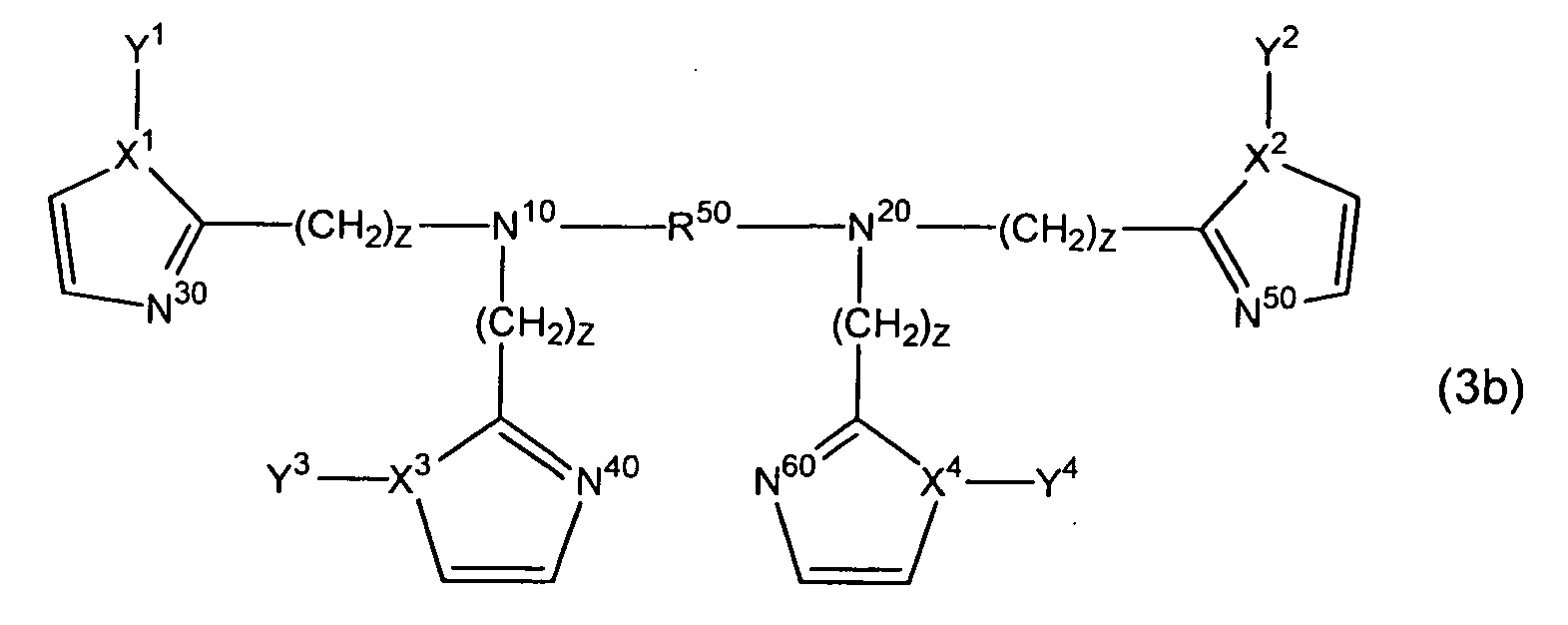
  • a compound expressed by the following formula (3b) or (4b) is easy for production and particularly preferable.
  • X 1 , X 2 , X 3 and X 4 (hereinafter sometimes denoted as X 1 to X 4 ), and Y 1 , Y 2 , Y 3 and Y 4 (hereinafter sometimes denoted as Y 1 to Y 4 ) are the same meanings as in the formula (3a) or (4a).
  • At least one of Y 1 to Y 4 is a group having a polymerizable reactive carbon-carbon double bond or a group having a ring-opening polymerizable ring.
  • Z represents an integer of 1 or 2.
  • N 10 and N 20 represent a nitrogen atom bonding with R 50
  • N 30 , N 40 , N 50 and N 60 (hereinafter sometimes denoted as N 30 to N 60 ) represent a nitrogen atom in an aromatic heterocyclic group.
  • R 50 represents a divalent group having the minimum of a covalent bond linking N 10 and N 20 of 2 or more, and 14 or less.
  • R 50 represents a divalent group having the minimum of a covalent bond linking N 10 and N 20 of 2 or more, and 14 or less.
  • the minimum is 4 in the (R5-1), the minimum is 6 in the (R5-2), the minimum is 6 in the (R5-3), and the minimum is 10 in the (R5-4).
  • a synthesis method of the compound expressed by the formulas (3b) and (4b) can use various methods.
  • a synthetic method of (4b) that includes the following formulas (100) and (200) and where X 1 to X 4 are a nitrogen atom can be included.
  • (4b) having R 50 with various structures of the (R5-1), the (R5-2), the (R5-3) and the (R5-4) can be synthesized.
  • R 100 represents either a hydrogen atom, the alkyl group, or the aromatic group.
  • Z, N 10 , N 20 and R 50 are the same meanings as in the formula (4).
  • a 100 represents any of a chlorine atom, a bromine atom, an iodine atom, a p-toluenesulfonyloxy group, a methylsulfonyloxy group, or a trifluoromethylsulfonyloxy group, which may be the same or different each other.
  • Z, N 10 , N 20 and R 50 are the same meanings as in the formula (100).
  • Y # represents any one of Y 1 to Y 4 in the formula (4b), the same meanings as in the formula (4b).
  • Z is preferably 1, specifically, a compound expressed by the following (3c) or (4c) is preferable.
  • X 1 to X 4 , and Y 1 to Y 4 are the same meanings as in the formula (3a) or (4a), and at least one of Y 1 to Y 4 is a group having a polymerizable reactive carbon-carbon double bond or a group having a ring-opening polymerizable ring.
  • At least one of Y 1 to Y 4 is a group having a polymerizable reactive carbon-carbon double bond or a group having a ring-opening polymerizable ring, and a preferable group, as described above, is a group selected from vinyl group, styryl group, vinylbenzyl group, allyl group, glycidyl group, and oxacyclobutylmethylene group.
  • Y 1 to Y 4 are groups having a polymerizable reactive carbon-carbon double bond or groups having a ring-opening polymerizable ring, it is further preferable that two or more of Y 1 to Y 4 are groups having a polymerizable reactive carbon-carbon double bond, and it is particularly preferable that all of Y 1 to Y 4 are groups having a polymerizable reactive carbon-carbon double bond.
  • a ligand L in a ligand L, four benzoimidazolyl groups are present as an aromatic heterocyclic group containing a coordination atom (Ar 1 to Ar 4 ), in the benzoimidazolyl group, one nitrogen atom as a coordination atom (denoted as N 1 , N 2 , N 3 and N 4 ) bonds to M 1 or M 2 (dotted line bonding M 1 or M 2 represents a coordinate bond), and other nitrogen atoms of this benzoimidazolyl group have a polymerizable reactive allyl group.
  • a coordination atom Ar 1 to Ar 4
  • the ligand L has a methylene group as a group represented by R 1 to R 4 , and a propylene group having an alkolate group being a crosslinking coordination atom (denoted as O 1 ) as R 5 .
  • a multinuclear complex has an acetate ion (having O 2 , O 3 as coordination atoms) as a ligand other than the ligand L, and two molecules of trifluoromethanesulfonate ions as a counter ion.
  • the multinuclear complex having such combinations of coordination atoms is a multinuclear complex having a coordination structure that M1 and M2 are present closely, and such a multinuclear complex is preferable because the catalyst activity is high.
  • a method that a compound giving a ligand L and a transition metal compound are mixed in a solvent can be included.
  • the compound giving a ligand L a precursor compound of the ligand L or a ligand compound, namely, a compound shown by the structure of the ligand itself is included.
  • the transition metal compound is preferably soluble in the solvent.
  • the preferable ligand L the one exemplified above is included.
  • a transition metal salt soluble in a solvent is included.
  • a preferable transition metal in the transition metal salt the one exemplified above is included.
  • Further adding a suitable salt to the complex forming reaction can change counter ions in a complex catalyst into ions derived from the added salt.
  • the preferable added salt contains the preferable counter ions.
  • Mn-bbpr-allyl-OTf Mn-OAc-(bbpr-CH 2 St)-OTf, Mn-vb-(bbpr-CH 2 St)-vb, Mn-vb-(bbpr-CH 2 St)-DBS, Mn-vb- (bbpr-CH 2 St) -HS 20 , Co- (bbpr-CH 2 St)- BPh 4 , Ni-(bbpr-CH 2 St)-BPh 4 , Cu-(bbpr-CH 2 St)-BPh 4 and Fe-(bbpr-CH 2 St)-BPh 4 , and synthetic methods shown in the following formulas (010), (020) and (030).
  • the multinuclear complex of the present invention can obtain a polymer by a polimerizable reactive group or a ring-opening polymerizable ring of the ligand L, and the polymer can become an excellent catalyst in heat stability.
  • the multinuclear complex can also be converted into a copolymer by copolymerizing one or a plurality of kinds of polimerizable monomers, and the copolymer can also become an excellent catalyst in heat stability.
  • reaction conditions in polymerization or copolymerization the reaction can be carried out without a solvent, or can be carried out under the presence of a reaction solvent.
  • a reaction substance needs to be ground as a pretreatment.
  • a multinuclear complex and a polymerizable monomer must be blended by a technique that a mixture of a multinuclear complex and a polymerizable monomer to be copolymerized are ground and mixed, or a technique of removing a solvent after dissolving and mixing a multinuclear complex and a polymerizable monomer in a reaction solvent, and the like.
  • reaction solvent when the polymerization or the copolymerization is carried out in the presence of a reaction solvent, a multinuclear complex and a polymerizable monomer to be added as needed may be dissolved in the reaction solvent, or being not dissolved therein, when the polymerization or the copolymerization is carried out using a reaction solvent, its reaction system may be a homogeneous system or an heterogeneous system.
  • solvents are operable, for example, there are included water, tetrahydrofuran, ether, 1,2-dimethoxyethane, acetonitrile, benzonitrile, acetone, methanol, ethanol, isopropanol, ethylene glycol, 2-methoxyethanol, 1-methyl-2-pyrrolidinone, dimethylformamide, dimethyl sulfoxide, acetic acid, hexane, pentane, benzene, toluene, xylene, dichloromethane, chloroform, carbon tetrachloride and the like.
  • the solvents may be used alone or in combination of two or more kinds.
  • the polymerizable monomer in the copolymerization can use various compounds, for example, there are exemplified monomers having a carbon-carbon double bond or a carbon-carbon triple bond such as acetylene, ethylene, propylene, styrene, 1,3-butadiene, maleimide, N,N'-1,4-phenylenedimaleimide, (meth)arylic acid, sodium (meth)acrylate, (meth)acrylic ester, (meth)acrylonitrile, (meth)acrolein, (meth)acryloamide, vinylpyridine, vinylimidazole, vinylphosphonic acid, vinyltriethoxysilane, p-vinylbenzoic acid, sodium p-styrenesulfonate, p-styrenesulfonic acid, N-vinylpyrrolidone, vinylphenol and divinylbenzene; and ring-opening polymerizable monomers such as pyrrole, furan,
  • the copolymerization is carried out by polymerizing at least one kind of the multinuclear complex with one or more of other polymerizable monomers.
  • the copolymerization can be carried out by combining various polymerizable monomers in various monomer ratios.
  • a polymerization initiation method various techniques such as heat, light, electrolysis, radiation and oxidation can be used, and a radical generation catalyst and a radical initiator may be used. Ion polymerization may also be adopted using a cation generation catalyst or an anion generation catalyst. Among them, thermal polymerization and radical addition polymerization using a radical initiator are preferable.
  • the temperature range of the thermal polymerization is preferably 50°C or more and less than 350°C, more preferably 80°C or more and less than 250°C, and further preferably 80°C or more and less than 200°C.
  • a gas atmosphere in conducting the thermal polymerization the polymerization can be carried out under various gas atmospheres such as helium, argon, hydrogen, air, oxygen, carbon monoxide, water vapor and ammonia, and, nitrogen, helium and argon are preferable.
  • radical initiator there can be used an organic peroxide such as benzoyl peroxide, an inorganic peroxide such as potassium persulfate, or an azo based initiator such as 2,2'-azobisisobutyronitrile.
  • organic peroxide such as benzoyl peroxide
  • inorganic peroxide such as potassium persulfate
  • azo based initiator such as 2,2'-azobisisobutyronitrile
  • the polymerization temperature is determined by a radical generation temperature of a radical initiator used, preferably is 10°C or more, and 180°C or less.
  • the polymerization time differs depending on the kind of polymerizable monomer and the polymerization temperature, but may be from about 0.5 hours to 24 hours.
  • the mode of reaction may be any of bulk polymerization, solution polymerization, suspension polymerization or emulsion polymerization.
  • additives are sometimes used concomitantly, including water-soluble polymers such as polyvinyl alcohol, polyacrylic acid, polymethacrylic acid, gelatin, tragacanth, methyl cellulose and polymethacrylamide; talc, bentonite, sillic acid, diatom earth, clay, BaSO 4 , Al(OH) 3 , CaSO 4 , BaCO 4 , MgCO 3 , Ca(PO 4 ) 2 , CaCO 3 , nonionic surfactants, anionic surfactants, cationic surfactants and ampholytic surfactants, these are used alone or in combination of two or more kinds.
  • a chain transfer agent can be also used concomitantly, including mercaptans such as t-dodecylmercaptan (TDM), n-dodecylmercaptan and n-octylmercaptan; ⁇ -methylstyrene dimer ( ⁇ MSD) and terpinolenes.
  • TDM t-dodecylmercaptan
  • ⁇ MSD ⁇ -methylstyrene dimer
  • terpinolenes terpinolenes.
  • the polymer obtained by polymerizing a multinuclear complex or the copolymer obtained by the multinuclear complex and other polymerizable monomer can be subjected to processing such as grinding, if necessary.
  • processing such as grinding, if necessary.
  • grinding manner grinding by a mortar, a agate mortar, a ball mill, a jet mill, a fine mill, a disc mill a hammer mill and the like can be included.
  • the multinuclear complex thus obtained the polymer obtained by polymerizing the multinuclear complex, or the copolymer obtained by the multinuclear complex and other polymerizable monomer exhibits a unique catalyst activity of the multinuclear complex itself and an excellent stability, particularly heat stability, and it can be suitably used as a redox catalyst and the like.
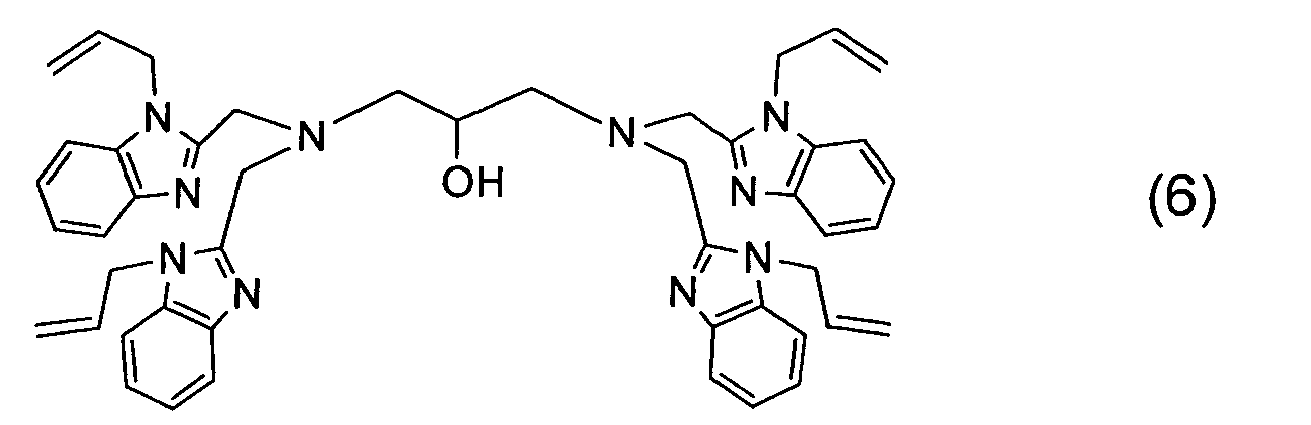
  • bbpr-allyl ligand A compound expressed by the following formula (6) (hereinafter called bbpr-allyl ligand) was synthesized in accordance with a synthesis of HL-Et ligand described in J. Am. Chem. Soc. 1984, 106, pp. 4765-4772 . Namely, 2-Hydroxy-1,3-diaminopropane tetraacetic acid and o-diaminobenzene were reacted, then allylated using allyl chloride, thus to obtain bbpr-allyl ligand in a 71% yield.
  • Fig. 1 shows a 1 H-NMR chart.
  • a ligand expressed by the following formula (7) can be produced in the same manner as Production example 1 in accordance with a synthesis of HL-Et ligand described in J. Am. Chem. Soc. 1984, 106, pp. 4765-4772 , using epichlorohydrin in place of allyl chloride of Production example 1.
  • Mn-(bbpr-allyl)-OTf A multinuclear complex (hereinafter called Mn-(bbpr-allyl)-OTf) was synthesized in accordance with a method described in J. Am. Chem. Soc. 1994, 116, pp. 891-897 . Namely, the bbpr-allyl ligand obtained in Production example 1 was mixed with manganese acetate tetrahydrate in an aqueous alcohol solution containing acetic acid and sodium acetate, further mixed with sodium triflate to obtain Mn-bbpr-allyl-OTf (yield 80%). Element analysis, Calculated for C 51 H 52 F 6 Mn 2 N 10 O 9 S 2 : C, 49.52; H, 4.24; N, 11.32; Found: C, 49.55; H, 4.37; N, 11.71.
  • Mn-(bbpr-allyl)-OTf 30.1 mg, 0.024 mmol
  • PDM N,N'-1,4-phenylenedimaleimide
  • Apparatus Rigaku TG8101D TAS200 Gas atmosphere: nitrogen Temperature range: 40°C to 300°C Rising speed: 10°C/min
  • Sample container open-type sample container made of aluminum ( ⁇ 5.2 mm, H 5.0 mm, 100 ⁇ l) Amount of sample: the mixture 16 ⁇ 2 mg/the sample container.
  • (Mn-(bbpr-allyl)-OTf/PDM) copolymer was obtained.
  • the manganese element analysis of the copolymer was conducted (sulfuric acid/nitric acid decomposition -hydrochloric acid dissolution- ICP optical emission spectrometry) to find the content of manganese of 4.21 wt%.
  • a solution (1.00 ml) of poly(sodium 4-styrenesulfonate) (commercial product of Aldrich, weight-average molecular weight: about 70, 000) dissolved in tartaric acid/sodium tartarate buffer solution (prepared with 0.20 mol/l aqueous tartaric acid solution and 0.10 mol/l aqueous sodium tartarate solution, pH 4.0) to a polymer concentration of 21.1 mg/ml was added to the flask, subsequently ethylene glycol (1.00 ml) was added and stirred. This was used as a catalyst mixed solution.
  • a septum was equipped to one neck of the two-neck flask containing this catalyst mixed solution, and the other neck was connected to a gas bullet. After this flask was stirred at 80°C for 5 minutes as heat treatment before reaction, aqueous hydrogen peroxide solution (11.4 mol/l, 0.20 ml (2.28 mmol)) was added with a syringe, and hydrogen peroxide decomposition reaction was conducted at 80°C for 20 minutes. Oxygen being generated was measured with the gas bullet, and the quantity of decomposed hydrogen peroxide was measured.
  • the measured volume (v) that the generated oxygen was measured with the gas bullet was converted to the conditions of 0°C, 101325 Pa (760 mmHg) by Numerical expression 1 taking atmospheric pressure and water vapor pressure into consideration, thereby obtaining a gas yield (V).
  • V 273 ⁇ v ⁇ P - p / [ 760 ⁇ 273 + t ] in the Numerical expression 1, represented are P: atmospheric pressure (mmHg), p: vapor pressure of water (mmHg), t: temperature (°C), v: measured volume (ml), V: volume (ml) at 0°C, 101325 Pa (760 mmHg).
  • Fig. 2 shows variation with time of the amount of oxygen generated (elapsed time is t).
  • the filtrate was subjected to GPC measurement (GPC analysis conditions are as follows), and the weight-average molecular weight of poly(sodium 4-styrenesulfonate) after the test was obtained.
  • Table 1 shows the result of weight-average molecular weights.
  • the weight-average molecular weight of poly(sodium 4-styrenesulfonate) (21.1 mg, commercial product of Aldrich) was measured in the same manner as the GPC analysis conditions.
  • Example 3 From Table 1, the weight-average molecular weight of poly(sodium 4-styrenesulfonate) coexisted in Example 3 was almost the same as that in the product before the test. From this fact, it was made clear that the catalyst of Example 3 suppressed the generation of free radicals and decomposed hydrogen peroxide.
  • Example 3 The same test as Example 3 was conducted in the same manner except that the heat treatment before reaction was set to a stirring condition at 80°C for 60 minutes.
  • Fig. 2 shows variation with time of the converted amount of oxygen generated, and Table 1 shows the weight-average molecular weight after the test.
  • the hydrogen peroxide decomposition test was conducted using the copolymer obtained in Example 2 as a catalyst, as a result, it was made clear that the catalyst has high heat-stability since the catalyst activity is not deteriorated at all even being subjected to hot water pretreatment for 1 hour.
  • Example 4 From Table 1, the weight-average molecular weight of poly(sodium 4-styrenesulfonate) coexisted in Example 4 was almost the same as that in the product before the test. From this fact, it was made clear that the catalyst of Example 4 which was subjected to hot water pretreatment for 1 hour suppressed the generation of free radicals and decomposed hydrogen peroxide. Table 1 Sample Weight-average molecular weight Example 3 (Heat treatment before reaction: 5 min) 1.0 ⁇ 10 5 Example 4 (Heat treatment before reaction: 60 min) 9.6 ⁇ 10 4 Product before test 1.1 ⁇ 10 5
  • binuclear manganese complex of the ligand L having an epoxy ring can be obtained in the same manner as in Example 1.
  • a bbpr-CH 2 St ligand expressed by the following formula (8) was obtained in a 85% yield in accordance with a synthesis of HL-Et ligand described in J. Am. Chem. Soc. 1984, 106, pp. 4765-4772 , in the same manner as Production example 1 using 4-chloromethylstyrene in place of allyl chloride. It was measured by 1 H-NMR (0.05% (v/v) TMS CDCL 3 solution), as a result, introduction of a -CH 2 St group was confirmed by a peak of 5 to 8 ppm.
  • Fig. 3 shows a 1 H-NMR chart.
  • the gel-like copolymer taken out was ground with a hammer and an agate mortar to obtain a light yellow powder (1.29 g, yield: the content of manganese is 0.775 ⁇ mol/mg provided that manganese in a starting material is contained by 100%).
  • the copolymer catalyst obtained in Example 8 (21.6 mg, 20.0 ⁇ mol (per one manganese atom, calculated by the content of manganese)) as a hydrogen peroxide decomposition catalyst, and tartaric acid/sodium tartarate buffer solution (2.00 ml, prepared by 0.20 mol/l aqueous tartaric acid solution and 0.10 mol/l aqueous sodium tartarate solution; pH 4.0) were weighed in a two neck flask. This was used as a catalyst mixed solution.
  • Example 9 The same test as Example 9 was conducted in the same manner except that the heat treatment before reaction was set to the stirring condition at 80°C for 6 hours.
  • Fig. 4 shows variation with time of the converted amount of oxygen generated.
  • the hydrogen peroxide decomposition test was conducted using the copolymer obtained in Example 8 as a catalyst, as a result, it was made clear that deterioration of catalyst activity was small even being subjected to hot water pretreatment for 6 hours and the catalyst had high heat-stability.
  • Mn-vb-(bbpr-CH 2 St)-vb 500 mg, 0.308 mmol
  • sodium n-dodecylbenzenesulfonate (215 mg, 0.616 mmol) were each weighed, and dissolved in tetrahydrofuran (30 ml). This was stirred for 2 hours, and then the solvent was removed under reduced pressure. The resulting residue was washed with hexane and water, and then dried in vacuum, thereby obtaining Mn-vb-(bbpr-CH 2 St) -DBS expressed by the following formula (11) having two n-dodecylbenzenesulfonates as counter anions. Yield 481 mg (0.242 mmol, 62%).
  • Mn-vb-(bbpr-CH 2 St)-DBS 100 mg, 0.0509 mmol
  • methacrylonitrile 166 mg, 2.47 mmol
  • methacrolein 95.1 mg, 0.730 mmol
  • toluene 150 mg
  • Aquaron HS-10 169 mg, manufactured by Daiichi Kogyo Seiyaku Co., Ltd
  • 2, 2' -azobis 2, 4-dimethylvaleronitrile
  • bbpr-CH 2 St (1.46 g, 1.36 mmol), diisopropylethylamine (0.160 g, 1.24 mmol) and cobalt acetate tetrahydrate (0.686 mg, 2.75 mmol) were each weighed, and dissolved in dimethyl sulfoxide (50 ml). This was stirred for 1 hour, and then sodium tetraphenylborate (0.941 mg, 5.50 mmol) was added thereto, and stirred for 30 minutes.
  • Ni-(bbpr-CH 2 St)-BPh 4 expressed by the following formula (13) was obtained. Yield 2.55 g (62%).
  • ESI Ms [M-(BPh 4 )] + 1568.5.
  • the multinuclear complex of the present invention and the polymer obtained by polymerizing the multinuclear complex are useful as a redox catalyst, in particular, when the polymer and the copolymer are used as a hydrogen peroxide decomposition catalyst, it is possible to decompose hydrogen peroxide into water and oxygen while suppressing the generation of free radicals, in comparison with the multinuclear complex catalyst disclosed so far, showing significantly high stability.
  • a catalyst can be used in applications such as an antidegradant for polyelectrolyte type fuel cells and water electrolysis equipment, an antioxidant for medicines, agricultural chemicals and foods.

Landscapes

  • Chemical & Material Sciences (AREA)
  • Organic Chemistry (AREA)
  • Engineering & Computer Science (AREA)
  • Materials Engineering (AREA)
  • Chemical Kinetics & Catalysis (AREA)
  • Health & Medical Sciences (AREA)
  • Polymers & Plastics (AREA)
  • Medicinal Chemistry (AREA)
  • Inorganic Chemistry (AREA)
  • Life Sciences & Earth Sciences (AREA)
  • Biochemistry (AREA)
  • General Health & Medical Sciences (AREA)
  • Molecular Biology (AREA)
  • Catalysts (AREA)
  • Addition Polymer Or Copolymer, Post-Treatments, Or Chemical Modifications (AREA)

Abstract

To provide a multinuclear complex including at least one ligand L satisfying the following requirements (i), (ii) and (iii), and a plurality of metal atoms in a molecule: (i) having a group having polymerizable reactive multiple bonds, and/or a ring-opening polymerizable ring, (ii) having five or more coordination atoms bonding to the metal atoms, and (iii) being soluble in a solvent.

Description

    TECHNICAL FIELD
  • The present invention relates to a multinuclear complex containing a group having polymerizable multiple bonds and/or a ring-opening polymerizable ring, and a polymer that the multinuclear complex is polymerized. It further relates to a multinuclear complex or a polymer of the multinuclear complex suitable for a redox catalyst.
  • BACKGROUND ART
  • As described in "Comprehensive dictionary on Chemistry" (first edition, 1994, Tokyo Kagaku Dozin Co., Ltd.), a multinuclear complex means one that contains two or more metal atoms as a central atom in one complex, and since it has an unusual, multiple reactivity based on interactions between a plurality of metal sites, it is a complex capable of being a unique catalyst for reaction, above all, it is used in an application of catalyst related to a chemical reaction involving electron transfer such as a redox catalyst (see for example, Hyomen 2003, 41 (3), 22 by Oyaizu Kenichi and Yuasa Makoto). As one example thereof, there is known an example using a binuclear manganese complex as a catalyst for decomposing hydrogen peroxide into water and oxygen (hydrogen peroxide decomposition catalyst) while suppressing the generation of free radicals (hydroxyl radical, hydroperoxy radical, etc.) in hydrogen peroxide (see A.E. Boelrijk and G.C. Dismukes, Inorg. Chem. 2000, 39, 3020). A catalyst that a metal enzyme was calcined is also known as a multinuclear complex (see for example, Japanese Unexamined Patent Publication No. 2004-217507 ).
  • DISCLOSURE OF THE INVENTION
  • However, when the binuclear manganese complex disclosed so far is used as a hydrogen peroxide decomposition catalyst, stability, in particular, heat stability is not sufficient, and thus a catalyst superior in heat stability has been strongly desired.
  • Further, since a metal enzyme itself is not only expensive, but also is a biological material, its storage stability is poor, and a catalyst using this as a raw material was difficult to obtain production repeatability.
  • An object of the present invention is to provide a multinuclear complex with an excellent heat stability as well as having a unique catalyst activity, in particular, in a hydrogen peroxide decomposition catalyst, to provide a catalyst with more excellent heat stability and having a catalyst ability capable of decomposition into water and oxygen while suppressing the generation of free radicals, and further to provide a novel multinuclear complex being a precursor of the catalyst.
  • In order to solve the above problems, the present inventors have keenly made efforts to find a technique which can improve the distance between a plurality of metal atoms and heat stability of conformation, and as a result, have found that a polymer or copolymer obtained by polymerizing a multinuclear complex having a specific ligand has a high stability without lowering a reaction activity as a redox catalyst, and thus completed the present invention. Namely, the present invention provides multinuclear complexes described in the following [1] to [8].
    1. [1] A multinuclear complex including at least one ligand L satisfying the following requirements (i), (ii) and (iii), and a plurality of metal atoms:
      1. (i) having a group having polymerizable reactive multiple bonds, and/or a ring-opening polymerizable ring,
      2. (ii) having five or more coordination atoms bonding to the metal atoms, and
      3. (iii) being soluble in a solvent.
    2. [2] The multinuclear complex described in [1], wherein a coordination atom of the ligand L is a nitrogen atom, an oxygen atom, a phosphorous atom or a sulfur atom.
    3. [3] The multinuclear complex described in [1] or [2], wherein a coordination atom of the ligand L contains a nitrogen atom having a double bond with carbon.
    4. [4] The multinuclear complex described in any one of [1] to [3], wherein the total of metal atoms contained in a molecule is 8 or less.
    5. [5] The multinuclear complex described in any one of [1] to [4], wherein a metal atom contained in a molecule is a transition metal atom of the first transition element series.
    6. [6] The multinuclear complex described in any one of [1] to [5], wherein two metal atoms in the multinuclear complex are coordinately bonded to the same coordination atom, or have a combination of AM1 and AM2 such that the minimum of a covalent bond linking AM1 and AM2 is 1 or more, and 4 or less, when two metal atoms selected from a plurality of metal atoms are denoted as M1, M2, and coordination atoms bonding to M1 and M2 are denoted as AM1 and AM2, respectively.
    7. [7] The multinuclear complex described in any one of [1] to [6], wherein the ligand L is one, and the metal atoms are two.
    8. [8] The multinuclear complex described in any one of [1] to [7], wherein the molecular weight is 6000 or less.
      Further, as the above ligand L, the present invention provides compounds described in the following [9] to [12] being preferable compounds, and the following [13] having the compounds as a ligand L.
    9. [9] A compound expressed by the following formula (1):
      Figure imgb0001
      wherein Ar1, Ar2, Ar3 and Ar4 (hereinafter sometimes denoted as Ar1 to Ar4) each independently represents an aromatic heterocyclic group having at least one coordination atom, R1, R2, R3, R4 and R5 (hereinafter sometimes denoted as R1 to R5) represent a divalent group, Z1 and Z2 each independently represents a nitrogen atom or a trivalent group; at least one of Ar1 to Ar4 and R1 to R5 has a group having polymerizable reactive multiple bonds, and/or a ring-opening polymerizable ring.
    10. [10] The compound described in [9], expressed by the following formula (2):
      Figure imgb0002
      wherein Ar1 to Ar4, and R1 to R5 are the same meanings as in the formula (1), and at least one of them has a group having polymerizable reactive multiple bonds, and/or a ring-opening polymerizable ring.
    11. [11] The compound described in [10], expressed by the following formula (3a) or (4a):
      Figure imgb0003
      Figure imgb0004

      In the formulas (3a) and (4a), R1 to R5 are the same definitions as in the formula (1). X1, X2, X3 and X4 (hereinafter sometimes denoted as X1 to X4) are selected from a nitrogen atom or CH. Y1, Y2, Y3 and Y4 (hereinafter sometimes denoted as Y1 to Y4) represent a hydrogen atom, an alkyl group having 1 to 50 carbon atoms, an aromatic group having 2 to 60 carbon atoms, a group having a polymerizable reactive carbon-carbon double bond or a group having a ring-opening polymerizable ring, and at least one of Y1 to Y4 is a group having a polymerizable reactive carbon-carbon double bond or a group having a ring-opening polymerizable ring.
    12. [12] The compound described in [11], expressed by the following formula (3b) or (4b):
      Figure imgb0005
      Figure imgb0006

      In the formulas (3b) and (4b), X1, X2, X3 and X4 (hereinafter sometimes denoted as X1 to X4), and Y1, Y2, Y3 and Y4 (hereinafter sometimes denoted as Y1 to Y4) are the same meanings as in the formula (3a) or (4a). At least one of Y1 to Y4 is a group having a polymerizable reactive carbon-carbon double bond or a group having a ring-opening polymerizable ring. Z represents an integer of 1 or 2. N10 and N20 represent a nitrogen atom bonding with R50, and N30, N40, N50 and N60 (hereinafter sometimes denoted as N30 to N60) represent a nitrogen atom in an aromatic heterocyclic group. R50 represents a divalent group having the minimum of a covalent bond linking N10 and N20 of 2 or more, and 14 or less.
    13. [13] The compound described in [12], expressed by the following formula (3c) or (4c):
      Figure imgb0007
      Figure imgb0008

      In the formulas (3c) and (4c), X1 to X4, and Y1to Y4 are the same meanings as in the formula (3a) or (4a), and at least one of Y1 to Y4 is a group having a polymerizable reactive carbon-carbon double bond or a group having a ring-opening polymerizable ring.
    14. [14] The multinuclear complex described in any one of [1] to [8], which has the compound described in any one of [9] to [13] as the ligand L.
      Further, the present invention provides a (co)polymer suitable as a catalyst obtained from the multinuclear complex, and also provides an application as a catalyst. Namely, it provides:
    15. [15] A polymer obtained by polymerizing the multinuclear complex described in any one of [1] to [8] and [14].
    16. [16] A copolymer obtained by copolymerizing at least one kind of the multinuclear complex described in any one of [1] to [8] and [14] with a polymerizable monomer capable of copolymerizing with the multinuclear complex.
    17. [17] A redox catalyst using the multinuclear complex described in any one of [1] to [8] and [14], the polymer described in [15], or the copolymer described in [16].
    BRIEF DESCRIPTION OF THE DRAWINGS
    • Fig. 1 1H-NMR analysis chart of bbpr-allyl ligand in Production example 1
    • Fig. 2 Variation with time of the amount of oxygen generated in Examples 3 and 4
    • Fig. 3 1H-NMR analysis chart of bbpr-CH2St ligand in Production example 3
    • Fig. 4 Variation with time of the amount of oxygen generated in Examples 8 and 9
    BEST MODE FOR CARRYING OUT THE INVENTION
  • Preferable embodiments of the present invention are shown below.
  • The multinuclear complex of the present invention contains a plurality of metal atoms. The metal atoms may be non-charged or charged ions. The number of the metal atoms is preferably 2 or more and 8 or less, more preferably 2 or more and 4 or less, and particularly preferably 2 or 3.
  • The metal atoms are selected from transition metals, and they may be the same or different each other. As a specific example of the transition metals, for example, there can be exemplified transition metals of the first transition element series selected from the group consisting of scandium, titanium, vanadium, chromium, manganese, iron, cobalt, nickel, copper and zinc; yttrium, zirconium, niobium, molybdenum, ruthenium, rhodium, palladium, silver, cadmium, lanthanum, cerium, praseodymium, neodymium, promethium, samarium, europium, gadolinium, terbium, dysprosium, holmium, erbium, thulium, ytterbium, lutetium, hafnium, tantalum, tungsten, rhenium, osmium, iridium, platinum, gold, mercury, actinium, thorium, protactinium, uranium and the like.
  • Preferable are transition metal atoms selected from the transition metal atoms of the first transition element series; zirconium, niobium, molybdenum, ruthenium, rhodium, palladium, silver, lanthanum, cerium, praseodymium, neodymium, promethium, samarium, europium, gadolinium, terbium, dysprosium, holmium, erbium, thulium, ytterbium, lutetium, tantalum, tungsten, rhenium, osmium, iridium, platinum, and gold;
  • More preferable are transition metal atoms selected from the transition metal atoms of the first transition element series; zirconium, niobium, molybdenum, ruthenium, rhodium, palladium, silver, lanthanum, cerium, samarium, europium, ytterbium, lutetium, tantalum, tungsten, rhenium, osmium, iridium, platinum and gold;
  • Further preferable are transition metal atoms of the first transition element series; and
  • Particularly preferable are transition metal atoms selected from vanadium, chromium, manganese, iron, cobalt, nickel and copper, above all, transition metal atoms selected from manganese, iron, cobalt, nickel and copper are preferable.
  • Next, the ligand L is explained.
  • The multinuclear complex of the present invention has at least one ligand L satisfying the requirements (i), (ii) and (iii). The number of the ligands L in the multinuclear complex is preferably 1 or more, and 6 or less, further preferably 1 or more, and 3 or less, especially preferably 1 or 2, and particularly preferably 1. Additionally, when there are a plurality of ligands L in the multinuclear complex, they may be the same or different.
  • The ligand L, as the above requirement (i), has at least one group having polymerizable reactive multiple bonds, and/or one ring-opening polymerizable ring. These groups or rings may be present in plural, and when there is a plurality, these groups or rings may be the same or different.
  • Herein, a group having polymerizable reactive multiple bonds is a group having a carbon-carbon double bond, a carbon-carbon triple bond and a carbon-nitrogen triple bond capable of giving addition polymerization such as radical polymerization (including thermal polymerization, photo polymerization using a photo initiator) and ion polymerization, the group having these multiple bonds may also have a divalent linking group, as the divalent linking group, there are included carboxylgroup, carbonyl group, sulfonyl group, thioxygroup, oxy group, alkylene groups having 1 to 16 carbon atoms, and divalent aromatic groups having 2 to 60 carbon atoms (including a heteroaromatic group) and the like, which may be a divalent group that these divalent groups are linked.
  • Specifically, examples of groups having polymerizable reactive multiple bonds include such as vinyl group, allylgroup, propenyl group, butenyl group, butadienyl group, cyclopentadienyl group, cyclohexenyl group, maleimidegroup, acroyl group, styryl group, vinylbenzyl group, ethynyl group, propynyl group, ethynylphenyl group, cyano group and isonitrile group.
  • Preferable are vinyl group, styryl group, vinylbenzyl group, allyl group, ethynyl group and cyano group, and more preferable are vinyl group, styryl group, vinylbenzyl group, allyl group and cyano group, further preferable are vinyl group, styryl group, vinylbenzyl group and allyl group, which are groups having a carbon-carbon double bond.
  • Further, an alkylene group or an aromatic group related to the divalent linking group may have a monovalent substituent, as the example, there are included hydroxyl group, mercapto group, carboxyl group, phophonic acid group, sulfonic acid group, nitro group, halogeno groups (fluoro group, chloro group, bromo group or iodo group), carbamoyl group, alkyl groups having 1 to 50 carbon atoms, aromatic groups having 2 to 60 carbon atoms (including an aromatic heterocyclic group), alkoxy groups or an alkylthio groups composed of the alkyl groups and oxy groups or thioether groups; aryloxy groups or arylthio groups composed of the aromatic groups and oxy groups or thioether groups; alkyl sulfonyl groups or aryl sulfonyl groups composed of the alkyl groups or the aromatic groups and sulfonyl groups; acyl groups or aryl carbonyl groups composed of the alkyl groups or the aromatic groups and carbonyl group; alkoxy carbonyl groups or aryloxy carbonyl groups composed of the alkyl groups or the aromatic groups and oxy carbonyl group; amino groups that may have the alkyl groups or the aromatic groups, acid amide groups that may have the alkyl groups or the aromatic groups, phosphoryl groups that may have the alkyl groups and/or the aromatic groups, thiophosphoryl groups that may have the alkyl groups and/or the aromatic groups, a silyl groups that has the alkyl groups and/or the aromatic groups and the like.
  • Here, as an example of the alkyl groups having 1 to 50 carbon atoms, there are included alkyl groups that can be obtained by removing one hydrogen atom from a saturate hydrocarbon compound, that is, linear alkyl groups, branched alkyl groups or cycloalkyl groups, such as methyl group, ethyl group, propyl group, isopropyl group, butyl group, isobutyl group, 2,2-dimethyl butyl group, octyl group, decyl group, dodecyl group, hexadecyl group, icosyl group, triacontyl group, pentacontyl group, cyclopentyl group, cyclohexyl group and adamantyl group.
  • The alkyl groups are preferably alkyl groups having 1 to 30 carbon atoms, more preferably alkyl groups having 1 to 16 carbon atoms, and particularly preferably alkyl groups having 1 to 8 carbon atoms.
  • Further, as an example of the aromatic groups (including an aromatic heterocyclic group), there are included aromatic groups that can be obtained by removing one hydrogen atom from an aromatic compound having carbon atoms of about 2 to 60, such as phenyl group, tolyl group, 4-t-butylphenyl group, naphthyl group, furyl group, thiophenyl group, pyrroyl group, pyridyl group, furazanyl group, oxazoyl group, imidazoyl group, pyrazolyl group, pyrazyl group, pyrimidyl group, pyridazyl group, benzoimidazoyl group, triazinyl group and the like.
  • The aromatic groups are preferably aromatic groups having 2 to 30 carbon atoms, more preferably aromatic groups having 2 to 16 carbon atoms, and further preferably aromatic groups having 2 to 10 carbon atoms.
  • Further, the alkyl groups or the aromatic groups may have a substituent such as hydoxy group, mercapto group, carboxylic group, sulfonic group, phosphonic group, nitro group and halogeno group.
  • In addition, the ring-opening polymerizable ring is a ring that gives an active species through any one of α ring-opening, β ring-opening and γ ring-opening generally by a cationic initiator or an anionic initiator.
  • These are rings described in "Polymer synthesis" (written by Furukawa Junji, p. 99 to 103, issued on 20 February, 1987 by Kagaku Dozin Co., Ltd.), such as cyclopropane ring, cyclopropene ring, cyclopropanone ring, cyclopropenone ring, cyclobutene ring, ethylene oxide ring (1,2-epoxy ring), oxetane ring, tetrahydrofuran ring, ethylene sulfide ring, thiethane ring, ethyleneimine ring, trimethyleneimine ring, pyrrolidine ring, piperidine ring, lactone ring and lactam ring.
  • Further, these rings may have a substituent, and as the substituent, there can be included one that is similar to one described as the substituent in the group having polymerizable reactive multiple bonds.
  • Preferable ring-opening polymerizable rings are epoxide ring, oxetane ring, or thiethane ring, and these having alkylene groups as a linking group are further preferable, specifically, there are included epoxy alkylene groups, oxacyclobutyl alkylene groups and thiranyl alkylene groups. In particular, glycidyl group and oxacyclobutyl methylene group are preferable.
  • As described above, though the ligand L has at least one group having a polymerizable reactive multiple bonds or a group having a ring-opening polymerizable ring, when there is a plurality, they may be the same or different, needless to say, may have a group having polymerizable reactive multiple bonds and also a group having a ring-opening polymerizable ring.
  • Among them, the ligand L of the present invention preferably has a group having polymerizable reactive multiple bonds.
  • As described in the requirement (ii), the ligand L of the present invention has 5 of more coordination atoms in a molecule. Here, a coordination atom represents an atom that has an unshared electron pair giving electrons in a vacant orbital of a metal atom and can form a coordinate bond with the metal atom, as described in "Iwanami, Physical and chemical science dictionary, fourth edition" (edited by Kubo Ryougo, et. al, issued on 10 January, 1991, p. 966, by Iwanami Shoten Publisher).
  • The number of coordination atoms present in the ligand L is preferably 5 or more and 20 or less, more preferably 5 or more and 12 or less, and further preferably 7 or more and 10 or less.
  • Further, for metal atoms in the multinuclear complex of the present invention, the number of coordinate bond with the ligand L is each preferably 3 or more, more preferably 3 or more, and 20 or less, further preferably 3 or more, and 7 or less, more further preferably 4 or more, and 6 or less, and particularly preferably 4 or 5.
  • The coordination atom is preferably an atom selected from the group consisting of a carbon atom, a nitrogen atom, an oxygen atom, a phosphorus atom and a sulfur atom, and more preferably a nitrogen atom, an oxygen atom, a phosphorus atom or a sulfur atom, above all, a nitrogen atom, an oxygen atom or a sulfur atom is preferable, a nitrogen atom or an oxygen atom is particularly preferable. Additionally, a plurality of coordination atoms may be the same or different each other.
  • As shown in the requirement (iii), the ligand L itself, namely, a compound which can be a ligand L is soluble in a solvent. According to the above, it is preferable because production of the multinuclear complex itself of the present invention becomes easy. In addition the solvent is not particularly limited, and a solvent which gives a complex reaction smoothly to obtain a multinuclear complex easily is preferable.
  • Further, for coordination atoms in the ligand L of the present invention, a part or whole thereof is preferably a nitrogen atom having a double bond with carbon. Containing such nitrogen atom as a coordination atom is preferable because redox catalyst activity, particularly, catalyst activity in peroxide decomposition reaction is superior.
  • Herein, a nitrogen atom having a double bond with carbon, for example, includes such as a nitrogen atom of an imino group obtained by condensation of a carbonyl group of a ketone compound or an aldehyde compound with an amine compound, and a nitrogen atom of an aromatic heterocyclic ring having a carbon-nitrogen double bond.
  • Having the aromatic heterocyclic ring having a carbon-nitrogen double bond in a ligand L means that a monovalent or multivalent aromatic heterocyclic group obtained by removing one or more hydrogen atoms from an aromatic heterocyclic molecule or a condensed ring molecule containing these aromatic heterocyclic molecule are present in the ligand L.
  • The aromatic heterocyclic group may have a substituent.
  • As the aromatic heterocyclic molecule, an aromatic heterocyclic molecule such as imidazole, pyrazole, 2H-1,2,3-triazole, 1H-1,2,4-triazole, 4H-1,2,4-triazole, 1H-tetrazole, oxazole, isooxazole, thiazole, isothiazole, furazan, pyridine, pyrazine, pyrimidine, pyridazine, 1,3,5-triazine, 1,3,4,5-tetrazine is exemplified.
  • Further, as the condensed ring molecule containing the aromatic heterocyclic molecules, benzoimidazole, 1H-indazole, benzooxazole, benzothiazole, quinoline, isoquinoline, cinnoline, quinazoline, quinoxaline, phthalazine, 1,8-naphthylidine, pteridine, phenanthridine, 1,10-phenanthroline, purine, perimidine and the like are exemplified.
  • Herein, a condensed ring represents a ring structure that each ring shares 2 or more atoms in a ring compound having 2 or more rings, as described in "Comprehensive dictionary on Chemistry" (first edition, 1994, Tokyo Kagaku Dozin Co., Ltd.).
  • Among the aromatic heterocyclic groups exemplified, preferable is a monovalent or multivalent aromatic heterocyclic group obtained by removing one or more hydrogen atoms from an aromatic heterocyclic molecule or the condensed ring molecule, such as imidazole, pyrazole, pyridine, pyrazine, pyrimidine, benzoimidazole, 1H-indazole, quinoline, isoquinoline, cinnoline, phthalazine, 1,8-naphthylidine and purine.
  • Herein, in the case where there is a substituent in the aromatic heterocyclic group, those that are similar to the exemplification of the group having polymeriazable reactive multiple bonds can be included. The position of a substituent is arbitrary, the number of substituents and the combinations thereof are arbitrary.
  • Among them, an aromatic heterocyclic group is preferable as the group containing a carbon-nitrogen double bond.
  • The multinuclear complex of the present invention may have other ligand in addition to the ligand L. Other ligand may be an ionic or an electrically neutral compound, and when it has a plurality of such other ligands, these other ligands may be the same or different.
  • As an electrically neutral compound in the other ligand, there are exemplified: a nitrogen atom-containing compound such as ammonia, pyridine, pyrrole, pyridazine, pyrimidine, pyrazine, 1,2,4-triazine, pyrazole, imidazole, 1,2,3-triazole, oxazole, isooxazole, 1,3,4-oxadiazole, thiazole, isothiazole, indole, indazole, quinoline, isoquinoline, phenanthridine, cinnoline, phthalazine, quinazoline, quinoxaline, 1,8-naphthylidine, acridine, 2,2'-bipyridine, 4,4'-bipyridine, 1,10-phenanthroline, ethylenediamine, propylenediamine, phenylenediamine, cyclohexanediamine, pyridine N-oxide, 2,2'-bipyridine N,N'-dioxide, oxamide, dimethyl glyoxime and o-aminophenol; an oxygen atom-containing compound such as water, phenol, oxalic acid, catechol, salicylic acid, phthalic acid, 2,4-pentanedione, 1,1,1-trifluoro-2,4-pentanedione, hexafluoropentanedione, 1,3-diphenyl-1,3-propanedione, 2,2'-binaphthol; a sulfur-containing compound such as dimethyl sulfoxide and urea; and a phosphorous-containing compound such as 1,2-bis(dimethylphosphino)ethane and 1,2-phenylenebis(dimethylphosphine).
  • Preferable are ammonia, pyridine, pyrrole, pyridazine, pyrimidine, pyrazine, 1,2,4-triazine, pyrazole, imidazole, 1,2,3-triazole, oxazole, isooxazole, 1,3,4-oxadiazole, indole, indazole, quinoline, isoquinoline, phenanthridine, cinnoline, phthalazine, quinazoline, quinoxaline, 1,8-naphthylidine, acridine, 2,2'-bipyridine, 4,4'-bipyridine, 1,10-phenanthroline, ethylenediamine, propylenediamine, phenylenediamine, cyclohexanediamine, pyridine N-oxide, 2,2'-bipyridine N,N'-dioxide, oxamide, dimethyl glyoxime, o-aminophenol, water, phenol, oxalic acid, catechol, salicylic acid, phthalic acid, 2,4-pentanedione, 1,1,1-trifluoro-2,4-pentanedione, hexafluoropentanedione, 1,3-diphenyl-1,3-propanedione and 2,2'-binaphthol;
  • More preferable are ammonia, pyridine, pyrrole, pyridazine, pyrimidine, pyrazine, 1,2,4-triazine, pyrazole, imidazole, 1,2,3-triazole, oxazole, isooxazole, 1,3,4-oxadiazole, indole, indazole, quinoline, isoquinoline, phenanthridine, cinnoline, phthalazine, quinazoline, quinoxaline, 1,8-naphthylidine, acridine, 2,2'-bipyridine, 4,4'-bipyridine, 1,10-phenanthroline, ethylenediamine, propylenediamine, phenylenediamine, cyclohexanediamine, pyridine N-oxide, 2,2'-bipyridine N,N'-dioxide, o-aminophenol, phenol, catechol, salicylic acid, phthalic acid, 1,3-diphenyl-1,3-propanedione, and 2,2'-binaphthol.
  • Among them, further preferable are pyridine, pyrrole, pyridazine, pyrimidine, pyrazine, pyrazole, imidazole, oxazole, indole, quinoline, isoquinoline, acridine, 2,2'-bipyridine, 4,4'-bipyridine, 1,10-phenanthroline, phenylenediamine, pyridine N-oxide, 2,2'-bipyridine N,N'-dioxide, o-aminophenol and phenol.
  • Further, as an anionic ligand, there are included hydroxide ion, peroxide, super oxide, cyanide ion, thiocyanate ion, halide ions such as fluoride ion, chloride ion, bromide ion and iodide ion; sulfate ion, nitrate ion, carbonate ion, perchlorate ion, tetrafluoroborate ion, tetraarylborate ions such as tetraphenylborate ion, hexafluorophosphate ion, sulfonate ions such as methanesulfonate ion, trifluoromethanesulfonate ion, p-toluenesulfonate ion, benzenesulfonate ion and dodecylbenzenesulfonate ion, dodecylsulfate ion, phosphate ion, phosphite ion, phenylphosphonate ion, diphenylphosphonate ion, acetate ion, trifluoroacetate ion, propionate ion, benzoate ion, hydroxy ion, metal oxide ions, methoxide ion, ethoxide ion, vinylbenzoate ion, acrylate ion, methacrylate ion and the like.
  • Preferably, there are exemplified hydroxide ion, sulfate ion, nitrate ion, carbonate ion, perchlorate ion, tetrafluoroborate ion, tetraphenylborate ion, hexafluorophosphate ion, methanesulfonate ion, trifluoromethanesulfonate ion, p-toluenesulfonate ion, benzenesulfonate ion and dodecylbenzenesulfonate ion, phosphate ion, phosphite ion, phenylphosphonate ion, diphenylphosphonate ion, acetate ion, trifluoroacetate ion, vinylbenzoate ion, acrylate ion and methacrylate ion.
  • Among them, preferable are hydroxide ion, sulfate ion, nitrate ion, carbonate ion, tetraphenylborate ion, trifluoromethanesulfonate ion, p-toluenesulfonate ion, acetate ion, trifluoroacetate ion, vinylbenzoate ion, acrylate ion and methacrylate ion.
  • Further, the ions exemplified as the anionic ligand may act as a counter ion to electrically neutralize the multinuclear metal complex itself of the present invention.
  • In addition, there is a case that the multinuclear complex of the present invention has a cationic counter ion for maintaining electrical neutrality. As the cationic counter ion, alkali metal ions, alkaline earth metal ions, tetraalkylammonium ions such as tetra (n-butyl) ammonium ion and tetraethylammonium ion, and tetraarylphosphonium ions such as tetraphenylammonium ion are exemplified, specifically, there are included lithium ion, sodium ion, potassium ion, rubidium ion, cesium ion, magnesium ion, calcium ion, strontium ion, barium ion, tetra(n-butyl)ammonium ion, tetraethylammonium ion and tetraphenylphosphonium ion; and more preferably tetra(n-butyl)ammonium ion, tetraethylammonium ion and tetraphenylphosphonium ion,
  • Among them, tetra(n-butyl)ammonium ion and tetraethylammonium ion are preferable as a cationic counter ion.
  • Additionally, using various counter ions suitably can also adjust such as solubility or dispersibility of a multinuclear complex in a solvent.
  • The multinuclear complex of the present invention has a plurality of metal atoms, and one or more of the ligands L described above, in particular, it is preferable that at least 2 metal atoms of a plurality of metal atoms are located closely in a molecule.
  • In this case, as an index that metal atoms are located closely, when the two metal atoms are denoted as M1, M2, and coordination atoms bonding to M1 and M2 are denoted as AM1 and AM2, respectively, they preferably have a combination of AM1 and AM2 such that the minimum of a covalent bond linking AM1 and AM2 is 4 or less. The minimum is more preferably 3 or less, further preferably 2 or less, and particularly preferably 1.
  • Particularly preferably, it is a multinuclear complex that two metal atoms (M1, M2) selected from the plurality of metal atoms form a coordinate bond with the same coordination atom. This means that M1 and M2 are crosslinked coordinatively with the same coordination atom. According to the above, the distance between M1 and M2 becomes small, and an interaction of between two metal atoms tends to be exhibited, and thus a catalyst activity of the multinuclear complex becomes higher.
  • The M1 and M2 may also both be coordination atoms present in the ligand L, or may both be coordination atoms present in a ligand other than the ligand L.
  • In the multinuclear complex, coordination atoms crosslink-bonding to two metal atoms may also be coordination atoms of the ligand L or coordination atoms in a ligand other than the ligand L.
  • In addition, the multinuclear complex of the present invention preferably has a molecular weight of 6000 or less. It is preferable because synthesis of a multinuclear complex itself is easy if it is within such molecular weight range. The molecular weight is more preferably 5000 or less, further preferably 4000 or less, and particularly preferably 2000 or less.
  • Further, the lower molecular weight of a multinuclear complex is preferable because operations become simple in polymerization or copolymerization of the multinuclear complex described later.
  • Next, preferable compounds as a ligand L related to the multinuclear complex of the present invention will be explained. The ligand L, as previously described, preferably contains a nitrogen atom on a carbon-nitrogen double bond as a coordination atom, and in particular, more preferably has a nitrogen atom on the carbon-nitrogen double bond in an aromatic heterocyclic group.
  • In this way, the ligand L having a nitrogen atom on a carbon-nitrogen double bond as a coordination atom can be exemplified by a ligand that a hydrogen atom in the compound described in a document (Anna L. Gavrilova and Brice Bosnich, Chem. Rev. 2004, 104, 349.), that is, Ligand Numbers 52 to 55, 56a, 56b, 56c, 57a, 57b, 57c, 57d, 58a, 58b, 58c and 60 in Table 5 (p. 357) ; Ligand Numbers 73 and 74 in Table 7 (p. 360) ; Ligand Numbers 79, 80, 83 and 85 in Table 8 (p. 362); Ligand Numbers 90, 91 and 92 in Table 9 (p. 364); Ligand Numbers 100 to 103, 105 to 108, 110, 111, and 113 to 118 in Table 10 (p. 366); Ligand Numbers 123 to 126, 129, 131, 132, 134 to 138, and 141 to 147 in Table 11 (p. 370 to 371); Ligand Numbers 151, 152, and 154 to 157 in Table 12 (p. 373); Ligand Numbers 166 and 167 in Table 13 (p. 376) ; Ligand Number 174 in Table 14 (p. 377); and Ligand Numbers 177 and 179 in Table 15 (p. 378) described in (Anna L. Gavrilova and Brice Bosnich, Chem. Rev. 2004, 104, 349.) was substituted with the group having polymerizable reactive multiple bonds and/or a group containing a ring-opening polymerizable ring.
  • Among the above exemplifications, as a particularly preferable ligand, one having an aromatic heterocyclic group containing a carbon-nitrogen double bond is preferable, which can be exemplified by a ligand that a hydrogen atom in the compound expressed by Ligand Numbers 52 to 55, 56a, 56b, 56c, 57a, 57b, 57c, 57d, 58a, 58b, 58c and 60 in Table 5 (p. 357); Ligand Numbers 73 and74 in Table 7 (p. 360) ; Ligand Numbers 79, 80, 83 and 85 in Table 8 (p.362); Ligand Numbers 90, 91 and 92 in Table 9 (p. 364); Ligand Numbers 100, 101, 106 to 108, 110, 111 and 113 to 118 in Table 10 (p. 366); Ligand Numbers 123, 124, 126, 129, 131, 132, 134 to 138 and 141 to 147 in Table 11 (p. 370 to 371); Ligand Numbers 155 to 157 in Table 12 (p. 373); Ligand Number 174 in Table 14 (p. 377); and Ligand Numbers 177 and 179 in Table 15 (p. 378) was substituted with the group having polymerizable reactive multiple bonds and/or a group containing a ring-opening polymerizable ring.
  • The ligand L related to the multinuclear complex of the present invention preferably has the aromatic heterocyclic group described above and a molecular weight of 6000 or less, and from such viewpoints, in particular, a compound expressed by the following formula (1) is preferable:
    Figure imgb0009
    wherein Ar1, Ar2, Ar3 and Ar4 (hereinafter sometimes denoted as Ar1 to Ar4) each independently represents an aromatic heterocyclic group, R1, R2, R3, R4 and R5 (hereinafter sometimes denoted as R1 to R5) represent a divalent linking group, Z1 and Z2 each independently represents a nitrogen atom or a trivalent group; at least one of Ar1 to Ar4 and R1 to R5 has a group having polymerizable reactive multiple bonds, and/or a ring-opening polymerizable ring.
  • Herein, Ar1 to Ar4 are preferably the aromatic heterocyclic groups exemplified above, for example, there can be exemplified imidazolyl group, pyrazolyl group, 2H-1,2,3-triazolyl group, 1H-1,2,4-triazolyl group, 4H-1,2,4-triazolyl group, 1H-tetrazolyl group, oxazolyl group, isooxazolyl group, thiazolyl group, isothiazolyl group, furazyl group, pyridyl group, pyradyl group, pyrimidyl group, pyridazyl group, 1,3,5-triazyl group and 1,3,4,5-tetrazyl group.
  • As an aromatic heterocyclic ring, they may also be a condensed ring group thereof for example, there can be exemplified benzoimidazoyl group, 1H-imidazoyl group, benzooxazoyl group, benzothiazoyl group, quinolyl group, isoquinolyl grouop, cinnolyl group, quinazoyl group, quinoxalyl group, phtahlazyl group, 1,8-naphthylidyl group, pteridyl group, carbazolyl group, phenanthridyl group, 1,10-phenanthrolyl group, puryl group, and perimidyl group.
  • In addition, these aromatic heterocyclic rings may have a substituent. As an example of the substituent, it is similar to the substituent exemplified in the group having a multiple bond. Further, the substituting position and the number of the substituent, and the combinations thereof are arbitrary. The group having polymerizable reactive multiple bonds or the group having a polymerizable ring may be bonded to the aromatic heterocyclic group.
  • As the aromatic heterocyclic rings Ar1 to Ar4 in the formula (1), preferably, they are benzoimidazoyl group, pyridyl group, imidazoyl group, pyrazoyl group, oxazoyl group, thiazolyl group, isooxazolyl group, isothiazolyl group, pyrazyl group, pyrimidiyl group, pyridazyl group, and N-alkylbenzoimidazoyl groups and N-alkylimidazoyl groups having the alkyl group exemplified above on its nitrogen;
  • More preferable are benzoimidazoyl group, pyridyl group, imidazoyl group, pyrazoyl group, pyrazyl group, pyrimidiyl group, pyridazyl group, N-alkylbenzoimidazoyl groups and N-alkylimidazoyl groups;
  • Further preferable are benzoimidazoyl group, N-alkylbenzoimidazoyl groups, pyridyl group, imidazoyl group, N-alkylimidazoyl groups and pyrazoyl group; and
  • Particularly preferable are pyridyl group, N-alkylbenzoimidazoyl groups and N-alkylimidazoyl groups.
  • R5 is also a divalent group which may have a coordination atom or a group containing a coordination atom, it is selected from an alkylene group, a divalent aromatic group and a divalent organic group containing a hetero atom shown below, and may be a group that these are arbitrarily bonded and combined.
  • As an example of the alkylene group, there are included alkylene groups that are obtained by removing two hydrogen atoms from a saturated hydrocarbon having about 1 to 50 total carbon atoms such as methane, ethane, propane, butane, octane, decane, icosane, triacontane, pentacontane, cycloheptane and cyclohexane.
  • These alkylene groups may also have substituents in any position, the number of the substituents and the combinations thereof are arbitrary, and as the substituents, the ones similar to the exemplifications in the group having polymerizable reactive multiple bonds can be included.
  • Herein, as the alkylene group, the carbon atoms contained are preferably 1 to 30, more preferably 1 to 16, further preferably 1 to 8, and particularly preferably 1 to 4.
  • As an example of the divalent aromatic group, there are included groups that are obtained by removing two hydrogen atoms from an aromatic compound, a heterocyclic compound or a compound having substituents in these compounds such as benzene, naphthalene, anthracene, tetracene, biphenyl, acenaphthylene, phenalene, pyrene, furan, thiophene, pyrrole, pyridine, oxazole, isooxazole, thiazole, isothiazole, imidazole, pyrazole, pyrazine, pyrimidine, pyridazine, benzofuran, isobenzofuran, 1-benzothiophene, 2-benzothiophene, indole, isoindole, indolizine, carbazole, xanthene, quinoline, isoquinoline, 4H-quinolizine, phenanthridine, acrydine, 1,8-naphthyridine, benzoimidazole, 1H-indazole, quinoxaline, quinazoline, cinnoline, phthalazine, purine, pteridine, perimidine, 1,10-phenanthroline, thianthorene, phenoxathiin, phenoxadine, phenothiazine, phenazine and phenarsazine.
  • Among them, preferable are groups that are obtained by removing two hydrogen atoms from a compound selected from benzene, phenol, p-cresol, naphthalene, biphenyl, furan, thiophene, pyrrole, pyridine, oxazole, isooxazole, thiazole, isothiazole, imidazole, pyrazole, pyrazine, pyrimidine, pyridazine, benzofuran, isobenzofuran, 1-benzothiophene, 2-benzothiophene, indole, isoindole, indolizine, carbazole, xanthene, quinoline, isoquinoline, 1,8-naphthyridine, benzoimidazole, 1H-indazole, quinoxaline, quinazoline, cinnoline, phthalazine, purine, pteridine and perimidine;
  • More preferable are groups that are obtained by removing two hydrogen atoms from a compound selected from benzene, naphthalene, biphenyl, pyrrole, pyridine, oxazole, isooxazole, thiazole, isothiazole, imidazole, pyrazole, pyrazine, pyrimidine, pyridazine, indole, isoindole, quinoline, isoquinoline, 1,8-naphthyridine, benzoimidazole, 1H-indazole, quinoxaline, quinazoline, cinnoline and phthalazine
  • Further preferable are groups that are obtained by removing two hydrogen atoms from a compound selected from benzene, phenol, p-cresol, naphthalene, biphenyl, pyrrole, pyridine, imidazole, pyrazole, pyrazine, pyridazine, indole, isoindole, quinoline, isoquinoline, 1,8-naphthyridine, benzoimidazole, 1H-indazole, quinoxaline, quinazoline, cinnoline and phthalazine; and
  • Particularly preferable are groups that are obtained by removing two hydrogen atoms from a compound selected from phenol, p-cresol, pyridine, pyrazole, pyridazine, 1,8-naphthyridine, 1H-indazole and phthalazine.
  • Substituents in these divalent aromatic groups may be located at an arbitrary position, the number and the combinations thereof are arbitrary. As the substituents, the substituents exemplified in the group having polymerizable reactive multiple bonds can be included. Further, as the substituent, it may have the group having polymerizable reactive multiple bonds and/or the group having a ring-opening polymerizable ring of the present invention.
  • As the divalent organic group containing hetero atoms, for example, groups expressed by the following (E-1) to (E-10) are included.
    Figure imgb0010
    Figure imgb0011
    wherein Ra, Re, Rf and Rg represent an alkyl group having 1 to 50 carbon atoms, an aromatic group having 2 to 60 carbon atoms, an alkoxy group having 1 to 50 carbon atoms, an aryloxy group having 2 to 60 carbon atoms, a hydroxyl group, or a hydrogen atom. Rb represents an alkyl group having 1 to 50 carbon atoms, an aromatic group having 2 to 60 carbon atoms, or a hydrogen atom, Rd and Rc represent an alkyl group having 1 to 50 carbon atoms, or an aromatic group having 2 to 60 carbon atoms.
  • As a bifunctional hetero atom functional group of R5, (E-1), (E-2), (E-3), (E-4), (E-5), (E-7), (E-8) and (E-10) are preferable, (E-1), (E-2), (E-4), (E-7) and (E-10) are more preferable, and (E-1) and (E-7) are further preferable.
  • In particular, R5 preferably contains a functional group capable of coordinating to a metal atom. As the functional group capable of coordinating to a metal atom, there are included hydroxyl group, carboxyl group, mercapto group, sulfonic acid group, phosphonic acid group, nitro group, cyano group, ether group, acyl groups, ester groups, amino group, carbamoyl group, acid amide group, phospholyl group, thiophospholyl group, sulfide group, sulfonyl group, pyrrolyl group, pyridyl group, oxazolyl group, isooxazolyl group, thiazolyl group, isothizoyl group, imidazolyl group, pyrazolyl group, pyrazyl group, pyrimidyl group, pyridazyl group, indolyl group, isoindolyl group, carbazolyl group, quinolyl group, isoqunolyl group, 1,8-naphthyridyl group, benzoimidazolyl group, 1H-indazolyl group, quinoxalyl group, quinazolyl group, cinnolyl group, phtalazyl group, puryl group, pteridyl group and permidyl group.
  • Preferably, there are included hydroxyl group, carboxyl group, sulfonic acid group, phosphonic acid group, nitro group, cyano group, ether group, acyl groups, amino group, phospholyl group, thiophospholyl group, sulfonyl group, pyrrolyl group, pyridyl group, oxazolyl group, isooxazolyl group, thiazolyl group, isothizoyl group, imidazolyl group, pyrazolyl group, pyrazyl group, pyrimidyl group, pyridazyl group, indolyl group, isoindolyl group, quinolyl group, isoqunolyl group, 1,8-naphthyridyl group, benzoimidazolyl group, 1H-indazolyl group, quinoxalyl group, quinazolyl group, cinnolyl group, phtalazyl group, puryl group, pteridyl group and permidyl group; more preferably, hydroxyl group, carboxyl group, sulfonic acid group, a phosphonic acid group, cyano group, ether group, acyl groups, amino group, phospholyl group, sulfonyl group, pyridyl group, imidazolyl group, pyrazolyl group, pyrimidyl group, pyridazyl group, quinolyl group, isoqunolyl group, 1,8-naphthyridyl group, benzoimidazolyl group, 1H-indazolyl group, cinnolyl group, phtalazyl group and pteridyl group.
  • As a particularly preferable R5, the following (R5-1), (R5-2), (R5-3) or (R5-4) can be exemplified, and (R5-1) is particularly preferable.
    Figure imgb0012
    Figure imgb0013
  • Herein, a hydroxyl group in (R5-1) and (R5-2), a pyrazole ring in (R5-3), and a phosphinic group in (R5-4) sometimes become anionic by releasing a proton in coordinating to a metal atom as a ligand.
  • In the formula (3), R1 to R4 are a divalent group that may be substituted, and may be each independently the same or different. As an example of R1 to R4, the one similar to the alkylene group, a divalent aromatic group and the divalent organic group containing a hetero atom, and the divalent group that these groups are bonded and combined arbitrarily exemplified in R5 can be included.
  • As an example of R1 to R4, a methylene group, a 1,1-ethylene group, a 2,2-propylne group, a 1,2-ethylene group and a 1,2-phenylene group are preferable, and a methylene group and a 1,2-ethylene group are more preferable.
  • Z1 and Z2 in the formula (1) are selected from a nitrogen atom or a trivalent organic group, and as the trivalent organic group, the following groups are included.
    Figure imgb0014
    Figure imgb0015
    wherein Ra and Rc are the same meanings as described above.
  • Above all, it is preferable that either Z1 or Z2 is a nitrogen atom, and particularly preferable that both are nitrogen atoms. Specifically, a compound expressed by the foregoing formula (1) is preferably a compound expressed by the formula (2).
    Figure imgb0016
    wherein Ar1 to Ar2, and R1 to R5 are the same definitions as in the formula (1), at least one of them has a group having polymeriazable reactive multiple bonds or a group having a polymerizable ring.
  • Among the compounds expressed by the formula (2), a compound expressed by the following formula (3a) or (4a) is further preferable.
    Figure imgb0017
    Figure imgb0018
  • In the formulas (3a) and (4a), R1 to R5 are the same meanings as in the formula (1). X1, X2, X3 and X4 (hereinafter sometimes denoted as X1 to X4) are selected from a nitrogen atom or CH. Y1, Y2, Y3 and Y4 (hereinafter sometimes denoted as Y1 to Y4) represent a hydrogen atom, an alkyl group having 1 to 50 carbon atoms, an aromatic group having 2 to 60 carbon atoms, a group having a polymerizable reactive carbon-carbon double bond or a group having a ring-opening polymerizable ring, and at least one of Y1 to Y4 is a group having a polymerizable reactive carbon-carbon double bond or a group having a ring-opening polymerizable ring.
  • Among the compounds expressed by the formula (3a) or (4a), a compound expressed by the following formula (3b) or (4b) is easy for production and particularly preferable.
    Figure imgb0019
    Figure imgb0020
  • In the formulas (3b) and (4b), X1, X2, X3 and X4 (hereinafter sometimes denoted as X1 to X4), and Y1, Y2, Y3 and Y4 (hereinafter sometimes denoted as Y1 to Y4) are the same meanings as in the formula (3a) or (4a). At least one of Y1 to Y4 is a group having a polymerizable reactive carbon-carbon double bond or a group having a ring-opening polymerizable ring. Z represents an integer of 1 or 2. N10 and N20 represent a nitrogen atom bonding with R50, and N30, N40, N50 and N60 (hereinafter sometimes denoted as N30 to N60) represent a nitrogen atom in an aromatic heterocyclic group. R50 represents a divalent group having the minimum of a covalent bond linking N10 and N20 of 2 or more, and 14 or less.
  • R50 represents a divalent group having the minimum of a covalent bond linking N10 and N20 of 2 or more, and 14 or less. As a specific example, the minimum is 4 in the (R5-1), the minimum is 6 in the (R5-2), the minimum is 6 in the (R5-3), and the minimum is 10 in the (R5-4).
  • A synthesis method of the compound expressed by the formulas (3b) and (4b) can use various methods. As an example thereof, a synthetic method of (4b) that includes the following formulas (100) and (200) and where X1 to X4 are a nitrogen atom can be included. By such a method, (4b) having R50 with various structures of the (R5-1), the (R5-2), the (R5-3) and the (R5-4) can be synthesized.
  • Reaction of a diamine compound having CO2R100 group and o-phenylenediamine:
    Figure imgb0021
    wherein R100 represents either a hydrogen atom, the alkyl group, or the aromatic group. Z, N10, N20 and R50 are the same meanings as in the formula (4).
  • Substitution reaction of N-H bond on a benzoimidazolyl group:
    Figure imgb0022
  • In the figure, A100 represents any of a chlorine atom, a bromine atom, an iodine atom, a p-toluenesulfonyloxy group, a methylsulfonyloxy group, or a trifluoromethylsulfonyloxy group, which may be the same or different each other. Z, N10, N20 and R50 are the same meanings as in the formula (100). Y# represents any one of Y1 to Y4 in the formula (4b), the same meanings as in the formula (4b).
  • In the compound expressed by the formula (3b) or (4b), Z is preferably 1, specifically, a compound expressed by the following (3c) or (4c) is preferable.
    Figure imgb0023
    Figure imgb0024
  • In the formulas (3c) and (4c), X1 to X4, and Y1 to Y4 are the same meanings as in the formula (3a) or (4a), and at least one of Y1 to Y4 is a group having a polymerizable reactive carbon-carbon double bond or a group having a ring-opening polymerizable ring.
  • In the compound expressed by the formula (3b), (4b), (3c) or (4c), at least one of Y1 to Y4 is a group having a polymerizable reactive carbon-carbon double bond or a group having a ring-opening polymerizable ring, and a preferable group, as described above, is a group selected from vinyl group, styryl group, vinylbenzyl group, allyl group, glycidyl group, and oxacyclobutylmethylene group.
  • Herein, it is preferable that two or more of Y1 to Y4 are groups having a polymerizable reactive carbon-carbon double bond or groups having a ring-opening polymerizable ring, it is further preferable that two or more of Y1 to Y4 are groups having a polymerizable reactive carbon-carbon double bond, and it is particularly preferable that all of Y1 to Y4 are groups having a polymerizable reactive carbon-carbon double bond.
  • Based on the document (Anna L. Gavrilova and Brice Bosnich, Chem. Rev. 2004, 104, 349. in Table 10, Ligands Number 110 (p. 366), as a preferable multinuclear complex, for example, a complex expressed by formula (5) can be exemplified.
    Figure imgb0025
  • Herein, in a ligand L, four benzoimidazolyl groups are present as an aromatic heterocyclic group containing a coordination atom (Ar1 to Ar4), in the benzoimidazolyl group, one nitrogen atom as a coordination atom (denoted as N1, N2, N3 and N4) bonds to M1 or M2 (dotted line bonding M1 or M2 represents a coordinate bond), and other nitrogen atoms of this benzoimidazolyl group have a polymerizable reactive allyl group. The ligand L has a methylene group as a group represented by R1 to R4, and a propylene group having an alkolate group being a crosslinking coordination atom (denoted as O1) as R5. Further, a multinuclear complex has an acetate ion (having O2, O3 as coordination atoms) as a ligand other than the ligand L, and two molecules of trifluoromethanesulfonate ions as a counter ion.
  • Additionally, figures inscribed on a nitrogen coordination atom and an oxygen coordination atom are inscribed for distinction in explaining the number of covalent bonds between coordination atoms described below.
  • In a complex expressed by the formula (5), the number of covalent bonds present between coordination atoms each bonding to M1 and M2 will be explained.
  • In the complex in the formula (5);
    between M1-O1-M2, M1 and M2 are crosslinked coordinatively with the same coordination atom O1;
    between M1-O2-O3-M2, the minimum of the number of covalent bonds linking coordination atoms is 2;
    between M1-O1-N6-M2, and between M2-O1-N5-M1, the minimum of the number of covalent bonds linking the coordination atoms is 3; and
    between M1-N5-N6-M2, the minimum of the number of covalent bonds linking coordination atoms is 4.
  • The multinuclear complex having such combinations of coordination atoms is a multinuclear complex having a coordination structure that M1 and M2 are present closely, and such a multinuclear complex is preferable because the catalyst activity is high.
  • As a production method related to the suitable multinuclear complex, a method that a compound giving a ligand L and a transition metal compound are mixed in a solvent can be included. As the compound giving a ligand L, a precursor compound of the ligand L or a ligand compound, namely, a compound shown by the structure of the ligand itself is included. The transition metal compound is preferably soluble in the solvent. As the preferable ligand L, the one exemplified above is included.
  • As the preferable transition metal compound, a transition metal salt soluble in a solvent is included. As a preferable transition metal in the transition metal salt, the one exemplified above is included.
  • Further adding a suitable salt to the complex forming reaction can change counter ions in a complex catalyst into ions derived from the added salt. The preferable added salt contains the preferable counter ions.
  • As the specific production method, there can be exemplified a synthesis method later described of Mn-bbpr-allyl-OTf, Mn-OAc-(bbpr-CH2St)-OTf, Mn-vb-(bbpr-CH2St)-vb, Mn-vb-(bbpr-CH2St)-DBS, Mn-vb- (bbpr-CH2St) -HS20, Co- (bbpr-CH2St)- BPh4, Ni-(bbpr-CH2St)-BPh4, Cu-(bbpr-CH2St)-BPh4 and Fe-(bbpr-CH2St)-BPh4, and synthetic methods shown in the following formulas (010), (020) and (030).
    Figure imgb0026
    Figure imgb0027
    Figure imgb0028
  • The multinuclear complex of the present invention can obtain a polymer by a polimerizable reactive group or a ring-opening polymerizable ring of the ligand L, and the polymer can become an excellent catalyst in heat stability.
  • The multinuclear complex can also be converted into a copolymer by copolymerizing one or a plurality of kinds of polimerizable monomers, and the copolymer can also become an excellent catalyst in heat stability.
  • As reaction conditions in polymerization or copolymerization, the reaction can be carried out without a solvent, or can be carried out under the presence of a reaction solvent.
  • When the reaction is carried out without a solvent, there is a case that a reaction substance needs to be ground as a pretreatment. Further, when the copolymerization is carried out without a solvent, a multinuclear complex and a polymerizable monomer must be blended by a technique that a mixture of a multinuclear complex and a polymerizable monomer to be copolymerized are ground and mixed, or a technique of removing a solvent after dissolving and mixing a multinuclear complex and a polymerizable monomer in a reaction solvent, and the like.
  • Additionally, when the polymerization or the copolymerization is carried out in the presence of a reaction solvent, a multinuclear complex and a polymerizable monomer to be added as needed may be dissolved in the reaction solvent, or being not dissolved therein, when the polymerization or the copolymerization is carried out using a reaction solvent, its reaction system may be a homogeneous system or an heterogeneous system. Various solvents are operable, for example, there are included water, tetrahydrofuran, ether, 1,2-dimethoxyethane, acetonitrile, benzonitrile, acetone, methanol, ethanol, isopropanol, ethylene glycol, 2-methoxyethanol, 1-methyl-2-pyrrolidinone, dimethylformamide, dimethyl sulfoxide, acetic acid, hexane, pentane, benzene, toluene, xylene, dichloromethane, chloroform, carbon tetrachloride and the like. The solvents may be used alone or in combination of two or more kinds.
  • The polymerizable monomer in the copolymerization can use various compounds, for example, there are exemplified monomers having a carbon-carbon double bond or a carbon-carbon triple bond such as acetylene, ethylene, propylene, styrene, 1,3-butadiene, maleimide, N,N'-1,4-phenylenedimaleimide, (meth)arylic acid, sodium (meth)acrylate, (meth)acrylic ester, (meth)acrylonitrile, (meth)acrolein, (meth)acryloamide, vinylpyridine, vinylimidazole, vinylphosphonic acid, vinyltriethoxysilane, p-vinylbenzoic acid, sodium p-styrenesulfonate, p-styrenesulfonic acid, N-vinylpyrrolidone, vinylphenol and divinylbenzene; and ring-opening polymerizable monomers such as pyrrole, furan, thiophene, cyclopropane, cyclopropene, cyclopropanone, cyclopropenone, cyclobutene, ethylene oxide, oxetane, tetrahydrofuran and ethylenesulfide.
  • The copolymerization is carried out by polymerizing at least one kind of the multinuclear complex with one or more of other polymerizable monomers. The copolymerization can be carried out by combining various polymerizable monomers in various monomer ratios.
  • As manners of the polymerization treatment and the copolymerization treatment, regarding a polymerization initiation method, various techniques such as heat, light, electrolysis, radiation and oxidation can be used, and a radical generation catalyst and a radical initiator may be used. Ion polymerization may also be adopted using a cation generation catalyst or an anion generation catalyst. Among them, thermal polymerization and radical addition polymerization using a radical initiator are preferable.
  • Reactive conditions in the thermal polymerization of a preferable polymerization technique are explained.
  • The temperature range of the thermal polymerization is preferably 50°C or more and less than 350°C, more preferably 80°C or more and less than 250°C, and further preferably 80°C or more and less than 200°C. Regarding a gas atmosphere in conducting the thermal polymerization, the polymerization can be carried out under various gas atmospheres such as helium, argon, hydrogen, air, oxygen, carbon monoxide, water vapor and ammonia, and, nitrogen, helium and argon are preferable.
  • Reaction conditions in addition polymerization of another preferred embodiment using a radical initiator are explained.
  • As the radical initiator, there can be used an organic peroxide such as benzoyl peroxide, an inorganic peroxide such as potassium persulfate, or an azo based initiator such as 2,2'-azobisisobutyronitrile.
  • The polymerization temperature is determined by a radical generation temperature of a radical initiator used, preferably is 10°C or more, and 180°C or less. The polymerization time differs depending on the kind of polymerizable monomer and the polymerization temperature, but may be from about 0.5 hours to 24 hours.
  • The mode of reaction may be any of bulk polymerization, solution polymerization, suspension polymerization or emulsion polymerization. However, in cases of the suspension polymerization and the emulsion polymerization, if necessary, additives are sometimes used concomitantly, including water-soluble polymers such as polyvinyl alcohol, polyacrylic acid, polymethacrylic acid, gelatin, tragacanth, methyl cellulose and polymethacrylamide; talc, bentonite, sillic acid, diatom earth, clay, BaSO4, Al(OH)3, CaSO4, BaCO4, MgCO3, Ca(PO4)2, CaCO3, nonionic surfactants, anionic surfactants, cationic surfactants and ampholytic surfactants, these are used alone or in combination of two or more kinds.
  • As the additive, if necessary, a chain transfer agent can be also used concomitantly, including mercaptans such as t-dodecylmercaptan (TDM), n-dodecylmercaptan and n-octylmercaptan; α-methylstyrene dimer (αMSD) and terpinolenes.
  • The polymer obtained by polymerizing a multinuclear complex or the copolymer obtained by the multinuclear complex and other polymerizable monomer can be subjected to processing such as grinding, if necessary. As the grinding manner, grinding by a mortar, a agate mortar, a ball mill, a jet mill, a fine mill, a disc mill a hammer mill and the like can be included.
  • The multinuclear complex thus obtained, the polymer obtained by polymerizing the multinuclear complex, or the copolymer obtained by the multinuclear complex and other polymerizable monomer exhibits a unique catalyst activity of the multinuclear complex itself and an excellent stability, particularly heat stability, and it can be suitably used as a redox catalyst and the like.
  • Hereinafter, the present invention is specifically described based on Examples, but the present invention is not limited to the Examples.
  • Production example 1 [Synthesis of ligand]
  • A compound expressed by the following formula (6) (hereinafter called bbpr-allyl ligand) was synthesized in accordance with a synthesis of HL-Et ligand described in J. Am. Chem. Soc. 1984, 106, pp. 4765-4772. Namely, 2-Hydroxy-1,3-diaminopropane tetraacetic acid and o-diaminobenzene were reacted, then allylated using allyl chloride, thus to obtain bbpr-allyl ligand in a 71% yield. It was measured by 1H-NMR (0.05% (v/v) TMS CDCL3 solution), as a result, introduction of an allyl group was confirmed by a peak of 4 to 6 ppm. Fig. 1 shows a 1H-NMR chart.
    Figure imgb0029
  • Production example 2 [Synthesis of ligand]
  • A ligand expressed by the following formula (7) can be produced in the same manner as Production example 1 in accordance with a synthesis of HL-Et ligand described in J. Am. Chem. Soc. 1984, 106, pp. 4765-4772, using epichlorohydrin in place of allyl chloride of Production example 1.
    Figure imgb0030
  • Example 1 [Production of multinuclear complex]
  • A multinuclear complex (hereinafter called Mn-(bbpr-allyl)-OTf) was synthesized in accordance with a method described in J. Am. Chem. Soc. 1994, 116, pp. 891-897. Namely, the bbpr-allyl ligand obtained in Production example 1 was mixed with manganese acetate tetrahydrate in an aqueous alcohol solution containing acetic acid and sodium acetate, further mixed with sodium triflate to obtain Mn-bbpr-allyl-OTf (yield 80%).
    Element analysis, Calculated for C51H52F6Mn2N10O9S2: C, 49.52; H, 4.24; N, 11.32; Found: C, 49.55; H, 4.37; N, 11.71.
  • Example 2 [Production of copolymer]
  • Mn-(bbpr-allyl)-OTf (30.1 mg, 0.024 mmol) and N,N'-1,4-phenylenedimaleimide (hereinafter abbreviated as PDM) (30.0 mg, 0.111 mmol) were mixed in an agate mortar, and this mixture was heat polymerized under the following conditions.
    Apparatus: Rigaku TG8101D TAS200
    Gas atmosphere: nitrogen
    Temperature range: 40°C to 300°C
    Rising speed: 10°C/min
    Sample container: open-type sample container made of aluminum (φ 5.2 mm, H 5.0 mm, 100 µl)
    Amount of sample: the mixture 16±2 mg/the sample container.
  • According to the above, (Mn-(bbpr-allyl)-OTf/PDM) copolymer was obtained. The manganese element analysis of the copolymer was conducted (sulfuric acid/nitric acid decomposition -hydrochloric acid dissolution- ICP optical emission spectrometry) to find the content of manganese of 4.21 wt%.
  • Example 3 [Hydrogen peroxide decomposition test of copolymer]
  • The (Mn-(bbpr-allyl)-OTf)/PDM) copolymer obtained in Example 2 (10.98 mg, 8.41 µmol (per one metal atom)) was weighed in a two neck flask of 25 ml. Herein, as a solvent, a solution (1.00 ml) of poly(sodium 4-styrenesulfonate) (commercial product of Aldrich, weight-average molecular weight: about 70, 000) dissolved in tartaric acid/sodium tartarate buffer solution (prepared with 0.20 mol/l aqueous tartaric acid solution and 0.10 mol/l aqueous sodium tartarate solution, pH 4.0) to a polymer concentration of 21.1 mg/ml was added to the flask, subsequently ethylene glycol (1.00 ml) was added and stirred. This was used as a catalyst mixed solution.
  • A septum was equipped to one neck of the two-neck flask containing this catalyst mixed solution, and the other neck was connected to a gas bullet. After this flask was stirred at 80°C for 5 minutes as heat treatment before reaction, aqueous hydrogen peroxide solution (11.4 mol/l, 0.20 ml (2.28 mmol)) was added with a syringe, and hydrogen peroxide decomposition reaction was conducted at 80°C for 20 minutes. Oxygen being generated was measured with the gas bullet, and the quantity of decomposed hydrogen peroxide was measured. The measured volume (v) that the generated oxygen was measured with the gas bullet was converted to the conditions of 0°C, 101325 Pa (760 mmHg) by Numerical expression 1 taking atmospheric pressure and water vapor pressure into consideration, thereby obtaining a gas yield (V). V = 273 v P - p / [ 760 273 + t ]
    Figure imgb0031

    in the Numerical expression 1, represented are P: atmospheric pressure (mmHg), p: vapor pressure of water (mmHg), t: temperature (°C), v: measured volume (ml), V: volume (ml) at 0°C, 101325 Pa (760 mmHg).
  • Fig. 2 shows variation with time of the amount of oxygen generated (elapsed time is t).
  • Thereafter, the reaction solution was diluted with a water/acetonitrile mixed solution (water: acetonitrile = 7:3, (v/v)) for the solution volume to be 10.0 ml, and this solution was filtered through a syringe filter. The filtrate was subjected to GPC measurement (GPC analysis conditions are as follows), and the weight-average molecular weight of poly(sodium 4-styrenesulfonate) after the test was obtained. By comparing this weight-average molecular weight after the test with the weight-average molecular weight of poly(sodium 4-styrenesulfonate) before the test, the degree of lowering molecular weight of the polymer due to free radicals derived from hydrogen peroxide was examined, thereby estimating the amount of free radicals generated.
  • Table 1 shows the result of weight-average molecular weights.
  • GPC (gel permeation chromatography) analysis conditions
  • Column: TSK gel α-M manufactured by Tosoh Corporation (13 µm, 7.8 mmφ × 30 cm)
    Column temperature: 40°C
    Mobile phase 50 mmol/l aqueous ammonium acetate solution: CH3CN, =7:3 (v/v)
    Flow rate: 0.6 ml/min
    Detector: RI
    Injection amount: 50 µl
    Molecular weight determination: a weight-average molecular weight was obtained in terms of polyethylene oxide conversion value.
  • Measurement of weight-average molecular weight of poly(sodium 4-styrenesulfonate) before test
  • The weight-average molecular weight of poly(sodium 4-styrenesulfonate) (21.1 mg, commercial product of Aldrich) was measured in the same manner as the GPC analysis conditions.
  • From Table 1, the weight-average molecular weight of poly(sodium 4-styrenesulfonate) coexisted in Example 3 was almost the same as that in the product before the test. From this fact, it was made clear that the catalyst of Example 3 suppressed the generation of free radicals and decomposed hydrogen peroxide.
  • Example 4 [Hydrogen peroxide decomposition test of copolymer]
  • The same test as Example 3 was conducted in the same manner except that the heat treatment before reaction was set to a stirring condition at 80°C for 60 minutes. Fig. 2 shows variation with time of the converted amount of oxygen generated, and Table 1 shows the weight-average molecular weight after the test.
  • The hydrogen peroxide decomposition test was conducted using the copolymer obtained in Example 2 as a catalyst, as a result, it was made clear that the catalyst has high heat-stability since the catalyst activity is not deteriorated at all even being subjected to hot water pretreatment for 1 hour.
  • From Table 1, the weight-average molecular weight of poly(sodium 4-styrenesulfonate) coexisted in Example 4 was almost the same as that in the product before the test. From this fact, it was made clear that the catalyst of Example 4 which was subjected to hot water pretreatment for 1 hour suppressed the generation of free radicals and decomposed hydrogen peroxide. Table 1
    Sample Weight-average molecular weight
    Example 3
    (Heat treatment before reaction: 5 min) 1.0×10⁵
    Example 4
    (Heat treatment before reaction: 60 min) 9.6×10⁴
    Product before test 1.1×10⁵
  • Example 5 [Production of multinuclear complex]
  • Using the ligand expressed by the formula (7) shown in Production example 2, binuclear manganese complex of the ligand L having an epoxy ring can be obtained in the same manner as in Example 1.
  • Production example 3 [Synthesis of ligand]
  • A bbpr-CH2St ligand expressed by the following formula (8) was obtained in a 85% yield in accordance with a synthesis of HL-Et ligand described in J. Am. Chem. Soc. 1984, 106, pp. 4765-4772, in the same manner as Production example 1 using 4-chloromethylstyrene in place of allyl chloride. It was measured by 1H-NMR (0.05% (v/v) TMS CDCL3 solution), as a result, introduction of a -CH2St group was confirmed by a peak of 5 to 8 ppm. Fig. 3 shows a 1H-NMR chart.
    Figure imgb0032
  • Production example 4 [Synthesis of multinuclear complex precursor]
  • In a flask, p-vinylbenzoic acid (10.1 g, 67.5 mmol) and aqueous sodium hydroxide solution (10.2 g, 64.1 mmol) were weighed, 140 ml of water was added thereto, stirred and dissolved, the undissolved component was filtered off, thereby preparing an aqueous sodium p-vinylbenzoate solution. Separately, manganese (II) sulfate pentahydrate (7.74 g, 32.1 mmol) and 50 ml of water were weighed in a flask, stirred and dissolved. The aqueous sodium p-vinylbenzoate solution was added thereto, and stirred at room temperature for 2 hours. The precipitation produced was collected by filtration, washed with water, washed with ether, and then dried under reduced pressure to obtain a white powder of manganese p-vinylbenzoate tetrahydrate. Yield 5.87 g (13.9 mmol) 43%, element analysis, Calculated for C18H22MnO8: C, 51.32; H, 5.26, Found: C, 51.63, H, 5.16.
  • Example 6 [Production of multinuclear complex]
  • In a flask, bbpr-CH2St (1.12 g, 1.04 mmol), sodium acetate (324 mg, 11.8 mmol) and acetic acid (120 mg, 3.95 mmol) were weighed, 120 ml of dimethyl sulfoxide was added thereto, stirred and dissolved. Manganese acetate tetrahydrate (637 mg, 2.60 mmol) was added thereto, and stirred at room temperature for 1.5 hours. Thereafter, sodium triflate (447 mg, 2.60 mmol) was added, and further stirred for 1 hour. This reaction mixture was poured into a beaker having 700 ml of distilled water, the precipitation produced was collected by filtration. The precipitation was washed with water, and then dried under reduced pressure, thereby obtaining a white powder of Mn-OAc- (bbpr-CH2St) -OTf expressed by the following formula (9). Yield 1.22 g (0.792 mmol, 76%). ESI MS [M-CF3SO3] + = 1391.2.
    Figure imgb0033
  • Example 7 [Production of multinuclear complex]
  • In a flask, bbpr-CH2St (400 mg, 0.372 mmol) and diisopropylethylamine (43.2 mg, 0.335 mmol) were weighed, 54 ml of tetrahydrofuran was added thereto, stirred and dissolved. Manganese p-vinylbenzoate tetrahydrate (313 mg, 0.744 mmol) was added thereto, and stirred at room temperature for 2 hours. This reaction mixture was concentrated under reduced pressure, methanol was added, and the precipitation produced was collected by filtration, washed with water, washed with ether, and then dried under reduced pressure, thereby obtaining a beige powder of Mn-vb-(bbpr-CH2St)-vb expressed by the following formula (10). Yield 122 mg. ESI MS [M-(p-vinylbenzoate )]+ = 1477.4.
    Figure imgb0034
  • Example 8 [Production of copolymer]
  • In a 10 ml sample tube made of glass, Mn-OAc-(bbpr-CH2St)-OTf (770 mg, 0.500 mmol), sodium p-styrenesulfonate hydrate (35.1 mg), N-vinylpyrrolidone (299 mg, 2.69 mmol), dimethylformamide (391 mg) and 1,1'-azobis(cyclohexane-1-carbonitrile) (39.7 mg, 0.162 mmol) were mixed and dissolved. After argon gas was flowed in this sample tube, which was sealed with a rubber septum, and the mixture was heated and polymerized at 80°C in an oil bath for 24 hours. A gel-like copolymer produced was taken out by crashing the sample tube. The gel-like copolymer taken out was ground with a hammer and an agate mortar to obtain a light yellow powder (1.29 g, yield: the content of manganese is 0.775 µmol/mg provided that manganese in a starting material is contained by 100%).
  • Example 9 [Hydrogen peroxide decomposition test of copolymer]
  • The copolymer catalyst obtained in Example 8 (21.6 mg, 20.0 µmol (per one manganese atom, calculated by the content of manganese)) as a hydrogen peroxide decomposition catalyst, and tartaric acid/sodium tartarate buffer solution (2.00 ml, prepared by 0.20 mol/l aqueous tartaric acid solution and 0.10 mol/l aqueous sodium tartarate solution; pH 4.0) were weighed in a two neck flask. This was used as a catalyst mixed solution.
  • Using this catalyst mixed solution, the hydrogen peroxide decomposition reaction was conducted for 20 minutes in the same manner as Example 3, oxygen generated was measured with a gas bullet to determine the quantity of decomposed hydrogen peroxide. Fig. 4 shows variation with time of the amount of oxygen generated (elapsed time is t).
  • Example 10 [Hydrogen peroxide decomposition test of copolymer]
  • The same test as Example 9 was conducted in the same manner except that the heat treatment before reaction was set to the stirring condition at 80°C for 6 hours. Fig. 4 shows variation with time of the converted amount of oxygen generated.
  • The hydrogen peroxide decomposition test was conducted using the copolymer obtained in Example 8 as a catalyst, as a result, it was made clear that deterioration of catalyst activity was small even being subjected to hot water pretreatment for 6 hours and the catalyst had high heat-stability.
  • Example 11 [Production of copolymer]
  • In a 10 ml sample tube made of glass, Mn-vb- (bbpr-CH2St) -vb (100 mg, 0. 0615 mmol), N-vinylimidazole (68.4 mg, 0.723 mmol), acrylic acid (51.6 mg, 0.716 mmol), tetrahydrofuran (330 mg) and 2,2'-azobis(2,4-dimethylvaleronitrile) (9.20 mg, 0.0370 mmol) were mixed and dissolved. After argon gas was flowed in this sample tube, which was sealed with a rubber septum, and the mixture was heated and polymerized at 50°C in an oil bath for 16 hours. A gel-like copolymer produced was taken out by crashing the sample tube. The gel-like copolymer taken out was ground with a hammer and an agate mortar to obtain a white powder (187 mg).
  • Example 12 [Production of copolymer]
  • In a 10 ml sample tube made of glass, Mn-vb- (bbpr-CH2St) -vb (100 mg, 0. 0615 mmol), methacrylonitrile (62.0 mg, 0.924 mmol), acrylic acid (11.5 mg, 0.160 mmol) and 2,2'-azobis(2,4-dimethylvaleronitrile) (9.20 mg, 0.0370 mmol) were mixed and dissolved. This was subjected to polymerization and grinding treatment in the same manner as in Example 11 to obtain a white powder of copolymer (99.0 mg).
  • Example 13 [Production of copolymer]
  • In a 10 ml sample tube made of glass, Mn-vb-(bbpr-CH2St)-vb (100 mg, 0.0615 mmol), methacrylonitrile (82.0 mg, 1.22 mmol), acrylic acid (23.1 mg, 0.321 mmol), divinylbenzene (41.0 mg, 0.315 mmol) and 2,2'-azobis(2,4-dimethylvaleronitrile) (9.20 mg, 0.0370 mmol) were mixed and dissolved. This was subjected to polymerization and grinding treatment in the same manner as Example 11 to obtain a white powder of copolymer (143 mg).
  • Example 14 [Production of copolymer]
  • In a 2 ml sample tube made of glass, Mn-vb- (bbpr-CH2St) -vb (100 mg, 0.0615 mmol), acryloamide (20.4 mg, 0.287 mmol), methacrylic acid (73.5 mg, 0.854 mmol) and 2,2'-azobis(2,4-dimethylvaleronitrile) (9.20 mg, 0.0370 mmol) were mixed and dissolved. This was subjected to polymerization and grinding treatment in the same manner as Example 11 to obtain a white powder of copolymer (143 mg).
  • Example 15 [Production of copolymer]
  • In a 2 ml sample tube made of glass, Mn-vb- (bbpr-CH2St) -vb (100 mg, 0.0615 mmol), methacryloamide (21.0 mg, 0.247 mmol), methacrylic acid (73.5 mg, 0.854 mmol) and 2,2'-azobis(2,4-dimethylvaleronitrile) (9.20 mg, 0.0370 mmol) were mixed and dissolved. This was subjected to polymerization and grinding treatment in the same manner as Example 11 to obtain a white powder of copolymer (130 mg).
  • Example 16 [Production of copolymer]
  • In a 2 ml sample tube made of glass, Mn-vb- (bbpr-CH2St) -vb (200 mg, 0.123 mmol), methacryloamide (60.0 mg, 0.705 mmol), acrylic acid (49.3 mg, 0.684 mmol), methacrolein (135 mg, 1.93 mmol) and 2,2'-azobis(2,4-dimethylvaleronitrile) (18.4 mg, 0.0740 mmol) were mixed and dissolved. This was subjected to polymerization and grinding treatment in the same manner as Example 11 to obtain a white powder of copolymer (130 mg).
  • Example 17 [Production of multinuclear complex]
  • In a flask, Mn-vb-(bbpr-CH2St)-vb (500 mg, 0.308 mmol) and sodium n-dodecylbenzenesulfonate (215 mg, 0.616 mmol) were each weighed, and dissolved in tetrahydrofuran (30 ml). This was stirred for 2 hours, and then the solvent was removed under reduced pressure. The resulting residue was washed with hexane and water, and then dried in vacuum, thereby obtaining Mn-vb-(bbpr-CH2St) -DBS expressed by the following formula (11) having two n-dodecylbenzenesulfonates as counter anions. Yield 481 mg (0.242 mmol, 62%).
    Figure imgb0035
  • Example 18 [Production of copolymer]
  • Mn-vb-(bbpr-CH2St)-DBS (100 mg, 0.0509 mmol), methacrylonitrile (166 mg, 2.47 mmol), methacrolein (95.1 mg, 0.730 mmol), toluene (150 mg), Aquaron HS-10 (169 mg, manufactured by Daiichi Kogyo Seiyaku Co., Ltd), 2, 2' -azobis (2, 4-dimethylvaleronitrile) (18. 0 mg, 0.0720 mmol) and distilled water (5 ml, bubbled with nitrogen gas for 30 minutes) were weighed in a 25 ml flask equipped with a rotor of 1.2 mm after being replaced with nitrogen, the mixture was stirred at 450 rpm, and polymerized at 50°C for 3 hours.
  • Methanol was added to the reaction mixture obtained to precipitate, and the precipitation was collected by filtration and washed with methanol, and then dried in vacuum. (Yield 148 mg).
  • Example 19 [Production of multinuclear complex]
  • In a flask, bbpr-CH2St (1.46 g, 1.36 mmol), diisopropylethylamine (0.160 g, 1.24 mmol) and cobalt acetate tetrahydrate (0.686 mg, 2.75 mmol) were each weighed, and dissolved in dimethyl sulfoxide (50 ml). This was stirred for 1 hour, and then sodium tetraphenylborate (0.941 mg, 5.50 mmol) was added thereto, and stirred for 30 minutes. Water was added to this reaction mixture, the precipitation produced was collected by filtration, washed with water, washed with ether, and then dried in vacuum to obtain Co-(bbpr-CH2St)-BPh4 expressed by the following formula (12). Yield 2.48 g (62%). ESI MS [M-(BPh4)]+ = 1570.6.
    Figure imgb0036
  • Example 20 [Production of multinuclear complex]
  • By conducting complex formation reaction in the same manner as Example 19 except use of nickel acetate tetrahydrate (0.687 mg, 2.75 mmol) in place of cobalt acetate tetrahydrate (0.686 mg, 2.75 mmol), Ni-(bbpr-CH2St)-BPh4 expressed by the following formula (13) was obtained. Yield 2.55 g (62%). ESI Ms [M-(BPh4)]+ = 1568.5.
    Figure imgb0037
  • Example 21 [Production of multinuclear complex]
  • By conducting complex formation reaction in the same manner as Example 19 except use of copper (II) acetate monohydrate (0.549 mg, 2.75 mmol) in place of cobalt acetate tetrahydrate (0.686 mg, 2.75 mmol), Cu-(bbpr-CH2St)-BPh4 expressed by the following formula (14) was obtained. Yield 2.39 g (78%).
    Figure imgb0038
  • Example 22 [Production of multinuclear complex]
  • By conducting complex formation reaction in the same manner as Example 19 except use of iron (II) chloride tetrahydrate (0.545 mg, 2.77 mmol) in place of cobalt acetate tetrahydrate (0.686 mg, 2.75 mmol), Fe-(bbpr-CH2St)-BPh4 expressed by the following formula (15) was obtained. Yield 2.77 g (62%).
    Figure imgb0039
  • The multinuclear complex of the present invention and the polymer obtained by polymerizing the multinuclear complex are useful as a redox catalyst, in particular, when the polymer and the copolymer are used as a hydrogen peroxide decomposition catalyst, it is possible to decompose hydrogen peroxide into water and oxygen while suppressing the generation of free radicals, in comparison with the multinuclear complex catalyst disclosed so far, showing significantly high stability. Such a catalyst can be used in applications such as an antidegradant for polyelectrolyte type fuel cells and water electrolysis equipment, an antioxidant for medicines, agricultural chemicals and foods.

Claims (17)

  1. A multinuclear complex comprising at least one ligand L satisfying the following requirements (i), (ii) and (iii), and a plurality of metal atoms in a molecule:
    (i) having a group having polymerizable reactive multiple bonds, and/or a ring-opening polymerizable ring,
    (ii) having five or more coordination atoms bonding to the metal atoms, and
    (iii) being soluble in a solvent.
  2. The multinuclear complex according to claim 1, wherein a coordination atom of the ligand L is a nitrogen atom, an oxygen atom, a phosphorous atom or a sulfur atom.
  3. The multinuclear complex according to claim 1, wherein at least one of coordination atoms of the ligand L is a nitrogen atom having a double bond with carbon.
  4. The multinuclear complex according to claim 1, wherein the total of metal atoms contained in a molecule is 8 or less.
  5. The multinuclear complex according to claim 1, wherein a metal atom contained in a molecule is a transition metal atom of the first transition element series.
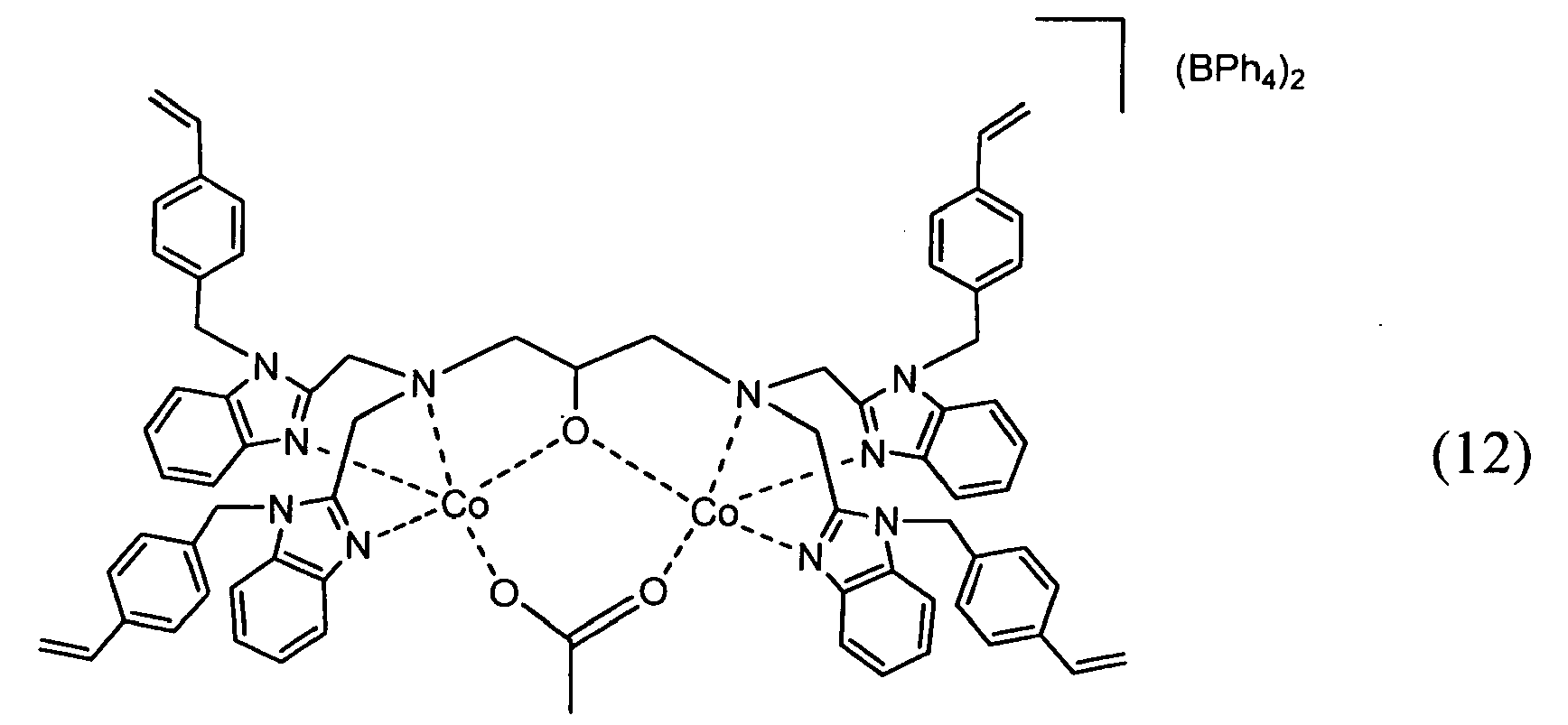
  6. The multinuclear complex according to claim 1, wherein two metal atoms selected from said plurality of metal atoms are coordinately bonded with the same coordination atom, or have a combination of AM1 and AM2 such that the minimum of a covalent bond linking AM1 and AM2 is 1 or more, and 4 or less, when two metal atoms selected from a plurality of metal atoms are denoted as M1, M2, and coordination atoms bonding to M1 and M2 are denoted as AM1 and AM2, respectively.
  7. The multinuclear complex according to claim 1, wherein the ligand L is one, and the metal atoms are two.
  8. The multinuclear complex according to claim 1, wherein the molecular weight is 6000 or less.
  9. A compound expressed by the following formula (1):
    Figure imgb0040
    wherein Ar1, Ar2, Ar3 and Ar4 (hereinafter sometimes denoted as Ar1 to Ar4) each independently represents an aromatic heterocyclic group, R1, R2, R3, R4 and R5 (hereinafter sometimes denoted as R1 to R5) represent a divalent group, Z1 and Z2 each independently represents a nitrogen atom or a trivalent group; at least one of Ar1 to Ar4 and R1 to R5 has a group having polymerizable reactive multiple bonds, and/or a ring-opening polymerizable ring.
  10. The compound according to claim 9, expressed by the following formula (2):
    Figure imgb0041
    wherein Ar1 to Ar4, and R1 to R5 are the same meanings as in said formula (1), and at least one of them has a group having polymerizable reactive multiple bonds, and/or a ring-opening polymerizable ring.
  11. The compound according to claim 10, expressed by the following formula (3a) or (4a):
    Figure imgb0042
    Figure imgb0043
    In the formulas (3a) and (4a), R1 to R5 are the same meanings as in the formula (1). X1, X2, X3 and X4 (hereinafter sometimes denoted as X1 to X4) are selected from a nitrogen atom or CH. Y1, Y2, Y3 and Y4 (hereinafter sometimes denoted as Y1 to Y4) represent a hydrogen atom, an alkyl group having 1 to 50 carbon atoms, an aromatic group having 2 to 60 carbon atoms, a group having a polymerizable reactive carbon-carbon double bond or a group having a ring-opening polymerizable ring, and at least one of Y1 to Y4 is a group having a polymerizable reactive carbon-carbon double bond or a group having a ring-opening polymerizable ring.
  12. The compound according to claim 11, expressed by the following formula (3b) or (4b):
    Figure imgb0044
    Figure imgb0045
    In the formulas (3b) and (4b), X1, X2, X3 and X4 (hereinafter sometimes denoted as X1 to X4), and Y1, Y2, Y3 and Y4 (hereinafter sometimes denoted as Y1 to Y4) are the same meanings as in the formula (3a) or (4a). At least one of Y1 to Y4 is a group having a polymerizable reactive carbon-carbon double bond or a group having a ring-opening polymerizable ring. Z represents an integer of 1 or 2. N10 and N20 represent a nitrogen atom bonding with R50, and N30, N40, N50 and N60 (hereinafter sometimes denoted as N30 to N60) represent a nitrogen atom in an aromatic heterocyclic group. R50 represents a divalent group having the minimum of a covalent bond linking N10 and N20 of 2 or more, and 14 or less.
  13. The compound according to claim 12, expressed by the following formula (3c) or (4c):
    Figure imgb0046
    Figure imgb0047
    In the formulas (3c) and (4c), X1 to X4, and Y1 to Y4 are the same meanings as in the formula (3a) or (4a), and at least one of Y1 to Y4 is a group having a polymerizable reactive carbon-carbon double bond or a group having a ring-opening polymerizable ring.
  14. The multinuclear complex according to any one of claims 1 to 8, which the compound of any one of claims 9 to 13 as the ligand L.
  15. A polymer obtained by polymerizing the multinuclear complex according to any one of claims 1 to 8 and 14.
  16. A copolymer obtained by copolymerizing at least one kind of the multinuclear complex according to any one of claims 1 to 8 and 14 with a polymerizable monomer capable of copolymerizing with said multinuclear complex.
  17. A redox catalyst using the multinuclear complex according to any one of claims 1 to 8 and 14, the polymer of claim 15, or the copolymer of claim 16.
EP07714121A 2006-02-08 2007-02-07 POLYNUCLEAR COMPLEX AND ITS POLYMER Withdrawn EP1988082A4 (en)

Applications Claiming Priority (2)

Application Number Priority Date Filing Date Title
JP2006030585 2006-02-08
PCT/JP2007/052540 WO2007091713A1 (en) 2006-02-08 2007-02-07 Polynuclear complex and polymer thereof

Publications (2)

Publication Number Publication Date
EP1988082A1 true EP1988082A1 (en) 2008-11-05
EP1988082A4 EP1988082A4 (en) 2010-09-01

Family

ID=38345301

Family Applications (1)

Application Number Title Priority Date Filing Date
EP07714121A Withdrawn EP1988082A4 (en) 2006-02-08 2007-02-07 POLYNUCLEAR COMPLEX AND ITS POLYMER

Country Status (6)

Country Link
US (1) US20090011929A1 (en)
EP (1) EP1988082A4 (en)
KR (1) KR20080106227A (en)
CN (2) CN102391421A (en)
CA (1) CA2641591A1 (en)
WO (1) WO2007091713A1 (en)

Cited By (1)

* Cited by examiner, † Cited by third party
Publication number Priority date Publication date Assignee Title
EP1908520A4 (en) * 2005-06-28 2009-06-10 Sumitomo Chemical Co CATALYST FOR DEGRADING A PEROXIDE

Families Citing this family (7)

* Cited by examiner, † Cited by third party
Publication number Priority date Publication date Assignee Title
US20090062110A1 (en) * 2006-02-08 2009-03-05 Sumitomo Chemical Company Limited Metal complex and use thereof
KR20090127419A (en) * 2007-03-09 2009-12-11 내셔날 인스티튜트 오브 어드밴스드 인더스트리얼 사이언스 앤드 테크놀로지 Electrode Catalyst for Fuel Cell
JP5380014B2 (en) * 2007-08-07 2014-01-08 住友化学株式会社 Modified polymer complex and redox catalyst
DE112008002143T5 (en) * 2007-08-07 2010-07-15 Sumitomo Chemical Co., Ltd. Modified polymer complex, complex monomer, polymer complex and redox catalyst
CN106188145B (en) * 2016-06-28 2019-02-01 中国科学院福建物质结构研究所 A kind of manganese (II) complex and its preparation method and use in organic light-emitting diode
CN106496579A (en) * 2016-10-01 2017-03-15 桂林理工大学 Double structure primitive phthalic acid manganese polymer and preparation method thereof
CN113178585B (en) * 2021-04-09 2022-05-20 常熟理工学院 Metal-air fuel cell catalyst and preparation method thereof

Family Cites Families (11)

* Cited by examiner, † Cited by third party
Publication number Priority date Publication date Assignee Title
US5637745A (en) * 1995-01-30 1997-06-10 Elf Atochem North America, Inc. Organometallic compounds and polymers made therefrom
JPH10156188A (en) * 1996-12-03 1998-06-16 Lion Corp Bleaching activation catalyst and bleach composition containing the catalyst
US5938934A (en) * 1998-01-13 1999-08-17 Dow Corning Corporation Dendrimer-based nanoscopic sponges and metal composites
CN1137908C (en) * 2000-07-13 2004-02-11 中国科学院长春应用化学研究所 Process for preparing 'after-cyclopentadiene' high-molecular catalyst for polymerization of olefine
DE10163331A1 (en) * 2001-12-21 2003-07-10 Henkel Kgaa Support-fixed bleach catalyst complex compounds are suitable as catalysts for peroxygen compounds
US7319083B2 (en) * 2002-10-25 2008-01-15 Exxonmobil Chemical Patents Inc. Polymerized catalyst composition
DE10345820A1 (en) * 2003-09-30 2005-04-28 Henkel Kgaa Removing oxygen from water by treating the water with an oxygen scavenger in the presence of catalyst comprises using a transition metal complex as the catalyst
GB0415879D0 (en) * 2004-07-15 2004-08-18 Bp Chem Int Ltd Polymerisation catalyst
WO2007000956A1 (en) * 2005-06-28 2007-01-04 Sumitomo Chemical Company, Limited Peroxide-degrading catalyst
CA2641573A1 (en) * 2006-02-08 2007-08-16 Waseda University Multinuclear complex and condensation product thereof
US20090062110A1 (en) * 2006-02-08 2009-03-05 Sumitomo Chemical Company Limited Metal complex and use thereof

Cited By (1)

* Cited by examiner, † Cited by third party
Publication number Priority date Publication date Assignee Title
EP1908520A4 (en) * 2005-06-28 2009-06-10 Sumitomo Chemical Co CATALYST FOR DEGRADING A PEROXIDE

Also Published As

Publication number Publication date
KR20080106227A (en) 2008-12-04
CN102391421A (en) 2012-03-28
CA2641591A1 (en) 2007-08-16
EP1988082A4 (en) 2010-09-01
US20090011929A1 (en) 2009-01-08
CN101405274A (en) 2009-04-08
WO2007091713A1 (en) 2007-08-16

Similar Documents

Publication Publication Date Title
EP1988082A1 (en) Polynuclear complex and polymer thereof
Smits et al. Influence of ligand denticity and flexibility on the molecular copper mediated oxygen reduction reaction
Allgeier et al. Ligand design for electrochemically controlling stoichiometric and catalytic reactivity of transition metals
US7988944B2 (en) Peroxide decomposition catalyst
US8674128B2 (en) Conductive organometallic framework
Cai et al. Thermally robust heterobimetallic palladium–alkali catalysts for ethylene and alkyl acrylate copolymerization
WO2007091616A1 (en) Metal complex and use thereof
Bera et al. Electrocatalytic water oxidation activity of molecular copper complexes: effect of redox-active ligands
Mahapatra et al. Ni (II) complex of N2O3 donor unsymmetrical ligand and its use for the synthesis of NiII–MnII complexes of diverse nuclearity: structures, magnetic properties, and catalytic oxidase activities
Huang et al. Reactivity and Properties of Metal Complexes Enabled by Flexible and Redox-Active Ligands with a Ferrocene Backbone
Mandon et al. Trigonal bipyramidal geometry and tridentate coordination mode of the tripod in FeCl2 complexes with tris (2-pyridylmethyl) amine derivatives bis-α-substituted with bulky groups. Structures and spectroscopic comparative studies
CN101674886A (en) Electrode Catalysts for Fuel Cells
Adomeit et al. Effects of imidazole-type ligands in CuI/TEMPO-mediated aerobic alcohol oxidation
Patricio-Rangel et al. Multinuclear mesoionic 1, 2, 3-triazolylidene complexes: design, synthesis, and applications
Vrdoljak et al. Zigzag chain, square tetranuclear, and polyoxometalate-based inorganic− organic hybrid compounds-molybdenum vs tungsten
Tam et al. Competition between Reversible Capture of CO2 and Release of CO2•–Using Electrochemically Reduced Quinones in Acetonitrile Solutions
US20100197886A1 (en) Modified polymer complex, complex monomer, polymer complex, and redox,catalyst
Eckenhoff et al. Highly Efficient Copper‐Mediated Atom‐Transfer Radical Addition (ATRA) in the Presence of Reducing Agent
Al Isawi et al. Capped nanojars: Synthesis, solution and solid-state characterization, and atmospheric CO2 sequestration by selective binding of carbonate
Comba et al. Redox properties of iron complexes with pentadentate bispidine ligands
Bienemann et al. Synthesis and application of new guanidine copper complexes in atom transfer radical polymerisation
Jameei Moghaddam et al. Interplay between β-Diimino and β-Diketiminato Ligands in Nickel Complexes Active in the Proton Reduction Reaction
JP2007238603A (en) Polynuclear complex and polymer thereof
JP4704283B2 (en) Peroxide decomposition catalyst
Collomb et al. Chemical and electrochemical generation of [Fe (bpy) 2 (S) 2] 2+(bpy= 2, 2′-bipyridine, S= H2O or CH 3 CN). A route for synthesis of coordinatively dissymmetrical iron (II) polypyridine complexes and supramolecular structures containing a Fe (bpy) 3 2+ moiety

Legal Events

Date Code Title Description
PUAI Public reference made under article 153(3) epc to a published international application that has entered the european phase

Free format text: ORIGINAL CODE: 0009012

17P Request for examination filed

Effective date: 20080829

AK Designated contracting states

Kind code of ref document: A1

Designated state(s): AT BE BG CH CY CZ DE DK EE ES FI FR GB GR HU IE IS IT LI LT LU LV MC NL PL PT RO SE SI SK TR

A4 Supplementary search report drawn up and despatched

Effective date: 20100729

DAX Request for extension of the european patent (deleted)
STAA Information on the status of an ep patent application or granted ep patent

Free format text: STATUS: THE APPLICATION HAS BEEN WITHDRAWN

18W Application withdrawn

Effective date: 20130809