EP1987843A2 - Method for solubilising peptide mixtures - Google Patents
Method for solubilising peptide mixtures Download PDFInfo
- Publication number
- EP1987843A2 EP1987843A2 EP07024331A EP07024331A EP1987843A2 EP 1987843 A2 EP1987843 A2 EP 1987843A2 EP 07024331 A EP07024331 A EP 07024331A EP 07024331 A EP07024331 A EP 07024331A EP 1987843 A2 EP1987843 A2 EP 1987843A2
- Authority
- EP
- European Patent Office
- Prior art keywords
- peptides
- peptide
- peptide mixture
- aqueous solution
- acid
- Prior art date
- Legal status (The legal status is an assumption and is not a legal conclusion. Google has not performed a legal analysis and makes no representation as to the accuracy of the status listed.)
- Withdrawn
Links
- 108090000765 processed proteins & peptides Proteins 0.000 title claims abstract description 248
- 239000000203 mixture Substances 0.000 title claims abstract description 120
- 238000000034 method Methods 0.000 title claims abstract description 63
- 102000004196 processed proteins & peptides Human genes 0.000 claims abstract description 119
- QTBSBXVTEAMEQO-UHFFFAOYSA-N Acetic acid Chemical compound CC(O)=O QTBSBXVTEAMEQO-UHFFFAOYSA-N 0.000 claims abstract description 48
- 239000007864 aqueous solution Substances 0.000 claims abstract description 37
- 150000007524 organic acids Chemical group 0.000 claims abstract description 21
- BDAGIHXWWSANSR-UHFFFAOYSA-N methanoic acid Natural products OC=O BDAGIHXWWSANSR-UHFFFAOYSA-N 0.000 claims abstract description 16
- 241000711549 Hepacivirus C Species 0.000 claims abstract description 10
- 229920001184 polypeptide Polymers 0.000 claims abstract description 10
- OSWFIVFLDKOXQC-UHFFFAOYSA-N 4-(3-methoxyphenyl)aniline Chemical compound COC1=CC=CC(C=2C=CC(N)=CC=2)=C1 OSWFIVFLDKOXQC-UHFFFAOYSA-N 0.000 claims abstract description 8
- FERIUCNNQQJTOY-UHFFFAOYSA-N Butyric acid Chemical compound CCCC(O)=O FERIUCNNQQJTOY-UHFFFAOYSA-N 0.000 claims abstract description 8
- XBDQKXXYIPTUBI-UHFFFAOYSA-N dimethylselenoniopropionate Natural products CCC(O)=O XBDQKXXYIPTUBI-UHFFFAOYSA-N 0.000 claims abstract description 8
- 235000019253 formic acid Nutrition 0.000 claims abstract description 8
- 235000011054 acetic acid Nutrition 0.000 claims abstract description 4
- 239000000825 pharmaceutical preparation Substances 0.000 claims abstract description 4
- 235000019260 propionic acid Nutrition 0.000 claims abstract description 4
- IUVKMZGDUIUOCP-BTNSXGMBSA-N quinbolone Chemical compound O([C@H]1CC[C@H]2[C@H]3[C@@H]([C@]4(C=CC(=O)C=C4CC3)C)CC[C@@]21C)C1=CCCC1 IUVKMZGDUIUOCP-BTNSXGMBSA-N 0.000 claims abstract description 4
- WEVYAHXRMPXWCK-UHFFFAOYSA-N Acetonitrile Chemical compound CC#N WEVYAHXRMPXWCK-UHFFFAOYSA-N 0.000 claims description 27
- 239000000243 solution Substances 0.000 claims description 25
- 230000002209 hydrophobic effect Effects 0.000 claims description 20
- 150000001413 amino acids Chemical class 0.000 claims description 17
- 239000000725 suspension Substances 0.000 claims description 14
- 150000001875 compounds Chemical class 0.000 claims description 13
- FAPWRFPIFSIZLT-UHFFFAOYSA-M Sodium chloride Chemical compound [Na+].[Cl-] FAPWRFPIFSIZLT-UHFFFAOYSA-M 0.000 claims description 8
- 102000004169 proteins and genes Human genes 0.000 claims description 8
- 108090000623 proteins and genes Proteins 0.000 claims description 8
- 239000004067 bulking agent Substances 0.000 claims description 7
- 229960005486 vaccine Drugs 0.000 claims description 7
- FBPFZTCFMRRESA-FSIIMWSLSA-N D-Glucitol Natural products OC[C@H](O)[C@H](O)[C@@H](O)[C@H](O)CO FBPFZTCFMRRESA-FSIIMWSLSA-N 0.000 claims description 6
- 229920000036 polyvinylpyrrolidone Polymers 0.000 claims description 6
- 239000001267 polyvinylpyrrolidone Substances 0.000 claims description 6
- 235000013855 polyvinylpyrrolidone Nutrition 0.000 claims description 6
- 239000000600 sorbitol Substances 0.000 claims description 6
- 108700042778 Antimicrobial Peptides Proteins 0.000 claims description 5
- 102000044503 Antimicrobial Peptides Human genes 0.000 claims description 5
- 238000001914 filtration Methods 0.000 claims description 5
- 239000003960 organic solvent Substances 0.000 claims description 5
- 229920002851 polycationic polymer Polymers 0.000 claims description 5
- 239000011780 sodium chloride Substances 0.000 claims description 4
- FBPFZTCFMRRESA-KVTDHHQDSA-N D-Mannitol Chemical compound OC[C@@H](O)[C@@H](O)[C@H](O)[C@H](O)CO FBPFZTCFMRRESA-KVTDHHQDSA-N 0.000 claims description 3
- FBPFZTCFMRRESA-JGWLITMVSA-N D-glucitol Chemical compound OC[C@H](O)[C@@H](O)[C@H](O)[C@H](O)CO FBPFZTCFMRRESA-JGWLITMVSA-N 0.000 claims description 3
- 229930195725 Mannitol Natural products 0.000 claims description 3
- 230000002255 enzymatic effect Effects 0.000 claims description 3
- 239000000594 mannitol Substances 0.000 claims description 3
- 235000010355 mannitol Nutrition 0.000 claims description 3
- 239000003910 polypeptide antibiotic agent Substances 0.000 claims description 3
- 235000010356 sorbitol Nutrition 0.000 claims description 3
- 238000002144 chemical decomposition reaction Methods 0.000 claims description 2
- IAZDPXIOMUYVGZ-UHFFFAOYSA-N Dimethylsulphoxide Chemical compound CS(C)=O IAZDPXIOMUYVGZ-UHFFFAOYSA-N 0.000 description 59
- XLYOFNOQVPJJNP-UHFFFAOYSA-N water Substances O XLYOFNOQVPJJNP-UHFFFAOYSA-N 0.000 description 22
- 239000000427 antigen Substances 0.000 description 20
- 108091007433 antigens Proteins 0.000 description 20
- 102000036639 antigens Human genes 0.000 description 20
- ZMXDDKWLCZADIW-UHFFFAOYSA-N N,N-Dimethylformamide Chemical compound CN(C)C=O ZMXDDKWLCZADIW-UHFFFAOYSA-N 0.000 description 17
- 235000001014 amino acid Nutrition 0.000 description 15
- 229940024606 amino acid Drugs 0.000 description 15
- 238000009472 formulation Methods 0.000 description 14
- 239000000126 substance Substances 0.000 description 9
- 206010028980 Neoplasm Diseases 0.000 description 8
- 108010007004 cathelin Proteins 0.000 description 8
- 229920000724 poly(L-arginine) polymer Polymers 0.000 description 8
- 239000002904 solvent Substances 0.000 description 8
- 238000004108 freeze drying Methods 0.000 description 7
- 235000018102 proteins Nutrition 0.000 description 7
- 238000011084 recovery Methods 0.000 description 7
- 239000008194 pharmaceutical composition Substances 0.000 description 5
- 101000854908 Homo sapiens WD repeat-containing protein 11 Proteins 0.000 description 4
- 241000701044 Human gammaherpesvirus 4 Species 0.000 description 4
- 241000725303 Human immunodeficiency virus Species 0.000 description 4
- 241000714474 Rous sarcoma virus Species 0.000 description 4
- 102100020705 WD repeat-containing protein 11 Human genes 0.000 description 4
- 125000000539 amino acid group Chemical group 0.000 description 4
- 230000015556 catabolic process Effects 0.000 description 4
- 125000002091 cationic group Chemical group 0.000 description 4
- 238000006731 degradation reaction Methods 0.000 description 4
- 238000004519 manufacturing process Methods 0.000 description 4
- 239000002244 precipitate Substances 0.000 description 4
- 108010039918 Polylysine Proteins 0.000 description 3
- 239000002671 adjuvant Substances 0.000 description 3
- 239000005557 antagonist Substances 0.000 description 3
- 102000014509 cathelicidin Human genes 0.000 description 3
- 108060001132 cathelicidin Proteins 0.000 description 3
- 239000013020 final formulation Substances 0.000 description 3
- 235000005985 organic acids Nutrition 0.000 description 3
- 230000003647 oxidation Effects 0.000 description 3
- 238000007254 oxidation reaction Methods 0.000 description 3
- 244000052769 pathogen Species 0.000 description 3
- 108010011110 polyarginine Proteins 0.000 description 3
- 229920000656 polylysine Polymers 0.000 description 3
- 239000000047 product Substances 0.000 description 3
- 238000003860 storage Methods 0.000 description 3
- 241000228257 Aspergillus sp. Species 0.000 description 2
- 241000193738 Bacillus anthracis Species 0.000 description 2
- 241000283690 Bos taurus Species 0.000 description 2
- 241000222122 Candida albicans Species 0.000 description 2
- 201000005019 Chlamydia pneumonia Diseases 0.000 description 2
- 241000606153 Chlamydia trachomatis Species 0.000 description 2
- 102000000541 Defensins Human genes 0.000 description 2
- 108010002069 Defensins Proteins 0.000 description 2
- ZHNUHDYFZUAESO-UHFFFAOYSA-N Formamide Chemical compound NC=O ZHNUHDYFZUAESO-UHFFFAOYSA-N 0.000 description 2
- 241000187479 Mycobacterium tuberculosis Species 0.000 description 2
- 241001442539 Plasmodium sp. Species 0.000 description 2
- 241000702670 Rotavirus Species 0.000 description 2
- 241000191967 Staphylococcus aureus Species 0.000 description 2
- 201000005010 Streptococcus pneumonia Diseases 0.000 description 2
- 241000193998 Streptococcus pneumoniae Species 0.000 description 2
- 241000607626 Vibrio cholerae Species 0.000 description 2
- 241000700605 Viruses Species 0.000 description 2
- 239000000556 agonist Substances 0.000 description 2
- 239000012062 aqueous buffer Substances 0.000 description 2
- 229940065181 bacillus anthracis Drugs 0.000 description 2
- 230000000903 blocking effect Effects 0.000 description 2
- 201000011510 cancer Diseases 0.000 description 2
- 229940095731 candida albicans Drugs 0.000 description 2
- 210000004027 cell Anatomy 0.000 description 2
- 229940038705 chlamydia trachomatis Drugs 0.000 description 2
- 238000009795 derivation Methods 0.000 description 2
- 239000000539 dimer Substances 0.000 description 2
- 208000005252 hepatitis A Diseases 0.000 description 2
- 208000002672 hepatitis B Diseases 0.000 description 2
- 229940088597 hormone Drugs 0.000 description 2
- 239000005556 hormone Substances 0.000 description 2
- 230000003993 interaction Effects 0.000 description 2
- 230000001717 pathogenic effect Effects 0.000 description 2
- 208000030773 pneumonia caused by chlamydia Diseases 0.000 description 2
- 229920001308 poly(aminoacid) Polymers 0.000 description 2
- 238000001556 precipitation Methods 0.000 description 2
- 238000000746 purification Methods 0.000 description 2
- 239000013557 residual solvent Substances 0.000 description 2
- 150000003839 salts Chemical class 0.000 description 2
- 238000011146 sterile filtration Methods 0.000 description 2
- 230000002483 superagonistic effect Effects 0.000 description 2
- 241000712461 unidentified influenza virus Species 0.000 description 2
- 229940118696 vibrio cholerae Drugs 0.000 description 2
- 230000003612 virological effect Effects 0.000 description 2
- MTCFGRXMJLQNBG-REOHCLBHSA-N (2S)-2-Amino-3-hydroxypropansäure Chemical compound OC[C@H](N)C(O)=O MTCFGRXMJLQNBG-REOHCLBHSA-N 0.000 description 1
- 101800000112 Acidic peptide Proteins 0.000 description 1
- VHUUQVKOLVNVRT-UHFFFAOYSA-N Ammonium hydroxide Chemical compound [NH4+].[OH-] VHUUQVKOLVNVRT-UHFFFAOYSA-N 0.000 description 1
- 108700031308 Antennapedia Homeodomain Proteins 0.000 description 1
- 102000014133 Antimicrobial Cationic Peptides Human genes 0.000 description 1
- 108010050820 Antimicrobial Cationic Peptides Proteins 0.000 description 1
- 239000004475 Arginine Substances 0.000 description 1
- DCXYFEDJOCDNAF-UHFFFAOYSA-N Asparagine Natural products OC(=O)C(N)CC(N)=O DCXYFEDJOCDNAF-UHFFFAOYSA-N 0.000 description 1
- 208000023275 Autoimmune disease Diseases 0.000 description 1
- 229920002101 Chitin Polymers 0.000 description 1
- 229920001661 Chitosan Polymers 0.000 description 1
- GSNUFIFRDBKVIE-UHFFFAOYSA-N DMF Natural products CC1=CC=C(C)O1 GSNUFIFRDBKVIE-UHFFFAOYSA-N 0.000 description 1
- 241000233866 Fungi Species 0.000 description 1
- WHUUTDBJXJRKMK-UHFFFAOYSA-N Glutamic acid Natural products OC(=O)C(N)CCC(O)=O WHUUTDBJXJRKMK-UHFFFAOYSA-N 0.000 description 1
- 102000018997 Growth Hormone Human genes 0.000 description 1
- 108010051696 Growth Hormone Proteins 0.000 description 1
- XUJNEKJLAYXESH-REOHCLBHSA-N L-Cysteine Chemical compound SC[C@H](N)C(O)=O XUJNEKJLAYXESH-REOHCLBHSA-N 0.000 description 1
- ODKSFYDXXFIFQN-BYPYZUCNSA-P L-argininium(2+) Chemical compound NC(=[NH2+])NCCC[C@H]([NH3+])C(O)=O ODKSFYDXXFIFQN-BYPYZUCNSA-P 0.000 description 1
- DCXYFEDJOCDNAF-REOHCLBHSA-N L-asparagine Chemical compound OC(=O)[C@@H](N)CC(N)=O DCXYFEDJOCDNAF-REOHCLBHSA-N 0.000 description 1
- CKLJMWTZIZZHCS-REOHCLBHSA-N L-aspartic acid Chemical compound OC(=O)[C@@H](N)CC(O)=O CKLJMWTZIZZHCS-REOHCLBHSA-N 0.000 description 1
- WHUUTDBJXJRKMK-VKHMYHEASA-N L-glutamic acid Chemical compound OC(=O)[C@@H](N)CCC(O)=O WHUUTDBJXJRKMK-VKHMYHEASA-N 0.000 description 1
- ZDXPYRJPNDTMRX-VKHMYHEASA-N L-glutamine Chemical compound OC(=O)[C@@H](N)CCC(N)=O ZDXPYRJPNDTMRX-VKHMYHEASA-N 0.000 description 1
- HNDVDQJCIGZPNO-YFKPBYRVSA-N L-histidine Chemical compound OC(=O)[C@@H](N)CC1=CN=CN1 HNDVDQJCIGZPNO-YFKPBYRVSA-N 0.000 description 1
- KDXKERNSBIXSRK-YFKPBYRVSA-N L-lysine Chemical compound NCCCC[C@H](N)C(O)=O KDXKERNSBIXSRK-YFKPBYRVSA-N 0.000 description 1
- FFEARJCKVFRZRR-BYPYZUCNSA-N L-methionine Chemical compound CSCC[C@H](N)C(O)=O FFEARJCKVFRZRR-BYPYZUCNSA-N 0.000 description 1
- AYFVYJQAPQTCCC-GBXIJSLDSA-N L-threonine Chemical compound C[C@@H](O)[C@H](N)C(O)=O AYFVYJQAPQTCCC-GBXIJSLDSA-N 0.000 description 1
- QIVBCDIJIAJPQS-VIFPVBQESA-N L-tryptophane Chemical compound C1=CC=C2C(C[C@H](N)C(O)=O)=CNC2=C1 QIVBCDIJIAJPQS-VIFPVBQESA-N 0.000 description 1
- OUYCCCASQSFEME-QMMMGPOBSA-N L-tyrosine Chemical compound OC(=O)[C@@H](N)CC1=CC=C(O)C=C1 OUYCCCASQSFEME-QMMMGPOBSA-N 0.000 description 1
- KDXKERNSBIXSRK-UHFFFAOYSA-N Lysine Natural products NCCCCC(N)C(O)=O KDXKERNSBIXSRK-UHFFFAOYSA-N 0.000 description 1
- 239000004472 Lysine Substances 0.000 description 1
- 241001465754 Metazoa Species 0.000 description 1
- FXHOOIRPVKKKFG-UHFFFAOYSA-N N,N-Dimethylacetamide Chemical compound CN(C)C(C)=O FXHOOIRPVKKKFG-UHFFFAOYSA-N 0.000 description 1
- 229920002873 Polyethylenimine Polymers 0.000 description 1
- MTCFGRXMJLQNBG-UHFFFAOYSA-N Serine Natural products OCC(N)C(O)=O MTCFGRXMJLQNBG-UHFFFAOYSA-N 0.000 description 1
- 239000004809 Teflon Substances 0.000 description 1
- 229920006362 Teflon® Polymers 0.000 description 1
- AYFVYJQAPQTCCC-UHFFFAOYSA-N Threonine Natural products CC(O)C(N)C(O)=O AYFVYJQAPQTCCC-UHFFFAOYSA-N 0.000 description 1
- 239000004473 Threonine Substances 0.000 description 1
- QIVBCDIJIAJPQS-UHFFFAOYSA-N Tryptophan Natural products C1=CC=C2C(CC(N)C(O)=O)=CNC2=C1 QIVBCDIJIAJPQS-UHFFFAOYSA-N 0.000 description 1
- 239000006035 Tryptophane Substances 0.000 description 1
- 239000002253 acid Substances 0.000 description 1
- 230000002378 acidificating effect Effects 0.000 description 1
- 230000004913 activation Effects 0.000 description 1
- 210000005006 adaptive immune system Anatomy 0.000 description 1
- 230000002776 aggregation Effects 0.000 description 1
- 238000004220 aggregation Methods 0.000 description 1
- 239000003513 alkali Substances 0.000 description 1
- 125000000129 anionic group Chemical group 0.000 description 1
- 230000000844 anti-bacterial effect Effects 0.000 description 1
- 230000030741 antigen processing and presentation Effects 0.000 description 1
- 210000000612 antigen-presenting cell Anatomy 0.000 description 1
- ODKSFYDXXFIFQN-UHFFFAOYSA-N arginine Natural products OC(=O)C(N)CCCNC(N)=N ODKSFYDXXFIFQN-UHFFFAOYSA-N 0.000 description 1
- 235000009582 asparagine Nutrition 0.000 description 1
- 229960001230 asparagine Drugs 0.000 description 1
- 235000003704 aspartic acid Nutrition 0.000 description 1
- 230000001363 autoimmune Effects 0.000 description 1
- 230000001580 bacterial effect Effects 0.000 description 1
- 244000052616 bacterial pathogen Species 0.000 description 1
- OQFSQFPPLPISGP-UHFFFAOYSA-N beta-carboxyaspartic acid Natural products OC(=O)C(N)C(C(O)=O)C(O)=O OQFSQFPPLPISGP-UHFFFAOYSA-N 0.000 description 1
- 230000015572 biosynthetic process Effects 0.000 description 1
- 238000006664 bond formation reaction Methods 0.000 description 1
- 239000000872 buffer Substances 0.000 description 1
- 239000012830 cancer therapeutic Substances 0.000 description 1
- 238000009566 cancer vaccine Methods 0.000 description 1
- 229940022399 cancer vaccine Drugs 0.000 description 1
- 125000003178 carboxy group Chemical group [H]OC(*)=O 0.000 description 1
- POIUWJQBRNEFGX-XAMSXPGMSA-N cathelicidin Chemical compound C([C@@H](C(=O)N[C@@H](CCCNC(N)=N)C(=O)N[C@@H](CCCCN)C(=O)N[C@@H](CO)C(=O)N[C@@H](CCCCN)C(=O)N[C@@H](CCC(O)=O)C(=O)N[C@@H](CCCCN)C(=O)N[C@@H]([C@@H](C)CC)C(=O)NCC(=O)N[C@@H](CCCCN)C(=O)N[C@@H](CCC(O)=O)C(=O)N[C@@H](CC=1C=CC=CC=1)C(=O)N[C@@H](CCCCN)C(=O)N[C@@H](CCCNC(N)=N)C(=O)N[C@@H]([C@@H](C)CC)C(=O)N[C@@H](C(C)C)C(=O)N[C@@H](CCC(N)=O)C(=O)N[C@@H](CCCNC(N)=N)C(=O)N[C@@H]([C@@H](C)CC)C(=O)N[C@@H](CCCCN)C(=O)N[C@@H](CC(O)=O)C(=O)N[C@@H](CC=1C=CC=CC=1)C(=O)N[C@@H](CC(C)C)C(=O)N[C@@H](CCCNC(N)=N)C(=O)N[C@@H](CC(N)=O)C(=O)N[C@@H](CC(C)C)C(=O)N[C@@H](C(C)C)C(=O)N1[C@@H](CCC1)C(=O)N[C@@H](CCCNC(N)=N)C(=O)N[C@@H]([C@@H](C)O)C(=O)N[C@@H](CCC(O)=O)C(=O)N[C@@H](CO)C(O)=O)NC(=O)[C@H](CC=1C=CC=CC=1)NC(=O)[C@H](CC(O)=O)NC(=O)CNC(=O)[C@H](CC(C)C)NC(=O)[C@@H](N)CC(C)C)C1=CC=CC=C1 POIUWJQBRNEFGX-XAMSXPGMSA-N 0.000 description 1
- SBNPWPIBESPSIF-MHWMIDJBSA-N cetrorelix Chemical compound C([C@@H](C(=O)N[C@H](CCCNC(N)=O)C(=O)N[C@@H](CC(C)C)C(=O)N[C@@H](CCCNC(N)=N)C(=O)N1[C@@H](CCC1)C(=O)N[C@H](C)C(N)=O)NC(=O)[C@H](CO)NC(=O)[C@@H](CC=1C=NC=CC=1)NC(=O)[C@@H](CC=1C=CC(Cl)=CC=1)NC(=O)[C@@H](CC=1C=C2C=CC=CC2=CC=1)NC(C)=O)C1=CC=C(O)C=C1 SBNPWPIBESPSIF-MHWMIDJBSA-N 0.000 description 1
- 229960003230 cetrorelix Drugs 0.000 description 1
- 108700008462 cetrorelix Proteins 0.000 description 1
- 238000006243 chemical reaction Methods 0.000 description 1
- 239000007795 chemical reaction product Substances 0.000 description 1
- 235000018417 cysteine Nutrition 0.000 description 1
- XUJNEKJLAYXESH-UHFFFAOYSA-N cysteine Natural products SCC(N)C(O)=O XUJNEKJLAYXESH-UHFFFAOYSA-N 0.000 description 1
- 230000006240 deamidation Effects 0.000 description 1
- 210000004443 dendritic cell Anatomy 0.000 description 1
- 230000001419 dependent effect Effects 0.000 description 1
- 238000001212 derivatisation Methods 0.000 description 1
- 238000010790 dilution Methods 0.000 description 1
- 239000012895 dilution Substances 0.000 description 1
- 229960001760 dimethyl sulfoxide Drugs 0.000 description 1
- 201000010099 disease Diseases 0.000 description 1
- 208000037265 diseases, disorders, signs and symptoms Diseases 0.000 description 1
- 238000004090 dissolution Methods 0.000 description 1
- 230000003828 downregulation Effects 0.000 description 1
- 239000011363 dried mixture Substances 0.000 description 1
- 230000000694 effects Effects 0.000 description 1
- 230000002708 enhancing effect Effects 0.000 description 1
- 210000003527 eukaryotic cell Anatomy 0.000 description 1
- 238000002474 experimental method Methods 0.000 description 1
- 238000011049 filling Methods 0.000 description 1
- 239000012634 fragment Substances 0.000 description 1
- 238000013467 fragmentation Methods 0.000 description 1
- 238000006062 fragmentation reaction Methods 0.000 description 1
- 125000000524 functional group Chemical group 0.000 description 1
- 230000002538 fungal effect Effects 0.000 description 1
- 235000013922 glutamic acid Nutrition 0.000 description 1
- 239000004220 glutamic acid Substances 0.000 description 1
- ZDXPYRJPNDTMRX-UHFFFAOYSA-N glutamine Natural products OC(=O)C(N)CCC(N)=O ZDXPYRJPNDTMRX-UHFFFAOYSA-N 0.000 description 1
- 150000004676 glycans Chemical class 0.000 description 1
- 239000000122 growth hormone Substances 0.000 description 1
- 238000010438 heat treatment Methods 0.000 description 1
- HNDVDQJCIGZPNO-UHFFFAOYSA-N histidine Natural products OC(=O)C(N)CC1=CN=CN1 HNDVDQJCIGZPNO-UHFFFAOYSA-N 0.000 description 1
- 229910052739 hydrogen Inorganic materials 0.000 description 1
- 239000001257 hydrogen Substances 0.000 description 1
- 230000007062 hydrolysis Effects 0.000 description 1
- 238000006460 hydrolysis reaction Methods 0.000 description 1
- 125000002887 hydroxy group Chemical group [H]O* 0.000 description 1
- 230000001900 immune effect Effects 0.000 description 1
- 230000003308 immunostimulating effect Effects 0.000 description 1
- 230000002779 inactivation Effects 0.000 description 1
- 150000002632 lipids Chemical class 0.000 description 1
- 230000007774 longterm Effects 0.000 description 1
- 230000001404 mediated effect Effects 0.000 description 1
- 229930182817 methionine Natural products 0.000 description 1
- 230000000813 microbial effect Effects 0.000 description 1
- 230000004048 modification Effects 0.000 description 1
- 238000012986 modification Methods 0.000 description 1
- 231100000252 nontoxic Toxicity 0.000 description 1
- 230000003000 nontoxic effect Effects 0.000 description 1
- 244000045947 parasite Species 0.000 description 1
- 230000003071 parasitic effect Effects 0.000 description 1
- 229920001282 polysaccharide Polymers 0.000 description 1
- 239000005017 polysaccharide Substances 0.000 description 1
- 238000002360 preparation method Methods 0.000 description 1
- 125000002924 primary amino group Chemical group [H]N([H])* 0.000 description 1
- 230000008569 process Effects 0.000 description 1
- 210000001236 prokaryotic cell Anatomy 0.000 description 1
- 230000002035 prolonged effect Effects 0.000 description 1
- 230000002797 proteolythic effect Effects 0.000 description 1
- 238000010532 solid phase synthesis reaction Methods 0.000 description 1
- 238000005063 solubilization Methods 0.000 description 1
- 230000007928 solubilization Effects 0.000 description 1
- 230000003381 solubilizing effect Effects 0.000 description 1
- 238000007614 solvation Methods 0.000 description 1
- 230000006641 stabilisation Effects 0.000 description 1
- 238000004659 sterilization and disinfection Methods 0.000 description 1
- 239000011550 stock solution Substances 0.000 description 1
- 238000006467 substitution reaction Methods 0.000 description 1
- 230000008685 targeting Effects 0.000 description 1
- 229960004799 tryptophan Drugs 0.000 description 1
- OUYCCCASQSFEME-UHFFFAOYSA-N tyrosine Natural products OC(=O)C(N)CC1=CC=C(O)C=C1 OUYCCCASQSFEME-UHFFFAOYSA-N 0.000 description 1
- 238000002255 vaccination Methods 0.000 description 1
Images

Classifications
-
- C—CHEMISTRY; METALLURGY
- C07—ORGANIC CHEMISTRY
- C07K—PEPTIDES
- C07K14/00—Peptides having more than 20 amino acids; Gastrins; Somatostatins; Melanotropins; Derivatives thereof
- C07K14/005—Peptides having more than 20 amino acids; Gastrins; Somatostatins; Melanotropins; Derivatives thereof from viruses
-
- A—HUMAN NECESSITIES
- A61—MEDICAL OR VETERINARY SCIENCE; HYGIENE
- A61K—PREPARATIONS FOR MEDICAL, DENTAL OR TOILETRY PURPOSES
- A61K47/00—Medicinal preparations characterised by the non-active ingredients used, e.g. carriers or inert additives; Targeting or modifying agents chemically bound to the active ingredient
- A61K47/06—Organic compounds, e.g. natural or synthetic hydrocarbons, polyolefins, mineral oil, petrolatum or ozokerite
- A61K47/08—Organic compounds, e.g. natural or synthetic hydrocarbons, polyolefins, mineral oil, petrolatum or ozokerite containing oxygen, e.g. ethers, acetals, ketones, quinones, aldehydes, peroxides
- A61K47/12—Carboxylic acids; Salts or anhydrides thereof
-
- A—HUMAN NECESSITIES
- A61—MEDICAL OR VETERINARY SCIENCE; HYGIENE
- A61K—PREPARATIONS FOR MEDICAL, DENTAL OR TOILETRY PURPOSES
- A61K9/00—Medicinal preparations characterised by special physical form
- A61K9/0012—Galenical forms characterised by the site of application
- A61K9/0019—Injectable compositions; Intramuscular, intravenous, arterial, subcutaneous administration; Compositions to be administered through the skin in an invasive manner
-
- C—CHEMISTRY; METALLURGY
- C12—BIOCHEMISTRY; BEER; SPIRITS; WINE; VINEGAR; MICROBIOLOGY; ENZYMOLOGY; MUTATION OR GENETIC ENGINEERING
- C12N—MICROORGANISMS OR ENZYMES; COMPOSITIONS THEREOF; PROPAGATING, PRESERVING, OR MAINTAINING MICROORGANISMS; MUTATION OR GENETIC ENGINEERING; CULTURE MEDIA
- C12N2770/00—MICROORGANISMS OR ENZYMES; COMPOSITIONS THEREOF; PROPAGATING, PRESERVING, OR MAINTAINING MICROORGANISMS; MUTATION OR GENETIC ENGINEERING; CULTURE MEDIA ssRNA viruses positive-sense
- C12N2770/00011—Details
- C12N2770/24011—Flaviviridae
- C12N2770/24211—Hepacivirus, e.g. hepatitis C virus, hepatitis G virus
- C12N2770/24222—New viral proteins or individual genes, new structural or functional aspects of known viral proteins or genes
Definitions
- the present invention relates to a method for solubilising peptide mixtures.
- peptides are characterised by their solubility. Peptides which are soluble in an aqueous solution less than 100 ⁇ g/ml are considered hydrophobic. On the other hand hydrophilic peptides dissolve in a buffered aqueous solution in concentration over 100 ⁇ g/ml. Hydrophilic peptides may further be divided into cationic (>20% basic amino acids including lysine, arginine, histidine), anionic (>20% acidic amino acids including aspartic acid, glutamic acid) and hydroxyl-rich peptides (>30% -OH containing amino acids like serine, threonine, tyrosine).
- Such peptide mixtures are useful for the formulation of vaccines.
- peptide mixtures containing peptides acting as e.g. hormones can be dissolved by the method according to the present invention.
Landscapes
- Health & Medical Sciences (AREA)
- Chemical & Material Sciences (AREA)
- Life Sciences & Earth Sciences (AREA)
- General Health & Medical Sciences (AREA)
- Medicinal Chemistry (AREA)
- Organic Chemistry (AREA)
- Veterinary Medicine (AREA)
- Public Health (AREA)
- Pharmacology & Pharmacy (AREA)
- Epidemiology (AREA)
- Animal Behavior & Ethology (AREA)
- Dermatology (AREA)
- Molecular Biology (AREA)
- General Chemical & Material Sciences (AREA)
- Chemical Kinetics & Catalysis (AREA)
- Virology (AREA)
- Gastroenterology & Hepatology (AREA)
- Biochemistry (AREA)
- Biophysics (AREA)
- Genetics & Genomics (AREA)
- Oil, Petroleum & Natural Gas (AREA)
- Proteomics, Peptides & Aminoacids (AREA)
- Engineering & Computer Science (AREA)
- Peptides Or Proteins (AREA)
- Medicines That Contain Protein Lipid Enzymes And Other Medicines (AREA)
- Medicinal Preparation (AREA)
- Medicines Containing Antibodies Or Antigens For Use As Internal Diagnostic Agents (AREA)
- Pharmaceuticals Containing Other Organic And Inorganic Compounds (AREA)
- Preparation Of Compounds By Using Micro-Organisms (AREA)
Abstract
Description
- The present invention relates to a method for solubilising peptide mixtures.
- The formulation of peptides and peptide mixtures for pharmaceutical use is in many cases very challenging. Ideally, a formulation should be stable at room temperature or at least at 4°C for prolonged time (up to two years). Especially this long-term stability is difficult to achieve in solution since a lot of reactions can take place at the side chain functional groups of amino acids, such as oxidation (tryptophane, methionine, cysteine), deamidation (glutamine, asparagine), and racemisation. In addition depending on the pH of the final formulation hydrolysis of the peptide backbone can also occur. Therefore freeze-drying is a preferred way of obtaining stable peptide formulations.
- The solubilisation of single peptides usually represents in the laboratory practice a minor problem. Whereas hydrophilic peptides are usually dissolved in water or buffered aqueous solutions, hydrophobic peptides are dissolved in solutions containing in many cases at least one component of an organic solvent. The solubilisation of a mixture of chemically different peptides is much more complicated due to the presence of a variety of hydrophilic (water soluble) and hydrophobic (water insoluble) peptides.
- Therefore the challenges for a pharmaceutical formulation containing a peptide mixture are several-fold. First of all a solvent has to be found that allows the solubilization of all peptides at the required concentration. Furthermore the solvent has to be relatively non-toxic, so that traces of residual solvent in the product do not prevent pharmaceutical use. Finally to prolong the shelf life of a peptide/protein mixture the composition should be lyophilisable (mixtures of e.g. water and DMSO cannot be freeze-dried).
- The problems arising during solubilisation of peptide mixtures are apparent taking in consideration the dissolving behaviour of single peptides. The addition of mild alkali solutions containing e.g. NH4OH increases the solubility of acidic peptides. In contrast mild acid solutions containing e.g. TFA help to solubilise basic peptides. Water soluble peptides can interact with each other depending on their respective charge state (e. g. oligo-cationic peptides will interact with oligo-anionic peptides to form an insoluble salt that precipitates from aqueous solutions). Highly hydrophobic peptides are regularly dissolved in organic solvents such as DMSO, DMF, acetonitrile, acetic acid or in mixtures of water with the aforementioned solvents. Furthermore it is known to the man skilled in the art that salts tend to promote aggregation of hydrophobic molecules, especially peptides, which is followed by a concentration dependent precipitation. Therefore the solubilisation of a peptide mixture containing different kinds of peptides is a main problem in the manufacturing of e.g. pharmaceutical compositions.
- The
European patent EP 0 611 572 B1US 2002/0198186 A1 extended the described method to peptides containing 3 to 14 amino acids. However, both the European patent and the US patent application disclose the solubilisation and lyophilisation of single peptides only and not mixtures of two or more peptides. Moreover, it has to be emphasized that dilution of the solution to 3% acetic acid will precipitate hydrophobic peptides resulting in a turbid suspension. - Other commonly used solvents for peptides are dimethyl sulfoxid (DMSO; see e.g. Chen and Wetzel, Protein Science 10:887-891) and dimethylformamide (DMF; see e.g. de Groot et al., Molecular Cancer Therapeutics 1:901-911). The peptides dissolved by these solvents are usually hydrophobic and poorly soluble in water. Unfavorably peptide solutions containing DMSO or DMF can not be lyophilised and can not be used directly for medicinal purposes.
- It is the aim of the present invention to provide methods for the solubilisation of peptide mixtures, which are composed of two or more peptides consisting of hydrophilic as well hydrophobic peptides. Another aim is to make available a method for the manufacturing of sterile and optionally lyophilised pharmaceutical formulations containing peptide mixtures.
- Therefore, the present invention provides a method for making a pharmaceutical preparation comprising the solubilisation of a peptide mixture, characterized in that the peptide mixture is solubilized by an aqueous solution containing at least one organic acid selected from the group consisting of formic acid, acetic acid, propionic acid, butyric acid and halogenated or hydroxylated forms thereof. In order to elongate the shelf life the solubilised peptide mixture may be further sterilised (by filtration, irradiation, heat treatment, chemical sterilisation or other methods) and lyophilised.
- In a preferred embodiment the peptide mixture contains hydrophilic as well hydrophobic peptides. Of course the present method is also usable for peptide mixtures containing only one type of peptides (specifically for mixtures containing e.g. two or more hydrophilic peptides).
- In another preferred embodiment the peptides which are dissolved by an aqueous solution according to the present invention contain at least 6, preferably at least 8, more preferably at least 10, especially at least 12 amino acids. Peptides as well polypeptides containing a maximum number of 100 amino acids can be dissolved according to the present invention.
- In the scope of the present invention peptides are characterised by their solubility. Peptides which are soluble in an aqueous solution less than 100µg/ml are considered hydrophobic. On the other hand hydrophilic peptides dissolve in a buffered aqueous solution in concentration over 100µg/ml. Hydrophilic peptides may further be divided into cationic (>20% basic amino acids including lysine, arginine, histidine), anionic (>20% acidic amino acids including aspartic acid, glutamic acid) and hydroxyl-rich peptides (>30% -OH containing amino acids like serine, threonine, tyrosine).
- In another preferred embodiment the peptide mixture contains peptides and/or polypeptides obtained from antigens. Preferably, peptides or polypeptides derived from a viral or a bacterial pathogen or from fungi or parasites are used as such antigens (including derivatized antigens or glycosylated or lipidated antigens or polysaccharides or lipids). Another preferred source of antigens are tumor antigens. Preferred pathogens are selected from human immunodeficiency virus (HIV), hepatitis A and B viruses, hepatitis C virus (HCV), rous sarcoma virus (RSV), Epstein Barr virus (EBV) Influenza virus, Rotavirus, Staphylococcus aureus, Chlamydia pneumonias, Chlamydia trachomatis, Mycobacterium tuberculosis, Streptococcus pneumonias, Bacillus anthracis, Vibrio cholerae, Plasmodium sp. (Pl. falciparum, Pl. vivax, etc.), Aspergillus sp. or Candida albicans. Antigens may also be molecules expressed by cancer cells (tumor antigens). The derivation process may include the purification of a specific protein from the pathogen/cancer cells, the inactivation of the pathogen as well as the proteolytic or chemical derivatization or stabilisation of such a protein. In the same way also tumor antigens (cancer vaccines) or autoimmune antigens may be mixed to obtain a composition according to the present invention. With such compositions a tumor vaccination or a treatment for autoimmume diseases may be performed.
- In the case of peptide antigens the use of peptide mimitopes/agonists/superagonists/antagonists or peptides changed in certain positions without affecting the immunologic properties or non-peptide mimitopes/agonists/superagonists/antagonists is included in the current invention. Peptide antigens may also contain elongations either at the carboxy or at the amino terminus of the peptide antigen facilitating interaction with a polycationic compound(s) or a immunostimulatory compound(s). For the treatment of autoimmune diseases peptide antagonists may be applied.
- Antigens may also be derivatized to include molecules enhancing antigen presentation and targeting of antigens to antigen presenting cells.
- A composition obtained by the method according to the present invention, especially in the form of a vaccine, may further comprise a polycationic compound, preferably a polycationic polymer, more preferably a polycationic peptide, especially polyarginine, polylysine or an antimicrobial peptide.
- The polycationic compound(s) to be used according to the present invention may be any polycationic compound which shows the characteristic effect according to the
WO 97/30721 WO 97/30721 WO 99/38528 - Cationic (poly)peptides may also be polycationic anti-bacterial microbial peptides. These (poly)peptides may be of prokaryotic or animal or plant origin or may be produced chemically or recombinantly. Peptides may also belong to the class of defensins. Such host defense peptides or defensins are also a preferred form of the polycationic polymer according to the present invention. Generally, a compound allowing as an end product activation (or down-regulation) of the adaptive immune system, preferably mediated by APCs (including dendritic cells) is used as polycationic polymer.
- Polycationic substances used in the method according to the present invention are cathelicidin derived antimicrobial peptides or derivatives thereof (
WO 02/13857 WO 01/24822 - Polycationic compounds derived from natural sources include HIV-REV or HIV-TAT (derived cationic peptides, antennapedia peptides, chitosan or other derivatives of chitin) or other peptides derived from these peptides or proteins by biochemical or recombinant production. Other preferred polycationic compounds are cathelin or related or derived substances from cathelin, especially mouse, bovine or especially human cathelins and/or cathelicidins. Related or derived cathelin substances contain the whole or parts of the cathelin sequence with at least 15-20 amino acid residues. Derivations may include the substitution or modification of the natural amino acids by amino acids which are not among the 20 standard amino acids. Moreover, further cationic residues may be introduced into such cathelin molecules. These cathelin molecules are preferred to be combined with the antigen/vaccine composition according to the present invention. However, these cathelin molecules surprisingly have turned out to be also effective as an adjuvant for a antigen without the addition of further adjuvants. It is therefore possible to use such cathelin molecules as efficient adjuvants in vaccine formulations with or without further immunactivating substances.
- Another preferred polycationic substance to be used according to the present invention is a synthetic peptide containing at least 2 KLK-motifs separated by a linker of 3 to 7 hydrophobic amino acids, especially L (
WO 02/32451 - Such peptide mixtures are useful for the formulation of vaccines. Of course also peptide mixtures containing peptides acting as e.g. hormones can be dissolved by the method according to the present invention.
- The peptides of the peptide mixture are synthesized by standard chemical methods (e.g. solid phase synthesis according to Merrifield). Of course the peptides may also be obtained by chemical or enzymatic fragmentation of recombinant produced or native isolated proteins. In another embodiment the peptides are directly isolated from eukaryotic and prokaryotic cells. In all three cases additional purification of the peptide or polypeptide of interest will in some cases be required before they are lyophilised and mixed together.
- Depending on the application the number of the individual peptides and especially their concentration in the mixture varies.
In a preferred embodiment of the present invention the concentration of the individual peptides ranges from 5µg/ml to 5mg/ml, preferably from 50µg/ml to 4mg/ml, more preferably from 100µg/ml to 3mg/ml. - Peptides are often used in pharmaceutical formulations for the use e.g. as hormones or vaccines. Therefore it is a basic requirement that the organic acids used in aqueous solutions for the solubilisation of peptides are pharmaceutically acceptable.
In a preferred embodiment of the present invention the organic acids are acetic acid and/or formic acid containing optionally acetonitrile. - The experiments revealed, depending on the composition of the peptide mixture, that the concentration of the organic acid in the aqueous solution has to be at least 10%, preferably at least 20%, preferably at least 30%, preferably at least 40%, preferably at least 50%, preferably at least 60%.
- In some cases the addition of derivatives of organic acids (e.g. acetonitrile) to the aqueous solution may be helpful to solubilise peptide mixtures containing a larger quantity of hydrophobic peptides. Also organic solvents such as DMSO and DMF contribute to an enhanced dissolution of peptide mixtures containing an increased concentration of hydrophobic peptides. However, aqueous peptide mixtures containing DMSO and/or DMF cannot be freeze-dried.
- In a preferred embodiment bulking agents are added to the peptide mixture when the product is intended to be lyophilised. Especially at low peptide concentrations the forming of a good lyophilisation cake is not guaranteed. Therefore at low amounts of peptides bulking agents are added. Preferred bulking agents are sorbitol, mannitol, polyvinylpyrrolidone (PVP) and mixtures thereof.
- In another preferred embodiment the solubilised peptide mixture is sterilised by filtration. In order to get an increased recovery of the product and to allow filtration of large amounts of the peptide mixture, the containing peptides have to be completely solubilised and no gel may be formed.
- The solubilised and optionally sterilised peptide mixture can be lyophilised directly or after filling into vials. Lyophilisation is a useful and effective method to prolong the shelf life of peptide mixtures as described above. With the solubilised peptides a lyophilised preparation of a mixture of peptides, containing a maximum of 5% of residual solvent (water in aqueous systems) and traces of the organic acid, can be obtained which is reconstitutable in a buffered aqueous solution containing NaCl and/or sorbitol within 10 minutes of >95%, preferably of 98%, especially of 99%, resulting in a turbid suspension or clear solution (depending on the composition of the peptide mixture). Such a quick reconstitution is specifically necessary in emergency cases, where a ready-to-use solution has to be present within a few minutes with an almost complete re-solvation of the whole dosis of a lyophilised vial.
- The invention is further illustrated by the following examples and the drawing figure without being restricted to them.
- The figure shows the storage stability of a peptide mixture according to the present invention (A, B) compared to suspensions according to the prior art (C).
- The peptide mixture contains 6 peptides (see table 1), which show a broad range of solubility. Peptides 1240 and 1242 are water soluble and can also be dissolved in DMSO. Peptide 1236 does not dissolve in DMSO, but slowly dissolves in water. Peptides 1235 and 1241 are hydrophobic and only dissolve in DMSO.
- Peptides 1236, 1240, and 1242 can sequentially be dissolved in water, provided that the final pH is adjusted to pH 8.5. At lower pH a gel is formed presumably due to charge interactions and/or hydrogen bond formation. This gel can not be sterile filtered as it blocks the filter immediately. However, upon addition of poly-L-arginine (pR) to the aqueous solution of the three peptides a precipitate forms that makes sterile filtration of the solution impossible.
- Therefore, to achieve a suspension formulation, three stock solutions have to be prepared: one containing peptides 1236, 1240 and 1242 dissolved in a buffer at pH 8.5, one containing poly-L-arginine (pR) disolved in a NaCl solution and one containing peptides 1235 and 1241 dissolved in DMSO. Each solution can be sterile filtered. The combination of any two of these three solutions leads to the formation of a precipitate, resulting in a turbid suspension. The final formulation obtained by this method can not be sterile filtered and not be freeze-dried when containing 10% DMSO.
- It was also tested whether these peptides dissolve in DMSO, DMF, dimethylacetamide, 0,1% formic acid/water, formamide or water/acetonitrile mixtures. However it turned out that none of these regularly used solvents gave a solution that could be sterile filtered; the blocking of the filter showed that considerable amounts of undissolved peptides remained in the solution.
- Surprisingly it was found that 50% acetic acid/water is an excellent solvent for this peptide mixture (pR, 1235, 1236, 1240, 1241, and 1242) since it dissolves hydrophilic as well as hydrophobic peptides. In addition, due to being a charged molecule itself, it is also able to dissociate ionic complexes. Thus 50% acetic was able to dissolve the above mentioned mixture at the required concentrations (1 mg/ml each peptide, 2 and 4 mg/ml pR). The solution could be sterile filtered using an acetic acid resistant filter (e.g. hydrophilic teflon). In addition mixtures of water and acetic acid readily freeze and can be freeze-dried using standard lyophilisation cycles.
- Very surprisingly the freeze-dried mixture of the five peptides (0,5 mg/vial) and poly-L-arginine (1 mg/vial) showed an excellent stability. Even after 4 months at 37°C, the peptide content was between 96,1% and 100,5% of the original value. In contrast, even an optimized suspension formulation showed considerable degradation after 2 months at 37°C (< 90% recovery for Ipep 1240; <75% recovery of Ipep 1236 and Ipep1241) and numerous degradation peaks (absent in the lyo-formulation) were observed in the chromatograms.
Table 1 Peptide mixture I Peptide ID Peptide sequence 1235 IDELKTNSSLLTSILTYHVV 1236 TGSGAGIAQAAAGTVNI 1240 VSDLKSSTAVIPGYPVAGQV 1241 NFLLPDAQAAAAGFASK 1242 YNINISLPSYYPDQKSLENY - The peptide mixture contains the
peptides peptides 83 and 84 are soluble in water and DMSO, peptides 87 and 89 are poorly water soluble, but dissolve easily in DMSO andpeptide 1426 is only soluble in DMSO. As with the formulation of example 1, for the manufacturing of a suspension formulation it is necessary first to dissolvepeptides 83 and 84 in an aqueous buffer solution andpeptides 87, 89, and 1426 in DMSO. After sterile filtration the solutions can be combined to form the final suspension. - Water/acetonitrile mixtures as well as DMSO and DMF did not work as solvents and resulted in suspensions that could not be sterile filtered due to filter blockage. Surprisingly a 50% acetic acid/water mixture was found to dissolve all components. The obtained peptide solution containing the above mentioned peptides could easily sterile filtered without any filter blocking.
Table 2 Peptide mixture II Peptide ID Peptide sequence 83 KFPGGGQIVGGVYLLPRRGPRL 84 GYKVLVLNPSVAAT 87 DLMGYIPAV 89 CINGVCWTV 1426 HMWNFISGIQYLAGLSTLPGNPA - The following examples (examples 2.1 to 2.12, tables 3 to 14) illustrate that peptide mixtures containing at least two peptides with variable length and amino acid composition are suitable to be solubilised according to the present invention. Furthermore the tables show the known HLA class I and class II epitopes contained within the peptides.
-
Table 3 Peptide mixture III Peptide ID Peptide sequence HLA class I HLA class II 1835 KFPGGGQIVGGVYLLPRRGPRLGVRATRK A2, A3, B7 DR11 87 DLMGYIPAV A2 1624 LEDRDRSELSPLLLSTTEW B60 DR7 1846 DYPYRLWHYPCTVNFTIFKV A2, A11, Cw7 DR1, 4, 7, 11 84 GYKVLVLNPSVAAT DR1, 4, 7, 11 89 CINGVCWTV A2 1799 YLVAYQATVCARAQAPPPSWD B35 DR1, 4 1547 AAWYELTPAETTVRLR A2 DR1, 4, 7, 11 1827 TAYSQQTRGLLG A24 DR1, 7, 11 1426 HMWNFISGIQYLAGLSTLPGNPA A2 DR1, 4, 7, 11 1798 IGLGKVLVDILAGYGAGVAGALVAFK A2, A3, A11 DR1, 4, 7 1829 SMSYTWTGALITP A2, B7 DR1, 7, 11 -
Table 4 Peptide mixture IV Peptide ID Peptide sequence HLA class I HLA class II 1835 KFPGGGQIVGGVYLLPRRGPRLGVRATRK A2, A3, B7 DR11 1846 DYPYRLWHYPCTVNFTIFKV A2, A11, Cw7 DR1, 4, 7, 11 1799 AAWYELTPAETTVRLR B35 DR1, 4 1827 TAYSQQTRGLLG A24 DR1, 7, 11 1426 HMWNFISGIQYLAGLSTLPGNPA A2 DR1, 4, 7, 11 1798 IGLGKVLVDILAGYGAGVAGALVAFK A2, A3, A11 DR1, 4, 7 1829 SMSYTWTGALITP A2, B7 DR1, 7, 11 -
Table 5 Peptide mixture V Peptide ID Peptide sequence HLA class I HLA class II C134 TTLLFNILGGWVAAQ A2 DR1, 7, 11 1815 TVNYTIFKI A11 1006 MWNFISGIQYLAGLSTLPGN -
Table 6 Peptide mixture VI Peptide ID Peptide sequence HLA class I HLA class II 84 GYKVLVLNPSVAAT DR1, 4, 7, 11 87 DLMGYIPAV A2 89 CINGVCWTV A2 1426 HMWNFISGIQYLAGLSTLPGNPA A2 DR1, 4, 7, 11 -
Table 7 Peptide mixture VII Peptide ID Peptide sequence HLA class I HLA class II 1051 YLLPRRGPRL A2 84 GYKVLVLNPSVAAT DR1, 4, 7, 11 87 DLMGYIPAV A2 89 CINGVCWTV A2 1426 HMWNFISGIQYLAGLSTLPGNPA A2 DR1, 4, 7, 11 -
Table 8 Peptide mixture VIII Peptide ID Peptide sequence HLA class I HLA class II 1006 MWNFISGIQYLAGLSTLPGN 1827EX GWRLLAPITAYSQQTRGLLGCIV B8 -
Table 9 Peptide mixture IX Peptide ID Peptide sequence HLA class I HLA class II 1604 VVCCSMSYTWTGALITPC 83 KFPGGGQIVGGVYLLPRRGPRL B8 A130 DYPYRLWHYPCTVNF B46 AGAAWYELTPAETTV -
Table 10 Peptide mixture X Peptide ID Peptide sequence HLA class I HLA class II B84 GSIGLGKVLVDILAG DR1, 4 B96 LAGYGAGVAGALVAF DR1, 4, 7, 11 1829 SMSYTWTGALITP A2, B7 DR1, 7, 11 A135 LWHYPCTVNFTIFKV DR7 A130 DYPYRLWHYPCTVNF DR1, 4 1426 HMWNFISGIQYLAGLSTLPGNPA A2 DR1, 4, 7, 11 1817 RMYVGGVEHRL DR4 87EX DLMGYIPLVGAPL A2, 24 1816 TINYTIFK A11 -
Table 11 Peptide mixture XI Peptide ID Peptide sequence HLA class I HLA class II 1650 VDYPYRLWHYPCTVNFTIFKVRMYVG- GVEHRL Cw7, A2, A24, A11, A3 DR1, 4, 7, 11 1836 DYPYRLWHYPCTVNFTIFKI Cw7, A2, A24, A11 DR1, 4, 7, 11 1846 DYPYRLWHYPCTVNFTIFKV Cw7, A2, , 11 A1, A11 A24, DR1, 4, 7 1651 VDYPYRLWHYPCTVNYTIFKIRMYVG-GVEHRL 1800 DYPYRLWHYPCTVNYTIFKI Cw7, A24, A11 DR7 -
Table 12 Peptide mixture XII Peptide ID Peptide sequence HLA class I HLA class II 1835 KFPGGGQIVGGVYLLPRRGPRLGVRATRK A2, A3, B7 DR11 83 KFPGGGQIVGGVYLLPRRGPRL A2 B7 DR11 84EX AYAAQGYKVLVLNPSVAAT A24 DR1, 4, 7, 11 87EX DLMGYIPLVGAPL A2, A24 89EX GEVQVVSTATQSFLATCINGVCWTV A2 DR 4, 7 1426 HMWNFISGIQYLAGLSTLPGNPA A2 DR1, 4, 7, 11 -
Table 13 Peptide mixture XIII Peptide ID Peptide sequence HLA class I HLA class II C114 TAYSQQTRGLLGCIV A24, B8 DR1, 4, 7, 11 1798 IGLGKVLVDILAGYGAGVAGALVAFK A2,24,3,11 DR1, 4, 7 1604 VVCCSMSYTWTGALITPC A2, A24, B7 DR1, 4, 7, 11 1624 LEDRDRSELSPLLLSTTEW A1,2,3,26 DR7 -
Table 14 Peptide mixture XIV Peptide ID Peptide sequence HLA class I HLA class II 1547 YLVAYQATVCARAQAPPPSWD A2 DR1, 4, 7, 11 A1A7 MSTNPKPQRKTKRNTNR A11, B08, B27 A122EX LINTNGSWHINRTALNCNDSL A2, 2, 3, B8 DR1, 4, 7, 11 A241 TTILGIGTVLDQAET A2, A3 DR1, 4 B8B38 FDSSVLCECYDAGAAWYE A1, 2, 3, 26 C70EX ARLIVFPDLGVRVCEKMALY A2, A3, B27 C92 AFCSAMYVGDLCGSV A2, B51 DR1, 4 C97 GVLFGLAYFSMVGNW A2, 3, 26, B2705, 51 DR1, 4, 7 C106 TRVPYFVRAQGLIRA A3, 24, B7, B8, B2705 DR1, 4, 7 C134 TTLLFNILGGWVAAQ A2 DR1, 7, 11 - Another peptide mix containing the following 8 HCV derived peptides was provided:
Ipep 1827: TAYSQQTRGLLG Ipep 1835: KFPGGGQIVGGVYLLPRRGPRLGVRATRK Ipep 84: GYKVLVLNPSVAAT Ipep 1799: AAWYELTPAETTVRLR Ipep 1624: LEDRDRSELSPLLLSTTEW Ipep 1846: DYPYRLWHYPCTVNFTIFKV Ipep 1426: HMWNFISGIQYLAGLSTLPGNPA Ipep 1798: IGLGKVLVDILAGYGAGVAGALVAFK - As in the previous examples the mix of the peptides did not dissolve in aqueous solutions. Specifically,
Ipep 1798, though water soluble on its own, interacted with the other water soluble peptides Ipep 84 and 1835, which led to precipitation. On top of that,Ipep 1624 most likely ionically interacted withIpep 1835 and therefore had also to be added to the DMSO solution. Therefore onemix containing Ipep 84,Ipep 1835 andIpep 1827 in aqueous buffer and one mix containing the other five peptides in DMSO had to be prepared and mixed in a 9:1 ratio (v/v) to give the final suspension. Surprisingly, the whole mix was soluble in 30% and 50% acetic acid and could be freeze-dried from this solution. Even more surprisingly, the final formulation turned out to be stable for at least 6 months even at a temperature as high as 37°C. In fact there was hardly any difference between storage at 5°C and 37°C. In both cases the recovery after 6 months was between 95% and 110% of the initial value (Figure A and B). In contrast, a suspension formulation stored at room temperature (as a comparison to the prior art) showed a higher degree of degradation, mainly oxidation ofIpep 1846 to its dimer (Figure C). However, the recovery of some other peptides (Ipep 1426 and Ipep 1624) were as low as 80% showing the superiority of the lyo-formulation (Figure C as compared to A or B). out to be stable for at least 6 months even at a temperature as high as 37°C. In fact there was hardly any difference between storage at 5°C and 37°C. In both cases the recovery after 6 months was between 95% and 110% of the initial value (Figure A and B). In contrast, a suspension formulation stored at room temperature (as a comparison to the prior art) showed a higher degree of degradation, mainly oxidation ofIpep 1846 to its dimer (Figure C). However, the recovery of some other peptides (Ipep 1426 and Ipep 1624) were as low as 80% showing the superiority of the lyo-formulation (Figure C as compared to A or B). -
- 1. A method for making a pharmaceutical preparation comprising the solubilisation of a peptide mixture, characterized in that the peptide mixture is solubilized by an aqueous solution containing at least one organic acid selected from the group consisting of formic acid, acetic acid, propionic acid, butyric acid and halogenated or hydroxylated forms thereof.
- 2. The method according to 1, characterized in that the peptide mixture contains at least three, preferably at least four, especially at least five peptides.
- 3. The method according to 1 or 2, characterized in that the peptide mixture contains at least one hydrophilic and/or at least one hydrophobic peptide.
- 4. The method according to any one of 1 to 3, characterized in that the peptides contain at least 6, preferably at least 8, more preferably at least 10, especially at least 12 amino acids.
- 5. The method according to 3 or 4, characterized in that the hydrophilic peptides are soluble at a concentration of more than 100µg/ml in aqueous solutions.
- 6. The method according to 3 or 4, characterized in that the hydrophobic peptides are soluble at a concentration of less than 100µg/ml in aqueous solutions.
- 7. The method according to any one of 1 to 6, characterized in that the peptide mixture comprises peptides or polypeptides obtained from bacterial, viral, fungal, parasitic or tumor-associated antigens or fragments thereof.
- 8. The method according to 7, characterized in that the antigens are selected from the group consisting of human immunodeficiency virus (HIV), hepatitis A and B viruses, hepatitis C virus (HCV), rous sarcoma virus (RSV), Epstein Barr virus (EBV) Influenza virus, Rotavirus, Staphylococcus aureus, Chlamydia pneumonias, Chlamydia trachomatis, Mycobacterium tuberculosis, Streptococcus pneumonias, Bacillus anthracis, Vibrio cholerae, Plasmodium sp., Pl. falciparum, Pl. vivax, Aspergillus sp., Candida albicans and tumor antigens.
- 9. The method according to any one of 1 to 8, characterized in that the peptide mixture comprises a polycationic compound, preferably a polycationic polymer, more preferably a polycationic peptide, especially polyarginine, polylysine, an antimicrobial peptide or a peptide containing at least two KLK-motifs separated by a linker of three to seven hydrophobic amino acids.
- 10. The method according to any one of 1 to 9, characterized in that the peptides are chemically synthesised peptides.
- 11. The method according to any one of 1 to 10, characterized in that the peptides are obtained by enzymatic or chemical degradation of recombinant or native proteins.
- 12. The method according to any one of 1 to 11, characterized in that the peptides are isolated from eukaryotic or prokaryotic organisms.
- 13. The method according to any one of 1 to 12, characterized in that the concentration of each solubilised peptide varies from 5µg/ml to 5mg/ml, preferably from 50µg/ml to 4mg/ml, more preferably from 100µg/ml to 3mg/ml.
- 14. The method according to any one of 1 to 13, characterized in that the organic acid is a pharmaceutically acceptable organic acid.
- 15. The method according to any one of 1 to 14, characterized in that the organic acid is acetic acid and/or formic acid containing optionally acetonitrile.
- 16. The method according to any one of 1 to 15, characterised in that the concentration of the organic acid in the aqueous solution is at least 10%, preferably at least 20%, preferably at least 30%, preferably at least 40%, preferably at least 50%, preferably at least 60%.
- 17. The method according to any one of 1 to 16, characterized in that the aqueous solution contains additionally at least one derivative of an organic acid, especially acetonitrile.
- 18. The method according to any one of 1 to 17, characterized in that the aqueous solution contains additionally at least one organic solvent.
- 19. The method according to any one of 1 to 18, characterised in that contains additionally a bulking agent.
- 20. The method according to 19, characterised in that the bulking agent is selected from the group consisting of sorbitol, mannitol, polyvinylpyrrolidone (PVP) and mixtures thereof.
- 21. The method according to any one of 1 to 20, characterised in that the solubilised peptide mixture is sterilised by filtration.
- 22. The method according to any one of 1 to 21, characterised in that the solubilised peptide mixture is lyophilised and reconstitutable in a buffered aqueous solution containing NaCl and/or sorbitol within 10 minutes of >95%, preferably of 98%, especially of 99%, resulting in a turbid suspension or clear solution.
- 23. An aqueous solution of a mixture of peptides obtainable with a method according to anyone of 1 to 22.
- 24. The aqueous solution of 23, characterised in that said solution is a vaccine.


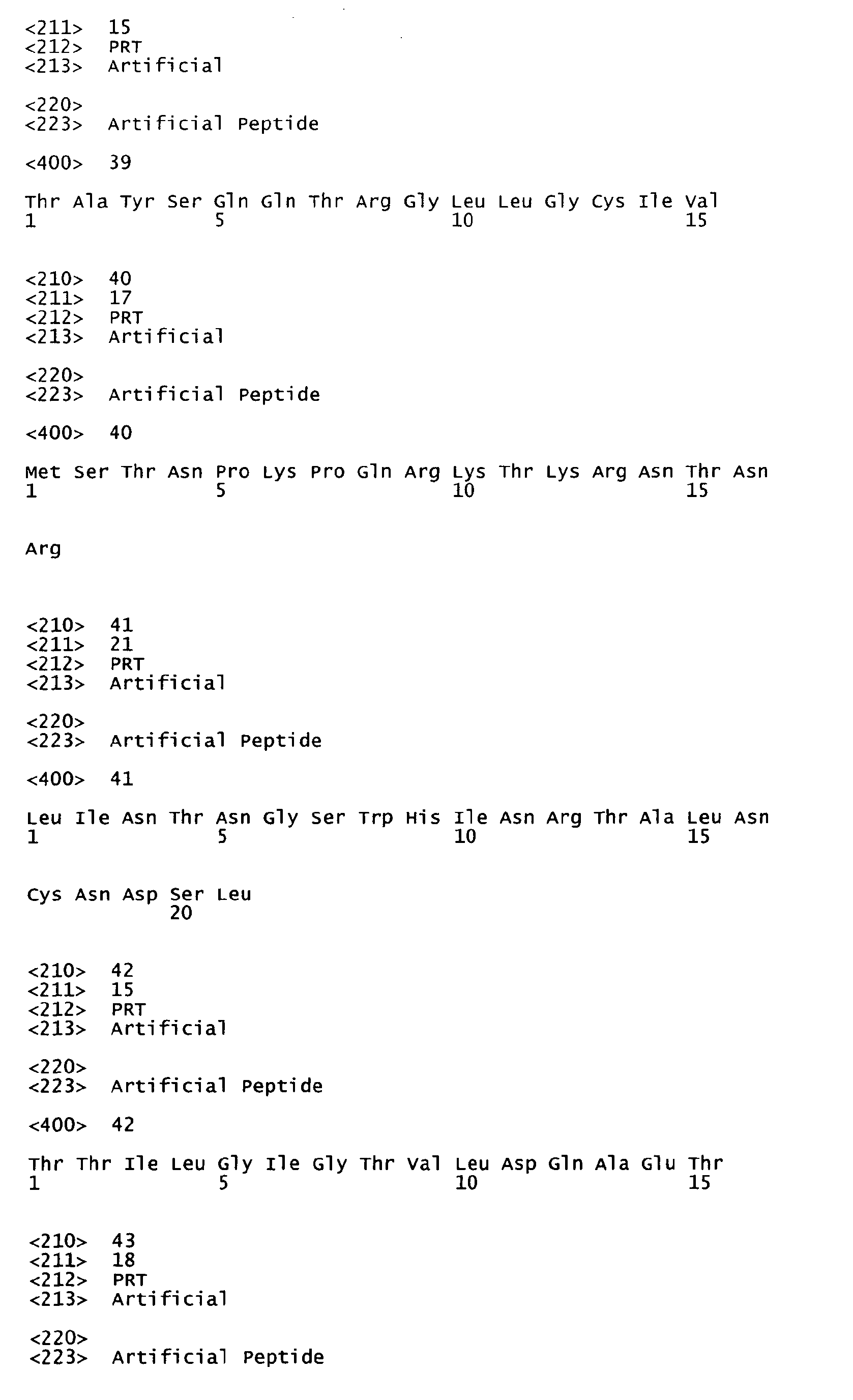

Claims (27)
- A method for making a pharmaceutical preparation comprising the solubilisation of a peptide mixture, characterized in- that the peptide mixture is solubilized by an aqueous solution containing at least one organic acid selected from the group consisting of formic acid, acetic acid, propionic acid, butyric acid and halogenated or hydroxylated forms thereof whereby the concentration of the organic acid in the aqueous solution is at least 10% and- that the peptide mixture contains peptides and/or polypeptides from hepatitis C virus (HCV).
- The method according to claim 1, characterized in that the peptide mixture contains at least three, preferably at least four, especially at least five peptides.
- The method according to claim 1 or 2, characterized in that the peptide mixture contains at least one hydrophilic and/or at least one hydrophobic peptide.
- The method according to any one of claims 1 to 3, characterized in that the peptides contain at least 6, preferably at least 8, more preferably at least 10, especially at least 12 amino acids.
- The method according to claim 3 or 4, characterized in that the hydrophilic peptides are soluble at a concentration of more than 100µg/ml in aqueous solutions.
- The method according to claim 3 or 4, characterized in that the hydrophobic peptides are soluble at a concentration of less than 100µg/ml in aqueous solutions.
- The method according to any one of claims 1 to 6, characterized in that the peptide mixture comprises at least two peptides selected from KFPGGGQIVGGVYLLPRRGPRL, GYKVLVLNPSVAAT, DLMGYIPAV, CINGVCWTV, HMWNFISGIQYLAGLSTLPGNPA, KFPGGGQIVGGVYLLPRRGPRLGVRATRK, LEDRDRSELSPLLLSTTEW, DYPYRLWHYPCTVNFTIFKV, AAWYELTPAETTVRLR, YLVAYQATVCARAQAPPPSWD, TAYSQQTRGLLG, IGLGKVLVDILAGYGAGVAGALVAFK, SMSYTWTGALITP, TTLLFNILGGWVAAQ, TVNYTIFKI, MWNFISGIQYLAGLSTLPGN, YLLPRRGPRL, GWRLLAPITAYSQQTRGLLGCIV, VVCCSMSYTWTGALITPC, DYPYRLWHYPCTVNF, AGAAWYELTPAETTV, GSIGLGKVLVDILAG, LAGYGAGVAGALVAF, LWHYPCTVNFTIFKV, RMYVGGVEHRL, DLMGYIPLVGAPL, TINYTIFK, VDYPYRLWHYPCTVNFTIFKVRMYVGGVEHRL, DYPYRLWHYPCTVNFTIFKI, VDYPYRLWHYPCTVNYTIFKIRMYVGGVEHRL, DYPYRLWHYPCTVNYTIFKI, AYAAQGYKVLVLNPSVAAT, GEVQVVSTATQSFLATCINGVCWTV, TAYSQQTRGLLGCIV, MSTNPKPQRKTKRNTNR, LINTNGSWHINRTALNCNDSL, TTIL-GIGTVLDQAET, FDSSVLCECYDAGAAWYE, ARLIVFPDLGVRVCEKMALY, AFCSAMYVGDLCGSV, GVLFGLAYFSMVGNW and TRVPYFVRAQGLIRA.
- The method according to any one of claims 1 to 7, characterized in that the peptide mixture comprises at least two peptides selected from KFPGGGQIVGGVYLLPRRGPRLGVRATRK, DLMGYIPAV, LEDRDRSELSPLLLSTTEW, DYPYRLWHYPCTVNFTIFKV, GYKVLVLNPSVAAT, CINGVCWTV, AAWYELTPAETTVRLR, YLVAYQATVCARAQAPPPSWD, TAYSQQTRGLLG, HMWNFISGIQYLAGLSTLPGNPA, IGLGKVLVDILAGYGAGVAGALVAFK, SMSYTWTGALITP and KFPGGGQIVGGVYLLPRRGPRC.
- The method according to any one of claims 1 to 8, characterized in that the peptide mixture comprises a polycationic compound, preferably a polycationic polymer, more preferably a polycationic peptide, especially an antimicrobial peptide or a peptide containing at least two KLK-motifs separated by a linker of three to seven hydrophobic amino acids.
- The method according to any one of claims 1 to 9, characterized in that the peptides are chemically synthesised peptides.
- The method according to any one of claims 1 to 10, characterized in that the peptides are obtained by enzymatic or chemical degradation of recombinant or native proteins.
- The method according to any one of claims 1 to 11, characterized in that the peptides are isolated from eukaryotic or prokaryotic organisms.
- The method according to any one of claims 1 to 12, characterized in that the concentration of each solubilised peptide varies from 5µg/ml to 5mg/ml, preferably from 50µg/ml to 4mg/ml, more preferably from 100µg/ml to 3mg/ml.
- The method according to any one of claims 1 to 13, characterized in that the organic acid is a pharmaceutically acceptable organic acid.
- The method according to any one of claims 1 to 14, characterized in that the organic acid is acetic acid and/or formic acid containing optionally acetonitrile.
- The method according to any one of claims 1 to 15, characterised in that the concentration of the organic acid in the aqueous solution is at least 20%, preferably at least 30%, preferably at least 40%, preferably at least 50%, preferably at least 60%.
- The method according to any one of claims 1 to 16, characterized in that the aqueous solution contains additionally at least one derivative of an organic acid, especially acetonitrile.
- The method according to any one of claims 1 to 17, characterized in that the aqueous solution contains additionally at least one organic solvent.
- The method according to any one of claims 1 to 18, characterised in that contains additionally a bulking agent.
- The method according to claim 19, characterised in that the bulking agent is selected from the group consisting of sorbitol, mannitol, polyvinylpyrrolidone (PVP) and mixtures thereof.
- The method according to any one of claims 1 to 20, characterised in that the solubilised peptide mixture is sterilised by filtration.
- The method according to any one of claims 1 to 21, characterised in that the solubilised peptide mixture is lyophilised and reconstitutable in a buffered aqueous solution containing NaCl and/or sorbitol within 10 minutes of >95%, preferably of 98%, especially of 99%, resulting in a turbid suspension or clear solution.
- An aqueous solution of a mixture of peptides obtainable with a method according to anyone of claims 1 to 22.
- The aqueous solution of claim 23, characterised in that said solution is a vaccine.
- The aqueous solution of claim 23 or 24, characterized in that the peptide mixture comprises at least two peptides selected from KFPGGGQIVGGVYLLPRRGPRL, GYKVLVLNPSVAAT, DLMGYIPAV, CINGVCWTV and HMWNFISGIQYLAGLSTLPGNPA.
- The aqueous solution of any one of claims 23 to 25, characterized in that the peptide mixture contains GYKVLVLNPSVAAT, DLMGYIPAV, CINGVCWTV and HMWNFISGIQYLAGLSTLPGNPA.
- The aqueous solution of any one of claims 23 to 26, characterized in that the peptide mixture contains KFPGGGQIVGGVYLLPRRGPRL, GYKVLVLNPSVAAT, DLMGYIPAV, CINGVCWTV and HMWNFISGIQYLAGLSTLPGNPA.
Priority Applications (1)
| Application Number | Priority Date | Filing Date | Title |
|---|---|---|---|
| EP07024331A EP1987843A3 (en) | 2004-03-12 | 2005-03-11 | Method for solubilising peptide mixtures |
Applications Claiming Priority (3)
| Application Number | Priority Date | Filing Date | Title |
|---|---|---|---|
| EP04450061 | 2004-03-12 | ||
| EP05727232A EP1722819B1 (en) | 2004-03-12 | 2005-03-11 | Method for solubilising peptide mixtures |
| EP07024331A EP1987843A3 (en) | 2004-03-12 | 2005-03-11 | Method for solubilising peptide mixtures |
Related Parent Applications (2)
| Application Number | Title | Priority Date | Filing Date |
|---|---|---|---|
| EP05727232A Division EP1722819B1 (en) | 2004-03-12 | 2005-03-11 | Method for solubilising peptide mixtures |
| EP05727232.0 Division | 2005-03-11 |
Publications (2)
| Publication Number | Publication Date |
|---|---|
| EP1987843A2 true EP1987843A2 (en) | 2008-11-05 |
| EP1987843A3 EP1987843A3 (en) | 2011-10-26 |
Family
ID=35064441
Family Applications (2)
| Application Number | Title | Priority Date | Filing Date |
|---|---|---|---|
| EP05727232A Expired - Lifetime EP1722819B1 (en) | 2004-03-12 | 2005-03-11 | Method for solubilising peptide mixtures |
| EP07024331A Withdrawn EP1987843A3 (en) | 2004-03-12 | 2005-03-11 | Method for solubilising peptide mixtures |
Family Applications Before (1)
| Application Number | Title | Priority Date | Filing Date |
|---|---|---|---|
| EP05727232A Expired - Lifetime EP1722819B1 (en) | 2004-03-12 | 2005-03-11 | Method for solubilising peptide mixtures |
Country Status (6)
| Country | Link |
|---|---|
| US (1) | US20080145383A1 (en) |
| EP (2) | EP1722819B1 (en) |
| AT (1) | ATE381945T1 (en) |
| DE (1) | DE602005004014T2 (en) |
| ES (1) | ES2297688T3 (en) |
| WO (1) | WO2005094891A2 (en) |
Families Citing this family (18)
| Publication number | Priority date | Publication date | Assignee | Title |
|---|---|---|---|---|
| US6828415B2 (en) * | 1993-02-19 | 2004-12-07 | Zentaris Gmbh | Oligopeptide lyophilisate, their preparation and use |
| GB0408164D0 (en) | 2004-04-13 | 2004-05-19 | Immune Targeting Systems Ltd | Antigen delivery vectors and constructs |
| GB0716992D0 (en) | 2007-08-31 | 2007-10-10 | Immune Targeting Systems Its L | Influenza antigen delivery vectors and constructs |
| US8883146B2 (en) | 2007-11-30 | 2014-11-11 | Abbvie Inc. | Protein formulations and methods of making same |
| US20100278822A1 (en) * | 2009-05-04 | 2010-11-04 | Abbott Biotechnology, Ltd. | Stable high protein concentration formulations of human anti-tnf-alpha-antibodies |
| AR077384A1 (en) * | 2010-07-05 | 2011-08-24 | Eriochem Sa | AN INJECTABLE PHARMACEUTICAL FORMULATION OF MELFALANO. |
| TWI603739B (en) | 2010-11-11 | 2017-11-01 | 艾伯維生物技術有限責任公司 | Liquid formulation with high concentration of anti-TNFα antibody |
| GB201022147D0 (en) | 2010-12-31 | 2011-02-16 | Immune Targeting Systems Its Ltd | Formulation |
| WO2012122535A2 (en) | 2011-03-10 | 2012-09-13 | Xeris Pharmaceuticals, Inc. | Stable formulations for parenteral injection of peptide drugs |
| JP6117811B2 (en) | 2011-10-31 | 2017-04-19 | ゼリス ファーマシューティカルズ インコーポレイテッド | Formulations for treating diabetes |
| MX344635B (en) | 2012-03-23 | 2017-01-04 | Amicrobe Inc | Compositions and uses of antimicrobial materials with tissue-compatible properties. |
| US9125805B2 (en) | 2012-06-27 | 2015-09-08 | Xeris Pharmaceuticals, Inc. | Stable formulations for parenteral injection of small molecule drugs |
| US9018162B2 (en) | 2013-02-06 | 2015-04-28 | Xeris Pharmaceuticals, Inc. | Methods for rapidly treating severe hypoglycemia |
| KR102428675B1 (en) | 2014-08-06 | 2022-08-02 | 엑스에리스 파머수티클스, 인크. | Syringes, kits, and methods for intracutaneous and/or subcutaneous injection of pastes |
| US9649364B2 (en) | 2015-09-25 | 2017-05-16 | Xeris Pharmaceuticals, Inc. | Methods for producing stable therapeutic formulations in aprotic polar solvents |
| US11590205B2 (en) | 2015-09-25 | 2023-02-28 | Xeris Pharmaceuticals, Inc. | Methods for producing stable therapeutic glucagon formulations in aprotic polar solvents |
| CN110740744A (en) * | 2017-04-06 | 2020-01-31 | 艾麦克罗比公司 | Compositions and uses of topical antimicrobials with enhanced performance and safety |
| CN117085022A (en) | 2017-06-02 | 2023-11-21 | Xeris药物公司 | Anti-precipitation small molecule pharmaceutical preparations |
Citations (7)
| Publication number | Priority date | Publication date | Assignee | Title |
|---|---|---|---|---|
| WO1997030721A1 (en) | 1996-02-24 | 1997-08-28 | Boehringer Ingelheim International Gmbh | Pharmaceutical composition for immunomodulation based on peptides and adjuvants |
| WO1999038528A2 (en) | 1998-01-30 | 1999-08-05 | Boehringer Ingelheim International Gmbh | Vaccine formulations |
| EP0611572B1 (en) | 1993-02-19 | 2000-06-07 | ASTA Medica Aktiengesellschaft | Process to prepare a cetrorelix lyophilised composition |
| WO2001024822A2 (en) | 1999-10-01 | 2001-04-12 | Cistem Biotechnologies Gmbh | Pharmaceutical composition comprising an antigen |
| WO2002013857A2 (en) | 2000-08-17 | 2002-02-21 | Intercell Biomedizinische Forschungs- Und Entwicklungs Ag | A vaccine which comprises at least one antigen and a cathelididin derived antimicrobial peptide or a derivative thereof |
| WO2002032451A1 (en) | 2000-10-18 | 2002-04-25 | Intercell Biomedizinische Forschungs- Und Entwicklungs Ag | Vaccine composition comprising an antigen and a peptide having adjuvant properties |
| US20020198186A1 (en) | 1993-02-19 | 2002-12-26 | Zentaris Ag | Oligopeptide lyophilisate, their preparation and use |
Family Cites Families (12)
| Publication number | Priority date | Publication date | Assignee | Title |
|---|---|---|---|---|
| JPH05112464A (en) * | 1991-04-09 | 1993-05-07 | Sanwa Kagaku Kenkyusho Co Ltd | Stabilized [Leu13-motilin-Hse pharmaceutical composition |
| NZ243090A (en) * | 1991-06-18 | 1993-11-25 | Lilly Co Eli | Method of identifying active peptides and synthesis of peptide mixtures with a known amino acid in the last coupled position |
| EP0788370A4 (en) * | 1993-07-09 | 1998-07-08 | Smithkline Beecham Corp | Cyclic semi-random peptide libraries |
| DE4402756A1 (en) * | 1994-01-31 | 1995-08-03 | Boehringer Mannheim Gmbh | Specific binding substances for antibodies and their use for immunoassays or vaccines |
| US5980898A (en) * | 1996-11-14 | 1999-11-09 | The United States Of America As Represented By The U.S. Army Medical Research & Material Command | Adjuvant for transcutaneous immunization |
| EP0998942A4 (en) * | 1997-01-20 | 2006-08-16 | Japan Energy Corp | METHOD FOR STABILIZING PEPTIDES AND LYOPHILIZED MEDICINAL COMPOSITIONS COMPRISING PEPTIDES OBTAINED THEREBY |
| US20020019061A1 (en) * | 1999-08-31 | 2002-02-14 | Hung-Sen Lai | Purification and analysis of cyclic peptide libraries, and compositions thereof |
| JP4516711B2 (en) * | 1999-12-28 | 2010-08-04 | 中外製薬株式会社 | Stable antibody composition and injection preparation |
| DE10024451A1 (en) * | 2000-05-18 | 2001-11-29 | Asta Medica Ag | Pharmaceutical dosage form for peptides, process for their preparation and use |
| GB0218821D0 (en) * | 2002-08-13 | 2002-09-18 | Glaxosmithkline Biolog Sa | Novel compositions |
| EP1537418A2 (en) * | 2002-09-13 | 2005-06-08 | Intercell AG | Method for isolating hepatitis c virus peptides |
| CA2530062A1 (en) * | 2003-07-11 | 2005-01-20 | Intercell Ag | Hcv vaccines |
-
2005
- 2005-03-11 EP EP05727232A patent/EP1722819B1/en not_active Expired - Lifetime
- 2005-03-11 ES ES05727232T patent/ES2297688T3/en not_active Expired - Lifetime
- 2005-03-11 AT AT05727232T patent/ATE381945T1/en active
- 2005-03-11 EP EP07024331A patent/EP1987843A3/en not_active Withdrawn
- 2005-03-11 WO PCT/EP2005/002583 patent/WO2005094891A2/en not_active Ceased
- 2005-03-11 DE DE602005004014T patent/DE602005004014T2/en not_active Expired - Lifetime
- 2005-03-11 US US10/592,404 patent/US20080145383A1/en not_active Abandoned
Patent Citations (7)
| Publication number | Priority date | Publication date | Assignee | Title |
|---|---|---|---|---|
| EP0611572B1 (en) | 1993-02-19 | 2000-06-07 | ASTA Medica Aktiengesellschaft | Process to prepare a cetrorelix lyophilised composition |
| US20020198186A1 (en) | 1993-02-19 | 2002-12-26 | Zentaris Ag | Oligopeptide lyophilisate, their preparation and use |
| WO1997030721A1 (en) | 1996-02-24 | 1997-08-28 | Boehringer Ingelheim International Gmbh | Pharmaceutical composition for immunomodulation based on peptides and adjuvants |
| WO1999038528A2 (en) | 1998-01-30 | 1999-08-05 | Boehringer Ingelheim International Gmbh | Vaccine formulations |
| WO2001024822A2 (en) | 1999-10-01 | 2001-04-12 | Cistem Biotechnologies Gmbh | Pharmaceutical composition comprising an antigen |
| WO2002013857A2 (en) | 2000-08-17 | 2002-02-21 | Intercell Biomedizinische Forschungs- Und Entwicklungs Ag | A vaccine which comprises at least one antigen and a cathelididin derived antimicrobial peptide or a derivative thereof |
| WO2002032451A1 (en) | 2000-10-18 | 2002-04-25 | Intercell Biomedizinische Forschungs- Und Entwicklungs Ag | Vaccine composition comprising an antigen and a peptide having adjuvant properties |
Non-Patent Citations (2)
| Title |
|---|
| CHEN; WETZEL, PROTEIN SCIENCE, vol. 10, pages 887 - 891 |
| DE GROOT ET AL., MOLECULAR CANCER THERAPEUTICS, vol. 1, pages 901 - 911 |
Also Published As
| Publication number | Publication date |
|---|---|
| EP1987843A3 (en) | 2011-10-26 |
| ES2297688T3 (en) | 2008-05-01 |
| WO2005094891A2 (en) | 2005-10-13 |
| WO2005094891A3 (en) | 2006-03-16 |
| DE602005004014D1 (en) | 2008-02-07 |
| ATE381945T1 (en) | 2008-01-15 |
| EP1722819A2 (en) | 2006-11-22 |
| US20080145383A1 (en) | 2008-06-19 |
| EP1722819B1 (en) | 2007-12-26 |
| DE602005004014T2 (en) | 2008-12-11 |
Similar Documents
| Publication | Publication Date | Title |
|---|---|---|
| EP1722819B1 (en) | Method for solubilising peptide mixtures | |
| US8084045B2 (en) | Pharmaceutical formulations for the prolonged release of active principle(s) and their applications | |
| EP3248985B1 (en) | Modifications of peptide compositions to increase stability and delivery efficiency | |
| US20110014235A1 (en) | Therapeutic and vaccine polyelectrolyte nanoparticle compositions | |
| JP4636883B2 (en) | Drug sustained-release carrier | |
| CN100448482C (en) | HGF lyophilized preparation | |
| JP6279672B2 (en) | Fluorocarbon-linked peptide preparation | |
| CN107743494A (en) | Insulin with polar recombinant extension | |
| JPH09208485A (en) | Poorly water-soluble composition of peptide / protein drug | |
| JP2010534708A (en) | Complex of amphiphilic polymer and bone morphogenetic protein belonging to BMP family | |
| JPH03502704A (en) | Method for producing water-insoluble biocompatible gel | |
| WO2001074397A1 (en) | Powdery preparation for transmucosal administration containing a polymeric form of drug and exhibiting improved storage stability | |
| TWI642444B (en) | Sugar chain added linker, compound comprising sugar chain added linker moiety and physiological active substance moiety, or salt thereof, and method for manufacturing thereof | |
| JP4064454B2 (en) | Pharmaceutical preparation comprising growth hormone and isoleucine | |
| AU2002212326A1 (en) | Vaccine composition comprising an antigen and a peptide having adjuvant properties | |
| TW201533061A (en) | Sugar chain-polypeptide complex | |
| Kim et al. | Thermo-responsive human α-elastin self-assembled nanoparticles for protein delivery | |
| EP1288228A1 (en) | BMP-2-derived peptides having osteogenetic activity and osteogenetic accelerator containing the same | |
| CA2476397A1 (en) | Albumin-based drug delivery system and antimicrobial peptides | |
| JP4332694B2 (en) | Water-soluble dry composition | |
| US20070269517A1 (en) | Pharmaceutical Formulations for the Prolonged Release of Interferons and Their Therapeutic Applications | |
| RU2239457C2 (en) | Sustained-release pharmaceutical composition and method for its preparing | |
| Andrianov | Self-assembling ionic polyphosphazenes and their biomedical applications | |
| CN117120088A (en) | Adjuvant activity enhancers and adjuvant compositions | |
| JP3088744B2 (en) | Fibronectin composition |
Legal Events
| Date | Code | Title | Description |
|---|---|---|---|
| PUAI | Public reference made under article 153(3) epc to a published international application that has entered the european phase |
Free format text: ORIGINAL CODE: 0009012 |
|
| AC | Divisional application: reference to earlier application |
Ref document number: 1722819 Country of ref document: EP Kind code of ref document: P |
|
| AK | Designated contracting states |
Kind code of ref document: A2 Designated state(s): AT BE BG CH CY CZ DE DK EE ES FI FR GB GR HU IE IS IT LI LT LU MC NL PL PT RO SE SI SK TR |
|
| PUAL | Search report despatched |
Free format text: ORIGINAL CODE: 0009013 |
|
| AK | Designated contracting states |
Kind code of ref document: A3 Designated state(s): AT BE BG CH CY CZ DE DK EE ES FI FR GB GR HU IE IS IT LI LT LU MC NL PL PT RO SE SI SK TR |
|
| RIC1 | Information provided on ipc code assigned before grant |
Ipc: C07K 14/18 20060101ALI20110916BHEP Ipc: A61K 39/12 20060101ALI20110916BHEP Ipc: A61K 47/12 20060101AFI20110916BHEP |
|
| AKY | No designation fees paid | ||
| REG | Reference to a national code |
Ref country code: DE Ref legal event code: R108 |
|
| REG | Reference to a national code |
Ref country code: DE Ref legal event code: R108 Effective date: 20120704 |
|
| STAA | Information on the status of an ep patent application or granted ep patent |
Free format text: STATUS: THE APPLICATION IS DEEMED TO BE WITHDRAWN |
|
| 18D | Application deemed to be withdrawn |
Effective date: 20120427 |