EP1986444A2 - White balance adjusting device, imaging apparatus, and white balance adjusting program - Google Patents
White balance adjusting device, imaging apparatus, and white balance adjusting program Download PDFInfo
- Publication number
- EP1986444A2 EP1986444A2 EP08251258A EP08251258A EP1986444A2 EP 1986444 A2 EP1986444 A2 EP 1986444A2 EP 08251258 A EP08251258 A EP 08251258A EP 08251258 A EP08251258 A EP 08251258A EP 1986444 A2 EP1986444 A2 EP 1986444A2
- Authority
- EP
- European Patent Office
- Prior art keywords
- evaluation values
- white balance
- attention
- small area
- calculating unit
- Prior art date
- Legal status (The legal status is an assumption and is not a legal conclusion. Google has not performed a legal analysis and makes no representation as to the accuracy of the status listed.)
- Withdrawn
Links
- 238000003384 imaging method Methods 0.000 title claims description 9
- 238000011156 evaluation Methods 0.000 claims abstract description 87
- 238000000034 method Methods 0.000 description 22
- 238000011109 contamination Methods 0.000 description 4
- 238000012986 modification Methods 0.000 description 4
- 230000004048 modification Effects 0.000 description 4
- 238000006243 chemical reaction Methods 0.000 description 3
- 230000001276 controlling effect Effects 0.000 description 2
- 230000002596 correlated effect Effects 0.000 description 2
- 230000000875 corresponding effect Effects 0.000 description 2
- 238000010586 diagram Methods 0.000 description 2
- 238000005286 illumination Methods 0.000 description 2
- 230000005457 Black-body radiation Effects 0.000 description 1
- 239000003086 colorant Substances 0.000 description 1
- 238000010276 construction Methods 0.000 description 1
Images




Classifications
-
- H—ELECTRICITY
- H04—ELECTRIC COMMUNICATION TECHNIQUE
- H04N—PICTORIAL COMMUNICATION, e.g. TELEVISION
- H04N1/00—Scanning, transmission or reproduction of documents or the like, e.g. facsimile transmission; Details thereof
- H04N1/46—Colour picture communication systems
- H04N1/56—Processing of colour picture signals
- H04N1/60—Colour correction or control
- H04N1/6077—Colour balance, e.g. colour cast correction
-
- H—ELECTRICITY
- H04—ELECTRIC COMMUNICATION TECHNIQUE
- H04N—PICTORIAL COMMUNICATION, e.g. TELEVISION
- H04N23/00—Cameras or camera modules comprising electronic image sensors; Control thereof
- H04N23/80—Camera processing pipelines; Components thereof
- H04N23/84—Camera processing pipelines; Components thereof for processing colour signals
- H04N23/88—Camera processing pipelines; Components thereof for processing colour signals for colour balance, e.g. white-balance circuits or colour temperature control
Definitions
- the embodiments relate to a white balance adjusting device which performs white balance adjustment on image data to be processed, and a related imaging apparatus and white balance adjusting program.
- a proposition of the embodiments is therefore to provide a white balance adjusting device, an imaging apparatus, and a white balance adjusting program which can suppress color failure and perform white balance adjustment properly.
- a color balance adjusting device includes a dividing unit which divides an image to be processed into plural small areas; a calculating unit which calculates evaluation values of each of the small areas based on color information of the image; a judging unit which makes a judgment as to whether to use the evaluation values of a small area of attention for white balance calculation based on a relationship between the evaluation values of the small area of attention and the evaluation values of small areas adjacent to the small area of attention among the evaluation values of the plural small areas; and a calculating unit which performs white balance calculation based on a judgment result of the judging unit.
- the judging unit makes the judgment based on whether the evaluation values are included in achromatic regions which are defined in advance in a predetermined chromatic coordinate.
- the judging unit judges that the evaluation values of the small area of attention should be used for white balance calculation if the evaluation values of the small area of attention are included in the achromatic regions and the evaluation values of all of the small areas adjacent to the small area of attention are included in the achromatic regions.
- the judging unit judges that the evaluation values of the small area of attention should be used for white balance calculation if the evaluation values of the small area of attention are included in the achromatic regions and color differences between the small area of attention and all of the small areas adjacent to the small area of attention are smaller than or equal to a predetermined value.
- the calculating unit determines a weight to be applied to the evaluation values of the small area of attention according to the color differences when they are used for white balance calculation.
- An imaging apparatus having any of the above white balance adjusting devices is effective as a specific form of implementation of the present embodiment.
- a white balance adjusting program as obtained by converting the expression of any of the above white adjusting devices into a program form, for realizing white balance adjustment on image data to be processed is also effective as a specific form of implementation of the present embodiment.
- the first embodiment is directed to an electronic camera which is equipped with a white balance adjusting device according to the present embodiment.
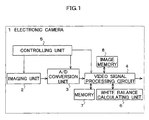
- Fig. 1 is a functional block diagram of an electronic camera 1 according to the first embodiment.
- the electronic camera 1 is equipped with an imaging unit 2, an A/D conversion unit 3, a video signal processing circuit 4, and a controlling unit 5 for controlling the individual units. Equipped with an imaging lens (not illustrated), an imaging device, etc., the imaging unit 2 generates an image signal by taking an image of an object and outputs it to the A/D conversion unit 3.
- the A/D conversion unit 3 generates digital image data based on the received image signal and outputs it to the video signal processing circuit 4.
- the electronic camera 1 is also equipped with a white balance calculating unit (hereinafter referred to as "WB calculating unit") 6, a memory 7, and an image memory 8.
- WB calculating unit white balance calculating unit
- the image data that is input to the video signal processing circuit 4 is subjected to various kinds of image processing by the video signal processing circuit 4 and the WB calculating unit 6.
- the other part of the configuration of the electronic camera 1 will not be described or illustrated because it is the same as in the related art.
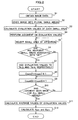
- Fig. 2 is a flowchart of a process which is executed by the WB calculating unit 6 at the time of white balance adjustment.
- the WB calculating unit 6 obtains image data of an image to be processed from the video signal processing circuit 4.
- the image data is RGB image data.
- the WB calculating unit 6 divides the obtained image into plural small areas.
- the image data is divided into 9 (vertical) x 10 (horizontal) small areas.
- the WB calculating unit 6 calculates evaluation values for each of the small areas produced at step S2.
- the evaluation values are two values, that is, (average of R values)/(average of G values) and (average of B values)/(average of G values) which will be referred to as R/G and B/G, respectively.
- the WB calculating unit 6 stores the calculated evaluation values R/G's and B/G's of the respective small areas in the memory 7 (the evaluation values are stored temporarily), and moves to step S4.
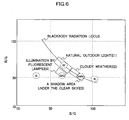
- the WB calculating unit 6 performs judgment on the evaluation values of each small area calculated at step S3. More specifically, the WB calculating unit 6 performs judgment on the evaluation values of each small area based on whether or not the evaluation values calculated at step S3 are included in predetermined achromatic regions in a predetermined color plane illustrated in Fig. 4 .
- the horizontal axis and the vertical axis represent B/G and R/G, respectively.
- four achromatic regions E1-E4 are defined in advance according to a blackbody radiation locus. The achromatic regions E1-E4 are defined for natural outdoor light, cloudy weather, a shadow area under the clear sky, and illumination by fluorescent lamps, respectively.
- the WB calculating unit 6 judges whether or not the evaluation values of each small area is included in one of the achromatic regions E1-E4. If the evaluation values are included in one of the achromatic regions E1-E4, the WB calculating unit 6 stores "OK” in the memory 7 in such a manner that it is correlated with the small area concerned. If the evaluation values are not included in any of the achromatic regions E1-E4, the WB calculating unit 6 stores "NG" in the memory 7 in such a manner that it is correlated with the small area concerned.
- the evaluation values of small areas indicated by "W” in Fig. 5 are included in the achromatic region E1 which is defined for outdoor natural light (see Fig. 6 ).
- the evaluation values of small areas indicated by "B” in Fig. 5 and those of small areas indicated by “G” in Fig. 5 are not included in any of the achromatic regions E1-E4.
- Small areas indicated by "W/B” in Fig. 5 are ones located at the boundary between the white area and the blue area, and their evaluation values are included in the achromatic region E3 which is defined for a shadow area under the clear sky.
- Small areas indicated by "B/G” in Fig. 5 are ones located at the boundary between the blue area and the green area, and their evaluation values are included in the achromatic region E4 which is defined for illumination by fluorescent lamps.
- the WB calculating unit 6 stores "OK” in the memory 7 for the small areas indicated by “W”, “W/B”, or “B/G” in Fig. 5 and stores "NG” in the memory 7 for the small areas indicated by "B” or "G".
- the WB calculating unit 6 selects a small area of attention.
- the WB calculating unit 6 selects small areas of attention in order starting from the small area that is located at the top-left corner.
- the WB calculating unit 6 judges whether or not all the small areas (i.e., eight small areas) adjacent to the small area selected at step S5 are associated with "OK”. If judging that all of such small areas are associated with "OK”, the WB calculating unit 6 moves to step S7. On the other hand, if there is at least one small area that is associated with "NG”, the WB calculating unit 6 moves to step 59 (described later).
- the WB calculating unit 6 adds the evaluation values of the small area selected at step S5 to T R/G and T B/G , respectively.
- step S8 the WB calculating unit 6 increments, by one, parameter CountT in the memory 7. Then, the WB calculating unit 6 moves to step S9.
- step S9 the WB calculating unit 6 increments, by one, parameter CountB in the memory 7. Then, the WB calculating unit 6 moves to step S10.
- step S6 If it is judged at step S6 that there is at least one small area that is associated with "NG" (step S6: no), steps S7 and S8 are skipped. That is, the evaluation values of the small area of attention are excluded from subjects of white balance calculation.
- the WB calculating unit 6 judges, based on the count CountB stored in the memory 7, whether or not the judgment of step S6 has been made for all the small areas. If judging that the judgment of step S6 has been made for all the small areas, the WB calculating unit 6 moves to step S11. On the other hand, if judging that the judgment of step S6 has not been made for all the small areas yet, the WB calculating unit 6 returns to step S5 and selects the next small area as a small area of attention.
- the WB calculating unit 6 calculates R gain and B gain based on the average values of evaluation values calculated at step S11.
- a specific method for calculating R gain and B gain is the same as in the well-known technique.
- a dividing unit which divides an image to be processed into plural small areas, a calculating unit which calculates evaluation values of each small area based on color information of the image, and a judging unit which judges whether to use the evaluation values of a small area of attention for white balance calculation based on a relationship between the evaluation values of the small area of attention and the evaluation values of small areas adjacent to the small area of attention among the evaluation values of the plural small areas are provided and white balance calculation is performed based on a judgment result of the judging unit. Therefore, color failure is suppressed and white balance adjustment can be performed properly.
- the judging unit makes the judgment based on whether or not the evaluation values are included in achromatic regions which are defined in advance in a predetermined chromatic coordinate. Therefore, small areas that may cause color contamination can be excluded from subjects of white balance calculation.
- the judging unit judges that the evaluation values of the small area of attention should be used for white balance calculation if the evaluation values of the small area of attention are included in the achromatic regions and the evaluation values of all of the small areas adjacent to the small area of attention are included in the achromatic regions. Therefore, achromatic areas can be selected with high accuracy and used for white balance calculation.
- a second embodiment will be described below with reference to the drawings.
- the second embodiment is a modification of the first embodiment.
- only components, operations, etc. that are different than in the first embodiment will be described in detail with components having the same components in the first embodiment given the same reference symbols as the latter.
- the second embodiment is directed to an electronic camera which is the same in configuration as the electronic camera 1 of Fig. 1 according to the first embodiment.
- Figs. 7 and 8 are a flowchart of a process which is executed by the WB calculating unit 6 at the time of white balance adjustment.
- the WB calculating unit 6 performs the same processing as at steps S1-S5 in Fig. 2 .
- step S26 as at step S6 in Fig. 2 , the WB calculating unit 6 judges whether or not all the small areas (i.e., eight small areas) adjacent to the small area selected at step S25 are associated with "OK”. If judging that all of such small areas are associated with "OK”, the WB calculating unit 6 moves to step S27. On the other hand, if there is at least one small area that is associated with "NG”, the WB calculating unit 6 moves to step S31 (described later).
- the WB calculating unit 6 calculates color differences ⁇ C between the small area selected at step S25 and all the small areas adjacent to it, respectively.
- Fig. 9 illustrates how to calculate color differences ⁇ C.
- (x, y) is one of eight combinations, that is, (-1, -1), (-1, 0), (-1, +1), (0, -1), (0, +1), (+1, -1), (+1, 0), and (+1, +1).
- the WB calculating unit 6 calculates color differences ⁇ C for these eight combinations of (x, y), stores them in the memory 7 (the calculated color differences ⁇ C are stored temporarily), and moves to step S28.
- a calculated color difference ⁇ C (x,y) stored in the memory 7 may be reused for the same combination of (x, y) corresponding to a different small area of attention (i.e., a color difference ⁇ C (x,y) is calculated only when each combination (x, y) appears for the first time).
- the WB calculating unit 6 judges whether or not the maximum value of the color differences ⁇ C (x,y) calculated at step S27 is smaller than or equal to a predetermined threshold value k. If judging that it is smaller than or equal to the predetermined threshold value k, the WB calculating unit 6 moves to step S29. On the other hand, if judging that it is larger than the predetermined threshold value k, the WB calculating unit 6 moves to step S31 (described later).
- the WB calculating unit 6 adds the evaluation values of the small area selected at step S25 to T R/G and T B/G , respectively.
- step S30 as at step S8 in Fig. 2 , the WB calculating unit 6 increments, by one, parameter CountT in the memory 7. Then, the WB calculating unit 6 moves to step S31.
- Step S31 as at step S9 in Fig. 2 , the WB calculating unit 6 increments, by one, parameter CountB in the memory 7. Then, the WB calculating unit 6 moves to step S32.
- Steps S29 and S30 are skipped if it is judged at step S26 that there is at least one small area that is associated with "NG" (step S6: no) or if it is judged at step S28 that the maximum value of the color differences ⁇ C (x,y) are larger than the predetermined threshold value k (step S28: no). That is, the evaluation values of the small area of attention are excluded from subjects of white balance calculation.
- step S32 as at step S10 in Fig. 2 , the WB calculating unit 6 judges, based on the count CountB in the memory 7, whether or not the judgment of step S26 has been made for all the small areas. If judging that the judgment of step S26 has been made for all the small areas, the WB calculating unit 6 moves to step S33. On the other hand, if judging that the judgment of step S26 has not been made for all the small areas yet, the WB calculating unit 6 returns to step S25 and selects the next small area as a small area of attention.
- the WB calculating unit 6 calculates average values of the evaluation values.
- step S34 as at step S12 in Fig. 2 , the WB calculating unit 6 calculates R gain and B gain based on the average values of evaluation values calculated at step S33.
- the judging unit judges that the evaluation values of the small area of attention should be used for white balance calculation if the evaluation values of the small area of attention are included in the achromatic regions and the color differences between the small area of attention and all of the small areas adjacent to the small area of attention are smaller than or equal to the predetermined value. Therefore, the second embodiment provides, in addition to the advantages of the first embodiment, an advantage that small areas that may cause color contamination can be excluded more reliably from subjects of white balance calculation and hence the evaluation values of small areas with low degrees of color unevenness can be used for white balance calculation.
- a third embodiment will be described below with reference to the drawings.
- the third embodiment is a modification of the first and second embodiments.
- only components, operations, etc. that are different than in the first and second embodiments will be described in detail with components having the same components in the first and second embodiments given the same reference symbols as the latter.
- the third embodiment is directed to an electronic camera which is the same in configuration as the electronic camera 1 of Fig. 1 according to the first embodiment.
- Figs. 10 and 11 are a flowchart of a process which is executed by the WB calculating unit 6 at the time of white balance adjustment.
- the WB calculating unit 6 performs the same processing as at steps S1-S5 in Fig. 2 .
- step S46 as at step S6 in Fig. 2 , the WB calculating unit 6 judges whether or not all the small areas (i.e., eight small areas) adjacent to the small area selected at step S45 are associated with "OK”. If judging that all of such small areas are associated with "OK”, the WB calculating unit 6 moves to step S47. On the other hand, if there is at least one small area that is associated with "NG”, the WB calculating unit 6 moves to step S54 (described later).
- the WB calculating unit 6 calculates color differences ⁇ C (x,y) for the eight combinations of (x, y) in the same manner as at step S27 in Fig. 7 .
- the WB calculating unit 6 judges whether or not the maximum value of the color differences ⁇ C (x,y) calculated at step S47 is smaller than or equal to a predetermined threshold value m. If judging that it is smaller than or equal to the predetermined threshold value m, the WB calculating unit 6 moves to step S52 (described later). On the other hand, if judging that it is larger than the predetermined threshold value m, the WB calculating unit 6 moves to step S49.
- the WB calculating unit 6 judges whether or not the maximum value of the color differences ⁇ C (x, y) calculated at step S47 is larger than or equal to a predetermined threshold value n. If judging that it is larger than or equal to the predetermined threshold value n, the WB calculating unit 6 moves to step S54 (described later). On the other hand, if judging that it is smaller than the predetermined threshold value n, the WB calculating unit 6 moves to step S50.
- step S51 the WB calculating unit 6 multiplies the evaluation values of the small area selected at step S45 by the weight W calculated at step S50. Then, the WB calculating unit 6 moves to step S52.
- the WB calculating unit 6 adds the evaluation values to T R/G and T B/G , respectively.
- Step S53 as at step S8 in Fig. 2 , the WB calculating unit 6 increments, by one, parameter CountT in the memory 7. Then, the WB calculating unit 6 moves to step S54.
- Step S54 as at step S9 in Fig. 2 , the WB calculating unit 6 increments, by one, parameter CountB in the memory 7. Then, the WB calculating unit 6 moves to step S55.
- Steps S52 and S53 are skipped if it is judged at step S49 that the maximum value of color differences ⁇ C (x,y) are larger than or equal to the threshold value n (step S49: yes). That is, the weight W for a small area whose maximum value of color differences ⁇ C (x,y) are larger than or equal to the threshold value n is set to 0.
- Fig. 12 illustrates a relationship between the maximum value of color differences ⁇ C (x, y) and the weight W.
- the weight W is set to 1 if the maximum value of color differences ⁇ C (x,y) is smaller than or equal to the threshold value m (step S48: yes).
- the weight W is set to 0 if the maximum value of color differences ⁇ C (x,y) is larger than or equal to the threshold value n (step S49: yes). If the maximum value of color differences ⁇ C (x,y) is larger than the threshold value m and smaller than the threshold value n (step S49: no), the weight W is determined according to the maximum value of color differences ⁇ C (x,y) .
- the weight W is determined so that the evaluation values of the small area of attention contributes to white balance calculation greatly.
- the maximum value of color differences ⁇ C (x,y) is sufficiently large, the evaluation values of the small area of attention are excluded from subjects of white balance calculation.
- step 555 as at step S10 in Fig. 2 , the WB calculating unit 6 judges, based on the count CountB in the memory 7, whether or not the judgment of step S46 has been made for all the small areas. If judging that the judgment of step S46 has been made for all the small areas, the WB calculating unit 6 moves to step S56. On the other hand, if judging that the judgment of step S46 has not been made for all the small areas yet, the WB calculating unit 6 returns to step S45 and selects the next small area as a small area of attention.
- step S56 as at step S11 in Fig. 2 , the WB calculating unit 6 calculates average values of the evaluation values.
- step S57 as at step S12 in Fig. 2 , the WB calculating unit 6 calculates R gain and B gain based on the average values of evaluation values calculated at step S56.
- the third embodiment provides, in addition to the advantages of the first embodiment, an advantage that the degree of contribution of the evaluation values of each small area of attention to white balance calculation can be adjusted according to color differences.
- image data of an image to be processed is RGB image data
- the present embodiment can similarly be applied to a case that image data of an image to be processed is image data in another color space (e.g., YCbCr image data).
- each of the above-described embodiments is directed to the electronic camera which is equipped with the white balance adjusting device
- the present embodiment can similarly be applied to an image processing apparatus using a computer.
Landscapes
- Engineering & Computer Science (AREA)
- Multimedia (AREA)
- Signal Processing (AREA)
- Processing Of Color Television Signals (AREA)
- Color Television Image Signal Generators (AREA)
Abstract
Description
- The embodiments relate to a white balance adjusting device which performs white balance adjustment on image data to be processed, and a related imaging apparatus and white balance adjusting program.
- Techniques for performing white balance adjustment on digital image data are known. And a technique has been proposed which varies the weights of pieces of information used for white balance adjustment according to luminance information to prevent color failure due to an object color in the white balance adjustment (refer to Japanese Unexamined Patent Application Publication No.
2002-23296 - Incidentally, there may occur an event that color contamination occurs in object color boundary portions included in image data and white balance adjustment is performed improperly due to color failure. The technique of the above publication No. 2002-23296 cannot accommodate this problem.
- A proposition of the embodiments is therefore to provide a white balance adjusting device, an imaging apparatus, and a white balance adjusting program which can suppress color failure and perform white balance adjustment properly.
- To attain the above proposition, a color balance adjusting device according to the present embodiment includes a dividing unit which divides an image to be processed into plural small areas; a calculating unit which calculates evaluation values of each of the small areas based on color information of the image; a judging unit which makes a judgment as to whether to use the evaluation values of a small area of attention for white balance calculation based on a relationship between the evaluation values of the small area of attention and the evaluation values of small areas adjacent to the small area of attention among the evaluation values of the plural small areas; and a calculating unit which performs white balance calculation based on a judgment result of the judging unit.
- For example, the judging unit makes the judgment based on whether the evaluation values are included in achromatic regions which are defined in advance in a predetermined chromatic coordinate.
- For example, the judging unit judges that the evaluation values of the small area of attention should be used for white balance calculation if the evaluation values of the small area of attention are included in the achromatic regions and the evaluation values of all of the small areas adjacent to the small area of attention are included in the achromatic regions.
- For example, the judging unit judges that the evaluation values of the small area of attention should be used for white balance calculation if the evaluation values of the small area of attention are included in the achromatic regions and color differences between the small area of attention and all of the small areas adjacent to the small area of attention are smaller than or equal to a predetermined value.
- Furthermore, for example, the calculating unit determines a weight to be applied to the evaluation values of the small area of attention according to the color differences when they are used for white balance calculation.
- An imaging apparatus having any of the above white balance adjusting devices is effective as a specific form of implementation of the present embodiment.
- A white balance adjusting program, as obtained by converting the expression of any of the above white adjusting devices into a program form, for realizing white balance adjustment on image data to be processed is also effective as a specific form of implementation of the present embodiment.
-
-
Fig. 1 is a functional block diagram of anelectronic camera 1 according to a first embodiment; -
Fig. 2 is a flowchart of a process which is executed by theelectronic camera 1 according to the first embodiment; -
Fig. 3 illustrates how an image is divided; -
Fig. 4 illustrates how judgment is performed; -
Fig. 5 illustrates colors of respective small areas; -
Fig. 6 illustrates how judgment is performed on the image ofFig. 5 ; -
Fig. 7 is a flowchart of a process which is executed by anelectronic camera 1 according to a second embodiment; -
Fig. 8 is (a continuation of) a flowchart of a process which is executed by anelectronic camera 1 according to a second embodiment; -
Fig. 9 illustrates how color differences ΔC are calculated; -
Fig. 10 is a flowchart of a process which is executed by anelectronic camera 1 according to a third embodiment; -
Fig. 11 is (a continuation of) a flowchart of a process which is executed by anelectronic camera 1 according to a third embodiment; -
Fig. 12 illustrates a relationship between the maximum value of color differences ΔC(x,y) and the weight W. - A first embodiment will be described below with reference to the drawings. The first embodiment is directed to an electronic camera which is equipped with a white balance adjusting device according to the present embodiment.
-
Fig. 1 is a functional block diagram of anelectronic camera 1 according to the first embodiment. As illustrated inFig. 1 , theelectronic camera 1 is equipped with animaging unit 2, an A/D conversion unit 3, a videosignal processing circuit 4, and a controllingunit 5 for controlling the individual units. Equipped with an imaging lens (not illustrated), an imaging device, etc., theimaging unit 2 generates an image signal by taking an image of an object and outputs it to the A/D conversion unit 3. The A/D conversion unit 3 generates digital image data based on the received image signal and outputs it to the videosignal processing circuit 4. Theelectronic camera 1 is also equipped with a white balance calculating unit (hereinafter referred to as "WB calculating unit") 6, amemory 7, and animage memory 8. The image data that is input to the videosignal processing circuit 4 is subjected to various kinds of image processing by the videosignal processing circuit 4 and the WB calculatingunit 6. The other part of the configuration of theelectronic camera 1 will not be described or illustrated because it is the same as in the related art. -
Fig. 2 is a flowchart of a process which is executed by the WB calculatingunit 6 at the time of white balance adjustment. - At step S1, the WB calculating
unit 6 obtains image data of an image to be processed from the videosignal processing circuit 4. The image data is RGB image data. - At step S2, the WB calculating
unit 6 divides the obtained image into plural small areas. In this embodiment, as illustrated inFig. 3 , the image data is divided into 9 (vertical) x 10 (horizontal) small areas. - At step S3, the WB calculating
unit 6 calculates evaluation values for each of the small areas produced at step S2. The evaluation values are two values, that is, (average of R values)/(average of G values) and (average of B values)/(average of G values) which will be referred to as R/G and B/G, respectively. The WB calculatingunit 6 stores the calculated evaluation values R/G's and B/G's of the respective small areas in the memory 7 (the evaluation values are stored temporarily), and moves to step S4. - At step S4, the WB calculating
unit 6 performs judgment on the evaluation values of each small area calculated at step S3. More specifically, the WB calculatingunit 6 performs judgment on the evaluation values of each small area based on whether or not the evaluation values calculated at step S3 are included in predetermined achromatic regions in a predetermined color plane illustrated inFig. 4 . InFig. 4 , the horizontal axis and the vertical axis represent B/G and R/G, respectively. InFig. 4 , four achromatic regions E1-E4 are defined in advance according to a blackbody radiation locus. The achromatic regions E1-E4 are defined for natural outdoor light, cloudy weather, a shadow area under the clear sky, and illumination by fluorescent lamps, respectively. The WB calculatingunit 6 judges whether or not the evaluation values of each small area is included in one of the achromatic regions E1-E4. If the evaluation values are included in one of the achromatic regions E1-E4, the WB calculatingunit 6 stores "OK" in thememory 7 in such a manner that it is correlated with the small area concerned. If the evaluation values are not included in any of the achromatic regions E1-E4, the WB calculatingunit 6 stores "NG" in thememory 7 in such a manner that it is correlated with the small area concerned. - For example, in the case of an image in which a top-left area is white, a bottom-right area is green, and a blue area exists between them (see
Fig. 5 ), the evaluation values of small areas indicated by "W" inFig. 5 are included in the achromatic region E1 which is defined for outdoor natural light (seeFig. 6 ). The evaluation values of small areas indicated by "B" inFig. 5 and those of small areas indicated by "G" inFig. 5 are not included in any of the achromatic regions E1-E4. Small areas indicated by "W/B" inFig. 5 are ones located at the boundary between the white area and the blue area, and their evaluation values are included in the achromatic region E3 which is defined for a shadow area under the clear sky. Small areas indicated by "B/G" inFig. 5 are ones located at the boundary between the blue area and the green area, and their evaluation values are included in the achromatic region E4 which is defined for illumination by fluorescent lamps. - Therefore, the WB calculating
unit 6 stores "OK" in thememory 7 for the small areas indicated by "W", "W/B", or "B/G" inFig. 5 and stores "NG" in thememory 7 for the small areas indicated by "B" or "G". - At
step 55, the WB calculatingunit 6 selects a small area of attention. The WB calculatingunit 6 selects small areas of attention in order starting from the small area that is located at the top-left corner. - At step S6, the WB calculating
unit 6 judges whether or not all the small areas (i.e., eight small areas) adjacent to the small area selected at step S5 are associated with "OK". If judging that all of such small areas are associated with "OK", theWB calculating unit 6 moves to step S7. On the other hand, if there is at least one small area that is associated with "NG", theWB calculating unit 6 moves to step 59 (described later). - Among the small areas for which "OK" was stored at step S4 (judgment), it is not appropriate to use, for white balance calculation, the evaluation values of the small areas indicated by "W/B" because color contamination will occur there. The small areas indicated by "B/G" were erroneously detected by the judgment at step S4 because actually they are not achromatic areas. However, these small areas can be excluded from subjects of white balance calculation by virtue of the judgment of step S6.
- At step S7, the
WB calculating unit 6 adds the evaluation values of the small area selected at step S5 to TR/G and TB/G, respectively. Symbols TR/G and TB/G represent the sums of evaluation values and are initialized (TR/G = 0, TB/G = 0) before the process is started. - At step S8, the
WB calculating unit 6 increments, by one, parameter CountT in thememory 7. Then, theWB calculating unit 6 moves to step S9. Parameter CountT is the count of a counter for counting the number of evaluation values that have been added to TR/G and TB/G at step S7, and is initialized (CountT = 0) before the process is started. - At step S9, the
WB calculating unit 6 increments, by one, parameter CountB in thememory 7. Then, theWB calculating unit 6 moves to step S10. Parameter CountB is the count of a counter for counting the number of small areas that have been selected at step S5, and is initialized (CountB = 0) before the process is started. - If it is judged at step S6 that there is at least one small area that is associated with "NG" (step S6: no), steps S7 and S8 are skipped. That is, the evaluation values of the small area of attention are excluded from subjects of white balance calculation.
- At step S10, the
WB calculating unit 6 judges, based on the count CountB stored in thememory 7, whether or not the judgment of step S6 has been made for all the small areas. If judging that the judgment of step S6 has been made for all the small areas, theWB calculating unit 6 moves to step S11. On the other hand, if judging that the judgment of step S6 has not been made for all the small areas yet, theWB calculating unit 6 returns to step S5 and selects the next small area as a small area of attention. - At step S11, the
WB calculating unit 6 calculates average values of the evaluation values according to the following Equations (1) and (2):

- At step S 12, the
WB calculating unit 6 calculates Rgain and Bgain based on the average values of evaluation values calculated at step S11. A specific method for calculating Rgain and Bgain is the same as in the well-known technique. - As described above, in the first embodiment, a dividing unit which divides an image to be processed into plural small areas, a calculating unit which calculates evaluation values of each small area based on color information of the image, and a judging unit which judges whether to use the evaluation values of a small area of attention for white balance calculation based on a relationship between the evaluation values of the small area of attention and the evaluation values of small areas adjacent to the small area of attention among the evaluation values of the plural small areas are provided and white balance calculation is performed based on a judgment result of the judging unit. Therefore, color failure is suppressed and white balance adjustment can be performed properly.
- Furthermore, in the first embodiment, the judging unit makes the judgment based on whether or not the evaluation values are included in achromatic regions which are defined in advance in a predetermined chromatic coordinate. Therefore, small areas that may cause color contamination can be excluded from subjects of white balance calculation.
- Still further, in the first embodiment, the judging unit judges that the evaluation values of the small area of attention should be used for white balance calculation if the evaluation values of the small area of attention are included in the achromatic regions and the evaluation values of all of the small areas adjacent to the small area of attention are included in the achromatic regions. Therefore, achromatic areas can be selected with high accuracy and used for white balance calculation.
- A second embodiment will be described below with reference to the drawings. The second embodiment is a modification of the first embodiment. In the second embodiment, only components, operations, etc. that are different than in the first embodiment will be described in detail with components having the same components in the first embodiment given the same reference symbols as the latter.
- The second embodiment is directed to an electronic camera which is the same in configuration as the
electronic camera 1 ofFig. 1 according to the first embodiment. -
Figs. 7 and8 are a flowchart of a process which is executed by theWB calculating unit 6 at the time of white balance adjustment. - At steps S21-S25, the
WB calculating unit 6 performs the same processing as at steps S1-S5 inFig. 2 . - At step S26, as at step S6 in
Fig. 2 , theWB calculating unit 6 judges whether or not all the small areas (i.e., eight small areas) adjacent to the small area selected at step S25 are associated with "OK". If judging that all of such small areas are associated with "OK", theWB calculating unit 6 moves to step S27. On the other hand, if there is at least one small area that is associated with "NG", theWB calculating unit 6 moves to step S31 (described later). - At step S27, the
WB calculating unit 6 calculates color differences ΔC between the small area selected at step S25 and all the small areas adjacent to it, respectively. -
Fig. 9 illustrates how to calculate color differences ΔC. Assume that the central small area (0, 0) is the small area selected at step S25; then, a color difference ΔC(x,y) between the small area selected at step S25 and an adjacent small area (x, y) is calculated according to the following Equation (3):
- In Equation (3), (x, y) is one of eight combinations, that is, (-1, -1), (-1, 0), (-1, +1), (0, -1), (0, +1), (+1, -1), (+1, 0), and (+1, +1). The
WB calculating unit 6 calculates color differences ΔC for these eight combinations of (x, y), stores them in the memory 7 (the calculated color differences ΔC are stored temporarily), and moves to step S28. A calculated color difference ΔC(x,y) stored in thememory 7 may be reused for the same combination of (x, y) corresponding to a different small area of attention (i.e., a color difference ΔC(x,y) is calculated only when each combination (x, y) appears for the first time). - At step S28, the
WB calculating unit 6 judges whether or not the maximum value of the color differences ΔC(x,y) calculated at step S27 is smaller than or equal to a predetermined threshold value k. If judging that it is smaller than or equal to the predetermined threshold value k, theWB calculating unit 6 moves to step S29. On the other hand, if judging that it is larger than the predetermined threshold value k, theWB calculating unit 6 moves to step S31 (described later). - At step S29, as at step S7 in
Fig. 2 , theWB calculating unit 6 adds the evaluation values of the small area selected at step S25 to TR/G and TB/G, respectively. Symbols TR/G and TB/G represent the sums of evaluation values and are initialized (TR/G = 0, TB/G = 0) before the process is started. - At step S30, as at step S8 in
Fig. 2 , theWB calculating unit 6 increments, by one, parameter CountT in thememory 7. Then, theWB calculating unit 6 moves to step S31. Parameter CountT is the count of a counter for counting the number of evaluation values that have been added to TR/G and TB/G at step S29, and is initialized (CountT = 0) before the process is started. - At step S31, as at step S9 in
Fig. 2 , theWB calculating unit 6 increments, by one, parameter CountB in thememory 7. Then, theWB calculating unit 6 moves to step S32. Parameter CountB is the count of a counter for counting the number of small areas that have been selected at step S26, and is initialized (CountB = 0) before the process is started. - Steps S29 and S30 are skipped if it is judged at step S26 that there is at least one small area that is associated with "NG" (step S6: no) or if it is judged at step S28 that the maximum value of the color differences ΔC(x,y) are larger than the predetermined threshold value k (step S28: no). That is, the evaluation values of the small area of attention are excluded from subjects of white balance calculation.
- At step S32, as at step S10 in
Fig. 2 , theWB calculating unit 6 judges, based on the count CountB in thememory 7, whether or not the judgment of step S26 has been made for all the small areas. If judging that the judgment of step S26 has been made for all the small areas, theWB calculating unit 6 moves to step S33. On the other hand, if judging that the judgment of step S26 has not been made for all the small areas yet, theWB calculating unit 6 returns to step S25 and selects the next small area as a small area of attention. - At step S33, as at step S11 in
Fig. 2 , theWB calculating unit 6 calculates average values of the evaluation values. - At step S34, as at step S12 in
Fig. 2 , theWB calculating unit 6 calculates Rgain and Bgain based on the average values of evaluation values calculated at step S33. - As described above, in the second embodiment, the judging unit judges that the evaluation values of the small area of attention should be used for white balance calculation if the evaluation values of the small area of attention are included in the achromatic regions and the color differences between the small area of attention and all of the small areas adjacent to the small area of attention are smaller than or equal to the predetermined value. Therefore, the second embodiment provides, in addition to the advantages of the first embodiment, an advantage that small areas that may cause color contamination can be excluded more reliably from subjects of white balance calculation and hence the evaluation values of small areas with low degrees of color unevenness can be used for white balance calculation.
- A third embodiment will be described below with reference to the drawings. The third embodiment is a modification of the first and second embodiments. In the third embodiment, only components, operations, etc. that are different than in the first and second embodiments will be described in detail with components having the same components in the first and second embodiments given the same reference symbols as the latter.
- The third embodiment is directed to an electronic camera which is the same in configuration as the
electronic camera 1 ofFig. 1 according to the first embodiment. -
Figs. 10 and11 are a flowchart of a process which is executed by theWB calculating unit 6 at the time of white balance adjustment. - At steps S41-545, the
WB calculating unit 6 performs the same processing as at steps S1-S5 inFig. 2 . - At step S46, as at step S6 in
Fig. 2 , theWB calculating unit 6 judges whether or not all the small areas (i.e., eight small areas) adjacent to the small area selected at step S45 are associated with "OK". If judging that all of such small areas are associated with "OK", theWB calculating unit 6 moves to step S47. On the other hand, if there is at least one small area that is associated with "NG", theWB calculating unit 6 moves to step S54 (described later). - At step S47, the
WB calculating unit 6 calculates color differences ΔC(x,y) for the eight combinations of (x, y) in the same manner as at step S27 inFig. 7 . - At step S48, the
WB calculating unit 6 judges whether or not the maximum value of the color differences ΔC(x,y) calculated at step S47 is smaller than or equal to a predetermined threshold value m. If judging that it is smaller than or equal to the predetermined threshold value m, theWB calculating unit 6 moves to step S52 (described later). On the other hand, if judging that it is larger than the predetermined threshold value m, theWB calculating unit 6 moves to step S49. - At step S49, the
WB calculating unit 6 judges whether or not the maximum value of the color differences ΔC(x, y) calculated at step S47 is larger than or equal to a predetermined threshold value n. If judging that it is larger than or equal to the predetermined threshold value n, theWB calculating unit 6 moves to step S54 (described later). On the other hand, if judging that it is smaller than the predetermined threshold value n, theWB calculating unit 6 moves to step S50. - If the maximum value of the color differences ΔC(x,y) is larger than the threshold value m and smaller than the threshold value n, at step S50, the
WB calculating unit 6 calculates a weight W according to the following Equation (4) based on the maximum value of the color differences ΔC(x,y):
where a is the maximum value of the color differences ΔC(x,y). - At step S51, the
WB calculating unit 6 multiplies the evaluation values of the small area selected at step S45 by the weight W calculated at step S50. Then, theWB calculating unit 6 moves to step S52. - At step S52, as at step S7 in
Fig. 2 , theWB calculating unit 6 adds the evaluation values to TR/G and TB/G, respectively. Symbols TR/G and TB/G represent the sums of evaluation values and are initialized (TR/G = 0, TB/G = 0) before the process is started. If the maximum value of the color differences ΔC(x,y) is larger than the threshold value m and smaller than the threshold value n, at step S52, the evaluation values as multiplied by the weight W at step S51 are added to TR/G and TB/G. - At step S53, as at step S8 in
Fig. 2 , theWB calculating unit 6 increments, by one, parameter CountT in thememory 7. Then, theWB calculating unit 6 moves to step S54. Parameter CountT is the count of a counter for counting the number of evaluation values that have been added to TR/G and TB/G at step S52, and is initialized (CountT = 0) before the process is started. - At step S54, as at step S9 in
Fig. 2 , theWB calculating unit 6 increments, by one, parameter CountB in thememory 7. Then, theWB calculating unit 6 moves to step S55. Parameter CountB is the count of a counter for counting the number of small areas that have been selected at step S45, and is initialized (CountB = 0) before the process is started. - Steps S52 and S53 are skipped if it is judged at step S49 that the maximum value of color differences ΔC(x,y) are larger than or equal to the threshold value n (step S49: yes). That is, the weight W for a small area whose maximum value of color differences ΔC(x,y) are larger than or equal to the threshold value n is set to 0.
-
Fig. 12 illustrates a relationship between the maximum value of color differences ΔC(x, y) and the weight W. As illustrated inFig. 12 , the weight W is set to 1 if the maximum value of color differences ΔC(x,y) is smaller than or equal to the threshold value m (step S48: yes). The weight W is set to 0 if the maximum value of color differences ΔC(x,y) is larger than or equal to the threshold value n (step S49: yes). If the maximum value of color differences ΔC(x,y) is larger than the threshold value m and smaller than the threshold value n (step S49: no), the weight W is determined according to the maximum value of color differences ΔC(x,y). - That is, if the maximum value of color differences ΔC(x,y) is sufficiently small, the weight W is determined so that the evaluation values of the small area of attention contributes to white balance calculation greatly. On the other hand, if the maximum value of color differences ΔC(x,y) is sufficiently large, the evaluation values of the small area of attention are excluded from subjects of white balance calculation.
- At step 555, as at step S10 in
Fig. 2 , theWB calculating unit 6 judges, based on the count CountB in thememory 7, whether or not the judgment of step S46 has been made for all the small areas. If judging that the judgment of step S46 has been made for all the small areas, theWB calculating unit 6 moves to step S56. On the other hand, if judging that the judgment of step S46 has not been made for all the small areas yet, theWB calculating unit 6 returns to step S45 and selects the next small area as a small area of attention. - At step S56, as at step S11 in
Fig. 2 , theWB calculating unit 6 calculates average values of the evaluation values. - At step S57, as at step S12 in
Fig. 2 , theWB calculating unit 6 calculates Rgain and Bgain based on the average values of evaluation values calculated at step S56. - As described above, in the third embodiment, a weight to be applied to the evaluation values when they are used for white balance calculation is determined according to the color differences. Therefore, the third embodiment provides, in addition to the advantages of the first embodiment, an advantage that the degree of contribution of the evaluation values of each small area of attention to white balance calculation can be adjusted according to color differences.
- Although in each of the above-described embodiments image data of an image to be processed is RGB image data, the present embodiment can similarly be applied to a case that image data of an image to be processed is image data in another color space (e.g., YCbCr image data).
- Although each of the above-described embodiments is directed to the electronic camera which is equipped with the white balance adjusting device, the present embodiment can similarly be applied to an image processing apparatus using a computer. In this case, it is appropriate to store, in the computer, a program corresponding to the flowchart of
Fig. 2 ,Figs. 7 and8 , orFigs. 10 and11 . - The many features and advantages of the embodiments are apparent from the detailed specification and, thus, it is intended by the appended claims to cover all such features and advantages of the embodiments that fall within the true spirit and scope thereof. Further, since numerous modifications and changes will readily occur to those skilled in the art, it is not desired to limit the inventive embodiments to the exact construction and operation illustrated and described, and accordingly all suitable modifications and equivalents may be resorted to, falling within the scope thereof.
Claims (7)
- A white balance adjusting device comprising:a dividing unit which divides an image to be processed into plural small areas;a calculating unit which calculates evaluation values of each of said small areas based on color information of said image;a judging unit which makes a judgment as to whether to use said evaluation values of a small area of attention for white balance calculation based on a relationship between said evaluation values of said small area of attention and said evaluation values of small areas adjacent to said small area of attention among said evaluation values of said plural small areas; anda calculating unit which performs white balance calculation based on a judgment result of said judging unit.
- The white balance adjusting device according to claim 1, wherein said judging unit makes said judgment based on whether said evaluation values are included in achromatic regions which are defined in advance in a predetermined chromatic coordinate.
- The white balance adjusting device according to claim 2, wherein said judging unit judges that said evaluation values of said small area of attention should be used for white balance calculation if said evaluation values of said small area of attention are included in said achromatic regions and said evaluation values of all of said small areas adjacent to said small area of attention are included in said achromatic regions.
- The white balance adjusting device according to claim 2, wherein said judging unit judges that said evaluation values of said small area of attention should be used for white balance calculation if said evaluation values of said small area of attention are included in said achromatic regions and color differences between said small area of attention and all of said small areas adjacent to said small area of attention are smaller than or equal to a predetermined value.
- The white balance adjusting device according to claim 4, wherein said calculating unit determines a weight to be applied to said evaluation values according to said color differences when they are used for white balance calculation.
- An imaging apparatus comprising said white balance adjusting device according to any one of claims 1 to 5.
- A white balance adjusting program for causing a computer to perform white balance adjustment on image data to be processed, comprising:a dividing step dividing an image to be processed into plural small areas;a calculating step calculating evaluation values of each of said small areas based on color information of said image;a judging step judging whether to use said evaluation values of a small area of attention for white balance calculation based on a relationship between said evaluation values of said small area of attention and said evaluation values of small areas adjacent to said small area of attention among said evaluation values of said plural small areas and whether said evaluation values of said small area of attention are included in achromatic regions which are defined in advance in a predetermined chromatic coordinate; anda calculating step performing white balance calculation based on a judgment result of said judging step.
Applications Claiming Priority (1)
| Application Number | Priority Date | Filing Date | Title |
|---|---|---|---|
| JP2007115807A JP5250996B2 (en) | 2007-04-25 | 2007-04-25 | White balance adjustment device, imaging device, and white balance adjustment program |
Publications (2)
| Publication Number | Publication Date |
|---|---|
| EP1986444A2 true EP1986444A2 (en) | 2008-10-29 |
| EP1986444A3 EP1986444A3 (en) | 2011-09-07 |
Family
ID=39433777
Family Applications (1)
| Application Number | Title | Priority Date | Filing Date |
|---|---|---|---|
| EP08251258A Withdrawn EP1986444A3 (en) | 2007-04-25 | 2008-03-31 | White balance adjusting device, imaging apparatus, and white balance adjusting program |
Country Status (4)
| Country | Link |
|---|---|
| US (1) | US8164649B2 (en) |
| EP (1) | EP1986444A3 (en) |
| JP (1) | JP5250996B2 (en) |
| CN (1) | CN101296384B (en) |
Cited By (2)
| Publication number | Priority date | Publication date | Assignee | Title |
|---|---|---|---|---|
| EP3138283A4 (en) * | 2014-04-29 | 2017-12-13 | Intel Corporation | Automatic white balancing with chromaticity measure of raw image data |
| CN112820248A (en) * | 2021-02-07 | 2021-05-18 | 峰米(北京)科技有限公司 | White balance adjusting method, system, storage medium and electronic equipment |
Families Citing this family (21)
| Publication number | Priority date | Publication date | Assignee | Title |
|---|---|---|---|---|
| US7808531B2 (en) * | 2005-12-14 | 2010-10-05 | Samsung Electronics Co., Ltd. | Method and apparatus for auto white controlling |
| US7825958B2 (en) * | 2007-01-25 | 2010-11-02 | Research In Motion Limited | Method and apparatus for controlling a camera module to compensate for the light level of a white LED |
| US7710466B2 (en) * | 2007-01-25 | 2010-05-04 | Research In Motion Limited | Method and apparatus for controlling a camera module to compensate for the color spectrum of a white LED |
| KR100983037B1 (en) * | 2008-07-25 | 2010-09-17 | 삼성전기주식회사 | How to adjust the white balance automatically |
| JP5187241B2 (en) * | 2009-02-16 | 2013-04-24 | 株式会社リコー | Imaging apparatus and imaging method |
| JP5399739B2 (en) * | 2009-02-25 | 2014-01-29 | ルネサスエレクトロニクス株式会社 | Image processing device |
| KR101533282B1 (en) * | 2009-02-27 | 2015-07-02 | 삼성전자주식회사 | Digital camera and control method thereof |
| JP5045731B2 (en) * | 2009-11-04 | 2012-10-10 | カシオ計算機株式会社 | Imaging apparatus, white balance setting method, and program |
| JP5549282B2 (en) * | 2010-03-05 | 2014-07-16 | 株式会社ニコン | Image processing apparatus, imaging apparatus, computer-readable program |
| JP5743696B2 (en) * | 2011-05-06 | 2015-07-01 | キヤノン株式会社 | Image processing apparatus, image processing method, and program |
| JP5769524B2 (en) * | 2011-07-05 | 2015-08-26 | キヤノン株式会社 | IMAGING DEVICE, IMAGING DEVICE CONTROL METHOD, AND COMPUTER PROGRAM |
| US20140152866A1 (en) * | 2011-07-11 | 2014-06-05 | Ren Wu | Ranking color correction processes |
| EP2704055A1 (en) | 2012-08-31 | 2014-03-05 | Layar B.V. | Determining space to display content in augmented reality |
| CN103686113B (en) * | 2012-09-14 | 2016-06-08 | 富士通株式会社 | Based on the white balance system of raw data and the method for digital camera |
| JP6234191B2 (en) * | 2013-11-28 | 2017-11-22 | オリンパス株式会社 | Multi-area white balance control device, multi-area white balance control method, multi-area white balance control program, computer recording multi-area white balance control program, multi-area white balance image processing device, multi-area white balance image processing method, multi-area White balance image processing program, computer recording multi-area white balance image processing program, and imaging apparatus provided with multi-area white balance image processing device |
| JP6345430B2 (en) * | 2014-01-31 | 2018-06-20 | オリンパス株式会社 | Multi-area white balance control device, multi-area white balance control method, multi-area white balance control program, computer recording multi-area white balance control program, multi-area white balance image processing device, multi-area white balance image processing method, multi-area White balance image processing program, computer recording multi-area white balance image processing program, and imaging apparatus provided with multi-area white balance image processing device |
| US9860507B2 (en) | 2015-06-08 | 2018-01-02 | Qualcomm Incorporated | Dynamic frame skip for auto white balance |
| CN105872500A (en) * | 2015-12-08 | 2016-08-17 | 乐视移动智能信息技术(北京)有限公司 | Adjusting method and device for white balance of image |
| CN108540787B (en) * | 2018-03-16 | 2019-09-17 | 浙江大华技术股份有限公司 | A kind of method, apparatus, equipment and the storage medium in determining white balance point region |
| CN112911261B (en) * | 2021-01-28 | 2022-07-12 | 武汉华星光电半导体显示技术有限公司 | Display device and white balance adjustment method for photosensitive element of display device |
| CN116095292B (en) * | 2023-02-13 | 2024-11-26 | 锐芯微电子股份有限公司 | White balance adjustment method, computer readable storage medium and electronic device |
Citations (4)
| Publication number | Priority date | Publication date | Assignee | Title |
|---|---|---|---|---|
| JP2002023296A (en) | 2000-07-13 | 2002-01-23 | Konica Corp | Silver halide photosensitive material containing dispersion of solid fine particles, and image-forming method |
| US20020023296A1 (en) | 2000-09-05 | 2002-02-28 | Harry Bussey | Pool cover |
| US20040212691A1 (en) * | 2003-04-25 | 2004-10-28 | Genta Sato | Automatic white balance adjusting method |
| US20070047803A1 (en) | 2005-08-30 | 2007-03-01 | Nokia Corporation | Image processing device with automatic white balance |
Family Cites Families (18)
| Publication number | Priority date | Publication date | Assignee | Title |
|---|---|---|---|---|
| US5442408A (en) * | 1989-11-17 | 1995-08-15 | Sanyo Electric Co., Ltd. | White balance adjusting apparatus for automatically adjusting white balance in response to luminance information signal and color information signal obtained from image sensing device |
| JP3113518B2 (en) * | 1994-09-30 | 2000-12-04 | 三洋電機株式会社 | Video camera |
| US6020920A (en) * | 1997-06-10 | 2000-02-01 | Flashpoint Technology, Inc. | Method and system for speculative decompression of compressed image data in an image capture unit |
| JP2000165896A (en) | 1998-11-25 | 2000-06-16 | Ricoh Co Ltd | White balance control method and device |
| JP3849834B2 (en) * | 1999-02-02 | 2006-11-22 | 富士写真フイルム株式会社 | Auto white balance control method |
| US6788331B1 (en) * | 1999-07-30 | 2004-09-07 | Frank Sacca | Videofax system with progressive image display |
| US6906744B1 (en) | 1999-09-28 | 2005-06-14 | Nikon Corporation | Electronic camera |
| CN1202491C (en) * | 2000-12-28 | 2005-05-18 | 金宝电子工业股份有限公司 | White balancing treatment method for digital image pick-up |
| JP2002232906A (en) | 2001-01-31 | 2002-08-16 | Ricoh Co Ltd | White balance control device |
| JP3903094B2 (en) | 2002-01-29 | 2007-04-11 | 富士フイルム株式会社 | White balance control method and digital camera |
| JP3513506B2 (en) * | 2002-02-20 | 2004-03-31 | キヤノン株式会社 | WHITE BALANCE CORRECTION DEVICE, IMAGING DEVICE WITH THE SAME, AND WHITE BALANCE CORRECTION METHOD |
| JP2005080011A (en) * | 2003-09-01 | 2005-03-24 | Canon Inc | Imaging method, imaging apparatus, program, and storage medium |
| JP4603319B2 (en) * | 2004-09-01 | 2010-12-22 | パナソニック株式会社 | Image input device |
| JP4754227B2 (en) * | 2005-01-31 | 2011-08-24 | イーストマン コダック カンパニー | Auto white balance device and white balance adjustment method |
| JP4849818B2 (en) | 2005-04-14 | 2012-01-11 | イーストマン コダック カンパニー | White balance adjustment device and color identification device |
| JP2007068146A (en) * | 2005-08-04 | 2007-03-15 | Canon Inc | Image processing apparatus, method for calculating white balance evaluation value, program having program code for realizing method for calculating white balance evaluation value, and storage medium storing the program |
| JP2007053499A (en) * | 2005-08-16 | 2007-03-01 | Fujifilm Holdings Corp | White balance control unit and imaging apparatus |
| JP4832899B2 (en) * | 2006-01-05 | 2011-12-07 | イーストマン コダック カンパニー | Gain calculation device |
-
2007
- 2007-04-25 JP JP2007115807A patent/JP5250996B2/en not_active Expired - Fee Related
-
2008
- 2008-03-14 US US12/076,181 patent/US8164649B2/en not_active Expired - Fee Related
- 2008-03-31 EP EP08251258A patent/EP1986444A3/en not_active Withdrawn
- 2008-04-24 CN CN2008100957065A patent/CN101296384B/en not_active Expired - Fee Related
Patent Citations (4)
| Publication number | Priority date | Publication date | Assignee | Title |
|---|---|---|---|---|
| JP2002023296A (en) | 2000-07-13 | 2002-01-23 | Konica Corp | Silver halide photosensitive material containing dispersion of solid fine particles, and image-forming method |
| US20020023296A1 (en) | 2000-09-05 | 2002-02-28 | Harry Bussey | Pool cover |
| US20040212691A1 (en) * | 2003-04-25 | 2004-10-28 | Genta Sato | Automatic white balance adjusting method |
| US20070047803A1 (en) | 2005-08-30 | 2007-03-01 | Nokia Corporation | Image processing device with automatic white balance |
Cited By (3)
| Publication number | Priority date | Publication date | Assignee | Title |
|---|---|---|---|---|
| EP3138283A4 (en) * | 2014-04-29 | 2017-12-13 | Intel Corporation | Automatic white balancing with chromaticity measure of raw image data |
| CN112820248A (en) * | 2021-02-07 | 2021-05-18 | 峰米(北京)科技有限公司 | White balance adjusting method, system, storage medium and electronic equipment |
| CN112820248B (en) * | 2021-02-07 | 2023-01-10 | 峰米(北京)科技有限公司 | White balance adjusting method, system, storage medium and electronic equipment |
Also Published As
| Publication number | Publication date |
|---|---|
| US20080266417A1 (en) | 2008-10-30 |
| JP5250996B2 (en) | 2013-07-31 |
| EP1986444A3 (en) | 2011-09-07 |
| JP2008277899A (en) | 2008-11-13 |
| CN101296384B (en) | 2013-09-25 |
| US8164649B2 (en) | 2012-04-24 |
| CN101296384A (en) | 2008-10-29 |
Similar Documents
| Publication | Publication Date | Title |
|---|---|---|
| US8164649B2 (en) | White balance adjusting device, imaging apparatus, and recording medium storing white balance adjusting program | |
| KR100467610B1 (en) | Method and apparatus for improvement of digital image quality | |
| US7636472B2 (en) | Image quality correction apparatus and image quality correction method | |
| US6842536B2 (en) | Image processing apparatus, image processing method and computer program product for correcting image obtained by shooting subject | |
| US20070047803A1 (en) | Image processing device with automatic white balance | |
| US10565742B1 (en) | Image processing method and apparatus | |
| US10521887B2 (en) | Image processing device and image processing method | |
| KR102346522B1 (en) | Image processing device and auto white balancing metohd thereof | |
| KR100809344B1 (en) | Automatic white balancing method and apparatus | |
| US8059904B2 (en) | Image-processing device, electronic camera, image-processing program, and image-processing method | |
| CN112399163B (en) | Image sensing device and automatic white balance method | |
| CN113068011B (en) | Image sensor, image processing method and system | |
| US7542166B2 (en) | Method for automatically extracting image effect color and recovering original image color | |
| KR20130000665A (en) | Method and apparatus for detecting and compensating back light frame | |
| CN114581344B (en) | Purple edge correction method for video image | |
| JP7699964B2 (en) | Imaging device, control method thereof, program, and storage medium | |
| US20130223735A1 (en) | Method and apparatus for eliminating chromatic aberration | |
| TWI432010B (en) | Electronic system and scar image repair method | |
| US7324704B2 (en) | Method of repairing scratches in digital images | |
| CN113099191A (en) | Image processing method and device | |
| KR102315200B1 (en) | Image processing apparatus for auto white balance and processing method therefor | |
| CN115546067B (en) | Low-illumination image enhancement method and image enhancement device | |
| US7305126B2 (en) | Photo dazzle color temperature correction | |
| JPH09163164A (en) | Image processing method and image processing apparatus | |
| KR101470001B1 (en) | Camera module with backlight compensation function and method thereof |
Legal Events
| Date | Code | Title | Description |
|---|---|---|---|
| PUAI | Public reference made under article 153(3) epc to a published international application that has entered the european phase |
Free format text: ORIGINAL CODE: 0009012 |
|
| AK | Designated contracting states |
Kind code of ref document: A2 Designated state(s): AT BE BG CH CY CZ DE DK EE ES FI FR GB GR HR HU IE IS IT LI LT LU LV MC MT NL NO PL PT RO SE SI SK TR |
|
| AX | Request for extension of the european patent |
Extension state: AL BA MK RS |
|
| RAP1 | Party data changed (applicant data changed or rights of an application transferred) |
Owner name: NIKON CORPORATION |
|
| PUAL | Search report despatched |
Free format text: ORIGINAL CODE: 0009013 |
|
| AK | Designated contracting states |
Kind code of ref document: A3 Designated state(s): AT BE BG CH CY CZ DE DK EE ES FI FR GB GR HR HU IE IS IT LI LT LU LV MC MT NL NO PL PT RO SE SI SK TR |
|
| AX | Request for extension of the european patent |
Extension state: AL BA MK RS |
|
| RIC1 | Information provided on ipc code assigned before grant |
Ipc: H04N 9/73 20060101AFI20110804BHEP |
|
| 17P | Request for examination filed |
Effective date: 20120307 |
|
| AKX | Designation fees paid |
Designated state(s): AT BE BG CH CY CZ DE DK EE ES FI FR GB GR HR HU IE IS IT LI LT LU LV MC MT NL NO PL PT RO SE SI SK TR |
|
| 17Q | First examination report despatched |
Effective date: 20130122 |
|
| RAP1 | Party data changed (applicant data changed or rights of an application transferred) |
Owner name: NIKON CORPORATION |
|
| STAA | Information on the status of an ep patent application or granted ep patent |
Free format text: STATUS: EXAMINATION IS IN PROGRESS |
|
| STAA | Information on the status of an ep patent application or granted ep patent |
Free format text: STATUS: THE APPLICATION IS DEEMED TO BE WITHDRAWN |
|
| 18D | Application deemed to be withdrawn |
Effective date: 20171003 |