EP1985977A1 - Weighing scale - Google Patents
Weighing scale Download PDFInfo
- Publication number
- EP1985977A1 EP1985977A1 EP08005813A EP08005813A EP1985977A1 EP 1985977 A1 EP1985977 A1 EP 1985977A1 EP 08005813 A EP08005813 A EP 08005813A EP 08005813 A EP08005813 A EP 08005813A EP 1985977 A1 EP1985977 A1 EP 1985977A1
- Authority
- EP
- European Patent Office
- Prior art keywords
- weighing scale
- gravitational acceleration
- weight
- weight value
- compensation factor
- Prior art date
- Legal status (The legal status is an assumption and is not a legal conclusion. Google has not performed a legal analysis and makes no representation as to the accuracy of the status listed.)
- Withdrawn
Links
Images




Classifications
-
- G—PHYSICS
- G01—MEASURING; TESTING
- G01G—WEIGHING
- G01G3/00—Weighing apparatus characterised by the use of elastically-deformable members, e.g. spring balances
- G01G3/12—Weighing apparatus characterised by the use of elastically-deformable members, e.g. spring balances wherein the weighing element is in the form of a solid body stressed by pressure or tension during weighing
- G01G3/14—Weighing apparatus characterised by the use of elastically-deformable members, e.g. spring balances wherein the weighing element is in the form of a solid body stressed by pressure or tension during weighing measuring variations of electrical resistance
- G01G3/1414—Arrangements for correcting or for compensating for unwanted effects
Definitions
- the present invention relates to a weighing scale having a platform on which objects to be weighed are placed, and having a weight measurer for measuring the weights of the objects.
- JP 2005-49271A discloses a weighing scale containing a spirit level therein. The user observes the spirit level and adjusts the lengths of legs of the weighing scale, whereby the weighing scale may be oriented so as to be horizontal.
- the present invention provides a weighing scale that can easily compensate for the errors in measured weights due to inclination of the platform (inclination-induced error) so that it is easier for users to set up the weighing scale.
- a platform including a planar surface on which an object to be weighed, having a weight, is placed; a weight measurer for outputting weight data indicating an apparent weight value of the object to be weighed on the planar surface of the platform, the apparent weight value being affected by inclination of the planar surface; an acceleration sensor for measuring at least two components of the gravitational acceleration exerted on the weighing scale in at least two directions that are orthogonal to each other; and a first compensator which compensates, on the basis of the at least two components of the gravitational acceleration currently being measured by the acceleration sensor, the apparent weight value of the object to be weighed indicated by the weight data currently being output from the weight measurer, thereby determining a compensated weight value of the object to be weighed.
- the first compensator compensates the apparent weight value of the object to be weighed indicated by the weight data currently being output from the weight measurer, on the basis of the at least two components of the gravitational acceleration currently being measured by the acceleration sensor. Therefore, the weighing scale automatically compensates for the error of the measured weight due to inclination of the platform (inclination-induced error) without users having to go through the trouble of making the planar surface level and horizontal by observing the spirit level, and determines the compensated and precise weight value of the object being weighed. This is convenient because the troublesome operations for orienting the weighing scale horizontally can be avoided, even when the weighing scale is moved and is set up in another location.
- the weighing scale may further include a memory for storing first compensation factors, each of the first compensation factors being a ratio between a true weight value of a material and an apparent weight value of the material which is assumed to be measured by the weight measurer when the planar surface is inclined at an angle, the first compensator referring to the memory for obtaining a first compensation factor corresponding to the components of the gravitational acceleration currently being measured by the acceleration sensor, the first compensator compensating, by the obtained first compensation factor, the apparent weight value of the object to be weighed indicated by the weight data currently being output from the weight measurer, thereby determining a compensated weight value of the object to be weighed.
- first compensation factors being a ratio between a true weight value of a material and an apparent weight value of the material which is assumed to be measured by the weight measurer when the planar surface is inclined at an angle
- the first compensator compensates the apparent weight value of the object to be weighed, using the first compensation factor that is the ratio between the true weight value and the apparent weight value and corresponds to the current angle of inclination of the planar surface.
- the weighing scale can precisely determine the compensated weight value of the object being weighed.
- the memory may store the first compensation factors and sets of components of the gravitational acceleration, each of the sets of components of the gravitational acceleration having at least two components of the gravitational acceleration that are assumed to be exerted on the weighing scale in at least two orthogonal directions when the planar surface is inclined at an angle, each of the first compensation factors being associated in the memory with a set of components of the gravitational acceleration that are assumed to be exerted on the weighing scale when the planar surface is inclined at the angle corresponding to the apparent weight value of the material.
- the memory may store a large number of the first compensation factors and a large number of the sets of components of the gravitational acceleration in order to compensate for any errors caused by various angles of inclination of the platform.
- the first compensator may interpolate the first compensation factor corresponding to the components of the gravitational acceleration currently being measured by the acceleration sensor, on the basis of the first compensation factors and sets of components of the gravitational acceleration stored in the memory and the components of the gravitational acceleration currently being measured by the acceleration sensor. Therefore, a limited number of the first compensation factors and a limited number of the sets of components of the gravitational acceleration may be stored in the memory.
- the contents (first compensation factors and sets of components of the gravitational acceleration) stored in the memory may be measured or be determined at another machine, which may be of the same type as in this aspect of the present invention.
- the contents may be transferred from outside of the weighing scale and be written into the memory.
- the weighing scale further includes a first compensation factor generator and a recorder, the first compensation factor generator receiving, from the weight measurer, weight data indicating the apparent weight value of the material on the planar surface of the platform of the weight measurer when the planar surface is inclined at an angle, the first compensation factor generator calculates a first compensation factor that is a ratio between the true weight value of the material and the apparent weight value of the material, the recorder recording the first compensation factor calculated by the first compensation factor generator with a set of components of the gravitational acceleration measured by the acceleration sensor when the planar surface is inclined at the angle at which the first compensation factor generator receives, from the weight measurer, the weight data indicating the apparent weight value of the material.
- the first compensation factor generator receiving, from the weight measurer, weight data indicating the apparent weight value of the material on the planar surface of the platform of the weight measurer when the planar surface is inclined at an angle
- the first compensation factor generator calculates a first compensation factor that is a ratio between the true weight value of the material and the apparent weight value of the
- the weight measurer of the weighing scale actually measures the apparent weight value of a material
- the first compensation factor generator calculates a first compensation factor on the basis of the true weight value and the apparent weight value actually measured by the weight measurer of the weighing scale.
- the recorder records the calculated first compensation factor with a set of components of the gravitational acceleration actually measured by the acceleration sensor of the weighing scale. Therefore, the instrumental error of the weight measurer and the instrumental error of the acceleration sensor may be compensated for in addition to the inclination-induced error.
- the memory may store the first compensation factors and angles of inclination of the planar surface, each of the first compensation factors being associated in the memory with the angle of inclination of the planar surface corresponding to the apparent weight value of the material.
- the weighing scale further include an inclination angle calculator for calculating a current angle of inclination of the planar surface on the basis of the components of the gravitational acceleration currently being measured by the acceleration sensor.
- the first compensator refers to the memory for obtaining a first compensation factor corresponding to the current angle of inclination of the planar surface calculated by the inclination angle calculator, the first compensator compensating, by the obtained first compensation factor, the apparent weight value of the object to be weighed indicated by the weight data currently being output from the weight measurer, thereby determining a compensated weight value of the object to be weighed.
- the memory may store a large number of the first compensation factors and a large number of the angles of inclination in order to compensate for any errors caused by various angles of inclination of the platform.
- the first compensator may interpolate the first compensation factor corresponding to the current angle of inclination of the planar surface currently calculated by the inclination angle calculator, on the basis of the first compensation factors and angles of inclination of the planar surface stored in the memory and the current angle of inclination of the planar surface currently calculated by the inclination angle calculator.
- a limited number of the first compensation factors and a limited number of the angles of inclination may be stored in the memory.
- the contents (first compensation factors and angles of inclination) stored in the memory might be measured or determined at another machine, which may be of the same type as in this aspect of the present invention.
- the contents might be transferred from outside of the weighing scale and be written into the memory.
- the weighing scale further includes a first compensation factor generator and a recorder, the first compensation factor generator receiving, from the weight measurer, weight data indicating the apparent weight value of the material on the planar surface of the platform the weight measurer when the planar surface is inclined at an angle, the first compensation factor generator calculates a first compensation factor that is a ratio between the true weight value of the material and the apparent weight value of the material, the recorder recording the first compensation factor calculated by the first compensation factor generator with the angle calculated by the inclination angle calculator at which the first compensation factor generator receives, from the weight measurer, the weight data indicating the apparent weight value of the material.
- the weight measurer of the weighing scale actually measures the apparent weight value of a material
- the first compensation factor generator calculates a first compensation factor on the basis of the true weight value and the apparent weight value actually measured by the weight measurer of the weighing scale.
- the recorder records the calculated first compensation factor with the angle calculated by the inclination angle calculator on the basis of a set of components of the gravitational acceleration actually measured by the acceleration sensor of the weighing scale. Therefore, in accordance with this embodiment, the instrumental error of the weight measurer and the instrumental error of the acceleration sensor may be compensated for in addition to the inclination-induced error.
- the memory may store a reference gravitational acceleration at a reference point, the acceleration sensor measuring three components of the gravitational acceleration exerted on the weighing scale in three directions that are orthogonal to one another.
- the weighing scale may further include: a second acceleration sensor measuring three components of the gravitational acceleration exerted on the weighing scale in three directions that are orthogonal to one another; a gravitational acceleration calculator for calculating an actual gravitational acceleration exerted on the weighing scale that is the square root of the sum of the squares of the three components of the gravitational acceleration measured by the second acceleration sensor; and a second compensator for calculating a second compensation factor that is a ratio between the reference gravitational acceleration and the actual gravitational acceleration, and for compensating, by the second compensation factor, the compensated weight value determined by the first compensator, thereby determining a second compensated weight value of the object to be weighed.
- Gravitational acceleration varies slightly depending on the location on Earth, and therefore, the weight data output from the weight measurer is affected by the gravitational error.
- the gravitational error can be assumed for individual locations and can be eliminated from the measured weight by the user setting the weighing scale.
- the second compensator calculates the second compensation factor on the basis of the reference gravitational acceleration and the actual gravitational acceleration that is calculated from three components of the gravitational acceleration actually measured by the second acceleration sensor, and further compensates for the compensated weight value. Therefore, the gravitational error can be automatically subtracted out without the user setting the weighing scale.
- the second acceleration sensor may be the same as, or different from, the acceleration sensor used for compensating for the inclination-induced error.
- a weighing scale 10A of a first embodiment includes a casing or housing 1 supported by a plurality of legs 11 on a support surface (e.g. a floor), and a platform 2 including an upper planar surface 2a on which an object to be weighed is placed.
- a support surface e.g. a floor
- a platform 2 including an upper planar surface 2a on which an object to be weighed is placed.
- a weight measurer 130 is located within the housing 1.
- the platform 2 is attached to the housing 1 in such a manner that the weight measurer 130 measures the load, i.e., weight of the object to be weighed on the planar surface 2a of the platform 2.
- the weight measurer 130 may be a load cell or a weight sensor that outputs weight data indicating the weight value of the object to be weighed on the planar surface 2a of the platform 2.
- An accelerometer i.e., acceleration sensor 120 is mounted on the platform 2.
- the acceleration sensor 120 is very sensitive and appropriately calibrated, so that the acceleration sensor 120 can measure even components of the gravitational acceleration (gravity acceleration) exerted on the platform 2.
- the acceleration sensor 120 is, for example, but is not limited to, a piezo-resistive semiconductor-based acceleration sensor, a capacitive semiconductor-based acceleration sensor, or a thermal acceleration sensor.
- the acceleration sensor 120 may be mounted on another location in the weighing scale since the weighing scale is not so large that the gravitational acceleration exerted on the sensor 120 can be considered constant as far as the sensor 120 is mounted on the weighing scale. Therefore, the acceleration sensor 120 can measure components of the gravitational acceleration exerted on the location to which the sensor 120 is mounted, but the measured components are generally equal to those exerted on the platform 2.
- An electric power switch 3 is provided at a side surface of the electric power switch 3 for turning on and off the power to the weighing scale 10A.
- a display 140 is provided on the top wall of the housing 1 for displaying suitable information, such as the result of measurement (measured weight).
- the display 140 is, for example, but is not limited to, an LCD (liquid crystal display).
- the weighing scale 10A further includes a memory 150 and a CPU (central processing unit) 110 that are located in the housing 1.
- the CPU 110 conducts overall control of the weighing scale 10A.
- Fig. 3 is a schematic diagram showing the principle of the measuring components of the gravitational acceleration by the acceleration sensor 120.
- the acceleration sensor 120 is a triaxial type that can measure accelerations A x , A y , and A z in the x, y, and z directions that are, of course, orthogonal to one another.
- the acceleration sensor 120 is secured to weighing scale so that the x and y axes of the acceleration sensor 120 are parallel to the upper planar surface 2a of the platform 2, the x axis is parallel to the lateral direction of the platform 2, and the y axis is parallel to the anteroposterior direction of the platform 2.
- the acceleration sensor 120 When the acceleration sensor 120 is in the static condition (no dynamic load or force is being applied to the acceleration sensor 120), only the gravitational acceleration (static acceleration) is exerted on the acceleration sensor 120, and therefore, the measured accelerations A x , A y , and A z are the components of the gravitational acceleration in the x, y, and z directions.
- the amounts of the components A x , A y , and A z of the gravitational acceleration are related to the inclination angles of the x, y, and z axes of the acceleration sensor 120.
- the acceleration sensor 120 measures the component of the gravitational acceleration in the x direction, of which the amount A x is g times cos (90 - ⁇ x ) where g is the gravitational acceleration.
- the acceleration sensor 120 measures the component of the gravitational acceleration in the y direction, of which the amount A y is g times cos (90 - ⁇ y ).
- the acceleration sensor 120 measures the component of the gravitational acceleration in the z direction, of which the amount A z is g times cos ⁇ z .
- angles ⁇ x , ⁇ y , and ⁇ z are the inclination angles of the acceleration sensor 120.
- Angles ⁇ x , ⁇ y , and ⁇ z are the inclination angles of the upper planar surface 2a of the platform 2 since the acceleration sensor 120 is secured and oriented to the platform 2 as described above.
- the outputs A x and A y from the acceleration sensor 120 are utilized as will be described later. Therefore, the acceleration sensor 120 need not necessarily be a triaxial type, and it may be a biaxial type that can measure accelerations A x and A y in this embodiment.
- the weight measurer 130 outputs weight data M p indicating the weight value of an object to be weighed on the planar surface 2a of the platform 2, but the measured weight value is an apparent weight value affected by inclination of the planar surface 2a. For example, if the upper planar surface 2a is inclined at ⁇ x (but ⁇ y is zero degrees), the weight data M p indicates an apparent value that is equal to W times cos ⁇ x when W is the true weight of the object to be weighed. If the upper planar surface 2a is inclined at ⁇ y (but ⁇ x is zero degrees), the weight data M p indicates an apparent value that is equal to W times cos ⁇ y . If the upper planar surface 2a is inclined at ⁇ x and ⁇ y , the weight data M p indicates an apparent value affected by the angles ⁇ x and ⁇ y .
- the CPU 110 (first compensator) compensates for the apparent weight value indicated by the weight data M p so as to exclude inclination-induced error on the basis of a set of components of the gravitational acceleration (A x and A y ) measured by the acceleration sensor 120.
- the CPU 110 thus determines a compensated weight value of the object to be weighed, and it generates compensated weight data M out1 .
- the display 140 shows the compensated weight value indicated by the compensated weight data M out1 .
- the memory 150 stores a compensation table TBL1 that will be referred to by the CPU 110.
- the memory 150 is, for example, but is not limited to, a ROM (read only memory). If the compensation table TBL1 is written into the memory 150 at this weighing scale 10A, the memory 150 is preferably an EPROM (erasable programmable read-only memory).
- the compensation table TBL1 stores first compensation factors k 0 through k 4 and sets of components of the gravitational acceleration (A x and A y ).
- each number in brackets indicates angle ⁇ x or ⁇ y that takes on values of 0, +1.5, and -1.5 degrees.
- Each of the first compensation factors k 0 through k 4 is the ratio between a true weight value of a material and an apparent weight value of the material which is assumed to be measured by the weight measurer 130 when the planar surface 2a of the platform 2 is inclined at the angle resulting from angles ⁇ x and ⁇ y .
- the first compensation factors k 0 is the ratio between the true weight value and the apparent weight value when the upper planar surface 2a is not inclined (the value of k 0 is 1 if the weight measurer 130 is accurate).
- the first compensation factors k 1 is the ratio between the true weight value and the apparent weight value when the upper planar surface 2a is inclined at angle ⁇ x that is equal to +1.5 degrees, but angle ⁇ y is zero degrees.
- the first compensation factors k 4 is the ratio between the true weight value and the apparent weight value when the upper planar surface 2a is inclined at angle ⁇ y that is equal to -1.5 degrees, but angle ⁇ x is zero degrees.
- the true weight value and the apparent weight values may be actually measured by the weight measurer 130 of this weighing scale 10A, but may also be measured by another device at another location.
- the first compensation factor may be the ratio of the apparent weight to the true weight, but may be the ratio of the true weight to the apparent weight.
- each of the first compensation factors k 0 through k 4 is associated with a set of components of the gravitational acceleration (A x and A y ) that is assumed to be exerted on the weighing scale when the planar surface 2a is inclined at the angle corresponding to the apparent weight value.
- factor k 1 is associated with a set of components A x [+1.5] and A y [0]
- factor k 4 is associated with a set of components A x [0] and A y [-1.5].
- the components of the gravitational acceleration (A x and A y ) may be actually measured by the acceleration sensor 120 of this weighing scale 10A, but may also be measured by another accelerometer at another location.
- the CPU 110 conducts the measurement process according to a computer program (that is, a measurement program).
- This program may be stored in the memory 150 or another suitable information recording medium (not shown).
- the user turns on the power to the weighing scale 10A and places an object to be weighed on the upper planar surface 2a of the platform 2. Then, the measurement program runs so as to execute the measurement process.
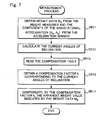
- the CPU 110 obtains the weight data M p output from the weight measurer 130 and the components of the gravitational acceleration (A x and A y ) output from the acceleration sensor 120 at step SB1.
- the CPU 110 (first compensator) reads the contents stored in the compensation table TBL1 of the memory 150 at step SB3.
- the CPU 110 calculates a first compensation factor k corresponding to the components of the gravitational acceleration (A x and A y ) that were currently measured by the acceleration sensor 120 and were obtained at step SB1. For this calculation, for example, interpolation may be used.
- the CPU 110 uses at least one interpolating formula to estimate the subject first compensation factor k on the basis of the first compensation factors k 0 through k 4 and sets of components of the gravitational acceleration (A x [0], A x [+1.5], and A x [-1.5]; and A y [0], A y [+1.5], and A y [-1.5]) stored in the memory 150 and the current components (A x and A y ) of the gravitational acceleration currently being measured by the acceleration sensor 120.
- the CPU 110 as the first compensator compensates by the obtained first compensation factor k, the apparent weight value of the object to be weighed indicated by the weight data M p which was currently being output from the weight measurer and was obtained at step SB1, thereby determining a compensated weight value of the object to be weighed at step SB7.
- the CPU 110 generates compensated weight data M out1 and causes the display 140 to show the compensated weight value indicated by the compensated weight data M out1 .
- the apparent weight value may be divided by the first compensation factor when the first compensation factor is the ratio of the apparent weight to the true weight, but the apparent weight value may be multiplied by the first compensation factor when the first compensation factor is the ratio of the true weight to the apparent weight.
- the weighing scale 10A automatically compensates for the inclination-induced error without users having to go through the trouble of making the planar surface level and horizontal by observing the spirit level, and it determines the compensated and precise weight value of the object to be weighed. This is convenient since a troublesome operation for orienting the weighing scale horizontally can be avoided even when the weighing scale is moved and is set up at another location.
- the memory 150 may store a large number of the first compensation factors and a large number of the sets of components of the gravitational acceleration in such a manner that each compensation factor is associated in the memory with a set of components of the gravitational acceleration.
- the CPU may choose a first compensation factor corresponding to the components of the gravitational acceleration (A x and A y ) currently measured by the acceleration sensor 120 from among the many first compensation factors stored in the memory 150.
- the weighing scale 10A uses the above-mentioned calculation for estimating the first compensation factor which applies in the compensation as described above. Consequently, a limited number of the first compensation factors and a limited number of the sets of components of the gravitational acceleration may be stored in the memory 150.
- the contents (first compensation factors and sets of components of the gravitational acceleration) stored in the memory 150 might be measured or determined at another machine, which may be of the same type as that of the present invention.
- the contents might be transferred from outside of the weighing scale 10A and be written into the memory 150.
- the contents originate in this weighing scale 10A and are recorded in the memory 150 in the weighing scale 10A itself in order to eliminate instrumental errors, as will be described later.
- This recording is preferably conducted in a calibration process at the factory that manufactured the weighing scale 10A or in an experimental laboratory before shipping the weighing scale 10A.
- the CPU 110 conducts the calibration process according to a computer program (that is, a calibration program).
- This program may be stored in the memory 150 or another suitable information recording medium (not shown).
- a material for which the true weight value is known is used and is placed on the upper planar surface 2a of the platform 2.
- the weighing scale 10A is located on a support table by which the weighing scale 10A can be inclined.
- inclination angles ⁇ x and ⁇ y may be measured by an external device or instrument. However, inclination angles ⁇ x and ⁇ y may be calculated by the CPU 110 of the weighing scale 10A on the basis of the components of the gravitational acceleration (A x and A y ) output from the acceleration sensor 120 and displayed in the display 140. Angles ⁇ x and ⁇ y can be calculated by the following formulae that will be understood from the above description in conjunction with Fig. 3 .
- g is the gravitational acceleration, for example, the actual gravitational acceleration if it is known or the standard gravitational acceleration that is 9.80665 meters per second squared established by the 3rd CGPM (General Conference on Weights and Measures).
- step SA3 the CPU 110 (first compensation factor generator) obtains the weight data M p output from the weight measurer 130 and the components of the gravitational acceleration (A x [0] and A y [0]) output from the acceleration sensor 120.
- the CPU 110 calculates a first compensation factor k 0 that is the ratio between the true weight value of the material and the apparent weight value of the material indicated by the current weight data M p .
- the CPU 110 (as the recorder) records the first compensation factor k 0 in the compensation table TBL1 in such a manner that the first compensation factor k 0 is associated with the set of angles ( ⁇ x , ⁇ y ) that is (0, 0).
- the CPU 110 records the components of the gravitational acceleration (A x [0] and A y [0]) in the compensation table TBL1 in such a manner that A x [0] is associated with angle ⁇ x which is zero degrees and that A y [0] is associated with angle ⁇ y which is zero degrees.
- the CPU 110 records the first compensation factor k 0 with a set of components of the gravitational acceleration (A x [0] and A y [0]) measured by the acceleration sensor 120 when the planar surface 2a is oriented horizontally.
- step SA7 the CPU 110 (first compensation factor generator) obtains the weight data M p output from the weight measurer 130 and the components of the gravitational acceleration (A x [+1.5] and A y [0]) output from the acceleration sensor 120.
- the CPU 110 calculates a first compensation factor k 1 that is the ratio between the true weight value of the material and the apparent weight value of the material indicated by the current weight data M p .
- the CPU 110 (as the recorder) records the first compensation factor k 1 in the compensation table TBL1 in such a manner that the first compensation factor k 1 is associated with the set of angles ( ⁇ x , ⁇ y ) that is (+1.5, 0).
- the CPU 110 records the component of the gravitational acceleration A x [+1.5] in the compensation table TBL1 in such a manner that A x [+1.5] is associated with angle ⁇ x , which is +1.5 degrees.
- the other component A y [0] has been recorded in the compensation table TBL1 appropriately since it was written at step SA3.
- step SA11 the CPU 110 (first compensation factor generator) obtains the weight data M p output from the weight measurer 130 and the components of the gravitational acceleration (A x [0] and A y [+1.5]) output from the acceleration sensor 120.
- the CPU 110 calculates a first compensation factor k 2 that is the ratio between the true weight value of the material and the apparent weight value of the material indicated by the current weight data M p .
- the CPU 110 (as the recorder) records the first compensation factor k 2 in the compensation table TBL1 in such a manner that the first compensation factor k 2 is associated with the set of angles ( ⁇ x , ⁇ y ) that is (0, +1.5).
- the CPU 110 records the component of the gravitational acceleration A y [+1.5] in the compensation table TBL1 in such a manner that A y [+1.5] is associated with angle ⁇ y , which is +1.5 degrees.
- the other component A x [0] has been recorded in the compensation table TBL1 appropriately since it was written at step SA3.
- steps SA13 and SA15 another compensation factor k 3 is calculated and recorded in the compensation table TBL1 in such a manner that the first compensation factor k 3 is associated with the set of angles ( ⁇ x , ⁇ y ) that is (-1.5, 0) and with a set of components of the gravitational acceleration (A x [-1.5] and A y [0]).
- steps SA17 and SA19 another compensation factor k 4 is calculated and recorded in the compensation table TBL1 in such a manner that the first compensation factor k 4 is associated with the set of angles ( ⁇ x , ⁇ y ) that is (0, -1.5) and with a set of components of the gravitational acceleration (A x [0] and A y [-1.5]).
- the contents of the compensation table TBL1 in the memory 150 are completed as shown in Fig. 4 before shipping the weighing scale 10A from the factory or the experimental laboratory.
- weight measurer 130 of the weighing scale 10A actually measures the apparent weight value of a material, and the CPU 110 calculates the first compensation factor on the basis of the true weight value and the apparent weight value actually measured by the weight measurer 130 of the weighing scale 10A. Therefore, by virtue of this embodiment, the instrumental error of the weight measurer 130 may be compensated for in addition to the inclination-induced error.
- each component of the gravitational acceleration (A x and A y ) measured by the acceleration sensor 120 involves an instrumental error, in addition to the inclination-induced error.
- the CPU 110 records the calculated first compensation factor with a set of components of the gravitational acceleration (A x and A y ) actually measured by the acceleration sensor 120 of the weighing scale 10A, which also measures components of the gravitational acceleration in the measurement process. Therefore, in accordance with this embodiment, the instrumental error of the acceleration sensor 120 may be compensated for in addition to the inclination-induced error.
- a weighing scale of a second embodiment of the present invention includes structures that are the same as those in the first embodiment described in conjunction with Figs. 1 to 3 . Therefore, the same reference symbols in the drawings for the first embodiment are applied to corresponding parts in the second embodiment.
- the compensation table TBL1 for which the contents have been described in conjunction with Fig. 4 , is also stored in the memory 150 in the second embodiment. However, it is not necessary that the components of the gravitational acceleration (A x [0], A x [+1.5], and A x [-1.5]; and A y [0], A y [+1.5], and A y [-1.5]) be stored in the compensation table TBL1. Referring back to Fig. 4 , the compensation table TBL1 in the memory 150 stores first compensation factors k 0 through k 4 and sets of components of the gravitational acceleration (A x and A y ).
- Each of the first compensation factors k 0 through k 4 is the ratio between a true weight value of a material and an apparent weight value of the material which is assumed to be measured by the weight measurer 130 when the planar surface 2a of the platform 2 is inclined at the angle resulting from angles ⁇ x and ⁇ y .
- each of the first compensation factors k 0 through k 4 is associated with the angle of inclination of the upper planar surface 2a corresponding to the apparent weight value.
- factor k 1 is associated with the angle resulting from the fact that angle ⁇ x is +1.5 degrees and ⁇ y is zero degrees
- factor k 4 is associated with a set of angles ( ⁇ x , ⁇ y ) that are (0, -1.5).
- the CPU 110 conducts the measurement process according to a computer program (that is, a measurement program).
- This program may be stored in the memory 150 or another suitable information recording medium (not shown).
- the user turns on the power to the weighing scale 10A and places an object to be weighed on the upper planar surface 2a of the platform 2. Then, the measurement program runs so as to execute the measurement process.
- the CPU 110 obtains the weight data M p output from the weight measurer 130 and the components of the gravitational acceleration (A x and A y ) output from the acceleration sensor 120 at step SB11.
- the CPU 110 calculates the current angles of inclination ( ⁇ x and ⁇ y ) of the planar surface 2a of the platform 2 on the basis of the components of the gravitational acceleration (A x and A y ) currently measured by the acceleration sensor 120.
- the CPU 110 (first compensator) reads the contents stored in the compensation table TBL1 of the memory 150 at step SB13.
- the CPU 110 calculates a first compensation factor k corresponding to the current angles of inclination ( ⁇ x and ⁇ y ) of the planar surface 2a that were currently calculated at step SB12. For this calculation, for example, interpolation may be used.
- the CPU 110 as the first compensator compensates, by the obtained first compensation factor k, the apparent weight value of the object to be weighed indicated by the weight data M p which was currently output from the weight measurer and was obtained at step SB11 in a manner similar to that in the first embodiment, thereby determining a compensated weight value of the object to be weighed at step SB 17.
- the CPU 110 generates compensated weight data M out1 and causes the display 140 to show the compensated weight value indicated by the compensated weight data M out1 .
- the weighing scale 10A automatically compensates for the inclination-induced error without users having to go through the trouble of making the planar surface level and horizontal by observing the spirit level, and it determines the compensated and precise weight value of the object to be weighed. This is convenient since a troublesome operation for orienting the weighing scale horizontally can be avoided even when the weighing scale is moved and is set up at another location.
- the memory 150 may store a large number of the first compensation factors and a large number of the angles of inclination in such a manner that each compensation factor is associated in the memory with a set of the angles of inclination.
- the CPU may choose a first compensation factor corresponding to the angles of inclination currently calculated from among the many first compensation factors stored in the memory 150.
- the weighing scale 10A uses the above-mentioned calculation for estimating the first compensation factor that applies in the compensation as described above. Consequently, a limited number of the first compensation factors and a limited number of the sets of angles may be stored in the memory 150.
- first compensation factors and sets of angles of inclination stored in the memory 150 might be measured or determined at another machine, which may be of the same type as that of the present invention.
- the contents might be transferred from outside of the weighing scale 10A and be written into the memory 150.
- the contents originate in this weighing scale 10A and are recorded in the memory 150 in the weighing scale 10A itself in order to eliminate instrumental errors, as will be described later.
- This recording is preferably conducted in a calibration process at the factory that manufactured the weighing scale 10A or in an experimental laboratory before shipping the weighing scale 10A.
- the calibration process in the second embodiment may be the same as that described with reference to Fig. 6 in conjunction with the first embodiment, but it may also be different from that in the first embodiment, as described below.
- the CPU 110 conducts the calibration process according to a computer program (that is, a calibration program) in a manner similar to that in the first embodiment.
- Fig. 8 is similar to Fig. 6 , but it differs from Fig. 6 of the first embodiment in that steps SA3, SA7, SA11, SA15, and SA19 are replaced by SA103, SA107, SA111, SA115, and SA119.
- the CPU 110 (first compensation factor generator) obtains the weight data M p output from the weight measurer 130.
- the CPU 110 calculates a first compensation factor k 0 that is the ratio between the true weight value of the material and the apparent weight value of the material indicated by the current weight data M p .
- the CPU 110 (as the recorder) records the first compensation factor k 0 in the compensation table TBL1 in such a manner that the first compensation factor k 0 is associated with the set of angles ( ⁇ x , ⁇ y ) that is (0, 0).
- the CPU 110 (first compensation factor generator) obtains the weight data M p output from the weight measurer 130.
- the CPU 110 calculates a first compensation factor k 1 that is the ratio between the true weight value of the material and the apparent weight value of the material indicated by the current weight data M p .
- the CPU 110 (as the recorder) records the first compensation factor k 1 in the compensation table TBL1 in such a manner that the first compensation factor k j is associated with the set of angles ( ⁇ x , ⁇ y ).
- the CPU 110 (first compensation factor generator) obtains the weight data M p output from the weight measurer 130.
- the CPU 110 calculates a first compensation factor k 2 that is the ratio between the true weight value of the material and the apparent weight value of the material indicated by the current weight data M p .
- the CPU 110 (as the recorder) records the first compensation factor k 2 in the compensation table TBL1 in such a manner that the first compensation factor k 2 is associated with the set of angles ( ⁇ x , ⁇ y ) that is (0, +1.5).
- steps SA13 and SA115 another compensation factor k 3 is calculated and recorded in the compensation table TBL1 in such a manner that the first compensation factor k 3 is associated with the set of angles ( ⁇ x , ⁇ y ) that is (-1.5, 0).
- steps SA17 and SA119 another compensation factor k 4 is calculated and recorded in the compensation table TBL1 in such a manner that the first compensation factor k 4 is associated with the set of angles ( ⁇ x , ⁇ y ) that is (0, -1.5).
- the contents of the compensation table TBL1 in the memory 150 are completed before shipping the weighing scale 10A from the factory or the experimental laboratory.
- the weight measurer 130 of the weighing scale 10A actually measures the apparent weight value of a material, and the CPU 110 calculates the first compensation factor on the basis of the true weight value and the apparent weight value actually measured by the weight measurer 130 of the weighing scale 10A. Therefore, by virtue of this embodiment, the instrumental error of the weight measurer 130 may be compensated for in addition to the inclination-induced error.
- the CPU 110 records the calculated first compensation factor with a set of angles calculated on the basis of a set of components of the gravitational acceleration (A x and A y ) actually measured by the acceleration sensor 120 of the weighing scale 10A, which also measures components of the gravitational acceleration in the measurement process. Therefore, in accordance with this embodiment, the instrumental error of the acceleration sensor 120 may be compensated for in addition to the inclination-induced error.
- a third embodiment of the present invention will be described.
- the gravitational error resulting from location-dependent differences in gravitational acceleration can be excluded automatically.
- Fig. 9 the same symbols are used to designate elements that are substantially the same as in Fig. 1 , and these elements will not be described in detail.
- the weighing scale 10B in the third embodiment includes a second acceleration sensor 120b of a triaxial type that can measure accelerations A x , A y , and A z in the x, y, and z directions.
- the inclination-induced error can be eliminated in the third embodiment.
- the weighing scale 10B calculates the actual gravitational acceleration exerted on the weighing scale on the basis of the three components of the gravitational acceleration (A x , A y , and A z ) actually measured by the acceleration sensor 120b. The actual gravitational acceleration thus calculated is used for compensating for the gravitational error.
- the actual gravitational acceleration g a exerted on the weighing scale is the square root of the sum of the squares of the three components of the gravitational acceleration (A x , A y , and A z ) measured by the acceleration sensor 120b as represented in the formula below.
- g a ( A x 2 + A y 2 + A z 2 ⁇ ) 1 / 2
- the second acceleration sensor 120b is used for measuring two components of the gravitational acceleration (A x and A y ) to compensate for the inclination-induced error, and for measuring three components of the gravitational acceleration (A x , A y , and A z ) to calculate the actual gravitational acceleration.
- two acceleration sensors may be used for these two purposes, respectively.
- the weighing scale 10B further includes a memory 150b that stores the compensation table TBL1 that has been described in conjunction with the first and second embodiments.
- the memory 150b stores a reference gravitational acceleration G r at a reference point.
- the reference gravitational acceleration G r may be the standard gravitational acceleration that is 9.80665 meters per second squared at a location at sea-level at latitude 45 degrees north.
- the reference gravitational acceleration G r is determined on the basis of three components of the gravitational acceleration measured by the acceleration sensor 120b in a calibration process conducted at the factory that manufactured the weighing scale 10A or in an experimental laboratory.
- the apparent weight value of an object to be weighed on the platform 2 that is indicated by the weight data M p output from the weight measurer 130 is affected by the gravitational error. This is because gravitational acceleration varies slightly depending on location on the Earth. For example, it varies with latitude, longitude, elevation, and subsurface density. The gravitational error can be assumed for individual locations and can be eliminated from the measured weight in accordance with a user setting of the weighing scale. However, whenever the weighing scale is moved and is set up at another location, this setting was previously necessary to achieve accurate measurements.
- the weight value that originated from the weight measurer 130 is corrected for by the ratio between the reference gravitational acceleration G r and the actual gravitational acceleration g a at the location at which the weighing scale 10B is to be used. Therefore, the gravitational error can be automatically subtracted without a user setting the weighing scale, even when the weighing scale 10B is used at different locations.
- Fig. 10 is a flowchart representing the flow of a measurement process for measuring the weight of an object to be weighed according to the third embodiment.
- the CPU 110 conducts the measurement process according to a computer program (that is, a measurement program).
- This program may be stored in the memory 150b or another suitable information recording medium (not shown).
- the measurement program runs so as to execute the measurement process.
- the CPU 110 obtains the weight data M p output from the weight measurer 130 and three components of the gravitational acceleration (A x , A y , and A z ) output from the acceleration sensor 120.
- the process proceeds to steps SB3 through SB7, whereby the CPU 110 compensates for the inclination-induced error and determines a compensated weight value of the object to be weighed, but this compensated weight value will not be displayed on the display 140.
- the CPU 110 serves as a gravitational acceleration calculator for calculating the actual gravitational acceleration g a exerted on the weighing scale, which is the square root of the sum of the squares of the three components of the gravitational acceleration (A x , A y , and A z ) measured by the acceleration sensor 120.
- This actual gravitational acceleration g a is the actual gravitational acceleration at this measurement location.
- the CPU 110 serves as a second compensator for calculating a second compensation factor that is the ratio between the reference gravitational acceleration G r stored in the memory 150b and the actual gravitational acceleration g a at the measurement location.
- the second compensation factor may be calculated as G r /g a or g a /G r .
- the CPU 110 (second compensator) compensates, by the second compensation factor, the compensated weight value determined at step SB7, thereby determining a second compensated weight value of the object to be weighed.
- the CPU 110 generates second compensated weight data M ont2 indicating the compensated weight value and causes the display 140 to show the second compensated weight value indicated by the second compensated weight data M out2 .
- the first compensated weight value may be multiplied by the second compensation factor when the second compensation factor is G r /g, but the first compensated weight value may be divided by the second compensation factor when the second compensation factor is g u /G r .
- the weighing scale 10A automatically conducts the measurement process including the inclination compensation and the gravity compensation without the process being troublesome for the user.
- Fig. 11 is a flowchart representing the flow of a calibration process according to the third embodiment.
- the CPU 110 conducts the calibration process according to a computer program (that is, a calibration program).
- This program may be stored in the memory 150b or another suitable information recording medium (not shown).
- the process proceeds to steps SA1 through SA19, whereby the contents of the compensation table TBL1 in the memory 150b are completed at the factory or the experimental laboratory.
- the CPU 110 obtains the three components of the gravitational acceleration (A x , A y , A z ) simultaneously measured by the acceleration sensor 120.
- the CPU 110 serves as a reference gravitational acceleration calculator for calculating the reference gravitational acceleration G r .
- the reference gravitational acceleration G r is the square root of the sum of the squares of the three components of the gravitational acceleration (A x , A y , A z ).
- the components (A x , A y , A z ) at this stage are three components of the reference gravitational acceleration (A xr , A yr , A zr ).
- the contents of the compensation table TBL1 in the memory 150b are completed and the reference gravitational acceleration G r is stored in the memory 150b before shipping the weighing scale 10A from the factory or the experimental laboratory.
- the third embodiment may have an advantage that the gravity compensation can be achieved automatically without the process being troublesome for the user.
- the calibration process includes the calculation of the reference gravitational acceleration G r .
- the calibration process and the calculation of the reference gravitational acceleration G r may be conducted in accordance with different computer programs, respectively.
- the third embodiment is a modification of the first embodiment.
- the same modification can be applied to the second embodiment as well.
- the third embodiment employs the inclination compensation and the gravity compensation. However, it is possible to have the weighing scale conduct the above-described gravity compensation, but not conduct the inclination compensation.
- Fig. 12 is a table showing an example of contents of another compensation table TBL1a in a modified embodiment.
- the compensation table TBL1 shown in Fig. 4 only the five first compensation factors k 0 through k 4 are stored.
- the compensation table TBL1a shown in Fig. 7 stores four additional first compensation factors k 5 through k 8 .
- the factor k 5 corresponds to the set of angles ( ⁇ x , ⁇ y ) that is (+1.5, +1.5).
- the factor k 6 corresponds to the set of angles ( ⁇ x , ⁇ y ) that is (+1.5, -1.5).
- the factor k 7 corresponds to the set of angles ( ⁇ x , ⁇ y ) that is (-1.5, +1.5).
- the factor k 8 corresponds to the set of angles ( ⁇ x , ⁇ y ) that is (-1.5, -1.5).
- the compensation table TBL1a can be used instead of the compensation table TBL1 in the first through third embodiments. However, it is not necessary that the components of the gravitational acceleration (A x [0], A x [+1.5], and A x [-1.5]; and A y [0], A y [+1.5], and A y [-1.5]) be stored in the compensation table TBL1 as in the second embodiment and modifications of the second embodiment. By using the compensation table TBL1a, it is possible to the improve accuracy of the interpolation.
- the compensation table may store more compensation factors corresponding to more sets of angles ( ⁇ x , ⁇ y ) in which each of ⁇ x and ⁇ y can take intermediate values between zero and +1.5 and between zero and -1.5.
- the CPU 110 of the weighing scale executes the calibration process for completing the compensation table (and for calculating the reference gravitational acceleration G r ).
- another processing machine may be connected to the weight measurer 130 so as to perceive the true weight value output from the weight measurer 130, and this processing machine calculates each first compensation factor k on the basis of the output from the weight measurer 130 and the true weight value.
- the processing machine may also be connected to the acceleration sensor 120 so as to perceive the components of the gravitational acceleration output from the acceleration sensor 120. In this case, the processing machine can complete the contents of the compensation table and can calculate the reference gravitational acceleration G r .
- These data can be transferred from the processing machine to the weighing scale and be written into the memory. Although these data are calculated at an external processing machine, they originated from the weighing scale per se, and they contribute to the reduction in instrumental errors.
- the components of the gravitational acceleration (A x and A y ) output from the acceleration sensor 120 are measured so as to be used as the bases for determining the current first compensation factor that is used for compensating the inclination-induced error in the measurement process.
- the components (A x and A z ,) or (A y and A z ) may be measured to be utilized for determining the current first compensation factor. This is because A y is a function of A x and A z , and A x is also a function of A y and A z by the following formula when the gravitational acceleration g a , is considered to be a known constant.
- g a ( A x 2 + A y 2 + A z 2 ⁇ ) 1 / 2
Landscapes
- Physics & Mathematics (AREA)
- General Physics & Mathematics (AREA)
- Indication And Recording Devices For Special Purposes And Tariff Metering Devices (AREA)
- Electric Ovens (AREA)
Abstract
Description
- The present invention relates to a weighing scale having a platform on which objects to be weighed are placed, and having a weight measurer for measuring the weights of the objects.
- There have been developed techniques for maintaining platforms of weighing scales so as to be horizontal because if the platform were inclined, the weight sensor (weight measurer) would output an erroneous result due to the inclination, and such an error often could not have been estimated in advance.
- For example,
JP 2005-49271A - However, adjusting the scale so that it is level and horizontal takes a substantial amount of time. Furthermore, whenever the weighing scale is moved and is set up in another location, this troublesome leveling and adjusting it so as to be horizontal must be performed.
- Accordingly, the present invention provides a weighing scale that can easily compensate for the errors in measured weights due to inclination of the platform (inclination-induced error) so that it is easier for users to set up the weighing scale.
- In accordance with an aspect of the invention, there is provided a platform including a planar surface on which an object to be weighed, having a weight, is placed; a weight measurer for outputting weight data indicating an apparent weight value of the object to be weighed on the planar surface of the platform, the apparent weight value being affected by inclination of the planar surface; an acceleration sensor for measuring at least two components of the gravitational acceleration exerted on the weighing scale in at least two directions that are orthogonal to each other; and a first compensator which compensates, on the basis of the at least two components of the gravitational acceleration currently being measured by the acceleration sensor, the apparent weight value of the object to be weighed indicated by the weight data currently being output from the weight measurer, thereby determining a compensated weight value of the object to be weighed.
- With such a structure, the first compensator compensates the apparent weight value of the object to be weighed indicated by the weight data currently being output from the weight measurer, on the basis of the at least two components of the gravitational acceleration currently being measured by the acceleration sensor. Therefore, the weighing scale automatically compensates for the error of the measured weight due to inclination of the platform (inclination-induced error) without users having to go through the trouble of making the planar surface level and horizontal by observing the spirit level, and determines the compensated and precise weight value of the object being weighed. This is convenient because the troublesome operations for orienting the weighing scale horizontally can be avoided, even when the weighing scale is moved and is set up in another location.
- The weighing scale may further include a memory for storing first compensation factors, each of the first compensation factors being a ratio between a true weight value of a material and an apparent weight value of the material which is assumed to be measured by the weight measurer when the planar surface is inclined at an angle, the first compensator referring to the memory for obtaining a first compensation factor corresponding to the components of the gravitational acceleration currently being measured by the acceleration sensor, the first compensator compensating, by the obtained first compensation factor, the apparent weight value of the object to be weighed indicated by the weight data currently being output from the weight measurer, thereby determining a compensated weight value of the object to be weighed. Therefore, the first compensator compensates the apparent weight value of the object to be weighed, using the first compensation factor that is the ratio between the true weight value and the apparent weight value and corresponds to the current angle of inclination of the planar surface. The weighing scale can precisely determine the compensated weight value of the object being weighed.
- In an embodiment of the present invention, the memory may store the first compensation factors and sets of components of the gravitational acceleration, each of the sets of components of the gravitational acceleration having at least two components of the gravitational acceleration that are assumed to be exerted on the weighing scale in at least two orthogonal directions when the planar surface is inclined at an angle, each of the first compensation factors being associated in the memory with a set of components of the gravitational acceleration that are assumed to be exerted on the weighing scale when the planar surface is inclined at the angle corresponding to the apparent weight value of the material. In this embodiment, it is easy for the first compensator to obtain the first compensation factor corresponding to the components of the gravitational acceleration currently being measured since each first compensation factor is associated in the memory with a set of components of the gravitational acceleration.
- In the weighing scale according to this embodiment of the present invention, the memory may store a large number of the first compensation factors and a large number of the sets of components of the gravitational acceleration in order to compensate for any errors caused by various angles of inclination of the platform.
- However, preferably, the first compensator may interpolate the first compensation factor corresponding to the components of the gravitational acceleration currently being measured by the acceleration sensor, on the basis of the first compensation factors and sets of components of the gravitational acceleration stored in the memory and the components of the gravitational acceleration currently being measured by the acceleration sensor. Therefore, a limited number of the first compensation factors and a limited number of the sets of components of the gravitational acceleration may be stored in the memory.
- For the weighing scale according to this embodiment of the present invention, the contents (first compensation factors and sets of components of the gravitational acceleration) stored in the memory may be measured or be determined at another machine, which may be of the same type as in this aspect of the present invention. The contents may be transferred from outside of the weighing scale and be written into the memory.
- However, preferably, the weighing scale further includes a first compensation factor generator and a recorder, the first compensation factor generator receiving, from the weight measurer, weight data indicating the apparent weight value of the material on the planar surface of the platform of the weight measurer when the planar surface is inclined at an angle, the first compensation factor generator calculates a first compensation factor that is a ratio between the true weight value of the material and the apparent weight value of the material, the recorder recording the first compensation factor calculated by the first compensation factor generator with a set of components of the gravitational acceleration measured by the acceleration sensor when the planar surface is inclined at the angle at which the first compensation factor generator receives, from the weight measurer, the weight data indicating the apparent weight value of the material. The weight measurer of the weighing scale actually measures the apparent weight value of a material, and the first compensation factor generator calculates a first compensation factor on the basis of the true weight value and the apparent weight value actually measured by the weight measurer of the weighing scale. Furthermore, the recorder records the calculated first compensation factor with a set of components of the gravitational acceleration actually measured by the acceleration sensor of the weighing scale. Therefore, the instrumental error of the weight measurer and the instrumental error of the acceleration sensor may be compensated for in addition to the inclination-induced error.
- In accordance with another embodiment of the invention, the memory may store the first compensation factors and angles of inclination of the planar surface, each of the first compensation factors being associated in the memory with the angle of inclination of the planar surface corresponding to the apparent weight value of the material. The weighing scale further include an inclination angle calculator for calculating a current angle of inclination of the planar surface on the basis of the components of the gravitational acceleration currently being measured by the acceleration sensor. The first compensator refers to the memory for obtaining a first compensation factor corresponding to the current angle of inclination of the planar surface calculated by the inclination angle calculator, the first compensator compensating, by the obtained first compensation factor, the apparent weight value of the object to be weighed indicated by the weight data currently being output from the weight measurer, thereby determining a compensated weight value of the object to be weighed. In this embodiment, it is easy for the first compensator to obtain the first compensation factor corresponding to the components of the gravitational acceleration currently being measured since each first compensation factor is associated in the memory with the angle of inclination.
- In the weighing scale according to this embodiment of the present invention, the memory may store a large number of the first compensation factors and a large number of the angles of inclination in order to compensate for any errors caused by various angles of inclination of the platform.
- However, preferably, the first compensator may interpolate the first compensation factor corresponding to the current angle of inclination of the planar surface currently calculated by the inclination angle calculator, on the basis of the first compensation factors and angles of inclination of the planar surface stored in the memory and the current angle of inclination of the planar surface currently calculated by the inclination angle calculator. In this embodiment, a limited number of the first compensation factors and a limited number of the angles of inclination may be stored in the memory.
- For the weighing scale according to this embodiment of the present invention, the contents (first compensation factors and angles of inclination) stored in the memory might be measured or determined at another machine, which may be of the same type as in this aspect of the present invention. The contents might be transferred from outside of the weighing scale and be written into the memory.
- However, preferably, the weighing scale further includes a first compensation factor generator and a recorder, the first compensation factor generator receiving, from the weight measurer, weight data indicating the apparent weight value of the material on the planar surface of the platform the weight measurer when the planar surface is inclined at an angle, the first compensation factor generator calculates a first compensation factor that is a ratio between the true weight value of the material and the apparent weight value of the material, the recorder recording the first compensation factor calculated by the first compensation factor generator with the angle calculated by the inclination angle calculator at which the first compensation factor generator receives, from the weight measurer, the weight data indicating the apparent weight value of the material. In this embodiment, the weight measurer of the weighing scale actually measures the apparent weight value of a material, and the first compensation factor generator calculates a first compensation factor on the basis of the true weight value and the apparent weight value actually measured by the weight measurer of the weighing scale. Furthermore, the recorder records the calculated first compensation factor with the angle calculated by the inclination angle calculator on the basis of a set of components of the gravitational acceleration actually measured by the acceleration sensor of the weighing scale. Therefore, in accordance with this embodiment, the instrumental error of the weight measurer and the instrumental error of the acceleration sensor may be compensated for in addition to the inclination-induced error.
- In each embodiment of the present invention, the memory may store a reference gravitational acceleration at a reference point, the acceleration sensor measuring three components of the gravitational acceleration exerted on the weighing scale in three directions that are orthogonal to one another. The weighing scale may further include: a second acceleration sensor measuring three components of the gravitational acceleration exerted on the weighing scale in three directions that are orthogonal to one another; a gravitational acceleration calculator for calculating an actual gravitational acceleration exerted on the weighing scale that is the square root of the sum of the squares of the three components of the gravitational acceleration measured by the second acceleration sensor; and a second compensator for calculating a second compensation factor that is a ratio between the reference gravitational acceleration and the actual gravitational acceleration, and for compensating, by the second compensation factor, the compensated weight value determined by the first compensator, thereby determining a second compensated weight value of the object to be weighed.
- Gravitational acceleration varies slightly depending on the location on Earth, and therefore, the weight data output from the weight measurer is affected by the gravitational error. The gravitational error can be assumed for individual locations and can be eliminated from the measured weight by the user setting the weighing scale. However, according to the above-described embodiment, the second compensator calculates the second compensation factor on the basis of the reference gravitational acceleration and the actual gravitational acceleration that is calculated from three components of the gravitational acceleration actually measured by the second acceleration sensor, and further compensates for the compensated weight value. Therefore, the gravitational error can be automatically subtracted out without the user setting the weighing scale.
- The second acceleration sensor may be the same as, or different from, the acceleration sensor used for compensating for the inclination-induced error.
- With reference to the accompanying drawings, various embodiments of the present invention will be described hereinafter. In the drawings:
-
Fig. 1A is a plane view showing a weighing scale of a first embodiment according to the present invention; -
Fig. 1B is a front view showing the weighing scale inFig. 1A ; -
Fig. 2 is a functional block diagram showing functions of the weighing scale inFig. 1A ; -
Fig. 3 is a schematic diagram showing the principle of measuring components of the gravitational acceleration by an acceleration sensor in the weighing scale inFig. 1A ; -
Fig. 4 is a table showing an example of contents of a compensation table stored in a memory of the weighing scale inFig. 1A ; -
Fig. 5 is a flowchart representing the flow of a measurement process according to the first embodiment; -
Fig. 6 is a flowchart representing the flow of a calibration process according to the first embodiment; -
Fig. 7 is a flowchart representing the flow of a measurement process according to a second embodiment of the present invention; -
Fig. 8 is a flowchart representing the flow of a calibration process according to the second embodiment; -
Fig. 9 is a functional block diagram showing functions of a weighing scale of a third embodiment according to the present invention; -
Fig. 10 is a flowchart representing the flow of a measurement process according to the third embodiment; -
Fig. 11 is a flowchart representing the flow of a calibration process according to the third embodiment; and -
Fig. 12 is a table showing an example of contents of another compensation table in a modified embodiment. - As shown in
Figs. 1A and 1B , a weighingscale 10A of a first embodiment according to the present invention includes a casing orhousing 1 supported by a plurality oflegs 11 on a support surface (e.g. a floor), and aplatform 2 including an upperplanar surface 2a on which an object to be weighed is placed. - A
weight measurer 130 is located within thehousing 1. Theplatform 2 is attached to thehousing 1 in such a manner that theweight measurer 130 measures the load, i.e., weight of the object to be weighed on theplanar surface 2a of theplatform 2. Theweight measurer 130 may be a load cell or a weight sensor that outputs weight data indicating the weight value of the object to be weighed on theplanar surface 2a of theplatform 2. - An accelerometer, i.e.,
acceleration sensor 120 is mounted on theplatform 2. Theacceleration sensor 120 is very sensitive and appropriately calibrated, so that theacceleration sensor 120 can measure even components of the gravitational acceleration (gravity acceleration) exerted on theplatform 2. Theacceleration sensor 120 is, for example, but is not limited to, a piezo-resistive semiconductor-based acceleration sensor, a capacitive semiconductor-based acceleration sensor, or a thermal acceleration sensor. - In an alternative embodiment, the
acceleration sensor 120 may be mounted on another location in the weighing scale since the weighing scale is not so large that the gravitational acceleration exerted on thesensor 120 can be considered constant as far as thesensor 120 is mounted on the weighing scale. Therefore, theacceleration sensor 120 can measure components of the gravitational acceleration exerted on the location to which thesensor 120 is mounted, but the measured components are generally equal to those exerted on theplatform 2. - An
electric power switch 3 is provided at a side surface of theelectric power switch 3 for turning on and off the power to the weighingscale 10A. Adisplay 140 is provided on the top wall of thehousing 1 for displaying suitable information, such as the result of measurement (measured weight). Thedisplay 140 is, for example, but is not limited to, an LCD (liquid crystal display). - As shown in
Fig. 2 , the weighingscale 10A further includes amemory 150 and a CPU (central processing unit) 110 that are located in thehousing 1. TheCPU 110 conducts overall control of the weighingscale 10A. -
Fig. 3 is a schematic diagram showing the principle of the measuring components of the gravitational acceleration by theacceleration sensor 120. Let us assume that theacceleration sensor 120 is a triaxial type that can measure accelerations Ax, Ay, and Az in the x, y, and z directions that are, of course, orthogonal to one another. Theacceleration sensor 120 is secured to weighing scale so that the x and y axes of theacceleration sensor 120 are parallel to the upperplanar surface 2a of theplatform 2, the x axis is parallel to the lateral direction of theplatform 2, and the y axis is parallel to the anteroposterior direction of theplatform 2. - When the
acceleration sensor 120 is in the static condition (no dynamic load or force is being applied to the acceleration sensor 120), only the gravitational acceleration (static acceleration) is exerted on theacceleration sensor 120, and therefore, the measured accelerations Ax, Ay, and Az are the components of the gravitational acceleration in the x, y, and z directions. The amounts of the components Ax, Ay, and Az of the gravitational acceleration are related to the inclination angles of the x, y, and z axes of theacceleration sensor 120. More specifically, when the x axis of theacceleration sensor 120 is inclined so as to intersect a horizontal plane A at an angle θx (to intersect the Z axis (absolute vertical axis) at an angle (90 - θx) (degrees), theacceleration sensor 120 measures the component of the gravitational acceleration in the x direction, of which the amount Ax is g times cos (90 - θx) where g is the gravitational acceleration. When the y axis of theacceleration sensor 120 is inclined so as to intersect the horizontal plane A at an angle θy (to intersect the Z axis (absolute vertical axis) at an angle (90 - θy) (degrees), theacceleration sensor 120 measures the component of the gravitational acceleration in the y direction, of which the amount Ay is g times cos (90 - θy). When the z axis of theacceleration sensor 120 is inclined so as to intersect the Z axis (absolute vertical axis) at an angle θz (degrees), theacceleration sensor 120 measures the component of the gravitational acceleration in the z direction, of which the amount Az is g times cos θz. - As described above, angles θx, θy, and θz are the inclination angles of the
acceleration sensor 120. Angles θx, θy, and θz are the inclination angles of the upperplanar surface 2a of theplatform 2 since theacceleration sensor 120 is secured and oriented to theplatform 2 as described above. - In this embodiment, the outputs Ax and Ay from the
acceleration sensor 120 are utilized as will be described later. Therefore, theacceleration sensor 120 need not necessarily be a triaxial type, and it may be a biaxial type that can measure accelerations Ax and Ay in this embodiment. - As shown in
Fig. 2 , theweight measurer 130 outputs weight data Mp indicating the weight value of an object to be weighed on theplanar surface 2a of theplatform 2, but the measured weight value is an apparent weight value affected by inclination of theplanar surface 2a. For example, if the upperplanar surface 2a is inclined at θx (but θy is zero degrees), the weight data Mp indicates an apparent value that is equal to W times cos θx when W is the true weight of the object to be weighed. If the upperplanar surface 2a is inclined at θy (but θx is zero degrees), the weight data Mp indicates an apparent value that is equal to W times cos θy. If the upperplanar surface 2a is inclined at θx and θy, the weight data Mp indicates an apparent value affected by the angles θx and θy. - The CPU 110 (first compensator) compensates for the apparent weight value indicated by the weight data Mp so as to exclude inclination-induced error on the basis of a set of components of the gravitational acceleration (Ax and Ay) measured by the
acceleration sensor 120. TheCPU 110 thus determines a compensated weight value of the object to be weighed, and it generates compensated weight data Mout1. Thedisplay 140 shows the compensated weight value indicated by the compensated weight data Mout1. - For the compensation of the apparent weight value, the
memory 150 stores a compensation table TBL1 that will be referred to by theCPU 110. Thememory 150 is, for example, but is not limited to, a ROM (read only memory). If the compensation table TBL1 is written into thememory 150 at this weighingscale 10A, thememory 150 is preferably an EPROM (erasable programmable read-only memory). - As shown in
Fig. 4 , the compensation table TBL1 stores first compensation factors k0 through k4 and sets of components of the gravitational acceleration (Ax and Ay). InFig. 4 , each number in brackets indicates angle θx or θy that takes on values of 0, +1.5, and -1.5 degrees. Each of the first compensation factors k0 through k4 is the ratio between a true weight value of a material and an apparent weight value of the material which is assumed to be measured by theweight measurer 130 when theplanar surface 2a of theplatform 2 is inclined at the angle resulting from angles θx and θy. For example, the first compensation factors k0 is the ratio between the true weight value and the apparent weight value when the upperplanar surface 2a is not inclined (the value of k0 is 1 if theweight measurer 130 is accurate). The first compensation factors k1 is the ratio between the true weight value and the apparent weight value when the upperplanar surface 2a is inclined at angle θx that is equal to +1.5 degrees, but angle θy is zero degrees. The first compensation factors k4 is the ratio between the true weight value and the apparent weight value when the upperplanar surface 2a is inclined at angle θy that is equal to -1.5 degrees, but angle θx is zero degrees. - The true weight value and the apparent weight values may be actually measured by the
weight measurer 130 of this weighingscale 10A, but may also be measured by another device at another location. The first compensation factor may be the ratio of the apparent weight to the true weight, but may be the ratio of the true weight to the apparent weight. - In the compensation table TBL1, each of the first compensation factors k0 through k4 is associated with a set of components of the gravitational acceleration (Ax and Ay) that is assumed to be exerted on the weighing scale when the
planar surface 2a is inclined at the angle corresponding to the apparent weight value. For example, factor k1 is associated with a set of components Ax[+1.5] and Ay[0], whereas factor k4 is associated with a set of components Ax[0] and Ay[-1.5]. The components of the gravitational acceleration (Ax and Ay) may be actually measured by theacceleration sensor 120 of this weighingscale 10A, but may also be measured by another accelerometer at another location. - With reference to
Fig. 5 , the flow of a measurement process for measuring the weight of an object to be weighed in the weighingscale 10A will be described next. TheCPU 110 conducts the measurement process according to a computer program (that is, a measurement program). This program may be stored in thememory 150 or another suitable information recording medium (not shown). - The user turns on the power to the weighing
scale 10A and places an object to be weighed on the upperplanar surface 2a of theplatform 2. Then, the measurement program runs so as to execute the measurement process. In the measurement process, theCPU 110 obtains the weight data Mp output from theweight measurer 130 and the components of the gravitational acceleration (Ax and Ay) output from theacceleration sensor 120 at step SB1. - Next, the CPU 110 (first compensator) reads the contents stored in the compensation table TBL1 of the
memory 150 at step SB3. At step SB5, theCPU 110 calculates a first compensation factor k corresponding to the components of the gravitational acceleration (Ax and Ay) that were currently measured by theacceleration sensor 120 and were obtained at step SB1. For this calculation, for example, interpolation may be used. More specifically, theCPU 110 uses at least one interpolating formula to estimate the subject first compensation factor k on the basis of the first compensation factors k0 through k4 and sets of components of the gravitational acceleration (Ax[0], Ax[+1.5], and Ax[-1.5]; and Ay[0], Ay[+1.5], and Ay[-1.5]) stored in thememory 150 and the current components (Ax and Ay) of the gravitational acceleration currently being measured by theacceleration sensor 120. For example, if the current components (Ax and Ay) of the gravitational acceleration are (Axl and Ayl) where Ax[0] < Axl < Ax[+1.5] and Ayl = Ay[0], the interpolation formula can be transformed into a simplified form below.
- Then, the
CPU 110 as the first compensator compensates by the obtained first compensation factor k, the apparent weight value of the object to be weighed indicated by the weight data Mp which was currently being output from the weight measurer and was obtained at step SB1, thereby determining a compensated weight value of the object to be weighed at step SB7. TheCPU 110 generates compensated weight data Mout1 and causes thedisplay 140 to show the compensated weight value indicated by the compensated weight data Mout1. In this compensation, the apparent weight value may be divided by the first compensation factor when the first compensation factor is the ratio of the apparent weight to the true weight, but the apparent weight value may be multiplied by the first compensation factor when the first compensation factor is the ratio of the true weight to the apparent weight. - Thus, the weighing
scale 10A automatically compensates for the inclination-induced error without users having to go through the trouble of making the planar surface level and horizontal by observing the spirit level, and it determines the compensated and precise weight value of the object to be weighed. This is convenient since a troublesome operation for orienting the weighing scale horizontally can be avoided even when the weighing scale is moved and is set up at another location. - In an alternative embodiment, the
memory 150 may store a large number of the first compensation factors and a large number of the sets of components of the gravitational acceleration in such a manner that each compensation factor is associated in the memory with a set of components of the gravitational acceleration. In this alternative embodiment, the CPU may choose a first compensation factor corresponding to the components of the gravitational acceleration (Ax and Ay) currently measured by theacceleration sensor 120 from among the many first compensation factors stored in thememory 150. - However, in the first embodiment, the weighing
scale 10A uses the above-mentioned calculation for estimating the first compensation factor which applies in the compensation as described above. Consequently, a limited number of the first compensation factors and a limited number of the sets of components of the gravitational acceleration may be stored in thememory 150. - It is possible to envisage the contents (first compensation factors and sets of components of the gravitational acceleration) stored in the
memory 150 might be measured or determined at another machine, which may be of the same type as that of the present invention. The contents might be transferred from outside of the weighingscale 10A and be written into thememory 150. - However, in the weighing
scale 10A according to the first embodiment, the contents originate in this weighingscale 10A and are recorded in thememory 150 in the weighingscale 10A itself in order to eliminate instrumental errors, as will be described later. This recording is preferably conducted in a calibration process at the factory that manufactured the weighingscale 10A or in an experimental laboratory before shipping the weighingscale 10A. - With reference to
Fig. 6 , the flow of a calibration process for recording the first compensation factors and sets of components of the gravitational acceleration will be described next. TheCPU 110 conducts the calibration process according to a computer program (that is, a calibration program). This program may be stored in thememory 150 or another suitable information recording medium (not shown). - In the calibration process, a material for which the true weight value is known is used and is placed on the upper
planar surface 2a of theplatform 2. The weighingscale 10A is located on a support table by which the weighingscale 10A can be inclined. - First, at step SA1, the
CPU 110 waits for a notification that is issued in response to the fact that the weighingscale 10A including the upperplanar surface 2a is horizontally oriented so that (θx, θy) = (0, 0). The user should adjust the support table to orient theplatform 2 horizontally. - In the calibration process, inclination angles θx and θy may be measured by an external device or instrument. However, inclination angles θx and θy may be calculated by the
CPU 110 of the weighingscale 10A on the basis of the components of the gravitational acceleration (Ax and Ay) output from theacceleration sensor 120 and displayed in thedisplay 140. Angles θx and θy can be calculated by the following formulae that will be understood from the above description in conjunction withFig. 3 .

where g is the gravitational acceleration, for example, the actual gravitational acceleration if it is known or the standard gravitational acceleration that is 9.80665 meters per second squared established by the 3rd CGPM (General Conference on Weights and Measures). - Once the angles (θx, θy) are adjusted to be (0, 0), the user gives a notification to the
CPU 110. Then, the process proceeds to step SA3 where the CPU 110 (first compensation factor generator) obtains the weight data Mp output from theweight measurer 130 and the components of the gravitational acceleration (Ax[0] and Ay[0]) output from theacceleration sensor 120. TheCPU 110 calculates a first compensation factor k0 that is the ratio between the true weight value of the material and the apparent weight value of the material indicated by the current weight data Mp. The CPU 110 (as the recorder) records the first compensation factor k0 in the compensation table TBL1 in such a manner that the first compensation factor k0 is associated with the set of angles (θx, θy) that is (0, 0). In addition, theCPU 110 records the components of the gravitational acceleration (Ax[0] and Ay[0]) in the compensation table TBL1 in such a manner that Ax[0] is associated with angle θx which is zero degrees and that Ay[0] is associated with angle θy which is zero degrees. As a result, theCPU 110 records the first compensation factor k0 with a set of components of the gravitational acceleration (Ax[0] and Ay[0]) measured by theacceleration sensor 120 when theplanar surface 2a is oriented horizontally. - Subsequently, at step SA5, the
CPU 110 waits for a notification that is issued in response to the fact that the weighingscale 10A including the upperplanar surface 2a is inclined so that (θx, θy) = (+1.5, 0) (degrees). The user should adjust the support table so that (θx, θy) = (+1.5, 0) (degrees). - Once the angles (θx, θy) are adjusted to be (+1.5, 0), the user gives a notification to the
CPU 110. Then, the process proceeds to step SA7 in which the CPU 110 (first compensation factor generator) obtains the weight data Mp output from theweight measurer 130 and the components of the gravitational acceleration (Ax[+1.5] and Ay[0]) output from theacceleration sensor 120. TheCPU 110 calculates a first compensation factor k1 that is the ratio between the true weight value of the material and the apparent weight value of the material indicated by the current weight data Mp. The CPU 110 (as the recorder) records the first compensation factor k1 in the compensation table TBL1 in such a manner that the first compensation factor k1 is associated with the set of angles (θx, θy) that is (+1.5, 0). In addition, theCPU 110 records the component of the gravitational acceleration Ax[+1.5] in the compensation table TBL1 in such a manner that Ax[+1.5] is associated with angle θx, which is +1.5 degrees. The other component Ay[0] has been recorded in the compensation table TBL1 appropriately since it was written at step SA3. As a result, theCPU 110 records the first compensation factor k1 with a set of components of the gravitational acceleration (Ax[+1.5] and Ay[0]) measured by theacceleration sensor 120 when theplanar surface 2a is inclined so that (θx, θy) = (+1.5, 0) (degrees). - Subsequently, at step SA9, the
CPU 110 waits for a notification that is issued in response to the fact that the weighingscale 10A including the upperplanar surface 2a is inclined so that (θx, θy) = (0, +1.5) (degrees). The user should adjust the support table so that (θx, θy) = (0, + 1. 5) (degrees). - Once the angles (θx, θy) are adjusted to be (0, +1.5), the user gives a notification to the
CPU 110. Then, the process proceeds to step SA11 in which the CPU 110 (first compensation factor generator) obtains the weight data Mp output from theweight measurer 130 and the components of the gravitational acceleration (Ax[0] and Ay[+1.5]) output from theacceleration sensor 120. TheCPU 110 calculates a first compensation factor k2 that is the ratio between the true weight value of the material and the apparent weight value of the material indicated by the current weight data Mp. The CPU 110 (as the recorder) records the first compensation factor k2 in the compensation table TBL1 in such a manner that the first compensation factor k2 is associated with the set of angles (θx, θy) that is (0, +1.5). In addition, theCPU 110 records the component of the gravitational acceleration Ay[+1.5] in the compensation table TBL1 in such a manner that Ay[+1.5] is associated with angle θy, which is +1.5 degrees. The other component Ax[0] has been recorded in the compensation table TBL1 appropriately since it was written at step SA3. As a result, theCPU 110 records the first compensation factor k2 with a set of components of the gravitational acceleration (Ax[0] and Ay[+1.5]) measured by theacceleration sensor 120 when theplanar surface 2a is inclined so that (θx, θy) = (0, +1.5) (degrees). - Similarly, by steps SA13 and SA15, another compensation factor k3 is calculated and recorded in the compensation table TBL1 in such a manner that the first compensation factor k3 is associated with the set of angles (θx, θy) that is (-1.5, 0) and with a set of components of the gravitational acceleration (Ax[-1.5] and Ay[0]). By steps SA17 and SA19, another compensation factor k4 is calculated and recorded in the compensation table TBL1 in such a manner that the first compensation factor k4 is associated with the set of angles (θx, θy) that is (0, -1.5) and with a set of components of the gravitational acceleration (Ax[0] and Ay[-1.5]). Thus, the contents of the compensation table TBL1 in the
memory 150 are completed as shown inFig. 4 before shipping the weighingscale 10A from the factory or the experimental laboratory. - In weighing scales, there may be instrumental errors in weight data Mp resulting from production errors, etc., of the
weight measurers 130. Consequently, there is no guarantee that multiple units of the weight measurers 130 of the same type will each output the same measurements under the same conditions. Each of the weight values indicated by the weight data Mp involves an instrumental error in addition to the inclination-induced error. In this embodiment, theweight measurer 130 of the weighingscale 10A actually measures the apparent weight value of a material, and theCPU 110 calculates the first compensation factor on the basis of the true weight value and the apparent weight value actually measured by theweight measurer 130 of the weighingscale 10A. Therefore, by virtue of this embodiment, the instrumental error of theweight measurer 130 may be compensated for in addition to the inclination-induced error. - Furthermore, there may be instrumental errors in outputs of
acceleration sensor 120 resulting from production errors, etc., of theacceleration sensors 120. Consequently, there is no guarantee that multiple units of theacceleration sensors 120 of the same type will each output the same measurements under the same conditions. Each components of the gravitational acceleration (Ax and Ay) measured by theacceleration sensor 120 involves an instrumental error, in addition to the inclination-induced error. In the calibration process of this embodiment, theCPU 110 records the calculated first compensation factor with a set of components of the gravitational acceleration (Ax and Ay) actually measured by theacceleration sensor 120 of the weighingscale 10A, which also measures components of the gravitational acceleration in the measurement process. Therefore, in accordance with this embodiment, the instrumental error of theacceleration sensor 120 may be compensated for in addition to the inclination-induced error. - A weighing scale of a second embodiment of the present invention includes structures that are the same as those in the first embodiment described in conjunction with
Figs. 1 to 3 . Therefore, the same reference symbols in the drawings for the first embodiment are applied to corresponding parts in the second embodiment. - The compensation table TBL1, for which the contents have been described in conjunction with
Fig. 4 , is also stored in thememory 150 in the second embodiment. However, it is not necessary that the components of the gravitational acceleration (Ax[0], Ax[+1.5], and Ax[-1.5]; and Ay[0], Ay[+1.5], and Ay[-1.5]) be stored in the compensation table TBL1. Referring back toFig. 4 , the compensation table TBL1 in thememory 150 stores first compensation factors k0 through k4 and sets of components of the gravitational acceleration (Ax and Ay). Each of the first compensation factors k0 through k4 is the ratio between a true weight value of a material and an apparent weight value of the material which is assumed to be measured by theweight measurer 130 when theplanar surface 2a of theplatform 2 is inclined at the angle resulting from angles θx and θy. - In the compensation table TBL1, each of the first compensation factors k0 through k4 is associated with the angle of inclination of the upper
planar surface 2a corresponding to the apparent weight value. For example, factor k1 is associated with the angle resulting from the fact that angle θx is +1.5 degrees and θy is zero degrees, whereas factor k4 is associated with a set of angles (θx, θy) that are (0, -1.5). - With reference to
Fig. 7 , the flow of a measurement process for measuring the weight of an object to be weighed in the weighingscale 10A of the second embodiment will be described next. TheCPU 110 conducts the measurement process according to a computer program (that is, a measurement program). This program may be stored in thememory 150 or another suitable information recording medium (not shown). - The user turns on the power to the weighing
scale 10A and places an object to be weighed on the upperplanar surface 2a of theplatform 2. Then, the measurement program runs so as to execute the measurement process. In the measurement process, theCPU 110 obtains the weight data Mp output from theweight measurer 130 and the components of the gravitational acceleration (Ax and Ay) output from theacceleration sensor 120 at step SB11. - Next, at step SB12, the CPU 110 (as an inclination angle calculator) calculates the current angles of inclination (θx and θy) of the
planar surface 2a of theplatform 2 on the basis of the components of the gravitational acceleration (Ax and Ay) currently measured by theacceleration sensor 120. It should be noted that angles θx and θy can be calculated by the following formulae as described above.

- Next, the CPU 110 (first compensator) reads the contents stored in the compensation table TBL1 of the
memory 150 at step SB13. At step SB16, theCPU 110 calculates a first compensation factor k corresponding to the current angles of inclination (θx and θy) of theplanar surface 2a that were currently calculated at step SB12. For this calculation, for example, interpolation may be used. More specifically, theCPU 110 uses at least one interpolating formula to estimate the subject first compensation factor k on the basis of the first compensation factors k0 through k4 and sets of angles of inclination (where θx = 0, +1.5, or -1.5; and θy = 0, +1.5, or -1.5) stored in thememory 150 and the current angles of inclination (θx and θy) currently calculated by theCPU 110. - Then, the
CPU 110 as the first compensator compensates, by the obtained first compensation factor k, the apparent weight value of the object to be weighed indicated by the weight data Mp which was currently output from the weight measurer and was obtained at step SB11 in a manner similar to that in the first embodiment, thereby determining a compensated weight value of the object to be weighed at step SB 17. TheCPU 110 generates compensated weight data Mout1 and causes thedisplay 140 to show the compensated weight value indicated by the compensated weight data Mout1. - Thus, the weighing
scale 10A automatically compensates for the inclination-induced error without users having to go through the trouble of making the planar surface level and horizontal by observing the spirit level, and it determines the compensated and precise weight value of the object to be weighed. This is convenient since a troublesome operation for orienting the weighing scale horizontally can be avoided even when the weighing scale is moved and is set up at another location. - In an alternative embodiment, the
memory 150 may store a large number of the first compensation factors and a large number of the angles of inclination in such a manner that each compensation factor is associated in the memory with a set of the angles of inclination. In this alternative embodiment, the CPU may choose a first compensation factor corresponding to the angles of inclination currently calculated from among the many first compensation factors stored in thememory 150. - However, in the second embodiment, the weighing
scale 10A uses the above-mentioned calculation for estimating the first compensation factor that applies in the compensation as described above. Consequently, a limited number of the first compensation factors and a limited number of the sets of angles may be stored in thememory 150. - It is possible to conceive of the contents (first compensation factors and sets of angles of inclination) stored in the
memory 150 might be measured or determined at another machine, which may be of the same type as that of the present invention. The contents might be transferred from outside of the weighingscale 10A and be written into thememory 150. - However, in the weighing
scale 10A according to the second embodiment, the contents originate in this weighingscale 10A and are recorded in thememory 150 in the weighingscale 10A itself in order to eliminate instrumental errors, as will be described later. This recording is preferably conducted in a calibration process at the factory that manufactured the weighingscale 10A or in an experimental laboratory before shipping the weighingscale 10A. The calibration process in the second embodiment may be the same as that described with reference toFig. 6 in conjunction with the first embodiment, but it may also be different from that in the first embodiment, as described below. - With reference to
Fig. 8 , the flow of a calibration process for recording the first compensation factors and sets of sets of angles of inclination in the second embodiment will be described next. TheCPU 110 conducts the calibration process according to a computer program (that is, a calibration program) in a manner similar to that in the first embodiment. -
Fig. 8 is similar toFig. 6 , but it differs fromFig. 6 of the first embodiment in that steps SA3, SA7, SA11, SA15, and SA19 are replaced by SA103, SA107, SA111, SA115, and SA119. - At step SA103, the CPU 110 (first compensation factor generator) obtains the weight data Mp output from the
weight measurer 130. TheCPU 110 calculates a first compensation factor k0 that is the ratio between the true weight value of the material and the apparent weight value of the material indicated by the current weight data Mp. The CPU 110 (as the recorder) records the first compensation factor k0 in the compensation table TBL1 in such a manner that the first compensation factor k0 is associated with the set of angles (θx, θy) that is (0, 0). - At step SA107, the CPU 110 (first compensation factor generator) obtains the weight data Mp output from the
weight measurer 130. TheCPU 110 calculates a first compensation factor k1 that is the ratio between the true weight value of the material and the apparent weight value of the material indicated by the current weight data Mp. The CPU 110 (as the recorder) records the first compensation factor k1 in the compensation table TBL1 in such a manner that the first compensation factor kj is associated with the set of angles (θx, θy). - At step SA111, the CPU 110 (first compensation factor generator) obtains the weight data Mp output from the
weight measurer 130. TheCPU 110 calculates a first compensation factor k2 that is the ratio between the true weight value of the material and the apparent weight value of the material indicated by the current weight data Mp. The CPU 110 (as the recorder) records the first compensation factor k2 in the compensation table TBL1 in such a manner that the first compensation factor k2 is associated with the set of angles (θx, θy) that is (0, +1.5). - Similarly, by steps SA13 and SA115, another compensation factor k3 is calculated and recorded in the compensation table TBL1 in such a manner that the first compensation factor k3 is associated with the set of angles (θx, θy) that is (-1.5, 0). By steps SA17 and SA119, another compensation factor k4 is calculated and recorded in the compensation table TBL1 in such a manner that the first compensation factor k4 is associated with the set of angles (θx, θy) that is (0, -1.5). Thus, the contents of the compensation table TBL1 in the
memory 150 are completed before shipping the weighingscale 10A from the factory or the experimental laboratory. - In this embodiment, the
weight measurer 130 of the weighingscale 10A actually measures the apparent weight value of a material, and theCPU 110 calculates the first compensation factor on the basis of the true weight value and the apparent weight value actually measured by theweight measurer 130 of the weighingscale 10A. Therefore, by virtue of this embodiment, the instrumental error of theweight measurer 130 may be compensated for in addition to the inclination-induced error. - Furthermore, in the calibration process of this embodiment, the
CPU 110 records the calculated first compensation factor with a set of angles calculated on the basis of a set of components of the gravitational acceleration (Ax and Ay) actually measured by theacceleration sensor 120 of the weighingscale 10A, which also measures components of the gravitational acceleration in the measurement process. Therefore, in accordance with this embodiment, the instrumental error of theacceleration sensor 120 may be compensated for in addition to the inclination-induced error. - Next, with reference to
Fig. 9 , a third embodiment of the present invention will be described. In the third embodiment, the gravitational error resulting from location-dependent differences in gravitational acceleration can be excluded automatically. InFig. 9 , the same symbols are used to designate elements that are substantially the same as inFig. 1 , and these elements will not be described in detail. - As shown in
Fig. 9 , the weighingscale 10B in the third embodiment includes asecond acceleration sensor 120b of a triaxial type that can measure accelerations Ax, Ay, and Az in the x, y, and z directions. In a manner similar to that in the first and second embodiments, on the basis of the components of the gravitational acceleration (Ax and Ay), the inclination-induced error can be eliminated in the third embodiment. In addition, the weighingscale 10B calculates the actual gravitational acceleration exerted on the weighing scale on the basis of the three components of the gravitational acceleration (Ax, Ay, and Az) actually measured by theacceleration sensor 120b. The actual gravitational acceleration thus calculated is used for compensating for the gravitational error. - More specifically, the actual gravitational acceleration ga exerted on the weighing scale is the square root of the sum of the squares of the three components of the gravitational acceleration (Ax, Ay, and Az) measured by the
acceleration sensor 120b as represented in the formula below.
- In this embodiment, the
second acceleration sensor 120b is used for measuring two components of the gravitational acceleration (Ax and Ay) to compensate for the inclination-induced error, and for measuring three components of the gravitational acceleration (Ax, Ay, and Az) to calculate the actual gravitational acceleration. In an alternative embodiment, two acceleration sensors may be used for these two purposes, respectively. - The weighing
scale 10B further includes amemory 150b that stores the compensation table TBL1 that has been described in conjunction with the first and second embodiments. In addition, thememory 150b stores a reference gravitational acceleration Gr at a reference point. The reference gravitational acceleration Gr may be the standard gravitational acceleration that is 9.80665 meters per second squared at a location at sea-level at latitude 45 degrees north. However, in this embodiment, the reference gravitational acceleration Gr is determined on the basis of three components of the gravitational acceleration measured by theacceleration sensor 120b in a calibration process conducted at the factory that manufactured the weighingscale 10A or in an experimental laboratory. The reference gravitational acceleration Gr is calculated as follows:
in which Axr, Ayr, and Azr are three components of the gravitational acceleration measured by theacceleration sensor 120b at the reference point. - The apparent weight value of an object to be weighed on the
platform 2 that is indicated by the weight data Mp output from theweight measurer 130 is affected by the gravitational error. This is because gravitational acceleration varies slightly depending on location on the Earth. For example, it varies with latitude, longitude, elevation, and subsurface density. The gravitational error can be assumed for individual locations and can be eliminated from the measured weight in accordance with a user setting of the weighing scale. However, whenever the weighing scale is moved and is set up at another location, this setting was previously necessary to achieve accurate measurements. In order to avoid this easily overlooked and troublesome setting, in this embodiment, the weight value that originated from theweight measurer 130 is corrected for by the ratio between the reference gravitational acceleration Gr and the actual gravitational acceleration ga at the location at which the weighingscale 10B is to be used. Therefore, the gravitational error can be automatically subtracted without a user setting the weighing scale, even when the weighingscale 10B is used at different locations. -
Fig. 10 is a flowchart representing the flow of a measurement process for measuring the weight of an object to be weighed according to the third embodiment. TheCPU 110 conducts the measurement process according to a computer program (that is, a measurement program). This program may be stored in thememory 150b or another suitable information recording medium (not shown). - In a manner similar to that of the measurement process of the first embodiment, when the user turns on the power to the weighing
scale 10A and places an object to be weighed on the upperplanar surface 2a of theplatform 2, the measurement program runs so as to execute the measurement process. At step SBb1, theCPU 110 obtains the weight data Mp output from theweight measurer 130 and three components of the gravitational acceleration (Ax, Ay, and Az) output from theacceleration sensor 120. Then, in a manner similar to that of the measurement process of the first embodiment, the process proceeds to steps SB3 through SB7, whereby theCPU 110 compensates for the inclination-induced error and determines a compensated weight value of the object to be weighed, but this compensated weight value will not be displayed on thedisplay 140. - Thereafter, at step SBb9, the
CPU 110 serves as a gravitational acceleration calculator for calculating the actual gravitational acceleration ga exerted on the weighing scale, which is the square root of the sum of the squares of the three components of the gravitational acceleration (Ax, Ay, and Az) measured by theacceleration sensor 120. This actual gravitational acceleration ga is the actual gravitational acceleration at this measurement location. - At step SBb11, the
CPU 110 serves as a second compensator for calculating a second compensation factor that is the ratio between the reference gravitational acceleration Gr stored in thememory 150b and the actual gravitational acceleration ga at the measurement location. The second compensation factor may be calculated as Gr/ga or ga/Gr. Then, the CPU 110 (second compensator) compensates, by the second compensation factor, the compensated weight value determined at step SB7, thereby determining a second compensated weight value of the object to be weighed. TheCPU 110 generates second compensated weight data Mont2 indicating the compensated weight value and causes thedisplay 140 to show the second compensated weight value indicated by the second compensated weight data Mout2. In this compensation, the first compensated weight value may be multiplied by the second compensation factor when the second compensation factor is Gr/g, but the first compensated weight value may be divided by the second compensation factor when the second compensation factor is gu/Gr. Thus, the weighingscale 10A automatically conducts the measurement process including the inclination compensation and the gravity compensation without the process being troublesome for the user. -
Fig. 11 is a flowchart representing the flow of a calibration process according to the third embodiment. TheCPU 110 conducts the calibration process according to a computer program (that is, a calibration program). This program may be stored in thememory 150b or another suitable information recording medium (not shown). - In a manner similar to that of the calibration process of the first embodiment, the process proceeds to steps SA1 through SA19, whereby the contents of the compensation table TBL1 in the
memory 150b are completed at the factory or the experimental laboratory. - Thereafter, at step SAb20, the
CPU 110 obtains the three components of the gravitational acceleration (Ax, Ay, Az) simultaneously measured by theacceleration sensor 120. At step SAb21, theCPU 110 serves as a reference gravitational acceleration calculator for calculating the reference gravitational acceleration Gr. More specifically, the reference gravitational acceleration Gr is the square root of the sum of the squares of the three components of the gravitational acceleration (Ax, Ay, Az). It should be noted the components (Ax, Ay, Az) at this stage are three components of the reference gravitational acceleration (Axr, Ayr, Azr). Thus, the contents of the compensation table TBL1 in thememory 150b are completed and the reference gravitational acceleration Gr is stored in thememory 150b before shipping the weighingscale 10A from the factory or the experimental laboratory. - As will be understood from the above description, in addition to the advantages of the first embodiment, the third embodiment may have an advantage that the gravity compensation can be achieved automatically without the process being troublesome for the user.
- In the third embodiment, the calibration process includes the calculation of the reference gravitational acceleration Gr. However, the calibration process and the calculation of the reference gravitational acceleration Gr may be conducted in accordance with different computer programs, respectively.
- As described above, the third embodiment is a modification of the first embodiment. However, the same modification can be applied to the second embodiment as well.
- The third embodiment employs the inclination compensation and the gravity compensation. However, it is possible to have the weighing scale conduct the above-described gravity compensation, but not conduct the inclination compensation.
-
Fig. 12 is a table showing an example of contents of another compensation table TBL1a in a modified embodiment. In the compensation table TBL1 shown inFig. 4 , only the five first compensation factors k0 through k4 are stored. The compensation table TBL1a shown inFig. 7 stores four additional first compensation factors k5 through k8. The factor k5 corresponds to the set of angles (θx, θy) that is (+1.5, +1.5). The factor k6 corresponds to the set of angles (θx, θy) that is (+1.5, -1.5). The factor k7 corresponds to the set of angles (θx, θy) that is (-1.5, +1.5). The factor k8 corresponds to the set of angles (θx, θy) that is (-1.5, -1.5). - The compensation table TBL1a can be used instead of the compensation table TBL1 in the first through third embodiments. However, it is not necessary that the components of the gravitational acceleration (Ax[0], Ax[+1.5], and Ax[-1.5]; and Ay[0], Ay[+1.5], and Ay[-1.5]) be stored in the compensation table TBL1 as in the second embodiment and modifications of the second embodiment. By using the compensation table TBL1a, it is possible to the improve accuracy of the interpolation.
- Other suitable modifications may be adopted for improving the accuracy of interpolation. For example, the compensation table may store more compensation factors corresponding to more sets of angles (θx, θy) in which each of θx and θy can take intermediate values between zero and +1.5 and between zero and -1.5.
- In each of the above-described embodiments, the
CPU 110 of the weighing scale executes the calibration process for completing the compensation table (and for calculating the reference gravitational acceleration Gr). However, it is possible for another processing machine to be connected to theweight measurer 130 so as to perceive the true weight value output from theweight measurer 130, and this processing machine calculates each first compensation factor k on the basis of the output from theweight measurer 130 and the true weight value. The processing machine may also be connected to theacceleration sensor 120 so as to perceive the components of the gravitational acceleration output from theacceleration sensor 120. In this case, the processing machine can complete the contents of the compensation table and can calculate the reference gravitational acceleration Gr. These data can be transferred from the processing machine to the weighing scale and be written into the memory. Although these data are calculated at an external processing machine, they originated from the weighing scale per se, and they contribute to the reduction in instrumental errors. - In each of the above-described embodiments, the components of the gravitational acceleration (Ax and Ay) output from the
acceleration sensor 120 are measured so as to be used as the bases for determining the current first compensation factor that is used for compensating the inclination-induced error in the measurement process. However, it is not intended to so limit the present invention. Alternatively, the components (Ax and Az,) or (Ay and Az) may be measured to be utilized for determining the current first compensation factor. This is because Ay is a function of Ax and Az, and Ax is also a function of Ay and Az by the following formula when the gravitational acceleration ga, is considered to be a known constant.
Claims (9)
- A weighing scale (10A, 10B) comprising:a platform (2) comprising a planar surface (2a) on which an object to be weighed, having a weight, is placed;a weight measurer (130) for outputting weight data indicating an apparent weight value of the object to be weighed on the planar surface of the platform, the apparent weight value being affected by inclination of the planar surface;an acceleration sensor (120, 120b)) for measuring at least two components of the gravitational acceleration exerted on the weighing scale in at least two directions that are orthogonal to each other; anda first compensator (110) which compensates, on the basis of the at least two components of the gravitational acceleration currently being measured by the acceleration sensor, the apparent weight value of the object to be weighed indicated by the weight data currently being output from the weight measurer, thereby determining a compensated weight value of the object to be weighed.
- The weighing scale according to claim 1, further comprising a memory (150, 150b) for storing first compensation factors (k1-k8), each of the first compensation factors being a ratio between a true weight value of a material and an apparent weight value of the material which is assumed to be measured by the weight measurer when the planar surface is inclined at an angle,
the first compensator (110) referring to the memory for obtaining a first compensation factor (k) corresponding to the components of the gravitational acceleration (Ax, Ay) currently being measured by the acceleration sensor, the first compensator compensating, by the obtained first compensation factor, the apparent weight value of the object to be weighed indicated by the weight data currently being output from the weight measurer, thereby determining a compensated weight value of the object to be weighed. - The weighing scale according to claim 2, wherein the memory (150, 150b) stores the first compensation factors (k1-k8) and sets of components of the gravitational acceleration (Ax, Ay), each of the sets of components of the gravitational acceleration having at least two components of the gravitational acceleration that are assumed to be exerted on the weighing scale in at least two orthogonal directions when the planar surface is inclined at an angle, each of the first compensation factors being associated in the memory with a set of components of the gravitational acceleration that are assumed to be exerted on the weighing scale when the planar surface is inclined at the angle corresponding to the apparent weight value of the material.
- The weighing scale according to claim 3, wherein the first compensator (110) interpolates the first compensation factor (k) corresponding to the components of the gravitational acceleration currently being measured by the acceleration sensor, on the basis of the first compensation factors and sets of components of the gravitational acceleration stored in the memory and the components of the gravitational acceleration currently being measured by the acceleration sensor.
- The weighing scale according to claim 3 or 4, further comprising a first compensation factor generator (110) and a recorder (110), the first compensation factor generator receiving, from the weight measurer, weight data indicating the apparent weight value of the material on the planar surface of the platform the weight measurer when the planar surface is inclined at an angle, the first compensation factor generator calculates a first compensation factor that is a ratio between the true weight value of the material and the apparent weight value of the material, the recorder recording the first compensation factor calculated by the first compensation factor generator with a set of components of the gravitational acceleration measured by the acceleration sensor when the planar surface is inclined at the angle at which the first compensation factor generator receives, from the weight measurer, the weight data indicating the apparent weight value of the material.
- The weighing scale according to claim 2, wherein the memory (150, 150b) stores the first compensation factors (k1-k8) and angles (θx, θy) of inclination of the planar surface, each of the first compensation factors being associated in the memory with the angle of inclination of the planar surface corresponding to the apparent weight value of the material;
the weighing scale further comprising an inclination angle calculator (110) for calculating a current angle of inclination of the planar surface on the basis of the components of the gravitational acceleration currently being measured by the acceleration sensor;
the first compensator (110) referring to the memory for obtaining a first compensation factor (k) corresponding to the current angle of inclination of the planar surface calculated by the inclination angle calculator, the first compensator compensating, by the obtained first compensation factor, the apparent weight value of the object to be weighed indicated by the weight data currently being output from the weight measurer, thereby determining a compensated weight value of the object to be weighed. - The weighing scale according to claim 6, wherein the first compensator (110) interpolates the first compensation factor corresponding to the current angle of inclination of the planar surface currently calculated by the inclination angle calculator, on the basis of the first compensation factors and angles of inclination of the planar surface stored in the memory and the current angle of inclination of the planar surface currently calculated by the inclination angle calculator.
- The weighing scale according to claim 6 or 7, further comprising a first compensation factor generator (110) and a recorder (110), the first compensation factor generator receiving, from the weight measurer, weight data indicating the apparent weight value of the material on the planar surface of the platform the weight measurer when the planar surface is inclined at an angle, the first compensation factor generator calculates a first compensation factor that is a ratio between the true weight value of the material and the apparent weight value of the material, the recorder recording the first compensation factor calculated by the first compensation factor generator with the angle calculated by the inclination angle calculator at which the first compensation factor generator receives, from the weight measurer, the weight data indicating the apparent weight value of the material.
- The weighing scale according to any one of claims 1 to 8, wherein the memory (150b) stores a reference gravitational acceleration (Gr) at a reference point,
the weighing scale comprising:a second acceleration sensor (120b) measuring three components of the gravitational acceleration (Ax, Ay, Az) exerted on the weighing scale in three directions that are orthogonal to one another;a gravitational acceleration calculator for calculating an actual gravitational acceleration (ga) exerted on the weighing scale that is the square root of the sum of the squares of the three components of the gravitational acceleration measured by the second acceleration sensor; anda second compensator (110) for calculating a second compensation factor that is a ratio between the reference gravitational acceleration and the actual gravitational acceleration, and for compensating, by the second compensation factor, the compensated weight value determined by the first compensator, thereby determining a second compensated weight value of the object to be weighed.
Applications Claiming Priority (1)
| Application Number | Priority Date | Filing Date | Title |
|---|---|---|---|
| JP2007115123A JP2008268147A (en) | 2007-04-25 | 2007-04-25 | Weight scale |
Publications (1)
| Publication Number | Publication Date |
|---|---|
| EP1985977A1 true EP1985977A1 (en) | 2008-10-29 |
Family
ID=39560891
Family Applications (1)
| Application Number | Title | Priority Date | Filing Date |
|---|---|---|---|
| EP08005813A Withdrawn EP1985977A1 (en) | 2007-04-25 | 2008-03-27 | Weighing scale |
Country Status (4)
| Country | Link |
|---|---|
| US (1) | US20080264141A1 (en) |
| EP (1) | EP1985977A1 (en) |
| JP (1) | JP2008268147A (en) |
| CN (1) | CN101294842A (en) |
Cited By (6)
| Publication number | Priority date | Publication date | Assignee | Title |
|---|---|---|---|---|
| GB2461369A (en) * | 2008-06-10 | 2010-01-06 | Datalogic Scanning Inc | Calibration system for a scanner-scale accounting for local acceleration due to gravity |
| EP2246675A1 (en) * | 2009-04-28 | 2010-11-03 | Illinois Tool Works Inc. | Weighing method and apparatus |
| EP2851660B1 (en) * | 2013-09-18 | 2017-04-05 | Tanita Corporation | Weighing apparatus, weighing system, weighing method, and program |
| WO2017066857A1 (en) * | 2015-10-19 | 2017-04-27 | Robert Bosch Limitada | A weighing platform for animals and a process of weighting an animal with a weighing platform |
| US11300442B2 (en) | 2020-02-07 | 2022-04-12 | Illinois Tool Works Inc. | Weighing apparatus with alignment of accelerometer coordinate system and load cell coordinate system and related method |
| CN116256049A (en) * | 2021-12-10 | 2023-06-13 | 梅特勒-托利多(常州)精密仪器有限公司 | A tilt compensation device and tilt compensation method thereof |
Families Citing this family (30)
| Publication number | Priority date | Publication date | Assignee | Title |
|---|---|---|---|---|
| US20090306924A1 (en) * | 2008-06-10 | 2009-12-10 | Datalogic Scanning, Inc. | Automatic calibration system for scanner-scale or other scale system |
| JP2010038855A (en) * | 2008-08-08 | 2010-02-18 | Universal Weight Enterprise Co Ltd | Mass measuring device having gravity calibrating function |
| JP5362338B2 (en) * | 2008-12-03 | 2013-12-11 | 大和製衡株式会社 | Load detection device |
| JP4797080B2 (en) | 2009-04-03 | 2011-10-19 | 株式会社タニタ | Weight scale |
| CN102116669B (en) * | 2009-12-31 | 2012-08-29 | 北京卫星环境工程研究所 | Method for eliminating null shift effect of sensor in barycentric test system |
| DE102010012640A1 (en) * | 2010-03-15 | 2011-09-15 | Seca Ag | Method and device for adjusting a weighing device |
| CN102445259B (en) * | 2010-10-14 | 2014-08-06 | 深圳市宇恒互动科技开发有限公司 | Weight measurement method and device |
| CN103090955A (en) * | 2011-10-28 | 2013-05-08 | 台衡精密测控(昆山)股份有限公司 | Gravitational acceleration compensatory method for electronic weighing instrument |
| JP5828751B2 (en) * | 2011-12-07 | 2015-12-09 | 大和製衡株式会社 | Combination scale |
| CN102778287B (en) * | 2012-07-27 | 2014-12-31 | 中山佳维电子有限公司 | System and method for controlling tiltable weighing electronic scale |
| TW201421360A (en) * | 2012-11-24 | 2014-06-01 | bing-xun Yang | Program for determining advancing or drowning |
| FI124888B (en) * | 2013-06-04 | 2015-03-13 | Ponsse Oyj | Procedure and arrangement in a weighing system and the corresponding software and material processing machine |
| CN103954344A (en) * | 2014-05-12 | 2014-07-30 | 浙江大学 | Acceleration sensor based dynamic weighing signal real-time compensation device and method |
| JP2017167051A (en) * | 2016-03-17 | 2017-09-21 | 北川工業株式会社 | Measurement information output system and program |
| CN106441536A (en) * | 2016-09-07 | 2017-02-22 | 广州视源电子科技股份有限公司 | Self-weighing method and device for luggage and luggage with self-weighing function |
| CN106441538A (en) * | 2016-09-07 | 2017-02-22 | 广州视源电子科技股份有限公司 | Self-weighing method and device for luggage and luggage with self-weighing function |
| TWM550194U (en) * | 2017-06-16 | 2017-10-11 | Sigma Cnc Technology Machinery Co Ltd | Machining head rotation angle compensation system |
| CN107314803A (en) * | 2017-06-30 | 2017-11-03 | 汤建华 | A kind of agricultural machinery vehicle-mounted weighing system and its Weighing method |
| CN109425420B (en) * | 2017-08-29 | 2022-04-19 | 梅特勒-托利多(常州)精密仪器有限公司 | Weighing method and storage medium thereof |
| CN107702773B (en) | 2017-09-07 | 2020-01-03 | 歌尔股份有限公司 | Load measuring device and method and load equipment |
| CN108801427A (en) * | 2018-08-08 | 2018-11-13 | 梅特勒-托利多(常州)测量技术有限公司 | The weighing device and its adjusting method of levelness automatic adjustment |
| CN111006750B (en) * | 2018-10-08 | 2021-11-23 | 阿里巴巴集团控股有限公司 | Electronic scale device, commodity object information processing method and device |
| US11397105B2 (en) * | 2018-10-22 | 2022-07-26 | Michael Caraway | Modular wireless scale system comprising microscales |
| CN112818287B (en) * | 2021-01-29 | 2024-04-09 | 三一海洋重工有限公司 | Weighing method and system of grabbing machine, storage medium and electronic equipment |
| CN113588063A (en) * | 2021-07-28 | 2021-11-02 | 天津市府易科技股份有限公司 | Detection system of going out based on living body gravity induction and edge intelligent recognition technology |
| DE112021008136T5 (en) * | 2021-08-23 | 2024-07-11 | A&D Company, Limited | Weighing device and weighing method using a triaxial accelerometer |
| WO2023047564A1 (en) * | 2021-09-27 | 2023-03-30 | 株式会社 エー・アンド・デイ | Weighing device equipped with three-axis acceleration sensor and inspection method therefor |
| CN115683304A (en) * | 2022-10-31 | 2023-02-03 | 湖南三一智能控制设备有限公司 | Weighing method, device and system and working machine |
| USD1061755S1 (en) | 2023-02-15 | 2025-02-11 | Brewer Science, Inc. | Weight plate |
| CN115839756B (en) * | 2023-02-27 | 2023-06-23 | 锐马(福建)电气制造有限公司 | Vehicle body inclination self-adaptive vehicle-mounted weighing method |
Citations (5)
| Publication number | Priority date | Publication date | Assignee | Title |
|---|---|---|---|---|
| EP0432979A2 (en) * | 1989-12-08 | 1991-06-19 | Yamato Scale Co., Ltd. | Scale for operation under oscillating conditions |
| GB2324377A (en) * | 1997-04-15 | 1998-10-21 | Bosch Gmbh Robert | Weight sensing module with correction for inclination |
| EP1413859A1 (en) * | 2002-10-21 | 2004-04-28 | Tanita Corporation | Gravity corrected scale, gravity correction indicator and gravity corrected scale system |
| JP2005049271A (en) | 2003-07-30 | 2005-02-24 | Teraoka Seiko Co Ltd | Balance device |
| WO2008071270A1 (en) * | 2006-12-15 | 2008-06-19 | Sartorius Ag | Electronic scales comprising an inclinometer and corresponding signal evaluation method |
Family Cites Families (5)
| Publication number | Priority date | Publication date | Assignee | Title |
|---|---|---|---|---|
| DE4001614A1 (en) * | 1990-01-20 | 1991-07-25 | Bosch Gmbh Robert | COMPENSATION SCALE |
| US5646376A (en) * | 1994-06-09 | 1997-07-08 | Intercomp Company | Aircraft weighing scale with improved base, platform and load cell mounting assembly |
| US5717167A (en) * | 1995-01-24 | 1998-02-10 | Lts Scale Corp. | Device and method for weighing solid waste with an angle-correction scale |
| US5959257A (en) * | 1998-04-15 | 1999-09-28 | Harvestmaster, Inc. | System for weighing material on a conveyor |
| ITMO20030134A1 (en) * | 2003-05-09 | 2004-11-10 | Cooperativa Bilanciai Cam Pogalliano A R Soc | WEIGHING SYSTEM |
-
2007
- 2007-04-25 JP JP2007115123A patent/JP2008268147A/en active Pending
-
2008
- 2008-03-27 EP EP08005813A patent/EP1985977A1/en not_active Withdrawn
- 2008-04-25 US US12/149,099 patent/US20080264141A1/en not_active Abandoned
- 2008-04-25 CN CNA2008100953401A patent/CN101294842A/en active Pending
Patent Citations (5)
| Publication number | Priority date | Publication date | Assignee | Title |
|---|---|---|---|---|
| EP0432979A2 (en) * | 1989-12-08 | 1991-06-19 | Yamato Scale Co., Ltd. | Scale for operation under oscillating conditions |
| GB2324377A (en) * | 1997-04-15 | 1998-10-21 | Bosch Gmbh Robert | Weight sensing module with correction for inclination |
| EP1413859A1 (en) * | 2002-10-21 | 2004-04-28 | Tanita Corporation | Gravity corrected scale, gravity correction indicator and gravity corrected scale system |
| JP2005049271A (en) | 2003-07-30 | 2005-02-24 | Teraoka Seiko Co Ltd | Balance device |
| WO2008071270A1 (en) * | 2006-12-15 | 2008-06-19 | Sartorius Ag | Electronic scales comprising an inclinometer and corresponding signal evaluation method |
Cited By (14)
| Publication number | Priority date | Publication date | Assignee | Title |
|---|---|---|---|---|
| GB2461369A (en) * | 2008-06-10 | 2010-01-06 | Datalogic Scanning Inc | Calibration system for a scanner-scale accounting for local acceleration due to gravity |
| GB2461369B (en) * | 2008-06-10 | 2010-08-04 | Datalogic Scanning Inc | Automatic calibration system for scanner-scale or other scale system |
| EP2246675A1 (en) * | 2009-04-28 | 2010-11-03 | Illinois Tool Works Inc. | Weighing method and apparatus |
| GB2469823A (en) * | 2009-04-28 | 2010-11-03 | Illinois Tool Works | Method and apparatus for calibrating a weighing scale to compensate for inclination errors |
| GB2469823B (en) * | 2009-04-28 | 2011-07-06 | Illinois Tool Works | Weighing method and apparatus |
| US9417116B2 (en) | 2009-04-28 | 2016-08-16 | Illinois Tool Works Inc. | Weighing method and apparatus |
| EP2851660B1 (en) * | 2013-09-18 | 2017-04-05 | Tanita Corporation | Weighing apparatus, weighing system, weighing method, and program |
| WO2017066857A1 (en) * | 2015-10-19 | 2017-04-27 | Robert Bosch Limitada | A weighing platform for animals and a process of weighting an animal with a weighing platform |
| US10794753B2 (en) | 2015-10-19 | 2020-10-06 | Robert Bosch Limitada | Weighing platform for animals and a process of weighting an animal with a weighing platform |
| AU2016343303B2 (en) * | 2015-10-19 | 2021-07-08 | Robert Bosch Limitada | A weighing platform for animals and a process of weighting an animal with a weighing platform |
| US11300442B2 (en) | 2020-02-07 | 2022-04-12 | Illinois Tool Works Inc. | Weighing apparatus with alignment of accelerometer coordinate system and load cell coordinate system and related method |
| CN116256049A (en) * | 2021-12-10 | 2023-06-13 | 梅特勒-托利多(常州)精密仪器有限公司 | A tilt compensation device and tilt compensation method thereof |
| WO2023104135A1 (en) * | 2021-12-10 | 2023-06-15 | Mettler-Toledo (Changzhou) Precision Instruments Ltd. | Tilt compensation apparatus and tilt compensation method therefor |
| CN116256049B (en) * | 2021-12-10 | 2025-11-07 | 梅特勒-托利多(常州)精密仪器有限公司 | Inclination compensation device and inclination compensation method thereof |
Also Published As
| Publication number | Publication date |
|---|---|
| CN101294842A (en) | 2008-10-29 |
| JP2008268147A (en) | 2008-11-06 |
| US20080264141A1 (en) | 2008-10-30 |
Similar Documents
| Publication | Publication Date | Title |
|---|---|---|
| US20080264141A1 (en) | Weighing scale | |
| CN102778287B (en) | System and method for controlling tiltable weighing electronic scale | |
| US6137065A (en) | Level weighing device | |
| CN201090970Y (en) | Inclination angle measuring apparatus capable of automatic performing zero compensation | |
| Vásquez et al. | An alternative gravimetric measurement standard for calibration of liquid flow meters | |
| CN103148917A (en) | High-precision weighing system in flow standard device | |
| CN101163949A (en) | Weighing device, in particular multi-track weighing device | |
| Xing et al. | A new and high-precision gravity base network in the south of the Tibetan Plateau | |
| CN203929205U (en) | A kind of lever weighing structure | |
| US8670951B2 (en) | Electronic scale having function of compensating for air pressure changes in glove box | |
| Boynton et al. | Mass properties measurement handbook | |
| JP2002139372A (en) | Electronic balance | |
| JP2002022401A (en) | Instrument for measuring bend/warp size of long part | |
| KR20130053882A (en) | Terminal device for correcting gyro-sensor sensing value and accelation sensor sensing value and method for controlling thereof | |
| Chang et al. | Hydrostatic weighing at KRISS | |
| CN101266146A (en) | Inclination angle measuring device with automatic zero position compensation | |
| AU2006100493A4 (en) | Portable Inclinometer | |
| JP4763476B2 (en) | Inclination error determination device, inclination error determination method, measuring instrument, and measuring method | |
| JP2634780B2 (en) | Tilt measuring device | |
| Krasnov et al. | A new generation of gravimetric sensors | |
| JPH0746060B2 (en) | Electronic balance | |
| JP3621188B2 (en) | Mass measuring device | |
| CN112902954A (en) | Tower frame shaking sensor and tower frame shaking angle measuring method | |
| CN114812760B (en) | Double-output weighing sensor and manufacturing method thereof | |
| Vâlcu | Calibration of nonautomatic weighing instruments |
Legal Events
| Date | Code | Title | Description |
|---|---|---|---|
| PUAI | Public reference made under article 153(3) epc to a published international application that has entered the european phase |
Free format text: ORIGINAL CODE: 0009012 |
|
| AK | Designated contracting states |
Kind code of ref document: A1 Designated state(s): AT BE BG CH CY CZ DE DK EE ES FI FR GB GR HR HU IE IS IT LI LT LU LV MC MT NL NO PL PT RO SE SI SK TR |
|
| AX | Request for extension of the european patent |
Extension state: AL BA MK RS |
|
| 17P | Request for examination filed |
Effective date: 20090210 |
|
| AKX | Designation fees paid |
Designated state(s): AT BE BG CH CY CZ DE DK EE ES FI FR GB GR HR HU IE IS IT LI LT LU LV MC MT NL NO PL PT RO SE SI SK TR |
|
| STAA | Information on the status of an ep patent application or granted ep patent |
Free format text: STATUS: THE APPLICATION HAS BEEN WITHDRAWN |
|
| 18W | Application withdrawn |
Effective date: 20091208 |