EP1985614A1 - Improved method for producing nitroguanidine derivative - Google Patents
Improved method for producing nitroguanidine derivative Download PDFInfo
- Publication number
- EP1985614A1 EP1985614A1 EP07706314A EP07706314A EP1985614A1 EP 1985614 A1 EP1985614 A1 EP 1985614A1 EP 07706314 A EP07706314 A EP 07706314A EP 07706314 A EP07706314 A EP 07706314A EP 1985614 A1 EP1985614 A1 EP 1985614A1
- Authority
- EP
- European Patent Office
- Prior art keywords
- group
- carbon atoms
- atom
- alkyl group
- salt
- Prior art date
- Legal status (The legal status is an assumption and is not a legal conclusion. Google has not performed a legal analysis and makes no representation as to the accuracy of the status listed.)
- Granted
Links
- 0 *N(*)C(O*)=N[N+]([O-])=O Chemical compound *N(*)C(O*)=N[N+]([O-])=O 0.000 description 2
Classifications
-
- C—CHEMISTRY; METALLURGY
- C07—ORGANIC CHEMISTRY
- C07D—HETEROCYCLIC COMPOUNDS
- C07D213/00—Heterocyclic compounds containing six-membered rings, not condensed with other rings, with one nitrogen atom as the only ring hetero atom and three or more double bonds between ring members or between ring members and non-ring members
- C07D213/02—Heterocyclic compounds containing six-membered rings, not condensed with other rings, with one nitrogen atom as the only ring hetero atom and three or more double bonds between ring members or between ring members and non-ring members having three double bonds between ring members or between ring members and non-ring members
- C07D213/04—Heterocyclic compounds containing six-membered rings, not condensed with other rings, with one nitrogen atom as the only ring hetero atom and three or more double bonds between ring members or between ring members and non-ring members having three double bonds between ring members or between ring members and non-ring members having no bond between the ring nitrogen atom and a non-ring member or having only hydrogen or carbon atoms directly attached to the ring nitrogen atom
- C07D213/60—Heterocyclic compounds containing six-membered rings, not condensed with other rings, with one nitrogen atom as the only ring hetero atom and three or more double bonds between ring members or between ring members and non-ring members having three double bonds between ring members or between ring members and non-ring members having no bond between the ring nitrogen atom and a non-ring member or having only hydrogen or carbon atoms directly attached to the ring nitrogen atom with hetero atoms or with carbon atoms having three bonds to hetero atoms with at the most one bond to halogen, e.g. ester or nitrile radicals, directly attached to ring carbon atoms
- C07D213/61—Halogen atoms or nitro radicals
-
- C—CHEMISTRY; METALLURGY
- C07—ORGANIC CHEMISTRY
- C07D—HETEROCYCLIC COMPOUNDS
- C07D307/00—Heterocyclic compounds containing five-membered rings having one oxygen atom as the only ring hetero atom
- C07D307/02—Heterocyclic compounds containing five-membered rings having one oxygen atom as the only ring hetero atom not condensed with other rings
- C07D307/04—Heterocyclic compounds containing five-membered rings having one oxygen atom as the only ring hetero atom not condensed with other rings having no double bonds between ring members or between ring members and non-ring members
- C07D307/10—Heterocyclic compounds containing five-membered rings having one oxygen atom as the only ring hetero atom not condensed with other rings having no double bonds between ring members or between ring members and non-ring members with substituted hydrocarbon radicals attached to ring carbon atoms
- C07D307/14—Radicals substituted by nitrogen atoms not forming part of a nitro radical
Definitions
- the present invention relates to an improved process for producing nitroguanidine derivatives having an insecticidal activity.
- Nitroguanidine derivatives having an insecticidal activity and a process for producing the same have been disclosed in Japanese Patent Laid-open No. 1990-288860 , Japanese Patent Laid-open No. 1991-157308 , Japanese Patent Laid-open No. 1991-291267 and Japanese Patent Laid-open No. 1995-179448 .
- the problem occurs in the production method that exchange reactions between isothiourea derivatives and amines are frequent, thereby releasing mercaptans as by-products having a strong distasteful odor.
- R 1 represents a hydrocarbon group which may be substituted
- R 2 represents hydrogen or a hydrocarbon group which may be substituted
- Q represents a heterocyclic group which may be substituted
- X represents an electron-withdrawing group
- An object of the present invention is to provide an industrially advantageous process for producing guanidine derivatives having an insecticidal activity, by overcoming the above problems in the prior art. That is, an object of the present invention is to provide an improved process for producing various guanidine derivatives having an insecticidal activity with high selectivity and in a high yield, while using inexpensive nitroisourea intermediates.
- the present inventors have conducted an extensive study of a process for producing nitroguanidine derivatives represented by the general formula (3) (hereinafter referred to as the compound (3) in some cases) or a salt thereof.
- nitroguanidine derivatives represented by the following general formula (3) in which nitroisourea derivatives represented by the following general formula (1) (hereinafter referred to as the compound (1) in some cases) or a salt thereof and amines represented by the following general formula (2) (hereinafter referred to as the amine derivatives (2) in some cases) or a salt thereof are reacted in the presence of a base in an aqueous solution wherein an inorganic salt is dissolved at not less than 50% of its saturated solubility,
- R 1 represents an alkyl group having 1 to 4 carbon atoms or a benzyl group
- R 2 represents an alkyl group having 1 to 4 carbon atoms
- R 3 represents a hydrogen atom or an alkyl group having 1 to 4 carbon atoms
- R 4 , R 5 and R 6 each independently represent a hydrogen atom or an alkyl group having 1 to 4 carbon atoms; and Q represents a 5- or 6-membered heterocyclic group which contains at least one each of a nitrogen atom, an oxygen atom and a sulfur atom and may be substituted with a halogen atom
- the heterocyclic group herein represents a pyridyl group, a pyridine-N-oxide group, a pyrimidinyl group, a pyridazyl group, a furyl group, a tetrahydrofuryl group, a thienyl group, a tetrahydrothienyl group, a tetrahydropyranyl group, an oxazolyl group, an isoxazolyl group, an oxadiazolyl group, a thiazolyl group, an isothiazolyl group, a thiadiazolyl group, a
- R 2 represents an alkyl group having 1 to 4 carbon atoms
- R 3 , R 4 , R 5 and R 6 each independently represent a hydrogen atom or an alkyl group having 1 to 4 carbon atoms
- Q represents a 5- or 6-membered heterocyclic group which contains at least one each of a nitrogen atom, an oxygen atom and a sulfur atom and may be substituted with a halogen atom (The heterocyclic group herein represents the same as those described above).
- the present invention relates to an industrially advantageous process for producing the compound (3) or a salt thereof, which makes it possible to suppress the decomposition of the compound (1) by reacting the compound (1) or a salt thereof with the amine derivatives (2) in an aqueous solution wherein an inorganic salt is dissolved at not less than 50% of its saturated solubility, and further to suppress the generation of by-products by adding a base.
- the nitroisourea derivatives represented by the general formula (1) may contain nitroisourea derivatives having a double bond between the other nitrogen atom and carbon atom.
- nitroguanidine derivatives having an excellent insecticidal activity with high selectivity and in a high yield, while using inexpensive nitroisourea derivatives, and it is possible to produce it in an industrially advantageous way.
- the process for producing nitroguanidine derivatives of the present invention or a salt thereof is a process for producing nitroguanidine derivatives represented by the following general formula (3) or a salt thereof, in which nitroisourea derivatives represented by the following general formula (1) or a salt thereof and compounds represented by the following general formula (2) or a salt thereof are reacted in the presence of a base in an aqueous solution wherein an inorganic salt is dissolved at not less than 50% of its saturated solubility,
- R 1 represents an alkyl group having 1 to 4 carbon atoms or a benzyl group
- R 2 represents an alkyl group having 1 to 4 carbon atoms
- R 3 represents a hydrogen atom or an alkyl group having 1 to 4 carbon atoms
- R 4 , R 5 and R 6 each independently represent a hydrogen atom or an alkyl group having 1 to 4 carbon atoms; and Q represents a 5- or 6-membered heterocyclic group which contains at least one each of a nitrogen atom, an oxygen atom and a sulfur atom and may be substituted with a halogen atom
- the heterocyclic group herein represents a pyridyl group, a pyridine-N-oxide group, a pyrimidinyl group, a pyridazyl group, a furyl group, a tetrahydrofuryl group, a thienyl group, a tetrahydrothienyl group, a tetrahydropyranyl group, an oxazolyl group, an isoxazolyl group, an oxadiazolyl group, a thiazolyl group, an isothiazolyl group, a thiadiazolyl group, a
- R 2 represents an alkyl group having 1 to 4 carbon atoms
- R 3 , R 4 , R 5 and R 6 each independently represent a hydrogen atom or an alkyl group having 1 to 4 carbon atoms
- Q represents a 5- or 6-membered heterocyclic group which contains at least one each of a nitrogen atom, an oxygen atom and a sulfur atom and may be substituted with a halogen atom (The heterocyclic group herein represents the same as those described above).
- the method of the present invention makes it possible to suppress the decomposition of the starting material by carrying out the reaction in an aqueous solution wherein an inorganic salt is dissolved at not less than 50% of its saturated solubility, and further to suppress the generation of by-products such as nitroisourea derivatives represented by the following general formula (4) or the like by carrying out the reaction in the presence of a base,
- R 1 represents an alkyl group having 1 to 4 carbon atoms
- R 4 , R 5 and R 6 each independently represent a hydrogen atom or an alkyl group having 1 to 4 carbon atoms
- Q represents a 5- or 6-membered heterocyclic group which contains at least one each of a nitrogen atom, an oxygen atom and a sulfur atom and may be substituted with a halogen atom (The heterocyclic group herein represents the same as those described above).
- R 1 represents an alkyl group having 1 to 4 carbon atoms
- R 4 , R 5 and R 6 each independently represent a hydrogen atom or an alkyl group having 1 to 4 carbon atoms
- Q represents a 5- or 6-membered heterocyclic group which contains at least one each of a nitrogen atom, an oxygen atom and a sulfur atom and may be substituted with a halogen atom (The heterocyclic group herein represents the same as those described above).
- the process of the present invention enables the process of the present invention to obtain desired nitroguanidine derivatives or a salt thereof in a high yield as compared to the prior art, and at the same time to reduce a purification load.
- the production method of the present invention is excellent in the productivity, environmental sustainability and economical efficiency, and is useful as an industrial production method.
- the salt of the compound (3), the compound (1) and the amine derivatives (2) may be a salt which can be industrially allowable, and examples thereof include salts of inorganic acids such as hydrochloric acid, hydrobromic acid, hydroiodic acid, phosphoric acid, sulfuric acid, perchloric acid and the like; and salts of organic acids such as formic acid, acetic acid, tartaric acid, malic acid, citric acid, oxalic acid, succinic acid, benzoic acid, picric acid, methanesulfonic acid, p-toluenesulfonic acid and the like.
- these salts preferably used are hydrochloride and sulfate.
- the reaction can be performed in accordance with the following method.
- the amine derivatives (2) are known compounds, and can be produced, for example, by a method described in DE 3727126A , Japanese Patent Laid-open No. 1993-286936 , Japanese Patent Laid-open No. 1995-179448 , EP 446913A , Japanese Patent Laid-open No. 1992-21674 or the like.
- the amine derivatives (2) or a salt thereof are used in an amount of from 0.8 to 10 mole equivalents and preferably from 0.9 to 1.5 mole equivalents, based on the compound (1) or a salt thereof.
- a base By carrying out the reaction in the presence of a base, side reaction with amino group can be suppressed and the reaction selectivity can be enhanced.
- a basic substance there can be used, for example, inorganic bases such as alkali metal carbonate (such as sodium carbonate, potassium carbonate or the like), alkali metal hydroxide (such as sodium hydroxide, potassium hydroxide or the like), and alkaline earth metal hydroxide (such as calcium hydroxide or the like).
- alkali metal carbonate such as sodium carbonate, potassium carbonate or the like
- alkali metal hydroxide such as sodium hydroxide, potassium hydroxide or the like
- alkaline earth metal hydroxide such as calcium hydroxide or the like
- the decomposition of the compound (1) can be suppressed and the reaction yield can be enhanced.
- the amount of the inorganic salt can be properly selected in the range of 50 to 100% of its saturated solubility, but it is preferably selected in the range of 70 to 100% of its saturated solubility from the viewpoint of the above effects.
- the saturated solubility of the inorganic salt is a value at a water temperature at the time of the reaction of the compound (1) and the compound (2).
- the inorganic salts reduce the solubility of the compound (1) and at the same time serves as a freezing mixture. It is considered that the reaction makes it possible to suppress the decomposition of the compound (1) and also to enhance the reaction selectivity when the initial reaction temperature is as low as possible.
- the present inventors have conducted an extensive study on the basis of such knowledge and as a result, have found that these effects can be achieved when the concentration of the inorganic salt is not less than 50% of its saturated solubility.
- lithium salts such as lithium chloride, lithium bromide, lithium iodide, lithium nitrate, lithium sulfate and the like
- sodium salts such as sodium chloride, sodium bromide, sodium iodide, sodium nitrate, sodium sulfate and the like
- potassium salts such as potassium chloride, potassium bromide, potassium iodide, potassium nitrate, potassium sulfate, potassium phosphate and the like
- magnesium salts such as magnesium chloride, magnesium bromide, magnesium iodide, magnesium nitrate, magnesium sulfate, magnesium phosphate and the like
- calcium salts such as calcium chloride, calcium bromide, calcium iodide, calcium nitrate, calcium sulfate, calcium phosphate and the like.
- one or more kinds of these salts can be selected and used.
- the amount of the inorganic salt is properly selected in the range of 50 to 100% of its saturated solubility.
- the saturated solubility is defined as a relative value of the concentration of the inorganic salt that is actually dissolved on the assumption that the saturated solubility of inorganic salt in water is 100%.
- concentration of a saturated sodium chloride solution at 20 degree centigrade is about 26.4 weight %
- the saturated solubility of 50 to 100% of sodium chloride at 20 degree centigrade means a concentration of 13.2 to 26.4 weight %.
- the reaction temperature is usually in the range of -30 to 100 degree centigrade and preferably in the range of -20 to 50 degree centigrade.
- the reaction time is usually in the range of 10 minutes to 50 hours and preferably in the range of 1 to 25 hours.
- R 1 and R 2 are each independently an alkyl group having 1 to 4 carbon atoms
- R 3 is a hydrogen atom
- R 4 , R 5 and R 6 are each independently a hydrogen atom.
- Q is preferably a 2-chloro-5-thiazolyl group, a 2-chloro-5-pyridinyl group or a 3-tetrahydrofuranyl group because of its excellent insecticidal activity.
- the suspension was stirred at -10 degree centigrade for 4 hours and then heated to 20 degree centigrade, and further stirred for 6 hours. Then, 35% hydrochloric acid (8.5 g, 0.08 mole) was added to the suspension so that the pH became not more than 4. Water and acetonitrile were added to the above suspension for complete dissolution. The resulting solution was analyzed by HPLC and as a result, the reaction yield of the titled compound was 96%.
- N,O-dimethyl-N'-nitroisourea 49.2 g, 0.37 mole
- sodium chloride was dissolved in water with 45% of the saturated solubility at a water temperature of -10 degree centigrade.
- the reaction highly selectively proceeded in a high yield by the method described in Example 2 the amount of 2-nitro-1,3-bis(tetrahydro-3-furylmethyl)guanidine as a by-product was less than 1 mole%, thus greatly reducing the amount of the by-product. That is, according to the present invention, it is possible to reduce the load when the desired compound of 1-methyl-2-nitro-3-(tetrahydro-3-furylmethyl)guanidine is purified. Thus, the method is useful as an industrial production method.
Landscapes
- Chemical & Material Sciences (AREA)
- Organic Chemistry (AREA)
- Organic Low-Molecular-Weight Compounds And Preparation Thereof (AREA)
- Pyridine Compounds (AREA)
- Furan Compounds (AREA)
- Agricultural Chemicals And Associated Chemicals (AREA)
- Plural Heterocyclic Compounds (AREA)
Abstract


Description
- The present invention relates to an improved process for producing nitroguanidine derivatives having an insecticidal activity.
- Nitroguanidine derivatives having an insecticidal activity and a process for producing the same have been disclosed in Japanese Patent Laid-open No.
1990-288860 1991-157308 1991-291267 1995-179448 1995-179448 1998-120666 -

- wherein, in the formula, R1 represents a hydrocarbon group which may be substituted; R2 represents hydrogen or a hydrocarbon group which may be substituted; Q represents a heterocyclic group which may be substituted; and X represents an electron-withdrawing group,
-

- wherein, in the formula, R3 represents an amino group which may be substituted; and R2, Q and X represent the same as those described above.
However, according to this method, there is a problem in that expensive isourea compounds represented by the general formula (A) must be employed as intermediates in order to produce guanidine derivatives represented by the general formula (B) having an insecticidal activity, thus increasing the production cost. - As an alternative method, in Japanese Patent Laid-open No.
2000-103776 - However, there were some problems to be solved for industrial application such that the stability of the nitroisourea derivatives are low, by-products are generated in large quantities in the reaction and the like.
-
- Patent Document 1: Japanese Patent Laid-open No.
1990-288860 - Patent Document 2: Japanese Patent Laid-open No.
1991-157308 - Patent Document 3: Japanese Patent Laid-open No.
1991-291267 - Patent Document 4: Japanese Patent Laid-open No.
1995-179448 - Patent Document 5: Japanese Patent Laid-open No.
1998-120666 - Patent Document 6: Japanese Patent Laid-open No.
2000-103776 - An object of the present invention is to provide an industrially advantageous process for producing guanidine derivatives having an insecticidal activity, by overcoming the above problems in the prior art. That is, an object of the present invention is to provide an improved process for producing various guanidine derivatives having an insecticidal activity with high selectivity and in a high yield, while using inexpensive nitroisourea intermediates.
- In order to achieve the above objects, the present inventors have conducted an extensive study of a process for producing nitroguanidine derivatives represented by the general formula (3) (hereinafter referred to as the compound (3) in some cases) or a salt thereof.
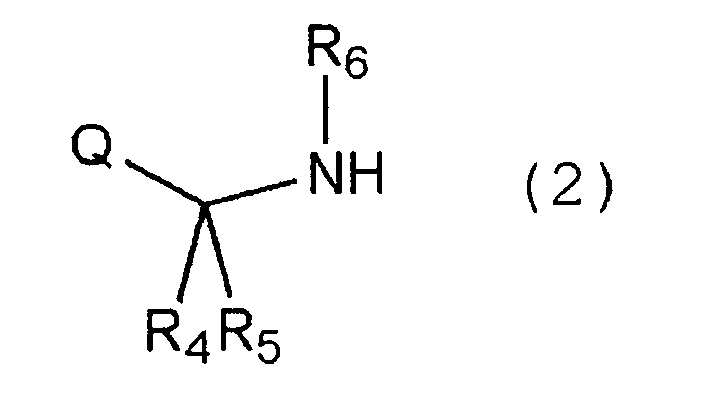
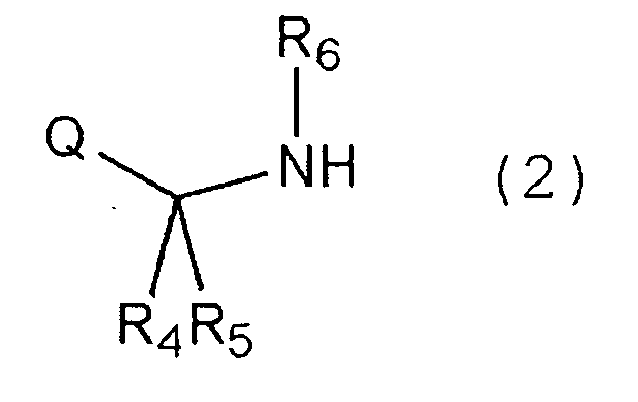
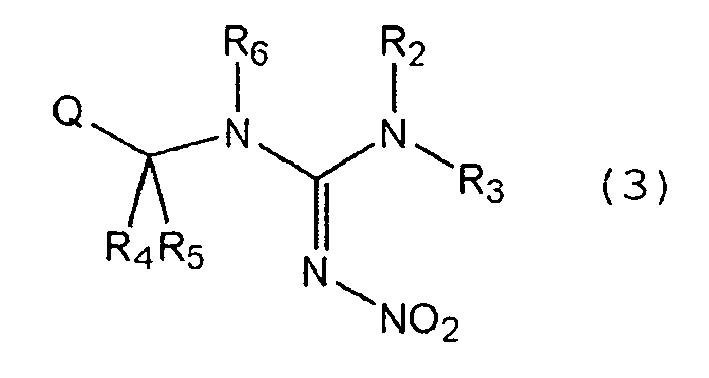
- As a result, the present inventors have found a process for producing the aforementioned nitroguanidine derivatives represented by the following general formula (3), in which nitroisourea derivatives represented by the following general formula (1) (hereinafter referred to as the compound (1) in some cases) or a salt thereof and amines represented by the following general formula (2) (hereinafter referred to as the amine derivatives (2) in some cases) or a salt thereof are reacted in the presence of a base in an aqueous solution wherein an inorganic salt is dissolved at not less than 50% of its saturated solubility,
-

- wherein, in the formula, R1 represents an alkyl group having 1 to 4 carbon atoms or a benzyl group; R2 represents an alkyl group having 1 to 4 carbon atoms; and R3 represents a hydrogen atom or an alkyl group having 1 to 4 carbon atoms,
-

- wherein, in the formula, R4, R5 and R6 each independently represent a hydrogen atom or an alkyl group having 1 to 4 carbon atoms; and Q represents a 5- or 6-membered heterocyclic group which contains at least one each of a nitrogen atom, an oxygen atom and a sulfur atom and may be substituted with a halogen atom (The heterocyclic group herein represents a pyridyl group, a pyridine-N-oxide group, a pyrimidinyl group, a pyridazyl group, a furyl group, a tetrahydrofuryl group, a thienyl group, a tetrahydrothienyl group, a tetrahydropyranyl group, an oxazolyl group, an isoxazolyl group, an oxadiazolyl group, a thiazolyl group, an isothiazolyl group, a thiadiazolyl group, a pyrrole group, an imidazolyl group, a triazolyl group, a pyrazolyl group or a tetrazolyl group.),
-

- wherein, in the formula, R2 represents an alkyl group having 1 to 4 carbon atoms; R3, R4, R5 and R6 each independently represent a hydrogen atom or an alkyl group having 1 to 4 carbon atoms; and Q represents a 5- or 6-membered heterocyclic group which contains at least one each of a nitrogen atom, an oxygen atom and a sulfur atom and may be substituted with a halogen atom (The heterocyclic group herein represents the same as those described above).
- That is, the present invention relates to an industrially advantageous process for producing the compound (3) or a salt thereof, which makes it possible to suppress the decomposition of the compound (1) by reacting the compound (1) or a salt thereof with the amine derivatives (2) in an aqueous solution wherein an inorganic salt is dissolved at not less than 50% of its saturated solubility, and further to suppress the generation of by-products by adding a base.
- In addition, in the present invention, the nitroisourea derivatives represented by the general formula (1) may contain nitroisourea derivatives having a double bond between the other nitrogen atom and carbon atom.
- According to the method of the present invention, it is possible to obtain nitroguanidine derivatives having an excellent insecticidal activity with high selectivity and in a high yield, while using inexpensive nitroisourea derivatives, and it is possible to produce it in an industrially advantageous way.
- The process for producing nitroguanidine derivatives of the present invention or a salt thereof is a process for producing nitroguanidine derivatives represented by the following general formula (3) or a salt thereof, in which nitroisourea derivatives represented by the following general formula (1) or a salt thereof and compounds represented by the following general formula (2) or a salt thereof are reacted in the presence of a base in an aqueous solution wherein an inorganic salt is dissolved at not less than 50% of its saturated solubility,
-

- wherein, in the formula, R1 represents an alkyl group having 1 to 4 carbon atoms or a benzyl group; R2 represents an alkyl group having 1 to 4 carbon atoms; and R3 represents a hydrogen atom or an alkyl group having 1 to 4 carbon atoms,
-

- wherein, in the formula, R4, R5 and R6 each independently represent a hydrogen atom or an alkyl group having 1 to 4 carbon atoms; and Q represents a 5- or 6-membered heterocyclic group which contains at least one each of a nitrogen atom, an oxygen atom and a sulfur atom and may be substituted with a halogen atom (The heterocyclic group herein represents a pyridyl group, a pyridine-N-oxide group, a pyrimidinyl group, a pyridazyl group, a furyl group, a tetrahydrofuryl group, a thienyl group, a tetrahydrothienyl group, a tetrahydropyranyl group, an oxazolyl group, an isoxazolyl group, an oxadiazolyl group, a thiazolyl group, an isothiazolyl group, a thiadiazolyl group, a pyrrole group, an imidazolyl group, a triazolyl group, a pyrazolyl group or a tetrazolyl group.),
-

- wherein, in the formula, R2 represents an alkyl group having 1 to 4 carbon atoms; R3, R4, R5 and R6 each independently represent a hydrogen atom or an alkyl group having 1 to 4 carbon atoms; and Q represents a 5- or 6-membered heterocyclic group which contains at least one each of a nitrogen atom, an oxygen atom and a sulfur atom and may be substituted with a halogen atom (The heterocyclic group herein represents the same as those described above).
- The method of the present invention makes it possible to suppress the decomposition of the starting material by carrying out the reaction in an aqueous solution wherein an inorganic salt is dissolved at not less than 50% of its saturated solubility, and further to suppress the generation of by-products such as nitroisourea derivatives represented by the following general formula (4) or the like by carrying out the reaction in the presence of a base,
-

- wherein, in the formula, R1 represents an alkyl group having 1 to 4 carbon atoms; R4, R5 and R6 each independently represent a hydrogen atom or an alkyl group having 1 to 4 carbon atoms; and Q represents a 5- or 6-membered heterocyclic group which contains at least one each of a nitrogen atom, an oxygen atom and a sulfur atom and may be substituted with a halogen atom (The heterocyclic group herein represents the same as those described above).
- It is particularly important to suppress the generation of the nitroisourea derivatives of the general formula (4) because the nitroisourea derivatives are turned into nitroguanidine derivatives represented by the general formula (5) which is difficult to be removed, during the reaction,

- wherein, in the formula, R1 represents an alkyl group having 1 to 4 carbon atoms; R4, R5 and R6 each independently represent a hydrogen atom or an alkyl group having 1 to 4 carbon atoms; and Q represents a 5- or 6-membered heterocyclic group which contains at least one each of a nitrogen atom, an oxygen atom and a sulfur atom and may be substituted with a halogen atom (The heterocyclic group herein represents the same as those described above).
- This enables the process of the present invention to obtain desired nitroguanidine derivatives or a salt thereof in a high yield as compared to the prior art, and at the same time to reduce a purification load. In this way, the production method of the present invention is excellent in the productivity, environmental sustainability and economical efficiency, and is useful as an industrial production method.
- The salt of the compound (3), the compound (1) and the amine derivatives (2) may be a salt which can be industrially allowable, and examples thereof include salts of inorganic acids such as hydrochloric acid, hydrobromic acid, hydroiodic acid, phosphoric acid, sulfuric acid, perchloric acid and the like; and salts of organic acids such as formic acid, acetic acid, tartaric acid, malic acid, citric acid, oxalic acid, succinic acid, benzoic acid, picric acid, methanesulfonic acid, p-toluenesulfonic acid and the like. Of these salts, preferably used are hydrochloride and sulfate.
- Specifically, the reaction can be performed in accordance with the following method. The amine derivatives (2) are known compounds, and can be produced, for example, by a method described in
DE 3727126A , Japanese Patent Laid-open No.1993-286936 Japanese Patent Laid-open No. 1995-179448 EP 446913A 1992-21674 - The amine derivatives (2) or a salt thereof are used in an amount of from 0.8 to 10 mole equivalents and preferably from 0.9 to 1.5 mole equivalents, based on the compound (1) or a salt thereof. By carrying out the reaction within the above range, the generation of by-products can be effectively suppressed, and at the same time the reaction of the amine derivatives (2) or a salt thereof and the compound (1) or a salt thereof can be selectively carried out. Thus, the guanidine derivatives can be obtained in a high yield.
- By carrying out the reaction in the presence of a base, side reaction with amino group can be suppressed and the reaction selectivity can be enhanced. As such a basic substance, there can be used, for example, inorganic bases such as alkali metal carbonate (such as sodium carbonate, potassium carbonate or the like), alkali metal hydroxide (such as sodium hydroxide, potassium hydroxide or the like), and alkaline earth metal hydroxide (such as calcium hydroxide or the like). In the present invention, one or more kinds of these substances can be selected and used. These bases can be properly selected in the range of 0.05 to 5 mole equivalents, based on the compound (1) and used.
- By carrying out the reaction in suspension of the compound (1) and an aqueous solution wherein an inorganic salt is dissolved at not less than 50% of its saturated solubility, the decomposition of the compound (1) can be suppressed and the reaction yield can be enhanced. The amount of the inorganic salt can be properly selected in the range of 50 to 100% of its saturated solubility, but it is preferably selected in the range of 70 to 100% of its saturated solubility from the viewpoint of the above effects. Incidentally, the saturated solubility of the inorganic salt is a value at a water temperature at the time of the reaction of the compound (1) and the compound (2).
- The inorganic salts reduce the solubility of the compound (1) and at the same time serves as a freezing mixture. It is considered that the reaction makes it possible to suppress the decomposition of the compound (1) and also to enhance the reaction selectivity when the initial reaction temperature is as low as possible. The present inventors have conducted an extensive study on the basis of such knowledge and as a result, have found that these effects can be achieved when the concentration of the inorganic salt is not less than 50% of its saturated solubility.
- As such an inorganic salt, there can be used lithium salts such as lithium chloride, lithium bromide, lithium iodide, lithium nitrate, lithium sulfate and the like; sodium salts such as sodium chloride, sodium bromide, sodium iodide, sodium nitrate, sodium sulfate and the like; potassium salts such as potassium chloride, potassium bromide, potassium iodide, potassium nitrate, potassium sulfate, potassium phosphate and the like; magnesium salts such as magnesium chloride, magnesium bromide, magnesium iodide, magnesium nitrate, magnesium sulfate, magnesium phosphate and the like; and calcium salts such as calcium chloride, calcium bromide, calcium iodide, calcium nitrate, calcium sulfate, calcium phosphate and the like. In the present invention, one or more kinds of these salts can be selected and used.
- The amount of the inorganic salt is properly selected in the range of 50 to 100% of its saturated solubility. Herein, the saturated solubility is defined as a relative value of the concentration of the inorganic salt that is actually dissolved on the assumption that the saturated solubility of inorganic salt in water is 100%. For example, since the concentration of a saturated sodium chloride solution at 20 degree centigrade is about 26.4 weight %, the saturated solubility of 50 to 100% of sodium chloride at 20 degree centigrade means a concentration of 13.2 to 26.4 weight %.
- The reaction temperature is usually in the range of -30 to 100 degree centigrade and preferably in the range of -20 to 50 degree centigrade. The reaction time is usually in the range of 10 minutes to 50 hours and preferably in the range of 1 to 25 hours.
- In the present invention, it is preferable that R1 and R2 are each independently an alkyl group having 1 to 4 carbon atoms, R3 is a hydrogen atom, and R4, R5 and R6 are each independently a hydrogen atom. Of these, Q is preferably a 2-chloro-5-thiazolyl group, a 2-chloro-5-pyridinyl group or a 3-tetrahydrofuranyl group because of its excellent insecticidal activity.
- The present invention is now illustrated in detail below with reference to Examples and Comparative Examples. However, the present invention shall not be limited in any way by these Examples and Comparative Examples. The pH was measured with pH test paper unless otherwise described.
- [(3-tetrahydrofuryl)methyl]amine (38.0 g, 0.38 mole) and 56.99 g of water were mixed, and the resulting mixture was cooled to 5 degree centigrade. Furthermore, 3.05 g (0.07 mole) of 1N NaOH was added to the solution, and then N, O-dimethyl-N'-nitroisourea (49.2 g, 0.37 mole) was introduced to the solution. The suspension was stirred at 5 degree centigrade for 4 hours, and then heated to 10 degree centigrade, and further stirred for 10 hours. 35% hydrochloric acid (6.7 g, 0.07 mole) was added to the suspension so that the pH became not more than 4. Water and acetonitrile were added to the above suspension for complete dissolution. The resulting solution was analyzed by HPLC and as a result, the reaction yield of the titled compound was 86%.
- [(3-tetrahydrofuryl)methyl]amine (38.0 g, 0.38 mole), 31.3 g of sodium chloride and 125.0 g of water were mixed, and the resulting mixture was cooled to -10 degree centigrade.
N,O-dimethyl-N'-nitroisourea (49.2 g, 0.37 mole) was introduced into the above solution. Sodium chloride was dissolved in water with 76% of the saturated solubility at a water temperature of -10 degree centigrade. The suspension was stirred at -10 degree centigrade for 4 hours and then heated to 10 degree centigrade, and further stirred for 19 hours. 35% hydrochloric acid (6.7 g, 0.07 mole) was added to the suspension so that the pH became not more than 4. Water and acetonitrile were added to the above suspension for complete dissolution. The resulting solution was analyzed by HPLC and as a result, the reaction yield of the titled compound was 88%. - Example 1
- [(3-tetrahydrofuryl)methyl]amine (38.0 g, 0.38 mole), 27.4 g of sodium chloride and 107.0 g of water were mixed, and the resulting mixture was cooled to -10 degree centigrade. Furthermore, 2.3 g (0.06 mole) of 96% NaOH was added to the solution and dissolved. Sodium chloride was dissolved in water with 78% of the saturated solubility at a water temperature of -10 degree centigrade.
N,O-dimethyl-N'-nitroisourea (49.2 g, 0.37 mole) was introduced into the above solution, stirred at -10 degree centigrade for 4 hours, and then heated to 10 degree centigrade and further stirred for 19 hours. 35% hydrochloric acid (6.7 g, 0.07 mole) was added to the suspension so that the pH became not more than 4. Water and acetonitrile were added to the above suspension for complete dissolution. The resulting solution was analyzed by HPLC and as a result, the reaction yield of the titled compound was 95%. - 14.0 g of sodium chloride and 53.8 g of water were mixed, and the resulting mixture was cooled to -10 degree centigrade.
N,O-dimethyl-N'-nitroisourea (49.2 g, 0.37 mole) was introduced into the above solution, and 4.3 g (0.05 mole) of 48% NaOH was further added to the suspension and stirred. Thereafter, [(3-tetrahydrofuryl)methyl]amine (38.0 g, 0.38 mole) was introduced dropwise to the suspension. Sodium chloride was dissolved in water with 76% of the saturated solubility at a water temperature of -10 degree centigrade. The suspension was stirred at -10 degree centigrade for 4 hours and then heated to 20 degree centigrade, and further stirred for 6 hours. Then, 35% hydrochloric acid (8.5 g, 0.08 mole) was added to the suspension so that the pH became not more than 4. Water and acetonitrile were added to the above suspension for complete dissolution. The resulting solution was analyzed by HPLC and as a result, the reaction yield of the titled compound was 96%. - [(3-tetrahydrofuryl)methyl]amine (43.3 g, 0.43 mole), 31.3 g of sodium chloride and 125 g of water were mixed, and the resulting mixture was cooled to -10 degree centigrade. Furthermore, 2.9 g (0.07 mole) of 96% NaOH was added to the solution and dissolved. Sodium chloride was dissolved in water with 76% of the saturated solubility at a water temperature of -10 degree centigrade. N,O-dimethyl-N'-nitroisourea (49.2 g, 0.37 mole) was introduced into the above solution, stirred at -10 degree centigrade for 4 hours, and then heated to 0 degree centigrade and further stirred for 18 hours. 35% hydrochloric acid (13.1 g, 0.13 mole) was added to the suspension so that the pH became not more than 4. The suspension was heated and dissolved for carrying out recrystallization. The precipitated crystal was filtered, and the filtered crystal was washed with cold water and then dried. 61 g of a 1-methyl-2-nitro-3-[(3-tetrahydrofuryl)methyl]guanidine with a purity of 99% was obtained. The isolated yield at this time was 81%.
- 1H-NMR(CDCl3,ppm):1.62-1.71(1H,m),2.05-2.16(1H,m),2.58-2.67( 1H,m),2.97(3H,d,J=5.3Hz),3.36(2H,br-t),3.62-3.66(1H,m),3.71-3. 84(2H,m),3.89-3.95(1H,m),6.04(1H,br-s),9.35(1H,br-s)
- 1.3 g of sodium chloride and 4.65 g of water were mixed, and the resulting mixture was cooled to -10 degree centigrade. N,O-dimethyl-N'-nitroisourea (4.5 g, 0.03 mole) was introduced into the above solution, and 0.58 g (4.64 mmole) of 32% NaOH was further added to the suspention and stirred. Thereafter, [(2-chloro-5-pyridyl)methyl]amine (4.93 g, 0.03 mole) was introduced dropwise to the suspension. Sodium chloride was dissolved in water with 78% of the saturated solubility at a water temperature of -10 degree centigrade. The solution was stirred at -10 degree centigrade for 4 hours and then heated to 20 degree centigrade, and further stirred for 6 hours. Then, 35% hydrochloric acid (0.7 g, 6.71 mmole) was added to the suspension so that the pH became not more than 4. The resulting solution was extracted with ethyl acetate and concentrated under a reduced pressure, and then recrystallized. Thus, 6.5 g of a 1-[(2-chloro-5-pyridyl)methyl]-3-methyl-2-nitroguanidine was obtained. The isolated yield at this time was 81%.
- 1H-NMR(DMSO-d6,ppm):2.85(3H,br-s),4.44(2H,d,J=5.4Hz),7.51(1H ,d,J=8.3Hz),7.72(1H,br-s),7.80(1H,dd,J=8.3,2.4Hz),8.37(1H,d,J= 2.4Hz),9.19(1H,br-s)
- 18.75 g of sodium chloride, 115.0 g of water, 3.01 g (0.07 mole) of 96% NaOH and [(3-tetrahydrofuryl)methyl]amine (39.9 g, 0.39 mole) were mixed, and the resulting mixture was cooled to -10 degree centigrade. N,O-dimethyl-N'-nitroisourea (49.2 g, 0.37 mole) was introduced into the above solution. Sodium chloride was dissolved in water with 53% of the saturated solubility at a water temperature of -10 degree centigrade. The solution was stirred at -10 degree centigrade for 4 hours, heated to 0 degree centigrade, and further stirred for 19 hours. Then, 35% hydrochloric acid (13.1 g, 0.13 mole) was added to the suspension so that the pH became not more than 4. The suspension was heated and dissolved for carrying out recrystallization. The precipitated crystal was filtered, and the filtered crystal was washed with cold water and then dried. 59 g of a 1-methyl-2-nitro-3-[(3-tetrahydrofuryl)methyl]guanidine with a purity of 99% was obtained. The isolated yield at this time was 78%.
- To a solution obtained by mixing 7.2 g of sodium chloride and 53.8 g of water was added N,O-dimethyl-N'-nitroisourea (49.2 g, 0.37 mole). The above suspension was cooled to -10 degree centigrade and as a result, it was solidified. In addition, sodium chloride was dissolved in water with 45% of the saturated solubility at a water temperature of -10 degree centigrade.
- To a solution of 1.0 g of N,O-dimethyl-N'-nitroisourea and 10 ml of methanol was added 0.91 g of [(3-tetrahydrofuryl)methyl]amine, and the resulting mixture was stirred at room temperature for 3 hours. Then, an aqueous hydrochloric acid solution (4M) was added to the solution and subsequently extracted with ethyl acetate.
In Comparative Example 2, 2-nitro-1,3-bis(tetrahydro-3-furylmethyl)guanidine of a by-product was generated in an amount of 5 mole%, based on 100 mole% of the starting material, which was difficult to be removed. On the other hand, since the reaction highly selectively proceeded in a high yield by the method described in Example 2, the amount of 2-nitro-1,3-bis(tetrahydro-3-furylmethyl)guanidine as a by-product was less than 1 mole%, thus greatly reducing the amount of the by-product. That is, according to the present invention, it is possible to reduce the load when the desired compound of 1-methyl-2-nitro-3-(tetrahydro-3-furylmethyl)guanidine is purified. Thus, the method is useful as an industrial production method.
Claims (3)
- A process for producing nitroguanidine derivatives represented by the following general formula (3) or a salt thereof, in which nitroisourea derivatives represented by the following general formula (1) or a salt thereof and compounds represented by the following general formula (2) or a salt thereof are reacted in the presence of a base in an aqueous solution wherein an inorganic salt is dissolved at not less than 50% of its saturated solubility,

- The process for producing nitroguanidine derivatives as set forth in claim 1, in which R2 is an alkyl group having 1 to 4 carbon atoms, R3, R4, R5 and R6 are each a hydrogen atom or an alkyl group having 1 to 4 carbon atoms, and Q is a pyridyl group which may be substituted with a halogen atom, a thiazolyl group which may be substituted with a halogen atom or a tetrahydrofuryl group.
- The process for producing nitroguanidine derivatives as set forth in claim 1, in which R2 is a methyl group, R3, R4, R5 and R6 are each a hydrogen atom, and Q is a tetrahydrofuryl group.
Applications Claiming Priority (2)
| Application Number | Priority Date | Filing Date | Title |
|---|---|---|---|
| JP2006033941 | 2006-02-10 | ||
| PCT/JP2007/000066 WO2007091391A1 (en) | 2006-02-10 | 2007-02-07 | Improved method for producing nitroguanidine derivative |
Publications (3)
| Publication Number | Publication Date |
|---|---|
| EP1985614A1 true EP1985614A1 (en) | 2008-10-29 |
| EP1985614A4 EP1985614A4 (en) | 2010-10-20 |
| EP1985614B1 EP1985614B1 (en) | 2013-09-25 |
Family
ID=38344998
Family Applications (1)
| Application Number | Title | Priority Date | Filing Date |
|---|---|---|---|
| EP07706314.7A Active EP1985614B1 (en) | 2006-02-10 | 2007-02-07 | Improved method for producing nitroguanidine derivative |
Country Status (14)
| Country | Link |
|---|---|
| US (1) | US7977496B2 (en) |
| EP (1) | EP1985614B1 (en) |
| JP (1) | JP4966210B2 (en) |
| KR (1) | KR101050018B1 (en) |
| CN (1) | CN101379035B (en) |
| AU (1) | AU2007213271A1 (en) |
| CA (1) | CA2641877C (en) |
| ES (1) | ES2438979T3 (en) |
| IL (1) | IL193247A (en) |
| MX (1) | MX295359B (en) |
| RU (1) | RU2008136366A (en) |
| TW (1) | TWI327138B (en) |
| WO (1) | WO2007091391A1 (en) |
| ZA (1) | ZA200806839B (en) |
Families Citing this family (5)
| Publication number | Priority date | Publication date | Assignee | Title |
|---|---|---|---|---|
| CN104478762B (en) * | 2014-12-18 | 2017-01-11 | 湖南海利常德农药化工有限公司 | Preparation method of N,O-dimethyl-N-nitroisourea |
| CN106316993B (en) * | 2016-07-28 | 2018-11-16 | 山东康乔生物科技有限公司 | A kind of dinotefuran synthetic method |
| CN106349196B (en) * | 2016-08-26 | 2019-01-04 | 江苏克胜作物科技有限公司 | A kind of synthetic method of dinotefuran |
| CN108358875A (en) * | 2018-03-02 | 2018-08-03 | 海利尔药业集团股份有限公司 | A kind of synthetic method of dinotefuran |
| CN109400552A (en) * | 2018-12-19 | 2019-03-01 | 江苏中谱检测有限公司 | A kind of synthesis preparation method of 2- nitro -1,3- bis- [(tetrahydro -3- furans) methyl] guanidine |
Family Cites Families (11)
| Publication number | Priority date | Publication date | Assignee | Title |
|---|---|---|---|---|
| US242003A (en) * | 1881-05-24 | Plate-glass conveyer and setter | ||
| US2424003A (en) * | 1944-12-08 | 1947-07-15 | Jr Fred W Tanner | Method for the production of riboflavin by candida flareri |
| JP2779403B2 (en) | 1988-11-29 | 1998-07-23 | 日本バイエルアグロケム株式会社 | Insecticidal nitro compounds |
| JP2546003B2 (en) | 1988-12-27 | 1996-10-23 | 武田薬品工業株式会社 | Guanidine derivative, its production method and insecticide |
| JPH0674249B2 (en) | 1990-04-05 | 1994-09-21 | アグロカネショウ株式会社 | Method for producing substituted nitroguanidines |
| US5434181A (en) | 1993-10-26 | 1995-07-18 | Mitsui Toatsu Chemicals, Inc. | Furanyl insecticide |
| PL187896B1 (en) * | 1995-06-23 | 2004-10-29 | Sumitomo Chem Takeda Agro Co | Method of obtaining derivatives of quanidine, their intermediate compounds and method of obtaining them |
| JP3413632B2 (en) | 1995-11-17 | 2003-06-03 | 住化武田農薬株式会社 | Method for producing guanidine derivative |
| JP3720637B2 (en) * | 1998-07-24 | 2005-11-30 | 三井化学株式会社 | New nitroisourea derivatives |
| EP0974579B1 (en) * | 1998-07-24 | 2001-10-17 | Mitsui Chemicals, Inc. | Nitroisourea derivatives |
| JP2006103776A (en) * | 2004-10-08 | 2006-04-20 | Toppan Printing Co Ltd | Container lid with a dry resin molded body inserted |
-
2007
- 2007-02-07 US US12/278,497 patent/US7977496B2/en active Active
- 2007-02-07 WO PCT/JP2007/000066 patent/WO2007091391A1/en not_active Ceased
- 2007-02-07 AU AU2007213271A patent/AU2007213271A1/en not_active Abandoned
- 2007-02-07 ES ES07706314.7T patent/ES2438979T3/en active Active
- 2007-02-07 EP EP07706314.7A patent/EP1985614B1/en active Active
- 2007-02-07 ZA ZA200806839A patent/ZA200806839B/en unknown
- 2007-02-07 CA CA2641877A patent/CA2641877C/en active Active
- 2007-02-07 JP JP2007557760A patent/JP4966210B2/en active Active
- 2007-02-07 RU RU2008136366/04A patent/RU2008136366A/en not_active Application Discontinuation
- 2007-02-07 CN CN2007800049285A patent/CN101379035B/en active Active
- 2007-02-08 TW TW096104564A patent/TWI327138B/en active
-
2008
- 2008-08-05 IL IL193247A patent/IL193247A/en active IP Right Grant
- 2008-08-07 MX MX2008010143A patent/MX295359B/en active IP Right Grant
- 2008-08-29 KR KR20087021175A patent/KR101050018B1/en active Active
Also Published As
| Publication number | Publication date |
|---|---|
| EP1985614B1 (en) | 2013-09-25 |
| JP4966210B2 (en) | 2012-07-04 |
| KR101050018B1 (en) | 2011-07-19 |
| KR20080091497A (en) | 2008-10-13 |
| CN101379035B (en) | 2011-01-12 |
| EP1985614A4 (en) | 2010-10-20 |
| CA2641877C (en) | 2011-03-29 |
| ZA200806839B (en) | 2009-11-25 |
| US20090176990A1 (en) | 2009-07-09 |
| CA2641877A1 (en) | 2007-08-16 |
| JPWO2007091391A1 (en) | 2009-07-02 |
| MX295359B (en) | 2012-01-27 |
| ES2438979T3 (en) | 2014-01-21 |
| CN101379035A (en) | 2009-03-04 |
| RU2008136366A (en) | 2010-03-20 |
| TWI327138B (en) | 2010-07-11 |
| US7977496B2 (en) | 2011-07-12 |
| TW200745038A (en) | 2007-12-16 |
| MX2008010143A (en) | 2008-08-19 |
| WO2007091391A1 (en) | 2007-08-16 |
| AU2007213271A1 (en) | 2007-08-16 |
| IL193247A (en) | 2014-03-31 |
| IL193247A0 (en) | 2009-02-11 |
Similar Documents
| Publication | Publication Date | Title |
|---|---|---|
| EP1985614B1 (en) | Improved method for producing nitroguanidine derivative | |
| EP2266966A1 (en) | A process for the preparation of febuxostat | |
| US7560593B2 (en) | Process for producing nitroisourea derivatives | |
| HUP0202050A2 (en) | Method of producing nitroguanidine and nitroenamine derivatives | |
| JP3720637B2 (en) | New nitroisourea derivatives | |
| EP1619179A1 (en) | Production method of O-substituted tyrosine compound | |
| JP3082006B2 (en) | Method for producing 2-alkylthio-4,6-dihydroxypyrimidine | |
| KR102801536B1 (en) | Preparation for Benzoamine derivatives | |
| US5942625A (en) | Preparation of chloromethylpyridine hydrochlorides | |
| SK10182002A3 (en) | Method for producing heterocyclic compounds | |
| CN121159475A (en) | Synthesis method of N, N-alkyl substituted amine compound | |
| EP1043320A1 (en) | New process for producing aminopiperazine derivatives | |
| MX2008010140A (en) | Improved method for producing nitroisourea derivative | |
| EP0177808A1 (en) | 4-Methyl-5-thioformamidinomethylimidazole dihydrochloride | |
| JPS59196868A (en) | Method for producing 4-substituted pyrazoles | |
| JPWO2001053251A1 (en) | Method for producing 3-nitro-2-monosubstituted aminobenzoic acid esters | |
| JPH09316056A (en) | Process for producing cyclic nitroguanidine derivative | |
| JPH09124601A (en) | Method for producing piperidones | |
| TH13935A (en) | Preparation of cephalosporin antibiotics using SYN-isomer of thiacylyl intermediate. | |
| TH10805B (en) | Preparation of cephalosporin antibiotics using SYN-isomer of thiacylyl intermediate. | |
| JP2001328983A (en) | Method for producing disubstituted nitroguanidine |
Legal Events
| Date | Code | Title | Description |
|---|---|---|---|
| PUAI | Public reference made under article 153(3) epc to a published international application that has entered the european phase |
Free format text: ORIGINAL CODE: 0009012 |
|
| 17P | Request for examination filed |
Effective date: 20080829 |
|
| AK | Designated contracting states |
Kind code of ref document: A1 Designated state(s): AT BE BG CH CY CZ DE DK EE ES FI FR GB GR HU IE IS IT LI LT LU LV MC NL PL PT RO SE SI SK TR |
|
| RAP1 | Party data changed (applicant data changed or rights of an application transferred) |
Owner name: MITSUI CHEMICALS AGRO, INC. |
|
| RAP1 | Party data changed (applicant data changed or rights of an application transferred) |
Owner name: MITSUI CHEMICALS AGRO, INC. |
|
| A4 | Supplementary search report drawn up and despatched |
Effective date: 20100922 |
|
| 17Q | First examination report despatched |
Effective date: 20111118 |
|
| DAX | Request for extension of the european patent (deleted) | ||
| GRAP | Despatch of communication of intention to grant a patent |
Free format text: ORIGINAL CODE: EPIDOSNIGR1 |
|
| INTG | Intention to grant announced |
Effective date: 20130430 |
|
| GRAS | Grant fee paid |
Free format text: ORIGINAL CODE: EPIDOSNIGR3 |
|
| GRAA | (expected) grant |
Free format text: ORIGINAL CODE: 0009210 |
|
| AK | Designated contracting states |
Kind code of ref document: B1 Designated state(s): AT BE BG CH CY CZ DE DK EE ES FI FR GB GR HU IE IS IT LI LT LU LV MC NL PL PT RO SE SI SK TR |
|
| REG | Reference to a national code |
Ref country code: GB Ref legal event code: FG4D |
|
| REG | Reference to a national code |
Ref country code: CH Ref legal event code: EP |
|
| REG | Reference to a national code |
Ref country code: AT Ref legal event code: REF Ref document number: 633658 Country of ref document: AT Kind code of ref document: T Effective date: 20131015 |
|
| REG | Reference to a national code |
Ref country code: IE Ref legal event code: FG4D |
|
| REG | Reference to a national code |
Ref country code: DE Ref legal event code: R096 Ref document number: 602007033016 Country of ref document: DE Effective date: 20131121 |
|
| REG | Reference to a national code |
Ref country code: ES Ref legal event code: FG2A Ref document number: 2438979 Country of ref document: ES Kind code of ref document: T3 Effective date: 20140121 |
|
| PG25 | Lapsed in a contracting state [announced via postgrant information from national office to epo] |
Ref country code: LT Free format text: LAPSE BECAUSE OF FAILURE TO SUBMIT A TRANSLATION OF THE DESCRIPTION OR TO PAY THE FEE WITHIN THE PRESCRIBED TIME-LIMIT Effective date: 20130925 Ref country code: SE Free format text: LAPSE BECAUSE OF FAILURE TO SUBMIT A TRANSLATION OF THE DESCRIPTION OR TO PAY THE FEE WITHIN THE PRESCRIBED TIME-LIMIT Effective date: 20130925 |
|
| REG | Reference to a national code |
Ref country code: AT Ref legal event code: MK05 Ref document number: 633658 Country of ref document: AT Kind code of ref document: T Effective date: 20130925 |
|
| REG | Reference to a national code |
Ref country code: NL Ref legal event code: VDEP Effective date: 20130925 |
|
| REG | Reference to a national code |
Ref country code: LT Ref legal event code: MG4D |
|
| PG25 | Lapsed in a contracting state [announced via postgrant information from national office to epo] |
Ref country code: FI Free format text: LAPSE BECAUSE OF FAILURE TO SUBMIT A TRANSLATION OF THE DESCRIPTION OR TO PAY THE FEE WITHIN THE PRESCRIBED TIME-LIMIT Effective date: 20130925 Ref country code: SI Free format text: LAPSE BECAUSE OF FAILURE TO SUBMIT A TRANSLATION OF THE DESCRIPTION OR TO PAY THE FEE WITHIN THE PRESCRIBED TIME-LIMIT Effective date: 20130925 Ref country code: LV Free format text: LAPSE BECAUSE OF FAILURE TO SUBMIT A TRANSLATION OF THE DESCRIPTION OR TO PAY THE FEE WITHIN THE PRESCRIBED TIME-LIMIT Effective date: 20130925 Ref country code: GR Free format text: LAPSE BECAUSE OF FAILURE TO SUBMIT A TRANSLATION OF THE DESCRIPTION OR TO PAY THE FEE WITHIN THE PRESCRIBED TIME-LIMIT Effective date: 20131226 |
|
| PG25 | Lapsed in a contracting state [announced via postgrant information from national office to epo] |
Ref country code: BE Free format text: LAPSE BECAUSE OF FAILURE TO SUBMIT A TRANSLATION OF THE DESCRIPTION OR TO PAY THE FEE WITHIN THE PRESCRIBED TIME-LIMIT Effective date: 20130925 |
|
| PG25 | Lapsed in a contracting state [announced via postgrant information from national office to epo] |
Ref country code: SK Free format text: LAPSE BECAUSE OF FAILURE TO SUBMIT A TRANSLATION OF THE DESCRIPTION OR TO PAY THE FEE WITHIN THE PRESCRIBED TIME-LIMIT Effective date: 20130925 Ref country code: NL Free format text: LAPSE BECAUSE OF FAILURE TO SUBMIT A TRANSLATION OF THE DESCRIPTION OR TO PAY THE FEE WITHIN THE PRESCRIBED TIME-LIMIT Effective date: 20130925 Ref country code: IS Free format text: LAPSE BECAUSE OF FAILURE TO SUBMIT A TRANSLATION OF THE DESCRIPTION OR TO PAY THE FEE WITHIN THE PRESCRIBED TIME-LIMIT Effective date: 20140125 Ref country code: RO Free format text: LAPSE BECAUSE OF FAILURE TO SUBMIT A TRANSLATION OF THE DESCRIPTION OR TO PAY THE FEE WITHIN THE PRESCRIBED TIME-LIMIT Effective date: 20130925 Ref country code: EE Free format text: LAPSE BECAUSE OF FAILURE TO SUBMIT A TRANSLATION OF THE DESCRIPTION OR TO PAY THE FEE WITHIN THE PRESCRIBED TIME-LIMIT Effective date: 20130925 Ref country code: CZ Free format text: LAPSE BECAUSE OF FAILURE TO SUBMIT A TRANSLATION OF THE DESCRIPTION OR TO PAY THE FEE WITHIN THE PRESCRIBED TIME-LIMIT Effective date: 20130925 |
|
| PG25 | Lapsed in a contracting state [announced via postgrant information from national office to epo] |
Ref country code: AT Free format text: LAPSE BECAUSE OF FAILURE TO SUBMIT A TRANSLATION OF THE DESCRIPTION OR TO PAY THE FEE WITHIN THE PRESCRIBED TIME-LIMIT Effective date: 20130925 Ref country code: PL Free format text: LAPSE BECAUSE OF FAILURE TO SUBMIT A TRANSLATION OF THE DESCRIPTION OR TO PAY THE FEE WITHIN THE PRESCRIBED TIME-LIMIT Effective date: 20130925 Ref country code: CY Free format text: LAPSE BECAUSE OF FAILURE TO SUBMIT A TRANSLATION OF THE DESCRIPTION OR TO PAY THE FEE WITHIN THE PRESCRIBED TIME-LIMIT Effective date: 20130925 |
|
| REG | Reference to a national code |
Ref country code: DE Ref legal event code: R097 Ref document number: 602007033016 Country of ref document: DE |
|
| PG25 | Lapsed in a contracting state [announced via postgrant information from national office to epo] |
Ref country code: PT Free format text: LAPSE BECAUSE OF FAILURE TO SUBMIT A TRANSLATION OF THE DESCRIPTION OR TO PAY THE FEE WITHIN THE PRESCRIBED TIME-LIMIT Effective date: 20140127 |
|
| PLBE | No opposition filed within time limit |
Free format text: ORIGINAL CODE: 0009261 |
|
| STAA | Information on the status of an ep patent application or granted ep patent |
Free format text: STATUS: NO OPPOSITION FILED WITHIN TIME LIMIT |
|
| 26N | No opposition filed |
Effective date: 20140626 |
|
| PG25 | Lapsed in a contracting state [announced via postgrant information from national office to epo] |
Ref country code: MC Free format text: LAPSE BECAUSE OF FAILURE TO SUBMIT A TRANSLATION OF THE DESCRIPTION OR TO PAY THE FEE WITHIN THE PRESCRIBED TIME-LIMIT Effective date: 20130925 Ref country code: DK Free format text: LAPSE BECAUSE OF FAILURE TO SUBMIT A TRANSLATION OF THE DESCRIPTION OR TO PAY THE FEE WITHIN THE PRESCRIBED TIME-LIMIT Effective date: 20130925 Ref country code: LU Free format text: LAPSE BECAUSE OF FAILURE TO SUBMIT A TRANSLATION OF THE DESCRIPTION OR TO PAY THE FEE WITHIN THE PRESCRIBED TIME-LIMIT Effective date: 20140207 |
|
| REG | Reference to a national code |
Ref country code: CH Ref legal event code: PL |
|
| REG | Reference to a national code |
Ref country code: DE Ref legal event code: R097 Ref document number: 602007033016 Country of ref document: DE Effective date: 20140626 |
|
| PG25 | Lapsed in a contracting state [announced via postgrant information from national office to epo] |
Ref country code: CH Free format text: LAPSE BECAUSE OF NON-PAYMENT OF DUE FEES Effective date: 20140228 Ref country code: LI Free format text: LAPSE BECAUSE OF NON-PAYMENT OF DUE FEES Effective date: 20140228 |
|
| REG | Reference to a national code |
Ref country code: IE Ref legal event code: MM4A |
|
| PG25 | Lapsed in a contracting state [announced via postgrant information from national office to epo] |
Ref country code: IE Free format text: LAPSE BECAUSE OF NON-PAYMENT OF DUE FEES Effective date: 20140207 |
|
| REG | Reference to a national code |
Ref country code: FR Ref legal event code: PLFP Year of fee payment: 10 |
|
| PG25 | Lapsed in a contracting state [announced via postgrant information from national office to epo] |
Ref country code: BG Free format text: LAPSE BECAUSE OF FAILURE TO SUBMIT A TRANSLATION OF THE DESCRIPTION OR TO PAY THE FEE WITHIN THE PRESCRIBED TIME-LIMIT Effective date: 20130925 |
|
| PG25 | Lapsed in a contracting state [announced via postgrant information from national office to epo] |
Ref country code: HU Free format text: LAPSE BECAUSE OF FAILURE TO SUBMIT A TRANSLATION OF THE DESCRIPTION OR TO PAY THE FEE WITHIN THE PRESCRIBED TIME-LIMIT; INVALID AB INITIO Effective date: 20070207 Ref country code: TR Free format text: LAPSE BECAUSE OF FAILURE TO SUBMIT A TRANSLATION OF THE DESCRIPTION OR TO PAY THE FEE WITHIN THE PRESCRIBED TIME-LIMIT Effective date: 20130925 |
|
| REG | Reference to a national code |
Ref country code: FR Ref legal event code: PLFP Year of fee payment: 11 |
|
| REG | Reference to a national code |
Ref country code: FR Ref legal event code: PLFP Year of fee payment: 12 |
|
| P01 | Opt-out of the competence of the unified patent court (upc) registered |
Effective date: 20230512 |
|
| REG | Reference to a national code |
Ref country code: DE Ref legal event code: R081 Ref document number: 602007033016 Country of ref document: DE Owner name: MITSUI CHEMICALS CROP & LIFE SOLUTIONS, INC., JP Free format text: FORMER OWNER: MITSUI CHEMICALS AGRO INC., TOKYO, JP |
|
| REG | Reference to a national code |
Ref country code: ES Ref legal event code: PC2A Owner name: MITSUI CHEMICALS CROP & LIFE SOLUTIONS, INC. Effective date: 20240917 |
|
| PGFP | Annual fee paid to national office [announced via postgrant information from national office to epo] |
Ref country code: ES Payment date: 20250328 Year of fee payment: 19 |
|
| PGFP | Annual fee paid to national office [announced via postgrant information from national office to epo] |
Ref country code: GB Payment date: 20260219 Year of fee payment: 20 |
|
| PGFP | Annual fee paid to national office [announced via postgrant information from national office to epo] |
Ref country code: DE Payment date: 20260218 Year of fee payment: 20 |
|
| PGFP | Annual fee paid to national office [announced via postgrant information from national office to epo] |
Ref country code: IT Payment date: 20260224 Year of fee payment: 20 |
|
| PGFP | Annual fee paid to national office [announced via postgrant information from national office to epo] |
Ref country code: FR Payment date: 20260218 Year of fee payment: 20 |