EP1984297B1 - High-pressure fluidized bed reactor for preparing granular polycrystalline silicon - Google Patents
High-pressure fluidized bed reactor for preparing granular polycrystalline silicon Download PDFInfo
- Publication number
- EP1984297B1 EP1984297B1 EP07708807.8A EP07708807A EP1984297B1 EP 1984297 B1 EP1984297 B1 EP 1984297B1 EP 07708807 A EP07708807 A EP 07708807A EP 1984297 B1 EP1984297 B1 EP 1984297B1
- Authority
- EP
- European Patent Office
- Prior art keywords
- pressure
- reactor
- controlling means
- zone
- gas
- Prior art date
- Legal status (The legal status is an assumption and is not a legal conclusion. Google has not performed a legal analysis and makes no representation as to the accuracy of the status listed.)
- Not-in-force
Links
Images
Classifications
-
- C—CHEMISTRY; METALLURGY
- C01—INORGANIC CHEMISTRY
- C01B—NON-METALLIC ELEMENTS; COMPOUNDS THEREOF; METALLOIDS OR COMPOUNDS THEREOF NOT COVERED BY SUBCLASS C01C
- C01B33/00—Silicon; Compounds thereof
- C01B33/02—Silicon
- C01B33/021—Preparation
- C01B33/027—Preparation by decomposition or reduction of gaseous or vaporised silicon compounds other than silica or silica-containing material
-
- A—HUMAN NECESSITIES
- A47—FURNITURE; DOMESTIC ARTICLES OR APPLIANCES; COFFEE MILLS; SPICE MILLS; SUCTION CLEANERS IN GENERAL
- A47J—KITCHEN EQUIPMENT; COFFEE MILLS; SPICE MILLS; APPARATUS FOR MAKING BEVERAGES
- A47J37/00—Baking; Roasting; Grilling; Frying
- A47J37/06—Roasters; Grills; Sandwich grills
- A47J37/067—Horizontally disposed broiling griddles
- A47J37/0682—Horizontally disposed broiling griddles gas-heated
-
- B—PERFORMING OPERATIONS; TRANSPORTING
- B01—PHYSICAL OR CHEMICAL PROCESSES OR APPARATUS IN GENERAL
- B01J—CHEMICAL OR PHYSICAL PROCESSES, e.g. CATALYSIS OR COLLOID CHEMISTRY; THEIR RELEVANT APPARATUS
- B01J3/00—Processes of utilising sub-atmospheric or super-atmospheric pressure to effect chemical or physical change of matter; Apparatus therefor
- B01J3/04—Pressure vessels, e.g. autoclaves
- B01J3/046—Pressure-balanced vessels
-
- B—PERFORMING OPERATIONS; TRANSPORTING
- B01—PHYSICAL OR CHEMICAL PROCESSES OR APPARATUS IN GENERAL
- B01J—CHEMICAL OR PHYSICAL PROCESSES, e.g. CATALYSIS OR COLLOID CHEMISTRY; THEIR RELEVANT APPARATUS
- B01J8/00—Chemical or physical processes in general, conducted in the presence of fluids and solid particles; Apparatus for such processes
- B01J8/18—Chemical or physical processes in general, conducted in the presence of fluids and solid particles; Apparatus for such processes with fluidised particles
- B01J8/1818—Feeding of the fluidising gas
- B01J8/1827—Feeding of the fluidising gas the fluidising gas being a reactant
-
- B—PERFORMING OPERATIONS; TRANSPORTING
- B01—PHYSICAL OR CHEMICAL PROCESSES OR APPARATUS IN GENERAL
- B01J—CHEMICAL OR PHYSICAL PROCESSES, e.g. CATALYSIS OR COLLOID CHEMISTRY; THEIR RELEVANT APPARATUS
- B01J8/00—Chemical or physical processes in general, conducted in the presence of fluids and solid particles; Apparatus for such processes
- B01J8/18—Chemical or physical processes in general, conducted in the presence of fluids and solid particles; Apparatus for such processes with fluidised particles
- B01J8/1836—Heating and cooling the reactor
-
- C—CHEMISTRY; METALLURGY
- C01—INORGANIC CHEMISTRY
- C01B—NON-METALLIC ELEMENTS; COMPOUNDS THEREOF; METALLOIDS OR COMPOUNDS THEREOF NOT COVERED BY SUBCLASS C01C
- C01B33/00—Silicon; Compounds thereof
- C01B33/02—Silicon
- C01B33/021—Preparation
- C01B33/027—Preparation by decomposition or reduction of gaseous or vaporised silicon compounds other than silica or silica-containing material
- C01B33/029—Preparation by decomposition or reduction of gaseous or vaporised silicon compounds other than silica or silica-containing material by decomposition of monosilane
-
- C—CHEMISTRY; METALLURGY
- C01—INORGANIC CHEMISTRY
- C01B—NON-METALLIC ELEMENTS; COMPOUNDS THEREOF; METALLOIDS OR COMPOUNDS THEREOF NOT COVERED BY SUBCLASS C01C
- C01B33/00—Silicon; Compounds thereof
- C01B33/02—Silicon
- C01B33/021—Preparation
- C01B33/027—Preparation by decomposition or reduction of gaseous or vaporised silicon compounds other than silica or silica-containing material
- C01B33/03—Preparation by decomposition or reduction of gaseous or vaporised silicon compounds other than silica or silica-containing material by decomposition of silicon halides or halosilanes or reduction thereof with hydrogen as the only reducing agent
-
- A—HUMAN NECESSITIES
- A47—FURNITURE; DOMESTIC ARTICLES OR APPLIANCES; COFFEE MILLS; SPICE MILLS; SUCTION CLEANERS IN GENERAL
- A47J—KITCHEN EQUIPMENT; COFFEE MILLS; SPICE MILLS; APPARATUS FOR MAKING BEVERAGES
- A47J37/00—Baking; Roasting; Grilling; Frying
- A47J37/06—Roasters; Grills; Sandwich grills
- A47J37/07—Roasting devices for outdoor use; Barbecues
- A47J37/0786—Accessories
-
- B—PERFORMING OPERATIONS; TRANSPORTING
- B01—PHYSICAL OR CHEMICAL PROCESSES OR APPARATUS IN GENERAL
- B01J—CHEMICAL OR PHYSICAL PROCESSES, e.g. CATALYSIS OR COLLOID CHEMISTRY; THEIR RELEVANT APPARATUS
- B01J2208/00—Processes carried out in the presence of solid particles; Reactors therefor
- B01J2208/00008—Controlling the process
- B01J2208/00017—Controlling the temperature
- B01J2208/00389—Controlling the temperature using electric heating or cooling elements
- B01J2208/00398—Controlling the temperature using electric heating or cooling elements inside the reactor bed
-
- B—PERFORMING OPERATIONS; TRANSPORTING
- B01—PHYSICAL OR CHEMICAL PROCESSES OR APPARATUS IN GENERAL
- B01J—CHEMICAL OR PHYSICAL PROCESSES, e.g. CATALYSIS OR COLLOID CHEMISTRY; THEIR RELEVANT APPARATUS
- B01J2208/00—Processes carried out in the presence of solid particles; Reactors therefor
- B01J2208/00008—Controlling the process
- B01J2208/00017—Controlling the temperature
- B01J2208/00389—Controlling the temperature using electric heating or cooling elements
- B01J2208/00407—Controlling the temperature using electric heating or cooling elements outside the reactor bed
Definitions
- the present invention relates to a high-pressure fluidized bed reactor for preparing granular polycrystalline silicon that enables to maintain long-term stability of the reactor tube and efficiently prepare granular polycrystalline silicon even at relatively high reaction pressure.
- high-purity polycrystalline silicon is used as a basic material for manufacturing semiconductor devices or solar cells.
- the polycrystalline silicon is prepared by thermal decomposition and/or hydrogen reduction of highly-purified silicon atom-containing reaction gas, thus causing the continuous silicon deposition on silicon particles.
- a bell-jar type reactor For mass production of polycrystalline silicon, a bell-jar type reactor has been mainly used, which provides a rod-type polycrystalline silicon product with a diameter of about 50-300 mm.
- the bell-jar type reactor which consists fundamentally of the electric resistance heating system, cannot be operated continuously due to inevitable limit in extending the maximum rod diameter achievable.
- This reactor is also known to have serious problems of low deposition efficiency and high electrical energy consumption because of limited silicon surfaces and high heat loss.
- a fluidized bed reactor has recently been developed to prepare granular polycrystalline silicon with a size of 0.5-3 mm.
- a fluidized bed of silicon particles is formed by the upward flow of gas and the size of the silicon particles increases as the silicon atoms deposit on the particles from the silicon atom-containing reaction gas supplied to the heated fluidized bed.
- the fluidized bed reactor also uses a silane compound of Si-H-Cl system such as monosilane (SiH 4 ), dichlorosilane (SiH 2 Cl 2 ), trichlorosilane (SiHCl 3 ), silicon tetrachloride (SiCl 4 ) or its mixture as the silicon atom-containing reaction gas, which usually further comprises hydrogen, nitrogen, argon, helium, etc.
- Si-H-Cl system such as monosilane (SiH 4 ), dichlorosilane (SiH 2 Cl 2 ), trichlorosilane (SiHCl 3 ), silicon tetrachloride (SiCl 4 ) or its mixture as the silicon atom-containing reaction gas, which usually further comprises hydrogen, nitrogen, argon, helium, etc.
- the reaction temperature i.e., temperature of the silicon particles
- the temperature should be about 600-850 °C for monosilane, while being about 900-1,100 °C for trichlorosilane which is most widely used.
- the process of silicon deposition which is caused by thermal decomposition and/or hydrogen reduction of silicon atom-containing reaction gas, includes various elementary reactions, and there are complex routes where silicon atoms grow into granular particles depending on the reaction gas.
- the operation of the fluidized bed reactor provides a granular polycrystalline silicon product.
- seed crystals become bigger in size due to continuous silicon deposition or the agglomeration of silicon particles, thereby losing fluidity and ultimately moving downwards.
- the seed crystals may be prepared or generated in situ in the fluidized bed itself, or supplied into the reactor continuously, periodically or intermittently.
- prepared bigger particles, i.e., polycrystalline silicon product may be withrawn from the lower part of the reactor continuously, periodically or intermittently.
- the fluidized bed reactor system provides a higher reaction yield than that by the bell-jar type reactor system.
- the granular product may be directly used without further processing for the following-up processes such as single crystal growth, crystal block production, surface treatment and modification, preparation of chemical material for reaction or separation, or molding or pulverization of silicon particles.
- these follow-up processes have been operated in a batchwise manner, the manufacture of the granular polycrystalline silicon allows the processes to be performed in a semi-continuous or continuous manner.
- the increase in the productivity of the fluidized bed reactor is required for low-cost manufacture of granular polycrystalline silicon.
- it is most effective to increase the silicon deposition rate with low specific energy consumption, which is obtainable by continuous operation of the fluidized bed reactor under high pressure.
- it is essential to secure the physical stability of the reactor components.
- a reactor tube made of quartz is positioned in an electrical resistance heater for heating the silicon particles, and both the reactor tube and the heater are surrounded by a metallic shell. It is preferred to fill an insulating material in between the heater and the reactor shell or outside the reactor shell to reduce heat loss.
- U.S. patent no. 5,165,908 discloses a reactor system where an electric resistance heater encloses a reactor tube made of quartz, both of which are protected by a jacket-shaped stainless-steel shell and an insulating material is installed outside the shell.
- U.S. patent no. 5,810,934 discloses a fluidized bed reactor for manufacture of polycrystalline silicon, comprising a reactor vessel, i.e., the reactor tube defining a fluidized bed; a shroud, i.,e., a protection tube surrounding the reactor tube; a heater installed outside the shroud; and an outer containment surrounding the heater and an insulating material.
- This patent emphasizes that the protection tube made of quartz be installed in between the reactor tube and the heater to prevent the crack of the reactor tube and the contamination of its inner space.
- the fluidized bed reactor for manufacture of polycrystalline silicon may have a different structure depending on the heating method.
- U.S. patent no. 4,786,477 discloses a method of heating silicon particles with microwave penetrating through the quartz reactor tube instead of applying a conventional heater outside the tube.
- this patent still has a problem of a complex structure of the reactor and fails to disclose how to increase the reaction pressure inside the quartz reactor tube.
- U.S. 5,382,412 discloses a simple-structured fluidized bed reactor for manufacture of polycrystalline silicon, wherein a cylindrical reactor tube is hold vertically by a metallic reactor shell.
- this patent still has problems that the inner pressure cannot be increased beyond atmospheric pressure and the microwave supplying means should be combined with the reactor shell, thus failing to suggest how to overcome the mechanical weakness of the reactor tube that is anticipated at high-pressure reaction.
- a high-pressure fluidized bed reactor for preparing granular polycrystalline silicon, which comprises (a) a reactor tube, (b) a reactor shell encompassing the reactor tube, (c) an inner zone formed within the reactor tube, where a silicon particle bed is formed and silicon deposition occurs, and an outer zone formed in between the reactor shell and the reactor tube, which is maintained under an inert gas atmosphere, and (d) a controlling means to keep the difference between pressures in the inner zone and the outer zone being maintained within the range of 0 to 1 bar, thereby enabling to maintain physical stability of the reactor tube and efficiently prepare granular polycrystalline silicon even at relatively high reaction pressure.
- a fluidized bed reactor that can be conveniently applicable to the manufacture of high-purity silicon particles while minimizing the impurity contamination.
- a high-pressure fluidized bed reactor for preparing granular polycrystalline silicon comprising:
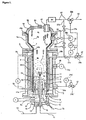
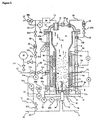
- Figures 1 and 2 are cross-sectional views of the high-pressure fluidized bed reactor for preparing granular polycrystalline silicon, in which some of the embodiments according to the present invention are illustrated in a comprehensive way.
- An inner space of the fluidized bed reactor here is separated from an outer space by a reactor shell 1 that surrounds a vertically-installed reactor tube 2.
- the reactor tube 2 partitions the inner space into an inner zone 4, where a silicon particle bed is formed and silicon deposition occurs, and an outer zone 5, where a silicon particle bed is not formed and silicon deposition does not occur.
- the reactor shell 1 is preferred to be made of a metallic material with reliable mechanical strength and processability such as carbon steel, stainless steel or other alloy steel.
- the reactor shell 1 may be divided into a plurality of components such as 1a, 1b, 1c and 1d as set forth in Figures 1 and 2 for convenience in fabrication, assembly and disassembly.
- the components may have various structures of a cylindrical pipe, a flange, a tube with fittings, a plate, a cone, an ellipsoid and a double-wall jacket with a cooling medium flowing in between the walls.
- the inner surface of each component may be coated with a protective layer or be installed with a protective tube or wall, which may be made of a metallic material or a non-metallic material such as organic polymer, ceramic and quartz.
- a cooling medium such as water, oil, gas and air
- the components that need to be cooled are preferred to be designed to comprise a coolant-circulating means at their inner or outer walls.
- the reactor shell 1 may comprise an insulating material on the outer wall.
- the reactor tube 2 may be of any shape only if it can be hold by the reactor shell 1 in such a manner that it can separate the inner space of the reactor shell 1 into an inner zone 4 and an outer zone 5.
- the reactor tube 2 may be of a structure of a simple straight tube as in Figure 1 , a shaped tube as in Figure 2 , a cone or an ellipsoid, and either one end or both ends of the reactor tube 2 may be formed into a flange shape. Further, the reactor tube 2 may comprise a plurality of components and some of these components may be installed in the form of a liner on the inner wall of the reactor shell 1.
- the reactor tube 2 is preferred to be made of an inorganic material, which is stable at a relatively high temperature, such as quartz, silica, silicon nitride, boron nitride, silicon carbide, graphite, silicon, glassy carbon or their combination.
- an inorganic material such as quartz, silica, silicon nitride, boron nitride, silicon carbide, graphite, silicon, glassy carbon or their combination.
- a carbon-containing material such as silicon carbide, graphite, glassy carbon may generate carbon impurity and contaminate the polycrystalline silicon particles.
- the reactor tube 2 is made of a carbon-containing material
- the inner wall of the reactor tube 2 is preferred to be coated or lined with materials such as silicon, silica, quartz or silicon nitride.
- the reactor tube 2 may be structured in a multi-layered form. Therefore, the reactor tube 2 is of one-layered or multilayered structure in the thickness direction, each layer of which is made of a different material.
- Sealing means 41a, 41b may be used for the reactor shell 1 to safely hold the reactor tube 2.
- the sealing means are preferred to be stable at a temperature of above 200 °C and may be selected from organic polymer, graphite, silica, ceramic, metal or their combination. However, considering the vibration and thermal expansion during reactor operation, the sealing means 41a, 41b may be installed less firmly to lower the possibility of cracking of the reactor tube 2 in the course of assembly, operation and disassembly.
- the partition of the inner space of the reactor shell 1 by the reactor tube 2 may prevent the silicon particles in the inner zone 4 from leaking into the outer zone 5 and differentiate the function and condition between the inner zone 4 and the outer zone 5.
- a heating means 8a, 8b may be installed in the reactor shell 1 to heat silicon particles.
- One or a plurality of heating means 8a, 8b may be installed in the inner zone 4 and/or the outer zone 5 in various manner.
- a heating means may be installed only in the inner zone 4 or in the outer zone 5 as illustrated in Figure 1 in a comprehensive manner.
- a plurality of heating means may be installed in both zones, or only in the outer zone 5 as illustrated in Figure 2 .
- a plurality of heating means 8a, 8b may be installed only in the inner zone 4. Otherwise, a single heating means may be installed in the outer zone 5 only.
- the electric energy is supplied to the heating means 8a, 8b through an electric energy supplying means 9a-9f installed on or through the reactor shell 1.
- the electric energy supplying means 9a-9f which connects the heating means 8a, 8b in the reactor and an electric source E outside the reactor, may comprise a metallic component in the form of a cable, a bar, a rod, a shaped body, a socket or a coupler. Otherwise the electric energy supplying means 9a-9f may comprise an electrode that is made of a material such as graphite, ceramic (e.g., silicon carbide), metal or a mixture thereof, and is fabricated in various shapes. Alternatively, the electric energy supplying means can be prepared by extending a part of the heating means 8a, 8b.
- a gas inlet means should be installed at the fluidized bed reactor to form a fluidized bed, where silicon particles can move by gas flow, within the reactor tube 2, i.e., in a lower part of the inner zone 4, for preparation of polycrystalline silicon by the silicon deposition on the surface of the fluidizing silicon particles.
- the gas inlet means comprises a fluidizing gas inlet means 14, 14' for introducing a fluidizing gas 10 into the silicon particles bed and a reaction gas inlet means 15 for introducing a silicon atom-containing reaction gas, both of which are installed in combination with the reactor shell 1b.
- a fluidizing gas 10 refers to a gas introduced to cause some or most of the silicon particles 3 to be fluidized in the fluidized bed formed within the inner zone 4.
- hydrogen, nitrogen, argon, helium, hydrogen chloride (HCl), silicon tetrachloride (SiCl 4 ) or a mixture thereof may be used as the fluidizing gas 10.
- a reaction gas 11 refers to a source gas containing silicon atoms, which is used to prepare the polycrystalline silicon particles.
- monosilane (SiH4), dichlorosilane (SiH2Cl2), trichlorosilane (SiHCl3), silicon tetrachloride (SiCl 4 ) or a mixture thereof may be used as the reaction gas 11.
- the reaction gas 11 may further comprise at least one gas selected from hydrogen, nitrogen, argon, helium and hydrogen chloride (HCl). Further, in addition to serving as a source for silicon deposition, the reaction gas 11 contributes to the fluidization of the silicon particles 3 as the fluidizing gas 10 does.
- the fluidizing gas inlet means 14, 14' and the reaction gas inlet means 15 may comprise a tube or nozzle, a chamber, a flange, a fitting, a gasket, etc, respectively.
- the parts exposed to the inner space of the reactor shell 1, especially to the lower part of the inner zone 4, where the parts are likely to contact the silicon particles 3, are preferred to be made of a tube, a liner or a shaped article the material of which is selected from those applicable to the reactor tube 2.
- the lower part of the fluidized bed 4a in the inner zone 4 may comprise a gas distributing means 19 for distributing the fluidizing gas 10 in combination with the fluidizing gas inlet means 14, 14' and the reaction gas inlet means 15.
- the gas distributing means 19 may have any geometry or structure including a multi-hole or porous distribution plate, a packing filler material submerged in the particle bed, a nozzle or a combination thereof.
- the outlet of the reaction gas inlet means 15, through which a reaction gas 11 is injected into the interior of the fluidized bed, is preferred to be positioned higher than the upper part of the gas distributing means 19.
- the fluidizing gas 10 which is required to form the fluidized bed 4a of silicon particles, may be supplied in various ways depending on how the fluidizing gas inlet means 14,14' is constituted.
- the fluidizing gas 10 may be supplied by a fluidizing gas inlet means 14, 14' coupled with the reactor shell 1 so that a gas chamber may be formed in lower part of the distribution plate-shaped gas distributing means 19.
- a fluidizing gas 10 may be supplied by a fluidizing gas inlet means 14 coupled with the reactor shell 1 so that one or a plurality of fluidizing gas nozzle outlet may be positioned in between the gas distributing means 19 that comprises a third packing filler material other than those fluidizing silicon particles.
- the gas distributing means 19 and the fluidizing gas inlet means 14, 14' may be constituted by using both the distribution plate and the packing filler material.
- the polycrystalline silicon particles are prepared in the inner zone 4 of the reactor based on the silicon deposition. Following the supply of the reaction gas 11 through the reaction gas inlet means 15, the silicon deposition occurs on the surface of the silicon particles 3 heated by the heating means 8a, 8b.
- a particle outlet means 16 is also required to be combined with the reactor shell 1 to discharge thus prepared silicon particles from the inner zone 4 to the outside of the fluidized bed reactor.
- An outlet pipe which constitutes the particle outlet means 16, may be assembled with the reaction gas inlet means 15 as illustrated in Figure 1 . Alternatively, it may be installed independently of the reaction gas inlet means 15 as illustrated in Figure 2 . Through the particle outlet means 16 the silicon particles 3b may be discharged when required from the fluidized bed 4a in a continuous, periodic, or intermittent way.
- an additional zone may be combined with the reactor shell 1.
- the additional zone can be provided at some part or a lower part of the fluidizing gas inlet means 14', allowing a space for the silicon particles 3b to reside or stay with an opportunity of cooling before being discharged from the reactor.
- Silicon particles 3, i.e., silicon particles 3 discharged from the inner zone 4 according to the present invention, may be delivered to a storage member or a transfer member of the polycrystalline silicon product, which is directly connected to the reactor. Meanwhile, thus-prepared silicon product particles 3b may have a particle-size distribution due to nature of the fluidized bed reactor, and smaller particles included therein may be used as seed crystals 3a for the silicon deposition. It is thus possible that the silicon product particles 3b discharged from the inner zone 4 may be delivered to a particle separation member where the particles can be separated by size. Then the larger particles may be delivered to the storage member or the transfer member, while the smaller particles are used as seed crystals 3a.
- the silicon particles 3b are preferred to be cooled down while being discharged through the particle outlet means 16.
- a cooling gas such as hydrogen, nitrogen, argon, helium, or a mixture thereof may flow in the particle outlet means 16, or a cooling medium such as water, oil or gas may be circulated through the wall of the particle outlet means 16.
- the particle outlet means 16 may be constituted in combination with the inner space of the reactor shell 1 (e.g. 14' in Figure 1 ) or a lower part of the reactor shell (e.g., 1b in Figures 1 and 2 ), allowing a sufficient space for the silicon particles 3b to reside or stay with an opportunity of cooling for a certain period of time before being discharged from the reactor.
- the elements that may contact high-temperature silicon product particles 3b may be made of a tube, a liner or a shaped product that is made of or coated with an inorganic material applicable to the reactor tube 2. These elements of the particle outlet means 16 are preferred to be coupled to the metallic reactor shell and/or a protection pipe.
- the components of the particle outlet means 16, which are in contact with the relatively low-temperature product particles or comprise a cooling means on their wall, may be made of a metal-material tube, a liner or a shaped product, the inner wall of which is coated or lined with a fluorine-containing polymer material.
- the silicon product particles 3b may be discharged from the reactor inner zone 4 through the particle outlet means 16 to a storage member or a transfer member of the polycrystalline silicon product in a continuous, periodic, or intermittent way.
- a particle separation member may be installed in between the reactor and the product storage member, to separate the silicon product particles 3b by size and use small-sized particles as seed crystals 3a.
- Various commercial devices may be used as the particle separation member in the present invention.
- the off-gas 13 comprises a fluidizing gas, a non-reacted reaction gas and a product gas, and passes through the upper part of the inner zone, 4c.
- Fine silicon particles or high-molecular-weight byproducts entrained in the off-gas 13 may be separated from an additional off-gas treating means 34.
- an off-gas treating means 34 which comprises a cyclone, a filter, a packed column, a scrubber or a centrifuge, may be installed outside the reactor shell 1 or at the upper zone 4c of the inner zone within the reactor shell 1.
- Fine silicon particles thus separated from the off-gas treating means 34, may be used for another purpose, or as seed crystals 3a for preparing silicon particles after being recycled into the fluidized bed 4a at the inner zone of the reactor.
- the fine silicon particles or powders separated from the off-gas treating means 34 may be recycled as seed crystals, but their amount can not be sufficient. It is then required to further yield, generate or prepare additional silicon seed crystals for continuous preparation of the silicon particles as required in the fluidized bed.
- an additional particle separation member may be installed in the middle of a discharge path included in the particle outlet means 16. Supplying a gas into the pathway in a counter-current manner leads to cooling of the product particles 3b, separatioin of smaller particles out of them and recycling of the smaller particles into the fluidized bed 4a. This reduces the burden of preparing or supplying seed crystals, and increases the average particle size of the final silicon product particles 3b while decreasing their particle size distribution.
- the silicon seed crystals may be prepared by pulverizing some of silicon product particles 3b discharged through the particle outlet means 16 into seed crystals in a separate pulverizing apparatus.
- prepared seed crystals 3a may be introduced into the inner zone 4 of the reactor in a continous, periodic or intermittently way as required.
- seed crystals 3a is downwardly introduced into the inner zone 4 is illustrated in Figure 1 , where a seed crystals inlet means 18 is combined with the topside of the reactor shell 1d. This method allows an efficient control in the average size and the feeding rate of seed crystals 3a as required, while it has a drawback of requiring a separate pulverizing apparatus.
- silicon particles may be pulverized into seed crystals inside fluidized bed 4a by using an outlet nozzle of a reaction gas inlet means 15 combined with the reactor shell or an additionally installed gas nozzle for a high-speed gas jet inside the fluidized bed allowing particle pulverization.
- This method has an economic advantage because it needs no additional pulverizing device, while having a drawback that it is difficult to control the size and generation amount of the seed crystals in the reactor within a predetermined acceptable range.
- the inner zone 4 comprises all spaces required for forming a silicon particle bed 4a, supplying a fluidizing gas 10 and a reaction gas 11 into the silicon particle bed 4a, allowing silicon deposition, and discharging the off-gas 13 containing a fluidizing gas, a non-reacted reaction gas and a byproduct gas. Therefore, the inner zone 4 plays a fundamental role for silicon deposition in the fluidized bed of silicon particles 3 and preparation of polycrystalline silicon product particles.
- the outer zone 5 is an independently formed space in between outer wall of reactor tube 2 and reactor shell 1, where a silicon particle bed 3 is not formed and silicon deposition does not occur due to no supply of the reaction gas.
- the outer zone 5 also plays important roles as follows.
- the outer zone 5 provides a space for protecting the reactor tube 2 by maintaining pressure difference between the inner zone 4 and the outer zone 5 within a certain range.
- the outer zone 5 provides a space for installing an insulating material 6 that prevents or decreases heat loss from the reactor.
- the outer zone 5 provides a space for a heater to be installed around the reactor tube 2.
- the outer zone 5 provides a space for maintaining a substantially inert gas atmosphere outside the reactor tube 2 to prevent dangerous gas containing oxygen and impurities from being introduced into the inner zone 4, and for safely installing and maintaining the reactor tube 2 inside the reactor shell 1.
- the outer zone 5 allows a real-time monitoring of the status of the reactor tube 2 during operation.
- the analysis or measurement of the outer-zone gas sample from the outer zone connecting means 28 may reveal the presence or concentration of a gas component that may exist in the inner zone 4, the change of which may indirectly reveal an accident at the reactor tube.
- the outer zone 5 provides a space for installing a heater 8b surrounding the reactor tube 2, as illustrated in Figure 2 , for heating up and chemically removing the silicon deposit layer accumulated on the inner wall of the reactor tube 2 due to silicon deposition operation.
- the outer zone 5 provides a space required for efficiently assemblying or disassemblying the reactor tube 2 and the inner zone 4.
- the outer zone 5 plays various important roles as mentioned above.
- the outer zone may be partitioned into several sections in an up-and-down and/or a radial or circumferential direction, utilizing one or more of tubes, plates, shaped articles or fittings as partitioning means.
- the divided sections are preferred to be spatially communicated with each other while having substantially the same atmospheric condition and pressure.
- An insulating material 6, which may be installed in the outer zone 5 for greatly reducing heat transfer via radiation or conduction, may be selected from industrially acceptable inorganic materials in the form of a cylinder, a block, fabric, a blaneket, a felt, a foamed product, or a packing filler material.
- the heating means 8a, 8b connected to an electric energy supplying means 9, which is connected to the reactor shell for maintaining reaction temperature in the fluidized bed reactor, may be installed in the outer zone 5 only, or installed alone within the inner zone 4, especially within the silicon particle bed 4a.
- the heating means 8a, 8b may be installed in both the inner zone 4 and the outer zone 5, if required, as illustrated in Figure 1 .
- Figure 2 illustrates an example when a plurality of independent heating means 8a, 8b are installed in the outer zone 5.
- heating means 8a, 8b When a plurality of heating means 8a, 8b are installed in the fluidized bed reactor, they may be electrically connected in series or parallel relative to an electric source E.
- the power supplying system comprising an electric source E and an electric energy supplying means 9a-9f may be constituted independently as illustrated in Figures 1 and 2 .
- the heater 8a installed within the silicon particle bed 4a may have an advantage of directly heating silicon particles in the fluidized bed.
- the heater 8a is preferred to be positioned lower than the reaction gas outlet of a reaction gas inlet means 15.
- an inert gas connecting means 26a, 26b is installed on the reactor shell, independently of the inner zone 4, to maintain a substantially inert gas atmosphere in the outer zone 5 precluding silicon deposition.
- the inert gas 12 may be one or more selected from hydrogen, nitrogen, argon and helium.
- An inert gas connecting means 26a, 26b which is installed on or through the reactor shell and spatially connected to the outer zone 5, has the function of piping connection for supplying or discharging an inert gas 12, and may be selected from a tube, a nozzle, a flange, a valve, a fitting or their combination.
- a reactor shell which is spatially exposed to the outer zone 5 directly or indirectly, may be equipped with an outer zone connecting means 28. Then, the outer zone connecting means 28 may be used to measure and control temperature, pressure or gas component.
- the supply or discharge of an inert gas may be independently performed by using a double-pipe or a plurality of inert gas connecting means 26a, 26b.
- the inert gas connecting means 26a, 26b maintains an independent inert gas atmosphere in the outer zone 5, and may also be used for measuring and/or controlling flow rate, temperature, pressure or gas component, which can also be performed by using the outer zone connecting means 28.
- Figures 1 and 2 provide various examples in a comprehensive way where pressure (Po) in the outer zone 5 is measured or controlled by using the inert gas connecting means 26a, 26b or outer zone connecting means 28.
- the outer zone connecting means 28 may be installed to measure and/or control the maintenance of the outer zone 5, independently of or on behalf of the inert gas connecting means 26a, 26b.
- the outer zone connecting means 28 has the function of piping connection, and may be selected from a tube, a nozzle, a flange, a valve, a fitting or their combination. If the inert gas connecting means 26a, 26b is not installed, the outer zone connecting means 28 may be used to supply or discharge an inert gas 12 as well as to measure or control temperature, pressure or gas component. Therefore, it is not necessary to differentiate the inert gas connecting means 26a, 26b from the outer zone connecting means 28 in respect of shape and function.
- pressure drop imposed by the fluidized bed of solid particles depends on the height of the fluidized bed, it is common to maintain the pressure drop by fluidized bed less than about 0.5-1 bar unless the height of the fluidized bed is excessively high. Further, irregular fluctuation of the pressure is inevitable with time due to the nature of the fluidization of solid particles. Thus, pressure may vary in the inner zone 4 depending on position and time.
- the pressure controlling means for the inner pressure i.e., the inner pressure controlling means 30 for directly or indirectly measuring or controlling pressure (Pi) in the inner zone 4 may be installed at such a point among various positions that it may be spatially connected to the inner zone 4.
- Pressure controlling means i.e., the inner pressure controlling means 30 and the outer pressure controlling means 31 may be installed on or through various positions depending on the details of the reactor assembly as well as on the operational parameters to be controlled.
- the pressure controlling means for the inner pressure i.e., the inner pressure controlling means 30 may be spatially connected to the inner zone 4 through an inner zone connecting means 24, 25, a fluidizing gas inlet means 14, a reaction gas inlet means 15, a particle outlet means 16, or a gas outlet means 17, which are spatially exposed directly or indirectly to the inner zone 4.
- the pressure controlling means for the outer pressure i.e., the outer pressure controlling means 31 may be spatially connected to the outer zone 5 through an outer zone connecting means 28 or an inert gas connecting means 26a, 26b, etc., which are installed on or through the reactor shell 1 and spatially exposed directly or indirectly to the outer zone 5.
- the inner pressure controlling means 30 and outer pressure controlling means 31 comprise the components necessary for directly or indirectly measuring and controlling pressure.
- Either of the pressure controlling means, 30 and 31, comprises at least one selected from the group consisting of: (a) a connecting pipe or fitting for spatial connection; (b) a manually-operated, semi-automatic, or automatic valve; (c) a digital- or analog-type pressure gauge or pressure-difference gauge; (d) a pressure indicator or recorder; and (e) an element constituting a controller with a signal converter or an arithmetic processor.
- the pressure controlling means for the inner pressure, 30, is interconnected with the pressure controlling means for the outer pressure, 31, in the form of a mechanical assembly or a signal circuit. Further, either of the pressure controlling means may be partially or completely integrated with a control system selected from the group consisting of a central control system, a distributed control system and a local control system.
- the inner pressure controlling means 30 and outer pressure controlling means 31 may be independently constituted in terms of pressure, either of the pressure controlling means may be partially or completely integrated with a means for measuring or controlling a parameter selected from the group consisting of flow rate, temperature, gas component and particle concentration, and etc.
- either of the controlling means, 30 or 31, may further comprise a separation device such as a filter or a scrubber for separating particles, or a container for buffering pressure. This protects the component of the pressure controlling means from contamination by impurities, and also provides a means to buffer pressure changes.
- a separation device such as a filter or a scrubber for separating particles
- a container for buffering pressure This protects the component of the pressure controlling means from contamination by impurities, and also provides a means to buffer pressure changes.
- the inner pressure controlling means 30 may be installed at or connected to the inner zone connecting means 24, 25, which is installed on or through the reactor shell and is spatially exposed directly or indirectly to an inner zone 4 for measurement of pressure, temperature or gas component or for viewing inside the reactor.
- the inner pressure controlling means 30 By constructing the inner pressure controlling means 30 so that it may be connected to the inner zone connecting means 24, 25, pressure in upper part of the inner zone 4c may be stably measured and controlled although it is difficult to detect the time-dependent pressure fluctuation due to the fluidized bed of silicon paricles.
- the inner zone connecting means may be installed so that it may be spatially connected to the inside of the fluidized bed.
- the inner pressure controlling means 30 may also be installed at or connected to other appropriate positions, i.e., a fluidizing gas inlet means 14 or a reaction gas inlet means 15 or a particle outlet means 16 or a gas outlet means 17, etc., all of which are combined with the reactor shell thus being spatially connected to the inner zone 4.
- a plurality of inner pressure controlling means 30 may be installed at two or more appropriate positions which ultimately allow spatial connection with the inner zone 4 through the inner zone connecting means 24, 25 or those at other positions (14,15,16,17).
- the presence of silicon particles affects the inner pressure, Pi.
- the measured value of Pi varies according to the position where the inner pressure controlling means 30 is installed.
- the value of Pi is influenced by the characteristics of the fluidized bed and by the structure of a fluidizing gas inlet means 14 or a reaction gas inlet means 15 or a particle outlet means 16 or a gas outlet means 17, but its positional deviation according to pressure measurement point is not greater than 1 bar.
- the outer pressure controlling means 31, for directly or indirectly measuring and/or controlling pressure in the outer zone 5, is preferred to be installed so that it may be spatially connected to the outer zone 5.
- the position where the outer pressure controlling means 31 may be connected or installed includes, for example, an outer zone connecting means 28 or an inert gas connecting means 26a, 26b installed on or through the reactor shell, which is spatially connected to the outer zone 5 directly or indirectly.
- the outer zone 5 is preferred to be maintained under a substantially inert gas atmosphere.
- the outer zone connecting means 28 may also comprise the function of an inert gas connecting means 26a that may be used for introducing an inert gas 12 to the outer zone 5 or an inert gas connecting means 26b that may be used for discharging an inert gas 12 from the outer zone 5. Therefore, it is possible to spatially connect the outer zone 5 to the outer pressure controlling means 31 for directly or indirectly measuring and controlling pressure in the outer zone 5 through an inert gas connecting means 26a, 26b or an outer zone connecting means 28.
- the inner pressure controlling means 30 and the outer pressure controlling means 31 may be used to maintain the value of
- Pi may vary depending on the position selected for connection to the inner zone.
- the value of Pi measured through an inner zone connecting means 24, 25, a fluidizing gas inlet means 14, a reaction gas inlet means 15, or a particle outlet means 16, etc., which are installed at the positions spatially connected to an inner or lower part of the fluidized bed, is higher than the value of Pi measured through an inner zone connecting means, a gas outlet means 17 or silicon seed crystals inlet means 18, etc., which are installed at the positions spatially connected to a space like an upper part of the inner zone 4c and are not in direct contact with the fluidized bed of silicon particles.
- the pressure value measured through an inner zone connecting means, a fluidizing gas inlet means 14 or a particle outlet means 16, which is spatially connected to a lower part of the fluidized bed of silicon particles, shows a maximum inner pressure value, Pi max .
- a minimum inner pressure value, Pi min may be obtained when measured through a gas outlet means 17 or an inner zone connecting means 24, 25, which is not in direct contact with the fluidized bed. This is because there is a pressure difference depending on the height of the fluidized bed of silicon particles 4a and the value of Pi is always higher in the lower part as compared to the upper part of the fluidized bed.
- This pressure difference increases with the height of the fluidized bed.
- An excessively high bed with the pressure difference being 1 bar or higher is not preferred because the height of the reactor becomes too high to be used.
- a very shallow bed with the pressure difference of 0.01 bar or lower is not preferred either, because the height and volume of the fluidized bed is too small to achieve an acceptable minimum productivity of the reactor.
- the pressure difference in the fluidized bed is preferred to be within the range of 0.01-1 bar. That is, pressure differences between maxium pressure value (Pi max ) and minimum pressure value (Pi min ) in the inner zone 4 is preferred to be within 1 bar.
- the inner pressure controlling means 30 or the outer pressure controlling means 31 may comprise a controlling means with an arithmetic processor that is capable of estimating an average value of pressure from those values measured with two or more pressure gauges.
- the inner pressure controlling means 30 and/or outer pressure controlling means 31 should comprise a pressure-difference controlling means that maintains the value of
- the pressure-difference controlling means may be comprised in only one of the inner pressure controlling means 30 or the outer pressure controlling means 31, or in both of the controlling means independently, or in the two controlling means 30, 31 in common.
- the pressure-difference controlling means may preferably be operated so that the requirements of Po ⁇ Pi and 0 bar ⁇ (Pi - Po) ⁇ 1 are satisfied.
- the pressure-difference controlling means enables the outer zone pressure (Po) and inner zone pressure (Pi) to satisfy the requirement of 0 bar ⁇ (Pi - Po) ⁇ 1 bar, with the inner pressure controlling means 30 being spatially connected to an inner part of the fluidized bed through a fluidizing gas inlet means 14 or a reaction gas inlet means 15 or a particle outlet means 16 or an inner zone connecting means.
- a pressure-difference controlling means so that the requirements of Pi ⁇ Po and 0 bar ⁇ (Po - Pi) ⁇ 1 bar may be satisfied if Pi is measured at a position that is spatially connected to the upper part of the inner zone 4c among various parts of the inner zone 4. Then, the pressure-difference controlling means enables the requirement of 0 bar ⁇ (Po - Pi) ⁇ 1 bar to be satisfied, with the inner pressure controlling means 30 being spatially connected to the inner zone 4 through a gas outlet means 17, a silicon seed crystals inlet means 18, or an inner zone connecting means 24, 25, which are not in direct contact with the fluidized bed of silicon particles.
- the pressure-difference controlling means maintains the value of
- reaction pressure higher than at least 1 bar instead at a vacuum state less than 1 bar, if pressure is expressed in absolute unit in the present invention.
- the feeding rates of fluidizing gas 10 and reaction gas 11 increase with pressure in a nearly proportional manner, based on mole number or mass per unit time.
- the heat duty in the fluidized bed 4a for heating the reaction gas from an inlet temperature to the temperature required for reaction also increases with the reaction pressure, i.e., Po or Pi.
- reaction gas 11 it is impossible to supply the gas into the reactor after preheating up to higher than about 350-400 °C, i.e. incipient decomposition temperature. Meanwhile, it is inevitable to preheat the fluidizing gas 10 up to lower than the reaction temperature because impurity contamination is highly probable during a preheating step outside the fluidized bed reactor, and the fluidizing gas inlet means 14 can hardly be insulated to achieve a gas preheating to above the reaction temperature. Therefore, difficulties in heating increase with pressure. When the reaction pressure exceeds about 15 bar, it is difficult to heat the fluidized bed 4a as required although a plurality of heating means 8a, 8b are additionally installed at the inner space of the reactor shell. Considering these practical limitations, the pressure in the outer zone 5 (Po) or the pressure in the inner zone 4 (Pi) is to be within about 1-15 bar based on the absolute pressure.
- the inner pressure controlling means 30 and/or the outer pressure controlling means 31 may comprise a pressure-difference controlling means that can reduce the pressure difference between inside and outside the reactor tube 2. This can be practised in various ways, some examples of which are described hereinafter.
- the reaction pressure may be set to a high level by using the pressure-difference controlling means without deteriorating the stability of the reactor tube 2, thus enabling to increase both the productivity and stability of the fluidized bed reactor.
- both of the inner pressure controlling means 30 and the outer pressure controlling means 31 may comprise respective pressure-difference controlling means so that the inner pressure (Pi) at the inner zone 4 and the outer pressure (Po) at the outer zone 5 may be controlled at predetermined values of pressure, i.e. Pi* and Po*, respectively, satisfying the requirement of
- the inner pressure controlling means 30 may comprise a pressure-difference controlling means that maintains Pi at a predetermined value, Pi*.
- the outer pressure controlling means 31 may also comprise a pressure-difference controlling means that maintains Po at such a predetermined value, Po*, that the requirement of
- the outer pressure controlling means 31 may comprise a pressure-difference controlling means that maintains Po at a predetermined value, Po*.
- the inner pressure controlling means 30 may also comprise a pressure-difference controlling means that maintains Pi at such a predetermined value, Pi*, that the requirement of
- the inner pressure controlling means 30 may comprise a pressure-difference controlling means that maintains Pi at a predetermined value, Pi*, while the outer pressure controlling means 31 may comprise a pressure-difference controlling means that controls the outer pressure, Po, in accordance with the change of the real-time inner pressure so that the requirement of
- the pressure control parameters to be used at the pressure-difference controlling means for controlling pressures in the inner zone and the outer zone, respectively may be predetermined based on the analysis on the composition of off-gas 13 or the gas present in outer zone 5.
- the pattern of impurity migration between inner zone 4 and outer zone 5 through the sealing means 41a, 41b may be deduced based on the component analysis on off-gas 13 sampled through the gas outlet means 17 or off-gas treating means 34, or that on the gas present in outer zone 5 sampled through an outer zone connecting means 28 or an inert gas connecting means 26b.
- off-gas 13 is verified to comprise the constituent of inert gas 12, which is not supplied into the inner zone, the influx of impurity elements from outer zone 5 into inner zone 4 may be decreased or prevented by presetting the value of Pi* higher than that of Po*, i.e., Pi* > Po*.
- the gas discharged out of outer zone 5 is verified to comprise the constituent of off-gas 13 of inner zone 4 besides that of inert gas 12, the influx of the impurity elements from inner zone 4 into outer zone 5 may be decreased or prevented by presetting the value of Po* higher than that of Pi*, i.e., Po* > Pi*.
- the sealing means 41a, 41b of reactor tube 2 may not be installed or maintained in a satisfactory manner during the assembly or operation of the fluidized bed reactor, an undesirable migration of impurity components between the two zones through the sealing means may be minimized or prevented by appropriate selection of the control parameters for the pressure controlling means.
- Pi* and Po* may be preset in the pressure-difference controlling means, the requirement of
- the pressure-difference controlling means may comprise an equalizing line, which spatially interconnects a connecting pipe comprised in the inner pressure controlling means 30 and a connecting pipe comprised in the outer pressure controlling means 31.
- a connecting pipe, which is comprised in the the inner pressure controlling means 30 and constitutes the equalizing line 23, may be installed at a position selected for spatial connection with inner zone 4, including but not limited to an inner zone connecting means 24, 25; a fluidizing gas inlet means 14, 14'; a reaction gas inlet means 15; a particle outlet means 16; a gas outlet means 17; or a seed crystals inlet means 18, all of which are spatially exposed to the inner zone in a direct or indirect manner.
- a connecting pipe which is comprised in the outer pressure controlling means 31 and constitutes an equalizing line 23, may be installed at a position selected for spatial connection with outer zone 5, including but not limited to an outer zone connecting means 28 or an inert gas connecting means 26a, 26b, all of which are coupled with the reactor shell and spatially exposed to the outer zone in a direct or indirect manner.
- the equalizing line 23, which interconnects spatially the inner pressure controlling means 30 and outer pressure controlling means 31, may be referred to as a simplest form of the pressure-difference controlling means because it may always maintain the pressure difference between two interconnected zones 4, 5 at nearly zero.
- gas and impurity components may undesirably be interchanged between two zones 4, 5.
- the impurity elements generated or discharged from an insulating material or a heating means installed in outer zone 5 may contaminate the inner zone 4, especially the polycrystalline silicon particles.
- silicon fine powders or components of residual reaction gas or reaction byproduct discharged from the inner zone 4 may contaminate the outer zone 5.
- a pressure equalizing means which can decrease or prevent the possible interexchange of gas and impurity components between two zones 4, 5, may be further added to the equalizing line 23.
- the pressure equalizing means may comprise at least one means selected from a check valve, a pressure equalizing valve, a 3-way valve, a filter for separating particles, a damping container, a packed bed, a piston, an assistant control fluid, and a pressure compensation device using separation membrane, which, respectively, is able to prevent the possible interexchange of gas and impurity components without deteriorating the effect of pressure equalization.
- the pressure-difference controlling means may comprise a manual valve for controlling pressure or flow rate, or may further comprise a(n) (semi-)automatic valve that performs a(n) (semi-)automatic control function according to a predetermined value of pressure or pressure difference.
- These valves may be installed in combination with a pressure gauge or a pressure indicator that exhibits a pressure or pressure difference.
- the pressure gauge or the pressure indicator is available commercially in the form of either analogue, digital or hybrid device, and may be included in an integrated system of data acquisition, storage and control, if combined with a data processing means such as a signal converter or a signal processor, etc., and/or with a local controller, a distributed controller or a central controller including a circuit for performing an arithmetic operation.
- Reactor shell 2 Reactor tube 3: silicon particles 3a: Silicon seed crystals 3b: Silicon product particles 4: Inner zone 5: Outer zone 6: Insulating material 7: Liner 8: Heater 9: Electric energy supplying means 10: Fluidizing gas 11: Reaction gas 12: Inert gas 13: Off-gas 14: Fluidizing gas inlet means 15: Reaction gas inlet means 16: Particle outlet means 17: Gas outlet means 18: Silicon seed crystals inlet means 19: Gas distributing means 23: Equalizing line 24, 25: Inner zone connecting means 26: Inert gas connecting means 27: On/off valve 28: Outer zone connecting means 30: Inner pressure controlling means 31: Outer pressure controlling means 32: Pressure-difference gauge 33: Fluctuation reducing means 34: Off-gas treating means 35: Gas analyzing means 36: Filter 41: Sealing means E: Electric source
- the inner pressure (Pi) and the outer pressure (Po) are independently controlled at predetermined values, Pi* and Po*, respectively, and the difference between the values of the inner pressure and the outer pressure is thereby maintained within the range of 0 to 1 bar.
- an inner pressure controlling means 30 may be constituted by interconnecting a first pressure control valve 30b with a gas outlet means 17 through an off-gas treating means 34 for removing fine silicon particles, which are interconnected with each other by a connecting pipe.
- the pressure of the upper part of the inner zone 4 may be controlled at a predetermined value, Pi*, by using the first pressure control valve 30b which behaves as an element of a pressure-difference controlling means.
- an outer pressure controlling means 31 may be constituted by interconnecting an inert gas connecting means 26a, a fourth pressure gauge 31a' and a fourth pressure control valve 31b'.
- the fourth pressure gauge 31a' and the fourth pressure control valve 31b' may be integrated with each other by a circuit, and thus be constituted as a single device that can measure and control pressure at the same time.
- the inner pressure controlling means 30 When the inner pressure controlling means 30 is connected to an upper part of the inner zone 4c, the pressure of which is lower than those in or below the fluidized bed, it is preferred to preset Pi* and Po* so that the condition of Po* ⁇ Pi* may be satisfied.
- the pressure in the outer zone may be controlled at a predetermined value, Po*, so that the condition of 0 bar ⁇ (Po* - Pi*) ⁇ 1 bar may be satisfied, by using the fourth pressure gauge 31a' and the fourth pressure valve 31b' both of which behave as elements of a pressure-difference controlling means.
- Po* may be preset at a lower value so that the condition of Pi* ⁇ Po* may be satisfied.
- the inner pressure controlling means 30 and the outer pressure controlling means 31 may further comprise their own pressure-difference controlling means, respectively, thus enabling the condition of 0 bar ⁇
- an inner pressure controlling means 30 may be constituted by interconnecting a first pressure control valve 30b with the gas outlet means 17 through the off-gas treating means 34 for removing fine silicon particles, which are interconnected with each other by a connecting pipe.
- the pressure of the upper part of the inner zone 4 may be controlled at a predetermined value, Pi*, by using the first pressure control valve 30b which behaves as an element of a pressure-difference controlling means.
- an outer pressure controlling means 31 may be constituted by interconnecting an inert gas connecting means 26b, an on/ off valve 31c, a third pressure gauge 31a and a third pressure control valve 31b.
- the third pressure gauge 31a and the third pressure control valve 31b may be integrated with each other by a circuit, and thus be constituted as a single device that can measure and control pressure at the same time.
- the supply of an inert gas 12 may be controlled by the third pressure control valve 31b in combination with the Po control, instead of connecting the inert gas connecting means 26a to a pressure-difference controlling means such as the fourth pressure gauge 31a' and the fourth pressure valve 31b'
- the inner pressure controlling means 30 When the inner pressure controlling means 30 is connected to an upper part of the inner zone 4c, the pressure of which is lower than those in or below the fluidized bed, it is preferred to preset Pi* and Po* so that the condition of Po* ⁇ Pi* may be satisfied.
- the pressure in the outer zone may be controlled at a predetermined value, Po*, so that the condition of 0 bar ⁇ (Po* - Pi*) ⁇ 1 bar may be satisfied, by the third pressure gauge 31a and the third pressure control valve 31b both of which behave as elements of a pressure-difference controlling means.
- Po* may be preset at a lower value so that the condition of Pi* ⁇ Po* may be satisfied.
- the inner pressure controlling means 30 and the outer pressure controlling means 31 may further comprise their own pressure-difference controlling means, respectively, thus enabling the condition of 0 bar ⁇
- a gas outlet means 17, an off-gas treating means 34 for removing fine silicon particles and a first pressure control valve 30b are interconnected with each other by a connecting pipe.
- an inner pressure controlling means 30 may be constituted by interconnecting the connecting pipe with an on/off valve 27e and a pressure-difference gauge 32.
- an outer pressure controlling means 31 may be constituted by interconnecting an inert gas connecting means 26b and a pressure-difference gauge 32, which are interconnected with each other by the connecting pipe.
- an inert gas 12 may be supplied to the outer zone through an inert gas connection means 26a.
- the pressure-difference gauge 32 is be a common element for both the inner pressure controlling means 30 and the outer pressure controlling means 31. Besides the pressure control valve 31b, 31b' may be omitted.
- the difference between the outer pressure (Po) and the inner pressure (Pi) in upper part of the inner zone can be maintained to be lower than 1 bar independently of the change of the outer pressure (Po) by using the pressure-difference gauge 32 and the first pressure control valve 30b both of which behave as elements of a pressure-difference controlling means.
- the inner pressure controlling means 30 may be connected to an upper part of the inner zone 4c, the pressure of which is lower than those in or below the fluidized bed, and it is preferred to control the first pressure control valve 30b so that the condition of Po ⁇ Pi may be satisfied.
- the first pressure control valve 30b may be controlled so that the condition of Pi ⁇ Po may be satisfied.
- ⁇ 1 bar may be satisfied at any position in the inner zone 4.
- the object of the present Example may be accomplished either by automatic control of the integrated circuit of the pressure-difference gauge 32 and the first pressure control valve 30b, or by manual operation of the first pressure control valve 30b in accordance with the values of ⁇ P measured with the pressure-difference gauge 32.
- a first pressure gauge 30a and a third pressure gauge 31a may be installed as the inner pressure controlling means 30 and the outer pressure controlling means 31, respectively.
- the pressure-difference controlling means may be further corrected or improved by equipping a first pressure gauge 30a and a third pressure gauge 31a in the inner pressure controlling means 30 and the outer pressure controlling means 31, respectively, in addition to the pressure-difference gauge 32.
- an inner pressure controlling means 30 may be constituted by interconnecting a first pressure control valve 30b with the gas outlet means 17 through the off-gas treating means 34 for removing fine silicon particles, which are interconnected with each other by a connecting pipe.
- an outer pressure controlling means 31 may be constituted by interconnecting an inert gas connecting means 26a for supplying an inert gas 12 and a fourth pressure gauge 31a', which are interconnected with each other by the connecting pipe.
- an inert gas 12 may be discharged through an inert gas connection means 26b.
- the pressure control valve 31b, 31b' in Figure 1 may be omitted.
- the difference between the outer pressure (Po) and the inner pressure (Pi) in the upper part of the inner zone 4c can be maintained to be lower than 1 bar independently of the change of the outer pressure (Po) by using the fourth pressure gauge 31a' and the first pressure control valve 30b both of which behave as elements of a pressure-difference controlling means.
- the inner pressure controlling means 30 may be connected to an upper part of the inner zone 4c, the pressure of which is lower than those in or below the fluidized bed, it is preferred to control the first pressure control valve 30b so that the condition of Po ⁇ Pi may be satisfied.
- the first pressure control valve 30b may be controlled so that the condition of Pi ⁇ Po may be satisfied.
- ⁇ 1 bar may be satisfied at any position in the inner zone 4.
- the object of the present Example may be accomplished either by automatic control of the integrated circuit of the fourth pressure gauge 31a' and the first pressure control valve 30b, or by manual operation of the first pressure control valve 30b in accordance with the pressure value measured with the fourth pressure gauge 31a'.
- the outer pressure controlling means 31 may also be constituted by connecting a fifth pressure gauge 31p to an outer zone connecting means 28 as illustrated in Figure 1 or a fifth pressure gauge 31p connected to the outer zone connecting means 28a as illustrated in Figure 2 or a third pressure gauge 31a connected to an inert gas connecting means 26b as illustrated in Figure 2 . Then, the respective pressure gauge employed in the outer pressure controlling means 31 may also behave as another element of the pressure-difference controlling means.
- the object of the present Example may be accomplished by regulating the first pressure control valve 30b, which behaves as an element of the pressure-difference controlling means that is comprised in the inner pressure controlling means 30, in accordance with the other element of the pressure-difference controlling means that is comprised in a variety of outer pressure controlling means 31.
- an inner pressure controlling means 30 may be constituted by interconnecting an on/off valve 27d and a pressure-difference gauge 32 with an outer zone connecting means 25 instead of the gas outlet means 17, which are interconnected with each other by a connecting pipe.
- the outer pressure controlling means 31 may be constituted by interconnecting a third pressure control valve 31b and pressure-difference gauge 32 with an inert gas connecting means 26b, which are interconnected with each other by the connecting pipe.
- This case corresponds to the case of constitution where the on/off valves 27c, 27e are closed.
- the pressure-difference gauge 32 is a common element for both the inner pressure controlling means 30 and the outer pressure controlling means 31.
- the difference between the outer pressure (Po) and the inner pressure (Pi) in the upper part of the inner zone 4c can be maintained to be lower than 1 bar independently of the change of the inner pressure (Pi) by using the pressure-difference gauge 32 and the third pressure control valve 31b both of which behave as elements of a pressure-difference controlling means.
- the inner pressure controlling means 30 may be connected to an upper part of the inner zone 4c the pressure of which is lower than those in or below the fluidized bed, the third pressure control valve 31b may be controlled so that the condition of Po ⁇ Pi may be satisfied.
- the first pressure control valve 30b may be controlled so that the condition of Pi ⁇ Po may be satisfied.
- ⁇ 1 bar may be satisfied at any position in the inner zone 4.
- the object of the present Example may be accomplished either by automatic control of the integrated circuit of the pressure-difference gauge 32 and the third pressure control valve 31b, or by manual operation of the third pressure control valve 31b in accordance with the ⁇ P value measured with the pressure-difference gauge 32.
- a first pressure gauge 30a and a third pressure gauge 31a may be installed as the inner pressure controlling means 30 and the outer pressure controlling means 31, respectively.
- the pressure-difference controlling means may be further corrected or improved by equipping a first pressure gauge 30a and a third pressure gauge 31a in the inner pressure controlling means 30 and the outer pressure controlling means 31, respectively, in addition to the pressure-difference gauge 32.
- the outer pressure controlling means in this Exmaple may be constituted in another form.
- the outer pressure controlling means may also be constituted by interconnecting the fourth pressure valve 31b' and the pressure-difference gauge 32 with the inert gas connecting means 26a for supplying the inert gas, which are interconnected with each other by a connecting pipe. If corresponding elements of the pressure-difference controlling means is further replaced together with such modification of the outer pressure controlling means, the object of the present Example may also be accomplished thereby.
- the inner pressure controlling means 30 may be constituted by interconnecting a second pressure gauge 30a' and a pressure-difference gauge 32 with a fluidizing gas inlet means 14, which are interconnected with each other by a connecting pipe and/or by electrical integration.
- the outer pressure controlling means 31 may be constituted by interconnecting a third pressure gauge 31a and a pressure-difference gauge 32, both of which are connected to an inert gas connecting means 26b, with a second pressure control valve 30b' which is connected to an inert gas connecting means 26a.
- the interconnection may be achieved by the connecting pipe and/ or by electrical integration.
- the pressure-difference gauge 32 is a common element for both the inner pressure controlling means 30 and the outer pressure controlling means 31.
- the pressure-difference gauge 32 exhibits a physical and/or electrical signal for the difference between Pi and Po, which are measured with the second pressure gauge 30a' and the third pressure gauge 31a, respectively.
- a fluctuation reducing means 33 may further be applied to the pressure-difference gauge because the fluidization of silicon particles in the fluidized bed naturally introduces fluctuation in the value of Pi measured by the second pressure gauge 30a'.
- the fluctuation reducing means 33 may comprise a pressure fluctuation damping (or buffering) means such as a physical device or a software-based device that transforms the fluctuating signals into an average Pi value for a predetermined short period of time (e.g., one second).
- the difference between the outer pressure (Po) and the inner pressure (Pi) is maintained to be lower than 1 bar independently of the change of the inner pressure (Pi) measusred through the fluidizing gas inlet means 14 in connection with the inner zone.
- the inner pressure controlling means 30 may be connected to a lower part of the fluidized bed, the pressure of which is higher than that in upper part of the inner zone 4c, the second pressure control valve 30b' may be controlled so that the condition of Po ⁇ Pi may be satisfied.
- the second pressure control valve 30b' may be controlled so that the condition of Po ⁇ Pi may be satisfied.
- ⁇ 1 bar may be satisfied at any position in the inner zone 4.
- the object of the present Example may be accomplished either by automatic control of the integrated circuit of the pressure-difference gauge 32 and the second pressure control valve 30b', or by manual operation of the second pressure control valve 30b' in accordance with the ⁇ P value measured with the pressure-difference gauge 32.
- another outer pressure gauge may be connected to the pressure-difference gauge 32 for achieving the object of the present Example.
- the outer pressure gauge may also be selected from the fifth pressure gauge 31p in connection with the outer zone connecting means 28a or a sixth pressure gauge 31q in connection with the inert gas connecting means 26a.
- the equalizing line 23 may be composed of a connecting pipe which spatially interconnects an inner zone connecting means 25 with an inert gas connecting means 26b.
- the inner pressure controlling means 30 may be basically composed of the inner zone connecting means 25 and the connecting pipe, and may further comprise an on/off valve 27d and a first pressure gauge 30a as illustrated in Figure 1 .
- the outer pressure controlling means 31 may be basically composed of a connecting means, which is selected among an inert gas connecting means 26a or an outer zone connecting means 28, and the connecting pipe, and may further comprise an on/ off valve 31c and a third pressure gauge 31a as illustrated in Figure 1 .
- an equalizing line 23 is composed of the two connecting pipes that constitute the inner pressure controlling means 30 and the outer pressure controlling means 31, respectively. Therefore, the equalizing line 23 behaves, by itself, as a pressure-difference controlling means. Spatially interconnecting the upper part of the inner zone 4c with the outer zone 5, the equalizing line 23 naturally prevents an apparent pressure difference between these two zones.
- the pressure difference between Pi, measured at a lower part of the fluidized bed 4a where Pi is highest in the bed, and Po, measured at an upper part of the inner zone 4c, is usually below 1 bar.
- the equalizing line 23 is used as the pressure-difference controlling means, the pressure difference between Pi and Po, i.e., between inside and outside of the reactor tube 2 may be maintained below 1 bar irrespective of the measurement point of Pi.
- the object of the present Example may also be accomplished by selecting a space in connection with a gas outlet means 17, instead of the inner zone connecting means 25, for constituting the inner pressure controlling means 30.
- the effect of pressure equalization of Pi and Po attributed to the equalizing line 23, which is a pressure-difference controlling means in the present Example, may also be obtained when a pressure equalizing valve 27c is further equipped at the equalizing line 23 enabling spatial partition of the inner zone and the outer zone.
- the equalizing line 23 may be composed of a connecting pipe which spatially interconnects an inner zone connecting means 25 and an outer zone connecting means 28b.
- the inner pressure controlling means 30 may be basically composed of the inner zone connecting means 25 and the connecting pipe.
- the outer pressure controlling means 31 may be basically composed of the outer zone connecting means 28b and the connecting pipe.
- an equalizing line 23 is composed of the two connecting pipes that constitute the inner pressure controlling means 30 and the outer pressure controlling means 31, respectively. Therefore, the equalizing line 23 behaves, by itself, as a pressure-difference controlling means. Spatially interconnecting the upper part of the inner zone 4c with the outer zone 5, the equalizing line 23 naturally prevents an apparent pressure difference between these two zones.
- the pressure difference between Pi, measured at a lower part of the fluidized bed 4a where Pi is highest in the bed, and Po, measured at an upper part of the inner zone 4c, is usually below 1 bar.
- the equalizing line 23 is used as the pressure-difference controlling means, the pressure difference between Pi and Po, i.e., between inside and outside of the reactor tube 2 may be maintained below 1 bar irrespective of the measurement point of Pi.
- a filter 36 and/or an on/ off valve 27d may be further equipped at the equalizing line 23 as illustrated in Figure 2 .
- the equalizing line 23 may be composed of a connecting pipe which spatially interconnects a gas outlet means 17 with an inert gas connecting means 26b.
- the inner pressure controlling means 30 may be basically composed of the gas outlet means 17, an off-gas treating means 34 and the connecting pipe, and may further comprise a first pressure gauge 30a, an on/ off valve 31d, a filter 36, etc., as illustrated in Figure 2 .
- the outer pressure controlling means 31 may be basically composed of a connecting means, which is selected among an inert gas connecting means 26a or an outer zone connecting means 28, and the connecting pipe, and may further comprise an on/off valves 31b, 31e, 31f, 31g, a gas analyzing means 35 and a third pressure gauge 31a, etc., as illustrated in Figure 2 .
- an equalizing line 23 is composed of the two connecting pipes that constitute the inner pressure controlling means 30 and the outer pressure controlling means 31, respectively. Therefore, the equalizing line 23 behaves, by itself, as a pressure-difference controlling means. Spatially interconnecting the upper part of the inner zone 4c with the outer zone 5; the equalizing line 23 naturally prevents an apparent pressure difference between these two zones.
- the pressure difference between Pi, measured at a lower part of the fluidized bed 4a where Pi is highest in the bed, and Po, measured at an upper part of the inner zone 4c, is usually below 1 bar.
- the equalizing line 23 is used as the pressure-difference controlling means, the pressure difference between Pi and Po, i.e., between inside and outside of the reactor tube 2 may be maintained below 1 bar irrespective of the measurement point of Pi.
- the object of the present Example may also be accomplished when a raction gas inlet means 15 is interconnected with the outer zone 5 by selecting a space in connection with a raction gas inlet means 15, instead of the gas outlet means 17, for constituting the inner pressure controlling means 30.
- the effect of pressure equalization of Pi and Po attributed to the equalizing line 23, which is a pressure-difference controlling means in the present Example, may also be obtained when a pressure equalizing valve 27c in Figure 2 is further equipped at the equalizing line 23 enabling spatial partition of the inner zone and the outer zone.
- an average value of the inner pressure, Pi(avg) may be estimated from the two values of pressure measured at two spaces which are in spatial connection with a fluidizing gas inlet means 14 and a gas outlet means 17 independently. Then, Po may be controlled according to the estimated value of Pi(avg), thus maintaining the difference between the values of Pi and Po within 1 bar, preferably 0.5 bar.
- a second pressure gauge 30a' and a first pressure gauge 30a are installed in connection with a fluidizing gas inlet means 14 and a gas outlet means 17, respectively.
- the inner pressure controlling means 30 may be constituted as an integrated circuit of a pressure-difference gauge 32 of Figure 2 and a controller comprising an arithmetic processor, where the controller generates an estimated value of Pi(avg) based on the real-time measurements of the two pressure gauges 30a', 30a.
- an outer pressure controlling means 31 may be constituted as an integrated circuit of the pressure-difference gauge 32 as well as a second pressure control valve 30b' and a third pressure gauge 31a which are connected to an inert gas connecting means 26a and an inert gas connecting means 26b, respectively.
- the pressure-difference gauge 32 exhibits the difference between Pi(avg) and Po, and generates an electric signal corresponding to the difference, thus operating the second pressure control valve 30b'. Therefore, being a common element for both the inner pressure controlling means 30 and the outer pressure controlling means 31, the software-based function of the pressure-difference gauge 32 may be coupled into the controller for estimation of Pi(avg).
- the controller comprising an arithmetic processor for estimation of Pi(avg) may further comprise a software-based damping means that generates time-averaged values of pressure, Pi*(avg), at an interval of, for example, 10 seconds or 1 minute based on the fluctuating real-time values of Pi.
- This damping means may allow a smooth operation of the second pressure control valve 30b' based on the time-averaged value instead of the fluctuating Pi.
- the controller comprising an arithmetic processor and the second pressure control valve 30b' as a pressure-difference controlling means, it is possible to control the outer pressure (Po) according to the change of the time-average of Pi values measured at different positions in connection with the inner zone, and then to maintain the difference of Po from and Pi(avg) or Pi*(avg) within the range of 0 to 1 bar.
- the manipulation of the second pressure control valve 30b' for controlling the outer pressure according to the average value of the inner pressure may be adjusted following a gas-component analysis on the off-gas through a gas outlet means 17 or the off-gas treating means 34 and/or on the gas discharged from the outer zone through the outer zone connecting means 28 or an inert gas connecting means 26b. If a large amount of an inert gas component is detected in the off-gas, it is preferred to lower Po, thus decreasing the migration of impurity into the inner zone 4 from the outer zone 5. On the contrary, if an off-gas 13 component is detected in the gas from the outer zone besides an inert gas 12, it is preferred to raise Po, thus decreasing the migration of impurity into the outer zone 5 from the inner zone 4.
- ⁇ 1 bar should be satisfied irrespective of conditions for controlling Po. If the impurity component is not detected, it is preferred to manipulate the second pressure control valve 30b' so that Po may be substantially the same with Pi*(avg). Therefore, it is possible to minimize or prevent the undesirable migration of impurity by controlling the pressure difference between the inner zone 4 and the outer zone 5, although the sealing means 41a, 41b for reactor tube 2 are not maintained perfect during the operation of the fluidized bed reactor.
- the object of the present Example may also be accomplished by constituting the the outer pressure controlling means 31 in a different way.
- a fifth pressure gauge 31p or a sixth pressure gauge 31q which are connected to an outer zone connecting means 28a or an inert gas connecting means 26a, respectively, may be selected as the pressure gauge to be connected to the the pressure-difference gauge 32.
- a third pressure control valve 31b connected to the inert gas connecting means 26b may be selected as the pressure control valve.
- the object of the present Example may also be accomplished by constituting the the inner pressure controlling means 30 in a different way.
- a pressure gauge in spatial connection with a silicon product particle outlet means 16 may be selected for measurement of Pi(avg) together with the first pressure gauge 30a connected to the gas outlet means 17.
- the inner pressure controlling means 30, the outer pressure controlling means 31 and the pressure-difference controlling means may be constituted in a variety of manners for preparation of granular polycrystalline silicon according to the present invention.
- the high-pressure fluidized bed reactor for preparing granular polycrystalline silicon herein have the superiority as follows.
Landscapes
- Chemical & Material Sciences (AREA)
- Organic Chemistry (AREA)
- Chemical Kinetics & Catalysis (AREA)
- Inorganic Chemistry (AREA)
- Engineering & Computer Science (AREA)
- Combustion & Propulsion (AREA)
- Food Science & Technology (AREA)
- Silicon Compounds (AREA)
- Devices And Processes Conducted In The Presence Of Fluids And Solid Particles (AREA)
Applications Claiming Priority (2)
| Application Number | Priority Date | Filing Date | Title |
|---|---|---|---|
| KR1020060011493A KR100756310B1 (ko) | 2006-02-07 | 2006-02-07 | 입자형 다결정실리콘 제조용 고압 유동층반응기 |
| PCT/KR2007/000657 WO2007091834A1 (en) | 2006-02-07 | 2007-02-07 | High-pressure fluidized bed reactor for preparing granular polycrystalline silicon |
Publications (3)
| Publication Number | Publication Date |
|---|---|
| EP1984297A1 EP1984297A1 (en) | 2008-10-29 |
| EP1984297A4 EP1984297A4 (en) | 2012-10-10 |
| EP1984297B1 true EP1984297B1 (en) | 2013-10-30 |
Family
ID=38345388
Family Applications (1)
| Application Number | Title | Priority Date | Filing Date |
|---|---|---|---|
| EP07708807.8A Not-in-force EP1984297B1 (en) | 2006-02-07 | 2007-02-07 | High-pressure fluidized bed reactor for preparing granular polycrystalline silicon |
Country Status (8)
| Country | Link |
|---|---|
| US (2) | US7972562B2 (https=) |
| EP (1) | EP1984297B1 (https=) |
| JP (1) | JP4955706B2 (https=) |
| KR (1) | KR100756310B1 (https=) |
| CN (1) | CN101378989B (https=) |
| ES (1) | ES2436770T3 (https=) |
| RU (1) | RU2397952C2 (https=) |
| WO (1) | WO2007091834A1 (https=) |
Cited By (1)
| Publication number | Priority date | Publication date | Assignee | Title |
|---|---|---|---|---|
| DE102014212049A1 (de) | 2014-06-24 | 2015-12-24 | Wacker Chemie Ag | Wirbelschichtreaktor und Verfahren zur Herstellung von polykristallinem Siliciumgranulat |
Families Citing this family (51)
| Publication number | Priority date | Publication date | Assignee | Title |
|---|---|---|---|---|
| KR100756310B1 (ko) * | 2006-02-07 | 2007-09-07 | 한국화학연구원 | 입자형 다결정실리콘 제조용 고압 유동층반응기 |
| KR100783667B1 (ko) * | 2006-08-10 | 2007-12-07 | 한국화학연구원 | 입자형 다결정 실리콘의 제조방법 및 제조장치 |
| DE102007021003A1 (de) | 2007-05-04 | 2008-11-06 | Wacker Chemie Ag | Verfahren zur kontinuierlichen Herstellung von polykristallinem hochreinen Siliciumgranulat |
| US8790782B2 (en) * | 2008-07-02 | 2014-07-29 | E I Du Pont De Nemours And Company | Method for making glass frit powders using aerosol decomposition |
| CN101318654B (zh) * | 2008-07-04 | 2010-06-02 | 清华大学 | 一种流化床制备高纯度多晶硅颗粒的方法及流化床反应器 |
| CN103058194B (zh) | 2008-09-16 | 2015-02-25 | 储晞 | 生产高纯颗粒硅的反应器 |
| DE102009043947B4 (de) | 2009-09-04 | 2011-07-07 | G+R Technology Group AG, 93128 | Anlage zur Herstellung von polykristallinem Silizium mit Vorrichtung zum Ausleiten gasförmiger Messproben |
| US9023425B2 (en) | 2009-11-18 | 2015-05-05 | Rec Silicon Inc | Fluid bed reactor |
| JP5637013B2 (ja) * | 2010-03-04 | 2014-12-10 | 三菱マテリアル株式会社 | トリクロロシラン製造装置及び製造方法 |
| US8404199B2 (en) | 2010-08-06 | 2013-03-26 | Empire Technology Development Llc | Fluorine based vanadium boride nanoparticle synthesis |
| KR101329030B1 (ko) * | 2010-10-01 | 2013-11-13 | 주식회사 실리콘밸류 | 유동층 반응기 |
| KR101057101B1 (ko) * | 2010-10-12 | 2011-08-17 | (주)기술과가치 | 입자형 다결정실리콘 제조용 유동층 반응기 및 이를 이용한 다결정 실리콘 제조방법 |
| US20120100061A1 (en) | 2010-10-22 | 2012-04-26 | Memc Electronic Materials, Inc. | Production of Polycrystalline Silicon in Substantially Closed-loop Processes |
| US8449848B2 (en) | 2010-10-22 | 2013-05-28 | Memc Electronic Materials, Inc. | Production of polycrystalline silicon in substantially closed-loop systems |
| US9156705B2 (en) | 2010-12-23 | 2015-10-13 | Sunedison, Inc. | Production of polycrystalline silicon by the thermal decomposition of dichlorosilane in a fluidized bed reactor |
| US8849584B2 (en) * | 2010-12-29 | 2014-09-30 | Sunedison, Inc. | Systems and methods for particle size determination and control in a fluidized bed reactor for use with thermally decomposable silicon-containing gas |
| US8452547B2 (en) | 2010-12-29 | 2013-05-28 | Memc Electronic Materials, Inc. | Systems and methods for particle size determination and control in a fluidized bed reactor |
| US20120183686A1 (en) * | 2011-01-19 | 2012-07-19 | Rec Silicon Inc. | Reactor system and method of polycrystalline silicon production therewith |
| KR101329033B1 (ko) * | 2011-04-20 | 2013-11-14 | 주식회사 실리콘밸류 | 유동층 반응기 |
| US20130129570A1 (en) * | 2011-04-20 | 2013-05-23 | Siliconvalue Llc. | Polycrystal silicon manufacturing apparatus |
| KR101329032B1 (ko) * | 2011-04-20 | 2013-11-14 | 주식회사 실리콘밸류 | 다결정 실리콘 제조장치 및 이를 이용한 다결정 실리콘의 제조방법 |
| KR101356391B1 (ko) * | 2011-04-20 | 2014-02-03 | 주식회사 실리콘밸류 | 다결정 실리콘 제조장치 |
| KR101329035B1 (ko) | 2011-04-20 | 2013-11-13 | 주식회사 실리콘밸류 | 유동층 반응기 |
| TW201304864A (zh) * | 2011-06-10 | 2013-02-01 | Rec Silicon Inc | 高純度矽塗佈顆粒之製造 |
| JP5897851B2 (ja) * | 2011-09-12 | 2016-04-06 | 東洋炭素株式会社 | 粉体処理装置および粉体処理方法 |
| WO2013049325A1 (en) | 2011-09-30 | 2013-04-04 | Memc Electronic Materials, Inc. | Production of polycrystalline silicon by the thermal decomposition of silane in a fluidized bed reactor |
| WO2013049314A2 (en) | 2011-09-30 | 2013-04-04 | Memc Electronic Materials, Inc. | Production of polycrystalline silicon by the thermal decomposition of silane in a fluidized bed reactor |
| KR20130053693A (ko) * | 2011-11-16 | 2013-05-24 | 주식회사 실리콘밸류 | 유동층 반응기 |
| KR101432896B1 (ko) * | 2012-10-29 | 2014-08-21 | 웅진에너지 주식회사 | 폴리실리콘 제조용 유동층 반응기 |
| US9212421B2 (en) | 2013-07-10 | 2015-12-15 | Rec Silicon Inc | Method and apparatus to reduce contamination of particles in a fluidized bed reactor |
| US9587993B2 (en) | 2012-11-06 | 2017-03-07 | Rec Silicon Inc | Probe assembly for a fluid bed reactor |
| KR20150082349A (ko) * | 2012-11-06 | 2015-07-15 | 알이씨 실리콘 인코포레이티드 | 유동상 반응기 내의 입자들의 오염을 감소시키는 방법 및 장치 |
| WO2014099502A1 (en) * | 2012-12-21 | 2014-06-26 | Rec Silicon Inc | High-temperature grade steel for fluidized bed reactor equipment |
| CN107364869A (zh) * | 2013-04-16 | 2017-11-21 | 江苏中能硅业科技发展有限公司 | 流化床反应器及其用于制备高纯粒状多晶硅的方法 |
| CN103449442B (zh) * | 2013-09-03 | 2015-03-18 | 浙江精功新材料技术有限公司 | 一种流化床多晶硅颗粒的制备系统及利用该系统制备多晶硅的工艺 |
| US20150104369A1 (en) * | 2013-10-11 | 2015-04-16 | Rec Silicon Inc | Polysilicon transportation device and a reactor system and method of polycrystalline silicon production therewith |
| US9446367B2 (en) * | 2014-08-15 | 2016-09-20 | Rec Silicon Inc | Joint design for segmented silicon carbide liner in a fluidized bed reactor |
| US9238211B1 (en) * | 2014-08-15 | 2016-01-19 | Rec Silicon Inc | Segmented silicon carbide liner |
| US9662628B2 (en) | 2014-08-15 | 2017-05-30 | Rec Silicon Inc | Non-contaminating bonding material for segmented silicon carbide liner in a fluidized bed reactor |
| DE102014221928A1 (de) * | 2014-10-28 | 2016-04-28 | Wacker Chemie Ag | Wirbelschichtreaktor und Verfahren zur Herstellung von polykristallinem Siliciumgranulat |
| KR20170101985A (ko) * | 2014-12-31 | 2017-09-06 | 알이씨 실리콘 인코포레이티드 | 하부 밀봉 장치를 갖는 실리콘 증착 반응기 |
| US10837106B2 (en) | 2015-05-12 | 2020-11-17 | Corner Star Limited | Clamping assembly for a reactor system |
| DE102015224120A1 (de) * | 2015-12-02 | 2017-06-08 | Wacker Chemie Ag | Wirbelschichtreaktor und Verfahren zur Herstellung von polykristallinem Siliciumgranulat |
| RU2691344C1 (ru) * | 2018-09-10 | 2019-06-11 | Вадим Георгиевич Кузьмин | Способ очистки зерен кварца и зерно кварца, полученное согласно способу |
| KR102671841B1 (ko) * | 2019-03-11 | 2024-06-04 | 한국전력공사 | 고압 유동층 시스템 및 그의 내부 압력 제어 방법 |
| US10717061B1 (en) * | 2019-06-26 | 2020-07-21 | X Energy, Llc | Fluidized bed reactor system allowing particle sampling during an ongoing reaction |
| FR3112148B1 (fr) | 2020-07-01 | 2022-07-15 | Safran Ceram | Dispositif pour le dépôt chimique en phase vapeur en lit fluidisé |
| CN115078450A (zh) * | 2021-03-11 | 2022-09-20 | 中国科学院过程工程研究所 | 一种热转化反应的分析装置及其分析方法 |
| CN113501794A (zh) * | 2021-07-28 | 2021-10-15 | 南京硕达生物科技有限公司 | 一种2-氨基-5-巯基-1,3,4-噻二唑的制备方法 |
| CN115007066A (zh) * | 2022-08-05 | 2022-09-06 | 山西阳煤化工机械(集团)有限公司 | 一种冷氢化反应器 |
| KR102712596B1 (ko) * | 2022-08-29 | 2024-09-30 | 오씨아이 주식회사 | 실리콘 마이크로 입자의 제조방법 및 이에 의해 제조된 실리콘 마이크로 입자 |
Family Cites Families (18)
| Publication number | Priority date | Publication date | Assignee | Title |
|---|---|---|---|---|
| KR880000618B1 (ko) * | 1985-12-28 | 1988-04-18 | 재단법인 한국화학연구소 | 초단파 가열 유동상 반응에 의한 고순도 다결정 실리콘의 제조 방법 |
| DE3839705A1 (de) * | 1987-11-25 | 1989-06-08 | Union Carbide Corp | Beheizter wirbelschichtreaktor |
| CA1332782C (en) * | 1988-03-31 | 1994-11-01 | Richard Andrew Van Slooten | Annular heated fluidized bed reactor |
| US5165908A (en) * | 1988-03-31 | 1992-11-24 | Advanced Silicon Materials, Inc. | Annular heated fluidized bed reactor |
| JPH0694367B2 (ja) * | 1990-01-19 | 1994-11-24 | 大阪チタニウム製造株式会社 | 多結晶シリコンの製造方法 |
| JPH06224183A (ja) * | 1991-12-18 | 1994-08-12 | I N R Kenkyusho:Kk | プラズマ利用装置 |
| JP2789064B2 (ja) * | 1991-12-27 | 1998-08-20 | コマツ電子金属株式会社 | 単結晶の引上げ方法及び引上げ装置 |
| JPH06120150A (ja) * | 1992-01-29 | 1994-04-28 | Toshiba Corp | 薄膜の処理方法 |
| US5382412A (en) * | 1992-10-16 | 1995-01-17 | Korea Research Institute Of Chemical Technology | Fluidized bed reactor heated by microwaves |
| US5810934A (en) * | 1995-06-07 | 1998-09-22 | Advanced Silicon Materials, Inc. | Silicon deposition reactor apparatus |
| EP0832312B1 (en) | 1995-06-07 | 2003-01-08 | Advanced Silicon Materials LLC | Method and apparatus for silicon deposition in a fluidized-bed reactor |
| DE19948395A1 (de) | 1999-10-06 | 2001-05-03 | Wacker Chemie Gmbh | Strahlungsbeheizter Fliessbettreaktor |
| JP2001214271A (ja) | 2000-01-31 | 2001-08-07 | Seiko Epson Corp | 成膜装置 |
| KR100411180B1 (ko) * | 2001-01-03 | 2003-12-18 | 한국화학연구원 | 다결정실리콘의 제조방법과 그 장치 |
| DE102005042753A1 (de) * | 2005-09-08 | 2007-03-15 | Wacker Chemie Ag | Verfahren und Vorrichtung zur Herstellung von granulatförmigem polykristallinem Silicium in einem Wirbelschichtreaktor |
| KR100756310B1 (ko) * | 2006-02-07 | 2007-09-07 | 한국화학연구원 | 입자형 다결정실리콘 제조용 고압 유동층반응기 |
| KR100661284B1 (ko) * | 2006-02-14 | 2006-12-27 | 한국화학연구원 | 유동층 반응기를 이용한 다결정실리콘 제조 방법 |
| KR100783667B1 (ko) * | 2006-08-10 | 2007-12-07 | 한국화학연구원 | 입자형 다결정 실리콘의 제조방법 및 제조장치 |
-
2006
- 2006-02-07 KR KR1020060011493A patent/KR100756310B1/ko not_active Expired - Fee Related
-
2007
- 2007-02-07 WO PCT/KR2007/000657 patent/WO2007091834A1/en not_active Ceased
- 2007-02-07 RU RU2008132506/15A patent/RU2397952C2/ru not_active IP Right Cessation
- 2007-02-07 CN CN2007800044671A patent/CN101378989B/zh not_active Expired - Fee Related
- 2007-02-07 EP EP07708807.8A patent/EP1984297B1/en not_active Not-in-force
- 2007-02-07 US US12/093,513 patent/US7972562B2/en not_active Expired - Fee Related
- 2007-02-07 JP JP2008554132A patent/JP4955706B2/ja not_active Expired - Fee Related
- 2007-02-07 ES ES07708807.8T patent/ES2436770T3/es active Active
-
2009
- 2009-10-30 US US12/609,364 patent/US8114352B2/en not_active Expired - Fee Related
Cited By (1)
| Publication number | Priority date | Publication date | Assignee | Title |
|---|---|---|---|---|
| DE102014212049A1 (de) | 2014-06-24 | 2015-12-24 | Wacker Chemie Ag | Wirbelschichtreaktor und Verfahren zur Herstellung von polykristallinem Siliciumgranulat |
Also Published As
| Publication number | Publication date |
|---|---|
| CN101378989A (zh) | 2009-03-04 |
| RU2397952C2 (ru) | 2010-08-27 |
| ES2436770T3 (es) | 2014-01-07 |
| JP4955706B2 (ja) | 2012-06-20 |
| CN101378989B (zh) | 2012-09-05 |
| US20080267834A1 (en) | 2008-10-30 |
| WO2007091834A1 (en) | 2007-08-16 |
| US20100047136A1 (en) | 2010-02-25 |
| EP1984297A1 (en) | 2008-10-29 |
| EP1984297A4 (en) | 2012-10-10 |
| RU2008132506A (ru) | 2010-02-20 |
| US7972562B2 (en) | 2011-07-05 |
| US8114352B2 (en) | 2012-02-14 |
| JP2009525937A (ja) | 2009-07-16 |
| KR100756310B1 (ko) | 2007-09-07 |
| KR20070080306A (ko) | 2007-08-10 |
Similar Documents
| Publication | Publication Date | Title |
|---|---|---|
| EP1984297B1 (en) | High-pressure fluidized bed reactor for preparing granular polycrystalline silicon | |
| EP1986956B1 (en) | Method for preparing granular polycrystalline silicon using fluidized bed reactor | |
| EP2032746B1 (en) | Method for continual preparation of polycrystalline silicon using a fluidized bed reactor | |
| JP2009526734A5 (https=) | ||
| JP2009525937A5 (https=) | ||
| US7922990B2 (en) | Method and device for producing granulated polycrystalline silicon in a fluidized bed reactor | |
| US9764960B2 (en) | Method and apparatus for preparation of granular polysilicon | |
| JP2009536915A5 (https=) |
Legal Events
| Date | Code | Title | Description |
|---|---|---|---|
| PUAI | Public reference made under article 153(3) epc to a published international application that has entered the european phase |
Free format text: ORIGINAL CODE: 0009012 |
|
| 17P | Request for examination filed |
Effective date: 20080908 |
|
| AK | Designated contracting states |
Kind code of ref document: A1 Designated state(s): AT BE BG CH CY CZ DE DK EE ES FI FR GB GR HU IE IS IT LI LT LU LV MC NL PL PT RO SE SI SK TR |
|
| RIN1 | Information on inventor provided before grant (corrected) |
Inventor name: CHOI, WON CHOON Inventor name: PARK, YONG KI Inventor name: YOON, KYUNG KOO Inventor name: KIM, HEE YOUNG |
|
| DAX | Request for extension of the european patent (deleted) | ||
| A4 | Supplementary search report drawn up and despatched |
Effective date: 20120906 |
|
| RIC1 | Information provided on ipc code assigned before grant |
Ipc: C30B 28/14 20060101ALI20120831BHEP Ipc: C01B 33/029 20060101ALI20120831BHEP Ipc: C30B 29/06 20060101ALI20120831BHEP Ipc: C01B 33/03 20060101ALI20120831BHEP Ipc: C01B 33/027 20060101AFI20120831BHEP |
|
| GRAP | Despatch of communication of intention to grant a patent |
Free format text: ORIGINAL CODE: EPIDOSNIGR1 |
|
| RIC1 | Information provided on ipc code assigned before grant |
Ipc: C01B 33/027 20060101AFI20130220BHEP Ipc: C30B 29/06 20060101ALI20130220BHEP Ipc: C30B 28/14 20060101ALI20130220BHEP Ipc: B01J 3/04 20060101ALI20130220BHEP Ipc: C01B 33/029 20060101ALI20130220BHEP Ipc: B01J 8/18 20060101ALI20130220BHEP Ipc: C01B 33/03 20060101ALI20130220BHEP |
|
| GRAS | Grant fee paid |
Free format text: ORIGINAL CODE: EPIDOSNIGR3 |
|
| GRAP | Despatch of communication of intention to grant a patent |
Free format text: ORIGINAL CODE: EPIDOSNIGR1 |
|
| GRAA | (expected) grant |
Free format text: ORIGINAL CODE: 0009210 |
|
| INTG | Intention to grant announced |
Effective date: 20130913 |
|
| AK | Designated contracting states |
Kind code of ref document: B1 Designated state(s): AT BE BG CH CY CZ DE DK EE ES FI FR GB GR HU IE IS IT LI LT LU LV MC NL PL PT RO SE SI SK TR |
|
| REG | Reference to a national code |
Ref country code: GB Ref legal event code: FG4D |
|
| REG | Reference to a national code |
Ref country code: CH Ref legal event code: EP |
|
| REG | Reference to a national code |
Ref country code: AT Ref legal event code: REF Ref document number: 638431 Country of ref document: AT Kind code of ref document: T Effective date: 20131115 |
|
| REG | Reference to a national code |
Ref country code: IE Ref legal event code: FG4D |
|
| REG | Reference to a national code |
Ref country code: DE Ref legal event code: R096 Ref document number: 602007033552 Country of ref document: DE Effective date: 20131224 |
|
| REG | Reference to a national code |
Ref country code: ES Ref legal event code: FG2A Ref document number: 2436770 Country of ref document: ES Kind code of ref document: T3 Effective date: 20140107 |
|
| REG | Reference to a national code |
Ref country code: NL Ref legal event code: VDEP Effective date: 20131030 |
|
| REG | Reference to a national code |
Ref country code: AT Ref legal event code: MK05 Ref document number: 638431 Country of ref document: AT Kind code of ref document: T Effective date: 20131030 |
|
| REG | Reference to a national code |
Ref country code: LT Ref legal event code: MG4D |
|
| PG25 | Lapsed in a contracting state [announced via postgrant information from national office to epo] |
Ref country code: BE Free format text: LAPSE BECAUSE OF FAILURE TO SUBMIT A TRANSLATION OF THE DESCRIPTION OR TO PAY THE FEE WITHIN THE PRESCRIBED TIME-LIMIT Effective date: 20131030 Ref country code: NL Free format text: LAPSE BECAUSE OF FAILURE TO SUBMIT A TRANSLATION OF THE DESCRIPTION OR TO PAY THE FEE WITHIN THE PRESCRIBED TIME-LIMIT Effective date: 20131030 Ref country code: FI Free format text: LAPSE BECAUSE OF FAILURE TO SUBMIT A TRANSLATION OF THE DESCRIPTION OR TO PAY THE FEE WITHIN THE PRESCRIBED TIME-LIMIT Effective date: 20131030 Ref country code: LT Free format text: LAPSE BECAUSE OF FAILURE TO SUBMIT A TRANSLATION OF THE DESCRIPTION OR TO PAY THE FEE WITHIN THE PRESCRIBED TIME-LIMIT Effective date: 20131030 Ref country code: IS Free format text: LAPSE BECAUSE OF FAILURE TO SUBMIT A TRANSLATION OF THE DESCRIPTION OR TO PAY THE FEE WITHIN THE PRESCRIBED TIME-LIMIT Effective date: 20140228 Ref country code: SE Free format text: LAPSE BECAUSE OF FAILURE TO SUBMIT A TRANSLATION OF THE DESCRIPTION OR TO PAY THE FEE WITHIN THE PRESCRIBED TIME-LIMIT Effective date: 20131030 |
|
| PG25 | Lapsed in a contracting state [announced via postgrant information from national office to epo] |
Ref country code: AT Free format text: LAPSE BECAUSE OF FAILURE TO SUBMIT A TRANSLATION OF THE DESCRIPTION OR TO PAY THE FEE WITHIN THE PRESCRIBED TIME-LIMIT Effective date: 20131030 Ref country code: LV Free format text: LAPSE BECAUSE OF FAILURE TO SUBMIT A TRANSLATION OF THE DESCRIPTION OR TO PAY THE FEE WITHIN THE PRESCRIBED TIME-LIMIT Effective date: 20131030 Ref country code: CY Free format text: LAPSE BECAUSE OF FAILURE TO SUBMIT A TRANSLATION OF THE DESCRIPTION OR TO PAY THE FEE WITHIN THE PRESCRIBED TIME-LIMIT Effective date: 20131030 |
|
| PG25 | Lapsed in a contracting state [announced via postgrant information from national office to epo] |
Ref country code: PT Free format text: LAPSE BECAUSE OF FAILURE TO SUBMIT A TRANSLATION OF THE DESCRIPTION OR TO PAY THE FEE WITHIN THE PRESCRIBED TIME-LIMIT Effective date: 20140228 |
|
| PG25 | Lapsed in a contracting state [announced via postgrant information from national office to epo] |
Ref country code: EE Free format text: LAPSE BECAUSE OF FAILURE TO SUBMIT A TRANSLATION OF THE DESCRIPTION OR TO PAY THE FEE WITHIN THE PRESCRIBED TIME-LIMIT Effective date: 20131030 |
|
| REG | Reference to a national code |
Ref country code: DE Ref legal event code: R097 Ref document number: 602007033552 Country of ref document: DE |
|
| PG25 | Lapsed in a contracting state [announced via postgrant information from national office to epo] |
Ref country code: CZ Free format text: LAPSE BECAUSE OF FAILURE TO SUBMIT A TRANSLATION OF THE DESCRIPTION OR TO PAY THE FEE WITHIN THE PRESCRIBED TIME-LIMIT Effective date: 20131030 Ref country code: SK Free format text: LAPSE BECAUSE OF FAILURE TO SUBMIT A TRANSLATION OF THE DESCRIPTION OR TO PAY THE FEE WITHIN THE PRESCRIBED TIME-LIMIT Effective date: 20131030 Ref country code: RO Free format text: LAPSE BECAUSE OF FAILURE TO SUBMIT A TRANSLATION OF THE DESCRIPTION OR TO PAY THE FEE WITHIN THE PRESCRIBED TIME-LIMIT Effective date: 20131030 Ref country code: PL Free format text: LAPSE BECAUSE OF FAILURE TO SUBMIT A TRANSLATION OF THE DESCRIPTION OR TO PAY THE FEE WITHIN THE PRESCRIBED TIME-LIMIT Effective date: 20131030 |
|
| PLBE | No opposition filed within time limit |
Free format text: ORIGINAL CODE: 0009261 |
|
| STAA | Information on the status of an ep patent application or granted ep patent |
Free format text: STATUS: NO OPPOSITION FILED WITHIN TIME LIMIT |
|
| PG25 | Lapsed in a contracting state [announced via postgrant information from national office to epo] |
Ref country code: LU Free format text: LAPSE BECAUSE OF FAILURE TO SUBMIT A TRANSLATION OF THE DESCRIPTION OR TO PAY THE FEE WITHIN THE PRESCRIBED TIME-LIMIT Effective date: 20140207 Ref country code: DK Free format text: LAPSE BECAUSE OF FAILURE TO SUBMIT A TRANSLATION OF THE DESCRIPTION OR TO PAY THE FEE WITHIN THE PRESCRIBED TIME-LIMIT Effective date: 20131030 Ref country code: MC Free format text: LAPSE BECAUSE OF FAILURE TO SUBMIT A TRANSLATION OF THE DESCRIPTION OR TO PAY THE FEE WITHIN THE PRESCRIBED TIME-LIMIT Effective date: 20131030 |
|
| REG | Reference to a national code |
Ref country code: CH Ref legal event code: PL |
|
| 26N | No opposition filed |
Effective date: 20140731 |
|
| PG25 | Lapsed in a contracting state [announced via postgrant information from national office to epo] |
Ref country code: LI Free format text: LAPSE BECAUSE OF NON-PAYMENT OF DUE FEES Effective date: 20140228 Ref country code: CH Free format text: LAPSE BECAUSE OF NON-PAYMENT OF DUE FEES Effective date: 20140228 |
|
| REG | Reference to a national code |
Ref country code: DE Ref legal event code: R097 Ref document number: 602007033552 Country of ref document: DE Effective date: 20140731 |
|
| REG | Reference to a national code |
Ref country code: IE Ref legal event code: MM4A |
|
| PG25 | Lapsed in a contracting state [announced via postgrant information from national office to epo] |
Ref country code: IE Free format text: LAPSE BECAUSE OF NON-PAYMENT OF DUE FEES Effective date: 20140207 |
|
| PG25 | Lapsed in a contracting state [announced via postgrant information from national office to epo] |
Ref country code: SI Free format text: LAPSE BECAUSE OF FAILURE TO SUBMIT A TRANSLATION OF THE DESCRIPTION OR TO PAY THE FEE WITHIN THE PRESCRIBED TIME-LIMIT Effective date: 20131030 |
|
| REG | Reference to a national code |
Ref country code: FR Ref legal event code: PLFP Year of fee payment: 10 |
|
| PG25 | Lapsed in a contracting state [announced via postgrant information from national office to epo] |
Ref country code: BG Free format text: LAPSE BECAUSE OF FAILURE TO SUBMIT A TRANSLATION OF THE DESCRIPTION OR TO PAY THE FEE WITHIN THE PRESCRIBED TIME-LIMIT Effective date: 20131030 |
|
| PG25 | Lapsed in a contracting state [announced via postgrant information from national office to epo] |
Ref country code: GR Free format text: LAPSE BECAUSE OF FAILURE TO SUBMIT A TRANSLATION OF THE DESCRIPTION OR TO PAY THE FEE WITHIN THE PRESCRIBED TIME-LIMIT Effective date: 20140131 |
|
| PG25 | Lapsed in a contracting state [announced via postgrant information from national office to epo] |
Ref country code: TR Free format text: LAPSE BECAUSE OF FAILURE TO SUBMIT A TRANSLATION OF THE DESCRIPTION OR TO PAY THE FEE WITHIN THE PRESCRIBED TIME-LIMIT Effective date: 20131030 Ref country code: HU Free format text: LAPSE BECAUSE OF FAILURE TO SUBMIT A TRANSLATION OF THE DESCRIPTION OR TO PAY THE FEE WITHIN THE PRESCRIBED TIME-LIMIT; INVALID AB INITIO Effective date: 20070207 |
|
| REG | Reference to a national code |
Ref country code: FR Ref legal event code: PLFP Year of fee payment: 11 |
|
| REG | Reference to a national code |
Ref country code: FR Ref legal event code: PLFP Year of fee payment: 12 |
|
| PGFP | Annual fee paid to national office [announced via postgrant information from national office to epo] |
Ref country code: IT Payment date: 20190208 Year of fee payment: 13 Ref country code: DE Payment date: 20190104 Year of fee payment: 13 Ref country code: GB Payment date: 20190107 Year of fee payment: 13 Ref country code: FR Payment date: 20190108 Year of fee payment: 13 Ref country code: ES Payment date: 20190313 Year of fee payment: 13 |
|
| PGFP | Annual fee paid to national office [announced via postgrant information from national office to epo] |
Ref country code: DE Payment date: 20190104 Year of fee payment: 13 |
|
| REG | Reference to a national code |
Ref country code: DE Ref legal event code: R119 Ref document number: 602007033552 Country of ref document: DE |
|
| GBPC | Gb: european patent ceased through non-payment of renewal fee |
Effective date: 20200207 |
|
| PG25 | Lapsed in a contracting state [announced via postgrant information from national office to epo] |
Ref country code: DE Free format text: LAPSE BECAUSE OF NON-PAYMENT OF DUE FEES Effective date: 20200901 Ref country code: GB Free format text: LAPSE BECAUSE OF NON-PAYMENT OF DUE FEES Effective date: 20200207 Ref country code: FR Free format text: LAPSE BECAUSE OF NON-PAYMENT OF DUE FEES Effective date: 20200229 |
|
| REG | Reference to a national code |
Ref country code: ES Ref legal event code: FD2A Effective date: 20210705 |
|
| PG25 | Lapsed in a contracting state [announced via postgrant information from national office to epo] |
Ref country code: ES Free format text: LAPSE BECAUSE OF NON-PAYMENT OF DUE FEES Effective date: 20200208 |
|
| PG25 | Lapsed in a contracting state [announced via postgrant information from national office to epo] |
Ref country code: IT Free format text: LAPSE BECAUSE OF NON-PAYMENT OF DUE FEES Effective date: 20200207 |