EP1983782A1 - Basic station - Google Patents
Basic station Download PDFInfo
- Publication number
- EP1983782A1 EP1983782A1 EP07708040A EP07708040A EP1983782A1 EP 1983782 A1 EP1983782 A1 EP 1983782A1 EP 07708040 A EP07708040 A EP 07708040A EP 07708040 A EP07708040 A EP 07708040A EP 1983782 A1 EP1983782 A1 EP 1983782A1
- Authority
- EP
- European Patent Office
- Prior art keywords
- packet
- retransmission
- scheduling unit
- channel
- radio resource
- Prior art date
- Legal status (The legal status is an assumption and is not a legal conclusion. Google has not performed a legal analysis and makes no representation as to the accuracy of the status listed.)
- Withdrawn
Links
Images








Classifications
-
- H—ELECTRICITY
- H04—ELECTRIC COMMUNICATION TECHNIQUE
- H04W—WIRELESS COMMUNICATION NETWORKS
- H04W72/00—Local resource management
- H04W72/04—Wireless resource allocation
- H04W72/11—Semi-persistent scheduling
-
- H—ELECTRICITY
- H04—ELECTRIC COMMUNICATION TECHNIQUE
- H04L—TRANSMISSION OF DIGITAL INFORMATION, e.g. TELEGRAPHIC COMMUNICATION
- H04L1/00—Arrangements for detecting or preventing errors in the information received
- H04L1/12—Arrangements for detecting or preventing errors in the information received by using return channel
- H04L1/16—Arrangements for detecting or preventing errors in the information received by using return channel in which the return channel carries supervisory signals, e.g. repetition request signals
- H04L1/18—Automatic repetition systems, e.g. Van Duuren systems
- H04L1/1867—Arrangements specially adapted for the transmitter end
- H04L1/1887—Scheduling and prioritising arrangements
-
- H—ELECTRICITY
- H04—ELECTRIC COMMUNICATION TECHNIQUE
- H04L—TRANSMISSION OF DIGITAL INFORMATION, e.g. TELEGRAPHIC COMMUNICATION
- H04L1/00—Arrangements for detecting or preventing errors in the information received
- H04L1/12—Arrangements for detecting or preventing errors in the information received by using return channel
- H04L1/16—Arrangements for detecting or preventing errors in the information received by using return channel in which the return channel carries supervisory signals, e.g. repetition request signals
- H04L1/18—Automatic repetition systems, e.g. Van Duuren systems
- H04L1/1867—Arrangements specially adapted for the transmitter end
- H04L1/1893—Physical mapping arrangements
-
- H—ELECTRICITY
- H04—ELECTRIC COMMUNICATION TECHNIQUE
- H04L—TRANSMISSION OF DIGITAL INFORMATION, e.g. TELEGRAPHIC COMMUNICATION
- H04L5/00—Arrangements affording multiple use of the transmission path
- H04L5/0001—Arrangements for dividing the transmission path
- H04L5/0003—Two-dimensional division
- H04L5/0005—Time-frequency
-
- H—ELECTRICITY
- H04—ELECTRIC COMMUNICATION TECHNIQUE
- H04L—TRANSMISSION OF DIGITAL INFORMATION, e.g. TELEGRAPHIC COMMUNICATION
- H04L5/00—Arrangements affording multiple use of the transmission path
- H04L5/003—Arrangements for allocating sub-channels of the transmission path
- H04L5/0042—Intra-user or intra-terminal allocation
-
- H—ELECTRICITY
- H04—ELECTRIC COMMUNICATION TECHNIQUE
- H04L—TRANSMISSION OF DIGITAL INFORMATION, e.g. TELEGRAPHIC COMMUNICATION
- H04L5/00—Arrangements affording multiple use of the transmission path
- H04L5/003—Arrangements for allocating sub-channels of the transmission path
- H04L5/0053—Allocation of signalling, i.e. of overhead other than pilot signals
- H04L5/0055—Physical resource allocation for ACK/NACK
-
- H—ELECTRICITY
- H04—ELECTRIC COMMUNICATION TECHNIQUE
- H04L—TRANSMISSION OF DIGITAL INFORMATION, e.g. TELEGRAPHIC COMMUNICATION
- H04L5/00—Arrangements affording multiple use of the transmission path
- H04L5/0091—Signalling for the administration of the divided path, e.g. signalling of configuration information
-
- H—ELECTRICITY
- H04—ELECTRIC COMMUNICATION TECHNIQUE
- H04W—WIRELESS COMMUNICATION NETWORKS
- H04W72/00—Local resource management
- H04W72/20—Control channels or signalling for resource management
- H04W72/23—Control channels or signalling for resource management in the downlink direction of a wireless link, i.e. towards a terminal
- H04W72/231—Control channels or signalling for resource management in the downlink direction of a wireless link, i.e. towards a terminal the control data signalling from the layers above the physical layer, e.g. RRC or MAC-CE signalling
-
- H—ELECTRICITY
- H04—ELECTRIC COMMUNICATION TECHNIQUE
- H04W—WIRELESS COMMUNICATION NETWORKS
- H04W72/00—Local resource management
- H04W72/30—Resource management for broadcast services
-
- H—ELECTRICITY
- H04—ELECTRIC COMMUNICATION TECHNIQUE
- H04W—WIRELESS COMMUNICATION NETWORKS
- H04W72/00—Local resource management
- H04W72/50—Allocation or scheduling criteria for wireless resources
- H04W72/56—Allocation or scheduling criteria for wireless resources based on priority criteria
- H04W72/566—Allocation or scheduling criteria for wireless resources based on priority criteria of the information or information source or recipient
- H04W72/569—Allocation or scheduling criteria for wireless resources based on priority criteria of the information or information source or recipient of the traffic information
-
- H—ELECTRICITY
- H04—ELECTRIC COMMUNICATION TECHNIQUE
- H04L—TRANSMISSION OF DIGITAL INFORMATION, e.g. TELEGRAPHIC COMMUNICATION
- H04L1/00—Arrangements for detecting or preventing errors in the information received
- H04L1/0001—Systems modifying transmission characteristics according to link quality, e.g. power backoff
Definitions
- the present invention relates to a base station for transmitting a retransmission packet when an error is detected in a transmission packet transmitted to a mobile station.
- Retransmission control schemes are used in radio communication systems, in which an error in a packet transmitted between a base station and a mobile station is detected and only a packet with the error is retransmitted.
- the retransmission control schemes are classified into two schemes as shown in Fig. 1 .
- One scheme is referred to as Synchronous ARQ (automatic repeat request) and the other scheme is referred to as Asynchronous ARQ.
- packets are retransmitted at predetermined retransmission timings. For example, when a transmission packet at a timing #0 (S00) is detected as an error packet, the corresponding retransmission packets can be transmitted at timings #0 (S10 and S20). Typically, retransmissions are performed at frames which are integral multiples of RTT (Round Trip Time) or control loop delay.
- RTT Random Trip Time
- Asynchronous ARQ packets are retransmitted at any timing after one RTT. For example, when a transmission packet at a timing #0 (A00) is detected as an error packet, the corresponding retransmission packets can be transmitted at any transmission slot timing (TTI: Transmission Time Interval) after A10. In other words, retransmissions are performed at any TTI (A10-A25) after one RTT from the transmission packet.
- TTI Transmission Time Interval
- Asynchronous ARQ is used in HSDPA (High Speed Downlink Packet Access) (see 3GPP TS 25.212, "Multiplexing and channel coding (FDD)", for example).
- Persistent Scheduling is used in radio communication systems, in which a base station allocates radio resources according to a predetermined cycle and a predetermined frequency allocation pattern.
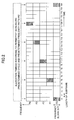
- Fig. 2 shows an example of Persistent Scheduling.
- Fig. 2 specifically shows an allocation pattern of radio resources allocated to a mobile station (user data) by the base station.
- radio resources are allocated to user data according to a predetermined cycle and a predetermined frequency allocation pattern.
- the base station allocates radio resources by means of a pattern which changes allocation every 5 TTIs in the time direction and every frequency block in the frequency direction.
- Persistent Scheduling After the base station allocates a radio resource to a mobile station (user data) at a timing T0 and a frequency block F0, the base station allocates a radio resource to the mobile station at a timing T5 and a frequency block F1.
- the predetermined cycle and the predetermined frequency allocation pattern are known to both the base station and the mobile station.
- the mobile station can receive, demodulate, and decode data according to the predetermined cycle and the predetermined frequency allocation pattern.
- the base station need not transmit radio resource allocation information to the mobile station, since both the base station and the mobile station share the radio resource allocation information.
- Persistent Scheduling has an advantage of reduced overhead.
- Persistent Scheduling can be applied to real-time voice communications in which radio resources should be allocated on a constant cycle (applications with the requirement of reduced overhead, in which communications are performed with a constant transmission speed and at a low rate).
- Radio resources are allocated according to a predetermined cycle and a predetermined frequency allocation pattern.
- a transmission packet or the corresponding retransmission packet is transmitted according to commonly-used scheduling based on a channel condition (channel-condition-based scheduling or channel-fluctuation-based scheduling) rather than according to Persistent Scheduling, contention may occur between the transmission packet or the corresponding retransmission packet to be transmitted according to channel-condition-based scheduling and a transmission packet and the corresponding retransmission packet to be transmitted according to Persistent Scheduling.
- a packet subsequent to a transmission packet at a time T5 and a frequency F1 is scheduled at a time T10 and a frequency F2, for example.
- the corresponding retransmission packet is scheduled at the time T10 and the frequency F2. Contention occurs in this manner.
- Contention for a radio resource may also occur when the base station performs both scheduling for unicast data based on a channel condition for a mobile station and scheduling for broadcast/multicast data. For example, provided that multiple TTIs are allocated to broadcast/multicast data on a broadcast/multicast channel, when an error is detected in a unicast packet, the corresponding unicast retransmission packet cannot use radio resources allocated to the broadcast/multicast data. Contention occurs in this manner.
- contention may occur when the base station performs scheduling for a transmission packet or the corresponding retransmission packet with a variable transmission time interval. For example, provided that a long packet with the length of 2 TTIs is retransmitted, when an error is detected in a short packet with the length of 1 TTI, the corresponding short retransmission packet cannot use radio resources allocated to the long retransmission packet. Contention occurs in this manner.
- a base station having a retransmission function for transmitting a retransmission packet when an error is detected in a transmission packet which is transmitted to a mobile station on a frequency band including multiple resource blocks including:
- a base station having a retransmission function for transmitting a retransmission packet when an error is detected in a transmission packet which is transmitted to a mobile station including:
- a base station having a retransmission function for transmitting a retransmission packet when an error is detected in a transmission packet which is transmitted to a mobile station including:
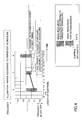
- Fig. 4 shows a diagram illustrating a scheduling scheme in accordance with a first embodiment of the present invention.
- a base station gives a higher priority to a transmission packet or a retransmission packet scheduled according to Persistent Scheduling upon allocating a radio resource, when contention occurs as shown in Fig. 3 .
- the base station uses both Synchronous ARQ and Persistent Scheduling.
- a packet subsequent to a transmission packet at a time T2 and a frequency F1 is scheduled at a time T7 and a frequency F2 according to Persistent Scheduling.
- the corresponding retransmission packet is scheduled at the time T7 and the frequency F2 according to Synchronous ARQ. Since contention will occur in this case, the base station gives a higher priority to the transmission packet scheduled according to Persistent Scheduling upon allocating a radio resource.
- the retransmission packet is transmitted at the next RTT. Specifically, the retransmission packet is transmitted at a time T12 and the frequency F2.
- Controlling contention for a radio resource in this manner allows for coexistence between Synchronous ARQ and Persistent Scheduling.
- Fig. 5 shows a diagram illustrating a scheduling scheme in accordance with a second embodiment of the present invention.
- a base station gives a higher priority to a retransmission packet scheduled according to a retransmission control scheme upon allocating a radio resource, when contention occurs as shown in Fig. 3 .
- the base station uses both Synchronous ARQ and Persistent Scheduling.
- a packet subsequent to a transmission packet at a time T2 and a frequency F1 is scheduled at a time T7 and a frequency F2 according to Persistent Scheduling.
- the corresponding retransmission packet is scheduled at the time T7 and the frequency F2 according to Synchronous ARQ. Since contention will occur in this case, the base station gives a higher priority to the retransmission packet scheduled according to Synchronous ARQ upon allocating a radio resource.
- the transmission packet scheduled according to Persistent Scheduling is transmitted at the next timing. Specifically, this transmission packet is transmitted at a time T12 and a frequency F3 instead of at the time T7 and the frequency F2.
- Controlling contention for a radio resource in this manner allows for coexistence between Synchronous ARQ and Persistent Scheduling.
- Fig. 6 shows a block diagram of a base station 10 in accordance with the first or second embodiment of the present invention.
- the base station 10 includes a channel-condition-based scheduling unit 101, a persistent scheduling unit 103, a control unit 105, and a radio resource allocating unit 107.
- the channel-condition-based scheduling unit 101 schedules a transmission packet and a retransmission packet based on a channel condition for a mobile station.
- the channel-condition-based scheduling unit 101 schedules a retransmission packet by allocating a radio resource to the retransmission packet according to Synchronous ARQ.
- the channel-condition-based scheduling unit 101 schedules the corresponding retransmission packet by allocating one of radio frames which are integral multiples of RTT to the retransmission packet.
- the channel-condition-based scheduling unit 101 may schedule the retransmission packet by allocating a radio resource to the retransmission packet according to Asynchronous ARQ.
- the persistent scheduling unit 103 schedules a transmission packet or a retransmission packet by allocating a radio resource to the transmission packet or the retransmission packet according to Persistent Scheduling. More specifically, the persistent scheduling unit 103 schedules a transmission packet or a retransmission packet by allocating a radio resource to the transmission packet or the retransmission packet according to a predetermined cycle and a predetermined frequency allocation pattern.
- the control unit 105 receives both scheduling information (radio resource) scheduled by the channel-condition based scheduling unit 101 and scheduling information (radio resource) scheduled by the persistent scheduling unit 103. Then the control unit 105 determines whether contention may occur and avoids contention between these scheduled radio resources. In the first embodiment, the control unit 105 gives a higher priority to the transmission packet or the retransmission packet scheduled by the persistent scheduling unit 103 upon allocating a radio resource. In the second embodiment, the control unit 105 gives a higher priority to the retransmission packet scheduled by the channel-condition-based scheduling unit 103 upon allocating a radio resource.
- control unit 105 may receive quality information such as a delay time or a packet error rate from both the channel-condition-based scheduling unit 101 and the persistent scheduling unit 103, compare quality information inputs, and give a higher priority based on the comparison upon allocating a radio resource.
- quality information such as a delay time or a packet error rate
- the radio resource allocating unit 107 allocates a radio resource which is scheduled by the channel-condition based scheduling unit 101 and the persistent scheduling unit 103 and controlled by the control unit 105.
- a base station transmits a control signal to a mobile station, when contention may occur as shown in Fig. 3 .
- the base station specifies a radio resource used for the retransmission packet by means of control information (control bit).
- the base station may specify which radio resource is specifically used, or specify the radio resource according to a predetermined pattern (for example, referring to an adjacent block).
- Fig. 7 shows a block diagram of a base station 10 in accordance with the third embodiment of the present invention.
- the base station in Fig. 7 is identical with the base station in Fig. 6 except for a control signal generating and transmitting unit 109.
- the control signal generating and transmitting unit 109 receives a control result from the control unit 105, generates a control signal specifying the radio resource to be used for the retransmission packet, and transmits the control signal to the mobile station.
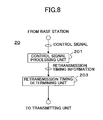
- Fig. 8 shows a block diagram of a mobile station 20 in accordance with the third embodiment of the present invention.
- the mobile station 20 includes a control signal processing unit 201 and a retransmission timing determining unit 203.
- the control signal processing unit 201 demodulates and decodes a control signal received from the base station, and extracts timing information for a retransmission packet.
- the retransmission timing determining unit 203 determines a timing at which the retransmission packet is to be transmitted to the mobile station based on the extracted timing information.
- the control signal transmitted from the base station to the mobile station may be transmitted along with scheduled allocation information which is transmitted for each subframe.
- the control signal generating and transmitting unit 109 may transmit the control result by the control unit 105, when the base station transmits a retransmission request upon detecting an error in a transmission packet at the time T5 and frequency F2 in Fig. 3 .
- the control signal is transmitted on a channel for L1/L2 control information.
- control signal may be transmitted from the base station to the mobile station as upper layer control information.
- control signal may be transmitted as system information on a broadcast channel or transmitted along with user data on a shared data channel. In this case, the control signal is transmitted with longer cycles, compared to the case where the control signal is transmitted for each subframe.
- Fig. 9 shows a diagram illustrating a scheduling scheme in accordance with a fourth embodiment of the present invention.
- a transmission cycle for a transmission packet or a retransmission packet scheduled by the persistent scheduling unit 103 and a transmission cycle for a transmission packet or a retransmission packet scheduled by the channel-condition-based scheduling unit 101 are controlled to be mutually integral multiples.
- the transmission cycle for the retransmission packet scheduled according to Synchronous ARQ is typically an integral multiple of RTT (six subframes in Fig. 9 ).
- Controlling the transmission cycle for the transmission packet scheduled by the persistent scheduling unit 103 to be an integral multiple of the transmission cycle for the retransmission packet allows the base station and the mobile station to identify contention for a radio resource in advance. Specifically, contention occurs between a retransmission packet scheduled at a time #1a and a transmission packet scheduled at a time #1p. However, contention never occurs for a retransmission packet scheduled at a time #2a.
- This relationship allows the base station and the mobile station to identify when contention for a radio resource will occur. Thus, this relationship simplifies the structures of the base station and the mobile station in terms of scheduling and retransmission control. In addition, radio resources without contention (unaffected by Persistent Scheduling) can be reserved.
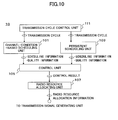
- Fig. 10 shows a block diagram of a base station 10 in accordance with the fourth embodiment of the present invention.
- the base station in Fig. 10 is identical with the base station in Fig. 6 except for a transmission cycle control unit 111.
- the transmission cycle control unit 111 controls the transmission cycle for the transmission packet or the retransmission packet scheduled by the persistent scheduling unit 103 and the transmission cycle for the transmission packet or the retransmission packet scheduled by the channel-condition-based scheduling unit 101 to have a predetermined relationship (integral multiple, for example).
- the transmission cycle control unit 111 provides the transmission cycles to the channel-condition-based scheduling unit 101 and the persistent scheduling unit 103, respectively.
- Fig. 11 shows a diagram illustrating a scheduling scheme in accordance with a fifth embodiment of the present invention.
- a frequency allocation position for a transmission packet or a retransmission packet scheduled by the persistent scheduling unit 103 and a frequency allocation position for a transmission packet or a retransmission packet scheduled by the channel-condition-based scheduling unit 101 are controlled to have a predetermined relationship.
- a transmission cycle is controlled to be six subframes and a frequency allocation position is controlled to shift by one frequency block.
- a transmission cycle is controlled to be twelve subframes (integral multiple of the transmission cycle for Synchronous ARQ) and a frequency allocation position is controlled to shift by two frequency blocks (integral multiple of the frequency allocation position for Synchronous ARQ).
- Controlling the frequency allocation positions in addition to transmission cycles to have the predetermined relationship allows the base station and the mobile station to identify contention for a radio resource in advance. Specifically, contention occurs between a retransmission packet scheduled at a time #1a and a transmission packet scheduled at a time #1p. However, contention never occurs for a retransmission packet scheduled at a time #2a.
- This relationship allows the base station and the mobile station to identify when contention for a radio resource will occur. Thus, this relationship simplifies the structures of the base station and the mobile station in terms of scheduling and retransmission control. In addition, radio resources without contention (unaffected by Persistent Scheduling) can be reserved.
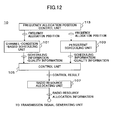
- Fig. 12 shows a block diagram of a base station 10 in accordance with the fifth embodiment of the present invention.
- the base station in Fig. 12 is identical with the base station in Fig. 6 except for a frequency allocation position control unit 113.
- the frequency allocation position control unit 113 controls the frequency allocation position for the transmission packet or the retransmission packet scheduled by the persistent scheduling unit 103 and the frequency allocation position for the transmission packet or the retransmission packet scheduled by the channel-condition-based scheduling unit 101 to have a predetermined relationship (integral multiple, for example).
- the frequency allocation position control unit 113 provides the frequency allocation positions to the channel-condition-based scheduling unit 101 and the persistent scheduling unit 103, respectively.
- Fig. 13 shows a diagram illustrating a scheduling scheme in accordance with a sixth embodiment of the present invention.
- Asynchronous ARQ is used for the retransmission control scheme.
- packets can be retransmitted at any TTI after one RTT. Accordingly, when an error is detected in a packet transmitted at a time T5 and a frequency F2, the corresponding retransmission packet is transmitted at a time and a frequency without contention with a radio resource scheduled according to Persistent Scheduling.
- the base station gives a higher priority to the transmission packet scheduled according to Persistent Scheduling upon allocating a radio resource, and allocates a radio resource which is not used for Persistent Scheduling to the retransmission packet.
- Controlling contention for a radio resource in this manner allows for coexistence between Asynchronous ARQ and Persistent Scheduling.
- Fig. 14 shows a diagram illustrating a scheduling scheme in accordance with a seventh embodiment of the present invention.
- Asynchronous ARQ is used for the retransmission control scheme. It is also assumed that one RTT is equal to 6 TTIs.
- the base station allocates a radio resource to broadcast/multicast data on a broadcast/multicast channel to transmit the same transmission packet to specified or unspecified multiple users within multiple cells (or within a cell).
- TTIs from a second TTI to a sixth TTI are allocated to multicast/broadcast data and the other TTIs are allocated to unicast data, for example.
- the base station uses both the unicast channel on which packets are transmitted to a specified user and the multicast/broadcast channel on which packets are transmitted to specified or unspecified multiple users.
- the corresponding retransmission packet can be transmitted after 6 TTIs (one RTT) according to Asynchronous ARQ.
- the base station cannot allocate a radio resource to the retransmission packet for unicast data at the sixth TTI, because the sixth TTI is allocated to multicast/broadcast data. Instead, the base station allocates a seventh TTI to the retransmission packet among TTIs after 6 TTIs from the seventh TTI which are available for unicast data. Controlling contention for a radio resource in this manner allows for coexistence between Asynchronous ARQ for unicast data and scheduling for multicast/broadcast data.
- the base station in accordance with the seventh embodiment has a structure similar to the base station 10 shown in Fig. 6 .
- the channel-condition-based scheduling unit 101 schedules a retransmission packet for unicast data on the unicast channel according to Asynchronous ARQ.
- the base station 10 includes, in place of the persistent scheduling unit 103, a broadcast/multicast data scheduling unit 115 for scheduling broadcast/multicast data on the broadcast/multicast channel by allocating a radio resource to the broadcast/multicast data.
- the control unit 105 avoids contention between the radio resource allocated to the transmission packet or the retransmission packet by the channel-condition-based scheduling unit 101 and the radio resource allocated to the broadcast/multicast data by the broadcast/multicast data scheduling unit 115. For example, the control unit 105 gives a higher priority to the broadcast/multicast data scheduled by the broadcast/multicast data scheduling unit 115 upon allocating a radio resource.
- Fig. 16 shows a diagram illustrating a scheduling scheme in accordance with an eighth embodiment of the present invention.
- Asynchronous ARQ is used for the retransmission control scheme. It is also assumed that one RTT is equal to 6 TTIs.
- the base station allocates a radio resource to a transmission packet or a retransmission packet with a variable transmission time interval.
- Fig. 16 shows a short packet with the length of 1 TTI and a long packet with the length of 2 TTIs, as an example of transmission packets with variable transmission time intervals.
- Fig. 16 also shows retransmission packets for both the short packet and the long packet.
- the base station uses both the short packet and the long packet. Even though there is no contention between the short packet and the long packet at the initial transmission, contention may occur among their respective retransmission packets. For example, when an error is detected in a long packet transmitted at twelfth and thirteenth TTIs, the corresponding retransmission packet can be transmitted at nineteenth and twentieth TTIs after 6 TTIs (one RTT) from the twelfth and thirteenth TTIs.
- the corresponding retransmission packet can be transmitted at the twentieth TTI after 6 TTIs (one RTT) from the fourteenth TTI.
- contention for a radio resource occurs at the twentieth TTI, when both of the retransmission packets are transmitted according to the cycle of 6 TTIs.
- the base station allocates a twenty-first TTI to the retransmission packet for the short packet, for example, in order to avoid contention with the long packet. Controlling contention for a radio resource in this manner allows for coexistence among transmission packets or retransmission packets with variable transmission time intervals.
- the base station in accordance with the eighth embodiment has a structure similar to the base station 10 shown in Fig. 6 .
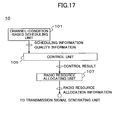
- the channel-condition-based scheduling unit 101 schedules a long packet and a short packet according to Asynchronous ARQ. As shown in Fig. 17 , the base station may not include the persistent scheduling unit 103.
- the control unit 105 avoids contention among radio resources allocated to transmission packets or retransmission packets for the long packet and the short packet by the channel-condition-based scheduling unit 101. For example, the control unit 105 gives a higher priority to the long packet upon allocating a radio resource.
Landscapes
- Engineering & Computer Science (AREA)
- Signal Processing (AREA)
- Computer Networks & Wireless Communication (AREA)
- Mobile Radio Communication Systems (AREA)
- Data Exchanges In Wide-Area Networks (AREA)
- Small-Scale Networks (AREA)
- Communication Control (AREA)
Abstract
Description
- The present invention relates to a base station for transmitting a retransmission packet when an error is detected in a transmission packet transmitted to a mobile station.
- Retransmission control schemes are used in radio communication systems, in which an error in a packet transmitted between a base station and a mobile station is detected and only a packet with the error is retransmitted. In view of retransmission timings, the retransmission control schemes are classified into two schemes as shown in
Fig. 1 . One scheme is referred to as Synchronous ARQ (automatic repeat request) and the other scheme is referred to as Asynchronous ARQ. - According to Synchronous ARQ, packets are retransmitted at predetermined retransmission timings. For example, when a transmission packet at a timing #0 (S00) is detected as an error packet, the corresponding retransmission packets can be transmitted at timings #0 (S10 and S20). Typically, retransmissions are performed at frames which are integral multiples of RTT (Round Trip Time) or control loop delay.
- According to Asynchronous ARQ, packets are retransmitted at any timing after one RTT. For example, when a transmission packet at a timing #0 (A00) is detected as an error packet, the corresponding retransmission packets can be transmitted at any transmission slot timing (TTI: Transmission Time Interval) after A10. In other words, retransmissions are performed at any TTI (A10-A25) after one RTT from the transmission packet. Asynchronous ARQ is used in HSDPA (High Speed Downlink Packet Access) (see 3GPP TS 25.212, "Multiplexing and channel coding (FDD)", for example).
- On the other hand, Persistent Scheduling is used in radio communication systems, in which a base station allocates radio resources according to a predetermined cycle and a predetermined frequency allocation pattern.
Fig. 2 shows an example of Persistent Scheduling.Fig. 2 specifically shows an allocation pattern of radio resources allocated to a mobile station (user data) by the base station. According to Persistent Scheduling, radio resources are allocated to user data according to a predetermined cycle and a predetermined frequency allocation pattern. For example, the base station allocates radio resources by means of a pattern which changes allocation every 5 TTIs in the time direction and every frequency block in the frequency direction. In the shown example, after the base station allocates a radio resource to a mobile station (user data) at a timing T0 and a frequency block F0, the base station allocates a radio resource to the mobile station at a timing T5 and a frequency block F1. The predetermined cycle and the predetermined frequency allocation pattern are known to both the base station and the mobile station. Thus, the mobile station can receive, demodulate, and decode data according to the predetermined cycle and the predetermined frequency allocation pattern. According to Persistent Scheduling, the base station need not transmit radio resource allocation information to the mobile station, since both the base station and the mobile station share the radio resource allocation information. As a result, Persistent Scheduling has an advantage of reduced overhead. For example, Persistent Scheduling can be applied to real-time voice communications in which radio resources should be allocated on a constant cycle (applications with the requirement of reduced overhead, in which communications are performed with a constant transmission speed and at a low rate). - As described above, according to Persistent Scheduling, radio resources are allocated according to a predetermined cycle and a predetermined frequency allocation pattern. When a transmission packet or the corresponding retransmission packet is transmitted according to commonly-used scheduling based on a channel condition (channel-condition-based scheduling or channel-fluctuation-based scheduling) rather than according to Persistent Scheduling, contention may occur between the transmission packet or the corresponding retransmission packet to be transmitted according to channel-condition-based scheduling and a transmission packet and the corresponding retransmission packet to be transmitted according to Persistent Scheduling. As shown in
Fig. 3 , according to Persistent Scheduling, a packet subsequent to a transmission packet at a time T5 and a frequency F1 is scheduled at a time T10 and a frequency F2, for example. In addition, according to Synchronous ARQ, when an error is detected in a packet transmitted at the time T5 and the frequency F2, the corresponding retransmission packet is scheduled at the time T10 and the frequency F2. Contention occurs in this manner. - Contention for a radio resource may also occur when the base station performs both scheduling for unicast data based on a channel condition for a mobile station and scheduling for broadcast/multicast data. For example, provided that multiple TTIs are allocated to broadcast/multicast data on a broadcast/multicast channel, when an error is detected in a unicast packet, the corresponding unicast retransmission packet cannot use radio resources allocated to the broadcast/multicast data. Contention occurs in this manner.
- Furthermore, contention may occur when the base station performs scheduling for a transmission packet or the corresponding retransmission packet with a variable transmission time interval. For example, provided that a long packet with the length of 2 TTIs is retransmitted, when an error is detected in a short packet with the length of 1 TTI, the corresponding short retransmission packet cannot use radio resources allocated to the long retransmission packet. Contention occurs in this manner.
- For this reason, there is a need for controlling radio resource allocation in the base station. Specifically, there is a problem associated with coexistence between Persistent Scheduling and Synchronous ARQ, because of the constraint of retransmission timings. Similarly, there is a problem associated with coexistence between Persistent Scheduling and Asynchronous ARQ. In addition, there is a problem associated with coexistence between scheduling for unicast data and scheduling for broadcast/multicast data. Furthermore, there is a problem associated with scheduling for a transmission packet or the corresponding retransmission packet with a variable transmission time interval.
- In order to solve at least one of the aforementioned problems, it is a general object of the present invention to avoid contention for a radio resource scheduled by a base station.
- In one embodiment of the present invention, there is provided a base station having a retransmission function for transmitting a retransmission packet when an error is detected in a transmission packet which is transmitted to a mobile station on a frequency band including multiple resource blocks, including:
- a channel-condition-based scheduling unit configured to schedule a transmission packet or a retransmission packet by allocating a radio resource to the transmission packet or the retransmission packet based on a channel condition for the mobile station;
- a persistent scheduling unit configured to schedule a transmission packet or a retransmission packet by allocating a radio resource to the transmission packet or the retransmission packet according to a predetermined cycle and a predetermined frequency allocation pattern; and
- a control unit configured to avoid contention between the radio resource allocated to the transmission packet or the retransmission packet by the channel-condition-based scheduling unit and the radio resource allocated to the transmission packet or the retransmission packet by the persistent scheduling unit.
- In one embodiment of the present invention, there is provided a base station having a retransmission function for transmitting a retransmission packet when an error is detected in a transmission packet which is transmitted to a mobile station, including:
- a channel-condition-based scheduling unit configured to schedule a transmission packet or a retransmission packet by allocating a radio resource to the transmission packet or the retransmission packet based on a channel condition for the mobile station;
- a broadcast/multicast data scheduling unit configured to schedule broadcast/multicast data on a broadcast/multicast channel by allocating a radio resource to the broadcast/multicast data to transmit the same transmission packet to multiple users within a cell; and
- a control unit configured to avoid contention between the radio resource allocated to the transmission packet or the retransmission packet by the channel-condition-based scheduling unit and the radio resource allocated to the broadcast/multicast data by the broadcast/multicast data scheduling unit.
- In one embodiment of the present invention, there is provided a base station having a retransmission function for transmitting a retransmission packet when an error is detected in a transmission packet which is transmitted to a mobile station, including:
- a channel-condition-based scheduling unit configured to schedule a transmission packet or a retransmission packet with a variable transmission time interval by allocating a radio resource to the transmission packet or the retransmission packet based on a channel condition for the mobile station; and
- a control unit configured to avoid contention among radio resources allocated to multiple retransmission packets with variable transmission time intervals by the channel-condition-based scheduling unit.
- According to an embodiment of the present invention, it is possible to avoid contention for a radio resource scheduled by a base station.
-
-
Fig. 1 shows a diagram illustrating retransmission control schemes according to Synchronous ARQ and Asynchronous ARQ. -
Fig. 2 shows a diagram illustrating a scheduling scheme according to Persistent Scheduling. -
Fig. 3 shows a diagram illustrating a scheduling scheme by means of both Synchronous ARQ and Persistent Scheduling. -
Fig. 4 shows a diagram illustrating a scheduling scheme in accordance with a first embodiment of the present invention. -
Fig. 5 shows a diagram illustrating a scheduling scheme in accordance with a second embodiment of the present invention. -
Fig. 6 shows a block diagram of a base station in accordance with the first or second embodiment of the present invention. -
Fig. 7 shows a block diagram of a base station in accordance with a third embodiment of the present invention. -
Fig. 8 shows a block diagram of a mobile station in accordance with the third embodiment of the present invention. -
Fig. 9 shows a diagram illustrating a scheduling scheme in accordance with a fourth embodiment of the present invention. -
Fig. 10 shows a block diagram of a base station in accordance with the fourth embodiment of the present invention. -
Fig. 11 shows a diagram illustrating a scheduling scheme in accordance with a fifth embodiment of the present invention. -
Fig. 12 shows a block diagram of a base station in accordance with the fifth embodiment of the present invention. -
Fig. 13 shows a diagram illustrating a scheduling scheme in accordance with a sixth embodiment of the present invention. -
Fig. 14 shows a diagram illustrating a scheduling scheme in accordance with a seventh embodiment of the present invention. -
Fig. 15 shows a block diagram of a base station in accordance with the seventh embodiment of the present invention. -
Fig. 16 shows a diagram illustrating a scheduling scheme in accordance with an eighth embodiment of the present invention. -
Fig. 17 shows a block diagram of a base station in accordance with the eighth embodiment of the present invention. -
- 10 base station
- 101 channel-condition-based scheduling unit
- 103 persistent scheduling unit
- 105 control unit
- 107 radio resource allocating unit
- 109 control signal generating and transmitting unit
- 20 mobile station
- 201 control signal processing unit
- 203 retransmission timing determining unit
- With reference to the accompanying drawings, a description is given below with regard to preferred embodiments of the present invention.
-
Fig. 4 shows a diagram illustrating a scheduling scheme in accordance with a first embodiment of the present invention. In the first embodiment, a base station gives a higher priority to a transmission packet or a retransmission packet scheduled according to Persistent Scheduling upon allocating a radio resource, when contention occurs as shown inFig. 3 . - In
Fig. 4 , the base station uses both Synchronous ARQ and Persistent Scheduling. A packet subsequent to a transmission packet at a time T2 and a frequency F1 is scheduled at a time T7 and a frequency F2 according to Persistent Scheduling. In addition, when an error is detected in a packet transmitted at the time T2 and the frequency F2, the corresponding retransmission packet is scheduled at the time T7 and the frequency F2 according to Synchronous ARQ. Since contention will occur in this case, the base station gives a higher priority to the transmission packet scheduled according to Persistent Scheduling upon allocating a radio resource. On the other hand, the retransmission packet is transmitted at the next RTT. Specifically, the retransmission packet is transmitted at a time T12 and the frequency F2. - Controlling contention for a radio resource in this manner allows for coexistence between Synchronous ARQ and Persistent Scheduling.
-
Fig. 5 shows a diagram illustrating a scheduling scheme in accordance with a second embodiment of the present invention. In the second embodiment, a base station gives a higher priority to a retransmission packet scheduled according to a retransmission control scheme upon allocating a radio resource, when contention occurs as shown inFig. 3 . - In
Fig. 5 , the base station uses both Synchronous ARQ and Persistent Scheduling. A packet subsequent to a transmission packet at a time T2 and a frequency F1 is scheduled at a time T7 and a frequency F2 according to Persistent Scheduling. In addition, when an error is detected in a packet transmitted at the time T2 and the frequency F2, the corresponding retransmission packet is scheduled at the time T7 and the frequency F2 according to Synchronous ARQ. Since contention will occur in this case, the base station gives a higher priority to the retransmission packet scheduled according to Synchronous ARQ upon allocating a radio resource. On the other hand, the transmission packet scheduled according to Persistent Scheduling is transmitted at the next timing. Specifically, this transmission packet is transmitted at a time T12 and a frequency F3 instead of at the time T7 and the frequency F2. - Controlling contention for a radio resource in this manner allows for coexistence between Synchronous ARQ and Persistent Scheduling.
-
Fig. 6 shows a block diagram of abase station 10 in accordance with the first or second embodiment of the present invention. Thebase station 10 includes a channel-condition-basedscheduling unit 101, apersistent scheduling unit 103, acontrol unit 105, and a radioresource allocating unit 107. - The channel-condition-based
scheduling unit 101 schedules a transmission packet and a retransmission packet based on a channel condition for a mobile station. In the first or second embodiment, the channel-condition-basedscheduling unit 101 schedules a retransmission packet by allocating a radio resource to the retransmission packet according to Synchronous ARQ. When an error is detected in a packet transmitted from the base station to the mobile station, the channel-condition-basedscheduling unit 101 schedules the corresponding retransmission packet by allocating one of radio frames which are integral multiples of RTT to the retransmission packet. As described below, the channel-condition-basedscheduling unit 101 may schedule the retransmission packet by allocating a radio resource to the retransmission packet according to Asynchronous ARQ. - The
persistent scheduling unit 103 schedules a transmission packet or a retransmission packet by allocating a radio resource to the transmission packet or the retransmission packet according to Persistent Scheduling. More specifically, thepersistent scheduling unit 103 schedules a transmission packet or a retransmission packet by allocating a radio resource to the transmission packet or the retransmission packet according to a predetermined cycle and a predetermined frequency allocation pattern. - The
control unit 105 receives both scheduling information (radio resource) scheduled by the channel-condition basedscheduling unit 101 and scheduling information (radio resource) scheduled by thepersistent scheduling unit 103. Then thecontrol unit 105 determines whether contention may occur and avoids contention between these scheduled radio resources. In the first embodiment, thecontrol unit 105 gives a higher priority to the transmission packet or the retransmission packet scheduled by thepersistent scheduling unit 103 upon allocating a radio resource. In the second embodiment, thecontrol unit 105 gives a higher priority to the retransmission packet scheduled by the channel-condition-basedscheduling unit 103 upon allocating a radio resource. - Alternatively, the
control unit 105 may receive quality information such as a delay time or a packet error rate from both the channel-condition-basedscheduling unit 101 and thepersistent scheduling unit 103, compare quality information inputs, and give a higher priority based on the comparison upon allocating a radio resource. - The radio
resource allocating unit 107 allocates a radio resource which is scheduled by the channel-condition basedscheduling unit 101 and thepersistent scheduling unit 103 and controlled by thecontrol unit 105. - In a third embodiment, a base station transmits a control signal to a mobile station, when contention may occur as shown in
Fig. 3 . - As shown in
Fig. 3 , when an error is detected in a packet transmitted at the time T5 and the frequency F2, contention occurs at the time T10 and the frequency F2. Accordingly, the base station specifies a radio resource used for the retransmission packet by means of control information (control bit). The base station may specify which radio resource is specifically used, or specify the radio resource according to a predetermined pattern (for example, referring to an adjacent block). -
Fig. 7 shows a block diagram of abase station 10 in accordance with the third embodiment of the present invention. The base station inFig. 7 is identical with the base station inFig. 6 except for a control signal generating and transmittingunit 109. The control signal generating and transmittingunit 109 receives a control result from thecontrol unit 105, generates a control signal specifying the radio resource to be used for the retransmission packet, and transmits the control signal to the mobile station. -
Fig. 8 shows a block diagram of amobile station 20 in accordance with the third embodiment of the present invention. Themobile station 20 includes a controlsignal processing unit 201 and a retransmissiontiming determining unit 203. The controlsignal processing unit 201 demodulates and decodes a control signal received from the base station, and extracts timing information for a retransmission packet. The retransmissiontiming determining unit 203 determines a timing at which the retransmission packet is to be transmitted to the mobile station based on the extracted timing information. - The control signal transmitted from the base station to the mobile station may be transmitted along with scheduled allocation information which is transmitted for each subframe. Specifically, the control signal generating and transmitting
unit 109 may transmit the control result by thecontrol unit 105, when the base station transmits a retransmission request upon detecting an error in a transmission packet at the time T5 and frequency F2 inFig. 3 . In this case, the control signal is transmitted on a channel for L1/L2 control information. - Alternatively, the control signal may be transmitted from the base station to the mobile station as upper layer control information. Specifically, the control signal may be transmitted as system information on a broadcast channel or transmitted along with user data on a shared data channel. In this case, the control signal is transmitted with longer cycles, compared to the case where the control signal is transmitted for each subframe.
-
Fig. 9 shows a diagram illustrating a scheduling scheme in accordance with a fourth embodiment of the present invention. In the fourth embodiment, a transmission cycle for a transmission packet or a retransmission packet scheduled by thepersistent scheduling unit 103 and a transmission cycle for a transmission packet or a retransmission packet scheduled by the channel-condition-basedscheduling unit 101 are controlled to be mutually integral multiples. - As described above, the transmission cycle for the retransmission packet scheduled according to Synchronous ARQ is typically an integral multiple of RTT (six subframes in
Fig. 9 ). Controlling the transmission cycle for the transmission packet scheduled by thepersistent scheduling unit 103 to be an integral multiple of the transmission cycle for the retransmission packet (twelve subframes inFig. 9 ) allows the base station and the mobile station to identify contention for a radio resource in advance. Specifically, contention occurs between a retransmission packet scheduled at atime # 1a and a transmission packet scheduled at atime # 1p. However, contention never occurs for a retransmission packet scheduled at atime # 2a. - This relationship allows the base station and the mobile station to identify when contention for a radio resource will occur. Thus, this relationship simplifies the structures of the base station and the mobile station in terms of scheduling and retransmission control. In addition, radio resources without contention (unaffected by Persistent Scheduling) can be reserved.
-
Fig. 10 shows a block diagram of abase station 10 in accordance with the fourth embodiment of the present invention. The base station inFig. 10 is identical with the base station inFig. 6 except for a transmissioncycle control unit 111. The transmissioncycle control unit 111 controls the transmission cycle for the transmission packet or the retransmission packet scheduled by thepersistent scheduling unit 103 and the transmission cycle for the transmission packet or the retransmission packet scheduled by the channel-condition-basedscheduling unit 101 to have a predetermined relationship (integral multiple, for example). The transmissioncycle control unit 111 provides the transmission cycles to the channel-condition-basedscheduling unit 101 and thepersistent scheduling unit 103, respectively. -
Fig. 11 shows a diagram illustrating a scheduling scheme in accordance with a fifth embodiment of the present invention. In the fifth embodiment, a frequency allocation position for a transmission packet or a retransmission packet scheduled by thepersistent scheduling unit 103 and a frequency allocation position for a transmission packet or a retransmission packet scheduled by the channel-condition-basedscheduling unit 101 are controlled to have a predetermined relationship. - As shown in
Fig. 11 , for a retransmission packet scheduled according to Synchronous ARQ, a transmission cycle is controlled to be six subframes and a frequency allocation position is controlled to shift by one frequency block. In addition, for a transmission packet scheduled by thepersistent scheduling unit 103, a transmission cycle is controlled to be twelve subframes (integral multiple of the transmission cycle for Synchronous ARQ) and a frequency allocation position is controlled to shift by two frequency blocks (integral multiple of the frequency allocation position for Synchronous ARQ). Controlling the frequency allocation positions in addition to transmission cycles to have the predetermined relationship allows the base station and the mobile station to identify contention for a radio resource in advance. Specifically, contention occurs between a retransmission packet scheduled at atime # 1a and a transmission packet scheduled at atime # 1p. However, contention never occurs for a retransmission packet scheduled at atime # 2a. - This relationship allows the base station and the mobile station to identify when contention for a radio resource will occur. Thus, this relationship simplifies the structures of the base station and the mobile station in terms of scheduling and retransmission control. In addition, radio resources without contention (unaffected by Persistent Scheduling) can be reserved.
-
Fig. 12 shows a block diagram of abase station 10 in accordance with the fifth embodiment of the present invention. The base station inFig. 12 is identical with the base station inFig. 6 except for a frequency allocationposition control unit 113. The frequency allocationposition control unit 113 controls the frequency allocation position for the transmission packet or the retransmission packet scheduled by thepersistent scheduling unit 103 and the frequency allocation position for the transmission packet or the retransmission packet scheduled by the channel-condition-basedscheduling unit 101 to have a predetermined relationship (integral multiple, for example). The frequency allocationposition control unit 113 provides the frequency allocation positions to the channel-condition-basedscheduling unit 101 and thepersistent scheduling unit 103, respectively. -
Fig. 13 shows a diagram illustrating a scheduling scheme in accordance with a sixth embodiment of the present invention. In the sixth embodiment, Asynchronous ARQ is used for the retransmission control scheme. - As described above, according to Asynchronous ARQ, packets can be retransmitted at any TTI after one RTT. Accordingly, when an error is detected in a packet transmitted at a time T5 and a frequency F2, the corresponding retransmission packet is transmitted at a time and a frequency without contention with a radio resource scheduled according to Persistent Scheduling. In other words, the base station gives a higher priority to the transmission packet scheduled according to Persistent Scheduling upon allocating a radio resource, and allocates a radio resource which is not used for Persistent Scheduling to the retransmission packet.
- Controlling contention for a radio resource in this manner allows for coexistence between Asynchronous ARQ and Persistent Scheduling.
-
Fig. 14 shows a diagram illustrating a scheduling scheme in accordance with a seventh embodiment of the present invention. In the seventh embodiment, Asynchronous ARQ is used for the retransmission control scheme. It is also assumed that one RTT is equal to 6 TTIs. In the seventh embodiment, the base station allocates a radio resource to broadcast/multicast data on a broadcast/multicast channel to transmit the same transmission packet to specified or unspecified multiple users within multiple cells (or within a cell). - As shown in
Fig. 14 , TTIs from a second TTI to a sixth TTI are allocated to multicast/broadcast data and the other TTIs are allocated to unicast data, for example. In the seventh embodiment, the base station uses both the unicast channel on which packets are transmitted to a specified user and the multicast/broadcast channel on which packets are transmitted to specified or unspecified multiple users. When an error is detected in a packet for unicast data transmitted at #0, the corresponding retransmission packet can be transmitted after 6 TTIs (one RTT) according to Asynchronous ARQ. However, the base station cannot allocate a radio resource to the retransmission packet for unicast data at the sixth TTI, because the sixth TTI is allocated to multicast/broadcast data. Instead, the base station allocates a seventh TTI to the retransmission packet among TTIs after 6 TTIs from the seventh TTI which are available for unicast data. Controlling contention for a radio resource in this manner allows for coexistence between Asynchronous ARQ for unicast data and scheduling for multicast/broadcast data. - The base station in accordance with the seventh embodiment has a structure similar to the
base station 10 shown inFig. 6 . The channel-condition-basedscheduling unit 101 schedules a retransmission packet for unicast data on the unicast channel according to Asynchronous ARQ. As shown inFig. 15 , thebase station 10 includes, in place of thepersistent scheduling unit 103, a broadcast/multicastdata scheduling unit 115 for scheduling broadcast/multicast data on the broadcast/multicast channel by allocating a radio resource to the broadcast/multicast data. Thecontrol unit 105 avoids contention between the radio resource allocated to the transmission packet or the retransmission packet by the channel-condition-basedscheduling unit 101 and the radio resource allocated to the broadcast/multicast data by the broadcast/multicastdata scheduling unit 115. For example, thecontrol unit 105 gives a higher priority to the broadcast/multicast data scheduled by the broadcast/multicastdata scheduling unit 115 upon allocating a radio resource. -
Fig. 16 shows a diagram illustrating a scheduling scheme in accordance with an eighth embodiment of the present invention. In the eighth embodiment, Asynchronous ARQ is used for the retransmission control scheme. It is also assumed that one RTT is equal to 6 TTIs. In the eighth embodiment, the base station allocates a radio resource to a transmission packet or a retransmission packet with a variable transmission time interval. -
Fig. 16 shows a short packet with the length of 1 TTI and a long packet with the length of 2 TTIs, as an example of transmission packets with variable transmission time intervals.Fig. 16 also shows retransmission packets for both the short packet and the long packet. In the eighth embodiment, the base station uses both the short packet and the long packet. Even though there is no contention between the short packet and the long packet at the initial transmission, contention may occur among their respective retransmission packets. For example, when an error is detected in a long packet transmitted at twelfth and thirteenth TTIs, the corresponding retransmission packet can be transmitted at nineteenth and twentieth TTIs after 6 TTIs (one RTT) from the twelfth and thirteenth TTIs. On the other hand, when an error is detected in a short packet transmitted at a fourteenth TTI, the corresponding retransmission packet can be transmitted at the twentieth TTI after 6 TTIs (one RTT) from the fourteenth TTI. However, contention for a radio resource occurs at the twentieth TTI, when both of the retransmission packets are transmitted according to the cycle of 6 TTIs. Accordingly, the base station allocates a twenty-first TTI to the retransmission packet for the short packet, for example, in order to avoid contention with the long packet. Controlling contention for a radio resource in this manner allows for coexistence among transmission packets or retransmission packets with variable transmission time intervals. - The base station in accordance with the eighth embodiment has a structure similar to the
base station 10 shown inFig. 6 . The channel-condition-basedscheduling unit 101 schedules a long packet and a short packet according to Asynchronous ARQ. As shown inFig. 17 , the base station may not include thepersistent scheduling unit 103. Thecontrol unit 105 avoids contention among radio resources allocated to transmission packets or retransmission packets for the long packet and the short packet by the channel-condition-basedscheduling unit 101. For example, thecontrol unit 105 gives a higher priority to the long packet upon allocating a radio resource. - The present invention is not limited to the specifically disclosed embodiments, and variations and modifications may be made without departing from the scope of the present invention.
- This international patent application is based on Japanese Priority Application No.
2006-031747 filed on February 8, 2006
Claims (14)
- A base station having a retransmission function for transmitting a retransmission packet when an error is detected in a transmission packet which is transmitted to a mobile station on a frequency band including multiple resource blocks, comprising:a channel-condition-based scheduling unit configured to schedule a transmission packet or a retransmission packet by allocating a radio resource to the transmission packet or the retransmission packet based on a channel condition for the mobile station;a persistent scheduling unit configured to schedule a transmission packet or a retransmission packet by allocating a radio resource to the transmission packet or the retransmission packet according to a predetermined cycle and a predetermined frequency allocation pattern; anda control unit configured to avoid contention between the radio resource allocated to the transmission packet or the retransmission packet by the channel-condition-based scheduling unit and the radio resource allocated to the transmission packet or the retransmission packet by the persistent scheduling unit.
- The base station as claimed in Claim 1, wherein:the channel-condition-based scheduling unit schedules the retransmission packet according to Synchronous ARQ; andthe control unit gives a higher priority to the retransmission packet scheduled by the channel-condition-based scheduling unit upon allocating a radio resource.
- The base station as claimed in Claim 1, wherein:the channel-condition-based scheduling unit schedules the retransmission packet according to Synchronous ARQ; andthe control unit gives a higher priority to the transmission packet or the retransmission packet scheduled by the persistent scheduling unit upon allocating a radio resource.
- The base station as claimed in Claim 1, wherein:the control unit compares quality required for the transmission packet or the retransmission packet scheduled by the channel-condition-based scheduling unit with quality required for the transmission packet or the retransmission packet scheduled by the persistent scheduling unit, and gives a higher priority to the transmission packet or the retransmission packet scheduled by either the channel-condition-based scheduling unit or the persistent scheduling unit based on the comparison upon allocating a radio resource.
- The base station as claimed in Claim 3, further comprising:a control signal generating and transmitting unit configured to generate and transmit a control signal notifying the mobile station of a radio resource to be used for the retransmission packet as a result of control by the control unit.
- The base station as claimed in Claim 5, wherein:the control signal generating and transmitting unit generates and transmits the control signal along with scheduled allocation information which is transmitted for each subframe, when the control unit detects the contention.
- The base station as claimed in Claim 5, wherein:the control signal generating and transmitting unit generates and transmits the control signal as upper layer control information.
- The base station as claimed in Claim 1, further comprising:a transmission cycle control unit configured to control a transmission cycle for the transmission packet or the retransmission packet scheduled by the persistent scheduling unit and a transmission cycle for the transmission packet or the retransmission packet scheduled by the channel-condition-based scheduling unit to have a predetermined relationship.
- The base station as claimed in Claim 1, further comprising:a frequency allocation position control unit configured to control a frequency allocation position for the transmission packet or the retransmission packet scheduled by the persistent scheduling unit and a frequency allocation position for the transmission packet or the retransmission packet scheduled by the channel-condition-based scheduling unit to have a predetermined relationship.
- The base station as claimed in Claim 1, wherein:the channel-condition-based scheduling unit schedules the retransmission packet according to Asynchronous ARQ; andthe control unit gives a higher priority to the transmission packet or the retransmission packet scheduled by the persistent scheduling unit upon allocating a radio resource, and allocates a radio resource to the retransmission packet scheduled by the channel-condition-based scheduling unit based on a result of allocation of the transmission packet or the retransmission packet scheduled by the persistent scheduling unit.
- A base station having a retransmission function for transmitting a retransmission packet when an error is detected in a transmission packet which is transmitted to a mobile station, comprising:a channel-condition-based scheduling unit configured to schedule a transmission packet or a retransmission packet by allocating a radio resource to the transmission packet or the retransmission packet based on a channel condition for the mobile station;a broadcast/multicast data scheduling unit configured to schedule broadcast/multicast data on a broadcast/multicast channel by allocating a radio resource to the broadcast/multicast data to transmit the same transmission packet to multiple users within a cell; anda control unit configured to avoid contention between the radio resource allocated to the transmission packet or the retransmission packet by the channel-condition-based scheduling unit and the radio resource allocated to the broadcast/multicast data by the broadcast/multicast data scheduling unit.
- The base station as claimed in Claim 11, wherein:the channel-condition-based scheduling unit schedules the retransmission packet according to Asynchronous ARQ; andthe control unit gives a higher priority to the broadcast/multicast data scheduled by the broadcast/multicast data scheduling unit upon allocating a radio resource, and allocates a radio resource to the retransmission packet scheduled by the channel-condition-based scheduling unit based on a result of allocation of the broadcast/multicast data scheduled by the broadcast/multicast data scheduling unit.
- A base station having a retransmission function for transmitting a retransmission packet when an error is detected in a transmission packet which is transmitted to a mobile station, comprising:a channel-condition-based scheduling unit configured to schedule a transmission packet or a retransmission packet with a variable transmission time interval by allocating a radio resource to the transmission packet or the retransmission packet based on a channel condition for the mobile station; anda control unit configured to avoid contention among radio resources allocated to multiple retransmission packets with variable transmission time intervals by the channel-condition-based scheduling unit.
- The base station as claimed in Claim 13, wherein:the channel-condition-based scheduling unit schedules the retransmission packet according to Asynchronous ARQ; andthe control unit gives a higher priority to a first retransmission packet among the multiple retransmission packets with variable transmission time intervals, and allocates a radio resource to a second retransmission packet among the multiple retransmission packets based on a result of allocation of the first retransmission packet.
Applications Claiming Priority (2)
| Application Number | Priority Date | Filing Date | Title |
|---|---|---|---|
| JP2006031747A JP4799202B2 (en) | 2006-02-08 | 2006-02-08 | base station |
| PCT/JP2007/051922 WO2007091520A1 (en) | 2006-02-08 | 2007-02-05 | Basic station |
Publications (2)
| Publication Number | Publication Date |
|---|---|
| EP1983782A1 true EP1983782A1 (en) | 2008-10-22 |
| EP1983782A4 EP1983782A4 (en) | 2013-01-23 |
Family
ID=38345118
Family Applications (1)
| Application Number | Title | Priority Date | Filing Date |
|---|---|---|---|
| EP07708040A Withdrawn EP1983782A4 (en) | 2006-02-08 | 2007-02-05 | BASE STATION |
Country Status (7)
| Country | Link |
|---|---|
| US (1) | US8301951B2 (en) |
| EP (1) | EP1983782A4 (en) |
| JP (1) | JP4799202B2 (en) |
| KR (1) | KR20080095892A (en) |
| CN (1) | CN101416554B (en) |
| TW (1) | TW200737815A (en) |
| WO (1) | WO2007091520A1 (en) |
Cited By (3)
| Publication number | Priority date | Publication date | Assignee | Title |
|---|---|---|---|---|
| WO2011129996A1 (en) * | 2010-04-16 | 2011-10-20 | Qualcomm Incorporated | Suspending pre-scheduled retransmissions of synchronous harq |
| EP2225911A4 (en) * | 2007-12-29 | 2012-10-17 | Alcatel Lucent | Semi-persistent scheduling method and apparatus based on statistically multiplexing in time and frenquency resources |
| EP2575280A1 (en) * | 2011-09-27 | 2013-04-03 | Siemens Aktiengesellschaft | Method for operating an automation device for avoiding data loss and corresponding data transfer method |
Families Citing this family (34)
| Publication number | Priority date | Publication date | Assignee | Title |
|---|---|---|---|---|
| JPWO2007145272A1 (en) * | 2006-06-14 | 2009-11-12 | パナソニック株式会社 | RADIO COMMUNICATION BASE STATION DEVICE, RADIO COMMUNICATION TERMINAL DEVICE, AND RESOURCE BLOCK ALLOCATION METHOD |
| KR101265637B1 (en) * | 2007-03-14 | 2013-05-22 | 엘지전자 주식회사 | method of transmitting data using a plurality of HARQ process channel sequentially |
| US7996744B2 (en) * | 2007-04-30 | 2011-08-09 | Nokia Corporation | Method and apparatus for providing a data retransmission scheme |
| EP2648356B1 (en) * | 2007-06-18 | 2018-04-04 | Optis Wireless Technology, LLC | Method and arrangement in a mobile telecommunications network for HARQ with TTI bundling |
| JP4940115B2 (en) * | 2007-07-13 | 2012-05-30 | 株式会社日立製作所 | Wireless communication system, wireless terminal and wireless base station |
| US9510360B2 (en) | 2007-10-06 | 2016-11-29 | Alcatel-Lucent Usa Inc. | Method and apparatus for a coordinated scheduling method to avoid multiplexing of control and data for power limited users in the LTE reverse link |
| US8705506B2 (en) * | 2007-11-16 | 2014-04-22 | Qualcomm Incorporated | Time reservation for a dominant interference scenario in a wireless communication network |
| CN101500311B (en) * | 2008-01-31 | 2012-04-04 | 电信科学技术研究院 | Method, system and device for allocating persistent scheduling resources |
| US8446859B2 (en) | 2008-02-01 | 2013-05-21 | Lg Electronics Inc. | Method for controlling uplink load in cell— FACH state |
| JP5041597B2 (en) * | 2008-02-27 | 2012-10-03 | Kddi株式会社 | Base station, method and program for scheduling radio resource allocation |
| US7903818B2 (en) | 2008-03-13 | 2011-03-08 | Lg Electronics Inc. | Random access method for improving scrambling efficiency |
| KR100893869B1 (en) | 2008-03-13 | 2009-04-20 | 엘지전자 주식회사 | How to operate HARV considering the measurement interval |
| EP2242203A3 (en) | 2008-03-21 | 2014-01-01 | Lg Electronics Inc. | Method of data communication in a wireless communication system |
| KR100925442B1 (en) | 2008-03-21 | 2009-11-06 | 엘지전자 주식회사 | Method of data communication in a wireless communication system |
| EP2107709B8 (en) * | 2008-04-01 | 2014-08-20 | Innovative Sonic Limited | Method and apparatus of transmission time interval bundling management |
| JP5162311B2 (en) * | 2008-04-17 | 2013-03-13 | 株式会社エヌ・ティ・ティ・ドコモ | Radio base station and mobile station |
| BRPI1007299A8 (en) | 2009-01-29 | 2017-07-11 | Panasonic Corp | METHOD FOR MAPPING REFERENCE SIGNALS AND WIRELESS COMMUNICATION BASE STATION APPLIANCE |
| CN101945336B (en) | 2009-07-06 | 2015-05-13 | 中兴通讯股份有限公司 | Dispatching processing method of multimedia broadcast multicast service and lower network elements |
| CN102577267B (en) * | 2009-09-16 | 2014-12-24 | 株式会社日立制作所 | Communication device and communication system for speeding up communication between terminals |
| WO2011099150A1 (en) * | 2010-02-12 | 2011-08-18 | 富士通株式会社 | Wireless communication device, wireless communication system and wireless communication method |
| US8634364B2 (en) | 2010-04-20 | 2014-01-21 | Qualcomm Incorporated | Semi-persistent scheduling grants in heterogeneous networks |
| JP5054804B2 (en) * | 2010-05-28 | 2012-10-24 | 株式会社エヌ・ティ・ティ・ドコモ | Radio base station and radio resource allocation method |
| CN102316592B (en) * | 2010-07-01 | 2014-06-18 | 电信科学技术研究院 | Persistent scheduling method and device |
| US8588090B2 (en) * | 2010-08-17 | 2013-11-19 | Telefonaktiebolaget L M Ericsson (Publ) | Method and apparatus for scheduling users in a frequency division duplex wireless system with duty cycle limitation |
| JP5576433B2 (en) * | 2012-06-08 | 2014-08-20 | 株式会社Nttドコモ | Radio base station and radio resource allocation method |
| US10028302B2 (en) * | 2013-03-08 | 2018-07-17 | Huawei Technologies Co., Ltd. | System and method for uplink grant-free transmission scheme |
| WO2015018096A1 (en) * | 2013-08-09 | 2015-02-12 | 富士通株式会社 | Information sending method, detecting method and device thereof and communication system |
| US10772092B2 (en) | 2013-12-23 | 2020-09-08 | Qualcomm Incorporated | Mixed numerology OFDM design |
| EP3142445B1 (en) * | 2014-05-27 | 2019-05-15 | Huawei Technologies Co., Ltd. | Data transmission method, device and system |
| US9763060B2 (en) * | 2014-11-11 | 2017-09-12 | Alcatel Lucent | Streaming unicast services to multiple user equipment |
| US10447616B2 (en) | 2015-04-24 | 2019-10-15 | At&T Intellectual Property I, L.P. | Broadcast services platform and methods for use therewith |
| US10015776B2 (en) * | 2016-03-10 | 2018-07-03 | Qualcomm Incorporated | Low latency point to multipoint communication techniques |
| US10560813B2 (en) * | 2016-08-16 | 2020-02-11 | Lg Electronics Inc. | Method and apparatus for index-coded multicast transmission in a wireless communication system |
| EP3852472B1 (en) | 2018-09-21 | 2024-11-06 | Beijing Xiaomi Mobile Software Co., Ltd. | Uplink data transmission method and apparatus, device, and system |
Family Cites Families (16)
| Publication number | Priority date | Publication date | Assignee | Title |
|---|---|---|---|---|
| JP4330767B2 (en) * | 2000-06-26 | 2009-09-16 | 株式会社エヌ・ティ・ティ・ドコモ | Communication method and base station apparatus performing automatic retransmission request |
| DE60217098T2 (en) * | 2002-08-13 | 2007-05-03 | Matsushita Electric Industrial Co., Ltd., Kadoma | Hybrid automatic repeat request protocol |
| JP3860556B2 (en) * | 2003-04-04 | 2006-12-20 | 松下電器産業株式会社 | Base station apparatus and communication method |
| JP2005051712A (en) * | 2003-07-31 | 2005-02-24 | Mitsubishi Electric Corp | COMMUNICATION METHOD, BASE STATION, AND WIRELESS NETWORK CONTROL DEVICE |
| JP4418377B2 (en) | 2004-01-29 | 2010-02-17 | パナソニック株式会社 | Communication terminal device and base station device |
| US7610057B2 (en) * | 2004-04-23 | 2009-10-27 | Microsoft Corporation | Selecting a wireless networking technology on a device capable of carrying out wireless network communications via multiple wireless technologies |
| FI20045253A0 (en) * | 2004-06-29 | 2004-06-29 | Nokia Corp | A packet radio system, a base station, and a method for controlling the timing of packets |
| US7486932B2 (en) * | 2005-02-25 | 2009-02-03 | Nokia Corporation | Method and system for VoIP over WLAN to bluetooth headset using advanced eSCO scheduling |
| US8274880B2 (en) * | 2005-03-30 | 2012-09-25 | Apple Inc. | Systems and methods for OFDM channelization |
| US8031583B2 (en) * | 2005-03-30 | 2011-10-04 | Motorola Mobility, Inc. | Method and apparatus for reducing round trip latency and overhead within a communication system |
| KR101086820B1 (en) * | 2006-03-14 | 2011-11-25 | 삼성전자주식회사 | Complex retransmission method in mobile communication system, receiving method and apparatus for same |
| US7979768B2 (en) * | 2006-03-21 | 2011-07-12 | Interdigital Technology Corporation | Method and system for implementing hybrid automatic repeat request |
| KR101165120B1 (en) * | 2006-03-29 | 2012-07-12 | 삼성전자주식회사 | Method for processing harq in a mobile communication system |
| US9065651B2 (en) * | 2006-08-11 | 2015-06-23 | Google Technology Holdings LLC | Apparatus and method for automatic repeat request with reduced resource allocation overhead in a wireless VoIP communication system |
| EP2587706B1 (en) * | 2007-10-23 | 2018-03-07 | Nokia Technologies Oy | Improved re-transmission capability in semi-persistent transmission |
| WO2009086668A1 (en) * | 2007-12-29 | 2009-07-16 | Alcatel Shanghai Bell Co., Ltd. | Semi-persistent scheduling method and apparatus based on statistically multiplexing in time and frenquency resources |
-
2006
- 2006-02-08 JP JP2006031747A patent/JP4799202B2/en not_active Expired - Fee Related
-
2007
- 2007-02-05 KR KR20087021292A patent/KR20080095892A/en not_active Ceased
- 2007-02-05 WO PCT/JP2007/051922 patent/WO2007091520A1/en not_active Ceased
- 2007-02-05 US US12/278,946 patent/US8301951B2/en not_active Expired - Fee Related
- 2007-02-05 CN CN2007800118798A patent/CN101416554B/en not_active Expired - Fee Related
- 2007-02-05 EP EP07708040A patent/EP1983782A4/en not_active Withdrawn
- 2007-02-06 TW TW096104284A patent/TW200737815A/en unknown
Cited By (6)
| Publication number | Priority date | Publication date | Assignee | Title |
|---|---|---|---|---|
| EP2225911A4 (en) * | 2007-12-29 | 2012-10-17 | Alcatel Lucent | Semi-persistent scheduling method and apparatus based on statistically multiplexing in time and frenquency resources |
| WO2011129996A1 (en) * | 2010-04-16 | 2011-10-20 | Qualcomm Incorporated | Suspending pre-scheduled retransmissions of synchronous harq |
| US9042312B2 (en) | 2010-04-16 | 2015-05-26 | Qualcomm Incorporated | Heterogeneous network partition in TDD beyond radio frame |
| KR101527814B1 (en) * | 2010-04-16 | 2015-06-10 | 퀄컴 인코포레이티드 | Suspending pre-scheduled retransmissions of synchronous harq |
| US9225474B2 (en) | 2010-04-16 | 2015-12-29 | Qualcomm Incorporated | Heterogeneous network partition in TDD beyond radio frame |
| EP2575280A1 (en) * | 2011-09-27 | 2013-04-03 | Siemens Aktiengesellschaft | Method for operating an automation device for avoiding data loss and corresponding data transfer method |
Also Published As
| Publication number | Publication date |
|---|---|
| CN101416554A (en) | 2009-04-22 |
| US8301951B2 (en) | 2012-10-30 |
| CN101416554B (en) | 2010-12-15 |
| KR20080095892A (en) | 2008-10-29 |
| TW200737815A (en) | 2007-10-01 |
| WO2007091520A1 (en) | 2007-08-16 |
| TWI326999B (en) | 2010-07-01 |
| JP2007214823A (en) | 2007-08-23 |
| US20090217118A1 (en) | 2009-08-27 |
| JP4799202B2 (en) | 2011-10-26 |
| EP1983782A4 (en) | 2013-01-23 |
Similar Documents
| Publication | Publication Date | Title |
|---|---|---|
| US8301951B2 (en) | Base station with a retransmission function | |
| CN115379573B (en) | A data transmission method, base station, user equipment and system | |
| CN102415014B (en) | Method and system for dynamically adjusting downlink/uplink allocation ratio in LTE TDD system | |
| EP1976174A1 (en) | Radio communication device and retransmission packet transmission method | |
| EP2034631A1 (en) | Mobile station device, base station device, and uplink scheduling request transmission method | |
| EP2063654A1 (en) | Radio base station used in mobile communication system | |
| EP3834452B1 (en) | Control information transmission techniques | |
| US20110292845A1 (en) | Method and equipment for user's uplink data scheduling | |
| CN107277922A (en) | Method and device for sending control channel and data channel in V2X communication | |
| CN107889157A (en) | The method and apparatus of Power Control | |
| KR20200036995A (en) | Method and apparatus for performing harq in nr v2x system | |
| EP3499981A1 (en) | Terminal and communication method | |
| US9560670B2 (en) | Method of managing coexisting packet streams | |
| KR20230128447A (en) | Method, device, and system for updating transmission resources or transmission parameters in a wireless network | |
| JP6692910B2 (en) | Base station, terminal and communication method | |
| KR20090051057A (en) | Mobile communication system, base station, user equipment and method | |
| KR101646941B1 (en) | Resource allocation apparatus and method for reducing overhead in mobile communication system | |
| CN103517397A (en) | Periodic empty synchronization method and base station | |
| Le et al. | An overview of physical layer design for ultra-reliable low-latency communications in 3GPP release 15 and release 16 | |
| EP2015495A1 (en) | Wireless base station and wireless communication control method | |
| CN104704896A (en) | Frequency resource allocation for semi-persistent scheduling | |
| JP3284977B2 (en) | Transmission method of retransmission control information | |
| US20030179728A1 (en) | Method for improved data communication due to improved data processing within a transceiver | |
| Thubert et al. | RFC 9913 Reliable and Available Wireless (RAW) Technologies | |
| CN120584537A (en) | Uplink transmission using configuration authorization mode operation |
Legal Events
| Date | Code | Title | Description |
|---|---|---|---|
| PUAI | Public reference made under article 153(3) epc to a published international application that has entered the european phase |
Free format text: ORIGINAL CODE: 0009012 |
|
| 17P | Request for examination filed |
Effective date: 20080814 |
|
| AK | Designated contracting states |
Kind code of ref document: A1 Designated state(s): AT BE BG CH CY CZ DE DK EE ES FI FR GB GR HU IE IS IT LI LT LU LV MC NL PL PT RO SE SI SK TR |
|
| DAX | Request for extension of the european patent (deleted) | ||
| A4 | Supplementary search report drawn up and despatched |
Effective date: 20130103 |
|
| RIC1 | Information provided on ipc code assigned before grant |
Ipc: H04W 72/04 20090101ALI20130109BHEP Ipc: H04L 5/00 20060101ALI20130109BHEP Ipc: H04L 1/00 20060101ALI20130109BHEP Ipc: H04L 29/08 20060101ALI20130109BHEP Ipc: H04L 12/28 20060101ALI20130109BHEP Ipc: H04L 1/18 20060101ALI20130109BHEP Ipc: H04J 1/00 20060101AFI20130109BHEP |
|
| GRAP | Despatch of communication of intention to grant a patent |
Free format text: ORIGINAL CODE: EPIDOSNIGR1 |
|
| INTG | Intention to grant announced |
Effective date: 20170609 |
|
| STAA | Information on the status of an ep patent application or granted ep patent |
Free format text: STATUS: THE APPLICATION IS DEEMED TO BE WITHDRAWN |
|
| 18D | Application deemed to be withdrawn |
Effective date: 20171020 |