EP1983447A1 - Handling of queries of transient and persistent data - Google Patents
Handling of queries of transient and persistent data Download PDFInfo
- Publication number
- EP1983447A1 EP1983447A1 EP08005675A EP08005675A EP1983447A1 EP 1983447 A1 EP1983447 A1 EP 1983447A1 EP 08005675 A EP08005675 A EP 08005675A EP 08005675 A EP08005675 A EP 08005675A EP 1983447 A1 EP1983447 A1 EP 1983447A1
- Authority
- EP
- European Patent Office
- Prior art keywords
- query
- partitions
- internal
- leaf
- repository
- Prior art date
- Legal status (The legal status is an assumption and is not a legal conclusion. Google has not performed a legal analysis and makes no representation as to the accuracy of the status listed.)
- Ceased
Links
Images



Classifications
-
- G—PHYSICS
- G06—COMPUTING OR CALCULATING; COUNTING
- G06F—ELECTRIC DIGITAL DATA PROCESSING
- G06F16/00—Information retrieval; Database structures therefor; File system structures therefor
- G06F16/20—Information retrieval; Database structures therefor; File system structures therefor of structured data, e.g. relational data
- G06F16/24—Querying
- G06F16/245—Query processing
- G06F16/2452—Query translation
- G06F16/24526—Internal representations for queries
Definitions
- the subject matter described herein relates to the handling of queries of both transient and persistent data.
- the Meta-Object Facility (MOF) Specification defines an abstract language and a framework for specifying, constructing, and managing technology neutral metamodels.
- a metamodel can be characterized as an abstract language for some kind of metadata.
- the MOF defines a framework for implementing repositories that hold metadata (e.g., models) described by the metamodels. This framework uses standard technology mappings to transform MOF metamodels into metadata APIs. This arrangement gives consistent and interoperable metadata repository APIs for different vendor product and different implementation technologies.
- MOIN SAP Modeling Infrastructure
- MQL a declarative query language has been developed
- MOIN is hosted on a database, either centrally (server-based) or locally (client Integrated Development Environment).
- server-based server-based
- client Integrated Development Environment client Integrated Development Environment
- current data is maintained in memory, in particular when it is being processed or modified.
- Data being processed is referred to as "dirty" when it only exists transiently (i.e., until it is saved to a database).
- One conventional technique for accessing a MOIN repository is via a standardized JAVA API. With this technique, data must be brought into memory, which unnecessarily consumes memory, especially when large amounts of data must be processed.
- a query of a meta-object facility repository that comprises transient data being modified or processed in memory and persisted data is received. Thereafter, portions of the received query on partitions associated with the persisted data are executed and other portions of the received query are executed on partitions of the repository associated with the transient data to generate a query result set.
- the query can be determined whether the query is type correct with respect to a corresponding meta-object facility meta-model so that the query can be transformed into a first internal query having an internal query structure.
- the executing can comprise expanding the first internal query into a second internal query containing leaf queries which can be executed in a single run on all query processors registered with the meta-object facility repository and non-leaf portions which can be interpreted by a query engine.
- Each leaf query can be assigned with the corresponding registered query processor to generate a third internal query.
- the third internal query can be optimized to generate a prepared query.
- Leaf queries of the received query can then be executed on the corresponding registered query processors. As a result, the results from the executed leaf queries of the received query with in-memory results can be combined to generate the query result set.
- an apparatus in an interrelated aspect, includes a query pre-processor and a query engine.
- the query pre-processor can receive a query of a meta-object facility repository, the repository comprising transient data being modified or processed in memory and persisted data.
- the query engine can execute portions of the received query on partitions associated with the persisted data and can execute portions of the received query on partitions of the repository associated with the transient data to generate a query result set.
- the subject matter described herein provides scheduling logic (performed, for example, by a scheduler in an MQL execution engine) that can break down a client-formulated query into smaller queries, whose results are recombined in memory. Such a process can occur prior to each query execution while taking into account a current state of the repository.
- a scheduler In order to implement such an arrangement a scheduler must identify which repository partitions (i.e., artificial groupings of model data) are being edited (and are thus dirty), which partitions are loaded (in memory, but not changed), and which partitions are persistent only (not loaded in memory). Based on this identification, the query is broken down into smaller queries, that either operate in transient memory (typically on dirty data) or on a persistent database. The results of these queries are then combined (also in memory) in the result set, which may be made available to the user.
- repository partitions i.e., artificial groupings of model data
- partitions are loaded (in memory, but not changed)
- partitions are persistent only (not loaded
- the scheduler can spread the bit of the query addressing this link-traversal.
- a heuristic algorithm as described herein can be utilized to combine link traversal operations while minimizing spreading.
- queries can be scoped such that parts (or all) of the considered query are reformulated so as to only execute on selected parts of the MOIN repository.
- scoping information can improve the ability of a scheduler to minimize and/or obviate query spreading.
- Articles are also described that comprise a machine-readable medium embodying instructions that when performed by one or more machines result in operations described herein.
- computer systems are also described that may include a processor and a memory coupled to the processor.
- the memory may encode one or more programs that cause the processor to perform one or more of the operations described herein.
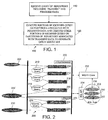
- FIG. 1 is a process flow diagram illustrating a method of executing a received query on transient and persistent data
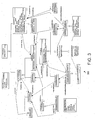
- FIG. 2 is a diagram of a query processor with a pre-processor and an engine for handling and executing queries;
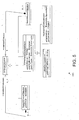
- FIG. 3 is a class diagram illustrating main IQAS classes
- FIG. 4 is a class diagram illustrating "with" clause
- FIG. 5 is a class diagram illustrating "where" clause
- FIG. 6 is an example diagram illustrating data partitions in which certain partitions are dirty and others are persisted
- FIG. 7 is an example initial graph abstraction of an MQL query
- FIG. 8 is a table illustrating spreading characteristics for different types of linked nodes.
- FIG. 9 is an example processed graph abstraction of an MQL query.
- FIG. 1 is a process flow diagram illustrating a method 100 in which, at 110, a query of a repository (e.g., meta-object facility, etc.) is received.
- a repository e.g., meta-object facility, etc.
- Such a repository comprises transient data being modified or processed in memory and persisted data.
- portions of the received query are executed on partitions associated with the persisted data and other portions of the received query are executed on partitions of the repository associated with the transient data to generate a query result set.
- FIG. 2 is a diagram 200 illustrating an MQL processor 201 with a pre-processor 202 and an engine 204.
- Each MQL processor instance 201 expects a pool of basic query language (BQL) processors 236.
- This BQL pool 210 is fixed at MOIN instantiation time and depends on which facilities are bound to the MOIN instance.
- the MQL processor 201 always expects the BQL pool 210 to have a memory 238 implementation of the BQL API 234, which executes BQL queries 240, 242 directly in the MOIN core 232 for the loaded partitions of the client scope.
- the other bound BQL processors are specialized with respect to the facility type. However, all implement the BQL API 234.
- the standard provided facility for MOIN is the Primary Facility or PF BQL 240 (also referred to simply as "PF”), which also provides persistence and an implemented BQL.
- PF BQL 240 also referred to simply as "PF”
- the preprocessor 202 is responsible to turn a client-specified MQL Query 206 into a prepared query.
- the preprocessor maintains 4 phases:
- the result of the preprocessor 202 is the prepared query 222, which is returned to the client.
- the preprocessor 202 only needs to know what BQL processors are registered in the pool 236 and is connection-state independent (i.e., it does not need to know whether the connection has dirty partitions or not). However, the preprocessor 202 does use the connection to access the meta-model data to do the type-checking and transformation in the internal query structure.
- the engine 204 is responsible to execute the prepared query 222 on top of the registered BQL processors 236. It maintains two phases.
- the scheduler 224 of the engine 204 checks if there is dirty state (i.e., some partitions are dirty) and transforms a fourth internal query 226 such that the memory-only results are properly mixed by a mixer 228 with the persistent data. After scheduling, the mixer 228 interprets and executes the fourth internal query 226 by executing the leaf queries on their responsible BQL processor and, if necessary, by combining the results in-memory to eventually produce the desired query result set 230.
- the execution logic within the MQL processor 201 can be based on the Internal Query Abstract Syntax (IQAS for short).
- An MQL prepared query 222 which a client obtains after preparation, is an instance of this data structure.
- the class diagrams 300, 400, 500, respectively in FIGs. 3-5 describe and illustrate the IQAS structure.
- FIG. 3 illustrates the main IQAS classes.
- FIG. 4 illustrates the IQAS "with” clause.
- FIG. 5 illustrates the IQAS "where" clause.
- the type checker 208 of the preprocessor 202 performs all required type and format checks on the input MQL query 206 as it is provided by a MOIN client. During this process, the type checker 208 translates a query formulated in the MQL API into the IQAS structure to generate the first internal query 210.
- the name-based references in the IQAS are only there for debugging purposes.
- the resulting IQAS is a true abstract syntax, i.e. everything is pointer-connected and there are no references-by-name left.
- the expander 212 takes a consistent IQAS query (resulting from the type checker) (i.e., the first internal query 210) and translates it into a new IQAS query 214 (i.e., the second internal query 214), which guarantees that the participating leaf queries are executable by a complete BQL processor.
- a leaf query is an internal query which has no other internal queries in its from-clause.
- the expander 212 can, for example, perform two transformations:
- the first expanding transformation can be illustrated using the following sample MQL query:
- the BasicQL API 234 expects clusters of strongly connected AssocPredicates and LinksPredicates.
- MQL queries 206 which can have more than one such strongly connected cluster, need to be split as attribute and alias comparisons because cross cluster boundaries may still exist. Those boundaries have to be correctly spread over the clusters in such a way that they are calculated in-memory by the MQL engine 204.
- the two AssocPredicates and the LinkPredicate starting from alias e form three clusters represented by the leaf queries q1, q2, and q4.
- the selections in these queries obtain the selections for the final result as well as the selections required to perform the attribute and alias comparisons, which cross cluster boundaries.
- the clusters are grouped in pairs to avoid too large temporary results sets in memory.
- leaf queries may be grouped which have (more) cross-cluster attribute comparisons because this also reduces intermediate result sets as much as possible. For example, for the above query, it would not be as effective to group q4 with q2 or q1.
- a client has to be ability to control whether a query is split in multiple smaller queries, which are then combined in memory. This is achieved with alias comparisons. They allow a client to break up a cluster. For instance, the query
- a client may have introduced alias comparisons which do not break up a cluster and which are therefore semantically unnecessary. For example, the query
- MOIN allows multiple facilities to be connected. It is the assigner's responsibility to execute the query over all registered facilities whenever it makes sense. Each leaf query resulting from the expansion is required to have exactly one BQL processor assigned. Some implementations of MOIN do not support cross-facility links and so the only technique to join results is via attribute comparisons. Such an invariant can be addressed in the logic of the assigner 216.
- each leaf query (as a result of the expander) has to be executed in exactly one facility. For instance, if no explicit scoping exists anywhere in the query, each leaf query has to be split over all facilities and the results have to be combined.
- an explicit (inclusion) scope it is possible that a leaf query does not have to be split, or only has to be split over the facilities which explicitly occur in the PRI (i.e. partition) list of the explicit scope.
- this process works best bottom-up because it is possible that link predicates can share nested queries (i.e., the result of the nested query can be reused).
- the query may have no valid solutions. In that case, an empty result set can be pre-computed.
- PF 240 there are two registered BQL processors: PF 240 and ABAP 242 (which can provides data from the ABAP dictionary).
- the assigner 216 translates it as follows:
- the optimizer 218 may perform optimizations or transformations that are beneficial for performance reasons. Such optimizations may be BQL processor dependent (since each leaf query is assigned a unique BQL processor now). In some variations, the optimizer 218 may talk to a capability API for each BQL processor and possibly further simplify each leaf query. With the example below, only queries that operate on an empty scope are removed.
- the scheduler 224 adapts the prepared query 222 to the current state of the repository (from the scope of one connection). Before doing so, the MQL engine registers 204 with any partition-change events as well as any type of change event to the dirty partition. If during execution, one such event is fired, the query result may be compromised and the client can be informed.
- a clone of the internally prepared query 222 may be made in order to guarantee that multiple executions of the same prepared query 222 do not affect each other.
- explicit scopes in terms of container names are resolved and expanded in the actual partitions they entail at the moment of execution. The latter expansion cannot be accomplished during preparation time because partitions may still move from one container to the other before each query execution (but after query preparation).
- the scheduler 224 acts to transform the internal query such that certain leaf queries are executed in the memory BQL processor 238 and others in the facility-specific BQL processor 240, 242.
- the results are combined in-memory.
- links may go from dirty partitions to persistent partitions and the other way around. Worse, dirty partitions override persistent data giving them precedence in their correctness with regard to their peer (and out-of-date) partitions which still reside persistently. This makes the algorithm for assigning the memory BQL processor 238 to leaf queries somewhat different than the assignment process.
- FIG. 6 is a diagram 600 illustrating a series of partitions p1 - p5, in which certain partitions are dirty and others are persisted.
- the links from b2 to a2 and the link b4 to a4 are cross-dirty-partition links that have storage in the dirty partitions and the links a1 to b1 are cross-dirty-partition links that have no storage in the dirty partitions.
- the dashed links (e.g., a4 to b4, b3 to a3, etc.) represent one of 1) an in-memory dashed link that once existed, but was subsequently deleted, or 2) a persistent dashed link that did not exist before, but was created.
- aliases b* has an attribute m and the type of aliases a* has attribute n. Included are two example aliases with attribute values: b1 has attribute m with value 1 and a2 has attribute n with value 2 persistently. In the dirty partitions, these values changed to 0 and 3 respectively.
- the simplest case is when there is one from-entry, which has no Assoc or Link predicates (because expansion has guaranteed us that clusters need to be dealt with). In that case, one can look at the scope of the one from-entry. If its scope is spread over dirty and non-dirty partitions, one has to unify the results from both sources, (i.e., in-memory from the dirty partitions and persistently over all partitions in scope, except the dirty partitions). If the scope comes exclusively from the dirty state, one only has to obtain the instances from the dirty partitions, and similarly if the scope comes exclusively from non-dirty state.
- the above query unifies four separate result sets.
- the first query runs on all persistent partitions, except those which are labeled dirty (i.e., p2 and p3).
- the second query runs on all partitions, which are in dirty memory only. These two queries produce all the results, which are connected via black links in FIG. 6 (i.e., links between model elements that are either both in dirty partitions or both in persistent partitions).
- the two remaining (top-level) queries find results which are connected via cross-dirty-partitions links. For type A, this means a1, a2, and a4. For type B, this means b1, b2, and b4.
- the exact form of these two queries depends on storage ownership properties of the association. Because storage is on the side of A, in this example, one can find all the results connected via the gray links in FIG. 6 (i.e., b1-a1 links) by computing the third query above, which looks for all links, which have the end of A in one of the dirty partitions and the end of B in a non-dirty partition. In order to calculate this, the memory BQL processor 238 may load the partitions in which the instances of B exist via this link.
- These partitions (together with the dirty partitions p2 and p3) can be calculated by investigating all links located in the dirty partitions and collecting all partitions used by those links. In some implementations, not many partitions will be affected by this arrangement because of a locality-principle when querying data, connected model elements where there is storage for the association.
- the fourth query can be fired.
- This query is complex because it cannot include information from a persistent partition, which has changed in memory.
- a super-set of all relevant links is searched persistently because any conditions on the side of B may be outdated.
- the elements are filtered with the dirty state where the condition on the side of B are up to date.
- Such a query can be characterized as: the instances of B that fulfill the condition from the dirty partitions are joined with the instances found via links in the persistence layer.
- Such an algorithm can be characterized as a spreading algorithm, because it spreads the query over the memory and persistent facilities in such a way that it produces correct results.
- Explicit scoping by MQL clients may empty one of the participating queries even before it is executed. This allows for significant simplifications such that the result can be identical to the original query (i.e., before scheduling). This arrangement can be exploited in the generalized scheduling algorithm described below. However, because of the significant effect explicit scoping has on the effectiveness of the scheduler techniques for optimization can be implemented.
- alias a is dominantly assigned with respect to myAssoc and alias b is sub-dominantly assigned with respect to myAssoc.
- an alias can only be assigned the dominant property with respect to an association if that association has storage on the side of the alias.
- an alias can be assigned sub-dominantly with respect to an association even if the association has storage on that side.
- Links may also be queried via link predicates.
- Link predicates are not affected in the same way by the spreading algorithm because it is possible to compute the nested query first and put its result set in the link predicate. This ability can be exploited as soon as a nested query is subject to any kind of mixing (i.e., results have to be combined in memory).
- Whether or not a nested query is computed separately is indicated with the reset attribute in the NestedQuery class of IQAS. During mixing, this attribute is used to decide whether the results of the nested query should be cached or not.
- scheduling with dirty partitions must be conducted for a query which is a non-trivial cluster containing more than one assoc or link predicate.
- a query which is a non-trivial cluster containing more than one assoc or link predicate.
- the spreading algorithm described above works for two aliases with one association. When a leaf query has more than one assoc predicate, the problem can be reduced to the case for one assoc predicate so that the results can be combined.
- One way to reduce the general problem to the smaller problem is to break the entire cluster apart in many small clusters of one assoc and link predicate. This is possible by cloning all shared aliases and introducing alias comparisons which are resolved by the MQL mixer 228 in memory. This method multiplies the number of required queries by the number of assoc predicates. Although in the general case, this negative behavior cannot be avoided, it does not incorporate the explicit scoping annotations of the client. Because a client is encouraged to give explicit scoping, there may be situations in which a less conservative query break-up can be achieved. As an example, in cases in which it can be initially detected whether a type has instances in a dirty partition in the first place, a less conservative break-up mechanism can be utilized.
- client-specific scoping may simplify the result of spreading considerably.
- the spreader will again produce one query, not a union of multiple queries. Whenever that is the case for an assoc predicate, one can easily deal with another assoc predicate because the spreader only has to add additional constraints in this query.
- nodes can be categorized in three classes:
- the illustrated graph 700 can be decomposed into spreadable sub-graphs such that the final combined result of spreading the sub-graphs produces a correct result.
- the criterion for making the spreader work for more than one assoc predicate is dependent on whether the spreader would have to introduce more than one (unified) query. If more than one query has to be produced, the spreader has to consider all possible combinations of assoc predicates, which makes the eventual results not more attractive than simply breaking up the above graph in pairs. However, when only one query is required to combine more than one assoc predicate, these predicates can be combined in a larger query than just a pair of aliases.
- each query can be named in its order of appearance Q1 through Q3.
- an adapted form of query Q1 let us call it Q1'
- query Q2 can be utilized.
- the table 800 of FIG. 8 lists out queries to use for spreading assoc predicates with different classes of atomic entries.
- cases six and eight have the memory-only nodes as being dominant, which allows them to be solved by query Q2 only. Cases four and five are similar in that they have non-dirty nodes that are dominant, however, it can be expected that the sub-dominant aliases for the association are simpler (i.e. not attribute selection or where-condition).
- the graph 700 can be decomposed into pair-graphs.
- step 4 the algorithm records for the special graphs introduced in step 1 with what type of query they have to be solved as well as the required scoping restrictions for each of the nodes. Similar recording can be conducted for the pair-wise graphs, constructed in step 4.
- FIG. 9 is a graph 900 of an illustrative break up of the graph 700 in FIG. 7 . Notice that atomic entry 900d is "simple" and thus can be included in the strongly connected graph of non-dirty aliases. The result of this breaking up is that the group with myAssoc1, myAssoc2, and myAssoc6 can be calculated in Q1 (and Q1'), the group with myAssoc3 and myAssoc4 in Q2, and the group with myAssoc5 in Q1 and Q2.
- the next step for the scheduler 224 is to split up the above query as occurs with the expander 212:
- query iq1 is untouched.
- query iq2 f is dominant and thus the dependent partitions can be incorporated in the scopes of c_ and f.
- the dependent partitions can be incorporated in the scope of alias b_ in the memory-based query because e_ is dominant.
- implementations of the subject matter described herein may be realized in digital electronic circuitry, integrated circuitry, specially designed ASICs (application specific integrated circuits), computer hardware, firmware, software, and/or combinations thereof.
- ASICs application specific integrated circuits
- These various implementations may include implementation in one or more computer programs that are executable and/or interpretable on a programmable system including at least one programmable processor, which may be special or general purpose, coupled to receive data and instructions from, and to transmit data and instructions to, a storage system, at least one input device, and at least one output device.
- the subject matter described herein may be implemented on a computer having a display device (e.g., a CRT (cathode ray tube) or LCD (liquid crystal display) monitor) for displaying information to the user and a keyboard and a pointing device (e.g., a mouse or a trackball) by which the user may provide input to the computer.
- a display device e.g., a CRT (cathode ray tube) or LCD (liquid crystal display) monitor
- a keyboard and a pointing device e.g., a mouse or a trackball
- Other kinds of devices may be used to provide for interaction with a user as well; for example, feedback provided to the user may be any form of sensory feedback (e.g., visual feedback, auditory feedback, or tactile feedback); and input from the user may be received in any form, including acoustic, speech, or tactile input.
- the subject matter described herein may be implemented in a computing system that includes a back-end component (e.g., as a data server), or that includes a middleware component (e.g., an application server), or that includes a front-end component (e.g., a client computer having a graphical user interface or a Web browser through which a user may interact with an implementation of the subject matter described herein), or any combination of such back-end, middleware, or front-end components.
- the components of the system may be interconnected by any form or medium of digital data communication (e.g., a communication network). Examples of communication networks include a local area network ("LAN”), a wide area network (“WAN”), and the Internet.
- LAN local area network
- WAN wide area network
- the Internet the global information network
- the computing system may include clients and servers.
- a client and server are generally remote from each other and typically interact through a communication network.
- the relationship of client and server arises by virtue of computer programs running on the respective computers and having a client-server relationship to each other.
- the subject matter described herein provides many advantages including the ability to efficiently provide responses to queries of both transient and persistent data so that new or modified model data can form part of the query result set. Additionally, typical tools based on MOIN maintain implicit constraints during the editing process. Such constraints typically ensure a certain form of consistency with existing repository data. The scheduling logic described herein allows for the verification of such constraints with a declarative query before edited data is even saved while avoiding memory consumption levels associated with non-query language based methods (such as JMI).
Landscapes
- Engineering & Computer Science (AREA)
- Theoretical Computer Science (AREA)
- Computational Linguistics (AREA)
- Data Mining & Analysis (AREA)
- Databases & Information Systems (AREA)
- Physics & Mathematics (AREA)
- General Engineering & Computer Science (AREA)
- General Physics & Mathematics (AREA)
- Information Retrieval, Db Structures And Fs Structures Therefor (AREA)
Abstract
Description
- The subject matter described herein relates to the handling of queries of both transient and persistent data.
- The Meta-Object Facility (MOF) Specification (Object Management Group standard) defines an abstract language and a framework for specifying, constructing, and managing technology neutral metamodels. A metamodel can be characterized as an abstract language for some kind of metadata. In addition, the MOF defines a framework for implementing repositories that hold metadata (e.g., models) described by the metamodels. This framework uses standard technology mappings to transform MOF metamodels into metadata APIs. This arrangement gives consistent and interoperable metadata repository APIs for different vendor product and different implementation technologies.
- For infrastructures adopting an MOF repository, such as the SAP Modeling Infrastructure (MOIN) in which a declarative query language has been developed (MQL), MOIN is hosted on a database, either centrally (server-based) or locally (client Integrated Development Environment). In such arrangements, current data is maintained in memory, in particular when it is being processed or modified. Data being processed is referred to as "dirty" when it only exists transiently (i.e., until it is saved to a database).
- One conventional technique for accessing a MOIN repository is via a standardized JAVA API. With this technique, data must be brought into memory, which unnecessarily consumes memory, especially when large amounts of data must be processed.
- In one aspect, a query of a meta-object facility repository that comprises transient data being modified or processed in memory and persisted data is received. Thereafter, portions of the received query on partitions associated with the persisted data are executed and other portions of the received query are executed on partitions of the repository associated with the transient data to generate a query result set.
- In some implementations, it can be determined whether the query is type correct with respect to a corresponding meta-object facility meta-model so that the query can be transformed into a first internal query having an internal query structure. The executing can comprise expanding the first internal query into a second internal query containing leaf queries which can be executed in a single run on all query processors registered with the meta-object facility repository and non-leaf portions which can be interpreted by a query engine. Each leaf query can be assigned with the corresponding registered query processor to generate a third internal query. The third internal query can be optimized to generate a prepared query. Subsequently, it can be checked whether any of the partitions are dirty to generate fourth internal query mixing transient data and persistent data. Leaf queries of the received query can then be executed on the corresponding registered query processors. As a result, the results from the executed leaf queries of the received query with in-memory results can be combined to generate the query result set.
- In an interrelated aspect, an apparatus includes a query pre-processor and a query engine. The query pre-processor can receive a query of a meta-object facility repository, the repository comprising transient data being modified or processed in memory and persisted data. The query engine can execute portions of the received query on partitions associated with the persisted data and can execute portions of the received query on partitions of the repository associated with the transient data to generate a query result set.
- In another aspect, the subject matter described herein provides scheduling logic (performed, for example, by a scheduler in an MQL execution engine) that can break down a client-formulated query into smaller queries, whose results are recombined in memory. Such a process can occur prior to each query execution while taking into account a current state of the repository. In order to implement such an arrangement a scheduler must identify which repository partitions (i.e., artificial groupings of model data) are being edited (and are thus dirty), which partitions are loaded (in memory, but not changed), and which partitions are persistent only (not loaded in memory). Based on this identification, the query is broken down into smaller queries, that either operate in transient memory (typically on dirty data) or on a persistent database. The results of these queries are then combined (also in memory) in the result set, which may be made available to the user.
- In implementations in which there are links (i.e., connections between two model elements that is stored with one or both model elements) in the MOIN repository, if the two model elements are not together in transient memory or not together in persistent memory, the scheduler can spread the bit of the query addressing this link-traversal. A heuristic algorithm as described herein can be utilized to combine link traversal operations while minimizing spreading.
- In other variations, queries can be scoped such that parts (or all) of the considered query are reformulated so as to only execute on selected parts of the MOIN repository. Such scoping information can improve the ability of a scheduler to minimize and/or obviate query spreading.
- Articles are also described that comprise a machine-readable medium embodying instructions that when performed by one or more machines result in operations described herein. Similarly, computer systems are also described that may include a processor and a memory coupled to the processor. The memory may encode one or more programs that cause the processor to perform one or more of the operations described herein.
- The details of one or more variations of the subject matter described herein are set forth in the accompanying drawings and the description below. Other features and advantages of the subject matter described herein will be apparent from the description and drawings, and from the claims.
-
FIG. 1 is a process flow diagram illustrating a method of executing a received query on transient and persistent data; -
FIG. 2 is a diagram of a query processor with a pre-processor and an engine for handling and executing queries; -
FIG. 3 is a class diagram illustrating main IQAS classes; -
FIG. 4 is a class diagram illustrating "with" clause; -
FIG. 5 is a class diagram illustrating "where" clause; -
FIG. 6 is an example diagram illustrating data partitions in which certain partitions are dirty and others are persisted; -
FIG. 7 is an example initial graph abstraction of an MQL query; -
FIG. 8 is a table illustrating spreading characteristics for different types of linked nodes; and -
FIG. 9 is an example processed graph abstraction of an MQL query. - Like reference symbols in the various drawings indicate like elements.
-
FIG. 1 is a process flow diagram illustrating amethod 100 in which, at 110, a query of a repository (e.g., meta-object facility, etc.) is received. Such a repository comprises transient data being modified or processed in memory and persisted data. Thereafter, at 120, portions of the received query are executed on partitions associated with the persisted data and other portions of the received query are executed on partitions of the repository associated with the transient data to generate a query result set. -
FIG. 2 is a diagram 200 illustrating an MQL processor 201 with a pre-processor 202 and anengine 204. Each MQL processor instance 201 expects a pool of basic query language (BQL)processors 236. ThisBQL pool 210 is fixed at MOIN instantiation time and depends on which facilities are bound to the MOIN instance. The MQL processor 201 always expects theBQL pool 210 to have amemory 238 implementation of theBQL API 234, which executesBQL queries MOIN core 232 for the loaded partitions of the client scope. The other bound BQL processors are specialized with respect to the facility type. However, all implement theBQL API 234. The standard provided facility for MOIN is the Primary Facility or PF BQL 240 (also referred to simply as "PF"), which also provides persistence and an implemented BQL. - The
preprocessor 202 is responsible to turn a client-specified MQL Query 206 into a prepared query. The preprocessor maintains 4 phases: - 1. Type checker 208: The
type checker phase 208 checks if theMQL query 206 is type correct with respect to the MOF meta-model it operates on. Along the way, it translates the query into a firstinternal query 210 having an internal query structure. - 2. Expander 214: In the
expander phase 214, the firstinternal query 210 is expanded into a secondinternal query 214 such that it consists of query parts (leafs) which can be executed in one run on all registered BQL processors defined by theBQL pool 236. The remaining (non-leaf) parts are then interpreted by theMQL engine 204. In many ways, the expander performs macro-expansion to circumvent BQL restrictions. - 3. Assigner 216: In the
assigner phase 216, the corresponding registered BQL processor is assigned to each leaf query part and may transform the query to deal with multiple facilities to generate a thirdinternal query 218. - 4. Optimizer 218: In the
optimizer phase 218, both facility-independent as well as facility-dependent optimizations can take place in connection with the generation of aprepared query 222. This phase may talk to a capability API of the assigned BQL for each involved leaf query and may further simplify the query. - The result of the
preprocessor 202 is theprepared query 222, which is returned to the client. Thepreprocessor 202 only needs to know what BQL processors are registered in thepool 236 and is connection-state independent (i.e., it does not need to know whether the connection has dirty partitions or not). However, thepreprocessor 202 does use the connection to access the meta-model data to do the type-checking and transformation in the internal query structure. - The
engine 204 is responsible to execute theprepared query 222 on top of the registeredBQL processors 236. It maintains two phases. Thescheduler 224 of theengine 204 checks if there is dirty state (i.e., some partitions are dirty) and transforms a fourthinternal query 226 such that the memory-only results are properly mixed by amixer 228 with the persistent data. After scheduling, themixer 228 interprets and executes the fourthinternal query 226 by executing the leaf queries on their responsible BQL processor and, if necessary, by combining the results in-memory to eventually produce the desired query result set 230. - The execution logic within the MQL processor 201 (both the
MQL preprocessor 202 and MQL engine 204) can be based on the Internal Query Abstract Syntax (IQAS for short). An MQL preparedquery 222, which a client obtains after preparation, is an instance of this data structure. The class diagrams 300, 400, 500, respectively inFIGs. 3-5 describe and illustrate the IQAS structure.FIG. 3 illustrates the main IQAS classes.FIG. 4 illustrates the IQAS "with" clause.FIG. 5 illustrates the IQAS "where" clause. - The
type checker 208 of thepreprocessor 202 performs all required type and format checks on theinput MQL query 206 as it is provided by a MOIN client. During this process, thetype checker 208 translates a query formulated in the MQL API into the IQAS structure to generate the firstinternal query 210. The name-based references in the IQAS are only there for debugging purposes. The resulting IQAS is a true abstract syntax, i.e. everything is pointer-connected and there are no references-by-name left. - The
expander 212 takes a consistent IQAS query (resulting from the type checker) (i.e., the first internal query 210) and translates it into a new IQAS query 214 (i.e., the second internal query 214), which guarantees that the participating leaf queries are executable by a complete BQL processor. A leaf query is an internal query which has no other internal queries in its from-clause. - The
expander 212, can, for example, perform two transformations: - 1. Splitting: Each leaf query can only be a true cluster (i.e., a query where all from-entries are connected to each other). The splitter moves any attribute or alias comparisons which cross two clusters to a higher level and constructs one leaf query for one cluster.
- 2. Removing unnecessary alias comparisons: Because BQL does not support alias comparisons (they are semantically not necessary within one cluster), this phase removes alias comparisons within one cluster. Alias comparisons that cross clusters are moved upwards by the splitter.
- The first expanding transformation can be illustrated using the following sample MQL query:
    (select a, a.n, b, b.m, c.n
    from A as a, B as b, C as c, D as d, E as e
    where a.p = b.m
    where b.end12[assoc1] = c
    here a.end22[assoc2] = d
    where d.t > e.f
    where a.end3[assoc3] in (select ...)
    where d.end4[assoc4] in (select ...)
    where e.end5[assoc5] in (select ...)
    where a.p > 5
    where e.f < 5
    where c.h = "test"
    where d.k = 0 and d.s = true
    where b.m != 3) as result
   select q3.q2.a, q3.q2.a.n, q3.q1.b, q3.q1.b.m, q3.q1.c.n
   from (select q2.a, q2.a.n, q1.b, q1.b.m, q1.c.n, q2.d.t
           from (select b, b.m, c.n
                  from B as b, C as c
                  where b.end12[assoc1] = c
                  where b.m != 3) as q1,
                 (select a, a.n, a.p, d.t t
                  from A as a, D as d
                  where a.end22[assoc2] = d
                  where a.end3 [assoc3] in (select ...)
                  where d.end4 [assoc4] in (select ...)
                  where a.p > 5
                  where d.k = 0 and d.s = true) as q2
           where q2.a.p = q1.b.m) as q3,
          (select e.f
           from E as e
          where e.end5 [assoc5] in (select ...)
          where e.f < 5) as q4
   where q3.q2.d.t > q4.e.f
   (select a.t, b.m, c.n
    from A as a, B as b, B as b_, C as c
     where a.end12[assoc1] = b
     where b_.end22[assoc2] = c
     where b = b_) as result
is broken by the splitter in two smaller queries, each working on a BQL processor and joined by the MQL processor in memory.
    (select a.t, b.m, c.n
     from A as a, B as b, B as b_, C as c
     where a.end12[assoc1] = b
     where b_.end22[assco2] = c
     where a.end32[assoc3] = c
     where b = b_) as result
does not actually break the cluster. Thus, a query which unifies aliases b and b_ will return the same results.
    (select a, b
     from A as a, B as b
    where a.endl2[myAssocl] = b
    where a.end22[myAssoc2] in
           (select c
            from c as C, d as D in {p1}
           where c.end32[myAssoc3] = d)) as result
    (select[PF] a, b
    from A as a, B as b
    where a.end12[myAssoc1] = b
    where a.end22[myAssoc2] in
           (select[PF] c
           from c as C, d as D in {p1}
           where c.end32[myAssoc3] = d)) as result
    (select q1.a, q2.c.m
     from (select a, a.n from A as a) as q1,
           (select c, c.m from C as c) as q2
     where q1.a.n = q2.c.m) as result
    (select q3.a, q4.c.m
     from ((select[PF] a, a.n from A as a))
            union
            (select[ABAP] a, a.n from A as a))) as q3,
           ((select[PF] c, c.m from C as c))
            union
            (select [ABAP] c, c.m from C as c))) as q4
     where q3.a.n = q4.c.m) as result
    (select[PF] a, a.attr1
    from A as a
    where a.n = 3) as result
    ((select[PF] a, a.attr1
      from A as a not in {p2 , p3}
      where a.n = 3)
    union
     (select[MEMORY] a, a.attr1
      from A as a in {p2, p3}
      where a.n = 3) as result
    (select[PF] a, a.attr1, b, b.attr2
     from A as a, B as b
     where a.end2[myAssoc] = b
     where a.n > b.m
     where b.m > 0
     where a.n = 3) as result
    ((select[PF] a, a.attr1, b, b.attr2
      from A as a not in {p2, p3}, B as b not in {p2, p3}
      where a.end2[myAssoc] = b
      where a.n > b.m
      where b.m > 0
      where a.n = 3)
    union
     (select[MEMORY] a, a.attr1, b, b.attr2
      from A as a in {p2, p3}, B as b in {p2, p3}
     where a.end2[myAssoc] = b
     where a.n > b.m
     where b.m > 0
     where a.n = 3)
    union
      (select[MEMORY] a, a.attr1, b, b.attr2
      from A as a in {p2, p3}, B as b in {p1, p4}
      where a.end2[myAssoc] = b
      where a.n > b.m
      where b.m > 0
      where a.n = 3)
     union
     (select q1.a, q1.a.attr1, q2.b, q2.b.attr2
      from (select[PF] a, a.attr1, a.n, b_
             from A as a not in {p2, p3}, B as b_ in {p2, p3}
             where a.end2[myAssoc] = b_
             where a.n = 3) as q1,
            (select[MEMORY] b, b.attr2, b.m
             from B as b in {p2, p3}
             where b.m > 0) as q2
      where q1.b_ = q2.b)
      where q1.a.n > q2.b.m) as result
    ((select[PF] a, a.attr1, b, b.attr2
      from A as a not in {p2, p3}, B as b not in {p2, p3}
      where a.end2[myAssoc] = b
      where a.n > b.m
      where b.m > 0
      where a.n = 3)
    union
     (select [MEMORY] a, a.attr1, b, b.attr2
      from A as a in {p2, p3}, B as b in {p1, p2, p3, p4}
     where a.end2[myAssoc] = b
      where a.n > b.m
      where b.m > 0
      where a.n = 3)
     union
      (select q1.a, q1.a.attr1, q2.b, q2.b.attr2
      from (select[PF] a, a.attr1, b_
             from A as a not in {p2, p3}, B as b_ in {p2, p3}
             where a.end2[myAssoc] = b
             where a.n = 3) as q1,
            (select[MEMORY] b, b.attr2
             from B as b in {p2, p3}
             where b.m > 0) as q2
      where q1.b_ = q2.b
      where q1.a.n > q2.b.m)) as result
- • No attribute selection on B exists in the select clause
- • There exists no where clause for B
- • There exists no attribute comparison which involves attributes of B
- • B is not involved in a links predicate
Consider the slightly adapted sample query:
    (select[PF] a, a.attr1, b
    from A as a, B as b
    where a.end2[myAssoc] = b
    where a.n = 3) as result
     ((select[PF] a, a.attr1, b B as b
       from A as a not in {p2, p3}, B as b
      where a.end2[myAssoc] = b
      where a.n = 3)
     union
      (select[MEMORY] a, a.attr1, b
      from A as a in {p2, p3}, B as b in {p1, p2, p3, p4}
      where a.end2[myAssoc] = b
      where a.n = 3)) as result
- 1. The nested query is processed entirely (up to its own link predicates) in one BQL processor; and
- 2. The (possibly non-leaf) query holding the link predicate can be processed in the same BQL processor.
    (select[PF] a, a.attr1
     from A as a
     where a.end2[myAssoc] in
           (select[PF] b
            from B as b in {p4}
            where b.m = 0)
     where a.n = 3) as result
    ((select[PF] a, a.attr1
      from A as a not in {p2, p3}
      where a.end2[myAssoc] in
            (select[PF] b
             from B as b in {p4}
             where b.m = 0) as q
      where a.n = 3)
     union
    (select[MEMORY] a, a.attr1
      from A as a in {p2, p3}
      where a.end2[myAssoc] in
            (select[PF] b
             from B as b in {p4}
             where b.m = 0) as q
     where a.n = 3)) as result
With such a result, query q is internally shared (i.e., the original nested query was reset before the spreader started).
- 1.
Non-dirty nodes - 2. Memory-only
nodes - 3.
Mixed nodes 700e, meaning that the explicit or implicit scope includes both dirty and non-dirty partitions.
- 1. Search for the "largest" (i.e. the largest number of edges) possible sub-graph with at least one edge, constructed in one of the following two ways:
- a. The graph is a strongly connected sub-graph of memory-only nodes with possibly other-colored nodes hanging on to it where storage is on the side of the memory-only node; or
- b. The graph is a strongly connected sub-graph of non-dirty nodes with possibly other-colored nodes hanging on to it which are simple and where storage is on the side of the non-dirty node
- 2. Whenever there was a choice, prefer the second type and "isolate" it from the original graph (by cloning and introducing alias comparisons);
- 3. Go back to
step 1 until no graph like that can be constructed. In that case, it can be established that the remaining graph only has mixed nodes and possibly memory-only and non-dirty nodes for which no storage exists on their sides. - 4. For those remaining graphs, perform a complete break-up, and therefore produce sub-graphs which are pairs and directly amenable to spreading.
      (select[PF] a, b, c, d, e, f.attr
       from A as a in {p4, p5},
             B as b in {p1},
             C as c in {p6, p7},
             D as d in {p2},
             E as e,
             F as f in {p2, p3}
      where a.end12 [myAssoc1] = b
      where b.end22[myAssoc2] = c
      where c.end32[myAssoc3] = f
      where f.end42[myAssoc4] = e
      where e.end52[myAssoc5] = b
      where b.end61[myAssoc6] = d) as result
     Assuming that p2 and p3 are dirty, breaking up the leaf query graph produces:
      (select[PF] a, b, c, d, e, f.attr
       from A as a in {p4, p5}
            B as b in {p1},
            B as b_ in {p1},
            C as c in {p6, p7},
            C as c_ in {p6, p7},
           D as d in {p2},
           E as e,
           E as e_,
           F as f in {p2, p3}
     where a.end12[myAssocl] = b
     where b.end22[myAssoc2] = c
     where c_.end32[myAssoc3] = f
     where f.end42[myAssoc4] = e
     where e_.end52[myAssoc5] = b_
     where b.end62[myAssoc6] = d
     where b = b_
     where c = c_
     where e = e_) as result
    (select iq3.iq1.a, iq3.iq1.b, iq3.iq1.c,
             iq3.iq1.d, iq3.iq2.e, iq3.iq2.f.attr
     from (select iq1.a, iq1.b, iq1.c, iq1.d, iq2.e, iq2.f.attr
            from (select[PF] a, b, c, d
                   from A as a in {p4, p5}
                         B as b in {p1},
                         C as c in {p6, p7},
                         D as d in {p2}
                   where a.end12[myASsoc1] = b
                   where b.end22[myAssoc2] = c
                   where b.end62[myAssoc6] = d) as iq1,
                  (select[PF] c_, f, f.attr, e
                   from C as c_ in {p6, p7},
                         E as e,
                         F as f in {p2, p3}
                  where c_.end32[myAssoc3] = f
                  where f.end42[myAssoc4] = e) as iq2
           where iq1.c = iq2.c_) as iq3,
           (select[PF] b_, e_
            from B as b_ in {p1},
                 E as e_
           where e_.end52[myAssoc5] = b_) as iq4
     where iq3.iq1.b = iq4.b_
     where iq3.iq2.e = iq4.e_) as result
- • The association dependent partitions for alias c_ from alias f via assoc myAssoc3 are p6 and p5
- • The association dependent partitions for alias e from alias f via myAssoc4 are p3 and p4
- • The association dependent partitions for alias b_ from alias e_ via myAssoc5 are p1, p2, and p5
    (select iq3.iq1.a, iq3.iq1.b, iq3.iq1.c,
             iq3.iq1.d, iq3.iq2.e, iq3.iq2.f.attr
    from (select iq1.a, iq1.b, iq1.c, iq1.d, iq2.e, iq2.f, iq2.f.attr
           from (select[PF] a, b, c, d
                   from A as a in {p4, p5}
                        B as b in {p1},
                        C as c in {p6, p7},
                        D as d in {p2}
                  where a.end12[myAssocl] = b
                  where b.end22[myAssoc2] = c
                  where b.end62[myAssoc6] = d) as iq1
                  (select[MEMORY] c_, f, f.attr, e
                  from C as c_ in {p6},
                        E as e in {p3, p4},
                        F as f in {p2, p3}
                  where c_.end32[myAssoc3] = f
                  where f.end42[myAssoc4] e) as iq2
           where iq1.c = iq2.c_) as iq3,
          ((select[PF] b_, e_
             from B as b_ in {p1},
                   E as e_ not in {p2, p3}
             where e_.end52[myAssoc5] = b_)
            union
            (select[MEMORY] b_, e_
             from B as b_ in {p1, p2, p5},
                   E as e_ in {p2, p3}
             where e_.end52 [myAssoc5] = b_)) as iq4
    where iq3.iq1.b = iq4.b_
    where iq3.iq2.e = iq4.e_) as result
Claims (20)
- A computer program product comprising computer-readable instructions that when performed by one or more machines result in operations comprising:receiving a query of a meta-object facility repository, the repository comprising transient data being modified or processed in memory and persisted data; andexecuting portions of the received query on partitions associated with the persisted data and executing other portions of the received query on partitions of the repository associated with the transient data to generate a query result set.
- A computer program product as in claim 1, wherein the executing further comprises:determining whether the query is type correct with respect to a corresponding meta-object facility meta-model; andtransforming the query into a first internal query having an internal query structure.
- A computer program product as in claim 2, wherein the executing further comprises:expanding the first internal query into a second internal query containing leaf queries which can be executed in a single run on all query processors registered with the meta-object facility repository and non-leaf portions which can be interpreted by a query engine.
- A computer program product as in claim 3, wherein the executing further comprises:assigning each leaf query with the corresponding registered query processor to generate a third internal query.
- A computer program product as in claim 4, wherein the executing further comprises:optimizing the third internal query to generate a prepared query.
- A computer program product as in claim 4 or 5, wherein the executing further comprises:checking whether any of the partitions are dirty to generate fourth internal query mixing transient data and persistent data.
- A computer program product as in any one of the preceding claims, wherein the executing further comprises:executing the leaf queries of the received query on the corresponding registered query processors.
- A computer program product as in any one of the preceding claims, wherein the executing further comprises:combining results from the executed leaf queries of the received query with in-memory results to generate the query result set.
- A computer-implemented method comprising:receiving a query of a meta-object facility repository, the repository comprising transient data being modified or processed in memory and persisted data; andexecuting a first set of portions of the received query on partitions associated with the persisted data and executing a second set of portions of the received query on partitions of the repository associated with the transient data to generate a query result set, the first set and second set of portions being disjoint.
- A method as in claim 9, wherein the executing further comprises:determining whether the query is type correct with respect to a corresponding meta-object facility meta-model; andtransforming the query into a first internal query having an internal query structure.
- A method as in claim 10, wherein the executing further comprises:expanding the first internal query into a second internal query containing leaf queries which can be executed in a single run on all query processors registered with the meta-object facility repository and non-leaf portions which can be interpreted by an engine.
- A method as in claim 11, wherein the executing further comprises:assigning each leaf query with the corresponding registered query processor to generate a third internal query.
- A method as in claim 12, wherein the executing further comprises:optimizing the third internal query to generate a prepared query.
- A method as in claim 12 or 13, wherein the executing further comprises:checking whether any of the partitions are dirty to generate fourth internal query mixing transient data and persistent data.
- A method as in any one of the preceding claims 9 to 14, wherein the executing further comprises:executing the leaf queries of the received query on the corresponding registered query processors.
- A method as in any one of the preceding claims 9 to 15, wherein the executing further comprises:combining results from the executed leaf queries of the received query with in-memory results to generate the query result set.
- An apparatus comprising:a query pre-processor to receive a query of a meta-object facility repository, the repository comprising transient data being modified or processed in memory and persisted data; anda query engine to execute portions of the received query on partitions associated with the persisted data and to execute portions of the received query on partitions of the repository associated with the transient data to generate a query result set.
- An apparatus as in claim 17, wherein the pre-processor comprises:a type checker to determine whether the query is type correct with respect to a corresponding meta-object facility meta-model and to transform the query into a first internal query having an internal query structure;an expander to expand the first internal query into a second internal query containing leaf queries which can be executed in a single run on all query processors registered with the meta-object facility repository and non-leaf portions which can be interpreted by the engine;an assigner to assign each leaf query with the corresponding registered query processor to generate a third internal query; andan optimizer to optimize the third internal query to generate a prepared query.
- An apparatus as in claim 17 or 18, wherein the engine comprises:a scheduler to check whether any of the partitions are dirty to generate fourth internal query mixing transient data and persistent data and to execute the leaf queries of the received query on the corresponding registered query processors; anda mixer to combine results from the executed leaf queries of the received query with in-memory results to generate the query result set.
- An apparatus as in claim 17, 18 or 19, wherein the query pre-processor identifies partitions of the repository in which data is being modified, partitions of the repository that are loaded in memory but are unchanged, and partitions of the repository which are persisted and not loaded in memory.
Applications Claiming Priority (1)
| Application Number | Priority Date | Filing Date | Title |
|---|---|---|---|
| US11/788,582 US7689612B2 (en) | 2007-04-19 | 2007-04-19 | Handling of queries of transient and persistent data |
Publications (1)
| Publication Number | Publication Date |
|---|---|
| EP1983447A1 true EP1983447A1 (en) | 2008-10-22 |
Family
ID=39672671
Family Applications (1)
| Application Number | Title | Priority Date | Filing Date |
|---|---|---|---|
| EP08005675A Ceased EP1983447A1 (en) | 2007-04-19 | 2008-03-26 | Handling of queries of transient and persistent data |
Country Status (2)
| Country | Link |
|---|---|
| US (1) | US7689612B2 (en) |
| EP (1) | EP1983447A1 (en) |
Families Citing this family (16)
| Publication number | Priority date | Publication date | Assignee | Title |
|---|---|---|---|---|
| US9146957B2 (en) * | 2012-12-20 | 2015-09-29 | Business Objects Software Ltd. | Method and system for generating optimal membership-check queries |
| US9342907B1 (en) * | 2013-03-06 | 2016-05-17 | Lockheed Martin Corporation | Method and system for analyzing ballistic trajectories |
| US9600805B2 (en) | 2013-06-25 | 2017-03-21 | Sap Se | Presenting information on a mobile communication device |
| US9176801B2 (en) | 2013-09-06 | 2015-11-03 | Sap Se | Advanced data models containing declarative and programmatic constraints |
| US9361407B2 (en) | 2013-09-06 | 2016-06-07 | Sap Se | SQL extended with transient fields for calculation expressions in enhanced data models |
| US9430523B2 (en) | 2013-09-06 | 2016-08-30 | Sap Se | Entity-relationship model extensions using annotations |
| US9639572B2 (en) | 2013-09-06 | 2017-05-02 | Sap Se | SQL enhancements simplifying database querying |
| US9575819B2 (en) | 2013-09-06 | 2017-02-21 | Sap Se | Local buffers for event handlers |
| US9442977B2 (en) | 2013-09-06 | 2016-09-13 | Sap Se | Database language extended to accommodate entity-relationship models |
| US9619552B2 (en) | 2013-09-06 | 2017-04-11 | Sap Se | Core data services extensibility for entity-relationship models |
| US9354948B2 (en) | 2013-09-06 | 2016-05-31 | Sap Se | Data models containing host language embedded constraints |
| JP5967628B2 (en) * | 2014-11-04 | 2016-08-10 | インターナショナル・ビジネス・マシーンズ・コーポレーションInternational Business Machines Corporation | Apparatus and method for processing a query |
| EP3550444B1 (en) * | 2018-04-02 | 2023-12-27 | Thoughtspot Inc. | Query generation based on a logical data model |
| US11928114B2 (en) | 2019-04-23 | 2024-03-12 | Thoughtspot, Inc. | Query generation based on a logical data model with one-to-one joins |
| US11409744B2 (en) | 2019-08-01 | 2022-08-09 | Thoughtspot, Inc. | Query generation based on merger of subqueries |
| US11580111B2 (en) | 2021-04-06 | 2023-02-14 | Thoughtspot, Inc. | Distributed pseudo-random subset generation |
Family Cites Families (11)
| Publication number | Priority date | Publication date | Assignee | Title |
|---|---|---|---|---|
| US6760815B1 (en) * | 2000-06-02 | 2004-07-06 | Sun Microsystems, Inc. | Caching mechanism for a virtual heap |
| US20020103815A1 (en) * | 2000-12-12 | 2002-08-01 | Fresher Information Corporation | High speed data updates implemented in an information storage and retrieval system |
| US6678677B2 (en) * | 2000-12-19 | 2004-01-13 | Xerox Corporation | Apparatus and method for information retrieval using self-appending semantic lattice |
| US6691101B2 (en) * | 2001-06-21 | 2004-02-10 | Sybase, Inc. | Database system providing optimization of group by operator over a union all |
| US6981104B2 (en) * | 2002-07-12 | 2005-12-27 | Hewlett-Packard Development Company, L.P. | Method for conducting checkpointing within a writeback cache |
| US7308474B2 (en) * | 2002-11-06 | 2007-12-11 | Oracle International Corporation | Techniques for scalably accessing data in an arbitrarily large document by a device with limited resources |
| US7089235B2 (en) * | 2003-04-17 | 2006-08-08 | International Business Machines Corporation | Method for restricting queryable data in an abstract database |
| GB0406860D0 (en) * | 2004-03-26 | 2004-04-28 | British Telecomm | Computer apparatus |
| US7546335B2 (en) * | 2004-09-02 | 2009-06-09 | Broadway Technology, Llc | System and method for a data protocol layer and the transfer of data objects using the data protocol layer |
| US7970823B2 (en) * | 2004-09-02 | 2011-06-28 | Broadway Technology, Llc | System for sharing data objects among applications |
| US8108355B2 (en) * | 2006-10-27 | 2012-01-31 | Hewlett-Packard Development Company, L.P. | Providing a partially sorted index |
-
2007
- 2007-04-19 US US11/788,582 patent/US7689612B2/en active Active
-
2008
- 2008-03-26 EP EP08005675A patent/EP1983447A1/en not_active Ceased
Non-Patent Citations (13)
| Title |
|---|
| ALTENHOFEN ET AL: "OCL support in an industrial environment", OCL APPS WORKSHOP, 1 September 2006 (2006-09-01), pages 126 - 138, XP002445485 * |
| AXEL UHL: "Model-Driven Development at SAP", MODEL DRIVEN ARCHTITECTURE, SS2006 COURSE MATERIALS, 12 July 2006 (2006-07-12), XP002492994, Retrieved from the Internet <URL:http://download.informatik.uni-freiburg.de/lectures/MDA/2005-2006WS/Slides//VorlesungFreiburg.ppt> [retrieved on 20080820] * |
| DUDDY K ET AL: "MOF Query / Views / Transformations, Initial Submission", OMG DOCUMENT, no. AD-2003-02-03, 3 March 2003 (2003-03-03), pages 1 - 66, XP002311737 * |
| HEARNDEN D ET AL: "MQL: a powerful extension to OCL for MOF queries", ENTERPRISE DISTRIBUTED OBJECT COMPUTING CONFERENCE, 2003. PROCEEDINGS. SEVENTH IEEE INTERNATIONAL 16-19 SEPT. 2003, PISCATAWAY, NJ, USA,IEEE, 16 September 2003 (2003-09-16), pages 264 - 276, XP010659498, ISBN: 978-0-7695-1994-4 * |
| ILIA PETROV ET AL.: "iRM: An OMG MOF Based Repository System with Querying Capabilities", ER 2004, 2004, XP009104641 * |
| ILIA PETROV, STEFAN JABLONSKI: "An OMG MOF based Repository System with Querying Capability ? the iRM Project", PROCEEDINGS OF THE SIXTH INTERNATIONAL CONFERENCE ON INFORMATION INTEGRATION AND WEB-BASED APPLICATIONS & SERVICES (IIWAS2004), 2004, XP009104750 * |
| KOTOPOULOS G ET AL: "Querying MOF Repositories: The Design and Implementation of the Query Metamodel Language (QML)", 20070201, 1 February 2007 (2007-02-01), pages 373 - 378, XP031176985 * |
| LOECHER S ET AL: "A Metamodel-Based OCL-Compiler for UML and MOF", ELECTRONIC NOTES IN THEORETICAL COMPUTER SCIENCE, ELSEVIER, vol. 102, 2 November 2004 (2004-11-02), pages 43 - 61, XP004649636, ISSN: 1571-0661 * |
| MICHAEL THONHAUSER ET AL: "Model-Based Data Processing with Transient Model Extensions", ENGINEERING OF COMPUTER-BASED SYSTEMS, 2007. ECBS '07. 14TH ANNUA L IEEE INTERNATIONAL CONFERENCE AND WORKSHOPS ON THE, IEEE, PI, 1 March 2007 (2007-03-01), pages 299 - 306, XP031073960, ISBN: 978-0-7695-2772-7 * |
| OMG: "Meta Object Facility (MOF) Core Specification, Version 2.0", OMG AVAILABLE SPECIFICATION, January 2006 (2006-01-01), XP002492996, Retrieved from the Internet <URL:http://www.omg.org/docs/formal/06-01-01.pdf> [retrieved on 20080821] * |
| THOMAS HETTEL: "Impact Analysis of OCL Expressions", DIPLOMARBEIT, April 2006 (2006-04-01), XP009087735 * |
| UHL A.: "Model-Driven Development in SAP", MODEL DRIVEN ARCHITECTURE SS2006 (LECTURE PRESENTED BY THIEMANN P.), XP002492995, Retrieved from the Internet <URL:http://electures.informatik.uni-freiburg.de/catalog/chapter.do?courseId=mdaSS2006&chapter=10> [retrieved on 20080821] * |
| UNIVERSITÄT KARLSRUHE: "Neuerwerbungen April 2006", FAKULTÄTSBIBLIOTHEK INFORMATIK NEUERWERBUNGEN, April 2006 (2006-04-01), XP002445493 * |
Also Published As
| Publication number | Publication date |
|---|---|
| US20080262999A1 (en) | 2008-10-23 |
| US7689612B2 (en) | 2010-03-30 |
Similar Documents
| Publication | Publication Date | Title |
|---|---|---|
| US7689612B2 (en) | Handling of queries of transient and persistent data | |
| JP6850907B2 (en) | Generate and execute query plans in a relational database management system with a temporal-relational database | |
| US9229978B2 (en) | Rule-based extendable query optimizer | |
| US9904522B2 (en) | Web development system | |
| EP1725929B1 (en) | System and method for efficient evaluation of a query that invokes a table valued function | |
| US10191943B2 (en) | Decorrelation of user-defined function invocations in queries | |
| US7716246B2 (en) | Dynamic mechanism for providing metadata | |
| Carey | Data delivery in a service-oriented world: the bea aqualogic data services platform | |
| US20080183725A1 (en) | Metadata service employing common data model | |
| US10997174B2 (en) | Case join decompositions | |
| Eastman | System facilities for CAD databases | |
| US11188450B2 (en) | Cloud application architecture using edge computing | |
| EP4361834A1 (en) | Fine-grained decision on propagation of revalidation | |
| EP3384385B1 (en) | Methods and systems for mapping object oriented/functional languages to database languages | |
| US11474812B1 (en) | Automated data store access source code review | |
| US10831784B2 (en) | Integration of relational calculation views into a relational engine | |
| US20030051230A1 (en) | Code management software fast transactions using state table technology | |
| US9864796B2 (en) | Databases from models | |
| CN115587148A (en) | Business-meaning-free data access method and device suitable for low-code platform | |
| US7499956B1 (en) | Annotation processing from source files and class files | |
| KR20250058696A (en) | Relational subtree matching for improved query performance | |
| US9753981B2 (en) | Hierarchical runtime settings within distributed query execution frameworks | |
| US11113285B2 (en) | Partition aware partial query processing | |
| Zhu | Towards Automated Online Schema Evolution | |
| Reimann | Optimization of BPEL/SQL Flows in Federated Database Systems |
Legal Events
| Date | Code | Title | Description |
|---|---|---|---|
| PUAI | Public reference made under article 153(3) epc to a published international application that has entered the european phase |
Free format text: ORIGINAL CODE: 0009012 |
|
| AK | Designated contracting states |
Kind code of ref document: A1 Designated state(s): AT BE BG CH CY CZ DE DK EE ES FI FR GB GR HR HU IE IS IT LI LT LU LV MC MT NL NO PL PT RO SE SI SK TR |
|
| AX | Request for extension of the european patent |
Extension state: AL BA MK RS |
|
| 17P | Request for examination filed |
Effective date: 20090422 |
|
| AKX | Designation fees paid |
Designated state(s): AT BE BG CH CY CZ DE DK EE ES FI FR GB GR HR HU IE IS IT LI LT LU LV MC MT NL NO PL PT RO SE SI SK TR |
|
| 17Q | First examination report despatched |
Effective date: 20110906 |
|
| RAP1 | Party data changed (applicant data changed or rights of an application transferred) |
Owner name: SAP SE |
|
| STAA | Information on the status of an ep patent application or granted ep patent |
Free format text: STATUS: THE APPLICATION HAS BEEN REFUSED |
|
| 18R | Application refused |
Effective date: 20160311 |